Impact of Various Mouthwashes on the Color Stability of Hybrid Ceramic and Reinforced Composite CAD/CAM Restorative Materials: An In Vitro Study
 , , ,
, , ,
Abstract
1. Introduction
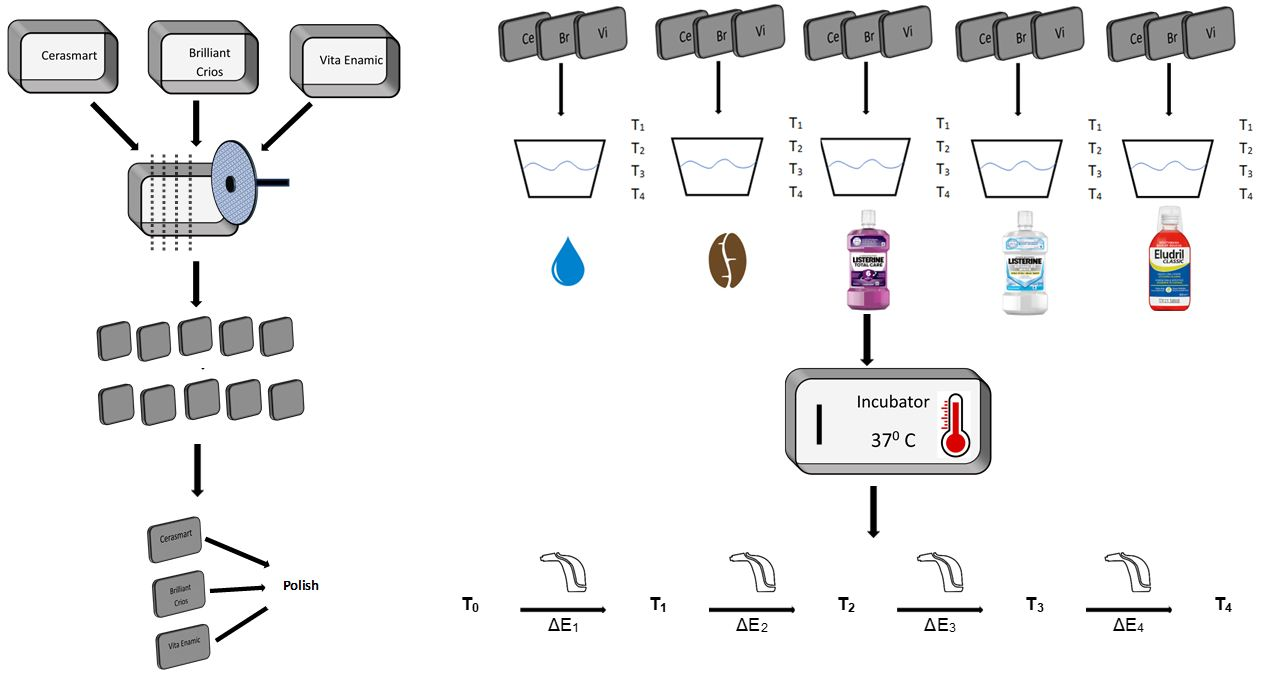
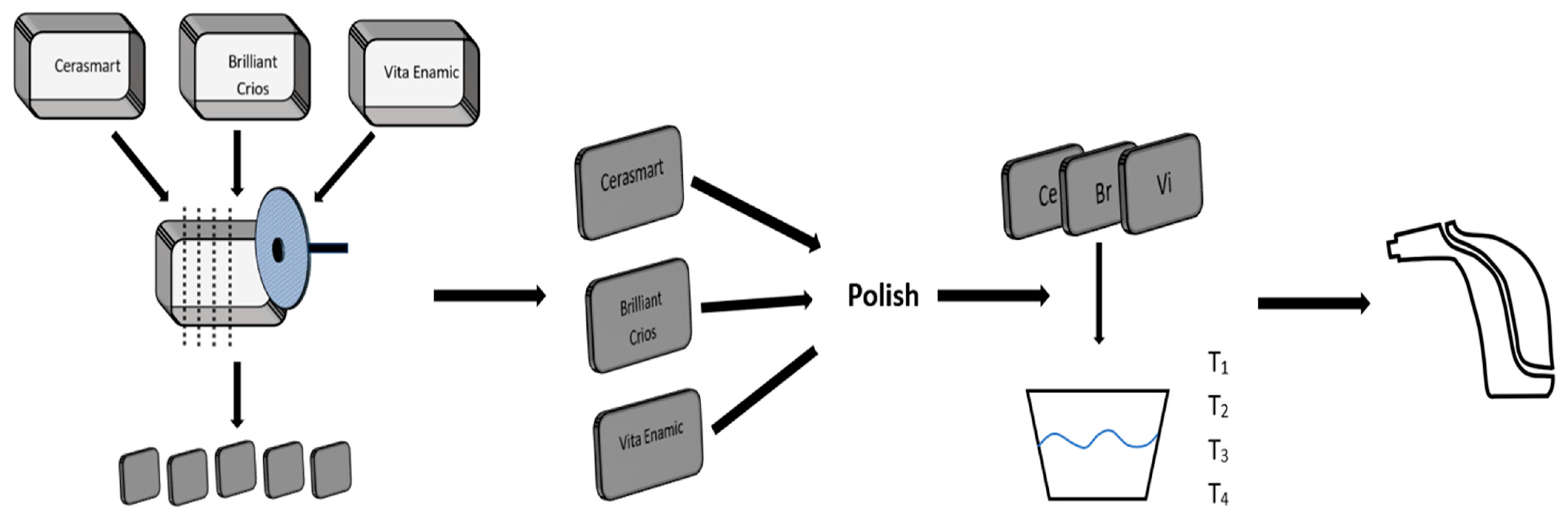
2. Materials and Methods
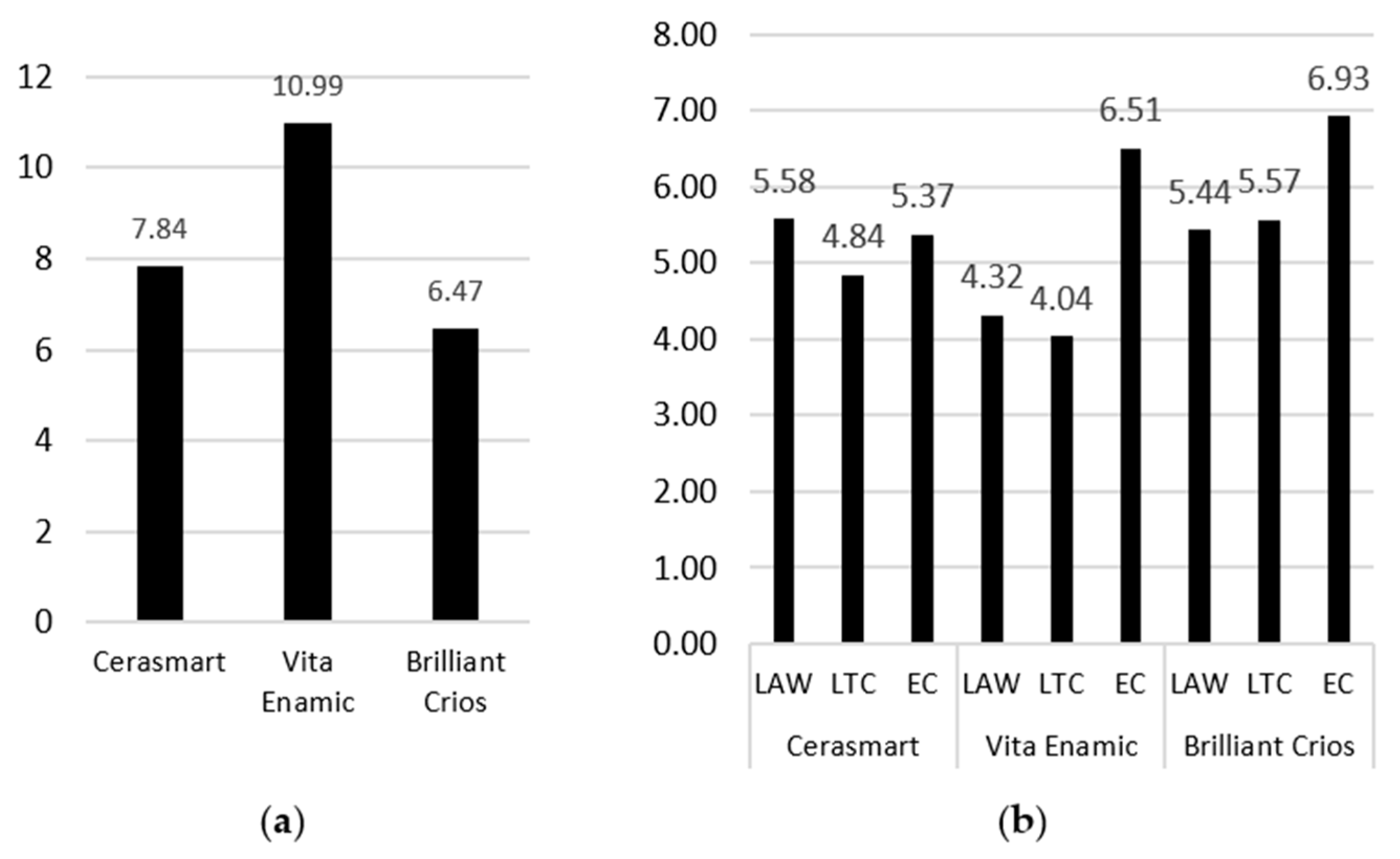
3. Results
- ΔC > 0 → Increase in chroma. The color becomes more saturated, more vivid, more intense.
- ΔC = 0 → No change in chroma. The saturation remains stable.
- ΔC < 0 → Decrease in chroma. The color becomes less saturated, duller, more grayish.
- ΔH = 0 → No hue change. The color keeps the same hue.
- ΔH ≠ 0 → Hue shift occurred
- ΔH > 0/ΔH < 0 → indicate the direction of hue rotation in the a*–b* plane (the sign is directional, not qualitative)
4. Discussion
5. Conclusions
- All tested CAD/CAM restorative materials exhibited clinically unacceptable color changes after immersion in the evaluated mouthwashes, as ΔE00 values consistently exceeded the acceptability threshold (ΔE00 > 3.6), regardless of immersion time.
- Mouthwash type significantly influenced color stability, with Eludril Classic producing the greatest discoloration, followed by Listerine Advanced White and Listerine Total Care. The pronounced effect of Eludril Classic may be related to its high alcohol content, chlorhexidine presence, and added colorants.
- Immersion time had a statistically significant effect on color change, indicating that prolonged exposure to mouthwash solutions leads to cumulative and progressive discoloration of resin-based CAD/CAM materials.
- Vita Enamic showed the highest color stability among the tested materials, although still clinically unacceptable after long-term exposure. Therefore, material selection is critical for color preservation.
- Alcohol-free mouthwashes are not necessarily free from discoloration risk, as Listerine Advanced White caused significant color changes, suggesting that factors such as surfactants and other active components also contribute to color instability.
- From a clinical perspective, long-term and frequent use of mouthwashes may compromise the esthetic longevity of resin-based CAD/CAM restorations, particularly in patients with high esthetic demands or extensive restorative work.
Author Contributions
Funding
Data Availability Statement
Acknowledgments
Conflicts of Interest
Abbreviations
| CAD/CAM | Computer aided design/Computer aided manufacturing |
| EC | Eludril Classic |
| LTC | Listerine Total Care |
| LAW | Listerine Advanced White |
| DA | Distilled water |
References
- Álvarez-Horna, J.; Aliaga-Mariñas, A.; Castro-Ramirez, L.; López-Gurreonero, C.; Cornejo-Pinto, A.; Scipión-Castro, R.; Cayo-Rojas, C. Color Stability of Resin Composites Immersed for Different Durations in Alcohol-Based and Alcohol-Free Mouthwashes: An In Vitro Study. J. Clin. Exp. Dent. 2025, 17, e1189–e1196. [Google Scholar] [CrossRef] [PubMed] [PubMed Central]
- Toz Akalin, T.; Genc, G.; Korkmaz Ceyhan, Y.; Ozturk Bozkurt, F. The effect of mouth rinses on the color stability of sonic fill and a nanohybrid composite. J. Istanb. Univ. Fac. Dent. 2016, 50, 17–23. [Google Scholar] [CrossRef] [PubMed] [PubMed Central]
- Yılmaz, C.; Uygun, L.A. The effect of different whitening mouthwashes and simulated tooth brushing on surface roughness and microhardness of nanohybrid resin composite: An in vitro study. BMC Oral Health 2025, 25, 631. [Google Scholar] [CrossRef] [PubMed] [PubMed Central]
- Antony Fernandez, R.A.; El Araby, M.; Siblini, M.; Al-Shehri, A. The effect of different types of oral mouth rinses on the hardness of Silorane-based and Nano-hybridcomposites. Saudi J. Oral Sci. 2014, 1, 105–109. [Google Scholar] [CrossRef]
- Tanthanuch, S.; Kukiattrakoon, B.; Naiyanart, C.; Promtong, T.; Yothinwatthanabamrung, P.; Pumpua, S. Effect of Mouthwashes for COVID-19 Prevention on Surface Changes of Resin Composites. Int. Dent. J. 2023, 73, 511–517. [Google Scholar] [CrossRef] [PubMed] [PubMed Central]
- Alessa, N.A. Effect of mouthwashes on the microhardness of aesthetic composite restorative materials. An. Sist. Sanit. Navar. 2023, 46, e1049. [Google Scholar] [CrossRef] [PubMed] [PubMed Central]
- Carvalho, L.F.; Bergamo, E.T.P.; Benalcázar-Jalkh, E.B.; Campos, T.M.B.; Zahoui, A.; Fermino, E.S.; de Oliveira, A.C.M.; Magalhães, A.C.; Bonfante, E.A.; Bezerra, F.J.B.; et al. Effect of mouth rinses on roughness and optical properties of restorative materials for oral rehabilitation. Biomater. Investig. Dent. 2025, 12, 43204. [Google Scholar] [CrossRef]
- Menon, A.; Ganapathy, D.M.; Mallikarjuna, A.V. Factors that influence the color stability of composite resins. Drug Invent. Today 2019, 11, 744–749. [Google Scholar]
- Ulusoy, N.B.; Arikan, V.; Akbay Oba, A. Effect of mouthwashes on the discoloration of restorative materials commonly used in paediatric dentistry. Eur. Arch. Paediatr. Dent. 2018, 19, 147–153. [Google Scholar] [CrossRef] [PubMed]
- El Embaby, A.E.-S. The effects of mouth rinses on the color stability of resin-based restorative materials. J. Esthet. Restor. Dent. 2014, 26, 264–271. [Google Scholar] [CrossRef] [PubMed]
- Baig, A.R.; Shori, D.D.; Shenoi, P.R.; Ali, S.N.; Shetti, S.; Godhane, A. Mouthrinses affect color stability of composite. J. Conserv. Dent. 2016, 19, 355–359. [Google Scholar] [CrossRef] [PubMed] [PubMed Central]
- Morais Sampaio, G.A.; Rangel Peixoto, L.; Vasconcelos Neves, G.; Nascimento Barbosa, D.D. Effect of mouthwashes on color stability of composite resins: A systematic review. J. Prosthet. Dent. 2021, 126, 386–392. [Google Scholar] [CrossRef] [PubMed]
- Arocha, M.A.; Basilio, J.; Di Bella, E.; Roig, M.; Ardu, S. Color stainability of indirect CAD-CAM processed composites vs. conventionally laboratory processed composites after immersion in staining solutions. J. Dent. 2014, 42, 831–838. [Google Scholar] [CrossRef] [PubMed]
- Hazar, A.; Hazar, E. Effects of different antiviral mouthwashes on the surface roughness, hardness, and color stability of composite CAD/CAM materials. J. Appl. Biomater. Funct. Mater. 2024, 22, 22808000241248886. [Google Scholar] [CrossRef] [PubMed]
- Paolone, G.; Mandurino, M.; De Palma, F.; Mazzitelli, C.; Scotti, N.; Breschi, L.; Gherlone, E.; Cantatore, G.; Vichi, A. Color Stability of Polymer-Based Composite CAD/CAM Blocks: A Systematic Review. Polymers 2023, 15, 464. [Google Scholar] [CrossRef] [PubMed] [PubMed Central]
- Fernandes-E-Silva, P.; Furtado, M.D.; Silva, A.F.D.; Piva, E.; Boscato, N.; Rosa, W.L.O.D. Influence of depth and translucency on the color matching of single-shade resin composites: An in vitro study. Braz. Dent. J. 2025, 36, e246074. [Google Scholar] [CrossRef] [PubMed] [PubMed Central]
- Pecho, O.E.; Ghinea, R.; Alessandretti, R.; Pérez, M.M.; Della Bona, A. Visual and instrumental shade matching using CIELAB and CIEDE2000 color difference formulas. Dent. Mater. 2016, 32, 82–92. [Google Scholar] [CrossRef]
- Dalmia, S.; Aher, G.; Gulve, M.; Samuel, R.; Kolhe, S. Comparative evaluation of the effect of chlorhexidine-based mouthwash and herbal mouthwash on the microhardness of two different composite resins an in vitro study. Int. J. Adv. Res. 2018, 6, 306–311. [Google Scholar] [CrossRef]
- George, R.; Kavyashree, G. Effect of four mouth rinses on microhardness of esthetic restorative material: An in vitro study. J. Int. Oral Health 2017, 9, 55–59. [Google Scholar] [CrossRef]
- Pirvulescu, I.; Pop, D.; Tăculescu Moacă, E.; Mihali, C.; Ille, C.; Jivanescu, A. Effects of Simulated Gastric Acid Exposure on Surface Topography, Mechanical and Optical Features of Commercial CAD/CAM Ceramic Blocks. Appl. Sci. 2021, 11, 8703. [Google Scholar] [CrossRef]
- Turker Kader, I.; Yuzbasioglu, E.; Smail, F.S.; Ilhan, C. How do various mouth rinses influence the color stability of CAD-CAM resin-based restorative materials? J. Prosthet. Dent. 2025, 133, 1584.e1–1584.e8. [Google Scholar] [CrossRef] [PubMed]
- Yıldırım-Işık, H.; Büyükgöze-Dindar, M. Effect of Simulated Gastric Acid on Surface Characteristics and Color Stability of Hybrid CAD/CAM Materials. Polymers 2025, 17, 2591. [Google Scholar] [CrossRef] [PubMed] [PubMed Central]
- Angwaravong, O.; Sirichay, S.; Pengsuk, T.; Sooksuwan, P.; Angwarawong, T. Effect of Surface Coating, Thermocycling, and Staining Solutions on the Color Stability of CAD-CAM Polymethyl Methacrylate Interim Fixed Restorations. J. Esthet. Restor. Dent. 2025, 37, 2270–2280. [Google Scholar] [CrossRef] [PubMed]
- Babaier, R.; Haider, J.; Alamoush, R.A.; Silikas, N. The Efficacy of 3 Bleaching Methods on Stained Polymer-Based CAD/CAM Materials. Int. Dent. J. 2025, 75, 1327–1337. [Google Scholar] [CrossRef] [PubMed] [PubMed Central]
- Al-Johani, H. The effect of coffee thermocycling and color correction serum on the colorimetric properties and hardness of CAD-CAM restorative materials. J. Prosthodont. 2026. Online ahead of print. [Google Scholar] [CrossRef] [PubMed]



| Materials | Manufacturer | Type | Composition | Filler Ratio |
|---|---|---|---|---|
| % by wt. | ||||
| Cerasmart | GC Corporation, Tokyo, Japan | Hybrid Ceramic CAD/CAM block | Bis-MEPP, UDMA, DMA silicon dioxide (20 nm), barium glass (300 nm), | 71% wt. |
| nanoparticle-filled resin containing silica monomers | ||||
| Vita Enamic | Vita Zahnfabrik, Bad Sackingen, Germany | Polymer-infiltrated CAD/CAM block | Ceramic: silicon dioxide 58–63%, aluminum oxide 20–23%, sodium oxide 9–11%, potassium oxide 4–6%, boron trioxide 0.5–2%, zirconia and calcium oxide. | 86% wt. |
| Polymer part (25%): UDMA and TEGDMA | ||||
| Brilliant Crios | Coltene/Whaledent, Langenau, Germany | Reinforced composite CAD/CAM block | Cross-linked methacrylates (Bis-GMA, BIS-EMA, TEGMA), barium glass (particle size < 1.0 μm) and silica (particle size < 20 μm) | 71% wt. |
| Mouthwash | Manufacturer | Composition | pH | Alcohol |
|---|---|---|---|---|
| Eludril Classic | Pierre Fabre Dermo-Cosmétique Lavaur, France | Chlorhexidine digluconate (0.10%) Chlorobutanol hemihydrate (0.50%), Ethanol (~42.8% v/v), Glycerol (Glycerin), Purified Water, Aroma (Mint flavor), Menthol (L-menthol), Sodium saccharin, Red dye CI 16255 (Ponceau 4R), Diethylhexyl sodium sulfosuccinate | Not stated (slightly acidic based on composition) | yes |
| Listerine Total Care | Johnson and Johnson, Skillman, NJ, USA | Sodium Fluoride (0.05% w/v), Eucalyptol (0.091% w/v), Thymol (0.063% w/v), Menthol (0.05% w/v), Zinc Chloride (0.09% w/v), Alcohol (21.6% v/v), Sorbitol, Poloxamer 407, Benzoic Acid, Sodium Benzoate, Sodium Saccharin, Sucralose, Water (Aqua), Colorants (e.g., Red 40, Blue 1), Methyl Salicylate | 4.2 to 5.5 | yes |
| Listerine Advanced White | Johnson and Johnson, Skillman, NJ, USA | Aqua (Water), Sorbitol, Propylene Glycol, Tetrapotassium Pyrophosphate, Pentasodium Triphosphate, Citric Acid, Poloxamer 407, Aroma, Sodium Methyl Cocoyl Taurate, Caprylyl Glycol, Eucalyptol, Thymol, Sodium Saccharin, Menthol, Sodium Fluoride, Sucralose | Not stated (slightly acidic based on composition) | no |
| Material | |
|---|---|
| Cerasmart Brilliant Crios Vita Enamic | Silicone polisher—preliminary polishing 6000 rpm |
| Bison brush—polishing 6000–10,000 rpm | |
| Goat hair-brush—polishing 6000–10,000 rpm | |
| Cotton buff + Renfert polish all in one paste—high luster polishing—10,000 rpm | |
| (Renfert all in one starter kit—Renfert GmbH, Hilzingen, Germany) |
| ΔE00 Threshold | Interpretation |
|---|---|
| ≤0.8 | Excellent match |
| >0.8 ≤ 1.8 | Acceptable match |
| >1.8 ≤ 3.6 | Mismatch (moderately unacceptable) |
| >3.6 ≤ 5.4 | Mismatch (clearly unacceptable) |
| >5.4 | Mismatch (extremely unacceptable) |
| Material | Mouthwash | ΔE1 | ΔE2 | ΔE3 | ΔE4 |
|---|---|---|---|---|---|
| Cerasmart | LAW | 5.54 (0.38) | 5.60 (1.35) | 5.72 (2.61) | 5.66 (2.37) |
| LTC | 4.16 (2.81) | 5.01 (2.20) | 4.58 (1.55) | 6.15 (2.93) | |
| EC | 5.77 (2.35) | 5.49 (1.63) | 6.78 (0.4) | 3.99 (0.81) | |
| Vita Enamic | LAW | 3.92 (2.65) | 5.67 (2.87) | 4.12 (2.19) | 5.59 (2.70) |
| LTC | 4.16 (3.52) | 4.57 (3.19) | 1.89 (0.93) | 5.12 (1.07) | |
| EC | 6.19 (1.18) | 6.93 (1.31) | 4.42 (0.23) | 7.15 (0.70) | |
| Brilliant Crios | LAW | 5.39 (0.82) | 5.55 (0.76) | 5.54 (1.32) | 5.22 (1.06) |
| LTC | 5.26 (4.84) | 5.16 (0.92) | 6.11 (0.72) | 8.34 (1.03) | |
| EC | 9.22 (0.36) | 9.06 (0.86) | 4.64 (0.27) | 5.48 (0.25) |
| Material | ΔE1 | ΔE2 | ΔE3 | ΔE4 |
|---|---|---|---|---|
| Cerasmart | 5.90 (4.59) | 7.57 (2.68) | 9.19 (3.66) | 8.13 (2.54) |
| Vita Enamic | 7.48 (3.72) | 10.17 (4.68) | 11.39 (4.64) | 12.22 (4.13) |
| Brilliant Crios | 5.51 (0.93) | 7.65 (2.09) | 6.41 (0.48) | 7.07 (1.52) |
| Material | Mouthwash | ΔC1 | ΔC2 | ΔC3 | ΔC4 |
|---|---|---|---|---|---|
| Cerasmart | LAW | −3.2 (0.20) | −3.0 (0.88) | −3.2 (1.43) | −3.4 (1.38) |
| LTC | −2.8 (1.70) | −3.55 (1.48) | 0.5 (0.40) | −3.5 (1.40) | |
| EC | −3.8 (1.20) | −4.05 (0.90) | 5.4 (0.37) | 0.4 (0.60) | |
| Vita Enamic | LAW | −3.3 (2.35) | −4 (1.63) | −3.0 (1.10) | −4.05 (1.70) |
| LTC | −3.2 (2.33) | −3.45 (2.03) | 0.2 (0.08) | −3.4 (2.33) | |
| EC | −4.8 (2.40) | −5.4 (2.68) | 1.8 (2.23) | 4.9 (1.05) | |
| Brilliant Crios | LAW | −3.35 (0.60) | −3.1 (0.63) | −3.5 (0.85) | −3.85 (1.00) |
| LTC | −4.5 (4.90) | −4.6 (0.58) | −6.2 (0.80) | −8.2 (1.10) | |
| EC | −9.2 (0.43) | −8.95 (0.82) | −2.6 (0.75) | −0.55 (1.25) | |
| Material | Mouthwash | ΔH1 | ΔH2 | ΔH3 | ΔH4 |
| Cerasmart | LAW | −8.8 (2.77) | −7.55 (0.10) | −6.25 (4.52) | −6.2 (3.12) |
| LTC | −3.45 (6.27) | −8.7 (3.57) | 7.6 (1.27) | −7.8 (4.15) | |
| EC | −2.0 (3.62) | −8.2 (3.67) | 15.75 (0.50) | 12.95 (2.70) | |
| Vita Enamic | LAW | −3.0 (5.45) | −4.7 (1.35) | −3.0 (3.80) | −5.05 (3.90) |
| LTC | −1.75 (3.50) | −3.35 (4.07) | 6.4 (1.80) | −1.2 (3.65) | |
| EC | 0.2 (4.55) | −4.6 (4.27) | 9.3 (3.92) | 10.1 (2.55) | |
| Brilliant Crios | LAW | −5.55 (4.85) | −4.65 (4.47) | −4.5 (3.67) | −5.25 (2.85) |
| LTC | −3.9 (11.17) | −4.3 (1.65) | −3.05 (0.30) | −10.2 (2.20) | |
| EC | −5.9 (0.47) | −9.55 (1.55) | 2.35 (0.70) | 3.65 (1.50) |
Disclaimer/Publisher’s Note: The statements, opinions and data contained in all publications are solely those of the individual author(s) and contributor(s) and not of MDPI and/or the editor(s). MDPI and/or the editor(s) disclaim responsibility for any injury to people or property resulting from any ideas, methods, instructions or products referred to in the content. |
© 2026 by the authors. Licensee MDPI, Basel, Switzerland. This article is an open access article distributed under the terms and conditions of the Creative Commons Attribution (CC BY) license.
Share and Cite
Rotar, R.; Cândea, A.; Măroiu, A.; Faur, A.-B.; Cuzic, C.; Rotar, R.-E.; Jivănescu, A. Impact of Various Mouthwashes on the Color Stability of Hybrid Ceramic and Reinforced Composite CAD/CAM Restorative Materials: An In Vitro Study. Materials 2026, 19, 758. https://doi.org/10.3390/ma19040758
Rotar R, Cândea A, Măroiu A, Faur A-B, Cuzic C, Rotar R-E, Jivănescu A. Impact of Various Mouthwashes on the Color Stability of Hybrid Ceramic and Reinforced Composite CAD/CAM Restorative Materials: An In Vitro Study. Materials. 2026; 19(4):758. https://doi.org/10.3390/ma19040758
Chicago/Turabian StyleRotar, Raul, Adrian Cândea, Alexandra Măroiu, Andrei-Bogdan Faur, Cristiana Cuzic, Roxana-Elena Rotar, and Anca Jivănescu. 2026. "Impact of Various Mouthwashes on the Color Stability of Hybrid Ceramic and Reinforced Composite CAD/CAM Restorative Materials: An In Vitro Study" Materials 19, no. 4: 758. https://doi.org/10.3390/ma19040758
APA StyleRotar, R., Cândea, A., Măroiu, A., Faur, A.-B., Cuzic, C., Rotar, R.-E., & Jivănescu, A. (2026). Impact of Various Mouthwashes on the Color Stability of Hybrid Ceramic and Reinforced Composite CAD/CAM Restorative Materials: An In Vitro Study. Materials, 19(4), 758. https://doi.org/10.3390/ma19040758