The Influence of Thermal and Mechanical Aging on the Flexural Properties of Conventional and 3D-Printed Materials Used in Occlusal Splints Manufacturing



Highlights
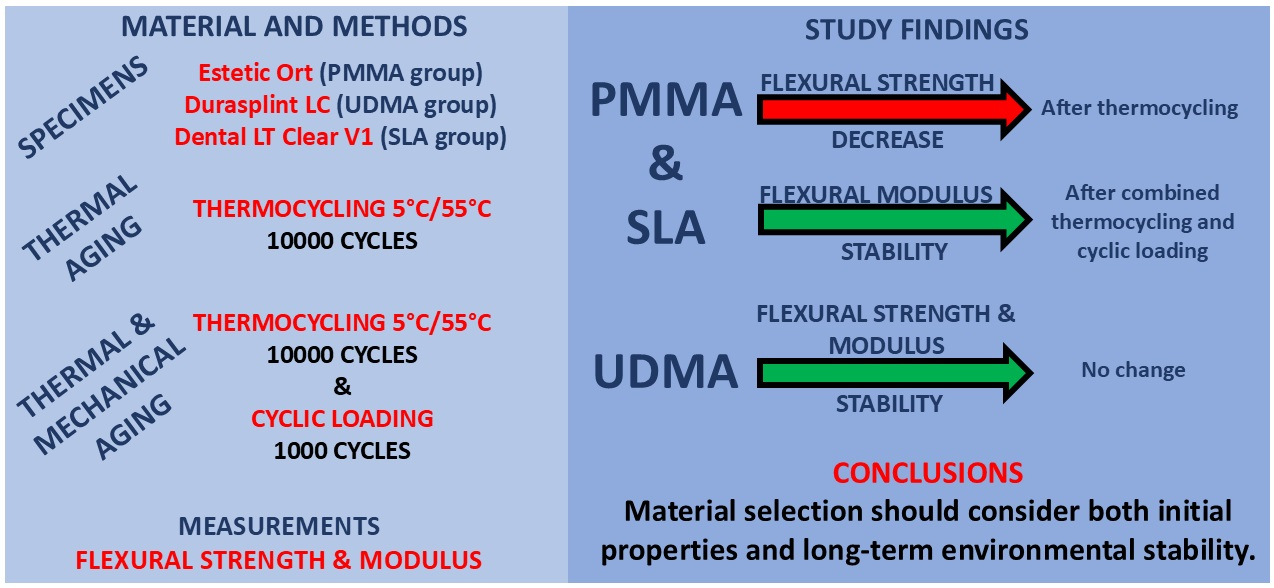
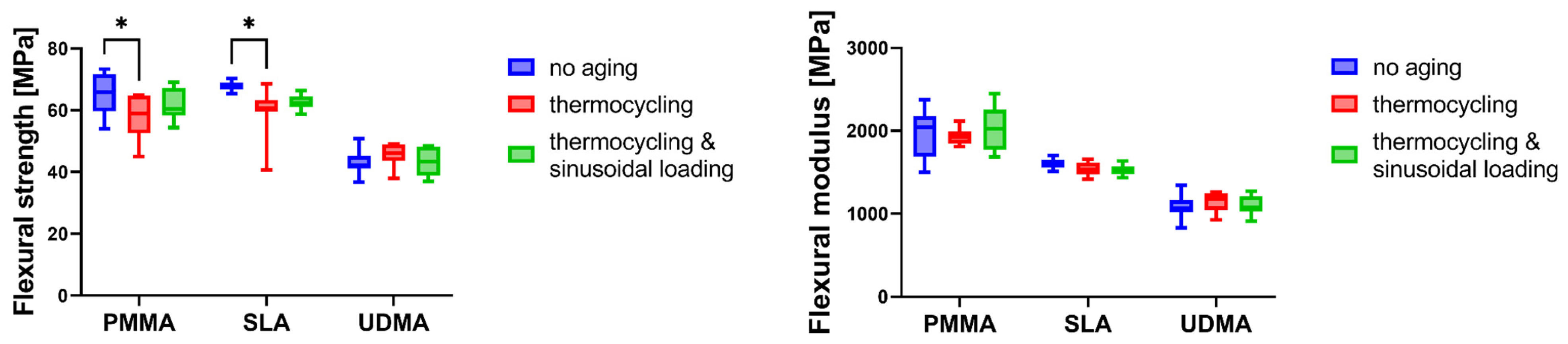
- Thermocycling significantly reduced flexural strength in PMMA and SLA-printed resins.
- UDMA-based material stayed unaffected under aging conditions.
- UDMA-based material showed significantly lower values of flexural strength and modulus when compared to PMMA and SLA-printed resins.
- Material selection should consider both initial properties and long-term environmental changes.
Abstract
1. Introduction
2. Materials and Methods
2.1. Materials
- Classic self-curing poly(methyl methacrylate) (PMMA) resin (PMMA group, Estetic Ort; Wiedent, Łódź, Poland) representing the conventional approach to splints manufacturing This material consists of a powder and liquid component.
- Light-cured UDMA-based resin (UDMA group, Durasplint LC; Scheu Dental, Iserlohn, Germany). This material is supplied as pre-formed bars and consists primarily of UDMA matrix with minor additions of acrylic resin, photoinitiators, and crosslinkers.
- Photopolymer designed explicitly for 3D printing using SLA technology (SLA group, Dental LT Clear V1; Vertex Dental, Soesterberg, The Netherlands). This material is classified as a Class IIa biocompatible resin primarily composed of methacrylate oligomers, methacrylate monomers, and photoinitiators.
2.2. Preparation of Specimens
2.3. Thermal Aging
2.4. Mechanical Aging
2.5. Flexural Properties Evaluation
2.6. Statistical Analysis
3. Results
3.1. Effect of Aging on Flexural Strength
3.2. Effect of Aging on Flexural Modulus
3.3. Inter-Material Comparisons
4. Discussion
5. Conclusions
Author Contributions
Funding
Institutional Review Board Statement
Informed Consent Statement
Data Availability Statement
Conflicts of Interest
Abbreviations
| PMMA | poly(methyl methacrylate) |
| PET-G | polyethylene terephthalate glycol |
| SLA | stereolithography |
| TMD | temporomandibular disorders |
| UDMA | urethane dimethacrylate |
References
- Zieliński, G.; Pająk, A.; Wójcicki, M. Global Prevalence of Sleep Bruxism and Awake Bruxism in Pediatric and Adult Populations: A Systematic Review and Meta-Analysis. J. Clin. Med. 2024, 13, 4259. [Google Scholar] [CrossRef]
- Zieliński, G.; Pająk-Zielińska, B.; Ginszt, M. A Meta-Analysis of the Global Prevalence of Temporomandibular Disorders. J. Clin. Med. 2024, 13, 1365. [Google Scholar] [CrossRef] [PubMed]
- Ohrbach, R.; Dworkin, S.F. The Evolution of TMD Diagnosis: Past, Present, Future. J. Dent. Res. 2016, 95, 1093–1101. [Google Scholar] [CrossRef] [PubMed]
- Lobbezoo, F.; Ahlberg, J.; Raphael, K.G.; Wetselaar, P.; Glaros, A.G.; Kato, T.; Santiago, V.; Winocur, E.; De Laat, A.; De Leeuw, R.; et al. International Consensus on the Assessment of Bruxism: Report of a Work in Progress. J. Oral Rehabil. 2018, 45, 837–844. [Google Scholar] [CrossRef] [PubMed]
- Zhang, S.H.; He, K.X.; Lin, C.J.; Liu, X.D.; Wu, L.; Chen, J.; Rausch-Fan, X. Efficacy of occlusal splints in the treatment of temporomandibular disorders: A systematic review of randomized controlled trials. Acta Odontol. Scand. 2020, 78, 580–589. [Google Scholar] [CrossRef]
- Al-Moraissi, E.A.; Farea, R.; Qasem, K.A.; Al-Wadeai, M.S.; Al-Sabahi, M.E.; Al-Iryani, G.M. Effectiveness of occlusal splint therapy in the management of temporomandibular disorders: Network meta-analysis of randomized controlled trials. Int. J. Oral Maxillofac. Surg. 2020, 49, 1042–1056. [Google Scholar] [CrossRef]
- Fricton, J.; Look, J.O.; Wright, E.; Alencar, F.G.P., Jr.; Chen, H.; Lang, M.; Ouyang, W.; Velly, A.M. Systematic Review and Meta-Analysis of Randomized Controlled Trials Evaluating Intraoral Orthopedic Appliances for Temporomandibular Disorders. J. Orofac. Pain 2010, 24, 237–254. [Google Scholar]
- Kuzmanovic Pficer, J.; Dodic, S.; Lazic, V.; Trajkovic, G.; Milic, N.; Milicic, B. Occlusal Stabilization Splint for Patients with Temporomandibular Disorders: Meta-Analysis of Short and Long Term Effects. PLoS ONE 2017, 12, e0171296. [Google Scholar] [CrossRef]
- Orzeszek, S.; Waliszewska-Prosol, M.; Ettlin, D.; Seweryn, P.; Straburzynski, M.; Martelletti, P.; Jenca, A., Jr.; Wieckiewicz, M. Efficiency of Occlusal Splint Therapy on Orofacial Muscle Pain Reduction: A Systematic Review. BMC Oral Health 2023, 23, 180. [Google Scholar] [CrossRef]
- Seifeldin, S.A.; Elhayes, K.A. Soft versus Hard Occlusal Splint Therapy in the Management of Temporomandibular Disorders (TMDs). Saudi Dent. J. 2015, 27, 208–214. [Google Scholar] [CrossRef]
- Granell-Ruiz, M.; Fons-Font, A.; Labaig-Rueda, C.; Martínez-González, A.; Román-Rodríguez, J.L.; Solá-Ruiz, M.F. A Clinical Longitudinal Study 323 Porcelain Laminate Veneers. Period of Study from 3 to 11 Years. Med. Oral Patol. Oral Cir. Bucal 2010, 15, e531–e537. [Google Scholar] [CrossRef] [PubMed]
- Nassif, M.; Haddad, C.; Habli, L.; Zoghby, A. Materials and manufacturing techniques for occlusal splints: A literature review. J. Oral Rehabil. 2023, 50, 1348–1354. [Google Scholar] [CrossRef] [PubMed]
- Soliman, T.A.; Raffat, E.M.; Farahat, D.S. Evaluation of Mechanical Behavior of CAD/CAM Polymers for Long-term Interim Restoration Following Artificial Aging. Eur. J. Prosthodont. Restor. Dent. 2023, 31, 22–30. [Google Scholar] [CrossRef] [PubMed]
- Cui, X.; Li, F.; Jiang, J. Effects of simulated intraoral temperatures and wet environments on the stress relaxation properties of thermoplastic aligner materials. Head Face Med. 2025, 21, 23. [Google Scholar] [CrossRef]
- Prpic, V.; Spehar, F.; Stajdohar, D.; Bjelica, R.; Cimic, S.; Par, M. Mechanical Properties of 3D-Printed Occlusal Splint Materials. Dent. J. 2023, 11, 199. [Google Scholar] [CrossRef]
- Ferracane, J.L. Hygroscopic and Hydrolytic Effects in Dental Polymer Networks. Dent. Mater. 2006, 22, 211–222. [Google Scholar] [CrossRef]
- Finer, Y.; Santerre, J.P. Salivary Esterase Activity and Its Association with the Biodegradation of Dental Composites. J. Dent. Res. 2004, 83, 22–26. [Google Scholar] [CrossRef]
- Asmussen, E.; Peutzfeldt, A. Influence of Selected Components on Crosslink Density in Polymer Structures. Eur. J. Oral Sci. 2001, 109, 282–285. [Google Scholar] [CrossRef]
- El-Din, M.S.; Ellakany, P.; Fouda, S.M.; Gad, M.M. Effect of various beverages on the surface roughness and color stability of different denture base resins: An in vitro study. Dent. Med. Probl. 2025, 62, 815–822. [Google Scholar] [CrossRef]
- Fortes, C.V.; Ribeiro, A.B.; De Wever, B.; Sakly, A.; Oliveira, V.C.; Clemente, L.M.; Watanabe, E.; Silva-Lovato, C.H. Evaluation of biofilm formation, adhesive strength and effectiveness of cleaning protocols on adhesive-containing acrylic resin specimens: An in vitro study. Dent. Med. Probl. 2025, 62, 843–851. [Google Scholar] [CrossRef]
- Zafar, M.S. Prosthodontic Applications of Polymethyl Methacrylate (PMMA): An Update. Polymers 2020, 12, 2299. [Google Scholar] [CrossRef]
- Alla, R.K.; Swamy, R.K.N.; Vyas, R.; Konakarchi, A. Conventional and Contemporary Polymers for the Fabrication of Denture Prosthesis: Part I—Overview, Composition and Properties. Int. J. Appl. Dent. Sci. 2015, 1, 82–89. [Google Scholar]
- Kanie, T.; Kadokawa, A.; Arikawa, H.; Fujii, K.; Ban, S. Flexural properties of ethyl or methyl methacrylate-UDMA blend polymers. Dent. Mater. J. 2010, 29, 575–581. [Google Scholar] [CrossRef] [PubMed]
- Szczesio-Wlodarczyk, A.; Domarecka, M.; Kopacz, K.; Sokolowski, J.; Bociong, K. An Evaluation of the Properties of Urethane Dimethacrylate-Based Dental Resins. Materials 2021, 14, 2727. [Google Scholar] [CrossRef] [PubMed]
- Sideridou, I.D.; Tserki, V.; Papanastasiou, G. Study of Water Sorption, Solubility and Modulus of Elasticity of Light-Cured Dimethacrylate-Based Dental Resins. Biomaterials 2003, 24, 655–665. [Google Scholar] [CrossRef] [PubMed]
- Lin, C.H.; Lin, Y.M.; Lai, Y.L.; Lee, S.Y. Mechanical Properties, Accuracy, and Cytotoxicity of UV-Polymerized 3D Printing Resins Composed of Bis-EMA, UDMA, and TEGDMA. J. Prosthet. Dent. 2020, 123, 349–353. [Google Scholar] [CrossRef]
- Tian, Y.; Chen, C.; Xu, X.; Wang, J.; Hou, X.; Li, K.; Lu, X.; Shi, H.; Lee, E.S.; Jiang, H.B. A Review of 3D Printing in Dentistry: Technologies, Affecting Factors, and Applications. Scanning 2021, 2021, 9950131. [Google Scholar] [CrossRef]
- Rezaie, F.; Farshbaf, M.; Dahri, M.; Masjedi, M.; Maleki, R.; Amini, F.; Wirth, J.; Moharamzadeh, K.; Weber, F.E.; Tayebi, L. 3D Printing of Dental Prostheses: Current and Emerging Applications. J. Compos. Sci. 2023, 7, 80. [Google Scholar] [CrossRef]
- Maleki, T.; Meinen, J.; Coldea, A.; Reymus, M.; Edelhoff, D.; Stawarczyk, B. Mechanical and Physical Properties of Splint Materials for Oral Appliances Produced by Additive, Subtractive and Conventional Manufacturing. Dent. Mater. 2024, 40, 1171–1183. [Google Scholar] [CrossRef]
- Prpić, V.; Schauperl, Z.; Ćatić, A.; Dulčić, N.; Čimić, S. Comparison of Mechanical Properties of 3D-Printed, CAD/CAM, and Conventional Denture Base Materials. J. Prosthodont. 2020, 29, 524–528. [Google Scholar] [CrossRef]
- van Noort, R. The future of dental devices is digital. Dent. Mater. 2012, 28, 3–12. [Google Scholar] [CrossRef] [PubMed]
- Farkas, A.Z.; Galatanu, S.V.; Nagib, R. The Influence of Printing Layer Thickness and Orientation on the Mechanical Properties of DLP 3D-Printed Dental Resin. Polymers 2023, 15, 1113. [Google Scholar] [CrossRef] [PubMed]
- Mudhaffer, S.; Haider, J.; Satterthwaite, J.; Silikas, N. Effects of print orientation and artificial aging on the flexural strength and flexural modulus of 3D printed restorative resin materials. J. Prosthet. Dent. 2025, 133, 1345–1357. [Google Scholar] [CrossRef] [PubMed]
- Alqarawi, F.K. The Influence of Printing Orientation on the Properties of 3D-Printed Polymeric Provisional Dental Restorations: A Systematic Review and Meta-Analysis. J. Funct. Biomater. 2025, 16, 278. [Google Scholar] [CrossRef]
- Szczesio-Wlodarczyk, A.; Fronczek, M.; Ranoszek-Soliwoda, K.; Grobelny, J.; Sokolowski, J.; Bociong, K. The First Step in Standardizing an Artificial Aging Protocol for Dental Composites—Evaluation of Basic Protocols. Molecules 2022, 27, 3511. [Google Scholar] [CrossRef]
- Gale, M.S.; Darvell, B.W. Thermal Cycling Procedures for Laboratory Testing of Dental Restorations. J. Dent. 1999, 27, 89–99. [Google Scholar] [CrossRef]
- Ghavami-Lahiji, M.; Firouzmanesh, M.; Bagheri, H.; Jafarzadeh Kashi, T.S.; Razazpour, F.; Behroozibakhsh, M. The effect of thermocycling on the degree of conversion and mechanical properties of a microhybrid dental resin composite. Restor. Dent. Endod. 2018, 43, e26. [Google Scholar] [CrossRef]
- Polychronakis, N.; Sarafianou, A.; Zissis, A.; Papadopoulos, T. The Influence of Thermocycling on the Flexural Strength of a Polyamide Denture Base Material. Acta. Stomatol. Croat. 2017, 51, 309–315. [Google Scholar] [CrossRef]
- Temizci, T.; Bozoğulları, H.N. Effect of Thermal Cycling on the Flexural Strength of 3-D Printed, CAD/CAM Milled and Heat-Polymerized Denture Base Materials. BMC Oral Health 2024, 24, 357. [Google Scholar] [CrossRef]
- Drummond, J.L. Degradation, Fatigue, and Failure of Resin Dental Composite Materials. J. Dent. Res. 2008, 87, 710–719. [Google Scholar] [CrossRef]
- Arola, D. Fatigue Testing of Biomaterials and Their Interfaces. Dent. Mater. 2017, 33, 367–381. [Google Scholar] [CrossRef]
- Lin, J.; Sun, M.; Zheng, Z.; Shinya, A.; Han, J.; Lin, H.; Zheng, G.; Shinya, A. Effects of rotating fatigue on the mechanical properties of microhybrid and nanofiller-containing composites. Dent. Mater. J. 2013, 32, 476–483. [Google Scholar] [CrossRef] [PubMed]
- Lohbauer, U.; Petschelt, A.; Greil, P. Lifetime Prediction of CAD/CAM Dental Ceramics. J. Biomed. Mater. Res. 2002, 63, 780–785. [Google Scholar] [CrossRef] [PubMed]
- Ausiello, P.; Ciaramella, S.; Fabianelli, A.; Gloria, A.; Martorelli, M.; Lanzotti, A.; Watts, D.C. Mechanical Behavior of Bulk Direct Composite versus Block Composite and Lithium Disilicate Indirect Class II Restorations by CAD-FEM Modeling. Dent. Mater. 2017, 33, 690–701. [Google Scholar] [CrossRef] [PubMed]
- Rayyan, M.M.; Aboushelib, M.; Sayed, N.M.; Ibrahim, A.; Jimbo, R. Comparison of Interim Restorations Fabricated by CAD/CAM with Those Fabricated Manually. J. Prosthet. Dent. 2015, 114, 414–419. [Google Scholar] [CrossRef]
- Weżgowiec, J.; Małysa, A.; Więckiewicz, M. How Does Artificial Aging Affect the Mechanical Properties of Occlusal Splint Materials Processed via Various Technologies? Dent. Med. Probl. 2025, 62, 527–535. [Google Scholar] [CrossRef]
- ISO 20795-1:2013; Dentistry—Base Polymers—Part 1: Denture Base Polymers. International Organization for Standardization: Geneva, Switzerland, 2013.
- Meissner, H.; Vacquier, M.; Kresse-Walczak, K.; Boening, K. Mechanical, Optical and Surface Properties of 3D-Printed and Conventionally Processed Polyamide 12. Dent. Med. Probl. 2024, 61, 729–738. [Google Scholar] [CrossRef]
- Wieckiewicz, M.; Opitz, V.; Richter, G.; Boening, K.W. Physical Properties of Polyamide-12 versus PMMA Denture Base Material. BioMed Res. Int. 2014, 2014, 150298. [Google Scholar] [CrossRef]
- Abdul-Monem, M.M.; Hanno, K.I. Effect of Thermocycling on Surface Topography and Fracture Toughness of Milled and Additively Manufactured Denture Base Materials: An In-Vitro Study. BMC Oral Health 2024, 24, 267. [Google Scholar] [CrossRef]
- Sideridou, I.; Achilias, D.S.; Spyroudi, C.; Karabela, M. Water Sorption Characteristics of Light-Cured Dental Resins and Composites Based on Bis-EMA/PCDMA. Biomaterials 2004, 25, 367–376. [Google Scholar] [CrossRef]
- Ferracane, J.L.; Berge, H.X. Fracture Toughness of Experimental Dental Composites Aged in Ethanol. J. Dent. Res. 1995, 74, 1418–1423. [Google Scholar] [CrossRef] [PubMed]
- Yiu, C.K.Y.; King, N.M.; Pashley, D.H.; Suh, B.I.; Carvalho, R.M.; Carrilho, M.R.O.; Tay, F.R. Effect of Resin Hydrophilicity and Water Storage on Resin Strength. Biomaterials 2004, 25, 5789–5796. [Google Scholar] [CrossRef] [PubMed]
- Paradowska-Stolarz, A.; Wezgowiec, J.; Malysa, A.; Wieckiewicz, M. Effects of Polishing and Artificial Aging on Mechanical Properties of Dental LT Clear® Resin. J. Funct. Biomater. 2023, 14, 295. [Google Scholar] [CrossRef] [PubMed]
- Aati, S.; Akram, Z.; Shrestha, B.; Patel, J.; Shih, B.; Shearston, K.; Ngo, H.; Fawzy, A. Effect of Post-Curing Light Exposure Time on the Physico-Mechanical Properties and Cytotoxicity of 3D-Printed Denture Base Material. Dent. Mater. 2022, 38, 57–67. [Google Scholar] [CrossRef]
- Paranna, S.; Thosar, N.; Kanitkar, A. Effect of Build Orientation on Mechanical and Physical Properties of Additively Manufactured Resins Using Digital Light Processing Technology in Dentistry: A Systematic Review. J. Contemp. Dent. Pract. 2024, 25, 891–903. [Google Scholar] [CrossRef]
- Alqutaibi, A.Y.; Aljohani, R.; Almuzaini, S.; Alghauli, M.A. Physical-mechanical properties and accuracy of additively manufactured resin denture bases: Impact of printing orientation. J. Prosthodont. Res. 2025, 69, 461–471. [Google Scholar] [CrossRef]
- Nam, N.E.; Hwangbo, N.K.; Jin, G.; Shim, J.S.; Kim, J.E. Effects of heat-treatment methods on cytocompatibility and mechanical properties of dental products 3D-printed using photopolymerized resin. J. Prosthodont. Res. 2023, 67, 121–131. [Google Scholar] [CrossRef]
- Nguyen, J.F.; Migonney, V.; Ruse, N.D.; Sadoun, M. Properties of Experimental Urethane Dimethacrylate-Based Dental Resin Composite Blocks Obtained via Thermo-Polymerization under High Pressure. Dent. Mater. 2013, 29, 535–541. [Google Scholar] [CrossRef]
- Kwaśny, M.; Bombalska, A.; Obroniecka, K. A Reliable Method of Measuring the Conversion Degrees of Methacrylate Dental Resins. Sensors 2022, 10, 2170. [Google Scholar] [CrossRef]
- Saini, R.S.; Vaddamanu, S.K.; Dermawan, D.; Mosaddad, S.A.; Heboyan, A. Investigating the Role of Temperature and Moisture on the Degradation of 3D-Printed Polymethyl Methacrylate Dental Materials through Molecular Dynamics Simulations. Sci. Rep. 2024, 14, 26079. [Google Scholar] [CrossRef]
- Machado, A.L.; Puckett, A.D.; Breeding, L.C.; Wady, A.F.; Vergani, C.E. Effect of thermocycling on the flexural and impact strength of urethane-based and high-impact denture base resins. Gerodontology 2012, 29, e318–e323. [Google Scholar] [CrossRef] [PubMed]
- Arima, T.; Murata, H.; Hamada, T. The effects of cross-linking agents on the water sorption and solubility characteristics of denture base resin. J. Oral Rehabil. 1996, 23, 476–480. [Google Scholar] [CrossRef] [PubMed]
- Barszczewska-Rybarek, I.M. A Guide through the Dental Dimethacrylate Polymer Network Structural Characterization and Interpretation of Physico-Mechanical Properties. Materials 2019, 12, 4057. [Google Scholar] [CrossRef] [PubMed]
- Pomes, B.; Derue, I.; Lucas, A.; Nguyen, J.-F.; Richaud, E. Water ageing of urethane dimethacrylate networks. Polym. Degrad. Stab. 2018, 154, 195–202. [Google Scholar] [CrossRef]
- Greil, V.; Mayinger, F.; Reymus, M.; Stawarczyk, B. Water sorption, water solubility, degree of conversion, elastic indentation modulus, edge chipping resistance and flexural strength of 3D-printed denture base resins. J. Mech. Behav. Biomed. Mater. 2023, 137, 105565. [Google Scholar] [CrossRef]
- Gad, M.M.; Alshehri, S.Z.; Alhamid, S.A.; Albarrak, A.; Khan, S.Q.; Alshahrani, F.A.; Alqarawi, F.K. Water Sorption, Solubility, and Translucency of 3D-Printed Denture Base Resins. Dent. J. 2022, 10, 42. [Google Scholar] [CrossRef]
- Carey, B.J.; Patra, P.K.; Ci, L.; Silva, G.G.; Ajayan, P.M. Observation of Dynamic Strain Hardening in Polymer Nanocomposites. ACS Nano 2011, 5, 2715–2722. [Google Scholar] [CrossRef]
- Varol, H.S.; Meng, F.; Hosseinkhani, B.; Malm, C.; Bonn, D.; Bonn, M.; Zaccone, A.; Parekh, S.H. Nanoparticle Amount, and Not Size, Determines Chain Alignment and Nonlinear Hardening in Polymer Nanocomposites. Proc. Natl. Acad. Sci. USA 2017, 114, E3170–E3177. [Google Scholar] [CrossRef]
- Espíndola-Castro, L.F.; Durão, M.A.; Pereira, T.V.; Cordeiro, A.B.; Monteiro, G.M. Evaluation of microhardness, sorption, solubility, and color stability of bulk fill resins: A comparative study. J. Clin. Exp. Dent. 2020, 12, e1033–e1038. [Google Scholar] [CrossRef]
- Takahashi, Y.; Hamanaka, I.; Shimizu, H. Flexural properties of denture base resins subjected to long-term water immersion. Acta Odontol. Scand. 2013, 71, 716–720. [Google Scholar] [CrossRef]
- Öztürk, Z.; Tosun, B. Comparison of 3D Printed and Conventional Denture Base Materials in Terms of Durability and Performance Characteristics. Sci. Rep. 2025, 15, 18234. [Google Scholar] [CrossRef] [PubMed]
- Benli, M.; Al-Haj Husain, N.; Ozcan, M. Mechanical and chemical characterization of contemporary occlusal splint materials fabricated with different methods: A systematic review. Clin. Oral Investig. 2023, 27, 7115–7141. [Google Scholar] [CrossRef] [PubMed]
- Jindal, P.; Juneja, M.; Siena, F.L.; Bajaj, D.; Breedon, P. Mechanical and Geometric Properties of Thermoformed and 3D Printed Clear Dental Aligners. Am. J. Orthod. Dentofac. Orthop. 2019, 156, 694–701. [Google Scholar] [CrossRef] [PubMed]
- Weżgowiec, J.; Czapor-Irzabek, H.; Małysa, A.; Boening, K.; Kulbacka, J.; Więckiewicz, M. Exploring the chemical stability and safety of intraoral appliances fabricated via 3D printing, thermoforming, and heat-activated polymerization. J. Prosthet. Dent. 2025; in press. [Google Scholar] [CrossRef]
- Gibreel, M.; Perea-Lowery, L.; Vallittu, P.K.; Lassila, L. Characterization of occlusal splint materials: CAD-CAM versus conventional resins. J. Mech. Behav. Biomed. Mater. 2021, 124, 104813. [Google Scholar] [CrossRef]
- Spencer, P.; Ye, Q.; Park, J.; Topp, E.M.; Misra, A.; Marangos, O.; Wang, Y.; Bohaty, B.S.; Singh, V.; Sene, F.; et al. Adhesive/Dentin Interface: The Weak Link in the Composite Restoration. Ann. Biomed. Eng. 2010, 38, 1989–2003. [Google Scholar] [CrossRef]
- Grymak, A.; Aarts, J.M.; Ma, S.; Waddell, J.N.; Choi, J.J.E. Wear Behavior of Occlusal Splint Materials Manufactured By Various Methods: A Systematic Review. J. Prosthodont. 2022, 31, 472–487. [Google Scholar] [CrossRef]
- Özcan, M.; Jonasch, M. Effect of Cyclic Fatigue Tests on Aging and Their Translational Implications for Survival of All-Ceramic Tooth-Borne Single Crowns and Fixed Dental Prostheses. J. Prosthodont. 2018, 27, 364–375. [Google Scholar] [CrossRef]


| Materials | Flexural Strength [MPa] | Flexural Modulus [MPa] | ||||||||
|---|---|---|---|---|---|---|---|---|---|---|
| No Aging (Mean ± SD) | Thermocycling (Mean ± SD) | Δ% vs. No Aging | Thermocycling & Sinusoidal Loading (Mean ± SD) | Δ% vs. No Aging | No Aging (Mean ± SD) | Thermocycling (Mean ± SD) | Δ% vs. No Aging | Thermocycling & Sinusoidal Loading (Mean ± SD) | Δ% vs. No Aging | |
| PMMA | 65.19 ± 6.68 | 57.94 ± 7.15 | −11.11% | 61.53 ± 5.11 | −5.61% | 1971.85 ± 292.35 | 1930.66 ± 101.29 | −2.09% | 2036.83 ± 263.60 | +3.30% |
| SLA | 67.67 ± 1.54 | 59.37 ± 8.80 | −12.25% | 62.55 ± 2.42 | −7.56% | 1609.32 ± 61.95 | 1539.58 ± 81.46 | −4.33% | 1521.45 ± 63.95 | −5.46% |
| UDMA | 43.12 ± 4.37 | 45.49 ± 3.90 | +5.49% | 43.31 ± 4.59 | +0.44% | 1077.40 ± 155.47 | 1140.58 ± 120.57 | +5.86% | 1099.36 ± 116.50 | +2.04% |
| Aging | Materials | Mean Difference | SE | 95.00% CI | q | df | Summary | p-Value |
|---|---|---|---|---|---|---|---|---|
| no aging | PMMA vs. SLA | −2.480 | 2.673 | −8.900 to 3.940 | 1.312 | 61.00 | ns | 0.6249 |
| PMMA vs. UDMA | 22.06 | 2.766 | 15.42 to 28.71 | 11.28 | 61.00 | **** | <0.0001 | |
| SLA vs. UDMA | 24.54 | 2.766 | 17.90 to 31.19 | 12.55 | 61.00 | **** | <0.0001 | |
| thermocycling | PMMA vs. SLA | −1.429 | 2.766 | −8.075 to 5.217 | 0.7306 | 61.00 | ns | 0.8636 |
| PMMA vs. UDMA | 12.45 | 2.673 | 6.034 to 18.88 | 6.590 | 61.00 | **** | <0.0001 | |
| SLA vs. UDMA | 13.88 | 2.766 | 7.238 to 20.53 | 7.097 | 61.00 | **** | <0.0001 | |
| thermocycling & sinusoidal loading | PMMA vs. SLA | −1.017 | 2.673 | −7.438 to 5.403 | 0.5383 | 61.00 | ns | 0.9233 |
| PMMA vs. UDMA | 18.22 | 2.673 | 11.80 to 24.64 | 9.640 | 61.00 | **** | <0.0001 | |
| SLA vs. UDMA | 19.24 | 2.673 | 12.81 to 25.66 | 10.18 | 61.00 | **** | <0.0001 |
| Aging | Materials | Mean Difference | SE | 95.00% CI | q | df | Summary | p-Value |
|---|---|---|---|---|---|---|---|---|
| no aging | PMMA vs. SLA | 362.5 | 80.72 | 168.6 to 556.4 | 6.351 | 61.00 | **** | <0.0001 |
| PMMA vs. UDMA | 894.4 | 83.56 | 693.7 to 1095 | 15.14 | 61.00 | **** | <0.0001 | |
| SLA vs. UDMA | 531.9 | 83.56 | 331.2 to 732.6 | 9.003 | 61.00 | **** | <0.0001 | |
| thermocycling | PMMA vs. SLA | 391.1 | 83.56 | 190.4 to 591.8 | 6.619 | 61.00 | **** | <0.0001 |
| PMMA vs. UDMA | 790.1 | 83.56 | 589.4 to 990.8 | 13.37 | 61.00 | **** | <0.0001 | |
| SLA vs. UDMA | 399.0 | 80.72 | 205.1 to 592.9 | 6.990 | 61.00 | **** | <0.0001 | |
| thermocycling & sinusoidal loading | PMMA vs. SLA | 515.4 | 80.72 | 321.5 to 709.3 | 9.029 | 61.00 | **** | <0.0001 |
| PMMA vs. UDMA | 937.5 | 80.72 | 743.6 to 1131 | 16.42 | 61.00 | **** | <0.0001 | |
| SLA vs. UDMA | 422.1 | 80.72 | 228.2 to 616.0 | 7.395 | 61.00 | **** | <0.0001 |
Disclaimer/Publisher’s Note: The statements, opinions and data contained in all publications are solely those of the individual author(s) and contributor(s) and not of MDPI and/or the editor(s). MDPI and/or the editor(s) disclaim responsibility for any injury to people or property resulting from any ideas, methods, instructions or products referred to in the content. |
© 2026 by the authors. Licensee MDPI, Basel, Switzerland. This article is an open access article distributed under the terms and conditions of the Creative Commons Attribution (CC BY) license.
Share and Cite
Smardz, J.; Kresse-Walczak, K.; Meißner, H.; Böning, K.; Weżgowiec, J.; Małysa, A.; Więckiewicz, M. The Influence of Thermal and Mechanical Aging on the Flexural Properties of Conventional and 3D-Printed Materials Used in Occlusal Splints Manufacturing. Materials 2026, 19, 421. https://doi.org/10.3390/ma19020421
Smardz J, Kresse-Walczak K, Meißner H, Böning K, Weżgowiec J, Małysa A, Więckiewicz M. The Influence of Thermal and Mechanical Aging on the Flexural Properties of Conventional and 3D-Printed Materials Used in Occlusal Splints Manufacturing. Materials. 2026; 19(2):421. https://doi.org/10.3390/ma19020421
Chicago/Turabian StyleSmardz, Joanna, Katarzyna Kresse-Walczak, Heike Meißner, Klaus Böning, Joanna Weżgowiec, Andrzej Małysa, and Mieszko Więckiewicz. 2026. "The Influence of Thermal and Mechanical Aging on the Flexural Properties of Conventional and 3D-Printed Materials Used in Occlusal Splints Manufacturing" Materials 19, no. 2: 421. https://doi.org/10.3390/ma19020421
APA StyleSmardz, J., Kresse-Walczak, K., Meißner, H., Böning, K., Weżgowiec, J., Małysa, A., & Więckiewicz, M. (2026). The Influence of Thermal and Mechanical Aging on the Flexural Properties of Conventional and 3D-Printed Materials Used in Occlusal Splints Manufacturing. Materials, 19(2), 421. https://doi.org/10.3390/ma19020421