Application of Porous Copper-Based Interconnect Materials in Electronic Packaging: A Brief Review

Abstract
1. Introduction
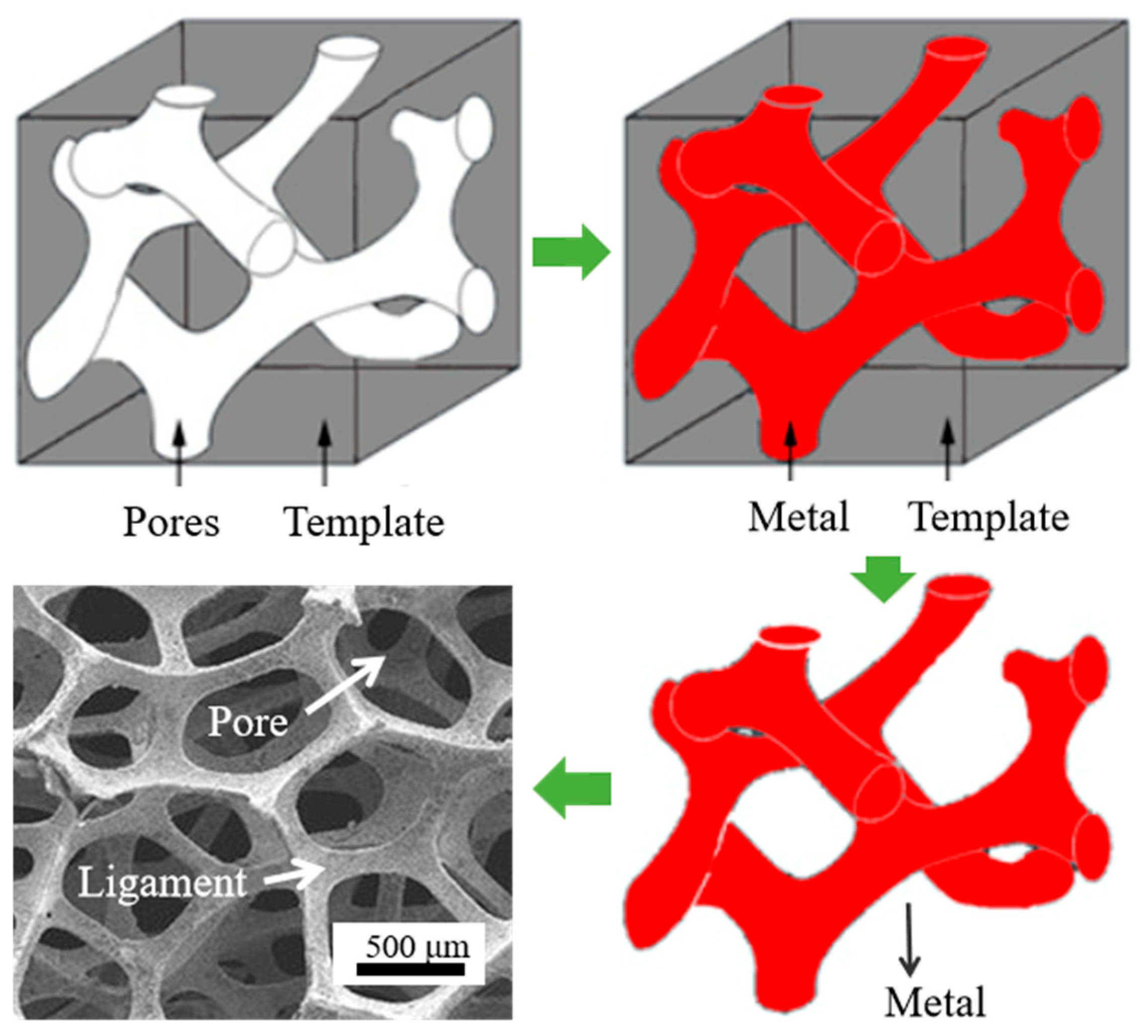
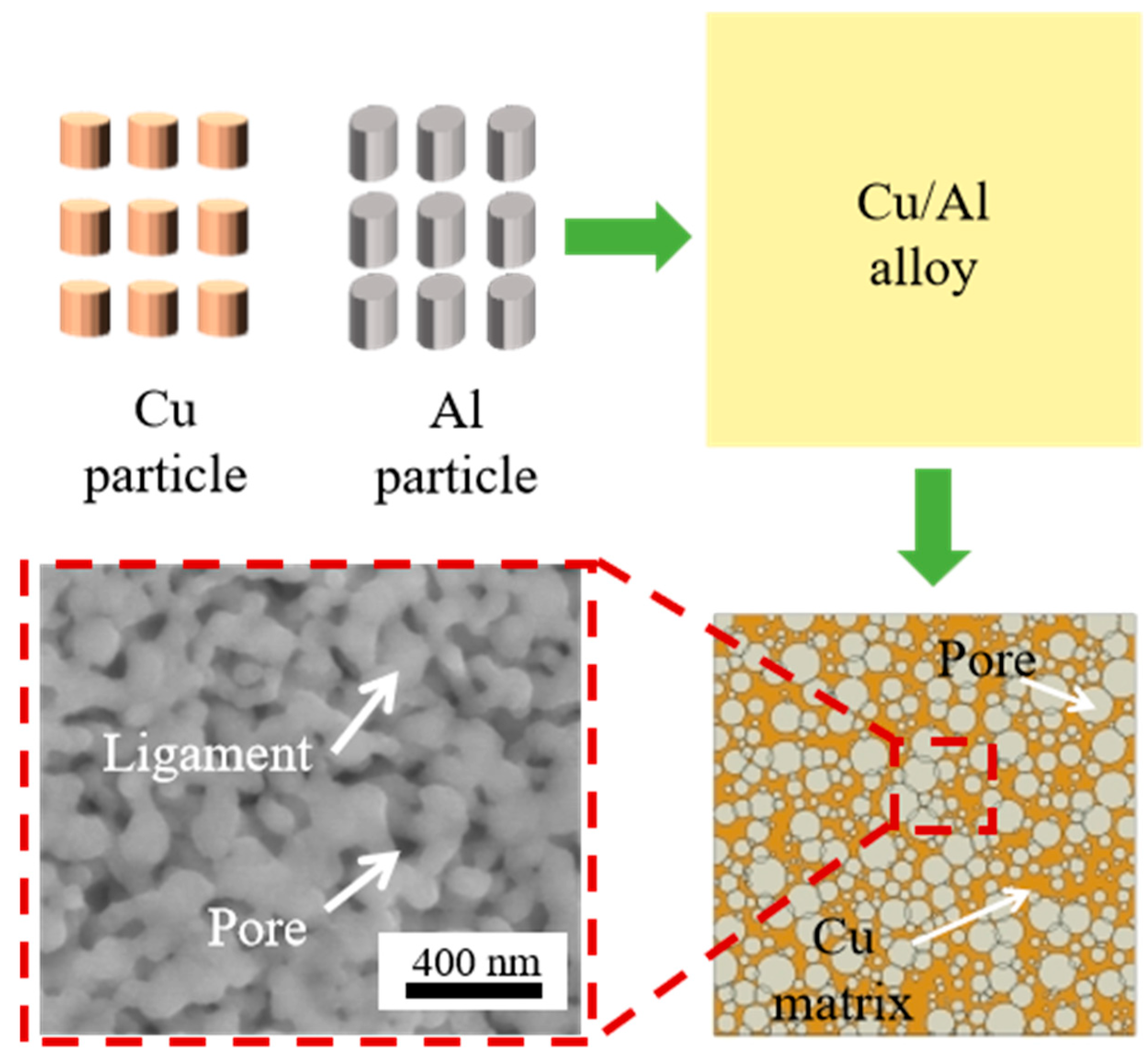
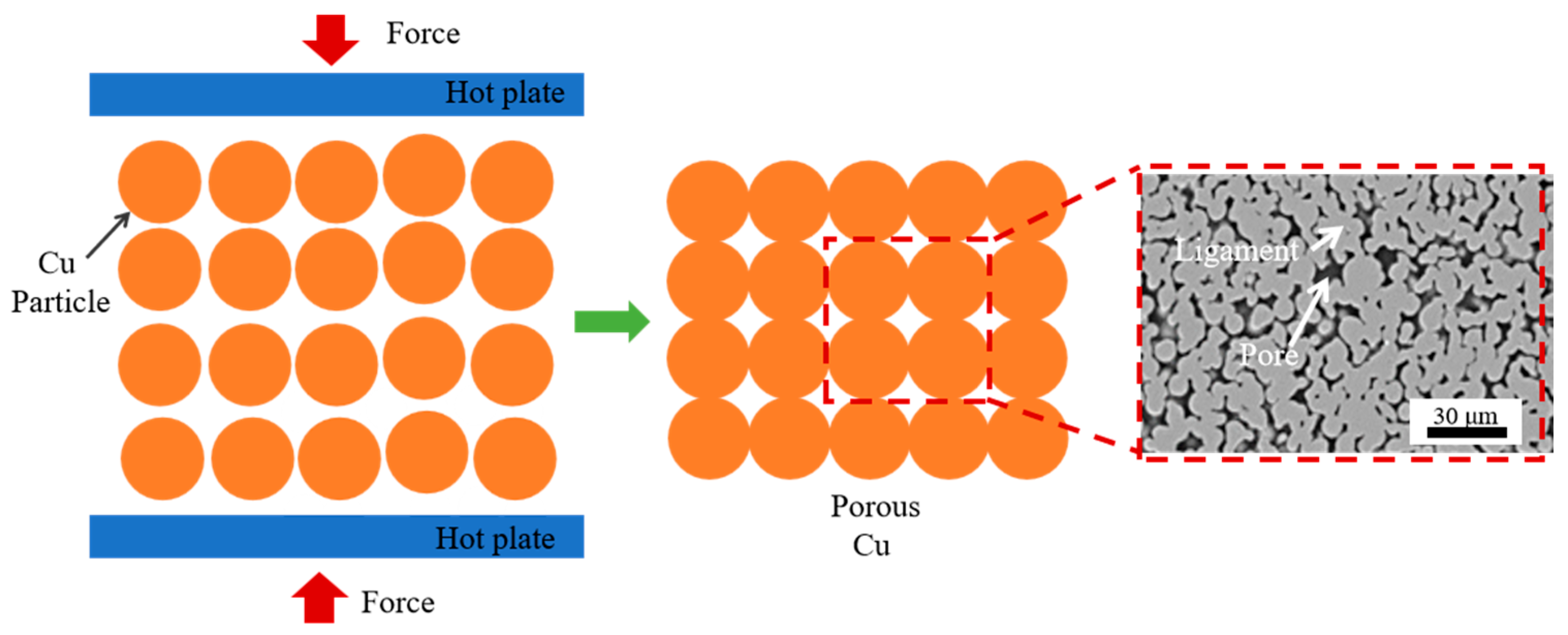
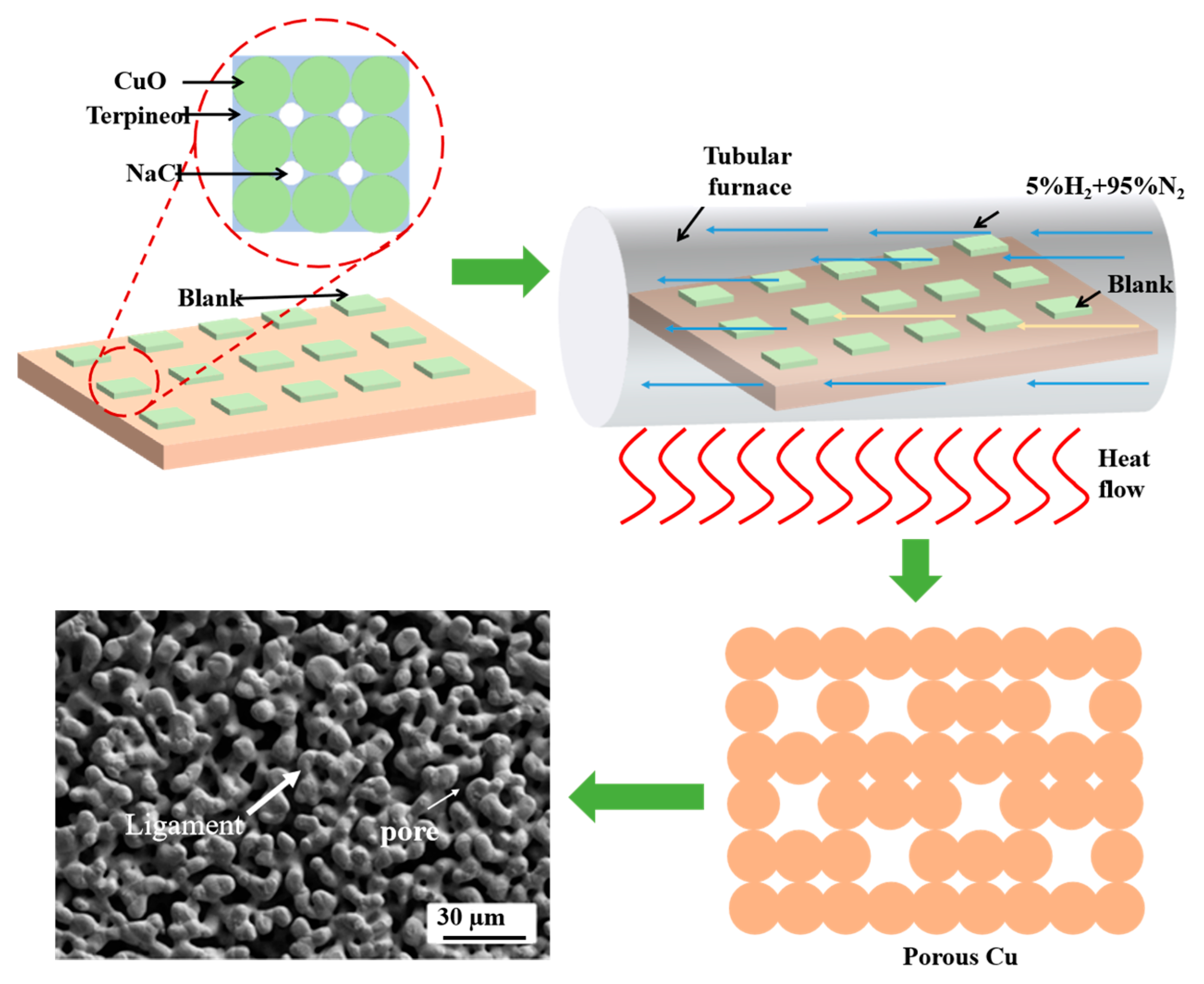
2. Fabrication Technologies of Porous Cu
3. Interconnection Technologies for Porous Cu Bondlines
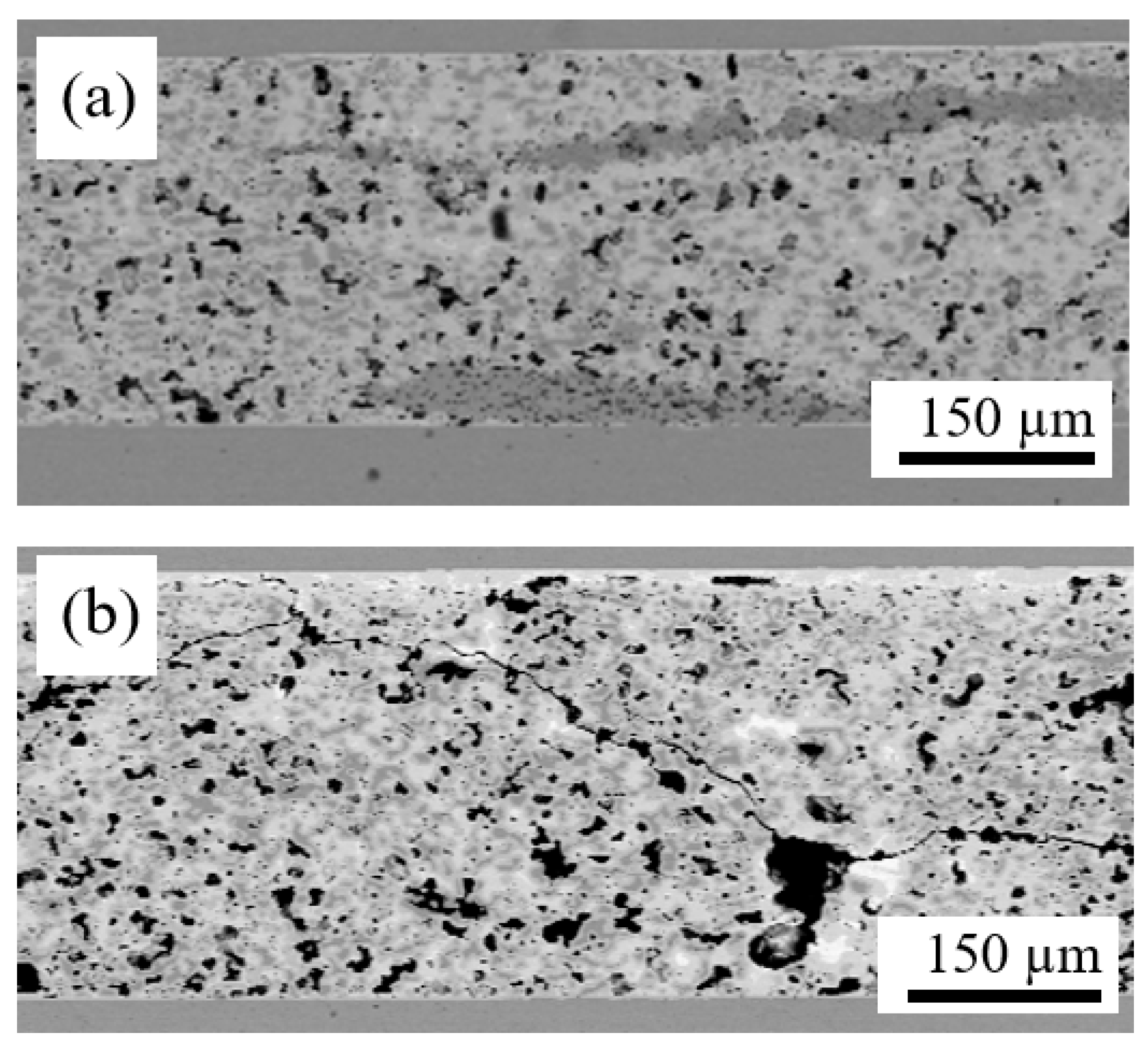
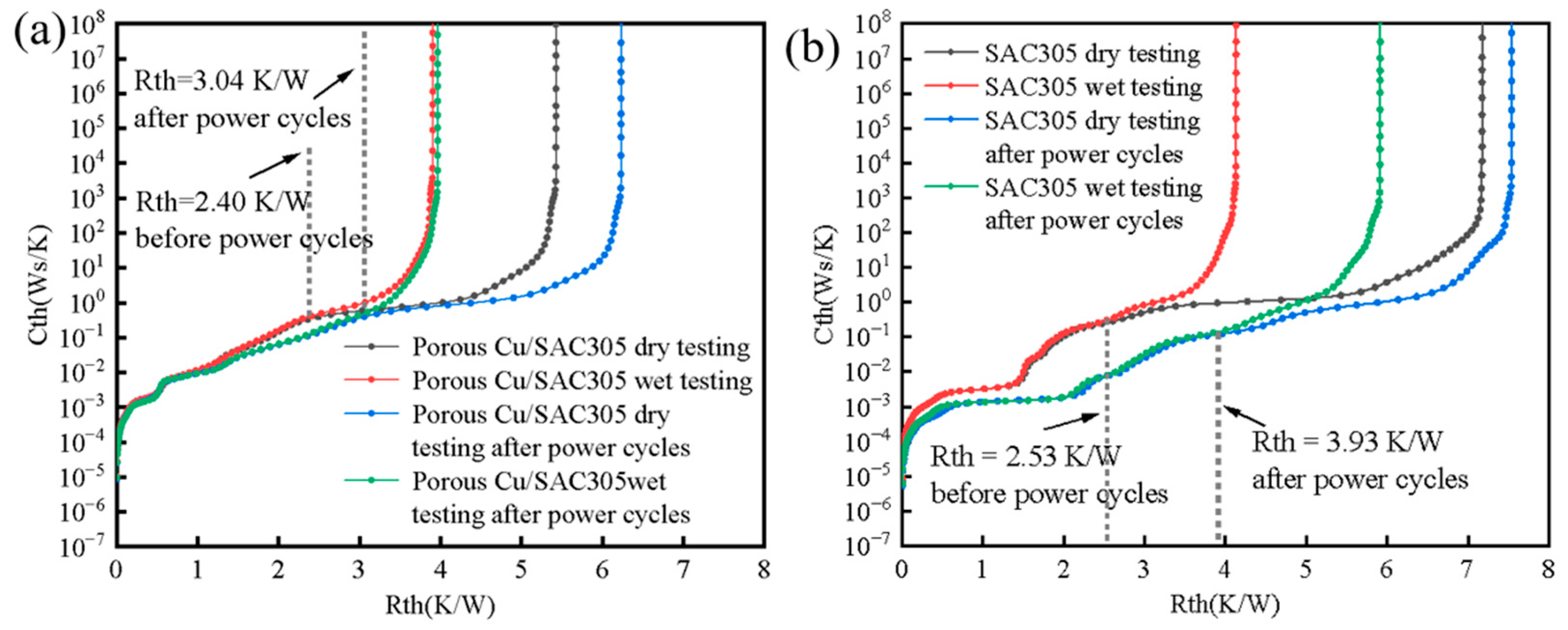
4. Reliability of Porous Cu Composite Bondlines
5. Conclusions and Challenges
5.1. Conclusions
5.2. Challenges
- (1)
- Precise fabrication of porous Cu with tailored pore sizes and porosities
- (2)
- Bottleneck in the development of pressureless bonding technology for porous Cu
- (3)
- Lack of validation for long-term reliability of porous Cu bondlines
Author Contributions
Funding
Institutional Review Board Statement
Informed Consent Statement
Data Availability Statement
Conflicts of Interest
References
- Lee, H.; Smet, V.; Tummala, R. A review of SiC power module packaging technologies: Challenges, advances, and emerging issues. IEEE J. Emerg. Sel. Top. Power Electron. 2019, 8, 239–255. [Google Scholar] [CrossRef] [Scilit]
- Hou, F.; Sun, Z.; Su, M.; Fan, J.; You, X.; Li, J.; Wang, Q.; Cao, L.; Zhang, G. Review of Die-attach materials for SiC high-temperature packaging. IEEE Trans. Power Electron. 2024, 39, 13471–13486. [Google Scholar] [CrossRef] [Scilit]
- Chen, L.Y.; Johnson, R.W.; Neudeck, P.G.; Beheim, G.M.; Spry, D.J.; Meredith, R.D.; Hunter, G.W. Packaging technologies for 500 °C SiC electronics and sensors. Mater. Sci. Forum 2012, 717–720, 1033–1036. [Google Scholar] [CrossRef] [Scilit]
- Banhart, J. Manufacture, characterisation and application of cellular metals and metal foams. Prog. Mater. Sci. 2001, 46, 559–632. [Google Scholar] [CrossRef] [Scilit]
- Singh, H.; Saxena, P.; Puri, Y.M. The manufacturing and applications of the porous metal membranes: A critical review. CIRP J. Manuf. Sci. Technol. 2021, 33, 339–368. [Google Scholar] [CrossRef] [Scilit]
- Mohan, K.; Shahane, N.; Liu, R.; Smet, V.; Antoniou, A. A Review of Nanoporous Metals in Interconnects. JOM 2018, 70, 2192–2204. [Google Scholar] [CrossRef] [Scilit]
- Atwater, M.A.; Guevara, L.N.; Darling, K.A.; Tschopp, M.A. Solid State Porous Metal Production: A review of the capabilities, characteristics, and challenges. Adv. Eng. Mater. 2018, 20, 1700766. [Google Scholar] [CrossRef] [Scilit]
- Michael, F.A.; Lu, T. Metal foams: A survey. Sci. China Ser. B-Chem. 2003, 46, 521–532. [Google Scholar] [CrossRef] [Scilit]
- Baruah, R.K.; Yoo, H.; Lee, E.K. Interconnection technologies for flexible electronics: Materials, fabrications, and applications. Micromachines 2023, 14, 1131. [Google Scholar] [CrossRef] [Scilit] [PubMed]
- Oppermann, H.; Dietrich, L. Nanoporous gold bumps for low temperature bonding. Microelectron. Reliab. 2012, 52, 356–360. [Google Scholar] [CrossRef] [Scilit]
- Chen, C.; Zhang, L.; Huo, F.; Ueshima, M.; Su, Y.; Long, X.; Nakayama, K.S.; Nishijima, M.; Miyake, H.; Li, M.; et al. Surface driving stress-assisted rapid and large area silver porous sheet bonding for power electronics packaging. J. Mater. Sci. Technol. 2025, 253, 246–257. [Google Scholar] [CrossRef] [Scilit]
- Xiao, Y.; Wang, Q.; Wang, L.; Zeng, X.; Li, M.; Wang, Z.; Zhang, X.; Zhu, X. Ultrasonic soldering of Cu alloy using Ni-foam/Sn composite interlayer. Ultrason. Sonochem. 2018, 45, 223–230. [Google Scholar] [CrossRef] [Scilit] [PubMed]
- Bui, B.H.; Kim, S. Preparation of Cu-Sn alloy foam by electrodeposition in acid solution. J. Electrochem. Soc. 2014, 162, D15–D19. [Google Scholar] [CrossRef] [Scilit]
- Wang, X.; Yang, Z.; Bian, L.; Liu, W.; Zhang, G.; Zhang, J.; Chen, C.; Liu, P. Copper-Based Composite Sintering Materials and Reliability Analysis for Power Electronics Packaging. J. Sci. Adv. Mater. Devices 2025, 10, 100963. [Google Scholar] [CrossRef] [Scilit]
- Roshanghias, A.; Malago, P.; Kaczynski, J.; Polom, T.; Bardong, J.; Holzmann, D.; Malik, M.-H.; Ortner, M.; Hirschl, C.; Binder, A. Sinterconnects: All-Copper Top-Side Interconnects Based on Copper Sinter Paste for Power Module Packaging. Energies 2021, 14, 2176. [Google Scholar] [CrossRef] [Scilit]
- Hanim, M.A.A.; Dasan, A.B.; Dele-Afolabi, T.T.; Ariga, T.; Vidyatharran, K. Influence of porous Cu interlayer on the intermetallic compound layer and shear strength of MWCNT-reinforced SAC 305 composite solder joints. J. Mater. Sci. Mater. Electron. 2021, 32, 4515–4528. [Google Scholar] [CrossRef] [Scilit]
- Liu, Y.; Ren, B.; Xue, Y.; Zhou, M.; Cao, R.; Chen, P.; Zeng, X. Pressure-assisted soldering of copper using porous metal-reinforced Sn58Bi solder. J. Mater. Sci. Mater. Electron. 2021, 32, 18968–18977. [Google Scholar] [CrossRef] [Scilit]
- Guo, G.; Zhang, K.; Zhu, K.; Yang, P.; Shao, Z.; Liu, S.; Lin, L.; Zhuang, W.; Xue, P.; Zhang, Q.; et al. Refined pore structure design and surface modification of 3D porous copper achieving highly stable dendrite-free lithium-metal anode. Adv. Funct. Mater. 2024, 34, 2402490. [Google Scholar] [CrossRef] [Scilit]
- Ibrahim, S.; Dworzak, A.; Crespo, D.; Renner, F.U.; Dosche, C.; Oezaslan, M. Nanoporous copper ribbons prepared by chemical dealloying of a melt-spun ZnCu Alloy. J. Phys. Chem. C 2021, 126, 212–226. [Google Scholar] [CrossRef] [Scilit]
- Boonsa, P.; Kamsawat, J.; Rattanasakulthong, W.; Rodchanarowan, A. Effect of dealloying conditions on nanoporous surface of Cu-Zn Alloy. Key Eng. Mater. 2017, 728, 181–186. [Google Scholar] [CrossRef] [Scilit]
- Mao, R.; Liang, S.; Wang, X.; Yang, Q.; Han, B. Effect of preparation conditions on morphology and thermal stability of nanoporous copper. Corros. Sci. 2012, 60, 231–237. [Google Scholar] [CrossRef] [Scilit]
- Song, T.; Yan, M.; Webster, N.A.S.; Styles, M.J.; Kimpton, J.A.; Qian, M. In-situ and ex-situ synchrotron X-ray diffraction studies of microstructural length scale controlled dealloying. Acta Mater. 2019, 168, 376–392. [Google Scholar] [CrossRef] [Scilit]
- Hemmendinger, K.D.; Hodge, A.M. Progression of the dealloying front in bilayer Cu–Al and Cu–Zn nanoporous foams. J. Mater. Res. 2023, 38, 3407–3415. [Google Scholar] [CrossRef] [Scilit]
- Xu, Z.; Erinomo, A.M.; Dan, Z.; Qin, F.; Chang, H. Flexible SERS substrates with gradient porous Cu structure dealloying from the thermal diffusion couples of Al/Cu stacking foils. Chem. Eng. J. 2024, 490, 151871. [Google Scholar] [CrossRef] [Scilit]
- Wang, Y.M.; Zhang, W.; Inoue, A. Nanoporous Cu wide ribbons with good mechanical integrity. Mater. Sci. Eng. B 2012, 177, 532–535. [Google Scholar] [CrossRef] [Scilit]
- Shao, H.; Wu, A.; Bao, Y.; Zhao, Y.; Zou, G.; Liu, L. Novel transient liquid phase bonding through capillary action for high-temperature power devices packaging. Mater. Sci. Eng. A 2018, 724, 231–238. [Google Scholar] [CrossRef] [Scilit]
- Miyajima, R.; Yagane, R.; Matsushima, M.; Fukumoto, S. Transient liquid-phase infiltration bonding of copper using porous copper interlayer. J. Mater. Sci. Mater. Electron. 2024, 35, 344. [Google Scholar] [CrossRef] [Scilit]
- Lin, K.; Li, T.; Chiang, S.W.; Liu, M.; Qin, X.; Xu, X.; Zhang, L.; Kang, F.; Chen, G.; Li, B. Facile Synthesis of Ant-Nest-Like Porous Duplex Copper as Deeply Cycling Host for Lithium Metal Anodes. Small 2020, 16, 2001784. [Google Scholar] [CrossRef] [Scilit] [PubMed]
- Qiu, L.; Liu, J.; Zhang, J.; Wang, F.; Tian, F.; Chen, H. Preparation, microstructure, and interconnect performance of porous copper using NaCl as pore-forming agent. J. Mater. Sci. Mater. Electron. 2026, 37, 25. [Google Scholar] [CrossRef] [Scilit]
- Xiong, B.; He, S.; Ge, J.; Li, Q.; Hu, C.; Yan, H.; Shen, Y.-A. Cu-Cu joint with Sn-58Bi/Porous Cu/Sn-58Bi transient liquid phase bonding under formic acid atmosphere. Solder. Surf. Mt. Technol. 2023, 36, 39–50. [Google Scholar] [CrossRef] [Scilit]
- Wang, J.; Wang, H.; Lv, Z.; Zhong, X.; Mao, X.; Chen, H. A high-remelting-point interconnect method based on porous copper and Sn42Bi58 solder. In Proceedings of the 2022 23rd International Conference on Electronic Packaging Technology (ICEPT), Dalian, China, 10–13 August 2022. [Google Scholar]
- Jamadon, N.H.; Yusof, F.; Shukor, M.A.H.; Ariga, T.; Miyashita, Y. Addition of porous Cu interlayer to Sn-3.0Ag-0.5Cu lead-free solder joint for high temperature application. In Proceedings of the 36th International Electronics Manufacturing Technology Conference (IEMTC), Johor, Malaysia, 11–13 November 2014. [Google Scholar]
- Castillo, E.; Njuki, M.; Pasha, A.F.; Dimitrov, N. Copper-based nanomaterials for fine-pitch interconnects in microelectronics. Acc. Chem. Res. 2023, 56, 1384–1394. [Google Scholar] [CrossRef] [Scilit] [PubMed]
- Wang, J.; Duan, F.; Wang, J.; Zhang, W.; Zhang, L.; Li, M.; Hang, C.; Chen, H.; Liu, J. Preparation, properties, and reliability of Cu/Sn composite joints with porous Cu as interlayer for high-temperature resistant packaging. J. Mater. Sci. Mater. Electron. 2023, 34, 715. [Google Scholar] [CrossRef] [Scilit]
- Hang, C.; Liu, J.; Wang, J.; Fu, X.; Chen, H.; Li, M. A low-temperature Cu-to-Cu interconnection method by using nanoporous Cu fabricated by dealloying electroplated Cu–Zn. J. Mater. Sci. Mater. Electron. 2020, 31, 18381–18388. [Google Scholar] [CrossRef] [Scilit]
- Koga, S.; Nishikawa, H.; Saito, M.; Mizuno, J. Fabrication of nanoporous Cu Sheet and application to bonding for high-temperature applications. J. Electron. Mater. 2020, 49, 2151–2158. [Google Scholar] [CrossRef] [Scilit]
- Wang, Y.; Xu, D.; Yan, H.; Li, C.-F.; Chen, C.; Li, W. Low-temperature Copper Sinter-Joining Technology for Power Electronics Packaging: A Review. J. Mater. Process. Technol. 2024, 332, 118526. [Google Scholar] [CrossRef] [Scilit]
- Sosa, R.A.; Mohan, K.; Nguyen, L.; Tummala, R.; Antoniou, A.; Smet, V. Cu pillar with nanocopper caps: The next interconnection node beyond traditional Cu pillar. In Proceedings of the 2019 IEEE 69th Electronic Components and Technology Conference (ECTC), Las Vegas, NV, USA, 28–31 May 2019. [Google Scholar]
- Su, Y.; Hang, C.; Chen, H.; Xie, X.; Ma, J.; Li, M. Interconnection method based on solder-filled nanoporous copper as interlayer for high-temperature applications. Microelectron. Eng. 2019, 214, 60–67. [Google Scholar] [CrossRef] [Scilit]
- Mohan, K.; Shahane, N.; Sosa, R.; Khan, S.; Raj, P.M.; Antoniou, A.; Smet, V.; Tummala, R. Demonstration of patternable all-Cu compliant interconnections with enhanced manufacturability in chip-to-substrate applications. In Proceedings of the 2018 IEEE 68th Electronic Components and Technology Conference (ECTC), San Diego, CA, USA, 29 May–1 June 2018; pp. 301–307. [Google Scholar]
- Liu, J.; Han, L.; Zhong, X.; Diao, H.; Wang, F.; Chen, F.; Sun, Z.; Chen, H.; Zhao, H. A novel thermal interface materials based on porous metal copper filled tin for die attachment in power device packaging. In Proceedings of the 2024 25th International Conference on Electronic Packaging Technology (ICEPT), Tianjin, China, 7–9 August 2024. [Google Scholar]
- Koncz-Horvath, D.; Molnar, A.; Gergely, G.; Pal, M.K.; Gacsi, Z. Examination the effect of thermal shock test on SAC solder joints fabricated by THRS and multiwave soldering techniques. Resolut. Discov. 2019, 4, 16–25. [Google Scholar] [CrossRef] [Scilit]
- Ouyang, Y.; Lu, J.; Yan, H.; Hong, S.; Wu, Z. High-reliability and cost-efficient transient liquid phase bonding for large-area interconnects in power modules. IEEE Trans. Compon. Packag. Manuf. Technol. 2025, 16, 307–318. [Google Scholar] [CrossRef] [Scilit]
- Liu, J.H.; Qiu, L.J.; Huang, J.X.; Chen, F.Z.; Chen, H.T.; Zhou, W.J. Thermal shock resistance characterization of a novel porous Cu filled Sn-3Ag-0.5Cu interconnect material for power device packaging. Mater. Lett. 2026, 415, 140570. [Google Scholar] [CrossRef] [Scilit]
- Liu, J.; Qiu, L.; Huang, J.; Tian, D.; Chen, H.; Zhao, H. A novel method for fabricating dual-continuous pore-ligament porous copper and application in power device packaging. Mater. Lett. 2025, 407, 140005. [Google Scholar] [CrossRef] [Scilit]



| Preparation Method | Raw Materials | Diameter of Pore (μm) | Thickness of Ligament (µm) | Advantage | Weakness | Ref. |
|---|---|---|---|---|---|---|
| Electrodeposition | Polyurethane foam, CuSO4, H2SO4, NH3·H2O | 140–680 | 30–170 | Low cost, mechanical properties | Uncontrollable shape | [16] |
| 50–200 | 48.67–187.90 | [17] | ||||
| CuSO4, HCl, CH3COOH | ~17.68 | ~17.70 | [18] | |||
| Dealloy | Cu-Zn, HCl | 0.015–0.050 | 0.015–0.078 | Adjustable porosity, nanopores | High cost, long preparation process, high brittleness | [19] |
| 0.019–0.021 | 0.018–0.030 | [20] | ||||
| Cu-Zn, HCl, NH4Cl | 0.037–0.130 | 0.030–0.176 | [21] | |||
| Cu-Al, HCl | ~0.2 | ~0.2 | [22] | |||
| Cu-Al, H3PO4 | ~0.02–0.03 | ~0.02–0.03 | [23] | |||
| Cu-Al, NaOH | ~0.015–0.044 | ~0.023–0.035 | [24] | |||
| Cu-Mn-Si, HCl | 0.026 | 0.032 | [25] | |||
| Powder Sintering | Cu particles | ~9.506 | ~18.876 | Low cost | Uncontrollable shape, High-temperature preparation | [26] |
| ~5.238 | ~12.098 | [27] | ||||
| Redox | Cu foil, S, H2 | ~3 | ~3 | Adjustable porosity and pores, low cost | Long preparation process; high energy consumption | [28] |
| CuO particles, H2 | ~5–100 | ~20–40 | [29] |
| Methods | Composition of Bondline | Remelting Point (°C) | Shear Strength (MPa) | Advantage | Weakness | Ref. |
|---|---|---|---|---|---|---|
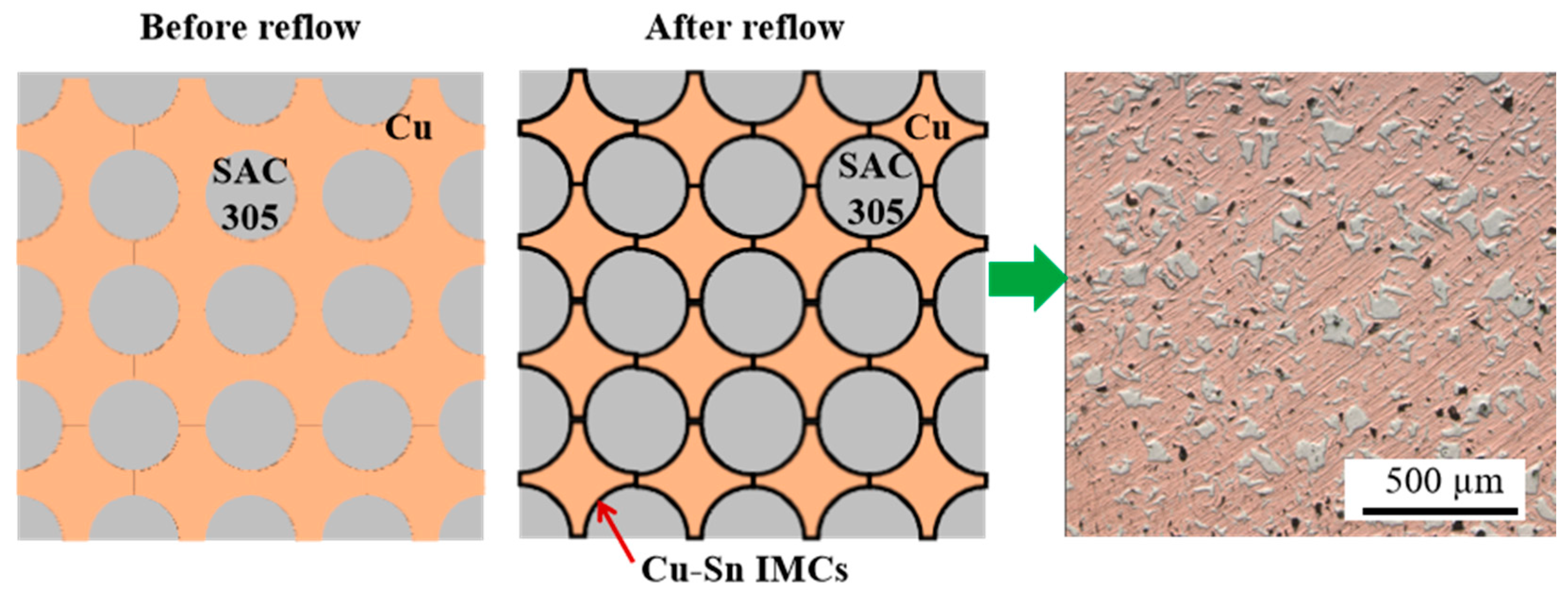
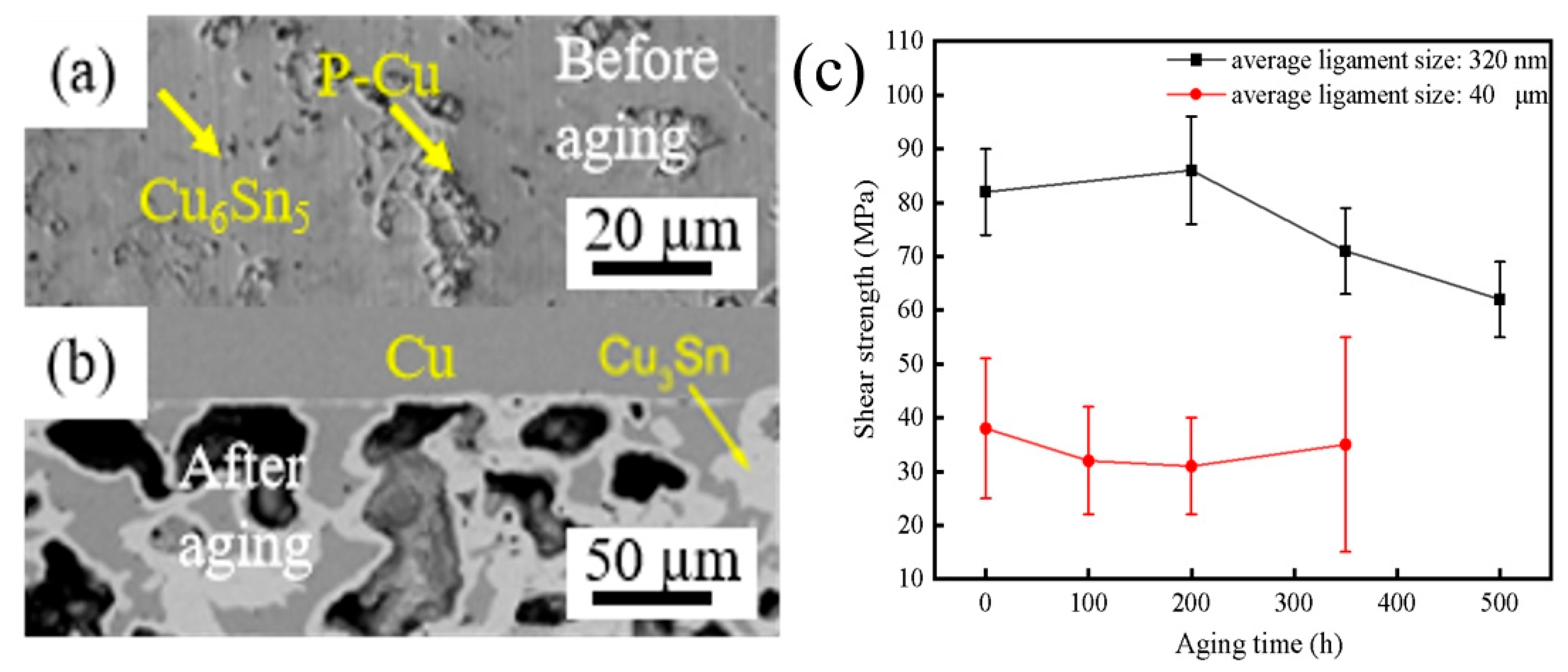
| Porous Cu-reinforced solder bonding | Cu, SnBi, Cu3Sn, Cu6Sn5 | 138 | 66.9 | Mechanical interlocking, excellent mechanical properties, inhibited IMC growth | Poor high-temperature resistance, internal voids | [30] |
| Cu, SnBi, Cu3Sn, Cu6Sn5 | 138 | 85.3 | [31] | |||
| P-Cu, SAC305, Cu3Sn, Cu6Sn5 | 217 | 70.0 | [32] | |||
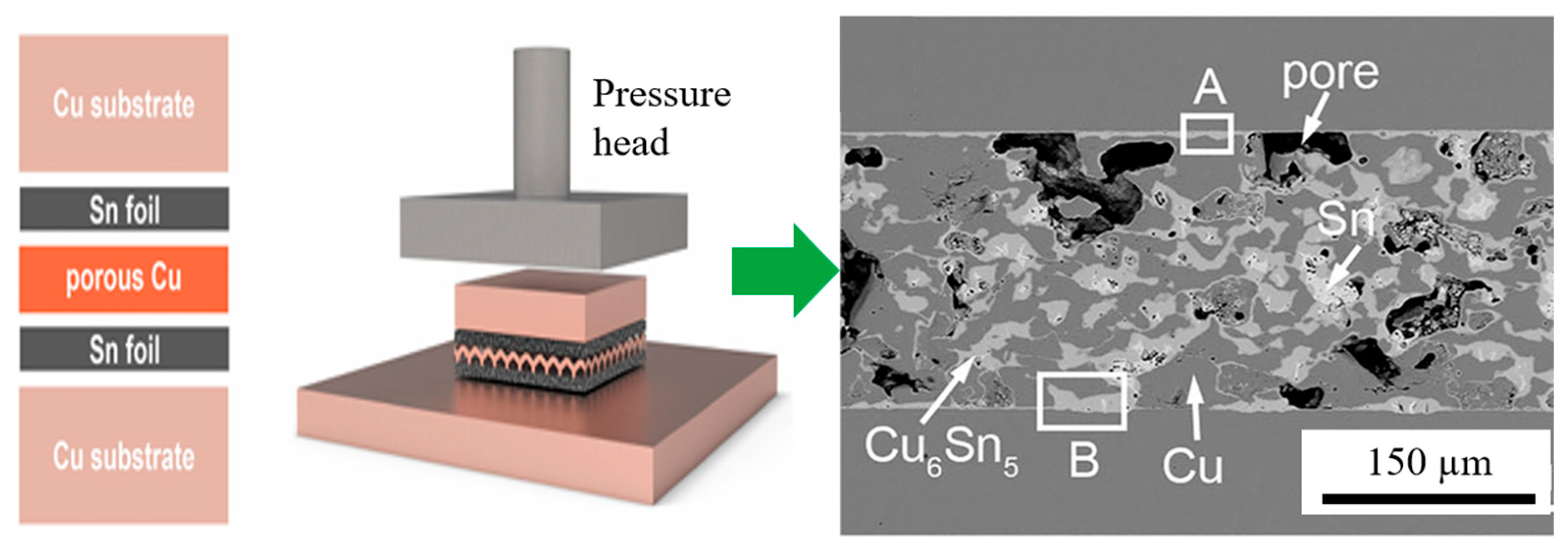
| TLP bonding | Cu, Cu3Sn, Cu6Sn5 | 415 | 70.7 | Low-temperature reflow–high-temperature service; excellent mechanical impact resistance | Complicated preparation process, interfacial voids | [29] |
| Cu3Sn | 676 | / | [33] | |||
| Cu, Cu3Sn, Cu6Sn5 | 415 | 83.0 | [34] | |||
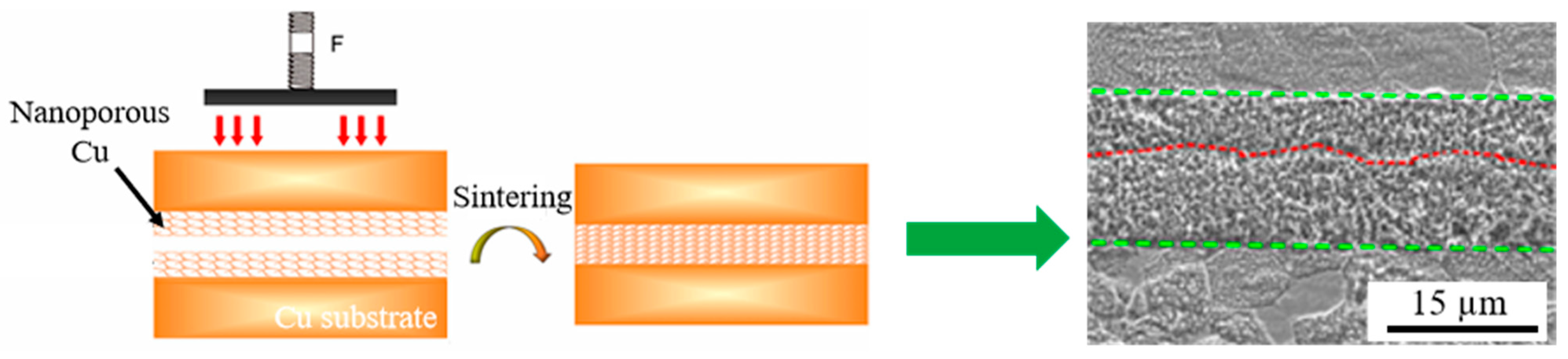
| Cu-Cu Bonding | Cu | 1084 | 30.8 | Excellent thermal and mechanical properties | Poor corrosion resistance, high processing difficulty | [35] |
| Cu, Cu(Au) | 1084 | ~40.0 | [36] | |||
| Cu | 1084 | 22.1 | [37] | |||
| Cu | 1084 | ~22.0 | [38] | |||
| Cu | 1084 | / | [39] |
Disclaimer/Publisher’s Note: The statements, opinions and data contained in all publications are solely those of the individual author(s) and contributor(s) and not of MDPI and/or the editor(s). MDPI and/or the editor(s) disclaim responsibility for any injury to people or property resulting from any ideas, methods, instructions or products referred to in the content. |
© 2026 by the authors. Licensee MDPI, Basel, Switzerland. This article is an open access article distributed under the terms and conditions of the Creative Commons Attribution (CC BY) license.
Share and Cite
Liu, J.; Qiu, L.; Wang, P.; Wang, F.; Huang, J.; Chen, H.; Zhao, H.; Chen, F. Application of Porous Copper-Based Interconnect Materials in Electronic Packaging: A Brief Review. Materials 2026, 19, 3937. https://doi.org/10.3390/ma19183937
Liu J, Qiu L, Wang P, Wang F, Huang J, Chen H, Zhao H, Chen F. Application of Porous Copper-Based Interconnect Materials in Electronic Packaging: A Brief Review. Materials. 2026; 19(18):3937. https://doi.org/10.3390/ma19183937
Chicago/Turabian StyleLiu, Jiahao, Lijin Qiu, Peizhong Wang, Feiyang Wang, Jixi Huang, Hongtao Chen, Hao Zhao, and Fangzhou Chen. 2026. "Application of Porous Copper-Based Interconnect Materials in Electronic Packaging: A Brief Review" Materials 19, no. 18: 3937. https://doi.org/10.3390/ma19183937
APA StyleLiu, J., Qiu, L., Wang, P., Wang, F., Huang, J., Chen, H., Zhao, H., & Chen, F. (2026). Application of Porous Copper-Based Interconnect Materials in Electronic Packaging: A Brief Review. Materials, 19(18), 3937. https://doi.org/10.3390/ma19183937