4.1. Position of the Sign Rule and the p/n Asymmetry
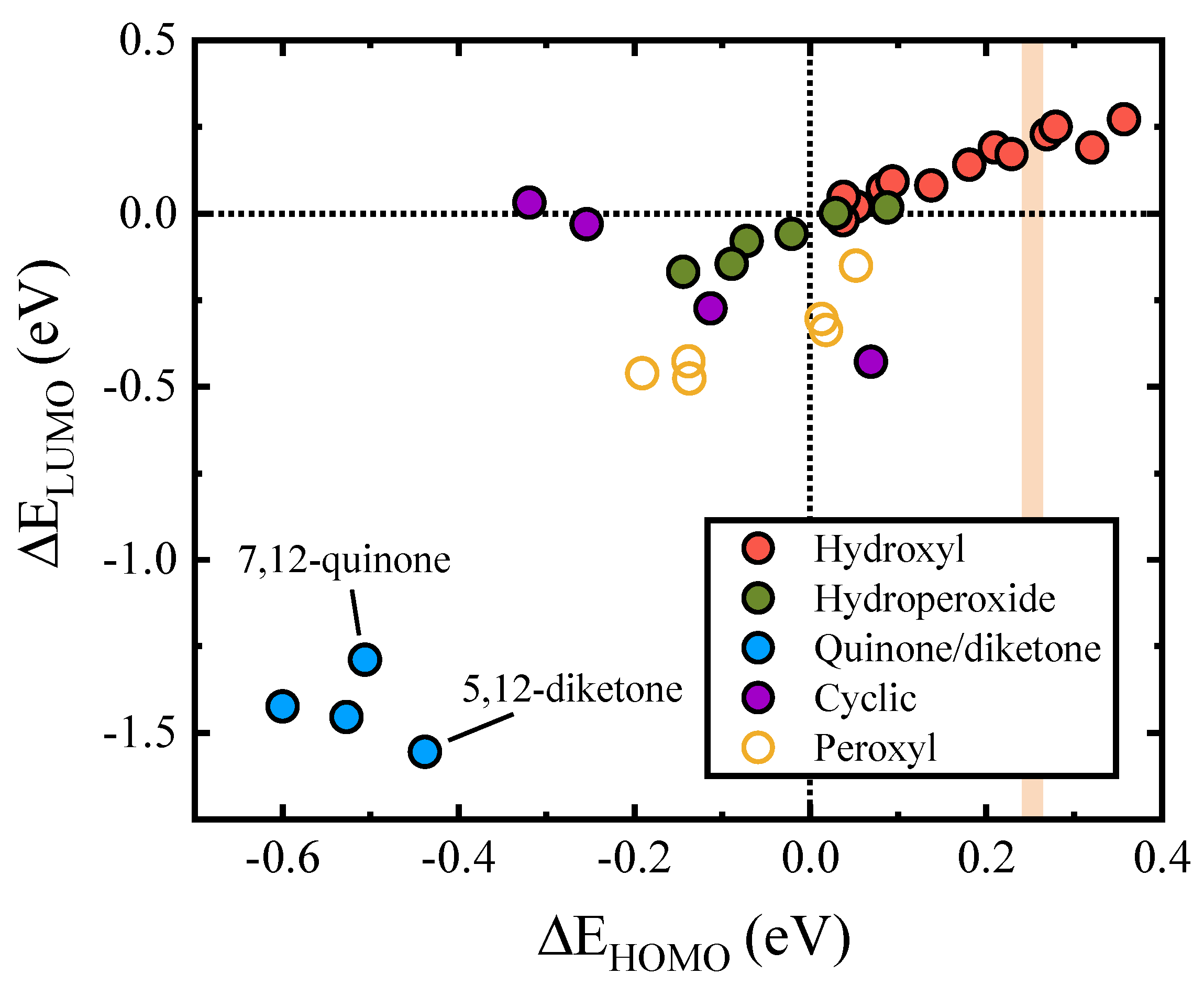
The notion that a substituent shifts the frontier levels of a conjugated molecule according to its donating or accepting character is, in itself, elementary. What the present screening adds is the systematic application of this notion across an entire family of atmospheric oxidation products of a single semiconductor so that the trap polarity may be read directly from the sign of the frontier-level shift. Previous computational studies of traps in organic semiconductors have commonly addressed individual candidate species in isolation [
14,
15]; here, in contrast, the value dwells in the continuity and the breadth of the map, which turns a case-by-case assignment into a single organising rule.
The same breadth underlies the second and, arguably, the more general result. The markedly better air stability of
p-type organic semiconductors relative to their
n-type counterparts is well documented experimentally [
7,
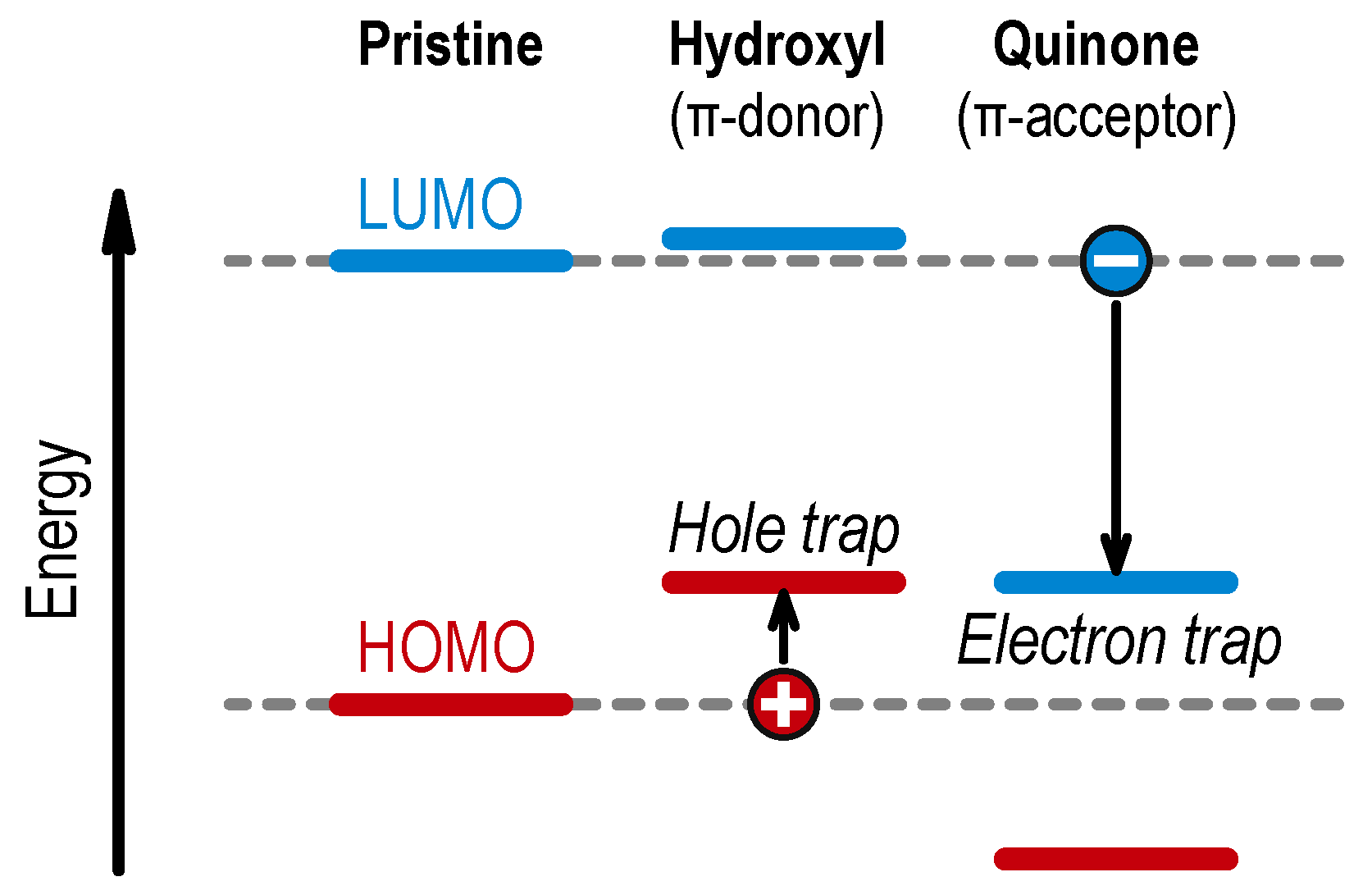
8], and it has usually been attributed to oxidation and humidity in rather general terms. The present map provides, to our knowledge, the first defect-level rationalisation of this asymmetry: atmospheric oxidation generates predominantly shallow hole traps but deep electron traps so that hole transport is only mildly perturbed, whereas electron transport would be destroyed. It should be noted here that this account is decoupled from any particular device—being a statement about which species can form and where their frontier levels dwell—and it constitutes, for this reason, the most robust and experiment-independent result of the present study.
A further, independent line of support emerges when the map is confronted with the thermodynamic criterion for the ambient stability of
n-type transport. De Leeuw and co-workers established that a reduced, electron-carrying state is stable against water and oxygen only if the electron affinity is sufficiently large—in practice, an electron affinity of roughly
–4 eV, i.e., a LUMO near
eV—a threshold that later underpinned the deep-LUMO design rules for air-stable
n-type semiconductors [
27,
28]. Notably, the oxidation-derived quinones of the present map fall within this window: added to the experimental pristine LUMO of DNTT (
eV [
6]), the density-functional shifts of
to
eV (
Section 4.4) place their absolute LUMO at about
to
eV; the semi-empirical shifts give essentially the same range (
to
eV) so that this placement does not depend on the level of the theory. Two consequences follow. First, these quinone states are deep enough to bind an electron stably in air so that they behave as permanent, thermodynamically robust electron traps rather than as reactive transients—consistent with their thermal silence in the DLTFS window. Second, and more broadly, the very deep LUMO that is deliberately engineered to obtain air-stable
n-type transport is here produced spontaneously by oxidation of the acene but as isolated defects: the oxidative lowering of the LUMO that would (globally) be required for stable
n-type conduction therefore (locally) destroys it, while perturbing hole transport only mildly so that the defect map supplies a microscopic basis for the macroscopic de Leeuw criterion. This absolute alignment, however, rests on adding a computed shift to the measured pristine level; owing to the semi-empirical, single-molecule nature of the screening, the agreement should be read as one of the right order rather than as an exact coincidence.
It should nevertheless be emphasised that the sign rule is a trend-level organising principle rather than a substitute for quantitative level positions; its strength dwells in predicting the polarity and the ordering of the traps rather than their absolute depths—a point to which we return below.
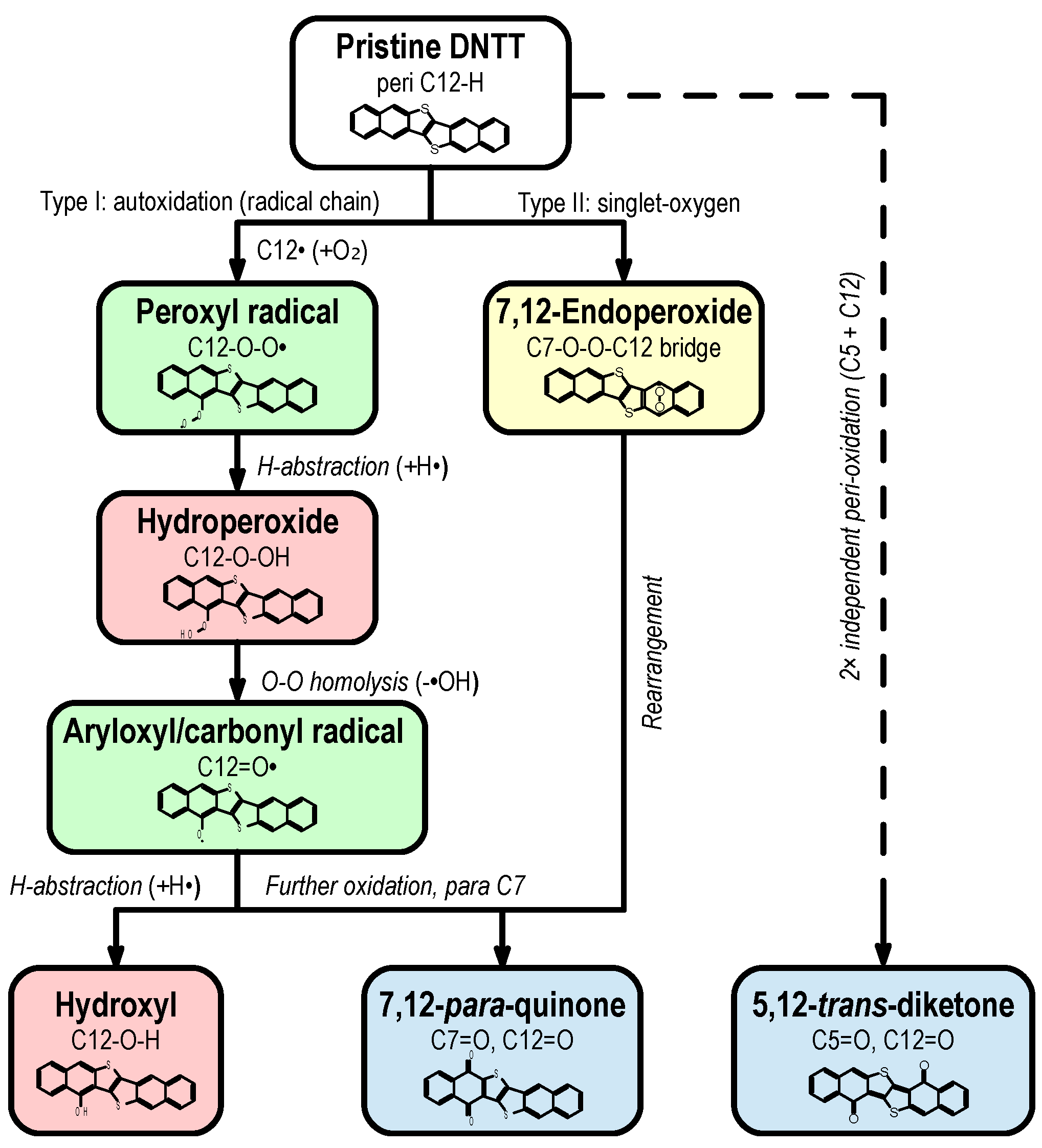
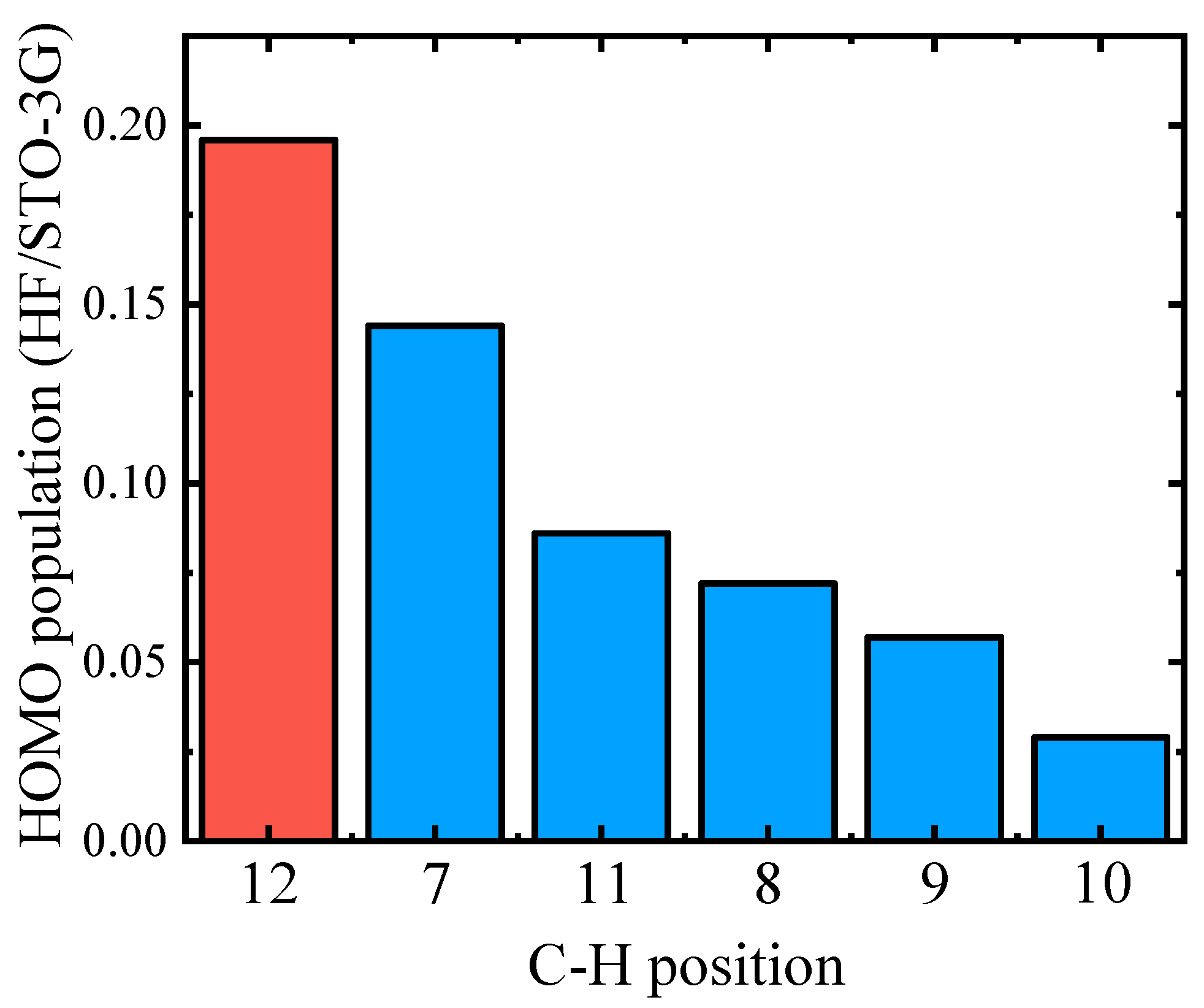
A remark on the relative likelihood of the mapped defects is in order, since not all of the identities are equally probable. The frontier reactivity index supplies an a priori ordering of the points of attack: the peri positions carry by far the largest HOMO population and are therefore the most susceptible to electrophilic oxidation (
Figure 3) so that the peri hydroxyl and the peri-derived carbonyl/quinone—precisely the species that anchor the present analysis—are expected to dominate the early-stage defect population. The multiply-oxidised species (the bis-hydroxyls and the endoperoxides) and the high-locant single defects are best read as later-stage or less-probable products that delineate the boundaries of each electronic regime rather than as the most likely traps. It should be noted here that a quantitative formation-energy ranking would require explicit reference states for O
2 and H
2O together with a treatment of the reaction barriers, which lies outside the scope of the present frontier-orbital screening; the reactivity index is therefore used only as an ordinal proxy for susceptibility.
4.2. The Experimental Anchor and Why a Unique Identification Is Withheld
As shown in
Section 3.6, the hole trap measured at about
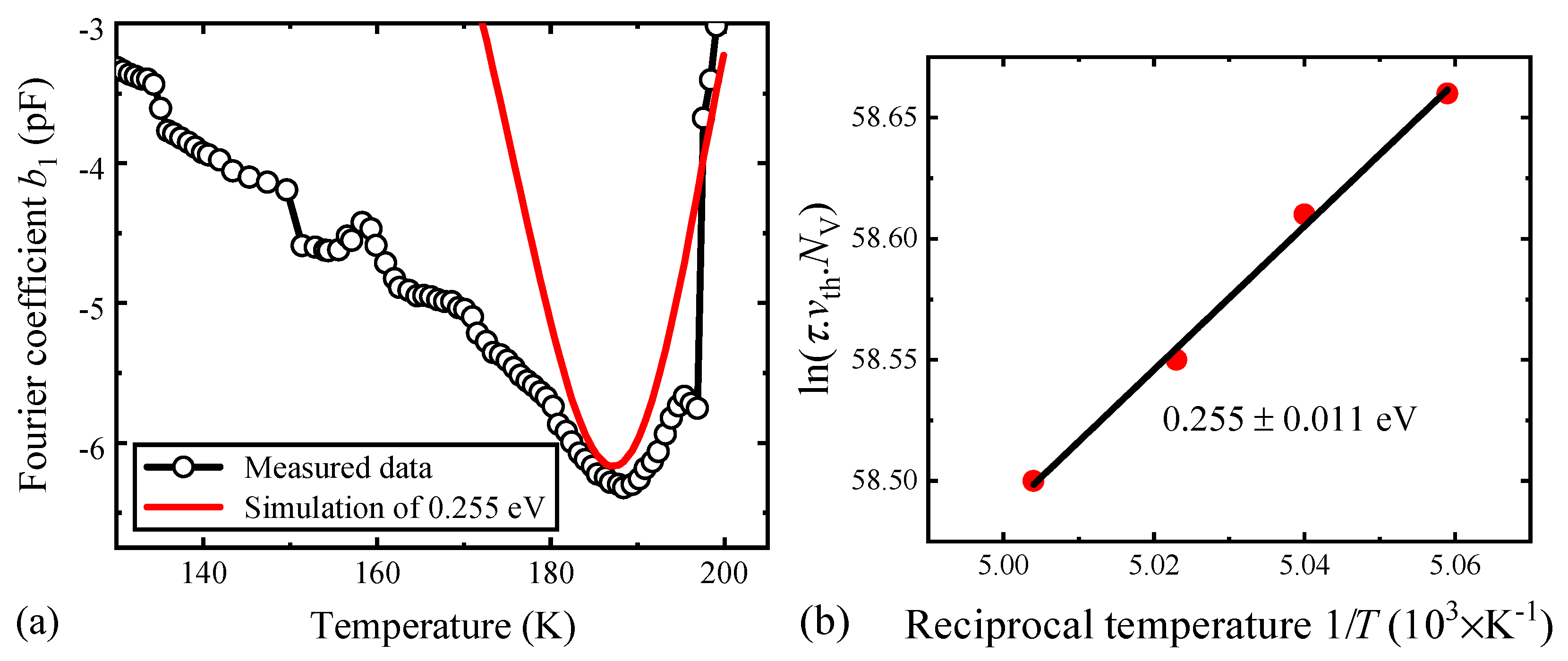
eV dwells within the band that the sign rule predicts for hydroxylation and early oxidation, and it is, in this sense, fully consistent with a hydroxyl-related origin. It should be noted here, however, that consistency is deliberately not equated with identification, and this is due to three reasons.
First, this energy window is densely populated by chemically distinct species: the 12-hydroxyl at eV, several bis-hydroxyl isomers between about and eV, and, numerically, the 12-carbonyl/alkoxyl radical at eV. Hence a single activation energy cannot, on its own, single out one microscopic configuration. Second, the screening is semi-empirical, with an intrinsic scatter of the order of – eV; even a nominally exact coincidence therefore dwells well within the uncertainty of the method and carries no special weight. Third, and most importantly, the chemical composition of the degraded film was not characterised independently (e.g., by infrared or photoelectron spectroscopy), so the actual presence of hydroxyl groups is inferred rather than verified.
It should be emphasised that the apparent exact match of the 12-carbonyl radical is not employed here as an argument. Its frontier level is singly occupied (i.e., a SOMO) and is thus not directly comparable with the closed-shell levels, and the radical is, in any case, a transient intermediate rather than a stable trapping species. We therefore deliberately refrain from resting any identification on this coincidence.
Furthermore, the exposure history of the devices was short—the transistors were first measured about one day after fabrication and were subsequently held under vacuum—so that the extent of oxidation was necessarily limited, and origins other than hydroxylation cannot be excluded. In particular, the disruption of
–
stacking at grain boundaries [
10], physisorbed oxygen or water acting as acceptors [
7,
9], and the penetration of silver from the evaporated top contacts all remain plausible contributors to a deep state of this energy. Indeed, a hole-trap feature at a comparable energy (about
–
eV above the mobility edge) has previously been resolved in DNTT and attributed to water-related states at the dielectric interface [
7]. The chemical origin proposed here is therefore offered as a complementary—and, to our knowledge, previously unexplored—possibility and not as a replacement for these physical mechanisms. It should be noted here, moreover, that covalent oxidation defects are expected only in dilute concentrations, at or below the sensitivity of the composition-sensitive probes (XPS, FTIR, SIMS) that would be required to confirm them directly; their absence from earlier reports therefore reflects the difficulty of detecting such dilute chemical modifications—already electrically active as traps at concentrations far below the chemical detection floor—rather than their genuine absence. As a result, the map is best read as constraining the polarity and the plausible chemistry of the trap rather than as delivering its precise microscopic identity.
4.3. Optical Filling and the Absence of an Electron-Trap Signal
Because the traps were filled optically rather than by an electrical pulse, the green-light excitation (
nm,
eV) generates both holes and electrons within the DNTT layer so that—in principle—both the hole and the electron families of the map could be populated. Optical excitation of DNTT is indeed well documented to produce a photoresponse and to trap photo-generated carriers [
9,
29], the response being strongest near the absorption maximum at 460 nm [
9] so that our 520 nm excitation lies on the low-energy tail. It should be noted here that the absence of any electron-related feature in the measured spectra is therefore not a filling artefact but rather a consequence of the detection stage.
The photo-generated species is initially a Frenkel exciton, the binding energy of which reaches a value of about
eV in acene-type materials [
30]. Its dissociation into free carriers is driven by the high internal field established under reverse bias, together with charge separation at the semiconductor/dielectric interface and at defect sites. Interestingly, the deep oxidation-derived electron traps (i.e., the quinones and the 5,12-diketone, with
reaching about
to
eV) constitute almost ideal electron sinks at which such a dissociation may proceed: the electron falls deep and remains captured, whereas the liberated hole is subsequently observed through its shallower hydroxyl-related trap. One and the same oxidation chemistry thus provides both a dissociation centre and the observed hole trap; this, however, should be regarded as a plausible mechanistic reading rather than an established claim.
The invisibility of the electron side then follows from a bundle of concurrent reasons. First, the deepest electron traps are thermally mute: at the measurement temperatures (130–205 K) a level lying
eV below the conduction-band minimum emits at a negligible rate and behaves as fixed charge rather than as a transient. Second, the structure is a
p-type device measured under negative reverse bias, i.e., in hole accumulation, so that the capacitance transient is intrinsically governed by the exchange of holes with the valence band. Third, and in accordance with the two preceding points, the electron channel is doubly blocked: the effective electron mobility of DNTT is lower by orders of magnitude (the material being a strongly unipolar
p-type semiconductor), and the silver source and drain present a large injection/extraction barrier to the shallow LUMO of DNTT: taking the DNTT HOMO and LUMO at about
and
eV, respectively [
6], and the silver work function as
eV [
31], the nominal (vacuum-level) electron injection barrier of about
eV substantially exceeds the hole barrier of about
eV. Hence, even a mid-depth electron trap that could in principle emit would find no communicating pathway to the electrodes.
It should be noted here that the resulting absence of an electron signal is thus an expected consequence of the measurement configuration and, crucially, does not constitute evidence concerning the electron side of the defect map. Where prior photoresponse studies of DNTT do resolve electron trapping, it is a reversible trapping of photo-generated electrons at the dielectric interface [
9], distinct from the deep, covalent electron traps (the quinones) that the present map predicts. The
p/
n asymmetry of
Section 3.6 therefore remains a computational prediction with which the present experiment is fully consistent (it resolves the hydroxyl-related hole trap) while being blind, by construction, to the electron-trapping species.
4.4. Methodological Standing: Validity and Limits of the Screening
The GFN2-xTB method employed here is a fast, broadly parametrised semi-empirical scheme, and its virtues and its limits should be stated plainly. Its absolute orbital energies are not reliable—the pristine HOMO of eV is far removed from the reported ionisation energy of DNTT—so the method is used here not as a source of absolute levels but as a screening tool for the relative shifts and, above all, for their ordering. In other words, it is a powerful and inexpensive instrument for establishing trends, but it does not, on its own, deliver quantitative trap depths.
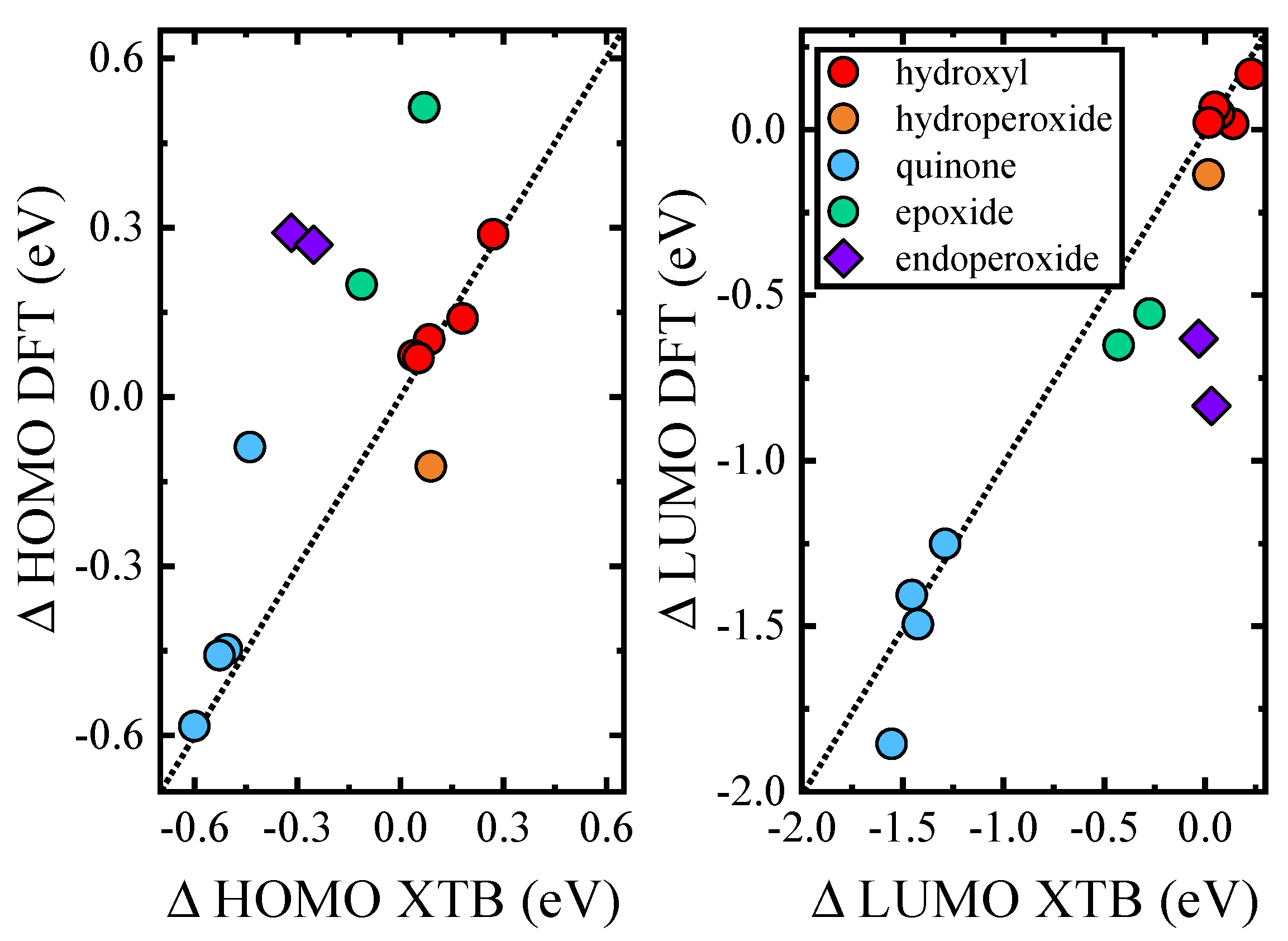
To test directly whether the sign rule and the ordering survive a higher level of theory, single-point hybrid density-functional calculations (B3LYP-D3BJ/def2-TZVP, with the RIJCOSX approximation) were carried out on the GFN2-xTB geometries of fourteen representative defects spanning all closed-shell classes—hydroxyls, a hydroperoxide, quinones, a diketone, epoxides and endoperoxides (
Figure 7 and
Table 2). At this level the pristine frontier levels are realistic (HOMO
eV, gap
eV, against the experimental
eV and ≈3.0 eV), and, more importantly, the polarity classification is reproduced throughout: every hydroxyl remains a hole trap (
for all five), and every quinone together with the diketone remains a deep electron trap (
between
and
eV). The two frameworks correlate closely—for
across the twelve donor/acceptor defects, the Pearson coefficient is
—so that the sign rule, the ordering, and with them the
p/
n asymmetry are confirmed to be robust to the electronic-structure method. We verified, in addition, that the shifts are essentially unchanged between the def2-SVP and def2-TZVP basis sets, and they are therefore not an artefact of basis-set size.
One motif, however, exposes a genuine limit of the semi-empirical screening. For both endoperoxides the two methods disagree: GFN2-xTB classifies them as gap-wideners—a lowered HOMO with an essentially unshifted LUMO—whereas at the DFT level, the O–O bridge dearomatises the terminal ring so that the HOMO rises, the LUMO falls, and the gap in fact narrows. Because the two endoperoxides diverge in precisely the same way, the discrepancy is systematic rather than incidental, and it singles out the strained, dearomatised peroxide bridge as the one structural motif for which the semi-empirical frontier levels are not to be trusted. It should be noted here that this does not affect the conclusions of the present work, which rest on the hydroxyl and carbonyl/quinone channels; the endoperoxides are reported in full and are simply excluded from the quantitative correlation above.
A legitimate objection is that the single-molecule, gas-phase levels neglect the electronic polarisation of the surrounding crystal, which stabilises a localised charge. It should be noted here, however, that this polaronic term (
–
eV) is, to a good approximation, a state-independent rigid offset: it shifts the whole map downward but changes neither the sign of
nor the ordering of the defects [
24,
25,
26]. Hence, the two load-bearing conclusions of the present work—the trap polarity and the ordering of the levels—are invariant with respect to it. An explicit crystal-polarisation cell would refine the absolute depths further, but—as the density-functional validation below already demonstrates for the sign and the ordering—it would leave the polarity classification and the
p/
n asymmetry untouched; the absolute trap depths are therefore not pursued here.
Finally, it should be emphasised that the frontier reactivity index is used only in an ordinal sense. Because the minimal STO-3G basis and the Mulliken partitioning are known to be basis-set dependent, no quantitative weight is placed on its values; its sole role is to rank the sites a priori, that is, independently of the trap energetics. This independence is, in fact, crucial: it ensures that the most reactive site is identified from the intrinsic frontier density of the pristine molecule rather than being selected a posteriori because its energy happens to match the experiment, and it thereby removes the circularity that would otherwise threaten such an assignment.
4.5. Trap Concentration: A Cautionary Note
A word of caution is in order regarding the trap concentration which, unlike the activation energy, is not measured directly but is obtained by scaling the transient amplitude,
, by the shallow (doping) concentration
. For the present devices, the extraction returns an
of about
cm
−3, which exceeds the molecular density of DNTT (approximately
cm
−3) by several orders of magnitude. It should be noted here that one cannot have more dopants than molecules; the extracted concentration is therefore an artefact rather than a physical value. The reason is simple: the standard analysis assumes a bulk Schottky junction with a bias-modulated depletion width, whereas the ≈50 nm, nearly intrinsic film is fully depleted so that its capacitance is geometric (bias-independent) and the extraction of
—and hence of
—breaks down. More generally, in a field-effect transistor, the charge is transported within a thin accumulation layer at the semiconductor/dielectric interface so that transfer-curve analyses probe essentially that interface and naturally return an areal trap density rather than a bulk one; the areal densities reported for DNTT devices, of the order of
–
cm
−2 [
7,
9], are consistent with this picture. As this behaviour is returned as a matter of course by commonly used commercial DLTS systems, the reported concentration should not be taken at face value; the detailed analysis is given in the
Supplementary Materials. Crucially, the activation energy
is obtained from the emission time constant
and not from the amplitude, so that it—and with it the entire defect map—is unaffected by this limitation.
4.6. Implications
The practical implication of the present work is that the map constitutes a roadmap linking oxidation chemistry to trap polarity, which can be used to assign the electronic character of a trap once it has been measured: given an activation energy together with its sign, the map indicates the class of degradation product to which the level may correspond, without a dedicated calculation for each new case. Since the underlying rule—the sign of the frontier shift, set by the donor or acceptor nature of the oxygen functionalisation—is chemical rather than specific to DNTT, the same approach should be transferable to other acene semiconductors. In particular, the rule is expected to carry over to the widely used side-chain- and core-modified DNTT derivatives—such as the dialkyl Cn-DNTTs and the diphenyl variant—since the alkyl or aryl groups govern solubility and film packing but leave the conjugated core, on which the oxygen functionalisation acts, essentially intact; the heavier chalcogen (seleno) analogues likewise preserve the donor/acceptor logic of the sign rule, even though their absolute frontier levels are shifted. The polarity classification should therefore transfer to these technologically important materials, although the precise trap depths would have to be recomputed in each case. Hence, the screening offers an inexpensive and reusable reference for interpreting trap spectra in atmospherically degraded organic devices.