Experimental Research on Heat Transfer Through 3D-Printed Plates: Implications for the Development of Smart Facades



Abstract
1. Introduction
2. Materials and Methods
2.1. Investigated 3D-Printed Polymer Materials
- PLA Basic (polylactic acid): The material used is a poly-L-lactic acid (PLLA) based polymer. While PLA is bio-based and biodegradable, its low heat deflection temperature (typically 50–60 °C) is a limitation for direct exposure on exterior facade surfaces. However, for building insulation, biodegradability may not be a required functional property; thus, it was selected for this study to evaluate its performance as a protected internal insulating core within multi-layered smart facade systems, where it remains shielded from direct environmental degradation and extreme surface temperatures. To ensure optimal processing and minimize moisture-induced defects during extrusion, the filament was dried at 45 °C for 6 h prior to printing using a dedicated filament drying station with forced air circulation.
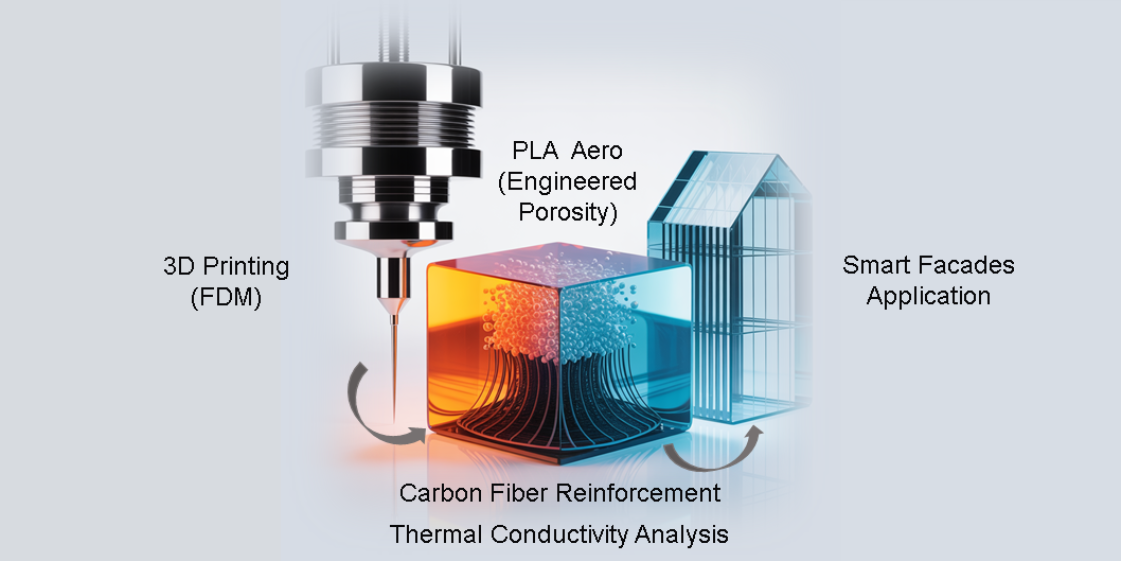
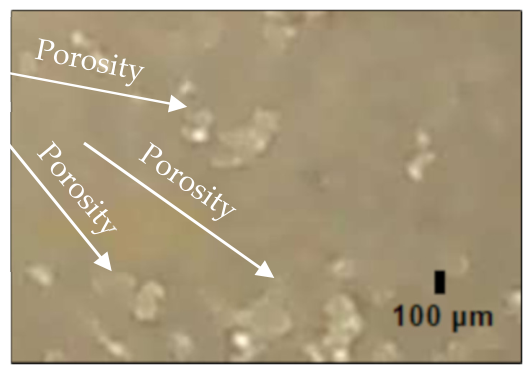
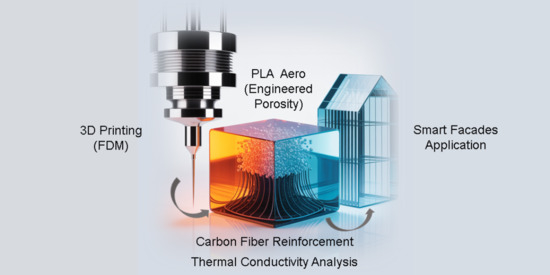
- PLA Aero (foaming grade): Confirmed as a PLLA-based material, this filament utilizes specialized active foaming additives that thermally decompose during the printing process. This creates a micro-porous, closed-cell internal structure, where the final porosity is controlled by the extrusion temperature and flow ratio. This engineered porosity is intended to reduce the effective thermal conductivity by substituting a portion of the solid polymer matrix with quiescent air pockets. To ensure material stability, the filament was dried at 45 °C for 6 h before printing. The resulting specimens were subsequently characterized to assess the semi-quantitative insulation benefits of this foamed architecture.
- PETG (polyethylene terephthalate glycol): PETG was selected for its superior chemical resistance and higher Heat Deflection Temperature (HDT) compared to PLA, enhancing its stability under thermal stress in facade applications. To prevent depolymerization during the melt process and eliminate moisture-induced porosity, the filament was dried at 65 °C for 4 h prior to printing.
- PET-CF (carbon fiber-reinforced PET): This technical-grade composite consists of a semi-crystalline PET matrix reinforced with 25 wt.% chopped carbon fibers. While the fibers enhance mechanical stability, they also potentially introduce thermal anisotropy and act as “thermal bridges,” increasing the effective conductivity. The filament was dried at 85 °C for 10 h before fabrication, following the manufacturer’s strict requirements to ensure optimal inter-layer bonding.
2.2. Fabrication of Samples for Thermal Analysis
2.3. Thermal Conductivity Measurement (GHP Method)
2.4. Multi-Layered Air-Core Structures and Glass Assemblies
2.5. Microstructural Characterization Method
2.6. Uncertainty Analysis
3. Results
4. Discussion
4.1. Influence of Reinforcements and Composite Morphology: PETG vs. PET-CF
4.2. Comparative Performance of Multi-Layered Air-Core Assemblies
4.3. Practical Implications for Smart Facades and Study Limitations
5. Conclusions
Author Contributions
Funding
Data Availability Statement
Conflicts of Interest
Abbreviations
| AM | Additive Manufacturing (3D printing) |
| ASTM | American Society for Testing and Materials |
| BEM | Building Energy Modeling |
| CFD | Computational Fluid Dynamics |
| EN | European Standard |
| FDM | Fused Deposition Modeling |
| GHP | Guarded Hot Plate (guarded-hot-plate method) |
| GLASS | Glass (used in multi-layer configurations, e.g., GLASS-AIR-GLASS) |
| GUM | Guide to the Expression of Uncertainty in Measurement |
| HDT | Heat Deflection Temperature |
| HVAC | Heating, Ventilation, and Air Conditioning |
| IGU | Insulating Glass Unit |
| ISO | International Organization for Standardization |
| PETG | Polyethylene Terephthalate Glycol |
| PET-CF | PET reinforced with Carbon Fiber |
| PLA | Polylactic Acid (PLA Basic) |
| PLA Aero | Polylactic Acid (foaming/foamed grade) |
| PLLA | Poly-L-lactic acid |
| q | heat flux [W/m2] |
| R-value | thermal resistance [m2·K/W] |
| uc | combined standard uncertainty |
| U-value | thermal transmittance (conductance) [W/(m2·K)] |
| U | expanded uncertainty ($k = 2$) |
| δ | sample thickness [m] |
| ΔT | temperature difference [K] |
| λeff | effective thermal conductivity (for monolithic specimens) [W/(m·K)] |
| λapp | apparent thermal conductivity (for multi-layered assemblies) [W/(m·K)] |
| ZEB | Zero-Emission Building |
References
- Firoozi, A.A.; Firoozi, A.A.; Oyejobi, D.O.; Avudaiappan, S.; Flores, E.S. Emerging trends in sustainable building materials: Technological innovations, enhanced performance, and future directions. Results Eng. 2024, 24, 103521. [Google Scholar] [CrossRef]
- Tan, Y.; Shen, L.; Yao, H. Sustainable construction practice and contractors’ competitiveness: A preliminary study. Habitat Int. 2011, 35, 225–230. [Google Scholar] [CrossRef]
- Pérez-Lombard, L.; Ortiz, J.; Pout, C. A review on buildings energy consumption information. Energy Build. 2008, 40, 394–398. [Google Scholar] [CrossRef]
- Yaman, M. Different facade types and building integration in energy efficient building design strategies. Int. J. Built Environ. Sustain. 2021, 8, 49–61. [Google Scholar] [CrossRef]
- Perino, M.; Serra, V. Switching from static to adaptable and dynamic building envelopes: A paradigm shift for the energy efficiency in buildings. J. Facade Des. Eng. 2015, 3, 143–163. [Google Scholar] [CrossRef]
- Sartori, I.; Hestnes, A.G. Energy use in the life cycle of conventional and low-energy buildings: A review article. Energy Build. 2007, 39, 249–257. [Google Scholar] [CrossRef]
- Baraboi, D.-R.; Scutaru, L.M.; Dragomir, G.; Brezeanu, A.I.; Calotă, R.; Pavel, M.; Năstase, G. Smart 3D-printed facades: A review of innovations, materials, and sustainable performance. Front. Sustain. Cities 2025, 7, 1610729. [Google Scholar] [CrossRef]
- Wang, J.; Li, S.; Ye, P. Dynamic Skin: A Systematic Review of Energy-Saving Design for Building Facades. Buildings 2025, 15, 2572. [Google Scholar] [CrossRef]
- Murtagh, N.; Scott, L.; Fan, J. Sustainable and resilient construction: Current status and future challenges. J. Clean. Prod. 2020, 268, 122264. [Google Scholar] [CrossRef]
- Chi, D.A.; Moreno, D.; Navarro, J. Design optimisation of perforated solar façades in order to balance daylighting with thermal performance. Build. Environ. 2017, 125, 383–400. [Google Scholar] [CrossRef]
- Grimvall, G. Thermophysical Properties of Materials; Elsevier: Amsterdam, The Netherlands, 1999. [Google Scholar]
- Guo, Y.; Ruan, K.; Gu, J. Controllable thermal conductivity in composites by constructing thermal conduction networks. Mater. Today Phys. 2021, 20, 100449. [Google Scholar] [CrossRef]
- Firoozi, A.A.; Firoozi, A.A. Smart facades in architecture: Driving energy efficiency and adaptive urban design. SSRN 2023. preprint. [Google Scholar] [CrossRef]
- Wong, K.V.; Hernandez, A. A review of additive manufacturing. Int. Sch. Res. Not. 2012, 2012, 208760. [Google Scholar] [CrossRef]
- Oropallo, W.; Piegl, L.A. Ten challenges in 3D printing. Eng. Comput. 2016, 32, 135–148. [Google Scholar]
- Teizer, J.; Blickle, A.; King, T.; Leitzbach, O.; Guenther, D. Large scale 3D printing of complex geometric shapes in construction. In Isarc, Proceedings of the International Symposium on Automation and Robotics in Construction, Montreal, QC, Canada, 28–31 July 2025; IAARC Publications: Lyon, France, 2016; Volume 33, p. 1. [Google Scholar]
- Borthakur, P.P. The Role and Future Directions of 3D Printing in Custom Prosthetic Design. Eng. Proc. 2025, 81, 10. [Google Scholar] [CrossRef]
- Lee, C.H.; Padzil, F.N.B.M.; Lee, S.H.; Ainun, Z.M.A.; Abdullah, L.C. Potential for natural fiber reinforcement in PLA polymer filaments for fused deposition modeling (FDM) additive manufacturing: A review. Polymers 2021, 13, 1407. [Google Scholar] [CrossRef] [PubMed]
- Markin, V.; Nerella, V.N.; Schröfl, C.; Guseynova, G.; Mechtcherine, V. Material design and performance evaluation of foam concrete for digital fabrication. Materials 2019, 12, 2433. [Google Scholar] [CrossRef] [PubMed]
- Rathore, P.K.S.; Aleem, A.; Sikarwar, B.S.; Sharma, R.K.; Kumar, R.; Gupta, N.K. Experimental and simulation study of lightweight roof with thermal energy storage for energy-efficient building envelope. Therm. Sci. Eng. Prog. 2025, 67, 104128. [Google Scholar] [CrossRef]
- Gao, Z.; Yin, J.; Liu, P.; Li, Q.; Zhang, R.; Yang, H.; Zhou, H. Simultaneous multi-material embedded printing for 3D heterogeneous structures. Int. J. Extrem. Manuf. 2023, 5, 035001. [Google Scholar] [CrossRef]
- Singh, R.; Gehlot, A.; Akram, S.V.; Gupta, L.R.; Jena, M.K.; Prakash, C.; Singh, S.; Kumar, R. Cloud manufacturing, internet of things-assisted manufacturing and 3D printing technology: Reliable tools for sustainable construction. Sustainability 2021, 13, 7327. [Google Scholar] [CrossRef]
- Morales, M.A.; Maranon, A.; Hernandez, C.; Michaud, V.; Porras, A. Colombian sustainability perspective on fused deposition modeling technology: Opportunity to develop recycled and biobased 3D printing filaments. Polymers 2023, 15, 528. [Google Scholar] [CrossRef] [PubMed]
- Abid, M.T.; Khan, S.A.; Koç, M. 3D printing in facilities management: A systematic review toward smart and sustainable building operations. Buildings 2025, 15, 4231. [Google Scholar] [CrossRef]
- Mahdavinejad, M.; Bazazzadeh, H.; Mehrvarz, F.; Berardi, U.; Nasr, T.; Pourbagher, S.; Hoseinzadeh, S. The impact of facade geometry on visual comfort and energy consumption in an office building in different climates. Energy Rep. 2024, 11, 1–17. [Google Scholar]
- Baraboi, D.-R.; Năstase, G.; Sima, R.; Șerban, A. Evolution of Colorimetry in 3D-Printed Samples Exposed to External Weather Conditions, Used in Smart Façades. Buildings 2026, 16, 197. [Google Scholar] [CrossRef]
- D’Alessandro, G.; Potenza, M.; Corasaniti, S.; Sfarra, S.; Coppa, P.; Bovesecchi, G.; de Monte, F. Modeling and measuring thermodynamic and transport thermophysical properties: A review. Energies 2022, 15, 8807. [Google Scholar] [CrossRef]
- Haj Hussein, M.; Monna, S.; Abdallah, R.; Juaidi, A.; Albatayneh, A. Improving the thermal performance of building envelopes: An approach to enhancing the building energy efficiency code. Sustainability 2022, 14, 16264. [Google Scholar] [CrossRef]
- Lei, J.; Yang, J.; Yang, E.-H. Energy performance of building envelopes integrated with phase change materials for cooling load reduction in tropical Singapore. Appl. Energy 2016, 162, 207–217. [Google Scholar] [CrossRef]
- Wang, X.; Sun, X.; Yu, C.W. Building envelope with variable thermal performance: Opportunities and challenges. Indoor Built Environ. 2018, 27, 729–733. [Google Scholar] [CrossRef]
- Lopez-Carreon, I.; Jahan, E.; Yari, M.H.; Esmizadeh, E.; Riahinezhad, M.; Lacasse, M.; Xiao, Z.; Dragomirescu, E. Moisture Ingress in Building Envelope Materials:(II) Transport Mechanisms and Practical Mitigation Approaches. Buildings 2025, 15, 762. [Google Scholar]
- Zheng, K.; Cho, Y.K.; Wang, C.; Li, H. Noninvasive Residential Building Envelope R-Value Measurement Method Based on Interfacial Thermal Resistance. J. Archit. Eng. 2016, 22, A4015002. [Google Scholar] [CrossRef]
- Anwajler, B.; Szołomicki, J.; Noszczyk, P.; Baryś, M. The potential of 3D printing in thermal insulating composite materials—Experimental determination of the impact of the geometry on thermal resistance. Materials 2024, 17, 1202. [Google Scholar] [CrossRef] [PubMed]
- Fakhr Ghasemi, A.; Pinto Duarte, J. A Systematic Review of Innovative Advances in Multi-Material Additive Manufacturing: Implications for Architecture and Construction. Materials 2025, 18, 1820. [Google Scholar] [CrossRef] [PubMed]
- Lü, X.; Lu, T.; Yang, T.; Salonen, H.; Dai, Z.; Droege, P.; Chen, H. Improving the energy efficiency of buildings based on fluid dynamics models: A critical review. Energies 2021, 14, 5384. [Google Scholar] [CrossRef]
- Tritt, T.M. Thermal Conductivity: Theory, Properties, and Applications; Springer Science & Business Media: Berlin, Germany, 2005. [Google Scholar]
- ASTM C177-19; Standard Test Method for Steady-State Heat Flux Measurements and Thermal Transmission Properties by Means of the Guarded-Hot-Plate Apparatus. ASTM International: West Conshohocken, PA, USA, 2019. Available online: https://store.astm.org/c0177-19.html (accessed on 6 December 2025).
- BS EN 12667:2001; Thermal Performance of Building Materials and Products. Determination of Thermal Resistance by Means of Guarded Hot Plate and Heat Flow Meter Methods. Products of High and Medium Thermal Resistance. BSI (British Standards Institution): London, UK, 2001. Available online: https://www.en-standard.eu/bs-en-12667-2001-thermal-performance-of-building-materials-and-products-determination-of-thermal-resistance-by-means-of-guarded-hot-plate-and-heat-flow-meter-methods-products-of-high-and-medium-thermal-resistance/ (accessed on 8 December 2025).
- EN 12939:2000; Thermal Performance of Building Materials and Products—Determination of Thermal Resistance by Means of Guarded Hot Plate and Heat Flow Meter Methods—Thick Products of High and Medium Thermal Resistance. CEN (European Committee for Standardization): Brussels, Belgium, 2000. Available online: https://standards.iteh.ai/catalog/standards/cen/15a1e073-68a4-4c76-ad91-b623f7422162/en-12939-2000?srsltid=AfmBOoo__PyE9BGU5JsKnTPvLkwWRy6OE-j3H0BKGclqmWQf2omJzR_a (accessed on 5 December 2025).
- ISO/IEC Guide 98-3:2008; Uncertainty of Measurement—Part 3: Guide to the Expression of Uncertainty in Measurement (GUM:1995). ISO: Geneva, Switzerland, 2008. Available online: http://www.iso.org/sites/JCGM/JCGM-introduction.htm (accessed on 6 December 2015).
- MacFarland, N.; Carbajal, G.; Romero-Ramirez, E.; Stanfill, C. Experimental Evaluation of the Thermal Conductivity of 3D-Printed Polylactic Acid Composite Materials. In Proceedings of the Volume 9: Heat Transfer and Thermal Engineering, Portland, OR, USA, 17–21 November 2024; American Society of Mechanical Engineers: New York, NY, USA, 2024; p. V009T11A005. [Google Scholar]
- Ultimaker. Ultimaker PLA Filament Material Data Sheet. Ultimaker, Technical Data Sheet. Available online: https://www.matweb.com/search/DataSheet.aspx?MatGUID=16027c449339463b90558b73f75e7a89 (accessed on 4 April 2026).
- Blanco, I.; Cicala, G.; Recca, G.; Tosto, C. Specific heat capacity and thermal conductivity measurements of PLA-based 3D-printed parts with milled carbon fiber reinforcement. Entropy 2022, 24, 654. [Google Scholar] [PubMed]
- Sovetova, M.; Calautit, J.K. Influence of printing parameters on the thermal properties of 3D-printed construction structures. Energy 2024, 305, 132265. [Google Scholar] [CrossRef]
- Valvez, S.; Silva, A.P.; Reis, P.N. Optimization of printing parameters to maximize the mechanical properties of 3D-printed PETG-based parts. Polymers 2022, 14, 2564. [Google Scholar] [PubMed]
- Alshammari, B.A.; Alsuhybani, M.S.; Almushaikeh, A.M.; Alotaibi, B.M.; Alenad, A.M.; Alqahtani, N.B.; Alharbi, A.G. Comprehensive Review of the Properties and Modifications of Carbon Fiber-Reinforced Thermoplastic Composites. Polymers 2021, 13, 2474. [Google Scholar] [CrossRef] [PubMed]
- EN 673:2011; Glass in Building—Determination of Thermal Transmittance (U Value)—Calculation Method. CEN: Brussels, Belgium, 2011. Available online: https://standards.iteh.ai/catalog/standards/sist/587a060c-7d1b-4fee-90270b445740ca87/sist-en-673-2011 (accessed on 10 December 2025).
- ISO 10292:1994; Glass in Building—Calculation of Steady-State U Values (Thermal Transmittance) of Multiple Glazing. ISO: Geneva, Switzerland, 1994. Available online: https://www.iso.org/standard/18334.html (accessed on 11 December 2025).



| Filament Type | Manufacturer | Density (kg/m3) | Tensile Strength (MPa) | Impact Strength (kJ/m2) | Other Properties |
|---|---|---|---|---|---|
| Bambu PLA Basic | Bambu Lab | ~1240 | 35 (X-Y), 31 (Z) | 26.6 (X-Y), 13.8 (Z) | High toughness, Biodegradable |
| Bambu PLA Aero | Bambu Lab | ~600–900 * | 24 ± 2 (X-Y), 18 ± 3 (Z) | 28.8 (X-Y), 8.2 (Z) | Lightweight, Foaming grade |
| ReFill PETG | Formfutura | 1270 | 50 (Yield) | 7.2 (Notched) | Amorphous, High HDT |
| Bambu PET-CF | Bambu Lab | ~1320 | 74 (X-Y), 35 (Z) | 36 (X-Y), 4.5 (Z) | Carbon-reinforced, Heat resistant |
| Parameter | PET-CF | PETG | PLA Aero | PLA Basic |
|---|---|---|---|---|
| Nozzle Diameter | 0.4 mm | 0.4 mm | 0.4 mm | 0.4 mm |
| Nozzle Temp. (°C) | 270 | 250 | 220 | 220 |
| Bed Temp. (°C) | 80 | 70 | 65 | 65 |
| Flow Ratio | 1.0 | 0.95 | 0.6 | 0.98 |
| Infill Pattern/Density | 100% Rect. | 100% Rect. | 100% Rect. | 100% Rect. |
| Layer Height (mm) | 0.12 | 0.12 | 0.12 | 0.12 |
| Line Width (mm) | 0.42 | 0.42 | 0.42 | 0.42 |
| Wall loops (Perimeters) | 10 | 10 | 10 | 10 |
| Outer Wall Speed | 60 mm/s | 60 mm/s | 60 mm/s | 60 mm/s |
| Inner Wall Speed | 150 mm/s | 150 mm/s | 150 mm/s | 150 mm/s |
| Travel Speed | 700 mm/s | 700 mm/s | 700 mm/s | 700 mm/s |
| Specimen Type (Assembly) | Component Thickness (mm) | Total Corrected Thickness δ (mm) | Calculated Internal Air Gap (mm) |
|---|---|---|---|
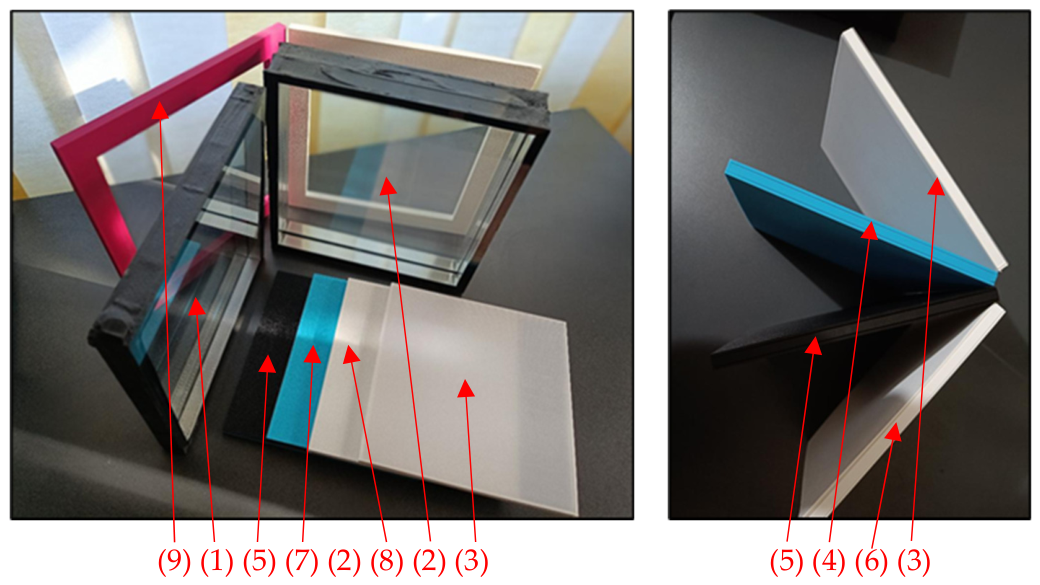
| PLA-AIR-PLA | 2.00 (3D-printed) | 10.35 | ~6.35 |
| PLA Aero-AIR-PLA Aero | 2.00 (3D-printed) | 10.15 | ~6.15 |
| GLASS-AIR-GLASS | 4.00 (Glass) | 24.66 | ~16.66 |
| GLASS-AIR-GLASS-AIR-GLASS | 4.00 (Glass) | 53.21 | ~16.60 + 16.60 * |
| Specimen/ Assembly | Measured Density (kg/m3) | Mean Thickness δ (m) | Heat Flux q (W/m2) | ΔT (K) | Thermal Cond. (W/(m·K)) | R-Value (m2·K/W) |
|---|---|---|---|---|---|---|
| Monolithic Samples | λeff | |||||
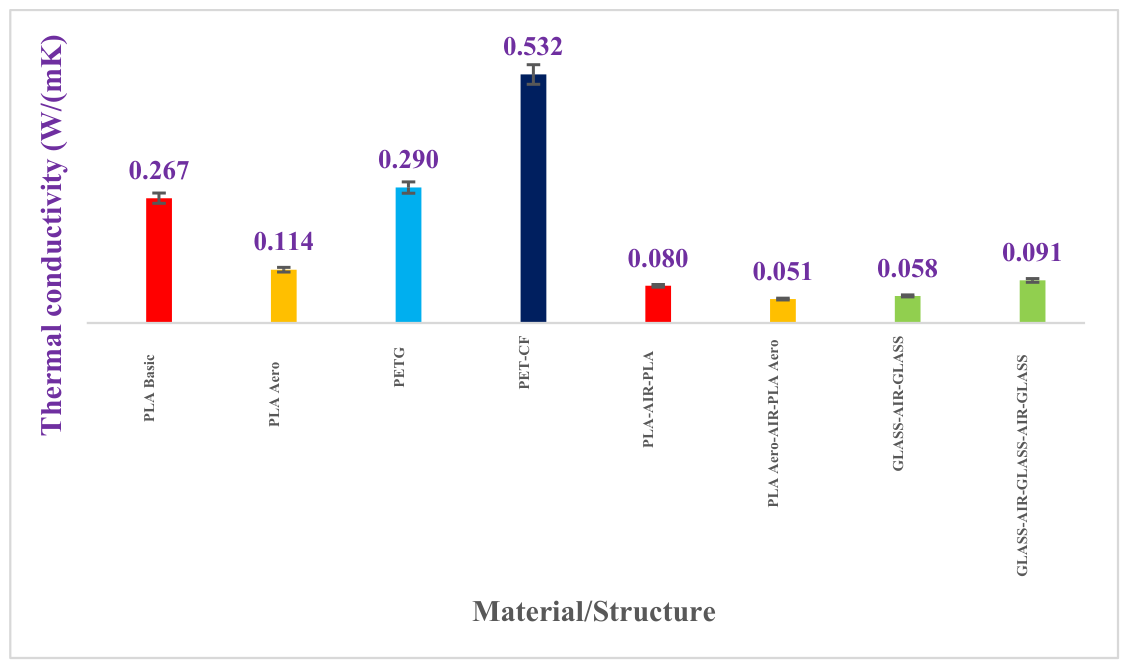
| PLA Basic | 1240 | 0.01019 | 260.4 | 10.21 | 0.267 ± 0.011 | 0.039 |
| PLA Aero | 740 * | 0.01094 | 70.4 | 6.83 | 0.114 ± 0.005 | 0.097 |
| PETG | 1270 | 0.01014 | 279.8 | 9.77 | 0.290 ± 0.012 | 0.034 |
| PET-CF | 1320 | 0.01007 | 398.7 | 7.50 | 0.533 ± 0.021 | 0.018 |
| Complex Assemblies | λapp | |||||
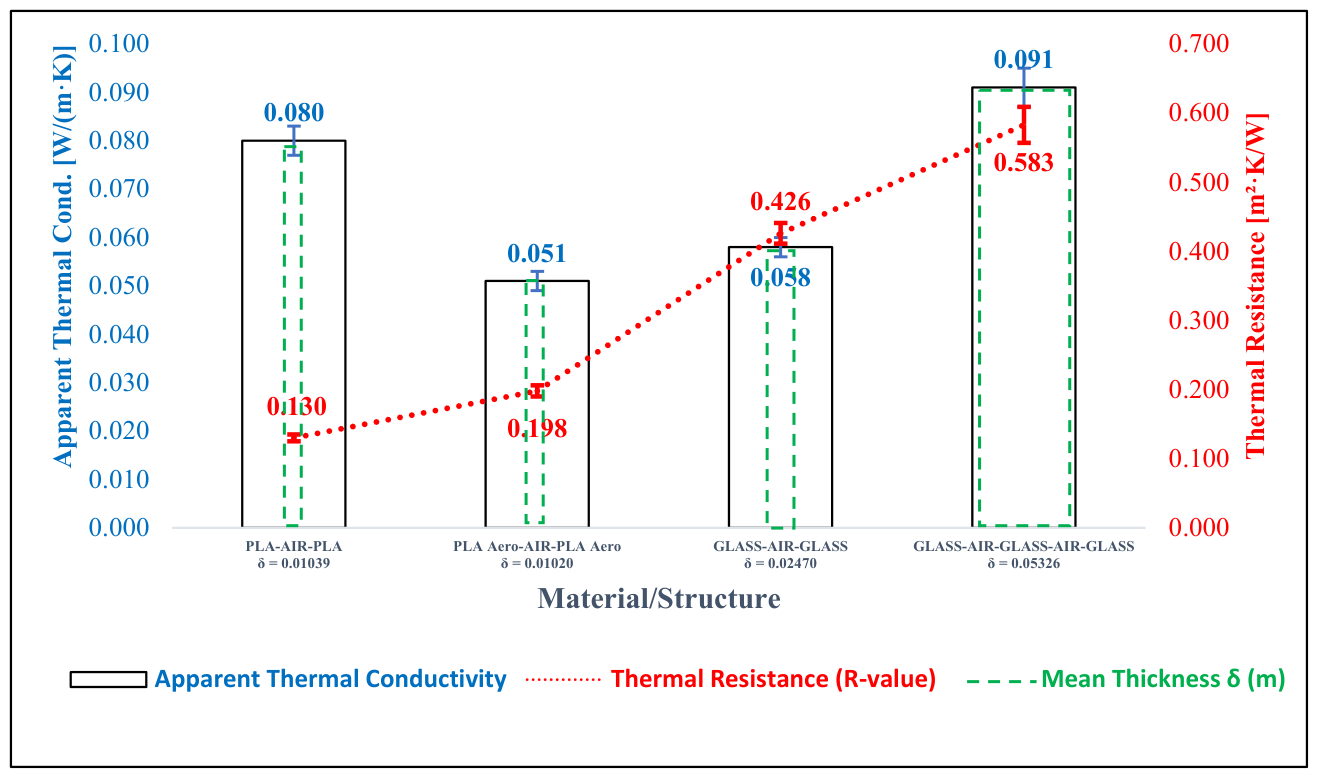
| PLA-AIR-PLA | N/A | 0.01039 | 49.9 | 6.50 | 0.080 ± 0.003 | 0.130 |
| PLA Aero-AIR-PLA Aero | N/A | 0.01020 | 55.8 | 11.14 | 0.051 ± 0.002 | 0.198 |
| GLASS-AIR-GLASS | N/A | 0.02470 | 14.5 | 6.21 | 0.058 ± 0.002 | 0.426 |
| GLASS-AIR-GLASS- AIR-GLASS | N/A | 0.05326 | 18.7 | 10.93 | 0.091 ± 0.004 | 0.583 |
Disclaimer/Publisher’s Note: The statements, opinions and data contained in all publications are solely those of the individual author(s) and contributor(s) and not of MDPI and/or the editor(s). MDPI and/or the editor(s) disclaim responsibility for any injury to people or property resulting from any ideas, methods, instructions or products referred to in the content. |
© 2026 by the authors. Licensee MDPI, Basel, Switzerland. This article is an open access article distributed under the terms and conditions of the Creative Commons Attribution (CC BY) license.
Share and Cite
Baraboi, D.-R.; Șova, D.; Năstase, G. Experimental Research on Heat Transfer Through 3D-Printed Plates: Implications for the Development of Smart Facades. Materials 2026, 19, 2793. https://doi.org/10.3390/ma19132793
Baraboi D-R, Șova D, Năstase G. Experimental Research on Heat Transfer Through 3D-Printed Plates: Implications for the Development of Smart Facades. Materials. 2026; 19(13):2793. https://doi.org/10.3390/ma19132793
Chicago/Turabian StyleBaraboi, Dan-Radu, Daniela Șova, and Gabriel Năstase. 2026. "Experimental Research on Heat Transfer Through 3D-Printed Plates: Implications for the Development of Smart Facades" Materials 19, no. 13: 2793. https://doi.org/10.3390/ma19132793
APA StyleBaraboi, D.-R., Șova, D., & Năstase, G. (2026). Experimental Research on Heat Transfer Through 3D-Printed Plates: Implications for the Development of Smart Facades. Materials, 19(13), 2793. https://doi.org/10.3390/ma19132793