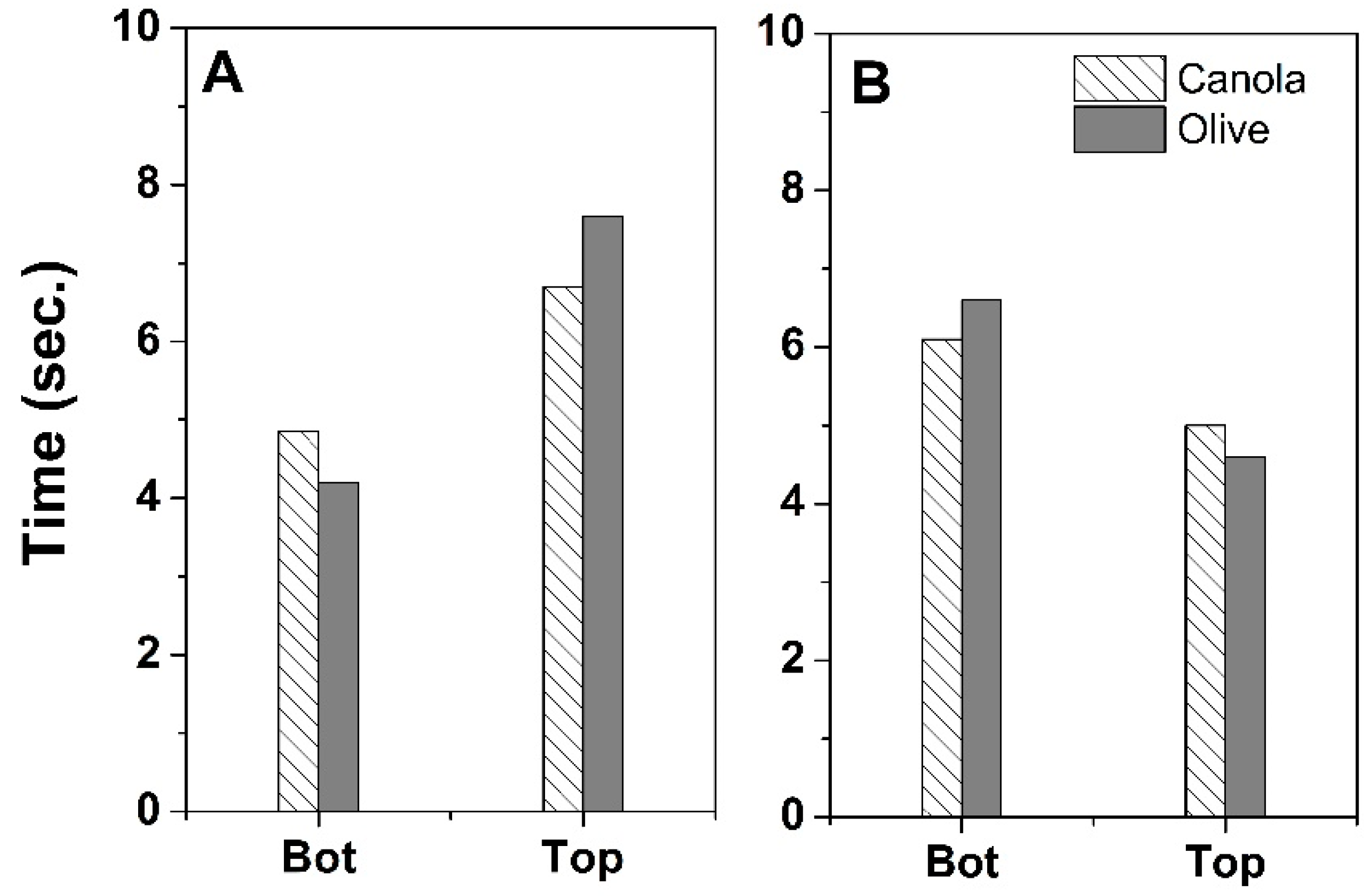
Anisotropic Graphene Oxide Aerogels for Vegetable Oil Absorption

 and
and 
Abstract
1. Introduction
2. Materials and Methods
2.1. Synthesis of Graphene Oxide Aerogels
2.2. Characterization of Graphene Oxide Aerogels
2.3. Vegetable Oil Absorption Performance Measurements
3. Results and Discussion

| Material | Oil | Absorption Capacity (g g−1) | Temperature | Ref. |
|---|---|---|---|---|
| Graphene-based carbon fiber aerogel | Crude Oil | 92 | Ambient | [49] |
| Graphene aerogel | Diesel Oil | 120.1 | Ambient | [30] |
| Reinforced graphene composite aerogel | Motor Oil | 98 | Ambient | [50] |
| Elastic Graphene Aerogel | Vegetable Oil | 118 | Ambient | [54] |
| Superhydrophobic graphene aerogel | Vegetable Oil | 114 | Ambient | [55] |
| GO:EDA aerogel | Olive Oil | 122 | Ambient | This work |
| GO:EDA aerogel | Olive Oil | 156 | 60 °C | This work |
4. Conclusions
Author Contributions
Funding
Data Availability Statement
Conflicts of Interest
References
- Kang, W.; Cui, Y.; Qin, L.; Yang, Y.; Zhao, Z.; Wang, X.; Liu, X. A novel robust adsorbent for efficient oil/water separation: Magnetic carbon nanospheres/graphene composite aerogel. J. Hazard. Mater. 2020, 392, 122499. [Google Scholar] [CrossRef] [PubMed]
- Wang, D.; McLaughlin, E.; Pfeffer, R.; Lin, Y.S. Adsorption of oils from pure liquid and oil-water emulsion on hydrophobic silica aerogels. Sep. Purif. Technol. 2012, 99, 28–35. [Google Scholar] [CrossRef]
- Fingas, M.; Fingas, M. The Basics of Oil Spill Cleanup; CRC Press: Boca Raton, FL, USA, 2002. [Google Scholar] [CrossRef]
- Crini, G.; Lichtfouse, E. Advantages and disadvantages of techniques used for wastewater treatment. Environ. Chem. Lett. 2019, 17, 145–155. [Google Scholar] [CrossRef]
- Gupta, R.K.; Dunderdale, G.J.; England, M.W.; Hozumi, A. Oil/water separation techniques: A review of recent progresses and future directions. J. Mater. Chem. A Mater. 2017, 5, 16025–16058. [Google Scholar] [CrossRef]
- Wang, L.K.; Pereira, N.C. (Eds.) Biological Treatment Processes; Humana Press: Totowa, NJ, USA, 1986. [Google Scholar] [CrossRef]
- Atabani, A.E.; Silitonga, A.; Ong, H.; Mahlia, T.; Masjuki, H.; Badruddin, I.A.; Fayaz, H. Non-edible vegetable oils: A critical evaluation of oil extraction, fatty acid compositions, biodiesel production, characteristics, engine performance and emissions production. Renew. Sustain. Energy Rev. 2013, 18, 211–245. [Google Scholar] [CrossRef]
- Radetić, M.M.; Jocić, D.M.; Jovančić, P.M.; Petrović, Z.L.; Thomas, H.F. Recycled wool-based nonwoven material as an oil sorbent. Environ. Sci. Technol. 2003, 37, 1008–1012. [Google Scholar] [CrossRef] [PubMed]
- Abdelwahab, O.; Amin, N.K.; El-Ashtoukhy, E.S.Z. Electrochemical removal of phenol from oil refinery wastewater. J. Hazard. Mater. 2009, 163, 711–716. [Google Scholar] [CrossRef] [PubMed]
- Bennett, G.F.; Peters, R.W. Critical Reviews in Environmental Control The removal of oil from wastewater by air flotation: A review. Crit. Rev. Environ. Control 1988, 18, 189–253. [Google Scholar]
- Chen, C.; Zhu, X.; Chen, B. Covalently cross-linked graphene oxide aerogel with stable structure for high-efficiency water purification. Chem. Eng. J. 2018, 354, 896–904. [Google Scholar] [CrossRef]
- Pruna, A.; Pullini, D.; Busquets, D. Influence of synthesis conditions on properties of green-reduced graphene oxide. J. Nanoparticle Res. 2013, 15, 1605. [Google Scholar] [CrossRef]
- Sun, Y.; Guo, J.; Gan, G.; Xu, Y.; Zheng, K.; Li, C.; Qu, T.; Li, R.; Li, C. Flexible reduced graphene oxide/carbon nanotubes/EPDM composite aerogel with superior photothermal conversion for selective oil recovery and emulsion separation. Sep. Purif. Technol. 2025, 378, 134586. [Google Scholar] [CrossRef]
- WChen, L. Yan In situ self-assembly of mild chemical reduction graphene for three-dimensional architectures. Nanoscale 2011, 3, 3132–3137. [Google Scholar] [CrossRef] [PubMed]
- Xu, Y.; Sheng, K.; Li, C.; Shi, G. Self-Assembled Graphene Hydrogel. ACS Nano 2010, 4, 4324–4330. [Google Scholar] [CrossRef] [PubMed]
- Zhang, Q.; Zhang, F.; Medarametla, S.P.; Li, H.; Zhou, C.; Lin, D. 3D Printing of Graphene Aerogels. Small 2016, 12, 1702–1708. [Google Scholar] [CrossRef] [PubMed]
- Yang, M.; Zhao, N.; Cui, Y.; Gao, W.; Zhao, Q.; Gao, C.; Bai, H.; Xie, T. Biomimetic Architectured Graphene Aerogel with Exceptional Strength and Resilience. ACS Nano 2017, 11, 6817–6824. [Google Scholar] [CrossRef] [PubMed]
- Luo, Y.; Jiang, S.; Xiao, Q.; Chen, C.; Li, B. Highly reusable and superhydrophobic spongy graphene aerogels for efficient oil/water separation. Sci. Rep. 2017, 7, 7162. [Google Scholar] [CrossRef] [PubMed]
- Zhang, R.; Fang, D.; Pei, Y.; Zhou, L. Microstructure, mechanical and dielectric properties of highly porous silicon nitride ceramics produced by a new water-based freeze casting. Ceram. Int. 2012, 38, 4373–4377. [Google Scholar] [CrossRef]
- Tu, P.M.; Lin, T.H.; Thang, T.Q.; Ngan, L.T.; Vy, D.N.C.; Lam, C.V.; Son, N.T.; Phong, M.T.; Hieu, N.H. Waste plastic-derived aerogel modified with graphene oxide for hygroscopic material and oil spill treatment. J. Mol. Struct. 2023, 1287, 135737. [Google Scholar] [CrossRef]
- Ren, J. Research Progress on the Application of Aerogel for Oil-water Separation. Appl. Comput. Eng. 2025, 156, 177–185. [Google Scholar] [CrossRef]
- Huang, P. Highly Robust, Compressible, Anisotropic, and Fire-Retardant Polyimide/Hydroxyapatite Nanowires/Reduced Graphene Oxide Aerogel for Rapid Adsorption of Viscous Oil Assisted by Sunlight. Research 2024, 7, 0512. [Google Scholar] [CrossRef] [PubMed]
- Cargua, C.; Rosas-Laverde, N.M.; Barjola, A.; Giménez, E.; Pruna, A.I. Effect of Mixed Reduction Approach on the Oil Absorption Capacity of Graphene Oxide Aerogels. Materials 2026, 19, 632. [Google Scholar] [CrossRef] [PubMed]
- Adebajo, M.O.; Frost, R.L.; Kloprogge, J.T.; Carmody, O.; Kokot, S. Porous Materials for Oil Spill Cleanup: A Review of Synthesis. J. Porous Mater. 2003, 10, 159–170. [Google Scholar] [CrossRef]
- Chi, C.; Xu, H.; Zhang, K.; Wang, Y.; Zhang, S.; Liu, X.; Liu, X.; Zhao, J.; Li, Y. 3D hierarchical porous graphene aerogels for highly improved adsorption and recycled capacity. Mater. Sci. Eng. B 2015, 194, 62–67. [Google Scholar] [CrossRef]
- Wen, C.E.; Yamada, Y.; Nouri, A.; Hodgson, P. Porous Titanium with Porosity Gradients for Biomedical Applications. Mater. Sci. Forum 2007, 539–543, 720–725. [Google Scholar] [CrossRef]
- Wan, W.; Zhang, F.; Yu, S.; Zhang, R.; Zhou, Y. Hydrothermal formation of graphene aerogel for oil sorption: The role of reducing agent, reaction time and temperature. New J. Chem. 2016, 40, 3040–3046. [Google Scholar] [CrossRef]
- Hui, Y.; Xie, W.; Gu, H. Reduced Graphene Oxide/Nanocellulose/Amino-Multiwalled Carbon Nanotubes Nanocomposite Aerogel for Excellent Oil Adsorption. ES Food Agrofor. 2021, 5, 38–44. [Google Scholar] [CrossRef]
- Xu, R.; Liu, W.; Cai, J.; Li, Z. Robust RGO composite aerogels with high adsorption capabilities for organic pollutants in water. Sep. Purif. Technol. 2021, 257, 117876. [Google Scholar] [CrossRef]
- Huang, J.; Liu, H.; Chen, S.; Ding, C. Graphene aerogel prepared through double hydrothermal reduction as high-performance oil adsorbent. Mater. Sci. Eng. B 2017, 226, 141–150. [Google Scholar] [CrossRef]
- Pruna, A.I.; Alfonso, C.C.; Benedito, A.; Gim, E. The Effect of Solvothermal Conditions on the Properties of Three-Dimensional N-Doped Graphene Aerogels. Nanomaterials 2019, 9, 350. [Google Scholar] [CrossRef] [PubMed]
- Pruna, A.I.; Barjola, A.; Cárcel, A.C.; Alonso, B.; Giménez, E. Effect of Varying Amine Functionalities on CO2 Capture of Carboxylated Graphene Oxide-Based Cryogels. Nanomaterials 2020, 10, 1446. [Google Scholar] [CrossRef] [PubMed]
- Trinh, T.T.P.N.X.; Quang, D.T.; Tu, T.H.; Dat, N.M.; Linh, V.N.P.; Van Cuong, L.; Nghia, L.T.T.; Loan, T.T.; Hang, P.T.; Phuong, N.T.L.; et al. Fabrication; characterization, and adsorption capacity for cadmium ions of graphene aerogels. Synth. Met. 2019, 247, 116–123. [Google Scholar] [CrossRef]
- Entegris. Graphite Properties and Characteristics for Industrial Applications; Entegris: Billerica, MA, USA, 2020; pp. 1–42. Available online: https://poco.entegris.com/content/dam/poco/resources/reference-materials/brochures/brochure-graphite-properties-and-characteristics-11043.pdf (accessed on 23 March 2026).
- Bumbrah, G.S.; Sharma, R.M. Raman spectroscopy—Basic principle, instrumentation and selected applications for the characterization of drugs of abuse. Egypt. J. Forensic Sci. 2016, 6, 209–215. [Google Scholar] [CrossRef]
- Ji, K.; Gao, Y.; Zhang, L.; Wang, S.; Yue, Q.; Xu, X.; Kong, W.; Gao, B.; Cai, Z.; Chen, Y. A tunable amphiphilic Enteromorpha-modified graphene aerogel for oil/water separation. Sci. Total Environ. 2021, 763, 142958. [Google Scholar] [CrossRef] [PubMed]
- Bakos, L.P.; Mensah, J.; László, K.; Igricz, T.; Szilágyi, I.M. Preparation and characterization of a nitrogen-doped mesoporous carbon aerogel and its polymer precursor. J. Therm. Anal. Calorim. 2018, 134, 933–939. [Google Scholar] [CrossRef]
- Štandeker, S.; Veronovski, A.; Novak, Z.; Knez, Ž. Silica aerogels modified with mercapto functional groups used for Cu(II) and Hg(II) removal from aqueous solutions. Desalination 2011, 269, 223–230. [Google Scholar] [CrossRef]
- Wu, L.; Qin, Z.; Zhang, L.; Meng, T.; Yu, F.; Ma, J. CNT-enhanced amino-functionalized graphene aerogel adsorbent for highly efficient removal of formaldehyde. New J. Chem. 2017, 41, 2527–2533. [Google Scholar] [CrossRef]
- Lv, H.; Li, Y.; Jia, Z.; Wang, L.; Guo, X.; Zhao, B.; Zhang, R. Exceptionally porous three-dimensional architectural nanostructure derived from CNTs/graphene aerogel towards the ultra-wideband EM absorption. Compos. B Eng. 2020, 196, 108122. [Google Scholar] [CrossRef]
- Kristen, S. Freeze Casting—A Review of Processing, Microstructure and Properties via the Open Data Repository, FreezeCasting.net. Prog. Mater. Sci. 2023, 94, 243–305. [Google Scholar]
- Qi, R.; Pan, T.; Deng, H.; Du, W.; Ran, S.; Yao, Z.; Yin, X.; Jing, Y. Regulating ice crystal growth for structure and performance optimization of freeze casting fiber-reinforced porous Ti3SiC2. J. Alloys Compd. 2026, 1072, 189001. [Google Scholar] [CrossRef]
- Nawaz, M.; Miran, W.; Jang, J.; Lee, D.S. One-step hydrothermal synthesis of porous 3D reduced graphene oxide/TiO2 aerogel for carbamazepine photodegradation in aqueous solution. Appl. Catal. B 2017, 203, 85–95. [Google Scholar] [CrossRef]
- Franco, P.; Cardea, S.; Tabernero, A.; De Marco, I. Porous aerogels and adsorption of pollutants fromwater and air: A review. Molecules 2021, 26, 4440. [Google Scholar] [CrossRef] [PubMed]
- Bai, Z.; Ren, S.; Deng, J.; Su, C.; Kang, F.; Zhang, Y. Effect of Temperature and Relative Humidity on CO2 Adsorption Performance of Biomass-Derived Aerogels. Polymers 2025, 17, 2375. [Google Scholar] [CrossRef] [PubMed]
- Sahasrabudhe, S.N.; Rodriguez-Martinez, V.; O’Meara, M.; Density, B.E.F. Viscosity surface tension of five vegetable oils at elevated temperatures: Measurement and modeling. Int. J. Food Prop. 2017, 20, 1965–1981. [Google Scholar] [CrossRef]
- Diamante, L.M.; Lan, T. Absolute Viscosities of Vegetable Oils at Different Temperatures and Shear Rate Range of 64.5 to 4835 s−1. J. Food Process. 2014, 2014, 234583. [Google Scholar] [CrossRef]
- Soylu, T.M.; Karakuzu-Ikizler, B.; Terzioğlu, P.; Yucel, S. Novel Adsorbents for Canola Oil Physical Refining: Mesoporous Calcium and Magnesium Silica Aerogel. ChemistrySelect 2025, 10, e02344. [Google Scholar] [CrossRef]
- Bi, H.; Xie, X.; Yin, K.; Zhou, Y.; Wan, S.; He, L.; Xu, F.; Banhart, F.; Sun, L.; Ruoff, R.S. Spongy graphene as a highly efficient and recyclable sorbent for oils and organic solvents. Adv. Funct. Mater. 2012, 22, 4421–4425. [Google Scholar] [CrossRef]
- Luo, Z.; Huang, S.; Kong, N.; Zhang, J.; Tao, J.; Li, J.; Li, S. Hydrophobic dual-polymer–reinforced graphene composite aerogel for efficient water–oil separation. RSC Adv. 2025, 15, 1–13. [Google Scholar] [CrossRef] [PubMed]
- Egbogah, E.O.; Ng, J.T. An improved temperature-viscosity correlation for crude oil systems. J. Pet. Sci. Eng. 1990, 4, 197–200. [Google Scholar] [CrossRef]
- Wang, H.; Wang, C.; Liu, S.; Chen, L.; Yang, S. Superhydrophobic and superoleophilic graphene aerogel for adsorption of oil pollutants from water. RSC Adv. 2019, 9, 8569–8574. [Google Scholar] [CrossRef] [PubMed]
- Feng, C.; Yi, Z.; She, F.; Gao, W.; Peng, Z.; Garvey, C.J.; Dumée, L.F.; Kong, L. Superhydrophobic and Superoleophilic Micro-Wrinkled Reduced Graphene Oxide as a Highly Portable and Recyclable Oil Sorbent. ACS Appl. Mater. Interfaces 2016, 8, 9977–9985. [Google Scholar] [CrossRef] [PubMed]
- Nguyen, D.D.; Tai, N.-H.; Lee, S.-B.; Kuo, W.-S. Superhydrophobic and superoleophilic properties of graphene-based sponges fabricated using a facile dip coating method. Energy Environ. Sci. 2012, 5, 7908. [Google Scholar] [CrossRef]
- Gao, J.; Zhang, X.; Yang, J.; Zhou, J.; Tong, M.; Jin, Q.; Dai, F.; Li, G. Ethylenediamine-catalyzed preparation of nitrogen-doped hierarchically porous carbon aerogel under hypersaline condition for high-performance supercapacitors and organic solvent absorbents. Nanomaterials 2019, 9, 771. [Google Scholar] [CrossRef] [PubMed]
- Yi, L.; Yang, J.; Fang, X.; Xia, Y.; Zhao, L.; Wu, H.; Guo, S. Facile fabrication of wood-inspired aerogel from chitosan for efficient removal of oil from Water. J. Hazard. Mater. 2020, 385, 121507. [Google Scholar] [CrossRef] [PubMed]
- Ren, J.; Wang, Z.; Wu, J.; Xiao, J.; Chu, Z.; Wang, Y. Bioinspired heterogeneous gradient-porous biomass aerogels for high-flux oil–water separation and self-healing. Sep. Purif. Technol. 2026, 397, 138121. [Google Scholar] [CrossRef]
- Zhang, X.; Wang, H.; Cai, Z.; Yan, N.; Liu, M.; Yu, Y. Highly compressible and hydrophobic anisotropic aerogels for selective oil/organic solvent absorption. ACS Sustain. Chem. Eng. 2019, 7, 332–340. [Google Scholar] [CrossRef]
- Ye, R.; Li, H.; Long, J.; Wang, Y.; Peng, D. Bio-aerogels derived from corn stalk and Premna Microphylla leaves as eco-friendly sorbents for oily water treatment: The role of microstructure in adsorption performance. J. Clean. Prod. 2023, 403, 136720. [Google Scholar] [CrossRef]


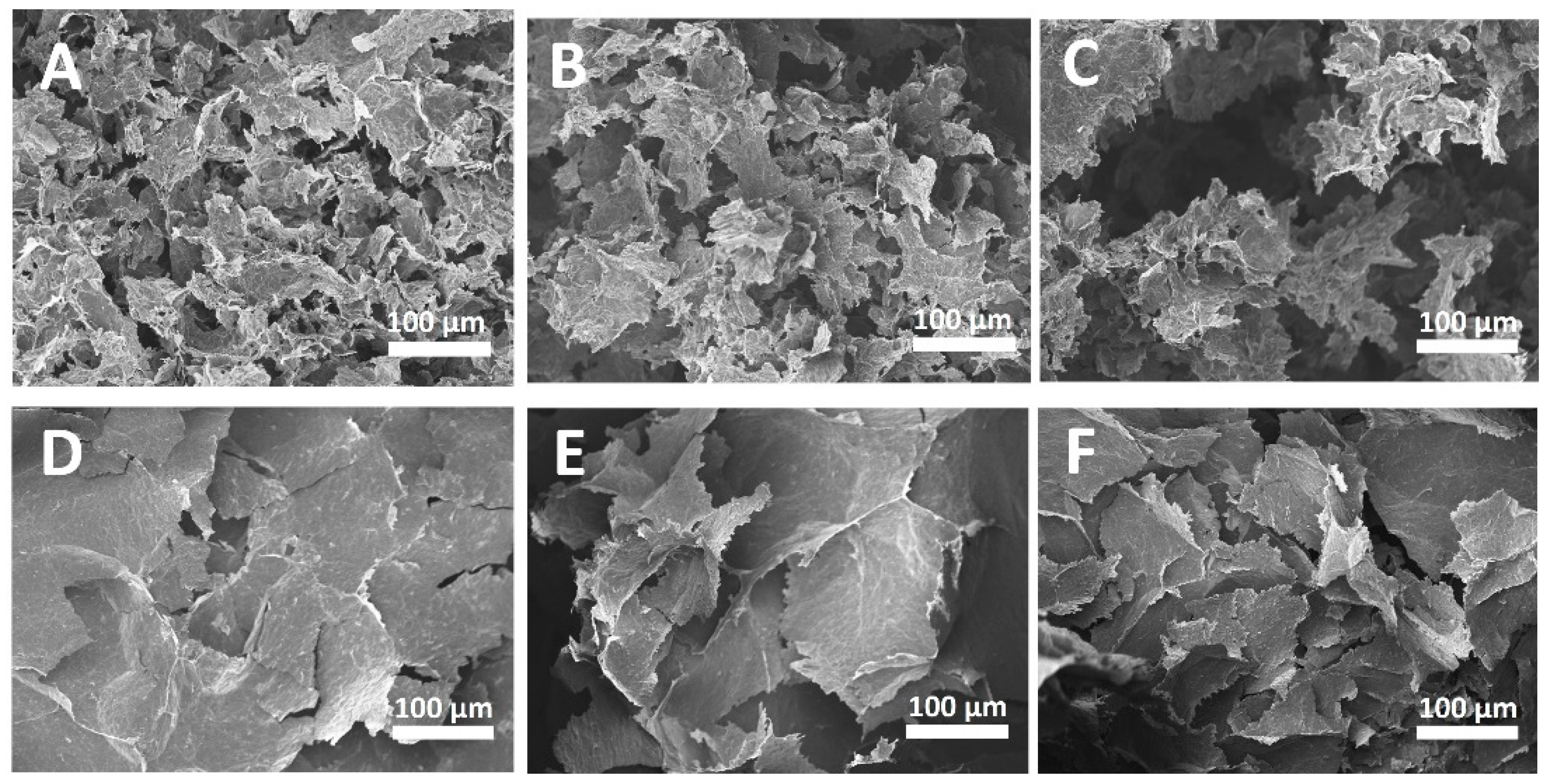


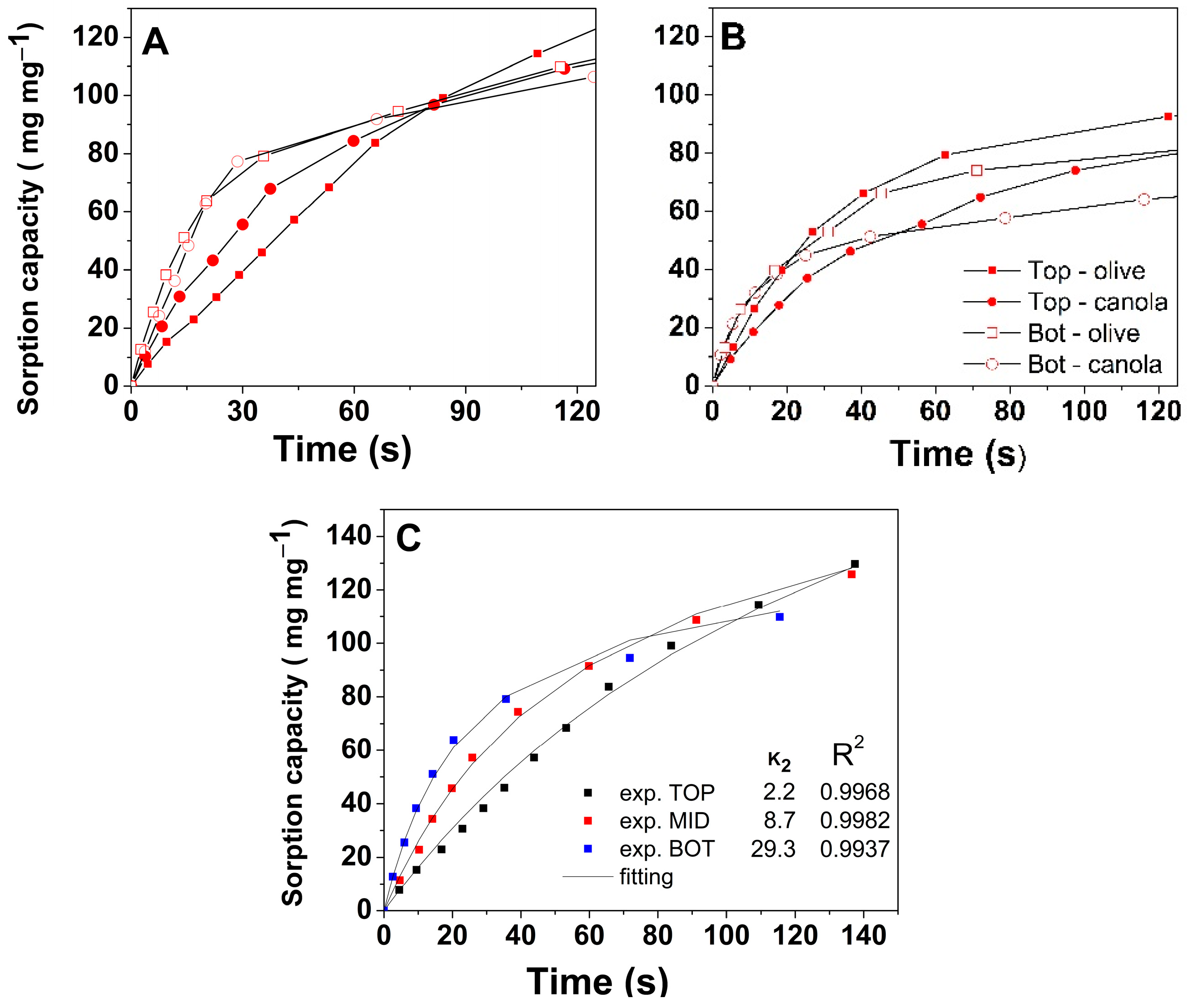

Disclaimer/Publisher’s Note: The statements, opinions and data contained in all publications are solely those of the individual author(s) and contributor(s) and not of MDPI and/or the editor(s). MDPI and/or the editor(s) disclaim responsibility for any injury to people or property resulting from any ideas, methods, instructions or products referred to in the content. |
© 2026 by the authors. Licensee MDPI, Basel, Switzerland. This article is an open access article distributed under the terms and conditions of the Creative Commons Attribution (CC BY) license.
Share and Cite
Ordóñez Oviedo, D.; Rosas-Laverde, N.M.; Barjola, A.; Giménez, E.; Pruna, A.I. Anisotropic Graphene Oxide Aerogels for Vegetable Oil Absorption. Materials 2026, 19, 2680. https://doi.org/10.3390/ma19122680
Ordóñez Oviedo D, Rosas-Laverde NM, Barjola A, Giménez E, Pruna AI. Anisotropic Graphene Oxide Aerogels for Vegetable Oil Absorption. Materials. 2026; 19(12):2680. https://doi.org/10.3390/ma19122680
Chicago/Turabian StyleOrdóñez Oviedo, Daniel, Nelly Maria Rosas-Laverde, Arturo Barjola, Enrique Giménez, and Alina Iuliana Pruna. 2026. "Anisotropic Graphene Oxide Aerogels for Vegetable Oil Absorption" Materials 19, no. 12: 2680. https://doi.org/10.3390/ma19122680
APA StyleOrdóñez Oviedo, D., Rosas-Laverde, N. M., Barjola, A., Giménez, E., & Pruna, A. I. (2026). Anisotropic Graphene Oxide Aerogels for Vegetable Oil Absorption. Materials, 19(12), 2680. https://doi.org/10.3390/ma19122680