Effect of Soluble Glass Alkali Activation on the Geotechnical Performance of Sandy-Pebble Soil Stabilized with Biomass Bottom Ash



Abstract
1. Introduction
2. Materials and Methods
2.1. Experimental Techniques
- A—amount of chemical compound leached from the solid sample (mg/L).
- C—concentration of the compound in the eluate (mg/L).
- L—volume of solvent used for leaching (kg).
- M—mass of the dry solid sample (kg).
- P—average compressive strength of mortar containing BMA (MPa).
- C—average compressive strength of reference mortar without BMA (MPa).
2.2. Initial Materials
2.2.1. Main Properties of Initial Materials
2.2.2. Strength Activity Index of BMA
3. Results and Discussion
3.1. A Complex Investigation of Sandy-Pebble and Biomass Ash Mixtures
3.2. Effect of Sodium Silicate Additive on the CBR Strength of Sandy-Pebble–Biomass Ash Blends
3.3. Mineral Composition Based on XRD and Infrared Spectroscopy Analyses of Alkali-Activated Sandy–Pebble Soil and Biomass Bottom Ash
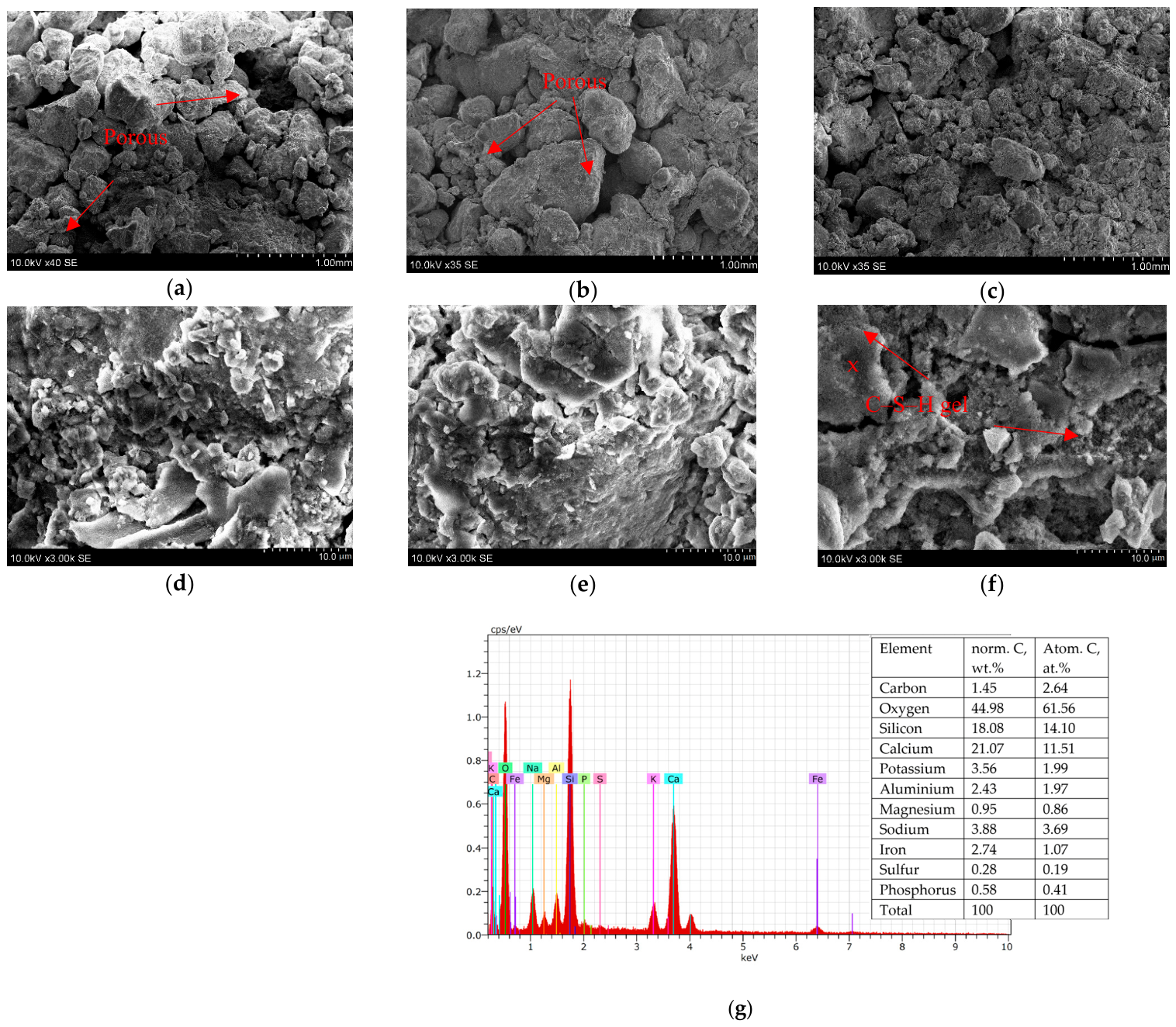
3.4. Microstructural Investigation of Alkali-Activated Sandy Pebbles and Biomass Bottom Ash
4. Conclusions
Author Contributions
Funding
Data Availability Statement
Conflicts of Interest
References
- IEA (International Energy Agency). Renewables 2023: Analysis and Forecast to 2028; Licence: CC BY 4.0; IEA: Paris, France, 2023; Available online: https://www.iea.org/reports/renewables-2023 (accessed on 1 January 2020).
- Bioenergy Europe. Statistical Report: Bioheat; Bioenergy Landscape—Bioenergy Europe: Brussels, Belgium, 2024. [Google Scholar]
- Lithuanian Energy Agency. Biofuel Market Review 2023. 2024. Available online: https://www-ena-lt.translate.goog/?_x_tr_sl=auto&_x_tr_tl=en&_x_tr_hl=lt&_x_tr_pto=wapp (accessed on 13 May 2026).
- Jonynas, R.; Puida, E.; Poškas, R.; Paukštaitis, L.; Jouhara, H.; Gudzinskas, J.; Miliauskas, G.; Lukoševičius, V. Renewables for district heating: The case of Lithuania. Energy 2020, 211, 119064. [Google Scholar] [CrossRef]
- Zhai, J.; Burke, I.T.; Mayes, W.M.; Stewart, D.I. New insights into biomass combustion ash categorisation: A phylogenetic analysis. Fuel 2021, 287, 119469. [Google Scholar] [CrossRef]
- Demis, S.; Tapali, J.G.; Papadakis, V.G. An investigation of the effectiveness of the utilization of biomass ashes as pozzolanic materials. Constr. Build. Mater. 2014, 68, 291–300. [Google Scholar] [CrossRef]
- Ling, X.; Chen, W.; Schollbach, K.; Brouwers, H.J.H. Valorization of biomass bottom ash in alkali-activated GGBFS-fly ash: Impact of biomass bottom ash characteristic, silicate modulus and aluminum-anodizing waste. Constr. Build. Mater. 2024, 428, 136408. [Google Scholar] [CrossRef]
- Barišić, I.; Netinger Grubeša, I.; Dokšanović, T.; Marković, B. Feasibility of agricultural biomass fly ash usage for soil stabilisation of road works. Materials 2019, 12, 1375. [Google Scholar] [CrossRef]
- Iyaruk, A.; Promputthangkoon, P.; Lukjan, A. Evaluating the performance of lateritic soil stabilized with cement and biomass bottom ash for use as pavement materials. Infrastructures 2022, 7, 66. [Google Scholar] [CrossRef]
- Galvín, A.P.; López-Uceda, A.; Cabrera, M.; Rosales, J.; Ayuso, J. Stabilization of expansive soils with biomass bottom ashes for an eco-efficient construction. Environ. Sci. Pollut. Res. 2021, 28, 24441–24454. [Google Scholar] [CrossRef]
- Jamnongwong, M.; Wongvatana, N.; Noorak, A.; Jongpradist, P.; Chaiprakaikeow, S.; Jamsawang, P. Mechanical and Environmental Performance of Cement-Eucalyptus Ash Stabilized Dam Sediments for Sustainable Road Construction. Int. J. Geosynth. Ground Eng. 2025, 11, 31. [Google Scholar] [CrossRef]
- Zhang, H.; Li, G.; Xu, Y.; Zhang, K.; Li, M. Mechanism and application of reaming anchorage of inverted wedge-shaped hole bottom in argillaceous cemented roadway. Sci. Rep. 2026, 16, 5094. [Google Scholar] [CrossRef] [PubMed]
- Xue, Y.; Wu, W. Characterization of brittleness evolution of hot dry rock during cyclic thermal treatment. Acta Geotech. 2026, 1–11. [Google Scholar] [CrossRef]
- Morales, D.P.; Saldanha, R.B.; Aguada, J.M.; Consoli, N.C. Alkali-activation of agro-industrial waste for stabilization of lateritic soils. Transp. Geotech. 2024, 45, 101187. [Google Scholar] [CrossRef]
- Anburuvel, A.; Sathiparan, N.; Dhananjaya, G.M.A.; Anuruththan, A. Characteristic evaluation of geopolymer based lateritic soil stabilization enriched with eggshell ash and rice husk ash for road construction: An experimental investigation. Constr. Build. Mater. 2023, 387, 131659. [Google Scholar] [CrossRef]
- Sukprasert, S.; Hoy, M.; Horpibulsuk, S.; Arulrajah, A.; Rashid, A.S.A.; Nazir, R. Fly ash based geopolymer stabilisation of silty clay/blast furnace slag for subgrade applications. Road Mater. Pavement Des. 2021, 22, 357–371. [Google Scholar] [CrossRef]
- Santhikala, R.; Chandramouli, K.; Pannirselvam, N. Stabilization of expansive soil using flyash based geopolymer. Mater. Today Proc. 2022, 68, 110–114. [Google Scholar] [CrossRef]
- Wu, D.; Zhang, Z.; Chen, K.; Xia, L. Experimental investigation and mechanism of fly ash/slag-based geopolymer-stabilized soft soil. Appl. Sci. 2022, 12, 7438. [Google Scholar] [CrossRef]
- Fattahi, S.M.; Zamani, S.; Imani, M.; Heydari, A. Sustainable stabilization of sandy soil using alkali-activated construction waste binders. Sci. Rep. 2026, 16, 12012. [Google Scholar] [CrossRef] [PubMed]
- Pourakbar, S.; Maneshmoaveni, A.; Moazami, D.; Moretti, L.; Yousefi, A.; Cristelo, N. Stabilization of clay soil using alkali-activated sewage sludge. J. Rock Mech. Geotech. Eng. 2025, 17, 3213–3224. [Google Scholar] [CrossRef]
- EN 196-6:2018; Methods of Testing Cement—Part 6: Determination of Fineness. CEN-CENELEC Management Centre: Brussels, Belgium, 2018.
- EN 450-1:2012; Fly Ash for Concrete—Part 1: Definition, Specifications and Conformity Criteria. CEN-CENELEC Management Centre: Brussels, Belgium, 2012.
- EN 13286-41:2021; Unbound and Hydraulically Bound Mixtures—Part 41: Test Method for the Determination of the Compressive Strength of Hydraulically Bound Mixtures. CEN-CENELEC Management Centre: Brussels, Belgium, 2021.
- EN 933-1:2012; Methods for Determining the Geometric Properties of Aggregates. Part 1. Determination of Particle Size Distribution. Sieving Method. Management Centre: Brussels, Belgium, 2012.
- EN 13286-2:2010; Unbound and Hydraulically Bound Mixtures—Part 2: Test Methods for Laboratory Reference Density and Water Content—Proctor Compaction. Management Centre: Brussels, Belgium, 2010.
- EN 13286-47:2021; Unbound and Hydraulically Bound Mixtures—Part 47: Test Method for the Determination of California Bearing Ratio, Immediate Bearing Index and Linear Swelling. Management Centre: Brussels, Belgium, 2021.
- EN ISO 17892-11:2019; Geotechnical Investigation and Testing—Laboratory Testing of Soil—Part 11: Permeability Tests. Management Centre: Brussels, Belgium, 2019.
- EN 12390-7:2019; Testing Hardened Concrete—Part 7: Density of Hardened Concrete. Management Centre: Brussels, Belgium, 2019.
- EN 197-1:2011; Cement—Part 1: Composition, Specifications and Conformity Criteria for Common Cements. Management Centre: Brussels, Belgium, 2011.
- EN 12457-4:2003; Characterisation of Waste—Leaching—Compliance Test for Leaching of Granular Waste Materials and Sludges—Part 4. Management Centre: Brussels, Belgium, 2003.
- Kaminskas, R.; Eisinas, A.; Barauskas, I.; Gaivenis, M. Hydrothermally Treated Biomass Fly Ash as an Additive for Portland Cement. Sustainability 2024, 16, 2754. [Google Scholar] [CrossRef]
- ASTM C311/C311M-18; Standard Test Methods for Sampling and Testing Fly Ash or Natural Pozzolans for Use in Portland-Cement Concrete. ASTM International: West Conshohocken, PA, USA, 2018.
- Chandara, C.H.E.A. Study of Pozzolanic Reaction and Fluidity of Blended Cement Containing Treated Palm Oil Fuel Ash as Mineral Admixture. Ph.D. Thesis, School of Materials and Mineral Resources Engineering, Universiti Sains Malaysia, Penang, Malaysia, 2011. 208. [Google Scholar]
- Kramar, S.; Ducman, V. Evaluation of ash pozzolanic activity by means of the strength activity index test, frattini test and DTA/TG analysis. Teh. Vjesn. 2018, 25, 1746–1752. [Google Scholar]
- Patil, C.; Manjunath, M.; Hosamane, S.; Bandekar, S.; Athani, R. Pozzolonic activity and strength activity index of bagasse ash and fly ash blended cement mortar. Mater. Today Proc. 2021, 42, 1456–1461. [Google Scholar] [CrossRef]
- TRA SBR 19; Technical Requirements for Unbound Mixtures and Soils Used for Layers Without Binders for Automobile Roads. Approved by Order No. V-191 of the Director of the Lithuanian Road Administration under the Ministry of Transport and Communications, 20 December 2019; Lithuanian Road Administration under the Ministry of Transport and Communications: Vilnius, Lithuania, 2019; 30p.
- Blayi, R.A.; Omer, B.; Sherwani, A.F.H.; Hamadamin, R.M.; Muhammed, H.K. Geotechnical characteristics of fine-grained soil with wood ash. Clean. Eng. Technol. 2024, 18, 100726. [Google Scholar] [CrossRef]
- Amran, M.; Fediuk, R.; Murali, G.; Avudaiappan, S.; Ozbakkaloglu, T.; Vatin, N.; Karelina, M.; Klyuev, S.; Gholampour, A. Fly ash-based eco-efficient concretes: A comprehensive review of the short-term properties. Materials 2021, 14, 4264. [Google Scholar] [CrossRef] [PubMed]
- Navagire, O.P.; Sharma, S.K.; Rambabu, D. Stabilization of black cotton soil with coal bottom ash. Mater. Today Proc. 2022, 52, 979–985. [Google Scholar] [CrossRef]
- Teerawattanasuk, C.; Voottipruex, P. Comparison between cement and fly ash geopolymer for stabilized marginal lateritic soil as road material. Int. J. Pavement Eng. 2019, 20, 1264–1274. [Google Scholar] [CrossRef]
- Hoyos-Montilla, A.A.; Puertas, F.; Mosquera, J.M.; Tobón, J.I. Infrared spectra experimental analyses on alkali-activated fly ash-based binders. Spectrochim. Acta Part A Mol. Biomol. Spectrosc. 2022, 269, 120698. [Google Scholar] [CrossRef]
- Abdel-Gawwad, H.A.; Abo-El-Enein, S.A. A novel method to produce dry geopolymer cement powder. HBRC J. 2016, 12, 13–24. [Google Scholar] [CrossRef]
- Saikia, B.J.; Parthasarathy, G.; Sarmah, N.C. Fourier transform infrared spectroscopic estimation of crystallinity in SiO2 based rocks. Bull. Mater. Sci. 2008, 31, 775–779. [Google Scholar] [CrossRef]
- Kaminskas, R.; Cesnauskas, V. Influence of activated biomass fly ash on portland cement hydration. Ceram. Silik 2014, 58, 260–268. [Google Scholar]
- Mathivet, V.; Jouin, J.; Gharzouni, A.; Sobrados, I.; Celerier, H.; Rossignol, S.; Parlier, M. Acid-based geopolymers: Understanding of the structural evolutions during consolidation and after thermal treatments. J. Non Cryst. Solids 2019, 512, 90–97. [Google Scholar] [CrossRef]
- Valcke, S.L.; Pipilikaki, P.; Fischer, H.R.; Verkuijlen, M.H.; van Eck, E.R. FT-IR and 29 Si-NMR for evaluating aluminium–silicate precursors for geopolymers. Mater. Struct. 2015, 48, 557–569. [Google Scholar] [CrossRef]
- Liu, W.; Liu, W.; Wang, X.; Wei, D.; Wang, B. Utilization of novel surfactant N-dodecyl-isopropanolamine as collector for efficient separation of quartz from hematite. Sep. Purif. Technol. 2016, 162, 188–194. [Google Scholar] [CrossRef]
- Yusuf, M.O. Bond characterization in cementitious material binders using Fourier-transform infrared spectroscopy. Appl. Sci. 2023, 13, 3353. [Google Scholar] [CrossRef]
- Velardo, P.; del Bosque, I.S.; de Rojas, M.S.; De Belie, N.; Medina, C. Design and evaluation of physical, mechanical and micro-structural properties of eco-friendly binary-blended mortars using biomass bottom ash or construction and demolition waste powder. Cem. Concr. Compos. 2023, 143, 105252. [Google Scholar] [CrossRef]
- Mabroum, S.; Garcia-Lodeiro, I.; Blanco-Varela, M.T.; Taha, Y.; Chhaiba, S.; Indris, S.; Benzaazoua, M.; Mansori, M.; Hakkou, R. Formation of CSH and MSH gels in alkali-activated materials based on marl by-products from phosphate mines. Constr. Build. Mater. 2023, 365, 130029. [Google Scholar] [CrossRef]



| Oxide | CaO | SiO2 | Al2O3 | Fe2O3 | MgO | K2O | Na2O | SO3 | CI | TiO2 | SrO | P2O5 | MnO | BaO | ZnO | LOI |
|---|---|---|---|---|---|---|---|---|---|---|---|---|---|---|---|---|
| OPC | 63.02 | 19.51 | 4.26 | 3.20 | 3.3 | 1.0 | 0.11 | 3.30 | 0.03 | 0.17 | - | - | - | - | 2.1 | |
| BMA | 13.6 | 72.3 | 3.79 | 0.85 | 2.12 | 4.08 | 0.53 | 0.31 | 0.04 | 0.09 | 0.02 | 1.90 | 0.23 | 0.09 | 0.07 | - |
| Elements | Cd | Ni | Pb | V | Cr | Zn |
|---|---|---|---|---|---|---|
| mg/L | 0.00058 | 0.0028 | 0.0882 | 0.142 | 0.0047 | 0.0107 |
| Samples | Natural Density, Mg/cm3 | Particles Density, Mg/cm3 | Proctor Density, Mg/cm3 | Optimal Moisture, % | Water Permeability, m/s |
|---|---|---|---|---|---|
| Biomass ash | 1.10 | 2.12 | 1.48 | 20.0 | 5.81 × 10⁻⁵ |
| Sandy pebbles | 1.58 | 2.67 | 1.96 | 10.5 | 9.72 × 10⁻⁵ |
| No. | OPC, % | BMA, % | Sand fr. 0/4, g | Water, mL | Compressive Strength, MPa | Pozzolanic Activity Index | ||
|---|---|---|---|---|---|---|---|---|
| After 7 Days | After 28 Days | After 7 Days | After 28 Days | |||||
| 1 | 100 | 0 | 1350 | 225 | 34.47 | 41.3 | 1 | 1 |
| 2 | 80 | 20 | 1350 | 225 | 23.26 | 36.93 | 0.67 | 0.89 |
| 3 | 75 | 25 | 1350 | 225 | 20.16 | 33.12 | 0.59 | 0.80 |
| 4 | 60 | 40 | 1350 | 225 | 12.97 | 20.96 | 0.37 | 0.51 |
| 5 | 40 | 60 | 1350 | 260 | 6.25 | 10.45 | 0.18 | 0.25 |
| 6 | 20 | 80 | 1350 | 275 | 0.88 | 1.22 | 0.03 | 0.03 |
| 7 | 0 | 100 | 1350 | 290 | 0 | 0 | 0 | 0 |
| Samples | Sandy Pebbles, % | Biomass Ash, % | Natural Density, Mg/m3 | Proctor Density, Mg/m3 | Optimum Moisture, % | Permeability, m/s |
|---|---|---|---|---|---|---|
| S | 100 | 0 | 1.58 | 1.95 | 10.5 | 9.72 × 10⁻⁵ |
| SB/1 | 80 | 20 | 1.61 | 2.04 | 11.2 | 8.11 × 10⁻⁵ |
| SB/2 | 60 | 40 | 1.43 | 1.94 | 12.6 | 8.01 × 10⁻⁵ |
| SB/3 | 40 | 60 | 1.32 | 1.91 | 13.4 | 6.89 × 10⁻⁵ |
| SB/4 | 20 | 80 | 1.28 | 1.68 | 16.7 | 5.91 × 10⁻⁵ |
| B | 0 | 100 | 1.12 | 1.48 | 20.0 | 5.81 × 10⁻⁵ |
| Samples | Sandy Pebbles, % | Biomass Ash, % | Natural Density, Mg/m3 | Weight Ratio of Water to Soluble Glass | Proctor Density, Mg/m3 | Optimum Moisture, % |
|---|---|---|---|---|---|---|
| SB/1 | 80 | 20 | 1.61 | 1:0 | 2.04 | 11.2 |
| SB/1 (1:1) | 80 | 20 | 1.61 | 1:1 | 2.06 | 11.2 |
| SB/1 (1:2) | 80 | 20 | 1.61 | 1:2 | 2.08 | 11.2 |
| SB/1 (1:3) | 80 | 20 | 1.61 | 1:3 | 2.10 | 11.2 |
| SB/3 | 40 | 60 | 1.32 | 1:0 | 1.91 | 13.4 |
| SB/3 (1:1) | 40 | 60 | 1.32 | 1:1 | 1.93 | 13.4 |
| SB/3 (1:2) | 40 | 60 | 1.32 | 1:2 | 1.95 | 13.4 |
| SB/3 (1:3) | 40 | 60 | 1.32 | 1:3 | 1.96 | 13.4 |
Disclaimer/Publisher’s Note: The statements, opinions and data contained in all publications are solely those of the individual author(s) and contributor(s) and not of MDPI and/or the editor(s). MDPI and/or the editor(s) disclaim responsibility for any injury to people or property resulting from any ideas, methods, instructions or products referred to in the content. |
© 2026 by the authors. Licensee MDPI, Basel, Switzerland. This article is an open access article distributed under the terms and conditions of the Creative Commons Attribution (CC BY) license.
Share and Cite
Vaičiukynienė, D.; Stelmokaitis, G.; Christou, P. Effect of Soluble Glass Alkali Activation on the Geotechnical Performance of Sandy-Pebble Soil Stabilized with Biomass Bottom Ash. Materials 2026, 19, 2169. https://doi.org/10.3390/ma19102169
Vaičiukynienė D, Stelmokaitis G, Christou P. Effect of Soluble Glass Alkali Activation on the Geotechnical Performance of Sandy-Pebble Soil Stabilized with Biomass Bottom Ash. Materials. 2026; 19(10):2169. https://doi.org/10.3390/ma19102169
Chicago/Turabian StyleVaičiukynienė, Danutė, Gediminas Stelmokaitis, and Petros Christou. 2026. "Effect of Soluble Glass Alkali Activation on the Geotechnical Performance of Sandy-Pebble Soil Stabilized with Biomass Bottom Ash" Materials 19, no. 10: 2169. https://doi.org/10.3390/ma19102169
APA StyleVaičiukynienė, D., Stelmokaitis, G., & Christou, P. (2026). Effect of Soluble Glass Alkali Activation on the Geotechnical Performance of Sandy-Pebble Soil Stabilized with Biomass Bottom Ash. Materials, 19(10), 2169. https://doi.org/10.3390/ma19102169