Deconstructing Multi-Scale Hybrid Fiber-Reinforced Coarse Aggregate UHPC: From Pore Structure Tailoring to Cross-Scale Toughening

 ,
, 
Abstract
1. Introduction
2. Materials and Methods
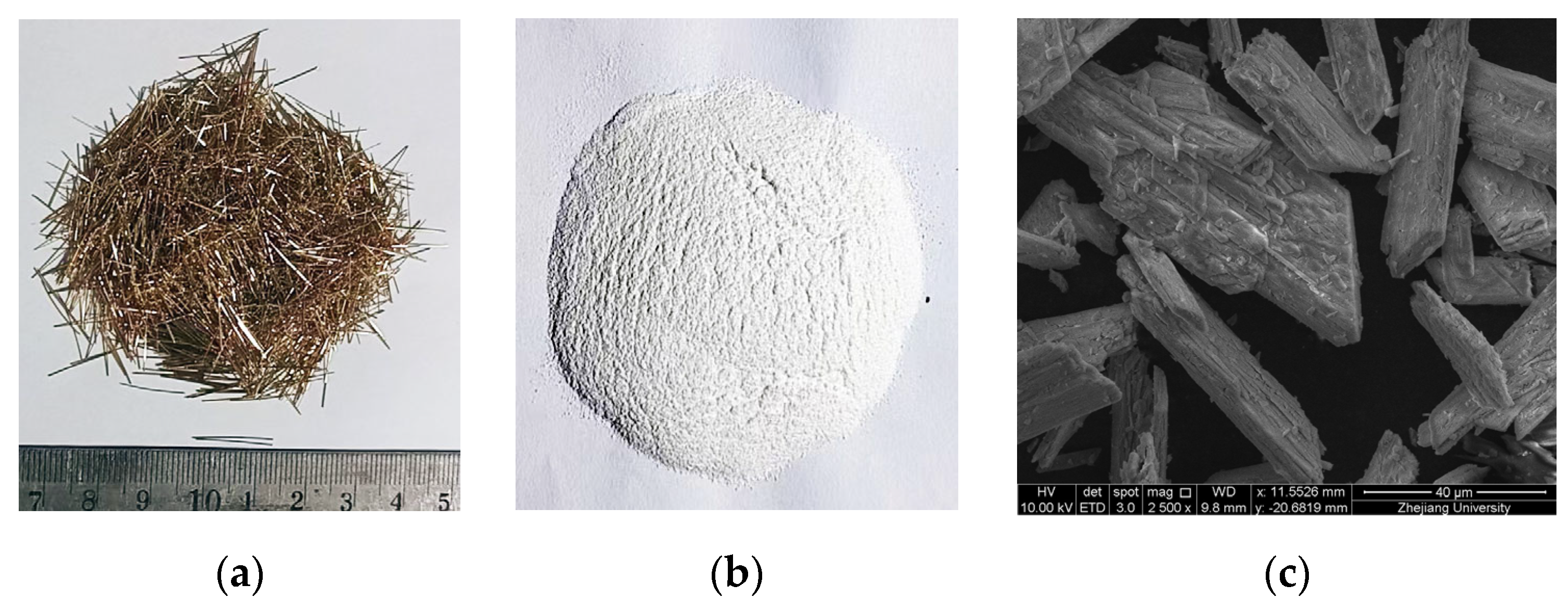
2.1. Raw Materials
2.2. Mixture Proportion Design
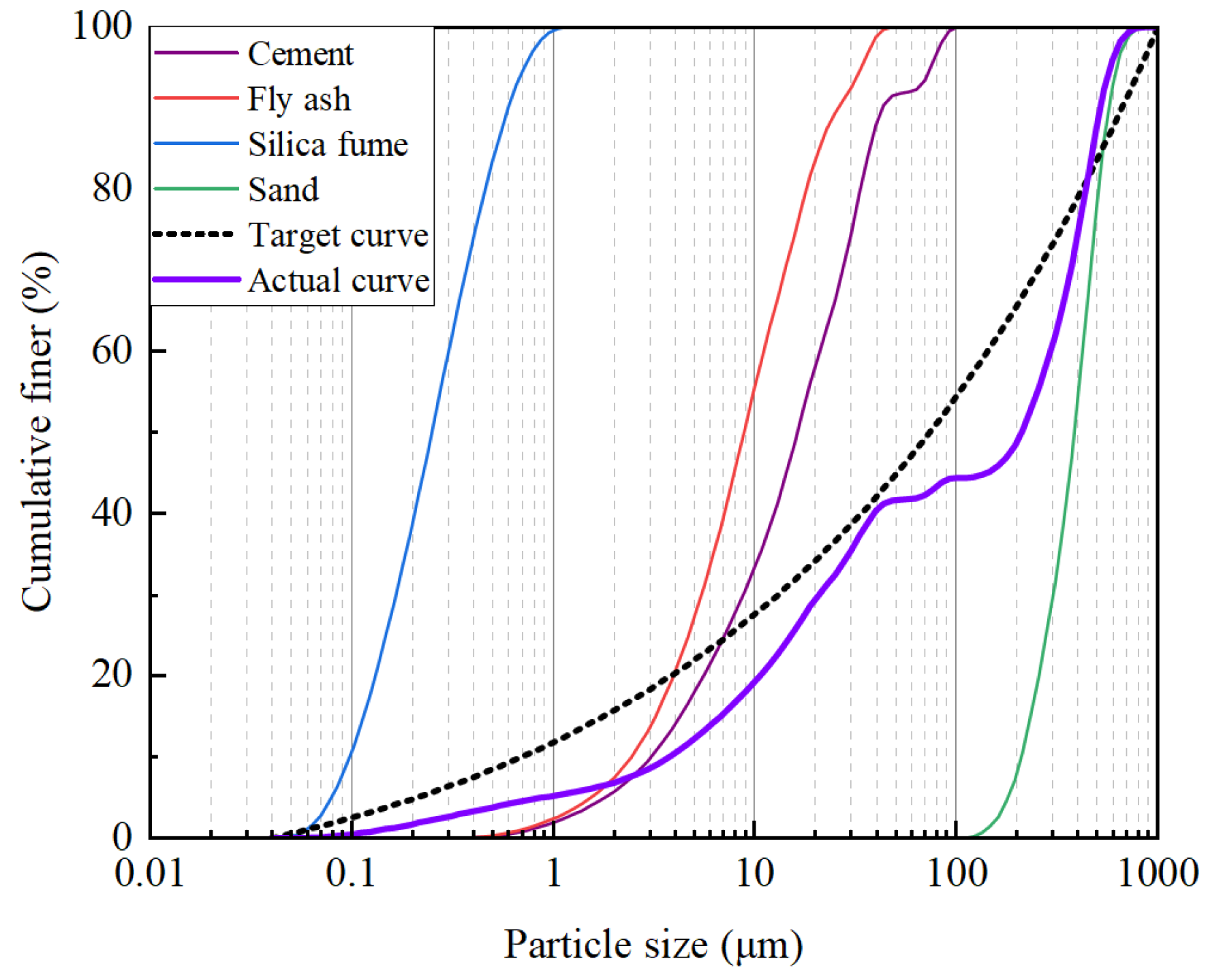
2.2.1. Particle Packing Optimization
2.2.2. Orthogonal Experimental Design
2.2.3. Full Factorial Design
2.3. Specimen Preparation and Testing Methods
2.3.1. Specimen Preparation
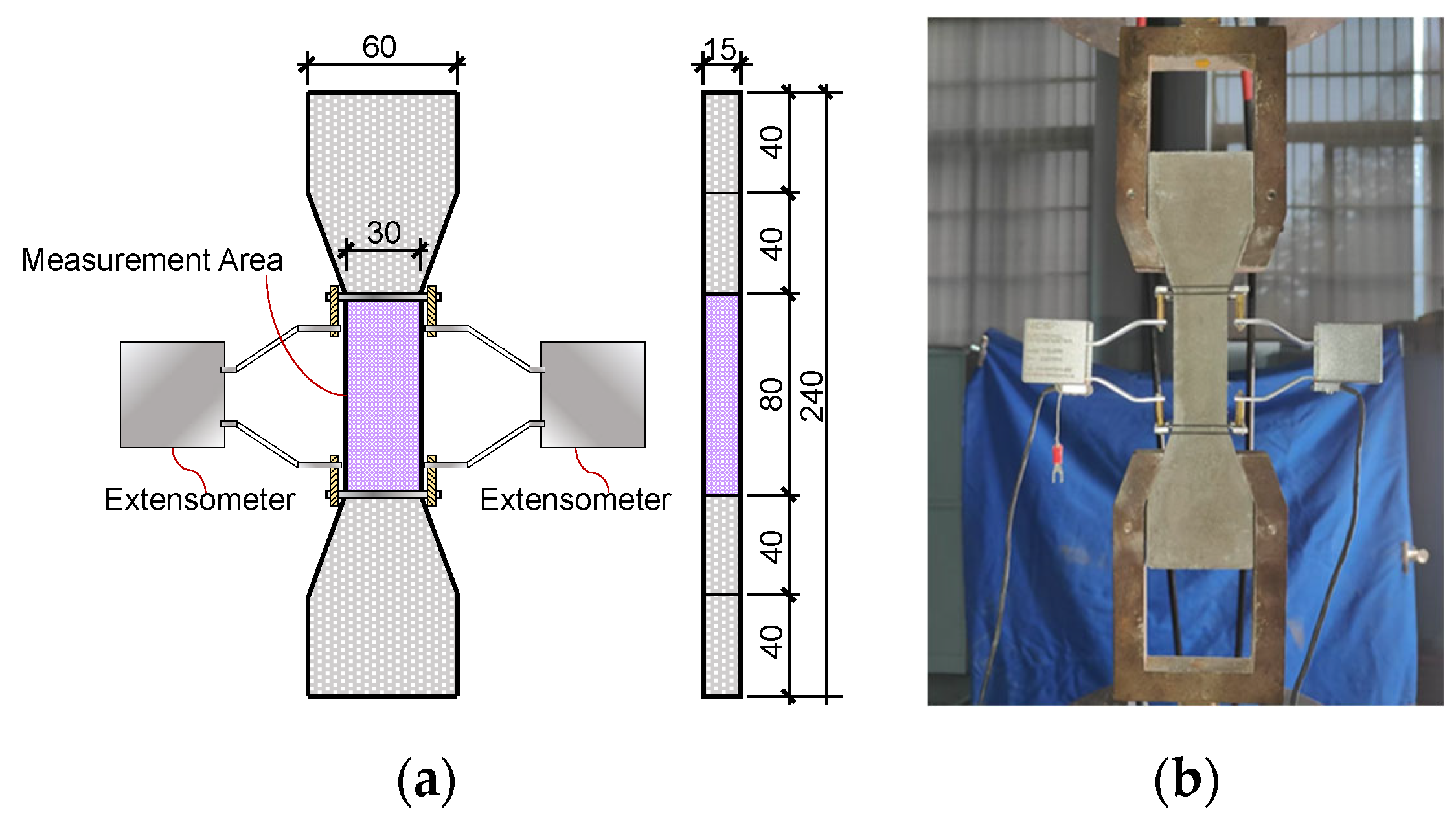
2.3.2. Mechanical Property Testing
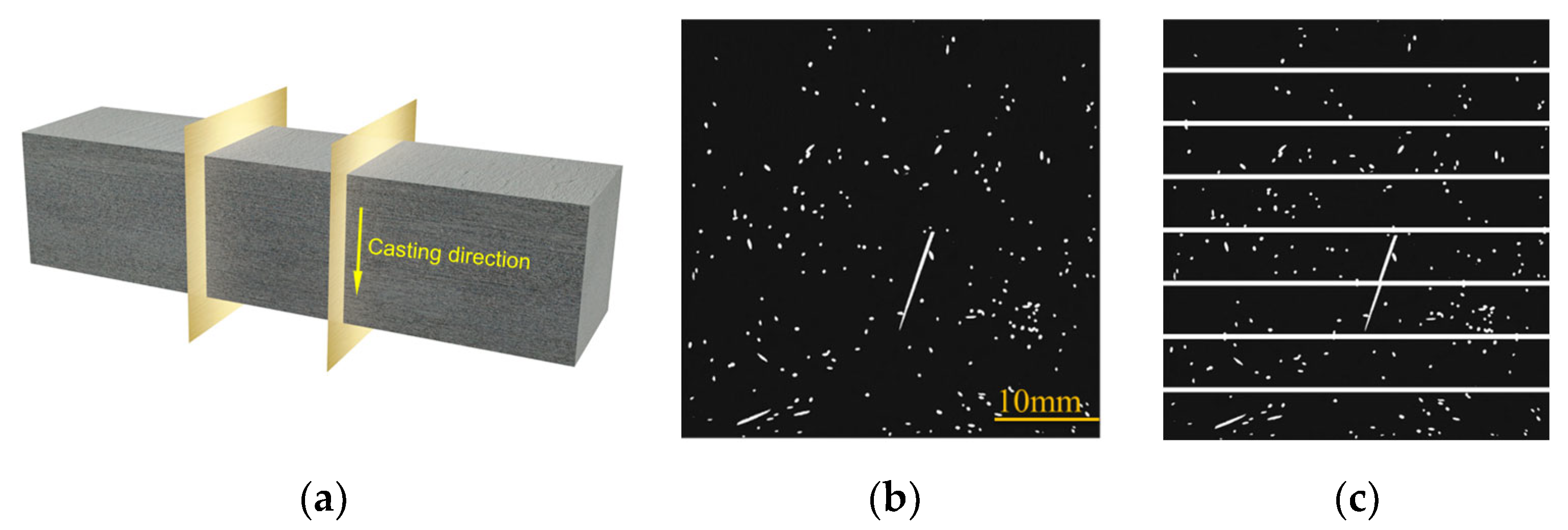
2.3.3. Fiber Dispersion Properties
2.3.4. Pore Structure Characterization
3. Results and Discussion
3.1. Mechanical Property Development
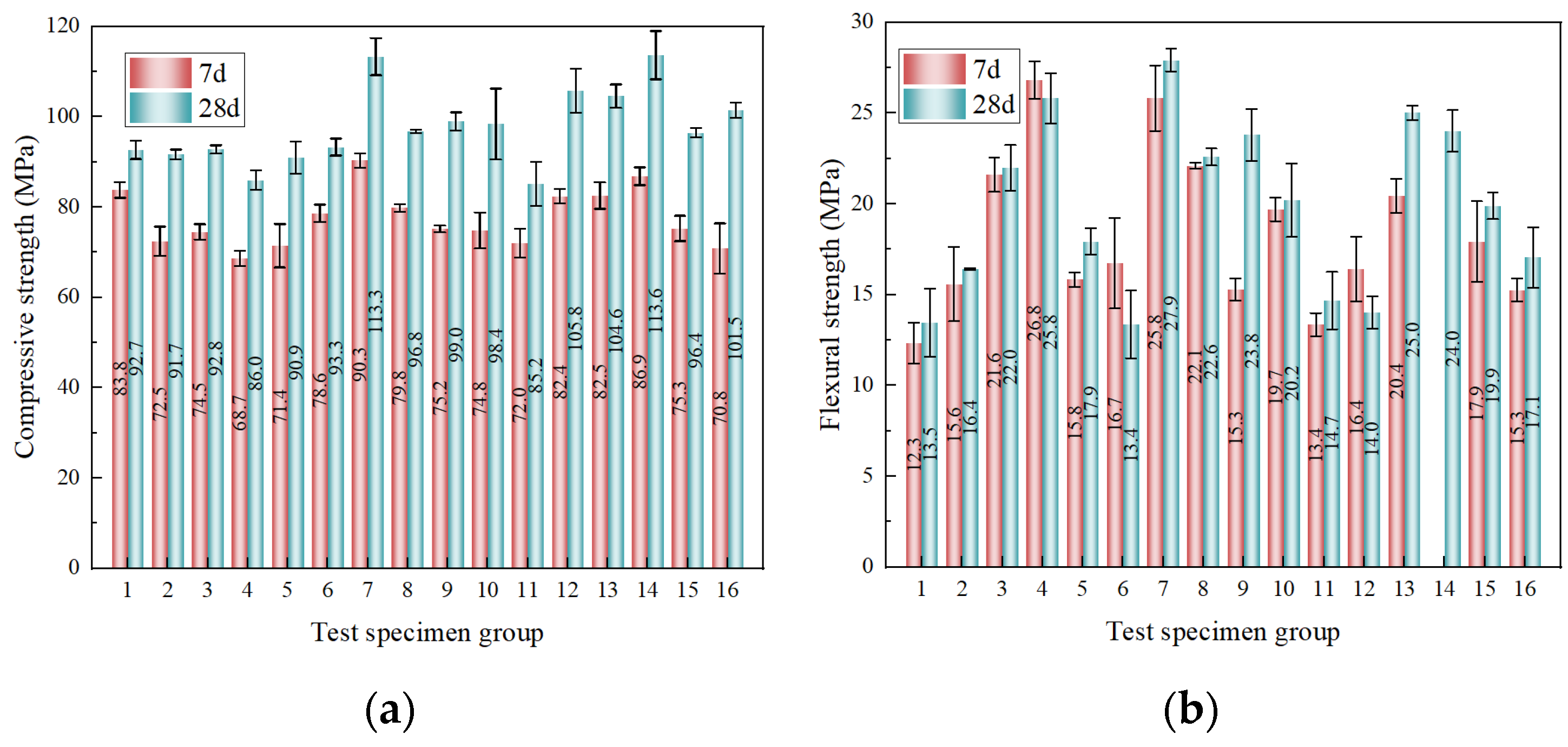
3.1.1. Age-Dependent Strength Evolution
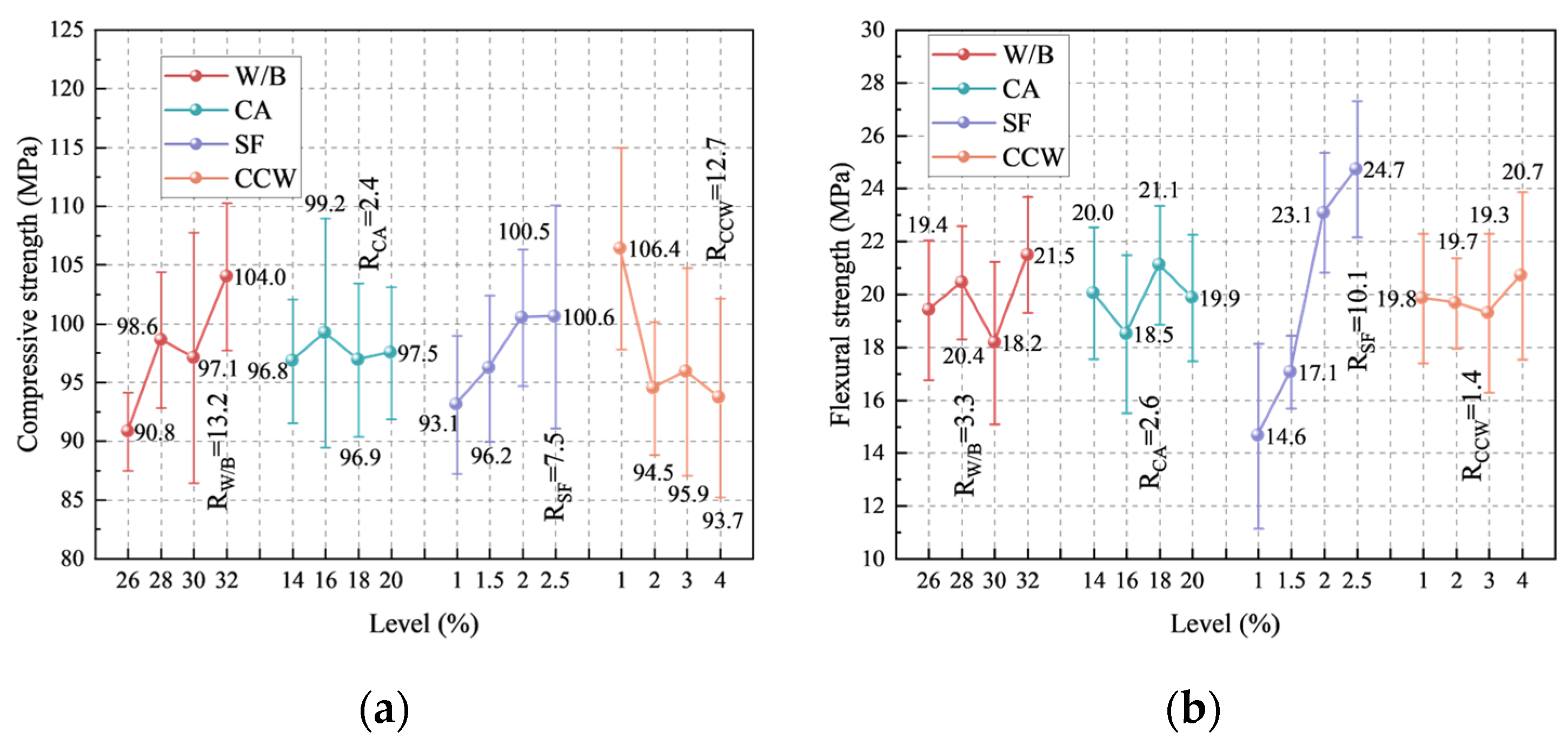
3.1.2. Orthogonal Range Analysis and Multi-Scale Mechanisms
- (1)
- W/B ratio (Optimal: 0.32)
- (2)
- CW content (Optimal: 1.0 vol.%)
- (3)
- SF dosage (Optimal: 2.0 vol.%):
- (4)
- CA content (Optimal: 18 wt.%):
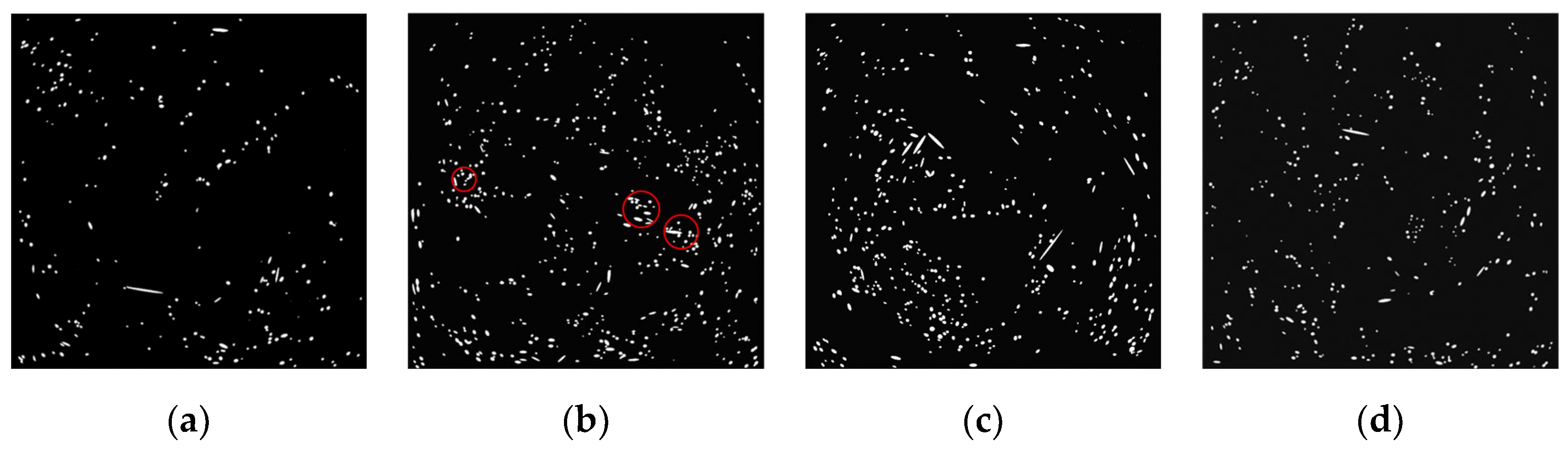
3.2. Fiber Dispersion Characteristics and Cross-Scale Synergistic Mechanisms
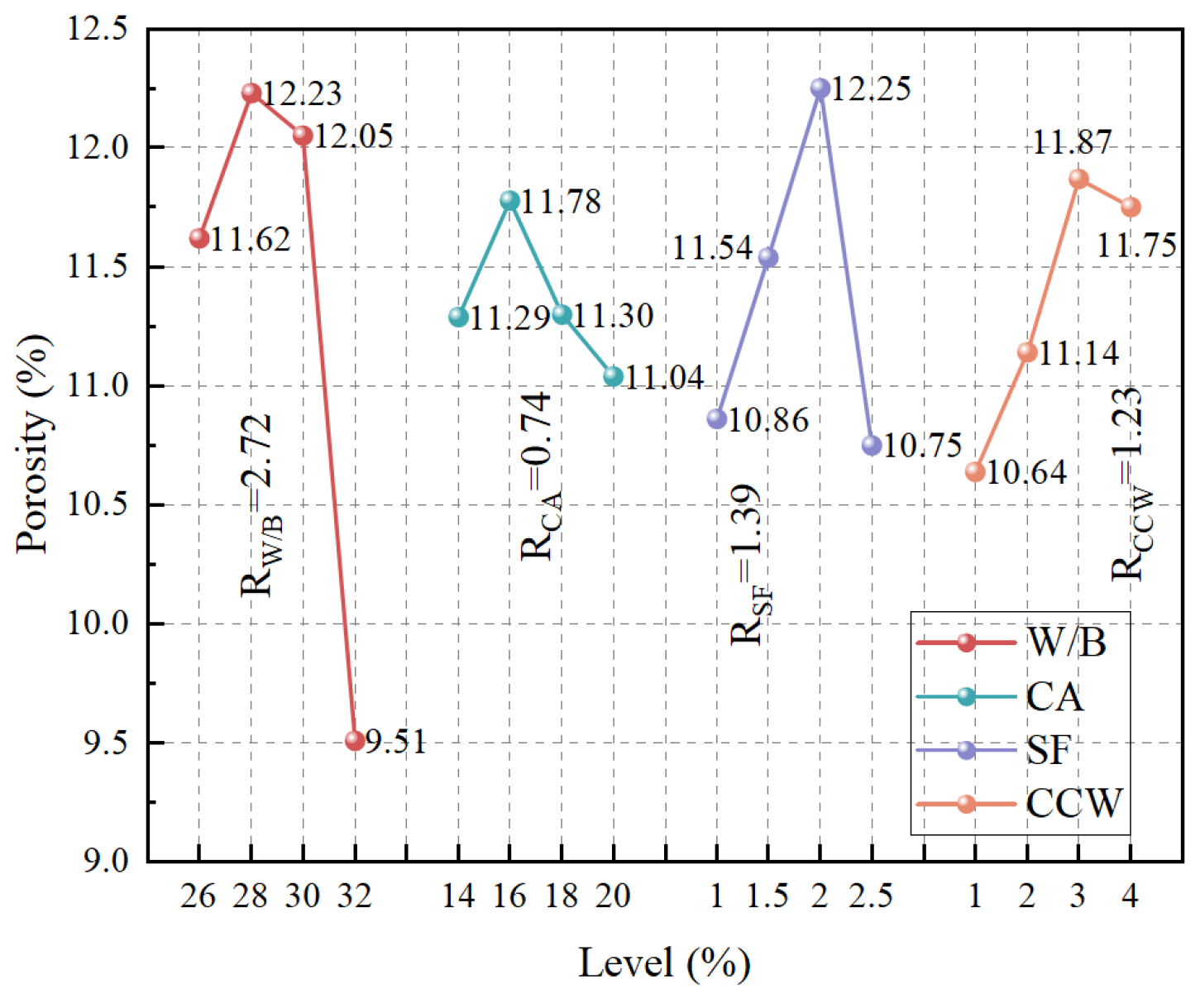
3.3. Microstructural Characterization: Pore Structure Evolution
3.3.1. Total Porosity and Matrix Densification
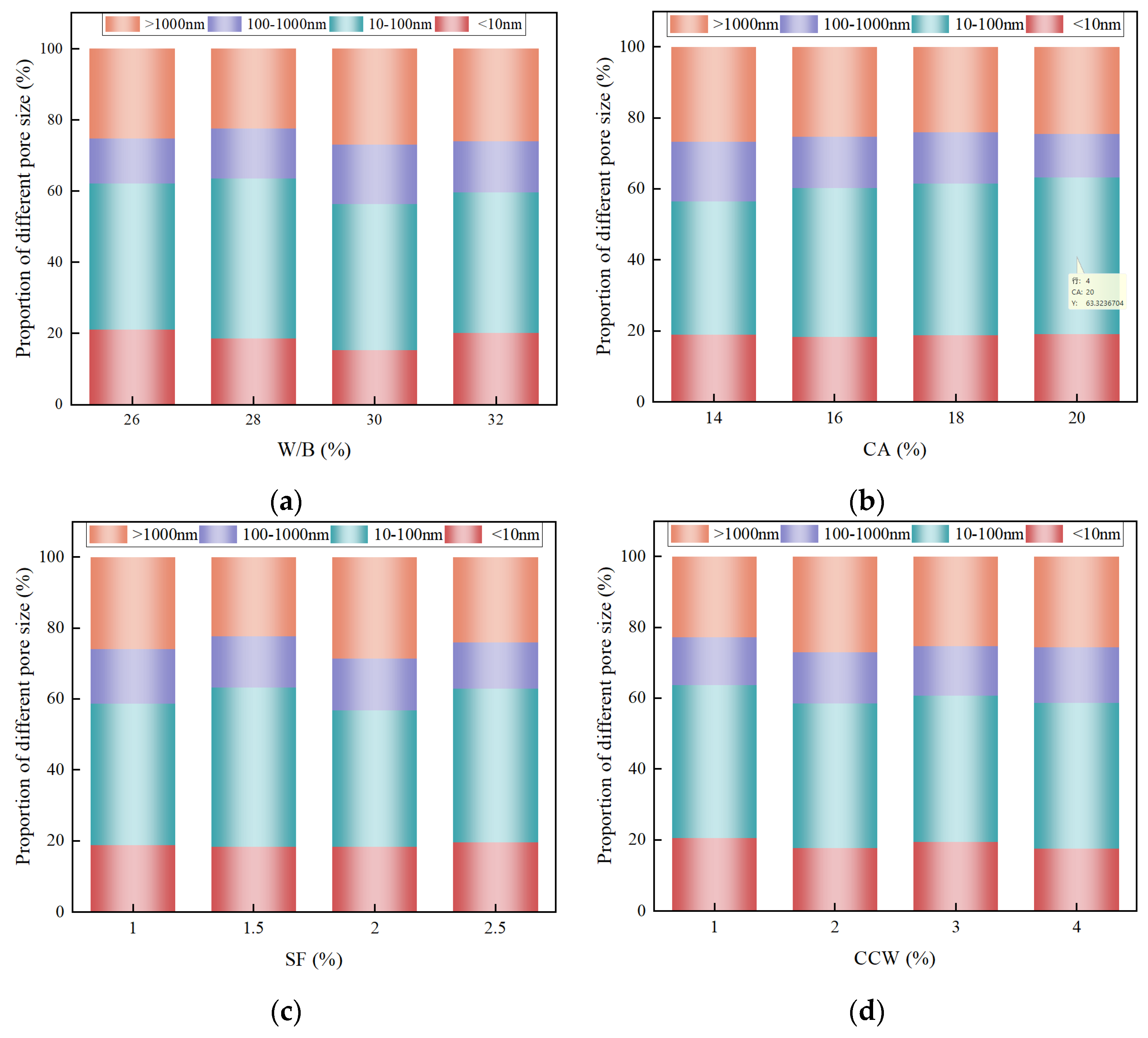
3.3.2. Multiscale Pore Size Distribution and Refinement Mechanisms
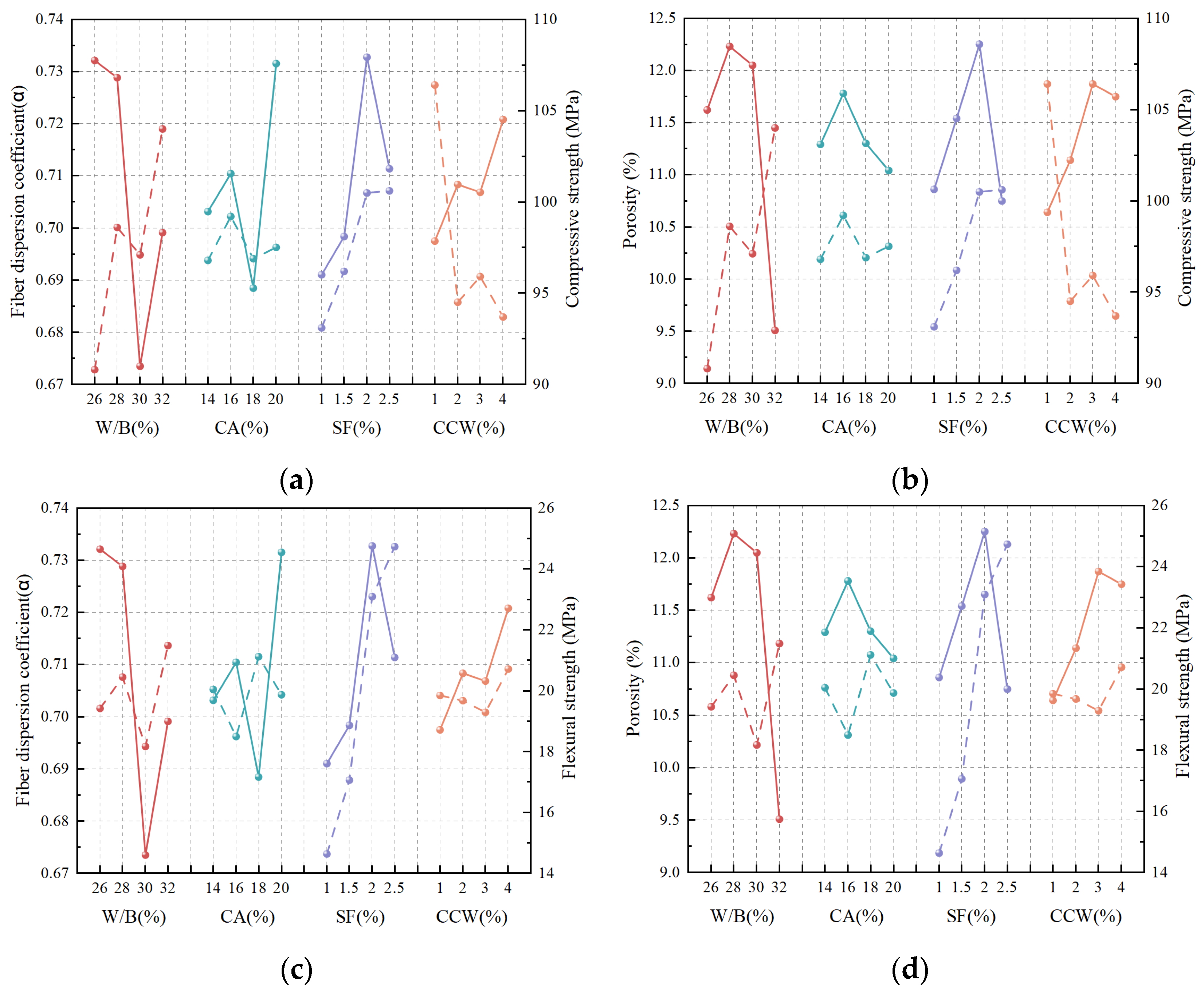
3.4. Structure–Property Relationships: Coupling Effects of Porosity and Fiber Dispersion
3.5. Direct Tensile Response and Multiscale Fracture Mechanisms
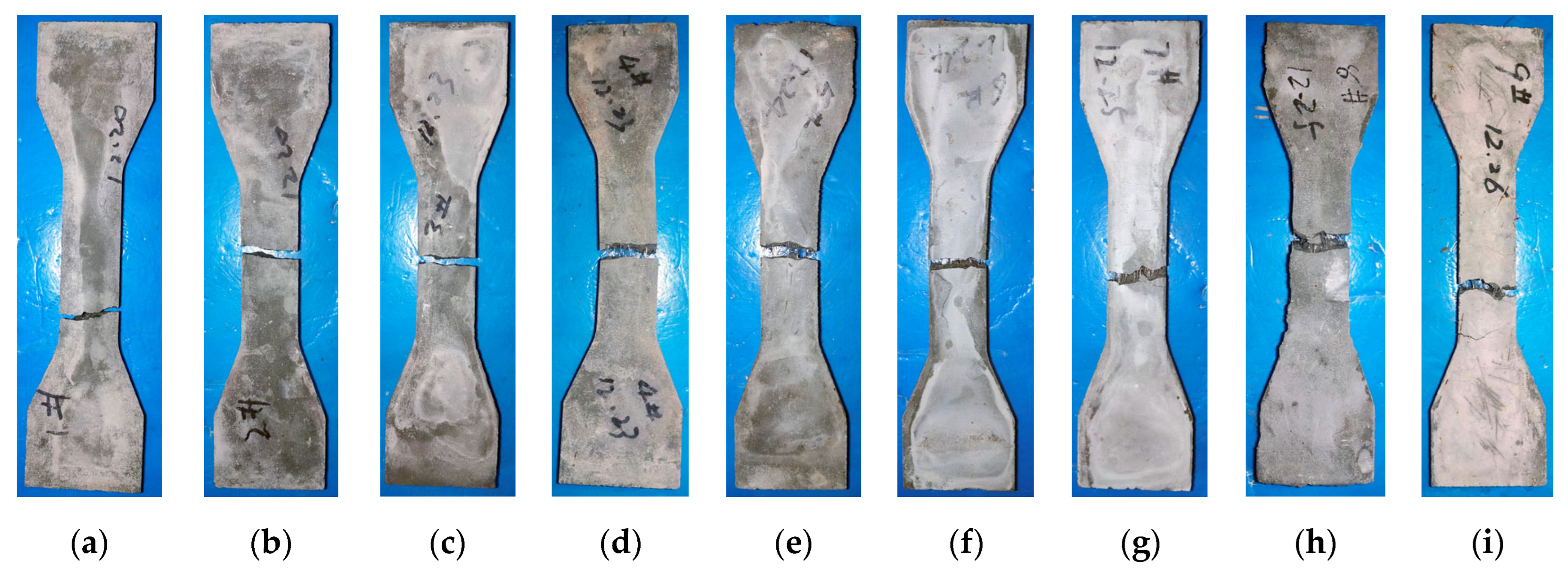
3.5.1. Macroscopic Fracture Morphologies and Crack-Bridging Behavior
3.5.2. Tensile Capacity and Cross-Scale Synergistic Effects
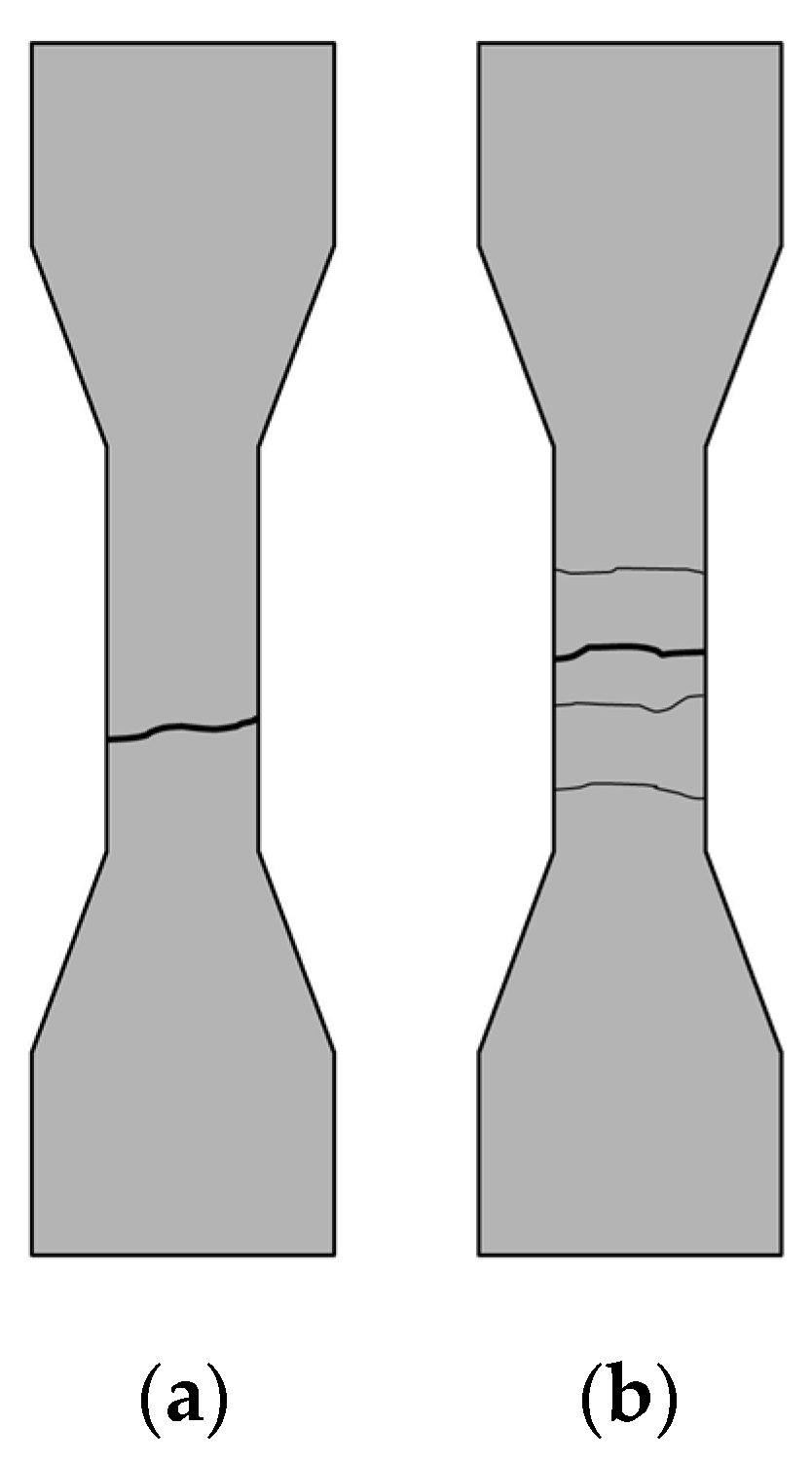
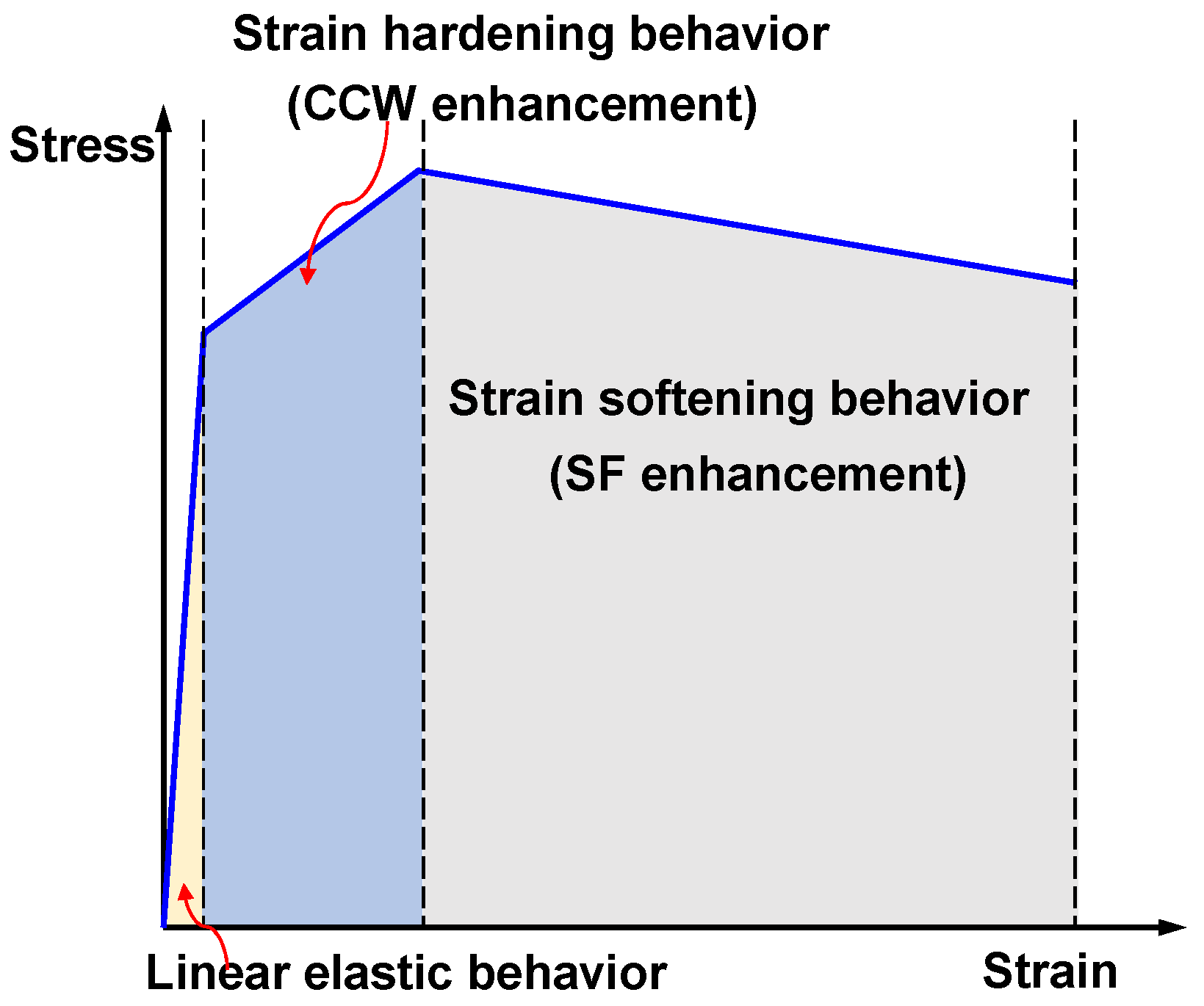
3.5.3. Constitutive Response and Multi-Stage Toughening Conceptualization
4. Conclusions
- (1)
- Stress-state-dependent optimization: Compressive strength is governed by matrix densification (W/B and CCW), whereas flexural performance is controlled by crack-bridging capacity (SF and CA). An optimal balance is achieved at W/B = 0.32, CA = 18%, SF = 2%, and CCW = 1%.
- (2)
- Rheology-controlled fiber dispersion: Fiber distribution is primarily dictated by matrix rheology rather than dosage alone. Increasing W/B lowers yield stress and induces gravity-driven SF segregation, while CA and CCW provide spatial confinement. A critical SF content (~2%) is required to avoid fiber depletion and agglomeration.
- (3)
- Decoupled pore refinement mechanism: Pore evolution follows a physico-chemical decoupling. W/B and CCW regulate gel pores via hydration and nucleation, whereas CA and SF mainly affect capillary pores and ITZs through geometric packing, without altering the intrinsic gel network.
- (4)
- Synergistic toughening: Under tension, CCW enhances the pre-peak regime by suppressing microcrack coalescence and promoting pseudo strain-hardening, while SF governs post-peak energy dissipation via crack bridging and pull-out. Their synergy (2% SF + 1% CCW) enables a transition from brittle fracture to stable multiple cracking.
- (5)
- Future Perspectives: Future studies will continue to develop physics-informed constitutive models and employ advanced microstructural characterization (e.g., SEM-EDS, XRD, TGA) to deepen our understanding of chemical hydration kinetics and fiber-matrix interactions. From an engineering standpoint, future work will also specifically address production scalability, conduct comprehensive cost and environmental impact assessments of CCW utilization, and verify the composite’s durability and structural performance under realistic exposure conditions relevant to marine infrastructure. This will ensure its promising potential for extensive application.
Author Contributions
Funding
Data Availability Statement
Acknowledgments
Conflicts of Interest
References
- Bae, Y.; Pyo, S. Ultra high performance concrete (UHPC) sleeper: Structural design and performance. Eng. Struct. 2020, 210, 110374. [Google Scholar] [CrossRef]
- Hung, C.C.; El-Tawil, S.; Chao, S.H. A review of developments and challenges for UHPC in structural engineering: Behavior, analysis, and design. J. Struct. Eng. 2021, 147, 03121001. [Google Scholar] [CrossRef]
- Azmee, N.M.; Shafiq, N. Ultra-high performance concrete: From fundamental to applications. Case Stud. Constr. Mater. 2018, 9, e00197. [Google Scholar] [CrossRef]
- Akhnoukh, A.K.; Buckhalter, C. Ultra-high-performance concrete: Constituents, mechanical properties, applications and current challenges. Case Stud. Constr. Mater. 2021, 15, e00559. [Google Scholar] [CrossRef]
- Miao, X.G.; Yuan, A.M.; Wang, K.Q.; Chen, Q.; Wang, X.; Kong, H.; Wang, J.Q. Mechanical and autogenous shrinkage properties of coarse aggregate ultra-high performance concrete (CA-UHPC): The effect of mineral admixtures. J. Build. Eng. 2024, 98, 111154. [Google Scholar] [CrossRef]
- Yang, L.; Shi, C.J.; Wu, Z.M. Mitigation techniques for autogenous shrinkage of ultra-high-performance concrete—A review. Compos. Part B Eng. 2019, 178, 107456. [Google Scholar] [CrossRef]
- Vishalakshi, K.P.; Revathi, V.; Sivamurthy Reddy, S. Effect of type of coarse aggregate on the strength properties and fracture energy of normal and high strength concrete. Eng. Fract. Mech. 2018, 194, 52–60. [Google Scholar] [CrossRef]
- Yoo, D.Y.; Banthia, N. Mechanical properties of ultra-high-performance fiber-reinforced concrete: A review. Cem. Concr. Compos. 2016, 73, 267–280. [Google Scholar] [CrossRef]
- Cao, M.L.; Zhang, C.; Wei, J.Q. Microscopic reinforcement for cement based composite materials. Constr. Build. Mater. 2013, 40, 14–25. [Google Scholar] [CrossRef]
- Cao, M.L.; Zhang, C.; Li, Y.; Wei, J.Q. Using calcium carbonate whisker in hybrid fiber-reinforced cementitious composites. J. Mater. Civ. Eng. 2015, 27, 04014139. [Google Scholar] [CrossRef]
- Yoo, D.Y.; Kim, S.; Park, G.J.; Park, J.J.; Kim, S.W. Effects of fiber shape, aspect ratio, and volume fraction on flexural behavior of ultra-high-performance fiber-reinforced cement composites. Compos. Struct. 2017, 174, 375–388. [Google Scholar] [CrossRef]
- Wu, Z.M.; Shi, C.J.; Khayat, K.H. Investigation of mechanical properties and shrinkage of ultra-high performance concrete: Influence of steel fiber content and shape. Compos. Part B Eng. 2019, 174, 107021. [Google Scholar] [CrossRef]
- Yoo, D.Y.; Yoon, Y.S. Structural performance of ultra-high-performance concrete beams with different steel fibers. Eng. Struct. 2015, 102, 409–423. [Google Scholar] [CrossRef]
- Gong, J.H.; Ma, Y.W.; Fu, J.Y.; Hu, J.; Ouyang, X.W.; Zhang, Z.H.; Wang, H. Utilization of fibers in ultra-high performance concrete: A review. Compos. Part B Eng. 2022, 241, 109995. [Google Scholar] [CrossRef]
- Zhao, C.G.; Wang, Z.Y.; Zhu, Z.Y.; Guo, Q.Y.; Wu, X.R.; Zhao, R.D. Research on different types of fiber reinforced concrete in recent years: An overview. Constr. Build. Mater. 2023, 365, 130075. [Google Scholar] [CrossRef]
- Yoo, D.Y.; Kim, M.J.; Kim, S.W.; Park, J.J. Development of cost effective ultra-high-performance fiber-reinforced concrete using single and hybrid steel fibers. Constr. Build. Mater. 2017, 150, 383–394. [Google Scholar] [CrossRef]
- Wu, Z.M.; Shi, C.J.; He, W.; Wang, D.H. Static and dynamic compressive properties of ultra-high performance concrete (UHPC) with hybrid steel fiber reinforcements. Cem. Concr. Compos. 2017, 79, 148–157. [Google Scholar] [CrossRef]
- Wen, C.C.; Zhang, P.; Wang, J.; Hu, S.W. Influence of fibers on the mechanical properties and durability of ultra-high-performance concrete: A review. J. Build. Eng. 2022, 52, 104370. [Google Scholar] [CrossRef]
- Deng, F.Q.; Xu, L.H.; Chi, Y.; Wu, F.H.; Chen, Q. Effect of steel-polypropylene hybrid fiber and coarse aggregate inclusion on the stress–strain behavior of ultra-high performance concrete under uniaxial compression. Compos. Struct. 2020, 252, 112685. [Google Scholar] [CrossRef]
- Cao, M.L.; Xie, C.P.; Guan, J.F. Fracture behavior of cement mortar reinforced by hybrid composite fiber consisting of CaCO3 whiskers and PVA-steel hybrid fibers. Compos. Part A Appl. Sci. Manuf. 2019, 120, 172–187. [Google Scholar] [CrossRef]
- Xie, C.P.; Cao, M.L.; Si, W.; Khan, M. Experimental evaluation on fiber distribution characteristics and mechanical properties of calcium carbonate whisker modified hybrid fibers reinforced cementitious composites. Constr. Build. Mater. 2020, 265, 120292. [Google Scholar] [CrossRef]
- Xie, C.P.; Cao, M.L.; Guan, J.F.; Liu, Z.X.; Khan, M. Improvement of boundary effect model in multi-scale hybrid fibers reinforced cementitious composite and prediction of its structural failure behavior. Compos. Part B Eng. 2021, 224, 109219. [Google Scholar] [CrossRef]
- Yang, Y.Y.; Zhou, Q.; Deng, Y.; Lin, J.H. Reinforcement effects of multi-scale hybrid fiber on flexural and fracture behaviors of ultra-low-weight foamed cement-based composites. Cem. Concr. Compos. 2022, 128, 104422. [Google Scholar] [CrossRef]
- Cui, K.; Xu, L.H.; Tao, T.; Huang, L.; Li, J.; Hong, J.; Li, H.; Chi, Y. Mechanical behavior of multiscale hybrid fiber reinforced recycled aggregate concrete subject to uniaxial compression. J. Build. Eng. 2023, 71, 106504. [Google Scholar] [CrossRef]
- Ragalwar, K.; Heard, W.F.; Williams, B.A.; Kumar, D.; Ranade, R. On enhancing the mechanical behavior of ultra-high performance concrete through multi-scale fiber reinforcement. Cem. Concr. Compos. 2020, 105, 103422. [Google Scholar] [CrossRef]
- Ji, X.S.; Jiang, Y.; Gao, X.J.; Sun, M. Synergistic effect of microfibers and oriented steel fibers on mechanical properties of UHPC. J. Build. Eng. 2024, 91, 109742. [Google Scholar] [CrossRef]
- Wu, Z.M.; Shi, C.J.; Khayat, K.H. Multi-scale investigation of microstructure, fiber pullout behavior, and mechanical properties of ultra-high performance concrete with nano-CaCO3 particles. Cem. Concr. Compos. 2018, 86, 255–265. [Google Scholar] [CrossRef]
- Huang, J.L.; Zhou, Y.; Yang, X.; Dong, Y.J.; Jin, M.; Liu, J.P. A multi-scale study of enhancing mechanical property in ultra-high performance concrete by steel-fiber@nano-silica. Constr. Build. Mater. 2022, 342, 128069. [Google Scholar] [CrossRef]
- Yu, L.B.; Bai, S.; Guan, X.C. Effect of multi-scale reinforcement on fracture property of ultra-high performance concrete. Constr. Build. Mater. 2023, 397, 132383. [Google Scholar] [CrossRef]
- Saulat, H.; Cao, M.L.; Khan, M.M.; Khan, M.; Khan, M.M.; Rehman, A. Preparation and applications of calcium carbonate whisker with a special focus on construction materials. Constr. Build. Mater. 2020, 236, 117613. [Google Scholar] [CrossRef]
- Sun, Z.K.; Yang, S.T.; Hang, M.Y.; Wang, J.H.; Yang, T.G. Optimization design of ultrahigh-performance concrete based on interaction analysis of multiple factors. Case Stud. Constr. Mater. 2022, 16, e00858. [Google Scholar] [CrossRef]
- Wang, J.; Wang, Y.; Wang, S.; Zhan, Y.; Peng, Y.; Hu, Z.; Zhang, B. Strength and Ductility Enhancement in Coarse-Aggregate UHPC via Fiber Hybridization: Micro-Mechanistic Insights and Artificial Neural Network Prediction. Materials 2026, 19, 157. [Google Scholar] [CrossRef]
- Li, P.; Wang, X.; Cao, H. Empirical compression model of ultra-high-performance concrete considering the effect of cement hydration on particle packing characteristics. Materials 2023, 16, 4585. [Google Scholar] [CrossRef]
- Wang, J.N.; Yu, R.; Ji, D.D.; Tang, L.W.; Yang, S.C.; Fan, D.Q.; Shui, Z.H.; Leng, Y.; Liu, K.N. Effect of distribution modulus (q) on the properties and microstructure development of a sustainable Ultra-High Performance Concrete (UHPC). Cem. Concr. Compos. 2022, 125, 104335. [Google Scholar] [CrossRef]
- Yu, R.; Spiesz, P.; Brouwers, H.J.H. Mix design and properties assessment of Ultra-High Performance Fibre Reinforced Concrete (UHPFRC). Cem. Concr. Res. 2014, 56, 29–39. [Google Scholar] [CrossRef]
- Yang, J.; Chen, B.C.; Su, J.Z.; Xu, G.; Zhang, D.; Zhou, J.L. Effects of fibers on the mechanical properties of UHPC: A review. J. Traffic Transp. Eng. (Engl. Ed.) 2022, 9, 363–387. [Google Scholar] [CrossRef]
- T/CBMF 37-2018; Fundamental Characteristics and Test Method of Ultra-High Performance Concrete. China Building Materials Federation: Beijing, China, 2018. (In Chinese)
- GB/T 50081-2019; Standard of Test Methods of Concrete Physical and Mechanical Properties. Ministry of Housing and Urban-Rural Development of the People’s Republic of China: Beijing, China, 2019. (In Chinese)
- GB/T 31387-2025; Ultra High Performance Concrete. Ministry of Housing and Urban-Rural Development of the People’s Republic of China: Beijing, China, 2025. (In Chinese)
- JC/T 2461-2018; Standard Test Method for the Mechanical Properties of Ductile Fiber Reinforced Cementitious Composites. Ministry of Industry and Information Technology of the People’s Republic of China: Beijing, China, 2018. (In Chinese)
- Wang, R.; Gao, X.J.; Huang, H.H.; Han, G.S. Influence of rheological properties of cement mortar on steel fiber distribution in UHPC. Constr. Build. Mater. 2017, 144, 65–73. [Google Scholar] [CrossRef]
- Teng, L.; Meng, W.N.; Khayat, K.H. Rheology control of ultra-high-performance concrete made with different fiber contents. Cem. Concr. Res. 2020, 138, 106222. [Google Scholar] [CrossRef]
- Tosun-Felekoğlu, K.; Felekoğlu, B.; Ranade, R.; Lee, B.Y.; Li, V.C. The role of flaw size and fiber distribution on tensile ductility of PVA-ECC. Compos. Part B Eng. 2014, 56, 536–545. [Google Scholar] [CrossRef]
- Cao, M.L.; Xu, L.; Zhang, C. Rheology, fiber distribution and mechanical properties of calcium carbonate (CaCO3) whisker reinforced cement mortar. Compos. Part A Appl. Sci. Manuf. 2016, 90, 662–669. [Google Scholar] [CrossRef]
- Meng, W.N.; Khayat, K.H. Improving flexural performance of ultra-high-performance concrete by rheology control of suspending mortar. Compos. Part B Eng. 2017, 117, 26–34. [Google Scholar] [CrossRef]
- Wu, Z.M.; Khayat, K.H.; Shi, C.J. Changes in rheology and mechanical properties of ultra-high performance concrete with silica fume content. Cem. Concr. Res. 2019, 123, 105786. [Google Scholar] [CrossRef]
- Li, Z.G.; Zhang, H.; Wang, R. Influence of steel fiber distribution on splitting damage and transport properties of ultra-high performance concrete. Cem. Concr. Compos. 2022, 126, 104373. [Google Scholar] [CrossRef]
- Gu, B.B.; Li, Q.F.; Li, C.; Zhao, P.; Hou, P.K.; Chen, H.; Wang, Y.; Zhao, P.Q.; Cheng, X. Optimization design of ultra-fine supplementary cementitious materials ultra-high performance concrete mix proportion based on orthogonal experiment. Constr. Build. Mater. 2024, 453, 139018. [Google Scholar] [CrossRef]
- Xu, L.H.; Wu, F.H.; Chi, Y.; Cheng, P.; Zeng, Y.Q.; Chen, Q. Effects of coarse aggregate and steel fibre contents on mechanical properties of high performance concrete. Constr. Build. Mater. 2019, 206, 97–110. [Google Scholar] [CrossRef]
- Wen, S.Y.; Cao, M.L. Reinforcement effects on the tensile properties of seawater sea-sand engineered cementitious composites reinforced with multi-scale hybrid fibers. Structures 2024, 64, 106579. [Google Scholar] [CrossRef]
- Zhou, M.; He, X.J.; Wang, H.Y.; Wu, C.; He, J.; Wei, B.Y. Mechanical properties and microstructure of ITZs in steel and polypropylene hybrid fiber-reinforced concrete. Constr. Build. Mater. 2024, 415, 135119. [Google Scholar] [CrossRef]
- Zhang, L.; Wang, H.; Wang, A.; Zhang, Q.; Li, Z.; Wang, X.; Huang, C.; Jivkov, A. Experimental study of marine ultra-high-performance concrete with coarse aggregate (UHPC-CA). Case Stud. Constr. Mater. 2025, 22, e04731. [Google Scholar] [CrossRef]
- Bahmani, H.; Mostofinejad, D. Microstructure of ultra-high-performance concrete (UHPC)—A review study. J. Build. Eng. 2022, 50, 104118. [Google Scholar] [CrossRef]
- Xu, R.; Miao, J.Y.; Lu, S.N.; Tang, C.M.; Yu, J.T. Tensile and fracture behavior of engineered cementitious composite with polyethylene fibers and calcium sulfate whiskers. Constr. Build. Mater. 2025, 460, 139806. [Google Scholar] [CrossRef]







| Insoluble Matter | Loss on Ignition | MgO | SO3 | Chloride Ion | Limestone | Natural Gypsum |
|---|---|---|---|---|---|---|
| 0.95 | 2.13 | 1.46 | 2.59 | 0.019 | 2.16 | 6.54 |
| C3S | C2S | C4AF | C3A | Calcite | Gypsum | Bassanite | Anhydrite | Free CaO | Free MgO |
|---|---|---|---|---|---|---|---|---|---|
| 59.4 | 13.8 | 9.4 | 6.5 | 4.8 | 2.6 | 1.6 | 0.7 | 0.4 | 0.8 |
| Moisture Content | Loss on Ignition | Water Requirement Ratio | SO3 | Free CaO | Total Mass Fraction of SiO2, Al2O3, and Fe2O3 | 28 d Activity Index |
|---|---|---|---|---|---|---|
| 0.02 | 1.80 | 93 | 0.7 | 0.05 | 77 | 79 |
| SiO2 | Fe2O3 | Al2O3 | TiO2 | CaO | MgO | Na2O | K2O |
|---|---|---|---|---|---|---|---|
| 93.0 | 0.31 | 4.63 | 0.057 | 0.23 | 0.12 | 1.38 | 2.18 |
| SiO2 | Moisture Content | Loss on Ignition |
|---|---|---|
| 94.0 | 0.4 | 0.5 |
| Tensile Strength (MPa) | Length (mm) | Equivalent Diameter (mm) | Length-to-Diameter Ratio |
|---|---|---|---|
| 2850 | 13.0 | 0.22 | 59 |
| Purity (%) | Moisture Content (%) | Equivalent Diameter (µm) | Length-to-Diameter Ratio | pH | Heat Resistance (°C) |
|---|---|---|---|---|---|
| 98 | 0.38 | 8 | 21 | 6.5 | 980 |
| Binding Materials | Binder-to-Sand Ratio (%) | ||
|---|---|---|---|
| Cement (%) | Fly Ash (%) | Silica Fume (%) | |
| 80 | 15 | 5 | 70/75/80 |
| 80 | 12.5 | 7.5 | 70/75/80 |
| 80 | 10 | 10 | 70/75/80 |
| 75 | 20 | 5 | 70/75/80 |
| 75 | 17.5 | 7.5 | 70/75/80 |
| 75 | 15 | 10 | 70/75/80 |
| W/B | CA (%) | SF (%) | CCW (%) |
|---|---|---|---|
| 0.26 | 14 | 1 | 1 |
| 0.28 | 16 | 1.5 | 2 |
| 0.30 | 18 | 2 | 3 |
| 0.32 | 20 | 2.5 | 4 |
| Specimen Groups | SF (%) | CCW (%) |
| SF0CCW0 | 0 | 0 |
| SF0CCW1 | 0 | 1 |
| SF0CCW2 | 0 | 2 |
| SF1CCW0 | 1 | 0 |
| SF1CCW1 | 1 | 1 |
| SF1CCW2 | 1 | 2 |
| SF2CCW0 | 2 | 0 |
| SF2CCW1 | 2 | 1 |
| SF2CCW2 | 2 | 2 |
| Specimen Groups | 7 d Compressive Strength (SD) | 28 d Compressive Strength (SD) | 7 d Flexural Strength (SD) | 28 d Flexural Strength (SD) |
|---|---|---|---|---|
| 1 | 83.8 (1.75) | 92.7 (2.06) | 12.3 (1.13) | 13.5 (1.86) |
| 2 | 72.5 (3.23) | 91.7 (1.07) | 15.6 (2.05) | 16.4 (0.05) |
| 3 | 74.5 (1.70) | 92.8 (0.93) | 21.6 (0.95) | 22.0 (1.25) |
| 4 | 68.7 (1.73) | 86.0 (2.18) | 26.8 (1.03) | 25.8 (1.39) |
| 5 | 71.4 (4.80) | 90.9 (3.58) | 15.8 (0.40) | 17.9 (0.73) |
| 6 | 78.6 (1.89) | 93.3 (1.88) | 16.7 (2.49) | 13.4 (1.86) |
| 7 | 90.3 (1.59) | 113.3 (4.12) | 25.8 (1.81) | 27.9 (0.62) |
| 8 | 79.8 (0.89) | 96.8 (0.43) | 22.1 (0.15) | 22.6 (0.47) |
| 9 | 75.2 (0.72) | 99.0 (2.04) | 15.3 (0.61) | 23.8 (1.42) |
| 10 | 74.8 (3.98) | 98.4 (7.86) | 19.7 (0.65) | 20.2 (2.03) |
| 11 | 72.0 (3.21) | 85.2 (4.88) | 13.4 (0.64) | 14.7 (1.58) |
| 12 | 82.4 (1.63) | 105.8 (4.87) | 16.4 (1.79) | 14.0 (0.90) |
| 13 | 82.5 (2.94) | 104.6 (2.58) | 20.4 (0.96) | 25.0 (0.42) |
| 14 | 86.9 (1.97) | 113.6 (5.35) | / | 24.0 (1.15) |
| 15 | 75.3 (2.80) | 96.4 (1.04) | 17.9 (2.22) | 19.9 (0.74) |
| 16 | 70.8 (5.54) | 101.5 (1.68) | 15.3 (0.63) | 17.1 (1.66) |
| Index | Level | W/B (SD) | CA (SD) | SF (SD) | CCW (SD) |
|---|---|---|---|---|---|
| Compressive strength | K1 | 90.8 (3.31) | 96.8 (5.28) | 93.1 (5.87) | 106.4 (8.58) |
| K2 | 98.6 (5.79) | 99.2 (9.75) | 96.2 (6.23) | 94.5 (5.64) | |
| K3 | 97.1 (10.65) | 96.9 (6.54) | 100.5 (5.82) | 95.9 (8.85) | |
| K4 | 104.0 (6.26) | 97.5 (5.61) | 100.6 (9.49) | 93.7 (8.43) | |
| Flexural strength | K1 | 19.4 (2.64) | 20.0 (2.49) | 14.6 (3.49) | 19.8 (2.44) |
| K2 | 20.4 (2.12) | 18.5 (2.98) | 17.1 (1.38) | 19.7 (1.71) | |
| K3 | 18.2 (3.08) | 21.1 (2.24) | 23.1 (2.27) | 19.3 (3.00) | |
| K4 | 21.5 (2.19) | 19.9 (2.39) | 24.7 (2.57) | 20.7 (3.17) |
| Index | Factor | SS | DOF | MS | F | Fa(3,3) | Significance |
|---|---|---|---|---|---|---|---|
| Compressive strength | W/B | 355.99 | 3 | 118.66 | 2.77 | 0.01 29.46 | - |
| CA | 15.33 | 3 | 5.11 | 0.12 | 0.05 9.28 | - | |
| SF | 156.83 | 3 | 52.28 | 1.22 | 0.1 5.39 | - | |
| CCW | 418.46 | 3 | 139.49 | 3.26 | - | - | |
| Error | 128.40 | 3 | 42.80 | - | - | - | |
| Flexural strength | W/B | 24.28 | 3 | 8.09 | 1.24 | 0.01 29.46 | - |
| CA | 13.85 | 3 | 4.62 | 0.71 | 0.05 9.28 | - | |
| SF | 277.17 | 3 | 92.39 | 14.13 | 0.1 5.39 | (*) * | |
| CCW | 4.36 | 3 | 1.45 | 0.22 | - | - | |
| Error | 19.62 | 3 | 6.54 | - | - | - |
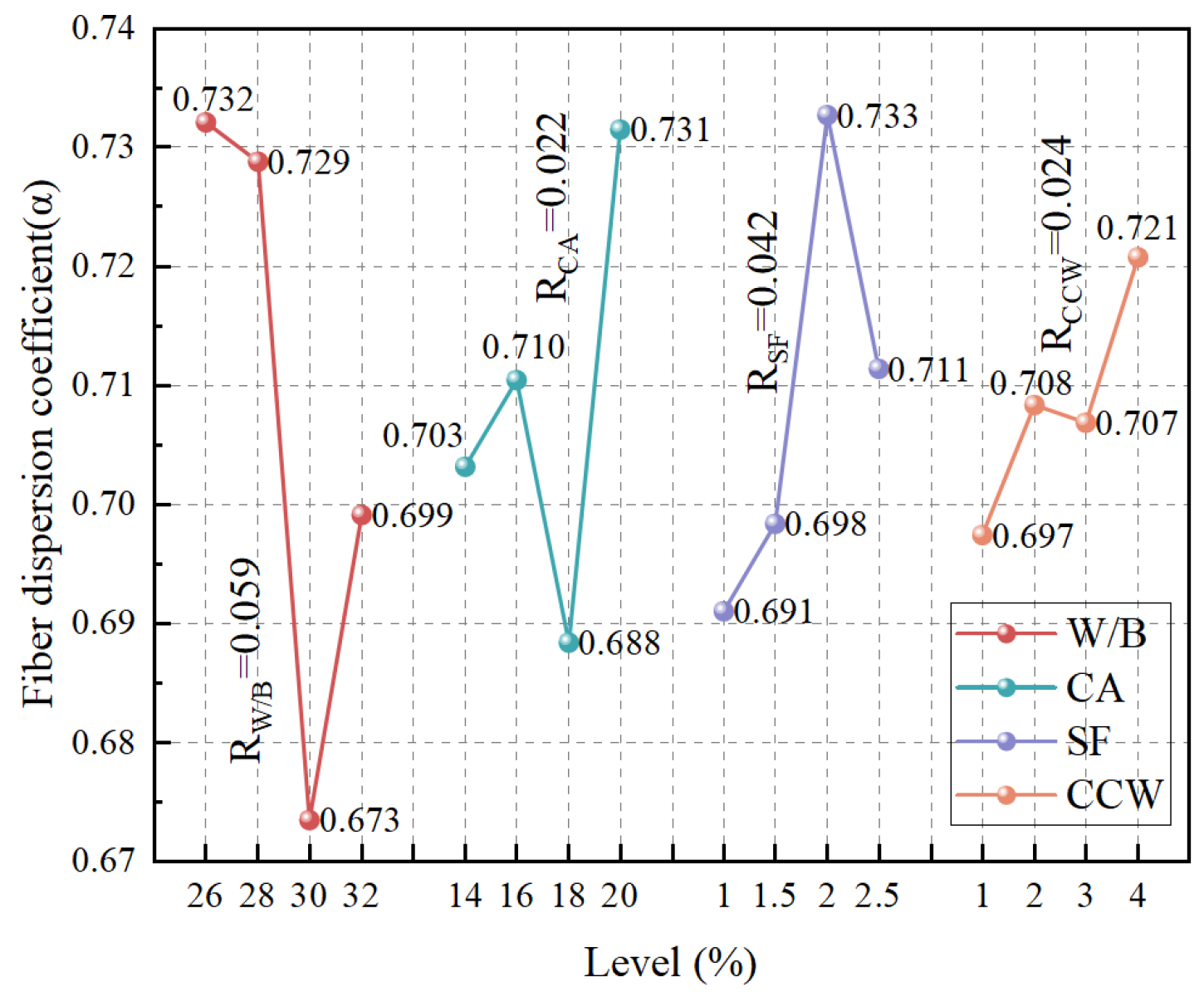
| Level | W/B (SD) | CA (SD) | SF (SD) | CCW (SD) |
|---|---|---|---|---|
| K1 | 0.732 (0.102) | 0.703 (0.096) | 0.691 (0.118) | 0.697 (0.118) |
| K2 | 0.729 (0.099) | 0.710 (0.120) | 0.698 (0.119) | 0.708 (0.104) |
| K3 | 0.673 (0.144) | 0.688 (0.072) | 0.733 (0.089) | 0.707 (0.030) |
| K4 | 0.699 (0.084) | 0.731 (0.138) | 0.711 (0.109) | 0.721 (0.131) |
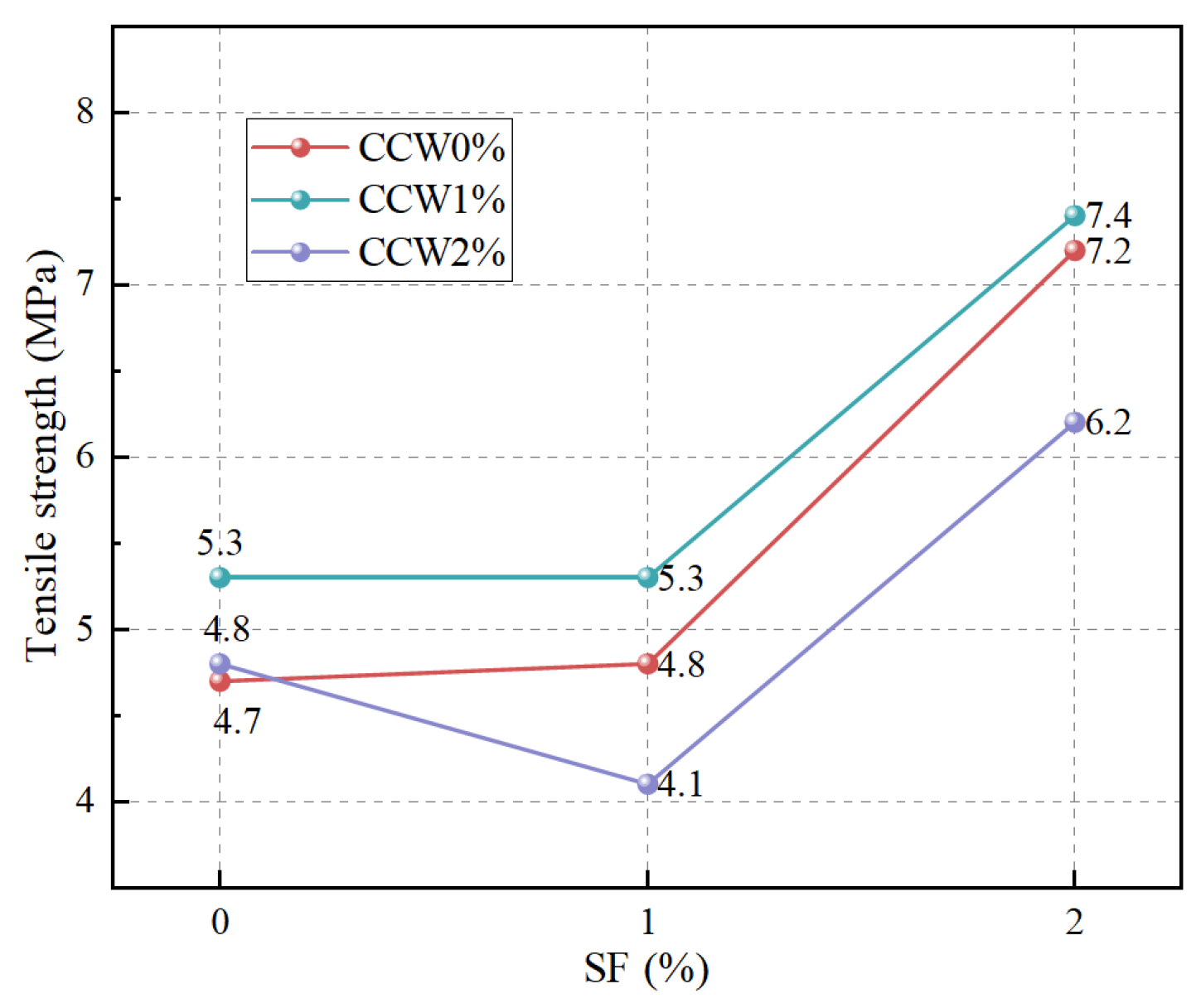
| Specimen Groups | Tensile Strength (SD) |
|---|---|
| SF0CCW0 | 4.7 (0.31) |
| SF0CCW1 | 5.3 (0.22) |
| SF0CCW2 | 4.8 (0.09) |
| SF1CCW0 | 4.8 (0.10) |
| SF1CCW1 | 5.3 (0.12) |
| SF1CCW2 | 4.1 (0.28) |
| SF2CCW0 | 7.2 (0.40) |
| SF2CCW1 | 7.4 (0.18) |
| SF2CCW2 | 6.2 (0.10) |
Disclaimer/Publisher’s Note: The statements, opinions and data contained in all publications are solely those of the individual author(s) and contributor(s) and not of MDPI and/or the editor(s). MDPI and/or the editor(s) disclaim responsibility for any injury to people or property resulting from any ideas, methods, instructions or products referred to in the content. |
© 2026 by the authors. Licensee MDPI, Basel, Switzerland. This article is an open access article distributed under the terms and conditions of the Creative Commons Attribution (CC BY) license.
Share and Cite
Wang, J.; Wang, Y.; Wang, L.; Peng, Y.; Zhang, Q.; Shi, J.; Xu, X.; Lin, S. Deconstructing Multi-Scale Hybrid Fiber-Reinforced Coarse Aggregate UHPC: From Pore Structure Tailoring to Cross-Scale Toughening. Materials 2026, 19, 2171. https://doi.org/10.3390/ma19102171
Wang J, Wang Y, Wang L, Peng Y, Zhang Q, Shi J, Xu X, Lin S. Deconstructing Multi-Scale Hybrid Fiber-Reinforced Coarse Aggregate UHPC: From Pore Structure Tailoring to Cross-Scale Toughening. Materials. 2026; 19(10):2171. https://doi.org/10.3390/ma19102171
Chicago/Turabian StyleWang, Jiyang, Yalong Wang, Lingbo Wang, Yu Peng, Qi Zhang, Jingwen Shi, Xianmo Xu, and Shuyu Lin. 2026. "Deconstructing Multi-Scale Hybrid Fiber-Reinforced Coarse Aggregate UHPC: From Pore Structure Tailoring to Cross-Scale Toughening" Materials 19, no. 10: 2171. https://doi.org/10.3390/ma19102171
APA StyleWang, J., Wang, Y., Wang, L., Peng, Y., Zhang, Q., Shi, J., Xu, X., & Lin, S. (2026). Deconstructing Multi-Scale Hybrid Fiber-Reinforced Coarse Aggregate UHPC: From Pore Structure Tailoring to Cross-Scale Toughening. Materials, 19(10), 2171. https://doi.org/10.3390/ma19102171