Flexural Behavior of Slender UHPC Prestressed Beams Without Passive Reinforcement

 , and
, and
Abstract
1. Introduction
2. Experimental Program
2.1. Test Specimens
2.2. Material Properties
2.3. Prestressing Setup
2.4. Beam Test Setup
3. Test Results and Observation
3.1. UHPC Characterization Tests
3.2. Prestress Losses
3.3. Bending Tests
4. Discussion
4.1. Prestress Losses
4.2. Bending Tests
4.2.1. Rectangular S0 Series
4.2.2. I-Shaped S1 Series
4.2.3. H-Shaped S2 Series
4.2.4. Overall Comparison Across Series
5. Conclusions
- Slender prestressed UHPC beams with different cross-sectional typologies can be successfully produced and tested under controlled laboratory conditions. The adopted methodology, combining material characterization, strand stress monitoring, and four-point bending tests, proved suitable for interpreting their flexural response.
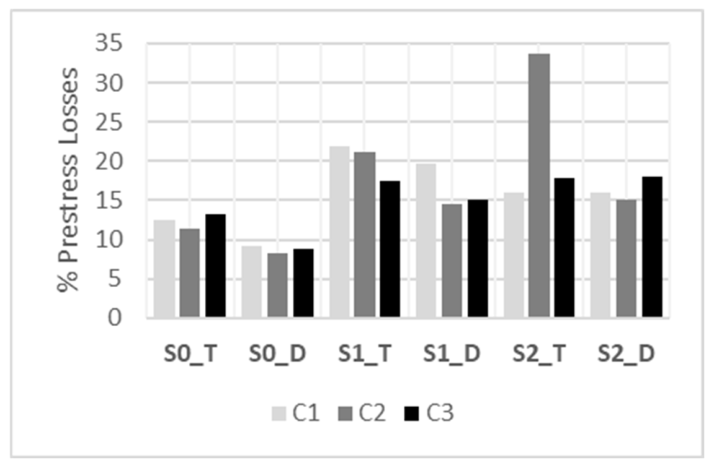
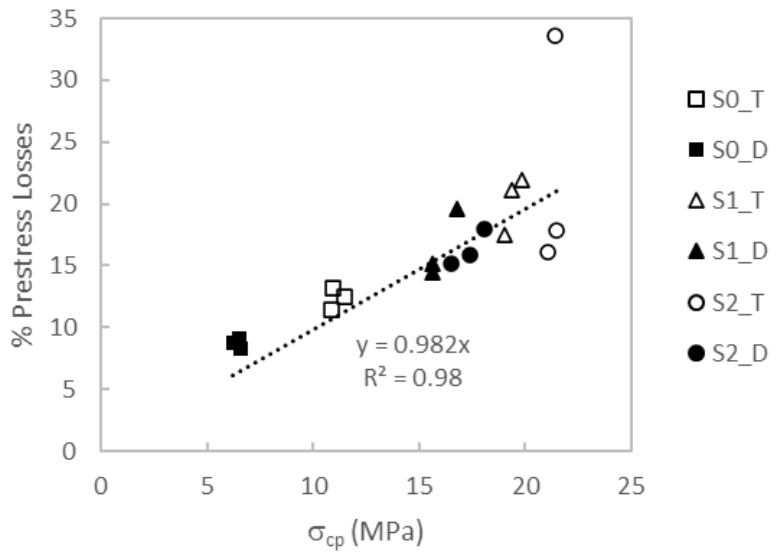
- Prestress losses were influenced primarily by cross-sectional geometry and prestressing layout rather than by concrete type. The rectangular S0 series showed the lowest prestress losses, the I-shaped S1 series the highest, and the H-shaped S2 series intermediate values, except for beam S2_C2T, which showed anomalously high prestress losses due to insufficient concrete maturity at prestress transfer.
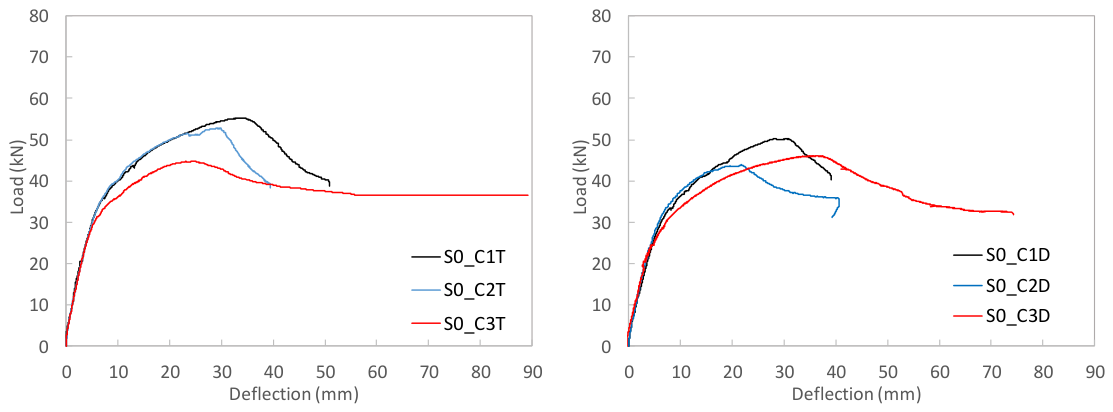
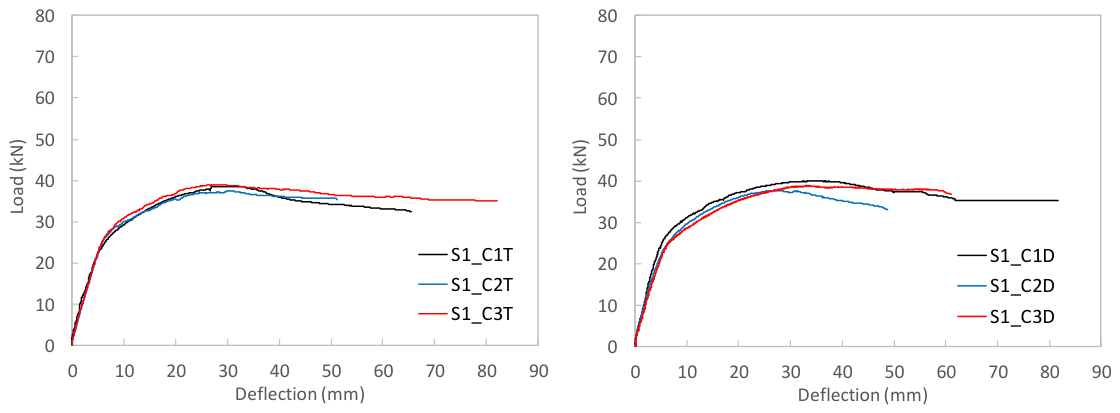
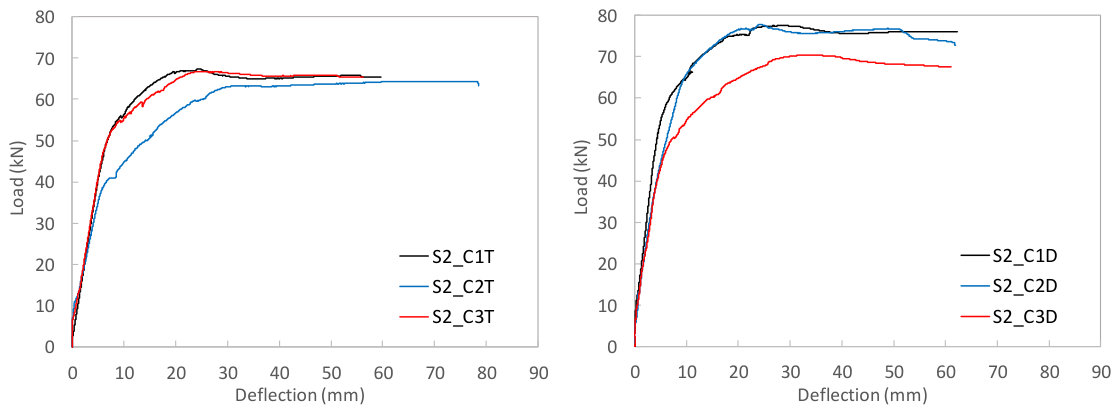
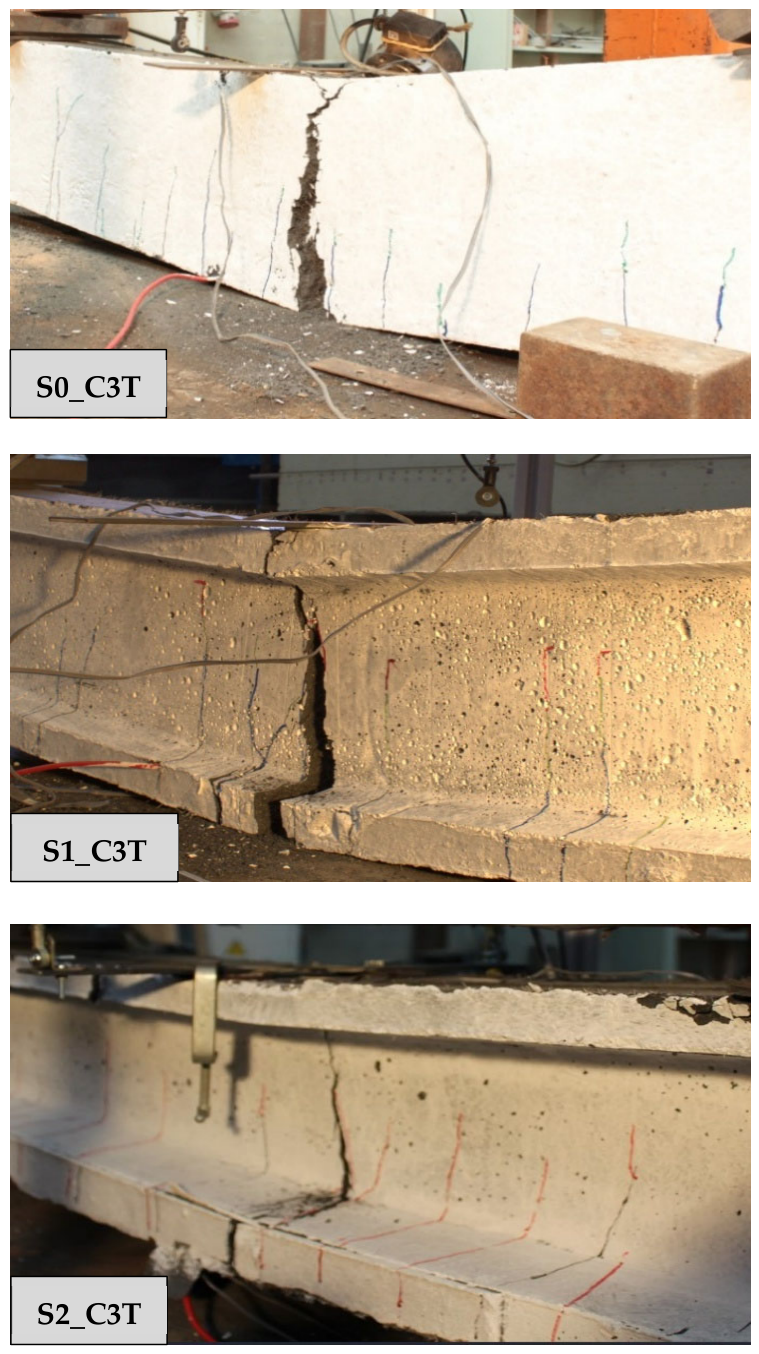
- All beam series exhibited a similar flexural response, with an initial uncracked branch, progressive stiffness degradation after cracking, a peak load, and a residual branch associated with fiber bridging and prestressing reinforcement. No crushing of the concrete compression chord was observed at peak load, indicating that the compressive capacity of the UHPC was not fully exploited.
- The response of I-shaped S1 beams was similar for all UHPC types (C1, C2, and C3), indicating that variations in fiber distribution and orientation do not significantly affect deflection behavior under service conditions, peak load, or residual flexural strength.
- The maximum load recorded in bending tests of I-shaped S1 beams did not differ significantly between bottom-only and symmetric top-and-bottom prestressing, suggesting the potential of symmetric top-and-bottom prestressing arrangement for structural members experiencing both positive and negative bending moments.
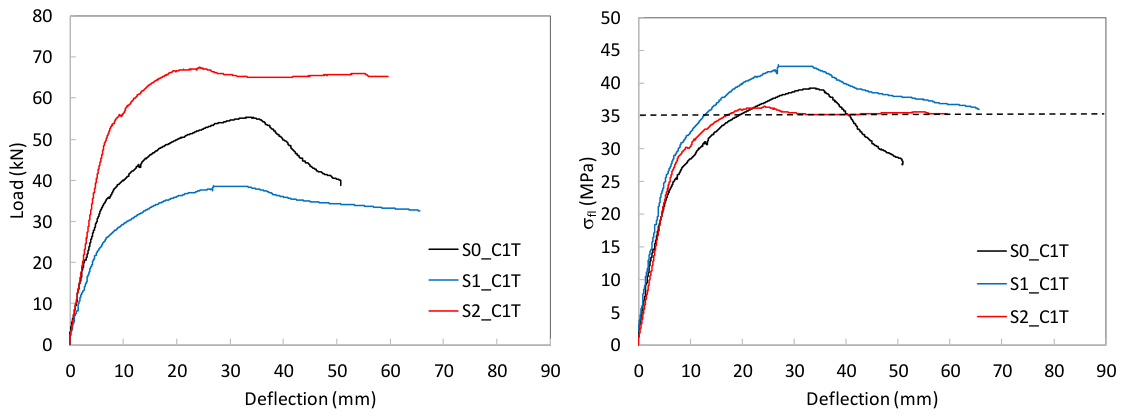
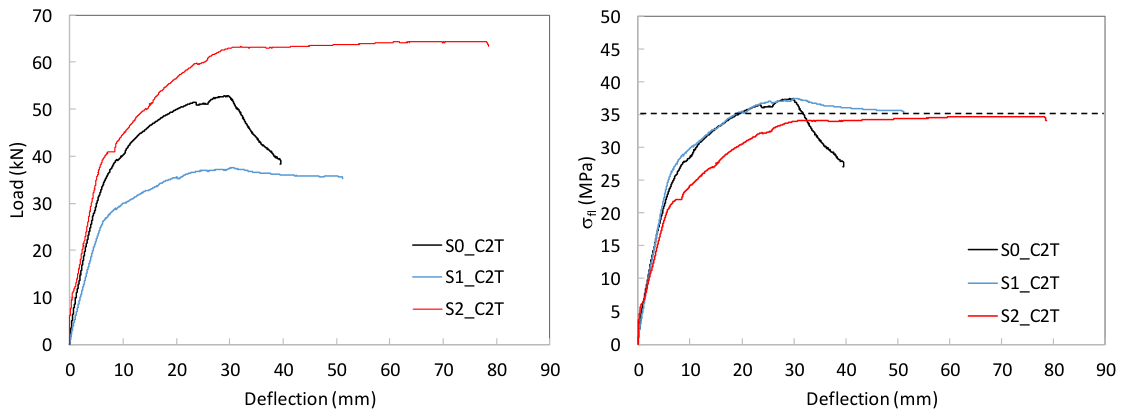
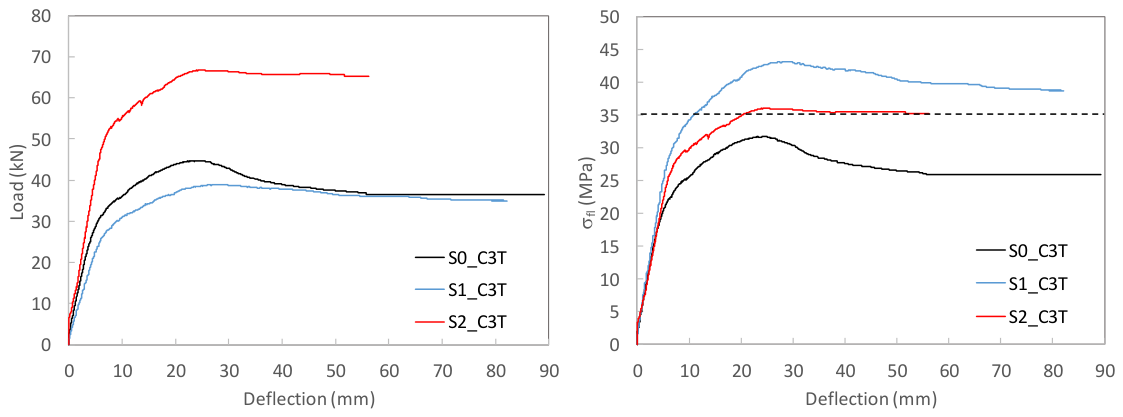
- In absolute terms, the H-shaped S2 beams reached the highest load-carrying capacity, followed by the rectangular S0 beams and the I-shaped S1 beams. In relative terms, however, the I-shaped S1 section was the most efficient typology, reaching the highest effective flexural tensile stresses and showing a favorable residual response. This highlights the strong potential of the I-shaped concept for lightweight prestressed UHPC flexural members.
- Equivalent flexural tensile stresses above 35 MPa were achieved in the I-shaped and H-shaped elements, confirming the high structural potential of slender prestressed UHPC members. Overall, the results support their use as lightweight precast elements with competitive flexural performance. They also indicate that even higher equivalent flexural tensile stresses could be achieved by increasing the prestressing force, provided that transfer conditions and time-dependent prestress losses are properly controlled.
Author Contributions
Funding
Data Availability Statement
Acknowledgments
Conflicts of Interest
Abbreviations
| σcp | concrete stress at the tendon level |
| σfl | equivalent flexural tensile stress |
| σp | stress in the prestressing reinforcement |
| 4PBT | four-point bending test |
| fcm | average concrete compressive strength |
| Mp | bending moment induced by prestressing |
| Np | axial force induced by prestressing |
| P1 | prestressing force before transfer |
| P2 | prestressing force before the bending test |
| Pu | ultimate load attained during the bending test |
| UHPC | ultra-high-performance concrete |
| UHPFRC | ultra-high-performance fiber-reinforced concrete |
| VWSG | vibrating-wire strain gauges |
| δmax | maximum deflection attained in the bending test |
| δu | deflection at mid-span attained at ultimate load in the bending test |
References
- Graybeal, B.A.; Brühwiler, E.; Kim, B.-S.; Toutlemonde, F.; Voo, Y.L.; Zaghi, A. International Perspective on UHPC in Bridge Engineering. J. Bridge Eng. 2020, 25, 04020094. [Google Scholar] [CrossRef]
- Azmee, N.M.; Shafiq, N. Ultra-High Performance Concrete: From Fundamental to Applications. Case Stud. Constr. Mater. 2018, 9, e00197. [Google Scholar] [CrossRef]
- Mishra, O.; Singh, S.P. An Overview of Microstructural and Material Properties of Ultra-High-Performance Concrete. J. Sustain. Cem.-Based Mater. 2019, 8, 97–143. [Google Scholar] [CrossRef]
- Bajaber, M.A.; Hakeem, I.Y. UHPC Evolution, Development, and Utilization in Construction: A Review. J. Mater. Res. Technol. 2021, 10, 1058–1074. [Google Scholar] [CrossRef]
- Li, J.; Wu, Z.; Shi, C.; Yuan, Q.; Zhang, Z. Durability of Ultra-High Performance Concrete—A Review. Constr. Build. Mater. 2020, 255, 119296. [Google Scholar] [CrossRef]
- Hung, C.-C.; El-Tawil, S.; Chao, S.-H. A Review of Developments and Challenges for UHPC in Structural Engineering: Behavior, Analysis, and Design. J. Struct. Eng. 2021, 147, 03121001. [Google Scholar] [CrossRef]
- Association Française de Normalisation. Concrete—Ultra-High Performance Fibre-Reinforced Concrete—Specifications, Performance, Production and Conformity (NF P 18-470); AFNOR: Paris, France, 2016. [Google Scholar]
- Japan Society of Civil Engineers (JSCE). Recommendations for Design and Construction of Ultra High Strength Fiber Reinforced Concrete; JSCE Guidelines for Concrete No. 9; JSCE: Tokyo, Japan, 2006. [Google Scholar]
- ACI Committee 239. Ultra-High-Performance Concrete: An Emerging Technology Report (ACI 239R-18); American Concrete Institute: Farmington Hills, MI, USA, 2018. [Google Scholar]
- Sim, C.; Tadros, M.; Gee, D.; Asaad, M. Flexural Design of Precast, Prestressed Ultra-High-Performance Concrete Members. PCI J. 2020, 65, 35–61. [Google Scholar] [CrossRef]
- Graybeal, B.A.; Helou, R.G. Structural Design with Ultra-High Performance Concrete; FHWA-HRT-23-077; Federal Highway Administration: McLean, VA, USA, 2023. [Google Scholar]
- Mohebbi, A.; Graybeal, B. Prestress Loss Model for Ultra-High Performance Concrete. Eng. Struct. 2022, 252, 113645. [Google Scholar] [CrossRef]
- El-Helou, R.G.; Graybeal, B.A. Flexural Behavior and Design of Ultrahigh-Performance Concrete Beams. J. Struct. Eng. 2022, 148, 04022023. [Google Scholar] [CrossRef]
- Ulfkjaer, J.P.; Brosbøl, D.P.; Larsen, R.; Clausen, J. Test and Analysis of Prestressed Ultra High Performance Concrete Beams. In Proceedings of the RILEM Spring Convention and Conference 2024; Springer: Cham, Switzerland, 2024; pp. 184–193. [Google Scholar] [CrossRef]
- Deng, Z.; Li, Q.; Tuladhar, R.; Shi, F. Flexural Performance of Prestressed UHPC Beams with Different Prestressing Degrees and Levels. Comput. Concr. 2024, 34, 379–391. [Google Scholar] [CrossRef]
- Tian, X.; Fang, Z.; Shao, Y. Flexural Behavior and Design of Prestressed Ultra-High Performance Concrete (UHPC) Beams: Failure Mode and Ductility. J. Struct. Eng. 2025, 151, 04025127. [Google Scholar] [CrossRef]
- Du, L.; Wu, D.; Wang, J.; Wang, S.; Zhao, B.; Tang, X. Experimental Study on Flexural Behavior of Retard-Bonded Prestressed UHPC Beams with Different Reinforcement Ratios. Buildings 2025, 15, 887. [Google Scholar] [CrossRef]
- Mezquida-Alcaraz, E.J.; Navarro-Gregori, J.; Serna-Ros, P. Direct Procedure to Characterize the Tensile Constitutive Behavior of Strain-Softening and Strain-Hardening UHPFRC. Cem. Concr. Compos. 2021, 115, 103854. [Google Scholar] [CrossRef]
- Zhao, S.; Bo, Y. Effect of Casting Position on Mechanical Performance of Ultra-High Performance Concrete. Materials 2022, 15, 404. [Google Scholar] [CrossRef] [PubMed]
- Wu, H.; Zang, Z.; Deng, S.; Shen, A.; Cai, Y.; Ren, G.; Pan, H. Recent Developments in Pullout Behaviors and Tensile Properties of Ultra-High-Performance Concrete Reinforced with Steel Fiber. Arch. Civ. Mech. Eng. 2023, 23, 216. [Google Scholar] [CrossRef]
- López, J.A.; Serna, P.; Camacho, E.; Coll, H.; Navarro-Gregori, J. First Ultra-High-Performance Fibre-Reinforced Concrete Footbridge in Spain: Design and Construction. Struct. Eng. Int. 2014, 24, 101–104. [Google Scholar] [CrossRef]
- Serna, P.; Lo Monte, F.; Mezquida-Alcaraz, E.J.; Cuenca, E.; Mechtcherine, V.; Reichardt, M.; Peled, A.; Regev, O.; Borg, R.P.; Tretjakov, A.; et al. Upgrading the Concept of UHPFRC for High Durability in the Cracked State: The Concept of Ultra High Durability Concrete (UHDC) in the Approach of the H2020 Project ReSHEALience. In Proceedings of the International Conference on Sustainable Materials, Systems and Structures (SMSS 2019), Rovinj, Croatia, 20–22 March 2019. [Google Scholar]
- Seyam, A.M.; Balázs, G.L. A Review in Technologies, Definitions, Properties and Applications of Ultra High-Performance Concrete (UHPC). Concr. Struct. 2023, 1, 15. [Google Scholar] [CrossRef]
- UNE-EN 12390-3:2020; Testing Hardened Concrete—Part 3: Compressive Strength of Test Specimens. UNE: Madrid, Spain, 2020.
- UNE 83519:2024; Concrete with Fibres—Test Method for the Characterisation of the Flexural Tensile Strength of Strain-Hardened Concretes. UNE: Madrid, Spain, 2024.
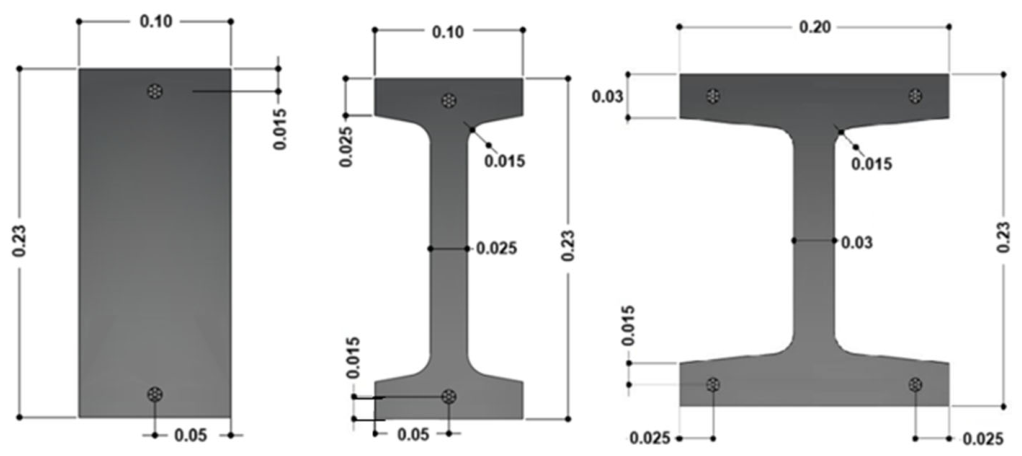








| Beam ID | Cross-Section Shape | Fiber Volume Fraction (kg/m3) | Prestressing |
|---|---|---|---|
| S0_C1T | Rectangular | 130 + 60 | Bottom |
| S0_C2T | Rectangular | 160 | Bottom |
| S0_C3T | Rectangular | 130 | Bottom |
| S0_C1D | Rectangular | 130 + 60 | Symmetric |
| S0_C2D | Rectangular | 160 | Symmetric |
| S0_C3D | Rectangular | 130 | Symmetric |
| S1_C1T | I-shaped | 130 + 60 | Bottom |
| S1_C2T | I-shaped | 160 | Bottom |
| S1_C3T | I-shaped | 130 | Bottom |
| S1_C1D | I-shaped | 130 + 60 | Symmetric |
| S1_C2D | I-shaped | 160 | Symmetric |
| S1_C3D | I-shaped | 130 | Symmetric |
| S2_C1T | H-shaped | 130 + 60 | Bottom |
| S2_C2T | H-shaped | 160 | Bottom |
| S2_C3T | H-shaped | 130 | Bottom |
| S2_C1D | H-shaped | 130 + 60 | Symmetric |
| S2_C2D | H-shaped | 160 | Symmetric |
| S2_C3D | H-shaped | 130 | Symmetric |
| Materials | Mix C1 | Mix C2 | Mix C3 |
|---|---|---|---|
| Crush sand type 1 | 500 | 380 | 380 |
| Crush sand type 2 | 580 | 700 | 700 |
| Cement CEM I 42.5R SR5 | 800 | 800 | 800 |
| Silica Fume | 175 | 175 | 175 |
| Dramix® OL 13/0.2 Fibers | 130 | 160 | 130 |
| Dramix® 3D 80/30BGP Fibers | 60 | - | - |
| Water | 170 | 170 | 170 |
| Superplasticizer | 40 | 40 | 40 |
| Properties | OL 13/0.2 | 80/30 BGP |
|---|---|---|
| Material | steel | steel |
| Fiber shape | straight | hooked-end |
| Bundling | loose | bundled |
| Length (mm) | 13 | 30 |
| Diameter (mm) | 0.2 | 0.38 |
| Aspect ratio | 65 | 80 |
| Tensile strength (MPa) | 3050 | 3070 |
| Modulus of elasticity (GPa) | 210 | 210 |
| Beam ID | fcm (MPa) 2 Days | fcm (MPa) 7 Days | fcm (MPa) 28 Days | fcm (MPa) 90 Days |
|---|---|---|---|---|
| S0_C1T | — | 103.6 (2.2%) | 129.0 (3.4%) | 141.7 (6.1%) |
| S0_C2T | 96.4 (2.5%) | 114.1 (6.0%) | 132.2 (4.6%) | 145.0 (6.1%) |
| S0_C3T | 87.5 (7.7%) | — | 131.9 (3.3%) | — |
| S0_C1D | 92.9 (4.0%) | 115.9 (6.9%) | 137.9 (3.3%) | 143.8 (6.6%) |
| S0_C2D | 92.9 (1.2%) | — | 141.9 (0.0%) | — |
| S0_C3D | 90.3 (1.0%) | 106.9 (2.9%) | 126.6 (0.6%) | 139.8 (6.0%) |
| S1_C1T | — | 103.6 (2.2%) | 129.0 (3.4%) | 141.7 (6.1%) |
| S1_C2T | 96.4 (2.5%) | 114.1 (6.0%) | 132.2 (4.6%) | 145.0 (6.1%) |
| S1_C3T | 87.5 (7.7%) | — | 131.9 (3.3%) | 143.8 (6.6%) |
| S1_C1D | 92.9 (4.0%) | 115.9 (6.9%) | 137.9 (3.3%) | — |
| S1_C2D | 92.9 (1.2%) | — | 141.9 (0.0%) | — |
| S1_C3D | 90.3 (1.0%) | 106.9 (2.9%) | 126.6 (0.6%) | 139.8 (6.0%) |
| S2_C1T | 82.3 (4.1%) | 106.3 (2.0%) | 144.0 (0.6%) | 142.4 (2.0%) |
| S2_C2T | 67.3 (3.1%) | 98.7 (3.8%) | 129.8 (7.0%) | 144.2 (5.3%) |
| S2_C3T | 84.4 (1.1%) | 108.4 (1.4%) | 132.3 (2.8%) | — |
| S2_C1D | 82.3 (4.1%) | 106.3 (2.0%) | 144.0 (0.6%) | 142.4 (2.0%) |
| S2_C2D | 95.0 (0.6%) | 112.9 (4.3%) | 138.0 (3.0%) | — |
| S2_C3D | 84.4 (1.1%) | 108.4 (1.4%) | 132.3 (2.8%) | — |
| Beam ID | Pre-Transfer Force P1 (kN) | P1/fpu % | Pre-Test Force P2 (kN) | P2/fpu % | (P1 − P2)/P1 % |
|---|---|---|---|---|---|
| S0_C1T | 80.85 | 83.43 | 70.74 | 73.00 | 12.50 |
| S0_C2T | 76.36 | 78.80 | 67.61 | 69.77 | 11.46 |
| S0_C3T | 76.85 | 79.30 | 66.72 | 68.85 | 13.18 |
| S0_C1D | 150.45 | 78.99 | 136.73 | 71.79 | 9.12 |
| S0_C2D | 151.77 | 78.31 | 139.18 | 71.81 | 8.30 |
| S0_C3D | 143.64 | 74.11 | 131.10 | 67.64 | 8.73 |
| S1_C1T | 76.58 | 80.41 | 59.79 | 62.79 | 21.92 |
| S1_C2T | 74.67 | 77.06 | 58.87 | 60.75 | 21.16 |
| S1_C3T | 73.26 | 75.60 | 60.47 | 62.40 | 17.46 |
| S1_C1D | 159.15 | 82.12 | 127.87 | 65.98 | 19.65 |
| S1_C2D | 148.57 | 76.65 | 127.00 | 65.53 | 14.52 |
| S1_C3D | 148.65 | 76.70 | 126.17 | 65.10 | 15.12 |
| S2_C1T | 157.52 | 81.28 | 132.23 | 68.23 | 16.06 |
| S2_C2T | 160.02 | 82.56 | 106.21 | 54.80 | 33.63 |
| S2_C3T | 160.93 | 83.04 | 132.13 | 68.18 | 17.90 |
| S2_C1D | 297.36 | 78.06 | 250.02 | 65.64 | 15.92 |
| S2_C2D | 282.56 | 72.90 | 239.85 | 61.90 | 15.12 |
| S2_C3D | 308.78 | 79.66 | 253.17 | 65.31 | 18.01 |
| Beam ID | Pu (kN) | δu (mm) | δmax (mm) | Np (kN) | Mp (kNm) | σp (MPa) |
|---|---|---|---|---|---|---|
| S0_C1T | 55.26 | 33.55 | 50.85 | 70.74 | −7.07 | 1357.8 |
| S0_C2T | 52.84 | 29.08 | 39.51 | 67.61 | −6.76 | 1297.7 |
| S0_C3T | 44.78 | 24.42 | 89.25 | 66.72 | −6.67 | 1280.6 |
| S0_C1D | 50.32 | 28.34 | 39.04 | 136.73 | 0.00 | 1335.3 |
| S0_C2D | 43.90 | 21.74 | 40.67 | 139.18 | 0.00 | 1335.7 |
| S0_C3D | 46.17 | 36.25 | 74.31 | 131.10 | 0.00 | 1258.1 |
| S1_C1T | 38.71 | 26.93 | 65.60 | 59.79 | −5.98 | 1167.9 |
| S1_C2T | 37.50 | 30.04 | 51.20 | 58.87 | −5.89 | 1130.0 |
| S1_C3T | 38.93 | 26.91 | 82.19 | 60.47 | −6.05 | 1160.6 |
| S1_C1D | 40.02 | 34.11 | 81.78 | 127.87 | 0.00 | 1227.2 |
| S1_C2D | 37.74 | 26.69 | 48.72 | 127.00 | 0.00 | 1218.9 |
| S1_C3D | 38.92 | 33.35 | 61.10 | 126.17 | 0.00 | 1210.9 |
| S2_C1T | 67.37 | 24.16 | 59.59 | 132.23 | −13.22 | 1269.1 |
| S2_C2T | 64.42 | 75.25 | 78.55 | 106.21 | −10.62 | 1019.3 |
| S2_C3T | 66.78 | 24.55 | 56.28 | 132.13 | −13.21 | 1268.1 |
| S2_C1D | 77.53 | 28.26 | 62.28 | 250.02 | 0.00 | 1220.9 |
| S2_C2D | 77.81 | 23.99 | 61.94 | 239.85 | 0.00 | 1151.3 |
| S2_C3D | 70.46 | 32.29 | 61.02 | 253.17 | 0.00 | 1214.8 |
Disclaimer/Publisher’s Note: The statements, opinions and data contained in all publications are solely those of the individual author(s) and contributor(s) and not of MDPI and/or the editor(s). MDPI and/or the editor(s) disclaim responsibility for any injury to people or property resulting from any ideas, methods, instructions or products referred to in the content. |
© 2026 by the authors. Licensee MDPI, Basel, Switzerland. This article is an open access article distributed under the terms and conditions of the Creative Commons Attribution (CC BY) license.
Share and Cite
Navarro-Gregori, J.; Gómez-Velásquez, Y.A.; Mateu-Sánchez, J.A.; Serna, P.; Martí-Vargas, J.R. Flexural Behavior of Slender UHPC Prestressed Beams Without Passive Reinforcement. Materials 2026, 19, 1936. https://doi.org/10.3390/ma19101936
Navarro-Gregori J, Gómez-Velásquez YA, Mateu-Sánchez JA, Serna P, Martí-Vargas JR. Flexural Behavior of Slender UHPC Prestressed Beams Without Passive Reinforcement. Materials. 2026; 19(10):1936. https://doi.org/10.3390/ma19101936
Chicago/Turabian StyleNavarro-Gregori, Juan, Yeiner A. Gómez-Velásquez, Juan A. Mateu-Sánchez, Pedro Serna, and José R. Martí-Vargas. 2026. "Flexural Behavior of Slender UHPC Prestressed Beams Without Passive Reinforcement" Materials 19, no. 10: 1936. https://doi.org/10.3390/ma19101936
APA StyleNavarro-Gregori, J., Gómez-Velásquez, Y. A., Mateu-Sánchez, J. A., Serna, P., & Martí-Vargas, J. R. (2026). Flexural Behavior of Slender UHPC Prestressed Beams Without Passive Reinforcement. Materials, 19(10), 1936. https://doi.org/10.3390/ma19101936