Geopolymer Foams Loaded with Diatomite/Paraffin Granules for Enhanced Thermal Energy Storage


Highlights
- Geopolymer foams were successfully modified with diatomite-encapsulated paraffin PCM.
- Diatomite stabilized paraffin and prevented leakage in phase change.
- The hybrid composites exhibited an improved thermal energy storage capacity.
- This approach integrates geopolymer sustainability with advanced energy storage.
Abstract
1. Introduction
2. Materials and Methods
2.1. Structural Elements of Geopolymer Foams
2.2. Diatomite/Paraffin Granules as a Phase Change Material
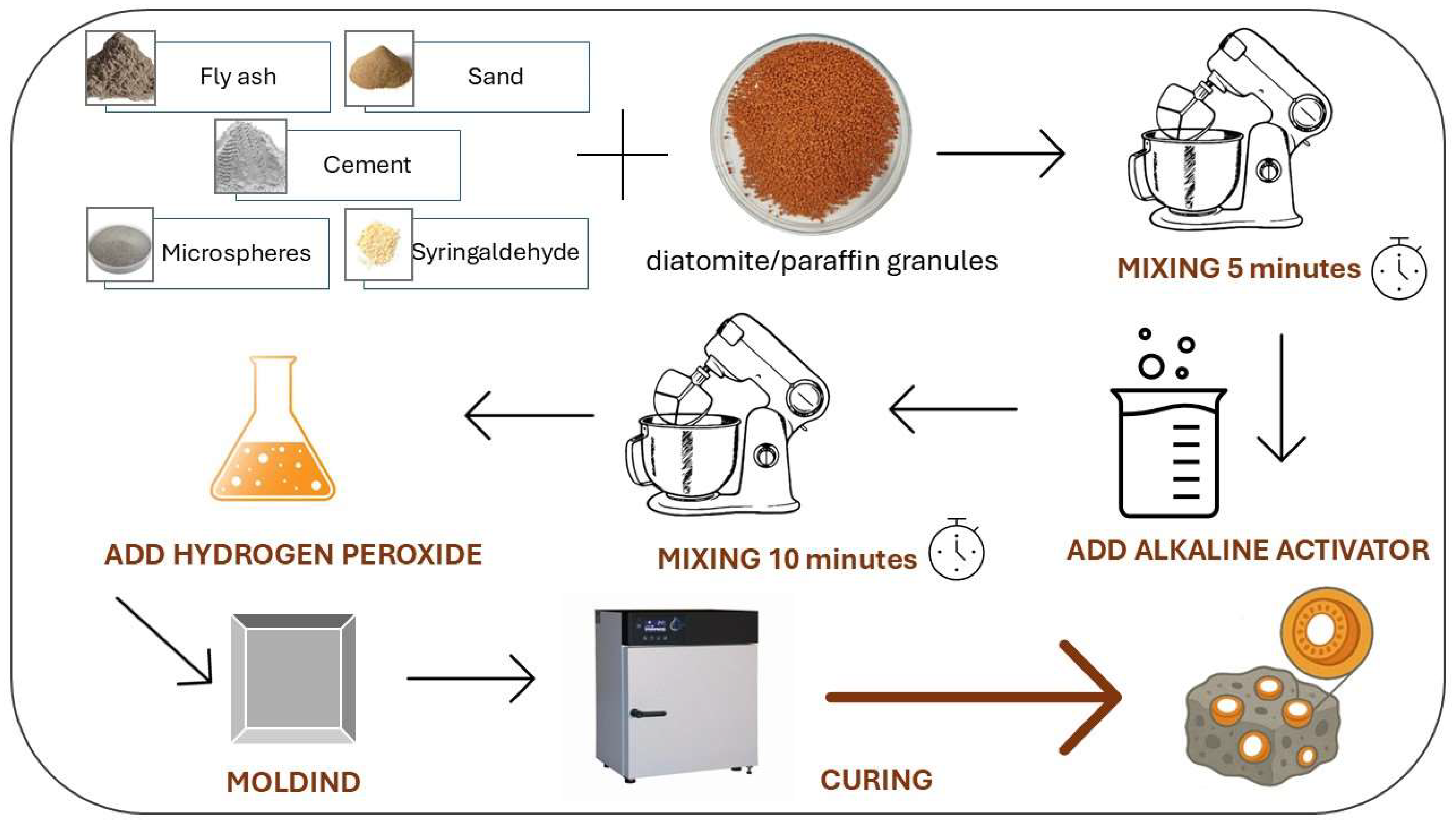
2.3. Synthesis and Formation of Geopolymer Foams
2.4. Porosity of Geopolymer Foams with PCM Based on Diatomite and Paraffin
2.5. Compressive Strength of Geopolymer Foams with PCM Based on Diatomite and Paraffin
- Rc—compressive strength [MPa],
- A—sample cross-sectional area [mm2],
- Fc—maximum load [N].
2.6. Thermal Parameters of Geopolymer Foams with PCM Based on Diatomite and Paraffin
2.7. Macroscopic Images of Geopolymer Foams with PCM Based on Diatomite and Paraffin
2.8. Microscopic Images of Geopolymer Foams with PCM Based on Diatomite and Paraffin
3. Results
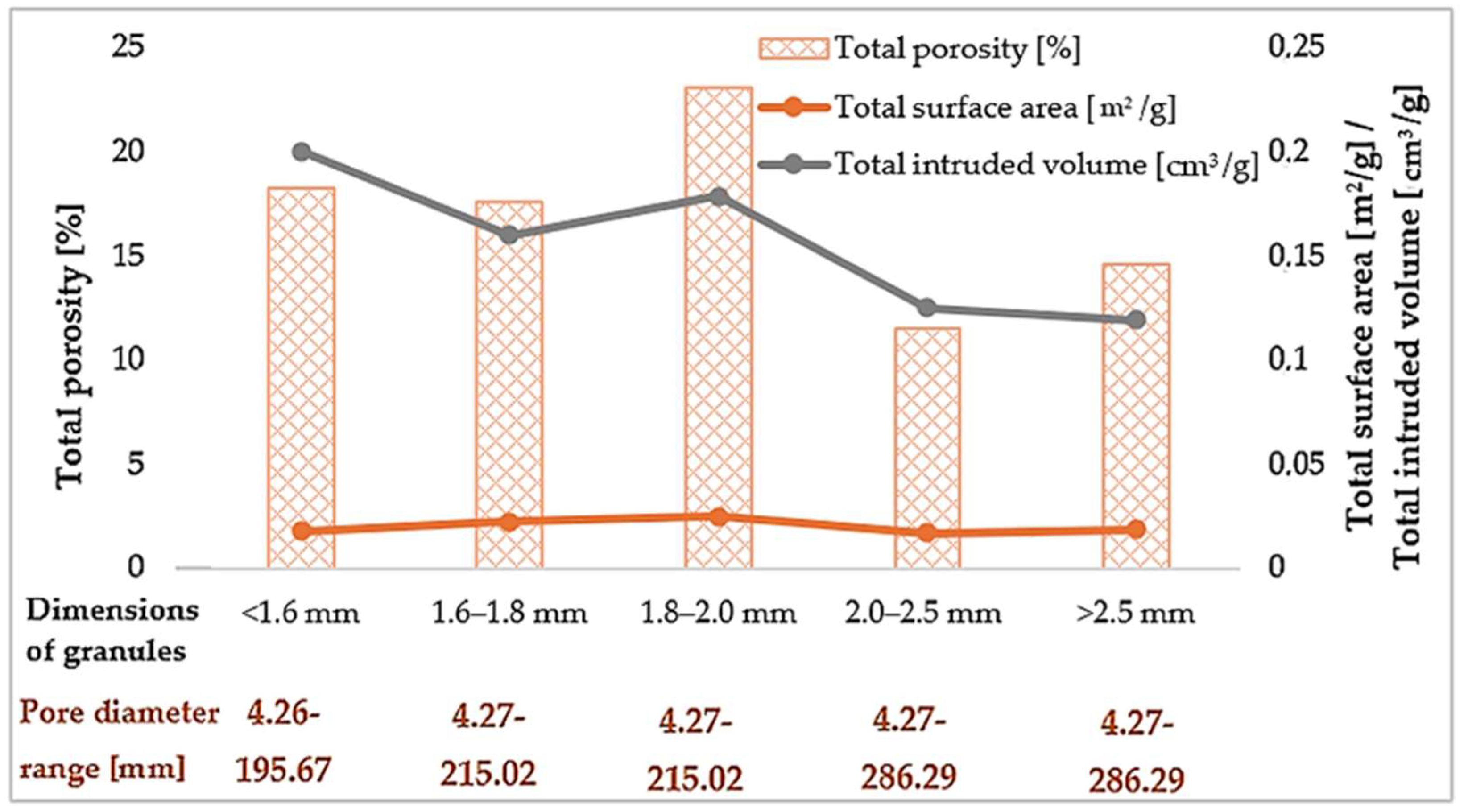
3.1. Porosity of Geopolymer Foams with PCM Based on Diatomite and Paraffin
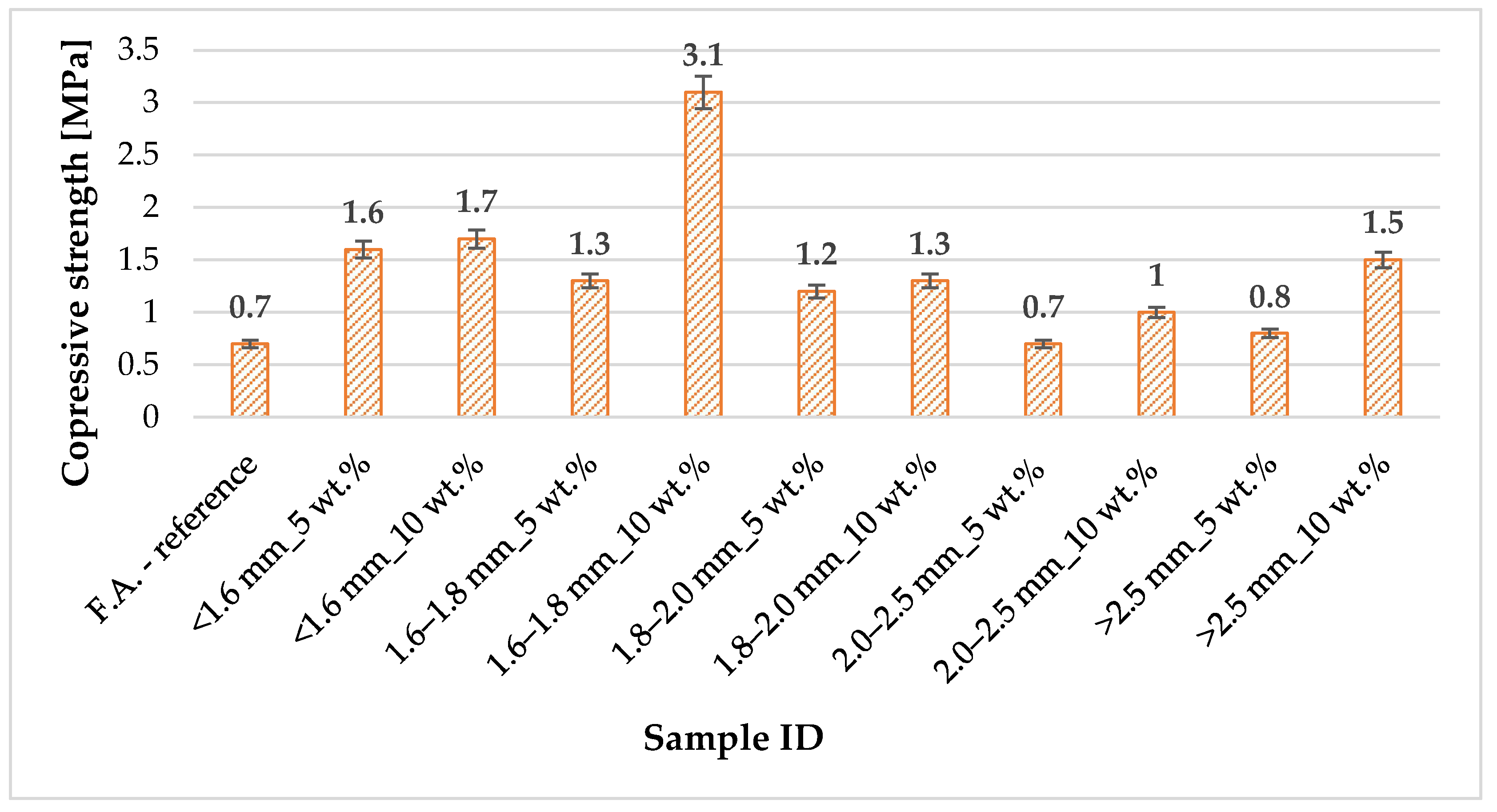
3.2. Compressive Strength of Geopolymer Foams with PCM Based on Diatomite and Paraffin
3.3. Thermal Parameters of Geopolymer Foams with PCM Based on Diatomite and Paraffin
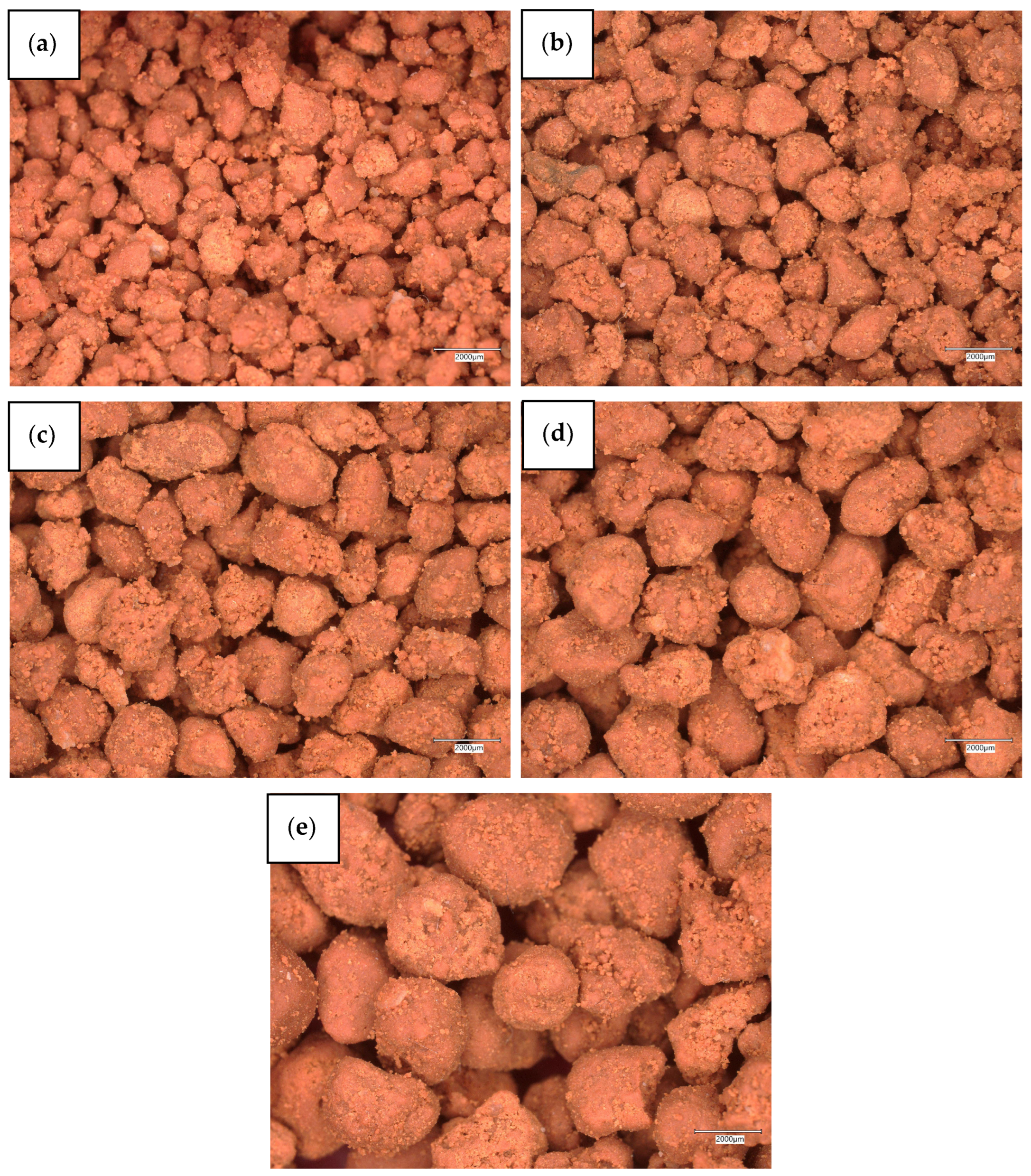
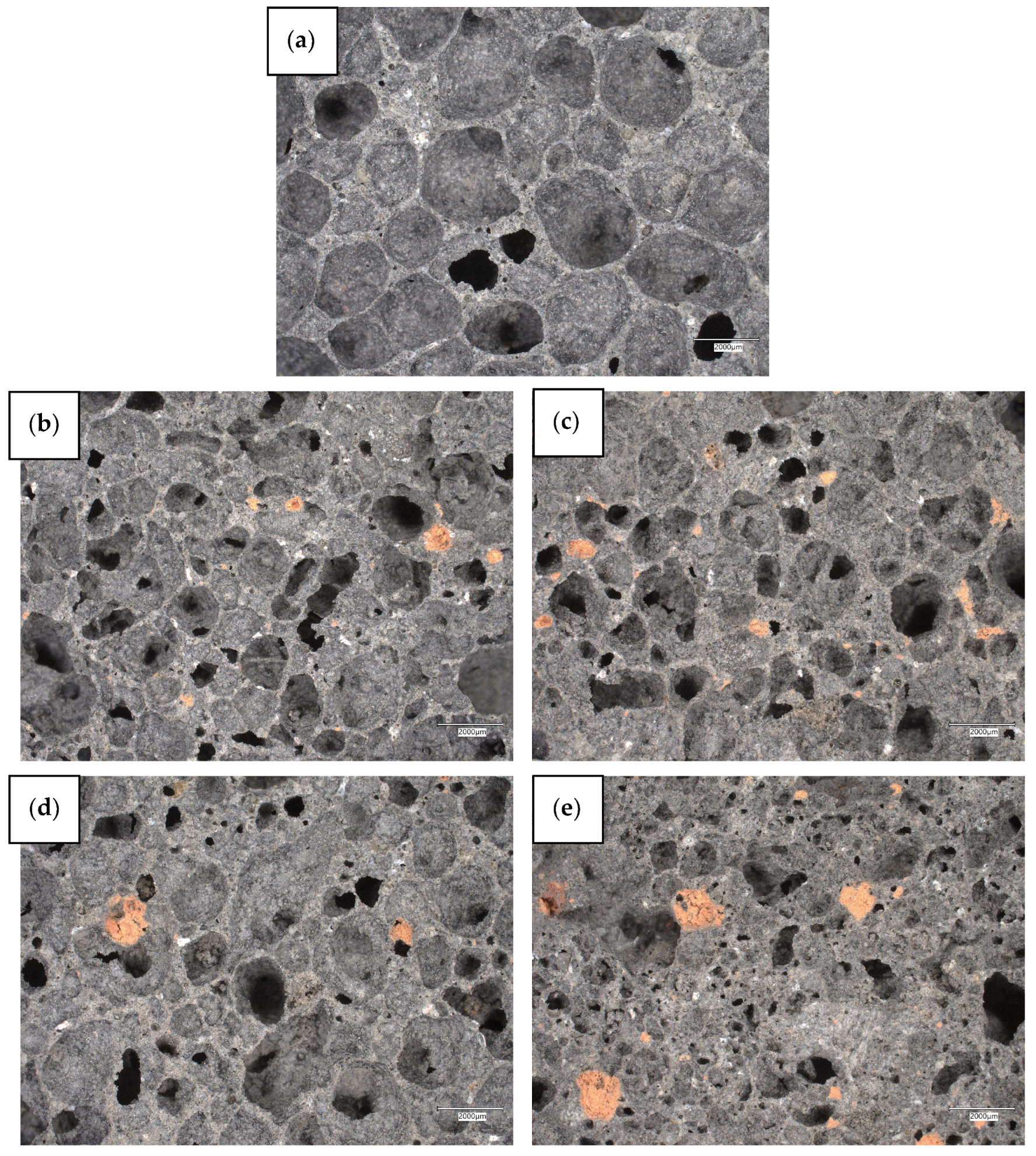
3.4. Macroscopic Images of Geopolymer Foams with PCM Based on Diatomite and Paraffin
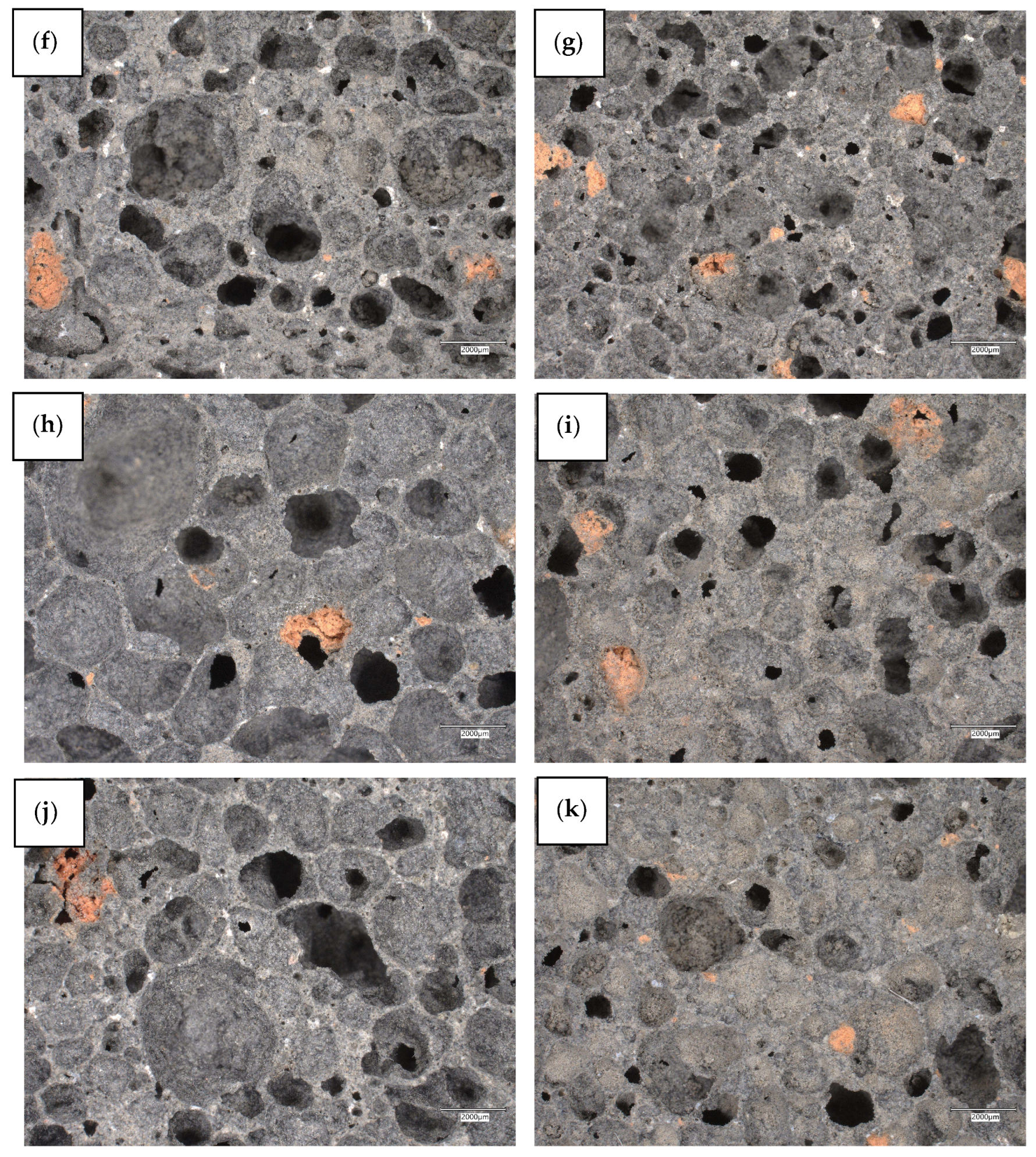
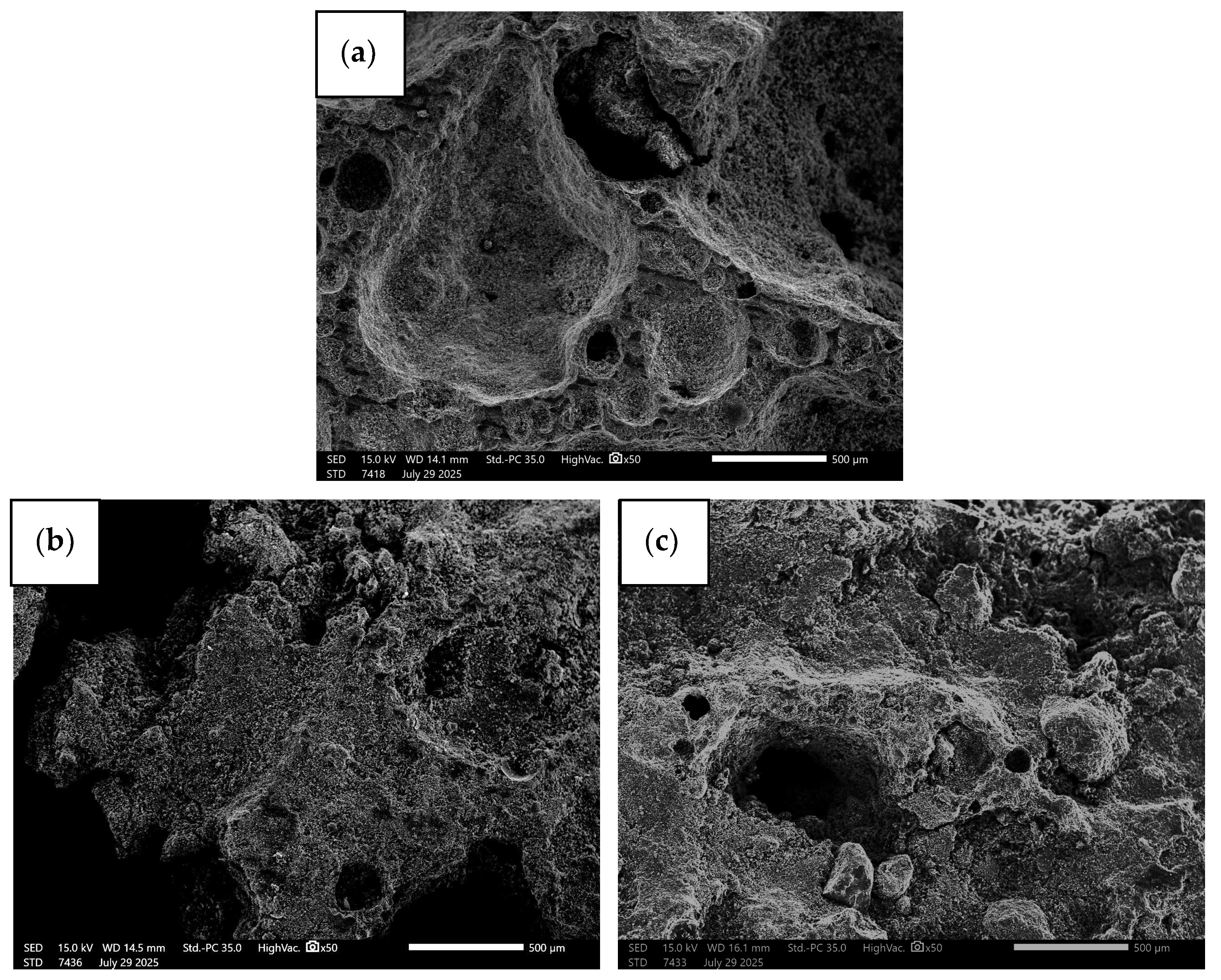
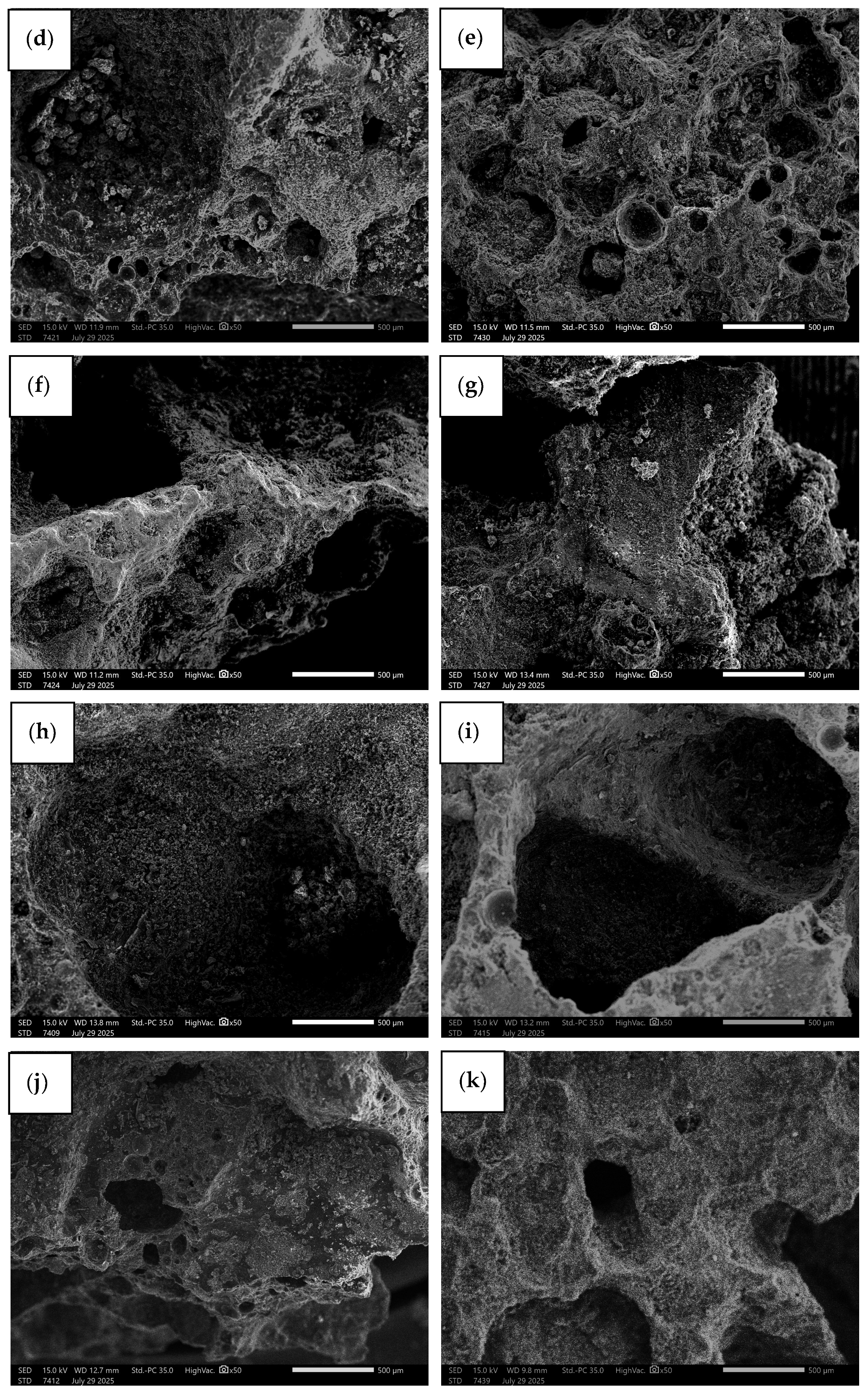
3.5. Microscopic Images of Geopolymer Foams with PCM Based on Diatomite and Paraffin
4. Discussion
5. Conclusions
Funding
Institutional Review Board Statement
Informed Consent Statement
Data Availability Statement
Conflicts of Interest
References
- Haraldsson, J.; Johansson, M.T. Effects on primary energy use, greenhouse gas emissions and related costs from improving energy end-use efficiency in the electrolysis in primary aluminium production. Energy Effic. 2020, 13, 1299–1314. [Google Scholar] [CrossRef] [Scilit]
- Degen, F. Lithium-ion battery cell production in Europe: Scenarios for reducing energy consumption and greenhouse gas emissions until 2030. J. Ind. Ecol. 2023, 27, 964–976. [Google Scholar] [CrossRef] [Scilit]
- Peng, T.; Ren, L.; Du, E.; Ou, X.; Yan, X. Life Cycle Energy Consumption and Greenhouse Gas Emissions Analysis of Primary and Recycled Aluminum in China. Processes 2022, 10, 2299. [Google Scholar] [CrossRef] [Scilit]
- IEA Buildings. Available online: https://www.iea.org/energy-system/buildings?utm (accessed on 25 August 2025).
- Song, S.; Long, J.; Jiang, H.; Ran, B.; Yao, L. Characteristics of office lighting energy consumption and its impact on air conditioning energy consumption. Energy Built Environ. 2024, 5, 529–543. [Google Scholar] [CrossRef] [Scilit]
- Chen, X.; Vand, B.; Baldi, S. Challenges and Strategies for Achieving High Energy Efficiency in Building Districts. Buildings 2024, 14, 1839. [Google Scholar] [CrossRef] [Scilit]
- Qin, Z.; Li, M.; Flohna, J.; Hu, Y. Thermal management materials for energy-efficient and sustainable future buildings. Chem. Commun. 2021, 57, 12236–12253. [Google Scholar] [CrossRef] [Scilit]
- Matuszek, K.; Kar, M.; Pringle, J.M.; MacFarlane, D.R. Phase Change Materials for Renewable Energy Storage at Intermediate Temperatures. Chem. Rev. 2022, 123, 491–514. [Google Scholar] [CrossRef] [Scilit]
- Revankar, S.T. Chapter Six—Chemical Energy Storage. In Storage and Hybridization of Nuclear Energy; Academic Press: Cambridge, MA, USA, 2019; pp. 177–227. [Google Scholar] [CrossRef] [Scilit]
- Yang, T.; King, W.P.; Miljkovic, N. Phase change material-based thermal energy storage. Cell Rep. Phys. Sci. 2021, 2, 100540. [Google Scholar] [CrossRef] [Scilit]
- Mahdaoui, M.; Hamdaoui, S.; Ait Msaad, A.; Kousksou, T.; El Rhafiki, T.; Jamil, A.; Ahachad, M. Building bricks with phase change material (PCM): Thermal performances. Constr. Build. Mater. 2021, 269, 121315. [Google Scholar] [CrossRef] [Scilit]
- Abass, P.J.; Muthulingam, S. Comprehensive assessment of PCM integrated roof for passive building design: A study in energo-economics. Energy Build. 2024, 317, 114387. [Google Scholar] [CrossRef] [Scilit]
- Vedrtnam, A.; Kalauni, K.; Soares, N. Finite element and genetic algorithm-based optimization of phase change material integration for passive thermal regulation in studio apartments in Portugal. J. Build. Eng. 2025, 106, 112647. [Google Scholar] [CrossRef] [Scilit]
- Prabhakar, M.; Saffari, M.; de Gracia, A.; Cabeza, L.F. Improving the energy efficiency of passive PCM system using controlled natural ventilation. Energy Build. 2020, 228, 110483. [Google Scholar] [CrossRef] [Scilit]
- Rangel, C.G.; Rivera-Solorio, C.; Gijón-Rivera, M.; Mousavi, S. The effect on thermal comfort and heat transfer in naturally ventilated roofs with PCM in a semi-arid climate: An experimental research. Energy Build. 2022, 274, 112453. [Google Scholar] [CrossRef] [Scilit]
- Jaradat, M.; Al Majali, H.; Bendea, C.; Bungau, C.C.; Bungau, T. Enhancing Energy Efficiency in Buildings through PCM Integration: A Study across Different Climatic Regions. Buildings 2024, 14, 40. [Google Scholar] [CrossRef] [Scilit]
- Lee, C.; Wang, F.; Lou, R.; Wang, K. How does green finance drive the decarbonization of the economy? Empirical evidence from China. Renew. Energy 2023, 204, 671–684. [Google Scholar] [CrossRef] [Scilit]
- Kurniawan, T.A.; Meidiana, C.; Goh, H.H.; Zhang, D.; Othman, M.H.D.; Aziz, F.; Anouzla, A.; Sarangi, P.K.; Pasaribu, B.; Ali, I. Unlocking synergies between waste management and climate change mitigation to accelerate decarbonization through circular-economy digitalization in Indonesia. Sustain. Prod. Consum. 2024, 46, 522–542. [Google Scholar] [CrossRef] [Scilit]
- Sharma, R.; Jang, J.-G.; Hu, J.-W. Phase-Change Materials in Concrete: Opportunities and Challenges for Sustainable Construction and Building Materials. Materials 2022, 15, 335. [Google Scholar] [CrossRef] [Scilit]
- Garg, N.; Khaudiyal, S.; Kumar, S.; Kumar Das, S. Research trends in phase change materials (PCM) for high-performance sustainable construction. Mater. Today Proc. 2023. [Google Scholar] [CrossRef] [Scilit]
- Boldoo, T.; Chinnasamy, V.; Cho, H. Enhancing efficiency and sustainability: Utilizing high energy density paraffin-based various PCM emulsions for low-medium temperature applications. Energy 2024, 303, 131988. [Google Scholar] [CrossRef] [Scilit]
- Mishra, D.K.; Bhowmik, C.; Bhowmik, S.; Pandey, K.M. Property-enhanced paraffin-based composite phase change material for thermal energy storage: A review. Environ. Sci. Pollut. Res. 2022, 29, 43556–43587. [Google Scholar] [CrossRef] [Scilit]
- Hou, Y.; Chen, H.; Liu, X. Experimental study on the effect of partial filling of copper foam on heat storage of paraffin-based PCM. Renew. Energy 2022, 192, 561–571. [Google Scholar] [CrossRef] [Scilit]
- Rahmalina, D.; Adhitya, D.C.; Rahman, R.A.; Ismail, I. Improvement the performance of composite PCM paraffin-based incorporate with volcanic ash as heat storage for low-temperature application. EUREKA Phys. Eng. 2021, 1, 53–61. [Google Scholar] [CrossRef] [Scilit]
- Chang, Z.; Wang, K.; Wu, X.; Lei, G.; Wang, Q.; Liu, H.; Wang, Y.; Zhang, Q. Review on the preparation and performance of paraffin-based phase change microcapsules for heat storage. J. Energy Storage 2022, 46, 103840. [Google Scholar] [CrossRef] [Scilit]
- Shah, M.A.; Ramana, P.V. A comprehensive review on solar drying using paraffin wax as PCM. J. Renew. Sustain. Energy 2025, 17, 12701. [Google Scholar] [CrossRef] [Scilit]
- Waqas, H.; Hasan, M.J.; Naqvi, S.M.R.S.; Liu, D.; Muhammad, T.; Eldin, S.M.; Kang, C. Enhancing the performance of thermal energy storage by adding nano-particles with paraffin phase change materials. Nanotechnol. Rev. 2024, 13, 20230180. [Google Scholar] [CrossRef] [Scilit]
- Faraj, K.; Khaled, M.; Faraj, J.; Hachem, F.; Chahine, K.; Castelain, C. Short recent summary review on evolving phase change material encapsulation techniques for building applications. Energy Rep. 2022, 8, 1245–1260. [Google Scholar] [CrossRef] [Scilit]
- Vargas, V.Z.; Claros-Marfil, L.J.; Sandoval, G.F.; Rojas, B.H.; Santos, A.G.; González, F.J.N. Experimental assessment of energy storage in microencapsulated paraffin PCM Cement mortars. Case Stud. Constr. Mater. 2024, 20, e02959. [Google Scholar] [CrossRef] [Scilit]
- Aiswarya, V.; Das, S.; James, A.; Saha, S.K.; Saha, B.B. An experimental investigation on the solar thermal energy storage potential of form stabilized paraffin microcapsules. J. Environ. Chem. Eng. 2025, 13, 116825. [Google Scholar] [CrossRef] [Scilit]
- Reka, A.A.; Pavlovski, B.; Fazlija, E.; Berisha, A.; Pacarizi, M.; Daghmehchi, M.; Sacalis, C.; Jovanovski, G.; Makreski, P.; Oral, A. Diatomaceous Earth: Characterization, thermal modification, and application. Open Chem. 2021, 19, 451–461. [Google Scholar] [CrossRef] [Scilit]
- Zuluaga-Astudillo, D.; Ruge, J.C.; Camacho-Tauta, J.; Reyes-Ortiz, O.; Caicedo-Hormaza, B. Diatomaceous Soils and Advances in Geotechnical Engineering—Part I. Appl. Sci. 2023, 13, 549. [Google Scholar] [CrossRef] [Scilit]
- Chung, C.-C.; Hwang, J.-J. Porous Diatomaceous Earth/Nano-Zinc Oxide Composites: Preparation and Antimicrobial Applications. J. Compos. Sci. 2023, 7, 204. [Google Scholar] [CrossRef] [Scilit]
- Gad, H.A.; Al-Anany, M.S.; Abdelgaleil, S.A. Enhancement the efficacy of spinosad for the control Sitophilus oryzae by combined application with diatomaceous earth and Trichoderma harzianum. J. Stored Prod. Res. 2020, 88, 101663. [Google Scholar] [CrossRef] [Scilit]
- Zhou, Y.; Wu, S.; Ma, Y.; Zhang, H.; Zeng, X.; Wu, F.; Liu, F.; Ryu, J.E.; Guo, Z. Recent Advances in Organic/Composite Phase Change Materials for Energy Storage. ES Energy Environ. 2020, 9, 28–40. [Google Scholar] [CrossRef] [Scilit]
- Chang, Y.; Yao, X.; Chen, Y.; Huang, L.; Zou, D. Review on ceramic-based composite phase change materials: Preparation, characterization and application. Compos. Part B Eng. 2023, 254, 110584. [Google Scholar] [CrossRef] [Scilit]
- Chen, X.; Gao, H.; Tang, Z.; Dong, W.; Lic, A.; Wang, G. Optimization strategies of composite phase change materials for thermal energy storage, transfer, conversion and utilization. Energy Environ. Sci. 2020, 13, 4498–4535. [Google Scholar] [CrossRef] [Scilit]
- Zhao, Y.; Zhang, X.; Hua, W. Review of preparation technologies of organic composite phase change materials in energy storage. J. Mol. Liq. 2021, 336, 115923. [Google Scholar] [CrossRef] [Scilit]
- Kumar, A.; Gangawane, K.M. Recent Advances in Organic/Composite Phase Change Materials (PCM) for Energy Storage. In Materials for Boosting Energy Storage. Volume 3: Advances in Sustainable Energy Technologies; ACS Publications: Washington, DC, USA, 2024; Chapter 13; pp. 309–334. [Google Scholar] [CrossRef] [Scilit]
- Liu, Y.; Zhu, X.; Zhang, M.; Zhang, Z.; Liu, B.; Shi, J. Cenosphere composite phase change materials in ultra-lightweight foam geopolymer: A pathway to enhance thermophysical and mechanical properties. Constr. Build. Mater. 2025, 489, 142053. [Google Scholar] [CrossRef] [Scilit]
- Fan, L.; Khodadadi, J. Thermal conductivity enhancement of phase change materials for thermal energy storage: A review. Renew. Sustain. Energy Rev. 2011, 15, 24–46. [Google Scholar] [CrossRef] [Scilit]
- Shi, X.; Yazdani, M.R.; Ajdary, R.; Rojas, O.J. Leakage-proof microencapsulation of phase change materials by emulsification with acetylated cellulose nanofibrils. Carbohydr. Polym. 2021, 254, 117279. [Google Scholar] [CrossRef] [Scilit]
- Liu, Z.; Yang, R. Synergistically-Enhanced Thermal Conductivity of Shape-Stabilized Phase Change Materials by Expanded Graphite and Carbon Nanotube. Appl. Sci. 2017, 7, 574. [Google Scholar] [CrossRef] [Scilit]
- Yu, X.; Tao, Y. Preparation and characterization of paraffin/expanded graphite composite phase change materials with high thermal conductivity. Int. J. Heat Mass. Transf. 2022, 198, 123433. [Google Scholar] [CrossRef] [Scilit]
- Shih, Y.-F.; Wang, C.-H.; Tson, Z.-G.; Zhang, Y.-C.; Lian, H.-Y. Functionalization of Recycled Diatomite for Green, Stable, and High-performance Phase Change Material (PCM) Composite. IOP Conf. Ser. Earth Environ. Sci. 2018, 171, 12040. [Google Scholar] [CrossRef] [Scilit]
- Khudhair, A.M.; Farid, M.M. A review on energy conservation in building applications with thermal storage by latent heat using phase change materials. Energy Convers. Manag. 2003, 45, 263–275. [Google Scholar] [CrossRef] [Scilit]
- Cabeza, L.; Castell, A.; Barreneche, C.; De Gracia, A.; Fernández, A. Materials used as PCM in thermal energy storage in buildings: A review. Renew. Sustain. Energy Rev. 2011, 15, 1675–1695. [Google Scholar] [CrossRef] [Scilit]
- Tahwia, A.M.; Abd Ellatief, M.; Heneigel, A.M.; Abd Elrahman, M. Characteristics of eco-friendly ultra-high-performance geopolymer concrete incorporating waste materials. Ceram. Int. 2022, 48, 19662–19674. [Google Scholar] [CrossRef] [Scilit]
- Haq, Z.U.M.; Sood, H.; Kumar, R.; Jena, P.C.; Joshi, S.K. Eco-friendly approach to construction: Incorporating waste plastic in geopolymer concrete. Mater. Today Proc. 2023. [Google Scholar] [CrossRef] [Scilit]
- Kumar, A.S.; Muthukannan, M.; Arunkumar, K.; Sriram, M.; Vigneshwar, R.; Sikkandar, A.G. Development of eco-friendly geopolymer concrete by utilizing hazardous industrial waste materials. Mater. Today Proc. 2021, 66, 2215–2225. [Google Scholar] [CrossRef] [Scilit]
- Ellatief, M.A.; Abadel, A.A.; Federowicz, K.; Elrahman, M.A. Mechanical properties, high temperature resistance and microstructure of eco-friendly ultra-high performance geopolymer concrete: Role of ceramic waste addition. Constr. Build. Mater. 2023, 401, 132677. [Google Scholar] [CrossRef] [Scilit]
- Afolabi, L.O.; Ariff, Z.M.; Megat-Yusoff, P.S.M.; Al-Kayiem, H.H.; Arogundade, A.I.; Afolabi-Owolabi, O.T. Red-mud geopolymer composite encapsulated phase change material for thermal comfort in built-sector. Sol. Energy 2019, 181, 464–474. [Google Scholar] [CrossRef] [Scilit]
- Dadsetan, S.; Siad, H.; Lachemi, M.; Mahmoodi, O.; Sahmaran, M. Sodium glass liquid from glass waste as a user-friendly hardener in structural geopolymer systems. Cem. Concr. Compos. 2022, 130, 104525. [Google Scholar] [CrossRef] [Scilit]
- Ören, O.H.; Mandev, E.; Kaya, M.; Sarı, A.; Hekimoğlu, G.; Çıkman, İ.Ü.; Subaşı, S.; Maraşlı, M.; Gencel, O. Effects of microencapsulated phase change material on physico-mechanical and thermoregulation performance of lightweight geopolymer concrete with zeolite and perlite. J. Energy Storage 2025, 109, 115225. [Google Scholar] [CrossRef] [Scilit]
- Dadsetan, S.; Siad, H.; Lachemi, M.; Mahmoodi, O.; Sahmaran, M. Development of ambient cured geopolymer binders based on brick waste and processed glass waste. Environ. Sci. Pollut. Res. 2022, 29, 80755–80774. [Google Scholar] [CrossRef] [Scilit]
- Mahmoodi, O.; Siad, H.; Lachemi, M.; Şahmaran, M. Comparative life cycle assessment analysis of mono, binary and ternary construction and demolition wastes-based geopolymer binders. Mater. Today Proc. 2023. [Google Scholar] [CrossRef] [Scilit]
- Pasupathy, K.; Ramakrishnan, S.; Sanjayan, J. Formulating eco-friendly geopolymer foam concrete by alkali-activation of ground brick waste. J. Clean. Prod. 2021, 325, 129180. [Google Scholar] [CrossRef] [Scilit]
- Senff, L.; Novais, R.; Carvalheiras, J.; Labrincha, J. Eco-friendly approach to enhance the mechanical performance of geopolymer foams: Using glass fibre waste coming from wind blade production. Constr. Build. Mater. 2020, 239, 117805. [Google Scholar] [CrossRef] [Scilit]
- Yan, S.; Ren, X.; Wang, W.; He, C.; Xing, P. Preparation of eco-friendly porous ceramic with low thermal conductivity by high-temperature treatment of foamed solid waste based geopolymer with cenospheres. Constr. Build. Mater. 2023, 398, 131190. [Google Scholar] [CrossRef] [Scilit]
- Ersoy, H.; Çavuş, M. Thermomechanical properties of environmentally friendly slag-based geopolymer foam composites in different curing conditions. Environ. Sci. Pollut. Res. 2023, 30, 58813–58826. [Google Scholar] [CrossRef] [Scilit] [PubMed]
- Abdellatief, M.; Elrahman, M.A.; Alanazi, H.; Abadel, A.A.; Tahwia, A. A state-of-the-art review on geopolymer foam concrete with solid waste materials: Components, characteristics, and microstructure. Innov. Infrastruct. Solut. 2023, 8, 230. [Google Scholar] [CrossRef] [Scilit]
- Majd, A.E.; Sair, S.; Ousaleh, H.A.; Moulakhnif, K.; Moujoud, Z.; Belrhazi, I.; Belouaggadia, N.; Bouari, A.E. Enhancing heat storage in geopolymer foams via shape-stabilized phase change materials: A comparative analysis of foaming techniques. J. Build. Eng. 2025, 112, 113799. [Google Scholar] [CrossRef] [Scilit]
- Moulakhnif, K.; Moujoud, Z.; Majd, A.E.; Ousaleh, H.A.; Faik, A.; Sair, S.; Bouari, A.E. Eutectic organic phase change materials integrated into inorganic geopolymer foam for low-temperature thermal energy storage in building applications. Process Saf. Environ. Prot. 2025, 202, 107750. [Google Scholar] [CrossRef] [Scilit]
- Erdogmus, E.; Yaras, A.; Ustaoglu, A.; Hekimoğlu, G.; Sarı, A.; Gencel, O. Thermal performance analysis of novel foam concrete composites with PCM for energy storage and environmental benefits in buildings. Energy Build. 2023, 296, 113413. [Google Scholar] [CrossRef] [Scilit]
- Dora, S.; Barta, R.B.; Mini, K. Study on foam concrete incorporated with expanded vermiculite/capric acid PCM—A novel thermal storage high-performance building material. Constr. Build. Mater. 2023, 392, 131903. [Google Scholar] [CrossRef] [Scilit]
- Jiang, D.; Chen, P.; Liu, J.; Xu, Y. Preparation and performance study of modified diatomite based PCM for construction. Green Mater. 2024, 1–13. [Google Scholar] [CrossRef] [Scilit]
- Yang, Y.; Shen, Z.; Wu, W.; Zhang, H.; Ren, Y.; Yang, Q. Preparation of a novel diatomite-based PCM gypsum board for temperature-humidity control of buildings. Build. Environ. 2022, 226, 109732. [Google Scholar] [CrossRef] [Scilit]
- Hassan, A.; Rashid, Y.; Mourad, A.; Ismail, N.; Laghari, M.S. Thermal and Structural Characterization of Geopolymer-Coated Polyurethane Foam—Phase Change Material Capsules/Geopolymer Concrete Composites. Materials 2019, 12, 796. [Google Scholar] [CrossRef] [Scilit]
- Bąk, A.; Pławecka, K.; Bazan, P.; Łach, M. Influence of the addition of phase change materials on thermal insulation properties of foamed geopolymer structures based on fly ash. Energy 2023, 278, 127624. [Google Scholar] [CrossRef] [Scilit]
- Przybek, A.; Łach, M. Insulating Innovative Geopolymer Foams with Natural Fibers and Phase-Change Materials—A Review of Solutions and Research Results. Materials 2024, 17, 4503. [Google Scholar] [CrossRef] [Scilit] [PubMed]
- Przybek, A.; Łach, M.; Romańska, P.; Ciemnicka, J.; Prałat, K.; Koper, A. Geopolymer Concretes with Organic Phase Change Materials—Analysis of Thermal Properties and Microstructure. Materials 2025, 18, 2557. [Google Scholar] [CrossRef] [Scilit]
- Przybek, A. Assessment of Physico-Chemical Behavior and Sorptivity—Diatomaceous Earth as Support for Paraffinic Phase-Change Materials. Materials 2024, 17, 4691. [Google Scholar] [CrossRef] [Scilit]
- Łach, M.; Pławecka, K.; Marczyk, J.; Ziejewska, C.; Hebdowska-Krupa, M.; Nykiel, M.; Hebda, M.; Miernik, K.; Mierzwiński, D.; Korniejenko, K.; et al. Use of diatomite from Polish fields in sustainable development as a sorbent for petroleum substances. J. Clean. Prod. 2023, 389, 136100. [Google Scholar] [CrossRef] [Scilit]
- PN-EN 12390-3:2019-07; Testing of Concrete—Part 3: Compressive Strength of Test Specimens. Polish Committee for Standardization: Warsaw, Poland, 2019.
- PN-EN 12390-1:2013-03; Concrete Testing. Part 1: Shape, Dimensions and Other Requirements for Test Specimens and Forms. Polish Committee for Standardization: Warsaw, Poland, 2013.
- ASTM C1784; Standard Test Method for Using a Heat Flow Meter Apparatus for Measuring Thermal Storage Properties of Phase Change Materials and Products. International American Society for Testing of Materials: West Conshohocken, PA, USA, 2020.
- ASTM C518; Standard Test Method for Steady-State Thermal Transmission Properties by Means of the Heat Flow Meter Apparatus. International American Society for Testing of Materials: West Conshohocken, PA, USA, 2021.
- ISO 8301; Thermal Insulation—Determination of Steady-State Thermal Resistance and Related Properties—Heat Flow Meter Apparatus. International Standards Organization: London, UK, 1991.
- EN 12664; Thermal Performance of Building Materials and Products. Determination of Thermal Resistance by Means of Guarded Hot Plate and Heat Flow Meter Methods. Dry and Moist Products of Medium and Low Thermal Resistance. European Committee for Standardization: Brussels, Belgium, 2001.
- Abdellatief, M.; Hassanien, A.E.; Mortagi, M.; Hamouda, H. Geopolymer foam concrete: A review of pore characteristics, compressive strength and artificial intelligence in GFC strength simulations. Discov. Concr. Cem. 2025, 1, 4. [Google Scholar] [CrossRef] [Scilit]
- Sitarz, M.; Zdeb, T.; Mróz, K.; Hager, I.; Setlak, K. Foaming and Physico-Mechanical Properties of Geopolymer Pastes Manufactured from Post-Metallurgical Recycled Slag. Materials 2024, 17, 1449. [Google Scholar] [CrossRef] [Scilit]
- Li, L.; Sun, W.; Ayti, A.; Chen, W.; Liu, Z.; Gómez-Zamorano, L.Y. Machine Learning Modeling of Foam Concrete Performance: Predicting Mechanical Strength and Thermal Conductivity from Material Compositions. Appl. Sci. 2024, 15, 7125. [Google Scholar] [CrossRef] [Scilit]
- Liu, J.; Liu, Y.; Ma, X.; Xu, H.; Wu, X.; Liu, M.; Zhuge, Y. Thermal performance optimisation of foam concrete for energy-efficient construction: A state-of-the-art review. J. Build. Eng. 2025, 112, 113899. [Google Scholar] [CrossRef] [Scilit]
- Compaore, A.; Toure, K.J.Y.N.; Klenam, D.E.P.; Asumadu, T.K.; Obayemi, J.D.; Rahbar, N.; Migwi, C.; Merenga, A.S.; Soboyejo, W.O. Performance of foam concrete containing low-temperature calcined clay as a partial replacement of Portland cement. J. Mater. Res. Technol. 2025, 38, 1761–1781. [Google Scholar] [CrossRef] [Scilit]
- Przybek, A.; Łach, M.; Bogucki, R.; Ciemnicka, J.; Prałat, K.; Koper, A.; Korniejenko, K.; Masłoń, A. Energy-Efficient Geopolymer Composites Containing Phase-Change Materials—Comparison of Different Contents and Types. Materials 2023, 17, 4712. [Google Scholar] [CrossRef] [Scilit]
- Liu, X.; Hou, X.; Yan, L.; Zhang, Y.; Wang, J.-J. ZnO functionalized paraffin/diatomite phase change material and its thermal management mechanism in PDMS coatings. RSC Adv. 2025, 15, 6032–6042. [Google Scholar] [CrossRef] [Scilit] [PubMed]
- Geng, Z.; Shi, C.; Zhao, Q.; Yang, L. Preparation of diatomite paraffin composite phase change coating and its simulation application in building wall. J. Energy Storage 2024, 83, 110543. [Google Scholar] [CrossRef] [Scilit]
- Rathinavel, N.; Aleem, A.; Ismail, M. Energy-Efficient geopolymer wall panels: Optimizing mechanical, thermal, and acoustic properties for sustainable construction. Sci. Rep. 2025, 15, 25851. [Google Scholar] [CrossRef] [Scilit]
- Przybek, A.; Łach, M.; Miernik, K.; Mikuła, J. Research of the physical and chemical properties of diatomite as a carrier of phase change materials for use in advanced building materials. Front. Mater. 2024, 11, 1507779. [Google Scholar] [CrossRef] [Scilit]
- Yan, D.; Shi, Y.; Zhang, Y.; Wang, W.; Qian, H.; Chen, S.; Liu, Y.; Ruan, S. A comparative study of porous geopolymers synthesized by pre-foaming and H2O2 foaming methods: Strength and pore structure characteristics. Ceram. Int. 2024, 50, 17807–17817. [Google Scholar] [CrossRef] [Scilit]
- Thalmaier, G.; Cobîrzan, N.; Sechel, N.A. Paraffin Graphite Composite Spheres for Thermal Energy Management. Materials 2024, 18, 1482. [Google Scholar] [CrossRef] [Scilit]
- Zhang, P.; Han, X.; Guo, J.; Zhang, H. Fractal Characteristics of Geopolymer Mortar Containing Municipal Solid Waste Incineration Fly Ash and Its Correlations to Pore Structure and Strength. Fractal Fract. 2022, 6, 676. [Google Scholar] [CrossRef] [Scilit]
- Kaze, R.C.; Nemaleu, J.G.D.; Kamseu, E.; Chinje, F.U.; Andreola, F.; Leonelli, C. Towards optimization of mechanical and microstructural performances of Fe-rich laterite geopolymer binders cured at room temperature by varying the activating solution. RSC Adv. 2022, 12, 33737–33750. [Google Scholar] [CrossRef] [Scilit] [PubMed]
- Tchio, J.A.; Fekoua, J.N.N.; Kaze, C.R.; Nemaleu, J.G.D.; Yliniemi, J.; Kamseu, E.; Chinje, F.U.; Leonelli, C. Improving thermal insulation and thermal resistance properties of laterite-based geopolymer foams by direct foaming. Int. J. Appl. Ceram. Technol. 2025, 22, e14959. [Google Scholar] [CrossRef] [Scilit]



| Precursor | Oxide Composition (wt.%) | ||||||
|---|---|---|---|---|---|---|---|
| SiO2 | Al2O3 | Fe2O3 | CaO | K2O | TiO2 | SO3 | |
| Fly ash | 59.21 | 31.05 | 3.88 | 2.29 | 2.07 | 0.77 | 0.50 |
| Sand | 98.57 | - | 0.30 | 0.36 | 0.42 | - | 0.24 |
| Cement | - | 82.85 | - | 17.09 | - | - | - |
| Microspheres | 55.38 | 38.22 | 2.44 | 0.67 | 2.15 | 0.85 | 0.12 |
| Material | D10 [μm] | D50 [μm] | D90 [μm] | Average Value [μm] | Standard Deviation [μm] |
|---|---|---|---|---|---|
| Fly ash | 2.45 | 12.87 | 32.12 | 16.21 | 0.03 |
| Sand | 253.72 | 341.97 | 472.38 | 390.65 | 0.02 |
| Cement | 1.62 | 11.39 | 29.90 | 14.70 | 0.01 |
| Microspheres | 18.93 | 53.39 | 88.89 | 56.39 | 0.07 |
| Syringaldehyde | 3.04 | 3.78 | 7.24 | 5.07 | 0.21 |
| Dimensions of Granules | λ at 0–20 °C [W/m × K] | R at 0–20 °C [m2 × K/W] | Cp at 27.5–32.5 °C [kJ/kg × K] |
|---|---|---|---|
| <1.6 mm | 0.12070 | 0.2579 | 1.536 |
| 1.6–1.8 mm | 0.11147 | 0.2355 | 1.435 |
| 1.8–2.0 mm | 0.10562 | 0.2378 | 1.548 |
| 2.0–2.5 mm | 0.11030 | 0.2234 | 1.160 |
| >2.5 mm | 0.11838 | 0.2485 | 1.550 |
| Sample ID | Sand [g] | Microspheres [g] | Fly Ash [g] | Cement [g] | Stabilizer [g] | PCM [g] | H2O2 [mL] | Alkaline Activator [mL] |
|---|---|---|---|---|---|---|---|---|
| F.A.—reference | 80 | 160 | 795 | 100 | 5 | 0 | 25 | 350 |
| <1.6 mm_5 wt.% | 80 | 160 | 795 | 100 | 5 | 57 | 25 | 365 |
| <1.6 mm_10 wt.% | 80 | 160 | 795 | 100 | 5 | 114 | 25 | 370 |
| 1.6–1.8 mm_5 wt.% | 80 | 160 | 795 | 100 | 5 | 57 | 25 | 370 |
| 1.6–1.8 mm_10 wt.% | 80 | 160 | 795 | 100 | 5 | 114 | 25 | 370 |
| 1.8–2.0 mm_5 wt.% | 80 | 160 | 795 | 100 | 5 | 57 | 25 | 370 |
| 1.8–2.0 mm_10 wt.% | 80 | 160 | 795 | 100 | 5 | 114 | 25 | 390 |
| 2.0–2.5 mm_5 wt.% | 80 | 160 | 795 | 100 | 5 | 57 | 25 | 400 |
| 2.0–2.5 mm_10 wt.% | 80 | 160 | 795 | 100 | 5 | 114 | 25 | 400 |
| >2.5 mm_5 wt.% | 80 | 160 | 795 | 100 | 5 | 57 | 25 | 400 |
| >2.5 mm_10 wt.% | 80 | 160 | 795 | 100 | 5 | 114 | 25 | 400 |
| Material | Total Porosity [%] | Pore Diameter Range [μm] | Total Surface Area [m2/g] | Total Intruded Volume [cm3/g] |
|---|---|---|---|---|
| F.A.—reference | 6.60 | 4.26–210.43 | 0.0574 | 0.2642 |
| <1.6 mm_5 wt.% | 13.47 ↑104.1% | 4.26–257.29 | 0.0598 ↑4.2% | 0.4345 ↑64.5% |
| <1.6 mm_10 wt.% | 15.44 ↑133.9% | 4.26–235.12 | 0.0521 ↓9.2% | 0.3765 ↑42.5% |
| 1.6–1.8 mm_5 wt.% | 12.81↑94.1% | 4.26–210.43 | 0.0549 ↓4.4% | 0.3767 ↑42.6% |
| 1.6–1.8 mm_10 wt.% | 19.64 ↑197.6% | 4.26–235.12 | 0.0457 ↓20.4% | 0.4676 ↑77.0% |
| 1.8–2.0 mm_5 wt.% | 18.44 ↑179.4% | 4.27–229.65 | 0.0573 ↓0.2% | 0.4192 ↑58.7% |
| 1.8–2.0 mm_10 wt.% | 13.29 ↑101.4% | 4.27–229.65 | 0.0451 ↓21.4% | 0.3408 ↑29.0% |
| 2.0–2.5 mm_5 wt.% | 5.38 ↓18.5% | 4.26–195.67 | 0.0307 ↓46.5% | 0.1793 ↓32.1% |
| 2.0–2.5 mm_10 wt.% | 12.28 ↑86.1% | 4.27–246.42 | 0.0366 ↓36.2% | 0.2995 ↑13.4% |
| >2.5 mm_5 wt.% | 9.60 ↑45.5% | 4.27–246.42 | 0.0430 ↓25.1% | 0.3098 ↑17.3% |
| >2.5 mm_10 wt.% | 14.26 ↑116.1% | 4.26–257.29 | 0.0531 ↓7.5% | 0.4195 ↑58.8% |
| Material | Density [kg/m3] | λ at 0–20 °C [W/m × K] | R at 0–20 °C [m2 × K/W] | Cp at 27.5–32.5 °C [kJ/kg × K] |
|---|---|---|---|---|
| F.A.—reference | 337.65 | 0.09248 | 0.2831 | 1.280 |
| <1.6 mm_5 wt.% | 377.80 ↑11.92% | 0.09472 ↑2.40% | 0.2851 ↑0.71% | 1.560 ↑21.88% |
| <1.6 mm_10 wt.% | 406.45 ↑20.36% | 0.09813 ↑6.12% | 0.2684 ↓5.21% | 1.587 ↑23.83% |
| 1.6–1.8 mm_5 wt.% | 379.70 ↑12.50% | 0.09440 ↑2.08% | 0.2722 ↓3.88% | 1.692 ↑32.19% |
| 1.6–1.8 mm_10 wt.% | 550.00 ↑62.90% | 0.12883 ↑39.18% | 0.2021 ↓28.61% | 1.552 ↑21.25% |
| 1.8–2.0 mm_5 wt.% | 434.25 ↑28.63% | 0.09790 ↑5.84% | 0.2631 ↓7.09% | 1.813 ↑41.64% |
| 1.8–2.0 mm_10 wt.% | 416.40 ↑23.34% | 0.10141 ↑9.68% | 0.2569 ↓9.27% | 1.648 ↑28.75% |
| 2.0–2.5 mm_5 wt.% | 339.20 ↑0.44% | 0.09027 ↓2.39% | 0.2888 ↑1.91% | 1.691 ↑32.23% |
| 2.0–2.5 mm_10 wt.% | 368.95 ↑9.29% | 0.09533 ↑3.06% | 0.2729 ↓3.61% | 1.873 ↑46.33% |
| >2.5 mm_5 wt.% | 378.40 ↑12.11% | 0.09123 ↓1.36% | 0.2867 ↑1.22% | 1.682 ↑31.56% |
| >2.5 mm_10 wt.% | 435.85 ↑29.14% | 0.10392 ↑12.36% | 0.2524 ↓10.86% | 1.488 ↑16.25% |
Disclaimer/Publisher’s Note: The statements, opinions and data contained in all publications are solely those of the individual author(s) and contributor(s) and not of MDPI and/or the editor(s). MDPI and/or the editor(s) disclaim responsibility for any injury to people or property resulting from any ideas, methods, instructions or products referred to in the content. |
© 2025 by the author. Licensee MDPI, Basel, Switzerland. This article is an open access article distributed under the terms and conditions of the Creative Commons Attribution (CC BY) license (https://creativecommons.org/licenses/by/4.0/).
Share and Cite
Przybek, A. Geopolymer Foams Loaded with Diatomite/Paraffin Granules for Enhanced Thermal Energy Storage. Materials 2025, 18, 4512. https://doi.org/10.3390/ma18194512
Przybek A. Geopolymer Foams Loaded with Diatomite/Paraffin Granules for Enhanced Thermal Energy Storage. Materials. 2025; 18(19):4512. https://doi.org/10.3390/ma18194512
Chicago/Turabian StylePrzybek, Agnieszka. 2025. "Geopolymer Foams Loaded with Diatomite/Paraffin Granules for Enhanced Thermal Energy Storage" Materials 18, no. 19: 4512. https://doi.org/10.3390/ma18194512
APA StylePrzybek, A. (2025). Geopolymer Foams Loaded with Diatomite/Paraffin Granules for Enhanced Thermal Energy Storage. Materials, 18(19), 4512. https://doi.org/10.3390/ma18194512