Article

Analysis of Strain Hardening Processes of AISI 316 LN Austenitic Stainless Steel

1
Bodva Industry and Innovation Cluster, Budulov 174, 04501 Moldava and Bodvou, Slovakia
2
Department of Metallic Materials, Institute of Materials, Faculty of Materials, Metallurgy and Recycling, Technical University of Kosice, Park Komenského 11, 04200 Košice, Slovakia
3
Department of Technology, Materials and Computer-Aided Production, Faculty of Mechanical Engineering, Technical University of Košice, Letná 9, 04002 Košice, Slovakia
4
Department of Material Analysis, Research Centre Řež, Hlavní 130, 25068 Husinec, Czech Republic
*
Authors to whom correspondence should be addressed.
Materials 2025, 18(18), 4268; https://doi.org/10.3390/ma18184268
Submission received: 31 July 2025 / Revised: 27 August 2025 / Accepted: 28 August 2025 / Published: 12 September 2025

Abstract

The primary objective of this contribution is to numerically and graphically evaluate engineering stress–strain curves, transform them into true stress–strain curves, and de-scribe the key points of material processed by cold rolling with strains of εRoll = 0%, 10%, 30%, and 50%. The initial and final conditions for uniform plastic deformations have been described. The initial point of uniform deformation lies above the onset yield strength value (σT,S > RP0,2). The necking point, as the final point of uniform deformation, was determined as the intersection point of the curves of the true stress–strain and strain hardening rate. The strain hardening coefficient and the recovery rate, as a function of cold rolling deformations, were derived. Convex polyhedra were derived which describe the dependencies of the development of maximal strain hardening rate values (θMax) and initial strain hardening rates (θ0) as a function of cold rolling deformations and the diameter of grain. The decisive point at which the curves showed a local maximum was a cold rolling deformation εRoll = 30%. The saturation stress required to initiate dynamic recovery of the microstructure is significantly higher than the stress necessary for necking (σT,Sat > σT,Neck). The saturation strain required to initiate dynamic recovery of the microstructure is significantly higher than the strain needed for necking formation (εT,Sat > εT,Neck).

1. Introduction

The strength properties of metallic materials depend on which passive and active strengthening contributions have been made to them. Passive strengthening contributions are primarily determined by the chemical composition, which depends on the content of interstitial and substitutional elements, as well as their potential mutual chemical interactions. Additionally, they are influenced by the lattice friction stress, also known as the resistance force to dislocation movement (Peierls–Nabarro stress). More important from the point of view of the strengthening gradient are the active strengthening contributions, which are predominantly dependent on the deformation conditions, such as grain boundaries, deformation twins, and dislocation density, often referred to by the common term strain hardening parameters [1]. Strain hardening is a widely used technique for achieving high-strength properties in metallic materials. The strength properties of austenitic stainless steel (SS) are primarily a function of the face-centred cubic (FCC) crystallographic system of austenite [2,3] and its ability to initiate dynamic recovery and dynamic recrystallisation, which depends on the thermo-deformation conditions [4,5].
A graphical representation characterising the relationship between stress and strain can be described using stress–strain curves, which result from static tensile tests of the observed material.
For description, the strain hardening rate (θ = dσ/dε) is important, as it represents the part of the stress–strain curve where the deformation simultaneously increases with increasing stress. This part of the curve is known as uniform deformation, which occurs after the yield point has been reached. Uniform deformation is terminated at the singularity point, where strain hardening changes to geometric softening. After reaching the singular point, the following inequality holds: (dσ/dε) < 0 [6]. According to the authors [7], the onset of plastic instability is accompanied by the formation of the necking, which can be represented by formula θ = dσ/dε)/σ ≈ 0. At this point, the material transitions from the stage of plastic stability to the stage of plastic instability, also known as the point at which necking begins. This means that the plastic instability of a material can be achieved when the curve of the strain hardening rate crosses the curve of the true stress–strain [7].
The numerical description of stress–strain curves, carried out by authors Voce, Swift, Hollomon, Ludwig, Pickering, Crussard and Jaoul, and Bergstrom using strain hardening models, is presented in works [8,9,10,11]. The simplest model for describing true stress–strain curves is the Hollomon equation:
σ ε = K · ε n
where:
σ(ε) [MPa]—flow stress;
ε [-]—strain;
K [MPa]—strength coefficient;
n [-]—strain hardening exponent;
εU≡εNeck [-]—true strain at which the beginning of the necking occurs.
The strain hardening exponent differs from the strain hardening rate, and is described as the first derivative of the function (θ = dσ(ε)/dε) [12,13,14]. The relationship for the strain hardening coefficient can be expressed as follows:
n = d ln σ ε d ln ε = ε σ · d σ ε d ε = ε U
Very useful parameters that describe the onset of homogeneous (uniform) deformation on a stress–strain curve are the strain hardening rate and the strain hardening coefficient. Both parameters can only be evaluated when the material underloading exceeds the yield point value.
The peak strain and peak stress (εPeakPeak) are determined at the point with θ = dσ/dε = 0, which indicates that a balance between strain hardening and softening is reached. The saturation strain and saturation stress (εSat; σSat) are defined as the extrapolation of the dependence θ = f(ε;σ) to the value θ = 0. In other words, it is the point where the extrapolation curve θ = f(ε;σ) intersects the ε-axis and σ-axis [15]. The saturation stress (σSat) represents a dynamic equilibrium between strain hardening and recovery, where a decrease in the dislocation density occurs due to the rearrangement and annihilation of dislocations through slip, climb, and sub-boundary migration [11,16]. The initial strain hardening rate (θ0) is determined as the point where the extrapolation curve θ = f(σ) intersects the σ-axis. The maximum strain hardening rate (θMax) is defined as the point where the extrapolation curve θ = f(σ) intersects the θ-axis [17].
This study focuses on investigating stress–strain curves resulting from cold rolling deformations to describe and analyse them numerically. The relationships between strain hardening rates and true stress, as well as the relationships between the true stress and the strain hardening exponent and recovery rate of the steel grade AISI 316LN, are discussed for an FCC polycrystalline metal.

2. Materials and Experimental Procedure

Austenitic AISI 316 LN stainless steel with the chemical composition given in Table 1 was studied. Chemical composition results were obtained from spectroscopic measurements.
The cast ingot was hot forged into a flat shape, from which samples for cold rolling with dimensions h0 × b0 × l0 = 15 × 40 × 75 mm were taken. Before cold rolling, the samples were annealed at 777 K for 60 min, which was followed by rapid air cooling to ambient temperature.
Cold rolling experiments were performed at room temperature (295 K) on duo rolling mill with roll diameter of 210 mm and rolling rate of 1 m/min. The thickness reduction per each pass was 10%. Specimens for static tensile tests were machined from cold-rolled samples with different total thickness reductions of 10%, 30% and 50%. The shape of the specimens for static tensile tests was circular with a diameter and length of the measurement part of d = 4 mm and l = 22 mm. The axes of the specimens for static tensile tests were parallel to the rolling direction. Each point representing mechanical properties is the average value from three specimens after static tensile tests. The displacement rate of the static tensile tests was 0.5 mm/min. Specimen dimensions and static tensile tests were performed in accordance with ASTM E8M [18].

3. Results and Analysis

3.1. Stress-Strain Curves

The stress–stain curves resulting from static tensile tests performed at 295 K on cold-rolled samples with varying thickness reductions (0%, 10%, 30%, 50%) are shown in Figure 1.
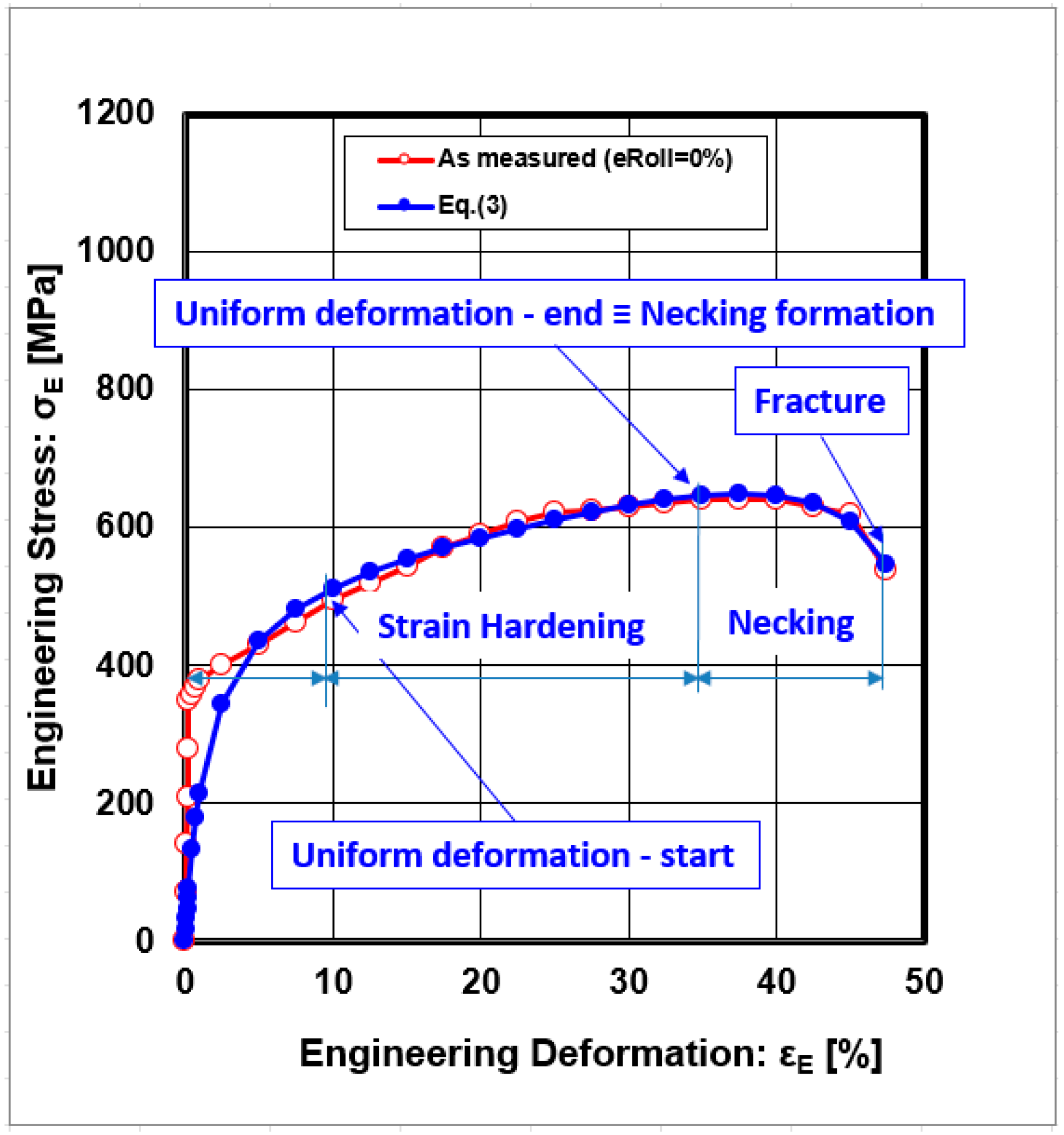
A graphical representation of the relationship between stress and strain resulting from static tensile tests of a material sample, known as the engineering stress–strain dependence, with definitions of the essential points for describing the stress–strain curve in terms of the necessary information for deformation strengthening, is shown in Figure 2.
Important points that describe the curves of the strain hardening rate are the point where uniform deformation begins and the point where uniform deformation ends (also called the necking point on the tested specimen). The last point is the fracture of the sample.
The numerical description of the curves σE = f(εE), representing the measured data, was performed using the following equations:
σ E = 298 · ε E 5.8 · ε E 2 / 1 + 0.475 · ε E 0.012 · ε E 2 + 0.000045 · ε E 3  
where:
σE [MPa]—engineering stress;
εE [-]—engineering strain;
R2 = 0.91.
The graphical dependencies shown in Figure 2 yield a suitable approximation of the measured values by the regression Equation (3), in the interval from the start to the end of strain hardening.
Transformation of the engineering stress–strain curves to true stress–strain curves was carried out according to the following formulae [19,20]:
σ T = σ E · 1 + ε E
ε T = ln 1 + ε E
For the approximation of the calculated values, σE = f(εT) was used in the following formulae:
(i)
A approximate regression equation was derived in the following form:
σ T = A · ε T + B · ε T 2 / 1 + C · ε T + D · ε T 2 + E · ε T 3
Regression coefficients for Equation (6) are given in Table 2.
(ii)
Holloman equation (Equation (7)):
σ T = K · ε T n
Calculated coefficients for Equation (7) are given in Table 3.
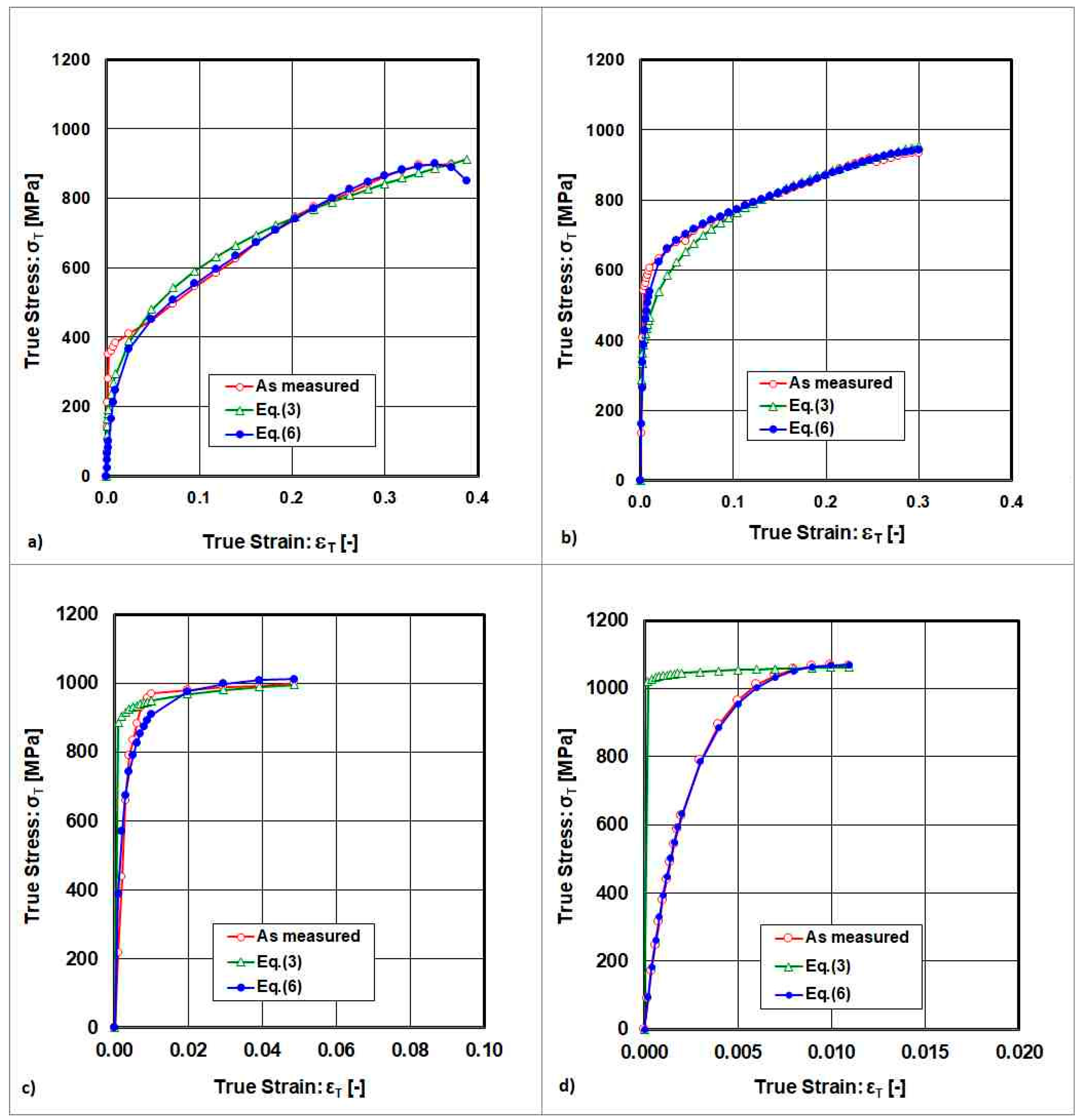
The transformation of engineering stress–engineering strain curves into true stress–true strain curves with the application of Equations (6) and (7) is shown in Figure 3.

3.1.1. The Manner of Determination of Important Points

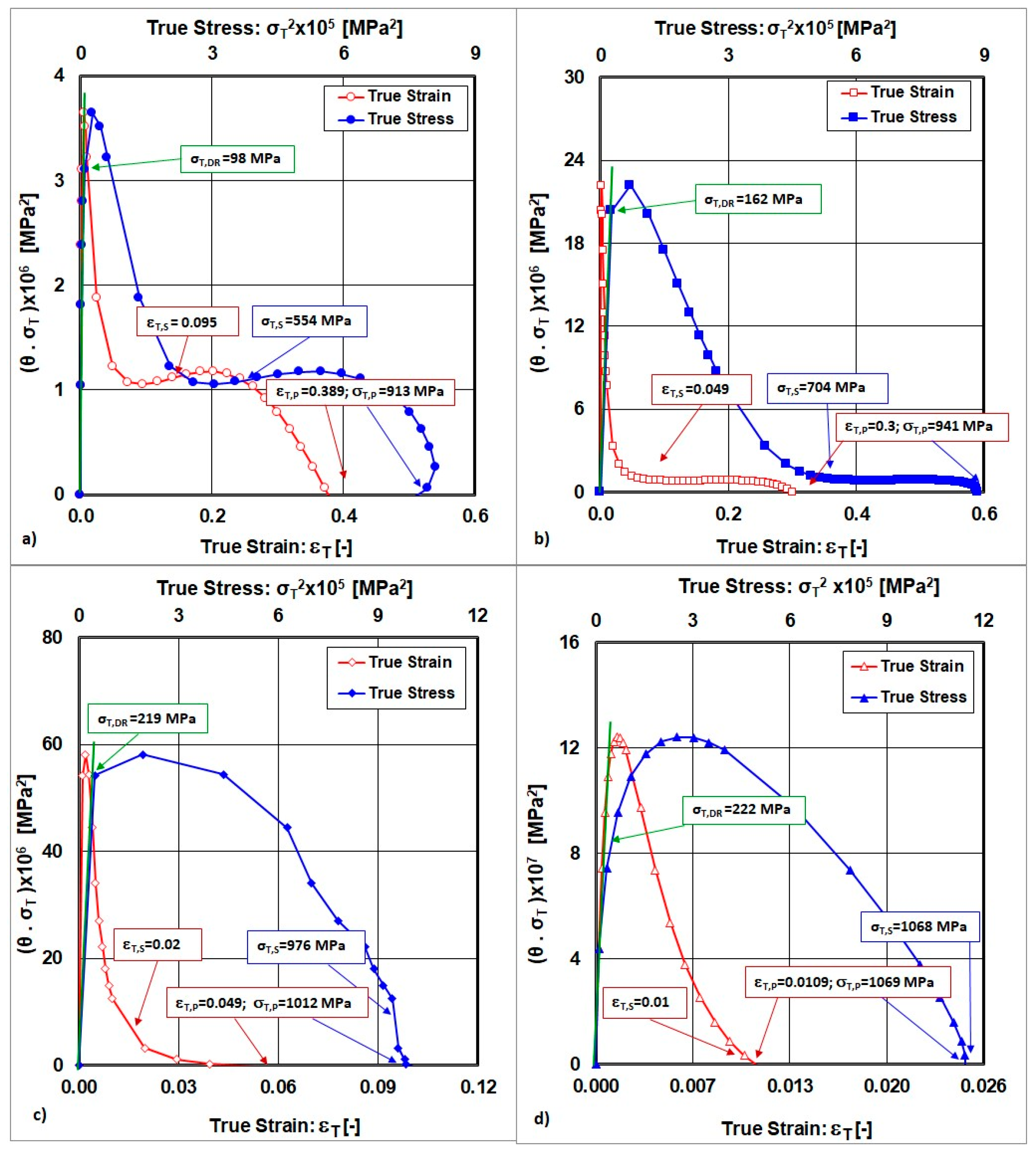
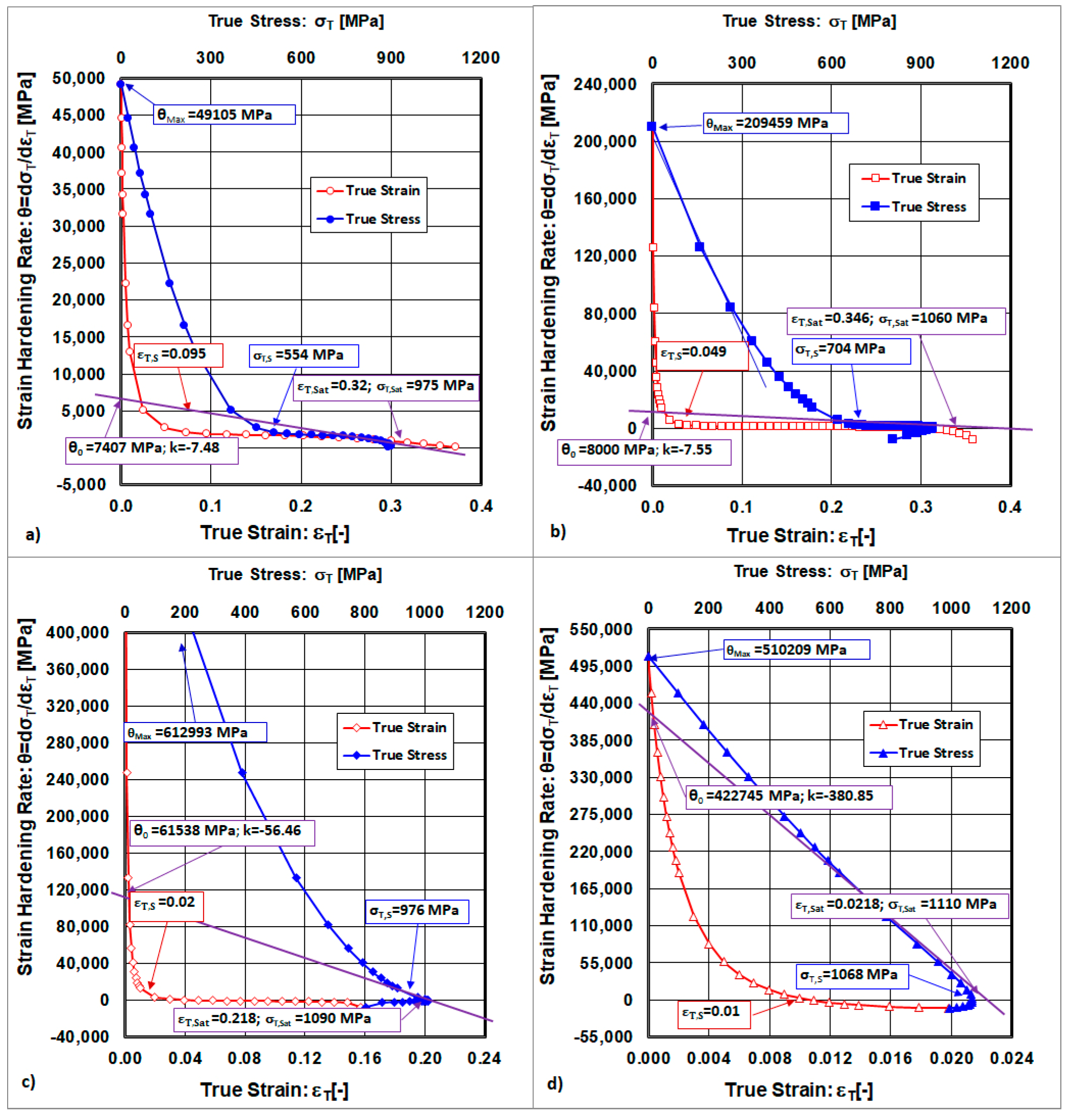
The starting point of uniform deformation described by the coordinates (εT,ST,S) was graphically determined from the following function dependence:
θ = d σ T d ε T = f ε T ; σ T
where:
θ [MPa]—the strain hardening rate calculated as the first derivative of true stress according to the true strain.
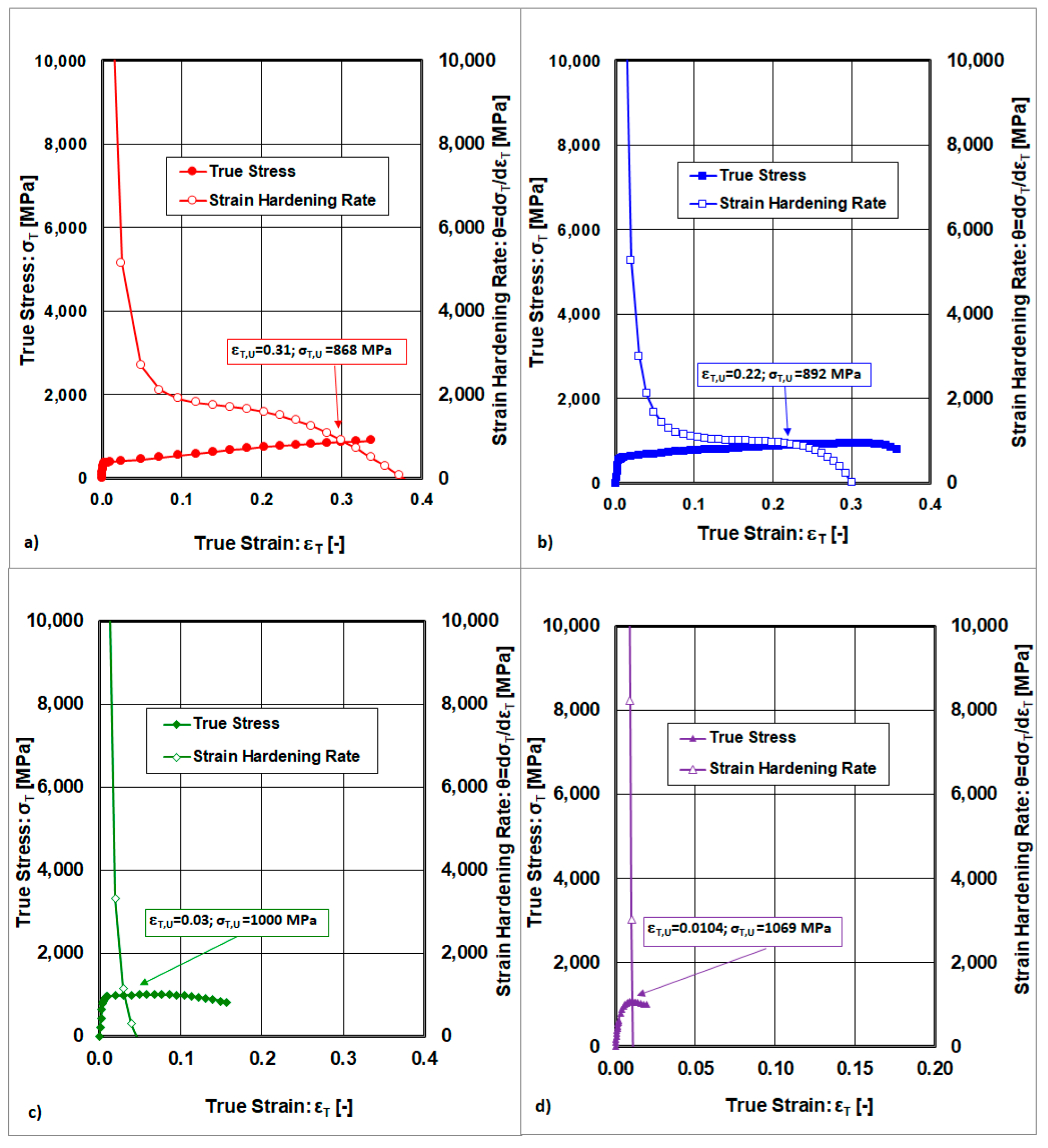
The graphical representations of Equation (8) are shown in Figure 4.
The point where the tangent to the curve θ = f(σT) intersects the axis θ = dσT/dεT was characterized by the authors of [17,21,22] as the initial strain hardening rate (θ0). The point where the curve θ = f(σT) intersects the axis θ = dσT/dεT was classified by the authors as the maximal strain hardening rate (θMax). The relationship between the initial strain hardening rate (θ0) and the saturation stress (σT,Sat) shown in Figure 4 is then described as the recovery rate (k [-]) by the following formula:
k = θ 0 / σ T , S a t
Determination of saturated points described by coordinates (εT,Sat; σT,Sat) is given as the extrapolation of the curve θ = f(σT) intersecting the εT-axis and σT-axis when θ = 0, as shown in Figure 4. The saturation stress (σT,Sat) represents a dynamic equilibrium between the strain hardening and the recovery. An increase in cold rolling deformation leads to an increase in the dislocation density, while a decrease in the dislocation density occurs because of the rearrangement and annihilation of dislocations by slip [11].
The final point at which uniform deformation is terminated (also called the necking point), described by the coordinates (εT,U≡εT,Neck; σT,U≡σT,Neck), is determined as the intersection point of the two curves corresponding to the onset of necking. One curve describes the true stress–strain curve and the other curve characterises the strain hardening rate, and both depend on the true strain, as shown in Figure 5. The intersection point of the two curves corresponds to the onset of necking. It is assumed that determining the necking onset directly from a static tensile test is more inaccurate than determining it from the described method.
The determination of the peak point described by the coordinates (εT,P≡εT,Peak; σT,P≡σT,Peak) is achieved under the condition that the product θ.σT = 0, which indicates that a balance between strain hardening and softening was reached, as is shown in Figure 6.
The dynamic recovery true stress (σT,DR) is determined as a tangent to the curves for θ.σT = f(σT2), which are given in Figure 6. Dynamic recovery can occur at a low deformation temperature and higher strain rate in materials with low to medium values for their stacking fault energy, such as AISI 316LN-grade steel [1,16,23].
The determination of the strain hardening exponent (n) is based on Equation (2) and Figure 5, where it is valid that n = εT,U.
The coefficient (K) in the Hollomon equation (Equation (7)) is determined as the intersection of the extrapolated curve ln(σT) = f(εT = 1), with a vertical line being erected at the point (εT = 1). “K” represents the true stress at εT = 1.

3.1.2. Analysis of Dependencies

(a)
Relationships between strain hardening rates and true stress
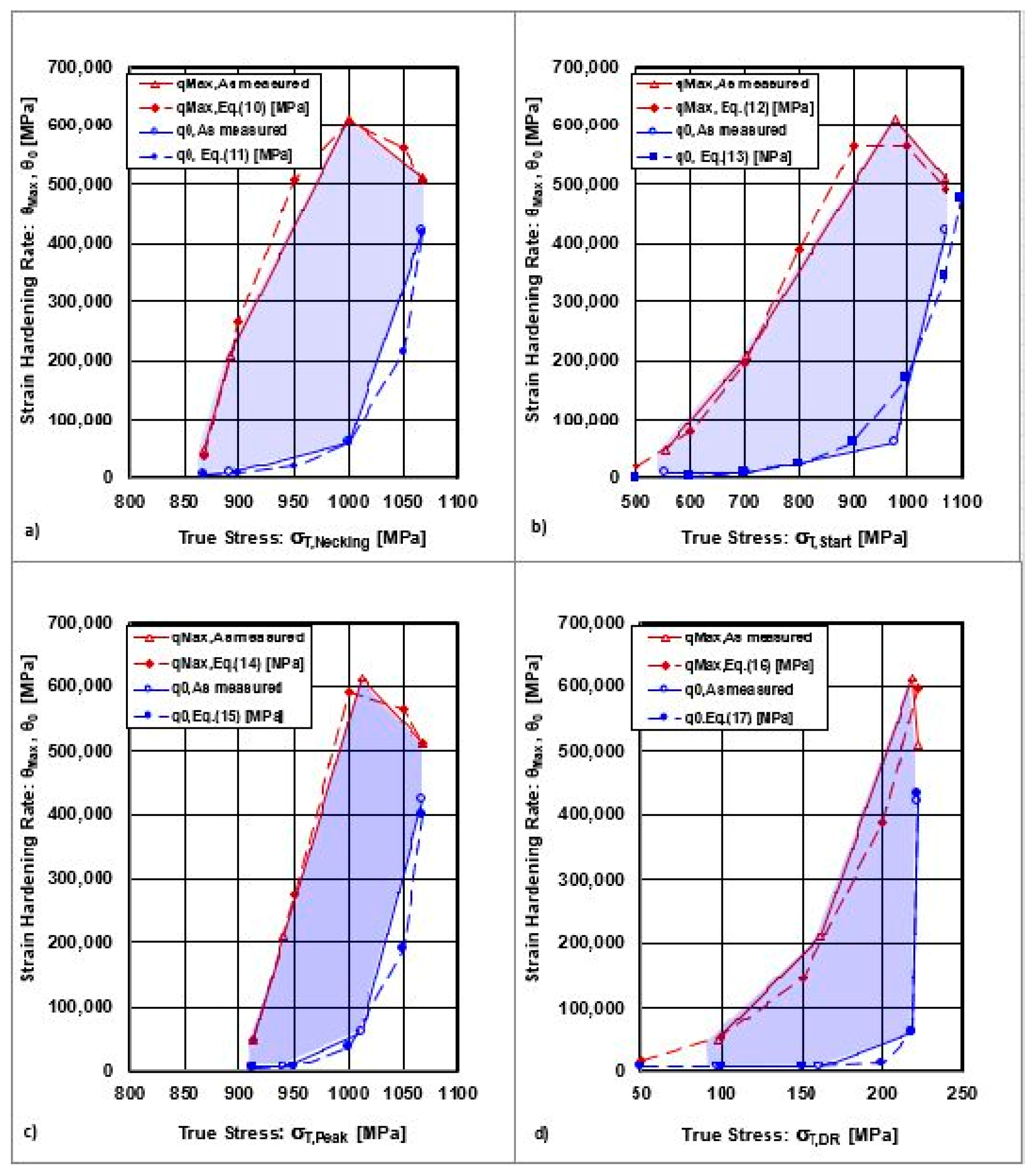
The common relationship between strain hardening rates and true stresses, described by the dependencies θ0 = f(σT,U ≡ Neck), θ0 = f(σT,S ≡ σT,Start), θ0 = f(σT,Peak), θ0 = f(σT,DR), θMax = f(σT, U ≡ Neck), θMax = f(σT, S ≡ σT,Start), θMax = f(σT, Peak), and θMax = f(σT,DR), will be analysed.
The mathematical dependencies describing the relationship between strain hardening rates (θMax, θ0) and true stresses are given in Table 4.
The graphical interpretations of the previous equations are shown in Figure 7.
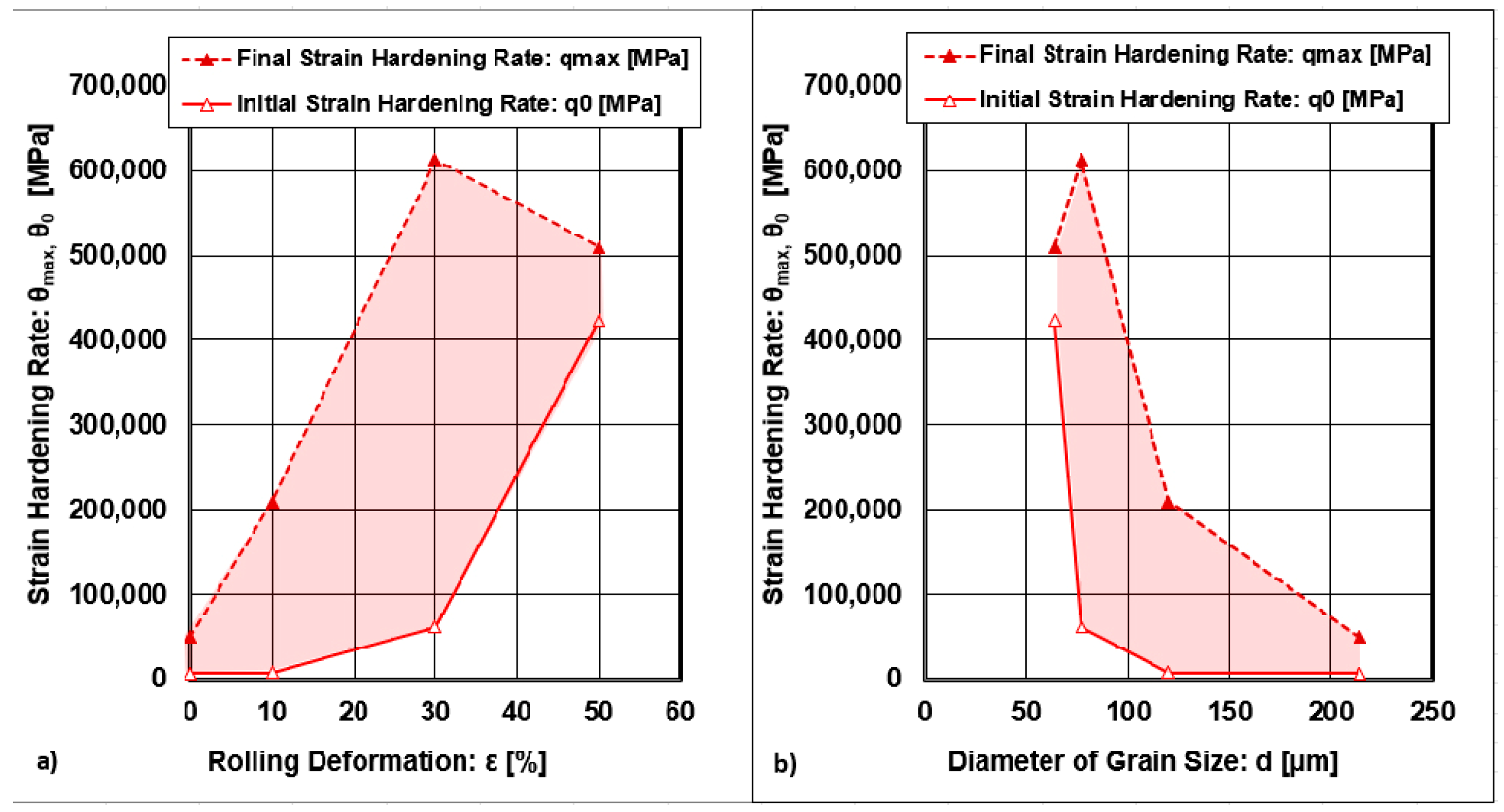
The graphical dependencies of qMax=f(sT) in Figure 7 show that the value of the maximal strain hardening rates reaches one local maximum. The curve showed an increasing tendency until reaching a local maximum. On the other hand, the curve θ0 = f(σT) exhibits an exponential dependence without a local maximum. While the curve θ0 represents the set of points for the initial strain hardening rates, the curve θMax represents the set of points for the final strain hardening rates. Both dependencies shown in Figure 7 and Figure 8 indicate the minimum and maximum boundaries of a convex polyhedron, within which there may be points representing nonoptimal conditions of plastic deformation. The optimal points lie on the curves. The dependencies of strain hardening rates on cold rolling deformations are shown in Figure 8.
The local maximum of the function θMax = f(εRoll) was reached at the point (εRollMax) = (30%; 612,993 MPa). Figure 8 shows that all local maxima correspond to cold rolling deformation εRoll = 30%. This change in θMax after εRoll = 30% cold deformation is related to the decrease in dislocation density, which was discussed in detail in previous work [1]. The curves for θMax0 = f(d) are represented by the opposite dependence, where the strain hardening rates decrease with an increasing grain size. The curve θMax = f(d) exhibits a local maximum at the point where the diameter of the grain size d = 77 μm, which also corresponds to εRoll = 30%.
(b)
Relationships between true stress and strain hardening exponent and recovery rate
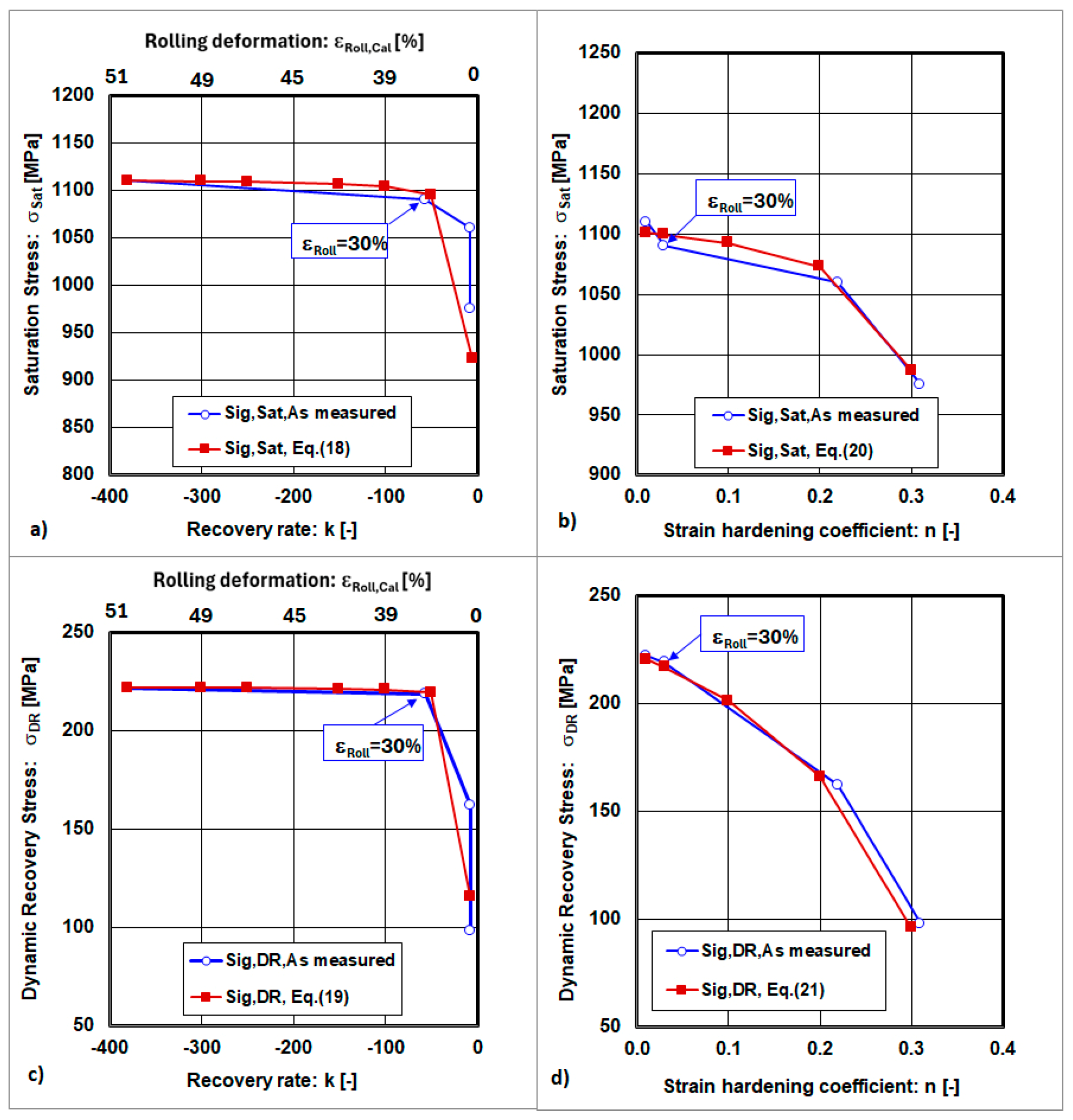
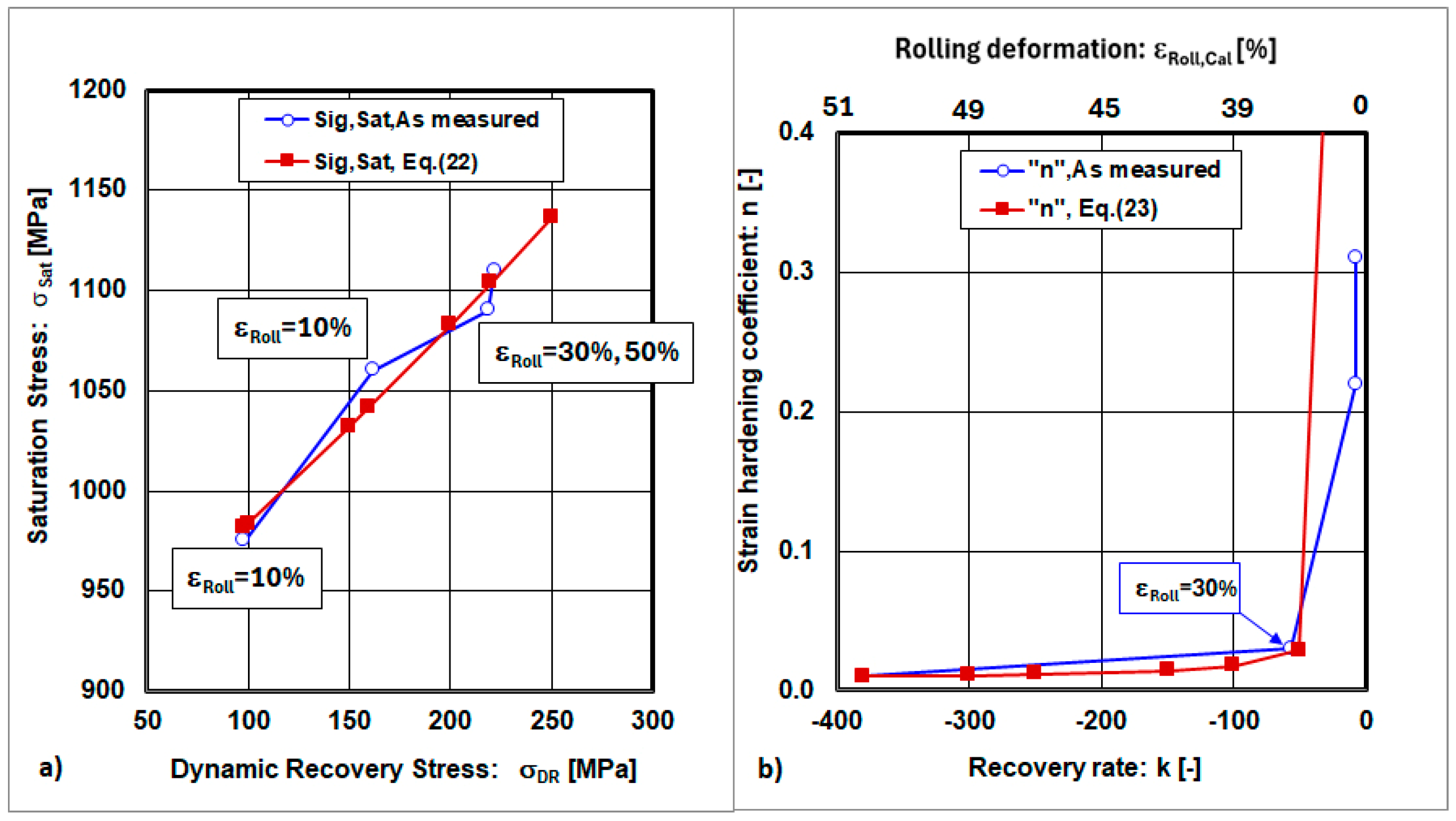
The relationship between the true stresses and strain hardening exponent and the recovery rate is described by the dependencies σT,Sat = f(n;k), σT,DR = f(n;k), and n = f(k), and will be analysed.
The mathematical dependencies describing the relationship between the true stresses (σT,Sat, σT,DR) and strain hardening exponent (n) and the recovery rate (k) are given in Table 5.
The graphical interpretations of the previous equations are shown in Figure 9 and Figure 10.
The relationships between σSat, σDR, and n = f(k), which depend on the recovery rate (k), exhibit local extrema at the point where the cold rolling deformation has reached a value of εRoll = 30.
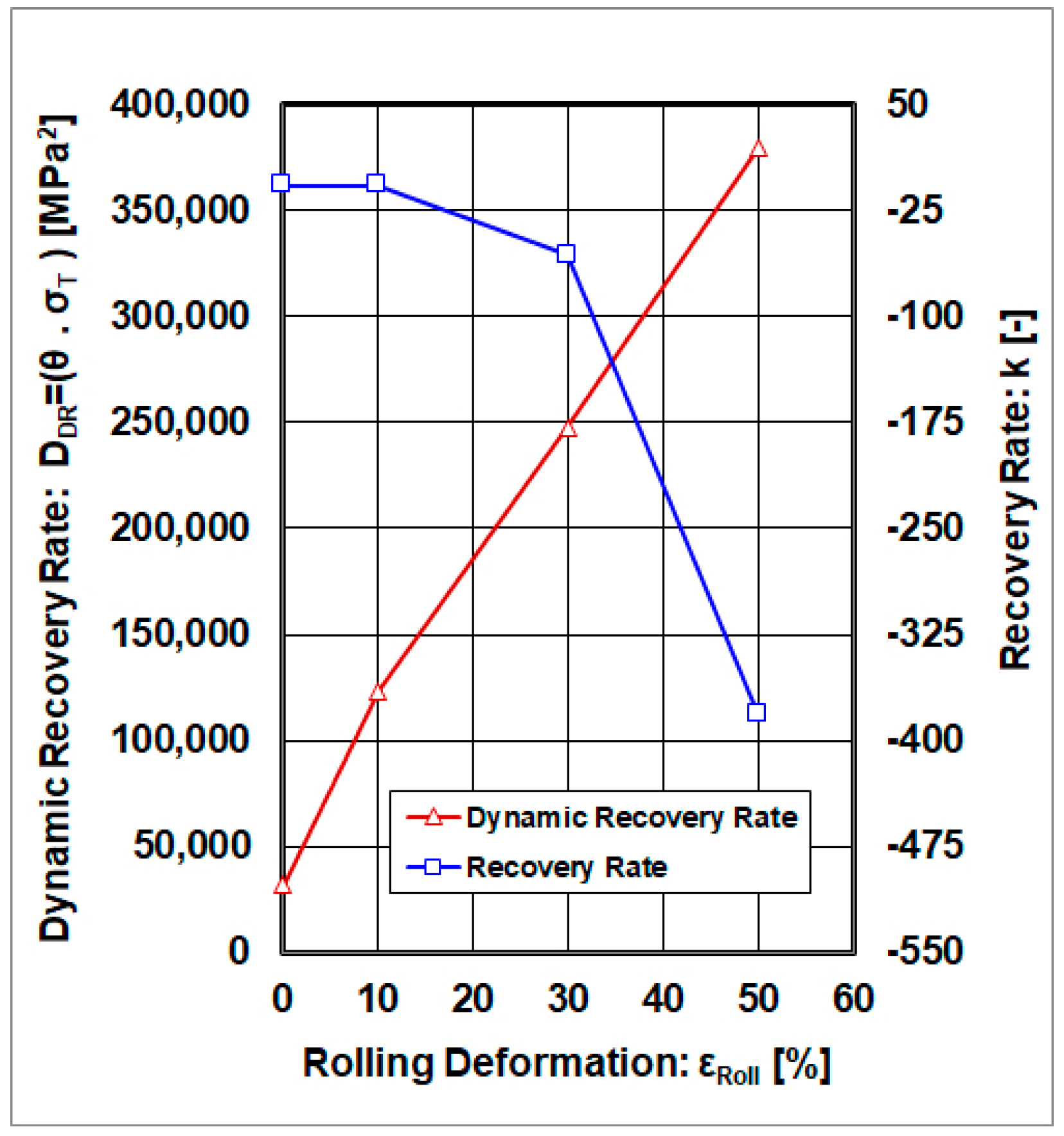
The graphical dependencies of the dynamic recovery rate and the recovery rate, as a function of cold rolling deformations, are shown in Figure 11. The graphical interpretation indicates that the dynamic recovery rate increases with increasing cold rolling deformations. This means that, with increasing cold plastic deformation, the accumulated energy, which is jointly dependent on the dislocation density and deformation twinning, increases and the ability of recovery rate processes is reduced. The accumulated energy, as described by the dynamic recovery rate (DDR), is not sensitive to cold rolling deformations. On the other hand, the recovery rate (k) exhibits a dependence on cold rolling deformations, with a local extreme at the point εRoll = 30%.
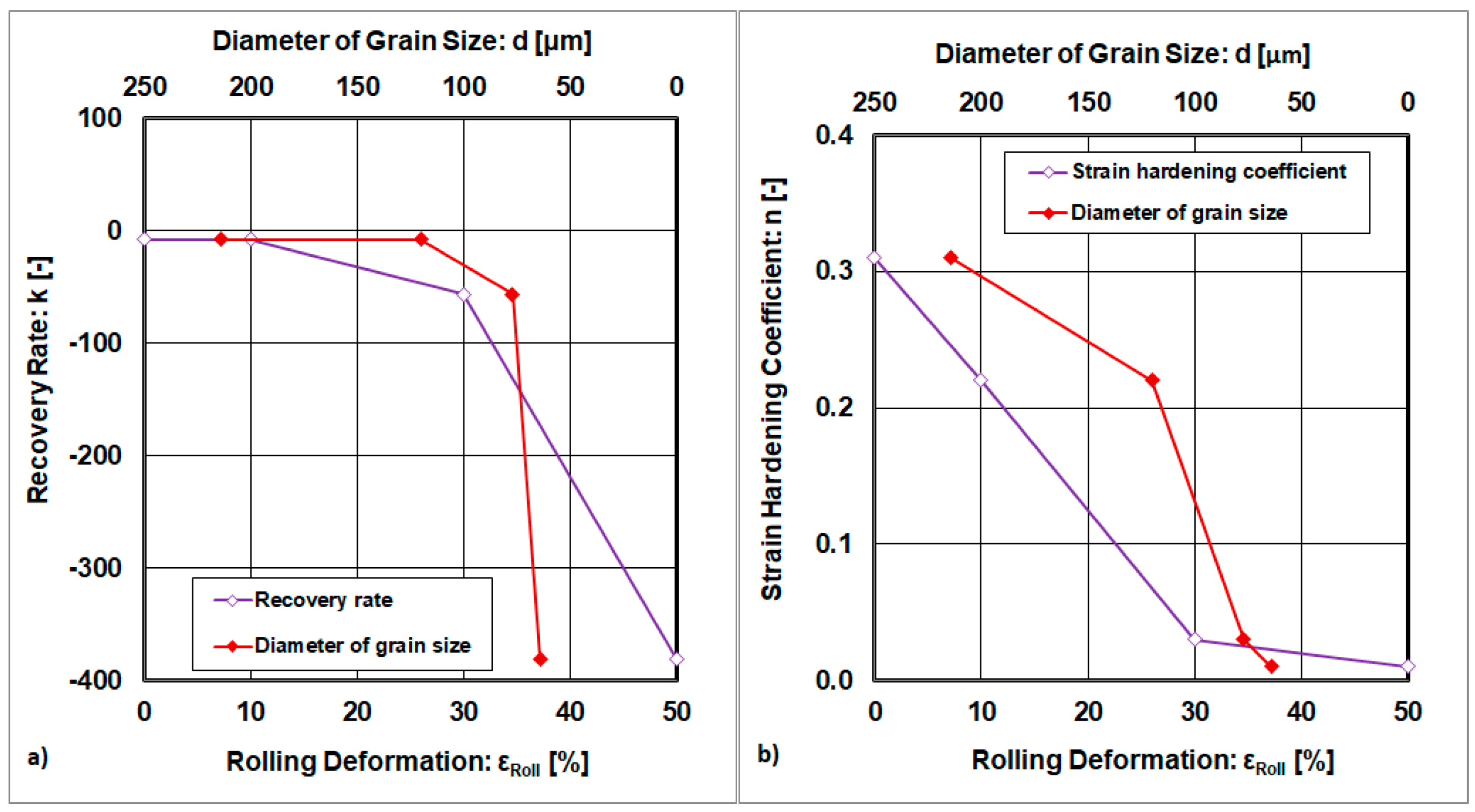
Relationships based on dependence k and n = f(εRoll; d), i.e., on the cold plastic deformation and diameter of the grain, are given in Figure 12.
The recovery rate falls with increasing cold rolling deformation and declines with the grain size as is shown in Figure 12a. Similar dependencies are also evident in the strain hardening exponent, but without any significant local extremes as is given in Figure 12b. The declining dependencies are based on microstructural refinement and changes in the mechanisms of plastic deformation. At the point εRoll = 30%, the transformation of low-angle grain boundaries to high-angle grain boundaries begins.
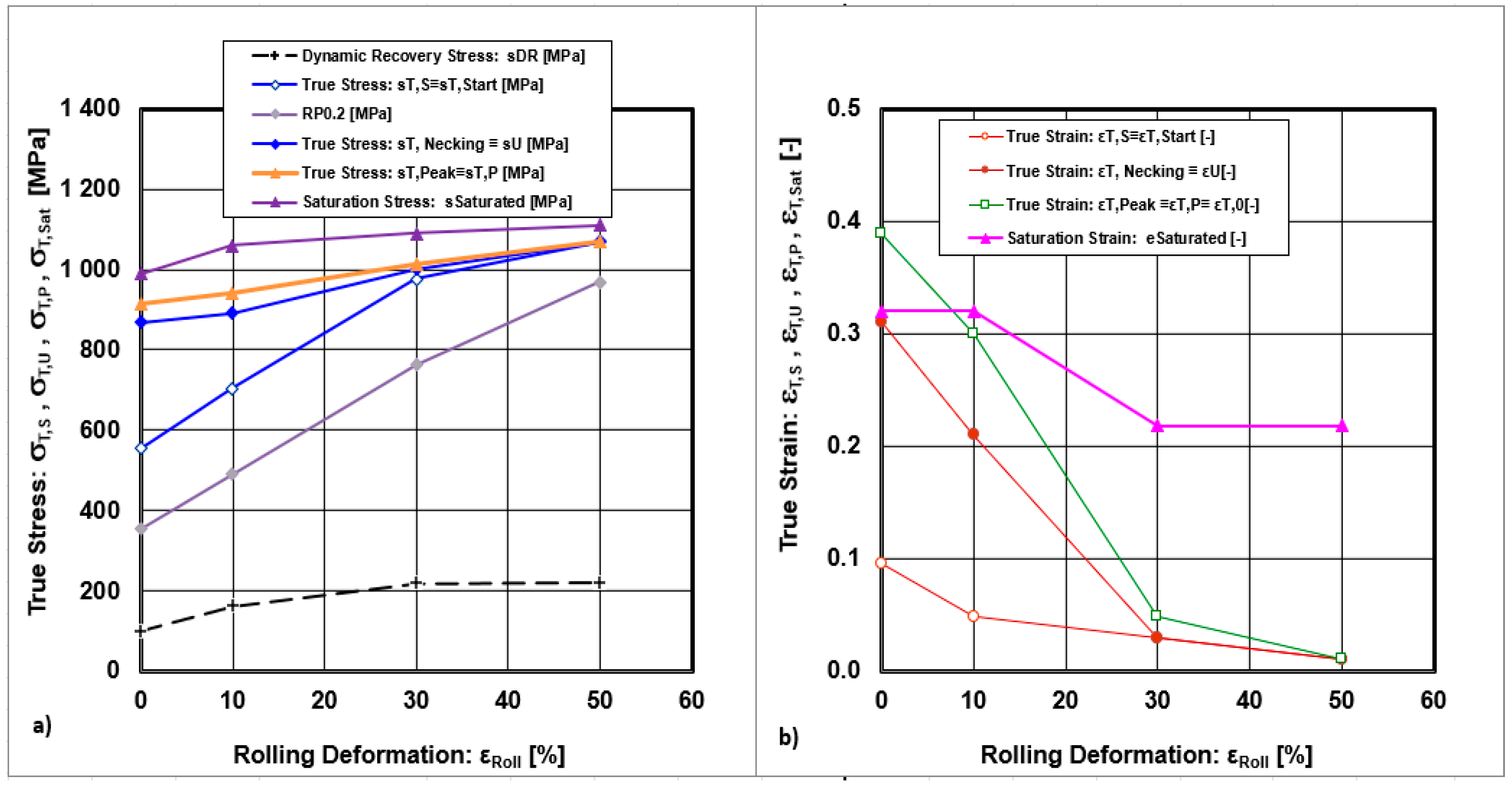
A comprehensive analysis of the previous graphical dependencies, based on the assessment of true stresses and true strains in relation to cold rolling deformations, is presented in Figure 13.
The curves describing the dependences of the true stress for the starting of uniform plastic deformation (σT,S) and the true stress for the finishing of uniform plastic deformation (σT,Neck) point to the fact that, with increasing cold deformation, the area of the convex polyhedron for possible values of uniform stresses decreases significantly. The stress convex polyhedron of uniform plastic deformations is located above the curve describing the offset yield strength (RP0.2). The graphical dependences of the stresses indicate that the saturation stress (σT,Sat) required to achieve dynamic recovery of the microstructure is significantly higher than the stress required for necking formation (σT,Sat > σT,Neck). This fact is also confirmed by the decreasing recovery rate shown in Figure 12a. Analysis of the material studied reveals that the dynamic recovery of the microstructure under cold plastic deformation conditions is limited. The true peak stresses are very similar to true necking stresses (σT,Peak ≈ σT,Neck).
The convex polyhedron of the set of true strains is limited by the curves of the true strain of uniform plastic deformation (εT,S) and the true strain finish of uniform plastic deformation (εT,Neck). The true strain values decrease with increasing cold rolling deformation. Also, the interval describing the set of points of the true strains decreases significantly with increasing cold deformation. After reaching a cold deformation of εRoll ≥ 30%, its complete elimination occurred. The values of true saturation strain (εT,Sat) required to achieve dynamic recovery of the microstructure are significantly higher than the strain necessary for necking formation (εT,Sat > εT,Neck). This fact is supported by the decrease in the strain hardening exponent, which declines with increasing cold rolling deformation, as shown in Figure 12b.

4. Conclusions

Based on studies in the literature and our own experiments that were performed by cold rolling AISI 316 LN stainless steel to analyse stress–strain curves with a focus on mathematical description of the strain hardening rate and derivation of subsequent dependencies, the following conclusions can be drawn:
  • Measured values of engineering stress–strain curves resulting from static tensile tests were transformed into true stress–true strain curves and mathematically described by a rational polynomial function and the Holloman function with appropriate correlation;
  • Two points characterise the strain hardening rate: the initial strain hardening rate (θ0) and the maximal strain hardening rate (θMax), These depend on cold rolling deformations and show an increase in their values. The dependence θMax = f(εRoll) shows a local maximum at deformation εRoll = 30%. The curve θMax = f(d) exhibits a local maximum at the point where the diameter of the grain d = 77 μm, which also corresponds to εRoll = 30%;
  • Two areas describe a convex polyhedron characterised by uniform plastic deformations. One is characterised by the true strain curves and the other by the true stress curves. Both convex polyhedra describe areas of uniform plastic deformation, which are bounded by curves that represent initial stress–strain curves and stress–strain curves for necking. The values of the first convex polyhedron decrease and narrow with increasing cold rolling deformations, while the second one shows increasing values and narrowing with increasing cold rolling deformations;
  • The area of the stress convex polyhedron lies significantly above the curve describing the offset yield stress (σT,S > RP0.2). From this dependence, it follows that uniform plastic deformations do not occur near the offset yield stress;
  • The values of the true stresses and true strains indicate that the saturation stress and strain required to achieve dynamic recovery of the microstructure are significantly higher than the stress and strain needed to accomplish the necking (σT,Sat > σT,Neck, εT,Sat > εT,Neck). The graphical dependences show that, under the described cold deformation conditions, dynamic recovery of the microstructure is not possible.

Author Contributions

Conceptualization, T.K. and A.F.; methodology, T.K. and J.B.; validation, T.K., J.B. and Ľ.K.; formal analysis, R.B.; investigation, A.F. and T.K.; resources, R.B.; data curation T.K. and J.B.; writing—original draft preparation, T.K.; writing—review and editing, T.K. and J.B.; visualization, T.K.; supervision, J.B.; project administration, R.B.; funding acquisition, R.B. All authors have read and agreed to the published version of the manuscript.

Funding

Funded by the EU Next Generation EU through the Recovery and Resilience Plan for Slovakia under the project No. 09I03-03-V04-00694.

Institutional Review Board Statement

Not applicable.

Informed Consent Statement

Not applicable.

Data Availability Statement

The original contributions presented in this study are included in the article. Further inquiries can be directed to the corresponding authors.

Conflicts of Interest

Authors Tibor Kvačkaj and Róbert Bidulský are employed by the Bodva Industry and Innovation Cluster. Author Alica Fedoríková is employed by the Department of Material Analysis, Research Centre Řež. The remaining authors declare that the research was conducted in the absence of any commercial or financial relationships that could be construed as a potential conflict of interest.

References

  1. Kvackaj, T.; Bidulska, J.; Fedorikova, A.; Bidulsky, R. Mechanical Properties and Strengthening Contributions of AISI 316 LN Austenitic Stainless Steel Grade. Materials 2025, 18, 499. [Google Scholar] [CrossRef]

  2. Vargas, B.R.R.; Albini, L.; Tiracorrendo, G.; Massi, R.; Stornelli, G.; Di Schino, A. Effect of Ultrafast Heating on AISI 304 Austenitic Stainless Steel. Acta Metall. Slovaca 2023, 29, 104–107. [Google Scholar] [CrossRef]
  3. Hassan, A.J.; Cheniti, B.; Belkessa, B.; Boukharouba, T.; Miroud, D.; Titouche, N.-E. Metallurgical investigation of direct drive friction welded joint for austenitic stainless steel (AISI 316). Acta Metall. Slovaca 2023, 29, 88–92. [Google Scholar] [CrossRef]
  4. Xu, D.M.; Li, G.Q.; Wan, X.L.; Xiong, R.L.; Xu, G.; Wu, K.M.; Somani, M.C.; Misra, R.D.K. Deformation Behavior of High Yield Strength—High Ductility Ultrafine-Grained 316LN Austenitic Stainless Steel. Mater. Sci. Eng. A 2017, 688, 407–415. [Google Scholar] [CrossRef]
  5. Choudhary, B.K. Influence of Strain Rate and Temperature on Tensile Deformation and Fracture Behavior of Type 316L(N) Austenitic Stainless Steel. Metall. Mater. Trans. A 2014, 45, 302–316. [Google Scholar] [CrossRef]
  6. Drucker, D.C.; Greenberg, H.J.; Prager, W. The Safety Factor of an Elastic-Plastic Body in Plane Strain. J. Appl. Mech. 1951, 18, 371–378. [Google Scholar] [CrossRef]
  7. Ding, H.; Ding, H.; Song, D.; Tang, Z.; Yang, P. Strain hardening behavior of a TRIP/TWIP steel with 18.8% Mn. Mater. Sci. Eng. A 2011, 528, 868–873. [Google Scholar] [CrossRef]
  8. Sing, W.M.; Rao, K.P. Role of Strain-Hardening Laws in the Prediction of Forming Limit Curves. J. Mater. Process. Technol. 1997, 63, 105–110. [Google Scholar] [CrossRef]
  9. Umemoto, M.; Tsuchiya, K.; Liu, Z.G.; Sugimoto, S. Tensile stress-strain analysis of single-structure steels. Metall. Mater. Trans. A 2000, 31, 1785–1794. [Google Scholar] [CrossRef]
  10. Colla, V.; De Sanctis, M.; Dimatteo, A.; Lovicu, G.; Solina, A.; Valentini, R. Strain Hardening Behavior of Dual-Phase Steels. Metall. Mater. Trans. A 2009, 40, 2557–2567. [Google Scholar] [CrossRef]
  11. Vanaja, J.; Laha, K.; Sam, S.; Nandagopal, M.; Selvi, S.P.; Mathew, M.D.; Jayakumar, T.; Kumar, E.R. Influence of strain rate and temperature on tensile properties and flow behaviour of a reduced activation ferritic–martensitic steel. J. Nucl. Mater. 2012, 424, 116–122. [Google Scholar] [CrossRef]
  12. Choudhary, B.K.; Christopher, J. Tensile Flow and Work Hardening Behaviour of Type 316L(N) Austenitic Stainless Steel in the Framework of One-Internal-Variableand Two-Internal-Variable Approaches. Mater. Sci. Eng. A 2015, 636, 269–278. [Google Scholar] [CrossRef]
  13. Hu, J.; Liu, Y.; Wang, G.; Li, Q.; Wen, J.; Yan, L.; Chen, S.; Gu, Y. Effect of Tempering Treatment on Microstructural Evolution and Mechanical Behavior of Heavy-Wall Heat Induction Seamless Bend Pipe. Materials 2022, 15, 259. [Google Scholar] [CrossRef]
  14. Wu, Z.; Liu, S.; Hasan, M.N.; Li, E.; An, X. The hot deformation behavior in austenite-ferrite heterostructured low density Fe-Mn-Al-C steel. Mater. Today Commun. 2023, 37, 107184. [Google Scholar] [CrossRef]
  15. Zhang, C.; Zhang, L.; Shen, W.; Liu, C.; Xia, Y.; Li, R. Study on constitutive modeling and processing maps for hot deformation of medium carbon Cr–Ni–Mo alloyed steel. Mater. Des. 2016, 90, 804–814. [Google Scholar] [CrossRef]
  16. Rohatgi, A.; Vecchio, K.S.; Gray, G.T. The Influence of Stacking Fault Energy on the Mechanical Behavior of Cu and Cu-Al Alloys: Deformation Twinning, Work Hardening, and Dynamic Recovery. Metall. Mater. Trans. A 2001, 32, 135–145. [Google Scholar] [CrossRef]
  17. Ruban, R.; Vijayanand, V.D.; Sivapirakasam, S.P.; Prasad Reddy, G.V. Influence of thermomechanical treatment on the flow behavior of 14Cr-15Ni stainless steel. Can. Metall. Q. 2025, 64, 873–878. [Google Scholar] [CrossRef]
  18. ASTM E8/E8M-03; Standard Test Methods for Tension Testing of Metallic Materials. ASTM International: West Conshohocken, PA, USA, 2003.
  19. Soares, G.C.; Gonzalez, B.M.; de Arruda Santos, L. Strain hardening behavior and microstructural evolution during plastic deformation of dual phase, non-grain oriented electrical and AISI 304 steels. Mater. Sci. Eng. A 2017, 684, 577–585. [Google Scholar] [CrossRef]
  20. Arrayago, I.; Real, E.; Gardner, L. Description of stress–strain curves for stainless steel alloys. Mater. Des. 2015, 87, 540–552. [Google Scholar] [CrossRef]
  21. Zhou, X.; Li, X.Y.; Lua, K. Strain hardening in gradient nano-grained Cu at 77 K. Scr. Mater. 2018, 153, 6–9. [Google Scholar] [CrossRef]
  22. Trinh, T.; Nguyen, S.A.; Pham, K.G.; Seidel, C.; Pham, A.H.; Phung, C.N. Change in Microstructure and Hardness of Additively Manufactured AISI H13 Steel by Heat Treatment and Nitriding Processes. Acta Metall. Slovaca 2023, 29, 82–87. [Google Scholar] [CrossRef]
  23. Inés, M.N.; Mansilla, G.A. Incidence of heat treatment on the corrosive behavior of AISI 316L austenitic stainless steel. Acta Metall. Slovaca 2023, 29, 161–166. [Google Scholar] [CrossRef]
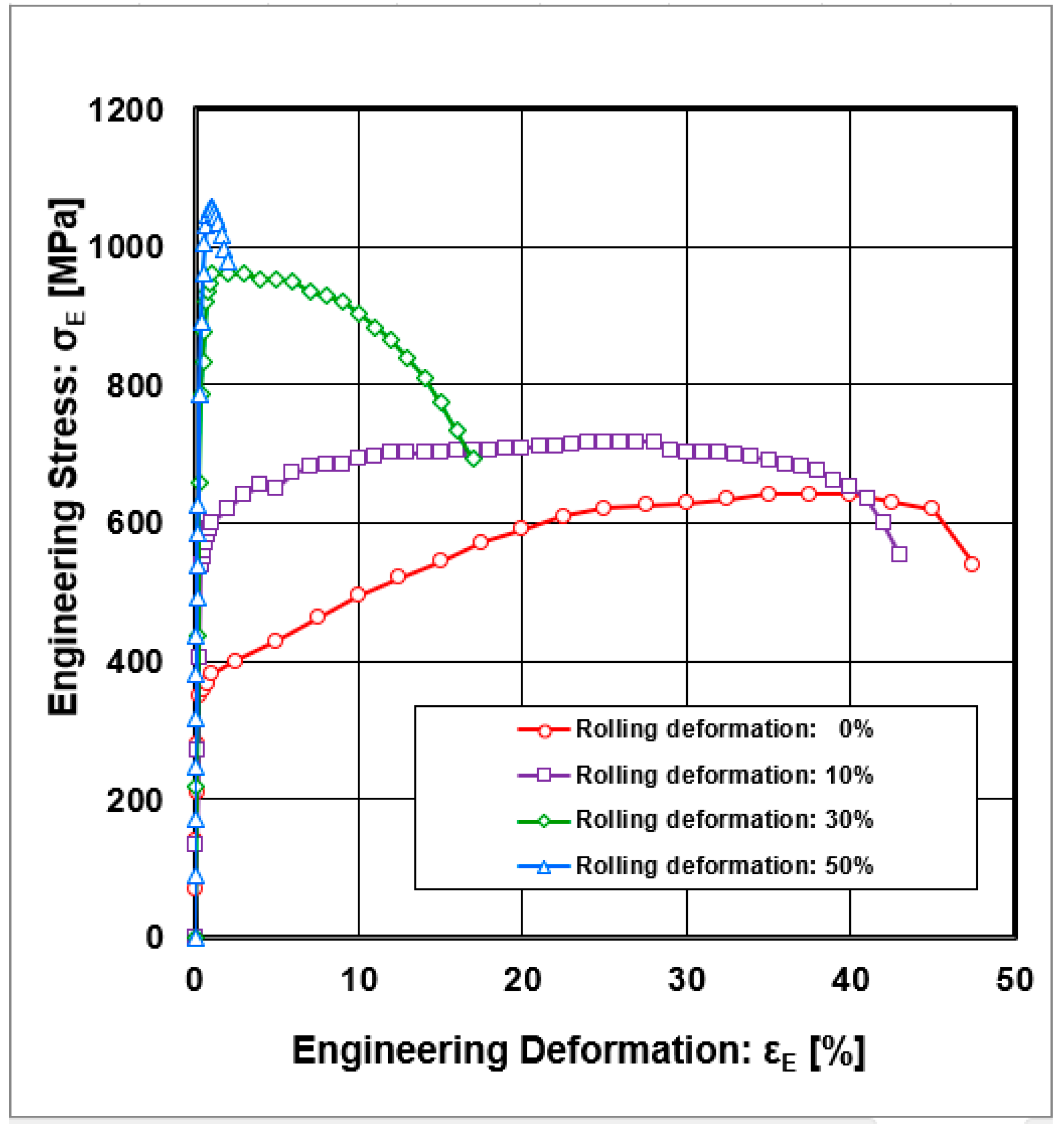
Figure 1. Engineering stress–strain curves σE = f(εE) after static tensile tests at 295 K.
Materials 18 04268 g001
Figure 2. The basic points characterised for stress–strain curves (εRoll = 0%).
Materials 18 04268 g002
Figure 3. True stress–strain curves resulting from measurement and approximation by Equations (6) and (7). (a) State after solution annealing, (b) state after cold rolling deformation εRoll = 10%, (c) state after cold rolling deformation εRoll = 30%, (d) state after cold rolling deformation εRoll = 50%.
Materials 18 04268 g003
Figure 4. Basic points resulting from curves. (a) State after solution annealing, (b) state after cold rolling deformation εRoll = 10%, (c) state after cold rolling deformation εRoll = 30%, (d) state after cold rolling deformation εRoll = 50%.
Materials 18 04268 g004
Figure 5. The manner of determining the starting point of the necking: (a) state after solution annealing, (b) state after cold rolling deformation εRoll = 10%, (c) state after cold rolling deformation εRoll = 30%, (d) state after cold rolling deformation εRoll = 50%.
Materials 18 04268 g005
Figure 6. The manner of determining the peak point and dynamic recovery true stress. (a) state after solution annealing, (b) state after cold rolling deformation εRoll = 10%, (c) state after cold rolling deformation εRoll = 30%, (d) state after cold rolling deformation εRoll = 50%.
Materials 18 04268 g006
Figure 7. Dependences of the strain hardening rates on uniform stresses. (a) state after solution annealing, (b) state after cold rolling deformation εRoll = 10%, (c) state after cold rolling deformation εRoll = 30%, (d) state after cold rolling deformation εRoll = 50%.
Materials 18 04268 g007
Figure 8. Dependence of strain hardening rates on and diameter of grain. (a) cold rolling deformations; (b) diameter of grain size.
Materials 18 04268 g008
Figure 9. Dependences of the saturation stress and dynamic recovery stress on the recovery rate and strain hardening coefficient. (a) state after solution annealing, (b) state after cold rolling deformation εRoll = 10%, (c) state after cold rolling deformation εRoll = 30%, (d) state after cold rolling deformation εRoll = 50%.
Materials 18 04268 g009
Figure 10. Dependences: (a) saturation stress on dynamic recovery stress, (b) strain hardening coefficient on the recovery rate.
Materials 18 04268 g010
Figure 11. Dependence of the dynamic recovery rate and the recovery rate on cold rolling deformations.
Materials 18 04268 g011
Figure 12. Dependences of (a) the recovery rate and strain hardening exponent on processing (εRoll) and microstructure (b) parameters.
Materials 18 04268 g012
Figure 13. Comprehensive analysis describing dependencies: (a) true stresses on cold rolling deformations, (b) true strains on cold rolling deformations.
Materials 18 04268 g013
Table 1. Local chemical composition of AISI 316 LN [mass %].
CMnSiPSCrNiMoVTiNbNB
0.061.50.50.0070.00318.7613.731.870.020.0040.020.130.001
Table 2. Regression coefficients for Equation (6).
Rolling
Deformation:
εRoll [%]
Regression CoefficientsCorrelation Index
A B C D E
049,105-100−2633580.85
10209,459−541,859289−10518090.91
30612,993−3,299,235568−2905-0.9
50510,209-2908745-0.98
Table 3. Regression coefficients for Equation (7).
Rolling Deformation: εRoll [%]Coefficients
Kn
012240.31
1012290.22
3010900.03
5011120.0104
Table 4. Regression equations describing the relationship between strain hardening rate and true stress.
Max, θ0)Regression EquationCorrelation
Index
Equation (No)
θMax = f(σT,U) θ M a x = 2.826 · 10 7 + 5.7186 · 10 4 · σ T , U 28.32 · σ T , U 2 R2 = 0.99(10)
θ0 = f(σT,U) θ 0 = 236,906 532.97 · σ T , U + 0.3016 · σ T , U 2 / 1 9.09 · 10 4 · σ T , U R2 = 0.98(11)
θMax = f(σT,S) θ M a x = 34,669 + 80 · σ T , S / 1 0.0021 · σ S + 1.18 · 10 6 · σ T , S 2 R2 = 0.99(12)
θ0 = f(σT,S) θ 0 = 6.815 · e x p 0.01014 · σ T , S R2 = 0.99(13)
θMax = f(σT,Peak) θ M a x = 42,876 + 47.6 · σ P e a k / 1 0.002024 · σ P + 1.032 · 10 6 · σ P e a k 2 R2 = 0.99(14)
θ0 = f(σT,Peak) θ 0 = 501,599 1076.17 · σ T , P e a k + 0.578 · σ T , P e a k 2 / 1 9.08 · 10 4 · σ T , P e a k R2 = 0.93(15)
θMax = f(σT,DR) θ M a x = 7690 · e x p 0.0196 · σ D R R2 = 0.95(16)
θ0 = f(σT,DR) θ 0 = 8407.9 51.2 · σ T , D R + 0.07859 · σ T , D R 2 / 1 4.495 · 10 3 · σ T , D R R2 = 0.98(17)
Table 5. Regression equations describing the relationship between true stress and coefficients.
T,Sat, σT,DR)Regression EquationCorrelation
Index
Equation (No)
σSat = f(k) σ S a t = 1112 + 823.38 / k + 0.6534 R2 = 0.97(18)
σDR = f(k) σ D R = 242.59 + 35.27 · k / 1 + 0.1586 · k R2 = 0.96(19)
σSat = f(n) σ S a t = 1124.5 + 8.246 / n 0.36 R2 = 0.98(20)
σDR = f(n) σ D R = 306 + 42 / n 0.5 R2 = 0.99(21)
σSat = f(σDR) σ S a t = 893.7 · e x p 9.6 · 10 4 · σ D R R2 = 0.98(22)
n = f(k) n = ( 0.239 + 1.97 · 10 3 · k ) / ( 1 + 0.251 · k ) R2 = 0.99(23)
Disclaimer/Publisher’s Note: The statements, opinions and data contained in all publications are solely those of the individual author(s) and contributor(s) and not of MDPI and/or the editor(s). MDPI and/or the editor(s) disclaim responsibility for any injury to people or property resulting from any ideas, methods, instructions or products referred to in the content.