An Experimental and Numerical Investigation on Enhancing the Ballistic Resistance of 316L Stainless Steel Plates Against Blunt Projectiles by Covering with 2024-T351 Aluminum Alloy Thin Plates


Highlights
- Ballistic tests and finite element simulations were conducted on monolithic 316L Austenitic Stainless Steel (ASS) and bilayer 2024-T351 aluminum alloy/316L ASS targets under blunt projectile impacts.
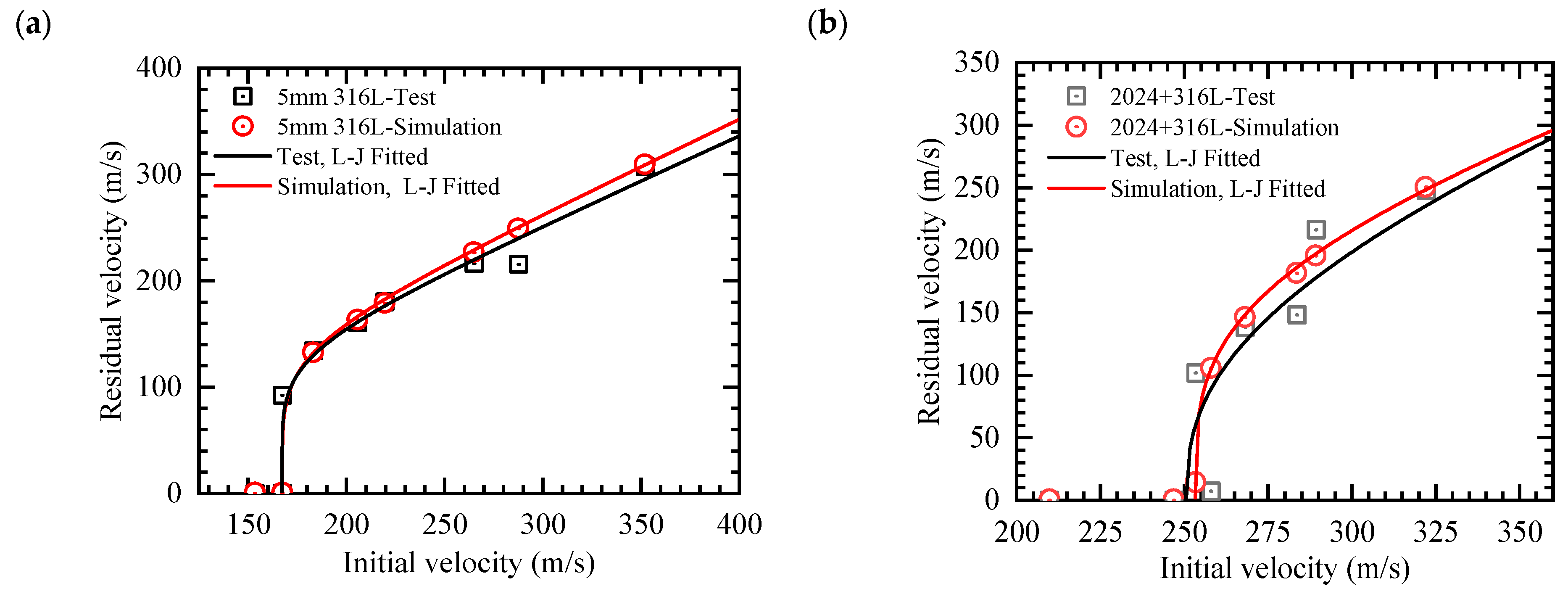
- A 2.05 mm thick aluminum alloy front layer significantly enhances the ballistic limit velocity (BLV) of the 5 mm thick monolithic 316L ASS plates, increasing the value from 167.5 m/s to 250.7 m/s.
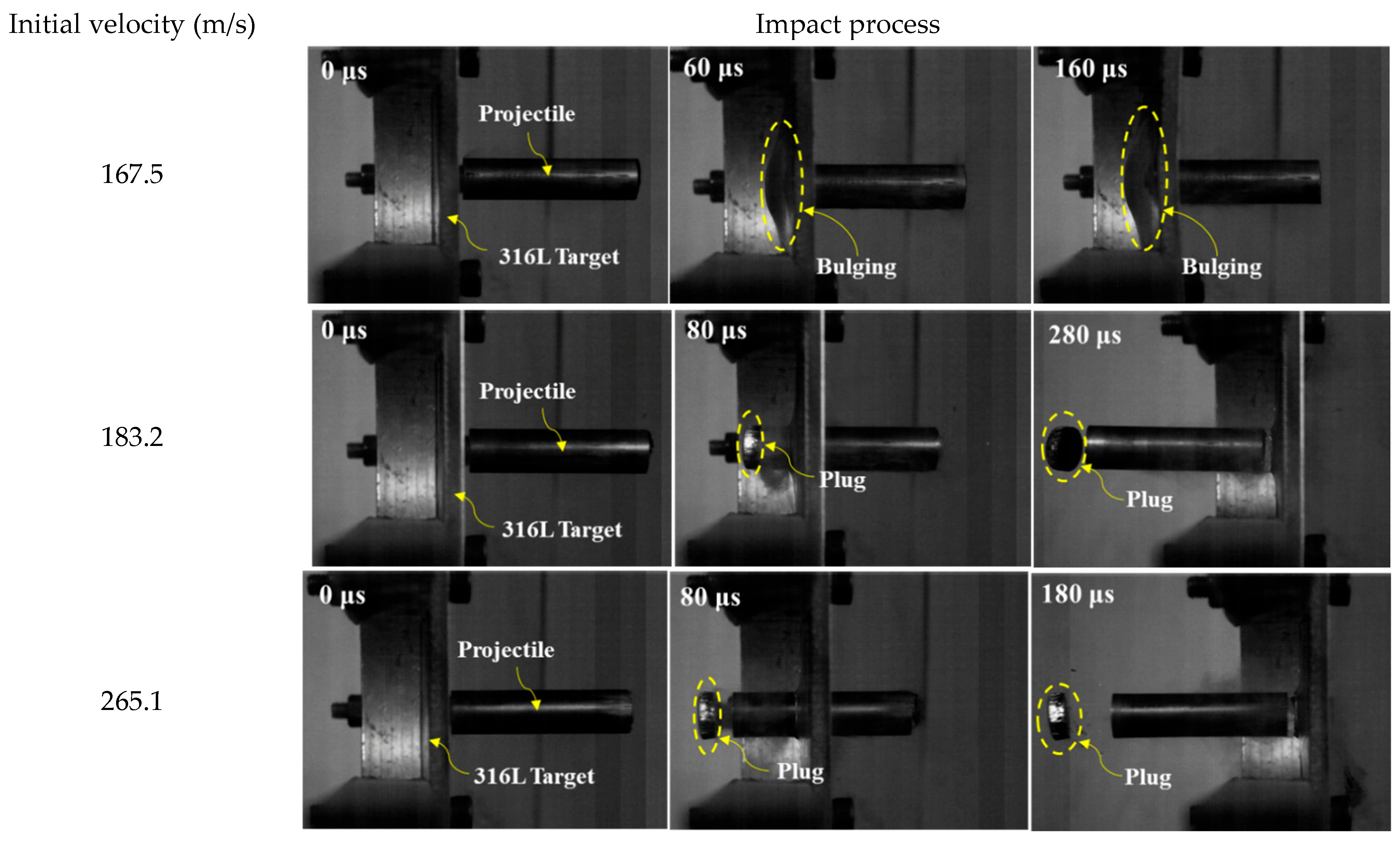
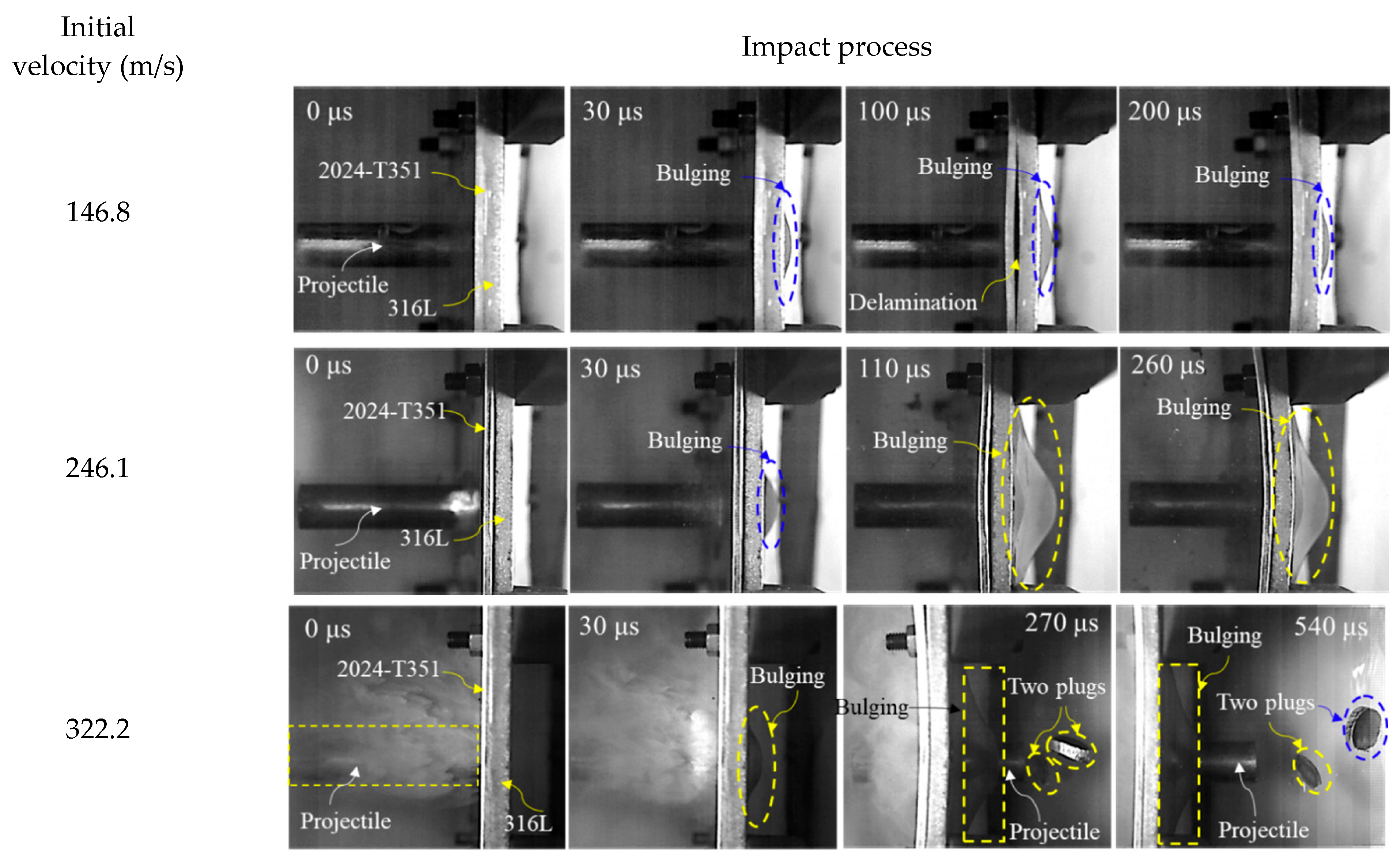
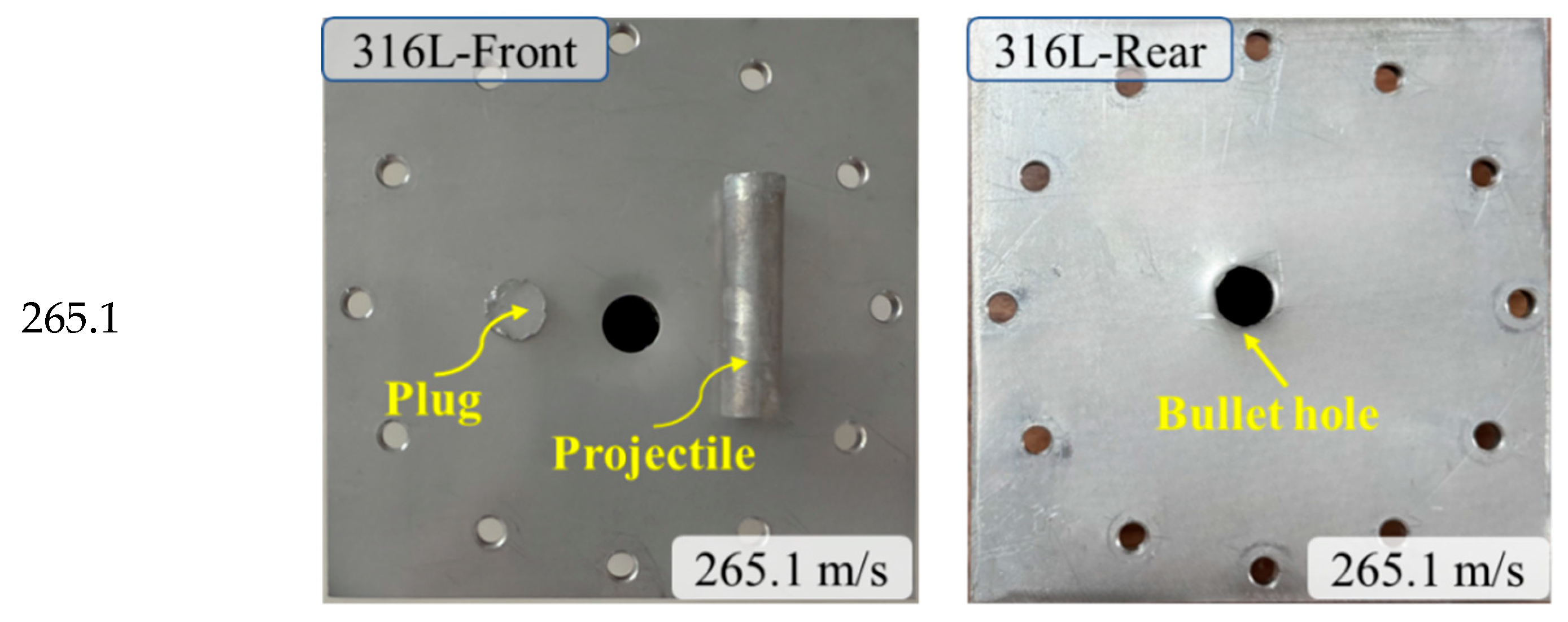
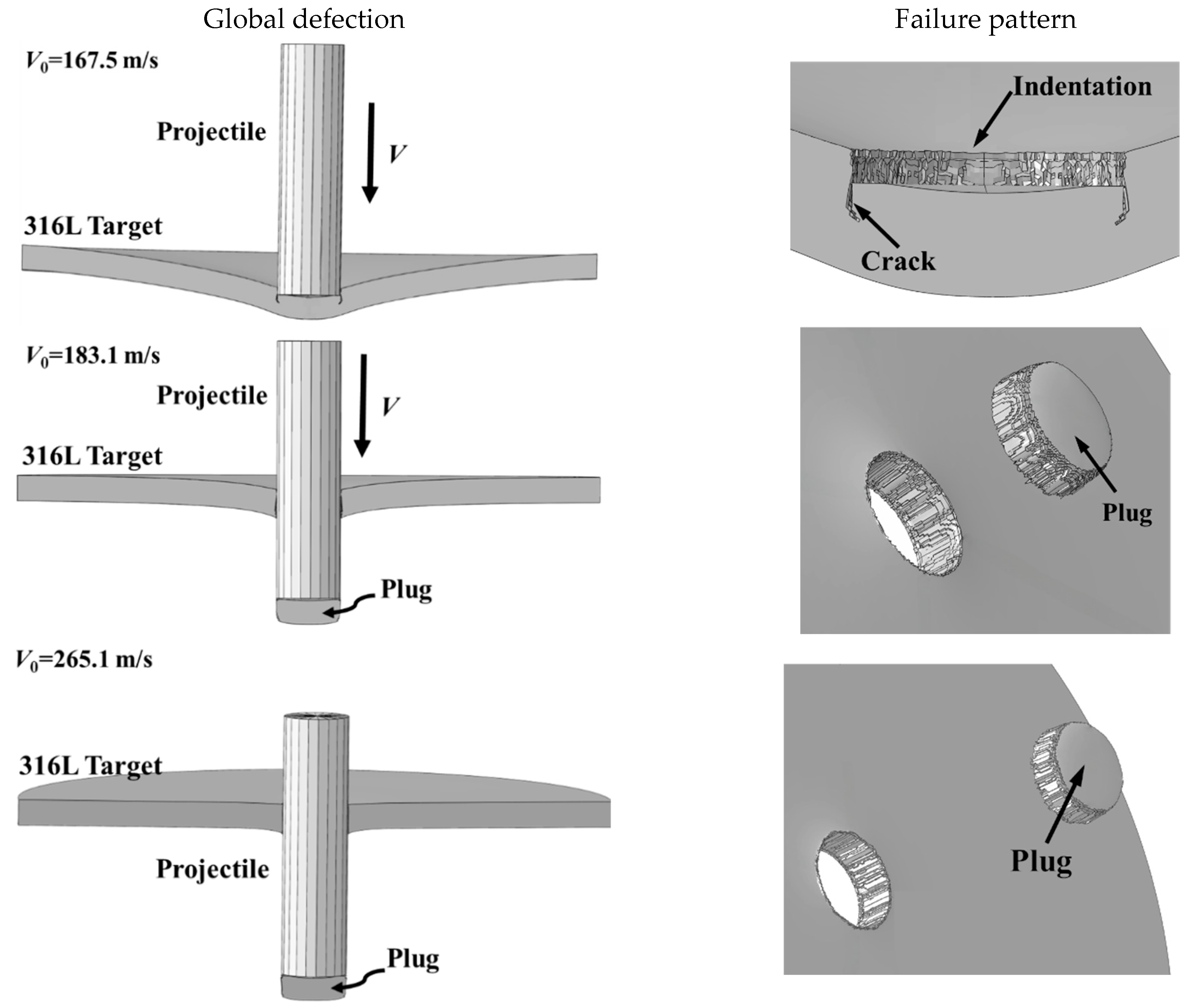
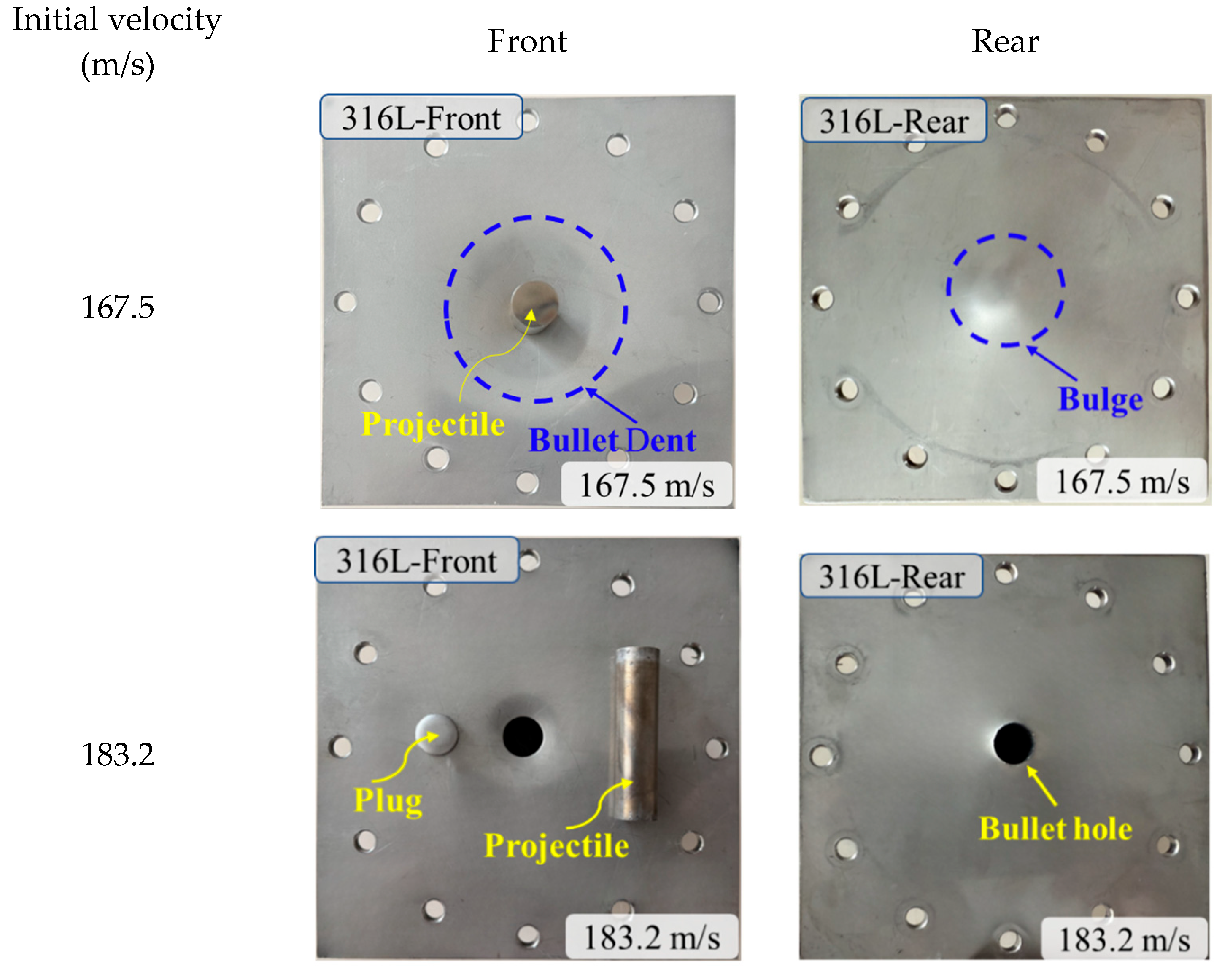
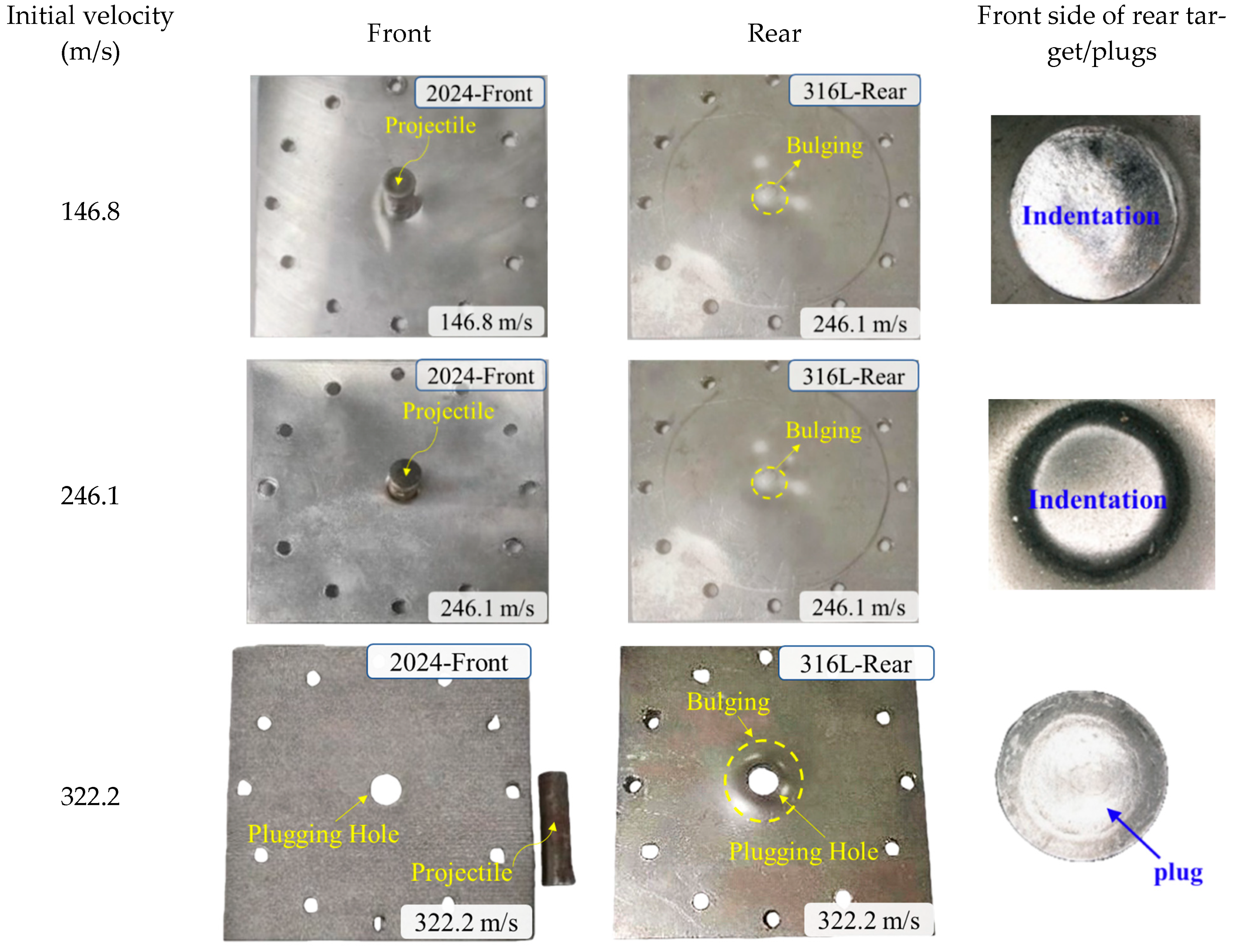
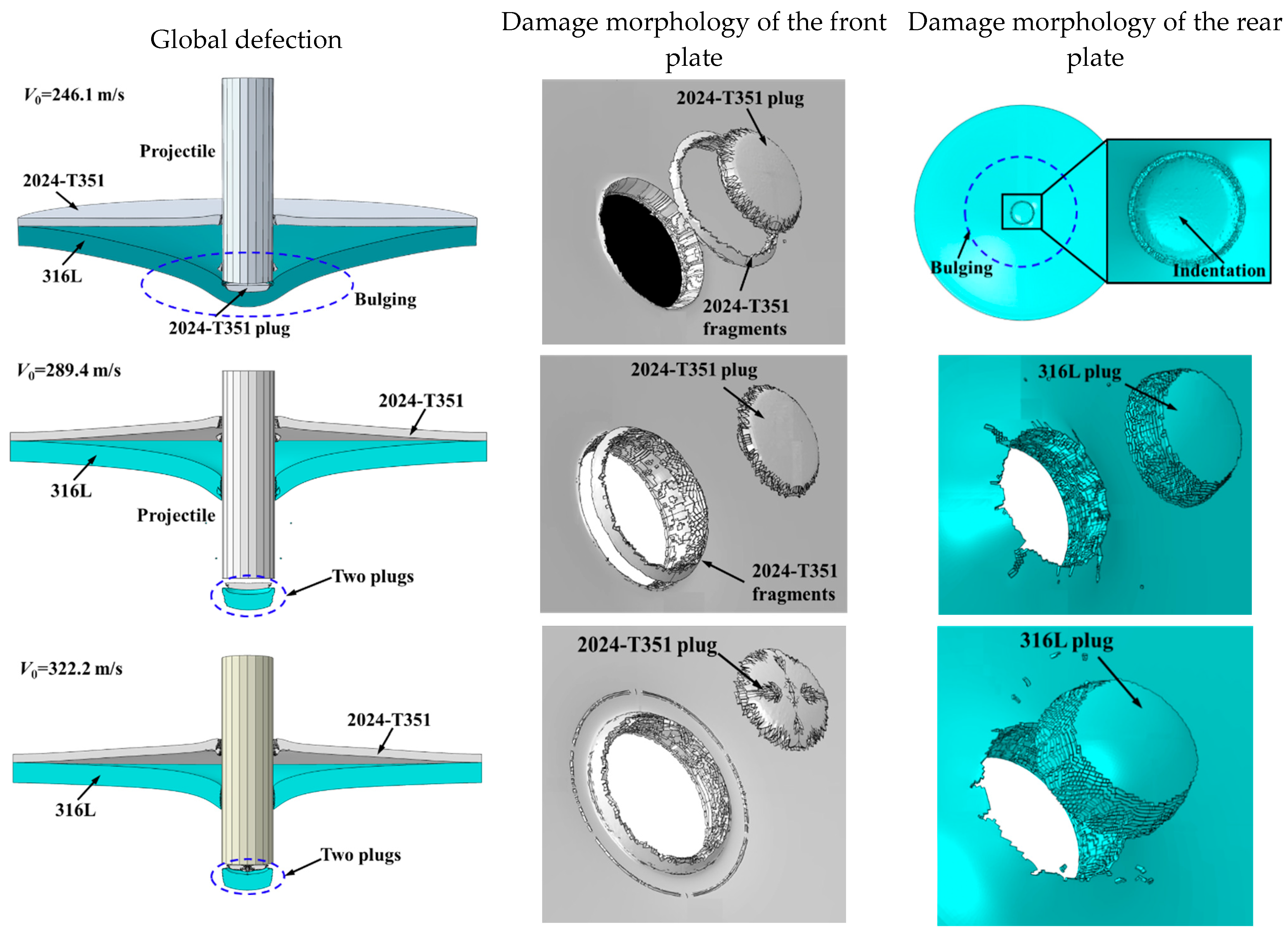
- The enhanced BLV correlates with failure mode shift from localized shear plugging to a combination of bulging, dishing and plugging.
Abstract
1. Introduction
2. Ballistic Experiments
2.1. Test Setup
2.2. Experimental Results
2.2.1. Ballistic Limit Velocity
2.2.2. Failure Mechanism of the Targets
3. Numerical Simulation
3.1. Finite Element Model
3.2. Material Models
4. Numerical Findings and Their Comparison to Experimental Data
4.1. Ballistic Limit Velocities
4.2. Failure Pattern
5. Enhancement Mechanism of 2024-T351 AA Front Layer on the Ballistic Performance of 316L ASS Target
5.1. Energy Absorption Fundamentals and Core Dissipation Mechanisms
5.2. Enhancement Mechanism of the 2024-T351 AA Layer
5.2.1. Energy Absorption by the Front Layer
5.2.2. Transformation of the Failure Mechanism and Energy Absorption in the Main 316L ASS Plate
5.3. Numerical Validation of the Enhancement Mechanism
5.3.1. Energy Response of Monolithic 316L ASS Target
5.3.2. Energy Distribution and Interlayer Interaction Mechanism in Bilayer Targets
5.3.3. Mechanical Essence of Ballistic Performance Enhancement
6. Conclusions
Author Contributions
Funding
Data Availability Statement
Conflicts of Interest
References
- Liu, X.; Liu, G.; Xue, J.; Wang, X.; Li, Q. Hydrogen as a carrier of renewable energies toward carbon neutrality: State-of-the-art and challenging issues. Int. J. Miner. Metall. Mater. 2022, 29, 1073–1089. [Google Scholar] [CrossRef]
- Evro, S.; Oni, B.A.; Tomomewo, O.S. Carbon neutrality and hydrogen energy systems. Int. J. Hydrogen Energy 2024, 78, 1449–1467. [Google Scholar] [CrossRef]
- Capurso, T.; Stefanizzi, M.; Torresi, M.; Camporeale, S.M. Perspective of the role of hydrogen in the 21st century energy transition. Energy Convers. Manag. 2022, 251, 114898. [Google Scholar] [CrossRef]
- Bromley, D.M. Hydrogen Embrittlement Testing of Austenitic Stainless Steels Sus 316 and 316L. Master’s Thesis, University of British Columbia, Vancouver, BC, Canada, 2008. [Google Scholar]
- Okonkwo, P.C.; Belgacem, I.B.; Mansir, I.B.; Aliyu, M.; Emori, W.; Uzoma, P.C.; Beitelmal, W.H.; Akyüz, E.; Radwan, A.B.; Shakoor, R. A focused review of the hydrogen storage tank embrittlement mechanism process. Int. J. Hydrogen Energy 2023, 48, 12935–12948. [Google Scholar] [CrossRef]
- Zhao, Q.; Xiao, X.; Ge, R.; Zhang, Y.; Chen, X.; Jia, B. Experimental-numerical study on ballistic impact behavior of 316L austenitic stainless steel plates against blunt and ogival projectiles. Int. J. Hydrogen Energy 2023, 48, 8526–8548. [Google Scholar] [CrossRef]
- Zhou, D.W.; Stronge, W.J. Ballistic limit for oblique impact of thin sandwich panels and spaced plates. Int. J. Impact Eng. 2008, 35, 1339–1354. [Google Scholar] [CrossRef]
- Rodríguez-Martínez, J.A.; Rusinek, A.; Pesci, R. Experimental survey on the behaviour of AISI 304 steel sheets subjected to perforation. Thin-Walled Struct. 2010, 48, 966–978. [Google Scholar] [CrossRef]
- Jia, B.; Rusinek, A.; Bahi, S.; Bernier, R.; Pesci, R.; Bendarma, A. Perforation Behavior of 304 Stainless Steel Plates at Various Temperatures. J. Dyn. Behav. Mater. 2019, 5, 416–431. [Google Scholar] [CrossRef]
- Dean, J.; Dunleavy, C.S.; Brown, P.M.; Clyne, T.W. Energy absorption during projectile perforation of thin steel plates and the kinetic energy of ejected fragments. Int. J. Impact Eng. 2009, 36, 1250–1258. [Google Scholar] [CrossRef]
- Masri, R.; Ryan, S. Ballistic limit predictions for perforation of multi-layered aluminium armour targets by rigid, nose-pointed projectiles. Int. J. Impact Eng. 2021, 155, 103900. [Google Scholar] [CrossRef]
- Zhai, Y.; Wu, H.; Fang, Q. Impact resistance of armor steel/ceramic/UHPC layered composite targets against 30CrMnSiNi2A steel projectiles. Int. J. Impact Eng. 2021, 154, 103888. [Google Scholar] [CrossRef]
- Gamble, E.; Compton, B.; Zok, F. Impact response of layered steel–alumina targets. Mech. Mater. 2013, 60, 80–92. [Google Scholar] [CrossRef]
- Gupta, N.; Iqbal, M.A.; Sekhon, G. Effect of projectile nose shape, impact velocity and target thickness on the deformation behavior of layered plates. Int. J. Impact Eng. 2008, 35, 37–60. [Google Scholar] [CrossRef]
- Velmurugan, R.; Gupta, N. Perforation of layered composite plates by impactors of different nose shapes. Def. Sci. J. 2008, 58, 227–237. [Google Scholar] [CrossRef]
- Senthil, K.; Iqbal, M.A. Prediction of superior target layer configuration of armour steel, mild steel and aluminium 7075-T651 alloy against 7.62 AP projectile. Structures 2021, 29, 2106–2119. [Google Scholar] [CrossRef]
- Han, J.; Ma, Q.; He, H.; Xiao, X. Experimental and Numerical Study on the Ballistic Resistance of Heterogeneous Double-Layered Aluminum Alloy Targets Against Blunt Projectiles. J. Mater. Eng. Perform. 2024, 34, 16847–16867. [Google Scholar] [CrossRef]
- Xiao, X.; Shi, Y.; Wang, Y.; Chen, X.; Jia, B. Effect of incorporating Lode angle parameter into a fracture criterion in predicting ballistic impact behavior of double-layered 2024-T351 aluminum alloy plates against blunt projectiles. Int. J. Impact Eng. 2022, 160, 104082. [Google Scholar] [CrossRef]
- Lambert, J.; Jonas, G. Towards Standardization in Terminal Ballistics Testing: Velocity Representation. 1976. Available online: https://www.semanticscholar.org/paper/Towards-Standardization-in-Terminal-Ballistics-Lambert-Jonas/5d14f925ec5c5bd5d00e49e30c0e3c54fae6559c (accessed on 1 March 2025).
- Xiao, X.; Pan, H.; Bai, Y.; Lou, Y.; Chen, L. Application of the modified Mohr–Coulomb fracture criterion in predicting the ballistic resistance of 2024-T351 aluminum alloy plates impacted by blunt projectiles. Int. J. Impact Eng. 2019, 123, 26–37. [Google Scholar] [CrossRef]
- Xiao, X.; Wang, Y.; Vershinin, V.V.; Chen, L.; Lou, Y. Effect of Lode angle in predicting the ballistic resistance of Weldox 700 E steel plates struck by blunt projectiles. Int. J. Impact Eng. 2019, 128, 46–71. [Google Scholar] [CrossRef]
- Johnson, G.R. A constitutive model and data for metals subjected to large strains, high strain rates and high temperatures. In Proceedings of the 7th International Symposium on Ballistics, The Hague, The Netherlands, 19–21 April 1983. [Google Scholar]
- Ludwik, P. Elemente der Technologischen Mechanik; Springer: Berlin/Heidelberg, Germany, 1909. [Google Scholar]
- Voce, E. The relationship between stress and strain for homogeneous deformation. J. Inst. Met. 1948, 74, 537–562. [Google Scholar]
- Roth, C.C.; Mohr, D. Effect of strain rate on ductile fracture initiation in advanced high strength steel sheets: Experiments and modeling. Int. J. Plast. 2014, 56, 19–44. [Google Scholar] [CrossRef]
- Dunand, M.; Mohr, D. On the predictive capabilities of the shear modified Gurson and the modified Mohr–Coulomb fracture models over a wide range of stress triaxialities and Lode angles. J. Mech. Phys. Solids 2011, 59, 1374–1394. [Google Scholar] [CrossRef]
- Bai, Y.; Wierzbicki, T. Application of extended Mohr–Coulomb criterion to ductile fracture. Int. J. Fract. 2010, 161, 1–20. [Google Scholar] [CrossRef]
- Xiao, X.; Mu, Z.; Pan, H.; Lou, Y. Effect of the Lode parameter in predicting shear cracking of 2024-T351 aluminum alloy Taylor rods. Int. J. Impact Eng. 2018, 120, 185–201. [Google Scholar] [CrossRef]
- Lou, Y.; Huh, H.; Lim, S.; Pack, K. New ductile fracture criterion for prediction of fracture forming limit diagrams of sheet metals. Int. J. Solids Struct. 2012, 49, 3605–3615. [Google Scholar] [CrossRef]
- Wu, S.; Zhou, C.; Shi, Y.; Hu, A.; Xiao, X. Plasticity, ductile fracture and ballistic impact behavior of Ti-6Al-4V Alloy. Int. J. Impact Eng. 2023, 174, 104493. [Google Scholar] [CrossRef]
- Han, J.; Shi, Y.; Ma, Q.; Vershinin, V.V.; Chen, X.; Xiao, X.; Jia, B. Experimental and numerical investigation on the ballistic resistance of 2024-T351 aluminum alloy plates with various thicknesses struck by blunt projectiles. Int. J. Impact Eng. 2022, 163, 104182. [Google Scholar] [CrossRef]
- Deng, Y.; Yang, X.; Wu, H.; Feng, Z. Effect of incorporating Lode angle into fracture criterion on predicting ballistic resistance of 6061-T651 aluminum alloy plates with different thicknesses struck by blunt projectiles. Eng. Fract. Mech. 2023, 292, 109634. [Google Scholar] [CrossRef]
- Rusinek, A.; Klepaczko, J. Experiments on heat generated during plastic deformation and stored energy for TRIP steels. Mater. Des. 2009, 30, 35–48. [Google Scholar] [CrossRef]
- Rittel, D.; Zhang, L.; Osovski, S. The dependence of the Taylor–Quinney coefficient on the dynamic loading mode. J. Mech. Phys. Solids 2017, 107, 96–114. [Google Scholar] [CrossRef]
- Børvik, T.; Langseth, M.; Hopperstad, O.; Malo, K. Perforation of 12 mm thick steel plates by 20 mm diameter projectiles with flat, hemispherical and conical noses: Part I: Experimental study. Int. J. Impact Eng. 2002, 27, 19–35. [Google Scholar] [CrossRef]
- Kpenyigba, K.; Jankowiak, T.; Rusinek, A.; Pesci, R. Influence of projectile shape on dynamic behavior of steel sheet subjected to impact and perforation. Thin-Walled Struct. 2013, 65, 93–104. [Google Scholar] [CrossRef]
- Jankowiak, T.; Rusinek, A.; Wood, P. A numerical analysis of the dynamic behaviour of sheet steel perforated by a conical projectile under ballistic conditions. Finite Elem. Anal. Des. 2013, 65, 39–49. [Google Scholar] [CrossRef]






| NO. | Initial Diameter di (mm) | Initial Length li (mm) | Initial Mass m (g) | Initial Velocity V0 (m/s) | Residual Velocity Vr (m/s) | Status |
|---|---|---|---|---|---|---|
| 1 | 12.66 | 50.60 | 49.52 | 287.8 | 215.4 | Perforated |
| 2 | 12.66 | 50.61 | 49.53 | 265.1 | 216.4 | Perforated |
| 3 | 12.66 | 50.57 | 49.55 | 167.4 | 0 | Projectile got stuck |
| 4 | 12.66 | 50.50 | 49.55 | 219.7 | 180.1 | Perforated |
| 5 | 12.66 | 50.55 | 49.55 | 183.2 | 134.1 | Perforated |
| 6 | 12.66 | 50.56 | 49.53 | 205.8 | 160.8 | Perforated |
| 7 | 12.66 | 50.82 | 49.55 | 153.5 | 0 | Projectile got stuck |
| 8 | 12.66 | 50.60 | 49.55 | 167.5 | 92.2 | Perforated |
| 9 | 12.66 | 50.61 | 49.56 | 352.3 | 307.1 | Perforated |
| NO. | Initial Diameter di (mm) | Initial Length li (mm) | Initial Mass m (g) | Initial Velocity V0 (m/s) | Residual Velocity Vr (m/s) | Status |
|---|---|---|---|---|---|---|
| 1 | 12.72 | 50.61 | 50.27 | 246.1 | 0.00 | Projectile got stuck |
| 2 | 12.73 | 50.60 | 50.32 | 146.8 | 0.00 | Projectile got stuck |
| 3 | 12.72 | 50.56 | 50.23 | 250.7 | 0.00 | Projectile got stuck |
| 4 | 12.73 | 50.49 | 50.16 | 246.9 | 0.00 | Projectile got stuck |
| 5 | 12.73 | 50.59 | 50.27 | 268.2 | 138.5 | Perforated |
| 6 | 12.73 | 50.58 | 50.31 | 209.8 | 0.00 | Projectile got stuck |
| 7 | 12.75 | 50.83 | 50.30 | 246.7 | 0.00 | Projectile got stuck |
| 8 | 12.73 | 50.62 | 50.29 | 283.6 | 148.3 | Perforated |
| 9 | 12.73 | 50.62 | 50.32 | 289.4 | 216.3 | Perforated |
| 10 | 12.72 | 50.61 | 50.33 | 246.7 | 0.00 | Projectile got stuck |
| 11 | 12.74 | 50.60 | 50.31 | 247.2 | 0.00 | Projectile got stuck |
| 12 | 12.74 | 50.59 | 50.28 | 258.1 | 7.38 | Perforated |
| 13 | 12.72 | 50.64 | 50.29 | 253.5 | 101.8 | Perforated |
| 14 | 12.73 | 50.66 | 50.30 | 322.2 | 248.0 | Perforated |
| Target | Test | Simulation | ||||
|---|---|---|---|---|---|---|
| a | p | Vbl (m/s) | a | p | Vbl (m/s) | |
| 316L monolithic | 0.84 | 5.35 | 167.3 | 0.88 | 4.95 | 167.5 |
| 2024+316L bilayer | 0.99 | 2.50 | 250.7 | 0.91 | 3.44 | 253.4 |
| 316L ASS | 2024-T351 AA | ||||
|---|---|---|---|---|---|
| Description | Notation | value | Description | Notation | value |
| Modulus of elasticity | E (GPa) | 183.3 | Modulus of elasticity | E (GPa) | 72.0 |
| Poisson’s ratio | v | 0.3 | Poisson’s ratio | v | 0.3 |
| Density | ρ (kg/m3) | 7900 | Density | ρ (kg/m3) | 2770 |
| Yield stress constant | A (MPa) | 266.2 | Yield stress constant | A (MPa) | 360.3 |
| Strain hardening constant | B (MPa) | 1263.37 | Strain hardening constant | B (MPa) | 649.4 |
| n | 0.72 | n | 0.68 | ||
| Q (MPa) | 1068.6 | Q (MPa) | 235.9 | ||
| β | 2.373 | β | 8.988 | ||
| α | 0.51 | α | 0.104 | ||
| Strain rate constant | C | 0.025 | Strain rate constant | C | 0.0146 |
| Thermal softening constant 1 | p | 1.0 | Thermal softening constant 1 | p | 1.702 |
| Thermal softening constant 2 | m | 0.8 | Thermal softening constant 2 | m | 2.768 |
| Reference strain rate | 8.33 × 10⁻⁴ | Reference strain rate | 8.33 × 10⁻⁴ | ||
| Room temperature | T0 (K) | 293 | Room temperature | T0 (K) | 293 |
| Melting temperature | Tm (K) | 1733 | Melting temperature | Tm (K) | 775 |
| Inelastic heat fraction | 0.9 | Inelastic heat fraction | 0.9 | ||
| Specific heat | Cp (J/kgK) | 441 | Specific heat | Cp (J/kgK) | 875 |
| MMC constants | K (MPa) | 1347 | MMC constants | K (MPa) | 678.7 |
| n | 0.425 | n | 0.138 | ||
| c1 | 0.147 | c1 | 0.104 | ||
| c2 | 964.3 | c2 | 335.6 | ||
| 1.0 | 1.0 | ||||
| 1.147 | 1.036 | ||||
| D4 | −0.036 | D4 | 0.011 | ||
| D5 | 26.75 | D5 | 0.0 | ||
| D6 | 7.899 | D6 | 1.0 | ||
| 5 mm Thick Monolithic 316LASS Target | 2024+316L Bilayer Target | ||||
|---|---|---|---|---|---|
| V0 (m/s) | Vi (m/s) | V0 (m/s) | Vi (m/s) | ||
| Test | MMC | Test | MMC | ||
| 287.8 | 215.4 | 249.1 | 146.8 | 0.0 | 0.0 |
| 265.1 | 216.4 | 226.7 | 209.8 | 0.0 | 0.0 |
| 167.4 | 0.0 | 0.0 | 246.9 | 0.0 | 0.0 |
| 219.7 | 180.1 | 178.7 | 258.1 | 7.38 | 134.1 |
| 183.2 | 134.1 | 132.1 | 268.2 | 138.48 | 159.4 |
| 205.8 | 160.8 | 163.0 | 253.5 | 101.82 | 113.5 |
| 153.5 | 0 | 0 | 283.6 | 148.31 | 191.2 |
| 167.5 | 92.2 | 0 | 289.4 | 216.34 | 202.1 |
| 352.3 | 307.1 | 309.5 | 322.2 | 247.97 | 253.8 |
| Target Configuration | Component/Plate | Energy (J) | Percentage (%) | Impact Velocity (m/s) | Projectile Kinetic Energy (J) | |
|---|---|---|---|---|---|---|
| Monolithic 316L ASS | WPLocal | 137.5 | 34.5 | 177.6 | 399.0 | |
| WPGlobal | 45.84 | 11.5 | ||||
| WPLocal | 157.7 | 17.6 | 265.7 | 893.1 | ||
| WPGlobal | 12.6 | 1.4 | ||||
| Bilayer target | Front plate | WPLocal | 98.6 | 11.0 | 265.7 | 893.1 |
| WPGlobal | 1.43 | 0.16 | ||||
| Rear plate | WPLocal | 262.8 | 29.4 | |||
| WPGlobal | 175.8 | 19.7 | ||||
Disclaimer/Publisher’s Note: The statements, opinions and data contained in all publications are solely those of the individual author(s) and contributor(s) and not of MDPI and/or the editor(s). MDPI and/or the editor(s) disclaim responsibility for any injury to people or property resulting from any ideas, methods, instructions or products referred to in the content. |
© 2025 by the authors. Licensee MDPI, Basel, Switzerland. This article is an open access article distributed under the terms and conditions of the Creative Commons Attribution (CC BY) license (https://creativecommons.org/licenses/by/4.0/).
Share and Cite
Xiao, X.; Ma, Q.; Kong, Y.; Lian, H.; Han, J.; Gao, Y. An Experimental and Numerical Investigation on Enhancing the Ballistic Resistance of 316L Stainless Steel Plates Against Blunt Projectiles by Covering with 2024-T351 Aluminum Alloy Thin Plates. Materials 2025, 18, 4264. https://doi.org/10.3390/ma18184264
Xiao X, Ma Q, Kong Y, Lian H, Han J, Gao Y. An Experimental and Numerical Investigation on Enhancing the Ballistic Resistance of 316L Stainless Steel Plates Against Blunt Projectiles by Covering with 2024-T351 Aluminum Alloy Thin Plates. Materials. 2025; 18(18):4264. https://doi.org/10.3390/ma18184264
Chicago/Turabian StyleXiao, Xinke, Qianqian Ma, Yifan Kong, Hao Lian, Jue Han, and Yubo Gao. 2025. "An Experimental and Numerical Investigation on Enhancing the Ballistic Resistance of 316L Stainless Steel Plates Against Blunt Projectiles by Covering with 2024-T351 Aluminum Alloy Thin Plates" Materials 18, no. 18: 4264. https://doi.org/10.3390/ma18184264
APA StyleXiao, X., Ma, Q., Kong, Y., Lian, H., Han, J., & Gao, Y. (2025). An Experimental and Numerical Investigation on Enhancing the Ballistic Resistance of 316L Stainless Steel Plates Against Blunt Projectiles by Covering with 2024-T351 Aluminum Alloy Thin Plates. Materials, 18(18), 4264. https://doi.org/10.3390/ma18184264