Article

Fiber Thickness and Porosity Control in a Biopolymer Scaffold 3D Printed through a Converted Commercial FDM Device

1
Laboratory of Cellular and Molecular Engineering “Silvio Cavalcanti”, Department of Electrical, Electronic and Information Engineering “Guglielmo Marconi” (DEI), University of Bologna, 47521 Cesena, FC, Italy
2
Gynaecological Cancer Research Group, Lowy Cancer Research Centre, Faculty of Medicine and Health, School of Women’s and Children’s Health, University of New South Wales, Sydney 2031, Australia
3
Mark One S.r.l., 47521 Cesena, FC, Italy
4
Reconstructive Orthopaedic Surgery and Innovative Techniques-Musculoskeletal Tissue Bank, IRCCS Istituto Ortopedico Rizzoli, 40136 Bologna, RE, Italy
5
BioEngLab, Health Science and Technology, Interdepartmental Center for Industrial Research (HST-CIRI), Alma Mater Studiorum, University of Bologna, 40064 Ozzano Emilia, BO, Italy
6
Advanced Research Center on Electronic Systems (ARCES), University of Bologna, 40064 Ozzano Emilia, BO, Italy
*
Author to whom correspondence should be addressed.
Materials 2022, 15(7), 2394; https://doi.org/10.3390/ma15072394
Submission received: 8 February 2022 / Revised: 18 March 2022 / Accepted: 22 March 2022 / Published: 24 March 2022

Abstract

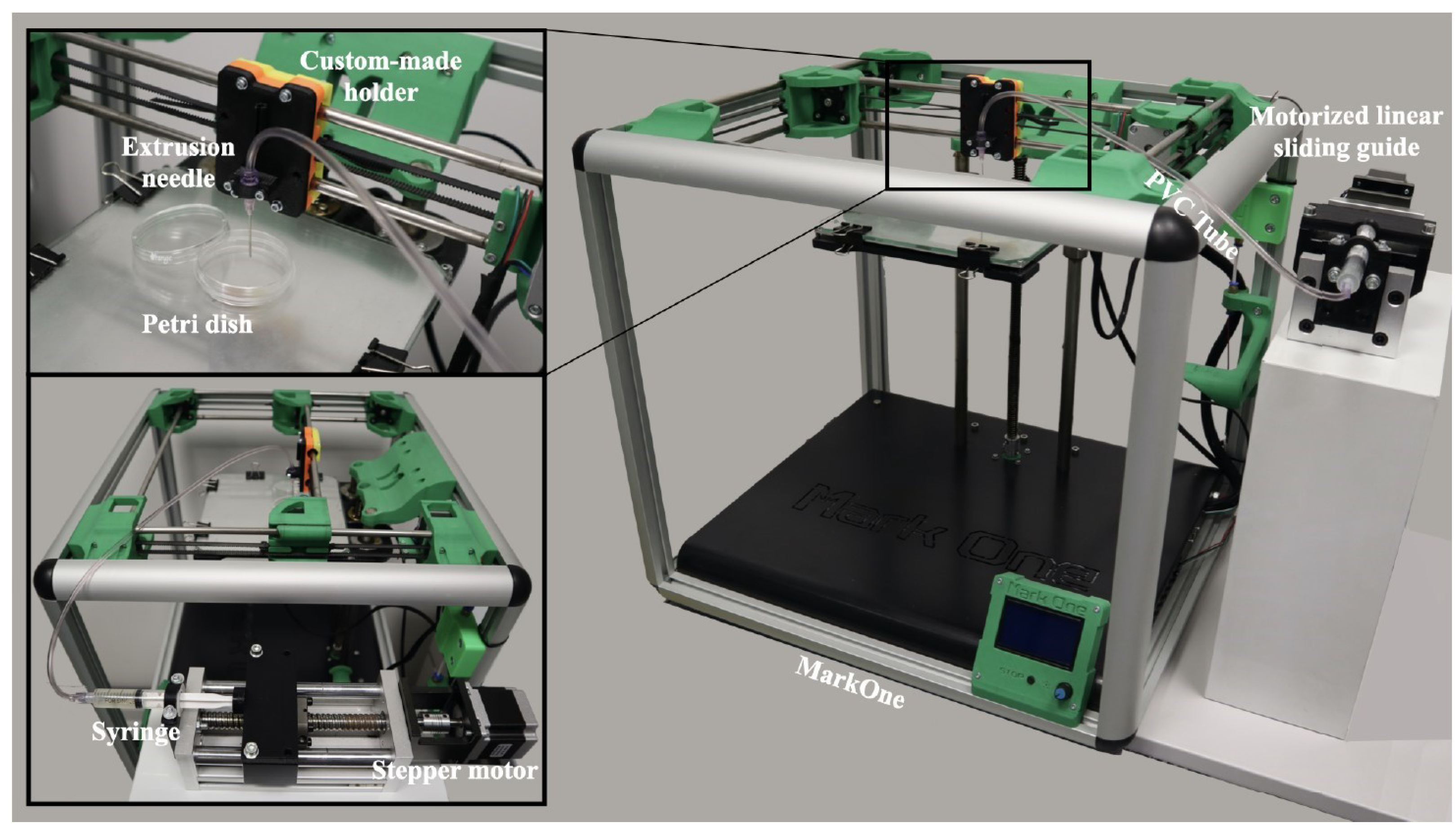
3D printing has opened exciting new opportunities for the in vitro fabrication of biocompatible hybrid pseudo-tissues. Technologies based on additive manufacturing herald a near future when patients will receive therapies delivering functional tissue substitutes for the repair of their musculoskeletal tissue defects. In particular, bone tissue engineering (BTE) might extensively benefit from such an approach. However, designing an optimal 3D scaffold with adequate stiffness and biodegradability properties also guaranteeing the correct cell adhesion, proliferation, and differentiation, is still a challenge. The aim of this work was the rewiring of a commercial fuse deposition modeling (FDM) 3D printer into a 3D bioplotter, aiming at obtaining scaffold fiber thickness and porosity control during its manufacturing. Although it is well-established that FDM is a fast and low-price technology, the high temperatures required for printing lead to limitations in the biomaterials that can be used. In our hands, modifying the printing head of the FDM device with a custom-made holder has allowed to print hydrogels commonly used for embedding living cells. The results highlight a good resolution, reproducibility and repeatability of alginate/gelatin scaffolds obtained via our custom 3D bioplotter prototype, showing a viable strategy to equip a small-medium laboratory with an instrument for manufacturing good-quality 3D scaffolds for cell culture and tissue engineering applications.
Keywords: 3D bioprinting; FDM; bone tissue engineering; scaffolds; alginate; gelatin; fiber thickness; porosity; bone grafting 3D bioprinting; FDM; bone tissue engineering; scaffolds; alginate; gelatin; fiber thickness; porosity; bone grafting