Article

Giant Strain and Induced Ferroelectricity in Amorphous BaTiO3 Films under Poling


by
Pegah Mirzadeh Vaghefi
1,*,
Ali Baghizadeh
2,
Armando A.C.S. Lourenço
1,
Vitor S. Amaral
1 and
Andre L. Kholkin
1,3
1
Department of Physics & CICECO-Aveiro Institute of Materials, University of Aveiro, 3810-193 Aveiro, Portugal
2
Department of Materials and Ceramics Engineering & CICECO-Aveiro Institute of Materials, University of Aveiro, 3810-193 Aveiro, Portugal
3
School of Natural Sciences and Mathematics, Ural Federal University, 620000 Ekaterinburg, Russia
*
Author to whom correspondence should be addressed.
Materials 2017, 10(9), 1107; https://doi.org/10.3390/ma10091107
Submission received: 28 August 2017 / Revised: 16 September 2017 / Accepted: 17 September 2017 / Published: 20 September 2017
(This article belongs to the Special Issue Scanning Probe Microscopy of Ferroics)

Abstract

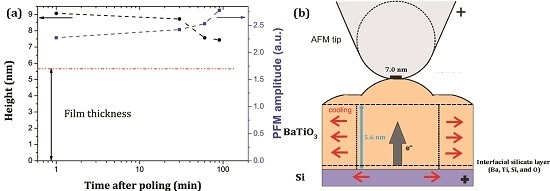
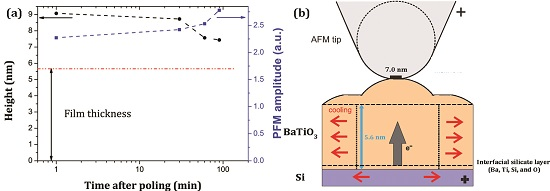
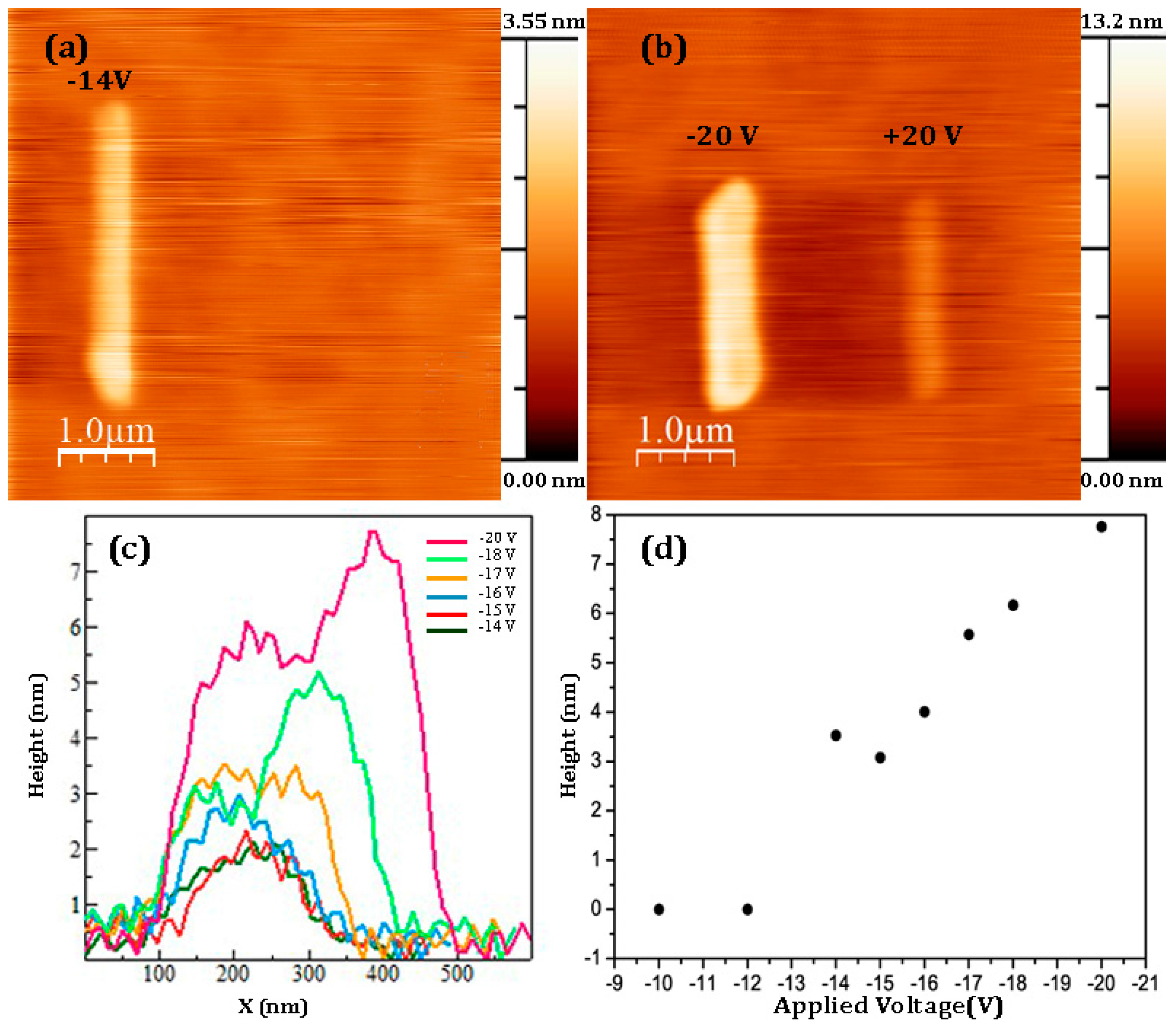
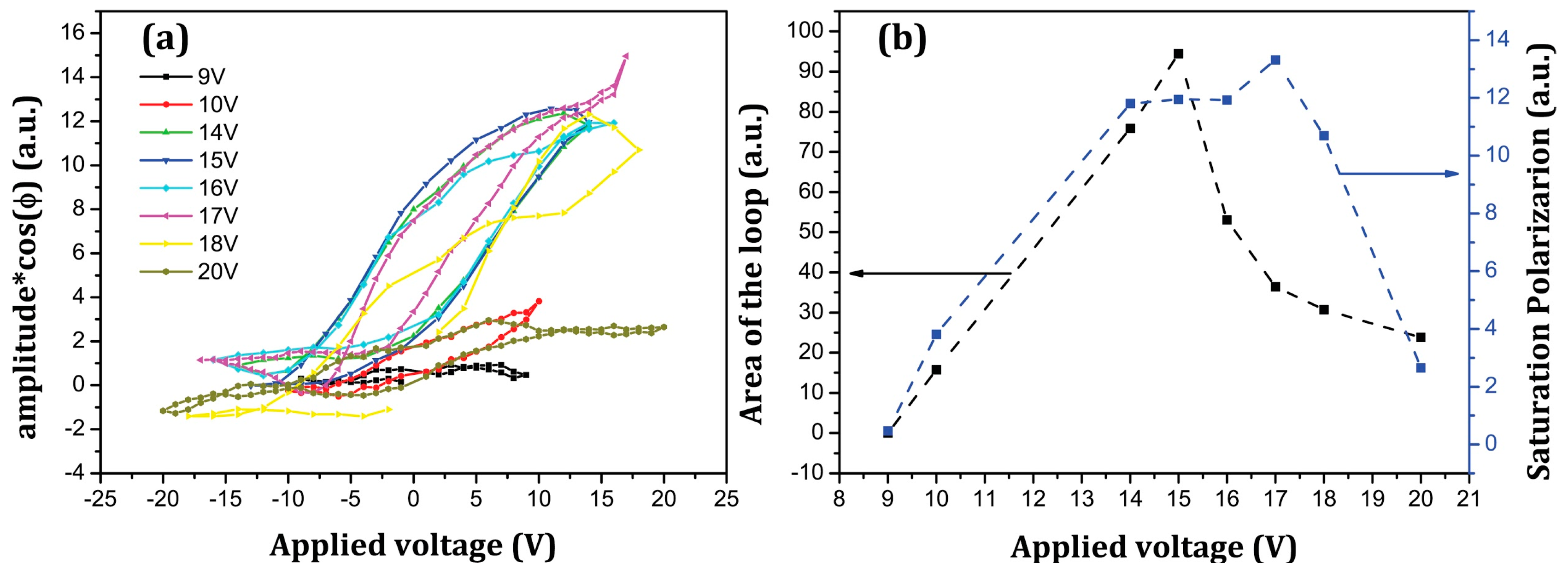
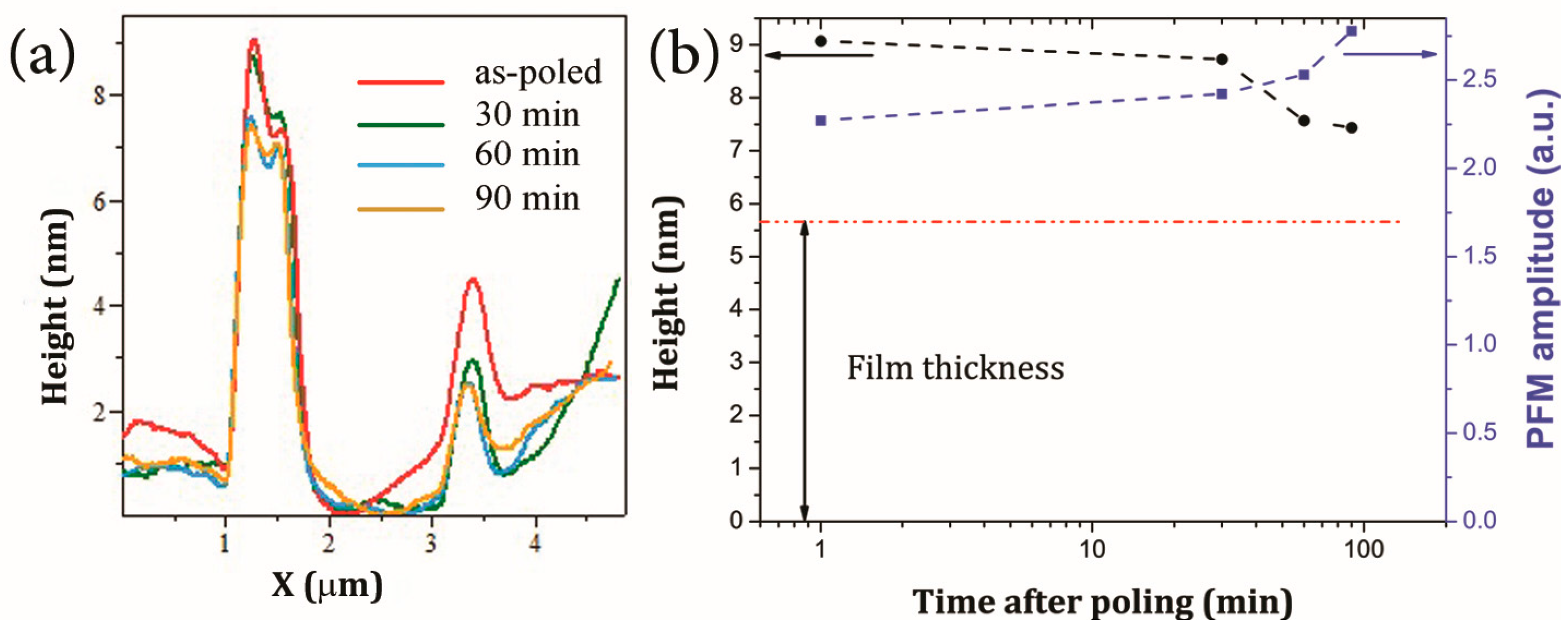
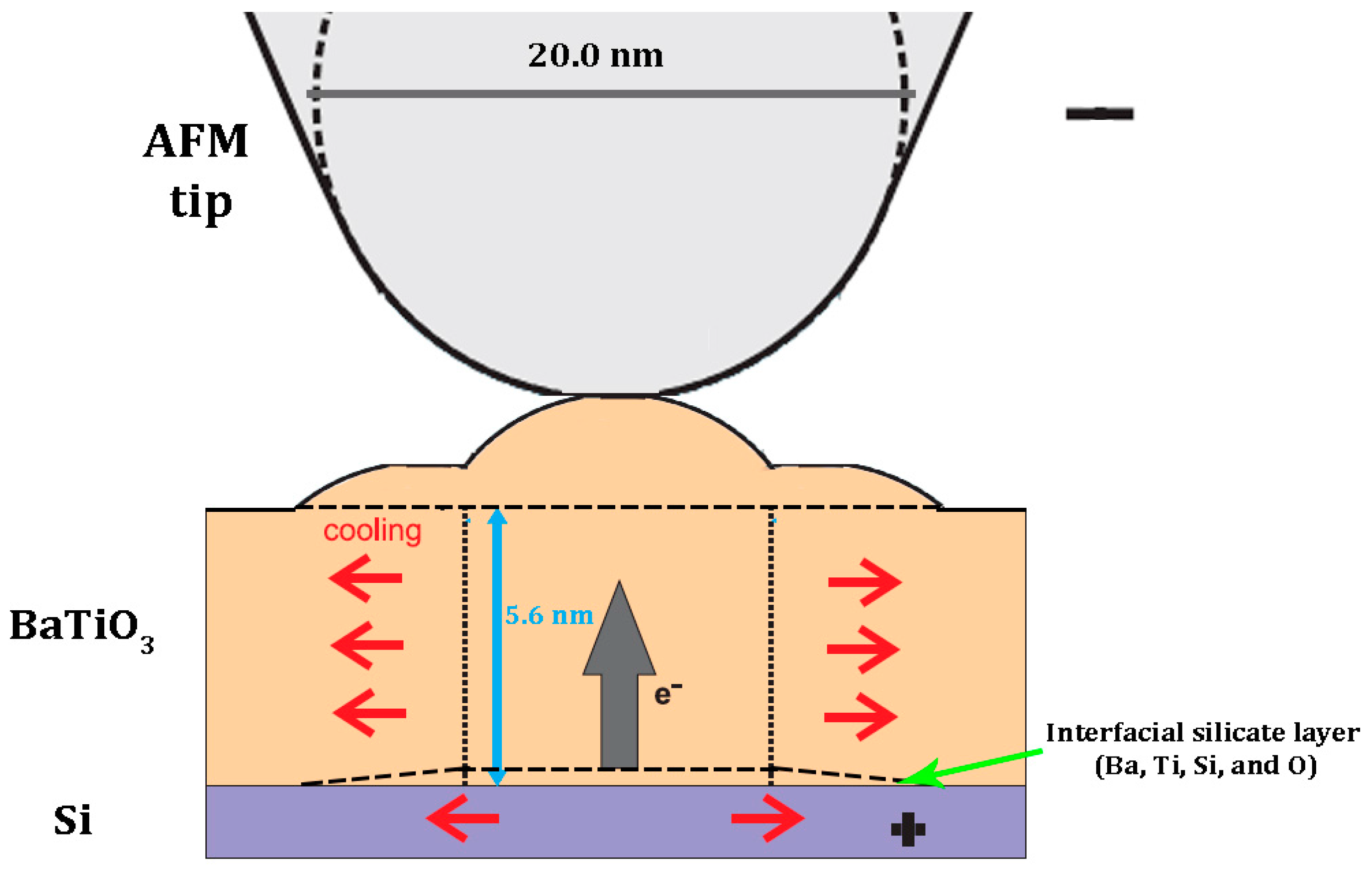
We report an effect of giant surface modification of a 5.6 nm thick BaTiO3 film grown on Si (100) substrate under poling by conductive tip of a scanning probe microscope (SPM). The surface can be locally elevated by about 9 nm under −20 V applied during scanning, resulting in the maximum strain of 160%. The threshold voltage for the surface modification is about 12 V. The modified topography is stable enough with time and slowly decays after poling with the rate ~0.02 nm/min. Strong vertical piezoresponse after poling is observed, too. Combined measurements by SPM and piezoresponse force microscopy (PFM) prove that the poled material develops high ferroelectric polarization that cannot be switched back even under an oppositely oriented electric field. The topography modification is hypothesized to be due to a strong Joule heating and concomitant interface reaction between underlying Si and BaTiO3. The top layer is supposed to become ferroelectric as a result of local crystallization of amorphous BaTiO3. This work opens up new possibilities to form nanoscale ferroelectric structures useful for various applications.
Keywords: BaTiO3; ferroelectricity; piezoresponse force microscopy; self-assembly; poling BaTiO3; ferroelectricity; piezoresponse force microscopy; self-assembly; poling
Graphical Abstract