


Abstract
Medium-voltage (MV) networks are increasingly relying on grid-forming inverter-based resources (IBRs) due to the worldwide transition towards renewable energy sources. This transformation poses considerable challenges for traditional protection schemes that were initially developed for systems powered by inertia-based generation. Key challenges include the low and controlled contributions of fault current, two-way power flows, diminished system inertia, and swiftly changing transient behaviors. These elements weaken the effectiveness of standard protection methods such as overcurrent, distance, and differential protection schemes. A critical review of recent advancements in adaptive protection schemes, impedance-based techniques, virtual synchronous machines, and enhancements in inverter control is provided. However, despite these advancements, current solutions frequently lack validation in real-world scenarios, encounter difficulties in detecting high-impedance faults, and face scalability issues. There remains a demand for protection strategies that are resilient, coordinated, and specifically designed to address the distinct dynamics of MV systems dominated by grid-forming inverters.
1. Introduction
The rapid integration of renewable energy sources using inverter-based resources (IBRs) has significantly transformed the power grid globally. Many regions in the world have ambitious goals of reaching 100% IBR-driven energy. This has resulted in MV networks being entirely fed by IBRs for specific periods of time. To support this high penetration of renewable energy, grid-forming inverters (GFMs) have become critical for maintaining system stability [1,2,3,4].
Traditional grid-following inverters typically rely on external grid signals, such as phase-locked loops (PLLs), for synchronization. Grid-forming inverters (GFMs), on the other hand, operate quite differently. They generate their own voltage and phase references and independently control both voltage and frequency, closely emulating the dynamic response of synchronous generators. This capability allows GFMs to support weak grids and islanded operation, including black-start scenarios. However, when GFMs replace conventional synchronous machines, they introduce new challenges that can lead to protection failures and even system instability. Ensuring smooth and reliable grid operation in these situations requires these issues to be properly identified and addressed [2,5,6,7]. In this review, the discussion of grid-forming inverters focuses specifically on their operational and control characteristics that directly influence the performance of protection schemes.
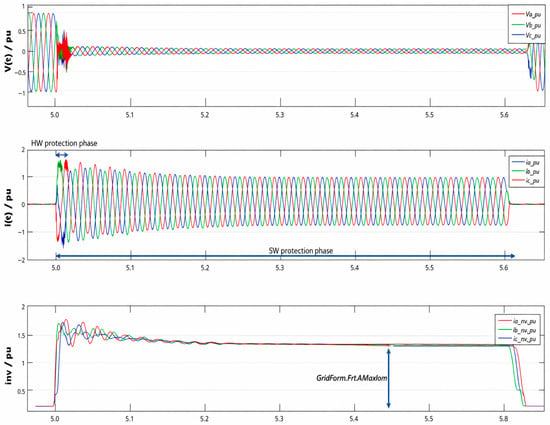
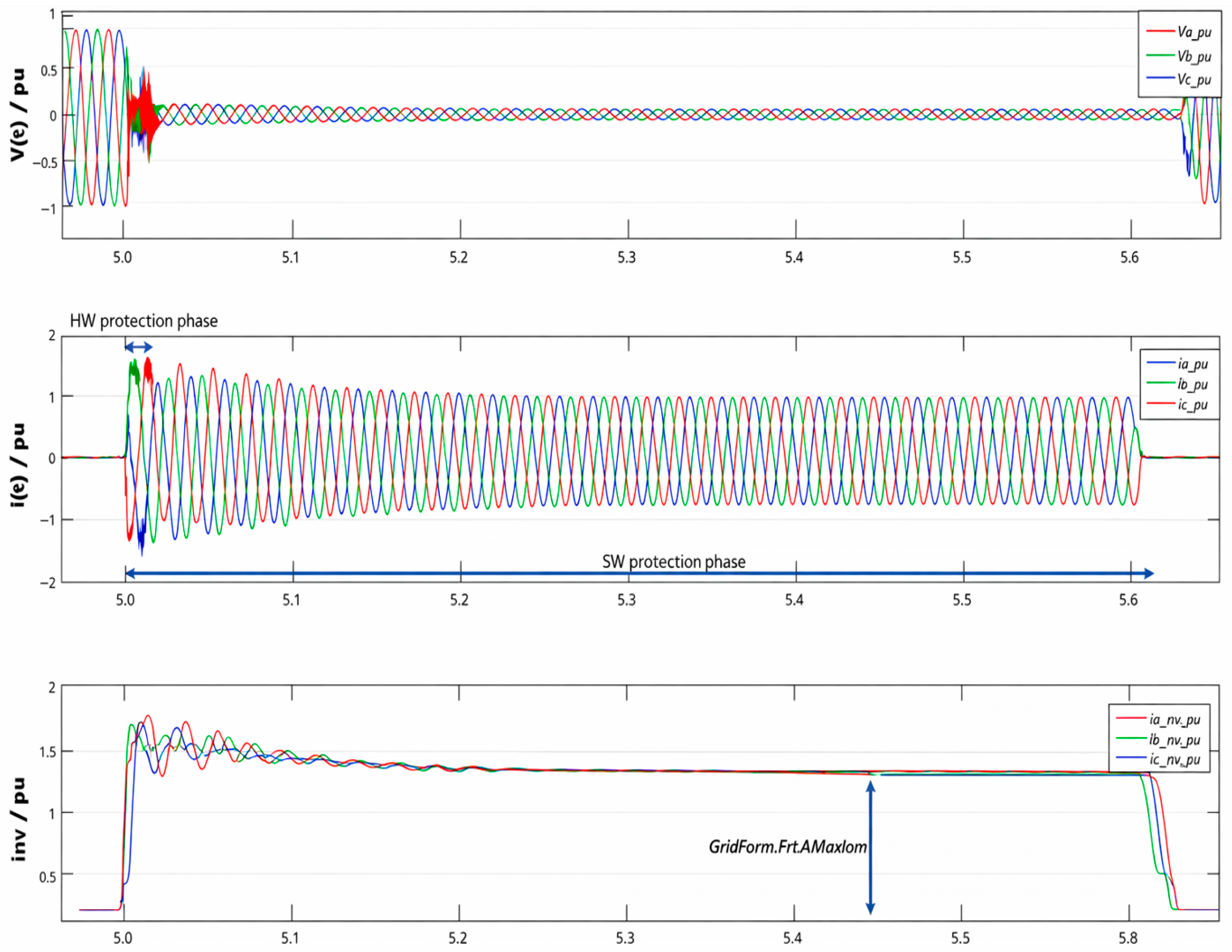
A primary challenge of IBRs is that they contribute low fault current compared to SGs. While a typical SG can contribute fault current ranging between 5 and 10 times the nominal current, the current of IBRs ranges between 1 and 2 times the nominal current, with significantly different transient behavior. In fact, in a 100% IBR-based MV network, the fault current can be so low that traditional overcurrent protection relay may fail to even detect the fault [6,8,9,10,11]. Figure 1 shows the inverter fault current profile.
Figure 1.
Typical IBR fault profile (extracted from SMA technical manual).
Figure 1 shows the typical fault profile of an IBR following the fault event. The top subplot shows the three-phase voltage response of the inverter, the middle subplot shows the three-phase current response, and the bottom subplot shows the inverter’s current-limited fault response, which is the main protection-relevant feature.
Few studies have documented the fault current levels contributed by GFMs, which reach up to 2.0 pu, after which the current clamps engage to limit the fault current contribution [6,8].
GFMs also react quickly to network disturbances because of minimum inertia, which results in significantly different faults from the current profile as compared to SGs. This variation limits the operation of traditional protection devices that heavily depend on the sustainable fault current level and peculiar transient behavior. This may directly result in the failure of protection devices, especially when the MV network is entirely supplied by IBRs. Another issue is related to distribution networks with multiple distributed GFMs, which can result in bidirectional fault current that limits the capability of traditional overcurrent relays, which are set for SG scenarios where fault is fed unidirectionally. This may result in miscoordination and selectivity issues since the high penetration of IBRs turns passive feeders into active multi-source networks resulting in an altered fault current profile. Moreover, the control strategies result in the variable output of IBR, which, in turn, results in inconsistent fault-level contributions over time. All these combined factors lead to relay misoperation, loss of selectivity, miscoordination, and ineffectiveness of tradition overcurrent protection relay [7,9,10,12]
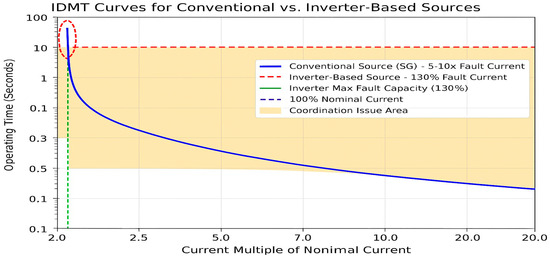
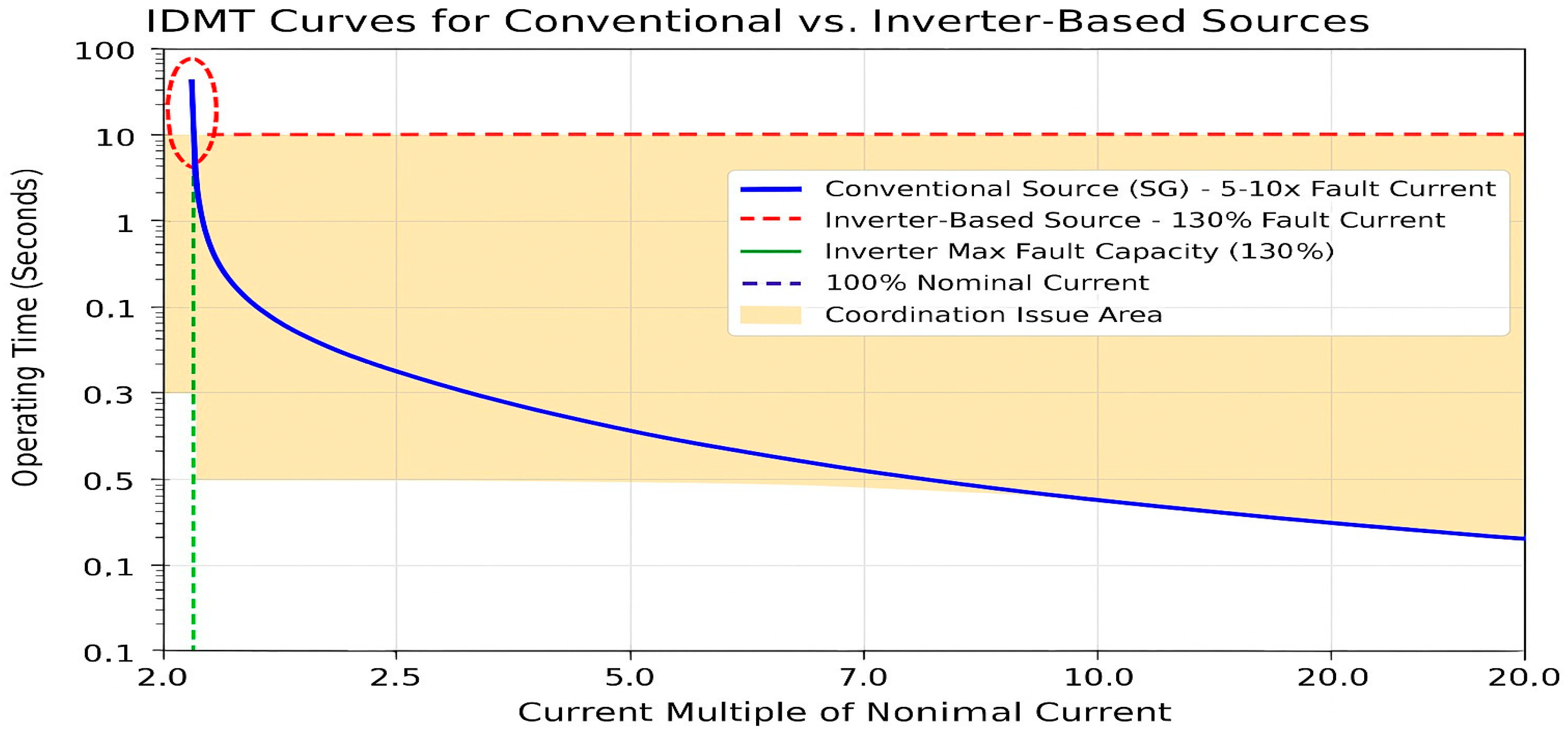
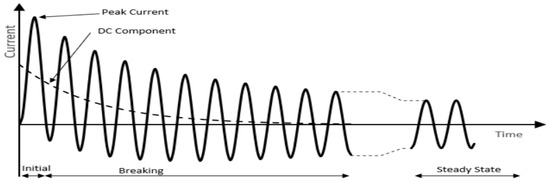
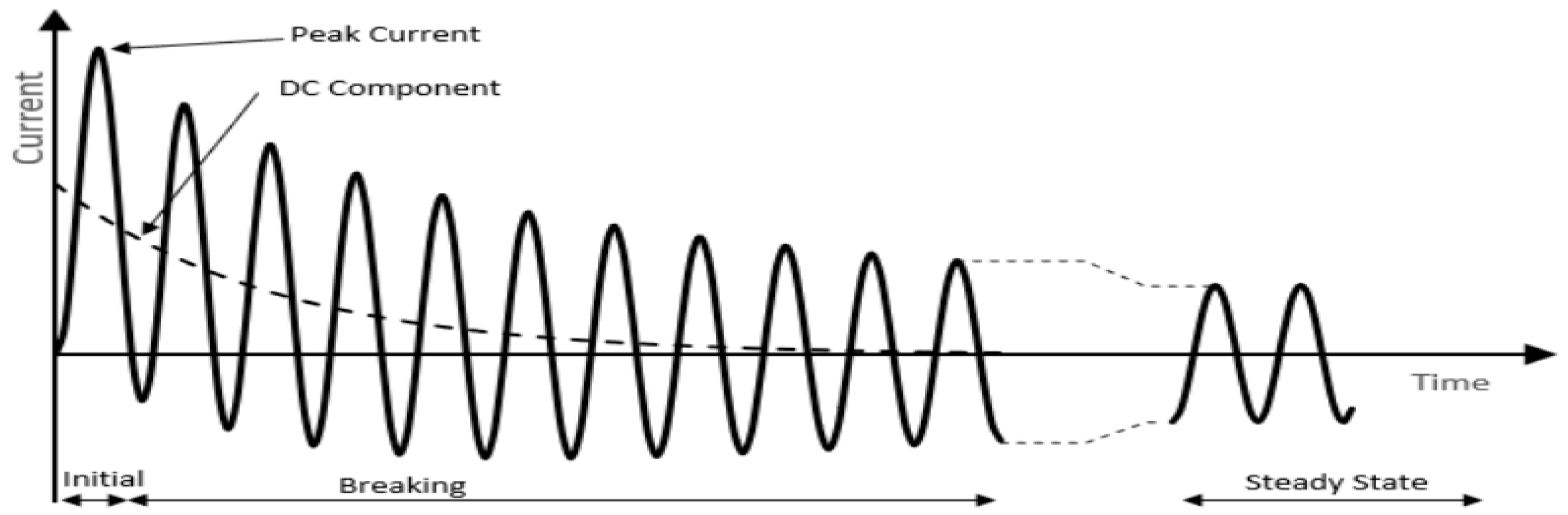
The loss of system inertia associated with IBRs further complicates protection. Low inertia results in faster voltage and frequency variations during and before fault occurrence, which may result in undesired relay operations for either frequency or ROCOF trip. Additionally, the inverter fault current may contain a higher proportion of harmonic components [2,7,13]. Figure 2 shows the behavior of typical overcurrent relay when the MV system is supplied by IBRs. Figure 3 shows the typical faults in the current profile of the synchronous generator.Field data and simulation studies have proved that the combination of lower fault current magnitude, different phase profiles, and faster decay of fault current can result in underreach or overreach of distance and directional elements [2,13,14,15,16].
Figure 2.
Typical IDMT curve performance.
Figure 3.
Fault profile of synchronous generator.
Overall, IBR-dominated MV networks result in a scenario where many conventional protection schemes (such as OC grading, distance zones, and fuse–recloser schemes) no longer behave as intended, hence ensuring that protection reliability becomes a paramount concern [12,14].
Research has been conducted actively to explore potential solutions ranging from improvements in protection schemes to increasing inverter fault current response. As far as relay is concerned, one approach deals with the application of more sensitive and/or directional algorithms that do not rely purely on fault current magnitude. For example, using negative-sequence currents or admittance-based protection criteria may detect unbalanced faults with low fault contributions from IBRs [6,12,17].
One study explores the use of improved pilot schemes in which conventional line differential protection is augmented with negative-sequence elements that increase the reliability of protection operations for asymmetrical faults in a network with multiple IBRs [12]. Other potential solutions deal with time domain and high-frequency methods. For instance, one method uses the polarity and timing of initial fault-induced transients to detect the faults in inverter-dominated microgrids [10,15].
Few other studies have analyzed the performance of distance relay with high IBR penetration, and it is observed that the conventional mho element may underreach or overreach (in the reverse direction) under certain fault conditions. The use of adaptive logic (for example, dynamic phase angle tracking) has been proposed to mitigate this issue [2,14,18].
Overall, protection algorithms are reinvented with increased smartness and intelligence by incorporating directional elements, sequence components, and traveling wave sensors, such that the unique fault signature of IBRs does not affect the reliability of protection relays. However, it is observed that unit protection methods (such as line differential) remain immune to fault-level variations but may need special adjustments to restrain the harmonic thresholds [10,12].
Some studies have proposed the use of communication-based adaptive schemes that compare voltage phase angles and superimposed currents for rapidly detecting faults, even those with small fault current profiles. In parallel, some studies have also proposed the use of dynamic adaptive protection schemes to adjust protection relay settings as per system conditions. Another methodology deals with the use of multiple adaptive pre-calculated protection settings to respond to varying network configurations and IBR’s output changes [2,10,14,18,19].
However, the adaptive protection scheme introduces complexity, and a secure communication line correctly detects the network state. This has resulted in increasing research on the self-organizing protection system, which uses machine learning to predict the optimal relay settings as per the operating conditions [7]. On the inverter side, research has been performed to propose changes in inverter hardware and control strategies and to allow higher fault current contributions momentarily without sacrificing stability. The use of special inductors is proposed for providing sufficient current. Another concept deals with virtual synchronous inertia where inverter control emulates the inertia [5,6].
Few techniques deal with the surge in inverter fault current capability without changing the hardware. They employ smart inverter controls to introduce variable internal impedance, which results in higher fault current capability without affecting the stability of the system [20].
One study explores the possibility of limiting only certain sequence components of the current combined with the adaptive droop control to tackle faults safely. Another advanced strategy manages the inverter’s power angle instead of its current [21,22].
In summary, a combination of adaptive protection schemes and enhanced inverter controls are being explored to protect the network while avoiding instability. Recent studies demonstrate adaptive and programmable approaches [6,19] using more novel relay operating principles involving traveling waves or sequence components [10,12] and inverter-level techniques such as dynamic impedance and virtual inertia [5,23]. Integrating these diverse approaches into a single protection architecture is the challenge. If this is accomplished, networks will continue to be as safe and dependable as those based on conventional generation while we transition to 100% IBRs [2].
2. Review Methodology
This review presents a systematic review of fault detection and protection strategies in medium-voltage (MV) networks with elevated levels of inverter-based resources (IBRs). The aim of this review was not only to summarize the various protection methods reported in the literature but also to evaluate and compare them based on key performance aspects, implementation challenges, and their feasibility for practical application in MV systems.
2.1. Literature Search Strategy
The literature included in this review was obtained from peer-reviewed journal articles, conference papers, technical reports, and selected industry guidance documents that were focused on power system protection in inverter-dominated networks. The literature search targeted studies that specifically addressed protection challenges in medium-voltage (MV) distribution systems, microgrids, and networks with high penetration of grid-forming inverters or other inverter-interfaced resources. Common search terms included “grid-forming inverter protection,” “fault detection in inverter-based microgrids,” “adaptive protection,” “distance protection with inverter-based resources,” “differential protection in DER-rich networks,” “symmetrical-component-based protection,” and “fault current contribution of inverter-based resources.”
Both the well-established and legacy protection principles and the more recent methods developed for inverter-dominated environments were evaluated. In addition to academic publications, several industry-oriented references were included, which offered valuable practical insights into protection philosophy, fault current limitations, and real-world implementation challenges of new protection techniques.
2.2. Inclusion and Exclusion Criteria
The reviewed sources were included in this review if they met the following criteria:
- The work presented addressed protection, fault detection, relay coordination, or fault behavior in systems with inverter-based generation.
- The proposed method or analysis was relevant to medium-voltage (MV) networks, microgrids, distribution systems, or protection concepts that could be applied to such systems.
- The source provided analytical, simulation-based, experimental, or practical discussions of protection performance.
- The source contributed meaningfully to understanding conventional protection, inverter fault characteristics, and/or proposed protection solutions.
Sources were excluded if they focused exclusively on converter control without any clear link to protection issues, if they dealt with topics unrelated to fault detection or relay operation, or if they lacked sufficient technical depth to allow the meaningful comparison of protection techniques.
2.3. Literature Classification Framework
To improve analytical clarity, the reviewed studies were grouped according to their main protection principle or mitigation approach. The literature was classified into the following categories:
- Conventional MV protection principles: studies describing traditional overcurrent, distance, differential, directional, grading, and zoning principles in systems dominated by synchronous generation.
- Fault behavior of inverter-based and grid-forming sources: studies examining fault current magnitude, transient response, sequence characteristics, inertia effects, weak-grid interactions, and control-dependent inverter behavior.
- Overcurrent- and directional-based solutions: methods that retain current-based protection but modify pickup settings, add directional supervision, or utilize sequence components.
- Distance-, admittance-, and impedance-based solutions: approaches that rely on measured impedance or related relay quantities for fault identification in inverter-dominated systems.
- Differential, pilot, and communication-assisted protection: unit protection or communication-based methods designed to reduce reliance on high fault current levels.
- Adaptive and setting-group-based protection: techniques that dynamically adjust relay settings based on network configurations, source availability, or operating conditions.
- Inverter-side support measures: methods that enhance protection compatibility through control modifications such as virtual impedance, virtual synchronous machine (VSM) emulation, or the temporary boosting of inverter fault current contribution.
This classification allows the various methods to be compared on a consistent basis, rather than being presented simply as isolated solutions.
2.4. Comparison Criteria
To provide a more analytical review, each protection category was assessed against a common set of practical criteria suitable for MV system applications. These criteria include the following:
- Sensitivity: the ability to detect low-magnitude faults under limited inverter fault current.
- Selectivity: isolating only the faulty section without the unwanted operation of nearby upstream/downstream protection.
- Speed of operation: response time and suitability for primary protection operation.
- Dependence on communication: need for links, synchronized data, or central controllers.
- Robustness to operating changes: performance under varying inverter control modes, grid strengths, reconfigurations, and fault types.
- Capability for high-impedance faults: reliability when fault currents are exceptionally low.
- Implementation complexity: practical challenges in deployment, hardware, communication, and settings.
This review follows a logical structure: it begins with the assumptions behind conventional MV protection, analyses how GFM behavior differs from them, identifies the main challenges, reviews solutions using the abovementioned classification and criteria, and concludes by highlighting the remaining research gaps and future directions.
3. Overview of MV Network Protection in Conventional Systems
Historically, MV power distribution systems have depended on time overcurrent protection strategies that are based on high fault current levels and radial power flow. These traditional systems are powered by synchronous generators, providing high fault current levels and inertia, resulting in proper protection, coordination, and discrimination [24,25,26,27].
3.1. Conventional Protection Philosophy
The main protective schemes utilized in MV networks use overcurrent protection (directional and nondirectional), distance protection, and differential protection. Overcurrent relays work by detecting the current surpassing the predefined threshold. Their simplicity and effectiveness in clearing the fault make them a highly popular choice [28,29,30,31]. Distance relays are primarily found in transmission systems but are also used in MV networks to protect the line. Distance protective relays operate by measuring the line impedance if it falls under the trip region defined in the impedance diagram [32,33]. Differential protection offers highly selective and sensitive protection, especially for transformers and buses. Differential protection works by comparing the incoming and outgoing currents to define the operating characteristics [29,34,35]. Directional overcurrent elements are used when the protection relay is required to operate in a specific power flow direction and are useful in interconnected ring networks [36,37].
3.2. Fault Characteristics, Relay Coordination, and Protection Zones
Traditional MV systems characterize the distinct fault profile with high fault current contributions ranging from 5 to 20 times the nominal current. Protection relays use this characteristic to coordinate and operate with a faster response [38,39,40]. Time–current characteristics are used to define relay coordination that guarantees selectivity and little to no impact on the upstream protection operation [41,42,43]. Protection studies recommend the proper grading margins and discrimination to make sure that downstream protective devices operate before the upstream devices for faults present downstream, resulting in a stable and reliable power system [44,45,46,47,48].
To minimize the system-wide disturbance, the MV protection schemes are designed to involve the different zones of localized fault clearance. Transformers, feeders, capacitor banks, and busbars are typically assigned to dedicated protective zones with high-speed clearance operations [24,25,26].
While these coordination and zoning principles remain valid in theory, their practical implementation becomes significantly more challenging in networks dominated by inverter-based resources. In such systems, the limited and tightly controlled fault current makes it harder to distinguish between normal load and fault conditions. Bidirectional power flows weaken the traditional assumptions used for relay grading, and the control-dependent behaviors of grid-forming inverters alter the quantities relayed by relays for fault discrimination. Consequently, protection schemes that work reliably in conventional synchronous-machine-dominated MV networks can become less sensitive, less selective, or much more difficult to coordinate when the system is dominated by GFMs.
3.3. Dependence on System Inertia
Traditional MV networks involve heavy rotating machines that provide a wide range of system inertia. These large rotating machines (mostly synchronous generators) provide high short-circuit MVA, resulting in the stable and reliable operation of protection relay. High inertia also reduces the frequency and voltage deviations during transient or fault conditions in any part of the MV system [27,49,50,51].
However, with the increasing penetration of IBRs in the MV network, the above-described fundamental characteristics of traditional MV networks do not hold true. The contribution of fault current from the IBRs is typically in the range of 1.1 to 2.5 pu (with most of the systems only providing 2.0 pu). IBRs exhibit fast current-limiting controls and provide limited inertia, thus undermining the conventional protection systems that heavily rely on the said characteristics [52,53,54,55,56].
4. Behavior of Grid-Forming Inverter Sources During Faults
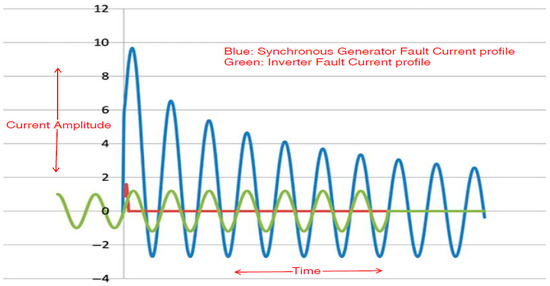
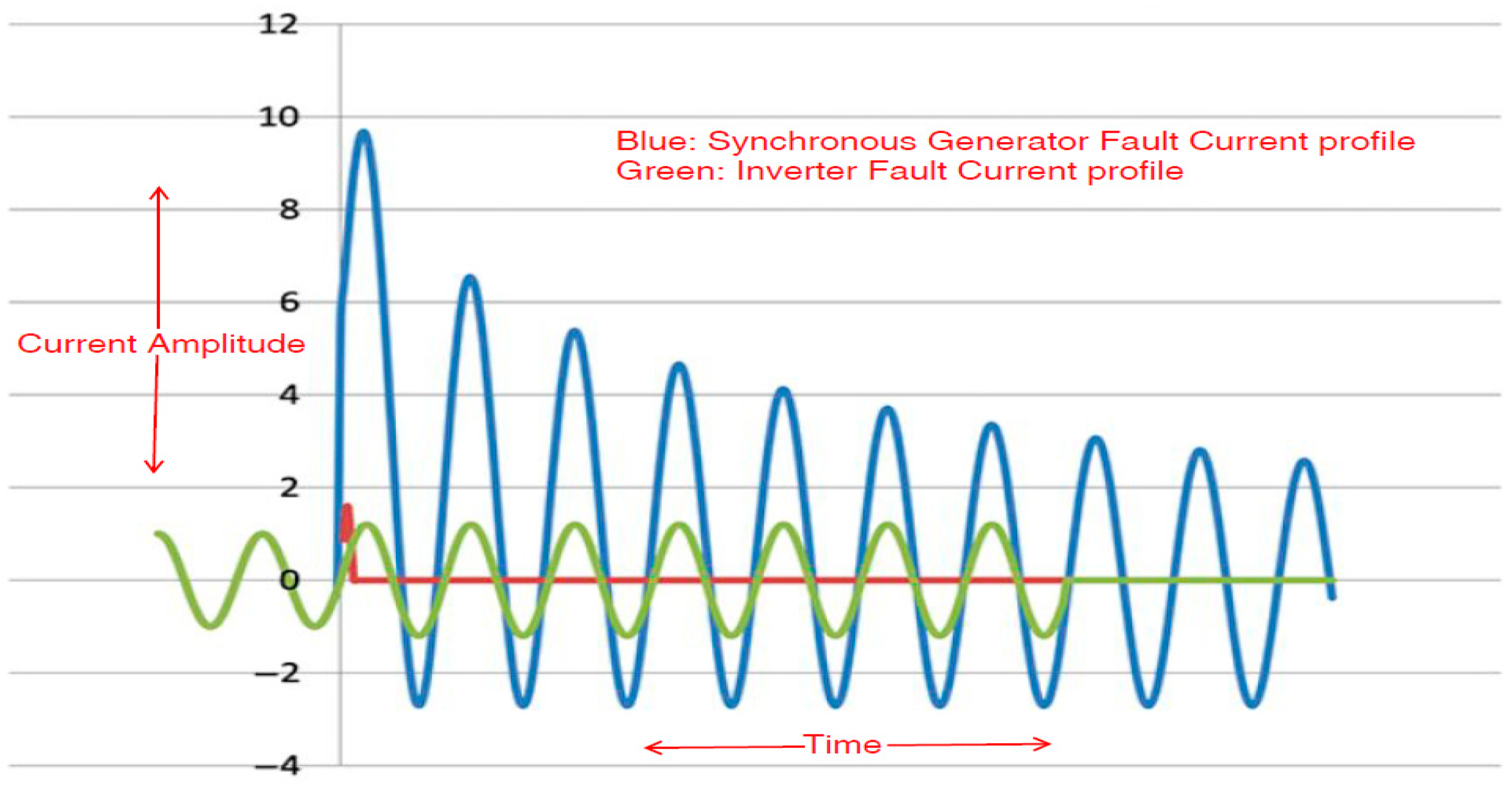
The stability of MV networks dominated by IBRs is achieved by using grid-forming inverter sources. Contrary to traditional synchronous generators, grid-forming sources can independently control their voltage and frequency, making them a reference for the grid operation. However, the behavior of GFMs differs significantly from that of traditional synchronous generators. Figure 4 shows the inverter vs. conventional generator fault current profile.
Figure 4.
IBR vs. conventional fault profile.
The active current-limiting strategies used in the control systems of GFMs and power electronic current withstand limitations, resulting in limited fault current contributions at the time of fault generation. The typical fault current contributions range between 1.1 pu and 2.5 pu compared to 5–20 pu in synchronous generators [52,57,58]. This distinct fault current profile affects the sensitivity and selectivity of overcurrent and differential protection schemes [50,59].
The control strategies of GFMs, such as droop control, VSMs, and impedance-forming techniques, determine how the inverter responds to voltage and frequency variations during fault events. These control strategies simulate the inertia and provide stability support, but they still exhibit fast current control and affect the conventional relay protection operation [57,60,61].
For balanced symmetrical faults, the response of the GFM depends on the phase-locked loop dynamics and grid synchronization capability. Grid-forming control allows for autonomous fault riding through capability and frequency support, but the fast voltage recovery and the lack of transient response of the inverters make it difficult for distance/impedance-based protection schemes to accurately detect faults [53,62,63]. In an unbalanced or asymmetrical fault, a GFM with an advanced control scheme can continue to operate in grid-forming mode, supporting the asymmetrical compensation of the voltage. However, these control dynamics can introduce harmonics, unbalanced currents, or oscillatory behavior that can affect the relay’s ability to accurately detect and classify faults [64,65].
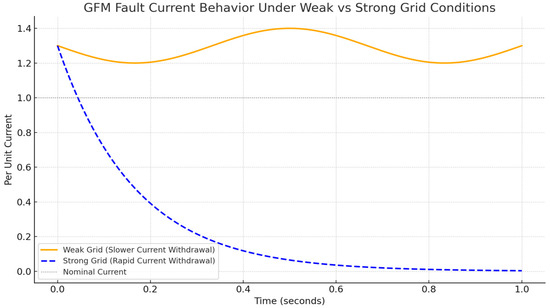
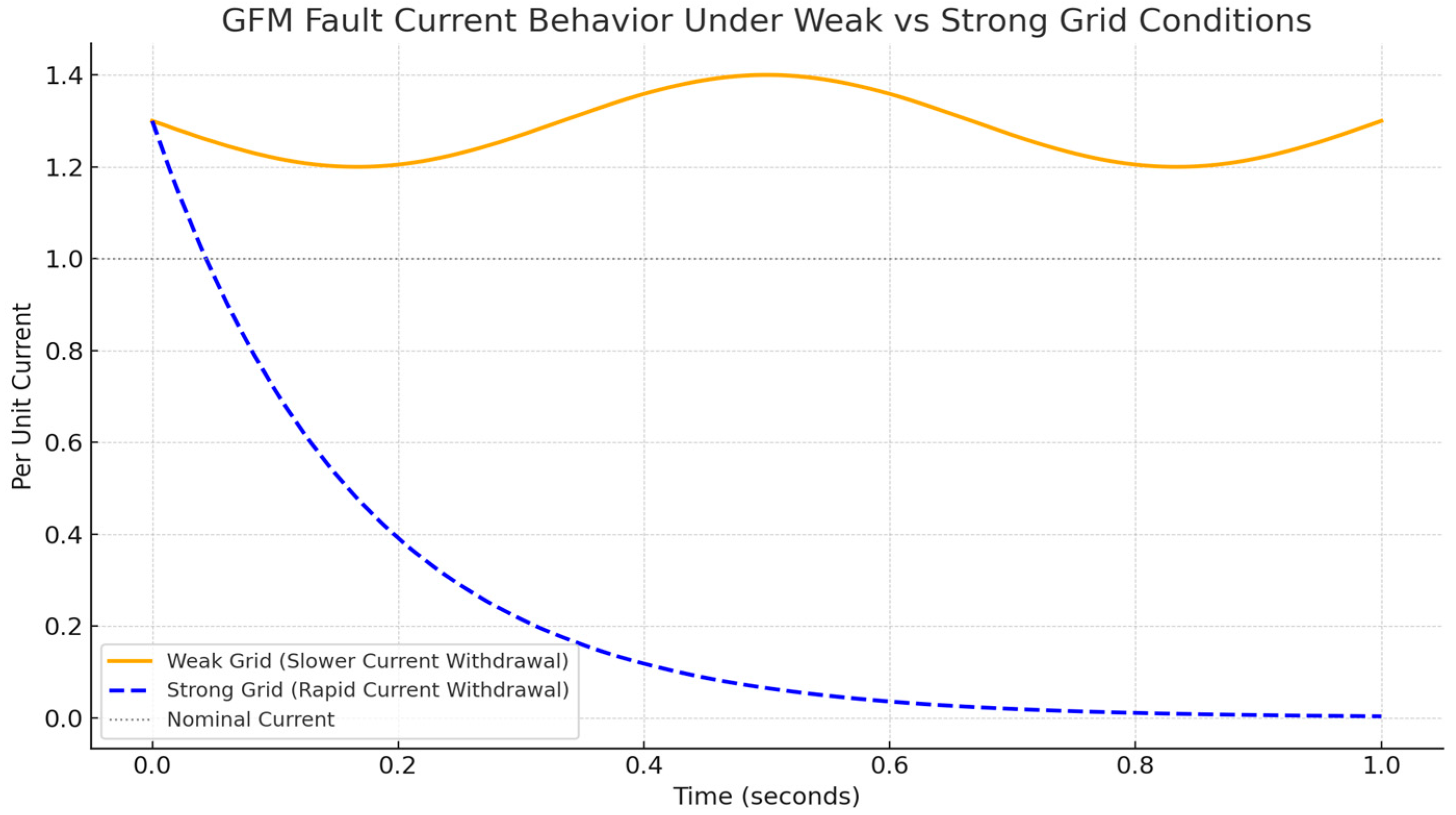
Recent studies have also highlighted the effects of grid strength and system impedance on the fault behavior of GFMs. In weak grids, the GFM can dominate the local grid voltage and cause protection problems; on the other hand, in strong grids, the inverter can quickly withdraw its current injection [56,66]. Figure 5 shows IBR current behaviour for weak and strong grids. Hybrid protection schemes and directional element-based overcurrent have been proposed as emerging solutions to accommodate these unconventional behaviors [67,68].
Figure 5.
IBR current behavior in weak vs. strong grid.
A detailed understanding of GFMs’ fault profile is crucial for redesigning the protection schemes to ensure that the system is reliable without entirely relying on high fault current magnitudes and traditional relay logic.
5. Challenges in Traditional Protection Schemes
The increasing integration of GFMs poses a major challenge to the traditional protection schemes, which are designed for conventional MV networks. These challenges mostly arise from differences in fault profiles, current contributions, and control strategies compared to conventional inertia-based systems [24,27,50].
Traditional overcurrent protection schemes rely on high fault currents for fast and selective fault detection. However, GFMs implement fast current-limiting control strategies, resulting in a fault contribution of 1.1 to 2.5 pu. The fault current is significantly lower than the fault current produced by synchronous generators [52,57,69,70]. The low-amplitude fault current reduces the sensitivity of overcurrent and distance protection [65,71].
GFM control strategies such as droop control, virtual impedance, and virtual synchronous machine (VSM) emulation generate complex dynamic responses during faults. This can result in changes in impedance characteristics and non-standard voltage and current waveforms that can disrupt the operation of traditional impedance-based distance protection [58,72,73].
The lack of inertia in a GFM causes the frequency to drastically change during a fault. While some advanced control strategies simulate inertia, the overall system’s fault response is constantly adjusted, which affects frequency-based protection and stability margins [51,62,74].
Directional relays are designed to operate based on the phase angles of current and voltage. However, the high-speed control on GFMs can distort the phase relationship, making the directional protection unreliable [38,54,75].
In a system with multiple GFIs, their rapid fault current suppression can cause the protection relay to ignore downstream or ground faults. Furthermore, since GFMs operate independently, protection coordination becomes more difficult, especially in an islanding or a weak grid [56,66].
Distance relays are configured by defining the zones with known system impedance. GFM behavior changes the system’s impedance; this change in impedance is more evident in low-inertia microgrids. This results in protection zones shifting or overlapping, causing maloperation or nonoperation [39,63,72].
Some adaptive or hybrid protection solutions designed for GFM-based networks require communication between relays and central controllers. This introduces delays, cybersecurity concerns, and reliability risks, especially in MV distribution systems where reliable communication infrastructure is lacking [67,76].
These challenges point out the need to develop protection philosophies that address these issues in modern distribution systems.
The reduction in fault current magnitude and the loss of conventional rotating inertia significantly affect protection schemes, and they directly impact the quantities that protection relays rely on to make decisions. Lower fault currents shrink the margin between normal load and fault conditions, which reduces the sensitivity of overcurrent protection and makes proper grading much more difficult. The fast current-limiting and control-dependent response of grid-forming inverters simultaneously alters the phase relationship between voltage and current, often distorting the apparent impedance encountered by distance and directional relays.
Consequently, the protection challenge in GFM-dominated MV networks is not simply a matter of reduced fault levels. It represents a fundamental shift in how source behavior interacts with the decision variables used by the relays.
6. Review of the Proposed/Existing Protection Solutions
In microgrids with significant integration of IBRs, the difference between the minimum fault level and the maximum load can be minimal, thus blinding the protection systems. The operation of IBRs during fault situations follows the standard IEEE 1547-2018 and the respective national grid codes, which impact how protective devices function [77].
6.1. Current/Voltage-Based Protection Methods
One potential approach to address the issue of protection blinding with significant IBR penetration is to enhance the fault current contribution of IBRs. However, this leads to increased costs and could violate grid codes. A novel method is introduced that utilizes a power angle-based adaptive overcurrent protection scheme. This approach ensures stable operation, but it is significantly dependent on the power angle, which poses challenges for accurate calculations in rapidly changing grid conditions in real time. The effectiveness of this protection scheme may be compromised in situations where voltages are highly fluctuating [21].
For overcurrent protection, the conventional method of fault detection using zero-sequence or negative-sequence components may prove insufficient, as IBRs tend to stabilize the system. While directional overcurrent elements can protect in certain circumstances, their reliability across all operating conditions is questionable, and they require the installation of voltage transformers to provide a reference polarizing quantity for relays. Although adaptive protection settings may serve as a viable option for overcurrent protection, their effectiveness is constrained by the system’s configuration and status. Relying on fault current for device coordination and protection poses significant challenges and is susceptible to failure.
To tackle these challenges, various advanced protection strategies have been suggested, one of which is adaptive protection schemes that modify relay settings in real time according to the grid conditions. This method aims to preserve relay coordination (in certain situations) even when fault currents are inadequate for conventional detection techniques [20]. However, this may lead to network instability caused by either resistive or inductive impedance. Moreover, transient stability degrades during voltage sags. Table 1, Table 2, Table 3 and Table 4 present the comparison of the proposed protection strategies.
Table 1.
Comparison of proposed protection strategies (voltage protection) [47,78,79].
Table 2.
Comparison of proposed protection strategies (line protection) [2,9,12,14,16,42,54,71,72,79].
Table 3.
Comparison of proposed protection strategies (overcurrent protection) [9,18,19,30,37,45,75,79].
Table 4.
Comparison of proposed protection strategies (miscellaneous) [20,23,36,48,63,69,70,73,79].
A recent study focuses on a method for adaptive protection coordination in remote microgrids under varying operational conditions, especially when utilizing IBRs and energy storage systems. It has been observed that traditional overcurrent relays designed for synchronous generation do not function adequately when the generation transitions to inverter-based energy storage systems. A research study suggests leveraging the real-time status of power sources to automatically adjust the adaptive settings of protection devices [8]. However, it does not provide a comparative assessment of protection operations between conventional generation and inverter-based resources and focuses on a scenario where the maximum loads for synchronous and inverter-based generation differ significantly, which can be addressed through specific engineering inputs in this case study. The proposed solutions do not align with the established industry practices.
Additionally, another research study examines adaptive protection methods for practical microgrids that rely entirely on inverter-based generation. Various conventional protection strategies, including under/overvoltage, frequency, overcurrent, and distance protection, prove inadequate when the grid is fully powered by 100% inverter-based generation. The use of adaptive protection configurations and directional overcurrent relays can offer some protection against faults in inverter-based resources [28]. However, the modeled system is quite simple and could be safeguarded using traditional engineering approaches without necessitating further investigation. The study presents pickup settings but lacks adequate justification concerning maximum load conditions. Moreover, it does not include coordination analysis or results for all test scenarios. In the test model, the IBR generation capacity is significantly more than the loads, allowing up to five times the fault current and thereby diminishing the significance of the findings. There is also no comparison of relay performance across all generations.
A design for adaptive protection is suggested for Hailuoto Island in Finland. It employs adaptive protection configurations during operation in the islanded mode [19]. However, the referenced study deals with a simplistic network featuring inertia-based diesel generation, which can deliver substantial fault currents in the islanded mode, thereby limiting the research to a basic engineering design problem.
An alternative solution employs an interfaced relay, which utilizes symmetrical voltage components for the detection of voltage and for triggering the trip mechanism. This method uses voltage and current modules to identify voltage sags accompanied by higher currents, which helps in detecting potential faults in a grid powered by IBRs [77]. However, this is a novel approach that would require new infrastructure to be set up. It has not undergone real-world testing and appears to be impossible to execute, as voltage sags are identified across a broad spectrum of power systems experiencing increased load currents (such as large motors). The suggested solution may lack reliability due to the frequent high voltage fluctuations within microgrids, combined with the possibility of rising current levels (notably in the case of inductive loads) to meet power consumption demands, potentially leading to false trips. Coordinating the proposed protection system in IBRs might be challenging because of the different methods of current pickups and TMS settings. Additionally, it is not suitable for high-impedance faults. The drawbacks of this approach become apparent when IBRs operate in the grid-following mode.
A recent study employs superimposed current alongside a voltage restraint element to identify and isolate faults in microgrids that are powered by IBRs. The functionality of the proposed technique remains unaffected by the type and severity of the fault. Fault detection relies on the difference between the regular load current (measured from the last four cycles) and the fault current, using a predefined voltage sag threshold [80]. However, this approach depends on voltage sag to trigger fault detection, which can be unreliable and difficult to coordinate with other devices. There is an increased risk of no differentiation between heavy overloads with actual faults. Additionally, this method encounters limitations when dealing with high-impedance faults. The scheme has not been modeled to demonstrate its effectiveness or operation in a more extensive and complex system. In smaller and simpler power systems with a reserve margin of 10 to 20%, fault detection can be achieved through straightforward overcurrent methods. Modern inverter technologies typically work in a way such that voltage is kept at a nominal level by regulating the current output, even in the event of a fault, making this approach susceptible to failure. Moreover, determining the pickup level for superimposed current can be difficult when the maximum inverter current is 1.3 or 1.5 times greater than the nominal current.
6.2. Impedance-Based Protection Methods
The operation of traditional distance protection can malfunction when the power system includes inverter-based generators. In systems utilizing IBRs, the advanced control strategies of the inverter can switch to a low-voltage ride-through mode, leading to complex fault current characteristics. This complexity makes it challenging for distance relays to accurately detect fault impedance. In scenarios involving metallic faults and faults with transition resistance, the effectiveness of distance protection can be significantly impacted, resulting in outcomes ranging from complete failure to both overreach and underreach [14]. The operation of distance protection for transmission lines fed by IBRs is influenced. In contrast to grid-following inverters, grid-forming inverters can provide synthetic inertia. This differs from grid-following inverters, where control strategies can alter the phase angles of voltages and currents, which in turn impacts the apparent impedance measurement of the transmission line as perceived by the protection device. Research indicates that, when wind farms supply 100% of the generation, the operation of distance protection becomes susceptible to both overreach and underreach [2].
The traditional (MHO) relay relies on adequate zero and negative-sequence currents for effective fault detection, and this is not achieved by IBRs operating in the grid-following mode, resulting in the incorrect functioning of distance protection. The control mechanisms employed for IBRs make the functioning of distance relays more complex due to the presence of grid-following and grid-forming modes. In the grid-following mode, inverters operate as current-controlled sources that track grid voltage and frequency, leading to the malfunctioning of the distance relay when the grid reference is lost [13].
6.3. Differential and Communication-Aided Methods
One approach to protect the system involves implementing line differential relays, which incur higher expenses due to communication links and still face issues with maloperation, particularly in cases of high-impedance faults. In situations with high IBR generation, differential protection however benefits from low-saturation CT selection. Voltage-based protection is unreliable because the operation of larger loads can significantly alter voltage profiles, leading to incorrect tripping, and coordinating this is complicated as voltage influences are detected by a wide array of protection devices throughout the network [15].
Additionally, the harmonic characteristics of fault currents in systems with high IBRs can make protection strategies more complex. Transformer differential protection, which usually employs harmonic blocking to distinguish between inrush currents and fault currents, might not function as intended due to non-standard harmonics produced by inverters during fault conditions [7].
Differential protection may fail when implemented on T lines fed by IBRs. For complex distribution systems, traditional overcurrent protection methods experience a notable decline in sensitivity and selectivity. An alternative approach could involve utilizing the negative-sequence current component as the primary operational parameter for the differential relay [12]. However, employing a differential protection scheme for lines with T connections is not standard engineering practice in the industry, making the proposed solution of little practical value. Presently, issues related to protection malfunctions and blinding are dealt with through various strategies, including the incorporation of synchronous condensers or other inertia-based generation sources alongside inverter generation, as well as the implementation of insulation-monitoring devices, which lead to significantly increased operational costs.
6.4. Inverter-Side Mitigation Measures
One alternative method to address protection issues is the utilization of virtual synchronous machines. In this method, the outputs of grid-forming inverters are managed to emulate the behavior of conventional synchronous generators [5]. However, this strategy presents its own set of challenges and constraints. The fault current contribution from VSMs remains restricted, and the adjustment of control parameters may result in an unstable network.
Table 1, Table 2, Table 3 and Table 4 provide a summary of the principal protection methods discussed throughout this review. These tables compare the different approaches based on their main advantages, their limitations, and how well they can be applied in real inverter-dominated MV networks.
The summary of protection strategies for microgrid projects in North America outlines the main challenges and solutions related to the protection of these microgrids. The introduction of distributed energy resources (DERs) has complicated protection strategies due to the reversal of fault current direction. Various methodologies are currently in use for protection, but each one has its limitations [78]. Undervoltage protection is prone to transients, may fail at high-impedance faults, and is difficult to coordinate. Voltage restraint overcurrent protection strategies face similar issues. Protection based on symmetrical components cannot detect all types of faults. While differential protection is the most suitable option, it entails higher costs linked to fiber optics.
7. Research Gaps
Despite the numerous protection solutions that have been proposed for the MV systems primarily reliant on grid-forming IBRs, several research and practical issues remain unresolved.
Firstly, many of the adaptive and angle-based protection methods found in the literature depend significantly on the precise real-time measurements of power angles and grid conditions. Accurately acquiring or calculating these parameters can be challenging during rapid disturbances in the system. Additionally, such methods show a lack of resilience in fluctuating voltage conditions and may not perform reliably in weak or island networks.
Overcurrent protection methods, such as directional and negative-sequence components, have limitations in networks where IBRs inherently limit fault current levels. The necessity for voltage transformers in directional relays, along with the difficulties in ensuring accurate polarizing quantities, adds complexity and expense, especially in large-scale applications.
Adaptive protection strategies often rely on communication systems or sophisticated controllers, which may be impractical in numerous real-world MV systems. Many studies that propose these approaches do not provide comparative performance assessments between traditional synchronous generation and inverter-based systems. Furthermore, these evaluations often operate under ideal or overly simplified microgrid designs, neglecting the coordination challenges present in extensive interconnected networks.
Numerous solutions, such as relays triggered by voltage sags and superimposed current techniques, are still largely theoretical or have been tested under limited conditions. These approaches frequently struggle to address the characteristics of high-impedance faults or the challenges in differentiating between fault and load behaviors. Their coordination with other devices is often inadequately defined, and in many instances, their reliance on IBR control logic (such as ride-through modes) compromises their reliability.
Moreover, most existing studies/models suggest that IBRs can provide high short-time fault contributions, often reaching up to five times the nominal current, while real-world implementations typically restrict fault current to less than 1.5 times the recommended value. Some research studies also fail to consider how high DER penetration influences fault direction, apparent impedance, and selectivity margins, especially in protection zones that coincide with T connections.
One concern is the incorrect application of distance and differential relays in situations with grid-following IBRs. Traditional distance protection depends on negative- and zero-sequence components, which IBRs operating in the grid-following mode do not offer effective support. Additionally, differential protection schemes especially for transmission lines are proposed without considering the costs of communication, fault sensitivity at lower fault levels, or harmonics produced by inverters that could disrupt standard blocking algorithms.
Moreover, employing VSMs or synchronous condensers as mitigation measures introduces further technical and financial difficulties. While these solutions might enhance protection compatibility, they necessitate substantial capital outlay and fail to resolve fundamental issues in relay design or coordination logic. Furthermore, approaches incorporating machine learning- or AI-based detection often lack validation during actual disturbances and depend on extensive training datasets that might not accurately reflect all operational scenarios.
8. Conclusions
This review offers an in-depth review of the challenges involved in protecting the MV networks that are primarily reliant on grid-forming IBRs. It begins with an introduction to the established protection philosophies utilized in the MV networks and explains how these conventional methods are becoming less effective due to the changing dynamics of inverter-based grids.
This review highlights the unique behaviors of grid-forming inverters during fault situations, noting the constraints they impose on traditional overcurrent, directional, and distance protection systems. A thorough overview of current and developing protection strategies is provided, which includes adaptive protection, impedance shaping, power-angle-based relays, and differential and pilot protection methods.
Despite the promise of these methods, this review points out several significant research gaps. These include insufficient performance testing in real-world scenarios, unrealistic assumptions regarding fault currents, limited effectiveness in high-impedance fault situations, and dependence on expensive or impractical hardware and communication systems.
The findings highlight that the current approaches inadequately tackle the issues related to protecting the MV systems with significant IBR integration. There is a need for stronger, more scalable, and implementable solutions. Future research should focus on protection schemes that have been validated through experimentation, comply with grid codes, and can function effectively across diverse operating conditions and inverter control strategies without needing new infrastructure.
Author Contributions
Conceptualization, M.A.R., M.B. and I.M.; methodology, M.A.R., M.B. and I.M.; software, M.A.R.; validation, M.B. and I.M.; formal analysis, M.A.R.; investigation, M.A.R.; resources, M.A.R.; data curation, M.A.R.; writing—original draft preparation, M.A.R.; writing—review and editing, M.B. and I.M.; visualization, M.A.R.; supervision, M.B. and I.M.; All authors have read and agreed to the published version of the manuscript.
Funding
This research received no external funding.
Data Availability Statement
The data are not publicly available due to commercial confidentiality and intellectual property restrictions.
Conflicts of Interest
The authors declare no conflicts of interest.
References
- Roy, S.; Pico, H.N.V. Transient Stability and Active Protection of Power Systems with Grid-Forming PV Power Plants. IEEE Trans. Power Syst. 2023, 38, 897–907. [Google Scholar] [CrossRef] [Scilit]
- O’Donovan, M.; Barry, N.; Connell, J. Distance Protection of Transmission Lines Connected to Inverter-Based Resources. In Proceedings of the IEEE PES GM, Orlando, FL, USA, 16–20 July 2023; pp. 1–5. [Google Scholar]
- Patel, T.; Brahma, S.; Hernandez-Alvidrez, J.; Reno, M.J. Adaptive Protection Scheme for a Real-World Microgrid with 100% Inverter-Based Resources. In Proceedings of the 74th Annual Conference for Protective Relay Engineers, Virtual, 22–25 March 2021; pp. 1–8. [Google Scholar]
- Brahma, S. Protection of Distribution System Islands Fed by Inverter-Interfaced Sources. In Proceedings of the 2019 IEEE Milan PowerTech, Milan, Italy, 23–27 June 2019; pp. 1–6. [Google Scholar] [CrossRef] [Scilit]
- Glassmire, J.; Antonova, G.; Cherevatskiy, S.; Fretwell, A. Using Virtual Synchronous Generators to Resolve Microgrid Protection Challenges. In Proceedings of the 74th Annual Conference for Protective Relay Engineers (CPRE), Virtual, 22–25 March 2021; pp. 1–8. [Google Scholar]
- Ferrari, M.; Tolbert, L.M.; Piesciorovsky, E.C. Grid-Forming Inverter with Increased Short-Circuit Contribution to Address Inverter-Based Microgrid Protection Challenges. IEEE Open J. Ind. Electron. Soc. 2024, 5, 489–500. [Google Scholar] [CrossRef] [Scilit]
- Aviz, C.; Reis, F.; Fabris, G.; Fernandes, R. Influence of Inverter Based Sources on Protection Devices. In Proceedings of the CIGRE 47th Biennial Session—Paris; Paper B5-10145; CIGRE: Paris, France, 2022. [Google Scholar]
- Chae, W.; Lee, J.-H.; Kim, W.-H.; Hwang, S.; Kim, J.-O.; Kim, J.-E. Adaptive Protection Coordination Method Design of Remote Microgrid for Three-Phase Short Circuit Fault. Energies 2021, 14, 7754. [Google Scholar] [CrossRef] [Scilit]
- Nikkhajoei, H.; Lasseter, R.H. Microgrid Fault Protection Based on Symmetrical and Differential Current Components; CEC PIER Technical Report; California Energy Commission: Sacramento, CA, USA, 2006. [Google Scholar]
- Li, X.; Dyko, A.; Burt, G. Enhanced Protection for Inverter Dominated Microgrid Using Transient Fault Information. In Proceedings of the 2005 International Conference on Future Power Systems, Amsterdam, The Netherlands, 16–18 November 2005; pp. 6–11. [Google Scholar]
- Gurule, N.S.; Hernandez-Alvidrez, J.; Reno, M.J.; Summers, A.; Gonzalez, S.; Flicker, J. Grid-Forming Inverter Experimental Testing of Fault Current Contributions. In Proceedings of the IEEE 46th Photovoltaic Specialists Conference (PVSC), Chicago, IL, USA, 16–21 June 2019; pp. 3150–3155. [Google Scholar]
- Han, B.; Wang, G.; Li, H.; Zeng, D. An improved pilot protection for distribution network with inverter-interfaced distributed generations. In Proceedings of the IEEE PES General Meeting, Boston, MA, USA, 17–21 July 2016; pp. 1–5. [Google Scholar] [CrossRef] [Scilit]
- Quintero, A.; Ramos, G. Findings on the Response of Legacy Line Distance Protection in IBR-Based Power Systems. In Proceedings of the 2023 Annual Conference for Protective Relay Engineers (CPRE), Station, TX, USA, 27–30 March 2023; pp. 1–7. [Google Scholar]
- Feng, Y.; Yin, X.; Zhang, Z.; Liu, H.; Lai, Q. Impact of Inverter Interfaced Generators on Distance Protection. In Proceedings of the 4th International Conference on Intelligent Green Building and Smart Grid (IGBSG), Yichang, China, 6–9 September 2019; pp. 1–6. [Google Scholar]
- Jain, R.; Velaga, Y.N.; Prabakar, K.; Baggu, M.; Schneider, K. Modern trends in power system protection for distribution grid with high DER penetration. e-Prime—Adv. Electr. Eng. Electron. Energy 2022, 2, 100080. [Google Scholar] [CrossRef] [Scilit]
- Opoku, K.; Dimitrovski, A.; Maglia, M.F.; Lubkeman, D.L. An Admittance-Based Protection Scheme for Microgrids. In Proceedings of the IEEE PES Innovative Smart Grid Technologies—Latin America (ISGT-LA), San Juan, PR, USA, 6–9 November 2023; pp. 265–269. [Google Scholar]
- Wang, C.; Li, C.; Chuyi, Z.; Zhu, C.; Yang, Q.; Duan, W. Study on the Over-Current Protection Method of the Large Power Inverter with IGCTs. In Proceedings of the 15th European Conference on Power Electronics and Applications (EPE), Lille, France, 3–5 September 2013; pp. 1–10. [Google Scholar]
- Piesciorovsky, E.C.; Schulz, N.N. Comparison of Programmable Logic and Setting Group Methods for Adaptive Overcurrent Protection in Microgrids. Electr. Power Syst. Res. 2017, 151, 273–282. [Google Scholar] [CrossRef] [Scilit]
- Laaksonen, H.; Ishchenko, D.; Oudalov, A. Adaptive Protection and Microgrid Control Design for Hailuoto Island. IEEE Trans. Smart Grid 2014, 5, 1486–1494. [Google Scholar] [CrossRef] [Scilit]
- Qoria, T.; Wu, H.; Wang, X.; Colak, I. Variable Virtual Impedance-Based Overcurrent Protection for Grid-Forming Inverters: Small-Signal, Large-Signal Analysis and Improvement. IEEE Trans. Smart Grid 2023, 14, 3324–3337. [Google Scholar] [CrossRef] [Scilit]
- Huang, L.; Wu, C.; Zhou, D.; Blaabjerg, F. A Power-Angle-Based Adaptive Overcurrent Protection Scheme for Grid-Forming Inverter Under Large Grid Disturbances. IEEE Trans. Ind. Electron. 2023, 70, 5927–5938. [Google Scholar] [CrossRef] [Scilit]
- Li, Z.; Hu, J.; Chan, K.W. A New Current Limiting and Overload Protection Scheme for Distributed Inverters in Microgrids Under Grid Faults. IEEE Trans. Ind. Appl. 2021, 57, 6362–6372. [Google Scholar] [CrossRef] [Scilit]
- CIGRE WG B5.48. Protection for Developing Network with Limited Fault Current Capability of Generation; Technical Brochure 896; CIGRE: Paris, France, 2023.
- Gadanayak, D.A. Protection algorithms of microgrids with inverter interfaced distributed generation units—A review. Electr. Power Syst. Res. 2021, 192, 106986. [Google Scholar] [CrossRef] [Scilit]
- Mahindara, V.R.; Priyadi, A.; Pujiantara, M.; Purnomo, M.H.; Saber, A.Y.; Muljadi, E. Protection Coordination Challenges for Microgrid Distribution Network with High Penetration Inverter-Based Resources. In Proceedings of the 2020 IEEE Energy Conversion Congress and Exposition (ECCE), Detroit, MI, USA, 11–15 October 2020; pp. 1618–1622. [Google Scholar] [CrossRef] [Scilit]
- Kavi, M.; Mishra, Y.; Vilathgamuwa, M. Morphological fault detector for adaptive overcurrent protection in distribution networks with increasing photovoltaic penetration. IEEE Trans. Sustain. Energy 2018, 9, 1021–1029. [Google Scholar] [CrossRef] [Scilit]
- Radwan, A.A.A.; Mohamed, Y.A.-R.I. Power Synchronization Control for Grid-Connected Current-Source Inverter-Based Photovoltaic Systems. IEEE Trans. Energy Convers. 2016, 31, 1023–1036. [Google Scholar] [CrossRef] [Scilit]
- Saleh, K.; Allam, M.A.; Mehrizi-Sani, A. Protection of Inverter-Based Islanded Microgrids via Synthetic Harmonic Current Pattern Injection. IEEE Trans. Power Deliv. 2020, 36, 2434–2445. [Google Scholar] [CrossRef] [Scilit]
- Muda, H.; Jena, P. Real Time Simulation of New Adaptive Overcurrent Technique for Microgrid Protection. In Proceedings of the 2016 IEEE International Conference on Power Electronics, Drives and Energy Systems (PEDES), Trivandrum, India, 14–17 December 2016. [Google Scholar]
- Kar, S.; Jati, D.; Samantaray, S.R. Overcurrent Relay Coordination for Micro-Grid with Different Operating Conditions. In Proceedings of the 2016 Australasian Universities Power Engineering Conference (AUPEC), Brisbane, Australia, 25–28 September 2016. [Google Scholar]
- Jain, D.K.; Gupta, P.; Singh, M. Overcurrent Protection of Distribution Network with Distributed Generation. In Proceedings of the 2015 IEEE Innovative Smart Grid Technologies—Asia (ISGT ASIA), Bangkok, Thailand, 3–6 November 2015; pp. 1–6. [Google Scholar]
- Mahamedi, B.; Fletcher, J.E. Trends in the protection of inverter-based microgrids. IET Gener. Transm. Distrib. 2019, 13, 4511–4522. [Google Scholar] [CrossRef] [Scilit]
- Mahat, P.; Chen, Z.; Bak-Jensen, B.; Bak, C.L. A Simple Adaptive Overcurrent Protection of Distribution Systems with Distributed Generation. IEEE Trans. Smart Grid 2011, 2, 428–437. [Google Scholar] [CrossRef] [Scilit]
- Dewadasa, M.; Ghosh, A.; Ledwich, G. Protection of microgrids using differential relays. In Proceedings of AUPEC 2011: Integrating Renewables into the Grid; IEEE: Brisbane, Australia, 2011. [Google Scholar]
- Khatua, S.; Mukherjee, V. Adaptive overcurrent protection scheme suitable for station blackout power supply of nuclear power plant operated through an integrated microgrid. Electr. Power Syst. Res. 2021, 192, 106934. [Google Scholar] [CrossRef] [Scilit]
- Pei, X.; Kang, Y. Short-circuit fault protection strategy for high-power three-phase three-wire inverter. IEEE Trans. Ind. Inform. 2012, 8, 545–553. [Google Scholar] [CrossRef] [Scilit]
- Haron, A.R.; Mohamed, A.; Shareef, H.; Zayandehroodi, H. Analysis and Solutions of Overcurrent Protection Issues in a Microgrid. In Proceedings of the 2012 IEEE International Conference on Power and Energy (PECon), Kota Kinabalu, Malaysia, 3–4 December 2012; pp. 644–649. [Google Scholar]
- Haddadi, A.; Farantatos, E.; Kocar, I.; Karaagac, U. Impact of inverter based resources on system protection. Energies 2021, 14, 1050. [Google Scholar] [CrossRef] [Scilit]
- Reno, M.J.; Brahma, S.; Bidram, A.; Ropp, M.E. Influence of inverter-based resources on microgrid protection: Part 1: Microgrids in radial distribution systems. IEEE Power Energy Mag. 2021, 19, 36–45. [Google Scholar] [CrossRef] [Scilit]
- Ilik, S.C.; Arsoy, A.B. Effects of Distributed Generation on Overcurrent Relay Coordination and an Adaptive Protection Scheme. IOP Conf. Ser. Earth Environ. Sci. 2017, 73, 012026. [Google Scholar] [CrossRef] [Scilit]
- Nikkhajoei, H.; Lasseter, R.H. Microgrid Protection. In Proceedings of the 2007 IEEE Power Engineering Society (PES) General Meeting, Tampa, FL, USA, 24–28 June 2007; pp. 1–6. [Google Scholar]
- Fang, Y.; Jia, K.; Yang, Z.; Li, Y.; Bi, T. Impact of Inverter-Interfaced Renewable Energy Generators on Distance Protection and an Improved Scheme. IEEE Trans. Ind. Electron. 2018, 66, 7078–7088. [Google Scholar] [CrossRef] [Scilit]
- Darwish, A.; Abdel-Khalik, A.S.; Elserougi, A.; Ahmed, S.; Massoud, A. Fault current contribution scenarios for grid-connected voltage source inverter-based distributed generation with an LCL filter. Electr. Power Syst. Res. 2013, 104, 93–103. [Google Scholar] [CrossRef] [Scilit]
- Bhattarai, B.P.; Bak-Jensen, B.; Chaudhary, S.; Pillai, J.R. An Adaptive Overcurrent Protection in Smart Distribution Grid. In Proceedings of the 2015 IEEE Power & Energy Society General Meeting, Denver, CO, USA, 26–30 July 2015. [Google Scholar]
- Mahamedi, B.; Zhu, J.G.; Eskandari, M.; Fletcher, J.E.; Li, L. Protection of inverter-based microgrids from ground faults by an innovative directional element. IET Gener. Transm. Distrib. 2018, 12, 5918–5927. [Google Scholar] [CrossRef] [Scilit]
- Nagpal, M.; Henville, C. Impact of Power Electronic Sources on Transmission Line Ground Fault Protection. IEEE Trans. Power Deliv. 2017, 33, 62–70. [Google Scholar] [CrossRef] [Scilit]
- Patil, N.; Kirar, M.K.; Paliwal, P.; Wankhede, S.K. Protection of Microgrid Using Coordinated Directional Overcurrent and Undervoltage Relay. In Proceedings of the 2021 International Conference on Sustainable Energy and Future Electric Transportation (SeFeT), Hyderabad, India, 21–23 January 2021. [Google Scholar]
- Muenz, U.; Bhela, S.; Xue, N.; Banerjee, A.; Reno, M.J.; Kelly, D.; Farantatos, E.; Haddadi, A.; Ramasubramanian, D.; Banaie, A. Protection of 100% Inverter-Dominated Power Systems with Grid-Forming Inverters and Protection Relays—Gap Analysis and Expert Interviews; Sandia Report; SAND2024-04848; Sandia National Laboratories: Albuquerque, NM, USA, 2024. [Google Scholar]
- Pan, Y.; Voloh, I.; Ren, W. Protection issues and solutions for protecting feeder with distributed generation. In Proceedings of the 66th Annual Conference for Protective Relay Engineers (CPRE), College Station, TX, USA, 8–11 April 2013; pp. 92–111. [Google Scholar]
- Chen, L.-H. Overcurrent protection for distribution feeders with renewable generation. Int. J. Electr. Power Energy Syst. 2017, 84, 202–213. [Google Scholar] [CrossRef] [Scilit]
- Haddadi, A.; Zhao, M.; Kocar, I.; Karaagac, U.; Chan, K.W.; Farantatos, E. Impact of Inverter-Based Resources on Negative Sequence Quantities-Based Protection Elements. IEEE Trans. Power Deliv. 2020, 36, 289–298. [Google Scholar] [CrossRef] [Scilit]
- Haddadi, A.; Kocar, I.; Mahseredjian, J.; Karaagac, U.; Farantatos, E. Negative sequence quantities-based protection under inverter-based resources—Challenges and impact of the German grid code. In Proceedings of the 21st Power Systems Computation Conf. (PSCC), Porto, Portugal, 29 June–3 July 2020; pp. 1–7. [Google Scholar]
- Zhou, T.; Xu, Y. Fault Characteristic Analysis and Simulation of Power Electronic Transformer Based on MMC in Distribution Network. In Proceedings of the 2017 IEEE International Conference on Energy Internet (ICEI), Beijing, China, 17–21 April 2017; pp. 332–337. [Google Scholar] [CrossRef] [Scilit]
- Haron, A.R.; Mohamed, A.; Shareef, H.; Overcurrent, C.O. Directional and Differential Relays for the Protection of Microgrid System. Procedia Technol. 2013, 11, 366–373. [Google Scholar] [CrossRef] [Scilit]
- Reno, M.J. Advanced Protection for Inverter-Based Systems; SAND2019-13501PE; Sandia National Laboratories: Albuquerque, NM, USA, 2019. [Google Scholar]
- Pan, Y.; Ren, W.; Ray, S.; Walling, R.; Reichard, M. Impact of Inverter Interfaced Distributed Generation on Overcurrent Protection in Distribution Systems. In Proceedings of the 2011 IEEE Power and Energy Society General Meeting, Detroit, MI, USA, 24–29 July 2011. [Google Scholar]
- Guerrero, J.M.; Chandorkar, M.C.; Lee, T.-L.; Loh, P.C. Advanced control architectures for intelligent microgrids—Part II: Power quality, energy storage, and AC/DC microgrids. IEEE Trans. Ind. Electron. 2013, 60, 1263–1270. [Google Scholar] [CrossRef] [Scilit]
- Zhao, X.; Kestelyn, X.; Flynn, D. A fault ride-through strategy for grid-forming converters under symmetrical and asymmetrical grid faults. Electr. Power Syst. Res. 2024, 235, 110672. [Google Scholar] [CrossRef] [Scilit]
- Katiraei, F.; Iravani, M.R. Power management strategies for a microgrid with multiple distributed generation units. IEEE Trans. Power Syst. 2006, 21, 1821–1831. [Google Scholar] [CrossRef] [Scilit]
- Al Abri, R.S.; El-Saadany, E.F.; Atwa, Y.M. Optimal Placement and Sizing Method to Improve the Voltage Stability Margin in a Distribution System Using Distributed Generation. IEEE Trans. Power Syst. 2013, 28, 326–334. [Google Scholar] [CrossRef] [Scilit]
- Savaghebi, M.; Vasquez, J.C.; Jalilian, A.; Guerrero, J.M.; Lee, T.L. Selective compensation of voltage harmonics in grid-connected microgrids with power quality enhancement capability. IEEE Trans. Ind. Electron. 2013, 60, 1394–1402. [Google Scholar]
- Tu, H.; Feng, H.; Srdic, S.; Lukic, S. Extreme fast charging of electric vehicles: A technology overview. IEEE Trans. Transp. Electrif. 2019, 5, 861–878. [Google Scholar] [CrossRef] [Scilit]
- Pei, X.; Chen, Z.; Wang, S.; Kang, Y. Overcurrent Protection for Inverter-Based Distributed Generation System. In Proceedings of the 2015 IEEE International Conference on Industrial Informatics (INDIN), Cambridge, UK, 22–24 July 2015; pp. 2328–2333. [Google Scholar]
- D’Arco, S.; Suul, J.A. Virtual synchronous machines—Classification of implementations and analysis of equivalence to droop controllers for microgrids. In Proceedings of the 2013 IEEE Powertech Grenoble Conference, Grenoble, France, 16–20 June 2013; pp. 1–7. [Google Scholar]
- Ghahderijani, M.M.; Camacho, A.; Moreira, C.; Castilla, M.; de Vicuña, L.G. Imbalance-Voltage Mitigation in an Inverter-Based Distributed Generation System Using a Minimum Current-Based Control Strategy. IEEE Trans. Power Deliv. 2020, 35, 1399–1409. [Google Scholar] [CrossRef] [Scilit]
- Majumder, R. Some aspects of stability in microgrids. IEEE Trans. Power Syst. 2013, 28, 3243–3252. [Google Scholar] [CrossRef] [Scilit]
- Xu, X.; Wen, H.; Jiang, L.; Hu, Y. Hybrid Control and Protection Scheme for the Inverter Dominated Microgrid. J. Power Electron. 2017, 17, 744–755. [Google Scholar] [CrossRef] [Scilit]
- Espina, E.; Llanos, J.; Burgos-Mellado, C.; Cárdenas-Dobson, R.; Martínez-Gómez, M.; Sáez, D. Distributed control strategies for microgrids: An overview. IEEE Access 2020, 8, 193412–193442. [Google Scholar] [CrossRef] [Scilit]
- Fan, B.; Liu, T.; Zhao, F.; Wu, H.; Wang, X. A Review of Current-Limiting Control of Grid-Forming Inverters Under Symmetrical Disturbances. IEEE Open J. Power Electron. 2022, 3, 955–969. [Google Scholar] [CrossRef] [Scilit]
- Benjamin, J.; Sahoo, A.K.; Bhui, P. Overcurrent Limitation and Enhanced Fault Current Utilization by Grid-Forming Inverter Using Hybrid Methods During Short Circuit Faults. IEEE Access 2025, 13, 58870–58886. [Google Scholar] [CrossRef] [Scilit]
- Dewadasa, M.; Ghosh, A.; Ledwich, G. An inverse time admittance relay for fault detection in distribution networks containing DGs. In Proceedings of the TENCON 2009—IEEE Region 10 Conference, Singapore, 23–26 November 2009; pp. 1–7. [Google Scholar]
- Johansson, H.; Xing, Q.; Taylor, N.; Wang, X. Impacts of grid-forming inverters on distance protection. IET Gener. Transm. Distrib. 2025, 19, e13354. [Google Scholar] [CrossRef] [Scilit]
- Eskandari, M.; Savkin, A.V.; Alhelou, H.H.; Blaabjerg, F. Explicit Impedance Modeling and Shaping of Grid-Connected Converters via an Enhanced PLL for Stabilizing the Weak Grid Connection. IEEE Access 2022, 10, 128874–128889. [Google Scholar] [CrossRef] [Scilit]
- Khosravi, N.; Çelik, D.; Bevrani, H.; Echalih, S. Microgrid stability: A comprehensive review of challenges, trends, and emerging solutions. Int. J. Electr. Power Energy Syst. 2025, 170, 110829. [Google Scholar] [CrossRef] [Scilit]
- Jakkula, H.S.; Bhui, P.; Sahoo, A.K.; Sravanthi, B. Performance of Directional Relay in the Presence of Grid-Forming Inverter. In Proceedings of the 2025 IEEE Energy Conversion Congress & Exposition Asia (ECCE-Asia), Bengaluru, India, 11–14 May 2025; pp. 1–6. [Google Scholar] [CrossRef] [Scilit]
- Hasani, A.; Liang, X.; Jie, B.; Sayler, K. A Communication-Assisted Protection Scheme for Medium Voltage Distribution Lines in Inverter-Based Isolated Microgrids. In Proceedings of the 2025 4th International Conference on Power Systems and Electrical Technology (PSET), Tokyo, Japan, 11–15 October 2025; pp. 808–813. [Google Scholar] [CrossRef] [Scilit]
- IEEE Std 1547-2018; IEEE Standard for Interconnection and Interoperability of Distributed Energy Resources with Associated Electric Power Systems Interfaces. The Institute of Electrical and Electronics Engineers, Inc. (IEEE): New York, NY, USA, 2018.
- Zarei, S.F.; Ghasemi, M.A.; Peyghami, S.; Blaabjerg, F. A fault detection scheme for islanded microgrid with grid-forming inverters. In Proceedings of the 2021 IEEE Workshop on Electronic Grid (eGRID), Online, 8–10 November 2021; pp. 1–6. [Google Scholar] [CrossRef] [Scilit]
- Shiles, J.; Wong, E.; Rao, S.; Sanden, C.; Zamani, M.A.; Davari, M.; Katiraei, F. Microgrid protection: An overview of protection strategies in North American microgrid projects. In Proceedings of the 2017 IEEE Power & Energy Society General Meeting, Chicago, IL, USA, 16–20 July 2017; pp. 1–5. [Google Scholar] [CrossRef] [Scilit]
- Eluvathingal, A.V.; Swarup, K.S. An interface protection relay for networked microgrids with inverter based sources. In Proceedings of the 2017 IEEE PES Asia-Pacific Power and Energy Engineering Conference (APPEEC), Bangalore, India, 8–10 November 2017; pp. 1–6. [Google Scholar] [CrossRef] [Scilit]

Disclaimer/Publisher’s Note: The statements, opinions and data contained in all publications are solely those of the individual author(s) and contributor(s) and not of MDPI and/or the editor(s). MDPI and/or the editor(s) disclaim responsibility for any injury to people or property resulting from any ideas, methods, instructions or products referred to in the content. |
© 2026 by the authors. Licensee MDPI, Basel, Switzerland. This article is an open access article distributed under the terms and conditions of the Creative Commons Attribution (CC BY) license.