


Abstract
Maintaining safe and consistent performance in industrial energy networks necessitates the dependable detection of asynchronous motor failures. However, in practical scenarios, diagnostic models often suffer from poor generalization and high false alarm rates when faced with incomplete datasets and limited high-quality samples. Aiming to overcome the aforementioned constraints, a PCA-KPLS integrated multi-fidelity scheme is presented in this work. The method utilizes low-fidelity data to construct a Principal Component Analysis (PCA) model for extracting basic features, and then integrates a small amount of high-fidelity target data via Kernel Partial Least Squares (KPLS) to establish a cross-domain feature mapping, enabling knowledge transfer between data of different fidelities. Validation through mathematical simulation and an engineering case study on a primary air fan demonstrates that the proposed method achieves higher prediction accuracy and lower root-mean-square error compared to models using only low-fidelity or high-fidelity data, significantly reduces false alarms, and enhances the accuracy of fault diagnosis and model generalization capability when training samples are insufficient.
1. Introduction
With the acceleration of energy transition and carbon reduction efforts, despite the rapid increase in renewable energy capacity, coal-fired power generation remains a key pillar of the power grid [1]. It plays a crucial role similar to nuclear energy in ensuring base-load safety and reliability [2]. However, as intermittent renewable generation expands, an increasing number of thermal power units are required to participate in deep peak regulation, shifting their operational mode from long-term stable base-load operation to high-intensity flexible peaking operation [3]. This shift poses severe challenges to critical auxiliary equipment. Among them, the primary air fan (PA Fan) serves as the core hub of the boiler combustion system [4]. The operational reliability of its power source—the rotating asynchronous motor—directly determines the stability of pulverized coal transport, which in turn affects the safety of the entire unit.
However, the operating environment of a PA fan in a thermal power plant is harsh, characterized by long-term exposure to high temperatures, heavy dust, and frequent load fluctuations [5]. Under such non-stationary conditions, the asynchronous motor inevitably suffers from problems such as wear, insulation aging, and mechanical vibration [6]. Therefore, implementing continuous health tracking and early fault diagnosis for the PA fan motor has immense engineering significance [7]. This demand has driven extensive research in related fields, prompting scholars to explore various diagnostic methods.
Traditional fault diagnosis methods for such systems are primarily grounded in fundamental physical principles, which offer strong interpretability and clear physical insights, such as infrared thermography [8] and virtual current approaches for broken rotor bar faults [9]. However, Sleiti et al. [10] noted in a study on the energy industry that building precise and robust digital twins for complex capital-intensive systems is challenging. Ge [11] corroborated this, arguing that traditional methods struggle to cope with the complexity of industrial big data. Consequently, with the development of the Industrial Internet of Things (IIoT), data-based methods have received widespread attention. These approaches can effectively extract features from large-scale data without requiring explicit physical modeling.
Data-driven methods can be broadly divided into four categories: traditional statistical methods, machine learning, signal processing, and deep learning. Multivariate statistical analysis included by traditional statistical methods was the earliest to be applied. Mallick and Imtiaz [12] applied hybrid methods for fault detection, while Yoon and MacGregor [13] laid the foundation for statistical and causal model-based approaches. However, traditional Principal Component Analysis (PCA) is based on linear assumptions. To handle the nonlinear characteristics of equipment, kernel methods were introduced. Pani [14] reviewed methods using Kernel Principal Component Analysis (KPCA) for nonlinear process monitoring. Furthermore, approaches based on Improved Dynamic Optimized Kernel Partial Least Squares (KPLS) [15] have demonstrated superior performance in handling nonlinear correlations, as proven by Said and Taouali. Meanwhile, machine learning and signal processing are also widely employed in fault diagnosis. Widodo and Yang [16] verified the effectiveness of Support Vector Machines (SVMs), and Lei et al. [17] explored the integration of signal decomposition techniques, including Ensemble Empirical Mode Decomposition (EEMD), to enhance diagnostic robustness. Despite these advances, data-driven methods still rely heavily on manual feature engineering. To overcome these limitations, deep learning has emerged as a research frontier [18]. Bao et al. [19] emphasized that even in complex environments, deep learning-based diagnostic technologies are moving from theoretical research to industrial application.
Recent advancements have led to the widespread use of deep learning in fault diagnosis. Research by Shao et al. [20] introduced deep autoencoders to extract features under complex stress conditions. Amjad et al. [21] further utilized vibration signal analysis combined with machine learning for fault identification. Moreover, Khalil and Rostam [22] demonstrated through case studies that data-driven prognostic maintenance is effective for such rotating machinery and Zhao et al. [23] reviewed the advancements among deep neural networks for bearing fault diagnosis, emphasizing that the severity of early faults often escalates nonlinearly. Zhu et al. [24] summarized recent studies on deep learning methods for intelligent diagnosis, demonstrating its ability to effectively capture features from massive data. However, Wang et al. [25] warned that the prospects of deep learning in specific application scenarios still face challenges regarding data quality. In practical thermal power plant applications, fault samples are extremely scarce, leading to severe class imbalance problems, as discussed by Zhong et al. [26] in the nuclear power sector. Zhu [27] further pointed out that models trained on such imbalanced datasets often face insufficient generalization capabilities and proposed a deep convolutional fuzzy system as a solution. Although deep learning methods have shown strong performance in fault diagnosis, they typically rely on large-scale labeled datasets and may struggle in practical industrial scenarios where data are scarce and imbalanced.
To alleviate the data scarcity problem, some scholars have attempted to use Generative Adversarial Networks (GANs). Guo and Potekhin [28] utilized GANs for classification, while Liu et al. [29] proposed a data fusion GAN for multi-class fault diagnosis. However, Mao et al. [30] pointed out in a comparative study that imbalanced diagnosis remains a challenge. Pan and Yang [31] indicated that transfer learning is a vital path to solution. Li et al. [32] extended this to the cross-domain diagnosis based on deep generative networks. Recently, the concept of multi-fidelity learning has emerged: Huang et al. [33] indicated that combining digital twin technology with multi-fidelity incremental learning helps address the shortage of real data. Gao et al. [34] further supported this view by proposing a multi-source information fusion network across domains to handle variable operating conditions.
Despite evolutionary developments in the field, conventional approaches are hampered by data dependency. The necessity for voluminous labeled high-fidelity samples in deep learning frameworks presents a major hurdle, as such data are rarely available in operational environments. While transfer learning and multi-fidelity learning help alleviate data scarcity, most rely on implicit feature alignment or end-to-end modeling, lacking an explicit mechanism to characterize the relationship between low- and high-fidelity data, limiting their interpretability and stability under small-sample conditions.
To tackle the above challenges, a multi-fidelity modeling framework based on PCA and KPLS is used for fault diagnosis under incomplete dataset conditions. Unlike existing approaches that rely on deep learning or adversarial training to align feature distributions, or conventional transfer learning methods that handle feature learning and domain adaptation within a single integrated framework, the proposed framework adopts a decoupled two-stage design. More importantly, the novelty of this framework does not lie in simply combining PCA and KPLS, but in how these components are structured within a multi-fidelity context. This structured design enables an explicit separation between feature representation and cross-domain mapping, which is not typically achieved in conventional multi-fidelity or transfer learning approaches. Specifically, PCA is used to construct a shared low-dimensional feature space from low-fidelity data, providing a physically consistent and noise-resilient representation of system behavior. KPLS then explicitly models the nonlinear relationship between low- and high-fidelity feature representations, enabling stable cross-domain knowledge transfer without requiring large amounts of labeled high-fidelity samples. As a result, the proposed framework offers a more interpretable and reliable mechanism for knowledge transfer under small-sample conditions, fundamentally differing from conventional end-to-end or feature-alignment-based approaches.
Based on the above, the primary contributions of this study are summarized as follows:
(1) A PCA-KPLS-based multi-fidelity modeling framework is proposed for fault diagnosis under incomplete dataset conditions, enabling effective transfer of information from the low-fidelity domain to the high-fidelity target domain and addressing the challenge of insufficient training samples.
(2) A two-stage modeling strategy is introduced, combining PCA-based feature extraction with KPLS-based nonlinear cross-domain mapping, which improves model interpretability and robustness under small-sample conditions compared with end-to-end learning approaches.
(3) The method is evaluated using simulated data and real industrial applications, with results indicating enhanced prediction accuracy and fewer false alarms compared to traditional single-fidelity approaches.
The remainder of this paper proceeds as follows: Section 2 outlines the relevant theoretical background and details the architecture of the proposed PCA-KPLS multi-fidelity modeling method; Section 3 verifies the feasibility of the algorithm through mathematical simulation; Section 4 analyzes the engineering application results based on actual operation data of a primary fan in a power plant, discussing the method’s performance in improving prediction accuracy and reducing false alarm rates; concluding remarks are provided in Section 5, alongside a discussion on future optimization strategies.
2. Materials and Methods
2.1. Principle of Partial Least Squares (PLS)
PLS is a multivariate statistical regression technique that derives latent variables (LVs) to represent the relationships between input and output variables, thereby capturing their underlying linear dependencies.
Given input data containing n samples and p variables, and output data containing n samples and q variables, the PLS algorithm decomposes X and Y as shown in Equations (1) and (2).
where A denotes the number of latent variables; denotes the a-th score vector, while and denote the loading vectors of and , respectively; and and are the residuals. Latent variables are extracted by maximizing the covariance between the projections of and , as shown in Equation (3).
where and represent the input and output data after extracting latent variables; is the a-th latent variable of ; and and denote the corresponding weight vectors. The regression model in Equation (2) can be converted to a regression on , as shown in Equation (4).
where is the regression coefficient. The regression coefficient can be calculated by Equation (5).
where is the weight matrix of input variables, and and represent the loading matrices corresponding to the input and output variables, respectively.
2.2. Principle of Kernel Partial Least Squares (KPLS)
KPLS extends the conventional PLS framework by introducing the kernel trick, which maps the original data into a high-dimensional feature space. In this transformed space, PLS regression is performed, thereby capturing complex nonlinear relationships in process data.
Assume and represent the i-th sample of input data and output data , respectively. KPLS does not directly decompose . Instead, it employs a kernel function to project the input data into a feature space . Let the mapping function be ; the mapping process of input data is shown in Equation (6).
Since the direct calculation dimension is too high, KPLS uses a kernel function to calculate the similarity between input samples, avoiding explicit mapping. For arbitrary samples and , the kernel function can be expressed as shown in Equation (7).
Commonly used kernel functions include the Radial Basis Function kernel, Polynomial kernel, and linear kernel, as shown in Equations (8)–(10).
The kernel matrix K is obtained implicitly through the kernel function , as defined in Equation (11).
where is the kernel matrix, .
Since the distribution characteristics of the kernel matrix K are directly affected by the mean of input data X, centralizing the kernel matrix is necessary to eliminate errors caused by mean offset. This ensures the feature distribution of the kernel matrix meets the zero-mean requirement, improving the stability and accuracy of subsequent KPLS modeling, as shown in Equation (12).
where is an matrix where each element is 1, and is the centralized kernel matrix.
KPLS performs PLS regression in the high-dimensional feature space, aiming to find weight vectors and such that the covariance of the projected latent variables and is maximized.
For the to A latent variables, the score matrix and weight matrix are calculated by Equation (14), with the detailed calculation process shown in Table 1.
where is the score matrix in the kernel space and is the weight matrix in the kernel space.
KPLS captures the relationship between and by building a regression model, calculating regression coefficients reflecting the main correlated features of input and output data, as shown in Equation (15).
where represents the regression coefficients. For a new sample , its kernel matrix is , calculated by Equation (16).
Using Equation (12) to centralize the kernel matrix yields . The predicted output of the KPLS model is shown in Equation (17).
where is the predicted output for sample .
Integrating kernel functions into the PLS framework and KPLS can effectively handle the feature extraction problem of high-dimensional nonlinear data. Compared with PLS, it improves the representation of nonlinear relationships data through the use of kernel functions, making it perform better in modeling complex nonlinear processes.
Table 1.
Detailed calculation steps for score matrix and weight matrix .
3. Multi-Fidelity Modeling Method Based on PCA-KPLS
In the multi-fidelity modeling process, the problem domain being transferred is referred to as the source domain, while the domain to be learned is the target domain. The source-domain samples are abundant but not directly transferable due to distribution discrepancies. Data in the target domain, while often scarce or incomplete, directly represent the system’s intended behavior.
In this study, “fidelity” is defined in an operational sense as the degree to which a data source represents the actual operating characteristics of the target PA fan, considering both physical consistency and distribution similarity. Low-fidelity data (source domain) refer to abundant samples collected from physically similar systems, such as identical PA fan units operating in different power plants. Although these data preserve the fundamental physical relationships of motor behavior, they may exhibit distribution mismatch due to differences in operating conditions, maintenance history, and equipment aging. High-fidelity data (target domain) are site-specific sensor measurements collected directly from the target PA fan. Although limited in quantity, these data more accurately reflect the actual operational characteristics of the target system.
3.1. Principle of PCA-KPLS
Let represent the low-fidelity dataset, where n denotes the number of samples and p is the feature dimension. After normalizing , a PCA model is established using Equations (1)–(7) (referring to standard PCA procedures), and the projection matrix is saved. Let the high-fidelity data be , where m denotes the number of samples and p is the feature dimension. After normalizing the data matrix , it is transformed using the projection matrix , as shown in Equation (18).
where is the projection of the high-fidelity data onto the principal component space; is the reconstructed result of the high-fidelity data in the principal component space. Combining and , we obtain , as shown in Equation (19).
There exists a mapping relationship between and , as shown in Equation (20).
where f is the mapping function.
Since the data in and contain nonlinear relationships, a simple PLS model cannot accurately capture the explicit mapping. Therefore, this chapter employs the linear kernel function (Equation (10)) to map and to a high-dimensional feature space before performing PLS regression. Since the number of latent variables plays a critical role in model performance, a k-fold cross-validation is employed to identify the optimal number of latent variables A. The specific steps are shown in Table 2.
Table 2.
k-fold cross-validation steps.
The centered kernel matrix is calculated using Equations (12) and (13), while the score matrix and weight matrix are computed from Table 1 and Equation (14). PLS regression is performed within the kernel space to compute the regression coefficient matrix , as shown in Equation (21).
where is the regression coefficient matrix. For a new sample , its kernel matrix is , which can be computed using Equation (22).
3.2. Structure of Multi-Fidelity Model Based on PCA-KPLS
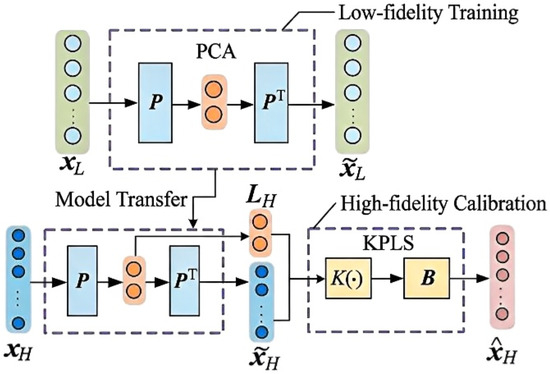
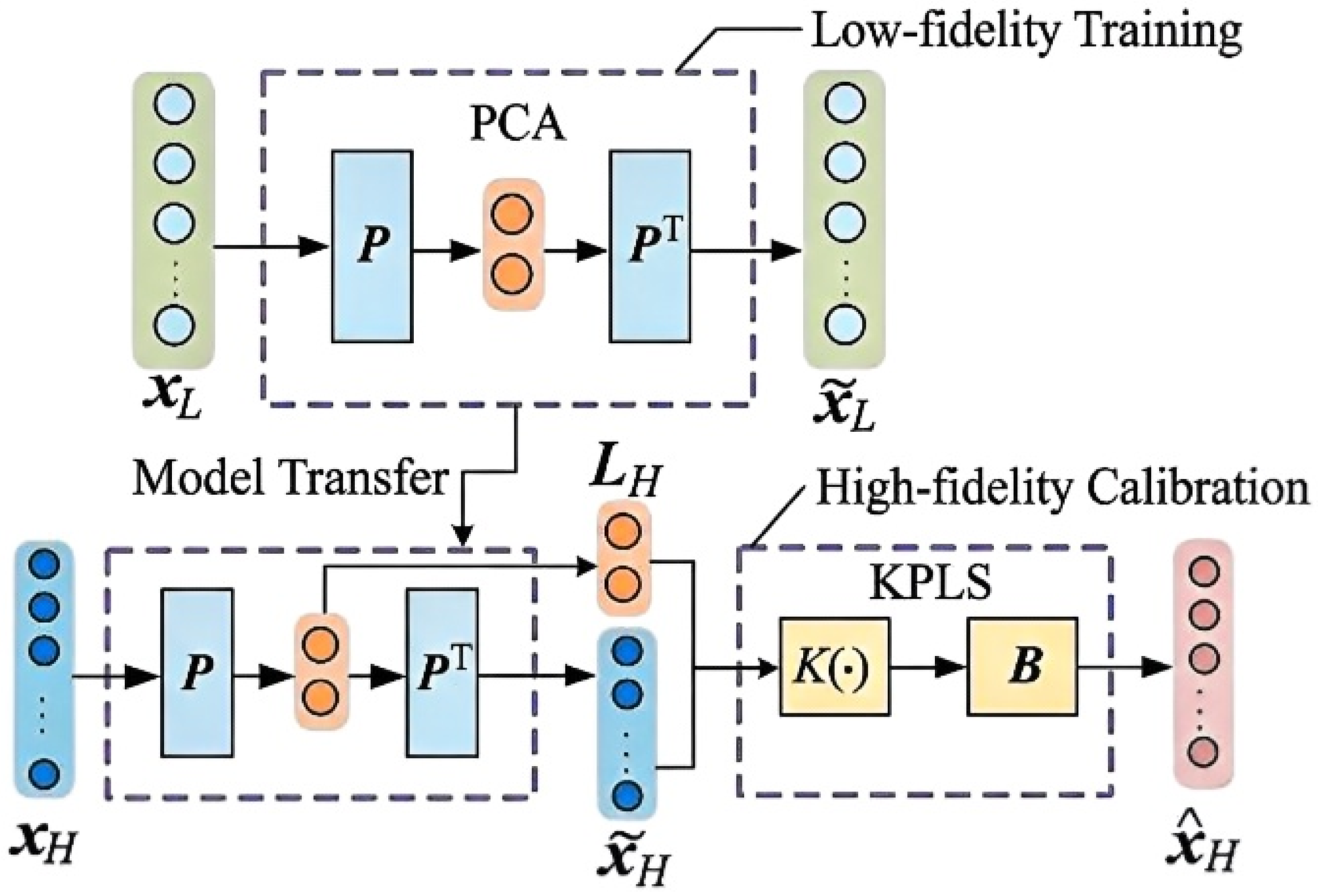
Figure 1 illustrates the basic structure of the PCA-KPLS-based multi-fidelity model. It mainly consists of interconnected PCA and KPLS models. The modeling procedure begins with training the PCA model using low-fidelity data, and the projection matrix P is saved. Subsequently, high-fidelity data is transformed via projection matrix P, and the transformed data is employed to train the KPLS model. This step aims to fuse the feature information of high- and low-fidelity data. Then, the resulting dataset is subsequently fed into the KPLS model, where a linear kernel function is applied to establish the mapping between low- and high-fidelity data. Finally, key parameters including the number of latent variables, transformation parameters, and regression coefficients in the KPLS model are fused with the PCA model to obtain the PCA-KPLS multi-fidelity model. Table 3 details the modeling steps.
Table 3.
Modeling steps for PCA-KPLS-based multi-fidelity model.
Figure 1.
Block diagram of the multi-fidelity model based on PCA-KPLS.
4. Results and Analysis
To ensure fair and consistent evaluation, all experiments are conducted under a unified experimental setup. The programming environment is based on Python 3.10.18, and all models are implemented in the TensorFlow (Keras) framework. Simulations are executed on a macOS platform equipped with an Apple M2 GPU, leveraging TensorFlow’s Metal backend for hardware acceleration.
4.1. Numerical Case Study
In this experiment, Equation (24) is utilized to construct 1000 sets of low-fidelity data to simulate the historical operational data of Equipment A. By slightly modifying the matrix in Equation (24), Equation (25) is derived to generate 1000 sets of high-fidelity data , simulating the historical operational data of Equipment B.
where follows a standard normal distribution, while and are sampled from normal distributions with null means and respective standard deviations of 0.8 and 0.6. The term e signifies zero-mean Gaussian white noise with a 0.02 intensity.
Three types of models—low-fidelity, high-fidelity, and multi-fidelity—were established using standard PCA and the proposed PCA-KPLS method.
- Low-fidelity model: Constructed using low-fidelity data for the PCA model; high-fidelity data is used for testing.
- High-fidelity model: 51 sets of data with parameters distributed within the interval are selected for PCA training, with the remaining portion of the high-fidelity data used for testing.
- Multi-fidelity model: Uses low-fidelity data to build the PCA model and the selected small sample set for KPLS training; tested on the remaining high-fidelity data.
The experiment uses the Coefficient of Determination () and Root-Mean-Square Error (RMSE) to evaluate performance (Equations (26) and (27)). The extent of variance explained by the model is represented by , where results approaching 1 are indicative of robust predictive accuracy and stronger predictive performance. RMSE measures the deviation between estimates and observations, representing the overall prediction error level; smaller values indicate higher precision.
where represents the true value of the i-th sample, denotes the model’s predicted value for the i-th sample, and signifies the mean value of the test set.
Figure 2, Figure 3 and Figure 4 and Table 4 present the experimental results for the three models. The low-fidelity model shows poor fitting on variables 1, 5, and 6, with values falling below 0.9. This predictive bias occurs because the distribution of high-fidelity data differs slightly from low-fidelity data, indicating that features learned solely from low-fidelity data cannot accurately generalize to actual high-fidelity data. The high-fidelity model also exhibits significant bias on variables 2 and 5 (), as the limited training set of 51 samples constrains the learning of inter-variable dependencies.
Table 4.
Simulation experimental results of different models.
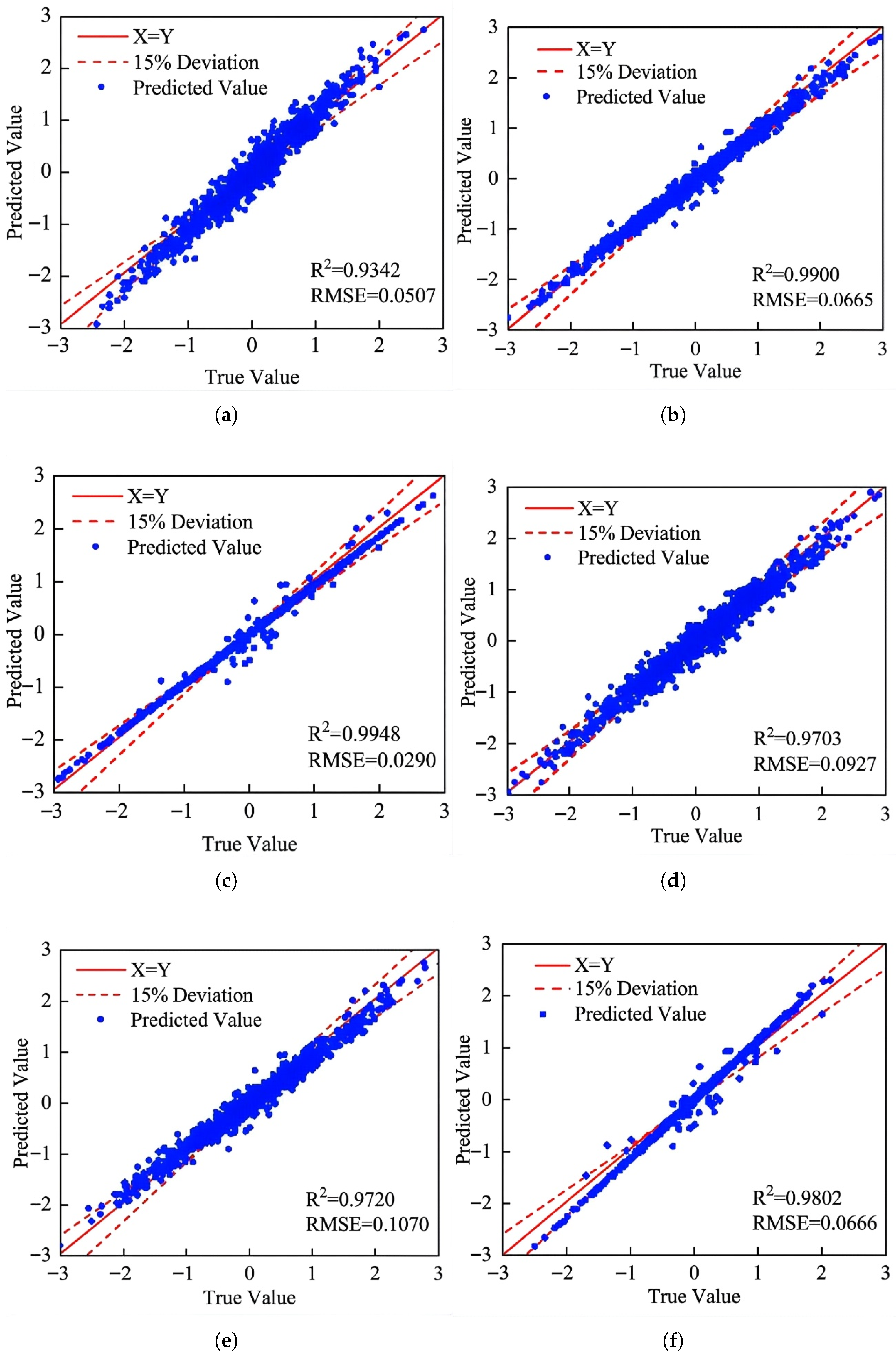
Figure 4 illustrates the predictive results of the multi-fidelity model. Compared to the single-fidelity models, the multi-fidelity approach first learns fundamental correlation features through large-scale low-fidelity data via PCA, and then employs a small high-fidelity sample set to build a KPLS model. This secondary step effectively mines the feature discrepancies between low- and high-fidelity data, enhancing predictive accuracy. Table 4 shows that for variables 1, 5, and 6 (where the low-fidelity model struggled), the multi-fidelity model achieves for every dimension. For variables 2 and 5 (where the high-fidelity model showed bias), the multi-fidelity model achieves . Furthermore, while the low-fidelity model’s RMSE exceeded 0.1 for every variable, the multi-fidelity model only had one variable with an RMSE above 0.1. These findings indicate that the PCA-KPLS multi-fidelity model effectively fuses low- and high-fidelity data, ensuring high precision and robust generalization even with sparse high-fidelity samples.
Figure 2.
Low-fidelity model test results: (a) predicted value of variable ; (b) predicted value of variable ; (c) predicted value of variable ; (d) predicted value of variable ; (e) predicted value of variable ; (f) predicted value of variable .
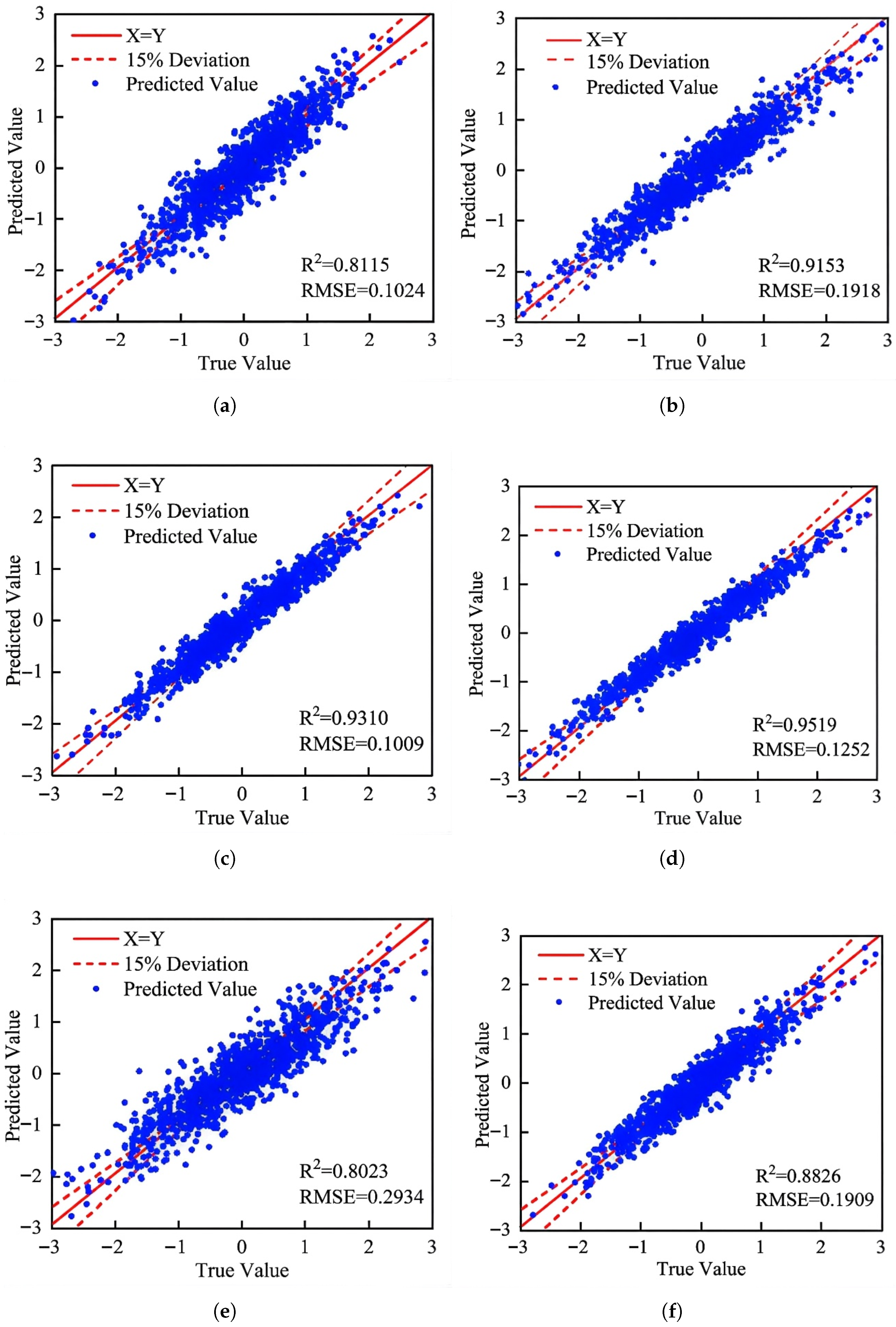
Figure 3.
High-fidelity model test results: (a) predicted value of variable ; (b) predicted value of variable ; (c) predicted value of variable ; (d) predicted value of variable ; (e) predicted value of variable ; (f) predicted value of variable .
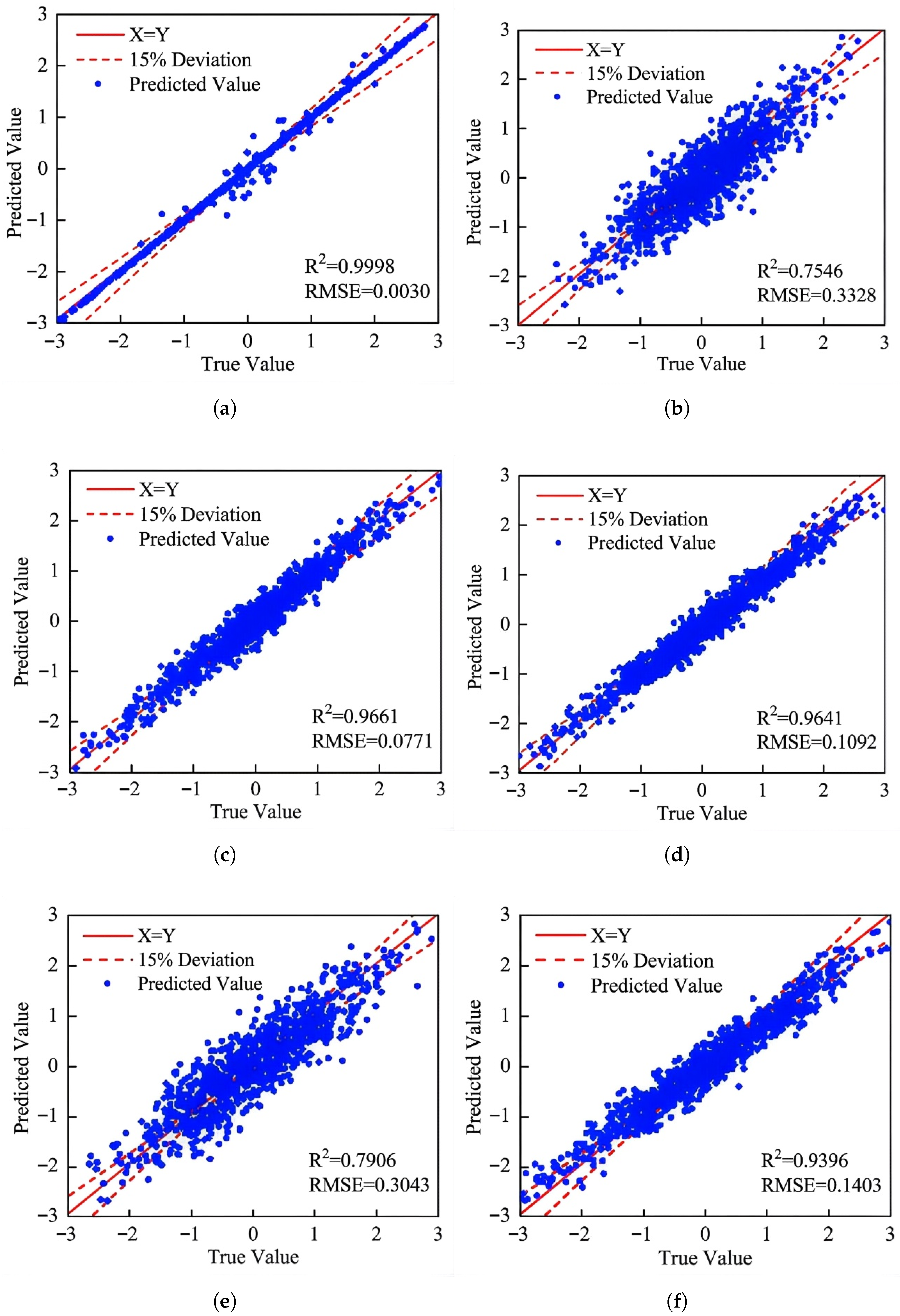
Figure 4.
Multi-fidelity model test results: (a) predicted value of variable ; (b) predicted value of variable ; (c) predicted value of variable ; (d) predicted value of variable ; (e) predicted value of variable ; (f) predicted value of variable .
4.2. Engineering Case Study
The datasets were obtained from industrial field measurements of PA fan systems. No missing values were identified after data inspection, and therefore no imputation was required. While industrial data may contain measurement noise, no explicit denoising was performed, as the proposed framework is designed to be robust to such variations.
To assess the practical performance of the PCA-KPLS multi-fidelity method, multi-dimensional operational parameters were collected via a Distributed Control System (DCS) from identical models of primary air fans across different power plants. The dataset includes critical monitoring variables such as motor coil temperature and bearing temperature, sampled at 1 min intervals. The primary air fan is driven by a 2600 kW squirrel-cage induction motor (4 poles, 6 kV rated voltage) equipped with multiple temperature sensors.
The 20,000 sets of complete data collected from the source-domain primary air fan from January to March are denoted as . The target-domain dataset from January was split chronologically, with the first 120 samples used as the training set and the remaining 13,500 samples used as the test set , without overlap. The test dataset was used solely for performance evaluation and was not involved in model training or parameter tuning. It reflects routine operational conditions of the target-domain system, enabling the assessment of model performance under practical scenarios. To ensure the validity of the experiment, the training and test sets for all three models consist of the same physical variables.
- Low-fidelity model: The complete dataset of the source domain primary air fan is utilized to train a PCA model, and the dataset is the test set to assess the predictive performance of the low-fidelity model.
- High-fidelity model: The 120 sets of incomplete data from the target domain primary air fan are utilized to train a PCA model, and the dataset is used as the test set to evaluate the predictive performance of the high-fidelity model.
- Multi-fidelity model: A PCA model is first constructed based on the complete dataset of the source domain primary air fan; then, the training set is utilized to build a multi-fidelity model based on PCA-KPLS, and the dataset is used as the test set to evaluate its predictive performance.
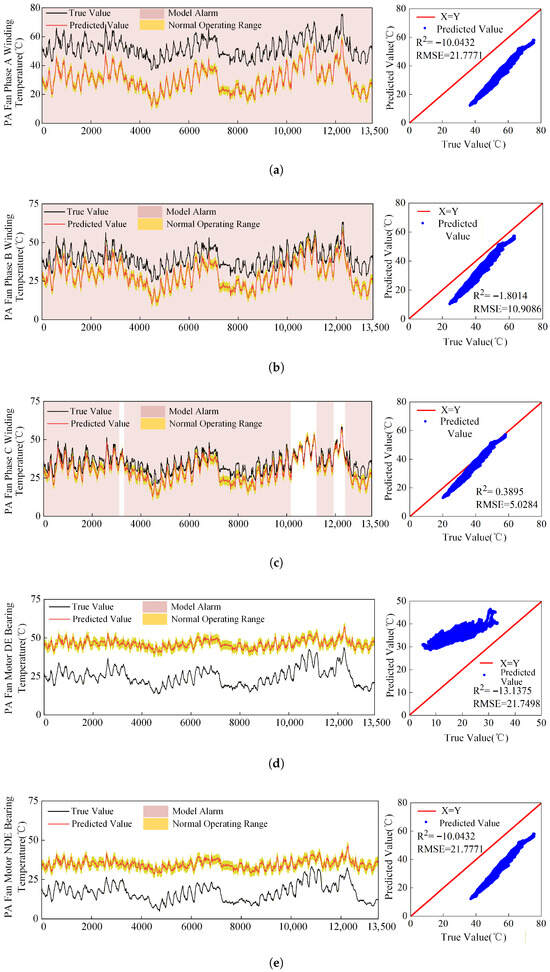
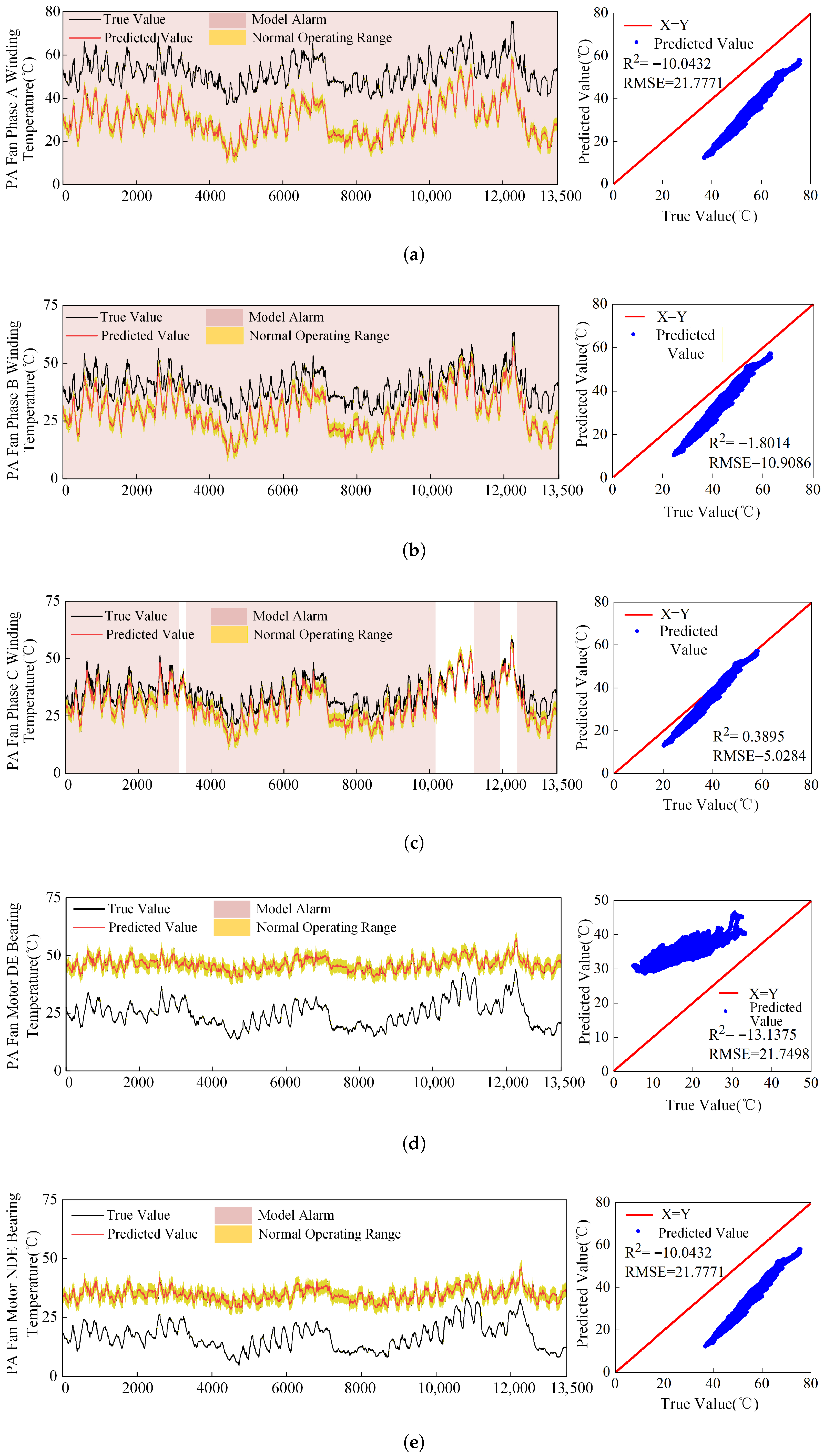
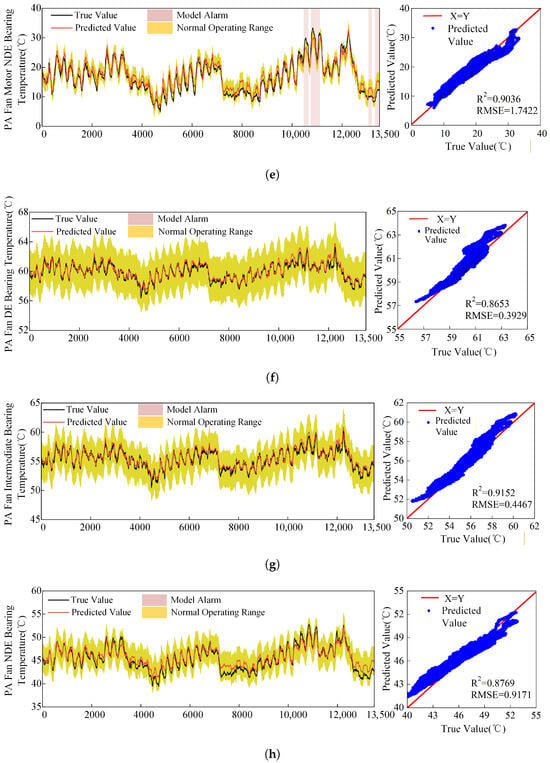
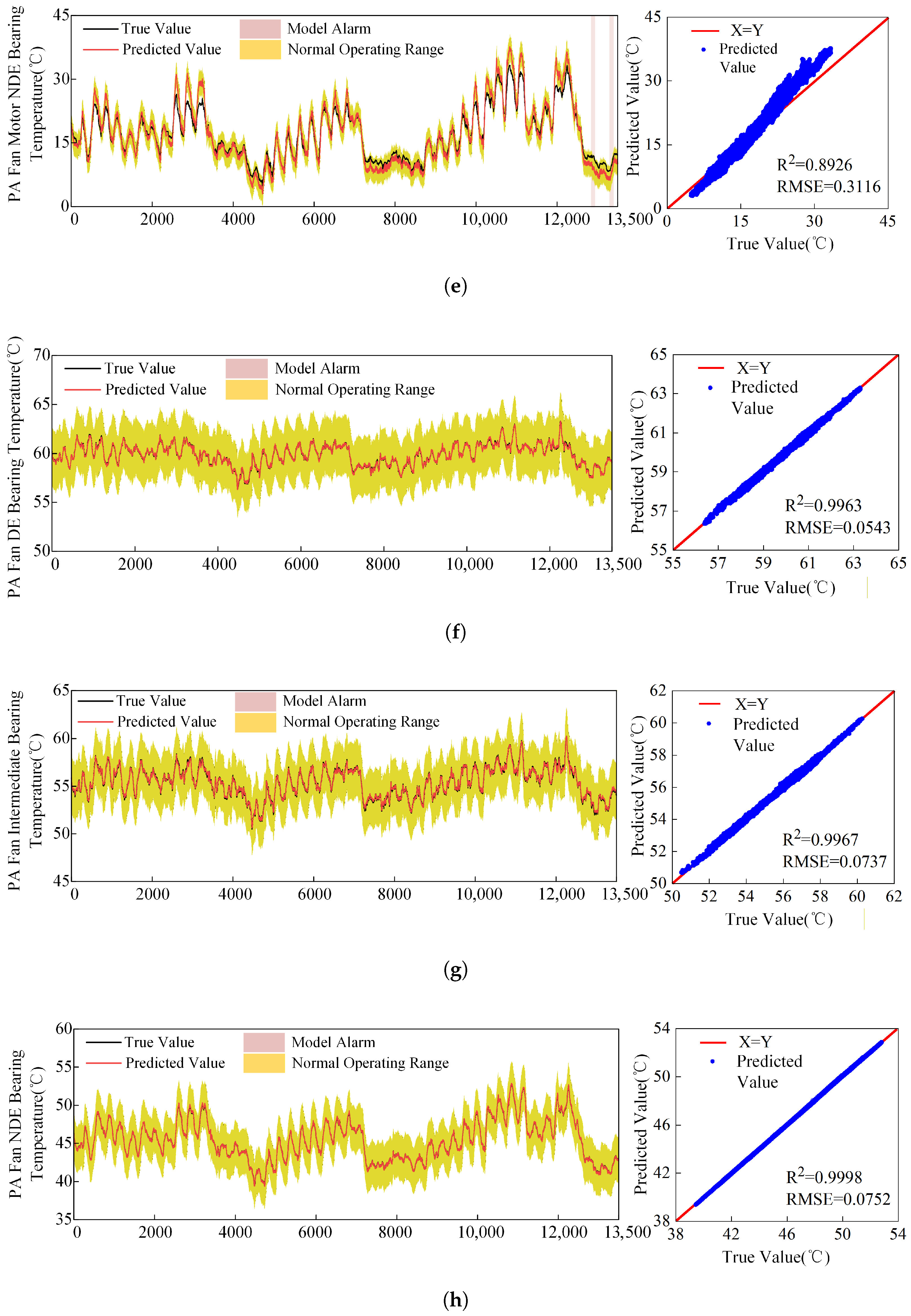
Table 5 presents the and experimental results for the low-, high-, and multi-fidelity models across different variables. Figure 5 illustrates the prediction results of the low-fidelity model, in which the black curve represents the actual values of the variable, and the red curve denotes the model’s predicted values. The yellow-shaded region in the figure indicates the normal operating interval of the model. When the actual value lies within this interval, the deviation is small and no alarm is triggered. Conversely, when the actual value exceeds the upper limit of the normal operating interval, it reflects a significant deviation between estimates and observations, prompting the model to issue an alarm.
Table 5.
Experimental results of different models.
Figure 5.
Comparison of prediction performance of the low-fidelity model: (a) PA fan phase A winding temperature; (b) PA fan phase B winding temperature; (c) PA fan phase C winding temperature; (d) PA fan motor DE bearing temperature. Comparison of prediction performance of the low-fidelity model: (e) PA fan motor NDE bearing temperature; (f) PA fan DE bearing temperature; (g) PA fan intermediate bearing temperature; (h) PA fan NDE bearing temperature.
Figure 5 and Table 5 show that the low-fidelity model exhibits significant deviations in predicting the first seven key variables, thus triggering frequent abnormal alarms across multiple time intervals due to the substantial errors owing to the significant discrepancies across estimates and observations. The primary cause of this issue lies in the fact that, although both low- and high-fidelity data are collected from primary fans of the same model, they operate under different actual working conditions. The low-fidelity model is trained solely on source domain data and fails to adequately learn the operational characteristics of the target domain primary fan, leading to a high rate of false alarms. These experimental results indicate that models trained exclusively on source domain data cannot effectively monitor the operating status of target domain equipment, highlighting the poor generalization capability of such models.
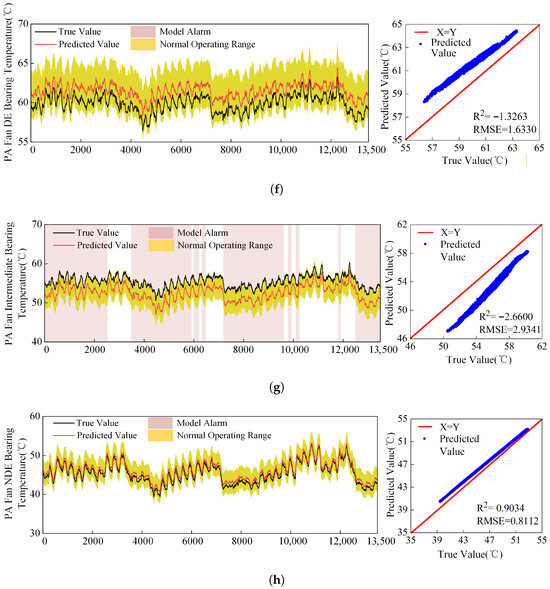
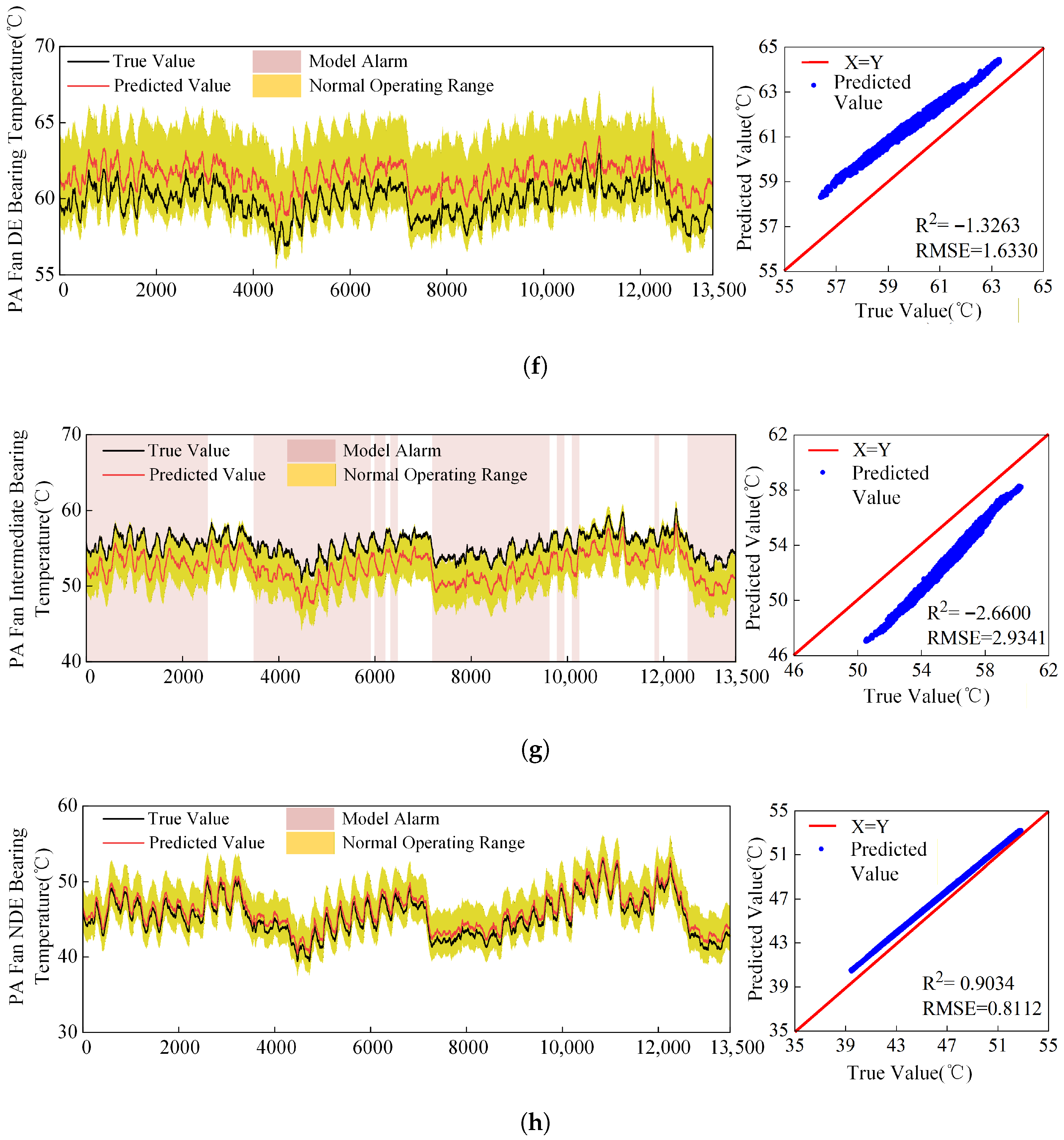
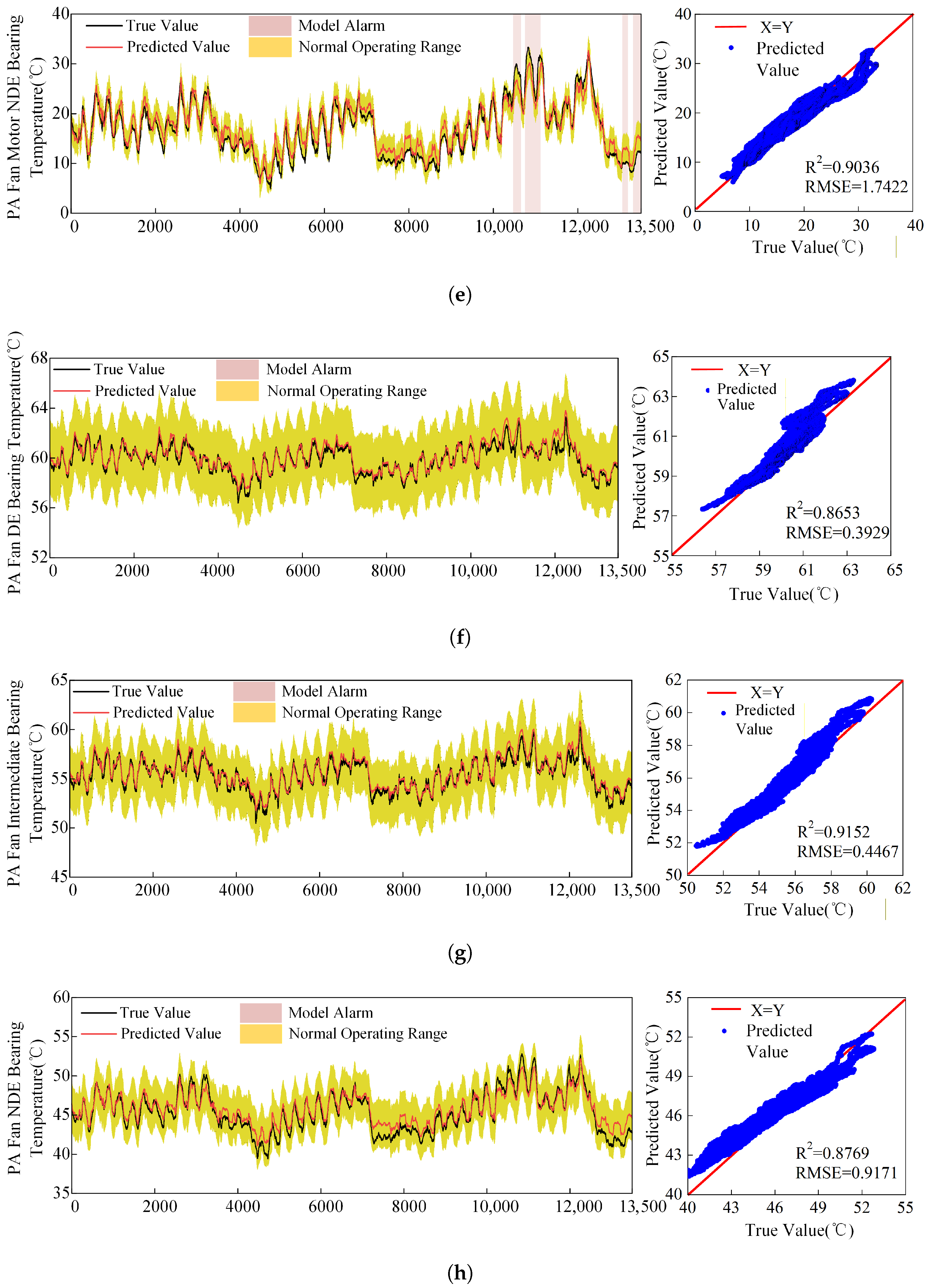
Figure 6 illustrates the high-fidelity forecasting results on the target domain test set. As evidenced by the outcomes in Table 5, the high-fidelity model achieved values exceeding 0.8 only for specific variables, such as the motor front/rear bearing temperatures and fan bearing temperature, whereas the values for the remaining variables remained relatively low. Although the high-fidelity model exhibited a marked reduction in prediction error compared to the low-fidelity model, the overall results were characterized by significant instability. Notably, for three critical variables—the temperatures of Motor Phase A, B, and C coils—the predicted values frequently surpassed the control limits established by fault detection indicators, leading to recurrent false alarms. Such performance gaps arise because the high-fidelity model was developed using a sparse training set of merely 120 observations, which hindered its ability to fully capture the complex feature correlations between variables. Consequently, despite possessing a degree of fitting capability, the high-fidelity model is constrained by data scarcity, resulting in a limited capacity to characterize the operational features of the primary air fan and an inability to reliably monitor the equipment’s status.
Figure 6.
Comparison of prediction performance of the high-fidelity model: (a) PA fan phase A winding temperature; (b) PA fan phase B winding temperature; (c) PA fan phase C winding temperature. Comparison of prediction performance of the high-fidelity model: (d) PA fan motor DE bearing temperature; (e) PA fan motor NDE bearing temperature; (f) PA fan DE bearing temperature; (g) PA fan intermediate bearing temperature. Comparison of prediction performance of the high-fidelity model: (h) PA fan NDE bearing temperature.
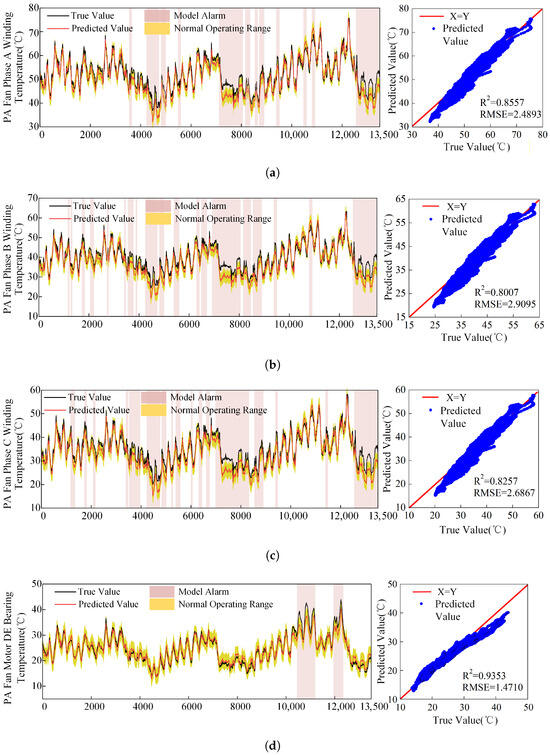
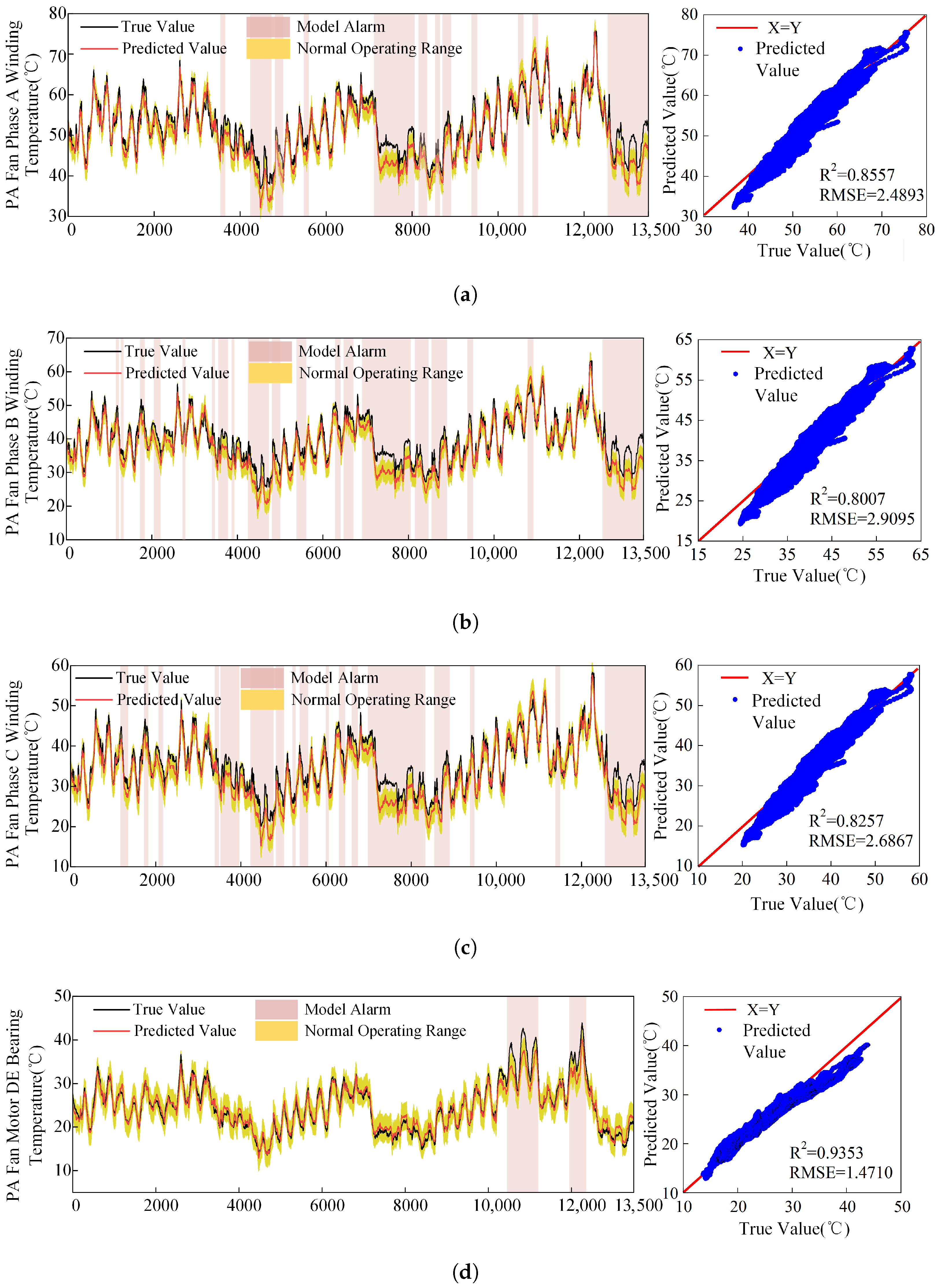
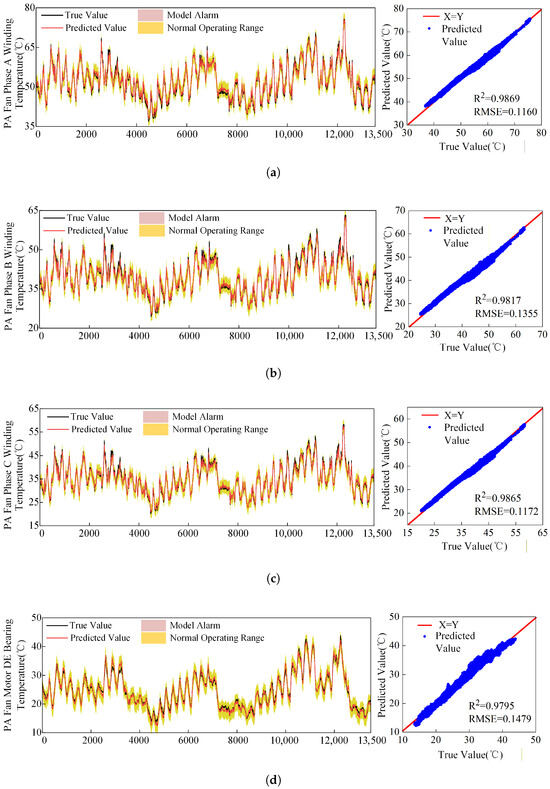
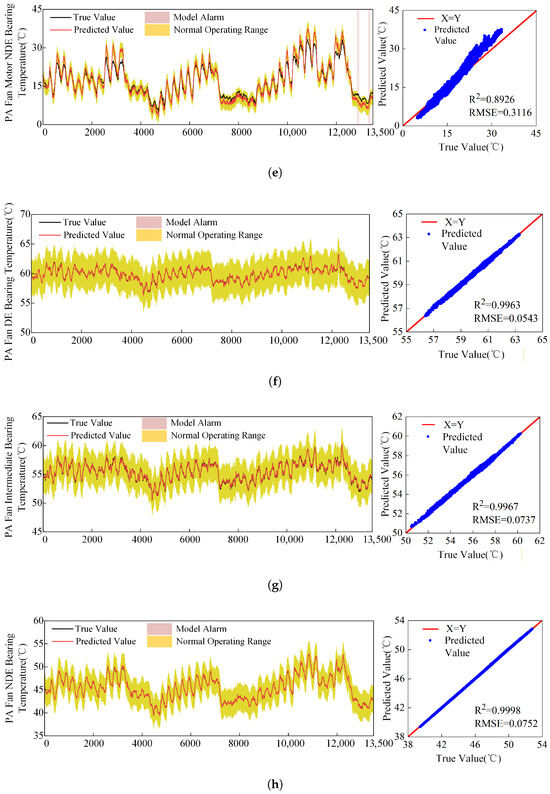
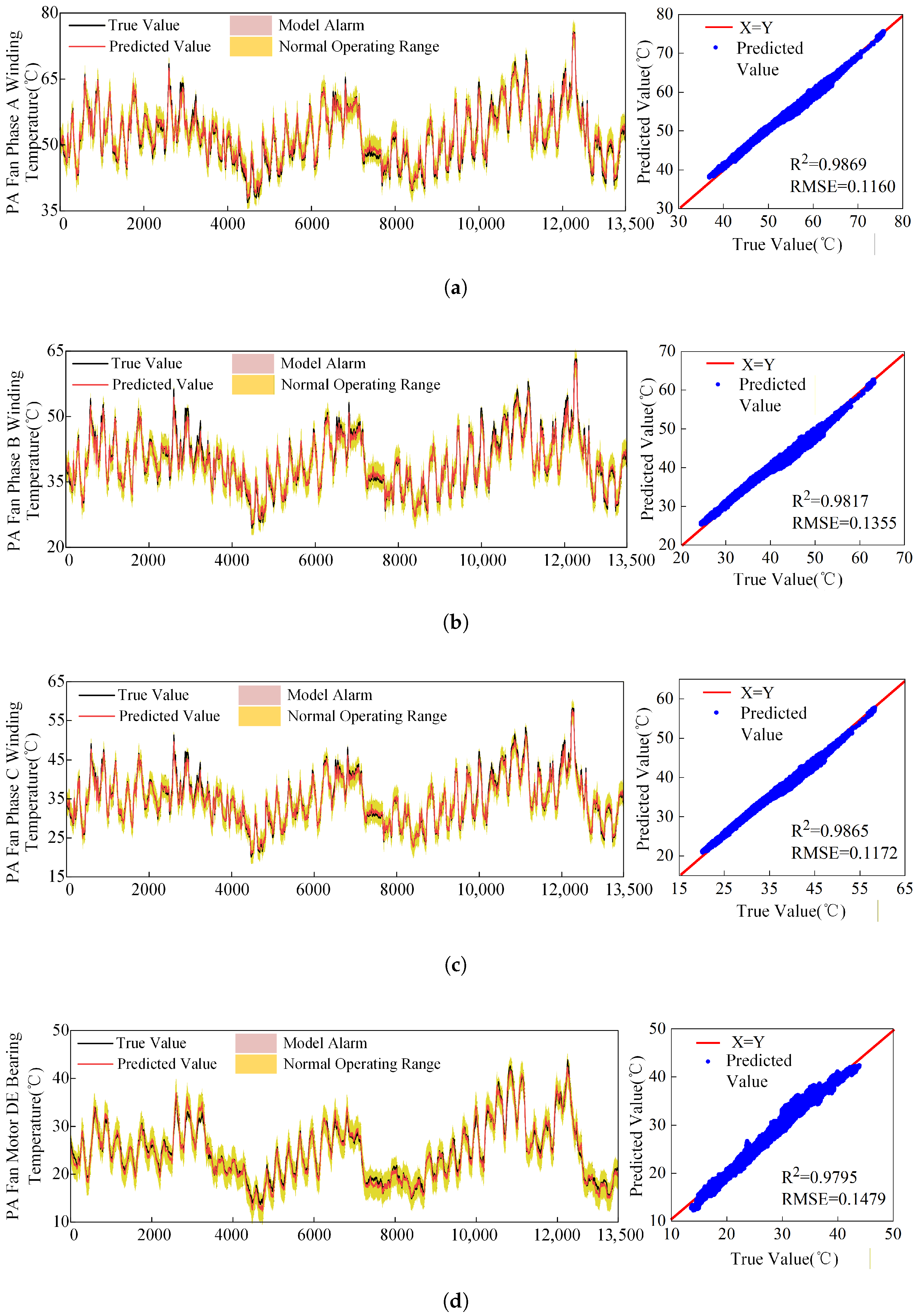
Figure 7 depicts the prediction of the multi-fidelity model on the target domain test set. According to Table 5, the multi-fidelity model yielded an below 0.9 only for the motor rear bearing temperature of the primary air fan, while the for all other variables exceeded 0.97. For sensitive variables such as fan bearing temperature, the even surpassed 0.99, significantly outperforming both the low-fidelity and high-fidelity models. As shown in Figure 7, the multi-fidelity model’s predictions align closely with the ground truth across most variables, demonstrating superior fitting without evident bias or fluctuations. Compared to its counterparts, the multi-fidelity model substantially reduced the false alarm rate, exhibiting enhanced stability and robustness. These findings suggest that the multi-fidelity model possesses strong adaptability to the operational characteristics of the primary air fan in the target domain, enabling effective condition monitoring even under data-constrained environments.
Figure 7.
Comparison of prediction performance of the multi-fidelity model: (a) PA fan phase A winding temperature; (b) PA fan phase B winding temperature. Comparison of prediction performance of the multi-fidelity model: (c) PA fan phase C winding temperature; (d) PA fan motor DE bearing temperature; (e) PA fan motor NDE bearing temperature; (f) PA fan DE bearing temperature. Comparison of prediction performance of the multi-fidelity model: (g) PA fan intermediate bearing temperature; (h) PA fan NDE bearing temperature.
5. Conclusions
This paper researched asynchronous motor fault diagnosis under incomplete data conditions, proposing a multi-fidelity modeling method based on PCA-KPLS. Verified by simulation and engineering cases, the conclusions are:
Prediction Performance: Under small sample conditions, the proposed method optimally balances generalization capability and prediction accuracy by fusing source domain knowledge with target domain characteristics. It achieves values closer to 1 and lower compared to single-fidelity models.
Fault Diagnosis: Engineering cases prove that the method effectively solves false alarm issues caused by deviations in data-driven model characteristics. It maintains prediction accuracy while significantly reducing false alarms, proving its effectiveness in monitoring equipment status and improving diagnosis efficiency under incomplete data conditions.
Further validation across broader industrial scenarios remains an open and worthwhile direction. In addition, exploring how the proposed framework performs under more diverse data conditions, as well as its potential integration with alternative approaches, could provide further improvements.
Author Contributions
Conceptualization, F.L., S.Y., S.R., N.A. and F.S.; Methodology, S.R.; Software, F.S.; Formal analysis, F.S.; Investigation, F.L., S.Y. and X.L.; Resources, F.S.; Data curation, S.R. and F.S.; Writing—original draft, S.R.; Writing—review & editing, F.S.; Visualization, S.R.; Project administration, N.A., X.L. and F.S.; Funding acquisition, F.L., S.Y., N.A. and X.L. All authors have read and agreed to the published version of the manuscript.
Funding
This research received no external funding.
Data Availability Statement
Data available from the corresponding author on request.
Conflicts of Interest
Authors Fei Li, Senquan Yang, Nan An and Xi Li were employed by the company China Nuclear Power Operation Technology Corporation, Ltd. and China National Nuclear Corporation. The remaining authors declare that the research was conducted in the absence of any commercial or financial relationships that could be construed as a potential conflict of interest.
References
- Zhen, J.; Wang, Y.; Li, S. Sustainable development through strategic retreat: Pathways for enhancing the efficiency of coal-fired power plant retirement. Energy 2026, 344, 140033. [Google Scholar] [CrossRef] [Scilit]
- Impram, S.; Nese, S.V.; Oral, B. Challenges of renewable energy penetration on power system flexibility: A survey. Energy Strategy Rev. 2020, 31, 100539. [Google Scholar] [CrossRef] [Scilit]
- Zhang, H.; Pang, Y.; Cui, H.; Li, J.; Wang, W.; Zhang, Z. Thermal economy analysis on deep peak regulation operation of supercritical 630 MW coal-fired unit. Front. Energy Res. 2025, 13, 1611001. [Google Scholar] [CrossRef] [Scilit]
- Susilo, S.D.; Tristanto, A.D.; Prasetya, W.; Ichwan, M.; Sihotang, F.; Intan, I.; Karnyoto, A. Redesigning the element profile of air preheater in coal-fired power plants for emission reduction and efficiency improvement. Int. J. Environ. Sustain. Soc. Sci. 2024, 5, 1082. [Google Scholar] [CrossRef] [Scilit]
- Yeh, J.-C.; Lee, Y.-C.; Huang, C.-H.; Li, M.-Y.; Wei, C.-C. Study of corrosion, power consumption, and wear characteristics of herringbone-grooved fan bearings in high-temperature and high-humidity environments. Lubricants 2025, 13, 245. [Google Scholar] [CrossRef] [Scilit]
- Lu, Y.; Yang, X.; E, L.; Fang, Z.; Li, Y.; Liang, C.; Shi, Z.; Wang, C. Characterizing a year-round particulate matter concentration and variation under different environmental controls in a naturally ventilated dairy barn. Agriculture 2023, 13, 902. [Google Scholar] [CrossRef] [Scilit]
- ElAraby, W.S.; Madian, A.H.; Saad, M.H. Fault diagnosis for rotating machinery based on deep learning. Noise Vib. Worldw. 2025, 56, 400–421. [Google Scholar] [CrossRef] [Scilit]
- Wang, R.; Zhan, X.; Bai, H.; Dong, E.; Cheng, Z.; Jia, X. A review of fault diagnosis methods for rotating machinery using infrared thermography. Micromachines 2022, 13, 1644. [Google Scholar] [CrossRef] [Scilit]
- de Souza, R.P.P.; Agulhari, C.M.; Goedtel, A.; Moriñigo-Sotelo, D.; Duque-Pérez, Ó.; Fernández-Cavero, V. Broken rotor bar fault detection—A virtual current approach combined with a robust linear parameter-varying observer. Control Eng. Pract. 2025, 156, 106233. [Google Scholar] [CrossRef] [Scilit]
- Sleiti, A.K.; Kapat, J.S.; Vesely, L. Digital twin in energy industry: Proposed robust digital twin for power plant and other complex capital-intensive large engineering systems. Energy Rep. 2022, 8, 3704–3726. [Google Scholar] [CrossRef] [Scilit]
- Ge, Z. Review on data-driven modeling and monitoring for plant-wide industrial processes. Chemom. Intell. Lab. Syst. 2017, 171, 16–25. [Google Scholar] [CrossRef] [Scilit]
- Mallick, M.R.; Imtiaz, S.A. A hybrid method for process fault detection and diagnosis. In Proceedings of the 10th IFAC International Symposium on Dynamics and Control of Process Systems, Mumbai, India, 18–20 December 2013; pp. 827–832. [Google Scholar] [CrossRef] [Scilit]
- Yoon, S.; MacGregor, J.F. Statistical and causal model-based approaches to fault detection and isolation. AIChE J. 2000, 46, 1813–1824. [Google Scholar] [CrossRef] [Scilit]
- Pani, A.K. Non-linear process monitoring using kernel principal component analysis: A review of the basic and modified techniques with industrial applications. Braz. J. Chem. Eng. 2022, 39, 327–344. [Google Scholar] [CrossRef] [Scilit]
- Said, M.; Taouali, O. Improved dynamic optimized kernel partial least squares for nonlinear process fault detection. Math. Probl. Eng. 2021, 2021, 6677944. [Google Scholar] [CrossRef] [Scilit]
- Widodo, A.; Yang, B.S. Support vector machine in machine condition monitoring and fault diagnosis. Mech. Syst. Signal Process. 2007, 21, 2560–2574. [Google Scholar] [CrossRef] [Scilit]
- Lei, Y.; Lin, J.; He, Z.; Zuo, M.J. A review on empirical mode decomposition in fault diagnosis of rotating machinery. Mech. Syst. Signal Process. 2013, 35, 108–126. [Google Scholar] [CrossRef] [Scilit]
- Lei, Y.; Yang, B.; Jiang, X.; Jia, F.; Nandi, A.K. Applications of machine learning to machine fault diagnosis: A review and roadmap. Mech. Syst. Signal Process. 2020, 138, 106587. [Google Scholar] [CrossRef] [Scilit]
- Bao, Z.; Liu, C.; Yang, H.; Zhang, J.; Li, Y. From theory to industry: A survey of deep learning-enabled bearing fault diagnosis in complex environments. Eng. Appl. Artif. Intell. 2026, 163, 113068. [Google Scholar] [CrossRef] [Scilit]
- Shao, H.; Jiang, H.; Zhao, H.; Wang, F. A novel deep autoencoder feature learning method for rotating machinery fault diagnosis. Mech. Syst. Signal Process. 2017, 95, 187–204. [Google Scholar] [CrossRef] [Scilit]
- Amjad, S.; Faraz, M.; Naqvi, S.Z.H. Fault diagnosis in rotating machines using vibration signal analysis and machine learning. In Proceedings of the 2024 19th International Conference on Emerging Technologies (ICET), Topi, Pakistan, 19–20 November 2024; pp. 1–6. [Google Scholar] [CrossRef] [Scilit]
- Khalil, A.F.; Rostam, S. Machine learning-based predictive maintenance for fault detection in rotating machinery: A case study. Eng. Technol. Appl. Sci. Res. 2024, 14, 13181–13189. [Google Scholar] [CrossRef] [Scilit]
- Zhao, J.; Wang, W.; Huang, J.; Ma, X. A comprehensive review of deep learning-based fault diagnosis approaches for rolling bearings: Advancements and challenges. AIP Adv. 2025, 15, 020702. [Google Scholar] [CrossRef] [Scilit]
- Zhu, Z.; Lei, Y.; Qi, G.; Chai, Y.; Mazur, N.; An, Y.; Huang, X. A review of the application of deep learning in intelligent fault diagnosis of rotating machinery. Measurement 2023, 206, 112346. [Google Scholar] [CrossRef] [Scilit]
- Wang, H.; Wang, H.; Tang, X. A review of deep learning in rotating machinery fault diagnosis and its prospects for port applications. Appl. Sci. 2025, 15, 11303. [Google Scholar] [CrossRef] [Scilit]
- Zhong, X.; Zhang, L.; Ban, H. Deep reinforcement learning for class imbalance fault diagnosis of equipment in nuclear power plants. Ann. Nucl. Energy 2023, 184, 109685. [Google Scholar] [CrossRef] [Scilit]
- Zhu, J.; Zhu, L. Fault diagnosis for imbalanced datasets based on deep convolution fuzzy system. Machines 2025, 13, 326. [Google Scholar] [CrossRef] [Scilit]
- Guo, C.; Potekhin, V.V. Generative adversarial network for classification of mechanical fault diagnosis model. Comput. Telecommun. Control 2025, 18, 30–43. [Google Scholar] [CrossRef]
- Liu, Q.; Ma, G.; Cheng, C. Data fusion generative adversarial network for multi-class imbalanced fault diagnosis of rotating machinery. IEEE Access 2020, 8, 70111–70124. [Google Scholar] [CrossRef] [Scilit]
- Mao, W.; Liu, Y.; Ding, L.; Li, Y. Imbalanced fault diagnosis of rolling bearing based on generative adversarial network: A comparative study. IEEE Access 2019, 7, 9515–9530. [Google Scholar] [CrossRef] [Scilit]
- Pan, S.J.; Yang, Q. A survey on transfer learning. IEEE Trans. Knowl. Data Eng. 2010, 22, 1345–1359. [Google Scholar] [CrossRef] [Scilit]
- Li, X.; Zhang, W.; Ding, Q. Cross-domain fault diagnosis of rolling element bearings using deep generative neural networks. IEEE Trans. Ind. Electron. 2019, 66, 5525–5534. [Google Scholar] [CrossRef] [Scilit]
- Huang, X.; Xie, T.; Zhou, Q. Digital twin-assisted bearing fault diagnosis using multi-fidelity incremental learning. In Proceedings of the 2024 10th International Conference on Control, Automation and Robotics (ICCAR), Singapore, 27–29 April 2024; pp. 184–190. [Google Scholar] [CrossRef] [Scilit]
- Gao, T.; Yang, J.; Tang, Q. A multi-source domain information fusion network for rotating machinery fault diagnosis under variable operating conditions. Inf. Fusion 2024, 106, 102278. [Google Scholar] [CrossRef] [Scilit]

Disclaimer/Publisher’s Note: The statements, opinions and data contained in all publications are solely those of the individual author(s) and contributor(s) and not of MDPI and/or the editor(s). MDPI and/or the editor(s) disclaim responsibility for any injury to people or property resulting from any ideas, methods, instructions or products referred to in the content. |
© 2026 by the authors. Licensee MDPI, Basel, Switzerland. This article is an open access article distributed under the terms and conditions of the Creative Commons Attribution (CC BY) license.