Climate Policy Uncertainty and Its Effects on Investments in Renewable Energy Transition: A Systematic Literature Review and Meta-Analysis



Abstract
1. Introduction
2. Literature Review
2.1. The Context of Climate Policy and Energy Transition
2.2. Channels of Transmission
2.2.1. First Channel: Firm Investment
2.2.2. Second Channel: Financial Market
2.2.3. Third Channel: Political and Institutional
2.2.4. Fourth Channel: Macroeconomic
2.3. Current Debate and Research Gap
3. Methodology
3.1. Research Protocol
- Setting: We included energy transition studies. This includes studies of renewable energy, carbon emission mitigation approaches, low-carbon technologies, electricity markets, hydrogen, storage, and electric vehicle studies. We excluded studies not focused on other industries or technical engineering studies without a policy or investment orientation. Qualifying studies would also need to account for those who have investment decisions to make, such as investors, businesses, financial institutions, and policymakers. We excluded studies comprising only households, median consumers, or non-financial entities, unless they clearly addressed investment outcomes in relation to the energy transition.
- Intervention: We paid specific attention to climate policy uncertainty (CPU), including uncertainty related to rules, policy-related risks, or changes in regulations related to climate and energy. Studies that accounted only for aggregate economic, political, or global uncertainty, without specific links to policy and energy and climate policy, respectively, were excluded.
- Comparison: These works could have been included if they had contrasted uncertain and certain policy regimes, confirmed how investment outcomes differed under different levels of policy uncertainty, or examined cross-country or intertemporal differences. We excluded studies that did not comment on policy environment differences or those focusing exclusively on the technical characteristics of energy systems.
- Evaluation: We examined studies that focused on investment results, including how money is spent, costs of financing, cost of capital, when to invest, risk premiums, the use of new technology, and how climate policy uncertainty affects these decisions. We excluded studies if their results did not relate to investment (for example, public opinion, social attitudes, or environmental effects) or if they did not explain how investments are affected.
Updated Search (1 April 2026)
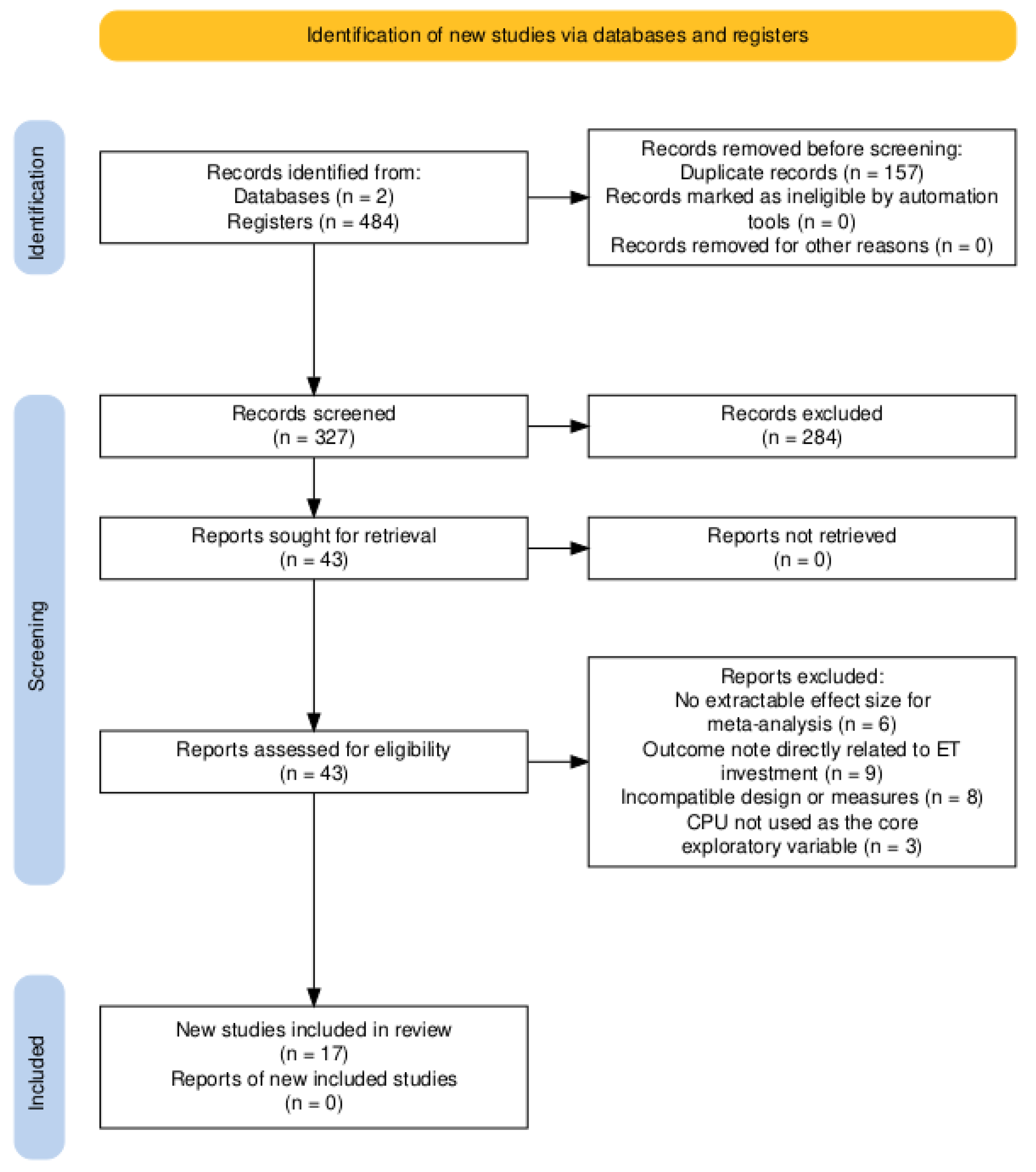
3.2. Selection Process Flowchart
3.3. Data Extraction and Data Management
3.4. Meta-Analysis Framework
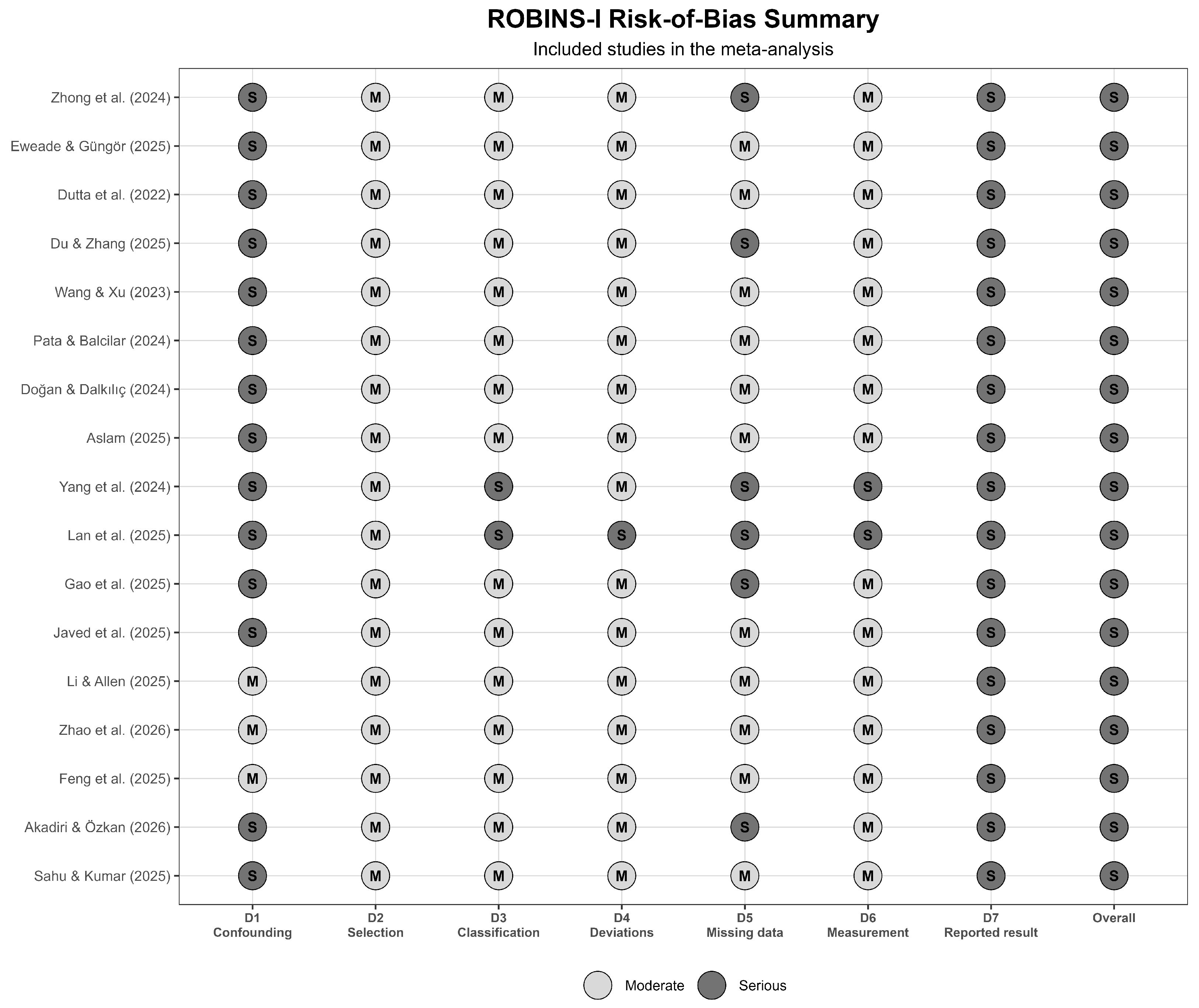
3.5. Risk of Bias Assessment
4. Empirical Results
4.1. Main Findings
4.2. Random-Effects Model—Meta-Analysis
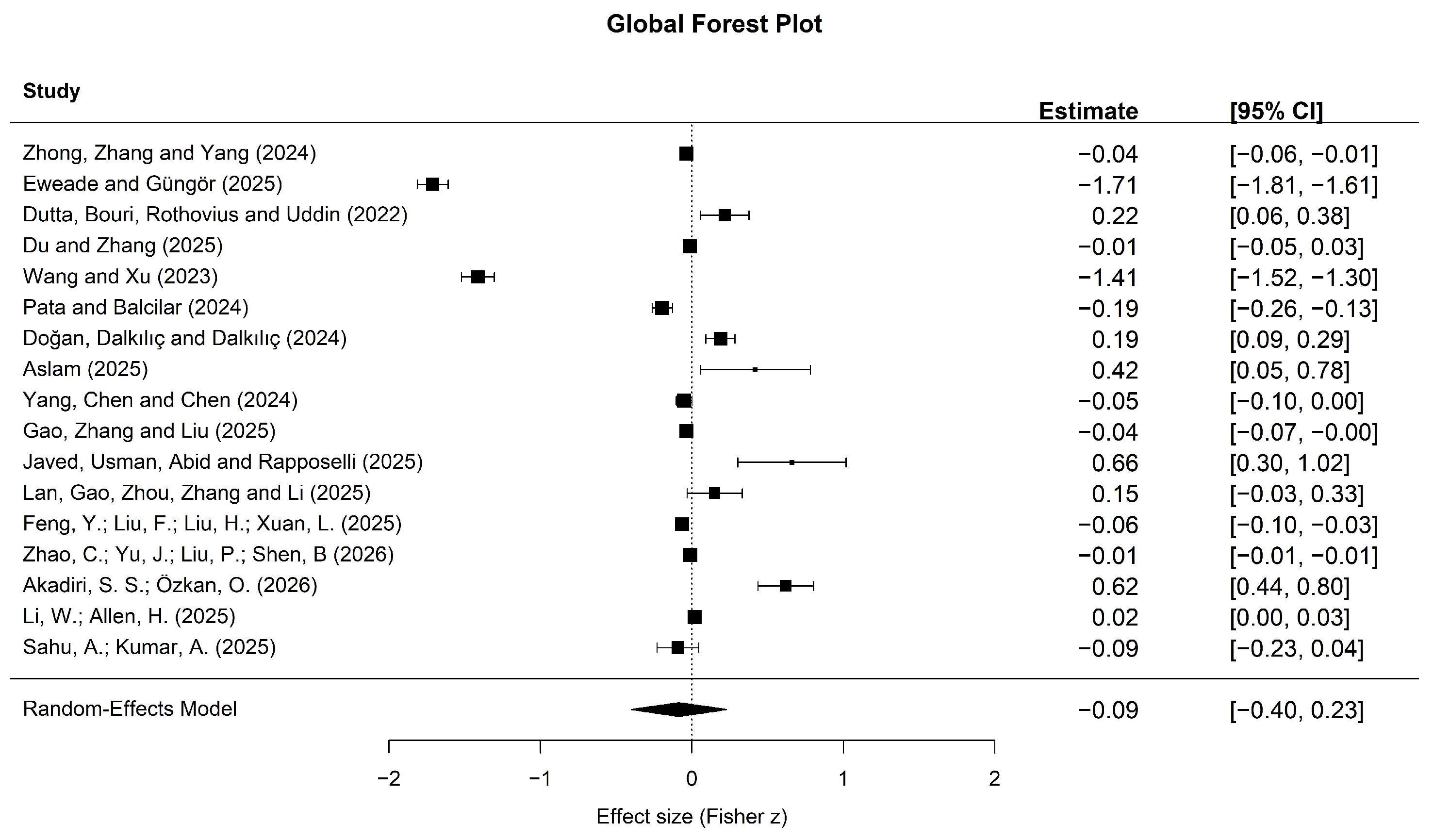
4.2.1. Meta-Analysis Model Specifications and Results
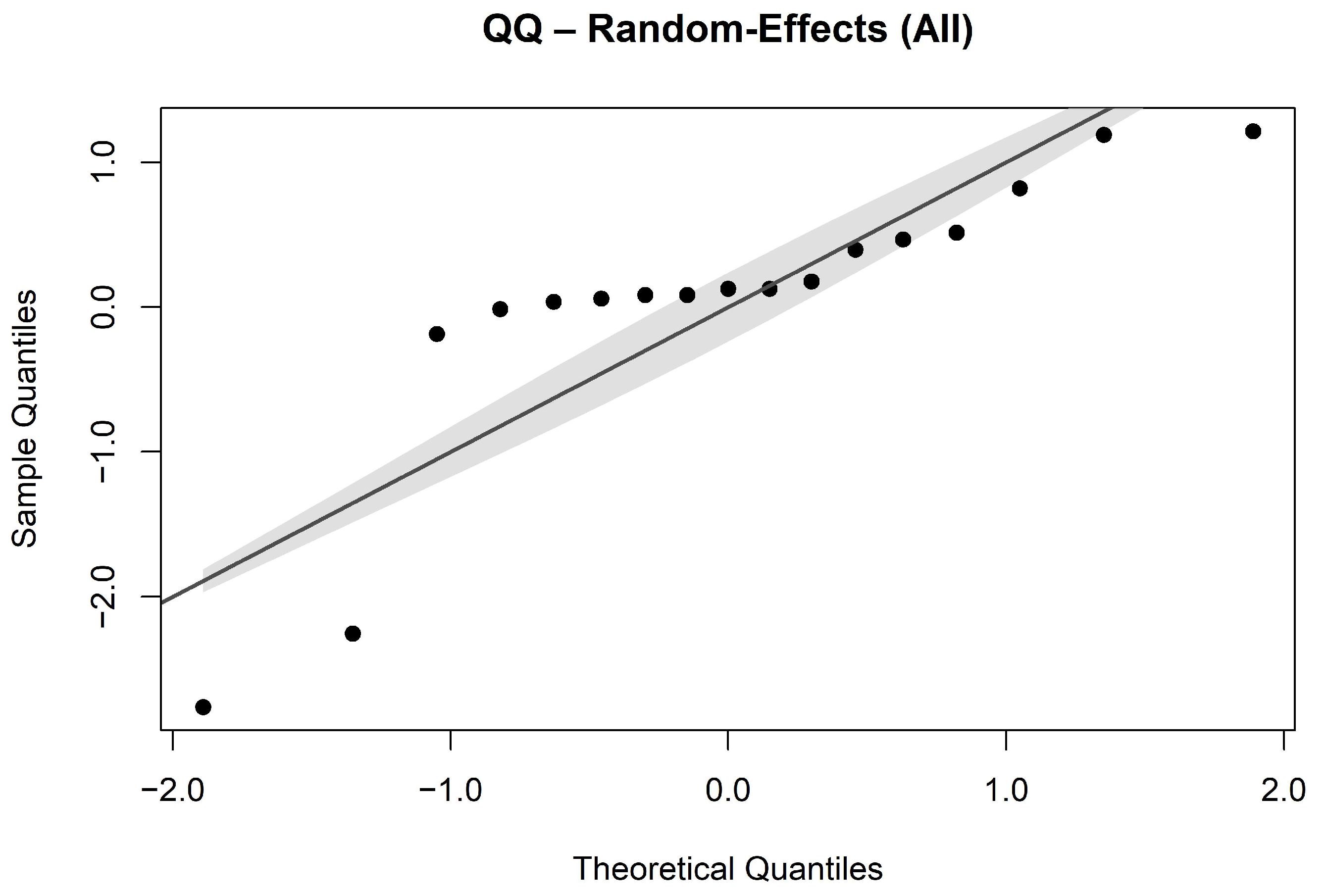
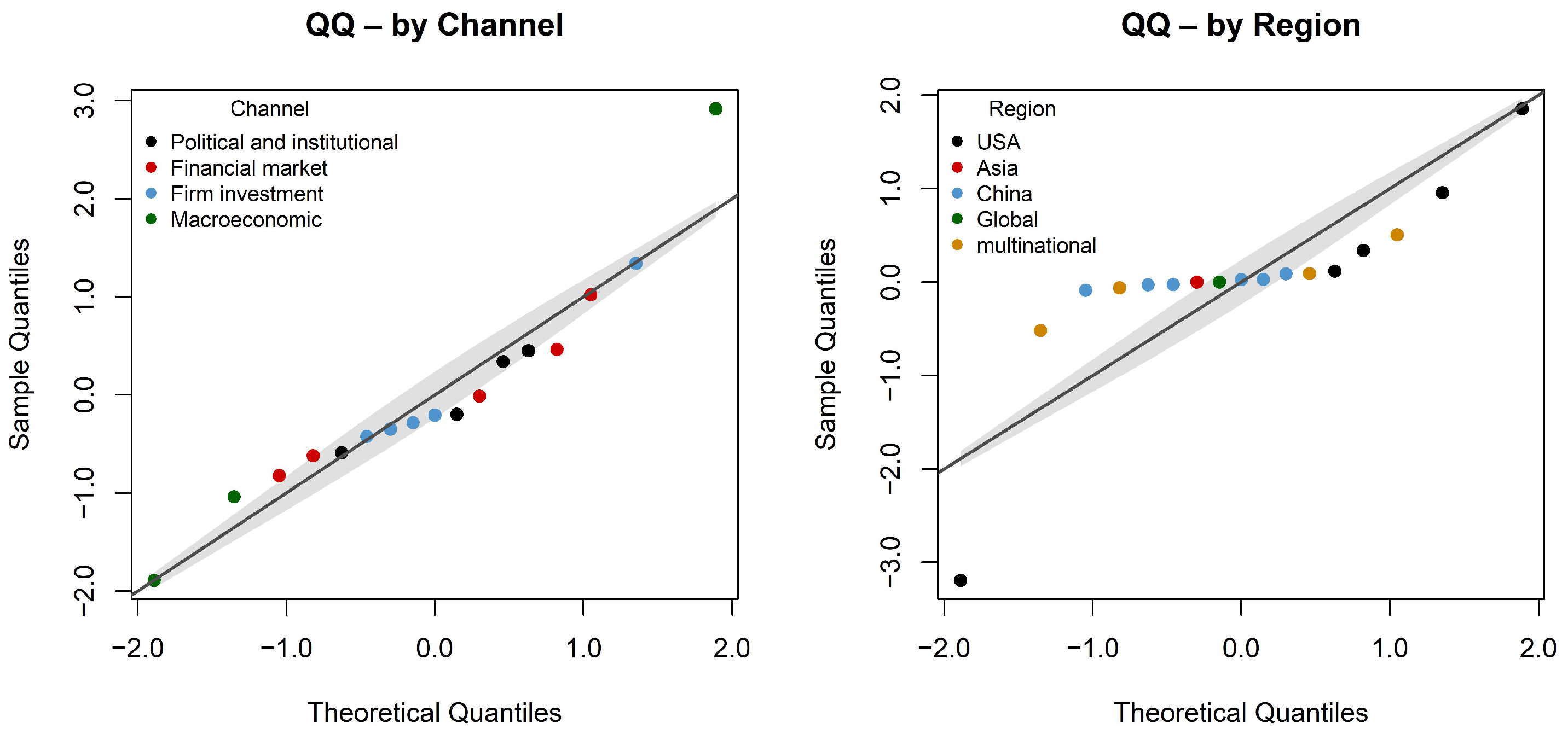
4.2.2. QQ Plot—Random-Effects
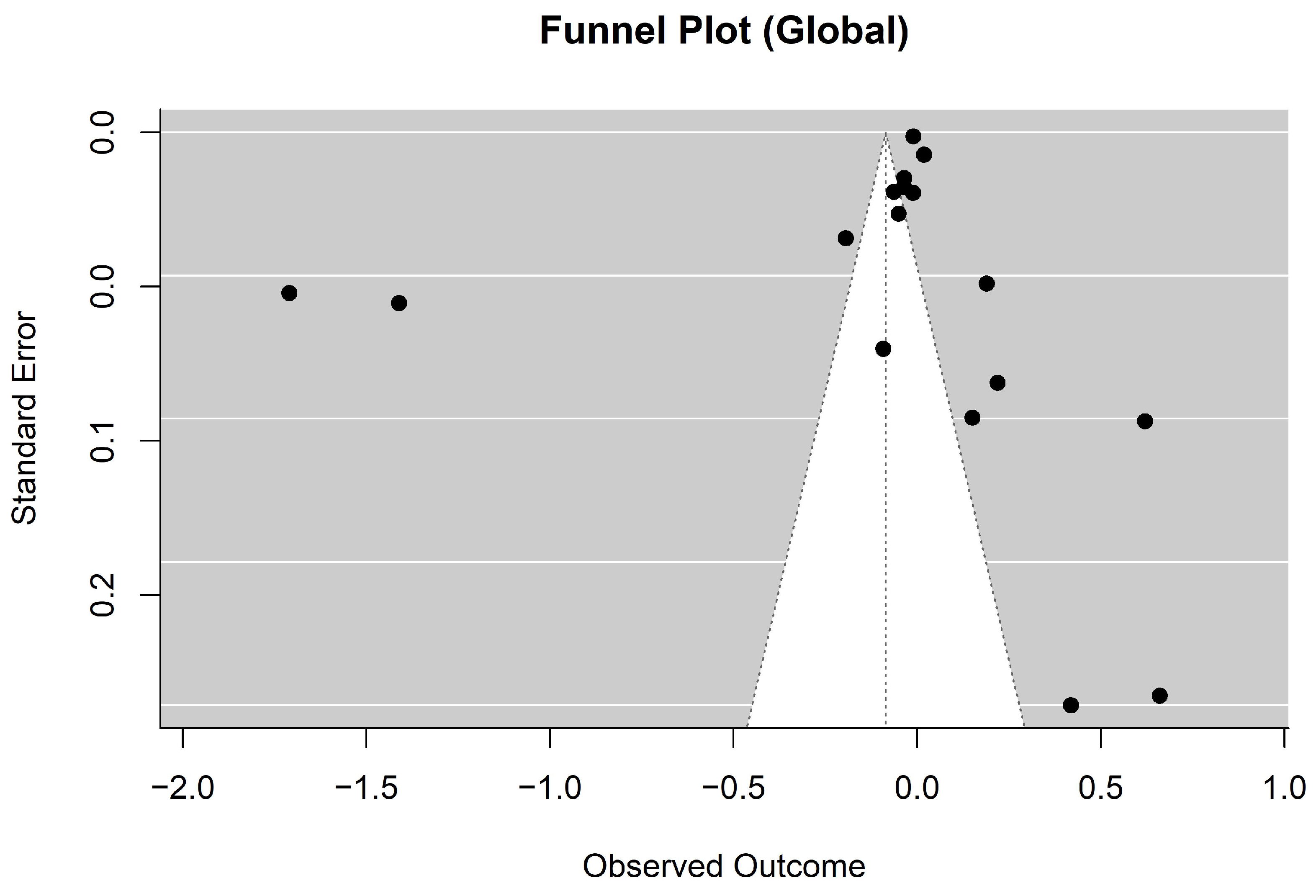
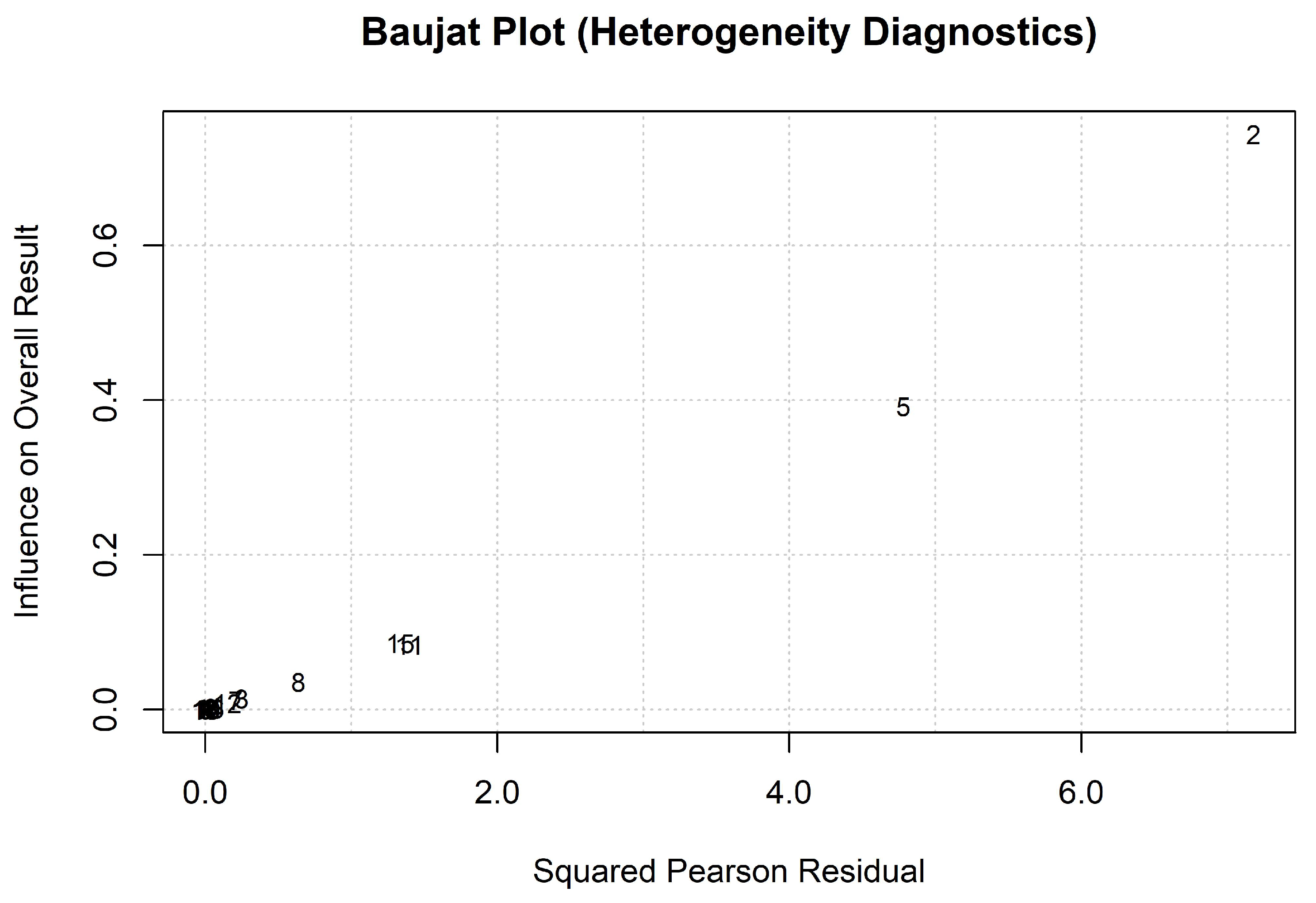
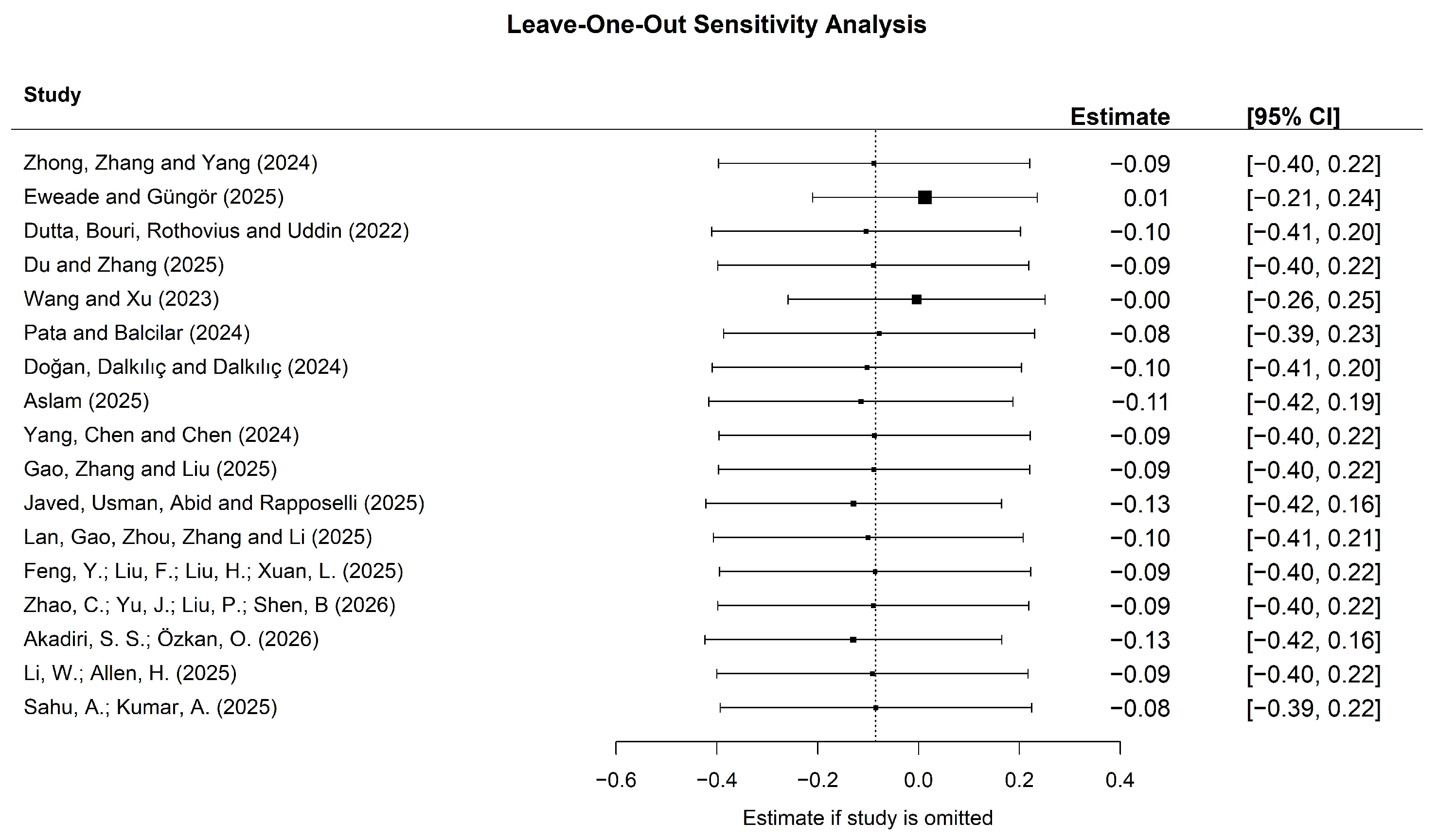
4.2.3. Publication Bias and Influence Diagnostic
4.3. Mixed-Effects Model—Meta-Regression
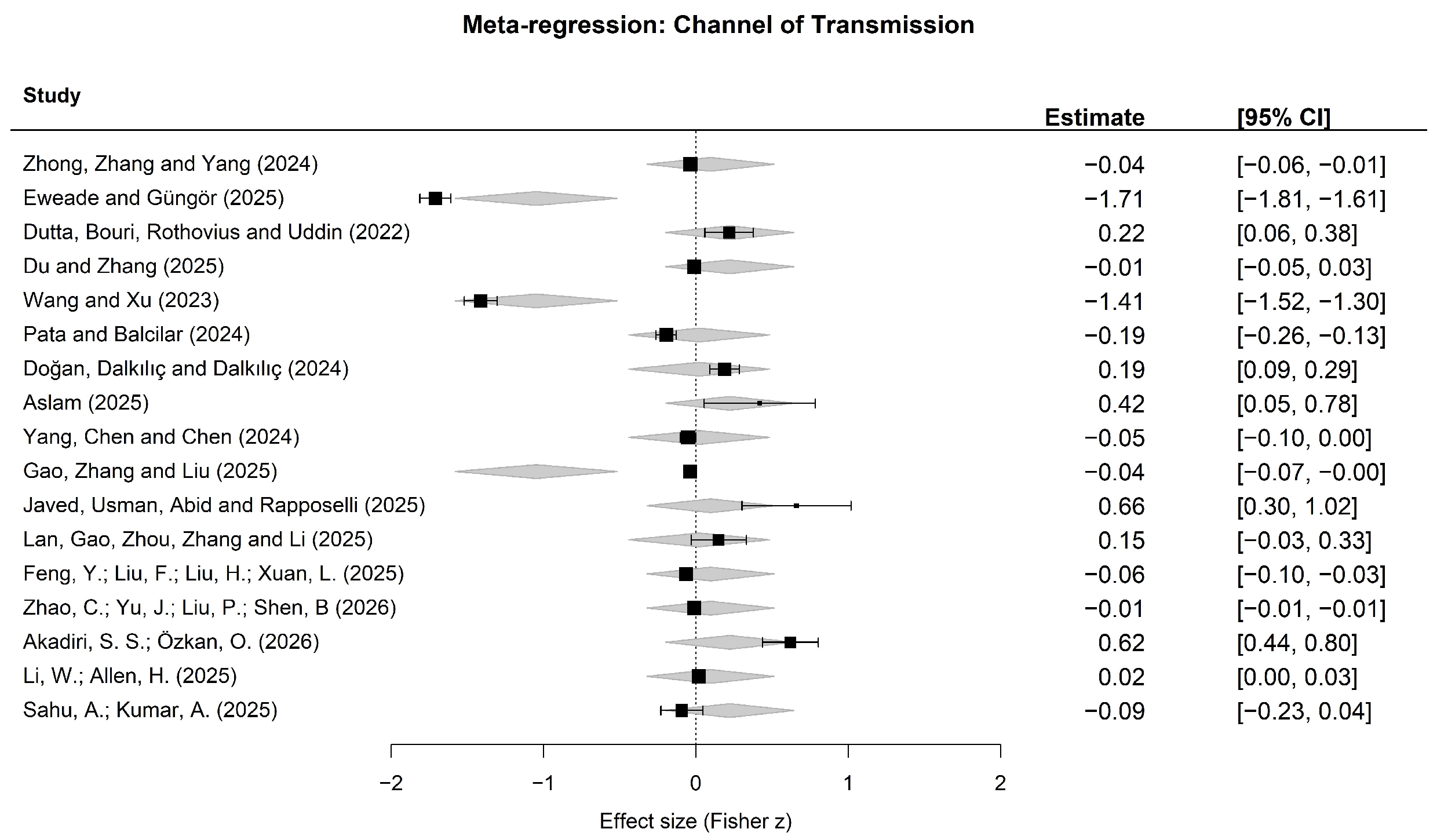
4.3.1. Mixed-Effects Model Specifications and Results
4.3.2. Moderator 1: Channel of Transmission
4.3.3. Moderator 2: Geographic Region
4.3.4. QQ Plot—Mixed-Effects
5. Discussion
6. Conclusions
Supplementary Materials
Author Contributions
Funding
Data Availability Statement
Conflicts of Interest
Abbreviations
| AI | Artificial Intelligence |
| CPU | Climate Policy Uncertainty |
| ET | Renewable Energy Transition |
| FDI | Foreign Direct Investment |
| GI | Green Innovation |
| OSF | Open Science Framework |
| PRISMA | Preferred Reporting Items for Systematic Reviews and Meta-Analyses |
| R&D | Research and Development |
| SE | Standard Error |
| TO | Trade Openness |
| WOS | Web of Science |
Appendix A

| Authors | Year | Region | Effect-Size Info | Channel | SE | t | df | N | r | Comments | ||||
|---|---|---|---|---|---|---|---|---|---|---|---|---|---|---|
| Zhong et al. [7] | 2024 | China | 2SLS; + SE; log-x level-y | Firm investment | 4544 | 4545 | Source in the Paper: Table 1, Col. (3). | |||||||
| Eweade and Güngör [26] | 2025 | USA | FMOLS/DOLS/TY; + SE | Macro economic | 371 | 372 | Source in the Paper: Table 1. | |||||||
| Dutta et al. [12] | 2022 | multi-nat. | Regime-switching; betas | Financial market | 154 | 155 | Source in the paper: Table 1, Line PBW. | |||||||
| Du and Zhang [41] | 2025 | China | + SE FMOLS/DOLS | Financial market | 2610 | 2611 | Source in the paper: Table 1, Col. 2. | |||||||
| Wang and Xu [42] | 2023 | Asia | PSTR; green innovation | Macro economic | 329 | 330 | Source in the paper: Table 1 (PMG). | |||||||
| Pata and Balcilar [43] | 2024 | USA | Betas MRS macro; bus. cycles | Political/instit. | 854 | 855 | Source in the paper: Table 1, Col. (1). | |||||||
| Doğan and İbrahim Dalkılıç [44] | 2024 | USA | Coef. ARDL; renewable instal. | Political/instit. | 419 | 420 | Source in the paper: Table 1, Col. SOLAR. | |||||||
| Aslam [45] | 2025 | multi-nat. | Quantilics dynamics Beta | Financial market | 31 | 32 | Source in the paper: Table 1 FMOLS. | |||||||
| Yang et al. [36] | 2024 | multi-nat. | Beta TVP-VAR energy/oil | Political/instit. | 1438 | 1439 | Source in the paper: Table 1, Col. (1). | |||||||
| Gao et al. [47] | 2025 | China | FMOLS/DOLS; SE | Macro economic | 3199 | 3200 | Source in the paper: Table 1, Col. (4). | |||||||
| Javed et al. [48] | 2025 | USA | ARDL long-run; relationship between CPU and RE | Firm investment | 32 | 33 | Source in the paper: Table 1, long-run. | |||||||
| Lan et al. [46] | 2025 | multi-nat. | Coef. ARDL; renewables; + SE | Political/instit. | — | — | — | — | 118 | Source in the paper: Table 1. | ||||
| Li and Allen [49] | 2025 | China | Firm-level panel; FE; + SE | Firm investment | 19,335 | 19,336 | Source in the paper: Table 1, Col. (3). | |||||||
| Zhao et al. [50] | 2026 | China | OLS/2SLS panel; + SE; firm and year FE | Firm investment | 577,445 | 577,446 | Source in the paper: Table 1, Col. (2). | |||||||
| Feng et al. [51] | 2025 | China | Firm-level panel FE; + SE; investment efficiency | Firm investment | 2693 | 2694 | Source in the paper: Table 1, Col. (2). | |||||||
| Akadiri and Özkan [52] | 2026 | Global | KRLS; average marginal effect; clean energy markets | Financial market | 116 | 117 | Source in the paper: Table 1, average marginal effects from KRLS. | |||||||
| Kumar and Sahu [53] | 2025 | USA | ARDL long-run; + SE; CELS index | Financial market | 205 | 206 | Source in the paper: Table 1, ARDL long-run form. |
Appendix B
| CiteKey | Dependent Variable (Proxy) | Exclusion Argument | SPICE Category |
|---|---|---|---|
| Ghani et al. [32] | Sectoral Index Volatility | Evaluation: Focus is on volatility and risk, not direct Investment (ET). Incompatible with extraction. | Evaluation |
| Nazari et al. [56] | Investment Return/Portfolio Allocation | Evaluation: Purely theoretical/simulation study (Real Options). Results are not empirically extractable in econometric format (). | Evaluation |
| Jiang et al. [57] | Realized Volatility | Evaluation: Focuses on market volatility. Effect is quantified by error reductions, a non-regressive metric incompatible with meta-analysis. | Evaluation |
| Pata [4] | Renewable Energy Consumption | Evaluation: Indirect proxy. Cross-Quantilogram requires non-standard conversion of coefficients () to . | Evaluation |
| Liu et al. [58] | Oil Price | Setting/Evaluation: Focuses on the fossil market. The QQR model is statistically incompatible with standard extraction. | Setting/Evaluation |
| Owjimehr and Meybodi [54] | Financial Stress Index | Evaluation: Dependent variable is Financial Stress, a systemic channel, not the primary Investment Outcome. | Evaluation |
| Yao et al. [59] | Stock Index Volatility | Evaluation: Transfer Entropy measures information flow/risk, not the quantitative magnitude of investment (). | Evaluation |
| Pham et al. [60] | Return Spillover (Connectivity) | Evaluation: Spillover index describes interconnectedness, not elasticity of investment. | Evaluation |
| Fuss et al. [61] | Adoption Time/Emissions | Evaluation: Theoretical calibration only/simulation Real Options study. Not empirical. | Evaluation |
| Rastegar et al. [62] | RE Innovation and Patents | Intervention: Does not use CPU directly. Uncertainty proxy is Climate Disaster Index (CDI), failing the Intervention criterion. | Intervention |
| Işık et al. [63] | ESG Performance | Evaluation: CPU effects are consistently insignificant (). Protocol excludes non-significant effects. | Evaluation |
| Husain et al. [64] | Green Equity Index/Green Bonds | Evaluation: Focus on financial index returns and tail dependence. No direct or elasticity coefficients. | Evaluation |
| Ashraf [55] | Ecological Footprint | Intervention: Does not use CPU. Uncertainty proxy is Political/Financial Risk. Ecological Footprint is a socio-environmental outcome. | Intervention |
| Pata [65] | Renewable Energy Consumption | Intervention: CPU omitted in primary model. Fails core Intervention criterion. | Intervention |
| Payne et al. [66] | Growth in RE Production | Evaluation: Vector autoregression model/generalized impulse response function impulse model. Provides dynamic responses, not long-term coefficients (). | Evaluation |
| Zhao et al. [67] | Renewable Energy Consumption | Evaluation: Kernel regularized quantile regression model gives non-parametric marginal effects; incompatible with standardization. | Evaluation |
| Pata and Pata [68] | Production of RE Minerals | Setting/Evaluation: Focus on RE Minerals (upstream). Multivariate quantile-on-quantile regression model incompatible with extraction. | Setting/Evaluation |
| Naifar [69] | Clean Energy Market Performance/Returns | Evaluation: Focuses on clean energy market performance and return dynamics rather than on direct investment outcomes or acceptable investment-related proxies. The empirical strategy relies on quantile-on-quantile, multivariate quantile-on-quantile, Granger causality, and connectedness methods, producing nonlinear distributional surfaces rather than a single harmonizable main effect in the form of . | Evaluation |
| Yang et al. [70] | Renewable Energy Investment | Evaluation: Although substantively well aligned with the research question, the paper does not report the full set of basic statistics required by the OSF protocol for harmonization. The main specification reports coefficient, z-statistic, and sample size, but not the directly reported standard error required for meta-analytic extraction. | Evaluation |
| Chen et al. [71] | Energy Transition | Evaluation: The study is conceptually relevant and uses a transition-related dependent variable, but the baseline table reports coefficient and sample size without a directly reported standard error. The values in parentheses appear to be t-statistics rather than SEs, preventing direct extraction of a standardized effect size under the protocol. | Evaluation |
| Lin and Luo [72] | Stock Index, Gold, and Government Bonds | Evaluation: Focuses on risky and safe-haven financial assets rather than on direct energy-transition investment outcomes. In addition, the empirical strategy is based on quantile Granger causality and recursive rolling Granger causality, which detect time-varying causal patterns rather than providing a single extractable effect size. | Evaluation |
| Asteriou and Dimiski [73] | Renewable/Low-Carbon Energy Asset Returns | Evaluation: Reports distributed lag time-series coefficients for individual lags of CPU but does not provide one directly extractable main effect for the central CPU–renewable/low-carbon asset relationship. The substantive interpretation depends on cumulative lag effects, which are reported only through summed coefficients with chi-square tests and p-values, without directly reported standard errors. | Evaluation |
| Bi et al. [74] | Volatility Spillovers/Co-movement Between Clean Energy and Metal Markets | Evaluation: Focuses on spillover transmission, co-movement, and market volatility dynamics rather than on direct investment outcomes or acceptable investment proxies. The use of TVP-VAR, wavelet coherence, and GARCH-MIDAS-CPU produces connectedness measures, not a directly harmonizable main effect in the form of . | Evaluation |
| Ali et al. [75] | Energy Transition | Evaluation: Although it directly examines CPU and energy transition, the empirical strategy is based on QARDL and quantile cointegration, explicitly designed to estimate heterogeneous effects across quantiles rather than a single central effect. Any selection of one quantile-specific coefficient would be arbitrary and inconsistent with the study’s own methodological logic. | Evaluation |
| Gyamerah et al. [76] | Renewable Energy ETF Prices | Evaluation: The paper is substantively aligned with the topic, but its empirical framework is based on time-varying Granger causality. Results are reported as Wald statistics, bootstrap critical values, and rolling causality patterns rather than as a single extractable effect size for the CPU–investment relationship. | Evaluation |
| Li et al. [29] | Green and Brown Energy Stock Prices | Evaluation: Examines the dynamic response of energy stock prices under combined uncertainty shocks using joint impulse response functions (jIRF), not a directly estimable main effect. Results are reported as dynamic response paths under the joint influence of CPU, EPU, and GPR, which are not directly harmonizable into a single estimate. | Evaluation |
Appendix C
| Study | D1 | D2 | D3 | D4 | D5 | D6 | D7 | Overall | Decision |
|---|---|---|---|---|---|---|---|---|---|
| Can artificial intelligence empower energy enterprises to cope with climate policy uncertainty? Zhong et al. [7] | Ser. | Mod. | Mod. | Mod. | Ser. | Mod. | Ser. | Ser. | Include (Sens.) |
| Climate policy uncertainty and energy impacts on trade openness and foreign direct investment in the United States: Evidence from the RALS co-integration test (Eweade and Güngör [26]) | Ser. | Mod. | Mod. | Mod. | Mod. | Mod. | Ser. | Ser. | Include (Sens.) |
| Climate risk and green investments: New evidence (Dutta et al. [12]) | Ser. | Mod. | Mod. | Mod. | Mod. | Mod. | Ser. | Ser. | Include (Sens.) |
| Green digital finance and energy transition: Considering the differentiating role of regional policy uncertainty (Du and Zhang [41]) | Ser. | Mod. | Mod. | Mod. | Ser. | Mod. | Ser. | Ser. | Include (Sens.) |
| Green investments and development of renewable energy projects: Evidence from 15 RCEP member countries (Wang and Xu [42]) | Ser. | Mod. | Mod. | Mod. | Mod. | Mod. | Ser. | Ser. | Include (Sens.) |
| Identifying the influence of climate policy uncertainty and oil prices on modern renewable energies: novel evidence from the United States (Pata and Balcilar [43]) | Ser. | Mod. | Mod. | Mod. | Mod. | Mod. | Ser. | Ser. | Include (Sens.) |
| Ink And Influence: The Role of Media On Climate Policy Understanding (Doğan and İbrahim Dalkılıç [44]) | Ser. | Mod. | Mod. | Mod. | Mod. | Mod. | Ser. | Ser. | Include (Sens.) |
| Spillovers between hydrogen, nuclear, and AI sectors: The impact of climate policy uncertainty and geopolitical risks (Aslam [45]) | Ser. | Mod. | Mod. | Mod. | Mod. | Mod. | Ser. | Ser. | Include (Sens.) |
| The dark side of climate policy uncertainty: Hindering energy transition by shaping environmental taxes effectiveness (Yang et al. [36]) | Ser. | Mod. | Ser. | Mod. | Ser. | Ser. | Ser. | Ser. | Include (Sens.) |
| The impact of climate risks on global energy production and consumption: New evidence from causality-in-quantile and wavelet analysis (Lan et al. [46]) | Ser. | Mod. | Ser. | Ser. | Ser. | Ser. | Ser. | Ser. | Include (Sens.) |
| The Urban Renewable Energy Transition: Impact Assessment and Transmission Mechanisms of Climate Policy Uncertainty (Gao et al. [47]) | Ser. | Mod. | Mod. | Mod. | Ser. | Mod. | Ser. | Ser. | Include (Sens.) |
| Unveiling the impact of geopolitical risk, climate policy uncertainty, environmental policy stringency, and financial efficiency on renewable energy investment in the USA: Evidence from novel dynamic simulated ARDL approach (Javed et al. [48]) | Ser. | Mod. | Mod. | Mod. | Mod. | Mod. | Ser. | Ser. | Include (Sens.) |
| From Policy Uncertainty to Carbon Neutrality: Digital Pathways to Renewable Energy and Decarbonization for Achieving SDG 7 and SDG 13 (Li and Allen [49]) | Mod. | Mod. | Mod. | Mod. | Mod. | Mod. | Ser. | Ser. | Include (Sens.) |
| Climate policy uncertainty and firm decarbonization challenge: Insights from energy transition and technological innovation (Zhao et al. [50]) | Mod. | Mod. | Mod. | Mod. | Mod. | Mod. | Ser. | Ser. | Include (Sens.) |
| How does climate policy uncertainty affect the investment efficiency of energy firms? (Feng et al. [51]) | Mod. | Mod. | Mod. | Mod. | Mod. | Mod. | Ser. | Ser. | Include (Sens.) |
| Navigating Uncertainty: The Impact of ESG Factors on Clean Energy Markets and Investment Dynamics (Akadiri and Özkan [52]) | Ser. | Mod. | Mod. | Mod. | Ser. | Mod. | Ser. | Ser. | Include (Sens.) |
| Persistent Policy Uncertainty and Green Energy Valuation: A Long-Run ARDL Analysis of the CELS Index (Kumar and Sahu [53]) | Ser. | Mod. | Mod. | Mod. | Mod. | Mod. | Ser. | Ser. | Include (Sens.) |
Appendix D
Publication Bias and Influence Diagnostic


Appendix E
| Statistic | Original Model (k = 12) | Updated Model (k = 17) |
|---|---|---|
| Pooled effect (Fisher z) | ||
| Standard error | ||
| 95% CI lower | ||
| 95% CI upper | ||
| p-value (global model) | ||
| (%) | ||
| Effect size (r) | ||
| Channel model (%) | ||
| Channel model omnibus test | ||
| Macroeconomic coefficient | ||
| Macroeconomic p-value | ||
| Region model (%) | ||
| Region model omnibus test |
References
- IEA. World Energy Outlook 2024; Technical Report; International Energy Agency: Paris, France, 2024. [Google Scholar]
- Xi, Y.; Huynh, A.N.Q.; Jiang, Y.; Hong, Y. Energy transition concern: Time-varying effect of climate policy uncertainty on renewables consumption. Technol. Forecast. Soc. Change 2023, 192, 122551. [Google Scholar] [CrossRef]
- Vasconcelos, G.F.; Castilho, H.A. A SWOT analysis for the evolution of Brazil’s renewable energy sector. Util. Policy 2025, 96, 101997. [Google Scholar] [CrossRef]
- Pata, S.K. Comparative impacts of energy, climate, and economic policy uncertainties on renewable energy. J. Environ. Manag. 2024, 370, 122494. [Google Scholar] [CrossRef]
- Bogmans, C.; Pescatori, A.; Prifti, E. The impact of climate policy on oil and gas investment: Evidence from firm-level data. Eur. Econ. Rev. 2024, 165, 104750. [Google Scholar] [CrossRef]
- Lin, Y.; Cheung, A.W.K. Climate policy uncertainty and energy transition: Evidence from prefecture-level cities in China. Energy Econ. 2024, 139, 107938. [Google Scholar] [CrossRef]
- Zhong, Q.; Zhang, Q.; Yang, J. Can artificial intelligence empower energy enterprises to cope with climate policy uncertainty? Energy Econ. 2025, 141, 108088. [Google Scholar] [CrossRef]
- Al-Thaqeb, S.A.; Algharabali, B.G. Economic policy uncertainty: A literature review. J. Econ. Asymmetries 2019, 20, e00133. [Google Scholar] [CrossRef]
- Sinn, H.W. Public policies against global warming: A supply side approach. Int. Tax Public Financ. 2008, 15, 360–394. [Google Scholar] [CrossRef]
- Xu, S. China’s climate governance for carbon neutrality: Regulatory gaps and the ways forward. Humanit. Soc. Sci. Commun. 2023, 10, 853. [Google Scholar] [CrossRef]
- Bouri, E.; Iqbal, N.; Klein, T. Climate policy uncertainty and the price dynamics of green and brown energy stocks. Financ. Res. Lett. 2022, 47, 102740. [Google Scholar] [CrossRef]
- Dutta, A.; Bouri, E.; Rothovius, T.; Uddin, G.S. Climate risk and green investments: New evidence. Energy 2023, 265, 126376. [Google Scholar] [CrossRef]
- Page, M.J.; McKenzie, J.E.; Bossuyt, P.M.; Boutron, I.; Hoffmann, T.C.; Mulrow, C.D.; Shamseer, L.; Tetzlaff, J.M.; Akl, E.A.; Brennan, S.E.; et al. The PRISMA 2020 statement: An updated guideline for reporting systematic reviews. Int. J. Surg. 2021, 88, 105906. [Google Scholar] [CrossRef]
- Anser, M.K.; Ali, S.; Umair, M.; Javid, R.; Mirzaliev, S. Energy consumption, technological innovation, and economic growth in BRICS: A GMM panel VAR framework analysis. Energy Strategy Rev. 2024, 56, 101587. [Google Scholar] [CrossRef]
- Yang, Y.; Subhani, G.; Sakina; Zhou, Y. Natural resource and energy efficiency in BRICS countries: Can green innovation capabilities really change the game? Gondwana Res. 2025, 145, 228–239. [Google Scholar] [CrossRef]
- Pimenow, S.; Pimenowa, O.; Prus, P. Challenges of Artificial Intelligence Development in the Context of Energy Consumption and Impact on Climate Change. Energies 2024, 17, 5965. [Google Scholar] [CrossRef]
- Masoomi, B.; Sahebi, I.G.; Ghobakhloo, M.; Mosayebi, A. Do industry 5.0 advantages address the sustainable development challenges of the renewable energy supply chain? Sustain. Prod. Consum. 2023, 43, 94–112. [Google Scholar] [CrossRef]
- Shang, Y.; Han, D.; Gozgor, G.; Mahalik, M.K.; Sahoo, B.K. The impact of climate policy uncertainty on renewable and non-renewable energy demand in the United States. Renew. Energy 2022, 197, 654–667. [Google Scholar] [CrossRef]
- Guo, K.; Kang, Y.; Ma, D.; Lei, L. How do climate risks impact the contagion in China’s energy market? Energy Econ. 2024, 133. [Google Scholar] [CrossRef]
- Wang, H.J.; Jin, S.L.; Chang, C.P. Does Artificial Intelligence Bring to Renewable Energy Innovation? Yes, Empirical Investigation for 51 Countries? Int. J. Green Energy 2025, 22, 375–390. [Google Scholar] [CrossRef]
- Valle, N.D.; Gioia, C. Behavioral factors shaping energy citizenship. Energy Policy 2025, 207, 114820. [Google Scholar] [CrossRef]
- Bernanke, B.S. Irreversibility, Uncertainty, and Cyclical Investment. Q. J. Econ. 1983, 98, 85–106. [Google Scholar] [CrossRef]
- Bloom, N. The Impact of Uncertainty Shocks. Econometrica 2009, 77, 623–685. [Google Scholar] [CrossRef]
- Fried, S.; Novan, K.; Peterman, W.B. The Macro Effects of Climate Policy Uncertainty. Financ. Econ. Discuss. Ser. 2021, 2021, 1–50. [Google Scholar] [CrossRef]
- Gavriilidis, K. Measuring Climate Policy Uncertainty; Technical Report; SSRN: Rochester, NY, USA, 2021. [Google Scholar]
- Eweade, B.S.; Güngör, H. Climate policy uncertainty and energy impacts on trade openness and foreign direct investment in the United States: Evidence from the RALS co-integration test. Nat. Resour. Forum 2025, 49, 2869–2890. [Google Scholar] [CrossRef]
- Borozan, D.; Pirgaip, B. Does uncertainty in climate policy play a role in shaping renewable energy use? Evidence from the USA. Environ. Dev. Sustain. 2025, 27, 2259–2284. [Google Scholar] [CrossRef]
- Silva, T.C.; Wilhelm, P.V.B.; Guerra, S.M.; Tabak, B.M. Extreme weather and firm borrowing: Evidence from Brazil. Financ. Res. Lett. 2025, 86, 108921. [Google Scholar] [CrossRef]
- Li, X.; Zhang, M.; Xin, X.; Yang, C.; Zhang, Y.; Dai, J. Advancing renewable energy innovation through digital technology and supply chain digitization. Energy Econ. 2025, 147, 108557. [Google Scholar] [CrossRef]
- Salman, M.; Wang, G.; Qin, L.; He, X. G20 roadmap for carbon neutrality: The role of Paris agreement, artificial intelligence, and energy transition in changing geopolitical landscape. J. Environ. Manag. 2024, 367, 122080. [Google Scholar] [CrossRef]
- Kalıp, N.G.; Bozbura, F.T.; Atteyih, Y. A comprehensive framework for patent value indicators: Machine learning-driven value prediction in renewable energy patents. World Patent Inf. 2025, 81, 102364. [Google Scholar] [CrossRef]
- Ghani, U.; Zhu, B.; Ma, F.; Ghani, M. Climate Change and Volatility Forecasting: Novel Insights from Sectoral Indices. J. Clim. Financ. 2024, 6, 100034. [Google Scholar] [CrossRef]
- Chen, L.; He, L.; Liu, R.; Fu, Y. Are the impacts of uncertainties on clean and conventional energy markets symmetrical? A fresh comparison analysis based on direction, quantile, and time-domain. Environ. Dev. Sustain. 2024. [Google Scholar] [CrossRef]
- Bag, S.; Rahman, M.; Routray, S.; Roubaud, D.; Mangla, S. Integrating Big Data and Artificial Intelligence Technology to Build Renewable Energy Supply Chain Resilience: An Empirical Study. Bus. Strategy Environ. 2025, 34, 8847–8869. [Google Scholar] [CrossRef]
- Chen, X.; Fu, Q.; Chang, C.P. What are the shocks of climate change on clean energy investment: A diversified exploration. Energy Econ. 2021, 95, 105136. [Google Scholar] [CrossRef]
- Yang, K.; Chen, G.; Chen, R. The dark side of climate policy uncertainty: Hindering energy transition by shaping environmental taxes effectiveness. J. Environ. Manag. 2024, 369, 122314. [Google Scholar] [CrossRef]
- Zhang, Y. How Economic Performance of OECD economies influences through Green Finance and Renewable Energy Investment Resources? Resour. Policy 2022, 79, 102925. [Google Scholar] [CrossRef]
- Berestycki, C.; Carattini, S.; Dechezleprêtre, A.; Kruse, T. Measuring and Assessing the Effects of Climate Policy Uncertainty; Technical Report, OECD Economics Department Working Papers; OECD: Paris, France, 2022. [Google Scholar] [CrossRef]
- Viechtbauer, W. Conducting Meta-Analyses in R with the Metafor Package; Technical Report; American Statistical Association: Alexandria, VA, USA, 2010. [Google Scholar]
- Sterne, J.A.; Hernán, M.A.; Reeves, B.C.; Savović, J.; Berkman, N.D.; Viswanathan, M.; Henry, D.; Altman, D.G.; Ansari, M.T.; Boutron, I.; et al. ROBINS-I: A tool for assessing risk of bias in non-randomised studies of interventions. BMJ 2016, 355, i4919. [Google Scholar] [CrossRef]
- Du, M.; Zhang, Y.J. Green digital finance and energy transition: Considering the differentiating role of regional policy uncertainty. Econ. Anal. Policy 2025, 86, 30–48. [Google Scholar] [CrossRef]
- Wang, Y.; Xu, A. Green investments and development of renewable energy projects: Evidence from 15 RCEP member countries. Renew. Energy 2023, 211, 1045–1050. [Google Scholar] [CrossRef]
- Pata, S.K.; Balcilar, M. Identifying the influence of climate policy uncertainty and oil prices on modern renewable energies: Novel evidence from the United States. Clean Technol. Environ. Policy 2025, 27, 2969–2980. [Google Scholar] [CrossRef]
- Doğan, N.; Dalkılıç, I. Ink And Influence: The Role of Media On Climate Policy Understanding. CINEJ Cine. J. 2024, 12, 445–480. [Google Scholar] [CrossRef]
- Aslam, A. Spillovers between hydrogen, nuclear, and AI sectors: The impact of climate policy uncertainty and geopolitical risks. J. Clim. Financ. 2025, 11, 100065. [Google Scholar] [CrossRef]
- Lan, Y.; Gao, H.; Zhou, P.; Zhang, H.; Li, H. The impact of climate risks on global energy production and consumption: New evidence from causality-in-quantile and wavelet analysis. Energy 2025, 319, 134850. [Google Scholar] [CrossRef]
- Gao, D.; Zhang, T.; Liu, X. The Urban Renewable Energy Transition: Impact Assessment and Transmission Mechanisms of Climate Policy Uncertainty. Energies 2025, 18, 2089. [Google Scholar] [CrossRef]
- Javed, A.; Usman, M.; Abid, N.; Rapposelli, A. Unveiling the impact of geopolitical risk, climate policy uncertainty, environmental policy stringency, and financial efficiency on renewable energy investment in the USA: Evidence from novel dynamic simulated ARDL approach. J. Environ. Manag. 2025, 393, 127057. [Google Scholar] [CrossRef]
- Li, W.; Allen, H. From Policy Uncertainty to Carbon Neutrality: Digital Pathways to Renewable Energy and Decarbonization for Achieving SDG 7 and SDG 13. Sustain. Dev. 2026, 34, 2456–2475. [Google Scholar] [CrossRef]
- Zhao, C.; Yu, J.; Liu, P.; Shen, B. Climate policy uncertainty and firm decarbonization challenge: Insights from energy transition and technological innovation. Int. Rev. Financ. Anal. 2026, 109, 104774. [Google Scholar] [CrossRef]
- Feng, Y.; Liu, F.; Liu, H.; Xuan, L. How does climate policy uncertainty affect the investment efficiency of energy firms? Financ. Res. Lett. 2025, 86, 108772. [Google Scholar] [CrossRef]
- Akadiri, S.S.; Özkan, O. Navigating Uncertainty: The Impact of ESG Factors on Clean Energy Markets and Investment Dynamics. Corp. Soc. Responsib. Environ. Manag. 2026, 33, 1270–1285. [Google Scholar] [CrossRef]
- Kumar, A.; Sahu, A. Persistent Policy Uncertainty and Green Energy Valuation: A Long-Run ARDL Analysis of the CELS Index. J. Appl. Econ. Sci. 2025, 20, 659–674. [Google Scholar] [CrossRef]
- Owjimehr, S.; Meybodi, M.E. Dynamic relationship between climate policy uncertainty shocks and financial stress: A GMM-Panel VAR approach. Reg. Sci. Policy Pract. 2025, 17, 100181. [Google Scholar] [CrossRef]
- Ashraf, J. The spillover effects of political risk, financial risk, and economic freedom on ecological footprint: Empirical evidence from Belt and Road Initiative countries. Borsa Istanb. Rev. 2022, 22, 873–885. [Google Scholar] [CrossRef]
- Nazari, M.S.; Maybee, B.; Whale, J.; McHugh, A. Climate Policy Uncertainty and Power Generation Investments: A Real Options-CVaR Portfolio Optimization Approach. Energy Procedia 2015, 75, 2649–2657. [Google Scholar] [CrossRef]
- Jiang, W.; Tang, W.; Li, J.; Wei, X. Climate risk and renewable energy market volatility: Machine learning approach. Res. Int. Bus. Financ. 2025, 76, 102871. [Google Scholar] [CrossRef]
- Liu, F.; Su, C.W.; Tao, R.; Lobonţ, O.R. Does economic and climate policy uncertainty matter the oil market? Resour. Policy 2024, 95, 105188. [Google Scholar] [CrossRef]
- Yao, Y.; Feng, Z.; Liu, X. Heterogeneous information transmission between climate policy uncertainty and Chinese new energy markets: A quantile-on-quantile transfer entropy method. Int. Rev. Financ. Anal. 2025, 103, 104175. [Google Scholar] [CrossRef]
- Pham, S.D.; Nguyen, T.T.; Do, H.X. Impact of climate policy uncertainty on return spillover among green assets and portfolio implications. Energy Econ. 2024, 134, 107631. [Google Scholar] [CrossRef]
- Fuss, S.; Johansson, D.J.; Szolgayova, J.; Obersteiner, M. Impact of climate policy uncertainty on the adoption of electricity generating technologies. Energy Policy 2009, 37, 733–743. [Google Scholar] [CrossRef]
- Rastegar, H.; Sajjad, A.; Eweje, G.; Kobayashi, K. Sustainability Solution: Renewable Energy Innovation Against Climate Disasters. Bus. Strategy Environ. 2025, 34, 9808–9824. [Google Scholar] [CrossRef]
- Işık, C.; Ongan, S.; Islam, H.; Yan, J.; Alvarado, R.; Ahmad, M. The nexus of economic growth, energy prices, climate policy uncertainty (CPU), and digitalization on ESG performance in the USA. Clim. Serv. 2025, 38, 100572. [Google Scholar] [CrossRef]
- Husain, S.; Sohag, K.; Wu, Y. The response of green energy and technology investment to climate policy uncertainty: An application of twin transitions strategy. Technol. Soc. 2022, 71, 102132. [Google Scholar] [CrossRef]
- Pata, U.K. Towards a sustainable future with renewable energy and load capacity factor: Institutions, technology, energy and climate policy uncertainties. Renew. Energy 2025, 254, 123710. [Google Scholar] [CrossRef]
- Payne, J.E.; Nazlioglu, S.; Koncak, A.; Ewing, B.T. U.S. climate policy uncertainty shocks and the growth in renewable energy production. J. Commod. Mark. 2025, 39, 100493. [Google Scholar] [CrossRef]
- Zhao, Y.; Ramzan, M.; Brika, S.K.; Eweade, B.S. Uncertainty in climate and ESG policies: Implications for renewable energy investments. Appl. Econ. 2025, 1–15. [Google Scholar] [CrossRef]
- Pata, U.K.; Pata, S.K. Unveiling the role of energy policy uncertainty, energy transition and climate policy uncertainty on renewable energy minerals in China. Environ. Dev. Sustain. 2025. [Google Scholar] [CrossRef]
- Naifar, N. Do climate risk and ESG sentiment predict clean energy performance? Evidence from quantile-on-quantile analysis. Res. Int. Bus. Financ. 2026, 84, 103327. [Google Scholar] [CrossRef]
- Yang, R.; Mao, H.; Liu, N. Does climate policy uncertainty hinder renewable energy investment in developing countries? Evidence from double machine learning method. Energy 2026, 347, 140491. [Google Scholar] [CrossRef]
- Chen, W.; Song, Z.; Xie, Y. Energy transition across the climate policy uncertainty divide: The critical role of green technology innovation and digital transformation. Econ. Anal. Policy 2026, 90, 322–342. [Google Scholar] [CrossRef]
- Lin, L.; Luo, M. Policy uncertainty in environment & technology: Impacts on risky and safe-haven assets in China. Int. Rev. Econ. Financ. 2026, 106, 104840. [Google Scholar] [CrossRef]
- Asteriou, D.; Dimiski, A. The Relationship Among Climate Policy Uncertainty and Energy Markets: Fossil Versus Renewable and Low-Carbon Assets. Int. J. Financ. Econ. 2026, 1–19. [Google Scholar] [CrossRef]
- Bi, Z.; Wu, Q.; Luo, L. Climate policy uncertainty and the co-movement between clean energy and metal markets: A spillover perspective. Resour. Policy 2026, 112, 105818. [Google Scholar] [CrossRef]
- Ali, A.R.; Iyiola, K.; Alzubi, A. Harnessing ESG Sustainability, Climate Policy Uncertainty and Information and Communication Technology for Energy Transition. Energies 2025, 18, 5301. [Google Scholar] [CrossRef]
- Gyamerah, S.A.; Blekor, K.S.; Gil-Alana, L.A. Time-varying bidirectional causality between climate policy uncertainty and renewable energy investments. Int. Rev. Econ. Financ. 2025, 104, 104727. [Google Scholar] [CrossRef]


| Authors | Year | Region | N | Fisher z | Channel of Transmission |
|---|---|---|---|---|---|
| Zhong et al. [7] | 2024 | China | 4545 | Firm investment | |
| Eweade and Güngör [26] | 2025 | USA | 372 | Macroeconomic | |
| Dutta et al. [12] | 2022 | Multinational | 155 | Financial market | |
| Du and Zhang [41] | 2025 | China | 2611 | Financial market | |
| Wang and Xu [42] | 2023 | Asia | 330 | Macroeconomic | |
| Pata and Balcilar [43] | 2024 | USA | 855 | Political and institutional | |
| Doğan and İbrahim Dalkılıç [44] | 2024 | USA | 420 | Political and institutional | |
| Aslam [45] | 2025 | Multinational | 32 | Financial market | |
| Yang et al. [36] | 2024 | Multinational | 1439 | Political and institutional | |
| Gao et al. [47] | 2025 | China | 3200 | Macroeconomic | |
| Javed et al. [48] | 2025 | USA | 33 | Firm investment | |
| Lan et al. [46] | 2025 | Multinational | 118 | Political and institutional | |
| Li and Allen [49] | 2025 | China | 19,336 | Firm investment | |
| Zhao et al. [50] | 2026 | China | 577,446 | Firm investment | |
| Feng et al. [51] | 2025 | China | 2694 | Firm investment | |
| Akadiri and Özkan [52] | 2026 | Global | 117 | Financial market | |
| Kumar and Sahu [53] | 2025 | USA | 206 | Financial market |
| k | Effect Size (Fisher z) | SE | 95% CI Lower | 95% CI Upper | p-Value | (%) | Effect Size (r) | |
|---|---|---|---|---|---|---|---|---|
| 17 |
| Moderator Level | Est. | SE | t | p-Value | 95% CI Lower | 95% CI Upper |
|---|---|---|---|---|---|---|
| Intercept (Political and institutional) | ||||||
| Financial market | ||||||
| Firm investment | ||||||
| Macroeconomic |
| Moderator Level | Est. | SE | t | p-Value | 95% CI Lower | 95% CI Upper |
|---|---|---|---|---|---|---|
| Intercept (United States of America—USA) | ||||||
| Asia | ||||||
| China | ||||||
| Global | ||||||
| Multinational |
Disclaimer/Publisher’s Note: The statements, opinions and data contained in all publications are solely those of the individual author(s) and contributor(s) and not of MDPI and/or the editor(s). MDPI and/or the editor(s) disclaim responsibility for any injury to people or property resulting from any ideas, methods, instructions or products referred to in the content. |
© 2026 by the authors. Licensee MDPI, Basel, Switzerland. This article is an open access article distributed under the terms and conditions of the Creative Commons Attribution (CC BY) license.
Share and Cite
Matias, M.d.C.; Tabak, B.M. Climate Policy Uncertainty and Its Effects on Investments in Renewable Energy Transition: A Systematic Literature Review and Meta-Analysis. Energies 2026, 19, 2009. https://doi.org/10.3390/en19092009
Matias MdC, Tabak BM. Climate Policy Uncertainty and Its Effects on Investments in Renewable Energy Transition: A Systematic Literature Review and Meta-Analysis. Energies. 2026; 19(9):2009. https://doi.org/10.3390/en19092009
Chicago/Turabian StyleMatias, Marcos de Castro, and Benjamin M. Tabak. 2026. "Climate Policy Uncertainty and Its Effects on Investments in Renewable Energy Transition: A Systematic Literature Review and Meta-Analysis" Energies 19, no. 9: 2009. https://doi.org/10.3390/en19092009
APA StyleMatias, M. d. C., & Tabak, B. M. (2026). Climate Policy Uncertainty and Its Effects on Investments in Renewable Energy Transition: A Systematic Literature Review and Meta-Analysis. Energies, 19(9), 2009. https://doi.org/10.3390/en19092009