Systematic Review

Climate Policy Uncertainty and Its Effects on Investments in Renewable Energy Transition: A Systematic Literature Review and Meta-Analysis


by
Marcos de Castro Matias
* and
Benjamin M. Tabak
School of Public Policy and Government (EPPG), Getulio Vargas Foundation (FGV), L2 Norte, SGAN, Quadra 602, Módulos A, B e C, Brasília 70830-051, DF, Brazil
*
Author to whom correspondence should be addressed.
Energies 2026, 19(9), 2009; https://doi.org/10.3390/en19092009
Submission received: 6 March 2026 / Revised: 6 April 2026 / Accepted: 16 April 2026 / Published: 22 April 2026
(This article belongs to the Section B1: Energy and Climate Change)

Abstract

This study investigates how Climate Policy Uncertainty (CPU) influences investments in the Renewable Energy Transition (ET), a relationship widely presumed to be negative, despite the empirical literature reporting mixed and highly heterogeneous results. Using a preregistered systematic review following PRISMA guidelines, we identify seventeen peer-reviewed studies from Web of Science and Scopus. Their quantitative estimates are harmonized using Fisher z-transformations and analyzed within a meta-analytic framework. A global random-effects meta-analysis reveals a small and statistically insignificant average effect of CPU on ET-related investment outcomes, together with extremely high heterogeneity, indicating that a single pooled coefficient is not an informative universal summary. To examine whether part of this dispersion follows an interpretable pattern, we estimate an exploratory mixed-effects meta-regression based on a four-channel transmission framework derived from the reviewed literature. This model accounts for 50.4% of the between-study variance, and only the Macroeconomic channel shows a negative and statistically significant deviation from the reference category ( β = 1.0700, p = 0.0060). This result should be interpreted cautiously, however, given the small number of studies in each subgroup and the persistence of substantial residual heterogeneity. Overall, the evidence suggests that the CPU does not affect ET-related investment outcomes in a uniform way; rather, the reported relationship varies across contexts, with the strongest negative pattern appearing in studies that capture macroeconomic conditions related to the energy transition, such as foreign direct investment, trade openness, and aggregate green investment. By providing the first meta-analytic quantification of this relationship and a structured mapping of transmission mechanisms, this study offers novel empirical clarity to a fragmented literature. The policy implication is direct, and governments seeking to accelerate the energy transition must prioritize long-term credibility, regulatory stability, and macroeconomic predictability, as these are the domains through which climate policy uncertainty most severely constrains low-carbon investment.

1. Introduction

Contemporary economic development remains highly dependent on energy use, while the global energy mix is still strongly reliant on fossil fuels [1,2]. Advancing the renewable energy transition is therefore one of the central challenges of this century, particularly in light of climate goals and long-term decarbonization commitments [3,4]. In this context, climate policy uncertainty (CPU) has emerged as a relevant source of risk for energy-transition investment decisions. In practical terms, CPU refers to uncertainty surrounding future climate-related rules, incentives, and regulatory signals, thereby reducing predictability regarding the legal and institutional environment faced by investors [5,6].
This uncertainty has a registered impact on investment decisions, affecting the investors’ trust and the financial cost for renewable energy projects. Some studies indicate that policy uncertainty can lead to postponement or termination of investments [7,8]. However, other studies highlight counterintuitive phenomena such as the Green Paradox [5,9,10] and the “flight-to-green” [4,11,12], which must be considered in the analysis.
The relationship between CPU and the energy transition has been examined across a growing but methodologically fragmented body of empirical research. Although several studies analyze climate-related uncertainty and energy outcomes, the literature still lacks a consolidated synthesis focused specifically on ET-related investment outcomes and on the reasons why the reported results differ so markedly across studies. This article addresses that gap in three ways. First, it provides a preregistered PRISMA-based systematic review focused on the CPU-ET investment nexus. Second, it harmonizes the quantitative evidence into a comparable meta-analytic framework. Third, it uses a transmission-channel classification derived from the reviewed literature to examine whether the heterogeneity in reported effects follows an interpretable pattern.
Accordingly, the study addresses two research questions: (1) how does climate policy uncertainty affect investment decisions related to the energy transition, and (2) through which transmission mechanisms is that relationship represented in the empirical literature? The working hypothesis is that higher CPU is associated with weaker ET-related investment outcomes, although the magnitude and direction of the reported effect may vary across contexts. To investigate these questions, we conduct a systematic review and meta-analysis of seventeen peer-reviewed studies identified in the Web of Science and Scopus databases under a preregistered OSF protocol and in accordance with PRISMA-2020 [13].
To investigate the substantial heterogeneity across studies, we employ a mixed-effects meta-regression framework. This approach allows us to assess whether the association between climate policy uncertainty and energy-transition-related outcomes varies systematically across transmission channels.

2. Literature Review

2.1. The Context of Climate Policy and Energy Transition

Economic development in the twenty-first century depends on intensive energy use to sustain an increasingly technology-dependent society. However, this social and economic model is marked by important contradictions. Advanced economies and emerging markets have experienced rising GDP per capita, together with growing energy demand [14]. At the same time, nearly half of the world’s population still lacks access to secure, affordable, and sustainable energy. Taken together, these trends have intensified pollution and accelerated the depletion of natural resources, making the energy transition an increasingly urgent global concern [2,15].
Another issue that has recently gained prominence on the global agenda is the advancement of artificial intelligence (AI). Existing research suggests that AI has a dual effect on energy demand. On the one hand, the adoption of AI in industry and energy systems can improve energy efficiency by enhancing operational performance and resource allocation. On the other hand, the training and deployment of AI models may increase energy consumption. The overall effect of AI adoption, therefore, depends on the balance between these opposing forces [16].
It is also important to emphasize that global energy demand is still largely met by an energy matrix heavily dependent on fossil fuels, as clean power generation has not yet outpaced the growth of global electricity demand [1]. This implies that countries must continue investing in renewable energy sources such as solar photovoltaic, wind, hydropower, and biomass in order to meet expected future demand growth [3,17].
In the case of the United States, the world’s largest energy consumer, evidence suggests that economic growth has not been effective in stimulating non-renewable energy use [18]. At the same time, the world has been experiencing increasingly frequent extreme weather events and natural disasters associated with climate change, while geopolitical conflicts have affected the supply and demand of both oil and renewable energy [19]. In this context, the transition from fossil fuels to renewable energy sources has emerged as one of the major challenges of this century. This transition is essential for achieving global climate goals and greenhouse gas (GHG) neutrality by 2050 [3,4].
In response, countries committed to the environmental agenda have invested in technologies aimed at improving resource and energy efficiency while reducing GHG emissions. Among these, investments in technological innovation and green innovation (GI) are particularly relevant. Countries are also using AI to accelerate the development of sustainable practices [15] and to promote renewable energy innovation (REI) by increasing research and development (R&D) investment, improving labor productivity, and strengthening institutional quality [20]. In Europe, the concept of energy citizenship has also gained prominence as part of the continent’s strategy to address climate and energy challenges. Energy citizenship refers to the active participation of individuals in the energy system and in its governance [21].
Against this broader background, regulatory risk has emerged as a systemic threat, and climate policies appear to play a crucial role in shaping the direction and pace of the energy transition [5]. From an economic perspective, uncertainty tends to negatively affect employment and investment by discouraging household spending and business capital allocation, ultimately weakening economic growth [22,23]. The literature has also identified a counterintuitive phenomenon known as the Green Paradox, according to which fossil fuel consumption may remain stable or even increase when climate policy becomes uncertain [9]. One interpretation is that anticipated future regulation induces firms to increase current investment in carbon-intensive assets in order to secure gains before stricter policies are implemented [5]. This possibility is important when interpreting empirical evidence, because climate policy, may under some conditions, generate unintended effects, including temporary increases in GHG emissions [9,10]. At the same time, quantitative evidence suggests that the net effect of climate policy risk operating through both supply and demand channels is to reduce emissions, reinforcing the importance of analyzing how policy uncertainty affects investment decisions across a broad range of capital assets rather than focusing only on fossil fuel supply responses [24].
Policy uncertainty may be understood as the economic risk associated with future policy and regulatory frameworks, which can delay spending and investment decisions by both firms and households [8]. In this context, governments have used laws and regulations to promote the energy transition through both “carrot” and “stick” strategies [6]. However, these same policy actions may also generate climate policy uncertainty, thereby influencing investment decisions. Regulatory volatility and ambiguous political signals can undermine investor confidence and increase the cost of financing renewable energy projects. As a result, climate policy uncertainty is increasingly recognized as an important determinant of investment behavior in the energy transition [7].
The Climate Policy Uncertainty (CPU) index emerged as an effort to quantify this uncertainty. Using the frequency of newspaper articles containing climate-policy-related terms in eight major U.S. newspapers between 2000 and 2021, Gavriilidis developed an index based on the statistical analysis of lexical frequency to capture media reactions to climate policy uncertainty [25]. Today, the CPU index is available through the Economic Policy Uncertainty database [12].
In studies on renewable energy, investment and energy consumption were initially examined in relation to Economic Policy Uncertainty (EPU) and only later in relation to CPU [26]. While CPU refers specifically to uncertainty surrounding climate-related policies, EPU captures broader uncertainty associated with regulatory, monetary, and fiscal policy conditions. These two types of uncertainty may affect renewable energy consumption in different ways [6]. In particular, the relationship between CPUs and renewable energy consumption may operate through different channels: rising CPUs may reduce investment in renewable energy, but they may also stimulate innovation and consumption through research-and-development dynamics [25,27].

2.2. Channels of Transmission

The reviewed literature suggests four recurring analytical domains through which the relationship between CPU and ET-related investment outcomes is discussed: firm investment, financial markets, political and institutional conditions, and macroeconomic conditions. In this article, these domains are used as an organizing framework for the meta-regression rather than as an exhaustive or externally validated taxonomy. Their purpose is exploratory: to assess whether the heterogeneity in the literature follows an interpretable pattern associated with the type of mechanism or outcome examined in the primary studies.

2.2.1. First Channel: Firm Investment

This channel concerns the impact that instability in climate policy has on investments by firms. Literature demonstrates that the increase in CPUs makes firms postpone or terminate corporate investments, spreading financial restrictions and limiting capital for ET [7]. And this effect is observable in corporate investments and in energy transition at the municipal level in China [6,7]. Research has that shown risk related to environmental regulation is increasing the cost of capital for private firms in the corporate loans market, syndicate loans, and corporate bonds, and higher interest rates for companies known as “dirtier firms”, i.e., those who are involved in non-renewable energy [5]. Another important aspect to be considered about climate policy and its uncertainties regards the real climate disasters’ experience that countries, regions, and cities are living, which are shaping the firm’s assessment about this subject in terms of adaptation, responsiveness, and recovery from climate extreme shocks [28].
The literature also highlights corporate investment in artificial intelligence (AI) aiming for energy efficiency, involving smart grids, buildings, corporate and industrial resources, transportation, and logistics [16,29]. The adoption of AI mitigates the adverse effects of CPUs: companies with a higher degree of AI adoption can stabilize their investments in renewable energy even in uncertain environments due to their increased ability to analyze more complex contexts and make more accurate predictions [7]. Recent studies emphasize the use of AI in solving climate change issues and its effectiveness in tackling the issue of carbon neutrality [30]. This channel also refers to investments in innovation and technology and how firms decide to invest in R&D, green innovation (GI), and the use of new technologies. Patents in renewable energy are strongly influenced by public policies [31].

2.2.2. Second Channel: Financial Market

This channel is about volatility and capital cost, which are also affected by instability in climate policies. A set of studies using GARCH-MIDAS models found that this instability causes increased volatility in renewable energy stock markets, with repercussions on risk premiums and cost of capital [11,12,32]. Another set of studies used nonlinear models (NARDL), which identified a more pronounced risk aversion among investors when political uncertainty increases [33]. A large set of studies documented a counterintuitive positive effect of high CPUs making clean energy stocks outperform dirty energy stocks, a phenomenon called “flight-to-green” [4,11,12].

2.2.3. Third Channel: Political and Institutional

This channel focuses on the political and institutional environment as a cause of uncertainty and as a moderator of its effects. Government effectiveness is seen as a moderator of fundamental importance, with high-quality institutions, clearer regulatory frameworks, and better implementation capacity reducing perceived uncertainty. Thus, government effectiveness positively moderates the energy transition [34]. Regulatory gaps, on the other hand, are factors that generate CPU variation itself and undermine the predictability of public policies [10]. Additionally, public attention and social pressure, which are factors external to the government, and play a relevant moderating role. Even in an environment of greater uncertainty, public pressure on firms can have positive effects on maintaining investments in the energy transition [35].

2.2.4. Fourth Channel: Macroeconomic

This channel refers to macroeconomic conditions associated with ET-related investment outcomes rather than to a narrow project-level measure of renewable energy investment. In the reviewed studies, these outcomes include variables such as foreign direct investment, trade openness, aggregate green investment, and broader macro-financial conditions that affect long-horizon capital allocation [24,26,36,37]. The underlying argument is that a higher CPU can intensify long-term regulatory risk, weaken investment cycles, and constrain foreign capital flows, thereby affecting the macroeconomic environment within which energy-transition investments are made. This framing is analytically useful, but it should be distinguished from direct evidence on project-level renewable energy investment.
Taken together, these strands of literature show that the relationship between CPU and ET-related investment outcomes is discussed through multiple analytical domains. However, the evidence remains fragmented, and the literature still lacks a structured synthesis capable of assessing whether these heterogeneous findings reflect a common average relationship or distinct transmission-specific patterns.

2.3. Current Debate and Research Gap

Building on the literature reviewed across these transmission domains, an important research gap remains.
The current debate shows that climate policy can simultaneously promote the energy transition and generate uncertainty for investors when policy direction, implementation capacity, or regulatory continuity becomes unclear [21,25,38]. Existing empirical studies therefore provide relevant but scattered evidence on the relationship between CPU and ET-related investment outcomes.
The specific gap addressed in this article is not the absence of individual studies but the absence of a structured synthesis focused on this relationship. In particular, the literature lacks a consolidated assessment of whether the reported effects of CPU on ET-related investment outcomes point to a common average relationship or instead reflect substantial contextual heterogeneity. It also lacks a systematic framework for organizing that heterogeneity according to the type of economic mechanism examined. This study responds to that gap by synthesizing the available evidence and by assessing whether a transmission-channel framework helps explain the dispersion of reported results.

3. Methodology

3.1. Research Protocol

In this research, we followed a protocol previously registered in the Open Science Framework (OSF). The registration can be accessed at the following address: https://doi.org/10.17605/OSF.IO/9PCQM (accessed on 28 September 2025).
To perform a systematic literature review, we searched for articles on two of the most prestigious platforms, Web of Science (WOS) and Scopus. The search was conducted on 28 September 2025, with no restrictions on the start date of the publications. Only articles published in peer-reviewed journals were considered.
We used a search term that covered the topics of uncertainty in climate policy and energy transition. The exact Boolean search term was as follows: TS = ((“climate policy uncertainty” OR “environmental policy uncertainty” OR “regulatory risk” OR “political risk”) AND (“energy transition” OR “renewable energy” OR “green energy” OR solar OR wind OR photovoltaic) AND (invest* OR financ* OR “capital allocation” OR FDI)). This search term was applied to the title, abstract, and keyword fields (TOPIC in WOS and TITLE-ABS-KEY in Scopus). The Rayyan platform was used for screening by the reviewers of this research.
Our inclusion and exclusion criteria were set through the SPICE framework (Setting, Perspective, Intervention, Comparison, and Evaluation).
  • Setting: We included energy transition studies. This includes studies of renewable energy, carbon emission mitigation approaches, low-carbon technologies, electricity markets, hydrogen, storage, and electric vehicle studies. We excluded studies not focused on other industries or technical engineering studies without a policy or investment orientation. Qualifying studies would also need to account for those who have investment decisions to make, such as investors, businesses, financial institutions, and policymakers. We excluded studies comprising only households, median consumers, or non-financial entities, unless they clearly addressed investment outcomes in relation to the energy transition.
  • Intervention: We paid specific attention to climate policy uncertainty (CPU), including uncertainty related to rules, policy-related risks, or changes in regulations related to climate and energy. Studies that accounted only for aggregate economic, political, or global uncertainty, without specific links to policy and energy and climate policy, respectively, were excluded.
  • Comparison: These works could have been included if they had contrasted uncertain and certain policy regimes, confirmed how investment outcomes differed under different levels of policy uncertainty, or examined cross-country or intertemporal differences. We excluded studies that did not comment on policy environment differences or those focusing exclusively on the technical characteristics of energy systems.
  • Evaluation: We examined studies that focused on investment results, including how money is spent, costs of financing, cost of capital, when to invest, risk premiums, the use of new technology, and how climate policy uncertainty affects these decisions. We excluded studies if their results did not relate to investment (for example, public opinion, social attitudes, or environmental effects) or if they did not explain how investments are affected.

Updated Search (1 April 2026)

To incorporate newly published evidence and address the reviewer’s request for an updated screening, we reran the same search strategy in Web of Science and Scopus on 1 April 2026, maintaining the original Boolean string, databases, eligibility criteria, and screening logic. This update identified 51 additional records (19 in WOS and 32 in Scopus). After removing 11 duplicates, 40 records were screened by title and abstract. Fourteen reports were assessed in full text, of which nine were excluded for not meeting the requirements for quantitative synthesis. Five additional studies met the predefined protocol and were incorporated into the meta-analysis, increasing the final sample from twelve to seventeen studies.

3.2. Selection Process Flowchart

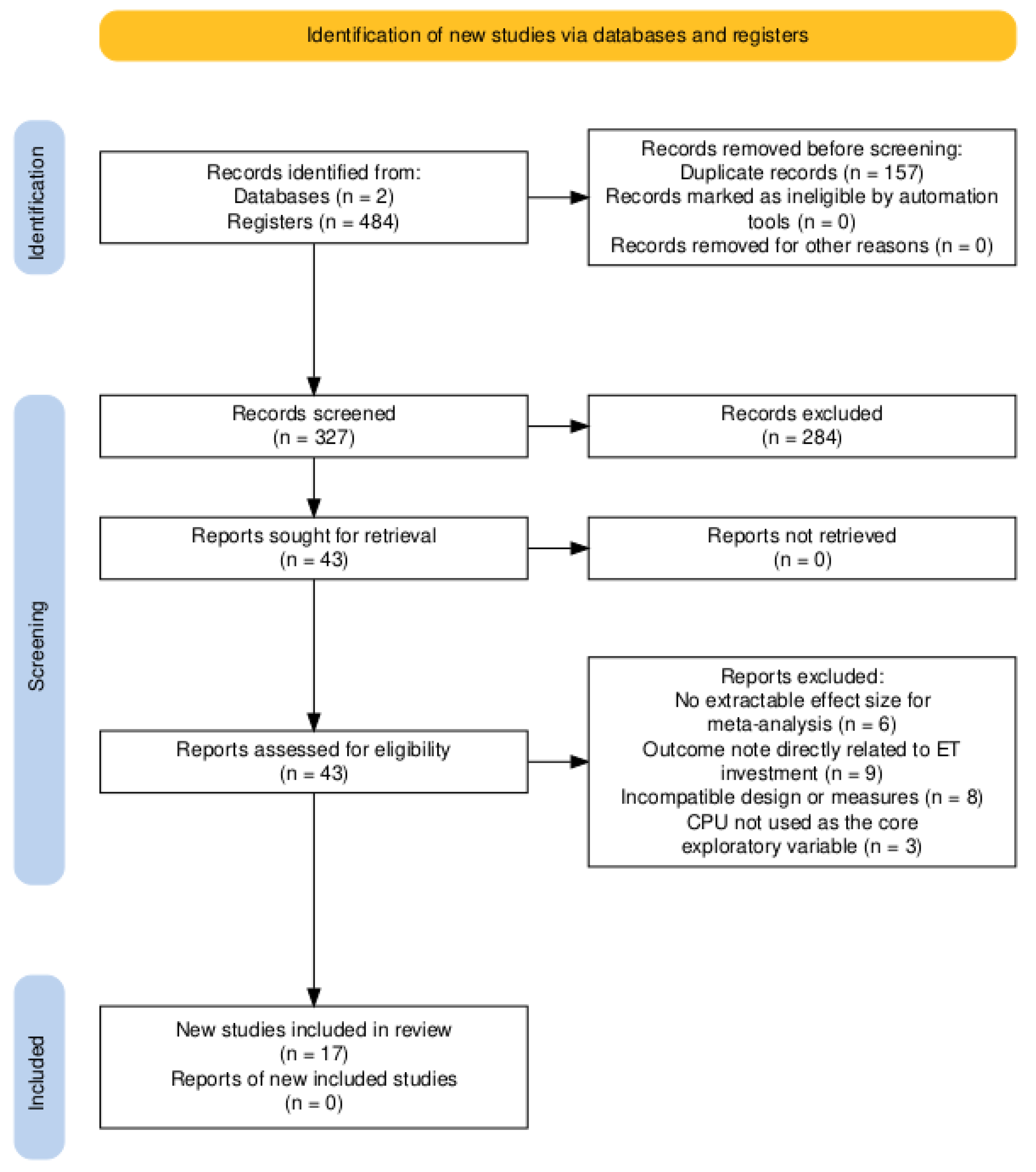
The article selection process followed the PRISMA (Preferred Reporting Items for Systematic Reviews and Meta-Analyses) guidelines [13], and a summary is presented in Figure 1.
The original search of the databases resulted in the identification of 433 articles, of which 203 were retrieved from WOS and 230 from Scopus. After the updated search conducted on 1 April 2026, 51 additional records were identified (19 in WOS and 32 in Scopus), bringing the total number of identified records to 484. Across both rounds, 157 duplicate records were removed, resulting in 327 records screened by title and abstract. Of these, 43 reports were selected for full-text reading. In the eligibility phase, 26 reports were excluded because they did not meet the requirements for quantitative synthesis, as detailed in Appendix B. Finally, 17 studies were included in the meta-analysis (Supplementary Materials).

3.3. Data Extraction and Data Management

The data extracted included publication details (title, authors, journal, year); study characteristics (main findings, methodology, research gaps, hypotheses tested, study objectives); details of the econometric model adopted; details of the comparison group; and outcome measures used and main quantitative and qualitative results reported. To ensure accuracy, the extraction process adopted was the single-extractor-with-verification model. In this approach, one reviewer performs the initial extraction of data, while the second reviewer independently verifies the accuracy and completeness of all extracted data.

3.4. Meta-Analysis Framework

The quantitative synthesis was conducted in R using the metafor package [39]. We first estimated a random-effects model, in which the observed effect size from each study is treated as an estimate of an underlying study-specific true effect. This specification is appropriate because the included studies differ in estimator choice, outcome definition, and empirical context, making between-study heterogeneity an expected feature of the evidence base. The between-study variance ( τ 2 ) was estimated by restricted maximum likelihood (REML), which is commonly preferred in small-sample meta-analytic settings. We then estimated mixed-effects meta-regression models using the rma() function with the mods argument to test whether two categorical moderators—transmission channel and geographic region—help explain part of the observed heterogeneity. Because the meta-analytic sample is small (k = 17), statistical inference was based on the Knapp–Hartung adjustment. Importantly, the Fisher z-transformation was used here as a harmonization device to place heterogeneous reported estimates on a common scale for synthesis; it does not imply full statistical equivalence among the different primary estimators.

3.5. Risk of Bias Assessment

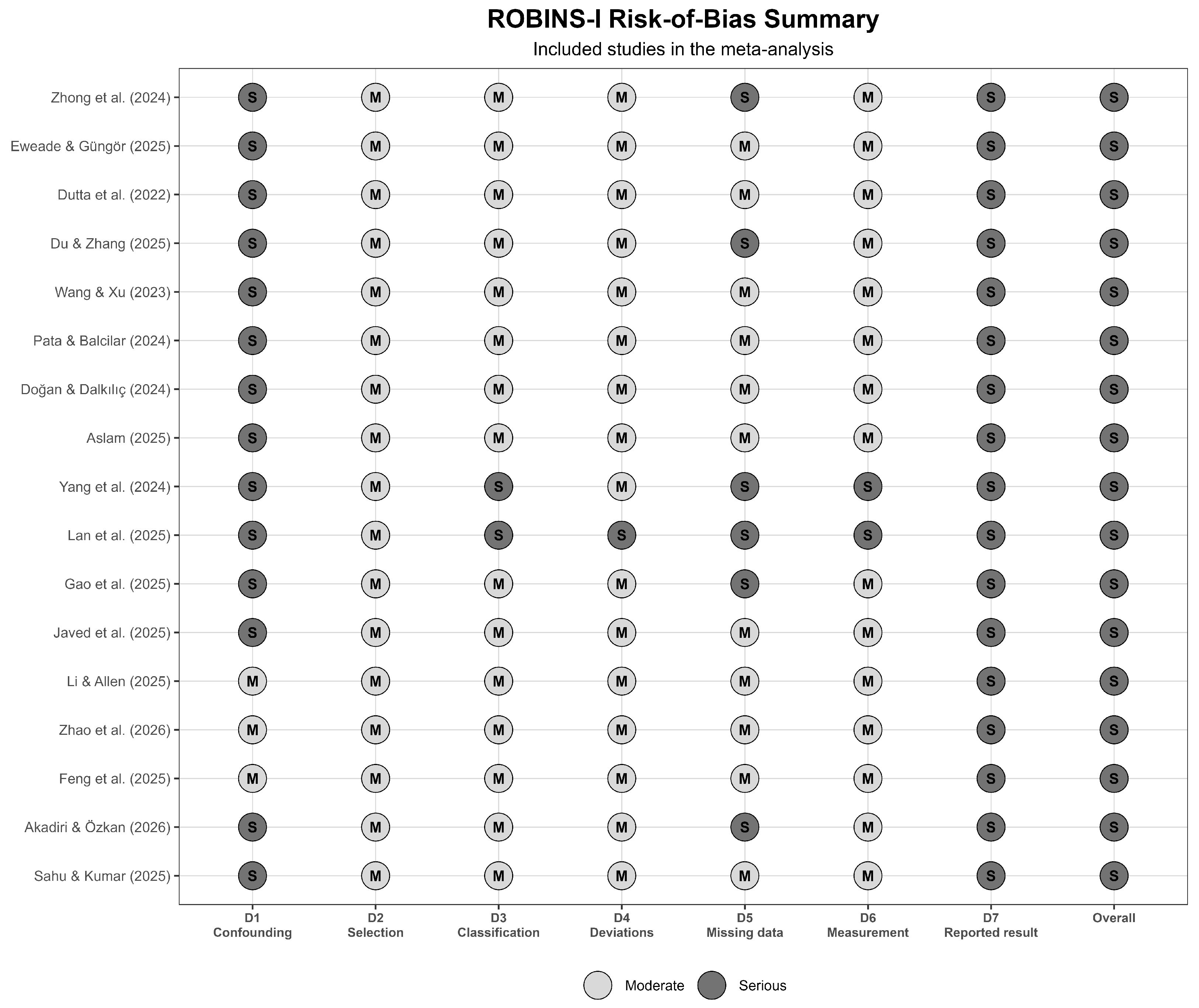
To evaluate internal validity, we adopted the ROBINS-I framework [40], which is appropriate for non-randomized empirical studies such as those included in this review. ROBINS-I assesses seven domains of bias: confounding, selection of participants, classification of exposures, deviations from intended interventions, missing data, measurement of outcomes, and selection of the reported result (Figure 2). This structure is especially relevant here because the primary studies rely on observational macro-financial and energy-economics designs rather than experimental identification. Appendix C reports the domain-level assessment for each of the seventeen included studies and summarizes the overall judgment. Most studies present moderate to serious risk in at least one domain, but none reach the threshold of critical risk. Consistent with ROBINS-I guidance, serious risk does not by itself require exclusion; accordingly, all seventeen studies were retained, while their limitations are taken into account in the interpretation of the meta-analytic findings.

4. Empirical Results

4.1. Main Findings

Table 1 summarizes the seventeen studies included in the quantitative synthesis (Appendix A). To improve comparability across heterogeneous empirical designs, the reported estimates were harmonized using the Fisher z-transformation. The expansion of the evidence base from 12 to 17 studies after the updated search is documented in Appendix E.
Under the random-effects model, the pooled association between CPU and ET-related investment outcomes is small, negative, and statistically insignificant (z = −0.0856, SE = 0.1479, p = 0.5707; r = −0.0854). At the same time, heterogeneity is extremely high ( I 2 = 99.94%), indicating that the evidence cannot be meaningfully summarized by a single average effect.
To explore this dispersion, we estimated two mixed-effects meta-regressions. The first model uses transmission channel as the moderator. It explains 50.44% of the between-study variance, and the omnibus test is statistically significant (F(3, 13) = 6.30, p = 0.0072). Among the transmission channels, only the Macroeconomic category differs significantly from the reference group, Political and institutional (Estimate = −1.0700, SE = 0.3264, t = −3.2784, p = 0.0060). The other channel categories are not statistically significant. This result should nevertheless be interpreted cautiously because subgroup sizes are small and residual heterogeneity remains very large.
The second model uses geographic region as the moderator. In this case, explanatory power remains limited ( R 2 = 28.55%), and the omnibus test is not statistically significant at the 5% level (F(4, 12) = 2.49, p = 0.0988). Although the point estimate for Asia is relatively large in magnitude, the regional specification as a whole remains unstable and should be interpreted with caution. Therefore, the regional moderator does not support a robust region-based interpretation of the observed heterogeneity.

4.2. Random-Effects Model—Meta-Analysis

4.2.1. Meta-Analysis Model Specifications and Results

The global meta-analysis using the random-effects model was conducted for the estimation of the consolidated effect of CPU on ET outcomes.
We begin assuming that
y i   =   θ i + e i ,
where y i is the observed effect in the i-th study, θ i is the unknown true effect, and e i is the sampling error.
Considering the studies are not exactly identical in methods and premises of the included samples, heterogeneity among the true effects is expected. We are considering these true effects as random, which leads to a random-effects model, as follows:
θ i   =   μ + u i ,
where u i N ( 0 , τ 2 ) .
Thus, the aim of this research is to estimate μ , which is the average true effect, and τ 2 , the total amount of heterogeneity among true effects. If τ 2 = 0 , then μ   =   θ [39].
Table 2 presents the data related to the overall random-effect meta-analysis, based on k = 17 harmonized effect sizes.
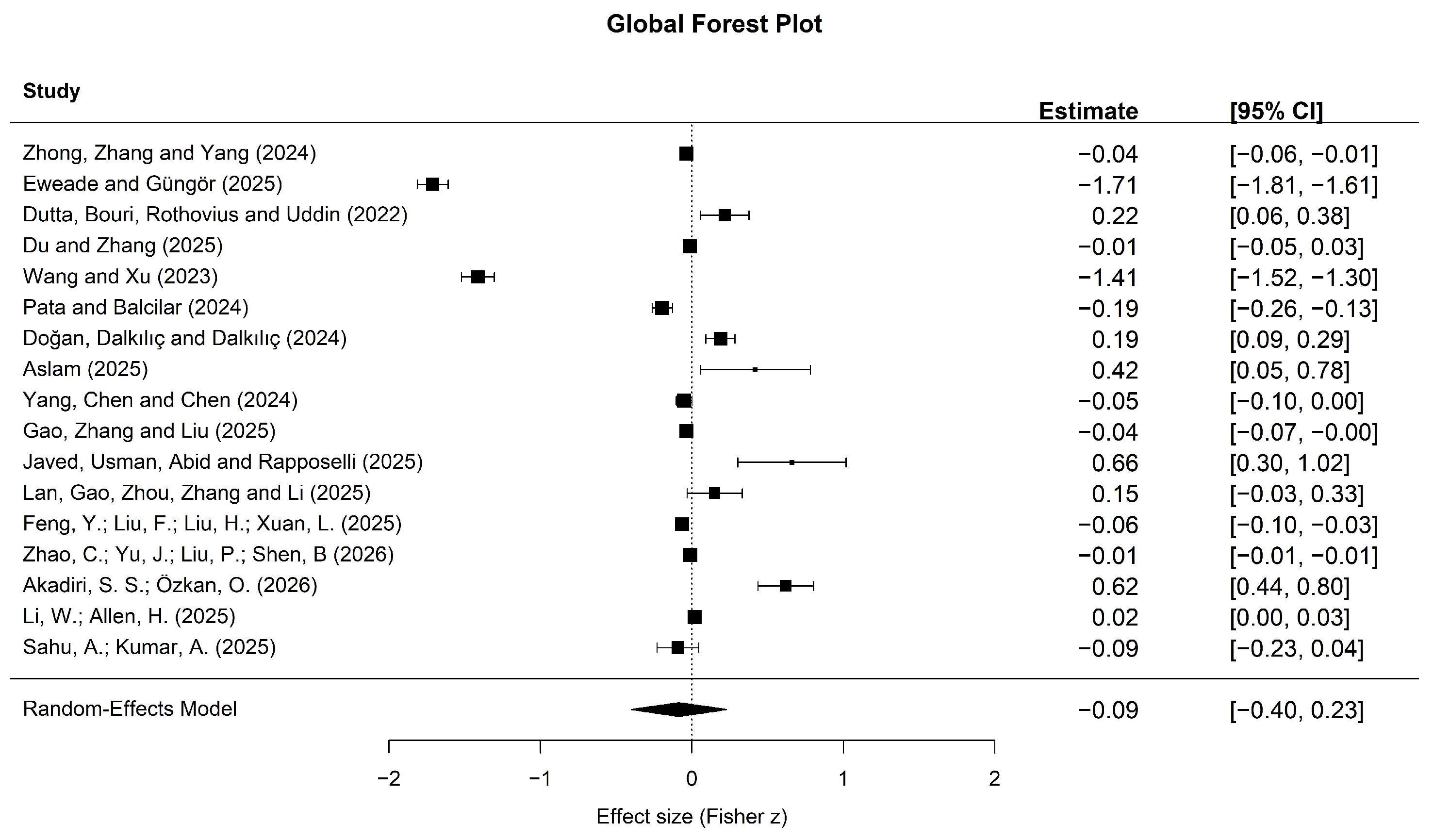
The pooled effect size on the Fisher z scale is 0.0856 , with S E = 0.1479 , and a 95% confidence interval ranging from 0.3991 to 0.2279 (Figure 3). The I 2 = 99.94 % indicates extreme heterogeneity, and τ 2 = 0.3648 reveals a large estimated between-study variance. Combined, these results indicate that the overall average effect remains modest and largely dominated by variability across outcomes rather than by sampling error. The p = 0.5707 indicates that the global effect is not statistically significant.
The random-effects results show that between-study variation dominates the observed evidence. With I 2 = 99.94%, the pooled estimate is not informative as a universal summary of the CPU-ET relationship. The principal contribution of the global model is therefore not to establish an average effect but to demonstrate the inadequacy of a single pooled coefficient under extreme heterogeneity. This conclusion follows directly from the combination of a statistically insignificant pooled estimate and very large between-study dispersion. For that reason, the moderator analyses are treated as a secondary and exploratory step aimed at organizing—rather than eliminating—the observed heterogeneity.

4.2.2. QQ Plot—Random-Effects

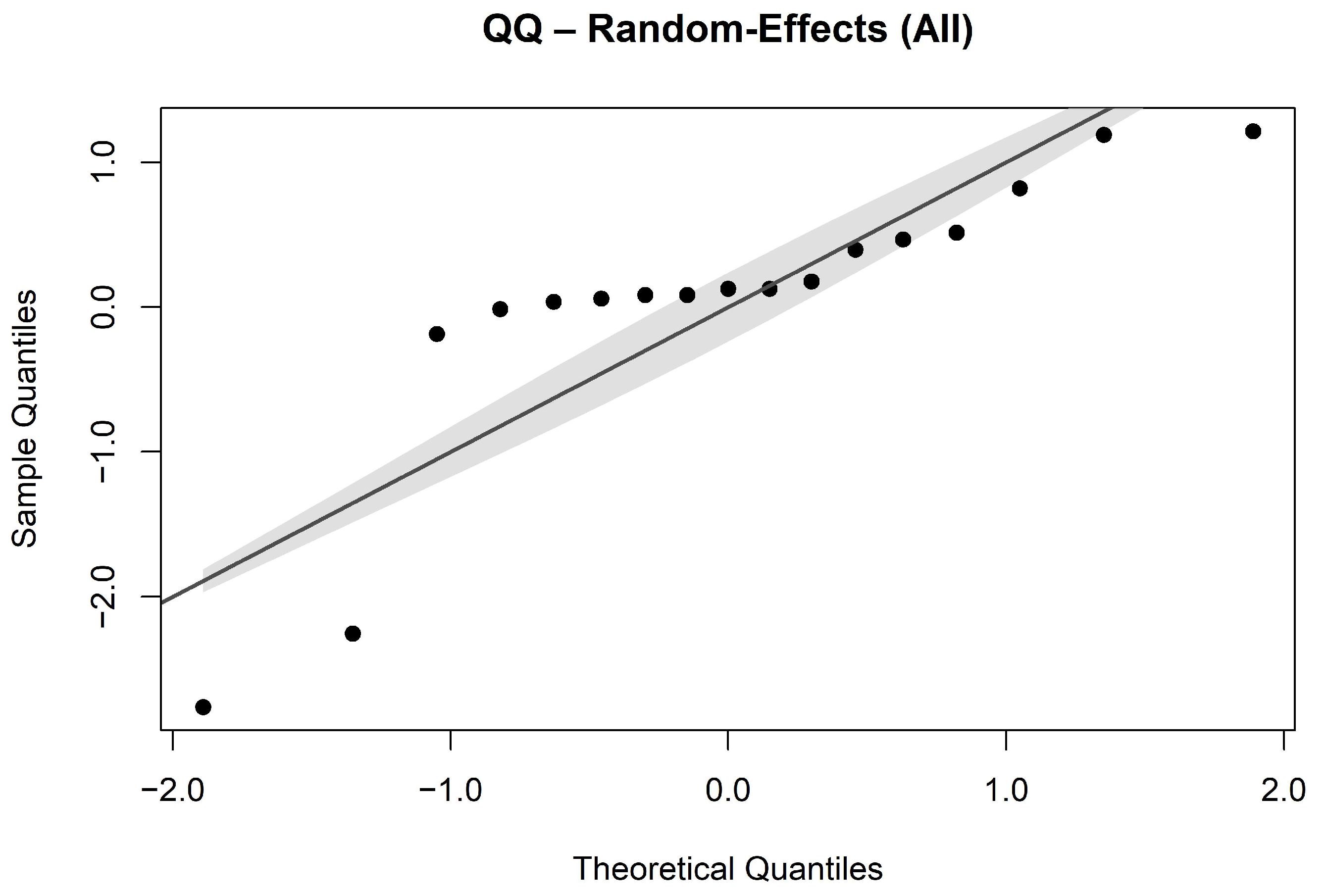
Figure 4 shows the QQ plot for the random-effects model and reveals a pattern of heavy-tailed behavior. This means that effect sizes from different studies are not fully captured by a single underlying distribution, even after applying the Fisher z-transformation.
Such deviations are expected in meta-analyses that synthesize studies using heterogeneous outcome measures, estimation methods, and temporal or geographic scopes. The global QQ plot, therefore, plays a crucial diagnostic role: it confirms that the overall variability is not attributable to sampling error alone and that a pure random-effects model—without moderators—cannot fully explain the dispersion in the effect sizes of the CPU and ET relationship.

4.2.3. Publication Bias and Influence Diagnostic

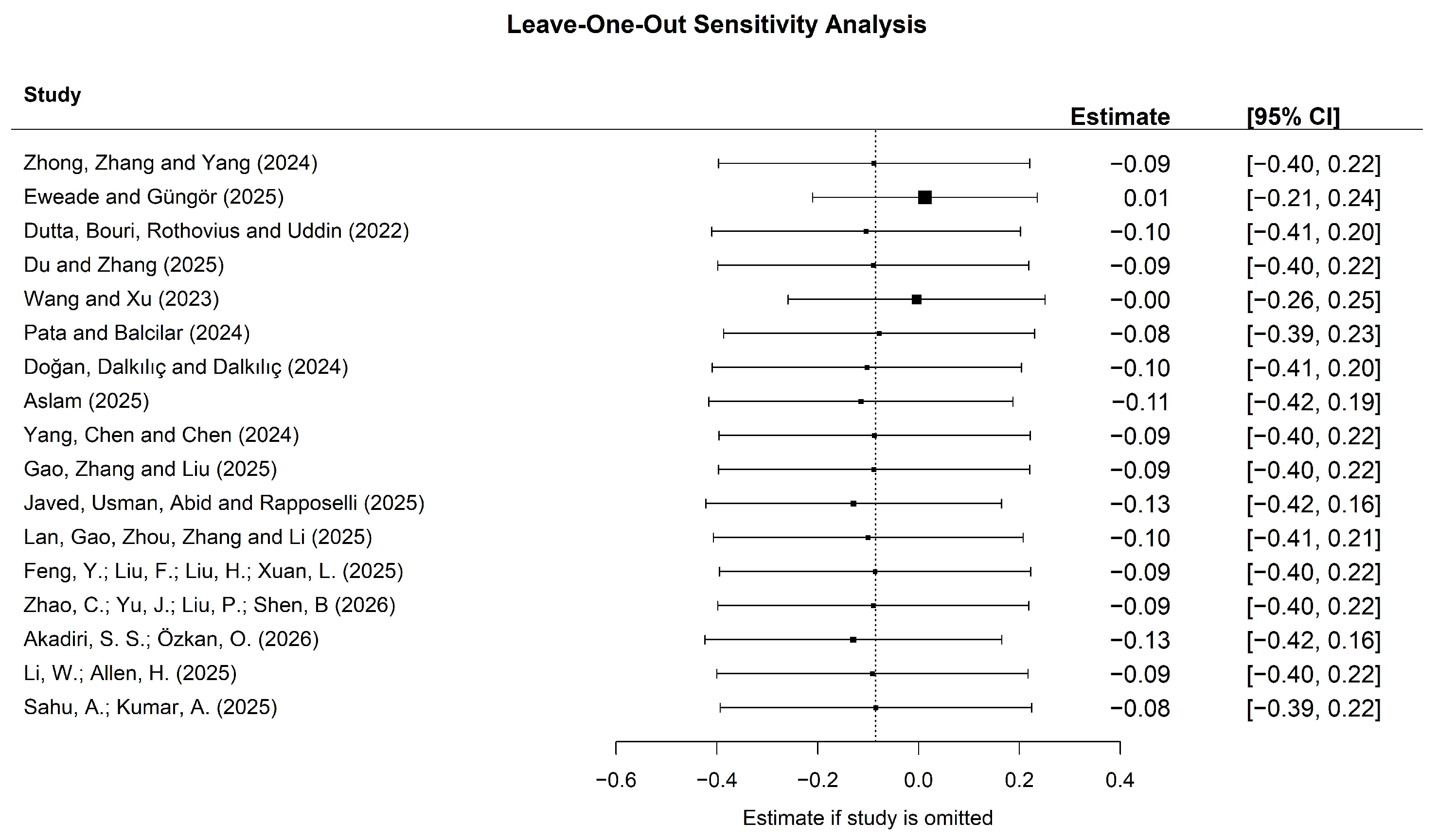
To complement the global random-effects model and assess the robustness of the synthesized evidence, we conducted three diagnostic analyses: a Funnel Plot, a Baujat Influence Plot, and a Leave-One-Out sensitivity analysis (see Appendix D for details). Taken together, these tools allow us to examine potential publication bias, identify influential studies, and evaluate the stability of the pooled effect after the removal of individual estimates.
These diagnostics suggest that the high heterogeneity observed in the global model reflects underlying variability across studies rather than publication bias. No single study materially alters the pooled effect, and the lack of statistical significance is not a consequence of high-leverage observations. Overall, these findings reinforce the conclusion that the relationship between CPU and ET is fundamentally heterogeneous across contexts and cannot be reduced to a single universal effect size.

4.3. Mixed-Effects Model—Meta-Regression

The high heterogeneity observed in the random-effects model demands an investigation using mixed-effects meta-regression. We explore two sets of categorical moderators: the channel of transmission and the geographic region.

4.3.1. Mixed-Effects Model Specifications and Results

To examine whether part of the between-study heterogeneity could be systematically attributed to contextual factors, we estimated mixed-effects meta-regression models. Let θ i denote the true effect size from study i. The mixed-effects specification is:
θ i   =   β 0 + β 1 x i 1 + + β p x i p + u i ,
where x i j represents the value of moderator j for study i, and u i N ( 0 , τ 2 ) captures the remaining heterogeneity in true effect sizes after accounting for the moderators.
In this framework, τ 2 quantifies the residual between-study variance, and the key objective is to assess whether the moderators significantly reduce heterogeneity and explain systematic variation across studies [39].
This specification explains part of the observed heterogeneity. The model yields R 2 = 50.44%, and the omnibus moderator test is statistically significant, with F(3, 13) = 6.30 and p = 0.0072. Given the small number of studies and the limited degrees of freedom, however, this result should be interpreted as exploratory evidence that the transmission-channel classification may capture part of the systematic variation in reported effects, rather than as definitive confirmation of stable subgroup differences.

4.3.2. Moderator 1: Channel of Transmission

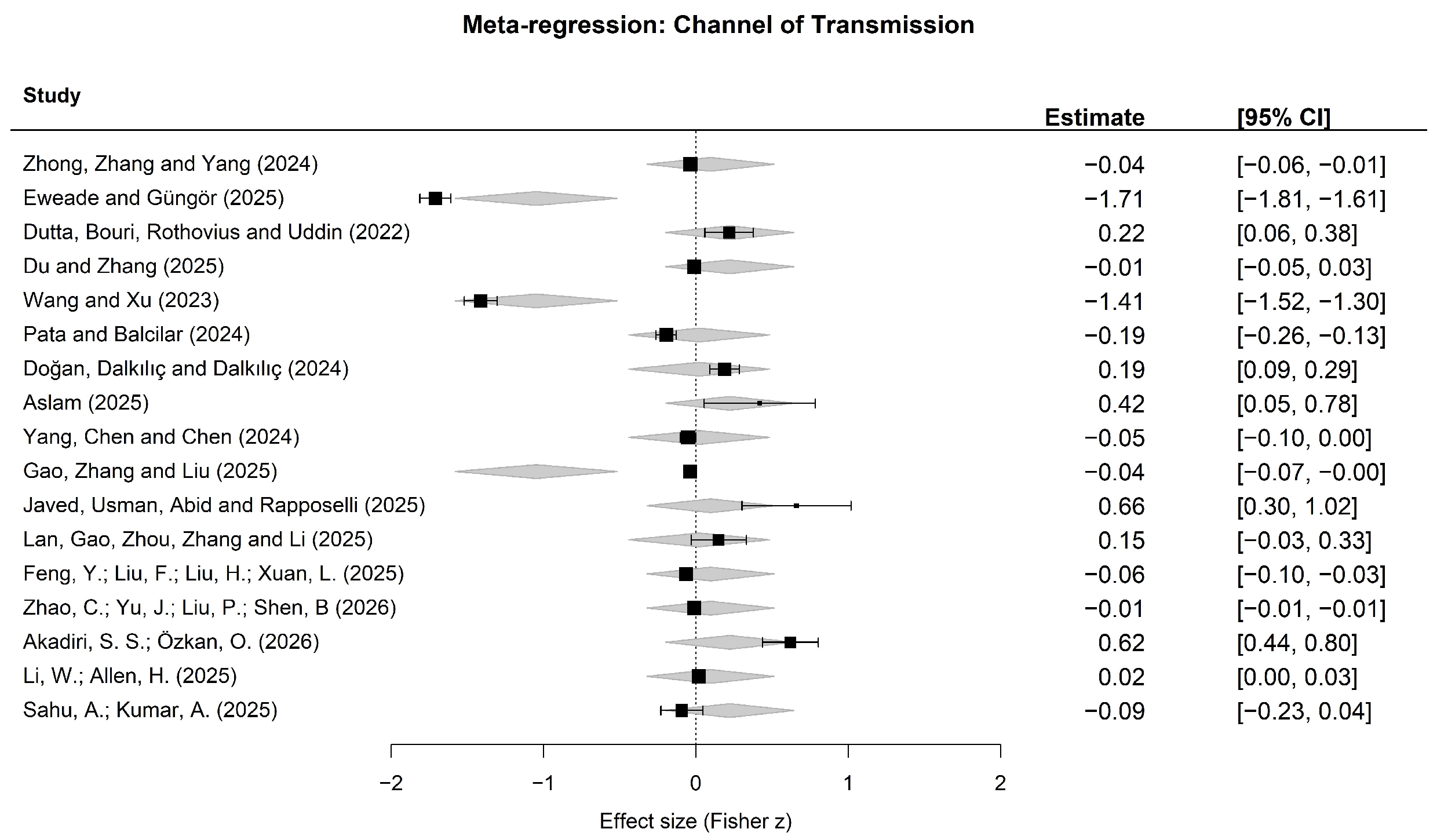
The first mixed-effects model examines whether the reported CPU–ET relationship varies across four transmission channels identified in the literature. The subgroups are Political and institutional (n = 4), Financial market (n = 5), Firm investment (n = 5), and Macroeconomic (n = 3). Relative to the reference category, the coefficients for Financial market and Firm investment are not statistically significant. By contrast, the Macroeconomic channel is the only category that shows a statistically significant deviation from the baseline (Estimate = −1.0700, p = 0.0060). Additional details are provided in Table 3 and Figure 5.
This pattern suggests a stronger negative association in studies that examine macroeconomic conditions related to energy-transition investment (Eweade and Güngör [26]; Wang and Xu [42]; Gao et al. [47]. Even so, the result should be interpreted with caution. The subgroup includes only three studies; its outcomes are broader than narrow project-level renewable energy investment, and one study in this subgroup, Eweade and Güngör [26], reports the largest negative effect size in the sample. Accordingly, these findings are better understood as suggestive evidence of a macroeconomic pathway in the literature rather than as definitive proof of a validated transmission mechanism. Residual heterogeneity remains extremely high ( I 2 = 99.87%), indicating that the moderator accounts for only part of the observed dispersion.

4.3.3. Moderator 2: Geographic Region

The second mixed-effects model evaluates whether geographic region helps explain the dispersion of reported effects (Table 4). Its explanatory power remains limited ( R 2 = 28.55%), and the omnibus test is not statistically significant at the 5% level (F(4, 12) = 2.49, p = 0.0988). Although the point estimate for Asia is relatively large and negative, the regional specification as a whole remains unstable and should be interpreted with caution. For that reason, the Asian estimate should not be treated as evidence of a stable regional effect.
At most, it indicates that some studies from Asian settings report more negative estimates, but the present dataset does not support a strong region-based interpretation. In comparative terms, the evidence suggests that heterogeneity is more plausibly organized by the type of mechanism or outcome examined than by geographic grouping alone.
The available evidence is currently concentrated in studies from the United States, China, broader Asian settings, and multinational samples, with no eligible studies from Europe or Africa included in the final meta-analytic dataset. This pattern does not reflect a selection preference; rather, it is a consequence of the eligible peer-reviewed literature identified under the predefined protocol.
Together, these results indicate that transmission channels, not regions, are the primary source of systematic heterogeneity in the empirical literature.

4.3.4. QQ Plot—Mixed-Effects

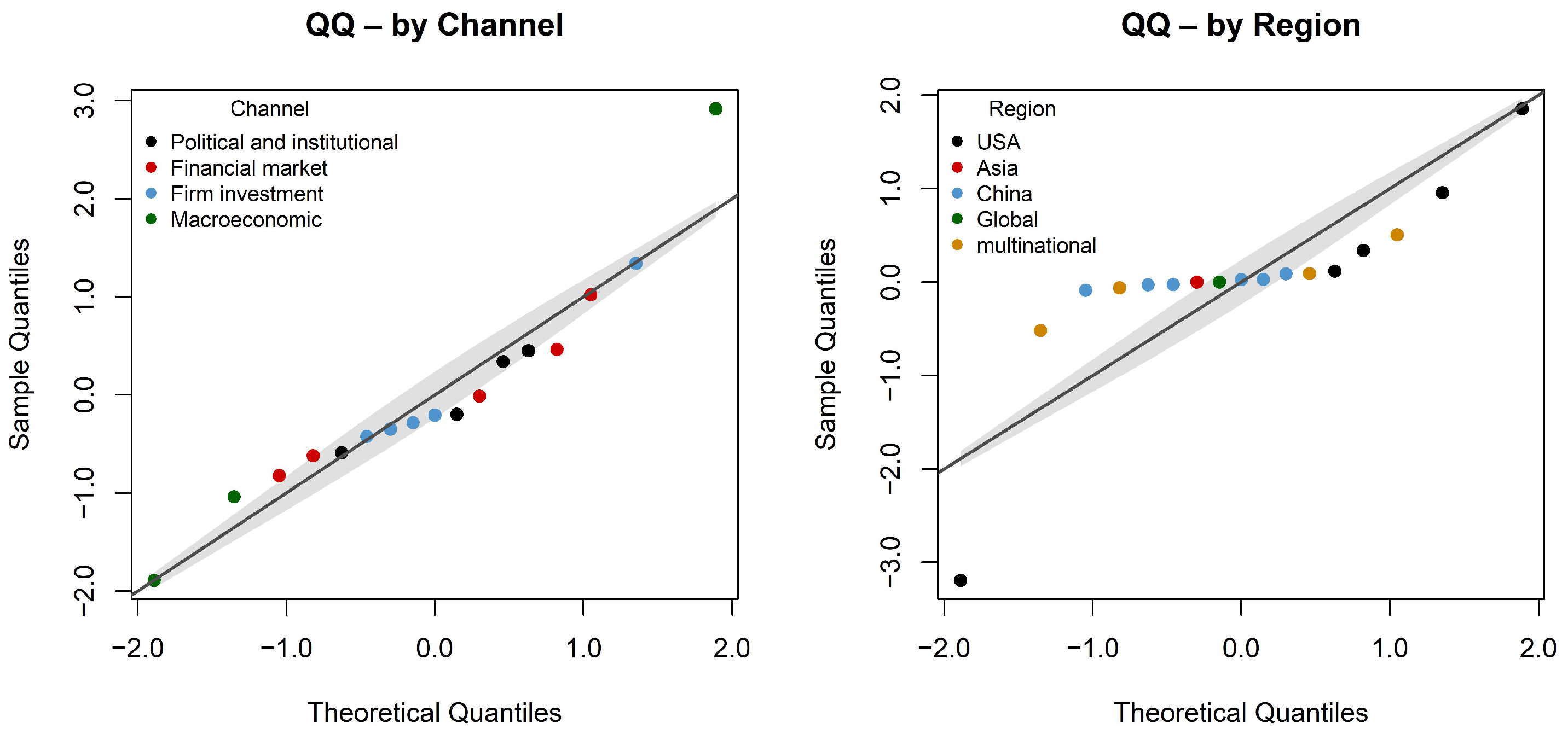
Figure 6 shows the QQ plot by Transmission Channels (left panel) and by Geographic Region (right panel). It can be seen that the model that considers the transmission channels as a moderator has points that are more contained within the confidence envelope area, compared with the model that considers the geographic region as a moderator.
The QQ-patterns, therefore, corroborate the meta-regression results in Section 4.3.3, where geographic region was not a statistically significant moderator and explained only a small fraction of the between-study variance. The absence of strong regional deviations indicates that heterogeneity is more strongly structured by economic transmission mechanisms than by geographic setting.

5. Discussion

As defined in the protocol preregistered on OSF, this study aimed to determine how climate policy uncertainty affects investment decisions in the energy transition and through which transmission mechanisms this influence may operate. The initial hypothesis assumed a negative effect of CPU on ET across contexts, based on real options theory and the principle of investment postponement under uncertainty [22,23]. However, the empirical evidence from the seventeen studies included in this review does not support a statistically meaningful universal effect. Accordingly, the initial hypothesis must be rejected.
To improve comparability across the seventeen studies, the reported estimates were harmonized using Fisher’s z-transformed correlations. This procedure places heterogeneous findings on a common metric for synthesis, but it does not remove the conceptual and statistical differences across the underlying estimators, outcome definitions, and empirical settings.
The global random-effects model yields a small, negative, and statistically insignificant pooled association (Fisher’s z = −0.0856, p = 0.5707), together with extreme heterogeneity ( I 2 = 99.94%; τ 2 = 0.3648). Accordingly, the central inference from the global model is that the evidence does not support a meaningful universal pooled effect. The mixed-effects meta-regressions were therefore used as exploratory tools to assess whether part of the dispersion follows an interpretable pattern. Their purpose is not to establish causal transmission in a strict sense, but to organize the literature according to the type of mechanism or ET-related outcome examined.
Within that exploratory framework, the transmission-channel specification performs better than the regional specification (Figure 4 and Figure 6). However, the moderator results remain bounded by the small number of studies, small subgroup sizes, and very high residual heterogeneity. The evidence, therefore, supports a cautious interpretation: the reported CPU-ET relationship is strongly context-dependent, and the strongest negative pattern appears in the macroeconomic subgroup, but this pattern should not be overstated as a definitive causal mechanism.
The Macroeconomic channel shows a statistically significant deviation from the baseline, with a large negative Fisher’s z estimate ( β = 1.0700 , p = 0.0060). This result is associated with studies that capture long-term regulatory risk through aggregate variables such as foreign direct investment and trade openness [26]. Related evidence from Owjimehr and Meybodi [54] and Ashraf [55] suggests that CPU may translate into systemic financial stress and heightened political and financial risk across countries, thereby increasing the cost of capital and constraining large-scale, capital-intensive ET projects. In this sense, climate policy uncertainty may negatively affect macroeconomic conditions relevant to long-term ET investment.
The remaining channels show point estimates close to zero and wide confidence intervals, indicating no detectable systematic link. At the micro level, firms and financial agents may adapt more flexibly to short-term uncertainty. The literature also documents a “flight-to-green” effect in equity markets, which may help explain attenuated or near-zero estimated effects [11,12]. Our meta-regression suggests that, if such a counterintuitive effect exists, it does not represent a statistically robust deviation from overall investment behavior. Moreover, residual heterogeneity remains extremely high after moderation ( I 2 = 99.87 % ), indicating that additional unobserved factors likely contribute to the observed dispersion.
This pattern is consistent with theoretical mechanisms discussed in the real options literature [7], according to which macro-level uncertainty shocks may alter expected growth trajectories [22,33], tighten financial conditions [7,54], and delay the reallocation of capital toward low-carbon technologies [6]. By contrast, micro-level and political-institutional contexts may allow more gradual adjustment, enabling firms and investors to adapt without large immediate changes in ET-related outcomes [6,10].
Technological innovation, including artificial-intelligence-related mechanisms, may constitute an additional transmission pathway linking climate policy uncertainty to energy-transition-related outcomes. However, although AI may shape energy demand, sustainable practices, and renewable energy innovation, the current dataset is too small to support a stable moderator analysis of this dimension.
The second mixed-effects meta-regression, which uses geographic region as the moderator, performs poorly as an explanatory factor. It explains 28.55% of the variance, but the moderator test remains above the conventional 5% threshold (p = 0.0988).
The geographic coverage of the eligible literature also limits generalization. The final meta-analytic sample is concentrated in studies from the United States, China, Asia, multinational and global settings, while no eligible studies from Europe or Africa were retained under the predefined protocol. This pattern should be understood as a characteristic of the currently available peer-reviewed evidence rather than as a deliberate selection preference. It nonetheless means that the present conclusions should be interpreted as conditional on the current composition of the literature and not as globally comprehensive evidence across all regions.
The ROBINS-I assessment highlights important limitations in the reviewed evidence. The 17 studies included in the meta-analysis present at least some risk of bias, mainly related to confounding, exposure classification, and deviations from intended interventions. However, no study reached a critical level that justified exclusion, and all 17 studies were therefore retained in the meta-analysis. Additional diagnostic checks indicate that no single study is sufficient to alter the direction or statistical significance of the overall results.
Given the difficulty of isolating a causal relationship between CPU and ET, the available studies rely on simplified correlations, time-series models, and panel regressions, all of which raise endogeneity concerns that cannot be fully resolved. In light of these limitations, this study adopts a transparent meta-analytic approach, including the full reporting of effect-size calculations in Appendix A.
The updated search conducted on 1 April 2026 added five studies to the quantitative synthesis, increasing the meta-analytic sample from 12 to 17 studies. Importantly, this expansion does not alter the main substantive conclusion of the article. The pooled effect remains small, negative, and statistically insignificant, while heterogeneity remains extreme. The main change is that the updated evidence base makes the channel-based interpretation more stable: the transmission-channel model becomes more statistically informative, the explanatory power of this moderator increases, and the Macroeconomic coefficient remains virtually unchanged in magnitude while becoming more statistically significant.
The updated evidence base also changes the composition of the sample. The additional studies are concentrated mainly in the Firm investment and Financial market channels, and geographically, they increase the weight of China and add one Global study. This broader composition attenuates the previously more positive point estimate in the Firm investment subgroup, while leaving the Macroeconomic subgroup as the only robustly negative and statistically significant category. In this sense, the updated search strengthens the interpretation that the strongest adverse CPU–ET pattern is concentrated in macroeconomic settings rather than at the firm or financial-market level.
Overall, the evidence does not support a universal average causal effect linking CPU to ET that can be summarized by a single β coefficient. Instead, the relationship between CPU and ET is highly heterogeneous, largely because the energy transition itself encompasses multiple and layered economic processes. The macroeconomic transmission mechanism is the only context in which CPU is associated with a systematic and statistically significant reduction in ET-related investment outcomes. However, the particularly large negative estimate reported by Eweade and Güngör [26] may materially influence the subgroup coefficient, so this result should be interpreted as suggestive rather than definitive. The other transmission channels, by contrast, do not exhibit systematic or statistically robust effects. Finally, the methodological limitations identified by ROBINS-I reinforce the need for stronger identification strategies capable of moving beyond associative evidence.

6. Conclusions

Following a preregistered protocol on the Open Science Framework (OSF), this study conducted a systematic literature review and meta-analysis of seventeen peer-reviewed empirical studies examining the relationship between climate policy uncertainty and energy-transition-related investment outcomes. Because the included studies relied on heterogeneous empirical designs, estimators, and outcome definitions, their reported estimates were harmonized using the Fisher z-transformation to enable synthesis on a common metric.
The global random-effects model yields a small, negative, and statistically insignificant pooled association between climate policy uncertainty and energy-transition-related investment outcomes, together with extreme heterogeneity. The central implication is therefore not the identification of an average effect, but rather the recognition that the available evidence cannot be meaningfully summarized by a single universal coefficient.
The moderator analyses indicate that context matters, but they should be interpreted as exploratory rather than definitive. In particular, the transmission-channel specification explains part of the observed dispersion, and only the Macroeconomic subgroup shows a statistically significant negative deviation from the reference category. Even so, this result remains qualified by the small number of studies in the subgroup, the broader scope of its outcome definitions, and the persistence of very high residual heterogeneity. Importantly, although the final meta-analytic sample remains relatively small, it reflects the full set of peer-reviewed studies that met the predefined eligibility protocol after the updated search, rather than a selective restriction imposed by the authors.
Taken together, the findings support a cautious conclusion: the relationship between climate policy uncertainty and energy-transition-related investment outcomes is highly context-dependent, and stronger negative estimates are concentrated in studies examining macroeconomic conditions related to long-term investment. By contrast, the remaining subgroup differences are not statistically robust. For policymakers, these results highlight the importance of regulatory credibility, macroeconomic stability, and long-horizon policy predictability in supporting the energy transition.
For future research, several priorities emerge. First, broader geographic coverage is needed, particularly in regions currently absent from the eligible literature, such as Europe and Africa. Second, future studies would benefit from more harmonized definitions of energy-transition-related outcomes and from stronger identification strategies capable of moving beyond associative evidence. Third, technological innovation may represent an additional transmission pathway. In particular, artificial-intelligence-related mechanisms deserve closer attention, as AI may affect energy-transition-related outcomes through multiple channels, including energy demand, efficiency gains, sustainable practices, and renewable energy innovation. Although the current evidence base is too limited to support a stable moderator analysis of this dimension, future research with a larger number of comparable studies may be able to assess whether AI constitutes a distinct transmission channel linking climate policy uncertainty to energy-transition-related investment outcomes. Finally, future empirical work may also examine whether the role of transmission channels varies across institutional environments, financing regimes, and stages of the energy transition.

Supplementary Materials

The following are available online at https://www.mdpi.com/article/10.3390/en19092009/s1, checklist; references.

Author Contributions

Conceptualization, M.d.C.M. and B.M.T.; methodology, M.d.C.M. and B.M.T.; software, M.d.C.M. and B.M.T.; validation, M.d.C.M. and B.M.T.; formal analysis, M.d.C.M. and B.M.T.; investigation, M.d.C.M. and B.M.T.; resources, M.d.C.M. and B.M.T.; data curation, M.d.C.M. and B.M.T.; writing—original draft preparation, M.d.C.M. and B.M.T.; writing—review and editing, M.d.C.M. and B.M.T.; visualization, M.d.C.M. and B.M.T.; supervision, M.d.C.M. and B.M.T.; project administration, M.d.C.M. and B.M.T. All authors have read and agreed to the published version of the manuscript.

Funding

Benjamin M. Tabak gratefully acknowledges financial support from CNPQ Foundation (Grant no. 305485/2022-9).

Data Availability Statement

Data will be made available on request.

Conflicts of Interest

The authors declare no conflicts of interest.

Abbreviations

The following abbreviations are used in this manuscript:
AIArtificial Intelligence
CPUClimate Policy Uncertainty
ETRenewable Energy Transition
FDIForeign Direct Investment
GIGreen Innovation
OSFOpen Science Framework
PRISMAPreferred Reporting Items for Systematic Reviews and Meta-Analyses
R&DResearch and Development
SEStandard Error
TOTrade Openness
WOSWeb of Science

Appendix A

Table A1. Quantitative meta-analysis.
AuthorsYearRegionEffect-Size InfoChannel β SEtdfNr F yi F sei F vi Comments
Zhong et al. [7]2024China2SLS; β  + SE; log-x level-yFirm investment 0.0241 0.0100 2.41 45444545 0.0357 0.0357 0.0148 0.0002 Source in the Paper: Table 1, Col. (3).
Eweade and Güngör [26]2025USAFMOLS/DOLS/TY; β  + SEMacro economic 0.1030 0.0020 51.50 371372 0.9366 1.7099 0.0521 0.0027 Source in the Paper: Table 1.
Dutta et al. [12]2022multi-nat.Regime-switching; betasFinancial market 0.0202 0.0074 2.73 154155 0.2148 0.2182 0.0811 0.0066 Source in the paper: Table 1, Line PBW.
Du and Zhang [41]2025China β  + SE FMOLS/DOLSFinancial market 0.0123 0.0210 0.59 26102611 0.0115 0.0115 0.0196 0.0004 Source in the paper: Table 1, Col. 2.
Wang and Xu [42]2023AsiaPSTR; green innovationMacro economic 0.1400 0.0040 35.00 329330 0.8879 1.4117 0.0553 0.0031 Source in the paper: Table 1 (PMG).
Pata and Balcilar [43]2024USABetas MRS macro; bus. cyclesPolitical/instit. 0.0063 0.0011 5.7273 854855 0.1923 0.1947 0.03426 0.00117 Source in the paper: Table 1, Col. (1).
Doğan and İbrahim Dalkılıç [44]2024USACoef. ARDL; renewable instal.Political/instit. 0.0222 0.0057 3.89 419420 0.1869 0.1891 0.0490 0.0024 Source in the paper: Table 1, Col. SOLAR.
Aslam [45]2025multi-nat.Quantilics dynamics BetaFinancial market 0.0002 0.0001 2.40 3132 0.3958 0.4187 0.1857 0.0345 Source in the paper: Table 1 FMOLS.
Yang et al. [36]2024multi-nat.Beta TVP-VAR energy/oilPolitical/instit. 3.9240 2.0520 1.91 14381439 0.0504 0.0504 0.0264 0.0007 Source in the paper: Table 1, Col. (1).
Gao et al. [47]2025ChinaFMOLS/DOLS; β   + SEMacro economic 0.1620 0.0780 2.08 31993200 0.0367 0.0367 0.0177 0.0003 Source in the paper: Table 1, Col. (4).
Javed et al. [48]2025USAARDL long-run; relationship between CPU and REFirm investment 1.3120 0.3270 4.01 3233 0.5785 0.6602 0.1826 0.0333 Source in the paper: Table 1, long-run.
Lan et al. [46]2025multi-nat.Coef. ARDL; renewables; β  + SEPolitical/instit.118 0.1490 0.1502 0.0925 0.0085 Source in the paper: Table 1.
Li and Allen [49]2025ChinaFirm-level panel; FE; β  + SEFirm investment 0.0330 0.0130 2.54 19,33519,336 0.0183 0.0183 0.0072 0.0001 Source in the paper: Table 1, Col. (3).
Zhao et al. [50]2026ChinaOLS/2SLS panel; β  + SE; firm and year FEFirm investment 0.0281 0.0034 8.26 577,445577,446 0.0109 0.0109 0.0013 0.0000 Source in the paper: Table 1, Col. (2).
Feng et al. [51]2025ChinaFirm-level panel FE; β  + SE; investment efficiencyFirm investment 0.0100 0.0030 3.33 26932694 0.0641 0.0642 0.0193 0.0004 Source in the paper: Table 1, Col. (2).
Akadiri and Özkan [52]2026GlobalKRLS; average marginal effect; clean energy marketsFinancial market 0.1210 0.0170 7.12 116117 0.5513 0.6203 0.0937 0.0088 Source in the paper: Table 1, average marginal effects from KRLS.
Kumar and Sahu [53]2025USAARDL long-run; β  + SE; CELS indexFinancial market 0.0226 0.0170 1.33 205206 0.0924 0.0927 0.0702 0.0049 Source in the paper: Table 1, ARDL long-run form.
Notes: β = original regression coefficient; SE = standard error; r = correlation coefficient; F yi = Fisher z-transformed correlation; F sei = standard error of F yi ; F vi = variance.

Appendix B

Table A2. Exclusion rationale for the meta-analysis.
CiteKeyDependent Variable (Proxy)Exclusion ArgumentSPICE Category
Ghani et al. [32]Sectoral Index VolatilityEvaluation: Focus is on volatility and risk, not direct Investment (ET). Incompatible with β / SE extraction.Evaluation
Nazari et al. [56]Investment Return/Portfolio AllocationEvaluation: Purely theoretical/simulation study (Real Options). Results are not empirically extractable in econometric format ( β / SE ).Evaluation
Jiang et al. [57]Realized VolatilityEvaluation: Focuses on market volatility. Effect is quantified by error reductions, a non-regressive metric incompatible with meta-analysis.Evaluation
Pata [4]Renewable Energy ConsumptionEvaluation: Indirect proxy. Cross-Quantilogram requires non-standard conversion of coefficients ( ρ ) to β .Evaluation
Liu et al. [58]Oil PriceSetting/Evaluation: Focuses on the fossil market. The QQR model is statistically incompatible with standard β / SE extraction.Setting/Evaluation
Owjimehr and Meybodi [54]Financial Stress IndexEvaluation: Dependent variable is Financial Stress, a systemic channel, not the primary Investment Outcome.Evaluation
Yao et al. [59]Stock Index VolatilityEvaluation: Transfer Entropy measures information flow/risk, not the quantitative magnitude of investment ( β ).Evaluation
Pham et al. [60]Return Spillover (Connectivity)Evaluation: Spillover index describes interconnectedness, not elasticity of investment.Evaluation
Fuss et al. [61]Adoption Time/EmissionsEvaluation: Theoretical calibration only/simulation Real Options study. Not empirical.Evaluation
Rastegar et al. [62]RE Innovation and PatentsIntervention: Does not use CPU directly. Uncertainty proxy is Climate Disaster Index (CDI), failing the Intervention criterion.Intervention
Işık et al. [63]ESG PerformanceEvaluation: CPU effects are consistently insignificant ( β 0 ). Protocol excludes non-significant effects.Evaluation
Husain et al. [64]Green Equity Index/Green BondsEvaluation: Focus on financial index returns and tail dependence. No direct β or elasticity coefficients.Evaluation
Ashraf [55]Ecological FootprintIntervention: Does not use CPU. Uncertainty proxy is Political/Financial Risk. Ecological Footprint is a socio-environmental outcome.Intervention
Pata [65]Renewable Energy ConsumptionIntervention: CPU omitted in primary model. Fails core Intervention criterion.Intervention
Payne et al. [66]Growth in RE ProductionEvaluation: Vector autoregression model/generalized impulse response function impulse model. Provides dynamic responses, not long-term coefficients ( β ).Evaluation
Zhao et al. [67]Renewable Energy ConsumptionEvaluation: Kernel regularized quantile regression model gives non-parametric marginal effects; incompatible with β / SE standardization.Evaluation
Pata and Pata [68]Production of RE MineralsSetting/Evaluation: Focus on RE Minerals (upstream). Multivariate quantile-on-quantile regression model incompatible with β / SE extraction.Setting/Evaluation
Naifar [69]Clean Energy Market Performance/ReturnsEvaluation: Focuses on clean energy market performance and return dynamics rather than on direct investment outcomes or acceptable investment-related proxies. The empirical strategy relies on quantile-on-quantile, multivariate quantile-on-quantile, Granger causality, and connectedness methods, producing nonlinear distributional surfaces rather than a single harmonizable main effect in the form of β / SE / N .Evaluation
Yang et al. [70]Renewable Energy InvestmentEvaluation: Although substantively well aligned with the research question, the paper does not report the full set of basic statistics required by the OSF protocol for harmonization. The main specification reports coefficient, z-statistic, and sample size, but not the directly reported standard error required for meta-analytic extraction.Evaluation
Chen et al. [71]Energy TransitionEvaluation: The study is conceptually relevant and uses a transition-related dependent variable, but the baseline table reports coefficient and sample size without a directly reported standard error. The values in parentheses appear to be t-statistics rather than SEs, preventing direct extraction of a standardized effect size under the protocol.Evaluation
Lin and Luo [72]Stock Index, Gold, and Government BondsEvaluation: Focuses on risky and safe-haven financial assets rather than on direct energy-transition investment outcomes. In addition, the empirical strategy is based on quantile Granger causality and recursive rolling Granger causality, which detect time-varying causal patterns rather than providing a single extractable β / SE effect size.Evaluation
Asteriou and Dimiski [73]Renewable/Low-Carbon Energy Asset ReturnsEvaluation: Reports distributed lag time-series coefficients for individual lags of CPU but does not provide one directly extractable main effect for the central CPU–renewable/low-carbon asset relationship. The substantive interpretation depends on cumulative lag effects, which are reported only through summed coefficients with chi-square tests and p-values, without directly reported standard errors.Evaluation
Bi et al. [74]Volatility Spillovers/Co-movement Between Clean Energy and Metal MarketsEvaluation: Focuses on spillover transmission, co-movement, and market volatility dynamics rather than on direct investment outcomes or acceptable investment proxies. The use of TVP-VAR, wavelet coherence, and GARCH-MIDAS-CPU produces connectedness measures, not a directly harmonizable main effect in the form of β / SE / N .Evaluation
Ali et al. [75]Energy TransitionEvaluation: Although it directly examines CPU and energy transition, the empirical strategy is based on QARDL and quantile cointegration, explicitly designed to estimate heterogeneous effects across quantiles rather than a single central effect. Any selection of one quantile-specific coefficient would be arbitrary and inconsistent with the study’s own methodological logic.Evaluation
Gyamerah et al. [76]Renewable Energy ETF PricesEvaluation: The paper is substantively aligned with the topic, but its empirical framework is based on time-varying Granger causality. Results are reported as Wald statistics, bootstrap critical values, and rolling causality patterns rather than as a single extractable β / SE / N effect size for the CPU–investment relationship.Evaluation
Li et al. [29]Green and Brown Energy Stock PricesEvaluation: Examines the dynamic response of energy stock prices under combined uncertainty shocks using joint impulse response functions (jIRF), not a directly estimable main effect. Results are reported as dynamic response paths under the joint influence of CPU, EPU, and GPR, which are not directly harmonizable into a single β / SE / N estimate.Evaluation

Appendix C

Table A3. ROBINS-I risk of bias assessment.
StudyD1D2D3D4D5D6D7OverallDecision
Can artificial intelligence empower energy enterprises to cope with climate policy uncertainty? Zhong et al. [7]Ser.Mod.Mod.Mod.Ser.Mod.Ser.Ser.Include (Sens.)
Climate policy uncertainty and energy impacts on trade openness and foreign direct investment in the United States: Evidence from the RALS co-integration test (Eweade and Güngör [26])Ser.Mod.Mod.Mod.Mod.Mod.Ser.Ser.Include (Sens.)
Climate risk and green investments: New evidence (Dutta et al. [12])Ser.Mod.Mod.Mod.Mod.Mod.Ser.Ser.Include (Sens.)
Green digital finance and energy transition: Considering the differentiating role of regional policy uncertainty (Du and Zhang [41])Ser.Mod.Mod.Mod.Ser.Mod.Ser.Ser.Include (Sens.)
Green investments and development of renewable energy projects: Evidence from 15 RCEP member countries (Wang and Xu [42])Ser.Mod.Mod.Mod.Mod.Mod.Ser.Ser.Include (Sens.)
Identifying the influence of climate policy uncertainty and oil prices on modern renewable energies: novel evidence from the United States (Pata and Balcilar [43])Ser.Mod.Mod.Mod.Mod.Mod.Ser.Ser.Include (Sens.)
Ink And Influence: The Role of Media On Climate Policy Understanding (Doğan and İbrahim Dalkılıç [44])Ser.Mod.Mod.Mod.Mod.Mod.Ser.Ser.Include (Sens.)
Spillovers between hydrogen, nuclear, and AI sectors: The impact of climate policy uncertainty and geopolitical risks (Aslam [45])Ser.Mod.Mod.Mod.Mod.Mod.Ser.Ser.Include (Sens.)
The dark side of climate policy uncertainty: Hindering energy transition by shaping environmental taxes effectiveness (Yang et al. [36])Ser.Mod.Ser.Mod.Ser.Ser.Ser.Ser.Include (Sens.)
The impact of climate risks on global energy production and consumption: New evidence from causality-in-quantile and wavelet analysis (Lan et al. [46])Ser.Mod.Ser.Ser.Ser.Ser.Ser.Ser.Include (Sens.)
The Urban Renewable Energy Transition: Impact Assessment and Transmission Mechanisms of Climate Policy Uncertainty (Gao et al. [47])Ser.Mod.Mod.Mod.Ser.Mod.Ser.Ser.Include (Sens.)
Unveiling the impact of geopolitical risk, climate policy uncertainty, environmental policy stringency, and financial efficiency on renewable energy investment in the USA: Evidence from novel dynamic simulated ARDL approach (Javed et al. [48])Ser.Mod.Mod.Mod.Mod.Mod.Ser.Ser.Include (Sens.)
From Policy Uncertainty to Carbon Neutrality: Digital Pathways to Renewable Energy and Decarbonization for Achieving SDG 7 and SDG 13 (Li and Allen [49])Mod.Mod.Mod.Mod.Mod.Mod.Ser.Ser.Include (Sens.)
Climate policy uncertainty and firm decarbonization challenge: Insights from energy transition and technological innovation (Zhao et al. [50])Mod.Mod.Mod.Mod.Mod.Mod.Ser.Ser.Include (Sens.)
How does climate policy uncertainty affect the investment efficiency of energy firms? (Feng et al. [51])Mod.Mod.Mod.Mod.Mod.Mod.Ser.Ser.Include (Sens.)
Navigating Uncertainty: The Impact of ESG Factors on Clean Energy Markets and Investment Dynamics (Akadiri and Özkan [52])Ser.Mod.Mod.Mod.Ser.Mod.Ser.Ser.Include (Sens.)
Persistent Policy Uncertainty and Green Energy Valuation: A Long-Run ARDL Analysis of the CELS Index (Kumar and Sahu [53])Ser.Mod.Mod.Mod.Mod.Mod.Ser.Ser.Include (Sens.)
Notes: D1 = Confounding; D2 = Selection; D3 = Classification; D4 = Deviations; D5 = Missing Data; D6 = Outcome Measurement; D7 = Reported Result. Mod. = Moderate risk; Ser. = Serious risk.

Appendix D

Publication Bias and Influence Diagnostic

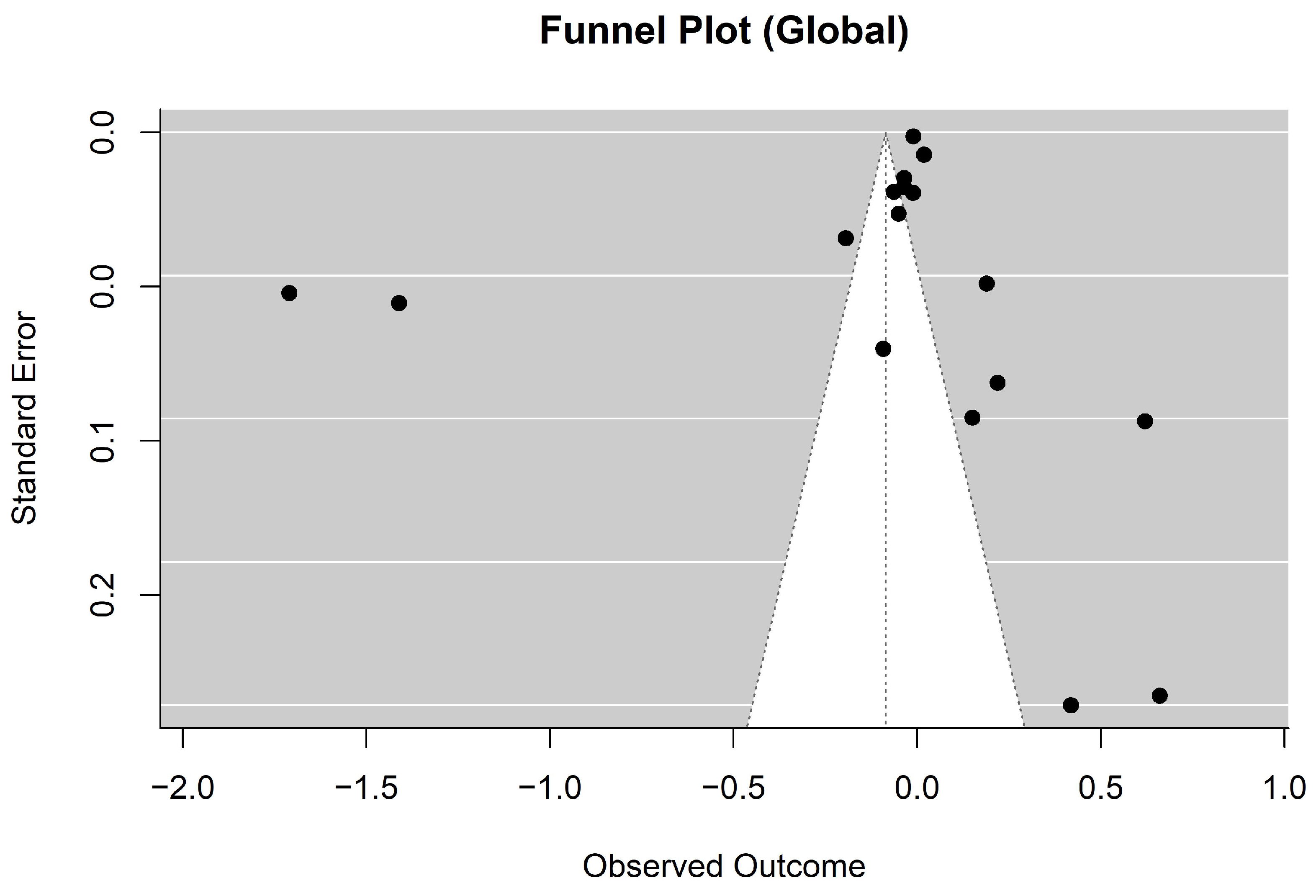
The funnel plot (Figure A1) displays horizontal dispersion, reflecting the extreme heterogeneity identified in the main model, but no clear asymmetry is observed, suggesting the absence of systematic publication bias or small-study effects.
Figure A1. Funnel plot. Black dots represent the study-specific effect-size estimates plotted against their standard errors around the pooled random-effects estimate; points closer to the top are more precise, while the broader horizontal dispersion among less precise studies reflects heterogeneity.
Energies 19 02009 g0a1
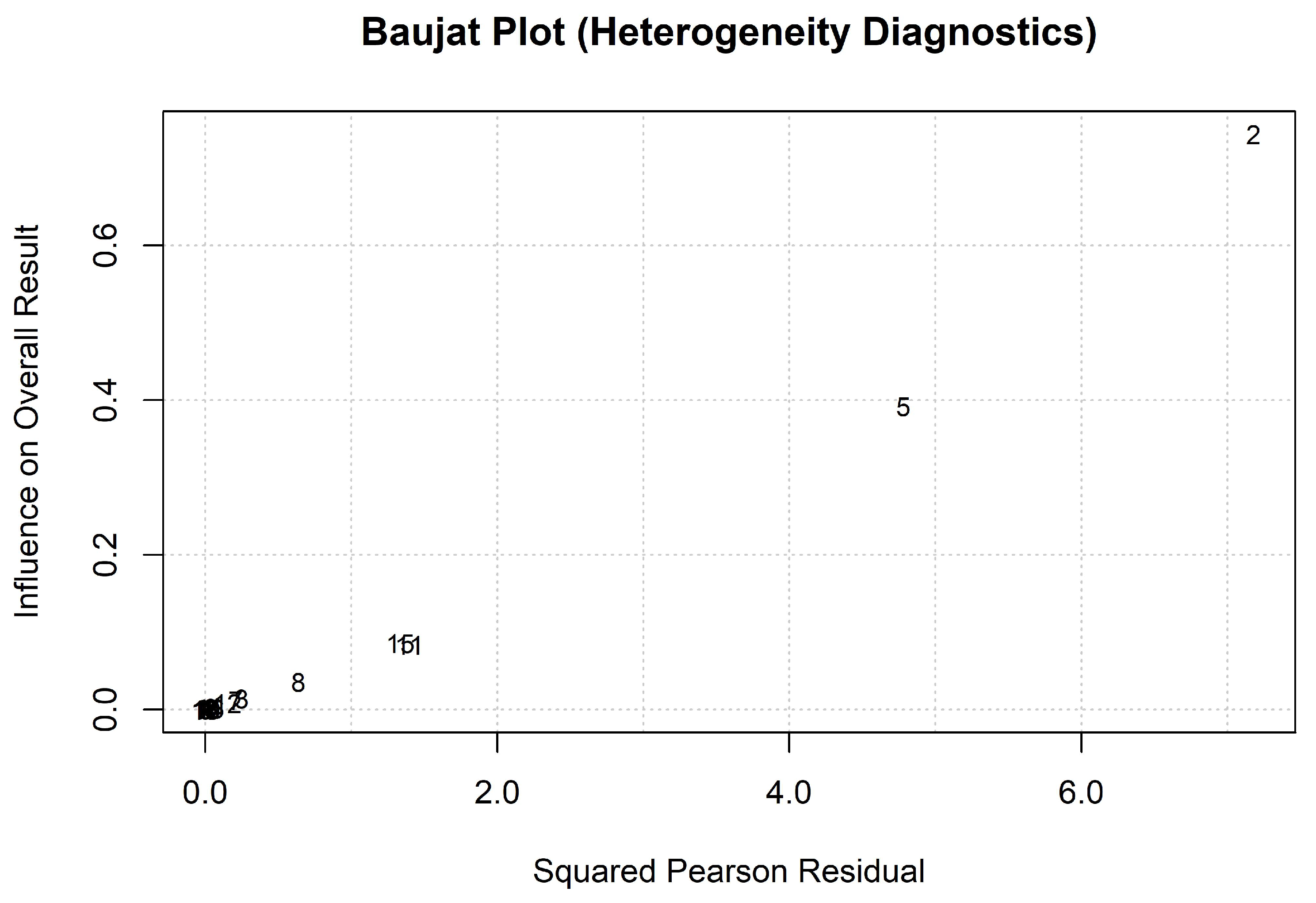
The Baujat plot (Figure A2) displays two studies that stand out as exerting moderate influence on heterogeneity. However, even these influential studies exert limited leverage on the pooled effect itself, as their vertical influence scores remain low. Thus, while they contribute substantially to heterogeneity, they do not dominate or distort the meta-analytic mean.
The leave-one-out forest plot (Figure A3) demonstrates that omitting any single study does not meaningfully change the magnitude, sign, or statistical significance of the pooled effect. All re-estimated effects remain small, negative, and non-significant, with their confidence intervals consistently crossing zero. This stability indicates that the global result is not driven by outliers, influential cases, or idiosyncratic modeling choices in any single primary study.
Figure A2. Baujat influence plot.
Energies 19 02009 g0a2
Figure A3. Leave-one-out sensitivity analysis. Dark squares indicate the pooled effect-size estimates obtained after omitting each study in turn, horizontal lines represent 95% confidence intervals, and the vertical dotted line marks the pooled random-effects estimate from the full meta-analysis. References according the order top-down: Zhong et al. [7], Eweade and Güngör [26], Dutta et al. [12], Du and Zhang [41], Wang and Xu [42], Pata and Balcilar [43], Doğan and İbrahim Dalkılıç [44], Aslam [45], Yang et al. [36], Lan et al. [46], Gao et al. [47], Javed et al. [48], Li and Allen [49], Zhao et al. [50], Feng et al. [51], Akadiri and Özkan [52], Kumar and Sahu [53].
Energies 19 02009 g0a3

Appendix E

Table A4. Comparison of meta-analytic results before and after the updated search.
StatisticOriginal Model (k = 12)Updated Model (k = 17)
Pooled effect (Fisher z) 0.1585 0.0856
Standard error 0.2021 0.1479
95% CI lower 0.6034 0.3991
95% CI upper 0.2864 0.2279
p-value (global model) 0.4496 0.5707
τ 2 0.4821 0.3648
I 2 (%) 99.80 99.94
Effect size (r) 0.1571 0.0854
Channel model R 2 (%) 47.57 50.44
Channel model omnibus test F ( 3 , 8 ) = 4.33 ,   p = 0.0433 F ( 3 , 13 ) = 6.30 ,   p = 0.0072
Macroeconomic coefficient 1.0718 1.0700
Macroeconomic p-value 0.0233 0.0060
Region model R 2 (%) 18.03 28.55
Region model omnibus test F ( 3 , 8 ) = 1.77 ,   p = 0.2304 F ( 4 , 12 ) = 2.49 ,   p = 0.0988
Notes: The original model refers to the synthesis based on 12 studies, whereas the updated model incorporates the five additional studies identified in the search update conducted on 1 April 2026. Both models use the same harmonization strategy, random-effects specification, and mixed-effects meta-regression framework.

References

  1. IEA. World Energy Outlook 2024; Technical Report; International Energy Agency: Paris, France, 2024. [Google Scholar]
  2. Xi, Y.; Huynh, A.N.Q.; Jiang, Y.; Hong, Y. Energy transition concern: Time-varying effect of climate policy uncertainty on renewables consumption. Technol. Forecast. Soc. Change 2023, 192, 122551. [Google Scholar] [CrossRef]
  3. Vasconcelos, G.F.; Castilho, H.A. A SWOT analysis for the evolution of Brazil’s renewable energy sector. Util. Policy 2025, 96, 101997. [Google Scholar] [CrossRef]
  4. Pata, S.K. Comparative impacts of energy, climate, and economic policy uncertainties on renewable energy. J. Environ. Manag. 2024, 370, 122494. [Google Scholar] [CrossRef]
  5. Bogmans, C.; Pescatori, A.; Prifti, E. The impact of climate policy on oil and gas investment: Evidence from firm-level data. Eur. Econ. Rev. 2024, 165, 104750. [Google Scholar] [CrossRef]
  6. Lin, Y.; Cheung, A.W.K. Climate policy uncertainty and energy transition: Evidence from prefecture-level cities in China. Energy Econ. 2024, 139, 107938. [Google Scholar] [CrossRef]
  7. Zhong, Q.; Zhang, Q.; Yang, J. Can artificial intelligence empower energy enterprises to cope with climate policy uncertainty? Energy Econ. 2025, 141, 108088. [Google Scholar] [CrossRef]
  8. Al-Thaqeb, S.A.; Algharabali, B.G. Economic policy uncertainty: A literature review. J. Econ. Asymmetries 2019, 20, e00133. [Google Scholar] [CrossRef]
  9. Sinn, H.W. Public policies against global warming: A supply side approach. Int. Tax Public Financ. 2008, 15, 360–394. [Google Scholar] [CrossRef]
  10. Xu, S. China’s climate governance for carbon neutrality: Regulatory gaps and the ways forward. Humanit. Soc. Sci. Commun. 2023, 10, 853. [Google Scholar] [CrossRef]
  11. Bouri, E.; Iqbal, N.; Klein, T. Climate policy uncertainty and the price dynamics of green and brown energy stocks. Financ. Res. Lett. 2022, 47, 102740. [Google Scholar] [CrossRef]
  12. Dutta, A.; Bouri, E.; Rothovius, T.; Uddin, G.S. Climate risk and green investments: New evidence. Energy 2023, 265, 126376. [Google Scholar] [CrossRef]
  13. Page, M.J.; McKenzie, J.E.; Bossuyt, P.M.; Boutron, I.; Hoffmann, T.C.; Mulrow, C.D.; Shamseer, L.; Tetzlaff, J.M.; Akl, E.A.; Brennan, S.E.; et al. The PRISMA 2020 statement: An updated guideline for reporting systematic reviews. Int. J. Surg. 2021, 88, 105906. [Google Scholar] [CrossRef]
  14. Anser, M.K.; Ali, S.; Umair, M.; Javid, R.; Mirzaliev, S. Energy consumption, technological innovation, and economic growth in BRICS: A GMM panel VAR framework analysis. Energy Strategy Rev. 2024, 56, 101587. [Google Scholar] [CrossRef]
  15. Yang, Y.; Subhani, G.; Sakina; Zhou, Y. Natural resource and energy efficiency in BRICS countries: Can green innovation capabilities really change the game? Gondwana Res. 2025, 145, 228–239. [Google Scholar] [CrossRef]
  16. Pimenow, S.; Pimenowa, O.; Prus, P. Challenges of Artificial Intelligence Development in the Context of Energy Consumption and Impact on Climate Change. Energies 2024, 17, 5965. [Google Scholar] [CrossRef]
  17. Masoomi, B.; Sahebi, I.G.; Ghobakhloo, M.; Mosayebi, A. Do industry 5.0 advantages address the sustainable development challenges of the renewable energy supply chain? Sustain. Prod. Consum. 2023, 43, 94–112. [Google Scholar] [CrossRef]
  18. Shang, Y.; Han, D.; Gozgor, G.; Mahalik, M.K.; Sahoo, B.K. The impact of climate policy uncertainty on renewable and non-renewable energy demand in the United States. Renew. Energy 2022, 197, 654–667. [Google Scholar] [CrossRef]
  19. Guo, K.; Kang, Y.; Ma, D.; Lei, L. How do climate risks impact the contagion in China’s energy market? Energy Econ. 2024, 133. [Google Scholar] [CrossRef]
  20. Wang, H.J.; Jin, S.L.; Chang, C.P. Does Artificial Intelligence Bring to Renewable Energy Innovation? Yes, Empirical Investigation for 51 Countries? Int. J. Green Energy 2025, 22, 375–390. [Google Scholar] [CrossRef]
  21. Valle, N.D.; Gioia, C. Behavioral factors shaping energy citizenship. Energy Policy 2025, 207, 114820. [Google Scholar] [CrossRef]
  22. Bernanke, B.S. Irreversibility, Uncertainty, and Cyclical Investment. Q. J. Econ. 1983, 98, 85–106. [Google Scholar] [CrossRef]
  23. Bloom, N. The Impact of Uncertainty Shocks. Econometrica 2009, 77, 623–685. [Google Scholar] [CrossRef]
  24. Fried, S.; Novan, K.; Peterman, W.B. The Macro Effects of Climate Policy Uncertainty. Financ. Econ. Discuss. Ser. 2021, 2021, 1–50. [Google Scholar] [CrossRef]
  25. Gavriilidis, K. Measuring Climate Policy Uncertainty; Technical Report; SSRN: Rochester, NY, USA, 2021. [Google Scholar]
  26. Eweade, B.S.; Güngör, H. Climate policy uncertainty and energy impacts on trade openness and foreign direct investment in the United States: Evidence from the RALS co-integration test. Nat. Resour. Forum 2025, 49, 2869–2890. [Google Scholar] [CrossRef]
  27. Borozan, D.; Pirgaip, B. Does uncertainty in climate policy play a role in shaping renewable energy use? Evidence from the USA. Environ. Dev. Sustain. 2025, 27, 2259–2284. [Google Scholar] [CrossRef]
  28. Silva, T.C.; Wilhelm, P.V.B.; Guerra, S.M.; Tabak, B.M. Extreme weather and firm borrowing: Evidence from Brazil. Financ. Res. Lett. 2025, 86, 108921. [Google Scholar] [CrossRef]
  29. Li, X.; Zhang, M.; Xin, X.; Yang, C.; Zhang, Y.; Dai, J. Advancing renewable energy innovation through digital technology and supply chain digitization. Energy Econ. 2025, 147, 108557. [Google Scholar] [CrossRef]
  30. Salman, M.; Wang, G.; Qin, L.; He, X. G20 roadmap for carbon neutrality: The role of Paris agreement, artificial intelligence, and energy transition in changing geopolitical landscape. J. Environ. Manag. 2024, 367, 122080. [Google Scholar] [CrossRef]
  31. Kalıp, N.G.; Bozbura, F.T.; Atteyih, Y. A comprehensive framework for patent value indicators: Machine learning-driven value prediction in renewable energy patents. World Patent Inf. 2025, 81, 102364. [Google Scholar] [CrossRef]
  32. Ghani, U.; Zhu, B.; Ma, F.; Ghani, M. Climate Change and Volatility Forecasting: Novel Insights from Sectoral Indices. J. Clim. Financ. 2024, 6, 100034. [Google Scholar] [CrossRef]
  33. Chen, L.; He, L.; Liu, R.; Fu, Y. Are the impacts of uncertainties on clean and conventional energy markets symmetrical? A fresh comparison analysis based on direction, quantile, and time-domain. Environ. Dev. Sustain. 2024. [Google Scholar] [CrossRef]
  34. Bag, S.; Rahman, M.; Routray, S.; Roubaud, D.; Mangla, S. Integrating Big Data and Artificial Intelligence Technology to Build Renewable Energy Supply Chain Resilience: An Empirical Study. Bus. Strategy Environ. 2025, 34, 8847–8869. [Google Scholar] [CrossRef]
  35. Chen, X.; Fu, Q.; Chang, C.P. What are the shocks of climate change on clean energy investment: A diversified exploration. Energy Econ. 2021, 95, 105136. [Google Scholar] [CrossRef]
  36. Yang, K.; Chen, G.; Chen, R. The dark side of climate policy uncertainty: Hindering energy transition by shaping environmental taxes effectiveness. J. Environ. Manag. 2024, 369, 122314. [Google Scholar] [CrossRef]
  37. Zhang, Y. How Economic Performance of OECD economies influences through Green Finance and Renewable Energy Investment Resources? Resour. Policy 2022, 79, 102925. [Google Scholar] [CrossRef]
  38. Berestycki, C.; Carattini, S.; Dechezleprêtre, A.; Kruse, T. Measuring and Assessing the Effects of Climate Policy Uncertainty; Technical Report, OECD Economics Department Working Papers; OECD: Paris, France, 2022. [Google Scholar] [CrossRef]
  39. Viechtbauer, W. Conducting Meta-Analyses in R with the Metafor Package; Technical Report; American Statistical Association: Alexandria, VA, USA, 2010. [Google Scholar]
  40. Sterne, J.A.; Hernán, M.A.; Reeves, B.C.; Savović, J.; Berkman, N.D.; Viswanathan, M.; Henry, D.; Altman, D.G.; Ansari, M.T.; Boutron, I.; et al. ROBINS-I: A tool for assessing risk of bias in non-randomised studies of interventions. BMJ 2016, 355, i4919. [Google Scholar] [CrossRef]
  41. Du, M.; Zhang, Y.J. Green digital finance and energy transition: Considering the differentiating role of regional policy uncertainty. Econ. Anal. Policy 2025, 86, 30–48. [Google Scholar] [CrossRef]
  42. Wang, Y.; Xu, A. Green investments and development of renewable energy projects: Evidence from 15 RCEP member countries. Renew. Energy 2023, 211, 1045–1050. [Google Scholar] [CrossRef]
  43. Pata, S.K.; Balcilar, M. Identifying the influence of climate policy uncertainty and oil prices on modern renewable energies: Novel evidence from the United States. Clean Technol. Environ. Policy 2025, 27, 2969–2980. [Google Scholar] [CrossRef]
  44. Doğan, N.; Dalkılıç, I. Ink And Influence: The Role of Media On Climate Policy Understanding. CINEJ Cine. J. 2024, 12, 445–480. [Google Scholar] [CrossRef]
  45. Aslam, A. Spillovers between hydrogen, nuclear, and AI sectors: The impact of climate policy uncertainty and geopolitical risks. J. Clim. Financ. 2025, 11, 100065. [Google Scholar] [CrossRef]
  46. Lan, Y.; Gao, H.; Zhou, P.; Zhang, H.; Li, H. The impact of climate risks on global energy production and consumption: New evidence from causality-in-quantile and wavelet analysis. Energy 2025, 319, 134850. [Google Scholar] [CrossRef]
  47. Gao, D.; Zhang, T.; Liu, X. The Urban Renewable Energy Transition: Impact Assessment and Transmission Mechanisms of Climate Policy Uncertainty. Energies 2025, 18, 2089. [Google Scholar] [CrossRef]
  48. Javed, A.; Usman, M.; Abid, N.; Rapposelli, A. Unveiling the impact of geopolitical risk, climate policy uncertainty, environmental policy stringency, and financial efficiency on renewable energy investment in the USA: Evidence from novel dynamic simulated ARDL approach. J. Environ. Manag. 2025, 393, 127057. [Google Scholar] [CrossRef]
  49. Li, W.; Allen, H. From Policy Uncertainty to Carbon Neutrality: Digital Pathways to Renewable Energy and Decarbonization for Achieving SDG 7 and SDG 13. Sustain. Dev. 2026, 34, 2456–2475. [Google Scholar] [CrossRef]
  50. Zhao, C.; Yu, J.; Liu, P.; Shen, B. Climate policy uncertainty and firm decarbonization challenge: Insights from energy transition and technological innovation. Int. Rev. Financ. Anal. 2026, 109, 104774. [Google Scholar] [CrossRef]
  51. Feng, Y.; Liu, F.; Liu, H.; Xuan, L. How does climate policy uncertainty affect the investment efficiency of energy firms? Financ. Res. Lett. 2025, 86, 108772. [Google Scholar] [CrossRef]
  52. Akadiri, S.S.; Özkan, O. Navigating Uncertainty: The Impact of ESG Factors on Clean Energy Markets and Investment Dynamics. Corp. Soc. Responsib. Environ. Manag. 2026, 33, 1270–1285. [Google Scholar] [CrossRef]
  53. Kumar, A.; Sahu, A. Persistent Policy Uncertainty and Green Energy Valuation: A Long-Run ARDL Analysis of the CELS Index. J. Appl. Econ. Sci. 2025, 20, 659–674. [Google Scholar] [CrossRef]
  54. Owjimehr, S.; Meybodi, M.E. Dynamic relationship between climate policy uncertainty shocks and financial stress: A GMM-Panel VAR approach. Reg. Sci. Policy Pract. 2025, 17, 100181. [Google Scholar] [CrossRef]
  55. Ashraf, J. The spillover effects of political risk, financial risk, and economic freedom on ecological footprint: Empirical evidence from Belt and Road Initiative countries. Borsa Istanb. Rev. 2022, 22, 873–885. [Google Scholar] [CrossRef]
  56. Nazari, M.S.; Maybee, B.; Whale, J.; McHugh, A. Climate Policy Uncertainty and Power Generation Investments: A Real Options-CVaR Portfolio Optimization Approach. Energy Procedia 2015, 75, 2649–2657. [Google Scholar] [CrossRef]
  57. Jiang, W.; Tang, W.; Li, J.; Wei, X. Climate risk and renewable energy market volatility: Machine learning approach. Res. Int. Bus. Financ. 2025, 76, 102871. [Google Scholar] [CrossRef]
  58. Liu, F.; Su, C.W.; Tao, R.; Lobonţ, O.R. Does economic and climate policy uncertainty matter the oil market? Resour. Policy 2024, 95, 105188. [Google Scholar] [CrossRef]
  59. Yao, Y.; Feng, Z.; Liu, X. Heterogeneous information transmission between climate policy uncertainty and Chinese new energy markets: A quantile-on-quantile transfer entropy method. Int. Rev. Financ. Anal. 2025, 103, 104175. [Google Scholar] [CrossRef]
  60. Pham, S.D.; Nguyen, T.T.; Do, H.X. Impact of climate policy uncertainty on return spillover among green assets and portfolio implications. Energy Econ. 2024, 134, 107631. [Google Scholar] [CrossRef]
  61. Fuss, S.; Johansson, D.J.; Szolgayova, J.; Obersteiner, M. Impact of climate policy uncertainty on the adoption of electricity generating technologies. Energy Policy 2009, 37, 733–743. [Google Scholar] [CrossRef]
  62. Rastegar, H.; Sajjad, A.; Eweje, G.; Kobayashi, K. Sustainability Solution: Renewable Energy Innovation Against Climate Disasters. Bus. Strategy Environ. 2025, 34, 9808–9824. [Google Scholar] [CrossRef]
  63. Işık, C.; Ongan, S.; Islam, H.; Yan, J.; Alvarado, R.; Ahmad, M. The nexus of economic growth, energy prices, climate policy uncertainty (CPU), and digitalization on ESG performance in the USA. Clim. Serv. 2025, 38, 100572. [Google Scholar] [CrossRef]
  64. Husain, S.; Sohag, K.; Wu, Y. The response of green energy and technology investment to climate policy uncertainty: An application of twin transitions strategy. Technol. Soc. 2022, 71, 102132. [Google Scholar] [CrossRef]
  65. Pata, U.K. Towards a sustainable future with renewable energy and load capacity factor: Institutions, technology, energy and climate policy uncertainties. Renew. Energy 2025, 254, 123710. [Google Scholar] [CrossRef]
  66. Payne, J.E.; Nazlioglu, S.; Koncak, A.; Ewing, B.T. U.S. climate policy uncertainty shocks and the growth in renewable energy production. J. Commod. Mark. 2025, 39, 100493. [Google Scholar] [CrossRef]
  67. Zhao, Y.; Ramzan, M.; Brika, S.K.; Eweade, B.S. Uncertainty in climate and ESG policies: Implications for renewable energy investments. Appl. Econ. 2025, 1–15. [Google Scholar] [CrossRef]
  68. Pata, U.K.; Pata, S.K. Unveiling the role of energy policy uncertainty, energy transition and climate policy uncertainty on renewable energy minerals in China. Environ. Dev. Sustain. 2025. [Google Scholar] [CrossRef]
  69. Naifar, N. Do climate risk and ESG sentiment predict clean energy performance? Evidence from quantile-on-quantile analysis. Res. Int. Bus. Financ. 2026, 84, 103327. [Google Scholar] [CrossRef]
  70. Yang, R.; Mao, H.; Liu, N. Does climate policy uncertainty hinder renewable energy investment in developing countries? Evidence from double machine learning method. Energy 2026, 347, 140491. [Google Scholar] [CrossRef]
  71. Chen, W.; Song, Z.; Xie, Y. Energy transition across the climate policy uncertainty divide: The critical role of green technology innovation and digital transformation. Econ. Anal. Policy 2026, 90, 322–342. [Google Scholar] [CrossRef]
  72. Lin, L.; Luo, M. Policy uncertainty in environment & technology: Impacts on risky and safe-haven assets in China. Int. Rev. Econ. Financ. 2026, 106, 104840. [Google Scholar] [CrossRef]
  73. Asteriou, D.; Dimiski, A. The Relationship Among Climate Policy Uncertainty and Energy Markets: Fossil Versus Renewable and Low-Carbon Assets. Int. J. Financ. Econ. 2026, 1–19. [Google Scholar] [CrossRef]
  74. Bi, Z.; Wu, Q.; Luo, L. Climate policy uncertainty and the co-movement between clean energy and metal markets: A spillover perspective. Resour. Policy 2026, 112, 105818. [Google Scholar] [CrossRef]
  75. Ali, A.R.; Iyiola, K.; Alzubi, A. Harnessing ESG Sustainability, Climate Policy Uncertainty and Information and Communication Technology for Energy Transition. Energies 2025, 18, 5301. [Google Scholar] [CrossRef]
  76. Gyamerah, S.A.; Blekor, K.S.; Gil-Alana, L.A. Time-varying bidirectional causality between climate policy uncertainty and renewable energy investments. Int. Rev. Econ. Financ. 2025, 104, 104727. [Google Scholar] [CrossRef]
Figure 1. Preferred Reporting Items for Systematic Reviews and Meta-Analyses (PRISMA).
Energies 19 02009 g001
Figure 2. ROBINS-I visual summary of risk of bias across the 17 studies included in the meta-analysis. D1 = confounding; D2 = selection; D3 = classification of exposures; D4 = deviations from intended interventions; D5 = missing data; D6 = outcome measurement; D7 = selection of the reported result; S = Serious; M = Moderate. References according the order top-down: Zhong et al. [7], Eweade and Güngör [26], Dutta et al. [12], Du and Zhang [41], Wang and Xu [42], Pata and Balcilar [43], Doğan and İbrahim Dalkılıç [44], Aslam [45], Yang et al. [36], Lan et al. [46], Gao et al. [47], Javed et al. [48], Li and Allen [49], Zhao et al. [50], Feng et al. [51], Akadiri and Özkan [52], Kumar and Sahu [53].
Energies 19 02009 g002
Figure 3. Forest plot—global meta-analysis. Black squares indicate the study-specific effect-size estimates, and their area is proportional to the inverse-variance weight of each study in the meta-analysis. Horizontal lines represent 95% confidence intervals, and the diamond represents the pooled random-effects estimate. References according the order top-down: Zhong et al. [7], Eweade and Güngör [26], Dutta et al. [12], Du and Zhang [41], Wang and Xu [42], Pata and Balcilar [43], Doğan and İbrahim Dalkılıç [44], Aslam [45], Yang et al. [36], Lan et al. [46], Gao et al. [47], Javed et al. [48], Li and Allen [49] Zhao et al. [50], Feng et al. [51], Akadiri and Özkan [52], Kumar and Sahu [53].
Energies 19 02009 g003
Figure 4. QQ plot of standardized residuals for the global random-effects model. Black dots denote the standardized residuals from the global random-effects model, and the shaded band represents the 95% confidence envelope.
Energies 19 02009 g004
Figure 5. Forest plot—mixed-effects meta-regression by channel of transmission. Gray polygons represent the fitted effect sizes from the mixed-effects meta-regression model for each study, with polygon width indicating the corresponding 95% confidence interval. References according the order top-down: Zhong et al. [7], Eweade and Güngör [26], Dutta et al. [12], Du and Zhang [41], Wang and Xu [42], Pata and Balcilar [43], Doğan and İbrahim Dalkılıç [44], Aslam [45], Yang et al. [36], Gao et al. [47], Javed et al. [48], Lan et al. [46], Feng et al. [51], Zhao et al. [50], Akadiri and Özkan [52], Li and Allen [49], Kumar and Sahu [53].
Energies 19 02009 g005
Figure 6. QQ plot of standardized residuals by channel of transmission and by region.
Energies 19 02009 g006
Table 1. Main findings—Studies included in the meta-analysis ( k = 17 ).
AuthorsYearRegionNFisher zChannel of Transmission
Zhong et al. [7]2024China4545 0.0357 Firm investment
Eweade and Güngör [26]2025USA372 1.7099 Macroeconomic
Dutta et al. [12]2022Multinational155 0.2182 Financial market
Du and Zhang [41]2025China2611 0.0115 Financial market
Wang and Xu [42]2023Asia330 1.4117 Macroeconomic
Pata and Balcilar [43]2024USA855 0.1947 Political and institutional
Doğan and İbrahim Dalkılıç [44]2024USA420 0.1891 Political and institutional
Aslam [45]2025Multinational32 0.4187 Financial market
Yang et al. [36]2024Multinational1439 0.0504 Political and institutional
Gao et al. [47]2025China3200 0.0367 Macroeconomic
Javed et al. [48]2025USA33 0.6602 Firm investment
Lan et al. [46]2025Multinational118 0.1502 Political and institutional
Li and Allen [49]2025China19,336 0.0183 Firm investment
Zhao et al. [50]2026China577,446 0.0109 Firm investment
Feng et al. [51]2025China2694 0.0642 Firm investment
Akadiri and Özkan [52]2026Global117 0.6203 Financial market
Kumar and Sahu [53]2025USA206 0.0927 Financial market
Notes: N refers to the sample size used in the primary study. Main effect size (Fisher z) refers to the primary study-level estimate harmonized onto the Fisher z scale for purposes of meta-analytic comparison. This transformation was adopted to place heterogeneous reported effects on a common metric; it should not be interpreted as eliminating conceptual or statistical differences across the original estimators. The transmission-channel classification groups studies according to the main economic mechanism or ET-related outcome emphasized in the primary analysis.
Table 2. Random-effects meta-analysis ( k = 17 ).
kEffect Size (Fisher z)SE95% CI Lower95% CI Upperp-Value τ 2 I 2 (%)Effect Size (r)
17 0.0856 0.1479 0.3991 0.2279 0.5707 0.3648 99.94 0.0854
Notes: The random-effects model was estimated using REML. The effect sizes are on the Fisher z scale. τ 2 is the estimated between-study variance in true effects, and I 2 quantifies the percentage of total observed variability.
Table 3. Mixed-effects meta-regression estimates by channel of transmission (Fisher z).
Moderator LevelEst.SEtp-Value95% CI Lower95% CI Upper
Intercept (Political and institutional) 0.0220 0.2140 0.1026 0.9198 0.4405 0.4844
Financial market 0.2005 0.2897 0.6921 0.5010 0.4253 0.8262
Firm investment 0.0741 0.2881 0.2572 0.8010 0.5484 0.6966
Macroeconomic 1.0700 0.3264 3.2784 0.0060 1.7752 0.3649
Table 4. Mixed-effects meta-regression estimates by region (Fisher z).
Moderator LevelEst.SEtp-Value95% CI Lower95% CI Upper
Intercept (United States of America—USA) 0.2486 0.2336 1.0643 0.3081 0.7576 0.2603
Asia 1.1631 0.5674 2.0497 0.0629 2.3994 0.0733
China 0.2252 0.3141 0.7169 0.4872 0.4592 0.9095
Global 0.8689 0.5725 1.5177 0.1550 0.3785 2.1164
Multinational 0.4259 0.3517 1.2109 0.2492 0.3404 1.1921
Disclaimer/Publisher’s Note: The statements, opinions and data contained in all publications are solely those of the individual author(s) and contributor(s) and not of MDPI and/or the editor(s). MDPI and/or the editor(s) disclaim responsibility for any injury to people or property resulting from any ideas, methods, instructions or products referred to in the content.