EV-Centric Technical Virtual Power Plants in Active Distribution Networks: An Integrative Review of Physical Constraints, Bidding, and Control


Abstract
1. Introduction
- Synthesizing a “physics-economics” bidirectional mapping framework: We systematically outline the Feasible Operation Region (FOR) equivalence and optimal scheduling methods for large-scale EV clusters, strictly considering nonlinear power flow constraints and network congestion within the TVPP framework.
- Evaluating multi-market coupling mechanisms: We analyze recent multi-agent coordinated architectures, tracking the evolution from unilateral energy market bidding to coupled participation involving carbon trading, green certificates, and Stackelberg game pricing.
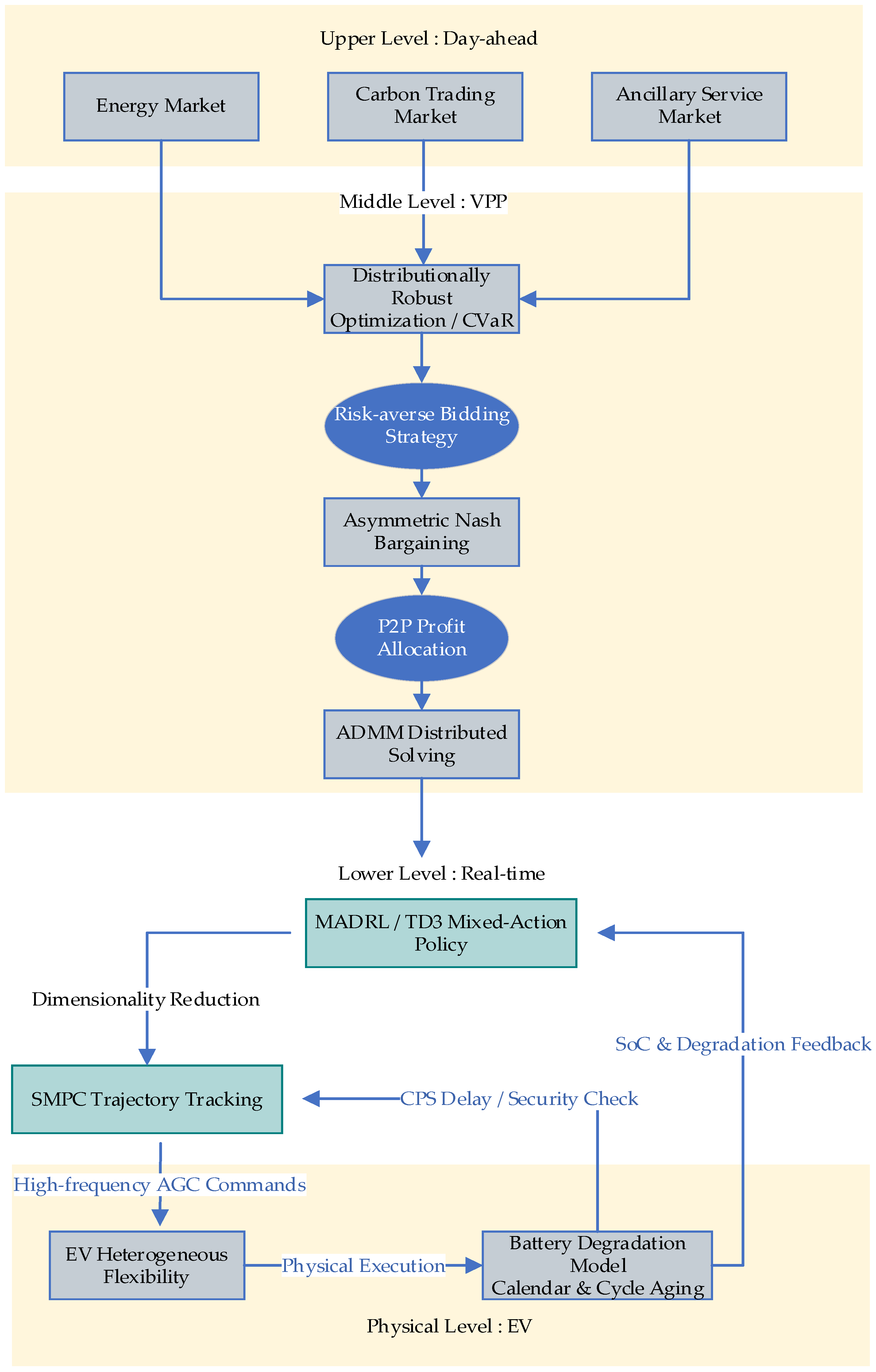
- Critically comparing real-time control and AI algorithms: We cross-evaluate various uncertainty management approaches (e.g., CVaR) and real-time execution methods, objectively discussing the specific capabilities of Deep Reinforcement Learning (DRL) in circumventing high-dimensional state spaces and addressing battery degradation.
2. Review Methodology
3. Taxonomy and Conceptual Boundaries of Key Entities
4. Load Forecasting and Aggregation Modeling of EVs
4.1. Data-Driven and Spatio-Temporal Charging Load Forecasting
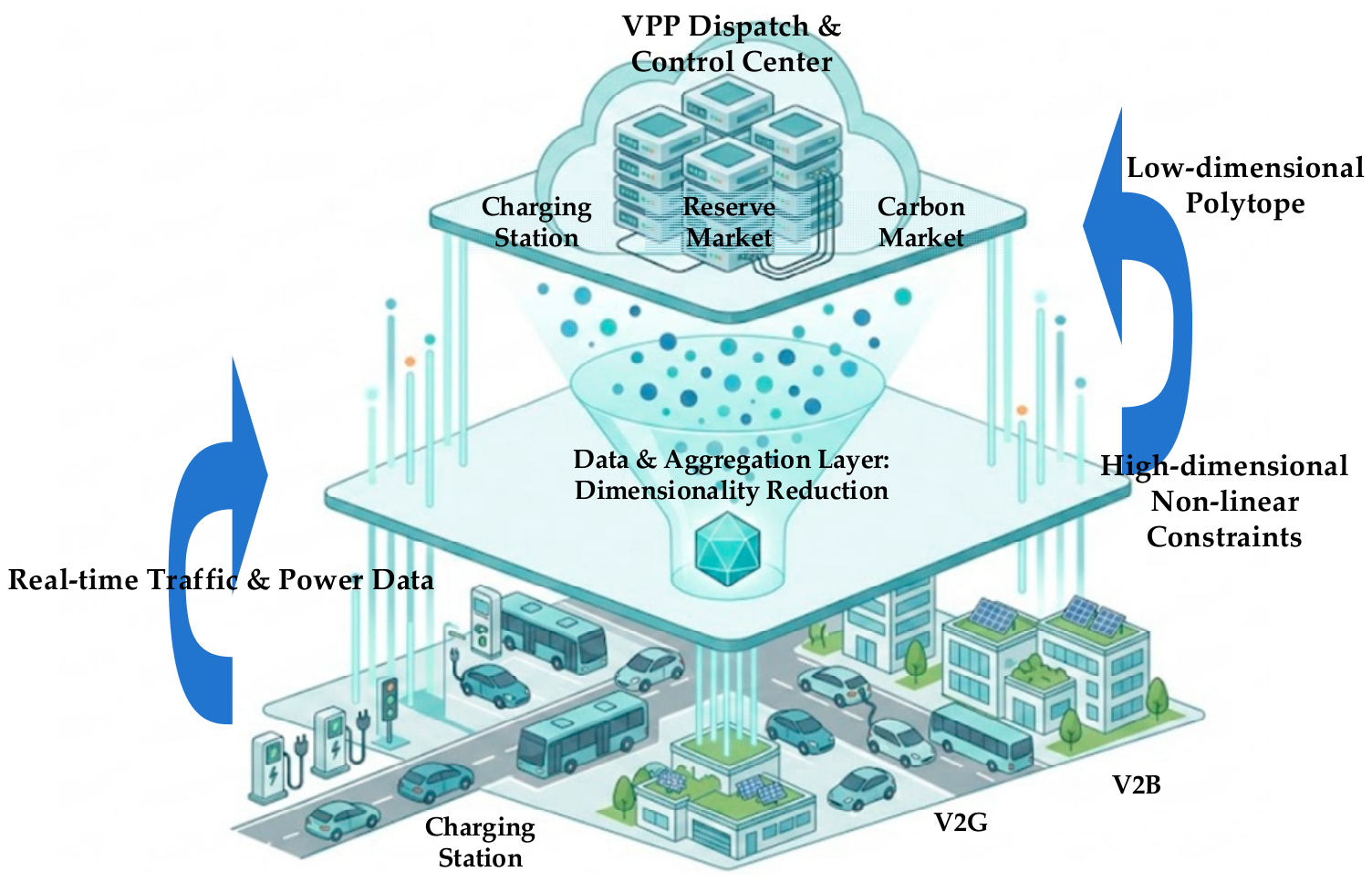
4.2. Dimensionality Reduction, Psychological Quantification, and Capacity Modeling of Heterogeneous EV Clusters
5. Multi-Market Co-Optimization and Bidding Strategies
5.1. Market Role Positioning, Differentiated Bidding, and Electricity-Carbon Joint Clearing Mechanism
5.2. Multi-Level Games, Nash Bargaining, and Internal P2P Allocation Between Aggregators and Users
5.3. Distributionally Robust and Hybrid Uncertainty Modeling, Risk Aversion, and Behavior Quantification
6. Hierarchical Control Strategies for AGC
6.1. Breaking the Curse of Dimensionality: From ADMM to MADRL
6.2. Communication Delays and Decentralized Security in Cyber-Physical Systems (CPS)
6.3. High-Fidelity Battery Degradation Management and Multi-Objective Control
7. Economic Assessments and Engineering Demonstrations
7.1. Comprehensive Economic Evaluation Models
7.2. Cost–Benefit Analysis Across Different Markets
7.3. Insights from Global Wide-Area Demonstrations
7.4. Commercialization Barriers and Policy Implications
8. Techno-Economic Challenges
8.1. Scalability Bottlenecks and the “Curse of Dimensionality” in Large-Scale Aggregation
8.2. Communication Delays and Underlying Protocol Vulnerabilities in Cyber-Physical Systems
8.3. Disconnect Between Battery Physical Degradation Models and Real-Time Incentive Mechanisms
8.4. Fragility of Business Models and Shocks from External Macro Environments
8.5. Algorithmic Paradigm Shift and Trade-Offs: A Critical Comparison of CVaR, MPC, and DRL
8.6. Synthesis of Unresolved System-Level Trade-Offs: The “Impossible Triangles” of V2G
9. Future Research Directions
9.1. Evidence-Backed Near-Term Directions
9.2. Speculative Themes: Blockchain and Large Language Models (LLMs)
9.3. Applications in Industrial and Power Electronics
9.4. Deep Integration of Cross-Domain Trading and Blockchain Smart Contracts
9.5. Limitations of This Review
10. Conclusions
- Physical-Economic Bidirectional Mapping: Traditional Commercial VPPs fail to guarantee local grid security. Incorporating nonlinear power flow constraints and exact Feasible Operation Region (FOR) extraction methods is necessary to safely translate physical EV flexibility into market capacity.
- Multi-Market Coupling Mechanisms: Bidding strategies have evolved from single energy markets to complex multi-agent architectures, incorporating stepped carbon trading and green certificates. However, aligning multi-timescale optimization from day-ahead bidding to real-time execution remains mathematically challenging.
- Cross-Evaluation of Real-Time Control: While Deep Reinforcement Learning (DRL) demonstrates advantages in breaking the “curse of dimensionality” and handling unknown parameters, it still lacks the absolute stability guarantees provided by Model Predictive Control (MPC) during extreme grid contingencies.
- Core Unresolved Trade-offs: The industrial deployment of V2G through TVPPs remains hindered by critical trade-offs, most notably the tension between aggregation fidelity, communication latency, and the accelerated battery degradation caused by high-frequency market participation.
Author Contributions
Funding
Data Availability Statement
Conflicts of Interest
References
- Shu, Y.; Zhang, Z.; Guo, J.; Zhang, Z. Analysis of Key Factors and Solutions of New Energy Accommodation. Proc. CSEE 2017, 37, 1–9. [Google Scholar]
- Wang, D.; Wang, X.; Duan, M.; Wang, Z.; Su, Y.; Liu, X.; Wu, X.; Nie, H.; Luo, F.; Wang, S. Coordinated Source-Network-Storage Expansion Planning of Active Distribution Networks Based on WGAN-GP Scenario Generation. Energies 2025, 19, 228. [Google Scholar] [CrossRef]
- Li, J.; Yang, B.; Huang, J.; Guo, Z.; Wang, J.; Zhang, R.; Hu, Y.; Shu, H.; Chen, Y.; Yan, Y. Optimal planning of Electricity-Hydrogen hybrid energy storage system considering demand response in active distribution network. Energy 2023, 273, 127142. [Google Scholar] [CrossRef]
- Wang, Y.; Liu, K.; Liu, C.; Liu, Y.; Fan, J.; Liu, C. Probabilistic power flow calculation in active distribution networks based on hybrid distribution transformers. Electr. Power Syst. Res. 2025, 249, 112008. [Google Scholar] [CrossRef]
- Nie, X.; Mansouri, S.; Jordehi, A.; Tostado-Véliz, M.; Alharthi, Y. Emerging renewable-based electricity grids under high penetration of cleaner prosumers: Unraveling the flexibility issues using a four-layer decentralized mechanism. J. Clean Prod. 2024, 443, 141107. [Google Scholar] [CrossRef]
- Ehsanbakhsh, M.; Sepasian, M. Bi-objective robust planning model for optimal allocation of soft open points in active distribution network: A flexibility improvement approach. Electr. Power Syst. Res. 2023, 224, 109780. [Google Scholar] [CrossRef]
- Khalid, M.; Thakur, J.; Bhagavathy, S.; Topel, M. Impact of public and residential smart EV charging on distribution power grid equipped with storage. Sustain. Cities Soc. 2024, 104, 105272. [Google Scholar] [CrossRef]
- Chandra, I.; Singh, N.; Samuel, P.; Bajaj, M.; Singh, A.; Zaitsev, I. Optimal scheduling of solar powered EV charging stations in a radial distribution system using opposition-based competitive swarm optimization. Sci. Rep. 2025, 15, 4880. [Google Scholar] [CrossRef]
- Liu, J.; Wang, H.; Du, Y.; Lu, Y.; Wang, Z. Multi-objective optimal peak load shaving strategy using coordinated scheduling of EVs and BESS with adoption of MORBHPSO. J. Energy Storage 2023, 64, 107121. [Google Scholar] [CrossRef]
- Kushwaha, P.; Prakash, V.; Yamujala, S.; Bhakar, R. Fast frequency response constrained electric vehicle scheduling for low inertia power systems. J. Energy Storage 2023, 62, 106944. [Google Scholar] [CrossRef]
- Suresh, M.; Yuvaraj, T.; Thanikanti, S.; Nwulu, N. Optimizing smart microgrid performance: Integrating solar generation and static VAR compensator for EV charging impact, emphasizing SCOPE index. Energy Rep. 2024, 11, 3224–3244. [Google Scholar] [CrossRef]
- Ahmed, M.U.; Qays, M.O.; Lachowicz, S.; Mahmud, P. Optimizing EV Battery Charging Using Fuzzy Logic in the Presence of Uncertainties and Unknown Parameters. Electronics 2025, 15, 177. [Google Scholar] [CrossRef]
- Qin, Y.; Rao, Y.; Xu, Z.; Lin, X.; Cui, K.; Du, J.; Ouyang, M. Toward flexibility of user side in China: Virtual power plant (VPP) and vehicle-to-grid (V2G) interaction. eTransportation 2023, 18, 100291. [Google Scholar] [CrossRef]
- Morcilla, R.; Enano, N. Sizing of community centralized battery energy storage system and aggregated residential solar PV system as virtual power plant to support electrical distribution network reliability improvement. Renew. Energy Focus 2023, 46, 27–38. [Google Scholar] [CrossRef]
- Wang, F.; Wang, G.; Xu, F. Review on Aggregation Characteristics and Trading Mechanisms of Virtual Power Plants for Enhancing System Response Capability. Autom. Electr. Power Syst. 2024, 48, 87–103. [Google Scholar]
- Yi, Z.; Hou, L.; Xu, Y.; Wu, Y.; Li, Z.; Wu, J.; Feng, T.; Han, L. Review on Key Technologies of Aggregation and Control of Flexible Resource Virtual Power Plants in Market Environment. Electr. Power 2024, 57, 82–96. [Google Scholar]
- Gough, M.; Santos, S.; Lotfi, M.; Javadi, M.; Osorio, G.; Ashraf, P.; Castro, R.; Catalao, J. Operation of a Technical Virtual Power Plant Considering Diverse Distributed Energy Resources. IEEE Trans. Ind. Appl. 2022, 58, 2547–2558. [Google Scholar] [CrossRef]
- Gough, M.; Santos, S.; Javadi, M.; Home-Ortiz, J.; Castro, R.; Catalao, J. Bi-level stochastic energy trading model for technical virtual power plants considering various renewable energy sources, energy storage systems and electric vehicles. J. Energy Storage 2023, 68, 107742. [Google Scholar] [CrossRef]
- Sarmiento-Vintimilla, J.; Larruskain, D.; Torres, E.; Abarrategi, O. Assessment of the operational flexibility of virtual power plants to facilitate the integration of distributed energy resources and decision-making under uncertainty. Int. J. Electr. Power Energy Syst. 2024, 155, 109611. [Google Scholar] [CrossRef]
- Chen, L.; Tang, Z.; He, S.; Liu, J. Feasible operation region estimation of virtual power plant considering heterogeneity and uncertainty of distributed energy resources. Appl. Energy 2024, 362, 123000. [Google Scholar] [CrossRef]
- Liu, X.; Li, Y.; Wang, L.; Tang, J.; Qiu, H.; Berizzi, A.; Valentin, I.; Gao, C. Dynamic aggregation strategy for a virtual power plant to improve flexible regulation ability. Energy 2024, 297, 131261. [Google Scholar] [CrossRef]
- Wei, X.; Xu, Y.; Sun, H.; Bai, X.; Chang, X.; Xue, Y. Day-ahead optimal dispatch of a virtual power plant in the joint energy-reserve-carbon market. Appl. Energy 2024, 356, 122459. [Google Scholar] [CrossRef]
- Chang, W.; Yang, Q. Low carbon oriented collaborative energy management framework for multi-microgrid aggregated virtual power plant considering electricity trading. Appl. Energy 2023, 351, 121906. [Google Scholar] [CrossRef]
- Cao, J.; Yang, D.; Dehghanian, P. Co-optimization of multiple virtual power plants considering electricity-heat-carbon trading: A Stackelberg game strategy. Int. J. Electr. Power Energy Syst. 2023, 153, 109294. [Google Scholar] [CrossRef]
- Guo, X.; Wang, L.; Ren, D. Optimal scheduling model for virtual power plant combining carbon trading and green certificate trading. Energy 2025, 318, 134750. [Google Scholar] [CrossRef]
- Li, J.; Sun, Z.; Niu, X.; Li, S. Economic optimization scheduling of virtual power plants considering an incentive based tiered carbon price. Energy 2024, 305, 132080. [Google Scholar] [CrossRef]
- Shen, Y.; Cen, W.; Zhou, B. Optimization Strategy of Virtual Power Plant in Joint Energy and Peak-shaving Market Considering Differentiated Bidding of Power Supply Equipment. Electr. Power 2025, 58, 115–127. [Google Scholar]
- Xiao, D.; Lin, Z.; Chen, H.; Hua, W.; Yan, J. Windfall profit-aware stochastic scheduling strategy for industrial virtual power plant with integrated risk-seeking/averse preferences. Appl. Energy 2024, 357, 122460. [Google Scholar] [CrossRef]
- Kraft, E.; Russo, M.; Keles, D.; Bertsch, V. Stochastic optimization of trading strategies in sequential electricity markets. Eur. J. Oper. Res. 2023, 308, 400–421. [Google Scholar] [CrossRef]
- Zheng, Y.; Wang, Y.; Yang, Q. Bidding strategy design for electric vehicle aggregators in the day-ahead electricity market considering price volatility: A risk-averse approach. Energy 2023, 283, 129138. [Google Scholar] [CrossRef]
- Alahyari, A.; Skoltech, D. Performance-based virtual power plant offering strategy incorporating hybrid uncertainty modeling and risk viewpoint. Electr. Power Syst. Res. 2022, 203, 107632. [Google Scholar] [CrossRef]
- Wang, J.; Guo, C.; Yu, C.; Liang, Y. Virtual power plant containing electric vehicles scheduling strategies based on deep reinforcement learning. Electr. Power Syst. Res. 2022, 205, 107714. [Google Scholar] [CrossRef]
- Jin, W.; Wang, P.; Yuan, J. Key Role and Optimization Dispatch Research of Technical Virtual Power Plants in the New Energy Era. Energies 2024, 17, 5796. [Google Scholar] [CrossRef]
- Xu, X.; Wu, J.; Lu, Y.; Liu, Y.; Zhao, H. A spatio-temporal prediction approach for charging load of clustered electric vehicles in dynamic traffic flow environment of highway. Sustain. Energy Grids Netw. 2024, 40, 101593. [Google Scholar] [CrossRef]
- Ding, H.; Guo, Y.; Wang, H. Spatiotemporal Forecasting of Regional Electric Vehicles Charging Load: A Multi-Channel Attentional Graph Network Integrating Dynamic Electricity Price and Weather. Electronics 2025, 14, 4010. [Google Scholar] [CrossRef]
- Liu, P.; Bai, X.; Zhang, W.; Wei, W.; Liu, R.; Guo, Z. Diffusion Model of PEV Charging Load and Its Application on ACE Correction. IEEE Trans. Smart Grid 2016, 7, 501–509. [Google Scholar] [CrossRef]
- Kumar, R.; Guha, P.; Chakraborty, A. Comparative assessment and selection of electric vehicle diffusion models: A global outlook. Energy 2022, 238, 121932. [Google Scholar] [CrossRef]
- Lee, Z.; Sharma, S.; Johansson, D.; Low, S. ACN-Sim: An Open-Source Simulator for Data-Driven Electric Vehicle Charging Research. IEEE Trans. Smart Grid 2021, 12, 5113–5123. [Google Scholar] [CrossRef]
- Huang, X.; Wu, D.; Boulet, B. MetaProbformer for Charging Load Probabilistic Forecasting of Electric Vehicle Charging Stations. IEEE Trans. Intell. Transp. Syst. 2023, 24, 10445–10455. [Google Scholar] [CrossRef]
- Karimi-Arpanahi, S.; Jooshaki, M.; Moein-Aghtaie, M.; Fotuhi-Firuzabad, M.; Lehtonen, M. Considering forecasting errors in flexibility-oriented distribution network expansion planning using the spherical simplex unscented transformation. IET Gener. Transm. Distrib. 2020, 14, 5970–5983. [Google Scholar] [CrossRef]
- Lee, S.; Choi, D. Three-Stage Deep Reinforcement Learning for Privacy-and Safety-Aware Smart Electric Vehicle Charging Station Scheduling and Volt/VAR Control. IEEE Internet Things J. 2024, 11, 8578–8589. [Google Scholar] [CrossRef]
- Kumar, G.; Saha, R.; Rai, M.; Buchanan, W.; Thomas, R.; Geetha, G.; Hoon-Kim, T.; Rodrigues, J. A Privacy-Preserving Secure Framework for Electric Vehicles in IoT Using Matching Market and Signcryption. IEEE Trans. Veh. Technol. 2020, 69, 7707–7722. [Google Scholar] [CrossRef]
- Powell, S.; Cezar, G.; Rajagopal, R. Scalable probabilistic estimates of electric vehicle charging given observed driver behavior. Appl. Energy 2022, 309, 118382. [Google Scholar] [CrossRef]
- Wang, X.; Sun, C.; Wang, R.; Wei, T. Two-Stage Optimal Scheduling Strategy for Large-Scale Electric Vehicles. IEEE Access 2020, 8, 13821–13832. [Google Scholar] [CrossRef]
- Yoon, S.; Jin, Y.; Yoon, Y. Dynamic Equivalent Battery as a Metric to Evaluate the Demand Response Performance of an EV Fleet. J. Electr. Eng. Technol. 2018, 13, 2220–2226. [Google Scholar]
- Gu, J.; Huang, W.; Yan, C.; Feng, K. Low-Carbon Economic Dispatch of Integrated Energy Systems with Electric Vehicle Participation. Electronics 2025, 14, 4557. [Google Scholar] [CrossRef]
- Yuan, L.; Yu, Q.; Yao, X.; Guo, M. Aggregation Feasible Region of Full Power Spectrum Electric Vehicles Based on Polyhedron Projection. IEEE Trans. Sustain. Energy 2025, 16, 2029–2043. [Google Scholar] [CrossRef]
- Al Taha, F.; Vincent, T.; Bitar, E. An Efficient Method for Quantifying the Aggregate Flexibility of Plug-In Electric Vehicle Populations. IEEE Trans. Smart Grid 2025, 16, 3142–3154. [Google Scholar] [CrossRef]
- Hou, H.; Wang, Y.; Chen, Y.; Zhao, B.; Zhang, L.; Xie, C. Long-time scale vehicle-to-grid scheduling strategy considering psychological effect based on Weber-Fechner law. Int. J. Electr. Power Energy Syst. 2022, 136, 107709. [Google Scholar] [CrossRef]
- Yang, H.; Xu, Y.; Sun, H.; Guo, Q.; Liu, Q. Electric Vehicles Management in Distribution Network: A Data-Efficient Bi-Level Safe Deep Reinforcement Learning Method. IEEE Trans. Power Syst. 2025, 40, 256–271. [Google Scholar] [CrossRef]
- Afzali, S.; Moghaddam, M.; Sheikh-El-Eslami, M.; Zamani, R. A flexibility-oriented bidding strategy for virtual power plants incorporating local energy communities: A bi-level stochastic-robust methodology. Appl. Energy 2025, 399, 126355. [Google Scholar] [CrossRef]
- Wei, H.; Zhang, J. Contribution-driven cooperative trading strategy for multi-energy virtual power plants in the electricity-carbon coupled markets: An asymmetric Nash bargaining model. Energy Strategy Rev. 2026, 63, 102047. [Google Scholar] [CrossRef]
- Chu, T.; Wang, T.; Li, M.; Feng, J.; Sun, Y.; Liu, X. Research on the collaborative management of internal and external fluctuations and optimization of power trading in multi-virtual power plants. Front. Energy Res. 2024, 11, 1337205. [Google Scholar] [CrossRef]
- Fan, Q.; Liu, D. A Wasserstein-distance-based distributionally robust chance constrained bidding model for virtual power plant considering electricity-carbon trading. IET Renew. Power Gener. 2024, 18, 456–475. [Google Scholar] [CrossRef]
- Yi, Z.; Zhao, Z.; Xu, Y.; Zhou, Y.; Yang, L. Market Clearing Model for Energy-Constrained Virtual Power Plants with Uncertainty Based on Distributionally Robust Chance-Constrained Optimization. J. Mod. Power Syst. Clean Energy 2025, 13, 2157–2167. [Google Scholar]
- Chen, G.; Li, J. A fully distributed ADMM-based dispatch approach for virtual power plant problems. Appl. Math. Model. 2018, 58, 300–312. [Google Scholar] [CrossRef]
- Bi, D.; Zhao, Y.; Chen, J.; He, S.; Li, X.; Cen, Y. A Control Strategy for Electric Vehicles Participating in Frequency Regulation Considering User Demand and Battery Longevity. In Proceedings of the 6th International Conference on Electronics and Electrical Engineering Technology (EEET), Nanjing, China, 1–3 December 2023; IEEE Computer Soc: Nanjing, China, 2023; pp. 166–172. [Google Scholar]
- Zhu, Q.; Jiang, L.; Yao, W.; Zhang, C.; Luo, C. Robust Load Frequency Control with Dynamic Demand Response for Deregulated Power Systems Considering Communication Delays. Electr. Power Compon. Syst. 2017, 45, 75–87. [Google Scholar] [CrossRef]
- Wang, H.; Jiang, H.; Sun, Y. Multi-agent deep reinforcement learning based fully decentralized aggregation frequency regulation of electric vehicle. Electr. Power Syst. Res. 2024, 234, 110555. [Google Scholar] [CrossRef]
- Liu, M.; Zhu, J.; Liu, M. Economic dispatch of virtual power plant using reinforcement learning method with improved state space and hybrid action representation. Eng. Appl. Artif. Intell. 2025, 159, 111725. [Google Scholar] [CrossRef]
- Das, R.; Wang, Y.; Putrus, G.; Kotter, R.; Marzband, M.; Herteleer, B.; Warmerdam, J. Multi-objective techno-economic-environmental optimisation of electric vehicle for energy services. Appl. Energy 2020, 257, 113965. [Google Scholar] [CrossRef]
- Tamura, S. A V2G strategy to increase the cost-benefit of primary frequency regulation considering EV battery degradation. Electr. Eng. Jpn. 2020, 212, 11–22. [Google Scholar] [CrossRef]
- Xi, L.; Sun, M.; Zhou, H.; Xu, Y.; Wu, J.; Li, Y. Multi-agent deep reinforcement learning strategy for distributed energy. Measurement 2021, 185, 109955. [Google Scholar] [CrossRef]
- Yang, Q.; Li, J.; Yang, R.; Zhu, J.; Wang, X.; He, H. New hybrid scheme with local battery energy storages and electric vehicles for the power frequency service. eTransportation 2022, 11, 100151. [Google Scholar] [CrossRef]
- Li, C.; Zeng, L.; Zhou, B.; Liu, X.; Wu, Q.; Zhang, D.; Huang, S. An Optimal Coordinated Method for EVs Participating in Frequency Regulation Under Different Power System Operation States. IEEE Access 2018, 6, 62756–62765. [Google Scholar] [CrossRef]
- Sun, L.; Yang, Q.; Li, P.; Chen, X.; Wang, S. VETchain: A Scalable Vehicular Energy Trading Blockchain With Optimized Trade Matching. IEEE. Trans. Mob. Comput. 2026, 25, 3874–3888. [Google Scholar] [CrossRef]
- Qi, J.; Zhao, Z.; Luo, Z.; Sun, J.; Yang, J.; Wang, H.; Liu, Y. A trustworthy vehicle-to-vehicle power trading scheme based on spatio temporal network and blockchain. Energy Rep. 2026, 15, 109094. [Google Scholar] [CrossRef]



| Reference/Review Paper | Year | Focus on TVPP & Physical Constraints | Multi-Market & Carbon Coupling | High-Frequency Control & AI | Uncertainty & Risk Modeling | Comprehensive TEA & Engineering |
|---|---|---|---|---|---|---|
| [15] | 2024 | Ignored (Focuses on commercial aggregation) | Energy & ancillary services only | Traditional MILP/Heuristics | Stochastic programming | Simulation only |
| [16] | 2024 | Considered (Node voltage limits included) | Unconsidered (Ignores carbon trading) | Model Predictive Control (MPC) | Information Gap Decision Theory (IGDT) | Lacks real-world validation |
| [33] | 2024 | Ignored (Network congestion omitted) | Day-ahead energy market only | Deep Q-Network (DQN) | Not explicitly modeled | LCC analysis included |
| Proposed Review | 2025 | Comprehensive (Nonlinear power flow & TVPP FOR equivalence) | Coupled (Energy, carbon trading & Stackelberg pricing) | Cross-evaluated (DRL vs. MPC vs. Exact Polytope) | Synthesized (CVaR & Hybrid Risk Theories) | Evaluated (Micro-bilateral benefits & empirical data) |
| Concept | Category/Layer | Core Function & Definition | Treatment of Physical Grid Constraints |
|---|---|---|---|
| CVPP (Commercial VPP) | Market Role/Economic Layer | Aggregates portfolio capacity to bid in wholesale energy or ancillary markets to maximize financial profit. | Typically ignores local network topology, nodal voltages, and line congestion. |
| TVPP (Technical VPP) | Architecture/Physical Layer | Manages the actual dispatch of DERs within a specific geographical grid area, ensuring safe operation limits. | Strictly adheres to Active Distribution Network (ADN) power flow limits and thermal constraints. |
| EV Aggregator | Market Entity/Intermediary | Acts as an intermediary agent that clusters dispersed EVs to offer required capacity to CVPPs, TVPPs, or Grid Operators. | Relies on upper-level TVPP signals or independent heuristic rules for internal physical dispatch. |
| V2G/V2X | Control Layer/Interface Technology | The bi-directional charging/discharging hardware and protocol layer enabling power exchange between vehicles and the grid/buildings. | Focuses on battery-level physics (e.g., SOC, degradation, charging current) and local converter limits. |
| Core Technical Dimension | Representative Algorithm/Model | Core Advantages & Breakthroughs | Limitations/Applicable Scenarios |
|---|---|---|---|
| Spatio-temporal Forecasting | STGCN + Bi-GRU-Seq2Seq | Efficiently extracts spatial spillover effects and long-term temporal dependencies; optimally reduces MAE by 9–16%. | Highly dependent on multi-source data; suitable for city-level public charging station clusters. |
| Probabilistic & Scenario Gen. | Diffusion Models + MetaProbformer | Breaks historical data limits to solve “cold start” issues; precisely envelopes extreme fluctuations without massive training data. | Generation process is time-consuming; ideal for large-scale Monte Carlo substitution in day-ahead dispatch. |
| Privacy-preserving Crypto. | Lattice Cryptography + -DP | Fundamentally protects privacy and mitigates FDIA; hash and signcryption avoid heavy computational overhead. | Higher hardware requirements for edge gateways; suitable for decentralized, multi-aggregator environments. |
| Physical Topology Reduction | Minkowski Sum + Polyhedron | Mathematically rigorous; aggregates hundreds of thousands of EVs into a single compliant generalized polytope without physical violations. | Suffers from a severe “curse of dimensionality”; relies on maximum-volume inner approximation for acceleration. |
| Clustering & Simulation | Hierarchical/K-means + ACN-Sim | Extremely high reduction efficiency (deriving millions of loads in 45 s); open-source baseline lowers the data barrier. | Engineering equivalent method with approximation errors; suitable for ultra-fast dispatch of heterogeneous fleets. |
| Psychological Quantification | Weber-Fechner Law + DEB/VoDEB | Breaks the “rational economic man” assumption; truly quantifies users’ “loss aversion” towards battery range anxiety. | Psychological parameters vary subjectively; primarily used for designing V2G micro-compensation mechanisms. |
| Dimension | Refs. | Core Algorithm/Model | Objective/Scenario | Quantitative Highlights (with Baseline & Scenario Context) |
|---|---|---|---|---|
| 1. Forecasting | [34,41] | Bi-GRU-Seq2Seq/FedAvg + LDP | Traffic-power coupled network (TPCN), Privacy-preserving | Finding: Reduces MAE by 9–16%. Scenario: Hourly forecasting using a multi-scale temporal window strategy (hour-day-week). Baseline: Single-scale temporal forecasting models. |
| 2. Aggregation | [47,48] | Minkowski Sum + Polyhedron Projection | Exact Feasible Operation Region (FOR) extraction | Finding: Translates complex heterogeneous constraints into low-dimensional polytopes, avoiding the “curse of dimensionality”. Assumption: Aggregation of hundreds of thousands of EVs without physical violations |
| 3. Joint Market | [22,46] | Bi-level Optimization + Stepped Carbon Trading | Energy-Carbon-Reserve market co-optimization | Finding: Reduces system carbon emissions by 32.2%; increases overall aggregator revenue by 11.69%. Scenario: Integrated energy system with P2G-CCS and EV participation. Baseline: High-carbon units bidding without the incentive-based stepped carbon price constraints |
| 4. Profit Allocation | [52,56] | Asymmetric Nash Bargaining + ADMM | P2P internal trading & privacy-preserving allocation | Finding: Reduces joint optimal costs by a maximum of 50.34%. Scenario: Contribution-driven P2P trading with dynamic bidding tailored to each sub-device. Baseline: Traditional uniform pricing and centralized allocation frameworks. |
| 5. Risk Aversion | [28,54] | Distributionally Robust Optimization (DRO) | Day-ahead bidding under extreme price volatility | Finding: Strictly guarantees expected profit lower bounds under worst-case scenarios. Assumption: Employs Wasserstein metric to build ambiguity sets from real samples. |
| 6. Real-time Control | [57,58] | Stochastic Model Predictive Control (SMPC) | AGC tracking and distribution network physical security | Finding: Reduces maximum tracking error of AGC power by 53.2%; total network loss by 10%. Scenario: EV cluster tracking high-frequency AGC commands. |
| 7. AI Control | [59,60] | Multi-Agent Deep Reinforcement Learning (MADRL) | Fully decentralized control & continuous-discrete actions | Finding: Increases frequency regulation aggregator’s total revenue by 16.25%. Baseline: Traditional Mixed-Integer Linear Programming (MILP) limits |
| 8. Degradation Mgmt. | [61,62] | High-fidelity Electrochemical + Multi-objective | Cycle & calendar aging mitigation during V2G | Finding: Reduces battery cycle aging by 67%, improves grid congestion by 90%, and reduces end-user’s energy cost by 88.2%. Scenario: Multi-objective techno-economic-environmental (TEA) scheduling. Baseline: Uncontrolled charging behaviors. |
| Demonstration Project/Region | Target Aggregated Resources | Core Market/Service | Measured Economic Benefits (with Baseline & Scenario) | Current Limitations & Assumptions |
|---|---|---|---|---|
| Parker Project (Denmark, Europe) | Branded vehicle fleets (e.g., Nissan Leaf) | Primary Frequency Regulation | Finding: Successfully validated technical feasibility across multiple brands. | Limitation: Relatively small scale; highly dependent on underlying communication protocol support from specific automakers. |
| Sciurus Project (UK, Europe) | Residential smart charge/discharge infrastructure | Routine grid services and Frequency Response | Finding: Annualized revenue per vehicle reaches £513. Scenario: Deep participation in high-end ancillary services (Grid Frequency Response) via an aggregator. Baseline: Limited to £340/year when only participating in conventional routine grid services. | Limitation: Long-term actual battery life degradation (5–10 years) under extreme high-frequency dispatch remains unverified. |
| INVENT Project (USA, North America) | Pure Electric School Buses | Peak Shaving & Capacity Market | Finding: Explored a novel business model utilizing idle periods as a massive flexible resource pool. | Limitation: Vehicle operation is strictly restricted by school schedules, resulting in poor flexibility for real-time spot markets. |
| Provincial V2G Platforms (Shanghai, etc., China) | Public transit, logistics, and private car fleets | Demand Response (DR) and microgrid interaction | Finding: Net revenue of approx. 4000 RMB/year for private car owners. Scenario: Deep participation in provincial vehicle-grid interaction platforms for V2G demand response. | Assumption: Profitability models currently still heavily rely on unilateral government subsidies; cross-market free arbitrage is immature. |
| Evaluation Dimension | CVaR-Based Optimization | Model Predictive Control (MPC) | Deep Reinforcement Learning (DRL) |
|---|---|---|---|
| Primary Domain/Horizon | Day-ahead multi-market bidding | Intraday/Minute-level execution | Real-time/Sub-second AGC tracking |
| Uncertainty Handling | Explicit risk-bounding (Tail risks) | Receding horizon feedback correction | Implicit adaptation via environment exploration |
| Interpretability & Safety | High: Strict mathematical proofs for economic bounds | High: Explicit physical constraint formulation | Low: Black-box nature; poor out-of-distribution generalization |
| Online Computation | Heavy: Often involves complex MILP solving | Moderate: Solves optimization per time step | Extremely Light: O(1) neural network inference |
| Scalability (Millions of EVs) | Poor: Susceptible to the curse of dimensionality | Moderate: Relies on decomposition methods (e.g., ADMM) | Excellent: Decentralized execution via MADRL |
Disclaimer/Publisher’s Note: The statements, opinions and data contained in all publications are solely those of the individual author(s) and contributor(s) and not of MDPI and/or the editor(s). MDPI and/or the editor(s) disclaim responsibility for any injury to people or property resulting from any ideas, methods, instructions or products referred to in the content. |
© 2026 by the authors. Licensee MDPI, Basel, Switzerland. This article is an open access article distributed under the terms and conditions of the Creative Commons Attribution (CC BY) license.
Share and Cite
Zheng, Y.; Zhang, H.; Liu, A.; Li, Y.; Hao, S.; Miao, Y.; Han, C.; Liao, S. EV-Centric Technical Virtual Power Plants in Active Distribution Networks: An Integrative Review of Physical Constraints, Bidding, and Control. Energies 2026, 19, 1945. https://doi.org/10.3390/en19081945
Zheng Y, Zhang H, Liu A, Li Y, Hao S, Miao Y, Han C, Liao S. EV-Centric Technical Virtual Power Plants in Active Distribution Networks: An Integrative Review of Physical Constraints, Bidding, and Control. Energies. 2026; 19(8):1945. https://doi.org/10.3390/en19081945
Chicago/Turabian StyleZheng, Youzhuo, Hengrong Zhang, Anjiang Liu, Yue Li, Shuqing Hao, Yu Miao, Chong Han, and Siyang Liao. 2026. "EV-Centric Technical Virtual Power Plants in Active Distribution Networks: An Integrative Review of Physical Constraints, Bidding, and Control" Energies 19, no. 8: 1945. https://doi.org/10.3390/en19081945
APA StyleZheng, Y., Zhang, H., Liu, A., Li, Y., Hao, S., Miao, Y., Han, C., & Liao, S. (2026). EV-Centric Technical Virtual Power Plants in Active Distribution Networks: An Integrative Review of Physical Constraints, Bidding, and Control. Energies, 19(8), 1945. https://doi.org/10.3390/en19081945