Article

Highly Concentrated Carbonate Electrolytes for Stable High-Voltage Lithium Metal Batteries

1
College of Materials Science and Engineering, Qingdao University of Science and Technology, Qingdao 266042, China
2
Qingdao Industrial Energy Storage Research Institute, Qingdao Institute of Bioenergy and Bioprocess Technology, Chinese Academy of Sciences, Qingdao 266101, China
3
Qingdao New Energy Shandong Laboratory, Shandong Energy Institute, Qingdao 266101, China
4
College of Chemistry and Chemical Engineering, Shandong Provincial Engineering Research Center of Organic Functional Materials and Green Low-Carbon Technology, Dezhou University, Dezhou 253023, China
*
Authors to whom correspondence should be addressed.
Energies 2026, 19(7), 1805; https://doi.org/10.3390/en19071805
Submission received: 10 February 2026 / Revised: 25 March 2026 / Accepted: 4 April 2026 / Published: 7 April 2026

Abstract

Lithium metal batteries (LMBs) have been widely studied due to their high energy density; however, the practical implementation of LMBs is limited by issues of uncontrolled dendrite growth, continuous electrolyte decomposition, and poor Coulombic efficiency (CE). Highly concentrated electrolytes (HCEs) have emerged as a promising approach to addressing the above issues. In this work, we propose a new HCE system based on a single carbonate solvent of 2,2,2-trifluoroethyl methyl carbonate (FEMC) with a high concentration of lithium bis(fluorosulfonyl)imide (LiFSI). The resulting electrolytes exhibit enhanced anodic stability and improved compatibility with lithium metal anodes and high-voltage cathodes. The optimized 4 M LiFSI–FEMC HCE achieved the highest CE for Li plating/stripping in Li/Cu cell and lowest overpotential in Li/Li symmetric cells, outperforming both low-concentration FEMC and ethyl methyl carbonate (EMC)-based electrolytes. In full-cell configurations with LiNi0.8Co0.1Mn0.1O2 (NCM811) cathodes, the HCE demonstrates stable cycling with minimal capacity fade over 250 cycles. Importantly, the HCE enables stable operation of 4.6 V high-voltage NCM811/Li cells for more than 120 cycles with a high-capacity retention of 88.61%. Post-mortem analysis revealed a more uniform and compact solid electrolyte interphase and a thinner cathode electrolyte interphase, contributing to the enhanced cycling performance.

1. Introduction

Lithium-ion batteries (LIBs) have widely been used as power sources in various portable electronic devices, electric vehicles, and stationary energy storage systems. However, their energy density is approaching its theoretical limit due to the limited capacity of the graphite anode (372 mAh g−1) [1,2,3,4,5,6,7,8,9]. Lithium metal batteries (LMBs) currently represent one of the most promising approaches to next-generation energy storage systems with ultrahigh energy density due to the exceptionally high theoretical capacity (3860 mAh g−1) and the low electrochemical potential (−3.04 V vs. standard hydrogen electrode (SHE)) of lithium metal [10]. These advantages make lithium metal an ideal anode material to meet the continuously increasing demand for energy density in electric vehicles and grid storage systems compared to other anodes [11,12]. However, the practical implementation of LMBs remains hampered by several fundamental challenges, including uncontrolled dendrite growth, continuous electrolyte decomposition, and poor Coulombic efficiency (CE) despite decades of research [13]. The inherent reactivity of the lithium metal anode with organic electrolytes leads to the formation of a solid electrolyte interphase (SEI). While a stable and ionically conductive SEI is essential for protecting the lithium anode, the naturally formed SEI in conventional electrolytes is often heterogeneous, mechanically fragile, and prone to cracking during repeated charge and discharge processes [14,15]. This exposes fresh lithium to the electrolyte, perpetuating a cycle of consumption and thickening of the SEI, which in turn increases cell resistance and accelerates cell failure. Moreover, the non-uniform lithium deposition morphology—often manifesting as dendritic or mossy structures—can penetrate the separator, causing internal short circuits and thermal runaway [14,16]. These issues collectively result in inferior cycle performance, reduced longevity, and increased safety hazards.
To address these challenges, numerous strategies have been proposed including lithium metal anode modifications, interfacial engineering, and the use of functional additives in conventional carbonate electrolytes [17,18]. For example, constructing three-dimensional (3D) host structures—such as porous copper scaffolds or carbon networks—can mitigate volume changes and reduce local current density, thereby suppressing dendrite initiation [19,20]. Similarly, artificial SEI layers fabricated from polymers, inorganic materials, or composites have been designed to provide mechanical robustness and uniform lithium-ion transport [21,22]. Functional additives such as fluoroethylene carbonate (FEC), lithium nitrate (LiNO3), and lithium difluoro(oxalato)borate (LiDFOB) have also been widely employed to modulate the SEI composition and properties, enhancing its stability and cycling performance [23,24]. While these strategies can alleviate the issues associated with the lithium anode and improve cell performance, each approach has specific limitations that hinder its widespread application. Lithium anode modifications often involve complex and costly fabrication processes, which may not be scalable for industrial production. Artificial SEI layers, while effective in laboratory settings, face challenges related to achieving uniform coverage and maintaining adhesion during long-term cycling. Furthermore, additives are often consumed during initial cycles and may lead to gassing or increased interfacial resistance over time, resulting in a potential loss of efficacy after hundreds of cycles [25,26].
The development of advanced electrolytes has been regarded as an efficient way to alleviate the issues of LMBs [27,28]. For instance, ionic liquids with outstanding electrochemical and thermal stability show promising applications in many fields, such as electrochemical energy materials, stimuli-responsive materials, carbon materials, antimicrobial materials, and catalysis [29,30,31,32,33,34,35], have been reported as an advanced electrolyte to inhibit lithium dendrite. However, the complex synthetic process of these ionic liquids limits their application [36,37]. In recent years, highly concentrated electrolytes (HCEs) have gained attention as a versatile approach to simultaneously address multiple challenges in LMBs. By significantly increasing the salt-to-solvent ratio, HCEs alter the solvation structure, which reduces the number of free solvent molecules and enhances the formation of inorganic-rich SEI layers. This results in improved interfacial stability, higher lithium transference numbers, and suppressed dendrite growth. Additionally, HCEs often exhibit higher anodic stability, making them compatible with high-voltage cathode materials [38,39]. While HCEs based on ethylene carbonate (EC), propylene carbonate (PC), and ether solvents have been extensively studied, the use of fluorinated solvents, particularly 2,2,2-trifluoroethyl methyl carbonate (FEMC), in HCE formulations remains relatively unexplored. FEMC offers a unique combination of low volatility, high flash point, and excellent oxidative stability, attributed to the electron-withdrawing effect of fluorine atoms. In addition, the functional fluorine atoms can contribute to the formation of LiF-rich SEI layers that protect the lithium metal anode. Consequently, these properties make FEMC an ideal candidate for safer and more stable electrolytes, especially when used in concentrated formulations.
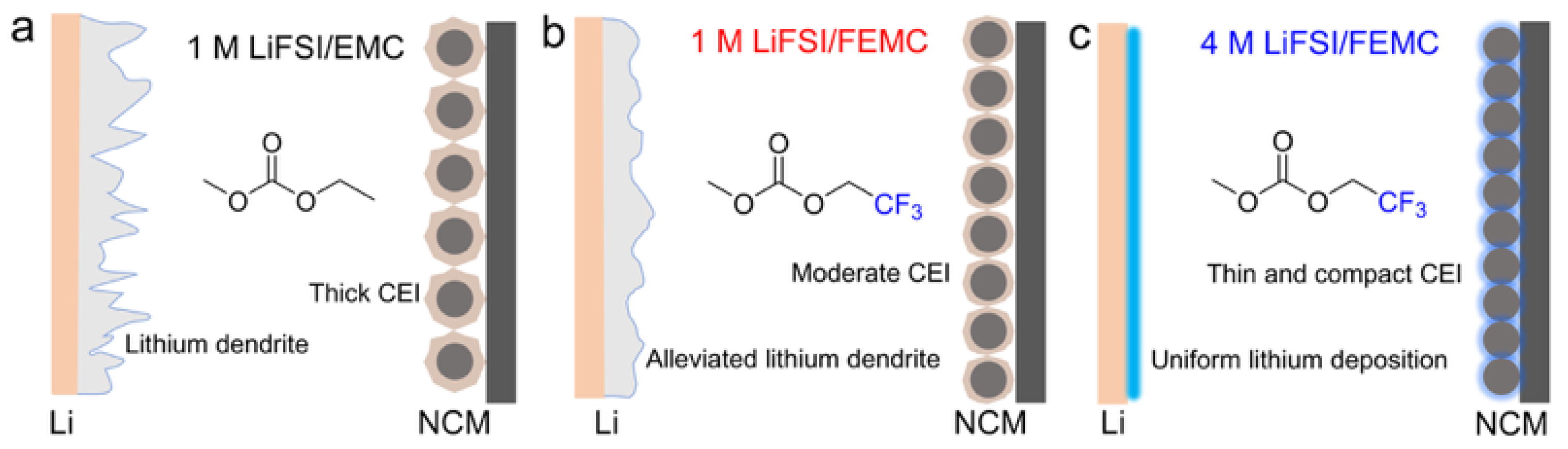
In this work, we systematically investigated a highly concentrated 4 M bis(fluorosulfonyl)imide (LiFSI)/FEMC electrolyte, comparing its performance with low-concentration 1 M FEMC and conventional 1 M ethyl methyl carbonate (EMC)-based electrolytes (Figure 1). We evaluated their physicochemical properties, electrochemical behavior, and compatibility with both lithium metal anodes and a high-voltage LiNi0.8Co0.1Mn0.1O2 (NCM811) cathode. Through a combination of symmetric Li/Li, Li/Cu and NCM811/Li cell tests, along with post-mortem analyses, we demonstrate that the FEMC-based HCE system significantly outperforms its low-concentration counterparts in terms of cycling stability, interfacial properties, and overall cycling performance. This work indicates that FEMC-based HCE is a promising electrolyte for the development of practical high-energy lithium metal batteries.

2. Experimental Section

2.1. Materials and Electrolyte Preparation

Lithium bis(fluorosulfonyl)imide (LiFSI) (LiFSI, battery grade, Dodochem) was used as received. 2,2,2-Trifluoroethyl methyl carbonate (FEMC, Sigma-Aldrich, ≥99%) and ethyl methyl carbonate (EMC, Sigma-Aldrich, 99%) were dried over 4 Å molecular sieves for 24 h prior to use. LiNi0.8Co0.1Mn0.1O2 (NCM811) cathodes were purchased from Guangdong Canrd New Energy Technology Co., Ltd. Three electrolyte systems were prepared in an Ar-filled glovebox (H2O < 1 ppm, O2 < 1 ppm). The electrolytes were mixed magnetically to ensure complete dissolution. All electrolytes were stored in sealed vials within the glovebox.

2.2. Physical and Electrochemical Tests

Ionic conductivities of the three electrolytes were measured on a BioLogic VMP-300 using symmetric stainless steel (SS) cells over the frequency range from 1 Hz to 3 MHz. Ionic conductivity values were calculated using Equation (1):
σ   =   L S   ×   R bulk  
where σ represents the ionic conductivity of the electrolytes, L is the thickness of the separators, S is the contact area between the electrolyte and SS electrode, and Rbulk represents the bulk resistance of the electrolytes.
Lithium-ion transference numbers (TLi+) of electrolytes were also measured on a BioLogic VMP-300 but using symmetric Li/Li cells. A combination of alternating-current (AC) EIS and direct-current (DC) polarization methods were used to test TLi+. The TLi+ values are calculated using Equation (2):
T L i + = I S S ( Δ V I 0 R 0 ) I 0 ( Δ V I S S R S S )
where TLi+ is the lithium-ion transference number of the electrolytes, ∆V is the voltage applied to the cell (5 mV in this work), I0 and R0 are the initial current and resistance, respectively, and ISS and RSS represent the steady-state current and resistance after the chronoamperometry process, respectively.
Symmetric Li/Li cells were constructed using two lithium foils (16 mm diameter) to evaluate the Li plating and stripping performance of different electrolytes at 1 mA cm−2 with a fixed areal capacity of 2 mAh cm−2. Li/Cu cells were used for Coulombic efficiency tests, with copper as the working electrode and lithium as the counter/reference electrode. The anodic stability of the three electrolytes was evaluated using Li/SS cells through linear sweep voltammetry. The surface morphologies and microstructures of the lithium deposits formed in different electrolytes were observed by scanning electron microscopy (SEM), where the lithium deposits were obtained by the galvanostatic deposition of lithium on the Cu electrode using Li/Cu cells at a current density of 0.1 mA cm−2 for 25 h. The solid electrolyte interphase (SEI) on the surface of the cathode material particles was examined using transmission electron microscopy (TEM) to analyze its thickness and microstructural features. The cathode electrode was obtained by disassembling a NCM811/Li cell in the discharged state after 30 cycles at a charge cutoff voltage of 4.3 V vs. Li+/Li.

2.3. Electrode Preparation and Cell Test

In this experiment, tests were conducted by assembling the NCM811/Li metal cell. The Li metal electrode had a thickness of 300 µm, and the separator used was of the PP2500 (Celgard®) type with a thickness of approximately 25 µm. NCM811 cathodes, consisting of 80 wt% active material, 10 wt% Super P conductive carbon, and 10 wt% polyvinylidene fluoride (PVDF) binder, were prepared via a conventional casting method. The areal loading of the active material on the NCM811 cathode was approximately 8.0 mg cm−2, and the volume of electrolyte injected was 60 µL. The assembly pressure applied during cell fabrication was 1.05 MPa. For the NCM811/Li cells, the three formation cycles were conducted at a charge/discharge rate of C/10. The cells were then tested at a charge rate of C/5 and a discharge rate of C/2 to evaluate cycling performance. The charge and discharge voltage range was from 2.5 to 4.3 V vs. Li+/Li. The high-voltage performance of the highly concentrated electrolyte was assessed using NCM811/Li cells cycled between 2.5 and 4.6 V vs. Li+/Li. All of the cells above-mentioned were assembled in an argon-filled glovebox (H2O < 1 ppm, O2 < 1 ppm).

3. Results and Discussion

3.1. Electrochemical Performance

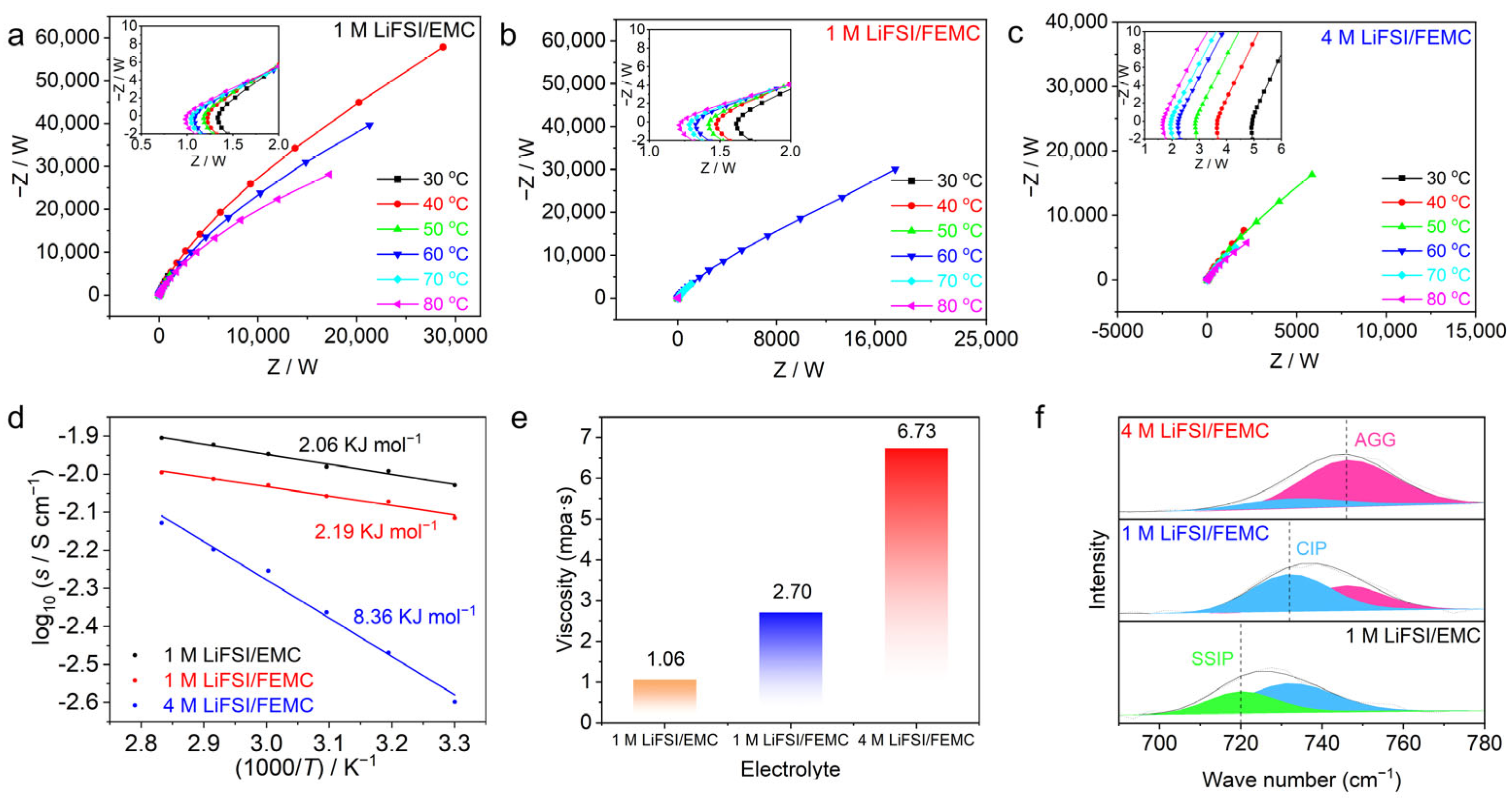
Ionic conductivity is a key parameter influencing battery performance, as it directly determines the charge transport efficiency within the cell. As shown in Figure 2, in the 1 M LiFSI/EMC and 1 M LiFSI/FEMC electrolytes, the systems exhibited relatively higher ionic conductivity due to their low viscosity, ample free solvent molecules, and a high degree of ion-pair dissociation, which results in a larger number of mobile ions. In addition, measurement results show that the FEMC-based electrolyte exhibited lower ionic conductivities compared to the EMC-based electrolyte. This reduction could be attributed to the incorporation of the -CF3 group in FEMC, which decreases the solvation tendency of Li+ and thus lowers the overall conductivity of the electrolyte [40]. In contrast, Figure 2c,d reveals that the 4 M LiFSI/FEMC HCE showed the lowest ionic conductivity values in the whole temperature range. In such an electrolyte, free solvent molecules are almost completely depleted, and the solvation structure is predominantly composed of contact ion pairs and ion aggregates. This structural change leads to a significant increase in the overall viscosity of the system and greater resistance to ion migration, thereby causing a decrease in conductivity [41]. Figure 2d shows the activation energy of the three electrolytes. The calculated results indicate that the activation energy varies significantly with the electrolyte composition and concentration. The 1 M LiFSI/EMC electrolyte exhibited the lowest activation energy of 2.06 kJ mol−1, while the 1 M LiFSI/FEMC electrolyte showed a slightly higher value of 2.19 kJ mol−1. In sharp contrast, the highly concentrated 4 M LiFSI/FEMC electrolyte possessed a much higher activation energy of 8.36 kJ mol−1. This difference in activation energy can be attributed to the variation in the solvation structure and ionic mobility among the electrolyte systems. The low-concentration electrolytes have relatively loose solvation shells around Li+ ions, leading to lower energy barriers for Li+ diffusion, whereas the high-concentration 4 M LiFSI/FEMC electrolyte forms more compact solvation complexes and stronger ion–ion interactions, which significantly increase the energy required for Li+ migration. To systematically investigate the physicochemical properties and microstructural differences of electrolyte systems with varying compositions, viscosity tests and Raman spectroscopy were conducted on three electrolyte samples with different formulations in this study. Through a combination of quantitative analysis and qualitative characterization, the influence of electrolyte concentration and solvent type on macroscopic viscosity and microscopic solvation structure was elucidated. As shown in Figure 2e, the concentrations of the three electrolytes directly led to a pronounced difference in their macroscopic viscosities. Specifically, the viscosity of the 4 M LiFSI/FEMC electrolyte was measured to be 6.73 mPa·s, which was significantly higher than that of the 1 M LiFSI/EMC electrolyte (1.06 mPa·s) and the 1 M LiFSI/FEMC electrolyte (2.70 mPa·s).
Raman spectroscopy tests (Figure 2f) further revealed the characteristics of changes in the microscopic solvation structure of the electrolytes. Both the changes in solvent type and electrolyte concentration significantly regulated the solvation structure. By comparing the Raman spectral peaks of the two low-concentration electrolytes, 1 M LiFSI/EMC and 1 M LiFSI/FEMC, it is evident that the 1 M LiFSI/FEMC electrolyte system exhibited stronger characteristic peaks for contact ion pairs (CIP). This indicates that compared to the EMC solvent, the FEMC solvent molecule possesses weaker coordination ability, and more FSI readily interacts with lithium ions and participates in the formation of the more CIP structures. When the electrolyte concentration was increased to 4 M, the Raman spectral characteristics of the 4 M LiFSI/FEMC system underwent a clear transformation. Its solvation structure became predominantly composed of aggregate ion pairs (AGG). A higher content of AGG and CIP structures are beneficial to contributing to forming anion-derived interfacial layers, which is consistent with the SEM and XPS analyses shown in the following sections.
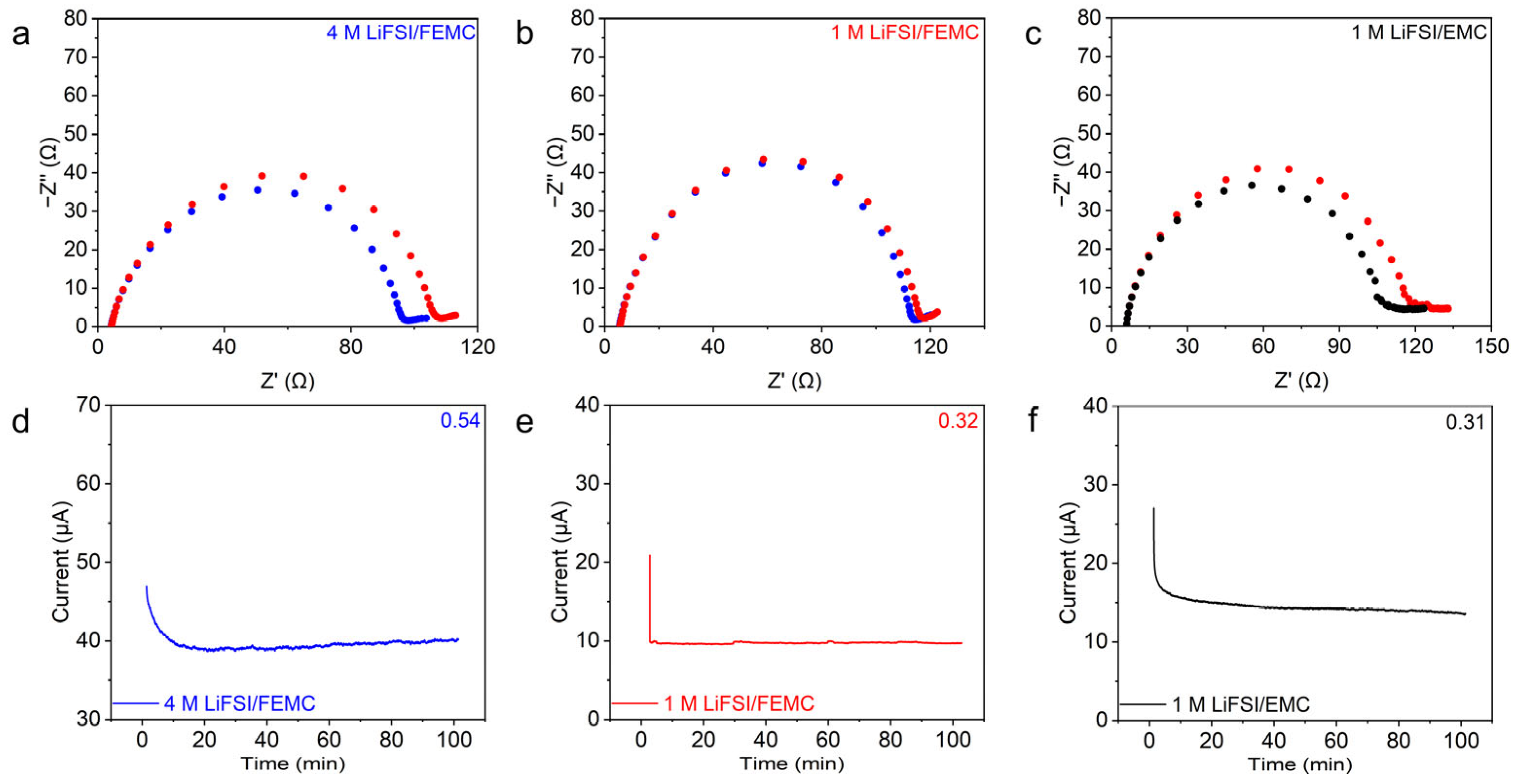
Nevertheless, the solvation structure under high-concentration conditions is favorable for enhancing the lithium-ion transference number. Anions are confined within cluster structures formed by anions and solvent molecules, resulting in markedly reduced mobility. This structure, however, promotes the directional transport of lithium ions: lithium ions can achieve more efficient migration through a structural diffusion mechanism or via a “relay” mode of coordination exchange between adjacent anion coordination shells [42,43]. Consequently, as shown in Figure 3a,d, the lithium-ion transference number in the 4 M LiFSI/FEMC electrolyte reached the value of 0.54. In comparison, conventional-concentration electrolytes contained a large number of free solvent molecules, where lithium ions are tightly coordinated by solvent molecules to form stable solvation sheaths. Their migration under an electric field is relatively sluggish, leading to lower lithium-ion transference numbers. As illustrated in Figure 3b,e, the lithium-ion transference number in 1 M LiFSI/FEMC was 0.32, while that in 1 M LiFSI/EMC was 0.31 (Figure 3c,f). The established view in battery electrochemistry holds that the energy storage capacity is solely derived from the intercalation and deintercalation of lithium ions between the electrodes. This underscores the critical importance of efficient and selective Li+ transport within the electrolyte. Therefore, achieving a high lithium-ion transference number, a metric that quantifies the fraction of total current carried by Li+, is fundamentally linked to enhanced cycling performance. A high lithium-ion transference number promotes more uniform lithium deposition/stripping and reduces detrimental concentration gradients, which are key to minimizing capacity fade and extending cycle life [44].
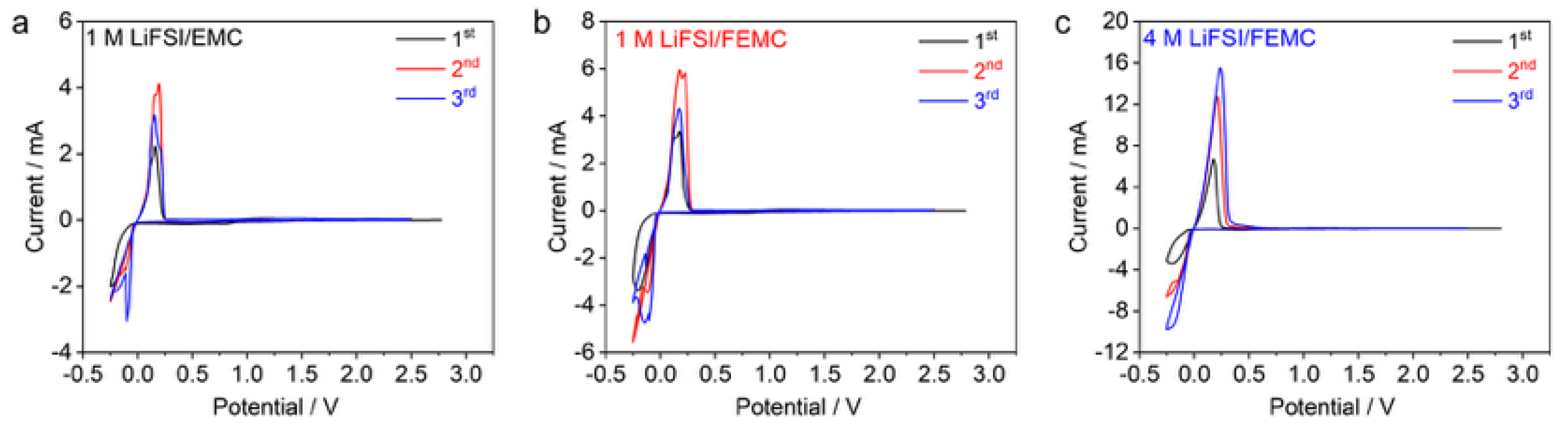
Cyclic voltammetry (CV) tests were performed using Li/Cu batteries at a scan rate of 1 mV s−1. As shown in Figure 4, all of the electrolytes exhibited clear redox peaks between 0.5 V and −0.5 V vs. Li+/Li, corresponding to the lithium plating and stripping processes on the Cu electrodes. For the 1 M LiFSI/EMC and 1 M LiFSI/FEMC electrolytes, however, noticeable side-reaction peaks appeared in the second and third cycles, which can be attributed to electrolyte decomposition at the interface. Notably, these undesirable peaks were not observed during cycling with the 4 M LiFSI/FEMC HCE (Figure 4c), demonstrating its superior electrochemical stability and effective suppression of decomposition reactions. Moreover, the sharper redox peaks and smaller overpotentials observed for 4 M LiFSI/FEMC point to highly reversible reaction kinetics. Such high reversibility is conducive to lower energy loss, higher Coulombic efficiency, and extended cycling life. The higher current response in the CV curves further suggests that electrode reactions proceed with greater electrochemical activity in this concentrated electrolyte. Collectively, these features underscore the advantages of the HCE system.
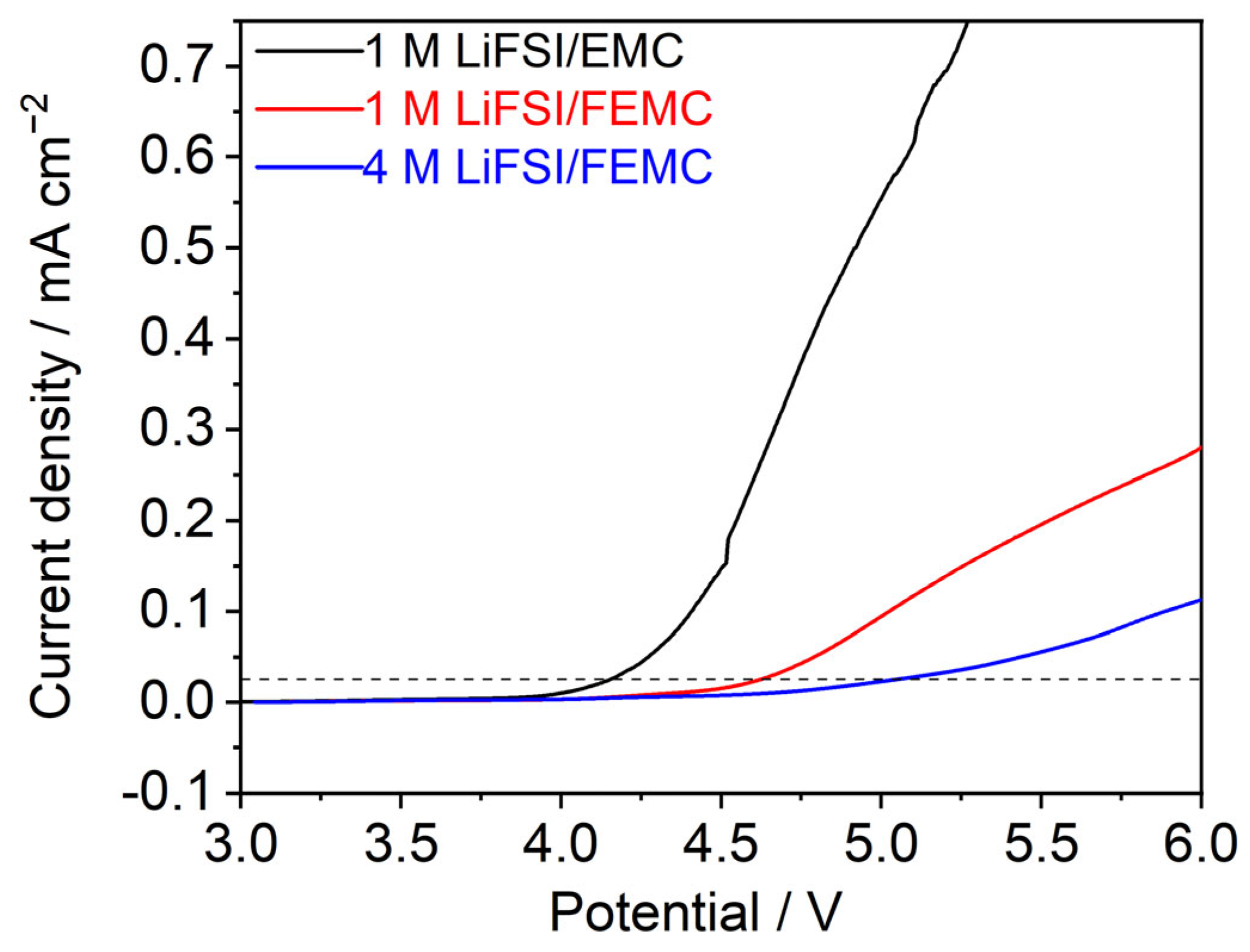
The oxidation stability of different electrolytes was tested by linear sweep voltammetry (LSV), and the results are shown in Figure 5. The LSV test was conducted at a scan rate of 5 mV s−1, and a current density of 0.025 mA cm−2 was used as the criteria to determine the initial oxidation potential on LSV [45]. In the 1 M LiFSI/EMC electrolyte, a noticeable oxidation decomposition current appeared at about 4.1 V vs. Li+/Li. In comparison, the oxidation decomposition potential of the 1 M LiFSI/FEMC electrolyte was increased to approximately 4.6 V vs. Li+/Li. The reason for the increase in the oxidation potential of FEMC is that compared to EMC, the introduction of F atoms in FEMC can lower the highest occupied molecular orbital (HOMO) energy level of the solvent, thereby improving the electrolyte’s cycling stability [46,47]. Meanwhile, the 4 M LiFSI/FEMC HCE exhibited even better oxidation resistance, with its oxidation decomposition potential further raised to about 5.1 V vs. Li+/Li. It can be observed that compared with the EMC-based solvent system, the FEMC-based electrolyte demonstrated higher intrinsic oxidation stability, and this stability was further enhanced under high-concentration conditions. High oxidation stability enables it to be compatible with high-voltage cathode materials, thereby achieving higher energy density.

3.2. Cell Performance and Interfacial Characterization

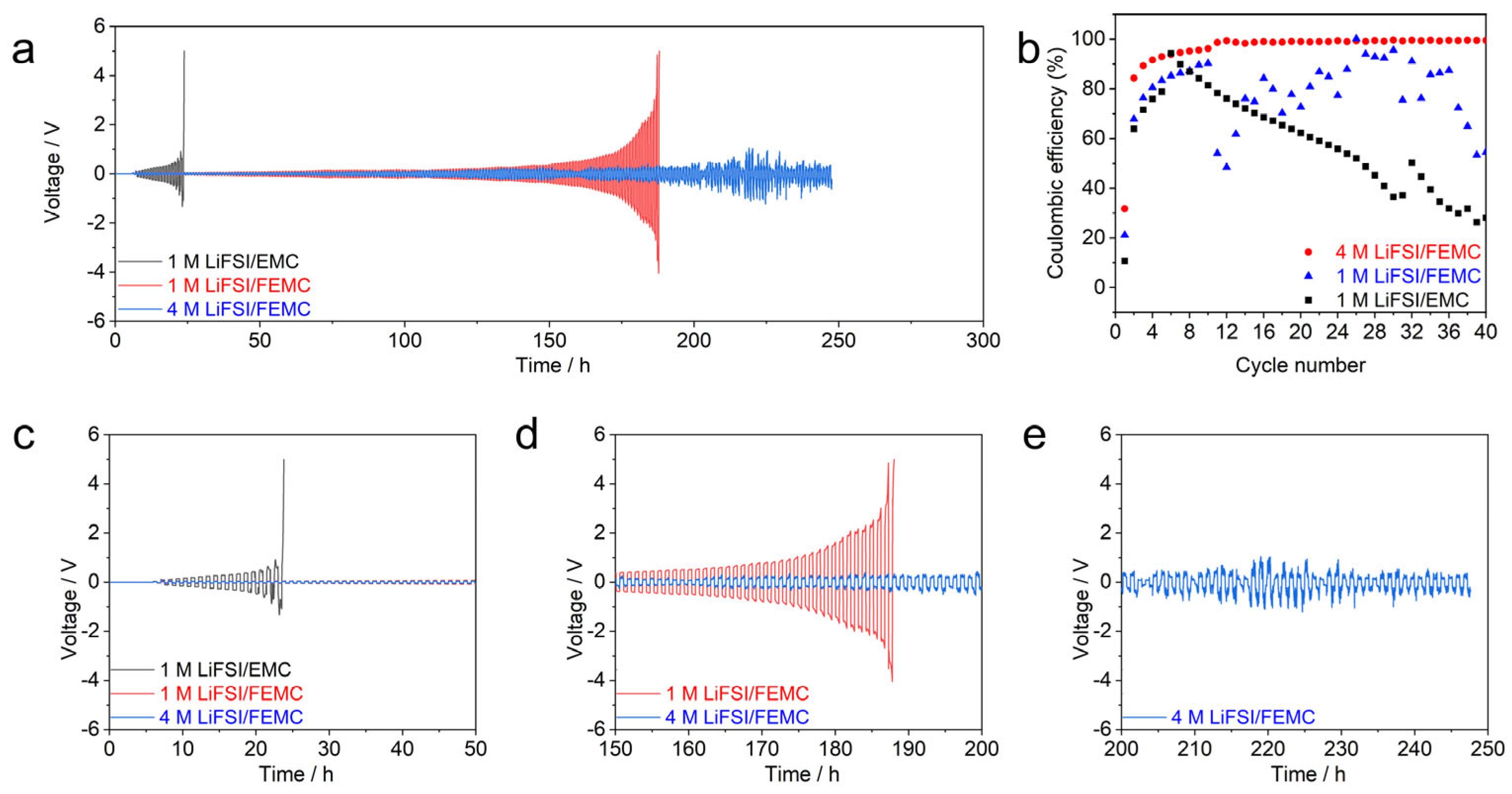
To evaluate the compatibility of different electrolyte systems with the lithium metal anode, this study employed Li/Li symmetric cells to assess the cycling stability of the cells using different electrolytes. As shown in the voltage–time curves in Figure 6a and the corresponding magnified plots (Figure 6c–d), the 1 M LiFSI/EMC system exhibited a rapidly increasing polarization after only about 25 h of cycling, and the 1 M LiFSI/FEMC system displayed pronounced voltage fluctuations and increased polarization after 190 h at a current density of 1 mA cm−2. In contrast, the cell using the 4 M LiFSI/FEMC electrolyte exhibited a relatively smooth voltage profile with no significant fluctuations during the first 200 h of cycling, although the polarization voltage increased thereafter. These results indicate that the electrolyte with FEMC as the solvent possesses better compatibility with lithium metal than the EMC-based system, and the high-concentration formulation further enhances this compatibility. Moreover, Coulombic efficiency tests in Li/Cu half-cells (Figure 6b) further confirm the superiority of the 4 M LiFSI/FEMC system. To improve the Coulombic efficiency of the Li/Cu cells, the Cu working electrode was activated for 10 cycles before the Coulombic efficiency. As shown in Figure 6b, the 4 M LiFSI/FEMC system delivered an average Coulombic efficiency of 99.16% over 30 cycles, whereas the 1 M LiFSI/FEMC system reached only 78.05%. In comparison, the 1 M LiFSI/EMC system suffered a sharp drop in coulombic efficiency after 10 cycles, accompanied by rapid cell failure, with an average Coulombic efficiency of only 52.08% These data consistently demonstrate that the high-concentration electrolyte significantly improves the interfacial stability and electrochemical reversibility of the lithium metal anode.
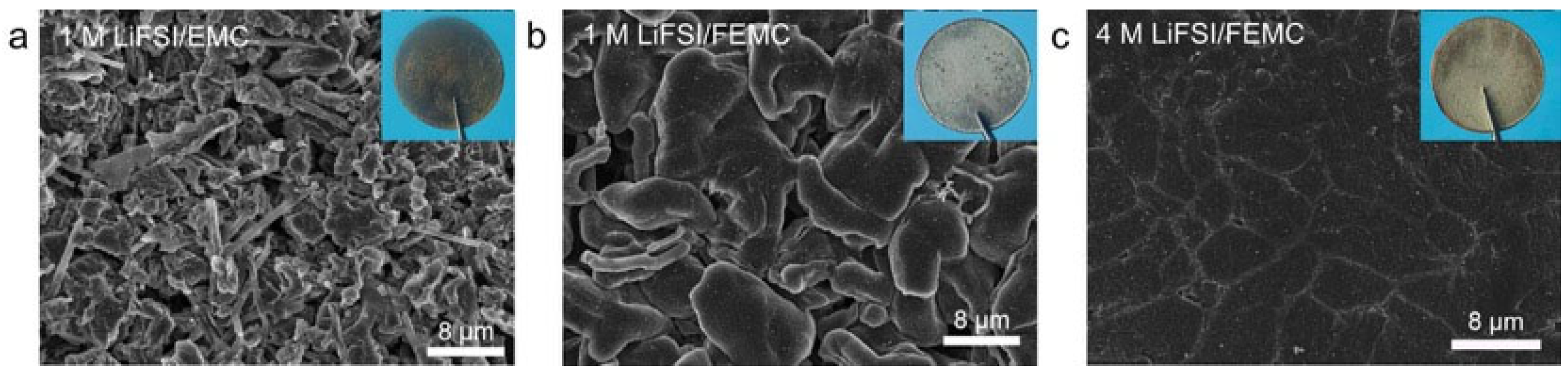
Figure 7 presents the optical photographs and scanning electron microscopy (SEM) images of lithium metal deposited on a Cu substrate after 25 h of deposition in a Li/Cu cell at a current density of 0.1 mA cm−2 using different electrolyte systems. As shown in Figure 7a, in the 1 M LiFSI/EMC electrolyte, exposed areas of the Cu substrate can be clearly observed, and the SEM images further confirm the presence of numerous lithium dendrites. Figure 7b shows that when using the 1 M LiFSI/FEMC electrolyte, the morphology of the deposited lithium was more uniform compared to the former, although a small number of lithium dendrites were still visible. In Figure 7c, the lithium deposited using the 4 M LiFSI/FEMC HCE exhibited a highly dense and uniform microstructure, without lithium dendrite growth observed. These results further indicate that the electrolyte with FEMC as the solvent can induce a more stable lithium deposition morphology compared to the EMC-based system, and the use of the high-concentration formulation further enhances the interfacial compatibility.
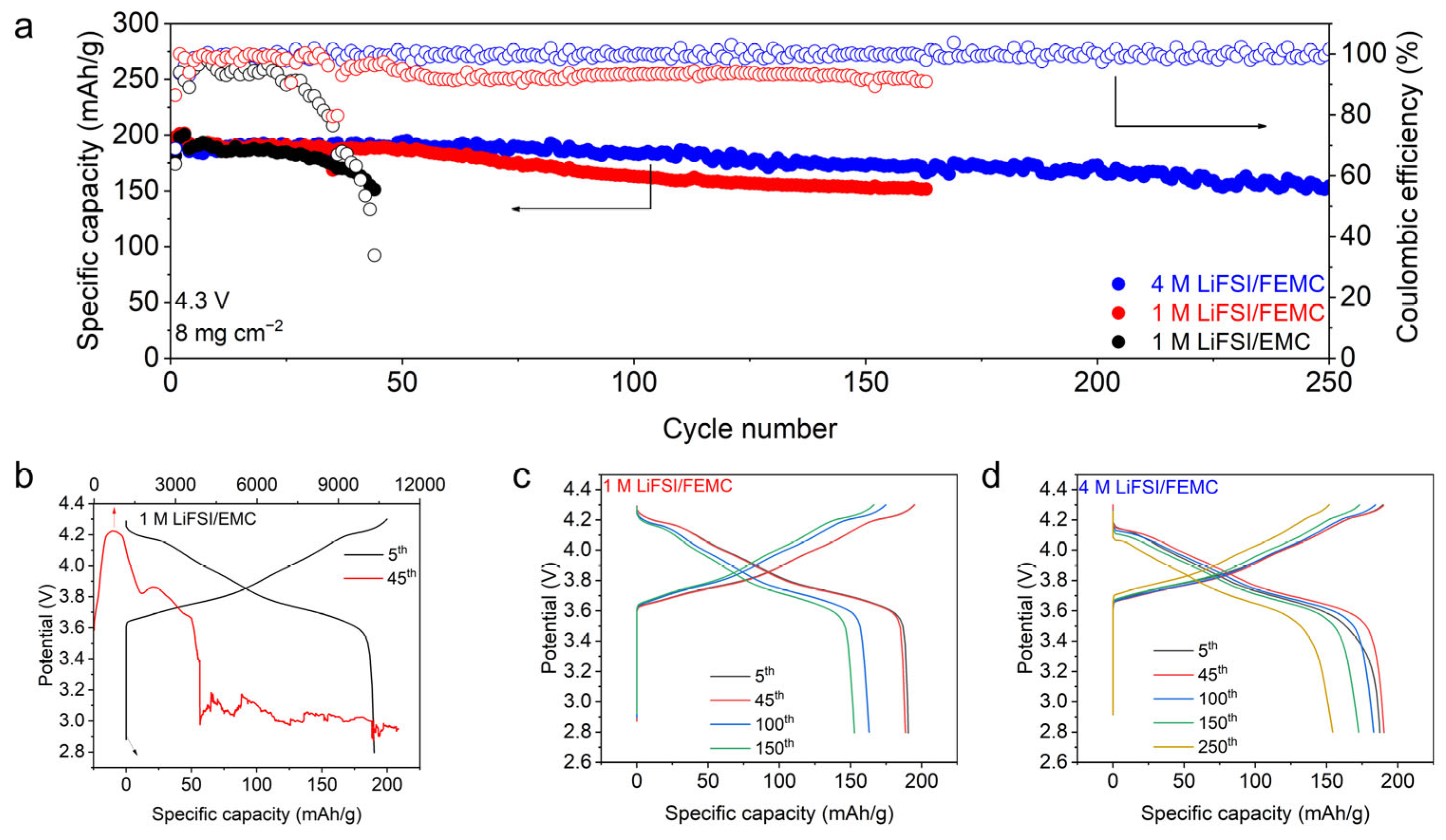
To systematically evaluate the practical feasibility of different electrolyte systems, NCM811/Li metal cells were assembled and subjected to cycling tests. As shown in Figure 8a,b, the cell using the 1 M LiFSI/EMC electrolyte experienced rapid capacity decay within only 45 cycles, leading to premature failure. This can be attributed to the interfacial instability of EMC against both the anode and the high-voltage cathode. In comparison, the cell employing the 1 M LiFSI/FEMC electrolyte (Figure 8a,c) exhibited improved performance; although the Coulombic efficiency remained relatively low during cycling, a capacity retention of 80% was still achieved after 150 cycles. Meanwhile, the cell with the 4 M LiFSI/FEMC HCE (Figure 8a,d) demonstrated even better cycling stability, maintaining 81.73% capacity retention and lower overpotentials after 250 cycles without noticeable overcharging throughout the test. The corresponding charge–discharge curves in Figure 8a–c indicate that the polarization voltage gradually increased upon cycling in both the 1 M LiFSI/EMC and 1 M LiFSI/FEMC; nevertheless, the 4 M LiFSI/FEMC high-concentration electrolyte showed a lower polarization voltage and delivered superior cycling stability. These results indicate that the FEMC solvent can more effectively enhance the electrochemical performance of the battery compared to the conventional EMC solvent, and the HCE system further improves cycling stability and interfacial compatibility.
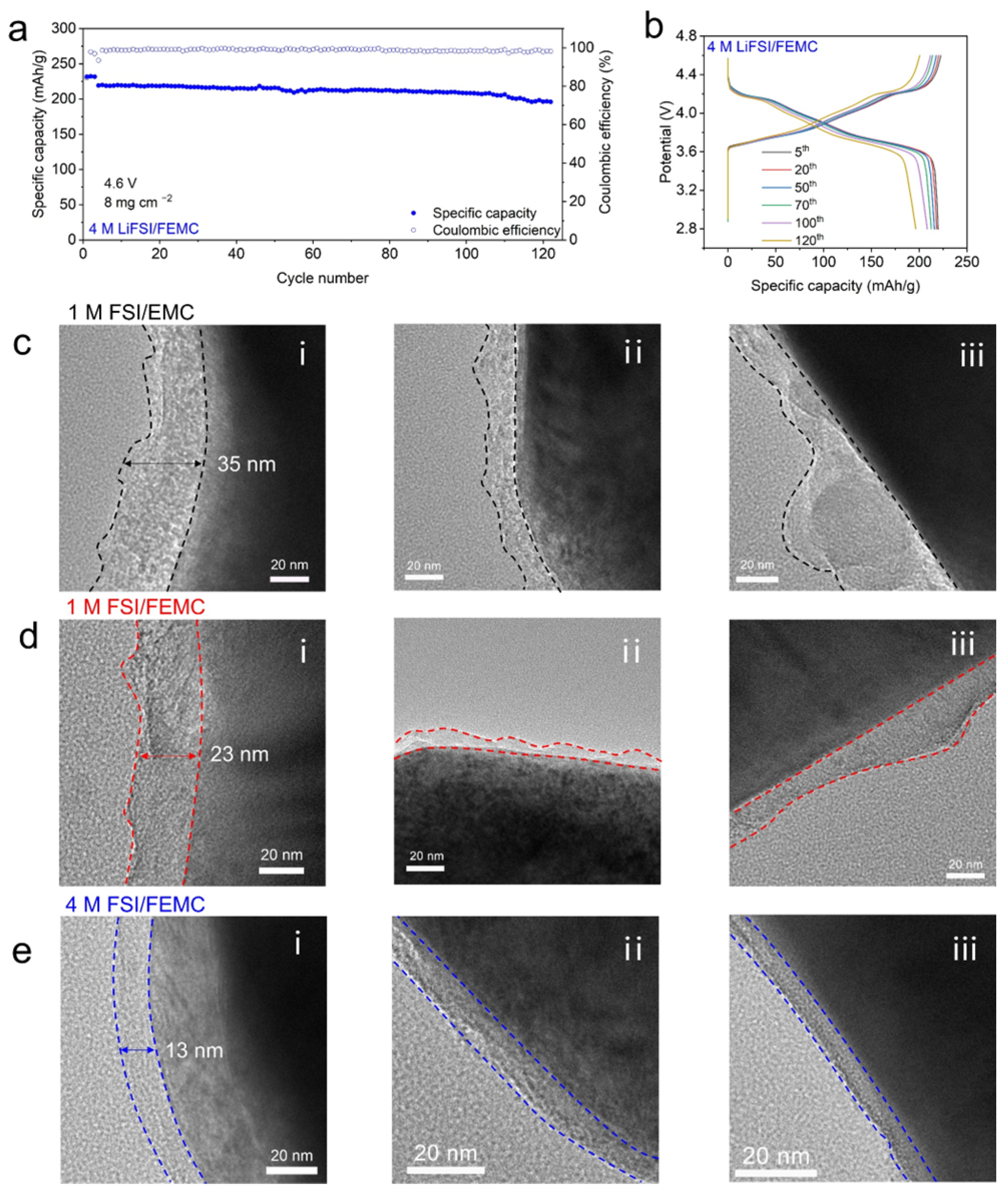
Subsequently, the long-term cycling stability of the 4 M LiFSI/FEMC HCE electrolyte in NCM811/Li metal batteries was further evaluated at a higher cutoff voltage (4.6 V vs. Li+/Li). As shown in Figure 9a, the cell employing this electrolyte delivered an initial discharge specific capacity of 231.7 mAh g−1 at a high voltage of 4.6 V vs. Li+/Li. After 120 cycles at 0.2 C charge and 0.5 C discharge rates, a capacity of 196 mAh g−1 was retained, corresponding to an 88.61% capacity retention and demonstrating excellent cycling stability. Furthermore, the charge/discharge curves in Figure 9b revealed that the voltage plateaus remained stable and the polarization increased only slightly over the entire cycling process, indicating that this HCE possesses excellent electrochemical stability and reversibility under high voltages, outperforming other carbonate-based high-concentration electrolyte systems reported in the literature (Table 1).
Figure 9c–e compares the transmission electron microscopy (TEM) morphologies of the NCM811 cathode surface after 30 cycles in three different electrolytes: 1 M LiFSI/EMC, 1 M LiFSI/FEMC, and 4 M LiFSI/FEMC, between 2.5 and 4.3 V vs. Li+/Li. As shown in Figure 9c, the cathode electrolyte interphase (CEI) formed in the 1 M LiFSI/EMC electrolyte exhibited a non-uniform thickness, with an overall average thickness of approximately 27.65 ± 7.35 nm. In comparison, the CEI that formed in the 1 M LiFSI/FEMC electrolyte (Figure 9d) had a reduced thickness of about 17.7 ± 5.6 nm, indicating that the introduction of the FEMC solvent facilitates the formation of a thinner CEI layer. Meanwhile, in the 4 M LiFSI/FEMC HCE system (Figure 9e), a dense and uniform CEI was formed, with a thickness of only 10 ± 3 nm. These results demonstrate that the HCE promotes the formation of a thinner and more stable CEI layer, which plays an important role in enhancing the cycling stability of the battery under high voltages.
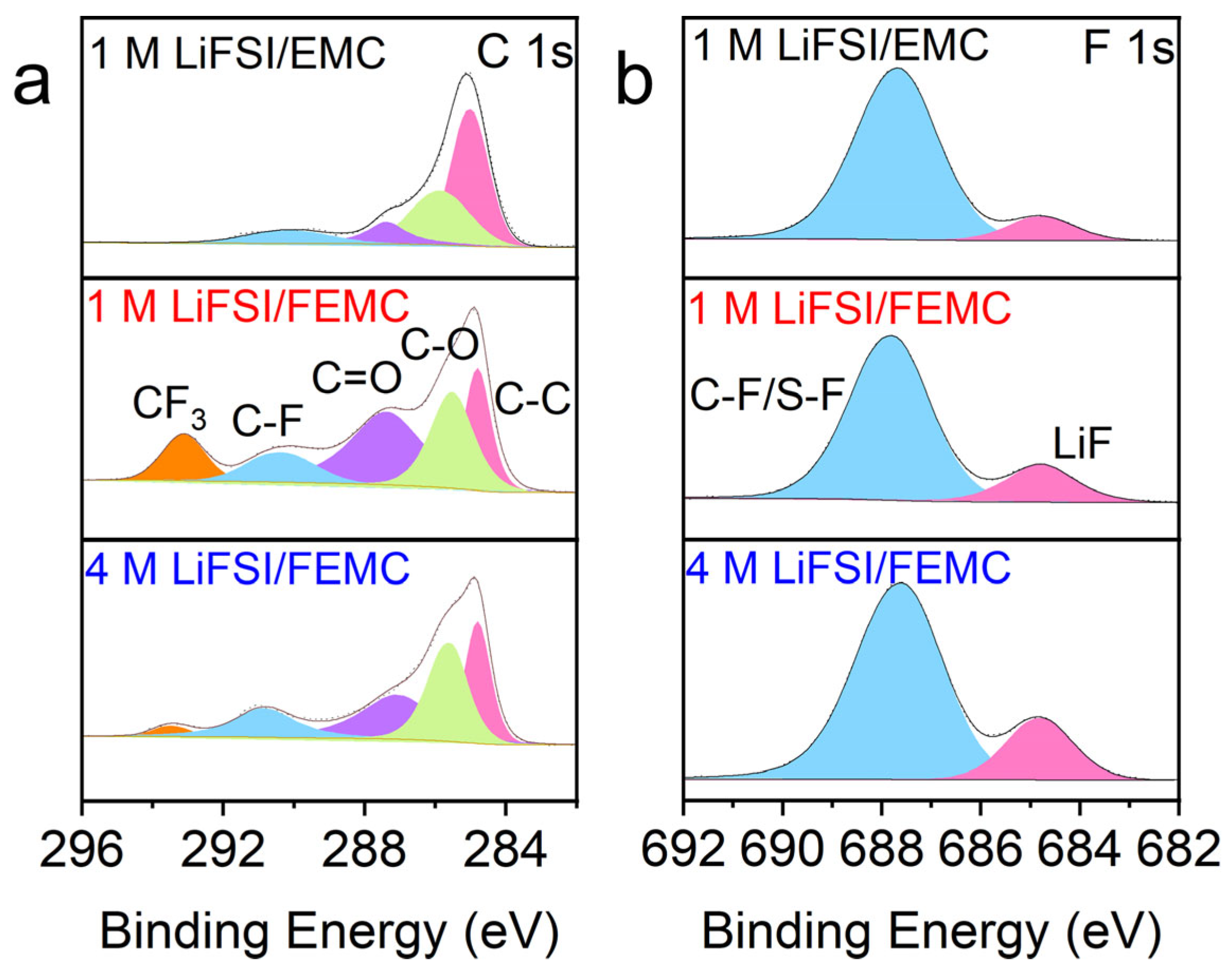
The XPS measurements were conducted to probe the interfacial components of the surface of the NCM811 recovered from different electrolytes after 30 cycles, and the results are shown in Figure 10. In the C 1s XPS spectrum, clear differences in characteristic peaks under different systems can be observed. Compared to the 1 M LiFSI/FEMC electrolyte system, the characteristic peak intensity of -CF3, the decomposition product of the FEMC solvent molecule, was significantly reduced in the 4 M LiFSI/FEMC high-concentration electrolyte system. This phenomenon indicates that in the high-concentration electrolyte system, a large number of Li+ ions form a stable solvation sheath structure with solvent molecules and anions, greatly reducing the number of free FEMC solvent molecules in the system. This effectively suppresses the oxidative decomposition reaction of solvent molecules on the cathode surface, significantly enhances the anti-oxidative decomposition performance of the electrolyte, and provides important support for improving the cycling stability of the battery.
Further analysis of the F 1s XPS spectrum reveals that in the 4 M LiFSI/FEMC high-concentration electrolyte system, the characteristic peak intensity of lithium fluoride (LiF) was significantly higher than that in the 1 M LiFSI/FEMC and 1 M LiFSI/EMC systems, indicating a significant increase in the amount of LiF generated in the high-concentration electrolyte. Combined with the analysis of the Li+ solvation structure of the electrolytes (Figure 2f), a large number of FSI anions in the high-concentration system preferentially participate in the formation of the first solvation sheath of Li+, which promotes the formation of a cathode electrolyte interphase (CEI) film rich in LiF. Due to its high mechanical strength and electrochemical stability, the LiF-rich layer effectively suppresses parasitic side reactions between the cathode and the electrolyte, particularly at high voltages, thereby reducing interfacial resistance and mitigating electrolyte decomposition and contributing to improved Coulombic efficiency and extended cycle life [56].

4. Conclusions

In summary, this study designed and systematically evaluated a novel high-concentration electrolyte system based on 2,2,2-trifluoroethyl methyl carbonate (FEMC) and lithium bis(fluorosulfonyl)imide (LiFSI), which is suitable for high-voltage lithium metal batteries. Compared with the low-concentration 1 M LiFSI/FEMC and the conventional 1 M LiFSI/EMC-based electrolytes, the 4 M LiFSI/FEMC high-concentration electrolyte demonstrated significant improvements in both physicochemical and electrochemical properties including higher anodic stability, a higher lithium-ion transference number, and excellent compatibility with lithium metal anodes and high-voltage NCM811 cathodes. This system enables long-term stable cycling at a cutoff voltage as high as 4.6 V vs. Li+/Li, exhibiting a high-capacity retention and a low polarization potential. The FEMC-based high-concentration electrolyte strategy proposed in this work provides a practical solution for constructing lithium metal batteries that combine high energy density, high operating voltage, and long cycle life, and also points to a promising technical pathway for the development of next-generation high-performance energy storage systems.

Author Contributions

Conceptualization, L.Q.; Investigation, Q.C. and Y.M.; Writing–original draft, Q.C. and Y.M.; Writing–review & editing, L.W., Z.Z. and L.Q.; Funding acquisition, L.Q. All authors have read and agreed to the published version of the manuscript.

Funding

This work was supported by the National Natural Science Foundation of China (22409203), the Natural Science Foundation of Shandong Province (2023HWYQ-104; ZR2023QE297), the Taishan Scholars Program (NO. tsqn202306310), and the Dezhou University university-level scientific research fund (2022xjrc411).

Data Availability Statement

The data that support the findings of this study are available from the corresponding author upon reasonable request.

Conflicts of Interest

The authors declare no conflicts of interest.

Abbreviations

The abbreviations are listed as below: [C2mpyr] [FSI]: [N-ethyl-N-methyl-pyrrolidinium bis(fluorosulfonyl)imide], DMC: (dimethyl carbonate), EC: (ethylene carbonate), FEA: (2,2,2-trifluoroethyl acetate), FEC: (fluoroethylene carbonate), FEMC: [2,2,2-trifluoroethyl methyl carbonate], LiBF4: [lithium tetrafluoroborate], LiFSI: [lithium bis(fluorosulfonyl)imide], LiPF6: (lithium hexafluorophosphate), LiTFSI: [lithium bis(trifluoromethanesulfonyl)imide], PC: (propylene carbonate), 2F-EA: (2,2-Difluoroethyl acetate).

References

  1. Li, C.; Yuan, C.; Zhu, J.; Ni, X.; Li, K.; Wang, L.; Qi, Y.; Ju, A. Fabrication of silicon nanoparticles/porous carbon@porous carbon nanofibers core-shell structured composites as high-performance anodes for lithium-ion batteries. Colloid Surf. A 2022, 655, 129721. [Google Scholar] [CrossRef]
  2. Li, Y.-F.; Wang, S.-G.; Shi, Y.-H.; Fan, C.-Y.; Lin, J.; Wu, X.-L.; Sun, H.-Z.; Zhang, J.-P.; Xie, H.-M. In situ chemically encapsulated and controlled SnS2 nanocrystal composites for durable lithium/sodium-ion batteries. Dalton Trans. 2020, 49, 15874–15882. [Google Scholar] [CrossRef] [PubMed]
  3. Li, Z.; Yang, M.; Geng, F.; Zhang, D.; Zhang, Y.; Zhang, X.; Pang, X.; Geng, L. Nanotubular Fe2O3 and Mn3O4 with hierarchical porosity as high-performance anode materials for lithium-ion batteries. Dalton Trans. 2023, 52, 18194–18205. [Google Scholar] [CrossRef] [PubMed]
  4. Li, Q.; Li, B.; Lv, D.; Wu, P.; Tang, Q.; Zhang, T.; Jiang, S.; Zhang, N. Synthesis of copper naphthalocyanine/graphene oxide composites as anode materials for lithium-ion batteries. Phys. Chem. Chem. Phys. 2023, 25, 31178–31187. [Google Scholar] [CrossRef] [PubMed]
  5. Qiu, S.; Yan, W.N.; Wang, L.; Zhang, L.S.; Chen, C.; Mu, L.J.; Mou, S.G. Facile Synthesis of Si@LiAlO2 Nanocomposites as Anode for Lithium-Ion Battery. Chin. J. Inorg. Chem. 2022, 38, 1655–1662. [Google Scholar]
  6. Sun, J.; Dong, Y.; Wang, X.; Cao, J.; Gong, M.; Li, C. Microrods synthesized of MoO3 with corn straw as biological templates and its electrochemical performance in aqueous aluminum-ion battery. Bull. Chem. Soc. Ethiop. 2022, 35, 669–675. [Google Scholar] [CrossRef]
  7. Xiao, Z.; Zhu, X.; Wang, S.; Shi, Y.; Zhang, H.; Xu, B.; Zhao, C.; Zhao, Y. Construction of Uniform LiF Coating Layers for Stable High-Voltage LiCoO2 Cathodes in Lithium-Ion Batteries. Molecules 2024, 29, 1414. [Google Scholar] [CrossRef]
  8. Lv, D.; Li, Q.; Wu, P.; Zhang, X.; Wang, L.; Li, B.; Gao, N.; Liu, Z.; Wang, L. High-Performance Anode Material Based on Zinc Naphthalocyanine/Graphene Composite. Langmuir 2024, 40, 11287–11296. [Google Scholar] [CrossRef]
  9. Wang, L.; Wang, B.; Li, H.; Qiao, L. Rapid response and wide-band regulation of an electrochromic device achieved by ultra-small V2O5 nanodots and a Zn2+/Li+ electrolyte. Inorg. Chem. Front. 2025, 12, 5091–5099. [Google Scholar] [CrossRef]
  10. Lin, H.; Zhang, Y.; Huang, Y. Unlocking the intercalation mechanism of blue phosphorene/MBene heterostructures for lithium/sodium-ion batteries: A first principles study. J. Mol. Liq. 2024, 409, 125528. [Google Scholar] [CrossRef]
  11. Zhang, K.; Zhang, H.; Li, C.; Ma, X. Vertically oriented MoSe0.4S1.6/N-doped C nanostructures directly grown on carbon nanotubes as high-performance anode for potassium-ion batteries. J. Electroanal. Chem. 2022, 923, 116846. [Google Scholar] [CrossRef]
  12. Ma, X.; Zhang, H.; Liu, Y.; Yan, W.; Chen, C.; Zhang, K. MOF-derived Na3V2(PO4)3-carbon@graphene fibers for flexible fiber-shaped sodium ion battery. J. Electroanal. Chem. 2024, 975, 118740. [Google Scholar] [CrossRef]
  13. Zhao, C.; Liu, H.; Liu, J.; Shi, Y.; Wang, S.; Tang, Q.; Zhu, X.; Zhang, H.; Zhao, Y. Petal-like Mn-doped α-Ni(OH)2 nanosheets for high-performance Li–S cathode material. RSC Adv. 2023, 13, 8706–8717. [Google Scholar] [CrossRef] [PubMed]
  14. Wu, C.; Zhou, Y.; Zhu, X.L.; Zhan, M.Z.; Yang, H.X.; Qian, J.F. Research Progress on High Concentration Electrolytes for Li Metal Batteries. Acta Phys.-Chim. Sin. 2021, 37, 2008044. [Google Scholar] [CrossRef]
  15. Cheng, X.B.; Zhang, R.; Zhao, C.Z.; Zhang, Q. Toward Safe Lithium Metal Anode in Rechargeable Batteries: A Review. Chem. Rev. 2017, 117, 10403–10473. [Google Scholar] [CrossRef]
  16. Shi, F.F.; Pei, A.; Boyle, D.T.; Xie, J.; Yu, X.Y.; Zhang, X.K.; Cui, Y. Lithium metal stripping beneath the solid electrolyte interphase. Proc. Natl. Acad. Sci. USA 2018, 115, 8529–8534. [Google Scholar] [CrossRef]
  17. Qi, M.P.; Xie, L.L.; Han, Q.; Zhu, L.M.; Chen, L.B.; Cao, X.Y. An overview of the key challenges and strategies for lithium metal anodes. J. Energy Storage 2022, 47, 103641. [Google Scholar] [CrossRef]
  18. Wang, A.P.; Kadam, S.; Li, H.; Shi, S.Q.; Qi, Y. Review on modeling of the anode solid electrolyte interphase (SEI) for lithium-ion batteries. Npj Comput. Mater. 2018, 4, 15. [Google Scholar] [CrossRef]
  19. Xiang, S.B.; Fu, Y.; Yin, C.R.; Hou, Y.; Tian, H.L.; Yin, Z.X. Advances in research on the inhibitory effect of 3D current collector structures for lithium dendrites. Inorg. Chem. Front. 2023, 10, 6767–6791. [Google Scholar] [CrossRef]
  20. Li, T.; Gu, S.C.; Lin, Q.W.; Han, J.W.; Zhou, G.M.; Li, B.H.; Kang, F.Y.; Lyu, W. Advanced 3D Current Collectors for Dendrite-free Lithium Metal Anode. Chem. J. Chin. U 2021, 42, 1480–1500. [Google Scholar]
  21. Wang, H.T.; Tang, Y.B. Artificial Solid Electrolyte Interphase Acting as “Armor” to Protect the Anode Materials for High-performance Lithium-ion Battery. Chem. Res. Chin. U 2020, 36, 402–409. [Google Scholar] [CrossRef]
  22. Thanner, K.; Varzi, A.; Buchholz, D.; Sedlmaier, S.J.; Passerini, S. Artificial Solid Electrolyte Interphases for Lithium Metal Electrodes by Wet Processing: The Role of Metal Salt Concentration and Solvent Choice. ACS Appl. Mater. Interfaces 2020, 12, 32851–32862. [Google Scholar] [CrossRef] [PubMed]
  23. Senthil, C.; Subramani, A.; Gupta, R.K.; Sofer, Z. Functional Electrolyte Additives: A Pinch of Salt/Solvent to an Electrolyte for High Energy Density Lithium-Ion and Lithium-Metal Batteries. Small 2025, 21, 2504276. [Google Scholar] [CrossRef] [PubMed]
  24. Lei, Y.; Wang, K.F.; Jiang, S.; Xu, X.; Zheng, J.Z.; Yin, J.Y.; Gao, Y.F. Recent Progress on Multifunctional Electrolyte Additives for High-Energy-Density Li Batteries—A Review. Chemelectrochem 2024, 11, e202300702. [Google Scholar] [CrossRef]
  25. Zhang, Y.; Zuo, T.T.; Popovic, J.; Lim, K.; Yin, Y.X.; Maier, J.; Guo, Y.G. Towards better Li metal anodes: Challenges and strategies. Mater. Today 2020, 33, 56–74. [Google Scholar] [CrossRef]
  26. Cheng, X.B.; Zhang, R.; Zhao, C.Z.; Wei, F.; Zhang, J.G.; Zhang, Q. A Review of Solid Electrolyte Interphases on Lithium Metal Anode. Adv. Sci. 2016, 3, 1500213. [Google Scholar] [CrossRef]
  27. Zhou, J.H.; Wang, H.M.; Yang, Y.Q.; Li, X.Y.; Guo, C.; Li, Z.B.; Wen, S.J.; Cai, J.H.; Wang, Z.K.; Zhang, Y.F.; et al. Advanced Liquid Electrolyte Design for High-Voltage and High-Safety Lithium Metal Batteries. Adv. Energy Mater. 2025, 15, 2502654. [Google Scholar] [CrossRef]
  28. Jie, Y.L.; Ren, X.D.; Cao, R.G.; Cai, W.B.; Jiao, S.H. Advanced Liquid Electrolytes for Rechargeable Li Metal Batteries. Adv. Funct. Mater. 2020, 30, 1910777. [Google Scholar] [CrossRef]
  29. Yang, Y.; Ren, Z.; Li, X.; Zhao, E.; Luo, X.; Yan, Y.; Gao, H.; Feng, L. RAFT-mediated polymerization-induced self-assembly of poly (ionic liquid) block copolymers in a green solvent. e-Polymers 2025, 25, 20240077. [Google Scholar] [CrossRef]
  30. Zhang, C.; Qu, P.; Zhou, M.; Qian, L.; Bai, T.; Jin, J.; Xin, B. Ionic Liquids as Promisingly Multi-Functional Participants for Electrocatalyst of Water Splitting: A Review. Molecules 2023, 28, 3051. [Google Scholar] [CrossRef]
  31. Zhang, C.; Bai, T.; Sun, Y.; Xin, B.; Zhang, S. Ionic Liquid/Deep Eutectic Solvent-Mediated Ni-Based Catalysts and Their Application in Water Splitting Electrocatalysis. Catalysts 2022, 12, 928. [Google Scholar] [CrossRef]
  32. Yang, Y.; Li, X.; Yan, Y.; Pan, R.; Liu, J.; Lian, M.; Luo, X.; Liu, G. RAFT polymerization-induced self-assembly of poly(ionic liquids) in ethanol. e-Polymers 2022, 22, 803–808. [Google Scholar]
  33. Wu, Q.; Zhao, C.; Wang, Q.; Liu, J. Successive preconcentration and mechanistic investigation of Au(iii), Pd(ii), Pt(iv) and Rh(iii) via cloud point extraction using a functionalised ionic liquid. New J. Chem. 2022, 46, 7695–7703. [Google Scholar] [CrossRef]
  34. Gu, Y.-Q.; Shu, T.; Ge, B.; Wang, P.; Gao, C.; Heydari, H. Using an SGB Decision Tree Approach to Estimate the Properties of CRM Made by Biomass Pretreated with Ionic Liquids. Int. J. Chem. Eng. 2021, 2021, 4107429. [Google Scholar] [CrossRef]
  35. Zhang, C.; Xin, B.; Xi, Z.; Zhang, B.; Li, Z.; Zhang, H.; Li, Z.; Hao, J. Phosphonium-Based Ionic Liquid: A New Phosphorus Source toward Microwave-Driven Synthesis of Nickel Phosphide for Efficient Hydrogen Evolution Reaction. ACS Sustain. Chem. Eng. 2018, 6, 1468–1477. [Google Scholar] [CrossRef]
  36. Liu, K.X.; Wang, Z.Y.; Shi, L.Y.; Jungsuttiwong, S.; Yuan, S. Ionic liquids for high performance lithium metal batteries. J. Energy Chem. 2021, 59, 320–333. [Google Scholar] [CrossRef]
  37. Balducci, A. Ionic Liquids in Lithium-Ion Batteries. Top. Curr. Chem. 2017, 375. [Google Scholar] [CrossRef]
  38. Cao, X.; Jia, H.; Xu, W.; Zhang, J.G. Review-Localized High-Concentration Electrolytes for Lithium Batteries. J. Electrochem. Soc. 2021, 168, 010522. [Google Scholar] [CrossRef]
  39. Yamada, Y.; Yamada, A. Review-Superconcentrated Electrolytes for Lithium Batteries. J. Electrochem. Soc. 2015, 162, A2406–A2423. [Google Scholar] [CrossRef]
  40. Wang, Y.K.; Li, Z.M.; Hou, Y.P.; Hao, Z.M.; Zhang, Q.; Ni, Y.X.; Lu, Y.; Yan, Z.H.; Zhang, K.; Zhao, Q.; et al. Emerging electrolytes with fluorinated solvents for rechargeable lithium-based batteries. Chem. Soc. Rev. 2023, 52, 2713–2763. [Google Scholar] [CrossRef]
  41. Im, J.; Lee, J.; Ryou, M.H.; Lee, Y.M.; Cho, K.Y. Fluorinated Carbonate-Based Electrolyte for High-Voltage Li (Ni0.5Mn0.3Co0.2) O2/Graphite Lithium-Ion Battery. J. Electrochem. Soc. 2017, 164, A6381–A6385. [Google Scholar] [CrossRef]
  42. Kankanamge, S.R.G.; Kuroda, D.G. Molecular Structure, Chemical Exchange, and Conductivity Mechanism of High Concentration LiTFSI Electrolytes. J. Phys. Chem. B. 2020, 124, 1965–1977. [Google Scholar] [CrossRef]
  43. Dokko, K.; Watanabe, D.; Ugata, Y.; Thomas, M.L.; Tsuzuki, S.; Shinoda, W.; Hashimoto, K.; Ueno, K.; Umebayashi, Y.; Watanabe, M. Direct Evidence for Li Ion Hopping Conduction in Highly Concentrated Sulfolane-Based Liquid Electrolytes. J. Phys. Chem. B 2018, 122, 10736–10745. [Google Scholar] [CrossRef] [PubMed]
  44. Qiao, L.X.; Peña, S.R.; Martínez-Ibañez, M.; Santiago, A.; Aldalur, I.; Lobato, E.; Sanchez-Diez, E.; Zhang, Y.; Manzano, H.; Zhu, H.J.; et al. Anion π-π Stacking for Improved Lithium Transport in Polymer Electrolytes. J. Am. Chem. Soc. 2022, 144, 9806–9816. [Google Scholar] [CrossRef] [PubMed]
  45. Qiao, L.; Oteo, U.; Zhang, Y.; Peña, S.R.; Martínez-Ibañez, M.; Santiago, A.; Cid, R.; Meabe, L.; Manzano, H.; Carrasco, J.; et al. Trifluoromethyl-free anion for highly stable lithium metal polymer batteries. Energy Storage Mater. 2020, 32, 225–233. [Google Scholar] [CrossRef]
  46. Qin, M.S.; Zeng, Z.Q.; Ma, F.F.; Gu, C.K.; Chen, X.; Cheng, S.J.; Xie, J. Doping in Solvation Structure: Enabling Fluorinated Carbonate Electrolyte for High-Voltage and High-Safety Lithium-Ion Batteries. ACS Energy Lett. 2024, 9, 2536–2544. [Google Scholar] [CrossRef]
  47. Zhang, Z.C.; Hu, L.B.; Wu, H.M.; Weng, W.; Koh, M.; Redfern, P.C.; Curtiss, L.A.; Amine, K. Fluorinated electrolytes for 5 V lithium-ion battery chemistry. Energy Environ. Sci. 2013, 6, 1806–1810. [Google Scholar] [CrossRef]
  48. Li, Y.; Wang, Z.; Lin, W.; Wei, B.; Chen, D. A Concentrated Electrolyte of LiTFSI and Dimethyl Carbonate for High-Voltage Li Batteries. ACS Appl. Energy Mater. 2023, 6, 9337–9346. [Google Scholar] [CrossRef]
  49. Cho, S.-J.; Yu, D.-E.; Pollard, T.P.; Moon, H.; Jang, M.; Borodin, O.; Lee, S.-Y. Nonflammable Lithium Metal Full Cells with Ultra-high Energy Density Based on Coordinated Carbonate Electrolytes. IScience 2020, 23, 100844. [Google Scholar] [CrossRef]
  50. Doi, T.; Fujii, R.; Inaba, M. Improved stability of highly concentrated LiBF4/fluorinated ethyl acetate-based electrolyte solutions with a co-solvent for LiNi0.8Co0.1Mn0.1O2 positive electrodes in lithium ion batteries. J. Appl. Electrochem. 2021, 51, 1535–1544. [Google Scholar] [CrossRef]
  51. Doi, T.; Fujii, R.; Aoki, Y.; Nagashima, T.; Takehara, K.; Inaba, M. Physicochemical Features of Fluorinated Ethyl Acetate-Based Highly Concentrated Electrolyte Solutions and Their Effects on Electrochemical Properties of LiNi0.8Co0.1Mn0.1O2 Positive Electrodes. J. Phys. Chem. C 2021, 125, 12578–12584. [Google Scholar] [CrossRef]
  52. Chen, S.; Zheng, J.; Mei, D.; Han, K.S.; Engelhard, M.H.; Zhao, W.; Xu, W.; Liu, J.; Zhang, J.-G. High-Voltage Lithium-Metal Batteries Enabled by Localized High-Concentration Electrolytes. Adv. Mater. 2018, 30, 1706102. [Google Scholar] [CrossRef]
  53. Wang, Z.; Sun, Y.; Mao, Y.; Zhang, F.; Zheng, L.; Fu, D.; Shen, Y.; Hu, J.; Dong, H.; Xu, J.; et al. Highly concentrated dual-anion electrolyte for non-flammable high-voltage Li-metal batteries. Energy Storage Mater. 2020, 30, 228–237. [Google Scholar] [CrossRef]
  54. Liu, Q.; Xu, H.; Wu, F.; Mu, D.; Shi, L.; Wang, L.; Bi, J.; Wu, B. Effects of a High-Concentration LiPF6-Based Carbonate Ester Electrolyte for the Electrochemical Performance of a High-Voltage Layered LiNi0.6Co0.2Mn0.2O2 Cathode. ACS Appl. Energy Mater. 2019, 2, 8878–8884. [Google Scholar] [CrossRef]
  55. Fan, X.; Chen, L.; Ji, X.; Deng, T.; Hou, S.; Chen, J.; Zheng, J.; Wang, F.; Jiang, J.; Xu, K.; et al. Highly Fluorinated Interphases Enable High-Voltage Li-Metal Batteries. Chem 2018, 4, 174–185. [Google Scholar] [CrossRef]
  56. Wan, H.; Xu, J.; Wang, C. Designing electrolytes and interphases for high-energy lithium batteries. Nat. Rev. Chem. 2024, 8, 30–44. [Google Scholar] [CrossRef]
Figure 1. Schematic illustration of the roles of (a) 1 M LiFSI/EMC, (b) 1 M LiFSI/FEMC, and (c) 4 M LiFSI/FEMC in dictating cell property and performance.
Energies 19 01805 g001
Figure 2. Ionic conductivity of the different electrolytes. (ac) Impedance plots of the electrolytes at different temperatures: (a) 1 M LiFSI/EMC, (b) 1 M LiFSI/FEMC, and (c) 4 M LiFSI/FEMC. (d) Arrhenius plots of ionic conductivity of the electrolytes, (e) viscosity values, and (f) Raman spectra of different electrolytes.
Energies 19 01805 g002
Figure 3. Impedance spectra of the Li symmetric cells using different electrolytes: (a) 4 M LiFSI/FEMC, (b) 1 M LiFSI/FEMC, and (c) 1 M LiFSI/EMC. Polarization profiles of the Li symmetric cells using different electrolytes: (d) 4 M LiFSI/FEMC, (e) 1 M LiFSI/FEMC, and (f) 1 M LiFSI/EMC.
Energies 19 01805 g003
Figure 4. Cyclic voltammetry (CV) curves of different electrolytes: (a) 1 M LiFSI/EMC, (b) 1 M LiFSI/FEMC, and (c) 4 M LiFSI/FEMC.
Energies 19 01805 g004
Figure 5. Linear sweep voltammetry (LSV) profiles of different electrolytes.
Energies 19 01805 g005
Figure 6. (a) Galvanostatic cycling of symmetric Li cells at a current density of 1 mA cm−2 with a half-cycle duration of 2 h. (b) Li metal plating/stripping CE evaluated by Li/Cu half cells. (ce) Zoomed-in plots of the Li symmetric cells using different electrolytes in the ranges of (c) 0–50 h, (d) 150–200 h, and (e) 200–250 h.
Energies 19 01805 g006
Figure 7. Optical and scanning electron microscopy images of Li deposits on Cu substrates recovered from various electrolytes. (a) 1 M LiFSI/EMC, (b) 1 M LiFSI/FEMC, and (c) 4 M LiFSI/FEMC.
Energies 19 01805 g007
Figure 8. (a) Long-cycle performance of NCM811/Li cells with different electrolytes between 2.5 and 4.3 V vs. Li+/Li. (bd) Charge/discharge profiles of the cells using different electrolytes: (b) 1 M LiFSI/EMC, (c) 1 M LiFSI/FEMC, and (d) 4 M LiFSI/FEMC.
Energies 19 01805 g008
Figure 9. (a) Long-term cycling performance of the NCM811/Li cells between 2.5 and 4.6 V vs. Li+/Li. (b) Charge/discharge profiles of 4 M LiFSI/FEMC. (ce) TEM images of the NCM811 cathodes obtained from the NCM811/Li cells with the (c) 1 M LiFSI/EMC, (d) 1 M LiFSI/FEMC, and (e) 4 M LiFSI/FEMC-based electrolyte after 30 cycles between 2.5 and 4.3 V vs. Li+/Li. (i–iii) TEM images of NCM811 particles from different samples.
Energies 19 01805 g009
Figure 10. XPS spectra of the surface of NCM811 cathode particles after 30 cycles of the NCM811/Li cells between 2.5 and 4.3 V vs. Li+/Li.: (a) C 1s and (b) F 1s.
Energies 19 01805 g010
Table 1. Cell performance of the state-of-the-art carbonate solvent-based high concentration electrolytes.
EntryElectrolyteIonic ConductivityCathodeLoadingCycle PerformanceCut-off VoltageReferences
13.5 M LiTFSI-DMC5.86 mS cm−1NCM523∼2 mg cm−2100 (92%)4.2 V[48]
24 M LiFSI-PC/FEC NCM811~3.5 mAh cm−2150 (92%)4.2 V[49]
34.48 mol kg−1 LiBF4/2F-EA+PC0.81 mS cm−1NCM811~4.3 mg cm−2100 (94%)4.3 V[50]
41.96 mol kg−1 LiBF4/FEA1.29 mS cm−1NCM811 100 (93%)4.3 V[51]
55.5 M LiFSI-DMC NCM111∼12.5 mg cm−2100 (80%)4.3 V[52]
64 M LiFSI/FEMC2.52 mS cm−1NCM811~8 mg cm−2250 (82%)4.3 VThis work
73.5 M LiTFSI/DMC/[C2mpyr] [FSI] NCM532~4 mg cm−2100 (95%)4.5 V[53]
86.5 M LiPF6-EC/DMC NCM622 100 (80%)4.6 V[54]
910 M LiFSI-EC/DMC NCM622∼13 mg cm−2100 (86%)4.6 V[55]
104 M LiFSI/FEMC2.52 mS cm−1NCM811~8 mg cm−2120 (88%)4.6 VThis work
Disclaimer/Publisher’s Note: The statements, opinions and data contained in all publications are solely those of the individual author(s) and contributor(s) and not of MDPI and/or the editor(s). MDPI and/or the editor(s) disclaim responsibility for any injury to people or property resulting from any ideas, methods, instructions or products referred to in the content.