Integration of Grid-Scaled Power-to-Heat Technology in Korea’s Power System: Operational Advantages and Future Insights for Renewable Energy Enhancement


Abstract
1. Introduction
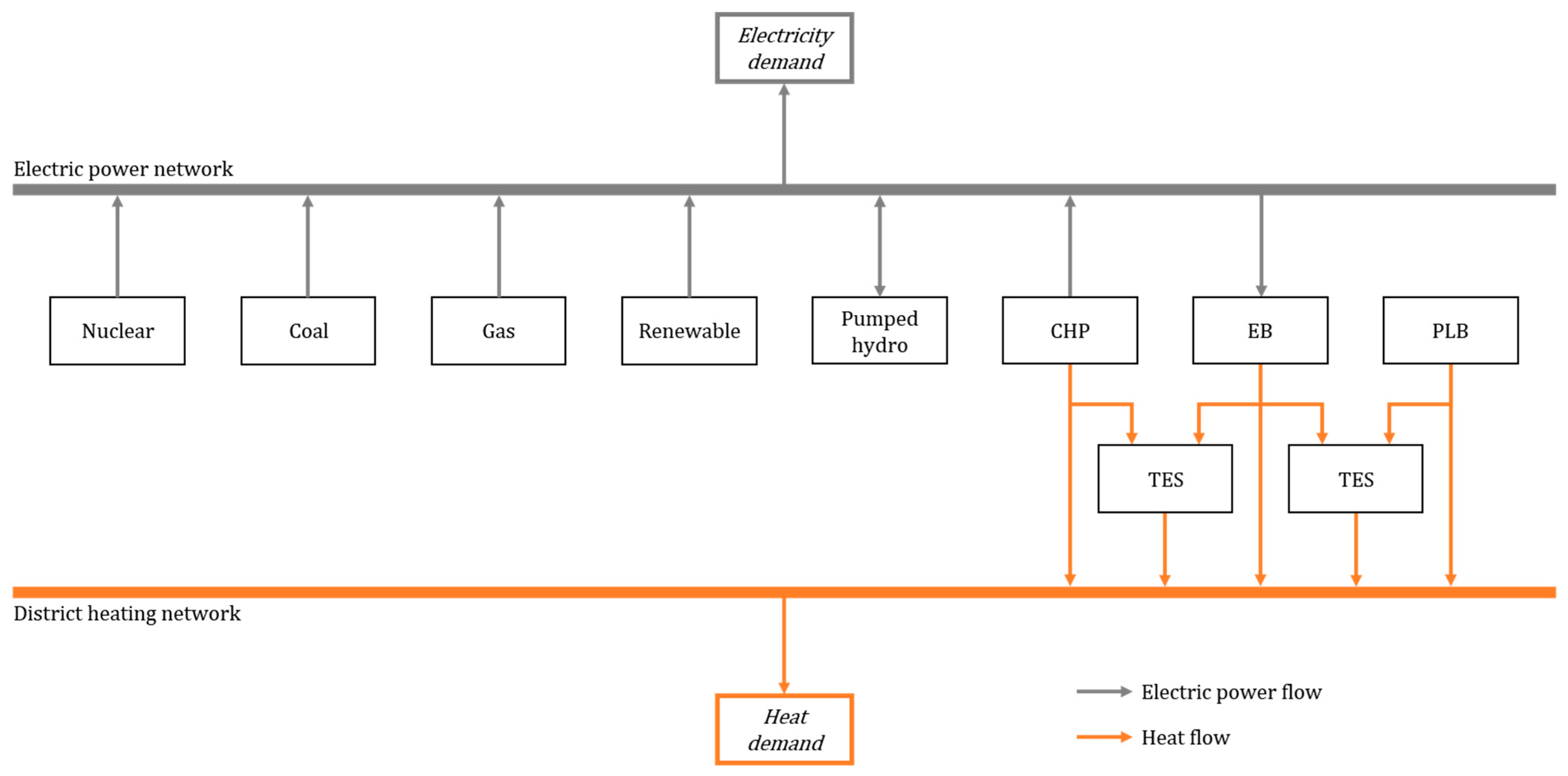
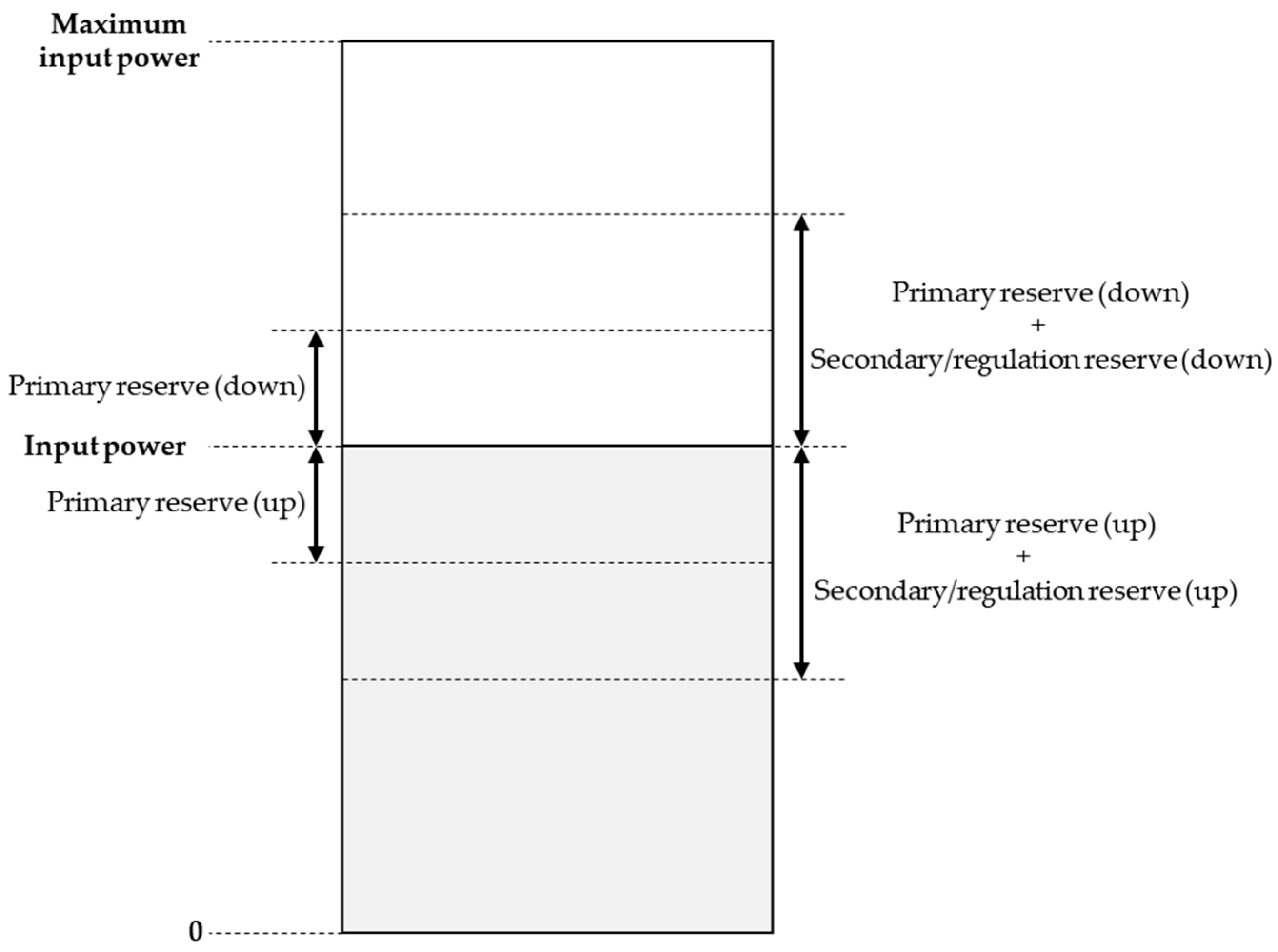
- We develop an MIP based RCUC model that co-optimizes the power and DH sectors and enables EB provision of upward and downward primary and secondary regulation reserves, thereby assessing the power system level impacts of P2H based reserve provision.
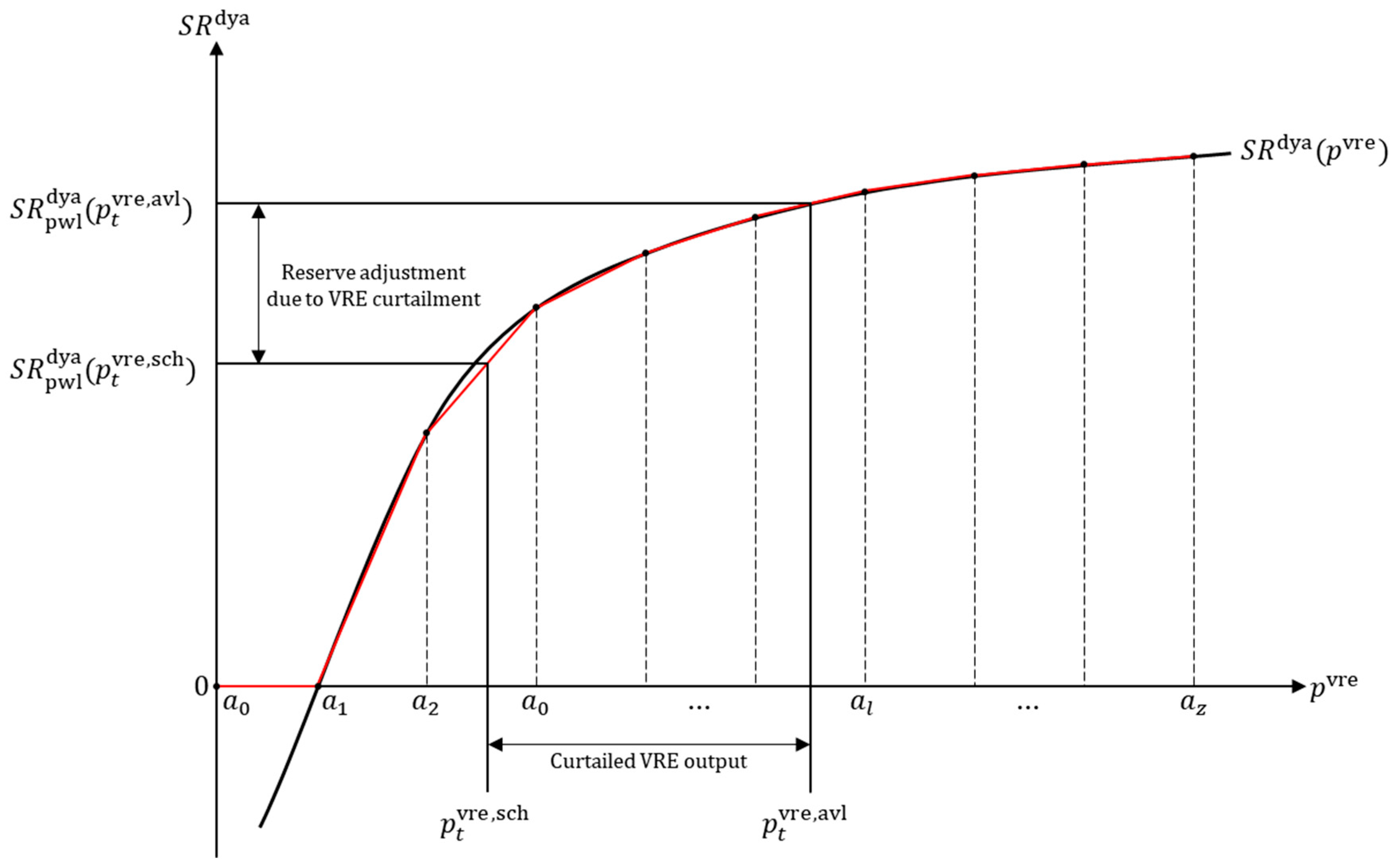
- We model the dynamic component of the reserve requirement using output-dependent short-term VRE variability derived from weather-based generation profiles and integrate it endogenously into the RCUC framework.
- Using Korea relevant data for a 2030 case study, we evaluate the system wide impacts of EB operation under alternative reserve participation configurations.
2. System Description
2.1. Combined and Hear Power Plant
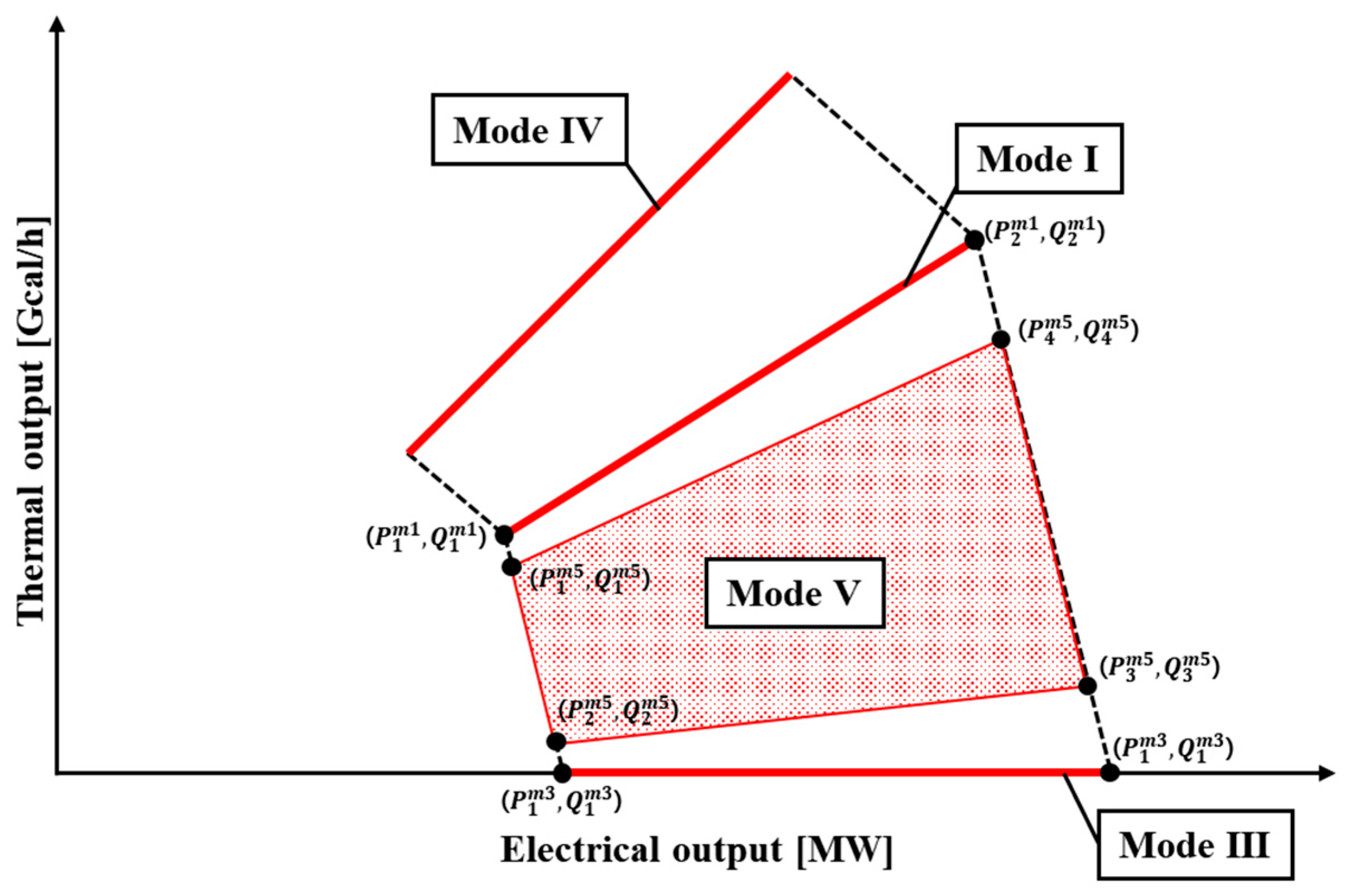
- Mode I (Heat-match mode): Operated primarily to supply heat, while also producing electricity. In this mode, the gas turbine (GT), heat recovery steam generator (HRSG), the high-pressure steam turbine, and the district heating network are in service. This mode generally offers the highest fuel efficiency.
- Mode II (GT-only, emergency power mode): An emergency mode to supply electricity rapidly by operating only the GT. No heat is produced.
- Mode III (Electricity-match mode): Operated mainly to supply electricity with no heat delivery. The GT, HRSG, high-pressure and low-pressure steam turbines, and the condenser are in service.
- Mode IV (Emergency heat-led mode): An emergency mode to prioritize heat supply. The GT and HRSG are in service to deliver heat to DH; the GT also produces electricity.
- Mode V (Mixed-match mode): An intermediate mode between Modes I and III that supplies both heat and electricity; the heat–power split is varied by adjusting the steam admitted to the LP steam turbine. Its efficiency is lower than in Mode I.
2.2. Electric Boiler and Thermal Energy Storage
3. Reserve Requirement Considering Variable Renewable Energy
4. Formulations
4.1. Objective Function
4.2. Constraints Considering P2H Technology
4.2.1. Electric Power and Heat Balance Constraints
4.2.2. Variable Renewable Energy Constraints
4.2.3. Combined Heat and Power Plant Constraints
4.2.4. Peak Load Boiler Constraints
4.2.5. Electric Boiler Constraints Considering Spinning Reserve
4.2.6. Thermal Energy Storage Constraints
4.2.7. Spinning Reserve Requirement Constraints
5. Simulation
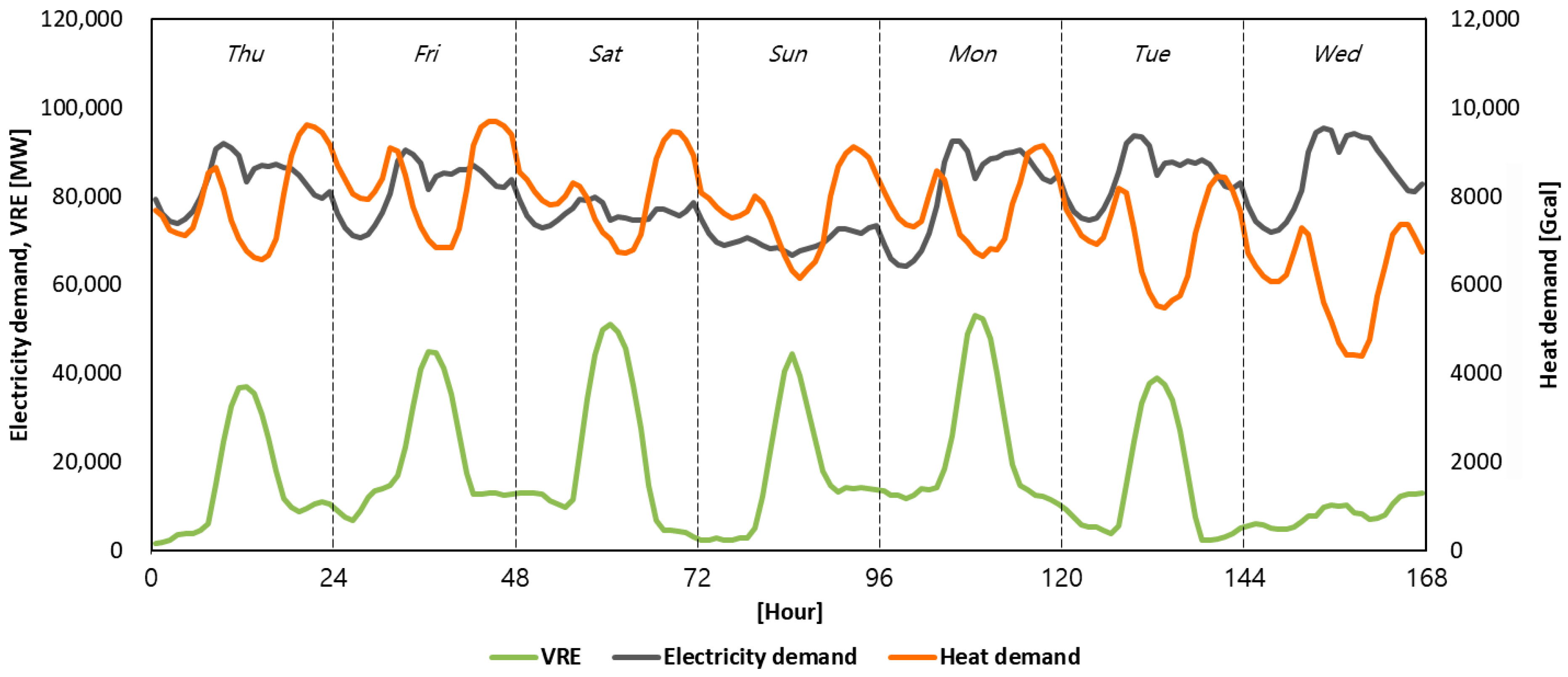
5.1. Scenarios and Input Data
- Nuclear units: Because operational flexibility is limited for safety reasons, online nuclear units are operated at rated output for all 168 h and are assumed not to provide operating reserves. This assumption is intended to represent normal scheduling conditions in the Korean power system.
- CHP units: In modes that produce electricity and heat simultaneously (Modes I and V), equipment characteristics limit rapid and wide adjustments of electric power output. Accordingly, CHP units provide primary reserve only in these cogeneration modes and do not provide secondary/regulation reserve.
- VRE: For each hour, the available output is determined by wind speed and solar irradiance. At the scheduling stage, the output may be scheduled below the available level (planned curtailment), but we assume VRE units lack real time output control. Therefore, they do not provide operating reserves.
5.2. Simulation Results
5.3. Discussion
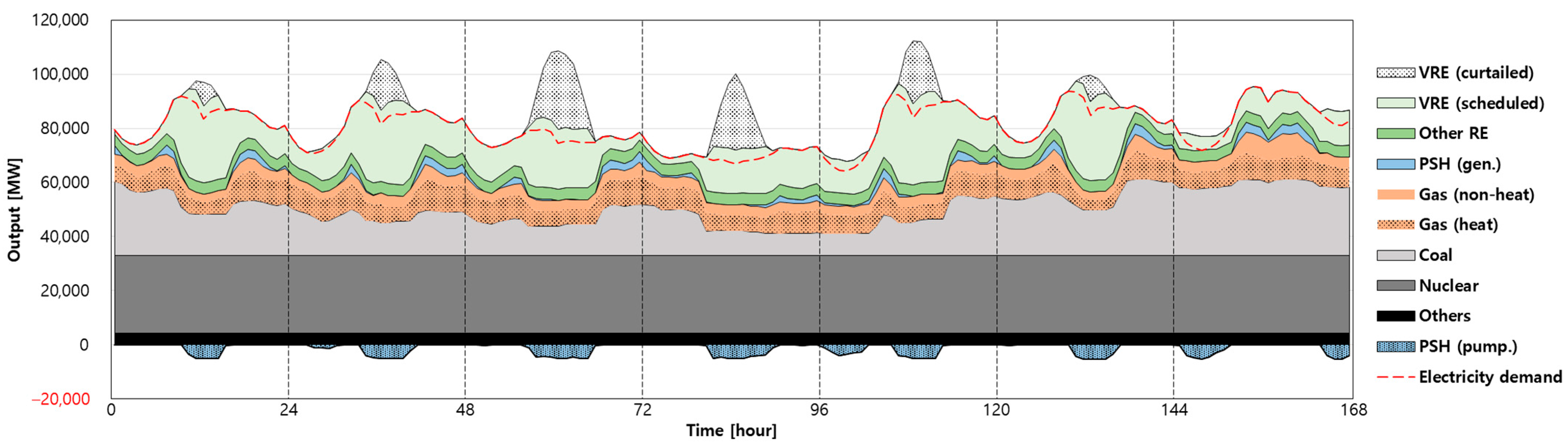
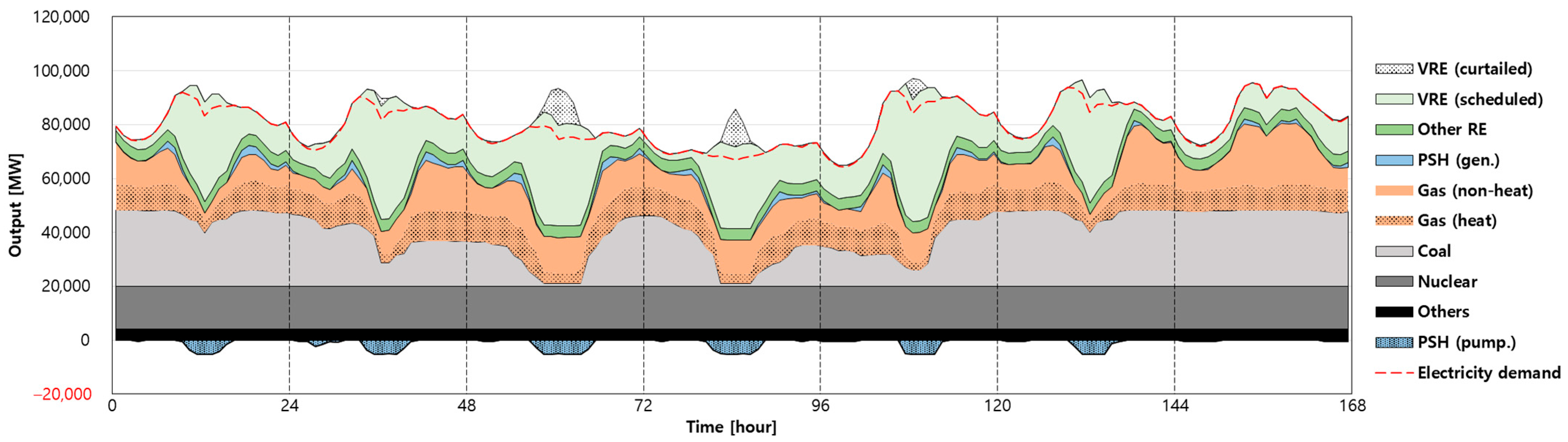
- During low net load hours, when VRE output is high, the EB increases load and mitigates the duck curve.
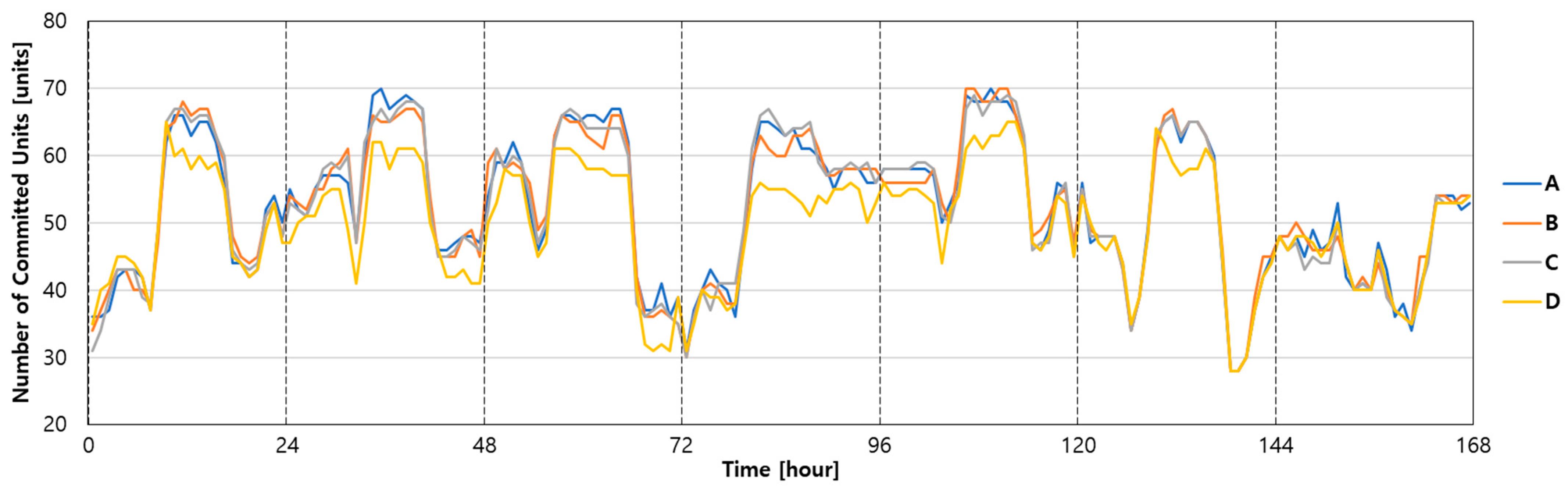
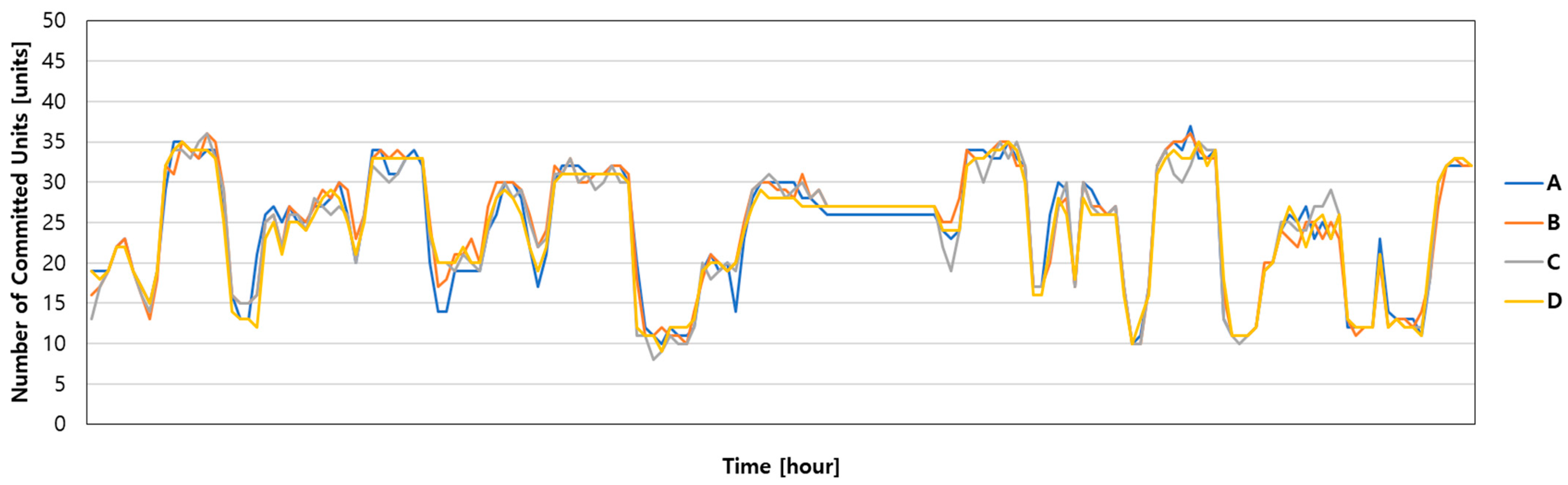
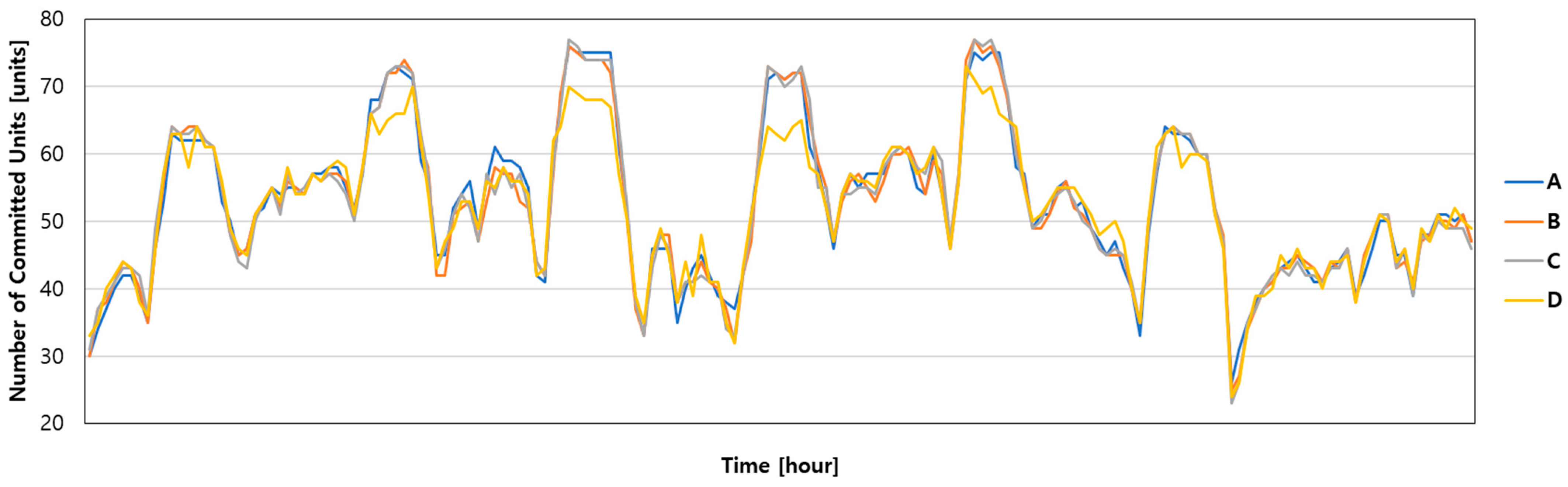
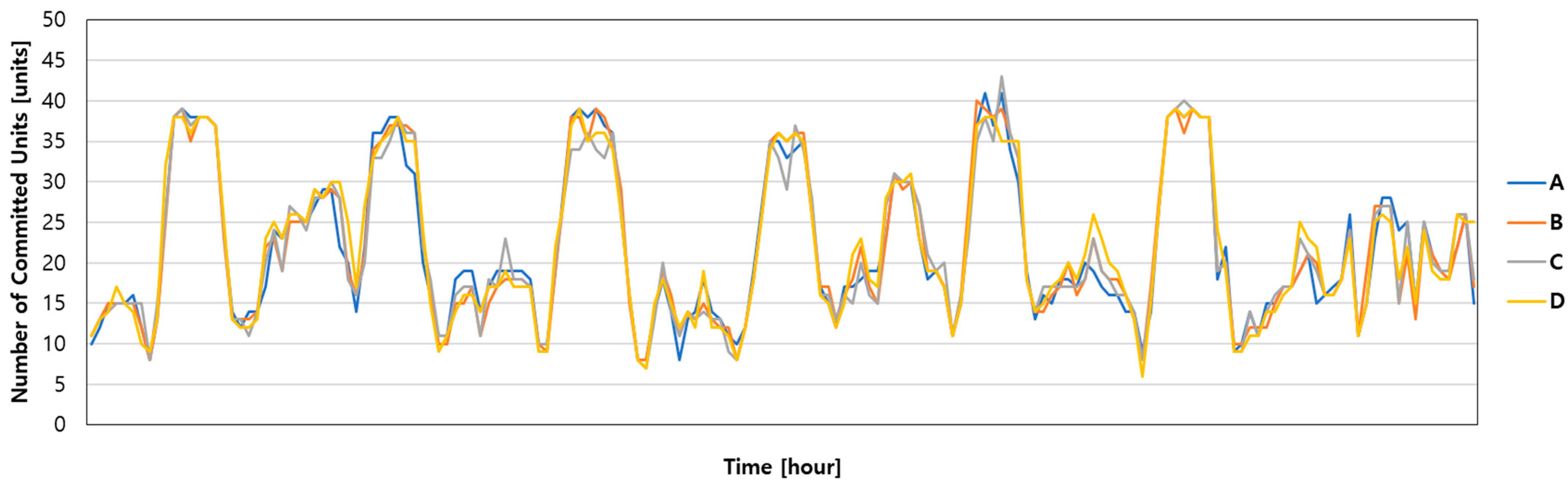
- By providing operating reserves, the EB reduces the number of coal and gas units that need to be committed to meet reserve requirements.
- Downward reserve provided by the EB reduces the need for other generators to operate above their technical minimum to procure downward reserve, thereby mitigating the increase in their effective minimum output.
6. Conclusions
- Conducting a comparative analysis based on Korea’s actual 2030 power system, which features high shares of inflexible baseload generation and VRE;
- Specifying operating-reserve requirements whose dynamic component is represented by a pre-estimated nonlinear variability function derived from weather-based generation profiles and evaluated at the scheduled VRE output; and
- Classifying the operating-reserve products that P2H can provide into primary reserve and secondary/regulation reserve.
- Under the KRW 1000/kWh curtailment-penalty case, Scenario B reduces the operating cost by KRW 5.35 billion compared to Scenario A on a cost basis excluding the curtailment-penalty term. Compared to Scenario B, operating costs in Scenarios C, D, and E decrease by an additional KRW 2.10, 17.61, and 18.41 billion, respectively. Under the KRW 0/kWh case, the corresponding cost reductions are smaller, but the qualitative trend remains the same.
- By providing operating reserves, the EB reduces the commitment of generators that would otherwise need to remain online solely to satisfy operating reserve requirements.
- By providing downward reserve, the EB reduces the need for other units to be dispatched above their technical minimum to meet downward reserve requirements, thereby mitigating increases in their effective minimum output.
Supplementary Materials
Author Contributions
Funding
Data Availability Statement
Conflicts of Interest
Nomenclature
- Sets and indices
| GU | Set of all generating units |
| CU | Set of CHP generating units, CU ⊂ GU |
| PP | Set of PSH plants, PP ⊂ GU |
| TS | Set of TES units |
| EB | Set of P2H units |
| PB | Set of PLB units |
| T | Operation period, index by t |
| i | Index for generating unit, i ∈ CU or GU |
| j | Index for TES unit, j ∈ TS |
| m | Index for P2H unit, m ∈ EB |
| n | Index for PLB unit, n ∈ PB |
| t | Index for time interval, t = 1, ..., T |
| w | Vertex index. In Modes 1 and 3, w ∈ {1, 2}. In Mode 5, w ∈ {1, 2, 3, 4} |
| l | Segment index, l = 0, 1, …, z − 1. |
| Slope of segment l. | |
| z | Number of PWL segments. |
| M | Big-M constant used in the PWL constraints, MW |
- Parameters and functions
| Fuel cost function of generating unit i at time t. | |
| Fuel cost function of PLB unit n at time t. | |
| Standard deviation of 1 min VRE output variability as a function of VRE output level, MW. | |
| Standard deviation of 5 min VRE output variability as a function of VRE output level, MW. | |
| Dynamic component of the reserve requirement as a function of VRE output, MW. | |
| MW. | |
| PWL dynamic component of upward primary reserve requirement as a function of scheduled VRE at time t, MW. | |
| PWL dynamic component of downward primary reserve requirement as a function of scheduled VRE at time t, MW. | |
| PWL dynamic component of upward secondary/regulation reserve requirement as a function of scheduled VRE at time t, MW. | |
| PWL dynamic component of downward secondary/regulation reserve requirement as a function of scheduled VRE at time t, MW. | |
| Startup cost of unit i, KRW. | |
| System electricity demand at time t, MW. | |
| System heat demand at time t, Gcal/h. | |
| Penalty cost for VRE curtailment, KRW/kWh. | |
| Charging efficiency of TES unit j, %. | |
| Discharging efficiency of TES unit j, %. | |
| Energy-conversion efficiency of EB, % | |
| Electric-to-heat unit-conversion coefficient. | |
| Standing heat-loss factor of TES j, %. | |
| n-sigma multiplier for 1 min VRE output variability. | |
| n-sigma multiplier for 5 min VRE output variability. | |
| Electric power at vertex w for CHP unit i in Mode 1, MW. | |
| Electric power at vertex w for CHP unit i in Mode 3, MW. | |
| Electric power at vertex w for CHP unit i in Mode 5, MW. | |
| Heat at vertex w for CHP unit i in Mode 1, Gcal/h. | |
| Heat at vertex w for CHP unit i in Mode 3, Gcal/h. | |
| Heat at vertex w for CHP unit i in Mode 5, Gcal/h. | |
| Upward ramping rate of CHP unit i, MW/minute. | |
| Downward ramping rate of CHP unit i, MW/minute. | |
| Minimum up-time of CHP unit i, hour. | |
| Minimum down-time of CHP unit i, hour. | |
| Maximum heat output of PLB unit n at time t, Gcal/h | |
| Minimum heat output of PLB unit n at time t, Gcal/h | |
| Maximum charging power of TES unit j at time t, Gcal/h | |
| Maximum discharging power of TES unit j at time t, Gcal/h | |
| Maximum electric power input of EB unit m at time t, MW. | |
| Minimum electric power input of EB unit m at time t, MW. | |
| Energy capacity of TES unit, Gcal. | |
| Maximum upward primary reserve of CHP unit i in Mode 1, MW. | |
| Maximum upward primary reserve of CHP unit i in Mode 3, MW. | |
| Maximum upward primary reserve of CHP unit i in Mode 5, MW. | |
| Maximum upward primary reserve of EB unit m, MW. | |
| Maximum downward primary reserve of CHP unit i in Mode 1, MW. | |
| Maximum downward primary reserve of CHP unit i in Mode 3, MW. | |
| Maximum downward primary reserve of CHP unit i in Mode 5, MW. | |
| Maximum downward primary reserve of EB unit m, MW. | |
| Maximum upward secondary/regulation reserve of CHP unit i in Mode 1, MW. | |
| Maximum upward secondary/regulation reserve of CHP unit i in Mode 3, MW. | |
| Maximum upward secondary/regulation reserve of CHP unit i in Mode 5, MW. | |
| Maximum upward secondary/regulation reserve of EB unit m, MW. | |
| Maximum downward secondary/regulation reserve of CHP unit i in Mode 1, MW. | |
| Maximum downward secondary/regulation reserve of CHP unit i in Mode 3, MW. | |
| Maximum downward secondary/regulation reserve of CHP unit i in Mode 5, MW. | |
| Maximum downward secondary and regulation reserve of EB unit m, MW. | |
| Static component of upward primary reserve requirement, MW. | |
| Static component of downward primary reserve requirement, MW. | |
| Static component of upward secondary/regulation reserve requirement, MW. | |
| Static component of downward secondary/regulation reserve requirement, MW. |
- Variables
| Segment activation indicator at time t. 1if active, else 0. | |
| Start-up indicator for unit i at time t. 1 if start-up between t − 1 and t, else 0. | |
| Shutdown indicator for unit i at time t. 1 if shutdown between t − 1 and t, else 0. | |
| Commitment status of unit i at time t. 1 if on at time t, otherwise 0. | |
| Mode 1 indicator for CHP unit i at time t. 1 if operating in Mode 1 at time t, else 0. | |
| Mode 3 indicator for CHP unit i at time t. 1 if operating in Mode 1 at time t, else 0. | |
| Mode 5 indicator for CHP unit i at time t. 1 if operating in Mode 1 at time t, else 0. | |
| Weight for vertex w of the Mode 1 for unit i at time t. | |
| Weight for vertex w of the Mode 3 for unit i at time t. | |
| Weight for vertex w of the Mode 5 for unit i at time t. | |
| Charging indicator for TES unit j at time t. 1 if charging at time t, else 0. | |
| Discharging indicator for TES unit j at time t. 1 if discharging at time t, else 0. | |
| Electric power output of unit i at time t, MW. | |
| Scheduled VRE power at time t, MW. | |
| Available VRE power at time t, MW. | |
| VRE curtailment at time t, MW. | |
| Pumping input of PSH unit i at time t, MW. | |
| Electric power input of EB unit m at time t, MW. | |
| Heat output of CHP unit i at time t, Gcal/h. | |
| Heat charged to TES unit j at time t, Gcal/h. | |
| Heat discharged from TES unit j at time t, Gcal/h. | |
| Heat output of EB unit m at time t, Gcal/h. | |
| Heat output of PLB unit n at time t, Gcal/h. | |
| Thermal energy stored in TES unit j at time t, Gcal. | |
| Upward primary reserve of CHP unit i at time t, MW. | |
| Upward primary reserve of PSH unit i at time t, MW. | |
| Upward primary reserve of EB unit m at time t, MW. | |
| Downward primary reserve of CHP unit i at time t, MW. | |
| Downward primary reserve of PSH unit i at time t, MW. | |
| Downward primary reserve of EB unit m at time t, MW. | |
| Upward secondary/regulation reserve of CHP unit i at time t, MW. | |
| Upward secondary/regulation reserve of PSH unit i at time t, MW. | |
| Upward secondary/regulation reserve of EB unit m at time t, MW. | |
| Downward secondary/regulation reserve of CHP unit i at time t, MW. | |
| Downward secondary/regulation reserve of PSH unit i at time t, MW. | |
| Downward secondary/regulation reserve of EB unit m at time t, MW. | |
| Upward primary reserve requirement at time t, MW. | |
| Downward primary reserve requirement at time t, MW. | |
| Upward secondary and regulation reserve requirement at time t, MW. | |
| Downward secondary and regulation reserve requirement at time t, MW. |
References
- Ministry of Trade, Industry and Energy (MOTIE). 11th Basic Plan for Electricity Supply and Demand; MOTIE: Sejong, Republic of Korea, 2025.
- ENTSO-E. Study on Power and Heat Sectors: Interactions and Synergies; ENTSO-E Aisbl: Brussels, Belgium, 2023; Available online: https://eepublicdownloads.blob.core.windows.net/public-cdn-container/clean-documents/Publications/Position%20papers%20and%20reports/2023/entso-e_integration_power2heat_230130.pdf (accessed on 4 February 2026).
- Iov, F.; Khatibi, M.; Bendtsen, J.D. On the Participation of Power-To-Heat Assets in Frequency Regulation Markets—A Danish Case Study. Energies 2020, 13, 4608. [Google Scholar] [CrossRef]
- Sihvonen, V.; Ollila, I.; Jaanto, J.; Grönman, A.; Honkapuro, S.; Riikonen, J.; Price, A. Role of Power-to-Heat and Thermal Energy Storage in Decarbonization of District Heating. Energy 2024, 305, 132372. [Google Scholar] [CrossRef]
- Kirkerud, J.G.; Trømborg, E.; Bolkesjø, T.F. Impacts of Electricity Grid Tariffs on Flexible Use of Electricity to Heat Generation. Energy 2016, 115, 1679–1687. [Google Scholar] [CrossRef]
- Nielsen, M.G.; Morales, J.M.; Zugno, M.; Pedersen, T.E.; Madsen, H. Economic Valuation of Heat Pumps and Electric Boilers in the Danish Energy System. Appl. Energy 2016, 167, 189–200. [Google Scholar] [CrossRef]
- Dimoulkas, I.; Amelin, M.; Levihn, F. District Heating System Operation in Power Systems with High Share of Wind Power. J. Mod. Power Syst. Clean Energy 2017, 5, 850–862. [Google Scholar] [CrossRef]
- Trømborg, E.; Havskjold, M.; Bolkesjø, T.F.; Kirkerud, J.G.; Tveten, Å.G. Flexible Use of Electricity in Heat-Only District Heating Plants. Int. J. Sustain. Energy Plan. Manag. 2017, 12, 29–46. [Google Scholar] [CrossRef]
- Kontu, K.; Rinne, S.; Junnila, S. Introducing Modern Heat Pumps to Existing District Heating Systems—Global Lessons from Viable Decarbonizing of District Heating in Finland. Energy 2019, 166, 862–870. [Google Scholar] [CrossRef]
- Sinha, R.; Bak-Jensen, B.; Radhakrishna Pillai, J.; Zareipour, H. Flexibility from Electric Boiler and Thermal Storage for Multi Energy System Interaction. Energies 2020, 13, 98. [Google Scholar] [CrossRef]
- Liu, B.; Li, J.; Zhang, S.; Gao, M.; Ma, H.; Li, G.; Gu, C. Economic Dispatch of Combined Heat and Power Energy Systems Using Electric Boiler to Accommodate Wind Power. IEEE Access 2020, 8, 41288–41297. [Google Scholar] [CrossRef]
- Yan, R.; Wang, J.; Huo, S.; Zhang, J.; Tang, S.; Yang, M. Comparative Study for Four Technologies on Flexibility Improvement and Renewable Energy Accommodation of Combined Heat and Power System. Energy 2023, 263, 126056. [Google Scholar] [CrossRef]
- Zhang, L.; Ma, C.; Wang, L.; Wang, X. Theoretical Analysis and Economic Evaluation of Wind Power Consumption by Electric Boiler and Heat Storage Tank for Distributed Heat Supply System. Electr. Power Syst. Res. 2024, 228, 110060. [Google Scholar] [CrossRef]
- Kim, D.-N.; Lee, J.-W.; Son, S.-Y. Feasibility of Grid Flexibility Provision Using Heat Pump Water Heaters Under Midnight Power Services: A Case of South Korea. IEEE Access 2025, 13, 80695–80704. [Google Scholar] [CrossRef]
- Böttger, D.; Götz, M.; Theofilidi, M.; Bruckner, T. Control Power Provision with Power-to-Heat Plants in Systems with High Shares of Renewable Energy Sources—An Illustrative Analysis for Germany Based on the Use of Electric Boilers in District Heating Grids. Energy 2015, 82, 157–167. [Google Scholar] [CrossRef]
- Romero Rodríguez, L.; Brennenstuhl, M.; Yadack, M.; Boch, P.; Eicker, U. Heuristic Optimization of Clusters of Heat Pumps: A Simulation and Case Study of Residential Frequency Reserve. Appl. Energy 2019, 233–234, 943–958. [Google Scholar] [CrossRef]
- Melo, S.P.; Brand, U.; Vogt, T.; Telle, J.S.; Schuldt, F.; Maydell, K.V. Primary Frequency Control Provided by Hybrid Battery Storage and Power-to-Heat System. Appl. Energy 2019, 233–234, 220–231. [Google Scholar] [CrossRef]
- Tan, J.; Wu, Q.; Hu, Q.; Wei, W.; Liu, F. Adaptive Robust Energy and Reserve Co-Optimization of Integrated Electricity and Heating System Considering Wind Uncertainty. Appl. Energy 2020, 260, 114230. [Google Scholar] [CrossRef]
- Monie, S.W.; Hesamzadeh, M.R.; Åberg, M. Power-to-Heat on the Reserve Capacity Market—Policy Implications Considering Economic Constraints and Competing Heat Production. J. Renew. Sustain. Energy 2022, 14, 055901. [Google Scholar] [CrossRef]
- Javanshir, N.; Syri, S.; Tervo, S.; Rosin, A. Operation of District Heat Network in Electricity and Balancing Markets with the Power-to-Heat Sector Coupling. Energy 2023, 266, 126423. [Google Scholar] [CrossRef]
- Magni, C.; Quoilin, S.; Arteconi, A. Evaluating the Potential Contribution of District Heating to the Flexibility of the Future Italian Power System. Energies 2022, 15, 584. [Google Scholar] [CrossRef]
- Jin, T. Estimating the Potential of Power-to-Heat (P2H) in 2050 Energy System for the Net-Zero of South Korea. Energy 2025, 314, 134206. [Google Scholar] [CrossRef]
- Holttinen, H.; Milligan, M.; Kirby, B.; Acker, T.; Neimane, V.; Molinski, T. Using Standard Deviation as a Measure of Increased Operational Reserve Requirement for Wind Power. Wind Eng. 2008, 32, 355–377. [Google Scholar] [CrossRef]
- Kim, M.-J.; Song, H.-Y.; Park, J.-B.; Roh, J.-H. Optimization of CHP and Thermal Storage under Heat Demand. In Proceedings of the 2016 12th IEEE International Conference on Control and Automation (ICCA), Kathmandu, Nepal, 1–3 June 2016; pp. 277–281. [Google Scholar] [CrossRef]
- Song, H.-Y.; Lee, D.-H.; Roh, J.-H.; Park, J.-B.; Park, Y.-G. Optimal Operation Strategy of Large-Scale CHP in District Heating System. J. Electr. Eng. Technol. 2024, 19, 2843–2858. [Google Scholar] [CrossRef]
- Korea Power Exchange (KPX). Power Market Operating Rules (Effective 2 October 2025). Available online: https://www.kpx.or.kr/boardDownload.es?bid=0030&list_no=76043&seq=4 (accessed on 5 February 2026).
- Kim, W.-J.; Lee, Y.-S.; Chun, Y.-H.; Jeong, H.-S. Reserve-Constrained Unit Commitment Considering Adjustable-Speed Pumped-Storage Hydropower and Its Economic Effect in Korean Power System. Energies 2022, 15, 2386. [Google Scholar] [CrossRef]
- Padberg, M. Approximating Separable Nonlinear Functions via Mixed Zero-One Programs. Oper. Res. Lett. 2000, 27, 1–5. [Google Scholar] [CrossRef]
- Croxton, K.L.; Gendron, B.; Magnanti, T.L. A Comparison of Mixed-Integer Programming Models for Nonconvex Piecewise Linear Cost Minimization Problems. Manag. Sci. 2003, 49, 1268–1273. [Google Scholar] [CrossRef]
- Vielma, J.P. Mixed Integer Linear Programming Formulation Techniques. SIAM Rev. 2015, 57, 3–57. [Google Scholar] [CrossRef]
- Lin, M.-H.; Carlsson, J.G.; Ge, D.; Shi, J.; Tsai, J.-F. A Review of Piecewise Linearization Methods. Math. Probl. Eng. 2013, 2013, 101376. [Google Scholar] [CrossRef]
- Dantzig, G.B. Linear Programming and Extensions; Princeton University Press: Princeton, NJ, USA, 1963. [Google Scholar]



| Ref. | P2H Resource | Reserve Product(s) | Clarity of Product Specification | Limitation |
|---|---|---|---|---|
| [15] | EB and TES | aFRR-down | Clear | Did not evaluate primary reserve |
| [16] | Residential HP clusters | FRR market | Partially clear | FRR is mentioned, but the specific product is not further disaggregated; primary reserve was not considered |
| [17] | EB | PCR (=FCR) | Clear | Did not evaluate secondary reserve (aFRR) |
| [3] | EB and HP | FCR, aFRR, mFRR | Very clear | Focused on technical prequalification and performance rather than system-level scheduling or cost assessment |
| [18] | EB | upward/downward reserve | Insufficiently specified | Did not sufficiently represent upward/downward reserve product differentiation |
| [19] | HP and TES | Reserve market participation | Insufficiently specified | Did not disaggregate reserve services by type and Analyzed from the DH-system perspective |
| [20] | EB, HP and TES | FCR, FRR, aFRR | Clear | Analyzed from the DH-system perspective |
| [4] | EB, HP and TES | aFRR-down, FCR-N | Clear | Analyzed from the DH-system perspective |
| Reserve Type | Requirement | Activated by | Secured for | ||
|---|---|---|---|---|---|
| Upward | Regulation reserve | 700 MW | AGC | Short-term load variation | |
| Frequency restoration reserve | Primary | 1000 MW | Governor, ESS | Largest unit loss | |
| Secondary | 1400 MW | AGC | |||
| Tertiary | 1400 MW | Manual | Reserve restoration | ||
| Downward | Operating reserve | 2000 MW | AGC, Manual, etc. | Over-generation, Renewable energy surplus | |
| Regulation reserve | 1200 MW | AGC, Remote set-point | |||
| Reserve Type | Current Requirement | Proposed Requirement | |
|---|---|---|---|
| Upward | Primary | 1000 MW | |
| Secondary | 1400 MW | ||
| Regulation reserve | 700 MW | ||
| Downward | Regulation reserve | 1200 MW | |
| Reserve Type | Proposed Requirement | ||
|---|---|---|---|
| Static Component | Dynamic Component | ||
| Upward | Primary | 1000 MW | |
| Secondary/Regulation | 2100 MW | ||
| Downward | Regulation reserve | 1200 MW | |
| Scenario | Electric Boiler | ||
|---|---|---|---|
| Capacity | Primary Reserve | Secondary Reserve | |
| A | 0 MW | - | - |
| B | 1000 MW | 0% | 0% |
| C | 1000 MW | 0% | 20% |
| D | 1000 MW | 20% | 0% |
| E | 1000 MW | 20% | 20% |
| Technology | |||
|---|---|---|---|
| EB | PLB | TES | |
| Parameters | |||
| Fuel Type | Scenario | ||||
|---|---|---|---|---|---|
| A | B | C | D | E | |
| Nuclear | 28.30 | 28.30 | 28.30 | 28.30 | 28.30 |
| Coal | 158.12 | 160.44 | 158.16 | 157.94 | 156.60 |
| Gas (heat) | 117.28 | 114.23 | 115.04 | 113.88 | 115.05 |
| Gas (non-heat) | 54.56 | 54.66 | 55.60 | 54.06 | 53.85 |
| Total (excl. Penalty cost) | 358.26 | 357.63 | 357.11 | 354.18 | 353.80 |
| Penalty cost | 0.00 | 0.00 | 0.00 | 0.00 | 0.00 |
| Total (incl. Penalty cost) | 358.26 | 357.63 | 357.11 | 354.18 | 353.80 |
| Fuel Type | Scenario | ||||
|---|---|---|---|---|---|
| A | B | C | D | E | |
| Nuclear | 15.11 | 15.37 | 15.52 | 16.90 | 16.90 |
| Coal | 186.74 | 186.61 | 187.42 | 183.55 | 183.53 |
| Gas (heat) | 133.77 | 130.61 | 130.91 | 130.28 | 129.82 |
| Gas (non-heat) | 152.79 | 150.48 | 147.11 | 134.73 | 134.42 |
| Total (excl. Penalty cost) | 488.42 | 483.07 | 480.97 | 465.46 | 464.66 |
| Penalty cost | 91.10 | 82.95 | 84.98 | 82.67 | 82.57 |
| Total (incl. Penalty cost) | 579.51 | 566.02 | 565.95 | 548.14 | 547.23 |
| Fuel Type | Scenario | ||||
|---|---|---|---|---|---|
| A | B | C | D | E | |
| Nuclear | 4,846,800 | 4,846,800 | 4,846,800 | 4,846,800 | 4,846,800 |
| Coal | 2,932,363 | 2,977,847 | 2,936,619 | 2,937,050 | 2,912,060 |
| Gas (heat) | 1,280,978 | 1,248,883 | 1,258,151 | 1,252,531 | 1,264,507 |
| Gas (non-heat) | 670,498 | 671,720 | 679,789 | 667,656 | 664,301 |
| PSH | 199,456 | 191,590 | 195,836 | 190,626 | 194,633 |
| VRE (scheduled) | 2,382,048 | 2,408,064 | 2,423,187 | 2,453,880 | 2,458,862 |
| Other RE | 710,965 | 710,965 | 710,965 | 710,965 | 710,965 |
| Others | 717,222 | 717,222 | 717,222 | 717,222 | 717,222 |
| Total | 13,740,330 | 13,773,092 | 13,768,568 | 13,776,730 | 13,769,351 |
| VRE (available) | 2,828,135 | 2,828,135 | 2,828,135 | 2,828,135 | 2,828,135 |
| VRE (curtailed) | 446,087 | 420,071 | 404,948 | 374,255 | 369,273 |
| Fuel Type | Scenario | ||||
|---|---|---|---|---|---|
| A | B | C | D | E | |
| Nuclear | 2,662,800 | 2,713,200 | 2,738,400 | 2,973,600 | 2,973,600 |
| Coal | 3,393,299 | 3,390,045 | 3,407,372 | 3,328,459 | 3,327,844 |
| Gas (heat) | 1,462,186 | 1,449,404 | 1,446,520 | 1,434,192 | 1,435,768 |
| Gas (non-heat) | 1,842,355 | 1,816,502 | 1,776,448 | 1,634,653 | 1,630,727 |
| PSH | 149,219 | 155,453 | 154,578 | 164,110 | 164,980 |
| VRE (scheduled) | 2,737,037 | 2,745,184 | 2,743,150 | 2,745,462 | 2,745,568 |
| Other RE | 710,965 | 710,965 | 710,965 | 710,965 | 710,965 |
| Others | 717,222 | 717,222 | 717,222 | 717,222 | 717,222 |
| Total | 13,675,085 | 13,697,975 | 13,694,655 | 13,708,664 | 13,706,675 |
| VRE (available) | 2,828,135 | 2,828,135 | 2,828,135 | 2,828,135 | 2,828,135 |
| VRE (curtailed) | 91,097 | 82,951 | 84,985 | 82,673 | 82,567 |
Disclaimer/Publisher’s Note: The statements, opinions and data contained in all publications are solely those of the individual author(s) and contributor(s) and not of MDPI and/or the editor(s). MDPI and/or the editor(s) disclaim responsibility for any injury to people or property resulting from any ideas, methods, instructions or products referred to in the content. |
© 2026 by the authors. Licensee MDPI, Basel, Switzerland. This article is an open access article distributed under the terms and conditions of the Creative Commons Attribution (CC BY) license.
Share and Cite
Lee, Y.-S.; Kim, W.-J.; Jeong, S.-H.; Chun, Y.-H. Integration of Grid-Scaled Power-to-Heat Technology in Korea’s Power System: Operational Advantages and Future Insights for Renewable Energy Enhancement. Energies 2026, 19, 1766. https://doi.org/10.3390/en19071766
Lee Y-S, Kim W-J, Jeong S-H, Chun Y-H. Integration of Grid-Scaled Power-to-Heat Technology in Korea’s Power System: Operational Advantages and Future Insights for Renewable Energy Enhancement. Energies. 2026; 19(7):1766. https://doi.org/10.3390/en19071766
Chicago/Turabian StyleLee, Yu-Seok, Woo-Jung Kim, Seung-Hoon Jeong, and Yeong-Han Chun. 2026. "Integration of Grid-Scaled Power-to-Heat Technology in Korea’s Power System: Operational Advantages and Future Insights for Renewable Energy Enhancement" Energies 19, no. 7: 1766. https://doi.org/10.3390/en19071766
APA StyleLee, Y.-S., Kim, W.-J., Jeong, S.-H., & Chun, Y.-H. (2026). Integration of Grid-Scaled Power-to-Heat Technology in Korea’s Power System: Operational Advantages and Future Insights for Renewable Energy Enhancement. Energies, 19(7), 1766. https://doi.org/10.3390/en19071766