Article

Coordinated Voltage and Power Factor Optimization in EV- and DER-Integrated Distribution Systems Using an Adaptive Rolling Horizon Approach


1
School of Electrical Engineering, Kookmin University, 77 Jeongneung-ro, Seongbuk-gu, Seoul 02707, Republic of Korea
2
Lawrence Livermore National Laboratory, 7000 East Ave, Livermore, CA 94500, USA
*
Author to whom correspondence should be addressed.
Energies 2025, 18(23), 6357; https://doi.org/10.3390/en18236357 (registering DOI)
Submission received: 20 October 2025 / Revised: 23 November 2025 / Accepted: 28 November 2025 / Published: 4 December 2025

Abstract

The penetration of distributed energy resources (DERs), such as photovoltaic (PV) generation and electric vehicles (EVs), in distribution systems has been increasing rapidly. At the same time, load demand is rising due to the proliferation of data centers and the growing use of artificial intelligence. These trends have introduced new operational challenges: reverse power flow from PV generation during the day and low-voltage conditions during periods of peak load or when PV output is unavailable. To address these issues, this paper proposes a two-stage adaptive rolling horizon (ARH)-based model predictive control (MPC) framework for coordinated voltage and power factor (PF) control in distribution systems. The proposed framework, designed from the perspective of a distributed energy resource management system (DERMS), integrates EV charging and discharging scheduling with PV- and EV-connected inverter control. In the first stage, the ARH method optimizes EV charging and discharging schedules to regulate voltage levels. In the second stage, optimal power flow analysis is employed to adjust the voltage of distribution lines and the power factor at the substation through reactive power compensation, using PV- and EV-connected inverters. The proposed algorithm aims to maintain stable operation of the distribution system while minimizing PV curtailment by computing optimal control commands based on predicted PV generation, load forecasts, and EV data provided by vehicle owners. Simulation results on the IEEE 37-bus test feeder demonstrate that, under predicted PV and load profiles, the system voltage can be maintained within the normal range of 0.95–1.05 per unit (p.u.), the power factor is improved, and the state-of-charge (SOC) requirements of EV owners are satisfied. These results confirm that the proposed framework enables stable and cooperative operation of the distribution system without the need for additional infrastructure expansion.

1. Introduction

With the recent implementation of decarbonization policies, the penetration rate of photovoltaic (PV) systems in distribution networks has been rapidly increasing [1,2]. The integration of PV generation into distribution systems offers significant environmental benefits; however, it also poses challenges to grid stability because PV is an inherently volatile resource with intermittent output [3,4]. Consequently, reverse power flow often occurs during periods of high PV generation and low daytime demand, while undervoltage conditions tend to arise during evening peak loads or in the absence of PV generation.
Addressing these voltage and power-quality issues has become a critical task in the operation of modern distribution systems [5,6]. Conventional solutions, such as network reinforcement or the installation of additional facilities, are both costly and time-consuming. As an alternative, the non-wired alternative (NWA) approach, which utilizes the distributed energy resources (DERs) for voltage regulation and line congestion management, has attracted considerable attention [7,8] (see Figure 1). This study allows the system to operate reliably and efficiently through EV scheduling and PV- and EV-connected inverter optimal control without the need to upgrade existing lines or build new facilities.
It is challenging for distribution system operators (DSOs) to effectively address the aforementioned operational issues. To manage these complexities, the distributed energy resource management system (DERMS) has recently been introduced as a software platform for systematically monitoring, controlling, and optimizing various DERs and demand response (DR) programs, thereby contributing to the stable operation of distribution systems [9,10,11]. DERMS integrates forecasting and control functions for DERs, such as PV systems, wind turbines, and electric vehicles (EVs). It predicts their output, determines optimal control commands for DR resources and support devices (e.g., PV- and EV-connected inverters), and transmits these commands through a communication network [12,13]. From the DERMS perspective, this study aims to develop an operational strategy that enables stable distribution-system operation without additional infrastructure expansion by leveraging the increasing penetration of PV and EV resources.
In the United States, EV sales reached approximately 1.6 million units in 2024, exceeding a 10% market share and contributing to the overall growth of the automotive industry. Similarly, in China, EV sales rose by 40% year-on-year in 2024, achieving an annual market share of around 50% [14]. With the rapid global adoption of EVs, vehicle-to-grid (V2G) technology, which utilizes EV batteries to store excess grid energy and supply it when needed, has emerged as a promising approach to enhance system flexibility and support grid stability [15,16]. For example, Ref. [17] proposed a real-time strategy that forms time-dependent charge/discharge current patterns for parked plug-in electric vehicles (PEVs) to mitigate the voltage rise caused by rooftop PV generation. Similarly, Ref. [18] developed an adaptive voltage feedback controller for onboard EV chargers that functions without requiring communication links. However, most of these studies consider only the charging/discharging power of connected EVs and overlook the uncertainties associated with EV arrival and departure times, as well as variations in the state-of-charge (SOC) and user behavior.
The IEEE 1547-2018 standard recommends the use of an inverter for DERs, such as PV and EV systems, to provide grid support functions, particularly reactive power compensation for voltage regulation [19]. The effectiveness of such control strategies has been demonstrated in the literature, using local, centralized, and distributed control approaches. In the local control method, for instance, Ref. [20] employed a droop-based Volt–Var controller to regulate the voltage at the point of common coupling (PCC) by performing reactive power compensation based on local voltage levels. In centralized control frameworks, Refs. [21,22] addressed voltage violations through coordinated optimization. Specifically, Ref. [21] formulated a bi-level volt/var optimization (VVO) problem, where the upper level minimizes the active power loss by optimizing the on-load tap changer (OLTC) and capacitor banks (CBs) operations, while the lower level determines the optimal reactive power output of PV- and EV-connected inverters for voltage regulation. To enhance real-time performance, Ref. [22] incorporated a convex second-order cone programming (SOCP)-based optimal power flow (OPF) into the control process, mitigating the computational challenges associated with large-scale centralized OPF models and their limited accuracy under uncertainty. Meanwhile, distributed control methods, such as those in [23,24], have been proposed to reduce reliance on centralized solvers. For example, Ref. [23] performed voltage regulation by computing the reactive power dispatch for each feeder lateral when overvoltage occurred, while Ref. [24] addressed the drawback that reactive power control may degrade substation power factor (PF). The latter developed an algorithm that partitions inverters into two groups—those responsible for voltage regulation and those for power-factor improvement—and executes reactive power compensation in a distributed manner without the need for a centralized optimizer.
Recently, research on the coordinated control of PVs and EVs for the stable operation of distribution systems has been expanding [25,26]. In [25], voltage control of distribution systems was achieved by incorporating the reactive power compensation capability of PV- and EV-connected inverters into the VVO framework. The optimization problem was solved centrally, and the resulting control commands were transmitted to each inverter. Similarly, Ref. [26] proposed a framework that clusters the system into regions and applies model predictive control (MPC) within each cluster to address voltage issues. In this approach, reactive power compensation from PV inverters and the charging/discharging flexibility of EVs were simultaneously utilized for voltage regulation. However, these studies assume deterministic EV models and do not explicitly address real-time uncertainties such as variations in arrival and departure times or changes in SOC.
Research on the optimal power flow method of the distribution system is being actively conducted [27,28]. Ref. [27] developed a two-stage optimal dispatching framework for AC/DC hybrid active distribution systems that exploits network flexibility resources to reduce network loss and increase renewable distributed generators’ (RDG) hosting capacity. However, this paper has not recently implemented the rapidly increasing integration of EVs. Further, Ref. [28] proposed a cloud-edge-device-based cyber-physical-social architecture for multi-operator AC/DC hybrid distribution systems. However, it did not reflect uncertainty in dealing with EVs, and in contrast, this paper introduces an adaptive rolling horizon method to address the uncertainty in EVs.
Ref. [29] introduces an adaptive rolling horizon (ARH) approach that controls EV charging while accounting for EV-related uncertainties. ARH defines an optimization window that extends from the current time step to the final departure time among all EVs that are currently connected. Within this window, optimization is performed at every time step using the available information—such as arrival and departure times and the initial SOC of connected EVs. As new EVs connect or existing ones depart, the window is updated so that its length adapts over time. Consequently, an ARH-based scheduling algorithm can dynamically respond to uncertain EV connection patterns. However, Ref. [29] does not model the power flow and grid constraints of the AC system but uses ARH to minimize the operating cost of the microgrid. Therefore, in this paper, by closely integrating the ARH and AC-OPF models, we extend the ARH framework from the cost-oriented EV scheduling problem to the feeder-level voltage and power factor control problem. Developed from a DERMS perspective, the method integrates EV scheduling and PV- and EV-connected inverter control to mitigate voltage issues while minimizing PV curtailment. In the first stage, the framework determines the optimization window from EV entry and exit times and solves a mixed-integer linear programming (MILP) problem to obtain the optimal EV charging/discharging schedule within that window. In the second stage, a nonlinear programming (NLP)-based AC-OPF computes the optimal reactive power compensation of inverters and PV output limits, using the fixed EV schedule from Stage 1. The resulting EV and inverter control commands are dispatched to each DER in real time, enabling stable and coordinated system operation.
The target system in this study is a low-voltage distribution network: specifically, 4.8 kV feeders that remain widely used in rural areas of the United States. Compared to modern 13.8 kV medium-voltage feeders, these low-voltage lines have limited power transfer capacity and higher line impedance, making voltage regulation more challenging. Although many utilities aim to upgrade such systems to medium voltage, the process requires extensive reconstruction of distribution lines and substations, costing billions of dollars and facing delays due to regulatory procedures and sequential construction timelines [30,31]. Therefore, this study proposes a control strategy that effectively manages the voltage, efficiency, and power factor in existing distribution networks by utilizing DERs, specifically EVs and PV systems, without the need for costly infrastructure expansion.
The key contributions of this work are summarized as follows:
  • A real-time control strategy for EVs and inverters based on the ARH framework is proposed. By explicitly considering uncertainties in EV arrival/departure times and SOC levels, the method enables effective voltage regulation through EV charging and discharging. The MILP-based formulation ensures satisfaction of SOC constraints while meeting the requirements of EV owners.
  • Since reactive power control for voltage regulation may degrade the system’s power factor, this paper proposes a strategy that distinguishes between inverters that are responsible for voltage control and those dedicated to power-factor improvement. The optimal reactive power output of each inverter is determined through AC-OPF to maximize overall system performance.
  • The proposed method enables stable operation of the power system without network upgrades or additional infrastructure. By providing an algorithm that is applicable to low-voltage distribution networks, it offers a practical foundation for maintaining system stability during the transitional period prior to full voltage level uprating in distribution systems.
The remainder of this paper is organized as follows. Section 2 presents the overall control architecture and operational scheme of the proposed framework. Section 3 describes the ARH-based MILP formulation for optimal EV scheduling and the NLP-based AC-OPF for inverter control. Section 4 provides simulation results for the IEEE 37-bus test feeder. Finally, Section 5 concludes the paper.

2. System Description

2.1. Control Structure

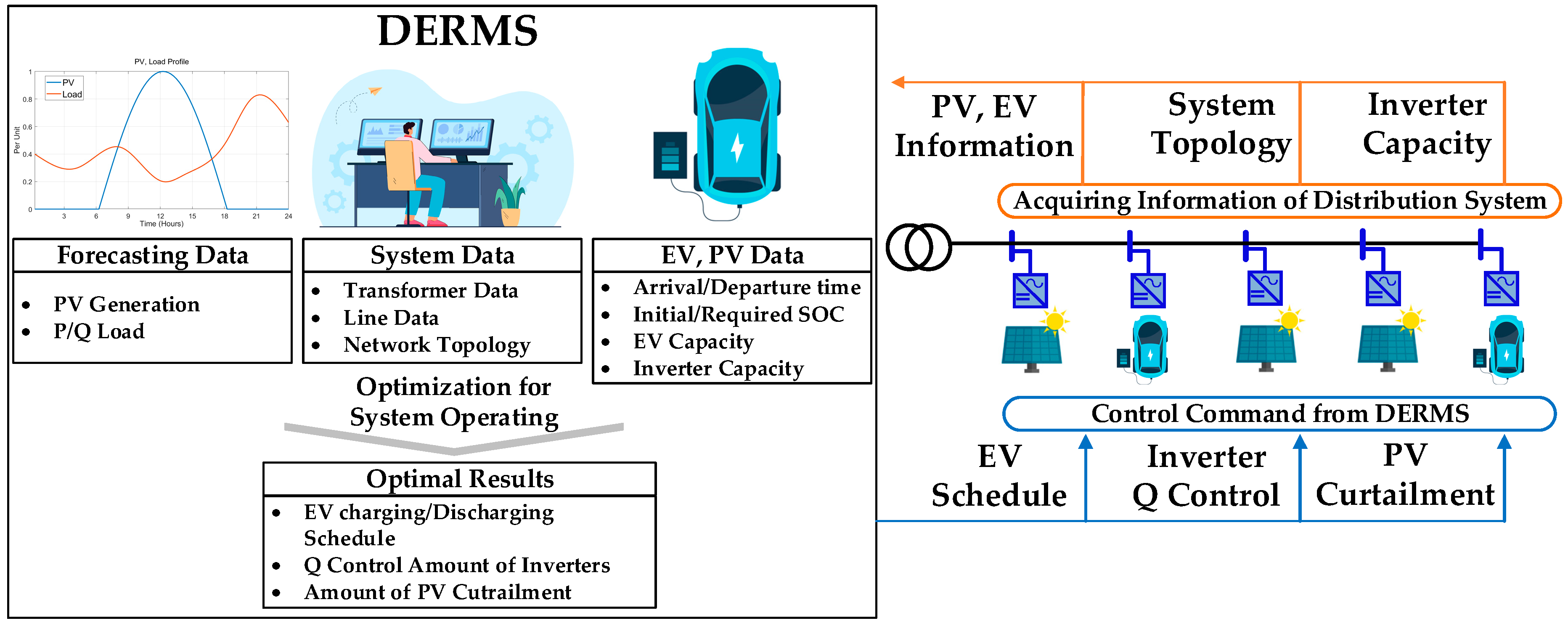
Figure 2 illustrates the operational architecture of the distribution system managed through the DERMS. When a large number of inverter-based resources (IBRs) operate based solely on local measurements, the overall network performance often becomes suboptimal. In contrast, a centralized operator such as DERMS can coordinate all DERs using global system information to achieve network-level operational objectives. Accordingly, this study develops a DER control algorithm within the DERMS framework to efficiently regulate the voltage and power factor across the distribution network. DERMS predicts both DER generation and system load demand, enabling the anticipation and prevention of potential voltage and power-quality issues. Based on these forecasts, DERMS can proactively adjust DER outputs to maintain stable network operation. In this study, predicted data are utilized for control, while any prediction errors that arise during operation are detected and corrected in real time. All EVs and PV systems connected to the distribution network are monitored and managed by DERMS. Using predicted data, DERMS calculates and transmits real-time setpoints for EV charging and discharging, as well as optimal reactive power compensation commands for PV- and EV-connected inverters.
Leveraging DERMS’s monitoring, forecasting, and dispatch capabilities, this study proposes a voltage control algorithm that is designed for seamless integration into the DERMS platform. The algorithm ensures stable system operation by coordinating EV charging/discharging, PV- and EV-connected inverter reactive power compensation, and PV output curtailment.
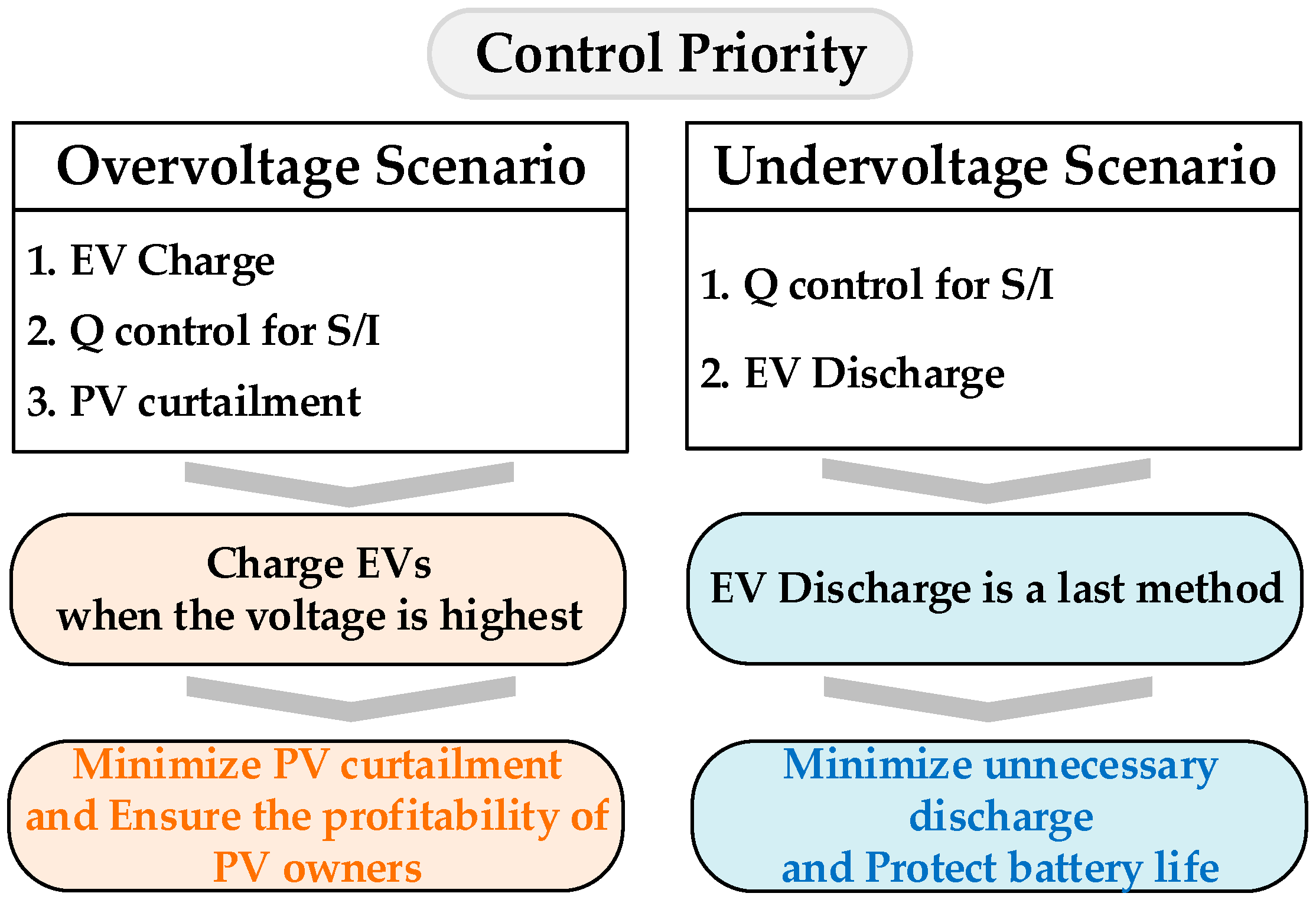
In the case of overvoltage, control actions are executed in the following order of priority: EV charging, inverter reactive power compensation, and PV output limitation. Conversely, for undervoltage conditions, the priority order is inverter reactive power compensation and EV discharging.
This hierarchy balances both system reliability and user satisfaction. For example, PV output limitation during overvoltage directly reduces the revenue of PV owners; therefore, PV curtailment is employed only as a last resort, while EV charging is prioritized to help maintain the required SOC for EV owners.
Similarly, frequent EV discharging during undervoltage can accelerate battery degradation and diminish user satisfaction. Hence, inverter reactive power control is applied first, with EV discharging used only as a secondary measure when voltage recovery through reactive support alone is insufficient.

2.2. Proposed Method

2.2.1. Two-Stage Optimization Framework for Voltage and PF Using ARH

This study proposes a two-stage optimization framework to address voltage regulation and power factor issues in a 4.8 kV distribution system with a high penetration of EVs and PV systems. Solving both problems in a single optimization is computationally intensive because it simultaneously involves the time-series SOC constraints of EVs and the nonlinear AC power flow equations associated with inverter control. To mitigate this complexity, optimization is divided into two sequential steps:
  • MILP for EV charging/discharging scheduling.
  • NLP for AC-OPF.
In the first stage, MILP determines the optimal EV charging/discharging schedule while ensuring that each EV meets the required SOC specified by the owner. An ARH approach is adopted to manage EV-related uncertainties by dynamically adjusting the optimization window based on the connection duration of the currently connected EVs at each time step. By default, MILP prioritizes EV charging to satisfy SOC requirements unless an undervoltage condition is detected. When a low-voltage event occurs, the algorithm first checks whether the issue can be resolved through maximum reactive power injection from inverters. If the voltage violation persists, MILP is re-optimized to enable EV discharging. Consequently, EV charging is prioritized to meet SOC requirements if there is no undervoltage, while EV discharging under undervoltage conditions is employed only as a last resort to minimize battery degradation from frequent discharging.
Once the EV charging/discharging schedule is determined through MILP, the second stage performs NLP-based AC-OPF to calculate the optimal reactive power setpoints for PV- and EV-connected inverters. The NLP formulation aims to (i) minimize residual voltage violations, (ii) maintain the system power factor above a specified threshold through reactive power compensation, and (iii) minimize PV curtailment.
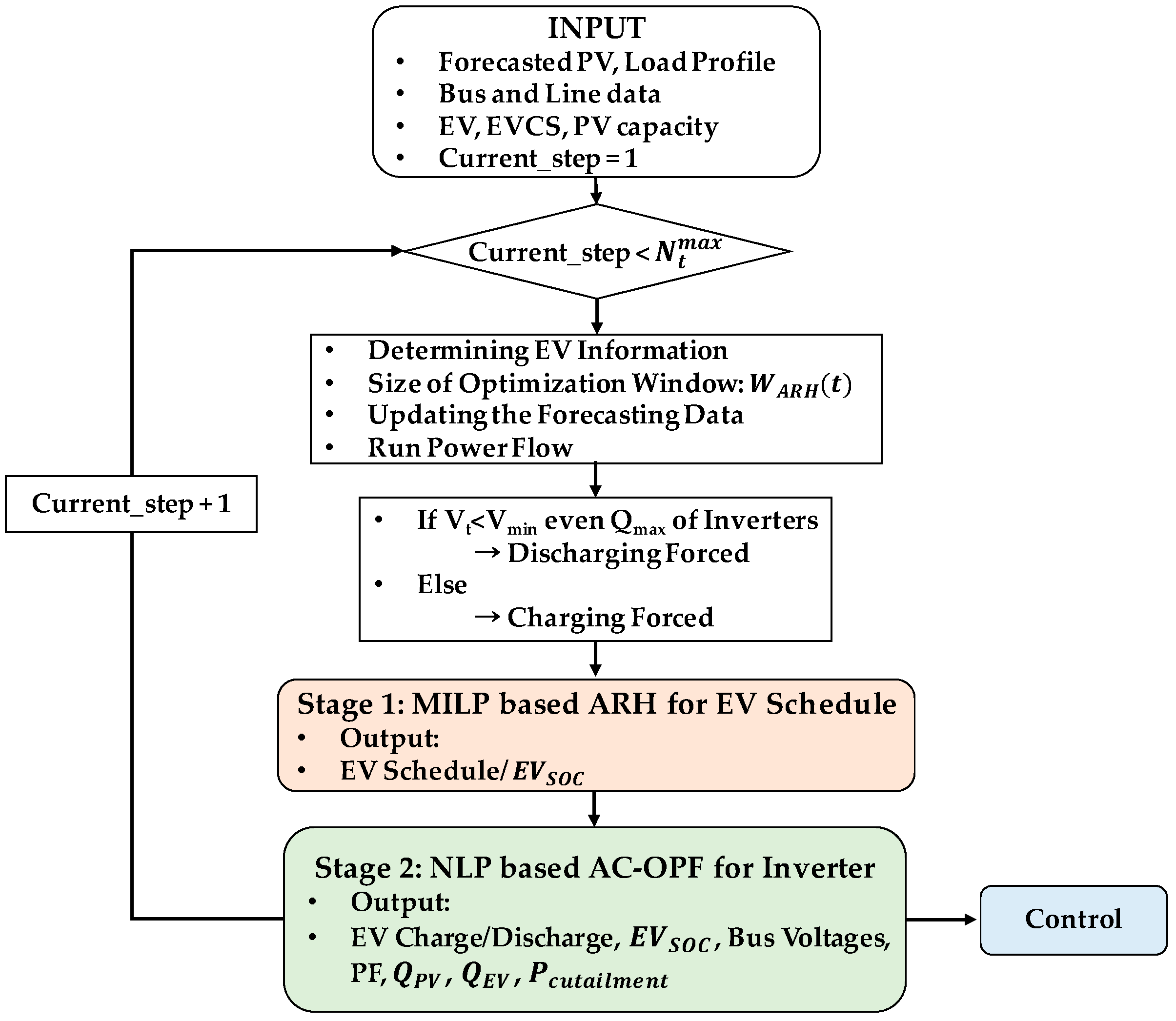
By decomposing the optimization into these two stages, the proposed method reduces the computational complexity and efficiently satisfies control priorities related to voltage regulation and power factor improvement. Figure 3 illustrates the flowchart of the proposed two-stage optimization framework. DERMS predicts PV generation and load profiles and collects distribution system data and EV-specific parameters, such as arrival/departure times, initial SOC, target SOC, and battery capacity. The ARH window size is determined based on the most recent information for currently connected EVs. A preliminary power-flow analysis is then conducted to assess whether EV discharging is necessary under undervoltage conditions. Subsequently, the MILP problem is solved to determine the optimal EV charging/discharging schedule, which serves as input to the NLP-based AC-OPF. Finally, the optimization outputs, including the EV charging/discharging schedule, inverter reactive power compensation, and PV curtailment levels, are transmitted to each device and applied to real-time distribution system operation.

2.2.2. The Need for Optimization Method

The control priorities and their underlying rationale are illustrated in Figure 4. During overvoltage conditions, when EV charging and reactive power compensation by PV- and EV-connected inverters are insufficient to maintain voltage within permissible limits, the remaining voltage violation must be mitigated through PV curtailment. However, PV curtailment can be minimized by appropriately scheduling EV charging during the periods of highest voltage within each EV’s connection window. Sequential control methods cannot dynamically adjust EV charging schedules to achieve this coordination, whereas optimization allows EVs to charge precisely when voltage levels are highest, thereby maintaining the system’s stability while preserving the profitability of PV owners.
In undervoltage scenarios, reactive power compensation from PV inverters is utilized first, and any remaining voltage violations are addressed through EV discharging. Under a sequential control approach, however, discharging EVs after reactive power compensation can inadvertently reduce the system’s PF. Because voltage regulation and PF improvement often exhibit conflicting objectives, both goals can only be achieved simultaneously through an optimization-based coordination of EV discharging and inverter reactive power compensation. The proposed method also minimizes unnecessary EV discharging, thereby mitigating battery degradation and preserving EV owners’ satisfaction by ensuring that the desired departed SOC is met, even after limited discharge events.
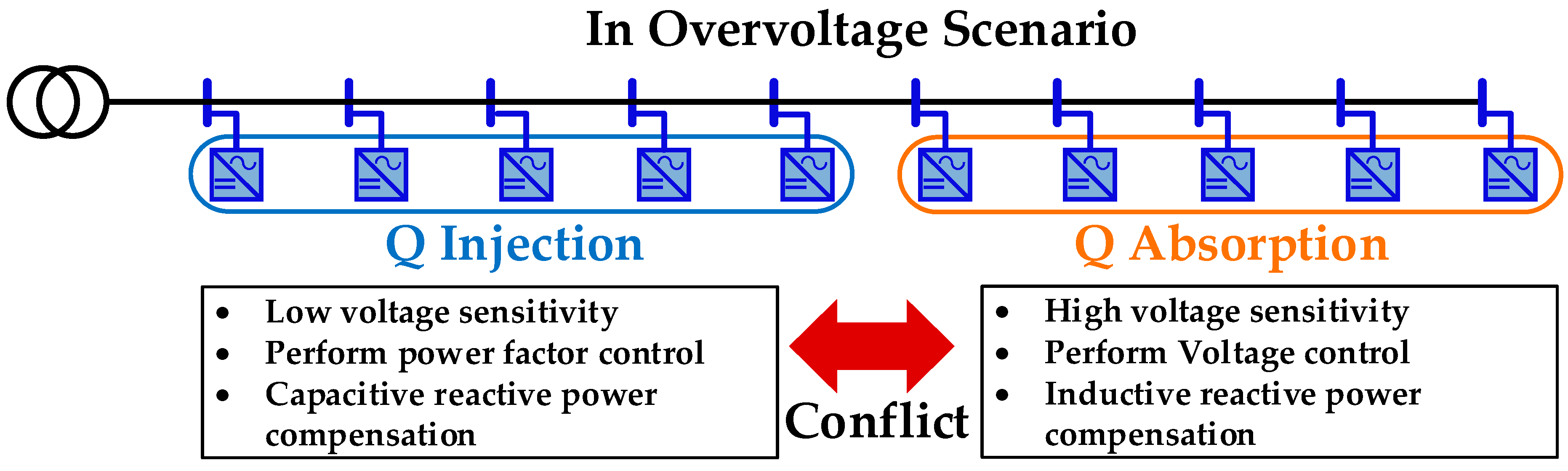
When performing AC-OPF through nonlinear programming (NLP), conflicts also arise in reactive power compensation decisions (see Figure 5). Under overvoltage conditions, PV inverters located near the feeder end—where voltage sensitivity is high—should absorb reactive power to alleviate the voltage rise, while inverters located near the substation—where sensitivity is lower—should inject reactive power to improve the PF. However, these two actions inherently conflict: absorbing reactive power lowers the voltage but reduces the PF, whereas injecting reactive power improves the PF but increases the voltage. Consequently, it is difficult to determine the optimal reactive power compensation for each inverter by using simple sequential control. The proposed optimization-based framework overcomes this limitation by simultaneously determining the reactive power compensation of all PV inverters, ensuring that both voltage regulation and power factor control objectives are satisfied without mutual interference. This coordinated strategy enables stable and efficient system operation under diverse voltage and loading conditions.

2.3. Adaptive Rolling Horizon Approach

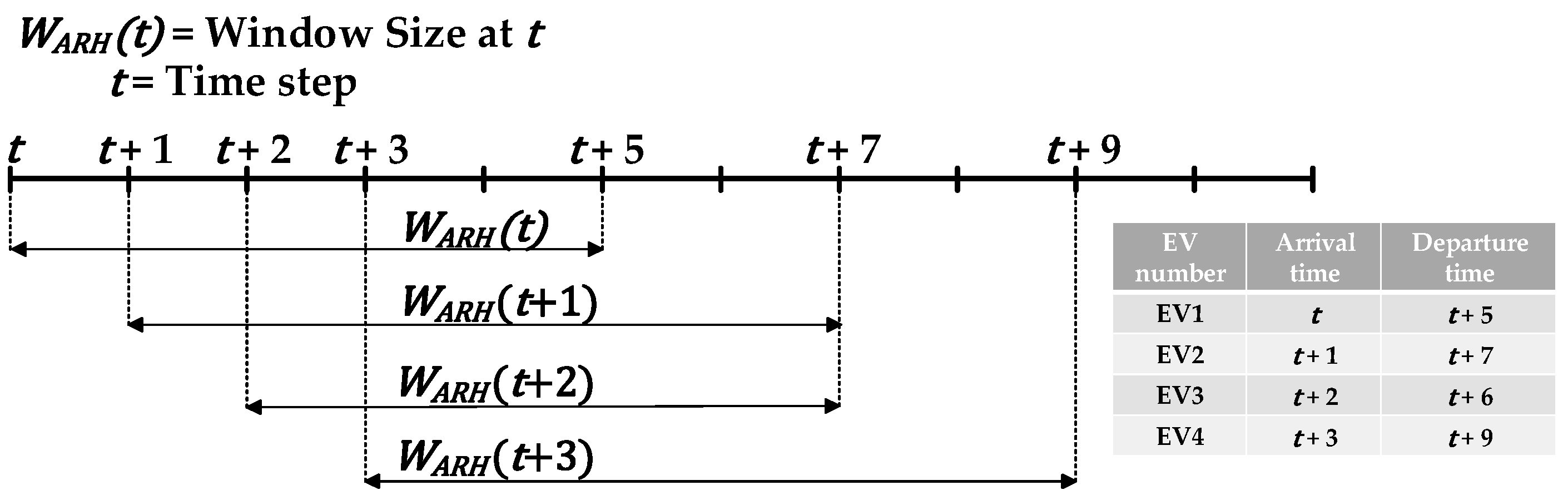
In this study, the ARH approach is employed to address uncertainties associated with EV arrival and departure times. At a given time step, t, the set of EVs connected to the system is denoted as N E V ( t ) . The rolling window, W A R H ( t ) , is defined from the current time step t to the latest departure time among all EVs. A rolling window means that the window, which is an optimization section of a certain length, rolls as the optimization section decreases, as the time step advances. For example, assuming that the optimization section of the window is t to t + 5, when the current time step is t, the optimization proceeds from t to t + 5, but when the time step is t + 1 over time, the optimization proceeds from t + 1 to t + 5, and eventually the optimization section becomes shorter as time passes. If d t denotes the departure time of an EV belonging to N E V ( t ) , the ARH window is expressed as follows:
W A R H t = { t ,   t + 1 ,   ,   max t N EV ( t ) d t }
For example, as shown in Figure 6 when the current time step is t, only EV1 is connected, and its departure time is at t + 5. Therefore, the rolling window extends to t + 5. When the time step advances to t + 1, EV2 is additionally connected, and the latest departure time among connected EVs becomes t + 7, so the window extends from t + 1 to t + 7. At time step t + 2, EV3 connects, but the maximum departure time remains the same, so the window stays from t + 2 to t + 7. Finally, at time step t + 3, EV4 connects, and its departure time is t + 9, so the window expands from t + 3 to t + 9. At each time step, optimization is performed over the defined window up to the latest departure time of the EVs that are currently connected to the system. However, only the control command corresponding to the current time step is executed and transmitted, while subsequent time steps are re-optimized as new information becomes available. This rolling and adaptive update mechanism enables real-time control that effectively manages the uncertainty of EV connections while maintaining stable voltage operation throughout the system.

3. Mathematical Description

3.1. MILP for EV Charge/Discharge Scheduling (Stage 1)

In Stage 1, MILP is performed over the rolling window defined by the ARH approach to determine the optimal EV charging and discharging schedule for voltage control in the distribution system. The objective function is shown in Equation (2). Here, s k , t E V , c h and s k , t E V , d i s represent the rated charging and discharging power at bus k and time step t, respectively, and γ is a penalty factor for EV discharging. As explained above, the frequent discharge of EV causes the battery life to be degraded, so the use of EV discharge to the minimum is induced by multiplying the penalty factor γ by the term, which provides the discharge power. The weight β k , t is determined based on the voltage of bus k and time step t, as shown in Equation (3), and encourages discharging only when the bus voltage is below the lower limit, V m i n . Otherwise, charging is induced to satisfy the required SOC of the EV owner. The required SOC is provided in advance by EVs, which means that owners use EV batteries for their distribution systems but still have the SOCs they need to move when they leave. Therefore, DERMS is obliged to ensure the requirements when EVs leave. Here, V m a x and V m i n are the upper and lower voltage limits, respectively. V k , t denotes the voltage magnitude at bus k and time step t. N t represents the number of time steps in the rolling window. N E V is the set of buses with connected EVs.
(1)
Objective Function:
m i n   Z 1 = t = 1 N t k N E V β k , t s k , t E V , c h + γ s k , t E V , d i s
(2)
SOC constraints:
β k , t = 1 , V k , t > V m a x V k , t V m i n V m a x V m i n , V m i n < V k , t < V m a x 0 , V k , t < V m i n
S O C k , t = S O C k , t 1 + t E V k c a p ρ c h P E V m a x , c h s k , t 1 c h P E V m a x , d i s s k , t 1 d i s ρ d i s ,           t = 2 , , N t
S O C k d e p a r t , t S O C k r e q
S O C m i n S O C k , t S O C m a x
0 s k , t E V ,     c h 1
0 s k , t E V ,   d i s 1 μ t         w h e r e   μ t = 1 E V   c h a r g e d 0 E V   d i s c h a r g e d
Equations (4)–(8) represent the SOC constraints of EVs. Equation (4) defines the SOC dynamics, where S O C k , t and S O C k , t 1 are SOC at bus k at time steps t and t − 1, respectively, t is the time step size, and E V k c a p is the rated EV capacity at bus k. P E V m a x , c h and P E V m a x , d i s are the maximum charging and discharging powers of EVs, respectively, while s k , t 1 c h and s k , t 1 d i s are the normalized charging and discharging rates at the previous time step. Finally, ρ c h and ρ d i s represent the charging and discharging efficiency, respectively. Equation (5) defines the departure SOC constraint, in which S O C k d e p a r t , t corresponds to the SOC of the EV connected at bus k when it stops charging at time step t; this value must meet the requirement specified by S O C k r e q . Equation (6) imposes SOC bounds, ensuring that the SOC of the EV remains within the set upper and lower limits, S O C m a x and S O C m i n , respectively, at each time step, t, with S O C k , t representing the SOC at bus k and time step t. Equations (7) and (8) specify the bounds for the charging and discharging rates, s k , t E V , c h and s k , t E V , d i s , which are constrained between 0 and 1. Equation (9) enforces mutual exclusivity, preventing simultaneous charging and discharging of the same EV.
By solving this MILP over the specified rolling window, the optimal EV charging/discharging schedule is obtained. This schedule is then used as input for Stage 2, where NLP-based AC-OPF is applied to optimize reactive power compensation while ensuring that SOC constraints are satisfied.

3.2. NLP for AC-OPF (Stage 2)

In Stage 2, AC-OPF is performed over the rolling window determined in Stage 1, using the optimal EV charging/discharging schedule to derive the optimal control commands for inverters. The final objective function is shown in Equation (9). As a multi-objective function, priorities are assigned to each term by using weighting factors. Equation (10) represents the minimization of voltage fluctuations. Here, V k , t is the voltage magnitude at bus k and time step t, and V r e f is a reference voltage, set to 1.0 per unit (p.u.) in this study. N is the number of buses, and the formulation minimizes voltage deviations across all buses. Equation (11) minimizes reductions in the system power factor. P F t is the power factor at the substation at time t, and P F t a r g is the target power factor. N t is the number of time steps in the rolling window. The reactive power control for voltage regulation can reduce the system power factor [18]. To address this, reactive power compensation is applied simultaneously for voltage control and power factor improvement. Compensation at the front of the feeder minimally affects the voltage, allowing for effective power factor regulation. Equation (12) minimizes PV curtailment, with γ c u r t P V as the penalty for curtailment, and P i , t P V , c u r t as the curtailed power of PV at bus i and time t. N P V is the number of PV units in the system. Equation (13) minimizes the total reactive power compensation, where Q i , t P V and Q i , t E V represent reactive power from PV- and EV-connected inverters, respectively. Reducing unnecessary reactive power mitigates line losses, inverter losses, and thermal stress. The weighting factors were selected as ω 1 = 0.4, and ω 2 , ω 3 , and ω 4 = 0.2.
(1)
Objective Function:
J = ω 1 J 1 + ω 2 J 2 + ω 3 J 3   +   ω 4 J 4
J 1 = k = 1 N V k , t V r e f 2
J 2 = t = 1 N t P F 1 , t P F t a r g 2
J 3 = t = 1 N t i ϵ N P V γ c u r t P V × P i , t P V , c u r t
J 4 = t = 1 N t | Q i , t P V | + | Q i , t E V |
(2)
Constraints:
P i , t i n j = k N V i , t V k , t G i k cos θ i , t θ k , t + B i k sin θ i , t θ k , t
Q i , t i n j = k N V i , t V k , t G i k sin θ i , t θ k , t B i k cos θ i , t θ k , t
w h e r e       P i , t i n j = P i , t l o a d + P i , t P V , a v a i P i , t P V , c u r t i N P V P i , t l o a d + P i , t E V , c h P i , t E V , d i s i N E V P i , t l o a d i N \ N P V , N E V
Q i , t i n j = Q i , t l o a d + Q i , t P V i N P V Q i , t l o a d + Q i , t E V i N E V Q i , t l o a d i N \ N P V , N E V
V m i n < V k , t < V m a x
I l , t I l , m a x
P k , t P V , a v a i P k , t P V , c u r t 2 + Q k , t P V 2 S k P V , k N P V
P k , t E V , c h P k , t E V , d i s 2 + Q k , t E V 2 S k E V , k N E V
P F m i n P F 1 , t P F m a x
Q k , m a x P V Q k , t P V Q k , m a x P V
Q k , m a x E V Q k , t E V Q k , m a x E V
0 P k , t P V , c u r t P k , t P V , a v a i
Equations (14)–(23) define the constraints of the distribution system and the inverters. Equations (14) and (15) ensure that the power flow satisfies Kirchhoff’s laws. Here, P i , t i n j and Q i , t i n j represent the active and reactive power injected at bus i and time step t, respectively, while G i k and B i k denote the conductance and susceptance between buses i and k. The term θ i , t θ k , t represents the voltage phase angle difference between buses i and k at time step t. P i , t l o a d and Q i , t l o a d are the active and reactive loads, respectively. P i , t P V , a v a i and P i , t P V , c u r t are the available PV generation and curtailed PV power, respectively. P i , t E V , c h and P i , t E V , d i s denote the EV charging and discharging power, and Q i , t P V and Q i , t E V denote the reactive power supplied by PV and EV-connected inverters. Equation (16) enforces the voltage limits to prevent overvoltage and undervoltage conditions. Equation (17) constrains the line current, I l , t , to remain below the maximum allowable current, I l , m a x , preventing overheating or damage to the lines. Equations (18) and (19) impose inverter capacity limits, ensuring that the apparent power output does not exceed the rated capacity of the inverters, S k P V , for PV inverters and S k E V for EV inverters. Equation (20) constrains the power factor, ensuring that the substation power factor remains within the acceptable range defined by P F m i n and P F m a x . Equations (21) and (22) set the reactive power limits for inverters, allowing for compensation only within the maximum reactive power capability, Q k , m a x P V and Q k , m a x E V , of PV and EV-connected inverters, respectively. Finally, Equation (23) sets the PV curtailment limit, ensuring that the curtailed power does not exceed the available PV generation.

4. Simulation and Results

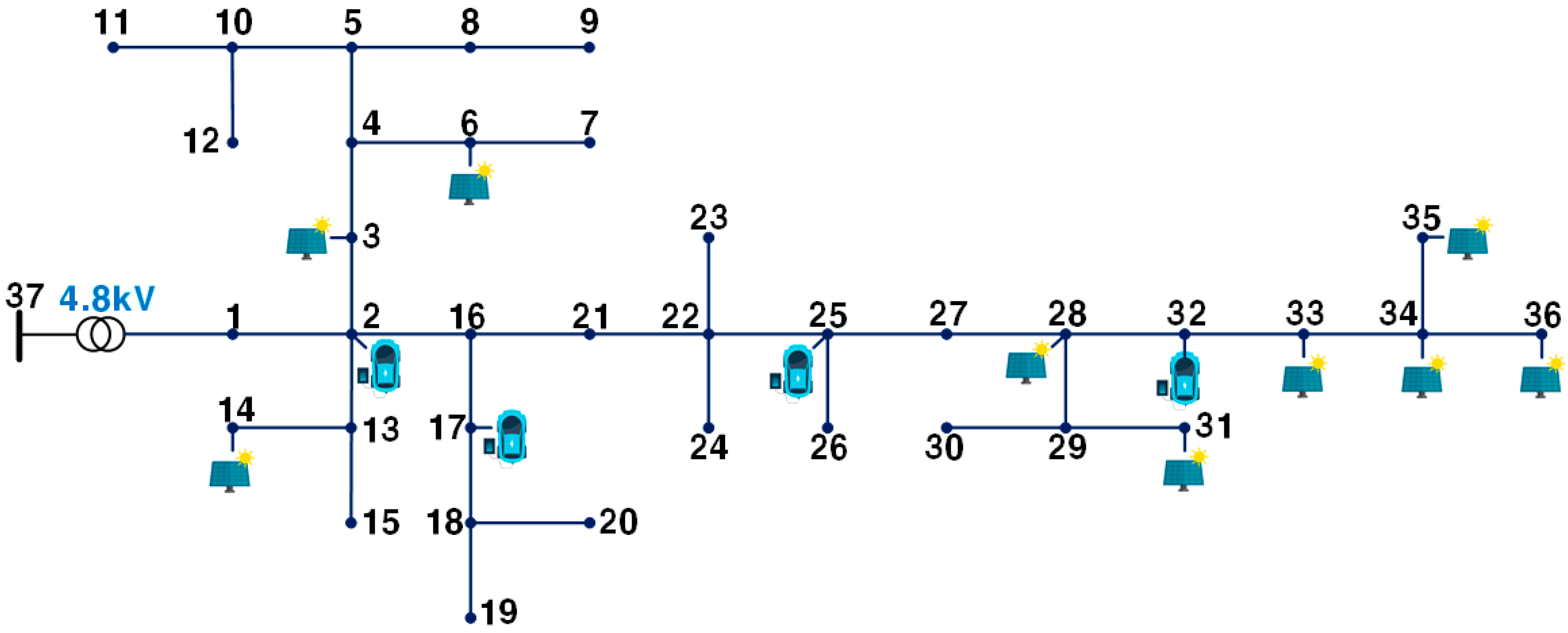
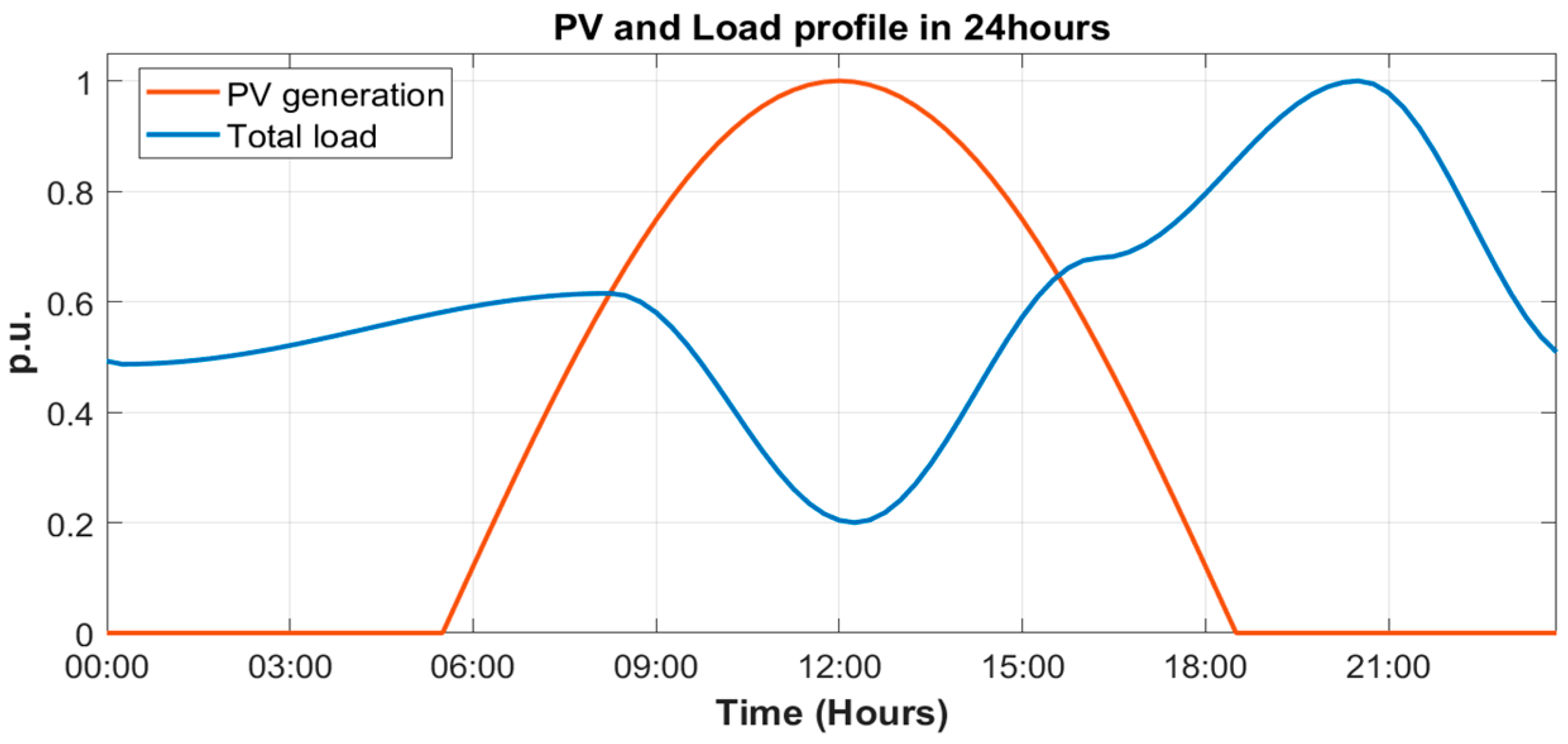
The performance of the EV-PV integrated control strategy was evaluated using the 4.8 kV IEEE 37-bus radial distribution test feeder [32]. The transformer capacity is 5 MVA, and the feeder load and line data are based on [32]. As shown in Figure 7, a total of nine PV systems are connected to buses 3, 6, 14, 28, 31, 33, 34, 35, and 36. EV stations are located on buses 2, 17, 25, and 32, with four EV stations per bus, accommodating a total of 16 EVs. The EV data are provided by EV owners. The inverter capacity at each PV and EV station was set to 1.1 times the rated capacity, following the IEEE-1547 recommendation, which allows for compensation of up to 44% of the reactive power, even at rated output [19]. Figure 8 shows the PV power generation and total load trend during the day. For each case, the PV profile expressed in Figure 8 is the same for all PVs, and the actual output of PV is also the same size, which is achieved by dividing the total PV capacity of Table 1 by the same ratio. The load profile is divided by bus, with the peak active/reactive power of Table 1 at the spatial distribution ratio of [32]. Assuming the divided value to be 1 p.u., it is expressed as a 24 h profile, as shown in Figure 8, but the absolute size varies from case to case because the peak levels given in Table 1 are different. In summary, Figure 8 is a picture for comparing shapes (trends), and the actual MW/MVar value depends on Table 1 and the PV capacity of each case. In the simulation, the allowed voltage ranges from 0.95 to 1.05 p.u., which corresponds to the ±5% service voltage limit specified in ANSI C84.1 range A and is widely adopted as an acceptable operating band for the distribution system [33]. The allowed power factor ranges from 0.98 to 1 above lagging, but in the actual system, it may be leading in some cases. However, in this study, the allowable range was set as above in order to prevent excessive reactive power compensation for power factor control. And in many studies, the power factor is strictly maintained at 0.98–1 to reduce the loss of the system [34]. Even in this simulation, it aims to maintain the power factor at a high value through compensation for the reactive power of the inverter. Likewise, PV power generation peaks around noon, as shown in Figure 8, and the value represents the rated output of PV. The total PV capacity in Table 1 refers to the total PV capacity linked to the system, and the capacity of one PV is 200 kW in Case 1-1, 300 kW in Case 1-2, 2-1, 3-1, and 400 kW in Case 2-2 and 3-2. The peak generation of PV is equal to the PV capacity. The electric vehicle charging station (EVCS) capacity was set at 72 kW.
Table 1 summarizes the case configurations. Case 1 represents no control; Case 2 only applies inverter control via AC-OPF; and Case 3 implements the proposed method, combining EV scheduling with inverter control. Comparisons are made within subcases: Case 1-2 increases PV output and load relative to Case 1-1, and Case 2-2 increases load and PV output relative to Case 2-1. Case 3-1 corresponds to the same scenario as Case 1-2, and Case 3-2 corresponds to Case 2-2, allowing for verification of the proposed algorithm’s effectiveness. Cases 1-2, 2-1, and 3-1 share the same PV capacity and load level and are used to validate the control performance by comparing (i) a case without any control, (ii) a case using only AC-OPF control, and (iii) a case using the proposed ARH-based EV, DERs control. Similarly, Cases 2-2 and 3-2 represent the same operating scenario and are used to demonstrate the necessity of EV charging/discharging scheduling by comparing the results of AC-OPF control with those of the proposed ARH-based EV, DERs control. Table 2 and Table 3 represent detailed EV data. Table 2 corresponds to EV data from residential buses (Bus 2 and 32), and Table 3 represents EV data from commercial areas (Bus 17 and 25).
In residential areas, EVs are typically connected from midnight to morning or evening to midnight. In commercial areas, EVs are connected primarily during working hours, from morning to evening. Therefore, the overvoltage that occurs during the day can be resolved by charging the EV connected to the commercial area, and the low voltage that occurs during the evening can be resolved by discharging the EV connected to the residential area. If the Depart SOC is smaller than the initial SOC among the EVs connected at night, the energy charged in addition to the SOC required when the EV owner departs would allow the EV to be discharged and profits could be pursued through the discharge.

4.1. Results of Case 1 (No Control)

4.1.1. Case 1-1 (Low PV Generation, Load)

Case 1 represents scenarios without any control. Subcase 1-1 corresponds to conditions where no voltage issues arise, even in the absence of control. As shown in Figure 9, the bus voltages remain within the acceptable range of 0.95–1.05 p.u. across all buses and time steps.

4.1.2. Case 1-2 (Medium PV Generation, Load)

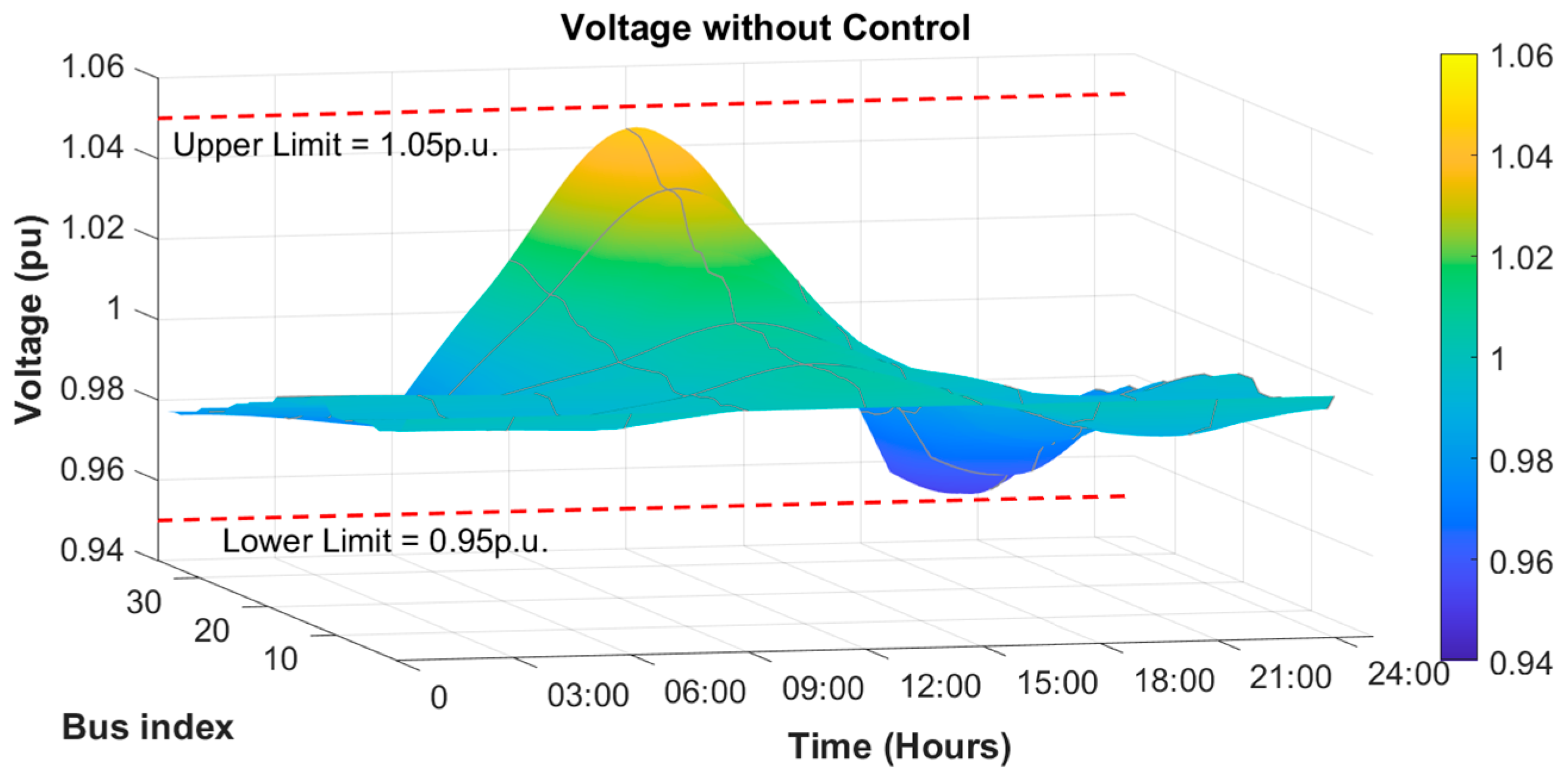
Case 1-2 represents a scenario in which the PV output is increased by 1.5 times and the system load rises by approximately 1.3 times, relative to Case 1-1 in Figure 10. During periods of high PV output, the voltage of Bus 36, located at the end of the feeder, reaches approximately 1.066 p.u. Conversely, when the system load peaks at 20:30, the voltage of Bus 36 drops to 0.938 p.u. These values exceed the established voltage limits, indicating voltage violations. This result demonstrates that without any control, the distribution system cannot accommodate the increased PV generation and load in this scenario.

4.2. Results of Case 2 (AC-OPF Control)

Case 2 represents scenarios in which only PV- and EV-connected inverter control is applied, excluding EV charging/discharging scheduling, within the proposed two-stage optimization framework.

4.2.1. Case 2-1 (Medium PV Generation, Load)

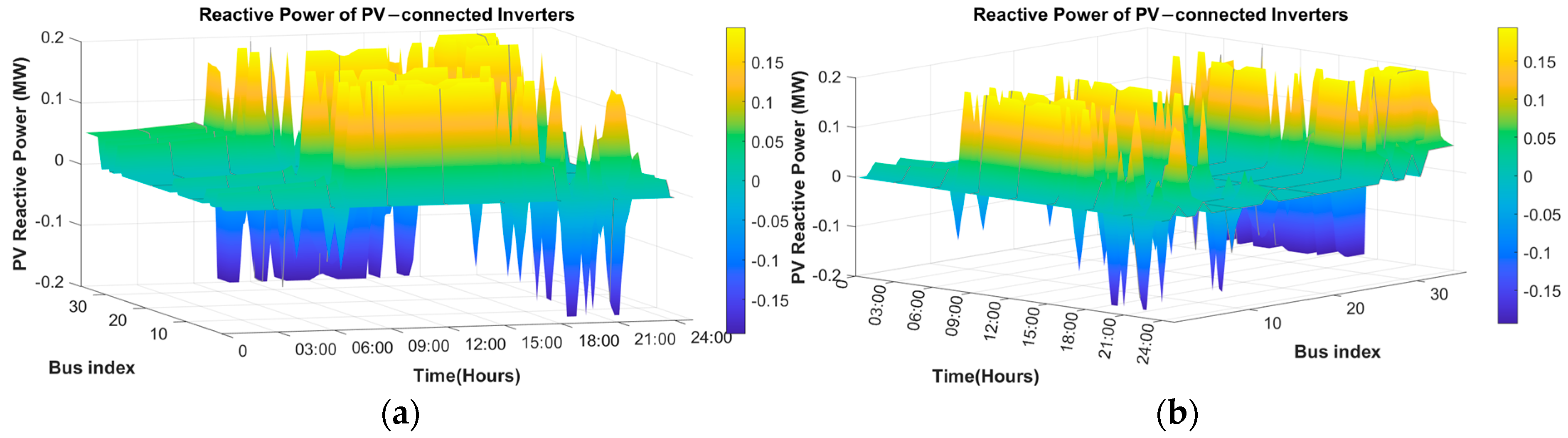
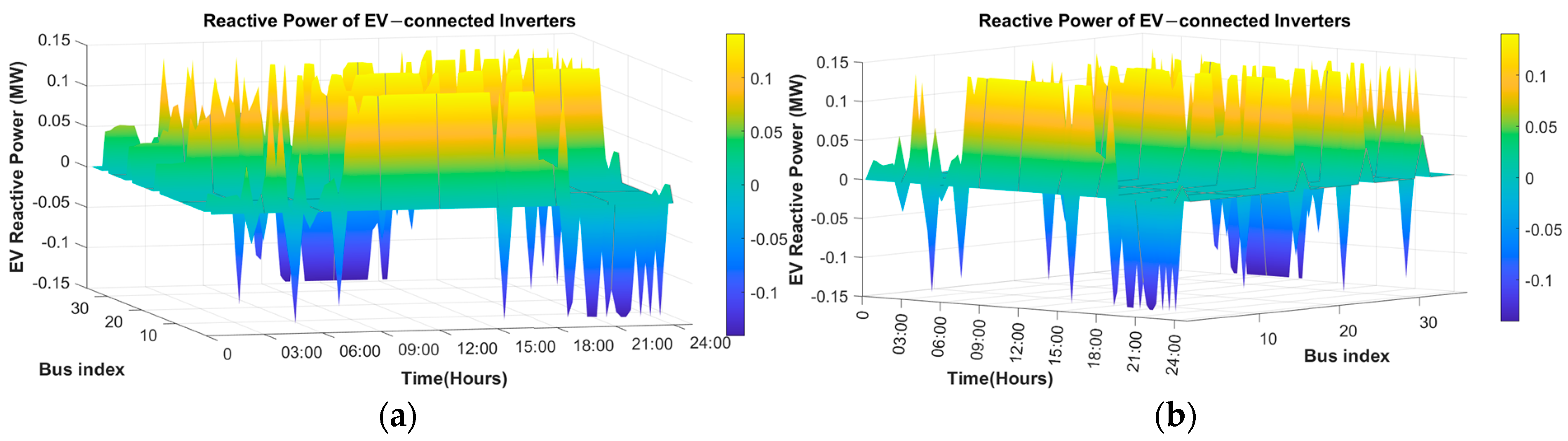
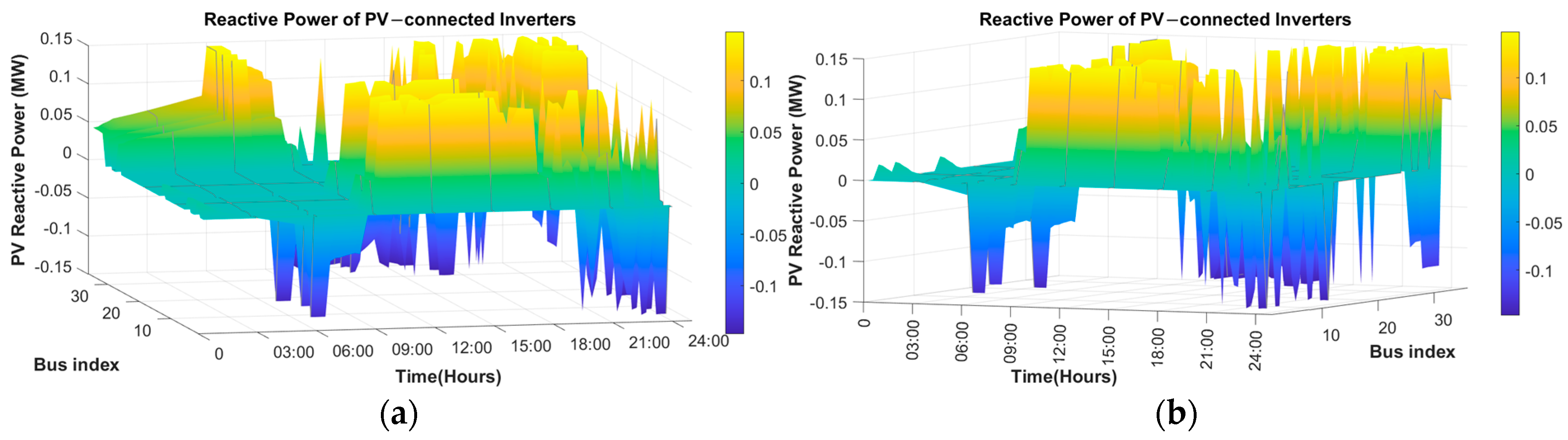
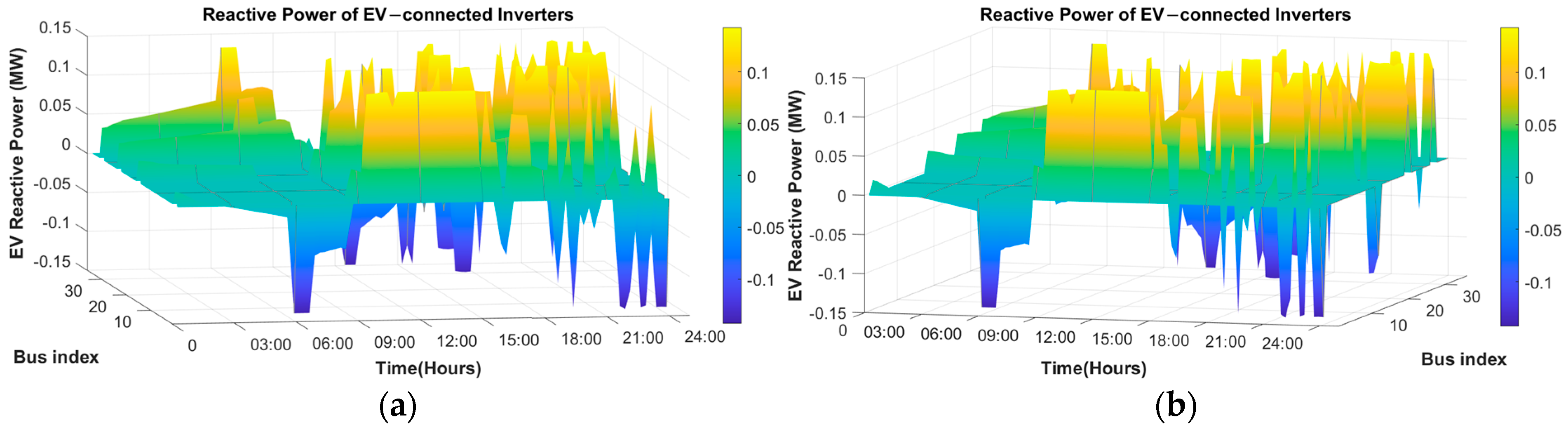
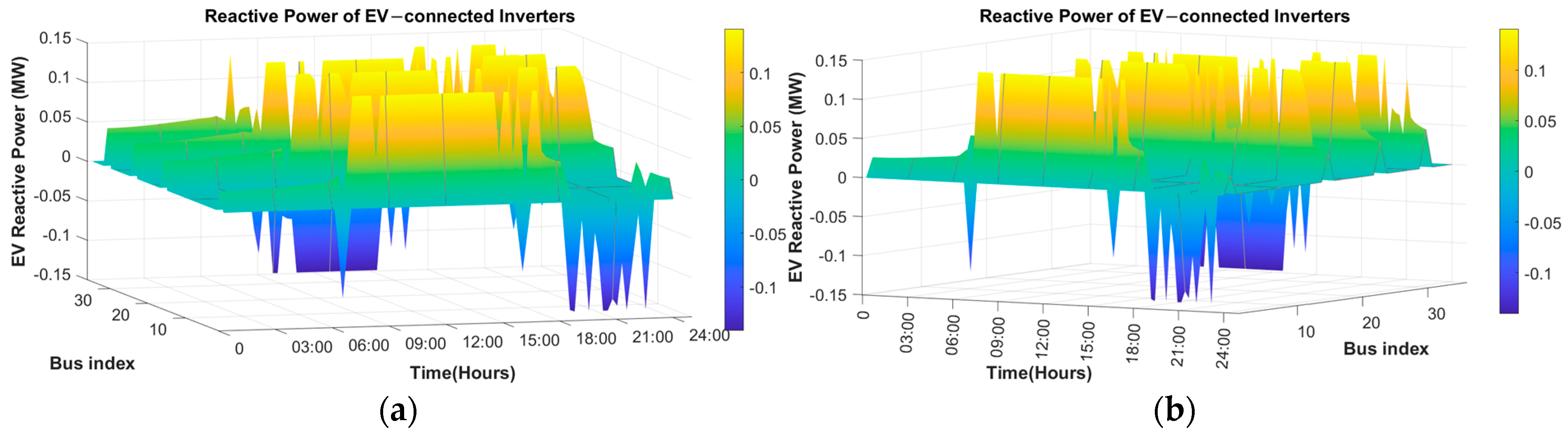
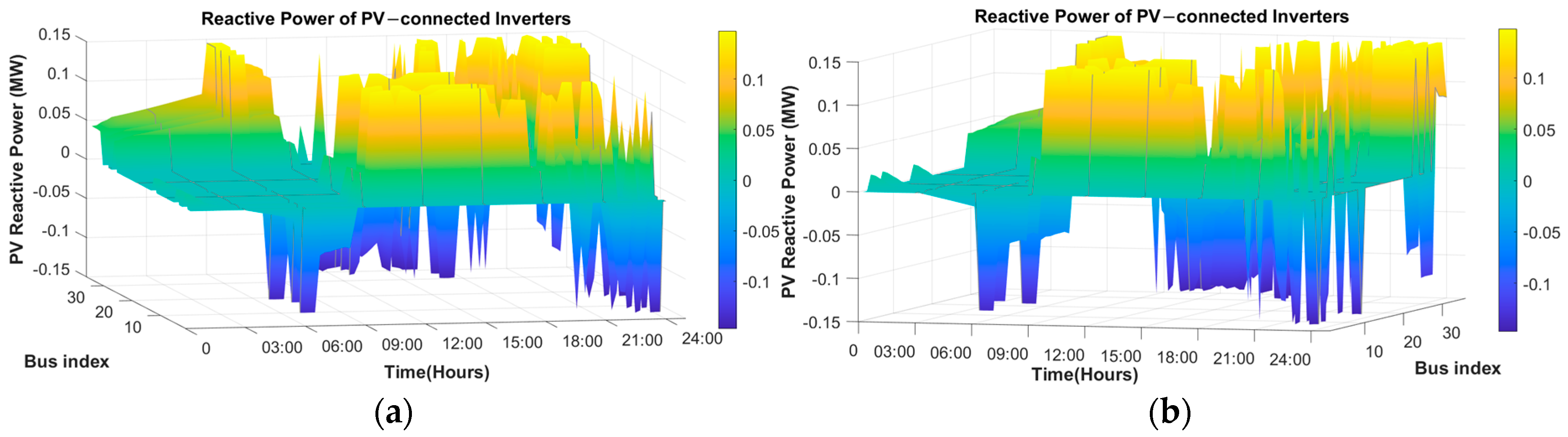
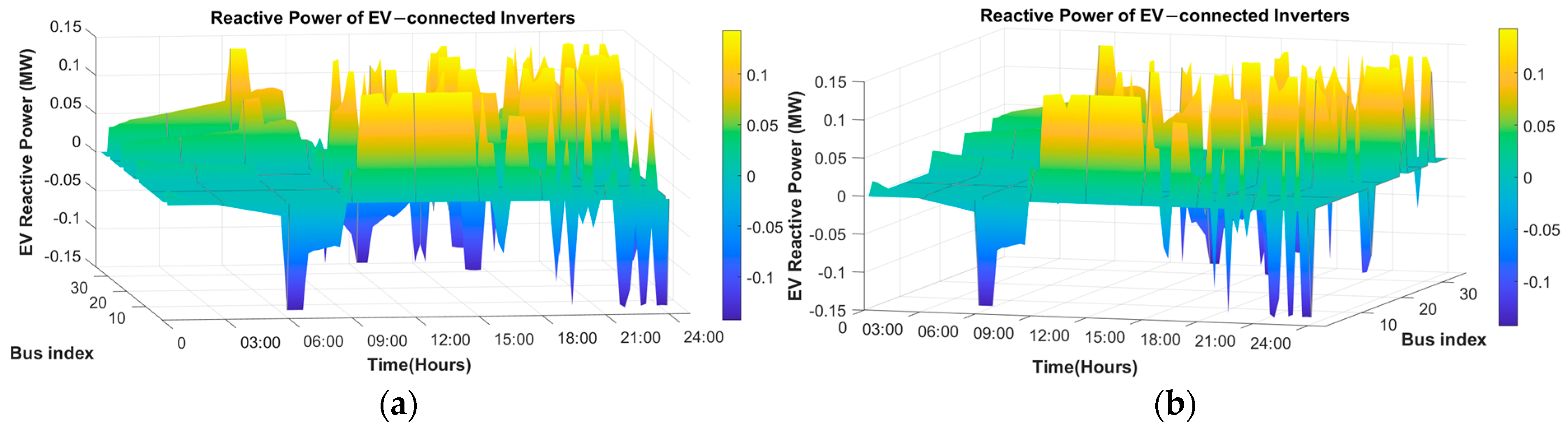
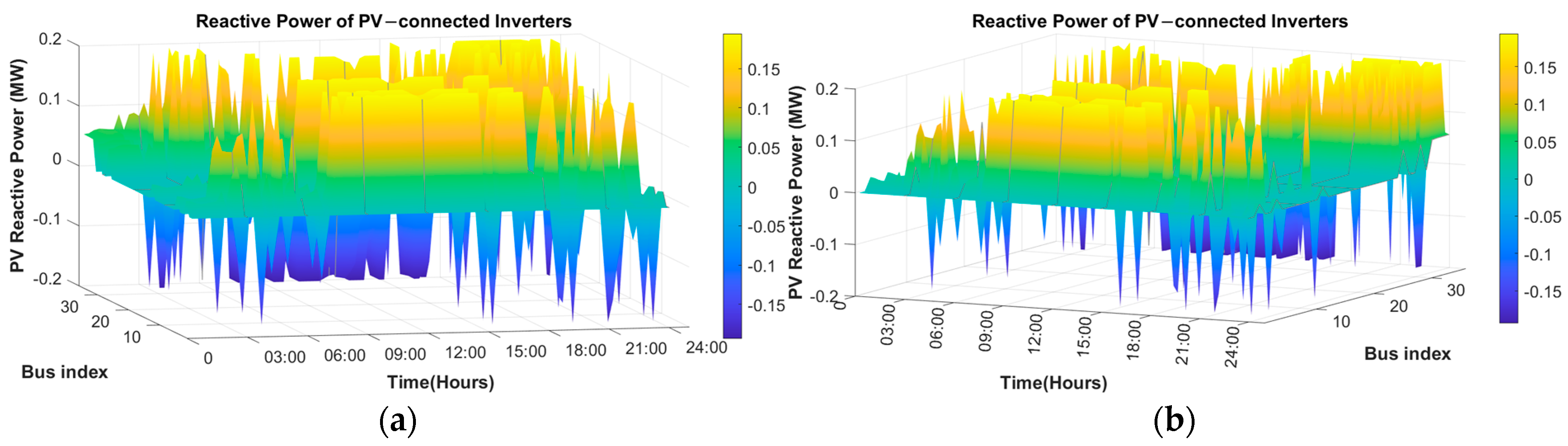
Case 2-1 considers the same PV output and load scenario as Case 1-2, allowing for the evaluation of the effectiveness of inverter control through AC-OPF. Figure 10 shows the voltage magnitudes before the control. Overvoltage occurs during periods of high PV output, while undervoltage occurs in the evening when the load peaks. Figure 11 and Figure 12 illustrate the reactive power compensation provided by the PV and EV-connected inverters. Figure 11 shows only the reactive power compensation of PV-connected inverters, with Figure 11a,b presenting different perspectives of the same data. From midnight to 08:00, the PV output is small, so during this period, the inverter mainly injects reactive power to improve the voltage and power factor. From 08:30, as PV output gradually increases, the inverters actively perform reactive power compensation. Each PV has a rated capacity of 300 kW, and the connected inverters have a capacity of 330 kVA, which is 1.1 times the PV rating. Consequently, the maximum reactive power compensation is 0.1452 MVar. Buses at the end of the system mainly absorb reactive power to mitigate daytime over-voltage, while buses at the front end inject reactive power to improve the substation bus power factor. For example, since overvoltage occurs around noon, Buses 28, 31, 33, 34, 35, and 36, located at the end, each absorb 0.139 MVar, which is close to the maximum reactive power compensation amount. Buses 3, 6, and 14, located at the front end, each show an injection of 0.139 MVar to compensate for the reduced power factor, due to the absorption of reactive power. Therefore, it can be confirmed that the grid voltage problem mitigation and power factor control are performed simultaneously by utilizing the reactive power compensation function of the inverter. In the evening, when the load is high, the reactive power operation reverses: end-of-feeder buses inject reactive power to address undervoltage, and front-end buses absorb reactive power to stabilize the system power factor. Similarly to PV-connected inverters, in Figure 12, the absorption or injection of reactive power of the EV-connected inverters depends on the prevailing overvoltage or undervoltage conditions.
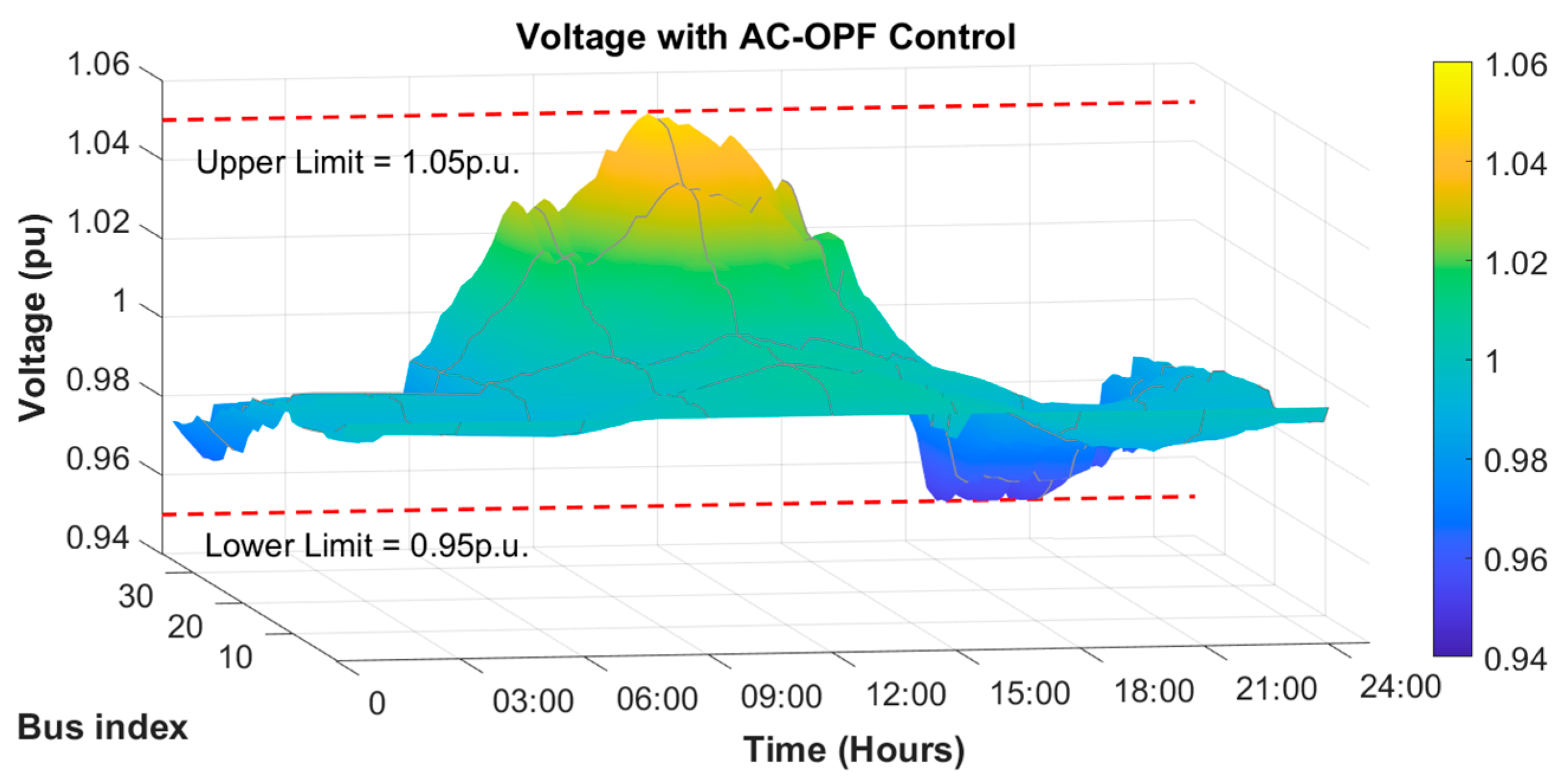
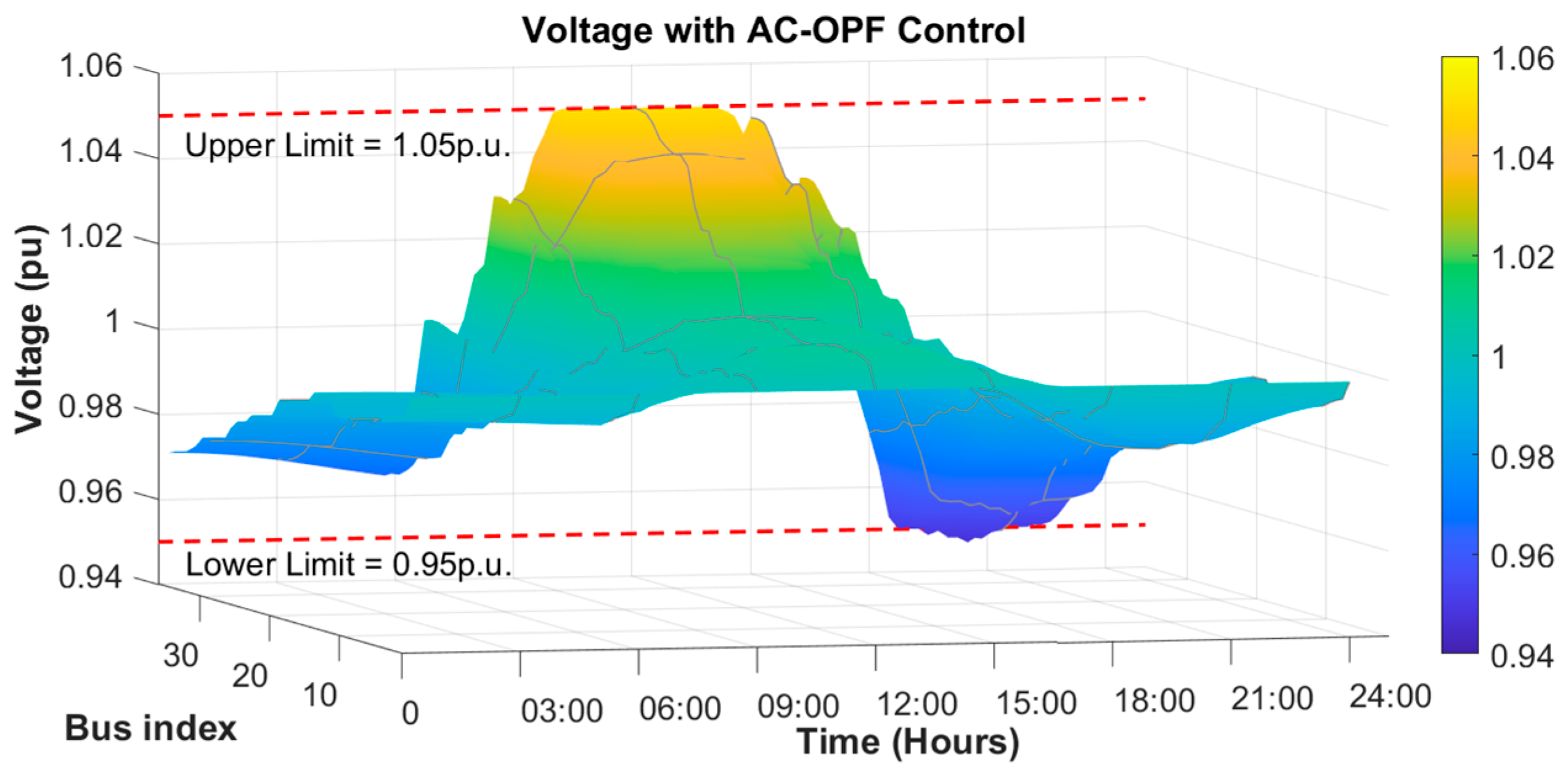
Figure 13 shows the voltage profile after applying AC-OPF control in Case 2-1. Voltages of all buses remain within the acceptable range of 0.95–1.05 p.u., indicating that the inverter control effectively mitigates voltage violations. Compared to Case 1-2, the system can accommodate a higher PV output and larger load demands. At this time, the total PV curtailment occurred in a small amount of 0.23 MWh, and most of them occurred in Bus 36, which has the greatest voltage control effect, to solve the problem that the voltage is insufficient due to reactive power compensation.

4.2.2. Case 2-2 (High PV Generation, Load)

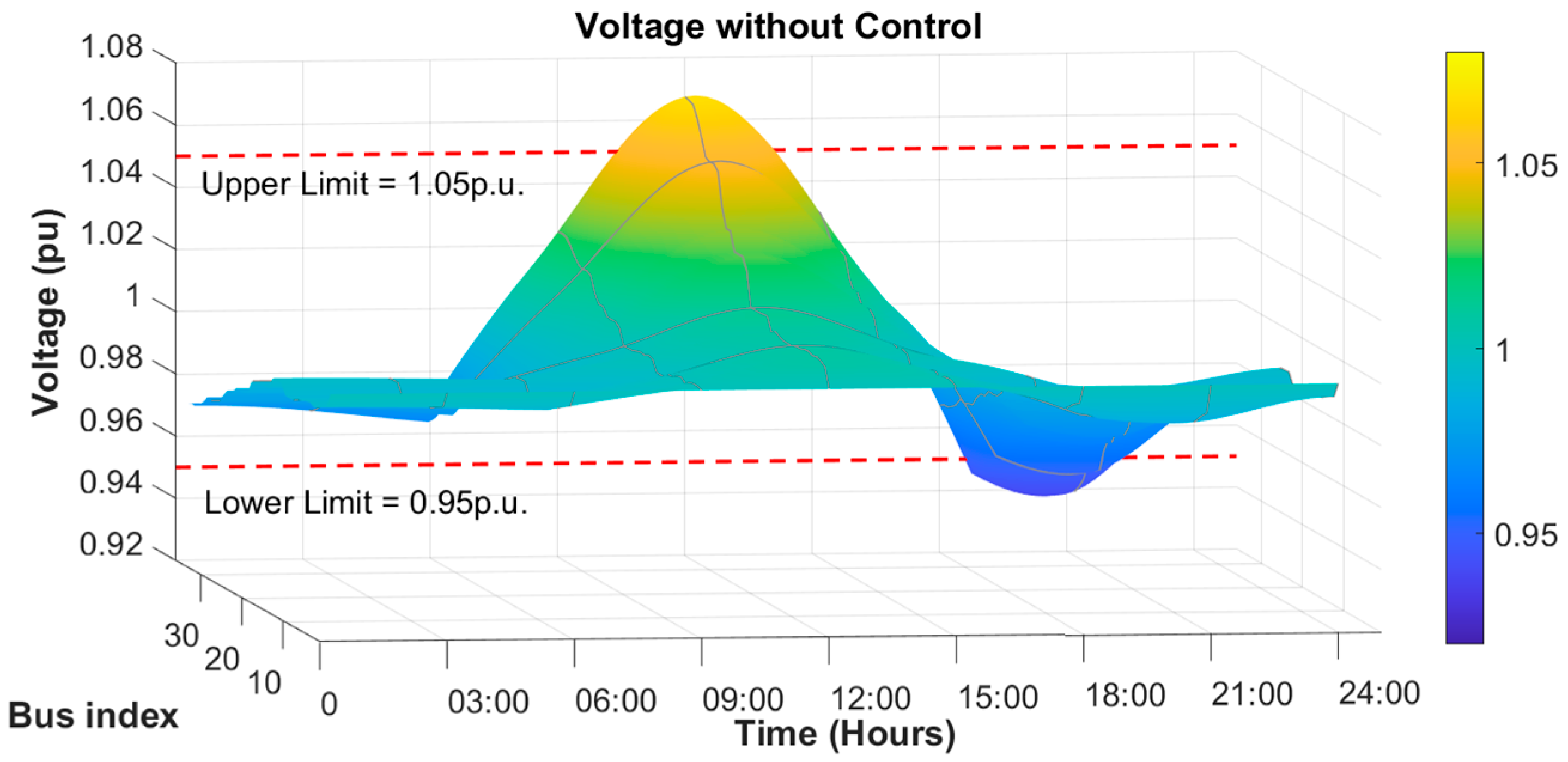
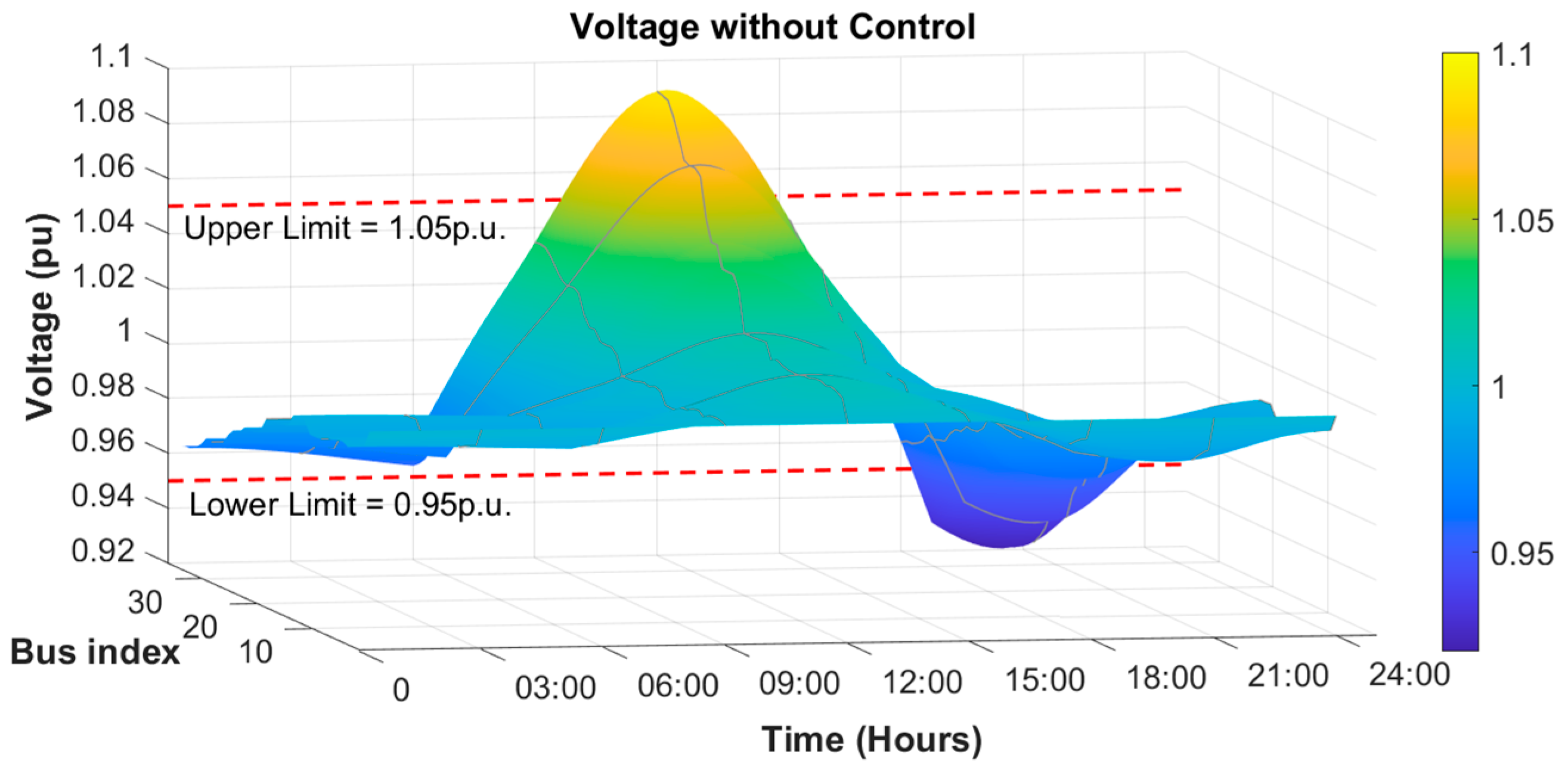
Case 2-2 represents a scenario in which both PV output and load are increased compared to Case 2-1. Figure 14 shows the voltage profile before control. With each PV output having increased from 300 kW to 400 kW and having higher load levels, overvoltage and undervoltage issues have become more severe compared to Case 1-2, with voltages rising to 1.089 p.u. and dropping to 0.92 p.u. When the inverter control is applied, the reactive power compensation of the PV and EV-connected inverters is shown in Figure 15 and Figure 16, respectively. The increased PV capacity allows for a maximum reactive power compensation of 0.194 MVar. As in Case 2-1, during overvoltage conditions, reactive power is absorbed at the end of the system, while it is injected at the front end to improve the substation power factor.
During undervoltage conditions, the reactive power control of the inverters operates in the opposite manner.
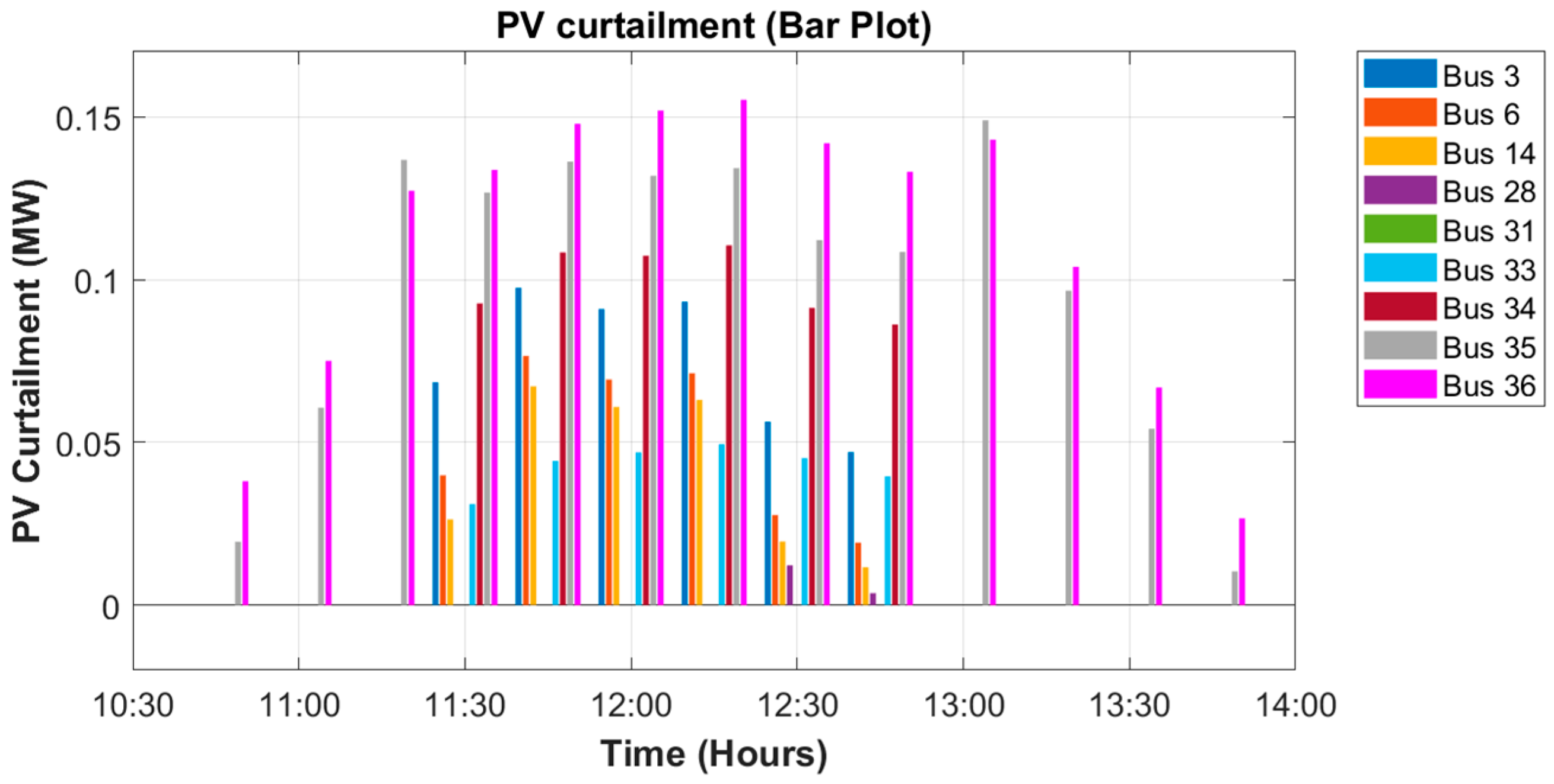
Figure 17 presents the voltage profile after applying the inverter control in Case 2-2. Overvoltage is effectively mitigated, although 2.42 MWh of PV curtailment is required. At this time, the most curtailments were performed by Bus 35 and Bus 36, and 0.542 MWh and 0.475 MWh, respectively. In the distribution system, voltage fluctuations intensify toward the end of the system, and since the voltage sensitivity of the end is the greatest, the bus located at the end performs many curtailments to resolve the voltage violation in the case with the largest voltage violation.
The third place to perform the most curtailments was Bus3 and 0.383 MWh. As the PV power generation in the distribution system increases, the magnitude of the current flowing to the substation increases significantly, resulting in an increase in curtailments, even in the bus located at the front end, to satisfy the line current constraints. Through this, it was confirmed that when AC-OPF control is used, excessive increases in voltage and line current can be suppressed. However, the minimum voltage during the evening load peak remains at 0.946 p.u., indicating that the undervoltage issue is not fully resolved. This limitation arises because the reactive power compensation alone cannot fully address voltage drops during high load periods. Therefore, the proposed method addresses the undervoltage phenomenon by utilizing EV discharging during peak load periods to support voltage regulation.

4.3. Results of Case 3 (ARH-Based EV, DERs Control)

Case 3 presents the results of implementing the proposed ARH-based EV and DERs control.

4.3.1. Case 3-1 (Medium PV Generation, Load)

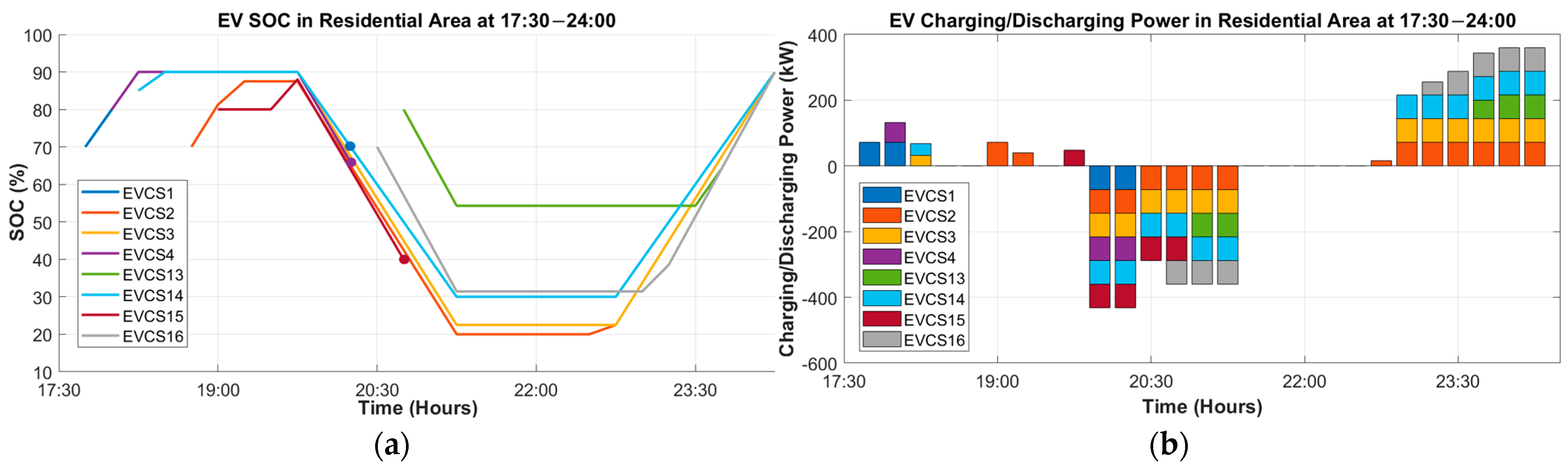
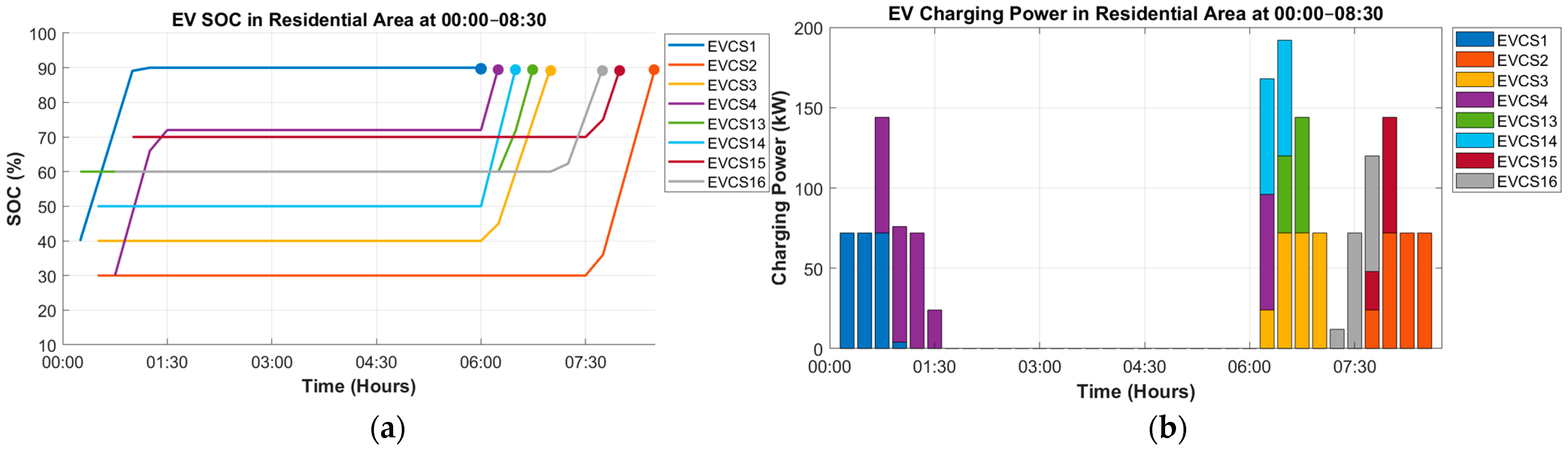
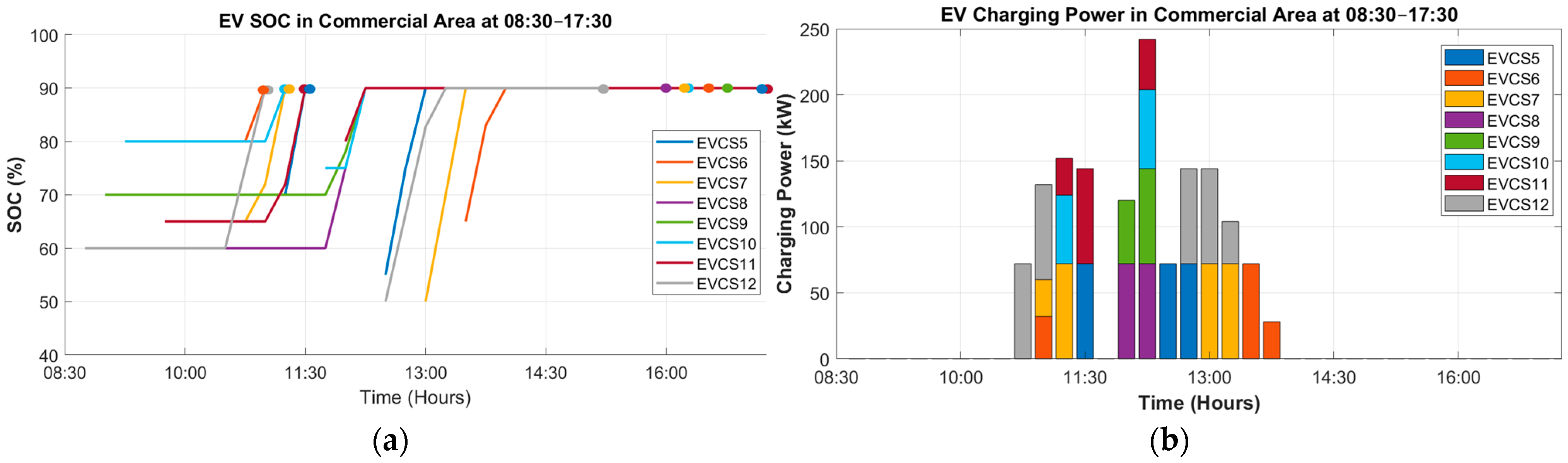
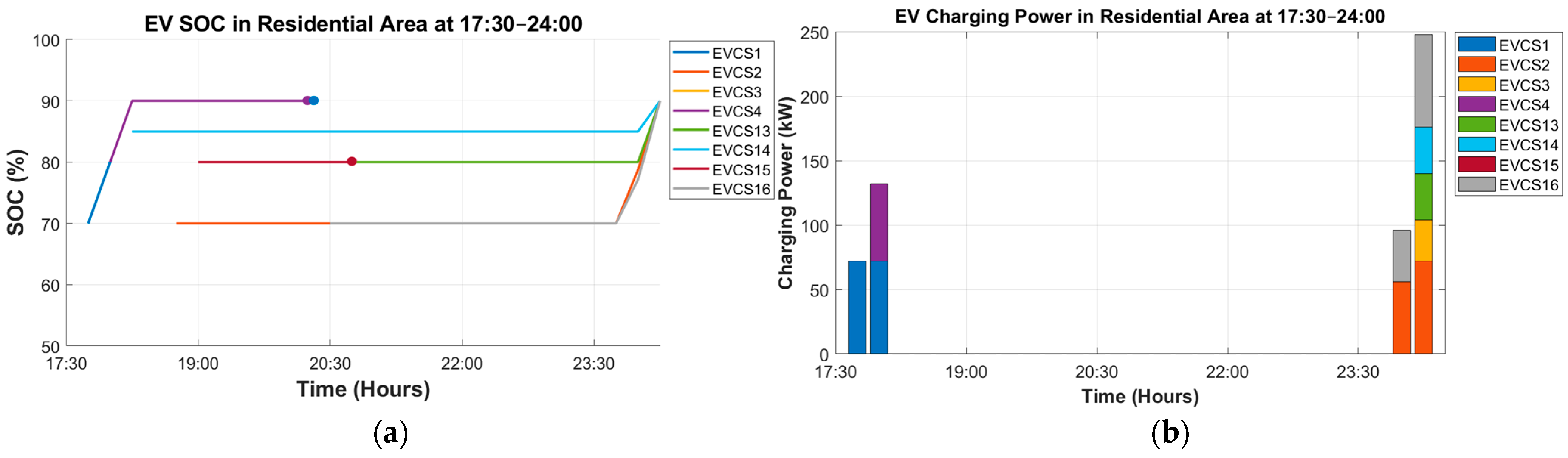
Case 3-1 uses the same scenario as Case 2-1 and demonstrates that the distribution system operates more effectively when EV charging/discharging scheduling through MILP is combined with a PV- and EV-connected inverter control. The voltage profile before the control is shown in Figure 10, and the SOC variations in the EVs, according to the optimized charging/discharging schedule, is shown in Figure 18a, Figure 19a, and Figure 20a. EV data for this scenario are provided in Table 2 and Table 3. As shown in Figure 18a, EVs in the residential area are connected from midnight to 08:30. Each EV charges between 06:00 and 08:30, when the voltage rises due to increasing PV output. To meet the required SOC for departure, most charging occurs just before the EV departs. EVs connected to EVCS1 and EVCS4, where no PV generation occurs during the connecting period, charge between midnight and 01:45, when the load is low. Figure 19a shows the SOC of EVs in the commercial area from 08:30 to 17:30. Some EVCSs undergo multiple connection and disconnection events, but in general, all EVs charge when the voltage is highest: around 12:30. As a result, voltage regulation is effectively achieved without the need for PV curtailment. Figure 20a shows SOC variations for EVs that are connected to the residential area again in the evening. Undervoltage conditions during this period are sufficiently mitigated through reactive power compensation alone. No V2G discharging is required, and charging occurs during the periods of highest voltage among each EV’s connection times, ensuring that all EVs achieve their required starting SOC. The variation in the charging power of the EVCS, according to each period, is shown in Figure 18b, Figure 19b, and Figure 20b, and the capacity of one EVCS is set to 72 kW.
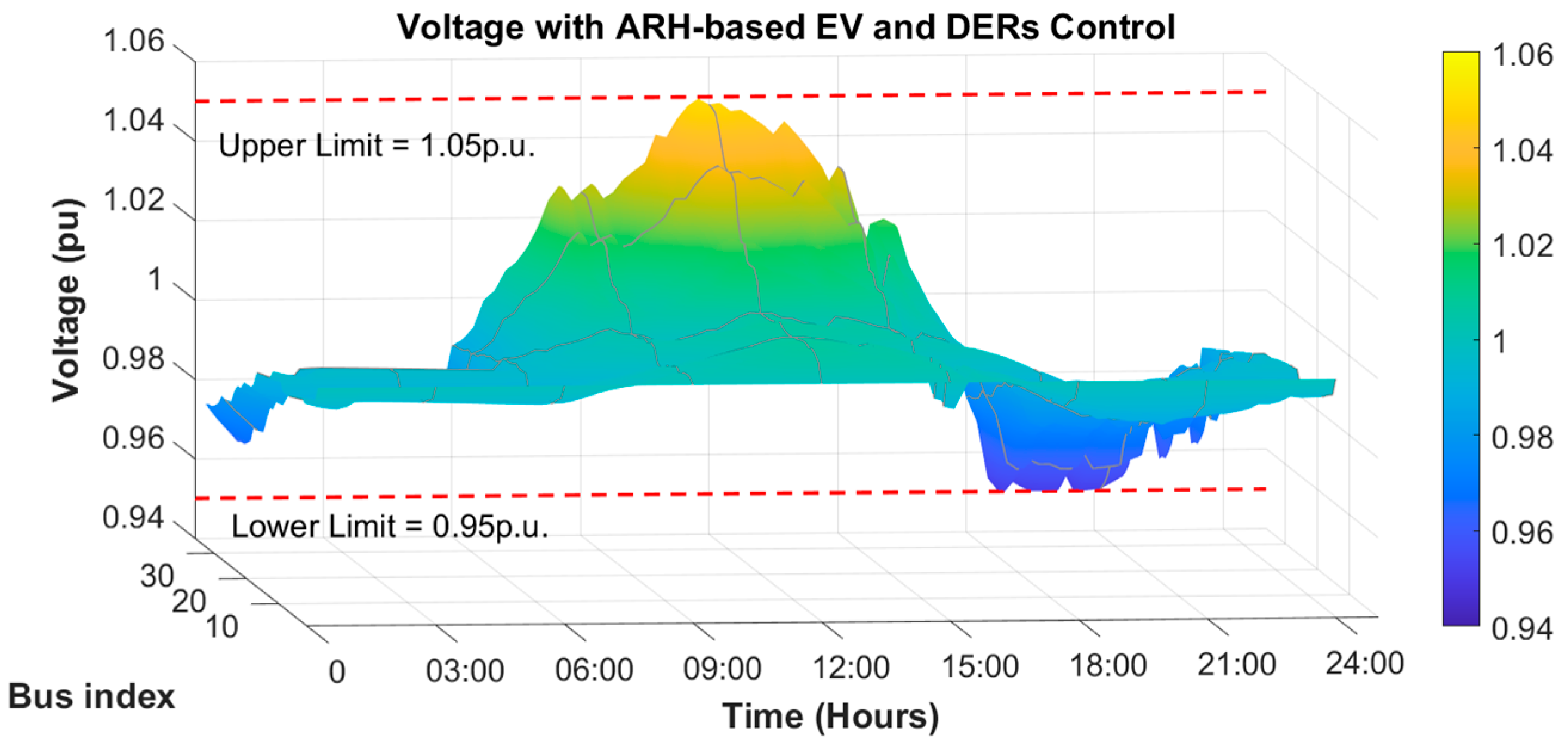
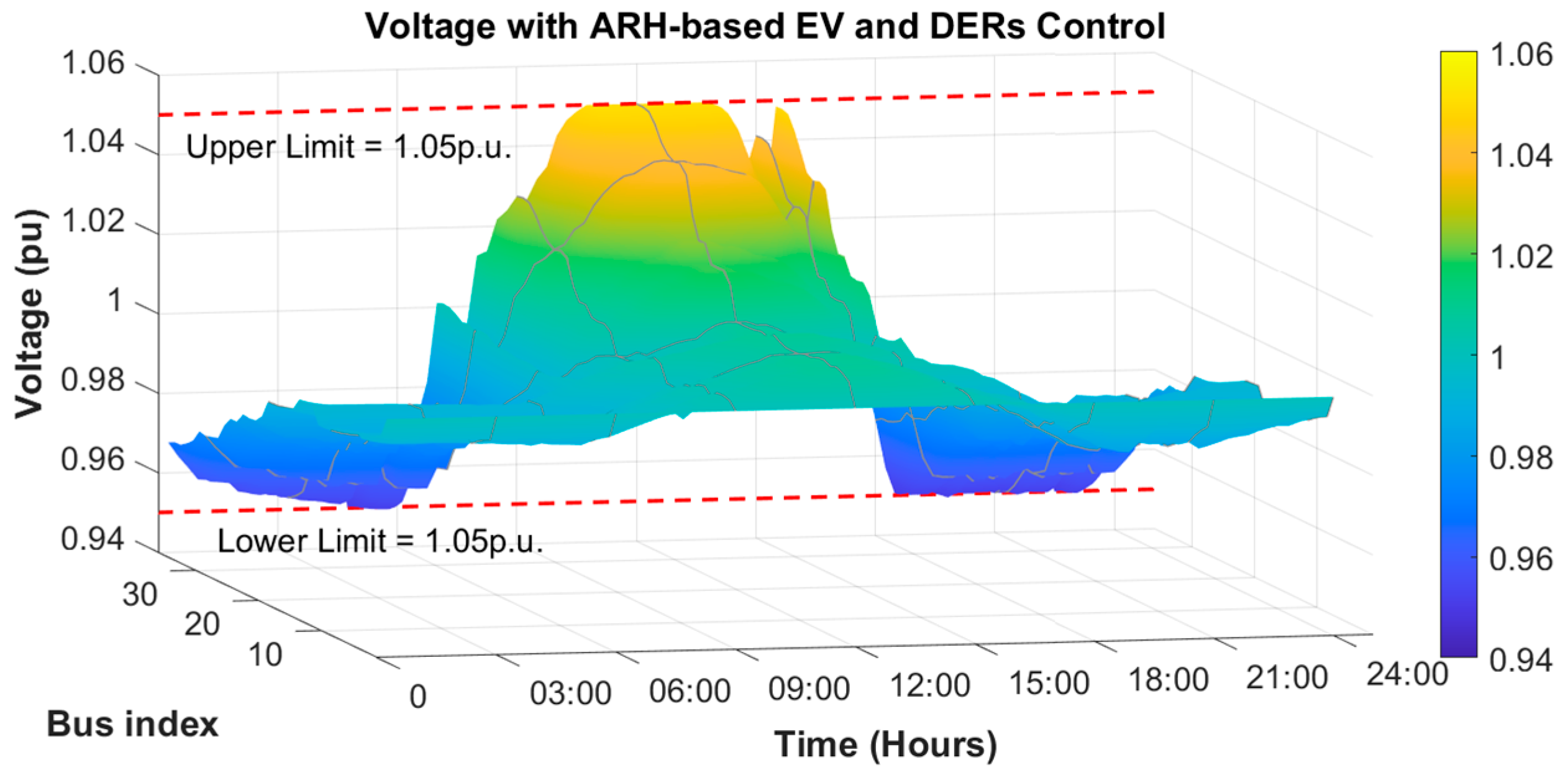
Figure 21 and Figure 22 depict the reactive power compensation of PV- and EV-connected inverters, respectively. As in previous cases, buses at the end of the system primarily absorb reactive power during the day and inject it in the evening, while buses at the front of the system inject reactive power during the day and absorb it in the evening to maintain the power factor. When EV charging/discharging scheduling and inverter reactive power compensation are fully utilized, all overvoltage conditions are resolved without limiting the PV output. Consequently, as shown in Figure 23, the voltages of all buses remain within 0.95–1.05 p.u. at all times. The proposed method thus reduces PV curtailment by leveraging EV charging during overvoltage periods, indicating that the distributed generation capacity of the system can be increased while maintaining PV owner profitability.

4.3.2. Case 3-2 (High PV Generation, Load)

Case 3-2 uses the same PV output and load scenario as Case 2-2 but addresses the low-voltage problem that could not be resolved using AC-OPF alone. The voltage profile before control is shown in Figure 14. The SOC variations in EVs in the residential area during the morning and in the commercial area are shown in Figure 18a and Figure 19a, respectively. EV charging is determined based on the voltage levels. While the voltage profile trend in Case 3-2 is similar to that of Case 3-1, only due to an increase in the PV output and system load, EVs connected in the residential area in the evening utilize the V2G function to mitigate low-voltage conditions that cannot be addressed by the inverter control alone. Figure 24a illustrates the corresponding SOC changes. EVs at EVCS1, EVCS4, and EVCS15 discharge up to the limit that does not violate the required SOC to correct undervoltage issues prior to departure. For other EVCSs, discharging occurs in all low-voltage periods, followed by recharging to meet the required SOC of 90% by 24:00, demonstrating that SOC targets are fully achieved. Figure 24b shows the variation in the EV charging/discharging power at the corresponding time. The negative number of the charging power means discharge, and like the SOC change, it can be seen that EVs are discharged during the time when the load increases, and charging is performed to satisfy the required SOC of the EV owner before parking out. When EV charging/discharging scheduling via MILP is combined with AC-OPF, low-voltage problems are effectively resolved through coordinated EV discharging in undervoltage areas. Figure 25 and Figure 26 depict the reactive power compensation of PV- and EV-connected inverters, respectively. The results show that simultaneous injection and absorption of reactive power are applied to achieve both voltage regulation and power factor control.
Figure 27 presents the voltage profile after the control in Case 3-2. By combining the EV scheduling and inverter control, the voltages of all buses are maintained within [0.95, 1.05 p.u.] for all times, successfully resolving all low-voltage issues that remained unresolved in Case 2-2. At this time, the total PV curtailment was 1.16 MWh, which was about half of Case 2-2. As in Case 2-2, curtailments occurred most in Bus 36 and Bus 35, which are located at the end, and were 0.364 MWh and 0.322 MWh, respectively, and 0.114 MWh of curtailment occurred in Bus 3 to satisfy the current constraint. Through this, it is possible to ensure the profitability of the PV owner by reducing the PV curtailment when using EV scheduling.

4.4. Results Analysis

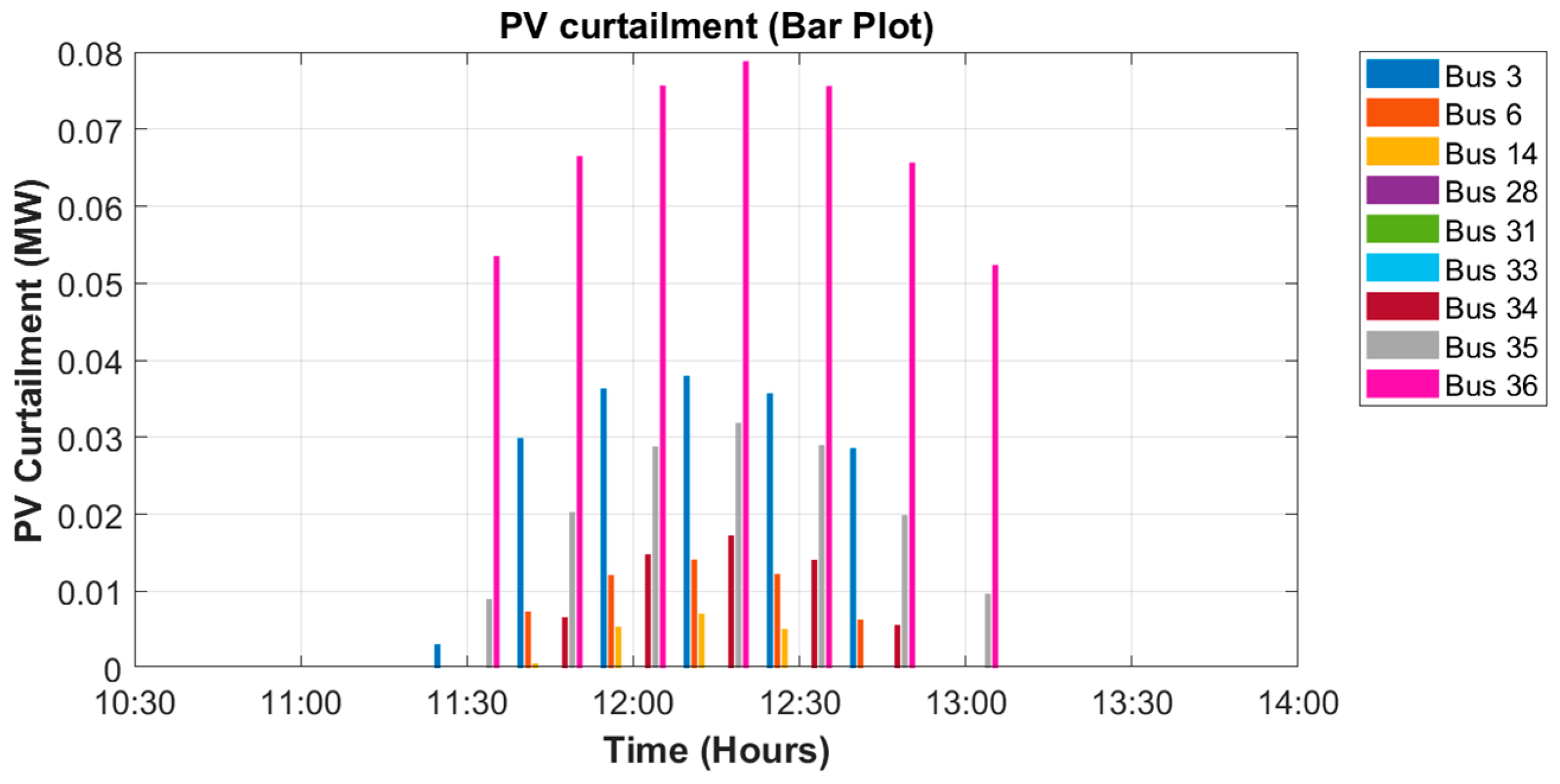
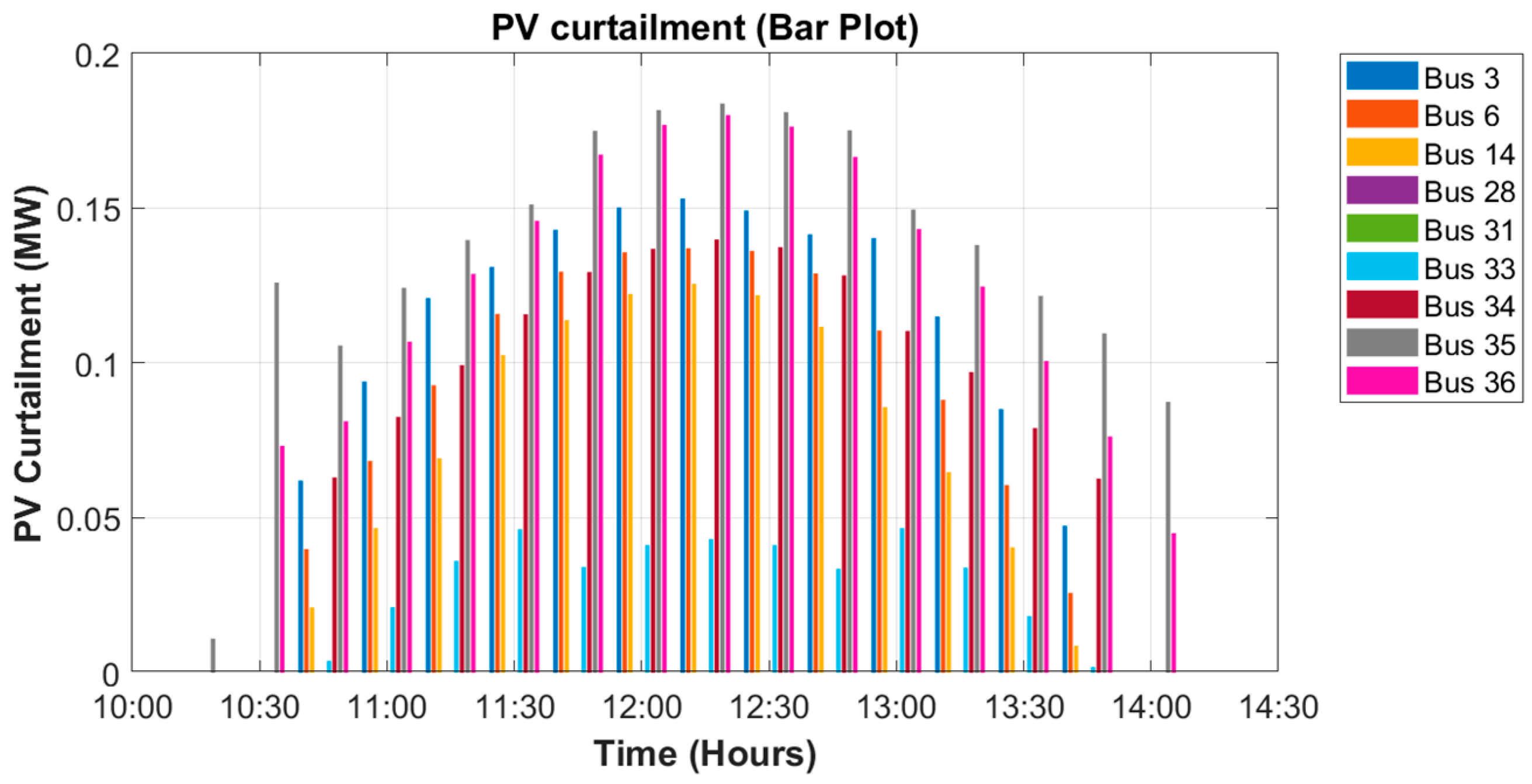
Table 4 summarizes the simulation results. Case 1-1 represents the PV capacity and load that can be accommodated when no control is applied. Cases 1-2, 2-1, and 3-1 use the same scenario to verify the performance of the proposed method. The total PV capacity is 2.7 MW, and the maximum load of the distribution system is 3.21 MW + j1.308 MVar. In Case 1-2, without control, the maximum voltage rises to 1.066 p.u., and the minimum voltage drops to 0.928 p.u., indicating that overvoltage and undervoltage issues occur during the day. When AC-OPF control is applied (Case 2-1), the voltage of all buses remains within 0.95–1.05 p.u. PV curtailment only occurs when necessary, as shown in Figure 28. Specifically, curtailment is applied at Buses 3, 6, and 14 to satisfy the line current limits, and at Buses 35 and 36 for voltage regulation. The total PV curtailment in Case 2-1 is 0.23 MWh. In Case 3-1, voltage control is achieved without any PV curtailment by scheduling EV charging during periods of overvoltage. This demonstrates that the system can be operated more effectively by using the ARH-based EV and DERs control method. For scenarios with increased PV generation and load (Cases 2-2 and 3-2), the total PV capacity is 3.6 MW, and the maximum load is 3.531 MW + j1.438 MVar. In Case 2-2, using only AC-OPF control, PV curtailment rises sharply during the day (Figure 29).
Curtailment is needed not only for voltage control at the end of the system but also to prevent overcurrent at the front end, due to higher PV generation. The total PV curtailment reaches 2.42 MWh. Although the maximum voltage is maintained below 1.05 p.u., the minimum voltage drops to 0.947 p.u., because the reactive power compensation alone cannot resolve the low-voltage problem during peak load periods. In Case 3-2, using ARH-based EV and DERs control, strategically scheduled EV charging reduces the PV curtailment by more than half, lowering it to 1.16 MWh (Figure 30). Furthermore, EV discharging during low-voltage periods ensures that the minimum voltage remains above 0.95 p.u.
The power factor shown in Table 4 represents the maximum, minimum, and average values of the power factor of the substation during the day. Case 1 does not use control, so when the PV power generation and load in the system are similar, the power factor drops a lot, so the minimum power factors for Case 1-1 and Case 1-2 were 0.678 and 0.517, respectively. Likewise, the average value of the power factor is slightly lower, at 0.916 for Case 1-1 and 0.899 for Case 1-2. However, when the AC-OPF control, ARH-based EVs, and the DERs control are used, the power factor control is performed through reactive power compensation, so the average power factor is 0.994 or 0.995, showing an ideal power factor value. Case 2-1 has a minimum power factor of 0.973, which is slightly below the set minimum power factor of 0.98. However, in Case 3-1, using EVs, more reactive power can be used for power factor control by using EVs for voltage control, so it can be seen that the minimum power factor is 0.98, which satisfies the set minimum power factor. This confirms that the proposed two-stage optimization method increases the capacity of the distributed generation, minimizes the PV curtailment, and effectively manages higher loads while maintaining system stability.
This study was conducted through MATLAB R2022b, and for the 24 h operation of the IEEE 37 bus distribution system considered in this study, the average time required to solve one optimization window of the proposed algorithm was about 15 min. This might feel a little bit longer to simulate, but if it is performed in C/C++ or a dedicated server, the solution time will be reduced.

5. Conclusions

This paper presents a two-stage optimization method for voltage control in distribution systems, integrating EV charging/discharging scheduling and inverter control within a DERMS framework. By employing an ARH approach to determine the optimization period based on each EV’s connection time, the method effectively addresses the uncertainty associated with EV availability. Additionally, the multi-objective optimization simultaneously mitigates conflicting voltage and power factor issues. The proposed algorithm combines MILP-based EV optimal scheduling with ARH and NLP-based optimal inverter control to maintain the voltage and power factor within permissible limits. This approach is particularly suitable for managing the increasing integration of distributed renewable energy and higher system loads, ensuring stable distribution system operation.
Simulation results demonstrate that the algorithm performs effectively in maintaining voltage and power factor. While inverter control alone, via AC-OPF, provides satisfactory results, combining it with EV scheduling further improves system performance. Specifically, the proposed method can reduce undervoltage issues through the V2G function while minimizing PV curtailment. Overall, this study contributes to the reliable and efficient operation of distribution systems by providing an effective strategy to increase DER integration and enhance system stability. In conclusion, it suggests that applying the proposed algorithm to the 4.8 kV distribution system can delay the huge investment cost for upgrading the distribution system, because stable operation is possible without line expansion or additional facilities.
In future work, the test system will be further expanded to verify the proposed algorithm in an environment where the penetration rate of large-scale distribution systems and DERs is increased, and a more quantitative analysis will be performed. In addition, cost–benefit and battery degradation analysis will be performed to verify the validity of the NWA approach [35,36]. Through comparative analysis with the recently researched deep reinforcement learning (DRL)-based optimization method, we will analyze the advantages and limitations of the proposed approach and advance the proposed method [37].

Author Contributions

Conceptualization, W.Y., P.-H.T. and I.-Y.C.; methodology, W.Y., P.-H.T. and J.-Y.J.; software, W.Y. and P.-H.T.; validation, W.Y., P.-H.T., J.-Y.J. and I.-Y.C.; formal analysis, W.Y. and P.-H.T.; investigation, W.Y. and P.-H.T.; data curation, W.Y.; writing—original draft preparation, W.Y.; writing—review and editing, W.Y. and P.-H.T.; visualization, W.Y.; supervision, I.-Y.C.; project administration, I.-Y.C. All authors have read and agreed to the published version of the manuscript.

Funding

This work was supported by the Korea Institute of Energy Technology Evaluation and Planning (KETEP), funded by the Ministry of Trade, Industry and Energy (MOTIE) of Korea (Grant No. RS-2024-00394225), and by the Institute for Information & Communications Technology Planning & Evaluation (IITP) under the Information Technology Research Center (ITRC) support program, funded by the Ministry of Science and ICT (MSIT), Korea (Grant No. RS-2023-00259004).

Data Availability Statement

The data presented in this study are available within the article.

Conflicts of Interest

The authors declare no conflicts of interest.

Nomenclature

Acronyms
DERsDistributed energy resources
PVPhotovoltaic
EVElectric vehicle
ARHAdaptive rolling horizon
MPCModel predictive control
PFPower factor
DERMSDistributed energy resource management system
p.u.Per unit
NWANon wire alternative
DSODistribution system operator
DRDemand response
V2GVehicle-to-grid
PEVPlug-in electric vehicle
PCCPoint of common coupling
VVOVolt/Var optimization
OLTCOn-load tap changer
CBCapacitor bank
SOCPSecond-order cone programming
OPFOptimal power flow
IBRInverter-based resources
MILPMixed-integer linear programming
NLPNonlinear programming
Indices and Sets definition
t Time step index in the rolling horizon
t Time step duration
k , i Bus indices
N Number of buses
N t Number of time steps, t = 1 , , N t
N E V Number of EV buses
N P V Number of PV buses
W A R H Adaptive rolling-horizon window at time t (set of time steps from current t to the latest EV departure)
Variables and parameters
d t Latest departure time among connected EVs at time step t
s k , t E V , c h , s k , t E V , d i s Normalized EV charging/discharging rate at bus k, time step t
γ Penalty factor for EV discharging
β k , t Normalized voltage index (0–1) at bus k, time step t
V m a x ,   V m i n Upper/lower voltage limit
S O C k , t SOC for EV at bus k, time step t
S O C k d e p a r t , t SOC for EV at bus k, departure time step
S O C k r e q Required SOC for EV on bus k
S O C m a x ,   S O C m i n Maximum/minimum SOC limit for EV
E V k c a p EV capacity at bus k
P E V m a x , c h ,   P E V m a x , d i s Rated charging/discharging active power for EV
ρ c h , ρ d i s Charging/discharging efficiency
μ t Binary indicator enforcing mutual exclusivity of EV charging/discharging at time step t
ω Weight factor
V k , t Voltage magnitude for bus k, time step t
V r e f Reference bus voltage magnitude
P F s u b , t Power factor at substation, time step t
P F t a r g Target power factor
P F m a x ,   P F m i n Maximum/minimum allowable power factor
γ c u r t P V Penalty coefficient for PV curtailment
P i , t P V , c u r t Curtailed PV active power for bus i, time step t
P i , t i n j ,   Q i , t i n j Injected active/reactive power for bus i, time step t
P i , t l o a d , Q i , t l o a d Active/reactive load of bus i, time step t
P i , t P V , a v a i Available PV active power for bus i, time step t
P i , t E V , c h ,   P i , t E V , d i s Charging/discharging active power for bus i, time step t
Q i , t P V ,   Q i , t E V Reactive power of PV/EV inverter for bus i, time step t
Q k , m a x P V , Q k , m a x E V Maximum reactive power of PV/EV inverter for bus k, time step t
S k P V , S k E V Rated apparent power of PV/EV inverter for bus k, time step t
I l , t Current magnitude flowing at line l , time step t
I l , m a x Thermal current limit of line l
θ i , t Voltage phase angle at bus i, time step t
G i k , B i k Conductance/susceptance between buses i and k

References

  1. Masson, G.; Bosch, E.; Van Rechem, A.; de l’Epine, M. Snapshot of Global PV Markets 2023; Report IEA-PVPS T1-44:2023. IEA Photovoltaic Power Systems Programme (IEA PVPS), Task 1; IEA: Angers, France, 2023; ISBN 978-3-907281-43-7. Available online: https://iea-pvps.org/ (accessed on 30 September 2025).
  2. International Energy Agency (IEA). World Energy Outlook 2024; Typeset in France, October 2024; IEA: Paris, France, 2024. [Google Scholar]
  3. Abedinia, O.; Moradzadeh, M.; Acharya, D.; Ghadimi, N. Grid Integration Challenges and Solution Strategies for Solar PV Systems: A Review. IEEE Access 2022, 10, 52233–52249. [Google Scholar] [CrossRef]
  4. Sun, H.; Guo, Q.; Qi, J.; Ajjarapu, V.; Bravo, R.; Chow, J.; Li, Z.; Moghe, R.; Nasr-Azadani, E.; Tamrakar, U.; et al. Review of Challenges and Research Opportunities for Voltage Control in Smart Grids. IEEE Trans. Power Syst. 2019, 34, 2790–2801. [Google Scholar] [CrossRef]
  5. Arabali, A.; Ghofrani, M.; Etezadi-Amoli, M.; Fadali, M.S.; Baghzouz, Y. Genetic-Algorithm-Based Optimization Approach for Energy Management. IEEE Trans. Power Deliv. 2013, 28, 162–170. [Google Scholar] [CrossRef]
  6. Anoune, K.; Ahaitouf, A.; El Markhi, H.; Ghandour, M.; Ghennioui, A. Optimal Sizing of Multiple Renewable Energy Resources and PV Inverter Reactive Power Control Encompassing Environmental, Technical, and Economic Issues. IEEE Syst. J. 2019, 13, 3026–3037. [Google Scholar] [CrossRef]
  7. Cruz-Vega, S.; Toquica, M.H.; Lima, L.; Leite, J.A.C.; Cabalcante-Goyes, C. Voltage Control in Distribution Networks: An Overview. Energies 2025, 18, 3568. [Google Scholar]
  8. Contreras-Ocaña, J.E.; Chen, Y.; Siddiqi, U.; Zhang, B. Non-Wire Alternatives: An Additional Value Stream for Distributed Energy Resources. IEEE Trans. Sustain. Energy 2020, 11, 1287–1299. [Google Scholar] [CrossRef]
  9. Pourghasem Gavgani, P.; Baghbannovin, S.; Mohseni-Bonab, S.M.; Kamwa, I. Distributed Energy Resources Management System (DERMS) and Its Coordination with Transmission System: A Review and Co-Simulation. Energies 2024, 17, 1353. [Google Scholar] [CrossRef]
  10. Tian, H.; Zhou, Y.; Shen, X.; Xie, J.; Zhou, M.; Wang, X.; Hu, T.; Bai, W.; Zhang, T. Distributed Energy Resource Management System (DERMS) Solution for Feeder Voltage Management for Utility Integrated DERs. In Proceedings of the 2021 6th International Conference on Power and Renewable Energy (ICPRE), Shanghai, China, 17–20 September 2021; pp. 106–111. [Google Scholar] [CrossRef]
  11. Strezoski, L. Utility DERMS and DER Aggregators: An Ideal Case for Tomorrow’s DSO. In Proceedings of the 2022 IEEE PES Innovative Smart Grid Technologies Conference Europe (ISGT Europe), Novi Sad, Serbia, 10–12 October 2022. [Google Scholar] [CrossRef]
  12. Yao, Y.; Ye, K.; Zhao, J.; Ding, F.; Giraldez, J. DERMS Online: A New Voltage Sensitivity-Enabled Feedback Optimization Framework. In Proceedings of the 2022 IEEE PES Innovative Smart Grid Technologies Conference (ISGT), New Orleans, LA, USA, 24–28 April 2022. [Google Scholar] [CrossRef]
  13. Strezoski, L.; Stefani, I. Utility DERMS for Active Management of Emerging Distribution Grids with High Penetration of Renewable DERs. Electronics 2021, 10, 2027. [Google Scholar] [CrossRef]
  14. International Energy Agency (IEA). Global EV Outlook 2025; IEA: Paris, France, 2025; Available online: https://www.iea.org/ (accessed on 2 October 2025).
  15. Eltohamy, M.S.; Tawfiq, M.H.; Ahmed, M.M.R.; Mohammed, B.; Ahmed, I.; Alaas, Z.; Youssef, H.; Raouf, A. A Comprehensive Review of V2G Technology. Energy Convers. Manag. X 2025, 27, 101138. [Google Scholar]
  16. İnci, M.; Savrun, M.M.; Çelik, Ö. Integrating Electric Vehicles as Virtual Power Plants: A Comprehensive Review on Vehicle-to-Grid (V2G) Concepts, Interface Topologies, Marketing and Future Prospects. J. Energy Storage 2022, 55, 105579. [Google Scholar] [CrossRef]
  17. Alam, M.J.E.; Muttaqi, K.M.; Sutanto, D. Effective Utilization of Available PEV Battery Capacity for Mitigation of Solar PV Impact and Grid Support with Integrated V2G Functionality. IEEE Trans. Smart Grid 2016, 7, 1562–1571. [Google Scholar] [CrossRef]
  18. Al-Awami, A.T.; Sortomme, E.; Akhtar, G.M.A.; Faddel, S. A Voltage-Based Controller for an Electric-Vehicle Charger. IEEE Trans. Veh. Technol. 2016, 65, 4185–4196. [Google Scholar] [CrossRef]
  19. IEEE Std 1547-2018; IEEE Standard for Interconnection and Interoperability of Distributed Energy Resources with Associated Electric Power Systems Interfaces. IEEE: New York, NY, USA, 2018. Available online: https://ieeexplore.ieee.org/ (accessed on 2 October 2025).
  20. Ismeil, M.A.; Alfouly, A.; Hussein, H.S.; Hamdan, I. Improved Inverter Control Techniques in Terms of Hosting Capacity for Solar Photovoltaic Energy with Battery Energy Storage System. IEEE Access 2023, 11, 140161–140176. [Google Scholar] [CrossRef]
  21. Long, Y.; Kirschen, D.S. Bi-Level Volt/VAR Optimization in Distribution Networks with Smart PV Inverters. IEEE Trans. Power Syst. 2022, 37, 3604–3613. [Google Scholar] [CrossRef]
  22. Chowdhury, M.M.-U.-T.; Hasan, M.S.; Kamalasadan, S. A Novel Voltage Optimization Co-Simulation Framework for Electrical Distribution System with High Penetration of Renewables. IEEE Trans. Ind. Appl. 2025, 61, 1080–1090. [Google Scholar] [CrossRef]
  23. Aboshady, F.M.; Pisica, I.; Zobaa, A.F.; Taylor, G.A.; Ceylan, O.; Ozdemir, A. Reactive Power Control of PV Inverters in Active Distribution Grids with High PV Penetration. IEEE Access 2023, 11, 81477–81496. [Google Scholar] [CrossRef]
  24. Babu, K.R.; Khatod, D.K. Smart Inverter-Based Distributed Volt/Var Control for Voltage Violation Mitigation of Unbalanced Distribution Networks. IEEE Trans. Power Deliv. 2024, 39, 1481–1490. [Google Scholar] [CrossRef]
  25. Farokhi Soofi, A.; Manshadi, S.D. Unleashing Grid Services Potential of Electric Vehicles for the Volt/VAR Optimization Problem. IEEE Trans. Veh. Technol. 2023, 72, 14115–14126. [Google Scholar] [CrossRef]
  26. Wang, Y.; Chen, X.; Biyik, E.; Dhople, S.V.; Wang, J.; Low, S.H.; Lavaei, J.; Domínguez-García, A.D. MPC-Based Decentralized Voltage Control in Power Distribution Systems with EV and PV Coordination. IEEE Trans. Smart Grid 2022, 13, 2900–2914. [Google Scholar] [CrossRef]
  27. Su, Y.; Teh, J. Two-Stage Optimal Dispatching of AC/DC Hybrid Active Distribution Systems Considering Network Flexibility. J. Mod. Power Syst. Clean Energy 2023, 11, 52–65. [Google Scholar] [CrossRef]
  28. Su, Y.; Teh, J.; Chen, C. Optimal Dispatching for AC/DC Hybrid Distribution Systems with Electric Vehicles: Application of Cloud-Edge-Device Cooperation. IEEE Trans. Intell. Transp. Syst. 2024, 25, 3128–3140. [Google Scholar] [CrossRef]
  29. Trinh, P.-H.; Zafar, R.; Chung, I.-Y. Optimal PEV Charging and Discharging Algorithms to Reduce Operational Cost of Microgrid Using Adaptive Rolling Horizon Framework. IEEE Access 2023, 11, 133668–133680. [Google Scholar] [CrossRef]
  30. California Public Advocates Office (Cal Advocates). Report on the Results of Operations for Southern California Edison Company General Rate Case Test Year 2025; Doc ID: 526146957; California Public Utilities Commission: San Francisco, CA, USA, 2024. [Google Scholar]
  31. Cochran, J.; Denholm, P.; Mooney, M.; Steinberg, D.; Hale, E.; Heath, G.; Palminitier, B.; Sigrin, B.; Keyser, D.; McCamey, D.; et al. LA100: The Los Angeles 100% Renewable Energy Study—Executive Summary; NREL/TP-6A20-79444-ES; National Renewable Energy Laboratory: Golden, CO, USA, 2021. [Google Scholar]
  32. Kersting, W.H. Radial Distribution Test Feeders. IEEE Trans. Power Syst. 1991, 6, 975–985. [Google Scholar] [CrossRef]
  33. ANSI C84.1-2011; American National Standard for Electric Power Systems and Equipment—Voltage Ratings (60 Hertz). National Electrical Manufacturers Association (NEMA): Rosslyn, VA, USA, 2011.
  34. Vega-Fuentes, E.; León-del Rosario, S.; Cerezo-Sánchez, J.M.; Vega-Martínez, A. Fuzzy Inference System for Volt/Var Control in Distribution Substations in Isolated Power Systems. arXiv 2014, arXiv:1401.1632. [Google Scholar] [CrossRef]
  35. Husein, M.; Chung, I.-Y. Optimal Design and Financial Feasibility of a University Campus Microgrid Considering Renewable Energy Incentives. Appl. Energy 2018, 225, 273–289. [Google Scholar] [CrossRef]
  36. Husein, M.; Hau, V.B.; Chung, I.-Y.; Chae, W.-K.; Lee, H.-J. Design and Dynamic Performance Analysis of a Stand-Alone Microgrid—A Case Study of Gasa Island, South Korea. J. Electr. Eng. Technol. 2017, 12, 1777–1788. [Google Scholar] [CrossRef]
  37. Su, Y.; Teh, J.; Fang, S.; Dai, Z.; Wang, P. Two-Stage Optimal Dispatch Framework of Active Distribution Networks with Hybrid Energy Storage Systems via Deep Reinforcement Learning and Real-Time Feedback Dispatch. J. Energy Storage 2025, 108, 115169. [Google Scholar] [CrossRef]
Figure 1. Concept of a non-wired alternative.
Energies 18 06357 g001
Figure 2. DERMS control structure.
Energies 18 06357 g002
Figure 3. Two-stage optimization framework flowchart.
Energies 18 06357 g003
Figure 4. EV scheduling for minimizing PV curtailment and discharging.
Energies 18 06357 g004
Figure 5. Conflict between voltage and PF.
Energies 18 06357 g005
Figure 6. Concept of adaptive rolling horizon.
Energies 18 06357 g006
Figure 7. IEEE-37-bus test feeder-integrated PV and EV.
Energies 18 06357 g007
Figure 8. PV and load profiles over 24 h.
Energies 18 06357 g008
Figure 9. Voltage profile for Case 1-1.
Energies 18 06357 g009
Figure 10. Voltage profile for Case 1-2.
Energies 18 06357 g010
Figure 11. Reactive power of PV-connected inverter for Case 2-1. (a) and (b) show the 3D surface from two different viewing angles.
Energies 18 06357 g011
Figure 12. Reactive power of EV-connected inverter for Case 2-1. (a) and (b) show the 3D surface from two different viewing angles.
Energies 18 06357 g012
Figure 13. Voltage profile with AC-OPF control in Case 2-1.
Energies 18 06357 g013
Figure 14. Voltage profile without control for Case 2-2.
Energies 18 06357 g014
Figure 15. Reactive power of PV-connected inverter for Case 2-2. (a) and (b) show the 3D surface from two different viewing angles.
Energies 18 06357 g015
Figure 16. Reactive power of EV-connected inverter for Case 2-2. (a) and (b) show the 3D surface from two different viewing angles.
Energies 18 06357 g016
Figure 17. Voltage profile with AC-OPF control in Case 2-2.
Energies 18 06357 g017
Figure 18. SOC and charging power variation at 0:00–08:30 in Case 3-1: (a) SOC variation, (b) charging power variation.
Energies 18 06357 g018
Figure 19. SOC and charging power variation at 08:30–17:30 in Case 3-1: (a) SOC variation, (b) charging power variation.
Energies 18 06357 g019
Figure 20. SOC and charging power variation at 17:30–24:00 in Case 3-1: (a) SOC variation, (b) charging power variation.
Energies 18 06357 g020
Figure 21. Reactive power of PV-connected inverter in Case 3-1. (a) and (b) show the 3D surface from two different viewing angles.
Energies 18 06357 g021
Figure 22. Reactive power of EV-connected inverter in Case 3-1. (a) and (b) show the 3D surface from two different viewing angles.
Energies 18 06357 g022
Figure 23. Voltage profile with ARH-based EV and DERs control in Case 3-1.
Energies 18 06357 g023
Figure 24. SOC and V2G power variation at residential area in Case 3-2. (a) SOC variation, (b) charging power variation.
Energies 18 06357 g024
Figure 25. Reactive power of PV-connected inverter in Case 3-2. (a) and (b) show the 3D surface from two different viewing angles.
Energies 18 06357 g025
Figure 26. Reactive power of EV-connected inverter in Case 3-2. (a) and (b) show the 3D surface from two different viewing angles.
Energies 18 06357 g026
Figure 27. Voltage profile with ARH-based EV and DERs control in Case 3-2.
Energies 18 06357 g027
Figure 28. PV curtailment in Case 2-1.
Energies 18 06357 g028
Figure 29. PV curtailment in Case 2-2.
Energies 18 06357 g029
Figure 30. PV curtailment in Case 3-2.
Energies 18 06357 g030
Table 1. PV power generation and EV scheduling utilization by case.
ParametersNo ControlAC-OPF ControlARH-Based
EV, DERs Control
Case 1-1Case 1-2Case 2-1Case 2-2Case 3-1Case 3-2
Total PV
Capacity (MW)
1.8 MW2.7 MW2.7 MW3.6 MW2.7 MW3.6 MW
EV
Scheduling
XXXXOO
Peak P Load (MW)2.2073.213.213.5313.213.531
Peak Q Load (MVar)0.8991.3081.3081.4381.3081.438
Table 2. EV and EVCS data in residential areas (Bus 2, 32).
BusStation No. Connecting TimeEV Capacity (kWh)Initial SOC (%)Depart SOC (%)
17508:50–11:25
12:25–17:12
90
90
70
55
90
90
17609:05–10:50
13:24–16:17
80
100
80
65
90
90
17709:40–11:08
12:55–16:03
100
90
65
50
90
90
17809:38–15:471206090
25908:47–16:441507090
251009:10–11:02
11:37–16:12
130
100
80
75
90
90
251109:41–11:23
11:56–16:07
100
95
65
80
90
90
251208:42–10:51
12:18–15:14
120
110
60
50
90
90
Table 3. EV and EVCS data in commercial areas (Bus 17, 25).
BusStation No. Connecting TimeEV Capacity (kWh)Initial SOC (%)Depart SOC (%)
2100:12–05:55
17:25–19:48
11040
70
90
50
180
2200:25–08:27
18:28–23:59
100
160
30
70
80
90
2300:20–06:50
17:49–23:59
120
160
40
85
90
90
2400:40–06:10
17:40–19:58
100
150
30
80
85
50
321300:12–06:32
20:17–23:59
100
140
60
80
85
90
321400:20–06:16
17:51–23:59
90
180
50
85
80
90
321500:58–07:48
18:36–20:20
120
150
70
80
80
40
321600:37–07:37
20:03–23:59
130
140
60
70
90
90
Table 4. Analysis of results according to case.
MethodSize of
PV, Load
CasesVoltage (p.u.)Power FactorPV Curtailment (MWh)Total PV Capacity (MW)
MaxMinMaxMinAvg
No
Control
LowCase 1-11.0450.9520.9940.6780.916-1.8
MediumCase 1-21.0680.9380.9950.5170.899-2.7
AC-OPF
Control
MediumCase 2-11.050.9510.9730.9950.232.7
HighCase 2-21.050.94710.980.9952.423.6
ARH-based
EV, DERs Control
MediumCase 3-11.0450.9510.980.99402.7
HighCase 3-21.050.9510.980.9951.163.6
Disclaimer/Publisher’s Note: The statements, opinions and data contained in all publications are solely those of the individual author(s) and contributor(s) and not of MDPI and/or the editor(s). MDPI and/or the editor(s) disclaim responsibility for any injury to people or property resulting from any ideas, methods, instructions or products referred to in the content.