Dynamic Robust Generation and Transmission Expansion Planning Incorporating Novel Inter-Area Virtual Transmission Lines and Unit Commitment Ramping Constraints †


Abstract
1. Introduction
1.1. Background
1.2. Literature Review
1.3. Contributions
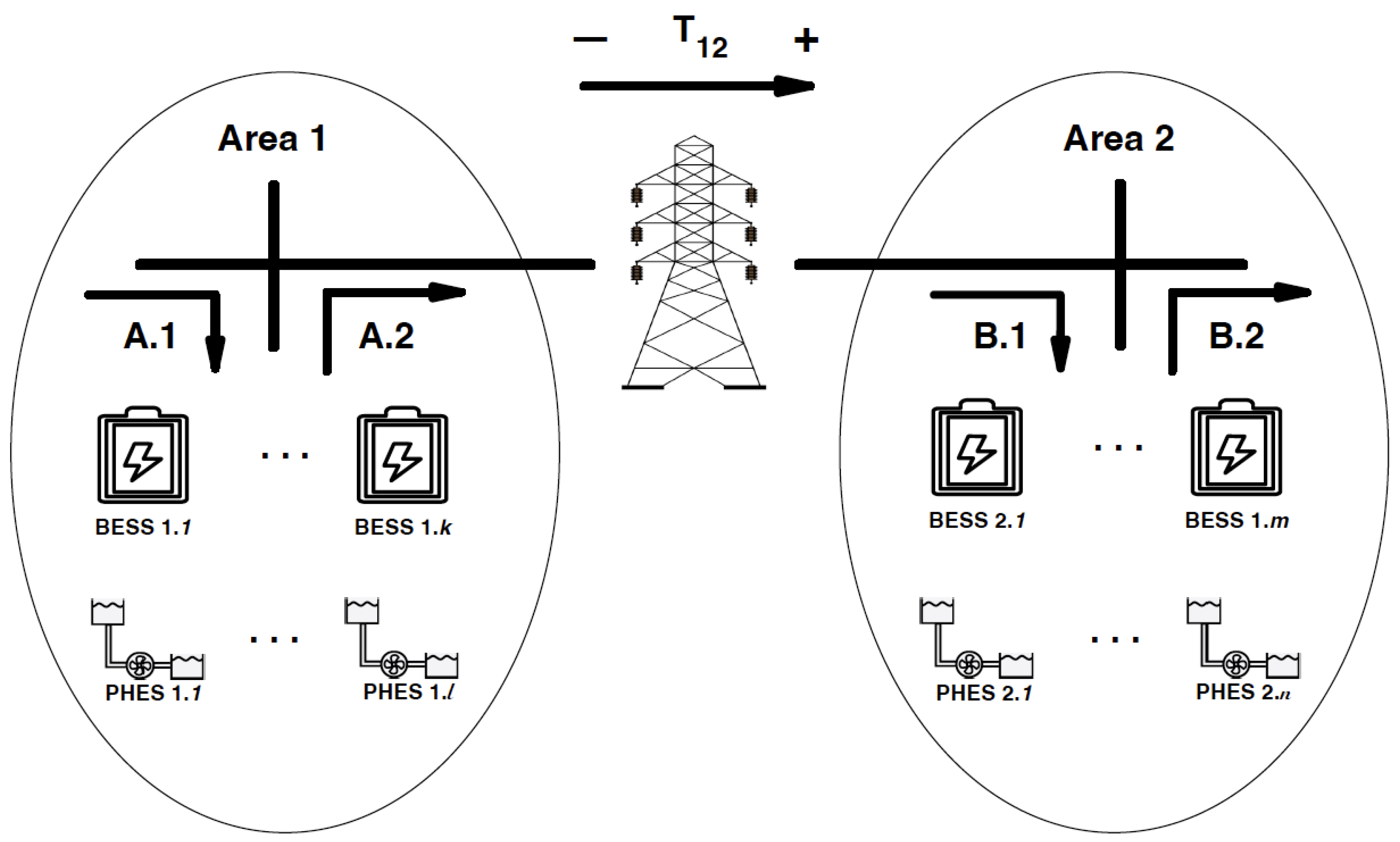
- A novel model of booster inter-area virtual transmission lines is considered in order to support this concept applied to trunks of transmission lines interconnecting areas of a transmission system, enabling the expansion planning consideration of storage infrastructure deployed at nodes of the two interconnected areas, and the use of revenue stacking from other services provided by this storage investments.
- Incorporation of flexibility metrics in generation and transmission dynamic expansion planning.
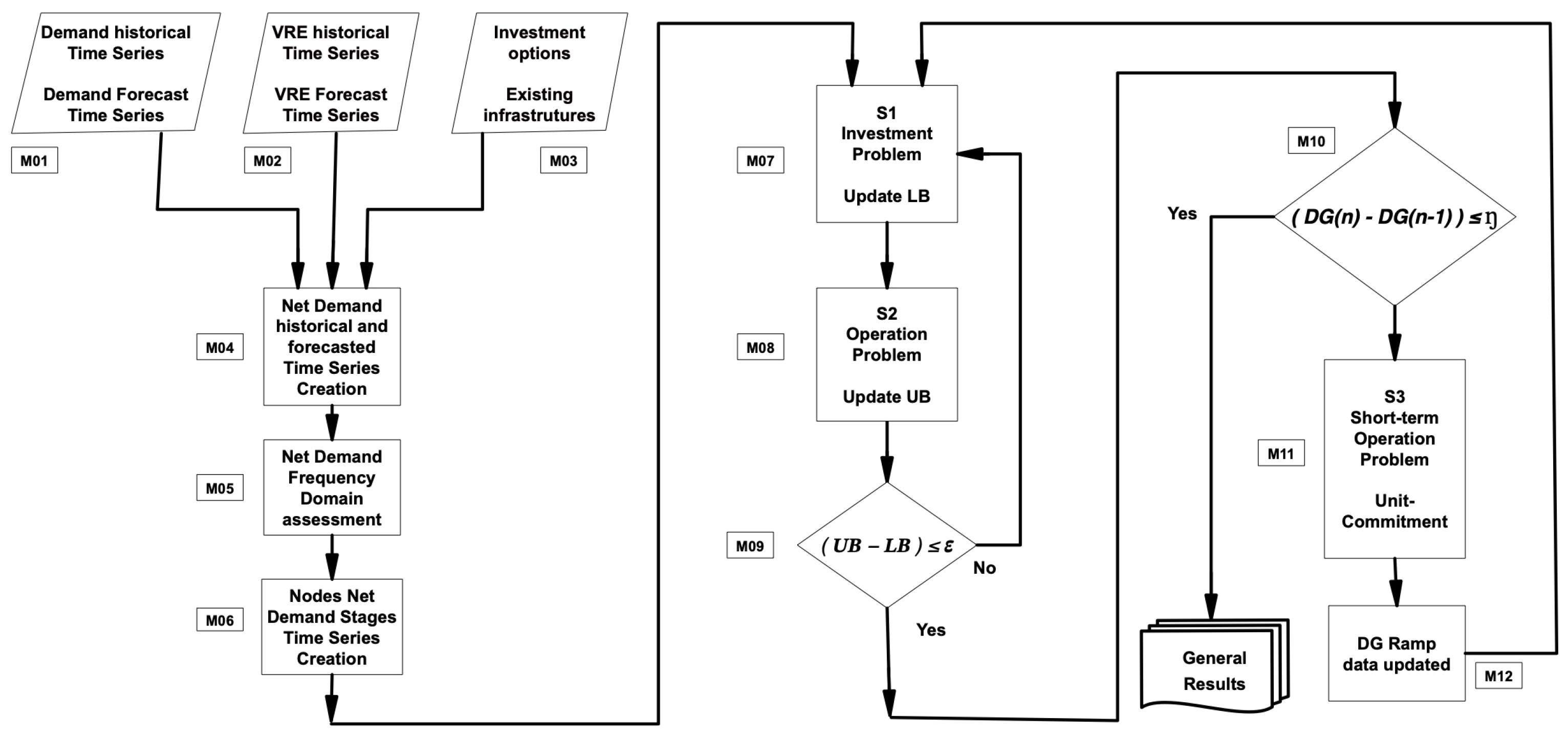
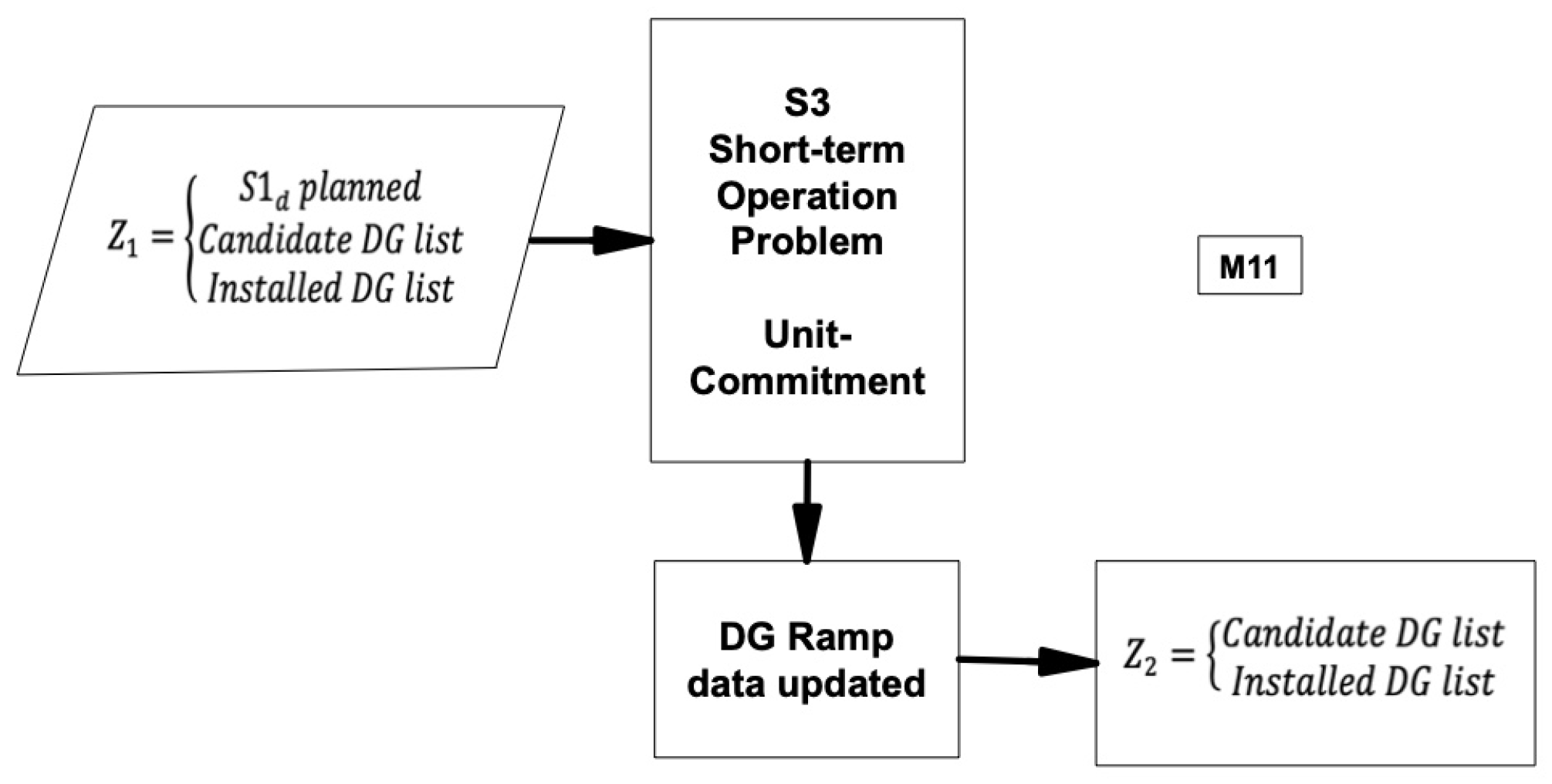
- Implementation of a three-level dynamic multi-period GTEP model, with the levels related to a long-term, lower-resolution of time intervals, approach considering investments and operational costs, and a third level, considering unit commitment and generators ramp constraints, considering a higher resolution of time periods.
2. Materials and Methods
2.1. Net Demand
2.2. Flexibility Metrics and Models
2.3. Virtual Transmission Lines
Virtual Transmission Lines—Revenue Stacking
2.4. Virtual Power Plants
2.5. Unit Commitment—Operational Flexibility Assessments
- Average and maximum curtailment levels.
- Average ramp-up surplus. The mean excess upward ramping capability (MW/h) beyond required net load ramps.
- Average ramp-down surplus. The mean excess downward ramping capability (MW/h), to absorb drops in net load.
2.6. Objective Function—Investment and Operation
2.7. Energy Storage System Constraints
2.8. Virtual Transmission Line Constraints
2.9. Flexibility Constraints
2.10. Unit Commitment Constraints
2.11. Inherited Model Components from Prior Work
2.12. Modeling Uncertainties
2.13. Solution Procedure
3. Results
3.1. IEEE RTS-GMLC
3.1.1. IEEE RTS-GMLC—Scenario S1.1
3.1.2. IEEE RTS-GMLC—Scenario S1.2
- Generation investment reduction (35.11 MUSD/year): This constitutes the largest portion of the savings. The strategic allocation of the ESS for VTL services allows the system to optimize the generation portfolio more efficiently, reducing the overall requirement for new candidate generation capacity.
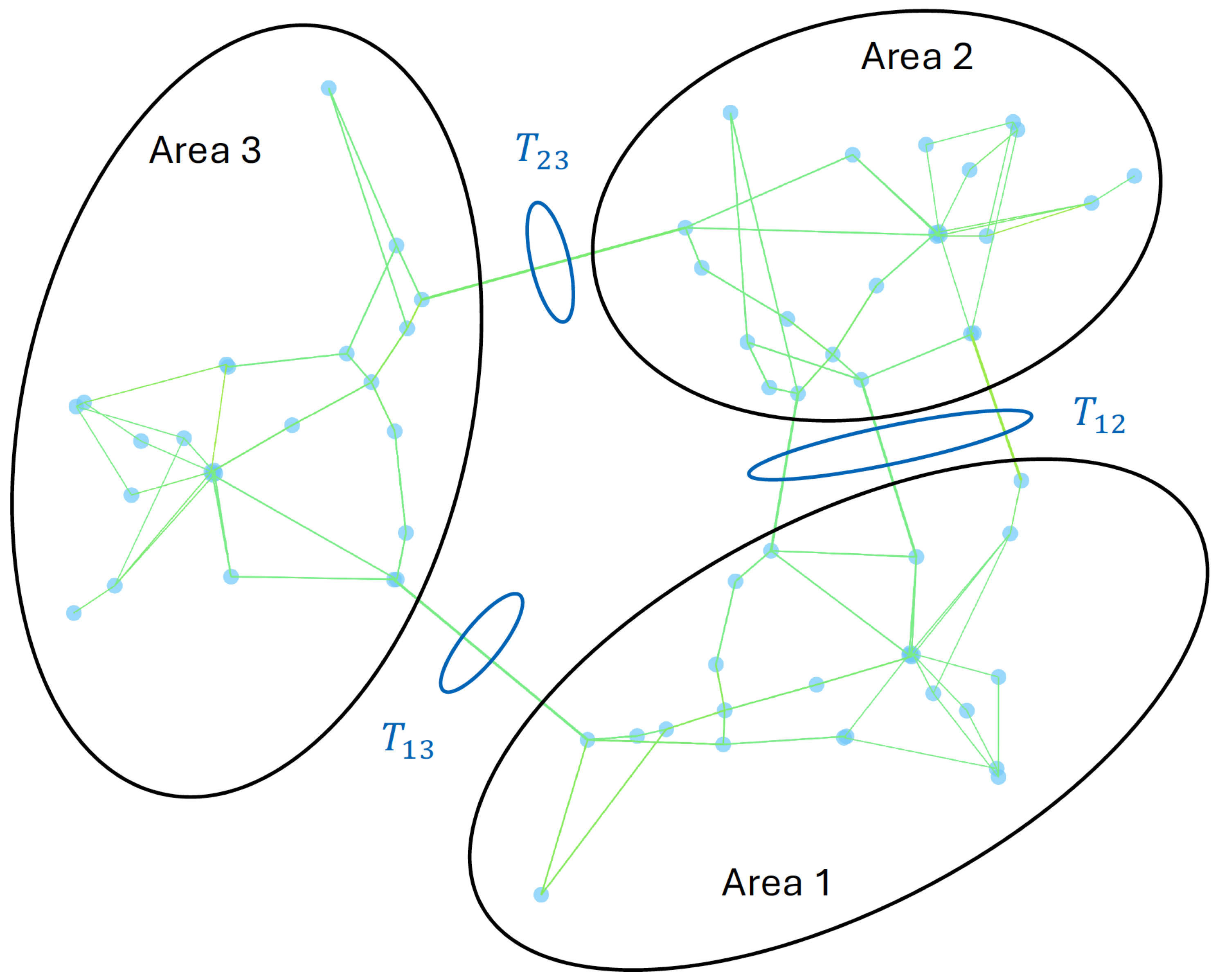
- Network investment reduction/transmission deferral (2.03 MUSD/year): By utilizing the inter-area VTL to increase the effective power transfer capacity of existing trunks, the model successfully reduces the need for capital-intensive physical transmission line expansions. The trunk of lines between Areas 3 and 2 that was chosen (N_318 N_223), without candidate VTL ESS, needed expansion in 2026 for two circuits, as shown in Table 9. Considering the investment in VTL in this trunk line, expansion was postponed to 2030 (first circuit) and 2031 (second circuit), as shown in Table 11.
- Operation cost reduction (4.71 MUSD/year): The VTL logic improves operational efficiency by mitigating inter-area congestion. This leads to reduced redispatch and minimizes the curtailment of low-cost renewable energy, thereby lowering daily generation operating expenses.
3.1.3. IEEE RTS-GMLC—Scenario S1.3
4. Conclusions
Author Contributions
Funding
Data Availability Statement
Conflicts of Interest
Nomenclature
| Unit Commitment—Input Data—Parameters | |
| Ramp-up capacity of generator | |
| Ramp-down capacity of generator | |
| Ramp limit start up of generator | |
| Ramp limit shut down of generator | |
| Min per-unit limit of generator | |
| Max per-unit limit of generator | |
| Nominal capacity of generator | |
| Min time up of generator | |
| Min time down of generator | |
| Min per-unit limit of generator | |
| Max per-unit limit of generator | |
| Min nominal capacity of generator | |
| Stand-by cost of generator n in time period t [$/] | |
| Start-up cost of generator n in time period t [$/event ] | |
| Start-down cost of generator n in time period t [$/event] | |
| Variable cost of UC load curtailment at node b [$/] | |
| Unit Commitment—Decision Variables | |
| Binary variable indicating if generator is dispatched | |
| Binary variable indicating if generator is start up | |
| Binary variable indicating if generator is shut down | |
| Dispatch power of generator | |
| Active power of UC curtailed demand, bus b, time period t | |
References
- Ferreira, F.A.L.; Unsihuay-Vila, C.; Núñez-Rodríguez, R.A. Transmission and Generation Expansion Planning Considering Virtual Power Lines/Plants, Distributed Energy Injection and Demand Response Flexibility from TSO-DSO Interface. Energies 2025, 18, 1602. [Google Scholar] [CrossRef]
- Lindner, M.; Peper, J.; Offermann, N.; Biele, C.; Teodosic, M.; Pohl, O.; Menne, J.; Häger, U. Operation strategies of battery energy storage systems for preventive and curative congestion management in transmission grids. IET Gener. Transm. Distrib. 2023, 17, 589–603. [Google Scholar] [CrossRef]
- Agüero, M.; Peralta, J.; Quintana, E.; Velar, V.; Stepanov, A.; Ashourian, H.; Mahseredjian, J.; Cárdenas, R. Virtual Transmission Solution Based on Battery Energy Storage Systems to Boost Transmission Capacity. J. Mod. Power Syst. Clean Energy 2024, 12, 466–474. [Google Scholar] [CrossRef]
- Wang, Q.; Li, X. Evaluation of battery energy storage system to provide virtual transmission service. Electr. Power Syst. Res. 2025, 244, 111570. [Google Scholar] [CrossRef]
- Latorre, G.; Cruz, R.D.; Areiza, J.M.; Villegas, A. Classification of publications and models on transmission expansion planning. IEEE Trans. Power Syst. 2003, 18, 938–946. [Google Scholar] [CrossRef]
- Hemmati, R.; Hooshmand, R.; Khodabakhshian, A. Comprehensive review of generation and transmission expansion planning. IET Gener. Transm. Distrib. 2013, 7, 955–964. [Google Scholar] [CrossRef]
- Mahdavi, M.; Sabillon Antunez, C.; Ajalli, M.; Romero, R. Transmission Expansion Planning: Literature Review and Classification. IEEE Syst. J. 2019, 13, 3129–3140. [Google Scholar] [CrossRef]
- Muralikrishnan, N.; Jebaraj, L.; Rajan, C.C.A. A Comprehensive Review on Evolutionary Optimization Techniques Applied for Unit Commitment Problem. IEEE Access 2020, 8, 132980–133014. [Google Scholar] [CrossRef]
- Ali, A.; Shah, A.; Keerio, M.U.; Mugheri, N.H.; Abbas, G.; Touti, E.; Hatatah, M.; Yousef, A.; Bouzguenda, M. Multi-Objective Security Constrained Unit Commitment via Hybrid Evolutionary Algorithms. IEEE Access 2024, 12, 6698–6718. [Google Scholar] [CrossRef]
- Tejada-Arango, D.A.; Morales-España, G.; Wogrin, S.; Centeno, E. Power-Based Generation Expansion Planning for Flexibility Requirements. IEEE Trans. Power Syst. 2020, 35, 2012–2023. [Google Scholar] [CrossRef]
- Han, T.; Hill, D.J.; Song, Y. Optimal Transmission Switching With Uncertainties From Both Renewable Energy and N-K Contingencies. IEEE Trans. Sustain. Energy 2023, 14, 1964–1978. [Google Scholar] [CrossRef]
- Palmintier, B.S.; Webster, M.D. Impact of Operational Flexibility on Electricity Generation Planning With Renewable and Carbon Targets. IEEE Trans. Sustain. Energy 2016, 7, 672–684. [Google Scholar] [CrossRef]
- Chen, X.; Lv, J.; McElroy, M.B.; Han, X.; Nielsen, C.P.; Wen, J. Power System Capacity Expansion Under Higher Penetration of Renewables Considering Flexibility Constraints and Low Carbon Policies. IEEE Trans. Power Syst. 2018, 33, 6240–6253. [Google Scholar] [CrossRef]
- Liu, X.; Fang, X.; Gao, N.; Yuan, H.; Hoke, A.; Wu, H.; Tan, J. Frequency Nadir Constrained Unit Commitment for High Renewable Penetration Island Power Systems. IEEE Open Access J. Power Energy 2024, 11, 141–153. [Google Scholar] [CrossRef]
- Chen, X.; Liu, Y.; Wu, L. Towards Improving Unit Commitment Economics: An Add-On Tailor for Renewable Energy and Reserve Predictions. IEEE Trans. Sustain. Energy 2024, 15, 2547–2566. [Google Scholar] [CrossRef]
- Backe, S.; Ahang, M.; Tomasgard, A. Stable stochastic capacity expansion with variable renewables: Comparing moment matching and stratified scenario generation sampling. Appl. Energy 2021, 302, 117538. [Google Scholar] [CrossRef]
- Wuijts, R.H.; van den Akker, M.; van den Broek, M. Effect of modelling choices in the unit commitment problem. Energy Syst. 2024, 15, 1–63. [Google Scholar] [CrossRef]
- Ramos, A.; Alvarez, E.F.; Lumbreras, S. OpenTEPES: Open-source Transmission and Generation Expansion Planning. SoftwareX 2022, 18, 101070. [Google Scholar] [CrossRef]
- Curty, M.G.; Borges, C.L.; Saboia, C.H.; Lisboa, M.L.; Berizzi, A. A soft-linking approach to include hourly scheduling of intermittent resources into hydrothermal generation expansion planning. Renew. Sustain. Energy Rev. 2023, 188, 113838. [Google Scholar] [CrossRef]
- Yin, X.; Chen, H.; Liang, Z.; Zhu, Y. A Flexibility-oriented robust transmission expansion planning approach under high renewable energy resource penetration. Appl. Energy 2023, 351, 121786. [Google Scholar] [CrossRef]
- Ghaljehei, M.; Khorsand, M. Day-Ahead Operational Scheduling with Enhanced Flexible Ramping Product: Design and Analysis. IEEE Trans. Power Syst. 2022, 37, 1842–1856. [Google Scholar] [CrossRef]
- Xu, B.; Oudalov, A.; Ulbig, A.; Andersson, G.; Kirschen, D.S. Modeling of Lithium-Ion Battery Degradation for Cell Life Assessment. IEEE Trans. Smart Grid 2018, 9, 1131–1140. [Google Scholar] [CrossRef]
- Xiong, L.; Huang, S.; Li, P.; Wang, Z.; Khan, M.W.; Niu, T. Hidden Markov Jump System Based Robust Control of Inverter-Fed Power Systems With Asynchronous Sliding Mode Observer. IEEE Trans. Ind. Electron. 2025, 72, 13287–13299. [Google Scholar] [CrossRef]
- Xiong, L.; Li, T.; Huang, S.; Li, P.; Wang, Z.; Sun, Z.; Niu, T. Optimized Sizing of ESSs in Non-Array Formed Wind Farm for Frequency Support Considering Multi-Directional Wake Effect. IEEE Trans. Sustain. Energy 2025, 17, 1878–1893. [Google Scholar] [CrossRef]
- Dehghan, S.; Amjady, N.; Conejo, A.J. A Multistage Robust Transmission Expansion Planning Model Based on Mixed Binary Linear Decision Rules—Part I. IEEE Trans. Power Syst. 2018, 33, 5341–5350. [Google Scholar] [CrossRef]
- Zhang, H.; Heydt, G.T.; Vittal, V.; Quintero, J. An Improved Network Model for Transmission Expansion Planning Considering Reactive Power and Network Losses. IEEE Trans. Power Syst. 2013, 28, 3471–3479. [Google Scholar] [CrossRef]
- Ghaddar, B.; Jabr, R.A. Power transmission network expansion planning: A semidefinite programming branch-and-bound approach. Eur. J. Oper. Res. 2019, 274, 837–844. [Google Scholar] [CrossRef]
- Mehrtash, M.; Cao, Y. A New Global Solver for Transmission Expansion Planning with AC Network Model. IEEE Trans. Power Syst. 2022, 37, 282–293. [Google Scholar] [CrossRef]
- Mehrtash, M.; Hobbs, B.F.; Mahroo, R.; Cao, Y. Does Choice of Power Flow Representation Matter in Transmission Expansion Optimization? A Quantitative Comparison for a Large-Scale Test System. IEEE Trans. Ind. Appl. 2024, 60, 1433–1441. [Google Scholar] [CrossRef]
- Wendelborg, M.A.; Backe, S.; del Granado, P.C.; Seifert, P.E. Consequences of Uncertainty from Intraday Operations to a Capacity Expansion Model of the European Power System. In Proceedings of the 2023 19th International Conference on the European Energy Market (EEM); IEEE: New York, NY, USA, 2023; pp. 1–8. [Google Scholar] [CrossRef]
- Domínguez, R.; Conejo, A.J.; Carrión, M. Toward Fully Renewable Electric Energy Systems. IEEE Trans. Power Syst. 2015, 30, 316–326. [Google Scholar] [CrossRef]
- Baringo, L.; Baringo, A. A Stochastic Adaptive Robust Optimization Approach for the Generation and Transmission Expansion Planning. IEEE Trans. Power Syst. 2018, 33, 792–802. [Google Scholar] [CrossRef]
- Moreira, A.; Pozo, D.; Street, A.; Sauma, E. Reliable Renewable Generation and Transmission Expansion Planning: Co-Optimizing System’s Resources for Meeting Renewable Targets. IEEE Trans. Power Syst. 2017, 32, 3246–3257. [Google Scholar] [CrossRef]
- Ranjbar, H.; Hosseini, S.H.; Zareipour, H. A robust optimization method for co-planning of transmission systems and merchant distributed energy resources. Int. J. Electr. Power Energy Syst. 2020, 118, 105845. [Google Scholar] [CrossRef]
- Zhang, C.; Liu, L.; Cheng, H.; Liu, D.; Zhang, J.; Li, G. Data-driven distributionally robust transmission expansion planning considering contingency-constrained generation reserve optimization. Int. J. Electr. Power Energy Syst. 2021, 131, 106973. [Google Scholar] [CrossRef]
- Ranjbar, H.; Hosseini, S.H.; Zareipour, H. Resiliency-Oriented Planning of Transmission Systems and Distributed Energy Resources. IEEE Trans. Power Syst. 2021, 36, 4114–4125. [Google Scholar] [CrossRef]
- Abushamah, H.A.S.; Haghifam, M.; Bolandi, T.G. A novel approach for distributed generation expansion planning considering its added value compared with centralized generation expansion. Sustain. Energy, Grids Netw. 2021, 25, 100417. [Google Scholar] [CrossRef]
- Ahmadi, S.; Mavalizadeh, H.; Ghadimi, A.A.; Miveh, M.R.; Ahmadi, A. Dynamic robust generation–transmission expansion planning in the presence of wind farms under long- and short-term uncertainties. IET Gener. Transm. Distrib. 2020, 14, 5418–5427. [Google Scholar] [CrossRef]
- Moreira, A.; Pozo, D.; Street, A.; Sauma, E.; Strbac, G. Climate-aware generation and transmission expansion planning: A three-stage robust optimization approach. Eur. J. Oper. Res. 2021, 295, 1099–1118. [Google Scholar] [CrossRef]
- El-Meligy, M.A.; Sharaf, M.; Soliman, A.T. A coordinated scheme for transmission and distribution expansion planning: A Tri-level approach. Electr. Power Syst. Res. 2021, 196, 107274. [Google Scholar] [CrossRef]
- Toolabi Moghadam, A.; Bahramian, B.; Shahbaazy, F.; Paeizi, A.; Senjyu, T. Stochastic Flexible Power System Expansion Planning, Based on the Demand Response Considering Consumption and Generation Uncertainties. Sustainability 2023, 15, 1099. [Google Scholar] [CrossRef]
- García-Bertrand, R.; Mínguez, R. Dynamic Robust Transmission Expansion Planning. IEEE Trans. Power Syst. 2017, 32, 2618–2628. [Google Scholar] [CrossRef]
- Roldán, C.; Mínguez, R.; García-Bertrand, R.; Arroyo, J.M. Robust Transmission Network Expansion Planning Under Correlated Uncertainty. IEEE Trans. Power Syst. 2019, 34, 2071–2082. [Google Scholar] [CrossRef]
- Liang, Z.; Chen, H.; Chen, S.; Wang, Y.; Zhang, C.; Kang, C. Robust Transmission Expansion Planning Based on Adaptive Uncertainty Set Optimization Under High-Penetration Wind Power Generation. IEEE Trans. Power Syst. 2021, 36, 2798–2814. [Google Scholar] [CrossRef]
- Liang, Z.; Chen, H.; Chen, S.; Lin, Z.; Kang, C. Probability-driven transmission expansion planning with high-penetration renewable power generation: A case study in northwestern China. Appl. Energy 2019, 255, 113610. [Google Scholar] [CrossRef]
- Yin, X.; Chen, H.; Liang, Z.; Zeng, X.; Zhu, Y.; Chen, J. Robust transmission network expansion planning based on a data-driven uncertainty set considering spatio-temporal correlation. Sustain. Energy, Grids Netw. 2023, 33, 100965. [Google Scholar] [CrossRef]
- Garcia-Cerezo, A.; Baringo, L.; Garcia-Bertrand, R. Dynamic Robust Transmission Network Expansion Planning in Renewable Dominated Power Systems Considering Inter-Temporal and Non-Convex Operational Constraints. In Proceedings of the 2022 International Conference on Smart Energy Systems and Technologies (SEST); IEEE: New York, NY, USA, 2022; pp. 1–6. [Google Scholar] [CrossRef]
- Garcia-Cerezo, A.; Baringo, L.; Garcia-Bertrand, R. Expansion planning of the transmission network with high penetration of renewable generation: A multi-year two-stage adaptive robust optimization approach. Appl. Energy 2023, 349, 121653. [Google Scholar] [CrossRef]
- Zhang, X.; Conejo, A.J. Coordinated Investment in Transmission and Storage Systems Representing Long- and Short-Term Uncertainty. IEEE Trans. Power Syst. 2018, 33, 7143–7151. [Google Scholar] [CrossRef]
- Verastegui, F.; Lorca, A.; Olivares, D.E.; Negrete-Pincetic, M.; Gazmuri, P. An Adaptive Robust Optimization Model for Power Systems Planning With Operational Uncertainty. IEEE Trans. Power Syst. 2019, 34, 4606–4616. [Google Scholar] [CrossRef]
- Li, J.; Li, Z.; Liu, F.; Ye, H.; Zhang, X.; Mei, S.; Chang, N. Robust Coordinated Transmission and Generation Expansion Planning Considering Ramping Requirements and Construction Periods. IEEE Trans. Power Syst. 2018, 33, 268–280. [Google Scholar] [CrossRef]
- Taibi, E.; Nikolakakis, T.; Gutierrez, L.; Fernandez del Valle, C.; Kiviluoma, J.; Lindroos, T.; Rissanen, S. Power System Flexibility for the Energy Transition; IRENA Flextool Methodology; IRENA International Renewable Energy: Masdar, United Arab Emirates, 2018. [Google Scholar] [CrossRef]
- Cochran, J.; Miller, M.; Zinaman, O.; Milligan, M.; Arent, D.; Palmintier, B.; O’Malley, M.; Mueller, S.; Lannoye, E.; Tuohy, A.; et al. Flexibility in 21st Century Power Systems; Technical Report; National Renewable Energy Lab. (NREL): Golden, CO, USA, 2014. [Google Scholar]
- Cañas-Carretón, M.; Carrión, M. Generation Capacity Expansion Considering Reserve Provision by Wind Power Units. IEEE Trans. Power Syst. 2020, 35, 4564–4573. [Google Scholar] [CrossRef]
- Huber, M.; Dimkova, D.; Hamacher, T. Integration of wind and solar power in Europe: Assessment of flexibility requirements. Energy 2014, 69, 236–246. [Google Scholar] [CrossRef]
- Ringkjøb, H.K.; Haugan, P.M.; Seljom, P.; Lind, A.; Wagner, F.; Mesfun, S. Short-term solar and wind variability in long-term energy system models—A European case study. Energy 2020, 209, 118377. [Google Scholar] [CrossRef]
- O’Sullivan, J.; Rogers, A.; Flynn, D.; Smith, P.; Mullane, A.; O’Malley, M. Studying the Maximum Instantaneous Non-Synchronous Generation in an Island System—Frequency Stability Challenges in Ireland. IEEE Trans. Power Syst. 2014, 29, 2943–2951. [Google Scholar] [CrossRef]
- Fonseca, N.; Neyestani, N.; Soares, F.; Iria, J.; Lopes, M.; Antunes, C.H.; Pinto, D.; Jorge, H. Bottom-up approach to compute der flexibility in the transmission-distribution networks boundary. In Proceedings of the Mediterranean Conference on Power Generation, Transmission, Distribution and Energy Conversion (MEDPOWER 2018); IET: Stevenage, UK, 2018; pp. 1–7. [Google Scholar] [CrossRef]
- Rahman, M.M.; Dadon, S.H.; He, M.; Giesselmann, M.; Hasan, M.M. An Overview of Power System Flexibility: High Renewable Energy Penetration Scenarios. Energies 2024, 17, 6393. [Google Scholar] [CrossRef]
- Yurdakul, O.; Ela, E.; Billimoria, F. Flexible Ramping Product Procurement in Day-Ahead Markets. IEEE Trans. Energy Mark. Policy Regul. 2025, 3, 13–31. [Google Scholar] [CrossRef]
- Hurtado, M.; Jafarian, M.; Kërçi, T.; Tweed, S.; Escudero, M.V.; Kennedy, E.; Milano, F. Stability Assessment of Low-Inertia Power Systems: A System Operator Perspective. In Proceedings of the 2024 IEEE Power & Energy Society General Meeting (PESGM); IEEE: New York, NY, USA, 2024; pp. 1–5. [Google Scholar] [CrossRef]
- Mohamed, A.A.R.; Best, R.J.; Liu, X.; Morrow, D.J.; Pollock, J.; Cupples, A. Stacking Battery Energy Storage Revenues in Future Distribution Networks. IEEE Access 2022, 10, 35026–35039. [Google Scholar] [CrossRef]
- Nguyen, T.A.; Copp, D.A.; Byrne, R.H. Stacking Revenue from Energy Storage Providing Resilience, T & D Deferral and Arbitrage. In Proceedings of the 2019 IEEE Power & Energy Society General Meeting (PESGM); IEEE: New York, NY, USA, 2019; pp. 1–5. [Google Scholar] [CrossRef]
- Steriotis, K.; Šepetanc, K.; Smpoukis, K.; Efthymiopoulos, N.; Makris, P.; Varvarigos, E.; Pandžić, H. Stacked Revenues Maximization of Distributed Battery Storage Units Via Emerging Flexibility Markets. IEEE Trans. Sustain. Energy 2022, 13, 464–478. [Google Scholar] [CrossRef]
- Pocola, T.O.; Robu, V.; Rietveld, J.; Norbu, S.; Couraud, B.; Andoni, M.; Flynn, D.; Poor, H. Optimal sizing and control of a grid-connected battery in a stacked revenue model including an energy community. Appl. Energy 2025, 397, 126122. [Google Scholar] [CrossRef]
- Baringo, A.; Baringo, L.; Arroyo, J.M. Holistic planning of a virtual power plant with a nonconvex operational model: A risk-constrained stochastic approach. Int. J. Electr. Power Energy Syst. 2021, 132, 107081. [Google Scholar] [CrossRef]
- Collins, S.; Deane, J.P.; Poncelet, K.; Panos, E.; Pietzcker, R.C.; Delarue, E.; Ó Gallachóir, B. Integrating short term variations of the power system into integrated energy system models: A methodological review. Renew. Sustain. Energy Rev. 2017, 76, 839–856. [Google Scholar] [CrossRef]
- Hua, B.; Baldick, R.; Wang, J. Representing Operational Flexibility in Generation Expansion Planning Through Convex Relaxation of Unit Commitment. IEEE Trans. Power Syst. 2018, 33, 2272–2281. [Google Scholar] [CrossRef]
- Ding, T.; Yang, Q.; Liu, X.; Huang, C.; Yang, Y.; Wang, M.; Blaabjerg, F. Duality-Free Decomposition Based Data-Driven Stochastic Security-Constrained Unit Commitment. IEEE Trans. Sustain. Energy 2019, 10, 82–93. [Google Scholar] [CrossRef]
- Wang, L.; Jiang, C.; Gong, K.; Si, R.; Shao, H.; Liu, W. Data-driven distributionally robust economic dispatch for distribution network with multiple microgrids. IET Gener. Transm. Distrib. 2020, 14, 5712–5719. [Google Scholar] [CrossRef]
- Barrows, C.; Bloom, A.; Ehlen, A.; Ikäheimo, J.; Jorgenson, J.; Krishnamurthy, D.; Lau, J.; McBennett, B.; O’Connell, M.; Preston, E.; et al. The IEEE Reliability Test System: A Proposed 2019 Update. IEEE Trans. Power Syst. 2020, 35, 119–127. [Google Scholar] [CrossRef]
- ENTSOE. Electricity Generation, Transportation and Consumption Data and Information for the Pan-European Market. 2024. Available online: https://transparency.entsoe.eu/dashboard/show (accessed on 18 October 2025).
- Goerigk, M.; Khosravi, M. Optimal scenario reduction for one- and two-stage robust optimization with discrete uncertainty in the objective. Eur. J. Oper. Res. 2023, 310, 529–551. [Google Scholar] [CrossRef]
- Ferreira, F. UFPR—Data Repository. 2022. Available online: https://github.com/Falferreira/Phd_Files.git (accessed on 10 October 2025).
- Ayres, D.; Zamora, L. Renewable Power Generation Costs in 2023; IRENA: Masdar, United Arab Emirates, 2024; p. 211. [Google Scholar]
- Zobaa, A.F.; Ribeiro, P.F.; Aleem, S.H.A.; Afifi, S.N. Energy Storage at Different Voltage Levels: Technology, Integration, and Market Aspects; IET: Stevenage, UK, 2018; Volume 111. [Google Scholar]



| Ref. 1 | GEP 2 | TEP 3 | UC 4 | VPP 5 | VTL 6 | Flx 7 | Gen Flx 8 | DR E Flx 9 | DR C Flx 10 |
|---|---|---|---|---|---|---|---|---|---|
| [10] | ✓ | ✓ | ✓ | ||||||
| [12] | ✓ | ✓ | ✓ | ||||||
| [13] | ✓ | ✓ | ✓ | ||||||
| [14] | ✓ | ✓ | ✓ | ||||||
| [15] | ✓ | ✓ | ✓ | ||||||
| [16] | ✓ | ✓ | ✓ | ||||||
| [17] | ✓ | ✓ | |||||||
| [18] | ✓ | ✓ | ✓ | ✓ | |||||
| [19] | ✓ | ✓ | ✓ | ||||||
| [20] | ✓ | ✓ | ✓ | ||||||
| [21] | ✓ | ✓ | ✓ | ||||||
| [25] | ✓ | ||||||||
| [26] | ✓ | ||||||||
| [27] | ✓ | ||||||||
| [28] | ✓ | ||||||||
| [29] | ✓ | ||||||||
| [30] | ✓ | ✓ | ✓ | ||||||
| [31] | ✓ | ✓ | ✓ | ||||||
| [32] | ✓ | ✓ | |||||||
| [33] | ✓ | ✓ | ✓ | ||||||
| [34] | ✓ | ✓ | ✓ | ||||||
| [35] | ✓ | ✓ | |||||||
| [36] | ✓ | ✓ | ✓ | ||||||
| [37] | ✓ | ✓ | ✓ | ✓ | |||||
| [38] | ✓ | ✓ | |||||||
| [39] | ✓ | ✓ | ✓ | ||||||
| [40] | ✓ | ✓ | |||||||
| [41] | ✓ | ✓ | ✓ | ✓ | |||||
| [42] | ✓ | ||||||||
| [43] | ✓ | ||||||||
| [44] | ✓ | ||||||||
| [45] | ✓ | ✓ | |||||||
| [46] | ✓ | ||||||||
| [47] | ✓ | ||||||||
| [48] | ✓ | ✓ | |||||||
| [49] | ✓ | ||||||||
| [50] | ✓ | ||||||||
| [51] | ✓ | ✓ | ✓ | ✓ | |||||
| Proposed | ✓ | ✓ | ✓ | ✓ | ✓ | ✓ | ✓ | ✓ | ✓ |
| Ref. 1 | T Scale 11 | VRE 12 | Cong 13 | AC 14 | DC 15 | Static 16 | Dynamic 17 |
|---|---|---|---|---|---|---|---|
| [10] | ✓ | ✓ | ✓ | ||||
| [12] | ✓ | ✓ | ✓ | ✓ | |||
| [13] | |||||||
| [14] | ✓ | ||||||
| [15] | ✓ | ||||||
| [16] | ✓ | ✓ | |||||
| [17] | |||||||
| [18] | ✓ | ✓ | ✓ | ||||
| [19] | ✓ | ✓ | ✓ | ✓ | |||
| [20] | ✓ | ✓ | ✓ | ||||
| [21] | ✓ | ||||||
| [25] | ✓ | ✓ | ✓ | ||||
| [26] | ✓ | ||||||
| [27] | ✓ | ||||||
| [28] | ✓ | ||||||
| [29] | ✓ | ||||||
| [30] | ✓ | ✓ | |||||
| [31] | ✓ | ✓ | ✓ | ✓ | |||
| [32] | ✓ | ✓ | ✓ | ||||
| [33] | ✓ | ✓ | ✓ | ||||
| [34] | ✓ | ✓ | ✓ | ||||
| [35] | ✓ | ✓ | |||||
| [36] | ✓ | ✓ | ✓ | ||||
| [37] | ✓ | ✓ | ✓ | ||||
| [38] | ✓ | ✓ | ✓ | ||||
| [39] | ✓ | ✓ | ✓ | ||||
| [40] | |||||||
| [41] | ✓ | ✓ | ✓ | ||||
| [42] | ✓ | ✓ | |||||
| [43] | ✓ | ✓ | ✓ | ||||
| [44] | ✓ | ✓ | |||||
| [45] | ✓ | ✓ | |||||
| [46] | ✓ | ✓ | |||||
| [47] | ✓ | ||||||
| [48] | ✓ | ✓ | |||||
| [49] | ✓ | ✓ | |||||
| [50] | ✓ | ✓ | |||||
| [51] | ✓ | ✓ | |||||
| Proposed | ✓ | ✓ | ✓ | ✓ | ✓ | ✓ | ✓ |
| Metric | Brief Description |
|---|---|
| Ramp-up/down rate | Measures the speed (MW/min or %/min) at which a generator can increase or decrease output to handle variability. |
| Flexible ramp-up surplus (FRUS) | Excess upward ramping capability provided by a generator beyond the required net load up movement in a given time period. |
| Flexible ramp-down surplus (FRDS) | Excess downward ramping capability provided by a generator beyond the required net load down movement in a given time period. |
| Ramp range/flexibility range | The difference between maximum and minimum stable output levels of a generator. |
| Start-up time | Time required for a generator to go from offline to full load. |
| Minimum up/down time | Constraints on the minimum duration a generator must run or stay offline after starting or stopping. |
| Insufficient ramping resource expectation (IRRE) | Probabilistic metric estimating expected hours per year when ramping resources are insufficient. |
| Minimum inertia | The lowest required threshold of total system rotational kinetic energy to maintain frequency stability. |
| Demand Side | Supply Side | |
|---|---|---|
| High grid usage | Discharge | Charge |
| Low grid usage | Charge | Discharge |
| Parameter | Value |
|---|---|
| Number of buses | 73 |
| Number of lines (branches) | 120 |
| Total generators | 158 |
| Generators per technology |
|
| Number of load buses | 43 |
| Total average system demand | 4481 MW |
| Average demand per load bus | Approximately 104 MW (total average demand divided by number of load buses) |
| Technology | Quantity | Total Power (GW) |
|---|---|---|
| Battery | 73 | 4.38 |
| Hydro | 20 | 5.50 |
| Gas-CCGT | 24 | 8.40 |
| Gas-OCGT | 24 | 6.00 |
| Onshore Wind | 12 | 3.80 |
| Solar PV | 16 | 4.10 |
| Corridor | AC/DC | 2026 | 2027 | 2028 | 2029 | 2030 | 2031 | 2032 | 2033 | 2034 | 2035 | |
|---|---|---|---|---|---|---|---|---|---|---|---|---|
| N_116 | N_117 | AC | 2035 | |||||||||
| N_116 | N_117 | AC | 2035 | |||||||||
| N_206 | N_208 | AC | 2033 | 2034 | 2035 | |||||||
| N_206 | N_208 | AC | 2033 | 2034 | 2035 | |||||||
| N_206 | N_210 | AC | 2034 | 2035 | ||||||||
| N_206 | N_210 | AC | 2034 | 2035 | ||||||||
| N_206 | N_210 | AC | 2034 | 2035 | ||||||||
| N_206 | N_210 | AC | 2034 | 2035 | ||||||||
| N_207 | N_208 | AC | 2029 | 2030 | 2031 | 2032 | 2033 | 2034 | 2035 | |||
| N_207 | N_208 | AC | 2029 | 2030 | 2031 | 2032 | 2033 | 2034 | 2035 | |||
| N_208 | N_209 | AC | 2030 | 2031 | 2032 | 2033 | 2034 | 2035 | ||||
| N_208 | N_209 | AC | 2030 | 2031 | 2032 | 2033 | 2034 | 2035 | ||||
| N_303 | N_324 | AC | 2031 | 2032 | 2033 | 2034 | 2035 | |||||
| N_303 | N_324 | AC | 2031 | 2032 | 2033 | 2034 | 2035 | |||||
| N_309 | N_311 | AC | 2032 | 2033 | 2034 | 2035 | ||||||
| N_309 | N_311 | AC | 2032 | 2033 | 2034 | 2035 | ||||||
| N_309 | N_312 | AC | 2035 | |||||||||
| N_309 | N_312 | AC | 2034 | 2035 | ||||||||
| N_317 | N_318 | AC | 2035 | |||||||||
| N_317 | N_318 | AC | 2035 | |||||||||
| Cost Component | M US$/year |
|---|---|
| Investment cost—generation | 1066.63 |
| Investment cost—network | 29.84 |
| Operation cost—generation | 219.35 |
| ENS Cost | 0.00 |
| Total | 1315.82 |
| Corridor | AC/DC | 2026 | 2027 | 2028 | 2029 | 2030 | 2031 | 2032 | 2033 | 2034 | 2035 | |
|---|---|---|---|---|---|---|---|---|---|---|---|---|
| N_103 | N_124 | AC | 2035 | |||||||||
| N_114 | N_116 | AC | 2034 | 2035 | ||||||||
| N_115 | N_116 | AC | 2035 | |||||||||
| N_115 | N_121 | AC | 2035 | |||||||||
| N_116 | N_117 | AC | 2027 | 2027 | 2027 | 2027 | 2027 | 2027 | 2027 | 2027 | 2027 | |
| 2027 | 2027 | 2027 | 2027 | 2027 | 2027 | 2027 | 2027 | 2027 | ||||
| N_116 | N_119 | AC | 2032 | 2032 | 2032 | 2032 | ||||||
| 2032 | 2032 | 2032 | 2032 | |||||||||
| N_117 | N_118 | AC | 2031 | 2031 | 2031 | 2031 | 2031 | |||||
| N_203 | N_224 | AC | 2032 | 2032 | 2032 | |||||||
| 2032 | 2032 | 2032 | ||||||||||
| N_206 | N_208 | AC | 2026 | 2026 | 2026 | 2026 | 2026 | 2026 | 2026 | 2026 | 2026 | 2026 |
| 2026 | 2026 | 2026 | 2026 | 2026 | 2026 | 2026 | 2026 | 2026 | 2026 | |||
| N_206 | N_210 | AC | 2030 | 2030 | 2030 | 2030 | 2030 | 2030 | ||||
| 2030 | 2030 | 2030 | 2030 | 2030 | 2030 | |||||||
| N_207 | N_208 | AC | 2026 | 2026 | 2026 | 2026 | 2026 | 2026 | 2026 | 2026 | 2026 | 2026 |
| 2026 | 2026 | 2026 | 2026 | 2026 | 2026 | 2026 | 2026 | 2026 | 2026 | |||
| N_209 | N_212 | AC | 2031 | 2031 | 2031 | 2031 | 2031 | |||||
| N_210 | N_211 | AC | 2032 | 2032 | 2032 | |||||||
| N_216 | N_219 | AC | 2032 | 2032 | 2032 | |||||||
| N_303 | N_324 | AC | 2026 | 2026 | 2026 | 2026 | 2026 | 2026 | 2026 | 2026 | 2026 | 2026 |
| 2026 | 2026 | 2026 | 2026 | 2026 | 2026 | 2026 | 2026 | 2026 | 2026 | |||
| N_309 | N_311 | AC | 2029 | 2029 | 2029 | 2029 | 2029 | 2029 | 2029 | |||
| 2029 | 2029 | 2029 | 2029 | 2029 | 2029 | 2029 | ||||||
| N_317 | N_318 | AC | 2031 | 2031 | 2031 | 2031 | 2031 | |||||
| N_318 | N_223 | AC | 2026 | 2026 | 2026 | 2026 | 2026 | 2026 | 2026 | 2026 | 2026 | 2026 |
| 2026 | 2026 | 2026 | 2026 | 2026 | 2026 | 2026 | 2026 | 2026 | 2026 | |||
| N_323 | N_325 | AC | 2030 | 2030 | 2030 | 2030 | 2030 | 2030 | ||||
| 2030 | 2030 | 2030 | 2030 | 2030 | 2030 | |||||||
| N_325 | N_121 | AC | 2026 | 2026 | 2026 | 2026 | 2026 | 2026 | 2026 | 2026 | 2026 | 2026 |
| 2026 | 2026 | 2026 | 2026 | 2026 | 2026 | 2026 | 2026 | 2026 | 2026 | |||
| Cost Component | M US$/Year |
|---|---|
| Investment cost—generation | 1335.51 |
| Investment cost—network | 43.92 |
| Operation cost—generation | 426.37 |
| ENS Cost | 0.00 |
| Total | 1805.80 |
| Corridor | AC/DC | 2026 | 2027 | 2028 | 2029 | 2030 | 2031 | 2032 | 2033 | 2034 | 2035 | |
|---|---|---|---|---|---|---|---|---|---|---|---|---|
| N_103 | N_124 | AC | 2035 | |||||||||
| N_107 | N_108 | AC | 2035 | |||||||||
| N_114 | N_116 | AC | 2034 | 2035 | ||||||||
| N_115 | N_116 | AC | 2035 | |||||||||
| N_115 | N_121 | AC | 2035 | |||||||||
| N_116 | N_117 | AC | 2027 | 2027 | 2027 | 2027 | 2027 | 2027 | 2027 | 2027 | 2027 | |
| 2027 | 2027 | 2027 | 2027 | 2027 | 2027 | 2027 | 2027 | 2027 | ||||
| N_116 | N_119 | AC | 2032 | 2032 | 2032 | 2032 | ||||||
| 2032 | 2032 | 2032 | 2032 | |||||||||
| N_117 | N_118 | AC | 2031 | 2031 | 2031 | 2031 | 2031 | |||||
| N_203 | N_224 | AC | 2032 | 2032 | 2032 | |||||||
| 2032 | 2032 | 2032 | ||||||||||
| N_206 | N_208 | AC | 2026 | 2026 | 2026 | 2026 | 2026 | 2026 | 2026 | 2026 | 2026 | 2026 |
| 2026 | 2026 | 2026 | 2026 | 2026 | 2026 | 2026 | 2026 | 2026 | 2026 | |||
| N_206 | N_210 | AC | 2032 | 2032 | 2032 | 2032 | ||||||
| 2032 | 2032 | 2032 | 2032 | |||||||||
| N_207 | N_208 | AC | 2028 | 2028 | 2028 | 2028 | 2028 | 2028 | 2028 | 2028 | ||
| 2028 | 2028 | 2028 | 2028 | 2028 | 2028 | 2028 | 2028 | |||||
| N_209 | N_212 | AC | 2032 | 2032 | 2032 | 2032 | ||||||
| N_210 | N_212 | AC | 2035 | |||||||||
| N_216 | N_219 | AC | 2032 | 2032 | 2032 | |||||||
| N_303 | N_324 | AC | 2027 | 2027 | 2027 | 2027 | 2027 | 2027 | 2027 | 2027 | 2027 | |
| 2027 | 2027 | 2027 | 2027 | 2027 | 2027 | 2027 | 2027 | 2027 | ||||
| N_309 | N_311 | AC | 2031 | 2031 | 2031 | 2031 | 2031 | |||||
| 2031 | 2031 | 2031 | 2031 | 2031 | ||||||||
| N_317 | N_318 | AC | 2031 | 2031 | 2031 | 2031 | 2031 | |||||
| N_318 | N_223 | AC | 2031 | 2031 | 2031 | 2031 | 2031 | |||||
| 2031 | 2031 | 2031 | 2031 | 2031 | ||||||||
| N_323 | N_325 | AC | 2030 | 2030 | 2030 | 2030 | 2030 | 2030 | ||||
| 2030 | 2030 | 2030 | 2030 | 2030 | 2030 | |||||||
| N_325 | N_121 | AC | 2031 | 2031 | 2031 | 2031 | 2031 | |||||
| 2031 | 2031 | 2031 | 2031 | 2031 | ||||||||
| Cost Component | M US$/Year |
|---|---|
| Investment cost—generation | 1300.40 |
| Investment cost—network | 41.89 |
| Operation cost—generation | 421.66 |
| ENS Cost | 0.00 |
| Total | 1763.95 |
| Technology | Typical Ramp Rate (%/min) | Ratio (h) |
|---|---|---|
| Oil | 5 | 0.33 |
| Coal | 3 | 0.56 |
| Gas | 10 | 0.17 |
| Hydro | 20 | 0.08 |
| Nuclear | 5 | 0.33 |
| Generator | Ramp-Up Surplus (MW/h) | Generator | Ramp-Up Surplus (MW/h) | Generator | Ramp-Up Surplus (MW/h) | Generator | Ramp-Up Surplus (MW/h) | |||
|---|---|---|---|---|---|---|---|---|---|---|
| 101_STEAM_3 | 0.018 | 123_CT_4 | 0.152 | 223_STEAM_1 | 0.031 | 313_CC_1 | 0.377 | |||
| 101_STEAM_4 | 0.018 | 123_CT_5 | 0.161 | 223_STEAM_2 | 0.028 | 315_CT_6 | 0.238 | |||
| 102_STEAM_3 | 0.014 | 203_CC_1 | 0.241 | 301_CC_1 | 0.135 | 315_CT_7 | 0.232 | |||
| 102_STEAM_4 | 0.012 | 207_CT_1 | 0.040 | 301_CT_3 | 0.037 | 315_CT_8 | 0.235 | |||
| 104_CC_1 | 1.724 | 207_CT_2 | 0.040 | 301_CT_4 | 0.038 | 318_CC_1 | 0.629 | |||
| 105_CC_1 | 1.263 | 213_CC_3 | 0.486 | 302_CT_3 | 0.026 | 321_CC_1 | 1.165 | |||
| 107_CC_1 | 1.973 | 213_CT_1 | 0.110 | 302_CT_4 | 0.026 | 322_CT_5 | 0.176 | |||
| 113_CT_1 | 0.118 | 213_CT_2 | 0.109 | 304_CC_1 | 0.097 | 322_CT_6 | 0.177 | |||
| 113_CT_2 | 0.118 | 215_CT_4 | 0.047 | 306_CC_1 | 0.037 | 323_CC_1 | 1.575 | |||
| 113_CT_3 | 0.121 | 215_CT_5 | 0.052 | 307_CC_1 | 0.005 | 323_CC_2 | 1.556 | |||
| 113_CT_4 | 0.116 | 216_STEAM_1 | 0.005 | 307_CT_1 | 0.076 | |||||
| 118_CC_1 | 1.765 | 218_CC_1 | 0.190 | 307_CT_2 | 0.071 | |||||
| 123_CT_1 | 0.156 | 221_CC_1 | 1.057 | 308_CC_1 | 0.260 | |||||
| Average Ramp-up Surplus | 0.354 | |||||||||
| Generator | Ramp-Up Surplus (MW/h) | Generator | Ramp-Up Surplus (MW/h) | Generator | Ramp-Up Surplus (MW/h) | Generator | Ramp-Up Surplus (MW/h) | |||
|---|---|---|---|---|---|---|---|---|---|---|
| 118_CC_1 | 8.346 | 315_CT_7 | 0.925 | 213_CT_2 | 0.333 | 302_CT_4 | 0.073 | |||
| 221_CC_1 | 7.211 | 315_CT_6 | 0.912 | 308_CC_1 | 0.272 | 101_STEAM_4 | 0.073 | |||
| 107_CC_1 | 6.983 | 301_CC_1 | 0.644 | 307_CT_1 | 0.222 | 216_STEAM_1 | 0.071 | |||
| 101_CC_1 | 6.747 | 322_CT_5 | 0.537 | 307_CT_2 | 0.218 | 306_CC_1 | 0.062 | |||
| 323_CC_1 | 6.617 | 322_CT_6 | 0.525 | 215_CT_5 | 0.179 | 102_STEAM_3 | 0.056 | |||
| 321_CC_1 | 6.406 | 123_CT_5 | 0.470 | 215_CT_4 | 0.161 | 116_STEAM_1 | 0.053 | |||
| 323_CC_2 | 6.382 | 123_CT_4 | 0.457 | 223_STEAM_1 | 0.156 | 102_STEAM_4 | 0.048 | |||
| 318_CC_1 | 5.647 | 113_CT_1 | 0.449 | 223_STEAM_2 | 0.131 | 115_STEAM_3 | 0.036 | |||
| 104_CC_1 | 5.530 | 113_CT_4 | 0.449 | 207_CT_2 | 0.117 | 304_CC_1 | 0.020 | |||
| 213_CC_3 | 5.389 | 123_CT_1 | 0.444 | 207_CT_1 | 0.113 | 223_CT_4 | 0.015 | |||
| 313_CC_1 | 4.276 | 113_CT_3 | 0.435 | 301_CT_3 | 0.090 | 223_CT_5 | 0.015 | |||
| 203_CC_1 | 2.917 | 113_CT_2 | 0.434 | 301_CT_4 | 0.088 | 201_STEAM_3 | 0.001 | |||
| 218_CC_1 | 1.567 | 307_CC_1 | 0.380 | 101_STEAM_3 | 0.077 | 223_CT_6 | 0.000 | |||
| 315_CT_8 | 0.933 | 213_CT_1 | 0.336 | 302_CT_3 | 0.073 | |||||
| Average Ramp-up Surplus | 1.547 | |||||||||
| Cost Component | No Requirement | 1.5% Surplus |
|---|---|---|
| Investment cost—generation | 1200.40 | 1206.34 |
| Investment cost—network | 41.89 | 43.17 |
| Operation cost—generation | 421.66 | 430.83 |
| ENS Cost | 0.00 | 0.00 |
| Total | 1663.95 | 1680.35 |
Disclaimer/Publisher’s Note: The statements, opinions and data contained in all publications are solely those of the individual author(s) and contributor(s) and not of MDPI and/or the editor(s). MDPI and/or the editor(s) disclaim responsibility for any injury to people or property resulting from any ideas, methods, instructions or products referred to in the content. |
© 2026 by the authors. Licensee MDPI, Basel, Switzerland. This article is an open access article distributed under the terms and conditions of the Creative Commons Attribution (CC BY) license.
Share and Cite
Ferreira, F.A.L.; Vila, C.U. Dynamic Robust Generation and Transmission Expansion Planning Incorporating Novel Inter-Area Virtual Transmission Lines and Unit Commitment Ramping Constraints. Energies 2026, 19, 1759. https://doi.org/10.3390/en19071759
Ferreira FAL, Vila CU. Dynamic Robust Generation and Transmission Expansion Planning Incorporating Novel Inter-Area Virtual Transmission Lines and Unit Commitment Ramping Constraints. Energies. 2026; 19(7):1759. https://doi.org/10.3390/en19071759
Chicago/Turabian StyleFerreira, Flavio Arthur Leal, and Clodomiro Unsihuay Vila. 2026. "Dynamic Robust Generation and Transmission Expansion Planning Incorporating Novel Inter-Area Virtual Transmission Lines and Unit Commitment Ramping Constraints" Energies 19, no. 7: 1759. https://doi.org/10.3390/en19071759
APA StyleFerreira, F. A. L., & Vila, C. U. (2026). Dynamic Robust Generation and Transmission Expansion Planning Incorporating Novel Inter-Area Virtual Transmission Lines and Unit Commitment Ramping Constraints. Energies, 19(7), 1759. https://doi.org/10.3390/en19071759