Review

Bearing Fault Diagnosis in Electric Motors: A Structured Review of Recent Methods and Engineering Trends


1
State Key Laboratory of Fluid Power and Mechatronic Systems, College of Electrical Engineering, Zhejiang University, Hangzhou 310027, China
2
School of Mechanical Engineering, Zhejiang University, Hangzhou 310027, China
3
College of Electrical Engineering, Zhejiang University, Hangzhou 310007, China
*
Author to whom correspondence should be addressed.
Energies 2026, 19(7), 1717; https://doi.org/10.3390/en19071717
Submission received: 21 January 2026 / Revised: 19 March 2026 / Accepted: 30 March 2026 / Published: 31 March 2026
(This article belongs to the Special Issue Energy, Electrical and Power Engineering: 5th Edition)

Abstract

Rolling bearings are among the most failure-prone critical components in electric motors, and their operational conditions have a direct impact on the safety and reliability of motor systems. Owing to weak incipient fault characteristics, complex operating conditions, and diverse signal manifestations, bearing fault diagnosis has become a key research focus in the field of motor condition monitoring. This paper presents a structured review of representative recent methods for electric motor bearing fault diagnosis, with particular emphasis on vibration signals and motor current signals. From the perspectives of physical interpretability, signal representation, and data-driven learning, bearing fault diagnosis approaches based on fault mechanism modeling, feature extraction, and artificial intelligence (AI) are structurally organized and compared. In addition, data augmentation techniques and meta-learning methods for small-sample scenarios, as well as transfer learning (TL) methods for variable operating conditions and virtual-to-real transfer scenarios, are summarized. Through a comparative analysis of different technical routes, the key challenges and emerging trends in bearing fault diagnosis under complex operating conditions and practical engineering scenarios are identified, providing an engineering-oriented reference for method selection and future research.

1. Introduction

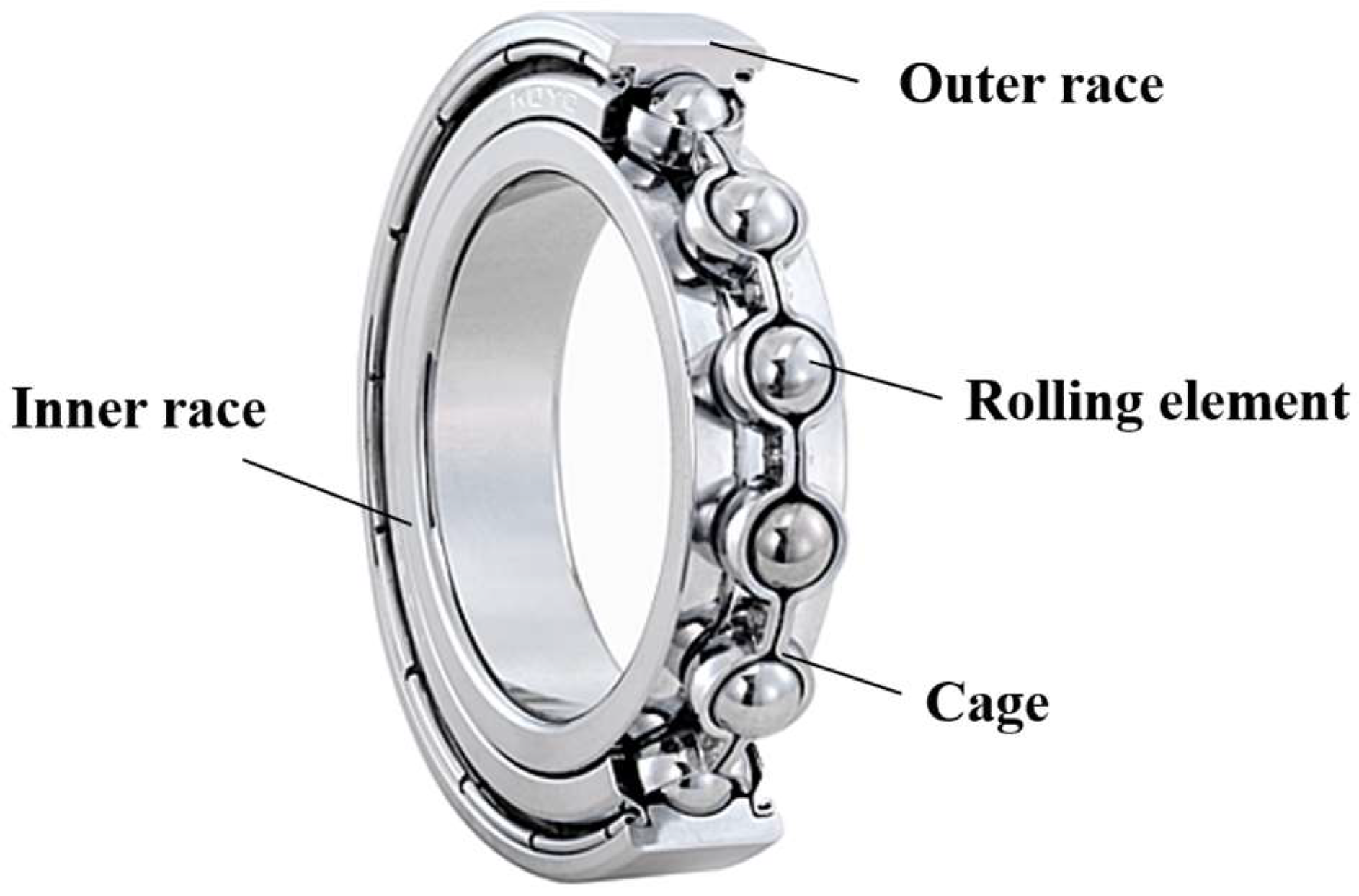
Electric motors are essential power equipment in modern industrial systems and are extensively employed in manufacturing, energy systems, transportation, and other industrial sectors. Their operational reliability is directly associated with system safety, equipment service life, and overall economic performance. Rolling bearings are among the most failure-prone and critical components in motor systems, and their operating condition directly affects the safety and reliability of the overall system operation. A typical rolling bearing consists of an inner race, an outer race, rolling elements, and a cage, as shown in Figure 1. Due to the complex contact interfaces and harsh operating conditions, bearing faults often exhibit weak incipient features, strong concealment, and progressive deterioration. Previous engineering statistics and fault analysis studies have shown that bearing-related faults are among the most common failure types in electric motors [1,2]. If such faults are not detected and diagnosed in time, they may induce secondary failures and even lead to severe system-level accidents. Therefore, accurate and reliable bearing fault detection and diagnosis are essential for maintaining the safe operation of electric motors and related industrial equipment [3,4].
To monitor bearing operating conditions and extract fault-related information, a variety of sensing signals have been investigated, including vibration [5], acoustic emission [6], current [7], rotational speed [8], and other auxiliary signals. Among these sensing modalities, vibration and motor current signals have been studied most extensively because they provide rich fault-related information and are well suited to engineering monitoring. Vibration signals directly reflect impact responses and modulation effects caused by localized defects and therefore remain one of the primary information sources for bearing fault diagnosis [5]. By contrast, current-based diagnosis is non-intrusive, easy to deploy, and compatible with online monitoring, which makes it particularly suitable for practical motor systems [7]. With the continuous development of sensing technology, signal processing, and computational methods, bearing fault diagnosis has gradually evolved from traditional signal analysis toward more integrated and intelligent diagnostic frameworks.
From the perspective of diagnostic strategy, existing studies on motor bearing fault diagnosis can generally be categorized into three major routes: fault-mechanism-based methods, feature-extraction-based methods, and AI-based methods. Fault-mechanism-based methods focus on the physical formation and propagation mechanisms of bearing defects and attempt to reveal how localized faults are reflected in vibration responses or current sideband components [9,10]. Feature-extraction-based methods aim to characterize fault-sensitive information in the time, frequency, or time-frequency domains and combine these features with conventional classifiers for diagnosis [11]. AI-based methods, especially machine learning (ML) and deep learning (DL), further enhance diagnostic performance by learning discriminative representations directly from measured data [12,13]. These three technical routes differ considerably in physical interpretability, data dependence, implementation complexity, and robustness under varying operating conditions.
In recent years, with the rapid development of intelligent diagnosis, increasing attention has been paid to the application of DL methods in bearing fault diagnosis because of their powerful nonlinear feature learning capability and end-to-end modeling advantages [14]. However, practical engineering applications still face several persistent challenges, including limited fault samples, class imbalance, varying operating conditions, and discrepancies between laboratory and industrial data distributions [15]. This data scarcity issue is not merely a matter of sample quantity but is also closely related to the characteristics of the public datasets on which diagnostic methods are commonly validated [16]. Although benchmark datasets such as CWRU, Paderborn, IMS, and PRONOSTIA have greatly promoted methodological development, their laboratory-based acquisition settings, limited operating-condition coverage, and frequently reused evaluation protocols may lead to overly optimistic estimates of generalization performance and do not fully reflect the diversity of real industrial scenarios [17,18]. In addition, purely data-driven methods often lack explicit physical constraints, which may weaken interpretability and reduce generalization ability under cross-domain conditions. To address the above issues, especially limited sample availability and distribution shifts across operating scenarios, data augmentation, meta-learning, and TL have gradually become important research directions. Data augmentation enriches the training set under small-sample and imbalanced conditions, meta-learning facilitates rapid adaptation to new fault categories or working conditions with only a few labeled samples, and TL improves knowledge reuse and model adaptability across varying operating conditions and between virtual and real scenarios [19].
Although existing reviews have examined bearing fault diagnosis from the perspectives of vibration analysis, current signature analysis, and intelligent diagnosis, an integrated review focused specifically on electric motor rolling bearings is still lacking. In particular, the relationships among fault mechanism modeling, feature extraction, AI-based diagnosis, data augmentation, and TL have not yet been sufficiently discussed within a unified engineering-oriented framework. To explicitly demonstrate the incremental value and distinctive advantages of this paper, Table 1 provides a critical comparison with recent high-impact review articles. As illustrated, while previous works have made significant contributions, they typically exhibit clear boundaries—either isolating specific signal modalities or decoupling data-driven models from physical constraints. This paper bridges these gaps by proposing a structured, closed-loop framework.
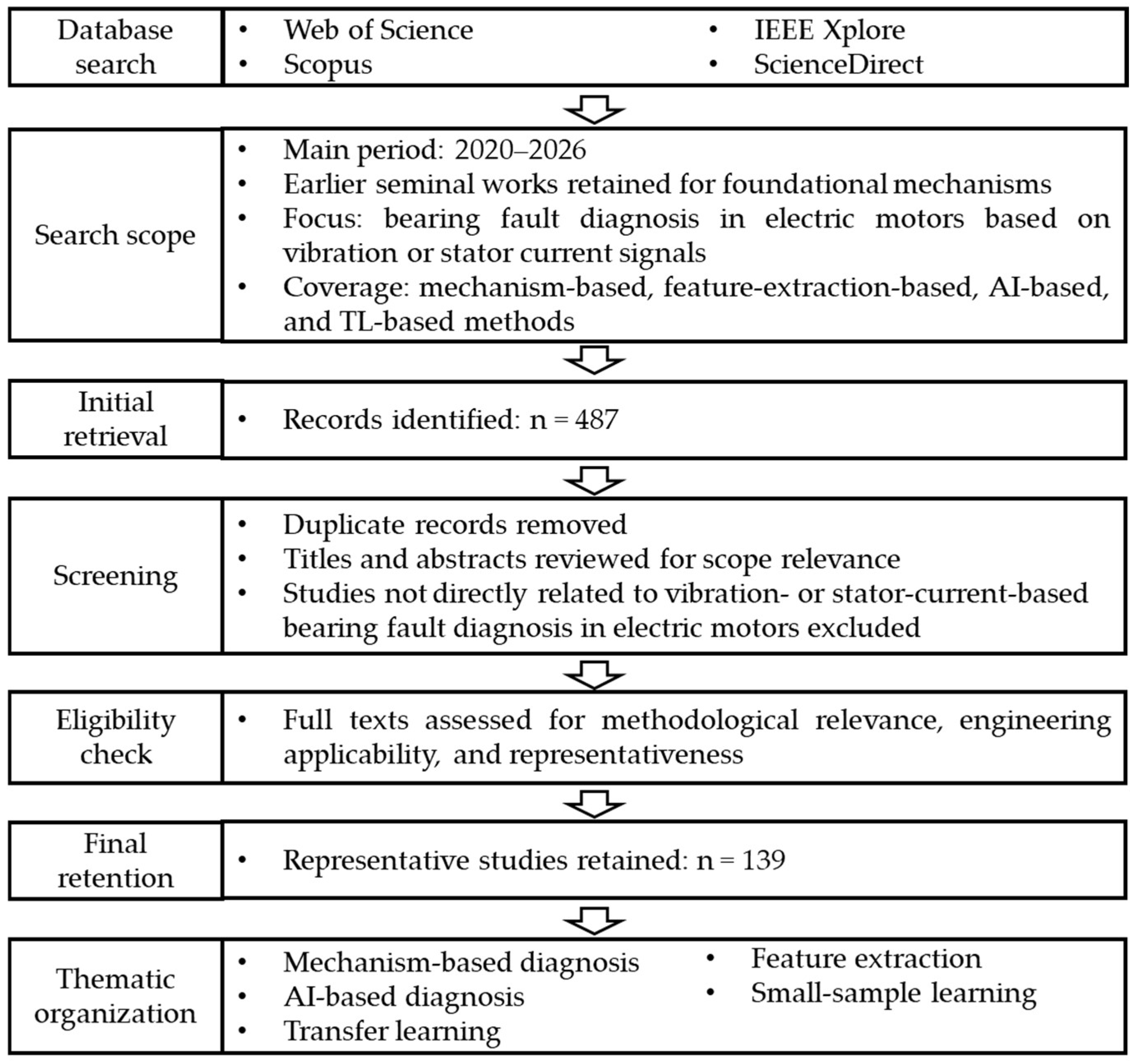
The reviewed literature was identified through database searching and subsequent screening, including duplicate removal, title and abstract review, and full-text assessment, as illustrated in Figure 2. Consistent with the purpose of this structured review, the final literature set comprises representative studies organized by methodological themes rather than by exhaustive PRISMA-style inclusion. This review focuses on the synergy of vibration and stator current signals, localized defects of the inner race, outer race, and rolling elements, as well as practical engineering scenarios involving small samples, varying operating conditions, and virtual-to-real transfer. Accordingly, Section 2 discusses fault-mechanism-based diagnosis methods from the perspectives of vibration-signal-based and motor-current-signal-based modeling. Section 3 summarizes feature-extraction-based diagnosis methods. Section 4 reviews AI-based diagnosis methods. Section 5 discusses representative methods for bearing fault diagnosis under small-sample conditions, including data augmentation and meta-learning strategies. Section 6 further reviews TL methods for varying operating scenarios and virtual-to-real transfer settings. Finally, the major challenges and future research directions are summarized.

2. Bearing Fault Diagnosis Based on Fault Mechanism Models

2.1. Vibration-Signal-Based Bearing Fault Mechanism Models

Localized damage in a rolling bearing alters its internal contact state, load distribution, and dynamic response. These changes appear in vibration signals as periodic impacts and modulation components with clear physical meaning. Vibration-based diagnosis uses the relationship between these dynamic changes and their signal manifestations to identify fault type, location, and progression. Because of their strong physical interpretability and engineering relevance, such methods remain fundamental to bearing fault diagnosis.

2.1.1. Vibration Mechanisms and Characteristic Frequency Theory of Bearing Faults

Under normal operating conditions, continuous contact is maintained between the rolling elements and the inner and outer raceways, and the vibration response of a rolling bearing system is primarily dominated by the rotational frequency and its associated low-order harmonics. When localized defects develop on the surfaces of the inner race, outer race, or rolling elements, the contact behavior of the rolling elements during passage through the defect region transitions from continuous rolling to a nonstationary process characterized by intermittent contact and rapid recovery [21], thereby fundamentally altering the excitation mechanism of the bearing system.
From a contact mechanics perspective, the presence of localized defects leads to instantaneous unloading as the rolling elements enter the defect region, followed by a rapid restoration of contact stiffness upon recontact with the intact raceway. This process results in abrupt temporal variations in contact force and generates impact-type excitations [22]. Such impact excitations inherently exhibit broadband characteristics, with their spectral distributions jointly determined by defect geometry, contact stiffness nonlinearity, and load conditions. Due to structural constraints, these excitations are mainly manifested as a superposition of high-frequency decaying vibrations and low-frequency repetitive components in bearing systems. Accordingly, the resulting spectral structure can be described as structural resonance bands acting as carriers that are modulated by the impact repetition rate [23].
Focusing on the repetitive nature of impact excitations, their relationships with bearing geometric parameters can be analyzed from a kinematic perspective. For outer-race defects, the defect location remains fixed with respect to the load zone, and an impact is generated each time a rolling element passes through the defect region. Consequently, the impact repetition rate is determined by the relative motion between the rolling elements and the outer race [24]. In the case of inner-race defects, because the inner race rotates with the shaft, the defect location continuously varies relative to the load zone, leading to rotational-frequency modulation of the impact excitation superimposed on its fundamental repetition rate [25]. Defects on the rolling elements involve the coupling between rolling element spin and orbital motions, and the corresponding impact repetition rate reflects the combined kinematic behavior of the rolling elements within the raceways. These kinematic distinctions constitute the physical basis for the different characteristic frequency expressions associated with inner-race, outer-race, and rolling-element faults.
Based on the above fault mechanism analysis, the characteristic frequencies corresponding to inner-race, outer-race, and rolling-element defects are widely adopted in engineering practice as key indicators for bearing fault identification. The standard expressions of these characteristic frequencies can be written as [26]:
f o = Z 2 f r 1 D b D c cos β
f i = Z 2 f r 1 + D b D c cos β
f b = D c 2 D b f r 1 D b D c cos β 2
where fo denotes the characteristic frequency of outer race faults, fi denotes the characteristic frequency of inner race faults, and fb denotes the characteristic frequency of rolling element faults. Z represents the number of rolling elements, Db is the diameter of the rolling element, Dc is the diameter of the rolling element pitch circle, β is the contact angle, and fr is the rotational frequency of the shaft.

2.1.2. Vibration Response Modeling Based on Dynamic Mechanism Models

Building upon the vibration mechanisms and characteristic frequency theory of bearing faults, dynamic-mechanism-based modeling approaches have been developed to further characterize the vibration responses of rolling bearings under practical operating conditions. These approaches describe the interaction processes among internal bearing components from a mechanical perspective. By formulating the equations of motion for systems consisting of rolling elements, inner and outer races, and the cage, such models can directly capture the formation mechanisms of vibration responses and their evolution with respect to structural parameters and operating conditions, thereby providing a fundamental theoretical basis for understanding rolling bearing vibration behavior.
In recent years, rolling bearing dynamic modeling has evolved from simplified representations toward multi-degree-of-freedom and strongly nonlinear models. Lumped-parameter approaches and multibody dynamics theory are commonly employed, in which bearing components are treated as motion units with mass and degrees of freedom. By incorporating Hertzian contact nonlinearity, damping, and inertial effects, these models are capable of directly generating time-domain vibration responses.
To translate these physical phenomena into a tractable mathematical framework, the vibration behavior of the bearing system is typically governed by a set of second-order nonlinear differential equations. Taking the inner race and its connected rotor as an example, the general equation of motion can be formulated as:
M r X ¨ r + C r X ˙ r + K r X r = F e ( t ) j = 1 Z F c j ( θ ˙ j , t )
where Mr, Cr, and Kr denote the mass, damping, and stiffness matrices, respectively; Xr is the displacement vector; Fe(t) represents the external load; and Fcj(θj, t) is the nonlinear contact force generated by the j-th rolling element [27].
The core of this dynamic model lies in the formulation of the restoring force Fcj, which bridges the macroscopic vibration responses to the microscopic localized defects. Based on nonlinear Hertzian contact theory, this force is expressed as:
F c j ( θ j , t ) = K h [ δ j ( θ j , t ) ] + n
where Kh is the Hertzian contact stiffness coefficient, n is the load-deflection exponent, and the bracket [·]+ ensures the force is zero if the rolling element loses contact with the raceway. When a localized defect is present, the total elastic deformation δj(θj, t) is modified by a time-varying defect depth function Hd(θj, t):
δ j ( θ j , t ) = X r cos θ j + Y r sin θ j c r H d ( θ j , t )
where θj is the instantaneous angular position of the j-th rolling element, and cr is the radial clearance. The term Hd becomes non-zero only when a rolling element enters the spall region, leading to an instantaneous drop in the contact deformation and a sudden unloading of the force. This abrupt physical disruption mathematically triggers the high-frequency structural resonances and low-frequency modulations characterizing the macroscopic vibration signals [28].
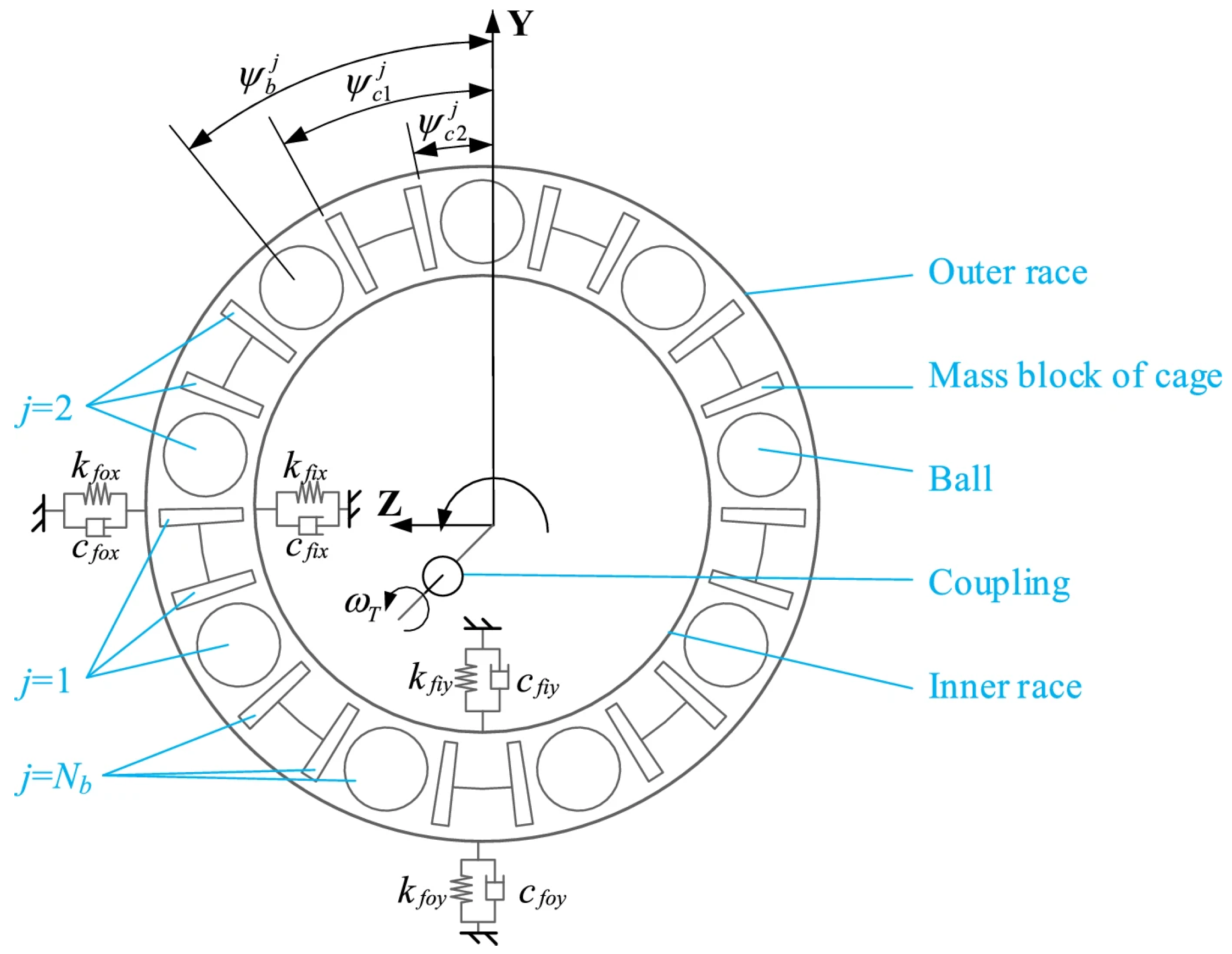
The spatial topology of such a mass-spring-damper system, which embodies these governing equations, can be visually represented through a structural schematic. Figure 3 presents a typical configuration of this multi-degree-of-freedom dynamic model for rolling bearings. Compared to simplified low-degree-of-freedom models, this spatial representation explicitly captures the complex coupling between radial and angular motions, offering superior fidelity for analyzing high-speed dynamic behaviors. Based on such modeling frameworks, multi-degree-of-freedom dynamic models have been widely applied to investigate vibration responses under localized defects, variations in structural parameters, and complex loading conditions [29].
With continued research efforts, the degrees of freedom in bearing dynamic models have progressively expanded from early radial or planar representations to spatial dynamic models that simultaneously account for radial, axial, and angular motions, enabling a more realistic description of internal load transmission and motion constraints within bearings [31]. On this basis, high-speed operation-related factors, including centrifugal forces, gyroscopic effects, and cage dynamics, have been incorporated, allowing these models to remain applicable under high-speed and heavy-load conditions [32]. Moreover, modeling approaches that consider rolling element slip and structural flexibility have attracted increasing attention, as they enable the characterization of vibration modulation effects induced by complex structural coupling.
To address system parameter variations arising from periodic changes in internal load distribution, time-varying parameter modeling has been widely adopted in recent years. Studies have shown that the time-varying stiffness caused by rolling elements entering and leaving the load zone is a major source of internal excitation in bearing vibration. This stiffness variation depends strongly on rotational speed, load, and defect geometry, and it substantially affects both vibration amplitude and spectral characteristics [33]. By incorporating time-varying stiffness, dynamic models can explain modulation phenomena and nonstationary features in vibration responses from a physics-based perspective, without relying on empirical excitation assumptions.
Furthermore, rolling bearing dynamic modeling has gradually extended toward system-level coupling. By integrating bearing models with rotors, shafting systems, or support structures, rotor–bearing system dynamic models can be established to investigate the influence of localized bearing defects, lubrication conditions, and structural nonlinearities on overall system vibration responses and stability [9]. Some studies have further incorporated elastohydrodynamic lubrication effects or structural flexibility models to improve the physical consistency of dynamic models in practical engineering applications [34].
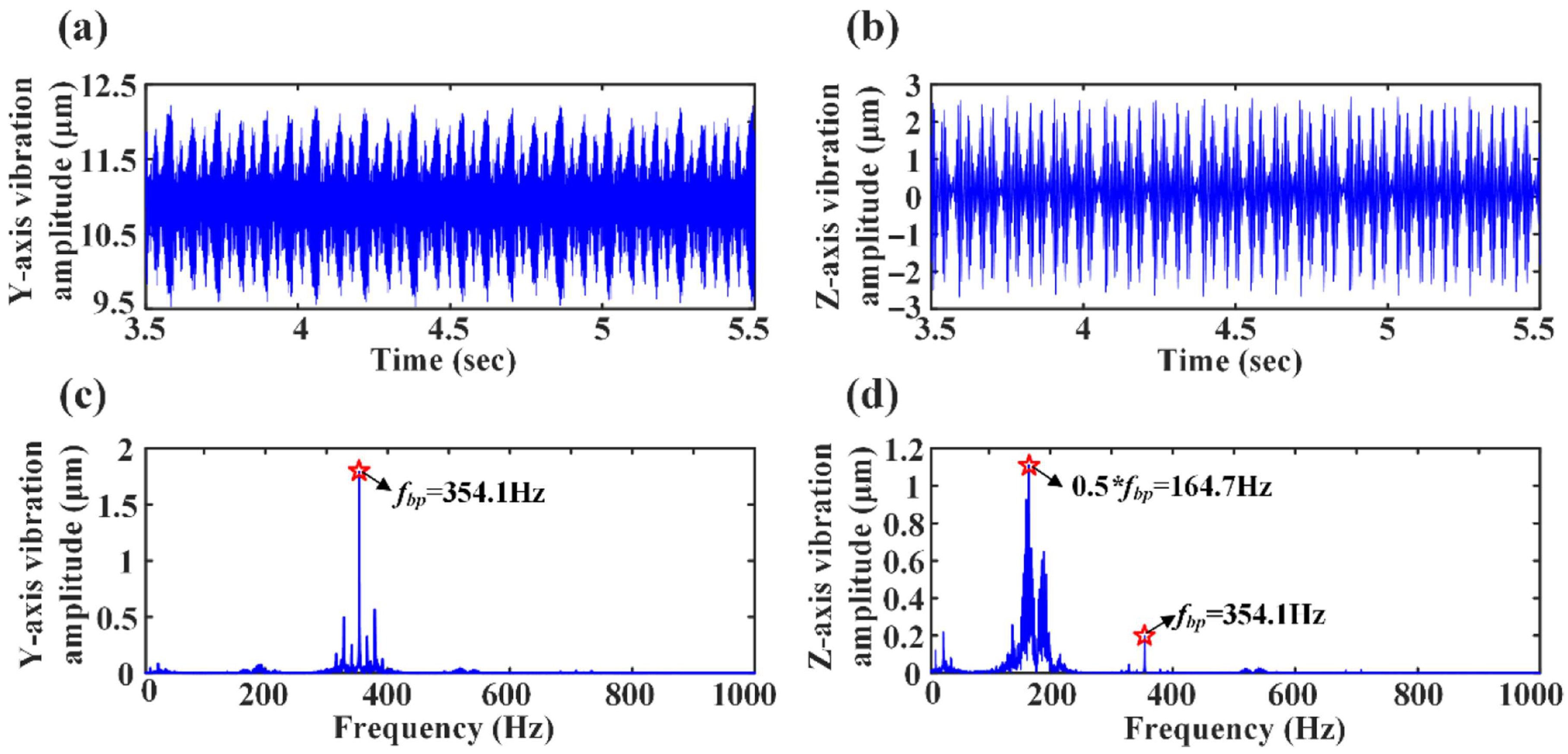
With the increasing availability of computational resources, high-fidelity numerical modeling approaches have been widely adopted for investigating the vibration responses of rolling bearings. Finite element methods enable detailed representation of bearing geometries, material properties, and complex contact behaviors, making them particularly suitable for analyzing the effects of local structural variations on vibration responses. In comparison, explicit dynamic algorithms offer distinct advantages in handling strongly nonlinear contact interactions and transient impact phenomena, and are therefore well suited for simulating transient vibration processes under complex operating conditions. These high-fidelity models are capable of directly generating high-quality time-domain vibration responses, thereby providing a reliable physical foundation for subsequent vibration feature analysis and model validation [35]. Representative vibration signals obtained from such simulations are illustrated in Figure 4. As shown in the frequency spectra, these algorithms can distinctly isolate characteristic fault frequencies from baseline structural noise, visually confirming their modeling superiority. However, this superiority is primarily reflected in mechanism reproduction rather than direct diagnostic deployability. In practical applications, the high computational cost and dependence on accurately specified structural parameters often limit their use to offline analysis, simulation-assisted interpretation, or model validation.
Overall, vibration response modeling based on dynamic mechanism models has evolved from low-degree-of-freedom representations with simplified assumptions toward multi-degree-of-freedom, strongly nonlinear, and high-fidelity numerical models. Although the increasing model complexity substantially improves the ability to capture realistic operating conditions, it also leads to challenges such as parameter identification difficulty and high computational cost. Consequently, achieving an appropriate balance between physical fidelity, model simplification, and computational efficiency remains an important and ongoing research direction in rolling bearing dynamic vibration modeling.

2.2. Current-Signal-Based Bearing Fault Mechanism Models

When localized damage occurs in rolling bearings, it not only alters the mechanical operating state of the bearing system but also perturbs the internal electromagnetic processes of the motor through electromechanical coupling mechanisms, thereby introducing fault-related modulation characteristics into stator current signals. Specifically, bearing-fault-induced rotor vibration and eccentricity variations give rise to periodic disturbances in the air-gap magnetic field and electromagnetic parameters, resulting in modulation components in the current signals that are closely related to bearing geometric parameters and operating conditions. Current-signal-based bearing fault analysis approaches aim to identify and characterize bearing fault features by analyzing the mapping mechanisms of these mechanical disturbances within the electromagnetic system. Owing to their nonintrusive nature, adaptability to complex operating conditions, and seamless integration with motor drive systems, such approaches offer distinctive advantages for bearing fault diagnosis.

2.2.1. Electromagnetic Modulation Mechanisms and Current Characteristic Frequency Expressions of Bearing Faults

During motor operation, mechanical disturbances caused by local bearing defects interact with the electromagnetic system through the air-gap magnetic field and time-varying electromagnetic parameters, leading to deviations of stator currents from their ideal steady-state behavior. From a physical standpoint, these disturbances primarily manifest as periodic modulation of the air-gap permeance and magnetic flux distribution, which in turn introduces additional frequency components associated with bearing faults into the current spectrum. Based on such electromagnetic modulation phenomena, extensive studies have progressively established the correspondence between bearing faults and current characteristic frequencies, forming an analytical framework centered on modulation theory.
Early investigations mainly interpreted this modulation mechanism from the perspective of air-gap permeance variations induced by radial displacement disturbances. It was demonstrated that periodic mechanical vibrations caused by local bearing defects can induce small radial displacements of the rotor, thereby modulating the air-gap magnetic field distribution and giving rise to sideband components related to bearing fault characteristic frequencies in the stator current spectrum [36].
To mathematically describe this electromagnetic modulation mechanism, consider the radial rotor displacement e(t) caused by a bearing fault. This displacement can be modeled as
e ( t ) = e 0 cos ( ω v t )
where e0 is the fault-induced displacement amplitude and ωv is the vibration angular frequency. This mechanical vibration directly modulates the effective air-gap length g(θ, t), which can be expressed as:
g ( θ , t ) = g 0 e ( t ) cos ( θ φ )
where g0 is the uniform air-gap length under healthy conditions, θ is the spatial angle, and φ is the initial phase angle. Consequently, the air-gap permeance Λ(θ, t) is inversely proportional to g(θ, t) and can be approximated using a Taylor series expansion as:
Λ ( θ , t ) μ 0 g 0 1 + e 0 g 0 cos ( ω v t ) cos ( θ φ )
where μ0 is the permeability of free space. Based on this time-varying permeance, we can explicitly demonstrate the electromechanical coupling process. Let the fundamental magnetomotive force be expressed as
F ( θ , t ) = F m cos ( p θ ω s t )
where Fm is the fundamental magnetomotive force amplitude, p is the number of pole pairs, and ωs is the fundamental supply angular frequency [37]. The resulting magnetic flux density B(θ, t) is the product of the fundamental magnetomotive force F(θ, t) and the permeance Λ(θ, t):
B ( θ , t ) = F ( θ , t ) Λ ( θ , t ) F m cos ( p θ ω s t ) μ 0 g 0 1 + e 0 g 0 cos ( ω v t ) cos ( θ ϕ )
By expanding this product using trigonometric identities, the magnetic flux density comprises a fundamental component and a modulation component. The critical modulation term involves the multiplication of the time-varying functions cos(ωst) and cos(ωvt), which can be mathematically decomposed as:
cos ( ω s t ) cos ( ω v t ) = 1 2 [ cos ( ( ω s + ω v ) t ) + cos ( ( ω s ω v ) t ) ]
This expansion rigorously proves that the interaction between the fundamental magnetomotive force and the fault-induced permeance variation directly introduces additional spatial-temporal harmonics. Consequently, sideband frequencies at ωs ± ωv are explicitly generated in the magnetic flux linkage. According to Faraday’s law of induction, these flux variations induce corresponding electromotive forces, ultimately leading to current spectrum distortion and the emergence of characteristic sideband harmonics in the stator current signals [38]. Building upon this foundation, subsequent studies developed analytical models that simultaneously account for radial and torsional coupling effects, providing a coherent explanation of the relationship between bearing fault vibration characteristic frequencies and current sideband components [39].
As research progressed, it became evident that analyses based on ideal motor assumptions are insufficient to fully explain fault-related features observed in current spectra under complex operating conditions. Consequently, non-ideal factors such as inherent eccentricity, slotting effects, and magnetic saturation have been incorporated to extend electromagnetic modulation models. Studies based on magnetic field modulation theory have revealed a strong coupling between bearing faults and rotor slot harmonics, indicating that current characteristic frequencies are governed not only by bearing geometric parameters but also by motor structural characteristics [40]. Further investigations into slotting effects have shown that additional sideband components may emerge around the fundamental frequency and its harmonics [41].
From an analytical modeling perspective, equivalent magnetic circuit approaches have been employed to develop motor models that account for nonlinear air-gap permeance and magnetic saturation, enabling derivation of analytical expressions for fault-related frequency components in stator currents under bearing fault conditions [42]. Moreover, by jointly considering inherent eccentricity and magnetic saturation, improved winding-function-based multi-loop analytical models incorporating local bearing defects have been established, theoretically elucidating the characteristic frequency differences exhibited by different bearing fault types in stator current spectra [43].
The review of these studies indicates that, despite differences in modeling assumptions and analytical derivation methods, the resulting current characteristic frequencies can generally be interpreted as modulation products between the power supply fundamental frequency and its associated harmonics and the bearing fault characteristic frequencies. Although the mathematical forms of characteristic frequency expressions corresponding to different bearing fault types are largely consistent, variations exist in terms of whether rotational frequency, cage frequency, and structural harmonics are incorporated. Table 2 summarizes representative expressions of bearing-fault-related current characteristic frequencies reported in the literature. In Table 2, fc denotes the stator current fundamental frequency, frsh denotes rotor slot harmonics, fcage denotes the cage rotational frequency, R represents the number of rotor slots, and k, q, i, n, m, j, s, r, c denote harmonic orders.

2.2.2. Motor Current Response Modeling Based on Electromagnetic Modulation Mechanisms

Building upon the aforementioned electromagnetic modulation mechanisms of bearing faults, research on motor current response modeling has increasingly focused on mapping air-gap nonuniformities and rotor disturbances into stator current responses through computationally Magnetic Equivalent Circuit models (MEC). Most existing studies take the time-varying behavior of electromagnetic parameters as the core and achieve mechanism-consistent current response modeling by constructing appropriate machine electromagnetic models. In recent years, a widely adopted approach has been to introduce time-varying inductance or mutual inductance parameters into equivalent circuit models or dq-frame representations, such that periodic electromagnetic parameter variations are directly embedded in the current equations. Owing to their simple structure and high computational efficiency, these models are well suited for rapid analysis under varying rotational speeds and load conditions, and have been employed to generate stator current responses containing bearing-related disturbance features [2]. Nevertheless, because the time-varying characteristics of electromagnetic parameters are typically derived under simplified assumptions, such models have inherent limitations in capturing spatial effects and accurately reproducing fault-feature amplitudes. Consequently, they are more suitable for interpreting the frequency composition of modulation-related components than for precise amplitude prediction. This distinction is important in diagnosis, as amplitude-sensitive indicators are generally more vulnerable to modeling bias than those relying primarily on frequency location.
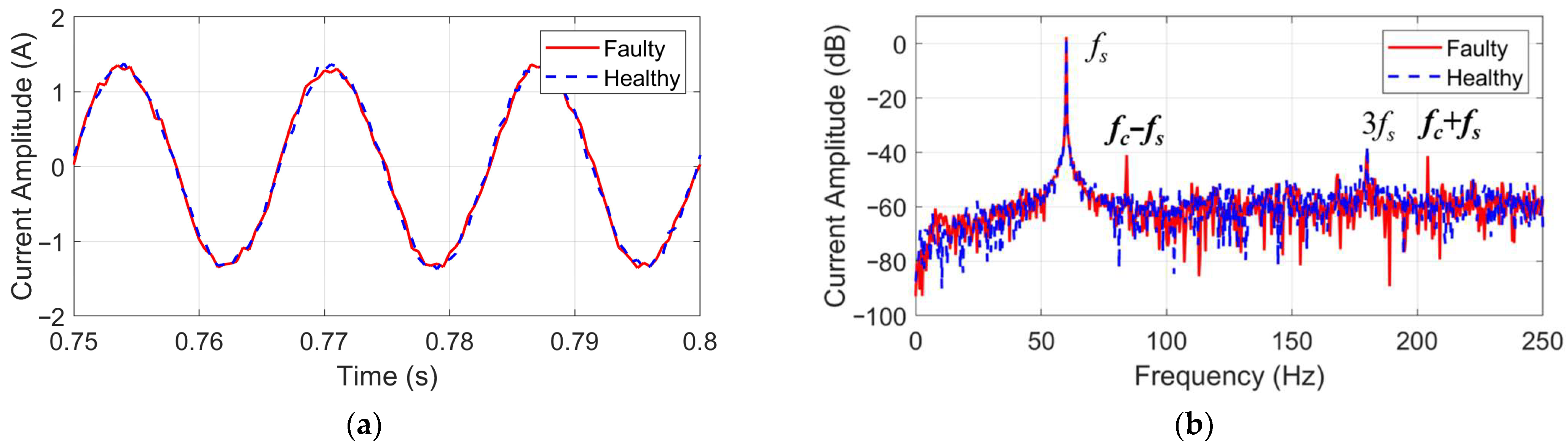
To enhance the physical consistency of current response modeling, Modified Winding Function Method (MWFM) has been increasingly adopted. By explicitly incorporating stator and rotor winding distributions together with air-gap nonuniformity into inductance parameter calculations, and coupling them with multi-loop circuit models, electromagnetic parameters can be dynamically updated during simulation. This enables a more realistic representation of current response characteristics. Compared with the foregoing equivalent-circuit and dq-based formulations, this framework provides a more explicit description of how winding distribution and air-gap nonuniformity affect the current response to fault-induced electromagnetic modulation. Models developed under this framework are able to generate response components that are consistent, at the physical-mechanism level, with experimentally observed current spectral features, and have been successfully applied to quantitative analysis of the effects of bearing-related disturbances on stator currents [10,44]. Representative simulation results are illustrated in Figure 5. The figure visually confirms the presence of fault-induced sidebands around the fundamental frequency, validating the superiority of winding-function-based multi-loop models in capturing complex electromagnetic modulations. Building upon this foundation, additional non-ideal factors, including slotting effects and magnetic saturation, have been incorporated into electromagnetic parameter modeling. By revising air-gap permeance formulations or inductance calculation methods, the applicability of these models under practical operating conditions has been significantly improved, leading to better agreement between simulated current response amplitudes and experimental observations [45].
As research has extended from single-machine models to system-level analysis, electromagnetic models have increasingly been coupled with rotor and bearing dynamic models, giving rise to integrated electromechanical modeling frameworks. In such frameworks, variations in electromagnetic parameters and mechanical system states are jointly updated through shared variables, enabling the relationship between current responses and overall system dynamics to be described within a unified modeling structure. Existing studies have demonstrated that incorporating unbalanced magnetic pull and explicitly accounting for electromagnetic-mechanical interactions can provide a more comprehensive characterization of motor current response characteristics [46]. This makes such models particularly useful when the current response is strongly affected by the dynamic interaction between bearing motion and the electromagnetic field.
For current-response studies requiring higher electromagnetic fidelity, the Finite Element Method (FEM) has also been introduced in a limited number of works. By numerically solving Maxwell’s equations on spatial meshes, it can represent slot geometry, winding distribution, and localized magnetic saturation in greater detail [47]. In principle, this makes it useful for examining how rotor eccentricity or air-gap perturbations distort current waveforms and sideband structures. However, because transient nonlinear FEM modeling is expensive in both model construction and computation, its use in current-based bearing fault studies remains relatively limited. In most cases, it serves mainly as a supplementary tool for mechanism verification or reference-data generation rather than a routine modeling approach for current response analysis [48].
Overall, current response modeling based on electromagnetic modulation has developed from simplified parameter-varying formulations toward physically richer winding-function and electromechanical coupled models. In comparison, simplified equivalent-circuit and dq-based models are advantageous for rapid interpretation of modulation-related frequency components, whereas MWFM-based and coupled models provide better physical consistency in describing the transfer from bearing-induced disturbance to stator current response. FEM can offer additional high-fidelity electromagnetic insight, but in current-based bearing fault studies it is used more often for supplementary verification than for routine modeling.

2.3. Bearing Fault Diagnosis Methods Based on Mechanism Models

Following the mechanism analysis and response modeling of vibration signals and motor current signals presented in the preceding sections, increasing attention has been devoted to incorporating the physical priors embedded in dynamic and electromagnetic models into the fault diagnosis process, with the aim of improving diagnostic reliability and interpretability under complex operating conditions. In recent years, mechanism-model-based bearing fault diagnosis approaches have evolved from conventional signal-driven paradigms toward integrated diagnostic frameworks that combine digital twins, physics-constrained learning, and mechanism-driven transfer strategies.
A representative research direction involves the construction of bearing system digital twins based on dynamic or electromagnetic models, where model-generated virtual responses are used to assist fault diagnosis. In such approaches, mechanism models are employed to generate or augment fault samples, while parameter calibration and model updating are performed to enhance the consistency between virtual and physical systems, thereby mitigating issues related to fault data scarcity and class imbalance in real-world applications. Existing studies have demonstrated the effectiveness of digital-twin-based approaches in improving diagnostic stability under imbalanced sample conditions [49]. However, their benefit depends strongly on whether the virtual model can remain sufficiently consistent with the evolving physical system. Without continuous parameter updating or uncertainty control, digital twins may reduce data scarcity while introducing model-induced bias into diagnosis.
Another class of approaches focuses on directly embedding mechanism models into the training process of diagnostic models, where physical consistency constraints are employed to guide feature learning and decision-making. In recent years, physics-informed neural networks and their extended variants have been increasingly applied to bearing fault diagnosis. By incorporating dynamic or electromagnetic constraints into network architectures or loss functions, these models enforce compliance with physical laws while maintaining data fitting capability. Existing studies have demonstrated that introducing physics-based residuals as constraint terms in deep neural networks can significantly enhance the interpretability and stability of diagnostic results [50].
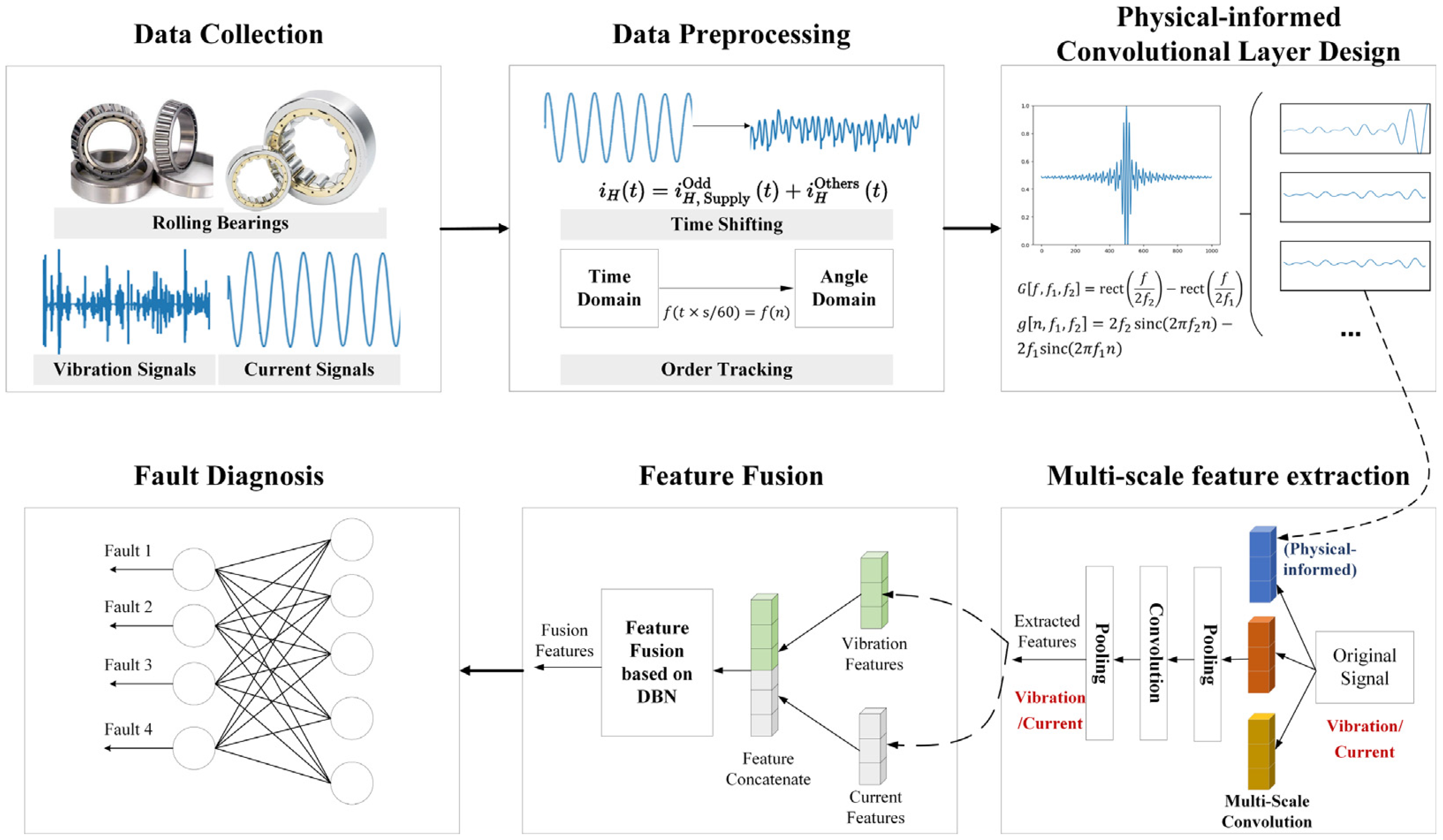
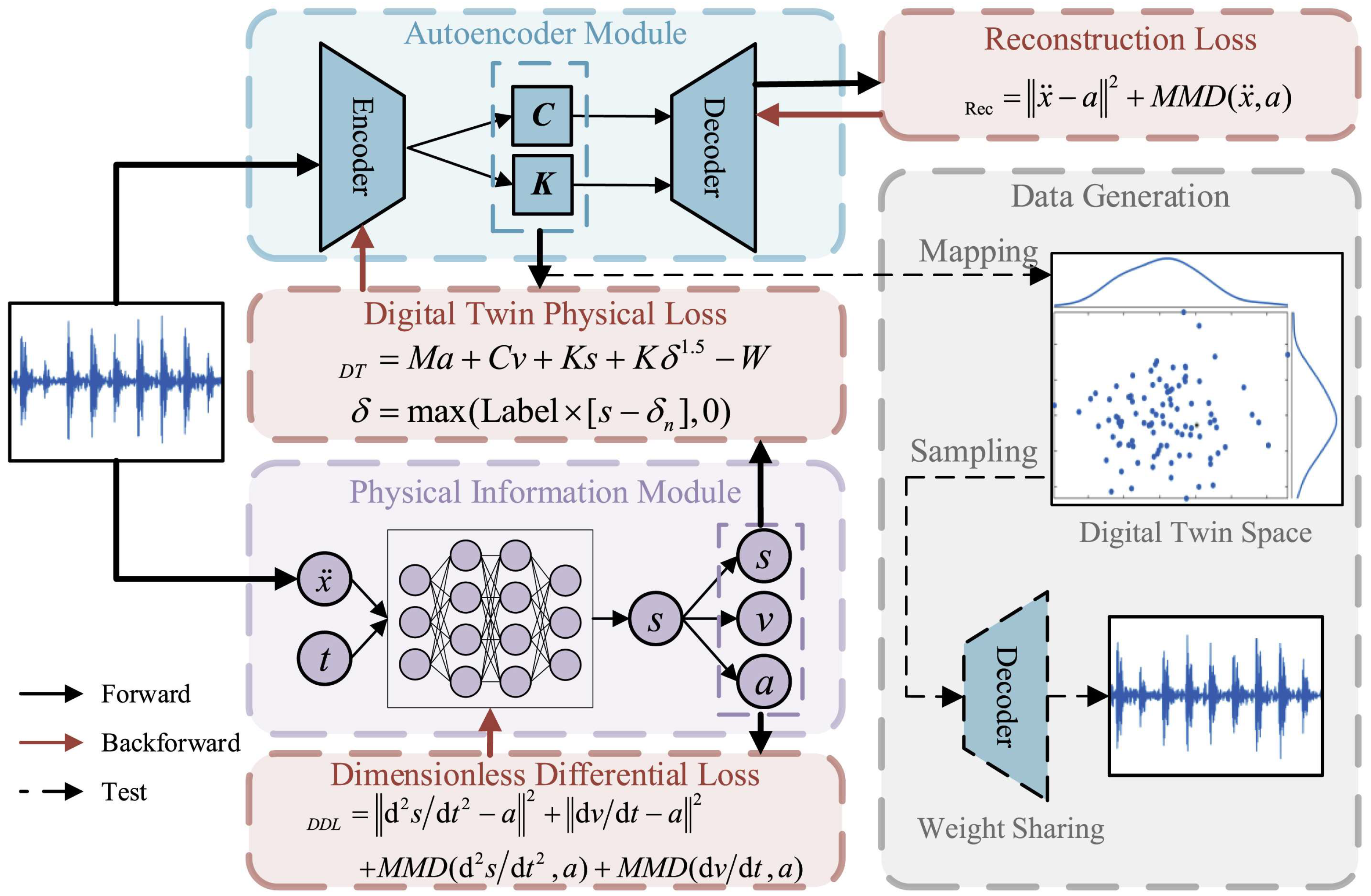
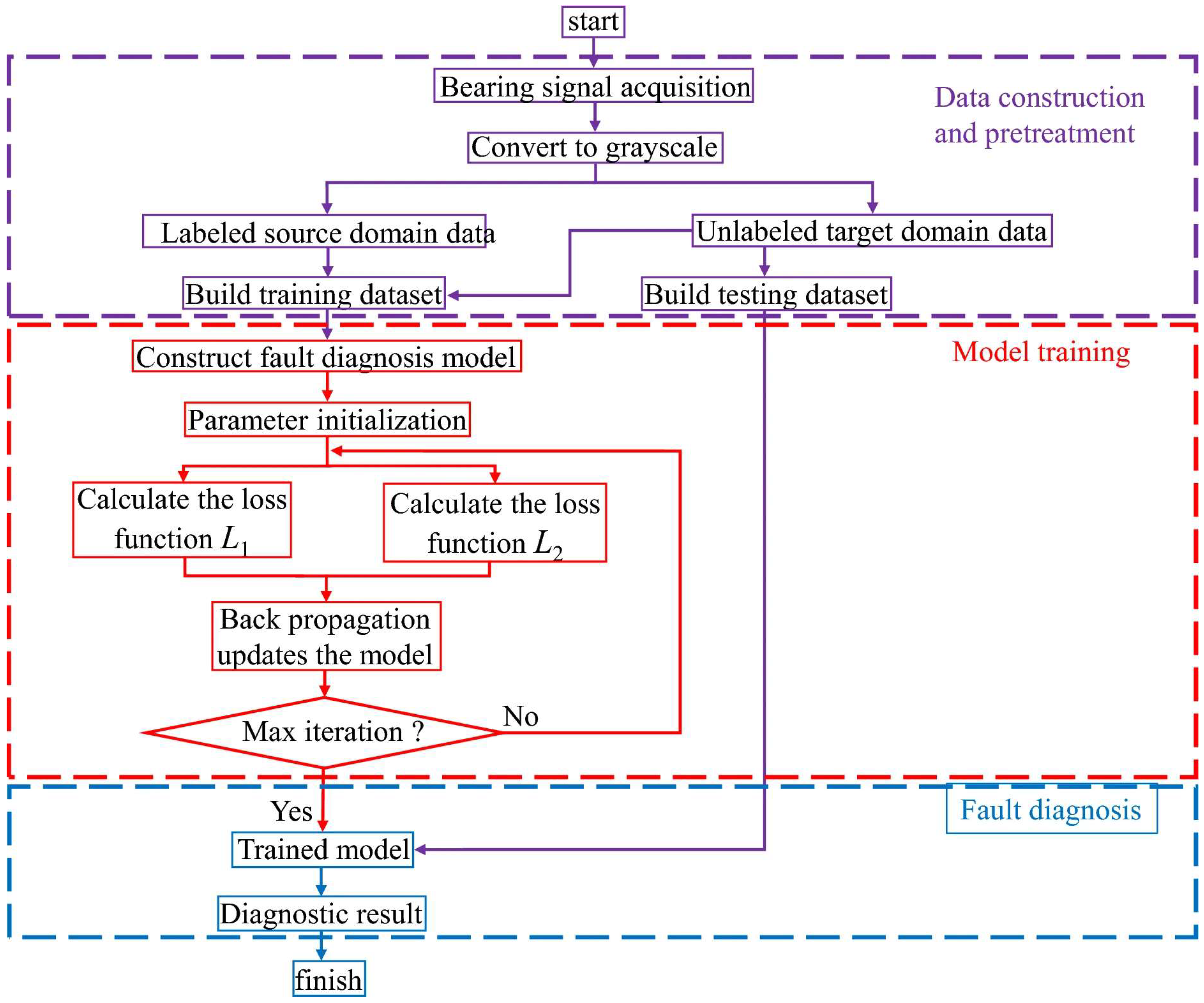
With the growing availability of motor current signals in industrial environments, multi-source mechanism-based diagnostic approaches that integrate dynamic and electromagnetic models have received increasing attention. Some studies have developed multi-source physics-constrained networks that fuse vibration and current signals within a unified physical prior framework, thereby enhancing the comprehensive characterization of bearing faults [51]. A representative architecture of such approaches is illustrated in Figure 6. The flowchart maps how physical mechanisms are explicitly embedded into the convolutional layers, explaining the advantage of using physical priors to constrain network weights rather than relying solely on data-driven extractions. In addition, engineering-oriented diagnostic frameworks based on motor current signals have demonstrated the practical feasibility of current-based bearing fault diagnosis under electromagnetic model constraints in real-world applications [52].
Overall, mechanism-model-based bearing fault diagnosis approaches are evolving toward an integrated technical paradigm supported by digital twins, centered on physics-constrained learning, and complemented by multi-source fusion and mechanism-driven transfer strategies. The physical consistency provided by dynamic and electromagnetic models plays a critical role in ensuring reliable fault diagnosis under complex operating conditions. Future research should further focus on online model updating and uncertainty quantification, as well as the adaptive integration of multi-source physical priors within unified diagnostic frameworks.

3. Bearing Fault Diagnosis Based on Fault Feature Extraction

While mechanism-based models provide physical insights into how bearing faults affect vibration and current signals, practical diagnosis often relies on extracting discriminative information directly from measured data. Therefore, feature extraction techniques are widely used to convert these signal responses into quantitative descriptors for subsequent fault identification.

3.1. Vibration-Signal-Based Bearing Fault Feature Extraction Methods

Vibration signals can directly capture the periodic impact responses induced by localized bearing defects during operation and are therefore widely employed in bearing fault feature extraction studies [3,26]. When localized damage occurs on the inner race, outer race, or rolling elements, defect-induced excitations periodically trigger structural resonances under load, giving rise to impact components with pronounced modulation characteristics in vibration signals. Consequently, the primary objective of vibration-based feature extraction is to suppress structural noise and transmission path effects while enhancing impact-related information associated with bearing characteristic frequencies.
In early research, vibration feature extraction mainly relied on time-domain statistical indicators and frequency-domain spectral features, such as root mean square, kurtosis, and characteristic frequency amplitudes [53]. While these features are effective under steady operating conditions and in mid-to-late fault stages, they often suffer from limited stability during the early stages of weak faults, where impact amplitudes are small and easily masked by broadband noise or structural resonances. To overcome these limitations, subsequent studies have increasingly focused on signal processing techniques centered on adaptive frequency-band selection and impact enhancement.
Spectral kurtosis quantifies the impulsiveness of signals across different frequency bands, enabling adaptive identification of fault-sensitive frequency regions, and has been widely applied in vibration-based feature extraction. For instance, spectral kurtosis has been used to determine optimal demodulation bands in combination with envelope analysis to extract bearing characteristic frequencies, thereby improving the detectability of weak fault-induced impacts [54]. Nevertheless, although these methods perform well under steady-state conditions, their frequency-band selection may still be affected by energy dispersion in nonstationary operating scenarios.
To address the nonstationary nature of vibration signals, time–frequency analysis methods have been widely employed to characterize the temporal evolution of bearing fault impact responses. The short-time Fourier transform (STFT) performs localized spectral analysis using a sliding time window, enabling a joint time–frequency representation, and has been applied to the time-varying detection of bearing fault features [55]. However, its fixed window length results in an inherent trade-off between time and frequency resolution. To mitigate this limitation, wavelet transform (WT) and wavelet packet decomposition introduce multi-scale analysis concepts, allowing transient impacts and high-frequency components to be more effectively represented across different scales, and have been widely applied to bearing fault feature extraction under complex background conditions [56]. Nevertheless, conventional time–frequency analysis methods remain susceptible to energy dispersion and frequency smearing when processing multicomponent vibration signals.
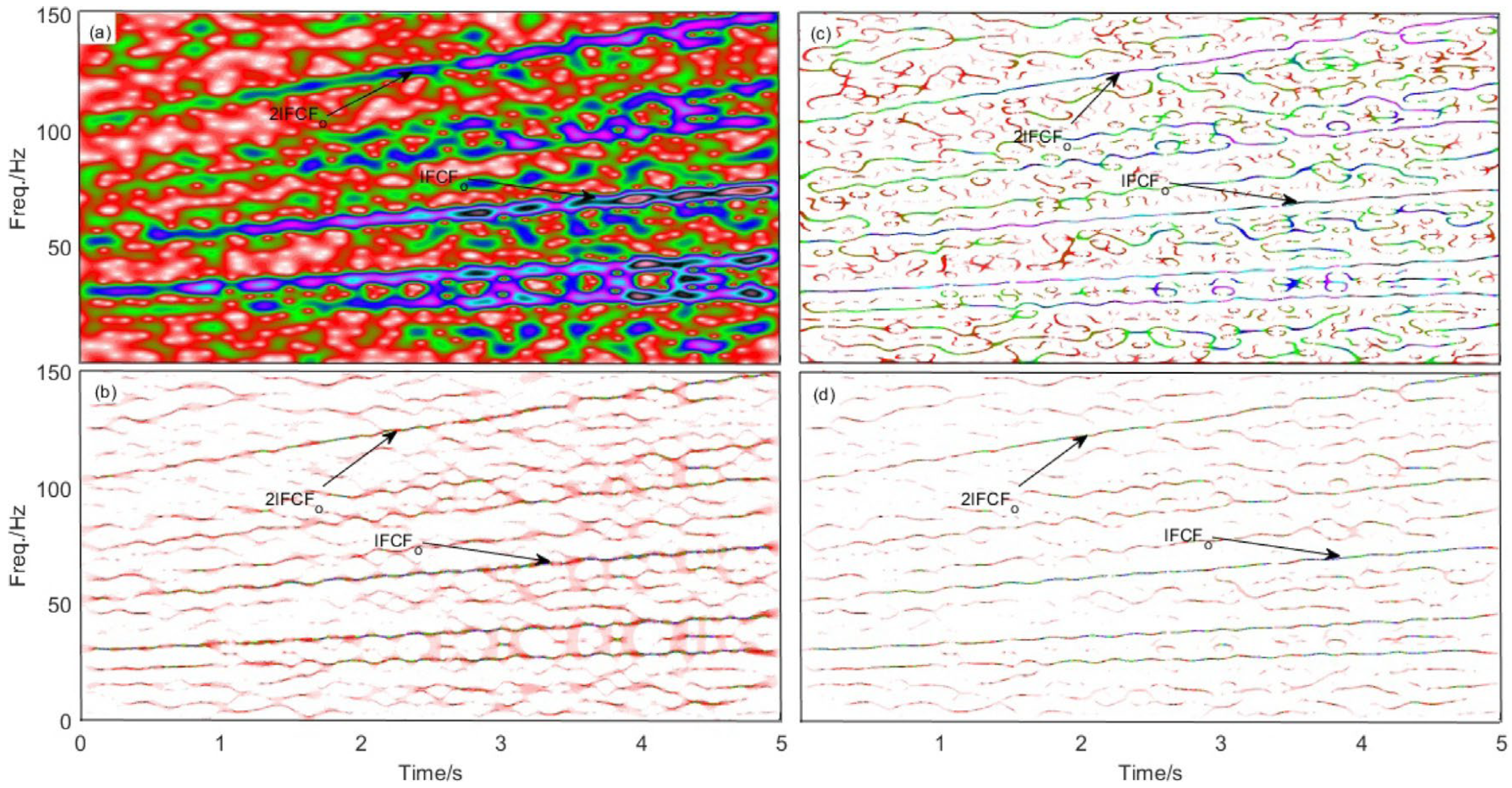
In recent years, high-resolution time–frequency analysis techniques have been increasingly adopted to further enhance the concentration of transient impact components. By redistributing time–frequency energy, synchrosqueezing-based methods enable fault-related frequency components to be more sharply localized in the time–frequency plane, thereby improving the identifiability of bearing fault features under variable-speed operating conditions [57], as illustrated in Figure 7. By comparing the subfigures, it is evident that synchrosqueezing and synchroextracting transforms significantly sharpen the time-frequency ridges compared to the blurred STFT result, providing visual proof of their superior resolution for nonstationary signals. Similarly, time–frequency reassignment methods improve the clarity of time–frequency representations for multicomponent vibration signals by correcting energy localization and have demonstrated strong potential under complex operating conditions [58].
In addition to time–frequency analysis, signal decomposition techniques have attracted considerable attention in vibration-based feature extraction. Complete ensemble empirical mode decomposition (CEEMD) introduces adaptive noise into the original signal to decompose vibration signals into a set of intrinsic mode functions, enabling fault-related impact components to be effectively separated from background interference [59]. By contrast, variational mode decomposition (VMD), which incorporates bandwidth constraint mechanisms, demonstrates improved performance in suppressing mode mixing and enhancing noise robustness [60]. In practical applications, decomposition-based methods are often combined with demodulation or statistical indicators to construct sensitive vibration features for weak bearing faults.
To further evaluate the engineering applicability of these feature extraction techniques, Table 3 presents a critical comparison across four key dimensions: noise robustness, non-stationary adaptability, hyperparameter sensitivity, and computational complexity. As summarized, traditional time–frequency analysis methods (STFT, WT) suffer from inherent resolution trade-offs, limiting their effectiveness for early weak faults. Adaptive decomposition algorithms (CEEMD, VMD) improve noise resistance but introduce high computational overhead and parameter dependency. While high-resolution transforms (SST, SET, SSET) excel in localizing non-stationary signals, their reassignment rules are vulnerable to strong background noise. Consequently, the optimal selection must be tailored to specific operational constraints.
Overall, while vibration-based feature extraction methods offer high fault sensitivity and physical interpretability, the critical comparison in Table 3 reveals a clear trade-off between diagnostic resolution and engineering deployability. The performance of these techniques remains inherently constrained by sensor placement, structural resonances, and the high sensitivity to prior parameter selection. Consequently, bridging the gap between sophisticated signal processing and robust, parameter-free feature representation under complex, non-stationary operating conditions remains a primary challenge for future industrial implementation.

3.2. Current-Signal-Based Bearing Fault Feature Extraction Methods

Compared with vibration signals, stator current signals offer distinct engineering advantages, including nonintrusive measurement, ease of acquisition, and suitability for online monitoring, and have therefore received sustained attention in motor bearing fault diagnosis research. Bearing faults induce slight rotor vibrations and air-gap magnetic flux density distortions, which result in amplitude and phase modulation of stator currents and give rise to sideband structures associated with bearing characteristic frequencies in the current spectrum [36]. Nevertheless, because the amplitudes of the current fundamental component and its harmonics are significantly larger than those of fault-related components, bearing fault signatures in current signals are typically weak, rendering feature extraction particularly challenging.
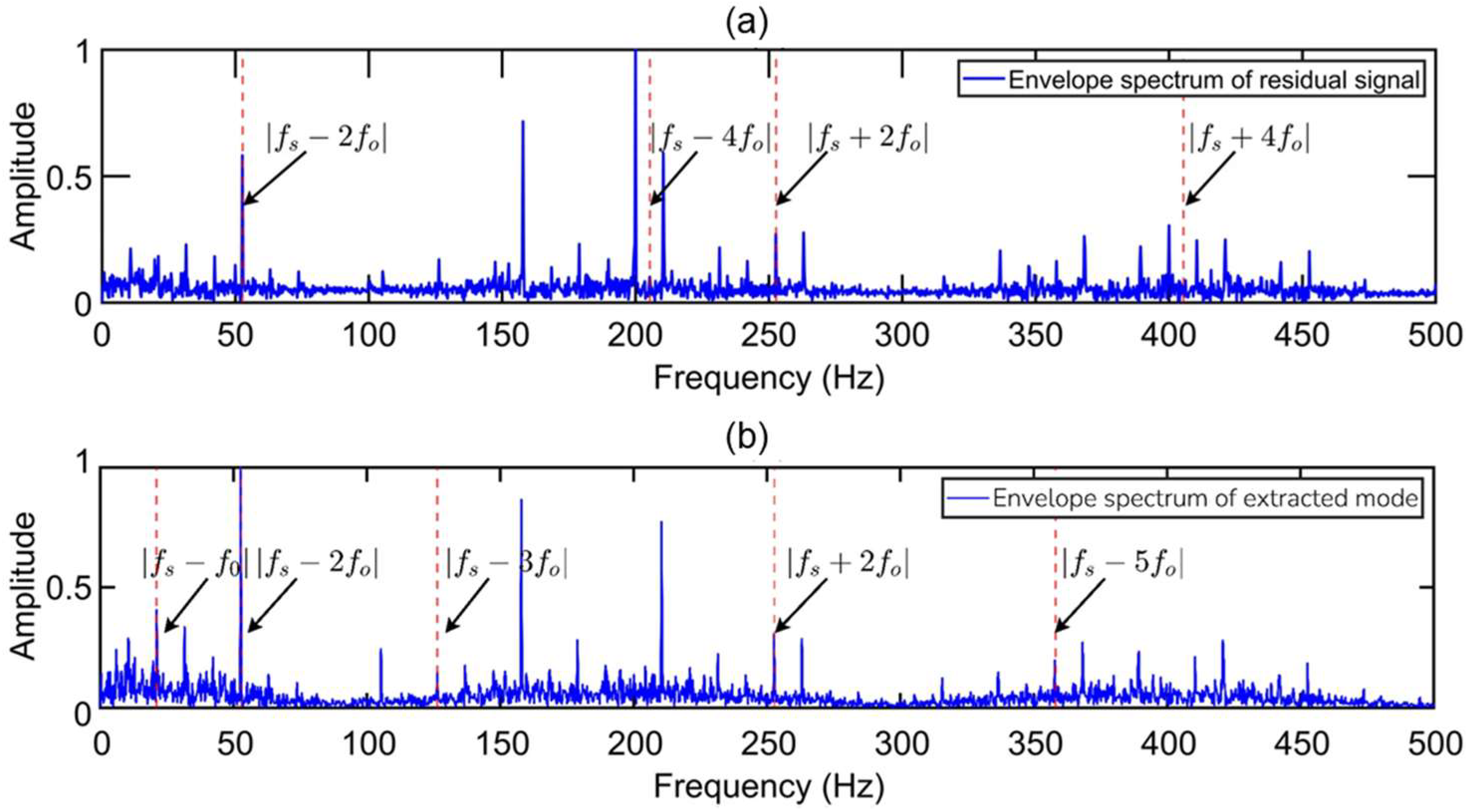
Early stator current feature extraction methods primarily relied on spectral analysis [20], in which bearing faults were identified by detecting sideband components around the fundamental frequency and its harmonics. To mitigate the masking effect of dominant fundamental components on weak fault signatures, several studies proposed modeling healthy current components using linear prediction or adaptive notch filtering and extracting bearing-fault-related information from residual signals [61]. In addition, harmonic attenuation strategies have been employed in current-signal-based bearing fault diagnosis to suppress the supply fundamental and its harmonics, thereby enhancing weak fault-related components before subsequent feature extraction and classification [62]. As illustrated in Figure 8, extracting the mode via variational mode extraction makes the weak fault frequencies and their sideband harmonics more distinct compared to analyzing the residual envelope spectrum alone. However, such approaches are generally sensitive to operating condition variations and tend to experience performance degradation under fluctuating load or speed conditions.
To further enhance bearing-fault-related modulation features, demodulation-based approaches have been widely adopted in stator current feature extraction. By extracting instantaneous amplitude or phase variations using the Hilbert transform, modulation information induced by bearing faults can be effectively separated from the dominant fundamental component, allowing bearing characteristic frequencies to be directly revealed in the spectrum of the demodulated signals [63]. In three-phase motor systems, transforming stator currents into rotating reference frames using Park transformation helps suppress fundamental frequency components, thereby making fault-related features more concentrated in the transformed domain [2]. However, these methods remain effective only when fault-induced modulation is sufficiently stronger than inverter-induced distortion or supply-related fluctuations. Once the electromagnetic background becomes dominant, demodulation may amplify non-fault modulation together with useful fault information.
To address feature frequency drift caused by speed variations under nonstationary operating conditions, time-frequency analysis techniques have been introduced for stator current signal processing, enabling time-varying tracking of bearing fault features across different operating regimes [64]. In recent studies, frequency-domain energy distributions and entropy-based indicators have also been employed to quantify stator current features and characterize the occurrence and progression of bearing faults, among which frequency-domain entropy features have demonstrated favorable stability under varying load conditions [65]. These developments indicate that current-signal-based feature extraction is gradually evolving from simple sideband observation toward more robust representations under variable operating conditions.
Overall, stator-current-based bearing fault feature extraction methods offer considerable practical value for engineering applications. However, their performance remains sensitive to operating conditions, motor structures, and power supply characteristics. Since the extracted features are expected to reflect the electromagnetic modulation mechanisms and current characteristic frequency structures discussed in Section 2, enhancing the detection capability for early-stage weak faults while preserving the advantages of nonintrusive measurement remains an important and open research challenge.

4. AI-Based Bearing Fault Diagnosis Methods

The feature extraction methods discussed in Section 3 provide structured representations of fault-related information. However, traditional diagnostic frameworks based on handcrafted features may struggle to capture complex nonlinear relationships under varying operating conditions. To address this issue, AI-based methods have been increasingly applied to bearing fault diagnosis.

4.1. Machine-Learning-Based Bearing Fault Diagnosis Methods

ML approaches to bearing fault diagnosis typically follow a three-stage pipeline consisting of feature construction, feature selection or dimensionality reduction, and classification or regression. Since the principles of signal feature extraction have been discussed in Section 3, this section focuses on how these features are organized and utilized within ML-based diagnostic frameworks. Compared with DL models, ML methods generally require relatively smaller datasets and lower computational resources, while their model structures and parameters are easier to interpret and control. Consequently, they remain practical solutions for many engineering applications. In studies involving vibration and current signals, research has gradually evolved from simple statistical indicators toward more comprehensive feature representations derived from the signal analysis techniques discussed in Section 3, with increasing attention to classifier robustness and generalization under varying operating conditions.
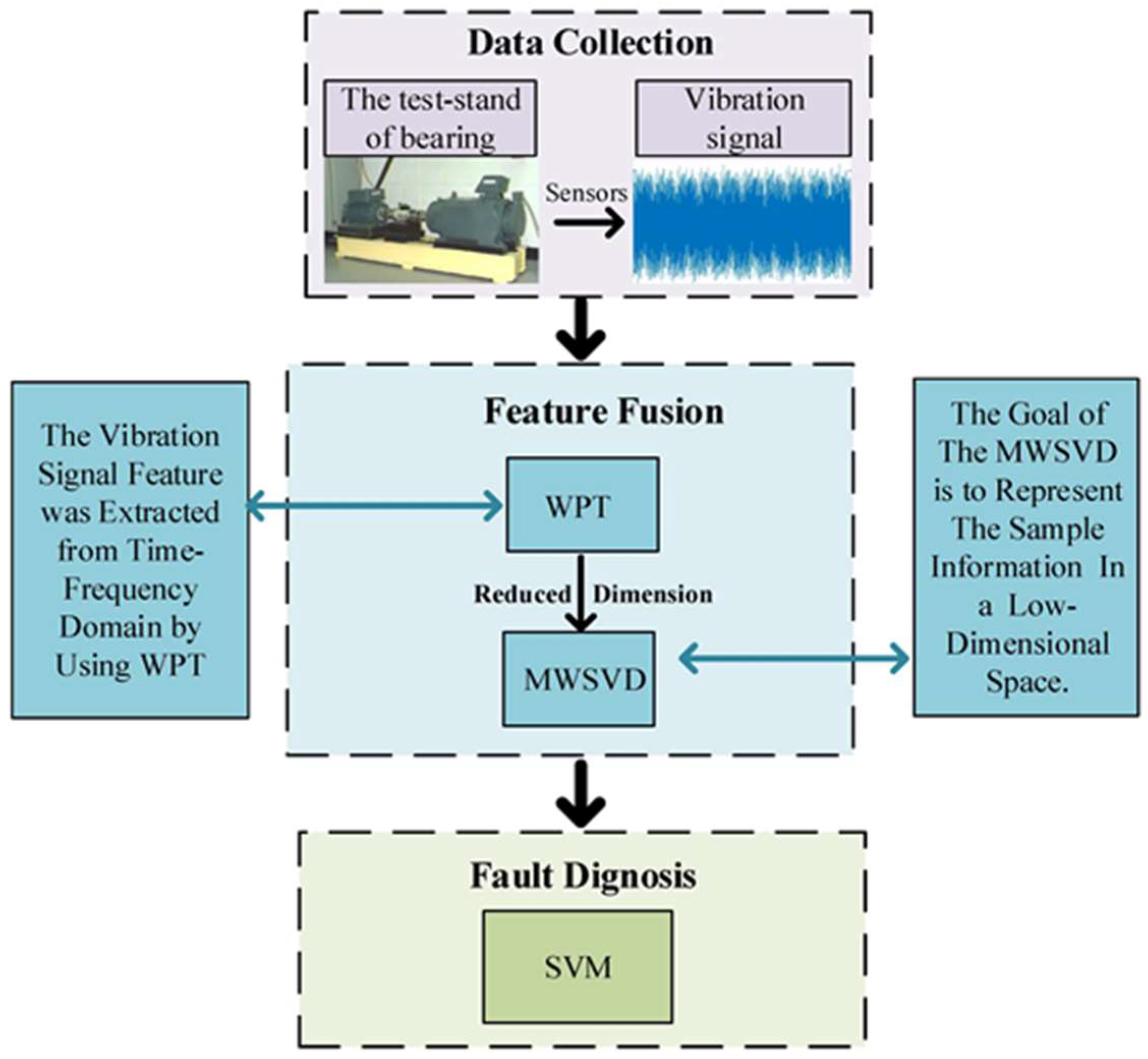
With respect to feature construction, conventional time-domain, frequency-domain, and time–frequency-domain features remain fundamental to bearing fault diagnosis. Nevertheless, recent studies have increasingly emphasized feature fusion strategies to enhance the complementary representation of fault-related information. For example, multi-source feature fusion has been applied to fault pattern recognition, yielding more robust diagnostic performance under varying operating conditions [66], as illustrated in Figure 9. The diagram highlights how fusing time-frequency domain features with low-dimensional spatial mapping systematically reduces redundancy and enhances classifier accuracy compared to single-domain feature extraction. Furthermore, as excessive feature dimensionality can introduce redundancy and increase the risk of overfitting, growing attention has been directed toward feature selection and feature subset optimization. By integrating feature fusion with feature selection, diagnostic accuracy can be preserved while effectively reducing feature dimensionality and model training complexity [67]. To address the class imbalance problem that is prevalent in industrial applications, where normal-condition samples are abundant while fault samples are relatively scarce, existing studies typically adopt coordinated strategies at both the data and algorithm levels. For example, resampling techniques have been integrated with multiclass least squares support vector machines (SVMs) to alleviate classification bias and improve the recognition performance of minority fault classes [68]. Yet, the same process may also make the resulting model more dependent on the statistical properties of a specific dataset. If feature subsets are optimized on a narrow experimental distribution, their apparent effectiveness may not translate well across different machines or operating regimes.
Under strong background noise and pronounced nonstationary conditions, the stability of feature extraction plays a critical role in determining the reliability of subsequent classification boundaries. To this end, a line of research has introduced adaptive signal decomposition and optimization mechanisms to extract more discriminative intrinsic feature components. For example, swarm-intelligence-based signal decomposition methods have been demonstrated to improve feature separability across multi-operating-condition datasets and enhance robustness to noise interference and operating condition variations [69]. With respect to classifier design, SVMs remain among the most widely adopted techniques for rolling bearing fault diagnosis. Recent research has increasingly focused on the automated optimization of kernel functions and hyperparameters. For instance, Bayesian optimization has been employed to tune hybrid-kernel SVM parameters, thereby improving generalization performance while preserving engineering interpretability and controllability [70].
Beyond fault type classification, ML-based health state assessment and degradation stage identification have emerged as important research directions. In contrast to end-to-end classification approaches, these studies emphasize extracting health indicators (HI) from raw signals to characterize degradation evolution, followed by state identification through anomaly detection, clustering, or discriminative techniques. For example, isolation forest models have been applied to bearing health state modeling, enabling effective condition characterization even in the absence of complete fault labels [71]. Meanwhile, feature selection strategies have evolved from single-algorithm approaches toward multi-algorithm comparison and ensemble selection schemes to improve the stability and interpretability of selected feature sets. When combined with SVM-based classifiers, such frameworks constitute engineering-feasible feature-engineering-based diagnostic solutions.
Under composite fault scenarios and strongly nonstationary signal conditions, increasing attention has been directed toward more targeted signal representation methods and complexity-based metrics. For instance, the combination of adaptive cyclic singular spectrum analysis and Rényi entropy has been shown to enhance the characterization of modulation components associated with composite faults, thereby improving diagnostic robustness [72]. With respect to visualization and dimensionality reduction of high-dimensional features, supervised manifold mapping techniques continue to attract considerable interest. By constructing refined composite multiscale complexity features and integrating supervised manifold dimensionality reduction with SVM classifiers, feature redundancy can be effectively reduced while preserving critical discriminative information, leading to improved overall model stability [73].
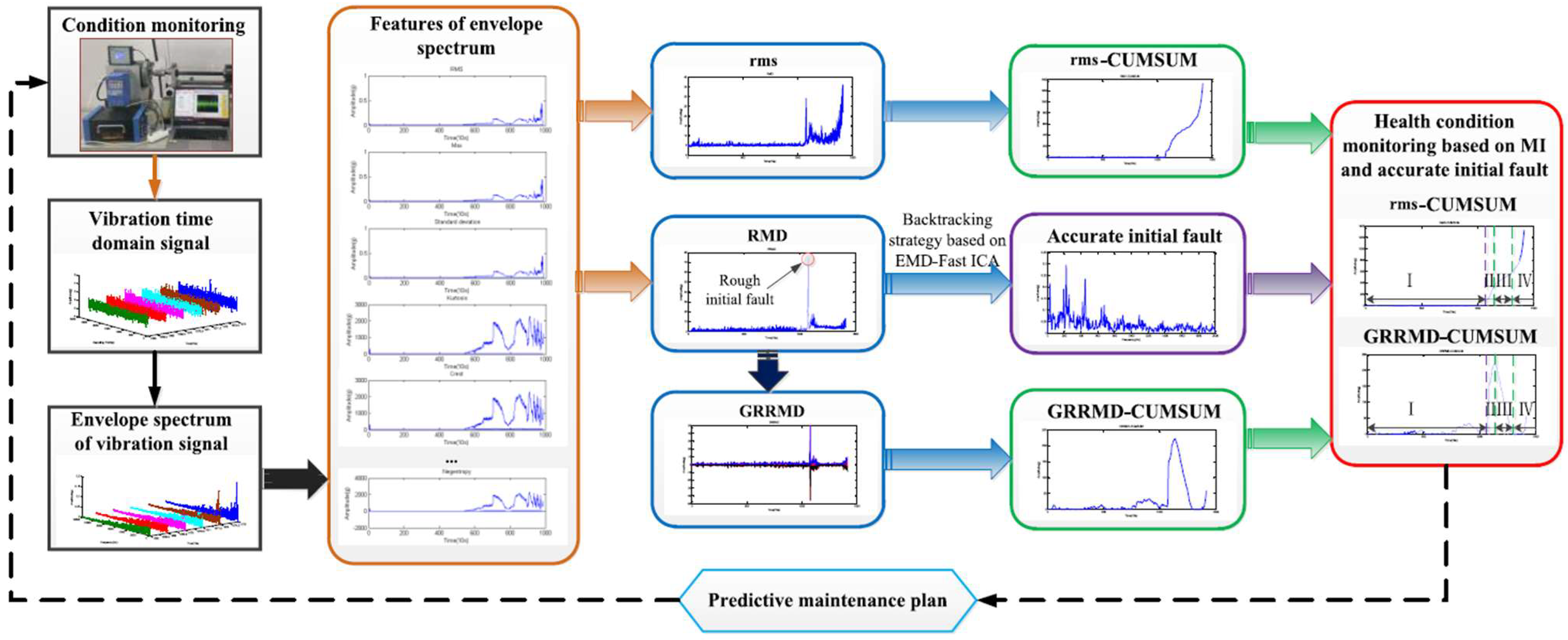
In online monitoring and early warning applications, achieving an appropriate balance among sensitivity, smoothness, and monotonicity is particularly critical when constructing health indicators. Related studies have proposed health indicator construction methods that combine multiple envelope spectrum features with cumulative sum concepts, enabling more sensitive detection of state variations at early stages of degradation [74]. A schematic illustration of this approach is shown in Figure 10. Through this cumulative transformation, weak degradation-related fluctuations can be progressively enhanced rather than masked by instantaneous noise, which makes the method particularly suitable for online monitoring scenarios requiring both early sensitivity and trend consistency. In addition, robust feature extraction strategies based on feature matrix construction and structured decomposition have also been explored. For example, health state identification methods that exploit gradient information of feature matrices in combination with multi-directional and multi-scale decomposition techniques can significantly enhance resistance to noise interference and rotational speed fluctuations [75].
In motor systems, stator current signals offer notable advantages, including non-intrusive acquisition and ease of measurement, and have therefore been increasingly employed in bearing fault diagnosis through the combination of current-based feature extraction and ML classifiers. For application scenarios such as electric vehicle drive systems, current signal feature construction methods integrated with classification strategies have demonstrated effective bearing fault identification, highlighting the practical potential of current-based approaches in engineering applications [76]. Meanwhile, adaptive signal decomposition techniques remain important tools for fault feature enhancement. For example, improved empirical Fourier decomposition methods based on optimized spectral segmentation strategies can yield more robust feature representations, providing cleaner inputs for subsequent ML-based classification [77].
Overall, ML approaches exhibit high engineering feasibility in industrial scenarios characterized by limited sample availability, constrained computational resources, or requirements for rapid deployment. These methods typically rely on handcrafted feature extraction and selection mechanisms combined with classifiers such as SVMs and k-nearest neighbors, enabling effective representation of bearing operating states while maintaining a balance between diagnostic accuracy and model interpretability. However, their performance is inherently limited by the completeness and adaptability of manually designed features, making it challenging to fully capture high-order nonlinear characteristics under complex operating conditions. This limitation has motivated increasing interest in DL approaches centered on end-to-end feature learning, with the objective of improving model adaptability in the presence of complex operating conditions and multi-source disturbances.

4.2. Deep-Learning-Based Bearing Fault Diagnosis Methods

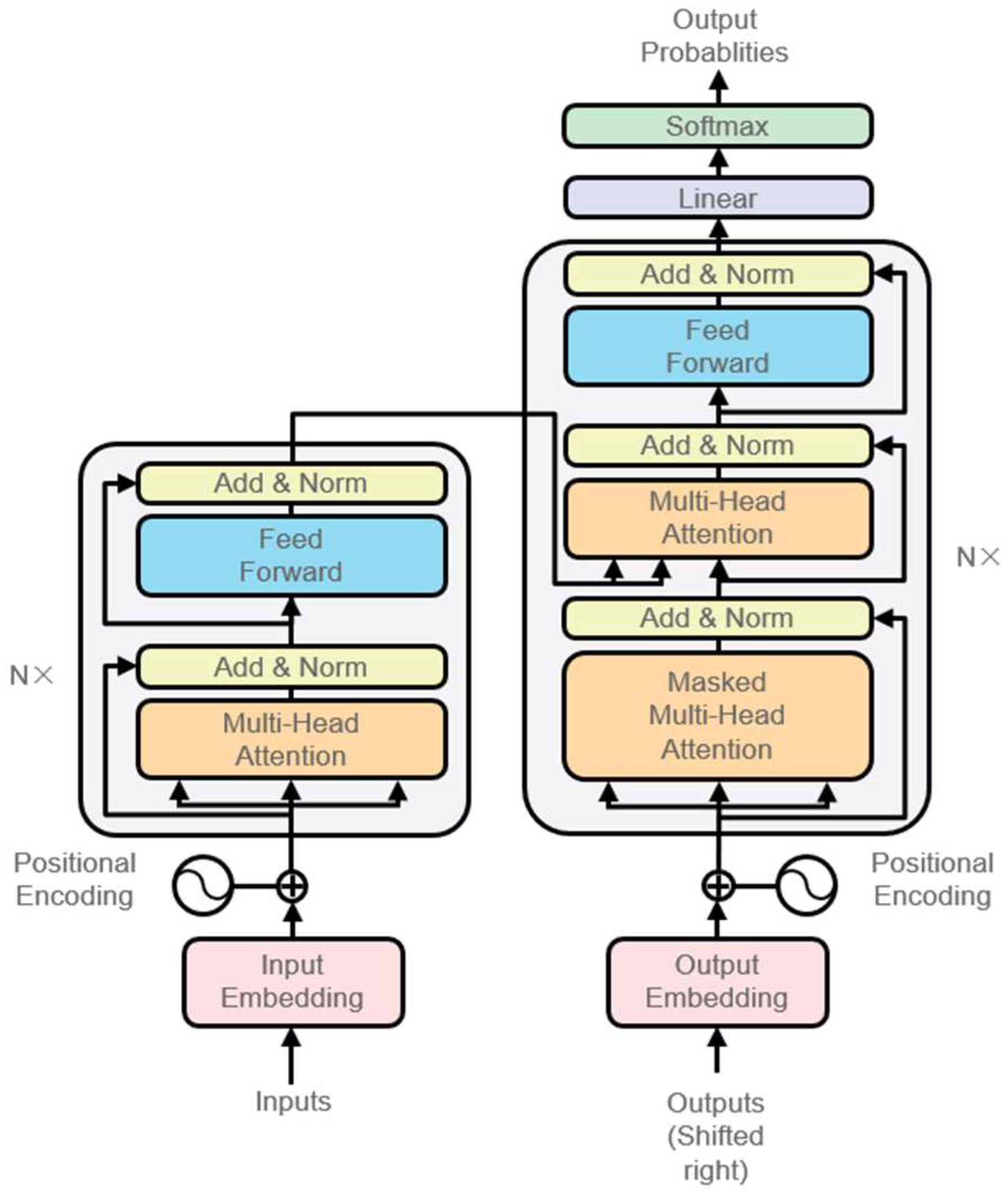
DL enables end-to-end representation learning and reduces reliance on handcrafted features, which makes it well suited to complex operating conditions, noisy environments, and cross-domain transfer scenarios [12]. Compared with traditional ML methods, deep models can automatically extract multi-scale discriminative patterns from raw vibration signals or current waveforms. Their generalization ability and diagnostic reliability can be further improved through TL, self-supervised learning, contrastive learning, and uncertainty modeling. In recent years, Transformers and their variants, benefiting from self-attention mechanisms for modeling long-range dependencies, have been increasingly applied to bearing fault diagnosis tasks, with a representative architecture shown in Figure 11. By organizing local signal patterns into a sequence before global interaction, the model can reweight informative components in a more context-aware manner, which is advantageous when fault signatures are dispersed across nonstationary signal segments. Studies have demonstrated that models combining time–frequency representations with self-attention mechanisms can more effectively focus on critical fault patterns under complex background conditions, thereby improving overall diagnostic performance [78]. Furthermore, Transformer architectures specifically tailored to rolling bearing diagnosis have shown strong competitiveness in multi-class fault recognition and cross-operating-condition generalization through task-oriented structural optimization [79]. Nevertheless, stronger representation capacity also increases the risk that models learn dataset-specific texture cues rather than fault-essential structures. This risk becomes more pronounced when training data are limited or collected from highly consistent laboratory settings.
When labeled data are unavailable or only limited samples are available under target operating conditions, self-supervised pretraining and contrastive learning provide effective pathways for learning general representations prior to diagnostic tasks. Studies have demonstrated that diagnostic frameworks based on self-supervised and contrastive learning can acquire more discriminative feature representations under unlabeled or weakly labeled conditions, thereby improving the detectability of the early-stage faults as well as cross-condition generalization capability [80]. In cross-condition domain adaptation scenarios, contrastive learning also plays a pivotal role. By learning transferable discriminative features between source and target domains, domain-adaptive networks are able to maintain high recognition stability even under significant operating condition discrepancies [81].
In motor bearing fault diagnosis, the application of DL to stator current signals has gradually shifted from direct end-to-end classification toward representation enhancement targeting weak fault-related components. Since fault modulation components in current signals are often masked by the fundamental frequency and its harmonics, many studies introduce noise suppression and re-representation steps consistent with physical mechanisms prior to deep network modeling, thereby reducing reliance on empirical strategies such as increasing network depth. For example, fractional-order wavelet denoising has been applied to stator current signals prior to deep network input to enhance the separability of fault-related modulation components. By exploiting the symmetry-breaking characteristics of three-phase currents induced by bearing damage, multi-phase current signals can be treated as multi-source inputs and processed using Multi-branch Convolutional Neural Networks (CNN) architectures for feature extraction and temporal modeling, followed by information fusion for classification [82]. Furthermore, channel attention mechanisms and periodic feature extraction modules have been introduced to adaptively enhance weak fault responses and emphasize periodic modulation patterns in current signals, thereby improving the ability of deep networks to focus on subtle fault signatures [83].
For multi-source diagnosis, recent studies have increasingly emphasized information complementarity within deep networks rather than simple feature concatenation. For instance, deep ensemble networks for multi-sensor information fusion have been proposed, in which weighted fusion suppresses strong noise interference and attention mechanisms combined with topology learning modules are used to uncover discriminative structures in fused signals, leading to improved diagnostic stability under complex noise environments [84]. As DL models progressively advance toward trustworthy engineering deployment, interpretability and diagnostic reliability have emerged as evaluation criteria on par with recognition accuracy. Accordingly, research efforts have shifted from solely enhancing discriminative performance toward explicitly characterizing diagnostic confidence and risk controllability. For instance, probabilistic modeling and uncertainty decomposition frameworks have been developed for manufacturing systems, allowing models to exhibit more conservative confidence responses when confronted with out-of-distribution samples, thereby improving the usability and auditability of diagnostic decisions [85].
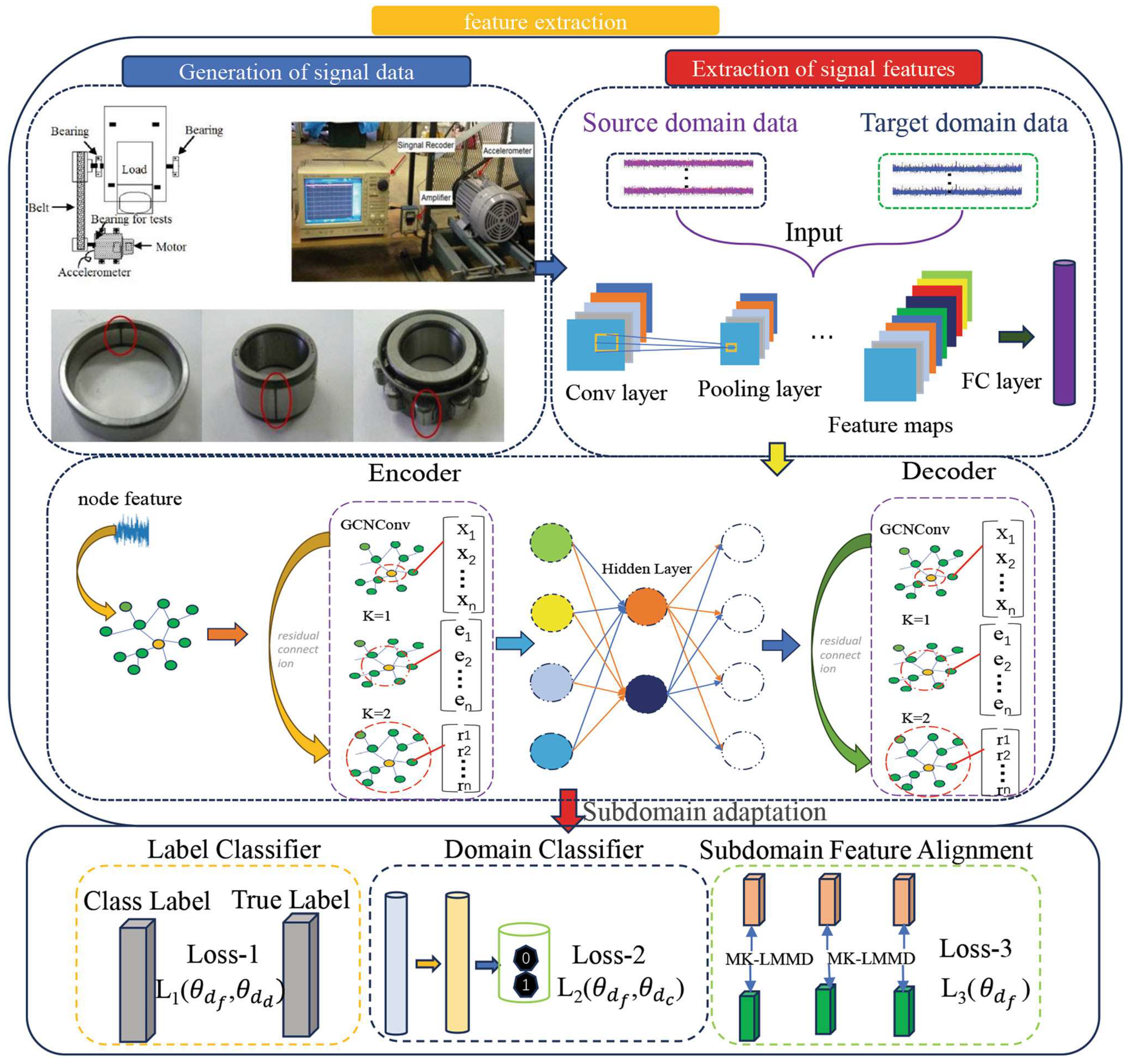
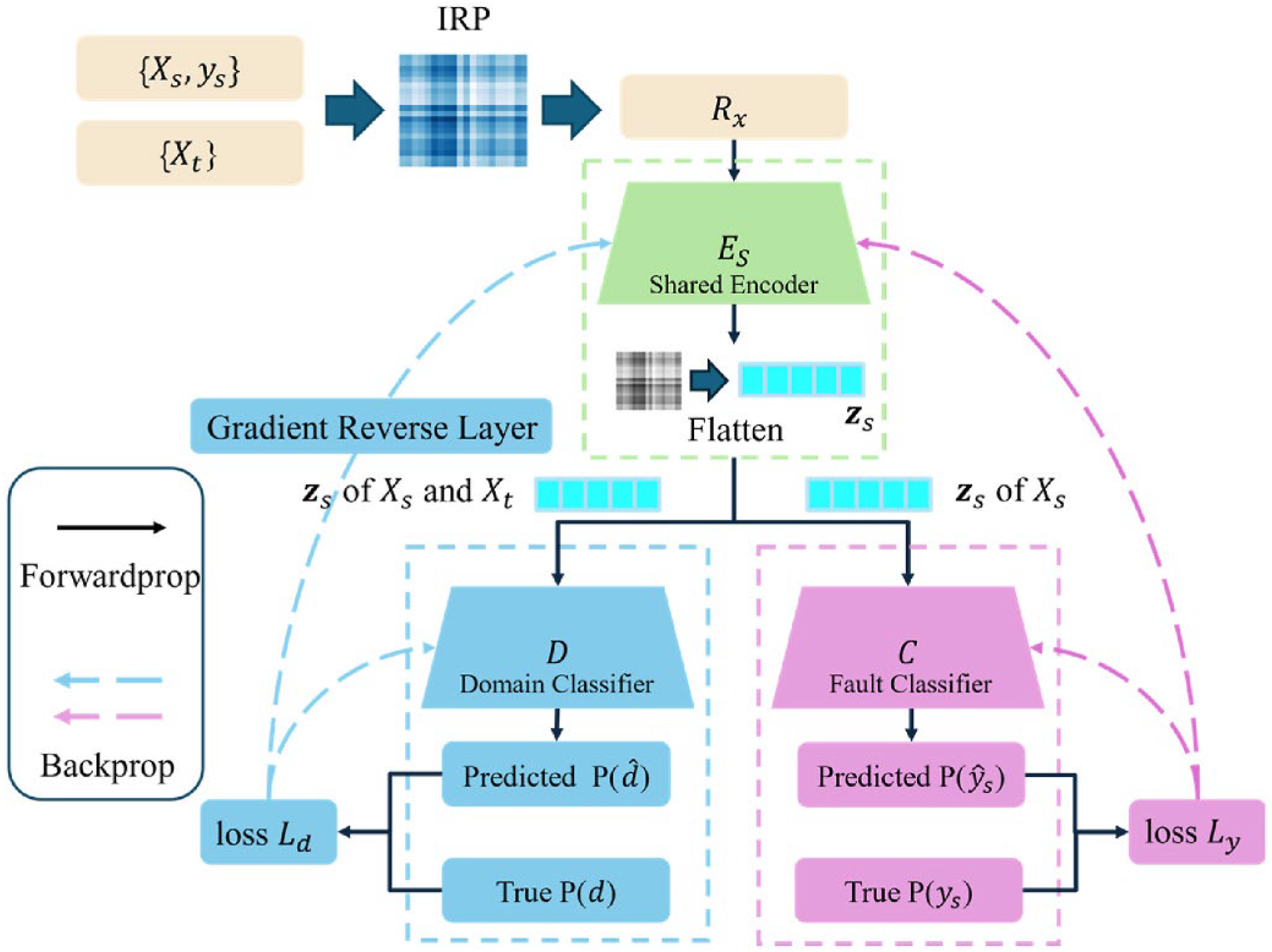
Another important research direction focuses on embedding physical priors or relational structures into deep architectures to mitigate the uncontrollable risks associated with black-box models. Physics-informed DL frameworks incorporate system-mechanism-related constraints into the learning process, enabling models to learn representations that are more consistent with fault mechanisms and thus improving interpretability [50,86]. Meanwhile, graph learning approaches have been employed to capture the global correlation structure of bearing signals. For example, graph structures constructed via Granger causality analysis have been combined with graph neural network inference to provide traceable support for correlation analysis, causal modeling, and diagnostic decision-making [87]. Other studies have attempted to construct graph structures from feature maps extracted by conventional CNN and use them as inputs to graph neural networks. By leveraging graph aggregation mechanisms to capture global relational information among nodes, these approaches enhance diagnostic performance and global relationship modeling capability under different operating conditions [88]. The corresponding methodological architecture is illustrated in Figure 12. By introducing domain adaptation after relational structure construction, the transferred features remain anchored to inter-sample dependencies rather than being aligned as isolated feature vectors, which is beneficial for preserving discriminative structure under varying operating conditions.
To systematically synthesize the diverse methodologies discussed above and provide a clear quantitative perspective, Table 4 presents a structured summary of these representative DL-based diagnostic models.
As indicated by this summary, DL-based bearing fault diagnosis has evolved from single-signal end-to-end classification toward a paradigm centered on representation enhancement, multi-source information fusion, and trustworthy diagnosis. Rather than simply chasing near-perfect accuracies—which often approach saturation on standard public benchmarks like CWRU—recent advanced architectures decisively shift toward resolving complex industrial bottlenecks. For current-signal-based diagnosis, research has primarily focused on noise suppression and weak-feature enhancement, while joint vibration–current diagnosis has increasingly emphasized fusion strategies and lightweight network architectures. From the perspective of interpretability and reliability, recent studies have also introduced uncertainty quantification, physics-informed constraints, and relational modeling to improve diagnostic credibility.
Despite these advances, DL methods still face several practical limitations in real industrial applications. Most deep models rely heavily on large labeled datasets, which are often difficult and costly to obtain in practical environments. As a result, data augmentation techniques have been widely applied to mitigate the challenges posed by small and imbalanced datasets. Furthermore, meta-learning strategies have emerged to enable rapid adaptation to new fault categories or varying operating conditions with only a few labeled samples. In addition, deep models are sensitive to distribution shifts caused by varying operating conditions, which may lead to performance degradation when models trained under laboratory conditions are deployed in industrial scenarios. Their computational complexity and limited interpretability may further restrict large-scale deployment in resource-constrained monitoring systems. These challenges, to some extent, hinder the long-term stable operation and widespread industrial adoption of DL-based diagnostic systems.

5. Bearing Fault Diagnosis Under Small-Sample Conditions

Although AI-based methods have demonstrated promising diagnostic performance, their effectiveness often depends on sufficient labeled data. In practical industrial environments, however, fault samples are usually scarce and imbalanced. Data augmentation techniques, together with meta-learning strategies, have been developed to expand training datasets and improve model generalization and rapid adaptability under small-sample conditions.

5.1. Rule-Based Data Augmentation Methods

Under small-sample conditions, one of the most critical challenges in bearing fault diagnosis arises from class imbalance and insufficient data coverage, which tend to bias decision boundaries toward majority classes. To address this issue, traditional data augmentation approaches primarily operate at the data level by increasing the number of minority-class samples and expanding their local coverage through resampling and perturbation strategies, thereby improving the learnability of training distributions without modifying model architectures [15].
In practical bearing datasets, simple random oversampling is computationally efficient but often results in duplicated samples, which may exacerbate overfitting and lead to decision boundary contraction. To improve the diversity of synthesized samples, the synthetic minority over-sampling technique (SMOTE) and its variants have been widely adopted. These methods generate new samples via interpolation within minority-class neighborhoods and enhance effectiveness by prioritizing boundary or hard-to-classify samples. To further address intra-class structural variability and sparse minority-class distributions in bearing fault data, improved SMOTE approaches that incorporate boundary reinforcement and hybrid modeling have been proposed to enhance the rationality of synthesized sample distributions. When combined with attention-based convolutional networks, such approaches have demonstrated effective diagnosis performance on imbalanced bearing datasets [89]. However, interpolation-based augmentation does not create truly new fault mechanisms; it mainly densifies the existing local sample space. As a result, its benefit becomes limited when minority samples themselves do not adequately cover the real fault variability.
Under complex operating conditions, minority-class samples are not only scarce but also frequently contaminated by noise and affected by class overlap, which may cause conventional interpolation strategies to generate samples in misleading regions. To overcome this limitation, clustering- and weighting-based oversampling strategies have been introduced, in which minority-class samples are first clustered and sampling weights are assigned according to density or representativeness. This approach simultaneously alleviates inter-class and intra-class imbalance and has been shown to improve classifier stability on complex rolling bearing datasets [90]. Furthermore, for noise-imbalanced scenarios, noise-immune weighted oversampling techniques have been developed and integrated with classifiers to form diagnostic frameworks in which synthesized samples provide effective class compensation while mitigating the risk of noise propagation [91].
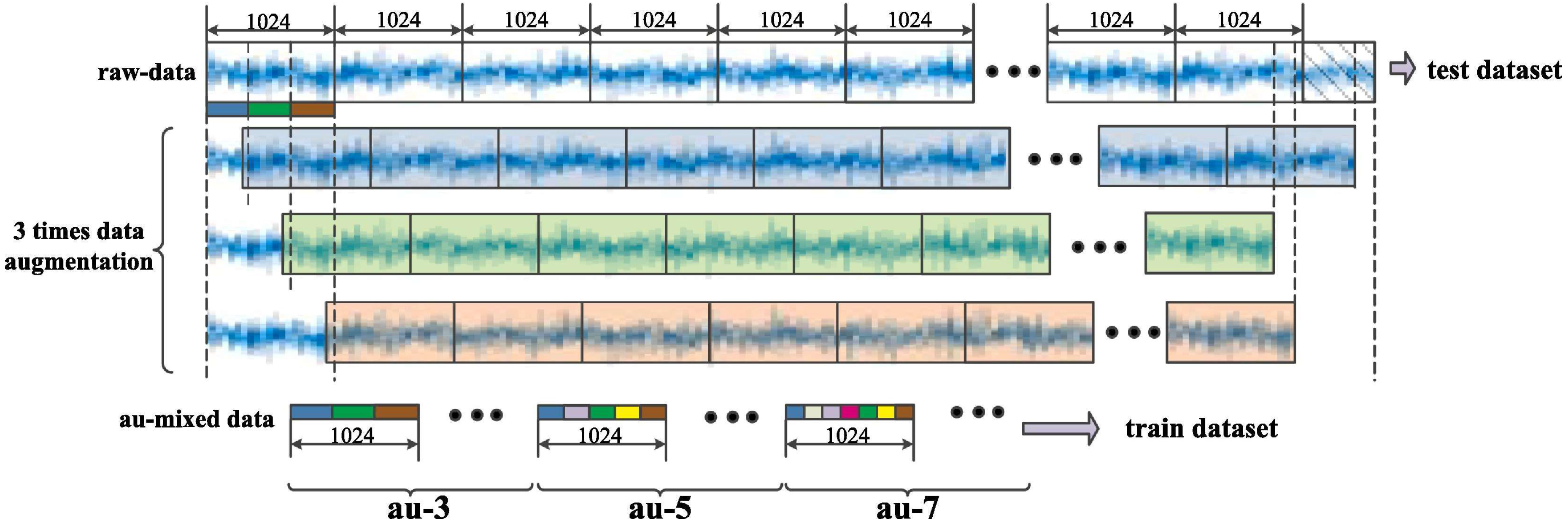
Beyond interpolation-based oversampling, signal-segment-based data augmentation has also demonstrated strong applicability in bearing fault diagnosis. The core idea of this approach is to modify local sample views through sliding-window segmentation, scale cropping, and recombination, thereby exposing learning models to richer morphological variations during feature extraction. For vibration signals, small-scale cropping and fusion strategies combined with multi-channel convolutional networks can increase the effective number of training samples and enhance multi-scale information coverage without relying on additional generative models, leading to improved convergence behavior and generalization performance under small-sample conditions [92]. The schematic diagram of the corresponding multi-scale clipping fusion augmentation strategy is shown in Figure 13. By recombining existing signal content across different scales, the augmentation process expands sample diversity while remaining closely tied to the original measurement structure, which helps avoid unrealistic pattern injection in small-sample scenarios. To mitigate the tendency of fault-related features to be overwhelmed by noise in small-sample scenarios, analytic-wavelet-based methods have also been introduced to construct controllable time-frequency augmentation views. By preserving the fidelity of fault-induced impulsive components, such approaches enhance the effectiveness of augmented samples and have been shown to facilitate cross-operating-condition generalization in bearing fault diagnosis tasks [93].
For current-signal-based bearing fault diagnosis, traditional data augmentation methods place particular emphasis on enhancing the separability of weak fault-related features. A representative approach exploits periodicity and synchronization characteristics to design resampling or shifting strategies, enabling original current sequences to form more stable periodic representations at the sample level. When combined with feature fusion modules, such strategies can improve classification robustness. For example, periodic resampling-based augmentation integrated with time–frequency channel attention mechanisms has been shown to enhance the distinguishability of bearing faults in the current domain without introducing additional sensors [94]. Similarly, frameworks that combine time-shift-based denoising of current sequences with CNN have demonstrated the effectiveness of augmentation and preprocessing in improving the learnability of weak fault features [95].
Beyond direct sample expansion, undersampling, cost-sensitive learning, and ensemble reweighting are frequently employed as complementary strategies to correct class imbalance at the training-objective level. For instance, resampling can be jointly optimized with classifier parameters, or discriminators can be used to assign higher weights to hard samples, thereby improving minority-class recall while suppressing false alarms [96]. In addition, some studies have integrated traditional augmentation with digital twin models or information transfer strategies to generate auxiliary samples or transferable features, thereby reducing the burden of real data acquisition and providing a bridge from rule-based augmentation to more advanced model-based or transfer-based solutions [97].
Overall, traditional data augmentation methods primarily rely on resampling and signal-segment construction. Their advantages lie in simplicity, strong controllability, and decoupling from diagnostic model architectures, making them suitable for rapidly improving the trainability of small-sample diagnostic tasks. However, their performance ceiling is often limited by insufficient information gain in synthesized samples and the potential amplification of noise and class overlap. In extremely data-scarce or strongly distribution-shifted scenarios, these approaches typically need to be combined with more advanced generative or transfer-based strategies.

5.2. Generative-Model-Based Data Augmentation Methods

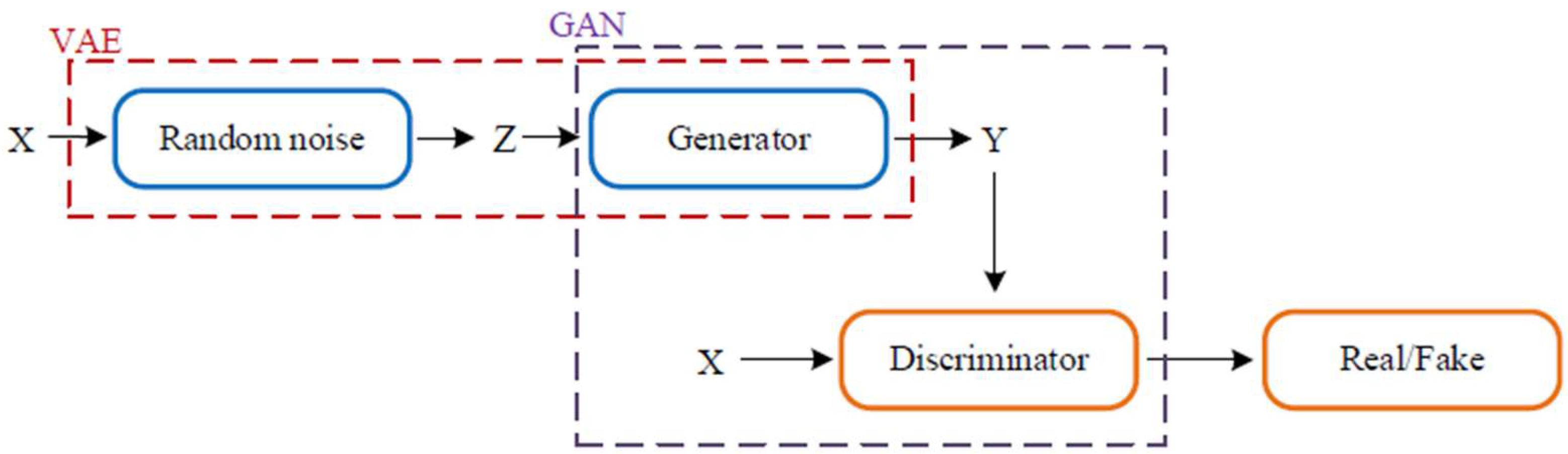
When fault samples are extremely scarce or exhibit pronounced distribution discrepancies, conventional interpolation- and segment-based augmentation methods are often limited to expanding local neighborhoods and fail to introduce substantial new discriminative information. In contrast, generative data augmentation methods aim to learn the underlying fault data distribution and generate new samples that are highly consistent with real data in a controllable manner, thereby improving minority-class coverage over a broader feature space. In bearing fault diagnosis, widely adopted generative approaches include generative adversarial networks (GAN), variational autoencoders (VAE), and their hybrid architectures, with recent extensions toward diffusion models and combined generative–TL strategies [98].
GAN-based methods play a prominent role in bearing fault diagnosis due to their ability to approximate fault data distributions through adversarial training and generate synthetic samples with high diversity. To enhance training stability and mitigate mode collapse, many studies introduce conditional constraints, multiple discriminators, or feature-consistency losses, ensuring that generated samples simultaneously satisfy class separability and temporal structural consistency. For instance, dual-discriminator conditional adversarial generative networks have been employed for rolling bearing fault augmentation, improving the discriminative effectiveness of synthesized samples under imbalanced conditions [99]. In scenarios characterized by both class imbalance and limited sample availability, adversarial generation frameworks integrated with oversampling strategies have been proposed to enhance minority-class representations and stabilize downstream classifier training, thereby improving small-sample bearing fault recognition performance [100]. Furthermore, to address training instability and collapse risks associated with imbalanced data, generative models incorporating enhanced relative losses and gradient penalty mechanisms have been applied to rolling bearing diagnosis, resulting in improved generation quality and diagnostic accuracy [101]. With respect to the practical usability of generated samples, several studies impose deep feature constraints or discriminator feature alignment, enabling synthetic samples not only to follow similar data distributions but also to populate sparse regions near decision boundaries in feature space [102]. Even so, visually plausible or feature-aligned samples are not necessarily diagnostically reliable. If the generated samples fail to preserve physically meaningful impulsive or modulation patterns, they may improve classifier fitting while weakening real-data credibility.
VAE and their variants emphasize learning continuous generative mechanisms through latent variable modeling. Owing to their stable training behavior and improved interpretability, VAEs are particularly suitable for distribution smoothing and structured sample generation under small-sample conditions. For imbalanced bearing fault diagnosis, weighted adaptations of conditional VAEs have been proposed to enhance the consistency between generated samples and target data distributions while suppressing the negative transfer effects of low-quality synthetic samples on downstream classifiers [103]. Furthermore, hybrid frameworks that combine VAEs with adversarial learning, such as VAEGAN, have been developed. As illustrated in Figure 14, these models integrate the stability of latent-variable-based generation with the high fidelity of adversarial learning, making them well suited for unified data augmentation and diagnostic modeling in imbalanced bearing fault scenarios [104].
In recent years, diffusion models have increasingly been explored for fault diagnosis data augmentation owing to their favorable training stability and strong generative diversity. The key principle of diffusion-based augmentation is to generate high-quality samples through a progressive denoising process, while enabling controllable class-conditioned generation via conditional constraints or feature guidance. Diffusion-model-based augmentation methods have been applied to imbalanced rolling bearing datasets to enhance minority-class coverage and achieve a more favorable balance between diagnostic accuracy and generation quality [105]. In addition, bearing diagnosis frameworks centered on diffusion-based augmentation have been proposed to further improve the separability and robustness of synthesized samples, with their effectiveness validated through downstream classification performance [106].
Beyond standalone generation, generative techniques are sometimes combined with transfer-aware reweighting strategies to address distribution shifts arising from cross-operating-condition scenarios. For example, TrAdaBoost-based transfer reweighting leverages auxiliary-domain data together with a small amount of target-domain data for joint training, iteratively reducing the influence of irrelevant samples through adaptive weighting [107]. In addition, integrating digital twin models with generative autoencoders has been explored to provide interpretable augmented samples under imbalanced conditions, offering a promising direction for engineering-oriented deployment [108]. The corresponding structural framework is illustrated in Figure 15. By embedding the digital twin directly into the generative pathway, physical knowledge participates in sample formation rather than only in posterior validation, which strengthens the interpretability of the augmented results.
In application scenarios where both current and vibration signals are available, generative augmentation can further compensate for weak fault-related features. In the current domain, fault components are typically weak and highly entangled with dominant background components, requiring stronger conditional constraints or feature-guided generation to prevent noise-dominated samples. In contrast, vibration-domain augmentation places greater emphasis on faithfully reproducing impulsive responses and time–frequency textures. As a result, within unified augmentation frameworks, different constraint designs and evaluation criteria are often adopted for different signal modalities. Generative approaches that combine motor current signals with bearing fault diagnosis further reflect a growing trend toward enhancing fault separability through sample generation while reducing dependence on handcrafted features [109].
Overall, generative data augmentation methods are highly effective in scenarios with localized data scarcity or mild class imbalance, where they are capable of compensating minority-class distributions over a broader feature space and enhancing sample diversity. However, it is crucial to recognize the boundary conditions of their effectiveness: under extreme small-sample conditions combined with severe cross-domain shifts, pure data-driven augmentation often becomes ineffective or even detrimental. If the original minority samples lack the structural diversity to represent true fault mechanisms, generative models tend to amplify inherent noise and class overlap rather than capturing actual fault dynamics [98]. Consequently, their practical deployment is heavily constrained by challenges related to generation quality assessment, training stability, and negative transfer risk control. For bearing fault diagnosis involving both vibration and current signals, generative augmentation must be jointly designed with strict signal-structure constraints, physical plausibility checks, quality screening mechanisms, and domain adaptation strategies to ensure that augmentation gains can be reliably translated into diagnostic performance improvements.

5.3. Meta-Learning-Based Few-Shot Diagnosis Methods

Although generative data augmentation can alleviate sample scarcity by expanding minority-class data and enhancing diversity, it may still fail when labeled samples are extremely limited or when fault types and operating conditions vary. Meta-learning addresses this limitation by extracting task-level transferable knowledge, enabling rapid adaptation with few labeled samples. This property is particularly valuable in small-sample industrial fault diagnosis scenarios, where the diversity of operating conditions and evolving fault types make conventional augmentation insufficient. Meta-learning methods are designed to capture common patterns across related tasks, providing the model with a prior that facilitates learning from only a handful of examples.
To achieve such rapid adaptation, optimization-based meta-learning frameworks, such as Model-Agnostic Meta-Learning (MAML), have been developed. These methods learn a generalizable initialization that can be quickly fine-tuned on new tasks. They allow the model to adapt to unseen fault categories or changing operating conditions with minimal labeled data, improving both generalization and adaptation speed [110]. For example, causal-Transformer-based meta-learning models integrate physical fault propagation priors into MAML, enhancing cross-condition fault classification and outperforming traditional adaptation approaches on multi-bearing datasets [111]. Despite these advantages, optimization-based methods require repeated gradient updates, increasing computational cost, and their performance may degrade when the distribution gap between meta-training and target tasks is large.
In addition to optimization-based strategies, metric-based meta-learning offers a more computationally efficient alternative. Metric-based meta-learning constructs discriminative embedding spaces and performs similarity-based classification. Elastic variants of prototypical networks adjust distance metrics to capture complex task-specific relationships, improving few-shot classification under unstable speeds or varying load conditions [112]. Prototype matching models meta-train embeddings across multiple tasks and then classify new samples based on similarity, achieving robust performance in few-shot and zero-shot scenarios [113]. However, they may fail to fully capture higher-order correlations in tasks with high heterogeneity or complex signal patterns, limiting their applicability in certain industrial scenarios.
To further enhance robustness and cross-condition generalization, researchers have explored hybrid meta-learning frameworks and multi-modal signal integration. Self-supervised meta-learning frameworks combining contrastive learning with meta-adaptation demonstrate strong representation learning even with few labeled samples, improving diagnostic accuracy in complex, noisy environments [114]. These approaches enhance robustness and cross-condition generalization but introduce additional network complexity and rely on high-quality multi-modal signals, which may not always be available in real industrial applications, especially in the presence of sensor noise or missing data.
Beyond hybrid and multi-modal methods, Bayesian meta-learning frameworks incorporate uncertainty estimation to further improve generalization. Bayesian meta-learning frameworks enhance performance under imbalanced and unseen sample conditions [115], allowing models to account for prediction uncertainty and provide reliable adaptation in industrial environments. Additional strategies include task scheduling, adaptive fine-tuning, and gradient prioritization, reducing negative transfer between tasks and improving meta-training efficiency. These methods, however, increase implementation complexity and require careful calibration of meta-training tasks and hyperparameters.
Overall, meta-learning establishes a task-level learning paradigm, capturing task commonalities and enabling rapid adaptation to new classes or conditions with minimal labeled data. By combining optimization-based, metric-based, hybrid, and Bayesian frameworks, meta-learning complements data augmentation and bridges the gap toward TL. These approaches provide a comprehensive toolkit for small-sample bearing fault diagnosis, supporting both cross-condition adaptability and robust performance under scarce label scenarios. Despite its advantages, meta-learning still faces challenges such as sensitivity to task distribution differences, high computational cost, and reliance on representative meta-training tasks. These limitations indicate that additional strategies are needed to further improve generalization and adaptability in highly variable industrial conditions.

6. Transfer-Learning-Based Bearing Fault Diagnosis Methods

In practical bearing fault diagnosis, small-sample limitations often interact with shifts in operating conditions, creating a compounded challenge: models trained under one set of conditions may not generalize well to new operating scenarios, even if augmented data or meta-learned representations are available. To mitigate such cross-domain performance degradation, TL has been applied to enable adaptation across varying working conditions as well as the transfer from virtual datasets to real industrial data.

6.1. TL Methods Under Varying Operating Conditions

In engineering applications of bearing fault diagnosis, changes in rotational speed and load alter excitation conditions, transmission paths, and modulation mechanisms simultaneously. As a result, pronounced distribution shifts often arise between source and target domains in terms of time-domain impact intervals, frequency-domain energy distributions, and time-frequency texture patterns. Consequently, discriminative boundaries learned under source operating conditions are often difficult to directly transfer to target conditions, resulting in feature mismatch and class overlap. To address this challenge, TL methods under varying operating conditions generally aim to learn operating-condition-invariant representations, achieving cross-condition generalization through the joint enforcement of distribution alignment and discriminative structure preservation.
From the perspective of distribution alignment, recent studies have increasingly adopted more powerful discrepancy measures to characterize cross-condition differences and enable end-to-end adaptation in unlabeled target-domain scenarios. By leveraging more stable alignment metrics, the adaptation process can remain well controlled under nonlinear speed variations and load disturbances, thereby alleviating the risk of insufficient alignment associated with simple statistical matching approaches [116]. However, as the gap between operating conditions increases, aligning marginal distributions alone may degrade class structures, compress inter-class margins, and even induce negative transfer. To mitigate this issue, structure-preserving constraints have been incorporated into domain alignment frameworks, ensuring that the adaptation process not only reduces domain discrepancy but also maintains fault class separability, rather than merely enforcing domain indistinguishability [117].
Regarding discriminative structure preservation, adversarial adaptation remains a widely adopted strategy due to its ability to learn domain-invariant features without requiring target-domain labels. Nevertheless, conventional adversarial alignment methods often suffer from insufficient intra-class alignment and inter-class boundary drift, particularly under strong noise, weak fault signatures, or highly heterogeneous operating conditions. To overcome these limitations, contrastive-constraint-based domain adaptation strategies have been proposed. By explicitly promoting intra-class compactness and inter-class separability, such approaches encourage the alignment process to focus on class geometric structures, thereby improving stability in cross-speed and cross-load transfer tasks [118]. However, reduced domain discrepancy does not necessarily imply preserved fault semantics. When operating-condition-related variations are incorrectly aligned as transferable fault information, negative transfer may still occur and compromise diagnostic reliability.
In practical engineering datasets, class imbalance and prior distribution shift are almost inevitable. On the one hand, certain fault categories may be sparsely represented in the source domain; on the other hand, the fault class proportions in the target domain may differ substantially from those observed during training. If uniform alignment weights are applied without considering these discrepancies, models tend to overfit majority classes while exhibiting degraded recognition performance for minority classes. To address this challenge, integrating imbalance modeling with domain adaptation—through class-prior correction, reweighting, or cost-sensitive learning mechanisms—has been shown to effectively suppress minority-class dilution and significantly enhance diagnostic robustness under the combined effects of varying operating conditions and imbalanced data distributions [119]. Moreover, under composite fault scenarios or strong interference backgrounds, the selection of transfer pathways may require dynamic adjustment. Exploiting correlation measures and alignment difficulty indicators to guide transfer strategies can reduce ineffective alignment and improve overall adaptation efficiency [120].
In more complex deployment scenarios, the target domain often comprises multiple operating-condition subdomains rather than a single homogeneous condition, such as alternating speed ranges, load levels, or operating stages. In such cases, aligning the target domain as a whole may obscure intra-domain heterogeneity and lead to overly averaged adaptation results. To overcome this limitation, multi-target domain adaptation approaches have been proposed, in which multiple target subdomains are jointly adapted based on shared representations. This enables models to maintain consistent performance across multiple operating points and is particularly suitable for systems with frequent operating-condition switching [121], as illustrated in Figure 16. By handling shared representation learning and subdomain-specific alignment simultaneously, the adaptation process can accommodate operating-state heterogeneity without collapsing all target variations into a single averaged transfer path. Furthermore, long-term operation of industrial equipment is typically accompanied by gradual operating-condition changes and the accumulation of data drift, rendering one-shot offline TL insufficient for sustained reliability. By integrating incremental TL with ensemble strategies, continuous model updating and dynamic fusion can mitigate catastrophic forgetting and provide effective support for long-term deployment [122].
Beyond alignment strategies, the effectiveness of TL under varying operating conditions is also highly dependent on the choice of representations. For nonstationary variable-speed signals, the combination of multi-scale time–frequency representations with finer-grained class-conditional constraints can strengthen the expression of weak fault-related features and mitigate errors dominated by operating condition variations, thereby improving cross-condition transferability [123]. Meanwhile, driven by data compliance and privacy isolation requirements, an increasing number of engineering scenarios restrict direct access to source-domain data and allow only pretrained source models to be shared. In such settings, source-free TL offers a practical solution by exploiting the implicit discriminative structures encoded in source models together with self-supervised information from the target domain for adaptive updating [124]. Its practicality is evident in privacy-sensitive scenarios, but the absence of source data also makes transfer errors harder to diagnose and correct. As a result, source-free adaptation usually requires stronger confidence control or pseudo-label screening to avoid reinforcing early misalignment.
Under label-scarce field conditions, TL under varying operating conditions is often tightly coupled with small-sample challenges. Excessively strong alignment may lead to negative transfer, whereas overly weak alignment may fail to adapt to target conditions. By incorporating sample difficulty modeling and representation regularization, limited target samples can more effectively constrain the alignment direction, thereby enhancing adaptation stability in few-shot cross-condition scenarios [125]. Moreover, for more general unseen operating conditions, domain adaptation approaches that emphasize cross-domain local structure preservation can reduce class boundary drift and improve generalization consistency [126]. When the source domain itself comprises multiple operating conditions or devices, different source domains contribute unequally to the target domain. Conditional distribution guidance and multi-source weighted transfer strategies can suppress redundant alignment and improve overall transfer efficiency [127].
To provide a concise quantitative comparison of the representative TL methods discussed above, Table 5 summarizes several typical strategies for bearing fault diagnosis under varying operating conditions in terms of target scenario, quantitative result, and key contribution.
As indicated by this summary, TL for bearing fault diagnosis under varying operating conditions has gradually evolved from discrepancy reduction alone toward more adaptive frameworks that integrate conditional alignment, contrastive discrimination, multi-target adaptation, source-free updating, and multi-source coordination. Although recent methods have reported strong quantitative performance on both benchmark datasets and engineering tasks, their evaluation settings still differ in datasets, transfer protocols, and definitions of operating-condition shifts. Therefore, the reported accuracy gains should be interpreted together with transfer scenario complexity, source-data accessibility, and robustness to realistic operating variations. Future research should further emphasize training stability, negative-transfer suppression, and coordinated utilization of heterogeneous multi-source information so as to support more reliable deployment in long-term and complex industrial environments.

6.2. Virtual-to-Real TL Methods

Compared with TL under varying operating conditions, virtual-to-real transfer typically involves more complex and heterogeneous domain discrepancies. These discrepancies arise not only from statistical distribution shifts induced by operating condition variations, but also from the combined effects of simulation modeling errors, inconsistent boundary conditions, differences in sensing and data acquisition chains, and on-site noise contamination. Although virtual domains can generate low-cost datasets covering multiple fault types and operating conditions, their distributions often exhibit inherent structural deviations from those of real domains. Consequently, the central challenge of virtual-to-real transfer lies in constructing trustworthy virtual priors and reliably transferring transferable knowledge to real equipment through effective cross-domain alignment mechanisms.
To effectively address this challenge and ensure the reliability of these virtual priors, specific evaluation criteria for synthetic and virtual data quality must be strictly established before performing domain adaptation. First, physical plausibility checks are required to verify that the simulated kinematics and defect frequencies generated by digital twin models accurately match the real physical structural parameters, rather than merely fitting statistical distributions. Second, spectral and temporal constraints must be imposed on the generated signals. The virtual data should retain physically meaningful impulsive or modulation patterns, including resonance frequency bands and impact repetition rates, to prevent the model from learning spurious background textures. Finally, quantitative domain gap metrics, like Maximum Mean Discrepancy or Wasserstein distance, should be continuously monitored. These metrics help measure the discrepancy between the virtual and real domains, ensuring that the alignment process dynamically calibrates simulation biases without destroying the intrinsic fault feature topology [128,129].
Guided by these strict evaluation criteria, from a methodological standpoint, digital-twin-driven transfer frameworks provide an effective pathway to unify virtual-domain task construction, representation learning, and rapid real-domain adaptation, enabling models to fully exploit virtual data while achieving effective calibration under few-sample real-domain conditions [130]. Furthermore, introducing physical constraints or parameter inversion mechanisms into digital twin models can impose explicit restrictions on representation learning during transfer, thereby reducing reliance on noise or spurious correlations inherent in purely data-driven approaches and improving robustness under class imbalance and disturbance conditions [131]. When the virtual domain covers a wide operating range, contains redundant states, or exhibits label spaces that are not fully consistent with those of the real domain, partial domain adaptation strategies can be employed. By suppressing non-transferable components and emphasizing alignment within transferable subspaces, such approaches can effectively alleviate negative transfer in virtual-to-real scenarios [132].
Beyond digital twins, simulation data generated from dynamic or finite element models are also widely used as source domains for virtual-to-real transfer. Given the pronounced nonlinear discrepancies between simulated and real domains, alternating transfer and progressive correction mechanisms have been proposed to continuously refine decision boundaries during adaptation, enabling simulation knowledge to be smoothly transitioned to real domains [133], as illustrated in Figure 17. By feeding correction results back into the transfer loop, the adaptation is performed as an iterative refinement process rather than a fixed one-pass mapping, which is more suitable for the coexistence of simulation bias and real-world disturbances. To further address simulation-induced domain shifts, simulation-guided domain adaptation strategies have been explored, in which robust cross-domain features are learned to reduce dependence on labeled target-domain data while maintaining favorable generalization performance under cross-operating-condition and cross-load variations [134]. Building upon this idea, incorporating structural priors available in the simulation domain for subdomain-level matching can further reduce class confusion caused by global alignment, making such approaches particularly suitable for virtual-to-real scenarios characterized by data scarcity, weak fault signatures, and coupled multi-operating conditions [135].
To effectively minimize the aforementioned domain gap metrics, from an alignment perspective, multi-adversarial constraints weaken virtual–real discrepancies across multiple representation levels while preserving class structures, demonstrating enhanced stability in the presence of complex domain gaps [136]. Given that simulation errors are inherently uncertain and vary with operating conditions, a single alignment strategy is often insufficient to address diverse error patterns. More generalized simulation-domain adaptation approaches therefore introduce stronger domain generalization constraints, allowing models to maintain a certain level of transfer performance even when digital-twin inaccuracies are pronounced or simulation coverage is limited, thereby improving the fault tolerance of virtual-to-real transfer in engineering applications [137].
In diagnostic tasks spanning digital and physical spaces, constructing cross-space consistent representations and alignment mechanisms enables knowledge learned in digital environments to be more reliably transferred to physical equipment, thereby enhancing the reusability of virtual-to-real transfer methods [138]. Furthermore, joint paradigms that combine virtual-domain pretraining with few-sample real-domain fine-tuning and alignment can exploit the coverage advantages of virtual data while enabling rapid calibration to real operating conditions, thereby improving on-site adaptation efficiency [139].
Overall, virtual-to-real transfer has evolved from early simulation pretraining–real fine-tuning paradigms toward integrated frameworks that combine physical constraints, partial domain suppression, and multi-level alignment. Future research should focus on improving the credibility of virtual-domain modeling and uncertainty quantification, and on developing more robust, interpretable, and continuously adaptive cross-space transfer diagnostic systems capable of operating reliably under complex noise conditions and coupled multi-operating scenarios.

7. Discussion

7.1. Methodological Taxonomy: Mapping Scenarios to Solutions

To synthesize the diverse challenges and methodological solutions discussed in the preceding sections, Table 6 presents a comparative matrix and methodological taxonomy. This updated framework explicitly evaluates mechanism-based, feature-extraction-based, and AI-based diagnostic categories across critical engineering dimensions, including data requirements, physical interpretability, and computational cost. Furthermore, it maps these methods to their optimal targeted scenarios while highlighting their primary limitations and inherent failure modes. Recognizing these multi-dimensional trade-offs is essential, as applying these methods outside their effective scopes can easily lead to negative transfer, amplified noise, or severe overfitting, thereby compromising diagnostic trustworthiness.
From the standpoint of diagnostic trustworthiness, a meaningful comparison of diagnostic methods should not rely solely on accuracy reported under isolated experimental settings. Instead, greater attention should be paid to whether a method remains effective under practically relevant conditions such as data imbalance, domain shift, cross-device transfer, and constrained deployment resources. In this sense, Table 6 already provides a partial performance-oriented assessment by comparing existing approaches across multiple engineering dimensions rather than through accuracy alone. Although this analysis does not replace a dedicated reproducible benchmark, it offers a more structured view of the strengths, limitations, and practical applicability of different diagnostic routes.

7.2. Open Challenges and Future Research Trends

Building on the above comparative analysis and applicability boundaries of different methods, several open challenges and future directions can be further identified in motor bearing fault diagnosis.
A.
Long-term drift and cross-device generalization
Although many methods achieve high accuracy on laboratory datasets, their robustness under long-term operation and cross-device transfer remains insufficiently validated. In practical applications, changes in operating conditions, structural properties, sensor mounting, and equipment aging may continuously shift data distributions, causing significant performance degradation. Future research should therefore pay more attention to long-term drift modeling and cross-device generalization, rather than limiting evaluation to static train-test settings.
B.
Uncertainty quantification and trustworthy diagnosis
Most existing studies still focus on classification accuracy, while the reliability of diagnostic decisions is rarely assessed explicitly. However, in real maintenance scenarios, a diagnostic system should not only provide predictions but also indicate when the result is uncertain or potentially unreliable. Incorporating uncertainty quantification into bearing fault diagnosis is thus an important future direction, especially for weak faults, noisy conditions, and cross-domain applications.
C.
Real-time deployment under resource constraints
A clear gap remains between high-performing diagnostic models and the requirements of industrial deployment. Many advanced methods rely on complex preprocessing, large model sizes, or repeated adaptation procedures, which limits their practical use in embedded or online monitoring systems. Future work should therefore emphasize lightweight architectures, efficient inference, and robustness under latency, memory, and computational constraints.
D.
Standardized benchmarks and reproducible evaluation
Current studies are still heavily dependent on a limited number of public datasets and often use inconsistent experimental settings, making fair comparison difficult. In particular, issues such as class imbalance, domain shift, and TL are frequently discussed, but not evaluated under unified protocols. Building more standardized benchmark settings and encouraging reproducible reporting will be essential for obtaining more reliable and cumulative conclusions in future research.

8. Conclusions

This paper has presented a structured review of recent research on bearing fault diagnosis in electric motors, with emphasis on the coordinated development of fault-mechanism-based modeling, feature-extraction-based methods, and AI-based diagnosis frameworks. Around the two representative signal modalities, namely vibration signals and stator current signals, the reviewed studies were organized from the perspectives of physical interpretation, signal representation, and engineering applicability. In addition, recent advances in data augmentation, meta-learning, and TL were further discussed in connection with practical scenarios involving small samples, varying operating conditions, and virtual-to-real transfer.
From the reviewed literature, it can be seen that different diagnostic routes exhibit distinct strengths and limitations. Mechanism-based methods provide clear physical interpretability and are valuable for revealing the relationships between localized defects and signal responses, but their practical use is often constrained by modeling complexity and parameter dependence. Feature-extraction-based methods remain attractive in engineering practice because of their controllability and relatively low implementation cost, although their performance is sensitive to noise, nonstationarity, and prior parameter selection. AI-based methods, especially deep-learning-based approaches, have shown strong capability in nonlinear feature learning, multi-source information fusion, and cross-condition diagnosis, but their deployment in real applications still depends heavily on data quality, sample sufficiency, and model reliability.
To address the gap between laboratory studies and engineering deployment, increasing attention has been paid to diagnosis under data-scarce and cross-domain conditions. In this context, rule-based and generative data augmentation methods can improve the trainability of imbalanced datasets, while meta-learning provides a promising route for rapid adaptation under few-shot conditions. TL further extends diagnostic models to varying operating scenarios and virtual-to-real tasks, making it an important support for improving practical adaptability. At the same time, digital-twin-assisted diagnosis and physics-informed learning indicate a clear trend toward deeper integration of physical knowledge and data-driven intelligence.
Overall, bearing fault diagnosis in electric motors is evolving toward more physically consistent, data-efficient, and engineering-oriented intelligent frameworks. Future research should further strengthen robust diagnosis under complex operating conditions, improve cross-device and long-term generalization, and enhance uncertainty awareness and deployment feasibility. These directions are essential for promoting more reliable and practical bearing fault diagnosis systems in real industrial environments.

Author Contributions

Conceptualization, J.W. and J.Z.; writing—original draft preparation, M.F.; writing—review and editing, J.W. and Y.F.; formal analysis, J.W. and M.F.; investigation, M.F. and Y.F.; methodology, X.H.; supervision, J.W. and Y.F.; Project administration, X.H. and J.Z.; funding acquisition, X.H. and J.Z. All authors have read and agreed to the published version of the manuscript.

Funding

This work was supported by the Key Research and Development Program of Ningbo under Grant 2025Z048, the Key Project of the State Key Laboratory of Fluid Power and Mechatronic Systems SKLoFP_ZZ_2405, the Key Research and Development Program of Zhejiang Province under Grant 2024C01140.

Data Availability Statement

No new data were created or analyzed in this study.

Conflicts of Interest

The authors declare no conflicts of interest.

Abbreviations

The following abbreviations are used in this manuscript:
AIArtificial intelligence
TLTransfer learning
MLMachine learning
DLDeep learning
MECMagnetic equivalent circuit
MWFMModified winding function method
FEMFinite element method
STFTShort-time Fourier transform
WTWavelet transform
SSTSynchrosqueezing transform
SETSynchroextracting transform
SSETSynchrosqueezing extracting transform
CEEMDComplete ensemble empirical mode decomposition
VMDVariational mode decomposition
SVMSupport vector machine
HIHealth indicator
CNNConvolutional neural networks
SMOTESynthetic minority over-sampling technique
GANGenerative adversarial network
VAEVariational autoencoder
MAMLModel-Agnostic Meta-Learning

References

  1. Nishat Toma, R.; Kim, C.-H.; Kim, J.-M. Bearing Fault Classification Using Ensemble Empirical Mode Decomposition and Convolutional Neural Network. Electronics 2021, 10, 1248. [Google Scholar] [CrossRef]
  2. Moloverya Kavugho, S.; Ngandu Kalala, G.; Rasolofondraibe, L.; Kilundu Y’Ebondo, B.; Chiementin, X. Model-based fault diagnosis and monitoring of induction machine bearing fault. Mech. Syst. Signal Process. 2025, 238, 113245. [Google Scholar] [CrossRef]
  3. Tiboni, M.; Remino, C.; Bussola, R.; Amici, C. A Review on Vibration-Based Condition Monitoring of Rotating Machinery. Appl. Sci. 2022, 12, 972. [Google Scholar] [CrossRef]
  4. Kumbhar, S.G.; Desavale, R.G.; Dharwadkar, N.V. Fault size diagnosis of rolling element bearing using artificial neural network and dimension theory. Neural Comput. Appl. 2021, 33, 16079–16093. [Google Scholar] [CrossRef]
  5. Boudiaf, M.; Boudinar, K.; Aimer, A.F.; Khodja, M.-E.-A. Induction motor bearing faults diagnosis using stator current and vibration analysis. Period. Polytech. Electr. Eng. Comput. Sci. 2021, 65, 344–351. [Google Scholar] [CrossRef]
  6. del Rosario Bautista-Morales, M.; Patiño-López, L.D. Acoustic detection of bearing faults through fractional harmonics lock-in amplification. Mech. Syst. Signal Process. 2023, 185, 109740. [Google Scholar] [CrossRef]
  7. Song, X.; Zhao, W. A Review of Rolling Bearing Fault Diagnosis Approaches Using AC Motor Signature Analysis. Proc. CSEE 2022, 42, 1582–1596. [Google Scholar]
  8. Zhang, H.; Borghesani, P.; Randall, R.B.; Peng, Z. A benchmark of measurement approaches to track the natural evolution of spall severity in rolling element bearings. Mech. Syst. Signal Process. 2022, 166, 108466. [Google Scholar] [CrossRef]
  9. Niu, L.; Cao, H.; Hou, H.; Wu, B.; Lan, Y.; Xiong, X. Experimental observations and dynamic modeling of vibration characteristics of a cylindrical roller bearing with roller defects. Mech. Syst. Signal Process. 2020, 138, 106553. [Google Scholar] [CrossRef]
  10. Wang, B.; Zhou, L.; Miyoshi, M.; Inoue, H.; Kanemaru, M. Quantification of Induction Motor Bearing Fault Severity based on Modified Winding Function Theory. In Proceedings of the International Conference on Electrical Machines and Systems (ICEMS); IEEE: New York, NY, USA, 2021; pp. 944–948. [Google Scholar]
  11. Tabasi, M.; Mostafavi, M.; Ojaghi, M. Motor current signature analysis for detecting local defects on rolling-element bearings of induction motors. Arab. J. Sci. Eng. 2023, 48, 14811–14822. [Google Scholar] [CrossRef]
  12. Hakim, M.; Omran, A.A.B.; Ahmed, A.N.; Al-Waily, M.; Abdellatif, A. A systematic review of rolling bearing fault diagnoses based on deep learning and transfer learning: Taxonomy, overview, application, open challenges, weaknesses and recommendations. Ain Shams Eng. J. 2023, 14, 101945. [Google Scholar] [CrossRef]
  13. Tama, B.A.; Vania, M.; Lee, S.; Lim, S. Recent advances in the application of deep learning for fault diagnosis of rotating machinery using vibration signals. Artif. Intell. Rev. 2023, 56, 4667–4709. [Google Scholar] [CrossRef]
  14. Kumar, R.R.; Andriollo, M.; Cirrincione, G.; Cirrincione, M.; Tortella, A. A Comprehensive Review of Conventional and Intelligence-Based Approaches for the Fault Diagnosis and Condition Monitoring of Induction Motors. Energies 2022, 15, 8938. [Google Scholar] [CrossRef]
  15. Zhang, T.; Chen, J.; Li, F.; Zhang, K.; Lv, H.; He, S.; Xu, E. Intelligent fault diagnosis of machines with small & imbalanced data: A state-of-the-art review and possible extensions. ISA Trans. 2022, 119, 152–171. [Google Scholar]
  16. Matania, O.; Dattner, I.; Bortman, J.; Kenett, R.S.; Parmet, Y. A systematic literature review of deep learning for vibration-based fault diagnosis of critical rotating machinery: Limitations and challenges. J. Sound Vib. 2024, 590, 118562. [Google Scholar] [CrossRef]
  17. Hendriks, J.; Dumond, P.; Knox, D.A. Towards better benchmarking using the CWRU bearing fault dataset. Mech. Syst. Signal Process. 2022, 169, 108732. [Google Scholar] [CrossRef]
  18. Soomro, A.A.; Muhammad, M.B.; Mokhtar, A.A.; Md Saad, M.H.; Lashari, N.; Hussain, M.; Sarwar, U.; Palli, A.S. Insights into modern machine learning approaches for bearing fault classification: A systematic literature review. Results Eng. 2024, 23, 102700. [Google Scholar] [CrossRef]
  19. Grover, C.; Turk, N. A novel fault diagnostic system for rolling element bearings using deep transfer learning on bispectrum contour maps. Eng. Sci. Technol. Int. J. 2022, 31, 101049. [Google Scholar] [CrossRef]
  20. Niu, G.; Dong, X.; Chen, Y. Motor Fault Diagnostics Based on Current Signatures: A Review. IEEE Trans. Instrum. Meas. 2023, 72, 1–19. [Google Scholar] [CrossRef]
  21. Tingarikar, G.; Choudhury, A. Vibration analysis-based fault diagnosis of a dynamically loaded bearing with distributed defect. Arab. J. Sci. Eng. 2022, 47, 8045–8058. [Google Scholar] [CrossRef]
  22. Mufazzal, S.; Muzakkir, S.M.; Khanam, S. On the importance of modeling ball raceway impact force for evaluating the plastic deformation at spall edge of rolling element bearing: Theoretical modeling. J. Vib. Eng. Technol. 2024, 12, 1309–1322. [Google Scholar] [CrossRef]
  23. Mufazzal, S.; Muzakkir, S.M.; Khanam, S. Theoretical and experimental analyses of vibration impulses and their influence on accurate diagnosis of ball bearing with localized outer race defect. J. Sound Vib. 2021, 513, 116407. [Google Scholar] [CrossRef]
  24. Atef, M.M.; Khair-Eldeen, W.; Yan, J.; Nassef, M.G.A. Investigating the Combined Effect of Multiple Dent and Bump Faults on the Vibrational Behavior of Ball Bearings. Machines 2022, 10, 1062. [Google Scholar] [CrossRef]
  25. Mattar, A.H.A.; Sayed, H.; Younes, Y.K.; El-Mongy, H.H. Experimental verification and nonlinear dynamic response analysis of a rolling element bearing with localized defects. J. Fail. Anal. Prev. 2022, 22, 1753–1770. [Google Scholar] [CrossRef]
  26. Vlachou, V.I.; Karakatsanis, T.S.; Vologiannidis, S.D.; Efstathiou, D.E.; Karapalidou, E.L.; Antoniou, E.N.; Efraimidis, A.E.; Balaska, V.E.; Vlachou, E.I. Intelligent Fault Diagnosis of Ball Bearing Induction Motors for Predictive Maintenance Industrial Applications. Machines 2025, 13, 902. [Google Scholar] [CrossRef]
  27. Ophel, G.E.; Tchomeni, B.X.; Alugongo, A.A.; Sozinando, D.F. An analysis of Hertzian contact and inner race crack-induced vibrations in a coupled shaft-bearing system. Eng. Technol. Appl. Sci. Res. 2025, 15, 28680–28686. [Google Scholar] [CrossRef]
  28. Jain, P.H.; Bhosle, S.P.; Keche, A.J.; Desavale, R.G. A dynamic model of outer race defective bearing considering the unbalanced shaft-bearing system with experimental simulation. J. Tribol. 2024, 146, 014301. [Google Scholar] [CrossRef]
  29. Qin, Y.; Li, C.; Wu, X.; Wang, Y.; Chen, H. Multiple-degree-of-freedom dynamic model of rolling bearing with a localized surface defect. Mech. Mach. Theory 2020, 154, 104047. [Google Scholar] [CrossRef]
  30. Shi, J.; Yu, Y.; Jiang, X.; Li, C.; Shen, C.; Huang, W.; Zhu, Z. Dynamic modeling considering time-varying contact pairs and parameterized defects of deep groove ball bearings for its vibration characteristic analysis. Nonlinear Dyn. 2024, 112, 17781–17809. [Google Scholar] [CrossRef]
  31. Yang, R.; Zhang, Z.; Chen, Y. Analysis of vibration signals for a ball bearing–rotor system with raceway local defects and rotor eccentricity. Mech. Mach. Theory 2022, 169, 104594. [Google Scholar] [CrossRef]
  32. Wang, M.; Yan, K.; Tang, Q.; Guo, J.; Zhu, Y.; Hong, J. Dynamic modeling and properties analysis for ball bearing driven by structure flexible deformations. Tribol. Int. 2023, 179, 108163. [Google Scholar] [CrossRef]
  33. Zhang, R.; Guo, L.; Zong, Z.; Gao, H.; Qian, M.; Chen, Z. Dynamic modeling and analysis of rolling bearings with rolling element defect considering time-varying impact force. J. Sound Vib. 2023, 562, 117820. [Google Scholar] [CrossRef]
  34. Prabith, K.; Praveen Krishna, I. Response and stability analysis of a two-spool aero-engine rotor system undergoing multi-disk rub-impact. Int. J. Mech. Sci. 2022, 213, 106861. [Google Scholar] [CrossRef]
  35. Fang, B.; Zhang, J.; Yan, K.; Hong, J. Comprehensive study on the nonlinear parameter vibrations of the rotor system due to the varying compliance of ball bearing. Commun. Nonlinear Sci. Numer. Simul. 2023, 126, 107426. [Google Scholar] [CrossRef]
  36. Schoen, R.R.; Habetler, T.G.; Kamran, F.; Bartfield, R. Motor bearing damage detection using stator current monitoring. IEEE Trans. Ind. Appl. 1995, 31, 1274–1279. [Google Scholar] [CrossRef]
  37. El Bouharrouti, N.; Sitnikov, M.; Hemeida, A.; Martin, F.; Kudelina, K.; Naseer, M.U.; Belahcen, A. Co-simulations of induction machines coupled with a radial ball bearing for mechanical defects analysis. IET Electr. Power Appl. 2025, 19, e12529. [Google Scholar] [CrossRef]
  38. Benninger, M.; Liebschner, M.; Kreischer, C. Fault Detection of Induction Motors with Combined Modeling- and Machine-Learning-Based Framework. Energies 2023, 16, 3429. [Google Scholar] [CrossRef]
  39. Blodt, M.; Granjon, P.; Raison, B.; Rostaing, G. Models for bearing damage detection in induction motors using stator current monitoring. IEEE Trans. Ind. Electron. 2008, 55, 1813–1822. [Google Scholar] [CrossRef]
  40. Geng, T.; Qiu, C.; Xu, C.; Ma, J. Research on magnetic field frequency feature for motor bearing fault. In Proceedings of the 2015 International Conference on Electrical and Information Technologies for Rail Transportation; Jia, L., Liu, Z., Qin, Y., Eds.; Springer: Berlin, Germany, 2016; pp. 27–34. [Google Scholar]
  41. Song, X.J.; Hu, J.T.; Zhu, H.Y. Effects of the slot harmonics on the stator current in an induction motor with bearing fault. Math. Probl. Eng. 2017, 2017, 2640796. [Google Scholar] [CrossRef]
  42. Han, Q.K.; Ding, Z.H.; Xu, X.P.; Wang, T.Y.; Chu, F.L. Stator current model for detecting rolling bearing faults in induction motors using magnetic equivalent circuits. Mech. Syst. Signal Process. 2019, 131, 554–575. [Google Scholar] [CrossRef]
  43. Ojaghi, M.; Sabouri, M.; Faiz, J. Analytic model for induction motors under localized bearing faults. IEEE Trans. Energy Convers. 2018, 33, 617–626. [Google Scholar] [CrossRef]
  44. Zhang, S.; Wang, B.; Kanemaru, M.; Lin, C.; Liu, D.; Habetler, T.G. Model-Based Analysis and Quantification of Bearing Faults in Induction Machines. In IEEE Transactions on Industry Applications; Technical Report: MERL TR2020-059; IEEE: New York, NY, USA, 2020. [Google Scholar]
  45. Desenfans, P.; Gong, Z.; Vanoost, D.; Gryllias, K.; Boydens, J.; De Gersem, H.; Pissoort, D. Improved air gap permeance modelling for single-slice magnetic equivalent circuits of skewed induction motors. COMPEL Int. J. Comput. Math. Electr. Electron. Eng. 2024, 43, 475–492. [Google Scholar] [CrossRef]
  46. Huang, L.; Shen, G.; Hu, N.; Chen, L.; Yang, Y. Coupled Electromagnetic-Dynamic Modeling and Bearing Fault Characteristics of Induction Motors considering Unbalanced Magnetic Pull. Entropy 2022, 24, 1386. [Google Scholar] [CrossRef]
  47. Dhakal, G.; Bhattarai, A.; Silwal, B. Modeling of induction motor bearing fault by using finite element method. In Proceedings of the 2023 IEEE 7th Conference on Energy Internet and Energy System Integration (EI2); IEEE: New York, NY, USA, 2023; pp. 3720–3725. [Google Scholar]
  48. Amitabh, P.; Bozalakov, D.; De Belie, F. Hybrid modeling of an induction machine to support bearing diagnostics. IEEE Open J. Ind. Electron. Soc. 2024, 5, 1140–1157. [Google Scholar] [CrossRef]
  49. Qin, Y.; Liu, H.; Mao, Y. Faulty rolling bearing digital twin model and its application in fault diagnosis with imbalanced samples. Adv. Eng. Inform. 2024, 61, 102513. [Google Scholar] [CrossRef]
  50. Ni, Q.; Ji, J.C.; Halkon, B.; Feng, K.; Nandi, A.K. Physics-Informed Residual Network (PIResNet) for rolling element bearing fault diagnostics. Mech. Syst. Signal Process. 2023, 200, 110544. [Google Scholar] [CrossRef]
  51. Zhong, J.; Zheng, Y.; Ruan, C.; Chen, L.; Bao, X.; Lyu, L. M-IPISincNet: An explainable multi-source physics-informed neural network based on improved SincNet for rolling bearings fault diagnosis. Inf. Fusion 2025, 115, 102761. [Google Scholar] [CrossRef]
  52. Wang, C.; Wang, M.; Yang, B.; Song, K.; Zhang, Y.; Liu, L. A Novel Methodology for Fault Size Estimation of Ball Bearings Using Stator Current Signal. Measurement 2021, 171, 108723. [Google Scholar] [CrossRef]
  53. Wu, G.; Yan, T.; Yang, G.; Chai, H.; Cao, C. A Review on Rolling Bearing Fault Signal Detection Methods Based on Different Sensors. Sensors 2022, 22, 8330. [Google Scholar] [CrossRef]
  54. Rohan, A.I.; Ridita, T.A.; Anonto, H.Z.; Hossain, M.I.; Shufian, A.; Mahin, M.S.R.; Islam, M.A. Intelligent fault diagnosis in rolling element bearings: Combining envelope spectrum and spectral kurtosis for enhanced detection. Results Eng. 2025, 27, 106899. [Google Scholar] [CrossRef]
  55. Tao, H.; Wang, P.; Chen, Y.; Stojanovic, V.; Yang, H. An unsupervised fault diagnosis method for rolling bearing using STFT and generative neural networks. J. Frankl. Inst. 2020, 357, 7286–7307. [Google Scholar] [CrossRef]
  56. Sharma, V.; Raghuwanshi, N.K.; Jain, A.K. Sensitive sub-band selection criteria for empirical wavelet transform to detect bearing fault based on vibration signals. J. Vib. Eng. Technol. 2021, 9, 1603–1617. [Google Scholar] [CrossRef]
  57. Liu, Q.; Wang, Y.; Xu, Y. Synchrosqueezing Extracting Transform and Its Application in Bearing Fault Diagnosis under Non-Stationary Conditions. Measurement 2021, 173, 108569. [Google Scholar] [CrossRef]
  58. Liu, J.; Meng, Z.; Sun, D.; Guan, Y.; Cao, W.; Li, J. Local time-reassigned synchrosqueezing transform and its application in bearing fault characteristic extraction. Mech. Syst. Signal Process. 2023, 203, 110726. [Google Scholar] [CrossRef]
  59. Shi, L.; Liu, W.; You, D.; Yang, S. Rolling Bearing Fault Diagnosis Based on CEEMDAN and CNN-SVM. Appl. Sci. 2024, 14, 5847. [Google Scholar] [CrossRef]
  60. Ni, Q.; Ji, J.C.; Feng, K.; Halkon, B. A Fault Information-Guided Variational Mode Decomposition (FIVMD) Method for Rolling Element Bearings Diagnosis. Mech. Syst. Signal Process. 2022, 164, 108216. [Google Scholar] [CrossRef]
  61. Kompella, K.C.D.; Rayapudi, S.R.; Rongala, N.S. Investigation of bearing faults in three phase induction motor using wavelet de-noising with improved Wiener filtering. Int. J. Power Energy Convers. 2021, 12, 115–136. [Google Scholar] [CrossRef]
  62. Jonjo, E.R.; Ali, I.; Megahed, T.F.; Nassef, M.G.A. A novel framework for motor bearings fault diagnosis using a heuristic-based adaptive variational mode extraction and a hybrid CNN–SVM classifier of current signals. J. Vib. Eng. Technol. 2025, 13, 417. [Google Scholar] [CrossRef]
  63. El Idrissi, A.; Derouich, A.; Mahfoud, S.; El Ouanjli, N.; Chantoufi, A.; Al-Sumaiti, A.S.; Mossa, M.A. Bearing Fault Diagnosis for an Induction Motor Controlled by an Artificial Neural Network—Direct Torque Control Using the Hilbert Transform. Mathematics 2022, 10, 4258. [Google Scholar] [CrossRef]
  64. Asad, B.; Vaimann, T.; Belahcen, A.; Kallaste, A.; Rassõlkin, A.; Ghafarokhi, P.S.; Kudelina, K. Transient Modeling and Recovery of Non-Stationary Fault Signature for Condition Monitoring of Induction Motors. Appl. Sci. 2021, 11, 2806. [Google Scholar] [CrossRef]
  65. Aguayo-Tapia, S.; Avalos-Almazan, G.; Rangel-Magdaleno, J.D.J. Entropy-Based Methods for Motor Fault Detection: A Review. Entropy 2024, 26, 299. [Google Scholar] [CrossRef]
  66. Zhu, H.; He, Z.; Wei, J.; Wang, J.; Zhou, H. Bearing Fault Feature Extraction and Fault Diagnosis Method Based on Feature Fusion. Sensors 2021, 21, 2524. [Google Scholar] [CrossRef]
  67. Buchaiah, S.; Shakya, P. Bearing fault diagnosis and prognosis using data fusion based feature extraction and feature selection. Measurement 2022, 188, 110506. [Google Scholar] [CrossRef]
  68. Wei, J.; Huang, H.; Yao, L.; Hu, Y.; Fan, Q.; Huang, D. New imbalanced bearing fault diagnosis method based on Sample-characteristic Oversampling TechniquE (SCOTE) and multi-class LS-SVM. Appl. Soft Comput. 2021, 101, 107043. [Google Scholar] [CrossRef]
  69. Chegini, S.N.; Amini, P.; Ahmadi, B.; Bagheri, A.; Amirmostofian, I. Intelligent bearing fault diagnosis using swarm decomposition method and new hybrid particle swarm optimization algorithm. Soft Comput. 2022, 26, 1475–1497. [Google Scholar] [CrossRef]
  70. Song, X.; Wei, W.; Zhou, J.; Ji, G.; Hussain, G.; Xiao, M.; Geng, G. Bayesian-Optimized Hybrid Kernel SVM for Rolling Bearing Fault Diagnosis. Sensors 2023, 23, 5137. [Google Scholar] [CrossRef]
  71. Sim, J.; Min, J.; Kim, S.; Lee, S.W.; Choi, J.-H. Construction of bearing health indicator under time-varying operating conditions based on Isolation Forest. Eng. Appl. Artif. Intell. 2023, 126, 107058. [Google Scholar] [CrossRef]
  72. Li, S.; Yan, C.; Hou, Y.; Meng, J.; Wen, T. Isolation and identification of rolling bearing compound faults based on adaptive periodized singular spectrum analysis and Rényi entropy. Meas. Sci. Technol. 2024, 35, 066102. [Google Scholar] [CrossRef]
  73. Su, H.; Wang, Z.; Cai, Y.; Ding, J.; Wang, X.; Yao, L. Refined Composite Multiscale Fluctuation Dispersion Entropy and Supervised Manifold Mapping for Planetary Gearbox Fault Diagnosis. Machines 2023, 11, 47. [Google Scholar] [CrossRef]
  74. Meng, J.; Yan, C.; Chen, G.; Liu, Y.; Wu, L. Health indicator of bearing constructed by rms-CUMSUM and GRRMD-CUMSUM with multifeatures of envelope spectrum. IEEE Trans. Instrum. Meas. 2021, 70, 1–16. [Google Scholar] [CrossRef]
  75. Meng, J.; Yan, C.; Wang, Z.; Wen, T.; Chen, G.; Wu, L. Health condition identification of rolling element bearing based on gradient of features matrix and MDDCs-MRSVD. IEEE Trans. Instrum. Meas. 2022, 71, 1–13. [Google Scholar] [CrossRef]
  76. Zhang, J.; Zhou, Y.; Wang, B.; Wu, Z. Bearing Fault Diagnosis Based on Multi-Scale 2D-CNN Model. In Proceedings of the 2021 3rd International Conference on Machine Learning, Big Data and Business Intelligence (MLBDBI); IEEE: New York, NY, USA, 2021; pp. 72–75. [Google Scholar]
  77. Zheng, J.; Cao, S.; Pan, H.; Ni, Q. Spectral envelope-based adaptive empirical Fourier decomposition method and its application to rolling bearing fault diagnosis. ISA Trans. 2022, 129, 476–492. [Google Scholar] [CrossRef]
  78. Ding, Y.; Jia, M.; Miao, Q.; Cao, Y. A novel time–frequency Transformer based on self-attention mechanism and its application in fault diagnosis of rolling bearings. Mech. Syst. Signal Process. 2022, 168, 108616. [Google Scholar] [CrossRef]
  79. Hou, Y.; Wang, J.; Chen, Z.; Ma, J.; Li, T. Diagnosisformer: An efficient rolling bearing fault diagnosis method based on improved Transformer. Eng. Appl. Artif. Intell. 2023, 124, 106507. [Google Scholar] [CrossRef]
  80. Ding, Y.; Zhuang, J.; Ding, P.; Jia, M. Self-supervised pretraining via contrast learning for intelligent incipient fault detection of bearings. Reliab. Eng. Syst. Saf. 2022, 218, 108126. [Google Scholar] [CrossRef]
  81. Pan, X.; Chen, H.; Wang, W.; Su, X. Adversarial domain adaptation based on contrastive learning for bearings fault diagnosis. Simul. Model. Pract. Theory 2025, 139, 103058. [Google Scholar] [CrossRef]
  82. Barcelos, A.S.; Cardoso, A.J.M. Current-Based Bearing Fault Diagnosis Using Deep Learning Algorithms. Energies 2021, 14, 2509. [Google Scholar] [CrossRef]
  83. Yang, G.; Kang, H.; Cheng, L.; Wang, Z.; Mishra, P. The ECA-Informer Algorithm for Diagnosing Motor Bearing Faults Based on Stator Current. J. Sens. 2025, 2025, 5573234. [Google Scholar] [CrossRef]
  84. Ye, M.; Yan, X.; Jiang, D.; Xiang, L.; Chen, N. MIFDELN: A multi-sensor information fusion deep ensemble learning network for diagnosing bearing faults in noisy scenarios. Knowl.-Based Syst. 2024, 284, 111294. [Google Scholar] [CrossRef]
  85. Zhou, T.; Han, T.; Droguett, E.L. Towards trustworthy machine fault diagnosis: A probabilistic Bayesian deep learning framework. Reliab. Eng. Syst. Saf. 2022, 224, 108525. [Google Scholar] [CrossRef]
  86. Zhang, Z.; Wu, L. Graph neural network-based bearing fault diagnosis using Granger causality test. Expert Syst. Appl. 2024, 242, 122827. [Google Scholar] [CrossRef]
  87. Yu, Z.; Zhang, C.; Deng, C. An improved GNN using dynamic graph embedding mechanism: A novel end-to-end framework for rolling bearing fault diagnosis under variable working conditions. Mech. Syst. Signal Process. 2023, 200, 110534. [Google Scholar] [CrossRef]
  88. Guo, J.; Hu, Z.; Wang, Z.; Zhang, Y. Bearing Fault Diagnosis via Graph Autoencoder Networks with Multi-kernel Subdomain Adversarial Domain Adaptation. J. Fail. Anal. Prev. 2024, 24, 2831–2846. [Google Scholar] [CrossRef]
  89. Wang, Z.; Liu, T.; Wu, X.; Liu, C. A diagnosis method for imbalanced bearing data based on improved SMOTE model combined with CNN-AM. J. Comput. Des. Eng. 2023, 10, 1930–1940. [Google Scholar] [CrossRef]
  90. Wei, J.; Huang, H.; Yao, L.; Hu, Y.; Fan, Q.; Huang, D. New imbalanced fault diagnosis framework based on Cluster-MWMOTE and MFO-optimized LS-SVM using limited and complex bearing data. Eng. Appl. Artif. Intell. 2020, 96, 103966. [Google Scholar] [CrossRef]
  91. Wei, J.; Wang, J.; Huang, H.; Jiao, W.; Yuan, Y.; Chen, H.; Wu, R.; Yi, J. Novel extended NI-MWMOTE-based fault diagnosis method for data-limited and noise-imbalanced scenarios. Expert Syst. Appl. 2024, 238, 121799. [Google Scholar] [CrossRef]
  92. Bai, R.; Xu, Q.; Meng, Z.; Cao, L.; Xing, K.; Fan, F. Rolling bearing fault diagnosis based on multi-channel convolution neural network and multi-scale clipping fusion data augmentation. Meas. J. Int. Meas. Confed. 2021, 184, 109885. [Google Scholar] [CrossRef]
  93. Kulevome, D.K.B.; Wang, H.; Cobbinah, B.M.; Mawuli, E.S.; Kumar, R. Effective time-series data augmentation with analytic wavelets for bearing fault diagnosis. Expert Syst. Appl. 2024, 256, 123536. [Google Scholar] [CrossRef]
  94. Wang, Z.; Guan, C.; Shi, S.; Zhang, G.; Gu, X. Motor Bearing Fault Diagnosis Based on Current Signal Using Time–Frequency Channel Attention. World Electr. Veh. J. 2024, 15, 281. [Google Scholar] [CrossRef]
  95. Guan, B.; Bao, X.; Qiu, H.; Yang, D. Enhancing bearing fault diagnosis using motor current signals: A novel approach combining time shifting and CausalConvNets. Measurement 2024, 226, 114049. [Google Scholar] [CrossRef]
  96. Wu, Z.; Zhang, H.; Guo, J.; Ji, Y.; Pecht, M. Imbalanced bearing fault diagnosis under variant working conditions using cost-sensitive deep domain adaptation network. Expert Syst. Appl. 2022, 193, 116459. [Google Scholar] [CrossRef]
  97. Ming, Z.; Tang, B.; Deng, L.; Yang, Q.; Li, Q. Digital twin-assisted fault diagnosis framework for rolling bearings under imbalanced data. Appl. Soft Comput. 2024, 168, 112528. [Google Scholar] [CrossRef]
  98. Sifat, M.S.I.; Kabir, M.A.; Islam, M.M.M.; Rehman, A.U.; Bermak, A. GAN-based data augmentation for fault diagnosis and prognosis of rolling bearings: A literature review. IEEE Access 2025, 13, 148083–148103. [Google Scholar] [CrossRef]
  99. Zheng, T.; Song, L.; Wang, J.; Teng, W.; Xu, X.; Ma, C. Data synthesis using dual discriminator conditional generative adversarial networks for imbalanced fault diagnosis of rolling bearings. Meas. J. Int. Meas. Confed. 2020, 158, 107741. [Google Scholar] [CrossRef]
  100. Zareapoor, M.; Shamsolmoali, P.; Yang, J. Oversampling adversarial network for class-imbalanced fault diagnosis. Mech. Syst. Signal Process. 2021, 149, 107175. [Google Scholar] [CrossRef]
  101. Luo, J.; Zhang, Y.; Yang, F.; Jing, X. Imbalanced data fault diagnosis of rolling bearings using enhanced relative generative adversarial network. J. Mech. Sci. Technol. 2024, 38, 541–555. [Google Scholar] [CrossRef]
  102. Liu, S.; Jiang, H.; Wu, Z.; Li, X. Data synthesis using deep feature enhanced generative adversarial networks for rolling bearing imbalanced fault diagnosis. Mech. Syst. Signal Process. 2022, 163, 108139. [Google Scholar] [CrossRef]
  103. Tian, J.; Jiang, Y.; Zhang, J.; Luo, H.; Yin, S. A novel data augmentation approach to fault diagnosis with class-imbalance problem. Reliab. Eng. Syst. Saf. 2024, 243, 109832. [Google Scholar] [CrossRef]
  104. Wang, X.; Jiang, H.; Wu, Z.; Yang, Q. Adaptive variational autoencoding generative adversarial networks for rolling bearing fault diagnosis. Adv. Eng. Inform. 2023, 56, 102027. [Google Scholar] [CrossRef]
  105. Yu, T.; Li, C.; Huang, J.; Xiao, X.; Zhang, X.; Li, Y.; Fu, B. ReF-DDPM: A novel DDPM-based data augmentation method for imbalanced rolling bearing fault diagnosis. Reliab. Eng. Syst. Saf. 2024, 251, 110343. [Google Scholar]
  106. Wang, Q.; Sun, Z.; Zhu, Y.; Li, D.; Ma, Y. A fault diagnosis method based on an improved diffusion model under limited sample conditions. PLoS ONE 2024, 19, e0309714. [Google Scholar] [CrossRef] [PubMed]
  107. Zhong, H.; Yuan, R.; Yu, S.; Yi, J.; Zhao, M.; Wu, H. SCGAN-TrAdaBoost: A Skip-Connection Generative Adversarial Network with Transfer AdaBoost for Bearing Fault Diagnosis with Limited Data. Meas. Sci. Technol. 2025, 36, 106127. [Google Scholar] [CrossRef]
  108. Shang, Z.; Wang, Z.; Pan, C.; Li, W.; Gao, M. Physics-informed auto-encoder based on digital twin for rolling bearing fault diagnosis under imbalanced sample conditions. Eng. Appl. Artif. Intell. 2026, 163, 113017. [Google Scholar] [CrossRef]
  109. Hei, Z.; Sun, W.; Yang, H.; Zhong, M.; Li, Y.; Kumar, A.; Xiang, J.; Zhou, Y. Novel domain-adaptive Wasserstein generative adversarial networks for early bearing fault diagnosis under various conditions. Reliab. Eng. Syst. Saf. 2025, 257, 110847. [Google Scholar] [CrossRef]
  110. Pourghoraba, A.; Khajuee Zadeh, M.S.; Amini, A.; Vahedi, A.; Agah, G.R.; Rahideh, A. Model-agnostic meta-learning for fault diagnosis of induction motors in data-scarce environments with varying operating conditions and electric drive noise. IEEE Trans. Energy Convers. 2025, 40, 3115–3125. [Google Scholar] [CrossRef]
  111. Lyu, Y.; Chu, Y.; Qiu, Q.; Zhang, J.; Guo, J. A causal-transformer based meta-learning method for few-shot fault diagnosis in CNC machine tool bearings. Comput. Mater. Contin. 2025, 85, 3393–3418. [Google Scholar] [CrossRef]
  112. Luo, J.; Shao, H.; Lin, J.; Liu, B. Meta-learning with elastic prototypical network for fault transfer diagnosis of bearings under unstable speeds. Reliab. Eng. Syst. Saf. 2024, 245, 110001. [Google Scholar] [CrossRef]
  113. Lin, L.; Zhang, S.; Fu, S.; Liu, Y.; Suo, S.; Hu, G. Prototype matching-based meta-learning model for few-shot fault diagnosis of mechanical systems. Neurocomputing 2025, 617, 129012. [Google Scholar] [CrossRef]
  114. Gültekin, Ö.; Cinar, E. Deep meta-learning-based multi-signal data fusion approach for fault diagnosis. J. Intell. Manuf. 2025, 1–20. [Google Scholar] [CrossRef]
  115. Lian, Z.; Li, S.; Huang, Q.; Huang, Z.; Liu, H.; Qiu, J.; Yang, P.; Tao, L. UBMF: Uncertainty-aware Bayesian meta-learning framework for fault diagnosis with imbalanced industrial data. Knowl. Based Syst. 2025, 323, 113772. [Google Scholar] [CrossRef]
  116. Chen, P.; Zhao, R.; He, T.; Wei, K.; Yang, Q. Unsupervised domain adaptation of bearing fault diagnosis based on Join Sliced Wasserstein Distance. ISA Trans. 2022, 129, 504–519. [Google Scholar] [CrossRef]
  117. Jiang, Q.; Shi, T.; Hou, X.; Miao, B.; Zhang, Z.; Jin, Y.; Wang, Z.; Zhou, H. Rolling Bearing Fault Diagnosis Based on Multi-Source Domain Joint Structure Preservation Transfer with Autoencoder. Sensors 2026, 26, 222. [Google Scholar]
  118. An, Y.; Zhang, K.; Chai, Y.; Liu, Q.; Huang, X. Domain adaptation network base on contrastive learning for bearings fault diagnosis under variable working conditions. Expert Syst. Appl. 2023, 212, 118802. [Google Scholar]
  119. Ding, Y.; Jia, M.; Zhuang, J.; Cao, Y.; Zhao, X.; Lee, C.-G. Deep imbalanced domain adaptation for transfer learning fault diagnosis of bearings under multiple working conditions. Reliab. Eng. Syst. Saf. 2023, 230, 108890. [Google Scholar] [CrossRef]
  120. Wang, Z.; Xuan, J.; Shi, T. Domain reinforcement feature adaptation methodology with correlation alignment for compound fault diagnosis of rolling bearing. Expert Syst. Appl. 2025, 262, 125594. [Google Scholar] [CrossRef]
  121. Bai, G.; Xing, T.; Sun, W.; Chi, H.; Zhong, Z.; Sun, Q.; Sun, L. Unsupervised multiple-target domain adaptation for bearing fault diagnosis. Eng. Appl. Artif. Intell. 2025, 111, 111063. [Google Scholar] [CrossRef]
  122. Liu, J. Bearing fault diagnosis based on incremental transfer learning and ensemble learning with stochastic configuration network. Expert Syst. Appl. 2025, 290, 128398. [Google Scholar] [CrossRef]
  123. Wan, L.; Li, Y.; Chen, K.; Gong, K.; Li, C. A novel deep convolution multi-adversarial domain adaptation model for rolling bearing fault diagnosis. Measurement 2022, 191, 110752. [Google Scholar] [CrossRef]
  124. Wu, W.; Zhang, H.; Wei, Z.; Jing, X.-Y.; Zhang, Q.; Wu, S. Both reliable and unreliable predictions matter: Domain adaptation for bearing fault diagnosis without source data. Neurocomputing 2025, 657, 131661. [Google Scholar] [CrossRef]
  125. Zhou, Q.; Ma, W.; Zhang, Y.; Guo, J. A multi-source domain adaptation approach with learning domain-specific representations for bearing fault diagnosis under limited samples. Appl. Soft Comput. J. 2025, 184, 113727. [Google Scholar]
  126. Kang, S.; Tang, X.; Wang, Y.; Wang, Q.; Xie, J. Cross-domain fault diagnosis method for rolling bearings based on contrastive universal domain adaptation. ISA Trans. 2024, 146, 195–207. [Google Scholar] [CrossRef]
  127. Wu, Z.; Jiang, H.; Liu, S.; Liu, Y.; Yang, W. Conditional distribution-guided adversarial transfer learning network with multi-source domains for rolling bearing fault diagnosis. Adv. Eng. Inform. 2023, 56, 101993. [Google Scholar]
  128. Xiao, B.; Zhong, J.; Bao, X.; Chen, L.; Bao, J.; Zheng, Y. Digital twin-driven prognostics and health management for industrial assets. Sci. Rep. 2024, 14, 13443. [Google Scholar] [CrossRef]
  129. Xia, M.; Shao, H.; Williams, D.; Lu, S.; Shu, L.; de Silva, C.W. Intelligent fault diagnosis of machinery using digital twin-assisted deep transfer learning. Reliab. Eng. Syst. Saf. 2021, 215, 107938. [Google Scholar] [CrossRef]
  130. Ma, L.; Jiang, B.; Xiao, L.; Lu, N. Digital twin-assisted enhanced meta-transfer learning for rolling bearing fault diagnosis. Mech. Syst. Signal Process. 2023, 200, 110490. [Google Scholar]
  131. Qin, Y.; Liu, H.; Wang, Y.; Mao, Y. Inverse physics–informed neural networks for digital twin–based bearing fault diagnosis under imbalanced samples. Knowl. Based Syst. 2024, 292, 111641. [Google Scholar]
  132. Zhang, Y.; Ji, J.; Ren, Z.; Ni, Q.; Gu, F.; Feng, K.; Yu, K.; Ge, J.; Lei, Z.; Liu, Z. Digital twin-driven partial domain adaptation network for intelligent fault diagnosis of rolling bearing. Reliab. Eng. Syst. Saf. 2023, 234, 109186. [Google Scholar] [CrossRef]
  133. Wang, H.; Wang, P.; Wang, S.; Li, D. Rolling bearing fault diagnosis method based on dynamic simulated model from source domain to target domain with improved alternating transfer learning. Nonlinear Dyn. 2025, 113, 4485–4510. [Google Scholar]
  134. Liu, C.; Gryllias, K. Simulation-Driven Domain Adaptation for Rolling Element Bearing Fault Diagnosis. IEEE Trans. Ind. Inform. 2022, 18, 5760–5770. [Google Scholar]
  135. Liu, J.; Cao, H.; Su, S.; Chen, X. Simulation-Driven Subdomain Adaptation Network for bearing fault diagnosis with missing samples. Eng. Appl. Artif. Intell. 2023, 123, 106201. [Google Scholar] [CrossRef]
  136. Li, Z.; Zhong, Z.; Zhang, Z.; Mao, W.; Zhang, W. Rolling Bearing Dynamics Simulation Information-Assisted Fault Diagnosis with Multi-Adversarial Domain Transfer Learning. Lubricants 2025, 13, 116. [Google Scholar] [CrossRef]
  137. Nguyen, T.H.; Hung, V.V.; Thinh, D.D.; Tran, T.T.; Hong, H.S. Generalized Simulation-Based Domain Adaptation Approach for Intelligent Bearing Fault Diagnosis. Arab. J. Sci. Eng. 2024, 49, 16941–16957. [Google Scholar] [CrossRef]
  138. Ma, Y.; Yan, X.; Jiang, D.; Chen, N. A multi-branch attention coupled convolutional domain adaptation network for bearing intelligent fault recognition under unlabeled sample scenarios. Appl. Soft Comput. J. 2025, 174, 113053. [Google Scholar]
  139. Qin, Z.; Zhang, Z.; Wu, Z.; Zhang, Q. Fault diagnosis method for rolling bearings under a small sample dataset based on improved WGAN-GP. Measurement 2025, 256, 118456. [Google Scholar] [CrossRef]
Figure 1. Structure of a rolling bearing.
Energies 19 01717 g001
Figure 2. Literature search, screening, and thematic organization workflow of the present structured review.
Energies 19 01717 g002
Figure 3. Schematic of a multi-degree-of-freedom dynamic model for a rolling bearing [30].
Energies 19 01717 g003
Figure 4. The rotor vibration responses at its steady stage (5900 rpm): (a) Y-axis direction vibration response; (b) Z-axis direction vibration response; (c) Y-axis direction vibration spectrum; (d) Z-axis direction vibration spectrum [35].
Energies 19 01717 g004
Figure 5. Simulated stator current signal the induction motor with healthy bearing (e0 = 0, blue dashed curve), and inner race fault with e0 = 0.3 (red curve) (a) time-domain waveform, (b) frequency spectrum [10].
Energies 19 01717 g005
Figure 6. Framework of a physics-informed bearing fault diagnosis method integrating mechanism models and multi-source signals [51].
Energies 19 01717 g006
Figure 7. (a) STFT result, (b) Synchrosqueezing transform (SST) result, (c) Synchroextracting transform (SET) result, (d) Synchrosqueezing extracting transform (SSET) result [57].
Energies 19 01717 g007
Figure 8. (a) Envelope spectrum of the residual current after the time-shifting operation, (b) Envelope spectrum of the extracted mode by Variational Mode Extraction. (Outer race fault) [62].
Energies 19 01717 g008
Figure 9. The flowchart of the bearing fault diagnosis method that is based on feature fusion [66].
Energies 19 01717 g009
Figure 10. Schematic of the bearing health monitoring method based on root mean square with cumulative sum and growth rate of real-time Mahalanobis distance with cumulative sum [74].
Energies 19 01717 g010
Figure 11. Transformer architecture [78].
Energies 19 01717 g011
Figure 12. Architecture of the multi-kernel subdomain adversarial domain adaptation for graph autoencoder [88].
Energies 19 01717 g012
Figure 13. Schematic of data augmentation by multi-scale clipping fusion [92].
Energies 19 01717 g013
Figure 14. Structure of VAEGAN [104].
Energies 19 01717 g014
Figure 15. Physics-informed autoencoder based on digital twin [108].
Energies 19 01717 g015
Figure 16. The architecture of Multi-Target Domain Adaptation based on Intertemporal Return Plots [121].
Energies 19 01717 g016
Figure 17. Flowchart of rolling bearing fault diagnosis based on improved alternate TL [133].
Energies 19 01717 g017
Table 1. Comparison between the present structured review and recent related review papers.
ReferenceYearPrimary FocusSignal ModalityMechanism-Data FusionEngineering Constraints
[12]2023DL and TLVibration mainlyPurely data-drivenTL focused
[13]2023AI and DL for rotating machineryVibration mainlyPurely data-drivenStandard conditions assumed
[15]2022Small and imbalanced data diagnosisVariousPurely data-drivenSmall and imbalanced data focused
[16]2024Limitations of DLVibration mainlyConceptual discussionData distribution shift discussed
[20]2023Motor current signature analysisCurrent exclusivelyMechanism analysis focusedIdeal conditions assumed
This review2026Integrated physical-data engineering frameworkVibration and CurrentDeep mechanism-data fusionCross-domain and few-shot adaptation
Table 2. Summary of components related to bearing fault in the stator current spectrum.
Fault Type[36][39][40][41][42][43]
Outer Race Fault f c ± n f o f c ± n f o f c ± q f r ± n f o f c ± m R ± s f r ± n f o f c ± n f o f c + i f c ± n f o ± r f r
f rsh ± n f o
Inner Race Fault f c ± n f i f c ± f r ± n f i k f c ± j f r ± n f i f c + i f c ± n f i ± r f r
Rolling Element Fault f c ± n f b f c ± f cage ± n f b f c ± j f cage ± n f b f c + i f c ± c f cage ± n f b ± r f r
k, q = 0, 1; i = 0, 2; n, m, j, s = 1, 2, 3, …; r, c = 0, 1, 2, ….
Table 3. Critical comparison of signal processing techniques for bearing fault feature extraction under engineering constraints.
MethodRobustness to Heavy NoiseSuitability for Non-Stationary ConditionsHyperparameter SensitivityComputational ComplexityBest Engineering Application Scenario
STFT [55]LowLowLowLowStationary conditions with late-stage severe faults
WT [56]ModerateModerateHighModerateModerate speed variations with transient impacts
CEEMD [59]ModerateHighModerateHighOffline analysis of strongly non-stationary signals
VMD [60]HighModerateVery HighModerateNoisy environments with narrowband modulations
SST/SET/SSET [57,58]LowExcellentModerateVery HighHigh SNR environments with drastic speed variations
Table 4. Quantitative Summary of Representative DL-based Diagnosis Methods.
ReferenceMethodSignal ModalityDataset UsedReported AccuracyKey Contribution
[78]Time-Frequency TransformerTime-Frequency RepresentationSEU and ABLT-1A bearing dataset99.94% (SEU), 99.94% (ABLT-1A)Novel Time–Frequency Representation Tokenizer
[79]DiagnosisformerFrequency domain signalsCWRU dataset and Self-built test rig99.84% (CWRU), 99.85% (Self)Parallel Feature Fusion
[80]Self-supervised Pretraining with Contrastive LearningVibration signalsFEMTO-ST and ABLT-1A datasets>97.5%Self-supervised Pretraining
[82]Fractional Wavelet Denoising + CNNStator currents Self-built induction motor test rig97.02%Positive Unlabeled Learning
[84]Multi-sensor information fusion deep ensemble learning networkMulti-sensor vibration signalsSLIET bearing dataset98.83%Multi-sensor Weighted Fusion
[86]GNN with Granger Causality TestTime and frequency-domain featuresCWRU and Paderborn datasets100% (CWRU), 96.51% (Paderborn)Causal Graph Modeling
Table 5. Quantitative Summary of Representative TL Methods under Varying Operating Conditions.
ReferenceMethodTarget ScenarioQuantitative ResultKey Contribution
[116]Domain Adaptation Method Based on Joint Sliced Wasserstein DistanceCross-speed/cross-load transfer94.48% (CWRU); 87.94% (JNU); 97.08% (MFPT); 79.04% (LZUT)Conditional alignment
[118]Domain Adaptation Network Based on Contrastive LearningVariable working conditions96.49% (simulator);
99.84% (CWRU)
Contrastive separation
[121]Unsupervised Multiple-Target Domain AdaptationCross-speed transfer for compound fault diagnosis90.88%
(engineering cross-speed tasks)
Adversarial reinforcement
[124]Source-Free Domain Adaptation Based on Label ReliabilitySource-free cross-domain diagnosis 96.78% (PU);
+6.52% over DANN;
+2.47% over GPLUE
Reliable pseudo-labeling
[127]Conditional Distribution-Guided Adversarial Transfer Learning Network with Multi-Source DomainsMulti-source transfer across different machines92.64%
(ablation-reported transfer tasks)
Source weighting
Table 6. Comparative analysis and taxonomy of motor bearing fault diagnosis methods.
Methodological CategoryTargeted ScenariosData RequirementPhysical InterpretabilityComputational CostPrimary Limitations and Failure Modes
Mechanism ModelsFault mechanism analysis;
Virtual data generation
LowHighHighLearning spurious correlations;
Dataset-specific overfitting;
High computational complexity.
Feature ExtractionWeak faults under strong noise;
Stationary operating conditions
LowModerateLow to ModerateEnergy dispersion;
Frequency smearing;
Noise amplification;
Sensor placement dependent.
Machine LearningLimited computational resources;
Manual feature dependency
ModerateModerateLowClassifier bias;
Overfitting to narrow distributions;
Limited non-linear adaptability.
Deep LearningComplex nonlinear features;
Multi-source data fusion
HighLowHighLearning spurious correlations;
Dataset-specific overfitting;
High computational complexity.
Data Augmentation and Meta-LearningData scarcity; Class imbalance;
Few-shot adaptation
Low to ModerateLowHighUnrealistic sample generation;
Bounded by original sample diversity;
Negative transfer across tasks.
Transfer LearningVarying operating conditions;
Virtual-to-real discrepancies
ModerateLow to ModerateHighClass boundary drift;
Minority-class dilution; Alignment to simulation biases.
Disclaimer/Publisher’s Note: The statements, opinions and data contained in all publications are solely those of the individual author(s) and contributor(s) and not of MDPI and/or the editor(s). MDPI and/or the editor(s) disclaim responsibility for any injury to people or property resulting from any ideas, methods, instructions or products referred to in the content.