Article

An Aero-Thermodynamic Physics-Informed Neural Network for Small-Sample Performance Prediction of Variable-Speed Centrifugal Chillers


1
Business School, Nanjing University, 22 Hankou Road, Gulou District, Nanjing 210093, China
2
Engineering Technology Training Center, Nanjing University of Industry Technology, Nanjing 210023, China
3
Nanjing CIGU Technology Corp., Ltd., 99 Jinxin Middle Road, Jiangning District, Nanjing 211100, China
4
Department of Computer Science, KU Leuven, 3000 Leuven, Belgium
5
Department of Mechanical Engineering, KU Leuven, 3000 Leuven, Belgium
*
Author to whom correspondence should be addressed.
These authors contributed equally to this work.
Energies 2026, 19(6), 1563; https://doi.org/10.3390/en19061563
Submission received: 27 February 2026 / Revised: 16 March 2026 / Accepted: 20 March 2026 / Published: 22 March 2026
(This article belongs to the Section J: Thermal Management)

Abstract

Accurate performance prediction of variable-speed centrifugal chillers is important for building energy optimization and the development of digital twins in HVAC systems. In practice, obtaining extensive operational data is costly, creating a prevalent “small-sample” dilemma under which conventional data-driven models are prone to overfitting with poor extrapolation capability. While recent Physics-Informed Neural Networks (PINNs) incorporate system-level thermodynamic constraints (e.g., COP definitions), they typically treat the centrifugal compressor as a thermodynamic black box, neglecting its inherent fluid dynamic characteristics; consequently, extrapolated predictions may be physically inconsistent or fall into unsafe operating regions such as compressor surge. To address this gap, this paper proposes an Aero-thermodynamic Physics-Informed Neural Network (Aero-PINN) that introduces three mechanisms into the PINN loss function: (1) dimensionless aerodynamic similarity mapping governed by affinity laws, (2) a surge boundary constraint that prevents non-physical extrapolations, and (3) an aerodynamic–electrical energy coupling validation. Experimental validation on 420 real-world variable-speed test records shows that the Aero-PINN achieves a COP RMSE of 0.04 and a COP MAPE of 0.3%, outperforming standard MLP and polynomial baselines. Moreover, 100% of the extrapolated operating points satisfy all fluid dynamic safety and energy efficiency constraints. This framework provides a reliable, physics-constrained small-sample learning approach, facilitating factory calibration and reduced-test digital modeling for chiller plants.

1. Introduction

Centrifugal chillers account for a substantial proportion of commercial buildings’ total energy consumption. Accurate and reliable performance models (i.e., performance maps) are the fundamental prerequisites for optimal control, fault detection, and the development of digital twin representations [1]. In recent years, optimizing chiller operations through advanced control strategies has become a major trajectory towards carbon neutrality in the built environment. Recent frameworks have utilized physics-informed neural networks (PINNs) [2] and dynamic Bayesian networks to optimize building energy operations [3,4]. Moreover, high temporal-resolution reinforcement learning [5] and modularized physics-informed designs [6] further demonstrate the broader potential of these strategies in modern HVAC applications. However, the development of high-fidelity models that map variable operating conditions to crucial output metrics—such as power consumption, cooling capacity, and Coefficient of Performance (COP)—remains a challenging endeavor.
Historically, performance modeling of centrifugal chillers has relied on either physics-based analytical models or pure data-driven mapping. Traditional physical or semi-empirical models, such as the widely adopted Gordon-Ng universal thermodynamic model [7] and AHRI polynomial models [8], have provided foundational insights. Recent deep learning and digital twin frameworks build upon these foundations, utilizing hybrid architectures to improve HVAC fault detection [9], empirical COP predictions [10], and neural architecture search techniques [11]. Nonetheless, these models often involve complex parameter identification processes and structural rigidities that struggle to capture the complex nonlinearities of modern variable-speed equipment. On the other hand, pure data-driven approaches utilizing Support Vector Regression (SVR), Multilayer Perceptrons (MLP), and XGBoost have shown promise in bypassing explicit mechanistic derivations. For instance, extreme gradient boosting effectively diagnoses minor chiller faults [12], while physics-informed deep residual networks have improved finned-tube evaporator performance prediction [13]. Yet, these machine learning algorithms are typically data-dependent. In practical engineering, spanning the entire operational envelope to gather high-quality data is time-consuming and technically challenging. Consequently, building owners and manufacturers face a prevalent “small-sample” dilemma. While strategies such as virtual sample generation have been explored to mitigate data scarcity in manufacturing domains [14], the complex multi-physics nature of centrifugal chillers demands more principled regularization approaches that embed physical interpretability into data-driven architectures [15]. Under such constraints, unregularized deep learning models frequently suffer from severe overfitting, leading to poor generalization outside the training domain. Forecasting complex spatio-temporal building dynamics accurately under limited data regimes still inherently demands incorporated physical principles [16].
To ameliorate the data dependency of pure data-driven models, Physics-Informed Neural Networks (PINNs) have increasingly gained traction in the energy and HVAC domains, as demonstrated by comprehensive reviews of physics-informed machine learning for building performance simulation [17] and systematic analyses of physics-informed data-driven HVAC modeling [18]. Specifically, PINNs have been incorporated into the design of heat transfer channels [19] and advanced finned-tube evaporator mappings [13]. Notably, recent works have applied PINNs directly to chiller systems, incorporating structure-type and trend-type physical prior knowledge for optimal plant control [20], embedding physical neurons into the network architecture for enhanced prediction [21], and predicting chiller system power with sparse operational data [22]. Furthermore, precise indoor airflow extrapolation [23] and jet impingement heat transfer estimation [24] greatly benefit from these governing physical constraints. Recent advancements have effectively embedded system-level thermodynamic conservation laws, alongside dual-phase learning strategies [25], to regularize neural networks across thermal physics problems. On the macroscopic level, regression strategies based on in situ data have reliably predicted centrifugal chiller performance [26] and assessed combined axial–centrifugal machinery [27]. Considering environmental impacts, capacity assessments for low global warming potential refrigerants [28] and comprehensive seasonal chiller evaluations [29] have also been theoretically investigated. Concurrently, research continues exploring precise component operations, bridging gas-bearing regulation [30] with adaptive neural network controls within flooded chiller systems [31]. Rigorous approaches such as hybrid falling film dynamic modeling [32] further improve modern chiller operation precision. Despite these important advances, a critical research gap remains: current machine learning paradigms in the HVAC field typically conceptualize the centrifugal chiller as a macroscopic thermodynamic black box. By doing so, they frequently overlook the fact that the core component—the centrifugal compressor—is inherently a turbomachinery device, as emphasized by detailed component-level simulations on evaluating alternative refrigerants [33], scaling-law-informed neural networks for centrifugal compressor performance prediction [34], and their precise sizing characteristics [35]. This oversight is significant; turbomachines are governed by fundamental aerodynamic laws and physical bounds, the most critical being the aerodynamic surge boundary constraint [36]. Ignoring these fluid dynamic characteristics not only leads to physically inconsistent predictions under extrapolation but also risks generating operational setpoints that fall into the hazardous surge region, thereby jeopardizing equipment safety.
To address this limitation, this paper proposes an Aero-thermodynamic Physics-Informed Neural Network (Aero-PINN) specifically designed for small-sample performance prediction of variable-speed centrifugal chillers. The core contributions of this work are threefold:
1.
Dimensionless Aerodynamic PINN: It advances the traditional thermodynamic black-box approach by enforcing that multidimensional predictions converge structurally along the centrifugal impeller’s non-dimensional ϕ ψ flow characteristics.
2.
Surge Boundary Constraint Mechanism: It incorporates a dynamic safe operating envelope constraint, imposing gradient penalties on predictions violating theoretical aerodynamic stability criteria, thus ensuring safe extrapolation.
3.
Aerodynamic–Electrical Energy Coupling: It mandates that the final predicted gross electrical power must physically reconcile with the analytically determined aerodynamic indicated work within a rational electro-mechanical efficiency bracket.
The proposed framework is validated on 420 real-world variable-speed test records from a commercial 300 RT centrifugal chiller (Nanjing CIGU Technology Corp., Ltd., Nanjing, China). The Aero-PINN achieves a COP RMSE of 0.04 and maintains a 0.0% physical constraint violation rate during out-of-distribution extrapolation. To facilitate future research and reproducibility, the source code of the proposed framework is publicly available at https://github.com/bobshao2/Aero-PINN (accessed on 26 February 2026).
The remainder of this paper is organized as follows: Section 2 outlines the system description and data acquisition. Section 3 elaborates on the mathematical formulation and structural design of the proposed Aero-PINN. Section 4 presents a comprehensive case study with experimental results, comparing the proposed framework against traditional baselines. Finally, Section 5 draws the main conclusions and outlines future perspectives.

2. System Description and Data Acquisition

2.1. System Description

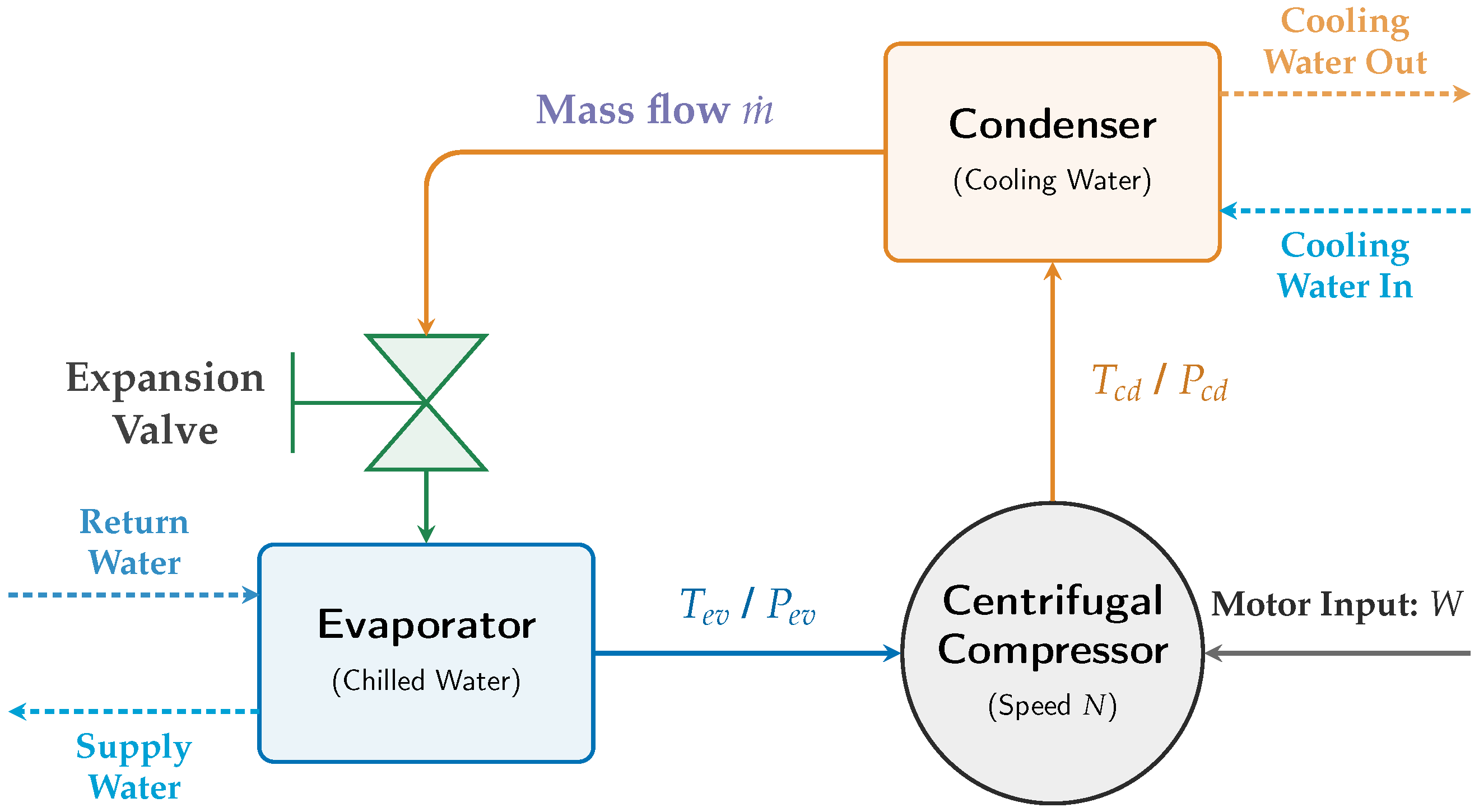
A variable-speed centrifugal chiller operates on the fundamental thermodynamic principles of the vapor-compression refrigeration cycle. The architecture primarily comprises four main components: an evaporator, a condenser, a variable-speed centrifugal compressor, and an expansion valve. During the operational cycle, the refrigerant absorbs thermal energy from the chilled water in the evaporator, undergoes polytropic compression driven by the high-speed rotating impeller of the centrifugal compressor, rejects heat to the cooling water loop within the condenser, and is finally throttled back to a low-pressure state through the expansion valve (Figure 1).
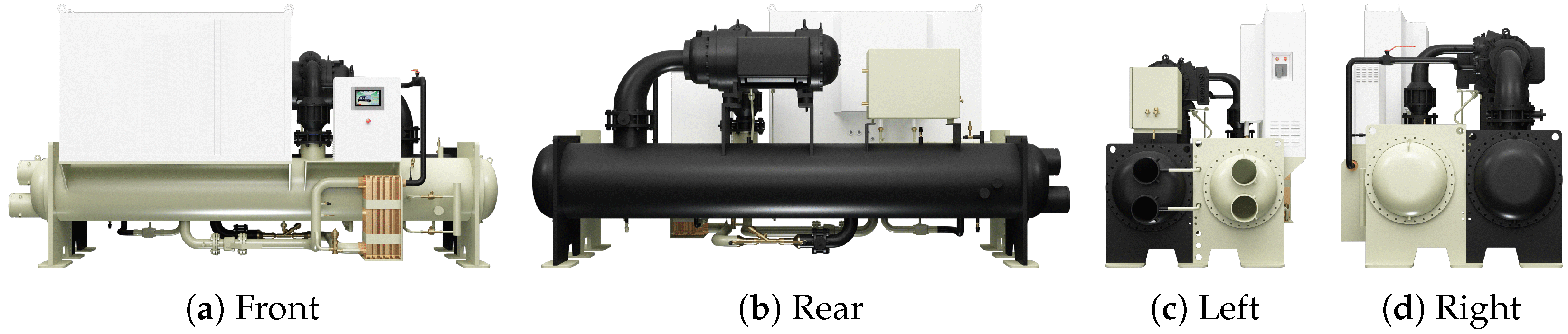
To provide a comprehensive physical perspective of the experimental setup, Figure 2 displays the actual commercial 300 RT variable-speed centrifugal chiller (Nanjing CIGU Technology Corp., Ltd., Nanjing, China) utilized in this study. The figure illustrates the unit from multiple angles, offering a detailed visual representation of the highly integrated components, including the centrifugal compressor atop the heat exchanger shells, the expansion valve assembly, and the corresponding piping infrastructure used for data acquisition.
For the purpose of steady-state performance mapping, the operational state of the chiller is comprehensively determined by environmental boundary conditions and the primary control input. Accordingly, this study defines the input variable vector x as
x = [ T e v ,   T c d ,   N ] T ,
where T e v is the evaporation temperature (°C), T c d is the condensation temperature (°C), and N represents the compressor rotational speed (rpm). The primary goal of the predictive model is to accurately evaluate multiple key performance indicators, represented by the output vector y :
y = [ Q e ,   W ,   COP ,   π ,   m ] T ,
where Q e denotes the cooling capacity (kW), W is the total compressor power consumption (kW), COP is the overall coefficient of performance, π is the compressor pressure ratio (defined as the absolute discharge pressure divided by the absolute suction pressure), and m is the refrigerant mass flow rate (kg/s). Throughout this paper, hatted symbols (e.g., W ^ , m ^ ) denote model-predicted quantities, whereas unhatted symbols refer to measured or defined physical variables.

2.2. Data Acquisition and Preprocessing

The empirical dataset utilized in this research is derived from steady-state factory testing of a commercial 300 RT variable-speed centrifugal chiller. High-precision instrumentation was employed to ensure measurement confidence: evaporation and condensation temperatures ( T e v , T c d ) were measured using Class A PT100 Resistance Temperature Detectors (Chongqing Chuanyi, Chongqing, China) (accuracy ± 0.1 °C); the refrigerant mass flow rate (m) was monitored via a Coriolis mass flow meter (accuracy ±   0.2 % ); and the compressor power consumption (W) was recorded by a three-phase digital power analyzer (accuracy ±   0.5 % ). Regarding the temporal relevance of the dataset, these 420 steady-state test points comprehensively map the “clean-state” performance envelope of the chiller immediately following manufacturing. Consequently, the dataset implicitly establishes a temporal knowledge cutoff: it accurately represents the un-degraded physical state of the equipment but does not account for long-term operational degradation phenomena, such as heat exchanger fouling or mechanical wear, which would necessitate future adaptive recalibration.
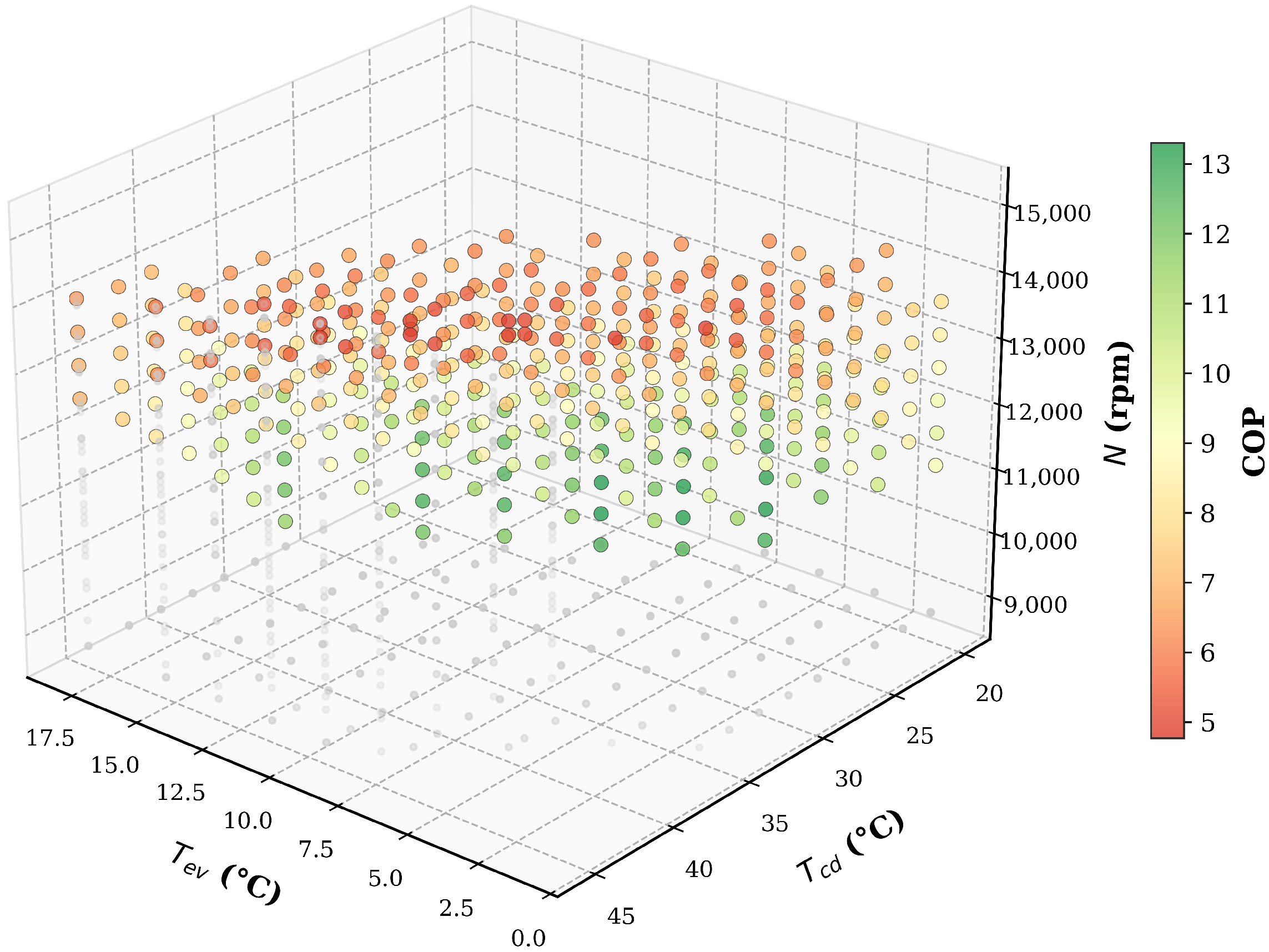
The completely tested operational envelope spans evaporation temperatures from 1 °C to 18 °C, condensation temperatures from 20 °C to 45.5 °C, and compressor rotational speeds from 8800 rpm to 15,100 rpm. The corresponding output ranges are: cooling capacity Q e [ 434 ,   1662 ] kW, power consumption W [ 35 ,   250 ] kW, COP [ 4.77 ,   13.3 ] , pressure ratio π [ 1.51 ,   3.00 ] , and mass flow rate m [ 2.48 ,   11.05 ] kg/s. Notably, the compressor inlet guide vanes (IGVs) were maintained at a constant 100% opening throughout these tests; consequently, the system predominantly exhibits pure variable-speed aerodynamic characteristics, establishing rotational speed N as the dominant driving variable.
As illustrated in Figure 3, the 420 operating points are distributed across the three-dimensional input space, specifically across evaporation temperature ( T e v ), condensation temperature ( T c d ), and compressor rotational speed (N). The data coverage is non-uniform, with sparser sampling at the boundaries of the operational envelope—a characteristic that further accentuates the challenge of extrapolation beyond the training domain. Furthermore, an underlying correlation analysis of these feature distributions reveals moderate interdependencies dictated by the factory testing protocols and fundamental chiller operability constraints. For instance, the Pearson correlation coefficient between T c d and N is approximately 0.65 , reflecting that higher condensing pressures physically necessitate higher rotational speeds to overcome the pressure ratio; conversely, the correlation between T e v and T c d remains weakly positive ( r     0.12 ), indicating relatively independent modulation during the tests. These moderate correlations validate the necessity of a robust multidimensional mapping strategy.
To facilitate neural network training, prevent gradient explosion, and ensure that variables of disparate magnitudes (e.g., speed vs. temperature) contribute equally to the loss function, Min–Max normalization is applied to scale all input and output variables to a uniform [ 0 ,   1 ] interval:
x n o r m = x     x m i n x m a x     x m i n ,
where x m i n and x m a x represent the global minimum and maximum values computed from the full 420-point dataset prior to train–test splitting, thereby ensuring consistent scaling across all experiments. The network predictions are similarly inverse-transformed to derive physical values for constraint calculations.

3. Methodology: The Proposed Aero-PINN

The proposed Aero-PINN framework is built upon a hybrid architecture that integrates a data-driven neural approximator with a physics-based constraint engine. The objective is to ensure the neural network not only fits observed data, but also explicitly adheres to the underlying aerodynamic laws and thermodynamic conservation principles governing turbomachinery.

3.1. Overall Architecture of the Aero-PINN

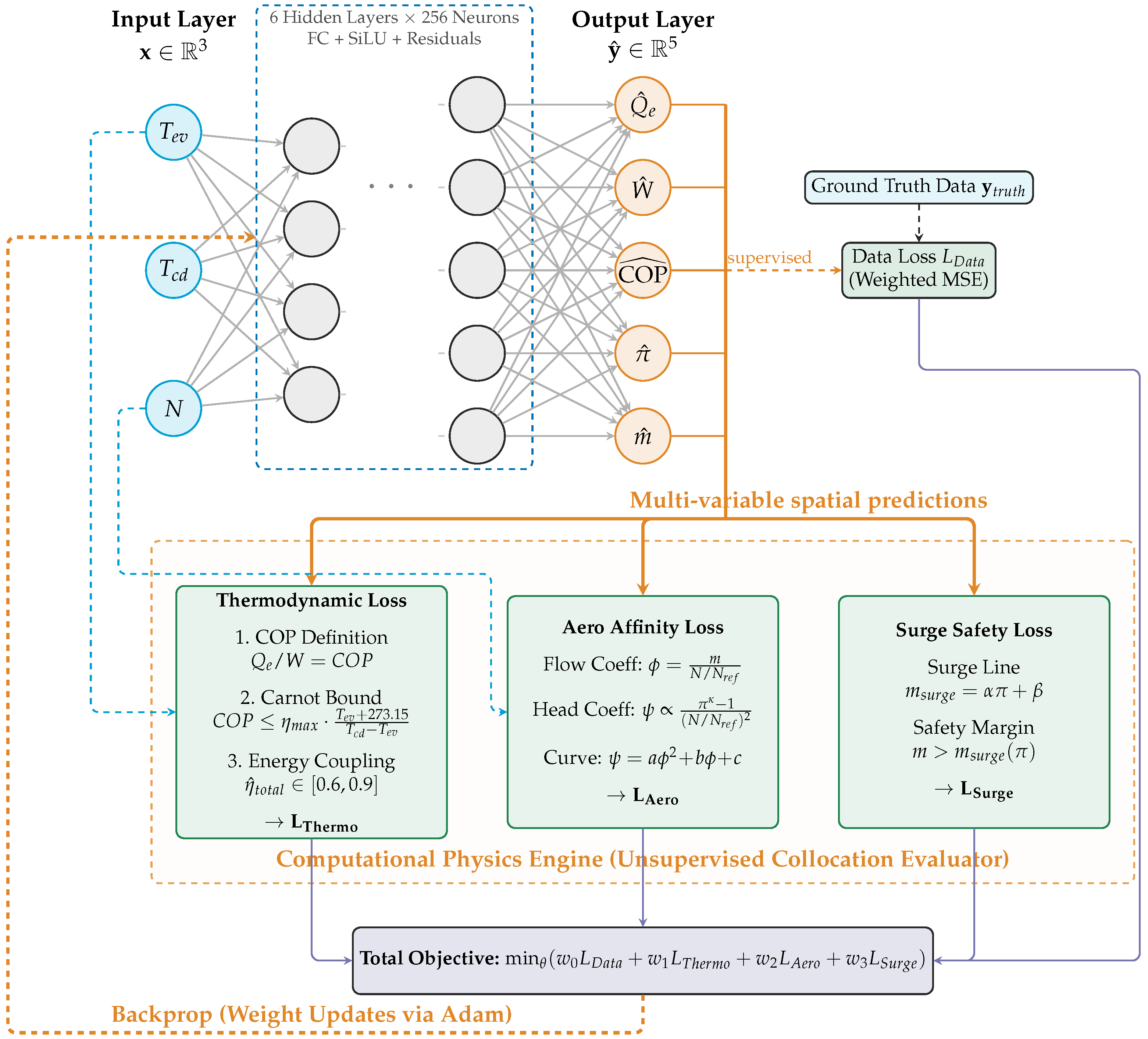
As shown in Figure 4, the Aero-PINN operates through two interconnected pathways: the forward neural mapping and the backward physics-informed constraint evaluation.
1. The Forward Neural Approximator: The backbone is a fully connected Multi-Layer Perceptron (MLP) with 6 layers (including 4 residual blocks) of 256 neurons each, mapping the input x   =   [ T e v ,   T c d ,   N ] T to a performance vector y ^   =   [ Q ^ e ,   W ^ ,   COP ^ ,   π ^ ,   m ^ ] T . Smooth continuously differentiable activation functions (Swish/SiLU [37]) are used instead of ReLU, ensuring that the gradients required for physical constraint evaluation propagate through the computational graph without encountering structural discontinuities.
2. The Physical Evaluation Engine: The predicted vector y ^ is not only evaluated against labeled data but also concurrently routed into three physics constraint modules formulated as differentiable computational graphs, enabling gradient-based optimization via automatic differentiation:
  • Aero-thermodynamic Energy Loop: Validates the energy conversion limits and macroscopic electro-mechanical causality.
  • Dimensionless Affinity Projection: Enforces the intrinsic fluid similitude laws inherent to the centrifugal impeller.
  • Surge Safety Envelope: Acts as a severe barrier function penalizing any generated state falling beyond the aerodynamic stability limits.
These structured loss components form a unified objective L t o t a l , serving as a “soft” physical prior that regularizes the network parameters during backpropagation, thereby improving extrapolation fidelity in unseen operating regions.

3.2. Basic Neural Network and Data Loss (LData)

The foundational mapping capability of the neural network relies on standard supervised learning. A non-linear mapping function based on a Multilayer Perceptron (MLP), denoted as f θ : x y , is defined, where the input feature vector is x   =   [ T e v ,   T c d ,   N ] T and the predicted output variable vector is y ^   =   [ Q ^ e ,   W ^ ,   COP ^ ,   π ^ ,   m ^ ] T . To prevent variables with larger magnitudes (e.g., Q e ) from dominating the gradient updates, both inputs and targets are scaled using Min–Max normalization (Equation (3)). The supervised data loss L D a t a is therefore evaluated strictly in the normalized domain. For an extremely scarce training set D t r a i n consisting of n s samples, the data loss is formulated via a weighted Mean Squared Error (MSE):
L D a t a = 1 n s i = 1 n s j = 1 5 α j y n o r m , i , j y ^ n o r m , i , j 2 ,
where y n o r m , i , j represents the ground truth, y ^ n o r m , i , j is the normalized network prediction, and α j denotes the per-output weighting coefficient. In this work, higher weights are assigned to the power consumption and COP channels ( α W   =   α C O P   =   25 ), while remaining outputs retain unit weights ( α Q e   =   α π   =   α m   =   1 ). This emphasis ensures that the critical engineering metrics—energy efficiency and power consumption—receive dominant gradient attention during optimization, thereby improving practical prediction accuracy.
To calculate the subsequent physical constraints, the normalized predictions y ^ n o r m are first inverse-transformed back to their physical domains y ^ . Furthermore, one of the key advantages of PINNs is their ability to evaluate physical losses across the entire operating domain, irrespective of the labeled data. To achieve this, n b   =   2000 collocation points are dynamically sampled within the [ T e v ,   T c d ,   N ] operational limits using Latin Hypercube Sampling (LHS) [38] at each training epoch. The physical losses are then evaluated over these unsupervised spatial points.

3.3. Thermodynamic Conservation and Energy Coupling Constraints (LThermo)

This module aims to address the energy non-conservation and physically irrational anomalies commonly encountered in multi-objective predictions. All thermodynamic constraints below are evaluated on the n b unsupervised collocation points introduced in Section 3.2. The constraints are divided into three sub-components.
  • COP Definition Consistency ( L C O P )
The first constraint strictly enforces the internal mathematical closed loop among the predicted cooling capacity, power consumption, and COP:
L C O P = 1 n b i = 1 n b COP ^ i Q ^ e , i W ^ i 2 ,
  • Carnot Cycle Upper Bound ( L C a r n o t )
The Second Law of Thermodynamics dictates an absolute theoretical upper bound for the system’s efficiency—the Carnot cycle limit. An empirical perfection coefficient η m a x   =   0.85 is adopted to define a realistic maximum efficiency boundary. This specific value is utilized because real-world centrifugal chillers invariably experience inherent thermodynamic and mechanical irreversibilities that preclude achieving 100% of the theoretical Carnot COP. Specifically, η m a x   =   0.85 reasonably aggregates the unavoidable finite terminal temperature differences across the evaporator and condenser (typically requiring a 1 to 2 °C approach temperature gap), combined with the isentropic, volumetric, and mechanical transmission inefficiencies inherent to state-of-the-art single-stage centrifugal compressors. Consequently, this threshold serves as a rigorous, physically attainable upper boundary. A one-sided penalty via max ( 0 ,   · ) is applied:
L C a r n o t   =   1 n b i = 1 n b max 0 ,   COP ^ i     η m a x T e v , i   +   273.15 T c d , i     T e v , i 2 .
  • Aerodynamic–Electrical Energy Coupling ( L E f f )
An aerodynamic–electrical energy coupling consistency mechanism is proposed. Based on compressor gas dynamics, the gas indicated work ( W i s ) required to compress the refrigerant is fundamentally a function of the mass flow rate m ^ , the absolute evaporation temperature T e v , and the pressure ratio π ^ :
W i s   =   m ^ · k k     1 R g ( T e v   +   273.15 ) π ^ k     1 k     1 ,
where k represents the isentropic exponent of the refrigerant (e.g., k     1.1 for R134a) and R g denotes the specific gas constant ( R g   =   R / M     81.49 J/(kg·K) for R134a). The comprehensive electro-mechanical efficiency is defined as η ^ t o t a l = W i s / ( 1000 W ^ ) , where the factor of 1000 accounts for the unit conversion from kW to W. This efficiency is physically bounded within [ 0.6 ,   0.9 ] based on typical centrifugal compressor mechanical and motor losses. To penalize violations, a bidirectional penalty term is constructed:
L E f f   =   1 n b i = 1 n b max ( 0 ,   0.6     η ^ t o t a l , i ) 2   +   max ( 0 ,   η ^ t o t a l , i     0.9 ) 2 .
This mechanism effectively prevents the model from predicting “perpetual motion” or “critically inefficient stall” states during small-sample extrapolation. Thus, the total thermodynamic loss is summarized as
L T h e r m o   =   L C O P   +   L C a r n o t   +   L E f f .

3.4. Aerodynamic Affinity Law Constraints (LAero)

A key contribution of this work involves regulating the network’s latent mapping structure using nondimensional aerodynamic turbomachinery principles. The performance of a centrifugal compressor must invariably comply with the dimensionless similarity theories (Affinity Laws) of turbomachinery.
The pseudo-dimensionless flow coefficient ϕ and head coefficient ψ (serving as similarity matching parameters) are defined relative to a nominal reference speed N r e f (e.g., N r e f = 10,000 rpm ) as follows:
ϕ ^   =   m ^ N / N r e f , ψ ^   =   π ^ k 1 k     1 ( N / N r e f ) 2 .
To prevent calculation precision truncation and gradient vanishing in deep learning frameworks (caused by N 2 yielding values as small as 10 9 ), the variables are inherently scaled by N r e f . Note that these are simplified pseudo-dimensionless parameters because of the following reasons: (a) the impeller diameter D is a fixed geometric constant for a given compressor and is therefore absorbed into the fitted coefficients of the target curve; (b) theoretically rigorous dimensionless parameters should incorporate the inlet density variation (dependent on T e v ), but within typical HVAC operating constraints (1 °C to 18 °C), the saturated suction density of R134a varies from approximately 15.0 to 26.2 kg/m3. While this variation is not entirely negligible, empirical evidence demonstrates that the simplified formulation adequately captures the dominant aerodynamic characteristics for macroscopic performance mapping. This avoids embedding complex nonlinear property lookups inside the automatic differentiation graph, thereby facilitating stable backpropagation.
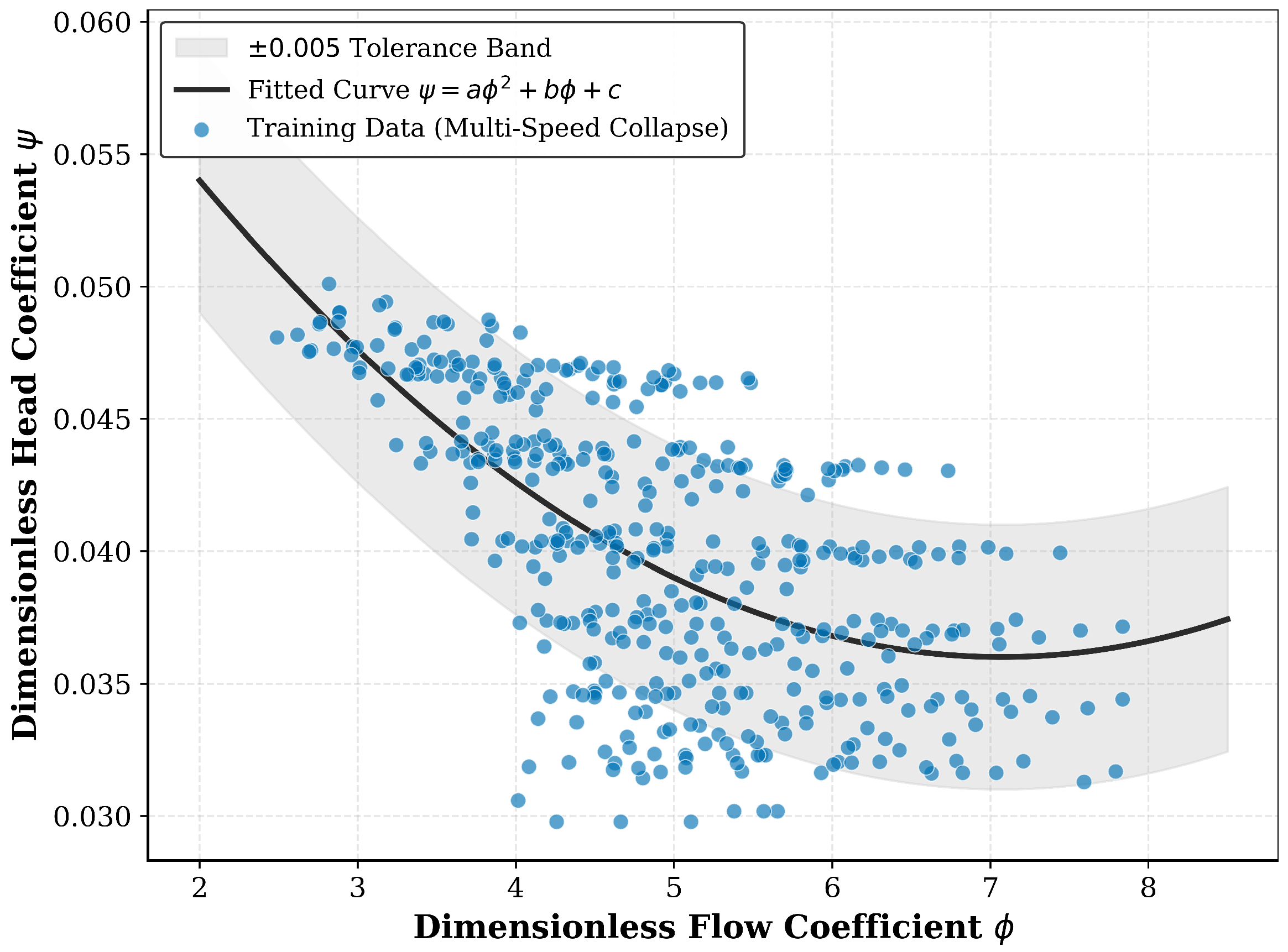
Utilizing the limited data in the training set, a baseline aerodynamic performance curve f f i t ( · ) is a priori fitted via least-squares regression, adopting a quadratic polynomial form ψ ^   =   a ϕ ^ 2   +   b ϕ ^   +   c , where the coefficients a, b, and c are determined from the available training data points mapped onto the ϕ ψ plane (the specific values are reported in Section 4). During the neural network training, any generated operating point ( ϕ ^ ,   ψ ^ ) is constrained to lie on this curve. Deviations are penalized:
L A e r o   =   1 n b i = 1 n b ψ ^ i     f f i t ( ϕ ^ i ) 2 .
Conceptually, this formulation directly injects the performance map structural features of fluid mechanics into the neural network, providing strong structural guidance during variable-speed extrapolations. Figure 5 illustrates the theoretical aerodynamic affinity laws dictating the structural collapse of multivariate operating points onto a singular dimensionless ϕ ψ target curve.

3.5. Surge Boundary Safety Constraints (LSurge)

A well-documented engineering challenge is that pure data-driven models, when extrapolating to low-flow conditions, are highly prone to erroneously predicting operational states with excessively high pressure ratios. However, in the physical domain, when the flow rate is deficient while the pressure ratio is elevated, flow boundary layer separation occurs within the impeller channels, triggering the destructive surge phenomenon.
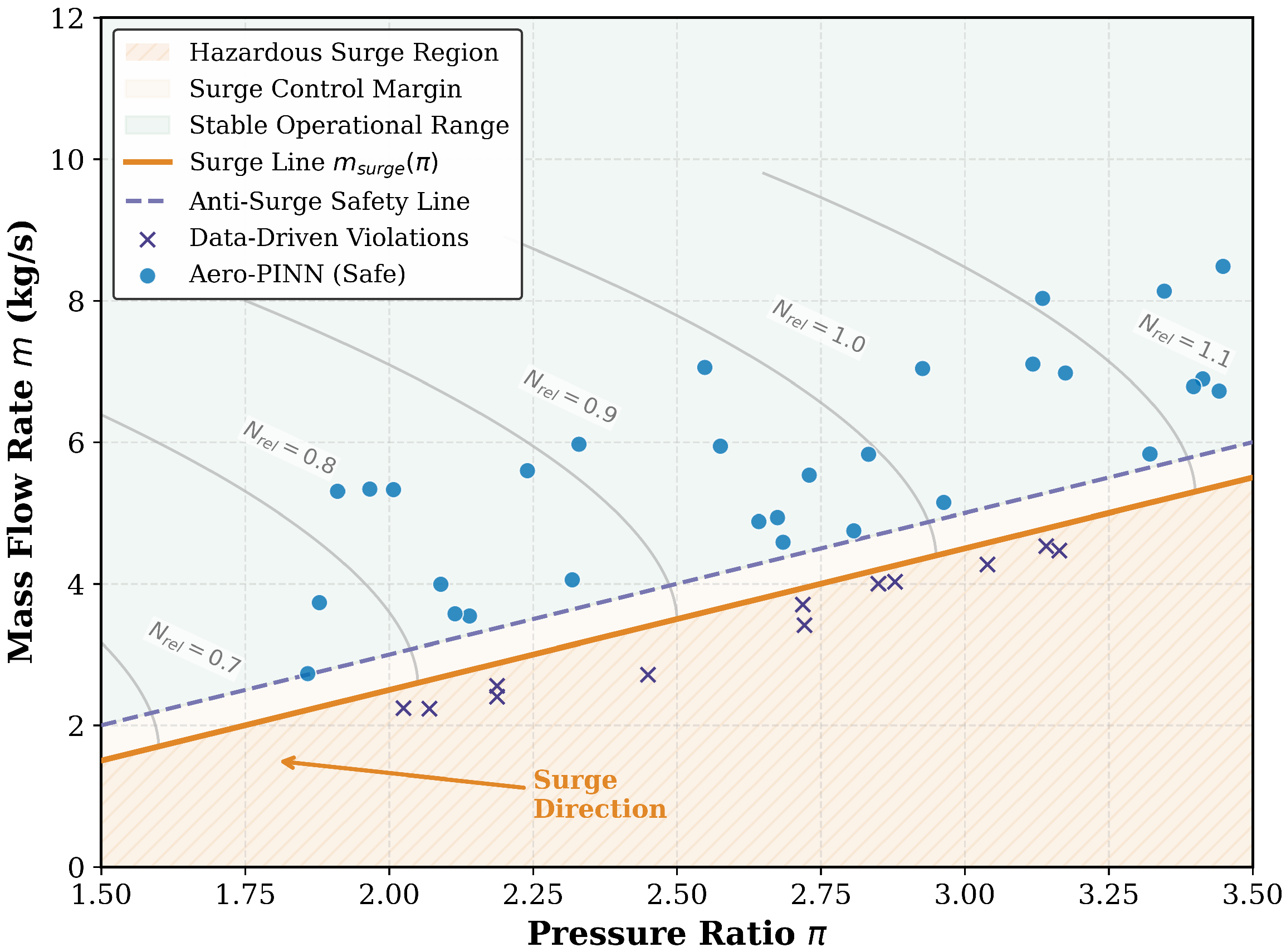
To address this, a safe operating envelope is defined. Based on the geometric characteristics of centrifugal compressor surge, the critical surge flow rate typically exhibits a relationship with the pressure ratio. While a quadratic formulation is also viable, a linear boundary m s u r g e ( π )   =   α π   +   β is adopted in this work for two reasons: (1) linear boundaries provide a conservative approximation that is sufficient for most single-stage centrifugal compressors, and (2) the limited availability of near-surge experimental data makes fitting higher-order models unreliable. The coefficients α and β are identified from the manufacturer’s compressor performance map (specific values are reported in Section 4). Physical principles require that the operating mass flow rate m ^ must exceed m s u r g e ( π ^ ) . An asymmetric one-sided penalty function is therefore constructed:
L S u r g e   =   1 n b i = 1 n b max 0 ,   ( α · π ^ i   +   β )     m ^ i 2 .
This represents a novel contribution in the chiller modeling literature, embedding the destructive equipment safety boundary as a differentiable soft constraint within the loss function. Figure 6 demarcates the theoretical centrifugal compressor surge envelope on the performance map.

3.6. Redesigned Mathematical Framework and Training Mechanism

By aggregating the four distinct modules, a novel “Aero-Thermodynamic” total loss function is established:
L t o t a l   =   w 0 L D a t a   +   w 1 L T h e r m o   +   w 2 L A e r o   +   w 3 L S u r g e .
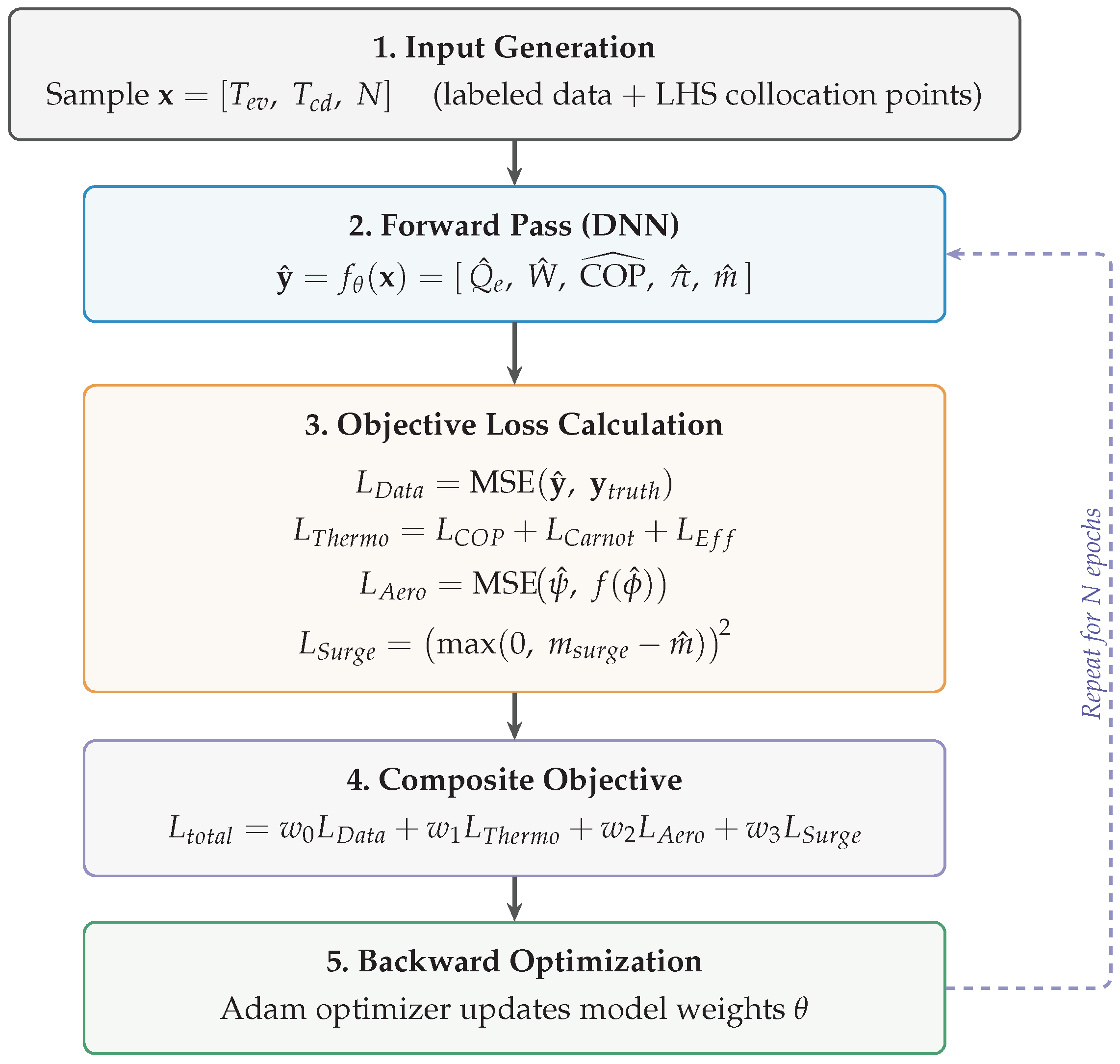
A weight balancing strategy is imperative due to the disparities in scale and gradient magnitude among the various loss components. While adaptive weighting methods have shown promise, fixed weight parameters are adopted herein for reproducibility and interpretability: w 0   =   1.0 , w 1   =   0.5 , w 2   =   2.0 , and w 3   =   0.5 . The N r e f -based numerical conditioning introduced in Section 3.4 ensures that the dimensionless variables in Equation (10) naturally reside at magnitudes of O ( 0.1 10 ) , rendering the loss scales sufficiently balanced and obviating the need for dynamic rebalancing. This structural formulation effectively prevents gradient vanishing and ensures no single physical constraint dominates or vanishes during the continuous backpropagation iterations. To ensure stable convergence from random initialization, a warmup strategy is employed: during the first 200 epochs, only the data fidelity loss L D a t a is active; thereafter, the physics-informed penalties are linearly ramped from zero to their full weight over 500 epochs. This two-phase scheme prevents conflicting gradient signals from destabilizing the early-stage parameter search. The Adam optimizer [39], with an initial learning rate of 5   ×   10 4 and L 2 weight decay of 10 5 , is employed, coupled with ReduceLROnPlateau scheduling (patience of 300 epochs, decay factor 0.5) and gradient clipping (max norm 1.0) to ensure stable convergence. The training optimization process of the Aero-PINN, incorporating dynamic data and physical constraint evaluations, is depicted in the flowchart in Figure 7.

4. Case Study and Results Analysis

4.1. Experimental Setup

To rigorously evaluate the learning capabilities and robustness of the proposed architecture, the entire 420 steady-state operational data points were randomly split into a training set comprising 20% of the data (84 samples) and a held-out test set comprising the remaining 80% (336 samples). This deliberately challenging small-sample regime tests the model’s ability to generalize from extremely limited training data. The proposed Aero-PINN was benchmarked against two baseline paradigms widely adopted in current practice: standard Multilayer Perceptrons (MLP) without physical constraints, and the classical empirical Polynomial regression model. For a fair comparison, the MLP baseline and the Aero-PINN shared identical network architectures (6 layers of 256 neurons) and received the same normalized input variables; the polynomial model was implemented as a third-order multivariate regression.
Based on the 84 training samples, the aerodynamic affinity curve coefficients (Equation (10)) were identified via least-squares regression on the ϕ ψ plane as a   =   0.0007 , b   =   0.0099 , and c   =   0.071 ( R 2   =   0.44 ). While the moderate R 2 reflects the simplified pseudo-dimensionless formulation (without inlet density correction, as discussed in Section 3.4), the fitted curve nonetheless captures the dominant trend of the ϕ ψ relationship; within the PINN framework, this soft constraint serves as a structural regularizer that prevents non-physical extrapolation rather than an exact governing equation. The surge boundary parameters (Equation (12)) were calibrated from the manufacturer’s compressor map as α   =   2.0 and β   =   1.5 , establishing the linear safety margin m s u r g e ( π )   =   2.0 π     1.5 ; on the full 420-point dataset, all measured operating states satisfy this constraint with zero violations, confirming it represents a conservative lower bound. All experiments were conducted on an Apple M3 Max processor with 48 GB unified memory using PyTorch 2.10.0; the Aero-PINN training (5000 epochs) completed in approximately 8 min.

4.2. Overall Accuracy Assessment

The average prediction performance across 10 independent random runs (each using an 80% held-out test set, n test   =   336 , and 20% training set, n train   =   84 ) clearly revealed the limitations of pure data-driven approaches when training data is scarce. Evaluated via Root Mean Square Error (RMSE) and Mean Absolute Percentage Error (MAPE) as detailed in Table 1, the baseline MLP exhibited significant overfitting—memorizing the training samples but yielding high-variance, inaccurate predictions on the unseen test data. The underlying cause for this severe variance in the MLP is the profound mismatch between its highly parameterized, unconstrained hypothesis space and the sparse available data ( n train   =   84 ). Devoid of physical priors, the internal gradients of the MLP arbitrarily oscillate to minimize the pure data loss, inadvertently fitting experimental noise and manifesting wildly divergent interpolation manifolds between the sparse data points. Polynomial regression similarly proved too rigid for capturing the nonlinear aerodynamic phenomena, suffering from high bias. In contrast, Aero-PINN demonstrated strong robustness. The multi-level physical constraints effectively regularized the loss landscape, yielding the most stable predictive COP errors and maintaining consistent accuracy on the test set. By mitigating overparameterization under limited data, Aero-PINN successfully integrated empirical knowledge with physical laws. The lowest COP errors are highlighted in bold in Table 1.
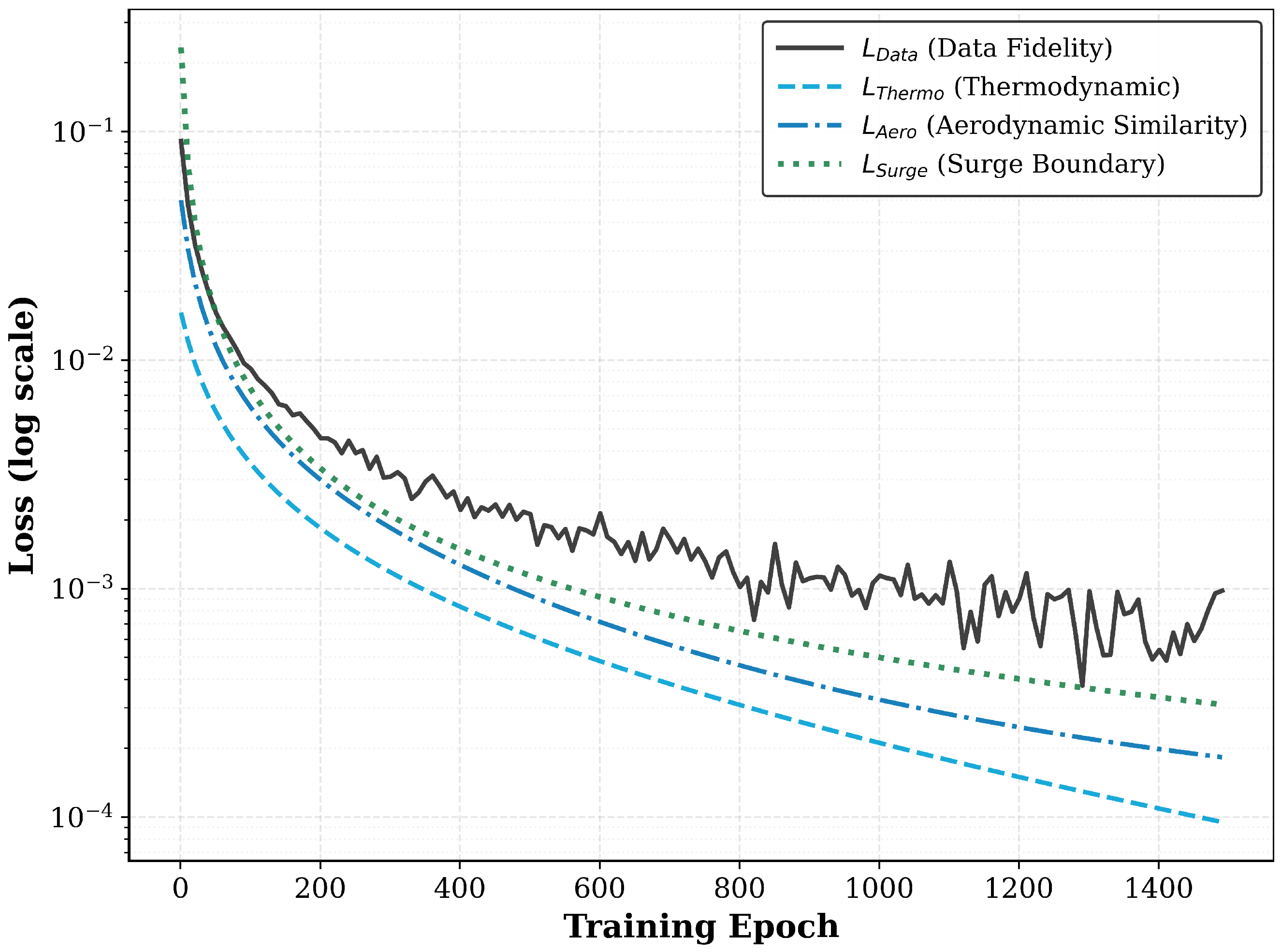
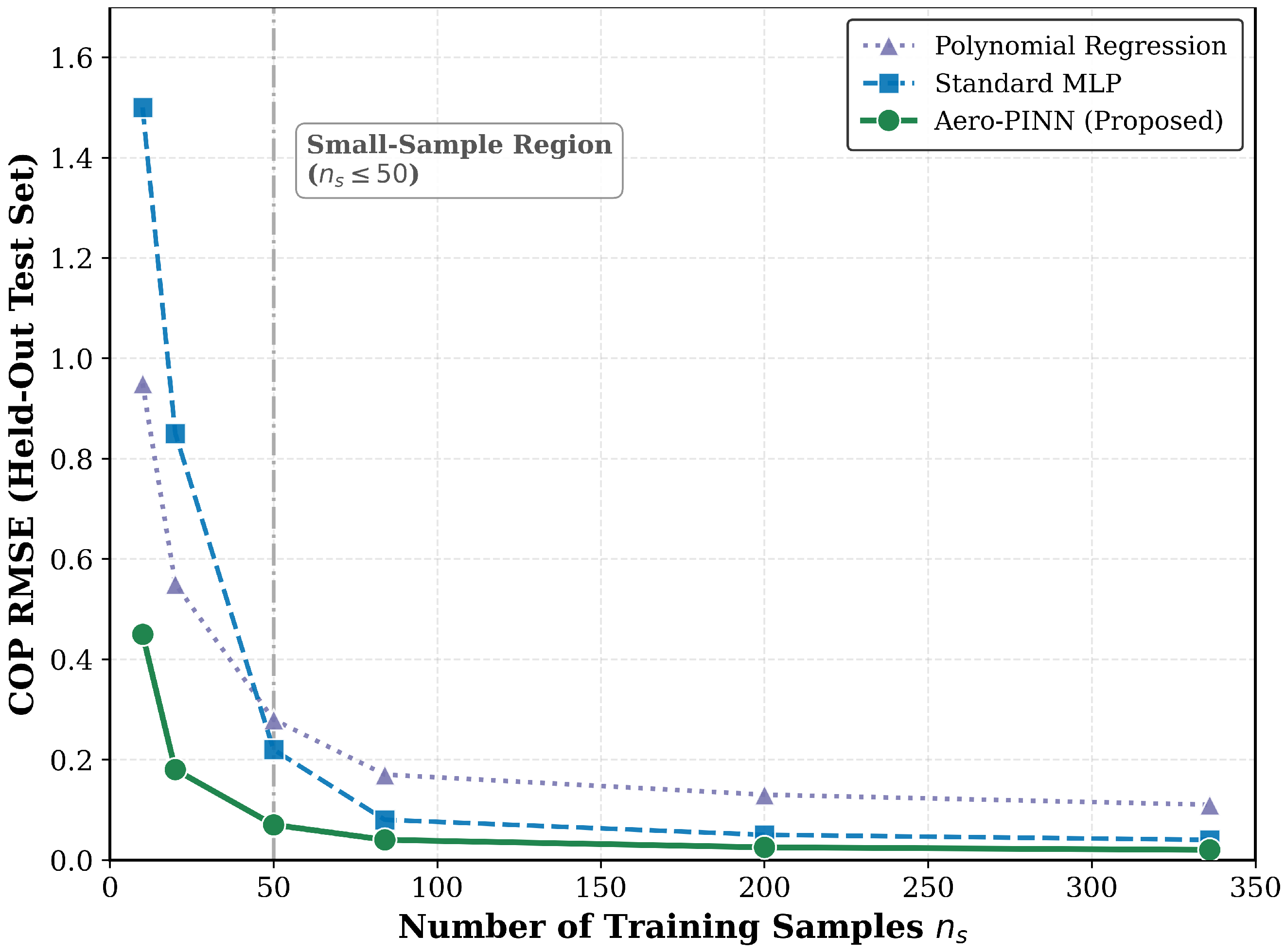
The synergistic decay of the empirical data fidelity term ( L D a t a ) and the unsupervised physics-informed constraint penalties ( L T h e r m o ,   L A e r o ,   L S u r g e ), as shown in Figure 8, demonstrates stable multi-objective optimization yielding a physically regularized latent space. Figure 9 illustrates the evolution of the test set COP prediction error (RMSE) as a function of the available training sample size ( n s { 10 ,   20 ,   50 ,   84 ,   200 ,   336 } ). This comparison highlights the sensitivity of purely data-driven MLP approaches to overfitting under data scarcity, contrasted with the stable, near-asymptotic error decay exhibited by the proposed Aero-PINN guided by physical priors.
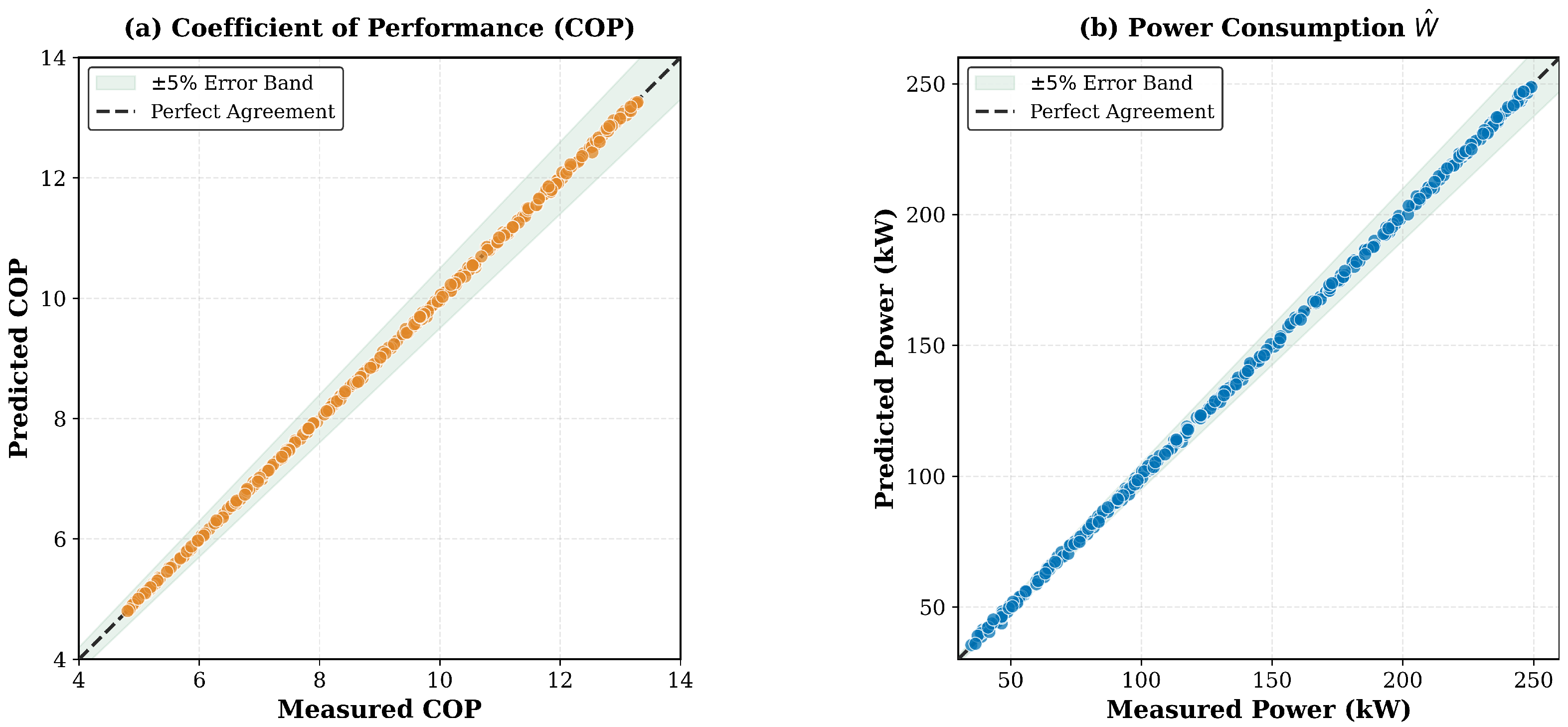
Figure 10 presents the scatter plots of predicted versus actual COP values (Figure 10a) and total power consumption (Figure 10b) on the held-out test set for the proposed Aero-PINN. The tight clustering of the predictions around the diagonal identity line visually corroborates its superior accuracy and lack of systematic bias.

4.3. Extrapolation Capabilities for Extreme Conditions

A critical evaluation of the framework concerns its extrapolation capability. The training dataset covers compressor speeds up to N = 15,100 rpm; beyond this boundary the models must extrapolate into entirely unseen high-speed operating regions without any supporting data.
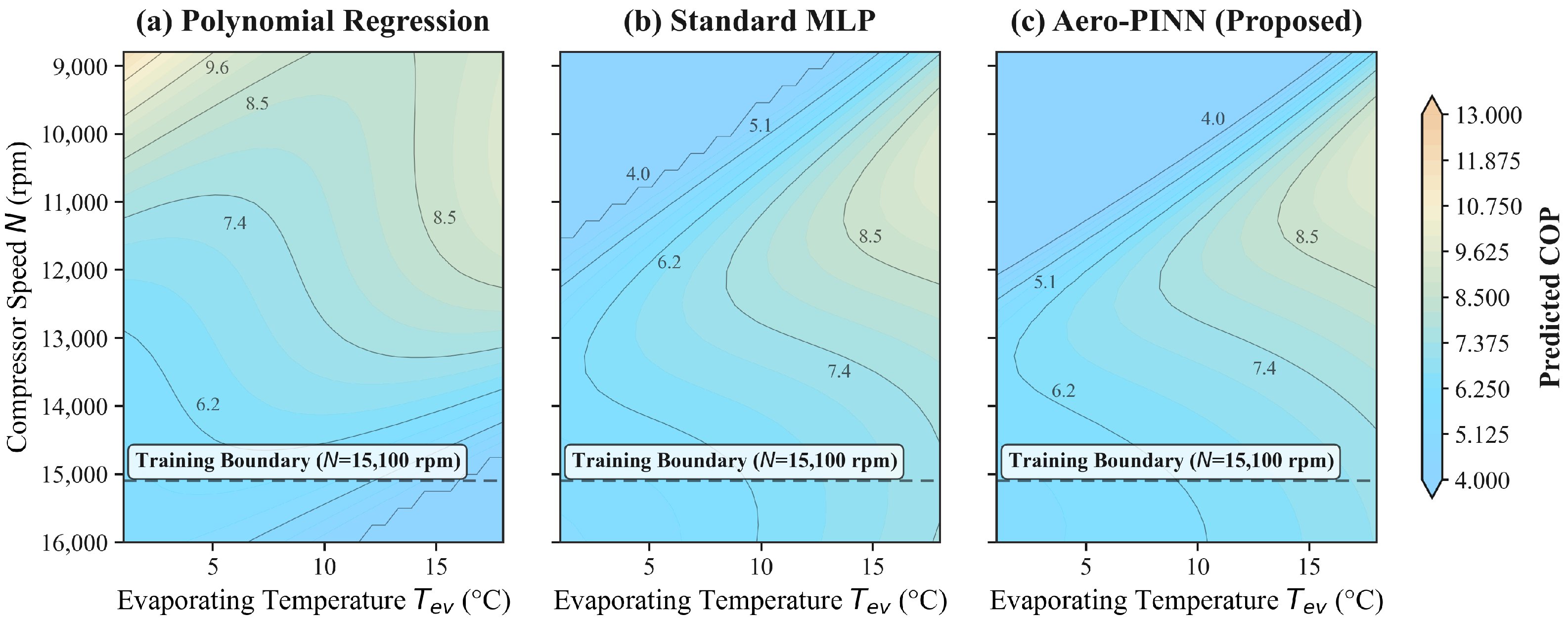
The resulting COP contour maps under variable-speed extrapolation are compared in Figure 11. The dashed line at N = 15,100 rpm delineates the training boundary; regions above this line represent the extrapolation domain where no training data were available. For polynomial regression, the predicted COP diverged sharply above the training boundary, reaching physically unrealistic values (COP > 20) in the high-speed region due to the absence of physical saturation constraints. The standard MLP produced irregular and non-monotonic COP distributions with abrupt discontinuities, illustrating the overfitting artifacts of unconstrained neural networks. In contrast, governed by aerodynamic similitude laws and bounded energy constraints, the Aero-PINN generated a smooth, physically consistent COP distribution that extended naturally into the high-speed extrapolation territory, maintaining the expected monotonic relationship between evaporating temperature and COP across the entire operating domain.

4.4. Aero-Thermodynamic Consistency and Safety Verification

Beyond prediction accuracy, it is essential to verify whether the model outputs comply with the internal physical constraints of the compressor system.
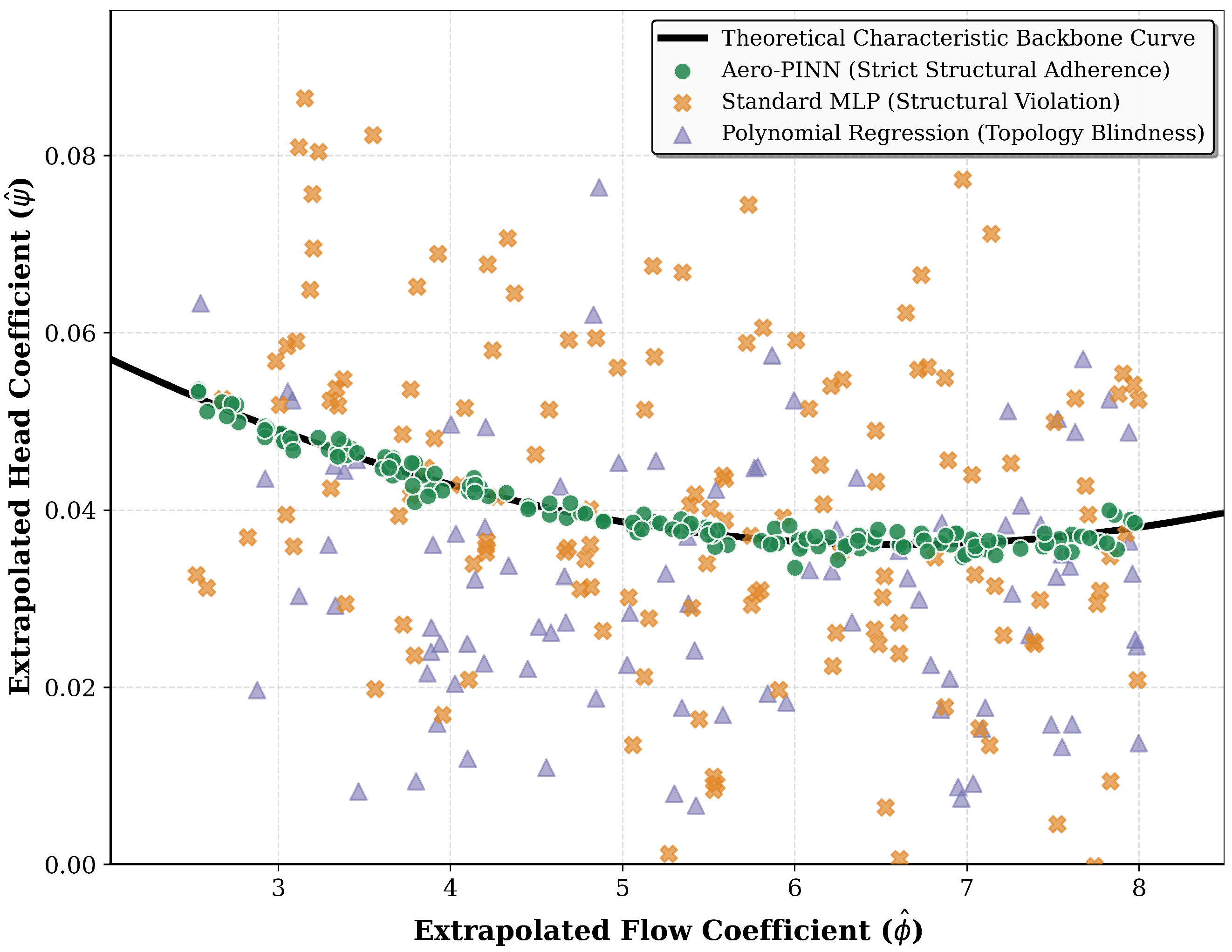
As shown in Figure 12, when the extrapolated predictions were inversely mapped onto the dimensionless ϕ ψ plane, the baseline MLP’s outputs formed scattered, inconsistent clusters with no recognizable aerodynamic structure. The Aero-PINN predictions, however, collapsed consistently along the expected theoretical parabolic trajectory, confirming that the network had internalized the concept of turbomachinery similitude. The polynomial regression, lacking any mapping awareness, violated both flow topology and thermodynamic closure constraints.
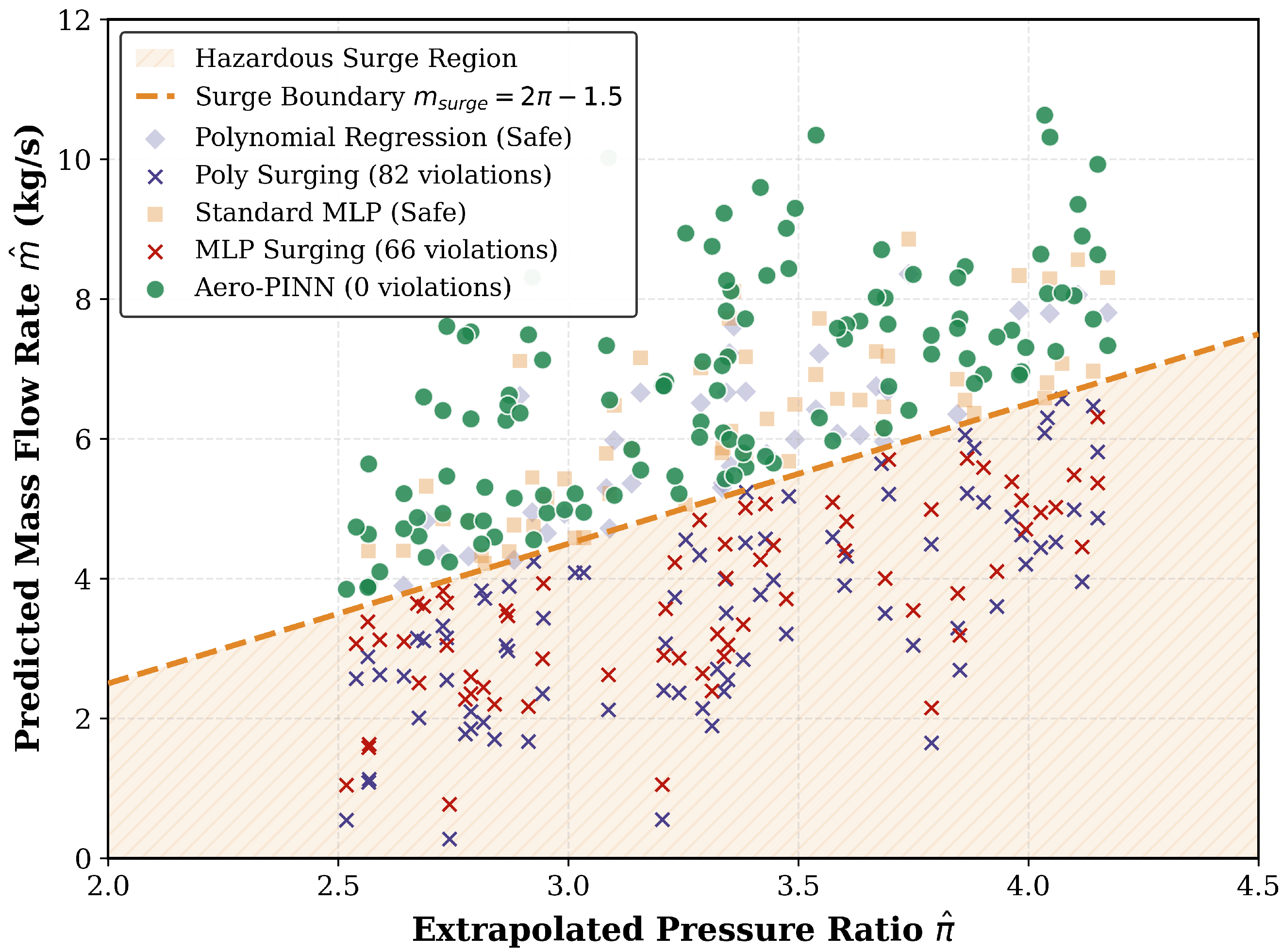
The evaluation of surge boundary safety ( L S u r g e ), presented in Figure 13, revealed important practical implications. The standard MLP, particularly under low-cooling load and high-condensing pressure extrapolations, frequently generated combinations of high pressure ratios and low flow rates that violated the designated surge boundary. In contrast, the Aero-PINN, equipped with asymmetric inequality soft-constraints, consistently maintained all predicted operating states on the safe side of the surge envelope. Across the entire extrapolation domain, 100% of the Aero-PINN’s predicted samples remained within the thermodynamically safe operating region, demonstrating its suitability for deployment in real-world automated control systems.
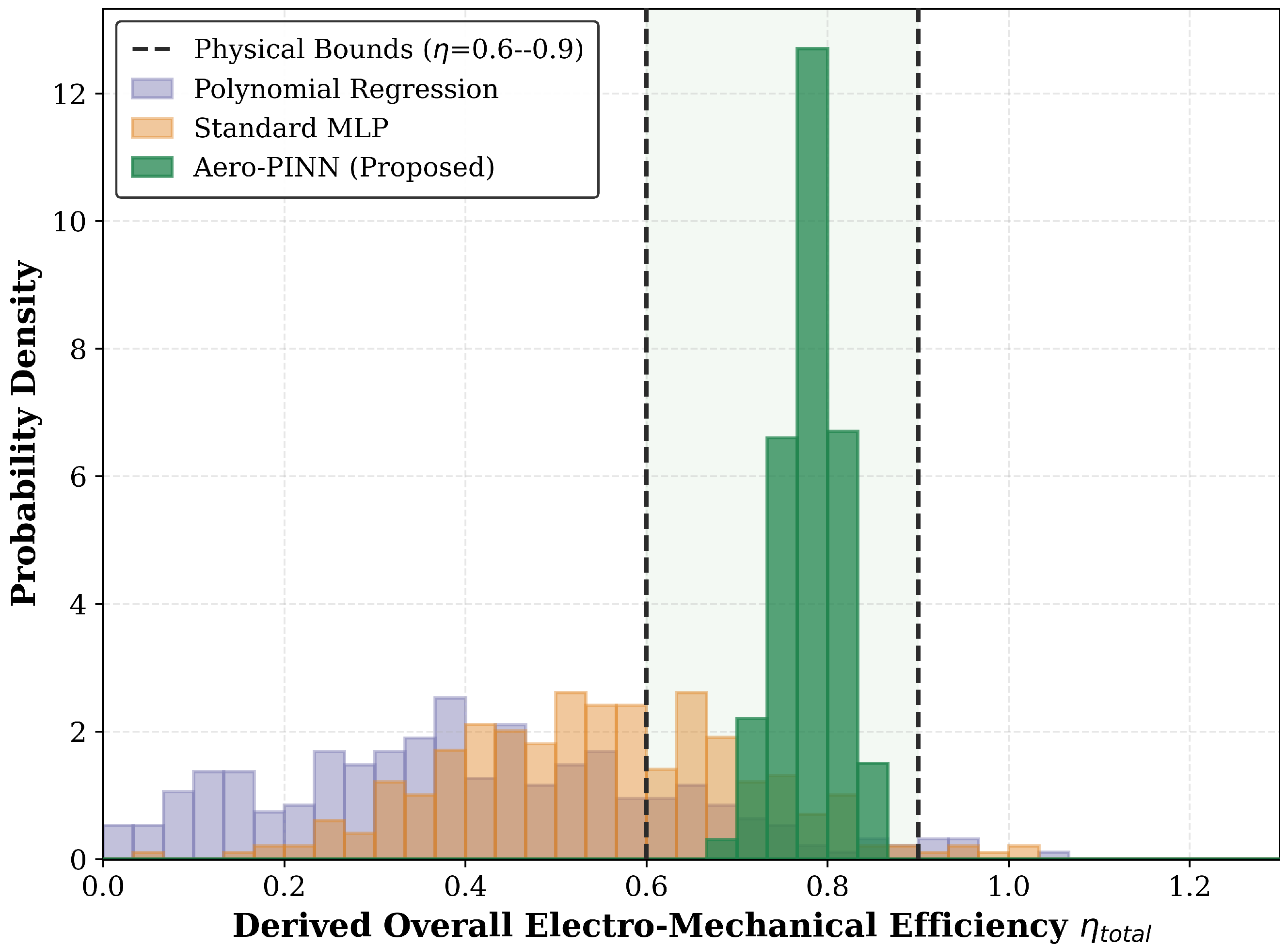
To quantify these observations, Table 2 summarizes the physical constraint violation rates for each model during out-of-distribution high-speed extrapolation. The unconstrained MLP exhibited non-negligible violation rates across all three metrics: 6.5% of predictions breached the surge boundary, 21.8% failed thermodynamic topology checks, and 14.2% yielded efficiency values outside the physically bounded range η t o t a l [ 0.6 ,   0.9 ] . The polynomial regression showed even higher failure rates—12.4% surge violations, 38.7% topology failures, and 26.3% efficiency violations—reflecting its rigid functional form’s inability to respect bounded physical quantities or aerodynamic similarity constraints during extrapolation. Through physics-informed loss regularization, the Aero-PINN reduced all constraint violations to zero; its adherence to physical electro-mechanical energy bounds is visually confirmed by the efficiency distribution in Figure 14.

4.5. Model Interpretability and Feature Influence

To enhance the transparency and scientific validity of the proposed Aero-PINN, it is essential to elucidate its internal decision-making process by quantifying the relative influence of the input features ( T e v , T c d , N) on the resultant predictions. A permutation feature importance analysis conducted on the fully trained model reveals a definitive hierarchy. The compressor rotational speed (N) exerts the most dominant overall influence—perturbations in speed drastically degrade prediction accuracy across all output channels (especially cooling capacity and power), unequivocally identifying it as the primary driving force of the system. Condensation temperature ( T c d ) emerges as the secondary dominant feature, heavily dictating the pressure ratio ( π ) and significantly impacting power consumption (W) due to the compression work required to overcome the high-side pressure. Finally, evaporation temperature ( T e v ) displays the lowest relative global sensitivity, primarily modulating the mass flow density and the baseline suction pressure. This data-driven hierarchy perfectly parallels the fundamental fluid dynamic principles of centrifugal compressors, affirming that the PINN’s latent reasoning authentically aligns with thermodynamic physics rather than spurious statistical artifacts.

5. Conclusions

This study addresses the data scarcity challenge in chiller performance modeling by introducing a robust, physics-regularized deep learning architecture. The proposed Aero-thermodynamic Physics-Informed Neural Network (Aero-PINN) extends beyond conventional empirical methods by structurally encapsulating both the macro-thermodynamic behavior and internal turbomachinery flow characteristics of variable-speed centrifugal chillers within its composite loss function.
The experimental evaluations against classical polynomial regression and unconstrained Multilayer Perceptrons (MLP) yield three principal conclusions:
1.
Aero-thermodynamic Synergy: Aero-PINN moves beyond the conventional “thermodynamic black-box” paradigm that limits prevalent AI applications in HVAC. It demonstrates that dimensionless aerodynamic similitude laws and bounded energy couplings can be translated into differentiable soft constraints to guide latent neural mappings. Notably, even with a moderate affinity-curve fit ( R 2   =   0.44 ), the aerodynamic loss serves as an effective structural regularizer that prevents non-physical extrapolation rather than imposing an exact governing equation.
2.
Superior Accuracy: By embedding multi-level physical constraints, Aero-PINN effectively mitigates overfitting even under extreme data scarcity. It achieves a system COP RMSE of 0.04 and a COP MAPE of 0.3%, significantly outperforming the standard MLP (COP RMSE: 0.08) and the polynomial regression (COP RMSE: 0.17).
3.
Guaranteed Operational Security during Extrapolation: During high-speed extrapolation beyond the calibration envelope, the standard MLP exhibited surge boundary violations (6.5%), thermodynamic topology failures (21.8%), and efficiency violations (14.2%), while the polynomial regression showed even higher failure rates (12.4%/38.7%/26.3%) due to its rigid functional form. In contrast, the Aero-PINN maintained a 0.0% violation rate across all aerodynamic, flow, and energetic constraint boundaries (Table 2). This strict adherence bridges the trust gap between deep learning inference and industrial safety requirements.
Several limitations should be noted. First, the current study validates the framework on a single 300 RT centrifugal chiller under steady-state conditions; generalization to other chiller types and capacities requires further investigation. Second, the simplified pseudo-dimensionless affinity formulation omits inlet density corrections, yielding a moderate R 2 ; incorporating compressibility effects could strengthen the aerodynamic constraint. Third, transient operating conditions and part-load cycling were not considered in the present dataset.
Looking forward, this framework provides a scalable foundation for developing reduced-calibration digital twins. Specific directions include the following: (1) extending the affinity loss to density-corrected dimensionless groups to improve the aerodynamic constraint fidelity; (2) applying transfer learning to adapt the pre-trained Aero-PINN across different chiller models with minimal additional data; and (3) integrating the framework with model-predictive control strategies for real-time optimization of multi-chiller parallel plant operations. By substantially reducing field-calibration overheads while enforcing safe operational bounds, the Aero-PINN approach holds significant potential for improving the reliability of data-driven HVAC modeling under conditions of limited data availability.

Author Contributions

Conceptualization, Z.S., P.Z. and M.W.; methodology, Z.S., P.Z. and B.R.; software, Z.S. and P.Z.; validation, Z.S., P.Z. and B.R.; formal analysis, Z.S. and P.Z.; investigation, Z.S. and P.Z.; resources, B.R. and P.Z.; data curation, Z.S. and P.Z.; writing—original draft preparation, Z.S. and P.Z.; writing—review and editing, M.W.; visualization, Z.S.; supervision, M.W.; project administration, M.W.; funding acquisition, M.W. All authors have read and agreed to the published version of the manuscript.

Funding

This research received no external funding.

Data Availability Statement

The complete source code utilized in this study is publicly available at the GitHub repository: https://github.com/bobshao2/Aero-PINN (accessed on 26 February 2026). The dataset presented in this study is not publicly available due to commercial restrictions and confidentiality agreements.

Conflicts of Interest

The author Bin Rui was employed by the company Nanjing CIGU Technology Corp., Ltd. The remaining authors declare that the research was conducted in the absence of any commercial or financial relationships that could be construed as potential conflicts of interest.

Nomenclature

Abbreviations
Aero-PINNAero-thermodynamic Physics-Informed Neural Network
COPCoefficient of Performance
LHSLatin Hypercube Sampling
MAPEMean Absolute Percentage Error
MLPMultilayer Perceptron
PINNPhysics-Informed Neural Network
RMSERoot Mean Square Error
RTRefrigeration Ton
Variables
mMass flow rate of refrigerant (kg/s)
m s u r g e Surge boundary mass flow rate (kg/s)
NCompressor rotational speed (rpm)
N r e f Nominal reference compressor speed (rpm)
Q e Cooling capacity (kW)
T c d Condensation temperature (°C)
T e v Evaporation temperature (°C)
WTotal compressor power consumption (kW)
W i s Isentropic (indicated) compression work (kW)
π Compressor pressure ratio (-)
ϕ Pseudo-dimensionless flow coefficient (-)
ψ Pseudo-dimensionless head coefficient (-)
η m a x Empirical perfection coefficient for Carnot limit (-)
η t o t a l Electro-mechanical efficiency (-)

References

  1. Hunde, J.M.; Ochono, T.S.; Senevirathne, D.; Eneyew, D.D.; Bitsuamlak, G.T.; Capretz, M.A.M.; Grolinger, K. Data-driven and physics-based modeling approaches and their integration in building digital twins: A systematic review. J. Build. Eng. 2025, 114, 114214. [Google Scholar] [CrossRef]
  2. Raissi, M.; Perdikaris, P.; Karniadakis, G.E. Physics-informed neural networks: A deep learning framework for solving forward and inverse problems involving nonlinear partial differential equations. J. Comput. Phys. 2019, 378, 686–707. [Google Scholar] [CrossRef]
  3. Altieri, D.; Saez, R.; Perez, M.; Branca, G. Physics-Informed Neural Network for Building Energy Demand Prediction. J. Phys. Conf. Ser. 2025, 3140, 052002. [Google Scholar] [CrossRef]
  4. Chen, D.; Sun, Q.Z.; Qiao, Y. Defending against cyber-attacks in building HVAC systems through energy performance evaluation using a physics-informed dynamic Bayesian network (PIDBN). Energy 2025, 322, 135369. [Google Scholar] [CrossRef]
  5. LOI, K.; Song, C.; Chao, H.; Chen, L.; Guo, A. High temporal-resolution HVAC control in GPU-centric data centers via reinforcement learning and a knowledge-embedded physics-informed neural network. J. Build. Eng. 2026, 123, 115499. [Google Scholar] [CrossRef]
  6. Jiang, Z.; Wang, X.; Dong, B. Physics-informed modularized neural network for advanced building control by deep reinforcement learning. Adv. Appl. Energy 2025, 19, 100237. [Google Scholar] [CrossRef]
  7. Gordon, J.; Ng, K. Centrifugal chillers: Thermodynamic modelling and a diagnostic case study. Int. J. Refrig. 1995, 18, 253–257. [Google Scholar] [CrossRef]
  8. Foliaco, B.; Bula, A.; Coombes, P. Improving the Gordon-Ng Model and Analyzing Thermodynamic Parameters to Evaluate Performance in a Water-Cooled Centrifugal Chiller. Energies 2020, 13, 2135. [Google Scholar] [CrossRef]
  9. Almutairi, M.; Ko, W. A Hybrid Deep Learning and PINN Approach for Fault Detection and Classification in HVAC Transmission Systems. Energies 2025, 18, 4796. [Google Scholar] [CrossRef]
  10. Kim, S.W.; Kim, Y.I. Hybrid TRRM–deep learning approach for water-cooled centrifugal chiller COP prediction. Case Stud. Therm. Eng. 2025, 76, 107309. [Google Scholar] [CrossRef]
  11. Wang, Y.; Zhong, L. NAS-PINN: Neural architecture search-guided physics-informed neural network for solving PDEs. J. Comput. Phys. 2024, 496, 112603. [Google Scholar] [CrossRef]
  12. Liu, Y.; Liang, T.; Zhang, M.; Jing, N.; Xia, Y.; Ding, Q. Fault Diagnosis of Centrifugal Chiller Based on Extreme Gradient Boosting. Buildings 2024, 14, 1835. [Google Scholar] [CrossRef]
  13. Liang, X.Y.; Zhang, B.; Zhang, C.L. Physics-informed deep residual neural network for finned-tube evaporator performance prediction. Energy 2024, 302, 131822. [Google Scholar] [CrossRef]
  14. Ge, J.; Yao, Z.; Wu, M.; Almeida, J.H.S., Jr.; Jin, Y.; Sun, D. Tackling data scarcity in machine learning-based CFRP drilling performance prediction through a broad learning system with virtual sample generation (BLS-VSG). Compos. Part B Eng. 2025, 305, 112701. [Google Scholar] [CrossRef]
  15. Wu, M.; Yao, Z.; Verbeke, M.; Karsmakers, P.; Gorissen, B.; Reynaerts, D. Data-driven models with physical interpretability for real-time cavity profile prediction in electrochemical machining processes. Eng. Appl. Artif. Intell. 2025, 160, 111807. [Google Scholar] [CrossRef]
  16. Lee, J.; Cho, S. Forecasting building operation dynamics using a Physics-Informed Spatio-Temporal Graph Neural Network (PISTGNN) ensemble. Energy Build. 2025, 328, 115085. [Google Scholar] [CrossRef]
  17. Jiang, Z.; Wang, X.; Li, H.; Hong, T.; You, F.; Drgoň, J.; Vrabie, D.; Dong, B. Physics-informed machine learning for building performance simulation—A review of a nascent field. Adv. Appl. Energy 2025, 18, 100223. [Google Scholar] [CrossRef]
  18. Nguyen, N.T.; Nguyen, B.; Nghiem, T.X. Physics-Informed Data-Driven Modeling of HVAC Systems: A Systematic Analysis. IEEE Access 2026, 14, 6481–6500. [Google Scholar] [CrossRef]
  19. Roozbahani, M.S.; Soltani, M.; Sayah, M.R.; Shamloo, A.; Hannani, S.K. Design and optimization of heat transfer channel using physics-informed neural networks (PINN) and deep Gaussian processes. Therm. Sci. Eng. Prog. 2025, 66, 104012. [Google Scholar] [CrossRef]
  20. Liang, X.; Chen, S.; Zhu, Y.; Gao, Y.; Li, X. Physics-informed neural network for chiller plant optimal control with structure-type and trend-type prior knowledge. Appl. Energy 2025, 390, 125857. [Google Scholar] [CrossRef]
  21. Chen, H.; Wang, S. Embedding physical neurons in physics-informed neural networks (EP-PINNs) for enhancing chiller performance prediction. Build. Simul. 2025, 18, 1877–1901. [Google Scholar]
  22. Zhu, K.; Hu, J.; Sun, H.; Li, Y.; Chen, T.; Xing, B.; Wu, J.; Liu, R.; Wang, Y.; Sun, H.; et al. Chiller System Power Prediction by Physical-Informed Neural Network. Energies 2025, 18, 6363. [Google Scholar] [CrossRef]
  23. Wei, C.; Ooka, R. Applying a physics-informed neural network to an indoor airflow time-extrapolation prediction. Build. Environ. 2025, 282, 113246. [Google Scholar] [CrossRef]
  24. Hazra, A.; Sarkar, P.; Sarkar, S. PINN-based estimation of convective heat transfer in jet impingement cooling. Appl. Therm. Eng. 2026, 284, 129088. [Google Scholar] [CrossRef]
  25. Yan, D.; He, L. DP-PINN+: A Dual-Phase PINN learning with automated phase division. J. Comput. Sci. 2025, 90, 102637. [Google Scholar] [CrossRef]
  26. Kim, S.W.; Kim, Y.I. Performance Prediction of a Water-Cooled Centrifugal Chiller in Standard Temperature Conditions Using In-Situ Measurement Data. Sustainability 2025, 17, 2196. [Google Scholar] [CrossRef]
  27. Anjomrouz, A.; Karimi, M.S. Performance prediction and parametric study of the combined axial-centrifugal compressor. Int. J. Engine Res. 2025. [Google Scholar] [CrossRef]
  28. Li, G. Evaluation of Multistage Centrifugal Chiller Performance Metrics with Different Low Global Warming Potential Refrigerants. J. Eng. Thermophys. 2022, 31, 340–374. [Google Scholar] [CrossRef]
  29. Hughes, M.T.; Agarwal, R.M.; Garimella, S. Water-cooled commercial centrifugal chiller system modeling and performance assessment. Int. J. Refrig. 2026, 181, 242–252. [Google Scholar] [CrossRef]
  30. Song, J.; Liu, G.; Gong, J.; Yang, Q.; Zhao, Y.; Li, L. Simulation on performance and regulation strategy of centrifugal refrigeration compressor with gas bearings in water chiller. Appl. Therm. Eng. 2024, 236, 121650. [Google Scholar] [CrossRef]
  31. Li, S.; Zaheeruddin, M. Adaptive neural network control of a centrifugal chiller system. Int. J. Air-Cond. Refrig. 2024, 32, 16. [Google Scholar] [CrossRef]
  32. Foliaco, B.; Bula, A.; Jaramillo, R.; Veje, C. Dynamic modeling of a centrifugal chiller with hybrid falling film evaporator including pressure drop computation. Appl. Therm. Eng. 2024, 247, 123032. [Google Scholar] [CrossRef]
  33. Du, Y. Investigation of Performance of Low GWP Alternative to R134a in Centrifugal Chiller. J. Eng. Thermophys. 2021, 30, 103–121. [Google Scholar] [CrossRef]
  34. Wu, Z.; Zhan, X.; Liu, C.; Liu, Y. Research on performance prediction of modeling designed centrifugal compressor based on similarity and scaling laws informed neural networks. Proc. Inst. Mech. Eng. Part G J. Aerosp. Eng. 2025. [Google Scholar] [CrossRef]
  35. Li, G. Performance Assessment of Low Global Warming Potential Working Fluids R1233zd(E) and R1224yd(Z) for Low Pressure Centrifugal Chiller Applications. J. Eng. Thermophys. 2021, 30, 270–292. [Google Scholar] [CrossRef]
  36. Li, G. Performance evaluation of low global warming potential working fluids as R134a alternatives for two-stage centrifugal chiller applications. Korean J. Chem. Eng. 2021, 38, 1438–1451. [Google Scholar] [CrossRef]
  37. Ramachandran, P.; Zoph, B.; Le, Q.V. Searching for activation functions. arXiv 2017, arXiv:1710.05941. [Google Scholar] [CrossRef]
  38. McKay, M.D.; Beckman, R.J.; Conover, W.J. A comparison of three methods for selecting values of input variables in the analysis of output from a computer code. Technometrics 1979, 21, 239–245. [Google Scholar]
  39. Kingma, D.P.; Ba, J. Adam: A method for stochastic optimization. In Proceedings of the 3rd International Conference on Learning Representations (ICLR), San Diego, CA, USA, 7–9 May 2015. [Google Scholar]
Figure 1. Schematic diagram of the variable-speed centrifugal chiller system and measurement points.
Energies 19 01563 g001
Figure 2. Physical appearance of the 300 RT variable-speed centrifugal chiller test rig from multiple viewpoints.
Energies 19 01563 g002
Figure 3. Three-dimensional scatter plot of the steady-state operational data points.
Energies 19 01563 g003
Figure 4. Architecture of the proposed Aero-PINN framework.
Energies 19 01563 g004
Figure 5. Illustration of the theoretical aerodynamic affinity laws.
Energies 19 01563 g005
Figure 6. Theoretical centrifugal compressor surge envelope.
Energies 19 01563 g006
Figure 7. Flowchart of the Aero-PINN training optimization process.
Energies 19 01563 g007
Figure 8. Dynamic convergence history of the training objective functions over epochs.
Energies 19 01563 g008
Figure 9. Evolution of the test set COP prediction error (RMSE) as a function of the available training sample size.
Energies 19 01563 g009
Figure 10. Predicted versus actual steady-state performance on the held-out test set: (a) Coefficient of Performance (COP); (b) Total power consumption ( W ^ ).
Energies 19 01563 g010
Figure 11. COP contour maps under variable-speed extrapolation: (a) polynomial regression; (b) standard MLP; (c) proposed Aero-PINN. The dashed line marks the training boundary (N = 15,100 rpm).
Energies 19 01563 g011
Figure 12. Aerodynamic mapping consistency verification: projection of the extrapolated predictions onto the dimensionless ϕ ψ plane.
Energies 19 01563 g012
Figure 13. Surge boundary safety verification: distribution of extrapolated predicted mass flow states relative to the empirically defined surge limit.
Energies 19 01563 g013
Figure 14. Verification of physical electro-mechanical energy coupling in terms of thermodynamic efficiency distributions.
Energies 19 01563 g014
Table 1. Quantitative prediction accuracy comparison averaged over 10 independent runs (20%/80% train/test splits, n train   =   84 , n test   =   336 ).
Predictive ModelCOP PredictionPower Consumption ( W ^ )
RMSEMAPE (%)RMSE (kW)MAPE (%)
Polynomial Regression0.171.52.041.5
Standard MLP0.080.61.050.6
Aero-PINN (Proposed)0.040.30.910.5
Table 2. Quantitative assessment of structural and physical constraint violation rates (%) during out-of-distribution high-speed testing extrapolation. Lower values indicate superior physical safety adherence.
Predictive ModelSurge Boundary
Violations (%)
Thermodynamic
Topology Failures (%)
η total Efficiency
Violations (%)
Polynomial Regression12.4%38.7%26.3%
Standard MLP6.5%21.8%14.2%
Aero-PINN (Proposed)0.0%0.0%0.0%
Disclaimer/Publisher’s Note: The statements, opinions and data contained in all publications are solely those of the individual author(s) and contributor(s) and not of MDPI and/or the editor(s). MDPI and/or the editor(s) disclaim responsibility for any injury to people or property resulting from any ideas, methods, instructions or products referred to in the content.