A Hybrid Deep Learning Framework for National Level Power Generation Forecasting of Different Energy Sources Including Renewable Energy and Fossil Fuel



Abstract
1. Introduction
1.1. Research Gap
1.2. Core Contribution of This Research
- A novel application of a hybrid deep learning-based multi-model framework that combines CNN, LSTM, and Bi-LSTM for forecasting monthly electricity generation in the U.S. from multiple energy sources, including both conventional (e.g., coal, natural gas) and renewable (e.g., solar, wind, hydro) sources. This approach is designed to handle the diverse temporal patterns and nonlinearities present in multi-source power generation data.
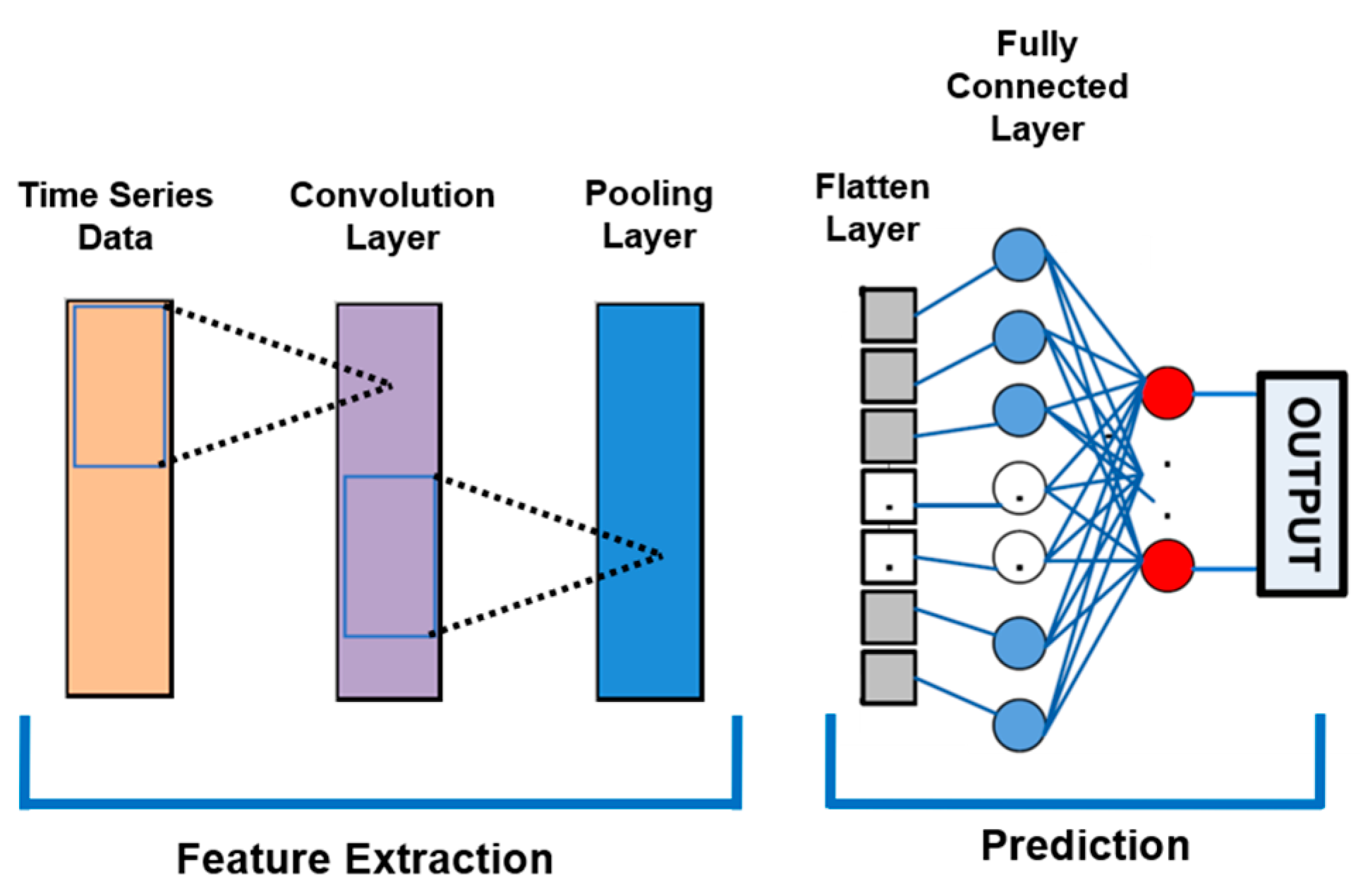
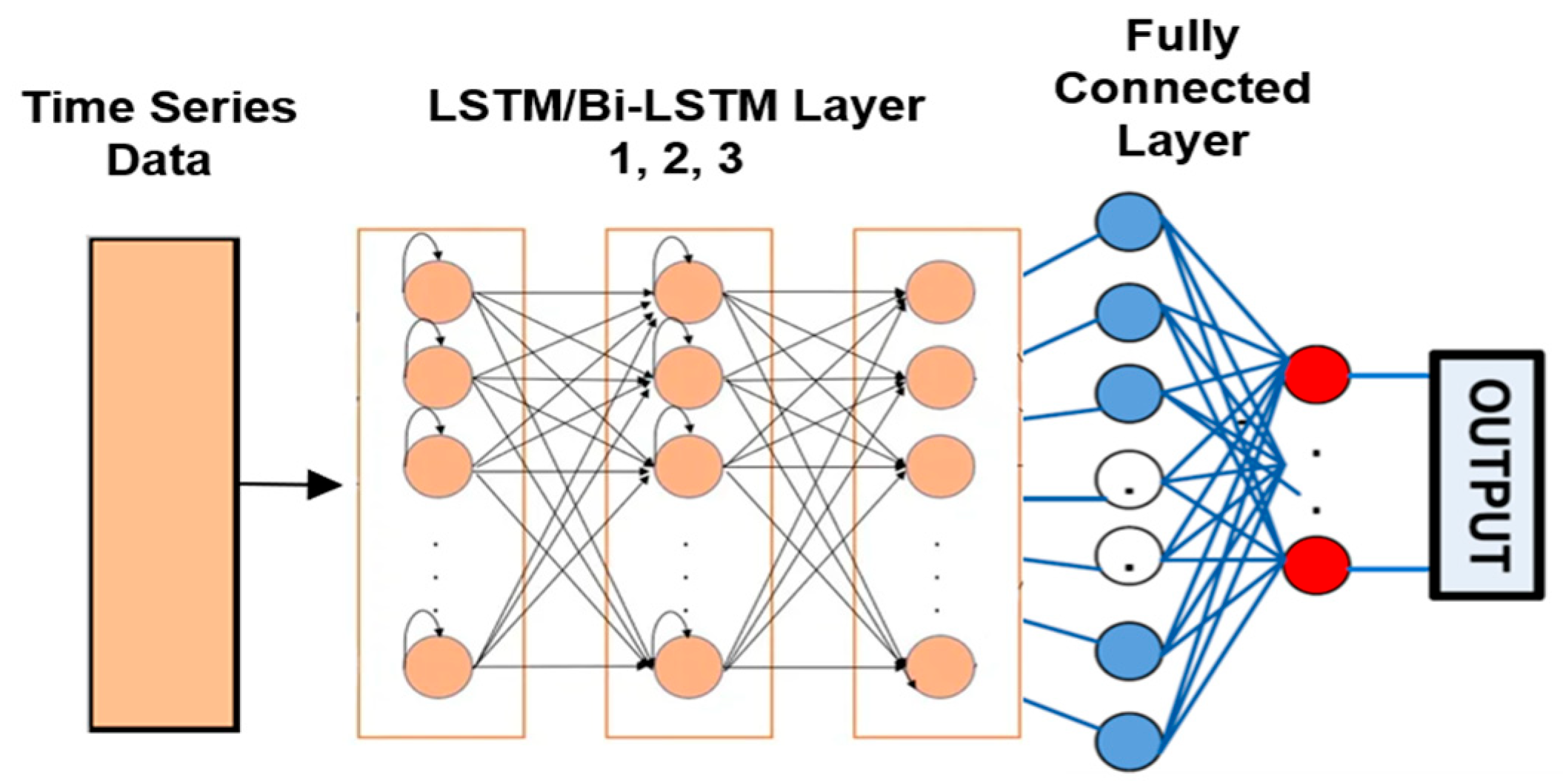
- As part of the framework, six distinct hybrid models are developed and evaluated, each leveraging different configurations of CNN, LSTM, and Bi-LSTM layers to identify the optimal model structure for accurate forecasting across energy types.
2. Literature Review on Deep Learning: Forecasting Point of View
2.1. Convolutional Neural Networks (CNN)
2.2. Recurrent Neural Networks (RNN)
2.3. Long Short-Term Memory (LSTM)
2.4. Bidirectional Long Short-Term Memory (Bi-LSTM)
2.5. Deep Learning Based Hybrid Neural Networks
2.6. Evaluation Matrix for Forecasting Model
2.7. Hybrid Deep Learning Models for Power Generation Forecasting
3. Materials and Methods
3.1. Data Collection and Data Split
3.2. Data Preprocessing by Decomposition Technique
3.3. Proposed Power Generation Forecasting Framework by a Hybrid Deep Learning Model
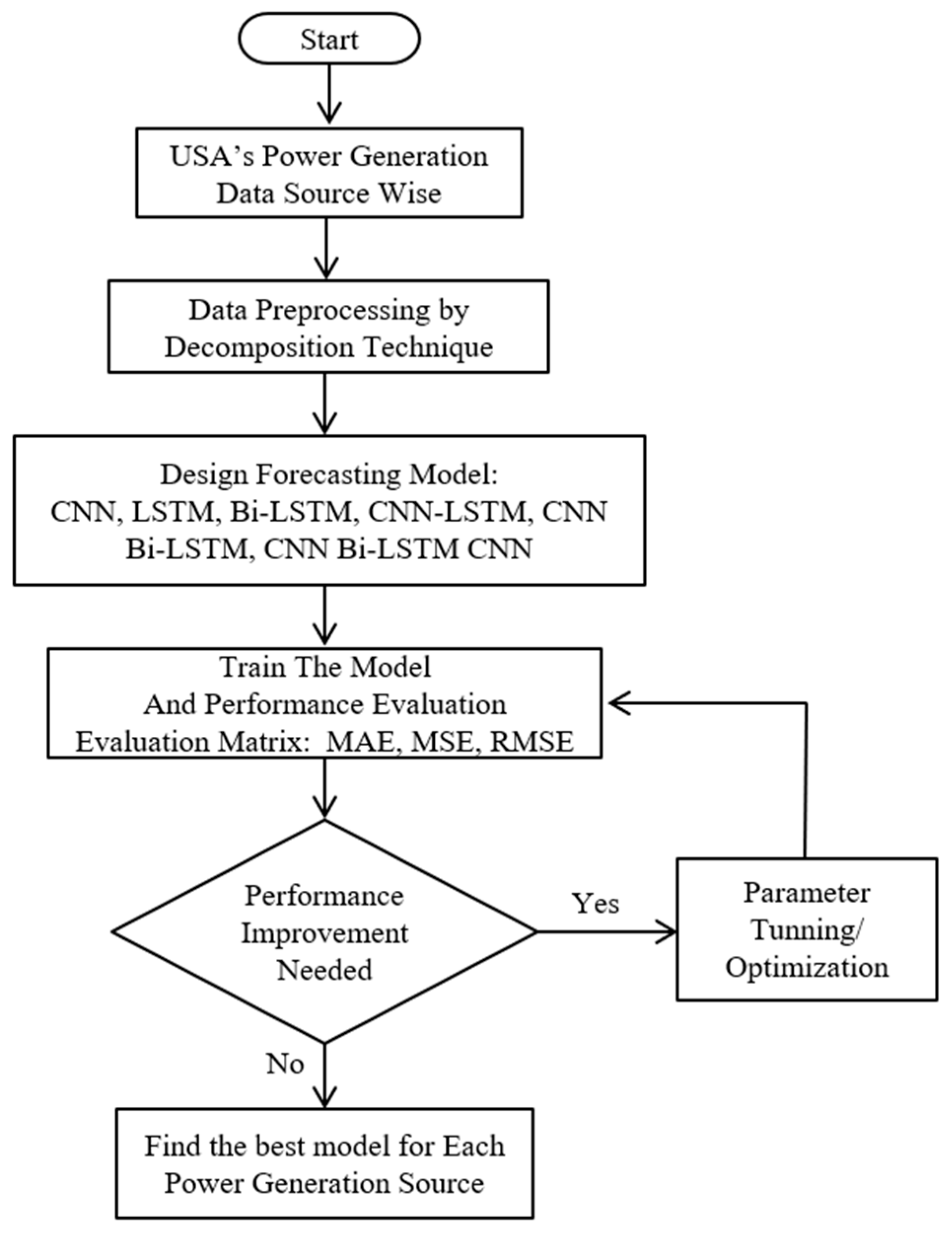
3.4. Methodology of Selecting Source-Wise Best-Fitted Model
3.5. Proposed Framework by Using the Best-Fitted Model for Each Power Generation Source
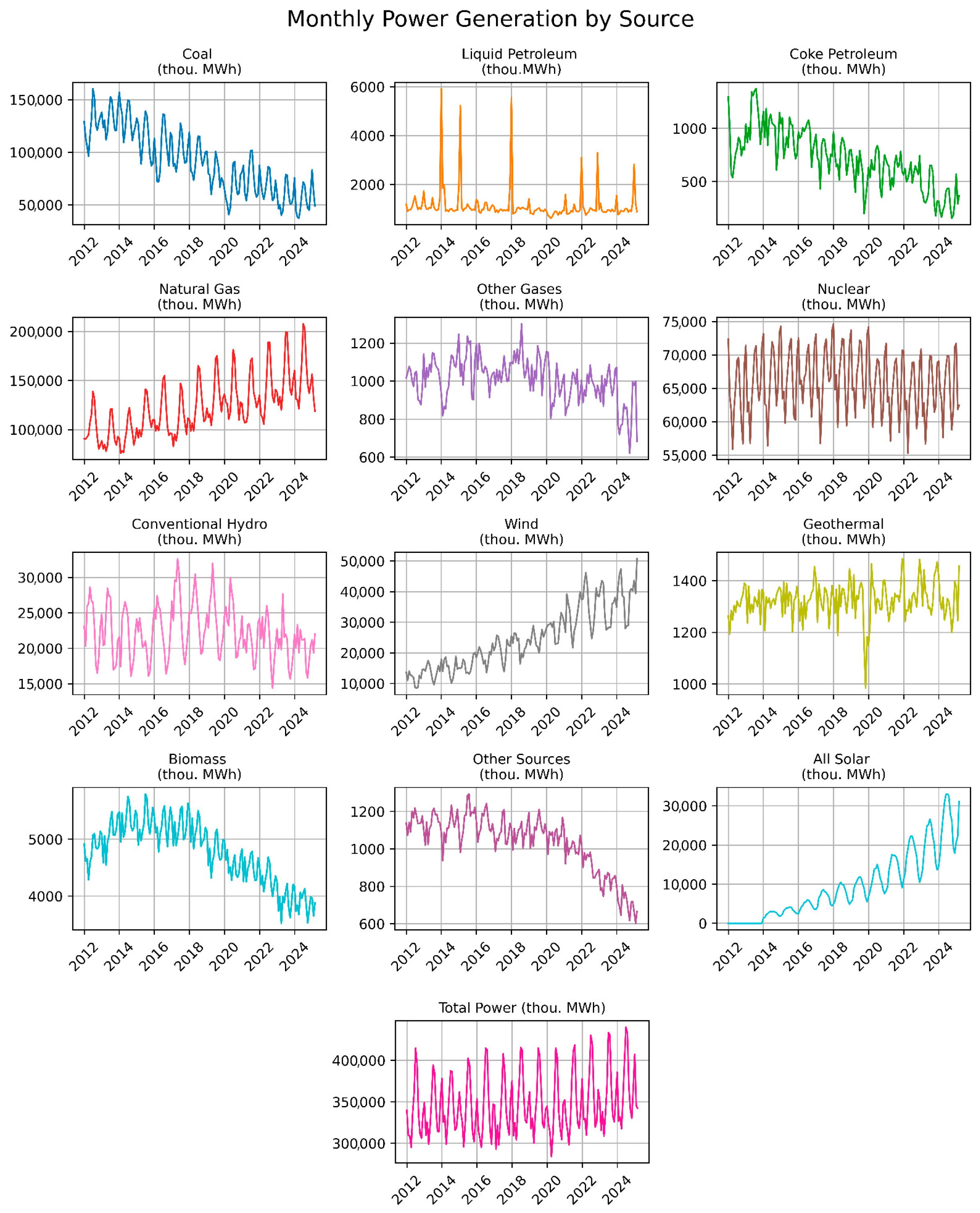
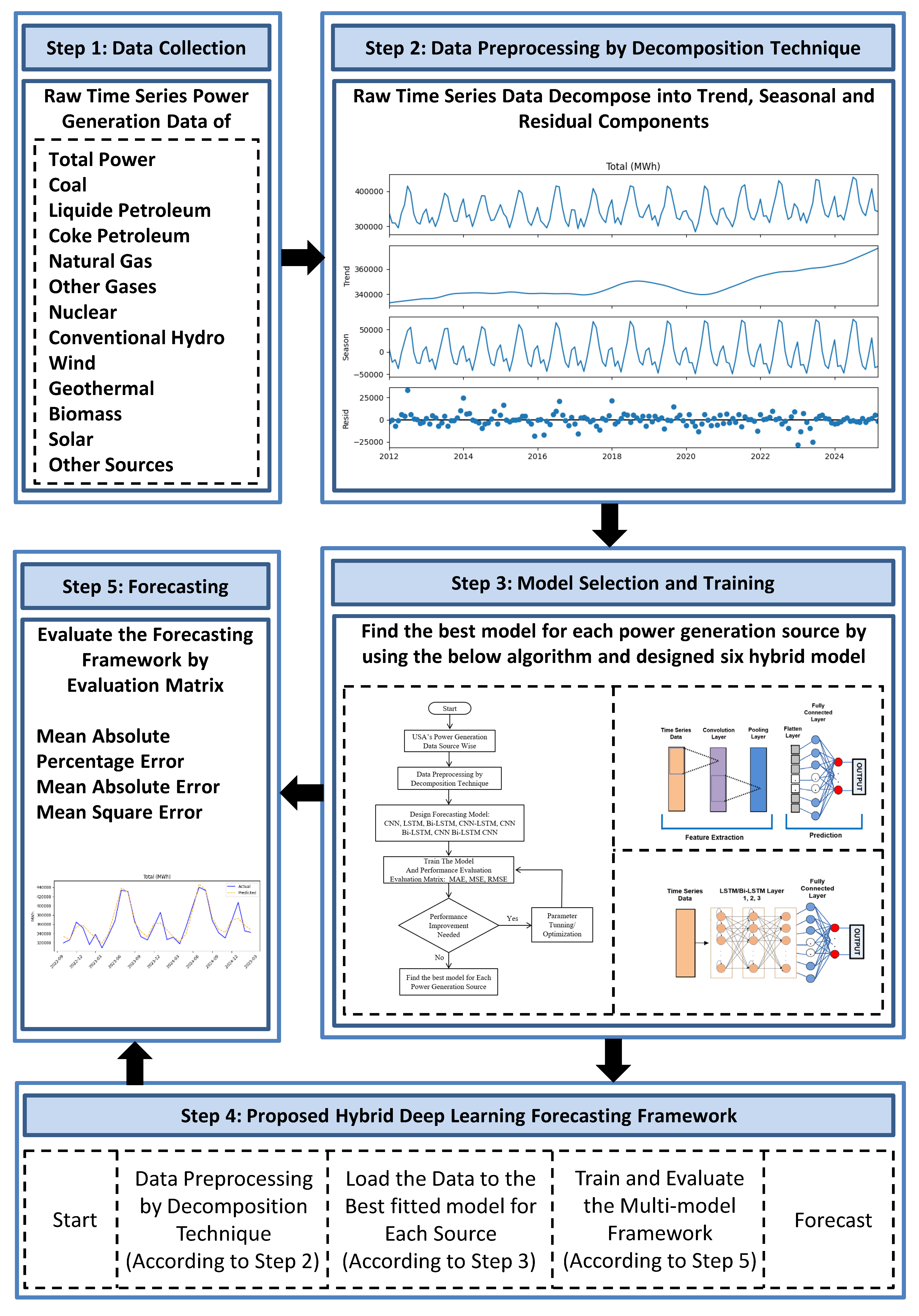
- Step 1: Data collection—raw time series power generation data is gathered from various sources, including both conventional (such as coal, natural gas, nuclear, and petroleum-based fuels) as well as renewable sources (like wind, solar, geothermal, and biomass). This wide-ranging data provides a strong foundation for accurate forecasting by capturing the heterogeneous nature of the U.S. power grid.
- Step 2: Data preprocessing—the collected raw data undergoes decomposition using techniques like STL (Seasonal-Trend decomposition using loess), which separates each time series into three fundamental components: trend, seasonal, and residual. This decomposition enhances model learning by isolating long-term growth patterns, short-term seasonal cycles, and noise, allowing more focused training for each aspect of the data.
- Step 3: Model selection and training—designing and evaluating six hybrid deep learning models mentioned in Section V to determine the most effective model for each power generation source. These models are trained on the decomposed data and assessed using evaluation metrics like mean absolute percentage error (MAPE), mean absolute error (MAE), and mean squared error (MSE). The best-performing model for each energy source is selected through an iterative process involving training, performance evaluation, and hyperparameter tuning.
- Step 4: The proposed hybrid deep learning forecasting framework is established by integrating these source-specific models into a multi-model forecasting structure. In this stage, the decomposed data is loaded into the best-fitted model for each source, and the multi-model framework is trained and evaluated holistically.
- Step 5: Forecasting—the trained framework is used to forecast power generation for each energy source. The output forecasts are evaluated again using MAPE, MAE, and MSE to ensure the reliability and accuracy of the model. This step validates the effectiveness of the overall forecasting approach and demonstrates the benefits of using specialized models for different sources within a unified framework.
4. Simulation Results and Discussion
4.1. Analysis of Proposed Hybrid Deep Learning Forecasting Framework
4.2. Comparative Analysis with Previous Works
5. Conclusions
Author Contributions
Funding
Data Availability Statement
Conflicts of Interest
References
- U.S. Energy Information Administration (EIA). After More Than a Decade of Little Change, U.S. Electricity Consumption Is Rising Again. Available online: https://www.eia.gov/todayinenergy/detail.php?id=65264 (accessed on 19 May 2025).
- U.S. Energy Information Administration (EIA). Electricity Explained: Electricity in the United States. Available online: https://www.eia.gov/energyexplained/electricity/ (accessed on 19 May 2025).
- International Energy Agency (IEA). Renewables 2023: Analysis and Forecast to 2028; IEA: Paris, France, 2023. Available online: https://www.iea.org/reports/renewables-2023 (accessed on 19 May 2025).
- Ghofrani, M.; Arabali, A.; Etezadi-Amoli, M.; Fadali, M.S. A framework for optimal placement of energy storage units within a power system with high wind penetration. IEEE Trans. Sustain. Energy 2013, 4, 434–442. [Google Scholar] [CrossRef]
- Hong, T.; Pinson, P.; Wang, Y.; Weron, R.; Yang, D.; Zareipour, H. Energy Forecasting: A Review and Outlook. IEEE Open Access J. Power Energy 2020, 7, 376–388. [Google Scholar] [CrossRef]
- Hong, T.; Fan, S. Probabilistic electric load forecasting: A tutorial review. Intern. J. Forecast. 2016, 32, 914–938. [Google Scholar] [CrossRef]
- Thatte, A.A.; Xie, L. Towards a unified operational value index of energy storage in smart grid environment. IEEE Trans. Smart Grid 2012, 3, 141–151. [Google Scholar] [CrossRef]
- Weron, R. Electricity price forecasting: A review of the state-of-the-art with a look into the future. Int. J. Forecast. 2014, 30, 1030–1081. [Google Scholar] [CrossRef]
- Singh, A.K.; Ibraheem; Khatoon, S.; Muazzam, M.; Chaturvedi, D.K. Load forecasting techniques and methodologies: A review. In 2012 2nd International Conference on Power, Control and Embedded Systems; IEEE: Allahabad, India, 2012. [Google Scholar] [CrossRef]
- Botterud, A. Forecasting Renewable Energy for Grid Operations. In Renewable Energy Integration: Practical Management of Variability, Uncertainty, and Flexibility in Power Grids, 2nd ed.; Elsevier: Amsterdam, The Netherlands, 2017; pp. 133–143. [Google Scholar] [CrossRef]
- Benti, N.E.; Chaka, M.D.; Semie, A.G. Forecasting Renewable Energy Generation with Machine Learning and Deep Learning: Current Advances and Future Prospects. Sustainability 2023, 15, 7087. [Google Scholar] [CrossRef]
- Zhang, G.P. Time series forecasting using a hybrid ARIMA and neural network model. Neurocomputing 2003, 50, 159–175. [Google Scholar] [CrossRef]
- Chang, P.C.; Fan, C.Y.; Hsieh, J.C. A weighted evolving fuzzy neural network for electricity demand forecasting. In 2009 First Asian Conference on Intelligent Information and Database System; IEEE: Dong hoi, Vietnam, 2009; Volume 9, pp. 330–350. [Google Scholar]
- Xie, Y.; Li, M. Application of gray forecasting model optimized by genetic algorithm in electricity demand forecasting. In Second International Conference on Computer Modeling and Simulation; IEEE: Sanya, China, 2010; Volume 10, pp. 275–277. [Google Scholar]
- Niu, D.X.; Wei, Y.; Li, J.; Wu, J. Analysis of electricity demand forecasting in Inner Mongolia based on gray Markov model. In 2010 International Conference on E-Business and E-Government; IEEE: Sanya, China, 2010; Volume 10, pp. 5082–5085. [Google Scholar]
- Setaiwan, A.; Koprinska, I.; Agelidis, V.G. Very short-term electricity load demand forecasting using support vector regression. In 2009 International Joint Conference on Neural Networks; IEEE: Atlanta, GA, USA, 2009; Volume 1, pp. 2888–2894. [Google Scholar]
- Gigoni, L.; Betti, A.; Crisostomi, E.; Franco, A.; Tucci, M.; Bizzarri, F.; Mucci, D. Day-ahead hourly forecasting of power generation from photovoltaic plants. IEEE Trans. Sustain. Energy 2017, 9, 831–842. [Google Scholar] [CrossRef]
- Liu, L.; Zhan, M.; Bai, Y. A recursive ensemble model for forecasting the power output of photovoltaic systems. Sol. Energy 2019, 189, 291–298. [Google Scholar] [CrossRef]
- Visser, L.; AlSkaif, T.; Van Sark, W. Benchmark analysis of day ahead solar power forecasting techniques using weather predictions. In 2019 IEEE 46th Photovoltaic Specialists Conference (PVSC); IEEE: Chicago, IL, USA, 2019; pp. 2111–2116. [Google Scholar]
- Zhou, H.; Zhang, Y.; Yang, L.; Liu, Q.; Yan, K.; Du, Y. Short-Term Photovoltaic Power Forecasting Based on Long Short Term Memory Neural Network and Attention Mechanism. IEEE Access 2019, 7, 78063–78074. [Google Scholar] [CrossRef]
- Hochreiter, S.; Schmidhuber, J. Long short-term memory. Neural Comput. 1997, 9, 1735–1780. [Google Scholar] [CrossRef] [PubMed]
- Graves, A.; Schmidhuber, J. Framewise phoneme classification with bidirectional LSTM networks. In Proceedings 2005 IEEE International Joint Conference on Neural Networks, 2005; IEEE: Montreal, QC, Canada, 2005; pp. 2047–2052. [Google Scholar]
- Zeng, Z.; Kaur, R.; Siddagangappa, S.; Rahimi, S.; Balch, T.; Veloso, M. Financial time series forecasting using CNN and transformer. arXiv 2023, arXiv:2304.04912. [Google Scholar] [CrossRef]
- Kandil, T.; Harris, A.; Das, R. Enhancing Fault Detection and Classification in Wind Farm Power Generation Using Convolutional Neural Networks (CNN) by Leveraging LVRT Embedded in Numerical Relays. IEEE Access 2025, 13, 104828–104843. [Google Scholar] [CrossRef]
- U.S. Energy Information Administration (EIA). Available online: https://www.eia.gov/electricity/data.php (accessed on 19 May 2025).
- Gulay, E.; Sen, M.; Akgun, O.B. Forecasting electricity production from various energy sources in Türkiye: A predictive analysis of time series, deep learning, and hybrid models. Energy 2024, 286, 129566. [Google Scholar] [CrossRef]
- Ullah, F.U.M.; Ullah, A.; Haq, I.U.; Rho, S.; Baik, S.W. Short-Term Prediction of Residential Power Energy Consumption via CNN and Multi-Layer Bi-Directional LSTM Networks. IEEE Access 2019, 8, 123369–123380. [Google Scholar] [CrossRef]
- Zafar, A.; Che, Y.; Ahmed, M.; Sarfraz, M.; Ahmad, A.; Alibakhshikenari, M. Enhancing Power Generation Forecasting in Smart Grids Using Hybrid Autoencoder Long Short-Term Memory Machine Learning Mode. IEEE Access 2023, 11, 118521–118537. [Google Scholar] [CrossRef]
- Zheng, J.; Du, J.; Wang, B.; Kleme, J.J.; Liao, Q.; Liang, Y. A hybrid framework for forecasting power generation of multiple renewable energy sources. Renew. Sustain. Energy Rev. 2023, 172, 113046. [Google Scholar] [CrossRef]
- Shalini, T.A.; Revathi, B.S. Hybrid power generation forecasting using CNN based BILSTM method for renewable energy systems. Automatika 2022, 64, 127–144. [Google Scholar] [CrossRef]
- Rubasinghe, O.; Zhang, X.; Chau, T.K.; Chow, Y.H.; Fernando, T.; Iu, H.H.-C. A Novel Sequence to Sequence Data Modelling Based CNN-LSTM Algorithm for Three Years Ahead Monthly Peak Load Forecasting. IEEE Trans. Power Syst. 2023, 39, 1932–1947. [Google Scholar] [CrossRef]
- Sharadga, H.; Hajimirza, S.; Balog, R.S. Time series forecasting of solar power generation for large-scale photovoltaic plants. Renew. Energy 2020, 150, 797–807. [Google Scholar] [CrossRef]
- Zhao, S.; Xu, Z.; Zhu, Z.; Liang, X.; Zhang, Z.; Jiang, R. Short and Long-Term Renewable Electricity Demand Forecasting Based on CNN-Bi-GRU Model. ICCK Trans. Emerg. Top. Artif. Intell. 2025, 2, 1–15. [Google Scholar] [CrossRef]



| Architecture | Key Feature | Strength |
|---|---|---|
| CNN | Convolutional filters extract local features | Capture short term patterns |
| RNN | Sequential feedback structure | Temporal modeling |
| LSTM | Memory cell with gating mechanism | Long term dependency learning |
| Bi-LSTM | Bidirectional sequence processing | Improved context learning |
| CNN LSTM | CNN and LSTM Layers | Spatial and temporal learning |
| CNN-Bi-LSTM | CNN and Bidirectional learning | Strong nonlinear modeling |
| Study | Model | Data Type | Forecast Horizon | Metrics |
|---|---|---|---|---|
| Gulay et al. [26] | STL-LSTM | Multi-source generation | Monthly | MAPE, RMSE |
| Ullah et al. [27] | CNN-M-BiLSTM | Residential load | Short-term | MSE, RMSE |
| Zafar et al. [28] | AE-LSTM | Solar generation | Short-term | MAE, RMSE |
| Zheng et al. [29] | CNN-A-LSTM-AR | Renewable multi-source | Short-term | MAPE |
| Shalini and Revathi et al. [30] | CNN-BiLSTM | Renewable hybrid system | Short-term | MSE, MAE |
| Rubasinghe et al. [31] | CNN-LSTM | Peak load | Long-term | MAPE |
| Hyperparameter | Layer Description | Search Range | Step Size |
|---|---|---|---|
| cnn_filters1/filters | First CNN layer filters | 32–128 | 32 |
| cnn_filters2 | Second CNN layer filters | 16–64 | 16 |
| kernel_size1 | Kernel size (first CNN) | {2, 3, 4} | — |
| kernel_size2 | Kernel size (second CNN) | {1, 2, 3} | — |
| cnn_dropout1 | Dropout after first CNN | 0.1–0.5 | 0.1 |
| cnn_dropout2 | Dropout after second CNN | 0.1–0.5 | 0.1 |
| lstm_units1 | First LSTM/BiLSTM layer units | 32–128 | 32 |
| lstm_units2 | Second LSTM/BiLSTM layer units | 16–64 | 16 |
| dropout1 | Dropout after first LSTM | 0.1–0.5 | 0.1 |
| dropout2 | Dropout after second LSTM | 0.1–0.5 | 0.1 |
| dense_units | Fully connected layer units | 32–128 | 32 |
| learning_rate | Adam optimizer learning rate | {0.001, 0.0005, 0.0001} | — |
| Model | Total Power | Coal | Liq. Petro. | Coke Petro. | Natural Gas | Other Gases | Nuclear | Conv. Hydro | Wind | Geo-Thermal | Biomass | Solar | Other Sources |
|---|---|---|---|---|---|---|---|---|---|---|---|---|---|
| CNN | 4.17 | 16.35 | 18.75 | 42.70 | 3.21 | 8.99 | 2.03 | 7.36 | 7.27 | 6.81 | 3.54 | 7.45 | 4.77 |
| LSTM | 3.79 | 14.95 | 19.97 | 24.28 | 4.48 | 10.13 | 2.78 | 7.78 | 8.34 | 4.88 | 3.75 | 12.99 | 16.01 |
| Bi-LSTM | 2.93 | 15.03 | 16.22 | 25.68 | 4.15 | 9.24 | 1.66 | 9.60 | 6.62 | 4.07 | 2.36 | 6.22 | 6.81 |
| CNN-LSTM | 3.52 | 16.84 | 21.68 | 91.85 | 4.69 | 10.90 | 1.70 | 7.33 | 9.06 | 4.97 | 3.45 | 20.98 | 13.27 |
| CNN Bi-LSTM | 2.60 | 22.12 | 16.38 | 86.64 | 4.21 | 7.39 | 1.89 | 8.01 | 6.89 | 6.21 | 5.33 | 12.90 | 16.05 |
| CNN Bi-LSTM CNN | 3.17 | 25.33 | 15.39 | 69.23 | 4.62 | 9.98 | 1.74 | 9.01 | 6.46 | 5.73 | 13.02 | 12.06 | 16.05 |
| Model | Total Power | Coal | Liq. Petro. | Coke Petro. | Natural Gas | Other Gases | Nuclear | Conv. Hydro | Wind | Geo-Thermal | Biomass | Solar | Other Sources |
|---|---|---|---|---|---|---|---|---|---|---|---|---|---|
| CNN | 17,643 | 10,458 | 518 | 140 | 6033 | 95 | 1557 | 1940 | 3382 | 109 | 180 | 1893 | 43 |
| LSTM | 17,508 | 8660 | 544 | 114 | 10,274 | 108 | 2175 | 1928 | 3847 | 77 | 177 | 4224 | 132 |
| Bi-LSTM | 13,015 | 9233 | 522 | 108 | 7737 | 99 | 1217 | 2140 | 3110 | 70 | 111 | 1836 | 61 |
| CNN-LSTM | 17,441 | 9898 | 521 | 279 | 10,119 | 110 | 1283 | 1871 | 4257 | 78 | 181 | 6007 | 112 |
| CNN Bi-LSTM | 13,745 | 12,825 | 508 | 265 | 8606 | 82 | 1499 | 2141 | 3174 | 109 | 241 | 3417 | 136 |
| CNN Bi-LSTM CNN | 13,973 | 14,169 | 542 | 212 | 8762 | 111 | 1373 | 2239 | 3277 | 105 | 532 | 3392 | 133 |
| Model | Total Power | Coal | Liq. Petro. | Coke Petro. | Natural Gas | Other Gases | Nuclear | Conv. Hydro | Wind | Geo-Thermal | Biomass | Solar | Other Sources |
|---|---|---|---|---|---|---|---|---|---|---|---|---|---|
| CNN | 14,391 | 8234 | 260 | 123 | 4791 | 76 | 1273 | 1427 | 2594 | 93 | 134 | 1550 | 35 |
| LSTM | 13,940 | 7508 | 282 | 88 | 6523 | 85 | 1758 | 1494 | 2933 | 66 | 142 | 3217 | 114 |
| Bi-LSTM | 10,795 | 7543 | 240 | 85 | 6151 | 75 | 1069 | 1791 | 2478 | 56 | 89 | 1368 | 50 |
| CNN-LSTM | 13,101 | 8304 | 285 | 249 | 6828 | 89 | 1106 | 1425 | 3520 | 67 | 129 | 5039 | 95 |
| CNN Bi-LSTM | 9542 | 11,049 | 233 | 239 | 6452 | 63 | 1201 | 1604 | 2426 | 85 | 202 | 2882 | 113 |
| CNN Bi-LSTM CNN | 11,262 | 12,501 | 238 | 190 | 6838 | 80 | 1128 | 1699 | 2502 | 80 | 502 | 2826 | 115 |
| Energy Source | Selected Model | Reason for Selection (Metric Reference) |
|---|---|---|
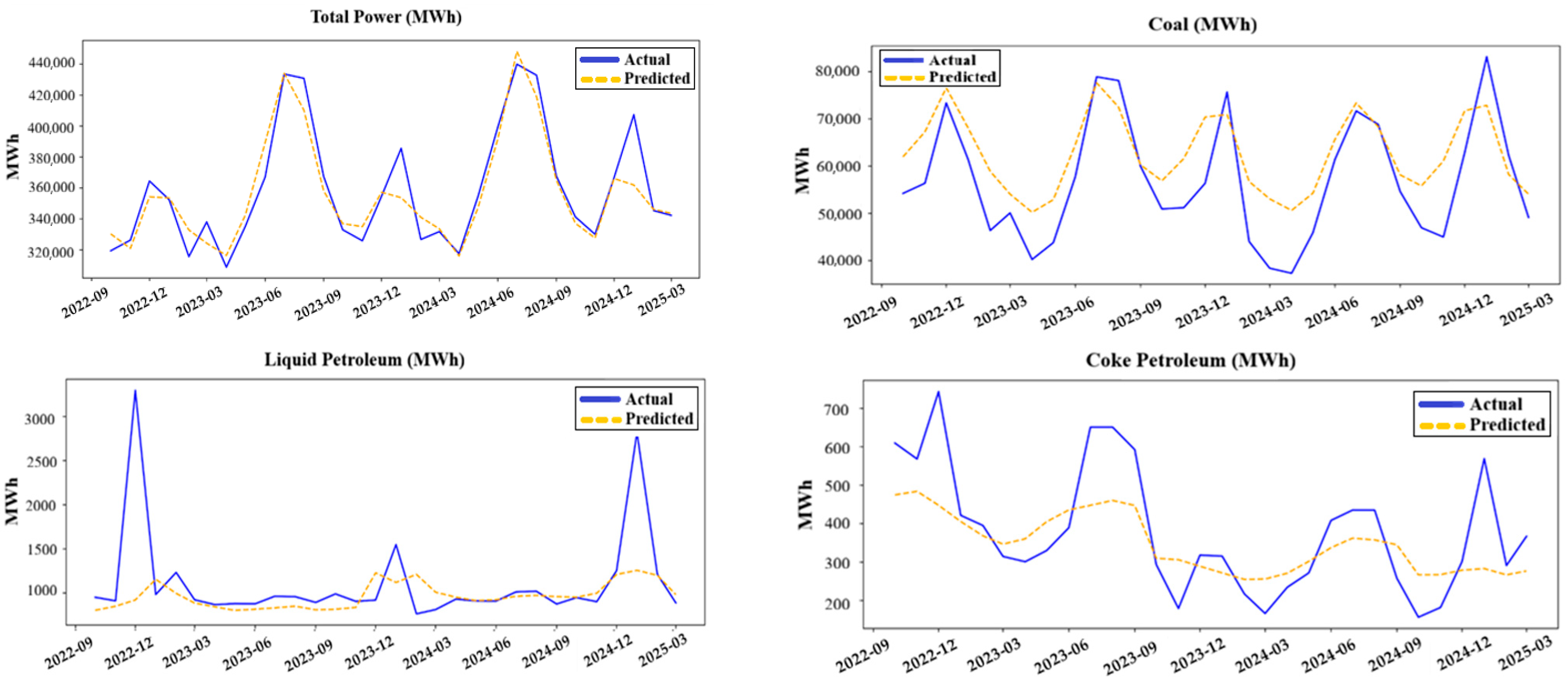
| Total Power | CNN Bi-LSTM | Lowest MAPE (2.60%), RMSE (13,745 MWh), and MAE (9542 MWh) |
| Coal | LSTM | Lowest MAPE (14.95%) and RMSE (8660 MWh); competitive MAE |
| Liquid Petroleum | Bi-LSTM | Lowest RMSE (522 MWh) and MAE (240 MWh); competitive MAPE |
| Coke Petroleum | Bi-LSTM | Lowest RMSE (108 MWh) and MAE (85 MWh) |
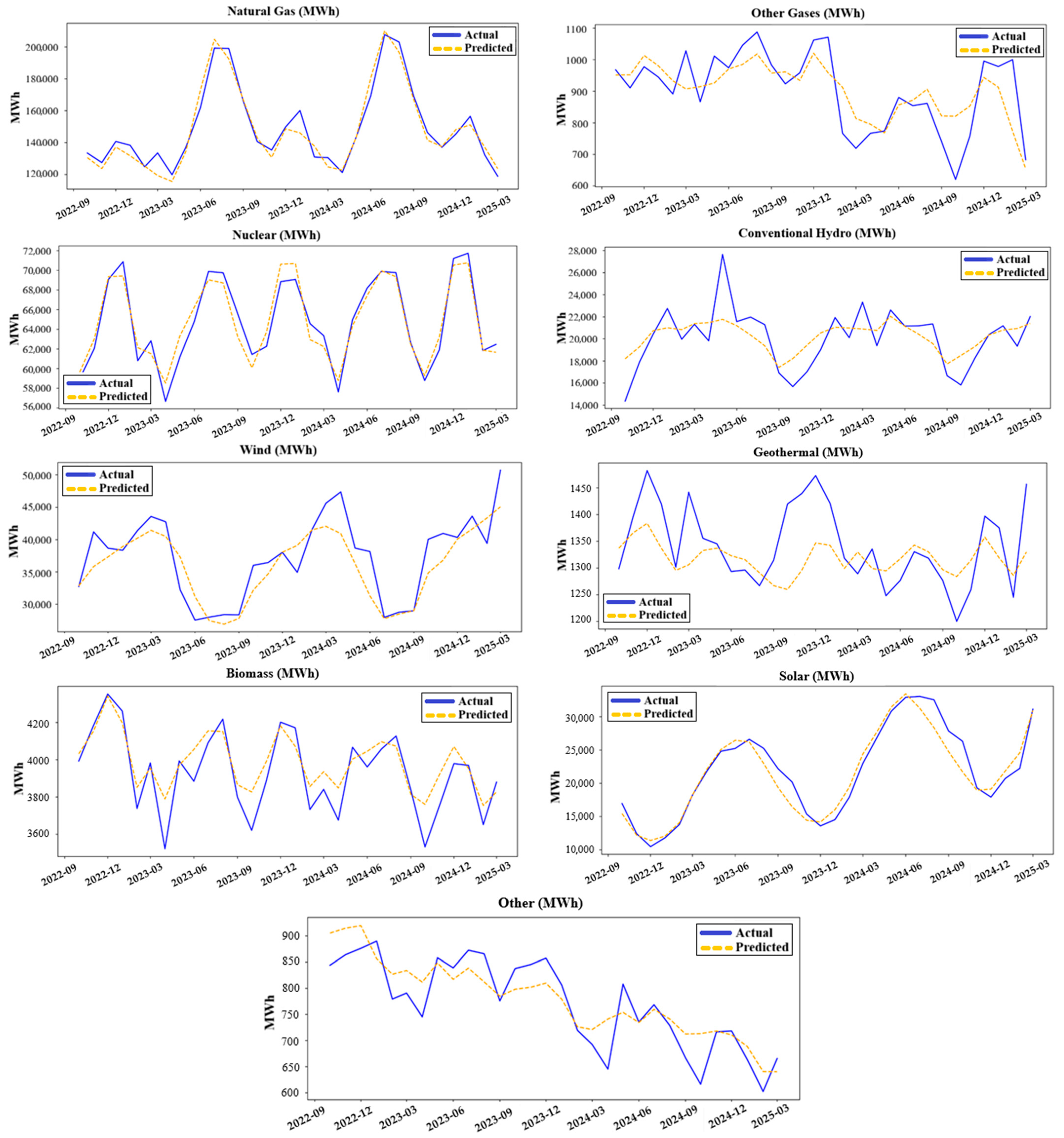
| Natural Gas | CNN | Lowest MAPE (3.21%) and RMSE (6033 MWh) |
| Other Gases | CNN Bi-LSTM | Lowest MAPE (7.39%), RMSE (82 MWh), and MAE (63 MWh) |
| Nuclear | Bi-LSTM | Lowest MAPE (1.66%), RMSE (1217 MWh), and MAE (1069 MWh) |
| Conventional Hydro | CNN Bi-LSTM CNN | Lowest RMSE (1373 MWh) and MAE (1128 MWh) |
| Wind | Bi-LSTM | Lowest MAPE (6.62%), RMSE (3110 MWh), and MAE (2478 MWh) |
| Geothermal | Bi-LSTM | Lowest MAPE (4.07%), RMSE (70 MWh), and MAE (56 MWh) |
| Biomass | Bi-LSTM | Lowest MAPE (2.36%), RMSE (111 MWh), and MAE (89 MWh) |
| Solar | Bi-LSTM | Lowest RMSE (1836 MWh) and MAE (1368 MWh) |
| Other Sources | CNN | Lowest MAPE (4.77%), RMSE (43 MWh), and MAE (35 MWh) |
| Model/Reference | Key Feature | Input Data Type | Application Domain | Reported Performance |
|---|---|---|---|---|
| Different Deep Learning Model [26] | Data decomposition before employing the deep learning and machine learning model | Monthly periodical power generation data and economic data | Forecasting of electricity generation of Turkiye | STL-LSTM performed best in terms of MAPE ranging 2.087–50.605% including 1.626 for the total power forecast |
| CNN-M-BDLSTM [27] | CNN with multilayer bidirectional LSTM | Residential power consumption data such as active power, voltage, current and time | Short-term rodential power consumption prediction | MSE: 0.3489 RMSE: 0.5905 MAE: 0.3730 |
| AE-LSTM [28] | Auto encoder with long short-term memory | Daily power generation, max grid connected power, radiance | Short-term solar power generation prediction | AE-LSTM with an MAE of 0.05–0.09. MAPE was not calculated |
| CNN+A-LSTM+AR [29] | Integrates CNN, attention-based LSTM, and autoregressive | Power generation data from different renewable energy sources and weather data | Forecasting power generation of multiple renewable energy sources (solar PV, solar thermal, wind) | MAPE: 9.16% (solar PV), 18.15% (solar thermal), 16.87% (wind) |
| CNN-Bi-LSTM [30] | Combines CNN and bidirectional LSTM | Renewable energy data (solar PV, wind) and weather data | Forecasting renewable energy power generation (Solar PV, Wind) | CNN-Bi-LSTM has an error of 00219 with solar data and 1.0125 with varying wind data |
| Bi-LSTM [32] | Bidirectional long short-term memory network | Hourly power generation data from 20 MW PV plant | Predicting solar power generation from large-scale photovoltaic (PV) plants | R value: 0.98 (one-hour ahead predictions) |
| CNN-Bi-GRU [33] | Multimodal information fusion (time series + textual data) | Historical renewable power generation data, policy documents | Short- and long-term renewable electricity demand forecasting | Lower RMSE and MAPE compared to ARIMA, standalone GRU, EEMD-ARIMA |
| CNN-LSTM [31] | Sequence-to-sequence hybrid model (CNN as encoder, LSTM as decoder) | Monthly peak load data (New South Wales, Australia) | Long-term monthly peak load forecasting (three-year horizon) | MAPE: 4.29% (36-month ahead) |
| Proposed Framework | Combine Multiple Model (Best model based on Source) in one Framework | Historical monthly EIA data (USA’s electricity production by source) | Forecasting USA’s Power Generation for Fossils Fuel and Renewable Sources | MAPE for Nuclear: 1.66% Details in Table 4 |
Disclaimer/Publisher’s Note: The statements, opinions and data contained in all publications are solely those of the individual author(s) and contributor(s) and not of MDPI and/or the editor(s). MDPI and/or the editor(s) disclaim responsibility for any injury to people or property resulting from any ideas, methods, instructions or products referred to in the content. |
© 2026 by the authors. Licensee MDPI, Basel, Switzerland. This article is an open access article distributed under the terms and conditions of the Creative Commons Attribution (CC BY) license.
Share and Cite
Das, R.; Kandil, T.; Harris, A.; Herron, B.; J. Magnante, E. A Hybrid Deep Learning Framework for National Level Power Generation Forecasting of Different Energy Sources Including Renewable Energy and Fossil Fuel. Energies 2026, 19, 1564. https://doi.org/10.3390/en19061564
Das R, Kandil T, Harris A, Herron B, J. Magnante E. A Hybrid Deep Learning Framework for National Level Power Generation Forecasting of Different Energy Sources Including Renewable Energy and Fossil Fuel. Energies. 2026; 19(6):1564. https://doi.org/10.3390/en19061564
Chicago/Turabian StyleDas, Remon, Tarek Kandil, Adam Harris, Bryson Herron, and Ethan J. Magnante. 2026. "A Hybrid Deep Learning Framework for National Level Power Generation Forecasting of Different Energy Sources Including Renewable Energy and Fossil Fuel" Energies 19, no. 6: 1564. https://doi.org/10.3390/en19061564
APA StyleDas, R., Kandil, T., Harris, A., Herron, B., & J. Magnante, E. (2026). A Hybrid Deep Learning Framework for National Level Power Generation Forecasting of Different Energy Sources Including Renewable Energy and Fossil Fuel. Energies, 19(6), 1564. https://doi.org/10.3390/en19061564