Electrifying the Future: Second- and Third-Generation Derived Oils for Transformers




Abstract
1. Introduction
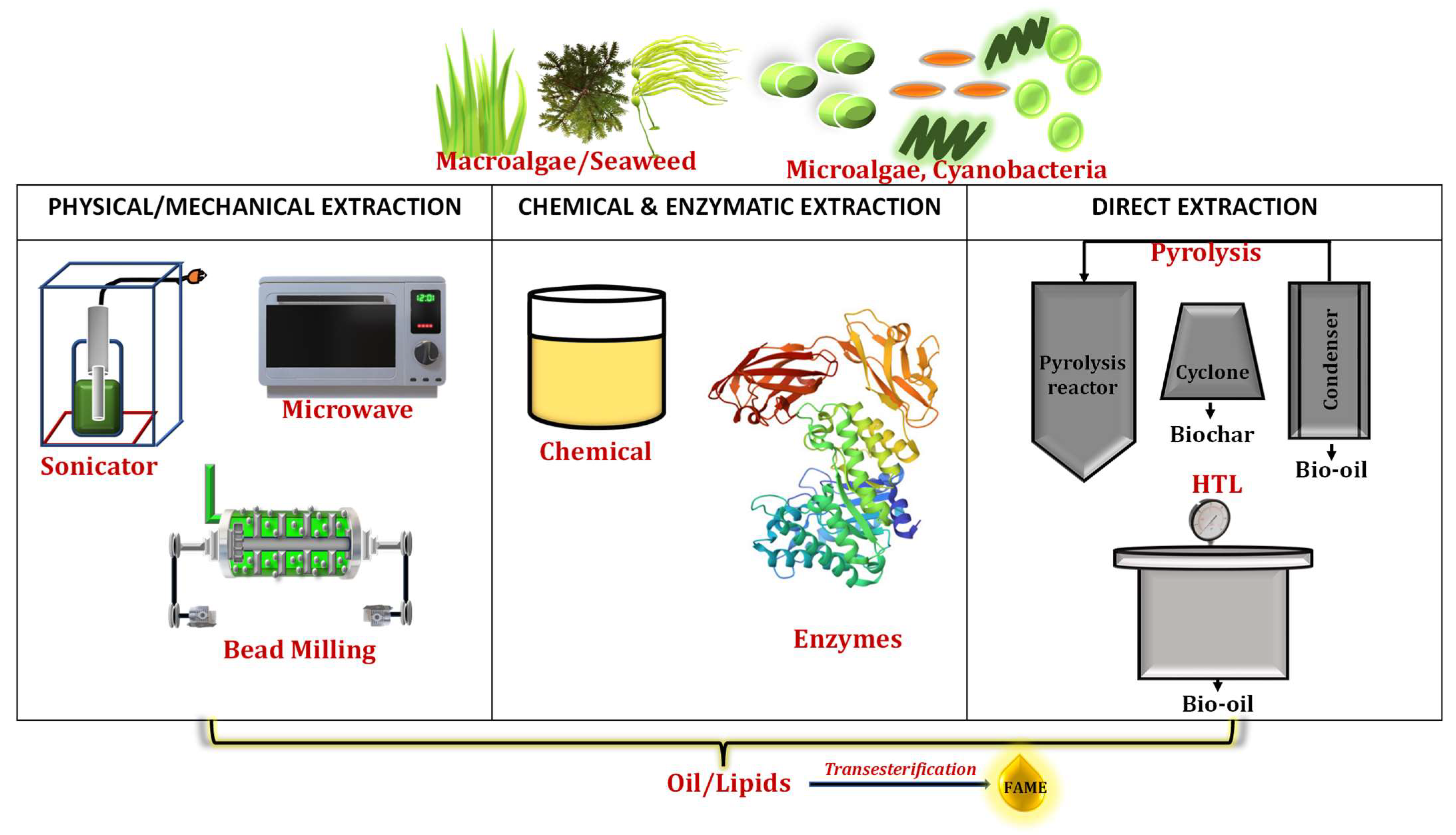
2. Algal Oil Extraction Process
2.1. Physical/Mechanical Methods of Oil/Lipid Extraction from Algae
2.2. Chemical and Enzymatic Methods of Oil/Lipid Extraction from Algae
2.3. Direct Bio-Oil Extraction from Algae
2.3.1. Pyrolysis for Bio-Oil Production
2.3.2. Hydrothermal Liquefaction for Bio-Oil Production
3. Precautionary Measures for Using Biodegradable Fluids in Power Transformers
4. Properties of Biodegradable Fluids for Power Transformers
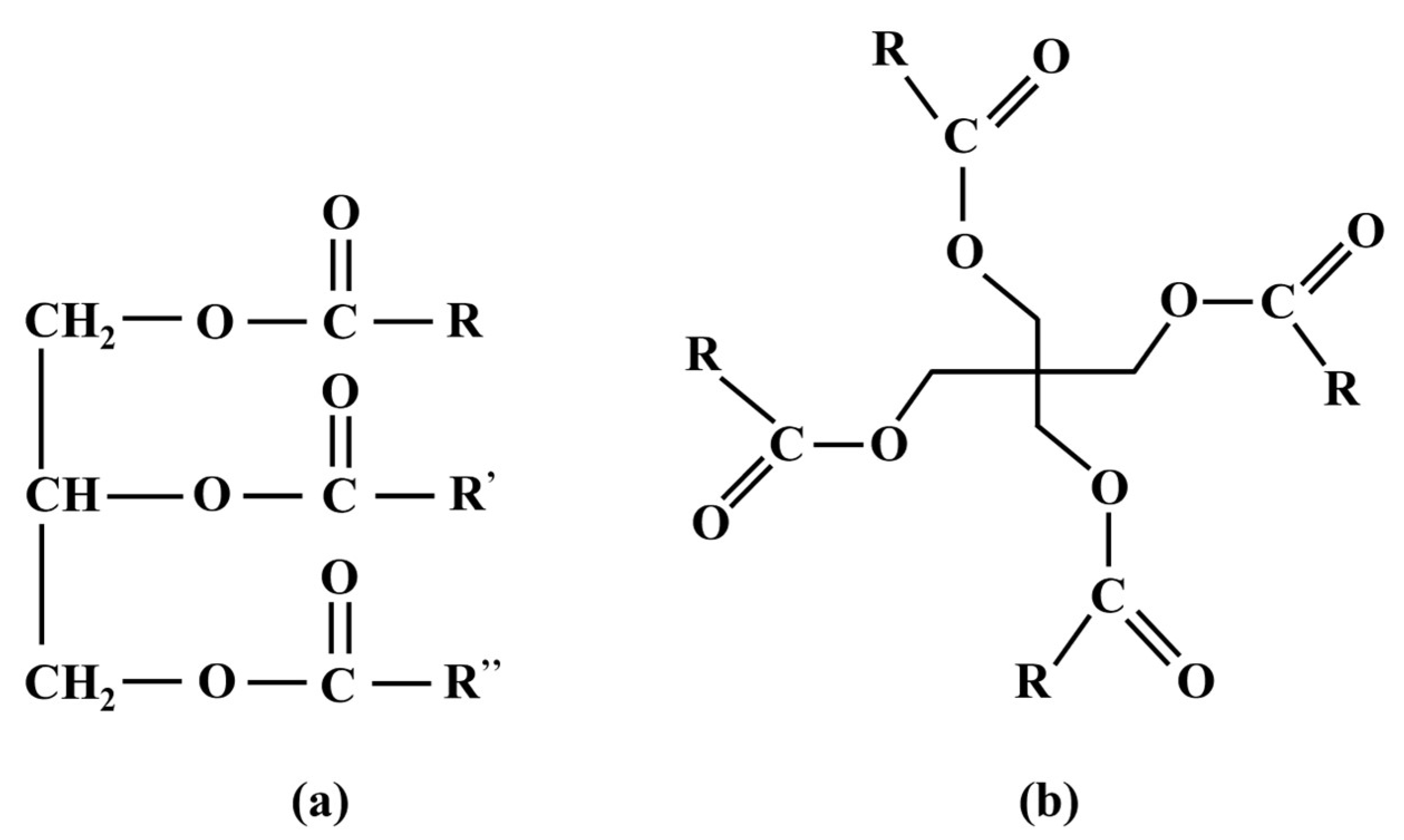
4.1. Composition of Fatty Acids
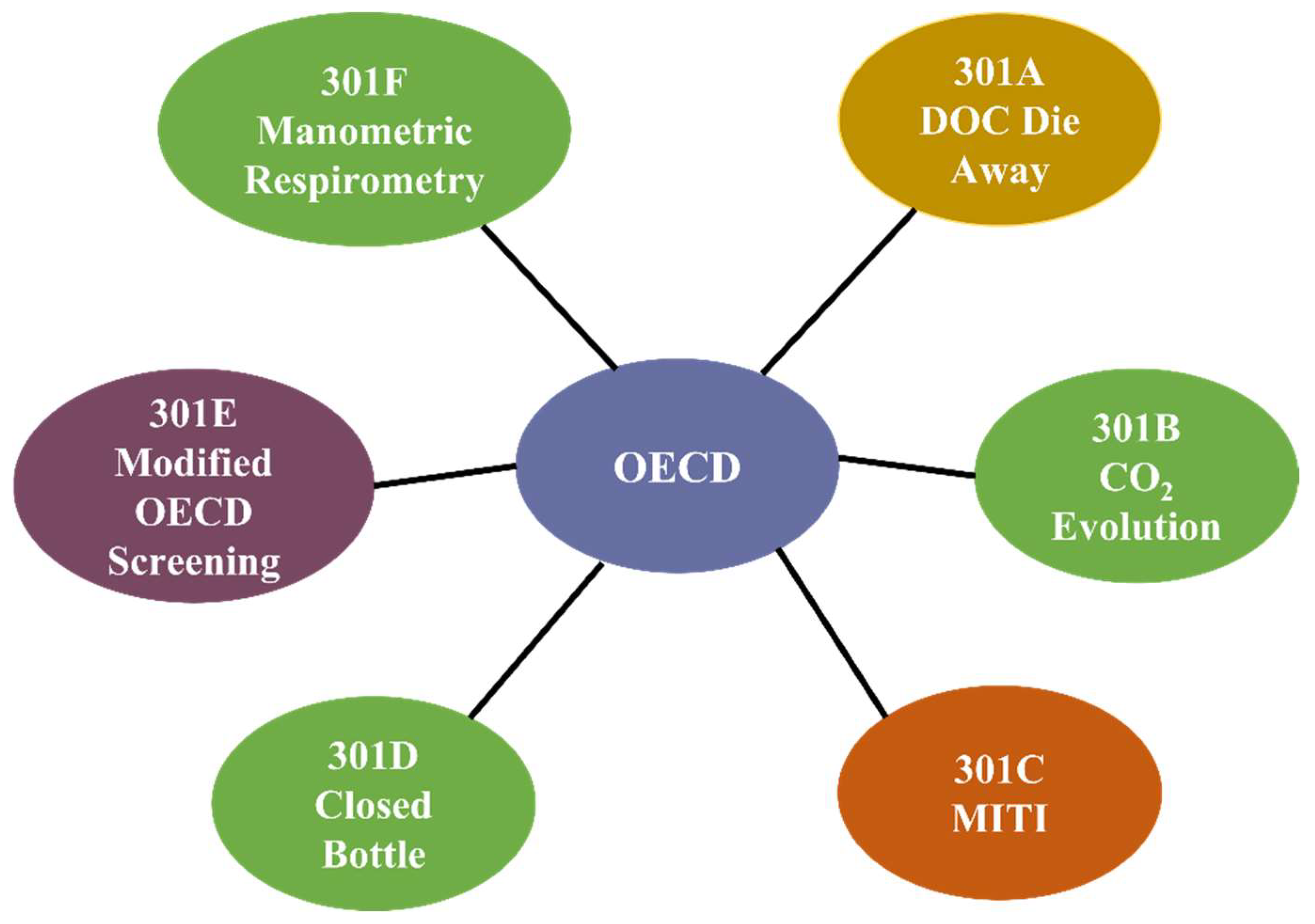
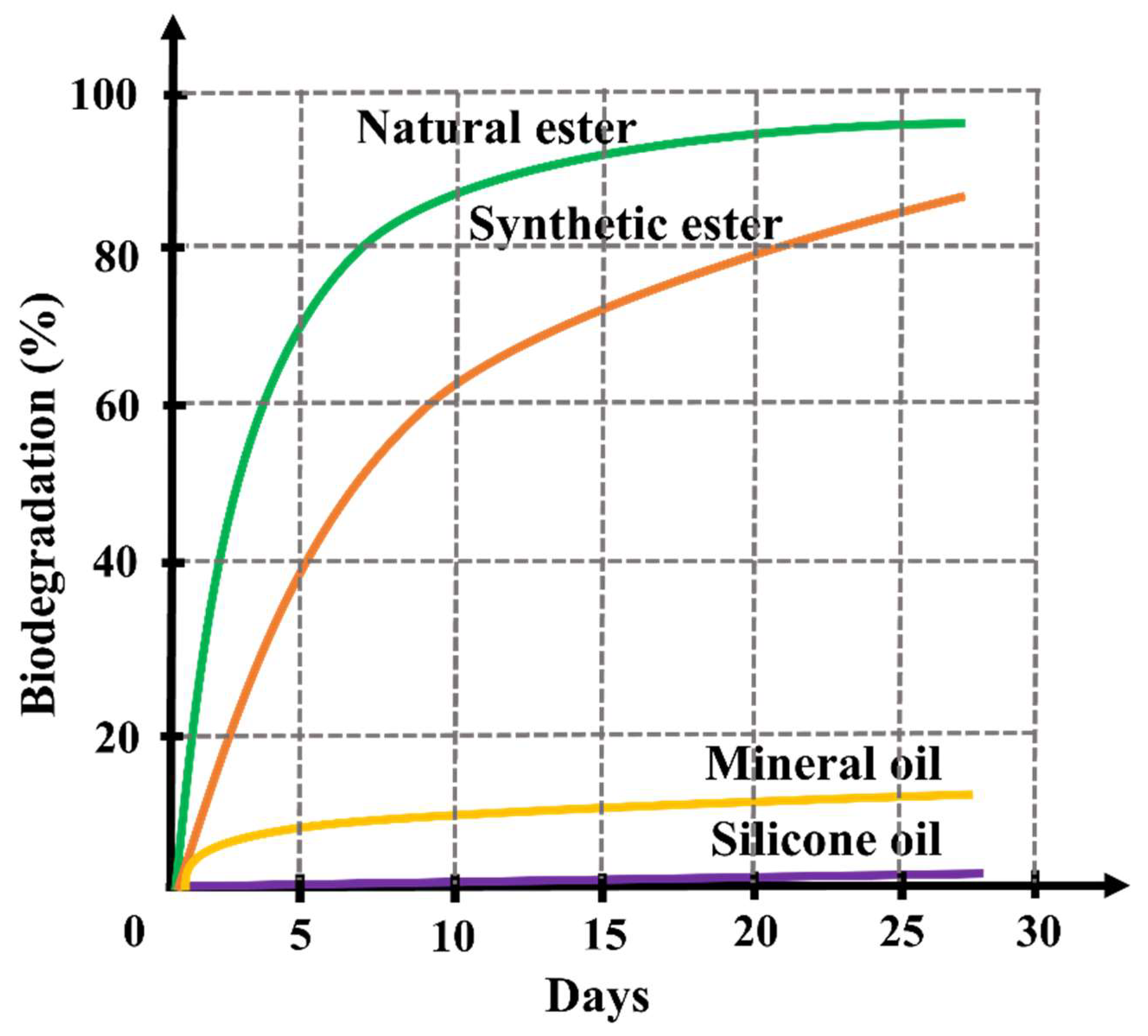
4.2. Biodegradability
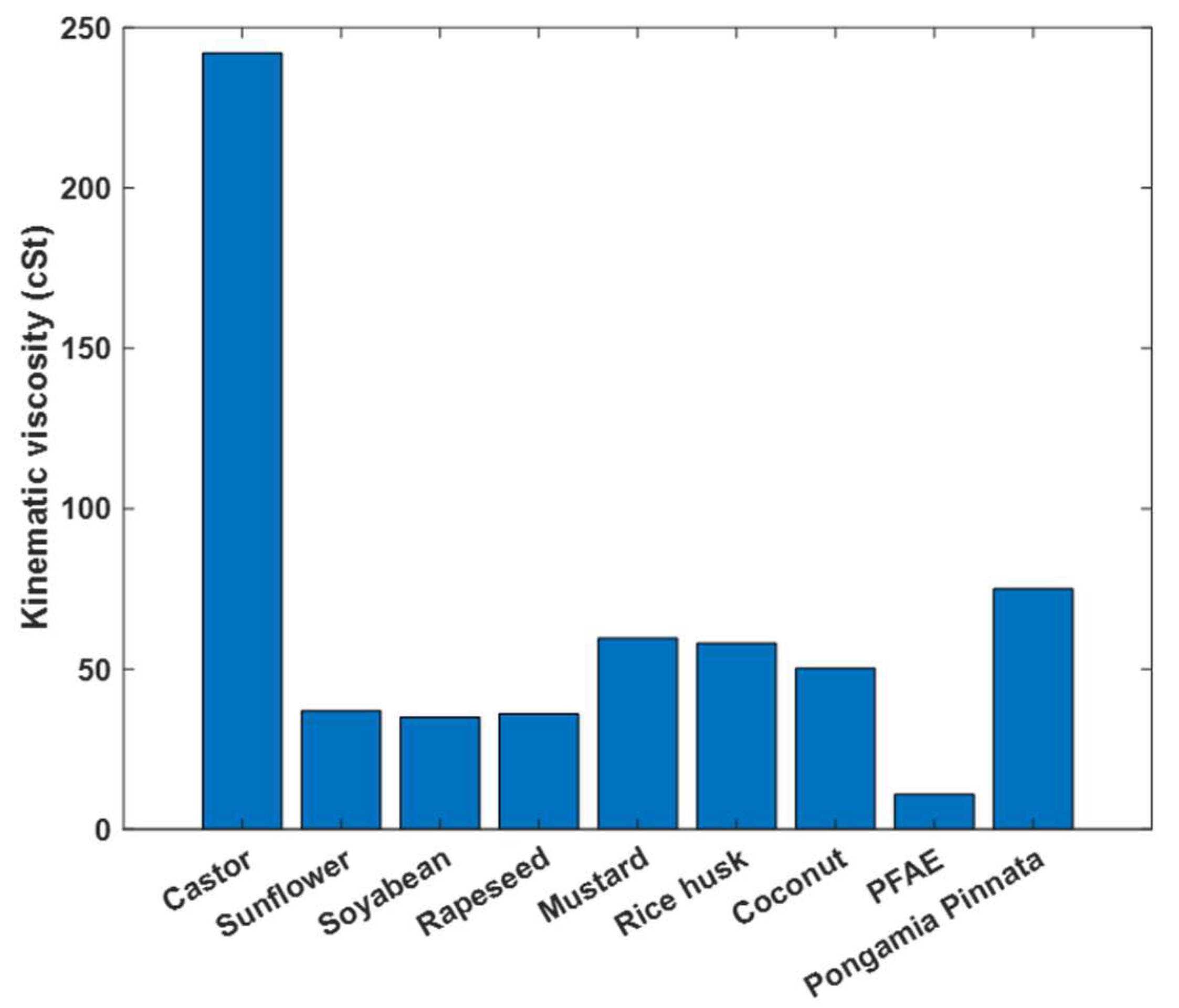
4.3. Kinematic Viscosity
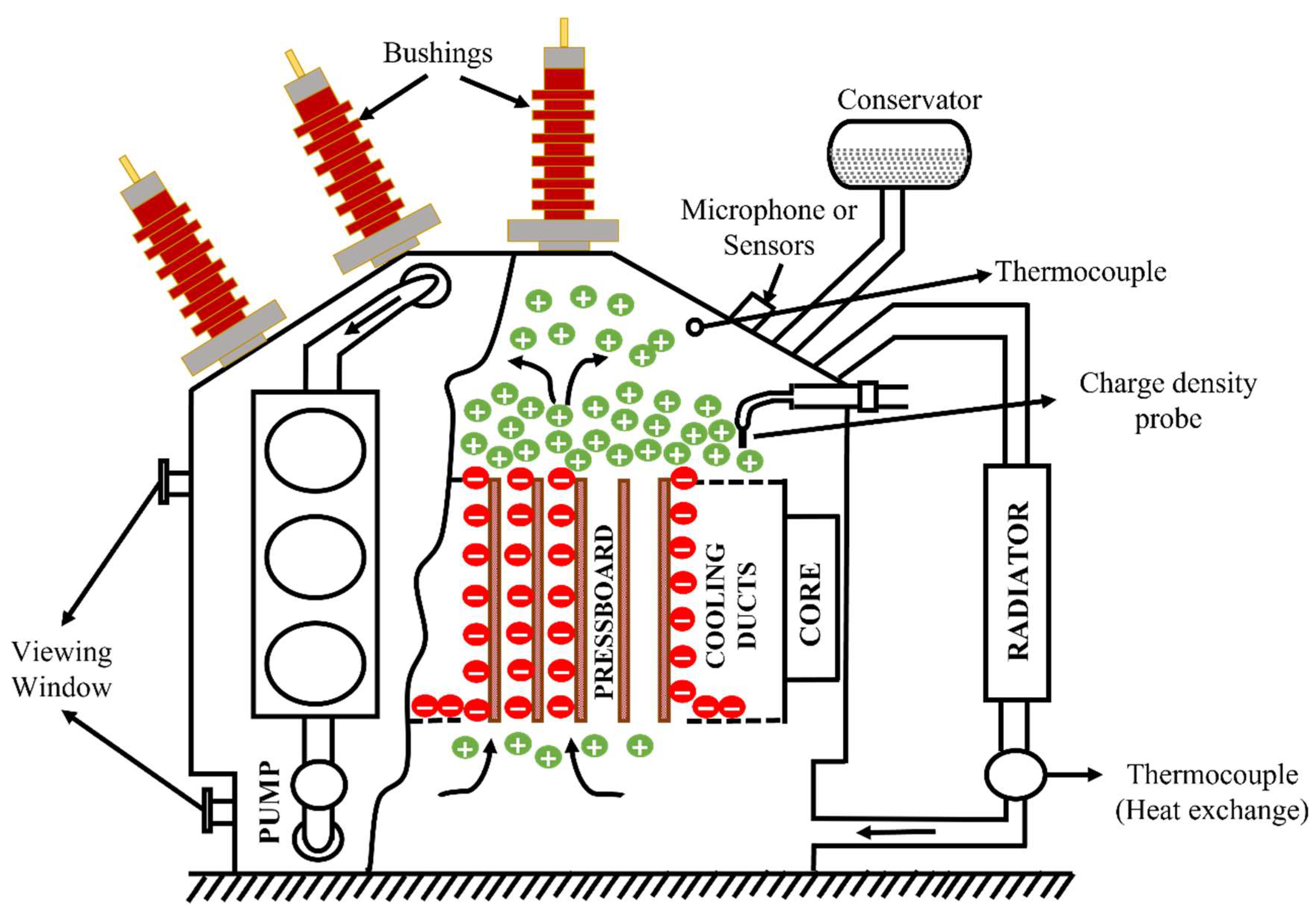
4.4. Flow Electrification
4.5. Dielectric Permittivity and Dissipation Factor
4.6. Flash Point and Fire Point
4.7. Oxidation Stability
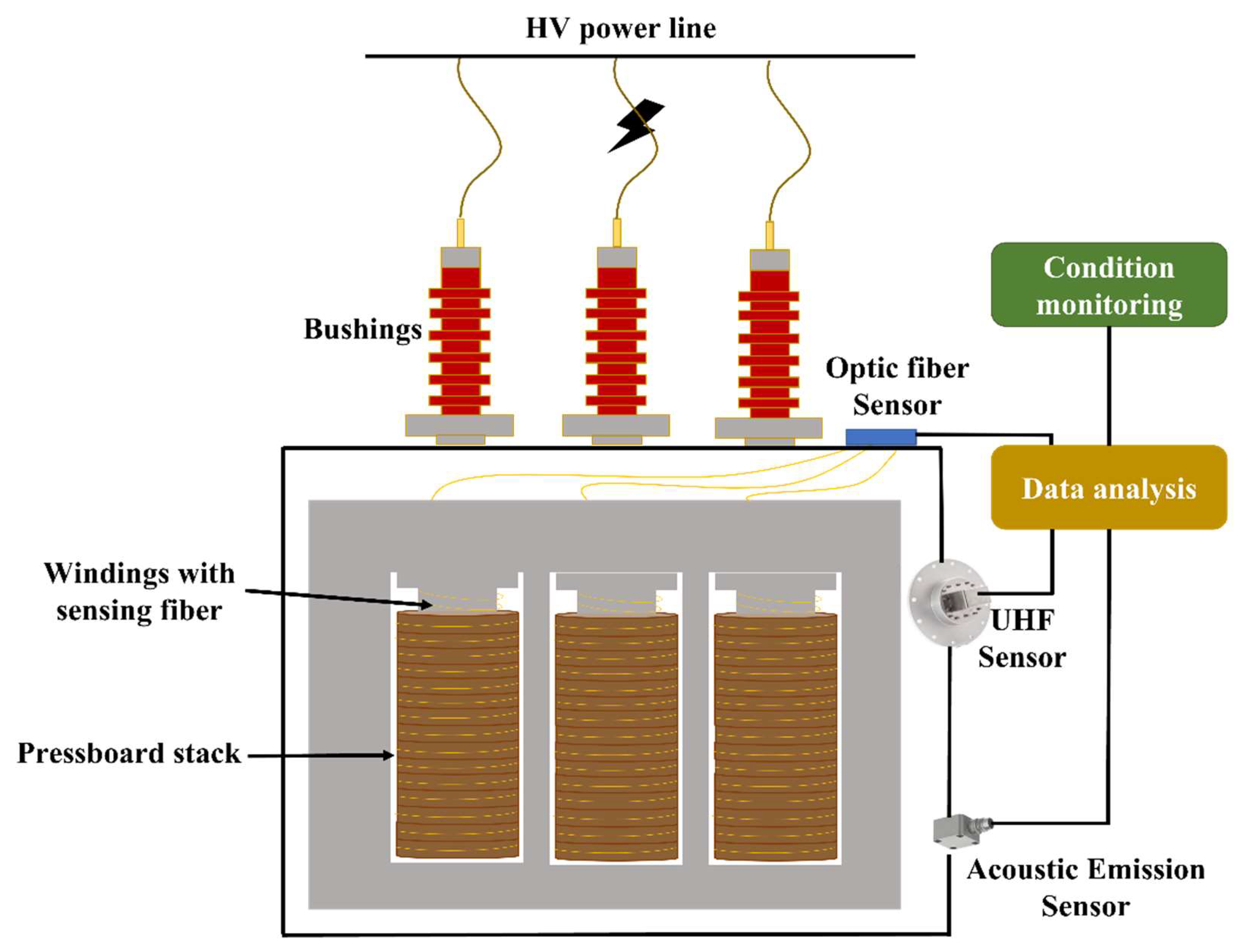
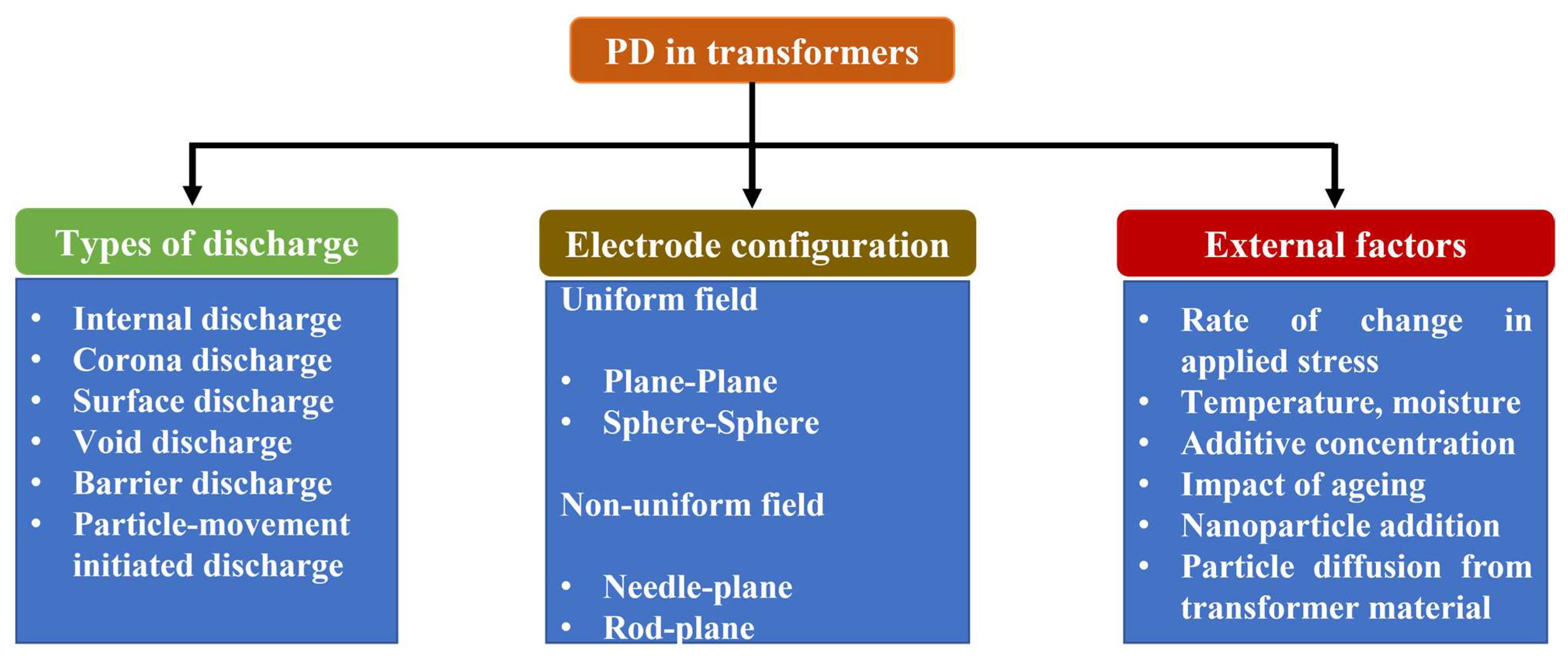
4.8. Partial Discharge
4.9. Breakdown Voltage
4.10. Reclamation and Recycling
4.11. Costs and Environmental Footprint
4.11.1. Cost Comparison
4.11.2. Environmental Footprint Comparison
5. The Next Frontier in Algal Research
- The selection of suitable algal species for the extraction of biofuel is necessary, and their properties should comply with the nominal standards developed for transformers.
- The tangential electrical stress exhibited by algal oils in combination with insulating pressboard/paper insulation illustrates their feasibility with the surrounding dielectric medium inside power transformers.
- Fault mechanisms such as protrusions in windings, particle defects, and surface discharge should be investigated for algal oils in laboratory conditions before their application to real-time power transformers.
- The evolution of gases under fault conditions, such as partial discharge, thermal faults and arcing, should be compared between algal and second-generation biofuels.
- Based on the various observations of algal oils, a separate IEEE/IEC standard should be developed for their precautionary and safe application in power transformers.
6. Future Perspectives and Conclusions
- The precautionary measures followed for second-generation feedstock in transformers should be tested and validated for third-generation feedstock. Considering biodegradability and susceptibility to environmental conditions, the fatty acid composition and lipid content of biofuels from different algal species should be examined to determine a suitable composition and exact composition of an insulating fluid for power transformers.
- Some of the algal bio-oils extracted from different algal species have viscous properties similar to those of oils from vegetable and plant crops. This suggests that algal oils can be used in transformers designed for biodegradable ester fluids, providing a similar heat transfer mechanism between the windings involved in the pressboard stacks. The electrostatic charge separation at the fluid/pressboard interfaces is also a function of viscosity and conductivity, and more investigations on algal oils are required to compare them with oils from second-generation feedstock.
- The flash point and fire point of algal oils are suitable for diesel engine applications, but for their use in power transformers, the limit depends on the algal species, and the maximum value is closer to that of conventional mineral oil. Thus, algal oils could be considered to be under thermal class K, which is lower than thermal class O of second-generation feedstocks. These properties should be considered by insulation engineers before implementing algal-oil-based transformers near load centres.
- Extensive research is needed to determine how the dielectric properties of algal oils, such as permittivity and the dissipation factor, might affect the lifetime of cellulose insulation and fluids inside transformers. Further, the partial discharge and breakdown voltage of the insulating fluid depend on the chemical constituents and stability, which should be researched in algal oils. For the establishment of an IEC or IEEE standard, it is necessary to comprehend how algal oils limit electron avalanche in contrast to second-generation oils. Further, more data are still required on the effects of nominal voltage profiles (AC, DC and +DC), harmonic voltage profiles and transients (impulse voltages and switching surges) on the partial discharge mechanism and breakdown in algal oils under different simulated faulty conditions.
- The oxidation stability of algal oils was found to be higher for species containing DHA, which complies with power transformer standards, and more studies in laboratory conditions could explore their use in either air-forced or sealed-type power transformer units. Accelerated thermal ageing is another important aspect to be understood for algal oils, which can provide information on their degradation mechanism and lifetime inside transformers. The versatility of algal biofuels, pressboard insulation, and design modifications may open the door for green fluid to enter the energy sector, even though their distinct qualities may correspond with feedstocks of the second generation.
Author Contributions
Funding
Data Availability Statement
Conflicts of Interest
References
- Okeke, R.O.; Ibokette, A.I.; Ijiga, O.M.; Enyejo, L.A.; Ebiega, G.I.; Olumubo, O.M. The reliability assessment of power transformers. Eng. Sci. Technol. J. 2024, 5, 1149–1172. [Google Scholar] [CrossRef]
- Nuruzzaman, M.; Nuruzzaman, M.; Limon, G.Q.; Chowdhury, A.R.; Khan, M.M. Predictive Maintenance in Power Transformers: A Systematic Review of AI And IOT Applications. ASRC Procedia Glob. Perspect. Sci. Scholarsh. 2025, 1, 34–47. [Google Scholar]
- Lu, S.; Lu, S.; Fang, M.; Wang, Q.; Huang, L.; Sun, W.; Zhang, Y.; Li, Q.; Zhang, X. Public acceptance investigation for 2 million tons/year flue gas CO2 capture, transportation and oil displacement storage project. Int. J. Greenh. Gas Control. 2021, 111, 103442. [Google Scholar] [CrossRef]
- Lu, S.; Zhao, D.; Cui, W.; Li, Z.; Zhu, Q. CCUS evaluation and simulation in a Chinese oil field. Int. J. Simul. Process Model. 2018, 13, 228–237. [Google Scholar] [CrossRef]
- Dixit, A.; Dixit, A.; Ma, H.; Ekanayake, C.; Daghrah, M.; Saha, T.K. Investigation of Cellulose Insulation Aging in Transformers Retrofilled with Ester Fluids at Different Service Years. IEEE Trans. Dielectr. Electr. Insul. 2024, 31, 2151–2160. [Google Scholar] [CrossRef]
- Fauzi, M.H.; Sahroni, T.R. Analysing the correlation between polychlorinated biphenyl (PCB) content in transformer oil to ensure compliance with environmental regulations. In IOP Conference Series: Earth and Environmental Science; IOP Publishing: Bristol, UK, 2025; Volume 1488, p. 012017. [Google Scholar]
- Amalanathan, A.J.; Sarathi, R.; Zdanowski, M.; Vinu, R.; Nadolny, Z. Review on gassing tendency of different insulating fluids towards transformer applications. Energies 2023, 16, 488. [Google Scholar] [CrossRef]
- Zhang, M.; Zhang, H.; Olajide, T.M.; Cao, W.; Wang, Y.; Zhang, H.; Jiang, Y. Mineral saturated hydrocarbons and mineral aromatic hydrocarbons in tropical plant oils and their removal by molecular distillation. J. Am. Oil Chem. Soc. 2023, 100, 95–106. [Google Scholar] [CrossRef]
- Wang, X.; Tang, C.; Huang, B.; Hao, J.; Chen, G. Review of research progress on the electrical properties and modification of mineral insulating oils used in power transformers. Energies 2018, 11, 487. [Google Scholar] [CrossRef]
- Madavan, R.; Saroja, S.; Karthick, A.; Murugesan, S.; Mohanavel, V.; Velmurugan, P.; Al Obaid, S.; Alfarraj, S.; Sivakumar, S. Performance analysis of mixed vegetable oil as an alternative for transformer insulation oil. Biomass Convers. Biorefinery 2025, 15, 1939–1944. [Google Scholar] [CrossRef]
- Pompili, M.; Calcara, L.; Sangiovanni, S.; Scatiggio, F.; Mazzaro, M.; De Bartolomeo, D. Natural esters and mineral oils fire behavior. In 2018 IEEE 2nd International Conference on Dielectrics (ICD); IEEE: New York, NY, USA, 2018; pp. 1–4. [Google Scholar]
- Selva, A.M.; Azis, N.; Ab Kadir, M.Z.A.; Jasni, J.; Zainuddin, H.; Yousof, M.M. Morphological study on corrosive sulphur development in transformer windings. In 2024 IEEE 4th International Conference in Power Engineering Applications (ICPEA); IEEE: New York, NY, USA, 2024; pp. 197–200. [Google Scholar]
- Rozga, P.; Rao, U.M.; Fofana, I.; Beroual, A.; Calcara, L.; Pompili, M.; Wang, F.; Casserly, E.; Martin, R.; Malde, J. Next-Generation Ester Dielectric Liquids: Some Key Findings and Perspectives. IEEE Electr. Insul. Mag. 2024, 40, 23–35. [Google Scholar] [CrossRef]
- Bakrutheen, M.; Iruthayarajan, M.W.; Narayani, A. Statistical failure reliability analysis on edible and non-edible natural esters based liquid insulation for the applications in high voltage transformers. IEEE Trans. Dielectr. Electr. Insul. 2018, 25, 1579–1586. [Google Scholar] [CrossRef]
- Rathore, D.; Sevda, S.; Prasad, S.; Venkatramanan, V.; Chandel, A.K.; Kataki, R.; Bhadra, S.; Channashettar, V.; Bora, N.; Singh, A. Bioengineering to accelerate biodiesel production for a sustainable biorefinery. Bioengineering 2022, 9, 618. [Google Scholar] [CrossRef] [PubMed]
- Amalanathan, A.J.; Sarathi, R.; Harid, N.; Griffiths, H. Degradation Assessment of Ester Liquids. In Alternative Liquid Dielectrics for High Voltage Transformer Insulation Systems: Performance Analysis and Applications; John Wiley & Sons: Hoboken, NJ, USA, 2021; pp. 85–125. [Google Scholar]
- Mehta, D.M.; Kundu, P.; Chowdhury, A.; Lakhiani, V.K.; Jhala, A.S. A review on critical evaluation of natural ester vis-a-vis mineral oil insulating liquid for use in transformers: Part 1. IEEE Trans. Dielectr. Electr. Insul 2016, 23, 873–880. [Google Scholar] [CrossRef]
- Arief, Y.Z.; Ahmad, M.H.; Lau, K.Y.; Muhamad, N.A.; Bashir, N.; Mohd, N.K.; Huey, L.W.; Kiat, Y.S.; Azli, S.A. A comparative study on the effect of electrical ageing on electrical properties of palm fatty acid ester (PFAE) and FR3 as dielectric materials. In 2014 IEEE International Conference on Power and Energy (PECon); IEEE: New York, NY, USA, 2014; pp. 128–133. [Google Scholar]
- Gómez, N.A.; Wilhelm, H.M.; Santos, C.C.; Stocco, G.B. Dissolved gas analysis (DGA) of natural ester insulating fluids with different chemical compositions. IEEE Trans. Dielectr. Electr. Insul. 2014, 21, 1071–1078. [Google Scholar] [CrossRef]
- Rozga, P.; Beroual, A.; Przybylek, P.; Jaroszewski, M.; Strzelecki, K. A review on synthetic ester liquids for transformer applications. Energies 2020, 13, 6429. [Google Scholar] [CrossRef]
- Oparanti, S.O.; Obebe, E.O.; Fofana, I.; Jafari, R. A State-of-the-Art Review on the Potential of Waste Cooking Oil as a Sustainable Insulating Liquid for Green Transformers. Appl. Sci. 2025, 15, 7631. [Google Scholar] [CrossRef]
- Shah, R.; Huang, C.; Karmakar, G.; Erhan, S.Z.; Sarker, M.I.; Sharma, B.K. Potential of Natural Esters as Immersion Coolant in Electric Vehicles. Energies 2025, 18, 4145. [Google Scholar] [CrossRef]
- Pukel, G.J.; Fleck, G.; Pregartner, H.; Fritsche, R. Safe and environmentally friendly large power transformers with ester successful introduction of ester liquids at the 420 kV transmission level. In 2016 IEEE Electrical Insulation Conference (EIC); IEEE: New York, NY, USA, 2016; pp. 134–137. [Google Scholar]
- Shinde, P.U.; Khanvilkar, N.R.; Kale, P.S.; Borude, C.B. Modernization of Transformer Insulation with Ester Oil by Replacing Mineral Oil. In 2026 International Conference on Intelligent and Innovative Technologies in Computing, Electrical and Electronics (IITCEE); IEEE: New York, NY, USA, 2026; pp. 1–5. [Google Scholar]
- Ouyang, B.; Zhang, G.; Liu, W.; Qiu, S.; Ding, W.; Zhang, Z.; Su, H. A method for predicting the gel point of mixed crude oil based on deep learning. In 2024 International Conference on Image Processing, Computer Vision and Machine Learning (ICICML); IEEE: New York, NY, USA, 2024; pp. 1546–1549. [Google Scholar]
- Amalanathan, A.J.; Vasa, N.J.; Harid, N.; Griffiths, H.; Sarathi, R. Classification of thermal ageing impact of ester fluid-impregnated pressboard material adopting LIBS. High Volt. 2021, 6, 655–664. [Google Scholar] [CrossRef]
- Khanali, M.; Jayaram, S. A study on PD activities of oil-impregnated paper under pulse voltages using gas analysis. IEEE Trans. Dielectr. Electr. Insul. 2017, 24, 2503–2510. [Google Scholar] [CrossRef]
- Kyere, I.K.; Walker, J.J. Partial discharge pattern characterization of different defects using 3D phase resolved technique. In 2014 ICHVE International Conference on High Voltage Engineering and Application; IEEE: New York, NY, USA, 2014; pp. 1–4. [Google Scholar]
- Han, S.J.; Zinkweg, D.B.; Cogen, J.M.; Gluck, S. Algae Oil Based Dielectric Fluid for Electrical Components. U.S. Patent 8,580,160, 11 December 2013. [Google Scholar]
- Farfan-Cabrera, L.I.; Franco-Morgado, M.; Gonzalez-Sanchez, A.; Pérez-González, J.; Marin-Santibanez, B.M. Microalgae biomass as a new potential source of sustainable green lubricants. Molecules 2022, 27, 1205. [Google Scholar] [CrossRef]
- Dow and Solazlyme Enter Contingent Agreement for Dielectric Insulating Fluids. Available online: https://www.utilityproducts.com/safety/article/16022398/dow-and-solazlyme-enter-contingent-agreement-for-dielectric-insulating-fluids (accessed on 15 May 2012).
- Borowitzka, M.A.; Moheimani, N.R. Algae for Biofuels and Energy; Springer: Dordrecht, The Netherlands, 2013; Volume 5, pp. 133–152. [Google Scholar]
- Ruffing, A.M.; Davis, R.W.; Lane, T.W. Advances in engineering algae for biofuel production. Curr. Opin. Biotechnol. 2022, 78, 102830. [Google Scholar] [CrossRef]
- Demirbas, A.; Demirbas, M.F. Importance of algae oil as a source of biodiesel. Energy Convers. Manag. 2011, 52, 163–170. [Google Scholar] [CrossRef]
- Demirbaş, A. Production of biodiesel from algae oils. Energy Sources Part A Recovery Util. Environ. Eff. 2008, 31, 163–168. [Google Scholar]
- Devi, A.; Saran, C.; Ferreira, L.F.R.; Mulla, S.I.; Bharagava, R.N. Sustainable approaches to algal biofuels: Opportunities, key challenges and current status. In Value Added Products from Bioalgae Based Biorefineries: Opportunities and Challenges; Springer Nature: Singapore, 2024; pp. 163–188. [Google Scholar]
- Abimbola, T.; Christodoulatos, C.; Lawal, A. Performance and optimization studies of oil extraction from Nannochloropsis spp. and Scenedesmus obliquus. J. Clean. Prod. 2021, 311, 127295. [Google Scholar] [CrossRef]
- Aravind, S.; Barik, D.; Ashok, N. Optimization of Oil Yield from the Macro Algae Spirogyra by Solvent Extraction Process Using RSM and ANN. Int. J. Photoenergy 2022, 2022, 3690635. [Google Scholar] [CrossRef]
- Weyer, K.M.; Bush, D.R.; Darzins, A.; Willson, B.D. Theoretical maximum algal oil production. Bioenergy Res. 2010, 3, 204–213. [Google Scholar] [CrossRef]
- Ranjith Kumar, R.; Hanumantha Rao, P.; Arumugam, M. Lipid extraction methods from microalgae: A comprehensive review. Front. Energy Res. 2015, 2, 61. [Google Scholar] [CrossRef]
- Gorgich, M.; Mata, T.M.; Martins, A.A.; Branco-Vieira, M.; Caetano, N.S. Comparison of different lipid extraction procedures applied to three microalgal species. Energy Rep. 2020, 6, 477–482. [Google Scholar] [CrossRef]
- Zhou, X.; Jin, W.; Tu, R.; Guo, Q.; Han, S.F.; Chen, C.; Wang, Q.; Liu, W.; Jensen, P.D.; Wang, Q. Optimization of microwave assisted lipid extraction from microalga Scenedesmus obliquus grown on municipal wastewater. J. Clean. Prod. 2019, 221, 502–508. [Google Scholar] [CrossRef]
- Rahman, M.M.; Hosano, N.; Hosano, H. Recovering microalgal bioresources: A review of cell disruption methods and extraction technologies. Molecules 2022, 27, 2786. [Google Scholar] [CrossRef]
- Mubarak, M.; Shaija, A.; Suchithra, T.V. A review on the extraction of lipid from microalgae for biodiesel production. Algal Res. 2015, 7, 117–123. [Google Scholar] [CrossRef]
- Azizi, K.; Moraveji, M.K.; Najafabadi, H.A. A review on bio-fuel production from microalgal biomass by using pyrolysis method. Renew. Sustain. Energy Rev. 2018, 82, 3046–3059. [Google Scholar] [CrossRef]
- Morais, M.G.; Cassuriaga, A.P.A.; Cruz, C.G.; Moraes, L.; Costa, J.A.V. Metabolism of microalgae and metabolic engineering for biomaterial applications. In Algae-Based Biomaterials for Sustainable Development; Elsevier: Amsterdam, The Netherlands, 2022; pp. 1–20. [Google Scholar]
- Chen, W.H.; Lin, B.J.; Huang, M.Y.; Chang, J.S. Thermochemical conversion of microalgal biomass into biofuels: A review. Bioresour. Technol. 2015, 184, 314–327. [Google Scholar] [CrossRef] [PubMed]
- Ağbulut, Ü.; Sirohi, R.; Lichtfouse, E.; Chen, W.H.; Len, C.; Show, P.L.; Le, A.T.; Nguyen, X.P.; Hoang, A.T. Microalgae bio-oil production through pyrolysis and hydrothermal liquefaction: Mechanism and characteristics. Bioresour. Technol. 2023, 128860. [Google Scholar] [CrossRef] [PubMed]
- Brindhadevi, K.; Anto, S.; Rene, E.R.; Sekar, M.; Mathimani, T.; Chi, N.T.L.; Pugazhendhi, A. Effect of reaction temperature on the conversion of algal biomass to bio-oil and biochar through pyrolysis and hydrothermal liquefaction. Fuel 2021, 285, 119106. [Google Scholar] [CrossRef]
- Gautam, R.; Varma, A.K.; Vinu, R. Apparent kinetics of fast pyrolysis of four different microalgae and product analyses using pyrolysis-FTIR and pyrolysis-GC/MS. Energy Fuels 2017, 31, 12339–12349. [Google Scholar] [CrossRef]
- Shan Ahamed, T.; Anto, S.; Mathimani, T.; Brindhadevi, K.; Pugazhendhi, A. Upgrading of bio-oil from thermochemical conversion of various biomass—Mechanism, challenges and opportunities. Fuel 2021, 287, 119329. [Google Scholar] [CrossRef]
- Katongtung, T.; Phromphithak, S.; Onsree, T.; Tippayawong, N.; Lauterbach, J. Bio-oil production from hydrothermal liquefaction of Pennisetum purpureum × Pennisetum typhoideum. Energy Rep. 2022, 8, 1170–1176. [Google Scholar] [CrossRef]
- Ahmed, S.F.; Rafa, S.J.; Mehjabin, A.; Tasannum, N.; Ahmed, S.; Mofijur, M.; Lichtfouse, E.; Almomani, F.; Badruddin, I.A.; Kamangar, S. Bio-oil from microalgae: Materials, production, technique, and future. Energy Rep. 2023, 10, 3297–3314. [Google Scholar] [CrossRef]
- Li, D.; Chen, L.; Xu, D.; Zhang, X.; Ye, N.; Chen, F.; Chen, S. Preparation and characteristics of bio-oil from the marine brown alga Sargassum patens C. Agardh. Bioresour. Technol. 2012, 104, 737–742. [Google Scholar] [CrossRef]
- Saber, M.; Nakhshiniev, B.; Yoshikawa, K. A review of production and upgrading of algal bio-oil. Renew. Sustain. Energy Rev. 2016, 58, 918–930. [Google Scholar] [CrossRef]
- Shuping, Z.; Yulong, W.; Mingde, Y.; Kaleem, I.; Chun, L.; Tong, J. Production and characterization of bio-oil from hydrothermal liquefaction of microalgae Dunaliella tertiolecta cake. Energy 2010, 35, 5406–5411. [Google Scholar] [CrossRef]
- Zou, S.; Wu, Y.; Yang, M.; Li, C.; Tong, J. Bio-oil production from sub-and supercritical water liquefaction of microalgae Dunaliella tertiolecta and related properties. Energy Environ. Sci. 2010, 3, 1073–1078. [Google Scholar] [CrossRef]
- Hu, Z.; Zheng, Y.; Yan, F.; Xiao, B.; Liu, S. Bio-oil production through pyrolysis of blue-green algae blooms (BGAB): Product distribution and bio-oil characterization. Energy 2013, 52, 119–125. [Google Scholar] [CrossRef]
- Han, J.; Li, X.; Kong, S.; Xian, G.; Li, H.; Li, X.; Li, J.; Zhang, J.; Meng, H.; Wang, H.; et al. Characterization of column chromatography separated bio-oil obtained from hydrothermal liquefaction of Spirulina. Fuel 2021, 297, 120695. [Google Scholar] [CrossRef]
- Choia, J.H.; Woob, H.C.; Suha, D.J. Pyrolysis of seaweeds for bio-oil and bio-char production. Chem. Eng. 2014, 37, 121–126. [Google Scholar]
- Wang, S.; Wang, Q.; Jiang, X.; Han, X.; Ji, H. Compositional analysis of bio-oil derived from pyrolysis of seaweed. Energy Convers. Manag. 2013, 68, 273–280. [Google Scholar] [CrossRef]
- IEC 61203; Synthetic Organic Esters for Electrical Purposes—Guide for Maintenance of Transformer Esters in Equipment. International Electrotechnical Commission (IEC): Geneva, Switzerland, 1992.
- IEEE C57.147; Guide for Acceptance and Maintenance of Natural Ester Insulating Liquid in Transformers. IEEE: New York, NY, USA, 2018.
- Rafiq, M.; Lv, Y.Z.; Zhou, Y.; Ma, K.B.; Wang, W.; Li, C.R.; Wang, Q. Use of vegetable oils as transformer oils–a review. Renew. Sustain. Energy Rev. 2015, 52, 308–324. [Google Scholar] [CrossRef]
- Wilhelm, H.M.; Franch, V.; Tulio, L.; Franch, A.F. Compatibility of transformer construction materials with natural ester-based insulating fluids. IEEE Trans. Dielectr. Electr. Insul. 2015, 22, 2703–2708. [Google Scholar] [CrossRef]
- Dai, J.; Wang, Z.D. A comparison of the impregnation of cellulose insulation by ester and mineral oil. IEEE Trans. Dielectr. Electr. Insul. 2008, 15, 374–381. [Google Scholar] [CrossRef]
- Jankovic, J.; Lukic, J.; Planojevic, J.; Kolarski, D.; Janackovic, D. Application of highly selective adsorbent in the removal of elemental sulfur and other corrosive sulfur compounds from mineral insulating oils. IEEE Trans. Dielectr. Electr. Insul. 2022, 29, 54–61. [Google Scholar] [CrossRef]
- Amalanathan, A.J.; Sarathi, R.; Prakash, S.; Mishra, A.K.; Gautam, R.; Vinu, R. Investigation on thermally aged natural ester oil for real-time monitoring and analysis of transformer insulation. High Volt. 2020, 5, 209–217. [Google Scholar] [CrossRef]
- ASTM D1934-95; Standard Test Method for Oxidative Aging of Electrical Insulating Petroleum Oils by Open-Beaker Method. ASTM International: West Conshohocken, PA, USA, 2012.
- IEC TS 62332-2; Electrical Insulation Systems (EIS)—Thermal Evaluation of Combined Liquid and Solid Components—Part 2: Simplified Test. International Electrotechnical Commission (IEC): Geneva, Switzerland, 2014.
- Kano, T.; Suzuki, T.; Oba, R.; Kanetani, A.; Koide, H. Study on the oxidative stability of palm fatty acid ester (PFAE) as an insulating oil for transformers. In 2012 IEEE International Symposium on Electrical Insulation; IEEE: New York, NY, USA, 2012; pp. 22–25. [Google Scholar]
- Abderrazzaq, M.H.; Hijazi, F. Impact of multi-filtration process on the properties of olive oil as a liquid dielectric. IEEE Trans. Dielectr. Electr. Insul. 2012, 19, 1673–1680. [Google Scholar] [CrossRef]
- Thanigaiselvan, R.; Raja, T.S.R.; Karthik, R. Investigations on eco friendly insulating fluids from rapeseed and pongamia pinnata oils for power transformer applications. J. Electr. Eng. Technol. 2015, 10, 2348–2355. [Google Scholar] [CrossRef]
- Naik, M.; Meher, L.C.; Naik, S.N.; Das, L.M. Production of biodiesel from high free fatty acid Karanja (Pongamia pinnata) oil. Biomass Bioenergy 2008, 32, 354–357. [Google Scholar] [CrossRef]
- Totzauer, P.; Trnka, P. Different ways to improve natural ester oils. Transp. Res. Proc. 2019, 40, 102–106. [Google Scholar] [CrossRef]
- Das, A.K.; Shill, D.C.; Chatterjee, S. Potential of coconut oil as a dielectric liquid in distribution transformers. IEEE Electr. Insul. Mag. 2020, 36, 36–46. [Google Scholar] [CrossRef]
- Kostik, V.; Memeti, S.; Bauer, B. Fatty acid composition of edible oils and fats. J. Hyg. Eng. Des. 2013, 4, 112–116. [Google Scholar]
- Vishnupriya, M.; Ramesh, K.; Sivakumar, P.; Balasubramanian, R.; Sircar, A. Kinetic and thermodynamic studies on the extraction of bio oil from Chlorella vulgaris and the subsequent biodiesel production. Chem. Eng. Commun. 2019, 206, 409–418. [Google Scholar]
- Wang, G.; Wang, T. Characterization of lipid components in two microalgae for biofuel application. J. Am. Oil Chem. Soc. 2012, 89, 135–143. [Google Scholar] [CrossRef]
- Ma, X.N.; Chen, T.P.; Yang, B.; Liu, J.; Chen, F. Lipid production from Nannochloropsis. Mar. Drugs 2016, 14, 61. [Google Scholar] [CrossRef]
- Huervana, F.H.; Dionela, C.S.; de la Torre, E.D.S.; del Castillo, C.S.; Traifalgar, R.F.M. Utilization of marine diatom Thalassiosira weissflogii as a feed additive in seawater-tolerant Nile tilapia (Oreochromis niloticus, Linnaeus 1758) strain. Front. Sustain. Food Syst. 2022, 6, 1052951. [Google Scholar] [CrossRef]
- Hartati, R.; Endrawati, H.; Mamuaja, J. Fatty acid composition of marine microalgae in Indonesia. J. Trop. Biol. Conserv. 2013, 10, 75–82. [Google Scholar]
- Nayak, M.; Karemore, A.; Sen, R. Sustainable valorization of flue gas CO2 and wastewater for the production of microalgal biomass as a biofuel feedstock in closed and open reactor systems. RSC Adv. 2016, 6, 91111–91120. [Google Scholar] [CrossRef]
- CIGRE Working Group A 2.35. Experiences in Service with New Insulating Liquids; CIGRE: Paris, France, 2010; ISBN 978-2-85873-124-4. [Google Scholar]
- Organization for Economic Cooperation and Development. OECD Guideline for Testing of Chemicals; The Organisation for Economic Co-operation and Development: Paris, France, 2005; pp. 1–13. [Google Scholar]
- Zabielska-Matejuk, J.; Stangierska, A.; Grabińska-Sota, E.; Czaczyk, K.; Drożdzyńska, A. Biodegradation of new ionic liquid-based wood preservatives in soil and water environments. Wood. Res. Pap. Rep. Announc. 2016, 59, 5–18. [Google Scholar] [CrossRef]
- He, M.; Mei, C.F.; Sun, G.P.; Li, H.B.; Liu, L.; Xu, M.Y. The Effects of Molecular Properties on Ready Biodegradation of Aromatic Compounds in the OECD 301B CO2 Evolution Test. Arch. Environ. Contam. Toxicol. 2016, 71, 133–145. [Google Scholar] [CrossRef]
- Kayashima, T.; Taruki, M.; Katagiri, K.; Nabeoka, R.; Yoshida, T.; Tsuji, T. Comparison of biodegradation performance of OECD test guideline 301C with that of other ready biodegradability tests. Environ. Toxicol. Chem. 2014, 33, 328–333. [Google Scholar] [CrossRef]
- Friedrich, J.; Längin, A.; Kümmerer, K. Comparison of an Electrochemical and Luminescence-Based Oxygen Measuring System for Use in the Biodegradability Testing According to Closed Bottle Test (OECD 301D). CLEAN–Soil Air Water 2013, 41, 251–257. [Google Scholar] [CrossRef]
- Thanekar, P.; Murugesan, P.; Gogate, P.R. Improvement in biological oxidation process for the removal of dichlorvos from aqueous solutions using pretreatment based on Hydrodynamic Cavitation. J. Water Proc. Eng. 2018, 23, 20–26. [Google Scholar] [CrossRef]
- Klein, J.; Łuczak, J.; Brillowska-Dąbrowska, A. Role of Fungi in Biodegradation of Imidazolium Ionic Liquids by Activated Sewage Sludge. Molecules 2023, 28, 1268. [Google Scholar] [CrossRef]
- Tokunaga, J.; Nikaido, M.; Koide, H.; Hikosaka, T. Palm fatty acid ester as biodegradable dielectric fluid in transformers: A review. IEEE Electr. Insul. Mag. 2019, 35, 34–46. [Google Scholar] [CrossRef]
- Haus, F.; German, J.; Junter, G.A. Primary biodegradability of mineral base oils in relation to their chemical and physical characteristics. Chemosphere 2001, 45, 983–990. [Google Scholar] [CrossRef]
- Lehmann, R.G.; Miller, J.R.; Kozerski, G.E. Degradation of silicone polymer in a field soil under natural conditions. Chemosphere 2000, 41, 743–749. [Google Scholar] [CrossRef] [PubMed]
- Oommen, T.V.; Claiborne, C.C.; Mullen, J.T. Biodegradable electrical insulation fluids. In Proceedings: Electrical Insulation Conference and Electrical Manufacturing and Coil Winding Conference; IEEE: New York, NY, USA, 1997; pp. 465–468. [Google Scholar]
- Bošnjaković, M. Biodiesel from algae. J. Mech. Eng. Automat. 2013, 3, 179–188. [Google Scholar]
- Shi, B.; Lortscher, P.; Palfery, D. Algal biomass anaerobic biodegradability. J. Appl. Phycol. 2013, 25, 757–761. [Google Scholar] [CrossRef]
- Asano, R.; Page, S.A. Reducing environmental impact and improving safety and performance of power transformers with natural ester dielectric insulating fluids. IEEE Trans. Ind. Appl. 2013, 50, 134–141. [Google Scholar] [CrossRef]
- Gockenbach, E.; Borsi, H. Performance and new application of ester liquids. In Proceedings of 2002 IEEE 14th International Conference on Dielectric Liquids. ICDL 2002 (Cat. No. 02CH37319); IEEE: New York, NY, USA, 2012; pp. 203–206. [Google Scholar]
- ASTM D445; Standard Test Method for Kinematic Viscosity of Transparent and Opaque Liquids (and Calculation of Dynamic Viscosity). ASTM International: West Conshohocken, PA, USA, 2015.
- Amalanathan, A.J.; Sarathi, R.; Sarkar, B.; Gardas, R.L.; Harid, N.; Griffiths, H. Impact of silver sulfide on rheology and streaming electrification of mineral oil and mixed fluid. J. Electrostat. 2022, 119, 103747. [Google Scholar] [CrossRef]
- Amizhtan, S.K.; Amalanathan, A.J.; Babu, M.S.; Sarathi, R.; Kumar, G.; Sangwai, J.S.; Edin, H.; Taylor, N. Experimental Study and ANN Analysis of Rheological Behavior of Mineral Oil-Based SiO2 Nanofluids. IEEE Trans. Dielectr. Electr. Insul. 2022, 29, 956–964. [Google Scholar] [CrossRef]
- Chen, S.; Ding, J.; Ou, C.; Zhang, C.; Yang, H.; Liu, Z.; Li, X. New measurement method of viscosity, density, and dielectric constant of transformer oil based on quartz tuning fork. IEEE Sens. J. 2022, 22, 16711–16718. [Google Scholar] [CrossRef]
- Singha, S.; Asano, R.; Frimpong, G.; Claiborne, C.C.; Cherry, D. Comparative aging characteristics between a high oleic natural ester dielectric liquid and mineral oil. IEEE Trans. Dielectr. Electr. Insul. 2014, 21, 149–158. [Google Scholar] [CrossRef]
- Gao, C.; Ye, W.; Xu, Q.; Zhu, M.; Zhu, W.; Hao, J. Influence of replacing oil with different natural esters on the thermal ageing behavior of mineral oil-paper insulation. In 2021 International Conference on Electrical Materials and Power Equipment (ICEMPE); IEEE: New York, NY, USA, 2021; pp. 1–4. [Google Scholar]
- Nadolny, Z.; Dombek, G. Thermal properties of mixtures of mineral oil and natural ester in terms of their application in the transformer. In E3S Web of Conferences; EDP Sciences: Les Ulis, France, 2017; Volume 19, p. 01040. [Google Scholar]
- De Bellis, G.; Calcara, L.; Pompili, M.; Sarto, M.S. Temperature dependence of the shear viscosity of mineral oils and natural esters. In 2019 IEEE 20th International Conference on Dielectric Liquids (ICDL); IEEE: New York, NY, USA, 2019; pp. 1–4. [Google Scholar]
- Rao, U.M.; Fofana, I.; Rozga, P.; Beroual, A.; Malde, J.; Martin, R.; Wang, F.; Casserly, E.; Pompili, M.; Calcara, L. Next Generation Insulating Liquids Prepared by the International working Group of IEEE DEIS Technical Committee on Liquid Dielectrics. In 2022 IEEE 21st International Conference on Dielectric Liquids (ICDL); IEEE: New York, NY, USA, 2022; pp. 1–4. [Google Scholar]
- Viertel, J.; Ohlsson, K.; Singha, S. Thermal aging and degradation of thin films of natural ester dielectric liquids. In 2011 IEEE International Conference on Dielectric Liquids; IEEE: New York, NY, USA, 2011. [Google Scholar]
- Yusof, S.M.; Hussin, N.; Isa, M. Viscosity reduction of palm oil via ultrasonic radiation. Appl. Mech. Mater. 2015, 785, 315–319. [Google Scholar] [CrossRef]
- Ahmed, M.R.; Islm, M.S.; Karmaker, A.K. Experimental investigation of electrical and thermal properties of vegetable oils for used in transformer. In 2021 International Conference on Automation, Control and Mechatronics for Industry 4.0 (ACMI); IEEE: New York, NY, USA, 2021; pp. 1–4. [Google Scholar]
- Chen, B.; Su, Z.; Du, Z.; Ma, M.; Zhang, J.; Tang, C. A new type of mixed vegetable insulating oil with better kinematic viscosity and oxidation stability. J. Mol. Liq. 2022, 360, 119512. [Google Scholar] [CrossRef]
- Mariprasath, T.; Kirubakaran, V. Pongamia pinnata as alternate liquid dielectrics in distribution transformer: A critical study on the property of viscosity. Adv. Energy. Power 2015, 3, 1–7. [Google Scholar] [CrossRef]
- Srinivasa, D.M.; Surendra, U. Comparative study of breakdown phenomena and viscosity in liquid dielectrics. In 2019 Innovations in Power and Advanced Computing Technologies (i-PACT); IEEE: New York, NY, USA, 2019; Volume 1, pp. 1–4. [Google Scholar]
- Zheng, H.; Feng, Y.; Li, X.; Yang, H.; Lv, W.; Li, S. Investigation on molecular dynamics simulation for predicting kinematic viscosity of natural Ester insulating oil. IEEE Trans. Dielectr. Electr. Insul. 2022, 29, 1882–1888. [Google Scholar] [CrossRef]
- Velandy, J.; Garg, A.; Narasimhan, C.S. Continuous thermal overloading capabilities of ester oil transformers in oil directed cooling conditions. In 2020 IEEE 9th Power India International Conference (PIICON); IEEE: New York, NY, USA, 2020; pp. 1–7. [Google Scholar]
- Velandy, J.; Garg, A.; Narasimhan, C.S. Prediction of static pressure drop, velocity and flow rate of higher viscous nature of ester oil in power transformers under oil directed cooling conditions. In 2020 IEEE 9th Power India International Conference (PIICON); IEEE: New York, NY, USA, 2020; pp. 1–8. [Google Scholar]
- Zheng, H.; Feng, Y.; Lv, W.; Yang, H.; Li, X. Unraveling Weak Interaction of Kinematic Viscosity of Fatty Acid Methyl Esters in Natural Ester Insulating Oils. IEEE Trans. Dielectr. Electr. Insul. 2023, 30, 528–535. [Google Scholar] [CrossRef]
- Girgis, R.; Bernesjo, M.; Frimpong, G.K. Detailed performance of a 50 MVA transformer filled with a natural ester fluid versus mineral oil. Water Eenrgy Int. 2011, 68, 66. [Google Scholar]
- Martin, D.; Wijaya, J.; Lelekakis, N.; Susa, D.; Heyward, N. Thermal analysis of two transformers filled with different oils. IEEE Electr. Insul. Mag. 2014, 30, 39–45. [Google Scholar] [CrossRef]
- Paisan, S.; Chetpattananondh, P.; Chongkhong, S. Assessment of water degumming and acid degumming of mixed algal oil. J. Environ. Chem. Eng. 2017, 5, 5115–5123. [Google Scholar] [CrossRef]
- Fofana, I.; Wasserberg, V.; Borsi, H.; Gockenbach, E. Challenge of mixed insulating liquids for use in high-voltage transformers. 1. Investigation of mixed liquids. IEEE Electr. Insul. Mag. 2002, 18, 18–31. [Google Scholar] [CrossRef]
- Lyutikova, M.N.; Korobeynikov, S.M.; Rao, U.M.; Fofana, I. Mixed insulating liquids with mineral oil for high-voltage transformer applications: A review. IEEE Trans. Dielectr. Electr. Insul. 2022, 29, 454–461. [Google Scholar] [CrossRef]
- Veeranan, T.; Kasirajaan, R.; Gurunathan, B.; Sahadevan, R. A novel approach for extraction of algal oil from marine macroalgae Ulva fasciata. Renew. Energy 2018, 127, 64–73. [Google Scholar] [CrossRef]
- Nurachman, Z.; Anita, S.; Anward, E.E.; Novirani, G.; Mangindaan, B.; Gandasasmita, S.; Syah, Y.M.; Panggabean, L.M.G.; Suantika, G. Oil productivity of the tropical marine diatom Thalassiosira sp. Bioresour. Technol 2012, 108, 240–244. [Google Scholar]
- Balu, M.; Lingadurai, K.; Shanmugam, P.; Raja, K.; Teja, N.B.; Vijayan, V. Biodiesel production from Caulerpa racemosa (macroalgae) oil. Indian J. Geo Mar. Sci. 2020, 49, 616–621. [Google Scholar]
- Renita, A.; Sreedhar, N.; Peter, D.M. Optimization of algal methyl esters using RSM and evaluation of biodiesel storage characteristics. Bioresour. Bioprocess. 2014, 1, 19. [Google Scholar] [CrossRef]
- Amalanathan, A.J.; Zdanowski, M.; Sarathi, R. Streaming electrification of different insulating fluids in power transformers. Energies 2022, 15, 8121. [Google Scholar] [CrossRef]
- Cabaleiro, J.M.; Paillat, T.; Moreau, O.; Touchard, G. Electrical double layer’s development analysis: Application to flow electrification in power transformers. IEEE Trans. Ind. Appl. 2009, 45, 597–605. [Google Scholar] [CrossRef]
- Metwally, I.A.; Leblanc, P.; Paillat, T. Behaviour of electrical double layer under oil flow and voltage application inside a capacitive sensor. IET Sci. Meas. Technol. 2015, 9, 335–343. [Google Scholar] [CrossRef]
- Singh, J.; Singh, S.; Singh, A. Distribution transformer failure modes, effects and criticality analysis (FMECA). Eng. Fail. Anal. 2019, 99, 180–191. [Google Scholar] [CrossRef]
- Amalanathan, A.J.; Sarathi, R.; Harid, N.; Griffiths, H. Modeling of Spinning Disk System for Charging Tendency of Ester-Based TiO2 Nanofluids Along With its Interfacial Zone. IEEE Trans. Dielectr. Electr. Insul. 2022, 29, 462–469. [Google Scholar]
- Peyraque, L.; Boisdon, C.; Beroual, A.; Buret, F. Static electrification and partial discharges induced by oil flow in power transformers. IEEE Trans. Dielectr. Electr. Insul. 1995, 2, 40–45. [Google Scholar] [CrossRef]
- Liu, D.; Du, B.; Yan, M.; Wang, S.; Liu, X. Investigation of electrification and breakdown strength about transformer oil/pressboard. IET Electr. Power Appl. 2017, 11, 386–392. [Google Scholar] [CrossRef]
- Sierota, A.; Rungis, J. Electrostatic charging in transformer oils. Testing and assessment. IEEE Trans. Dielectr. Electr. Insul. 1994, 1, 840–870. [Google Scholar] [CrossRef]
- Moreau, O.; Paillat, T.; Touchard, G. Flow electrification in transformers: Sensor prototype for electrostatic hazard. Inst. Phys. Conf. Ser. 2003, 178, 31–242. [Google Scholar]
- Paillat, T.; Touchard, G.; Bertrand, Y. “Capacitive sensor” to measure flow electrification and prevent electrostatic hazards. Sensors 2012, 12, 14315–14326. [Google Scholar] [CrossRef]
- Oommen, T.V.; Petrie, E.M. Electrostatic Charging Tendency of Transformer Oils. IEEE Trans. Power App. Syst. 1984, 7, 1923–1931. [Google Scholar] [CrossRef]
- Washabaugh, A.P.; Zahn, M. Flow electrification measurements of transformer insulation using a Couette flow facility. IEEE Trans. Dielectr. Electr. Insul. 1996, 3, 161–181. [Google Scholar] [CrossRef]
- Amalanathan, A.J.; Sarathi, R.; Harid, N.; Griffiths, H. Investigation on flow electrification of ester-based TiO2 nanofluids. IEEE Trans. Dielectr. Electr. Insul. 2020, 27, 1492–1500. [Google Scholar] [CrossRef]
- Zmarzły, D.; Frącz, P. Measurement of Dielectric Liquid Electrification in the Shuttle System with Two Parallel Electrodes. Energies 2021, 14, 970. [Google Scholar] [CrossRef]
- Perrier, C.; Beroual, A. Experimental investigations on insulating liquids for power transformers: Mineral, ester, and silicone oils. IEEE Electr. Insul. Mag. 2009, 25, 6–13. [Google Scholar] [CrossRef]
- Kolcunová, I.; Kurimský, J.; Cimbala, R.; Petráš, J.; Dolník, B.; Džmura, J.; Balogh, J. Contribution to static electrification of mineral oils and natural esters. J. Electrostat. 2007, 88, 60–64. [Google Scholar] [CrossRef]
- Talhi, M.; Fofana, I.; Flazi, S. Comparative study of the electrostatic charging tendency between synthetic ester and mineral oil. IEEE Trans. Dielectr. Electr. Insul. 2013, 20, 1598–1606. [Google Scholar] [CrossRef]
- Liu, Q.; Liu, Z.; Yang, G. Comparison of streaming electrification characteristics between an ester liquid and a mineral oil using rotating disc method. In 2013 Annual Report Conference on Electrical Insulation and Dielectric Phenomena; IEEE: New York, NY, USA, 2013; pp. 1026–1029. [Google Scholar]
- Huang, Y.M.; Liu, Q. Comparisons of streaming electrification characteristics between an ester liquid and a mineral oil using pipe flow method. In 2016 IEEE International Conference on Dielectrics (ICD); IEEE: New York, NY, USA, 2016; Volume 2, pp. 1028–1031. [Google Scholar]
- Huang, Q.; Chen, Y.; Huang, H.; Wang, Y.; Song, H. Comparison Among Ester Liquids for Streaming Electrification of Power Transformers. In 2022 IEEE 21st International Conference on Dielectric Liquids (ICDL); IEEE: New York, NY, USA, 2022; pp. 1–4. [Google Scholar]
- Rouabeh, J.; Nsibi, W.; M’barki, L.; Khmeilia, S.; Jallouli, B. A study of correlation between the ect and ehd properties of different aged insulating oil mixtures that can Be an alternative to mineral oil for the insulation and cooling of power transformers. Heliyon 2023, 9, e12693. [Google Scholar] [CrossRef]
- Rajab, A.; Gumilang, H.; Tsuchie, M.; Kozako, M.; Hikita, M.; Suzuki, T. Study on static electrification of the PFAE-mineral oil mixture. In IOP Conference Series: Materials Science and Engineering; IOP Publishing: Bristol, UK, 2019; Volume 602, p. 012016. [Google Scholar]
- Chen, Q.; Lin, L.; Gao, Y.; Li, J. Flow electrification characteristics of oil-pressboard insulation under ac superimposed on DC electric field. IEEE Trans. Dielectr. Electr. Insul. 2015, 22, 2915–2922. [Google Scholar] [CrossRef]
- Gao, Y.; Li, F.; Lu, W.; Zhao, W. Effect of temperature on flow electrification under dc electrical field. J. Eng. 2019, 2019, 2893–2896. [Google Scholar] [CrossRef]
- Li, N.; Wang, P.; Wang, S.; Wang, C.; Zhou, H.; Kapur, S.; Zhang, J.; Song, Y. Electrostatic charges on microalgae surface: Mechanism and applications. J. Environ. Chem. Eng. 2022, 10, 107516. [Google Scholar] [CrossRef]
- IEC 61620; Insulating Liquids—Determination of the Dielectric Dissipation Factor by Measurement of the Conductance and Capacitance—Test Method. International Electrotechnical Commission (IEC): Geneva, Switzerland, 1999.
- IEC 60247; Insulating Liquids: Measurement of Relative Permittivity, Dielectric Dissipation Factor (tan δ) and dc Resistivity. International Electrotechnical Commission (IEC): Geneva, Switzerland, 2004.
- ASTM D924; Standard Test Method for Dissipation Factor (or Power Factor) and Relative Permittivity (Dielectric Constant) of Electrical Insulating Liquids. ASTM International: West Conshohocken, PA, USA, 2015.
- Reffas, A.; Beroual, A.; Moulai, H. Comparison of creeping discharges propagating over pressboard immersed in olive oil, mineral oil and other natural and synthetic ester liquids under DC voltage. IEEE Trans. Dielectr. Electr. Insul. 2019, 26, 2019–2026. [Google Scholar] [CrossRef]
- Reffas, A.; Moulai, H.; Beroual, A. Creeping discharges propagating on natural ester oils/pressboard interface under AC and lightning impulse voltages. IEEE Trans. Dielectr. Electr. Insul. 2018, 25, 1814–1821. [Google Scholar] [CrossRef]
- Hamid, M.H.A.; Ishak, M.T.; Din, M.M.; Suhaimi, N.S.; Katim, N.I.A. Dielectric properties of natural ester oils used for transformer application under temperature variation. In 2016 IEEE International Conference on Power and Energy (PECon); IEEE: New York, NY, USA, 2016; pp. 54–57. [Google Scholar]
- Azis, N.; Jasni, J.; Ab Kadir, M.Z.A.; Mohtar, M.N. Suitability of palm-based oil as dielectric insulating fluid in transformers. J. Electr. Eng. Technol. 2014, 9, 662–669. [Google Scholar] [CrossRef]
- Fofana, I. 50 years in the development of insulating liquids. IEEE Electr. Insul. Mag. 2013, 29, 13–25. [Google Scholar] [CrossRef]
- Martin, D.; Wang, Z.D.; Darwin, A.W.; James, I.A. comparative study of the chemical stability of esters for use in large power transformers. In 2006 IEEE Conference on Electrical Insulation and Dielectric Phenomena; IEEE: New York, NY, USA, 2006; pp. 493–496. [Google Scholar]
- Wilhelm, H.M.; Tulio, L.; Jasinski, R.; Almeida, G. Aging markers for in-service natural ester-based insulating fluids. IEEE Trans. Dielectr. Electr. Insul. 2011, 18, 714–719. [Google Scholar] [CrossRef]
- Bandara, K.; Ekanayake, C.; Saha, T.K.; Annamalai, P.K. Understanding the ageing aspects of natural ester-based insulation liquid in power transformer. IEEE Trans. Dielectr. Electr. Insul. 2016, 23, 246–257. [Google Scholar] [CrossRef]
- Martin, D.; Lelekakis, N.; Guo, W.; Odarenko, Y. Further studies of a vegetable-oil-filled power transformer. IEEE Electr. Insul. Mag. 2011, 27, 6–13. [Google Scholar] [CrossRef]
- Dombek, G.; Gielniak, J. Fire safety and electrical properties of mixtures of synthetic ester/mineral oil and synthetic ester/natural ester. IEEE Trans. Dielectr. Electr. Insul. 2018, 25, 1846–1852. [Google Scholar] [CrossRef]
- Fernández, I.; Ortiz, A.; Delgado, F.; Renedo, C.; Pérez, S. Comparative evaluation of alternative fluids for power transformers. Electr. Pow. Syst. Res. 2013, 98, 58–69. [Google Scholar] [CrossRef]
- Han, J.; Qiu, W.; Wang, W.; Cao, H.; Yao, D. Application of insulating camellia oil in high fire resistance transformer. In 2012 International Conference on High Voltage Engineering and Application; IEEE: New York, NY, USA, 2012; pp. 655–658. [Google Scholar]
- Maharana, M.; Nayak, S.K.; Sahoo, N. Karanji oil as a potential dielectrics liquid for transformer. IEEE Trans. Dielectr. Electr. Insul. 2018, 25, 1871–1879. [Google Scholar] [CrossRef]
- Li, J.; Grzybowski, S.; Sun, Y.; Chen, X. Dielectric properties of rapeseed oil paper insulation. In 2007 Annual Report-Conference on Electrical Insulation and Dielectric Phenomena; IEEE: New York, NY, USA, 2007; pp. 500–503. [Google Scholar]
- Jaroszewski, M.; Beroual, A.; Gołębiowski, D. Effect of temperature on dielectric loss factor of biodegradable transformer oil. In 2018 IEEE International Conference on High Voltage Engineering and Application (ICHVE); IEEE: New York, NY, USA, 2018; pp. 1–4. [Google Scholar]
- Gutiérrez, C.M.; Fernández, A.O.; Estébanez, C.J.R.; Salas, C.O.; Maina, R. Understanding the Ageing Performance of Alternative Dielectric Fluids. IEEE Access 2023, 11, 9656–9671. [Google Scholar] [CrossRef]
- Fia, A.Z.; Amorim, J. Microwave pretreatment of biomass for conversion of lignocellulosic materials into renewable biofuels. J. Energy Inst. 2023, 106, 101146. [Google Scholar] [CrossRef]
- Jabloński, M.; Napieralska-Juszczak, E. Internal faults in power transformers. IET Electr. Power Appl. 2007, 1, 105–111. [Google Scholar] [CrossRef]
- ASTM D92; Standard Test Method for Flash and Fire Points by Cleveland Open Cup Tester. ASTM International: West Conshohocken, PA, USA, 2016.
- ASTM D93; Standard Test Methods for Flash Point by Pensky-Martenss Closed Cup Tester. ASTM International: West Conshohocken, PA, USA, 2018.
- Cai, S.; Chen, C.; Guo, H.; Chen, S.; Zhou, Z.; Guo, Z. Fire resistance test of transformers filled with natural ester insulating liquid. J. Eng. 2019, 2019, 1560–1564. [Google Scholar] [CrossRef]
- Mazzaro, M.; De Bartolomeo, D.; Bemporad, E.; Berardi, S.; Ledda, A.; Calcara, L.; Pompili, M.; Falconi, M.; Vecchio, A.; Scatiggio, F.; et al. Power transformer fire and environmental risk reduction by using natural esters. In 2017 IEEE 19th International Conference on Dielectric Liquids (ICDL); IEEE: New York, NY, USA, 2017; pp. 1–4. [Google Scholar]
- Daghrah, M. Effect of Controlled Aging of Less-Flammable Ester Liquids on Fire and Flash Points. IEEE Electr. Insul. Mag. 2022, 38, 14–22. [Google Scholar] [CrossRef]
- Subburaj, S.K.; Rengaraj, M.; Mariappan, R. Evaluating critical characteristics of vegetable oil as a biodegradable insulating oil for transformer. Int. J. Emerg. Electr. Power Syst. 2020, 21, 20200128. [Google Scholar] [CrossRef]
- Sorte, S.; Salgado, A.; Monteiro, A.F.; Ventura, D.; Martins, N.; Oliveira, M.S. Advancing power transformer cooling: The role of fluids and nanofluids—A comprehensive review. Materials 2025, 18, 923. [Google Scholar] [CrossRef]
- Senthilkumar, S.; Karthick, A.; Madavan, R.; Moshi, A.A.M.; Bharathi, S.S.; Saroja, S.; Dhanalakshmi, C.S. Optimization of transformer oil blended with natural ester oils using Taguchi-based grey relational analysis. Fuel 2021, 288, 119629. [Google Scholar] [CrossRef]
- Kumar, S.S.; Iruthayarajan, M.W.; Bakrutheen, M. Analysis of vegetable liquid insulating medium for applications in high voltage transformers. In 2014 International Conference on Science Engineering and Management Research (ICSEMR); IEEE: New York, NY, USA, 2014; pp. 1–5. [Google Scholar]
- Mohammed, L.S.; Bakrutheen, M.; Willjuice, M.; Karthik, M. Studies on critical properties of vegetable oil based insulating fluids. In 2015 Annual IEEE India Conference (INDICON); IEEE: New York, NY, USA, 2015; pp. 1–4. [Google Scholar]
- Das, A.K. Analysis of AC breakdown strength of vegetable oils and effect of mineral oil. Electric. Power. Syst. Res. 2023, 214, 108920. [Google Scholar] [CrossRef]
- Enwereuzoh, U.; Harding, K.; Low, M. Characterization of biodiesel produced from microalgae grown on fish farm wastewater. SN Appl. Sci. 2020, 2, 970. [Google Scholar] [CrossRef]
- Subramaniam, M.; Solomon, J.M.; Nadanakumar, V.; Anaimuthu, S.; Sathyamurthy, R. Experimental investigation on performance, combustion and emission characteristics of DI diesel engine using algae as a biodiesel. Energy Rep. 2020, 6, 1382–1392. [Google Scholar] [CrossRef]
- Raslavičius, L.; Striūgas, N.; Felneris, M.; Skvorčinskienė, R.; Miknius, L. Thermal characterization of P. moriformis oil and biodiesel. Fuel 2018, 220, 140–150. [Google Scholar] [CrossRef]
- Sivaramakrishnan, R.; Incharoensakdi, A. Purification and characterization of solvent tolerant lipase from Bacillus sp. for methyl ester production from algal oil. J. Biosci. Bioeng. 2016, 121, 517–522. [Google Scholar] [CrossRef] [PubMed]
- Nautiyal, P.; Subramanian, K.A.; Dastidar, M.G. Production and characterization of biodiesel from algae. Fuel Process. Technol. 2014, 120, 79–88. [Google Scholar] [CrossRef]
- Namitha, B.; Sathish, A.; Kumar, P.S.; Nithya, K.; Sundar, S. Micro algal biodiesel synthesized from Monoraphidium sp., and Chlorella sorokiniana: Feasibility and emission parameter studies. Fuel 2021, 301, 121063. [Google Scholar] [CrossRef]
- Konga, A.K.; Muchandi, A.S.; Ponnaiah, G.P. Soxhlet extraction of Spirogyra sp. algae: An alternative fuel. Biofuels 2017, 8, 29–35. [Google Scholar] [CrossRef]
- Selvan, B.K.; Revathi, M.; Piriya, P.S.; Vasan, P.T.; Prabhu, D.I.; Vennison, S.J. Biodiesel production from marine cyanobacteria cultured in plate and tubular photobioreactors. Indian J. Exp. Biol. 2013, 51, 262–268. [Google Scholar] [PubMed]
- Karthikeyan, S.; Periyasamy, M.; Prathima, A. Performance characteristics of CI engine using Chlorella Vulgaris microalgae oil as a pilot dual fuel blends. Mater. Today Proc. 2020, 33, 3277–3282. [Google Scholar] [CrossRef]
- Perrier, C.; Beroual, A.; Bessede, J.L. Improvement of power transformers by using mixtures of mineral oil with synthetic esters. IEEE Trans. Dielectr. Electr. Insul. 2006, 13, 556–564. [Google Scholar] [CrossRef]
- ASTM D2440-13; Standard Test Method for Oxidation Stability of Mineral Insulating Oil. ASTM International: West Conshohocken, PA, USA, 2013.
- IEC 61125; Insulating Liquids—Test Methods for Oxidation Stability—Test Method for Evaluating the Oxidation Stability of Insulating Liquids in the Delivered State. International Electrotechnical Commission (IEC): Geneva, Switzerland, 2018.
- Lewand, L.R.; Claiborne, C.; Cherry, D.B. Oxidation and oxidation stability of natural ester dielectric liquids. In Paper IM-Doble Client Conference, Boston; Doble Engineering Company: Boston, MA, USA, 2010. [Google Scholar]
- Corning, D. 561 Silicone Transformer Liquid; Dow Corning Corporation: Midland, MI, USA, 2021. [Google Scholar]
- Raymon, A.; Pakianathan, P.S.; Rajamani, M.P.E.; Karthik, R. Enhancing the critical characteristics of natural esters with antioxidants for power transformer applications. IEEE Trans. Dielectr. Electr. Insul. 2013, 20, 899–912. [Google Scholar] [CrossRef]
- Frankel, E.N.; Satué-Gracia, T.; Meyer, A.S.; German, J.B. Oxidative stability of fish and algae oils containing long-chain polyunsaturated fatty acids in bulk and in oil-in-water emulsions. J. Agric. Food Chem. 2002, 50, 2094–2099. [Google Scholar] [CrossRef]
- Pei, X.C.; Yin, F.W.; Zhong, X.; Liu, H.L.; Song, L.; Zhao, G.H.; Wang, Y.F.; Zhou, D.Y. Effects of different antioxidants and their combinations on the oxidative stability of DHA algae oil and walnut oil. Food Sci. Nutr. 2022, 10, 2804–2812. [Google Scholar] [CrossRef]
- Shen, Y.; Guo, C.; Lu, T.; Ding, X.Y.; Zhao, M.T.; Zhang, M.; Liu, H.L.; Song, L.; Zhou, D.Y. Effects of gallic acid alkyl esters and their combinations with other antioxidants on oxidative stability of DHA algae oil. Food Res. Int. 2021, 143, 110280. [Google Scholar] [CrossRef]
- Thobejane, L.T.; Thango, B.A. Partial Discharge Source Classification in Power Transformers: A Systematic Literature Review. Appl. Sci. 2024, 14, 6097. [Google Scholar] [CrossRef]
- Ganeshan, S.; Murugesan, J.; Cavallini, A.; Negri, F.; Valecillos, B.; Piovan, U. Identification of partial discharges in power transformers: An approach driven by practical experience. IEEE Electr. Insul. Mag. 2017, 33, 23–31. [Google Scholar] [CrossRef]
- Strachan, S.M.; Rudd, S.; McArthur, S.D.J.; Judd, M.D.; Meijer, S.; Gulski, E. Knowledge-based diagnosis of partial discharges in power transformers. IEEE Trans. Dielectr. Electr. Insul. 2008, 15, 259–268. [Google Scholar] [CrossRef]
- Rahimi, M.R.; Javadinezhad, R.; Vakilian, M. DC partial discharge characteristics for corona, surface and void discharges. In 2015 IEEE 11th International Conference on the Properties and Applications of Dielectric Materials (ICPADM); IEEE: New York, NY, USA, 2015; pp. 260–263. [Google Scholar]
- Mor, A.R.; Heredia, L.C.; Harmsen, D.A.; Muñoz, F.A. A new design of a test platform for testing multiple partial discharge sources. Int. J. Electr. Power. Energy Syst. 2018, 94, 374–384. [Google Scholar]
- Javandel, V.; Vakilian, M.; Firuzi, K. Multiple partial discharge sources separation using a method based on laplacian score and correlation coefficient techniques. Electr. Power Syst. Res. 2022, 210, 108070. [Google Scholar] [CrossRef]
- IEC 61294; Insulating Liquids—Determination of Partial Discharge Inception Voltage (PDIV)—Test Procedure. International Electrotechnical Commission (IEC): Geneva, Switzerland, 1993.
- IEC 60270; High-Voltage Test Techniques—Partial Discharge Measurement. International Electrotechnical Commission (IEC): Geneva, Switzerland, 2000.
- Mondal, M.; Kumbhar, G.B. Partial discharge localization in a power transformer: Methods, trends, and future research. IETE Tech. Rev. 2017, 34, 504–513. [Google Scholar] [CrossRef]
- Sikorski, W.; Walczak, K.; Gil, W.; Szymczak, C. On-Line partial discharge monitoring system for power transformers based on the simultaneous detection of high frequency, ultra-high frequency, and acoustic emission signals. Energies 2020, 13, 3271. [Google Scholar] [CrossRef]
- Rathod, V.B.; Kumbhar, G.B.; Bhalja, B.R. Partial discharge detection and localization in power transformers based on acoustic emission: Theory, methods, and recent trends. IETE Tech. Rev. 2022, 39, 540–552. [Google Scholar] [CrossRef]
- Baker, P.C.; Judd, M.D.; McArthur, S.D.J. A frequency-based RF partial discharge detector for low-power wireless sensing. IEEE Trans. Dielectr. Electr. Insul. 2010, 17, 133–140. [Google Scholar] [CrossRef]
- Siegel, M.; Beltle, M.; Tenbohlen, S.; Coenen, S. Application of UHF sensors for PD measurement at power transformers. IEEE Trans. Dielectr. Electr. Insul. 2017, 24, 331–339. [Google Scholar] [CrossRef]
- Jia, S.; Jia, Y.; Bu, Z.; Li, S.; Lv, L.; Ji, S. Detection technology of partial discharge in transformer based on optical signal. Energy Rep. 2023, 9, 98–106. [Google Scholar] [CrossRef]
- Deng, J.; Xiao, H.; Huo, W.; Luo, M.; May, R.; Wang, A.; Liu, Y. Optical fiber sensor-based detection of partial discharges in power transformers. Opt. Laser Technol. 2001, 33, 305–311. [Google Scholar] [CrossRef]
- Xie, R.; Ge, X.; Sun, Z.; Wang, H.; Zhang, Y.; Zhang, G.; Zhang, X. Partial discharge detection in transformer based on optical method. In 2018 International Conference on Power System Technology (POWERCON); IEEE: New York, NY, USA, 2018; pp. 3243–3248. [Google Scholar]
- Fuhr, J.; Aschwanden, T. Identification and localization of PD-sources in power-transformers and power-generators. IEEE Trans. Dielectr. Electr. Insul. 2017, 24, 17–30. [Google Scholar] [CrossRef]
- Chandrasekar, S.; Montanari, G.C. Analysis of partial discharge characteristics of natural esters as dielectric fluid for electric power apparatus applications. IEEE Trans. Dielectr. Electr. Insul. 2014, 21, 1251–1259. [Google Scholar] [CrossRef]
- Mengounou, G.M.; Jiosseu, J.L.; Imano, A.M. Experimental investigation of partial discharges activities in palm kernel oil methyl ester and mineral oil by using a Rogowski coil. Electr. Power Syst. Res. 2022, 213, 108708. [Google Scholar] [CrossRef]
- Pompili, M.; Mazzetti, C.; Bartnikas, R. Comparative PD pulse burst characteristics of transformer type natural and synthetic ester fluids and mineral oils. IEEE Trans. Dielectr. Electr. Insul. 2009, 16, 1511–1518. [Google Scholar] [CrossRef]
- Huang, Y.M.; Liu, Q.; Wang, Z.D. Effects of temperature on partial discharges and streamers in an ester liquid under AC stress. IEEE Trans. Dielectr. Electr. Insul. 2019, 26, 1512–1519. [Google Scholar] [CrossRef]
- Anand, S.; Vagnon, E.; Zouaghi, A.; Guillet, M.; Buttay, C.; Agri, O. Electrical and optical partial discharge assessment of dielectric barriers in mineral oil and synthetic ester. In 2021 IEEE Electrical Insulation Conference (EIC); IEEE: New York, NY, USA, 2021; pp. 602–605. [Google Scholar]
- Calcara, L.; Rapp, K.J.; Sangiovanni, S.; Pompili, M.; Sbravati, A. Influence of water content in natural ester liquids partial discharge inception voltage. In 2020 IEEE electrical insulation conference (EIC); IEEE: New York, NY, USA, 2020; pp. 203–206. [Google Scholar]
- Liu, Z.; Liu, Q.; Wang, Z.D.; Jarman, P.; Krause, C.; Smith, P.W.R.; Gyore, A. Partial discharge behaviour of transformer liquids and the influence of moisture content. In 2014 IEEE 18th international conference on dielectric liquids (ICDL); IEEE: New York, NY, USA, 2014; pp. 1–4. [Google Scholar]
- Pattanadech, N.; Maneerot, S.; Jariyanurat, K.; Nimsanong, P. Partial discharge characteristics of mineral oil compared with natural ester. In 2017 International Electrical Engineering Congress (iEECON); IEEE: New York, NY, USA, 2017; pp. 1–4. [Google Scholar]
- Ramli, M.R.; Arief, Y.Z.; Azli, S.A.; Muhamad, N.A.; Lau, K.Y.; Farhan, M.; Bashir, N.; Mohd, N.K.; Huey, L.W.; Kiat, Y.S. Partial discharge characteristics of palm fatty acid ester (PFAE) as high voltage insulating material. In The 2nd IEEE Conference on Power Engineering and Renewable Energy (ICPERE); IEEE: New York, NY, USA, 2014; pp. 262–266. [Google Scholar]
- Jaroszewski, M.; Rakowiecki, K. Partial discharge inception voltage in transformer natural ester liquid—Effect of the measurement method in the presence of moisture. IEEE Trans. Dielectr. Electr. Insul. 2017, 24, 2477–2482. [Google Scholar] [CrossRef]
- Kanakambaran, S.; Sarathi, R.; Srinivasan, B. Robust classification of partial discharges in transformer insulation based on acoustic emissions detected using fiber Bragg gratings. IEEE Sens. J. 2018, 18, 10018–10027. [Google Scholar] [CrossRef]
- Kanakambaran, S.; Sarathi, R.; Srinivasan, B. Identification and localization of partial discharge in transformer insulation adopting cross recurrence plot analysis of acoustic signals detected using fiber Bragg gratings. IEEE Trans. Dielectr. Electr. Insul. 2017, 24, 1773–1780. [Google Scholar] [CrossRef]
- Mariprasath, T.; Ravindaran, M. An experimental study of partial discharge analysis on environmental friendly insulating oil as alternate insulating material for transformer. Sādhanā 2022, 47, 204. [Google Scholar] [CrossRef]
- Florkowski, M.; Florkowska, B.; Furgał, J.; Zydron, P. Impact of high voltage harmonics on interpretation of partial discharge patterns. IEEE Trans. Dielectr. Electr. Insul. 2013, 20, 2009–2016. [Google Scholar] [CrossRef]
- Dionise, T.J.; Lorch, V. Voltage distortion on an electrical distribution system. IEEE Ind. Appl. Mag. 2010, 16, 48–55. [Google Scholar] [CrossRef]
- Thakur, S.; Panigrahi, S.K.; Mishra, A.K.; Sarathi, R. Understanding the influence of ambience on thermal ageing of natural ester liquid. IET Sci. Meas. Technol. 2019, 13, 123–130. [Google Scholar] [CrossRef]
- Mahidhar, G.D.P.; Somasundaram Karthikeyan, A.; Sarathi, R.; Taylor, N.; Edin, H. Dielectric properties of mixed mineral and synthetic ester oil. IET Sci. Meas. Technol. 2020, 14, 704–714. [Google Scholar] [CrossRef]
- Martínez-Tarifa, J.M.; Rivas-Conde, J.; Robles, G.; Sanz-Feito, J. Influence of leakage magnetic fields on partial discharge activity in power transformers. IEEE Trans. Dielectr. Electr. Insul. 2010, 17, 1724–1730. [Google Scholar] [CrossRef]
- Amizhtan, S.K.; Amalanathan, A.J.; Sarathi, R.; Edin, H.; Taylor, N. Impact of magnetic field on corona discharge behavior of mineral oil under AC voltage. IEEE Trans. Dielectr. Electr. Insul. 2022, 29, 1417–1424. [Google Scholar] [CrossRef]
- Murugesan, S.; Amalanathan, A.J.; Sarathi, R.; Srinivasan, B.; Samikannu, R. Investigation on impact of magnetic field on the corona discharge activity in Punga oil using fluorescent fiber and UHF sensor techniques. IEEE Access 2021, 9, 129218–129228. [Google Scholar] [CrossRef]
- Gautam, L.; Amalanathan, A.J.; Sarathi, R.; Rao, U.M.; Fofana, I. Effect of Magnetic Field on Partial Discharge Initiated by Metallic Particle in Thermally Aged Natural Esters Under AC and Harmonic Voltages. IEEE Access 2022, 10, 101198–101206. [Google Scholar] [CrossRef]
- Guvvala, N.; Sarathi, R.; Vinu, R. Effect of zeolite addition on partial discharge and dielectric behavior of thermally aged synthetic ester fluid under external magnetic field. IEEE Access 2022, 10, 46670–46677. [Google Scholar] [CrossRef]
- Mahidhar, G.D.P.; Sarathi, R.; Srinivasan, B. Fluorescence fiber-based identification of partial discharges in liquid nitrogen for high-temperature superconducting power apparatus. IEEE Sens. Lett. 2020, 4, 1–4. [Google Scholar] [CrossRef]
- Li, C.; Yang, Y.; Xu, G.; Zhou, Y.; Jia, M.; Zhong, S.; Gao, Y.; Park, C.; Liu, Q.; Wang, Y.; et al. Insulating materials for realising carbon neutrality: Opportunities, remaining issues and challenges. High Volt. 2022, 7, 610–632. [Google Scholar] [CrossRef]
- Beroual, A.; Khaled, U.; Mbolo Noah, P.S.; Sitorus, H. Comparative study of breakdown voltage of mineral, synthetic and natural oils and based mineral oil mixtures under AC and DC voltages. Energies 2017, 10, 511. [Google Scholar] [CrossRef]
- Lu, W.; Liu, Q. Prebreakdown and breakdown mechanisms of an inhibited gas to liquid hydrocarbon transformer oil under positive lightning impulse voltage. IEEE Trans. Dielectr. Electr. Insul. 2016, 23, 2450–2461. [Google Scholar] [CrossRef]
- Sarathi, R.; Sirse, M.N. Studies on the effect of ageing on the dielectric strength of transformer oil under oscillatory impulse voltages. In IEEE 1997 Annual Report Conference on Electrical Insulation and Dielectric Phenomena; IEEE: New York, NY, USA, 1997; Volume 2, pp. 680–683. [Google Scholar]
- ASTM D877-02; Standard Test Method for Dielectric Breakdown Voltage of Insulating Liquids Using Disk Electrodes. ASTM International: West Conshohocken, PA, USA, 2012.
- IEC 60156; Insulating Liquids—Determination of the Breakdown Voltage at Power Frequency—Test Method. International Electrotechnical Commission (IEC): Geneva, Switzerland, 2018.
- Beroual, A.; Zahn, M.; Badent, A.; Kist, K.; Schwabe, A.J.; Yamashita, H.; Yamazawa, K.; Danikas, M.; Chadband, W.D.; Torshin, Y. Propagation and structure of streamers in liquid dielectrics. IEEE Electr. Insul. Mag. 1998, 14, 6–17. [Google Scholar] [CrossRef]
- Wang, K.; Wang, F.; Li, J.; Zhao, Q.; Wen, G.; Zhang, T. Effect of metal particles on the electrical properties of mineral and natural ester oils. IEEE Trans. Dielectr. Electr. Insul. 2018, 25, 1621–1627. [Google Scholar] [CrossRef]
- Cheng, L.; Jiang, Y.; Dan, M.; Wen, H.; Li, Y.; Qin, W.; Hao, J. Effects of fiber and copper particles on conductivity and breakdown characteristics of natural ester and mineral oil under DC voltage. Energies 2020, 13, 1818. [Google Scholar] [CrossRef]
- Hao, J.; Dan, M.; Liao, R.; Li, J. Effect of moisture on particles accumulation and oil breakdown characteristics in mineral oil and natural ester under non-uniform DC electrical field. IEEE Access 2019, 7, 101785–101794. [Google Scholar] [CrossRef]
- Das, A.K.; Shill, D.C.; Chatterjee, S. Experimental investigation on breakdown performance of coconut oil for high voltage application. Electr. Power Syst. Res. 2023, 214, 108856. [Google Scholar] [CrossRef]
- Beroual, A.; Sitorus, H.B.; Setiabudy, R.; Bismo, S. Comparative study of AC and DC breakdown voltages in Jatropha methyl ester oil, mineral oil, and their mixtures. IEEE Trans. Dielectr. Electr. Insul. 2018, 25, 1831–1836. [Google Scholar] [CrossRef]
- Reffas, A.; Beroual, A.; Moulai, H. Comparison of breakdown voltage of vegetable olive with mineral oil, natural and synthetic ester liquids under DC voltage. IEEE Trans. Dielectr. Electr. Insul. 2020, 27, 1691–1697. [Google Scholar] [CrossRef]
- Haegele, S.; Tenbohlen, S.; Rapp, K.; Sbravati, A. Comparative study on inhomogeneous field breakdown in natural ester liquid and mineral oil. In 2016 IEEE Conference on Electrical Insulation and Dielectric Phenomena (CEIDP); IEEE: New York, NY, USA, 2016; pp. 375–379. [Google Scholar]
- Montero, A.; García, B.; Burgos, J.C.; González-García, C. Dielectric design of ester-filled power transformers: AC stress analysis. IEEE Trans. Power Del. 2022, 37, 2403–2412. [Google Scholar] [CrossRef]
- Sékongo, B.; Brettschneider, S.; Rao, U.M.; Fofana, I.; Jabbari, M.; Picher, P.; Yeo, Z. Pre-breakdown and breakdown behavior of synthetic and natural ester liquids under AC stress. Energies 2021, 15, 167. [Google Scholar] [CrossRef]
- Khaled, U.; Beroual, A.; Khan, Y. Statistical investigation of AC breakdown voltage of natural ester with electronic scavenger additives. IEEE Trans. Dielectr. Electr. Insul. 2019, 26, 2012–2018. [Google Scholar] [CrossRef]
- Tokunaga, J.; Koide, H.; Mogami, K.; Hikosaka, T. Comparative studies on the aging of thermally upgraded paper insulation in palm fatty acid ester, mineral oil, and natural ester. IEEE Trans. Dielectr. Electr. Insul. 2016, 23, 258–265. [Google Scholar] [CrossRef]
- Jayasree, T.; Rao, U.M.; Fofana, I.; Brettschneider, S.; Celis, E.R.; Picher, P. Pre-breakdown phenomena and influence of aging byproducts in thermally aged low pour point ester fluids under AC stress. IEEE Trans. Dielectr. Electr. Insul. 2021, 28, 1563–1570. [Google Scholar] [CrossRef]
- IEC 60060-2; High-Voltage Test Techniques Part 2: Measuring System. International Electrotechnical Commission (IEC): Geneva, Switzerland, 2010.
- Rao, U.M.; Fofana, I.; Beroual, A.; Rozga, P.; Pompili, M.; Calcara, L.; Rapp, K.J. A review on pre-breakdown phenomena in ester fluids: Prepared by the international study group of IEEE DEIS liquid dielectrics technical committee. IEEE Trans. Dielectr. Electr. Insul. 2020, 27, 1546–1560. [Google Scholar] [CrossRef]
- Haegele, S.; Vahidi, F.; Tenbohlen, S.; Rapp, K.J.; Sbravati, A. Lightning impulse withstand of natural ester liquid. Energies 2018, 11, 1964. [Google Scholar] [CrossRef]
- Sitorus, H.B.; Beroual, A.; Setiabudy, R.; Bismo, S. Pre-breakdown phenomena in new vegetable oil-based jatropha curcas seeds as substitute of mineral oil in high voltage equipment. IEEE Trans. Dielectr. Electr. Insul. 2015, 22, 2442–2448. [Google Scholar] [CrossRef]
- Thien, Y.V.; Azis, N.; Jasni, J.; Ab Kadir, M.Z.A.; Yunus, R.; Jamil, M.M.; Yaakub, Z. Pre-breakdown streamer propagation and breakdown characteristics of refined bleached and deodorized palm oil under lightning impulse voltage. IEEE Trans. Dielectr. Electr. Insul. 2018, 225, 1614–1620. [Google Scholar] [CrossRef]
- Rapp, K.J.; Corkran, J.; McShane, C.P.; Prevost, T.A. Lightning impulse testing of natural ester fluid gaps and insulation interfaces. IEEE Trans. Dielectr. Electr. Insul. 2009, 16, 1595–1603. [Google Scholar] [CrossRef]
- Liu, Q.; Wang, Z.D. Streamer characteristic and breakdown in synthetic and natural ester transformer liquids with pressboard interface under lightning impulse voltage. IEEE Trans. Dielectr. Electr. Insul. 2011, 18, 1908–1917. [Google Scholar] [CrossRef]
- Von Thien, Y.; Azis, N.; Jasni, J.; Ab Kadir, M.Z.A.; Yunus, R.; Ishak, M.T.; Yaakub, Z. Evaluation on the lightning breakdown voltages of palm oil and coconut oil under non-uniform field at small gap distances. J. Electr. Eng. Technol. 2016, 11, 184–191. [Google Scholar] [CrossRef]
- Li, H.; Xia, L.; Cai, S.; Huang, Z.; Li, J.; Zhong, L. Influence of molecule structure on lightning impulse breakdown of ester liquids. Energies 2021, 214, 1061. [Google Scholar] [CrossRef]
- Reffas, A.; Moulai, H.; Beroual, A. Comparison of dielectric properties of olive oil, mineral oil, and other natural and synthetic ester liquids under AC and lightning impulse stresses. IEEE Trans. Dielectr. Electr. Insul. 2018, 25, 1822–1830. [Google Scholar] [CrossRef]
- Liu, Q.; Wang, Z.D. Breakdown and withstand strengths of ester transformer liquids in a quasi-uniform field under impulse voltages. IEEE Trans. Dielectr. Electr. Insul. 2013, 20, 571–579. [Google Scholar] [CrossRef]
- Rozga, P.; Stanek, M. Comparative analysis of lightning breakdown voltage of natural ester liquids of different viscosities supported by light emission measurement. IEEE Trans. Dielectr. Electr. Insul. 2017, 24, 991–999. [Google Scholar] [CrossRef]
- Williamson, C.; Timoshkin, I.V.; MacGregor, S.J.; Wilson, M.P.; Given, M.J.; Sinclair, M.; Jones, A. Impulsive breakdown of mineral oil and natural and synthetic ester liquids when containing varying levels of moisture. IEEE Trans. Plas. Sci. 2020, 49, 466–475. [Google Scholar] [CrossRef]
- Ab Ghani, S.; Noorden, Z.A.; Muhamad, N.A.; Zainuddin, H.; Talib, M.A. A review on the reclamation technologies for service-aged transformer insulating oils. Indones. J. Electr. Eng. Comput. Sci. 2018, 10, 426–435. [Google Scholar] [CrossRef]
- IEEE C57.637; IEEE Guide for the Reclamation of Mineral Insulating Oil and Criteria for Its Use. IEEE: New York, NY, USA, 2015.
- Safiddine, L.; Hadj-Ziane Zafour, A.; Fofana, I.; Skender, A.; Guerbas, F.; Boucherit, A. Transformer oil reclamation by combining several strategies enhanced by the use of four adsorbents. IET Gener. Transm. Distrib. 2017, 11, 2912–2920. [Google Scholar] [CrossRef]
- Duraisamy, S.; Murugesan, S.; Murugan, K.; Raj, R.A. Reclamation of aged transformer oil employing combined adsorbents techniques using response surface for transformer applications. IEEE Trans. Dielectr. Electr. Insul. 2022, 30, 769–776. [Google Scholar] [CrossRef]
- Gautam, L.; Sarathi, R.; Fofana, I.; Rao, U.M. Investigating Adsorbent-Based Partial Reclamation of Natural Ester Fluids for Transformer Applications. In 2025 IEEE International Conference on Dielectric Liquids (ICDL); IEEE: New York, NY, USA, 2025; pp. 1–4. [Google Scholar]
- Amalanathan, A.J.; Harid, N.; Griffiths, H.; Sarathi, R. Impact of adding activated bentonite to thermally aged ester-based TiO2 nanofluids on insulation performance. IET Nanodielectrics 2021, 4, 63–74. [Google Scholar] [CrossRef]
- Zapata-Boada, S.; Gonzalez-Miquel, M.; Jobson, M.; Cuellar-Franca, R.M. Techno-economic and environmental analysis of algae biodiesel production via lipid extraction using alternative solvents. Ind. Eng. Chem. Res. 2022, 61, 18030–18044. [Google Scholar] [CrossRef]
- Oparanti, S.O.; Fofana, I.; Jafari, R. Sustainable natural ester dielectric liquid for power transformers: Thermo-oxidative performance and kraft paper compatibility. Next Res. 2025, 2, 100555. [Google Scholar] [CrossRef]
- Wiatrowski, M.; Klein, B.C.; Davis, R.W.; Quiroz-Arita, C.; Tan, E.C.; Hunt, R.W.; Davis, R.E. Techno-economic assessment for the production of algal fuels and value-added products: Opportunities for high-protein microalgae conversion. Biotechnol. Biofuels Bioprod. 2022, 15, 8. [Google Scholar] [CrossRef]
- Benemann, J.; Woertz, I.; Lundquist, T. Life cycle assessment for microalgae oil production. Disruptive Sci. Technol. 2012, 1, 68–78. [Google Scholar] [CrossRef]
- Dasan, Y.K.; Lam, M.K.; Yusup, S.; Lim, J.W.; Lee, K.T. Life cycle evaluation of microalgae biofuels production: Effect of cultivation system on energy, carbon emission and cost balance analysis. Sci. Total Environ. 2019, 688, 112–128. [Google Scholar] [CrossRef]
- Requena, J.S.; Guimaraes, A.C.; Alpera, S.Q.; Gangas, E.R.; Hernandez-Navarro, S.; Gracia, L.N.; Martin-Gil, J.; Cuesta, H.F. Life Cycle Assessment (LCA) of the biofuel production process from sunflower oil, rapeseed oil and soybean oil. Fuel Process. Technol. 2011, 92, 190–199. [Google Scholar] [CrossRef]



| Algal Species | Major Compounds Found in Bio-Oil |
|---|---|
| Nannochloropsis sp. | Myristic acid, palmitoleic acid, palmitic acid |
| Dunaliella tertiolecta | Palmitic acid, octadecadienoic acid |
| Dunaliella sp. | Palmitic acid, linoleic acid, oleic acid |
| Blue-green algae blooms | Palmitic acid |
| Spirulina | Tert-hexadecanethiol |
| Saccharina japonica | Heterocyclic aromatic compounds such as cyclopentanes, cyclohexanes |
| Enteromorpha clathrate, Sargassum natans | C16 to C20 hydrocarbons |
| Oil | Saturated Fatty Acid | Monounsaturated Fatty Acid | Polyunsaturated Fatty Acid | ||
|---|---|---|---|---|---|
| Palmitic (C16:0) | Stearic (C18:0) | Oleic (C18:1) | Linoleic (C18:2) | Linolenic (C18:3) | |
| Palm [71] | 44.4 | 4.3 | 39.9 | 9.4 | - |
| Olive [72] | 15.8 | 3 | 71 | 13.2 | 1 |
| Rapeseed [73] | 4 | 2 | 56 | 26 | 10 |
| Pongamia pinnata oil [74] | 11.65 | 7.5 | 51.5 | 16.64 | - |
| Sunflower [75] | 7 | 5 | 19 | 68 | 1 |
| Coconut [76] | 10 | 4 | 10 | 2.5 | 0.2 |
| Soyabean [77] | 9 | 4 | 28.5 | 49.5 | 8 |
| Algal Oil Species | Saturated Fatty Acid | Monounsaturated Fatty Acid | Polyunsaturated Fatty Acid | ||
|---|---|---|---|---|---|
| Palmitic (C16:0) | Stearic (C18:0) | Oleic (C18:1) | Linoleic (C18:2) | Linolenic (C18:3) | |
| Chlorella vulgaris [79] | 45.2 | 8.4 | 1.2 | 6.3 | 32.2 |
| Scenedesmus sp. [79] | 48.42 | 6.7 | 16.8 | 18.1 | 5.9 |
| Nannochloropsis oceanica [80] | 45.9 | 0.6 | 22.2 | 0.7 | 0.5 |
| Thalassiosira weissflogii [81] | 11.73 | - | 0.98 | 3.57 | - |
| Chaetoceros calcitrant [82] | 47.68 | 4.6 | 6.67 | 1.6 | 0.02 |
| Schizochytrium sp. [83] | 52.4 | 1.9 | 0.2 | 0.3 | 0.4 |
| Algae Species Name | Kinematic Viscosity (cSt) @ 40 °C |
|---|---|
| Ulva fasciata | 35.2 |
| Thalassiosira sp. | 1.151 |
| Chlorella vulgaris | 5.2 |
| Rhizoclonium hieroglyphicum | 5.0 |
| Caulerpa racemosa | 4.30 |
| Sargassum myriocystum | 7.89 |
| Oil | εr | tan δ | Comments | ||
|---|---|---|---|---|---|
| 20 °C | 90 °C | 20 °C | 90 °C | ||
| MO [17] | 2.20 | 2.10 | 0.00012 | 0.0011 | The permittivity of the EF is higher than those of SO and MO, whereas the dissipation factor is lower for MO compared to other fluids. There is not much variation in the permittivity of different vegetable oils, but there is variation in the dissipation factor due to a change in the composition of fatty acids. |
| SO [64] | 2.70 | 2.5 | 0.01 | - | |
| NE [140] | 3.2 | 2.93 | 0.002 | 0.016 | |
| SE [73] | 3.30 | 2.95 | 0.0008 | 0.0212 | |
| Vegetable oils | |||||
| Oil Type | εr (25 °C) | tan δ (90 °C) | |||
| Palm [92] | 2.94 | 0.0051 | |||
| Sunflower [165] | 3.1 | 0.0093 | |||
| Canola [158] | 2.01 | 0.0009 | |||
| Soyabean [166] | 3.1 | 0.061 | |||
| Camellia [167] | 3.19 | 0.0088 | |||
| Karanji [168] | 2.02 | 0.0002 | |||
| Rapeseed [169] | 2.93 | 0.0017 | |||
| Oil | Flash Point (°C) | Fire Point (°C) |
|---|---|---|
| Palm [180] | 295 | 315 |
| Olive [181] | 330 | 355 |
| Rapeseed [182] | 325 | 340 |
| Pongamia Pinnata [73] | 240 | 255 |
| Sunflower [182] | 270 | 285 |
| Castor oil [183] | 210 | 230 |
| Coconut [184] | 335 | 350 |
| Soyabean [184] | >315 | >350 |
| Algae Species Name | Flash Point (°C) | Fire Point (°C) |
|---|---|---|
| Botryococcus sp. [188] | 144 | - |
| Ulva fasciata [124] | 51 | 57 |
| Spirulina [189] | 130 | - |
| Monoraphidium sp. [190] | 99 | 102 |
| Chlorella sorokiniana [190] | 94 | 97 |
| Spirogyra [191] | 78 | - |
| Lyngbya sp. [192] | 74 | 76 |
| Synechococcus [192] | 71 | 73 |
| Chlorella vulgaris [193] | 217 | 235 |
Disclaimer/Publisher’s Note: The statements, opinions and data contained in all publications are solely those of the individual author(s) and contributor(s) and not of MDPI and/or the editor(s). MDPI and/or the editor(s) disclaim responsibility for any injury to people or property resulting from any ideas, methods, instructions or products referred to in the content. |
© 2026 by the authors. Licensee MDPI, Basel, Switzerland. This article is an open access article distributed under the terms and conditions of the Creative Commons Attribution (CC BY) license.
Share and Cite
Amalanathan, A.J.; Anto, S.; Zdanowski, M. Electrifying the Future: Second- and Third-Generation Derived Oils for Transformers. Energies 2026, 19, 1547. https://doi.org/10.3390/en19061547
Amalanathan AJ, Anto S, Zdanowski M. Electrifying the Future: Second- and Third-Generation Derived Oils for Transformers. Energies. 2026; 19(6):1547. https://doi.org/10.3390/en19061547
Chicago/Turabian StyleAmalanathan, Arputhasamy Joseph, Susaimanickam Anto, and Maciej Zdanowski. 2026. "Electrifying the Future: Second- and Third-Generation Derived Oils for Transformers" Energies 19, no. 6: 1547. https://doi.org/10.3390/en19061547
APA StyleAmalanathan, A. J., Anto, S., & Zdanowski, M. (2026). Electrifying the Future: Second- and Third-Generation Derived Oils for Transformers. Energies, 19(6), 1547. https://doi.org/10.3390/en19061547