Comparative Analysis of Waste Heat Capture Technologies Applied to Battery Energy Storage Systems


Abstract
1. Introduction
2. Literature Review
2.1. Heat Generation and Transfer Processes
2.2. Heat Reuse Technologies
- Waste heat to heat: where the low-grade waste heat is converted to a higher temperature level, e.g., through heat pumps;
- Waste heat to cold: where the waste heat is used for cooling, e.g., via absorption or adsorption chillers;
- Waste heat to power: where technologies such as the Organic Rankine Cycle (ORC) or thermoelectric generators (TEGs) permit the conversion of waste heat to electricity
- Heat exchange: this simply uses or stores the heat at the same or lower temperatures, e.g., thermal energy storage.
2.2.1. Heat Pumps
2.2.2. Absorption Chillers
2.2.3. Organic Rankine Cycle
2.2.4. Thermoelectric Generators
2.2.5. Hybrid ORC and Heat Pump Systems
2.2.6. Summarising Critical Parameters
3. Materials and Methods
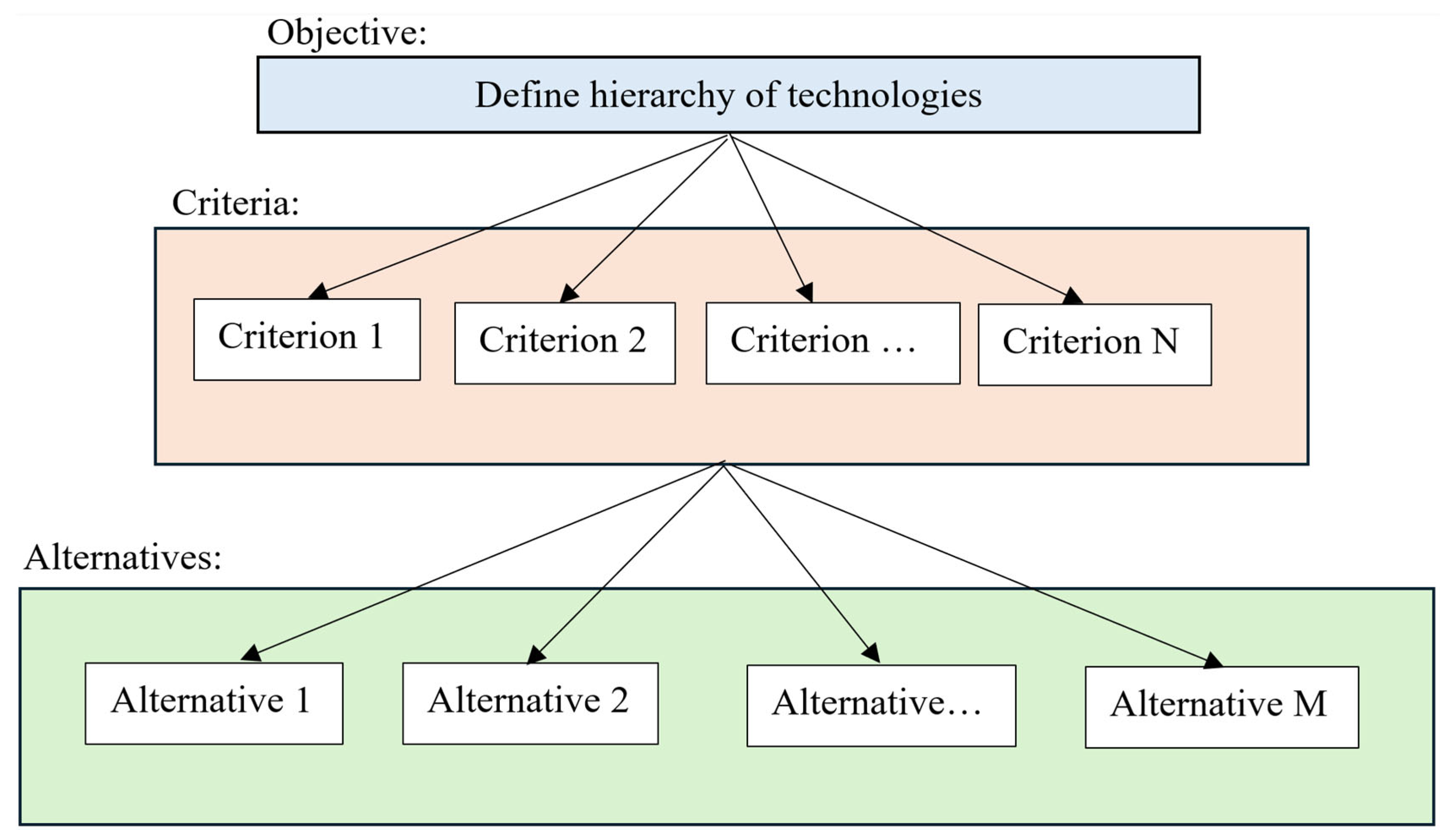
- Define the problem objectives;
- Identify the relevant criteria or attributes;
- Select the appropriate available alternatives;
- Arrange in the hierarchy tree structure: objectives, criteria, and alternatives.
4. Results and Discussion
4.1. Comparison of Heat Recovery Technology Criteria
4.2. Comparison of Heat Recovery Technologies
4.2.1. Heat Capture Technology Efficiency
4.2.2. Cost Effectiveness
4.2.3. Footprint and Integration
4.2.4. Safety and Environmental Concerns
4.3. Heat Capture and Reuse Technologies Ranked
5. Conclusions
Author Contributions
Funding
Data Availability Statement
Conflicts of Interest
Abbreviations
| AHP | Analytical Hierarchy Process |
| MCDM | Multi-criteria Decision Making |
| BESS | Battery Energy Storage System |
| VPP | Virtual Power Plant |
| TMS | Thermal Management System |
| ORC | Organic Rankine Cycle |
| ORC-HP | Organic Rankine Cycle–Heat Pump |
| TEG | Thermoelectric Generator |
| COP | Coefficient of Performance |
References
- Khan, R.; Islam, N.; Das, S.K.; Muyeen, S.M.; Moyeen, S.I.; Ali, M.F.; Tasneem, Z.; Islam, M.R.; Saha, D.K.; Badal, M.F.R.; et al. Energy Sustainability-Survey on Technology and Control of Microgrid, Smart Grid and Virtual Power Plant. IEEE Access 2021, 9, 104663–104694. [Google Scholar] [CrossRef]
- Abdelkader, S.; Amissah, J.; Abdel-Rahim, O. Virtual power plants: An in-depth analysis of their advancements and importance as crucial players in modern power systems. Energy Sustain. Soc. 2024, 14, 52. [Google Scholar] [CrossRef]
- Climate Change-gov.scot. Available online: https://www.gov.scot/policies/climate-change/ (accessed on 19 November 2025).
- Niel, J. Net Zero Strategy: Build Back Greener; Department for Energy Security and Net Zero: London, UK, 2021; p. 368. Available online: https://www.gov.uk/government/publications/net-zero-strategy (accessed on 19 November 2025).
- Glasgow’s Climate Plan-Glasgow City Council. Available online: https://glasgow.gov.uk/article/2389/Glasgow-s-Climate-Plan (accessed on 19 November 2025).
- Schimpe, M.; Becker, N.; Lahlou, T.; Hesse, H.C.; Herzog, H.G.; Jossen, A. Energy efficiency evaluation of grid connection scenarios for stationary battery energy storage systems. Energy Procedia 2018, 155, 77–101. [Google Scholar] [CrossRef]
- Khan, S.A.; Ahmad, S.; Lau, K.T.; Dong, K.; He, S.; Liu, H.; Zhao, J. A novel strategy of thermal management system for battery energy storage system based on supercritical CO2. Energy Convers. Manag. 2023, 277, 116676. [Google Scholar] [CrossRef]
- Han, X.; Lu, L.; Zheng, Y.; Feng, X.; Li, Z.; Li, J.; Ouyang, M. A review on the key issues of the lithium ion battery degradation among the whole life cycle. ETransportation 2019, 1, 100005. [Google Scholar] [CrossRef]
- Mdachi, N.K.; Choong-koo, C. Comparative Review of Thermal Management Systems for BESS. Batteries 2024, 10, 224. [Google Scholar] [CrossRef]
- Jindal, P.; Katiyar, R.; Bhattacharya, J. Evaluation of accuracy for Bernardi equation in estimating heat generation rate for continuous and pulse-discharge protocols in LFP and NMC based Li-ion batteries. Appl. Therm. Eng. 2022, 201, 117794. [Google Scholar] [CrossRef]
- Mevawalla, A.; Panchal, S.; Tran, M.K.; Fowler, M.; Fraser, R. Mathematical Heat Transfer Modeling and Experimental Validation of Lithium-Ion Battery Considering: Tab and Surface Temperature, Separator, Electrolyte Resistance, Anode-Cathode Irreversible and Reversible Heat. Batteries 2020, 6, 61. [Google Scholar] [CrossRef]
- Oró, E.; Taddeo, P.; Salom, J. Waste heat recovery from urban air cooled data centres to increase energy efficiency of district heating networks. Sustain. Cities Soc. 2019, 45, 522–542. [Google Scholar] [CrossRef]
- Ebrahimi, K.; Jones, G.F.; Fleischer, A.S. A review of data center cooling technology, operating conditions and the corresponding low-grade waste heat recovery opportunities. Renew. Sustain. Energy Rev. 2014, 31, 622–638. [Google Scholar] [CrossRef]
- Pan, Q.; Peng, J.; Wang, R. Application analysis of adsorption refrigeration system for solar and data center waste heat utilization. Energy Convers. Manag. 2021, 228, 113564. [Google Scholar] [CrossRef]
- Liu, H.; Wei, Z.; He, W.; Zhao, J. Thermal issues about Li-ion batteries and recent progress in battery thermal management systems: A review. Energy Convers. Manag. 2017, 150, 304–330. [Google Scholar] [CrossRef]
- Ladekar, C.L.; Chaudhary, S.K.; Khandare, S.S. A Critical Review-Optimization of Heat Pipe. Int. J. Eng. Res. Technol. 2016, 4, 274–280. [Google Scholar]
- Hao, Y.; Zhou, H.; Tian, T.; Zhang, W.; Zhou, X.; Shen, Q.; Wu, T.; Li, J. Data centers waste heat recovery technologies: Review and evaluation. Appl. Energy 2025, 384, 125489. [Google Scholar] [CrossRef]
- Brückner, S.; Liu, S.; Miró, L.; Radspieler, M.; Cabeza, L.F.; Lävemann, E. Industrial waste heat recovery technologies: An economic analysis of heat transformation technologies. Appl. Energy 2015, 151, 157–167. [Google Scholar] [CrossRef]
- Benedetti, M.; Dadi, D.; Giordano, L.; Introna, V.; Lapenna, P.E.; Santolamazza, A. Design of a Database of Case Studies and Technologies to Increase the Diffusion of Low-Temperature Waste Heat Recovery in the Industrial Sector. Sustainability 2021, 13, 5223. [Google Scholar] [CrossRef]
- Nandhini, R.; Sivaprakash, B.; Rajamohan, N. Waste heat recovery at low temperature from heat pumps, power cycles and integrated systems–Review on system performance and environmental perspectives. Sustain. Energy Technol. Assess. 2022, 52, 102214. [Google Scholar] [CrossRef]
- Pinamonti, M.; Baggio, P. Energy and economic optimization of solar-assisted heat pump systems with storage technologies for heating and cooling in residential buildings. Renew. Energy 2020, 157, 90–99. [Google Scholar] [CrossRef]
- Li, J.; Yang, Z.; Li, H.; Hu, S.; Duan, Y.; Yan, J. Optimal schemes and benefits of recovering waste heat from data center for district heating by CO2 transcritical heat pumps. Energy Convers. Manag. 2021, 245, 114591. [Google Scholar] [CrossRef]
- Angelidis, O.; Ioannou, A.; Friedrich, D.; Thomson, A.; Falcone, G. Comparative technoeconomic analysis of centralised and decentralised water source heat pump systems using CATHeaPS. Heliyon 2025, 11, e41396. [Google Scholar] [CrossRef]
- Sani, A.K.; Singh, R.M.; Amis, T.; Cavarretta, I. A review on the performance of geothermal energy pile foundation, its design process and applications. Renew. Sustain. Energy Rev. 2019, 106, 54–78. [Google Scholar] [CrossRef]
- van de Bor, D.M.; Ferreira, C.A.I.; Kiss, A.A. Low grade waste heat recovery using heat pumps and power cycles. Energy 2015, 89, 864–873. [Google Scholar] [CrossRef]
- Regulation (EU) 2024/573 of the European Parliament and of the Council of 7 February 2024 on fluorinated greenhouse gases, amending Directive (EU) 2019/1937 and repealing Regulation (EU) No 517/2014. Available online: https://eur-lex.europa.eu/eli/reg/2024/573/oj/eng (accessed on 19 November 2025).
- Kumar, S.; Raibhole, V.N.; Majumder, H. Performance of Heat Pump Air Conditioning with R1234ze (HFO) as a Refrigerant. J. Optim. 2024, 2024, 9101945. [Google Scholar] [CrossRef]
- Vivian, J.; Prataviera, E.; Cunsolo, F.; Pau, M. Demand Side Management of a pool of air source heat pumps for space heating and domestic hot water production in a residential district. Energy Convers. Manag. 2020, 225, 113457. [Google Scholar] [CrossRef]
- Srikhirin, P.; Aphornratana, S.; Chungpaibulpatana, S. A review of absorption refrigeration technologies. Renew. Sustain. Energy Rev. 2001, 5, 343–372. [Google Scholar] [CrossRef]
- Jayasekara, S.; Halgamuge, S.K. A combined effect absorption chiller for enhanced performance of combined cooling heating and power systems. Appl. Energy 2014, 127, 239–248. [Google Scholar] [CrossRef]
- Ayou, D.S.; Bruno, J.C.; Saravanan, R.; Coronas, A. An overview of combined absorption power and cooling cycles. Renew. Sustain. Energy Rev. 2013, 21, 728–748. [Google Scholar] [CrossRef]
- Vélez, F.; Segovia, J.J.; Martín, M.C.; Antolín, G.; Chejne, F.; Quijano, A. A technical, economical and market review of organic Rankine cycles for the conversion of low-grade heat for power generation. Renew. Sustain. Energy Rev. 2012, 16, 4175–4189. [Google Scholar] [CrossRef]
- Vélez, F.; Segovia, J.J.; Martín, M.C.; Antolín, G.; Chejne, F.; Quijano, A. Comparative study of working fluids for a Rankine cycle operating at low temperature. Fuel Process. Technol. 2012, 103, 71–77. [Google Scholar] [CrossRef]
- Quoilin, S.; Broek, M.V.D.; Declaye, S.; Dewallef, P.; Lemort, V. Techno-economic survey of Organic Rankine Cycle (ORC) systems. Renew. Sustain. Energy Rev. 2013, 22, 168–186. [Google Scholar] [CrossRef]
- Chen, H.; Goswami, D.Y.; Stefanakos, E.K. A review of thermodynamic cycles and working fluids for the conversion of low-grade heat. Renew. Sustain. Energy Rev. 2010, 14, 3059–3067. [Google Scholar] [CrossRef]
- Bao, J.; Zhao, L. A review of working fluid and expander selections for organic Rankine cycle. Renew. Sustain. Energy Rev. 2013, 24, 325–342. [Google Scholar] [CrossRef]
- Wang, D.; Ling, X.; Peng, H.; Liu, L.L.; Tao, L. Efficiency and optimal performance evaluation of organic Rankine cycle for low grade waste heat power generation. Energy 2013, 50, 343–352. [Google Scholar] [CrossRef]
- Tchanche, B.F.; Lambrinos, G.; Frangoudakis, A.; Papadakis, G. Low-grade heat conversion into power using organic Rankine cycles—A review of various applications. Renew. Sustain. Energy Rev. 2011, 15, 3963–3979. [Google Scholar] [CrossRef]
- Twaha, S.; Zhu, J.; Yan, Y.; Li, B. A comprehensive review of thermoelectric technology: Materials, applications, modelling and performance improvement. Renew. Sustain. Energy Rev. 2016, 65, 698–726. [Google Scholar] [CrossRef]
- Akhtar, F.; Rehmani, M.H. Energy replenishment using renewable and traditional energy resources for sustainable wireless sensor networks: A review. Renew. Sustain. Energy Rev. 2015, 45, 769–784. [Google Scholar] [CrossRef]
- Niu, Z.; Yu, S.; Diao, H.; Li, Q.; Jiao, K.; Du, Q.; Tian, H.; Shu, G. Elucidating modeling aspects of thermoelectric generator. Int. J. Heat Mass Transf. 2015, 85, 12–32. [Google Scholar] [CrossRef]
- Marshall, Z.M.; Duquette, J. A techno-economic evaluation of low global warming potential heat pump assisted organic Rankine cycle systems for data center waste heat recovery. Energy 2022, 242, 122528. [Google Scholar] [CrossRef]
- Xu, Z.Y.; Wang, R.Z. Absorption refrigeration cycles: Categorized based on the cycle construction. Int. J. Refrig. 2016, 62, 114–136. [Google Scholar] [CrossRef]
- Xu, Z.Y.; Wang, R.Z.; Yang, C. Perspectives for low-temperature waste heat recovery. Energy 2019, 176, 1037–1043. [Google Scholar] [CrossRef]
- Araya, S.; Jones, G.F.; Fleischer, A.S. Organic Rankine Cycle as a Waste Heat Recovery System for Data Centers: Design and Construction of a Prototype. In Proceedings of the 17th InterSociety Conference on Thermal and Thermomechanical Phenomena in Electronic Systems, ITherm 2018; IEEE: New York, NY, USA, 2018; pp. 850–858. [Google Scholar] [CrossRef]
- Olympios, A.V.; Song, J.; Ziolkowski, A.; Shanmugam, V.S.; Markides, C.N. Data-driven compressor performance maps and cost correlations for small-scale heat-pumping applications. Energy 2024, 291, 130171. [Google Scholar] [CrossRef]
- Xu, Z.Y.; Gao, J.T.; Hu, B.; Wang, R.Z. Multi-criterion comparison of compression and absorption heat pumps for ultra-low grade waste heat recovery. Energy 2022, 238, 121804. [Google Scholar] [CrossRef]
- Khalid, R.; Wemhoff, A.P.; Khuc, M.; Nayar, A.J.; Schon, S. Data Center Waste Heat Reuse: An Investment Analysis. J. Eng. Sustain. Build. Cities 2025, 6, 011002. [Google Scholar] [CrossRef]
- Gonidaki, D.; Bellos, E. A Detailed Review of Organic Rankine Cycles Driven by Combined Heat Sources. Energies 2025, 18, 526. [Google Scholar] [CrossRef]
- Zhu, Y.; Li, K.; Mgijimi, M.B.; He, J.; Wang, L.; Zheng, A.; Wang, X.; Zhang, H.; Liu, C. Field Test of Thermoelectric Generators for Power Generation Using Low Temperature Industrial Waste Heat. In Proceedings of the 49th Workshop on Geothermal Reservoir Engineering, Stanford, CA, USA, 12–14 February 2024. [Google Scholar]
- Karayalcin, I.I. The analytic hierarchy process: Planning, priority setting, resource allocation: Thomas L. SAATY McGraw-Hill, New York, 1980. Eur. J. Oper. Res. 1982, 9, 97–98. [Google Scholar] [CrossRef]
- Das, D.; Sharma, R.K.; Saikia, P.; Rakshit, D. An integrated entropy-based multi-attribute decision-making model for phase change material selection and passive thermal management. Decis. Anal. J. 2021, 1, 100011. [Google Scholar] [CrossRef]
- Goepel, K. Implementation of an Online Software Tool for the Analytic Hierarchy Process (AHP-OS). Int. J. Anal. Hierarchy Process 2018, 10, 469–487. [Google Scholar] [CrossRef]
- Socaciu, L.; Giurgiu, O.; Banyai, D.; Simion, M. PCM Selection Using AHP Method to Maintain Thermal Comfort of the Vehicle Occupants. Energy Procedia 2016, 85, 489–497. [Google Scholar] [CrossRef]
- Goepel, K.D. Implementing the Analytic Hierarchy Process as a Standard Method for Multi-Criteria Decision Making in Corporate Enterprises—A New Ahp Excel Template with Multiple Inputs. In Proceedings of the International Symposium on the Analytic Hierarchy Process 2013, Kuala Lumpur, Malaysia, 23–26 June 2013. [Google Scholar]
- Daǧdeviren, M.; Yavuz, S.; Kilinç, N. Weapon selection using the AHP and TOPSIS methods under fuzzy environment. Expert Syst. Appl. 2009, 36, 8143–8151. [Google Scholar] [CrossRef]
- Dwivedi, A.; Kumar, A.; Goel, V. A consolidated decision-making framework for nano-additives selection in battery thermal management applications. J. Energy Storage 2023, 59, 106565. [Google Scholar] [CrossRef]
- Sara, J.; Stikkelman, R.M.; Herder, P.M. Assessing relative importance and mutual influence of barriers for CCS deployment of the ROAD project using AHP and DEMATEL methods. Int. J. Greenh. Gas Control. 2015, 41, 336–357. [Google Scholar] [CrossRef]
- Saaty, T.L. Decision making—The Analytic Hierarchy and Network Processes (AHP/ANP). J. Syst. Sci. Syst. Eng. 2004, 13, 1–35. [Google Scholar] [CrossRef]
- Saaty, T.; Vargas, L. Models, Methods, Concepts & Applications of the Analytic Hierarchy Process; Springer: New York, NY, USA, 2012; pp. 1–20. [Google Scholar] [CrossRef]
- Dua, R.; Almutairi, S.; Bansal, P. Emerging energy economics and policy research priorities for enabling the electric vehicle sector. Energy Rep. 2024, 12, 1836–1847. [Google Scholar] [CrossRef]
- Dua, R.; Almutairi, S. A perspective on emerging policy and economics research priorities for enabling low-carbon trucking. Energy Res. Soc. Sci. 2025, 124, 104025. [Google Scholar] [CrossRef]
- Ahmed, A.M. Thermal efficiency investigation for organic Rankine cycle and trilateral flash cycle using hydrofluoroether working fluids. Results Eng. 2024, 21, 101648. [Google Scholar] [CrossRef]
- Tan, Z.; Feng, X.; Yang, M.; Wang, Y. Energy and economic performance comparison of heat pump and power cycle in low grade waste heat recovery. Energy 2022, 260, 125149. [Google Scholar] [CrossRef]



| Cooling Material | TMS Method | Waste Heat Form and Temperature |
|---|---|---|
| Air cooling | Passive air convection | Air or liquid 20–30 °C [12] |
| Forced air convection | Air 20–40 °C [12,13] | |
| Liquid cooling | Liquid passive cooling | Liquid 20–50 °C [13,14] |
| Liquid active cooling | Liquid 50–70 °C [13,15] | |
| Heat pipe cooling | Vapour 40–80 °C [16,17] |
| Technology | Minimum Driving Temperature (°C) | Optimum Driving Temperature (°C) | Matching TMS Cooling Technology | Application Scenario | References |
|---|---|---|---|---|---|
| Heat pump | Ambient | 20–90 | Liquid cooling, air cooling, and heat pipe | Preheating for space heating, space heating, and district heating network | [13,17,20,25,28] |
| Absorption chillers | 65 | 70–90 | Liquid active cooling and heat pipe | Refrigeration and chilled water production | [17,43,44] |
| ORC power generation | 65 | 60–100 | Liquid active cooling and heat pipe | Device power supply | [17,32,45] |
| TEG | 80 | >80 | Liquid active cooling and heat pipe | Localised small power loads | [13,39] |
| ORC-HP | 40 | 60–100 | Liquid cooling, active air cooling, and heat pipe | Localised small power loads | [20,42] |
| Technology | Efficiency | Capital Cost | Payback Period | Footprint | References |
|---|---|---|---|---|---|
| Heat pump | high | low | short | medium | [17,25,46,47,48] |
| Absorption chillers | medium–high | low–medium | short–medium | high | [17,25,43,44] |
| ORC power generation | low | medium | medium | medium | [17,25,32,45,49] |
| TEG | low | high | long | low | [13,39,50] |
| ORC-HP | medium | medium | medium | high | [20,25,42] |
| Preference Level | Preference Score | Description |
|---|---|---|
| Extremely Preferred | 9 | Importance of one factor over the other is extreme |
| Very Strongly Preferred | 7 | Very strong preference for one factor in the pair but not extreme |
| Strongly Preferred | 5 | Clear preference for one factor over the other |
| Moderately Preferred | 3 | There is only a moderate preference for one factor |
| Equally Preferred | 1 | There is equal preference for both factors |
| Intermediate Values | 2, 4, 6, 8 | Values falling between the adjacent levels |
| N | 1 | 2 | 3 | 4 | 5 | 6 | 7 | 8 | 9 | 10 | 11 |
|---|---|---|---|---|---|---|---|---|---|---|---|
| RI | 0 | 0 | 0.58 | 0.9 | 1.12 | 1.24 | 1.32 | 1.41 | 1.45 | 1.49 | 1.51 |
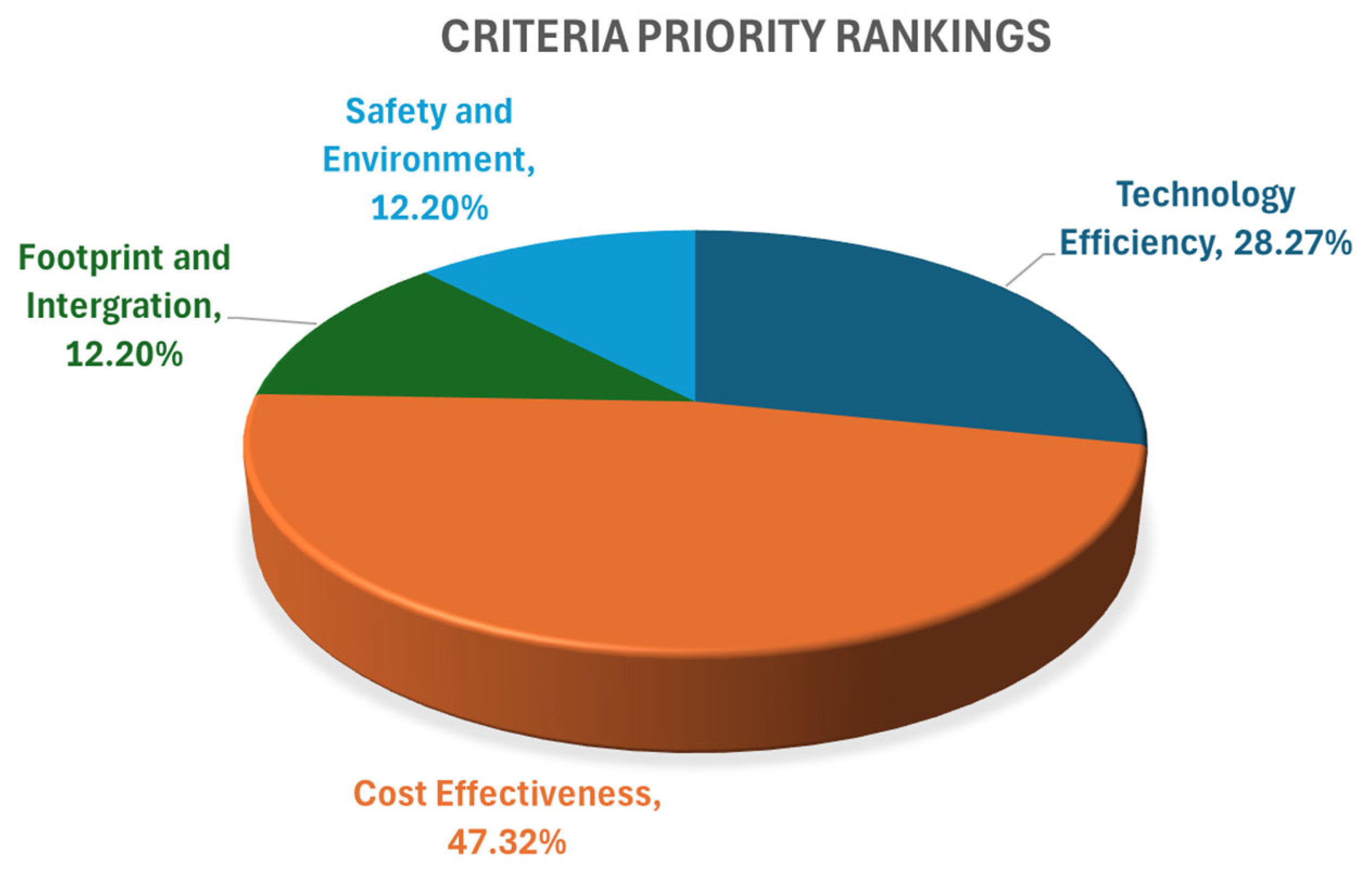
| Comparison Matrix | Technology Efficiency | Cost Effectiveness | Footprint and Integration | Safety and Environmental Considerations |
|---|---|---|---|---|
| Technology Efficiency | 1 | 3 | 3 | 5 |
| Cost Effectiveness | 0.33 | 1 | 3 | 3 |
| Footprint and Integration | 0.33 | 0.33 | 1 | 3 |
| Safety and Environmental Considerations | 0.2 | 0.33 | 0.33 | 1 |
| Summation | 1.87 | 4.67 | 7.33 | 12 |
| Priority Matrix | Heat Capture Efficiency | Cost Effectiveness | Response to Dynamic Loads | Safety and Environmental Considerations | Priority Vector |
|---|---|---|---|---|---|
| Heat Capture Efficiency | 0.535714286 | 0.642857143 | 0.409090909 | 0.416666667 | 50.11% |
| Cost Effectiveness | 0.178571429 | 0.214285714 | 0.409090909 | 0.25 | 26.30% |
| Response to Dynamic Loads | 0.178571429 | 0.071428571 | 0.136363636 | 0.25 | 15.91% |
| Safety and Environmental Considerations | 0.107142857 | 0.071428571 | 0.045454545 | 0.083333333 | 7.68% |
| 4.25 | |
| 0.083 | |
| 0.093 |
| Comparison Matrix | Heat Pump | Absorption Chillers | ORC Power Generation | TEG | ORC-HP | Priority Vector |
|---|---|---|---|---|---|---|
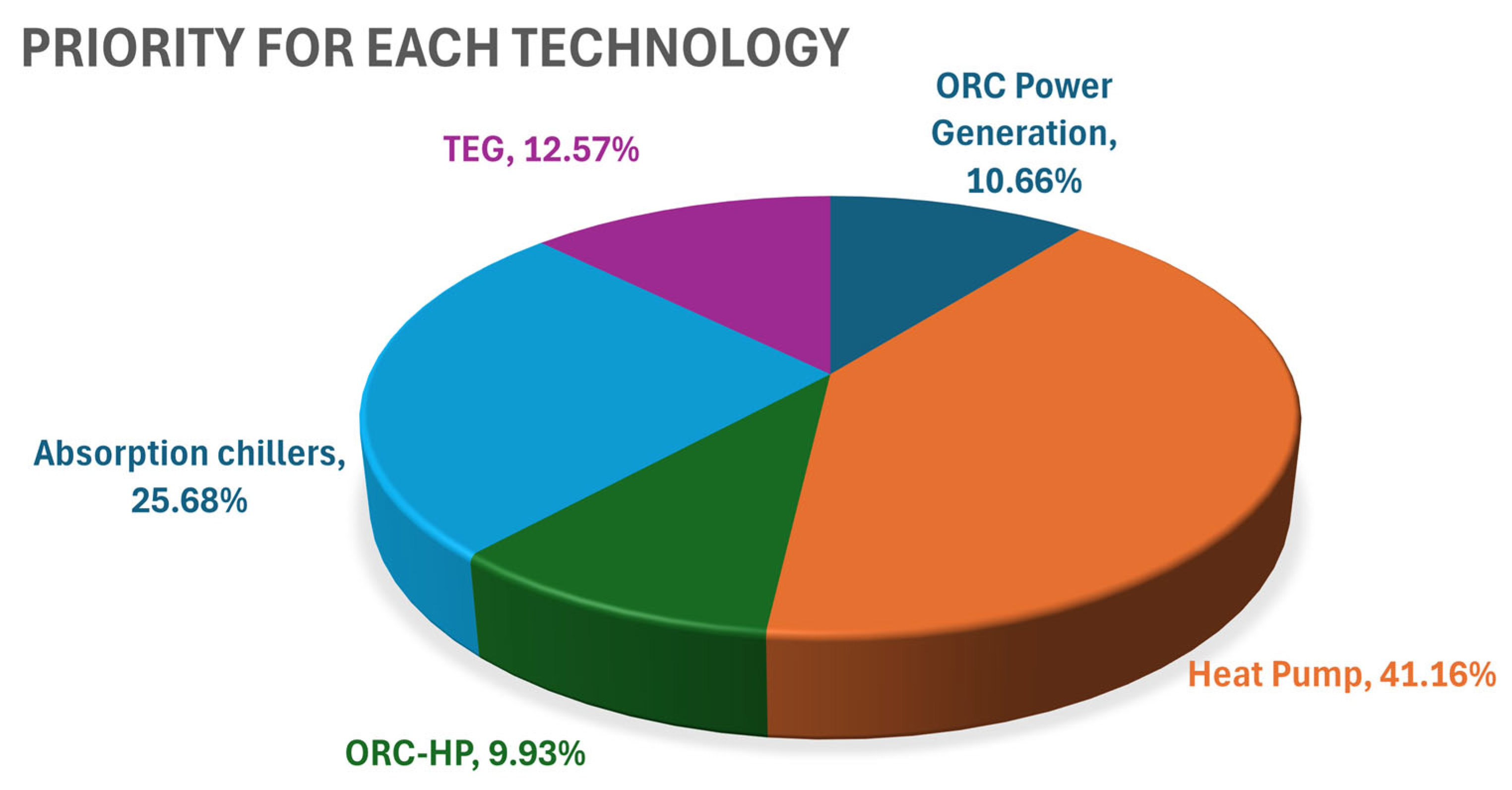
| Heat Pump | 1 | 3 | 9 | 9 | 5 | 50.48% |
| Absorption Chillers | 0.33 | 1 | 7 | 7 | 5 | 30.16% |
| ORC Power Generation | 0.11 | 0.14 | 1 | 1 | 0.33 | 4.38% |
| TEG | 0.11 | 0.14 | 1 | 1 | 0.33 | 4.38% |
| ORC-HP | 0.2 | 0.2 | 3 | 3 | 1 | 10.60% |
| 5.3149 | ||||||
| 0.0787 | ||||||
| 0.0703 | ||||||
| Comparison Matrix | Heat Pump | Absorption Chillers | ORC Power Generation | TEG | ORC-HP | Priority Vector |
|---|---|---|---|---|---|---|
| Heat Pump | 1 | 3 | 5 | 7 | 5 | 48.34% |
| Absorption Chillers | 0.33 | 1 | 3 | 7 | 3 | 25.08% |
| ORC Power Generation | 0.2 | 0.33 | 1 | 5 | 1 | 11.44% |
| TEG | 0.14 | 0.14 | 0.2 | 1 | 0.2 | 3.70% |
| ORC-HP | 0.14 | 0.33 | 1 | 5 | 1 | 11.44% |
| 5.3721 | ||||||
| 0.0930 | ||||||
| 0.0830 | ||||||
| Comparison Matrix | Heat Pump | Absorption Chillers | ORC Power Generation | TEG | ORC-HP | Priority Vector |
|---|---|---|---|---|---|---|
| Heat Pump | 1 | 3 | 1 | 0.2 | 3 | 15.59% |
| Absorption Chillers | 0.33 | 1 | 0.33 | 0.14 | 1 | 6.10% |
| ORC Power Generation | 1 | 3 | 1 | 0.2 | 3 | 15.59% |
| TEG | 5 | 7 | 5 | 1 | 7 | 56.62% |
| ORC-HP | 0.33 | 1 | 0.33 | 0.14 | 1 | 6.10% |
| 5.1751 | ||||||
| 0.0438 | ||||||
| 0.0391 | ||||||
| Comparison Matrix | Heat Pump | Absorption Chillers | ORC Power Generation | TEG | ORC-HP | Priority Vector |
|---|---|---|---|---|---|---|
| Heat Pump | 1 | 0.33 | 1 | 1 | 3 | 17.26% |
| Absorption Chillers | 3 | 1 | 3 | 1 | 5 | 37.21% |
| ORC Power Generation | 1 | 0.33 | 1 | 1 | 3 | 17.26% |
| TEG | 1 | 1 | 1 | 1 | 3 | 21.91% |
| ORC-HP | 0.33 | 0.2 | 0.33 | 0.33 | 1 | 6.37% |
| 5.1576 | ||||||
| 0.0394 | ||||||
| 0.0352 | ||||||
Disclaimer/Publisher’s Note: The statements, opinions and data contained in all publications are solely those of the individual author(s) and contributor(s) and not of MDPI and/or the editor(s). MDPI and/or the editor(s) disclaim responsibility for any injury to people or property resulting from any ideas, methods, instructions or products referred to in the content. |
© 2026 by the authors. Licensee MDPI, Basel, Switzerland. This article is an open access article distributed under the terms and conditions of the Creative Commons Attribution (CC BY) license.
Share and Cite
Hunt, G.; Iyer, A.; Falcone, G. Comparative Analysis of Waste Heat Capture Technologies Applied to Battery Energy Storage Systems. Energies 2026, 19, 1518. https://doi.org/10.3390/en19061518
Hunt G, Iyer A, Falcone G. Comparative Analysis of Waste Heat Capture Technologies Applied to Battery Energy Storage Systems. Energies. 2026; 19(6):1518. https://doi.org/10.3390/en19061518
Chicago/Turabian StyleHunt, Graeme, Aravind Iyer, and Gioia Falcone. 2026. "Comparative Analysis of Waste Heat Capture Technologies Applied to Battery Energy Storage Systems" Energies 19, no. 6: 1518. https://doi.org/10.3390/en19061518
APA StyleHunt, G., Iyer, A., & Falcone, G. (2026). Comparative Analysis of Waste Heat Capture Technologies Applied to Battery Energy Storage Systems. Energies, 19(6), 1518. https://doi.org/10.3390/en19061518