Article

Towards a Combined Energy and Water AMI Smart Metering Framework

1
Discipline of Electrical Electronic and Computer Engineering, University of KwaZulu-Natal, Durban 4001, South Africa
2
Ethekwini Municipality, Durban 4001, South Africa
*
Author to whom correspondence should be addressed.
Energies 2026, 19(6), 1449; https://doi.org/10.3390/en19061449
Submission received: 24 December 2025 / Revised: 22 February 2026 / Accepted: 5 March 2026 / Published: 13 March 2026
(This article belongs to the Section A1: Smart Grids and Microgrids)

Abstract

The delivery of energy and water meter data, management and control information on separate networks is expensive and defeats the gains of the Advanced Metering Infrastructure (AMI) Smart Grid (SG). In most cases, energy, gas and water services are offered by the same organizational entity, hence the use of different infrastructure for data, service delivery, control and management is expensive and highly illogical. There is a need for a combined energy and water infrastructure to reap the benefits of the AMI SG. Furthermore, combined metering will result in accurate billing, potential cost savings, and improved resource management. This work therefore develops and investigates a combined energy and water AMI smart metering framework. This is possible through a thorough understanding of the AMI technological standards. The implementation of such a system is not trivial, as it depends on many factors: environmental, geographical, technological, economical, regulatory and the existing legacy infrastructure. Optimal technological implementation choices are developed towards an integrated AMI infrastructure. An experimental test bed is developed for delivering energy and water metering data to the utility. The optimal placement results favor the system of separating energy and water actuators at the home area network of the SG while using an integrated communication system. Such a system is feasible, given the different evolution of electricity and water meters and their placement at the home area network, and enables water metering to benefit from the more advanced electrical metering infrastructure.

1. Introduction

The electric meter evolutionary trends have come from the manual meter reading (MMR) where the meter reading is physically done, to the electronic meter reading (EMR) where the EMR technologies employ walk-by or drive-by methods with transceivers. Then follows the automated meter reading (AMR) which involves fully remote consumption data collection and processing for bills, and finally the Advanced Metering Infrastructure (AMI). The AMI is an integrated system of smart meters (SM), communication networks, and data management systems that enables two-way communication between utilities and customers [1,2,3]. The AMI system has greatly benefited as a component from the evolution of the smart grid (SG), dominated be the electrical energy side.
Water meters evolved from the fully mechanical meters that use impellers and turbines to measure velocity. Others use oscillating pistons and nutating discs to measure displacement. These meters are low-cost and reliable, making them the most widely used water meters around the world. Traditionally, they were not automated, hence required labor-intensive manual meter reading [4]. The electromechanical meters arose as a result of electronic circuit components gradually being added into mechanical water meters to give autonomous functionalities, but the measurements are still performed mechanically [2,4,5]. New concepts, such as electromagnetic [3], fluidic [4] and ultrasonic meters [6], have recently been used to design modern fully electronic water meters. These AMR meters automatically collect consumption and status data and transmit it to a central database for billing and analysis. Advancements in smart water meters have enabled data acquired by devices to be transferred to the backhaul systems in real time. Therefore, the other important aspect of any smart metering system is having an effective communication infrastructure for transferring the collected information and control signals across the system. The communication part of a smart water metering system is closely related to the communication aspect of smart metering in Smart Grid networks [7,8]. As a result, a water network that utilizes smart water meters is also known as a smart water grid (SWG) [9].
Currently there are different trends in various sections of the SG. The most common trends include the fusion of energy and water meters into a combined meter; the smart meter application trends that perform modern duties like load forecasting and demand response; the application of energy-efficient techniques; gravitation towards the advances of Internet of Things (IoT), big data and artificial intelligence; regulatory trends towards common standards; and finally, the emergence of new business and customer models. Combined metering involves using a single system to measure both energy (electricity, gas, etc.) and water consumption in a building or complex. This approach offers several benefits, including accurate billing, potential cost savings, and improved resource management. This work focuses on the development of a combined energy and water AMI smart metering framework. Practical water and electricity and the entire framework are designed and implemented, and results developed to show the feasibility of such a system. In most urban cities, water and energy are supplied by the same entity. A fusion of the two for service delivery is therefore automatic, will save costs, and is inevitable. This will require a thorough understanding of the modern energy and water SG, one of the focuses of this work.
This work is organized as follows. Section 1 introduces the work. Section 2 presents the smart electricity, water and integrated grids. Section 3 presents the integrated AMI infrastructure and describes the different sections of the AMI infrastructure. Section 4 focuses on the AMI communication infrastructure where the communication requirements and application of communication technologies for the AMI are discussed. Section 5 presents the challenges of combined AMI metering. Section 6 presents the proposed architecture of the integrated AMI metering. Section 7 presents the designed experimental prototypes, testbeds, discussion and results, and finally, Section 8 concludes the work.

2. The Smart Grid

2.1. The Smart Electricity Grid

Generally, an SG can be viewed as a superposition of information and communication technologies (ICT) on the electric grids. A smart electric grid constitutes interconnected power generators, transmission lines, transformers, distribution systems, meters and other emerging devices to provide power. A smart grid comprises the following layers [10]: the power systems layer for power generation, transmission, distribution of electricity from the utility to the demand side; the power control layer for smart grid monitoring, control and management functions; the communication layer for providing two-way efficient, reliable and secure data transmission between the layers; the security layer for data confidentiality, integrity, authentication and availability and protection of physical smart grid components and systems from theft, harm, and tampering as well as general sabotage; finally, the application layer for customer-side and grid-end applications. Currently the adoption of IoT technology on smart grids has led to the more modern IoT-Enabled Smart Grids [11].

2.2. The Smart Water Grid

A smart water grid integrates digital technologies, like the IoT and sensors, into traditional water infrastructure to enable real-time monitoring, management, and optimization of water distribution systems. The electrical smart grid has evolved and continues to evolve more than the water grid. The SG’s power systems and control layers are the only separate section not directly applicable to water. The communication part of a smart water metering system is closely related to the communication aspect of smart metering in SG networks [9,12]. As a result, a water network that utilizes smart water meters is also known as a SWG [13]. The water utility industry needs to benefit from the electric industry’s experience with AMI. Smart water grid vendors will adopt electric smart grid technologies, particularly AMI and Meter Data Management Systems (MDMSs). Regulators will encourage water utilities to adopt electric utility business models [14,15]. Some of the adaptations include the following:
  • On the production side, water utilities will use real-time pricing and different pricing models (e.g., peak or volume pricing) than those used by electric utilities, and implement electrical energy management protocols for their motors and pumps. They will use renewable energy systems, such as solar panels and wind turbines, at their facilities. Power from these can be sold to the electrical grid.
  • For the distribution and customer side, water utilities will collaborate with energy utilities for the use of the AMI infrastructure. Smart meters will monitor and control water usage and parameters like pressure. Water utilities will adopt meter data management and customer billing systems to maintain all the consumption data. The Head End System (HES) and other management systems will be the same as those for the energy system.
The adoption and development of AMI in water utilities is driven by revenue loss, aging infrastructure, water scarcity, enhanced water management capabilities, water quality, leakage and pressure management, better billing, improvement of customer satisfaction, and building on the available AMI infrastructure. The water smart grid will introduce the following: advanced configurable meters, smart sensing data collection devices, two-way communication and data modelling, analytics, automation and control software. Data collected will be on water pressure, flow, quality, potential leaks and anomalies, etc.

2.3. The Integrated Grid

The energy smart grid has undergone unprecedented growth. The smart water grid needs to benefit from the electric industry’s experience with AMI. This trend will lead to the integrated smart grid for both energy and water. The functionalities of this integrated smart grid will be similar, borrow heavily from the energy smart grid, and based on the AMI infrastructure and its models. The functionalities and structures of the home area network (HAN), neighborhood area network (NAN), wide area network (WAN) and head end system (HES) are similar and still based on the energy AMI. The main differences are the power system and control layers of the energy SG. The differences are on the resource production and actual meter side. This will necessitate a new structure for the metering equipment.
Modern smart meters differ in the actuator of the measuring component only. The processing, control and storage capability, the communication capability for measuring processing and conveying the resources information and, finally, its self-powering capability should be the same. This necessitates the proposal on integrating the meters at the communication level for the new smart meter as the latest trend of the combined metering infrastructure. A new integrated packet structure for water and energy is required. Different standards have been developed to feature the integrated packet structure. The most widely accepted is the IEC 62056 Device Language Message Specification/Companion Specification for Energy Metering (DLMS/COSEM) [15,16,17,18].
The benefits of combined metering from the integrated SG include
  • Accurate billing: Combined metering allows for precise tracking of both energy and water usage, leading to fair and accurate billing for individual tenants or units.
  • Cost savings: By identifying areas of high consumption and combining data collection, users can implement measures to reduce waste and lower utility bills.
  • Improved resource management: Combined metering data can be used to identify inefficiencies and implement strategies for more sustainable resource management.
  • Reduced disputes: Clear and transparent billing based on actual consumption can minimize disputes between landlords and tenants regarding utility costs.

3. The Integrated AMI Infrastructure

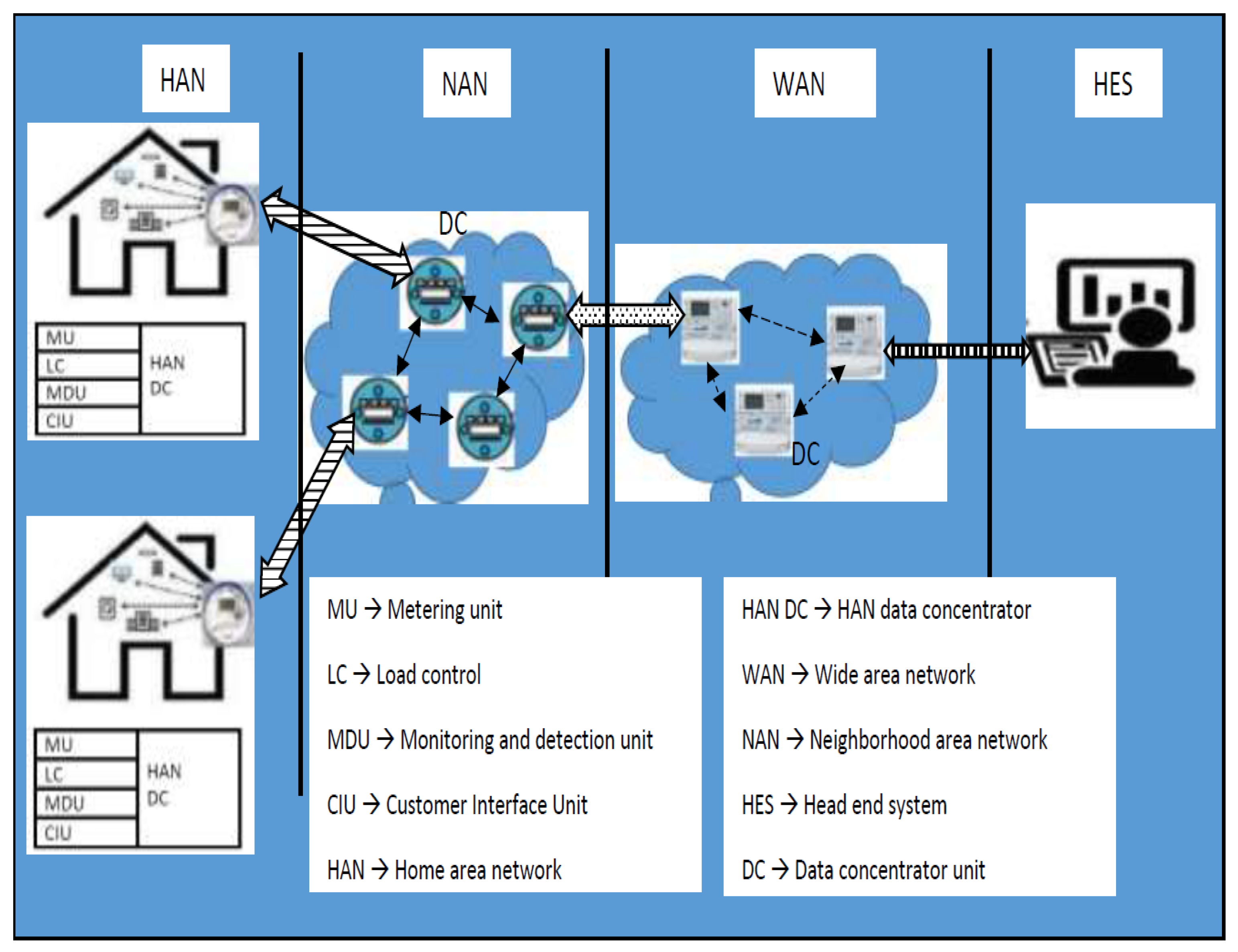
According to the IEEE 2030 standard [19], the AMI communication network facilitates communication between SMs and the MDMS of the HES. The network enables utilities to collect data from meters, which are then sent to the MDMS via the HES for processing, storage, and analysis to support functions like billing, revenue protection, and load management. The AMI SM system consists of the following; the premises area network (PAN), NAN, WAN and the HES. The premises area network could consist of the HAN or the commercial building area network (BAN) or the industrial area network (IAN), depending on the premises. The sections are demarcated by various points of the grid, such as distribution transformer, substation, low, medium and high voltage sections, etc. An SM framework is based on the full or reduced functionality of the system model of Figure 1.

3.1. The Home-Area Network

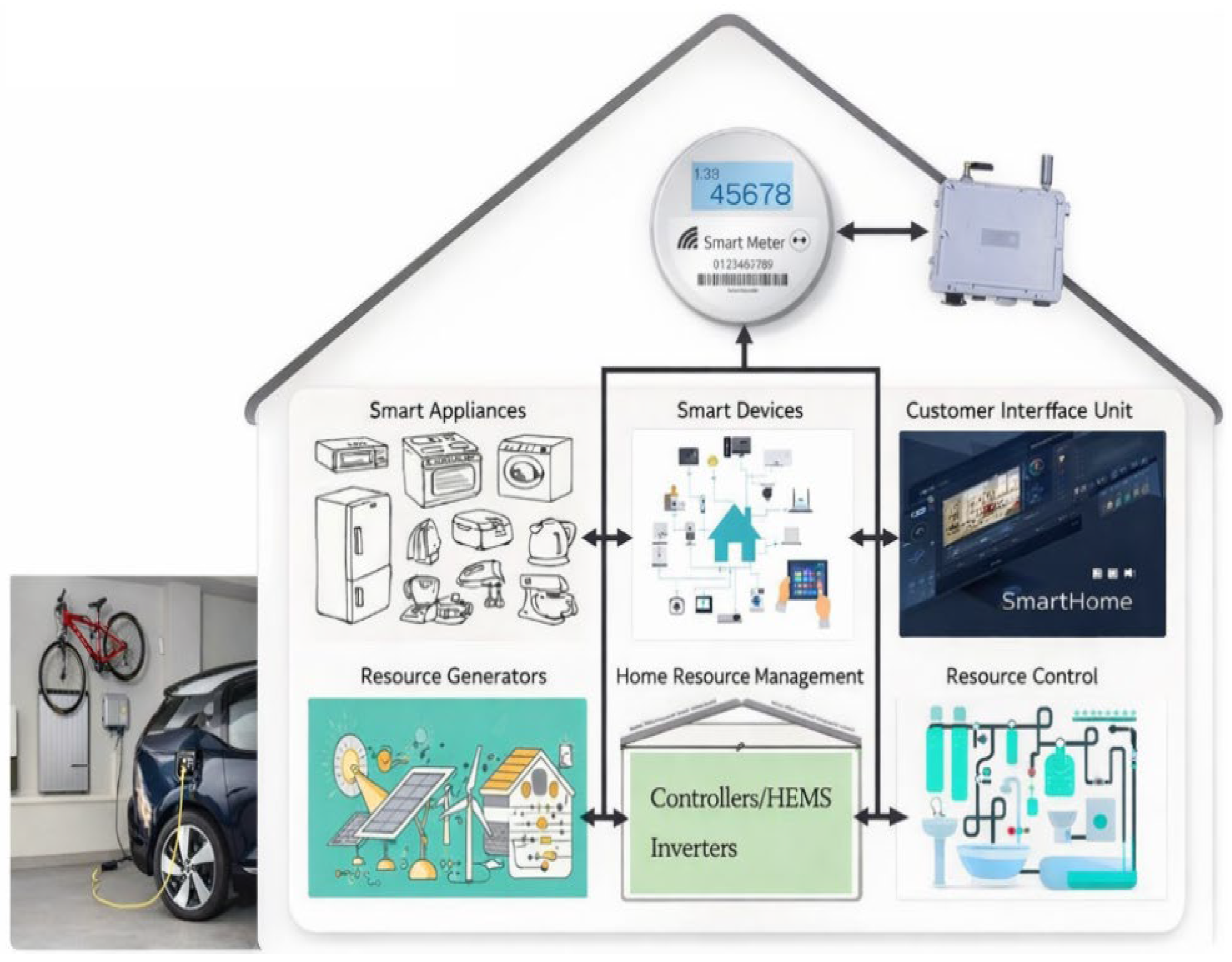
The HAN network connects and provides communications for components of a smart home: devices, appliances, equipment, customer interface units and home resource control and management systems. The HAN consists of the following: metering unit (MU) for collecting resource consumption data for both water and electricity, load control (LC) for controlling the resources, monitoring and detection unit (MDU) for collecting the status of the units, customer interface units (CIU) for interfacing with the customer and the HAN data concentrator (HAN-DC) for bidirectional data communication. On a large scale, HANs can be extended to BAN/IAN while targeting larger commercial premises and the industry with a focus on higher-consuming devices for building automation, heating, ventilating, air conditioning (HVAC), etc. [10,20]. Figure 2 illustrates a typical HAN system. The following components are common to all HAN systems:
  • Smart appliances: A smart appliance is one that can be programmed or controlled remotely or operate autonomously, based on input from sensors. Smart appliances are connected to the central system and are typically designed to interoperate with other smart devices, ideally as part of an overall smart home. They offer benefits such as better energy management, greater convenience, comfort, and security, etc. Examples include refrigerators, ovens, microwaves, coffee makers, blenders, water dispensers, vacuums, washers, dryers, light bulbs, outlets, plugs, lighting kits, heaters, air conditioners, smoke and carbon monoxide detectors, etc. Electric vehicles can also be viewed as a class of smart appliance.
  • Smart devices: Smart devices are electronic gadgets that are interactive and capable of performing autonomous computing, being connected to other devices for data exchange. Examples include smartphones, smart watches, tablets, smart glasses and other personal electronics.
  • Resource generators: Smart meters should be able to interface energy and water resources generated at the consumer through the grid. They should also be able to generate some energy, e.g., smart water meter turbines generating electricity.
  • Home resource management: These are application systems that work with the other HAN entities to improve energy efficiency in homes and buildings. Their technology platform provides energy usage monitoring and control to their users. A Home Energy Management System (HEMS) enables consumers and power utilities to regulate residential loads. The HEMS needs to support the following capabilities: device monitoring, control, communication, demand response, usage control intelligence, data management, security and privacy, etc. The application enables demand-side management, empowering customers to control and manage their own usage.
  • Resource/load control: The hardware and associated software that control the utilization and regulation of the load. The unit shall be equipped with integrated load control mechanisms to control flow of the resource to the load subject to commands such as connect or disconnect. The commands could be issued by the HEMS or from the HES. It is instrumental in enforcing demand-side management. It also provides functionalities like access, theft and tampering prevention. The monitoring and detection unit hardware is part of the resource control unit that receives instructions from the HEMS or the HES.
  • The metering unit: The unit is responsible for monitoring and reporting resource consumption, consumption patterns and the state of the HAN systems. The metering unit also houses the communication unit that serves as a bidirectional communication gateway to the NAN through its HAN data concentrator (DC) or the gateway. The HAN communication system links all the HAN units together and, through the metering unit/gateway, communicates to the HES. Obviously, the integrated packet is key to the function of the integrated smart meter.
  • Customer Interface Unit (CIU): The unit is used to display information pertaining to the customer’s resource usage, meter readings, consumption monitoring, tariffs, etc. The unit is also responsible for credit management, especially prepaid credit at the end-user’s premises. These units could employ split technology, where the CIU is separated from the actual meter unit.

3.2. The Neighborhood Area Network

The NAN enables bidirectional communication between the PAN (e.g., HAN, BAN and IAN) and the WAN. The NAN is a combination of several HANs. It consists of smart meters and DCs in the last-mile communication of the smart grid. It interconnects the utility’s WAN to the HAN. The smart meter connects the HAN to the NAN, and the NAN connects to the WAN through a data concentrator (DC)/gateway. Architecturally the NAN consists of several SMs connected to a single data concentrator. This can be extended to several data concentrators meshed together.
The DC is the central communication component of the AMI. The DC, also known as an edge router or gateway, aggregates data from a group of smart meters and forwards them to the HES. The DC gateway operates between the downstream smart meters and the upstream HES. It interfaces between different heterogeneous networks and facilitates bidirectional communication between the two systems. Its tasks involve protocol conversion and relaying of data and control information between the HES and SM. It is responsible for collecting and managing received data from the meters or communication hubs.
DCs are usually located inside Power Transformers (PTs) and substations and are part of the NAN. Smart meter devices are connected to a DC in two network topologies: mesh and star (point to multipoint). In the mesh topology, smart meters are connected to each other and the DC, and so a smart meter can communicate with other smart meters as well as the DC. In the star topology, meters directly communicate with a DC, and the DC manages several direct meters. Depending on the network topology and employed technologies, the number of smart meters per concentrator will vary. Modern DCs contain an embedded metering device and can perform additional tasks, such as low-voltage (LV) supervision.

3.3. The Wan Network

The WAN provides a two-way communication link between the HES and the NAN for SG applications. A gateway interconnects the NAN and the WAN. A WAN is the backbone of the AMI communication network. It connects several distributed networks: transmission substations, control systems, SCADA, RTU, etc., to the utility companies’ control centers [21]. NAN and the WAN subsystems provide for effective bidirectional routing and forwarding of data between the systems. Data processing is sometimes performed at the DCs.

3.4. The Head End System

The HES is normally located at the main control center of the system. It performs the following functionalities: data aggregation, analysis, storage, management, decision and control of the entire system. The HES updates the network topology information by tracking the connected devices, and, in case of communication failures, tries to re-establish communication with the DC. Moreover, it acquires and monitors the meter’s data automatically without needing any human intervention. The collected data are then sent to the MDMS, the central repository for the collected data.
The MDMS, an essential component of the AMI, performs data reception, analysis management and storage. In addition, it provides billing, data consumption and validation, alarms and their management while generating reports on these tasks. The MDMS can further run applications for load analysis, load forecasting, demand response, load management, outage management, prepaid functionality, equipment health monitoring, etc.
The MDMS consists of subsystems to support advanced AMI operations and functionalities such as power grid management, utility optimization by means of data analytics, customer interaction and billing. Moreover, the MDMS is associated with the following complementary systems: outage management system (OMS) for poor power quality (PQ), voltage anomalies, and unstable frequency on the customer side; geographic information system (GIS) that stores customers’ data such as their address and location; the distributed management system (DMS) that provides demand prediction, PQ management and load forecasting; and finally the consumer information system (CIS) that stores consumer billing information and consumer data. Though these functionalities are tailored toward the energy SG, alternate functions for the SWG also apply.

4. The AMI Communication Infrastructure

4.1. Communication Requirements for AMI

The integrated AMI communication system will need to cater to other SG applications for monitoring and grid management, such as SCADA, Distributed Automation (DA), Distributed Generation (DG), Power Management, Distributed Storage (DS), HEMS, and Demand Response (DR). It will also need to cater to SWG applications such as smart meter applications, loss management, demand and analysis applications, consumption monitoring, SCADA, modelling and optimization applications [22,23], etc. SWG applications focus on monitoring, controlling, and optimizing water distribution systems using IoT sensors and data analytics to enable applications such as real-time water quality monitoring, precise leak detection and loss management, predictive demand analysis, efficient water treatment, and smart irrigation. All these require very reliable communication links between HES and smart meters. The following key requirements are necessary.
  • Grid quality of service requirements: The SG bidirectional communication between the meters and the MDMS should guarantee a certain level of Quality of Service (QoS). QoS guarantees ensure that the communication system provides the agreed service levels required to the different applications. Despite the fact that service level parameters are not clearly specified for the SG and AMI applications, the QoS requirements that should be met include those pertaining to transmission latency, average delay, jitter, bandwidth, connection outage probability, etc.
  • Grid high-level security requirements: The requirements for safe and secure communication include authentication, where each user’s identification is verified; authorization, where only authorized devices can take certain actions; integrity, where there is no intervention or tampering of information; and confidentiality, where messages are accessible to the intended receiver. The data transferred on the SG communication system are private and contain information that is related to individual customers and their lives. Therefore, the security should guarantee privacy. The AMI needs to be robust against failures and attacks aimed at disrupting communication services and damaging electricity or water provision, as this is critically important for the safe and efficient operation of the integrated grid. Additional measures such as encryption, trust management, and intrusion detection are required in smart grids to prevent, detect and mitigate cyberattacks [24].
  • Grid reliability and stability requirements: Despite the intermittent nature of the AMI network and its applications, it should be able to provide reliable services. The smart grid heavily relies on its communication backbone for transmitting critical messages to maintain grid stability. The reliability of a communication system refers to its capability to operate properly and without any failures. Due to the critical functionality of the smart grid communication network, it should have a very low outage period and be supported by a reliable communication infrastructure. Resource, network and time-out failures affect the reliability of the grid. The network failures may be caused by a link/node failure, routing inconsistencies, overloading, etc. To increase the reliability of the system, self-healing techniques, which comprise the ability of the system to anticipate disturbances and achieve rapid self-restoration, have to be considered. Reliability affects ability. The stability of an electric grid indicates its capability to continue intact operation following disturbances. However, as more renewable energy penetration and less kinetic energy reserve are present in smart grid, the stability issues are yet to be properly addressed [4].
  • Grid flexibility and interoperability requirements: Different devices, communication technologies and networking protocols are used in smart grid systems and must work together effectively. The measures to ensure interoperability for these heterogeneous networks include standards, open network architectures and network service translation devices [24]. Network elements such as gateways can translate services between different standards with different protocols. Application interoperability would ensure applications assign the same meaning to exchanged messages. The smart grid communication system needs to be upgradable, evolvable and adaptable to accommodate various challenges, which are imposed on the system due to the rapid changes in technologies, policies, and consumer demands. The smart grid must be scalable to accommodate a large number of communication technologies on different software and hardware platforms. The grid should be flexible with the ability to support heterogeneous services with diverse QoS requirements.
  • Grid scalability requirements: The SG consists of very many connected devices. The grid should be scalable from a small scale with few devices to millions of devices. The SG should provide the following forms of scalability [24]: load scalability, where the system should handle big data or service requests; geographical scalability, where the system is deployed in various sizes and configurations; and finally, parameter scalability where different measures of scalability parameters are considered, such as the routing table size, number of nodes, amount of communication resources used, etc. To enhance scalability, distributed communication architectures have been employed in other fields and could also be applied in the smart grid. However, the scalability issue in the SG is further exacerbated by the limitations of grid devices in computing power, storage, communication capabilities, and hence, the QoS offered.

4.2. Application of AMI Communication Technologies in a Smart Metering System

4.2.1. Premises Area Network Communication Framework

The PAN links smart meters to controllable devices for monitoring and control purposes. HAN/BAN/IAN connects devices in the home or business to the smart metering system. The network provides communications for household appliances and equipment and home/business/industrial management and control systems through the smart meter gateway/DC functionality.
These PAN applications are not greedy in terms of coverage area, speed, or data rate, power, etc. The HAN’s typical bandwidth is within 10 to 100 kbps for each device. They require short-range wireless communication protocols. The preferred communication technologies include the short-range communication technologies listed in Table 1 and short-range PLC technologies in Table 2. These technologies are also preferred due to the inherent technological merits highlighted in the tables. Due to the different nature of devices and environments, the HAN utilizes a hybrid mix of technologies.

4.2.2. Neighborhood Area Network Communication Framework

The NAN enables communication between the PAN and the WAN. The smart meter connects the HAN to the NAN, and the NAN connects to the WAN through a DC/gateway. NAN connects a large number of sources and requires a high data rate and large coverage distance. Both wired and wireless technologies are suitable in the NAN and should complement each other. The NAN is connected through a mixture of wired and wireless technologies and short-range technologies, as listed in Table 1, PLC in Table 2, and long-range technologies in Table 3. Other, more traditional technologies like copper and fiber cables can also be used. The actual choice is case-dependent and should be made after factoring in many parameters. Most countries are pushing towards PLC due to the already existing infrastructure. The developed PLC standards are as shown in Table 2.

4.2.3. Wide Area Network Communication Framework

A WAN connects several distributed networks, including transmission substations, control systems, SCADA, RTU, etc., to the utility companies’ HES [17]. It forms the backbone of the communication system.
WAN applications require a high concentration of data points and high data rates from 10 Mbps to 1 Gbps. Their long-distance coverage is from 10 to 100 km. The WAN requires long-range wide coverage communication technologies. These are as shown in Table 3. Other technologies like PLC and fiber optic communications can be used. A variety of factors are considered when choosing the actual technology. For example, satellite communication can be used in remote locations.

4.2.4. Hybrid Communication Framework

A practical AMI system cannot utilize a single technology. Different technologies can be used in different network sections for HAN, NAN and WAN, forming a hybrid communication network. The choice of technologies depends on geographical, environmental, economic and many other factors. This is also influenced by the suppliers of the technologies pushing for their product. A combination of wired and wireless networks can be used. The characteristics of the AMI infrastructure are shown in Table 4.

5. The Combined AMI Metering Challenges

5.1. Communication Challenges

The deployment and efficient performance of different communication technologies depend on the characteristics of HAN, NAN, and WAN networks. The communication technologies differ in performance and different aspects like coverage, bandwidth, data rate, latency, etc. It follows that the biggest challenge for communication networks is the ability to meet the communication requirements of Section 4.1. This is then followed by the individual communication protocol challenges shown in Table 1, Table 2, Table 3 and Table 4 of Section 4.2; coverage, power, data rate, etc. These are among the technical challenges, as classified in [25].

5.2. Security and Privacy

The AMI has privacy and security issues, as the data and signals are transmitted via a network in a broadcast way. The data carried have sensitive customer and appliances information: names, IDs, location, types, consumption data, activities, security systems, etc. They need protection against unauthorized access. The AMI systems are a potential target for cyberattacks, including denial-of-service and malware. A comprehensive, multi-layered security framework is needed to protect communication channels and data storage, without which the AMI data might not to be trusted by either the utility providers or the customers.
Transmission via the network and its expansion poses increased security threats [5]. Cyber security issues due to increased chances of deliberate cyber-attacks arising from dissatisfied employees, industrial spying, and terrorists exist. The proliferation of smart meters and data limitation of networks leads to high traffic with limited transmission capacity. Furthermore, the integration of these devices will lead to a huge quantity of data transmitted and the need to have the memory to store the data. This, coupled with weak authentication, quality of software, weak protocol networks and error handling, etc., can lead to challenging security and privacy problems. Protecting large volumes of customer data, including personal details and energy consumption patterns, is a critical challenge. Utilities must ensure compliance with data protection regulations to maintain customer trust.
The AMI systems are vulnerable to tampering, both physical and digital. Sophisticated solutions are required to detect and prevent meter tampering, which can lead to significant revenue loss. The security problem is complex and at different levels and devices: devices should ensure secure end-to-end communications; hardware components should guarantee physical security like tamper detection; the grid needs to be able to detect false attacks and components; system software should be hack- and bug-free, etc.

5.3. Application and Big Data Challenges

SG applications include the AMI, DG, Renewable Integration (RI), DA, DS, HEMS, automated DR, SCADA and MDMS. The application performance relies on good communication interfaces of the AMI SG infrastructure. Each smart grid application has different QoS requirements, such as reliability, bandwidth, latency and power requirements. These different and diverse requirements and characteristics continue to grow. Mobile multimedia applications can generate high data rates, and therefore greatly increase energy consumption.
Apart from monitoring and control, smart meter applications continue to develop and grow for the benefit of the utilities and end users. The applications cater for electrical signal quality, load control and distribution, billing, demand response, consumer analytics, safety and security, etc. [26]. The applications face the challenges of complexity, coupled with an increasing number of devices on the SG, uncertainty brought about by the connected devices, and many others.
The large number of connected devices necessitates the ability to work with very large volumes of data as a key requirement. Furthermore, smart meter data analytics integrate more large multivariate data, such as meteorological data, consumer data, geographic data, electric vehicle charging data, etc., thus requiring techniques for efficient data fusion and integration. Such a big data integration and analytics engine must be developed and used by the technologies. SM big data analytics includes multivariate data fusion and high-performance computing, such as distributed computing, edge computing, cloud computing, and fog computing. The sheer volume of data generated by smart meters demands powerful data management solutions to handle-real time analytics efficiently. Utilities face challenges in data synchronization, validation, storage, and ensuring data accuracy for reliable reporting and billing. The AMI infrastructure must be able to scale as data demands and user requirements grow. Rapid technological advancements can lead to technology obsolescence, requiring that utilities adopt modular, upgradable solutions.
Recently, the application of machine learning techniques has greatly improved smart meter data analytics. Proposed clustering methods have been used in [26]; the progress in deep learning has been used in [27,28]. However, the application brings different challenges and limitations of the method and its application, such as size of data or samples [29]. Summarily, the challenges and limitations of big data analysis are very much present in AMI.

5.4. Technological Challenges

There are limitless technological challenges. They include accounting challenges which feature the type of software and hardware for billing systems and their costs. The metering technology challenges include the control systems software and hardware, the meter mechanical aspects, meter location aspects, smart meter device cost, and specific IDs to identify all smart meters and other components in the smart meter network [5]. Communication technological challenges include infrastructure type and the cost of communication equipment. Ensuring a robust communication network that reaches all service areas, especially remote or rural ones, is difficult. Signal interference from physical and electronic sources can lead to data delays or loss. Furthermore, recurrent technological innovation will create legacy meters needing frequent update cycles of installation, deinstallation and reinstallation.
Integrating smart meters with other meters and current energy infrastructure alongside additional smart technologies is a big challenge. The system integration of legacy utility systems often has compatibility issues with newer AMI technologies. Integrating these components requires extensive customization or middleware solutions. Compatibility difficulties, various communication protocols, and the requirement for interoperability can all present substantial technological obstacles, although standardized communication protocols and conformance with international standards can help with integration issues. Collaborations with technology suppliers and participating in industry are for interoperable solutions that function easily with a wide range of systems and devices. Protocols like DLMS/COSEM (IEC 62056) are used in smart metering and smart grids to allow for interoperable and secure data exchange between utility devices (like electricity, gas, water, and heat meters) and other systems.

5.5. Regulatory Standardization and Interoperability Challenges

The evolution in AMI systems necessitates revisiting and revising the regulations in place to deal with new practices and their positive and negative consequences. There is a potential need for laws to manage the introduction of a new technology. They should cover the uncertainties that arise in the application of existing legal rules to new practices and should be reviewed to determine the alleged obsolescence of existing legal rules. New regulations need to be developed or existing regulations revised for the firstly evolving technological trends. Inconsistent and evolving regulations, along with a lack of supportive policies at national and state levels, can create regulatory uncertainty and slow adoption. Navigating various data protection laws and regulations (like GDPR) to ensure compliance while using AMI data can be complex.
An AMI is a complex technical system that must be integrated with all the SG/SWG systems, such as utility information systems, customer user interface systems (CUIS), GIS, power management systems (PMS), work management systems (WMS), SCADA/DMS, etc. Standardization is one of the key issues in the application of SM and SGs. These systems are complex, requiring different layers of interoperability, as they consist of different domains. Standards are needed to ensure interoperability among the many AMI operators. Open standards development is the best way to ensure cooperation among vendors, hence acceptance of the AMI systems. Furthermore, the water aspects of the SWG should be addressed in an integrated grid.
Lack of harmonized national regulations and incentives has led to significant country-to-country differences and hampered the effective deployment of communication networks in the smart grid environment. Customers use proprietary solutions that cannot be easily integrated, especially with future versions of software and hardware [10]. Therefore, interoperability standards that set uniform requirements for AMI technology, its deployment and general operations need to be defined for a successful AMI-based grid system. As an example, competition by dissimilar overseas vendors in Africa has contributed to disparate implementations detrimental to smart solutions and standardized and interoperable and strategic growth within the electricity sector.
There are many internationally recognized professional associations such as the Institute of Electrical and Electronics Engineers (IEEE) and the International Electro technical Commission (IEC); international standardization bodies such as the International Telecommunication Union (ITU); regional standardization organizations such as the National Institute for Standards and Technology (NIST) for the US, Bureau of Indian Standards (BIS), South Africa’s 049 standard and China’s SGCC (State Grid Corporation of China). Finally, there are industrial alliances such as ZigBee, IPSO and Home Plug [25]. They all have different areas of focus and priorities and target different areas of standardization and interoperability.
The IEC 62056 DLMS/COSEM is the leading global standard for utility meter data exchange, a globally recognized standard for energy meter communication ensuring accurate and secure data exchange in electricity metering. DLMS defines the message specification for exchanging data with any utility device, including electricity, gas, and water meters. On the other hand, COSEM standardizes the data model using an object-oriented approach. It defines interface classes and uses a unique numbering system called the Object Identification System (OBIS) to identify all data items in a meter. DLMS/COSEM is widely adopted in smart metering infrastructure (SMI) for its flexibility, scalability, and robust security features like encryption and authentication. While standards like DLMS/COSEM and ANSI C12 provide robust frameworks, ensuring interoperability can be complex, and there are challenges. Differences can arise from vendor-specific implementations of standards, regional variations in communication profiles, and different physical communication layers, such as Power Line Communication (PLC) or radio frequency (RF) networks. These are among the policy challenges as classified in [24].

5.6. Rollout Implementation and Maintenance Challenges

For advancement, the replacement of the traditional smart meter is necessary, with many benefits. However, these legacy systems are already established, and their replacement is very expensive. They are not suitable and cannot sustain the advancing SG and its applications. As an example, legacy communications networks cannot support the current large number of customers or devices that far exceeds what was envisaged at the time of their application. The implementation of modern smart metering technologies in a distributed system incurs high investment costs for both software and hardware. The deployment of smart meters, communication networks, and data management systems requires significant upfront capital investment. Consequently, replacing the conventional meters with a smart meter may be challenging for utility companies and customers. Justifying this investment is difficult. Furthermore, rapid rollout plans are hindered by the financial constraints. The interoperability and synchronization of new and existing technology is a challenge to the introduction and rollout of smart meters. Several devices are integrated with the smart meter system; however, their full impact can be felt when the appliances and devices are integrated into the distribution and metering network communication system. The implementation and integration of these devices becomes more complicated as a huge number of customers start using the smart meter [30,31].
Most of the smart meter implementations in most countries are not uniform. This inconsistency is a result of poor standardization, which inhibits growth due to the fragmented industry. There is no cooperation among suppliers nor the implementing stakeholders. A collaborative environment would bring all experts together to agree on relevant contextual strategies and solutions.
The AMI will be wrought with different kinds of maintenance issues. Firstly, the skills required for operating the system are quite diverse compared to the legacy one. With issues like data analytics, very high skilled labor will be needed for running and maintaining the AMI systems. Secondly, the vastness and complexity of the systems will present maintenance challenges. Diverse problems like communication network failures, load balancing, etc., will be a challenge in maintenance. The interconnection of many devices on the IoT system will also come with its own diverse maintenance issues for both hardware and software. The hardware and software components of an AMI system can be expensive. Utilities may need to hire external consultants or system integrators to manage the complex implementation process and system maintenance. Utilities face challenges in demonstrating and achieving a clear return on their substantial investments in AMI systems. A clear cost–benefit analysis will have to be conducted before substantial investments are made.

5.7. Social Challenges

Social acceptance issues may arise as a result of customer resistance and adoption barriers, with customers resisting the installation of smart meters due to privacy concerns or a distrust of new technology. Creating user-friendly interfaces and offering opt-out policies can help increase user adoption. The workforce could resist training on the new AMI technology that requires extensive training programs to prevent mishandling, technical issues, and data loss.
Adopting an AMI system requires a significant cultural shift for the utility company, moving towards more digital and data-driven operations. This shift can be challenging for organizations with a traditional mindset. Consumers may resist installation due to a lack of understanding of AMI benefits, privacy concerns, or perceived inconvenience. Furthermore, vulnerable populations may face challenges related to the affordability of new technologies, data literacy, and fairness of new pricing structures.

6. The Integrated AMI Metering Framework

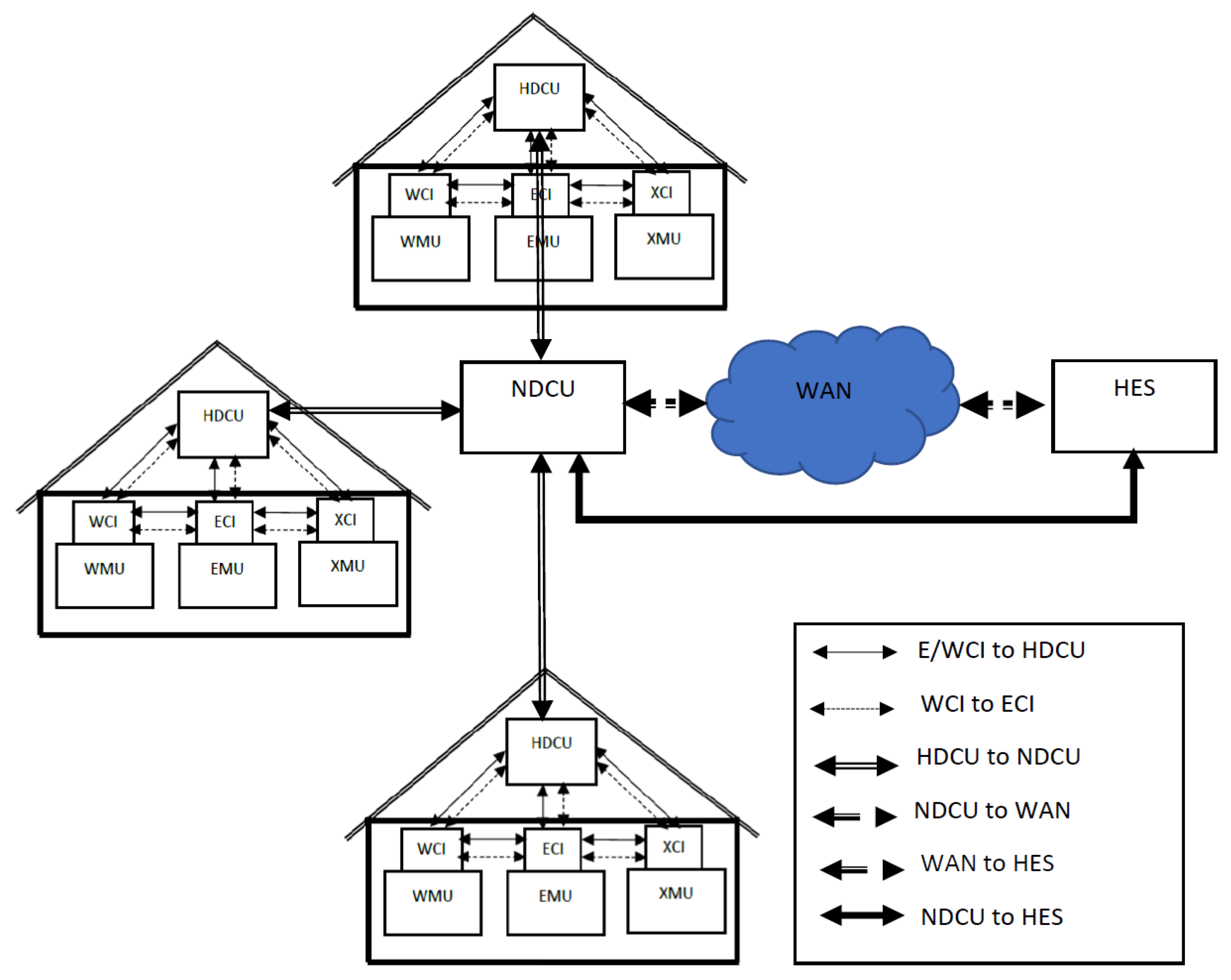
For the integrated metering system, the HES, WAN and NAN are similar to the current AMI infrastructure. The integration happens in the premises area network, in this case HAN. The HAN consists of the energy metering unit, water metering unit and any other metering unit. The envisaged integrated AMI metering framework is as shown in Figure 3 and consists of the following:
  • Energy metering unit (EMU): The EMU is responsible for management monitoring and control of the energy resource, equipment and associated mechanisms. It relays data and information through its energy communication interface unit (ECI) to the HAN DCU (HDCU).
  • Water metering unit (WMU): The WMU is responsible for the management, monitoring and control of the water resource, equipment and associated mechanisms. It relays data and information through its water communication interface unit (WCI) to the HAN DCU (HDCU). The same applies to other metering units.
  • The HAN DCU (HDCU): The HDCU aggregates all the data in the HAN. It is the central component of the HAN that communicates with the NAN DCU (NDCU).
The AMI utilizes different architectures. It is wrought with many expensive legacy systems that cannot be changed. There are different communication topologies employed on a fit-to-use basis. In BAN/IAN of large corporations the HDCU/NDCU can sometimes communicate directly with the HES through a dedicated wired/wireless communication channel. The communication interfaces for the integrated AMI unit can be as follows:
  • HDCU to NDCU interface: Offers bidirectional communication between the HDCU and NDCU. It can use wired or wireless interface technology. Since most NAN DCUs are at the transformer. PLC technology is gaining popularity for this interface.
  • E/WCI to HDCU interface: This interface offers bidirectional communication between the E/WCI and the HDCU. The HDCU centralizes all information in the HAN, then routes the data to and from the HES. It can be wired or wireless.
  • WCI to ECI interface: All meters are traditionally integrated into the power unit. This interface individually connects other metering units to the EMU’s ECI. The EMU ECI then interfaces to the HDCU. It can be wired or wireless. Due to the automatic power connection, PLC technology is gaining popularity for this interface.
  • The Electricity/Water communication interface (ECI/WCI): This formats the data for the relevant resource and sends it to the NDCU or vice versa. It follows the standards being established, like the DLMS/COSEM. Different parameters for the interfaces are still being standardized.

7. The Experimental Prototype Testbed Results and Discussion

7.1. Smart Combined Meter Testing

The testing and standardization frameworks for smart meters are governed by various national and international bodies, focusing on interoperability, accuracy, reliability, and security. The standard bodies include IEC 62052, IEC 62056, IEC 62351 and the regional standards, NIST for the US, BIS for India, South Africa’ s NRS 049 and SANS 474 standards and Chinas SGCC (State Grid Corporation of China), etc. The frameworks ensure multi-vendor product interoperability within the same grid infrastructure.
Testing ensures meters meet performance, accuracy, and safety requirements before installation. The testing framework typically involves a combination of automated test benches and standardized procedures to evaluate specific characteristics. The following tests are performed on meters; metrology (accuracy) tests, communication tests, electrical and mechanical performance tests, environmental tests, security tests and interoperability tests. Automated test systems are developed for this. Only the accuracy and communication tests are evaluated in this work.

7.2. Experimental Test Bed and Prototype

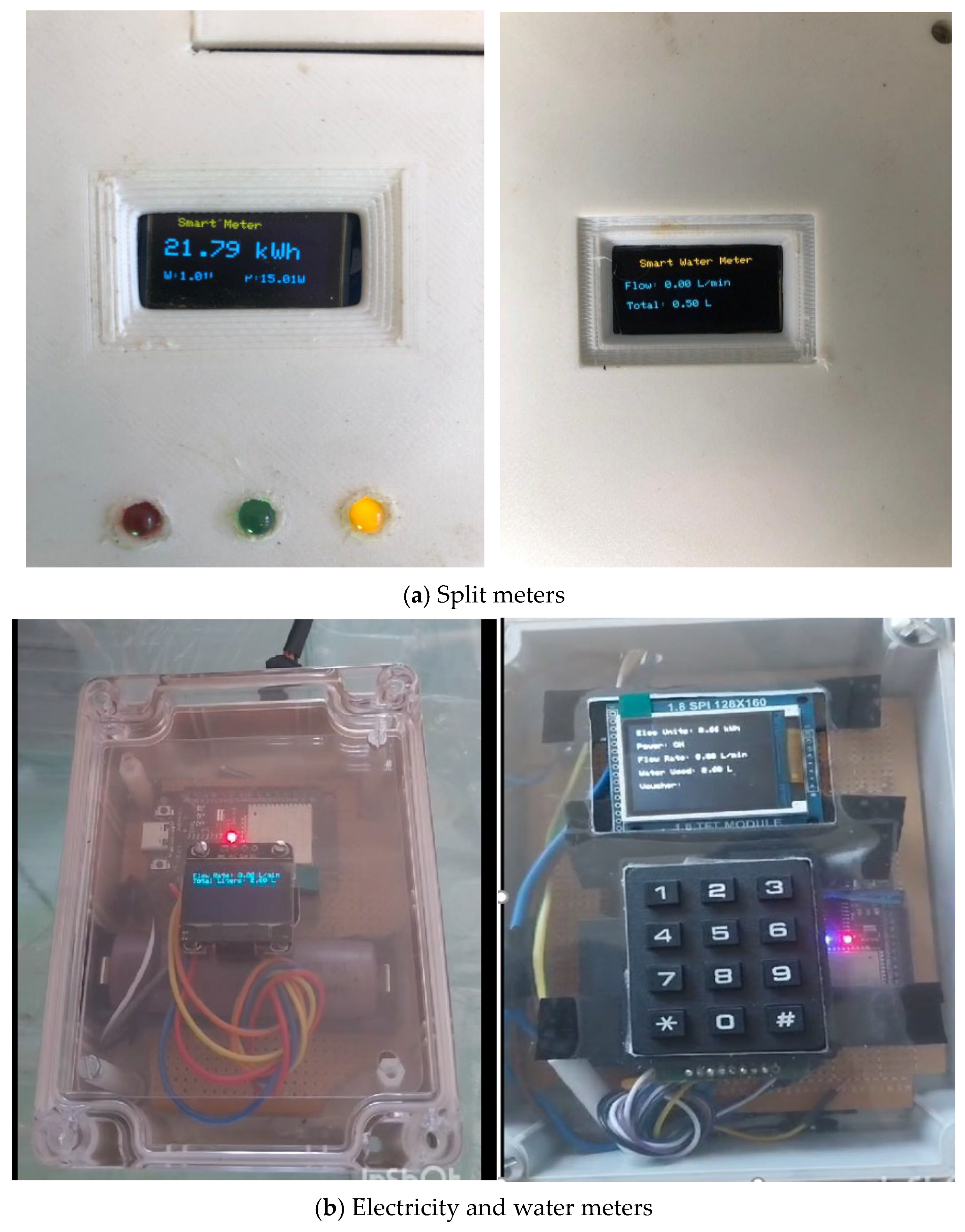
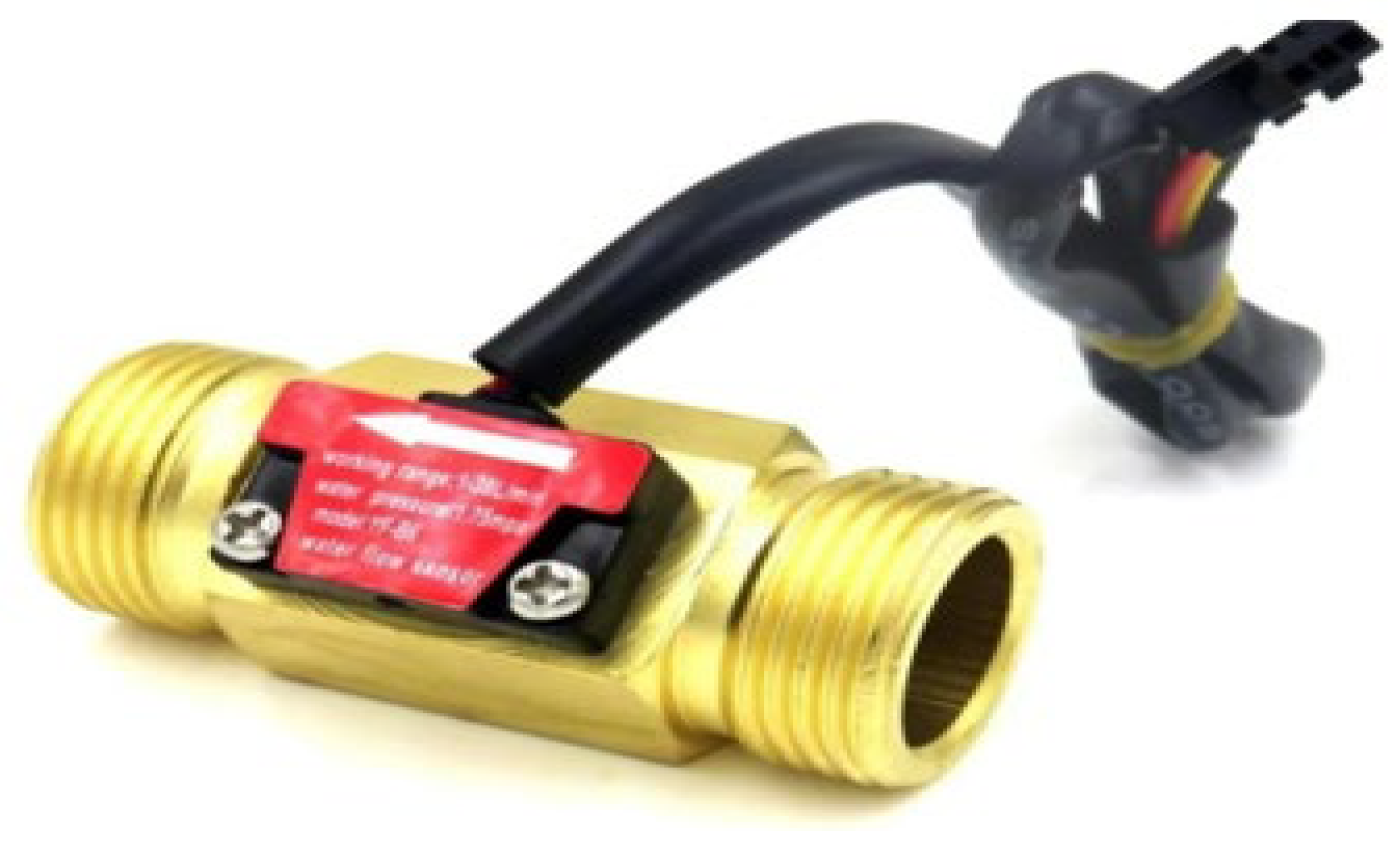
The experimental test bed architecture is as shown in Figure 3. Three sites on different sections of campus were selected where the developed smart meters were installed. The water meter consists of the water sensor, whose pulses are processed and sent to the electricity meter. The water meter communicates with the electricity meter through LORA hardware and software. Different smart electricity meter hardware technologies were designed and installed, featuring different metering ICSs mainly from the ADE (ADE7757) and STPM (STPM3x) families. The smart electricity meter uses PLC for communication with the DC. The DC aggregates data and sends it to the HES through NB-IOT. The developed energy meter and utilized water meter are as shown in Figure 4 and Figure 5. A split design was used for the interface.
At the center of the combined meter is the communication packet structure. Typical packet structure requirements include flag fields for start and end of frame, address field for destination device address, control fields for flow and error control, information field for the actual data, the frame check sequence for error detection and the end of frame flag field. The utilized water and energy frames are as shown in Table 5 and Table 6 below.

7.3. Discussion and Results

The feasibility of a combined metering infrastructure was tested by transmitting data from the installed water and electricity meters at three sites to the data concentrator, then to the HES database. For testing, small constant loads were continuously applied for resource consumption for the entire duration and consumption data relayed to the HES. The effectively relayed data consumption results at the HES for a meter are as shown in Table 7A–C for the three sites. The meter readings were benchmarked to commercial meters for accuracy, with the accumulated consumption for water and instantaneous consumption for electricity.
Although the time labels are shown in hourly format, each row represents a 4-h equivalent sampling interval. The 13 samples collectively represent a 48-h operational period. These experiments were conducted continuously and averaged. Instantaneous values indicate average conditions within each interval, while accumulative values represent total consumption over the 48-h duration. Different loads were used at the three sites.
This effectively shows accurate data collection from the water and electricity meters at all the three sites, with effective communication through LORA, PLC and NBIOT. Note that all the data meter collection results were similarly accurate. The integration of the whole system as the MDMS at the HES featuring a database and the Human Interface Unit was achieved.

8. Conclusions

This work sought to develop a combined smart meter framework for both water and energy. The smart grid structure and components were presented. The integrated AMI communication framework was proposed. The feasibility of the utilization of the water meter system of the smart grid was presented, and the combined metering infrastructure explained in detail. The actual meters were developed and installed at three sites to test the hardware, software and communication feasibility of a combined smart meter system. The installed combined meters collected water and energy data effectively. Through LORA, PLC and NB IOT, the data were effectively relayed to the HES featuring the MDMS. Therefore, the theoretical feasibility and application of the elements of a combined meter were effectively tested. The feasibility was demonstrated through a practical hardware and software design and implementation of the smart meters and the entire system. Further work is needed in terms of implementation and testing on a large scale and integration into the actual utilities’ MDMSs. The implementation should feature full application of the metering standards.

Author Contributions

Conceptualization, T.W., F.G., A.N. and D.B.; methodology, T.W. and O.M.; software, T.W. and O.M.; validation, T.W., O.M. and D.B.; formal analysis, T.W. and O.M.; investigation, T.W. and O.M.; resources, A.N. and D.B.; data curation, T.W., O.M., F.G., A.N. and D.B.; writing—original draft preparation, T.W. and F.G.; writing—review and editing, T.W. and O.M.; visualization, T.W., O.M., F.G., A.N. and D.B.; supervision, T.W., F.G., A.N. and D.B.; project administration, T.W., A.N. and D.B.; funding acquisition, T.W., A.N. and D.B. All authors have read and agreed to the published version of the manuscript.

Funding

This research was funded by eThekwini municipality.

Data Availability Statement

The original contributions presented in this study are included in the article. Further inquiries can be directed to the corresponding author.

Conflicts of Interest

The authors declare no conflicts of interest.

References

  1. Deconinck, G. An Evaluation of Two-Way Communication Means for Advanced Metering in Flanders (Belgium). In Proceedings of the 2008 IEEE Instrumentation and Measurement Technology Conference, Victoria, BC, Canada, 12–15 May 2008; IEEE: New York, NY, USA, 2008; pp. 900–905. [Google Scholar]
  2. Zivic, N.S.; Ur-Rehman, O.; Ruland, C. Evolution of Smart Metering Systems. In Proceedings of the 2015 23rd Telecommunications Forum Telfor (TELFOR), Belgrade, Serbia, 24–26 November 2015; IEEE: New York, NY, USA, 2015; pp. 635–638. [Google Scholar]
  3. Wong, S.; Moghavvemi, M. A Reliable and Economically Feasible Automatic Meter Reading System Using Power Line Distribution Network. Int. J. Eng. 2005, 18, 301–318. [Google Scholar]
  4. Li, X.J.; Chong, P.H.J. Design and Implementation of a Self-Powered Smart Water Meter. Sensors 2019, 19, 4177. [Google Scholar] [CrossRef] [PubMed]
  5. Depuru, S.S.S.R.; Wang, L.; Devabhaktuni, V.; Gudi, N. Smart meters for power grid—Challenges, issues, advantages and status. In Proceedings of the 2011 IEEE/PES Power Systems Conference and Exposition, Phoenix, AZ, USA, 20–23 March 2011; IEEE: New York, NY, USA, 2011; pp. 1–7. [Google Scholar]
  6. Idris, E. Smart Metering: A Significant Component of Integrated Water Conservation System. In Proceedings of the 1st Australian Young Water Professionals Conference, Sydney, Australia, 15–17 February 2006; pp. 15–17. [Google Scholar]
  7. Lee, Y.W.; Eun, S.; Oh, S.-H. Wireless digital water meter with low power consumption for automatic meter reading. In Proceedings of the 2008 International Conference on Convergence and Hybrid Information Technology, Daejeon, Republic of Korea, 28–30 August 2008. [Google Scholar]
  8. Cushing, V. Electromagnetic Water Current Meter. In Proceedings of the OCEANS ‘76, Washington, DC, USA, 13–15 September 1976; IEEE: New York, NY, USA, 1976; pp. 663–679. [Google Scholar]
  9. Wright, P. The Coanda Meter-a Fluidic Digital Gas Flowmeter. J. Phys. E Sci. Instrum. 1980, 13, 433. [Google Scholar] [CrossRef]
  10. Kuzlu, M.; Pipattanasomporn, M.; Rahman, S. Communication Network Requirements for Major Smart Grid Applications in Han, Nan and Wan. Comput. Netw. 2014, 67, 74–88. [Google Scholar] [CrossRef]
  11. Goudarzi, A.; Ghayoor, F.; Waseem, M.; Fahad, S.; Traore, I. A Survey on IoT-Enabled Smart Grids: Emerging, Applications, Challenges, and Outlook. Energies 2022, 15, 6984. [Google Scholar] [CrossRef]
  12. Paulsen, R.J.; Smith, C.F.; O’rourke, D.; Wong, T.F. Development and Evaluation of an Ultrasonic Ground Water Seepage Meter. Groundwater 2001, 39, 904–911. [Google Scholar] [CrossRef] [PubMed]
  13. Gungor, V.C.; Sahin, D.; Kocak, T.; Ergut, S.; Buccella, C.; Cecati, C.; Hancke, G.P. Smart Grid Technologies: Communication Technologies and Standards. IEEE Trans. Ind. Inform. 2011, 7, 529–539. [Google Scholar] [CrossRef]
  14. Ajami, N. Transforming How Water Utilities Do Business; American Water Works Association: Denver, CO, USA, 2018. [Google Scholar]
  15. Grigg, N.S. Digital Transformation in Water Utilities: Status, Challenges, and Prospects. Smart Cities 2025, 8, 99. [Google Scholar] [CrossRef]
  16. DLMS User Association. DLMS/COSEM Architecture and Protocol, 8th ed.; (the ‘Green Book’); DLMS User Association: Geneva, Switzerland, 2017. [Google Scholar]
  17. Kheaksong, A.; Lee, W. Packet transfer of DLMS/COSEM standards for smart grid. In Proceedings of the 20th Asia-Pacific Conference on Communication (APCC2014), Pattaya, Thailand, 1–3 October 2014; IEEE: New York, NY, USA, 2014; pp. 391–396. [Google Scholar]
  18. Park, M.; Eun, C. Data Interworking Model and Analysis for Harmonization of Smart Metering Protocols in IoT-Based AMI System. Sensors 2023, 23, 2903. [Google Scholar] [CrossRef]
  19. IEEE Standard 2030-2011; IEEE Guide for Smart Grid Interoperability of Energy Technology and Information Technology Opera-tion with the Electric Power System (EPS), End-Use Applications, and Loads. IEEE: New York, NY, USA, 2011.
  20. Zhou, J.; Hu, R.Q.; Qian, Y. Scalable Distributed Communication Architectures to Support Advanced Metering Infrastructure in Smart Grid. IEEE Trans. Parallel Distrib. Syst. 2013, 23, 1632–1642. [Google Scholar] [CrossRef]
  21. Abrahamsen, F.E.; Ai, Y.; Cheffena, M. Communication Technologies for Smart Grid: A Comprehensive Survey. Sensors 2021, 21, 8087. [Google Scholar] [CrossRef] [PubMed]
  22. Soares Ascenção, É.; Melo Marinangelo, F.; Meschini Almeida, C.F.; Kagan, N.; Dias, E.M. Applications of Smart Water Management Systems: A Literature Review. Water 2023, 15, 3492. [Google Scholar] [CrossRef]
  23. Okoli, N.J.; Kabaso, B. Building a Smart Water City: IoT Smart Water Technologies, Applications, and Future Directions. Water 2024, 16, 557. [Google Scholar] [CrossRef]
  24. Ancillotti, E.; Bruno, R.; Conti, M. The Role of Communication Systems in Smart Grids: Architectures, Technical Solutions and Research Challenges. Comput. Commun. 2013, 36, 1665–1697. [Google Scholar] [CrossRef]
  25. Wei, T.; Li, H.; Miao, J. Integration and Development Path of Smart Grid Technology: Technology Driven, Policy Framework and Application Challenges. Processes 2025, 13, 2428. [Google Scholar] [CrossRef]
  26. Uribe-Pérez, N.; Hernández, L.; De La Vega, D.; Angulo, I. State of the Art and Trends Review of Smart Metering in Electricity Grids. Appl. Sci. 2016, 6, 68. [Google Scholar] [CrossRef]
  27. Porwal, S.; Akbar, S.A.; Jain, S.C. Leakage detection and prediction of location in a smart water grid using SVM classification. In Proceedings of the 2017 International Conference on Energy, Communication, Data Analytics and Soft Computing (ICECDS), Chennai, India, 1–2 August 2017; IEEE: New York, NY, USA, 2017; pp. 3288–3292. [Google Scholar]
  28. Wang, Y.; Chen, Q.; Gan, D.; Yang, J.; Kirschen, D.S.; Kang, C. Deep Learning-Based Socio-Demographic Information Identification from Smart Meter Data. IEEE Trans. Smart Grid 2018, 10, 2593–2602. [Google Scholar] [CrossRef]
  29. Wang, Y.; Chen, Q.; Hong, T.; Kang, C. Review of Smart Meter Data Analytics: Applications, Methodologies, and Challenges. IEEE Trans. Smart Grid 2018, 10, 3125–3148. [Google Scholar] [CrossRef]
  30. Kappagantu, R.; Daniel, S.A. Challenges and issues of smart grid implementation: A case of Indian scenario. J. Electr. Syst. Inf. Technol. 2018, 5, 453–467. [Google Scholar] [CrossRef]
  31. Kanellopoulos, D.; Sharma, V.K.; Panagiotakopoulos, T.; Kameas, A. Networking Architectures and Protocols for IoT Applications in Smart Cities: Recent Developments and Perspectives. Electronics 2023, 12, 2490. [Google Scholar] [CrossRef]
Figure 1. The AMI Smart Metering System.
Energies 19 01449 g001
Figure 2. HAN system.
Energies 19 01449 g002
Figure 3. Integrated AMI Metering Framework.
Energies 19 01449 g003
Figure 4. Different Meter Implementations.
Energies 19 01449 g004
Figure 5. Water Flow Sensor.
Energies 19 01449 g005
Table 1. Short-range communication technologies.
TechnologyCharacteristicsMerits/Demerits
IEEE 802.15.4—ZigBee
  • Freq: Up to 250 kbps (2.4 GHz), 40 kbps (915 MHz), 20 kbps (868 MHz).
  • Range: 10 to 100 m LOS.
  • Low duty cycle, low data latency, low power.
  • Poor security. ISM interference.
IEEE 802.15.4—Z-Wave
  • Freq: 868 MHz (9.6 kbps) 2.4 GHz (200 kbps).
  • Range: 30 m (indoor), 100 m (outdoors).
  • Low data rate, short range, and low cost, low power.
  • Low interference, strong security. Limited devices.
IEEE 802.15.1a—Bluetooth
  • Freq: 2.4 GHz (1 Mbps).
  • Range: up to 100 m.
  • Low power, high transmission rate, low capacity.
  • Can handle few devices.
IEEE 802.15.4/IPv6—6LoWPAN
  • Freq: 2.4 GHz (40–250 kbps).
  • Range 100 m
  • Low cost, low power, connection to the internet.
  • Bandwidth limited.
IEEE 802.11ah—Low-power Wi-Fi
  • Freq: ISM (7.8 Mb/s)
  • Range 200 m–1 km
  • Supports many devices.
  • Low power, interference/disruption.
Wi-Fi (IEEE 802.11)
  • Freq: ISM (600 Mb/s)
  • Range 100 m
  • Supports many devices.
  • High power, interference/disruption.
Near Field Communication (NFC)
  • Freq: 13.56 MHz (424 Kbps, latency of 100–250 ms)
  • Range 10 to 20 cm
  • Peer-to-peer communications, low power, low cost, good security.
Ethernet
  • Wired technology, 100 Gbps
  • Range 100 m
  • Well established, secure.
  • High installation cost.
Table 2. PLC base communication standards.
TechnologyCharacteristicsMerits/Demerits
Broadband PLC (BPL)
TIA-1113, IEEE 1901, ITU-T G.hn, HomePlug
Freq: 1 to 250 MHz
Data: 500 Mbps
Range: 1500 m.
  • Existing infrastructure, less installation cost, good reliability.
  • Noisy channel. Security and privacy issues due to broadcasting, Disturbance sensitivity, BPL standards are not interoperable, low range.
Narrowband PLC (NB-PLC)
G3-PLC, PRIME, G3-PLC, IEEE P1901.2, and ITU G.hnem standards)
Freq: 3 to 500 KHz
Data: 500 Kbps
Range: 3000 m.
  • Existing infrastructure, less installation cost, good reliability.
  • Noisy channel. Security and privacy issues due to broadcasting, Disturbance sensitivity, NBPLC standards are not interoperable.
Ultra-narrowband PLC (UNB-PLC):
TWACS, Ripple Carrier Signaling/Control
Freq: 0.3 to 3 KHz
Data: 100 bps
Range: >150 km.
  • Existing infrastructure, less installation cost, good reliability.
  • Noisy channel. Security and privacy issues due to broadcasting, disturbance sensitivity, low data rate transmission.
Table 3. Long-range communication technologies.
TechnologyCharacteristicsMerits/Demerits
Low-power Wide Area Networks (LPWANs)Range: 2 to 5 km/urban areas, 10 km/rural areas.
RF technology.
  • High penetration
  • Low power
Narrow-Band Internet of Things (NB-IoT)Freq: 200 KHz, cellular-based technology.
Data rate: 200 kbps, message of 1600 bytes
  • Great range of communication, strong penetration, low energy consumption
  • Low data rates
LoRaWAN
Sigfox, ingenu, D7AP, Wireless M-Bus and Wi-SUN
Range: Cities/1–5 km, Rural/up to 15 km.
  • Long distance, less energy usage, great underground penetration, low energy.
RF Cellular Technology:
2G, 2.5G, 3G, WiMAX, LTE and 5G
Latency ranging from 1 to 1000 ms.
Data rates ranging from 100 to 10 Gb/s
  • High data rates, availability, security, wide coverage, low maintenance
  • High initial costs, congestion and performance degradation
RF Non Cellular Technology:
KamstrupRF, MeshNet3 and Flexnet
Freq: RF links, unlicensed radio, 900 MHz
Data/Range: 172 kbps over a range of 30 km.
  • Self-formed and self-healed
  • Interference problems.
IEEE 802.16 WiMAXFixed communication 3.65 GHz and 5.8 GHz.
Mobile communication
2.3 GHz, 2.5 GHz and 3.5 GHz.
Data: 75 Mbps and latency 10–50 ms
Range of 10–50 km LOS, 1–5 km NLOS
  • Multiple connections; more than 200 devices can communicate at a time. Long range, high data rate.
  • Costly radio system, high frequency results in short wavelength, weather-prone.
Satellite CommunicationsBand-dependent frequency from 1 to 75 GHz
Data rates 1 to 10 Gps
  • Wide coverage, thousands of kms, worldwide.
  • High latency up to 300 ms
Table 4. Integrated AMI infrastructure characteristics.
PANNANWAN
Range1 to 100 m10 m to 10 km10 to 100 km
Data rate10 to 100 kbps100 kbps to 10 mbps110 mbps to 10 Gbps
ApplicationsHome Energy Management Systems (HEMS), Demand Response (DR), Supervisory Control and Data Acquisition (SCADA),
Advanced Metering Infrastructure (AMI), Distributed Automation (DA), Distributed Generation (DG), Distributed Storage, Fault Detection and Home Security, etc.
Advanced Metering Infrastructure (AMI), Distributed Automation (DA), Distributed Generation (DG), Distributed Storage, Home Energy Management Systems (HEMS), Automated Demand Response (DR) Management, and Supervisory Control and Data Acquisition (SCADA). Outage Detection, Voltage Optimization, Microgrid Control and Management, etc.Advanced Metering Infrastructure (AMI), Distributed Automation (DA), Distributed Generation (DG), Distributed Storage, Resource Management, Home Energy Management Systems (HEMS), Automated Demand Response (DR). Load Control and Supervisory Control and Data Acquisition (SCADA). Grid Monitoring and Optimization, Data Collection and Management MDMS, Integration and Interoperability, Cybersecurity, etc.
Communication TechnologiesShort-range technologies, Table 1
PLC Table 2
Mixed, Table 1, Table 2 and Table 3Long-range technologies. Table 3
Table 5. Water Meter Data Payload Structure (Water Data).
Field NameData TypeSize (Bytes)Unit/ScaleDescription
Water Meter IDByte Array4Unique identifier for the water meter
Flow RateUnsigned Short2L/hInstantaneous water flow rate
Cumulative VolumeUnsigned Int4LitersTotal water consumption
Battery VoltageUnsigned Byte1V (encoded)Battery status for low-power operation
CRC16Unsigned Short2Error detection checksum
Total Payload Size13 bytesOptimized for low-power IoT transmission
Table 6. Energy Meter Data Payload Structure (Energy Data).
Field NameData TypeSize (Bytes)Unit/ScaleDescription
Meter ID 4Unique identifier for the energy meter
Active EnergyUnsigned Int4WhCumulative active electrical energy consumed
Reactive EnergyUnsigned Int4VARhCumulative reactive energy
Apparent EnergyUnsigned Int4VAhCumulative apparent energy
Voltage RMSUnsigned Short2V (scaled)RMS voltage measurement
Current RMSUnsigned Short2A (scaled)RMS current measurement
Instantaneous PowerSigned Int4WReal-time active power (positive/negative supported)
Available UnitsUnsigned Short2WhRemaining prepaid energy or available units
CRC16Unsigned Short2Error detection checksum
Total Payload Size28 bytesCompact AMI transmission frame
Table 7. Smart Meter Results Site.
A. Smart Meter Results Site 1.
TimeWater Consumption/Meter ID 11Electricity Consumption/Meter ID 12
Instantaneous (L/h)Accumulative (L)Benchmark Accum. (L)Instantaneous (kW)Accumulative (kWh)Benchmark Inst. (kW)
08h002080821.455.801.47
09h00101201181.3511.201.33
10h00202002031.2516.201.27
11h00102402361.3021.401.29
12h00303603681.2026.201.22
13h00204404461.1030.601.12
14h00104804741.2535.601.24
15h00205605691.3541.001.37
16h00106005921.4046.601.38
17h00206806891.3051.801.32
18h0006806721.2056.601.19
19h0006806861.1561.201.17
20h0006806911.1065.601.09
B. Smart Meter Results Site 2.
TimeWater Consumption/Meter ID 21Electricity Consumption/Meter ID 22
Instantaneous (L/h)Accumulative (L)Benchmark Accum. (L)Instantaneous (kW)Accumulative (kWh)Benchmark Inst. (kW)
08h00251001021.807.201.82
09h00151601571.7014.001.68
10h00202402451.6020.401.62
11h00153002961.5526.601.54
12h00354404471.4532.401.47
13h00255405481.4038.001.42
14h00156005921.5044.001.48
15h00257007121.6550.601.67
16h00157607511.7057.401.68
17h00258608721.6063.801.62
18h0058808681.4569.601.44
19h0008808921.4075.201.42
20h0008808991.3580.601.34
C. Smart Meter Results Site 3.
TimeWater Consumption/Meter ID 31Electricity Consumption/Meter ID 32
Instantaneous (L/h)Accumulative (L)Benchmark Accum. (L)Instantaneous (kW)Accumulative (kWh)Benchmark Inst. (kW)
08h001040412.6010.402.58
09h00560582.5520.602.57
10h00101001032.5030.602.48
11h0051201182.4540.402.47
12h00151801842.3549.802.37
13h00102202242.3059.002.28
14h0052402362.4068.602.42
15h00102802862.5578.802.53
16h0053002962.6089.202.62
17h00103403472.5099.202.48
18h0003403342.30108.402.28
19h0003403462.20117.202.22
20h0003403492.10125.602.08
Disclaimer/Publisher’s Note: The statements, opinions and data contained in all publications are solely those of the individual author(s) and contributor(s) and not of MDPI and/or the editor(s). MDPI and/or the editor(s) disclaim responsibility for any injury to people or property resulting from any ideas, methods, instructions or products referred to in the content.