Identification and Application of Flow Units in Tight Sandstone Reservoirs Under Complex Structural Settings Based on the SSOM Algorithm: A Case Study of the Shaximiao Formation in Southern Sichuan Basin



Abstract
1. Introduction
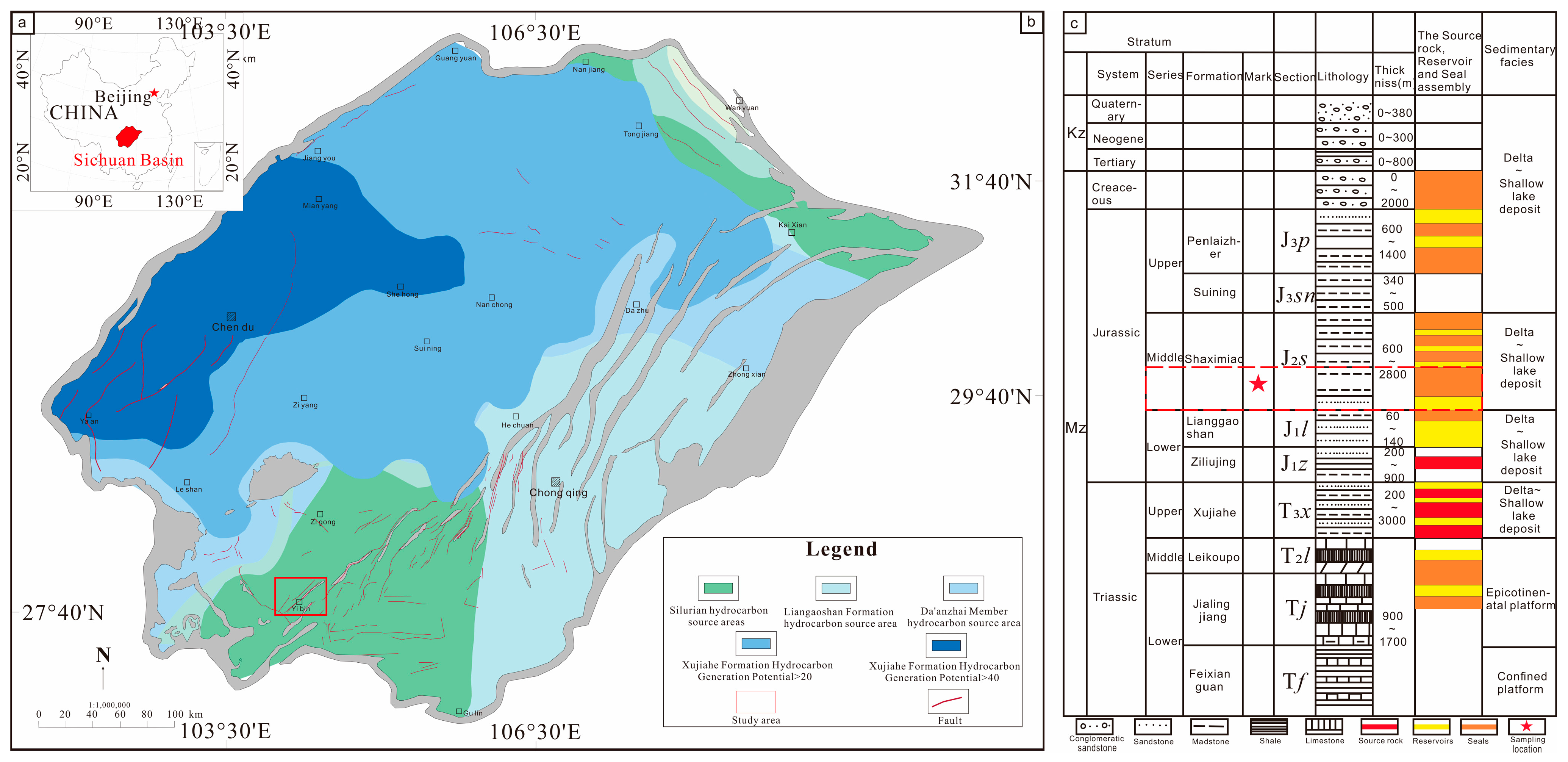
2. Geological Setting of the Study Area

3. Data and Methods
3.1. Data Acquisition
3.2. Data Pre-Processing
3.3. Principles of Machine-Learning Algorithms
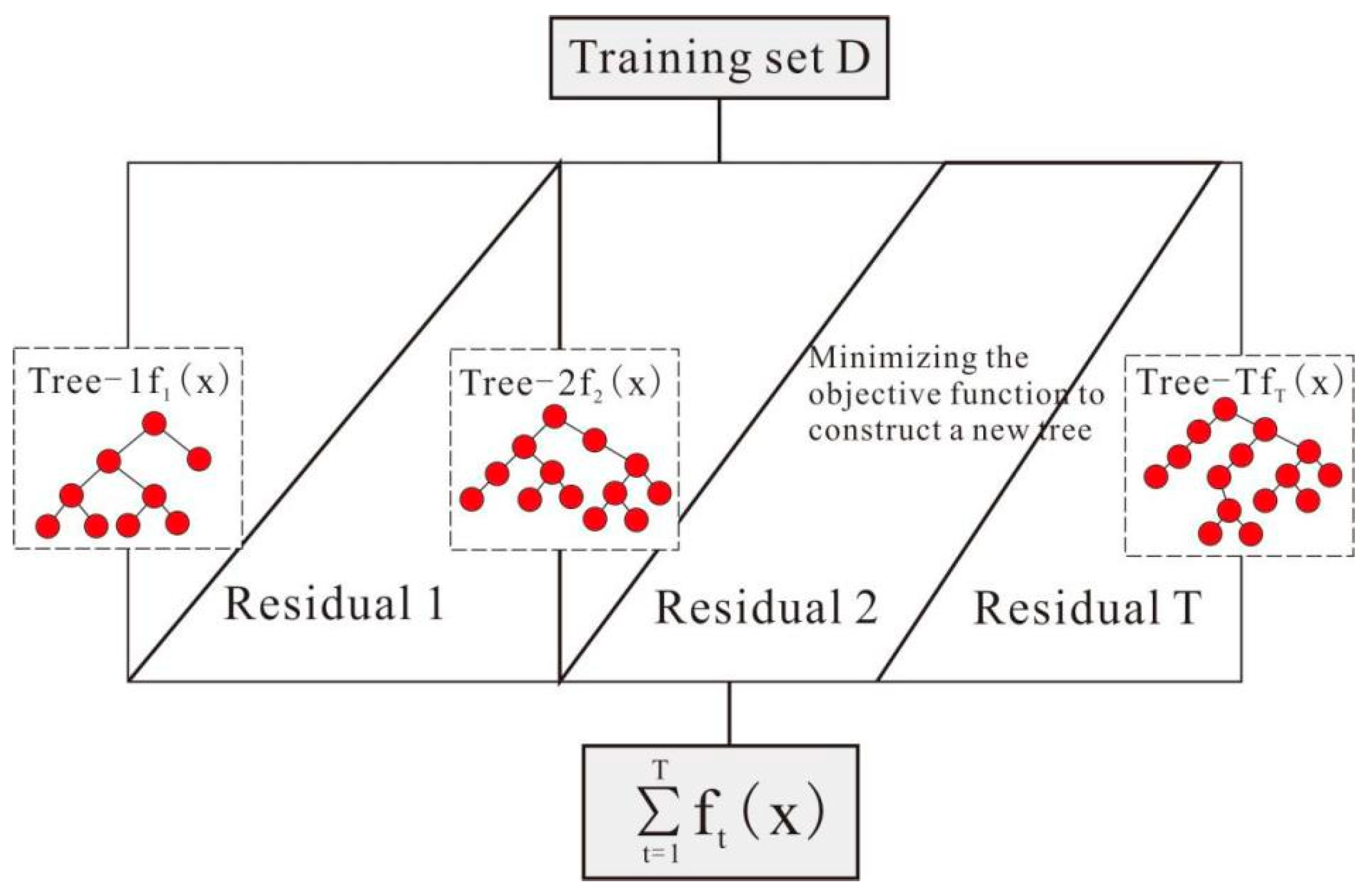
3.3.1. Gradient Boosting Decision Tree (GBDT)
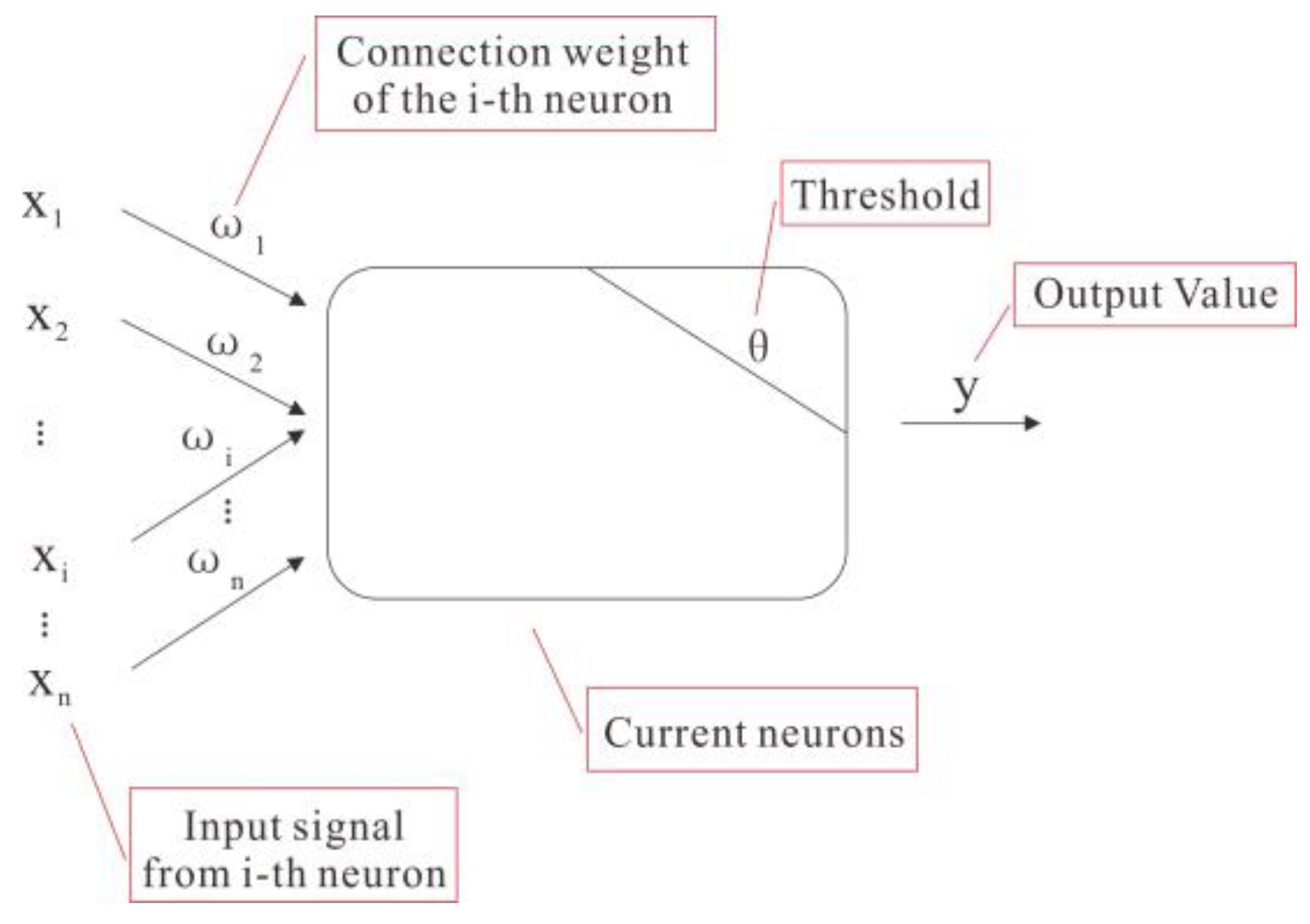
3.3.2. The Backpropagation Neural Network Algorithm (BPANN)
- Forward Propagation:
- 2.
- Backward Propagation:
3.3.3. Supervised Self-Organizing Map Neural Network Algorithm (SSOM)
3.4. Model Training and Hyperparameter Tuning
3.5. Flow Unit Division Methods
4. Results
4.1. Reservoir Characteristics
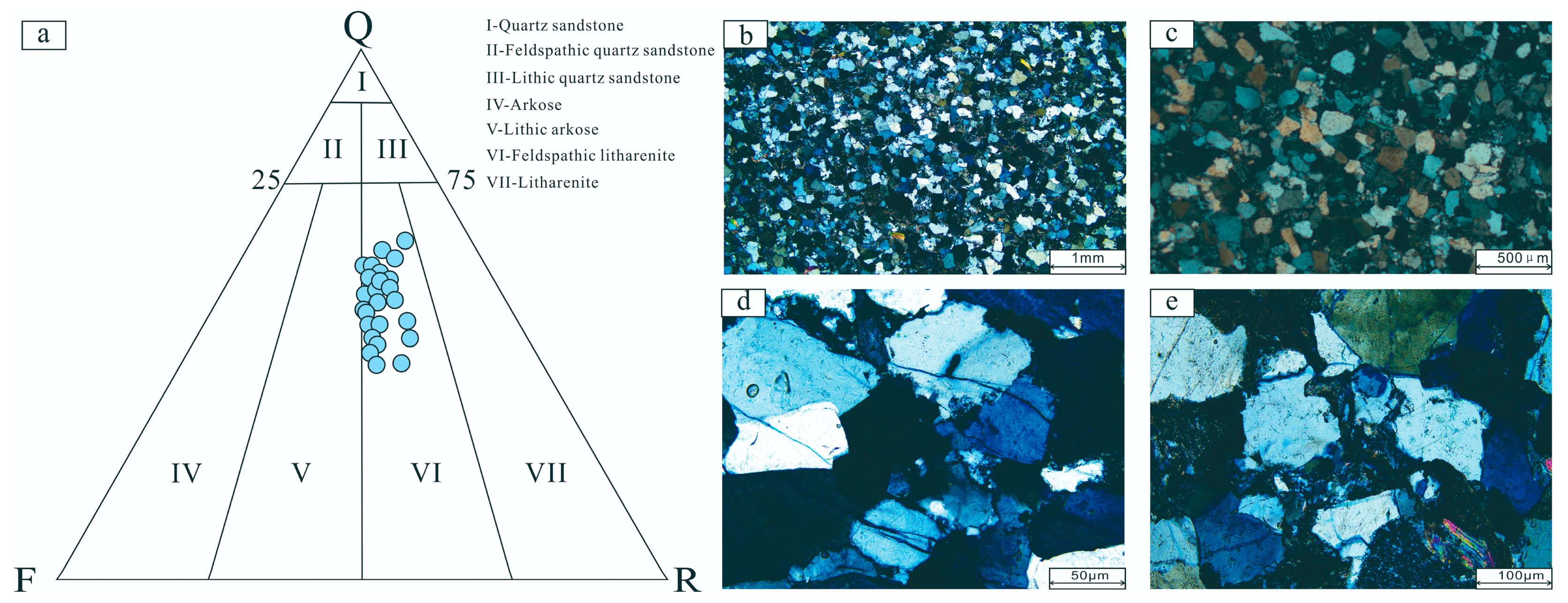
4.1.1. Petrological Characteristics
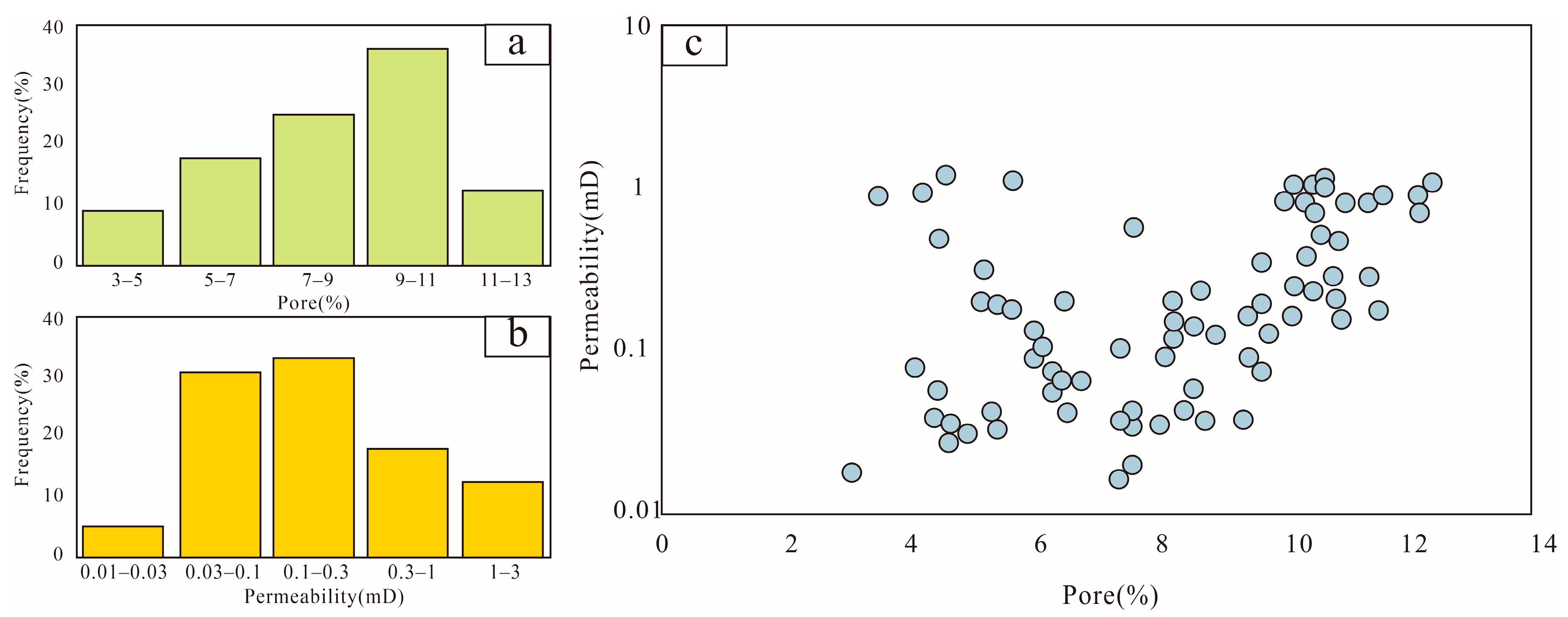
4.1.2. Physical Properties
4.2. Characteristics of Reservoir Pore Structure
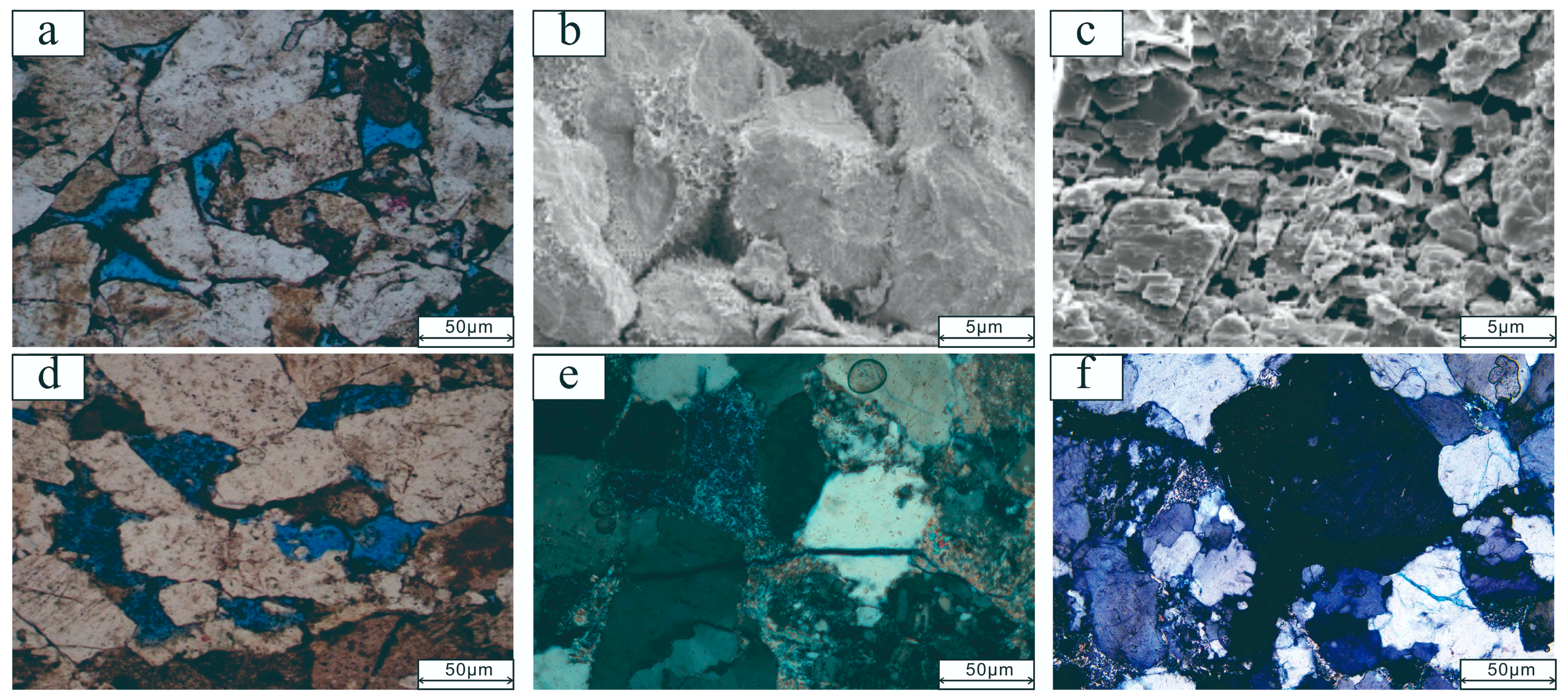
4.2.1. Pore Types in Reservoir Rocks
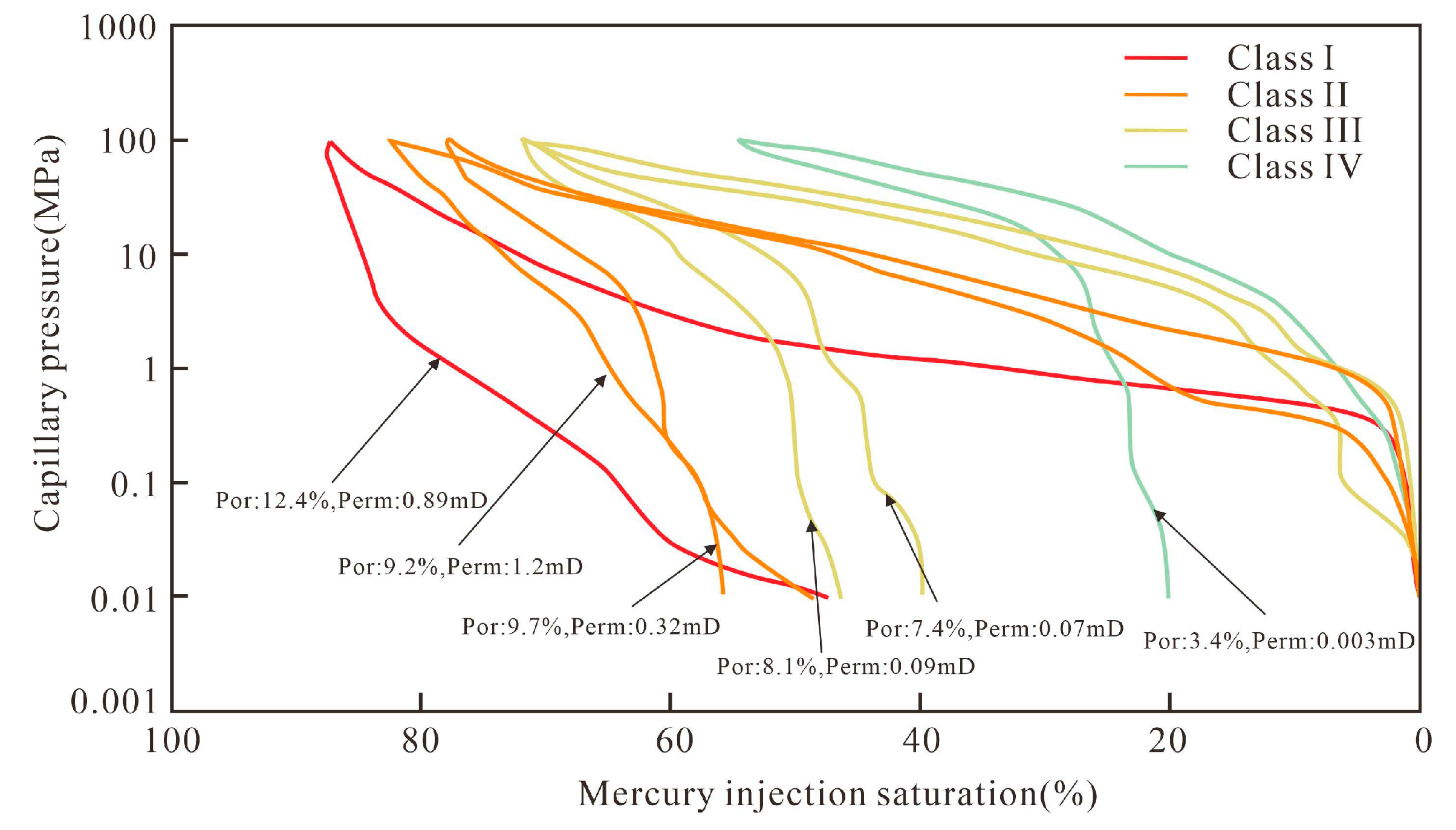
4.2.2. Classification of Pore Throats and Pore Structure
4.3. Identification of Reservoir Flow Units
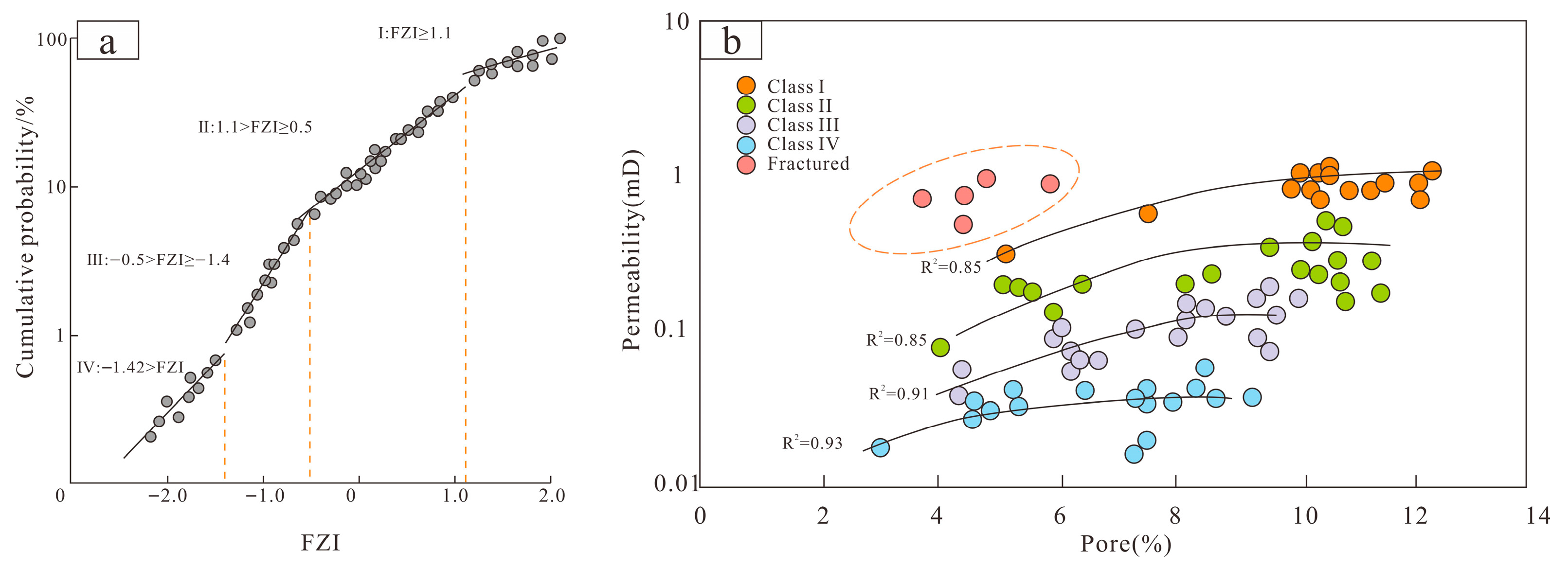
4.3.1. Reservoir Flow Unit Division
4.3.2. Intelligent Identification of Flow Units Based on Machine Learning Algorithms
5. Discussion
5.1. Vertical Development Characteristics of Reservoir Flow Units
5.2. Planar Development Characteristics of Reservoir Flow Units
6. Conclusions
- (1)
- By overcoming the limitations of traditional FZI methods and incorporating fracture flow effects, we established a five-dimensional flow unit classification standard (“four conventional types + fracture-type”). The fracture-type units, characterized by low porosity (4.4%) and high permeability (0.85 mD), demonstrate an average daily gas production of 14,200 cubic meters, serving as key contributors to high productivity in low-porosity reservoirs.
- (2)
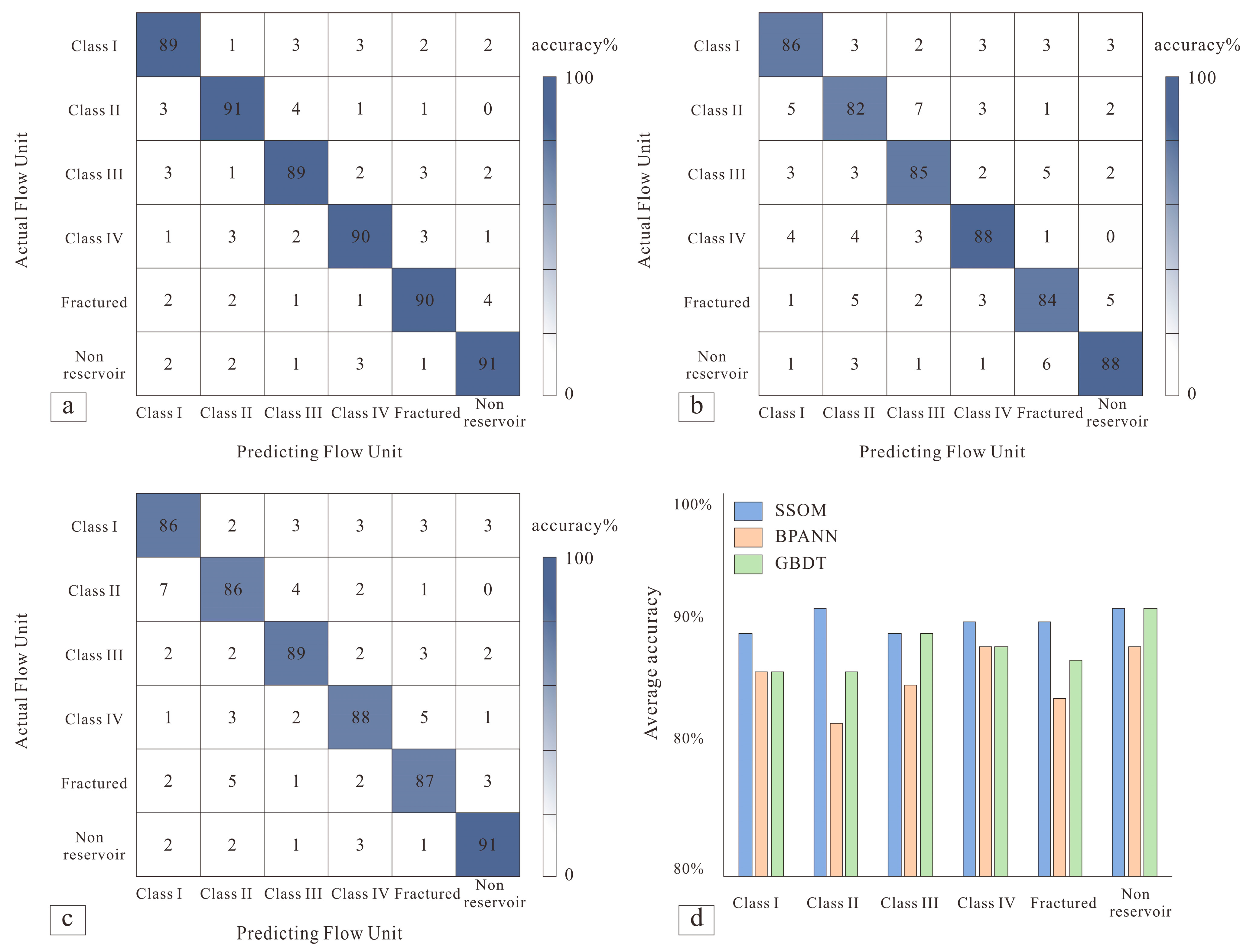
- The study confirmed the superiority of the SSOM algorithm in identifying flow units in complex reservoirs, with its 90.1% prediction accuracy stemming from its capability to decouple high-dimensional nonlinear relationships (particularly fracture responses), providing a reliable tool for predicting units in uncored intervals.
- (3)
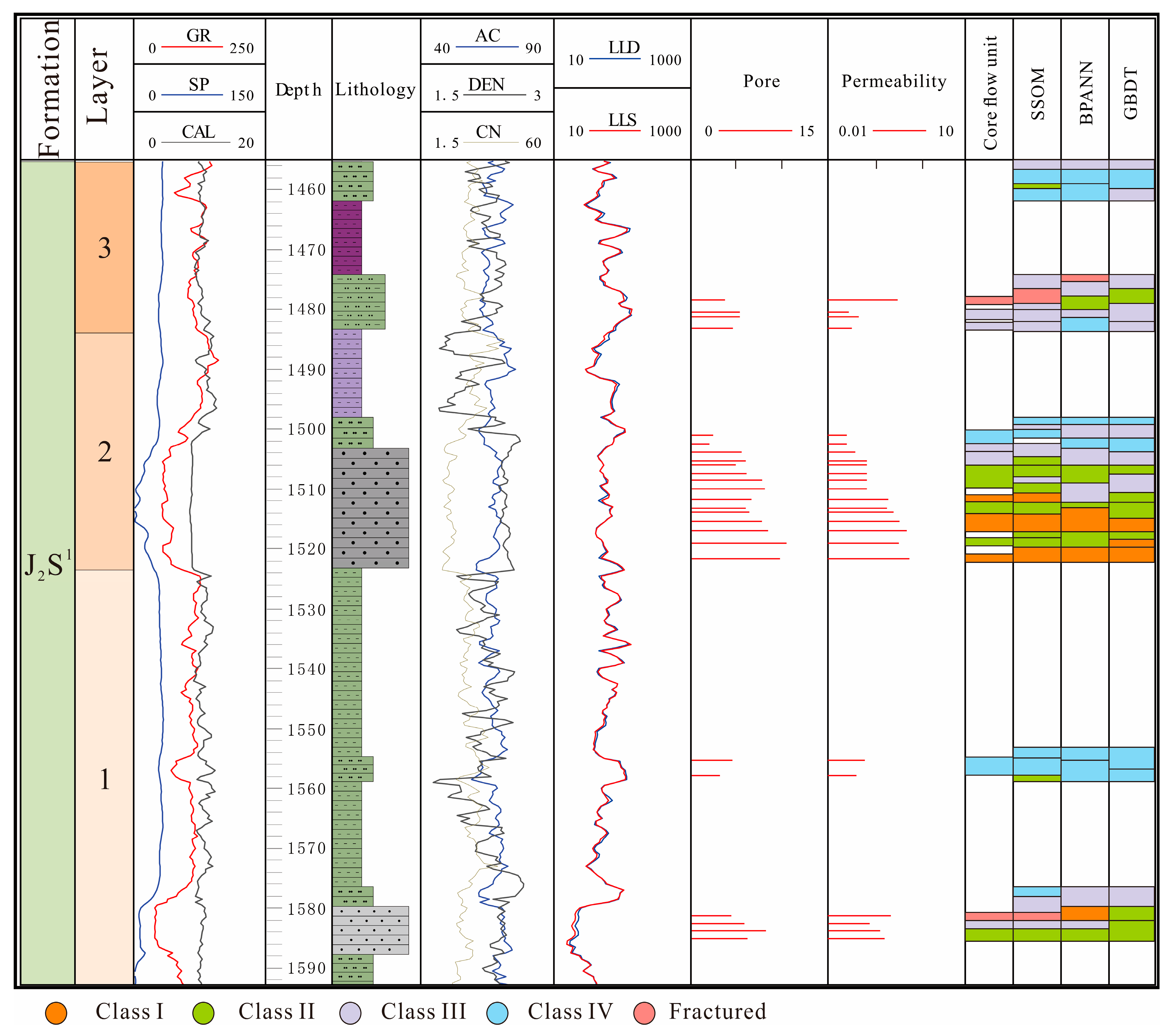
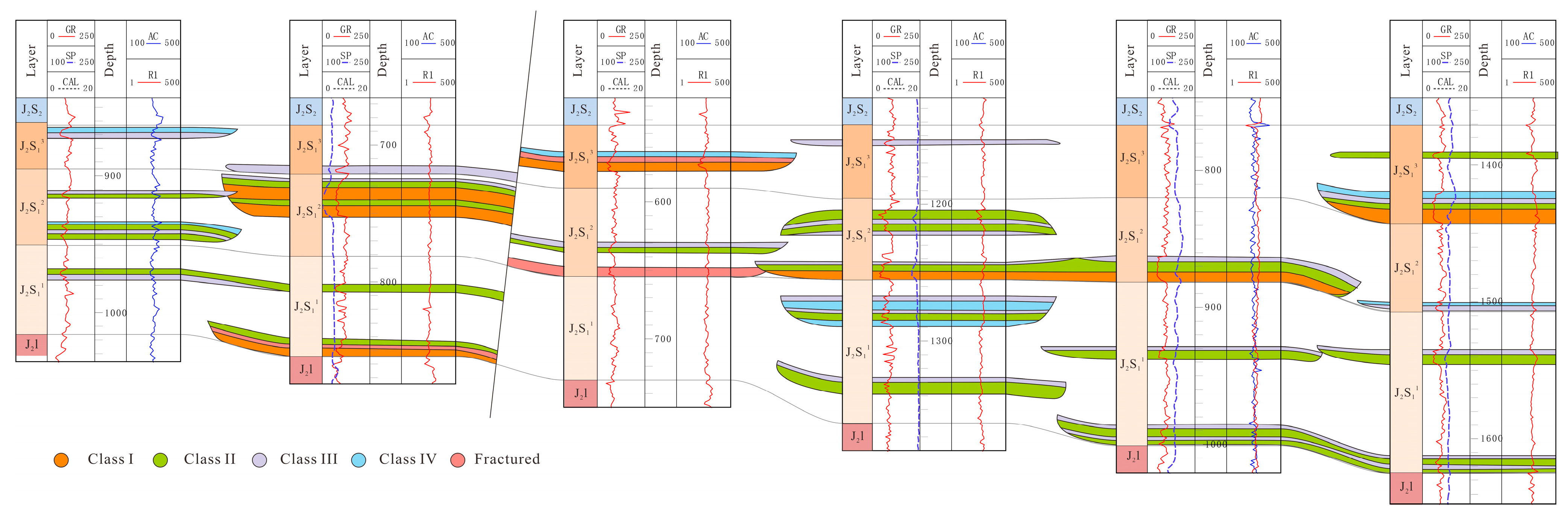
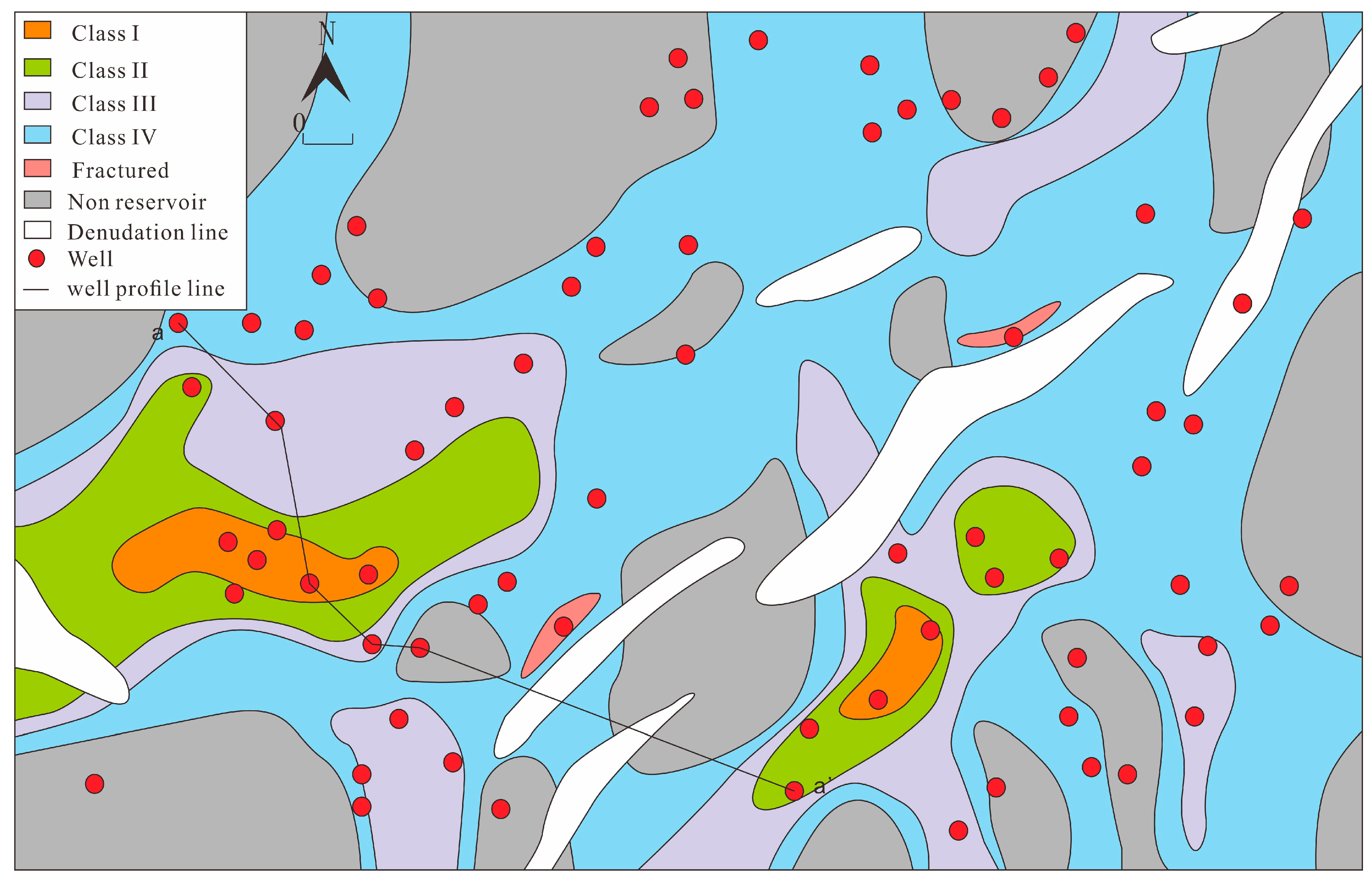
- Vertically, the differentiation of flow units is controlled by depositional sequences—Class I units predominantly develop at the base of delta plain channels (J2S12), while delta front thin sand bodies (J2S11/3) are mainly composed of Class II units. Horizontally, the coupling of tectonic and depositional processes results in strong heterogeneity, with high-quality units (Class I/II) showing ribbon-like distributions near sediment sources and fracture-type units being enriched along fault zones.
Author Contributions
Funding
Data Availability Statement
Conflicts of Interest
References
- Zou, C.-N.; Zhu, R.-K.; Bai, B.; Yang, Z.; Hou, L.-H.; Zha, M.; Fu, J.-H.; Shao, Y.; Liu, K.-Y. Significance, geologic characteristics, resource potential and future challenges of tight oil and shale oil. Bull Miner. Petrol. Geochem. 2015, 34, 3–17. [Google Scholar]
- Cai, Y.-D.; Gao, G.-S.; Liu, D.-M.; Qiu, F. Geological conditions for coal measure gas enrichment and accumulation models in Linxingzhong block along the eastern margin of the Ordos Basin. Nat. Gas Ind. 2022, 42, 25–36. [Google Scholar]
- Guo, T.-L.; Xiong, L.; Ye, S.-J.; Dong, X.-X.; Wei, L.-M.; Yang, Y.-T. Theory and practice of unconventional gas exploration in carrier beds: Insight from the breakthrough of new type of shale gas and tight gas in Sichuan Basin, SW China. Pet. Explor. Dev. 2023, 50, 24–37. [Google Scholar] [CrossRef] [Scilit]
- Mao, J.-B.; Yan, W.-L.; Fei, H.-Y.; Chen, W.-D.; Fei, Z.Q. Reservoir characteristics of Shaximiao Formation in Wubaochang structure, northeastern Sichuan Basin. Nat. Gas Ind. 2007, 27, 8–10. [Google Scholar]
- Ye, J.-L.; Li, Z.-Q.; Zhang, Y. On the genesis of fissures in the Shaximiao Formation, Wubaochang. Acta Geol. Sichuan 2011, 31, 162–166. [Google Scholar]
- Wang, X.-J.; Chen, S.-L.; Xie, J.-R.; Ma, H.-L.; Zhu, D.-Y.; Pang, X.-T.; Yang, T.; Lv, X.-Y. Accumulation characteristics and main controlling factors of tight sandstone of Jurassic Shaximiao Formation in southwestern Sichuan Basin. Lithol. Reserv. 2024, 36, 78–87. [Google Scholar]
- Guo, J.-L.; Jia, C.-Y.; Yan, H.-J.; Ji, L.-D.; Li, Y.-L.; Yuan, H. Research methodology and application of reservoir permeability units for tight sandstone gas reservoirs: A case study in the Permian Lower Shihezi Formation of the Ordos Basin. Geol. J. China Univ. 2018, 24, 412–424. [Google Scholar]
- Hearn, C.L.; Ebanks, W.J.; Tye, R.S.; Ranganathan, V. Geological factors influencing reservoir performance of the Hartzog Draw Field, Wyoming. J. Pet. Technol. 1984, 36, 1335–1344. [Google Scholar] [CrossRef] [Scilit]
- Yuan, B.-L.; Zhang, H.; Ye, Q.; Zhang, L.-Z.; Chen, Z.-H.; Chao, C.-X.; Dong, D.-X.; Huan, J.-L. Flow-unit classification based on compound sand-body architecture of delta and distribution pattern of remaining oil. Acta Sedimentol. Sin. 2021, 39, 1253–1263. [Google Scholar]
- Liu, R.-H.; Sun, Y.; Yan, B.-Q.; Zhang, Y.-G.; Huang, Y.-S.; Wang, N.; Wang, X.-R. Reservoir flow units for dynamic and static combinations: Case study of Neogene Guantao Formation in block M, Gudao Oilfield. Acta Sedimentol. Sin. 2023, 41, 1170–1180. [Google Scholar]
- Yuan, C.-P.; Yao, G.-Q.; Xu, S.-H.; Zhou, F.-D. Review on fluid flow unit in oiland gas reservoirs. Geol. Sci. Technol. Inf. 2006, 25, 23–28. [Google Scholar]
- Feng, X.-H.; Liu, X.-F.; Yue, Q.-S.; He, J.-S. A new method for heterogeneity description of thick reservoir: Hydraulic flow units analysis. Acta Petrolei Sin. 1994, 15, 149–158. [Google Scholar]
- Fan, Y.-R.; Ge, X.-M.; Wang, H.-L.; Deng, G.-S. Study on the method predicting permeability in the heterogeneous glutenite reservoir. J. Southwest Pet. Univ. 2010, 32, 6–10. [Google Scholar]
- Hu, S.-Y.; Zhu, R.-K.; Wu, S.-T.; Bai, B.; Yang, Z.; Cui, J.-W. Economic exploration and development of continental tight oil in China. Pet. Explor. Dev. 2018, 45, 204–215. [Google Scholar] [CrossRef] [Scilit]
- Malki, H.-A.; Baldwin, J. A neuro-fuzzy based oil/gas producibility estimation method. In Proceedings of the 2002 International Joint Conference on Neural Networks. IJCNN’02 (Cat. No.02CH37290), Honolulu, HI, USA, 12–17 May 2002; pp. 896–901. [Google Scholar]
- Rezaee, M.-R.; Kadkhodaie-llkhchi, A.; Alizadeh, P.-M. Intelligent approaches for the synthesis of petrophysical logs. J. Geophys. Eng. 2008, 5, 12–26. [Google Scholar] [CrossRef] [Scilit]
- Ahmadi, M.-A.; Zendehboudi, S.; Lohi, A.; Elkamel, A.; Chatzis, I. Reservoir permeability prediction by neural networks combined with hybrid genetic algorithm and particle swarm optimization. Geophys. Prospect. 2013, 61, 582–598. [Google Scholar] [CrossRef] [Scilit]
- Zhou, Y.; Li, Z.-P.; Jing, C.; Gu, X.-Y.; Sun, W.; Li, X. Quantitative evaluation of favorable reservoir in ultra-low permeable reservoir based on ”petrophysical facies-flow unit” log response: A case study of Chang 6 oil reservoir set in Yanchang Oilfield. Lithol. Reserv. 2017, 29, 116–123. [Google Scholar]
- Shan, L.-Q.; Cao, L.-Y.; Guo, B.-Y. Identification of flow units using the joint of WT and LSSVM based on FZI in a heterogeneous carbonate reservoir. J. Pet. Sci. Eng. 2018, 161, 219–230. [Google Scholar] [CrossRef] [Scilit]
- Chen, Z.; Lu, J.; Zhao, Y.-H.; Zhang, W.; Zhang, C.-S.; Tian, Q.-H. Research on flow unit division rationality of Yan 91 oil reservoir in Yang 19 block of Suijing oilfield, Ordos Basin. Oil Gas Geol. 2015, 36, 497–503. [Google Scholar]
- Wei, G.-Q.; Xie, Z.-Y.; Yang, Y.; Li, J.; Yang, W.; Zhao, L.-Z.; Yang, C.-L.; Zhang, L.; Xie, W.-R.; Jiang, H.; et al. Formation conditions of Sinian-Cambrian large lithologic gas reservoirs in the north slope area of central Sichuan Basin, SW China. Pet. Explor. Dev. 2022, 49, 835–846. [Google Scholar] [CrossRef] [Scilit]
- Guan, X.; Wu, C.-J.; Hong, H.-T.; Wang, X.-J.; Xiao, F.-S.; Wei, T.-Q. Sequence stratigraphic characteristics of Shaximiao Formation in central Sichuan-western Sichuan Basin. Nat. Gas Geosci. 2020, 31, 1216–1224. [Google Scholar]
- Qing, Y.-H.; Lv, Z.-X.; Zhao, F.; Yang, J.-J.; Li, S. Formation mechanism of authigenic turbidite in the tight sandstone of the first member of the Middle Jurassic in the northern part of Sichuan. Bull. Mineral. Petrol. Geochem. 2019, 39, 536–547. [Google Scholar]
- Xiao, F.-S.; Huang, D.; Zhang, B.-J.; Tang, D.-H.; Ran, Q.; Tang, Q.-S.; Yin, H. Geochemical characteristics and geological significance of natural gas in Jurassic Shaximiao Formation, Sichuan Basin. Acta Petrolei Sin. 2019, 40, 568–576. [Google Scholar]
- Zheng, R.-C.; Li, G.-H.; Chang, H.-L.; Li, S.-L.; Wang, X.-J.; Wang, C.-Y. Sequence-based lithofacies and paleogeographic characteristics of Upper Triassic Xujiahe Formation in Sichuan Basin. Geol. Rev. 2009, 55, 484–495. [Google Scholar]
- Zhang, B.-J.; Pan, K.; Wu, C.-J.; Wang, X.-J.; Tang, Y.-J.; Zhang, J.-Z.; Huang, Y.-H. Compound gas accumulation mechanism and model of Jurassic Shaximiao Formation multi-stage sandstone formations in Jinqiu gas field of the Sichuan Basin. Nat. Gas Ind. 2022, 42, 51–61. [Google Scholar]
- Wang, X.-J.; Hong, H.-T.; Wu, C.-J.; Liu, M.; Guang, X.; Chen, S.-L.; Zhang, S.-M.; Liang, Q.-S.; Yang, T. Characteristics and formation mechanisms of tight sandstone reservoirs in Jurassic Shaximiao Formation, central of Sichuan Basin. J. Jilin Univ. (Earth Sci. Ed.) 2022, 52, 1037–1051. [Google Scholar]
- Yang, C.-L.; Su, N.; Rui, Y.-R.; Zheng, Y.; Wang, X.-B.; Zhang, Y.-Q.; Jin, H. Gas accumulation conditions and exploration potential of tight gas reservoir of the Middle Jurassic Shaximiao Formation in Sichuan Basin. China Pet. Explor. 2021, 26, 98–109. [Google Scholar]
- Jiang, Y.-Q.; Guo, G.-A.; Chen, Y.-C.; Xie, W. Gas forming mechanisms and accumulation models of the Xujiahe Formation in Hebaochang region, the south of Sichuan Basin. Pet. Geol. Exp. 2010, 32, 314–318. [Google Scholar]
- Yang, Y.-M.; Wang, X.-J.; Chen, S.-L.; Wen, L.; Wu, C.-J.; Guan, X.; Wei, T.-Q.; Yang, X.-R. Sedimentary system evolution and sand body development characteristics of the Jurassic Shaximiao Formation in central Sichuan Basin. Nat. Gas Ind. 2022, 42, 12–24. [Google Scholar]
- Zhou, J.; Bai, H.-X.; Cui, J.; Zhang, W.-Q.; Liang, H.-D.; Wang, J.-Y.; Yu, Y.-C.; He, W.-W. Application of BP neural network model based on electromagnetic parameters in shale gas reservoir prediction. Comput. Tech. Geophys. Geochem. Explor. 2020, 42, 76–83. [Google Scholar]
- Yuan, Y.; Tan, D.; Yu, S.-J.; Li, Y.; Han, B. A Prediction model for shale gas organic carbon content based on improved BP neural network using Bayesian regularization. Geol. Explor. 2019, 55, 1082–1091. [Google Scholar]
- Ren, P.-G.; Xia, C.-Y.; Li, Y.; Xu, B.-W.; Yin, L.-L. Application of self-organizing neural network to logging reservoir evaluation. Geol. Sci. Technol. Inf. 2010, 29, 114–118. [Google Scholar]
- Kohonen, T. Self-organized formation of topologically correct feature maps. Biol. Cybern. 1982, 43, 59–69. [Google Scholar] [CrossRef] [Scilit]
- Zhong, H.-R.; Cheng, Y.-H.; Gao, S.; Zhong, T.; Lin, M.-X. Lithology identification of complex carbonate based on SOM and fuzzy recognition. Lithol. Reserv. 2019, 31, 84–91. [Google Scholar]
- Xu, J.-H.; Cao, R. Application of the supervised SOM neural network to oil and gas prediction. Geophys. Prospect. Pet. 1998, 37, 71–76. [Google Scholar]
- Wang, Y.; Lu, Y. Diagenetic facies prediction using a LDAassisted SSOM method for the Eocene beach-bar sandstones of Dongying Depression, East China. J. Pet. Sci. Eng. 2021, 196, 108040. [Google Scholar] [CrossRef] [Scilit]
- Amaefule, J.-O.; Altunbay, M.; Tiab, D.; Kersey, D.-G.; Keelan, D.-K. Enhanced reservoir description: Using core and log data to identify hydraulic (flow) units and predict permeability in uncored intervals/wells. In Proceedings of the SPE Annual Technical Conference and Exhibition, Houston, TX, USA, 3–6 October 1993; p. SPE-26436. [Google Scholar]
- Arafat, M.; Fagelnour, M.; Shazly, T.; Jiang, S.; Cai, C.; Hu, Y.; Omran, A.; Farouk, S. Reservoir characterization of Abu Roash-A sandstone by integration of core analysis and assessment of hydraulic flow units, Beni Suef oil field, Egypt. Egypt. J. Pet. 2025, 35, 1. [Google Scholar] [CrossRef] [Scilit]



| Flow Unit Type | Porosity (%) (Min–Max, Avg) | Permeability (mD) (Min–Max, Avg) | FZI Range | Gas Production (104 m3/day) |
|---|---|---|---|---|
| Class I | 4.4–12.3 (10.7) | 0.3–1.05 (0.675) | >1.1 | 4.07 |
| Class II | 4.0–11.7 (8.9) | 0.1–0.64 (0.37) | −0.6–1.1 | 3.12 |
| Class III | 4.1–10.1 (7.5) | 0.04–0.14 (0.09) | −1.5–0.6 | 0.77 |
| Class IV | 2.8–9.1 (5.3) | 0.02–0.05 (0.035) | <−1.5 | 0.24 |
| Fracture-Type | 3.1–5.9 (4.4) | 0.6–1.1 (0.85) | N/A | 1.42 |
| Flow Unit Type | Class I | Class II | Class III | Class IV | Fracture-Type | |
|---|---|---|---|---|---|---|
| SSOM | Precision | 0.95 | 0.88 | 0.91 | 0.93 | 0.77 |
| Recall | 0.91 | 0.93 | 0.88 | 0.95 | 0.83 | |
| F1-Score | 0.93 | 0.90 | 0.89 | 0.94 | 0.80 | |
| GBDT | F1-Score | 0.89 | 0.87 | 0.84 | 0.90 | 0.50 |
| BPANN | F1-Score | 0.86 | 0.85 | 0.81 | 0.87 | 0.44 |
| Algorithm | Overall Accuracy (%) | Macro-Average F1-Score | Fracture-Type F1-Score |
|---|---|---|---|
| SSOM | 90.1 | 0.89 | 0.80 |
| XGBoost | 88.5 | 0.84 | 0.62 |
| Random Forest | 87.9 | 0.83 | 0.58 |
| GBDT | 87.8 | 0.80 | 0.50 |
| Linear SVM | 72.4 | 0.65 | 0.15 |
Disclaimer/Publisher’s Note: The statements, opinions and data contained in all publications are solely those of the individual author(s) and contributor(s) and not of MDPI and/or the editor(s). MDPI and/or the editor(s) disclaim responsibility for any injury to people or property resulting from any ideas, methods, instructions or products referred to in the content. |
© 2026 by the authors. Licensee MDPI, Basel, Switzerland. This article is an open access article distributed under the terms and conditions of the Creative Commons Attribution (CC BY) license.
Share and Cite
Yang, H.; Lu, J.; Deng, Y.; Zheng, Z.; Jiang, L.; Long, H.; Zhang, L.; Wang, X. Identification and Application of Flow Units in Tight Sandstone Reservoirs Under Complex Structural Settings Based on the SSOM Algorithm: A Case Study of the Shaximiao Formation in Southern Sichuan Basin. Energies 2026, 19, 1397. https://doi.org/10.3390/en19061397
Yang H, Lu J, Deng Y, Zheng Z, Jiang L, Long H, Zhang L, Wang X. Identification and Application of Flow Units in Tight Sandstone Reservoirs Under Complex Structural Settings Based on the SSOM Algorithm: A Case Study of the Shaximiao Formation in Southern Sichuan Basin. Energies. 2026; 19(6):1397. https://doi.org/10.3390/en19061397
Chicago/Turabian StyleYang, Hanxuan, Jiaxun Lu, Yani Deng, Zhiwei Zheng, Lin Jiang, Hui Long, Lei Zhang, and Xinrui Wang. 2026. "Identification and Application of Flow Units in Tight Sandstone Reservoirs Under Complex Structural Settings Based on the SSOM Algorithm: A Case Study of the Shaximiao Formation in Southern Sichuan Basin" Energies 19, no. 6: 1397. https://doi.org/10.3390/en19061397
APA StyleYang, H., Lu, J., Deng, Y., Zheng, Z., Jiang, L., Long, H., Zhang, L., & Wang, X. (2026). Identification and Application of Flow Units in Tight Sandstone Reservoirs Under Complex Structural Settings Based on the SSOM Algorithm: A Case Study of the Shaximiao Formation in Southern Sichuan Basin. Energies, 19(6), 1397. https://doi.org/10.3390/en19061397