Article

Effective Planning and Management of Hybrid Renewable Energy Systems Through Graph Theory

by
Aikaterini Kolioukou
,
Athanasios Zisos
and
Andreas Efstratiadis
*
Laboratory of Hydrology and Water Resources Development, School of Civil Engineering, National Technical University of Athens, Heroon Polytechneiou 9, 15780 Zographou, Greece
*
Author to whom correspondence should be addressed.
Energies 2026, 19(5), 1381; https://doi.org/10.3390/en19051381
Submission received: 18 December 2025 / Revised: 4 March 2026 / Accepted: 6 March 2026 / Published: 9 March 2026

Abstract

Hybrid renewable energy systems (HRESs), mixing conventional and renewable power sources and occasionally storage units, have become the norm regarding electricity generation. Robust long-term planning of such systems requires stakeholders to test different layouts and system configurations, while their operational management relies on forecasting surpluses and deficits to achieve optimal decision making. However, both tasks, which in fact constitute a flow allocation problem across power networks, are subject to multiple peculiarities, arising from the nonlinear dynamics of the underlying processes, subject to numerous technical and operational constraints. Interestingly, a mutual problem emerges in water resource systems, also comprising network-type storage, abstraction and conveyance components. In this vein, triggered from well-established simulation approaches from the water domain, we introduce a generic (i.e., topology-free) and time-agnostic framework, the key methodological elements of which are: (a) the graph-based representation of the power fluxes; (b) the effective handling of energy uses and constraints through virtual nodes and edges; (c) the implementation of priorities via proper assignment of virtual costs across all graph components; and (d) the configuration of the overall problem as a network linear programming context, which allows the use of exceptionally fast solvers. Specific adjustments are required to address highly complex issues within HRESs, particularly the representation of conventional thermal and pumped-storage hydropower units, as well as the power losses across transmission lines. The modeling approach is stress-tested by means of configuring a hypothetical HRES in a non-interconnected Aegean island, i.e., Sifnos, Greece.

1. Introduction

As the global community continues to seek sustainable pathways for development, the question of how to maintain a high quality of life while benefiting from technological advancements and ensuring secure electricity remains pressing [1]. One promising solution lies in the deployment of hybrid renewable energy systems (HRESs), i.e., power systems typically combining at least one renewable energy source (solar, wind, etc.), with a conventional backup generator (e.g., thermal power unit), offering resilience and autonomy in cases of supply disruption. These systems, which have gained substantial traction in recent years [2,3,4], are now being integrated into regulatory frameworks across numerous countries.
Whereas RES implementation is, undoubtedly, on an upward trend, this is not the case for energy storage systems (ESSs), the integration of which is proceeding rather slowly, resulting in the paradox of surplus energy being rejected [5]. The concept of ESSs is more relevant today than ever, especially in the context of the energy crisis [6,7] the world is experiencing. There are a variety of ESSs, including Li-ion batteries and pumped hydropower storage (PHS), a general and detailed review of which is given in [8]. While large-scale storage of electricity in its raw form is unfeasible, its conversion to other forms of energy which can be stored and later reconverted into electricity is a common practice [9,10,11]. Currently, PHS is one of the most prevalent technologies, due to its high reliability and adaptability, also offering a more sustainable method of energy storage.
In this context, suitable computational tools should be available to support decision making for planning and management studies, thus making this energy transition in its entirety as effective as possible. As the mixing of renewable energy, conventional power sources and energy storage elements introduces significant challenges, it becomes imperative to provide a generic and robust methodological framework to handle them with satisfactory accuracy and computational effectiveness. Particularly, the improvement of computational effectiveness is a major goal in all kinds of energy planning problems that are subject to multi-scale spatiotemporal complexities [12].
Today, there are few well-established software applications for HRES simulation and optimization. The most popular one is HOMER, which allows hybrid systems consisting of various types of energy sources (PV panels, wind turbines, run-of-river hydropower, diesel, gasoline, and biogas plants) to be represented, as well as storage options such as battery banks and hydrogen. Another notable software is Hybrid2, which also supports pumped hydropower storage systems [13]. While there exist several reviews on such commercial tools in the literature [13,14,15], there is no extensive description of their background methodology, thus creating a gap in the comprehension of their theoretical context and the recognition of potential limitations.
The overall question of how electricity is produced and transmitted is generally handled under the context of the so-called optimal power flow (OPF) problem [16,17]. This aims to determine a steady-state set of electricity loads across a grid system to meet multiple operating constraints (in terms of voltage limits, transmission stability, etc.) and demands, while minimizing the cost of power generation. Most literature approaches investigate the OPF approach at the grid scale and for finely resolved time intervals, while its application at a large scale, particularly in the context of long-term planning and management of HRESs, is rather limited. Particularly in the case of large systems, the power flow solution is hard to obtain, since its complex mathematical structure introduces significant computational burden. In this respect, several alternatives of the original OPF formulation are used in practice, addressing elements of the underlying optimization problem as quadratic, mixed integer, or piecewise linear. A computationally effective, although quite simplified configuration, is the so-called DC optimal power flow (DC-OPF) problem, which handles the power system as linear [18].
In fact, the OPF frame may be regarded under the broader umbrella of graph theory, which offers a plethora of mathematical tools and algorithms to handle optimization problems across network-type systems. To the authors’ knowledge, applications on modeling energy systems under the graph theory context are very few. For instance, Ref. [19] introduced the energy hub concept for representing multi-energy systems (electricity, heating, cool, gas) as directed graphs, while a quite similar approach is proposed by Ref. [16]. Once again, these approaches refer to small-scale systems, e.g., micro-grids.
By contrasting energy systems with water ones, numerous similarities may be revealed with regards to their planning and management, together with several synergies and complementarities. The two systems can be conceptually depicted as graphs, comprising source, storage, abstraction, conveyance and consumption components, both are driven by randomly varying (and thus uncertain) inflows and demands, and both are subject to multiple and usually conflicting constraints and objectives. However, in the water domain, graph theory has gained much more attention. Specifically, network linear programming (NLP), originating from graph theory, has been widely applied in systems analysis problems, including water resource system simulations. NLP has a particular mathematical formulation, which can provide exceptionally fast solutions to the flow allocation problem across hydrosystems, which is the backbone of all kinds of water simulation procedures.
Triggered by the similarities of water and energy systems, as well as the generality, robustness and effectiveness of graph theory and, particularly, the NLP context, this paper attempts a knowledge transfer path to establish a novel simulation framework for the best-comprised allocation of power flows across hybrid renewable energy systems. The overall objective is to provide realistic simulators of significant computational effectiveness, to be integrated within broader optimization and uncertainty analysis procedures, thus supporting design and decision-making goals. Section 2 provides a brief overview of the underlying theory and computational methods, Section 3 introduces the core methodology that explicitly follows the NLP approach, and Section 4 focuses on three specific aspects of hybrid renewable energy systems and essential adjustments to the generic simulation framework, namely the integration of conventional thermal units, the energy storage facilities offered by pumped hydropower storage units, and the issue of transmission line losses. Section 5 outlines the incorporation of the simulation model within a global optimization context, thus allowing optimization of the specific design and/or operational parameters against an overall performance measure of the system. Section 6 describes the evaluation of the overall framework for the optimal configuration of a proposed hybrid energy system in the island of Sifnos (Cyclades, Greece). The conclusions and future research perspectives are summarized in Section 7.

2. Theoretical and Computational Background

2.1. Graph Theory

Graph theory is the theoretical tool for modeling sets of ordered objects and their connections. A graph is a very generic mathematical structure, which is represented in the form ( V , P ) , where V is a set of vertices (also called points or nodes), and P is a set of ordered pairs, referred to as arcs, links or edges. A directed graph (or digraph) is a graph whose edges are oriented in a direction, while a network is a graph whose elements comprise certain properties, e.g., geometry. The topology of a digraph consisting of n nodes and m edges is mathematically defined through the n × m incidence matrix, A , with values a i j = 1 when the direction is from node i to edge j , a i j = 1 if the direction is inverse, and a i j = 0 , if there is no connection between node i and edge k .
Graph theory has gained significant popularity, given the plethora of real-world systems that can be formalized, either physically or conceptually, as networks or, more generally, as linked structures. Among others, its applications span from computer sciences to biology, social sciences, geosciences, and engineering.
Following key definitions and concepts of graph theory, several algorithms from the broader family of operations research have been built to solve specific problems across such kinds of structures. Hereafter, we emphasize the so-called transshipment problem and its computational handling through the network linear programming (NLP) approach, to be next used as the cornerstone of the proposed methodological framework for modeling hybrid renewable energy systems.

2.2. The Network Linear Programming (NLP) Context

The transshipment problem seeks optimal distribution across a transportation network, where commodities should be transferred from many sources to many destinations (also referred to as sinks) with the minimum total cost for known supply and demand values. The network comprises n nodes and m links; thus, its topology is described through the n × m incidence matrix, A . Let x j be the unknown quantity to be conveyed through the corresponding link j , and let y i be the demand or supply at node i , annotated with a positive or negative sign, respectively.
The transshipment problem is subject to the following constraints:
(a)
The total supply equals the total demand.
(b)
At each node, the total incoming quantity equals the total outgoing minus the consumed (continuity equation).
(c)
At each edge j , the quantity transferred x j is non-negative and cannot exceed its conveyance capacity, u j .
The first constraint is mathematically expressed as:
i = 1 n y i = 0
In the generic case where the above requirement cannot be satisfied, a virtual (dummy) node should be introduced to absorb the excess supply.
The continuity (mass balance) equation is written in the form:
a 11 a 1 m a n 1 a n m x 1 x m =   y 1 y n  
where a i j is the ( i ,   j ) element of the incidence matrix, where index i refers to the node and index j to the link.
Finally, the third constraint is written as:
0 0 0   x 1 x 2 x m u 1 u 2 u m
The mathematical formalization of the transshipment problem is significantly simplified if the total cost is expressed through a linear function of the form:
f x 1 ,   ,   x m =   j = 1 m c j x j
where u j is the unit conveyance cost through link j .
The matrix formulation of the problem is:
m i n i m i s e   f x = c T x s . t . A   x = y 0 x u
In fact, the above formulation is a sub-case of the linear programming context, called network linear programming (NLP), given that the incidence matrix A contains only three district values, namely {1, −1, 0}. It is remarkable that this matrix is sparce, since each column, which represents the connection of the associated link with its leaving and its entering node, comprises n 2 zero elements. This exceptional mathematical formulation allows us to use specific solvers, i.e., the network simplex method, that are two to three orders of magnitude faster than the conventional simplex algorithm [20].
NLP has been applied in various fields to optimize resource allocation and routing within network structures. Among others, it has also been used in water resources planning and management, mainly as subroutines within simulation models [21,22,23,24,25,26,27,28,29]. An interesting feature of these applications is the introduction of virtual graph elements and properties to implement operational constraints, water rights and water use priorities. For instance, positive unit costs are imposed to penalize non-desirable water fluxes, whereas negative unit costs are assigned to force the abstraction and conveyance of the exact water amounts for fulfilling the associated demands. In particular, the simulation approach introduced in Ref. [27] provides a retrospective algorithm for assigning unit costs, either positive or negative, across four levels of interest. This ensures accurate preservation of all physical constraints (e.g., storage and flow capacity limits), hierarchical fulfillment of water uses and operational constraints, compliance with long-term management rules, and minimization of water conveyance and pumping costs across water resource systems of any topology. For details, the reader may also refer to Ref. [30].

3. NLP Approach for Optimizing Power Fluxes Across Multi-Source Energy Networks

3.1. Key Assumptions

Leveraging the computational advantages of network linear optimization, and its implementation within water resources management models, a resemblant simulation approach is developed for multi-source energy networks of any topology. These may comprise different types of power sources, renewable and conventional, which are connected to end-point consumers or broader consumption areas via transmission lines. In the generic case, the network may also comprise intermediate junctions. Following the graph concept, the sources and consumers are illustrated as supply and demand nodes, respectively, and the intermediate junctions are also depicted as nodes, while the lines are represented as edges of given power capacity. The system’s operation is dependent on several economic components (e.g., production, delivery and maintenance costs, as well as dynamic costs that are associated by energy market prices), which are assigned as unit costs to the graph’s edges, as well as on-demand priority constraints, regarding the hierarchical fulfillment of different energy consumptions, in the case of deficits.
A time interval in which both the potential power production from all sources and the demand loads are known should be established. In the case of complex topologies, the power delivery problem is subject to numerous degrees of freedom, since the transfer of energy flows from sources to consumption nodes is not straightforward, as there are alternative routes available. Under this premise, the knowledge of demand loads is insufficient for determining the optimal (i.e., least cost) allocation of power flows across the network. Furthermore, when the total demand exceeds the total supply, the problem becomes even more complicated, since the resulting deficits should be distributed in compliance with the priority orders.
Considering the above factors, this challenging issue can be configured as a transshipment problem under the network linear programming context, whose decision variables are the unknown power flows. It is highlighted that all variables of interest (supply, demand, transmission) are expressed in terms of power, thus formatting the simulation problem by means of agnostic time step. The optimized solution to the problem should be ensured in the following order of priority:
(i)
Strict adherence to physical constraints, namely continuity equations and power capacity limits.
(ii)
Hierarchical satisfaction of different energy uses.
(iii)
Minimization of total operational cost.
The above requirements are implemented through appropriate formulation of the digraph model and proper assignment of unit costs to its edges, as explained in the following sub-sections.

3.2. Digraph Formulation

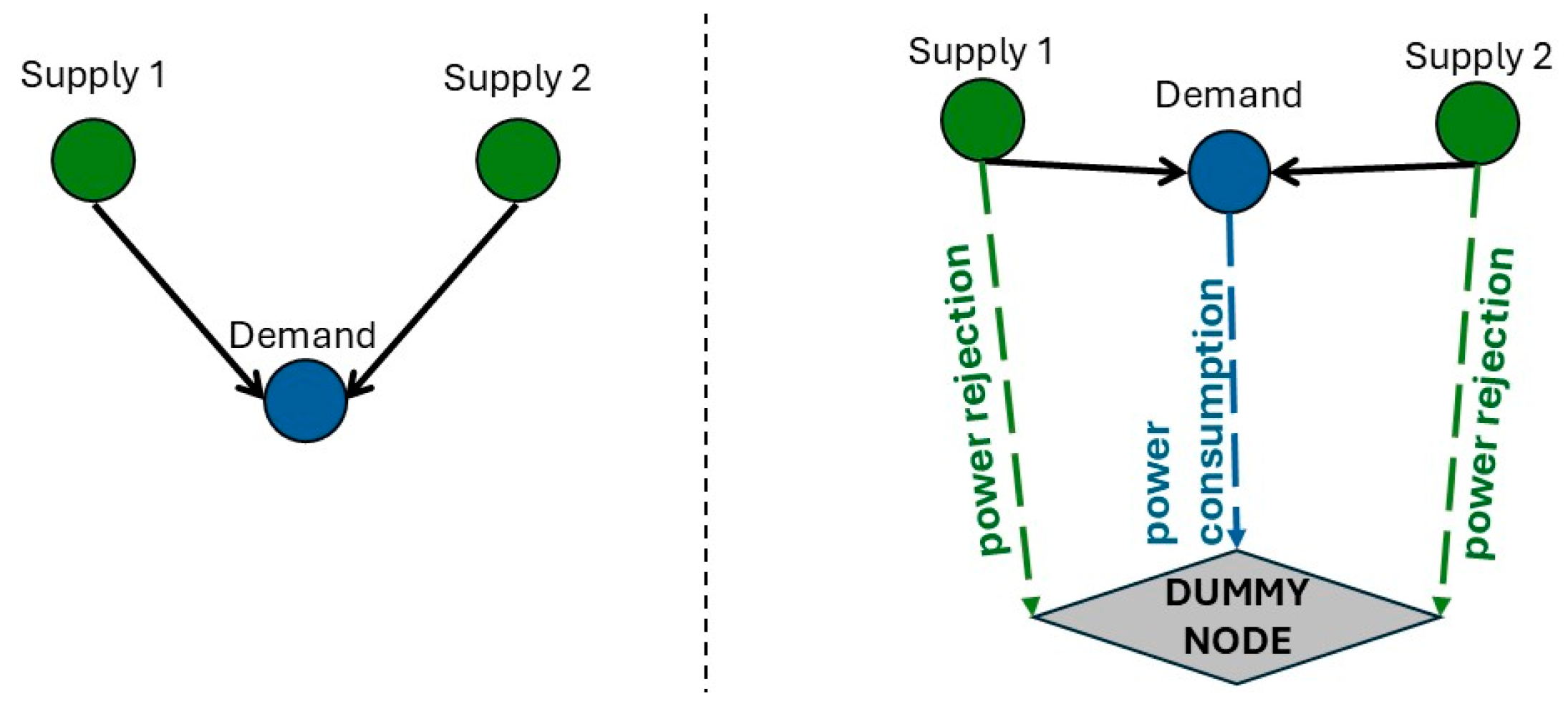
To configure the optimal power flow allocation as a transshipment problem under the three mentioned specifications, a virtual digraph was created that preserves the topology and the associated properties (by means of power capacities and unit costs) of the real system elements. As shown in Figure 1, this comprises the actual network, along with a virtual node, which is connected to all supply and demand nodes through virtual edges. This virtual node, hereafter referred to as dummy, is introduced to serve as an ideal cumulative point, thus receiving the energy that is either consumed or rejected at the demand and supply nodes, respectively. This is set so that the constraints of the transshipment problem are valid, particularly the global continuity Equation (1), i.e., the total supply equals the total demand.
The conveyance capacities of the virtual edges express physical constraints, i.e., the generated power, for those connecting supply nodes to the dummy one (herein referred to as power rejection edges) and the demand load for the remaining ones (herein referred to as power consumption edges). Both are time-varying quantities, which are updated at the beginning of each simulation step (see Section 3.4).
It is concluded that for a real energy system comprising n s sources, n d demands and n i intermediate junctions, which are interconnected via m transmission links, the equivalent virtual digraph consists of n s + n d + n i + 1 nodes (after adding the dummy one) and m + n s + n d edges (after adding the power rejection and power consumption ones).

3.3. Assigment of Unit Costs

The way in which unit cost values across the digraph edges are determined constitutes a highly important and original aspect of the mathematical framework developed. It serves as a reminder that, in the generic transshipment problem, positive unit costs reflect penalties to non-desirable fluxes, while negative ones are imposed to force conveyances across specific routes.
As mentioned, in the proposed model the edges represent three types of fluxes, i.e., power transmission, power rejection and power consumption. The unit costs of power transmission edges refer to real economic quantities, which are associated with the operation of the energy system. On the other hand, power consumption, which is mathematically expressed as power flows across the virtual edges connecting demand nodes with the dummy one, should be in accordance with pre-specified priorities. This is achieved by assigning negative unit costs to the associated consumption edges, specifically:
c j = 1 / k i
where k i is the priority order of the corresponding demand node i . It is underlined that the user-specified priorities cannot introduce conflicts with physical constraints of the power system, which are explicitly preserved through the continuity equations and the power capacity constraints.
Finally, power rejection is neutral, since it occurs in the case of excess power availability. For this reason, the unit costs across the associated virtual edges are set to zero.

3.4. Outline of Simulation Procedure

The simulation problem refers to a specific time horizon, discretized into finite time steps. It is highlighted that since all energy quantities are expressed in terms of power, the methodology is time-agnostic. However, in most practical applications, a small enough time step must be set, e.g., hourly or finer, to ensure as much as accurate representation of the variability of energy production and demand. This is of further importance in the case of pumped-storage systems and thermal plants, which are also subject to inter-temporal constraints.
The computational procedure, which is outlined in Figure 2, mainly requires a step-by-step solution to the transshipment problem, as defined in (5), through a suitable optimization algorithm. As explained, due to the specific structure of the problem elements, this may be done via NLP approaches, thus ensuring minimal computational burden.
The initialization step comprises the calculation of power supply, s i , and demand load, d i , through all sources and consumption sites, respectively, and the definition of the digraph’s geometry. The first task presupposes that the input processes and operational characteristics for all power production and consumption components are known. For instance, in the case of renewable energy sources, these include time series of associated hydrometeorological data (e.g., solar radiation, wind speed, streamflow), conversion formulas (e.g., power curves), and any other essential technical information. On the other hand, the digraph’s geometry, consisting of both real and virtual elements, is mathematically described through the incidence matrix, A . Following the mathematical context of Section 3.2, its dimensions will be ( n s + n d + n i + 1 ) × ( m + n s + n d ) .
Within the main simulation procedure, at the beginning of each time step, the supply, capacity, and unit cost vectors y , u , and c , respectively, are updated. This serves as a reminder that the first vector refers to nodes, thus containing n s + n d + n i + 1 elements, while the other two refer to edges; thus, their dimension is m + n s + n d .
The values of vector y refer to the power supply s i at each source node i ( n s nodes, in total) and the cumulative power supply (all expressed in power units, e.g., kW), which is assigned to the dummy node with a negative sign, i.e.,:
s c u m = i = 1 n s s i
By definition, the remaining values of vector y , referring to n d demand and n i intermediate nodes, are set equal to zero.
Vector u , also expressed in power terms, pertains to edges’ capacities, thus representing physical and artificial conveyance constraints. For each type of edge, the following values are assigned:
  • Real capacities, pj, to the m actual network elements, i.e., transmission links.
  • Power supply, si, to the ns power rejection edges.
  • Power demand loads, di, to the nd power consumption edges.
It is underlined that while transmission capacities may be handled as constant, all other elements of vector u are dynamic, since they refer to time-varying power supply and power demand values.
Finally, as explained in Section 3.3, the unit cost vector c , whose elements are expressed in monetary terms per power unit (e.g., €/kW), gets the following values:
  • Real operational costs for the m actual network elements.
  • Zero, for the n s power rejection edges.
  • 1 / k i , for the n d power consumption edges (Equation (6)).
After defining all graph model components, the optimal allocation of power fluxes for the specific time step is estimated by solving the underlying NLP problem. It is highlighted that this formulation allows the numerous nonlinearities across power conversions and other complex processes outside of this problem to be handled and expresses their outcomes as vector elements.

4. Extended Simulation Scheme for Hybrid Renewable Energy Systems

4.1. Problem Setting

The approach described above is applicable for energy systems of immediate (i.e., synchronous) activation, which accepts that the associated energy conversion processes are implemented during the specified time interval of simulation (e.g., hourly). In reality, this assumption is only valid for common renewable systems, e.g., wind, solar PV, hydropower. However, the typical mix of electricity generation sources also comprises fossil-fuel-based power plants, also referred to as conventional thermal units; thus, the whole system is defined as hybrid. Each of these units is subject to several thermal constraints and thus can only be gradually activated and deactivated. The non-synchronous nature of such units implies significant adaptations to the simulation procedure, by means of loops, as further developed in Section 4.2.
Another noticeable improvement within HRES modeling involves the key concept of energy storage. Section 4.3 introduces the essential modifications to the NLP-based mathematical context for the most popular form of energy storage, namely pumped hydropower storage (PHS). Under this premise, the excess energy, instead of being rejected, can be utilized to lift water to an upper reservoir. This implies proper adjustments to the digraph model shown in Figure 1, since this schematization assumes that the energy surpluses are conveyed to the dummy node.
A final enhancement of the simulation model refers to the representation of transmission losses along power grids. Section 4.4 provides an effective approach to account for this quite important yet highly complex issue by means of additional linear constraints.

4.2. Conventional Thermal Units

The addition of conventional thermal units to an energy mix is compulsory due to the intermittent operation of renewable energy sources.
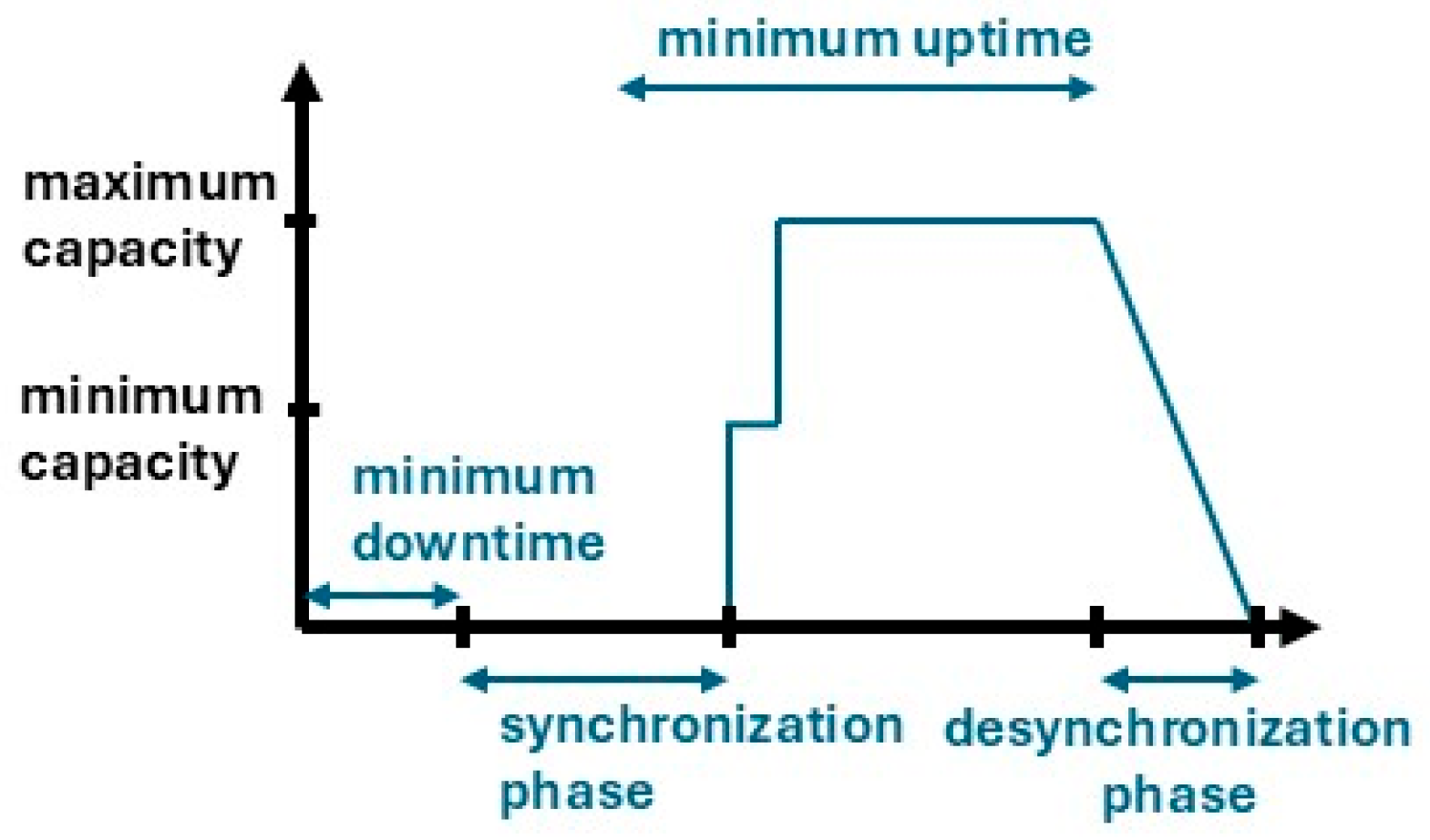
While conventional sources do not depend on hydroclimatic conditions, thus theoretically eliminating the risk for energy deficits, they are governed by a multitude of technical and operational constraints. In particular, the activation of a thermal unit implies a synchronization time to make the unit reach a minimum power capacity, during which the energy injection to the system is zero. After this, the unit must remain active during the so-called minimum uptime. Next, to exit the system, a desynchronization time is needed, during which the energy production gradually decreases from the technical minimum level till zero. Finally, after being deactivated, the unit must rest idle for a minimum downtime. The load variations between the technical minima and maxima are also subject to ramp rates. All above constraints determine the so-called thermal operation profile of the associated unit.
In fact, the complex operation of thermal units enacts significant adjustments to the simulation procedure to implement their typical thermal profile, as depicted in Figure 3. In this scheme, all time constraints are expressed in terms of discrete time steps. For convenience, as long as the demands are fulfilled by renewables, the conventional units are considered idle; thus, their inflow to the graph model is zero. In case of deficits, the procedure requires returning as many time steps as the synchronization time and resolving the NLP problem by setting the operation profile of the thermal units as inflow to the system. In this way, the initially detected deficits will be reduced, due to the power availability by both conventional and renewable sources. The thermal unit remains active for at least its minimum uptime. Then, the deactivation phase is launched. After this, the unit cannot be reactivated until the minimum downtime is exhausted. However, if during this period a power deficit occurs, the procedure goes backwards to cancel the deactivation.
It is also important to notice that for administrative reasons, the thermal units may remain continuously active at their minimum, for specific periods. This constraint can be easily handled by dynamically adjusting the thermal profile and assigning suitable negative unit costs to the corresponding edges.
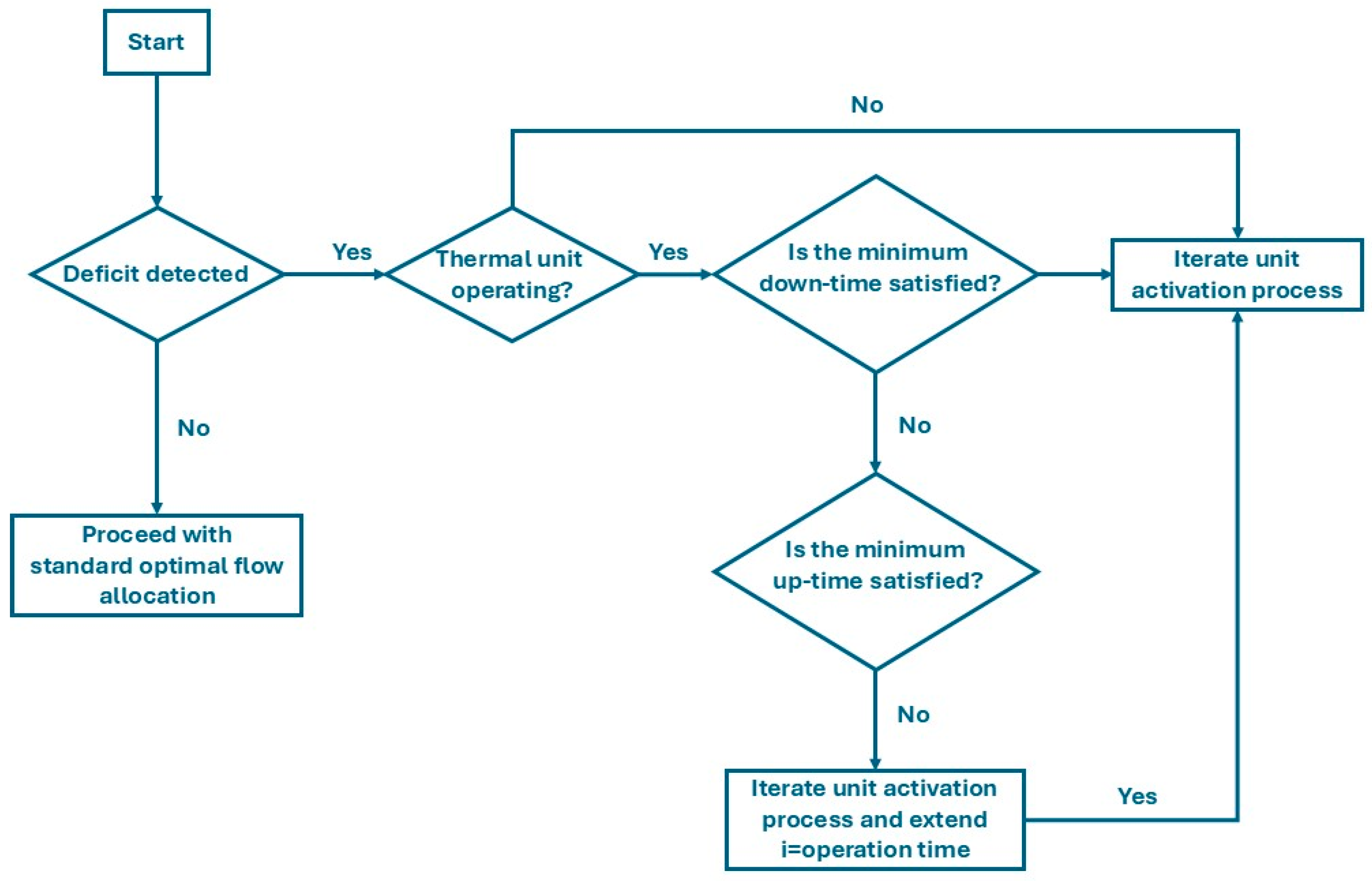
An outline of the adjusted simulation procedure is shown in Figure 4. It is highlighted that all described additions do not affect the core mathematical context, based on the NLP, as the means to estimate the stepwise optimal allocation of power flows. Nevertheless, it renders the need for occasional iterations, thus prolonging the computational time.

4.3. Energy Storage

Energy storage components offer significant flexibility since they allow excess electricity to be absorbed, converting it into another form and reconverting it into electricity when required. Among several forms of energy storage across different scales, the most applicable worldwide is pumped hydropower storage (PHS). Such systems consist of two interconnected reservoirs at different elevations, and they are equipped with reversible hydroturbines. The excess energy is utilized for lifting water to the upper reservoir through pumping, which is later released through the hydroturbines. The entire cycle is subject to hydraulic and electro-mechanical losses, thus having a total efficiency of up to 70%.
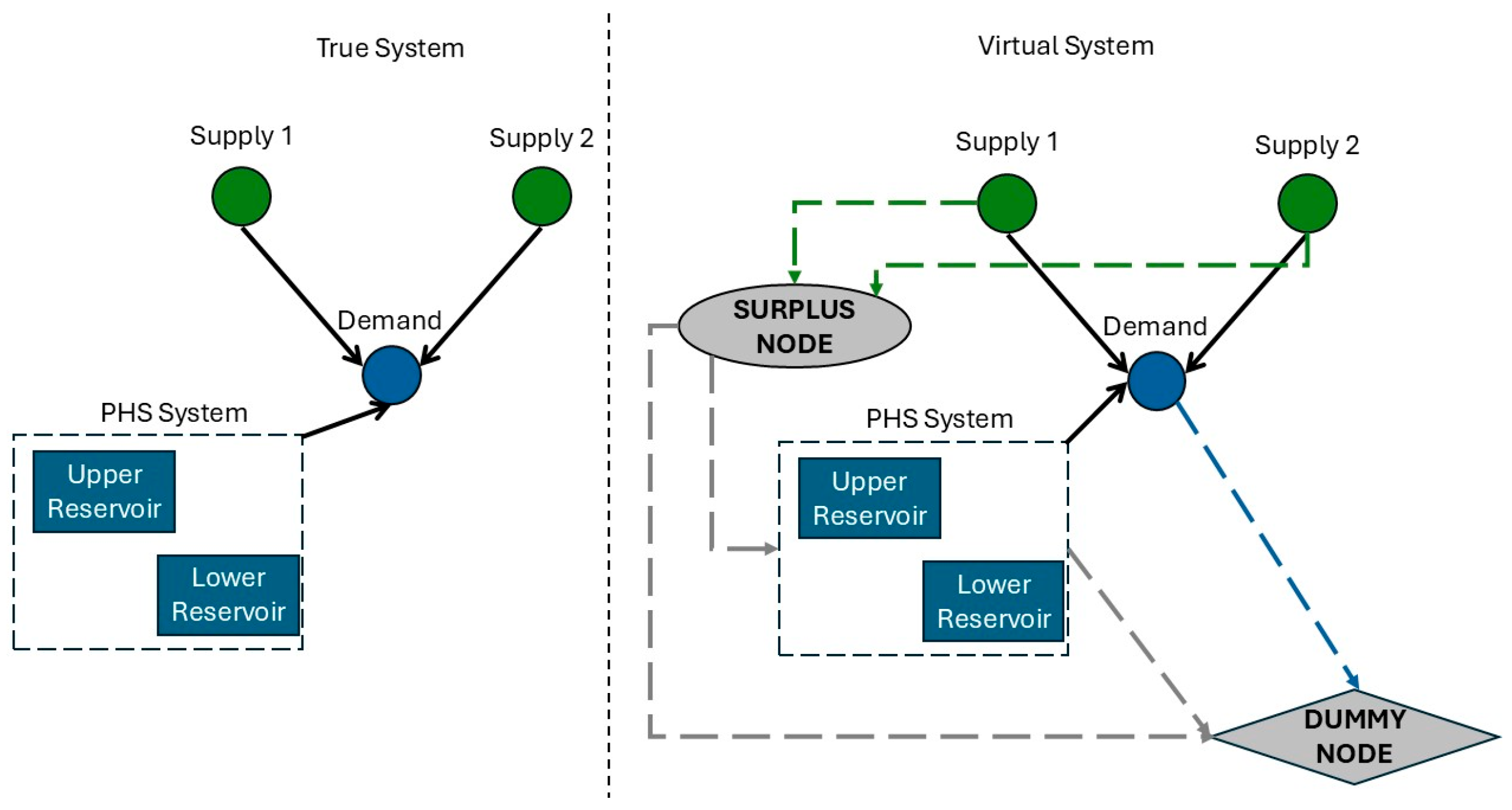
The implementation of a PHS unit within the simulation procedure, also resulting in notable modifications of the digraph layout, is explained via the illustrative example in Figure 5. It is important to note that within the schematization of the true network, the PHS system must be a priori linked with at least one demand node.
Provided that the system contains at least one PHS component (which is handled as a storage node), an additional virtual node is introduced to serve as a “median” between the PHS and the remaining power sources. Through this, which will hereafter be referred to as a surplus node, all power sources are connected to the storage node and the dummy one. This node is utilized in the case of surpluses. In fact, its role is to accumulate all excess energy and deliver as much as possible to the PHS unit, thus activating its pumping component, while the remaining surplus is conveyed to the dummy node. The power to be stored via pumping is subject to the following constraints:
  • The water availability, namely the actual useful storage at the lower reservoir.
  • The remaining storage capacity of the upper reservoir.
  • The power capacity of the pumping system.
These constraints, after being expressed in power terms, determine the conveyance capacity of the virtual edge linking the surplus with the storage node. The unit cost of this edge is set equal to the real pumping cost.
Regarding the virtual edge linking the surplus node with the dummy one, its capacity equals the total power production by all sources, while its unit cost is set up to a very large value to favor energy storage instead of pointless power rejections.
On the other hand, the storage node is connected to the demands via true transmission lines, as well as to the dummy node through a virtual edge. In contrast to the surplus node, which is operated occasionally, the storage node remains active during the entire simulation horizon to appropriately deliver the potential power to be generated. This quantity is represented as an inflow to the storage node and is also subject to three constraints:
  • The water availability, in this case being the actual useful storage at the upper reservoir.
  • The remaining storage capacity of the lower reservoir.
  • The power capacity of the generation system.
If the energy generated from all other sources is sufficient to meet the associated demands, the potential power, i.e., the inflow to the storage node, is totally absorbed by the dummy node, which means that the hydroturbines of the PHS unit remain idle. Otherwise, at least part of this inflow will be delivered to the demand nodes to minimize deficits. The exact allocation of the hydropower produced by the PHS is subject to capacities and associated costs of the true links that connect the storage node with the demands.
As with all other sources, the inflow to the storage node is also set as the capacity constraint of the virtual edge linking it with the dummy one.
The incorporation of PHS units into the energy system implies that two initial conditions per unit are defined by means of stored water at the associated upper and lower reservoirs. At each time step, after specifying the optimized power flows through the NLP approach, the simulation model examines whether energy has been produced or stored and converts the associated optimized power quantities into water quantities. This computation, also referred to as the inverse problem in hydroelectricity, is quite challenging, since it requires handling nonlinear relationships that associate discharge with efficiency and hydraulic losses [31]. Following this, the water balance of each pair of interconnected reservoirs is appropriately updated. A synopsis of computations is provided in Appendix A.

4.4. Transmission Losses

Losses across power grids are dependent on numerous and highly complex factors, mainly the conductor type, the current and the transmission distance, and they are also affected by environmental conditions, e.g., temperature. For long distances, the non-controlled losses may be as high as 5 to 10%. To handle them in practice, the transmission systems are appropriately adjusted through voltage control, thus resulting in much lower loss percentages.
Under this premise, the rather minimal yet non-negligible effect of transmission losses can be accounted for by assigning (small) loss coefficients to network links. This simple yet quite realistic assumption allows the introduction of nonlinear constraints within the energy flow allocation model to be avoided.
Let β be the loss ratio across an actual link of the energy network and let x be the incoming power at a specific time step. This is split into two components, i.e., x 1 representing the reduced power transferred to the end node and x 2 representing the transmission losses, which are conveyed (similarly to rejected energy) to the dummy node. The governing equations are written as:
x 1 + x 2 = x x 1 = 1 β x x 2 = β   x
By combining the above equations, the following constraint arises:
x 2 β 1 β x 1 = 0
In the generic case of a network consisting of m transmission elements of which a subset of q is subject to power losses, a parallel edge is created (herein referred to as loss edge), conveying the missed energy. To embed this feature to the mathematical formulation of the simulation problem, a square matrix L with size q × q is introduced that represents the loss ratios of each link through Equation (9). Its diagonal elements are β i / ( 1 β i ) , while the non-diagonal ones are 1 . In this context, the optimization problem is written as follows:
m i n i m i s e   f x = c T x s . t . A   x = y L   x L = 0 0 x u
where x L is a q -dimensional vector, representing the power values across the true links that are subject to losses and their virtual parallel edges that are connected to the dummy node. Under this formulation, x L is a subset of the overall decision vector x . Provided that the loss ratios do not change over time, matrix L should be defined once, i.e., at the beginning of the overall simulation procedure.
This modification alters the typical configuration of the transshipment problem because, unlike the topology (incidence) matrix A , the loss matrix L contains elements outside the strict set {−1, 1, 0}. Nevertheless, since the matrix structure remains sparse, specific versions of the simplex method for linear optimization problems may be applicable, also ensuring quite faster solutions than conventional LP solvers.
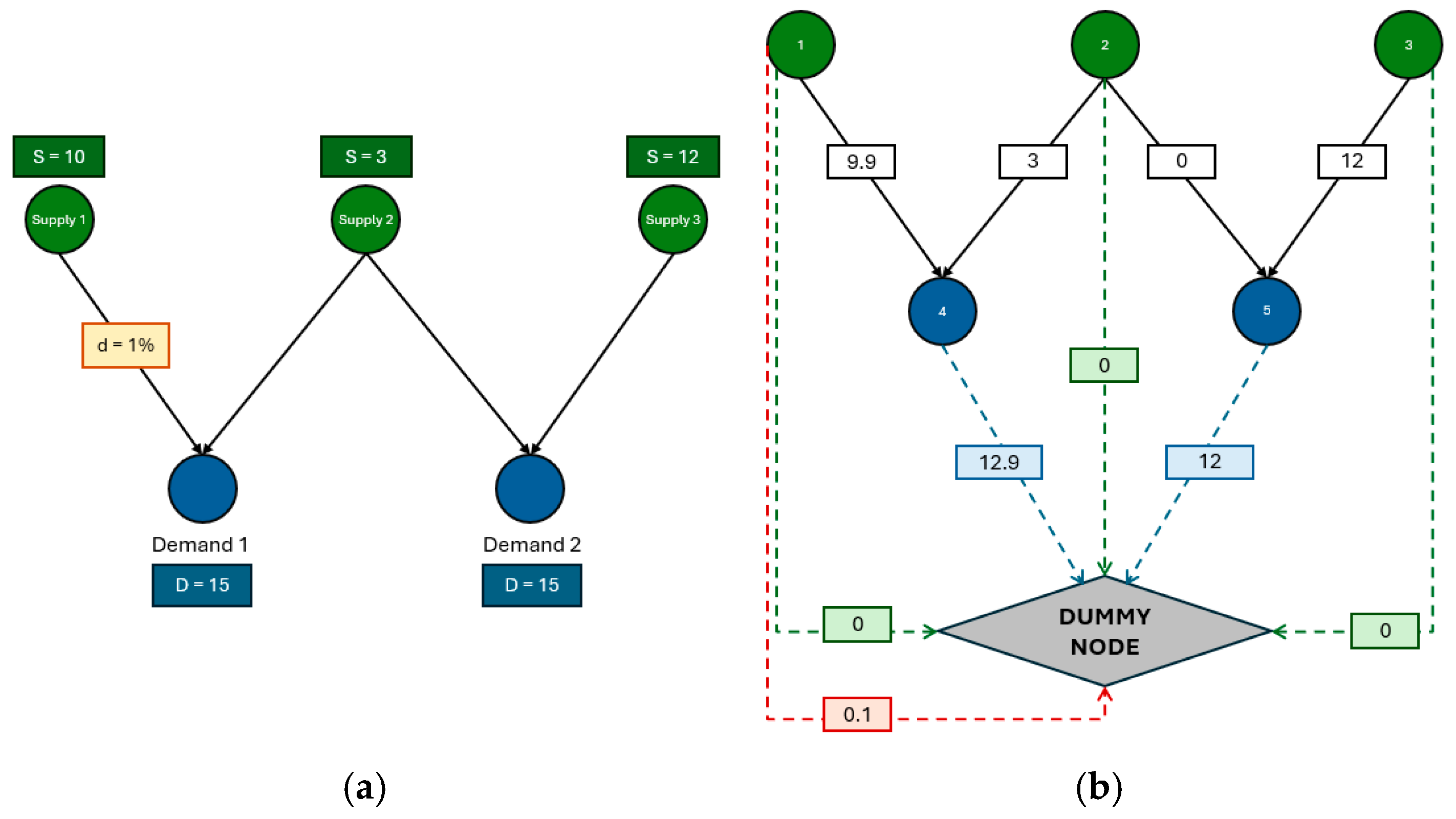
An example of modeling a hypothetical energy system with transmission line losses and its optimized power fluxes is shown in Figure 6.

5. Generalized Simulation–Optimization Framework

The simulation procedure is applicable to fully specified energy systems, for which an optimal allocation of energy flows is sought over a specific time horizon. However, the optimal planning and management of such systems may also comprise additional variables, involving the layout and sizing of individual components (design problem), along with long-term policy issues and associated constraints, e.g., the priorities assigned to energy users.
The modular structure of the proposed approach and, particularly, the major advantage of computational effectiveness makes it easily adaptable to a broader simulation–optimization framework. This requires assigning a performance measure of the energy system and defining the control variables of the design and/or management problem. It is highlighted that in the context of energy systems the issue of effectiveness is crucial, since the time resolution of simulations should be small enough (at most hourly) to comply with highly varying energy production and consumption processes, even across very fine temporal scales.
It is also important to note that the determination of the optimized allocation of power flows across the system is an internal optimization task, which is employed at each simulation step, and is formalized as a linear (or network linear) programming problem. On the other hand, the determination of the optimal planning and management of the energy system requires running the simulation problem multiple times under different values of the associated control variables to establish its optimal performance. This task is formalized as a nonlinear optimization problem that is handled through common global search tools, e.g., evolutionary algorithms. It is also remarkable that the optimized power fluxes obtained within internal optimizations are fully accurate, while the global optimization procedure generally leads to approximative solutions. Furthermore, since the performance measure may be comprised of multiple and conflicting criteria (e.g., reliability vs. cost), the problem may also be expressed in multi-objective terms, thus resulting in a set of mathematically equivalent solutions lying on the so-called Pareto front [32].
In the same context, the major advantage of the proposed simulation framework, namely its computational effectiveness, allows its use for the purpose of uncertainty analyses. This goal becomes increasingly crucial given the rapid penetration of randomly varying renewable energy sources combined with the volatility of energy markets [33,34].

6. Case Study: Optimal Design of Sifnos Energy System

6.1. Study Area

Sifnos is a typical Aegean island, whose resources and infrastructure are substantially stressed due to systematically increasing touristic arrivals, which are intensified during the summer. While its permanent population does not exceed 2800 residents, the estimated number of tourists is up to 100,000 people. Today, its electricity needs are mainly covered by a 9.0 MW oil power plant, while renewables have a small share in the island’s mix. Based on recent data by the Hellenic Electricity Distribution Network Operator, the annual electricity demand is 17.3 GWh, while the hourly peak is 5.4 MW.
A research study by Katsaprakakis and Voumvoulakis [35] examined whether the island could achieve energy independence by taking advantage of its significant solar and wind potential, as well as by exploiting the steep land relief of its NE part to develop a seawater PHS unit. In this vein, they proposed transformation of the current oil-based electricity system of Sifnos to a hybrid one, the major components of which (wind turbines, solar panels, upper reservoir) will be installed in the northeastern, uninhabited part of the island, specifically a plateau near the sea, at an elevation distance of 320 m.
Zisos et al. [34] further explored the techno-economic feasibility and reliability of the suggested scheme of works under an uncertainty-aware simulation–optimization context, thus offering a comprehensive analysis of the key design elements of the overall system, i.e., the storage capacity of the upper reservoir (the lower one is the sea). A significant conclusion was the detection of a much smaller reservoir size with respect to the initially proposed one (i.e., 315,000 vs. 1,100,000 m3), with minimal loss of the system’s reliability.
A hidden assumption of both research works was that the power deficits, which were far from negligible, would be fulfilled by the existing oil power plant, thus handling it as an external source of theoretically immediate response. As explained in Section 4.2, this hypothesis is not realistic and may lead to overestimating the system’s performance in terms of economy and reliability.
To ensure a more faithful representation of the HRES’s actual operation, the design optimization problem is revisited by keeping the already proposed configuration and data, with slight changes (see Section 6.2). This also allows stress-testing of the generality and computational effectiveness of the proposed methodological framework (implemented so far in a Python 3.14 environment) to a challenging system, mixing conventional and renewable sources with energy storage elements.

6.2. Problem Setting and Input Data

The power generation components consist of wind turbines, solar panels, the conventional oil plant (as a backup source) and the seawater PHS unit. Input time series include hourly meteorological drivers (wind velocity, solar radiation, temperature) and power demand data for a 20-year period. The climatic data were retrieved from the ERA-5 Land portal and refer to years 2000 to 2020, while the demands were synthetically generated using the anySim package [36].
Specifically, four commercial wind turbines are applied, namely two of 0.9 MW (Enercon E-44) and two of 2.4 MW (Enercon E-70 E4), whose technical data (power curves, etc.) are provided by Zisos et al. [34] (ENERCON is well-known wind turbine manufacturer, founded in Aurich, Germany). The turbines will be established at large enough distances, thus allowing wind power reduction due to turbulence effects to be omitted.
The number of solar PV panels is 6000, to be distributed in the vicinity of the upper reservoir. Each panel has a nominal capacity of 410 W and an effective area of 1.94 m2; thus, its maximum efficiency reaches 21.1%. A typical power temperature coefficient of 0.4%/°C is considered, denoting the rate of efficiency decrease with respect to a unit increase in the ambient temperature above a reference value of 25 °C. The adjusted efficiency for temperatures higher than this limit is estimated though the empirical formula by Evans and Florschuetz [37].
Regarding the existing conventional oil plant, since its role within the HRES is considered auxiliary, it is only partially exploited. In this respect, the system is allowed to utilize only one of its generators of 1.2 MW nominal power capacity, while its operational constraints are expressed by means of ramp-up and ramp-down times equal to three hours and a minimum close time equal to six hours.
Finally, the PHS system comprises a reversible hydroturbine of 6.0 MW, with constant total efficiencies of 0.85 and 0.80 for the generation and pumping modes, respectively. The penstock’s length and diameter are 910 m and 1.0 m, respectively, while its head losses when lifting or releasing water are explicitly accounted for through typical hydraulic approaches for pressurized pipes, i.e., the Darcy–Weisbach formula.
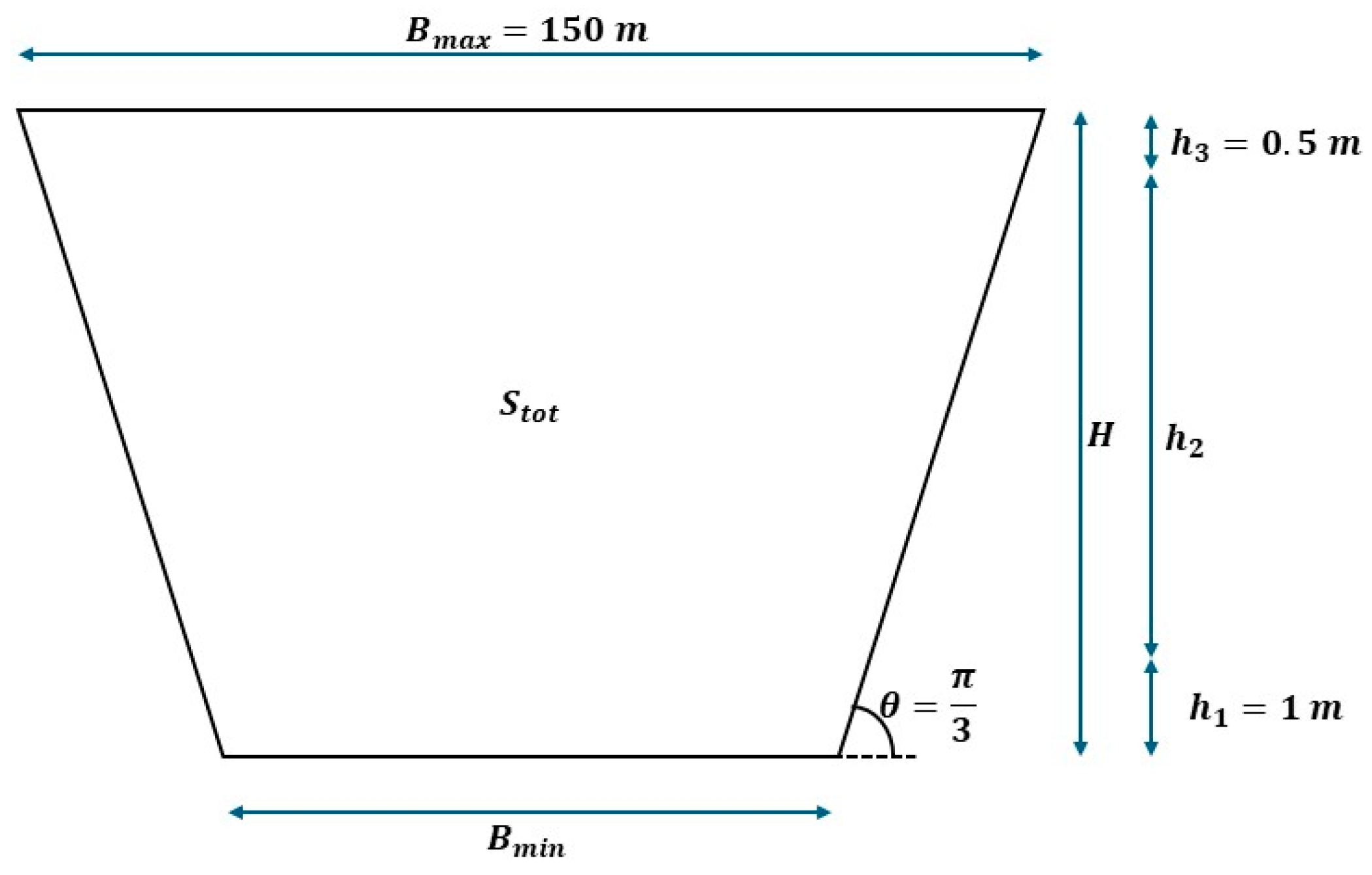
Regarding the configuration of the upper reservoir, some realistic simplifications are employed to facilitate construction cost computations. As shown in Figure 7, a trapezoidal cross-section is considered to be formed during excavation, covering a constant top area of 150 × 500 m. Since the soil is rocky, the side slope angle is set to 60°, the intake is set at an elevation of 1.0 m from the reservoir’s bottom to ensure sufficient capacity for deposit management, and a freeboard of 0.5 m is also applied. The whole wetted surface will be waterproofed to prohibit groundwater salinization.
Under the above assumptions for a given useful storage capacity, S u , all essential geometrical properties, namely the total section depth, H , the bottom width, B m i n , the gross storage capacity, S t o t , and the wetted area, A w , can be easily estimated. Specifically, S t o t , which determines the total construction cost, is a linear function of S u , i.e., volumes in thousands m3:
S t o t = 0.972   S u + 110.9
where A w (in m2), which is specifically associated with waterproofing costs, is polynomial function of S u , i.e.,:
S t o t = 0.0074   S u 2 + 27.706   S u + 78,041

6.3. Setup of Simulation Problem

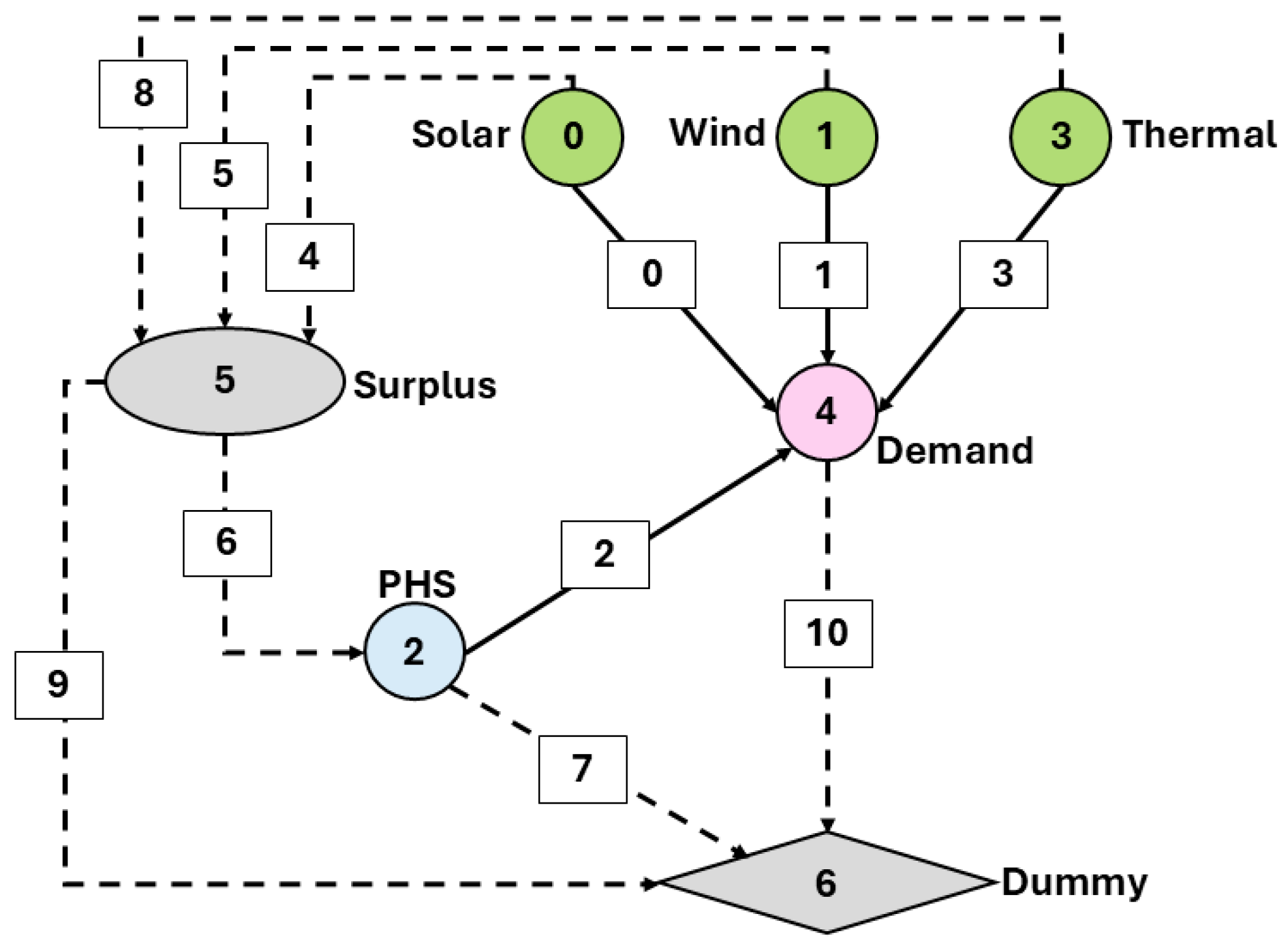
The real system is depicted as five interconnected nodes, namely three source nodes (i.e., the wind park, consisting of four turbines, the solar park, and the thermal unit), a PHS node, and a demand node. Following the proposed methodological framework, this scheme is mathematically represented by means of an equivalent digraph, also comprising virtual nodes and edges, as illustrated in Figure 8. The total number of nodes is seven (i.e., the five real ones, the surplus, and the dummy), while the number of edges is 11, i.e., four actual and seven virtual. Each edge conveys a specific power flux (expressed in kW) under a given unit cost, as explained in Table 1. The unit costs are fixed, while all other elements of the NLP model (i.e., inflows and power capacities) are time-varying.
The time set of simulation is hourly; thus, for a 20-year horizon, the simulation is discretized into 20 × 8760 = 175,200 steps.
The simulated data are the electricity produced, consumed and rejected by each source, the power stored through pumping, the total deficits, and the total rejections (i.e., power generated but neither consumed nor stored, due to the lack of storage capacity). These are used to assess the system’s performance, as explained next.

6.4. Performance Assessment Protocol

The upper reservoir’s useful storage, S u , is handled as the sole design variable of the examined HRES, while all other design characteristics (number and type of wind turbines, number and type of solar panels) are considered fixed. This allows highlighting the twofold importance of the PHS capacity as a power regulator and power source.
Under this premise, several simulation scenarios are investigated by assessing the system’s performance against different useful storage capacity values. The following metrics are calculated:
(i)
The system’s reliability, which is a probabilistic quantity, empirically derived as the frequency of power deficits (i.e., failed time steps to simulation length).
(ii)
The mean annual rejected energy, in absolute terms and as percentage of the total production.
(iii)
The frequency of thermal unit operation.
(iv)
The mean annual energy production by the thermal unit.
Since the thermal unit’s power capacity exceeds the maximum demand load, 100% reliability is achieved, as each time a deficit occurs, the retrospective algorithm of the thermal unit operation following the given thermal profile is activated (Section 4.2).
To express the overall performance of the system under a common unit, a cost function is introduced, accounting for the total capital expenses of the upper reservoir (since all other construction costs of the system are fixed), the mean annual operational cost of the thermal unit, and the cost of rejections.
The construction cost of the upper reservoir comprises two main terms, namely the cost of civil engineering works (excavations, etc.) and the cost of waterproofing, which are estimated by multiplying the gross storage capacity, S t o t , and the wetted area, A w , with appropriate unit values, i.e., 8.0 €/m3 and 1.5 €/m2, respectively (these costs are adapted by [34]). This is finally expressed in terms of equivalent annual cost (EAC) by applying an interest rate of 5% and by considering a depreciation period equal to 20 years.
The operational cost of the thermal unit also comprises two major components, i.e., the cost of crude oil and the cost of CO2 emissions. Both quantities are estimated as a function of energy production, also employing the following assumptions:
  • Based on assumptions retrieved by Greece’s Informative Inventory Report 2024 [38], a specific fuel consumption of 260 L/MWh is applied, which corresponds to a generator efficiency up to ~40%, a thermal power of 42 MJ/kg, and a typical density of 0.83 kg/L.
  • Following recommendations by the Greek National Energy & Climate Plan 2024 [39], the unit CO2 emissions are set to 0.80 t/MWh.
  • Based on recent market data, the unit cost of crude oil is set to 320 €/t (85 $/barrel), the cost of CO2 emissions is set to 75 €/t, and the electricity market price, which is applied as a penalty to rejected energy, is set to 240 €/MWh.
It is remarked that the mean annual energy produced by the wind and the solar parks is 15.03 and 3.61 GWh, respectively. While this quantity exceeds the total annual demand (i.e., 15.57 GWh), since their production is not synchronized with electricity needs, the actual reliability is very low, thus rendering the need for the power storage offered by the PHS under study and the existence of a fully controllable backup source, i.e., the conventional oil unit.

6.5. Problem Solving

The internal optimization problem within the graph-based simulation framework is handled through an NLP solver (method min_cost_flow, available through NetworkX Python Library [40]). To further prove the computational efficiency of the proposed approach, the NLP solver was contrasted to a general linear programming solver employing the conventional simplex method (method linprog, available through SciPy Python Library [41]), which exhibited an increase of ~500% in terms of computational time.

6.6. Results

The simulation is employed for different useful storage values of the upper reservoir, S u , ranging from 50,000 to 1,000,000 m3. For comparison, a benchmark study was also carried out in which the pumped-storage unit is omitted. Given that the two main renewables, i.e., wind and solar, are launched by priority, their electricity production that is directly conveyed to the consumption is constant and equal to 8.56 GWh/year (55.0% of the total demand). The remaining production is either stored or rejected, depending on the reservoir’s capacity.
Regarding the remaining 45.0% of the mean annual demand load, this is fulfilled by the hydropower station and/or the oil plant. The exact breakdown is subject to combined constraints induced by the PHS system and the thermal profile of the oil plant. It is highlighted that the produced hydropower is totally absorbed by the grid, since the hydroturbines are activated merely for covering energy deficits. On the other hand, the oil plant operation is dictated by the minimum uptime and downtime rules, which cause extended power production regardless of being needed or not.
The overall mean annual energy balance for each examined storage capacity is given in Table 2, the mean annual frequency of the different HRES components is given in Table 3, and Table 4 provides a breakdown of the cost function.
Following the outcomes in Table 2, it is observed that while the frequency of pumping remains practically constant (i.e., about 45% of time), the activation of the hydropower station becomes more frequent as the storage capacity increases and, in contrast, the oil plant is utilized less often.
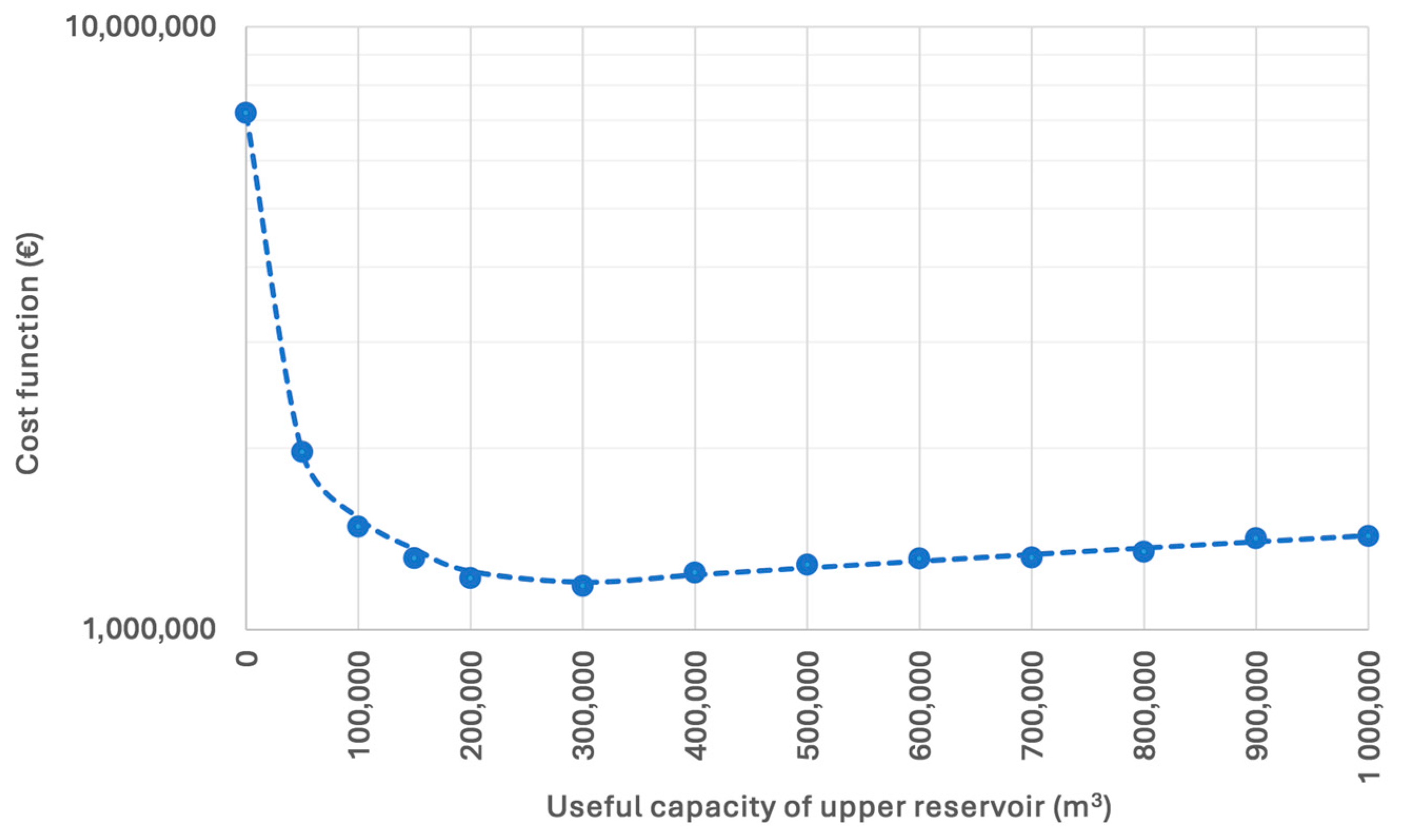
Based on the performance measure introduced in Section 6.4, the optimal storage capacity is in the order of 300,000 m3. This value is slightly smaller than the one detected by [34], i.e., 315,000 m3. As shown in Figure 9, when moving to lower values, the cost rises exponentially, since the HRES offers limited means for electrical power management, thus resulting in sharply increasing costs of fuel, CO2 emissions, and rejected energy. On the other hand, for higher-capacity values, the cost is almost linearly grown, mainly due to construction expenses. Interestingly, as the reservoir capacity becomes larger, the simulated energy and frequency balances (Table 1 and Table 2, respectively) exhibit relatively small fluctuations with respect to the optimal solution.
Finally, considering the power system without the PHS component, the total cost is raised by almost one order of magnitude, since while the thermal plant remains active about 70% of time, a significant part of its production cannot be absorbed. This results in highly increased fuel and CO2 emission costs, simultaneously with increased rejected energy costs.

7. Conclusions

Triggered by the methodological advances and computational capabilities of graph theory, as employed in water resource systems analysis, a generic simulation framework is deployed to estimate the stepwise optimal allocation of power flows across HRESs of any topology. This also embeds complex elements, such as energy storage features, by means of PHS units, and conventional plants of given thermal profiles. Overall, the whole methodology is built under the NLP context, thus representing all the system’s elements as digraph components, both actual and virtual, to which dynamic inflows, conveyance capacities, and unit costs are assigned. A major advantage of this modeling approach is the handling of nonlinear conversions across the different power elements. These are employed at the beginning of each time step, while their outcomes are embedded within the NLP model as inputs (e.g., power supply) or capacity constraints. This formulation offers exceptionally fast computations with respect to common solvers and allows for easily retrieving all power components of interest (generation, absorption, rejection, storage) that are expressed by means of optimized power flows across graphs’ links.
It is recognized that achieving a generic and fast solution entails several essential simplifications. For instance, the complex operation of individual thermal units is addressed by means of typical thermal profiles, which are pre-defined to dictate the available power supply, which is in turn embedded within the inflow vector. Under this premise, the operation of each unit is not set as an individual optimization problem, but it is embedded within the overall power flow allocation context. Similarly, the optimal scheduling of multiple thermal generators, which is generally referred to as the unit commitment problem [42], is empirically handled by assigning appropriate unit costs to determine their priority order. Another limitation of the proposed methodology involves operational issues at the grid scale (e.g., ramping, reserve/frequency support, etc.), which are not accounted for, since the emphasis is given to the broader HRES planning problem. On the other hand, significant technical issues, such as grid losses, are explicitly embedded within the simulation procedure, although in a simplified manner.
The generality, robustness, and effectiveness of the proposed methodology are demonstrated through the case study of the island of Sifnos. In particular, the configuration of an HRES comprising solar panels, wind turbines, PHS units and conventional fuel-based plants is examined. The system’s performance is assessed by establishing a composite function, contrasting the depreciated capital expenses for the construction of the upper reservoir with three major cost elements, regarding fuel consumption and CO2 emissions by the oil plant, and totally rejected energy. The optimal useful storage capacity was found to be 300,000 m3, which stands as an acceptable compromise solution.
Conclusively, the proposed framework offers a twofold service. The first is its utilization for the long-term planning of HRESs, the design of their critical infrastructures, and the assessment of their individual components against various criteria (e.g., Sifnos’s case). With the essential data available, by means of meteorological inputs and power demands, one can examine different hybrid system layouts, estimate the associated costs and benefits, evaluate their reliability, etc. The holistic approach to this problem is its formulation under a stochastic simulation–optimization context, where the issue of computational effectiveness, which is a major advantage of our framework, becomes of utmost importance. Under this prism, it should be regarded as complementary to more detailed tools, from the realm of an OPF approach. Particularly, after establishing an optimal configuration of the system of interest, with respect to crucial design and management elements of its power sources and their major connections, OPF-based models may be applied to emphasize operational issues at the grid scale, including the unit commitment problem and transmission constraints.
The second service, which is subject to future research, involves the real-time operation of existing energy systems, namely the anticipated optimal allocation of their power fluxes in the short term (e.g., day-ahead). In this vein, the proposed framework may be incorporated within a prediction tool, where the input drivers are generated by weather and energy demand forecasting systems and dynamically updated as more information is available. Under this context, the simulation procedure will be used to provide probabilistic forecasts of energy surpluses and deficits, thus supporting effective energy scheduling under uncertainty.

Author Contributions

Conceptualization, A.K., A.Z. and A.E.; methodology, A.K. and A.E.; validation, A.K. and A.Z.; formal analysis, A.K.; investigation, A.K.; resources, A.Z.; data curation, A.Z.; writing—original draft preparation, A.K. and A.E.; writing—review and editing, A.K., A.Z. and A.E.; visualization, A.K.; supervision, A.E. All authors have read and agreed to the published version of the manuscript.

Funding

This research received no external funding.

Data Availability Statement

All input data, by means of technical properties as well as meteorological and power demand time series, that were used to within this case study are available online (https://doi.org/10.5281/zenodo.17984791, accessed on 2 March 2026) and were delivered under the Creative Commons Attribution 4.0 International.

Conflicts of Interest

The authors declare no conflicts of interest.

Abbreviations

The following abbreviations are used in this manuscript:
EACEquivalent Annual Cost
ESSEnergy Storage System
HRESHybrid Renewable Energy System
LPLinear Programming
NLPNetwork Linear Programming
OPFOptimal Power Flow
PHSPumped Hydropower Storage
PVPhotovoltaic

Appendix A. Update of Digraph Inputs Within PHS Modeling

Consider a PHS unit consisting of two interconnected reservoirs, whose storage values are symbolized s l and s u . For convenience, indices l and u refer to the lower and upper reservoir elements, respectively. Their characteristic properties are the storage-elevation functions s l = f ( z l ) and s u = f ( z u ) , and their minimum and maximum operational levels, which typically correspond to the lower intake elevation and the spillway crest elevation, respectively. The water level constraints are converted to storage constraints, thus s l , m i n   s l s l , m a x and s u , m i n   s u s u , m a x . In the case of closed systems, the associated useful capacities s l , m a x s l , m i n and s u , m a x s u , m i n are practically identical, while in open-looped systems these may differ significantly (e.g., when a large-scale physical or artificial lake is served as lower reservoir).
The reservoirs are connected through a pressurized conveyance system, with known geometrical and hydraulic characteristics (length, diameter, roughness) which allow estimating the deriving hydraulic losses, Δ h , with respect to passing flow, q . For the establishment of function Δ h = f ( q ) , several alternative approaches of different levels of complexity and accuracy are available, for which the reader can refer to common hydraulic handbooks. The PHS unit is also equipped with a reversible pump–turbine of nominal power capacity P g , m a x and P p , m a x , and total efficiency η g and η p , for the generation and pumping mode, respectively. In general, the two efficiencies are also nonlinear functions of flow q , while η p is slightly lower than η g . The bottom level of the power station is z b and is considered a characteristic elevation property, while the time-varying difference h = z u z b is the so-called gross head of the system.
The update of inflow and capacity data of the graph model that are associated with the operation of PHS units relies upon essential computations that are employed at the beginning of each time step, by considering the water levels z l and z u as state variables of the overall computational procedure. Under this premise, the following quantities are computed:
  • The actual storage values, s l = f ( z l ) and s u = f ( z u ) .
  • The useful storage capacities, s l s l , m i n and s u s u , m i n .
  • The remaining storage capacities, s l , m a x s l and s u , m a x s u .
  • The gross head, h = z u z b .
As explained in Section 4.3, the power to be stored via pumping is subject to the useful storage of the lower reservoir, s l s l , m i n , the remaining storage capacity of the upper reservoir, s u , m a x s u , and the power capacity of the pumping system, P p , m a x . The last element is a constant property, while the other ones are time-varying storage elements and must be provided in power terms. In this respect, the two storage quantities are initially converted into flow units by dividing with the computational time interval, Δ t , and then expressed in terms of power availability to the pumping system, i.e.,:
P p , a v = γ   q p   ( h + Δ h p ) η p
where γ is the specific weight of water (9.81 kN/m3), q p = min s l s l , m i n , s u , m a x s u / Δ t , h + Δ h p is the so-called manometric head, and Δ h p = f ( q p ) .
Under this premise, the conveyance capacity of the virtual edge linking the surplus with the storage node is estimated as the minimum between the technical limit P p , m a x and the currently available power P p , a v .
On the other hand, the inflow to the storage node, which is also assigned as a capacity constraint to the virtual edge linking the storage with the dummy node, is determined by the useful storage at the upper reservoir, s u s u , m i n , the remaining storage capacity of the lower reservoir, s l , m a x s l , and the power capacity of the generation system, P g , m a x . In a similar context, the two storage quantities are first converted into flow units and next expressed in terms of hydropower potential, i.e.,:
P g , p o t = γ   η g   q g   ( h Δ h g )
where q g = min s u s u , m i n , s l , m a x s l / Δ t , Δ h g = f ( q g ) , and h Δ h g is the so-called net head.
The inflow to the storage node, as well as the conveyance capacity of the virtual edge linking the surplus with the storage node, are estimated as the minimum between the technical limit P g , m a x and the current hydropower potential P p o t , f .
At the end of the time step, i.e., after solving the NLP problem to determine either the power consumed via pumping (case of storage) or the power produced by releasing water from the upper to the lower reservoir (case of generation), the associated water volumes must be computed to allow the water storage of the two reservoirs and their associated levels to be updated. This requires to solve either Equation (A1) or Equation (A2) for the unknown flow and then converts this to volume by multiplying with the time interval Δ t . Both formulas are nonlinear, since the flow term is also embedded within the hydraulic losses, as well as within the efficiency terms (although here the two terms are handled as constants, for simplicity). The underlying inverse problem in hydroelectricity, which is explained in detail by Sakki et al. (2022) [31], requires establishing an iterative numerical scheme.
For the case of pumping, provided that the power consumption P and the gross head h are known, the lifting flow is expressed as:
q [ k ] = η k 1 P   γ   ( h + Δ h k 1 )
where k is an iteration counter; thus, the efficiency term η k 1 and the hydraulic losses Δ h k 1 are explicitly derived from the known flow value q [ k 1 ] . For k = 0 , a reasonable initial guess must be applied, by setting, for instance, the rated efficiency and the gross head for terms η 0 and Δ h 0 , respectively.
Regarding the generation phase, given that the power generation P and the gross head h are known, the associated retrospective formula for the flow passing through the hydroturbines is written as:
q [ k ] = P   γ   η k 1 ( h Δ h k 1 )
It is emphasized that all above complex calculations, involving nonlinear computations and numerical approximations through iterative procedures, are employed outside of the main core of the simulation context, namely the power allocation scheme, and are thus not affecting the strict mathematical structure of the NLP problem.

References

  1. Tian, J.; Culley, S.A.; Maier, H.R.; Zecchin, A.C. Is Renewable Energy Sustainable? Potential Relationships between Renewable Energy Production and the Sustainable Development Goals. npj Clim. Action 2024, 3, 35. [Google Scholar] [CrossRef]
  2. Agajie, T.F.; Fopah-Lele, A.; Amoussou, I.; Khan, B.; Bajaj, M.; Zaitsev, I.; Tanyi, E. Enhancing Ethiopian Power Distribution with Novel Hybrid Renewable Energy Systems for Sustainable Reliability and Cost Efficiency. Sci. Rep. 2024, 14, 10711. [Google Scholar] [CrossRef]
  3. Oyewole, O.L.; Nwulu, N.I.; Okampo, E.J. Optimal Design of Hydrogen-Based Storage with a Hybrid Renewable Energy System Considering Economic and Environmental Uncertainties. Energy Convers. Manag. 2024, 300, 117991. [Google Scholar] [CrossRef]
  4. Salim, E.; Abubaker, A.; Ahmed, B.; Nassar, Y. A Brief Overview of Hybrid Renewable Energy Systems and Analysis of Integration of Isolated Hybrid PV Solar System with Pumped Hydropower Storage for Brack City—Libya. Wadi Alshatti Univ. J. Pure Appl. Sci. 2025, 3, 152–167. [Google Scholar] [CrossRef] [PubMed]
  5. Fotis, G.; Maris, T.I.; Mladenov, V. Risks, Obstacles and Challenges of the Electrical Energy Transition in Europe: Greece as a Case Study. Sustainability 2025, 17, 5325. [Google Scholar] [CrossRef]
  6. Gajdzik, B.; Wolniak, R.; Nagaj, R.; Žuromskaitė-Nagaj, B.; Grebski, W.W. The Influence of the Global Energy Crisis on Energy Efficiency: A Comprehensive Analysis. Energies 2024, 17, 947. [Google Scholar] [CrossRef]
  7. Wei, X.; Shi, X.; Li, Y.; Ma, H.; Ban, S.; Liu, X.; Liu, H.; Yang, C. Analysis of the European Energy Crisis and Its Implications for the Development of Strategic Energy Storage in China. J. Energy Storage 2024, 82, 110522. [Google Scholar] [CrossRef]
  8. Mitali, J.; Dhinakaran, S.; Mohamad, A.A. Energy Storage Systems: A Review. Energy Storage Sav. 2022, 1, 166–216. [Google Scholar] [CrossRef]
  9. Elalfy, D.A.; Gouda, E.; Kotb, M.F.; Bureš, V.; Sedhom, B.E. Comprehensive Review of Energy Storage Systems Technologies, Objectives, Challenges, and Future Trends. Energy Strategy Rev. 2024, 54, 101482. [Google Scholar] [CrossRef]
  10. Kumar, R.; Lee, D.; Ağbulut, Ü.; Kumar, S.; Thapa, S.; Thakur, A.; Jilte, R.D.; Saleel, C.A.; Shaik, S. Different Energy Storage Techniques: Recent Advancements, Applications, Limitations, and Efficient Utilization of Sustainable Energy. J. Therm. Anal. Calorim. 2024, 149, 1895–1933. [Google Scholar] [CrossRef]
  11. Wang, D.; Liu, N.; Chen, F.; Wang, Y.; Mao, J. Progress and Prospects of Energy Storage Technology Research: Based on Multidimensional Comparison. J. Energy Storage 2024, 75, 109710. [Google Scholar] [CrossRef]
  12. Wang, S.; Luo, F.; Fo, J.; Lv, Y.; Wang, C. Two-Stage Spatiotemporal Decoupling Configuration of SOP and Multi-Level Electric-Hydrogen Hybrid Energy Storage Based on Feature Extraction for Distribution Networks with Ultra-High DG Penetration. Appl. Energy 2025, 398, 126438. [Google Scholar] [CrossRef]
  13. Markovic, D.; Cvetkovic, D.; Masic, B. Survey of Software Tools for Energy Efficiency in a Community. Renew. Sustain. Energy Rev. 2011, 15, 4897–4903. [Google Scholar] [CrossRef]
  14. Sinha, S.; Chandel, S.S. Review of Software Tools for Hybrid Renewable Energy Systems. Renew. Sustain. Energy Rev. 2014, 32, 192–205. [Google Scholar] [CrossRef]
  15. Tozzi, P.; Jo, J.H. A Comparative Analysis of Renewable Energy Simulation Tools: Performance Simulation Model vs. System Optimization. Renew. Sustain. Energy Rev. 2017, 80, 390–398. [Google Scholar] [CrossRef]
  16. Qin, C.; Wang, L.; Han, Z.; Zhao, J.; Liu, Q. Weighted Directed Graph Based Matrix Modeling of Integrated Energy Systems. Energy 2021, 214, 118886. [Google Scholar] [CrossRef]
  17. Risi, B.-G.; Riganti-Fulginei, F.; Laudani, A. Modern Techniques for the Optimal Power Flow Problem: State of the Art. Energies 2022, 15, 6387. [Google Scholar] [CrossRef]
  18. Larrahondo, D.; Moreno, R.; Chamorro, H.R.; Gonzalez-Longatt, F. Comparative Performance of Multi-Period ACOPF and Multi-Period DCOPF under High Integration of Wind Power. Energies 2021, 14, 4540. [Google Scholar] [CrossRef]
  19. Ma, T.; Wu, J.; Hao, L.; Li, D. Energy Flow Matrix Modeling and Optimal Operation Analysis of Multi Energy Systems Based on Graph Theory. Appl. Therm. Eng. 2019, 146, 648–663. [Google Scholar] [CrossRef]
  20. The Network Simplex Algorithm. Algorithms and Computation in Mathematics. In Graphs, Networks and Algorithms; Springer: Berlin/Heidelberg, Germany, 2008; Volume 5, pp. 343–361. [Google Scholar]
  21. Graham, L.P.; Labadie, J.W.; Hutchison, I.P.G.; Ferguson, K.A. Allocation of Augmented Water Supply Under a Priority Water Rights System. Water Resour. Res. 1986, 22, 1083–1094. [Google Scholar] [CrossRef]
  22. Kuczera, G. Fast Multireservoir Multiperiod Linear Programing Models. Water Resour. Res. 1989, 25, 169–176. [Google Scholar] [CrossRef]
  23. Kuczera, G. Network Linear Programming Codes for Water-Supply Headworks Modeling. J. Water Resour. Plan. Manag. 1993, 119, 412–417. [Google Scholar] [CrossRef]
  24. Labadie, J.; Larson, R. MODSIM: River Basin Management Decision Support System. In Watershed Models; CRC Press: Boca Raton, FL, USA, 2010. [Google Scholar]
  25. Fredericks, J.W.; Labadie, J.W.; Altenhofen, J.M. Decision Support System for Conjunctive Stream-Aquifer Management. J. Water Resour. Plann. Manage. 1998, 124, 69–78. [Google Scholar] [CrossRef]
  26. Dai, T.; Labadie, J.W. River Basin Network Model for Integrated Water Quantity/Quality Management. J. Water Resour. Plann. Manage. 2001, 127, 295–305. [Google Scholar] [CrossRef]
  27. Efstratiadis, A.; Koutsoyiannis, D.; Xenos, D. Minimizing Water Cost in Water Resource Management of Athens. Urban Water J. 2004, 1, 3–15. [Google Scholar] [CrossRef]
  28. Lerma, N.; Paredes-Arquiola, J.; Andreu, J.; Solera, A. Development of Operating Rules for a Complex Multi-Reservoir System by Coupling Genetic Algorithms and Network Optimization. Hydrol. Sci. J. 2013, 58, 797–812. [Google Scholar] [CrossRef]
  29. Cai, X.; McKinney, D.C.; Lasdon, L.S. Solving Nonlinear Water Management Models Using a Combined Genetic Algorithm and Linear Programming Approach. Adv. Water Resour. 2001, 24, 667–676. [Google Scholar] [CrossRef]
  30. Koutsoyiannis, D.; Karavokiros, G.; Efstratiadis, A.; Mamassis, N.; Koukouvinos, A.; Christofides, A. A Decision Support System for the Management of the Water Resource System of Athens. Phys. Chem. Earth Parts A/B/C 2003, 28, 599–609. [Google Scholar] [CrossRef]
  31. Sakki, G.-K.; Tsoukalas, I.; Efstratiadis, A. A Reverse Engineering Approach across Small Hydropower Plants: A Hidden Treasure of Hydrological Data? Hydrol. Sci. J. 2022, 67, 94–106. [Google Scholar] [CrossRef]
  32. Efstratiadis, A.; Koutsoyiannis, D. One Decade of Multi-Objective Calibration Approaches in Hydrological Modelling: A Review. Hydrol. Sci. J. 2010, 55, 58–78. [Google Scholar] [CrossRef]
  33. Gao, Y.; Tahir, M.; Siano, P.; Hussain, S.; Sun, W.; He, Y.; Meng, Q. A Bi-Level Hybrid Game Framework for Stochastic Robust Optimization in Multi-Integrated Energy Microgrids. Sustain. Energy Grids Netw. 2025, 44, 102024. [Google Scholar] [CrossRef]
  34. Zisos, A.; Sakki, G.-K.; Efstratiadis, A. Mixing Renewable Energy with Pumped Hydropower Storage: Design Optimization under Uncertainty and Other Challenges. Sustainability 2023, 15, 13313. [Google Scholar] [CrossRef]
  35. Katsaprakakis, D.A.; Voumvoulakis, M. A Hybrid Power Plant towards 100% Energy Autonomy for the Island of Sifnos, Greece. Perspectives Created from Energy Cooperatives. Energy 2018, 161, 680–698. [Google Scholar] [CrossRef]
  36. Tsoukalas, I.; Kossieris, P.; Makropoulos, C. Simulation of Non-Gaussian Correlated Random Variables, Stochastic Processes and Random Fields: Introducing the anySim R-Package for Environmental Applications and Beyond. Water 2020, 12, 1645. [Google Scholar] [CrossRef]
  37. Evans, D.L.; Florschuetz, L.W. Cost Studies on Terrestrial Photovoltaic Power Systems with Sunlight Concentration. Sol. Energy 1977, 19, 255–262. [Google Scholar] [CrossRef]
  38. Submission Under the UNECE Convention on Long-Range Transboundary Air Pollution and Directive (EU) 2016/2284 on the Reduction of National Emissions of Certain Atmospheric Pollutants. Available online: http://data.europa.eu/eli/dir/2016/2284/2024-02-06 (accessed on 2 March 2026).
  39. Directorate-General for Communication. Commission Assessment of the Final Updated National Energy and Climate Plan of Greece; European Commission: Brussels, Belgium, 2025. [Google Scholar]
  40. Hagberg, A.A.; Schult, D.A.; Swart, P.J. Exploring Network Structure, Dynamics, and Function Using NetworkX. In Proceedings of the Python in Science Conference, Pasadena, CA, USA, 28 June 2008; pp. 11–15. [Google Scholar]
  41. Virtanen, P.; Gommers, R.; Oliphant, T.E.; Haberland, M.; Reddy, T.; Cournapeau, D.; Burovski, E.; Peterson, P.; Weckesser, W.; Bright, J.; et al. SciPy 1.0: Fundamental Algorithms for Scientific Computing in Python. Nat. Methods 2020, 17, 261–272. [Google Scholar] [CrossRef] [PubMed]
  42. Montero, L.; Bello, A.; Reneses, J. A Review on the Unit Commitment Problem: Approaches, Techniques, and Resolution Methods. Energies 2022, 15, 1296. [Google Scholar] [CrossRef]
Figure 1. A real network (left) and its virtual correspondent (right).
Energies 19 01381 g001
Figure 2. Flowchart of simulation procedure.
Energies 19 01381 g002
Figure 3. Simplified thermal profile used in the simulation model.
Energies 19 01381 g003
Figure 4. Flowchart of thermal unit representation within the overall simulation procedure.
Energies 19 01381 g004
Figure 5. Example of representing a real-world HRES, comprising two power supply sources and a PHS system that are connected to a power demand node (left) as a virtual graph (right).
Energies 19 01381 g005
Figure 6. Example of modeling a hypothetical energy system with transmission losses: (a) actual network and input data; (b) optimized power fluxes across the digraph model.
Energies 19 01381 g006
Figure 7. Simplified cross-section of the upper reservoir and main geometrical properties.
Energies 19 01381 g007
Figure 8. Graph representation of Sifnos HRES (solid lines refer to real transmission elements, while dotted ones represent virtual power fluxes).
Energies 19 01381 g008
Figure 9. Plot of cost function (in logarithmic scale) for the examined useful capacity values (point values are obtained from Table 2; the dotted line depicts an approximate continuous cost function).
Energies 19 01381 g009
Table 1. Power fluxes (elements of vector x , in kW) that are conveyed through the edges.
IDFromToPower Flux DescriptionUnit Cost (€/kW)
0Solar ParkDemandSolar power absorbed1
1Wind TurbineDemandWind power absorbed1
2PHS unitDemandHydro power absorbed100,005
3Thermal unitDemandThermal power absorbed100,000
4Solar ParkSurplusSurplus solar power10
5Wind TurbineSurplusSurplus wind power10
6SurplusPHS unitPower stored10
7PHS unitDummyHydro power rejected500,000
8Thermal unitSurplusSurplus thermal power10
9SurplusDummyPower rejected due to lack of storage 1,000,000
10DemandDummyTotal power absorbed−200,011
Table 2. Mean annual energy balance against different useful storage capacity values.
Useful Storage Capacity (m3)PHS Production (GWh)Total Production by Oil Plant (GWh)Absorbed Production by Oil Plant (GWh)Rejected Energy (GWh)Stored Energy (GWh)
27.996.8231.88
50,0004.307.942.707.217.00
100,0004.925.842.095.028.01
150,0005.195.031.814.178.42
200,0005.314.481.693.698.58
300,0005.454.061.563.318.72
400,0005.474.101.543.258.77
500,0005.533.991.483.168.90
600,0005.583.811.423.088.91
700,0005.633.561.372.868.91
800,0005.683.391.332.788.90
900,0005.773.411.242.848.96
1,000,0005.803.191.212.658.93
Table 3. Mean annual frequency of alternative modes of HRES components against different useful storage capacity values (%).
Useful Storage Capacity (m3)PHS (Generation)PHS (Pumping)PHS (Idle)Oil Plant (Operation)Oil Plant (Absorption)
70.5654.44
50,00041.4045.6512.9621.7816.79
100,00045.7945.668.5515.1111.65
150,00047.4345.686.8912.739.91
200,00048.3745.536.1011.328.87
300,00049.1445.275.5910.638.04
400,00049.3745.155.4810.117.58
500,00049.5945.275.149.337.23
600,00049.7145.344.958.837.04
700,00050.2145.014.788.816.79
800,00050.4744.764.778.426.45
900,00050.5244.874.618.176.27
1,000,00050.7444.534.747.885.98
Table 4. Mean annual costs of Sifnos HRES against different useful storage capacity values.
Useful Storage Capacity (m3)EAC of Upper Reservoir (€)Fuel Cost (€)CO2 Emissions Cost (€)Rejected Energy Costs (€)Total Cost (€)
2,334,0941,679,2803,188,0007,201,374
50,000111,964661,816476,148721,2381,971,166
100,000143,329486,634350,112501,9021,481,977
150,000174,694419,783302,016417,0091,313,502
200,000206,059373,365268,620369,0001,217,044
300,000268,789338,839243,780330,5791,181,987
400,000331,519341,591245,760325,1211,243,991
500,000394,249332,618239,304315,9451,282,116
600,000456,979317,823228,660308,2111,311,673
700,000519,709297,274213,876285,8201,316,679
800,000582,439282,763203,436277,6561,346,294
900,000645,169284,114204,408283,5061,417,197
1,000,000707,899265,984191,364264,5911,429,838
Disclaimer/Publisher’s Note: The statements, opinions and data contained in all publications are solely those of the individual author(s) and contributor(s) and not of MDPI and/or the editor(s). MDPI and/or the editor(s) disclaim responsibility for any injury to people or property resulting from any ideas, methods, instructions or products referred to in the content.