Review

Torrefaction of Biowastes for High-Performance Solid Biofuel Production: A Review

by
Corinna Schloderer
1,2,
Sonil Nanda
1,* and
Janusz A. Kozinski
3
1
Department of Engineering, Faculty of Agriculture, Dalhousie University, Truro, NS B2N 5E3, Canada
2
Department of Engineering and Management, Hochschule München University of Applied Sciences, 80001 Munich, Bavaria, Germany
3
Faculty of Engineering, Lakehead University, Thunder Bay, ON P7B 5E1, Canada
*
Author to whom correspondence should be addressed.
Energies 2026, 19(5), 1380; https://doi.org/10.3390/en19051380
Submission received: 3 February 2026 / Revised: 26 February 2026 / Accepted: 6 March 2026 / Published: 9 March 2026
(This article belongs to the Special Issue Waste-to-Energy Biorefinery Technologies)

Abstract

To compete with fossil fuels, biofuels produced from renewable waste biomass must be cost-effective, adaptable to existing heat and power infrastructure, and possess desirable fuel properties and performance metrics matching those of fossil fuels, while having a much lower carbon footprint. However, handling and processing biowastes in thermochemical biorefineries is challenging owing to their high moisture content, low bulk density, poor grindability, low calorific value, and heterogeneous physicochemical properties. Torrefaction has emerged as an effective thermochemical technology for upgrading biowastes into torrefied biomass, which exhibits improved, homogeneous physicochemical properties, including higher calorific value, higher bulk density, better grindability, and hydrophobicity. This review synthesizes the current state of research on torrefaction, with particular emphasis on process parameters, reactor designs, commercial-scale implementations, and an analysis of its strengths, weaknesses, opportunities, and threats. The comparative advantages and limitations of different torrefaction reactors are highlighted, emphasizing how each reactor’s characteristics determine its suitability for specific circumstances and operating conditions. This article also considers the technical and economic challenges associated with scaling up torrefaction. The discussion on specific case studies on techno-economic analysis of torrefaction outlines the key barriers and provides incentives for researchers to consider when upscaling the technology. The strengths, weaknesses, opportunities, and threat analysis offers strategic insights for policymakers and industry stakeholders into possible actions to support torrefaction and its upscaling.

1. Introduction

One of the most significant challenges of the present and the future is climate change, and how to address it. Emissions of CO2, SOx, NOx, and other pollutants contribute to climate change and environmental degradation. Climate change can lead to acid rain, thermal pollution, localized air pollution, and global warming. The countries with the highest annual CO2 emissions are China (12 billion tons), the United States (5 billion tons), India (3 billion tons), Germany (572 million tons), Brazil (483 million tons), United Kingdom (313 million tons), and France (264 million tons) [1]. The sectors that produce the most greenhouse gas emissions worldwide are the electricity and heat generation (17 billion tons), transport (8.5 billion tons), agriculture (6.2 billion tons), manufacturing and construction (6.2 billion tons), fugitive emissions (3.4 billion tons), buildings (3.2 billion tons), industries (3.2 billion tons), waste (2 billion tons), and aviation and shipping (1.2 billion tons) [2].
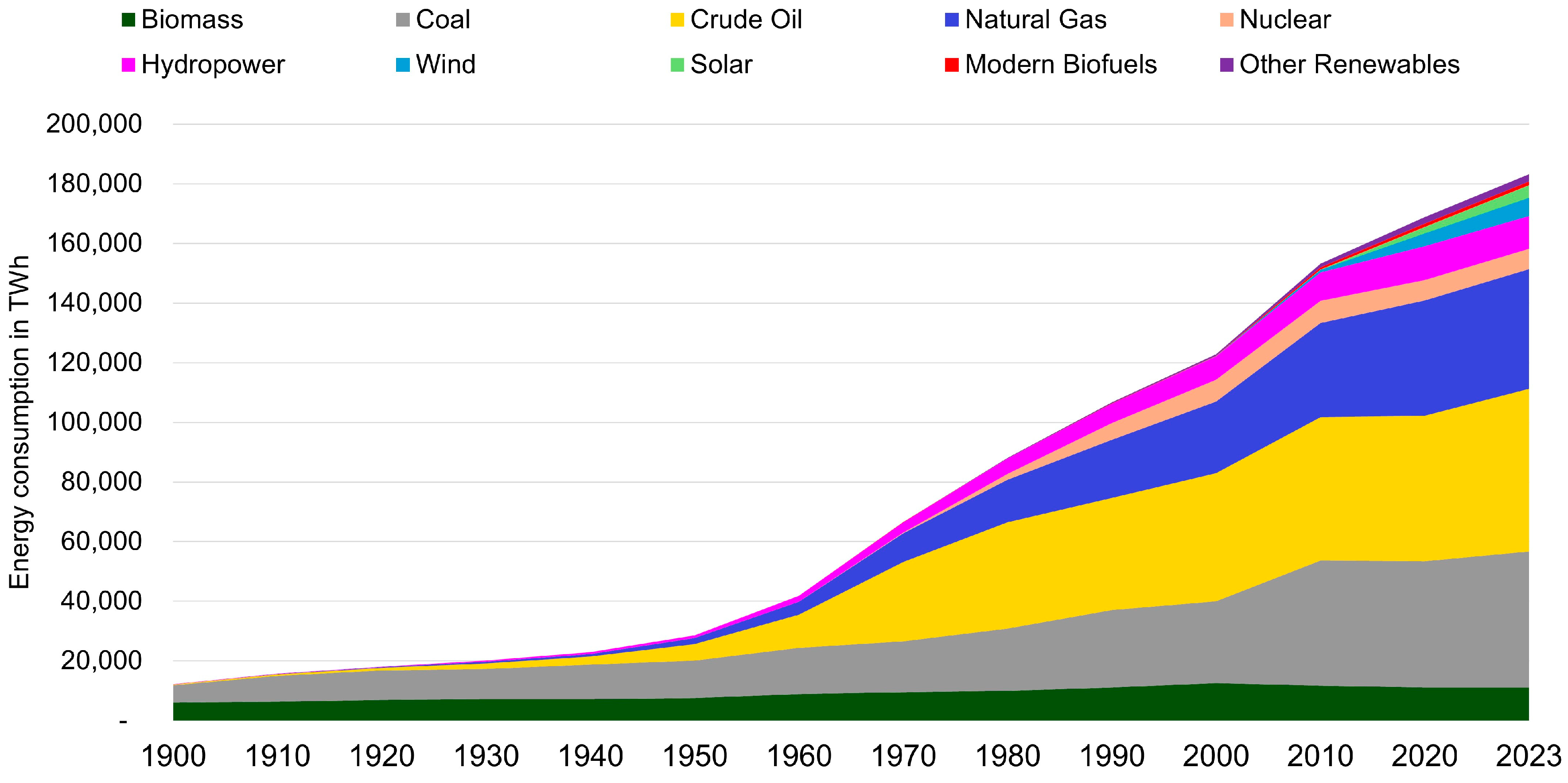
Since the Industrial Revolution, global energy has primarily been derived from fossil fuels (Figure 1), which has also led to a significant increase in anthropogenic greenhouse gas emissions and global warming [3]. Another major challenge is the growing population, projected to rise from 8 billion to 9.8 billion by 2050. The ever-increasing population, along with industrialization and economic growth, will drive higher energy demand. Global energy demand is projected to grow by 1.3% annually between 2020 and 2030.
Another significant challenge is the current environmentally unfriendly handling of waste organic biomass. Moreover, biogenic waste, including agricultural and forestry biomass, cattle manure, sewage sludge, and the organic fraction of municipal solid waste, is often poorly managed, leading to air pollution from emissions of CH4, CO2, NOx, SOx, H2S, and other greenhouse gases [4,5]. Soil degradation, nutrient imbalance, and water pollution with nitrites and nitrates occur due to acidification caused by ammoniacal nitrogen from these biogenic wastes, especially cattle manure, in the environment [6]. In addition, sewage sludge, which contains high levels of organic matter, persistent pollutants, pathogenic bacteria, and heavy metals, is expensive to dispose of [7]. These waste residues also offer several advantages, including their availability and flexibility in various forms and regions. Biomass has significant energy potential, as it contains a high renewable organic content [8]. Additionally, the use of biomass can generate employment, particularly in rural areas, thereby providing a distinct economic advantage. Overall, utilizing biomass for energy and biofuel production can help address issues such as climate change and rising energy demand. This would also enhance a country’s energy self-sufficiency, given the availability of biomass in various forms and regions.
The potential of biomass as a cost-effective renewable energy source has not been fully exploited. To utilize biomass more efficiently, it often requires upgrading to produce high-quality biofuels. Biomass, originating from diverse sources, can exhibit distinct qualities, climatic conditions, and seasonal supply patterns. The goal is to make biomass as homogeneous as possible to enable efficient, cost-effective conversion into biofuels. Moreover, the high moisture content of biomass makes it difficult to handle, as it has a lower heating value, is susceptible to microbial decay and natural decomposition, requires large storage space, and incurs higher transportation costs. One potential solution to address these inherent issues with biomass is torrefaction. Torrefaction is a mild thermochemical treatment of biomass, typically carried out under an inert atmosphere at atmospheric pressure, 150–300 °C, for 30 min to several hours, to remove moisture and volatile matter. As a result, torrefied biomass gains higher energy density and heating value, loses moisture content, and reduces hydrophilicity compared with raw biomass [8]. These properties make torrefied biomass more homogeneous and easier to handle, store, transport, and use as a high-quality solid biofuel [9]. Torrefaction is a relatively cost-effective biomass conversion process compared with other thermochemical methods such as pyrolysis, gasification, and liquefaction. It offers the potential for scale-up and commercialization due to its mild temperature requirements, the absence of catalysts, reduced infrastructure needs, and low maintenance [10].
Despite torrefaction being established as a biomass-upgrading technology, significant knowledge gaps remain. As mentioned earlier, persistent uncertainties exist regarding the impact of feedstock variability, such as origin, type, moisture content, ash content, and lignocellulosic composition (i.e., cellulose, hemicellulose, and lignin), on the efficiency of torrefaction and the quality of torrefied biomass, making it challenging to standardize operating conditions for different biomass sources. Moreover, the fundamental reaction mechanisms during torrefaction (i.e., dehydration, devolatilization, and decarboxylation), pathways of hemicellulose degradation, and associated secondary reactions remain inadequately understood, hindering accurate modeling and optimization of the process. Additionally, there is insufficient understanding of the long-term storage characteristics and stability of torrefied biomass under real-world conditions, particularly when exposed to humidity and mechanical handling. From a systems perspective, scaling up poses challenges due to limited understanding of heat transfer, reactor design limitations, and energy integration in large-scale continuous systems. Lastly, further research is needed to thoroughly assess the environmental impacts, including lifecycle emissions, utilization of by-products, and potential synergies with other thermochemical processes such as pyrolysis, liquefaction, gasification, or combustion, to validate torrefaction’s contribution to sustainable bioenergy systems.
This article identifies knowledge gaps as the primary reason for addressing them, summarizes the authors’ viewpoints on new insights, and emphasizes practical recommendations for researchers, policymakers, and industry stakeholders to support the commercial-scale-up of torrefaction. This review examines measures for researchers, policymakers, and industry stakeholders to improve process optimization, scale-up, and the commercialization of torrefaction. Additionally, this article offers thorough, consolidated, and up-to-date information on waste biomass and its composition, the torrefaction process and its uses, the impact of process parameters on torrefaction, and the different reactor configurations employed for torrefaction. Moreover, these thermochemical reactors are assessed using multi-criteria decision analysis, underscoring how their unique characteristics affect their appropriateness for operation and intensification from the laboratory to the commercial level. A concise techno-economic analysis, informed by selected case studies, identifies significant obstacles and offers guidance for researchers looking to upscale torrefaction. Finally, a strengths, weaknesses, opportunities, and threats (SWOT) analysis provides strategic insights for policymakers and industry stakeholders on actions to support torrefaction and its scale-up.

2. Waste Biomass and Its Composition

Biomass is defined as organic matter derived mainly from plants or animals. It can be clustered into three generations [11]. First-generation biomass includes edible crops such as corn, sugarcane, wheat, potato, and cassava, as well as other edible starch-based crops. These edible crops, initially intended for food production, create competition in their value chains when diverted to biorefineries for biofuel production. The second generation of biomass includes non-edible waste residues, such as agricultural biomass and forestry residues, is composed of cellulose, hemicellulose, and lignin. Examples of second-generation biomass include straw, husk, hull, meal, carp, cobs, bagasse, and woody biomass. The second-generation biomass also includes dedicated energy crops such as switchgrass, Miscanthus, Timothy grass, elephant grass, and hybrid poplar, which have short growth cycles and do not compete with the food chain or arable land for cultivation. The third-generation biomass includes more heterogeneous feedstocks such as municipal solid waste, food waste, sewage sludge, cattle manure, and marine waste.
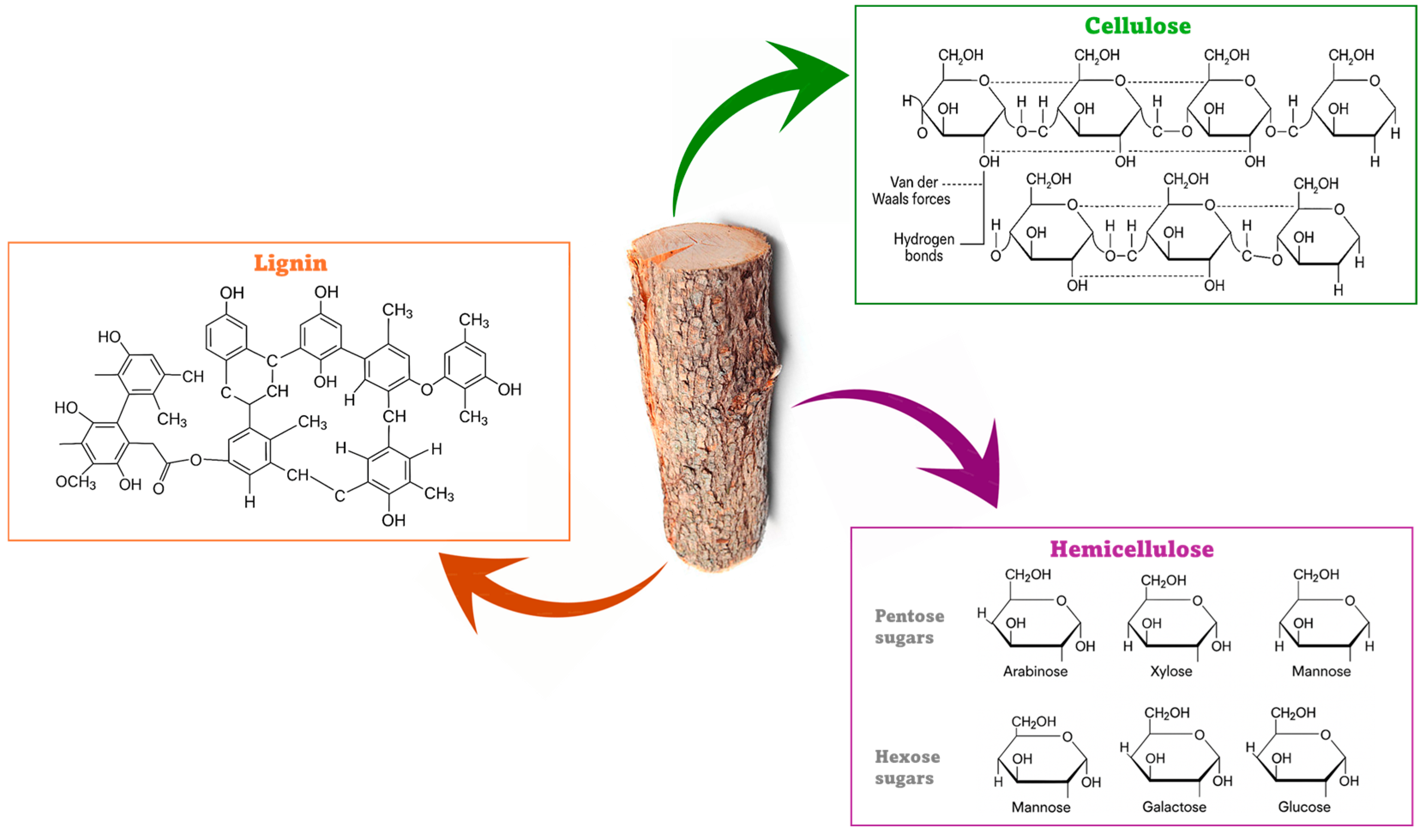
Second-generation biomass, or lignocellulosic feedstocks, are highly attractive for biofuel production. Lignocellulosic biomass is primarily made of cellulose, hemicellulose, and lignin [12]. Figure 2 illustrates the biopolymeric composition of lignocellulosic biomass. Cellulose is a long-chain glucose polymer bound together by glycosidic linkages, van der Waals forces, and hydrogen bonds, and has a relatively high molecular weight [13]. Hemicellulose mainly consists of hexoses, pentoses, and sugar acids with a lower degree of polymerization. Lignin is a phenylpropane polymer with high molecular weight that binds cellulose and hemicellulose, thereby providing structural integrity to the plant [14]. When biomass is torrefied, temperatures can reach up to 300 °C, as explained in detail later. The degradation temperature of cellulose is 275–500 °C, while hemicellulose will degrade at 200–450 °C. Lignin remains mostly thermally stable across a temperature range of 300 °C to 600 °C. This means that during torrefaction, cellulose and lignin decompose slightly, while hemicellulose undergoes substantial degradation. Given the regulations governing the use of first-generation biomass for energy generation and the food-versus-fuel debate, the research focuses primarily on second-generation biomass types.

2.1. Agro-Forestry Biomass

Agricultural biomass includes crop residues and energy crops. Using various thermochemical and biological conversion technologies, these residues can be converted into a variety of biofuels, including bio-oil, biogas, syngas, biochar, biodiesel, and bioethanol [15]. Biogas can be produced through the anaerobic digestion of organic waste. Energy crops are explicitly cultivated to produce bioenergy. However, they are not edible and can grow in marginal lands; therefore, they pose no risk to food security. Energy crops offer numerous advantages, including high biomass-yield potential and efficient use of sunlight, water, and nutrients [16]. Various studies have examined energy crops in general, including their environmental benefits, without compromising food security [17,18,19,20,21]. There is significant research interest in the energy crop Miscanthus, as it offers several benefits, including high biomass yield, low input requirements, and annual harvestability [19,21]. It has been demonstrated that Miscanthus can also remove heavy metals from technologically polluted soils when grown in these environments [22]. Miscanthus and switchgrass are also used to produce solid biofuel products, such as biochar and fuel pellets [23,24].
Additional agricultural biomasses suitable for biofuel production include starch, lignocellulosic, and oilseed crops. One example of a sugar crop is sugarcane, whose advantages have driven significant research into its use as a biofuel [25,26]. For example, oilseed crops include Pennycress, castor oil plant, and Jatropha, all of which are non-edible. Pennycress contains a relatively high level of monounsaturated fatty acids and is therefore of interest for biodiesel or jet fuel production [27]. The castor oil plant and Jatropha can both be used to produce biodiesel efficiently and cost-effectively through transesterification [28]. Crop residues and energy crops can be integrated to leverage the underutilized potential of crop residues and enhance their properties.
Significant research is ongoing for co-processing of energy crops, agricultural biomass, and other waste feedstocks, such as sewage sludge, plastics, and municipal solid waste, to produce biofuels [25,29]. Agricultural biomass, comprising crop residues and energy crops, can also be used in various bioprocesses, including anaerobic digestion, fermentation, and transesterification. Sugarcane leaves, as crop residues, can serve as an essential source of biomass for pellet fuels if specific challenges, such as high organic ash content and low calorific value, are overcome. Baur et al. [25] combined sugarcane leaves with bamboo, resulting in improvements in key physical properties, including length, bulk density, dust content, and durability.
Forestry residue is another type of lignocellulosic biomass that originates from forest harvesting or natural disturbances and has significant energy potential. They can be further divided into three categories. Primary forest residues are generated during forest harvesting, including tops and branches. Secondary forest residues are generated in industrial operations, such as black liquor. In contrast, tertiary forest residues result from construction and demolition activities during the building, renovation, and dismantling of structures [30]. Disturbance wood is another category of forestry residues that originates from dead trees or tree parts damaged by insects, pests, and natural disasters. Forestry biomass is derived from forest harvesting or natural disturbances and is available in large quantities. Castillo-Tera et al. [31] demonstrated the high energy potential of Bursera wood residues, yielding 46% cellulose, 14% hemicellulose, and 11% lignin. Pinus wood residues, with their high energy potential, were also found to be suitable for briquette and pellet production [32].

2.2. Other Organic Waste

Cattle manure is a lignocellulosic feedstock available in large quantities in both developed and developing countries. Cattle manure can be converted into various biofuel products through different biorefinery processes such as anaerobic digestion [33], fermentation [34], pyrolysis [35], torrefaction [36], gasification [6], hydrothermal gasification [37], hydrothermal carbonization [38], and hydrothermal liquefaction [39]. Cattle manure is primarily composed of 75–85% moisture and a rich mix of organic matter, including carbohydrates such as cellulose and hemicellulose, lignin, proteins, and lipids, as undigested and excreted fecal matter from cattle and livestock. It also contains essential nutrients such as nitrogen, phosphorus, and potassium, as well as minerals and trace elements that support microbial growth.
Wastewater treatment yields sewage sludge as a byproduct. Sewage sludge primarily comprises microorganisms (both pathogenic and non-pathogenic), heavy metals, and extracellular polymeric substances [40]. It has high energy potential, and there is significant research interest in utilizing sewage sludge for biofuel production. Multiple biorefinery processes have been investigated to valorize sewage sludge to produce high-quality producer gas, bio-oil, and biochar via pyrolysis [41], hydrochar via hydrothermal carbonization [42], bio-crude oil via hydrothermal liquefaction [43], and syngas via hydrothermal gasification [44]. Additionally, co-processing with sewage sludge is of high research interest, including co-pyrolysis with sawdust and wheat straw [45] and microalgae [46,47], and co-hydrothermal carbonization with high-concentration phenolic wastewater [48] or corncob [49]. Other examples of co-processes with sewage sludge include wet torrefaction and co-liquefaction with soybean straw [50] and anaerobic co-digestion with food waste [51].
Municipal solid waste is the daily trash and refuse generated from households, businesses, institutions, and public areas within a municipality. It generally comprises items such as food waste, paper, plastics, glass, metals, textiles, and yard waste, along with limited amounts of hazardous materials collected from residences. It typically excludes waste from industrial, agricultural, or construction activities. Effective management of municipal solid waste is crucial for preventing environmental pollution, conserving resources, and facilitating the recovery of energy and materials through recycling, composting, and waste-to-energy processes [7]. The compositions, conversion processes, and end products are highly varied. Examples include thermochemical processes such as anaerobic digestion, torrefaction, pyrolysis, combustion, gasification, hydrothermal carbonization, and liquefaction, which produce a broad range of biofuel products. Municipal solid waste can also be partially recycled, including glass, metal, and certain types of plastic. Sarker et al. [5] highlighted several additional challenges in producing biofuels from municipal solid waste, including process efficiency, capital and operational costs, and regulatory challenges that must be overcome to utilize municipal solid waste as efficiently as possible for biofuel production.

3. Torrefaction

3.1. Process and Applications

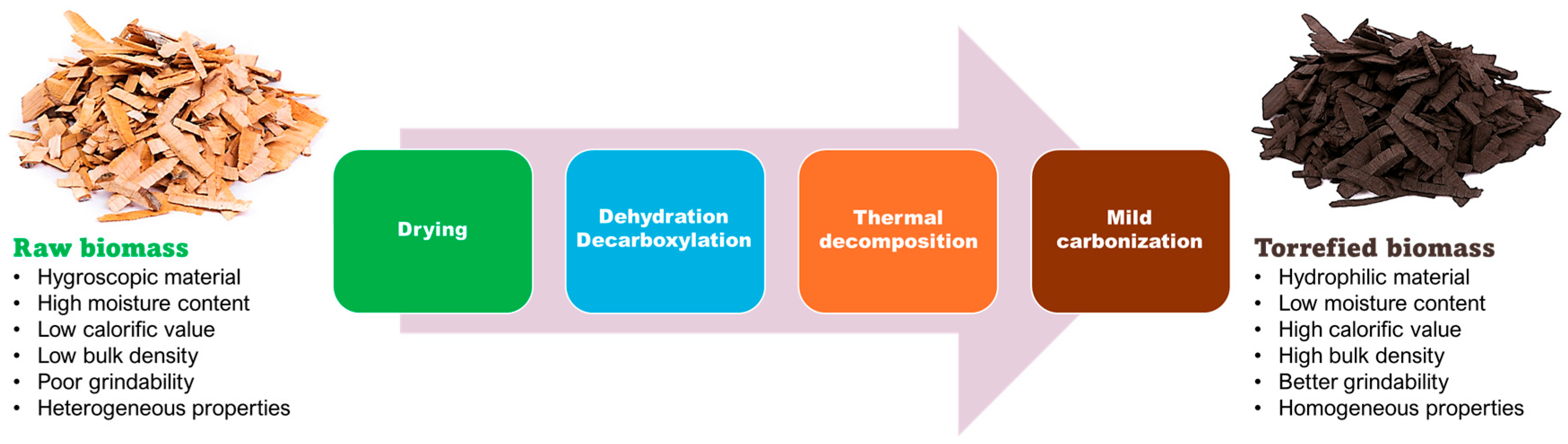
Torrefaction is a thermochemical conversion process that removes moisture and volatile matter from an organic residue under an inert atmosphere, thereby enhancing its energy density, heating value, and transportability and storage capacity [52]. Figure 3 illustrates the progression of biomass to the formation of torrefied biomass through drying, dehydration, devolatilization, thermal decomposition, and mild carbonization during torrefaction. The most relevant types of torrefaction processes are dry, oxidative, and pressurized. The temperatures for dry torrefaction range from 150 to 300 °C, and reaction times range from 30 min to several hours. The heating rate is generally less than 50 °C/min. Dry torrefaction occurs in an inert environment at atmospheric pressure. The final products are solid torrefied biomass and condensable volatile matter. The volatiles can be converted into processed water or gas, referred to as torr-gas after the torrefaction process [53,54]. Oxidative torrefaction uses air, flue gas with varying oxygen concentrations, or an oxidative gas as the carrier gas. Oxygen concentration significantly impacts torrefaction by facilitating partial oxidation, leading to increased mass loss and a reduced energy yield of torrefied biomass [55,56,57]. When oxygen levels are low or absent, torrefaction primarily proceeds via thermal decomposition, yielding a material that is more energy-dense and stable, resembling biochar.
One relatively new torrefaction method is pressurized torrefaction. Under applied pressure, the reaction time can be shorter than in dry torrefaction, as pressure facilitates faster heat transfer [58]. Sun et al. [59] used nitrogen to remove air and establish an initial pressure, determining 1.7 MPa as optimal, as higher pressures yielded minimal additional oxygen removal. The effect of pressurized torrefaction on the composition of the biomass is a higher decomposition of cellulose to over 90% in comparison to conventional torrefaction for lignocellulosic solid waste [60]. Sewage sludge, which was torrefied under gas pressure, had higher ash content, better hydrophobicity in comparison to dry torrefied sewage sludge, and a lower H/C ratio [61].
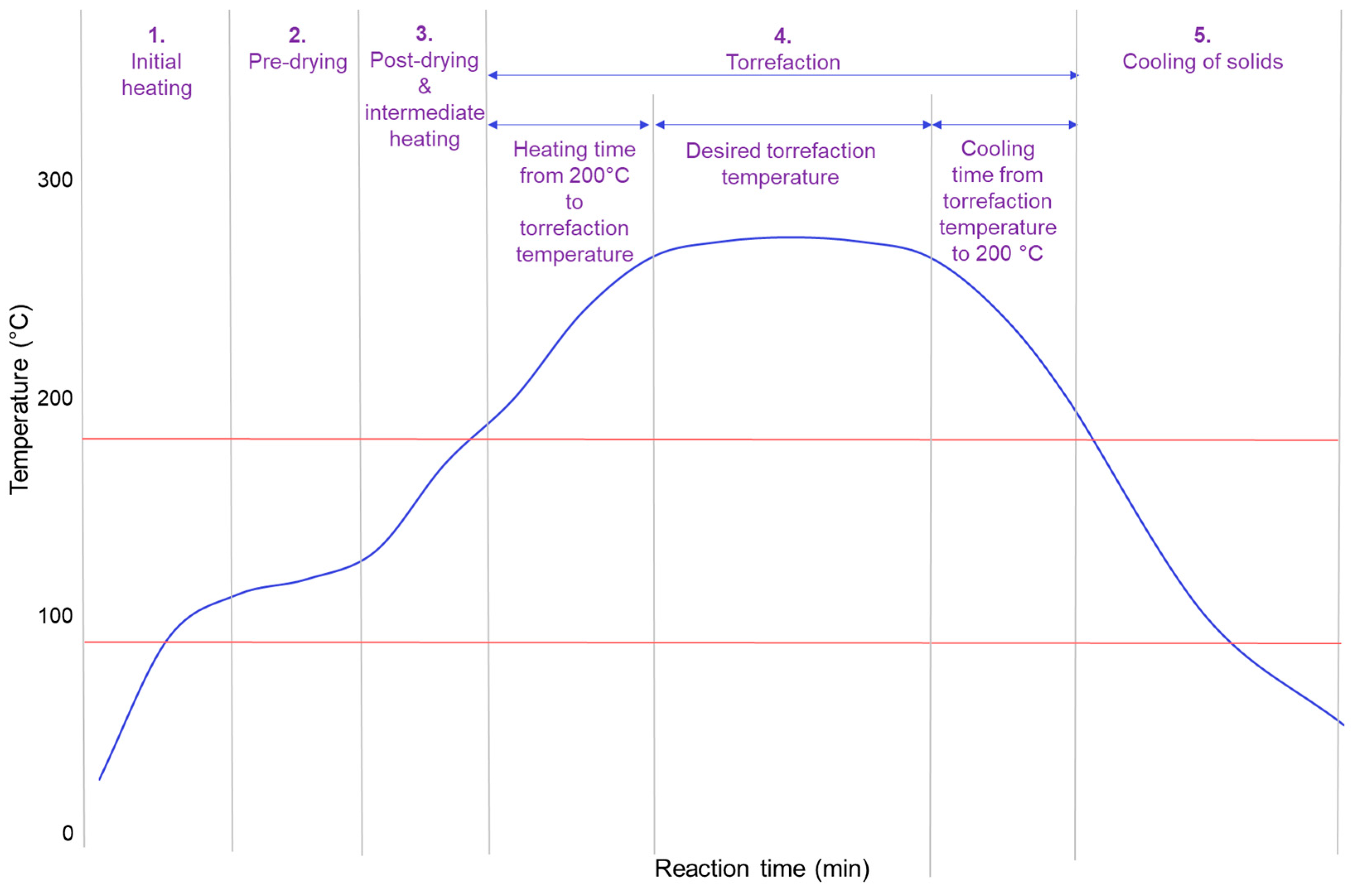
The torrefaction process can be divided into five stages, as summarized in Table 1 and illustrated in Figure 4. In the first stage, the biomass is heated until moisture begins to evaporate. The second phase, the pre-drying phase, lasts until the evaporation rate decreases again; the third stage continues until the temperature exceeds 200 °C. Subsequently, the fourth stage, also known as the torrefaction stage, is reached. This phase consists of a heating period, a holding time, and a cooling period. As soon as the temperature goes below 200 °C, until the solids reach their final temperature, the fifth stage of torrefaction is active.
Torrefaction offers numerous advantages and enhances biomass properties, as shown in Table 2. Higher energy density of torrefied biomass is a crucial performance indicator for torrefaction [65]. The bulk mass density decreases as torrefaction reduces the volatile and moisture content. The mass loss is explained by this as well as by the breakdown of hemicellulose and the partial decomposition of lignin and cellulose. Consequently, the O/C ratio also decreases with torrefaction. Lastly, torrefied biomass exhibits improved hydrophobicity [66]. Grindability of torrefied biomass is better due to the release of the volatiles, which leads to a reduction in the energy consumption for the grinding of the biomass by 70–90% [66]. Transportation costs of torrefied biomass are lower due to lower bulk density, higher energy density, and conversion to homogeneous pellets or powder. The improved hydrophobicity also facilitates storage, as torrefied biomass can be stored outdoors [67,68].
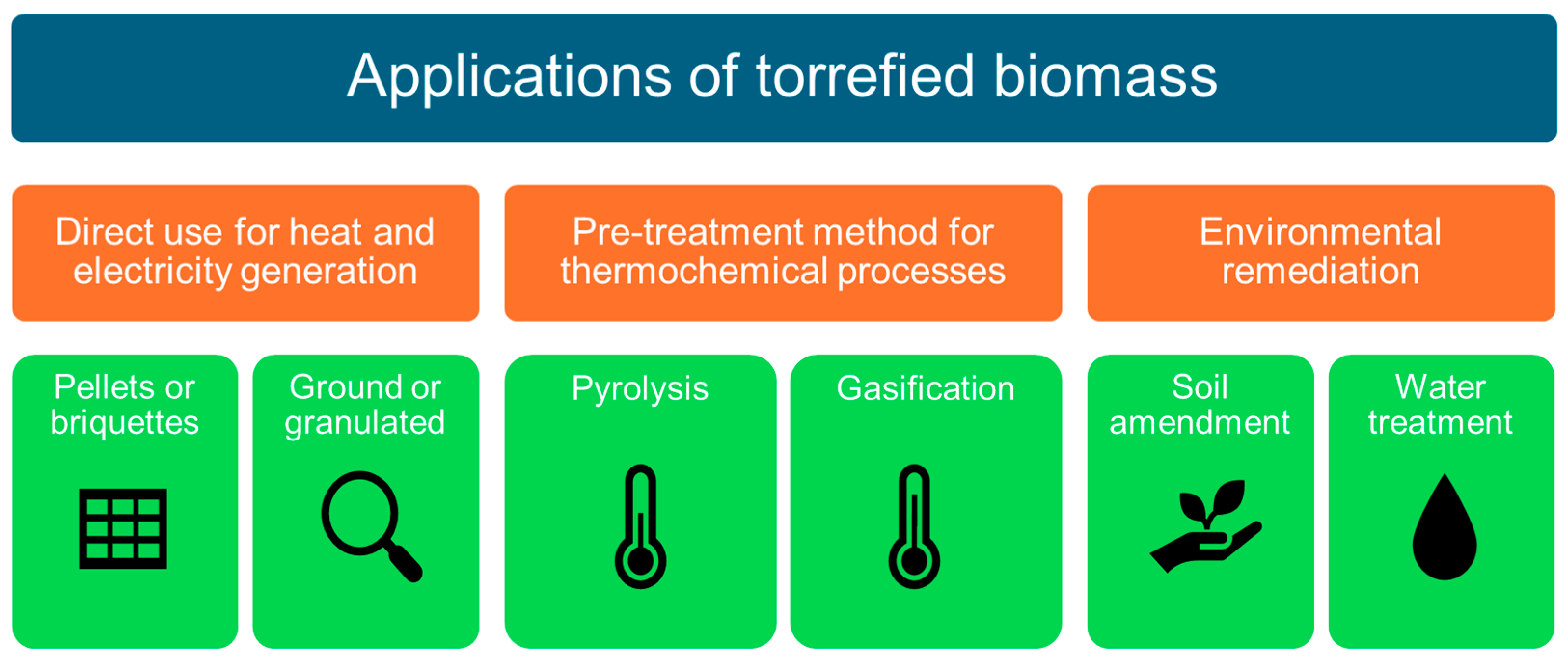
Figure 5 illustrates the numerous applications of torrefied biomass. Torrefied biomass and biochar can be used for heat and electricity production, either as a direct heat source or to enhance the performance of other thermochemical processes, such as pyrolysis, gasification, co-combustion, or co-firing [69]. The most significant benefits of torrefied biomass compared to raw biomass are its improved heating value and energy density, as well as increased homogeneity. Torrefied biomass can be used directly for heat and electricity production as an environmentally friendly substitute for coal, thereby serving as a solid, densified fuel. The form of the torrefied biomass for this purpose can be pellets or briquettes [70,71]. However, a disadvantage of torrefied biomass is that binders may be required for pelletizing. The reason is that torrefaction reduces the lignin, as mentioned above, which is a natural binder in the raw biomass. Several studies have been published on organic binders, such as lignosulfonate, wheat flour, starch, pitch, or molasses [72,73], as well as on inorganic binders, including high-density polyethylene and bentonite [70,74]. Additionally, the risk of pellet self-ignition is higher than that of raw biomass [66].
On the other hand, torrefaction can serve as a pretreatment method to improve outcomes in other thermochemical conversion technologies, such as pyrolysis or gasification. Singh et al. [75] investigated the torrefaction and subsequent pyrolysis of anaerobic digestate, demonstrating that torrefaction improves the performance of existing biogas plants. Guo et al. [76] studied gasification of pelletized, torrefied biomass derived from spent coffee grounds, corn stalks, and fungus bran. They found that integrating biomass torrefaction with densification significantly increased the yield of primary combustible gases at higher gasification temperatures, producing hydrogen-rich gas. Furthermore, optimizing pelletizing conditions can increase the process efficiency of biomass while reducing the costs for transportation, storage, and conversion [77].
Additionally, solid torrefied biomass is highly beneficial for environmental remediation, including soil amendment and water treatment. Rehman et al. [78] investigated the use of torrefied biomass for soil amendment. They found that highly torrefied rice straw can improve soil health and crop growth while reducing water requirements and the need for external fertilizers. Steiger et al. [79] investigated the use of torrefied biomass for water treatment by torrefying wheat straw and oat hulls, then combining them with kaolinite and chitosan to produce pelletized adsorbent materials. They reported that composites containing torrefied biomass reduce chemical input costs, enabling the development of sustainable pelletized adsorbent technology.

3.2. Effects of Process Parameters

As mentioned earlier, torrefaction has numerous positive effects on biomass properties. Maximizing those impacts requires an understanding of how various process parameters influence torrefied biomass. Additionally, with detailed knowledge of the influence of specific parameters, it is possible to optimize the parameters required for applications and effectively torrefy biomass with minimal operational costs and energy consumption. The state of research varies significantly across different process parameters. Many studies have focused on the influence of temperature and reaction time on torrefaction products [80,81,82,83], whereas a few have also examined the effects of heating rate [84,85,86]. Multiple researchers have also investigated the influence of particle size on torrefaction [80,87,88].
Biomass composition is also considered a parameter in the torrefaction process. Biomass with a higher hemicellulose ratio produces more volatile matter during torrefaction, whereas a higher lignin-to-cellulose ratio results in a higher solid yield upon torrefaction [89]. Konsomboon et al. [88] highlighted the influence of biomass composition on torrefied feedstocks, which included pinewood, ash wood, Miscanthus, and wheat straw, representing softwood, hardwood, an energy crop, and an agricultural residue, respectively. Pinewood had the highest content of relatively stable sugars in hemicellulose and mannan and therefore yielded the highest solid mass in this study. Wheat straw, on the other hand, had the lowest solid mass yield due to its high content of the reactive component hemicellulose xylan, which highly degraded at torrefaction temperatures.
Table 3 summarizes some recent studies on torrefied biomass and their energy yield in the torrefied biomass. In summary, parameters such as temperature, reaction time, heating rate, and biomass particle size significantly influence the severity of torrefaction and the resulting product properties. Current research indicates that temperature is the parameter of greatest scientific interest, followed by reaction time, heating rate, biomass composition, and particle size.

3.2.1. Temperature

Temperature has the most significant impact on biomass properties during torrefaction. First, the higher heating value of torrefied biomass increases with increasing torrefaction temperature and reaction time, with the effect of temperature being more significant than that of reaction time. Singh et al. [91] investigated the higher heating value of agricultural residue from pigeon pea stalks at 250 °C and 275 °C with a reaction time of 30 min. They reported increases of 20% and 26% in the higher heating value relative to the raw biomass, respectively. Secondly, temperature significantly affects the yield of the solid product during torrefaction [81,82]. The reason is that higher temperatures increase the extent of hemicellulose and cellulose decomposition, thereby reducing the yield of the solid product [83]. This is also the reason for the weight loss during torrefaction, which depends strongly on temperature.
Generally, raw biomass has a low calorific value of 9–12 MJ/kg [66]. For Pequi seed biomass, a 21% increase in the higher heating value of the torrefied biomass was observed [92]. The rise in higher heating value after torrefaction is due to increased carbon content and decreased oxygen content [66]. The O/C ratio and H/C ratio also decrease as the torrefaction temperature increases [91,93]. As hydroxyl-containing functional groups decompose more at higher temperatures, more bound moisture is released, increasing the liquid output of torrefaction and decreasing the solid yield. The hydrophobicity of biomass also increases with higher temperatures. A decline in moisture reabsorption after torrefaction, thereby significantly improving the storage potential of biomass [91]. Hence, temperature is the parameter with the most significant impact on the torrefaction process. On the one hand, with increased temperature, the higher heating value and hydrophobicity increase. The O/C ratio, H/C ratio, and solid product yield, by contrast, decrease with increasing torrefaction temperature.

3.2.2. Heating Rate

Multiple researchers have reported that the effect of heating rate on torrefied biomass is relatively small compared with that of temperature [87,88]. Chai et al. [94] reported that the heating rate has a minor impact on torrefaction, except during the initial heating stage. The effects of heating rate and reaction time on higher heating value and energy yield are minimal compared to temperature [86,91]. Eling et al. [90] reported the effects of temperature, holding time, and heating rate on the energy yield of groundnut shells and maize stalks, in that order. As noted earlier, biomass weight loss during torrefaction depends primarily on temperature, followed by reaction time and heating rate [95]. The O/C and H/C ratios decrease with increasing torrefaction temperature and reaction time, whereas the influence of the heating rate is less pronounced. This effect is especially pronounced at the maximum torrefaction temperatures and longer reaction times.

3.2.3. Reaction Time

As mentioned above, reaction time is the period during which the biomass is exposed to the temperature range of 200 °C to 300 °C, corresponding to the fourth stage of the torrefaction process. It typically ranges between 10 and 60 min [62]. Reaction time also affects the higher heating value. However, temperature during torrefaction is more important for solid product yield than reaction time. Increasing the torrefaction temperature and reaction time increases the higher heating value. Singh et al. [84] reported a slight increase in the higher heating value of only 3.7% when the reaction time was increased from 15 min to 45 min.
As reaction time increases, liquid output increases, and solid output decreases as more bound moisture is released. To support this, Abdulyekeen et al. [81] studied torrefied organic municipal solid waste in a helical screw rotation-induced fluidized bed reactor, with temperatures ranging from 200 to 300 °C and reaction times of up to 40 min. The most significant percentage change in the total solid fraction was 1% for reaction time and 26% for temperature. An increased reaction time in the torrefaction process yields the same improved properties as an increased temperature, such as a higher heating value. The influence of temperature, however, is found to be more critical than that of reaction time.

3.2.4. Biomass Particle Size

Wang et al. [87] also reported that temperature has a greater effect on all torrefaction parameters, including the particle size. Konsomboon et al. [88] investigated the impact of particle size and biomass composition on the yield and properties of torrefied products by torrefying biomass feedstocks such as pine, ash wood, Miscanthus, and wheat straw with different particle sizes at 280 °C. They reported that the yield of solid products increased with increasing particle size, while the yields of liquids and gases decreased. The reason for this is the convective and conductive heat transfer. Because larger particles have a lower surface area per unit mass than smaller particles, they exhibit a lower rate of convective heat transfer and greater resistance to heat and mass transfer, leading to a longer heat-up time. Additionally, a larger particle size results in a higher solid torrefied product and fewer volatiles [87]. With a higher particle size, heat transfer is less effective, resulting in a higher solid torrefied product yield and fewer volatiles.

4. Thermal Reactors for Torrefaction

A variety of thermal reactors are available for thermochemical conversion of biomass via torrefaction, pyrolysis, gasification, and liquefaction. To torrefy biomass as optimally as possible, it is essential to understand the proper characteristics of the available reactors. The primary differences between them lie in the method of biomass transport within the reactor, the design, and the heat-transfer mechanism. The heat source can either be direct or indirect. A heating medium is required for direct heating, whereas in indirect heating, heat transfer occurs through walls, thereby facilitating oxygen exclusion from the reactor [62]. Another way to classify reactors is by process control, with a distinction between batch and continuous reactors. Commonly used reactors for torrefaction include fixed-bed, rotary drum, fluidized-bed, screw, moving-bed, microwave, and entrained-flow reactors. Table 4 summarizes the advantages and disadvantages of these thermal reactors.

4.1. Fixed-Bed Reactor

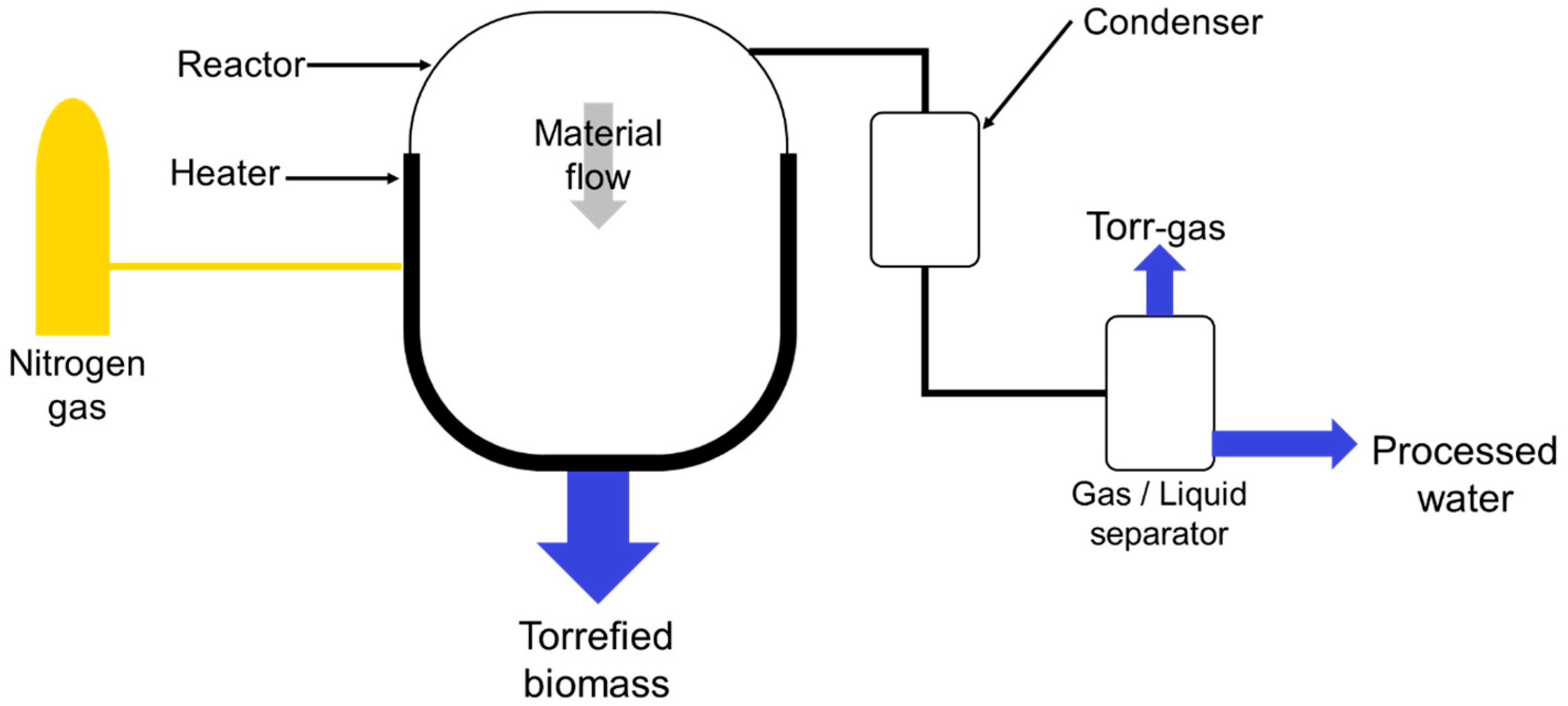
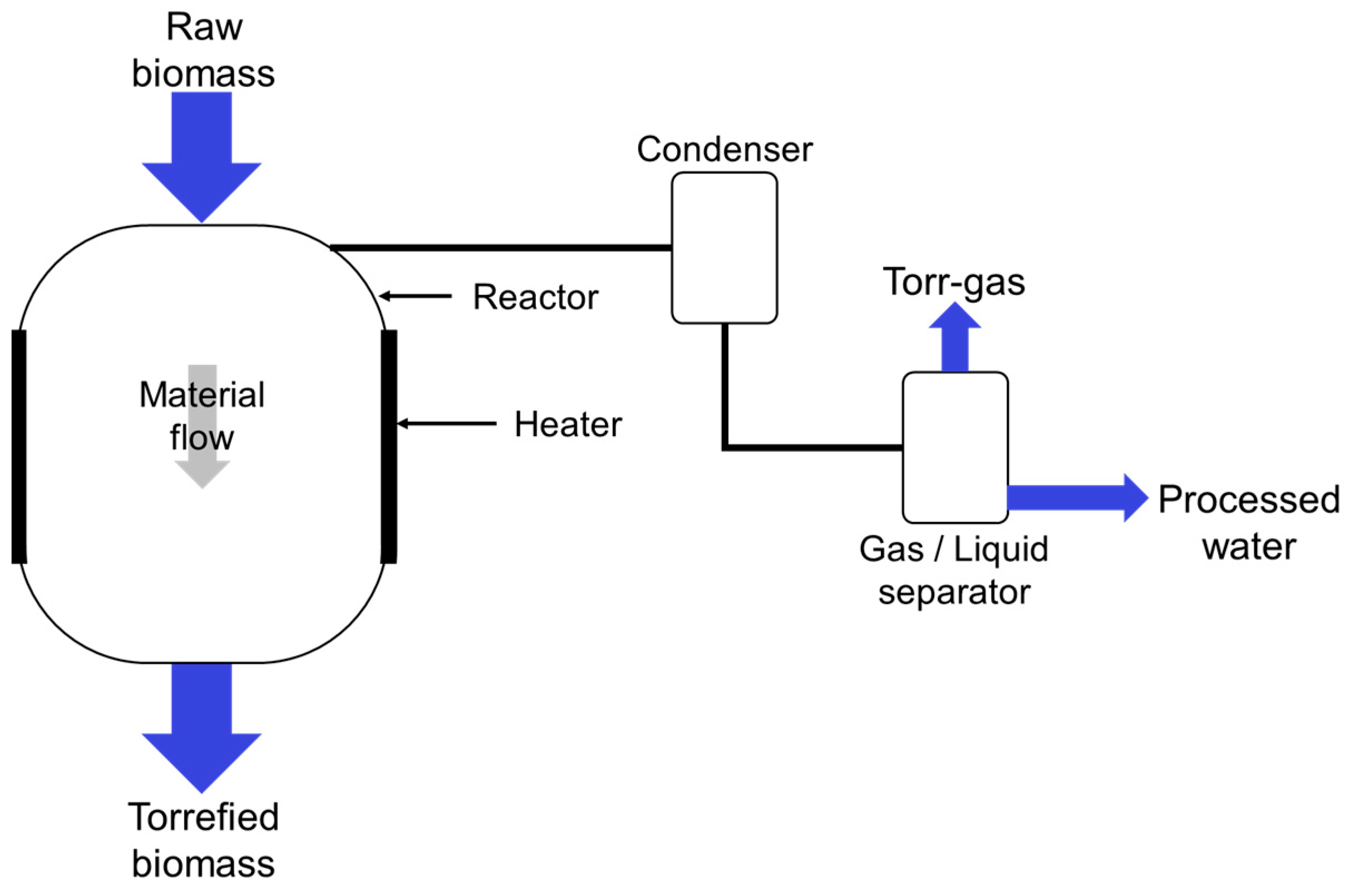
The fixed-bed reactor uses an indirect heat source for torrefaction and other thermochemical biomass conversion processes such as pyrolysis, gasification, and liquefaction [99]. Figure 6 shows a typical schematic of a fixed-bed reactor used for torrefaction. The procedure for using the fixed-bed reactor to torrefy biomass involves placing the raw material in the reactor, where it is dried and torrefied in the furnace. The torrefied biomass is collected at the end of the process, once the reactor has been cooled down [107]. Nitrogen is used to create an inert atmosphere by purging the reactor with nitrogen before introducing the biomass and initiating the torrefaction process. The volatiles produced during torrefaction are directed to the condenser and the gas–liquid separator to capture the torr-gas and processed water.
Nitrogen is a common carrier gas used to create an inert atmosphere during torrefaction. The advantages of fixed-bed reactors include their relatively low cost, straightforward operation, reliability, and a proven track record in research environments [98]. However, disadvantages include limited product sampling and inefficient heat transfer and temperature control [99]. Because of their advantages and disadvantages, fixed-bed reactors are primarily used in laboratory-scale research environments. The laboratory- and pilot-scale fixed-bed reactors are similar, with the primary difference that pilot-scale reactors are heated by combusting raw biomass, torr-gas, or pyrolysis gas, depending on the thermochemical biomass conversion process. In contrast, laboratory-scale reactors are heated by an electrically heated furnace. Additionally, a new solar-assisted fixed-bed torrefaction reactor offers potential for industrial applications [108]. It provides additional economic and environmental benefits due to its energy-saving and CO2-reducing properties. Fixed-bed reactors are often employed in research environments due to their cost-effectiveness and ease of operation. The scale-up is currently challenging due to inefficient heat transfer and stringent temperature regulations.

4.2. Rotary Drum Reactor

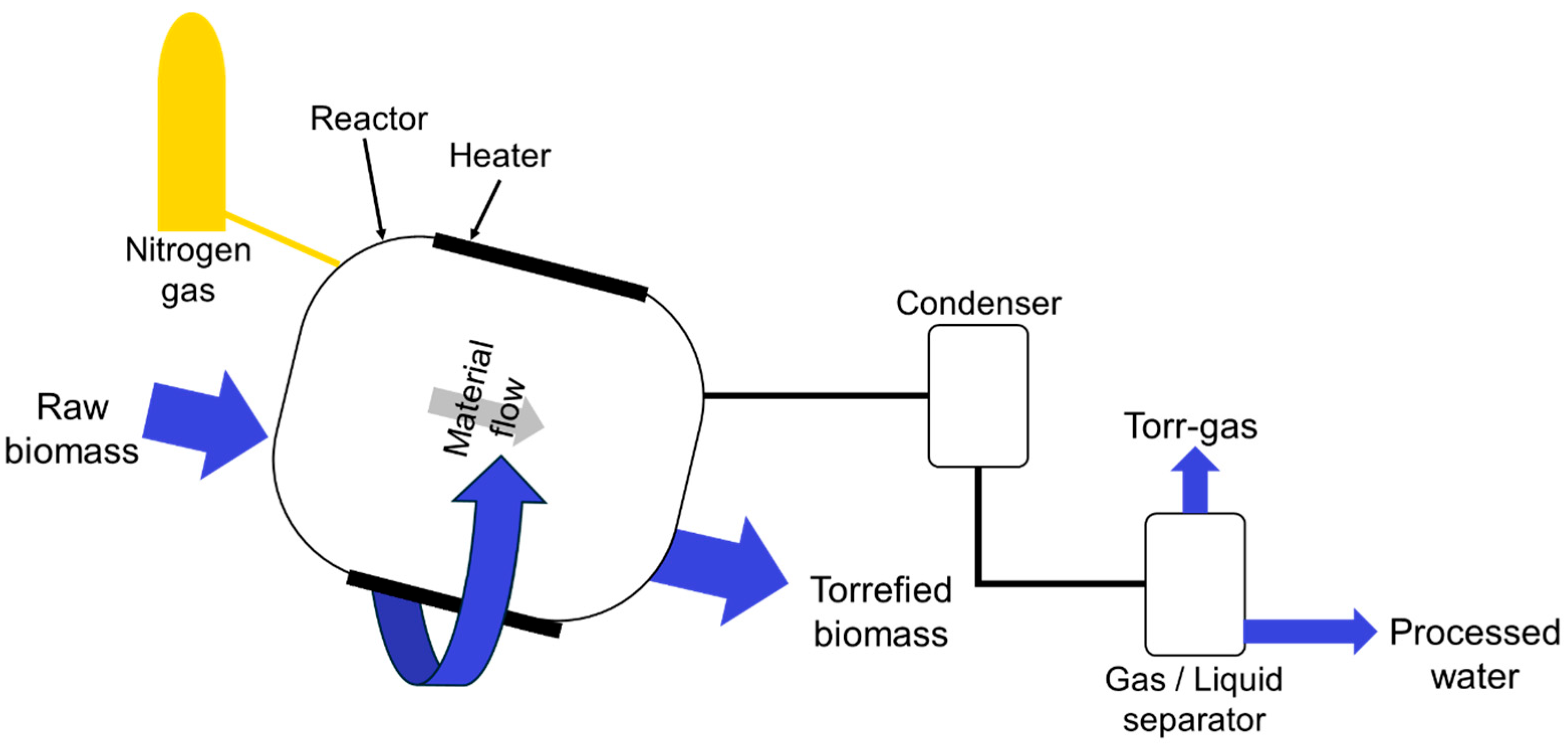
Rotary drum reactors use direct, indirect, or a combination of both heating modes. Indirect heat originates from the heated drum wall, whereas direct heat comes from heaters in the drum, hot inert gas, or recycled torrefaction gas [101]. Soponpongpipat et al. [104] reported that a combination of preheated inert gas and indirect heat may be necessary to achieve higher heating rates in specific applications, as preheated inert gas alone is sufficient only for slow pyrolysis of biomass.
Rotary drum reactors can be either continuous or batch reactors, depending on the specific setup. In the continuous reactor, raw biomass enters at the inlet and torrefied biomass exits at the outlet. As the reactor is slightly rotated around its vertical axis, the biomass slowly moves towards the outlet under gravity [101]. The batch reactor, however, is not rotated around the vertical axis. The raw biomass is loaded, and the drum begins to rotate once it is closed. When the experiment is complete, the drum can be opened, and the torrefied biomass can be removed [104]. When direct heat is supplied via a heat carrier, such as nitrogen, the resulting tor-gas contains nitrogen from the carrier gas. Figure 7 shows the schematics of a continuous rotary drum reactor.
Rotary drum reactors have been employed for the valorization of a wide range of biomass sources, including sawdust [104], pinewood [109], sewage sludge [110], municipal solid waste [111], and organic household waste [112]. These reactors are often characterized by high thermal efficiency [98]. Soponpongpipat et al. [104] found that rotary drum reactors exhibit a higher heating rate of 7.3–21.4 °C/min than a thermosyphon-fixed bed torrefaction reactor and a laboratory fixed-bed reactor. Additionally, because the reactors are filled to approximately 30% of their volume, the torrefied biomass is well mixed and heated homogeneously [62]. However, this maximum fill volume also has disadvantages, as it limits particle size and increases the reactor’s investment costs for a given biomass input [98]. Other disadvantages of torrefaction in a rotary drum reactor include the high pressure drop and rapid drying, which typically require slow, controlled drying.
In general, rotary drum reactors are used in other thermochemical processes, such as biomass drying and pyrolysis, which makes their use appealing for torrefaction. Hence, several research studies on torrefaction using rotary drum reactors are currently underway, primarily at the pilot scale [109,113]. Rotary drum reactors can operate with direct or indirect heat and can be configured as either continuous or batch reactors. These reactors offer advantages, including high thermal efficiency and well-mixed, homogeneously heated torrefied biomass. Disadvantages include the maximum filling volume, which limits particle size and results in high investment costs.

4.3. Fluidized Bed Reactor

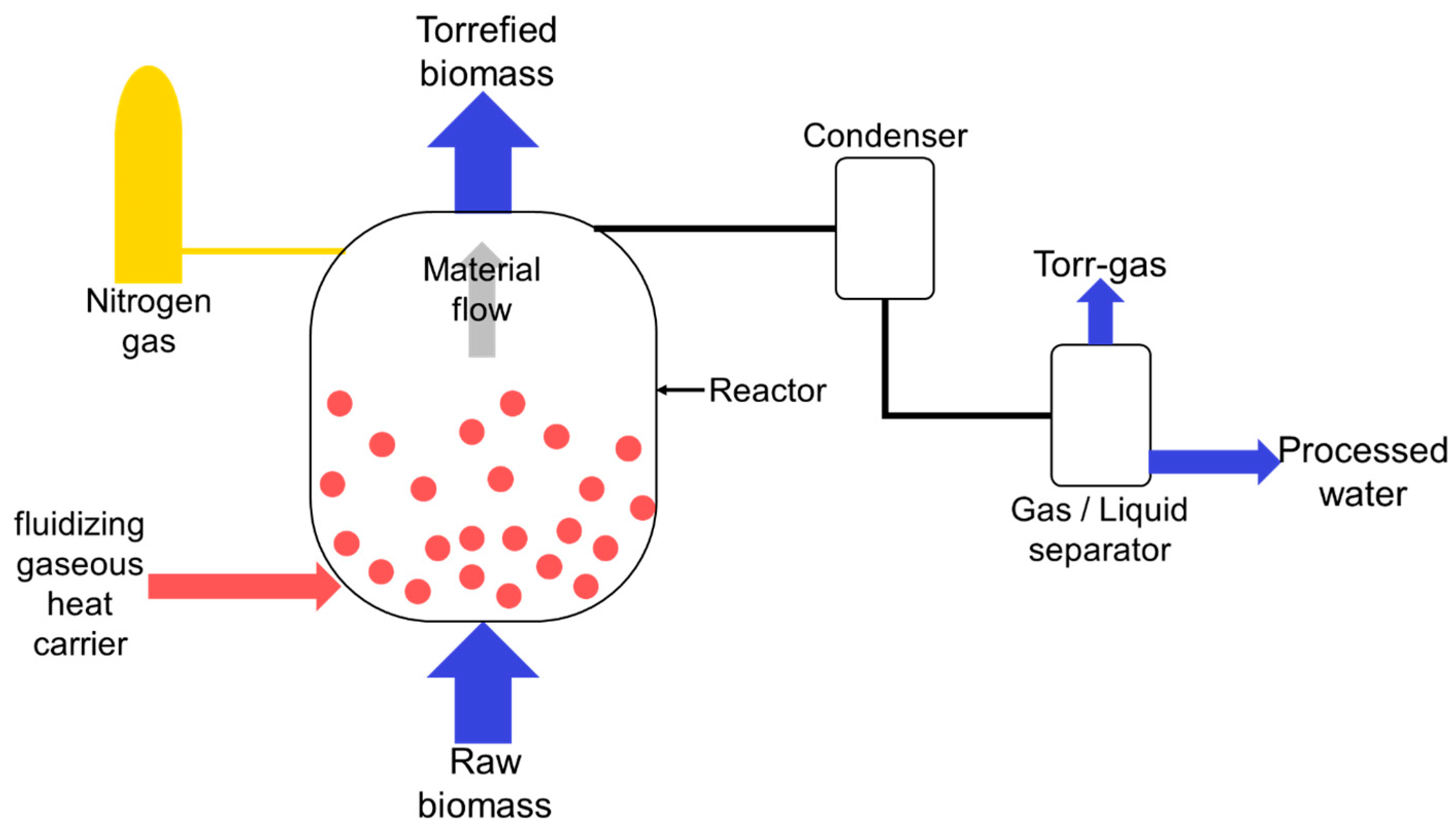
Fluidized bed reactors are typically operated in a continuous mode with a direct heat source [57]. Figure 8 shows the typical schematic of a fluidized-bed reactor used for torrefaction. In fluidized-bed reactors, the bottom section is filled with a fluidizing gaseous heat carrier, such as sand, which fluidizes the biomass. Torrefied biomass with lower density is then regularly extracted from the top [102]. These reactors have been used for the torrefaction of a variety of feedstocks, including Acacia nilotica wood [96], sawdust [114], and pellets made from Fir and olive pomace [57].
A wide range of advantages of fluidized bed reactors has been reported, including low mass-transfer resistance and, consequently, reduced clogging and fouling, owing to the constant motion of the biomass. This is especially advantageous compared to the fixed-bed reactor. Due to the continuous movement of the biomass, the gas–solid contact efficiency is also high [96]. This is also why localized hotspots inside the reactor can be more easily prevented. Due to the high heat-transfer rate, the reaction time in fluidized-bed reactors can be reduced by 5–7 min compared with other currently available torrefaction reactors, such as fixed-bed, rotary drum, and screw reactors, making the fluidized-bed reactor highly attractive for industrial applications. Another advantage is the high reproducibility of experimental results [57]. However, the constant movement of biomass in the reactor can also lead to disadvantages, such as increased wear and erosion of reactor components, thereby increasing maintenance costs. Investment costs for the operation and maintenance of these reactors are also relatively high [96]. An interesting variation in the fluidizing bed reactor is the horizontal pulsed fluidized bed reactor, which uses gas pulsation [114]. Fluidized bed reactors are utilized for various processes, including gasification and pyrolysis. The advantages include continuous biomass flow and a high heat transfer rate. Disadvantages include increased wear and erosion, and higher investment costs.

4.4. Moving Bed Reactor

In moving-bed reactors, biomass moves either horizontally or vertically [101]. These reactors rely on gravity to transport biomass and operate continuously. A direct or indirect heating source is possible [107]. Figure 9 presents the schematic of a moving-bed reactor used for torrefaction. In a moving bed reactor, both fluids and solids are in motion [98]. The raw biomass enters the reactor through a feeding device at the top. The torrefied biomass gets discharged at the bottom of the reactor into the cooling section [102]. This leads to a counterflow, with the biomass drying in the upper part of the reactor and torrefying in the lower part. To disrupt gas and particle channels and prevent biomass from agglomerating or adhering to the reactor walls, moving-bed reactors typically feature axial stirring shafts [101].
Experiments of torrefaction with a moving bed reactor have been performed with willow, wheat straw, Cattail, Moringa, and spruce pellets [115] and rubberwood sawdust [116]. However, only a few recent studies have examined the torrefaction of biomass in a moving-bed reactor. Moving-bed reactors offer multiple advantages, including their robust, simple designs and enhanced thermal efficiency resulting from the counterflow described above [102]. The reactors can be filled, thereby reducing capital costs per unit of torrefied biomass [101]. However, torrefaction in moving-bed reactors is poorly scalable. Additionally, the high-pressure drop and the uneven biomass mixture [62] are disadvantages. In vertical moving-bed reactors, the biomass is in motion, as the name suggests. These reactors offer several advantages, including ease of design and thermal efficiency. Disadvantages of these reactors include poor scalability and an uneven biomass mixture.

4.5. Screw Reactor

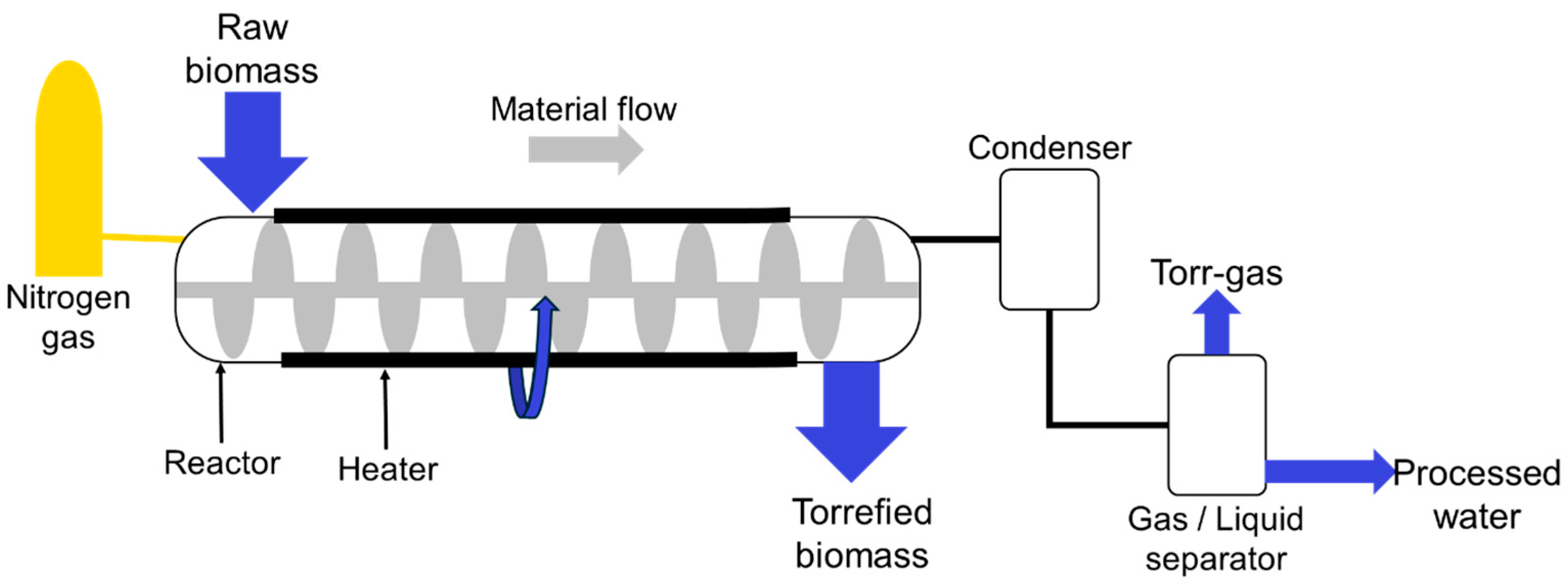
Screw reactors are also known as auger reactors or screw conveyor reactors. These reactors are continuous and primarily rely on indirect heat from the reactor wall. Figure 10 shows the schematics of a screw reactor. One or more screws are placed horizontally in the reactor to move the biomass through it. The rotation speed of the screw can be adjusted to achieve the desired reaction time [98]. Some recent studies have reported torrefaction in a screw reactor using corn straw [117], sesame stalks [118], the organic fraction of municipal solid waste [80], and oil palm mesocarp fiber [119].
Torrefaction in screw reactors presents both advantages and disadvantages. Some benefits include improved biomass flow, facilitated by the rotating screw, and the potential to torrefy various biomass particles. Additionally, the screw reactors are comparably affordable [98]. In contrast to a fixed-tube furnace, screw reactors heat biomass more uniformly [103]. Some disadvantages include low heat-transfer rates and inefficient heat transfer due to indirect contact, resulting in inconsistent biomass torrefaction [57]. The maintenance costs are also high. Lastly, carbonized material can develop in the heating area [98].
One interesting variation in the screw reactor is the helical screw rotation-induced fluidized bed reactor. The screw is rotated helically and used in place of an inert gas, thereby reducing investment and operating costs. Abdulyekeen et al. [81] reported that this improves biomass attrition and the separation of torrefied solid products from the bed material. Additional advantages include improved particle mixing and interactions among particles and between particles and the reactor wall, resulting in a more uniform temperature distribution within the sample. Screw reactors are horizontal, moving-bed reactors that offer improved biomass flow and are more affordable than other reactor types. However, they also exhibit low heat-transfer rates and high maintenance costs.

4.6. Microwave Reactor

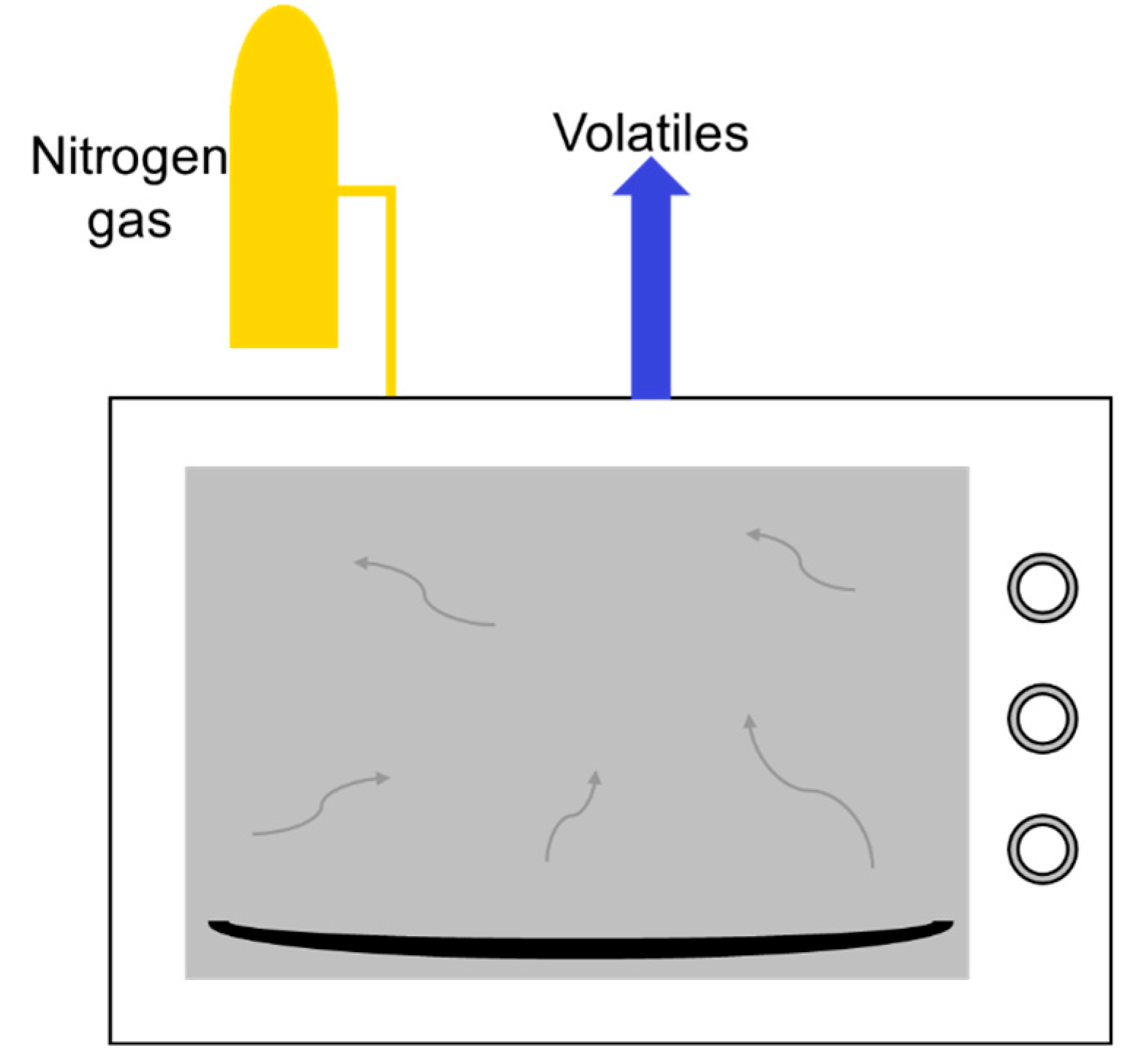
Microwave reactors are batch reactors that operate at microwave frequencies, high-frequency electromagnetic waves. They can operate at frequencies from 300 MHz to 300 GHz [99]. The central frequency used is 2.45 GHz. Heat transfer at that frequency can occur in two ways. Dipolar polarization, on the one hand, occurs as dipole-containing materials align with the oscillating electric field. As a result, they release energy as heat. On the other hand, ionic conduction takes place when ions move in an electric field and collide with nearby ions. Heat is released due to molecular friction [97]. Figure 11 illustrates the schematics of a microwave reactor.
Some recent studies have employed microwave reactors for the torrefaction of a variety of waste feedstocks, such as Camelina straw and switchgrass [70], pomelo, longan, waste cooking oil [120], crab shell waste [121], spent coffee grounds [67], Chlorella algae [100], and canola residue [122]. The moisture in the biomass can additionally act as an absorber of the microwave radiation [97]. There is significant ongoing research on microwave torrefaction, particularly on comparing conventional and microwave reactors, developing methods to improve microwave torrefaction, and developing microwave absorbers. The research is currently mostly laboratory-scale.
Microwave torrefaction offers numerous advantages, including higher efficiency than conventional torrefaction due to its faster processing and shorter reaction times [70,97]. Consequently, there is also greater energy-saving potential from uniform volumetric heating and rapid reactions. In a microwave reactor, microwave irradiation is transferred within the biomass, resulting in improved heating efficiency and shorter processing times [100]. Additionally, the reaction selectivity is high, and the operating costs are comparably low [97]. Disadvantages include high intra-particle temperatures and inhomogeneous torrefaction, particularly in larger biomass particles, as well as high capital costs [62]. Agu et al. [70] reported that microwave power has a greater influence on torrefaction than reaction time and particle size. Microwave reactors are relatively new to the torrefaction process and are not widely used at present. However, they offer several advantages, including high efficiency and low operating costs, which have led to growing scientific interest in microwave torrefaction.

4.7. Entrained-Flow Reactor

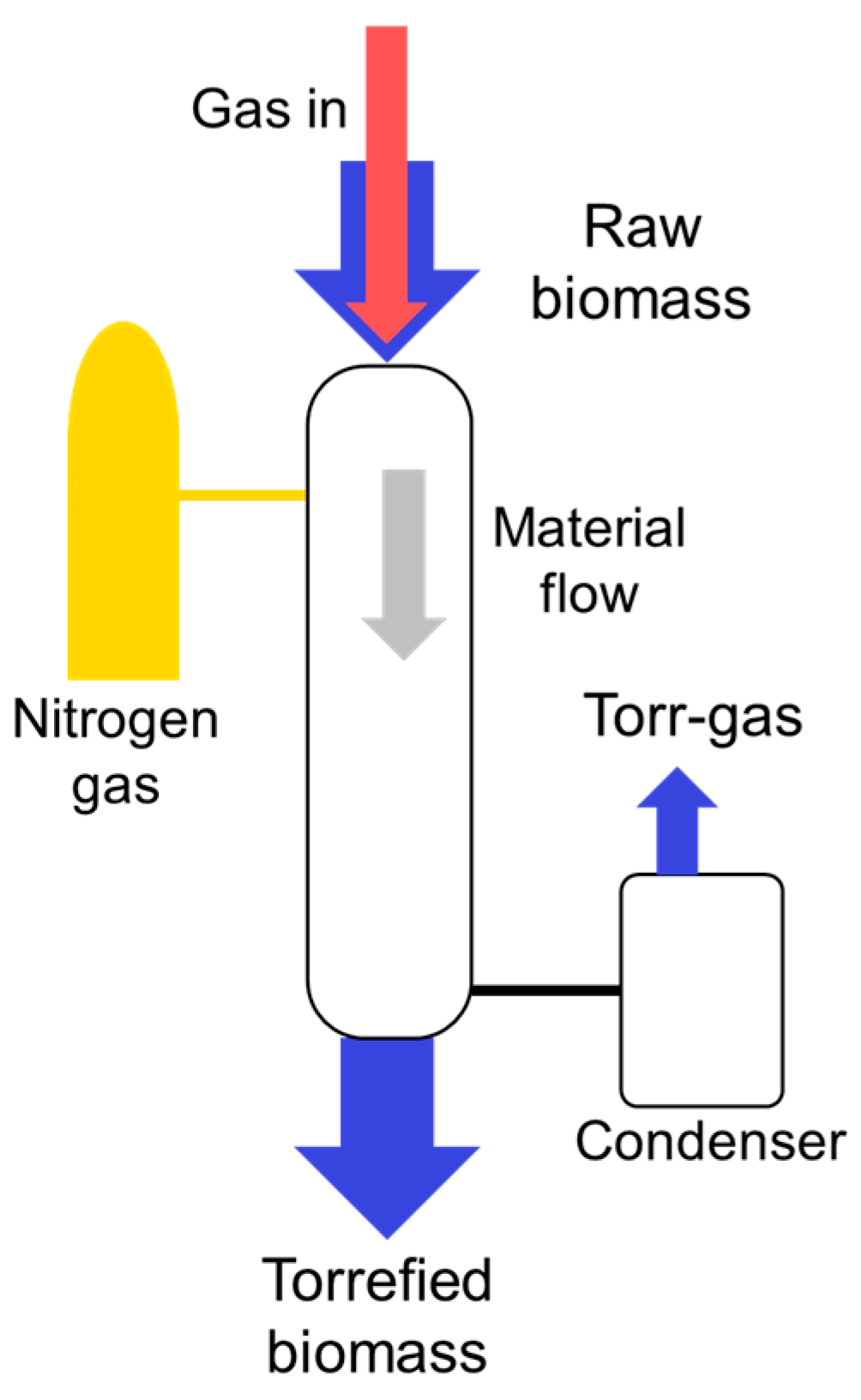
Entrained-flow reactors are another type of continuous reactor used for the thermochemical conversion of biomass. Powdered biomass and the agent are continually fed into the top of the reactor, and the end products exit at the bottom of the reactor [123]. Figure 12 illustrates a typical schematic of an entrained-flow reactor. Entrained-flow reactors are best suited for high temperatures (900–1800 °C), high pressures, and short reaction times [124].
Research has investigated the use of entrained-flow reactors for gasification due to their high-temperature, high-pressure, and short reaction time capabilities [105,106]. These conditions result in excellent thermal efficiency, a uniform and adjustable bed temperature, and rapid drying. However, one drawback of these reactors is the significant pressure drop they create [98]. It is important to note that entrained-flow reactors are not well-suited to torrefaction, which requires longer reaction times and lower temperatures. While they excel in processes such as gasification, their specific properties are not well-suited to torrefaction. This mismatch is a key reason for the limited scientific interest in entrained-flow torrefaction.

5. Multi-Criteria Decision Analysis of Torrefaction Reactors

Multi-criteria decision analysis is a method that synthesizes knowledge to support informed decision-making. Alternatives are compared using a defined set of criteria relevant to the decision. The target audience for this multi-criteria decision analysis is primarily researchers and companies seeking to establish a torrefaction process at any scale. The criteria were selected based on the authors’ literature survey and assessment of differences between torrefaction reactors, along with their advantages and disadvantages. The chosen criteria were state of research, proven scalability and operational scale, investment costs, operating costs, use of carrier gas, temperature control, particle-size flexibility, and biomass mixing. The criteria were not weighed. However, when analyzing a specific case study, applying weights to the criteria was appropriate to reflect their relative importance. The ranking scale was from 1 (worst) to 6 (best). If two reactors performed equally in one category, they received the same ranking. In that case, the highest-ranking number (6) was not assigned to any reactor. In this approach, the ranking showed that the differences among the reactors were not significant enough to justify the top ranking.
The six reactors analyzed are a fixed-bed reactor, a rotary drum reactor, a fluidized-bed reactor, a moving-bed reactor, a screw reactor, and a microwave reactor. The entrained-flow reactor was excluded from this comparison because it is neither optimal nor commonly used for torrefaction, as explained in more detail in the section on entrained-flow reactors. Table 5 summarizes the multi-criteria decision analysis for torrefaction reactors. Details of the rankings and assessments are provided in the subsections that follow.
The screw reactor performs the best overall, earning 30 points. However, all the reactor sums are close to one another. That highlights that all reactors have their advantages and disadvantages, making them suitable for certain circumstances. It is important to note that, in specific case studies, assigning weights to the criteria could help prioritize critical ones over less important ones.

5.1. State of Research

The state of research reflects the extent of research conducted on the torrefaction process in the specific reactor. The ranking is as follows: fixed-bed reactors (6), microwave reactors (5), fluidized-bed reactors (4), screw reactors (3), rotary drum reactors (2), and moving-bed reactors (1).

5.2. Proven Scalability and Scale of Operation

Proven scalability and operational scale may also be essential for setting up a torrefaction plant, as they enable learning from other plants. For this criterion, the ranking is: fluidized bed reactors (6), screw reactors (5), moving bed reactors (4), rotary drum reactors (3), fixed-bed reactors (2), and microwave reactors (1). Fluidized bed reactors are ranked highest in this category. Torrefaction in fluidized-bed reactors is easily scalable, and experimental results can be well reproduced [57,98]. Fluidized bed reactors are also utilized for other processes, such as gasification or pyrolysis [57,75]. Screw reactors have also demonstrated scalability and adaptation for large-scale industrial use [62,101]. For moving bed reactors, scalability has also been demonstrated [125].
Rotary drum reactors are ranked with 3 points for proven scalability and scale of operation, as their scalability has been demonstrated [125]. However, their scale-up is challenging, owing to the limited heat-transfer zone between the biomass and the reactor wall at large reactor sizes [126]. Rotary drum reactors are also established for other thermochemical processes such as biomass drying and pyrolysis. Torrefaction in rotary drum reactors is mainly reported at the pilot scale [62]. For torrefaction in fixed-bed reactors, scalability has not yet been demonstrated and appears challenging [98,99,125]. Fixed-bed reactors are well established in the research environment and are currently primarily used at the laboratory scale. Lastly, for microwave reactors, scalability has not yet been proven, and they are primarily used at the laboratory scale [122,125].

5.3. Investment Cost

Regardless of the reactor’s concrete usage or scale, investment costs are nearly always a significant factor in deciding which reactor to use. For the investment costs, the ranking is as follows: fixed-bed reactors (6), moving-bed reactors (5), screw reactors (4), fluidized-bed reactors (3), microwave reactors (2), and rotary drum reactors (1). Fixed-bed, moving-bed, and screw reactors are reported to be relatively inexpensive [98,126]. The setup of fixed-bed reactors is more straightforward than that of moving-bed reactors and screw reactors in that order, which explains the ranking of those reactors. Thengane et al. [127] reported an estimated cost of $50,000 for an auger-based continuous moving-bed reactor with a capacity of 0.5 tons/h. Because biomass is constantly moving in fluidized-bed reactors, the chances of erosion and wear of reactor components are typically higher [96]. Microwave reactors have high capital costs [62], like those of rotary drum reactors [126]. Additionally, rotary drum reactors can be filled to only about 30%, thereby increasing reactor size and investment costs for a given amount of biomass to be torrefied [62].

5.4. Operating Cost

Like investment costs, operating costs are also nearly always a crucial factor in deciding which reactor to use, regardless of the specific application or reactor scale [52]. The operational costs are challenging to assess, as they depend on many factors beyond reactor type. However, the advantages and disadvantages of different reactor types can influence operational costs and be analyzed. For the operational cost criterion, the ranking is as follows: microwave reactors (5), fixed-bed reactors (4), moving-bed reactors (3), rotary drum reactors (3), screw reactors (2), and fluidized-bed reactors (1).
Firstly, microwave reactors have lower operating costs than other reactors because microwave torrefaction is highly efficient, with faster reaction rates and shorter reaction times [70,97]. There is also greater energy-saving potential due to uniform volumetric heating and rapid reactions [97,100]. The operating costs of fixed-bed reactors are also reported to be relatively low [98]. For the rotary drum reactor and the moving-bed reactor, no general advantages or disadvantages affecting operational costs are known. Therefore, both are rated 3 points. Screw reactors incur high maintenance costs, thereby increasing overall operating costs [98].
The fluidized bed reactors received the lowest ranking in this category. Before torrefaction in a fluidized bed reactor, the biomass must be ground, a highly energy-intensive process [101]. This also means that the operating costs of fluidized-bed reactors depend heavily on current energy prices. Additionally, erosion and wear on reactor components are comparably high, leading to higher maintenance costs [96]. The two adverse effects on operational costs can be partially offset by the reduced reaction time in a fluidized-bed reactor. Brachi et al. [57] reported that the reaction time can be reduced by 5–7 min compared with other reactors, due to the high heat transfer rate.

5.5. Usage of Carrier Gas

The amount of carrier gas used is also significant, as it can be expensive and increase operational costs. However, it is also crucial whether a reactor uses a carrier gas, which is why this is a separate category in this analysis. Carrier gas is required when torrefaction occurs in an inert atmosphere or under direct heat. The latter requires more carrier gas compared to the former. Fluidized bed reactors require carrier gas, particularly for dry torrefaction and direct heat [102]. The demand for carrier gas is exceptionally high because biomass requires fluidization [98]. For the use of carrier gas, the ranking order is screw reactors (5), microwave reactors (4), fixed-bed reactors (3), rotary drum reactors (3), moving-bed reactors (2), and fluidized-bed reactors (1).
Screw reactors are considered the best option, as they operate with indirect heating in an inert environment and have significantly lower inert-gas demand [101,117]. Microwave and fixed-bed reactors also employ indirect heating in an inert atmosphere [22,97]. Rotary drum reactors can use direct or indirect heat, or a combination of both, resulting in a wide range of carrier gas requirements. There is potential to reduce carrier gas consumption by reusing biogas produced by the torrefaction process as a carrier gas [101]. Moving-bed reactors can also operate with direct or indirect heating [116].

5.6. Temperature Control

Maintaining appropriate temperature control during the torrefaction process is crucial for producing high-quality, homogeneous torrefied biomass. The ranking is as follows: fluidized-bed reactors (6), microwave reactors (5), screw reactors (4), rotary drum reactors (3), moving-bed reactors (2), and fixed-bed reactors (1). Torrefaction in fluidized-bed reactors provides controlled heating and superior heat transfer [62]. Additionally, the temperature distribution throughout the bed is relatively uniform [101]. Microwave reactors also have reasonable temperature control [98]. However, for larger biomass particles, the intraparticle temperature is high, leading to non-homogeneous torrefaction [62]. In screw reactors, heat-transfer rates are low, and biomass is heated uniformly, particularly compared with fixed-bed reactors [57,103].
In rotary drum reactors, the temperature is difficult to measure and control [101]. However, their thermal efficiency is relatively higher [98]. Moving-bed reactors also exhibit poor temperature control [126]. The thermal efficiency is also high due to the counterflow, as biomass dries in the upper part of the reactor and torrefies in the lower part [101,102]. Lastly, fixed-bed reactors exhibit poor temperature control due to inefficient heat transfer. The thermal efficiency is also not satisfactory [98,99].

5.7. Biomass Particle Size Flexibility

Particle-size flexibility enables a reactor to process a range of particle sizes, accommodating different biomass types and properties. The ranking is: moving-bed reactors (5), screw reactors (5), fixed-bed reactors (4), rotary drum reactors (3), microwave reactors (2), and fluidized-bed reactors (1). It is possible to torrefy larger particles in moving-bed reactors and screw reactors [125]. For screw reactors, improved biomass flow has been reported [98]. For fixed-bed reactors, larger particle sizes are also possible. However, uniform-sized biomass particles are preferred. Rotary drum reactors also enable the processing of biomass with larger particle sizes. However, these particle sizes are limited because the reactor can be filled to only 30% of its volume [125]. Although microwave torrefaction is possible with larger particles, intra-particle temperature and non-uniform heat distribution can be evident with larger biomass particles [62]. In fluidized bed reactors, the raw biomass must be reduced in size to enable fluidization, thereby creating an even temperature distribution in the bed [101].

5.8. Mixing of Biomass

Lastly, biomass mixing is essential to yield homogeneous, high-quality torrefied biomass. The reactors are ranked as follows for this category: rotary drum reactor (5), fluidized-bed reactor (4), moving-bed reactor (3), screw reactor (2), fixed-bed reactor (1), and microwave reactor (1). Mixing of biomass is excellent in rotary drum and fluidized bed reactors, as the torrefied biomass is well mixed and heated homogeneously. The reason is the continuous movement of biomass within the reactor [62,96]. However, the fluidized bed reactor is feedstock-sensitive, which accounts for its lower ranking relative to the rotary drum reactor [57]. The biomass is also mixed in a moving bed reactor. However, mixing remains uneven, whereas in a screw reactor it is restricted [62,99,101]. Fixed-bed and microwave reactors cannot mix the biomass, so it must be relatively homogeneous before torrefaction.

6. Notable Case Studies on Techno-Economic Analysis of Torrefaction

Biological conversion technologies, such as fermentation and anaerobic digestion, can already operate successfully on an industrial scale. However, thermochemical conversion technologies face challenges in upscaling, as many issues only become apparent at larger scales [128]. Only a few studies are available on industrial-scale torrefaction plants. Therefore, it is essential to learn from existing torrefaction facilities to successfully scale up the process. In the following section, selected case studies and industrial-scale torrefaction plants will be presented, along with the challenges they face and the approaches to overcoming them. Table 6 summarizes notable recent case studies on commercial-scale torrefaction.

6.1. Pinus pinaster Wood

Pinus pinaster wood has several advantages, including its availability and relatively low cost. It is also non-edible, meaning it does not compete with food production, and it is fast-growing. Currently, P. pinaster wood is primarily used in the pulp and paper industry and as sawn timber to produce wood panels [132]. Nunes [128] published a case study on biomass torrefaction at a pilot-industrial-scale plant in Portugal, which focuses on the continuous operation of P. pinaster wood torrefaction and pellet production. The primary torrefaction equipment was a rotary drum reactor with indirect heating, capable of producing 720 kg/h of torrefied biomass. The leading equipment for pelletizing and densifying biomass had a production capacity of 1200 kg/h, exceeding that of the torrefaction reactor. The goal of the project was to develop an understanding of the torrefaction and pelletizing processes, with the potential to scale them up to an industrial level in the short term. The torrefied biomass from this plant had a diameter of 6–10 mm and a length of 3.2–35 mm. The moisture content and fixed carbon content were 3–8 wt% and 25–30 wt%, respectively. The ash content could be kept under 3%. The carbon, oxygen, and hydrogen content of the torrefied biomass were 52–58 wt%, 4–6 wt%, and 37–39 wt%, respectively. The higher heating value is 22–23 MJ/kg.
A key finding of this research is that laboratory-scale reactors are well-suited to evaluating product characteristics. In contrast, it is difficult or impossible to verify the process conditions required for industrial-scale-up. Additionally, during the first phase of testing, the energy demand for pelletizing was high, as evidenced by the equipment’s current. The energy demand consistently exceeded expectations, and the production index remained low, never exceeding 150 kg/h. The reason was likely an excessively high degree of torrefaction of the biomass purchased during the first phase of pelletizing testing. Hence, the parameters of this torrefied material were unknown; the torrefaction temperature or reaction time could have been too high. In a subsequent testing phase, in which the biomass was torrefied on-site, the challenge of self-heating and autoignition due to the lack of gas extraction during torrefaction emerged. This was solved by replacing the discharge chamber with a new one, which has a double wall, can maintain a high temperature inside, and can prevent the gases from condensing by sucking them up efficiently.
Additionally, Nunes [128] reported that ash content is directly related to the number of metallic elements in biomass. The amount of ash can vary within the same type of biomass, depending on factors such as soil type or contamination. It was also made clear that it is feasible to understand the main challenges associated with increased torrefaction scale and address them to achieve an efficiently operating torrefaction plant. However, to achieve this, it is essential to precisely understand biomass properties to accurately define the torrefaction process. The main lesson from this industrial-scale torrefaction plant is the risk of self-heating and autoignition of torrefied biomass. The reason was the lack of gas extraction during torrefaction, which was solved by replacing the discharge chamber. The new discharge chamber features a double-wall design that retains high internal temperatures and prevents gas condensation. Additionally, the knowledge gap regarding torrefaction and reactors was highlighted.

6.2. Softwood, Hardwood, and Herbaceous Biomass

Miscanthus is a perennial grass with 12 species adapted to diverse climatic conditions. It has a good biomass yield and can be harvested annually without further irrigation in Northern Europe. It also requires only a low input of water and nutrients [21]. Miscanthus exhibited the highest mass loss, along with the highest net product calorific value and gas yield among the studied biomass, owing to its highly mobile potassium form. The potassium content of Miscanthus is 2–5 times higher than in woods and 4–5 times higher than in Alder.
Graham et al. [129] studied torrefaction at both the laboratory and industrial scales at the Perpetual Next research and development facility in Derby, United Kingdom, and at the sister plant in Dilsen Stokkem, Belgium. Based on the laboratory results, the plant-scale torrefaction data were interpreted, providing essential insights into torrefaction optimization and control. The torrefaction process used was autothermal torrefaction, in which the calorific value of the torrefaction gases and vapors is used to both dry and torrefy the raw biomass. The biomass used was softwood pine and spruce, hardwood alder and ash, and herbaceous Miscanthus, all in chip form. The reactor was a vibrating bed reactor equipped with an airlock valve. It used indirect heat and had a capacity of 1100 kg/h under an inert atmosphere. The goal of the research was to optimize autothermal and industrial torrefaction processes.
One key lesson learned from this industrial-scale torrefaction plant was that ash wood is challenging to torrefy due to significant temperature fluctuations and the generation of process gas. Possible reasons include the thicker bed and larger particle size in industrial-scale torrefaction, which may limit heat dissipation from the solid. Additionally, ash wood exhibits greater exothermicity during the early stages of decomposition, which may further raise bed temperature. Furthermore, the high potential of Miscanthus as a biofuel feedstock was highlighted. This study found that Miscanthus was the most suitable feedstock, achieving high fuel throughput at lower temperatures. The main learning was also the significant impact of highly reactive hemicelluloses on torrefaction scale-up. Hence, the composition of feedstock is a crucial factor to consider for upscaling the torrefaction process.

6.3. Encroacher and Invasive Bush Materials

Rashama et al. [130] studied the European Union Horizon 2020 SteamBioAfrica project in Otjiwarongo, Namibia. The project plant was semi-commercial, and the torrefaction process employed solar-powered superheated-steam torrefaction in a single-pass belt reactor. In this torrefaction process, the heat-transfer medium is superheated steam, which also maintains an inert atmosphere, replacing flue gases or nitrogen. The torrefied biomasses were derived from Acacia, Dichrostachys, Terminalia, Pinus, and Eucalyptus, harvested in Namibia, Botswana, and South Africa. Those invasive wood species are an emerging ecological issue in Africa. They damage ecosystems and threaten biodiversity by outcompeting local plants [133]. The main goal of this case study was to provide additional information to inform decisions regarding the torrefaction process for invasive wood species.
In this case study, one challenge was maintaining the temperature in the biomass processing. Different reasons were identified for that issue. Firstly, the incoming feedstock had a low moisture content, resulting in lower steam generation than the reactor’s large design volume would suggest. Additionally, the initial insulation material was of poor quality, leaving some parts of the biomass processing unit exposed to outdoor air and resulting in high, weather-dependent, fluctuating heat losses through radiation. This issue led to increased energy consumption from the solar and diesel generators, which was uneconomical for securing a constant power supply. Thirdly, heat loss occurred due to gases discharged from the biomass processing unit, which regularly escaped through the inlet rotary valve, which was not fully sealed. Heat loss was significantly reduced following the insulation upgrade of the biomass processing unit. Another issue that arose and needed to be managed was the escape of vapors, which increased the oxygen level as high as 16 wt%. It is worth noting that after controlling vapor escape, oxygen levels dropped below 1% again.
This also led to the loss of chemicals arising from hemicellulose degradation, making it impossible to collect, concentrate, and purify them for beneficial uses. The escape of vapors also increased the fire risk at the rotary valve. However, the industrial market offers significant opportunities for biofuel production. The future of solar-powered superheated steam torrefaction of encroacher and invasive bushwood offers numerous opportunities [130]. The reasons were the low moisture content of the incoming feedstock, the material’s initially poor insulation properties, and heat losses. The unintended release of vapors elevated oxygen levels in the biomass processing unit, resulting in chemical losses.

6.4. Mixed Hardwood

Föhr et al. [131] studied the pilot-scale torrefaction plant located in Mikkeli, eastern Finland, which has been producing torrefied, pelletized biomass. The biomass, consisting of mixed hardwood, including birch, pine, and spruce veneer, was torrefied. The reactor is vertical, in which wood chips move downward under gravity, and torrefaction occurs via steam-inertization. The facility’s nominal annual capacity was around 10,000 tons. The torrefied pellets of mixed hardwood had moisture content, bulk density, and ash content of 6.6 wt%, 704 kg/m3, and 1.3 wt%, respectively, and the torrefied pellets of spruce had 4.4 wt%, 699 kg/m3, and 1.4 wt%, respectively. It was reported that the torrefaction temperature might have been too low to produce high-quality pellets. A higher heating value of up to 19 MJ/kg was achieved with torrefaction temperatures of 240–260 °C. On the other hand, it has been shown that an additional binder may not be necessary for pelletizing at 250 °C. This study also showed the high potential for this torrefaction plant in Finland. One of the main findings from this torrefaction study is that an additional binder may not be necessary at 250 °C. The high potential of industrial-sized torrefaction plants was also highlighted.

6.5. Rice Husk

Thengane et al. [127] reported a theoretical case study on the grinding and torrefaction of rice husk in the Sacramento Valley, USA. The study shows an industrial-scale analysis. The existing facilities included a 27-megawatt biopower plant, currently without a torrefaction unit, capable of processing approximately 0.2 million tons/year of rice husk, and 12 rice mills with an annual milling capacity of 1.8 million tons, generating nearly 0.4 million tons of husk. As the biopower plant could process only 0.2 million tons of rice husk, there was an excess of 0.2 million tons. The goal of this study is to analyze promising torrefaction scenarios to more efficiently utilize rice husk in the Sacramento Valley, California. This is particularly interesting given the surplus of rice husk, which is currently landfilled at high tipping fees for producers. Torrefied rice straw has numerous applications and advantages for farmers, as it can potentially enhance soil health, improve crop growth, and reduce the need for external fertilizers and irrigation water [78].
To achieve this, two main options were examined. In the first option, torrefaction facilities were installed at producers’ existing mills or leased from suppliers. One restricting element for these decentralized mobile facilities was the capacity of the torrefaction reactor, as the mills operate continuously. The second option was a centralized, larger-capacity torrefaction facility located directly at the power plant. This would enable continuous power generation at maximum capacity, particularly since torrefied biomass can be stored more easily and for longer periods than raw biomass. This resulted in four scenarios, which were subsequently analyzed. The first scenario involved transporting raw biomass directly from the mill to the power plant without undergoing torrefaction. It was assumed that the remaining rice husk would be burned. The second scenario involved the centralized large torrefaction facility at the power plant, where it was assumed that the remaining rice husk would be burned. Thirdly, it was assumed that torrefaction facilities were decentralized near rice mills. Lastly, the fourth scenario involved rice mills leasing decentralized mobile torrefaction facilities. Milling capacity and feedstock availability were the most important economic factors, whereas transport distance had the greatest effect on emissions.

7. Strengths, Weaknesses, Opportunities, and Threats Analysis for Torrefaction

A strengths, weaknesses, opportunities, and threats (SWOT) analysis is primarily used to evaluate the economic and competitive position of enterprises, systems, and processes. Strengths are internal, positive factors, such as capabilities, that are relevant to achieving satisfactory or superior performance. Weaknesses, by contrast, are internal, negative factors, such as constraints that may impede goal attainment. External positive factors can facilitate business opportunities, piloting, and scaling up. Lastly, threats are external negative factors that can hinder goal achievement. Table 7 summarizes the SWOT analysis of torrefaction.

7.1. Strengths

As noted earlier, torrefied biomass is a renewable energy source that is carbon-neutral when managed sustainably. That makes torrefied biomass a valuable product for helping manage or mitigate climate change, address rising energy demand, and improve the environmentally unfriendly handling of biomass. It can also help minimize waste and increase a nation’s energy self-sufficiency. The different types of biomass are widely available, continuous, and relatively inexpensive, which can increase employment opportunities and be especially beneficial for rural areas.
Torrefied biomass has several advantages over raw biomass. It is more homogeneous and hydrophobic, with a higher heating value, higher energy density, lower moisture content, and a lower O/C ratio. This results in improved grindability, reduced transportation costs, and easier storage. In addition to serving as a pretreatment method to improve outcomes in various thermochemical conversion technologies, torrefaction can also serve as a direct source of heat and electricity. Lastly, torrefied biomass can be used for environmental remediation, such as soil amendment or water treatment. The advantages of torrefied biomass and its numerous applications are explained in detail in the section about torrefaction and applications of torrefied biomass.
The strengths of torrefaction are that torrefied biomass serves as a renewable energy source that can help address climate change, meet rising energy demand, and mitigate the environmental impacts of biomass handling. It offers greater employment opportunities because various types of raw biomass are widely available. Torrefied biomass is also more homogeneous, has a higher heating value and energy density, and a lower moisture content and O/C ratio than raw biomass.

7.2. Weaknesses

Torrefaction also has limitations that remain to be addressed. One is the high investment costs for new torrefaction plants. Uchezuba et al. [134] studied the torrefaction of Namibian encroacher wood species. They concluded that it is currently not economically viable due to high capital costs and the poor quality of Namibian wood biomass. For the operational costs, energy input is a primary factor. Starfeld et al. [135] integrated a torrefaction reactor into an existing combined heat and power plant, reporting that the overall plant efficiency increased, while the electrical efficiency decreased. The additional costs were €3.4/MWh, underscoring that fuel and electricity prices have the greatest impact on economics. However, the high operational costs can be overcome, and torrefaction can be made profitable. Goyal et al. [136] calculated the production of torrefied rice straw pellets via briquetting, with a production capacity of 30,000 tons of briquettes/year. They reported a 30% return on investment, a 2.4-year payback period, and a selling price of $73/ton for a briquette, with a break-even point of 42%.
Furthermore, a successful torrefaction process requires homogeneous biomass with low moisture content. The opposite can lead to difficulties, as shown in the techno-economic analysis of mixed hardwood [131]. The drying unit should be located near mills for optimal economic and environmental reasons, as demonstrated by the above-mentioned techno-economic analysis of rice husk [127]. Lastly, the technical immaturity of torrefaction at commercial scale is noted in the techno-economic analysis section, highlighting the gap between the industrial and laboratory stages that needs to be addressed. Hence, the weaknesses of torrefaction are the high investment and operational costs. The latter is highly dependent on energy prices. Other challenges include heterogeneous biomass and technical immaturity at a commercial scale for torrefaction.

7.3. Opportunities

Opportunities for torrefaction involve thermodynamic modeling and process simulation to develop an understanding of the system’s behavior, optimize processes, intensify operations, and analyze dynamics. These aspects can be used to upgrade the torrefaction technology and produce application-specific torrefied biomass. There is considerable scientific interest in using modeling and process simulation for torrefaction. One example is the study by Kamila et al. [137], which employed a two-dimensional model to determine the optimal reactor temperature and reaction time for torrefying 25 mm-diameter biomass particles. The authors developed a two-dimensional model of torrefaction of large, wet biomass that encompasses drying, reaction kinetics, heat transfer, and primary and secondary reactions. The parameters investigated included the effects of reactor temperature, reaction time, and particle size, as well as the spatial and temporal distributions of temperature, residual mass fraction, velocity, pressure within the particle, and shrinkage. The result was an optimal reactor temperature of 273 °C and a reaction time of 30 min. Internal convection had a significant impact on torrefaction, whereas particle shrinkage had little effect. The experimental results validated the model, yielding a small root-mean-square relative error of 2% [137]. Furthermore, Granados et al. [138] developed a mechanistic model for a two-stage rotary reactor, whereas Yek et al. [139] simulated microwave heating of an empty fruit bunch pellet using the COMSOL Multiphysics tool.
Artificial intelligence offers another opportunity to advance the torrefaction process. It can also be used to upgrade conversion technologies and to produce application-specific end products. Chen et al. [140] studied the use of artificial neural networks to torrefy spent mushroom substrates via microwave-assisted heating. Artificial neural networks in artificial intelligence are computational models that mimic the functioning of nerve cells in the human brain. The study successfully predicted the specific chemical bio-exergy of biofuels, a key indicator of the potential energy content in biomass fuels.
Machine learning is a subfield of artificial intelligence and a valuable tool for torrefaction. Wei et al. [141] successfully predicted the activation energies for biomass pyrolysis and torrefaction using multiple linear regression and random forests, based on 1300 thermogravimetric data points from 133 biomass species and 14 independent variables. The results of this study showed that moisture and carbon content had the most significant impact on the activation energy of torrefaction.

7.4. Threats

A primary threat to torrefaction includes the highly competitive pricing of conventional fossil fuels. The highly competitive pricing of coal, as a fossil fuel, poses a significant threat to the viability of torrefied biomass. Föhr et al. [131] calculated the average production cost of torrefied and pelletized biomass at €202/ton and highlighted improvements to end-product quality. Escorial et al. [142] reported that prices for co-firing torrefied biomass at 5–10% co-firing rates can be competitive. This can be achieved through six power plant units with an overall capacity of 627 megawatts in the Central Philippines.
Other threats to torrefaction technology include the lack of infrastructure for a systematic biomass market, necessitating further lifecycle assessments. The regular supply of biomass with consistent quantity and quality is also an issue, as highlighted in the techno-economic analysis of softwood, hardwood, and herbaceous biomass, where potassium levels varied across deliveries of the same biomass. Another threat is that more torrefaction plants and industrial-scale torrefaction research are needed, as many issues with up-scaling do not occur in laboratory-scale research [128]. Researchers can mitigate the risk of inconsistent biomass supply quality and quantity by diversifying the torrefaction process, thereby making it more feasible to process a wider range of biomass feedstocks. Conducting additional lifecycle analyses can also help ensure a more reliable biomass supply. However, the broad applicability of lifecycle analysis also poses challenges, as assumptions and theoretical scenarios may not translate well to real-world applications.

8. Conclusions, Perspectives, and Future Directions

Torrefaction enhances the properties of biomass, rendering it hydrophobic and more homogeneous, while increasing its higher heating value and energy density, and reducing its moisture content and O/C ratio. Compared to pyrolysis, gasification, and liquefaction, high-performance torrefaction is generally achieved under mild thermal conditions with precise control of temperature, reaction time, and heating rate. As evident in the literature, optimal temperatures typically range from 250 to 300 °C, at which point hemicellulose starts to break down, volatile matter is released, and biomass gains carbon content without excessive weight loss. A moderate heating rate, typically 5–20 °C/min, facilitates uniform heat distribution throughout the biomass particles, preventing thermal gradients that could lead to localized hotspots, uneven torrefaction, and variable product characteristics. Similarly, reaction times of 30–45 min are used to ensure adequate devolatilization and structural changes while avoiding over-carbonization, which could compromise grindability or pellet strength. It should be noted that optimizing temperature, heating rate, and reaction time in torrefaction requires a thorough understanding of their interrelated effects, biomass properties, biomass particle size, and the thermochemical reactor. Under these combined parameters, torrefied biomass exhibits enhanced hydrophobicity, increased fixed carbon content, improved grindability, and greater energy density, making it a stable, coal-like biofuel suitable for combustion, co-firing, or subsequent thermochemical conversion processes.
A multi-criteria decision analysis of various torrefaction reactors, including fixed-bed, rotary drum, fluidized-bed, screw, moving-bed, and microwave reactors, is essential for scale-up and industry adoption. The screw reactor achieves the highest overall performance among the reactors. Nonetheless, the reactors’ total scores are relatively close, indicating that each has distinct strengths and weaknesses and is better suited to different scenarios. It is worth noting that, in specific case studies, including a weighted scoring system can be valuable, allowing critical criteria to be prioritized over less significant ones.
The techno-economic analysis highlights the gap between laboratory- and commercial-scale torrefaction, underscoring the need for further research on industrial-scale plants and the high potential of commercial-scale plants. Generalizable incentives from the discussed techno-economic analysis for researchers and industry stakeholders include the need for precise temperature control to prevent temperature spikes and to ensure that torrefaction temperatures are sufficiently high to produce high-quality pellets. Challenges also include maintaining consistent biomass temperature despite low feedstock moisture, poor insulation, and heat losses. Regarding biomass composition, the significant impact of highly reactive hemicelluloses on scale-up is highlighted, as is the overall high potential for torrefaction.
The SWOT analysis provides essential insights into opportunities and threats to be addressed, guiding policymakers and industry stakeholders in promoting torrefaction and its upscaling. The primary approaches to torrefaction are process simulation, artificial intelligence, and machine learning. Additionally, governmental support, along with increased awareness of biofuels and new start-ups, can further drive the development of commercially scaled torrefaction plants, thereby yielding geopolitical advantages, such as enhanced energy security and greater energy market independence. To achieve this, more lifecycle assessments and industrial-scale torrefaction research are required.
Overall, this review addressed the research question of which actions researchers, industry stakeholders, and policymakers can take to facilitate the scale-up of torrefaction. Incentives for researchers include ensuring adequate gas extraction during torrefaction to minimize the risk of self-heating and autoignition of the torrefied biomass, and preventing recurring temperature increase that could lead to peaks in process gas production. The amount of highly reactive hemicellulose in the biomass is an essential factor to consider in the scale-up. Additionally, low moisture in the incoming feedstock, poor initial insulation material, and heat losses can make it challenging to maintain the biomass’s temperature. For industry stakeholders, opportunities such as modeling and process simulation, artificial intelligence, machine learning, and automation are crucial for the scale-up of torrefaction. The value of learning from the few industrial-scale torrefaction plants was highlighted, as limited commercial experience poses a risk to the effective and costly operation of such facilities. Feedstock availability was identified as the most significant factor influencing economics, whereas transportation distance had the greatest impact on emissions. For policymakers, the significance of supportive government policies and subsidies was underscored, as was the need to further raise awareness of biofuels and new start-ups. A key geopolitical advantage of biofuels and, therefore, torrefaction lies in the high energy security and higher independence in the energy market. In summary, torrefaction is a promising process for producing and upgrading biofuels, which are valuable renewable energy sources.
Based on the synthesized information in this review, future directions for the research, development, innovation, scale-up, and commercialization of torrefaction can be summarized as follows:
  • Innovations in cost-effective, energy-efficient, and low-maintenance thermochemical reactors to facilitate efficient biomass conversion to biofuels.
  • Investigation of compact and continuous reactors for decentralized biomass processing close to feedstock sources to maximize profitability of the value chain and reduce carbon emissions.
  • Integration of combined heat and power systems to utilize waste heat and volatiles from torrefaction to boost energy self-sufficiency.
  • Integration of other biorefinery technologies such as densification, pyrolysis, gasification, liquefaction, and combustion into torrefaction for a closed-loop biorefinery and to minimize resource, energy input, and emissions, reduce waste production, and maximize byproduct utilization.
  • Development of predictive kinetic and thermodynamic models to optimize torrefaction temperature and reaction time combinations according to feedstock variability to produce high-quality torrefied biomass.
  • Analysis of supply chain logistics, lifecycle analysis, and techno-economic assessment studies to ensure scale-up, commercialization, and sustainability of torrefaction.
  • Continuous improvement of torrefaction processes for high mass yield, energy yield, grindability, and hydrophobicity of torrefied biomass suited to wide-ranging energy and environmental applications.
  • Implementation of artificial intelligence and machine learning models to control real-time optimization of processes, suggest improvements, and for informed and predictive decision making.
  • Strengthening carbon credit systems and aiding rural economies through case studies and deployment of small-scale torrefaction systems.

Author Contributions

Conceptualization, S.N.; validation, C.S. and S.N.; formal analysis, C.S.; investigation, C.S. and S.N.; resources, S.N.; data curation, C.S.; writing—original draft preparation, C.S. and S.N.; writing—review and editing, S.N. and J.A.K.; visualization, C.S. and S.N.; supervision, S.N. and J.A.K.; project administration, S.N.; funding acquisition, S.N. All authors have read and agreed to the published version of the manuscript.

Funding

This research was funded by the Natural Sciences and Engineering Research Council of Canada (NSERC), Canada Research Chairs (CRC) program, Research Nova Scotia, Net Zero Atlantic (Emerging Concepts & Technologies program), Mitacs (Globalink and Accelerate programs), and the German Academic Exchange Service (DAAD).

Data Availability Statement

No new data were created or analyzed in this study. Data sharing is not applicable to this article.

Conflicts of Interest

The authors declare that they have no conflicts of interest.

References

  1. Ritchie, H.; Roser, M. CO2 Emissions. Our World in Data. 2024. Available online: https://ourworldindata.org/co2-emissions (accessed on 4 July 2025).
  2. Ritchie, H.; Rosado, P.; Roser, M. Breakdown of Carbon Dioxide, Methane and Nitrous Oxide Emissions by Sector. Our World in Data. 2024. Available online: https://ourworldindata.org/emissions-by-sector (accessed on 4 July 2025).
  3. Ritchie, H. How Have the World’s Energy Sources Changed Over the Last Two Centuries? Our World in Data. 2021. Available online: https://ourworldindata.org/global-energy-200-years (accessed on 4 July 2025).
  4. Sarker, T.R.; Nanda, S. Energy production from farming waste: A review. Environ. Chem. Lett. 2025, 23, 1187–1207. [Google Scholar] [CrossRef]
  5. Sarker, T.R.; Ethen, D.Z.; Asha, H.H.; Islam, S.; Ali, M.R. Transformation of municipal solid waste to biofuel and biochemicals—A review. Int. J. Environ. Sci. Technol. 2025, 22, 3811–3832. [Google Scholar] [CrossRef]
  6. Constantinescu, M.; Bucura, F.; Ionete, E.I.; Spiridon, Ş.-I.; Ionete, R.E.; Zaharioiu, A.; Marin, F.; Ion-Ebrasu, D.; Botoran, O.R.; Roman, A. Cattle manure thermochemical conversion to hydrogen-rich syngas, through pyrolysis and gasification. Int. J. Hydrogen Energy 2024, 79, 1058–1070. [Google Scholar] [CrossRef]
  7. Nanda, S.; Berruti, F. Municipal solid waste management and landfilling technologies: A review. Environ. Chem. Lett. 2021, 19, 1433–1456. [Google Scholar] [CrossRef]
  8. Granado, M.P.P.; Talwar, P.; Sahil, S.; De Conti, A.C.; Nanda, S.; Kozinski, J.A. Integrated and closed-loop biorefinery strategies for efficient waste valorization and biofuel production. Can. J. Chem. Eng. 2025. early access. [Google Scholar] [CrossRef]
  9. Sarker, T.R.; Nanda, S.; Dalai, A.K.; Meda, V. A review of torrefaction technology for upgrading lignocellulosic biomass to solid biofuels. BioEnergy Res. 2021, 14, 645–669. [Google Scholar] [CrossRef]
  10. Granado, M.P.P.; Alves, G.L.; Correia, A.J.B.; Nanda, S.; Kozinski, J.A.; De Conti, A.C. Solid biofuel production from torrefaction of urban tree pruning biomass using a combined mixture-process experimental design. Biomass Bioenergy 2026, 208, 108841. [Google Scholar] [CrossRef]
  11. Jha, S.; Okolie, J.A.; Nanda, S.; Dalai, A.K. A review of biomass resources and thermochemical conversion technologies. Chem. Eng. Technol. 2022, 45, 791–799. [Google Scholar] [CrossRef]
  12. Wang, C.; Zhang, W.; Qiu, X.; Xu, C. Hydrothermal treatment of lignocellulosic biomass towards low-carbon development: Production of high-value-added bioproducts. EnergyChem 2026, 6, 100133. [Google Scholar] [CrossRef]
  13. Pattnaik, F.; Tripathi, S.; Patra, B.R.; Nanda, S.; Kumar, V.; Dalai, A.K.; Naik, S. Catalytic conversion of lignocellulosic polysaccharides to commodity biochemicals: A review. Environ. Chem. Lett. 2021, 19, 4119–4136. [Google Scholar] [CrossRef]
  14. Nhuchhen, D.; Basu, P.; Acharya, B. A comprehensive review on biomass torrefaction. Int. J. Renew. Energy Biofuels 2014, 2024, 506376. [Google Scholar] [CrossRef]
  15. Jha, S.; Nanda, S.; Acharya, B.; Dalai, A.K. A review of thermochemical conversion of waste biomass to biofuels. Energies 2022, 15, 6352. [Google Scholar] [CrossRef]
  16. Sahoo, K.; Khatri, P.; Kanwar, A.; Singh, H.P.; Mani, S.; Bergman, R.; Runge, T.; Kumar, D. Integrated environmental and economic assessments of producing energy crops with cover crops for simultaneous use as biofuel feedstocks and animal fodder. Ind. Crops Prod. 2022, 179, 114681. [Google Scholar] [CrossRef]
  17. Mohanty, P.; Nanda, S.; Pant, K.K.; Naik, S.; Kozinski, J.A.; Dalai, A.K. Evaluation of the physiochemical development of biochars obtained from pyrolysis of wheat straw, timothy grass and pinewood: Effects of heating rate. J. Anal. Appl. Pyrolysis 2013, 104, 485–493. [Google Scholar] [CrossRef]
  18. Nanda, S.; Dalai, A.K.; Kozinski, J.A. Supercritical water gasification of timothy grass as an energy crop in the presence of alkali carbonate and hydroxide catalysts. Biomass Bioenergy 2016, 95, 378–387. [Google Scholar] [CrossRef]
  19. Singh, A.; Nanda, S.; Guayaquil-Sosa, J.F.; Berruti, F. Pyrolysis of Miscanthus and characterization of value-added bio-oil and biochar products. Can. J. Chem. Eng. 2021, 99, S55–S68. [Google Scholar] [CrossRef]
  20. Pattnaik, F.; Nanda, S.; Kumar, V.; Naik, S.; Dalai, A.K. Subcritical water hydrolysis of Phragmites for sugar extraction and catalytic conversion to platform chemicals. Biomass Bioenergy 2021, 145, 105965. [Google Scholar] [CrossRef]
  21. Van der Cruijsen, K.; Al Hassan, M.; van Erven, G.; Dolstra, O.; Trindade, L.M. Breeding targets to improve biomass quality in Miscanthus. Molecules 2021, 26, 254. [Google Scholar] [CrossRef]
  22. Romanchuk, L.; Matviichuk, N.; Abramova, I.; Matviichuk, B.; Tryboi, O. Removal of heavy metals by energy crops when grown on technologically contaminated soils. Ecol. Eng. Environ. Technol. 2025, 26, 92–102. [Google Scholar] [CrossRef]
  23. Mokrzycki, J.; Magdziarz, A.; Rutkowski, P. The influence of the Miscanthus giganteus pyrolysis temperature on the application of obtained biochars as solid biofuels and precursors of high surface area activated carbons. Biomass Bioenergy 2022, 164, 106550. [Google Scholar] [CrossRef]
  24. Hossain, T.; Jones, D.S.; Godfrey, E.; Saloni, D.; Sharara, M.; Hartley, D.S. Characterizing value-added pellets obtained from blends of Miscanthus, corn stover, and switchgrass. Renew. Energy 2024, 227, 120494. [Google Scholar] [CrossRef]
  25. Baur, R.T.; Tuedic, S.; Promploy, J.; Kirasamutranon, K. Optimizing biomass pellet quality from sugarcane leaves and bamboo for sustainable biofuel production. Adv. Bamboo Sci. 2025, 11, 100153. [Google Scholar] [CrossRef]
  26. Tilley, C. Sugarcane as a biofuel and its impact on the climate. Nat. Sci. Educ. 2025, 54, e70010. [Google Scholar] [CrossRef]
  27. Zanetti, F.; Isbell, T.A.; Gesch, R.W.; Evangelista, R.L.; Alexopoulou, E.; Moser, B.; Monti, A. Turning a burden into an opportunity: Pennycress (Thlaspi arvense L.) a new oilseed crop for biofuel production. Biomass Bioenergy 2019, 130, 105354. [Google Scholar] [CrossRef]
  28. Chibi, S.; Neghmouche, N.S.; Moussaoui, Y.; Ghernaout, D.; Elboughdiri, N.; Menaa, F.; Khan, M.I.; El Hadi, D. Valorizing seed oils for sustainable biodiesel production via trans-esterification process. Sci. J. King Faisal Univ. Basic Appl. Sci. 2024, 26, 1–6. [Google Scholar] [CrossRef]
  29. Yurten, M.; Ozdemir, S. Enhancing biomass fuel properties of municipal sewage sludge with carbon-rich and low ash energy crops common reed and Miscanthus. Ind. Crops Prod. 2024, 222, 120128. [Google Scholar] [CrossRef]
  30. Sebastian, R.M.; Billal, M.M.; Kumar, A. The development of a framework to assess waste and biomass availability: A case study for Canada. Resour. Conserv. Recycl. 2025, 215, 108170. [Google Scholar] [CrossRef]
  31. Castillo-Tera, O.A.; López-Sosa, L.-B.; Pintor-Ibarra, L.F.; Rutiaga-Quiñones, J.G.; Morales-Máximo, M. Evaluation of Bursera cuneata Schltdl. wood residues for use as densified biofuels. SSRN Electron. J. 2024, 26, 104916. [Google Scholar] [CrossRef]
  32. Morales-Máximo, M.; Rutiaga-Quiñones, J.G. Analysis and utilization of lignocellulosic materials for the generation of solid biofuels from the Purépecha Plateau in the state of Michoacán, Mexico. Results Eng. 2025, 26, 105230. [Google Scholar] [CrossRef]
  33. Ding, L.; Zamalloa, C.; Lin, H.; Hu, B. Bio-electrochemically assisted sulfide, phosphorus, and nitrogen remediation in continuous anaerobic digestion of dairy manure with improved biogas production. Chemosphere 2025, 376, 144288. [Google Scholar] [CrossRef]
  34. Qi, H.; Li, F.; Wang, S.; Hou, F.; Sui, M.; Lu, F. Waste heat utilization and kinetic analysis of aerobic fermentation with cattle manure and rape straw. Process Saf. Environ. Prot. 2024, 189, 587–597. [Google Scholar] [CrossRef]
  35. Qi, H.; Li, F.; Wang, S.; Sui, M.; Lu, F. Pyrolysis and co-pyrolysis of cattle manure, rape straw, and their blend: Physicochemical characterization, kinetic triplets, reaction mechanism, and thermodynamic analysis. Energy 2024, 292, 130520. [Google Scholar] [CrossRef]
  36. Hong, J.; Chae, C.; Kim, H.; Kwon, H.; Kim, J.; Kim, I. Investigation to enhance solid fuel quality in torrefaction of cow manure. Energies 2023, 16, 4505. [Google Scholar] [CrossRef]
  37. Nanda, S.; Dalai, A.K.; Gökalp, I.; Kozinski, J.A. Valorization of horse manure through catalytic supercritical water gasification. Waste Manag. 2016, 52, 147–158. [Google Scholar] [CrossRef]
  38. Lang, Q.; Liu, Z.; Li, Y.; Xu, J.; Li, J.; Liu, B.; Sun, Q. Combustion characteristics, kinetic and thermodynamic analyses of hydrochars derived from hydrothermal carbonization of cattle manure. J. Environ. Chem. Eng. 2022, 10, 106938. [Google Scholar] [CrossRef]
  39. He, S.; Wang, J.; Cheng, Z.; Dong, H.; Yan, B.; Chen, G. Synergetic effect and primary reaction network of corn cob and cattle manure in single and mixed hydrothermal liquefaction. J. Anal. Appl. Pyrolysis 2021, 155, 105076. [Google Scholar] [CrossRef]
  40. Zhang, Q.; Hu, J.; Lee, D.-J.; Chang, Y.; Lee, Y.-J. Sludge treatment: Current research trends. Bioresour. Technol. 2017, 243, 1159–1172. [Google Scholar] [CrossRef] [PubMed]
  41. Ghodke, P.K.; Sharma, A.K.; Pandey, J.K.; Chen, W.-H.; Patel, A.; Ashokkumar, V. Pyrolysis of sewage sludge for sustainable biofuels and value-added biochar production. J. Environ. Manag. 2021, 298, 113450. [Google Scholar] [CrossRef] [PubMed]
  42. Silva, R.D.V.K.; Lei, Z.; Shimizu, K.; Zhang, Z. Hydrothermal treatment of sewage sludge to produce solid biofuel: Focus on fuel characteristics. Bioresour. Technol. Rep. 2020, 11, 100453. [Google Scholar] [CrossRef]
  43. Lozano, E.M.; Løkke, S.; Rosendahl, L.A.; Pedersen, T.H. Production of marine biofuels from hydrothermal liquefaction of sewage sludge. Preliminary techno-economic analysis and life-cycle GHG emissions assessment of Dutch case study. Energy Convers. Manag. X 2022, 14, 100178. [Google Scholar] [CrossRef]
  44. Gong, M.; Nanda, S.; Romero, M.J.; Zhu, W.; Kozinski, J.A. Subcritical and supercritical water gasification of humic acid as a model compound of humic substances in sewage sludge. J. Supercrit. Fluids 2017, 119, 130–138. [Google Scholar] [CrossRef]
  45. Huang, C.; Mohamed, B.A.; Li, L.Y. Comparative life-cycle energy and environmental analysis of sewage sludge and biomass co-pyrolysis for biofuel and biochar production. Chem. Eng. J. 2023, 457, 141284. [Google Scholar] [CrossRef]
  46. Nasir, A.S.M.; Mohamed, B.; Li, L.Y. Comparative life cycle assessment of co-pyrolysing sewage sludge and wastewater-grown microalgae for biofuel production. Resour. Conserv. Recycl. 2023, 190, 106780. [Google Scholar] [CrossRef]
  47. Mustapha, S.I.; Isa, Y.M. Co-pyrolysis of microalgae and sewage sludge over ZnO/MgO/CeO2/HZSM-5 catalyst for energy and water treatment application. J. Environ. Chem. Eng. 2024, 12, 114955. [Google Scholar] [CrossRef]
  48. Wang, L.; Chang, Y.; Zhang, X.; Yang, F.; Li, Y.; Yang, X.; Dong, S. Hydrothermal co-carbonization of sewage sludge and high concentration phenolic wastewater for production of solid biofuel with increased calorific value. J. Clean. Prod. 2020, 255, 120317. [Google Scholar] [CrossRef]
  49. Lu, X.; Ma, X.; Yu, Z.; Tian, Y.; Chen, X.; Hong, F.; Gao, Z. Conversion of sewage sludge and corncob into clean solid fuel: Hydrochar properties and heavy metal chemical speciation. Energy 2025, 327, 136424. [Google Scholar] [CrossRef]
  50. Wang, M.; Zhou, W.; Wang, Y.; Jiang, H.; Wang, W.; Wu, J.; Hu, J.; Luo, T.; Wang, Q.; Hu, Y.; et al. Production of high-grade biocrude and recovery of nutrient elements from wet torrefaction of sewage sludge coupled with co-liquefaction with soybean straw. Renew. Energy 2025, 242, 122411. [Google Scholar] [CrossRef]
  51. Chuenchart, W.; Sawaya, C.; Surendra, K.C.; Smith, A.L.; Khanal, S.K. In-situ intermittent micro-aeration in food waste and sewage sludge anaerobic co-digestion: Performance, stability, and microbial dynamics. Bioresour. Technol. 2025, 427, 132398. [Google Scholar] [CrossRef] [PubMed]
  52. Talwar, P.; Nanda, S. Recent innovations in thermochemical biomass valorization for next-generation biofuel production: A review. Biomass Futures 2026, 1, 100029. [Google Scholar] [CrossRef]
  53. Peng, H.; Cai, W.; Huang, M.; Xia, S.; Zhu, L.; Fang, X.; Ma, Z. Advancing biomass gasification by the dry and wet torrefaction pre-treatment. Energy 2025, 324, 136118. [Google Scholar] [CrossRef]
  54. Yan, W.; Sun, Z.; Dong, K.; Guo, F. Effects of dry and wet torrefaction pretreatment on the physicochemical structure of corn stover-derived porous carbon and its performance in supercapacitor applications. Biomass Bioenergy 2025, 197, 107773. [Google Scholar] [CrossRef]
  55. Jadsadajerm, S.; Wannapeera, J.; Phopiyanukror, A.; Worasuwannarak, N. Influence of oxygen concentration on torrefaction of Leucaena: Gas formation rates and chemical properties analysis. Biomass Convers. Biorefin. 2025, 15, 7989–7999. [Google Scholar] [CrossRef]
  56. Zhu, L.; Cen, K.; Ni, X.; Liu, M.; Chen, D. Potential of cellulose after oxidative torrefaction for fuel enhancement and utilization: Properties and pyrolysis characteristics. Coatings 2025, 15, 407. [Google Scholar] [CrossRef]
  57. Brachi, P.; Chirone, R.; Miccio, M.; Ruoppolo, G. Fluidized bed torrefaction of biomass pellets: A comparison between oxidative and inert atmosphere. Powder Technol. 2019, 357, 97–107. [Google Scholar] [CrossRef]
  58. Zhang, C.; Zhan, Y.; Chen, W.-H.; Lamba, B.Y.; Zhang, Y. Relative fuel property variation of gas-pressurized and conventional torrefaction for biochar performance assessment. Renew. Energy 2024, 235, 121366. [Google Scholar] [CrossRef]
  59. Sun, Y.; Tong, S.; Li, X.; Wang, F.; Hu, Z.; Dacres, O.D.; Edreis, E.M.A.; Worasuwannarak, N.; Sun, M.; Liu, H.; et al. Gas-pressurized torrefaction of biomass wastes: The optimization of pressurization condition and the pyrolysis of torrefied biomass. Bioresour. Technol. 2021, 319, 124216. [Google Scholar] [CrossRef]
  60. Li, M.; Wang, H.; Huang, Z.; Yuan, X.; Tan, M.; Jiang, L.; Wu, Z.; Qin, X.; Li, H. Comparison of atmospheric pressure and gas-pressurized torrefaction of municipal sewage sludge: Properties of solid products. Energy Convers. Manag. 2020, 213, 112793. [Google Scholar] [CrossRef]
  61. Amer, M.; Mohamed, N.; Mahmoud, A.; Ookawara, S.; Sameh, N.; Elwardany, A. The effect of microwave drying pretreatment on dry torrefaction of agricultural biomasses. Bioresour. Technol. 2019, 286, 121400. [Google Scholar] [CrossRef]
  62. Thengane, S.K.; Kung, K.S.; Gomez-Barea, A.; Ghoniem, A.F. Advances in biomass torrefaction: Parameters, models, reactors, applications, deployment, and market. Prog. Energy Combust. Sci. 2022, 93, 101040. [Google Scholar] [CrossRef]
  63. Bergman, P.C.A.; Boersma, A.R.; Zwart, R.W.R.; Kiel, J.H.A. Torrefaction for Biomass Co-Firing in Existing Coal-Fired Power Stations; Energy Research Centre of the Netherlands: Petten, The Netherlands, 2005. [Google Scholar]
  64. Ivanovski, M.; Petrovič, A.; Goričanec, D.; Urbancl, D.; Simonič, M. Exploring the properties of the torrefaction process and its prospective in treating lignocellulosic material. Energies 2023, 16, 6521. [Google Scholar] [CrossRef]
  65. Chen, C.; Yang, R.; Wang, X.; Qu, B.; Zhang, M.; Ji, G.; Li, A. Effect of in-situ torrefaction and densification on the properties of pellets from rice husk and rice straw. Chemosphere 2022, 289, 133009. [Google Scholar] [CrossRef]
  66. Akbari, M.; Oyedun, A.O.; Kumar, A. Techno-economic assessment of wet and dry torrefaction of biomass feedstock. Energy 2020, 207, 118287. [Google Scholar] [CrossRef]
  67. Zhang, C.; Chen, W.-H.; Ho, S.-H. Economic feasibility analysis and environmental impact assessment for the comparison of conventional and microwave torrefaction of spent coffee grounds. Biomass Bioenergy 2023, 168, 106652. [Google Scholar] [CrossRef]
  68. Zhang, C.; Chen, W.-H.; Ho, S.-H.; Park, Y.-K.; Wang, C.; Zhang, Y. Pelletization property analysis of raw and torrefied corn stalks for industrial application to achieve agricultural waste conversion. Energy 2023, 285, 129463. [Google Scholar] [CrossRef]
  69. Sarker, T.R.; Ethen, D.Z.; Nanda, S. Decarbonization of metallurgy and steelmaking industries using biochar: A review. Chem. Eng. Technol. 2024, 47, e202400217. [Google Scholar] [CrossRef]
  70. Agu, O.S.; Tabil, L.G.; Mupondwa, E.; Emadi, B.; Cree, D. Pelletization and quality evaluation of torrefied selected biomass with microwave absorber. Results Eng. 2025, 25, 104183. [Google Scholar] [CrossRef]
  71. Chaiyo, R.; Wongwiwat, J.; Sukjai, Y. Thermal and economic evaluation of replacing pulverized coal with torrefied biomass in a small industrial burner in Thailand using computational fluid dynamics. Clean. Eng. Technol. 2025, 24, 100898. [Google Scholar] [CrossRef]
  72. Adeleke, A.A.; Odusote, J.K.; Lasode, O.A.; Ikubanni, P.P.; Malathi, M.; Paswan, D. Densification of coal fines and mildly torrefied biomass into composite fuel using different organic binders. Heliyon 2019, 5, e02160. [Google Scholar] [CrossRef]
  73. Sykorova, V.; Jezerska, L.; Sassmanova, V.; Honus, S.; Peikertova, P.; Kielar, J.; Zidek, M. Biomass pellets with organic binders—Before and after torrefaction. Renew. Energy 2024, 221, 119771. [Google Scholar] [CrossRef]
  74. Adeleke, A.A.; Odusote, J.K.; Ikubanni, P.P.; Olabisi, A.S.; Nzerem, P. Briquetting of subbituminous coal and torrefied biomass using bentonite as inorganic binder. Sci. Rep. 2022, 12, 8716. [Google Scholar] [CrossRef]
  75. Singh, R.; Lindenberger, C.; Chawade, A.; Vivekanand, V. Sustainable management of anaerobic digestate through torrefaction into bioenergy: Mass and energy balance, performance indices, thermal-pyrolysis behavior. Therm. Sci. Eng. Prog. 2025, 62, 103688. [Google Scholar] [CrossRef]
  76. Guo, S.; Deng, X.; Guo, T.; Gao, L.; Qu, H.; Li, X.; Tian, J. Optimization of biomass torrefaction densification process parameters: Impact on hydrogen-rich syngas generation in the gasification process. Biomass Bioenergy 2025, 195, 107703. [Google Scholar] [CrossRef]
  77. Sarker, T.R.; Nanda, S.; Meda, V.; Dalai, A.K. Densification of waste biomass for manufacturing solid biofuel pellets: A review. Environ. Chem. Lett. 2023, 21, 231–264. [Google Scholar] [CrossRef]
  78. Rehman, A.; Thengane, S.K. Rice straw valorization through torrefaction to improve soil health and crop growth. Ind. Crops Prod. 2025, 226, 120762. [Google Scholar] [CrossRef]
  79. Steiger, B.G.K.; Zhou, Z.; Anisimov, Y.A.; Evitts, R.W.; Wilson, L.D. Valorization of agro-waste biomass as composite adsorbents for sustainable wastewater treatment. Ind. Crops Prod. 2023, 191, 115913. [Google Scholar] [CrossRef]
  80. Abdulyekeen, K.A.; Daud, W.M.A.W.; Patah, M.F.A. Torrefaction of wood and garden wastes from municipal solid waste to enhanced solid fuel using helical screw rotation-induced fluidised bed reactor: Effect of particle size, helical screw speed and temperature. Energy 2024, 293, 130759. [Google Scholar] [CrossRef]
  81. Abdulyekeen, K.A.; Daud, W.M.A.W.; Patah, M.F.A. Valorization of organic municipal solid waste to enhanced solid biofuel: Torrefaction kinetics, torrefied solid fuel performance, and fuel properties. Energy Sources Part A 2024, 46, 348–361. [Google Scholar] [CrossRef]
  82. Chung, T.W.; Shi, Y.N.; Gao, S. Discussion on torrefaction parameters for making the refuse-derived fuels by response surface methodology. E3S Web Conf. 2024, 520, 02035. [Google Scholar] [CrossRef]
  83. Dhaundiyal, A.; Toth, L. Optimization of torrefaction parameters using metaheuristic approach. Energies 2024, 17, 3314. [Google Scholar] [CrossRef]
  84. Singh, S.; Chakraborty, J.P.; Mondal, M.K. Optimization of process parameters for torrefaction of Acacia nilotica using response surface methodology and characteristics of torrefied biomass as upgraded fuel. Energy 2019, 186, 115865. [Google Scholar] [CrossRef]
  85. Singh, R.K.; Chakraborty, J.P.; Sarkar, A. Optimizing the torrefaction of pigeon pea stalk (Cajanus cajan) using response surface methodology (RSM) and characterization of solid, liquid and gaseous products. Renew. Energy 2020, 155, 677–690. [Google Scholar] [CrossRef]
  86. Vashishtha, M.; Patidar, K. Property enhancement of mustard stalk biomass by torrefaction: Characterization and optimization of process parameters using response surface methodology. Mater. Sci. Energy Technol. 2021, 4, 432–441. [Google Scholar] [CrossRef]
  87. Wang, Z.; Lim, C.J.; Grace, J.R.; Li, H.; Parise, M.R. Effects of temperature and particle size on biomass torrefaction in a slot-rectangular spouted bed reactor. Bioresour. Technol. 2017, 244, 281–288. [Google Scholar] [CrossRef] [PubMed]
  88. Konsomboon, S.; Commandré, J.-M.; Fukuda, S. Torrefaction of various biomass feedstocks and its impact on the reduction of tar produced during pyrolysis. Energy Fuels 2019, 33, 3257–3266. [Google Scholar] [CrossRef]
  89. Chen, D.; Gao, A.; Cen, K.; Zhang, J.; Cao, X.; Ma, Z. Investigation of biomass torrefaction based on three major components: Hemicellulose, cellulose, and lignin. Energy Convers. Manag. 2018, 169, 228–237. [Google Scholar] [CrossRef]
  90. Eling, J.; Menya, E.; Atim, M.R.; Okot, D.K. Optimisation of torrefaction conditions of groundnut shell and maize stalk. Biomass Convers. Biorefin. 2025, 15, 19207–19238. [Google Scholar] [CrossRef]
  91. Singh, R.K.; Sarkar, A.; Chakraborty, J.P. Effect of torrefaction on the physico-chemical properties of pigeon pea stalk (Cajanus cajan) and estimation of kinetic parameters. Renew. Energy 2019, 138, 805–819. [Google Scholar] [CrossRef]
  92. Silveira, E.A.; Barcelo, R.; Lamas, G.C.; de Oliveira Rodrigues, P.P.; Chaves, B.S.; Protásio, T.P.; Rousset, P.; Ghesti, G. Biofuel from agro-industrial residues as sustainable strategy for CO2 mitigation: Statistical optimization of Pequi seeds torrefaction. Energy Convers. Manag. 2024, 304, 118222. [Google Scholar] [CrossRef]
  93. Martín-Lara, M.A.; Ronda, A.; Zamora, M.C.; Calero, M. Torrefaction of olive tree pruning: Effect of operating conditions on solid product properties. Fuel 2017, 202, 109–117. [Google Scholar] [CrossRef]
  94. Chai, M.; Xie, L.; Yu, X.; Zhang, X.; Yang, Y.; Rahman, M.M.; Blanco, P.H.; Liu, R.; Bridgwater, A.V.; Cai, J. Poplar wood torrefaction: Kinetics, thermochemistry and implications. Renew. Sust. Energy Rev. 2021, 143, 110962. [Google Scholar] [CrossRef]
  95. Buratti, C.; Barbanera, M.; Lascaro, E.; Cotana, F. Optimization of torrefaction conditions of coffee industry residues using desirability function approach. Waste Manag. 2018, 73, 523–534. [Google Scholar] [CrossRef]
  96. Singh, A.K.; Chakraborty, J.P. Torrefaction of woody biomass (Acacia nilotica) in fluidized bed reactor: Study of solid fuel properties. Biomass Convers. Biorefin. 2025, 15, 21027–21044. [Google Scholar] [CrossRef]
  97. Aziz, N.A.M.; Mohamed, H.; Kania, D.; Ong, H.C.; Zainal, B.S.; Junoh, H.; Ker, P.J.; Silitonga, A.S. Bioenergy production by integrated microwave-assisted torrefaction and pyrolysis. Renew. Sust. Energy Rev. 2024, 191, 114097. [Google Scholar] [CrossRef]
  98. Gizaw, D.G.; Periyasamy, S.; Baylie, H.; Redda, Z.T.; Asaithambi, P.; Jayakumar, M.; Baskar, G.; Pugazhendhi, A. Advances in solid biofuels production through torrefaction: Potential biomass, types of torrefaction and reactors, influencing process parameters and future opportunities—A review. Process Saf. Environ. Prot. 2024, 186, 1307–1319. [Google Scholar] [CrossRef]
  99. Djurdjevic, M.; Papuga, S. Torrefaction: Process parameters and reactor design. Period. Polytech. Chem. Eng. 2023, 67, 416–426. [Google Scholar] [CrossRef]
  100. Chen, W.-H.; Arpia, A.A.; Chang, J.-S.; Kwon, E.; Park, Y.-K.; Culaba, A.B. Catalytic microwave torrefaction of microalga Chlorella vulgaris FSP-E with magnesium oxide optimized via Taguchi approach: A thermo-energetic analysis. Chemosphere 2022, 290, 133374. [Google Scholar] [CrossRef]
  101. Tumuluru, J.S.; Ghiasi, B.; Soelberg, N.R.; Sokhansanj, S. Biomass torrefaction process, product properties, reactor types, and moving bed reactor design concepts. Front. Energy Res. 2021, 9, 728140. [Google Scholar] [CrossRef]
  102. Direktor, L.B.; Zaichenko, V.M.; Is’emin, R.L.; Chernyavskii, A.A.; Shevchenko, A.L. Comparison of the efficiency of the reactors for low-temperature pyrolysis of biomass. Therm. Eng. 2020, 67, 296–303. [Google Scholar] [CrossRef]
  103. Liu, X.; Yao, Z.; Zhao, L.; Song, J.; Jia, J. Torrefaction of Sorghum straw pellets in a stationary reactor with a feeding screw. Energy Fuels 2020, 34, 5997–6007. [Google Scholar] [CrossRef]
  104. Soponpongpipat, N.; Nanetoe, S.; Comsawang, P. Thermal and torrefaction characteristics of a small-scale rotating drum reactor. Processes 2020, 8, 489. [Google Scholar] [CrossRef]
  105. Plou, J.; Martínez, I.; Grasa, G.S.; Murillo, R. Experimental carbonation of CaO in an entrained flow reactor. React. Chem. Eng. 2019, 4, 899–908. [Google Scholar] [CrossRef]
  106. Maliutina, K.; Tahmasebi, A.; Yu, J.; Saltykov, S.N. Comparative study on flash pyrolysis characteristics of microalgal and lignocellulosic biomass in entrained-flow reactor. Energy Convers. Manag. 2017, 151, 426–438. [Google Scholar] [CrossRef]
  107. Mamvura, T.A.; Danha, G. Biomass torrefaction as an emerging technology to aid in energy production. Heliyon 2020, 6, e03531. [Google Scholar] [CrossRef]
  108. Rodríguez-Alejandro, D.A.; Nam, H.; Lieberman, D.G.; Wang, S.; Hwang, S.-C.; Nam, H.; Capareda, S.C. Experimental and numerical investigation on a solar-driven torrefaction reactor using woody waste (Ashe juniper). Energy Convers. Manag. 2023, 288, 117114. [Google Scholar] [CrossRef]
  109. Hazra, S.; Morampudi, P.; Prindle, J.C.; Fortela, D.L.B.; Hernandez, R.; Zappi, M.E.; Buchireddy, P. Torrefaction of pine using a pilot-scale rotary reactor: Experimentation, kinetics, and process simulation using Aspen Plus™. Clean Technol. 2023, 5, 675–695. [Google Scholar] [CrossRef]
  110. Singh, A.; Sawant, M.; Herlekar, M.; Aymerich, E.; Starkl, M. Assessing feasibility of sewage sludge composting in rotary drum reactor. Bioresour. Technol. 2024, 394, 130219. [Google Scholar] [CrossRef]
  111. Gikas, P.; Zhu, B.; Batistatos, N.I.; Zhang, R. Evaluation of the rotary drum reactor process as pretreatment technology of municipal solid waste for thermophilic anaerobic digestion and biogas production. J. Environ. Manag. 2018, 216, 96–104. [Google Scholar] [CrossRef]
  112. Lu, Y.; Wei, Z.; Wang, Y.; Zhang, J.; Li, G.; Zhang, Y. Research on the characteristics and kinetics of direct reduction of limonite ore fines under CO atmosphere in a rotary drum reactor. Powder Technol. 2019, 352, 240–250. [Google Scholar] [CrossRef]
  113. Barbanera, M.; Muguerza, I.F. Effect of the temperature on the spent coffee grounds torrefaction process in a continuous pilot-scale reactor. Fuel 2020, 262, 116493. [Google Scholar] [CrossRef]
  114. Wang, R.; Wang, Z.; Bi, X.; Lim, C.J.; Sokhansanj, S. Residence time distribution and solids mixing of sawdust in a horizontal pulsed fluidized bed. Powder Technol. 2022, 397, 117006. [Google Scholar] [CrossRef]
  115. Campbell, W.A.; Coller, A.; Evitts, R.W. Comparing severity of continuous torrefaction for five biomass with a wide range of bulk density and particle size. Renew. Energy 2019, 141, 964–972. [Google Scholar] [CrossRef]
  116. Kongto, P.; Palamanit, A.; Chaiprapat, S.; Tippayawong, N. Enhancing the fuel properties of rubberwood biomass by moving bed torrefaction process for further applications. Renew. Energy 2021, 170, 703–713. [Google Scholar] [CrossRef]
  117. Wang, Y.; Mu, J.; Zhang, X.; Ding, X.; Zheng, M.; Guo, T. Optimized torrefaction of corn straw in a screw reactor: Energy balance analysis and biochar production enhancement. Processes 2025, 13, 1302. [Google Scholar] [CrossRef]
  118. Khairy, M.; Emam, M.; Alashmawy, M.M.; Ookawara, S.; Ibrahim, M.G.; Elwardany, A. Continuous thermochemical conversion for sesame stalks into eco-friendly biochar using auger reactor torrefaction. Biomass Convers. Biorefin. 2025, 15, 18097–18118. [Google Scholar] [CrossRef]
  119. Mueanmas, C.; Rakmak, N. Enhancing the fuel properties of oil palm Mesocarp Fiber using screw conveyor reactor torrefaction. Energy Convers. Manag. 2023, 298, 117772. [Google Scholar] [CrossRef]
  120. Lin, Y.L.; Zheng, N.Y.; Lin, W.H.; Chang, C.C. Economic and environmentally efficient biochar production via microwave-assisted co-torrefaction of fruit residue and waste oil. Renew. Sust. Energy Rev. 2025, 209, 115100. [Google Scholar] [CrossRef]
  121. Sun, J.; Liu, Q.; Peng, F.; Gu, Y. Exploring new approach for resource utilization of crab shell waste: Optimized microwave torrefaction parameters and efficient self-desulfurization. J. Environ. Manag. 2025, 373, 123582. [Google Scholar] [CrossRef]
  122. Sarker, T.R.; Nanda, S.; Meda, V.; Dalai, A.K. Process optimization and investigating the effects of torrefaction and pelletization on steam gasification of canola residue. Fuel 2022, 323, 124239. [Google Scholar] [CrossRef]
  123. Ferreiro, A.I.; Ferreira, A.F.; Fernandes, E.C.; Coelho, P. Influence of process parameters on biomass gasification: A review of experimental studies in entrained flow reactors and droptube furnaces. Biomass Bioenergy 2024, 185, 107217. [Google Scholar] [CrossRef]
  124. Talwar, P.; Agudelo, M.A.; Nanda, S. Pyrolysis process, reactors, products, and applications: A review. Energies 2025, 18, 2979. [Google Scholar] [CrossRef]
  125. Ghiasi, B. Steam-Assisted Pelletization and Torrefaction of Lignocellulosic Biomass. Ph.D. Thesis, The University of British Columbia, Vancouver, BC, Canada, 2020. [Google Scholar]
  126. Piersa, P.; Unyay, H.; Szufa, S.; Lewandowska, W.; Modrzewski, R.; Slezak, R.; Ledakowicz, S. An extensive review and comparison of modern biomass torrefaction reactors vs. biomass pyrolysis—Part 1. Energies 2022, 15, 2227. [Google Scholar] [CrossRef]
  127. Thengane, S.K.; Burek, J.; Kung, K.S.; Ghoniem, A.F.; Sanchez, D.L. Life cycle assessment of rice husk torrefaction and prospects for decentralized facilities at rice mills. J. Clean. Prod. 2020, 275, 123177. [Google Scholar] [CrossRef]
  128. Nunes, L.J.R. A case study about biomass torrefaction on an industrial scale: Solutions to problems related to self-heating, difficulties in pelletizing, and excessive wear of production equipment. Appl. Sci. 2020, 10, 2546. [Google Scholar] [CrossRef]
  129. Graham, S.; Jones, J.M.; Dekker, M. An integrated laboratory and industrial scale study of autothermal torrefaction of hardwood, softwood and Miscanthus. Biomass Bioenergy 2025, 195, 107723. [Google Scholar] [CrossRef]
  130. Rashama, C.; Wakefield, D.; Pearson, A.; Lindeque, C.; Bewer, B.; Parry, H.; Lello, D.; Mapani, B. Benchmarking the torrefaction process and product performance: Insights from the SteamBioAfrica project in Namibia. Next Res. 2025, 2, 100256. [Google Scholar] [CrossRef]
  131. Föhr, J.; Ranta, T.; Joronen, T.; David, A.A.; Sikanen, L. Raw Material Supply and Its Influence on Profitability and Life-Cycle Assessment of Torrefied Pellet Production in Finland—Experiences from Pilot-Scale Production. Ph.D. Thesis, LUT University, Lappeenranta, Finland, 2021. [Google Scholar]
  132. Vila, C.; Yáñez, R.; Alonso, J.L. Valorization of Pinus pinaster wood by one-pot treatments in butanol/water biphasic mixtures. Ind. Crops Prod. 2023, 206, 117581. [Google Scholar] [CrossRef]
  133. Cutz, L.; Bias, N.; Al-Naji, M.; de Jong, W. Exploring the catalytic hydrothermal liquefaction of Namibian encroacher bush. Sci. Rep. 2025, 15, 112. [Google Scholar] [CrossRef]
  134. Uchezuba, D.I.; Mbai, S.; Zimmermann, I.; Bruwer, J. Investigating wood pellet torrefaction investment and its economic feasibility in the Krumhuk, Khomas region of Namibia. SN Appl. Sci. 2019, 1, 402. [Google Scholar] [CrossRef]
  135. Starfelt, F.; Aparicio, E.T.; Li, H.; Dotzauer, E. Integration of torrefaction in CHP plants—A case study. Energy Convers. Manag. 2015, 90, 427–435. [Google Scholar] [CrossRef]
  136. Goyal, I.; Prasad, A.; Kumar, S.; Ojhab, D. Techno-economic analysis of integrated torrefaction and pelleting process. Int. J. Green Energy 2025, 22, 1407–1413. [Google Scholar] [CrossRef]
  137. Kamila, B.; Sadhukhan, A.K.; Gupta, P.; Basu, P. 2-D modeling of torrefaction of a large biomass particle: Effect of L/D ratio, internal convection and shrinkage. Int. J. Green Energy 2025, 22, 361–374. [Google Scholar] [CrossRef]
  138. Granados, D.A.; Basu, P.; Chejne, F. Biomass torrefaction in a two-stage rotary reactor: Modeling and experimental validation. Energy Fuels 2017, 31, 5701–5709. [Google Scholar] [CrossRef]
  139. Yek, P.N.Y.; Kong, S.H.; Law, M.C.; Xia, C.; Liew, R.K.S.T.; Lim, J.W.; Lam, S.S. Microwave torrefaction of empty fruit bunch pellet: Simulation and validation of electric field and temperature distribution. J. Bioresour. Bioprod. 2022, 7, 270–277. [Google Scholar] [CrossRef]
  140. Chen, W.-H.; Aniza, R. Specific chemical bioexergy and microwave-assisted torrefaction optimization via statistical and artificial intelligence approaches. Fuel 2023, 333, 126524. [Google Scholar] [CrossRef]
  141. Wei, Y.; He, C.; Qu, J.; Liu, Y.; Ao, W.; Yu, H.; Yun, H.; Dai, J.; Bi, X. Applying machine learning to predict torrefaction and pyrolysis activation energy based on biomass characteristics and heating conditions. Ind. Crops Prod. 2025, 225, 120388. [Google Scholar] [CrossRef]
  142. Escorial, J.G.H.; Español, J.C.N.; Naquila, E.M.V.; Esguerra, J.P.S. Techno-economic modelling of a sugarcane biomass torrefaction plant producing an alternative solid fuel for coal-fired power plants in the Philippines. Chem. Eng. Trans. 2024, 113, 631–636. [Google Scholar] [CrossRef]
Figure 1. Global primary energy consumption by source (Data Source: Ritchie [3]).
Energies 19 01380 g001
Figure 2. Biopolymeric composition of lignocellulosic biomass.
Energies 19 01380 g002
Figure 3. Progression of raw biomass to the formation of torrefied biomass as a solid biofuel.
Energies 19 01380 g003
Figure 4. Process schematics of torrefaction (adapted from Bergman et al. [63]).
Energies 19 01380 g004
Figure 5. Applications of torrefied biomass.
Energies 19 01380 g005
Figure 6. Schematics of a typical fixed-bed reactor.
Energies 19 01380 g006
Figure 7. Schematics of a typical rotary drum reactor.
Energies 19 01380 g007
Figure 8. Schematics of a typical fluidized bed reactor.
Energies 19 01380 g008
Figure 9. Schematics of a typical moving bed reactor.
Energies 19 01380 g009
Figure 10. Schematics of a typical screw reactor.
Energies 19 01380 g010
Figure 11. Schematics of a typical microwave reactor.
Energies 19 01380 g011
Figure 12. Schematics of a typical entrained flow reactor.
Energies 19 01380 g012
Table 1. Characteristics of different reactions or stages during torrefaction.
Stage (as Per Occurrence)Steps
Initial heating
  • Increased temperature of the biomass
  • Start of evaporation of moisture
  • End of stage: reaching the stage of drying
Pre-drying
  • Constant evaporation of free water
  • Constant temperature of biomass
  • End of stage: reaching critical moisture content (i.e., 5–10 wt% for biomass) and start of decreasing rate of water evaporation
Post-drying and intermediate heating
  • Increase in the biomass temperature to 200 °C
  • Release of physically bound water
  • Some mass loss due to evaporation of light organic compounds (e.g., terpenes)
  • End of stage: practically moisture-free biomass and temperature above 200 °C
Torrefaction
  • The time in the torrefaction stage is defined as the reaction time
  • Consists of a heating period, a holding time (period of constant temperature), a peak temperature, and a cooling period
  • Start of devolatilization and mass loss
  • Usually 10–60 min
  • End of stage: temperature below 200 °C
Cooling of solids
  • Cooling of the solid product from 200 °C to the required final temperature
  • Potentially some evaporation of absorbed reaction products, no further mass release
  • End of stage: reaching the final temperature of solids
References: Thengane et al. [62]; Bergman et al. [63]; Ivanovski et al. [64].
Table 2. Comparison of raw biomass and torrefied biomass.
Raw BiomassTorrefied Biomass
  • Heterogeneous physicochemical properties
  • Homogeneous physicochemical properties
  • Low calorific value
  • High calorific value
  • Low bulk density
  • High bulk density
  • Higher moisture content
  • Lower moisture content
  • Higher O/C ratio
  • Lower O/C ratio
  • Hydrophilic material
  • Difficult to store and handle
  • Susceptible to microbial decomposition
  • Hydrophobic material
  • Flexibility to store and handle
  • Resistant to microbial decomposition
Table 3. Recent studies of torrefied biomass.
FeedstockProcess ParametersEnergy YieldReference
Acacia
  • Temperature: 220–280 °C
  • Heating rate: 5–15 °C/min
  • Reaction time: 20–60 min
71%Singh et al. [84]
Ash wood
  • Biomass particle size range: <500 μm, 500–5000 μm, and 5000–10,000 μm
  • Composition: 39% cellulose, 22% hemicellulose, 26% lignin, and 10% extractives
86%Konsomboon et al. [88]
Groundnut shell
  • Temperature: 200–300 °C
  • Heating rate: 5–15 °C/min
  • Reaction time: 10–20 min
97%Eling et al. [90]
Maize stalk
  • Temperature: 200–300 °C
  • Heating rate: 5–15 °C/min
  • Reaction time: 10–120 min
98%Eling et al. [90]
Miscanthus
  • Biomass particle size range: <500 μm, 500–5000 μm, and 5000–10,000 μm
  • Composition: 46% cellulose, 23% hemicellulose, 20% lignin, and 9% extractives
85%Konsomboon et al. [88]
Mustard stalk
  • Temperature: 220–300 °C
  • Heating rate: 5–25 °C/min
  • Reaction time: 20–60 min
81%Vashishtha et al. [86]
Pigeon pea stalk
  • Temperature: 225–275 °C
  • Reaction time: 15–45 min
50%Singh et al. [85]
Pinewood
  • Biomass particle size range: <500 μm, 500–5000 μm, and 5000–10,000 μm
  • Composition: 37% cellulose, 26% hemicellulose, 28% lignin, and 8% extractives
85%Konsomboon et al. [88]
Wheat straw
  • Biomass particle size range: <500 μm, 500–5000 μm, and 5000–10,000 μm
  • Composition: 34% cellulose, 22% hemicellulose, 21% lignin, and 16% extractives
80%Konsomboon et al. [88]
Table 4. Advantages and disadvantages of different thermal reactors used for torrefaction.
ReactorAdvantagesDisadvantages
Fixed bed reactor
  • Relatively cheap
  • Simple operation
  • Dependable
  • Well-proven in research
  • Difficult product sampling
  • Inefficient heat transmission and temperature regulation
Rotary drum
reactor
  • Consistent and tightly managed bed temperature
  • High thermal efficiency
  • Higher heating rate compared to a fixed-bed reactor
  • Well-mixed and uniformly heated torrefied biomass
  • Limit in particle sizes
  • Higher costs
  • Fast drying
  • Difficult scalability in comparison to other torrefaction reactors
Fluidized bed
reactor
  • Reduced clogging and fouling
  • High gas–solid contact efficiency
  • Easier prevention of localized hotspots
  • High heat transfer rate
  • Reduced reaction time
  • Good reproducibility of experiment results
  • Higher wear and erosion on the reactor components
  • High maintenance costs
  • High investment costs
  • High amount of inert gas needed
  • Grinding before torrefaction is necessary
Moving bed
reactor
  • Robust and simple designs
  • Thermal efficiency
  • Maximum fill capacity of 100%
  • Badly scalable
  • Higher pressure drops
  • Uneven mixture of biomass
Screw reactor
  • Heating more uniformly in comparison to a fixed tube furnace
  • Good biomass flow
  • Affordable reactor
  • Low heat transfer rates
  • Uneven torrefaction of biomass
  • High maintenance costs
  • Formation of carbonized materials
Microwave
reactor
  • High efficiency in comparison to conventional torrefaction
  • Faster speed and lower reaction time
  • Higher energy saving potential
  • High reaction selectivity
  • Comparably low operating costs
  • High intra-particle temperature
  • Inhomogeneous torrefaction, especially in thick biomass particles
  • High capital costs
Entrained flow
reactor
  • High temperature, high pressure, and low reaction time are possible
  • Excellent thermal efficiency
  • Adjustable and homogeneous bed temperature
  • Fast drying
  • Properties not optimal for torrefaction
  • Particle sizes and distribution
  • High-pressure drops
References: Brachi et al. [57]; Thengane et al. [62]; Agu et al. [70]; Singh et al. [96]; Aziz et al. [97]; Gizaw et al. [98]; Djurdjevic et al. [99]; Chen et al. [100]; Tumuluru et al. [101]; Direktor et al. [102]; Liu et al. [103]; Soponpongpipat et al. [104]; Plou et al. [105]; Maliutina et al. [106].
Table 5. Multi-criteria decision analysis for torrefaction reactors.
CriteriaFixed Bed
Reactor
Rotary Drum
Reactor
Fluidized Bed
Reactor
Moving Bed
Reactor
Screw ReactorMicrowave
Reactor
State of research 624135
Proven scalability and scale of operation236451
Investment costs613542
Operational costs431325
Usage of carrier gas431254
Temperature control136245
Particle size flexibility431552
Mixing of biomass154321
Total282326253025
Note: The criteria and ratings in this Table are based on the authors’ literature survey and an opinion-based evaluation of variations among torrefaction reactors, particularly their advantages and disadvantages. The ratings in this Table are subject to change based on different opinions, research, development, innovation, applications, and the state of the art.
Table 6. Notable case studies on pilot-scale or demonstration-scale torrefaction facilities.
StudyMain Observations
Pinus pinaster wood [128]
  • Torrefaction and pelletizing of Pinus pinaster wood in Portugal
  • Pilot-industrial scale for 5 years starting in 2012
  • Rotary drum torrefaction reactor
  • The issue of self-heating and auto-ignition of the torrefied biomass due to a lack of gas extraction during torrefaction was solved by replacing the discharge chamber
  • Knowledge gap about torrefaction and the reactors
Softwood, hardwood, and herbaceous biomass [129]
  • Autothermal torrefaction of Pine, Spruce, Alder, Ash,
  • and Miscanthus in the United Kingdom
  • Laboratory and plant scale in 2021 and 2022
  • Vibrating bed reactor
  • Recurring temperature spikes and associated peaks in process gas production
  • High impact of highly reactive hemicelluloses in scale-up
  • The most manageable feedstock in those industrial trials was Miscanthus, with high fuel throughput at a lower deck temperature
Encroacher and invasive bush materials [130]
  • Solar-powered superheated steam torrefaction of encroacher
  • and invasive bush materials in Namibia
  • Semi-commercial plant in 2023 and 2024
  • Single-pass belt reactor
  • Difficult to maintain temperature in the biomass due to low moisture in the incoming feedstock, poor initial insulation material, and heat losses
  • Unwanted escape from vapors leading to high oxygen levels in biomass processing units and loss of chemicals arising from the hemicellulose degradation to the atmosphere
Mixed hardwood [131]
  • Torrefaction of mixed hardwood, birch, pine, spruce,
  • and birch veneer in Finland
  • Pilot-scale plan since 2014
  • Vertical reactor
  • An additional binder at a torrefaction temperature of 250 °C might not be needed
  • The torrefaction temperature was perhaps too low to produce a fully top-quality pellet
  • High potential for the torrefaction plan
Rice husk [127]
  • Torrefaction of rice husk in the United States
  • Auger-based moving bed reactor
  • Most essential factors for economics: milling capacity and feedstock availability
  • Most profound effect on emissions: distance or transportation
Table 7. Strengths, weaknesses, opportunities, and threats analysis for torrefaction.
Strengths
  • Renewable energy sources
  • Torrefied biomass can be part of handling or solving climate change, rising energy demand, and the environmentally unfriendly handling of biomass
  • Higher employment opportunities
  • Biomass is widely available
  • Torrefied biomass is more homogeneous
  • Torrefied biomass has a higher heating value and high energy density
  • Torrefied biomass has low moisture content, a low O/C ratio, and hydrophobic
  • Better grindability of torrefied biomass
  • Lower transportation costs and easier storage of torrefied biomass
  • Higher efficiency for other hydrothermal processes with torrefied biomass compared to raw biomass
Weaknesses
  • High investment costs depending on the reactor type, feedstock, and processing conditions
  • High operational costs and high energy input for wet feedstocks
  • Heterogeneous biomass with potentially high moisture content is complex to torrefy
  • Technical immaturity at commercial-scale, distinctive gap between laboratory, pilot, and commercial stages
Opportunities
  • Modeling and process simulation
  • Artificial intelligence, machine learning, and automation
  • Supportive governmental policies and subsidies
  • Rise in scientific interest and technical knowledge creation
  • Increased awareness about biofuels and new start-ups
  • High energy security and waste valorization
Threats
  • Lifecycle assessments mostly involve theoretical and geographically restricted conditions
  • More torrefaction plants and industrial-scale torrefaction research are needed
  • Conventional fuel has highly competitive pricing, unfavored by investors
  • A regular supply of biomass of similar quality and quantity is difficult
  • Supply of a costly inert gas is not economical for large-scale applications
Disclaimer/Publisher’s Note: The statements, opinions and data contained in all publications are solely those of the individual author(s) and contributor(s) and not of MDPI and/or the editor(s). MDPI and/or the editor(s) disclaim responsibility for any injury to people or property resulting from any ideas, methods, instructions or products referred to in the content.