1. Introduction
With the large-scale integration of renewable energy, traditional power grids dominated by synchronous generators (SGs) are evolving into distributed power generation systems (DPGSs) that are interfaced via grid-connected converters [
1]. The full controllability of converters enables the flexible operation of DPGSs. At present, the majority of grid-connected converters are controlled as current sources and synchronized with the system through phase-locked loops (PLLs) [
2,
3]. Such a PLL-synchronized system requires rigid grid conditions, yet this requirement is being challenged by the ever-increasing penetration of DPGSs [
4,
5]. Hence, the latest trend favors voltage source control for grid-connected converters, with their voltage and frequency specified by the upper power control loops. Such grid-forming (GFM) control enables grid-connected converters to participate in the regulation of system voltage and frequency, thereby effectively enhancing the stability and flexibility of DPGSs in weak grid scenarios [
6,
7].
To achieve this GFM control, an intuitive solution is to operate grid-connected converters in a manner similar to SGs. For this purpose, various control schemes have been proposed, such as droop control and virtual synchronous generator (VSG) control. Among them, the simplest is the
P-
f and
Q-
V droop method. Droop control mimics the frequency and voltage regulation behavior of SGs, i.e., it decreases the frequency as the active power increases, and it reduces the voltage as the reactive power increases [
8,
9]. However, droop control lacks inertia, leading to large frequency deviations and high rates of change in frequency [
10,
11]. To address this issue, the concept of VSG has been further proposed [
12,
13]. Studies have shown that VSG control is equivalent to droop control with low-pass filters (LPFs) [
14,
15].
However, existing studies have shown that using a high-inertia control parameter will significantly deteriorate the transient stability of GFM converters and even induce transient instability [
16,
17,
18]. Based on this, numerous studies have conducted extensive explorations on the mechanism, influencing factors, and quantitative analysis of transient instability caused by high-inertia parameters of GFM converters. References [
19,
20] adopted the phase plane analysis method to establish the correlation between inertia coefficient, damping coefficient, and the transient stability boundary of GFM converters and found that high inertia will narrow the system’s domain of attraction, reduce the critical fault clearing time, and thereby increase the risk of transient instability. Additionally, when GFM converters enter the current limiting mode, the coupling effect between high-inertia control parameters and the current limiting link will further deteriorate the transient stability of the system, ultimately leading to converter instability and disconnection from the grid [
21,
22]. The secondary overcurrent impact is likely to be triggered during the system recovery process after fault clearance [
23,
24,
25,
26], which not only damages power semiconductor devices but also delays the recovery process of grid frequency, further deteriorating the operational stability of the system.
To address the above technical limitations, this paper proposes a novel transient stability enhancement strategy based on adaptive hybrid synchronization to balance the frequency support capability of GFM converters with the transient stability during LVRT. The contributions of this article are summarized as follows:
- (1)
There is a conflict between the frequency stability and transient stability of the GFM converter in terms of virtual inertia. Specifically, high inertia is usually required in the GFM converter to support the system frequency, while large inertia would destabilize the transient stability and even lead to transient instability.
- (2)
An adaptive hybrid synchronization-based transient enhancement strategy is proposed through the weighted fusion of the active power droop phase angle and the PLL-locked grid phase angle, which can effectively enhance transient stability under various voltage sags (with a voltage sag depth of up to 90%) without sacrificing system inertia.
- (3)
By coordinated optimization of hybrid phase angle regulation and virtual impedance control, the proposed strategy can effectively suppress transient current surges during faults and avoid secondary overcurrent after fault clearance, accelerating the recovery of grid frequency.
The subsequent structure of this paper is arranged as follows:
Section 2 elaborates on the system structure of GFM converters and the characteristics of traditional control strategies;
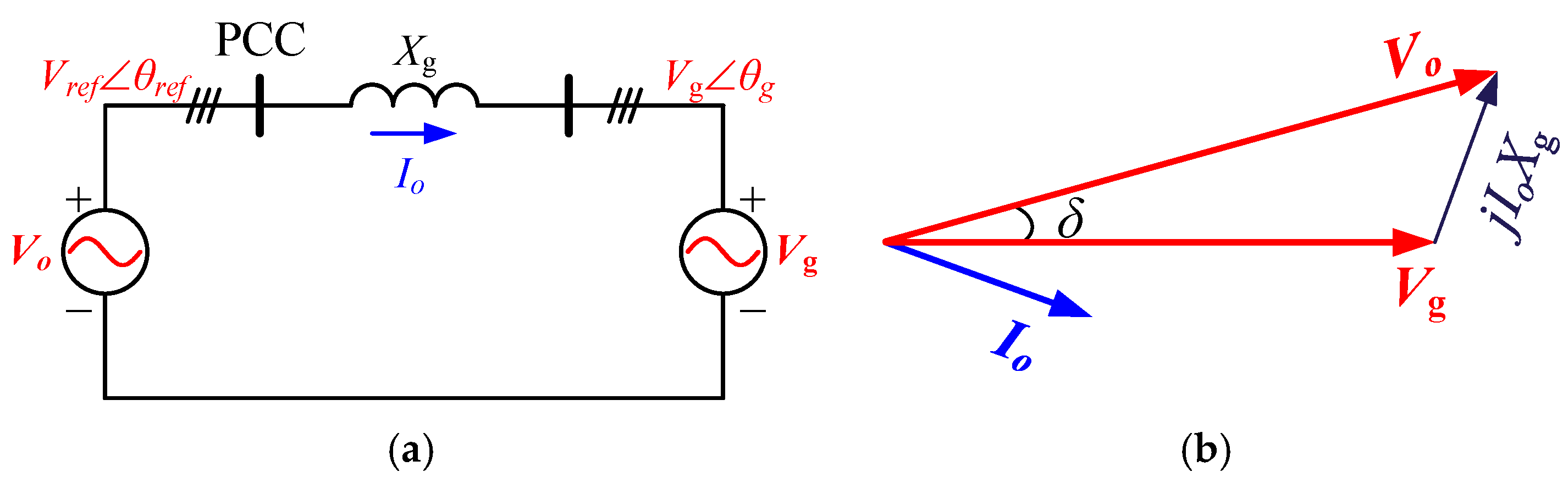
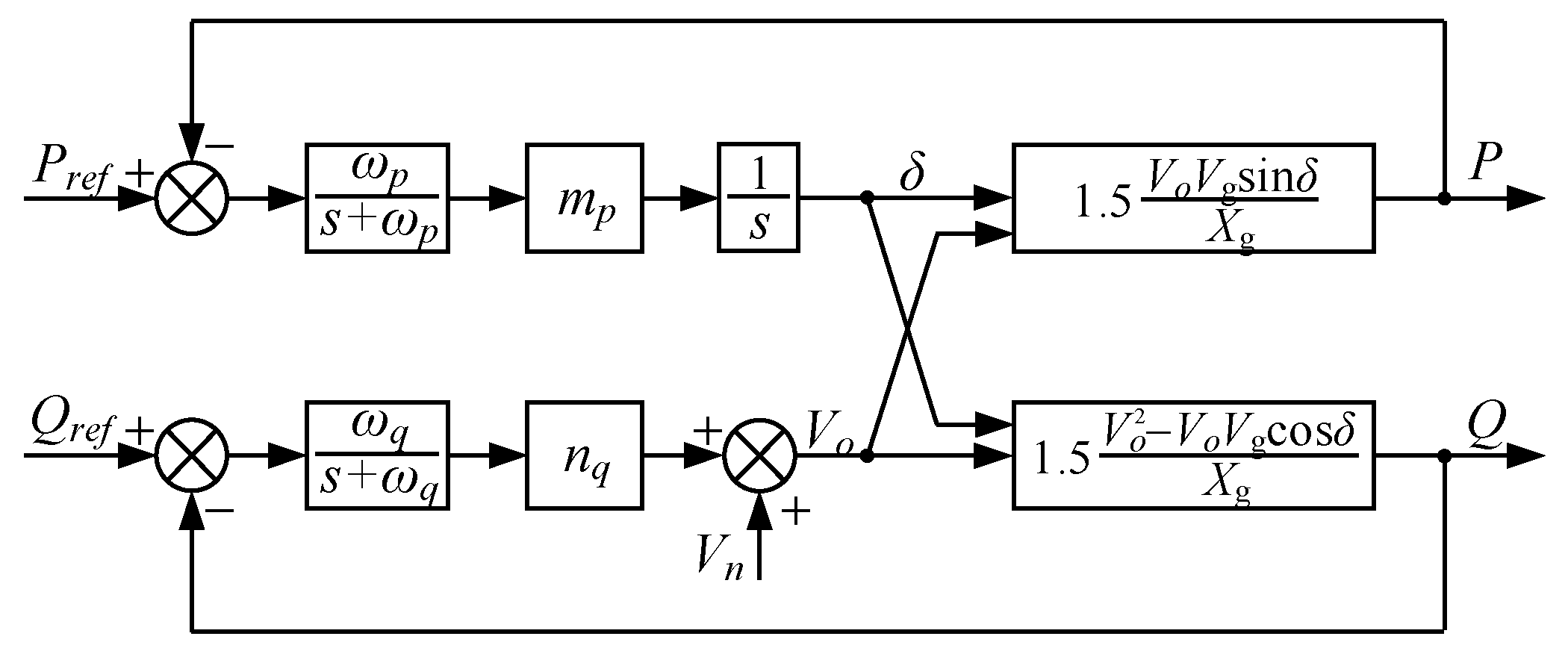
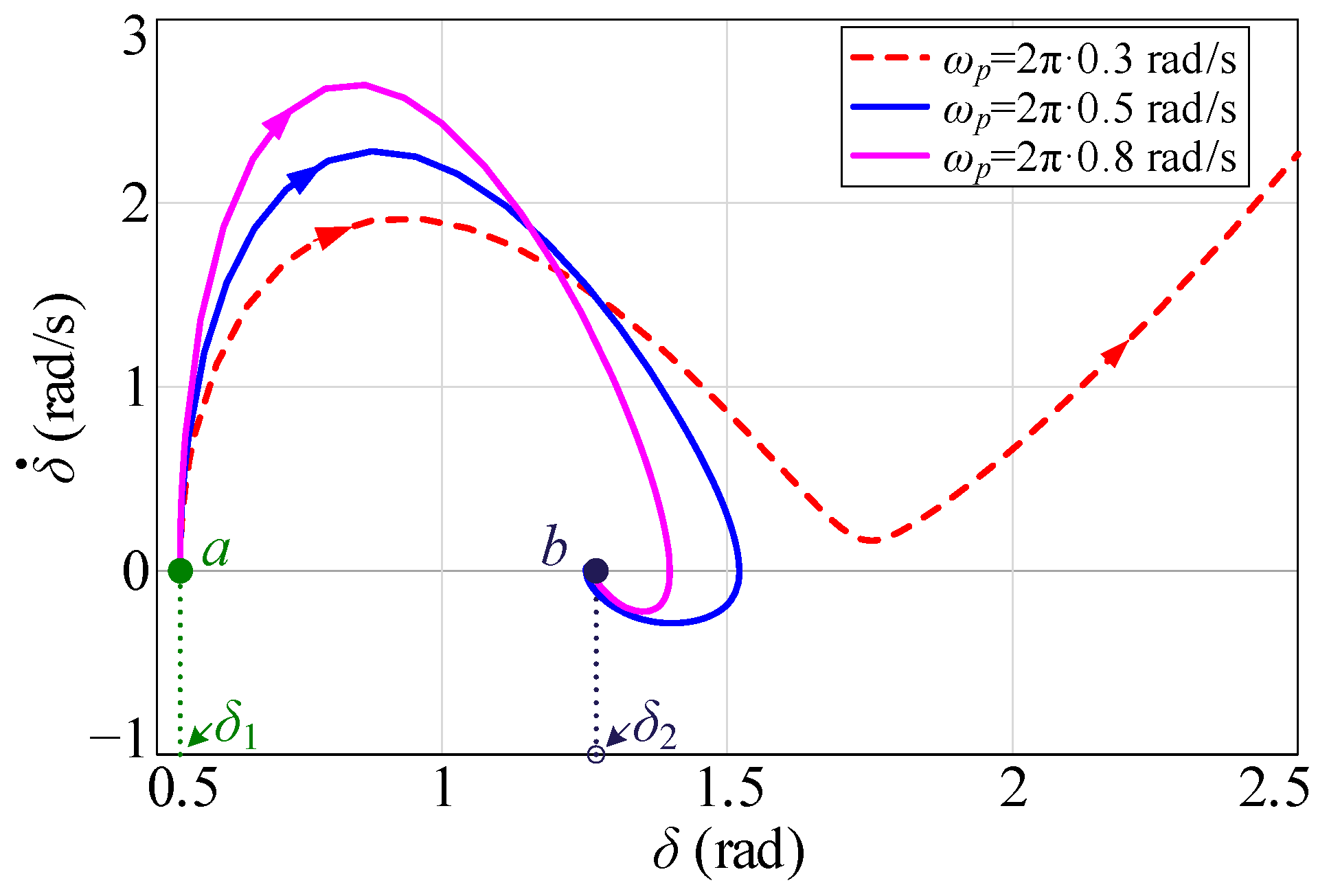
Section 3 establishes the large-signal model of the system and analyzes the transient stability under low-voltage faults;
Section 4 details the core principles and parameter design of the proposed adaptive synchronization control strategy;
Section 5 verifies the effectiveness of the scheme through simulations and experiments; and, finally, the main research conclusions of this paper are summarized in
Section 6.
2. System Description
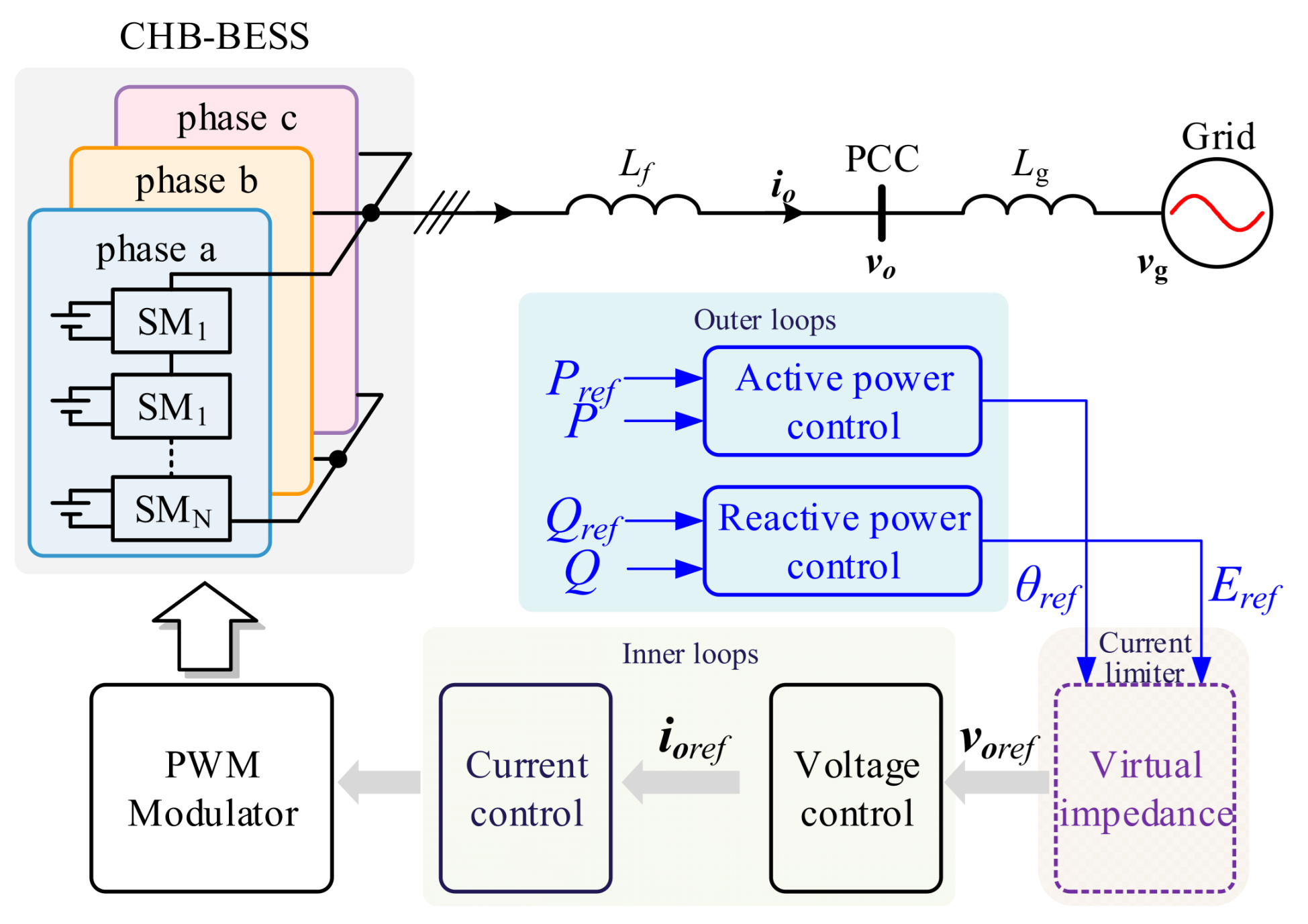
Figure 1 shows the configuration of a cascaded H-bridge converter-based battery energy storage system (CHB-BESS) interfacing the power system through an inductor,
Lf. The power grid at the point of common coupling (PCC) is modeled as an ideal voltage source,
vg, in series with a pure inductance,
Lg.
To participate in the regulation of grid voltage and frequency, the GFM converter is controlled as a voltage source and synchronizes with the power grid by adjusting their output active power,
P, and reactive power,
Q. The above control concept is generally implemented by cascading the power loop and the voltage loop, as illustrated in
Figure 1.
The outer power control loop is primarily responsible for ensuring synchronization between the inverter and the power grid.
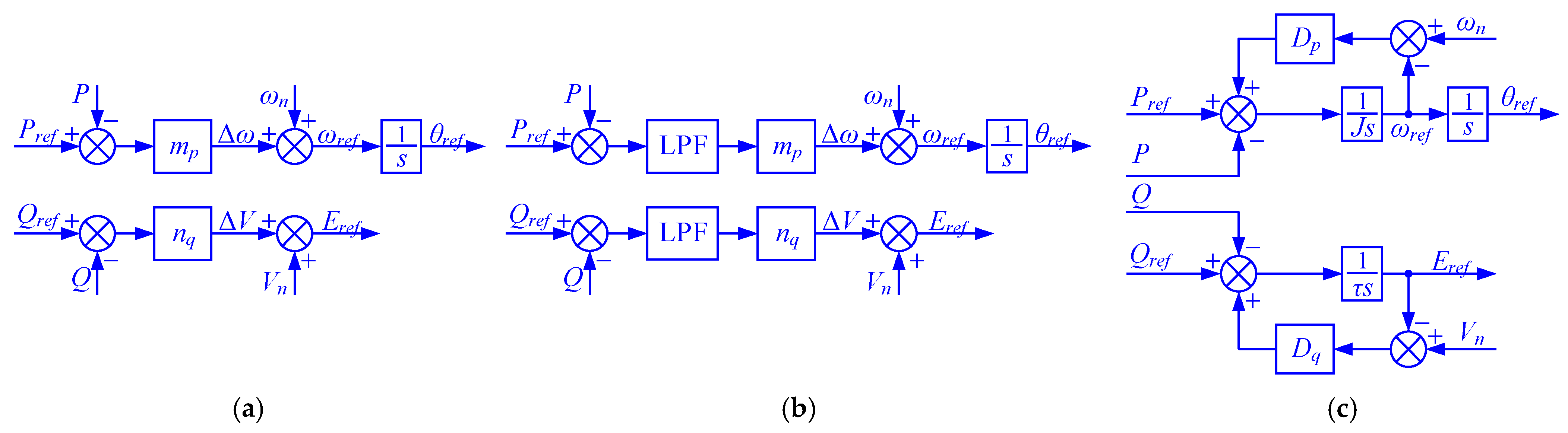
Figure 2 shows three typical power control strategies. The control structure of basic droop control is depicted in
Figure 2a. Power deviations from their command values,
Pref and
Qref, are respectively regulated by the droop coefficients,
mp and
nq, to generate frequency and voltage variations. These variations, Δ
ω and Δ
V, are then added to the GFM converter’s rated frequency,
ωn, and rated voltage,
Vn, to obtain the actual output voltage frequency reference,
ωref, and amplitude reference,
Eref. After the integration of
ωref, the actual phase reference,
θref, is subsequently yielded. By combining
θref with
Eref, the reference voltage vector of the inner voltage loop,
voref, can be further derived. Based on the information presented above, the control law can be written as:
To suppress the fluctuations in measured output power caused by load imbalances, LPFs with cutoff frequencies,
ωp and
ωq, are typically added into the active power control (APC) loop and reactive power control (RPC) loop, respectively, as illustrated in
Figure 2b. Thereby, this power control method is generally named as droop control with LPFs, whose control law can be written as:
Reference [
14] points out that the employment of LPFs in droop control additionally endows the GFM converter with inertia, similar to that in virtual synchronous generator (VSG) control, as shown in
Figure 2c. Therein,
Dp and
J are the damping factor and the active power inertia, respectively, while
Dq and
τ are the counterparts in RPC. Based on the derivation in [
15], the equivalent relationship between VSG control and droop control with LPFs is expressed as:
Furthermore, by comparing the control expressions of basic droop control and those of droop control with LPFs, it can be found that the former can be regarded as a special case of the latter under the condition ω
p = ω
q = ∞. That is to say, all three control structures in
Figure 2 can be encompassed by droop control with LPFs. Therefore, we select the droop control with LPFs as the representative in the following modeling and analysis.
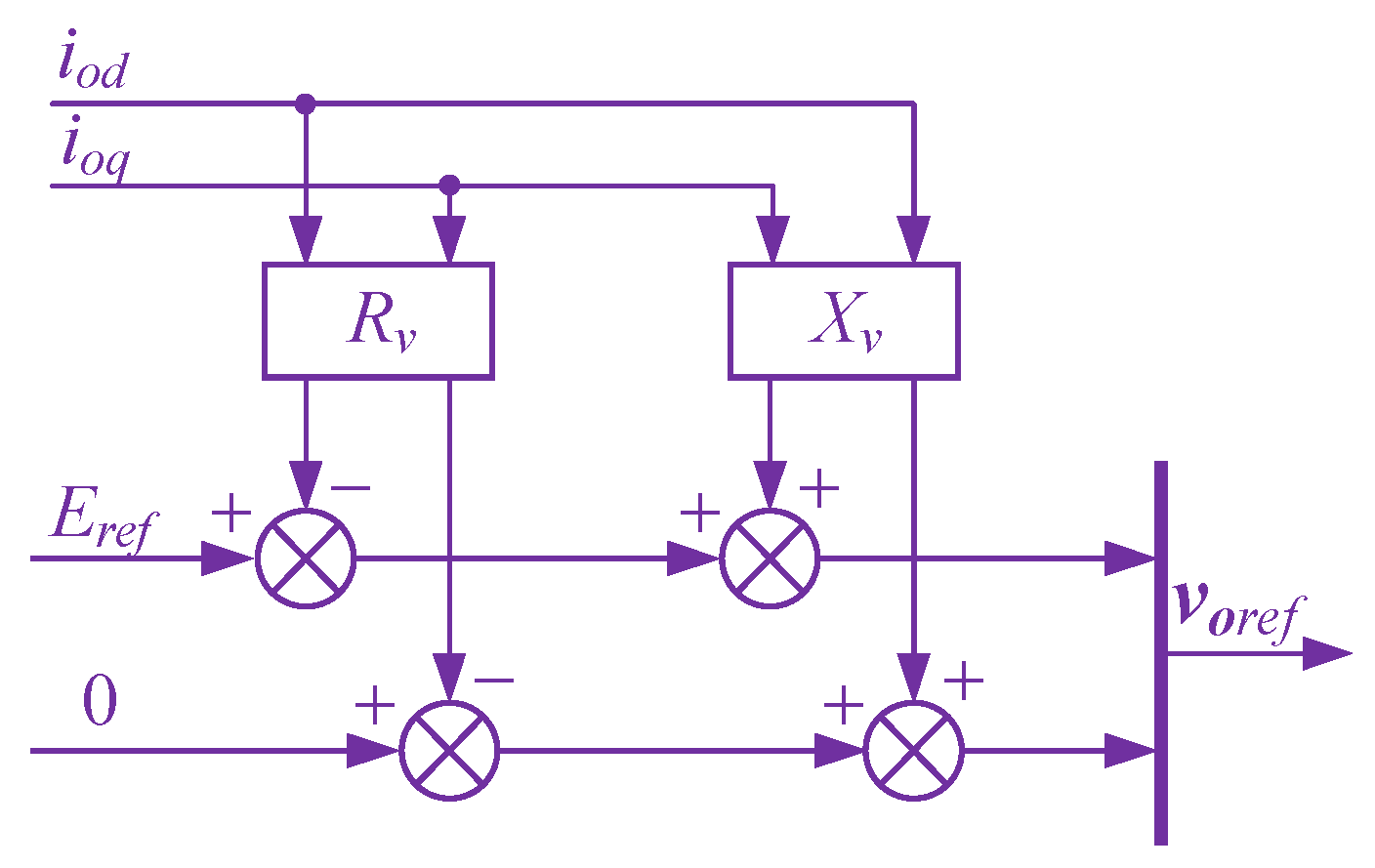
Moreover, due to the voltage source nature, the output current of GFM converters is highly susceptible to external system dynamics. In the event of severe disturbances at the PCC, such as voltage sags or phase angle jumps, current limiting is necessary once its current exceeds 1.2 to 1.5 p.u. Therefore, suitable current-limiting strategies must be employed for grid-forming converters to avoid damaging the semiconductor devices and achieve successful fault ride-through. Here, as shown in
Figure 3, the virtual impedance-based current-limiting method is adopted [
27], where
Rv and
Xv represent the virtual resistance and virtual reactance, respectively:
where
σ is the
X/
R ratio of the virtual impedance, and
kX is the proportional gain. It is worth noting that this virtual impedance is only activated when the amplitude of the output current
Imag exceeds the required threshold,
Ith.
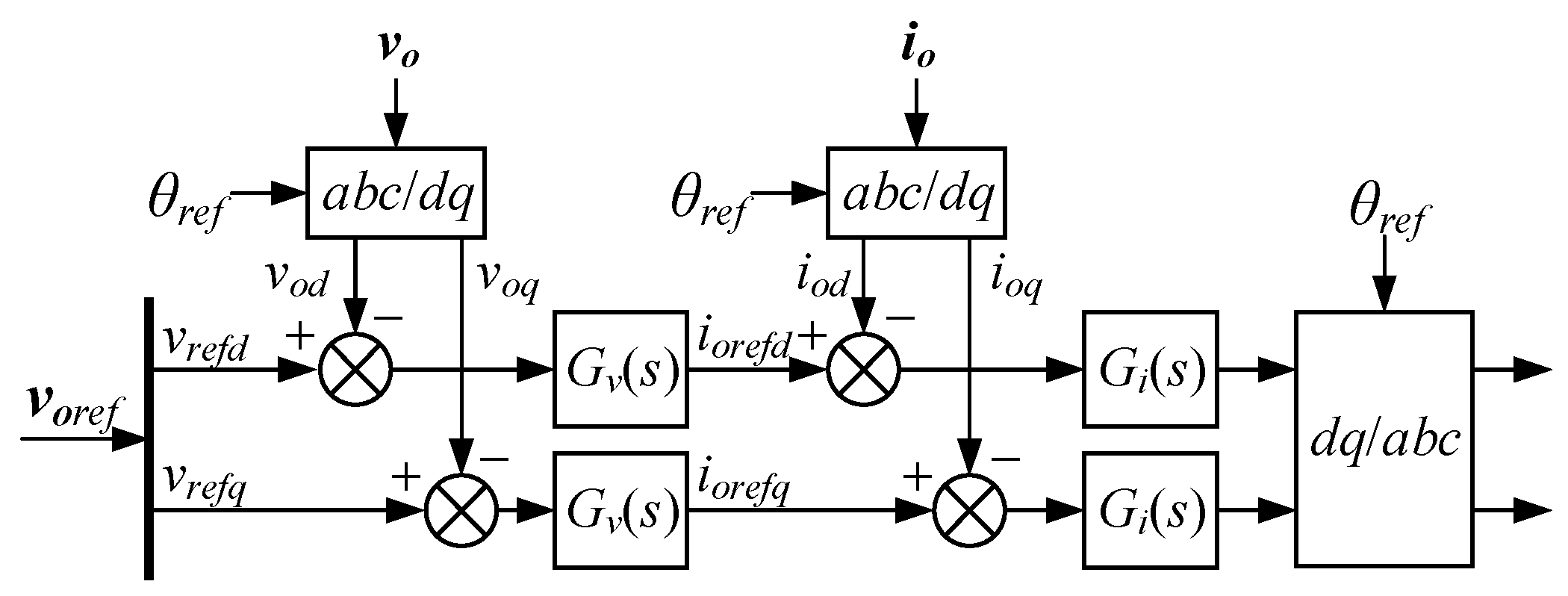
For the voltage inner loop, the widely used voltage–current dual-loop control is employed. The control structure is depicted in
Figure 4, where
Gv(
s) and
Gi(
s) are the voltage controller and current controller, respectively. Both are proportional–integral (PI) controllers in this paper.
4. Proposed Transient Enhancement Strategy
Since the PLL does not provide inertia, a simple solution involving the transient stability enhancement method without sacrificing system frequency support capability is hybridizing the PLL into the traditional GFM control architecture. In this section, an adaptive hybrid synchronization-based transient enhancement strategy is proposed.
4.1. Adaptive Hybrid Synchronization Control Structure
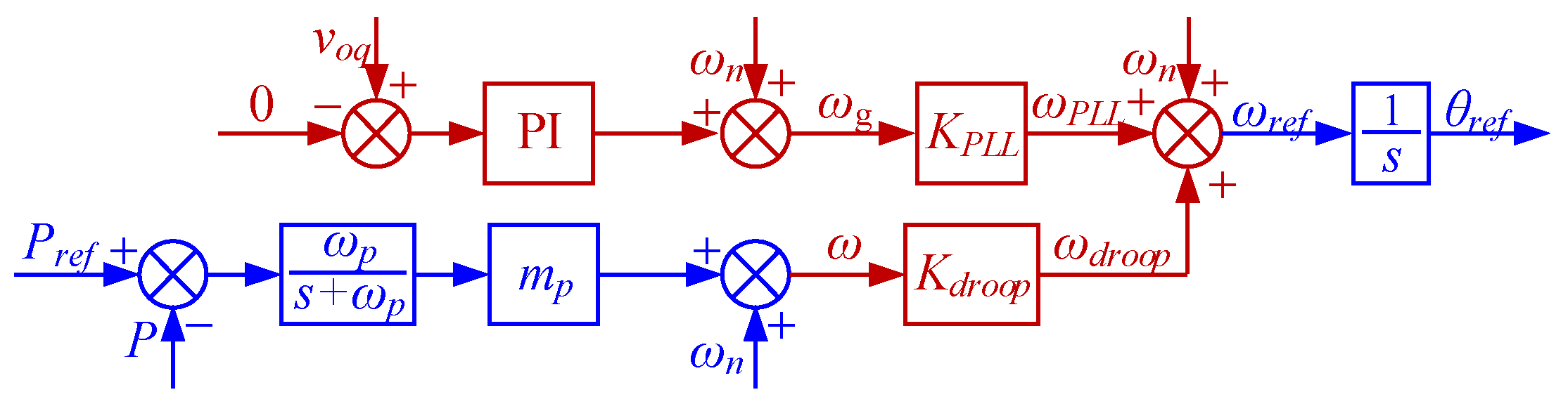
Figure 8 shows the control structure of the proposed adaptive hybrid synchronization-based transient enhancement strategy. It can be observed that, by performing a weighted summation of the active power droop phase angle and the grid phase angle locked by PLL, the synthesized phase angle is taken as the synchronization reference for
dq transformation, thus achieving the coordinated optimization of synchronization accuracy and power regulation performance during fault conditions.
The essence of the proposed scheme is to integrate the grid synchronization advantages of grid-following control and the active support characteristics of grid-forming control through a phase angle fusion mechanism. This control involves two core angular frequency components, namely, the active power droop angular frequency and the PLL-locked grid angular frequency, and the accurate calculation of both components forms the foundation of phase angle fusion.
The detection of the PLL-locked grid phase angle is realized through the synchronous rotating frame PLL (SRF-PLL) to achieve accurate locking of the grid phase angle, whose core lies in tracking the fundamental phase angle of the grid voltage through the closed-loop regulation of the
dq-axis voltage components. In the PLL control loop, the closed-loop transfer function,
GPLL(
s), expressed as the following formula is adopted:
where the damping ratio
ξ is
is the natural frequency of PLL;
Vg is the grid voltage amplitude; and
are the integral coefficient and proportional coefficient of the PI controller in the PLL, respectively. The reference value of the q-axis component of output voltage is set to 0 at all times. The difference between this reference and the actual q-axis component of the output voltage,
voq, is calculated, and the resulting value is taken as the input to obtain the grid angular frequency,
ωg, based on the PLL principle.
According to the specific proportion of the voltage sag, the system can automatically select the corresponding angular frequency adaptation parameters,
Kdroop and
KPLL, which are multiplied by the converter’s internal angular frequency, ω, and the grid angular frequency,
ωg, respectively, to yield the corrected angular frequency from the droop loop,
ωdroop, and the corrected angular frequency,
ωPLL, from the PLL. On this basis, the final equivalent adaptive angular frequency, ω
ref, inside the converter is given as follows:
Then, through integral calculation, the phase angle θref can be obtained.
4.2. Adaptive Parameter Design
The adjustment of the adaptive angular frequency parameters,
Kdroop and
KPLL, is determined by the per-unit voltage sag depth
Vpu at the PCC, and its expression is given as follows:
where
Vg(rms) is the root mean square (rms) value of the grid voltage and
VgN is the nominal grid voltage. This paper adopts a piecewise linear regulation strategy, where the adaptive parameters have different expressions under different voltage sag severities. Definitions are given in this section as follows: the grid system is regarded as a mild fault when
Vpu ranges from 0.8 to 1; a moderate fault when
Vpu ranges from 0.45 to 0.8; and a severe fault when
Vpu is less than 0.45. The selection of adaptive parameters under different operating conditions follows the expressions given below:
During a mild grid fault, the voltage sag amplitude is small, and the waveform distortion degree is low, with the system operating state close to the steady state. The phase angle is dominated by the active power droop control loop, and only the auxiliary synchronization function of the PLL phase angle is retained, which maximizes the active voltage and frequency support characteristics of the active power droop control and enables the converter to take grid-forming characteristics as the core under near-steady-state operating conditions. During a moderate grid fault, the voltage sag depth increases; through smooth transition weight allocation, the dominance of the active power droop loop on the phase angle is gradually reduced, and the synchronous compensation function of the PLL phase angle is dynamically enhanced to address the risk of synchronization deviation caused by voltage sags. During a severe grid fault, the value of KP can be minimized as much as possible to enhance the synchronous tracking capability of the PLL, which avoids the instability risk of active power droop control under severe voltage sags. Meanwhile, a certain droop component is retained to maintain the basic grid-forming support characteristics, thus ensuring the stable operation of the converter under extreme operating conditions.
4.3. Simulation Verification
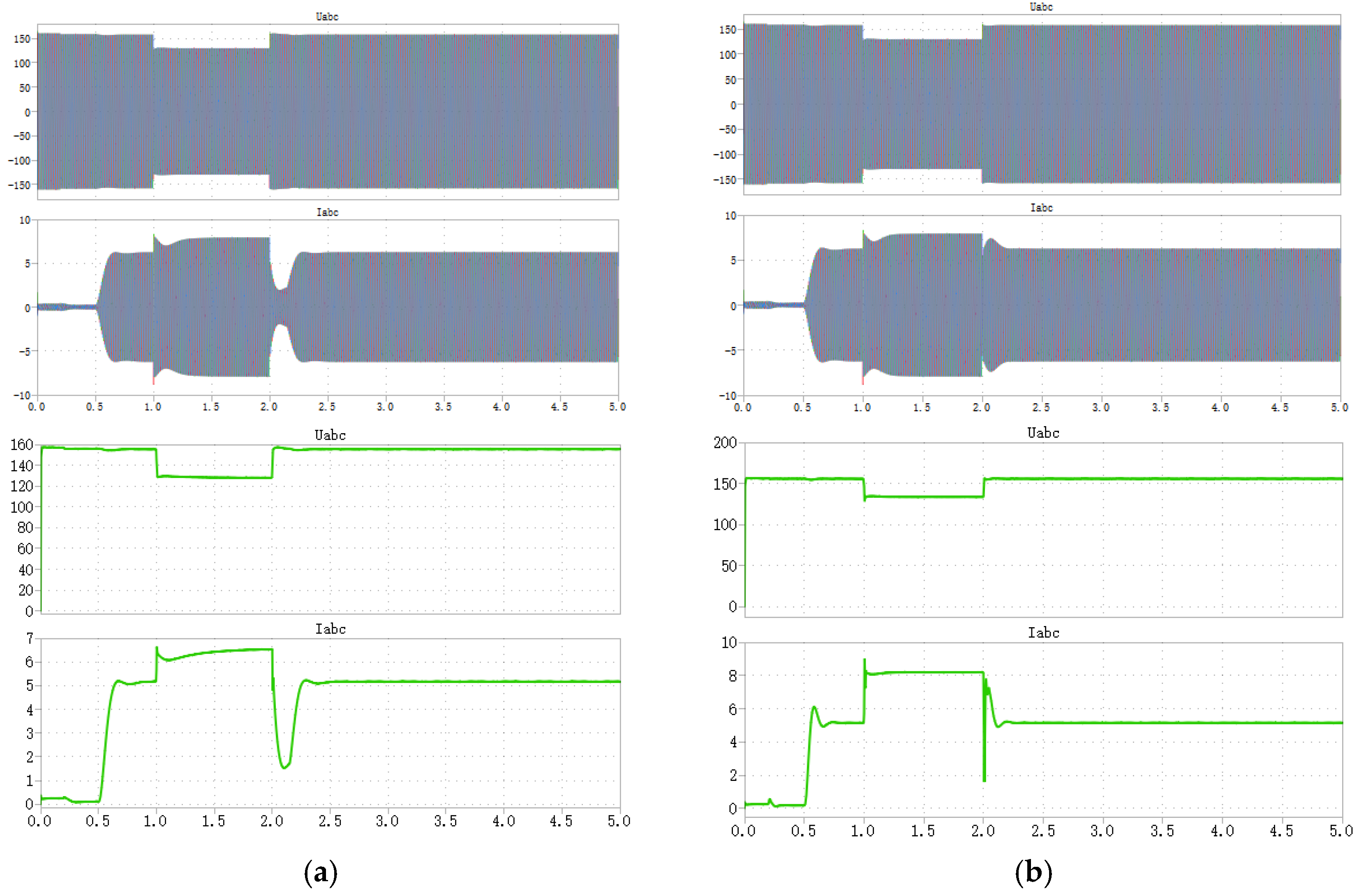
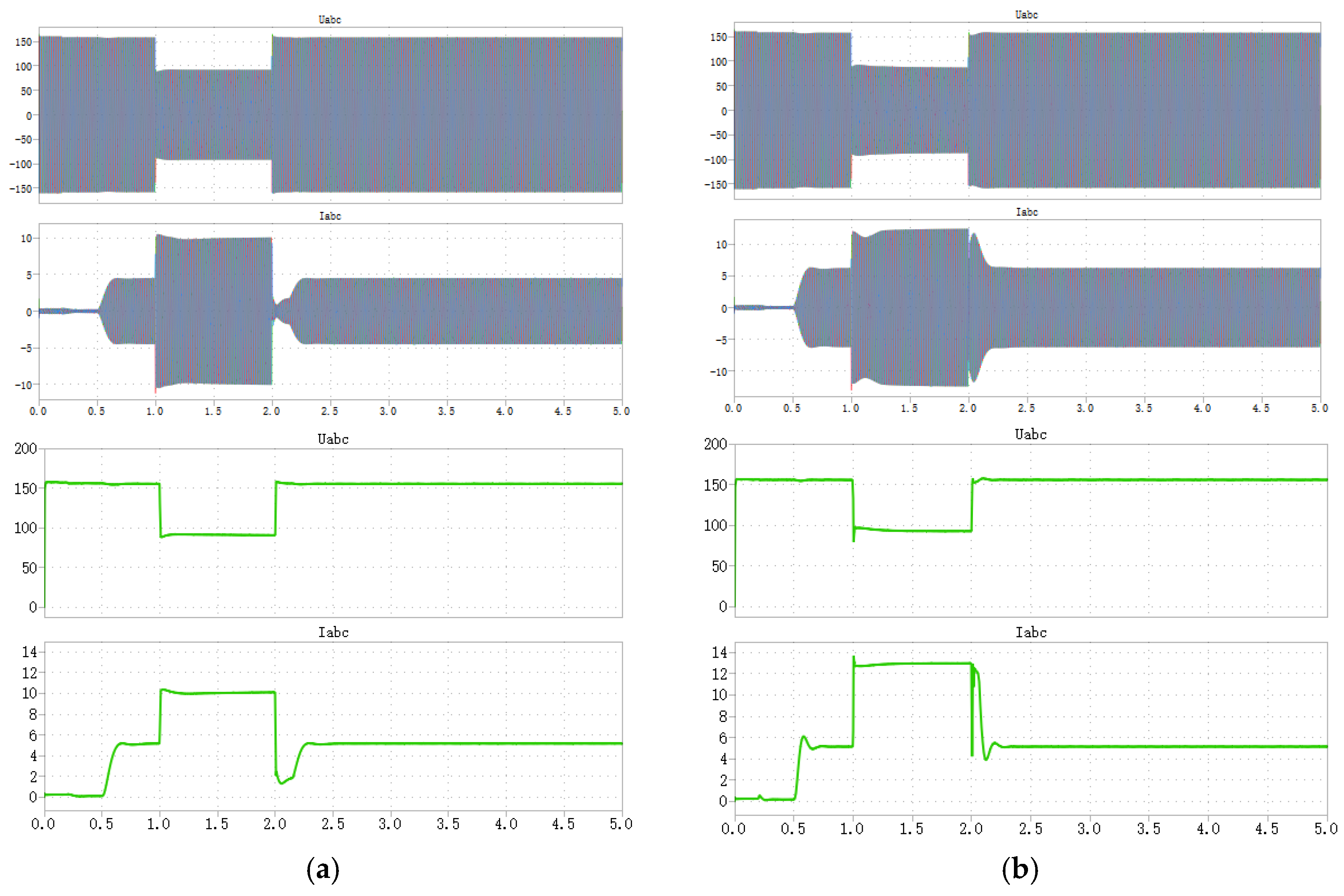
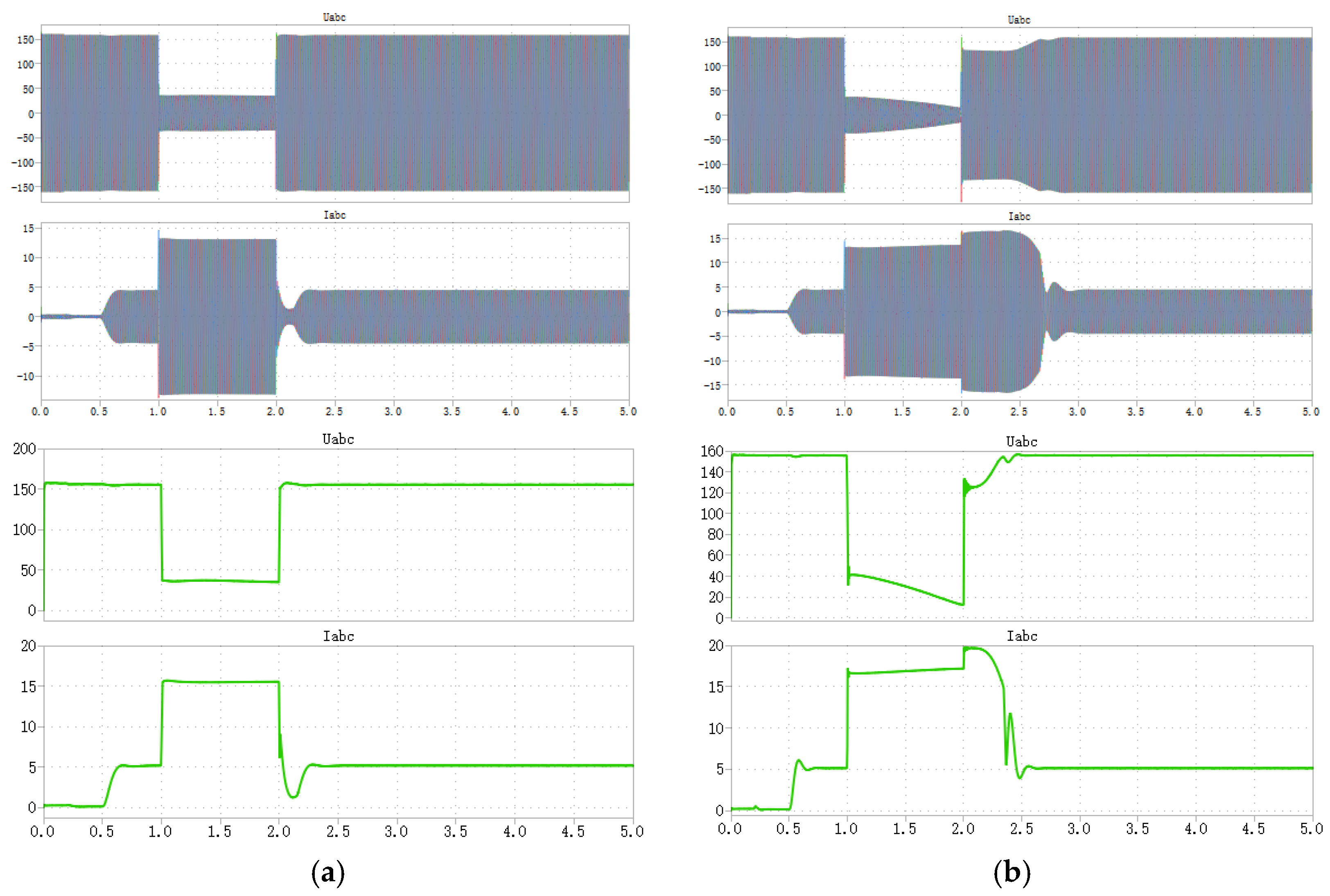
Based on the above analysis, a CHB-BESS model is built on the PLECS platform, with the nominal grid voltage of 110 V, rated power of 2000 W, and power reference of 1400 W. Comparative simulation verification between the proposed scheme and the traditional grid-forming scheme is carried out under the grid voltage sag conditions of 20%, 50%, and 90%, respectively, and the results are shown in the
Figure 9,
Figure 10 and
Figure 11.
From the waveform comparison under the three scenarios of Vpu = 0.8, Vpu = 0.5 and Vpu = 0.1, it can be seen that the proposed adaptive synchronization control exhibits superior performance to the traditional grid-forming control over the entire fault range: in case of mild faults, both the adaptive control and the traditional grid-forming control are dominated by droop control, with no significant performance difference observed between the two; in case of moderate faults, the adaptive control effectively balances the supporting capability of active power droop and the synchronous compensation function of the PLL through linear dynamic adjustment of parameters and when combined with the current limiting capability of the virtual impedance, it greatly suppresses transient current surges and waveform distortion, whereas traditional grid-forming control suffers from instability during the fault and a recovery delay after fault clearance; in case of severe faults, the adaptive control relies on the PLL-dominated synchronous tracking mechanism to avoid the instability risk of pure droop control under deep voltage sags and meanwhile retains the basic supporting effect of the droop phase angle component to maintain grid-forming characteristics, thus ensuring the stable operation of the converter, while traditional grid-forming control experiences severe voltage and current fluctuations and distortion at this time, with an obvious instability risk. The simulations fully verify the effectiveness and superiority of the proposed LVRT scheme for grid-forming converters based on adaptive synchronization in terms of transient surge suppression, current distortion rate reduction, and fault recovery speed.
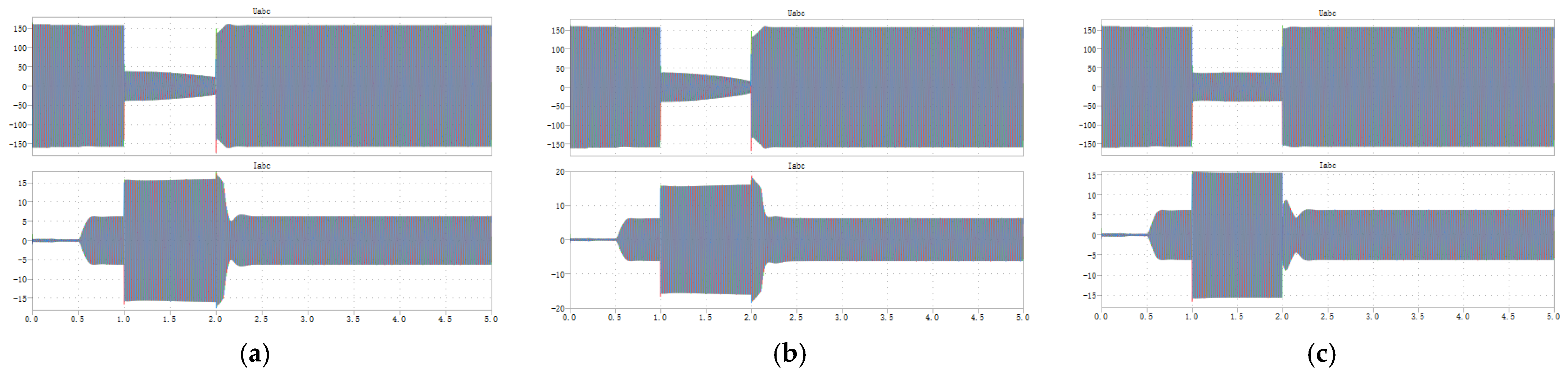
Furthermore, to verify the rationality and generality of the thresholds selected in the parameter design of
Section 4.2, comparative simulations are performed with
= 0.1 under different values of the adaptive droop coefficient
Kdroop = 0.3, 0.2, 0.1 (
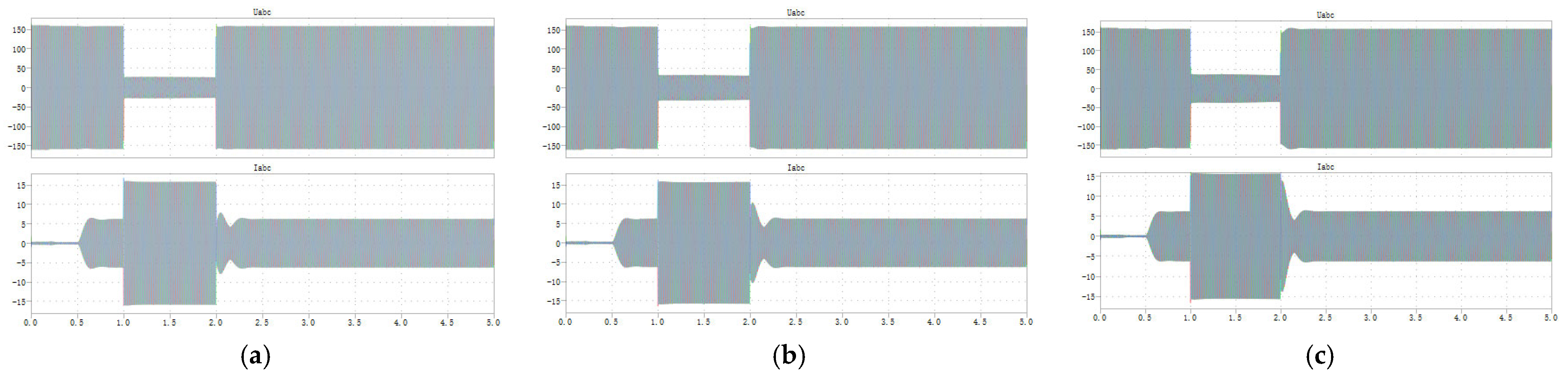
Figure 11), and 0.01. The simulated three-phase voltage and current waveforms are presented in
Figure 12.
The simulation results demonstrate that an overlarge Kdroop gives rise to severe voltage distortion under serious fault conditions, as well as slow post-fault voltage recovery and obvious dynamic response delay. When Kdroop is reduced to the designed value of 0.1, the voltage waveform becomes stable and smooth with significantly improved dynamic performance. A further decrease in Kdroop can still maintain stable fault waveforms; however, an excessively small Kdroop will impair the grid-forming capability of the converter during faults. Taking into account voltage quality, dynamic recovery performance, and grid-forming support under fault conditions, Kdroop = 0.1 is determined as the optimal parameter.
On this basis, to further validate the generality of the proposed parameters and control strategy under different weak grid strengths, simulation verifications are carried out under short-circuit ratios (SCRs) of 2, 2.5, and 3 with
= 0.1, The results are shown in
Figure 13. The results reveal that the proposed strategy can operate stably under various SCR conditions, with smooth and undistorted voltage and current waveforms, indicating favorable operational adaptability and robustness.
5. Experimental Verification
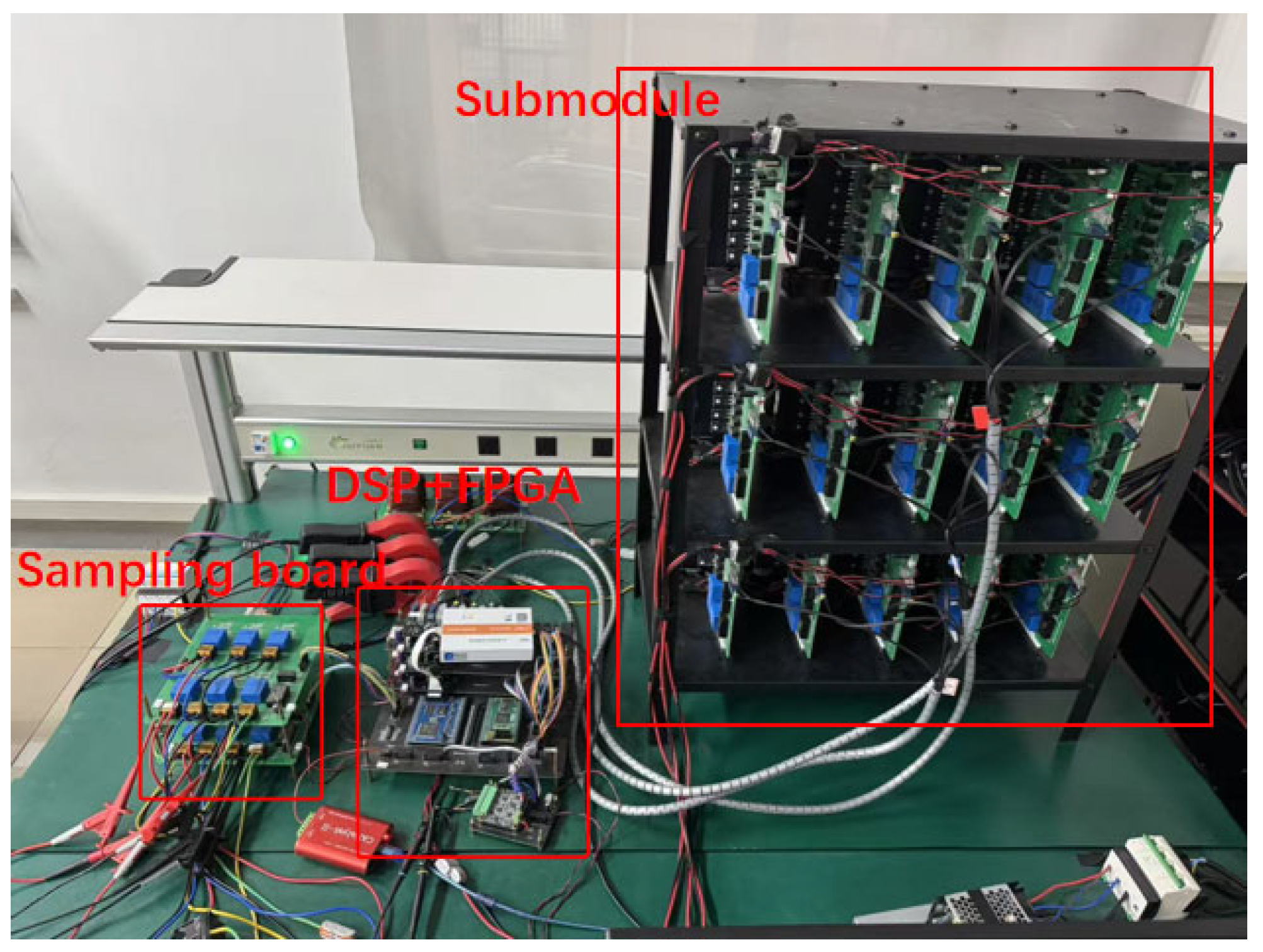
Combined with the aforementioned theoretical analysis and simulation verification, the experimental verification is carried out on the physical test platform shown in
Figure 14. The main topology of the platform is a three-phase five-module CHB converter, and the DC side of each phase is composed of five batteries connected in series with a rated voltage of 48 V. The sub-modules transmit signals to the main control DSP via optical fibers, and the DSP is used to implement the processes of phase angle calculation, modulation wave generation, and other relevant links. The specific parameters adopted in the experimental process are listed in
Table 1.
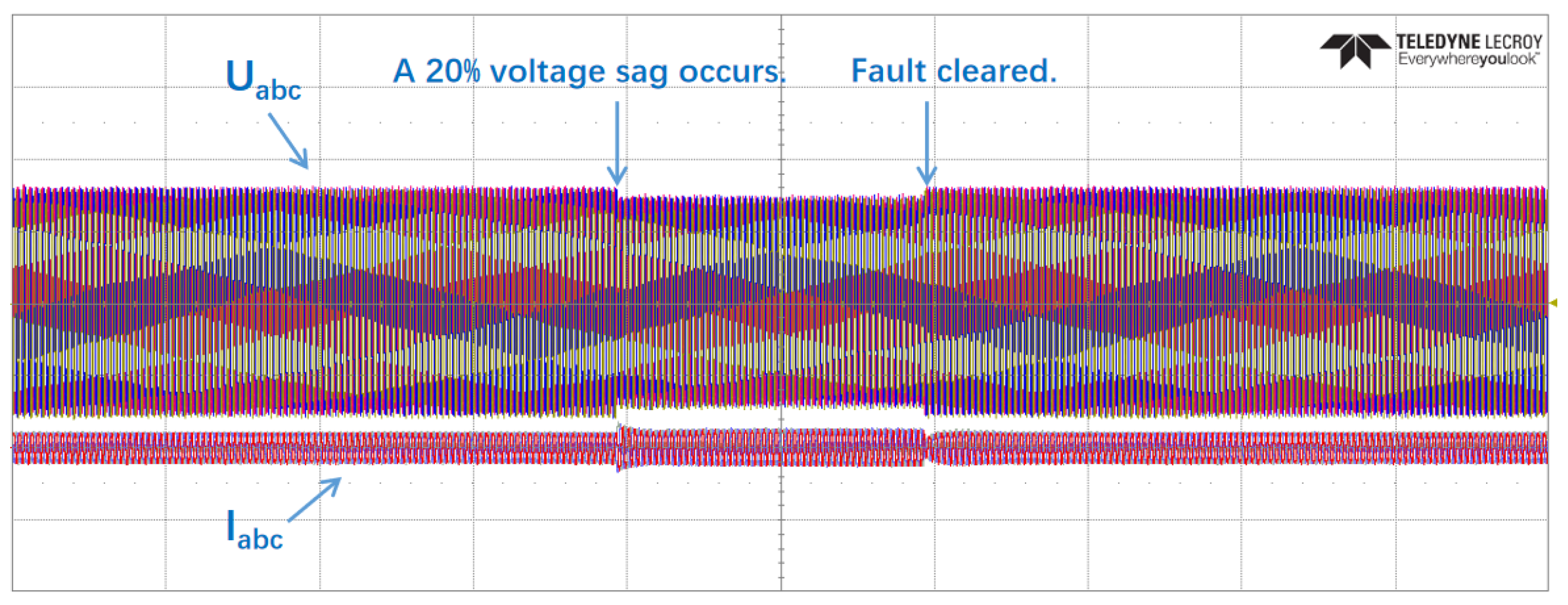
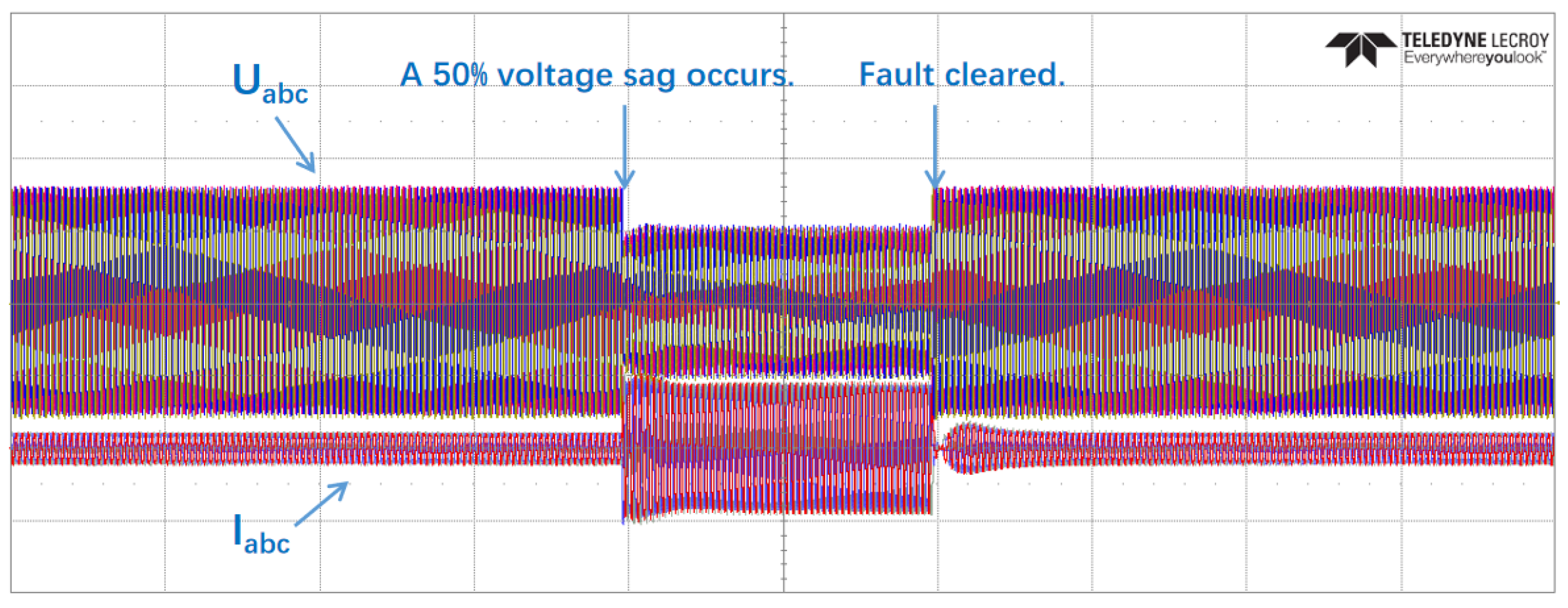
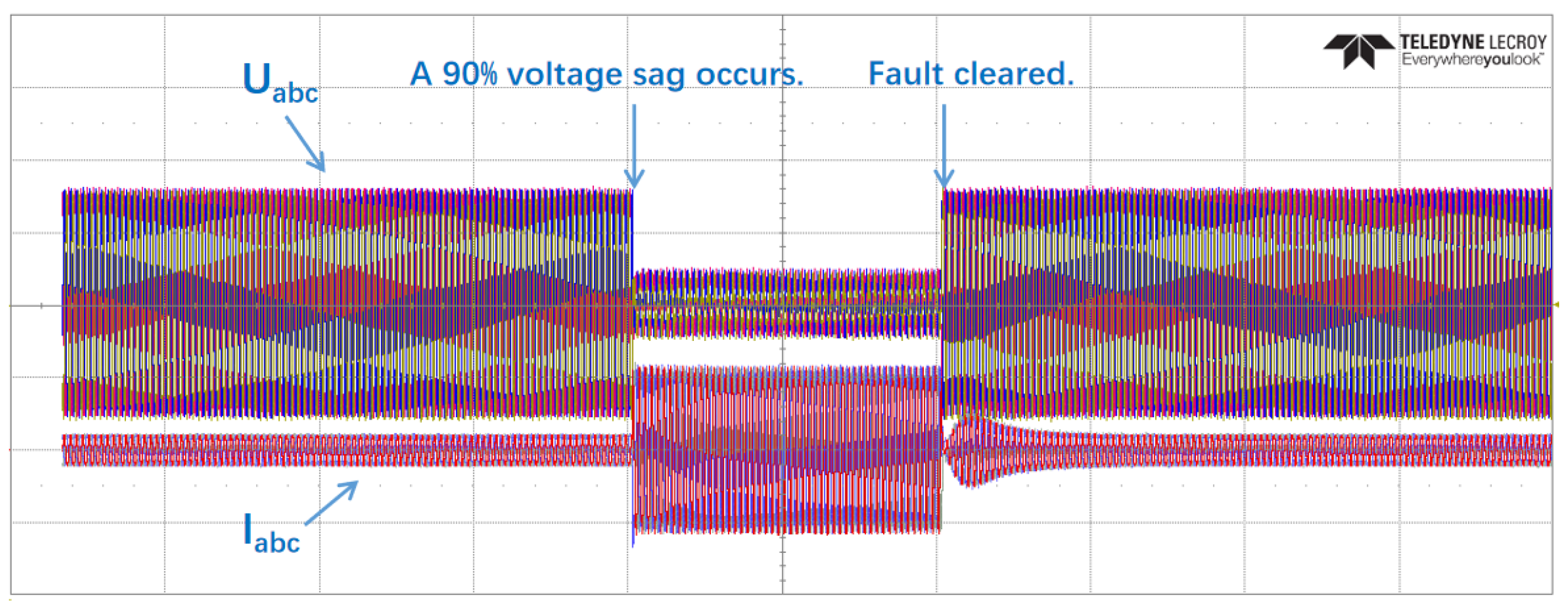
The experiments were conducted under the grid voltage sag conditions of 20%, 50%, and 90% in accordance with the given parameters, and the results are shown in the
Figure 15,
Figure 16 and
Figure 17. It can be seen that the proposed scheme can well achieve low-voltage ride-through under different degrees of grid voltage sag: the waveforms remain smooth during the fault period; after fault clearance, all electrical parameters quickly recover to their steady-state rated values with a recovery time of less than 0.1 s. The steady-state operation accuracy meets the technical requirements for grid-connected operation of the power grid, which fully verifies the effective adaptability to voltage sags and stable control performance of the proposed scheme over the entire fault range.
In summary, compared with the traditional GFM control and grid-following control, the control strategy based on adaptive synchronization proposed in this paper exhibits remarkable advantages. First, it greatly improves the transient stability margin under voltage sag scenarios. Through the weighted summation of the phase angle output by the PLL and the phase angle output by active power droop control, it not only overcomes the defect of poor stability in traditional grid-forming control due to the lack of grid phase angle reference but also retains the active voltage support capability of grid-forming control. Even when the grid voltage drops to 30% or lower, the phase angle and power can still be maintained stable. Second, it realizes the coordinated optimization of phase angle regulation and overcurrent suppression. The adaptive adjustment of the droop coefficient accelerates the response speed of the active power droop phase angle; combined with the phase angle weighted summation, it avoids the abrupt current increase caused by excessive phase angle deviation. Meanwhile, it relies on virtual impedance for auxiliary overcurrent suppression to ensure the safety of power devices. Third, it enhances the anti-interference capability and robustness of the system. The dynamic weight allocation of phase angle weighted fusion can adapt to different sag depths and voltage distortion scenarios. Compared with traditional control, its anti-interference capability and scenario adaptability are significantly improved, making it particularly suitable for weak-grid and high-penetration renewable energy grid-connected scenarios. In terms of technical characteristics, this strategy can be directly embedded into the existing control algorithms, featuring strong compatibility and convenient engineering application. The control parameters are dynamically adapted based on real-time operating states with high flexibility, and the core logic conforms to the requirements of source-grid-load-storage coordinated regulation, which facilitates the recovery of grid voltage and frequency while ensuring the self-stability of the converter, meeting the construction requirements of the new power system.
6. Conclusions
This paper addresses the inherent conflict between frequency stability and transient stability of GFM converters under LVRT scenarios, as well as the secondary overcurrent issue during fault recovery, which restricts the reliable operation of high-penetration renewable energy grid-connected systems. To resolve these technical bottlenecks, an adaptive hybrid synchronization-based transient stability enhancement strategy is proposed, and the key research conclusions are summarized as follows:
(1) The proposed strategy achieves weighted fusion of the active power droop phase angle and the PLL-locked grid phase angle, integrating the active support capability of GFM control and the transient stability advantage of grid-following control. This innovative mechanism reconciles the trade-off between system inertia (frequency stability) and transient stability, enabling GFM converters to maintain high inertia while enhancing transient stability under various fault severities.
(2) Through coordinated optimization of hybrid phase angle regulation and virtual impedance control, the strategy effectively suppresses transient current surges during faults and avoids secondary overcurrent after fault clearance, ensuring the safety of power semiconductor devices and accelerating the recovery of grid voltage and frequency.
This proposed adaptive hybrid synchronization strategy provides a practical solution for the transient stability enhancement of GFM converters. However, it should be noted that the current research work mainly focuses on the low voltage ride-through problem under the scenario of three-phase voltage symmetric sag. Its design idea, control parameter tuning, and performance verification are all carried out based on symmetric fault conditions, failing to fully consider the more common three-phase voltage asymmetric sag scenario in the actual power grid operation, nor involving the influence of complex operating conditions when asymmetric loads are connected, which leads to certain limitations in the engineering applicability of the strategy. Therefore, future research can be further expanded on the basis of this paper. On the one hand, the adaptive synchronization control mechanism for the grid asymmetric sag scenario could be optimized to improve the transient support capability of the strategy under asymmetric faults; on the other hand, the operating characteristics of asymmetric loads can be combined to improve the coordinated logic of hybrid phase angle regulation and virtual impedance control, make up for the limitations of existing research, and further enhance the universality and engineering practical value of the proposed strategy, thus providing more comprehensive technical support for the safe and stable operation of weak power grids.




 ,
,