Article

Quantifying Savings and Evaluating Cost Allocation Methods in Energy Communities: A Data-Driven Approach


by
David González-Asenjo
1,2 and
Luis R. Izquierdo
1,*
1
Department of Management Engineering, Universidad de Burgos, 09006 Burgos, Spain
2
Instituto Tecnológico de Castilla y León (ITCL), Calle López Bravo 70, 09001 Burgos, Spain
*
Author to whom correspondence should be addressed.
Energies 2026, 19(5), 1336; https://doi.org/10.3390/en19051336
Submission received: 27 January 2026 / Revised: 23 February 2026 / Accepted: 25 February 2026 / Published: 6 March 2026

Abstract

Energy Communities (ECs) have emerged as a key instrument for promoting local renewable energy integration and citizen participation in the energy transition. While their economic performance largely depends on the ability to generate savings through self-consumption and internal energy trading, their long-term viability is strongly influenced by how these savings are distributed among heterogeneous participants. Despite extensive literature on cost allocation methods, there remains a lack of integrated, data-driven approaches that clearly disentangle the sources of savings in ECs and examine how different allocation methods perform under realistic operating conditions. This paper presents a simulation-based analytical framework to quantify the economic savings generated within Energy Communities and to analyse how a set of widely used cost allocation methods distribute these savings among participants. The approach explicitly separates savings due to renewable self-consumption from those arising from internal trading in a Local Energy Market and explores allocation outcomes across a broad range of community configurations. Extensive simulations based on both synthetic and real-world consumption and price data are used to examine community-level savings, individual outcomes, surplus distribution patterns between Net Consumers and Net Producers, and computational tractability. The results show that internal energy trading consistently increases community-level savings, although its contribution is typically modest relative to self-consumption and strongly dependent on contextual factors such as renewable penetration, demand heterogeneity, and price conditions. The analysis highlights important trade-offs between savings generation, surplus distribution, and computational feasibility, underscoring the relevance of context-aware selection of allocation mechanisms. Overall, the proposed approach provides a transparent and reproducible tool for analysing the economic performance of Energy Communities under practical constraints.

1. Introduction

The ongoing energy transition, especially in developed countries where the adoption of renewable energy sources is a growing trend, has fundamentally altered the structure of electricity systems [1], shifting them from centralised, utility-driven energy systems towards decentralised and participatory models. In this context, empowering citizens to become active market participants plays a central role [2,3]. From this perspective, Energy Communities (ECs) have gained increasing attention as organisational entities that allow non-energy-intensive consumers (such as citizens, small businesses, and SMEs) to jointly produce, consume, and manage renewable energy within a geographical context of proximity [4]. By facilitating collective self-consumption and peer-to-peer energy exchanges, ECs are expected to deliver economic benefits to their members (usually higher than those that the same members would obtain operating alone) [5], enhance social acceptance of renewable technologies [6], and contribute to broader strategic decarbonisation goals [7,8].
However, the practical implementation of Energy Communities raises non-trivial challenges. Among them, the quantification of savings and the allocation of costs and benefits stand out as critical determinants of community long-term viability and participants’ engagement [9]. EC members typically exhibit heterogeneous consumption patterns, generation capacities, and electricity prices [10]. As a result, the economic gains generated by cooperation (i.e., particularly those arising from internal energy trading) must be distributed in a manner that is not only economically efficient but also perceived as fair, transparent, and resilient [11]. Failure to achieve these conditions may undermine trust, discourage participation, and ultimately threaten the long-term sustainability of the community [12].
A wide range of cost allocation methods has been proposed in the literature to address these challenges [13,14], including simple rules price-based and savings-based approaches [15]. Each allocation method embodies different properties regarding fairness, incentives, and computational complexity. While some methods prioritise simplicity and ease of implementation, others aim to satisfy stronger theoretical properties such as individual rationality or coalition stability [16,17]. Despite this diversity, existing studies often focus either on theoretical compliance or on isolated numerical case studies [18]. Consequently, there is still no unified, data-driven framework that allows for a systematic comparison and quantification of allocation outcomes under realistic operating conditions.
In parallel, the economic assessment of Energy Communities frequently relies on simplified indicators that do not explicitly disentangle the different sources of savings [19]. In practice, ECs’ savings originate from individual or collectively owned renewable energy generating facilities and from internal energy trading enabled by Local Energy Markets (LEMs) [20]. Quantifying the specific contribution of the internal trading is particularly important, as it determines the potential added value that an Energy Community may generate for its members. This value depends on factors such as profile complementarity, renewable penetration levels, and the spread between electricity buying and selling prices [21]. In practice, open-access tools capable of estimating this savings potential in a transparent and reproducible way remain scarce.
Taking this into consideration, this paper aims to present a methodological framework that integrates the economic assessment of Energy Communities with a systematic, data-driven analysis of cost allocation methods. The proposed tool is designed to (i) quantify the potential savings generated by internal energy trading in a Local Energy Market and (ii) compute and compare the outcomes of different allocation methods under identical operating conditions. The framework combines analytical modelling with extensive simulations based on both synthetic datasets and real-world consumption and price data, enabling a transparent exploration of how savings generation, surplus distribution, and computational feasibility vary across different community configurations.
The main contributions of this work are twofold. First, it provides a compact economic formulation that clarifies the origin of savings for a specific archetype of Energy Community and isolates the contribution of internal energy trading. Second, it introduces a unified assessment framework to analyse and compare allocation outcomes under different methods. This framework is presented as an R-based [22] program that performs this assessment in a replicable and scalable manner. It permits the delivery of empirical insights into the conditions under which specific allocation methods perform well, highlighting trade-offs between beneficial participation, surplus sharing, EC configuration parameters, and computational tractability.
Furthermore, the modular nature of this framework allows for the evaluation of methods not considered in this paper, thus establishing a robust line of research that can be used to assess future developments.

1.1. Related Work

Prior to discussing specific contributions within the literature on cost allocation in Energy Communities, it is interesting to situate this work within the broader research landscape of collective energy systems. Collective energy systems encompass a variety of frameworks in which multiple actors coordinate the production, consumption, and management of energy resources to achieve common objectives such as cost reduction, increased renewable integration, and improved system flexibility [23,24,25]. Research in this area spans several intersecting domains, including (i) asset management and optimisation, which addresses the technical and economic coordination of distributed energy resources and storage assets within collective settings [26]; (ii) economic diagnostics and performance evaluation, which quantifies cost savings, value streams, and financial viability of energy systems [27]; (iii) behavioural and demand forecasting models, which focus on predicting consumption patterns and their impact on collective scheduling strategies [28]; (iv) market design and trading mechanisms, where peer-to-peer and local market interactions are analysed [29]; and (v) governance and regulatory frameworks, which investigate operational strategies, grid integration, and policy implications for community-based energy systems [30]. Within this broader context, the specific line of research addressed in this paper (i.e., the quantification of savings and the comparison of cost allocation methods) has been explored in recent studies [31], analysing structured community-based market mechanisms for internal energy exchange and comparing alternative allocation rules and their economic implications within Energy Communities.
In particular, the economic operation of ECs and collective self-consumption schemes has been extensively studied in recent years, driven by the increasing penetration of distributed renewable energy resources and the emergence of Local Energy Markets. The existing literature can be broadly grouped around three closely related research streams:
  • Quantification of economic savings associated with shared energy assets [5,32,33].
  • Design of cost and benefit allocation mechanisms [34,35,36].
  • Evaluation of fairness, efficiency, and stability properties (here, stability is defined under a game-theoretic perspective, as the condition under which the allocation mechanism prevents members from having incentives to exit the community) [37,38,39].
A first body of work focuses on the economic benefits of collective self-consumption and internal energy sharing. Several studies [32,40] analyse how shared renewable generation reduces overall energy costs by increasing self-consumption and reducing reliance on the wholesale electricity market. More recent contributions extend this analysis to Local Energy Markets [41,42], showing that internal energy trading can generate additional economic surplus for EC members by exploiting the spread between electricity buying and selling prices. These works consistently highlight the role of renewable penetration levels, demand–generation coincidence, and price schemes as key drivers of savings. However, most analyses either rely on simplified assumptions or do not explicitly disentangle the contribution of internal trading from that of self-consumption.
A second research trend addresses the allocation of costs and benefits among Energy Community members. Approaches range from mechanisms based on simple rules to more sophisticated price-based and cooperative game-theoretic methods [43,44]. Rule-based schemes [18] are often favoured in practice due to their transparency and ease of implementation, yet they may fail to adequately reflect individual contributions or to ensure beneficial participation under heterogeneous conditions. Price-based methods [15] are the most common and may introduce economic price signals to influence consumers’ behaviour to pursuit system efficiency [45] but may lead to uneven distributions depending on the price setting mechanism. Game-theoretic-based approaches, such as the Shapley Value [17] and the Nucleolus [16], provide formal guarantees in terms of perceived fairness and coalitional stability, although their practical applicability is frequently limited due to computational complexity [18,28]. Along similar lines, ref. [46] compare social-welfare maximisation and Nash bargaining solutions with Shapley value and Nucleolus allocations, showing that different notions of fairness (at individual and collective level) lead to markedly different benefit distributions among consumers and prosumers.
A third line of research formalises fairness and stability as key drivers for the long-term sustainability of Energy Communities [47], attempting to clarify the implicit subjectivity of such concepts. Several works [10,48,49,50] have proposed some desirable properties (i.e., Pareto efficiency, individual rationality, cost causality, and coalition stability) to assess allocation mechanisms. While these properties offer a rigorous conceptual foundation, existing studies often evaluate them either under restrictive assumptions or isolated case studies [21,51]. As a result, there is still limited evidence on how cost allocation outcomes vary across different community configurations, price regimes, and allocation methods. Most existing contributions focus on individual aspects of the problem, making cross-comparison difficult and limiting their reproducibility.
The present work builds upon and extends this literature by providing a unified methodological framework that operationalises the full evaluation pipeline. The proposed approach explicitly separates the generation of economic surplus from its allocation, quantifies the contribution of internal energy trading, and systematically tests the performance of multiple allocation methods with a controlled set of indicators. Moreover, by combining synthetic and real-world data within a scalable assessment environment, this paper provides a practical framework for the analysis and diagnosis of real-world Energy Communities.

1.2. Structure of This Paper

This article is organised as follows. Section 2 describes the materials and methods employed in the analysis. It introduces the conceptual framework used to model a generic Energy Community setting with internal energy trading, formalising the origin of economic savings, and presents the cost allocation methods considered in the study.
Section 3 presents the methodological framework outcomes. This section reports the results obtained from data-driven simulations based on synthetic and real-world data. Section 4 discusses the main findings and their implications for the design and assessment of cost allocation methods in Energy Communities. Finally, Section 5 concludes the article by summarising the key contributions and outlining directions for future research and policymaking.

2. Materials and Methods

This section describes the materials and methods that support the framework used in this paper. It first introduces the Energy Community archetype and the modelling assumptions adopted (Section 2.1), together with the formal definition of prosumers’ roles based on their individual energy balances (Section 2.2). It then presents the cost scenarios considered and the origin of economic savings (Section 2.3), followed by the Local Energy Market model used to represent internal energy trading (Section 2.4).
The cost allocation methods analysed in the study are described in Section 2.5, while Section 2.6 defines the dimensions used for their systematic evaluation. Section 2.7 describes the analytical framework that operationalises the proposed methodology. Section 2.8 summarises the simulation design and datasets employed. Together, these elements establish a coherent and reproducible methodological foundation for the results presented in the subsequent sections.

2.1. Energy Community Archetype and Assumptions

This study considered an Energy Community composed of a set of energy prosumers who jointly participate in the production and economic coordination of electricity generated by a shared Renewable Energy Facility (REF). The community operated over a discrete time horizon divided into uniform time slots (often, an hour), typically corresponding to the settlement interval of the wholesale electricity market. All economic interactions were analysed on an ex post basis once energy balances and external market prices were known.
The EC was assumed to own a single shared Renewable Energy Facility, such as a photovoltaic facility, whose total energy production at each time slot is distributed among members according to predefined ownership or participation coefficients. In this study, we assumed an equal sharing of energy production among EC members.
We assumed also that the REF had already been installed and had already been financed by the members of the community (or there was a binding commitment to finance it), so the cost of installation (capital expenditure) was a sunk cost that should not affect any subsequent decision; therefore, we excluded it from our analysis. In this sense, we also assumed that running the facility made economic sense, focusing our approach on the operational dimension of the Energy Community and abstracting from investment recovery considerations that were outside the scope of the allocation and trading mechanisms analysed here.
Thus, the economic assessment focused exclusively on operational expenditures of energy produced, including the costs of purchasing electricity from the grid and the revenues obtained from exporting excess energy. In this context, the grid refers to the economic interface with the wholesale electricity market (subject to regulated network access charges) where energy is bought and sold. By contrast, the Energy Community was modelled as a local collective configuration that enabled internal energy exchanges among members without altering the physical operation of the wider power system.
Members of the community were connected to the main electricity grid and were exposed to exogenous time-dependent buying and selling prices. In line with real-world market conditions, it was assumed that for any given time slot, the electricity purchase price from the grid was greater than or equal to the corresponding selling price. This difference (which we defined as “price spread”) was a key driver of the potential economic benefits associated with internal energy exchanges [14].
In addition, the Energy Community was assumed to operate a Local Energy Market (LEM) that enabled internal energy trading among members before interacting with the wholesale electricity market. The purpose of the LEM was to prioritise the internal use of locally generated energy to maximise the economic surplus generated by cooperation between EC members. Cost and benefit allocation was performed after the internal trading and grid interactions were resolved according to a selected cost allocation method.
In this study, we opted out of incorporating battery storage systems to highlight the core principles of individual cooperative energy trading within ECs. While batteries undoubtedly offer important benefits (such as load balancing and enhanced self-consumption), these aspects have already been extensively addressed in the literature. By excluding storage, we can isolate and more clearly assess the impact of cost allocation mechanisms on member collaboration and economic outcomes, without introducing the additional complexity that battery-driven arbitrage of shared energy storage systems would entail.
These assumptions defined a generic and flexible EC archetype that captured the essential economic mechanisms of collective self-consumption and internal energy trading while remaining sufficiently abstract to allow for systematic comparison across different allocation rules and operating conditions. Specifically, this archetype referred to citizen collective self-consumption systems without batteries in residential areas, which are very common in the real world, given the high installation costs of batteries.

2.2. Member Roles and Energy Balance: Net Consumers and Net Producers

At each time slot, the economic role of each community member was determined by the net balance between individual electricity consumption and the amount of energy assigned from the shared renewable facility. Let the electricity demand of member a at time t be denoted by e a , t c , and let e a , t g represent the portion of renewable energy assigned to the same member during the same time slot. Based on this balance, community members were dynamically classified into two categories:
  • Net Consumers (NCs): members for whom electricity demand exceeds the renewable generation assignation, i.e., ( e a , t g < e a , t c ).
  • Net Producers (NPs): members for whom allocated renewable generation exceeds electricity demand, i.e., ( e a , t g e a , t c ).
This classification is time dependent, and the role of a specific EC member may vary across time slots, reflecting the temporal variability of both consumption patterns and renewable generation. Net Consumers require additional energy to satisfy their demand, which may be obtained either from the Local Energy Market or from the wholesale electricity market. Conversely, Net Producers generate excess energy that can be exported to the grid or traded internally within the community.
The coexistence of NC and NP within the same time slot is a necessary condition for internal energy trading to occur. The volume of energy exchanged internally, and thus the economic surplus generated by the LEM, depends on the degree of overlap between over-generation and over-consumption across community members. Consequently, the heterogeneity and complementarity of individual consumption and generation profiles played a central role in determining the effectiveness of internal energy trading mechanisms.

2.3. Cost Scenarios and Origin of Economic Savings

To characterise the economic impact of cooperation within an EC, three scenarios were considered. These scenarios allowed for the identification of the different sources of savings and provided a baseline for subsequent allocation analysis.
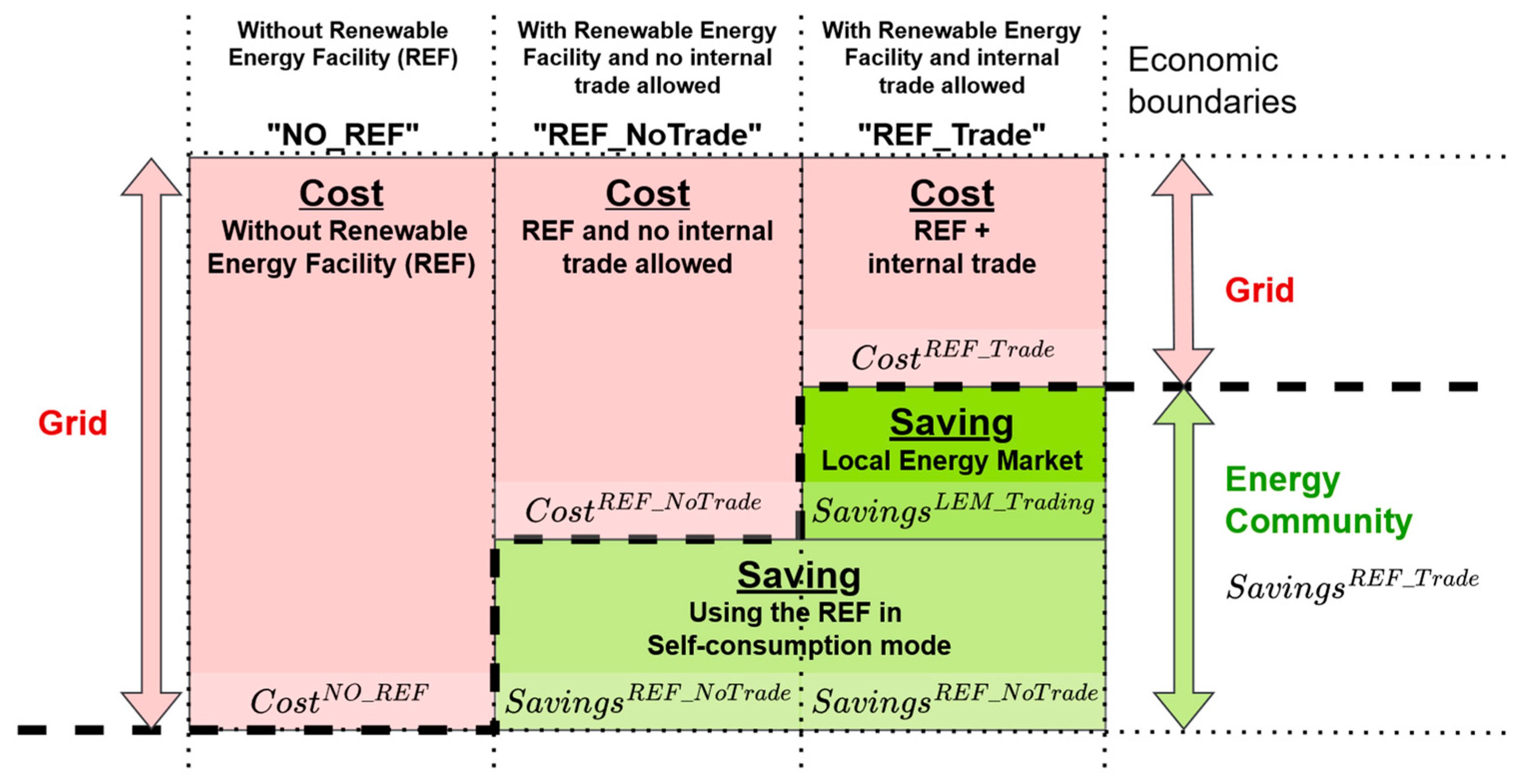
  • No Renewable Energy Facility (NO_REF): In this baseline scenario, the community does not own any renewable generation assets. All electricity demand must therefore be supplied by the wholesale electricity market (i.e., outside the economic boundaries of the EC—see Figure 1 below). Let p b u y , a G r i d denote the electricity purchase price for a given EC member. Then, for each time slot, the total cost incurred by the Energy Community A is given by the following:
C o s t N O _ R E F = a A p b u y , a G r i d · e a c
  • Renewable Energy Facility without internal trading (REF_NoTrade): In this scenario, the community owns a shared Renewable Energy Facility, but internal energy trading among members is not allowed. Each member can only self-consume the renewable energy assigned to them and must interact individually with the grid to cover deficits or export energy excesses. Let p s e l l , a G r i d denote the selling price to the grid. The marginal cost of energy produced by the shared Renewable Energy Facility is assumed to be zero. The community cost becomes the following:
C o s t R E F _ N o T r a d e = a N C p b u y , a G r i d e a c e a g a N P p s e l l , a G r i d e a g e a c
Savings relative to the baseline that arise exclusively from generation and individual self-consumption of renewable energy (i.e., C o s t N O _ R E F C o s t R E F _ N o T r a d e ) depend on the individual alignment between consumption and generation.
  • Renewable Facility with Internal Trading (REF_Trade): Finally, in the most collaborative scenario, the community operates a Local Energy Market that enables internal energy exchanges between NP and NC prior to interacting with the grid. When internal trading is allowed, renewable energy excesses can be transferred from Net Producers to Net Consumers, thereby reducing grid transactions at unfavourable prices (recall that buying prices are higher than selling prices). The resulting community cost is as follows:
C o s t R E F _ T r a d e = C o s t R E F _ N o T r a d e S a v i n g s L E M _ T r a d i n g  
where S a v i n g s L E M _ T r a d i n g are the savings obtained strictly due to internal trading.
This formulation highlights that total savings in an Energy Community originate from two distinct components: savings due to self-consumption of locally generated energy (i.e., S a v i n g s R E F _ N o T r a d e = C o s t N O _ R E F C o s t R E F _ N o T r a d e ) and additional savings generated by internal energy trading (i.e., S a v i n g s L E M _ T r a d i n g =   C o s t R E F _ N o T r a d e C o s t R E F _ T r a d e ), which exploit the price spread between grid purchase and sale tariffs. The latter is the focus of the Local Energy Market and is analysed in detail in the following subsections.
Figure 1 describes schematically the economic boundaries of these three cost scenarios and their relationship between sources of saving.

2.4. Local Energy Market Model and Internal Trading Mechanism

The Local Energy Market was modelled as a centralised community-based peer-to-peer mechanism [29] that facilitated internal energy exchanges among community members within each time slot. The LEM was conceptualised to operate within the regulatory perimeter of Renewable Energy Communities (RECs) and Citizen Energy Communities (CECs), as defined in Directive (EU) 2018/2001 (RED II) [2] and Directive (EU) 2019/944 [3]. In particular, Article 22 of RED II explicitly recognises the right of Renewable Energy Communities to share renewable energy among their members. In this context, the proposed internal market does not replace or interfere with organised European short-term markets (day-ahead, intraday, balancing) but rather operates as an internal settlement mechanism prior to net exchange with the wholesale market. Wholesale prices were therefore treated as exogenous, ensuring compatibility with the existing EU electricity market framework.
The primary objective of the LEM is to maximise the economic savings for the EC members by reallocating the excesses of renewable energy from the Net Producers with the lowest p s e l l , a G r i d to the Net Consumers with the highest p b u y , a G r i d . We assumed that at every time slot, all EC members paid a greater price for buying energy from the grid than the highest price any of them could obtain for selling energy to the grid (i.e., min p b u y , a G r i d > max p s e l l , a G r i d ) . Thus, if Net Producers transferred their excess energy to Net Consumers, the community as a whole could save money.
At each time slot, the total amount of internal energy that can be efficiently traded ( E T r ) is defined by the aggregate excess of Net Producers ( E N P ) and the aggregate deficit of Net Consumers ( E N C ):
e a N C = e a c e a g + ;   E N C = a N C e a N C e a N P = e a g e a c + ;   E N P = a N P e a N P E T r = min E N C , E N P
where x + = max 0 , x .
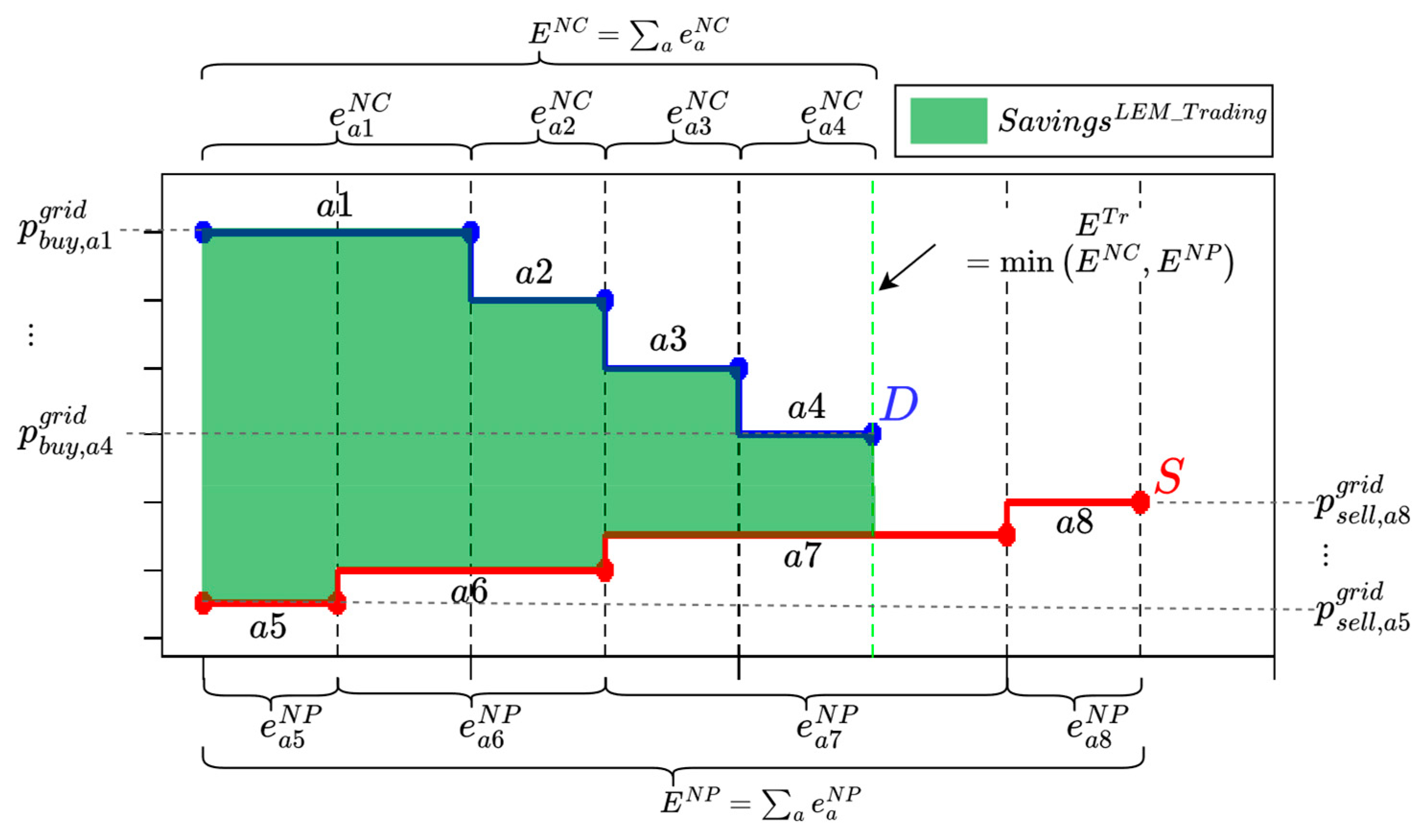
The LEM was assumed to operate efficiently under a market clearing algorithm that guaranteed the maximum feasible savings. Trading was organised at the level of energy units and prioritised by price merit order, allocating units supplied by NPs with the lowest grid selling prices p s e l l , a G r i d to units demanded by NCs with the highest grid buying prices p b u y , a G r i d (see Figure 2). When multiple participants submitted identical prices at the margin and the remaining feasible traded volume was insufficient to fully clear their aggregate supply or demand, the marginal units were allocated proportionally to individual supply or demand. This algorithm is formalised in Appendix A.
Figure 2 shows an example of how a LEM can provide savings through the market clearing mechanism proposed. The figure refers to a specific time slot, in which there are four Net Consumers (a1, a2, a3, a4) and four Net Producers (a5, a6, a7, a8). Note that the set of Net Consumers and Net Producers will generally be different in different time slots depending on energy production and energy consumption patterns.
First, the energy demand and supply functions were computed. The energy demand D p , shown in blue in Figure 2, was formed by the energy requirements of Net Consumers ( e a N C N C ) , considering the maximum price they would be willing to pay for the energy they require ( p b u y , a N C G r i d ) . The energy supply S p , shown in red in Figure 2, was formed by the energy excess of the Net Producers in the time slot e a N P N P , considering the minimum price they would be willing to accept for their energy excess p s e l l , a N P G r i d .
The internal market was cleared using a market-clearing algorithm designed to maximise the total savings (see Appendix A). The amount of trading that maximises the savings for the whole community is E T r = min E N C , E N P , and the maximum total savings that can be achieved is the green area in Figure 2. By clearing the market in this way, the community could save the sum of the differences between p b u y , a N C G r i d and p s e l l , a N P G r i d for the transferred units of energy (see Figure 2). The resulting economic savings generated by the LEM at each time slot is therefore as follows:
S a v i n g s L E M T r a d i n g = 0 E T r D q S q   d q
This surplus represents the maximum benefit that can be achieved through internal trading, regardless of how it is subsequently allocated among participants. Its magnitude depends on three main factors: the availability of renewable energy (defined by the level of renewable penetration), the complementarity of consumption and generation profiles (i.e., coexistence of NCs and NPs and the magnitude of their differences), and the spread between grid buying and selling prices. The specific distribution of the resulting savings among members was determined ex post by the selected cost allocation method.

2.5. Cost Allocation Methods Considered

Once the total economic surplus generated by internal energy trading was determined, the remaining challenge laid in distributing the resulting costs and benefits among community members. This task was performed through a cost allocation method (CAM), defined as an algorithm that assigns to each member a final economic value (cost or benefit) after accounting for self-consumption, internal trading, and grid interaction outcomes.
In this study, only ex post cost allocation methods were considered. That is, allocation was performed once all energy flows and external prices for a given time slot were known. This approach reflects current regulatory and operational practices in most Energy Community implementations and allowed for a transparent separation between surplus generation and surplus distribution.
The CAMs analysed in this work were grouped into three broad families according to our previous work [15,42,52], where the formal definition of the CAMs considered can be found. These families are Simple Rules, Price-Based, and Savings-Based, each one characterised by distinct allocation principles and informational requirements:
Simple Rules are based on predefined allocation schemes, such as equal sharing or proportional allocation based on consumption or ownership shares. They are typically easy to implement and transparent, but they may fail to reflect individual marginal contributions to surplus generation under heterogeneous conditions. Within the Simple Rules family, we considered the Bill-Sharing (BS) allocation method [53,54]. BS uses the community’s net energy balance to determine the allocation of costs and revenues. When total generation exceeds total consumption, surplus energy is sold to the grid, and revenues are distributed among NPs in proportion to their individual overproduction. Conversely, when consumption exceeds generation, the cost of grid imports is shared among NCs according to their overconsumption. As BS allocates costs and benefits considering the EC net balance, NPs are assumed to give their excess energy for free to NCs, reducing NP benefits.
Price-Based methods settle internal energy exchanges using an internally defined transfer price, which is usually linked to wholesale electricity market prices. Costs are allocated by valuing internally traded energy at this transfer price. These methods may lead to uneven surplus distribution when participants face different external prices. The price-based method used in this study, which we denoted PB, set the transfer price at each time step to the average between the minimum grid buying price among all NCs who traded in the LEM and the maximum grid selling price among all NPs who traded in the LEM.
Savings-Based methods explicitly distribute the total surplus generated by the LEM, S a v i n g s L E M _ T r a d i n g , among participants according to predefined criteria, such as the volume of energy traded or ownership shares. Inside this family, we also considered game theory (GT) methods, which model the Energy Community as a cooperative game in which members form coalitions to generate economic value. In GT methods, surplus is allocated according to criteria based on widely known solution concepts such as the Shapley Value or the Nucleolus, which aim to capture some notion of fairness or stability. While these methods provide strong theoretical guarantees, their practical applicability may be constrained by computational complexity. Within this family, several methods were considered:
  • Proportional to Traded Energy (PTE): the total surplus generated by internal energy trading is distributed among participants according to their contribution to the energy traded volumes in the LEM.
  • Nucleolus (NUC) [16]: this allocates the surplus by minimising the maximum dissatisfaction across all coalitions, thereby ensuring strong coalitional stability properties.
  • Shapley Value (SV) [17]: surplus is distributed based on the average marginal contribution of each participant across all possible coalitions.
This classification provides a structured basis for systematically comparing allocation mechanisms with fundamentally different design philosophies under a unified evaluation framework.

2.6. Evaluation Dimensions for Cost Allocation Methods

This study adopted a pragmatic, outcome-oriented evaluation approach focused on dimensions that were directly observable and relevant for the operation of real-world ECs. The aim was to characterise how different allocation mechanisms behave under realistic conditions.
Building on previous work [15], we analysed in detail the compliance of a key property, i.e., beneficial individual participation, which implies that members of the EC are never worse off inside the community than outside. To be precise, let c o s t a , t C A M denote the final cost allocated to member a at time t after under a given CAM, and let c o s t a , t R E F _ N o T r a d e denote the corresponding reference cost incurred by the same member when operating independently. Beneficial individual participation occurs when c o s t a , t C A M c o s t a , t R E F _ N o T r a d e for all agents at all times. Here, rather than treating this condition as a purely binary criterion, we explored the extent and frequency of deviations across scenarios and configuration parameters.
In addition, we examined distributional outcomes between the two main market roles—Net Consumers (NCs) and Net Producers (NPs)—by analysing how the total surplus generated by the EC was shared between these groups.
Finally, computational feasibility was treated as a practical evaluation dimension. Execution times were measured as a function of community size to assess scalability and to distinguish between methods that are suitable for repeated, time-resolved deployment and those whose applicability is limited to small communities due to computational constraints.
Together, these evaluation dimensions provide a coherent basis for comparing cost allocation methods in terms of economic outcomes, incentive patterns, and practical applicability.

2.7. Methodological Framework and Evaluation Procedure

The analytical framework described in the previous sections was implemented as a piece of software, which is freely available at Supplementary Material [55], together with instructions on how to use it. The software was organised into three main functions. First, a data introduction function processed time-series data on electricity consumption, renewable generation production, and external market prices. These inputs were used to construct the energy balances of community members and to determine their roles as Net Consumers or Net Producers at each time slot.
Second, a savings quantification function computed community-level costs under the different scenarios defined in Section 2.3 and quantified the potential savings attributable to self-consumption and internal energy trading. The Local Energy Market’s clearing algorithm described in Section 2.4 and Appendix A was executed here and determined the maximum feasible internal exchange and the maximum economic surplus.
Third, cost allocation methods were applied to distribute costs and benefits among community members. Methods from different families of allocation mechanisms were considered, including the bill-sharing simple rule (BS), a price-based method (PB), and three savings-based methods (PTE, NUC, and SV), allowing direct comparison under identical operating conditions.

2.8. Simulation Design and Datasets Utilised

The proposed framework was validated through a combination of simulations based on synthetic datasets as well as real-world data. This dual approach allowed for controlled exploration of parameter effects while ensuring empirical relevance.
Synthetic datasets were generated to represent specific conditions of Energy Communities, considering a set of controlled features. Key parameters varied and included renewable penetration levels, consumption–generation profile complementarity, electricity price spreads, and community size. These datasets enabled isolation of specific mechanisms and facilitated interpretation of causal relationships.
Real-world simulations were conducted using existing datasets where measured electricity consumption profiles and historical market price data were recorded. Several years and community configurations were considered to capture temporal variability and heterogeneity among participants. Both uniform-price and heterogeneous-price scenarios were analysed to assess the robustness of allocation methods under realistic conditions.
Across all simulations, the same workflow was applied, ensuring consistency and reproducibility of results. Performance metrics included community savings, individual cost outcomes, and computational execution times. This design enabled a comprehensive evaluation of both economic performance and practical feasibility.
To this end, particular attention was paid to computational feasibility, which was treated as a practical constraint rather than a purely theoretical property. For each cost allocation method, computational performance was assessed by measuring execution times as a function of community size. This allowed for the identification of scalability limitations and the distinction between methods that are suitable for real-world deployment and those that remain primarily of theoretical interest. In this sense, complexity was analysed empirically based on observed runtimes.

3. Result Overview and Assessment Strategy

The results presented in this section are derived directly from the implementation of the methodological framework presented in Section 2. First, we examine the behaviour of the Energy Community under controlled synthetic scenarios; then, we apply the framework to real-world data to validate the robustness of the observed patterns under more realistic operating conditions.
Across both synthetic and real-data simulations, the results are reported along three complementary dimensions. The first dimension concerns community-level performance, measured in terms of total economic savings. The second dimension focuses on individual-level outcomes, analysing how costs and benefits are distributed among members under different cost allocation methods. The third dimension addresses practical considerations, examining patterns in allocation outcomes and the computational feasibility of each method as community size increases.

3.1. Results from Synthetic Data Simulations

This subsection reports the results obtained from simulations based on synthetic datasets, which are designed to isolate the fundamental mechanisms governing economic savings in Energy Communities. By controlling key parameters independently, these simulations allow for a systematic assessment of causal relationships that may be hidden in real-world data.
In this paper, we explore in greater detail the results of our previous work [52], where the same synthetic datasets for consumption and generation profiles were used but with less granularity. In that previous work, we can find the generation data sources and the numerical values of the synthetic consumption profiles. As an added value, in the present paper, we explore a deeper degree of variation, with a higher level of granularity in the heterogeneity of profiles, and we introduce the new dimension of price variation.

3.1.1. Synthetic Dataset Description

The synthetic data employed in this section are designed to represent realistic Energy Community configurations but enable controlled exploration of the mechanisms driving internal energy trading and economic savings. Synthetic datasets are used to isolate the effect of key parameters while avoiding misleading factors typically present in real-world data. Admittedly, these profiles are not particularly realistic, but this does not affect the validity of the results, as our objective here is to compute savings under controlled conditions rather than to replicate a specific real-world case.
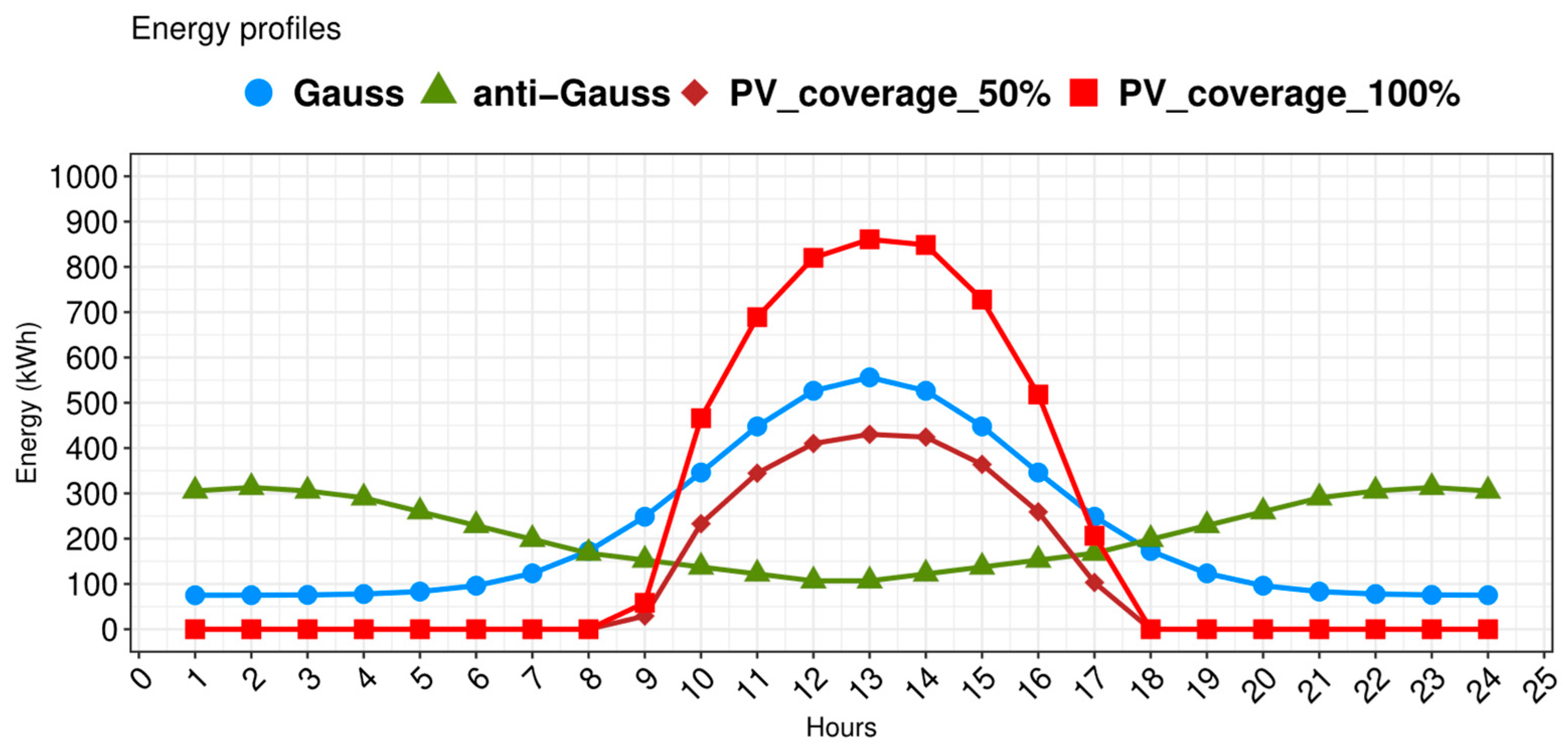
Electricity consumption profiles are generated on purpose for a fixed number of community members and follow predefined daily patterns intended to capture different degrees of temporal alignment with renewable generation. As shown in Figure 3, two profiles are considered: one aligned with typical photovoltaic generation patterns (i.e., Gauss—G) and another temporally shifted to represent an opposite demand behaviour (i.e., anti-Gauss—aG). These profiles are constructed to preserve identical total daily consumption while differing only in their temporal distribution, thereby allowing the analysis to focus on the role of the alignment between energy consumption and generation. To model the variation in complementarity of profiles, we modify the proportion of one profile relative to the other, establishing the more heterogeneous scenario in which there is the same amount of them (i.e., 50% Gauss/50% anti-Gauss).
Renewable energy generation is based on a reference photovoltaic yearly production profile obtained from standardised sources [56] and scaled to represent different levels of renewable penetration relative to total EC demand. The renewable energy profile is generated by obtaining an hourly annual photovoltaic generation profile whose total annual energy generated matches the percentage of penetration level expressed.
Penetration levels, which are denoted by parameter G = E A g / E A c , are varied systematically across a wide range (from 0% to 200%) to capture different regimes. Figure 3 shows an example of underproduction for a penetration level of 50% (i.e., the total amount of energy generated during the year E A g corresponds to the 50% of the total annual demand E A c —see Figure 3. PV_coverage_50% curve) and an example of overproduction for a penetration level of 100% (see Figure 3. PV_coverage_100% curve)
Electricity prices are assumed to be constant within each simulation scenario (i.e., as a fix-price tariff) and are defined through a pair of exogenous buying and selling prices. These prices are computed based on the annual average wholesale electricity price of the Spanish electricity market (OMIE) [57] between 2020 and 2024 and are subsequently introduced to represent simplified retail buying and selling conditions. Also, all agents have the same buying and selling prices (i.e., p b u y , a G r i d = p b u y G r i d ;   p s e l l , a G r i d = p s e l l G r i d   a A ). This assumption is introduced to isolate the effect of the price spread and to avoid additional heterogeneity unrelated to the allocation mechanisms. The price spread between these two values (i.e., p b u y G r i d   p s e l l G r i d ) is treated as a key control parameter, reflecting the economic incentive for internal energy trading. Multiple spread values are analysed to assess the sensitivity of savings to market conditions.
Simulation scenarios are generated through a systematic variation of the main configuration parameters of the Energy Community with the following procedure:
  • A fixed community size of 10 members is considered. Then, demand heterogeneity is modelled through five different combinations of the Gauss (G) and anti-Gauss (aG) consumption profiles. The following profiles have been tested: 90% G/10% aG, 70% G/30% aG, 50% G/50% aG, 30% G/70% aG, and 10% G/90% aG.
  • Renewable energy penetration (G) is varied across 51 discrete renewable penetration levels, ranging from 0% to 200% of total community consumption.
  • Electricity price spread is explored through six price spread levels, ranging from 0.01 to 0.5, with 0.1 increments. These spreads are further varied across four branches that capture different combinations of grid buying and selling price values, maintaining the overall spread range while employing different sell-to-buy ratios (i.e., p s e l l G r i d / p b u y G r i d ).
The full factorial combination of these parameters results in a total of 6120 synthetic simulation scenarios (i.e., 5 Gauss/anti-Gauss demand heterogeneity scenarios × 51 renewable penetration options × 6 price spread levels × 4 branches of buying and selling price values, maintaining the overall spread), ensuring a comprehensive and robust exploration of the synthetic parameter data span.

3.1.2. Origin and Composition of Economic Savings

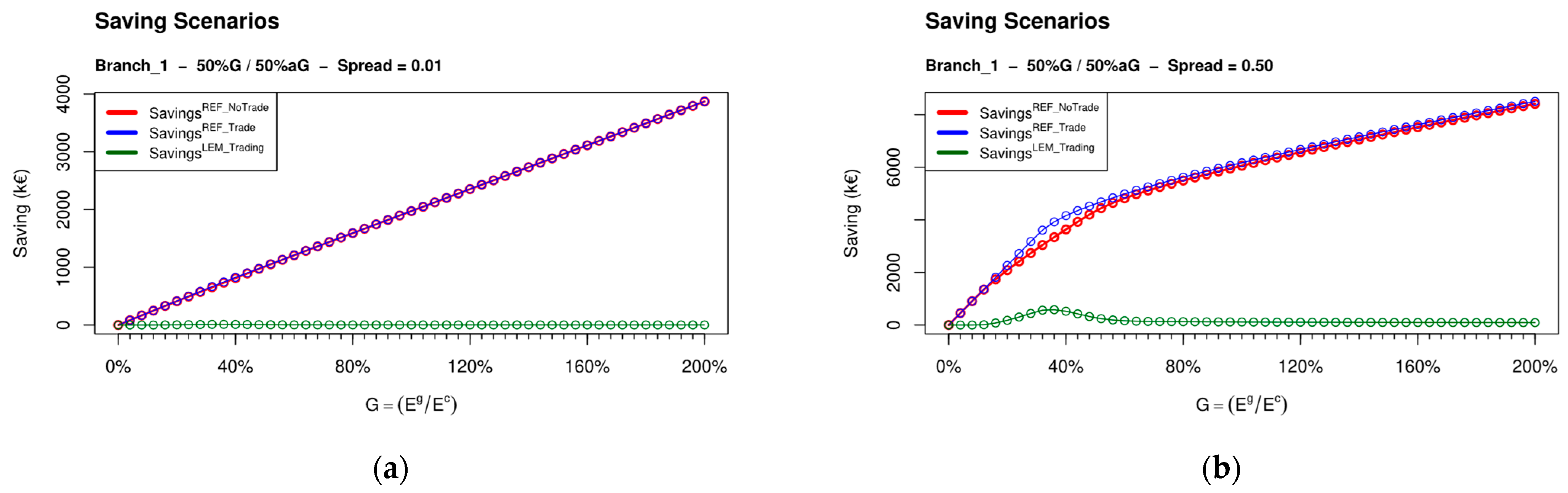
Across all simulated scenarios, we conclude that total community savings increase monotonically with renewable penetration and price spread (i.e., p b u y G r i d     p s e l l G r i d ). However, the marginal rate of increase diminishes at higher penetration levels, especially as price spread grows (see Figure 4b). This behaviour reflects the saturation of self-consumption opportunities, as locally generated energy increasingly exceeds the coincident demand profile.
The local maximum observed in the LEM savings (i.e., green curve, see Figure 4b) indicates where the savings generated by the LEM are maximised, which occurs at moderate renewable penetration levels (in the figure, around 30–40%). Moreover, when comparing the two green curves (see Figure 4a,b), it is evident that the magnitude of this local maximum is strongly conditioned by the price spread, which acts as a multiplying factor that conditions the economic value of internal trading.
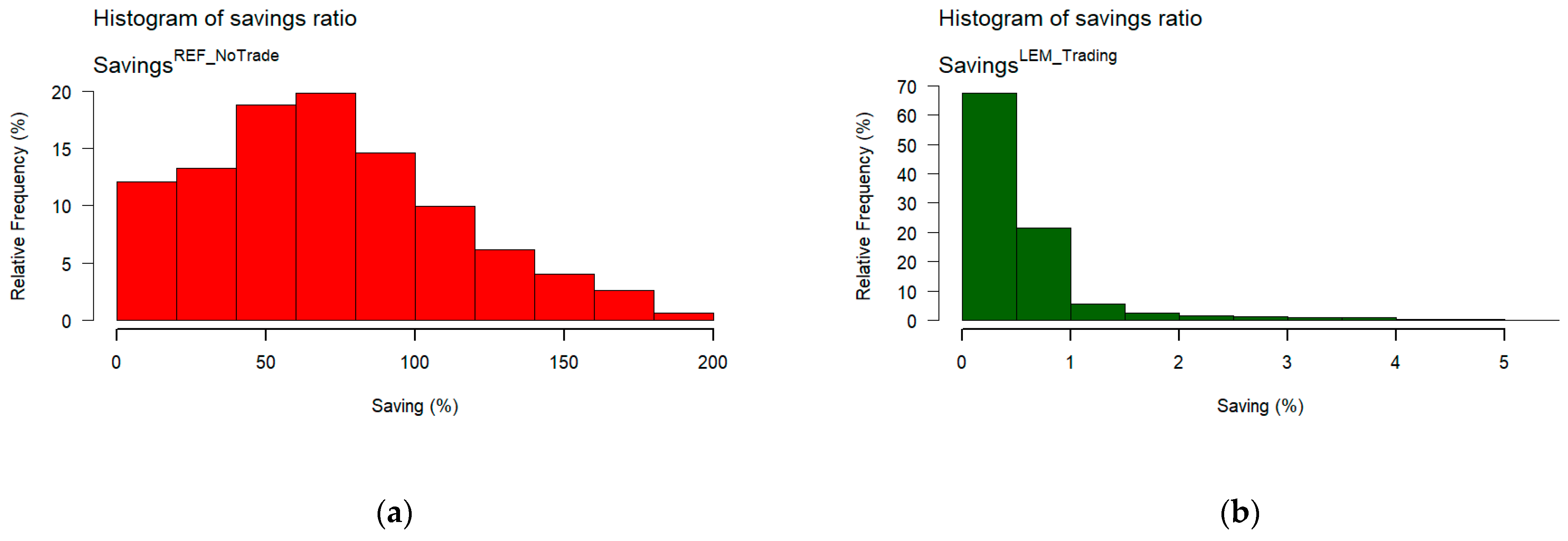
Savings are primarily driven by individual self-consumption of renewable energy, which accounts for the largest share of total economic benefits in most scenarios (see Figure 5a). Internal energy trading contributes an additional surplus, but its magnitude is lower and strongly dependent on the coexistence of Net Consumers and Net Producers within the same time slots. As a result, only under certain specific conditions (mainly at intermediate levels of renewable penetration—see Figure 6), the internal trading is maximised. Naturally, internal trading is never detrimental (i.e., always non-negative).
It should be noted that the scale of the horizontal axis in Figure 5 differs significantly between the two histograms. This difference in scale highlights the smaller magnitude of savings attributable exclusively to internal trading ( S a v i n g s L E M _ T r a d i n g ) compared to those achieved through individual self-consumption ( S a v i n g s R E F _ N o T r a d e ). Therefore, while internal trading generates positive savings, its absolute contribution is considerably lower than that of self-consumption, as visually corroborated by the different scale ranges in both panels. Then, the key implication is to prioritise and promote those ECs in which the structural conditions allow internal trading to generate meaningful additional savings.
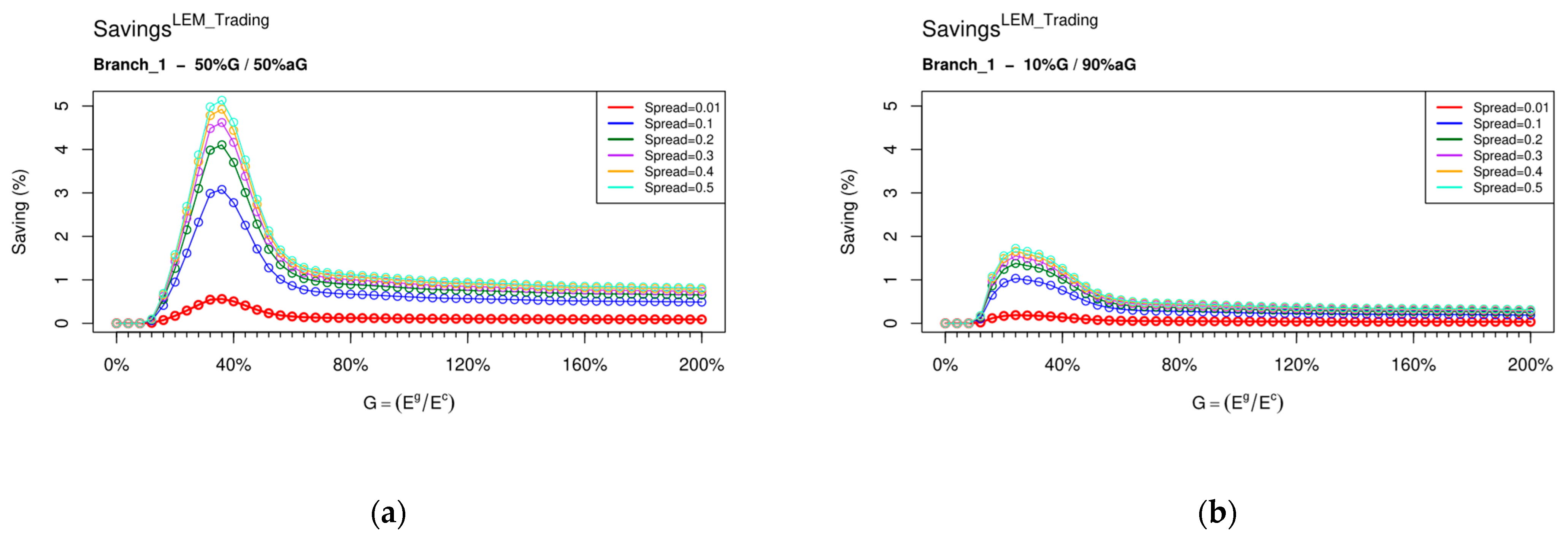
The results shown in Figure 6 show the magnitude of the savings due to internal trading for different price spreads under two demand heterogeneity scenarios. When this spread is small, the contribution of the Local Energy Market to total savings becomes negligible. Conversely, larger spreads significantly amplify the economic value generated through internal exchanges, even when the volume of traded energy remains limited (see Figure 6b).

3.1.3. Effect of Profile Complementarity

Complementarity of profiles emerges as a critical determinant of the potential of internal energy trading. Energy Communities with heterogeneous consumption profiles (see Figure 6a, characterised by high heterogeneity) exhibit substantially higher levels of internal energy exchange compared to homogeneous communities (see Figure 6b, characterised by low heterogeneity due to predominance of one type of profile) at the same spread level. Heterogeneous configurations consistently outperform homogeneous scenarios in terms of internal trading volume and associated economic surplus, even when total energy consumption remains unchanged.
This result highlights that total energy consumption and demand are not sufficient indicators of Energy Community performance. Instead, the temporal structure of demand plays a decisive role in unlocking the value of internal trading.

3.1.4. Sensitivity to Renewable Penetration and Price Spread

The interaction between renewable penetration and price spread reveals a non-linear relationship. At low penetration levels, savings are limited by the availability of locally generated energy. Meanwhile, at high penetration levels, savings become constrained by insufficient internal demand to absorb energy generation excess. Between these two extremes, an intermediate penetration range maximises both internal trading volume and the marginal contribution of the Local Energy Market (see Figure 6).
Furthermore, price spread acts as a scaling factor on this mechanism. For a given penetration level and heterogeneity configuration, higher spreads magnify the economic impact of internal trading without altering the underlying energy flows. This observation suggests that Energy Communities operating under volatile or high-spread price regimes may derive significant benefits from well-designed internal markets.
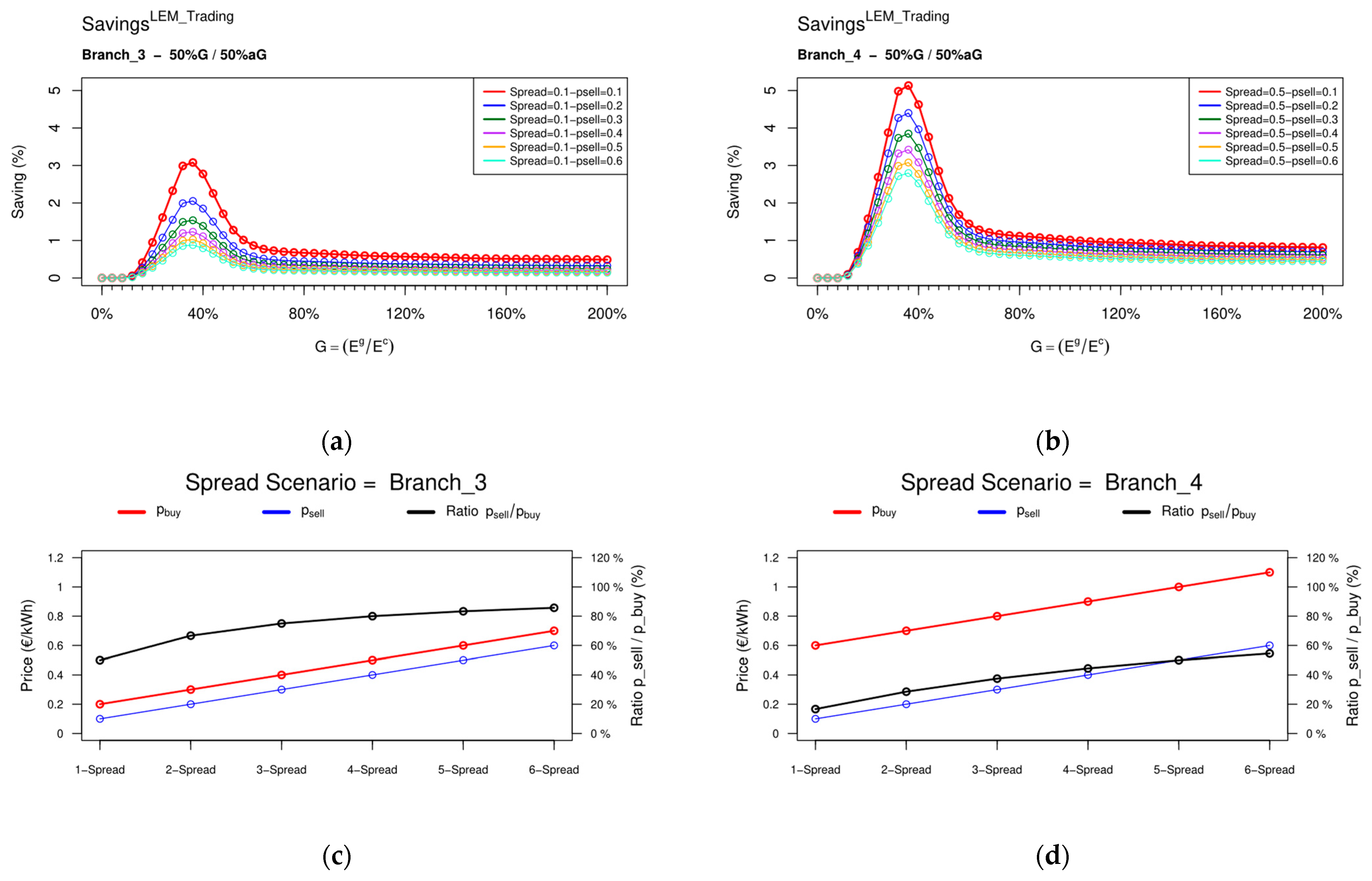
In detail, synthetic simulations indicate that the sell-to-buy ratio (i.e., p s e l l G r i d / p b u y G r i d ) is also a key determinant of the economic value generated by internal energy trading in Energy Communities. For a given price spread, as this ratio decreases (see Figure 7d), the potential surplus generated by the LEM is enhanced (see Figure 7b). In addition, when the sell-to-buy approaches unity (see Figure 7b), the economic incentive for internal trading decreases (see Figure 7a) since exporting surplus energy to the grid yields revenues comparable to those achieved through internal exchanges. In contrast, lower values of this ratio significantly amplify the marginal benefit of internal trading.
These results show that the effectiveness of Local Energy Markets is highly sensitive to price spread and that internal trading delivers its highest relative value in regulatory or market contexts characterised by low compensation for grid exports relative to external market purchase prices (i.e., high price spread with the lowest possible sell-to-buy ratio).

3.1.5. Summary of Key Findings from Synthetic Data Simulations

The synthetic data simulations presented in the previous subsections provide a controlled environment to disentangle the mechanisms driving economic performance in Energy Communities. By systematically varying renewable penetration levels, consumption profile complementarity, and electricity price spreads, these experiments allow for the identification of robust patterns that are largely independent of specific dataset assumptions. The main findings derived from this analysis are summarised in Table 1.
Overall, the results obtained from synthetic data confirm that the economic value generated by Local Energy Markets within Energy Communities is never detrimental and is governed by a small number of structural factors rather than by specific numerical configurations. While self-consumption remains the dominant source of savings, internal energy trading can provide non-negligible additional benefits when renewable penetration, demand heterogeneity, and price spreads conditions are appropriate. These insights motivate the subsequent analysis based on real-world data, which examines the extent to which the patterns observed under controlled conditions persist in practical Energy Community deployments.

3.2. Results from Real-World Data Simulations

This section reports the results obtained from simulations based on real-world electricity consumption profiles and historical market price data. Unlike the synthetic scenarios analysed in Section 3.1, real-data simulations introduce additional sources of intrinsic heterogeneity, including diverse demand distributions, time-varying prices, and different community sizes. The purpose of this analysis is to assess the robustness of the previously identified patterns under realistic operating conditions.

3.2.1. Real-World Dataset Description

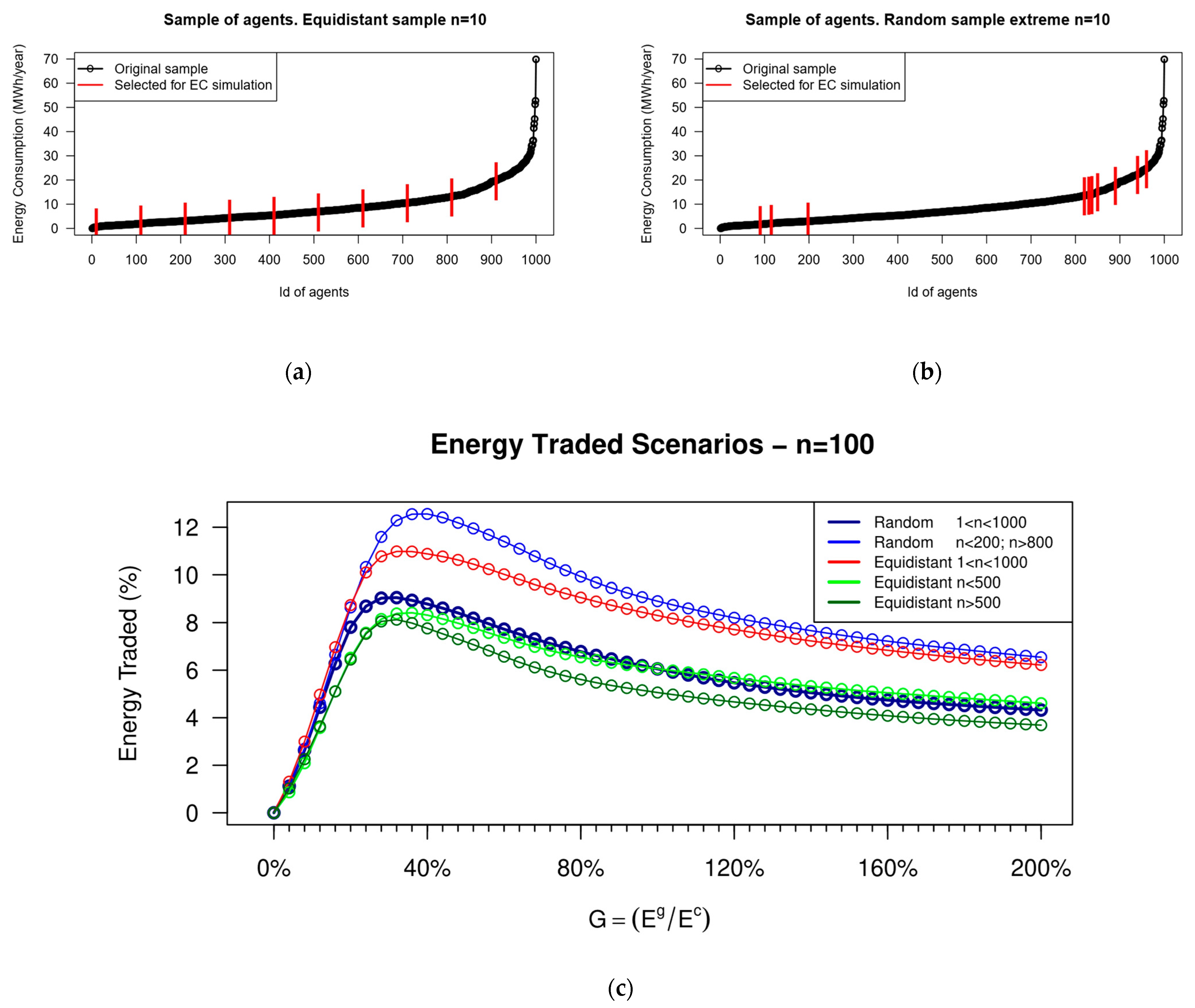
The datasets considered consist of measured electricity consumption profiles from real users, combined with historical electricity market price data. Electricity consumption data correspond to a large dataset of 1000 end-users and are provided with a temporal resolution consistent with market settlement intervals of 15 min [58]. Individual consumption profiles exhibit substantial heterogeneity in both magnitude and temporal structure, reflecting differences in user behaviour and activity schedules (i.e., household, services and industry, among others). These profiles are aggregated to construct different Energy Community configurations of varying size and composition by using different sampling methods. This sample, ordered by yearly total consumption, has a distribution that seems to follow a power law and exhibits high heterogeneity. We see that most users consume little energy, while a minority concentrates a large share of the overall consumption. This feature allows us to analyse relevant phenomena such as profile complementarity together with demand, providing a realistic and representative scenario of many existing energy networks with multistakeholder ECs.
Renewable energy generation is modelled using photovoltaic production profiles derived from reliable and recognised data sources such as PVGIS [56]. These profiles are scaled to represent different energy renewable availability levels with respect to total community demand ( E A c ) through the renewable penetration ratio G (i.e., G = E A g / E A c ), enabling the analysis of underproduction, balanced, and surplus-dominated regimes within a realistic temporal framework.
Electricity prices are obtained from historical data that belong to the Spanish electricity market [57], including both buying and selling prices across several years. Unlike the synthetic scenarios, prices vary over time and may differ across EC members, introducing additional complexity and allowing for the assessment of internal energy trading under fluctuating market conditions. This variability is particularly relevant for evaluating the impact of price asymmetries on economic savings and studying the impact of different real-world events (i.e., old-fashioned market trends, transition scenario to renewable energies, geopolitical energy crisis, etc.) and their impact on real electricity price schemes.
By combining real consumption data, realistic renewable generation profiles, and time-varying electricity prices, the datasets used in this section provide a representative and empirically grounded basis for assessing Energy Community performance and for testing the practical behaviour of cost allocation methods.
Real-world simulation scenarios are generated through a more complex parameter variation than synthetic datasets, with the following varying dimensions:
  • Community size (n) will vary between 10, 100, and 1000 members. Here, profile heterogeneity is tuned by five different sampling procedures that vary the areas from which we take EC members from the 1000-agent power-law distribution dataset. Sampling strategies include random sampling across the full population, sampling focused on the extremes of the consumption distribution to increase the presence of high-demand agents, and equidistant sampling to ensure uniform coverage of the population. Additional equidistant strategies are applied separately to low- and high-consumption subsets, enabling the analysis of communities dominated by different demand levels.
  • Renewable energy penetration (G) is varied across 51 renewable penetration discrete levels, ranging from 0% to 200% of total community consumption in the same way as in the synthetic data section.
  • Electricity price structure is explored through the Spanish wholesale electricity market prices from 2020 to 2024, representing different price spread distributions. To assess the impact of price heterogeneity, two pricing scenarios are considered: an “equal-price” scenario, where all agents face identical hourly electricity prices, and a “different-price” scenario, where individual prices differ within the same time slot. The latter is constructed using a controlled and realistic price dispersion, reflecting market-based EC configurations and preserving consistent buy–sell price spreads (i.e., we have multiplied the individual prices considered on the “equal-price” scenario by the vector of N elements where the i-th element is 0.5 + (i − 1)/(N − 1), with i ∈ [1, N]). This approach allows us to introduce a structured range of prices that captures the variability observed in real electricity markets, while adapting it to a simulated context in which different users within the EC may face heterogeneous retail conditions. The scaling mechanism therefore provides a controlled representation of intra-community price dispersion, preserving market realism without compromising analytical consistency.
Given these test conditions, dozens of combinations can be created. This experiment design yields a total of 7650 scenarios (i.e., 3 community sizes × 5 sampling procedures × 51 renewable penetration options × 5 yearly price references × 2 pricing scenarios), which are analysed using a set of predefined performance evaluation indicators. Due to the extensive amount of generated data, this section focuses on the most relevant results.

3.2.2. Community-Level Savings and Internal Trading

Across all real-data scenarios, total community savings remain positively correlated with renewable penetration, although the relationship is markedly non-linear. As observed in synthetic simulations, savings increase rapidly at low penetration levels and exhibit diminishing marginal gains as penetration rises (see Figure 4). This behaviour is consistently reproduced across different years and price regimes.
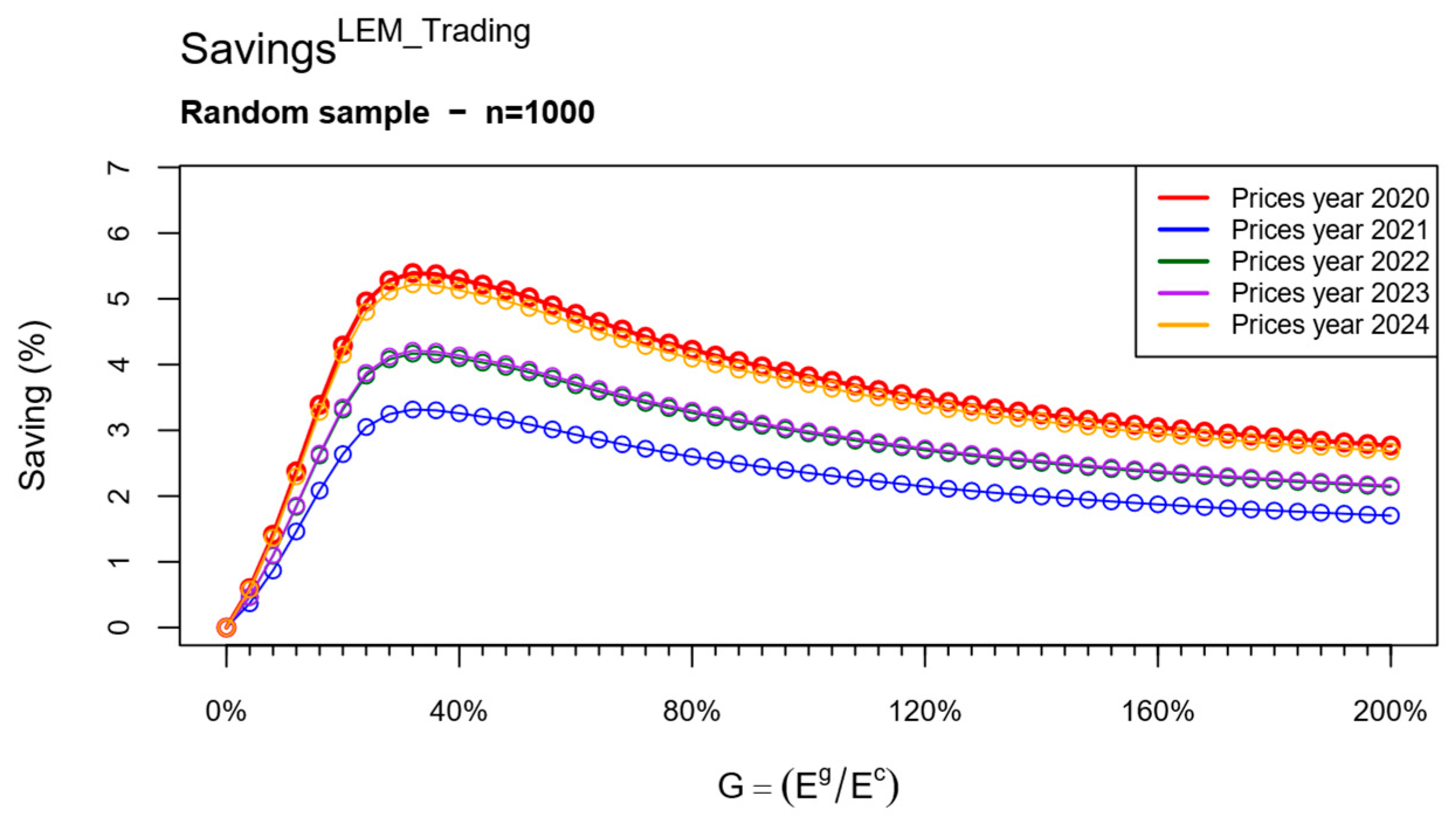
Internal energy trading contributes positively to total savings whenever NC and NP coexist within the same time slots. The magnitude of this contribution is strongly influenced by electricity price spreads as well as the sell-to-buy ratios, which vary substantially across different year samples. Specifically, the average sell-to-buy ratio for the yearly price sample is 0.455 (year 2020), 0.661 (2021), 0.581 (2022), 0.583 (2023), and 0.483 (2024). Figure 8 shows how periods characterised by low sell-to-buy ratio (years 2020 and 2024) exhibit higher gains from internal trading, while the smallest savings are seen in the 2021 price sample, which exhibited the highest ratio of the sample.
These results confirm that the economic relevance of Local Energy Markets cannot be inferred solely from energy volumes. Instead, market conditions play a decisive role in translating internal exchanges into money savings.

3.2.3. Effect of Community Size and Demand Heterogeneity

Real-data simulations allow for the exploration of Energy Communities of different sizes, ranging from small groups of households to large collectives with hundreds or thousands of members with different backgrounds (i.e., household, retail, or industry). The results show that larger communities generally exhibit greater potential for internal trading due to increased demand heterogeneity and a higher likelihood of coincident energy excess and deficit events.
However, size alone does not guarantee improved performance. Synthetic simulations showed that ECs dominated by homogeneous consumption profiles tend to exhibit limited internal trading, regardless of scale. In the real datasets, it is worth mentioning the effect of the presence of a small number of large consumers (i.e., consumer acting as “demand sinks”), which significantly enhances the capacity of the community to absorb excess renewable generation, thereby extending the effective range of internal trading at higher renewable penetration levels.
In the simulations, consumption heterogeneity is modulated by the sampling method from the 1000-consumer dataset, which seems to follow a power-law distribution. Greater consumer diversity and a higher probability of demand sinks are more likely to occur when members from the right side of the distribution join the community (i.e., those that are scarce but have high consumption).
These findings reinforce the importance of participant composition and profile diversity as key determinants of Energy Community performance.
Figure 9 shows how the sampling method can model the appearance of demand sinks.

3.2.4. Validation of Synthetic Trends Under Real Conditions

To sum up, a central outcome of the real-data analysis is the confirmation of the qualitative trends identified in synthetic simulations, the following in particular:
  • Internal trading is maximised at intermediate renewable penetration levels.
  • Price spreads act as an important weighting factor to transform energy traded into LEM-related savings.
  • Demand heterogeneity amplifies the economic value of cooperation.
While absolute savings levels differ across datasets and years, the persistence of these patterns demonstrates that the conclusions identified in Section 3.1 are robust.
It is also worth noting that the observed trend that total savings are predominantly driven by self-consumption rather than by internal market exchanges is maintained. Nevertheless, when real-world data are considered, the range of savings attributable to the LEM is broader, reaching values of up to 7% (2.54% on average) compared to a previous maximum of 4.5% (0.5% on average) with synthetic data. This clearly evidences the positive effect of demand heterogeneity and the presence of demand sinks, leading to a key conclusion: under appropriate conditions, the economic contribution of an internal market within an Energy Community is meaningful, albeit quantitatively modest.
This consistency provides a solid empirical basis for evaluating cost allocation methods under realistic conditions, which is addressed in the following section.

3.3. Allocation Outcomes and Computational Feasibility

This section examines the behaviour of cost allocation methods when applied to the savings generated in real-world Energy Community scenarios, with an emphasis on the practical implications of allocation outcomes under different operating conditions. Rather than focusing solely on formal property compliance, the analysis explores in detail how CAMs respond to varying price structures, the resulting patterns of beneficial participation, and the differentiated impact on NC and NP. Particular attention is also paid to the interaction between price heterogeneity and allocation outcomes as well as to the computational feasibility of the methods under realistic community sizes.

3.3.1. Graphical Representation of Data Simulations

In this section, we explain how the results of the experiments described in Section 3.2 are presented. This section corresponds to an extension of our previous work in [42], where a reduced version of the Energy Community’s economic performance parameters was calculated. In this paper, we have taken advantage of that framework, expanding the variability of scenarios and the number of parameters analysed and represented in the graphs.
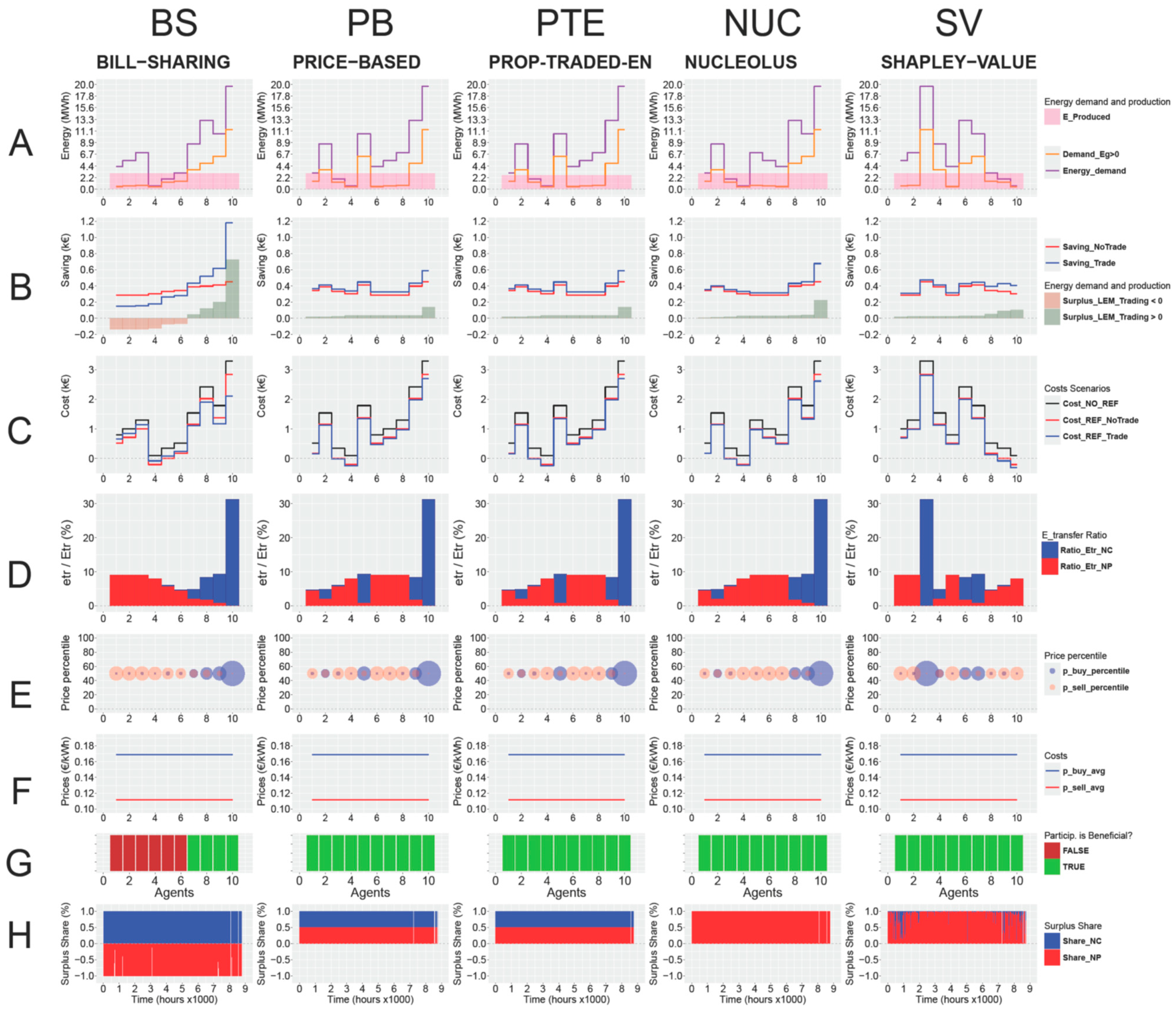
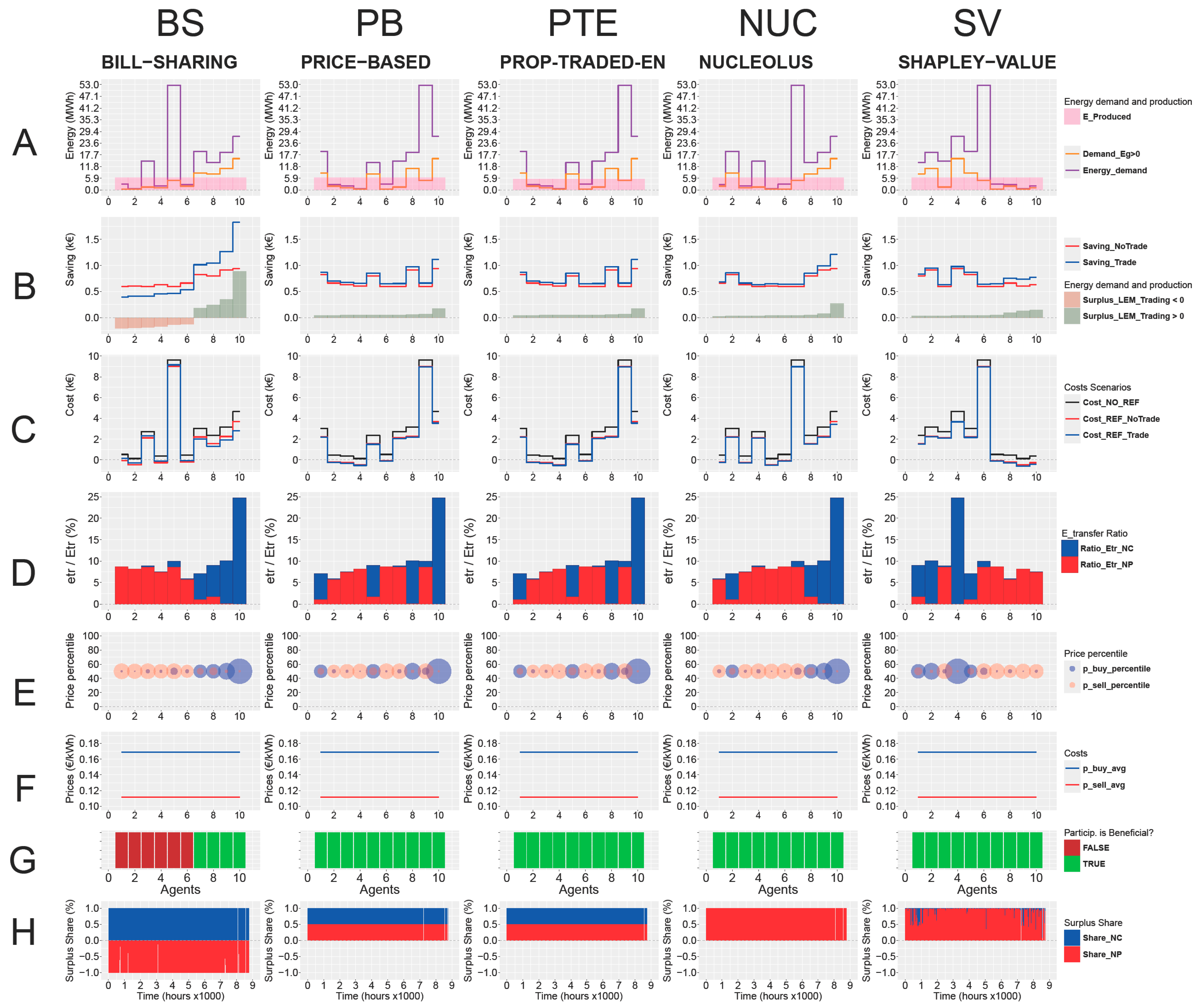
To do this, simulation results of the different configurations of Energy Community are depicted in template figures like Figure 10. These figures have been created as 8 × 5 matrices, where each column is dedicated to a specific allocation method explained in Section 2.5 (i.e., BS, PB, PTE, NUC, and SV), while each row (denoted with letters from A to H) represents different evaluation aspects of the EC performance. For each allocation method (column), agents are plotted in increasing order by their LEM savings values (see Figure 10B, Surplus_LEM_Trading curves). We represent the following:
A.
For each agent, the yearly amount of energy consumed (energy demand), together with the consumption during energy production hours (demand Eg > 0), is represented. We depict also the total amount of energy generated that is assigned to them (E_produced). The figures for different methods differ only in the ordering of the agents.
B.
Total annual savings are reported for each agent under different cost scenarios, distinguishing savings due to self-consumption without internal trading (Savings_NoTrade), aggregated savings with trading (Savings_Trade), and their specific allocation of the economic surplus generated by the LEM (Surplus_LEM_trading).
C.
Individual annual cost curves are compared across the three cost scenarios defined in Section 2.3.
D.
The share of energy traded internally by each agent is quantified, differentiating between energy traded by each agent in the role of NP (red bar) and NC (blue bar). Since these quantities are independent of the cost allocation methods, the figures for different methods differ only in the ordering of the agents.
E.
Agents’ buying and selling prices are characterised through percentile rankings, weighted by their level of participation in the internal market (i.e., energy traded).
F.
Average annual buying and selling prices are computed for each agent, providing a summary of price heterogeneity across participants.
G.
Individual participation in the internal market is classified as beneficial or non-beneficial based on the sign of net savings (Row B, Surplus_LEM_trading).
H.
Hourly time series of the share of internal market savings are analysed to examine how benefits are distributed over time between Net Consumers and Net Producers.
Figure 10 represents an example of the chart template explained above, corresponding to an EC configuration of 10 members, with an equidistant sampling over the 1000-agent dataset, taking as reference 2021 prices (implemented through the “equal-price” scenario) and considering a renewable penetration ratio of 40%.
Based on this template chart, we have examined the results of data simulations, extracting a series of general insights that are relevant for the majority of the data scenarios.
First, the representation of consumption and the NC/NP roles (see Figure 10A,D) exhibits a direct correlation between solar-hour consumption (row A—orange curve) and assigned renewable energy (row A—pink bar). The chart shows that when solar consumption falls below assigned renewable energy, the participant behaves predominantly as a Net Producer and vice versa. Notably, for Net Consumers to capture a very high share of transferred energy (see Figure 10D), they must have very large energy demand during solar production hours.
Second, regarding the cost structure (see Figure 10B,C), the curves in row B (Savings) correspond to the differences between the curves in row C (Costs). As shown earlier, the greatest saving arises from self-consumption (i.e., difference between the Cost_NO_REF and Cost_REF_NoTrade curves). When allowing for internal energy trading, additional savings may typically arise, but much smaller. For community members to benefit from participation, their Cost_REF_Trade must be lower than the Cost_REF_NoTrade curve. Thus, the positive or negative impact on each member’s costs is visible in row B (with green bars denoting savings, and red bars indicating losses) and more explicitly in the beneficial participation chart (see Figure 10G). To analyse cost behaviours in greater detail, we also include information about the price structure (see Figure 10E,F). In the “equal-price” scenario, these charts offer little additional information since all agents face the same prices. However, this scenario will allow us to observe hidden behaviours about the price dynamics within the “different-price” scenario.
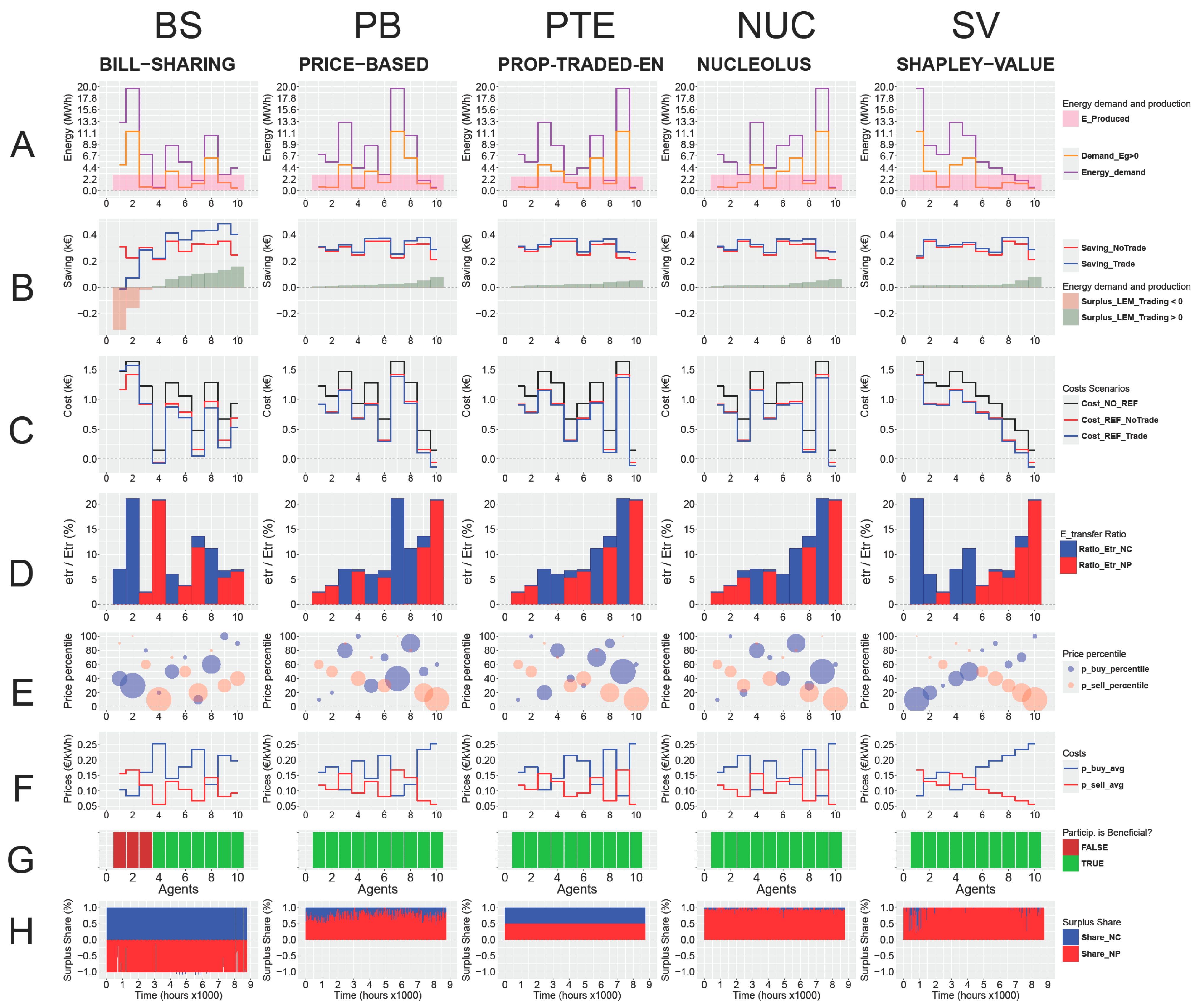
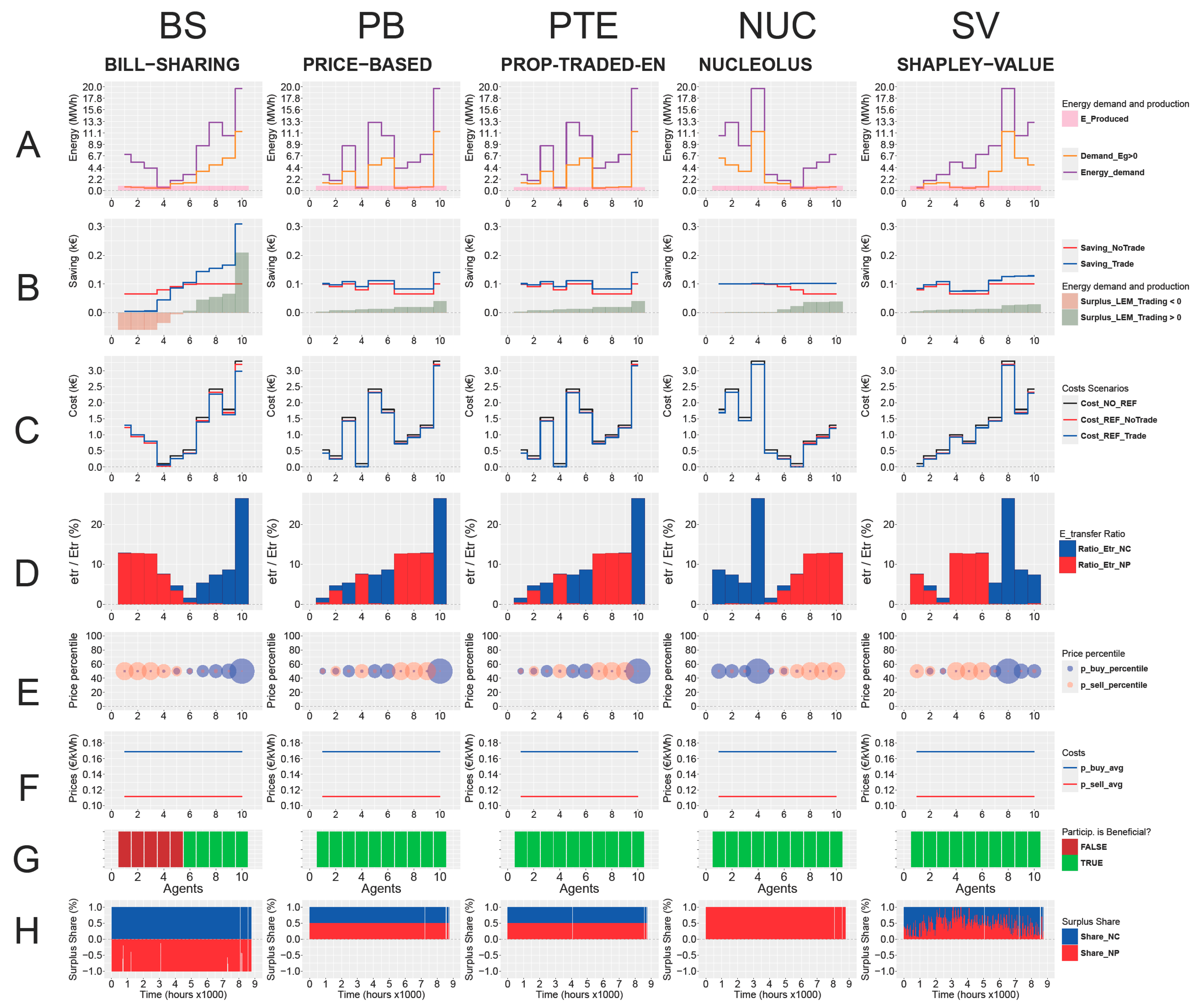
Regarding the “different-price” scenarios, for which Figure 11 represents an example, we gain relevant insights into how price variation affects the behaviour of different allocation methods. We see that some methods favour Net Consumers with the highest purchase prices and Net Producers with the lowest selling prices (e.g., the Shapley Value method illustrates this trend very clearly—see Figure 11E, column SV), while other methods, such as PTE, which depend solely on the volume of energy transferred, exhibit behaviour that is less tied to price variation (see Figure 11E, column PTE).
Finally, in the bottom row (see Figure 10H and Figure 11H), we present the share of surplus captured by Net Producers and Net Consumers. This allows us to examine parity in surplus distribution, revealing different behavioural ranges that span from favouring a single group to achieving perfect parity, as we will discuss in the following sections.

3.3.2. Outcomes Across Different Cost Allocation Methods

In this section, we conduct a comparative analysis of the behaviour of Energy Communities across different CAMs and parameter configurations.
  • Impact on beneficial participation.
There is only one CAM that does not fulfil the condition of all participants always benefiting from EC participation, which is bill sharing (see Figure 10G and Figure 11G, column BS). Using this method, there is a set of EC members that suffer negative LEM-related savings (see Figure 10B and Figure 11B, column BS), i.e., they would be better off outside the community. The reason is that by sharing the bill, Net Producers are effectively giving their energy excess for free (rather than selling it to the grid at a price), and Net Consumers with low buying prices are sharing the bill with Net Consumers with greater buying prices. In the “equal-price” scenario, only Net Producers can be harmed (see Figure 10B,D,F), but in the “different-price” scenario, Net Consumers with low buying prices may be worse off too (see Figure 11B,D,F).
  • Impact on parity on surplus distribution between NP and NC.
Under the “equal-price” scenario, savings are evenly distributed between NC and NP for the PB and PTE methods (Figure 10H, columns PB and PTE) but not for NUC and SV (Figure 10H, columns NUC and SV). The BS method deserves special mention: as discussed above, when the Energy Community is a Net Consumer overall, this method benefits only NCs, allocating the entire surplus exclusively to them (see Figure 10H, column BS).
Furthermore, the NUC and SV methods exhibit a markedly different behaviour (see Figure 10H, columns SV and NUC). This is because their primary driver is each agent’s marginal contribution to the market, which, under energy-scarcity conditions, is dominated by NPs—i.e., the agents that constrain the traded energy volumes—and who therefore capture the largest share of the benefits.
The added value of the “different-price” scenario is that under price-variation conditions closer to real-world settings, the PB and PTE methods are no longer equivalent, and the mechanisms governing NC/NP surplus distribution become apparent. First, under the PB method, the exchange price at each time step is set as the average of the minimum grid buying price among trading NCs and the maximum grid selling price among trading NPs, so the distribution of savings between NPs and NCs is driven by relative supply–demand elasticities. In this case, producers’ supply is more inelastic, allowing NPs to capture a larger share of the savings. Second, the PTE mechanism allocates savings based on the amount of energy transferred, which intrinsically promotes a more balanced distribution between NCs and NPs. As a consequence, for the PTE method, savings exhibit a stronger correlation with the volume of energy exchanged (see Figure 11D, column PTE).
Regarding the game-theoretic methods, we observe that the Nucleolus behaves similarly to a price-based cost allocation mechanism with extreme prices [15] in the sense that it yields allocations that favour the minority group. In most cases, this minority consists of Net Producers, who consequently capture the largest share of the surplus (see Figure 11B,D, column NUC). By contrast, the Shapley Value method typically allocates the greatest surplus to participants with the highest market power—namely, buyers with the highest purchase prices and sellers with the lowest selling prices (see Figure 11E, column SV)—since their marginal contribution to the local market is greatest whenever they participate.
  • Impact on community size.
For the other community sizes analysed (i.e., n = 100 and n = 1000), we observe that the data’s granularity increases, while the main conclusions remain unchanged.
  • Effect of price spread.
To assess the effect of price spread, we recall that as established in previous sections, higher spreads lead to higher surplus levels. The results shown in Figure 11B,F confirm that under the “different-price” scenario—where buying and selling prices vary across Energy Community members (row F)—total savings are higher (row B) for all cost allocation methods. Nevertheless, savings attributable to self-consumption remain substantially larger than those generated by the LEM, thus preserving the trend identified earlier.
  • Effect of profile heterogeneity.
As mentioned above, our assessment of the effect of demand heterogeneity depends on the adopted sampling method. We illustrate this effect through the following example, which captures the qualitative behaviour observed across the majority of data scenarios. Specifically, we contrast Energy Community (EC) configurations where all agents exhibit very similar consumption levels (see Figure 12) with configurations where there is a significant probability of including an agent with substantially higher demand. Such an agent effectively acts as a demand sink, markedly increasing the volume of internally traded energy and, consequently, the economic surplus generated within the local market (see Figure 13). A comparison of these two cases shows that the presence of demand sinks strongly incentivises internal energy trading.
  • Effect of renewable energy availability.
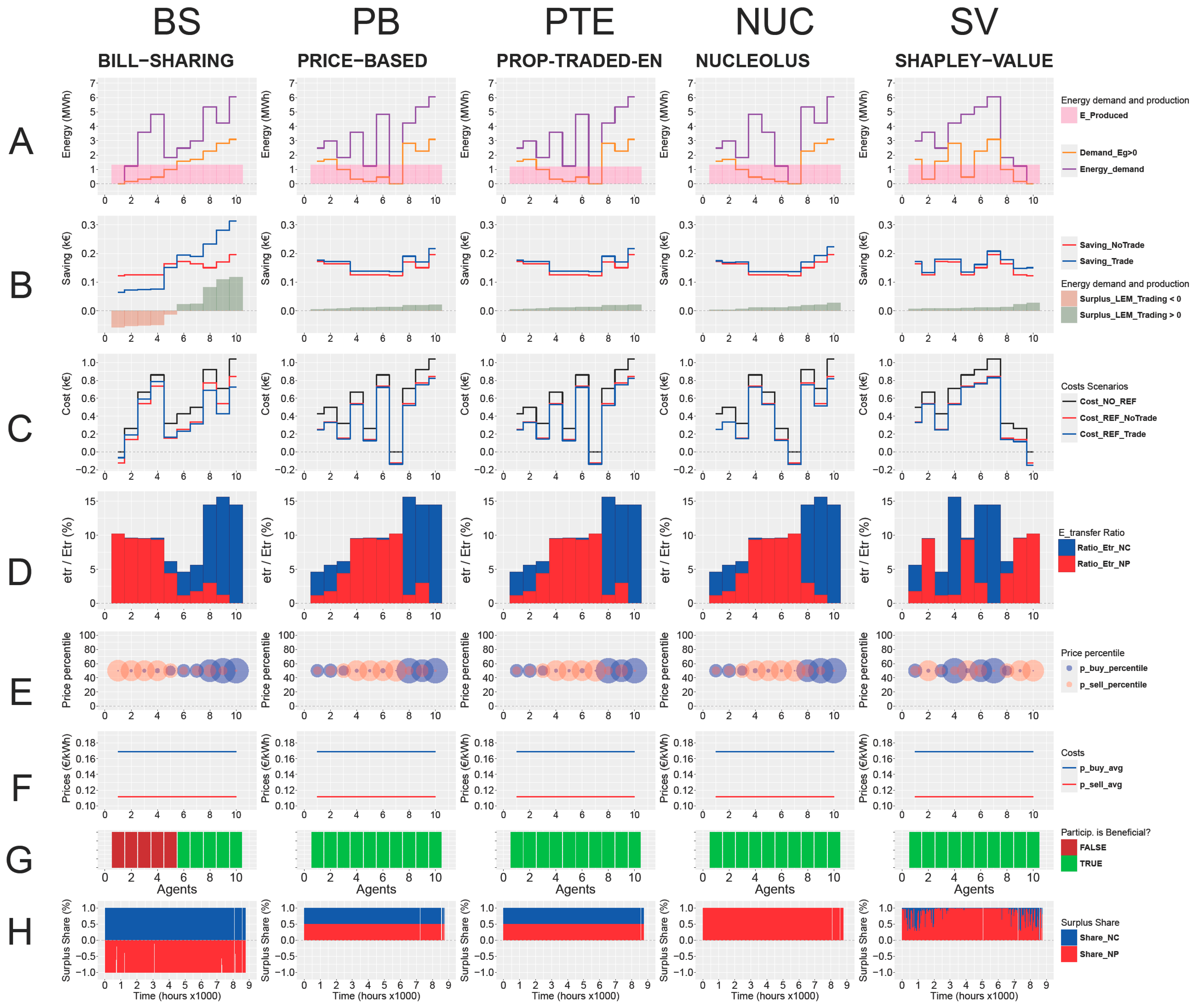
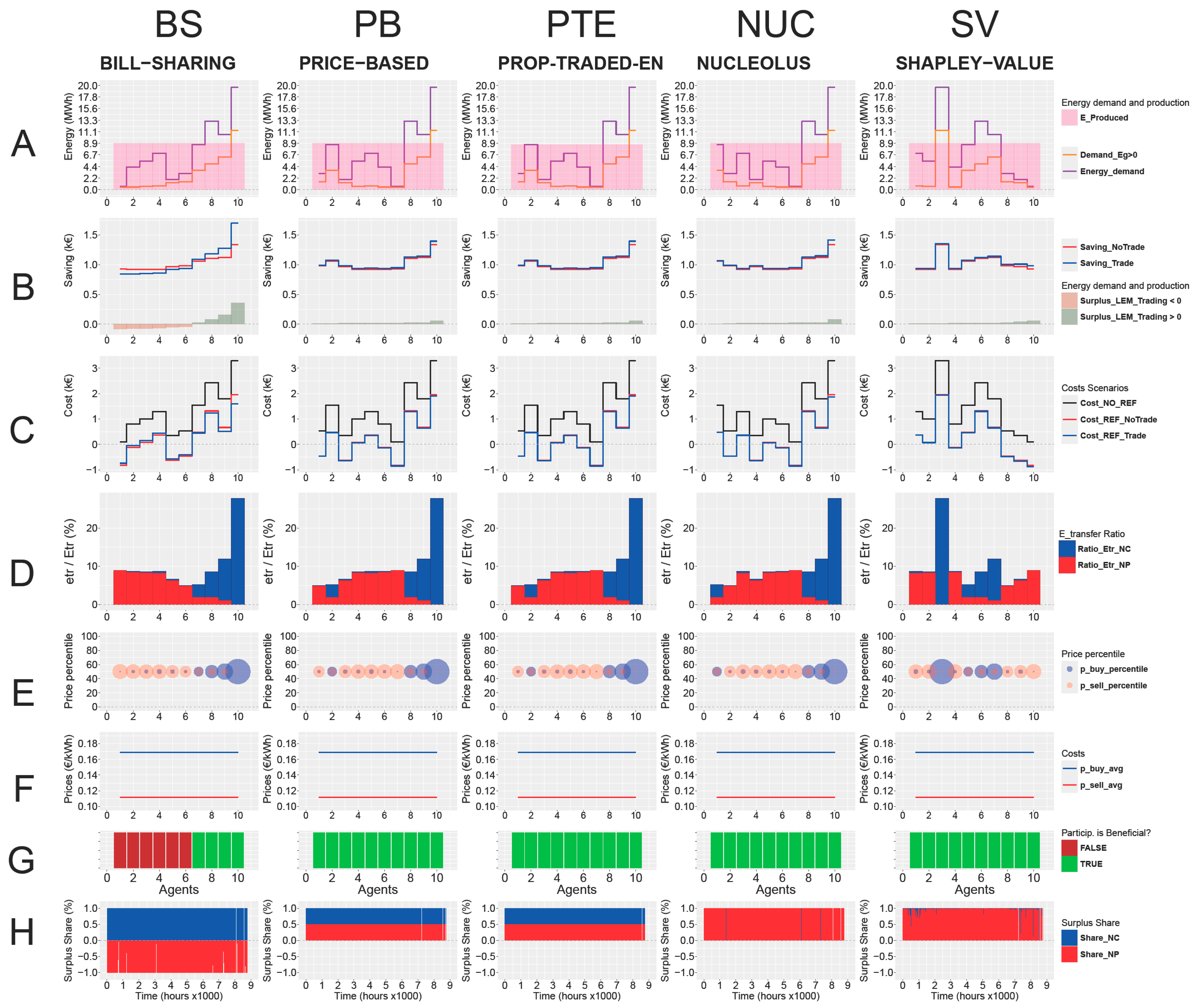
Figure 14 and Figure 15 illustrates how the volume of energy traded within the internal market—and, consequently, the resulting economic surplus—varies with renewable energy availability. Trading volumes peak at intermediate levels of renewable penetration (around 40%). To illustrate this effect, we compare the baseline case shown in Figure 10 and Figure 11 (with a 40% renewable penetration ratio) with two extreme scenarios: one in which renewable generation accounts for only 12% of total consumption (Figure 14) and another in which generation exceeds consumption, reaching a penetration level of 120% (Figure 15).
When comparing these scenarios under identical price conditions, sampling methods, and community sizes, differences in the resulting surplus (row B of the figures) are driven solely by variations in the volume of energy traded within the LEM.
A comparison of the two scenarios shows that despite operating over similar cost ranges (see Figure 14 and Figure 15C), the “REF_NoTrade” and “REF_Trade” cost curves lie very close to one another in both cases. This proximity indicates that the additional savings attributable to internal trading are minimal at both extremes of renewable penetration (low and high). By contrast, savings from self-consumption increase substantially in the high-penetration scenario (120%), reflecting the greater opportunity to utilise locally generated renewable energy.
In the low-penetration scenario (12%), achieving Net Producer status is particularly difficult. As a result, the few agents that do become NPs play a critical role in enabling internal trading and are therefore often rewarded with a large share of the surplus. This effect is most pronounced under the Nucleolus allocation method (see Figure 14B,D, column NUC), where Net Producers dominate the surplus distribution.
Conversely, in the high-penetration scenario (120%), NP status is readily attained by most participants. In this setting, Net Consumers—now the minority—act as the pivotal demand sinks and consequently capture the largest share of the surplus. Under the Nucleolus method (see Figure 15B,D, column NUC), Net Consumers receive a higher portion of the surplus, a pattern that is also observed across the other allocation methods.

3.3.3. Computational Feasibility

To objectively evaluate the implementation opportunities of the different allocation methods across different EC configurations, in Table 2, we have collected the execution times (in seconds) for each CAM. It is assumed that a method that is easy to implement in real-world settings is one that, in addition to meeting a set of expectations regarding fairness and stability principles, is also feasible in terms of computational requirements.
In this context, we define the execution time as the complete achievement of market-clearing procedure and the subsequent cost/benefit allocation for the annual hourly dataset (i.e., 8760 iterations, one per hour of the year) for a community of n members under specific price and renewable-penetration conditions. Code runs have been executed in a high-performance laptop with the following features: Intel Core i9-14900HX (24 cores at 2.20 GHz) and 32 GB RAM (5600 MHz).
For each EC configuration, several parameters, such as reference prices, penetration percentage, and consumption profiles, are held fixed, as they do not affect computational complexity. By contrast, community size has a direct and significant impact on computational burden, becoming particularly critical for allocation methods whose runtime scales exponentially with the number of participants, such as the Shapley Value and the Nucleolus.
As community size increases, the computational requirements of these methods grow rapidly, rendering some configurations infeasible in practice. For instance, applying the Shapley Value or the Nucleolus to a community of 20 members would require execution times on the order of several weeks (up to approximately 60 days), making direct computation impractical.
Accordingly, when constructing Table 2, execution times for the Shapley Value and Nucleolus methods were partially estimated rather than directly computed. These estimates were obtained by extrapolating from observed runtimes in smaller communities to larger sizes, corresponding to single-market instances with 50, 100, and 1000 agents.
The exponential scaling of the Shapley Value (SV) and Nucleolus (NUC) methods is immediately apparent. Across all community sizes, their runtimes strictly exceed those of all other cost allocation methods, rendering them increasingly impractical as n grows. In particular, for community sizes beyond approximately n = 23, the runtime required to process an annual dataset exceeds one calendar year, which definitively precludes their use in large communities.
By contrast, the remaining methods (BS, PB, and PTE) exhibit nearly indistinguishable runtimes, differing by less than one second. Their computational cost scales approximately linearly with community size. Even for n = 1000, all three methods complete a full year of hourly market-clearing calculations in under 1600 s (approximately 27 min) in the worst case, demonstrating clear practical feasibility.
In summary, the BS, PB, and PTE cost allocation methods are computationally feasible even for large communities, as tested up to 1000 members. Conversely, while the Shapley Value and Nucleolus methods remain applicable for small communities ( n < 20), their exponential runtime growth renders them impractical for n     22 , as execution times would exceed the real-time horizon over which market-clearing procedures are applied.

3.3.4. Summary of Allocation Outcomes and Computational Feasibility

This subsection synthesises the main insights derived from the comparative analysis of cost allocation methods under real-world Energy Community scenarios. Rather than identifying a universally optimal mechanism, the results highlight systematic trade-offs between allocation outcomes, behavioural incentives, and computational tractability across different operating conditions.
From an allocation perspective, the results confirm that cost allocation methods respond heterogeneously to price structures, demand composition, and renewable availability. Simple rules, while transparent and easy to implement, may fail to ensure beneficial participation for all members (particularly NPs) under realistic configurations. In contrast, PB and PTE methods consistently guarantee beneficial individual participation and exhibit robust performance across both uniform and heterogeneous price regimes, although their surplus distribution patterns differ depending on price asymmetry and trading volumes.
Game-theoretic methods, despite providing the strongest guarantees in terms of long-term stability [15], are highly sensitive to the relative scarcity of Net Producers or Net Consumers. Under conditions of energy scarcity, these methods tend to favour the limiting side of the market, while under surplus-dominated regimes, the distribution shifts accordingly. These features, while theoretically well founded, may generate asymmetric outcomes that require careful interpretation in practical deployments.
The analysis shows that beneficial participation property is achieved by all CAMs except for bill sharing, where some members of the EC may be better off outside the community, operating on their own.
Finally, computational feasibility emerges as a decisive criterion for real-world applicability. BS, PB, and PTE methods scale linearly with community size and remain computationally feasible even for large communities (up to 1000 members). By contrast, classical game-theoretic solutions such as the Shapley Value and the Nucleolus exhibit exponential runtime growth, leaving them practical only for small community sizes (lower than 20 members). Table 3 summarises those findings as follows:
Overall, the results demonstrate that the selection of a cost allocation method involves balancing economic performance, perceived fairness considerations, behavioural incentives, and operational feasibility. The comparative evidence provided in this section supports informed, context-dependent decision-making and underlines the importance of evaluating allocation mechanisms under realistic price and demand conditions.

4. Discussion

The results presented in this study provide a detailed, simulation-based view of how savings are generated and distributed within ECs under a wide range of realistic configurations. A central finding is that internal energy trading through a Local Energy Market consistently increases total community savings but that this contribution is generally modest when compared to the dominant effect of self-consumption. This highlights the importance of carefully distinguishing between these two sources of value when assessing the economic performance of Energy Communities. The magnitude of savings attributable to internal trading is shown to depend strongly on contextual factors. In particular, intermediate levels of renewable penetration maximise the potential for internal exchanges, as they balance the availability of locally generated energy with sufficient internal demand. Similarly, heterogeneity in consumption profiles plays a crucial role by increasing temporal complementarity between Net Consumers and Net Producers, thereby enabling higher traded volumes and surplus generation. Price conditions act primarily as a scaling factor, amplifying or dampening the economic value of a given volume of internal trading without altering the underlying energy flows.
The analysis also reveals that beneficial individual participation cannot be taken for granted, even when the EC as a whole generates positive savings, as, for instance, the bill-sharing method does not guarantee that property.
The analysis of allocation outcomes reveals substantial differences between cost allocation methods in terms of how surplus is distributed among participants. While some methods lead to relatively balanced outcomes between Net Consumers and Net Producers, others systematically favour the group that is pivotal for enabling internal trading under a given configuration. The bill-sharing method tends to favour NCs, especially those with higher buying prices. Meanwhile, price-based mechanisms tend to favour agents facing unfavourable grid conditions (high buying prices or low selling prices), as internal exchanges substitute costly external purchases with the grid. The PTE method provides a distribution highly correlated with the energy transfer ratio, keeping parity between NP and NC groups. Game-theoretic CAMs provide allocation outcomes that correspond to the intrinsic nature of their formulation. On the one hand, the Nucleolus favours the scarcer roles (i.e., NP in an Energy Community with a deficit energy net balance). On the other hand, Shapley Value favours those agents with more market power (i.e., NC with high buying prices and NP with low selling prices). These dynamics explain why some methods systematically disadvantage specific participant profiles under realistic conditions.
Price heterogeneity emerges as a central driver of CAMs’ behaviour. Under “equal-price” scenarios, differences between allocation methods are primarily driven by consumption–generation profiles, allowing structural properties of the methods to be isolated. In contrast, “different-price” scenarios amplify differences between methods, revealing how price signals interact with allocation rules to shape individual allocation outcomes. This result underscores the importance of explicitly accounting for price dispersion when evaluating cost allocation schemes, as conclusions drawn under uniform pricing may not generalise to heterogeneous market contexts.
From a practical perspective, computational feasibility emerges as a decisive constraint. Simple rule BS and price-based methods scale well with community size and are suitable for repeated, time-resolved application. In contrast, cooperative game-theoretic methods such as the Shapley Value and the Nucleolus exhibit exponential growth in runtime, rendering them impractical beyond relatively small communities despite their appealing theoretical foundations.
Overall, the findings underscore that no single cost allocation method dominates across all dimensions and configurations. Instead, the choice of allocation mechanism should be guided by the specific characteristics and priorities of the Energy Community, including its size, degree of heterogeneity, renewable penetration level, and tolerance for computational complexity. The simulation-based framework proposed in this work provides a transparent and flexible tool to support such context-aware assessments.

5. Conclusions and Future Work

This paper analyses the performance of cost allocation methods in Energy Communities under realistic operating conditions, with a focus on beneficial participation, price heterogeneity, participant roles, and computational feasibility outcomes. Using both synthetic and real-world simulations, the study examines how different allocation rules behave under different EC configurations.
The results show that renewable self-consumption remains the main source of economic savings, while internal energy trading provides an additional but context-dependent benefit that becomes relevant only under favourable conditions of demand heterogeneity, renewable energy availability, and price spread. At the individual level, beneficial participation depends on the interaction between participant roles, price exposure, and the selected allocation method, with no approach guaranteeing universally optimal outcomes.
Price-based (PB) and Proportional to Traded Energy (PTE) allocation methods offer scalable and robust performance, albeit with different distributional effects, whereas game-theoretic methods provide stronger normative guarantees at the expense of computational feasibility. These findings indicate that formal property compliance alone is insufficient to assess real-world performance and must be complemented by scenario-specific analysis.
A central contribution of this work lies in the proposed methodological framework, which operationalises the analysis of an EC in a systematic and reproducible manner. By integrating savings estimation, allocation outcomes, and property testing within a single tool, the framework enables comprehensive evaluation of Energy Community configurations without relying on ad hoc assumptions or case-specific interpretations. This capability is particularly relevant for practitioners and policymakers, who must navigate trade-offs between perceived fairness, long-term sustainability, and operational constraints when selecting allocation mechanisms.
Despite these contributions, several limitations should be acknowledged. The analysis focuses on ex post allocation methods and operational costs, abstracting from investment decisions, network constraints, and subjective behavioural factors. Moreover, while the framework accommodates heterogeneous prices and profiles, regulatory constraints and tariff structures may further influence feasible allocation schemes in practice. Addressing these aspects represents a natural direction for future research.
Overall, the results support a context-aware assessment methodology of cost allocation mechanisms, aligned with community size, market conditions, and governance objectives, contributing to more realistic and informed design of Energy Communities.

Supplementary Materials

The supplementary materials supporting this study are available online at https://github.com/dga0024/Evaluating-CAMs-within-ECs (accessed on 27 January 2026) [55] as a public-access Zenodo repository. The repository includes additional figures, tables, and datasets used in the simulations as well as scripts and configuration files required to reproduce the results presented in the paper.

Author Contributions

Conceptualisation, D.G.-A. and L.R.I.; Methodology, D.G.-A. and L.R.I.; Formal analysis, D.G.-A. and L.R.I.; Investigation, D.G.-A. and L.R.I.; Resources, D.G.-A. and L.R.I.; Writing—original draft, D.G.-A. and L.R.I.; Writing—review and editing, D.G.-A. and L.R.I.; Project administration, L.R.I.; Funding acquisition, L.R.I. All authors have read and agreed to the published version of the manuscript.

Funding

This research study was funded by the Spanish State Research Agency (PID2024-159461NBI00/MICIU and PID2020-118906GB-I00/MCIN) and the Spanish Ministry of Universities (PRX22/00064). It also received funding from the Spanish Ministry of Science and Innovation, and CDTI, under projects ECOSISTEMAS DE INNOVACIÓN ECO-20241016 (ECENOVA) and MISIONES MIG-20211033, and Interreg SUDOE program under the SHAREDH2 S1/2.7/E0024 grant.

Data Availability Statement

The synthetic electricity consumption profiles as well as the renewable energy generation profiles used in this study are based on data previously published in [52]. Real-world electricity consumption profiles are obtained from a publicly available reference dataset [58]. Electricity market price data are sourced from the Spanish wholesale electricity market operator (OMIE) and are publicly available online [57]. All data sources used in this study are publicly accessible and are cited in the corresponding references.

Acknowledgments

Parts of this work are based on results developed in the PhD thesis of González-Asenjo. During the preparation of this manuscript, the authors used ChatGPT 5.1 to assist with text editing and refinement. The authors have reviewed and edited the output and take full responsibility for the content of this publication.

Conflicts of Interest

The authors declare no conflicts of interest.

Abbreviations

The following abbreviations are used in this manuscript:
BSBill Sharing
CAMCost Allocation Method
CB-P2PCommunity-Based Peer-to-Peer
ECEnergy Community
GTGame Theory
LEMLocal Energy Market
NCNet Consumer
NPNet Producer
NUCNucleolus
PBPrice-Based
PTEProportional to Traded Energy
PVPhotovoltaic
REFRenewable Energy Facility
SVShapley Value

Appendix A

This appendix explains how energy trade within the Local Energy Market is conducted. It describes how internal energy exchanges are allocated among Net Consumers and Net Producers and provides the analytical expressions used to compute energy traded volumes and the resulting economic surplus.
The LEM is assumed to operate efficiently under a market-clearing algorithm that always achieves the maximum feasible savings. The algorithm prioritises trades between NCs with the highest grid buying prices p b u y , a G r i d and NPs with the lowest grid selling prices p s e l l , a G r i d . If total demand cannot match total supply, the units traded at the margin are prorated among the unsatisfied Net Producers with the lowest p s e l l , a G r i d —if supply exceeds demand—or among the unsatisfied Net Consumers with the highest p b u y , a G r i d —if demand exceeds supply. Therefore, the amount of energy that agent a trades in the market, e a t r , is
  • For Net Consumers,
e a N C t r = m i n e a N C , S p b u y , a i N C ;   p b u y , i   > p b u y , a e i N C e a N C i N C ;   p b u y , i   = p b u y , a e i N C
  • For Net Producers,
e a N P t r = m i n e a N P , D p s e l l , a i N P ;   p s e l l , i   < p s e l l , a e i N P e a N P i N P ;   p s e l l , i   = p s e l l , a e i N P
The resulting economic surplus generated by the LEM is as follows:
S a v i n g s L E M _ T r a d i n g = a N C p b u y , a G r i d e a t r a N P p s e l l , a G r i d e a t r
Although the proposed Local Energy Market follows a merit-order matching logic, it differs from the centralised double-auction mechanisms used in European electricity markets. In those markets, participants submit strategic bids and offers, and a uniform clearing price determines both traded quantities and payments, enabling price discovery.
In our framework, participants do not submit strategic bids; their buying and selling prices are exogenous (retail tariffs). The clearing algorithm is therefore not intended to determine a market price but to maximise the total economic surplus generated by reallocating locally produced energy between Net Producers and Net Consumers whenever their price spread makes this exchange beneficial.
Furthermore, surplus generation and surplus allocation are treated separately: the clearing stage determines the welfare-maximising traded volume, while cost allocation methods distribute the resulting surplus ex post. This contrasts with centralised double-auction mechanisms, in which allocation and pricing are jointly determined by the clearing price.

References

  1. Reis, I.F.G.; Gonçalves, I.; Lopes, M.A.R.; Antunes, C.H. Business Models for Energy Communities: A Review of Key Issues and Trends. Renew. Sustain. Energy Rev. 2021, 144, 111013. [Google Scholar] [CrossRef]
  2. European Parliament. Directive (EU) 2018/2001 of the European Parliament and of the Council of 11 December 2018 on the Promotion of the Use of Energy from Renewable Sources (Recast) (Text with EEA Relevance). 2018. Available online: https://eur-lex.europa.eu/eli/dir/2018/2001/oj/eng (accessed on 20 January 2026).
  3. European Parliament. Directive (EU) 2019/944 of the European Parliament and of the Council of 5 June 2019—On Common Rules for the Internal Market for Electricity and Amending Directive 2012/27/EU. 2019. Available online: https://eur-lex.europa.eu/eli/dir/2019/944/oj/eng (accessed on 20 January 2026).
  4. Zhou, Y.; Lund, P.D. Peer-to-Peer Energy Sharing and Trading of Renewable Energy in Smart Communities—Trading Pricing Models, Decision-Making and Agent-Based Collaboration. Renew. Energy 2023, 207, 177–193. [Google Scholar] [CrossRef]
  5. Li, N.; Okur, Ö. Economic Analysis of Energy Communities: Investment Options and Cost Allocation. Appl. Energy 2023, 336, 120706. [Google Scholar] [CrossRef]
  6. Wüstenhagen, R.; Wolsink, M.; Bürer, M.J. Social Acceptance of Renewable Energy Innovation: An Introduction to the Concept. Energy Policy 2007, 35, 2683–2691. [Google Scholar] [CrossRef]
  7. European Commission. The European Green Deal (COM/2019/640 Final). of 11 December 2019. Available online: https://eur-lex.europa.eu/legal-content/EN/TXT/?uri=COM%3A2019%3A640%3AFIN (accessed on 20 January 2026).
  8. Lowitzsch, J.; Hoicka, C.E.; van Tulder, F.J. Renewable Energy Communities under the 2019 European Clean Energy Package—Governance Model for the Energy Clusters of the Future? Renew. Sustain. Energy Rev. 2020, 122, 109489. [Google Scholar] [CrossRef]
  9. Li, N.; Hakvoort, R.; Lukszo, Z. Cost Allocation in Integrated Community Energy Systems—Social Acceptance. Sustainability 2021, 13, 9951. [Google Scholar] [CrossRef]
  10. Volpato, G.; Carraro, G.; Cont, M.; Danieli, P.; Rech, S.; Lazzaretto, A. General Guidelines for the Optimal Economic Aggregation of Prosumers in Energy Communities. Energy 2022, 258, 124800. [Google Scholar] [CrossRef]
  11. Li, N.; Hakvoort, R.A.; Lukszo, Z. Cost Allocation in Integrated Community Energy Systems—A Review. Renew. Sustain. Energy Rev. 2021, 144, 111001. [Google Scholar] [CrossRef]
  12. Abada, I.; Ehrenmann, A.; Lambin, X. On the Viability of Energy Communities. Energy J. 2020, 41, 113–150. [Google Scholar] [CrossRef]
  13. Kulmala, A.; Baranauskas, M.; Safdarian, A.; Valta, J.; Jarventausta, P.; Bjorkqvist, T. Comparing Value Sharing Methods for Different Types of Energy Communities. In Proceedings of the 2021 IEEE PES Innovative Smart Grid Technologies Europe (ISGT Europe), Espoo, Finland, 18–21 October 2021; pp. 1–6. [Google Scholar] [CrossRef]
  14. Chakraborty, P.; Baeyens, E.; Khargonekar, P.P.; Poolla, K.; Varaiya, P. Analysis of Solar Energy Aggregation under Various Billing Mechanisms. IEEE Trans. Smart Grid 2019, 10, 4175–4187. [Google Scholar] [CrossRef]
  15. González-Asenjo, D.; Izquierdo, L.R.; Izquierdo, S.S. Cost Allocation Methods and Their Properties in Energy Communities. Energies 2025, 18, 6236. [Google Scholar] [CrossRef]
  16. Schmeidler, D. The Nucleolus of a Characteristic Function Game. SIAM J. Appl. Math. 1969, 17, 1163–1170. [Google Scholar] [CrossRef]
  17. Shapley, L.S. A Value for N-Person Game. In Contributions to the Theory of Games, Volume II; Kuhn, H.W., Tucker, A.W., Eds.; Princeton University Press: Princeton, NJ, USA, 1953; pp. 307–318. [Google Scholar] [CrossRef]
  18. Yang, Y.; Hu, G.; Spanos, C.J. Optimal Sharing and Fair Cost Allocation of Community Energy Storage. IEEE Trans. Smart Grid 2021, 12, 4185–4194. [Google Scholar] [CrossRef]
  19. González-Asenjo, D.; Izquierdo, L.R.; Sedano, J. Deciding How Much to Self-Consume Within the European Green Deal Framework. In Lecture Notes on Data Engineering and Communications Technologies; García Márquez, F.P., Iyer, S.R., Singh, B.K., del Rosario Arévalo, M., Eds.; Springer: Cham, Switzerland, 2023; Volume 160, pp. 409–413. [Google Scholar] [CrossRef]
  20. Tushar, W.; Saha, T.K.; Yuen, C.; Liddell, P.; Bean, R.; Poor, H.V. Peer-to-Peer Energy Trading with Sustainable User Participation: A Game Theoretic Approach. IEEE Access 2018, 6, 62932–62943. [Google Scholar] [CrossRef]
  21. Victor Sam Moses Babu, K.; Satya Surya Vinay, K.; Chakraborty, P. Peer-to-Peer Sharing of Energy Storage Systems Under Net Metering and Time-of-Use Pricing. IEEE Access 2023, 11, 3118–3128. [Google Scholar] [CrossRef]
  22. Posit Team RStudio: Integrated Development Environment for R; Posit Software. Version RStudio 2024.12.1+563 “Kousa Dogwood” Release (27771613951643d8987af2b2fb0c752081a3a853, 2025-02-02) for windows; Posit: Boston, MA, USA, 2025.
  23. Bauwens, T.; Huybrechts, B.; Dufays, F. Understanding the Diverse Scaling Strategies of Social Enterprises as Hybrid Organizations: The Case of Renewable Energy Cooperatives. Organ. Environ. 2020, 33, 195–219. [Google Scholar] [CrossRef]
  24. Han, L.; Morstyn, T.; McCulloch, M. Incentivizing Prosumer Coalitions with Energy Management Using Cooperative Game Theory. IEEE Trans. Power Syst. 2019, 34, 303–313. [Google Scholar] [CrossRef]
  25. Nagpal, H.; Avramidis, I.-I.; Capitanescu, F.; Madureira, A.G. Local Energy Communities in Service of Sustainability and Grid Flexibility Provision: Hierarchical Management of Shared Energy Storage. IEEE Trans. Sustain. Energy 2022, 13, 1523–1535. [Google Scholar] [CrossRef]
  26. Lazzari, F.; Mor, G.; Cipriano, J.; Solsona, F.; Chemisana, D.; Guericke, D. Optimizing Planning and Operation of Renewable Energy Communities with Genetic Algorithms. Appl. Energy 2023, 338, 120906. [Google Scholar] [CrossRef]
  27. Di Lorenzo, G.; Rotondo, S.; Araneo, R.; Petrone, G.; Martirano, L. Innovative Power-Sharing Model for Buildings and Energy Communities. Renew. Energy 2021, 172, 1087–1102. [Google Scholar] [CrossRef]
  28. Bâra, A.; Oprea, S.V. A Value Sharing Method for Heterogeneous Energy Communities Archetypes. iScience 2024, 27, 108687. [Google Scholar] [CrossRef]
  29. Sousa, T.; Soares, T.; Pinson, P.; Moret, F.; Baroche, T.; Sorin, E. Peer-to-Peer and Community-Based Markets: A Comprehensive Review. Renew. Sustain. Energy Rev. 2019, 104, 367–378. [Google Scholar] [CrossRef]
  30. Hoicka, C.E.; Lowitzsch, J.; Brisbois, M.C.; Kumar, A.; Ramirez Camargo, L. Implementing a Just Renewable Energy Transition: Policy Advice for Transposing the New European Rules for Renewable Energy Communities. Energy Policy 2021, 156, 112435. [Google Scholar] [CrossRef]
  31. Fotopoulou, M.; Tsekouras, G.J.; Vlachos, A.; Rakopoulos, D.; Chatzigeorgiou, I.M.; Kanellos, F.D.; Kontargyri, V. Day Ahead Operation Cost Optimization for Energy Communities. Energies 2025, 18, 1101. [Google Scholar] [CrossRef]
  32. Fina, B.; Auer, H.; Friedl, W. Profitability of PV Sharing in Energy Communities: Use Cases for Different Settlement Patterns. Energy 2019, 189, 116148. [Google Scholar] [CrossRef]
  33. Fleischhacker, A.; Lettner, G.; Schwabeneder, D.; Auer, H. Portfolio Optimization of Energy Communities to Meet Reductions in Costs and Emissions. Energy 2019, 173, 1092–1105. [Google Scholar] [CrossRef]
  34. Parag, Y.; Sovacool, B.K. Electricity Market Design for the Prosumer Era. Nat. Energy 2016, 1, 16032. [Google Scholar] [CrossRef]
  35. Zhou, Y.; Wu, J.; Long, C. Evaluation of Peer-to-Peer Energy Sharing Mechanisms Based on a Multiagent Simulation Framework. Appl. Energy 2018, 222, 993–1022. [Google Scholar] [CrossRef]
  36. Gasca, M.V.; Rigo-Mariani, R.; Debusschere, V.; Sidqi, Y.; Clastres, C. Costs Allocation in Energy Communities: An Insight on Users’ Preferences. In Proceedings of the 2023 IEEE PES Innovative Smart Grid Technologies Europe (ISGT EUROPE 2023), Grenoble, France, 23–26 October 2023; pp. 1–5. [Google Scholar] [CrossRef]
  37. Vasiljevska, J.; Mengolini, A.; Nikolic, I. SIMP-Subjective Individual Model of Prosumer; Publications Office of the European Union: Luxembourg, 2018. [Google Scholar] [CrossRef]
  38. Gasca, M.-V.; Rigo-Mariani, R.; Debusschere, V.; Sidqi, Y. Fairness in Energy Communities: Centralized and Decentralized Frameworks. Renew. Sustain. Energy Rev. 2025, 208, 115054. [Google Scholar] [CrossRef]
  39. Moret, F.; Pinson, P. Energy Collectives: A Community and Fairness Based Approach to Future Electricity Markets. IEEE Trans. Power Syst. 2019, 34, 3994–4004. [Google Scholar] [CrossRef]
  40. Roberts, M.B.; Sharma, A.; MacGill, I. Efficient, Effective and Fair Allocation of Costs and Benefits in Residential Energy Communities Deploying Shared Photovoltaics. Appl. Energy 2022, 305, 117935. [Google Scholar] [CrossRef]
  41. Lezama, F.; Soares, J.; Hernandez-Leal, P.; Kaisers, M.; Pinto, T.; Vale, Z. Local Energy Markets: Paving the Path Toward Fully Transactive Energy Systems. IEEE Trans. Power Syst. 2019, 34, 4081–4088. [Google Scholar] [CrossRef]
  42. Gonzalez-Asenjo, D.; Izquierdo, L.R.; Sedano Franco, J. Empowering Energy Communities: Three Methods to Distribute Savings in Local Energy Markets. Dyna 2024, 99, 417–423. [Google Scholar] [CrossRef] [PubMed]
  43. Mitridati, L.; Kazempour, J.; Pinson, P. Design and Game-Theoretic Analysis of Community-Based Market Mechanisms in Heat and Electricity Systems. Omega 2021, 99, 102177. [Google Scholar] [CrossRef]
  44. Paudel, A.; Chaudhari, K.; Long, C.; Gooi, H.B. Peer-to-Peer Energy Trading in a Prosumer-Based Community Microgrid: A Game-Theoretic Model. IEEE Trans. Ind. Electron. 2019, 66, 6087–6097. [Google Scholar] [CrossRef]
  45. Li, N.; Hakvoort, R.A.; Lukszo, Z. Cost Allocation in Integrated Community Energy Systems—Performance Assessment. Appl. Energy 2022, 307, 118155. [Google Scholar] [CrossRef]
  46. Volpato, G.; Carraro, G.; Dal Cin, E.; Rech, S. On the Different Fair Allocations of Economic Benefits for Energy Communities. Energies 2024, 17, 4788. [Google Scholar] [CrossRef]
  47. Benedek, M.; Fliege, J.; Nguyen, T.-D. Finding and Verifying the Nucleolus of Cooperative Games. Math. Program. 2021, 190, 135–170. [Google Scholar] [CrossRef]
  48. Noorfatima, N.; Choi, Y.; Lee, S.; Jung, J. Development of Community-Based Peer-to-Peer Energy Trading Mechanism Using Z-Bus Network Cost Allocation. Front. Energy Res. 2022, 10, 920885. [Google Scholar] [CrossRef]
  49. Chen, C.; Zhu, Y.; Zhang, T.; Li, Q.; Li, Z.; Liang, H.; Liu, C.; Ma, Y.; Lin, Z.; Yang, L. Two-Stage Multiple Cooperative Games-Based Joint Planning for Shared Energy Storage Provider and Local Integrated Energy Systems. Energy 2023, 284, 129114. [Google Scholar] [CrossRef]
  50. Vespermann, N.; Hamacher, T.; Kazempour, J. Access Economy for Storage in Energy Communities. IEEE Trans. Power Syst. 2021, 36, 2234–2250. [Google Scholar] [CrossRef]
  51. Huang, Z.; Zhang, Y.; Lu, Y.; Wang, W.; Chen, D.; Wang, C.; Khan, Z. Cost Allocation Model for Net-Zero Energy Buildings under Community-Based Reward Penalty Mechanism. Environ. Clim. Technol. 2019, 23, 293–307. [Google Scholar] [CrossRef]
  52. Gonzalez-Asenjo, D.; Izquierdo, L.R.; Sedano, J. A Simple and Efficient Method to Allocate Costs and Benefits in Energy Communities. J. Ind. Eng. Manag. 2023, 16, 398–424. [Google Scholar] [CrossRef]
  53. Grzanic, M.; Morales, J.M.; Pineda, S.; Capuder, T. Electricity Cost-Sharing in Energy Communities under Dynamic Pricing and Uncertainty. IEEE Access 2021, 9, 30225–30241. [Google Scholar] [CrossRef]
  54. Long, C.; Wu, J.; Zhang, C.; Thomas, L.; Cheng, M.; Jenkins, N. Peer-to-Peer Energy Trading in a Community Microgrid. In Proceedings of the 2017 IEEE Power & Energy Society General Meeting, Chicago, IL, USA, 16–20 July 2017; pp. 1–5. [Google Scholar] [CrossRef]
  55. Gonzalez-Asenjo, D.; Izquierdo, L.R. Evaluating CAMs within ECs. Available online: https://github.com/dga0024/Evaluating-CAMs-within-ECs (accessed on 27 January 2026). [CrossRef]
  56. European Commission JRC Photovoltaic Geographical Information System (PVGIS)—European Commission. Available online: https://re.jrc.ec.europa.eu/pvg_tools/en/ (accessed on 15 September 2023).
  57. Red Eléctrica de España E·SIOS. Sistema de Información Del Operador Del Sistema. Available online: https://www.esios.ree.es/es (accessed on 20 January 2026).
  58. Cenký, M.; Bendík, J.; Cintula, B.; Janiga, P.; Eleschová, Ž.; Beláň, A. Dataset of 15-Minute Values of Active and Reactive Power Consumption of 1000 Households during Single Year. Data Brief 2023, 50, 109588. [Google Scholar] [CrossRef]
Figure 1. Economic boundaries that reflect our cost scenario approach in terms of differentiating the two sources of economic saving: self-consumption (i.e., S a v i n g s R E F _ N o T r a d e ) and internal energy trading (i.e., S a v i n g s L E M _ T r a d i n g ).
Energies 19 01336 g001
Figure 2. An example of how a Local Energy Market can provide savings. The energy demand D is shown in blue, and the energy supply S is shown in red. The maximum total savings that can be achieved is the green area in the figure.
Energies 19 01336 g002
Figure 3. Graphical representation of the two daily energy consumption profiles considered (Gauss and anti-Gauss) and of two individual PV energy daily generation profiles (covering 50% and 100% of daily total consumption).
Energies 19 01336 g003
Figure 4. A comparison of savings scenarios for different community energy configurations; (a): n = 10, Complementarity = 50%G/50%aG, Spread = 0.01); (b): n = 10, Complementarity = 50%G/50%aG, Spread = 0.5. Note that the green curve ( S a v i n g s L E M _ T r a d i n g ) represents the marginal contribution of the Local Energy Market, calculated as the difference between the blue (total savings) and the red (savings due to individual self-consumption) curves.
Energies 19 01336 g004
Figure 5. A histogram for the 6120 data scenarios analysed of the distribution of the percentage of savings achieved (a) by individual self-consumption: S a v i n g s R E F _ N o T r a d e =   C o s t N O _ R E F C o s t R E F _ N o T r a d e / C o s t N O _ R E F and (b) only due to internal trading: S a v i n g s L E M _ T r a d i n g =   C o s t R E F _ N o T r a d e C o s t R E F _ T r a d e / C o s t N O _ R E F . Savings above 100% arise in high renewable penetration scenarios, where revenues from surplus electricity exports exceed total annual electricity purchases.
Energies 19 01336 g005
Figure 6. Comparison of savings scenarios for different EC configurations. (a): n = 10, Complementarity = 50%G/50%aG); (b): n = 10, Complementarity = 10%G/90%aG.
Energies 19 01336 g006
Figure 7. Comparison of savings scenarios for different EC configurations. (a): n = 10, Complementarity = 50%G/50%aG, spread = 0.1; (b): n = 10, Complementarity = 50%G/50%aG, spread = 0.5, with different price values for the spread composition: (c) 0.1 spread for selling prices between 0.1 and 0.5; (d) 0.5 spread for selling prices between 0.1 and 0.5.
Energies 19 01336 g007
Figure 8. A comparison of LEM savings for different yearly price samples. We can see that the higher savings ratios occur for the lowest sell-to-buy ratio (years 2020 and 2024).
Energies 19 01336 g008
Figure 9. An illustration of how the properties of the sampled dataset (particularly the degree of demand heterogeneity) affect the energy trading capacity for an Energy Community, obtained through different sampling strategies. In the top, we describe, for a 10-member EC (for the sake of graphical understanding), two sampling methods with opposite behaviour: (a) equidistant and (b) random at extremes. In the lower part (c), we represent the impact of the five sampling methods and thus the consumption diversity and existence of demand sinks in the energy trading capacity of a 100-member EC.
Energies 19 01336 g009
Figure 10. An example of the graphical representation of the results of different allocation methods behaviours for a given EC configuration. In the figure, (n = 10, sampling = equidistant 1 < n < 1000, reference prices 2021, equal prices, renewable penetration ratio = 40%). Subfigures (AH) represent: (A–Total consumption and generation); (B–Savings and surplus allocation); (C–Cost comparison); (D–Internal trading volumes between NP/NC); (E–Price percentiles); (F–Average prices); (G–Beneficial participation); (H–Temporal distribution of LEM surplus between NP/NC).
Energies 19 01336 g010
Figure 11. An example of the graphical representation of the results of different allocation methods behaviours for a given EC configuration. In the figure, (n = 10, sampling= equidistant 1 < n < 1000, reference prices 2021, different prices, renewable penetration ratio = 40%). Subfigures (AH) represent: (A–Total consumption and generation); (B–Savings and surplus allocation); (C–Cost comparison); (D–Internal trading volumes between NP/NC); (E–Price percentiles); (F–Average prices); (G–Beneficial participation); (H–Temporal distribution of LEM surplus between NP/NC).
Energies 19 01336 g011
Figure 12. Comparison of savings scenarios for different community energy configurations; n = 10, sampling = equidistant n < 500, reference prices 2021, equal prices, renewable penetration ratio = 40%). Subfigures (AH) represent: (A–Total consumption and generation); (B–Savings and surplus allocation); (C–Cost comparison); (D–Internal trading volumes between NP/NC); (E–Price percentiles); (F–Average prices); (G–Beneficial participation); (H–Temporal distribution of LEM surplus between NP/NC).
Energies 19 01336 g012
Figure 13. Comparison of savings scenarios for different community energy configurations; n = 10, sampling = random n < 200; n > 800, reference prices 2021, equal prices, renewable penetration ratio = 40%. Subfigures (AH) represent: (A–Total consumption and generation); (B–Savings and surplus allocation); (C–Cost comparison); (D–Internal trading volumes between NP/NC); (E–Price percentiles); (F–Average prices); (G–Beneficial participation); (H–Temporal distribution of LEM surplus between NP/NC).
Energies 19 01336 g013
Figure 14. Comparison of savings scenarios for two different values of renewable penetration ratio. 12%, n = 10, sampling= equidistant 1 < n < 1000, reference prices 2021 and equal prices. Subfigures (AH) represent: (A–Total consumption and generation); (B–Savings and surplus allocation); (C–Cost comparison); (D–Internal trading volumes between NP/NC); (E–Price percentiles); (F–Average prices); (G–Beneficial participation); (H–Temporal distribution of LEM surplus between NP/NC).
Energies 19 01336 g014
Figure 15. Comparison of savings scenarios for two different values of renewable penetration ratio. 120%, n = 10, sampling= equidistant 1 < n < 1000, reference prices 2021 and equal prices. Subfigures (AH) represent: (A–Total consumption and generation); (B–Savings and surplus allocation); (C–Cost comparison); (D–Internal trading volumes between NP/NC); (E–Price percentiles); (F–Average prices); (G–Beneficial participation); (H–Temporal distribution of LEM surplus between NP/NC).
Energies 19 01336 g015
Table 1. Summary of main findings from synthetic data simulations.
Aspect
Analysed
Main
Finding
Implication for
Energy Communities
Total economic savingsIncrease monotonically with renewable penetration but with diminishing marginal returnsOversizing renewable capacity yields decreasing economic performance
Dominant source of savingsSelf-consumption accounts for the largest share of total savings in contrast with LEM savingsMaximising self-consumption remains the primary economic driver
Contribution of internal tradingLower magnitude, but never detrimental, and non-negligible under favourable conditionsLocal Energy Markets add value when conditions are appropriate
Renewable
penetration level
Internal trading is maximised at intermediate penetration levelsOptimal system design avoids both under- and overproduction
Profile
complementarity
Higher heterogeneity significantly increases internal trading volumeComplementarity of demand profiles is more important than total demand
Price spread
effect
Internal trading surplus scales linearly with the buy–sell price differenceMarket conditions critically shape the economic relevance of LEMs
Energy flow vs. economic valueLimited traded energy can still generate substantial surplus under high spreadsEconomic impact cannot be inferred from energy volumes alone
Robustness of patternsQualitative trends persist across
all synthetic configurations tested
Results are structurally driven, not coincidences of specific datasets
Table 2. Summary of execution times (in seconds) of market clearing and CAM algorithms for different EC configurations.
nMarket
Clearing
Allocation Method
BSPBPTESVNUC
510.810.050.050.04110.98106.64
1018.340.130.130.175874.365774.95
1217.890.080.090.0925,541.0024,639.16
5045.370.270.270.316.75 × 1015 *
10091.330.530.580.607.60 × 1030 *
10001557.427.278.5010.116.43 × 10301 *
* estimation obtained by extrapolating observed runtimes in smaller communities to larger sizes.
Table 3. Summary of allocation outcomes, behavioural effects, and computational feasibility across cost allocation methods.
CAMAllocation
Outcomes
Behaviour Under
Price Heterogeneity
Beneficial
Participation
NC/NP Parity in Surplus
Allocation
Computational
Feasibility
Practical
Implications
BSHighly dependent of overall EC net balanceAlmost insensitive to price structureMay fail for NP and, under “different-price”, also for NC with lower pricesAll surplus goes to NC, except for high overproduction scenariosExcellent
(linear scaling)
Simple and transparent but does not guarantee basic fairness principles
PBAllocation driven by individual price exposureFavours agents with unfavourable grid pricesBeneficial participation ensuredDepends on transfer price setting and demand/supply price elasticityExcellent
(linear scaling)
Efficient and scalable; outcomes price-dependent
PTEAllocation proportional to internal trading volumesWeak sensitivity to price heterogeneityBeneficial participation ensuredAchieves NC/NP parity in all casesExcellent
(linear scaling)
Balanced and stable outcomes; intuitive implementation
NUCMinimises dissatisfaction across coalitionsFavours the limiting side of the market (NC or NP)Beneficial participation ensuredRole that limits energy trading is favouredPoor (exponential scaling)Strong stability guarantees; limited scalability
SVAllocation based on marginal contributions, often posed as fairFavours agents with higher marginal LEM impactBeneficial participation ensuredRole with higher market power is favouredPoor (exponential scaling)Based on marginal contributions; impractical for large ECs
Disclaimer/Publisher’s Note: The statements, opinions and data contained in all publications are solely those of the individual author(s) and contributor(s) and not of MDPI and/or the editor(s). MDPI and/or the editor(s) disclaim responsibility for any injury to people or property resulting from any ideas, methods, instructions or products referred to in the content.