1. Introduction
In recent years, growing attention toward the energy transition and the circular economy has driven scientific research to identify innovative strategies for the valorization of solid waste streams. While lignocellulosic biomass has been extensively studied and utilized in thermochemical conversion processes, its combined valorization with plastic waste, particularly through emerging technologies such as microwave-assisted pyrolysis, remains comparatively less explored. Europe alone produced 58.7 million tons of plastics in 2022, and 32.3 million tons became waste; only 26.9% was recycled [
1]. At the same time, more than 1.3 billion tons of agricultural and forestry residues are generated annually, representing a wide renewable carbon reservoir that remains largely unutilized [
2]. When properly converted, both streams can contribute to the production of renewable energy, advanced biofuels and sustainable chemical intermediates.
Biomass is broadly defined as organic material produced through biological processes, mainly photosynthesis [
3], and is recognized by the EU Directive 2018/2001 [
4] as an intrinsically biodegradable and renewable resource. Its carbon emissions are effectively neutral over the life cycle, as the CO
2 released during thermochemical conversion corresponds to the amount previously absorbed during biomass growth. Due to its abundance, degradability and carbon neutrality, biomass is considered a strategic feedstock for sustainable energy systems [
5,
6]. Moreover, when subjected to thermochemical conversion processes, biomass can yield solid, liquid and gaseous fuels capable of contributing significantly to the global energy demand [
7]. In parallel, plastic materials have become indispensable in modern society due to their versatility, low cost and durability [
8]. However, these same properties hinder their end-of-life management, particularly for mixed, contaminated or multi-layer plastics that are unsuitable for mechanical recycling [
9]. As a result, a significant fraction of plastic waste is still landfilled or incinerated, leading to resource losses and environmental impacts [
9]. Thermochemical conversion represents a promising alternative for the valorization of non-recyclable plastics, enabling the recovery of energy and valuable hydrocarbons while reducing dependence on fossil resources [
10]. Plastics are characterized by high carbon and hydrogen content and very low oxygen levels, making them attractive feedstocks to produce fuels and syngas with high calorific value [
11].
Among other processes, pyrolysis is a thermochemical process in which organic materials are heated at high temperature under an inert atmosphere [
12,
13,
14]. Pyrolysis can be applied to both lignocellulosic biomass and plastic waste, providing an opportunity for simultaneous waste valorization and reduction in fossil fuel dependence. However, conventional thermochemical routes face intrinsic limitations, including relatively low thermal efficiency, slow heat transfer, long heating times and limited adaptability to heterogeneous feedstocks [
15]. Despite its versatility, conventional pyrolysis often suffers from limitations related to product quality. Biomass pyrolysis typically yields bio-oils with high oxygen content, acidity, thermal instability and low heating value, which limit their direct use as fuels without upgrading. Plastic pyrolysis, on the other hand, tends to produce waxy hydrocarbons, long-chain olefins and aromatics, often associated with high viscosity, poor flowability and coke formation. In both cases, insufficient heat transfer and temperature gradients within the reactor can exacerbate secondary reactions, leading to uncontrolled cracking, char formation and reduced selectivity toward desired products.
From a technological standpoint, biomass pyrolysis has been implemented in a wide range of reactor configurations at laboratory, pilot, and industrial scales, including fixed-bed, rotary kiln, fluidized-bed, circulating fluidized-bed, conical spouted bed, and auger reactors. These systems can be broadly classified as batch, semi-batch, or continuous-flow configurations, each offering different levels of operational simplicity, scalability, productivity, and process stability. The final product distribution and process performance are primarily governed by the pyrolysis technique adopted—namely, the heating rate, peak temperature, vapour residence time, and pressure conditions. Consequently, reactor configuration and process technique must be considered as interdependent design variables rather than independent technological choices [
12,
16]. Fixed-bed reactors are widely used for laboratory investigations due to their simplicity and low cost; however, their limited heat transfer rate and poor internal temperature uniformity often result in heterogeneous heating and incomplete conversion [
17]. They are particularly suited for slow pyrolysis and carbonization processes aimed at maximizing biochar yield [
17]. Rotary kiln systems improve mixing and heat transfer through slow rotation and are commonly adopted for heterogeneous residues, including lignocellulosic biomass, due to their robustness and tolerance to large particle sizes [
17]. These systems are typically associated with slow or intermediate pyrolysis regimes. Process intensification toward higher liquid yields may be achieved through increased rotational speed, reduced solids loading, integration of internal heat carriers, and rapid vapour extraction systems. Nevertheless, heat transfer remains predominantly conductive and convective, limiting achievable heating rates [
17]. Fluidized-bed and circulating fluidized-bed reactors provide superior gas–solid contact and high heat and mass transfer coefficients [
18], enabling better temperature control and enhanced liquid yields [
17]. Their superior gas–solid contact enables rapid biomass heating and precise temperature control, thereby promoting enhanced bio-oil yields. However, these systems generally require extensive feedstock pre-treatment, strict particle size control, and complex gas–solid separation units [
17]. Auger reactors represent an intermediate solution combining mechanical simplicity, compact design and improved heat transfer through continuous mixing and controlled residence time [
19]. These reactors are particularly attractive for decentralized or small-scale applications, and can be adapted to operate under slow, intermediate, or moderately fast pyrolysis conditions by adjusting screw speed, reactor length, and heating intensity. However, their reliance on conductive heating from reactor walls may limit heating rate uniformity in large-diameter systems. Despite the technological maturity of these conventional reactor concepts, all of them rely predominantly on conductive and convective heat transfer, which inherently limits heating rates and may generate temperature gradients, especially when processing composite biomass–plastic mixtures.
Feedstock composition and operating conditions strongly affect pyrolysis performance [
20,
21,
22,
23,
24,
25,
26]. Among advanced pyrolysis technologies, microwave-assisted pyrolysis (MAP) has attracted considerable interest. In MAP, microwave irradiation delivers rapid volumetric heating [
27], often enabling much faster heating rates and lower energy consumption compared to conventional heating. However, most plastics exhibit very low dielectric loss factors and thus absorb microwaves poorly. As a result, the use of microwave susceptors, typically carbon-based materials, is essential to convert electromagnetic energy into heat [
28]. Microwaves in the 2.45 GHz industrial frequency range interact with matter mainly through dipolar polarization, surface induced polarization and ionic conduction [
29], causing polar molecules to continuously realign with the oscillating electromagnetic field and generating internal heat. Biomass, containing polar functional groups and residual moisture, absorbs microwaves more readily than plastics, whereas plastics require susceptors to achieve efficient heating.
Compared to conventional pyrolysis, MAP offers accelerated start-up, rapid temperature response, reduced thermal gradients and enhanced syngas formation [
30], often producing higher-quality oils [
31]. Several studies have demonstrated the advantages of microwave-assisted pyrolysis (MAP) for biomass–plastic systems. Monzavi et al. [
32], Zhao et al. [
33], and Zou et al. [
34] reported enhanced deoxygenation, synergistic cracking and improved hydrogen production under microwave heating. In this context, carbonaceous catalysts and susceptors play a crucial role in improving microwave absorption, thermal uniformity and process stability in biomass–plastic co-pyrolysis systems. At higher heating rates, microwave pyrolysis can reduce the pyrolysis temperature for cellulose and hemicellulose. Moreover, the dielectric loss factor is two orders of magnitude higher at high heating rates [
35,
36].
Despite these advances, MAP remains largely confined to laboratory-scale systems. Systematic datasets linking feedstock composition, susceptor behaviour and product quality are limited, and challenges persist in achieving homogeneous heating and scaling the process to higher technology readiness levels. Furthermore, the integration of MAP into short supply chains and its assessment under the sustainability criteria of the Directive 2023/2413 [
37] remain underexplored. As highlighted in recent reviews [
38], blending biomass with plastics enhances conversion efficiency and improves the quality of the resulting liquids and gases compared to the separate pyrolysis of each feedstock. Plastics, rich in hydrogen and poor in oxygen, promote deoxygenation of biomass-derived vapours, increasing the hydrogen-to-carbon ratio and improving the calorific value and stability of the oil [
26]. Conversely, biomass introduces oxygenated species that mitigate excessive viscosity, corrosiveness and the long-chain olefins typical of plastic pyrolysis oils [
39]. Operatively, biomass improves heat transfer within the reacting bed and reduces agglomeration, coke formation and reactor clogging, issues that are particularly critical in conventional fixed-bed and vertical reactor configurations typically adopted for plastic pyrolysis. Overall, co-pyrolysis allows for simultaneous valorization of two major waste streams, effectively closing both resource loops within a single process chain.
The present study aims at advancing the understanding of microwave-assisted pyrolysis of mixed plastic and biomass waste through a dedicated experimental investigation. In particular, a direct and systematic comparison between microwave-assisted pyrolysis and conventional heating single-stage pyrolysis was carried out using the same feedstocks and blend compositions in order to provide:
- (i)
Direct and systematic experimental comparison between microwave-assisted and conventional single-stage pyrolysis conducted on the same feedstocks under comparable final temperatures;
- (ii)
Quantitative assessment of synergistic effects on gas yield and syngas composition across multiple plastic–biomass blending ratios;
- (iii)
Experimental demonstration of significant hydrogen enrichment and CO2 reduction under MAP relative to conventional heating;
- (iv)
Integration of experimental findings with a preliminary but engineering-consistent scale-up framework.
2. Materials and Methods
The materials used in this study consist of a plastic waste stream and biomass. The biomass sample is a residual lignocellulosic biomass, with a characteristic size of about 5 mm. Prior to characterization, the samples were oven-dried and mechanically milled—drying was performed to remove moisture, while milling was carried out to increase the specific surface area and consequently enhance heat transfer. Milling was conducted using a cutting mill equipped with a sieve, allowing for the collection of biomass particles with a characteristic size below 4 mm. The second material is plastic waste originating from the production of polyolefin densified products and classified under the code EWC 150106 (according to the European Waste Catalogue [
40]). This material was also dried and milled for the same purposes as the biomass, achieving a characteristic particle size of 4 mm. For convenience, the biomass is referred to as WP (wood pellet), while the plastic waste is referred to as PSW (plastic solid waste).
Both materials were characterized to support the interpretation and prediction of their behaviour during microwave-assisted pyrolysis. The characterization included the determination of ash content (A). Thermogravimetric analysis (TGA) in nitrogen was performed to investigate the thermal degradation behaviour of the materials under inert conditions. Elemental analysis was conducted to determine carbon, hydrogen, and nitrogen contents (C, H, N), which were then used to calculate the higher heating value (HHV) and lower heating value (LHV). Finally, differential scanning calorimetry (DSC) was performed exclusively on PSW to identify the main polymers present in the waste.
A was evaluated by heating the samples to 600 ± 30 °C in accordance with ASTM D5630 [
41] and calculated as the ratio between the residual mass and the initial dry mass.
TGA were performed in nitrogen using a TAQ500 thermobalance (TA Instrument, New Castle, UK) coupled with the Universal Analysis 2000 software. The thermal programme consisted of two steps: (i) heating from 30 °C to 800 °C at 10 °C/min, and (ii) an isothermal step at 800 °C for 2 h to ensure complete degradation.
Elemental analysis was carried out using a TruSpec CHN Elemental Analyzer (LECO, St. Joseph, MI, USA). Based on the measured contents of C, H, N, A, and oxygen estimated by difference, the heating values were calculated using Equations (1) and (2) [
42]:
Finally, DSC analysis was carried out to identify the main polymeric components present in PSW, using a DSC Star System. The method consisted of three thermal steps: heating from −20 °C to 300 °C at 10 °C/min, cooling from 300 °C to −20 °C at 20 °C/min, and a final heating step from −20 °C to 300 °C at 10 °C/min.
To investigate not only the behaviour of the individual feedstocks but also the potential synergistic effects arising from their co-pyrolysis, blended samples were prepared by mixing WP and PSW at different weight ratios. Three mixtures were produced: 30 wt% PSW and 70 wt% WP (P30W70), 50 wt% PSW and 50 wt% WP (P50W50), and 70 wt% PSW and 30 wt% WP (P70W30).
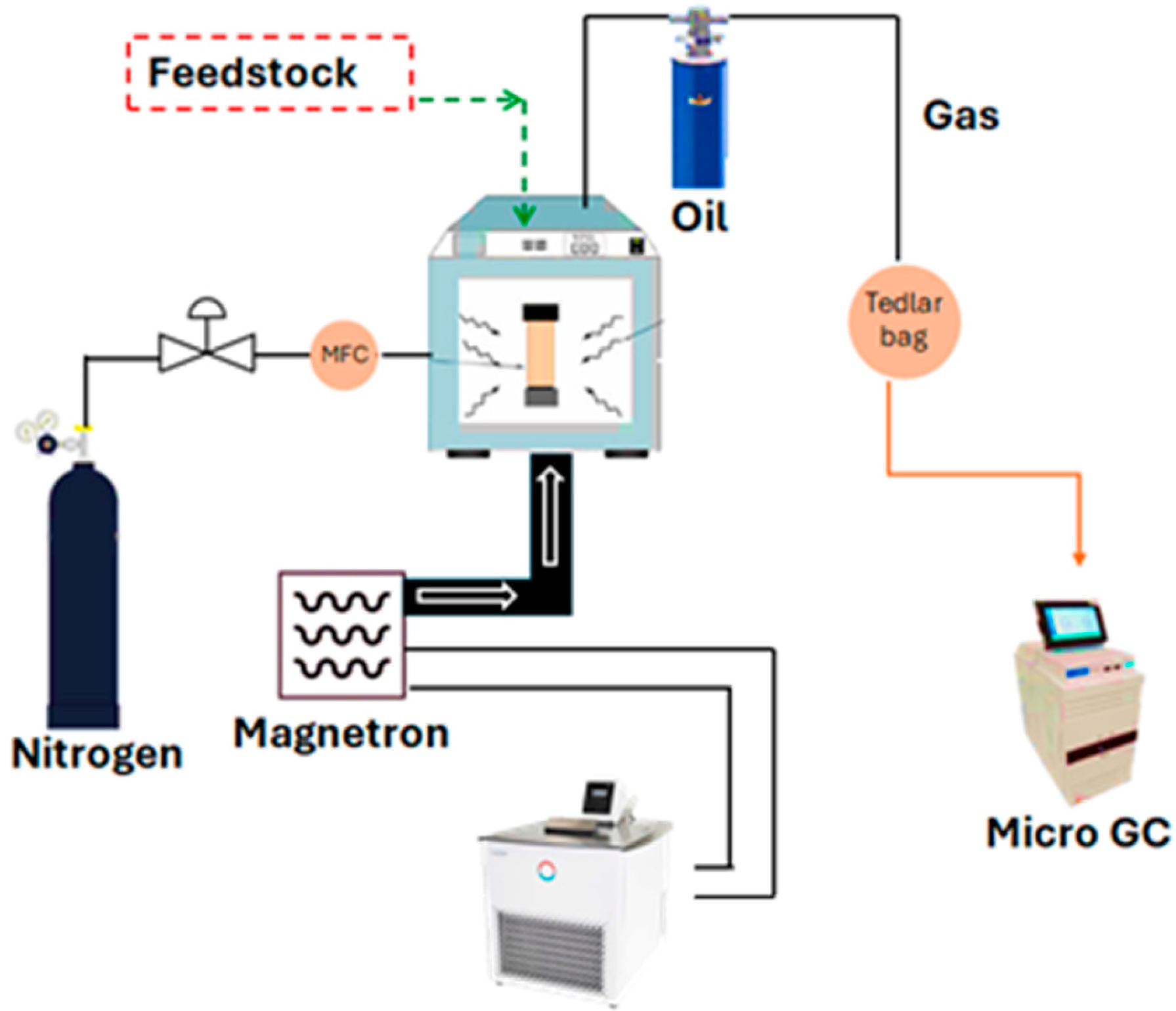
After characterization, the samples were subjected to experimental tests to investigate microwave-assisted co-pyrolysis and to compare the results with those obtained under conventional heating. The experimental apparatus consisted of three main sections—the reaction section, the product separation section, and the analysis section—as illustrated in
Figure 1.
The reaction section, which represents the core of the process, consisted of a custom-built AISI 316 microwave (Next Technology Tecnotessile, Prato, Italy) furnace with a cubic irradiation chamber (edge length: 500 mm) manufactured by laser welding with a wall thickness of approximately 10 mm. The furnace was equipped with two circular openings, one on the top plate and one on the bottom plate, allowing for the insertion of a quartz tube (inner diameter: 30 mm; length: 1 m) through the irradiation cavity. The lower end of the quartz tube was connected to a nitrogen supply system, while the upper end was connected to airtight PVC tubing and valves for conveying the pyrolysis products to the separation section. Microwave energy was supplied by a 2000 W magnetron operating at 2.45 GHz, coupled to the furnace through a waveguide entering from the bottom side of the chamber.
At the beginning of each test, the quartz tube was positioned through the two openings and secured externally with laboratory clamps. Both ends were sealed using truncated conical silicone caps equipped with airtight fittings for the inlet and outlet PVC lines.
Inside the tube, a bed of expanded clay was first loaded. Expanded clay is microwave-transparent and chemically inert, thus it does not influence either the heating behaviour or the reactions occurring during pyrolysis. The material was added until approximately half of the height of the irradiation cavity was filled, providing support to keep the feedstock sample cantered within the microwave field. Subsequently, approximately 5 g of sample was loaded above the expanded clay bed.
The product separation section consisted of a condensation system for collecting the liquid fraction. Condensation was performed using a condenser whose cold utility is a mixture of acetone and liquid CO2 at −20 °C. Part of the condensable fraction (oil) was collected directly in the condenser, while waxes and heavier compounds were partially retained along the connecting lines. Non-condensable gases were collected at the outlet of the system in 5 L Tedlar® bags (Supelco, Bellefonte, PA, USA) and subsequently analyzed using an Agilent 990 microGC (SRA Instruments, Milan, Italy), representing the analysis section of the apparatus.
The entire system was flushed with nitrogen using a mass flow controller (MFC) to inertize the environment and to transport the products to the separation section, with the flow rate fixed at 300 mL/min. Temperature was monitored using a pyrometer (IMPAC, Frankfurt, Germany, data acquisition via INFRAWIN 5) equipped with a 32 mm lens and a focal distance of 600 mm. The pyrometer was mounted on a tripod and operated discontinuously.
At the end of the experiments, the mass of each product fraction (mi) was measured, and yields (Yi) were calculated according to Equation (3).
To determine the solid mass, the quartz tube was removed, the lower silicone cap was opened, and the expanded clay was discharged. The remaining material (susceptor and pyrolytic char) was then pushed out, collected, and weighed. Oils and waxes were partly recovered from the condenser and weighed directly; additional material retained in the tubing was dissolved using acetone, collected, and subsequently separated through a distillation column consisting only of the top section packed to provide a theoretical separation efficiency equivalent to 25 plates. Gas yield was calculated using the micro-GC data together with the nitrogen flow rate, following the approach described in previous work [
22].
Different tests were performed using the described setup. A preliminary set of experiments was carried out using only the susceptors to evaluate their heating behaviour under microwave irradiation. Three susceptors (charcoal, lignite, and anthracite) were tested, and the temperature evolution over time was recorded to identify the most suitable material. Subsequently, MAP tests were conducted on the individual materials (PSW and WP) and on the blends to assess the effect of biomass–plastic synergy on product distribution and gas composition. Experiments were performed using two sample-to-susceptor ratios (R), 1:1 and 1:2, allowing for the evaluation of the influence of volatile residence time as the vapours passed through longer packed beds.
Table 1 reports the experimental matrix, summarizing all the tests performed and their corresponding objectives.
All microwave-assisted pyrolysis experiments were performed in triplicate under identical operating conditions. The reported product yields and gas compositions correspond to the average values of the repeated tests. The variability between replicates was limited, with standard deviations generally within a few percentage points for product yields and within approximately ±1–2 vol% for the main gas components (H2, CO, and CO2), indicating good experimental repeatability. Finally, all results from microwave-assisted tests were compared with those obtained using a conventional one-stage heating setup.
3. Results and Discussion
3.1. Material Characterization Results
The characterization results of the feedstocks used in this study are summarized in
Table 2, which reports the ash content (A), elemental composition (C, H, N, O), and lower heating value (LHV) for PSW, WP, and their blends. For the mixtures, the values were calculated as weighted averages of the corresponding pure materials.
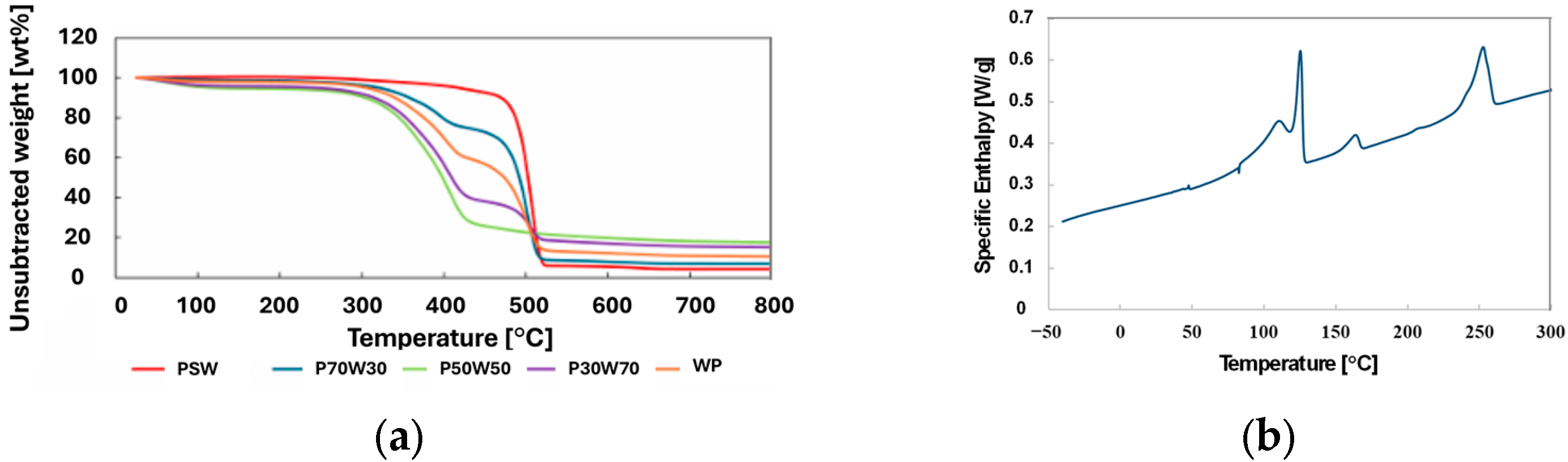
To further elucidate the thermal behaviour of the samples, TGA measurements were performed on pure PSW, pure WP, and all three blended materials. The resulting thermograms are shown in
Figure 2a.
A key difference emerges immediately: PSW shows virtually no mass loss until approximately 400 °C; all samples containing biomass exhibit an early weight loss around 100 °C.
The thermal decomposition of WP follows the classical pattern of lignocellulosic biomass, with the main devolatilization occurring between 200 and 500 °C [
43] and leaving a final residue close to 20 wt%. PSW, instead, displays a delayed and more rapid mass loss beginning around 500 °C, associated with the breakdown of polymeric chains such as those of polyethylene and polypropylene. Its final residue (~7 wt%) is consistent with the low fixed-carbon fraction typical of polyolefins. A gradual mass loss can be detected from about 225 °C, but the dominant degradation step occurs sharply between roughly 425 and 525 °C, a behaviour consistent with the degradation profiles of LDPE [
44], HDPE [
45], and PP [
46].
The thermal profile of the P50W50 lies between those of the two pure components, with a broader degradation interval and two distinct stages: the first associated with the decomposition of the biomass fraction, and the second corresponding to the volatilization of the plastic polymers. This type of dual-step behaviour has been widely reported in studies dealing with biomass–plastic co-pyrolysis [
47].
DSC analysis was performed only on the pure PSW to identify the polymers present in the waste stream. The thermogram reported in
Figure 2b indicates that the material is mainly composed of PE and PET, with a minor presence of PP in agreement with elemental analysis. This polymeric composition provides a qualitative indication of the expected pyrolysis products. The degradation of PE, characterized by its linear to branched aliphatic structure, typically generates n-alkanes, alkenes, and alkadienes. PET, due to its aromatic polyester backbone, yields significant amounts of CO and CO
2. PP, conversely, generally produces predominantly alkenes with smaller quantities of alkanes and dienes during thermal cracking [
48].
3.2. Susceptor Screening and Selection
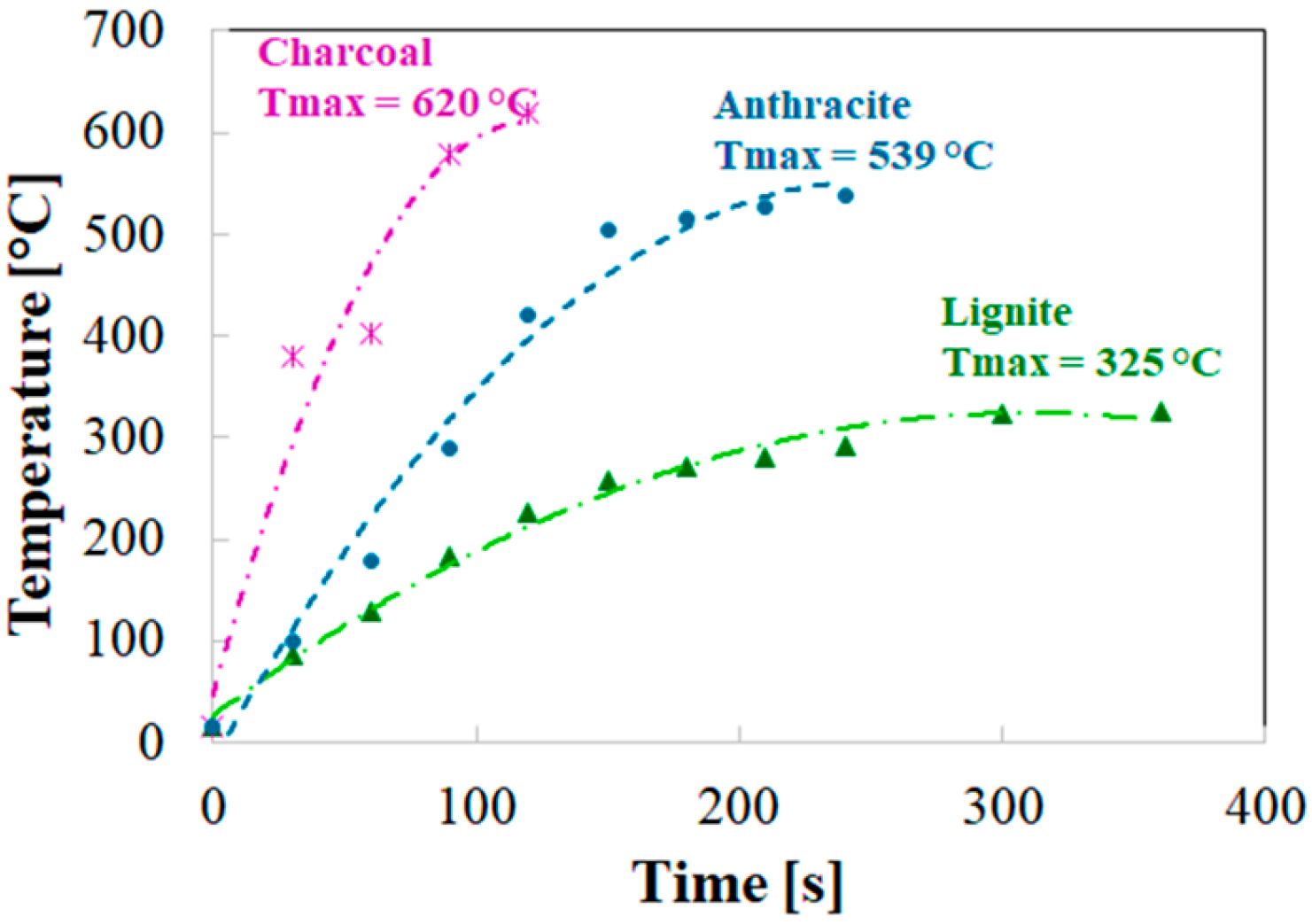
To establish an effective non-conventional heating strategy, three potential microwave susceptors (anthracite, lignite and charcoal) were first evaluated. The resulting temperature profiles obtained under microwave irradiation are shown in
Figure 3.
The three curves exhibit markedly different heating behaviours. Lignite (green curve) reached only slightly above 300 °C after 360 s of irradiation, indicating a limited ability to convert microwave energy into heat. Anthracite (blue curve) performed better, achieving approximately 550 °C after 240 s. Charcoal, however, displayed the highest heating rate and maximum temperature, exceeding 600 °C after only 120 s. Similar observations have been previously reported for carbonaceous materials, where pyrolytic carbons and natural biomass-derived chars were shown to reach temperatures above 600 °C under microwave fields [
49].
The superior performance of charcoal arises not only from its intrinsic microwave susceptibility but also from parasitic eddy currents generated by the magnetic component of the electromagnetic field, in agreement with Faraday–Neumann induction principles. Conversely, lignite proved to be the least effective susceptor, as it neither heated rapidly nor reached temperatures suitable for efficient pyrolysis.
This behaviour can be rationalized in terms of dielectric properties and microstructural characteristics. In microwave fields, the heating rate is primarily governed by the dielectric loss factor and, more specifically, by the loss tangent, which quantifies a material’s ability to convert electromagnetic energy into heat [
50]. Carbonaceous solids with a more disordered structure, higher mineral content and a larger concentration of defects or surface functional groups generally exhibit higher dielectric losses than highly ordered, graphitic materials [
21]. Several studies have shown that biochar- and charcoal-type materials often display stronger microwave absorption compared to crystalline carbons, due to the combined effects of residual inorganic matter, amorphous carbon domains and chemically active surface functionalities that enhance both dipolar and conductive loss mechanisms. Conversely, lignite, with its more compact structures and less polar surface groups, typically it has lower loss tangents and therefore weaker microwave coupling under comparable conditions [
51].
Consequently, the superior heating performance of charcoal observed in
Figure 3 is fully consistent with its higher effective microwave absorbance, which enables faster temperature rise and significantly higher steady-state temperatures. Lignite, by contrast, exhibited the poorest response and can be considered the least suitable susceptor under the tested conditions. For these reasons, charcoal was selected as the preferred susceptor for all subsequent co-pyrolysis experiments, combining rapid heating behaviour, thermal stability and environmental compatibility. Although the heating rate in conventional pyrolysis is significantly lower than in microwave-assisted heating, both processes were conducted to the same final temperature of 600 °C, ensuring thermodynamic consistency in terms of final state variables.
3.3. Effect of Feedstock Composition and Sample-to-Susceptor Ratio
Pyrolysis under inert conditions proceeds through homolytic bond cleavage, yielding radical species that drive a cascade of secondary reactions [
52]. In plastic-rich feeds, thermal decomposition is dominated by random chain scission and β-scission mechanisms, leading predominantly to waxes, long-chain hydrocarbons and hydrogen-rich gases [
53]. Lignocellulosic biomass, in contrast, undergoes dehydration, decarboxylation and depolymerisation of its three major biopolymers (cellulose, hemicellulose and lignin) producing CO- and CO
2-rich gases and substantial amounts of solid char [
54,
55]. When plastics and biomass are co-pyrolysed, interactions between the respective radical pools give rise to synergistic effects: hydrogen-donor radicals generated from plastics promote the deoxygenation of biomass-derived vapours [
56], while the highly reactive oxygen-containing radicals from biomass influence the cracking and condensation pathways of plastic-derived intermediates [
57].
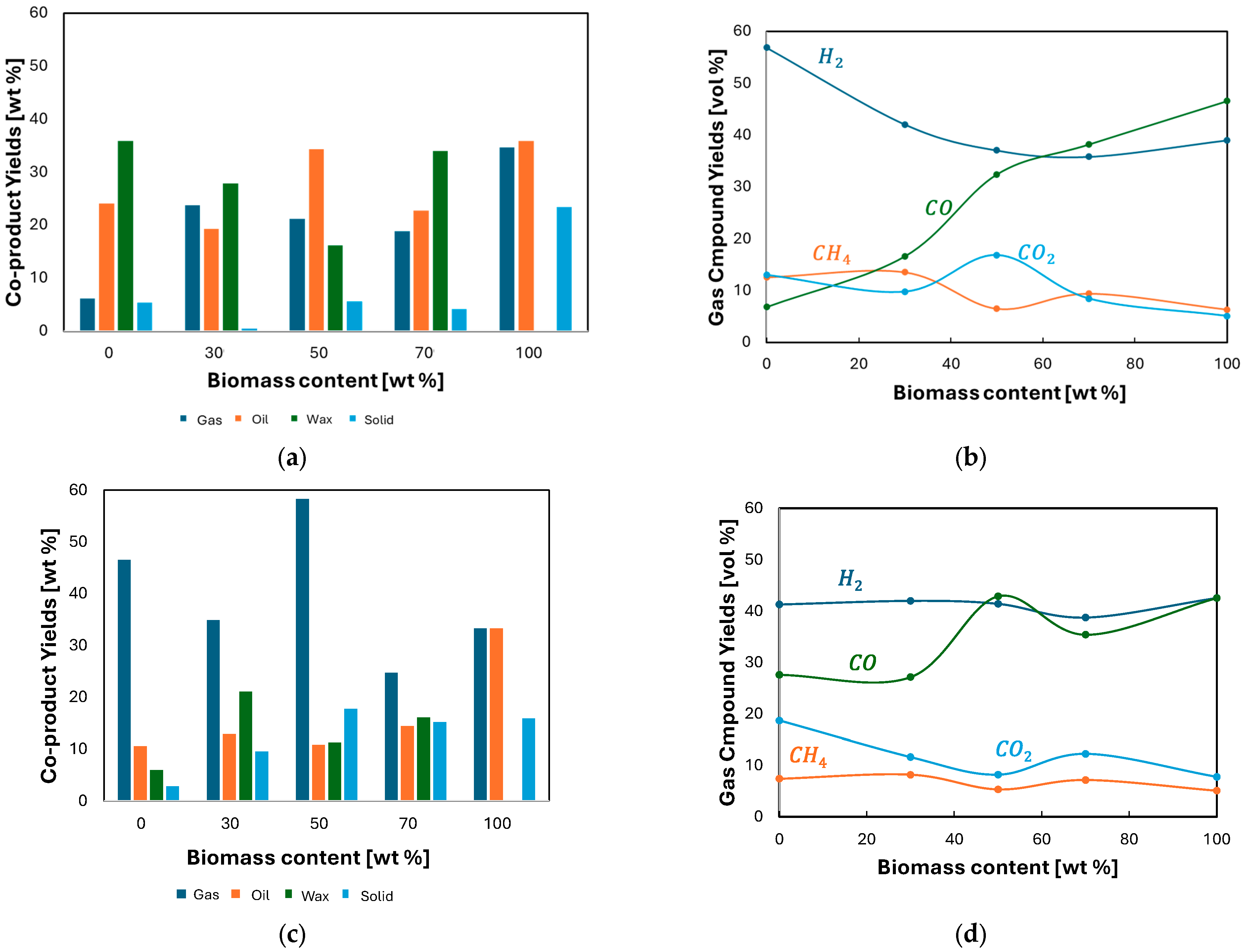
Figure 4 illustrates the effect of biomass content on co-product yields and gas composition under MAP, comparing two sample-to-susceptor ratios. Panels (a) and (b) refer to R = 1, while panels (c) and (d) correspond to R = 0.5. These datasets allow for a comprehensive assessment of the behaviour of pure PSW and pure biomass, as well as their blends, within the microwave-assisted pyrolytic environment. To quantitatively assess synergistic effects, the experimental yields obtained for biomass–plastic blends were compared with theoretical values calculated as linear combinations of the yields of the individual feedstocks, weighted according to the blend composition.
The experimental data acquired with a sample-to-susceptor ratio of 1 (
Figure 4a,b) reflect a mechanistic framework. Pure PSW produced relatively low gas yields, in the order of 6 wt%, and a substantial fraction of condensable products, with oils reaching approximately 24 wt% and waxes 36 wt%. This behaviour is consistent with the well-established behaviour of polyolefins to generate long-chain liquid products with limited gaseous output under inert environment. Pure biomass, on the other hand, yielded the highest fraction of char (23 wt%) and produced around 35 wt% gas, confirming the inherently solid-forming nature of lignocellulosic pyrolysis. Intermediate behaviour was observed for the blends, underlying a synergistic effect. For instance, for the blend containing 30 wt% biomass at R = 1, the experimental gas yield reached approximately 24 wt%, whereas the theoretical value calculated from a linear combination of the individual feedstocks was about 14.7 wt%. This corresponds to an increase of more than 60% relative to the non-synergistic expectation, providing clear quantitative evidence of synergistic interactions between plastic- and biomass-derived degradation pathways, suggesting enhanced cracking promoted by the interaction of plastic-derived hydrogenated radicals with oxygenated biomass vapours [
56,
57].
These synergistic effects are particularly evident in the gas compositions reported in
Figure 4b. Pure PSW produced a hydrogen-rich gas, with H
2 levels around 57 vol% and relatively low concentrations of CO and CO
2. In contrast, pure biomass generated gas dominated by CO (47 vol%) with lower H
2 contents (39 vol%) and significant CO
2 contributions. In the blends, however, the gas composition deviated strongly from a simple weighted average. The 30 wt% biomass mixture exhibited an appreciable increase in hydrogen, reaching 42 vol% substantially above the expected trend, while CO decreased and CO
2 remained comparatively low. Although the hydrogen concentration was slightly lower than the linear theoretical value, the simultaneous reduction in CO and CO
2 resulted in a significantly higher H
2/CO ratio, confirming a synergistic improvement in syngas quality rather than simple yield enhancement. This behaviour confirms that hydrogen-transfer reactions between plastic-derived radicals and oxygenated biomass fragments enhance deoxygenation and promote the formation of lighter, hydrogen-enriched gases. The experimental data allow for a first-order assessment of energy recovery. For the optimal blend (P70W30), the feedstock lower heating value was approximately 29.4 MJ kg
−1. Under microwave-assisted pyrolysis at R = 1, the gas yield reached ~24 wt%, with syngas heating values in the range of 18–30 MJ kg
−1 depending on composition. Using a conservative average value of ~22 MJ kg
−1, the energy recovered in the gaseous phase corresponds to approximately 5.3 MJ kg
−1 of feed, equivalent to 18% of the initial chemical energy.
Considering that the solid char fraction (≈15–20 wt%) typically retains heating values of 20–30 MJ kg−1, an additional 4 MJ kg−1 of recoverable energy is available in the solid phase. This yields an overall recoverable energy fraction of roughly 30–35% in gas and char alone, without accounting for the energetic contribution of the liquid products.
The resulting syngas exhibited H
2/CO ratios between 2 and 3, which are particularly favourable for downstream synthesis routes such as methanol or Fischer–Tropsch intermediates [
58]. Although the higher hydrogen content lowers the overall mass yield of gas, since hydrogen-rich gases are less dense, the specific energy content of the syngas increases, making it a more valuable on-site energy carrier. From a reaction-engineering perspective, the improved syngas composition obtained under microwave-assisted co-pyrolysis has relevant implications for downstream conversion pathways. The measured H
2/CO ratios in the range of 2–3 fall within the optimal window typically required for methanol synthesis (H
2/CO ≈ 2) and are also suitable for Fischer–Tropsch processes after minor adjustment, depending on the desired hydrocarbon distribution. In addition, the elevated hydrogen concentration observed under MAP indicates that secondary reforming and water–gas shift reactions are effectively promoted during microwave heating, partially upgrading the gas in situ. The relatively low CO
2 content compared to conventional pyrolysis suggests that deoxygenation proceeds preferentially through reforming-type pathways rather than simple decarboxylation, resulting in a more reduced and chemically valuable gas mixture. For practical implementation, additional conditioning steps would still be required, including particulate and tar removal, as well as CO
2 adjustment depending on the target synthesis route. However, the higher intrinsic hydrogen content reduces the need for extensive downstream reforming or external hydrogen supplementation, which is often necessary for biomass-derived syngas. A full techno-economic evaluation and catalytic synthesis testing remain beyond the scope of this experimental study, but the compositional results clearly indicate that microwave-assisted co-pyrolysis provides a syngas platform more directly compatible with established thermochemical fuel synthesis routes compared to conventional slow pyrolysis.
The tests performed with an increased mass of susceptor were carried out to evaluate the fine-tuning of the experimental setup and to assess how product yields and compositions change with the filling height of the reactive core. The results are shown in
Figure 4c,d.
A different behaviour emerges when the susceptor loading is increased, corresponding to a reduction in the sample-to-susceptor ratio to 0.5. Under these conditions, the increased height of the hot reactive zone prolongs the residence time of vapours (from 2.5 s to 4.7 s) before quenching, favouring secondary thermal cracking reactions. As reported in previous studies on both conventional and microwave pyrolysis [
59,
60], longer residence times enhance the conversion of condensable vapours into permanent gases. In this study, for pure PSW, the gas yield enhanced to up 47 wt%, while the yields of oils and waxes decreased sharply. The solid residue remained nearly unchanged, confirming that the increased gas production originated from enhanced secondary cracking rather than changes in primary degradation.
The behaviour of pure biomass under these conditions was more complex. The results revealed a simultaneous increase in both gas and liquid yields and a reduction in solid char relative to the previous experiments. This behaviour may be attributed to the well-documented tendency of biomass pyrolysis vapours to undergo repolymerisation when subjected to prolonged exposure to high temperatures in radical-rich environments. Such secondary repolymerisation pathways produce heavy tar-like liquids, which were indeed observed accumulating within the cold condenser lines, consistent with thermodynamic predictions for lignocellulosic pyrolysis at extended residence times.
The blended systems under higher susceptor loading also displayed enhanced gas production, with yields ranging from 27 (70% of biomass) to almost 60 wt% (50 wt% of biomass) depending on composition. This increase was accompanied by a general reduction in oil and wax fractions and a moderate, nearly uniform rise in char yields across all mixtures. The latter can be explained by the decomposition profile of lignin, which favours the formation of elemental carbon and aromatic structures at elevated temperatures [
61]. In addition, plastic-derived light volatiles are more prone to repolymerisation when trapped within a zone characterized by high radical density, contributing to additional solid formation.
Regarding the gas composition under these enhanced residence time conditions, a general decline in quality was observed. Hydrogen concentrations decreased relative to the previous experiments, while CO and CO2 increased, reflecting intensified secondary cracking of oxygenated vapours but also a shift towards decarboxylation pathways. Methane exhibited only minor variations across the different compositions. Overall, the increased gas yield obtained at higher susceptor loading came at the expense of gas calorific value, though the total energy recovered in the gaseous phase remained comparatively high.
These results demonstrate that microwave-assisted co-pyrolysis offers a high degree of tunability in terms of both co-product yields and syngas composition. Operating conditions strongly influence the balance between primary degradation and secondary cracking, while the interplay between plastic- and biomass-derived radicals enables synergistic modulation of gas quality. Intermediate blend compositions, particularly around 30 wt% biomass, exhibit the most pronounced synergies, combining elevated hydrogen content with reduced oxygenated gases. Increasing susceptor loading enhances gas formation through extended thermal exposure but reduces syngas quality. These findings highlight how feed composition and reactor configuration can be strategically adjusted to optimize either total gas production or syngas quality depending on downstream process requirements.
3.4. Comparison Between Microwave-Assisted and Conventional Pyrolysis
A direct comparison between microwave-assisted pyrolysis (MAP) and conventional single-stage pyrolysis provides important insight into the influence of the heating method on both product yields and gas composition. The conventional experiments were conducted under slow heating conditions, with an average heating rate of approximately 0.5 °C/s, characteristic time of slow pyrolysis regimes. These data represent a fundamentally different thermochemical environment compared to the rapid, volumetric heating enabled by microwave radiation.
Under microwave irradiation, all feedstocks, PSW, WP, and their blends, exhibited significantly higher gas yields compared to conventional heating, for which gas production typically ranged between 9 and 12 wt% and showed only minor variations with blend composition. This marked increase can be attributed to the combination of rapid heating, more uniform temperature distribution, and the occurrence of localized hot spots characteristic of microwave–matter interactions [
62]. These conditions promote intense homolytic cracking and enhance secondary decomposition of condensable vapours, which under slow thermal heating would instead condense as liquid products [
63]. In contrast, the conventional pyrolysis system produced consistently higher oil/wax fractions across all blend compositions, along with a more gradual increase in the solid residue as biomass content increased.
A more detailed comparison of the product yields obtained under microwave-assisted and conventional heating is provided in
Table 3. However, beyond the quantitative differences in gas production, the most relevant insight emerges from the analysis of gas volumetric composition, which directly reflects the severity of the thermochemical environment and the dominant reaction pathways. A direct comparison between the gas compositions obtained under conventional and microwave heating for all feedstocks and blend ratios is reported in
Table 3.
Under conventional pyrolysis, the gas streams are dominated by CO, particularly for biomass-rich samples, where CO concentrations reached values of 34 vol% (
Table 3). Hydrogen content remained comparatively low, especially for blended feedstocks, ranging between 9 and 21 vol%, while significant amounts of CO
2 and light hydrocarbons (mainly CH4) remained in the gas mixture. This behaviour is typical of slow pyrolysis, where longer solid–vapour contact times and limited radical formation lead to incomplete cracking and preservation of oxygenated intermediates.
Under microwave heating a markedly different behaviour was observed. MAP consistently produced hydrogen-rich syngas with lower CO and CO2 contents, indicating more extensive deoxygenation and advanced cracking reactions. In particular, hydrogen concentrations increased up to ~42 vol% for intermediate PSW/WP blends, while the H2/CO ratio, which remained below unity in conventional pyrolysis, increased up to values above 2–3 under microwave irradiation. This shift in gas composition reflects the fundamentally different thermo-kinetic environment of microwave heating, where fast temperature rise and volumetric energy deposition promote stronger radical formation. The increased availability of hydrogen radicals leads to their rapid recombination into H2, thereby explaining the systematically higher hydrogen content observed in MAP-derived syngas.
The enhanced hydrogen production under MAP can be attributed to the concurrent action of multiple mechanisms. First, localized hot spots induced by microwave–matter interactions promote extensive C–H bond homolysis, accelerating the generation of reactive H• radicals that subsequently recombine into H2. Second, the rapid heating rates and elevated temperatures achieved under MAP favour secondary endothermic reactions, including dehydrogenation, steam reforming of oxygenated intermediates and the water–gas shift reaction, sustained by the residual moisture inherently present in biomass and char. Moreover, slow heating prolongs the residence time of biomass in the active devolatilization range (approximately 200–450 °C), promoting secondary cracking, repolymerization, and char formation reactions. In contrast, rapid heating accelerates primary devolatilization and limits secondary transformations due to shortened exposure to intermediate temperatures and faster volatile release. Consequently, the differences observed between microwave and conventional pyrolysis are also governed by reaction kinetics and heat/mass transfer phenomena rather than thermodynamic inconsistency. Third, MAP enhances the synergistic interaction between plastics and biomass, whereby hydrogen-rich volatiles released from plastics facilitate the deoxygenation of biomass-derived fragments, suppressing CO2 formation and further increasing hydrogen availability. This synergy leads to a cleaner and more energy-dense syngas.
Moreover, to strengthen the contribution derived from water gas shift promoted by char, a complementary microwave-assisted char gasification experiment under controlled conditions using a pyrolysis-derived carbonaceous residue with a known moisture content of approximately 8 wt% was performed. Under microwave irradiation, the produced gas was strongly enriched in hydrogen and carbon monoxide, with volumetric fractions of about 53 vol% H2 and 37 vol% CO, accompanied by only ~9 vol% CO2 and negligible higher hydrocarbons, and with no visible condensate formation along the reactor or condenser lines. A stoichiometric analysis based on the measured molar composition indicated that the total molar amount of oxidized carbon species (CO + CO2 ≈ 0.208 mol) was closely comparable to the amount of hydrogen generated (H2 ≈ 0.24 mol), which is consistent with dominant steam–carbon reactions (C + H2O ⇌ CO + H2) followed by partial water–gas shift equilibration. Furthermore, the reacted water mass estimated from hydrogen production (≈0.69 g) closely matched the experimentally introduced moisture content (≈0.75 g), demonstrating quantitative consistency between reactants and products and confirming that steam–char interactions were kinetically significant under microwave heating conditions.
Quantitatively, the increase in hydrogen yield obtained via MAP was as high as 35% compared to the conventional one-stage pyrolysis, while CO2 content was reduced by up to 40%, confirming the enhanced reforming and deoxygenation processes. As a result, the syngas produced by MAP is substantially more suitable for direct utilization as a hydrogen-enriched fuel or as a precursor for catalytic synthesis routes (e.g., methanol or Fischer–Tropsch hydrocarbons) without extensive upgrading.
Overall, the comparison demonstrates that the mode of heat delivery plays a decisive role in determining both the extent of primary decomposition and the severity of secondary reactions. These findings highlight the potential of MAP as an advanced thermochemical platform capable of enhancing both the efficiency and quality of waste-to-fuel processes.
3.5. Scale-Up of a Microwave-Assisted Pyrolysis Reactor
A major limitation in the development of microwave-assisted pyrolysis technologies is the lack of industrial-scale reactors. Most studies to date operate at laboratory scale, typically below a few grams of feed per batch, and the transition to continuous units capable of treating several kilograms per hour remains a central engineering challenge [
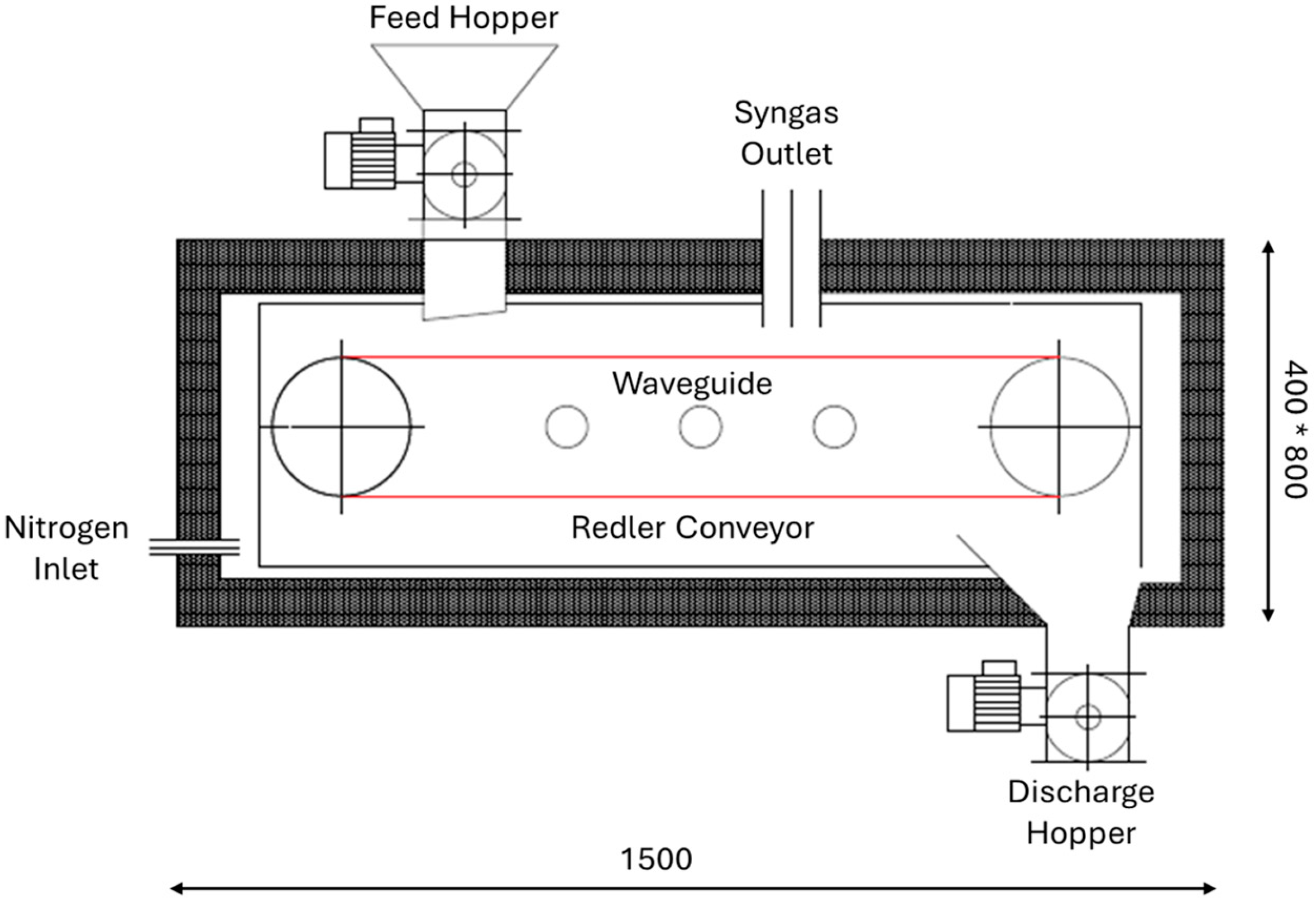
64]. The present work therefore not only develops a process model for a small industrial installation but also proposes a preliminary scale-up design for a continuous microwave reactor, recognizing that the reactor core is the component least mature technologically and the most critical to scaling. In
Figure 5, the proposed scheme for a scale-up of a microwave-assisted reactor in shown.
The purpose of this section is to translate experimentally derived operating conditions into a physically realistic continuous microwave-assisted pyrolysis configuration and to identify the dominant scale-up constraints, rather than to deliver a finalized reactor design. The proposed throughput (5 kg h
−1), operating temperature (~600 °C), residence time (2.5–4.7 s as experimentally observed via susceptor loading), and installed microwave power (four 1 kW magnetrons) are quantitatively anchored to laboratory results and established microwave-processing limits. An order-of-magnitude energy balance supports the feasibility of the design: heating 5 kg h
−1 of mixed plastic–biomass feed from ambient temperature to 600 °C requires approximately 1.6 kW of sensible heat (assuming an effective heat capacity of ~2 kJ kg
−1 K
−1), while the endothermic pyrolysis reactions contribute an additional ~0.4–1.4 kW, yielding a total absorbed duty of roughly 2–3 kW. The proposed 4 kW microwave supply therefore implies an overall coupling efficiency of 50–75%, consistent with susceptor-assisted microwave operation at high temperatures. From an engineering perspective, the reactor is configured horizontally to enable mechanically enforced solids transport through the microwave field, which represents the primary operability challenge in continuous MAP [
65]. Controlled residence time is achieved by the imposed conveying velocity under partially filled conditions, allowing for efficient gas disengagement and limiting back-mixing. To mitigate sticking, agglomeration and fouling associated with plastic-rich feeds, mechanical scrapers and self-cleaning elements are incorporated, while the selection of microwave-transparent, thermally stable ceramic materials (e.g., alumina) ensures structural integrity and compatibility with the electromagnetic field [
6]. Inert gas sweeping, engineered solids sealing and heated vapour transfer lines further address air ingress, condensation and plugging risks. Distributed microwave injection from multiple generators improves field uniformity and thermal controllability [
66]. Overall, the section provides a first-order feasibility framework demonstrating that the experimentally observed thermal behaviour can be sustained at higher throughputs, while detailed electromagnetic modelling, full energy balances and pilot-scale validation are explicitly identified as necessary next steps beyond the scope of the present study.
4. Conclusions
This study provided a systematic experimental investigation of microwave-assisted co-pyrolysis of PSW and WP, coupled with a direct comparison to conventional single-stage pyrolysis conducted under comparable final temperatures. The results clearly demonstrate that the mode of heat delivery plays a decisive role in determining both conversion pathways and gas composition. Compared to conventional single-stage pyrolysis under slow heating conditions, microwave-assisted pyrolysis consistently resulted in significantly higher gas yields for all feedstocks and blend compositions. While conventional heating produced limited gas fractions (typically 9–12 wt%) with minor sensitivity to blend ratio, MAP enhanced gas production by up to a factor of 2.7 for selected PSW/WP mixtures. This behaviour was attributed to rapid volumetric heating, reduced thermal gradients and the formation of localized hot spots, which promote extensive cracking of condensable vapours.
MAP led to the production of hydrogen-rich syngas with markedly improved quality. Hydrogen concentrations increased by up to ~35% relative to conventional pyrolysis, while CO2 content was reduced by as much as ~40%. The resulting syngas exhibited H2/CO ratios in the range of 2–3 for intermediate blend compositions, making it particularly attractive for downstream energy and chemical applications. These findings confirm the existence of strong synergistic effects during the co-pyrolysis of plastics and biomass under microwave irradiation, whereby hydrogen-rich plastic-derived volatiles enhance the deoxygenation of biomass fragments and suppress CO2 formation. In addition to the experimental investigation, a preliminary conceptual design for scaling up a continuous microwave-assisted pyrolysis reactor was proposed, addressing key challenges related to feed transport, microwave distribution and thermal control. Overall, the results highlight MAP as a promising thermochemical route for the simultaneous valorization of plastic and biomass waste streams and provide a robust basis for future scale-up, modelling and experimental validation at pilot scale, as well as for assessing the environmental performance of microwave-based systems relative to conventional pyrolysis technologies.
Moreover, in the present experimental setup, temperature was monitored using an external optical pyrometer operated intermittently, which provides a representative surface temperature but does not fully resolve internal gradients or localized hot spots. This limitation is intrinsic to many laboratory-scale MAP systems, where intrusive thermocouples may perturb the electromagnetic field or fail under high-temperature, reactive conditions. Importantly, the objective of this work was not to establish a detailed thermal field map, but to compare process outcomes (product yields and gas composition) under microwave and conventional heating operated to comparable nominal temperatures. The observed trends are therefore interpreted in terms of effective thermal severity rather than absolute local temperature values.
Overall, the experimental results highlight microwave-assisted pyrolysis as a promising thermochemical route for the simultaneous valorization of plastic and biomass waste streams, enabling the production of cleaner and more energy dense syngas compared to conventional heating approaches. In particular, the results provide a robust basis for the modelling and preliminary design of continuous microwave-assisted reactors operating at higher throughputs. Further investigations should also assess the environmental performance of microwave-based systems, including potential reductions in greenhouse gas emissions compared to conventional pyrolysis technologies.




 ,
,