Article

Tailoring Anisotropic Thermal Conductivity in Hollow Tellurium Nanowires via Surface Palladium Decoration for Energy Applications


Department of Materials Science, Tokai University, Hiratsuka 259-1292, Kanagawa, Japan
*
Author to whom correspondence should be addressed.
Energies 2026, 19(5), 1319; https://doi.org/10.3390/en19051319
Submission received: 30 January 2026 / Revised: 26 February 2026 / Accepted: 3 March 2026 / Published: 5 March 2026
(This article belongs to the Special Issue Advances in Synthesis and Thermal Properties of Energy Materials)

Abstract

Directional control of heat flow is essential for advanced energy and electronic systems, yet strategies for tuning anisotropic phonon transport in low-dimensional materials remain limited. Hollow tellurium (Te) nanowires were synthesized via a solvothermal method and modified through Pd electroless plating to achieve tunable anisotropic thermal transport. Structural analyses confirmed Pd incorporation as nanoscale surface deposits without crystalline Pd phases, while SEM observations revealed cavity enlargement due to galvanic displacement at higher PdCl2 concentrations. Bulk films prepared by cold pressing exhibited direction-dependent behavior. Thermal conductivities remained nearly unchanged below 2.2 mM PdCl2, but at 5.5 mM, the in-plane value increased to 2.14 W/(m·K) and the cross-plane value decreased to 0.39 W/(m·K), enhancing the anisotropy ratio from 2.71 to 5.49. This divergence arises from direction-selective phonon scattering, where Pd-rich regions promote in-plane heat flow while junction irregularity suppresses cross-plane transport. These results demonstrate a controllable approach for engineering anisotropic thermal properties in functional energy materials.

1. Introduction

The rapid development of high-performance electronics, wearable sensors, and energy-conversion devices has created an urgent demand for materials capable of directing heat with high spatial precision [1,2,3,4]. As these systems continue to evolve toward thinner, more compact, and multifunctional architectures, thermal loads become increasingly localized, making efficient heat routing essential for preventing device degradation and ensuring long-term operational stability [5,6,7]. Consequently, thermal transport engineering has emerged as a central design challenge in modern energy and electronic technologies, particularly in applications where directional heat flow is required to maintain performance under high power densities or dynamic operating conditions [8,9]. Overcoming this challenge demands materials that can manipulate heat transport with directional selectivity, ensuring that thermal energy is guided precisely where it is needed within the device architecture.
A key concept enabling such control is thermal conductivity anisotropy, the property by which a material conducts heat differently along distinct crystallographic or structural directions [10,11,12,13]. Materials exhibiting strong anisotropy support a variety of thermal-management functions, including in-plane heat spreading, cross-plane thermal insulation, and directional heat-flux sensing. These capabilities are already utilized in graphite heat spreaders, layered thermoelectrics, and thermal diodes, where directional phonon transport is essential for achieving high efficiency and stability [14,15,16,17,18,19]. As device miniaturization progresses and heterogeneous integration becomes more common, the ability to tune anisotropy at the nanoscale is expected to play an increasingly important role in advanced thermal-management strategies [20,21,22]. This trend highlights the need for material platforms that allow systematic manipulation of phonon pathways.
Low-dimensional materials naturally provide such opportunities because their reduced dimensionality and directional bonding impose strong constraints on phonon propagation [23,24,25]. Among them, one-dimensional (1D) nanostructures—such as carbon nanotubes (CNTs), semiconductor nanowires, and nanoplates—exhibit particularly pronounced anisotropic behavior due to their confined phonon spectra and highly directional structural motifs [26,27,28,29,30,31]. CNT films, for instance, display extremely high in-plane thermal conductivity but very low cross-plane conductivity because weak van der Waals interactions between adjacent nanotubes limit phonon transfer across the film thickness. This contrast results in anisotropy ratios far exceeding those of bulk materials [32,33]. Tellurium (Te) nanowires exhibit a similar phenomenon: their helical covalent chains aligned along the c-axis enable efficient axial phonon transport, while much weaker inter-chain interactions suppress heat flow perpendicular to the chain direction [34,35,36,37]. These intrinsic structural features make Te nanowires a promising platform for engineering highly directional thermal transport, particularly when combined with additional structural or interfacial modifications.
Despite these advantages, most previous efforts to control heat flow in low-dimensional materials have focused primarily on reducing overall thermal conductivity through the introduction of pores, defects, or surface decorations [38,39,40,41]. Although such approaches effectively suppress phonon transport, they do not inherently provide directional control because the introduced scattering centers typically influence phonons isotropically. Achieving enhanced anisotropy instead requires strategies that selectively modify phonon-scattering pathways along specific directions—a challenge that remains comparatively underexplored despite its importance for next-generation thermal-management technologies [42,43,44]. For instance, it has been reported that the formation of surface nanodots via electron beam irradiation enhances both crystallinity and carrier mobility, leading to a significant improvement in thermoelectric performance [45]. Developing such direction-selective approaches would enable materials capable not only of reducing heat flow but also of actively steering it, opening pathways toward thermal routing, thermal logic, and adaptive heat-control systems [46].
In this study, we propose a distinct strategy for engineering anisotropic thermal transport by combining hollow 1D nanostructures with controlled surface metal decoration. Hollow trigonal Te nanowires were synthesized via solvothermal methods, and their surfaces were subsequently coated with Pd surface deposits using electroless plating. The hollow geometry introduces internal interfaces that influence phonon propagation, while the Pd decoration provides a tunable means of modifying surface scattering and interfacial phonon coupling. After cold-pressing the nanowires into bulk films, we measured both in-plane and cross-plane thermal conductivities and found that the extent of Pd decoration strongly affects the resulting anisotropy. These results demonstrate a new route for designing anisotropic thermal materials based on 1D nanostructures with engineered surface and internal architectures, offering a versatile platform for advanced thermal-management and energy-conversion applications.

2. Experimental Details

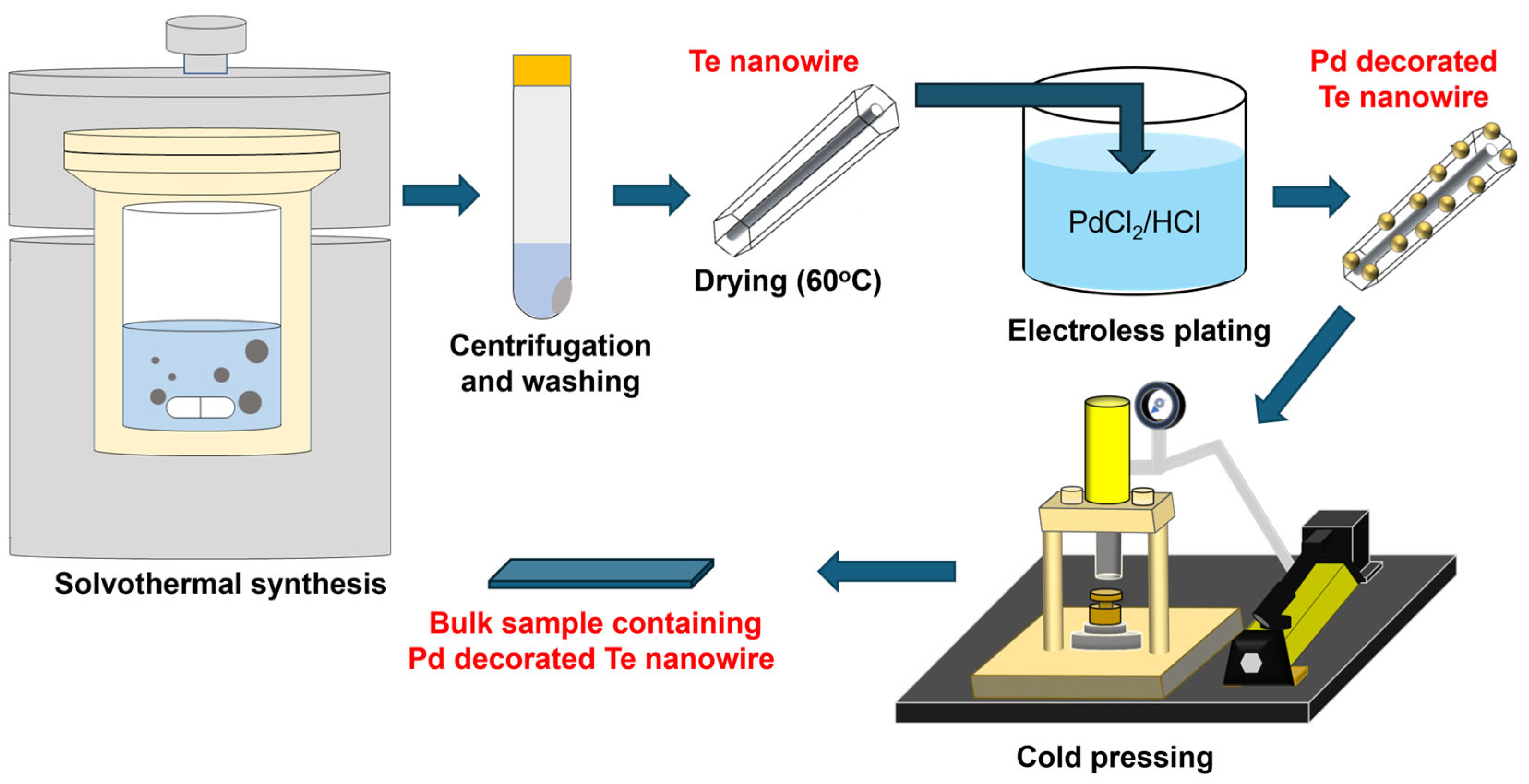
Figure 1 provides an overview of the procedures employed in this work, including the synthesis of hollow Te nanowires, surface modification via Pd electroless deposition, and consolidation into bulk films for thermal transport measurements. The hollow Te nanowires were synthesized via a solvothermal method, in which chemical reactions proceed in a sealed autoclave under elevated temperature and pressure, enabling controlled nucleation and anisotropic crystal growth in solution [34,47]. The basic experimental setup for this synthesis follows the methodology described in our previous reports [48]. In brief, polyvinylpyrrolidone (0.4 g) (99.9% purity, K30, Ms ~ 40,000, Fujifilm Wako Co., Osaka, Japan) was dissolved in ethylene glycol (18 mL) (99.5% purity, Fujifilm Wako Co., Osaka, Japan), followed by the addition of TeO2 (70 mM) (99.9% purity, Kojundo Chemical Lab., Sakado, Japan) and a NaOH solution (2 mL containing 0.4 g NaOH) (purity > 97.0%, Fujifilm Wako Co., Osaka, Japan). The mixture was transferred to a Teflon-lined stainless-steel autoclave (50 cm3 internal volume) and heated at 200 °C for 4 h under continuous stirring at 500 rpm. After cooling to room temperature, the product was collected by centrifugation, washed several times with water and ethanol, and dried under vacuum at 60 °C to obtain hollow Te nanowires. To ensure batch-to-batch homogeneity, the products obtained from six independent solvothermal reaction vessels were collected and thoroughly mixed for each experimental condition.
Surface decoration with Pd was carried out using an electroless plating bath composed of HCl (0.66 M) (concentration of 35–37%, Fujifilm Wako Co., Osaka, Japan) and PdCl2 (purity > 99.0%, Fujifilm Wako Co., Osaka, Japan), with the PdCl2 concentration varied between 1.1 and 5.5 mM to control the amount of deposited Pd. The Te nanowires were immersed in the plating solution for 10 min and then separated by filtration, rinsed thoroughly with deionized water, and dried again at 60 °C. For thermal measurements, 0.35 g of the mixed Pd-decorated nanowires were consolidated by uniaxial pressing at room temperature under 0.45 GPa, producing pellets with dimensions of approximately 22 mm in length, 5 mm in width, and 0.6 mm in thickness.
The morphology of the nanowires and the pressed films was examined using field-emission scanning electron microscopy (FE-SEM; S-4800, Hitachi, Tokyo, Japan). The hollow structure and crystallinity were analyzed by transmission electron microscopy (TEM; JEM-ARM200F, JEOL, Tokyo, Japan) and selected-area electron diffraction (SAED). Phase identification was performed using X-ray diffraction (XRD; MiniFlex 600, Rigaku, Tokyo, Japan), (Cu Kα radiation, 2θ range: 10–80°). Elemental composition was evaluated using an electron backscatter diffraction system attached to an FE-SEM (JSM-7100F, JEOL, Tokyo, Japan).
Thermal diffusivities in both the in-plane and cross-plane directions were measured near 300 K using a periodic heating–radiation thermometry system (Thermowave Analyzer, Bethel, Ishioka, Japan). The system, based on the principles detailed by Reference [49], utilizes a spot-periodic heating method to independently evaluate directional heat transport. For in-plane measurements, αin is determined using the distance-variation method, where the phase lag of the temperature response is scanned as a function of the distance from the heating spot. For cross-plane measurements, αout is obtained through the frequency-variation method, which analyzes the phase lag relative to the modulation frequency based on a one-dimensional heat-flow model. This dual-method approach, utilizing independent scanning parameters (r and f), ensures that the measured thermal anisotropy is determined by distinct physical processes without measurement artifacts. Furthermore, because this technique relies on phase-shift analysis rather than absolute temperature rise, it remains highly robust against variations in surface emissivity and structural inhomogeneities inherent in nanostructured films. Based on these thermal diffusivities, the thermal conductivities in the corresponding directions were obtained from κ = αρCp where α is the thermal diffusivity, ρ is the density determined from the mass and volume of the bulk samples, and Cp is the specific heat taken from References [50,51]. Furthermore, for the Pd-decorated samples, Cp was calculated based on the mass fractions of Te and Pd using the Neumann–Kopp rule [52]. The detailed calculation procedures and parameters are described in the Supplementary Materials (Figure S1).

3. Results and Discussion

3.1. Structural Properties of Hollow Te Nanowires

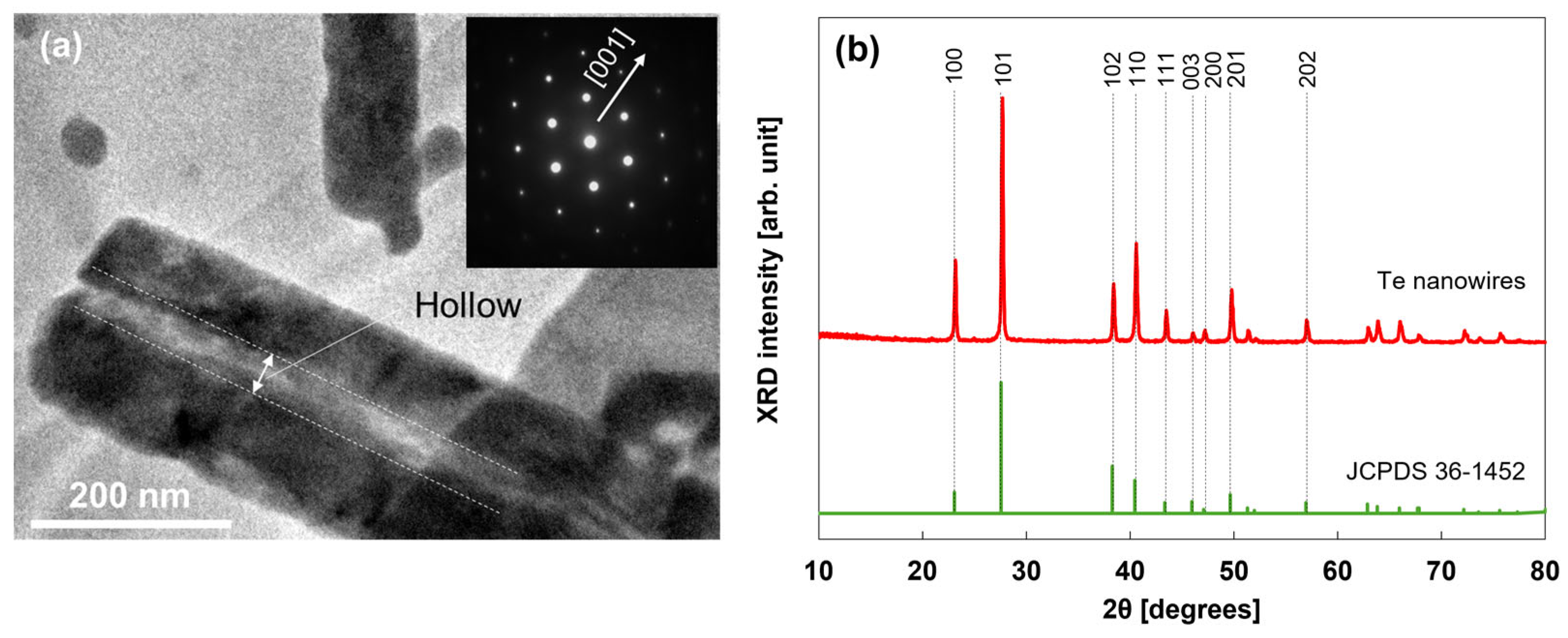
Figure 2 presents the crystallographic characterization of the Te nanowires, including a TEM image with the corresponding SAED pattern and the XRD profile. Figure 2a shows a TEM image of a single Te nanowire, revealing its elongated morphology with a uniform diameter and smooth surface. Notably, the interior region appears lighter in contrast than the periphery, suggesting that the nanowire possesses a hollow internal structure. The corresponding SAED pattern, displayed in the inset, consists of sharp and well-defined diffraction spots that can be indexed along the [001] zone axis. This confirms the single-crystalline nature of the nanowire and indicates a preferential growth direction consistent with the trigonal phase of tellurium. Together, the TEM and SAED analyses demonstrate that the synthesized Te nanowires exhibit structural uniformity, high crystallinity, and a possible hollow architecture.
Figure 2b presents the XRD pattern of the Te nanowires, along with the standard reference profile from JCPDS card No. 36-1452 for trigonal Te. The experimental pattern exhibits distinct diffraction peaks that correspond closely to the reference, with major reflections indexed to the (100), (101), (102), and (110) planes. This strong agreement confirms that the nanowires are composed of phase-pure trigonal Te without detectable secondary phases or structural impurities. The presence of multiple indexed peaks further indicates high crystallinity and long-range structural order within the nanowire ensemble. Taken together, the TEM, SAED, and XRD results consistently demonstrate that the Te nanowires possess a well-defined trigonal crystal structure, high phase purity, and uniform morphology, with a possible hollow internal architecture suggested by the TEM contrast.
The possible mechanism of formation of the hollow structures was discussed in our previous report [48]. In brief, the emergence of hollow Te structures can be interpreted as a consequence of Te concentration gradients on the surfaces of solid seeds [53]. Under conditions where the NaOH concentration in the precursor solution is low—corresponding to a reduced availability of OH—the amount of Te atoms present in the bulk solution decreases [54]. Once the seeds are formed, Te atoms tend to accumulate preferentially along the circumferential edges of the cylindrical seeds, as these sites possess relatively higher free energies compared with other surface regions [55]. During subsequent crystal growth, the supply of Te atoms to the central region of the growth plane becomes insufficient or depleted, leading to the development of a hollow interior within the growing Te nanowires. Through this sequence of reactions, Te nanowires ultimately adopt a hollow morphology.

3.2. Pd Surface Decoration on Te Nanowires with Hollow Structure (Figure S2)

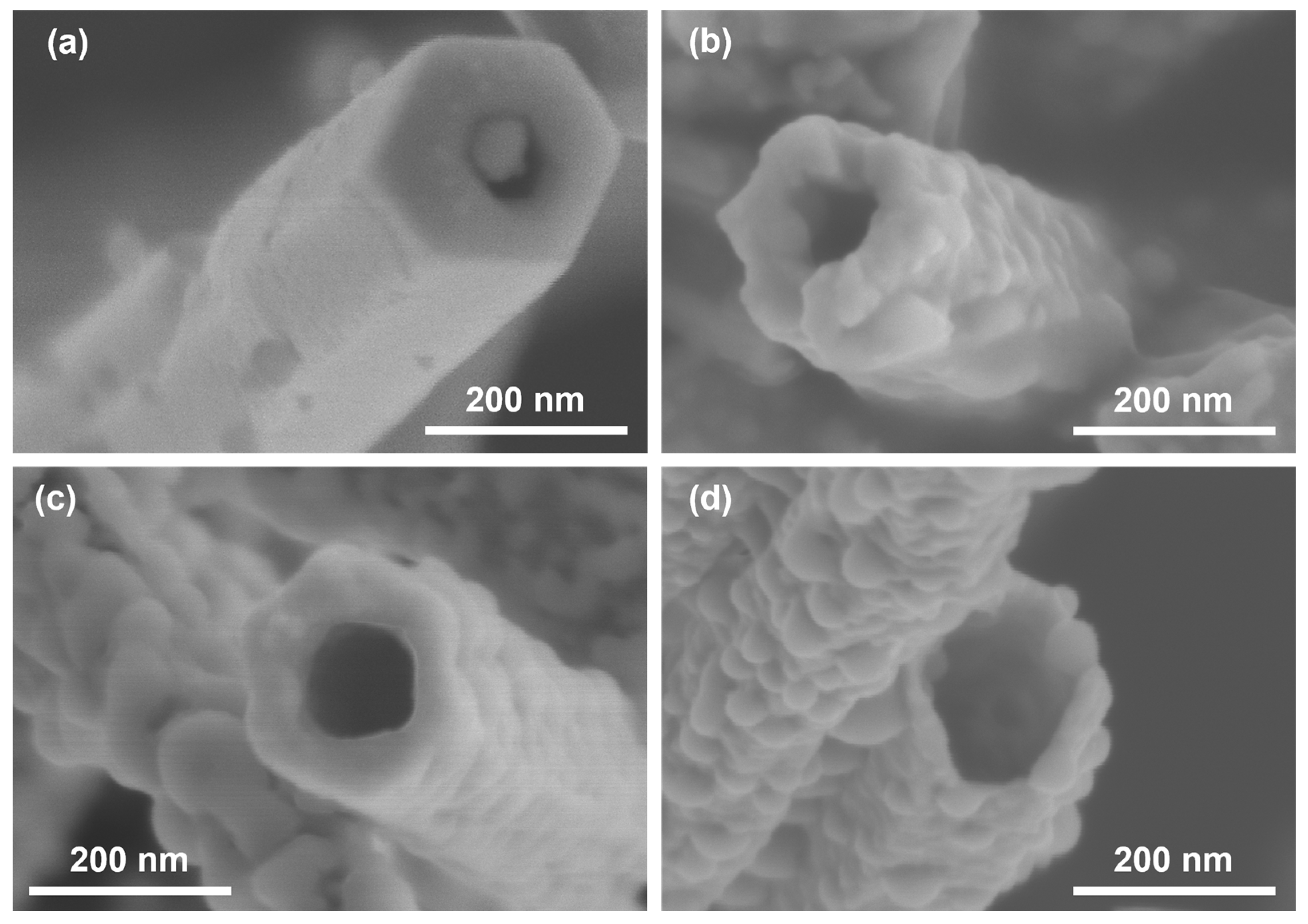
To further control the thermal conductivity of the Te nanowires, we decorated the surfaces of the hollow Te nanowires with Pd deposits using electroless plating. Figure 3 shows SEM images of the surface morphologies of the Pd-decorated Te nanowires prepared with various PdCl2 concentrations. As shown in Figure 3a, a hexagonal hollow structure was observed at the center of the basal plane of the Te nanowire, consistent with the faint-contrast region in the TEM image of Figure 2a, which indicates the presence of a hollow interior. The hexagon has an edge length of approximately 60 nm and exhibits well-defined edges with a high degree of symmetry, suggesting anisotropic growth along the crystallographic c-axis. Statistical analysis of multiple nanowires revealed that the synthesized hollow Te nanowires had an average length of 4.1 ± 3.8 μm, an average outer diameter of 217 ± 72 nm, and an average internal hexagonal cavity edge length of 87 ± 43 nm. At a PdCl2 concentration of 1.1 mM, as shown in Figure 3b, Pd was not deposited as a continuous film but as discrete nanodots, resulting in a rough and textured surface morphology. To quantitatively evaluate these deposits, a detailed statistical analysis was performed using multiple SEM images, measuring a total of 80 particles across the samples (see Figure S2 in the Supplementary Material). The analysis showed that at 1.1 mM, the Pd nanoparticles had a mean diameter of 40 ± 16 nm. The hollow structure of the Te nanowires remained intact after Pd deposition. As the PdCl2 concentration increased, as shown in Figure 3c,d, the mean diameter of the Pd nanodots remained relatively consistent at 59 ± 16 nm for 2.2 mM and 40 ± 9 nm for 5.5 mM, confirming that the individual particle diameter did not scale monotonically with the concentration. While the particle diameter remained within a stable range, the surface roughness became more pronounced due to increased deposition density and the formation of denser, more irregular Pd clusters. Although the hollow structure was preserved, the edge length of the central cavity expanded progressively with increasing Pd concentration. In particular, at a PdCl2 concentration of 5.5 mM, the edge length expanded to approximately 140 nm [Figure 3d], which is attributed to the progressive dissolution of Te during electroless plating. This enlargement arises from an enhanced galvanic displacement reaction, where a higher Pd2+ concentration accelerates the reduction of Pd2+ to Pd0 on the Te surface while simultaneously promoting the oxidative dissolution of Te. Consequently, this process leads to a pronounced expansion of the cavity, most notably at 5.5 mM PdCl2.
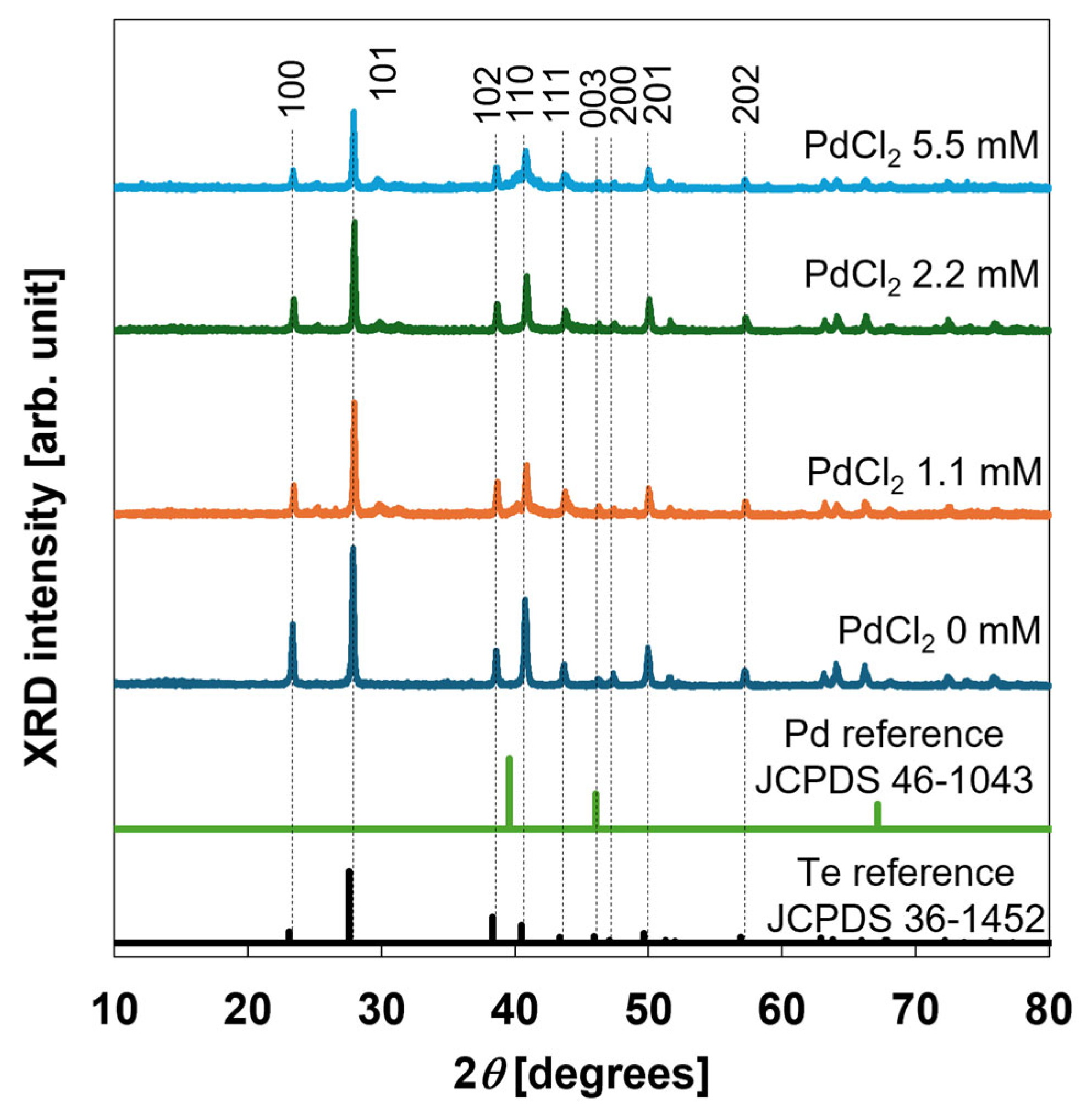
The crystal structure and phase purity of the Pd-decorated Te nanowires fabricated with various PdCl2 concentrations were analyzed using XRD, as shown in Figure 4. Despite the Pd incorporation, the XRD patterns exhibited no peaks corresponding to metallic Pd (JCPDS 46-1043) [56]. Notably, even for the sample with the highest Pd concentration (approximately 15 at.% Pd), no diffraction peaks such as Pd (111) or (200) were detected. This strongly indicates that the Pd deposits are in an “XRD-amorphous” state, likely consisting of ultra-fine nanocrystallites or amorphous clusters below the detection limit of conventional XRD (typically < 3–5 nm), consistent with previous reports [41,57,58,59,60]. This is also in agreement with the established growth models of galvanic displacement, where Pd initially forms highly dispersed, sub-nanometer clusters before significant grain growth occurs [61,62]. In all samples, regardless of the PdCl2 concentration, diffraction peaks corresponding to trigonal Te (JCPDS 36-1452) [63] were clearly detected, and no peaks associated with Pd–Te compounds were observed, indicating that alloy or intermetallic phase formation did not occur during the plating process.
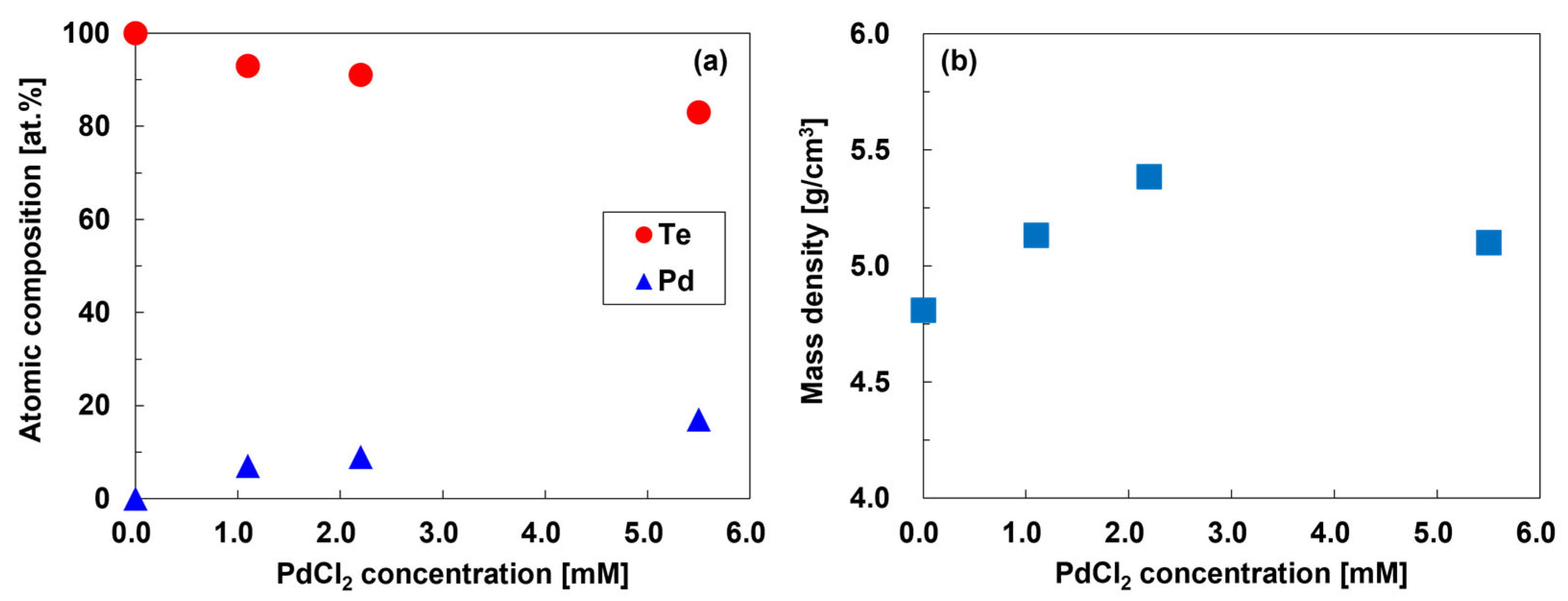
Figure 5 shows the material properties of hollow Te nanowires electroless plated at different PdCl2 concentrations. For visual convenience, the properties of the pristine bulk Te nanowire assemblies, which were not subjected to electroless plating, were plotted at a PdCl2 concentration of 0 mM. The atomic composition of the hollow Te nanowires with Pd decoration is shown in Figure 5a. As the PdCl2 concentration increased from 0 to 5.5 mM, the Te content decreased from 100 at.% to approximately 85 at.%, while the Pd content increased correspondingly to around 15 at.%. This trend indicates progressive Pd incorporation into the nanowire structure, likely through surface incorporation during the plating process. Figure 5b presents the corresponding mass density of the nanowires. The density increased from 4.8 g/cm3 at 0 mM to a maximum of 5.6 g/cm3 at 2.2 mM PdCl2, followed by a slight decrease to 5.0 g/cm3 at 5.5 mM. The initial increase suggests structural densification due to Pd incorporation, whereas the subsequent decline may reflect morphological changes such as increased porosity or surface roughening at higher PdCl2 concentrations. These results collectively demonstrate that PdCl2 concentration plays a critical role in tuning both the composition and physical properties of the plated Te nanowires.

3.3. Thermal Properties of Pd Surface Decoration on Hollow Te Nanowires

A note should be made that the measured thermal conductivity predominantly reflects the lattice contribution and is therefore closely associated with phonon transport. This is because the total thermal conductivity consists of both electronic and lattice components, as shown in the Supplementary Materials (Figure S3), the electronic contribution is negligibly small compared with the lattice contribution across all PdCl2 concentrations.
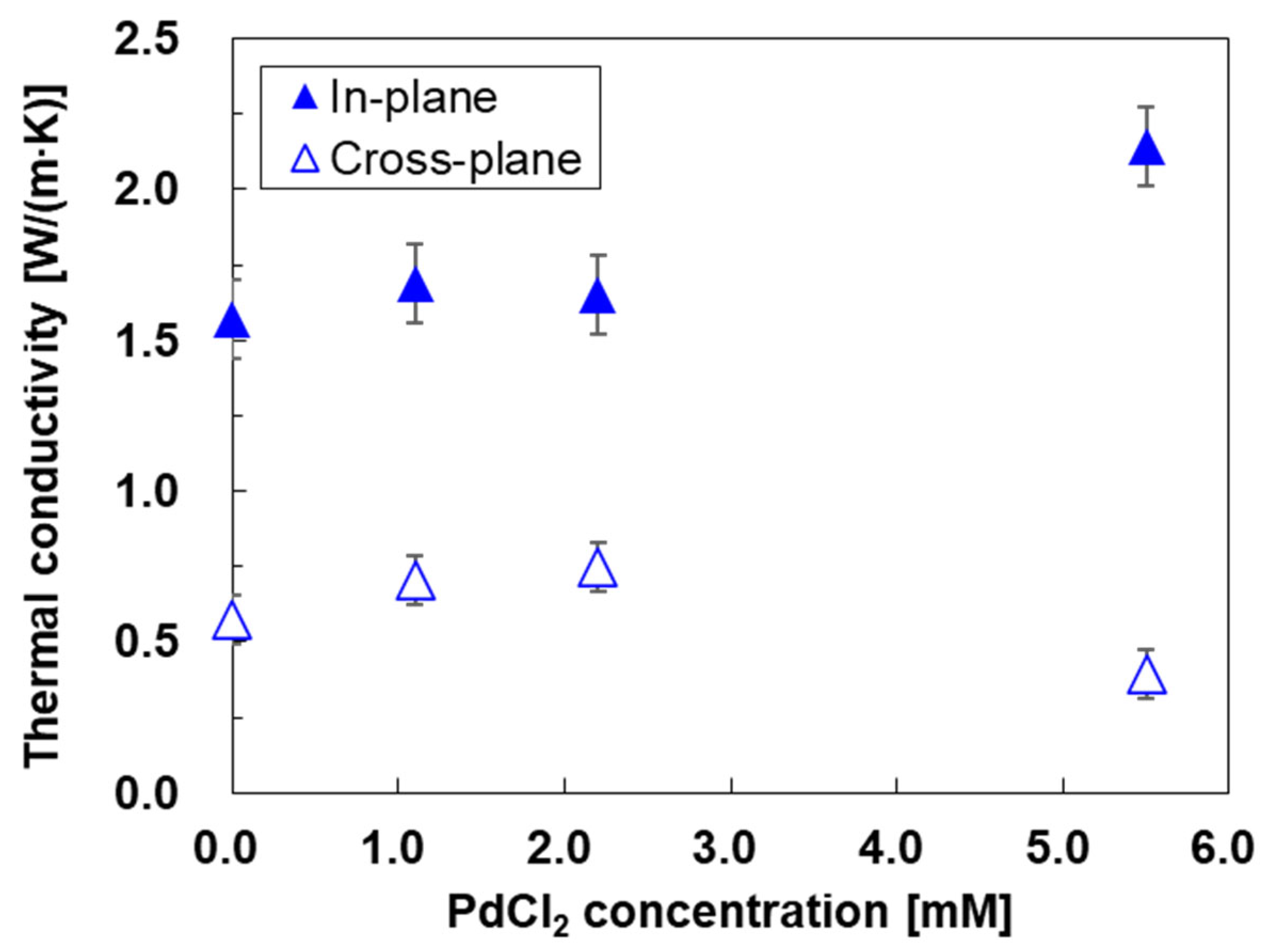
Figure 6 shows the in- and cross-plane thermal conductivities of the bulk Te nanowire assemblies with hollow structures when Pd was deposited with different PdCl2 concentrations obtained through electroless plating. The fact that most hollow Te nanowires remain unbroken, preserving their original length while forming connections with neighboring nanowires, has already been confirmed in our previous study through SEM observations of both the pressed surface and the fracture surface [48]. For reference, representative SEM images of these surfaces are provided in the Supplementary Materials (Figure S4). The PdCl2-concentration dependence of the thermal diffusivity and specific heat used to derive the thermal conductivity is also provided in the Supplementary Materials (Figures S1 and S5). In the Pd-free deposition condition (0 mM PdCl2), the thermal conductivity was 1.57 W/(m·K) in the in-plane direction and 0.58 W/(m·K) in the cross-plane direction, yielding an anisotropy ratio of 2.71. Up to a PdCl2 concentration of 2.2 mM, both thermal conductivities remained nearly constant, and the anisotropy ratio showed minimal variation. However, a marked divergence was observed at 5.5 mM PdCl2: the in-plane thermal conductivity increased to 2.14 W/(m·K), while the cross-plane value decreased to 0.39 W/(m·K), resulting in an anisotropy ratio of 5.49—approximately twice that of the Pd-free sample. Notably, this value is significantly higher than the anisotropy ratio of typical bulk anisotropic materials, such as Bi2Te3 single crystals, which exhibit a ratio of approximately 2.1 [64]. This pronounced enhancement in anisotropy suggests that Pd incorporation significantly alters the directional heat transport characteristics of the nanowire-based bulk material. To elucidate the origin of this strong anisotropy, the underlying phonon-transport mechanism is discussed in the following section.

3.4. Mechanism of Anisotropic Thermal Properties

The substantial increase in thermal conductivity anisotropy observed at 5.5 mM PdCl2 can be interpreted by considering how Pd incorporation modifies phonon transport pathways in a direction-dependent manner within the nanowire-based bulk structure [65,66,67]. Although the XRD patterns (Figure 4) do not exhibit distinct Pd-related diffraction peaks—indicating that the deposited Pd does not form large crystalline domains—the compositional analysis (Figure 5) clearly shows a significant increase in Pd content at higher precursor concentrations. This suggests that Pd is present as nanoscale clusters or highly dispersed deposits that remain below the detection limit of XRD, yet still exert a strong influence on interfacial phonon scattering. It is important to note that the observed enhancement of thermal anisotropy is primarily driven by these morphological alterations and the formation of Pd-rich interfacial pathways, rather than the specific atomic crystallinity of the Pd deposits. These highly dispersed Pd “disorders,” whether amorphous or nanocrystalline, effectively serve as additional scattering centers for phonons and modify the interfacial landscape, which is the core mechanism underlying the observed modulation in thermal conductivity. The role of the hollow geometry in reducing thermal conductivity compared to solid counterparts has been previously established [48]. In this study, the hollow structure serves as a consistent baseline for all samples, allowing us to isolate the effects of Pd decoration. By comparing the pristine hollow Te (0 mM) with the Pd-decorated samples, the marked increase in anisotropy can be directly attributed to the formation of Pd-rich interfacial pathways and the expansion of the hollow cavity. Therefore, the observed trends remain physically representative of the synergistic effect between the hollow architecture and Pd ornamentation. At PdCl2 concentrations up to 2.2 mM, Pd was deposited primarily as isolated nanodots on the nanowire surfaces, as observed in Figure 3. These nanodots act as additional phonon-scattering centers, but their distribution is nearly isotropic with respect to the nanowire orientation. Consequently, both in-plane and cross-plane thermal conductivities remain nearly unchanged, and the anisotropy ratio shows only minor variation.
In contrast, at 5.5 mM PdCl2, the Pd deposition behavior changes markedly. SEM observations (Figure 3d) reveal a much denser and more irregular accumulation of Pd on the nanowire surfaces, accompanied by a pronounced enlargement of the hollow cavity due to enhanced galvanic displacement. In the in-plane direction—where nanowires lie laterally and share extended contact surfaces—this denser Pd coverage can form locally interconnected Pd-rich regions or high-density clusters along the nanowire interfaces. These Pd-rich regions effectively smooth the interfacial landscape, reducing phonon scattering and enabling more efficient heat flow along the in-plane direction [68,69,70]. This mechanism accounts for the increase observed in the in-plane thermal conductivity at 5.5 mM.
In contrast, the cross-plane direction is dominated by point-like junctions between stacked nanowires. At these junctions, Pd deposition does not lead to extended coverage but instead increases structural irregularity and interfacial complexity. This enhances phonon scattering and further suppresses cross-plane thermal conductivity [71,72,73]. While atomic-scale distribution at the interfaces remains a subject for future high-resolution studies, our EPMA elemental mapping confirmed a uniform distribution of Pd throughout the bulk, and SEM observations clearly showed the preferential in-plane orientation of the nanowires. Collectively, these results imply that Pd-decorated surfaces are integrated into the high-density junctions along the cross-plane direction, effectively enhancing the anisotropic phonon scattering observed in our thermal measurements. The combined effect of reduced scattering in the in-plane direction and enhanced scattering in the cross-plane direction results in a dramatic amplification of anisotropy, with the ratio increasing from 2.71 to 5.49.
The electronic thermal conductivity trend shown in Supplementary Materials (Figure S1) further supports this interpretation. Quantitative analysis using the Wiedemann–Franz law reveals that while the electronic contribution increases at 5.5 mM PdCl2, it remains less than 4% of the total thermal conductivity, confirming that the lattice contribution is dominant across all samples. The sharp increase in electronic contribution at 5.5 mM PdCl2 suggests the formation of conductive Pd-rich pathways preferentially along the in-plane direction. This indicates that electronic transport also contributes to the enhancement of the overall thermal anisotropy. Because electrons have a much shorter mean free path than phonons in high-carrier-density regions, they can traverse these Pd-rich regions more effectively than phonons [74,75,76]. This selective enhancement of electronic transport, combined with the contrasting phonon-scattering environments in the two directions, provides a coherent explanation for the pronounced increase in thermal conductivity anisotropy.

4. Conclusions

In this work, we demonstrated a strategy for engineering anisotropic thermal transport in one-dimensional energy materials by combining hollow Te nanowires with controlled Pd surface decoration. Hollow trigonal Te nanowires were synthesized through solvothermal processing, and their surfaces were modified via electroless Pd deposition. Structural analyses confirmed that Pd was incorporated as nanoscale surface deposits without forming crystalline Pd phases, while SEM observations revealed that higher PdCl2 concentrations promoted both denser Pd accumulation and enlargement of the hollow cavity through galvanic displacement. Bulk films prepared by cold pressing exhibited clear direction-dependent thermal behavior, with a pronounced divergence in thermal conductivities at 5.5 mM PdCl2 that increased the anisotropy ratio from 2.71 to 5.49. This enhancement originates from direction-dependent phonon scattering, where Pd-rich interfacial regions facilitate smoother in-plane heat flow while increased junction irregularity suppresses cross-plane transport. These findings demonstrate that surface metal decoration is a powerful strategy for tailoring the anisotropic thermal properties of nanostructured energy materials, providing an effective route for controlling phonon pathways. The concept introduced here offers a promising foundation for thermal routing, directional heat-control technologies, and advanced thermal-management or thermoelectric systems requiring precise heat-flow manipulation. Although the specific chemical oxidation state of the decorated Pd remains to be further elucidated, potentially through X-ray photoelectron spectroscopy (XPS) in future studies, the present results clearly demonstrate the effectiveness of surface decoration in tailoring anisotropic phonon transport. Future work may explore alternative metal decorations and further optimization of hollow geometries to expand tunability and enhance anisotropic thermal performance.

Supplementary Materials

The following supporting information can be downloaded at: https://www.mdpi.com/article/10.3390/en19051319/s1. Figure S1. Calculated specific heat of bulk Te nanowire assemblies, calculated from Refs. [50,51,52]. Figure S2: Particle size distribution histograms of Pd nanoparticles decorated on hollow Te nanowires prepared with different PdCl2 concentrations: (a) 1.1 mM, (b) 2.2 mM, and (c) 5.5 mM. Figure S3: In-plane electronic thermal conductivity of Pd-decorated Te nanowires as a function of PdCl2 concentration. Figure S4: SEM micrographs of cold-pressed bulk specimens composed of hollow Te nanowires: (a) surface morphology and (b) fracture cross-section. Reprinted from Ref. [48]. Figure S5: PdCl2 concentration dependence of thermal diffusivity of bulk Te nanowire assemblies.

Author Contributions

Conceptualization, M.T.; methodology, K.U., K.K. and Y.S.; investigation, K.U., K.K. and Y.S.; writing—original draft, K.U. and M.T.; supervision, M.T.; project administration, M.T.; funding acquisition, M.T. All authors have read and agreed to the published version of the manuscript.

Funding

This study was partially supported by the JSPS KAKENHI (grant number 22H04953).

Data Availability Statement

The original contributions presented in this study are included in the article/Supplementary Material. Further inquiries can be directed to the corresponding author.

Acknowledgments

The authors would like to express their sincere gratitude to S. Miyake (Setsunan University), as well as M. Morikawa, Y. Oda, K. Kohashi, and K. Sato (Tokai University), for their invaluable support and technical assistance with the experiments.

Conflicts of Interest

The authors declare no conflicts of interest.

References

  1. Jia, Y.; Jiang, Q.; Sun, H.; Liu, P.; Hu, D.; Pei, Y.; Liu, W.; Crispin, X.; Fabiano, S.; Ma, Y.; et al. Wearable thermoelectric materials and devices for self-powered electronic systems. Adv. Mater. 2021, 33, 2102990. [Google Scholar] [CrossRef]
  2. Jung, Y.; Kim, M.; Kim, T.; Ahn, J.; Lee, J.; Ko, S.H. Functional materials and innovative strategies for wearable thermal management applications. Nano-Micro Lett. 2023, 15, 160. [Google Scholar] [CrossRef]
  3. Liu, Q.; Tian, B.; Liang, J.; Wu, W. Recent advances in printed flexible heaters for portable and wearable thermal management. Mater. Horiz. 2021, 8, 1634–1656. [Google Scholar] [PubMed]
  4. Huang, Y.; Xu, L.; Zhuang, Q.; Zhou, X.; Xu, Z.; Xiao, W.; Liu, X.; Chen, Q.; Zhao, Y.; Wu, C.; et al. High-temperature flexible heat flux sensors. Chem. Eng. J. 2025, 504, 158986. [Google Scholar] [CrossRef]
  5. Cahill, D.G.; Braun, P.V.; Chen, G.; Clarke, D.R.; Fan, S.; Goodson, K.E.; Keblinski, P.; King, W.P.; Mahan, G.D.; Majumdar, A.; et al. Nanoscale thermal transport. II. 2003–2012. Appl. Phys. Rev. 2014, 1, 011305. [Google Scholar] [CrossRef]
  6. Lv, Y.-G.; Wang, Y.-T.; Meng, T.; Wang, Q.-W.; Chu, W.-X. Review on thermal management technologies for electronics in spacecraft environment. Energy Storage Sav. 2024, 3, 153–189. [Google Scholar] [CrossRef]
  7. Sheela, A.S.J.J.; Woo, M.W.; Marshall, A.; Kennedy, J.; Liu, J. Critical factors contributing to thermally induced hotspots in PEM water electrolysers. J. Electrochem. Soc. 2025, 172, 104510. [Google Scholar] [CrossRef]
  8. Zhao, Y.; Cai, Y.; Zhang, L.; Li, B.; Zhang, G.; Thong, J.T.L. Thermal transport in 2D semiconductors—Considerations for device applications. Adv. Funct. Mater. 2020, 30, 1903929. [Google Scholar] [CrossRef]
  9. Pyun, K.R.; Park, J.J.; Ahn, J.; Lee, Y.S.; Kim, H.; Kim, J.; Yoon, S.; Ha, K.-H.; Seo, D.-G.; Rogers, J.A.; et al. Skin-integrated soft wearable XR interfaces for seamless and realistic user experience. Chem. Rev. 2025, 125, 11567–11665. [Google Scholar] [CrossRef] [PubMed]
  10. Minnich, A.J. Exploring the extremes of heat conduction in anisotropic materials. Nanoscale Microscale Thermophys. Eng. 2016, 20, 1–21. [Google Scholar] [CrossRef]
  11. Termentzidis, K. Thermal conductivity anisotropy in nanostructures and nanostructured materials. J. Phys. D Appl. Phys. 2018, 51, 094003. [Google Scholar]
  12. Lee, J.; Li, Z.; Reifenberg, J.P.; Lee, S.; Sinclair, R.; Asheghi, M.; Goodson, K.E. Thermal conductivity anisotropy and grain structure in Ge2Sb2Te5 films. J. Appl. Phys. 2011, 109, 084902. [Google Scholar] [CrossRef]
  13. Kudo, S.; Tanaka, S.; Miyazaki, K.; Nishi, Y.; Takashiri, M. Anisotropic analysis of nanocrystalline bismuth telluride thin films treated by homogeneous electron beam irradiation. Mater. Trans. 2017, 58, 513–519. [Google Scholar] [CrossRef]
  14. Song, H.; Liu, J.; Liu, B.; Wu, J.; Cheng, H.-M.; Kang, F. Two-dimensional materials for thermal management applications. Joule 2018, 2, 442–463. [Google Scholar] [CrossRef]
  15. El Sachat, A.; Alzina, F.; Sotomayor Torres, C.M.; Chavez-Angel, E. Heat transport control and thermal characterization of low-dimensional materials: A review. Nanomaterials 2021, 11, 175. [Google Scholar] [CrossRef] [PubMed]
  16. Li, L.; Cheng, Q. Anisotropic thermally conductive films based on two-dimensional nanomaterials. Interdiscip. Mater. 2024, 3, 847–864. [Google Scholar]
  17. Zhang, Y.; Li, H.; Zhou, Y.; Ma, J.; Lin, K.-T.; Lin, H.; Guo, C.; Jia, B. Beyond conventional cooling: Advanced micro/nanostructures for managing extreme heat flux. Adv. Mater. 2025, 38, e04706. [Google Scholar] [CrossRef]
  18. Norimasa, O.; Tamai, R.; Nakayama, H.; Shinozaki, Y.; Takashiri, M. Self-generated temperature gradient under uniform heating in pin junction carbon nanotube thermoelectric generators. Sci. Rep. 2025, 15, 15956. [Google Scholar]
  19. Yamamoto, H.; Amezawa, T.; Okano, Y.; Hoshino, K.; Ochiai, S.; Sunaga, K.; Miyake, S.; Takashiri, M. High thermal durability and thermoelectric performance with ultra-low thermal conductivity in n-type single-walled carbon nanotube films by controlling dopant concentration with cationic surfactant. Appl. Phys. Lett. 2025, 126, 063902. [Google Scholar] [CrossRef]
  20. Duan, F.; Wei, D.; Chen, A.; Zheng, X.; Wang, H.; Qin, G. Efficient modulation of thermal transport in two-dimensional materials for thermal management in device applications. Nanoscale 2023, 15, 1459–1483. [Google Scholar] [CrossRef]
  21. Cheng, S.; Guo, X.; Cai, W.; Zhang, Y.; Zhang, X.-A. Enhanced thermal management in electronic devices through control-oriented structures. J. Mater. Chem. A 2024, 12, 8640–8662. [Google Scholar] [CrossRef]
  22. Moore, A.L.; Shi, L. Emerging challenges and materials for thermal management of electronics. Mater. Today 2014, 17, 163–174. [Google Scholar] [CrossRef]
  23. Shao, C.; Yu, X.; Yang, N.; Yue, Y.; Bao, H. A review of thermal transport in low-dimensional materials under external perturbation: Effect of strain, substrate, and clustering. Nanoscale Microscale Thermophys. Eng. 2017, 21, 201–236. [Google Scholar] [CrossRef]
  24. Cepellotti, A.; Fugallo, G.; Paulatto, L.; Lazzeri, M.; Mauri, F.; Marzari, N. Phonon hydrodynamics in two-dimensional materials. Nat. Commun. 2015, 6, 6400. [Google Scholar] [CrossRef]
  25. Anufriev, R.; Maire, J.; Nomura, M. Review of coherent phonon and heat transport control in one-dimensional phononic crystals at nanoscale. APL Mater. 2021, 9, 070701. [Google Scholar] [CrossRef]
  26. Machín, A.; Fontánez, K.; Arango, J.C.; Ortiz, D.; De León, J.; Pinilla, S.; Nicolosi, V.; Petrescu, F.I.; Morant, C.; Márquez, F. One-dimensional (1D) nanostructured materials for energy applications. Materials 2021, 14, 2609. [Google Scholar] [CrossRef]
  27. Li, Y.; Yang, X.-Y.; Feng, Y.; Yuan, Z.-Y.; Su, B.-L. One-dimensional metal oxide nanotubes, nanowires, nanoribbons, and nanorods: Synthesis, characterizations, properties and applications. Crit. Rev. Solid State Mater. Sci. 2012, 37, 1–74. [Google Scholar] [CrossRef]
  28. Kuchibhatla, S.V.N.T.; Karakoti, A.S.; Bera, D.; Seal, S. One dimensional nanostructured materials. Prog. Mater. Sci. 2007, 52, 699–913. [Google Scholar] [CrossRef]
  29. Yonezawa, S.; Chiba, T.; Seki, Y.; Takashiri, M. Origin of n-type properties in single wall carbon nanotube films with anionic surfactants investigated by experimental and theoretical analyses. Sci. Rep. 2021, 11, 5758. [Google Scholar] [CrossRef] [PubMed]
  30. Mori, R.; Mayuzumi, Y.; Yamaguchi, M.; Kobayashi, A.; Seki, Y.; Takashiri, M. Improved thermoelectric properties of solvothermally synthesized Bi2Te3 nanoplate films with homogeneous interconnections using Bi2Te3 electrodeposited layers. J. Alloys Compd. 2020, 818, 152901. [Google Scholar] [CrossRef]
  31. Seki, Y.; Takashiri, M. Freestanding bilayers of drop-cast single-walled carbon nanotubes and electropolymerized poly(3,4-ethylenedioxythiophene) for thermoelectric energy harvesting. Org. Electron. 2020, 76, 105478. [Google Scholar]
  32. Nonoguchi, Y.; Nakano, M.; Murayama, T.; Hagino, H.; Hama, S.; Miyazaki, K.; Matsubara, R.; Nakamura, M.; Kawai, T. Simple salt-coordinated n-type nanocarbon materials stable in air. Adv. Funct. Mater. 2016, 26, 3021–3028. [Google Scholar] [CrossRef]
  33. Chiba, T.; Amma, Y.; Takashiri, M. Heat source free water floating carbon nanotube thermoelectric generators. Sci. Rep. 2021, 11, 14707. [Google Scholar] [CrossRef]
  34. He, Z.; Yang, Y.; Liu, J.-W.; Yu, S.-H. Emerging tellurium nanostructures: Controllable synthesis and their applications. Chem. Soc. Rev. 2017, 46, 2732–2753. [Google Scholar] [CrossRef] [PubMed]
  35. Li, T.; Gao, W.; Zhi, G.; Wang, L.; Niu, T.; Chen, M.; Zhou, M. Recent progress in elemental tellurium: Properties, fabrication and applications. ChemNanoMat 2025, 11, e202400648. [Google Scholar] [CrossRef]
  36. Poborchii, V.V.; Sachkov, V.A.; Shklyaev, A.A.; Fokin, A.V.; Geshev, P.I. Photonic and phononic properties of oriented 5 nm diameter tellurium nanowires. J. Phys. Chem. Solids 2024, 185, 111806. [Google Scholar] [CrossRef]
  37. Zhu, H.; Fan, L.; Wang, K.; Liu, H.; Zhang, J.; Yan, S. Progress in the synthesis and application of tellurium nanomaterials. Nanomaterials 2023, 13, 2057. [Google Scholar] [CrossRef]
  38. Shi, L. Thermal and thermoelectric transport in nanostructures and low-dimensional systems. Nanoscale Microscale Thermophys. Eng. 2012, 16, 79–116. [Google Scholar] [CrossRef]
  39. Zhan, H.; Nie, Y.; Chen, Y.; Bell, J.M.; Gu, Y. Thermal transport in 3D nanostructures. Adv. Funct. Mater. 2020, 30, 1903841. [Google Scholar] [CrossRef]
  40. Kimberly, T.Q.; Wang, E.Y.C.; Navarro, G.D.; Qi, X.; Ciesielski, K.M.; Toberer, E.S.; Kauzlarich, S.M. Into the void: Single nanopore in colloidally synthesized Bi2Te3 nanoplates with ultralow lattice thermal conductivity. Chem. Mater. 2024, 36, 6618–6626. [Google Scholar] [CrossRef] [PubMed]
  41. Kohashi, K.; Yamamoto, H.; Okano, Y.; Kaneko, K.; Miyake, S.; Takashiri, M. Low-dimensional heterostructures of tin nanoparticle-decorated Bi2Te3 nanoplates for reducing lattice thermal conductivity. Ceram. Int. 2024, 50, 764–771. [Google Scholar] [CrossRef]
  42. Kim, W. Strategies for engineering phonon transport in thermoelectrics. J. Mater. Chem. C 2015, 3, 10336–10348. [Google Scholar] [CrossRef]
  43. Xie, S.; Zhu, H.; Zhang, X.; Wang, H. A brief review on the recent development of phonon engineering and manipulation at nanoscales. Int. J. Extrem. Manuf. 2024, 6, 012007. [Google Scholar] [CrossRef]
  44. Kim, H.; Park, G.; Park, S.; Kim, W. Strategies for manipulating phonon transport in solids. ACS Nano 2021, 15, 2182–2196. [Google Scholar] [CrossRef]
  45. Takashiri, M.; Imai, K.; Uyama, M.; Hagino, H.; Tanaka, S.; Miyazaki, K.; Nishi, Y. Effects of homogeneous irradiation of electron beam on crystal growth and thermoelectric properties of nanocrystalline bismuth selenium telluride thin films. J. Alloys Compd. 2014, 612, 98–102. [Google Scholar] [CrossRef]
  46. Sun, Q.; Zhi, G.; Zhou, S.; Dong, X.; Shen, Q.; Tao, R.; Qi, J. Advanced design and manufacturing approaches for structures with enhanced thermal management performance: A review. Adv. Mater. Technol. 2024, 9, 2400263. [Google Scholar] [CrossRef]
  47. Zhang, H.; Yang, D.; Ma, X.; Que, D. Transformation mechanism of Te particles into Te nanotubes and nanowires during solvothermal process. J. Cryst. Growth 2006, 289, 568–573. [Google Scholar] [CrossRef]
  48. Kaneko, K.; Kohashi, K.; Ochiai, S.; Yamamoto, H.; Okano, Y.; Uchida, K.; Miyake, S.; Takashiri, M. Controlling thermal conductivity in tellurium nanowires with and without hollow structures. J. Alloys Compd. 2025, 1040, 183569. [Google Scholar] [CrossRef]
  49. Nagata, S.; Nishi, T.; Miyake, S.; Azuma, N.; Hatori, K.; Awano, T.; Ohta, H. Development of Novel Thermal Diffusivity Analysis by Spot Periodic Heating and Infrared Radiation Thermometer Method. Materials 2020, 13, 4848. [Google Scholar] [CrossRef]
  50. Lide, D.R. CRC Handbook of Chemistry and Physics, 80th ed.; CRC Press: Boca Raton, FL, USA, 1999. [Google Scholar]
  51. Furukawa, G.T.; Reilly, M.L.; Gallagher, J.S. Critical analysis of heat-capacity data and evaluation of thermodynamic properties of ruthenium, rhodium, palladium, iridium, and platinum from 0 to 300 K: A survey of the literature data on osmium. J. Phys. Chem. Ref. Data 1974, 3, 163–209. [Google Scholar] [CrossRef]
  52. Leitner, J.; Chuchvalec, P.; Sedmidubský, D.; Strejc, A.; Abrman, P. Estimation of heat capacities of solid mixed oxides. Thermochim. Acta 2002, 395, 27–46. [Google Scholar] [CrossRef]
  53. Mayers, B.; Xia, Y. Formation of tellurium nanotubes through concentration depletion at the surfaces of seeds. Adv. Mater. 2002, 14, 279–282. [Google Scholar] [CrossRef]
  54. Li, Z.; Zheng, S.; Zhang, Y.; Teng, R.; Huang, T.; Chen, C.; Lu, G. Controlled synthesis of tellurium nanowires and nanotubes via a facile, efficient, and relatively green solution phase method. J. Mater. Chem. A 2013, 1, 15046–15052. [Google Scholar] [CrossRef]
  55. Chernov, A.A. Modern Crystallography, 1st ed.; Springer: Berlin, Germany, 1984. [Google Scholar]
  56. JCPDS 46-1043; Palladium. International Centre for Diffraction Data: Newtown Square, PA, USA, 1996.
  57. Hashimoto, T.; Nakamura, T.; Fukumuro, N.; Yae, S. Analysis of existing states of co-deposited hydrogen in electrodeposited Pd films. Mater. Trans. 2023, 64, 2466–2470. [Google Scholar] [CrossRef]
  58. Hussein, H.E.M.; Amari, H.; Breeze, B.G.; Beanland, R.; Macpherson, J.V. Controlling palladium morphology in electrodeposition from nanoparticles to dendrites via the use of mixed solvents. Nanoscale 2020, 12, 21757–21769. [Google Scholar] [CrossRef]
  59. Mendoza-Huizar, L.H. Kinetic and morphological study of palladium electrodeposits onto indium tin oxide (ITO) substrates. J. Solid State Electrochem. 2025, 29, 3977–3987. [Google Scholar] [CrossRef]
  60. Matsuoka, K.; Okuhata, M.; Takashiri, M. Dual-bath electrodeposition of n-type Bi–Te/Bi–Se multilayer thin films. J. Alloys Compd. 2015, 649, 721–725. [Google Scholar] [CrossRef]
  61. Ataee-Esfahani, H.; Koczkur, K.M.; Weiner, R.G.; Skrabalak, S.E. Overgrowth Versus Galvanic Replacement: Mechanistic Roles of Pd Seeds during the Deposition of Pd–Pt. ACS Omega 2018, 3, 3952–3956. [Google Scholar] [CrossRef]
  62. Conklin, D.R.; Loehde-Woolard, H.C.; Zaza, M.; Evans, B.; Croell, A.; Volz, M.; Warren, K.J.; Raj, R.; Rosales, J.; Weimer, A.W. Accelerating activated sintering of tungsten with palladium particle atomic layer deposition. Int. J. Refract. Met. Hard Mater. 2026, 135, 107554. [Google Scholar] [CrossRef]
  63. JCPDS 36-1452; Tellurium. International Centre for Diffraction Data: Newtown Square, PA, USA, 1985.
  64. Rowe, D.M. (Ed.) CRC Handbook of Thermoelectrics, 1st ed.; CRC Press: Boca Raton, FL, USA, 1995. [Google Scholar]
  65. Wei, B.; Liu, J.; Cai, Q.; Alatas, A.; Said, A.H.; Hu, M.; Li, C.; Hong, J. Giant anisotropic in-plane thermal conduction induced by anomalous phonons in pentagonal PdSe2. Mater. Today Phys. 2022, 22, 100599. [Google Scholar] [CrossRef]
  66. Song, X.; Tang, G.; Li, W.; Qin, M.; Wang, N.; He, Y. Role of strong anisotropy and high-order anharmonicity in the phonon thermal transport of pentagonal PdX2 (X = S, Se, Te) monolayers. Phys. Rev. B 2026, 113, 035430. [Google Scholar] [CrossRef]
  67. Kim, B.; Barbier-Chebbah, F.; Ogawara, Y.; Jalabert, L.; Yanagisawa, R.; Anufriev, R.; Nomura, M. Anisotropy reversal of thermal conductivity in silicon nanowire networks driven by quasi-ballistic phonon transport. ACS Nano 2024, 18, 10557–10565. [Google Scholar] [CrossRef] [PubMed]
  68. Chen, W.; Zhou, Q.; Han, Q.; Liu, C.; Jiang, X.; Gu, Y.; Wu, G.; Zhang, Y.; Wei, Z.; Chen, Y. Elastic and inelastic phonon scattering effects on thermal conductance across Au/graphene/Au interface. J. Appl. Phys. 2024, 135, 165107. [Google Scholar] [CrossRef]
  69. Lan, Y.; Zhang, Y.; Zhang, H.; Wang, P.; Wang, N.; Yan, Y.; Zha, X.; Ding, C.; Li, Y.; Li, C.; et al. Impact of four-phonon scattering on thermal transport and thermoelectric performance of Penta-XP2 (X = Pd, Pt) monolayers. Nanomaterials 2025, 15, 1396. [Google Scholar] [CrossRef]
  70. Xu, J.; Guo, Y. Uncovering the roughness effect on inelastic phonon scattering and thermal conductance at interface via spectral energy exchange. Int. J. Heat Mass Transf. 2025, 250, 127295. [Google Scholar] [CrossRef]
  71. Ma, D.; Ding, H.; Meng, H.; Feng, L.; Wu, Y.; Shiomi, J.; Yang, N. Nano-cross-junction effect on phonon transport in silicon nanowire cages. Phys. Rev. B 2016, 94, 165434. [Google Scholar] [CrossRef]
  72. Liu, C.; Ma, W.; Lv, Y.; Li, S.; He, C.; Gong, Z.; Chi, L.; Wen, X.; Dan, J.; Li, X. Interfaces dominated electrical and thermal percolation properties in nanowire composite. Appl. Phys. A 2025, 131, 565. [Google Scholar] [CrossRef]
  73. Gokhale, A.G.; Jain, A. Cross-plane thermal transport in layered materials. Appl. Phys. Lett. 2023, 123, 232202. [Google Scholar] [CrossRef]
  74. Gall, D. Electron mean free path in elemental metals. J. Appl. Phys. 2016, 119, 085101. [Google Scholar] [CrossRef]
  75. Hishiyama, Y.; Yoshida, A.; Kaburagi, Y. Crystal-grain size, phonon and carrier mean free paths in the basal plane, and carrier density of graphite films prepared from aromatic polyimide films. Carbon 2013, 52, 622. [Google Scholar] [CrossRef]
  76. Kim, W.; Zide, J.; Gossard, A.; Klenov, D.; Stemmer, S.; Shakouri, A.; Majumdar, A. Thermal conductivity reduction and thermoelectric figure of merit increase by embedding nanoparticles in crystalline semiconductors. Phys. Rev. Lett. 2006, 96, 045901. [Google Scholar] [CrossRef] [PubMed]
Figure 1. Schematic illustration of the fabrication process for hollow Te nanowires, Pd-decorated Te nanowires, and bulk-formed nanowire composites.
Energies 19 01319 g001
Figure 2. Structural and crystallographic characterization of hollow Te nanowires. (a) TEM image showing tubular morphology, with an inset showing a SAED pattern indexed to the [001] zone axis, confirming crystallinity. (b) XRD profile of Te nanowires compared with the standard JCPDS reference (card no. 36-1452) with diffraction peaks indexed to Te crystal planes.
Energies 19 01319 g002
Figure 3. SEM images of hollow Te nanowires electroless plated at varying PdCl2 concentrations: (a) 0 mM, (b) 1.1 mM, (c) 2.2 mM, and (d) 5.5 mM.
Energies 19 01319 g003
Figure 4. XRD patterns of hollow Te nanowires electroless plated with varying PdCl2 concentrations (0–5.5 mM), compared with Pd (JCPDS 46-1043) and Te (JCPDS 36-1452) reference patterns.
Energies 19 01319 g004
Figure 5. (a) Atomic composition and (b) mass density of hollow Te nanowires electroless plated at varying PdCl2 concentrations.
Energies 19 01319 g005
Figure 6. PdCl2 concentration dependence of in- and cross-plane thermal conductivities of hollow Te nanowires.
Energies 19 01319 g006
Disclaimer/Publisher’s Note: The statements, opinions and data contained in all publications are solely those of the individual author(s) and contributor(s) and not of MDPI and/or the editor(s). MDPI and/or the editor(s) disclaim responsibility for any injury to people or property resulting from any ideas, methods, instructions or products referred to in the content.