Passive Heat Transfer Enhancement in Internal Flows: A Critical Review on the Evolution from Swirl Generators to Programmable Vortex Fields

Featured Application
Abstract
1. Introduction
2. Theoretical Foundations: From Vortex Dynamics to a Unified Evaluation Framework
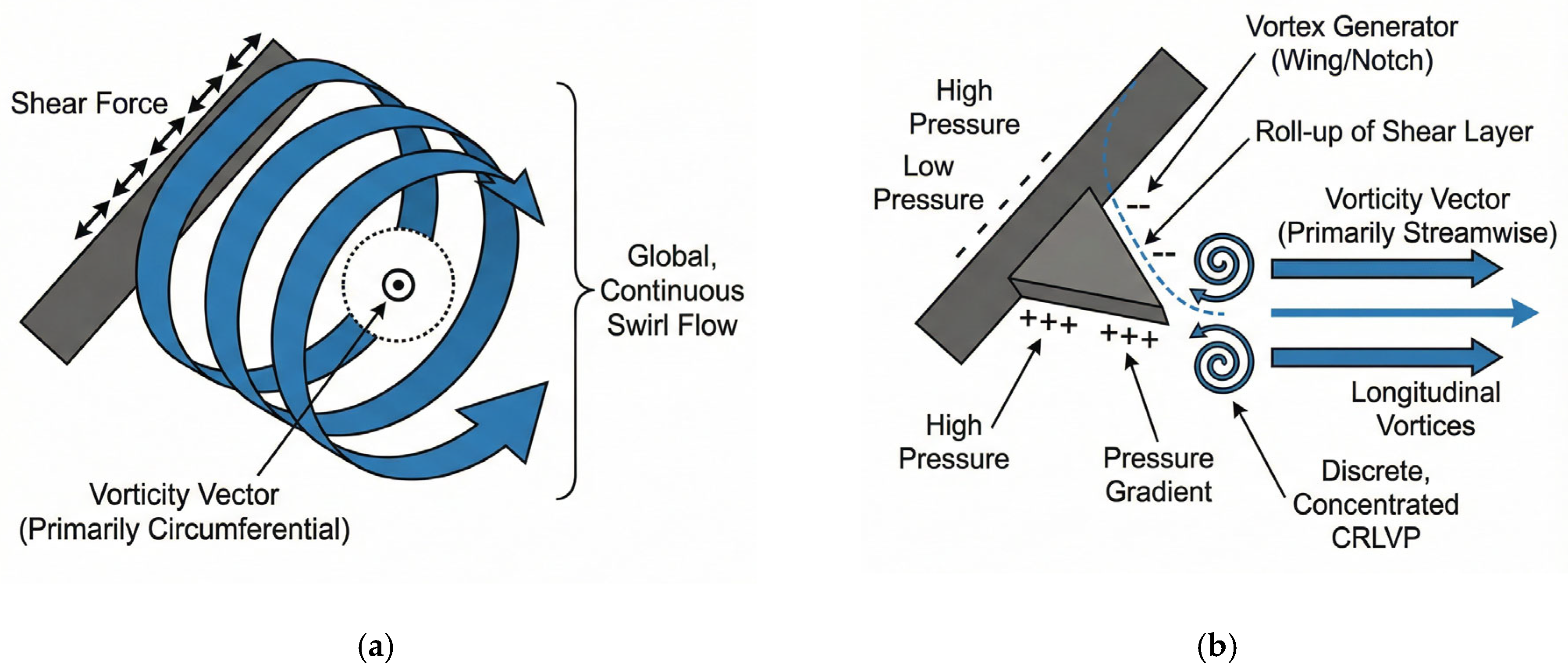
2.1. The Physics of Vortex Generation and Flow Manipulation
2.2. Linking Vortex Structures to Thermal–Hydraulic Performance: A Critical Analysis
2.3. Advanced Performance Evaluation: Moving Beyond the Basic TPF
2.4. Key Performance Metrics: Nusselt Number, Friction Factor, and Thermal Performance Factor
3. Twisted Tapes: From Global Swirl to Engineered Vortex Fields and Their Critical Assessment
3.1. Conventional Twisted Tapes: Mechanism and the Trade-Off
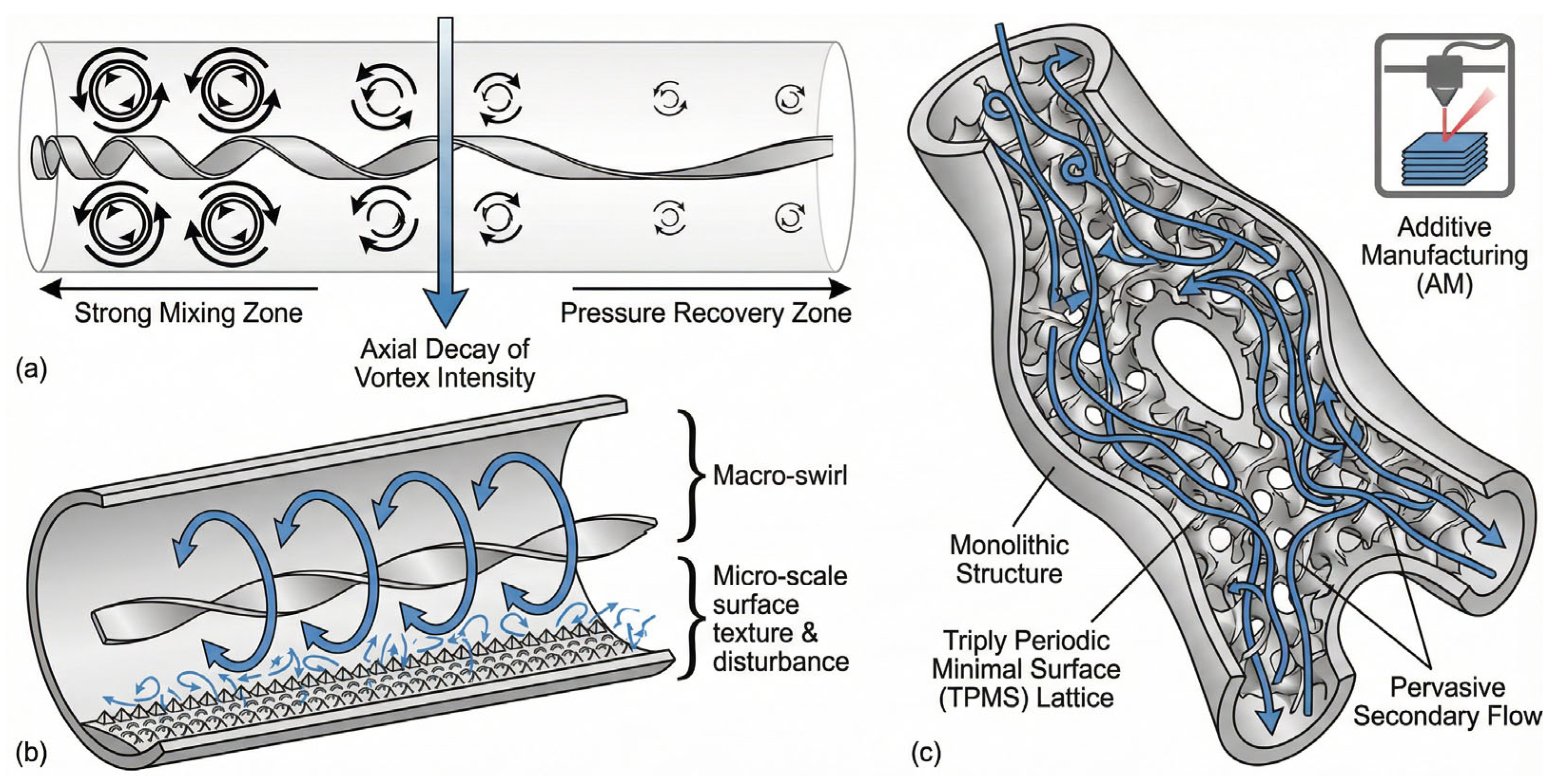
3.2. Multiple Twisted Tapes and the Generation of Complex Vortex Fields
3.3. Deepening the Physical Mechanism: The Essential Difference and Synergy Between Longitudinal Vortices and Swirl Flow
3.4. Frontier Innovative Design Cases and the Concept of “Flow Field Programming”
3.5. Systematic Performance Comparison and Critical Analysis
4. Aerofoil-Shaped Inserts: Bio-Inspired Vortex Generators
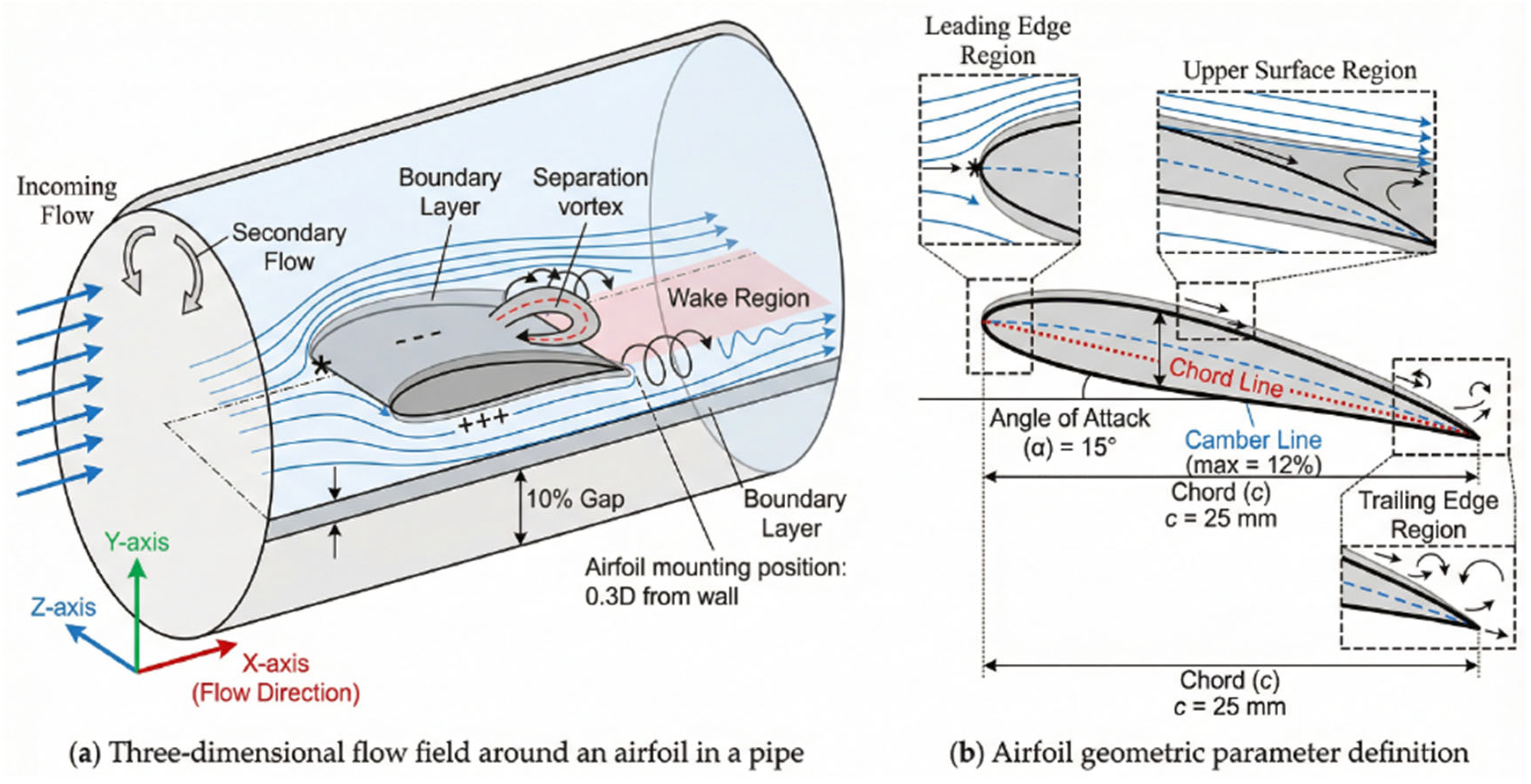
4.1. From Aerodynamic Lift to Targeted Vorticity Injection: A Fundamental Physical Shift
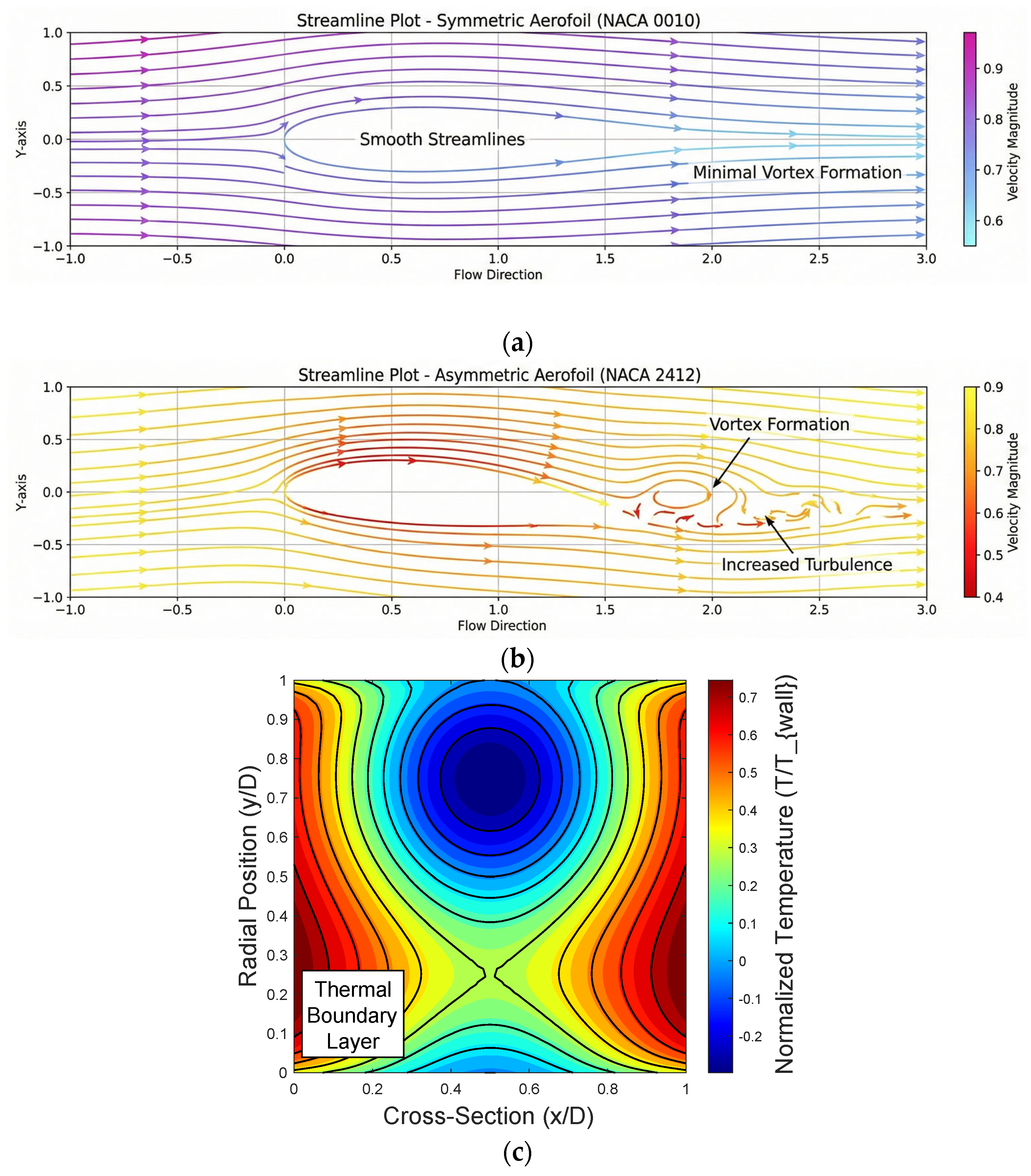
4.2. Parametric Sensitivity and Flow Physics: A Mechanistic Analysis
4.3. Advanced Configurations and Synergistic Systems
4.4. Critical Performance Comparison and Application Niche Positioning
5. Compound Enhancement and Industrial Applications: Synergistic Integration and Real-World Implementation
5.1. The Philosophy and Taxonomy of Compound Enhancement
Towards a Quantitative Framework: Defining Synergy Metrics
5.2. Deep Dive into Geometrical–Geometrical Compound Techniques
5.3. The Synergy of Geometrical–Fluidic Compounds: Nanofluids and Vortex Fields
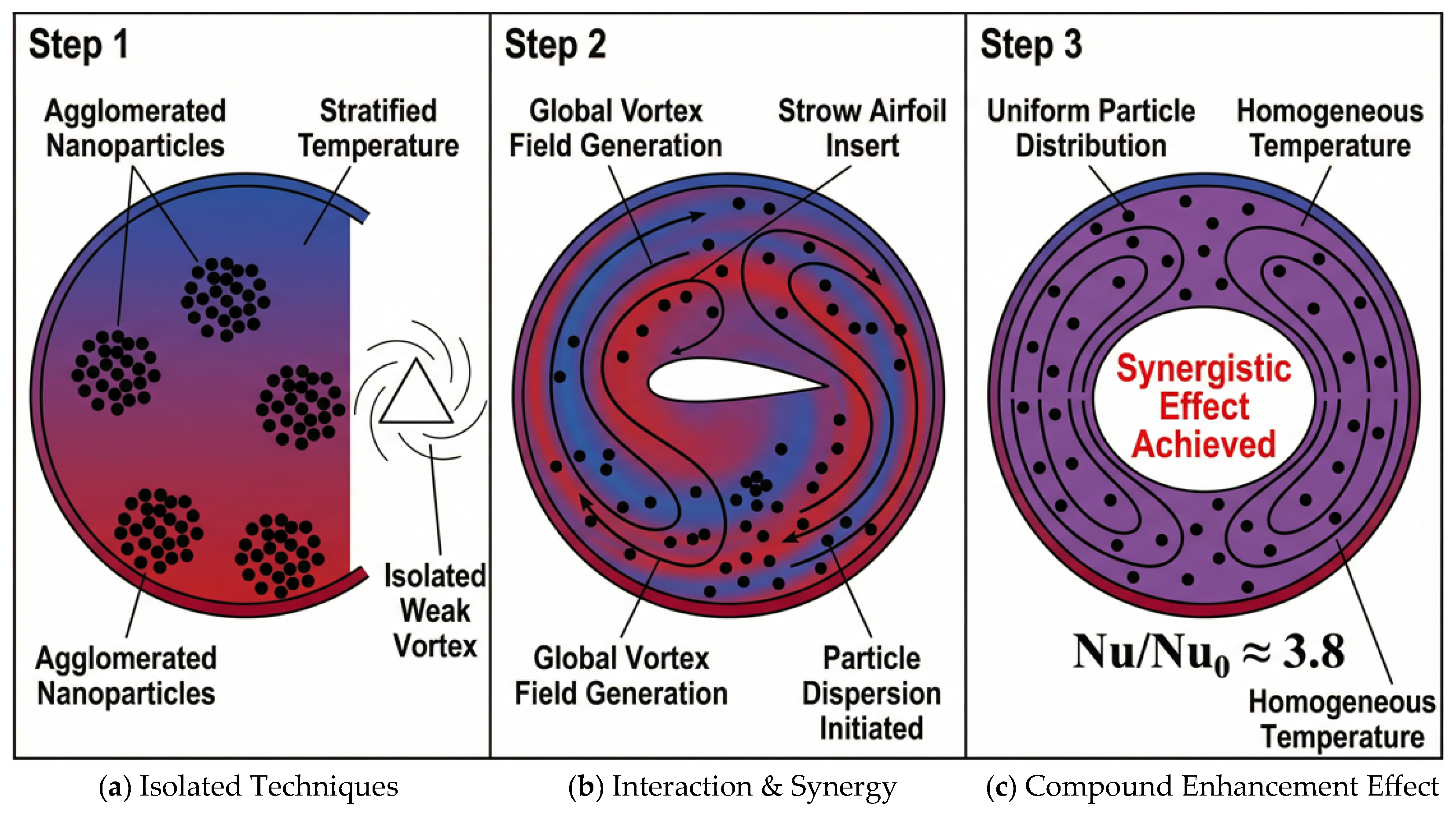
- Particle Dispersion and Stability: The shear forces, centrifugal action, and turbulent fluctuations induced by vortex generators act as an in situ mixing mechanism. This helps break up nanoparticle agglomerates and counteracts sedimentation, maintaining a more uniform particle distribution and preserving the enhanced thermal conductivity of the nanofluid [87].
- Modified Boundary Layer Structure: The centrifugal force in a swirl flow can drive nanoparticles toward the tube wall. This particle migration may alter the effective viscosity and thermal conductivity in the critical viscous sublayer, potentially reducing the conductive resistance at the wall–fluid interface [88].
- Enhanced Thermal Dispersion: The vortices dramatically improve the advective transport of heat carried by the nanoparticles themselves, facilitating a more efficient exchange of energy between the wall, the fluid, and the particles.
5.4. Industrial Case Studies: From Laboratory to Operational Reality
5.5. Sustainability and Lifecycle Analysis: The Broader Impact
5.6. Critical Challenges and Forward Look
6. Microchannel and Miniature Scale Vortex Enhancement: Addressing the Fundamental Limits of Laminar Flow
6.1. Introduction: The Escalating Demand and Inherent Challenges at the Microscale
6.2. Strategies for Vortex Generation in Confined Geometries
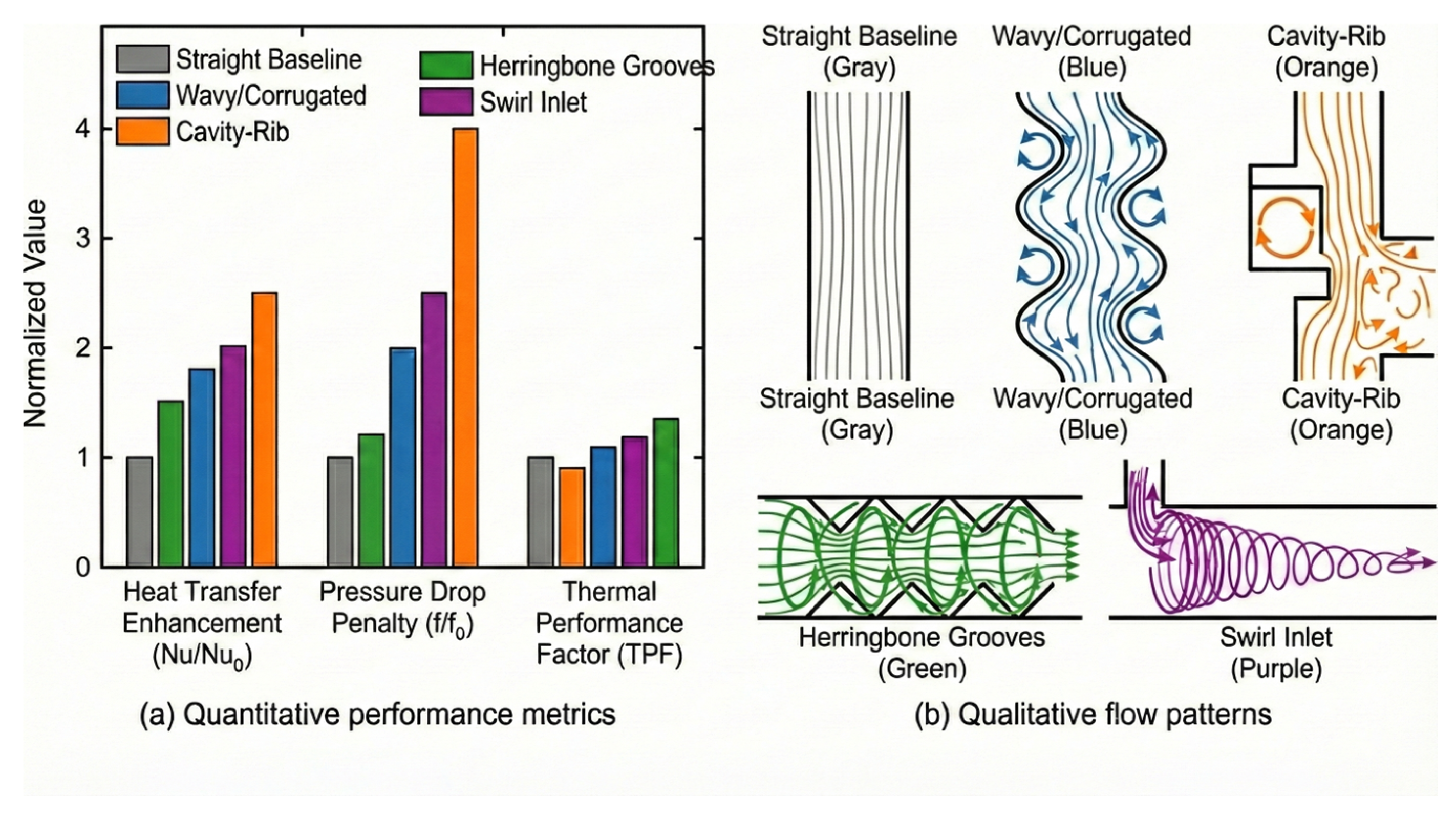
- Wavy or Corrugated Channels: Introducing a sinusoidal or periodic variation in the channel width creates a converging-diverging flow path. This generates Dean-type secondary flows due to centrifugal instabilities in the curved sections. These counter-rotating vortex pairs enhance fluid exchange between the core and the walls, thinning the thermal boundary layer at each crest and trough.
- Cavities and Ribs (TC-RR Structures): Integrating periodic transverse micro-cavities (e.g., triangular, rectangular) paired with downstream ribs is a highly effective strategy. The cavity acts as a low-pressure recirculation zone that traps and rotates fluid, generating a stable, embedded vortex. The downstream rib then forcibly disrupts the main flow, causing separation and reattachment, which further energizes the flow and scours the boundary layer. This combination creates a powerful “puncture-and-sweep” mechanism for the thermal boundary layer [119].
- Oblique or Herringbone Grooves: Etched or fabricated on the channel floor, these asymmetric grooves act as micro-scale vortex generators. They impart a lateral velocity component to the near-wall fluid, inducing a helical or twisting secondary flow along the channel length. This creates a continuous, low-intensity mixing that is particularly effective in very low Reynolds number flows.
- 4.
- Integrated Swirl Chambers or Helical Inlets: Fabricating a miniature tangential inlet or a helical section upstream of the main microchannel can impart a systemic swirl to the incoming flow. This pre-rotation ensures fluid enters the straight section with significant angular momentum, promoting centrifugal mixing. While effective, this approach adds complexity and may increase pressure drop at the inlet [120,121].
- 5.
- Pulsating Flow: While an active technique, pulsating the inlet flow rate can destabilize laminar flow and trigger vortex shedding from built-in geometric features at frequencies that resonate with the flow instability, leading to enhanced mixing. It represents a bridge towards adaptive microsystems.
6.3. Compound Enhancement in Microscale Systems: The Essential Synergy
6.4. Critical Analysis and Future Trajectories
7. Phase Change Heat Transfer Enhancement: Mastering Interfacial Phenomena Through Surface Engineering
7.1. Introduction: The Quantum Leap in Heat Transfer Coefficients
7.2. Boiling Heat Transfer Enhancement: Architecting the Surface for Optimal Bubbles
7.3. Jet Impingement and Spray Cooling for Ultra-High Heat Fluxes
7.4. Heat Pipes and Vapor Chambers: The Art of Wick Design
7.5. Critical Synthesis and Integration with Vortex Principles
8. Emerging Frontiers and Future Perspectives: Toward Intelligent, Adaptive, and Sustainable Thermal Systems
8.1. Synthesis of the Evolutionary Trajectory: From Perturbation to Programming
8.2. Frontier I: Smart Materials and Morphing Structures for Adaptive Enhancement
8.3. Frontier II: Artificial Intelligence and the Data-Driven Design Revolution
8.4. Frontier III: Sustainability, Integration, and the Macro-Scale Impact
8.5. Concluding Remarks: The Path Forward
9. Conclusions
- The primacy of vorticity injection mechanism over intensity. The distinction between shear-driven global swirl (e.g., classic twisted tapes) and pressure-gradient-induced longitudinal vortices (e.g., airfoil inserts) is not merely geometric but fundamental. It dictates the energy dissipation path: swirl incurs widespread shear losses, while longitudinal vortices concentrate energy into efficient cross-sectional fluid transport. This explains their divergent application niches—swirl for maximum heat transfer regardless of pressure cost, and longitudinal vortices for superior thermo-hydraulic efficiency.
- Synergy is multiplicative, not additive. The compound enhancement principle demonstrates that combining techniques (geometric–geometric, geometric–fluidic) often yields performance gains exceeding the sum of individual parts. This synergy arises because the flow structures address complementary limitations; for instance, vortex generators prevent nanoparticle sedimentation in nanofluids, or enhanced surfaces providing anchor points for vortex regeneration.
- The governing physics is scale-dependent, but the design philosophy is universal. From macro-tubes to microchannels and phase-change systems, the core strategy remains the targeted disruption of the dominant resistive layer—whether a hydrodynamic boundary layer, a developing laminar profile, or a stagnant liquid–vapor interface. The tools transition from inserted devices to integrated surface textures, yet the goal of optimizing the trade-off between enhanced energy transfer and ancillary dissipation is constant.
9.1. Comparison with Existing Reviews and Unique Contribution
9.2. Limitations and Critical Knowledge Gaps
9.3. Future Research Directions
Author Contributions
Funding
Data Availability Statement
Acknowledgments
Conflicts of Interest
References
- Chaudhari, M.; Kulkarni, A.; Mali, Y.; Kumawat, V.; Kulkarni, S.; Kulkarni, A. Twisted Tape Innovations: Enhancing Heat Transfer Efficiency in a Heat Exchanger. In Proceedings of the 10th International and 50th National Conference on Fluid Mechanics and Fluid Power (FMFP 2023), Jodhpur, India, 20–22 December 2023; Lecture Notes in Mechanical Engineering; Springer: Singapore, 2025; Volume 4, pp. 435–447. [Google Scholar] [CrossRef]
- Kozłowska, E.; Szkodo, M. Contemporary and Conventional Passive Methods of Intensifying Convective Heat Transfer—A Review. Energies 2024, 17, 4268. [Google Scholar] [CrossRef]
- Ali, M.R.; Al-Khaled, K.; Hussain, M.; Labidi, T.; Khan, S.U.; Kolsi, L.; Sadat, R. Effect of design parameters on passive control of heat transfer enhancement phenomenon in heat exchangers—A brief review. Case Stud. Therm. Eng. 2023, 43, 102674. [Google Scholar] [CrossRef]
- Wang, Q.; Tao, J.; Cui, Z.; Zhang, T.; Chen, G. Passive enhanced heat transfer, hotspot management and temperature uniformity enhancement of electronic devices by micro heat sinks: A review. Int. J. Heat Fluid Flow 2024, 107, 109368. [Google Scholar] [CrossRef]
- Rajesh Babu, C.; Kumar, P.; Roy, S.; Ganesan, R. A comprehensive review on compound heat transfer enhancement using passive techniques in a heat exchanger. Mater. Today Proc. 2022, 54, 428–436. [Google Scholar] [CrossRef]
- Ajarostaghi, S.S.M.; Zaboli, M.; Javadi, H.; Badenes, B.; Urchueguia, J.F. A Review of Recent Passive Heat Transfer Enhancement Methods. Energies 2022, 15, 986. [Google Scholar] [CrossRef]
- Jadhav, G.Z.; Gupta, K.K. Review: Technological Development of Heat Transfer Enhancement in Two Phase Flow by using Passive Method. IOP Conf. Ser. Mater. Sci. Eng. 2021, 1017, 012025. [Google Scholar] [CrossRef]
- Arsenyeva, O.; Tovazhnyanskyy, L.; Kapustenko, P.; Klemeš, J.J.; Varbanov, P.S. Review of Developments in Plate Heat Exchanger Heat Transfer Enhancement for Single-Phase Applications in Process Industries. Energies 2023, 16, 4976. [Google Scholar] [CrossRef]
- Rafid, M.; Azad, A.K.; Prottoy, S.M.; Alam, S.; Rahman, M.; Miah, M.J.; Hossain, M.S.; Rahman, M.M. Augmentation of heat exchanger performance with hybrid nanofluids: Identifying research gaps and future indications—A review. Int. Commun. Heat Mass Transf. 2024, 155, 107537. [Google Scholar] [CrossRef]
- Kamaei, R.; Izadi, M.; Altnji, S.; Majdoub, F.; Hajjar, A.; Alqurashi, F.; Mohamed, M.H.; Ben Hamida, M.B. All-around review on applying passive strategies to improve heat exchanger performance using inserts and turbulators applied in thermal storage. Int. Commun. Heat Mass Transf. 2024, 159, 108234. [Google Scholar] [CrossRef]
- Deshmukh, V.; Sarviya, R.M. Categorical review of experimental and numerical studies on twist tape inserts in the single-phase flow tubular heat exchanger. J. Therm. Anal. Calorim. 2024, 149, 2985–3025. [Google Scholar] [CrossRef]
- Al-Zahrani, S. Plate heat exchanger: A state-of-the-art review. Renew. Sustain. Energy Rev. 2026, 227, 116502. [Google Scholar] [CrossRef]
- Gahlot, P.; Sheoran, A.; Kaushik, N. Heat Exchanger Using Winglet as Vortex Generator for Heat Augmentation: A Critical Review. In Proceedings of the 3rd Biennial International Conference on Future Learning Aspects of Mechanical Engineering (FLAME 2022), Noida, India, 3–5 August 2022; Lecture Notes in Mechanical Engineering; Springer: Singapore, 2023; pp. 705–720. [Google Scholar] [CrossRef]
- Alam, T.; Kim, M.H. A comprehensive review on single phase heat transfer enhancement techniques in heat exchanger applications. Renew. Sustain. Energy Rev. 2018, 81, 813–839. [Google Scholar] [CrossRef]
- Gokulnathan, E.; Pradeep, S.; Jayan, N.; Bhatlu, M.L.D.; Karthikeyan, S. Review of heat transfer enhancement on helical coil heat exchanger by additive passive method. Mater. Today Proc. 2021, 37, 3024–3027. [Google Scholar] [CrossRef]
- Liu, Y.; Wang, X.; Meng, X.; Wang, D. A review on tube external heat transfer for passive residual heat removal heat exchanger in nuclear power plant. Appl. Therm. Eng. 2019, 149, 1476–1491. [Google Scholar] [CrossRef]
- Darius, D.; Misaran, M.S.; Rahman, M.M.; Ismail, M.A.; Amaludin, A. Working parameters affecting earth-air heat exchanger (EAHE) system performance for passive cooling: A review. IOP Conf. Ser. Mater. Sci. Eng. 2017, 217, 012021. [Google Scholar] [CrossRef]
- Kadhim, S.A.; Ashour, A.M.; Sherza, J.S.; Bouabidi, A.; Hussein, A.K.; Togun, H.; Rashid, F.L.; Ahmad, S. Review of insertion scenarios in enhancement performance of double-pipe heat exchanger: Case of cut twist tape. Chem. Eng. Process.-Process Intensif. 2025, 213, 110308. [Google Scholar] [CrossRef]
- Aasa, S.A.; Dunne, R.K.; Desai, D.A. A review of surface roughened passive enhancement for fluid-solid interaction in geometry endwall ducts. Prog. Eng. Sci. 2025, 2, 100101. [Google Scholar] [CrossRef]
- Kiyokawa, H.; Kondo, Y.; Koyama, R.; Kurokawa, N.; Hotta, A.; Alavi, S.; Ota, I.; Ohmura, R. Pinacol hydrate as a novel thermal energy storage medium for electric vehicles. J. Energy Storage 2022, 51, 104404. [Google Scholar] [CrossRef]
- Awasthi, M.K.; Kumar, A.; Dutt, N.; Thangavel, S. Heat Exchanger Technologies for Sustainable Renewable Energy Systems; CRC Press: Boca Raton, FL, USA, 2025; pp. 1–265. [Google Scholar] [CrossRef]
- Ahmad, S.; Alsalmah, H.A. Intelligent-simulation of solar irradiation in the axisymmetric cylindrical heat exchanger for renewable energy systems. Int. Commun. Heat Mass Transf. 2025, 169, 109523. [Google Scholar] [CrossRef]
- Yu, Z.; Liu, F.; Sui, W.; Wang, R.; Zhang, C.; Dong, X.; Xu, X. A Novel Earth-to-Air Heat Exchanger-Assisted Ventilated Double-Skin Facade for Low-Grade Renewable Energy Utilization in Transparent Building Envelopes. Buildings 2025, 15, 3655. [Google Scholar] [CrossRef]
- Tombrink, J.; Bauer, D. Demand-based process steam from renewable energy: Implementation and sizing of a latent heat thermal energy storage system based on the Rotating Drum Heat Exchanger. Appl. Energy 2022, 321, 119325. [Google Scholar] [CrossRef]
- Beni, H.M.; Mortazavi, H. Mathematical modeling of the solar regenerative heat exchanger under turbulent oscillating flow: Applications of renewable and sustainable energy and artificial heart. Results Eng. 2022, 13, 100321. [Google Scholar] [CrossRef]
- Cheriet, N.; Amirat, H.; Korichi, A.; Polidori, G. Conjugate heat transfer enhancement over heated blocks using airfoil deflec-tors. Therm. Sci. Eng. Prog. 2021, 25, 101011. [Google Scholar] [CrossRef]
- Yuan, L.; Zou, S.; Yang, Y.; Chen, S. Boundary-Layer Disruption and Heat-Transfer Enhancement in Convection Turbulence by Oscillating Deformations of Boundary. Phys. Rev. Lett. 2023, 130, 204001. [Google Scholar] [CrossRef]
- Diwaker, M.K.; Kumar, A. An Updated Review of Heat Transfer Enhancement Techniques in Tube-Type Heat Exchangers. In Proceedings of the 9th International and 49th National Conference on Fluid Mechanics and Fluid Power (FMFP 2022), Roorkee, India, 14–16 December 2022; Lecture Notes in Mechanical Engineering; Springer: Singapore, 2024; Volume 1, pp. 65–78. [Google Scholar] [CrossRef]
- Jadhao, R.R.; Chitragar, P.; Kamble, D. A chronological review of heat transfer enhancement using inserts in channel flows. Phys. Scr. 2025, 100, 032002. [Google Scholar] [CrossRef]
- Alzaben, H.; Marzouk, S.A. Critical review of heat transfer advancements using bubbles injection in heat exchangers. Renew. Sustain. Energy Rev. 2026, 226, 116395. [Google Scholar] [CrossRef]
- Zhang, D.; Kang, D.; Lan, M.; Tang, S.; Shen, C.; Wang, L.; Wu, J.; Lei, Y.; Wu, X. Numerical Study on the Heat Transfer Enhancement in Boundary Layer of Microchannels Assisted by Protrusions and Ultrasound. Int. Commun. Heat Mass Transf. 2025, 164, 108940. [Google Scholar] [CrossRef]
- Sadeghianjahromi, A.; Wang, C.C. Heat Transfer Enhancement in Fin-and-Tube Heat Exchangers—A Review on Different Mechanisms. Renew. Sustain. Energy Rev. 2021, 137, 110470. [Google Scholar] [CrossRef]
- Carella, A.; D’Orazio, A. A Systematic Review on Heat Transfer and Pressure Drop Correlations for Natural Refrigerants. Energies 2024, 17, 1478. [Google Scholar] [CrossRef]
- Trincado, R.; Ortega, I.; Sieres, J. Condensation Heat Transfer and Pressure Drop inside Tubes with Propane (R290) Refrigerant. A Review of Experimental Data and Correlations. Int. J. Heat Mass Transf. 2026, 256, 127975. [Google Scholar] [CrossRef]
- Suwaed, M.S.; Turgut, O.; Abdulkarim, A.H. A Review of Passive Techniques, Working Fluid, and Flow Characteristics Impacts on Heat Transfer, Pressure Drop, and Friction Factor in Flow Channels. J. Therm. Anal. Calorim. 2025, 150, 12983–13022. [Google Scholar] [CrossRef]
- Antanenkova, I.S.; Geller, Y.A.; Vinogradov, M.M.; Gorbunova, E.A.; Kuznetsov, V.I. Heat Transfer and Pressure Drop in Main Heat Exchangers of a Thermal Oil ORC-Unit (Review). Therm. Eng. 2025, 72, 44–64. [Google Scholar] [CrossRef]
- Awais, M.; Ullah, N.; Ahmad, J.; Sikandar, F.; Ehsan, M.M.; Salehin, S.; Bhuiyan, A.A. Heat Transfer and Pressure Drop Performance of Nanofluid: A State-of-the-Art Review. Int. J. Thermofluids 2021, 9, 100065. [Google Scholar] [CrossRef]
- Rajiv; Kumar, H.; Sokhal, G.S. Effect of Geometries and Nanofluids on Heat Transfer and Pressure Drop in Microchannels: A Review. Mater. Today Proc. 2020, 28, 1841–1846. [Google Scholar] [CrossRef]
- Eiamsa-ard, S.; Thianpong, C.; Eiamsa-ard, P. Turbulent Heat Transfer Enhancement by Counter/Co-Swirling Flow in a Tube Fitted with Twin Twisted Tapes. Exp. Therm. Fluid Sci. 2010, 34, 53–62. [Google Scholar] [CrossRef]
- Ahirwar, B.K.; Kumar, A. A Comprehensive Review on Heat Transfer Enhancement in Tubular Heat Exchangers Using Twisted Tapes, Wire Coil Inserts, and Their Combined Effect with Nanofluids. Renew. Sustain. Energy Rev. 2025, 224, 116035. [Google Scholar] [CrossRef]
- He, Y.; Tang, C.; Chen, D. Evaluation of Heat Transfer Correlations for Two-Phase Flow Boiling in Twisted Tapes Inserted Tubes. J. Phys. Conf. Ser. 2024, 2758, 012016. [Google Scholar] [CrossRef]
- Thote, S.A.; Singh, N.P. Improvement of Heat Transfer Through Use of Twisted Tape Inserts: A Review. J. Eng. Proj. Prod. Manag. 2024, 14, 1. [Google Scholar] [CrossRef]
- Sheikhi Azizi, A.A.; Mousavi, S.M.; Vafai, K.; Darzi, A.A.R. Comprehensive Review of Heat Transfer and Fluid Flow Characteristics of Elliptical/Oval Twisted Tubes. Int. J. Heat Fluid Flow 2025, 112, 109639. [Google Scholar] [CrossRef]
- Shelare, S.D.; Aglawe, K.R.; Belkhode, P.N. A Review on Twisted Tape Inserts for Enhancing the Heat Transfer. Mater. Today Proc. 2022, 54, 560–565. [Google Scholar] [CrossRef]
- Wei, X.; Wang, Z.; Yu, X.; Zhao, M.; Feng, Y.; Xu, S.; Qin, J. Numerical Investigation on the Flow and Heat Transfer Characteristics of Tube-Bundle Precooler Based on the Multi-Layer Grid Superposition Method. Therm. Sci. Eng. Prog. 2025, 67, 104090. [Google Scholar] [CrossRef]
- Wang, X.; Yuchi, W.; Zhu, J.; Yao, J.; Cao, L. Heat Transfer Enhancement and Vortex Flow Structure in the Spirally Fluted Tubes. J. Therm. Sci. 2021, 30, 1814–1826. [Google Scholar] [CrossRef]
- Zhao, Z.; Pan, L.; Zhang, W.; Tan, K.; Hao, J.; Wang, Y. Review on vortex generators for flow-channel-enhanced heat transfer. J. Therm. Anal. Calorim. 2026, 151, 1173–1196. [Google Scholar] [CrossRef]
- Mousa, M.H.; Miljkovic, N.; Nawaz, K. Review of Heat Transfer Enhancement Techniques for Single Phase Flows. Renew. Sustain. Energy Rev. 2021, 137, 110566. [Google Scholar] [CrossRef]
- Chaurasiya, P.K.; Heeraman, J.; Singh, S.K.; Verma, T.N.; Dwivedi, G.; Shukla, A.K. Exploring the Combined Influence of Primary and Secondary Vortex Flows on Heat Transfer Enhancement and Friction Factor in a Dimpled Configuration Twisted Tape with Double Pipe Heat Exchanger Using SiO2 Nanofluid. Int. J. Thermofluids 2024, 22, 100684. [Google Scholar] [CrossRef]
- Veerabhadrappa Bidari, M.; Nagaraj, P.B.; Lalagi, G. Influence of Different Types of Vortex Generators (VGs) to Enhance Heat Transfer Performance in Heat Exchangers: A Review. Int. J. Ambient Energy 2022, 43, 5718–5741. [Google Scholar] [CrossRef]
- Bhattacharyya, S.; Vishwakarma, D.K.; Srinivasan, A.; Soni, M.K.; Goel, V.; Sharifpur, M.; Ahmadi, M.H.; Issakhov, A.; Meyer, J. Thermal Performance Enhancement in Heat Exchangers Using Active and Passive Techniques: A Detailed Review. J. Therm. Anal. Calorim. 2022, 147, 9229–9281. [Google Scholar] [CrossRef]
- Sheikholeslami, M.; Gorji-Bandpy, M.; Ganji, D.D. Review of Heat Transfer Enhancement Methods: Focus on Passive Methods Using Swirl Flow Devices. Renew. Sustain. Energy Rev. 2015, 49, 444–469. [Google Scholar] [CrossRef]
- Bilen, K.; Tokgoz, N.; Solmaz, I.; Balta, T. Thermo-Hydraulic Performance of Tube with Decaying Swirl Flow Generators. Appl. Therm. Eng. 2022, 200, 117643. [Google Scholar] [CrossRef]
- Bhatnagar, M.K.; Rai, M.; Ashraf, M.; Kapoor, O.; Mamatha, T.G.; Vishnoi, M. Efficiency Enhancement of Heat Exchanger Using Inserts and Nanofluid—A Review. Mater. Today Proc. 2021, 44, 4399–4403. [Google Scholar] [CrossRef]
- Hayat, M.Z.; Nandan, G.; Tiwari, A.K.; Sharma, S.K.; Shrivastava, R.; Singh, A.K. Numerical Study on Heat Transfer Enhancement Using Twisted Tape with Trapezoidal Ribs in an Internal Flow. Mater. Today Proc. 2021, 46, 5412–5419. [Google Scholar] [CrossRef]
- Liao, G.; Li, Z.; Zhang, F.; Liu, L.; E, J. A review on the thermal-hydraulic performance and optimization of compact heat exchangers. Energies 2021, 14, 6056. [Google Scholar] [CrossRef]
- Trilok, G.; Gnanasekaran, N.; Mobedi, M. Reconciliation of Wire Woven Mesh Porous Media in Controlling the Desired Heat Transfer and Pressure Drop. Int. J. Numer. Methods Heat Fluid Flow 2025, 35, 981–1011. [Google Scholar] [CrossRef]
- Conroy, T.; Collins, M.N.; Fisher, J.; Grimes, R. Levelized Cost of Electricity Evaluation of Liquid Sodium Receiver Designs Through a Thermal Performance, Mechanical Reliability, and Pressure Drop Analysis. Sol. Energy 2018, 166, 472–485. [Google Scholar] [CrossRef]
- Wright, L.M.; Chen, A.F.; Wu, H.-W.; Han, J.-C.; Lee, C.-P.; Azad, S.; Um, J. Heat Transfer Enhancement in a Rectangular Cooling Channel with Airfoil Shaped Fins. J. Therm. Sci. Eng. Appl. 2021, 13, 041026. [Google Scholar] [CrossRef]
- Zheng, N.; Yan, F.; Zhang, K.; Li, B.; Wang, S. A Review on Single-Phase Convective Heat Transfer Enhancement Based on Multi-Longitudinal Vortices in Heat Exchanger Tubes. Appl. Therm. Eng. 2020, 164, 114475. [Google Scholar] [CrossRef]
- Okafor, I.F.; Dirker, J.; Meyer, J.P. Influence of non-uniform heat flux distributions on the secondary flow, convective heat transfer and friction factors for a parabolic trough solar collector type absorber tube. Renew. Energy 2017, 108, 287–302. [Google Scholar] [CrossRef]
- Wang, S.; Wan, L.; Che, G.; Wang, H.; Du, T.; Wang, C. Numerical investigation of secondary flow-induced heat transfer enhancement mechanisms and near-wall flow structures in helical groove tubes. Appl. Therm. Eng. 2025, 279, 128002. [Google Scholar] [CrossRef]
- Liao, W.; Li, X.; Zhang, S.; Wang, N.; Bao, W. Heat transfer enhancement mechanics of different micro-disturbing structures for transcritical hydrocarbon fuel using 3-D secondary flow intensity analysis. Case Stud. Therm. Eng. 2024, 60, 104813. [Google Scholar] [CrossRef]
- Rao, Y.; Gong, Z.; Wang, S.; Zhang, C.; Wang, Y.; Wen, C. Effect of twisted tapes on swirling flow dynamics in gas–solid two-phase flows for natural gas hydrate transportation. Processes 2025, 13, 781. [Google Scholar] [CrossRef]
- Nasirzadeh, H.; Yazdi, M.E.; Lavasani, A.M. Heat transfer and fluid flow of swirling impinging jets ejected from nozzles with different twisted tapes. J. Braz. Soc. Mech. Sci. Eng. 2022, 44, 498. [Google Scholar] [CrossRef]
- Thulasi, S.; Jaisankar, S. Analysis of thermal performance characteristics in variable header solar water heating system by a swirling effect of twisted tapes. Energy Sources Part A 2022, 44, 10630–10646. [Google Scholar] [CrossRef]
- Mushatet, K.S.; Rishak, Q.A.; Fagr, M.H. Experimental and numerical investigation of swirling turbulent flow and heat transfer due to insertion of twisted tapes of new models in a heated tube. Appl. Therm. Eng. 2020, 171, 115070. [Google Scholar] [CrossRef]
- Tariq, M.H.; Khan, F.; Rizwan, H.M.; Cheema, T.A. Thermo-fluid performance enhancement using NACA aerofoil cross-sectional tubes. Eng. Proc. 2022, 23, 13. [Google Scholar] [CrossRef]
- Wongcharee, K.; Eiamsa-Ard, S. Enhancement of heat transfer using CuO/water nanofluid and twisted tape with alternate axis. Int. Commun. Heat Mass Transf. 2011, 38, 742–748. [Google Scholar] [CrossRef]
- Haque, M.R.; Redu, R.R.; Rafi, M.A.A.A.; Haque, M.M.; Rahman, M.Z. Numerical investigation of heat transfer performance for rectangular, elliptical, and airfoil shaped pin fin heatsinks through the novel combination of perforation and bulge inserts. Int. Commun. Heat Mass Transf. 2022, 138, 106352. [Google Scholar] [CrossRef]
- Chokphoemphun, S.; Pimsarn, M.; Thianpong, C.; Promvonge, P. Thermal performance of tubular heat exchanger with multiple twisted-tape inserts. Chin. J. Chem. Eng. 2015, 23, 755–762. [Google Scholar] [CrossRef]
- Yehia, M.G.; Attia, A.A.A.; Abdelatif, O.E.; Khalil, E.E. Heat transfer and friction characteristics of shell and tube heat exchanger with multi inserted swirl vanes. Appl. Therm. Eng. 2016, 102, 1481–1491. [Google Scholar] [CrossRef]
- Promvonge, P.; Eiamsa-Ard, S. Heat transfer behaviors in a tube with combined conical-ring and twisted-tape insert. Int. Commun. Heat Mass Transf. 2007, 34, 849–859. [Google Scholar] [CrossRef]
- Kumar, A.; Pathak, M. Flow and heat transfer characteristics of gas turbine blade channels with compound V-rib-dimple structures. Int. Commun. Heat Mass Transf. 2024, 157, 107823. [Google Scholar] [CrossRef]
- Kiros, A.K.; Tewolde, D.G.; Atsbeha, A.K.; Gebru, K.G.; Teklehaimanot, T.T. Effect of multi-leg twisted tape inserts on heat transfer and pressure drop characteristics of a laminar pipe flow: A comparative analysis. Case Stud. Therm. Eng. 2025, 74, 106838. [Google Scholar] [CrossRef]
- Hajarian, A.; Zakerzadeh, M.R.; Baghani, M. Design, analysis and testing of a smart morphing airfoil actuated by SMA wires. Smart Mater. Struct. 2019, 28, 115043. [Google Scholar] [CrossRef]
- Hasan Ibrahim, S.; Abdul Wahhab, H.A. Influence of twisted tape inserts with perforation on heat transfer and pressure drop inside circular tube: Numerical and experimental investigation. In Proceedings of the 7th International Conference on Production, Energy and Reliability (ICPER 2020); Springer Nature: Singapore, 2022; pp. 281–293. [Google Scholar] [CrossRef]
- Liu, X.; Li, C.; Cao, X.; Yan, C.; Ding, M. Numerical analysis on enhanced performance of new coaxial cross twisted tapes for laminar convective heat transfer. Int. J. Heat Mass Transf. 2018, 121, 1125–1136. [Google Scholar] [CrossRef]
- Chang, S.W.; Huang, B.J. Thermal performances of tubular flows enhanced by ribbed spiky twist tapes with and without edge notches. Int. J. Heat Mass Transf. 2014, 73, 645–663. [Google Scholar] [CrossRef]
- Wang, G.; Zhang, L.; Zhou, X.; Liu, J.; Du, Z.; Zhang, Y.; Zhang, Z.; Zhou, C. Heat Transfer Tube and Cracking Furnace Using the Heat Transfer Tube. U.S. Patent 9,359,560, 7 June 2016. [Google Scholar]
- Eiamsa-Ard, S.; Thianpong, C.; Eiamsa-Ard, P.; Promvonge, P. Thermal characteristics in a heat exchanger tube fitted with dual twisted tape elements in tandem. Int. Commun. Heat Mass Transf. 2010, 37, 39–46. [Google Scholar] [CrossRef]
- Yuxiang, H.; Xianhe, D. 3D numerical study on compound heat transfer enhancement of converging-diverging tubes equipped with twin twisted tapes. Chin. J. Chem. Eng. 2012, 20, 589–601. [Google Scholar] [CrossRef]
- Gururatana, S.; Skullong, S. Experimental investigation of heat transfer in a tube heat exchanger with airfoil-shaped insert. Case Stud. Therm. Eng. 2019, 14, 100462. [Google Scholar] [CrossRef]
- Eiamsa-Ard, S.; Seemawute, P. Decaying swirl flow in round tubes with short-length twisted tapes. Int. Commun. Heat Mass Transf. 2012, 39, 649–656. [Google Scholar] [CrossRef]
- Sundar, L.S.; Sharma, K.V. Turbulent heat transfer and friction factor of Al2O3 nanofluid in circular tube with twisted tape inserts. Int. J. Heat Mass Transf. 2010, 53, 1409–1416. [Google Scholar] [CrossRef]
- Zhang, L.Z.; Wang, X.J.; Quan, Y.Y.; Pei, L.X. Conjugate heat conduction in filled composite materials considering interactions between the filler and base materials. Int. J. Heat Mass Transf. 2013, 64, 735–742. [Google Scholar] [CrossRef]
- Sadooghi, P.; Kherani, N.P. Thermal analysis of triple and quadruple windows using partitioning radiant energy veils™ with dif-ferent physical and optical properties. Sol. Energy 2018, 174, 1163–1168. [Google Scholar] [CrossRef]
- Ren, Y.T.; Qi, H.; He, M.J.; Ruan, S.T.; Ruan, L.M.; Tan, H.P. Application of an improved firework algorithm for simultaneous esti-mation of temperature-dependent thermal and optical properties of molten salt. Int. Commun. Heat Mass Transf. 2016, 77, 33–42. [Google Scholar] [CrossRef]
- Nguyen, T.A.; Kondo, K.; Kakuta, N. Near-infrared measurement of temperature fields formed by mixed convection from a small heating sphere in water. Int. J. Therm. Sci. 2022, 176, 107498. [Google Scholar] [CrossRef]
- Rahimi, M.; Shabanian, S.R.; Alsairafi, A.A. Experimental and CFD studies on heat transfer and friction factor characteristics of a tube equipped with modified twisted tape inserts. Chem. Eng. Process. Process Intensif. 2009, 48, 762–770. [Google Scholar] [CrossRef]
- Eiamsa-Ard, S.; Kiatkittipong, K. Heat transfer enhancement by multiple twisted tape inserts and TiO2/water nanofluid. Appl. Therm. Eng. 2014, 70, 896–924. [Google Scholar] [CrossRef]
- Guo, J.; Fan, A.; Zhang, X.; Liu, W. A numerical study on heat transfer and friction factor characteristics of laminar flow in a circu-lar tube fitted with center-cleared twisted tape. Int. J. Therm. Sci. 2011, 50, 1263–1270. [Google Scholar] [CrossRef]
- Suri, A.R.S.; Kumar, A.; Maithani, R. Effect of square wings in multiple square perforated twisted tapes on fluid flow and heat transfer of heat exchanger tube. Case Stud. Therm. Eng. 2017, 10, 28–43. [Google Scholar] [CrossRef]
- Wang, G.; Zhou, X.; Shi, Y.; Li, W.; Zhang, Y.; Zhou, C.; Du, Z. Research progress and industrial application of radiant section technology of ethylene cracking furnace. Sci. Sin. Chim. 2014, 44, 1714–1722. [Google Scholar] [CrossRef]
- Wang, X.; Liang, Y.; Sun, Y.; Liu, Z.; Liu, W. Experimental and numerical investigation on shell-side performance of a double shell-pass rod baffle heat exchanger. Int. J. Heat Mass Transf. 2019, 132, 631–642. [Google Scholar] [CrossRef]
- Jadhao, R.R.; Chitragar, P.; Kamble, D. Overview of the future perspective of aerofoil-based passive heat transfer enhancement. Eng. Res. Express 2025, 7, 012503. [Google Scholar] [CrossRef]
- Garcia, E.N.; Durgesh, V.; Johari, H. Experimental study of NACA symmetric and camber airfoils at low Reynolds numbers. In Proceedings of the 55th AIAA Aerospace Sciences Meeting, Grapevine, TX, USA, 9–13 January 2017. [Google Scholar] [CrossRef]
- Eiamsa-Ard, S.; Thianpong, C.; Eiamsa-Ard, P.; Promvonge, P. Convective heat transfer in a circular tube with short-length twisted tape insert. Int. Commun. Heat Mass Transf. 2009, 36, 365–371. [Google Scholar] [CrossRef]
- Khare, A.; Khurana, S. Detached Eddy Simulation of Micro-Vortex Generators Mounted on NACA 4412 Airfoil. J. Fluids Eng. 2025, 147, 061206. [Google Scholar] [CrossRef]
- Huda, N.; Tech, V.; Shakil, S.M.; Salam, M.A. Study of NACA 0010 Symmetric Airfoil with Leading Edge Rotating Cylinder in a Subsonic Wind Tunnel. In Proceedings of the 11th International Conference on Mechanical Engineering, Dhaka, Bangladesh, 18–20 December 2015. [Google Scholar]
- Yu, C.; Cui, Y.; Zhang, H.; Gao, B.; Zeng, M.; Han, L. Comparative study on turbulent flow characteristics and heat transfer mechanism of a twisted oval tube with different twisted tapes. Int. J. Therm. Sci. 2022, 174, 107455. [Google Scholar] [CrossRef]
- Falahat, A.; Bahoosh, R.; Noghrehabadi, A.; Rashidi, M.M. Experimental study of heat transfer enhancement in a novel cylindrical heat sink with helical minichannels. Appl. Therm. Eng. 2019, 154, 585–592. [Google Scholar] [CrossRef]
- Vaidya, H.A.; Kevadiya, M. 2D analysis of NACA 4412 airfoil. Int. J. Innov. Res. Sci. Eng. Technol. 2013, 2, 1686–1691. [Google Scholar]
- Manglik, R.M.; Bergles, A.E. Heat Transfer and Pressure Drop Correlations for Twisted-Tape Inserts in Isothermal Tubes: Part II—Transition and Turbulent Flows. J. Heat Transf. 1993, 115, 890–896. [Google Scholar] [CrossRef]
- Bucher, T.; Bolger, C.; Zhang, M.; Chen, C.J.; Yao, Y.L. Effect of Geometrical Modeling on Prediction of Laser-Induced Heat Trans-fer in Metal Foam. Procedia Manuf. 2016, 5, 1265–1282. [Google Scholar] [CrossRef][Green Version]
- Paknezhad, M.; Rashidi, A.M.; Yousefi, T.; Saghir, Z. Effect of aluminum-foam heat sink on inclined hot surface temperature in the case of free convection heat transfer. Case Stud. Therm. Eng. 2017, 10, 199–206. [Google Scholar] [CrossRef]
- Harris, M.; Wu, H.; Zhang, W.; Angelopoulou, A. Overview of recent trends in microchannels for heat transfer and thermal management applications. Chem. Eng. Process. Process Intensif. 2022, 181, 109155. [Google Scholar] [CrossRef]
- Steinke, M.E.; Kandlikar, S.G. Single-phase liquid friction factors in microchannels. Int. J. Therm. Sci. 2006, 45, 1073–1083. [Google Scholar] [CrossRef]
- Rosa, P.; Karayiannis, T.G.; Collins, M.W. Single-phase heat transfer in microchannels: The importance of scaling effects. Appl. Therm. Eng. 2009, 29, 3447–3468. [Google Scholar] [CrossRef]
- Asadi, M.; Xie, G.; Sunden, B. A review of heat transfer and pressure drop characteristics of single and two-phase microchannels. Int. J. Heat Mass Transf. 2014, 79, 34–53. [Google Scholar] [CrossRef]
- Chai, L.; Xia, G.D.; Wang, H.S. Numerical study of laminar flow and heat transfer in microchannel heat sink with offset ribs on sidewalls. Appl. Therm. Eng. 2016, 92, 32–41. [Google Scholar] [CrossRef]
- Li, Y.F.; Xia, G.D.; Ma, D.D.; Jia, Y.T.; Wang, J. Characteristics of laminar flow and heat transfer in microchannel heat sink with triangular cavities and rectangular ribs. Int. J. Heat Mass Transf. 2016, 98, 17–28. [Google Scholar] [CrossRef]
- Yadav, V.; Baghel, K.; Kumar, R.; Kadam, S.T. Numerical investigation of heat transfer in extended surface microchannels. Int. J. Heat Mass Transf. 2016, 93, 612–622. [Google Scholar] [CrossRef]
- Soleimanikutanaei, S.; Ghasemisahebi, E.; Lin, C.X. Numerical study of heat transfer enhancement using transverse microchannels in a heat sink. Int. J. Therm. Sci. 2018, 125, 89–100. [Google Scholar] [CrossRef]
- Mori, S.; Utaka, Y. Critical heat flux enhancement by surface modification in a saturated pool boiling: A review. Int. J. Heat Mass Transf. 2017, 108, 2534–2557. [Google Scholar] [CrossRef]
- Wen, R.; Li, Q.; Wang, W.; Latour, B.; Li, C.H.; Li, C.; Lee, Y.C.; Yang, R. Enhanced bubble nucleation and liquid rewetting for highly efficient boiling heat transfer on two-level hierarchical surfaces with patterned copper nanowire arrays. Nano Energy 2017, 38, 59–65. [Google Scholar] [CrossRef]
- Leong, K.C.; Ho, J.Y.; Wong, K.K. A critical review of pool and flow boiling heat transfer of dielectric fluids on enhanced surfaces. Appl. Therm. Eng. 2017, 112, 999–1019. [Google Scholar] [CrossRef]
- Das, S.; Saha, B.; Bhaumik, S. Experimental study of nucleate pool boiling heat transfer of water by surface functionalization with crystalline TiO2 nanostructure. Appl. Therm. Eng. 2017, 113, 1345–1357. [Google Scholar] [CrossRef]
- Maradiya, C.; Vadher, J.; Agarwal, R. The heat transfer enhancement techniques and their thermal performance factor. Beni-Suef Univ. J. Basic Appl. Sci. 2018, 7, 1–21. [Google Scholar] [CrossRef]
- Ali, S.; Deshmukh, S.P. An overview: Applications of thermal energy storage using phase change materials. Mater. Today Proc. 2020, 26, 1231–1237. [Google Scholar] [CrossRef]
- Kanimozhi, B.; Prabhu, A.; Anish, M.; Kumar, P.H. Review on Heat Transfer Enhancement Techniques in Thermal Energy Storage Systems. Int. J. Eng. Res. Appl. 2014, 4, 144–149. [Google Scholar]
- Saha, S.K.; Dutta, A. Thermohydraulic study of laminar swirl flow through a circular tube fitted with twisted tapes. J. Heat Transfer. 2001, 123, 417–427. [Google Scholar] [CrossRef]
- Heydari, A.; Noori, A.; Nezhad, A.K.; Kord, K. Optimized heat transfer systems: Exploring the synergy of micro pin-fins and micro Vortex generators. Int. Commun. Heat Mass Transf. 2024, 153, 107378. [Google Scholar] [CrossRef]
- Lu, L.; Fu, T.; Tang, Y.; Tang, T.; Tang, B.; Wan, Z. A novel in-situ nanostructure forming route and its application in pool-boiling enhancement. Exp. Therm. Fluid Sci. 2016, 72, 140–148. [Google Scholar] [CrossRef]
- Rahman, M.M.; Ölçeroğlu, E.; McCarthy, M. Role of wickability on the critical heat flux of structured superhydrophilic surfaces. Langmuir 2014, 30, 11225–11234. [Google Scholar] [CrossRef] [PubMed]
- Wong, S.C.; Lin, Y.C. Effect of copper surface wettability on the evaporation performance: Tests in a flat-plate heat pipe with visualization. Int. J. Heat Mass Transf. 2011, 54, 3921–3926. [Google Scholar] [CrossRef]
- Li, C.; Peterson, G.P. Evaporation/boiling in thin capillary wicks (II)—Effects of volumetric porosity and mesh size. J. Heat Transf. 2006, 128, 1320–1328. [Google Scholar] [CrossRef]
- Mudawar, I.; Wadsworth, D.C. Critical heat flux from a simulated chip to a confined rectangular impinging jet of dielectric liquid. Int. J. Heat Mass Transfer. 1991, 34, 1465–1479. [Google Scholar] [CrossRef]
- Rau, M.J.; Garimella, S.V.; Dede, E.M.; Joshi, S.N. Boiling heat transfer from an array of round jets with hybrid surface enhancements. J. Heat Transfer. 2015, 137, 071501. [Google Scholar] [CrossRef]
- Thompson, S.M.; Ma, H.B.; Wilson, C. Investigation of a flat-plate oscillating heat pipe with Tesla-type check valves. Exp. Therm. Fluid Sci. 2011, 35, 1265–1273. [Google Scholar] [CrossRef]
- Yan, Y.; Zu, Y.Q.; Dong, B. LBM, a useful tool for mesoscale modelling of single-phase and multiphase flow. Appl. Therm. Eng. 2011, 31, 649–655. [Google Scholar] [CrossRef]
- Xue, Z.; Yan, Y.; Shen, K.; You, J.; Zhang, C.; He, Z. Investigation on thermal-hydraulic performance for local hotspot via variable density design of a micro-jet heat sink. Int. Commun. Heat Mass Transf. 2024, 156, 107668. [Google Scholar] [CrossRef]



| Technology Category | Core Vortex Mechanism | Key Governing Parameters | Typical Nu/Nu0 Range (Turbulent) (a) | Typical f/f0 Range (Turbulent) (a) | Key Advantages | Fundamental Limitations & Challenges |
|---|---|---|---|---|---|---|
| Conventional Full-Length Tape | Global, continuous swirl [52,79]. | Twist ratio (y = H/D). | 1.8–3.2 [97,104] (b) | 4.0–8.0 [97,104] (b) | Simple structure, significant enhancement, mature manufacturing. | Very high pressure drop penalty, induces flow stagnation zones, high risk of fouling [52,96]. |
| Drag-Reduction Type (Perforated/Cleared/Short) | Decaying swirl + edge separation vortices [98,99]. | Twist ratio (y), Perforation/Clearance ratio, Short-length ratio (L_tape/L_tube). | 1.4–2.4 [98,99,100] (c) | 2.0–4.5 [98,99,100] (c) | Improved TPF, reduced pumping power requirement. | Sacrifices peak enhancement; performance sensitive to specific geometric design. |
| Enhanced-Mixing Type (Winged/Notched/Alternating-Axis) | Swirl + discrete longitudinal vortex pairs [82,101]. | Twist ratio (y), Wing/notch geometry, Alternation pitch. | 2.2–3.8 [82,101] (d) | 5.0–11.0 [82,101] (d) | Intensified heat transfer, superior boundary layer disruption. | Sharp rise in pressure drop; complex manufacturing; potential structural weak points. |
| Multiple/Multi-vane Tapes | System of interacting longitudinal vortices [73,85]. | Number of tapes, Twist ratio (y), Arrangement (co/counter-swirl). | 2.0–3.5 [73,85] (e) | 4.0–12.0+ [73,85] (e) | Uniform cross-sectional mixing, high synergy potential. | Extremely high flow resistance; complex, unpredictable vortex interactions. |
| Technology | Primary Vortex Mechanism [49,90] | Typical Performance (Turbulent Flow) [58,92] | Key Advantages | Fundamental Limitations & Optimal Application Niche |
|---|---|---|---|---|
| Classical Twisted Tape | Continuous, forced global swirl [52,79]. | High Nu enhancement (Nu/Nu0~2–4), but very high f increase (f/f0 ~ 4–10) [58,97]. | Maximum heat transfer augmentation, simple. | Excessive pressure drop penalty. Niche: Where heat transfer is paramount and pressure drop is secondary. |
| Airfoil-Shaped Insert | Discrete, coherent longitudinal vortex pairs [49,90]. | Moderate-high Nu enhancement (Nu/Nu0 ~ 1.8–3.2) with lower f increase (f/f0 ~ 2–5) [90,91,108]. | Superior aerodynamic efficiency, excellent TPF, design flexibility. | Performance sensitive to orientation/Re; lower peak Nu than aggressive tapes. Niche: Balanced performance, energy-efficient systems. |
| Delta-Wing Vortex Generator | Strong, concentrated longitudinal vortices from leading-edge separation [49,62]. | High local Nu enhancement, but significant form drag. | Very strong near-field mixing. | High pressure drag, localized effect may require dense arrays. Niche: Leading-edge augmentation in compact heat exchangers. |
| Compound Systems | Vortex-enhanced thermal dispersion & particle migration [87,88]. | Synergistic gains; TPF can exceed product of individual gains [106] | Breaks performance limits of single technique. | Increased complexity, cost, and potential long-term stability issues. |
| Technique | Primary Vortex Generation Mechanism | Key Advantage | Main Drawback | Typical Application Range |
|---|---|---|---|---|
| Wavy/Corrugated Channels | Dean vortices from centrifugal instability. | Continuous, relatively low additional friction. | Performance enhancement is moderate and Re-dependent. | Broad (Re ~ 50–1000). |
| Cavity-Rib (TC-RR) Structures | Recirculation vortex in cavity + separation/reattachment at rib. | Very high local heat transfer augmentation, effective hot spot mitigation. | High form drag and pressure drop penalty. | Medium-High heat flux (Re ~ 200–1500). |
| Oblique/Herringbone Grooves | Induced lateral secondary flow (helical motion). | Effective mixing at very low Re, continuous action. | Manufacturing complexity, limited peak enhancement. | Low Re, laminar flow (Re < 500). |
| Helical/Swirl Inlet | Imparted systemic angular momentum (solid-body rotation). | Strong initial mixing, good for short channels. | Entrance pressure loss, swirl decays downstream. | Entrance-dominated flows, short channels. |
| Surface Technology | Typical Structure | Core Enhancement Mechanism | Key Performance Gains | Primary Challenges |
|---|---|---|---|---|
| Micro-structured | Fins, pillars, channels. | Increased surface area, defined vapor escape/liquid supply paths. | High HTC, improved CHF. | Optimization of geometry is complex; can have high incipience superheat. |
| Nano-structured | Nanowires, nanotubes, nanocoating. | Massive nucleation site density, strong capillary wicking. | Very high HTC & CHF, low ONB. | Mechanical durability, potential long-term degradation. |
| Hierarchical (Micro+Nano) | Nanowires on microfins, nanocoatings in microcavities. | Combines advantages of both scales: massive nucleation site density (nano) with organized liquid/vapor paths (micro) [124,125] | Superior synergistic performance (maximized CHF & HTC). [124,125] | Manufacturing complexity and cost. |
| Porous Coating | Sintered metal powder, foam. | Interconnected nucleation sites, high capillary pressure for liquid supply [126] | Exceptional CHF enhancement [126,127] | Added thermal contact resistance, potential for clogging. |
Disclaimer/Publisher’s Note: The statements, opinions and data contained in all publications are solely those of the individual author(s) and contributor(s) and not of MDPI and/or the editor(s). MDPI and/or the editor(s) disclaim responsibility for any injury to people or property resulting from any ideas, methods, instructions or products referred to in the content. |
© 2026 by the authors. Licensee MDPI, Basel, Switzerland. This article is an open access article distributed under the terms and conditions of the Creative Commons Attribution (CC BY) license.
Share and Cite
Tang, Y.; Che, C.; Guo, P. Passive Heat Transfer Enhancement in Internal Flows: A Critical Review on the Evolution from Swirl Generators to Programmable Vortex Fields. Energies 2026, 19, 1318. https://doi.org/10.3390/en19051318
Tang Y, Che C, Guo P. Passive Heat Transfer Enhancement in Internal Flows: A Critical Review on the Evolution from Swirl Generators to Programmable Vortex Fields. Energies. 2026; 19(5):1318. https://doi.org/10.3390/en19051318
Chicago/Turabian StyleTang, Yufeng, Cuicui Che, and Pengjiang Guo. 2026. "Passive Heat Transfer Enhancement in Internal Flows: A Critical Review on the Evolution from Swirl Generators to Programmable Vortex Fields" Energies 19, no. 5: 1318. https://doi.org/10.3390/en19051318
APA StyleTang, Y., Che, C., & Guo, P. (2026). Passive Heat Transfer Enhancement in Internal Flows: A Critical Review on the Evolution from Swirl Generators to Programmable Vortex Fields. Energies, 19(5), 1318. https://doi.org/10.3390/en19051318