Review

Research Status and Technical Progress of Hydrogen-Fueled Gas Turbine

School of Environment and Energy Engineering, Anhui Jianzhu University, Hefei 230601, China
*
Authors to whom correspondence should be addressed.
Energies 2026, 19(5), 1312; https://doi.org/10.3390/en19051312
Submission received: 27 November 2025 / Revised: 26 December 2025 / Accepted: 10 February 2026 / Published: 5 March 2026
(This article belongs to the Section J1: Heat and Mass Transfer)

Abstract

As a multiple-energy carrier, hydrogen can facilitate the transition to a low-carbon future, and coupling renewable energy sources with hydrogen-power generation systems (e.g., gas turbines) can markedly enhance gas turbine combined cycles (GTCCs) power generation regarding cleanliness and flexibility. Conventional gas turbines fuel the natural gas–hydrogen mixture and encounter issues like unstable combustion and elevated nitrogen oxide (NOx) emissions. Initially, the alterations in combustion characteristics resulting from the fuel transition are analyzed, and the principal technical challenges of hydrogen-mixed combustion are summarized. It is found that hydrogen exhibits a laminar flame speed approximately 7–10 times higher than that of methane, and a hydrogen blending ratio beyond 30% significantly increases the risk of flashback and thermoacoustic oscillations. The existing technical proficiencies of advanced hydrogen combustion strategies are delineated to offer decision-making assistance for the industry. For instance, micromix combustors can achieve NOx emissions below 20 ppm even with 100% hydrogen, while axial staging technology expands the stable operating range to 25–106% load. Additionally, current research on hydrogen-fueled gas turbines primarily focuses on enhancing traditional combustor designs. Conversely, the focus on the overall alteration of gas turbines has been relatively restricted. It further examines component failure issues arising from elevated temperatures and material hydrogen embrittlement, highlighting that X80 pipeline steel experiences a 17-fold increase in hydrogen embrittlement index when the hydrogen blending ratio rises from 1% to 20%, as well as safety concerns related to fuel transitions from conventional gas turbines to hydrogen gas turbines, offering technical references for the comprehensive optimization of hydrogen-fueled gas turbines.

1. Introduction

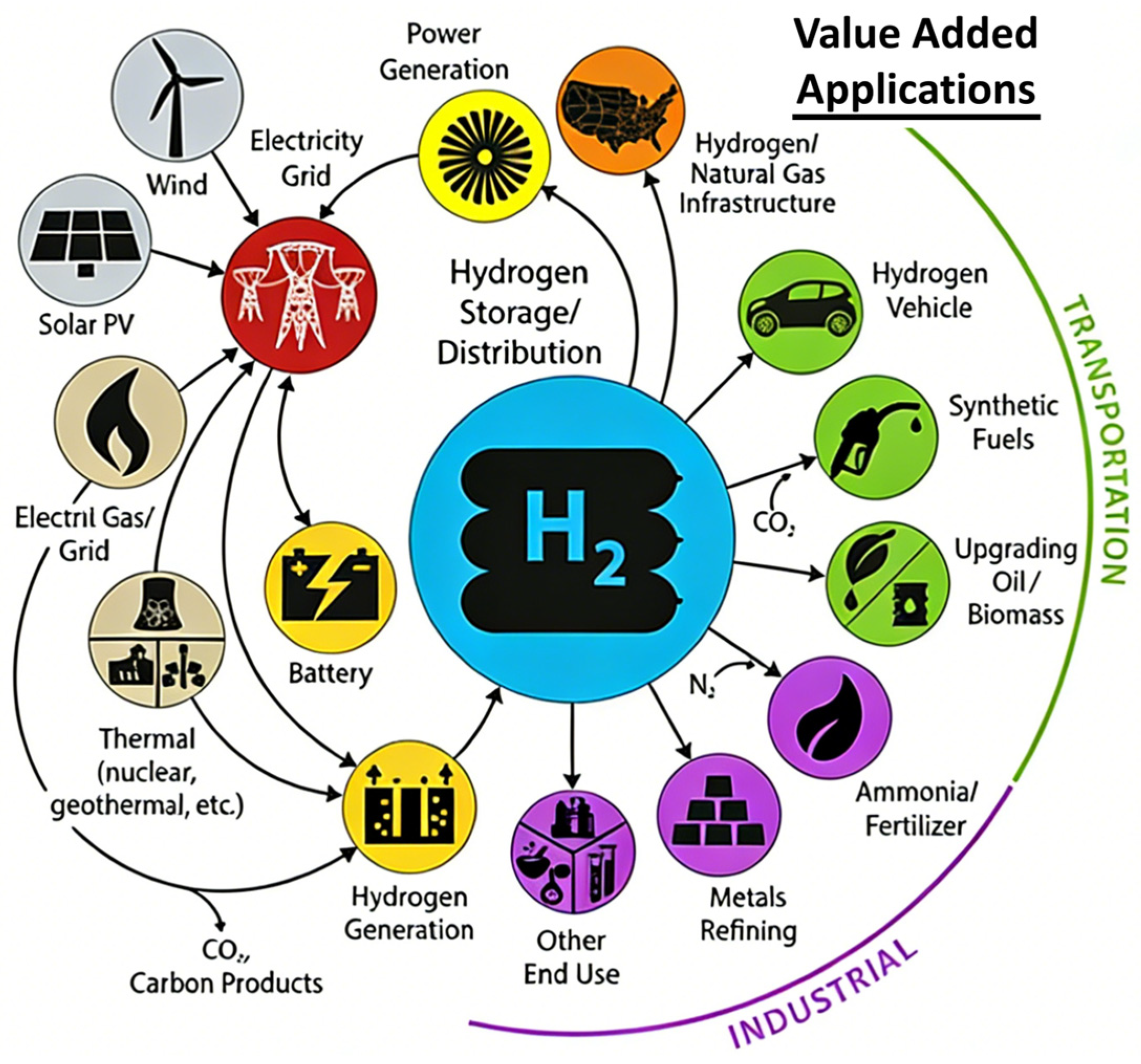
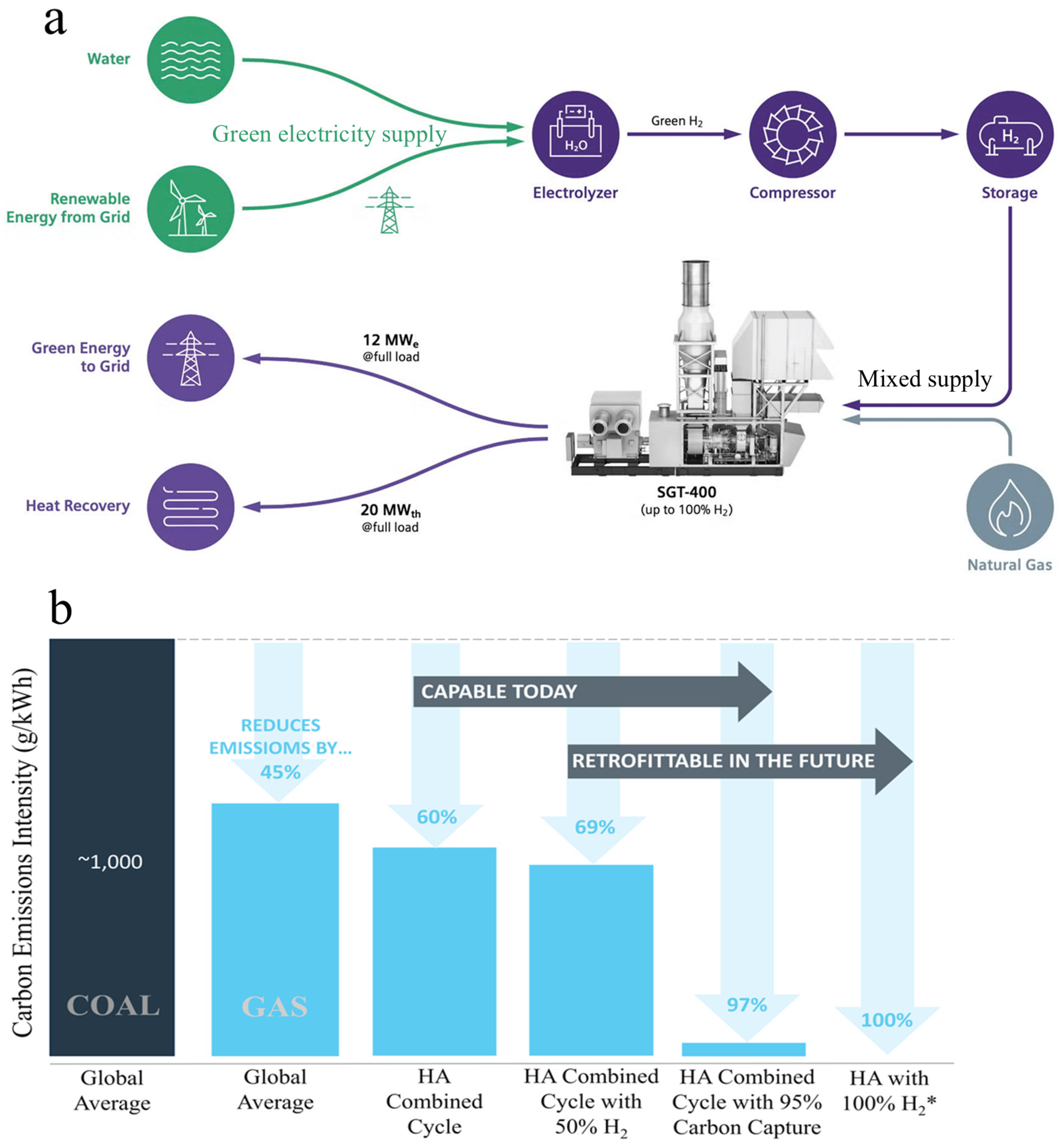
The escalation of global industrialization and regional wars has exacerbated environmental challenges. The United Nations report reveals that the rise in global temperature is approaching the 1.5 °C threshold. United Nations Secretary-General António Guterres has introduced a “five-point energy plan” as a strategic solution to tackle these challenges [1]. The importance of renewable energy in the energy transition is emphasized in the UN’s 2030 Agenda for Sustainable Development [2]. As shown in Figure 1, hydrogen energy functions as an abundant, clean, and sustainable energy carrier [3,4,5,6]. Hydrogen energy can effectively serve as an ideal energy storage medium and power generation carrier in new energy generation, combined with hydrogen production from valley power and hydrogen doping from combustion engines for peak power generation, realizing an integrated energy supply system for distributed energy sources [7,8]. And, the effective integration of hydrogen with gas turbines will be a powerful accelerator for a low-carbon economy, as seen in Figure 2, which is anticipated to become a central component in the new power grid, relying on its flexible, controllable, and highly efficient power generation capabilities.
Researchers in the sector are currently working to address the issues of excessive NOx emissions in the combustor and unstable combustion in hydrogen-fueled gas turbines. The process by which hydrogen burns in the combustion chamber causes unstable combustion, according to some researchers. Flebbe et al. [11] conducted experimental investigations on the effect of centerbody thermal runaway on boundary layer flashback in a swirl-stabilized gas turbine burner with 100% hydrogen as fuel, revealed the process where the centerbody temperature reaches a thermal threshold, triggering thermal runaway that subsequently dominates flashback via an auto-ignition mechanism, and established an analytical model and safety map to effectively predict the occurrence of centerbody thermal runaway under specific operating conditions. Giannotta et al. [12] conducted a conceptual study on the linear stability of premixed laminar hydrogen-enriched methane–air flames in a cylindrical pipe with both ends open, and the results indicated that the hydrogen mole fraction can be a tunable parameter for controlling thermoacoustic instabilities. Jung et al. [13] designed three premixed swirl gas turbine nozzles with different orifice sizes, conducted experiments where the hydrogen volume fraction in the fuel was increased from 0% to 60%, and suppressed combustion instabilities by increasing the fuel amount of the pilot flow; the results indicated that the fuel amount required for the pilot injection varies with the increase of the hydrogen ratio, and one-dimensional thermoacoustic analysis results confirmed that changes in fuel orifice size alter combustion instabilities by affecting variations in combustion delay and delay distribution. Karlis et al. [14] investigated the effect of hydrogen blending on the thermoacoustic stability of lean premixed swirl flames; the results indicated that an appropriate amount of hydrogen (e.g., 10%) can extend the flammability limit, while an excessive amount (e.g., 40%) can induce intermittent to stable high-amplitude thermoacoustic oscillations, and the study revealed that the dynamic relationship between flame stretch rate and extinction stretch rate is the key mechanism driving the stability transition. Mohamadi et al. [15] employed numerical simulation methods to analyze the effect of hydrogen blending on combustion-induced vortex breakdown (CIVB) and flashback in a swirl premixed burner; through coupled calculations of the EDC model and GRI 2.11 mechanism, the hydrogen ratio was increased up to 40% via an isocaloric replacement method under the condition of constant outlet temperature. The study found that hydrogen blending significantly alters the flame structure, thinning the flame thickness and changing the flame morphology, while the increase in operating pressure enhances the flashback tendency. It was pointed out that the dynamic matching relationship between the local flame stretch rate and the mixture extinction stretch rate is the key mechanism for controlling combustion stability, suppressing thermoacoustic oscillations, and inhibiting flashback, and this work provides an important theoretical reference for the stable combustion of hydrogen-blended fuels in practical gas turbines. Tian et al. [16] systematically investigated the thermoacoustic dynamic behavior of laminar premixed hydrogen-enriched methane-air flames under the coupling of dual-mode velocity perturbations by adopting the level set method and G-equation model; through theoretical derivation, the study obtained the Flame Describing Function (FDF) varying with hydrogen content (ηH) and coupled it into the low-order Rijke tube network model to analyze system stability. Fritz et al. [17] systematically investigated the flashback triggering mechanism in swirling tubular premixed combustion by designing a single-burner test rig combined with high-speed photography, LDV (Laser Doppler Velocimetry), and PLIF (Planar Laser-Induced Fluorescence) measurements; the results indicated that under the studied conditions, combustion-induced vortex breakdown (CIVB) is the primary mechanism leading to flashback, which is extremely sensitive to the momentum distribution in the vortex core region—increasing axial momentum near the mixing tube axis can reduce the circumferential velocity gradient, thereby effectively suppressing flashback. By varying the laminar burning velocity of fuels (natural gas/hydrogen), the study clarified the effects of equivalence ratio, preheating temperature, and average flow velocity on flashback characteristics, providing key insights for the stable design of low-NOx swirling premixed combustion chambers.
Boretti et al. [18] planned a system consisting of 325 GW wind and solar power, 50–150 GW electrolyzers, and 50 TWh hydrogen storage to meet the 570 TWh dispatchable electricity demand of the Australian power grid, and demonstrated that the methane–hydrogen combined-cycle gas turbine is a key transitional supporting technology for achieving smooth decarbonization. Hernandez et al. [19] compared the combustion characteristics of hydrogen/air and natural gas/air under micromixing injection through numerical and experimental methods; the results indicated that the NOx emissions of hydrogen mixtures are significantly reduced with obvious differences in flame structure, verifying the potential of the micromixing strategy to achieve ultra-low emissions while revealing the higher complexity of its combustion modeling, which provides key references for the design of hydrogen-fueled gas turbines. Pashchenko et al. [20] analyzed the thermodynamic performance of gas turbines using two hydrogen-enriched fuels (hydrogen-diluted methane and renewable reformate); the results indicated that hydrogen blending can nonlinearly reduce CO2 emissions, with a 50% hydrogen blending ratio achieving a 23.5% emission reduction, and the minimum carbon emission when using renewable reformate is equivalent to the level of 53% hydrogen blending. Tamang et al. [21] conducted numerical simulation analysis and showed that increasing the hydrogen blending ratio in a non-premixed combustion chamber can significantly improve combustion efficiency and reduce CO and CO2 emissions by up to 96.63%; however, the NOx emissions increase substantially due to the elevated flame temperature, requiring the coordinated control of pollutant formation by optimizing the equivalence ratio and hydrogen blending ratio.
Other researchers have concentrated on novel combustor designs created for the burning of hydrogen. Cappelletti et al. [22] redesigned the combustion chamber of the Turbec T100 micro gas turbine through CFD simulations, expanding its fuel from natural gas to pure hydrogen; the study focused on addressing the challenges of high NOx emissions and operational safety in hydrogen combustion, providing a technical foundation for the application of hydrogen energy in distributed power generation. Cappelletti et al. [23] introduced the design of a lean premixed combustor for heavy-duty gas turbines fueled with 100% hydrogen; through improvements to the axial swirler and blending injection system, a wide range of premixing regulation was achieved. Tests indicated that by optimizing the outlet flow velocity and equivalence ratio, NOx emissions can be controlled within 17 ppm (at an outlet velocity of approximately 120 m/s), while effectively managing the flashback limit and pressure drop, verifying the feasibility and low-emission potential of the pure hydrogen combustion system.
The paper initially examines the primary technological challenges associated with mixed hydrogen combustion in traditional gas turbine combustors, analyzing the differences in properties between hydrogen and conventional methane fuel. It also presents existing advanced hydrogen combustion strategies and the enhanced technological capabilities of modified combustors. Nevertheless, the majority of studies concentrate on optimizing traditional combustor designs to get steady and low-emission combustion, whereas insufficient emphasis has been placed on the overall modification of gas turbines. This paper examines component failures resulting from high-temperature material hydrogen embrittlement and safety concerns arising from fuel transitions during the shift from conventional gas turbines to hydrogen gas turbines, thereby offering references and insights for the comprehensive optimization of hydrogen-fueled gas turbines.
This paper initially examines the primary technological challenges associated with mixed hydrogen combustion in traditional gas turbine combustors, analyzing the differences in properties between hydrogen and conventional methane fuel. It also presents existing advanced hydrogen combustion strategies and the enhanced technological capabilities of modified combustors. Nevertheless, the majority of studies concentrate on optimizing traditional combustor designs to achieve steady and low-emission combustion, whereas insufficient emphasis has been placed on the overall modification of gas turbines. This paper further examines component failures resulting from high-temperature material hydrogen embrittlement and safety concerns arising from fuel transitions during the shift from conventional gas turbines to hydrogen gas turbines, thereby offering references and insights for the comprehensive optimization of hydrogen-fueled gas turbines. To provide a clear roadmap for readers, the remainder of this paper is structured as follows:
Section 2 Schematic overview of the review structure on hydrogen-fueled gas turbines.
Section 3 systematically compares the combustion characteristics of hydrogen with conventional fuels and analyzes the underlying mechanisms of key technical challenges, including flashback, thermoacoustic oscillations, and NOx emissions.
Section 4 reviews advanced combustion technologies for hydrogen-fueled gas turbines, such as diffusion-flame combustion, dry low-emission (DLE) combustion, micromix combustion, and axial staged combustion, highlighting their operational principles and performance under hydrogen-enriched conditions.
Section 5 addresses the systemic modifications required for gas turbines transitioning from natural gas to hydrogen, focusing on material compatibility (especially high- temperature hydrogen embrittlement), hot-end component design, and safety protocols including hydrogen purging.
Section 6 summarizes the main findings, identifies research gaps, and proposes future directions for both technology development and policy support.
This structure is designed to progress from fundamental combustion properties to advanced technological solutions, and finally to systemic integration and safety considerations, thereby providing a comprehensive and logically coherent review that bridges research insights with engineering applications.

2. Methodology and Review Structure

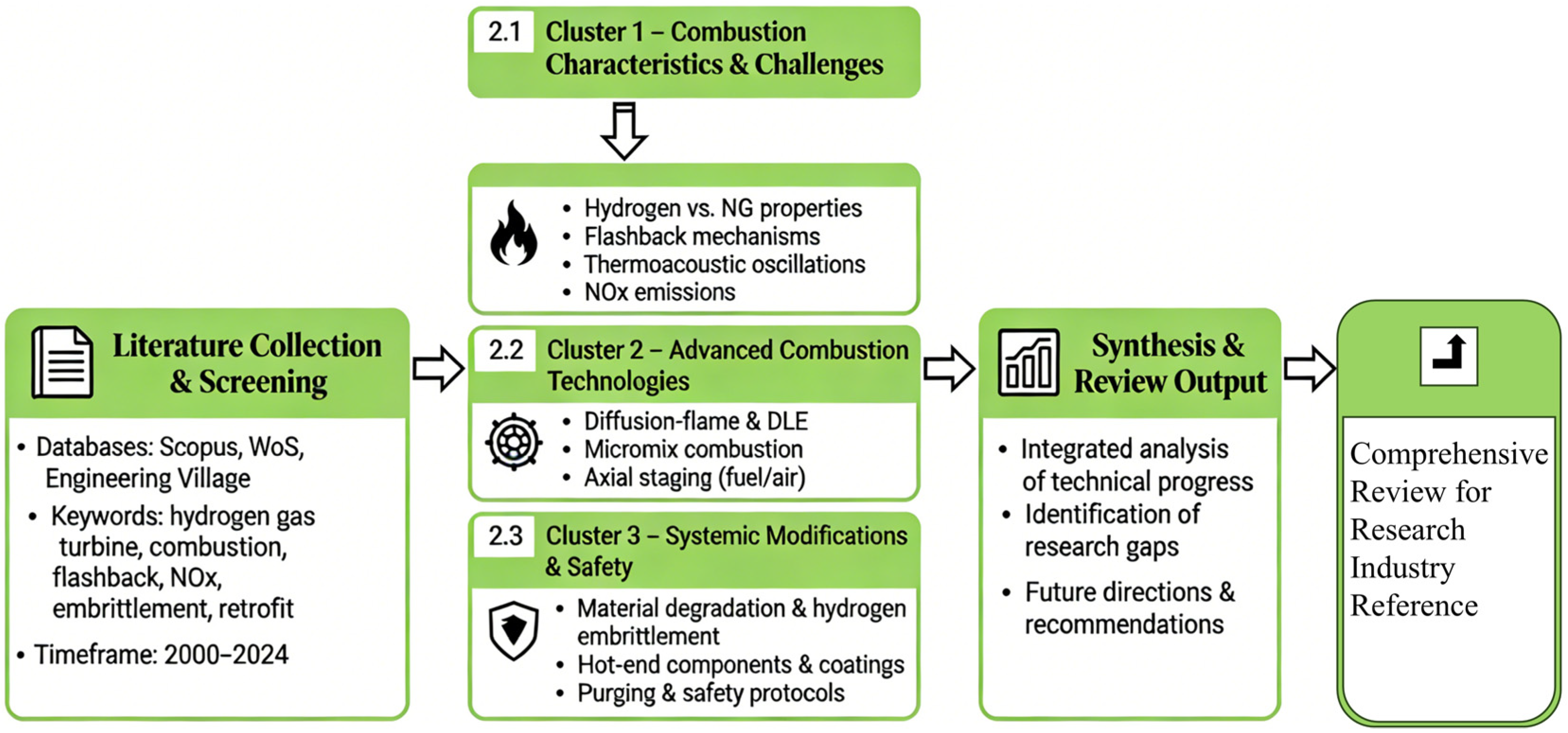
To ensure a systematic and comprehensive analysis of the research status and technical progress in hydrogen-fueled gas turbines, this review was conducted following a structured methodological approach. The process encompassed literature collection, screening, categorization, and synthesis, as outlined in Figure 3.

2.1. Literature Search and Selection

A systematic search was performed across major scientific databases (including Scopus, Web of Science, and Engineering Village) using keywords such as “hydrogen gas turbine,” “hydrogen combustion,” “flashback,” “thermoacoustic instability,” “NOx emissions,” “hydrogen embrittlement,” and “gas turbine retrofit.” The search was limited to peer-reviewed journal articles, conference proceedings, and technical reports published between 2000 and 2024. Initial search results were screened based on relevance to hydrogen-fueled gas turbine technology, with emphasis on experimental studies, numerical simulations, and recent industrial advancements.

2.2. Analytical Framework

The selected literature was categorized into three thematic clusters:
(1)
Combustion Characteristics and Challenges: Focusing on hydrogen’s thermophysical properties, flame dynamics, flashback mechanisms, thermoacoustic oscillations, and NOx formation.
(2)
Advanced Combustion Technologies: Reviewing technological developments such as diffusion-flame, dry low-emission (DLE), micromix, and axial-staged combustion systems.
(3)
Systemic Modifications and Safety: Examining material compatibility, hydrogen embrittlement, hot-end component design, purge protocols, and overall turbine retrofit requirements.

2.3. Review Structure Overview

Figure 3 illustrates the logical flow of this review. It begins with an analysis of hydrogen’s combustion properties and associated challenges, proceeds to evaluate current and emerging combustion technologies, and concludes with a discussion on systemic integration and safety considerations. This structure ensures a progressive understanding from fundamental principles to engineering applications, thereby providing a holistic reference for researchers and industry practitioners.

3. Characteristics of Hydrogen Fuel Combustion

The thermophysical and chemical characteristics of hydrogen and two additional hydrocarbons at 20 °C and 101.325 kPa are shown in Table 1. Variations in the physical properties of fuel can significantly affect the combustion process, and the operational efficiency of the gas turbine depends on the retrofitting system’s ability to adapt to these fuel variations.
(1)
The flame speed of hydrogen is an order of magnitude greater than that of natural gas; when mixed with hydrogen, the potential energy of the natural gas jet is diminished, and the stability of the combustion flame is positioned closer to the nozzle.
(2)
The adiabatic flame temperature of hydrogen exceeds that of methane by approximately 150 K at the same equivalence ratio in a lean premixed burner, leading to localized temperatures exceeding 2000 °C in the burner, which has significant implications for pollutant management and internal cooling.
(3)
Hydrogen possesses merely 7% of the ignition energy of methane, and the inlet pressures and temperatures of contemporary gas turbines facilitate self-ignition in the premixed portion.
(4)
Hydrogen exhibits reactivity that is 100 times greater than that of methane, possesses a broader flammability range in air, and necessitates more stringent operating safety standards.
(5)
A reduced Wobbe index for gas necessitates more adaptable combustion systems and corresponding control mechanisms, together with enhanced fuel supply capacity.
(6)
Hydrogen atoms are minuscule and can readily permeate the internal structure of materials.
Key hydrogen properties and corresponding technical challenges for gas tur-bines are summarized in Table 2.

3.1. Flashback

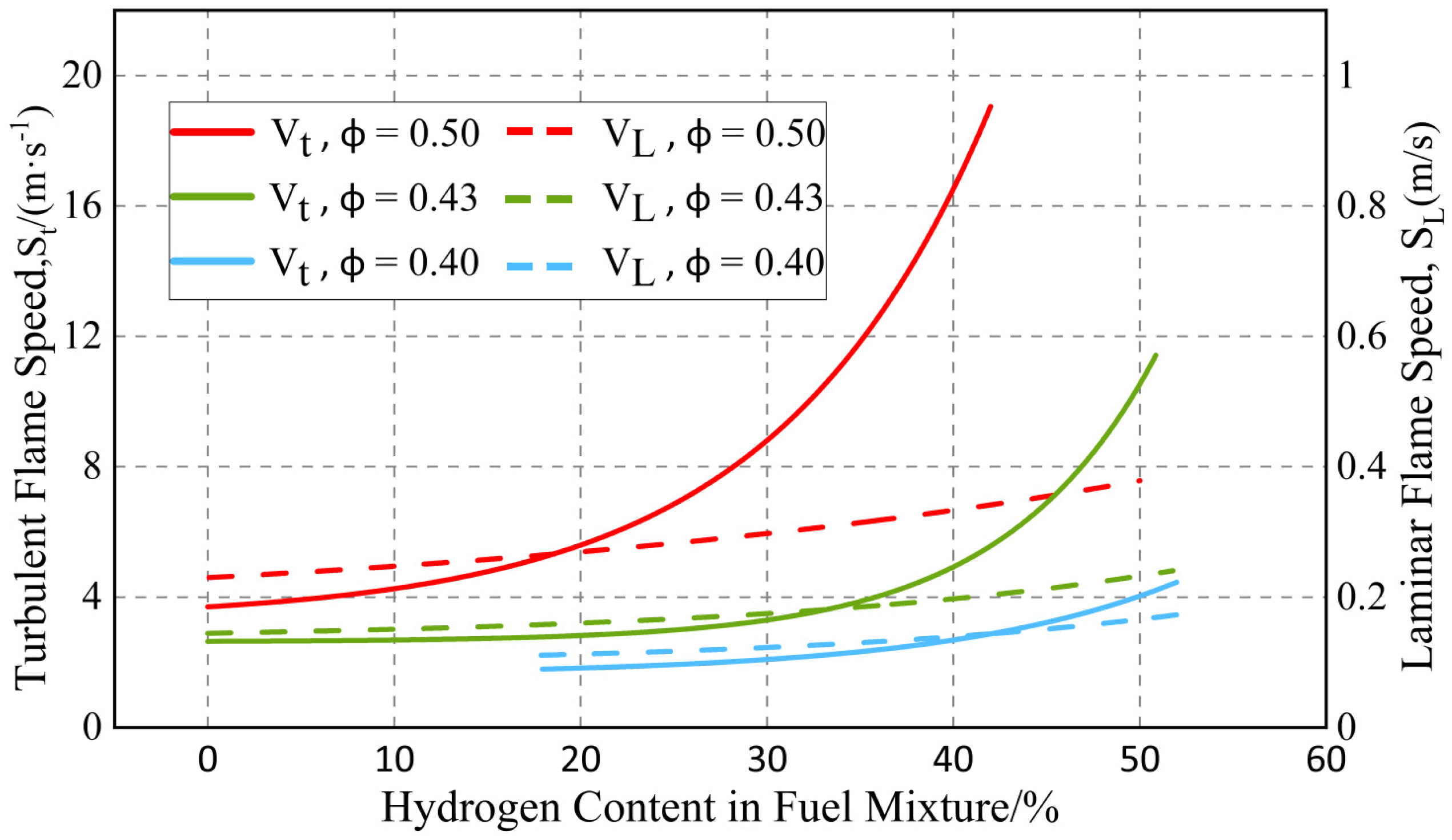
High-performance gas turbines typically utilize lean premixed combustion (LPM) technology. In LPM systems, the flashback is an intrinsic feature; when the local turbulent flame speed in the burner surpasses the reactant flow speed, the flame front advances from the combustion zone upstream into the premixed section [11,15], causing local flame stabilization within the premixed channel, potentially resulting in overheating and damage to the hardware. Fuels with reduced hydrogen content exhibit elevated turbulent flame speed relative to methane, hence heightening the risk of flashback in the LPM combustor [28]. Figure 4 illustrates that the turbulent flame speed closely aligns with the trend of laminar flame speed when the hydrogen-mixed ratio in the methane/hydrogen mixture is minimal. As the hydrogen content approaches or exceeds 30%, the flame speed demonstrates considerable variability with the hydrogen-mixed ratio and equivalence ratio, hence heightening the risk of flashback during the burning of methane–hydrogen mixtures in the burner with increasing hydrogen-mixed ratio [29]. Table 3 provides a comparison of these mechanisms. At least four different mechanisms can cause this to occur in the gas turbine’s premixing chamber [17,30,31]:
(1)
Boundary Layer Flashback (BLF) is a phenomenon in which a flame propagates upstream along the burner wall boundary layer, which is characterized by a low-velocity shear flow;
(2)
A phenomenon characterized by flame propagation in the core region of a combustion-induced vortex breakdown (CIVB);
(3)
Bulk Flow Flashback (BFF) is defined as flashback through the flow core, triggered when the flame speed surpasses the bulk flow velocity;
(4)
Flashback as a result of combustion instabilities.

Table 3. Classification and characteristics of flashback mechanisms in hydrogen-enriched premixed combustion [17,30,31].
MechanismAcronymDriving FactorTypical LocationKey Influencing Factors
Boundary Layer FlashbackBLFLow velocity near wallSwirl burners with centerbodyHydrogen fraction, boundary layer velocity profile
Combustion-Induced Vortex BreakdownCIVBVortex breakdown induced by heat releaseSwirl burners without centerbodySwirl number, equivalence ratio, hydrogen diffusivity
Bulk Flow FlashbackBFFFlame speed > bulk flow velocityCore flow regionTurbulent flame speed, fuel composition, mixing uniformity
Combustion Instability Flashback-Thermoacoustic oscillationsEntire premixed zonePressure oscillations, hydrogen reactivity, system acoustics
Figure 4. Measurements of turbulent flame speed for methane/hydrogen fuel mixtures. By courtesy of ASME [32].
Energies 19 01312 g004
Combustion instability flashback is typically induced by variations in pressure and acoustic waves resulting from thermoacoustic oscillations, which may be intensified by hydrogen’s heightened reactivity. Emerson et al. [33] proposed a new concept of the NRRL combustor. Through the rich-burn, relaxation, and lean-burn pathway, it achieves ultra-low NOx emissions under high-temperature and high-pressure conditions, and can flexibly adapt to various fuels ranging from pure hydrogen to pure ammonia, providing an innovative solution for the next-generation. Experiments conducted by Costa et al. [34] demonstrate that hydrogen can significantly enhance the laminar burning velocity of ammonia at a high pressure of 10 atm, while elevated pressure can intensify specific termination reactions to inhibit combustion. This finding provides a critical basis for the high-pressure combustion design and kinetic model improvement of ammonia–hydrogen fuel blends. Yovino et al. [35] indicate that hydrogen can enhance the laminar burning velocity of ammonia at a high pressure of 10 atm, whereas elevated pressure can also intensify specific termination reactions, thus inhibiting combustion. This study provides critical data for refining the high-pressure combustion kinetic model of ammonia–hydrogen fuel blends. Rajagopalan et al. [36] found that increases in hydrogen content and pressure both significantly enhance the turbulent flame speed, while the effect of preheating temperature is dependent on the fuel composition. This study emphasizes the importance of analyzing sensitivity under constant initial turbulence intensity or normalized intensity. Shahin et al. [37] found that the flame exhibits higher stability under the conditions of high hydrogen content and high ammonia decomposition, whereas high concentrations of methane/ammonia can induce periodic global extinction and reignition, leading to significant thermoacoustic instability whose intensity is closely related to the fuel composition. To mitigate the turbulent flame propagation speed associated with hydrogen fuel, the turbulence at the flame front can be diminished by employing microscale nozzles or enhancing the fuel–air mixing, hence decreasing the risk of flashback [38].
For swirl-stabilized premixed burners, BLF and CIVB predominate as the flashback mechanisms. BLF typically transpires in swirl-stabilized burners with a centerbody; BLF is initiated at the centerbody when the upstream-propagating flame interacts with the separated boundary layer there [39]. Increased turbulent flame velocities may facilitate the initiation of boundary layer flashback. Dam et al. [40] increased the hydrogen mass fraction in different fuel blends to investigate their characteristics. They observed that the tendency for boundary layer flashback is positively correlated with the hydrogen fraction in the fuel. In contrast, CIVB is more commonly associated with flashback in swirl burners that lack a centerbody. In this mechanism, alterations in the cold flow field within the reflux zone induce vortex propagation towards the disrupted flame in the premixed section, ultimately resulting in the flame occupying the whole premixed section [17]. Pugh et al. [41] show that the NO formation of hydrogen flames increases significantly under high-pressure conditions (1–6 bar) and high swirl numbers. For NH3-H2 blended fuels, increasing the ammonia proportion can reduce NO emissions; this reduction effect is particularly pronounced under high-pressure and low-swirl conditions, where the NO emissions of the blends outperform those of pure hydrogen flames. De et al. [42] established that combustion-induced CIVB flashback is more probable in hydrogen than in methane, based on calculations and comparative investigations of hydrogen/methane mixed fuel and methane fuels. The phenomena may be associated with the increased diffusivity of hydrogen, enabling the hydrogen flame to engage more intensively with the cyclone, hence producing more significant alterations in the cold flow field.
The experimental investigations into hydrogen flashback mechanisms remain few, and the turbulent flame propagation speed of hydrogen has yet to be accurately and quantitatively assessed, complicating comprehensive predictions and prevention of hydrogen flashback. Conventional burners are usually designed to function with a specific range of flame speed associated with certain fuels, and for natural gas fuels with an elevated hydrogen-mixed ratio, it is necessary to construct specialist burners to accommodate varying combustion circumstances.

3.2. Thermoacoustic Oscillation

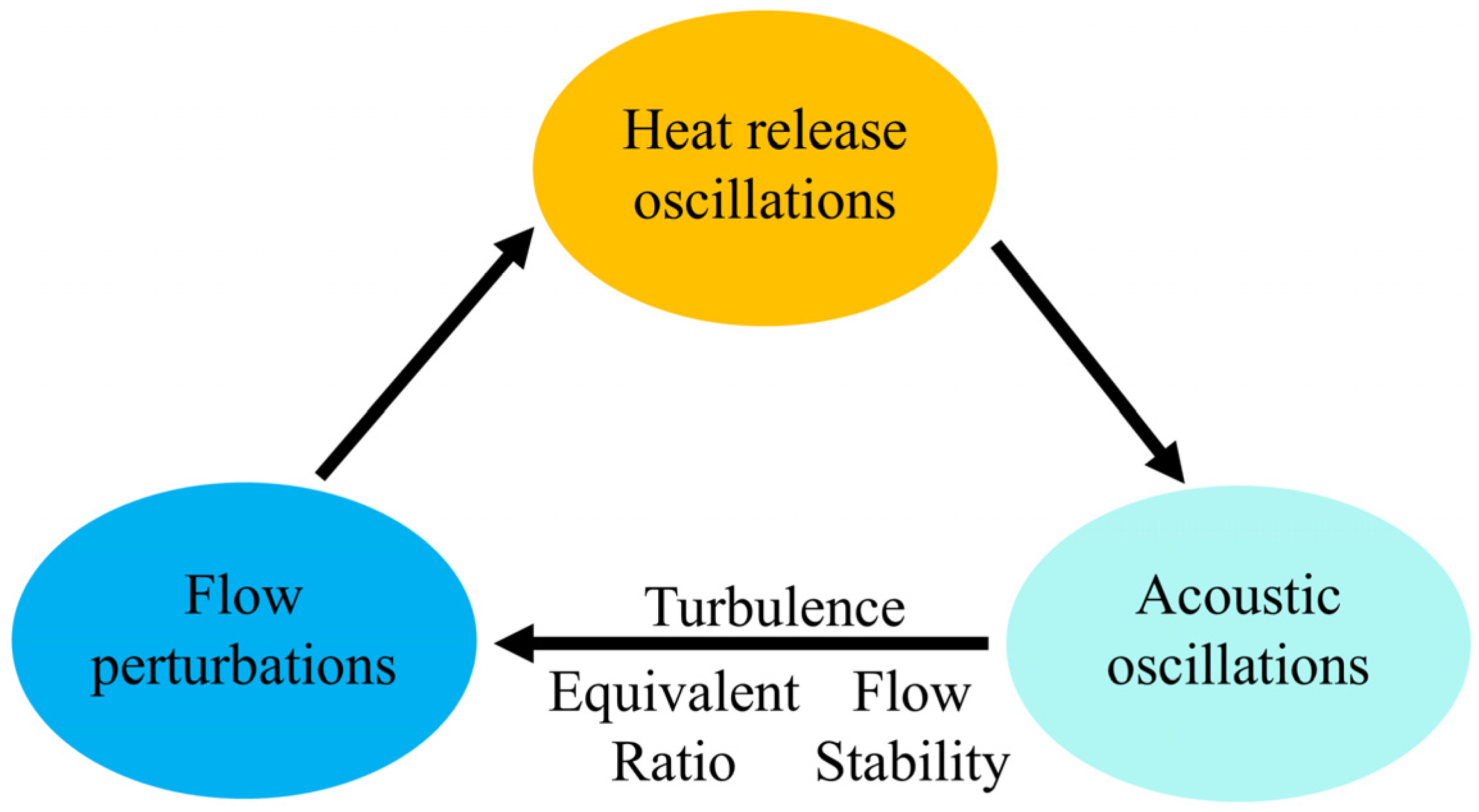
Thermoacoustic oscillation is a self-sustaining combustion instability resulting from the resonant interaction between oscillating flow and unsteady heat release processes [43], with amplitudes potentially exceeding 10 percent of the average pressure within the combustor [44]. This phenomenon restricts the stable operational range of the combustion system and increases heat transfer to the chamber walls, potentially causing system disturbances. Figure 5 illustrates the feedback mechanism of self-sustaining combustion instability [45]. Perturbations are introduced into the flow/mixture via a dedicated driving process. These perturbations in flow and mixture generate heat release oscillations, which in turn excite acoustic modes, subsequently causing fluctuations in pressure and velocity. This, in turn, produces additional perturbations in the flow and mixture, forming a closed feedback loop [46].
Rayleigh identified two essential requirements for the creation of thermoacoustic oscillations: firstly, the pressure oscillations p and heat release oscillations q must be in phase (θ < 90°) [47], as indicated in Equation (1):
p t q t dt > 0
The classical Rayleigh criterion provides a fundamental principle for identifying the conditions under which thermoacoustic oscillations may be sustained. Mathematically, it states that oscillations will grow if the integral of the product of pressure oscillations p t and heat release oscillations q t over one period is positive.
The derivation outline is as follows.
Starting from the acoustic energy balance equation for a combustor, the rate of change in acoustic energy E ac can be expressed as
d E ac d t = V p q d V D
where D represents acoustic damping losses. When the source term p q d V exceeds D , instability grows. For a harmonically oscillating system, Equation (1) emerges as the time-averaged condition for instability.
The connection to hydrogen-enriched combustion is as follows.
In hydrogen-mixed flames, the higher reactivity and shorter chemical timescales of hydrogen significantly alter the phase relationship between p and q . Specifically [14,48],
(1)
Hydrogen’s faster heat release can advance the phase of q relative to p , potentially satisfying Equation (1) over a wider range of equivalence ratios.
(2)
This explains why hydrogen enrichment can shift instability regions and promote thermoacoustic oscillations even under nominally stable methane conditions.
Thus, Equation (1) serves as a key analytical tool in this study for interpreting the increased propensity of hydrogen flames toward thermoacoustic instability, and it underpins the discussion of active/passive control strategies aimed at disrupting the p q phase alignment.
Secondly, the energy transfer rate from the unstable heat release to the acoustic mode needs to outpace the acoustic energy dissipation rate. Lu et al. [49] demonstrated that in a diesel-fueled multi-injector lean-premixed combustor, increasing the fuel staging ratio can alter the flame structure, shifting it from the wall-interference zone to the inter-injector interference zone. This modification effectively suppresses thermoacoustic oscillations, transforming the oscillation mode from a double-periodic limit cycle into a single mode. Nicoud et al. [50] pointed out that the classical Rayleigh criterion is derived from the acoustic energy equation, whereas the wave energy equation incorporating entropy perturbations yields a new criterion stating that “temperature is in phase with heat release”—a finding that exerts a fundamental impact on the study of combustion instability. The combustor is a highly resonant system, particularly in LPM combustors that are extensively premixed and lack a secondary air orifice structure [51]. In contrast to diffusion-flame combustors, which benefit from improved acoustic energy dissipation through the introduction of dilution air, the absence of film cooling and secondary air in the LPM combustor results in a marked decrease in sound attenuation [52].
Thermoacoustic instabilities in premixed combustion are largely attributed to the time lag, which acts as a key driver. This essentially corresponds to the combined time for a fuel particle to convect to the reaction zone and for the subsequent ignition and energy release to occur. Instabilities may arise when the time delay matches the convective travel time of a disturbance from its point of formation to the heat release zone. The combustion flame of hydrogen exhibits a greater propagation velocity and diffusivity than that of methane fuel, influencing the duration of the convective lag time. Meng et al. [53] showed that the incorporation of the spray–wall interaction and liquid film models into a large eddy simulation (LES) enables more accurate predictions of the phase and frequency of thermoacoustic instability. However, the predicted gain values are still underestimated, indicating that model refinement is required to improve prediction accuracy. An et al. [54] found that pressure signals exhibit a critical slowing-down phenomenon prior to the onset of thermoacoustic instability, with their variance and autoregressive coefficients increasing several seconds in advance. This phenomenon can serve as an effective early-warning indicator, and real-time monitoring is expected to prevent combustion oscillations. Guo et al. [55] adopted the Gaussian process machine learning model and combined it with the concept of “risk map”, which effectively quantifies the risk of multimodal thermoacoustic instability under the uncertainties of flame and acoustic boundary parameters, thereby providing an efficient analytical tool for the robust preliminary design of gas turbine combustors. Guo et al. [56] proposed a strategy based on the Gaussian process surrogate model and active learning, which quantifies the epistemic uncertainty of the model while intelligently allocating training samples to accurately capture the zero-growth-rate boundary, thereby enabling efficient calculation of the modal instability risk of gas turbine combustors. Consequently, in the investigation of hydrogen-initiated oscillatory combustion, greater emphasis should be placed on the process behind the thermoacoustic oscillation.
Current combustor designs utilize strategies to mitigate combustion instability primarily by enhancing system sound attenuation or disrupting the feedback loop between heat release and acoustic waves by modifying the phase difference between pressure and heat release oscillations to exceed 90°. According to these principles, suppression methods can be classified into two categories: active control, which mitigates the growth of combustion oscillations by disrupting the interaction between unsteady heat release and acoustic waves via external interventions [56], whereas passive control methods enhance acoustic dissipation within the combustor by modifying the internal hardware structure of the combustor [57]. In real combustion systems, the principal method for mitigating combustion oscillations is to control the fuel flow into the combustor [43].

3.3. NOx Emission

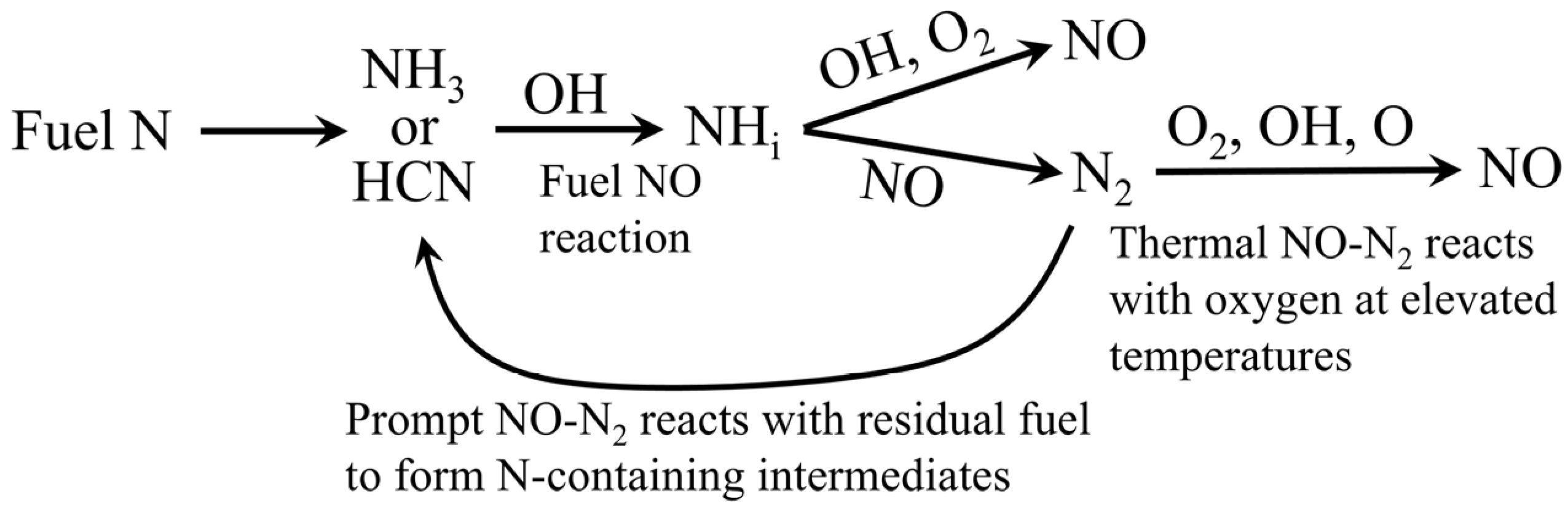
The ongoing enforcement of ultra-low emission limits across multiple industries has rendered NOx emission levels a critical metric for assessing the future viability of fuels [58], with certain affluent nations and regions imposing standards as low as 2 μmol/mol. Higher adiabatic flame temperatures due to the combustion of hydrogen-doped fuels, especially hydrogen-enriched fuels, can instead promote NOx production, as shown in the simplified NOx production mechanism by Lieuwen et al. [59] in Figure 6, where the reaction of thermal NO-N2 with oxygen at high temperatures promotes NO production.
Prompt NO formation predominantly occurs under rich-burn settings and is diminished in hydrogen combustion under lean combustion conditions. The adiabatic temperature of the hydrogen combustion flame can reach up to 2000 K, creating circumstances conducive to the formation of thermal NO. Avila et al. [60] demonstrate that in a rich-burn, relaxation, lean-burn combustion system, employing a longer relaxation section along with fewer secondary air injection holes featuring higher momentum can significantly reduce NOx and N2O emissions from ammonia combustion, achieving optimal emission reduction effects under specific equivalence ratios. This exponential correlation with temperature renders the reduction in burn temperature a critical strategy for low-NO burn [61].
Low-emission control strategies for gas turbines are classified as active and passive. The active approach involves innovative combustion techniques to modify the combustion process, such as reducing peak combustion temperature and residence time, designed to reduce thermal NOx and prompt NOx. The passive strategy entails the treatment of exhaust gases downstream of the combustor to transform them into less harmful products, such as water and nitrogen [62,63]. The incorporation of diluents into the combustor may lower the flame temperature; however, it can also result in system instability and diminish the efficiency of the thermal cycle. Consequently, prevailing strategies for nitrogen reduction are presently concentrated on dry low-emission (DLE) combustion technology.
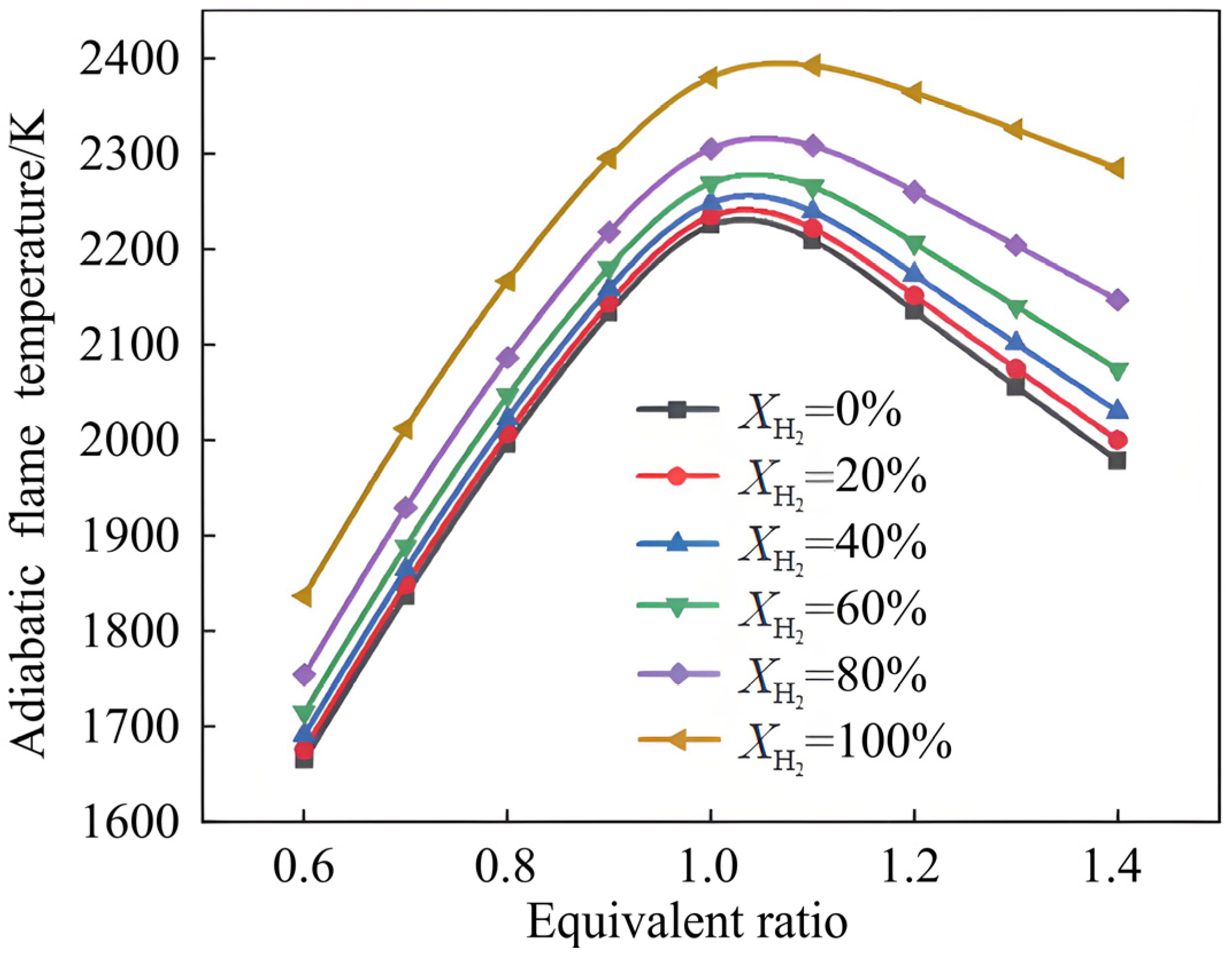
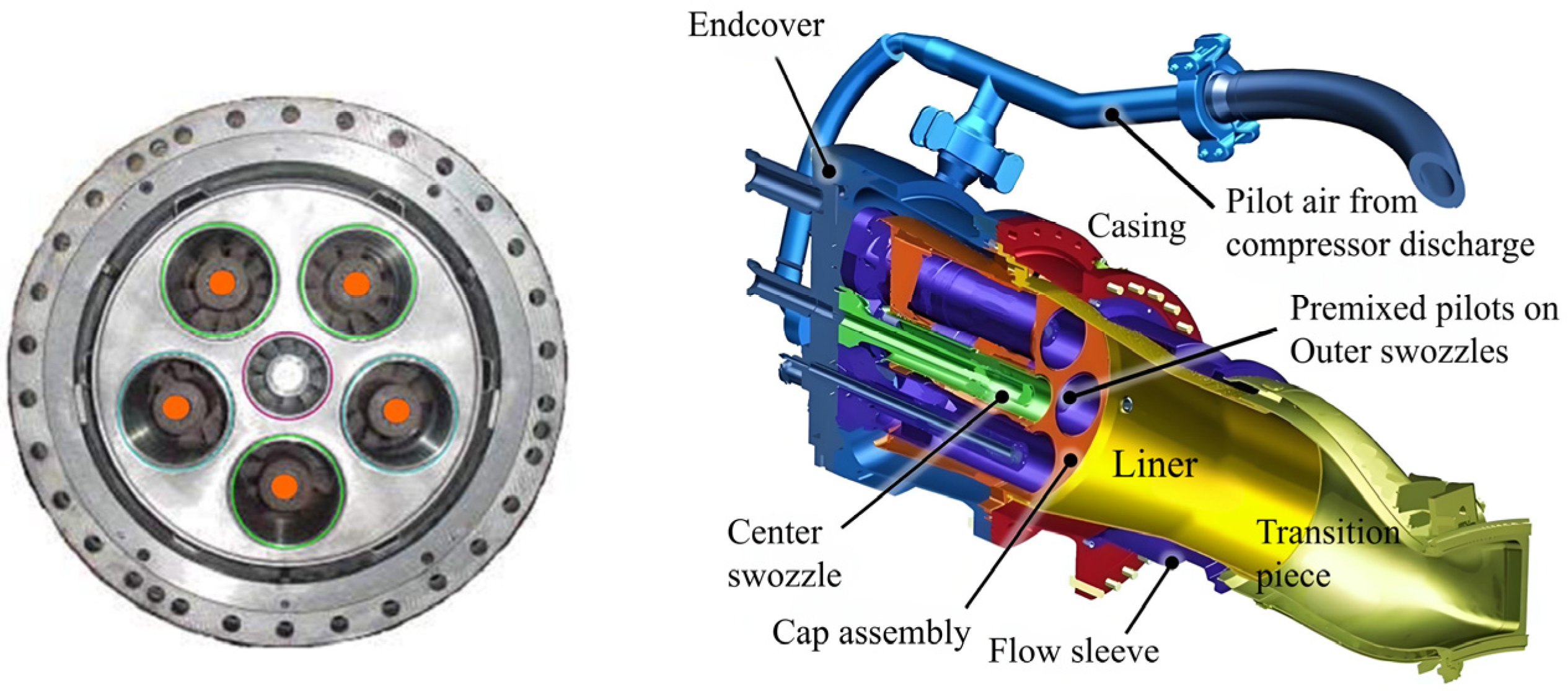
As can be seen from Figure 7, the use of low equivalence ratios and appropriate hydrogen doping ratios can effectively reduce the adiabatic flame temperature of combustion. Thus, most of the current DLE combustion technologies are usually fuel–air, premixed or partially premixed, and the burn chambers in gas turbines for power generation are generally combusted with a low hydrogen-mixed ratio according to the current state of the art. Cellek et al. [64] conducted a numerical analysis of NO emissions from an industrial low cyclone burner and discovered that as the hydrogen doping ratio rose, NO production dramatically increased. Guo et al. [65] conducted a computational investigation on the influence of additional hydrogen in an ultra-lean methane/air countercurrent laminar flame, concluding that the addition of hydrogen could enhance NO emissions via the NNH and N2O routes. The diffusion-flame chamber engineered by GE can achieve over 85% hydrogen by volume in the mixed gas; however, the issue of NOx emissions is significant. Conversely, the DLN2.6+ combustor created by the company (Figure 8) can operate at a maximum of 15% hydrogen content, yet it is typically maintained at below 5% during practical operation [66]. As environmental protection regulations become stricter, the operational parameters of K-class gas turbines will be enhanced, necessitating the urgent development of innovative combustion technologies to comply with the escalating NOx emission standards.
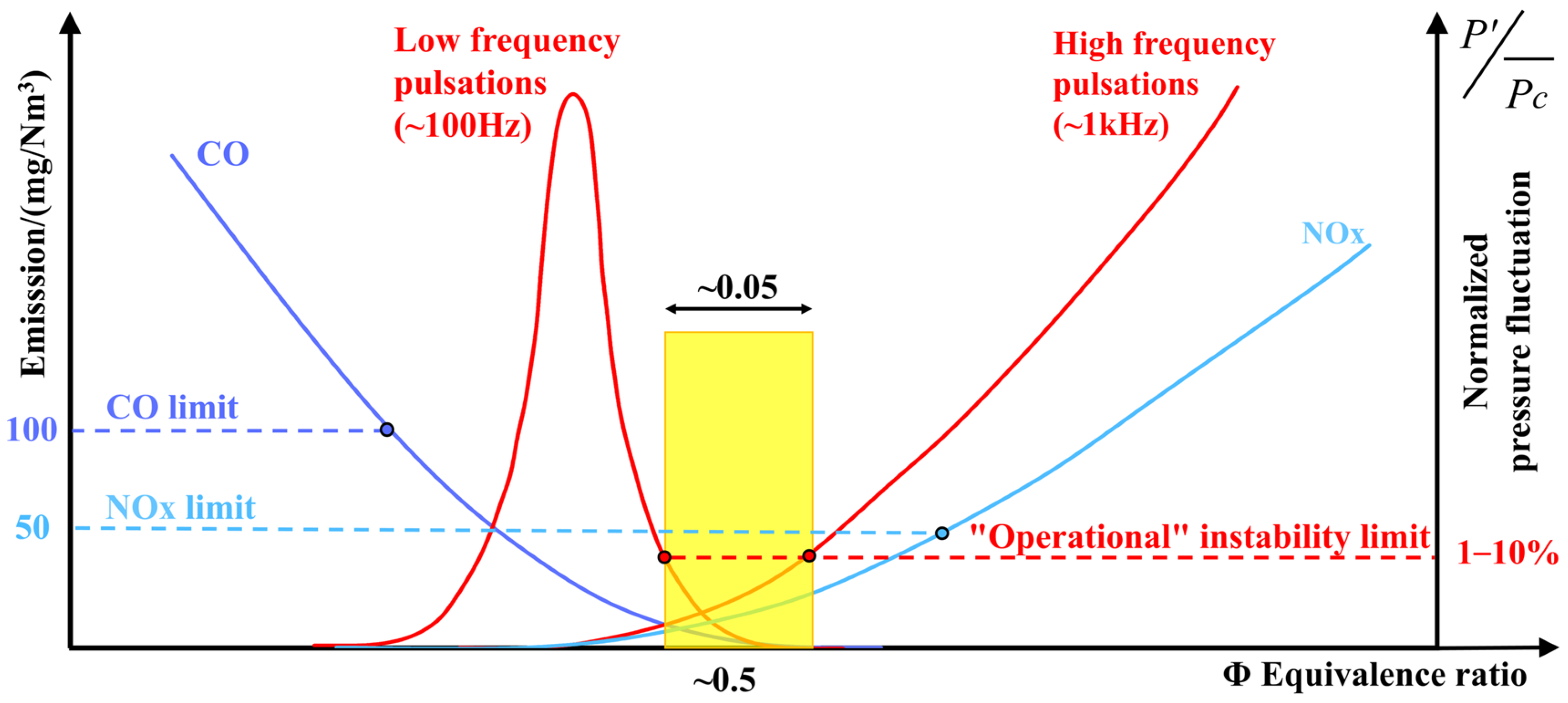
Despite the notable enhancement in flame behavior afforded by LPM technology, combustion instabilities, including backfires and oscillations, persist during the combustion of hydrogen-blended fuels, potentially resulting in NOx formation in localized hot patches [52,68,69]. Figure 9 qualitatively illustrates the capability of LPM technology to regulate pollutant emissions [61]; nonetheless, despite enhancements, combustion instability results in a reduced stable operating range of the system. Consequently, addressing the combustion instability issue may be fundamental to resolving the NOx emission challenge during hydrogen fuel combustion.

4. Advanced Combustion Technologies for Gas Turbines

To attain fuel flexibility, several enhanced combustion technologies for gas turbines have been developed, enhancing combustion engine performance mostly by structural modifications to the combustor.

4.1. Diffusion-Flame Combustion

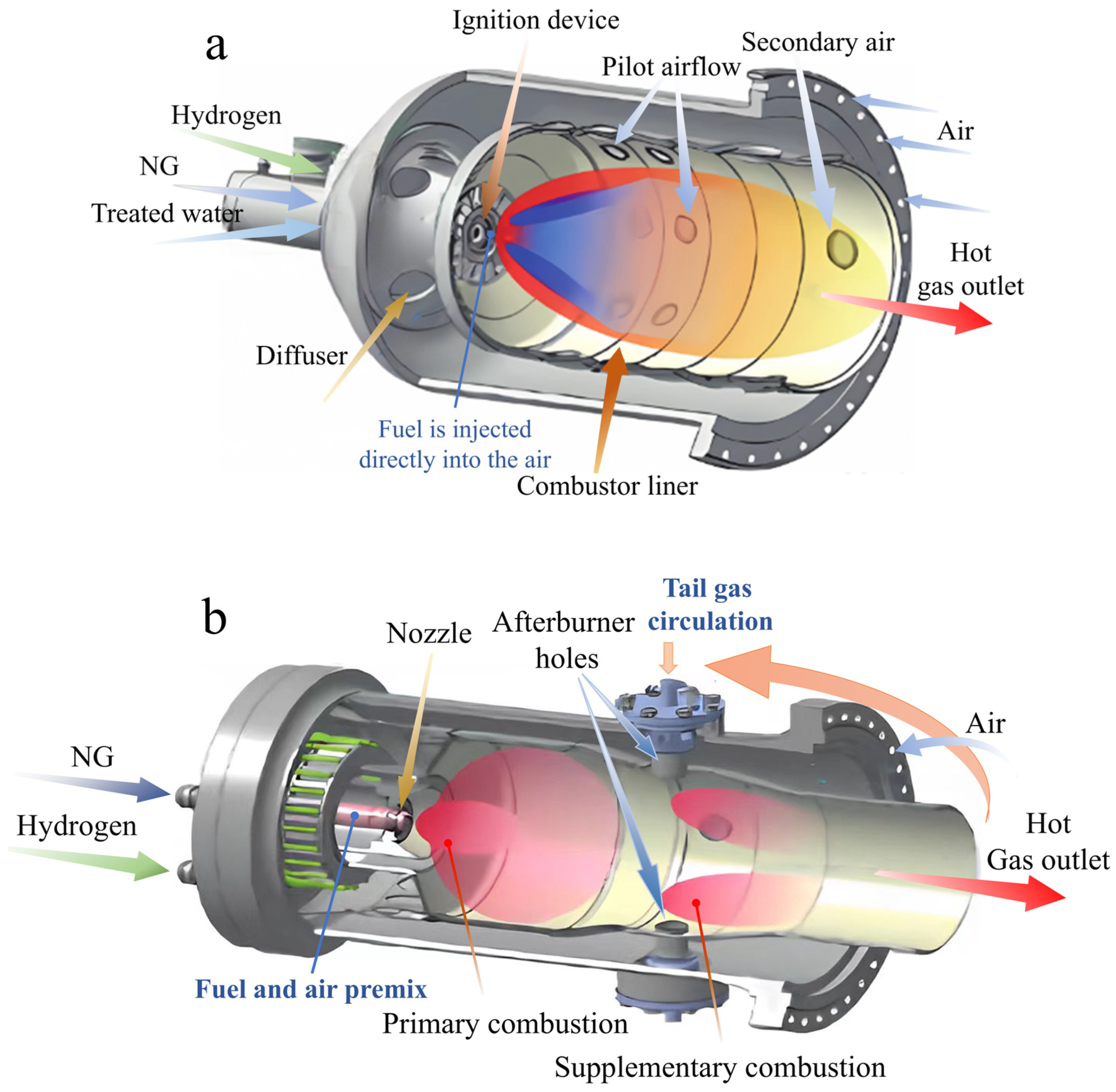
Diffusion-flame combustion is an early-developed advanced technique, illustrated in Figure 10a, that ignites the fuel by directly mixing it with air and combusting it within a hollow. This combustion method may alone regulate NOx emissions to a range of (15~25) × 10−6 [70]. Typically, it is essential to lower the NOx emission level using steam injection or selective catalytic reduction (SCR) technology; nevertheless, both approaches elevate operational costs and system complexity.
Diffusion-flame combustion technology exhibits high combustion stability and is appropriate for the combustion of various highly reactive fuels [71]. Due to its superior hydrogen combustion performance, it has been extensively utilized by prominent gas turbine manufacturers in testing 100% hydrogen fuel [72,73,74]. The multi-nozzle, low-noise, diffusion-flame burn system of GE company, derived from the 7FA combustion engine modification, is capable of combusting hydrogen-rich fuels containing 43.5% to 90% hydrogen, provided that all other gases are inert, such as nitrogen or steam, while maintaining component temperatures within the designated range. Test results indicate the viability of burning pure hydrogen fuel [75]. Currently, research is mostly concentrated on advancing DLE combustion technology to significantly diminish pollutant emissions and streamline the gas turbine modification process.
Figure 10. (a) Diffusion burner; (b) DLE burner. Reprinted from Kawasaki Ltd. [76].
Energies 19 01312 g010

4.2. DLE Combustion

Figure 10b illustrates that DLE combustion is typically premixed, wherein the majority of the inhaled air is combined with the fuel. This process diminishes NOx emissions through lean burn; however, it heightens the risk of flashbacks, flame interruptions, and detonations [52]. This combustion technology remains underdeveloped for hydrogen-rich applications. Table 4 illustrates the key performance indicators (KPIs) for advanced DLE gas turbines in 2020 and forecasts future developmental trends [77]. A hydrogen-mixed ratio of 30% to 100% presents a challenge in maintaining a specific NOx emission level. At present, NOx emissions are primarily regulated by diminishing gas turbine power [61].
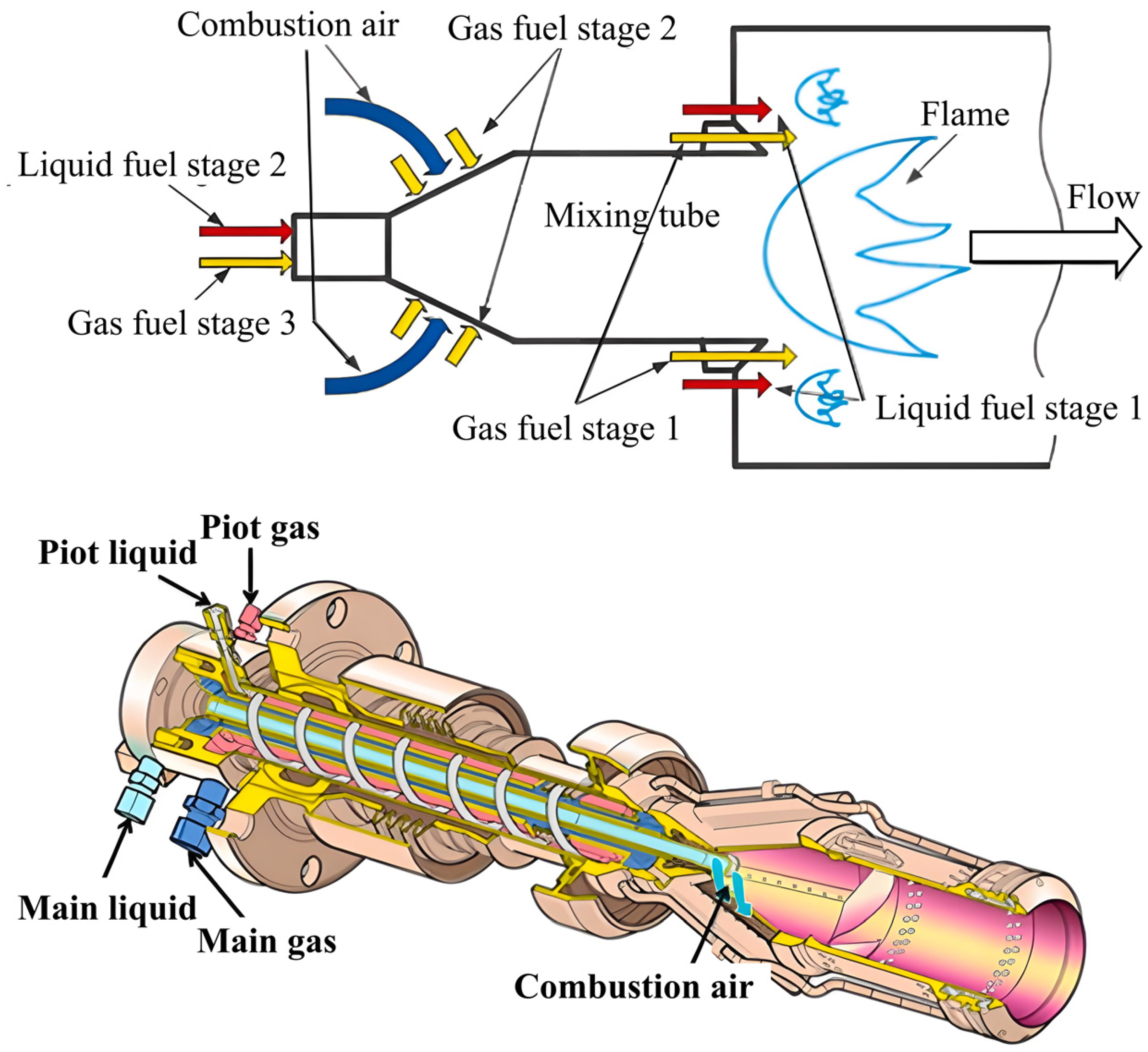
The SGT-600 third-generation engine was modified by Siemens, a German company that is at the forefront of developing hydrogen-mixed natural gas burn technology. As shown in Figure 11, the introduced DLE engine features a design where the main gas (gas fuel stage 2) is injected into the four air slots of a split cone, prior to entering a mixing section that incorporates film air holes. Numerous studies were conducted to test the 24 MWe SGT-600 3rd generation DLE gas turbine’s NOx emissions and flame flashback risk at higher H2 contents. The third-generation DLE gas turbine has been demonstrated to operate on 100% hydrogen at full load, achieving NOx emissions of only 35 ppm (at 15% O2) in single-burner high-pressure tests. Additionally, the results demonstrated that, within the SGT-600’s normal operating range, across the full load range from 0 to 100%, operation with 60 vol% hydrogen is feasible, with stable combustion maintained and NOx emissions kept under 25 ppm (at 15% O2) [78]. However, in tests of the fourth-generation combustor, the SGT-750, NOx emissions significantly increased with higher hydrogen-mixed ratios, exceeding 30 ppm when the ratio reached 50% [79]. The fuel–air mixing ratio of the current strong swirl premixer exceeds 98%, and the capacity to further improve the premixing degree to mitigate NOx emissions is constrained. Consequently, it is essential to develop more sophisticated combustion methods by enhancing traditional burners or creating new hydrogen burners to optimize hydrogen combustion efficiency.

4.3. Micromix Combustion

German researchers have discovered that micro-nozzles possess characteristics of low emission and anti-tempering, which can effectively address the primary issues in pure hydrogen combustion [26,79]. Extensive research has been conducted in many countries on micromix hydrogen burn technology [80,81,82], with the technical approach being the utilization of microtubes to enhance the mixing process, generate a small-scale combustion flame, and reduce gas residence time.
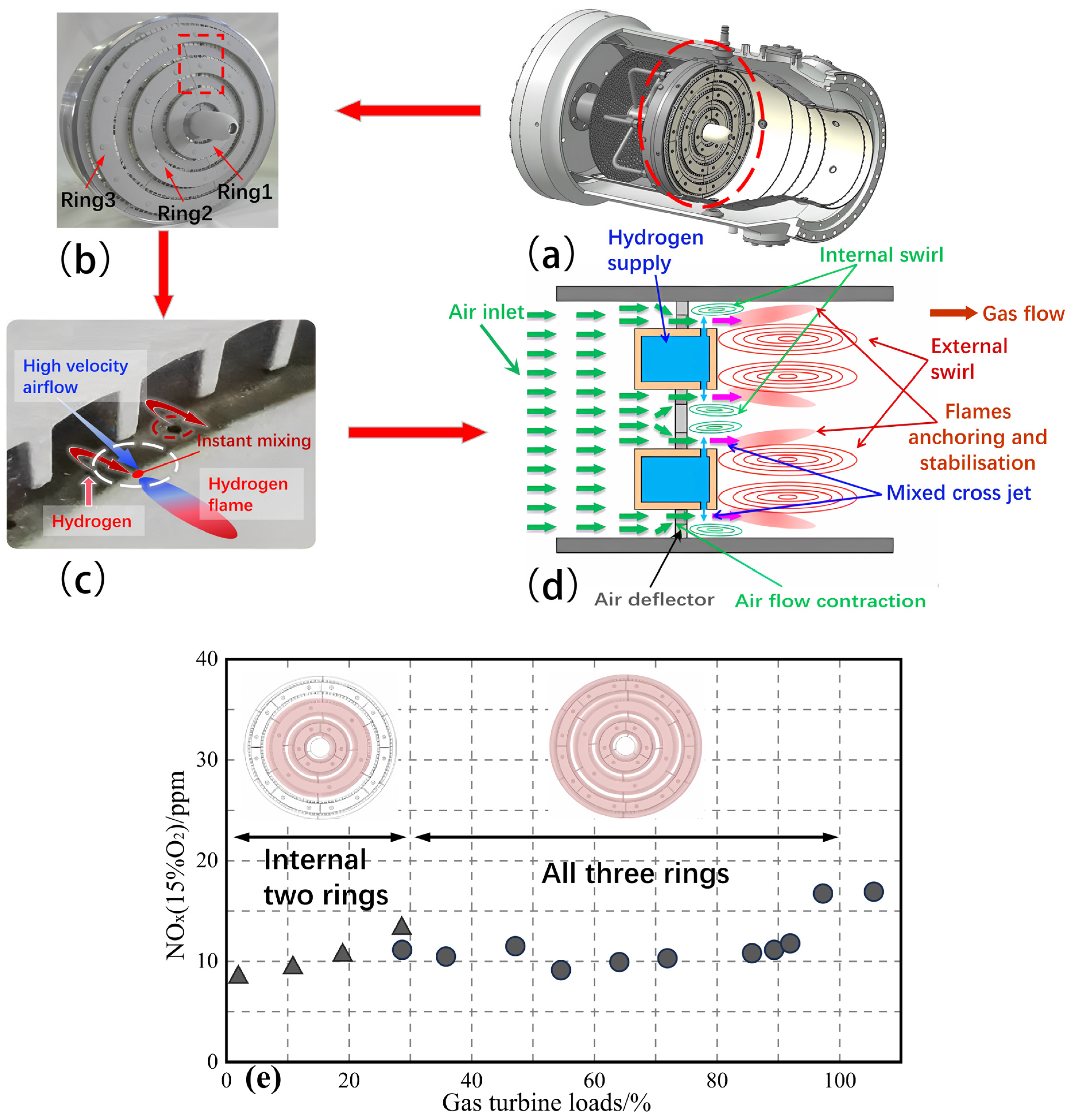
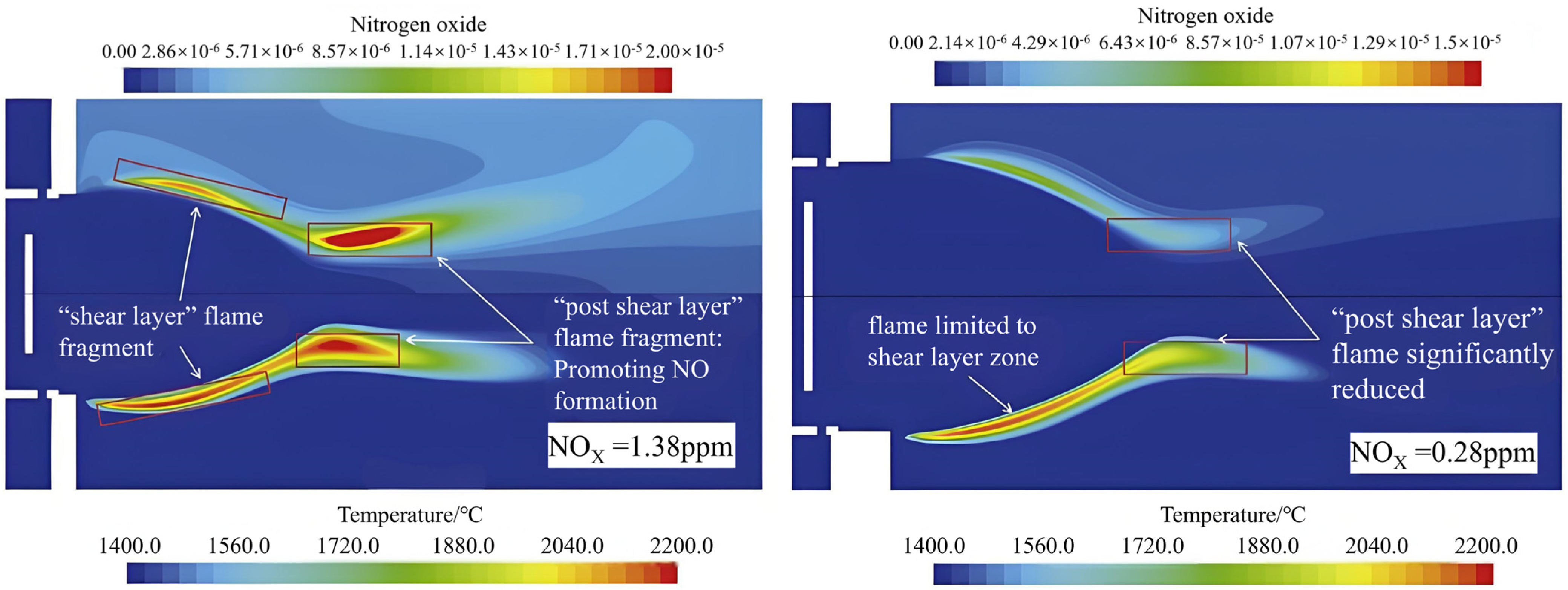
Kawasaki Heavy Industries has created a micromix combustor, utilizing the Aachen University program, which is equipped with an M1A-17 gas turbine that can operate on 100% hydrogen under commercial conditions, as seen in Figure 12a [83]. Figure 12c,d illustrate its operational principle, wherein air and hydrogen are combined through jet-crossflow, generating internal and external vortices that facilitate the anchoring and stabilization of the flame. It has been found that both the air flow blockage ratio and the depth of fuel jet penetration into the air stream are primary factors that affect the same shape and length, resulting in NOx formation (Figure 13). This configuration provides inherent flashback safety and achieves low NOx emissions due to the extremely short residence time of reactants in the micro-flame zone. The microporous multi-ring design is scalable and easily adaptable to various burner sizes and load conditions. The burner head depicted in Figure 12b features a three-ring configuration, as illustrated in Figure 12e. At low loads, only the two internal rings are utilized, while the fuel supply remains constant to ensure an adequate fuel–air ratio, thereby stabilizing the burner at low loads and maintaining NOx emissions below 20 ppm [84]. The implementation of micromix burn technology enables commercial combustion engines to operate on 100% hydrogen, significantly optimizing the combustion process while preserving favorable emission performance.
In micromix combustors, the diameter of hydrogen is one of the leading factors of flame behavior; The position and size of the flame are regulated by adjusting the aperture size to prevent the flame from entering the reflux zone while also avoiding excessively small apertures to simplify the nozzle manufacturing process [29]. Furthermore, it is essential to consider the impact of high-frequency combustion instability on the microscale flame [52]. A study on a swirl micromixer conducted by Seoul National University in Korea revealed that the instability in micromix combustion is more responsive to the hydrogen-mixed ratio, with the resonance frequency rising alongside an increased hydrogen-mixed ratio [87]. Consequently, modifying the configuration of air apertures or the axial placement and dimensions of hydrogen openings may be deemed effective in mitigating the mutual interference among combustion bundles and alleviating the impact of thermoacoustic instability.

4.4. Axial Staged Combustion Technology

Axial staging technology adds an axial degree of freedom to enhance combustion organization in the conventional combustor by the staging of fuel and air, categorized into fuel staging and air staging based on the objects being staged.

4.4.1. Fuel Staging

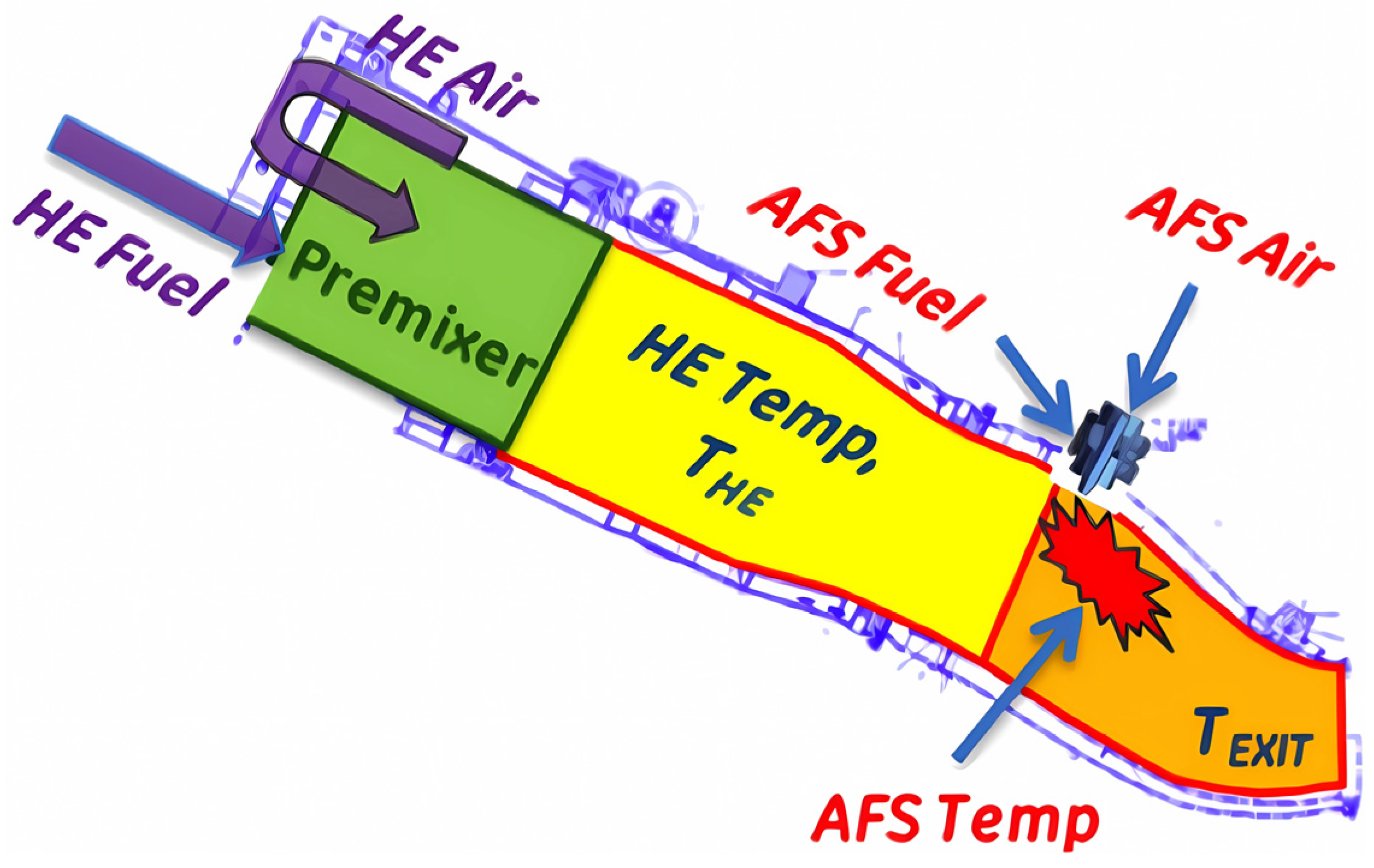
Figure 14 illustrates that fuel staging is employed to attain optimal combustion conditions by the ratio of fuel and air split across the two stages. Under full power settings, the generation of thermal NOx is diminished by decreasing the temperature-weighted residence time of the combustion products [88]. When the load and ignition temperature decrease, the primary fuel injection is prioritized to maintain the combustor head at the optimal temperature [89]. This adaptable distribution strategy enables the entire system to meet emission standards across a broader spectrum of combustion temperatures. For the Ansaldo-developed GT36 gas turbine, expanding the operating range to 25 to 106% is due to its axial fuel staging system, while traditional lean premix combustors are limited to meeting emission regulations with operating loads between 50 and 100 percent [90]. Further tests have revealed that the GT36 gas turbine may function on fuels containing up to 70% hydrogen without diluent injection [91].
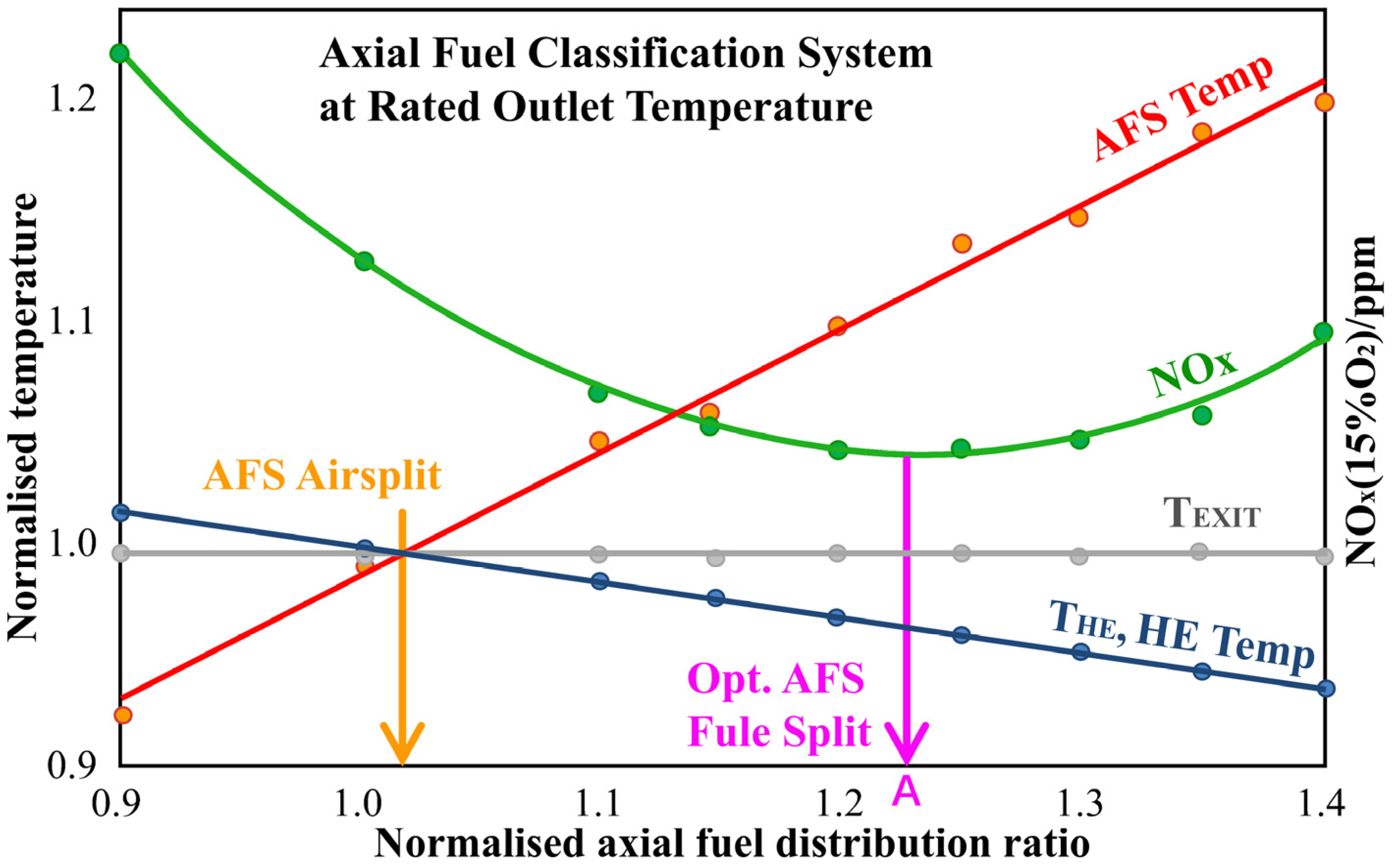
Fuel staged injection increases combustor flexibility by reallocating a portion of the fuel to the secondary burn zone, effectively mitigating the high reactivity of fuels like hydrogen while preserving combustor efficiency [92]. Figure 15 illustrates that, with a constant combustor outlet temperature, the back-end temperature rises and the front temperature declines as the proportion of the secondary fuel split ratio increases to point A, leading to reduced NOx emissions. The DLN2.6e combustor, engineered by GE, utilizes a micromix combustor + axial fuel staging technique [93], yielding a NOx emission benefit of 70 °C relative to whirl-type PLM combustors. This system is compatible with the 9HA gas turbine, and subsequent evaluations have confirmed its capability to function with fuels containing 50% hydrogen [66]. The rise in NOx emissions beyond point A is attributable to inadequate mixing of the primary gas with the secondary jet [90]. Consequently, optimizing the jet technique and nozzle position of the secondary is a priority in the structural design of the fuel-staged combustor.

4.4.2. Air Staging (RQL)

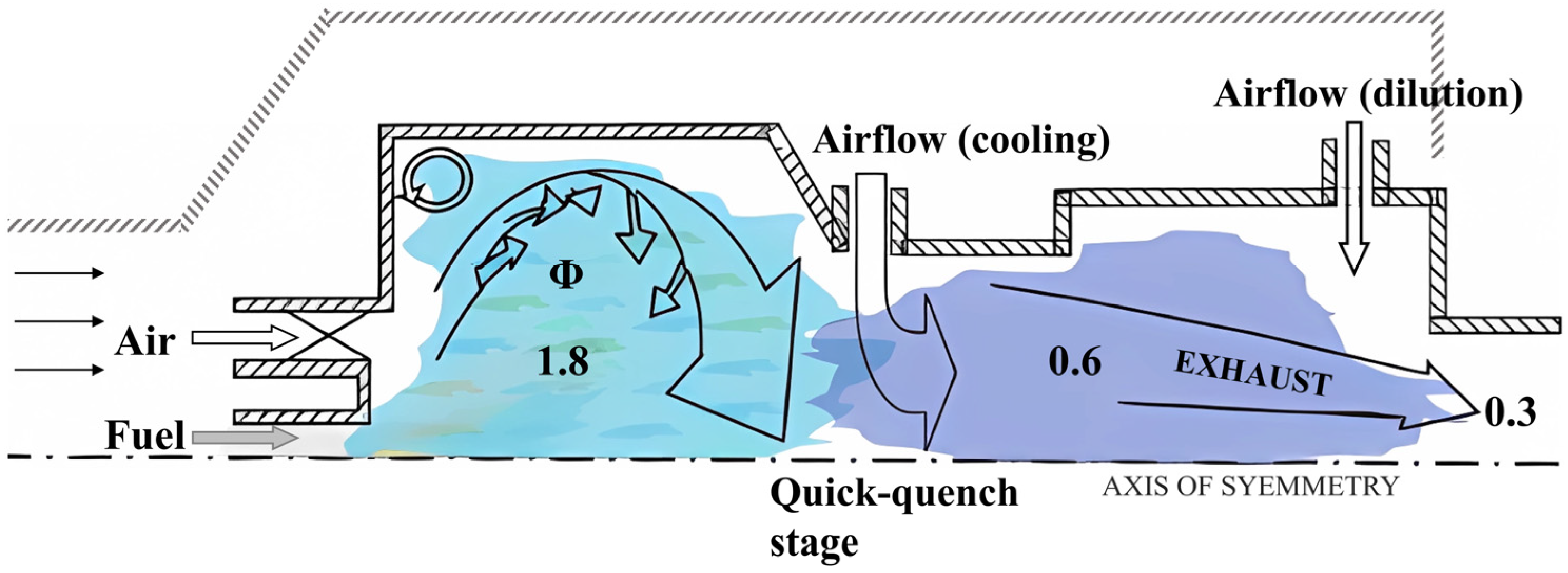
The RQL (rich-burn/quick-quench/lean-burn) technology is an air-staged combustion technique, as seen in Figure 16. Air staging injection establishes the ambient conditions for both rich and lean combustion. Rich burn generates a substantial concentration of high-energy hydrogen and hydrocarbon compounds, markedly improving combustion stability [94]. In the lean-burn stage, introducing a significant volume of airflow facilitates the complete burning of carbon monoxide and unburned hydrocarbons while enhancing the uniformity of temperature distribution at the combustor output [95].
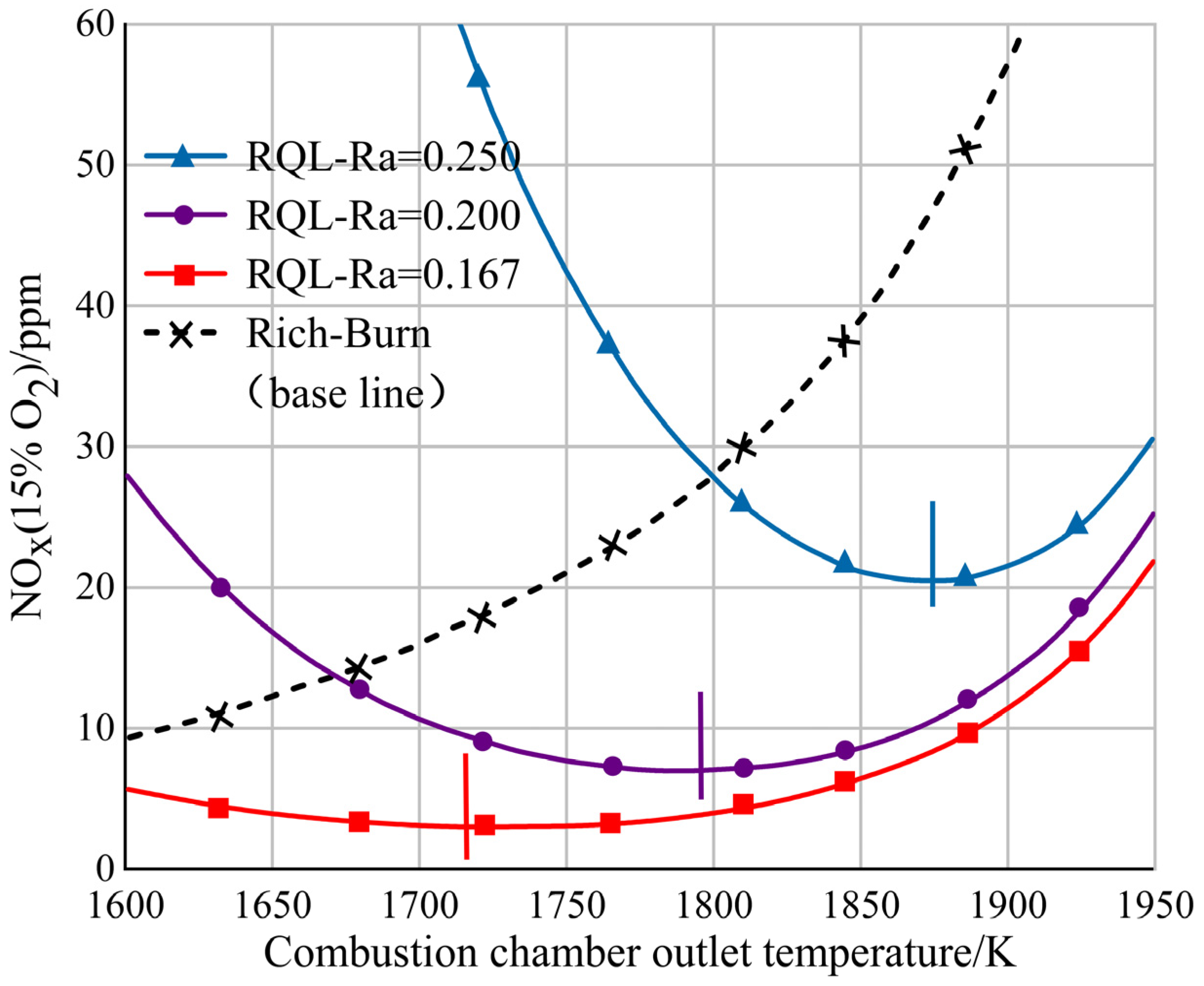
NOx emissions are reduced when both stages of combustion circumvent the high-temperature burn zone [97]. Figure 17 illustrates the correlation between NOx emissions and outlet temperature in the RQL combustor for three distinct air split ratios during the rich-burn phase, indicating that RQL technology exhibits substantial NOx reduction potential when the air split ratio is below 0.2. Furthermore, all three change curves exhibit a decreasing trend followed by an increasing trend. Lin et al. [88] examined this phenomenon, indicating that the NOx emissions produced during the rich-burn and lean-burn stages progressively decline and subsequently rise with the increase in outlet temperature, respectively. This competition between the two stages leads to a non-monotonic variation in total emissions.
At present, RQL technology has been commercially implemented in aero-engines, notably by U.S. Hewlett-Packard (P&W), which has integrated RQL technology into the PW6000 and PW4000 series of civil aviation engines for practical application [98]. In comparison to fuel staging, RQL combustion demonstrates enhanced emission performance at elevated temperatures and commendable stability at low loads. RQL technology has been progressively applied to the gas turbine sector through the utilization of alternative fuels like hydrogen. GE has engineered an industrial-grade RQL combustor for the stable combustion of low heating value (LHV) fuels [95], capable of reducing NOx emissions to below 24.775 mg/m3. Recio et al. [99] developed and validated a large eddy simulation (LES) framework integrating the advanced tabulated flamelet (ATF) method, toxic chemical interaction (TCI) model, exhaust gas recirculation (EGR) model, and conjugate heat transfer (CHT) model, which enables accurate evaluation of CO emissions from lean-premixed combustors and provides a critical reference for pollutant modeling in aeroengines. Mitsubishi Heavy Industries has undertaken comprehensive fundamental research on RQL technology [100].
In gas turbine combustors, when the outlet temperature approaches approximately 1890 K (J-class gas turbine), attention must be directed toward gas residence time and mixing efficiency in the quick-quench stage. However, achieving the optimal quick-quench stage is more challenging, resulting in a slightly diminished NOx reduction capability of the RQL combustor compared to fuel staging [101]. Nonetheless, header-rich burn is more compatible with alternative fuels, such as hydrogen. Meziane et al. [102] have demonstrated that augmenting the hydrogen-mixed ratio in natural gas can result in reduced pollutant emissions in RQL combustors. Ammonia is regarded as one of the most effective hydrogen carriers, and ammonia-rich burn can significantly reduce the conversion of fuel nitrogen to NOx [103]. Consequently, RQL technology may emerge as a crucial technique for low-emission gas turbines in the future.

5. Modification of Gas Turbine from the NG to Hydrogen

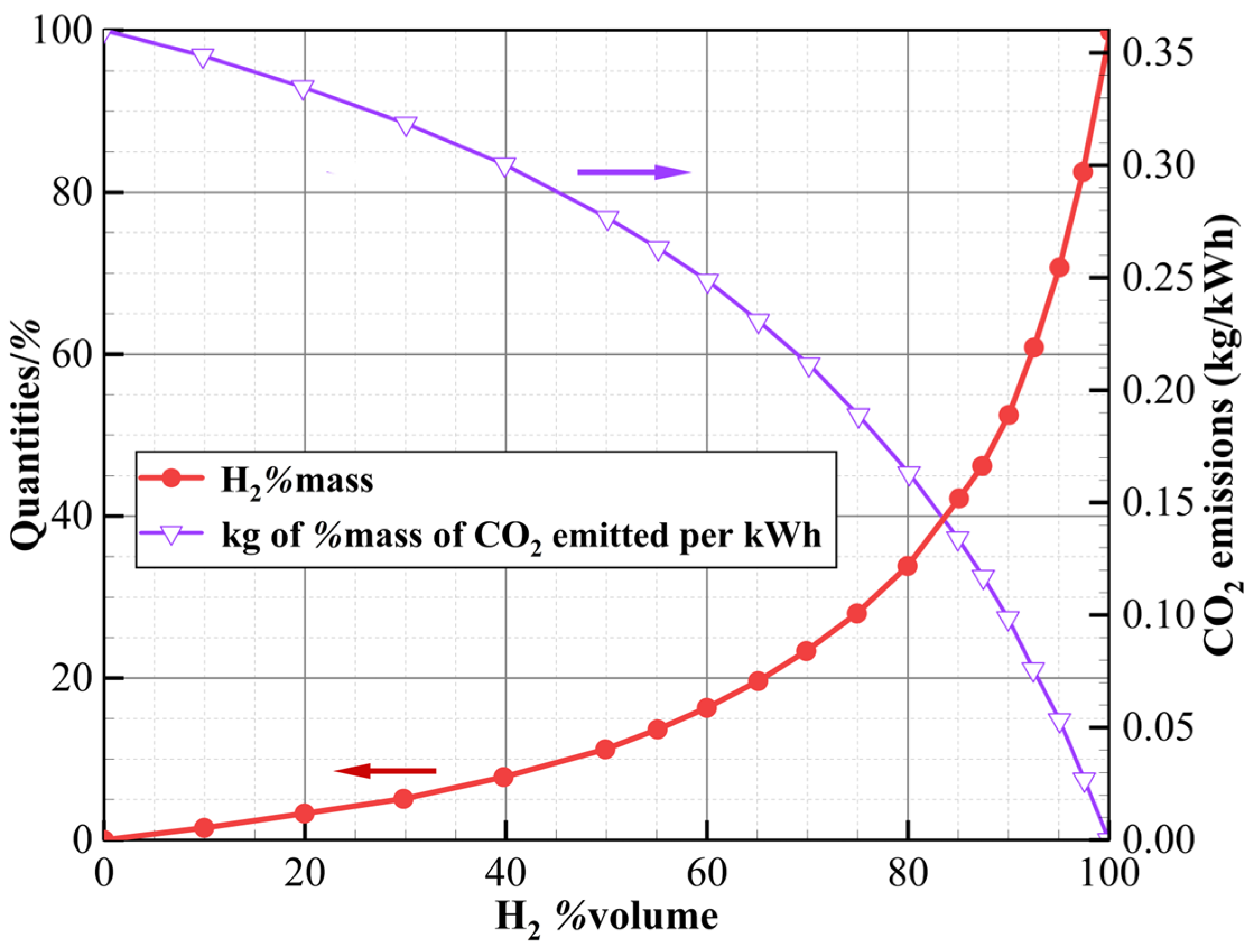
According to a Siemens study, current gas turbine combustion chambers can accommodate up to a 15% hydrogen blending volume ratio without requiring significant changes. Additional experiments have demonstrated that a minor modification to the conventional combustor can enhance the utilization of hydrogen [104]. The red curve shows the correspondence between the volume and mass percentages of hydrogen in CH4/H2 mixtures. The purple curve displays dual-axis data for a given hydrogen volume percentage in the mixture. The left axis indicates the percentage of CO2 emitted, while the right axis shows the relative emissions in kg/kWh, assuming a 55% electrical efficiency. Nevertheless, owing to the low energy density of hydrogen, including minor quantities of hydrogen in natural gas has a minimal impact on CO2 emissions. Figure 18 illustrates that a hydrogen blending ratio of around 75% in the fuel is necessary to achieve a 50% reduction in CO2 emissions. To attain a substantial effect, the hydrogen blending ratio must be markedly elevated. Consequently, a retrofit of the current gas turbine is necessary, encompassing not just the combustor but also additional components of the gas turbine.

5.1. Materials of Hot-End Component

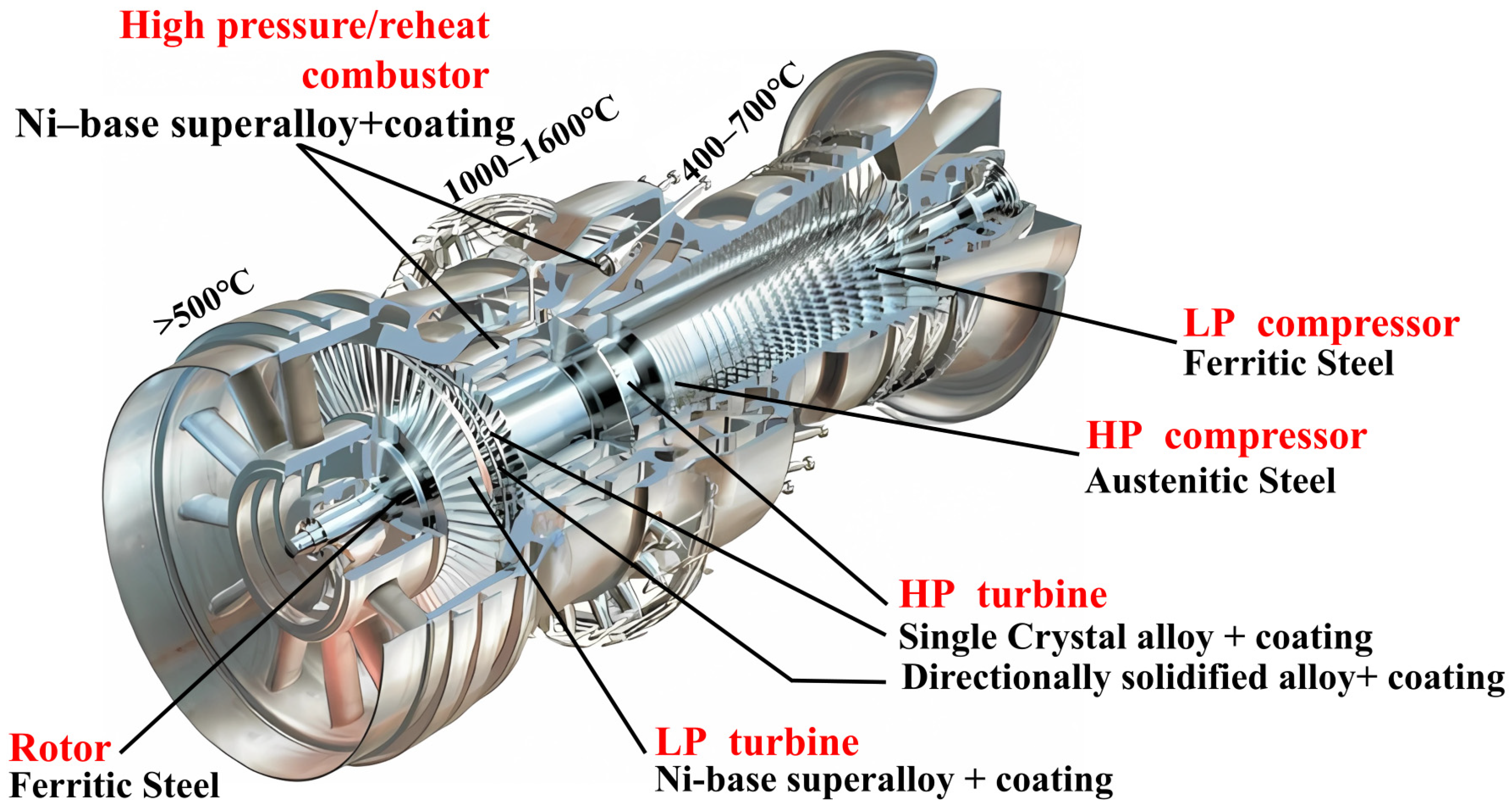
Figure 19 shows the range of exposure conditions for various gas turbine components, while also indicating the material combinations typically applied in each case [106,107]. External coatings and internal air cooling elevate the operating temperature of components beyond the melting point of the alloys; however, hydrogen-mixed combustion necessitates even more stringent material requirements. Hydrogen combustion produces a flame with a significantly higher temperature. Additionally, a hydrogen flame exhibits a quenching distance that is reduced to about half that of a natural gas flame [108]. Consequently, the solid wall at the stabilized position of the hydrogen flame will withstand greater thermal stresses within a near-wall turbulent structure [109].
Increased vapor content in the hot flue gas is an additional challenge. Natural gas combustion generally generates vapor with a volume content of 10%, whereas pure hydrogen combustion produces a level of 15% of DLE burn and 85% of wet combustion [110]. The augmented water vapor content will enhance heat transfer between the hot gases and the hot-end components, particularly in the first-stage metal blades, which endure the highest heat loads. Ceramic matrix composites (CMCs) are extensively utilized to minimize internal cooling, and the SiO2 film formed on the surface mitigates oxidation during operation; however, SiO2 is volatile in humid conditions, necessitating the application of an environmental barrier coating (EBC) on the outer layer to enhance durability [111]. For advancement in the temperature capability of material families developed over the last several decades, the performance plateau of single-crystal Ni-based alloys can be overcome by applying thermal barrier coatings (TBCs), a technology that has also advanced rapidly over time [112]. CMCs protected by T/EBCs are capable of withstanding temperatures exceeding 1800 K. Future hydrogen gas turbines will also strengthen the need for low-silicon volatile coatings.
As the operational parameters of gas turbines rise, metallic materials are nearing their maximum utilization limits, prompting the growing use of alternative alloys such as oxide-dispersion-strengthened (ODS) [113] superalloys and ceramic matrix composites. ODS alloys exhibit exceptional high-temperature resistance; yet, their high cost renders them challenging for use in the industrial-scale fabrication of land-based gas turbines [114]. Additional investigation into high-temperature alloys and low thermal conductivity coating materials, together with their manufacturing processes, is essential for attaining cost-effective and long-term steady functioning of power production gas turbines.

5.2. Embrittlement of Material Hydrogen

Hydrogen serves as both a power source and a coolant in power generation systems [115,116,117], while introducing the issue of hydrogen embrittlement. Hydrogen-mixed gas turbines have significantly higher internal hydrogen partial pressures relative to conventional gas turbines, which can intensify the degradation of material components and result in a decline in the operational performance of elements such as fuel and combustion systems.
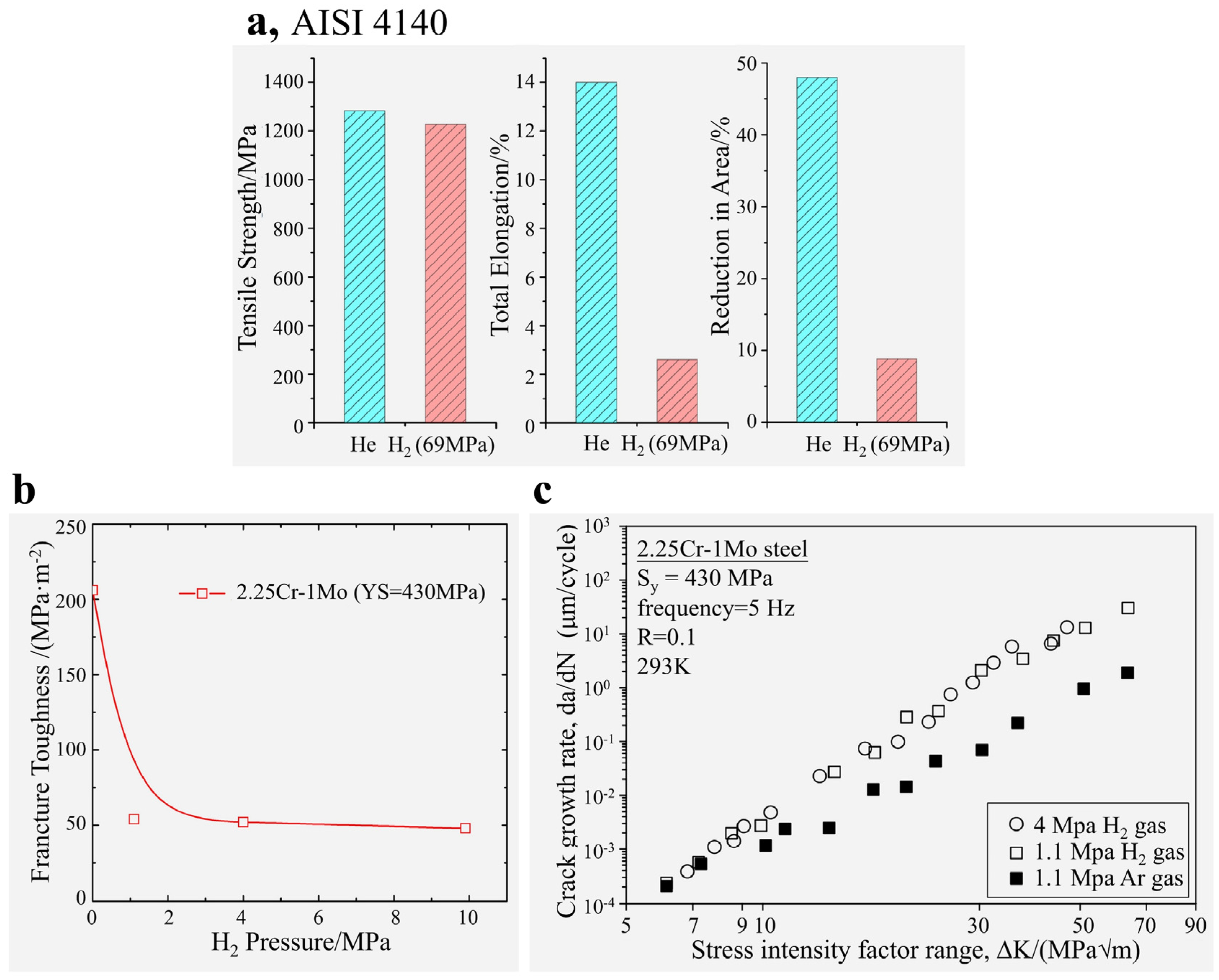
Initially, it is essential to evaluate the impact of the transmission pipeline’s operating conditions and the material of the pipeline. As the natural gas sector evolves, both the transmission pressure of pipelines and the steel grade of the pipes are consistently rising. The increase in pressure promotes the infiltration of hydrogen into the steel structure, following the Sirvert law [118]. An et al. [119] reported that X80 pipeline steel exhibits a significant reduction in elongation under 0.6 MPa hydrogen pressure, an effect which is exacerbated by stress concentrations. Zhang et al. [120] showed that the HE sensitivity of X52 steel rises with increasing hydrogen partial pressure. However, under low-pressure conditions (2 MPa hydrogen doping), the HE index was maintained below 25%, which satisfies safety standards for transport. However, at a hydrogen blending ratio of 20%, the HE index of X80 steel reached 7.31%, which is 17 times higher than that at 1% hydrogen, as demonstrated by Wang et al. [121]. The influence of hydrogen on the tensile characteristics, fracture toughness, and fatigue resistance of specific commercial Cr-Mo steels under high-pressure H2 is illustrated in Figure 20 [122]. The results demonstrate a strong detrimental effect of the hydrogen environment on the steel’s ductility (Figure 20a), fracture toughness (Figure 20b), and fatigue crack growth rate (Figure 20c), but only a weak influence on tensile strength. The more intriguing finding is that a significant detrimental effect (approximately a 2/3 decrease in fracture toughness, as illustrated in Figure 20b) can be produced by a limited H2 pressure (1.1 MPa), and that this effect diminishes significantly as the H2 pressure increases (for example, from 1.1 to 10 MPa).
Furthermore, the impact of temperature must be taken into account; the optimal CCGTs system typically preheats the fuel to 320 °C, potentially resulting in hydrogen migration through the material of tubes when temperatures surpass 200 °C [91]. Consequently, the pipeline and transport conditions must be modified for fuel delivery with a high hydrogen content. The materials used in gas turbine components are likewise at serious risk of hydrogen embrittlement due to their exposure to high temperatures. Balyts’kyi et al. examined the characteristics of various single-crystal alloys in hydrogen environments ranging from 20 to 900 °C and discovered that the detrimental impact of hydrogen diminishes with rising temperatures; however, the alloys continue to exhibit a notable reduction in strength and plasticity at temperatures up to 900 °C [123]. Generally, the augmentation of chromium in alloys enhances the maximum temperature resistance and hydrogen partial pressure; however, in high-temperature, high-pressure, and hydrogen-rich operational environments, it may still be essential to improve alloys, coating materials, and maintenance strategies to mitigate the adverse effects of hydrogen.

5.3. Purging of Hydrogen Gas Turbine

Hydrogen exhibits superior permeability and diffusion coefficients compared to natural gas, resulting in a greater propensity for retention within components and pipelines. Due to the flammable and explosive characteristics of hydrogen, hydrogen-fueled gas turbines necessitate more stringent purging requirements [124], as illustrated in Table 5, which delineates the disparity between the two purging requirements.
Hydrogen-fueled gas turbines generally utilize a “safe fuel” as an energy source throughout the start-up and shutdown stages, commonly natural gas or liquid oil [88]. This fuel switching method necessitates a more adaptable purge design, and gas detection instruments must be implemented to guarantee that hydrogen concentration stays within safe thresholds during the purge and venting procedure.

5.4. Safety Standards and Engineering Protocols

The safe integration of hydrogen into gas turbine systems necessitates adherence to established international standards and engineering best practices. These protocols cover design, operation, maintenance, and emergency response, addressing hydrogen’s unique hazards such as high diffusivity, wide flammability range, and low ignition energy.

5.4.1. Design and Material Standards

(1)
ISO 19880-1:2020 [125]: Gaseous hydrogen—Fueling stations—Part 1: General requirements. Provides guidelines for hydrogen handling infrastructure, including compressors, storage, and dispensing systems relevant to gas turbine fuel supply.
(2)
ASME B31.12:2023 [126]: Hydrogen Piping and Pipelines. Specifies design, construction, and inspection requirements for hydrogen transport pipelines, emphasizing leak prevention and material compatibility.

5.4.2. Operational and Maintenance Protocols

(1)
Leak Detection Systems: Continuous monitoring using catalytic, electrochemical, or infrared sensors is mandated in enclosed spaces. Alarm thresholds are typically set at 10–25% of the lower flammability limit (LFL) for hydrogen (≈0.4–1.0 vol%), according to NFPA 2:2023 [127].
(2)
Purge Procedures: As outlined in Section 5.3, purging must follow ISO 16110-1 [128] and IGEM/SR/25 [129] standards, which specify inert gas (e.g., nitrogen) purge sequences, flow rates, and duration to achieve hydrogen concentrations below 1 vol% before maintenance or fuel switching.
(3)
Ventilation Requirements: Enclosures housing hydrogen components must maintain ventilation rates sufficient to prevent hydrogen accumulation, as per EN 60079-10-1:2021 [130] (Explosive atmospheres—Part 10-1: Classification of areas).

5.4.3. Emergency Response and Risk Mitigation

(1)
Passive Safety Systems: Explosion relief panels, flame arrestors, and pressure relief devices are designed in accordance with API 521 [131] and NFPA 68 [132].
(2)
Active Safety Controls: Automatic shutdown systems triggered by leak detection, flame sensors, or abnormal pressure/temperature excursions, aligned with IEC61511 [133] (Functional safety—Safety instrumented systems).
(3)
Training and Certification: Personnel involved in hydrogen turbine operations should be trained under frameworks such as ISO 22734 [134] (Hydrogen generators using water electrolysis—Industrial, commercial, and residential applications) and EIGA Doc 121/14 [135] (Safe operation of hydrogen-fueled gas turbines).

5.4.4. Industry-Specific Guidelines

(1)
The Hydrogen Council’s “Path to Hydrogen Competitiveness” report emphasizes the need for harmonized standards across the value chain [136].
(2)
EU’s Clean Hydrogen Alliance recommends integrating ISO/TS 19880-5 [125] for hydrogen fueling station compressors into turbine fuel supply designs.

6. Conclusions and Prospects

6.1. Summary of Findings

Gas turbines will be a major component of thermal power production in the future energy landscape, and the “hydrogen-power coupling” development mode will make hydrogen and combustion power generation more competitive in the market. This study describes the present state of research on the problems of flashback, thermoacoustic oscillation, and NOx emissions produced by natural gas–hydrogen mixing, based on the background of local and international research on hydrogen-fueled gas turbines and environmental protection standards. It presents the most recent developments in gas turbine-related improvements and sophisticated hydrogen combustion technologies. The following conclusions are drawn from this:
(1)
Hydrogen has significantly distinct physical properties compared to NG, altering the structure and dynamics of the combustion flame. Research on hydrogen combustion mostly examines its mixed combustion with other synthesis gases, whereas experimental data and mathematical models about pure hydrogen combustion are limited, complicating the implementation of hydrogen gas turbines. Lean premixed burn can diminish NOx emissions during hydrogen burn, yet it may induce combustion instability and elevate NOx production. Consequently, future research should focus more on the burn characteristics of pure hydrogen itself and the burn instability it causes.
(2)
The primary development avenues for hydrogen gas turbine combustors involve the modification of traditional combustors and the creation of novel hydrogen combustors. The potential of the existing LPM combustor, based on strong swirl premixing, whose combustion air premixing ratio is often above 98%, has been realized, and it is no longer possible to meet the ever-increasing performance requirements of gas turbines in the future by depending just on strong premixing. This paper reviews the current mainstream combustion technologies and their application progress. As a result, integrating various combustion technologies is an achievable route toward the creation of a new burner generation in the future.
(3)
To improve the overall compatibility of hydrogen-mixed gas turbines, retrofit measures involve not only the improvement of the combustor but also the optimization of the overall system of the gas turbine. The combination of novel high-temperature alloys and composite coatings is effective in preventing component failure caused by the deterioration of conventional materials because of the water vapor and high temperatures produced during hydrogen combustion. The manufacturing process increases the potential to produce high-performance alloys and composites, which improves the performance and longevity of gas turbines; therefore, material enhancement is a crucial element of gas turbine transformation. Furthermore, the hydrogen embrittlement issue must be taken into consideration by concentrating on the hydrogen-mixed ratios and work temperature of gas turbine operation, in addition to optimizing the material of the crucial components. Regular gas turbine purging not only reduces the risk of an explosion but also delays the hydrogen-induced component deterioration.
(4)
Although hydrogen energy has plenty of potential, the supply is still limited, and the need for energy conservation and emission reduction keeps growing, according to New Scientist. The utilization of natural gas with a 20% hydrogen mix, however, is entirely capable of satisfying energy demand and successfully lowering carbon emissions, according to the state of the art in hydrogen-fueled gas turbine technology. It is anticipated that the hydrogen energy sector will progressively grow to incorporate production, storage, transportation, and combustion for power generation as natural gas cogeneration systems and transportation pipeline networks continue to improve.

6.2. Future Research Directions and Recommendations

(1)
Development of Phased Retrofit Roadmaps: We recommend that turbine manufacturers and plant operators collaboratively establish standardized pathways for retrofitting existing natural gas fleets. This involves defining clear technical milestones—from control system adjustments for low hydrogen blends (e.g., <20%) to combustor hardware upgrades for high blends (e.g., >50%)—enabling asset owners to plan a cost-effective and risk-managed transition.
(2)
Establishment of Industry-Wide Material and Safety Protocols: We highlight the urgent need for coordinated industry efforts to develop and validate material testing standards under hydrogen-rich, high-temperature conditions, as well as unified safety and maintenance procedures for hydrogen-blended operations. This will ensure reliability, reduce certification costs, and accelerate market acceptance.

Author Contributions

Y.X.: Resources, Conceptualization, Methodology, Data curation, Formal analysis, Writing—Original Draft, Project administration, Supervision. X.G.: Software, Data curation, Visualization, Writing—original draft, Writing—review and editing. X.Z.: Validation, Software, Formal analysis. X.X.: Conceptualization, Formal analysis, Writing—review and editing. Z.C.: Conceptualization, Methodology, Supervision. Y.L.: Validation, Software, Formal analysis. All authors have read and agreed to the published version of the manuscript.

Funding

This research was funded by the University Synergy Innovation Program of Anhui Province (No. GXXT-2022-017), the Key Project of Anhui Provincial University Research and Development (No. 2023AH050188), and the Project of Doctor’s Funding of Anhui Jianzhu University (No. 2020QDZ42).

Data Availability Statement

Data will be made available on request.

Acknowledgments

We sincerely appreciate the anonymous reviewers for the insightful comments and great help on this paper. This study was supported by the University Synergy Innovation Program of Anhui Province (No. GXXT-2022-017), the Key Project of Anhui Provincial University Research and Development (No. 2023AH050188), and the Project of Doctor’s Funding of Anhui Jianzhu University (No. 2020QDZ42).

Conflicts of Interest

The authors declare no conflicts of interest.

Nomenclature

p′pressure oscillationsBFFflashback through the core of the bulk flow
q′heat release oscillations
Greek symbolsDLEdry low emission
Φequivalent ratioDLNdry low NOx
AbbreviationsSCRselective catalytic reduction
NGnatural gasKPIskey performance indicators
GTCCsgas turbine combined cyclesRQLrich-burn/quick-quench/lean-burn
LPMlean premixed combustionLHVlow heating value
BLFboundary layer flashbackCMCceramic matrix composite
CIVBcombustion-induced vortex breakdownODSoxide-dispersion-strengthened
ppmparts per million
TBCsthermal barrier coatingsEBCsenvironmental barrier coatings

References

  1. Yu, H.; Wen, B.; Zahidi, I.; Chow, M.F.; Liang, D.; Madsen, D.Ø. The critical role of energy transition in addressing climate change at COP28. Results Eng. 2024, 22, 102324. [Google Scholar] [CrossRef]
  2. Colocci, A.; Gioia, E.; Casareale, C.; Marchetti, N.; Marincioni, F. The role of sustainable energy and climate action plans: Synergies with regional sustainable development strategies for a local 2030 agenda. Environ. Dev. 2023, 47, 100894. [Google Scholar] [CrossRef]
  3. Ahbabi Saray, J.; Gharehghani, A.; Hosseinzadeh, D. Towards sustainable energy carriers: A solar and wind-based systems for green liquid hydrogen and ammonia production. Energy Convers. Manag. 2024, 304, 118215. [Google Scholar] [CrossRef]
  4. Ibrahim Idriss, A.; Awalo Mohamed, A.; Abdi Atteye, H.; Ali Ahmed, R.; Abdoulkader Mohamed, O.; Cetin Akinci, T.; Ramadan, H.S. Sustainable pathways for hydrogen production: Metrics, trends, and strategies for a zero-carbon future. Sustain. Energy Technol. Assess. 2025, 73, 104124. [Google Scholar] [CrossRef]
  5. Jamil, F.; Inayat, A.; Hussain, M.; Ghenai, C.; Shanableh, A.; Sarwer, A.; Shah, N.S.; Park, Y.-K. Green hydrogen production through a facile aqueous-phase reforming technique from waste biomass: A comprehensive review. Int. J. Hydrogen Energy 2024, 96, 126–146. [Google Scholar] [CrossRef]
  6. Naseem, K.; Qin, F.; Khalid, F.; Suo, G.; Zahra, T.; Chen, Z.; Javed, Z. Essential parts of hydrogen economy: Hydrogen production, storage, transportation and application. Renew. Sustain. Energy Rev. 2025, 210, 115196. [Google Scholar] [CrossRef]
  7. Li, D.-W.; Huang, J.-L.; Yu, D.; Zhang, D.; Zhang, X.-L. Development of low-carbon technologies in China’s integrated hydrogen supply and power system. Adv. Clim. Change Res. 2024, 15, 936–947. [Google Scholar] [CrossRef]
  8. Li, L.-L.; Zhang, Z.-Y.; Sethanan, K.; Tseng, M.-L. Multi-energy synergistic planning of distributed energy supply system: Wind-solar-hydrogen coupling energy supply. Renew. Energy 2024, 237, 121769. [Google Scholar] [CrossRef]
  9. Pivovar, B.; Rustagi, N.; Satyapal, S. Hydrogen at scale (H2@Scale): Key to a clean, economic, and sustainable energy system. Electrochem. Soc. Interface 2018, 27, 47–51. [Google Scholar] [CrossRef]
  10. Goldmeer, J.; Catillaz, J. Hydrogen for Power Generation: Experience, Requirements, and Implications for Use in Gas Turbines; GEA34805; GE Ltd.: London, UK, 2025; p. 3. Available online: https://www.ge.com/gas-power/future-of-energy (accessed on 1 January 2026).
  11. Flebbe, S.M.; Tartsch, S.; Sattelmayer, T. Thermal runaway effect of the centerbody on boundary layer flashback in a swirl-stabilized gas turbine burner operated with hydrogen. Int. J. Hydrogen Energy 2024, 61, 6–12. [Google Scholar] [CrossRef]
  12. Giannotta, A.; Cherubini, S.; De Palma, P. The effect of hydrogen enrichment on thermoacoustic instabilities in laminar conical premixed methane/air flames. Int. J. Hydrogen Energy 2023, 48, 37654–37665. [Google Scholar] [CrossRef]
  13. Jung, J.; Kim, M.; Hwang, J.; Kang, D.; Lee, W.; Kim, H.; Kim, D. Combustion instability characteristics via fuel nozzle modification in a hydrogen and natural gas Co-firing gas turbine combustor. Int. J. Hydrogen Energy 2024, 79, 962–973. [Google Scholar] [CrossRef]
  14. Karlis, E.; Liu, Y.; Hardalupas, Y.; Taylor, A.M.K.P. H2 enrichment of CH4 blends in lean premixed gas turbine combustion: An experimental study on effects on flame shape and thermoacoustic oscillation dynamics. Fuel 2019, 254, 115524. [Google Scholar] [CrossRef]
  15. Mohamadi, M.; Tahsini, A.M.; Tavazohi, R. Hydrogen addition impacts on flashback phenomenon in combustion chamber. Int. J. Hydrogen Energy 2024, 67, 769–775. [Google Scholar] [CrossRef]
  16. Tian, Y.; Nan, J.; Yang, L.; Li, J. The effect of hydrogen enrichment on the conical premixed methane–air flame response and thermoacoustic modes coupling. Combust. Flame 2024, 270, 113742. [Google Scholar] [CrossRef]
  17. Fritz, J.; Kro¨ner, M.; Sattelmayer, T. Flashback in a Swirl Burner with Cylindrical Premixing Zone. J. Eng. Gas Turbines Power 2004, 126, 276–283. [Google Scholar] [CrossRef]
  18. Boretti, A. Combined cycle gas turbine (CCGT) plants utilizing methane-hydrogen blends represent a significant element in Australia’s journey toward achieving net-zero emissions. Fuel 2025, 381, 133339. [Google Scholar] [CrossRef]
  19. Hernandez, S.R.; Wang, Q.; McDonell, V.; Mansour, A.; Steinthorsson, E.; Hollon, B. Micro mixing fuel injectors for low emissions hydrogen combustion. In Proceedings of the Turbo Expo: Power for Land, Sea, and Air, Berlin, Germany, 9–13 June 2008; Volume 43130, pp. 675–685. [Google Scholar] [CrossRef]
  20. Pashchenko, D. Hydrogen-rich gas as a fuel for the gas turbines: A pathway to lower CO2 emission. Renew. Sustain. Energy Rev. 2023, 173, 113117. [Google Scholar] [CrossRef]
  21. Tamang, S.; Park, H. An investigation on the thermal emission of hydrogen enrichment fuel in a gas turbine combustor. Int. J. Hydrogen Energy 2023, 48, 40071–40087. [Google Scholar] [CrossRef]
  22. Cappelletti, A.; Martelli, F.; Bianchi, E.; Trifoni, E. Numerical redesign of 100kw MGT combustor for 100% H2 fueling. Energy Procedia 2014, 45, 1412–1421. [Google Scholar] [CrossRef]
  23. Cappelletti, A.; Martelli, F. Investigation of a pure hydrogen fueled gas turbine burner. Int. J. Hydrogen Energy 2017, 42, 10513–10523. [Google Scholar] [CrossRef]
  24. Wang, C.; Zhao, L.; Qu, J.; Xiao, Y.; Deng, J.; Shu, C.-M. Minireview on the Leakage Ignition and Flame Propagation Characteristics of Hydrogen: Advances and Perspectives. Energy Fuels 2023, 37, 5653–5666. [Google Scholar] [CrossRef]
  25. Liu, L.; Luo, Z.; Wang, T.; Cheng, F.; Gao, S.; Liang, H. Effects of Initial Temperature on the Deflagration Characteristics and Flame Propagation Behaviors of CH4 and Its Blends with C2H6, C2H4, CO, H2. Energy Fuels 2021, 35, 785–795. [Google Scholar] [CrossRef]
  26. Li, X.; Hong, X.; Chen, Y. Hydrogen-Blended Combustion Technology in Gas Turbine. South. Energy Constr. 2023, 10, 14–25. (In Chinese) [Google Scholar] [CrossRef]
  27. Colwell, J.D.; Korb, T.M.; Peck, R.E. Hot surface ignition of Jet-A fuel by conductive deposits. Proc. Combust. Inst. 2002, 29, 297–303. [Google Scholar] [CrossRef]
  28. Pers, H.; Poinsot, T.; Schuller, T. Effect of quenching on flashback of hydrogen-enriched laminar premixed flames. Proc. Combust. Inst. 2024, 40, 105725. [Google Scholar] [CrossRef]
  29. Kıymaz, T.B.; Böncü, E.; Güleryüz, D.; Karaca, M.; Yılmaz, B.; Allouis, C.; Gökalp, İ. Numerical investigations on flashback dynamics of premixed methane-hydrogen-air laminar flames. Int. J. Hydrogen Energy 2022, 47, 25022–25033. [Google Scholar] [CrossRef]
  30. Yahou, T.; Schuller, T.; Dawson, J.R. The Effect of Ignition Procedure on Flashback of Hydrogen-Enriched Flames. J. Eng. Gas Turbines Power 2024, 146, 011023. [Google Scholar] [CrossRef]
  31. Sattelmayer, T.; Mayer, C.; Sangl, J. Interaction of flame flashback mechanisms in premixed hydrogen-air swirl flames. J. Eng. Gas Turbines Power 2016, 138, 011503. [Google Scholar] [CrossRef]
  32. Boschek, E.; Griebel, P.; Jansohn, P. Fuel variability effects on turbulent, lean premixed flames at high pressures. In Proceedings of the Turbo Expo: Power for Land, Sea, and Air, Montreal, Canada, 14–17 May 2007; Volume 47918, pp. 373–382. [Google Scholar] [CrossRef]
  33. Emerson, B.; Patel, S.J.; Gubbi, S.; McKinney, R.G.; Wu, D.; Noble, D.R.; Lieuwen, T. Nonpremixed Approaches for Fuel Flexible, Low NOx Combustors in High-Efficiency Gas Turbines. J. Eng. Gas Turbines Power 2025, 147, 011009. [Google Scholar] [CrossRef]
  34. Costa, U.L.; Almarzooq, Y.M.; Hardaya, A.; Hay, M.K.; Kulatilaka, W.D.; Petersen, E.L. Laminar Flame Speed Measurements of a NH3/H2/N2 Natural Gas Surrogate at Elevated Pressures. J. Eng. Gas Turbines Power 2026, 148, 061004. [Google Scholar] [CrossRef]
  35. Yovino, L.; Safdari, A.; Kim, G.; Rahman, R.K.; Vasu, S.; Winquist, M.; Subbaraman, G.; Vega, J.; Steele, R. Laminar Burning Speed Measurements of Ammonia-Hydrogen Mixtures at Elevated Pressures for Gas-Turbine Applications. J. Eng. Gas Turbines Power 2026, 148, 061005. [Google Scholar] [CrossRef]
  36. Rajagopalan, H.P.; Cole, R.; Wu, D.; Emerson, B.; Lieuwen, T.C. Turbulent Burning Velocity of High Hydrogen Flames. J. Eng. Gas Turbines Power 2025, 147, 061016. [Google Scholar] [CrossRef]
  37. Shahin, T.T.; Hodge, A.J.; Murdock, B.K.; Koenig, K.C.; Moehring, E.K.; Gejji, R.M.; Lucht, R.P.; Slabaugh, C.D. Structure of High-Pressure Premixed Ammonia, Hydrogen, and Methane Flames With 100 kHz OH-PLIF Measurements. J. Eng. Gas Turbines Power 2025, 147, 121018. [Google Scholar] [CrossRef]
  38. Zhao, H.; Wang, J.; Cai, X.; Dai, H.; Bian, Z.; Huang, Z. Flame structure, turbulent burning velocity and its unified scaling for lean syngas/air turbulent expanding flames. Int. J. Hydrogen Energy 2021, 46, 25699–25711. [Google Scholar] [CrossRef]
  39. Heeger, C.; Gordon, R.L.; Tummers, M.J.; Sattelmayer, T.; Dreizler, A. Experimental analysis of flashback in lean premixed swirling flames: Upstream flame propagation. Exp. Fluids 2010, 49, 853–863. [Google Scholar] [CrossRef]
  40. Dam, B.; Love, N.; Choudhuri, A. Flashback propensity of syngas fuels. Fuel 2011, 90, 618–625. [Google Scholar] [CrossRef]
  41. Pugh, D.; Bowen, P.; Navaratne, R.; Goktepe, B.; Giles, A.; Valera Medina, A.; Morris, S.; Vivoli, R. Influence of Variable Swirl on Emissions in a Non-Premixed Fuel-Flexible Burner at Elevated Ambient Conditions. J. Eng. Gas Turbines Power 2024, 146, 061006. [Google Scholar] [CrossRef]
  42. De, A.; Acharya, S. Dynamics of upstream flame propagation in a hydrogen-enriched premixed flame. Int. J. Hydrogen Energy 2012, 37, 17294–17309. [Google Scholar] [CrossRef]
  43. Huang, Y.; Yang, V. Dynamics and stability of lean-premixed swirl-stabilized combustion. Prog. Energy Combust. Sci. 2009, 35, 293–364. [Google Scholar] [CrossRef]
  44. Poinsot, T. Prediction and control of combustion instabilities in real engines. Proc. Combust. Inst. 2017, 36, 1–28. [Google Scholar] [CrossRef]
  45. Cheng, J.; Hu, B.; Zeng, Z.; Fu, J.; Zhang, B. A Review on Combustion Instability of Hydrogen-Enriched Marine Gas Turbines. J. Mar. Sci. Eng. 2025, 13, 2110. [Google Scholar] [CrossRef]
  46. Durox, D.; Schuller, T.; Noiray, N.; Birbaud, A.L.; Candel, S. Rayleigh criterion and acoustic energy balance in unconfined self-sustained oscillating flames. Combust. Flame 2009, 156, 106–119. [Google Scholar] [CrossRef]
  47. Rayleigh, L. The explanation of certain acoustical phenomena. Nature 1878, 18, 319–321. [Google Scholar] [CrossRef]
  48. Dinu, C.; Cican, G.; Osman, S.; Secareanu, R. Performance and Emissions of Camelina Biodiesel–Jet A Blends in a Micro-Gas Turbine as a Sustainable Pathway for Aviation. Fire 2025, 8, 442. [Google Scholar] [CrossRef]
  49. Lu, Y.; Zhou, Y.; Wu, H.; Liu, X.; Ge, B. Study on the Impact of Fuel Staging on Flame Structure and Thermoacoustic Oscillation in a Diesel Multi-Nozzle Combustor. J. Eng. Gas Turbines Power 2026, 148, 051018. [Google Scholar] [CrossRef]
  50. Nicoud, F.; Poinsot, T. Thermoacoustic instabilities: Should the Rayleigh criterion be extended to include entropy changes? Combust. Flame 2005, 142, 153–159. [Google Scholar] [CrossRef]
  51. Andrews, G.E. Ultra-low nitrogen oxides (NOx) emissions combustion in gas turbine systems. In Modern Gas Turbine Systems; Jansohn, P., Ed.; Woodhead Publishing: Cambridge, UK, 2013; Volume 16, pp. 715–790. [Google Scholar] [CrossRef]
  52. Beita, J.; Talibi, M.; Sadasivuni, S.; Balachandran, R. Thermoacoustic instability considerations for high hydrogen combustion in lean premixed gas Turbine combustors: A review. Hydrogen 2021, 2, 33–57. [Google Scholar] [CrossRef]
  53. Meng, S.; Zhang, M. Effect of Spray-Wall Interaction on Thermoacoustic Instability Prediction by Flame Transfer Function and the Convective Time Delay Method. J. Eng. Gas Turbines Power 2021, 143, 111003. [Google Scholar] [CrossRef]
  54. An, Q.; Steinberg, A.M.; Jella, S.; Bourque, G.; Füri, M. Early Warning Signs of Imminent Thermoacoustic Oscillations Through Critical Slowing Down. J. Eng. Gas Turbines Power 2019, 141, 054501. [Google Scholar] [CrossRef]
  55. Polifke, W.; Silva, C.F.; Guo, S. Efficient Robust Design for Thermoacoustic Instability Analysis: A Gaussian Process Approach. J. Eng. Gas Turbines Power 2020, 142, 031026. [Google Scholar] [CrossRef]
  56. Guo, S.; Silva, C.F.; Polifke, W. Reliable Calculation of Thermoacoustic Instability Risk Using an Imperfect Surrogate Model. J. Eng. Gas Turbines Power 2021, 143, 011010. [Google Scholar] [CrossRef]
  57. Ånestad, A.; Æsøy, E.; Dawson, J.R.; Worth, N.A. Mitigating thermoacoustic instabilities in premixed hydrogen flames using axial staging. Proc. Combust. Inst. 2024, 40, 105430. [Google Scholar] [CrossRef]
  58. Shaw, S.; Van Heyst, B. Nitrogen Oxide (NOx) emissions as an indicator for sustainability. Environ. Sustain. Indic. 2022, 15, 100188. [Google Scholar] [CrossRef]
  59. Lieuwen, T.; Yang, V.; Yetter, R. Synthesis Gas Combustion: Fundamentals and Applications; CRC Press: Boca Raton, FL, USA, 2009. [Google Scholar]
  60. Avila Jimenez, C.D.; Cole, R.; Noble, D.R.; Steele, R.; Wu, D.; Emerson, B.; Lieuwen, T. Toward the Development of an NH3-RRQL System—Part II: Effects of the Primary Combustion Zone Length and Secondary Stage Number of Holes on Stability and Emissions. J. Eng. Gas Turbines Power 2026, 148, 071001. [Google Scholar] [CrossRef]
  61. Cecere, D.; Giacomazzi, E.; Di Nardo, A.; Calchetti, G. Gas turbine combustion technologies for hydrogen blends. Energies 2023, 16, 6829. [Google Scholar] [CrossRef]
  62. Elkaee, S.; Moghaddam, L.; Alinaghipour, B. A review of NH3-SCR using nitrogen-doped carbon catalysts for NOx emission control. Mater. Today Sustain. 2024, 28, 101016. [Google Scholar] [CrossRef]
  63. Li, Y.; Sun, S.; Geng, K.; Yan, P.; Feng, D.; Zhang, W.; Zhao, Y.; Yang, W. Synergistic activation of reburned char for ultra-low NOx emissions using flue gas recirculation and natural gas in a10 kW furnace. J. Environ. Manag. 2025, 373, 123614. [Google Scholar] [CrossRef]
  64. Cellek, M.S.; Pınarbaşı, A. Investigations on performance and emission characteristics of an industrial low swirl burner while burning natural gas, methane, hydrogen-enriched natural gas and hydrogen as fuels. Int. J. Hydrogen Energy 2018, 43, 1194–1207. [Google Scholar] [CrossRef]
  65. Guo, H.; Smallwood, G.J.; Liu, F.; Ju, Y.; Gülder, Ö.L. The effect of hydrogen addition on flammability limit and NOx emission in ultra-lean counterflow CH4/air premixed flames. Proc. Combust. Inst. 2005, 30, 303–311. [Google Scholar] [CrossRef]
  66. Goldmeer, J. Power to gas: Hydrogen for power generation Fuel Flexible Gas Turbines as Enablers for a Low or Reduced Carbon Energy Ecosystem. GE Power 2019, GEA33861, 7–9. Available online: https://pdf4pro.com/view/power-to-gas-hydrogen-for-power-generation-5b6079.html (accessed on 1 January 2026).
  67. York, W.D.; Simons, D.W.; Fu, Y. Operational flexibility of GE’s F-class gas turbines with the DLN2.6+ combustion system. In Proceedings of the ASME Turbo Expo 2018: Turbomachinery Technical Conference and Exposition, Oslo, Norway, 11–15 June 2018. [Google Scholar] [CrossRef]
  68. Nemitallah, M.A.; Haque, M.A.; Hussain, M.; Abdelhafez, A.; Habib, M.A. Stratified and hydrogen combustion techniques for higher turndown and lower emissions in gas turbines. J. Energy Resour. Technol. 2022, 144, 020801. [Google Scholar] [CrossRef]
  69. Skabelund, B.B.; Jenkins, C.D.; Stechel, E.B.; Milcarek, R.J. Thermodynamic and emission analysis of a hydrogen/methane fueled gas turbine. Energy Convers. Manag. X 2023, 19, 100394. [Google Scholar] [CrossRef]
  70. Wu, J.; Brown, P.; Diakunchak, I.; Gulati, A.; Lenze, M.; Koestlin, B. Advanced gas turbine combustion system development for high hydrogen fuels. In Proceedings of the ASME Turbo Expo 2007: Power for Land, Sea, and Air, Montreal, Canada, 14–17 May 2007; pp. 1085–1091. [Google Scholar] [CrossRef]
  71. Khosravy el_Hossaini, M. Review of the new combustion technologies in modern gas turbines. In Progress in Gas Turbine Performance; IntechOpen: London, UK, 2013; pp. 953–978. [Google Scholar] [CrossRef]
  72. Goldmeer, J.; York, W.; Glaser, P. Fuel and combustion system capabilities of GE’s F and HA class gas turbines. In Proceedings of the ASME Turbo Expo 2017: Turbomachinery Technical Conference and Exposition, Charlotte, NC, USA, 26–30 June 2017. [Google Scholar] [CrossRef]
  73. Nose, M.; Kawakami, T.; Araki, H.; Senba, N.; Tanimura, S. Hydrogen-fired gas turbine targeting realization of CO2-free society. Mitsubishi Heavy Ind. Tech. Rev. 2018, 55, 1–7. [Google Scholar]
  74. Nose, M.; Kawakami, T.; Nakamura, S.; Kuroki, H.; Kataoka, M.; Yuri, M. Development of hydrogen/ammonia firing gas turbine for decarbonized society. Mitsubishi Heavy Ind. Tech. Rev. 2021, 58. [Google Scholar] [CrossRef]
  75. Todd, D.; Battista, R. Demonstrated applicability of hydrogen fuel for gas turbines. In Proceedings of the Gasification 4 the Future, Noordwijk, The Netherlands, 11–13 April 2000; pp. 741–748. [Google Scholar]
  76. Kawasaki Gas Turbine Europe GmbH. Available online: https://www.kawasaki-gasturbine.de/en/products/turbine-generator-sets/hydrogen-technology (accessed on 15 December 2025).
  77. Clean Hydrogen Partnership. Clean Hydrogen Joint Undertaking, Strategic Research and Innovation Agenda 2021–2027, Annex to GB decision no. CleanHydrogen-GB-2022-02. Available online: https://www.clean-hydrogen.europa.eu (accessed on 23 August 2023).
  78. Berg, A.; Magnusson, R. Fleet Experience of SGT-600 (24 MW) DLE Gas Turbine with Over 60% H2 in Natural Gas. In Proceedings of the ASME Turbo Expo 2023: Turbomachinery Technical Conference and Exposition, Boston, MA, USA, 26–30 June 2023. [Google Scholar] [CrossRef]
  79. Lindman, O.; Andersson, M.; Bonaldo, A.; Larsson, A.; Janczewski, J.; Persson, M. SGT-750 fuel flexibility: Engine and rig tests. In Proceedings of the ASME Turbo Expo 2017: Turbomachinery Technical Conference and Exposition, Charlotte, NC, USA, 26–30 June 2017. [Google Scholar] [CrossRef]
  80. Choi, J.; Rajasegar, R.; Lee, W.; Lee, T.; Yoo, J. Hydrogen enhancement on a mesoscale swirl stabilized burner array. Int. J. Hydrogen Energy 2021, 46, 23906–23915. [Google Scholar] [CrossRef]
  81. Landry-Blais, A.; Sivić, S.; Picard, M. Micro-mixing combustion for highly recuperated gas turbines: Effects of inlet temperature and fuel composition on combustion stability and NOx emissions. In Proceedings of the ASME Turbo Expo 2022: Turbomachinery Technical Conference and Exposition, Rotterdam, The Netherlands, 13–17 June 2022. [Google Scholar] [CrossRef]
  82. Liu, X.; Shao, W.; Liu, C.; Bi, X.; Liu, Y.; Xiao, Y. Numerical study of a high-hydrogen micromix model burner using flamelet-generated manifold. Int. J. Hydrogen Energy 2021, 46, 20750–20764. [Google Scholar] [CrossRef]
  83. Tekin, N.; Horikawa, A.; Ashikaga, M.; Funke, H. Hydrogenroad of kawasaki-development of innovative hydrogen combustion systems for industrial. In Proceedings of the Gas Turbines in a Carbon-Neutral Society 10th International Gas Turbine Conference, Virtual, 11–15 October 2021. [Google Scholar]
  84. Tekin, N.; Ashikaga, M.; Horikawa, A.; Funke, H. Enhancement of fuel flexibility of industrial gas turbines by development of innovative hydrogen combustion systems. Gas Energy 2018, 2, 1–6. [Google Scholar]
  85. Kim, D. Review on the development trend of hydrogen gas turbine combustion technology. J. Korean Soc. Combust. 2019, 24, 1–10. [Google Scholar] [CrossRef]
  86. Ayed, A.H.; Kusterer, K.; Funke, H.-W.; Keinz, J.; Bohn, D. CFD based exploration of the dry-low-NOx hydrogen micromix combustion technology at increased energy densities. Propuls. Power Res. 2017, 6, 15–24. [Google Scholar] [CrossRef]
  87. Kim, D.; Joo, S.; Yoon, Y. Effects of fuel line acoustics on the self-excited combustion instability mode transition with hydrogen-enriched laboratory-scale partially premixed combustor. Int. J. Hydrogen Energy 2020, 45, 19956–19964. [Google Scholar] [CrossRef]
  88. Liu, H.; Qian, W.; Zhu, M.; Li, S. Kinetics modeling on NOx emissions of a syngas turbine combustor using rich-burn, quick-mix, lean-burn combustion method. J. Eng. Gas Turbines Power 2020, 142, 021005. [Google Scholar] [CrossRef]
  89. Karim, H.; Natarajan, J.; Narra, V.; Cai, J.; Rao, S.; Kegley, J.; Citeno, J. Staged combustion system for improved emissions operability and flexibility for 7HA class heavy duty gas turbine engine. In Proceedings of the Turbo Expo: Power for Land, Sea, and Air, Charlotte, NC, USA, 26–30 June 2017; ASME: New York, NY, USA, 2017; p. V04AT04A062. [Google Scholar] [CrossRef]
  90. Pennell, D.A.; Bothien, M.R.; Ciani, A.; Granet, V.; Singla, G.; Thorpe, S.; Wickstroem, A.; Oumejjoud, K.; Yaquinto, M. An introduction to the Ansaldo GT36 constant pressure sequential combustor. In Proceedings of the ASME Turbo Expo 2017: Turbomachinery Technical Conference and Exposition, Charlotte, NC, USA, 26–30 June 2017. [Google Scholar] [CrossRef]
  91. Turbines, H.G. In The Path Toward a Zero-Carbon Gas Turbine. 2020. Available online: https://etn.global/wp-content/uploads/2021/07/Gas-turbines-an-enabling-technology-for-a-carbon-neutral-society.pdf (accessed on 1 January 2026).
  92. Bothien, M.R.; Ciani, A.; Wood, J.P.; Fruechtel, G. Toward decarbonized power generation with gas turbines by using sequential combustion for burning hydrogen. J. Eng. Gas Turbines Power 2019, 141, 121013. [Google Scholar] [CrossRef]
  93. Hughes, M.J.; Berry, J.; Weber, J.A. Advanced Multi-Tube Mixer Combustion for 65% Efficiency (Final Report); US Department of Energy: Washington, DC, USA, 2021. [CrossRef]
  94. Kumuk, O. Colorless distributed combustion effects on hydrogen-enriched methane fuels combustion in a laboratory-scale combustor. Fuel 2025, 381, 133590. [Google Scholar] [CrossRef]
  95. Liu, Y.; Sun, X.; Sethi, V.; Nalianda, D.; Li, Y.-G.; Wang, L. Review of modern low emissions combustion technologies for aero gas turbine engines. Prog. Aerosp. Sci. 2017, 94, 12–45. [Google Scholar] [CrossRef]
  96. Prakash, A. Prediction of NOx emissions for an RQL aero-engine combustor using a stirred reactor modelling approach. In Proceedings of the 52nd AIAA/SAE/ASEE Joint Propulsion Conference, Salt Lake City, UT, USA, 25–27 July 2016; p. AIAA 2016-4501. [Google Scholar] [CrossRef]
  97. Göke, S.; Füri, M.; Bourque, G.; Bobusch, B.; Göckeler, K.; Krüger, O.; Schimek, S.; Terhaar, S.; Paschereit, C.O. Influence of steam dilution on the combustion of natural gas and hydrogen in premixed and rich-quench-lean combustors. Fuel Process. Technol. 2013, 107, 14–22. [Google Scholar] [CrossRef]
  98. Aydın, H.; Turan, O.; Karakoç, T.H.; Midilli, A. Sustainability assessment of PW6000 turbofan engine: An exergetic approach. Int. J. Exergy 2014, 14, 388. [Google Scholar] [CrossRef]
  99. Recio Balmaseda, S.; Karpowski, T.J.P.; Nicolai, H.; Koob, P.; Hasse, C.; Greifenstein, M.; Dreizler, A. Numerical Investigation of Effusion Cooling Air Influence on the CO Emissions for a Single-Sector Aero-Engine Model Combustor. J. Eng. Gas Turbines Power 2024, 146, 121014. [Google Scholar] [CrossRef]
  100. Matsuyama, R.; Kobayashi, M.; Ogata, H.; Horikawa, A.; Kinoshita, Y. Development of a lean staged combustor for small aero-engines. In ASME Turbo Expo 2012: Turbine Technical Conference and Exposition; ASME: New York, NY, USA, 2012; pp. 211–218. [Google Scholar] [CrossRef]
  101. Liu, H.; Zeng, Z.; Guo, K. Numerical analysis on hydrogen swirl combustion and flow characteristics of a micro gas turbine combustor with axial air/fuel staged technology. Appl. Therm. Eng. 2023, 219, 119460. [Google Scholar] [CrossRef]
  102. Meziane, S.; Bentebbiche, A. Numerical study of blended fuel natural gas-hydrogen combustion in rich/quench/lean combustor of a micro gas turbine. Int. J. Hydrogen Energy 2019, 44, 15610–15621. [Google Scholar] [CrossRef]
  103. Kobayashi, H.; Hayakawa, A.; Somarathne, K.D.; Kunkuma, A.; Okafor, E.C. Science and technology of ammonia combustion. Proc. Combust. Inst. 2019, 37, 109–133. [Google Scholar] [CrossRef]
  104. McMillan, R.; Martin, P.; Noden, R.; Welch, M. Gas Fuel Flexibility in a Dry Low Emissions Combustion System; Demag Delaval Industrial Turbomachinery Ltd.: Mumbai, India, 2004. [Google Scholar]
  105. Giacomazzi, E.; Messina, G. Hydrogen and the fuel-flexibility dilemma in gas turbines. Energ. Ambiente Innov. ENEA Stockh. Swed. 2021, 1, 125–129. [Google Scholar] [CrossRef]
  106. Bakan, E.; Mack, D.E.; Mauer, G.; Vaßen, R.; Lamon, J.; Padture, N.P. High-temperature materials for power generation in gas turbines. In Advanced Ceramics for Energy Conversion and Storage; Guillon, O., Ed.; Elsevier: Amsterdam, The Netherlands, 2020; pp. 3–62. [Google Scholar] [CrossRef]
  107. Shaikh, A.S. Development of a γ’ Precipitation Hardening Ni-Base Superalloy for Additive Manufacturing. Master’s Thesis, Chalmers University of Technology, Gothenburg, Sweden, 2018. [Google Scholar] [CrossRef]
  108. Dreizler, A.; Böhm, B. Advanced laser diagnostics for an improved understanding of premixed flame-wall interactions. Proc. Combust. Inst. 2015, 35, 37–64. [Google Scholar] [CrossRef]
  109. Gruber, A.; Sankaran, R.; Hawkes, E.R.; Chen, J.H. Turbulent flame–wall interaction: A direct numerical simulation study. J. Fluid Mech. 2010, 658, 5–32. [Google Scholar] [CrossRef]
  110. Chiesa, P.; Lozza, G.G.; Mazzocchi, L. Using hydrogen as gas turbine fuel. J. Eng. Gas Turbines Power 2003, 127, 73–80. [Google Scholar] [CrossRef]
  111. Stefan, E.; Talic, B.; Larring, Y.; Gruber, A.; Peters, T.A. Materials challenges in hydrogen-fuelled gas turbines. Int. Mater. Rev. 2022, 67, 461–486. [Google Scholar] [CrossRef]
  112. Clarke, D.R.; Oechsner, M.; Padture, N.P. Thermal-barrier coatings for more efficient gas-turbine engines. MRS Bull. 2012, 37, 891–898. [Google Scholar] [CrossRef]
  113. Pimentel, G.; Capdevila, C.; Bartolomé, M.; Chao, J.; Serrano, M.; García-Junceda, A.; Campos, M.; Torralba, J.; Aldazabal, J. Advanced FeCrAl ODS steels for high-temperature structural applications in energy generation systems. Rev. De Metal. 2012, 48, 303. [Google Scholar] [CrossRef]
  114. Yang, B.; Zhou, X.; Chai, Y. Mechanical properties of SiCf/SiC composites with PyC and the BN interface. Ceram. Int. 2015, 41, 7185–7190. [Google Scholar] [CrossRef]
  115. Dhivya, S. 210 MW turbo generator’s hydrogen gas cooling system online monitoring and controlling using node red flow based IoT. Malaya J. Mat. 2019, 8, 82–87. [Google Scholar] [CrossRef]
  116. Kumar, R.; Kumar, A. Assessment of impact of hydrogen cooled generator on power system loadability enhancement. In Proceedings of the 2015 International Conference on Energy, Power and Environment: Towards Sustainable Growth (ICEPE), Shillong, India, 12–13 June 2015; IEEE: New York, NY, USA, 2015; pp. 1–6. [Google Scholar] [CrossRef]
  117. Nagano, S.; Kitajima, T.; Yoshida, K.; Kazao, Y.; Kabata, Y.; Murata, D.; Nagakura, K. Development of world’s largest hydrogen-cooled turbine generator. In Proceedings of the IEEE Power Engineering Society Summer Meeting, Chicago, IL, USA, 21–25 July 2002; IEEE: New York, NY, USA, 2002; pp. 657–663. [Google Scholar] [CrossRef]
  118. Sieverts, A. Absorption of gases by metals. Jpn. Inst. Met. 1929, 13, 10–14. [Google Scholar] [CrossRef]
  119. An, T.; Zhang, S.; Feng, M.; Luo, B.; Zheng, S.; Chen, L.; Zhang, L. Synergistic action of hydrogen gas and weld defects on fracture toughness of X80 pipeline steel. Int. J. Fatigue 2019, 120, 23–32. [Google Scholar] [CrossRef]
  120. Zhang, R.; Yuan, C.; Liu, C.; Wang, C.; Xu, X.; Zhang, J. Experimental and molecular dynamics study of the hydrogen embrittlement behavior of X52 steel: Analysis of abnormal hydrogen embrittlement susceptibility. Int. J. Hydrogen Energy 2024, 83, 987–1002. [Google Scholar] [CrossRef]
  121. Wang, C.; Zhang, J.; Liu, C.; Hu, Q.; Zhang, R.; Xu, X.; Yang, H.; Ning, Y.; Li, Y. Study on hydrogen embrittlement susceptibility of X80 steel through in-situ gaseous hydrogen permeation and slow strain rate tensile tests. Int. J. Hydrogen Energy 2023, 48, 243–256. [Google Scholar] [CrossRef]
  122. San Marchi, C.W.; Somerday, B.P. Technical Reference for Hydrogen Compatibility of Materials; Sandia National Laboratories (SNL): Albuquerque, NM, USA; Livermore, CA, USA, 2012. [Google Scholar] [CrossRef]
  123. Balyts’kyi, A.I.; Kvasnyts’ka, Y.H.; Ivas’kevich, L.M.; Myal’nitsa, H.P. Corrosion- and hydrogen-resistance of heat-resistant blade Nickel-Cobalt alloys. Mater. Sci. 2018, 54, 230–239. [Google Scholar] [CrossRef]
  124. Molière, M. The fuel flexibility of gas turbines: A review and retrospective outlook. Energies 2023, 16, 3962. [Google Scholar] [CrossRef]
  125. ISO 19880-1; Gaseous Hydrogen Fuelling Stations. International Organization for Standardization: Geneva, Switzerland, 2020.
  126. ASME B31; Hydrogen Piping and Pipelines. The American Society of Mechanical Engineers: New York, NY, USA, 2023.
  127. NFPA 2; Hydrogen Technologies Code. National Fire Protection Association: Quincy, MA, USA, 2023.
  128. ISO 16110-1; Hydrogen Generators Using Fuel Processing Technologies—Part 1: Safety. International Organization for Standardization: Geneva, Switzerland, 2007.
  129. IGEM/SR/25 Edition 2; Hazardous Area Classification of Natural Gas Installations. Institution of Gas Engineers and Managers: Kegworth, UK, 2010.
  130. EN IEC 60079-10-1; Explosive Atmospheres–Part 10-1: Classification of Areas–Explosive Gas Atmospheres. European Committee for Electrotechnical Standardization: Brussels, Belgium, 2021.
  131. API Std 521; Pressure-Relieving and Depressuring Systems, Seventh Edition, Includes Errata 1. American Petroleum Institute: Washington, DC, USA, 2020.
  132. NFPA 68; Standard on Explosion Protection by Deflagration Venting. National Fire Protection Association: Quincy, MA, USA, 2023.
  133. IEC 61511; Functional Safety–Safety Instrumented Systems for the Process Industry Sector–ALL PARTS. International Electrotechnical Commission: Geneva, Switzerland, 2016.
  134. ISO 22734-1; Hydrogen Generators Using Water Electrolysis—Part 1: Safety. International Organization for Standardization: Geneva, Switzerland, 2025.
  135. EIGA IGC Doc 121/14; Hydrogen Pipeline Systems. European Industrial Gases Association: Brussels, Belgium, 2014.
  136. Hydrogen Council. Path to Hydrogen Competitiveness: A Cost Perspective; Hydrogen Council: Brussels, Belgium, 2020. [Google Scholar]
Figure 1. Schematic illustration of the H2@Scale energy system. Reprinted from [9].
Energies 19 01312 g001
Figure 2. (a) Hydrogen-fueled gas turbine schematic diagram. (b) Gas turbine decarbonization opportunity. (b) By courtesy of GE 2021 report [10]. Note: * represents a future technological target.
Energies 19 01312 g002
Figure 3. Schematic overview of the review structure on hydrogen-fueled gas turbines.
Energies 19 01312 g003
Figure 5. Feedback cycle for thermoacoustic instabilities. Reprinted from [44].
Energies 19 01312 g005
Figure 6. Simplified schematic diagram of NOx formation mechanism. Reprinted from [59].
Energies 19 01312 g006
Figure 7. Schematic of the effect of equivalence ratio and hydrogen doping ratio on adiabatic flame temperature. Reprinted from [26].
Energies 19 01312 g007
Figure 8. The DLN2.6+ multi-can layout (left) and one of the cans of the DLN2.6+ combustion system for the 7F gas turbine (right). By courtesy of ASME [67].
Energies 19 01312 g008
Figure 9. NOx and CO emissions and normalized pressure fluctuation as functions of equivalence ratio [61].
Energies 19 01312 g009
Figure 11. Third-generation DLE burner for SGT-600, 3rd gen, DLE, SGT-700, and SGT-800. By courtesy of ASME [77].
Energies 19 01312 g011
Figure 12. Prototype and working principle of Kawasaki heavy-industry micromix burner. Reprinted from [58] and Kawasaki Ltd. [79]. (a) M1A-17 gas turbine; (b) three-ring configuration; (c) Working principle diagram; (d) Working principle diagram; (e) Comparison diagram.
Energies 19 01312 g012
Figure 13. CFD results of KAWASAKI micro-mixing-type combustor. By courtesy of Refs. [85,86].
Energies 19 01312 g013
Figure 14. Schematic of GE FA combustion system with prototype axial fuel staging tested in single can test facility: HE is the primary stage, AFS is the second stage. By courtesy of ASME [61].
Energies 19 01312 g014
Figure 15. Measured NOx variation with AFS fuel split at constant combustor exit temperature TEXIT. By courtesy of ASME [89].
Energies 19 01312 g015
Figure 16. Schematic diagram of working principle of RQL combustor. Reprinted from [96].
Energies 19 01312 g016
Figure 17. Effects of combustor outlet temperature and air split ratio on NOx emissions. Reprinted from [88].
Energies 19 01312 g017
Figure 18. Relation between volume and mass percentages in methane/hydrogen mixtures, and impact in terms of CO2 emitted (assuming an electrical efficiency of 55%). The percentage quantities on the left are with respect to pure methane. Reprinted from [105].
Energies 19 01312 g018
Figure 19. Key components, exposure conditions, and materials for a gas turbine of Alstom Ltd. Reprinted from [109].
Energies 19 01312 g019
Figure 20. (a) Comparison of tensile strength, total elongation, and reduction in area between an AISI 4140 steel loaded under 69 MPa He and the same material loaded under 69 MPa H2 [122]; the influence of H2 on (b) the fracture toughness and (c) the fatigue crack growth rate of a 2.25Cr-1Mo steel. Reprinted from the report [122].
Energies 19 01312 g020
Table 1. Properties of H2 compared with methane (CH4), propane (C3H8), and Jet-A [24,25,26,27].
Characteristics of CombustionH2 [24]CH4 [25]C3H8 [26]Jet-A [27]
Molecular weight [g/mol]2.01616.0444.097~168
Density [kg/m3]0.08380.65121.87775–840
Self-ignition temperature T [K]845~858813–905760–766483
Minimum ignition energy [MJ]0.020.29–0.330.26–0.30520
Flammability range in air [vol%]4–755–152.1–100.6–7
Flammability range [Φ]0.1–7.10.4–1.60.56–2.7-
Adiabatic flame temperature [K]2318–24002158–22262198–22672366
Lower heating value [MJ/m3]10.7835.891.21-
Minimum quenching distance [mm]0.62.52.0-
Lower wobbe index [MJ/m3]40.747.9473.3-
Table 2. Key hydrogen properties and corresponding technical challenges for gas turbines.
Hydrogen PropertyCharacteristicCorresponding TechnicalPrimary Impact
Challenge
High laminar flame speed~7–10 × CH4Flashback riskFlame speed exceeds flow velocity in premixing zone, leading to upstream propagation
High adiabatic flame temperature~2318–2400 KIncreased NOx emissions & thermal stressPromotes thermal NOx formation via Zeldovich mechanism; raises wall temperature
Low ignition energy0.02 MJAuto-ignition & safety hazardsPremature ignition in premixing ducts; increased explosion risk during handling
Wide flammability range4–75 vol% in airCombustion instability & safety controlDifficulty in maintaining stable lean combustion; requires precise fuel–air ratio control
Low density & Wobbe index0.0838 kg/m3; 40.7 MJ/m3Fuel delivery & injector redesignRequires higher volumetric flow rates and modified fuel supply systems
High diffusivity & small molecular size-Hydrogen embrittlementPermeation into materials causing degradation; leakage risks in seals and pipelines
High reactivity & diffusivity-Thermoacoustic oscillationsCoupling between heat release and pressure fluctuations; shifts instability regimes
Table 4. Key performance indicators for DLE-type gas turbines [77].
KPIUnit202020242030
H2 fuel content% by mass0–50–230–100
% by volume0–300–700–100
NOx emissionsppmv at 15% O2 dry<25 at 30% vol. H2<25 at 70% vol. H2<25 at 100% vol. H2
mmg/MJfuel<31 at 30% vol. H2<29 at 70% vol. H2<24 at 100% vol. H2
Max. H2 content at start-up% by mass0.73100
% by volume520100
Max. H2 content at start-up% points10 at 30% vol. H210 at 70% vol. H210 at 100% vol. H2
Min. ramp rate% load/minute10 at 30% vol. H210 at 70% vol. H210 at 100% vol. H2
H2-accepted fluctuations% by mass/minute±1.4±2.21±5.11
% by volume/minute±10±15±30
Table 5. Purging content of hydrogen gas turbine and conventional gas turbine [124].
-Characteristics of
Used Fuel
PurposesPurging
Requirements
Traditional
gas turbine
Narrower flammability range Removing residual fuel and condensate; optimizing the combustion processLow safety requirements;
at a lower pressure
Hydrogen-fueled gas turbinesFlammable and explosive; high diffusibilityPushing hydrogen
and natural gas
out of the circuit; preventing accidental combustion
Higher safety requirements;
Higher
operating pressure
and flow rate
Disclaimer/Publisher’s Note: The statements, opinions and data contained in all publications are solely those of the individual author(s) and contributor(s) and not of MDPI and/or the editor(s). MDPI and/or the editor(s) disclaim responsibility for any injury to people or property resulting from any ideas, methods, instructions or products referred to in the content.