Conservation-Consistent Modeling of Time-Varying Transfer Delays with Applications in Energy Systems


Abstract
1. Introduction
1.1. Background and Motivation
1.2. Mathematical Formulation of Delayed Systems
1.3. Challenges and Research Gap
- Overestimation of renewable integration capacity [37];
- Suboptimal energy storage dispatch [38];
- Grid instability in microgrids with high DER penetration [8];
- Inefficient thermal management in district heating networks [25];
2. Motivation and Mathematical Formulation
2.1. Motivation: Examples Revealing Model Inconsistencies
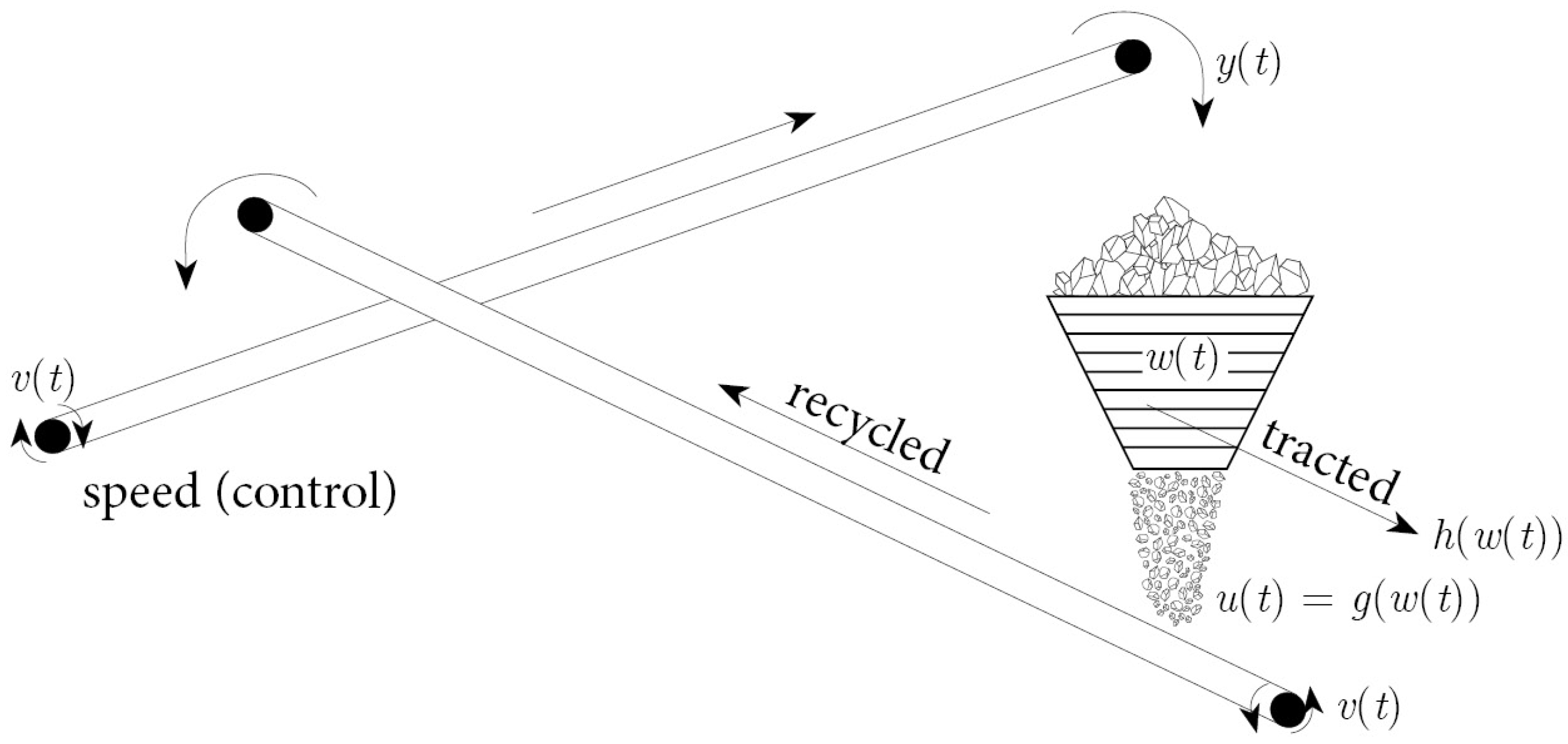
2.1.1. Crushing Process: Dimensional and Signal Inconsistency
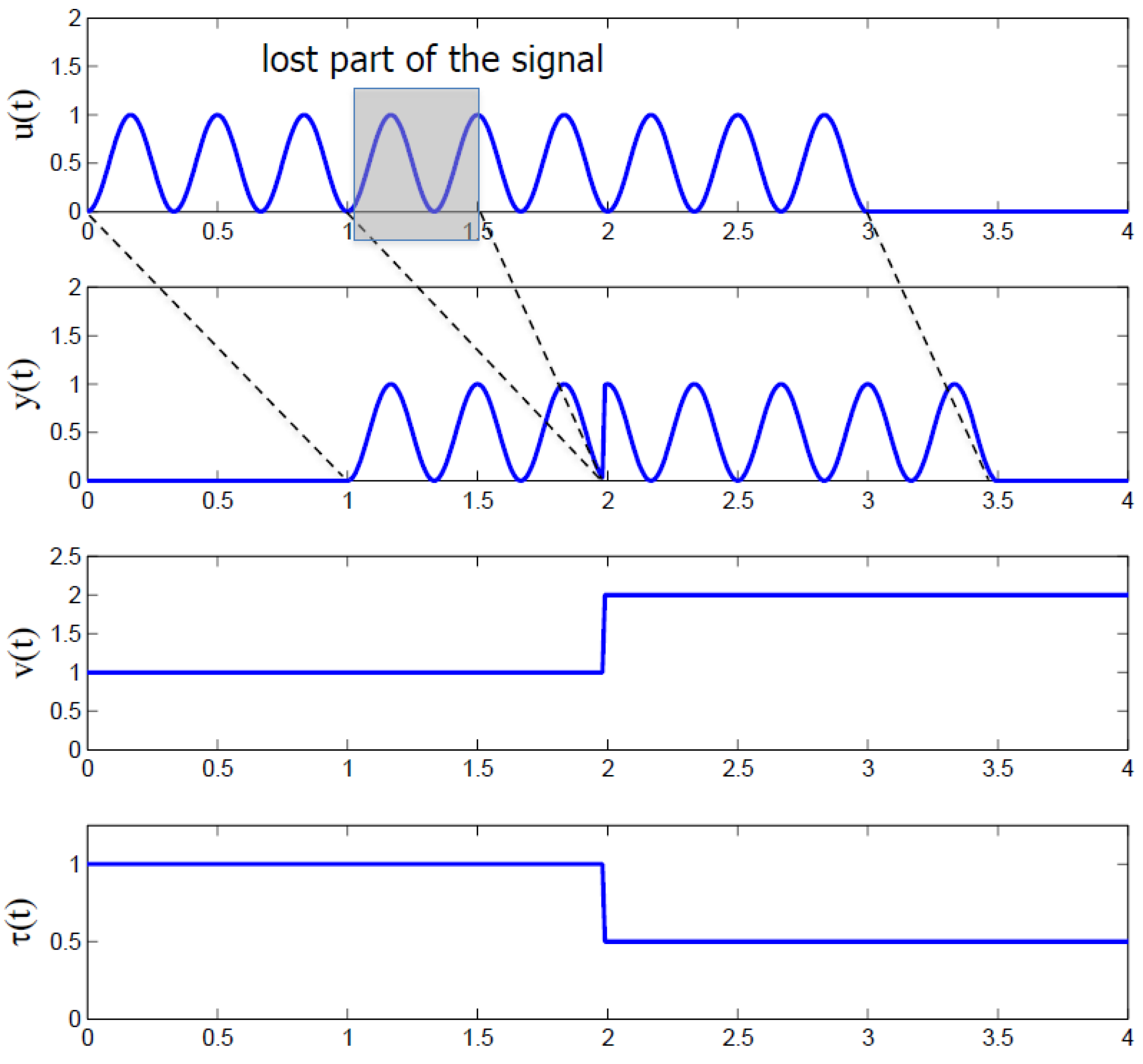
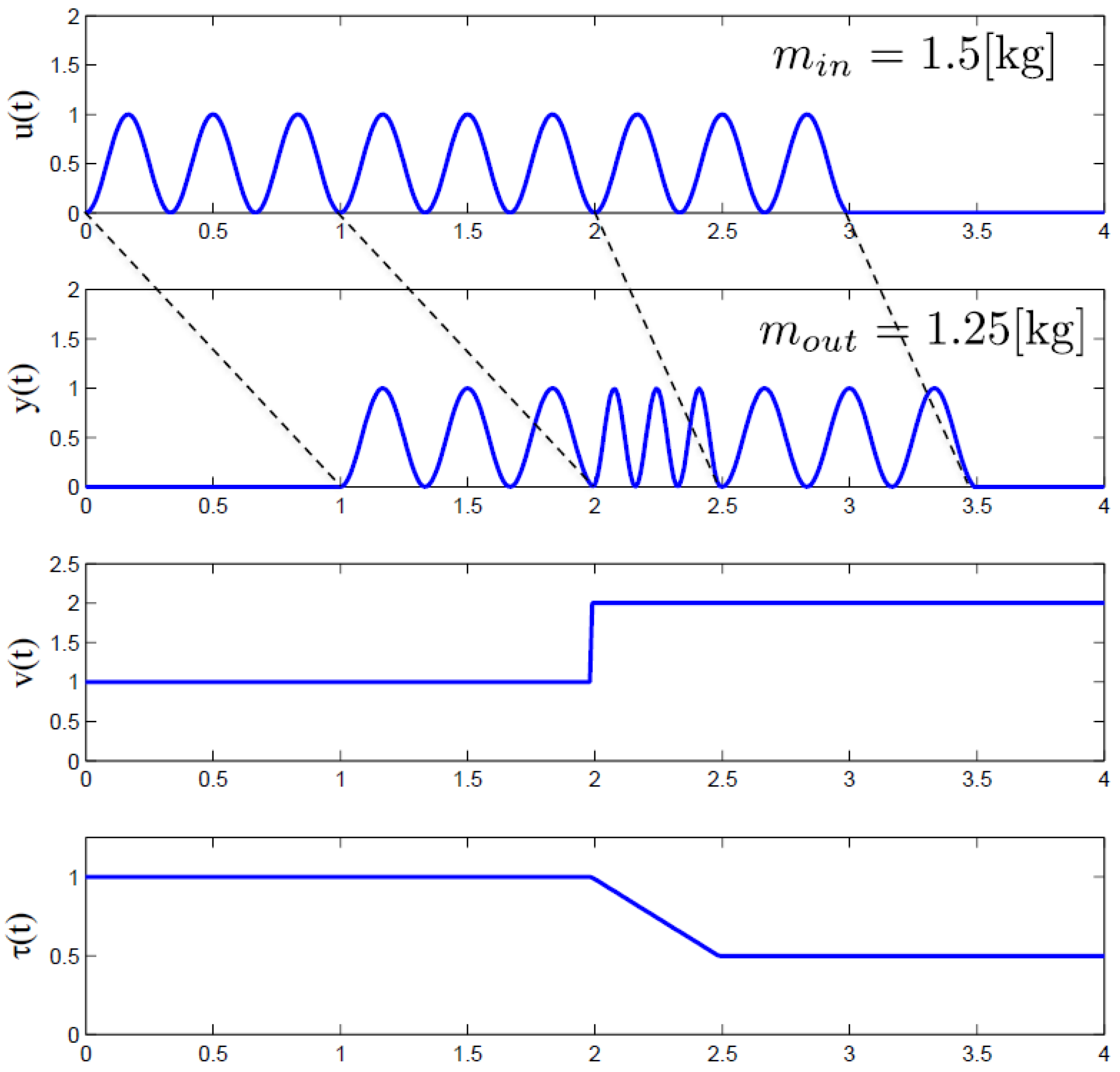
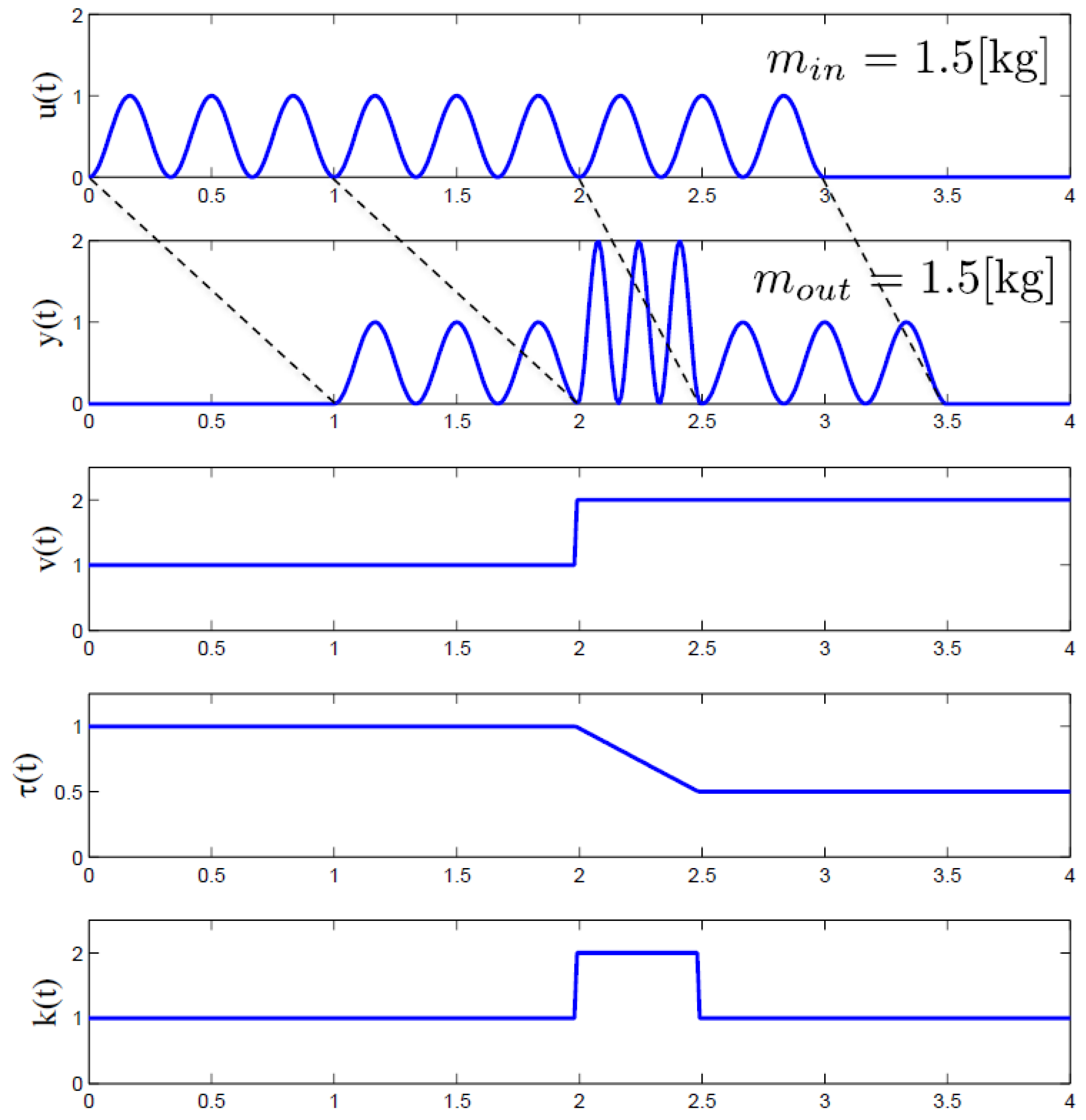
2.1.2. Kinematic Analysis and Limitations of Simulink Transport Delay
2.2. Signal Delay vs. Transfer Delay: Physical Distinction
- Signal delay:
- Transfer delay:
2.3. Physical Interpretation of the Dynamic Gain
2.4. Assumptions and Limitations
3. Classification of Variable Delays
- 1.
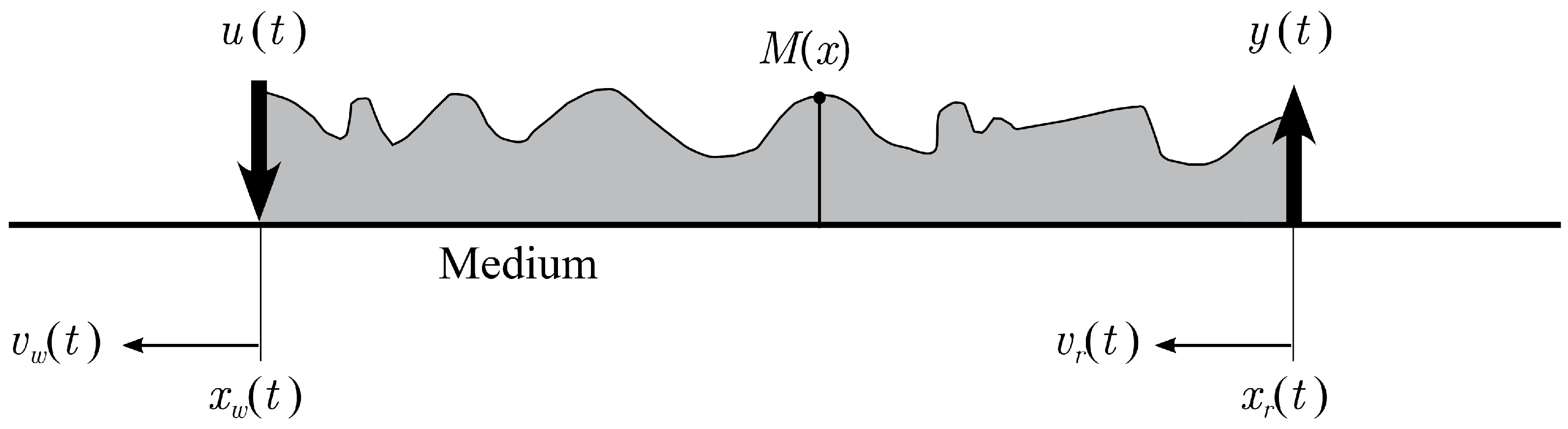
- Type R—variable read-head velocity , representing changes in the place where the delayed signal is read (e.g., the place where the material is collected from the conveyor belt);
- 2.
- Type W—variable write-head velocity , representing changes in the place where the input signal is transmitted to the delay element (e.g., the place where the material is deposited on the conveyor belt);
- 3.
- Type M—variable speed of the medium relative to both stationary heads, corresponding to the situation when the positions of both heads change simultaneously in the same way relative to the stationary medium at speed (e.g., the speed of a conveyor belt or the speed of a pump in a pipeline).
Representative Applications
4. Implementation in Simulink Environment
4.1. General Delay Blocks
4.2. Delay Blocks with Time Parameter
5. Case Study: Heat Transport in Pipeline System
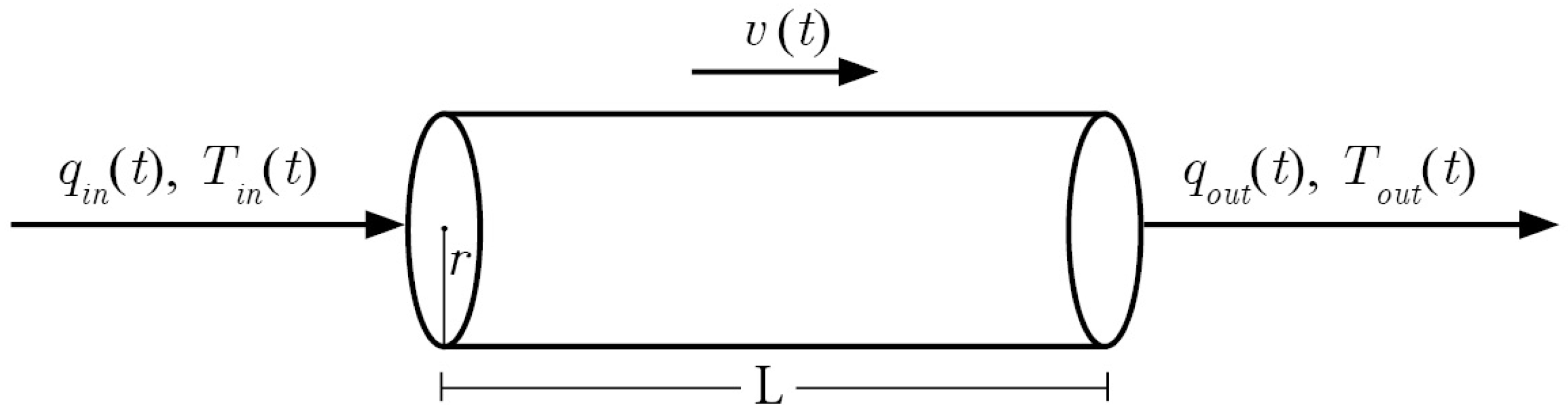
5.1. Physical Context and System Description
- Input thermal energy flow [J/s = W] entering the pipeline;
- Input temperature [°C];
- Output thermal energy flow [J/s = W] delivered to the consumer;
- Output temperature [°C];
- Medium velocity [m/s], controlled by pump speed;
- Pipeline length L 3600 [m] (constant);
- Pipeline radius r = 0.1 [m];
- Specific heat of water /[kg°C].
5.2. Application of Transfer Delay Framework
5.3. Comparative Simulation Setup
- Model 1—a pure signal-based Variable Time Delay;
- Model 2—Simulink’s Variable Transport Delay block (no dynamic scaling);
- Model 3—the proposed Transfer Delay (Type M) including dynamic gain .
5.4. Simulation Results
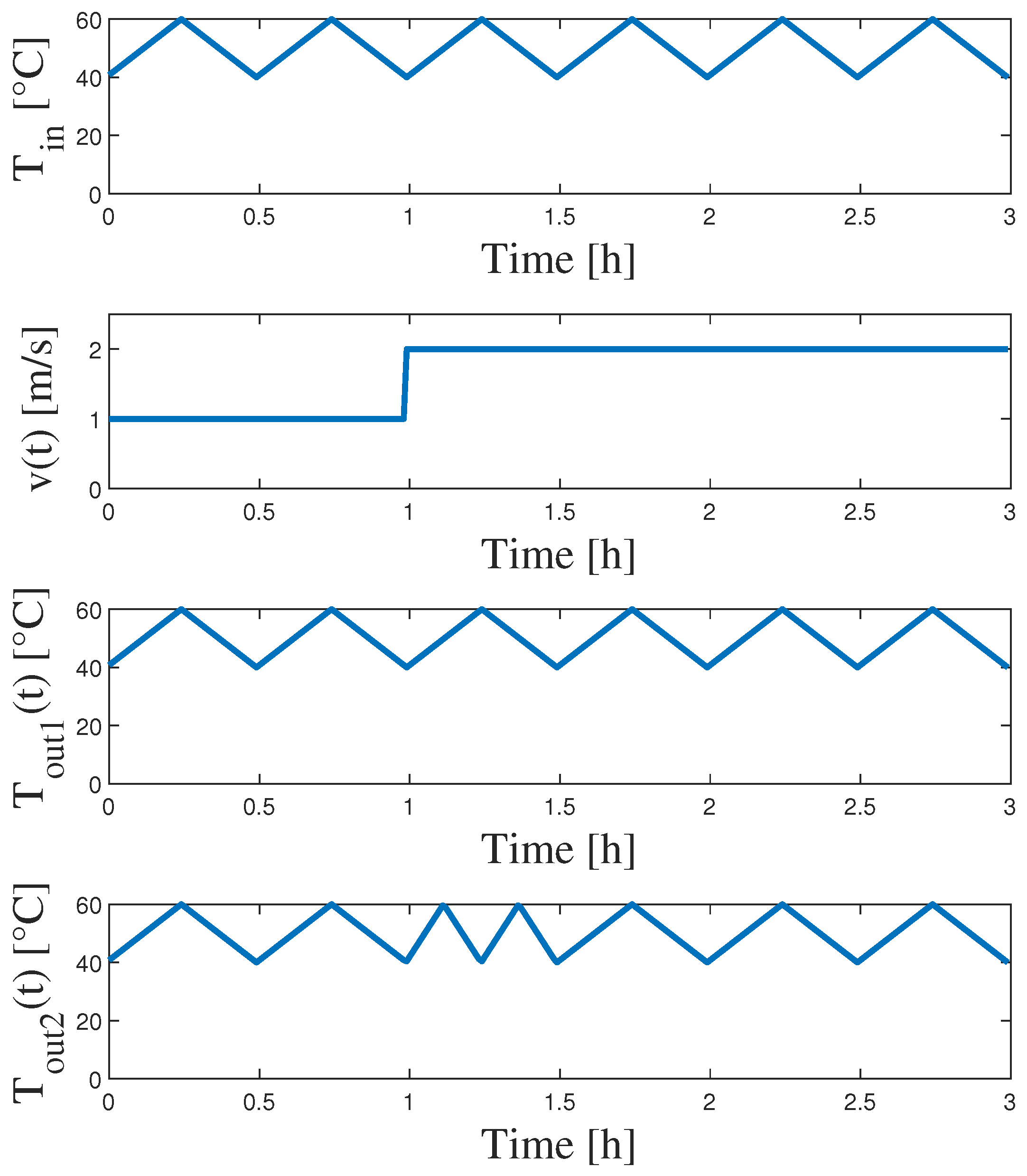
5.4.1. Temperature Simulation
- Model 1 (, fourth panel) uses a pure signal-based Variable Time Delay. This model also shows qualitatively correct temporal shifting of the temperature profile, with similar compression of oscillations following the velocity increase. The output closely matches Model 1, demonstrating that for temperature propagation, the signal-delay approach yields acceptable results.
- Model 2 (, third panel) employs Simulink’s Variable Transport Delay block. The output faithfully reproduces the triangular input waveform with correct temporal shifting. After the velocity step at h, the delay decreases from 1 h to 0.5 h, causing the output oscillations to compress temporally while maintaining their amplitude. The temperature profile remains undistorted, with peak and trough values matching the input.
5.4.2. Thermal Energy Flow Simulation
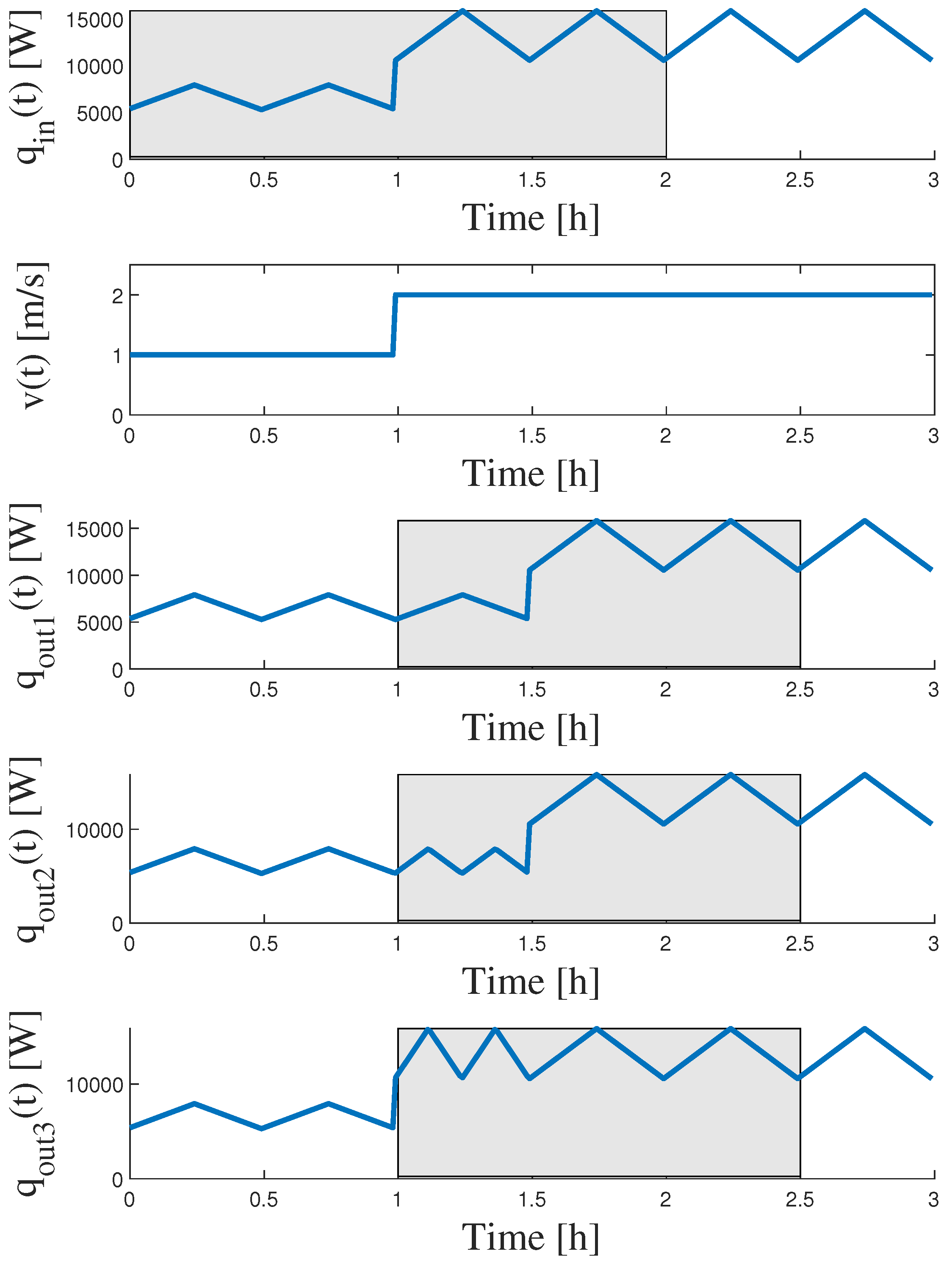
- Model 1 (, third panel), the Simulink Signal Delay block, and Model 2 (, fourth panel), the Simulink Variable Transport Delay block, both show significant amplitude reduction and phase-shifted oscillations immediately following the velocity transition at h. While the waveform shape is qualitatively preserved, the output amplitude is systematically lower than the input, indicating progressive energy loss. These conventional models enforce kinematic delay evolution but omit the conservation-mandating dynamic gain term , resulting in non-physical energy dissipation, as confirmed by the quantitative analysis.
- Model 3 (, fifth panel), which is the proposed Transfer Delay (Type M) including the dynamic gain , faithfully preserves energy conservation through correct amplitude scaling. Notably, after the velocity step at h, the output amplitude in the gray-shaded region exceeds the input amplitude due to the compensating action of the dynamic gain . When velocity doubles, the linear energy density [J/m] along the pipe is compressed, and this compression is correctly reflected in the output power through the gain factor , ensuring that total energy is conserved despite the kinematic compression of the thermal wave.
5.4.3. Quantitative Analysis of Energy Conservation
5.4.4. Overall Conclusion
6. Conclusions
6.1. Key Contributions and Physical Significance
- Physically consistent formulation: A unified mathematical framework (Equation (15)) for transfer delays was developed, explicitly coupling kinematic evolution with conservation laws. The introduction of the time-varying gain ensures both dimensional consistency and the preservation of energy and mass balance, a capability fundamentally absent in standard Signal Delay models.
- Systematic classification framework: A dual classification scheme was introduced, distinguishing between Signal Delays (information transfer) and Transfer Delays (physical transport), further categorized by the source of variability (Types R, W, and M). This taxonomy provides a practical guideline for consistent model selection across diverse domains, including district heating, power-to-gas, and thermal storage.
- Implementation and validation: New functional blocks for the Simulink environment were developed, supporting all six delay variants, thereby extending the capability of industrial simulation tools. Validation through a heat transport case study confirmed that while standard models fail in conservation, the proposed transfer-delay formulation maintains physical consistency under variable operating conditions.
6.2. Limitations of the Current Framework
6.3. Limitations and Directions for Future Research
- Development of stability criteria and robust controller design specifically tailored to systems governed by transfer delays.
- Integration into Model Predictive Control strategies for renewable energy systems to proactively compensate for variable delays.
- Experimental validation on industrial-scale thermal systems to quantify performance improvements.
- Generalization to multiphase and compressible flows and application to large-scale distributed energy networks.
Author Contributions
Funding
Data Availability Statement
Acknowledgments
Conflicts of Interest
Nomenclature
| Symbol | Description | Unit |
| System state vector | – | |
| System input vector / input flow (mass flow rate or thermal power) | kg/s or W | |
| Output flow (mass flow rate or thermal power) | kg/s or W | |
| Time-varying delay | s | |
| Dynamic gain (velocity ratio) | – | |
| Read-head velocity (extraction/output velocity) | m/s | |
| Write-head velocity (input/supply velocity) | m/s | |
| Medium velocity | m/s | |
| Flow velocity / conveyor belt speed | m/s | |
| L | Transport medium length / pipeline length | m |
| l | Conveyor length | m |
| Linear density distribution along medium | J/m or kg/m | |
| x | Spatial coordinate along transport medium | m |
| Read-head position | m | |
| Write-head position | m | |
| Distance from write head to read head | m | |
| Prescribed delay (Variable Time Delay block) | s | |
| Delay computed from medium length and velocity | s | |
| Nominal (user-specified) delay | s | |
| Input thermal power | W | |
| Output thermal power | W | |
| Input temperature | °C | |
| Output temperature | °C | |
| Mass flow rate | kg/s | |
| Fluid density | kg/m3 | |
| c | Specific heat capacity of water | kJ/(kg·°C) |
| A | Pipe cross-sectional area | m2 |
| r | Pipe radius | m |
| Mill mass | kg | |
| Recycled flow function | kg/s | |
| Total input mass | kg | |
| Total output mass | kg | |
| System dynamics function | – | |
| n | Dimension of state vector | – |
| m | Dimension of input vector | – |
| Integration variable | s |
Acronyms and Abbreviations
| Acronym | Definition |
| DDE | Delay Differential Equation |
| ODE | Ordinary Differential Equation |
| RES | Renewable Energy Sources |
| DER | Distributed Energy Resources |
| PMU | Phasor Measurement Unit |
| MPPT | Maximum Power Point Tracking |
| MPC | Model Predictive Control |
| PDE | Partial Differential Equation |
References
- Niculescu, S.-I. Delay Effects on Stability: A Robust Control Approach; Springer: Berlin/Heidelberg, Germany, 2001. [Google Scholar] [CrossRef] [Scilit]
- Sipahi, R.; Niculescu, S.-I.; Abdallah, C.T.; Michiels, W.; Gu, K. Stability and Stabilization of Systems with Time Delay. IEEE Control Syst. Mag. 2011, 31, 38–65. [Google Scholar] [CrossRef] [Scilit]
- Fujarewicz, K.; Łakomiec, K. Parameter estimation of systems with delays via structural sensitivity analysis. Discret. Contin. Dyn.-Syst. 2014, 19, 2521–2533. [Google Scholar] [CrossRef] [Scilit]
- Fujarewicz, K. Estimation of initial functions for systems with delays from discrete measurements. Math. Biosci. Eng. 2017, 14, 165–178. [Google Scholar] [CrossRef] [Scilit]
- European Commission. Fit for 55: Delivering the EU’s 2030 Climate Target on the Way to Climate Neutrality; European Commission: Brussels, Belgium, 2021; Available online: https://ec.europa.eu/info/strategy/priorities-2019-2024/european-green-deal/delivering-european-green-deal_en (accessed on 15 October 2025).
- Zhang, Y.; Pen, H.; Zhang, X. Stability Control of Grid-Connected Converter Considering Phase-Locked Loop Frequency Coupling Effect. Energies 2024, 17, 3438. [Google Scholar] [CrossRef] [Scilit]
- Ding, L.; Han, Q.-L.; Ge, X.; Zhang, X.-M. An Overview of Recent Advances in Event-Triggered Consensus of Multiagent Systems. IEEE Trans. Cybern. 2018, 48, 1110–1123. [Google Scholar] [CrossRef] [Scilit]
- Cagnano, A.; De Tuglie, E.; Mancarella, P. Microgrids: Overview and guidelines for practical implementations and operation. Appl. Energy 2020, 258, 114039. [Google Scholar] [CrossRef] [Scilit]
- Nosratabadi, S.M.; Hooshmand, R.-A.; Gholipour, E. A comprehensive review on microgrid and virtual power plant concepts employed for distributed energy resources scheduling in power systems. Renew. Sustain. Energy Rev. 2017, 67, 341–363. [Google Scholar] [CrossRef] [Scilit]
- Mackey, M.C.; Glass, L. Oscillation and chaos in physiological control systems. Science 1977, 197, 287–289. [Google Scholar] [CrossRef] [Scilit]
- Bélair, J.; Glass, L.; an der Heiden, U.; Milton, J. Dynamical disease: Identification, temporal aspects and treatment strategies of human illness. Chaos 1995, 5, 1–7. [Google Scholar] [CrossRef] [Scilit] [PubMed]
- Fenwick, J.D. Delay differential equations and the dose-time dependence of early radiotherapy reactions. Med. Phys. 2006, 33, 3526. [Google Scholar] [CrossRef] [Scilit] [PubMed]
- Mahaffy, J.M.; Bélair, J.; Mackey, M.C. Hematopoietic Model with Moving Boundary Condition and State Dependent Delay: Applications in Erythropoiesis. J. Theor. Biol. 1998, 190, 135–146. [Google Scholar] [CrossRef] [Scilit]
- Nelson, P.W.; Perelson, A.S. Mathematical analysis of delay differential equation models of HIV-1 infection. Math. Biosci. 2002, 179, 73–94. [Google Scholar] [CrossRef] [Scilit] [PubMed]
- Foryś, U.; Poleszczuk, J. A delay-differential equation model of HIV related cancer–immune system dynamics. Math. Biosci. Eng. 2011, 8, 627–641. [Google Scholar] [CrossRef] [Scilit]
- Ottesen, J.T.; Olufsen, M.S.; Larsen, J.K. Applied Mathematical Models in Human Physiology; SIAM: Philadelphia, PA, USA, 2004. [Google Scholar] [CrossRef] [Scilit]
- Li, Y.; Zhu, Y.; Guo, Y. Stability and Hopf bifurcation analysis in a model of respiratory system with time delay. Math. Biosci. 2019, 316, 108242. [Google Scholar] [CrossRef] [Scilit]
- Bátkai, A.; Piazzera, S. Semigroups for Delay Equations; A K Peters: Wellesley, MA, USA, 2005. [Google Scholar] [CrossRef] [Scilit]
- Bellen, A.; Zennaro, M. Numerical Methods for Delay Differential Equations; Oxford University Press: Oxford, UK, 2003. [Google Scholar] [CrossRef] [Scilit]
- Richard, J.-P. Time-delay systems: An overview of some recent advances and open problems. Automatica 2003, 39, 1667–1694. [Google Scholar] [CrossRef] [Scilit]
- Kolmanovskii, V.; Nosov, V. Stability of Functional Differential Equations; Academic Press: London, UK, 1986; ISBN 9780080963143. [Google Scholar]
- Górecki, H.; Fuksa, S.; Grabowski, P.; Korytowski, A. Analysis and Synthesis of Time Delay Systems; Wiley: Chichester, UK, 1989. [Google Scholar]
- Malek-Zavarei, M.; Jamshidi, M. Time Delay Systems: Analysis, Optimization and Applications; North-Holland: Amsterdam, The Netherlands, 1987. [Google Scholar]
- Verda, V.; Colella, F. Primary energy savings through thermal storage in district heating networks. Energy 2011, 36, 4278–4286. [Google Scholar] [CrossRef] [Scilit]
- Dalla Rosa, A.; Christensen, J.E. Low-energy district heating in energy-efficient building areas. Energy 2011, 36, 6890–6899. [Google Scholar] [CrossRef] [Scilit]
- Liu, M.; Tay, N.H.S.; Bell, S.; Belusko, M.; Jacob, R.; Will, G.; Saman, W.; Bruno, F. Review on concentrating solar power plants and new developments in high temperature thermal energy storage technologies. Renew. Sustain. Energy Rev. 2016, 53, 1411–1432. [Google Scholar] [CrossRef] [Scilit]
- Li, H.; Svendsen, S. Energy and exergy analysis of low temperature district heating network. Energy 2012, 45, 237–246. [Google Scholar] [CrossRef] [Scilit]
- Phadke, A.G.; Thorp, J.S.; Karimi, K.J. State estimation with phasor measurements. IEEE Trans. Power Syst. 1986, 1, 233–241. [Google Scholar] [CrossRef] [Scilit]
- Palensky, P.; Dietrich, D. Demand Side Management: Demand Response, Intelligent Energy Systems, and Smart Loads. IEEE Trans. Ind. Inform. 2011, 7, 381–388. [Google Scholar] [CrossRef] [Scilit]
- Perez, H.E.; Hu, X.; Dey, S.; Moura, S.J. Optimal Charging of Li-Ion Batteries with Coupled Electro-Thermal-Aging Dynamics. IEEE Trans. Veh. Technol. 2017, 66, 7761–7770. [Google Scholar] [CrossRef] [Scilit]
- Ulleberg, Ø. Modeling of advanced alkaline electrolyzers: A system simulation approach. Int. J. Hydrogen Energy 2003, 28, 21–33. [Google Scholar] [CrossRef] [Scilit]
- Sánchez, M.; Amores, E.; Rodríguez, L.; Clemente-Jul, C. Semi-empirical model and experimental validation for the performance evaluation of a 15 kW alkaline water electrolyzer. Int. J. Hydrogen Energy 2018, 43, 20332–20345. [Google Scholar] [CrossRef] [Scilit]
- Esram, T.; Chapman, P.L. Comparison of Photovoltaic Array Maximum Power Point Tracking Techniques. IEEE Trans. Energy Convers. 2007, 22, 439–449. [Google Scholar] [CrossRef] [Scilit]
- Kalogirou, S.A. Solar Energy Engineering: Processes and Systems; Academic Press: Burlington, MA, USA, 2009. [Google Scholar] [CrossRef] [Scilit]
- Bianchi, F.D.; De Battista, H.; Mantz, R.J. Wind Turbine Control Systems: Principles, Modelling and Gain Scheduling Design; Springer: London, UK, 2007. [Google Scholar] [CrossRef] [Scilit]
- Lima, T.A.; Fioravanti, A.R. Stability analysis of switched systems with time-varying delay. Automatica 2022, 146, 110599. [Google Scholar] [CrossRef] [Scilit]
- Martínez Ceseña, E.A.; Loukarakis, E.; Good, N.; Mancarella, P. Integrated Electricity–Heat–Gas Systems: Techno–Economic Modeling, Optimization, and Application to Multienergy Districts. Proc. IEEE 2020, 108, 1392–1410. [Google Scholar] [CrossRef] [Scilit]
- Korpaas, M.; Holen, A.T.; Hildrum, R. Operation and sizing of energy storage for wind power plants in a market system. Int. J. Electr. Power Energy Syst. 2003, 25, 599–606. [Google Scholar] [CrossRef] [Scilit]
- Wang, J.; Liu, P.; Hicks-Garner, J.; Sherman, E.; Soukiazian, S.; Verbrugge, M.; Tataria, H.; Musser, J.; Finamore, P. Cycle-life model for graphite-LiFePO4 cells. J. Power Sources 2011, 196, 3942–3948. [Google Scholar] [CrossRef] [Scilit]
- Zhang, X.; Yeddanapudi, M. Modeling and simulation of time-varying delays. In TMS/DEVS ’12: Proceedings of the 2012 Symposium on Theory of Modeling and Simulation-DEVS Integrative M&S Symposium, Orlando, Florida; Society for Computer Simulation International: San Diego, CA, USA, 2012; pp. 1–8. Available online: https://api.semanticscholar.org/CorpusID:27028921 (accessed on 15 October 2025).
- Romanchenko, D.; Kensby, J.; Odenberger, M.; Johnsson, F. Thermal energy storage in district heating: Centralised storage vs. storage in thermal inertia of buildings. Energy Convers. Manag. 2018, 162, 26–38. [Google Scholar] [CrossRef] [Scilit]
- Zhang, X.-M.; Han, Q.-L.; Yu, X. Survey on Recent Advances in Networked Control Systems. IEEE Trans. Ind. Inform. 2016, 12, 1740–1752. [Google Scholar] [CrossRef] [Scilit]
- Koren, Y.; Shpitalni, M. Design of reconfigurable manufacturing systems. J. Manuf. Syst. 2010, 29, 130–141. [Google Scholar] [CrossRef] [Scilit]
- Olufsen, M.S.; Peskin, C.S.; Kim, W.Y.; Pedersen, E.M.; Nadim, A.; Larsen, J. Numerical simulation and experimental validation of blood flow in arteries with structured-tree outflow conditions. Ann. Biomed. Eng. 2000, 28, 1281–1299. [Google Scholar] [CrossRef] [Scilit]
- Keener, J.; Sneyd, J. Mathematical Physiology: I: Cellular Physiology, 2nd ed.; Springer: New York, NY, USA, 2009. [Google Scholar] [CrossRef] [Scilit]
- Heywood, J.B. Internal Combustion Engine Fundamentals, 2nd ed.; McGraw-Hill Education: New York, NY, USA, 2018. [Google Scholar]
- Basu, P. Circulating Fluidized Bed Boilers: Design, Operation and Maintenance; Springer: Cham, Switzerland, 2015. [Google Scholar] [CrossRef] [Scilit]



| Type of Delay | Variable(s) Controlling the Time Delay | Signal Delay | Transfer Delay | |
|---|---|---|---|---|
| Constant | Variable | |||
| Speed(s) | Speed(s) | |||
| General | – | and | ||
| Type R | ||||
| Type W | ||||
| Type M | – | |||
| Variable(s) Controlling the Time Delay | Type of Delay | |
|---|---|---|
| Signal Delay | Transfer Delay | |
| Signal Delay M (Simulink: Variable Transport Delay) | Transfer Delay M (Newly developed) | |
| () | Signal Delay R (Simulink: Variable Time Delay) | Transfer Delay R (Newly developed) |
| () | Signal Delay W (Newly developed) | Transfer Delay W (Newly developed) |
| Model | Total Input Energy [J] | Total Output Energy [J] |
|---|---|---|
| 1 | 100 | 74.8 |
| 2 | 100 | 74.8 |
| 3 | 100 | 99.8 |
Disclaimer/Publisher’s Note: The statements, opinions and data contained in all publications are solely those of the individual author(s) and contributor(s) and not of MDPI and/or the editor(s). MDPI and/or the editor(s) disclaim responsibility for any injury to people or property resulting from any ideas, methods, instructions or products referred to in the content. |
© 2026 by the authors. Licensee MDPI, Basel, Switzerland. This article is an open access article distributed under the terms and conditions of the Creative Commons Attribution (CC BY) license.
Share and Cite
Bysko, S.; Łakomiec, K.; Fujarewicz, K. Conservation-Consistent Modeling of Time-Varying Transfer Delays with Applications in Energy Systems. Energies 2026, 19, 1262. https://doi.org/10.3390/en19051262
Bysko S, Łakomiec K, Fujarewicz K. Conservation-Consistent Modeling of Time-Varying Transfer Delays with Applications in Energy Systems. Energies. 2026; 19(5):1262. https://doi.org/10.3390/en19051262
Chicago/Turabian StyleBysko, Sara, Krzysztof Łakomiec, and Krzysztof Fujarewicz. 2026. "Conservation-Consistent Modeling of Time-Varying Transfer Delays with Applications in Energy Systems" Energies 19, no. 5: 1262. https://doi.org/10.3390/en19051262
APA StyleBysko, S., Łakomiec, K., & Fujarewicz, K. (2026). Conservation-Consistent Modeling of Time-Varying Transfer Delays with Applications in Energy Systems. Energies, 19(5), 1262. https://doi.org/10.3390/en19051262