Review

Towards Smoother Linear Locomotion Through Combined Linear Machine Structural Optimization Methods

1
Department of Mechanical Engineering, The Hong Kong Polytechnic University, Hung Hom, Hong Kong SAR, China
2
Department of Industrial and Systems Engineering, The Hong Kong Polytechnic University, Hung Hom, Hong Kong SAR, China
3
The Hong Kong Polytechnic University Shenzhen Research Institute, Shenzhen 518057, China
*
Author to whom correspondence should be addressed.
Energies 2026, 19(5), 1243; https://doi.org/10.3390/en19051243
Submission received: 29 January 2026 / Revised: 20 February 2026 / Accepted: 27 February 2026 / Published: 2 March 2026
(This article belongs to the Section F: Electrical Engineering)

Abstract

Permanent Magnet Linear Synchronous Motors (PMLSMs) are the dominant actuation solution for high-end manufacturing equipment, such as semiconductor lithography systems, owing to their superior force density and direct-drive capabilities. However, the inherent thrust ripple—comprising cogging force, end effects, and harmonics—severely compromises their ability to achieve the nanoscale tracking accuracy required for precision metrology. This paper presents a comprehensive review of structural optimization techniques aimed at suppressing thrust ripple to ultra-low levels suitable for high-precision applications. The optimization methodologies are systematically categorized into Permanent Magnet (PM) modification, core structure optimization, end-effect mitigation, and topological innovations. Beyond analyzing individual techniques, this review critically evaluates the synergistic efficacy of combined optimization strategies, identifying complementary pairings that maximize ripple suppression while minimizing the trade-off with average thrust. Finally, the paper discusses the impact of manufacturing tolerances on optimization robustness, providing a roadmap for designing next-generation, high-fidelity linear motion systems.

1. Introduction

Permanent Magnet Linear Synchronous Motors (PMLSMs) drive high-precision applications, including semiconductor lithography equipment, ultra-precision CNC machine tools, and wafer inspection stages, due to their direct-drive mechanism, high thrust density, rapid response, and excellent positioning accuracy without mechanical intermediaries like ball screws or gears [1,2]. These attributes enable nanoscale motion control essential for modern semiconductor manufacturing and precision metrology.
PMLSMs are subject to inherent thrust ripples, which stem from three primary sources. First, cogging forces arise from the magnetic interaction between the stator slots and the Permanent Magnets (PMs). Second, the finite length of the primary part creates magnetic discontinuities known as end effects. Finally, harmonic distortions within the air-gap field further contribute to fluctuations in performance [3]. In ultra-precision scenarios, such as lithography machines, uncontrolled thrust ripple can exceed 5% of average thrust, causing velocity fluctuations, vibration, and positioning errors that degrade nanoscale accuracy. High-end applications typically demand ultra-low ripple levels below 0.5–1% or even five ten-thousandths in extreme cases to ensure stable operation and sub-micron repeatability [4].
Structural optimization techniques address thrust ripple at the source by refining motor topology, offering persistent suppression without additional energy consumption or real-time computational burden—ideal for stable, high-precision environments [5]. By embedding suppression directly into the motor topology, structural methods ensure persistent performance stability over extended operation, avoiding thermal or computational overheads associated with active compensation. Key methods for ripple reduction in PMLSMs include magnet skewing, Halbach arrays, auxiliary slots/poles, end-effect compensation, coreless designs, and modular structures. Individually, these approaches can achieve 40–90% ripple reduction, but they involve trade-offs: skewing effectively cancels cogging force phases but slightly reduces average thrust and increases manufacturing complexity [6,7]; Halbach arrays significantly enhance air-gap flux density and sinusoidal waveform quality while minimizing harmonics, though at the cost of high manufacturing difficulty, demagnetization risks, and inability to fully eliminate cogging in cored designs [8,9,10]; coreless configurations eliminate cogging entirely, offer smooth operation, low mass, and fast response, yet suffer from lower efficiency, poor heat dissipation, higher magnet usage, and force pulsations [11,12]; auxiliary slots/poles minimize disturbances (e.g., detent force), but enlarge motor volume [13]; end-effect compensation reduces end-specific forces with minimal impact on overall cogging. Combinations, such as skewed Halbach arrays in axial-flux or double-sided PMLSMs, yield synergistic effects, often pushing residual ripple below 1% while maintaining or boosting thrust density—for instance, dual-skewed Halbach designs achieve ~7.8% higher average torque and notable ripple reduction compared to baselines, though they amplify assembly challenges and potential asymmetries [14,15].
However, prior investigations largely treat these techniques in isolation, and a consolidated perspective on their combined efficacy and engineering implications remains limited.
This review focuses on structural optimization strategies for achieving ultra-low thrust ripples in PMLSMs tailored to high-precision applications. Compared to existing reviews, this work places greater emphasis on the combined efficacy of multiple structural optimization techniques and explores their practical feasibility from the perspective of real-world industrial production and engineering implementation. It synthesizes recent advancements, provides quantitative comparisons of ripple suppression efficacy, and highlights combined approaches as a promising pathway to achieving sub-1% performance thresholds.
The structure of this paper is as follows. Section 2 introduces the thrust ripple sources and high-precision requirements, explaining the root causes of thrust ripple generation and the importance of suppressing thrust ripple. Section 3 discusses common single structural optimization methods and their respective efficacy. In Section 4, the feasibility of different structural optimization combinations is investigated.

2. Thrust Ripple Sources and High-Precision Requirements

Thrust ripple in PMLSM arises from inherent electromagnetic interactions within their open-ended, finite-length structure, leading to periodic force fluctuations that compromise performance. The phenomenon manifests as deviations from the ideal average thrust, resulting in position- and load-dependent disturbances that degrade smooth motion [16].
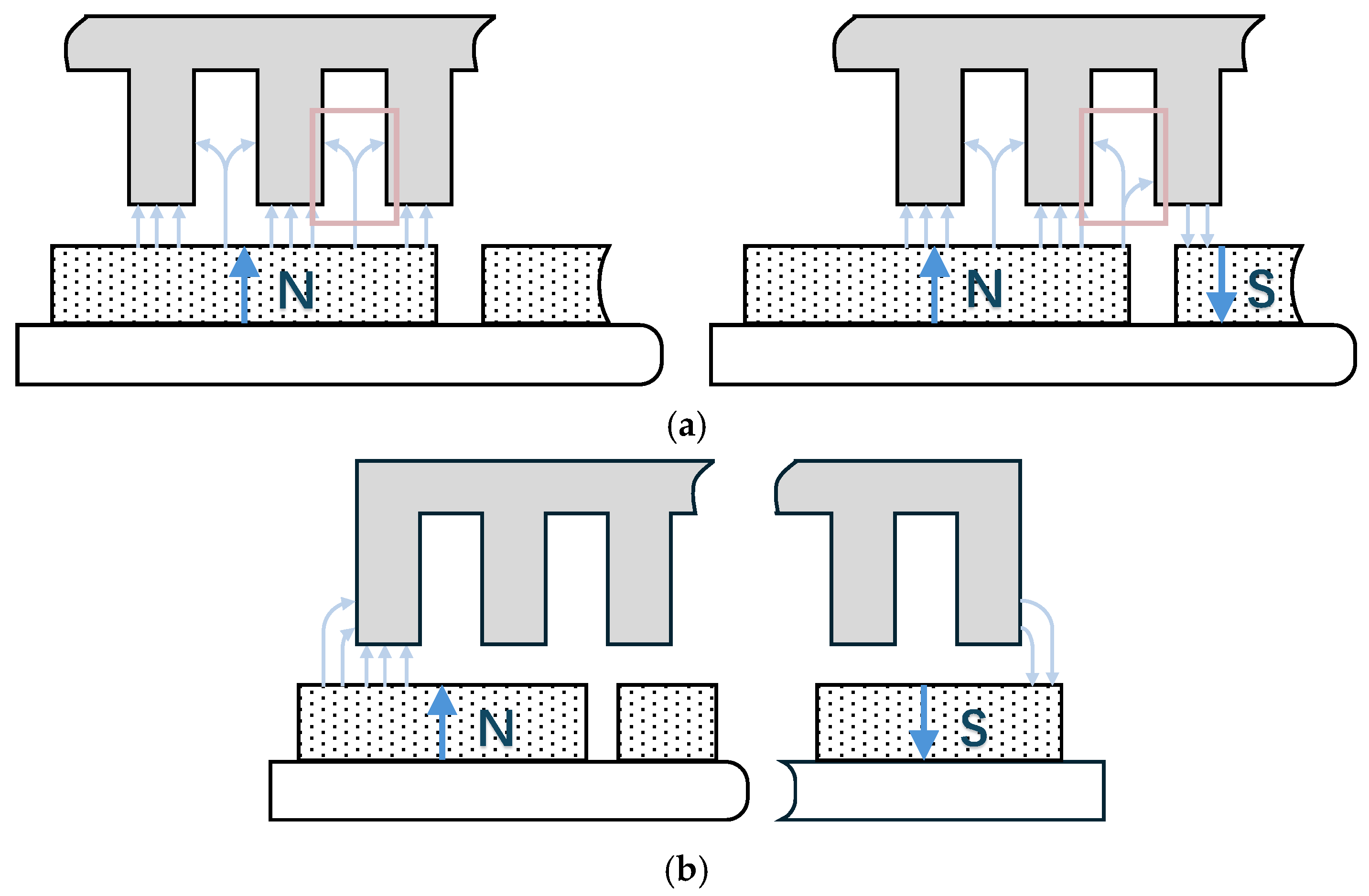
The dominant source is cogging force, stemming from the reluctance variations between stator slots and PMs. This creates a periodic attraction/repulsion cycle, even under no-load conditions, as the magnets align with slots of varying magnetic resistance. In PMLSMs with N s (number of slots) slots and N p (number of pole pairs) pole pairs, cogging force exhibits periodicity related to the least common multiple of slots and poles, producing harmonic components that contribute significantly to overall ripple, as illustrated in Figure 1.
End effects constitute another major contributor, caused by the abrupt truncation of magnetic fields at the motor’s finite ends. This leads to asymmetric flux distributions along the travel direction, generating additional longitudinal force oscillations that are particularly pronounced in short-primary configurations. The resulting end force introduces low-frequency components, amplifying ripple and becoming especially problematic at low speeds or during acceleration/deceleration phases common in precision positioning [4], with typical asymmetric force waveforms and end-effect contributions also depicted in Figure 1.
Additionally, under load conditions, electromagnetic ripple originates from the coupling between harmonic components in the air-gap flux density and non-ideal current waveforms. Non-sinusoidal back-EMF, arising from factors such as winding distribution, slotting effects, magnet geometry, and magnetic saturation, interacts with both fundamental and harmonic current components. This coupling produces higher-order space–time force harmonics, leading to electrical-angle- and load-dependent thrust pulsations, which further intensify thrust ripple and contribute to velocity fluctuations in dynamic operation.
In high-precision applications, such as semiconductor lithography machines, ultra-precision CNC stages, wafer inspection systems, and optical alignment platforms, these combined sources severely exacerbate system instability. Unmitigated ripple, often reaching more than 5% of average thrust in conventional designs [4], induces velocity errors, mechanical vibration, acoustic noise, and positioning inaccuracies exceeding 1–10 μm, which are completely unacceptable for nanoscale operations where feature sizes and overlay tolerances are below 100 nm. Moreover, ripple-induced vibrations promote thermal expansions, structural resonances, and servo hunting, further degrading long-term repeatability and yield in manufacturing processes.
To address these challenges, ultra-low ripple thresholds are mandatory: typically below 0.5–1% for most high-precision tasks to ensure stable velocity control and sub-micron accuracy, while extreme lithography applications demand levels as low as 0.05% to minimize any thermal or mechanical distortions during exposure cycles [17]. Achieving such stringent performance requires structural optimizations that fundamentally mitigate root causes at the design stage, as real-time control strategies alone may introduce computational latency or instability in nanosecond-critical environments.

3. Structural Optimization Methods for Thrust Ripple Suppression

Structural optimizations for thrust ripple suppression in PMLSMs are categorized based on their primary target: PM optimization, stator/core modifications, end-effect mitigation, and topological innovations. PM optimization refines magnet shape and arrangement to enhance air-gap flux sinusoidality. Stator/core methods address cogging via geometric averaging. End-effect techniques compensate finite-length asymmetries, while topological innovations eliminate or modularize ripple sources [18].

3.1. PM Optimization

PM optimization primarily improves air-gap flux distribution and sinusoidality to reduce harmonic-induced ripple.
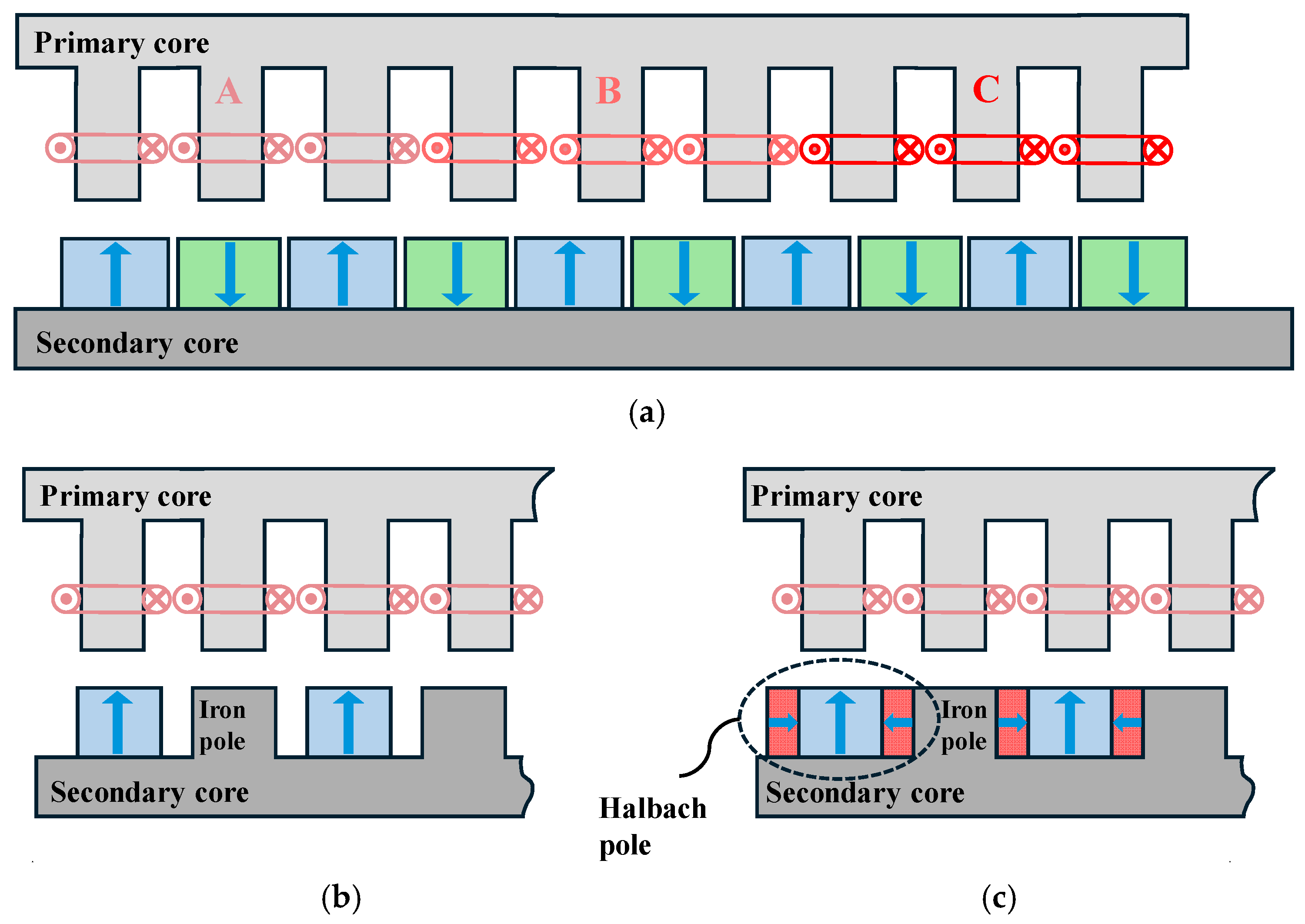
Xu et al. [15] designed a Halbach consequent-pole (HCP) PMLSM for ropeless elevators (shown in Figure 2). The Halbach array produces a quasi-sinusoidal magnetic field distribution that inherently suppresses harmonic content and thrust ripple, while also concentrating flux to reduce leakage and PM usage by 27.6% compared to traditional motors. Combined with pole optimization and double-sided pole shift, this enables an average thrust of 2499 N with ripple suppressed to just 0.87%, achieving an effective balance of cost and performance.
A double-sided linear iron-core fine-tooth motor featuring a moving skewed Halbach magnet array was proposed in [16]. The Halbach array enhances the sinusoidal air-gap flux density, contributing significantly to harmonic cancellation and reduced thrust ripple, while the skewed configuration further minimizes cogging effects. The double-sided symmetric structure eliminates normal-direction force harmonics, resulting in 95% lower acoustic noise than single-sided conventional motors and supporting high acceleration up to 8.2 G for precision systems.
Reference [19] presented an ironless double-sided Halbach PMLSM with C-shaped windings for electromagnetic launch. In the ironless design, the Halbach array compensates for inherently low flux density by strongly concentrating magnetic fields on the active side, while its quasi-sinusoidal distribution minimizes harmonics and achieves a very low thrust ripple of 0.8%. A modified Fourier series model accounts for end effects, delivering an average thrust of 8.3 kN suitable for high-speed transient launch applications.
Tavana and Shoulaie investigated permanent-magnet pole-shape optimization for thrust ripple suppression in PMLSMs. By parameterizing the arc-shaped PM geometry and minimizing the normalized total thrust ripple (NTTR) under constant average thrust, the optimized design significantly reduced force pulsations. Finite-element results indicate that NTTR was reduced to a very low level compared with the initial rectangular pole design, while the average thrust remained nearly unchanged and the back-EMF waveform exhibited substantially lower harmonic distortion [20].
Chung et al. proposed a doubly salient PMLSM with optimized permanent-magnet placement and salient-pole geometry for precision position control. Experimental measurements demonstrate that the optimized PM configuration effectively suppresses detent force and reduces thrust fluctuation amplitude compared with the conventional structure. The measured thrust waveforms exhibit markedly smoother force profiles, leading to improved low-speed motion stability and positioning accuracy [21].
Reference [5] highlights it as a widely adopted method for thrust ripple reduction in PMLSMs. By optimizing skew length, high-order harmonics (4th, 6th, 8th) are reduced by 55.7%, 93%, and 79.5% compared to rectangular PMs. This approach suppresses sine wave distortion of detent force more effectively and conveniently than traditional amplitude-focused optimizations, facilitating minimal ripple control.

3.2. Core Modifications

Core modifications target cogging force through geometric averaging of reluctance variations.
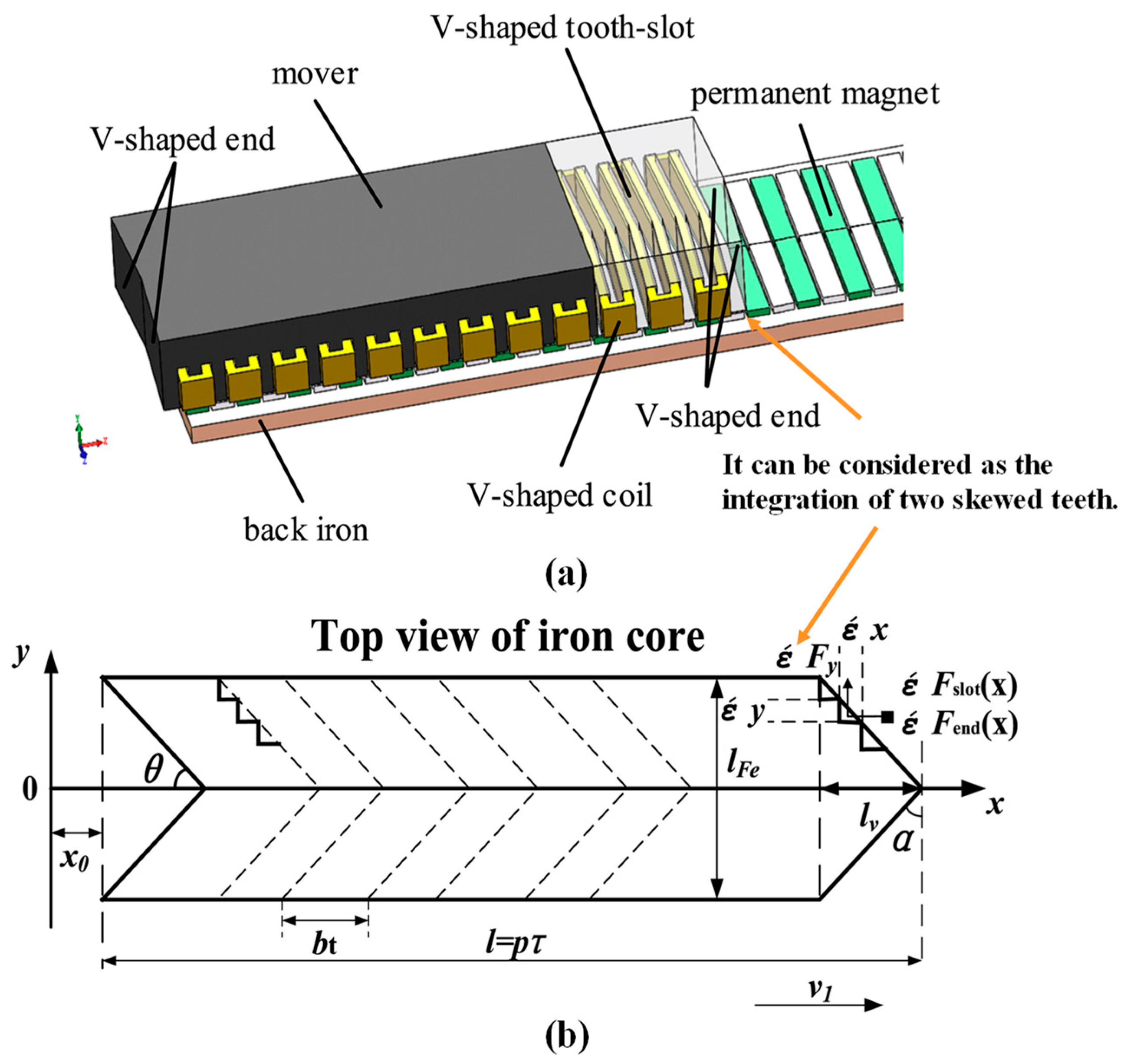
Building upon traditional skewed slots and skewed poles technology, reference [22] proposes a novel PMLSM design featuring a V-shaped tooth-slot structure (illustrated in Figure 3). The V-shaped teeth can be regarded as a clever combination of two helical teeth. This structure simultaneously suppresses both the tooth-slot effect and end effect in positioning forces, significantly reducing thrust pulsation (to approximately 3.3%) while enhancing average thrust (by about 3%). It also minimizes normal forces, avoiding the shortcomings of traditional methods that either address only a single effect or result in reduced thrust. Its superior performance has been validated through theoretical analysis, FEM, and prototype experiments.
In Ref. [23], a novel consequent-pole PMLSM was presented for electromagnetic launch, optimizing both the mover and stator jointly. Both the mover and stator are jointly optimized, in which a double-sided consequent-pole stator and an optimized mover structure are adopted to suppress detent force and thrust ripple while reducing magnet usage. Finite-element and experimental results show that the detent force is reduced from 158.5 N to 55.2 N, thrust ripple decreases from 22.9% to 10.9%, and permanent-magnet consumption is reduced by approximately 43.3–50%.

3.3. End-Effect Mitigation

End effects, unique to linear motors’ finite length, produce longitudinal force oscillations. Compensation strategies include auxiliary poles or fractional end teeth that balance magnetic potential at boundaries, and optimized end-tooth shaping
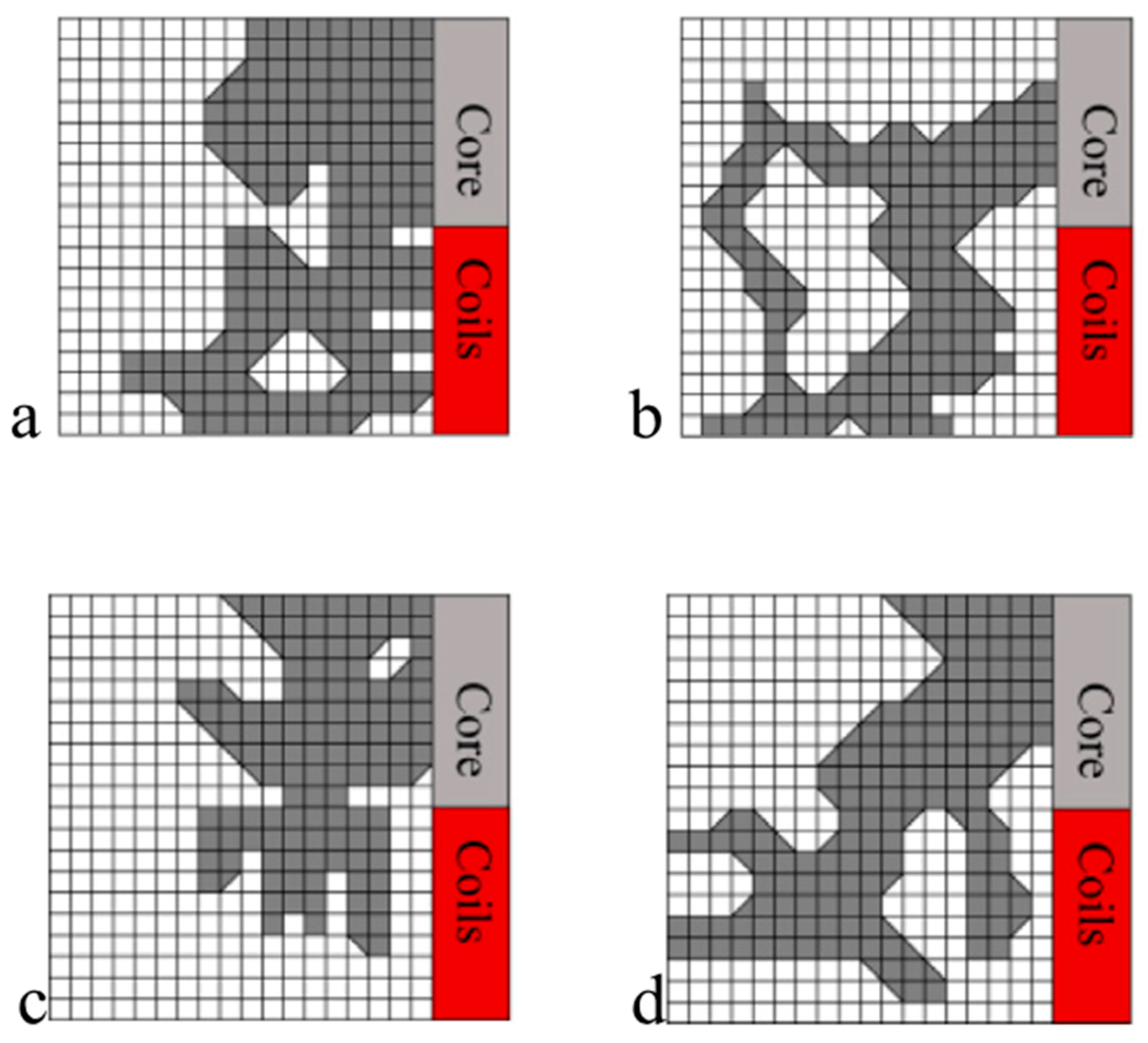
As mentioned in Ref. [24], a novel end topology optimization method based on grid-level ON/OFF inverse design is proposed for PMLSMs. The end design domain is discretized into binary elements, with Genetic Algorithm (GA) or Immune Algorithm (IA) evolving optimal topologies via initialization, crossover, and maturation. Semi-material filling smooths boundaries for manufacturability. Typical optimal end topologies generated by this method are illustrated in the following figures. Results (Figure 4) demonstrate that in various PMLSM configurations, detent force is reduced by over 85%, with average thrust variation less than 1%.
Reference [25] proposes minimizing detent force in short-stator PMLSMs using the finite element method (FEM). Detent force, from slotting and finite core length, is the sum of magnetic forces at stator edges. FEM simulations reveal their phase difference, enabling cancellation by adjusting stator length. Smooth edge shapes further reduce ripple. The technique, applied to a single model, successfully minimizes detent force without multiple tests, as validated by computed results.
Zhu et al. [13] propose attaching auxiliary poles to the ends of the mover in a PMLSM to reduce the end effect of detent force. Using 2D FEM, the authors study how auxiliary pole dimensions and positioning impact detent force. Optimal design significantly minimizes the peak detent force without affecting electromagnetic thrust or flux distribution. FEM simulations match experimental results, confirming the method’s effectiveness.
To effectively suppress the dominant end effect force in double-sided inset PM flat linear brushless motors, a new technique using stepped end blocks in the slotless stator has been proposed in reference [26]. This method optimizes the end block geometry through two-dimensional analytical formulas, which allows for the precise adjustment of lamination width and length to minimize magnetic interactions at the finite stator ends. Experimental validation on an adjustable slotless model confirmed a significant reduction in end effect components with minimal impact on average thrust, where the change is less than one percent. This thereby improves low-speed stability and achieves efficient overall detent force suppression when combined with complementary methods such as phase shifting between the upper and lower stator slots.

3.4. Topological Innovations

Topological innovations involve a fundamental reconfiguration of the motor’s physical structure and magnetic flux paths. This category targets the root causes of thrust ripples by eliminating specific electromagnetic interaction mechanisms entirely—such as removing the iron core to eradicate cogging force—or by restructuring the stator/mover into modular units to achieve harmonic cancellation through geometric periodicity. These methods often require a trade-off between ripple suppression and thrust density but offer the highest potential for theoretical zero-ripple performance.
The ironless structure mentioned in [27] offers significant advantages, including zero cogging effect, high dynamic response, low thermal loss, absence of hysteresis, uniform magnetic field distribution, and reduced operational noise, making it suitable for high-precision, low-noise, and high-dynamic-performance applications. Although its power density is lower than that of traditional iron-core structures, these core advantages make it an indispensable choice in specific scenarios. Furthermore, the ironless design simplifies magnetic field analysis and control algorithm design. Combined with a fixed central shaft and sleeve protection design, it enhances motor installation stability and operational precision, making it adaptable for high-load applications.
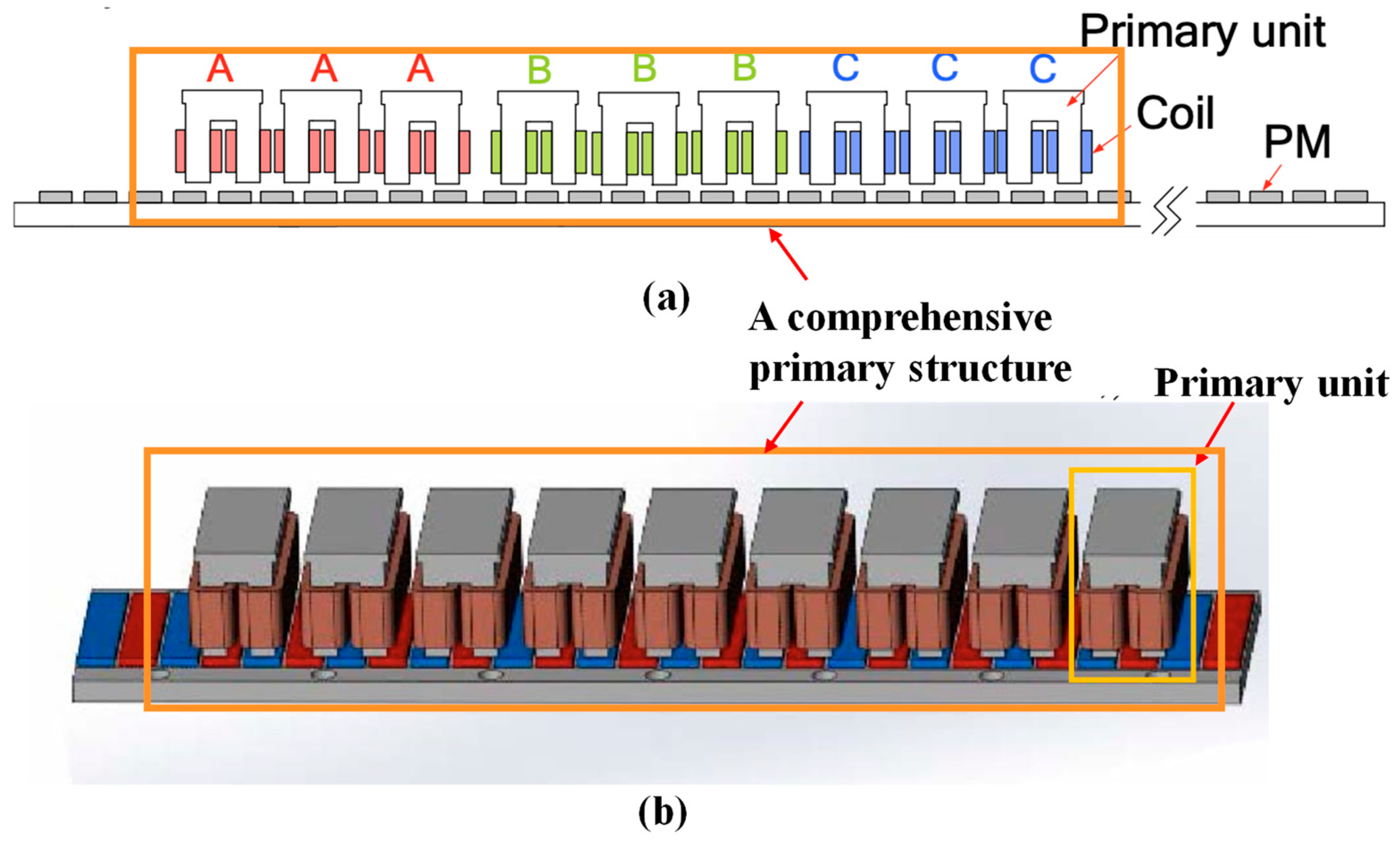
References [21,28,29] highlight that modular primary design offers significant advantages in PMLSM systems, including a substantial reduction in thrust ripple and detent force, which enhances precision position control performance. The core mechanism relies on intentional spatial shifting and segmentation of the primary or mover to achieve harmonic cancellation and magnetic decoupling. Specifically, the primary is divided into multiple identical modules, such as two mover cores with a 60-degree electrical offset, as shown in [21]. As shown in Figure 5, the dispersed primary units form multiple ends within each phase group, as described in [29]. This configuration causes the detent force components of each module, including end effects and slotting effects, to exhibit a 120-degree electrical phase difference among the three phases.
Consequently, most harmonic orders other than multiples of three mutually cancel out, resulting in a near-zero net detent force. Furthermore, introducing a modular regulation structure with flux barriers into the segmented primary alongside alternate coil winding as detailed in [27] can suppress ripples originating from armature current or voltage harmonics and end effects while simultaneously achieving magnetic decoupling between phases through the air gap. These designs also allow for a fifty percent reduction in PM usage, such as through consequent pole structures, which lowers costs and facilitates mechanical separation for improved manufacturing flexibility. Moreover, they maintain excellent thrust linearity and minimal ripple characteristics across various load conditions.
The generation mechanisms and harmonic characteristics of thrust ripple in moving-magnet PMLSMs were investigated in [30]. A multi-secondary topology based on an independent-coil structure is proposed to suppress cogging force, end force, and electromagnetic force fluctuations simultaneously. Experimental results demonstrate that the proposed motor reduces detent force by 84% and electromagnetic force fluctuation by 93.4%, validating its effectiveness for high-precision linear motion applications.
Each method targets specific ripple sources and offers varying degrees of suppression efficacy, but they also introduce potential drawbacks in terms of manufacturing complexity, thrust density impact, and applicability to different motor configurations. It should be noted that the studies reviewed in this paper involve substantially different test conditions, including rated thrust levels, machine dimensions, pole–slot combinations, excitation methods, and evaluation metrics. Consequently, the reported thrust ripple values and reduction ratios are not strictly comparable across references. The quantitative data presented herein are therefore intended to illustrate methodological tendencies and relative suppression capabilities rather than absolute performance rankings. PM optimizations excel in enhancing flux sinusoidality but may increase material costs; stator/core modifications provide robust cogging reduction with minimal thrust loss yet require precise machining; end-effect mitigations are highly effective for finite-length issues but can complicate assembly; and topological innovations offer fundamental ripple elimination at the expense of power density or scalability. Overall, as summarized in Table 1 and Table 2, the choice depends on application-specific priorities, such as precision level, cost constraints, and operational environment, often favouring combinations for optimal performance.

4. Combinations of Structural Optimizations and Their Efficacy

Structural optimization techniques may be implemented either individually or in combination to mitigate thrust ripple in PMLSMs, and in practical systems, they are often coordinated with advanced control strategies. While combining multiple structural approaches is intuitively attractive, their effectiveness largely depends on the ability to effectively control different electromagnetic mechanisms and avoid significant overlap. Existing research mainly focuses on the combination of structural optimization and algorithmic optimization, while systematic quantitative studies on the synergistic effects of combined structural optimization remain relatively scarce [31]. Therefore, the effectiveness of multi-structural combinations remains highly case-dependent and requires detailed electromagnetic interpretation.
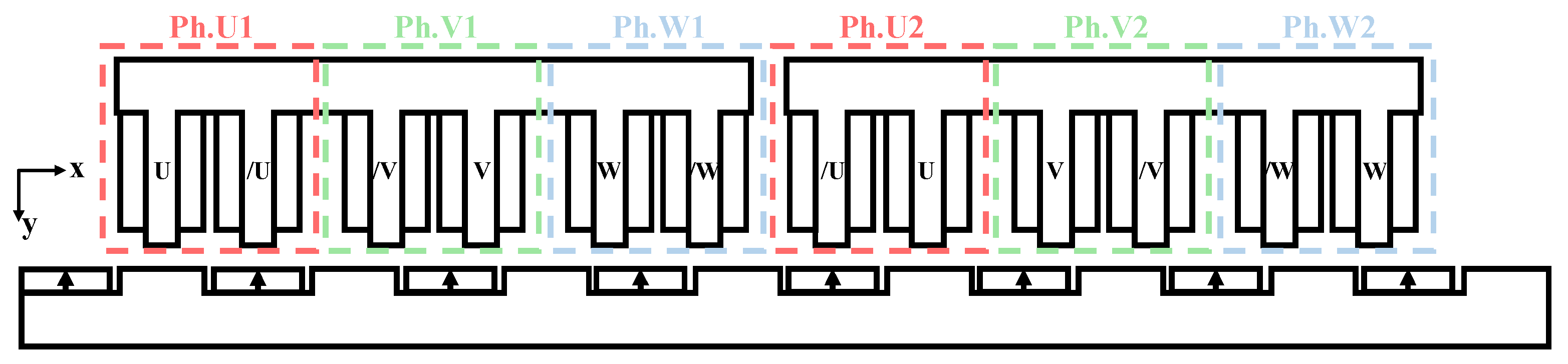
To meet the high-precision positioning demands of the DSPMLSM, in [21], Chung et al. proposed three synergistic structural optimizations grounded in the phase superposition and cancellation mechanism of detent-force-related space harmonics (shown in Figure 6). First, a modular complementary primary structure is employed where the primary is divided into multiple modules spatially staggered by a selected multiple of the stator pole pitch so that detent force harmonics generated by individual modules exhibit complementary phase relationships and partially cancel each other, with additional flux barriers introduced to modulate the magnetic circuit. Furthermore, a phase-matching topology is adopted to distribute PMs and three-phase windings according to specific pole-pitch relationships, enabling complementary superposition of magnetic field harmonics in the air gap and suppressing dominant detent force components. Finally, permanent-magnet skewing along the motion direction is applied to introduce a continuous spatial phase shift that spreads higher-order detent-force harmonics in the spectral domain, thereby reducing thrust ripple amplitude.
In reference [32], to address the issues of excessive thrust ripple and electromagnetic vibration in the double-sided flux-switching Permanent Magnet linear motor, the author proposes a synergistic structural optimization strategy for the stator. First, the stator slot structure is enhanced by introducing arc fillets to reduce magnetic flux leakage and smooth the flux flow in the cogging region. Furthermore, the stator tooth structure is optimized by introducing rectangular auxiliary slots with dimensions determined through response surface methodology and central composite design to suppress detent force. These combined structural optimizations effectively improve motor performance, as simulation results demonstrate an 11.5% increase in electromagnetic thrust alongside an 11.3% reduction in thrust ripple and a decrease of more than 16% in key electromagnetic vibration indicators.
Yu et al. [33] employ a multi-objective structural parameter optimization framework that combines response surface methodology and the NSGA-II algorithm to suppress cogging torque in surface-mounted PMSMs. This work provides a valuable reference for addressing multi-objective optimization challenges in PMLSMs. By simultaneously optimizing critical geometric parameters such as the pole arc coefficient, slot opening width, and magnet thickness, the optimized design significantly reduced the cogging torque magnitude. The reported results showed a decrease of more than fifty percent compared to the initial design. Furthermore, this approach alleviated torque ripple while maintaining the average electromagnetic torque within a narrow variation range. These findings demonstrate that coordinated geometric parameter optimization can effectively balance ripple suppression and output performance without introducing adverse trade-offs.
Accordingly, an optimized double-sided long-stator PMSLM for cordless elevators was proposed by Lee et al. [34]. The authors employed two-dimensional FEM combined with response surface methodology to minimize the pawl force in the core design. They optimized the PM length, magnet assembly displacement length, and slot length. The pawl force was reduced from 37.7 N to 8.7 N, only 0.07% of the rated thrust of 12,000 N, ensuring smooth operation. Prototype testing validated the results, demonstrating that this high-force-density motor is suitable for multi-car cordless vertical transportation.
However, in actual industrial manufacturing, unavoidable errors in multi-process manufacturing and precision assembly—such as geometric deviations in component dimensions and changes in the magnetization characteristics of PMs—often propagate and accumulate, leading to a significant error superposition effect. These accumulated errors not only reduce the dimensional accuracy and functional performance of the final product but also increase assembly complexity, increase scrap rate, and impair overall quality consistency [35,36].
Manufacturing tolerances significantly affect the practical effectiveness of structural thrust ripple suppression strategies. Many ripple-reduction mechanisms depend on precise harmonic interactions and geometric periodicity, making them inherently sensitive to dimensional and assembly deviations. Structures relying on magnetic-field shaping or phase cancellation, such as skewed magnets or pole-shifted arrays, are particularly tolerance-sensitive, since small geometric errors may disrupt harmonic-cancellation conditions. This behaviour is consistent with classical cogging torque theory, where ripple components arise from the coupling between magnet flux distribution and slot-induced permeance variation [6]. Prior studies have shown that structural parameter deviations, including magnet positioning errors and pole-pitch variations, can markedly alter detent force characteristics and harmonic spectra in permanent-magnet machines and linear motors [24,30]. In contrast, approaches based on geometric averaging or reluctance smoothing, such as auxiliary teeth/slots and edge shaping, generally exhibit greater robustness due to their weaker dependence on strict relationships. These observations indicate that tolerance sensitivity is strongly structure-dependent and should be evaluated alongside electromagnetic performance, especially in high-precision linear motor applications [37].
Given that tolerance sensitivity varies substantially across different structural suppression mechanisms, robustness-oriented optimization frameworks become essential for ensuring consistent performance under manufacturing uncertainties [38]. Conventional ripple-reduction techniques, including pole-arc optimization, skewing, dummy slots, and permanent-magnet shifting, may achieve significant improvements under ideal conditions, yet their effectiveness can degrade in mass production due to unavoidable variations in component dimensions, assembly accuracy, and magnet properties. To address this challenge, robust design methodologies incorporating statistical tolerance analysis have been widely investigated. In particular, approaches integrating the Taguchi method, response surface modelling, and Monte Carlo simulation have been shown to effectively minimize both the expected cogging-related disturbances and their production-induced variance by identifying tolerance-insensitive design variables while explicitly accounting for realistic process capabilities of sub-components [39].
Combinations of multiple structural optimization methods exhibit significant synergistic potential in thrust ripple suppression for PMLSMs. These approaches effectively reduce ripple amplitude and improve average thrust via harmonic cancellation and magnetic circuit modulation. However, their effectiveness is highly case-dependent, with limited systematic quantitative studies, requiring validation through finite element simulations or experiments. In mass production, complex geometries amplify manufacturing and assembly error superposition, causing error propagation, greater assembly difficulty, higher scrap rates, and lower quality consistency. Thus, exclusive reliance on multi-structural combinations may impair robustness to manufacturing tolerances. Future studies should adopt robust optimization frameworks integrating the Taguchi method with response surface methodology to incorporate tolerance sensitivity at the design stage and balance performance gains with production robustness.

5. Discussion on Control-Based Suppression and Practical Impact

While this review primarily focuses on structural optimization, thrust ripple can also be significantly mitigated through advanced control strategies. Control methods, such as harmonic current injection and iterative learning control (ILC), offer a non-invasive way to compensate for residual ripple that structural modifications cannot eliminate [4]. Ideally, structural optimization reduces the “source” of the ripple, thereby lowering the complexity and effort required by the controller.
In terms of practical applications, suppressing thrust ripple is directly linked to enhanced energy efficiency. By minimizing the high-frequency current compensation needed to counteract ripple forces, the motor’s copper loss and thermal dissipation are reduced. This leads to a more energy-efficient operation and extends the mechanical lifespan of the system by reducing vibration-induced wear, which is critical for long-term reliability in industrial metrology.

6. Conclusions and Future Work

Structural optimization is pivotal for suppressing PMLSM thrust ripple in high-precision applications. This analysis demonstrates that while individual primary or PM-side modifications are effective, their independent application often faces performance bottlenecks or compromises in average thrust. The most viable pathway to achieving ultra-low ripple lies in the synergistic combination of multiple techniques, such as optimally coupling magnet shaping with auxiliary poles. However, a critical limitation remains: these combined designs significantly increase geometric complexity, making performance highly sensitive to manufacturing tolerances. Future research must therefore transition from idealized theoretical models to robustness-oriented design. Integrating tolerance-aware frameworks and multi-physics co-design is essential to ensure that precision gains remain resilient and cost-effective under real-world manufacturing constraints.

Funding

This work was mainly supported by Shenzhen Science and Technology Program under the project JCYJ20240813162005007, China; in part by a grant under project ITP/024/25AP from the Innovation and Technology Commission, Hong Kong SAR; and in part by a grant under Carbon Neutrality Funding Scheme project P0056205 from The Hong Kong Polytechnic University, University Grants Committee (UGC), Hong Kong SAR.

Data Availability Statement

No new data were created or analyzed in this study.

Conflicts of Interest

The authors declare no conflict of interest.

References

  1. Bramerdorfer, G.; Tapia, J.A.; Pyrhonen, J.J.; Cavagnino, A. Modern Electrical Machine Design Optimization: Techniques, Trends, and Best Practices. IEEE Trans. Ind. Electron. 2018, 65, 7672–7684. [Google Scholar] [CrossRef]
  2. Kang, K.; Wang, M.; Sun, J.; Zhang, C.; Li, L. Nonlinear Friction Compensation for PMLSM Using an Enhanced Adaptive Friction Observer. IEEE Trans. Ind. Electron. 2024, 71, 16234–16244. [Google Scholar] [CrossRef]
  3. Yang, X.; Zhao, W.; Song, B. Thrust Force Calculation and Analysis for the Permanent Magnet Linear Motor Motion System Considering the Encoder Errors. IEEE Trans. Ind. Electron. 2022, 69, 6069–6079. [Google Scholar] [CrossRef]
  4. Chen, S.; Liu, Y.; Zhang, Q.; Tan, J. Analysis and Suppression of Thrust Ripple in a Permanent Magnet Linear Synchronous Motor—A Review. Energies 2025, 18, 863. [Google Scholar] [CrossRef]
  5. Wang, X.; Chen, F.; Zhu, R.; Huang, X.; Sang, N.; Yang, G.; Zhang, C. A Review on Disturbance Analysis and Suppression for Permanent Magnet Linear Synchronous Motor. Actuators 2021, 10, 77. [Google Scholar] [CrossRef]
  6. Park, E.-J.; Kim, Y.-J.; Jung, S.-Y. Edge Effect Minimization of Stationary Discontinuous Armature PMLSM Using Skewed Magnets and Stair Shape Auxiliary Teeth. In Proceedings of the 2013 International Conference on Electrical Machines and Systems (ICEMS), Busan, Republic of Korea, 20–23 October 2013; pp. 1958–1961. [Google Scholar] [CrossRef]
  7. Li, T.; Slemon, G. Reduction of Cogging Torque in Permanent Magnet Motors. IEEE Trans. Magn. 1988, 24, 2901–2903. [Google Scholar] [CrossRef]
  8. Huang, R.; Liu, C.; Song, Z.; Zhao, H. Design and Analysis of a Novel Axial-Radial Flux Permanent Magnet Machine with Halbach-Array Permanent Magnets. Energies 2021, 14, 3639. [Google Scholar] [CrossRef]
  9. Sohel, R.M.; Shen, Y.; Ji, R.; Liu, K. Design and Analysis of Low-Speed External Frame Motors with Halbach-Type and Olive-Shaped Magnet Structures. World Electr. Veh. J. 2025, 16, 350. [Google Scholar] [CrossRef]
  10. Parveziqbal, A.K.M.; Mokhtar, F.A.M.; Sahari, K.S.M.; Aris, I. A Review of Permanent Magnet Linear Motor with Halbach Array. J. Eng. Appl. Sci. 2016, 11, 1752–1761. [Google Scholar]
  11. Oljidiarn, G. Ironcore or Ironless: A Comparison of Linear Motors for H-Drives. Master’s Thesis, Eindhoven University of Technology (TU/e), Eindhoven, The Netherlands, 2006. [Google Scholar]
  12. Song, Z.; Liu, C.; Zhao, H. Comparative Analysis of Slotless and Coreless Permanent Magnet Synchronous Machines for Electric Aircraft Propulsion. In Proceedings of the 2019 22nd International Conference on Electrical Machines and Systems (ICEMS), Harbin, China, 11–14 August 2019; pp. 1–6. [Google Scholar] [CrossRef]
  13. Zhu, Y.-W.; Lee, S.-G.; Chung, K.-S.; Cho, Y.-H. Investigation of Auxiliary Poles Design Criteria on Reduction of End Effect of Detent Force for PMLSM. IEEE Trans. Magn. 2009, 45, 2863–2866. [Google Scholar] [CrossRef]
  14. Xu, X.; Jia, L.; Jiang, S.; Feng, H. Mover Structure Optimization and Performance Improvement for Halbach Consequent-Pole PM Synchronous Linear Motors with Flux Barrier. J. Magn. Magn. Mater. 2024, 591, 171692. [Google Scholar] [CrossRef]
  15. Xu, X.; Sun, Z.; Du, B.; Ai, L. Pole Optimization and Thrust Ripple Suppression of New Halbach Consequent-Pole PMLSM for Ropeless Elevator Propulsion. IEEE Access 2020, 8, 62042–62052. [Google Scholar] [CrossRef]
  16. Yoon, J.Y.; Lang, J.H.; Trumper, D.L. Double-Sided Linear Iron-Core Fine-Tooth Motor for Low Acoustic Noise and High Acceleration. IEEE/ASME Trans. Mechatron. 2019, 24, 2161–2170. [Google Scholar] [CrossRef]
  17. Dover Motion. Precision Motion Stages for Semiconductor Applications. Available online: https://dovermotion.com/applications-capabilities/precision-motion-stages-for-semiconductor-applications (accessed on 2 January 2026).
  18. Gaukler, M.; Roppenecker, G.; Ulbrich, P. Details and Proofs for: Stability Analysis of Multivariable Digital Control Systems with Uncertain Timing. arXiv 2019, arXiv:1911.02537. [Google Scholar] [CrossRef]
  19. Mao, Y.; Sun, Z.; Huang, C.; Jia, G.; Ding, A. Electromagnetic Characteristics Analysis of a Novel Ironless Double-Sided Halbach Permanent Magnet Synchronous Linear Motor for Electromagnetic Launch Considering Longitudinal End Effect. IEEE Trans. Transp. Electrif. 2024, 10, 7467–7477. [Google Scholar] [CrossRef]
  20. Tavana, N.R.; Shoulaie, A. Pole-Shape Optimization of Permanent-Magnet Linear Synchronous Motor for Reduction of Thrust Ripple. Energy Convers. Manag. 2011, 52, 349–354. [Google Scholar] [CrossRef]
  21. Chung, S.-U.; Kim, J.-W.; Woo, B.-C.; Hong, D.-K.; Lee, J.-Y.; Chun, Y.-D.; Koo, D.-H. Design and experimental validation of doubly salient permanent magnet linear synchronous motor for precision position control. Mechatronics 2013, 23, 172–181. [Google Scholar] [CrossRef]
  22. Lan, Z.; Chen, L.; Xiao, X.; Luo, Y.; Deng, M.; Zhu, S. Detent Force Suppression of Permanent Magnet Linear Synchronous Motor Based on a V-Shaped Tooth-Slot Structure. IET Electr. Power Appl. 2023, 17, 535–546. [Google Scholar] [CrossRef]
  23. Deng, C.; Ye, C.; Yang, J.; Sun, S.; Yu, D. A Novel Permanent Magnet Linear Motor for the Application of Electromagnetic Launch System. IEEE Trans. Appl. Supercond. 2020, 30, 4902005. [Google Scholar] [CrossRef]
  24. Sun, Z.; Xu, X.; Watanabe, K. Minimizing Detent Force of Permanent Magnet Linear Synchronous Machines by Designing Mover Using Mesh-Level Stochastic Shaping. Energy Rep. 2023, 9, 859–869. [Google Scholar] [CrossRef]
  25. Inoue, M.; Sato, K. An Approach to a Suitable Stator Length for Minimizing the Detent Force of Permanent Magnet Linear Synchronous Motors. IEEE Trans. Magn. 2000, 36, 1890–1893. [Google Scholar] [CrossRef]
  26. Kwon, Y.-S.; Kim, W. Detent-Force Minimization of Double-Sided Interior Permanent-Magnet Flat Linear Brushless Motor. IEEE Trans. Magn. 2016, 52, 1–9. [Google Scholar] [CrossRef]
  27. Shao, W.; Xing, P.; Deng, B.; Liu, C.; Liu, Y.; Zhao, H.; Peng, Y. Electromagnetic Analysis and Experimental Validation of an Ironless Tubular Permanent Magnet Synchronous Linear Motor. Symmetry 2025, 17, 1480. [Google Scholar] [CrossRef]
  28. Huang, X.; Liang, J.; Zhou, B.; Zhang, C.; Li, L.; Gerada, D. Suppressing the Thrust Ripple of the Consequent-Pole Permanent Magnet Linear Synchronous Motor by Two-Step Design. IEEE Access 2018, 6, 32935–32944. [Google Scholar] [CrossRef]
  29. Bai, Y.; Yang, T.; Kou, B. Reducing Detent Force and Three-Phase Magnetic Paths Unbalance of PM Linear Synchronous Motor Using Modular Primary Iron-Core Structure. In Proceedings of the 2014 17th International Conference on Electrical Machines and Systems (ICEMS), Hangzhou, China, 22–25 October 2014; pp. 1743–1748. [Google Scholar] [CrossRef]
  30. Sun, Q.; Wang, M.; Liu, M.; Zhang, C.; Li, L. Thrust Ripple Suppression Analysis of Moving-Magnet-Type Linear Synchronous Motor Based on Independent Coil. Precis. Eng. 2024, 91, 223–232. [Google Scholar] [CrossRef]
  31. Wang, M.; Li, L.; Yang, R. Overview of Thrust Ripple Suppression Technique for Linear Motors. Chin. J. Electr. Eng. 2016, 2, 77–84. [Google Scholar] [CrossRef]
  32. Du, H.C.W. The Suppression of Thrust Ripple and Electromagnetic Vibration in A Double-Sided Flux Switching Permanent Magnet Linear Motor by Optimizing the Stator Structure. Fuel Cells Bull. 2025, 2025, 1–13. [Google Scholar] [CrossRef]
  33. Yu, Y.; Pan, Y.; Chen, Q.; Zeng, D.; Hu, Y.; Goh, H.-H.; Niu, S.; Zhao, Z. Cogging Torque Minimization of Surface-Mounted Permanent Magnet Synchronous Motor Based on RSM and NSGA-II. Actuators 2022, 11, 379. [Google Scholar] [CrossRef]
  34. Lee, S.-G.; Kim, S.-A.; Saha, S.; Zhu, Y.-W.; Cho, Y.-H. Optimal Structure Design for Minimizing Detent Force of PMLSM for a Ropeless Elevator. IEEE Trans. Magn. 2014, 50, 4001104. [Google Scholar] [CrossRef]
  35. Li, C.; Li, L. An Analytical Framework for Error Propagation Effects in Multiprocess Manufacturing. Math. Probl. Eng. 2023, 2023, 2769757. [Google Scholar] [CrossRef]
  36. Liu, X.; Zheng, L.; Wang, Y.; Yang, W.; Wang, B.; Liu, B. Assembly Error Modeling and Tolerance Dynamic Allocation of Large-Scale Space Deployable Mechanism toward Service Performance. Appl. Sci. 2023, 13, 4999. [Google Scholar] [CrossRef]
  37. Islam, M.S.; Mir, S.; Sebastian, T. Issues in Reducing the Cogging Torque of Mass-Produced Permanent-Magnet Brushless DC Motor. IEEE Trans. Ind. Appl. 2004, 40, 813–820. [Google Scholar] [CrossRef]
  38. Wang, M.; Li, L.; Pan, D. Detent Force Compensation for PMLSM Systems Based on Structural Design and Control Method Combination. IEEE Trans. Ind. Electron. 2015, 62, 6845–6854. [Google Scholar] [CrossRef]
  39. Lee, B.-H.; Jung, J.-W. Robust Design for Reducing Cogging Torque in Surface-Mounted Permanent Magnet Synchronous Motor Considering Tolerances of Sub-Components. IET Electr. Power Appl. 2020, 14, 448–456. [Google Scholar] [CrossRef]
Figure 1. Schematic diagrams of thrust ripple generation mechanisms in PMLSMs: (a) cogging force due to slot–magnet interaction; (b) end force due to finite-length effects [4].
Energies 19 01243 g001
Figure 2. Schematic of Halbach PM array structures in PMLSMs: (ac) cross-sectional comparison of SP-PMLSM (conventional single-polarity), CP-PMLSM (consequent-pole), and proposed HCP-PMLSM (Halbach consequent-pole with alternating magnetization) [15].
Energies 19 01243 g002
Figure 3. The 3D and discretization models of a V-shaped tooth-slot PMLSM, showing its components and iron core parameters [22]: (a) 3D view; (b) 2D top view.
Energies 19 01243 g003
Figure 4. Optimal left-hand auxiliary end topologies generated by the ON/OFF method with GA and IA: (a) GA-optimized for 3s4p PMLSM, (b) IA-optimized for 3s4p PMLSM, (c) GA-optimized for 6s7p PMLSM, and (d) IA-optimized for 6s7p PMLSM [24].
Energies 19 01243 g004
Figure 5. (a,b) The structure of the DSPMLSM [29]: (a) a schematic of the primary unit (with A/B/C-phase coils) and the PM array; (b) the 3D structural model of the motor.
Energies 19 01243 g005
Figure 6. Structural configuration and phase arrangement of the DSPMLSM, showing the spatial distribution of U-, V-, and W-phase windings for Mover A and Mover B [21].
Energies 19 01243 g006
Table 1. Comparative analysis of the structural optimization methods for thrust ripple suppression.
Method CategoryAdvantagesDisadvantages
Permanent Magnet (PM) Optimization
  • Improves air-gap flux sinusoidality for 40–90% ripple reduction
  • Enhances thrust density (e.g., Halbach arrays reduce PM usage by 20–30% while maintaining air-gap flux density)
  • Low energy/computational overhead
  • Increases manufacturing complexity (e.g., skewing or shaping PMs)
  • Potential minor thrust loss (5–10%)
  • Higher material costs for advanced arrays
Stator/Core Modifications
  • Effective cogging suppression (55–80%, up to ~95% in optimized cases)
  • Maintains average thrust; slight improvement reported in some designs
  • Requires high-precision machining, raising costs
  • May introduce minor normal force imbalances
  • Less effective against end effects alone
End-Effect Mitigation
  • High detent force reduction (>85% in well-optimized designs)
  • Minimal impact on average thrust (<1% variation)
  • Improves low-speed stability
  • Adds assembly complexity (e.g., auxiliary poles or GA/IA optimization)
  • Limited to finite-length issues; not comprehensive for all ripple sources
  • Potential for unintended flux asymmetries if not optimized
Topological Innovations
  • Near-elimination of cogging (e.g., ironless: ~0% cogging)
  • Reduces costs via modularization
  • Enhances overall precision and noise reduction
  • Lower power density (10–20% loss in ironless designs), increased structural complexity, and scalability challenges
  • May require redesign of entire motor system
Table 2. Summary of structural optimization methods table.
Ref.TargetOptimization MethodKey Results/Findings
[5]Harmonic content in detent forcePM skewing with optimized skew lengthHigh-order harmonics (4th, 6th, 8th) reduced by 55.7%, 93%, 79.5%
[15]Air-gap flux harmonics, leakageHCP array + pole optimization + double-sided pole shiftThrust ripple 0.87%, average thrust 2499 N, PM usage ↓ 27.6% *
[16]Cogging + normal force harmonicsSkewed moving Halbach magnet array in double-sided symmetric fine-tooth structure95% lower acoustic noise, supports 8.2 G acceleration, significant ripple reduction
[20]Thrust ripple in ironless designIronless double-sided Halbach array + C-shaped windingsThrust ripple 0.8%, average thrust 8.3 kN
[21]Thrust ripple from pole shapeParameterized arc-shaped PM pole optimization (minimize NTTR)Very low normalized total thrust ripple (NTTR), back-EMF harmonics significantly reduced
[22]Detent force & thrust fluctuationOptimized PM placement + salient-pole geometry (doubly salient PMLSM)Markedly smoother thrust waveforms, improved low-speed stability, and positioning accuracy
[23]Tooth-slot effect + end effectV-shaped tooth-slot structure (equivalent to combined helical teeth)Thrust ripple ≈3.3%, average thrust ↑ ≈3%, reduced normal force *
[24]Detent force, thrust ripple, PM usageDouble-sided consequent-pole stator + optimized mover structureDetent force 158.5 N → 55.2 N, ripple 22.9% → 10.9%, PM consumption ↓ 43.3–50% *
[25]End-effect detent forceGrid-level ON/OFF inverse topology optimization (GA/IA) at stator endsDetent force ↓ >85%, average thrust variation <1%*
[13]Slotting + end-effect detent forceStator length adjustment + smooth edge shaping (FEM-based cancellation)Detent force effectively minimized
[26]End-effect detent forceOptimized auxiliary poles attached to mover endsPeak detent force significantly minimized, no impact on thrust or flux distribution
[27]End-effect in slotless double-sidedStepped end blocks with optimized lamination geometryEnd-effect components significantly reduced, thrust change <1%
[28]Cogging force (root cause)Ironless core structureZero cogging force, uniform field, low noise, high dynamic response
[29]Detent force & thrust rippleModular primary with spatial shifting/segmentationSubstantial reduction in ripple and detent force
[30]Detent force (slot + end effects)Dispersed/modular primary with 120° electrical phase offset among modulesNear-zero net detent force
[31]Cogging, end force, EM fluctuationIndependent-coil multi-secondary topology (moving-magnet)Detent force ↓ 84%, electromagnetic force fluctuation ↓ 93.4% *
* ↑: Increased by; ↓: Decreased by; →: Changed to.
Disclaimer/Publisher’s Note: The statements, opinions and data contained in all publications are solely those of the individual author(s) and contributor(s) and not of MDPI and/or the editor(s). MDPI and/or the editor(s) disclaim responsibility for any injury to people or property resulting from any ideas, methods, instructions or products referred to in the content.