1. Introduction
The dynamic development of contemporary logistics systems and the pressure to shorten order fulfilment cycles [
1] foster the search for solutions [
2] that enhance the efficiency of warehouse space utilisation and improve material flow [
3]. Gravity flow racks, owing to their straightforward design, high reliability, and the ability to sequence pallets according to the FIFO principle without the use of IT systems, constitute a common element of material-handling equipment (MHE) infrastructure in logistics centres [
4,
5]. Gravity flow racks are also employed in Just-in-Time (JIT) production systems [
6], particularly in processes supplying production cells. Gravity flow racks are increasingly deployed in modern high-bay automated storage and retrieval systems (AS/RS). Simultaneously, energy efficiency is becoming a key priority in the design of such systems [
7]. This has been enabled by the growing integration of gravity flow racks with intelligent control systems, which broadens their range of applications and necessitates a more advanced approach to their design and operational assessment [
8,
9].
Based on practical experience, it has been observed that optimisation efforts to date in the field of gravity flow racks have largely been limited to reducing their mass (i.e., the amount of steel used in the rack structure), which directly affects rack cost. As this approach has proved insufficient, the optimisation process for gravity flow racks has expanded to include mathematical and simulation-based modelling, analysis of flow parameters, safety considerations, and the dynamics of pallet motion within gravity flow racks [
10]. The outcome of these efforts is the assurance of appropriate pallet velocities and motion dynamics as well as effective and precise braking systems and motion stability mechanisms within the rack [
11].
Existing literature extensively covers energy recovery in active components of AS/RS, such as regenerative braking in stacker cranes and shuttle systems [
12]. However, despite the growing interest in sustainable logistics, there remains a lack of comprehensive studies that specifically model and validate the energy performance of gravity flow racks with integrated energy recovery capabilities.
To the best of the authors’ knowledge, standard commercial storage rack solutions do not feature energy recovery systems that allow for controlled pallet dynamics in both LIFO and FIFO queuing modes. While individual components (like braking rollers) exist, the specific integration of a lift mechanism for energy recovery in a gravity flow rack has not been widely reported in the literature or industrial databases.
The subsequent sections of this paper describe the research activities and scientific work that led to the invention and patenting of a gravity flow rack characterised by both energy recovery and the generation of a positive energy balance over a complete operational cycle. The research comprised an integrated methodology, ranging from analysis of the flow concept, through numerical modelling using simulations in the MSC Adams and TIA Portal environments, to validation of a physical prototype under laboratory (TRL-3) and operational (TRL-5) conditions. This made it possible to evaluate pallet motion dynamics and the energy consumption of the gravity flow rack, taking into account the balance of energy generated and consumed in real FIFO and LIFO operating sequences.
The scientific novelty of the proposed solution is expressed in three interrelated areas: (i) the proposed gravity flow rack design enables the simultaneous handling of FIFO and LIFO sequences while operating with a positive energy balance, representing a breakthrough in the design of storage systems that use gravity as an energy carrier; (ii) the presented energy model allows the assessment of energy recovery potential at both the individual cycle level and the level of the entire system operating under high flow intensity conditions; and (iii) the introduced REPI indicator is the first proposed comparative metric of energy efficiency for storage racks, which may serve as a tool for evaluating storage technologies in rack-based systems in the context of the development of passive and energy-positive warehouses [
13,
14].
The subsequent sections of this paper explain the concept of the gravity flow rack with energy recovery, review the state of the art in the literature, present the energy consumption model, discuss the research results, and outline directions for further work.
2. Concept of the Energy-Recovering Gravity Rack with a Generative Output Level
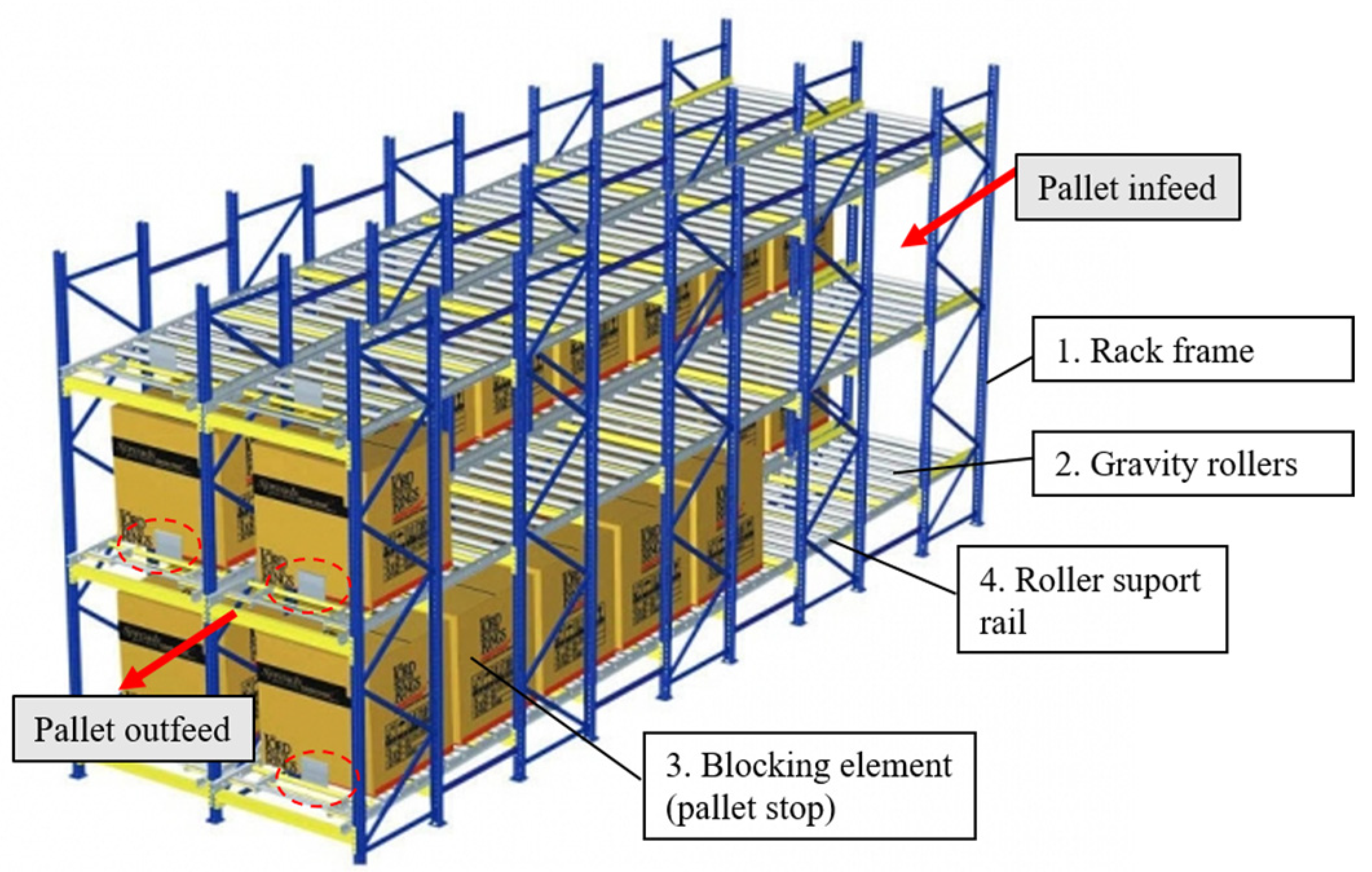
A conventional gravity flow rack is shown in
Figure 1. The red arrow indicates the direction of pallet movement (only in the direction of the arrow). The rolling elements (2) of the rack are arranged so as to form a surface inclined at a specified angle. This surface is designed such that the pallet moves from the infeed to the outfeed of the rack. In the final stage of motion, the pallet is decelerated by a dedicated mechanism in order to minimise the adverse effects of pallet-to-pallet impacts [
15].
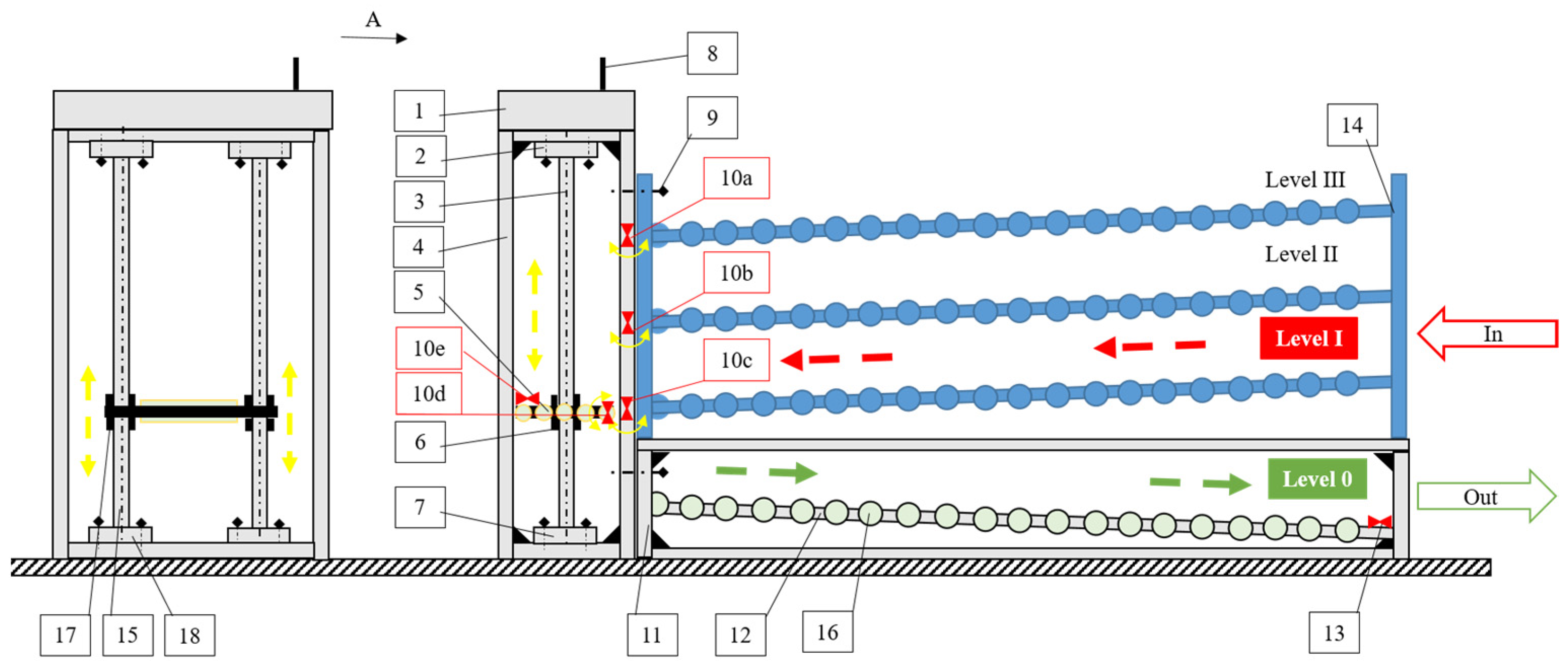
The energy of the pallet is dissipated or converted into heat. The essence of the innovation lies in recovering this energy and reusing it. To this end, a design that can cooperate with conventional racks to adapt them for energy recovery has been developed. The mechanism of operation, protected by intellectual property rights, is illustrated in
Figure 2.
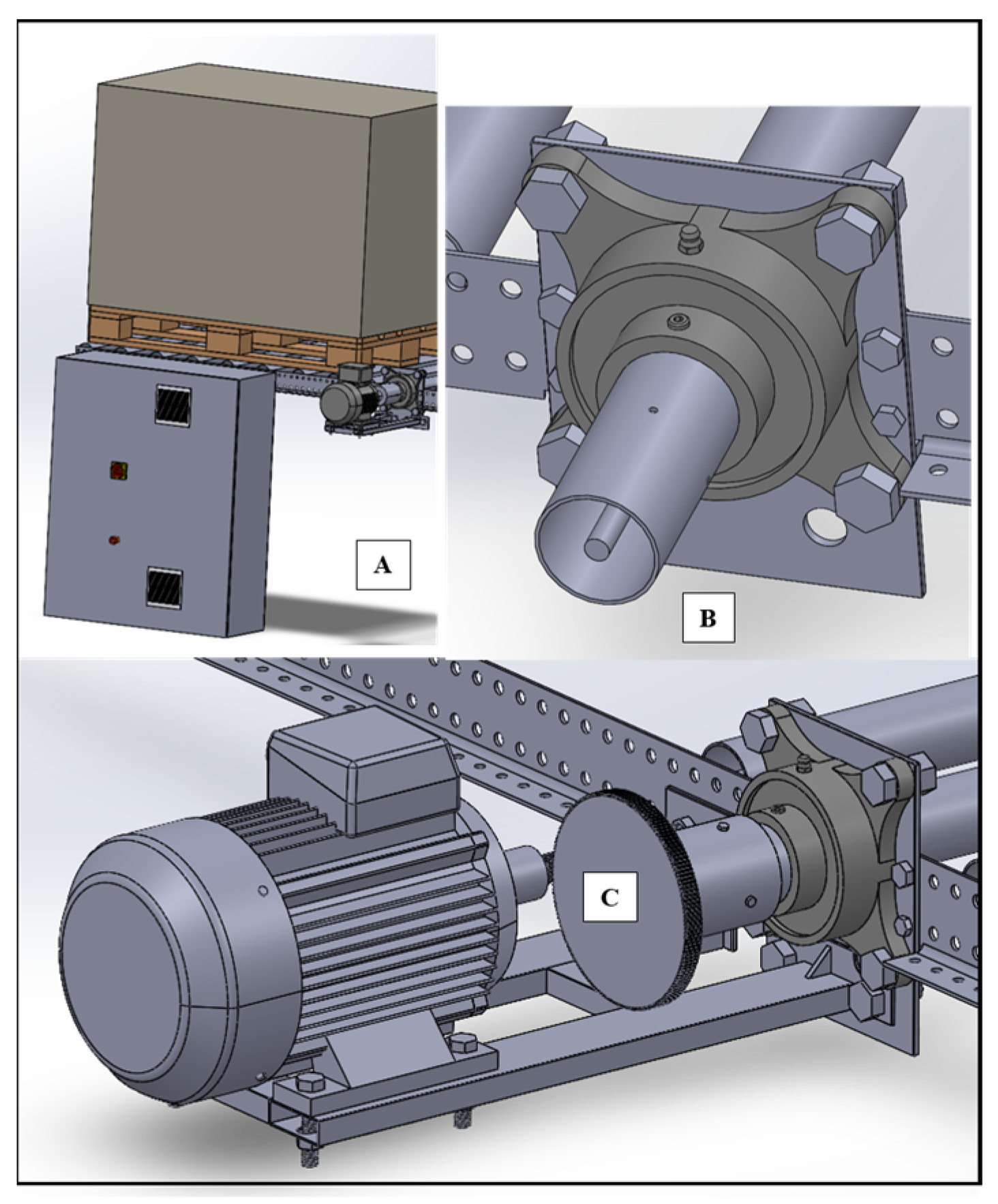
The first pallet placed in the gravity flow rack 14 rolls along the floor rollers due to the inclination towards the lock 10c (direction indicated by the red arrow). The same applies to the subsequent pallet. When a pallet is to be retrieved from the rack, the intermediate table (the lift working table) 5, using the drive assemblies 7 and 18 and controlled via the control cabinet 1 (which houses the user interface: control buttons), moves the pallet from the parking position at level 0 to level I. Next, in automatic mode, the lock 10c (optionally 10a or 10b) is switched to the open position, allowing a single pallet to move onto the intermediate table (element 5 in
Figure 2) under the action of gravity. The lock 10d on the intermediate platform (5) is then closed. As soon as the pallet or crate reaches the intermediate platform (5) and contacts the fixed lock 10e, lock 10d is switched to the closed position. Once the pallet or crate is entirely on the intermediate platform (5), lock 10c is returned to the closed position.
This configuration allows the intermediate platform (5) together with the pallet to be moved using the two ball screws 3 and 15, connected to the table via the ball nuts 6 and 17 with motion locks. The intermediate table consists of standard electrically driven shafts, controlled from the cabinet 1.
The integration of the Vertical Transfer Unit (lift) is a strategic design choice that offers advantages beyond simple storage. First, it functions as the primary energy recuperator, capturing potential energy that is otherwise dissipated as heat in conventional braking rollers. Second, it enables the system to operate in both LIFO and FIFO modes, offering flexibility unavailable in standard gravity racks. Third, and most importantly for facility planning, the lift reduces the need for multiple external transport aisles. By handling vertical displacement internally, the system minimizes the floor space dedicated to forklift manoeuvring (turning radius plus clearance), thereby maximizing the warehouse area utilization ratio.
The lowering of the pallet or crate together with the intermediate platform (5) is driven by gravity. The weight force, dependent on the pallet mass, induces rotation of the ball screws 3 and 15 (2pcs). The load of the pallet forces the ball screws (No. 1 and No. 2; 3 and 15) to rotate, which, through a gearbox connected to the asynchronous motor, causes the electric motors 7 and 18 (corresponding to ball screws No. 1 and No. 2) to operate in generator mode. Energy production, understood as recovery, continues until the intermediate platform (5) (with the pallet) reaches the level of the floor 12. The recovered energy can alternatively be stored in the accumulator (supercapacitor) batteries installed in the control cabinet 1 or fed into the power grid.
Once the intermediate platform (5) reaches the level of the movable floor 12, the lock 10d on the intermediate platform (5) is released, allowing the pallet to be transferred onto the movable floor 12 using electrically driven rollers (a standard module typically used in rack construction). The roller drive is automatically switched off after the pallet has been transferred onto the movable floor 12.
The pallet on the element 12 moves (as indicated by the green arrows in
Figure 2) until it reaches the end stop 13. The movable floor 12 is equipped with standard powered rollers 16 capable of operating in generator mode, which provide energy recovery. Energy production, understood as recovery, continues until the pallet reaches the lock 13.
The intermediate platform (5) remains in the “Level 0” position, which serves as its parking location. The next pallet retrieval process begins with moving the intermediate platform (5) to the appropriate level (in this case: Level 1, Level 2, or Level 3).
The recovered energy is the sum of the energy generated during the movement of the pallet at the storage level (1 to 3), during the lowering of the pallet onto the intermediate platform (5), and during the transfer of the pallet at level 0 (
Figure 2, elements 12 and 13). The following section presents a review of the most recent literature, which, in its extended version including a patent survey, is provided in reference [
16].
3. Literature Review and Research Gap in Energy Performance of Storage Racks
A gravity flow rack is a device for pallet storage in the Supply Chain Management (SCM), particularly in distribution and production subsystems. During the storage process, a pallet moves autonomously within the rack under the influence of gravity. Each time a pallet is removed from a storage level, neighbouring pallets move under the influence of gravity so that they sequentially fill the space vacated by the removed pallet. The device used for placing and retrieving pallets from the rack is not integrated with the rack itself. It can be any piece of material-handling equipment (MHE), such as a forklift. The points for pallet placement (In) and pallet retrieval (Out) are located on parallel surfaces of the rack and perpendicular to the warehouse floor. The inclination angle of the storage surface relative to the warehouse floor—depending on the mass and impact resistance of the pallet—typically ranges from . In practice, solutions are designed individually for specific conditions, based on analyses of the number and intensity of braking devices and the inclination angle. The basic parameters of a gravity flow rack include: rack length (number of pallets per storage level), number of storage levels, slope of the storage level, and shaft parameters. Shafts, mounted on the rack frame, form the storage surface. Key shaft characteristics include diameter, length, strength, type of bearing, and material (e.g., steel, stainless steel, or polymer), all of which affect pallet rolling resistance.
The design of the Vertical Transfer Unit differs from standard commercial solutions primarily in its mass optimization for energy recovery. While typical lift tables in AS/RS applications have a mass exceeding 120 kg, the proposed unit was engineered to achieve a mass of approximately 70 kg. This reduction directly improves the net energy balance by minimizing consumption during the empty upward return phase. The structural integrity and safety of this lightweight design have been verified and certified by the Office of Technical Inspection (UDT), allowing for its deployment in operational industrial environments.
The FIFO queuing model is characteristic of a typical gravity flow rack and simultaneously exhibits the highest utilisation factor commonly used in logistics—warehouse space occupancy (~0.9). Recent publications assessing progress in this area emphasise both achievements and ongoing challenges in the field [
17].
Research studies address technologies for energy recovery, including regenerative braking, hydraulic accumulators, flywheel systems, as well as piezoelectric and hybrid solutions [
1,
2,
3,
10,
18,
19,
20]. These mechanisms exploit the kinetic and potential energy generated during pallet movement, particularly in the braking phase. Scientific studies highlight that energy recovery efficiency is closely linked to rack design and control strategies, including the selection of storage locations and the relationship between load mass and system geometry [
1,
18]. The rapid development of piezoelectric materials, such as lead-free ceramics, nanomaterials, and flexible polymers, expands the range of possible applications, although most of these solutions remain at the laboratory research stage [
11,
13,
15,
21,
22].
An important area of analysis concerns control strategies and optimisation methods that allow energy consumption in gravity flow racks to be minimised. The literature discusses pallet placement strategies based on energy criteria as well as approaches based on dynamic programming and advanced sequencing methods, which outperform static solutions in terms of operational efficiency [
23,
24,
25]. The use of complex cycles (as opposed to simple cycles), in which placing and retrieval tasks are carried out within a single working cycle of the material-handling device, reduces both the distance (in metres) and time (in seconds) of storage processes, thereby decreasing energy consumption [
26,
27]. Simultaneously, multi-criteria methods, including genetic algorithms and constraint programming, are employed to enable simultaneous assessment of costs, operation times, and energy [
12,
28].
Significant attention in the scientific literature is devoted to comparisons of electric and hydraulic systems. In stacker cranes, such systems can reduce energy consumption by approximately 15%, whereas in forklifts they can achieve savings of up to 50% [
2,
29,
30]. Flywheel systems, achieving efficiencies above 50%, constitute effective solutions under high load conditions [
20,
30,
31,
32]. Despite their potential, similar solutions are still lacking for palletised gravity flow racks [
31,
32].
Scientific studies have noted that gravity flow racks should be considered in conjunction with energy-related aspects. Equally important are the principles of pallet placement, managed under the WMS, which are more energy-efficient than random assignment of storage locations [
33,
34,
35]. Innovative spatial configurations, such as transverse aisles, are also significant, as they reduce the length of operational routes [
36,
37]. Research on structural stability further demonstrates that the use of rack tunnel reinforcements (where pallets are stored), appropriately designed screw joint geometries, and optimised beam and column parameters significantly improves not only seismic resistance but also the stability of pallet flow operations [
38,
39,
40,
41,
42].
The literature employs a wide range of research tools, including simulation models, numerical analyses, laboratory tests, and techno-economic assessments [
12,
14,
16,
43,
44,
45,
46,
47,
48]. Simulation models dominate due to their ability to reproduce complex dynamic phenomena, although their limitation lies in the scarcity of data from real-world implementations. According to the author, their scientific value is limited, although they certainly provide an interesting educational exercise in engineering modelling [
13]. Increasing importance is attributed to artificial intelligence techniques, which enable predictive maintenance, load monitoring, and real-time optimisation of flows [
49]. Furthermore, research gaps have been identified in the design of hydraulic accumulators, integration of piezoelectric transducers, fatigue and seismic analysis, as well as modelling that accounts for geometric imperfections and second-order effects [
8,
50,
51].
In summary, the literature highlights a research gap concerning the energy consumption of storage racks, including gravity flow racks with energy recovery. Rack design [
52,
53,
54,
55], material properties [
56,
57,
58,
59,
60,
61], and control strategies [
62,
63] determine the efficiency of energy recovery, yet issues regarding energy recovery systems [
64,
65,
66] and their conversion [
67,
68,
69] and storage [
70,
71] remain open. The following sections of this article propose to address these gaps.
4. Energy and Mathematical Model of the Gravity Rack with Energy Recovery
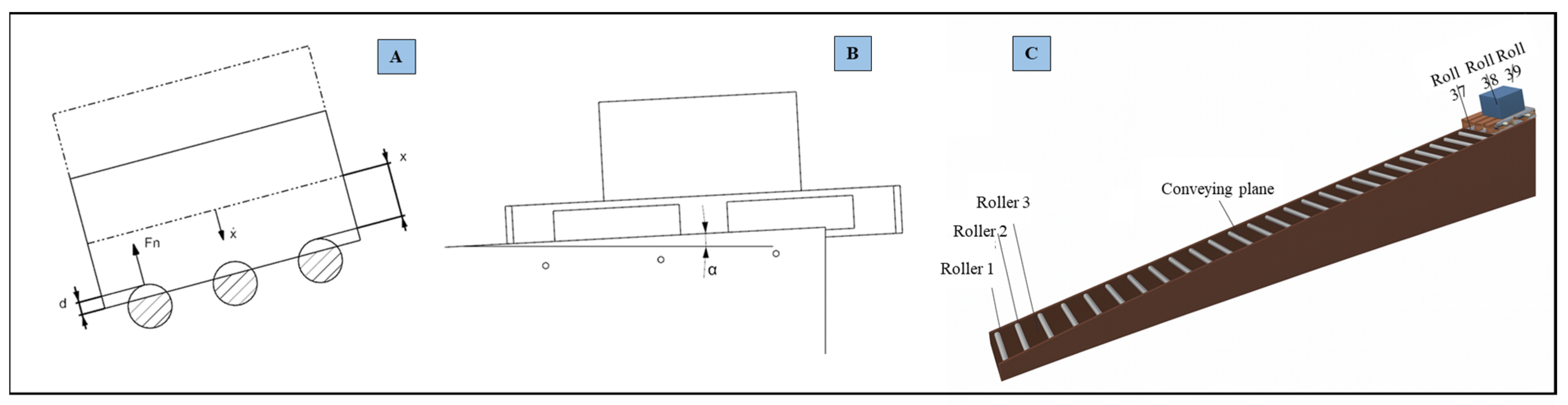
The following analysis focuses on a single cycle of pallet movement in a gravity flow rack, whose storage level is formed by evenly spaced Asynchronous Motor Rollers (AMRs) mounted in the rack frame. An AMR is a combination of an asynchronous motor and a shaft that drives pallet movement. A pallet of mass
, placed at storage level
(where
,
Figure 3C), moves along the AMRs under the influence of the rack level inclination
, generating recoverable energy
, sourced from the pallet’s energy (1) (
Figure 3).
The generator operation is modeled using the steady-state mechanical characteristic (torque vs. angular velocity) of the induction motor. While standard constitutive equations are omitted here for brevity, the detailed mathematical derivation and validation of this specific energy recovery model—including the efficiency maps used—have been extensively documented in our previous work [
17]. The specific motor parameters used for the simulation are provided in
Table S1.
This energy can be divided into energy recovered at the storage levels
[
72], energy recovered
during pallet descent using the lift, energy recovered at level 0
, energy consumed to lift the empty working table of the lift and mechanical and electrical losses
, and energy losses in the rack control and diagnostic systems
. The energy balance is expressed by Equation (2). This equation serves as the starting point for further refinement of the model for individual elements of the gravity flow rack.
The selected storage level k is modelled as an inclined plane with an inclination angle
and a length
, with discretely spaced rollers
. The pallet is modelled as a rigid body of mass
, moving along the installed AMRs with a displacement
measured from the start of the storage level. In a one-dimensional approximation, the equation of motion of the pallet at level k takes the form of Equation (3).
Here,
represents the interaction of the pallet with the AMRs (friction and rolling resistance), while
denotes the remaining system resistances projected onto the direction of motion. The friction force is modelled accounting for the transition between static and kinetic states.
The variables
and
are the static and kinetic coefficients of friction, respectively, for the pallet–shaft pair at level k. Each AMR j at level k is treated as a rigid cylinder with radius R and moment of inertia J. Its rotational motion is described by Equation (5).
denotes the contact force transmitted from the pallet to the shaft (determined experimentally in the contact model), and
is the electromagnetic torque of the shaft motor. In the generator mode, a simplified linear characteristic was adopted, enabling representation of the braking torque as a function of the shaft angular velocity within the recovery operation range.
The mechanical energy transferred from the pallet to the AMR system at level k is expressed by Equation (7).
The electrical energy recovered at this level, considering the conversion efficiency
, is given by Equation (8).
The lift operates in two work cycles: (i) with a pallet, moving it from level k to level 0, and (ii) without a pallet, when moving from level 0 (parking position) to the storage levels (1 to 3). It is assumed that the mass of the empty lift platform is
, and the vertical displacement is
. The energy recovered during cycle (i) can be expressed by Equation (9).
denotes the efficiency of the ball screw drive in motor operation mode. In the dynamic model, the lift motion in MSC Adams is represented as the motion of a rigid body with coordinate in the gravitational field, subject to generalised forces derived from the servo drive characteristics.
Level 0 is represented by an AMR track of length
with an inclination angle
opposite to the slope of storage levels 1, 2, and 3. The pallet movement on this level is described by Equation (10).
Equation (10) is analogous to the previously discussed equations for storage levels 1, 2, and 3, with the friction and resistance parameters corresponding to the AMR configuration at level 0 [
17]. The mechanical energy recovered at level 0 is expressed by Equation (11).
The electrical energy, taking into account the conversion efficiency
, is given by Equation (12).
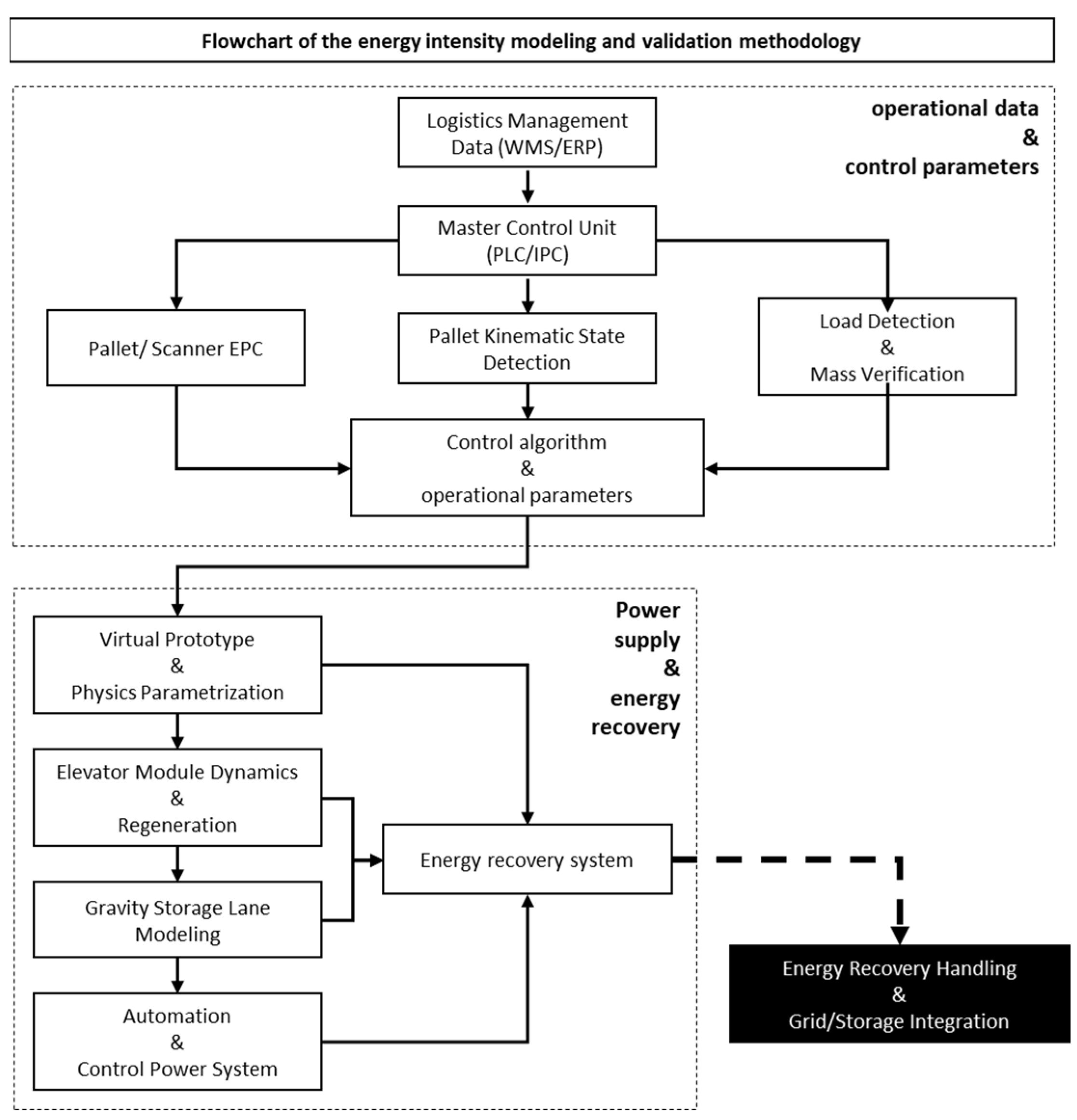
These equations are reflected in the system-level energy model of the rack, in which the physical interactions generated by the moving pallet are linked to the control layer, decision-making logic, and the modules responsible for energy extraction, conversion, and recovery. In such a system, the flow of energy is not isolated from the flow of information. On the contrary, these two streams remain coupled. Only within this integrated framework is it possible to fully describe the rack’s operational efficiency and to identify the factors affecting its actual energy consumption.
It is important to note that unlike conventional gravity racks that use isolated mechanical braking rollers, the proposed system employs motorized rollers (electric rollers) throughout the active deceleration zones. This design choice allows for continuous control of the friction coefficient to prevent pallet slippage and maximize energy capture. Consequently, the mathematical model assumes that all rollers within these active segments function as generators. This configuration reflects the current prototype aimed at maximizing energy recovery performance; economic optimization and component reduction are subjects for future development.
The management layer, implemented via WMS/ERP, initiates warehouse operations by generating orders assigned to specific pallets. These functions are then passed to the local control level, implemented by a programmable logic controller (PLC). The controller integrates signals from presence, weight, and position sensors, as well as data derived from pallet identification via EPC code scanners [
73,
74]. These data are used to dynamically adjust AMR operating parameters, such as torque, supply current, rotational speed, and mode of operation (drive, braking, or generator operation).
The control module oversees the pallet movement and models its behaviour at the rack level (in/out), taking into account motion resistances, forces due to track inclination, friction, and the variable kinetic and potential energy of the pallet. These transformations generate energy demand or enable energy recovery. Hence, the system incorporates two interacting modules: a supply module and a recovery module. The rack can interface with an energy storage system (lithium-ion battery or supercapacitor) or the power grid, or consume the recovered energy in real time via the drive shafts and the lift.
Within the AMR system, the rollers serve as the actuating element, responsible both for pallet movement and for energy generation during braking. Their operating characteristics directly affect the overall energy balance of the rack. The lift module also plays a significant role, being responsible for lowering pallets from levels k to level 0. Operating in generator mode allows the recovery of part of the pallet’s potential energy.
The final component of the system is the interaction between the pallet and the AMRs, as well as the dynamic effects of movement, which either provide recoverable energy or create a demand for control energy. The combination of these interactions constitutes the rack’s energy consumption profile (
Figure 4).
The diagram integrates pallet identification, motion control, energy management, and mechanical interactions resulting from the pallet’s presence in the rack.
Author’s Concept of the Rack Energy Performance Index (REPI)
The analysis of the obtained results, literature review, and operational experience justifies the formulation of a novel index for the quantitative assessment of the energy consumption of a gravity rack—REPI. The index pertains to the rack understood as a storage device. The subject of this study is the storage of pallets that move “within the rack structure” and/or “with the rack structure” during the analysed time period.
At the level of the energy balance of the analysed gravity rack, both the potential energy of a pallet (dependent on its mass and stacking height), the electrical energy consumed by the rack drives, and the energy recovered through the operation of AMRs are taken into account. In the case of the analysed gravity rack, the potential energy of a pallet—in the energy model and balance—serves as a source of mechanical energy, which is partially converted into, for example, electrical energy. More generally, a gravity rack may be integrated with other energy-harvesting installations, such as PV systems. In the REPI definition, it is assumed that only electrical energy is exchanged between the rack and the power grid. REPI is used for the quantitative assessment of the energy consumption of a rack, expressed per unit of stored pallets.
The basis for calculating REPI is the separation of the energy streams required to carry out the storage process into energy drawn from the grid and energy returned to the grid or a local energy storage system. Within the analysed time horizon T, it is assumed that all streams are averaged over the same time interval, and the subtraction and addition of energy are performed at the level of total energies. REPI is defined as the net energy drawn by the rack per handled pallet, expressed by Equation (13).
denotes the energy drawn by the rack during the i-th time interval (including, among others, the energy consumption of the control system, barcode and RFID scanners, PLC, as well as the energy consumption of drive modules such as the lift drive or AMRs). denotes the recoverable energy in that interval (e.g., energy generated by the AMRs at level 0, and energy recovered in the generator mode of the lift drive). is the overall energy recovery efficiency. denotes the number of pallets handled in the i-th time interval. represents the total number of pallets handled over the time horizon .
In practical terms, small positive REPI values (REPI → 0+) indicate that the rack is almost energy-neutral—within the analysed time horizon, the energy drawn from the grid is approximately balanced by the recovered energy, and the difference is residual.
The REPI > 0 denotes a net energy-consuming system, while REPI < 0 describes a net-positive energy system in which, over a given period, the rack returns more energy to the grid (or local energy storage) than it consumes. For comparative purposes between different types of warehouse storage racks (gravity racks, shuttle systems, movable-floor systems, flow racks), research should be conducted to organise and systematise scientific knowledge.
5. Results of Modelling and Full-Scale Testing
For the simulations conducted in the MSC ADAMS environment, an asynchronous motor integrated with a shaft or roller installed in the rack—referred to as the AMR DP 0080—was adopted. The roller has a diameter of 0.08 m.
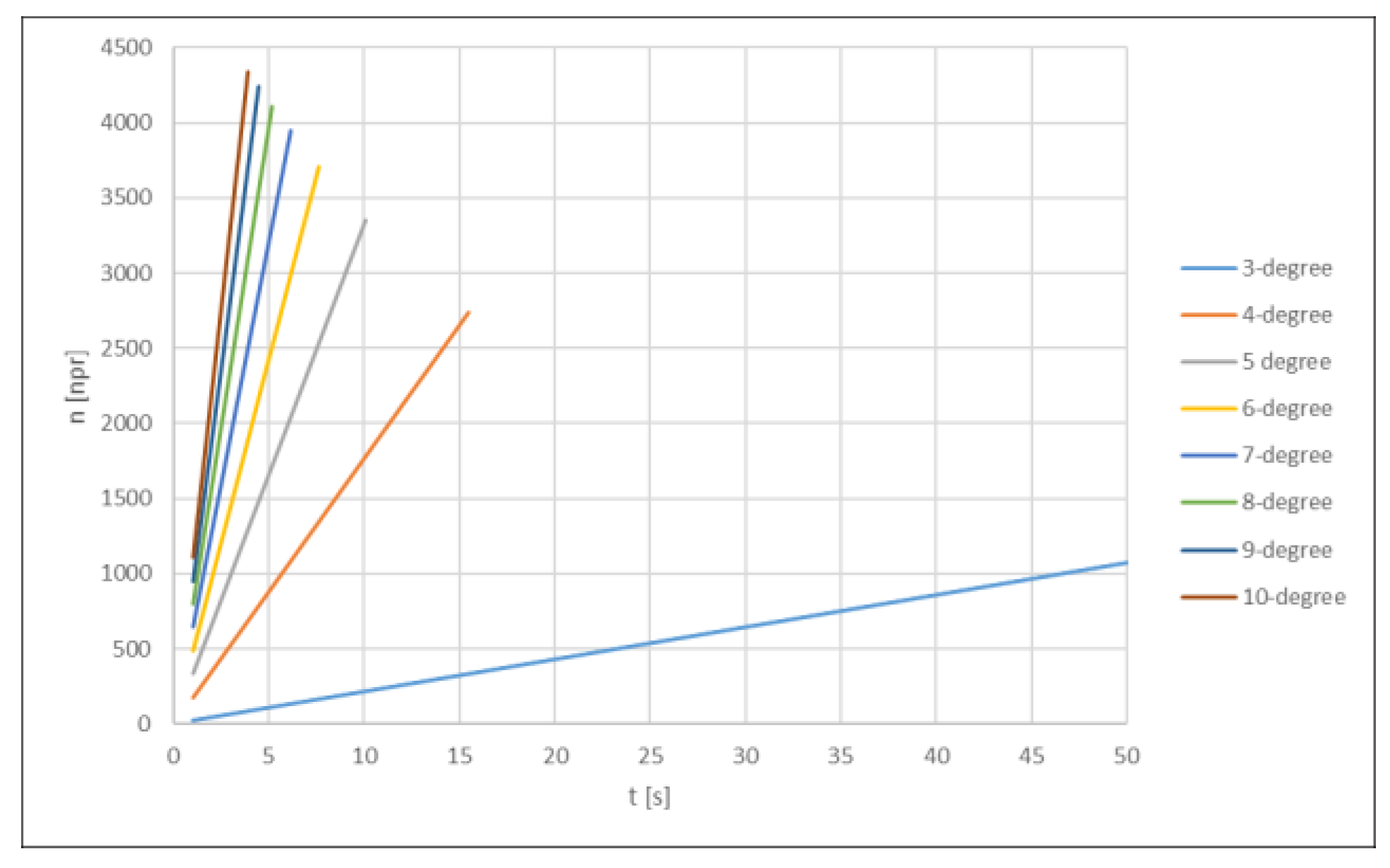
The results indicate that for inclination angles of 3° and 4°, energy recovery does not occur as the rotor speed does not exceed the synchronous speed (
Figure 5). Consequently, the AMR does not enter generator mode. For inclination angles of 5°, 6°, and 7°, energy recovery is achieved. However, the duration of energy generation and the number of AMRs remain limited. An inclination angle of 8° meets the design criteria as higher rotational speeds could lead to motor overspeed. Under these conditions, the AMR reaches generator mode after approximately 4 s of pallet motion, when the rotational speed transmitted to the rotor exceeds the synchronous speed.
The equivalent parameters of the AMR motor used for calculating the magnetising current in generator mode are provided as shown in
Table S1 (see Supplementary Materials). In addition, the mechanical characteristic of the motor is verified based on the calculated values.
5.1. Calculation of the Equivalent Parameters of an Asynchronous Motor
In the case of a gravity rack with energy recovery, the mechanical characteristic is defined as the relationship between rotational speed and slip as a function of the electromagnetic torque. For a rack inclination angle of 8°, calculations were performed with respect to individual rollers, including their rotational speed, slip, energy drawn from or fed back into the system, and the electromagnetic torque generated in the motor at a given moment (as shown in
Table S1, Supplementary Materials). To reproduce the operating conditions of the system, a shaft spacing of 0.20 m was assumed. A shaft is set in motion by the pallet when the pallet is positioned at the centre of the upper surface of the shaft. The first AMR is located 0.06 m from the rack frame. In a rack with a length of 11.7 m, there are 56 shafts per storage level, and their surface covers 11.14 m of the rack length. The remaining 0.53 m of the rack is allocated to the pallet braking/locking mechanism. The shaft pitch is selected such that four evenly distributed shafts support a single pallet. One storage level accommodates 14 pallets. Shafts numbered from 32 to 56 are equipped with an energy recovery system. Shafts from 1 to 31 are dynamically braked and result only in energy losses for the system. Slip was calculated separately for each shaft, which made it possible to determine which of them operate in the energy recovery mode. Based on the equivalent parameters, the electromagnetic torque of the asynchronous motor was calculated for each shaft. This serves to verify whether the actual mechanical characteristic of the asynchronous motor under different operating conditions is consistent with the assumptions adopted for the system.
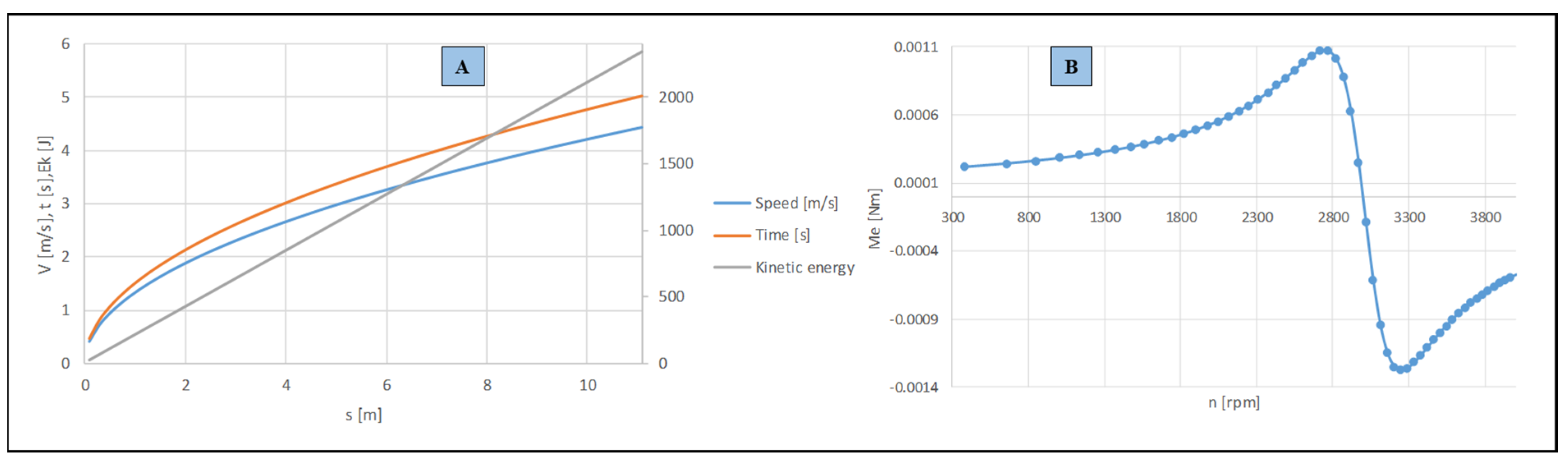
The mechanical characteristic of the squirrel-cage motor operating within the system (
Figure 6) is consistent with the assumed conditions. The maximum critical torque is approximately 0.0011 Nm, while the minimum value is approximately −0.0014 Nm. At a rotor speed of about 2800 rpm, the electromagnetic torque begins to change its direction, enabling the onset of generator operation.
For each shaft, the value of kinetic energy is calculated. This constitutes the basis for determining the energy consumption of the system depending on the type of shafts used. The load mass assumed in the calculations is 240 kg.
Numerical investigations of the system’s energy consumption were carried out in MSC ADAMS for various load masses. In addition, the analysis was divided into three computational stages: calculation of energy at the storage level (recovered energy), calculation of lift energy at the ball screw, and calculation of energy at level 0 and the balance of the previously mentioned partial energy consumptions. Based on these studies, the limitations of the maximum pallet mass were determined. It should not exceed 1000 kg as this is the permissible load of a Euro-pallet with an arbitrarily distributed load in the general case.
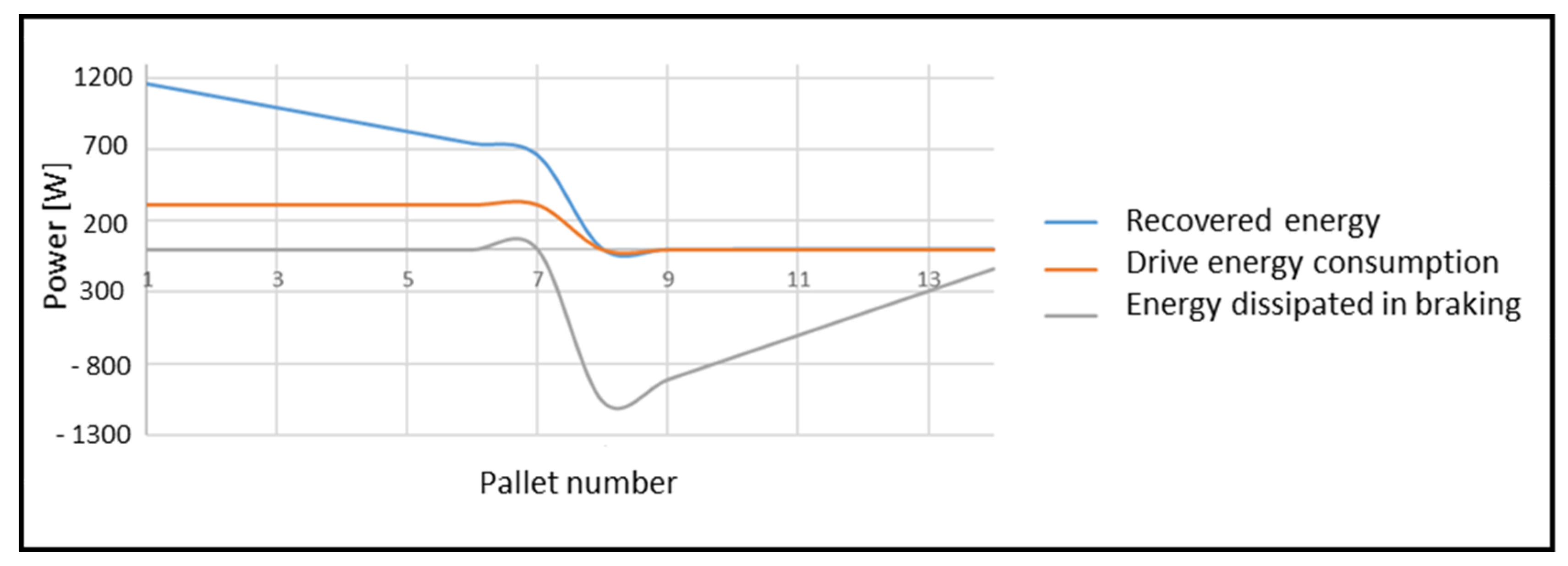
The energy balance for a single storage level, divided into recovered energy, energy consumed for drive, and energy dissipated in braking for each individual pallet, is shown in
Figure 7. Pallets 1 to 7 recover energy but also lose some to motor drive. Pallets 8 to 14 do not recover energy and lose it only through dynamic braking. Based on the energy balance for each pallet, the total energy balance for the storage level was calculated. The minimum mass a pallet must have for energy recovery to occur is 221 kg. The recovered energy for such a pallet is 1 W. For a lighter pallet, no energy recovery takes place.
The chart shows a gradual decrease in recovered energy for successive pallets until the generator mode is no longer active. From pallet 9 onwards, the amount of energy lost decreases because less is required for dynamic braking. The largest energy loss occurs with pallet 8. For a pallet mass of mL = 1000 kg, the values are presented in
Table 1.
Focus now shifts to the lift, which is powered by the energy of a pallet moving to level 0. The lift requires external energy input to move from its parking position (raising the empty lift platform) to the storage level in order to retrieve a pallet. The lift is driven by a ball screw with an efficiency of
. Energy consumption results for pallets of 221 kg and 1000 kg are summarised in
Table 2.
The selection of test masses was dictated by the operational envelope of the drive system defined in
Section 3. The upper limit of 1000 kg corresponds to the maximum permissible load assuming uneven weight distribution (a safety-critical scenario), distinct from the theoretical 1500 kg limit for ideal loads. The lower limit of 221 kg was determined based on the motor’s torque characteristic as the minimum mass required to overcome system resistance and effectively engage the regenerative braking mode. The intermediate values presented in
Table 3 were introduced to empirically verify the linearity of the energy recovery efficiency across this entire operating range.
The results illustrate how the lift’s energy demand depends on both the pallet mass and the storage level. The maximum recovered energy is 2391 kW. The overall energy balance of the system depends on the rack design assumptions, particularly on the drive characteristics of the ball screw.
The overall energy consumption balance for 14 pallets across all storage levels, assuming level 0 behaves like the other levels, shows that the energy consumed by the lift increases to values that eventually produce a negative energy balance, which decreases as the load mass increases. The energy balance for level 0 is presented in
Table 4.
The amount of energy recovered from level 0, assuming that only one pallet is present at a time, is significantly higher than that from the storage levels. For a pallet mass of 221 kg, approximately 11.97 kW can be recovered (
Table 5).
Comparison of the modelled values with the measured data (columns 5 and 9,
Table 5) reveals systematic, relatively small deviations, which are fully consistent with the expected uncertainty for mechatronic systems operating under real conditions. On average, the energy recovered from the rack in the measurements is lower than the model predictions by a few percent (
, depending on the storage level and pallet mass). The energy drawn by the lift drive is slightly higher than predicted by the model. As a result, the overall energy consumption balance for the entire system—both for a pallet mass of 221 kg and 1000 kg—remains positive. The measured results are systematically more “conservative” than the computational model outcomes.
From a physical interpretation perspective, this picture is consistent with the real behaviour of the system: the mathematical model accounts for the main loss mechanisms (rolling friction, lift drive efficiency, AMR motor characteristics) in an averaged manner. In the prototype, additional effects that are difficult to capture fully occur—including imperfect speed control, local assembly inaccuracies, mechanical element hysteresis, additional losses in bearings and gearings, and dispersion in the electrical parameters of the drives. All these factors result in slightly lower energy recovery efficiency and slightly higher power demand than predicted by the model.
Importantly, the observed difference between the model and measurements is systematic rather than random. This indicates the presence of additional, stable loss components rather than a flaw in the model itself. This allows for further calibration of parameters (e.g., effective friction coefficients or drive efficiencies) to match the “typical” behaviour of the prototype, without the need to modify the structure of the motion equations. Full-scale tests confirm the validity of the concept and the order of magnitude of the energy predictions, providing the basis for transitioning from the idealised model to an operational model that reflects the actual energy consumption of the rack.
5.2. Energy Consumption Measurements for the Test Rack
Full-scale prototype tests of the gravity rack were conducted at the terminal of a warehouse handling palletised deliveries for a leading manufacturer of pet food (dogs, cats, fish, snakes, spiders, etc.). Pallets were prepared under the supervision of the WMS, using a mixed queuing mode: 50% FIFO and 50% LIFO. The tests were carried out on an operational loading terminal (approximately 4800 pallets, equivalent to about 160 lorries per day) over an 8 h shift. The rack served as a buffer for pallets after order picking, prior to loading onto lorries. The lorries were loaded from the rack.
The full-scale prototype provided data for the MSC Adams environment. This included parameter sets such as pallet motion mechanics as well as pallet–AMR and pallet–guide contact characteristics. For the numerical model, measurements of pallet displacement and speed along a straight track with a known inclination were taken. Comparing these measurements with the simulation allowed calibration of the contact stiffness and damping parameters to ensure that travel times and speed profiles were consistent. In the energy-related part of the study, a simplified relationship between the electromagnetic torque and speed (or slip) was implemented, alongside measurement data: current, voltage, active and reactive power, rotational speed, and commanded/actual torque for typical operating states. The full-scale prototype provided the generator-mode curve (torque–speed–power) and the converter efficiency. For calibration of pallet collision behaviour and FIFO/LIFO sequencing, the time evolution of events was recorded: the instant the first pallet stopped at the front position, rebound amplitude, and vibration damping time. These phenomena were modelled in the MSC Adams environment using elastic–damping contact elements (Hunt–Crossley model).
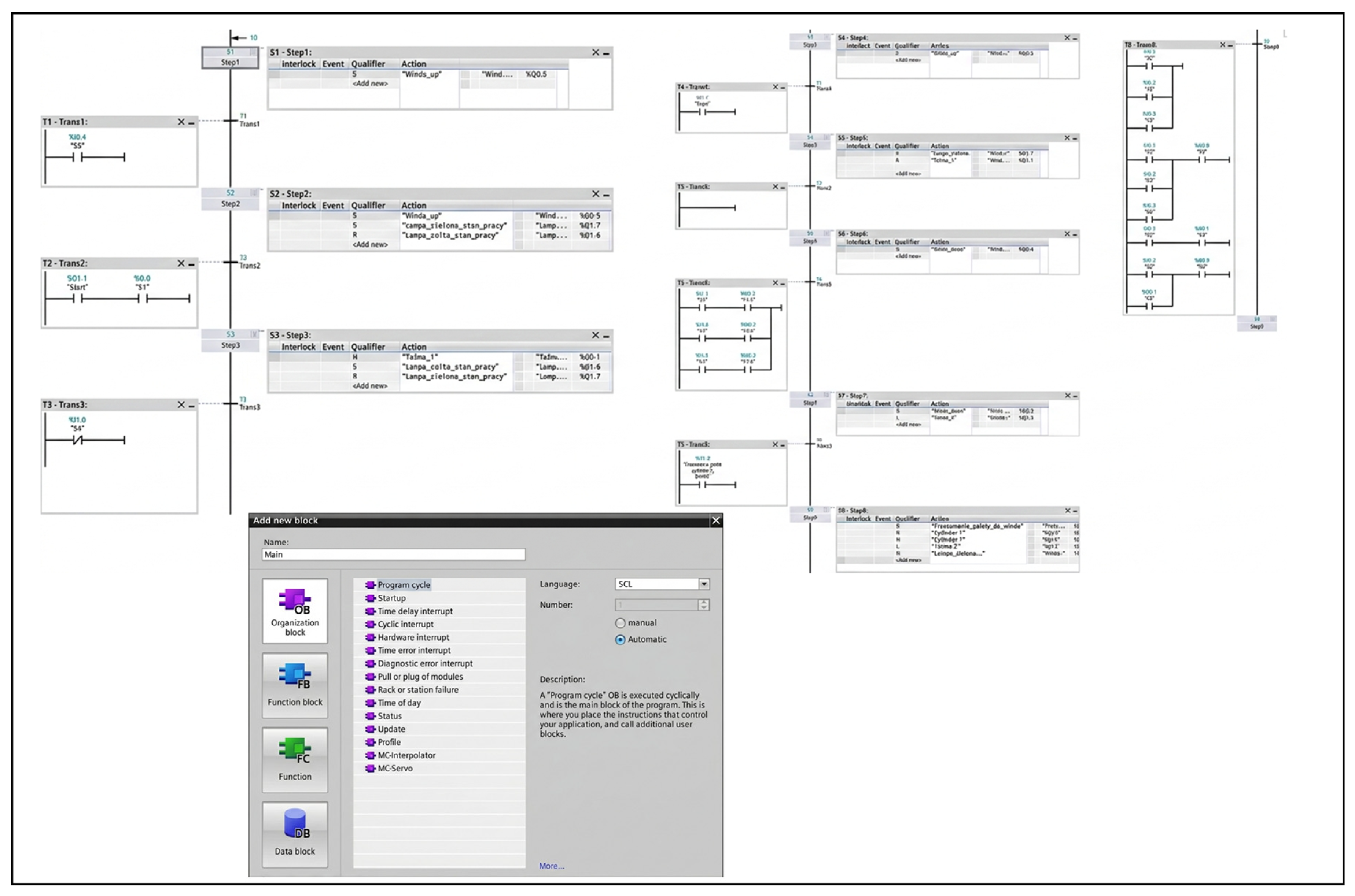
The energy consumption of the rack was recorded using a multi-channel measurement card with cloud-based data logging, integrated with software for data processing and rack control (
Figure 8).
During the tests, the number of pallet in/out cycles, the electrical energy consumed and generated by the lift drive, the energy recovered at level 0, and pallet buffering times were recorded. In addition to structural components, the rack’s AMRs were equipped with barcode/RFID readers (EPC scanning) and pallet presence sensors (monitoring pallet slot occupancy at storage levels and in the lift). Pallet identification via the AUTO-ID system [
75] allows for more effective adjustment of the AMR excitation current to appropriately limit or increase the magnetising force.
Individual branches correspond to the recording of pallet kinematic signals, electrical parameters of the rollers and lift drive, and measurements of consumed and recovered energy. Data are synchronously stored in the measurement database, from which they are exported for analysis and model calibration in MSC Adams. The individual execution modules are shown in
Figure 9.
5.3. Accuracy of Measurement Results
The gravity rack operated under real conditions in a distribution logistics centre. The rack handled pallets of varying mass, due to natural differences in wood moisture content, degree of wear, and repairs to load-bearing components. For a EURO pallet (wooden), a reference average mass of 12 kg was assumed, with a tolerance of ±15%. The calibration of the rack model in MSC Adams was based on a systematic experimental plan carried out on the full-scale prototype. This plan was prepared according to classical experimental design methodology and divided into three main stages, consistent with the range of data presented in as shown in
Supplementary Materials.
In the first stage, attention was focused on reconstructing the mechanics of a single pallet moving along a straight section of the gravity track. On selected sections of the levels, displacement and velocity profiles of the pallet were recorded, along with transit times between measurement points, which enabled the adjustment of friction, motion resistance, and damping parameters in the MSC Adams model. Independent collision tests (pallets impacting each other) in FIFO and LIFO configurations allowed for the identification of the parameters of the elastic–damping contact models so that the duration of collisions and the damping profiles matched the experimental observations.
In the next stage, a series of tests was carried out involving multiple pallets moving simultaneously on different levels, following FIFO and LIFO queuing and the full work cycle of the lift. Experimental planning was conducted using a structured methodology, similarly to the approaches described in [
76,
77]. During these tests, aggregated energy consumption data were recorded from energy meters, along with instantaneous power profiles of the drives. Organisational and operational constraints of the facility did not allow all test configurations to be repeated freely, particularly in cases where results were suspected to be extreme outliers. Data validation was governed by a binary protocol: a measurement was accepted only if the pallet ID verified by the rack’s Auto-ID system matched the WMS order and the data acquisition window covered the full operational cycle. Approximately 5% of the raw data points were excluded due to synchronization errors or incomplete recording. No statistical outliers were removed from the valid dataset.
The measurement instruments used had accuracy classes corresponding to the requirements for assessing energy consumption at an industrial scale: energy meters compliant with MID, power analysers with single-watt resolution, and encoders and linear measurement devices with resolutions below 1 mm. Signals were sampled at frequencies matched to the process dynamics () and, where necessary, subjected to digital filtering to eliminate high-frequency noise. Based on repeated measurement series, the relative uncertainty ranges of the main components of energy consumption were estimated at a few percent. This represents a significant difference observed between the operating scenario without energy recovery and the configuration with energy recovery. It indicates that the positive energy consumption balance of the rack as well as the agreement between its modelled description and the actual system behaviour are robust against realistic measurement errors and can be considered practically significant rather than merely a numerical artefact.
5.4. Discussion of the Obtained Energy Consumption Results
As demonstrated by the results, the overall energy efficiency is highly dependent on the synergy between the load unit’s mass and the specific characteristics of the AMR drive system in relation to the pallet’s movement dynamics. Without this compatibility, even an inclined system may remain merely functionally gravity-driven, failing to produce a significant passive or net-positive energy effect. In such cases, the resulting energy recovery, as reflected by the $REPI$ metrics, remains negligible. This highlights that achieving a high-performance, energy-positive system requires precise tuning of both the geometric parameters and the electromechanical properties of the automation components.
The data compiled in
Table 6 confirm (perhaps trivially) that the proposed REPI appropriately reflects the transition of a gravity rack between three qualitatively different operating states. For light load units (on the order of 200–500 kg) and small inclination angles of the storage levels, REPI values remain positive, indicating that the energy recovered at the rack levels and at level 0 does not fully compensate for the energy consumed to overcome motion resistance, raise the empty lift, and power the control systems. In such cases, the rack behaves like a conventional rack. As the pallet mass increases (or as the inclination angles of the storage levels and level 0 change), REPI values decrease and approach zero. The zone where REPI ≈ 0 corresponds to cases in which the torque generated by the pallet on the AMRs is comparable to the minimum torque required for the asynchronous motors to enter the stable generator-operation region. This threshold therefore has a direct physical interpretation: it defines the combinations (mass, angle) for which the motion dynamics allow full utilisation of drive energy recovery. For the heaviest pallets (with a mass of 1000 kg), REPI becomes negative, indicating that in the considered model, the energy recovered during the rack’s work cycle exceeds the energy consumed—the rack enters a net-positive energy operating state. Thus, the table illustrates that REPI can be used both for a rapid assessment of whether, under given operational conditions, the rack actually enters the generator-operation region, and for defining the design parameter space (pallet mass, inclination angle, AMR configuration) in which the use of energy-recovering drives is energetically justified.
The obtained results were compared with simulation outcomes, particularly with respect to the energy recovered at individual storage levels, the energy generated during the lowering of a pallet by the lift, and the energy consumed to raise the empty lift. The good agreement between experimental and simulated values allowed the model to be considered a reliable predictive tool, enabling the analysis of scenarios not physically tested (different inclination angles, pallet masses, queuing scenarios), and providing a basis for further assessment of the energy consumption of the gravity rack using REPI.
Analysis of the recorded data showed that for pallets with an average mass of approximately 210 kg, the energy recovered during a single storage cycle (including energy returned by the lift, energy generated at level 0, and energy consumed to lift the empty lift) averaged 0.0013–0.0014 kWh per pallet. The difference between FIFO mode and LIFO mode was evident. In FIFO mode, pallets achieved higher speeds and longer operation of the motors in the generator region, whereas in LIFO mode, energy generation was limited. Averaging both modes yielded an effective value close to the theoretical model results. When scaled to a full shift (8 h of operation), the recovered energy amounted to , which on an annual balance corresponds to .
The estimate considered a 12-month operational period, accounting for actual rack downtime, variability in pallet flows, and a minor, observed degradation of the electro-mechanical efficiency (approximately 4–6%) [
73].
The obtained results confirm the practical feasibility of energy recovery in gravity racks with a high turnover of load units. Operational measurements demonstrated an order-of-magnitude agreement with the computational model, confirming that even for relatively light pallets (210 kg), stable energy recovery is possible, provided that the system operates under conditions of high flow intensity.
An analysis encompassing both simulations of pallet motion dynamics and modelling of AMR operating parameters made it possible to reproduce the energy consumption associated with pallet movement in a gravity rack. In the first stage, numerical simulations were carried out in the MSC Adams environment, enabling assessment of the influence of the storage-level inclination angle on the development of the pallet’s linear velocity and the angular velocity of the cooperating roller. The results clearly indicated that only at inclinations on the order of 5–7° does the AMR overcome the synchronous speed threshold, while at 8° it reaches a stable generator mode. In accordance with the data presented in the tables, for angles below 5° the pallet does not develop sufficient velocity to drive the AMR into generator operation. At an inclination angle of 8°, the synchronous speed is reached after approximately 4 s. This result defines the required minimum track length and confirms that effective energy recovery is achievable only with an appropriate storage-level geometry.
In parallel, calculations of the motor’s equivalent parameters were performed using the classical equivalent-circuit model, which made it possible to reproduce the relationship between electromagnetic torque and slip. The torque characteristic showed that the asynchronous motor begins to generate negative torque only after exceeding the synchronous speed, with the maximum generating torque lying in the range of −0.0012 to −0.0014 Nm. These values are consistent with the expected range.
The application of a full model comprising 56 AMRs interacting with the pallets made it possible to determine the actual distribution of slip and the kinetic energy of the AMR rotors. It was demonstrated that only the rollers located in the second half of the storage level (from approximately roller No. 32 to the last one) reach the generator mode. This results from the fact that only in the final section of the track does the pallet velocity become sufficiently high to exceed the synchronous speed of the rotor after accounting for the transmission ratio. AMRs located in the first part of the track serve solely to transmit motion and do not contribute to the energy balance, apart from introducing mechanical losses. The region of active energy generation is therefore spatially limited, which is an important consideration in the design of gravity racks with energy recovery.
The energy consumption balance of the storage levels demonstrates that for a pallet with a mass of 221 kg, energy recovery at levels 1–3 is limited and strongly dependent on the pallet sequence (FIFO–LIFO). The first few pallets generate a positive energy flow. However, subsequent pallets introduce losses which, when considered cumulatively, almost neutralise the gain. The table presenting these results indicates that for a load of 221 kg the total level balance attains only a slightly positive value, meaning that this mass constitutes a threshold at which the system is capable of any energy recuperation. The situation is markedly different for pallets with a mass of 1000 kg, for which the energy gain increases by almost an order of magnitude. In this case, the storage-level balance shows recovered power of approximately 7.7 kW, clearly confirming the significant influence of load mass on the system’s energy-generation capability.
It should be noted that a major limitation to energy recovery arises from energy losses associated with the lift drive equipped with a ball screw. Calculations of losses for pallets of 221 kg and 1000 kg showed that the losses related to raising the empty lift are substantial and, for high loads, can reach values exceeding 2 kW per cycle. This means that for lower pallet masses, energy recovery at the storage levels may be dominated by the energy consumption of the lift drive.
At level 0, where each pallet moves individually along the entire track equipped with AMRs, a recovered power of 11.97 kW was achieved for a pallet mass of 221 kg, increasing to 35.9 kW for 1000 kg. This result unequivocally alters the energy consumption balance of the entire rack, transforming it from a largely energy-passive system into one capable of generating tangible energy surpluses. This effect is particularly significant because, in practical warehouse operations, all pallets always exit the rack via level 0, regardless of their storage level.
Operational data obtained from a facility operating under mixed FIFO/LIFO queuing, handling approximately 4800 pallets per shift with an average load unit mass of 210 ± 35 kg, confirmed an order-of-magnitude agreement between the measured results and the theoretical model. The average energy recovery per pallet amounted to 4.8–5.0 kJ, corresponding to approximately 6.2–6.6 kWh per shift. When scaled to a standardised working month, this yields 136–145 kWh, while over one year of system operation the net energy gain ranged from 1.62 to 1.72 MWh. These results confirm that even for relatively light pallets, energy recovery is not only feasible but also stable and repeatable under conditions of intensive operation. In addition, the data indicate that energy recovery in intralogistics systems can represent a real and practical mechanism for improving the energy efficiency of warehouse facilities.
From a sustainability perspective, this concept enables the development of low-emission warehouses capable of partially self-supplying auxiliary equipment with energy.
6. Discussion
The obtained computational and measurement results clearly indicate that a rack equipped with a movable floor and an energy recovery system can be regarded not only as a device that is technically more efficient than conventional designs, but also as an element of warehouse infrastructure capable of partially—and under favourable conditions, even fully—balancing its own energy demand. In the available literature, pallet racks—both conventional and gravity flow systems—are analysed primarily in terms of storage capacity, throughput, structural safety, and the organisation of material flows. Gravity racks are generally treated as energy-consuming systems or as systems that merely exploit gravity in a passive manner, without considering the energy balance of the device as a whole. To date, there has been a lack of systematic analyses of the energy consumption of pallet racking systems as well as attempts to introduce quantitative measures for assessing the energy consumption of this class of equipment.
Against this background, the proposed solution places the gravity rack in a completely new comparative domain, bringing it closer to solutions known from hoisting cranes, overhead travelling cranes, or automated stacker cranes equipped with regenerative drives, in which converters enabling generator operation are becoming standard. The results obtained on a full-scale test rack make it possible to propose a preliminary scheme for the energy classification of storage racks, based on the averaged electrical energy balance per unit of material flow and on the net REPI proposed in this study. REPI enables an objective distinction to be made between: (i) conventional racks, for which (systems that exclusively consume energy); (ii) racks that partially recover lifting and operational energy, for which ; and (iii) energy-positive racks, for which , indicating a positive energy balance at the level of a single operating cycle. In this context, the values recorded during the measurements—on the order of 4.8–5.0 kJ of net energy per pallet and 6.2–6.6 kWh per shift—indicate that the tested system falls between categories (ii) and (iii), compensating for a substantial portion of the energy consumed by the lift drive and generating stable energy recovery at level 0 under mixed FIFO/LIFO queuing conditions. From the perspective of comparison with other intralogistics technologies (stacker cranes, shuttle systems, multi-level roller conveyors), it is important that this energy recovery is achieved without any additional interference with the operational process: the energy is recovered “incidentally” during the gravity-driven movement of pallets, and the rack transitions from a purely energy-consuming device to a local energy source.
The observed order-of-magnitude agreement between the theoretical model and operational measurements confirms that relatively small per-pallet recoveries (on the order of 0.0013–0.0014 kWh per pallet) scale linearly with increasing flow intensity, resulting, on an annual basis, in net values of approximately 1.6–1.7 MWh for a single rack module operating under high-turnover conditions. Compared with other measures for improving the energy balance of warehouses—such as photovoltaic systems, energy recovery from hoisting cranes and stacker cranes, or lighting upgrades—the proposed solution is clearly complementary: it does not compete with these technologies, but rather enables energy reduction directly within the storage infrastructure itself. The introduction of REPI makes it possible to compare configurations of gravity racks in a manner analogous to the classification of buildings as passive, energy-efficient, or energy-positive.
The calculation and measurement results presented refer to the operation of the rack under standard temperature conditions (distribution hall, thermal comfort) in which the properties of lubricants, the resistance of motor windings, and friction parameters remain within nominal ranges. In the case of operation in cold storage or freezer facilities, different working conditions for both mechanical and electrical components should be expected. Lower temperatures lead to changes in friction and motion resistance as well as mechanical losses, which in turn reduce the efficiency of the gravity rack. Due to the complexity of these phenomena, a full analysis of the influence of thermal conditions requires dedicated studies and an extension of the model. Assessing energy consumption under low-temperature conditions may constitute a natural direction for further research.
REPI can be applied as an additional criterion for evaluating gravity rack configurations for a given warehouse volume. For the same storage volume, it is possible to design layouts differing in the number of levels, depth of storage bays, track inclination, and the configuration of AMRs and lift drives. The use of REPI enables a comparison of these variants not only in terms of capacity and throughput, but also with respect to energy consumption per unit of material flow. This approach paves the way for multi-criteria optimisation of rack parameters—including spatial arrangement, flow organisation, and energy losses—and may serve as a starting point for further research into the design of low-energy and energy-positive warehouses.
7. Conclusions
In the investigated gravity rack system, the lift drive was based on a ball screw mechanism. In this configuration, the minimum mass of the platform is not determined by the requirement to maintain cable tension, as is the case with rope-driven systems, but rather results from a compromise between the dynamics of the mechanical system and the characteristics of the electric drive. On the one hand, the lift mass () must be sufficient for the axial force to overcome the static friction in the screw–nut–guide assembly and to ensure smooth motion without stick-slip phenomena caused by friction. On the other hand, an excessively large increases the energy required to lift the unloaded platform, thereby raising the energy consumption of the work cycle. The characteristics of the asynchronous motor supplied via a variable-frequency drive do not impose a strict lower load limit. However, from a practical point of view, it is desirable that the torque required to lift the empty platform remains within a few percent of the rated torque. Thus, the minimum platform mass is determined by dynamic requirements and control system parameters, while the upper mass limit is constrained by the energy consumption balance considerations.
A similar relationship applies to AMRs operating in generator mode. Energy can be recovered only when the load torque exerted by the pallet on the AMR exceeds the minimum torque required for the AMR to enter the generator operation region at a given rotational speed . The condition defines the minimum pallet mass at which the system transitions to effective conversion of potential energy into electrical energy. In practice, this implies the simultaneous optimisation of several parameters: the mass and mass distribution of the load unit, the inclination of the storage levels and level 0, and the characteristics of the AMR drive. The mere presence of AMRs and a “suitable” storage level inclination do not guarantee a satisfactory energy recovery. These parameters must be matched to ensure that the drive is sufficiently loaded to work above the threshold for effective generator operation.
Based on calculations and experimental studies, it can be concluded that a configuration in which level 0 operates identically to the storage levels does not provide sufficient energy recovery to make the system energetically advantageous. In such a variant, an energy-positive character may only be observed in the gravity-driven part of the rack for loads exceeding approximately 221 kg, while the energy lost in the ball screw significantly reduces the benefits of recovery. The use of a dedicated level 0 equipped with an AMR, on which only a single pallet is present at any given time, markedly improves the energy consumption balance. In an ideal scenario, where each pallet from levels 1–3 could traverse the entire length of level 0, the maximum energy recovered in a single cycle would reach approximately 164.4 kJ, while the lowest energy generated would be around 127.8 J for a load of 107 kg. Actual operation, however, deviates from the ideal model, as the rack handles pallets of varying masses. Under such conditions, it is reasonable to apply an average load unit mass and, where operationally feasible, implement a queuing strategy in which heavier pallets are positioned to maximise their energy recovery potential.
Analysis of transit times and throughput indicates that level 0 does not constitute a constraint in terms of the system’s transport capacity. The lift’s travel from levels 1–3 to level 0 and back is relatively short, and a pallet traverses the entire level 0 in approximately 5.15 s. This demonstrates that the studied rack can be successfully deployed in high-turnover warehouses. A significant constraint, however, arises from normative requirements. The energy-optimal inclination of the storage levels should comply with standards for gravity racks. Furthermore, the rack cannot be equipped with conventional mechanical brakes at the end of the storage levels, as these would prematurely dissipate kinetic energy, which is essential for the effective operation of the AMRs. At higher storage level inclinations, attention must also be paid to safe control of pallet braking.
A preliminary economic assessment of the solution indicates that, assuming a maximum and uniform loading of the rack, the investment could be recovered after approximately 351 work cycles. As the pallet mass decreases, for example to 500 kg, the number of cycles required to reach the break-even point rises above 797, which should be regarded as a more realistic figure for a system handling a diverse assortment of loads. The main advantage of the system remains the use of asynchronous motors as AMRs. These enable the recovery of a relatively large amount of energy with minimal start-up power and integrate well with the warehouse power infrastructure. The recovered energy could be used to supply other devices, such as electric forklifts. A drawback is the relatively low efficiency of small asynchronous motors, often not exceeding 70% (for calculations, a conservative value of 50% was assumed), as well as the increasing costs associated with switching to motors of higher efficiency.
From a general perspective, harnessing gravitational energy in storage systems represents an interesting avenue for the development of renewable energy sources in logistics. No system, however, is ideal—generating a useful energy flow requires accepting and minimising, as precisely as possible, losses due to friction, collisions, and discontinuities in the load. The conducted studies demonstrate that, with an appropriate geometric configuration, proper selection of pallet mass, and careful matching of motor and converter characteristics, it is possible to achieve a gravity rack that not only reduces electricity consumption in the storage process but can also become an integral component of an integrated “green” logistics system, supporting the concept of low-energy warehouses or even achieving a positive energy balance.
The 30-day industrial validation confirmed that the prototype is capable of recovering energy in both FIFO and LIFO modes within a high-throughput environment (4800 pallets/shift facility context). While the results from the single unit are promising, large-scale implementation requires further analysis of multi-rack grid stability.
8. Conclusions and Future Works
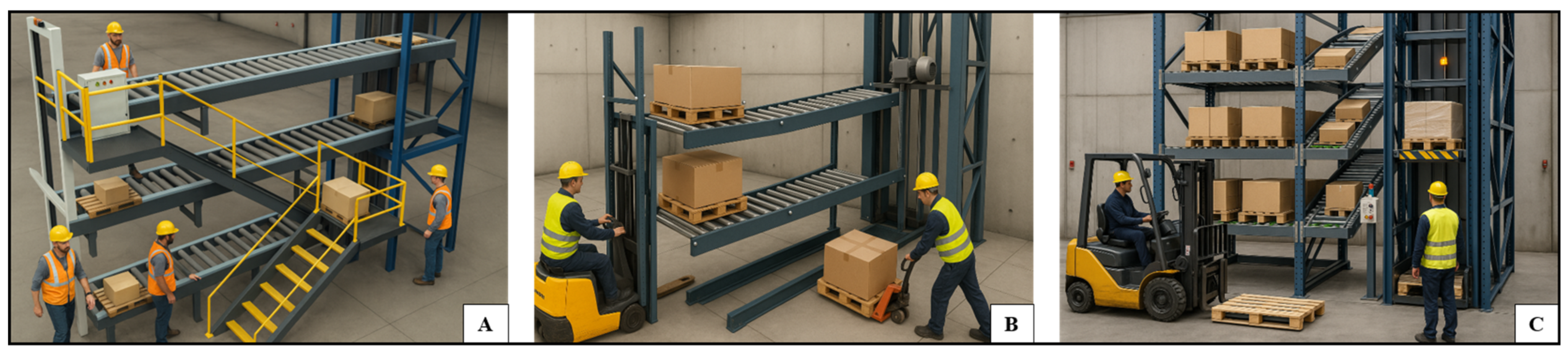
In future work, the development of a numerical model, and its experimental validation under real operational conditions, is planned for the variants shown in
Figure 10B,C. In this model, the lift structure is to be replaced with a standard serial solution to minimise the costs of prototype production and operation. This approach stems from the fact that tests conducted on the full-scale system (
Figure 10A) inspired modifications to the rack design that had previously been overlooked. These changes open up new operational and functional possibilities, including improved alignment of level 0 interface with other transport devices—the transfer point (TP). These proposed structural optimizations, shown in
Figure 10, represent the next stage of development and were not included in the mathematical model or the current experimental validation.
The prototype described utilised a standard squirrel-cage asynchronous motor. Replacing it with a permanent-magnet asynchronous motor for the rack drive could reduce the energy consumption of the gravity rack. Additionally, the number of driven shafts in the rack should be the subject of further investigation. Currently, there is no clear methodology or transparent rules for optimally selecting the number of AMRs per storage level per pallet, taking into account the basic parameters of the rack and the pallet. A novel aspect, not previously analysed, is the consideration of variable operating temperatures, including 0 °C and sub-zero conditions [
78,
79].
Furthermore, REPI, which is the analogue of EPI for transfer points in intralogistics systems, requires further investigation. REPI should cover storage systems such as gravity racks, mobile racks, paternoster systems, carousel racks, combinations of AGVs with racks (e.g., AGV transporting a rack to a picking station, as in Auto-Store), and tunnel racks with shuttle platforms. In general, REPI studies should include AGVs and robotic systems along with any specialised structures used to handle pallets within or in conjunction with racks. Analysing energy consumption in this context will be valuable for the development of storage solutions for passive or energy-positive warehouses.