Article

Nitrogen-Doped Bamboo-Based Porous Activated Carbon for High-Performance Supercapacitor Electrodes


1
College of Chemical Engineering, Zhejiang University of Technology, Hangzhou 310014, China
2
Zhejiang Province Key Laboratory of Biofuel, Petroleum and Chemical Industry Biodiesel Technology Engineering Laboratory, Hangzhou 310014, China
3
Sinopec Research Institute of Petroleum Processing, Beijing 100083, China
4
Sinopec Maoming Petrochemical Co., Ltd., Maoming 525000, China
*
Author to whom correspondence should be addressed.
Energies 2026, 19(5), 1199; https://doi.org/10.3390/en19051199
Submission received: 19 December 2025 / Revised: 20 February 2026 / Accepted: 25 February 2026 / Published: 27 February 2026
(This article belongs to the Special Issue Advanced Carbonaceous Materials for Energy Conversion and Storage)

Abstract

The conversion of low-cost, widely available, and renewable agricultural and forestry biomass waste into high-performance electrode materials for supercapacitors has attracted significant research interest. In this study, bamboo was used as a raw material to prepare bamboo-derived activated carbon (BAC) and nitrogen-doped biomass activated carbon (N-BAC) via a two-step process involving carbonization and KOH activation. The obtained materials were subsequently evaluated as electrode materials for supercapacitors. The effects of carbonization temperature and time, activation temperature and time, and impregnation ratio on the structural properties and iodine adsorption capacity of the activated carbons were systematically examined. The results revealed that all process parameters influenced the iodine adsorption value of the samples in a volcano-type trend. The BAC prepared under optimized conditions (carbonization at 600 °C for 60 min, activation at 850 °C for 60 min, and an impregnation ratio of 6:1) exhibited the highest specific surface area (3013.30 m2/g), a total pore volume of 1.5813 cm3/g, and an average pore diameter of 2.0992 nm. Although nitrogen doping slightly reduced the specific surface area and pore volume of BAC, the introduced nitrogen-containing functional groups participated in redox reactions with the electrolyte, leading to a significant enhancement in the electrochemical performance of N-BAC. In a 6.0 M KOH electrolyte at a scan rate of 0.01 V/s, the specific capacitance of N-BAC reached 288.8 F/g, exceeding that of the optimized BAC (180.85 F/g). The supercapacitor assembled with N-BAC demonstrated a high energy density of 14.4 Wh/kg at a power density of 73.1 W/kg in aqueous electrolyte, the specific capacitance retention rate is about 90.3% after 5000 cycles between −1.2 V and 0 V at a scan rate of 10 mV/s. Overall, this work successfully developed high-performance supercapacitor electrode materials, providing a promising approach for the high-value utilization of biomass resources.

1. Introduction

With the rapid advancement of the economy and continued population growth, the demand for electricity in both daily life and industrial production is steadily increasing. However, current power generation remains heavily reliant on fossil fuels such as petroleum, coal, and natural gas. The overexploitation of these resources has led to increasingly severe energy shortages and environmental pollution [1]. As a result, there is a pressing need to advance the development of renewable energy and efficient energy storage technologies, which can bridge the gap between energy supply and demand while minimizing adverse environmental impacts.
Supercapacitors, as high-power energy storage devices, achieve rapid charge and discharge through the formation of an electric double layer (via electrostatic adsorption) and pseudocapacitance (via redox reactions) at the electrode–electrolyte interface [2]. They offer advantages such as a power density of up to 10 kW/kg, high reliability, long cycle life, excellent electrical conductivity, high charge–discharge efficiency, and strong safety performance [3]. These characteristics render them irreplaceable in applications such as power grid frequency regulation, regenerative braking, and pulse power systems [4]. As a critical component of supercapacitors, electrode materials significantly determine device performance. Porous carbon materials—including activated carbon, activated carbon fibers [5], carbon aerogels, carbon nanotubes, and graphene—are regarded as promising electrode candidates due to their environmental friendliness, excellent electrical conductivity, stable physicochemical properties [6,7], and wide working voltage windows enabled by their three-dimensional porous structures [8]. Among these, activated carbon stands out for its high porosity, large specific surface area, excellent conductivity, and low cost [9].
Activated carbon can be prepared through various methods, including physical activation [10,11], chemical activation [12,13], combined chemical–physical activation [14], and templating approaches [15]. Among these, chemical activation is often preferred due to its ability to effectively control the surface functional groups and pore structure of the activated carbon, as well as its procedural simplicity and pronounced effects. In particular, KOH activation enables efficient activation at relatively low temperatures. The resulting activated carbon not only exhibits a well-defined micropore size distribution and an exceptionally high specific surface area, but also maintains a high production yield [16]. Zhan et al. [17] compared the activation effects of K2CO3, KCl, KOH, and NaOH on peanut shell-derived activated carbon. Their results indicated that activated carbons produced via K2CO3 and KCl activation were predominantly microporous, whereas those obtained through KOH and NaOH activation displayed a well-developed porous structure comprising both micropores and mesopores. Moreover, compared to other activating agents, KOH-activated peanut shell-derived activated carbon exhibited the highest specific surface area (2936.8 m2/g).
Activated carbon can be produced from a variety of high-carbon natural materials, including petroleum derivatives [18], animal manure [19], and biomass [20]. Among these, biomass stands out as a green, renewable, and abundant carbon source. Its inherent biological structure can be utilized to form porous nanostructures, making it a promising precursor for activated carbon synthesis [21]. Extensive research has been conducted on biomass-derived carbon-based electrode materials, which often exhibit high specific surface areas (around 3000 m2/g) and moderate specific capacitances (200–250 F/g). For instance, Quan et al. [22] prepared layered porous carbon materials from osmanthus via hydrothermal carbonization and KOH activation. The optimized material achieved a specific surface area of 1462 m2/g and a specific capacitance of 252 F/g at 1 A/g. Yu et al. [23] used KCl as a template to pretreat walnut shells and subsequently produced sandwich-structured porous carbon through CO2 activation. The resulting material possessed a specific surface area of 1958 m2/g and delivered a specific capacitance of 245.0 F/g at 0.1 A/g in 6 M KOH electrolyte. Aktas et al. [24] prepared highly micro-/mesoporous activated carbons from waste tea leaves by K2CO3 and H3PO4 activation, with the best material reaching a specific capacitance of 203 F/g at 1.5 mA/cm2.
To further enhance the specific capacitance and energy density of conventional activated carbon, various heteroatoms, such as nitrogen [25,26], oxygen [27], boron [28], sulfur [29], and phosphorus [30], have been employed for modification. Among these, nitrogen, which is adjacent to carbon in the periodic table, can be readily incorporated into the carbon framework to form nitrogen-containing functional groups. Heteroatom doping effectively tunes the electronic structure of carbon materials, thereby improving their electrical conductivity and surface wettability. Moreover, the introduced heteroatoms can contribute pseudocapacitance through redox reactions with surface functional groups, significantly boosting the overall electrochemical performance. For example, Chen et al. [31] synthesized nitrogen-doped mesoporous carbon using melamine as the nitrogen precursor and chemical activation with a hard template, demonstrating that the nitrogen configuration enhances electron transfer and contributes to pseudocapacitance. Wang et al. [32] prepared nitrogen-doped activated carbon sheets with a specific surface area of 1997.5 m2/g, achieving a maximum specific capacitance of 312.0 F/g at 0.5 A/g via melamine-assisted chemical foaming and subsequent KOH activation. Ma et al. [33] fabricated nitrogen-doped porous carbon nanosheets from expanded persimmon gum through KOH activation and urea-assisted foaming, obtaining a material with a specific surface area of 2030.0 m2/g and a specific capacitance of 350.0 F/g at 0.5 A/g in 6 M KOH aqueous solution. Therefore, nitrogen doping serves as an effective strategy to further improve the electrochemical performance of carbon materials and is anticipated to advance the application of biomass-derived activated carbons in supercapacitors.
Bamboo, as a representative biomass resource, offers significant advantages such as rapid growth, high yield, short growth cycles, and the ability to establish mature stands in a single planting. China is home to a wide variety of bamboo species, leading the world in both production output and cultivation area. However, its current utilization rate remains below 50% [34]. Therefore, transforming bamboo into supercapacitor electrode materials presents a promising pathway for improving the utilization efficiency of bamboo resources.
In this study, bamboo was used as the precursor to prepare bamboo-based activated carbon (BAC) and nitrogen-doped bamboo-based activated carbon (N-BAC) through a two-step process involving carbonization and KOH activation, and their performance as supercapacitor electrode materials was evaluated. The effects of process conditions—including carbonization temperature and duration, activation temperature and duration, and impregnation ratio—on the structure and iodine adsorption value of the BAC were systematically investigated. The structural properties of BAC and N-BAC were characterized using N2 adsorption–desorption, SEM, XRD, FTIR and XPS analyses. Meanwhile, the electrochemical performance of the BAC and N-BAC electrode materials was assessed through cyclic voltammetry (CV), galvanostatic charge–discharge (GCD), electrochemical impedance spectroscopy (EIS), and cyclic stability tests.

2. Materials and Methods

2.1. Materials

Potassium hydroxide was purchased from Ji Gong Biochemical Technology Co., Ltd. (Hangzhou, China), urea was supplied by XI Long Scientific Co., Ltd. (Guangzhou, China), and ethylene glycol was obtained from Shanghai Ling Feng Chemical Reagent Co., Ltd. (Shanghai, China). Ethanol and hydrochloric acid were provided by Sinopharm Chemical Reagent Co., Ltd. (Shanghai, China). All chemicals and reagents were of analytical grade and used as received.
Bamboo powder (BP) was prepared from bamboo (Bambusoideae sp.) cultivated in Lishui City, Zhejiang Province. The raw material was mechanically pulverized to an average particle size of 0.08 mm, followed by thermal drying at 110 °C for 12 h under ambient conditions. The dried powder was stored in sealed containers for subsequent use. Its elemental and proximate compositions are listed in Table 1.

2.2. Preparation of BAC

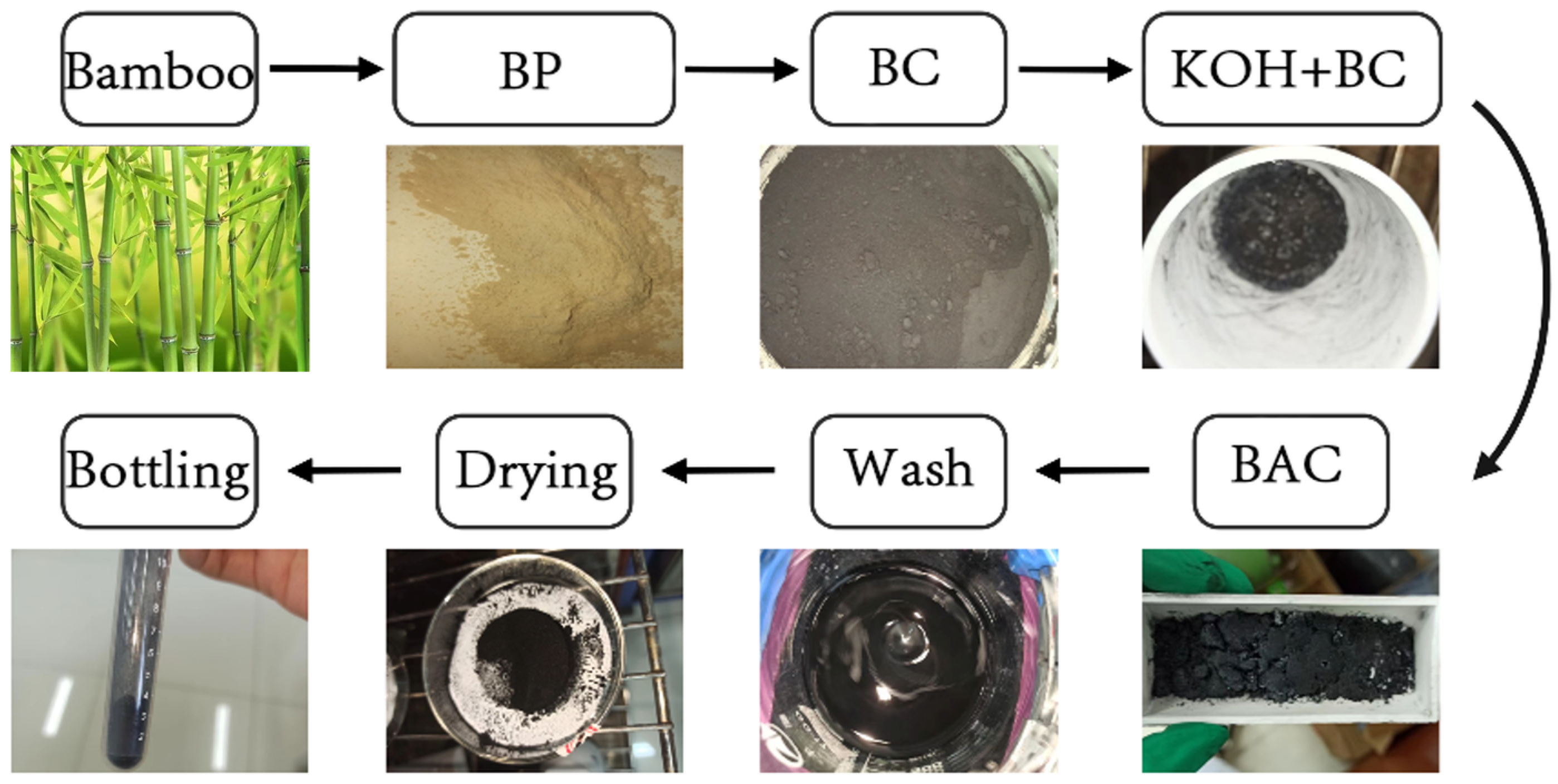
Bamboo-based activated carbon (BAC) was synthesized through a two-step procedure involving carbonization followed by KOH activation, as depicted in Figure 1.
The carbonization process was carried out as follows: A predetermined mass of bamboo powder (BP) was loaded into a custom-designed reactor placed inside an electric heating furnace. The reactor was purged with nitrogen gas at a flow rate of 40 L/h to establish an inert atmosphere. The heating rate was carefully controlled at 20 °C/min. The carbonization temperature and duration were adjusted according to the specific experimental protocols. Once the product temperature approached room temperature, the reactor was removed from the furnace. The resulting carbonized material was thoroughly washed with distilled water to remove residual impurities and subsequently dried to constant weight. This carbonized product is referred to as BC hereafter.
For the activation step, BC was mixed with KOH at a designated impregnation ratio (mass ratio) and then oven-dried at 110 °C. The dried mixture was transferred to a tube furnace and heated to the specified activation temperature and held for a defined duration, with a heating rate of 5 °C/min under a nitrogen flow of 0.4 L/min. After cooling to room temperature, the product was sequentially washed with dilute hydrochloric acid solution and distilled water until the pH reached 7.0. The resulting activated carbon was designated as BAC.

2.3. Preparation of N-BAC

The BC sample was initially prepared by pyrolysis at 600 °C for 60 min. Subsequently, the obtained BC was mixed with KOH and urea at a mass ratio of 1:6:0.3 using the impregnation method, followed by thorough mixing for 11 h. The mixture was then thermally dried at 110 °C. Nitrogen-doped activated carbon (N-BAC) was produced by activating the dried sample at 850 °C for 60 min under a nitrogen atmosphere (flow rate: 0.4 L/min). The nitrogen-doped activated carbon was labeled as N-BAC.

2.4. Preparation of Electrode Material

A specified mass of activated carbon powder was weighed and wetted with anhydrous ethanol. It was then mixed with a conductive additive (acetylene black) and a binder (polytetrafluoroethylene, PTFE) in a mass ratio of 8:1:1. The resulting viscous slurry was uniformly applied onto a nickel foam current collector with an area of 1.0 cm2, yielding an active material loading of approximately 5 mg. The coated electrode was dried at 80 °C until constant weight was reached. Subsequently, the dried electrode was pressed at 10 MPa for 1 min to ensure good adhesion of the coating to the nickel foam substrate.

2.5. Determination of Iodine Valve

The iodine number of the activated carbon samples was determined in accordance with GB/T 12496.8-2015 [35], the standard test method for iodine adsorption value of wood-based activated carbon.

2.6. Material Characterizations

The specific surface area, pore size distribution, and pore volume of the samples were analyzed using N2 adsorption/desorption isotherms measured at 77 K with a specific surface area and pore structure analyzer (Micromeritics TriStar II 3020, Norcross, GA, USA). The morphology was observed by scanning electron microscopy (SEM, Hitachi SU8010, Tokyo, Japan) at an accelerating voltage of 15 kV after sputter-coating with gold. X-ray diffraction (XRD) patterns of the samples were recorded on a diffractometer (PANalytical X’Pert Pro, Almelo, The Netherlands) over the 2θ range of 5–90°. Functional groups were identified by Fourier-transform infrared spectroscopy (FTIR, Thermo Scientific Nicolet 6700, Waltham, MA, USA) in the wavenumber range of 400–4000 cm−1. X-ray photoelectron spectroscopy (XPS, Thermo Scientific K-Alpha, Waltham, MA, USA) was used to test the elemental composition and surface characteristics of the activated samples, and the XPS spectra, covering a broad range of binding energies from 0 to 1350 eV, provided a comprehensive understanding of the elemental statuses within the carbon samples.

2.7. Measurement of Electrochemical Performance

The electrochemical performance of the samples was evaluated using a CHI7960E electrochemical workstation (Chenhua, Shanghai, China). A three-electrode configuration was employed, with a platinum plate as the counter electrode, an Ag/AgCl electrode as the reference electrode, and the prepared supercapacitor electrode as the working electrode. A 6 M KOH aqueous solution served as the electrolyte. The specific capacitance (Cs) was calculated from the cyclic voltammetry (CV) curves using the following equation:
C S = Q 2 m ν Δ V
where Cs is the specific capacitance (F/g), Q is the integrated area of the CV curve, m is the mass of active material on the electrode (g), ν is the scan rate (V/s), and ΔV is the potential difference (V).
Theoretically the specific capacitance of a three-electrode cell is one-fourth that of a two-electrode cell [36], so the energy density (E) and power density (P) can be calculated using the following equations based on the above three-electrode system:
E = C S Δ V 2 28.8
P = 3600 E Δ t
where E is the energy density (Wh/kg), P is the power density (W/kg), and Δt is the discharge time (s).

3. Results and Discussion

3.1. Influence of Process Parameters for Preparing BAC

The activation mechanism of KOH is complex, and its primary function is to disrupt the carbon layer structure of biomass-derived carbon. During KOH activation, multiple reactions proceed simultaneously. The overall activation reaction can be expressed as follows [4,37]:
6KOH + 2C → 2K2CO3 + 2K + 3H2
K2CO3 → K2O + CO2
K2CO3 + 2C → 2K + 3CO
C + K2O → 2K + CO
CO2 + C → 2CO
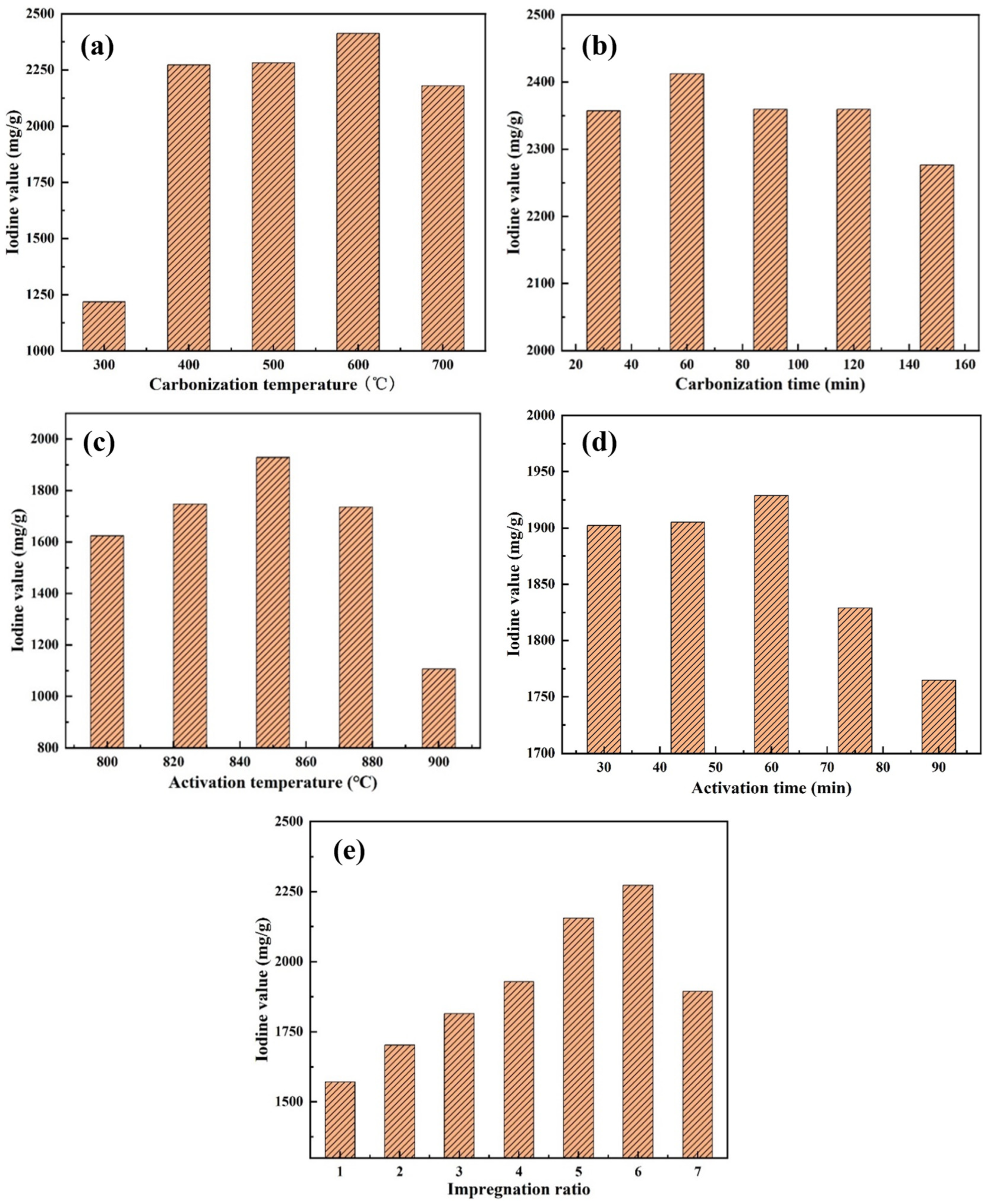
The iodine adsorption values of BAC samples prepared at different carbonization temperatures are shown in Figure 2a. As the carbonization temperature increases, the iodine value of BAC rises from 1218.8 mg/g at 300 °C to 2412.1 mg/g at 600 °C, and then decreases to 2179.3 mg/g at 700 °C. In the temperature range of 300–600 °C, the release of volatile matter and the increase in carbon content within the carbon matrix jointly promote continuous pore structure development. Simultaneously, the synergistic effects of the KOH activation reaction and the intercalation of metallic potassium further enhance the formation of micropores, leading to a significant improvement in the iodine adsorption value of the activated carbon. However, when the carbonization temperature reaches 700 °C, excessive carbonization results in pore collapse, with micropores being enlarged into mesopores under the etching effect of KOH, thereby reducing the iodine adsorption capacity. Therefore, the optimal carbonization temperature is determined to be 600 °C.
The effect of carbonization time on the iodine adsorption value of BAC is shown in Figure 2b. As the carbonization time was extended from 30 min to 150 min, the iodine value of BAC first increased and then decreased, reaching a maximum of 2412.1 mg/g at 60 min. This trend can be attributed to the fact that a moderate extension of carbonization time promotes the release of volatile matter and facilitates the formation of abundant micropores during subsequent KOH activation. Conversely, excessively prolonged carbonization can cause the collapse of the original pore structure and the widening of micropores into mesopores under the etching effect of KOH. Therefore, a carbonization time of 60 min is considered optimal.
Figure 2c illustrates the influence of activation temperature on the iodine adsorption value of BAC. As the activation temperature increases from 800 °C to 900 °C, the iodine value of BAC shows a volcano-type trend, rising initially and then declining. The maximum iodine value of 1928.8 mg/g is achieved at 850 °C. In the high-temperature KOH activation process, intermediate products such as potassium oxide, carbon dioxide, and potassium carbonate are formed. These intermediates react with the carbon matrix to drive the pore-forming process, with potassium carbonate playing a key role in creating additional micropores. As the activation temperature increases, KOH is reduced by carbon, and metallic potassium intercalates into the carbon lattice, activating and generating new porous structures. However, when the activation temperature exceeds 850 °C, a greater amount of metallic potassium is produced. These potassium atoms aggregate and migrate within the existing micropores, continuing to react with the carbon matrix, which results in the expansion of micropores into mesopores.
The effect of activation time on the iodine adsorption value of BAC is shown in Figure 2d. As the activation time was extended, the iodine value of BAC slightly increased from 1902.2 mg/g at 30 min to 1928.8 mg/g at 60 min, and then gradually decreased to 1764.9 mg/g at 90 min. This indicates that a moderate extension of activation time promotes the thorough reaction of carbon with KOH and its intermediates, thereby facilitating the formation of more micropores. However, excessive prolongation of activation time leads to continued reaction of KOH and its intermediates with the carbon surrounding the pores, resulting in over-etching of the formed pore structure and partial pore collapse, which ultimately reduces the iodine value.
The impregnation ratio of KOH to carbon precursor is also a significant factor affecting the iodine adsorption value of BAC (Figure 2e). As the impregnation ratio increases, the iodine value of BAC initially rises from 1570.9 mg/g at a ratio of 1:1 to 2272.2 mg/g at 6:1, and then declines to 1894.27 mg/g at 7:1. This trend can be explained as follows: A moderate increase in the impregnation ratio allows KOH and its intermediates to react more completely with the carbon matrix. A greater amount of metallic potassium intercalates into the carbon layers, the degree of carbon etching increases, and more microporous structures are formed, thereby enhancing the adsorption capacity of BAC. However, a further increase in the impregnation ratio results in an excess of KOH and its intermediates reacting with the carbon matrix within the already formed micropores, leading to micropore collapse and a reduction in iodine value [38].

3.2. Material Characterization

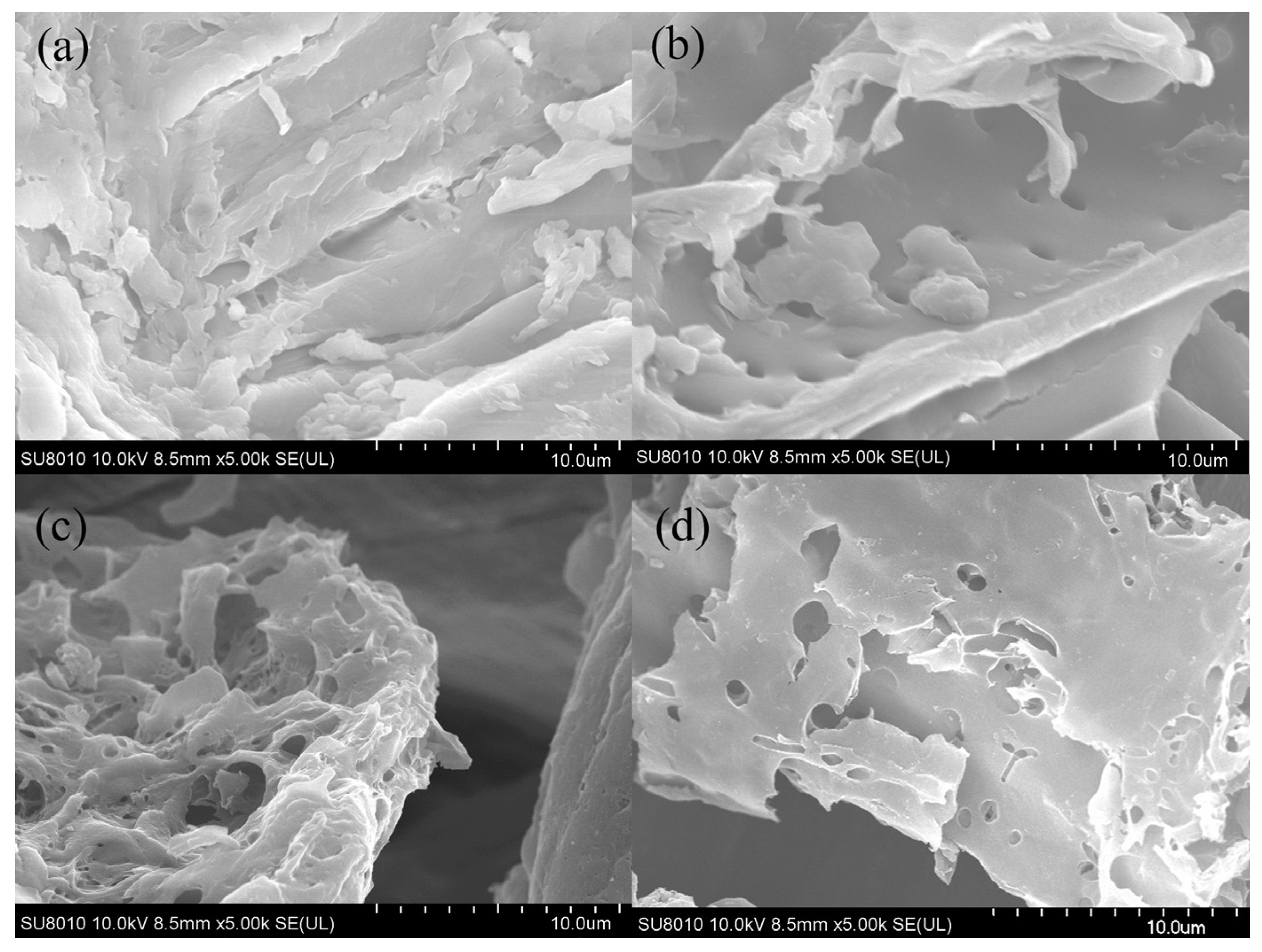
The morphology of the prepared samples was examined by scanning electron microscopy (SEM). As shown in Figure 3, BP, BC, BAC, and N-BAC exhibit significant differences in their microscopic morphology and pore structure. The surface of BP is smooth and flat, with no obvious pores visible. In contrast, BC begins to show a small number of pores on its surface while largely retaining the original fibrous morphology of bamboo. The surface of BAC displays a typical three-dimensional hierarchical porous structure, with a high density of pores, as well as numerous cracks, pits, and cavities, indicating that a rich hierarchical pore system has been successfully formed after carbonization and KOH activation. Compared to BAC, the surface of N-BAC shows more severe structural disruption, suggesting that the addition of urea has partially damaged the porous architecture of the carbon matrix.
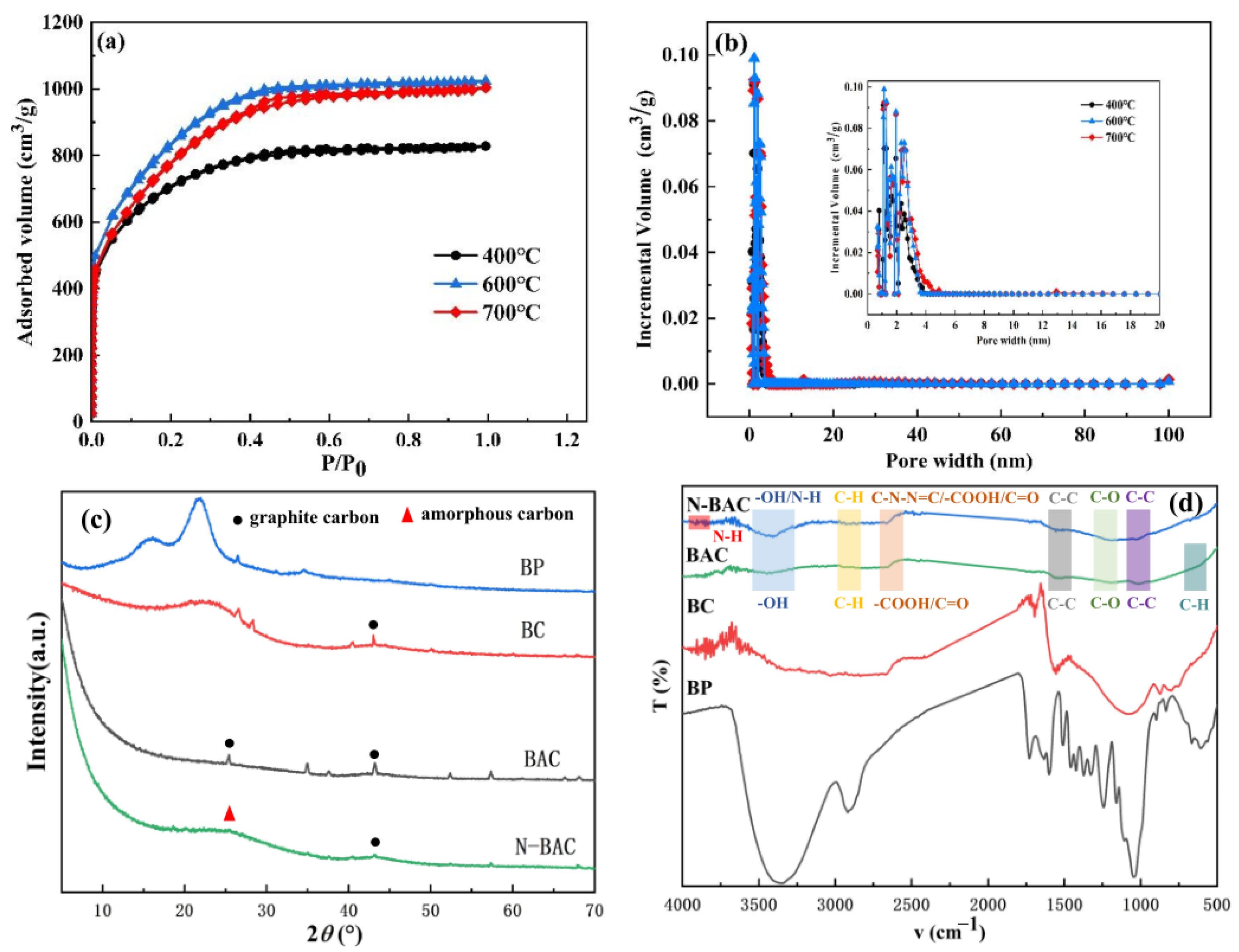
Specific surface area and pore size distribution are critical factors influencing the performance of supercapacitors. Figure 4a,b show the N2 adsorption–desorption isotherms and pore size distributions of BAC prepared at different carbonization temperatures. According to the IUPAC classification, all samples exhibit typical Type I adsorption isotherms. In the low-pressure region (P/P0 < 0.1), the adsorption capacity increases sharply, indicating that micropores dominate the adsorption process. As the relative pressure increases into the medium-pressure region (0.1 < P/P0 < 0.8), the rate of adsorption increase slows, further confirming the microporous nature of the materials. Notably, samples prepared at 600 °C and 700 °C show slight H4-type hysteresis loops in the medium-pressure range (0.4 < P/P0 < 0.8), suggesting the presence of mesopores in these samples.
As shown in Table 2, the preparation conditions—including carbonization temperature, carbonization time, activation temperature, activation time, and impregnation ratio—exhibit a typical volcano-type effect on the specific surface area and total pore volume of the samples. This trend is highly consistent with the influence of these conditions on the iodine adsorption value. Among the tested conditions, the activated carbon prepared at 600 °C for 60 min shows the highest specific surface area (3013.30 m2/g) and the largest total pore volume (1.5813 cm3/g). Combined with the pore size distribution analysis in Figure 4b, it can be seen that the pore size distribution of the activated carbon is relatively concentrated, mainly in the range of 0.5–3.0 nm, with an average pore diameter between 2.0785 nm and 2.8078 nm. The structure is predominantly composed of micropores and mesopores. The presence of micropores can significantly enhance the specific capacitance of activated carbon in aqueous and organic electrolytes, while mesopores facilitate the rapid diffusion of larger ions, which is of great importance for improving the overall performance of activated carbon.
Table 3 provides a comprehensive comparison of the prepared BAC and N-BAC with commercial bamboo-based activated carbon (commercial-AC) and Japanese Kuraray YP-80F activated carbon. The results show that BAC exhibits a high specific surface area of 3013.30 m2/g, which is significantly higher than that of the other samples, indicating its greater potential for achieving high specific capacitance. In terms of total pore volume, BAC surpasses YP-80F but is slightly lower than commercial-AC. Its micropore volume lies between those of commercial-AC and YP-80F. Overall, the prepared BAC possesses a high specific surface area and a favorable pore structure, which facilitates ion transport and storage within the material. In contrast, N-BAC shows a lower specific surface area and pore volume compared to BAC, suggesting that the addition of urea may have partially disrupted the pore structure.
Figure 4c shows the XRD patterns of BP, BC, BAC, and N-BAC. The diffraction peaks of BAC shift to higher angles compared with those of BC, which is attributed to the increased graphitization degree and reduced interlayer spacing of the carbon layers in BAC after activation at 850 °C. In the 2θ range of 20.0–30.0°, the broad and diffuse peaks observed for both BC and BAC indicate the presence of disordered carbon layers, which may contain a small number of graphite microcrystals. The two distinct peaks of BP at 2θ = 15.6° and 22.0° are assigned to cellulose and hemicellulose, respectively. The broad and weak peak of BC at 2θ ≈ 23.0° suggests its amorphous carbon nature, likely due to incomplete carbonization. The crystalline peaks of BC at 2θ = 25.6° and 43.0° indicate partial graphitization [8]. The sharper peaks of activated carbon imply a higher content of graphite microcrystals compared with carbonized carbon. The sharp peaks of BAC at 2θ ≈ 35°, 37°, 52°, 57°, 66°, and 68° are associated with inorganic impurities; the reduced intensity of these peaks may result from the dispersion of metallic potassium into the carbon layers during KOH activation [39]. The broad peak of N-BAC in the 2θ range of 15.0–30° corresponds to amorphous carbon, indicating the formation of disordered carbon structures induced by nitrogen doping [40].
The FTIR spectra of BP, BC, BAC, and N-BAC are shown in Figure 4d. The broad peak around 3400 cm−1 corresponds to the O-H stretching vibration of hydroxyl and carboxyl groups. The absorption bands in the range of 1000–1450 cm−1 are attributed to a large number of residual hydroxyl groups, which can be assigned to O–H bending vibrations and C–O (hydroxyl, ester, or ether) stretching vibrations. BP exhibits absorption peaks at 3400 cm−1 and 2900 cm−1, corresponding to O–H and C–H stretching vibrations, respectively. BC shows distinct absorption peaks compared to BP in the 1000–1500 cm−1 region, which are associated with abundant residual hydroxyl groups attributable to O–H bending and C–O (hydroxyl, ester, or ether) stretching vibrations [39]. BAC displays absorption peaks at 3410 cm−1, 2660 cm−1, 1720 cm−1, 1210 cm−1, 1024 cm−1, and 675 cm−1, which correspond to the stretching vibrations of –OH, –COOH, C=O, C–C, C–O–H, and aromatic C–H structures, respectively. N-BAC exhibits absorption peaks at 3740 cm−1, 3450 cm−1, 2930 cm−1, 2660 cm−1, 1720 cm−1, 1210 cm−1, and 1008 cm−1, which are assigned to the stretching vibrations of N–H, –OH or N–H, C–H, C–N–N=C/–COOH/C=O, C–C, C–O, and C–C, respectively. During the nitrogen doping process, the pore size of N-BAC ranges from 0.5 to 3 nm, while the atomic radius of nitrogen is about 0.075 nm, indicating that N atoms can potentially enter the pores of the activated carbon. The results demonstrate that after carbonization and activation of BP, the surface functional groups change significantly, and nitrogen is successfully doped into the activated carbon matrix. Nitrogen doping is achieved through the chemical reaction of urea with surface functional groups and subsequent thermal conversion. Oxygen-containing functional groups (such as hydroxyl groups) can react with amino groups of urea, allowing N atoms to incorporate into the graphite lattice. These functional groups can participate in redox reactions with the electrolyte, thereby enhancing the electrochemical performance of the activated carbon [41]. The following reactions may occur in the electrolyte [42]:
-CN = NH + 2H2O + 2e↔-CH-NH2 + 2OH
-CN-NHOH + 2H2O + 2e↔-C-NH2 + 2OH
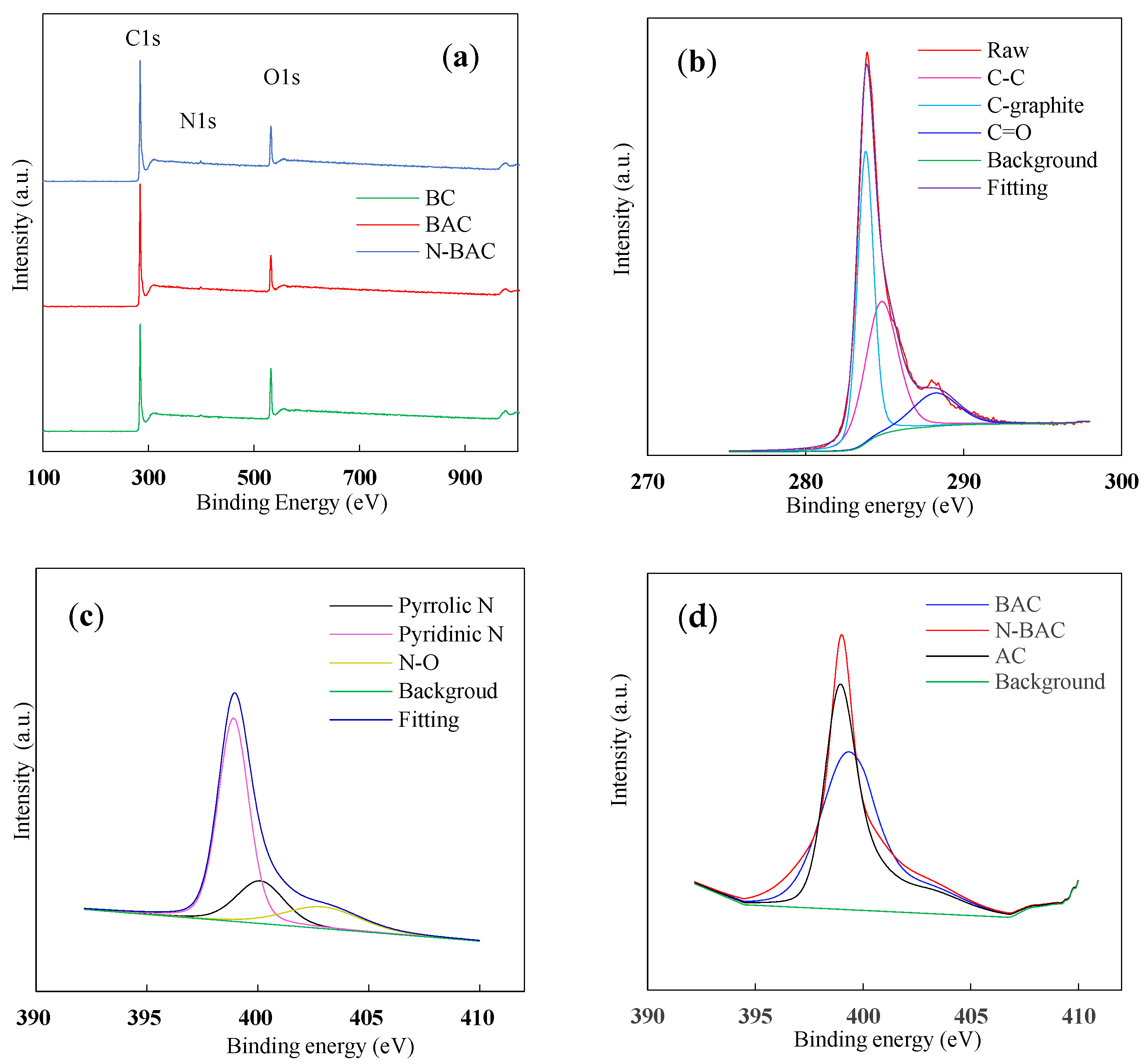
The chemical composition of each sample was analyzed by XPS. As shown in Figure 5a, the XPS spectra of BC, BAC, and N-BAC exhibit distinct binding energy peaks at 283.8 eV, 399.2 eV, and 531.8 eV, which correspond to the C1s, N1s, and O1s orbitals, respectively. In addition, trace amounts of S2p (168.1 eV) and P2p (136.7 eV) were also detected in the samples. Figure 5b displays the peak-fitted C1s spectrum of N-BAC, in which three major binding energy peaks are observed at 283.8 eV, 284.8 eV, and 288.2 eV, attributed to C–graphite, C–C, and C=O, respectively. A weaker peak at 289.3 eV can be attributed to O–C=O functional groups, such as carboxyl and lactone groups. Figure 5c shows the peak-fitted N1s spectrum of N-BAC, where three characteristic binding energy peaks are located at 398.4 eV, 400.1 eV, and 402.9 eV, corresponding to pyridinic N, pyrrolic N, and nitrogen oxides, respectively. Pyridinic and pyrrolic N species create abundant electrochemically active sites, enhance the surface-controlled pseudocapacitive effect, promote ion diffusion kinetics, and thereby significantly improve the specific capacity [43]. In addition, nitrogen oxides are strongly hydrophilic, which improves the wettability of the material surface and consequently enhances the conductivity, rate capability, and cycling stability of the activated carbon [44]. Figure 5d compares the N1s peaks among BC, BAC, and N-BAC samples. The N1s peak of N-BAC is notably more pronounced, with a nitrogen content of 1.75%, surpassing that of BAC (1.56%) and BC (1.32%), demonstrating the successful doping of nitrogen atoms into bamboo-derived activated carbon via the experimental approach.

3.3. Electrochemical Characterization

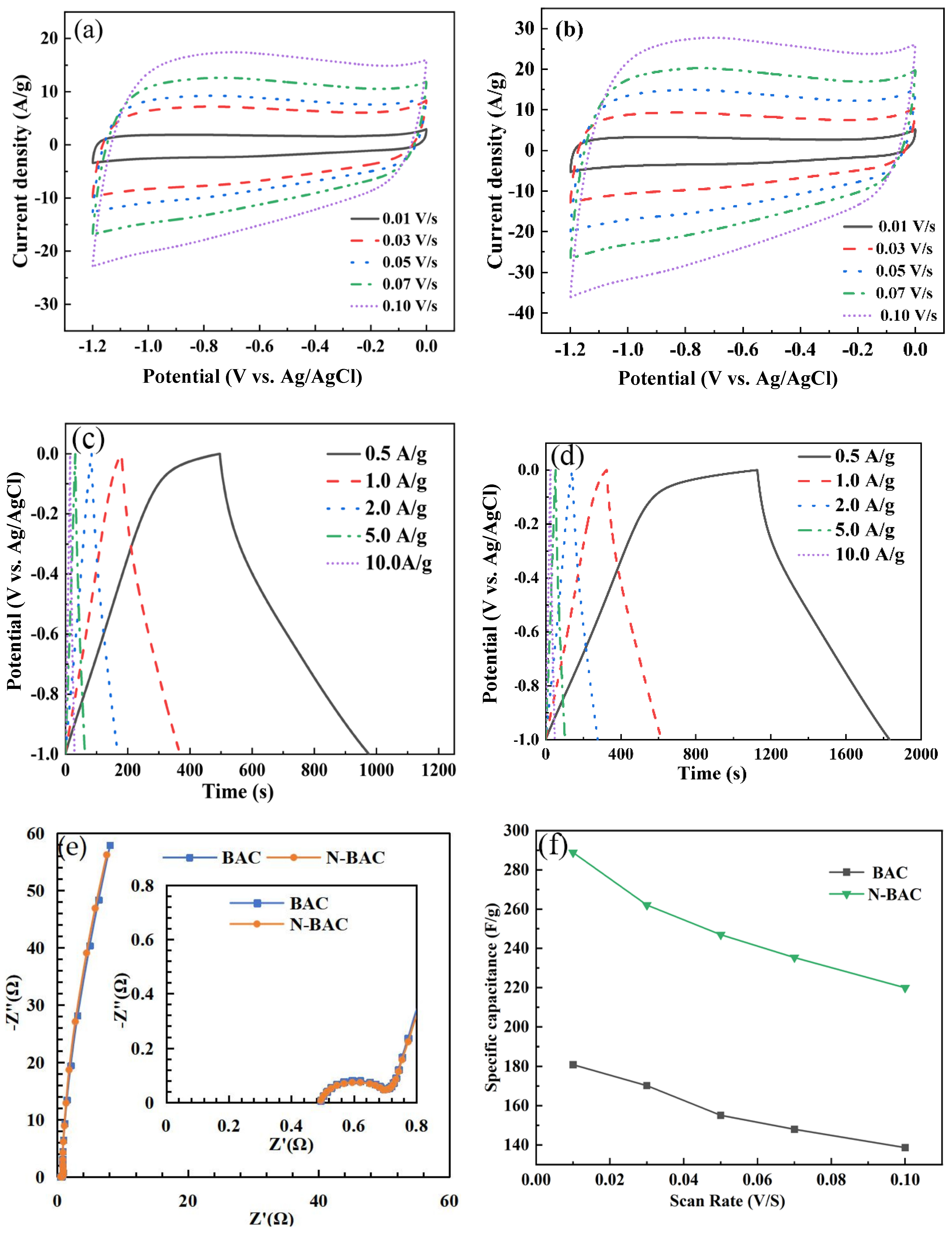
Figure 6a,b show the cyclic voltammetry (CV) curves of BAC and N-BAC electrodes at different scan rates. CV analysis reveals the relationship between the response current and voltage, reflecting the electrochemical behavior at the electrode surface [9]. Within the tested potential range (–1.2 V to 0 V), the CV curves of both electrodes display a well-defined rectangular shape, indicating that the charge–discharge process is primarily governed by electric double-layer capacitive behavior. This suggests that both BAC and N-BAC electrodes possess excellent capacitive and power characteristics. This performance benefit can be ascribed to their three-dimensional hierarchical porous structure: the open-pore architecture facilitates electrolyte penetration and charge transport, while the abundant micropores and suitably sized mesopores provide a large electrochemically active surface area and enhance the material’s conductivity, thereby endowing the electrodes with rapid kinetic response and outstanding capacitive performance [45].
As the scan rate increases, the area enclosed by the CV curves gradually expands, a trend consistent with previous reports [45]. At identical scan rates, the CV curve area of N-BAC is significantly larger than that of BAC, indicating a higher specific capacitance. This enhancement is closely related to the synergistic effects of nitrogen doping, which not only introduces pseudocapacitance through faradaic reactions but also likely improves electric double-layer capacitance by enhancing surface wettability and electrolyte accessibility.
Figure 6c,d display the galvanostatic charge–discharge (GCD) curves of the BAC and N-BAC electrodes at different current densities. The charge–discharge curves of both electrodes show quasi-symmetrical triangular shapes, confirming their excellent electric double-layer capacitive behavior, including good electrochemical reversibility and charge–discharge performance. As the current density increases, the discharge time decreases accordingly. At the same current density, the charge–discharge time of the N-BAC electrode is longer, further confirming its higher specific capacitance, which is consistent with the CV analysis results.
Figure 6e presents the electrochemical impedance spectroscopy (EIS) Nyquist plots of the BAC and N-BAC electrodes. These Nyquist plots exhibit approximately straight line in lower frequency region and small semi arc in high frequency region thus signifying typical capacitive behavior for BAC and N-BAC materials. The diameter of the semi arc is directly related to charge transfer resistance, which is obtained from the resistance between the electrode and current collector, and the smaller diameter demonstrates the lower internal resistance exhibited by the activated carbon materials [46]. By performing equivalent circuit fitting based on the Nyquist plots, the solution resistances (Rs) for the BAC and N-BAC electrodes are determined as 0.55 Ω and 0.49 Ω, respectively, while the charge transfer resistances (Rct) are 8.20 Ω and 7.98 Ω. This indicates that nitrogen doping can enhance the electrochemical performance of bamboo-based activated carbon materials. The porous structure of the bamboo-based activated carbon facilitates ion diffusion [47], resulting in lower reaction resistance, improved interfacial contact, relatively homogeneous surface characteristics, and promising application potential.
As shown in Figure 6f, the specific capacitance calculated from the CV curves decreases with increasing scan rate. As the scan rate increases from 0.01 V/s to 0.1 V/s, the specific capacitance of the BAC electrode decreases from 180.85 F/g to 138.63 F/g (retention rate 76.65%), while that of the N-BAC electrode drops from 288.83 F/g to 219.96 F/g (retention rate 76.15%). The higher specific capacitance of the N-BAC electrode is attributed to the pseudocapacitive contribution introduced by nitrogen doping. The specific surface areas of the BAC and N-BAC electrodes are 3013.30 m2/g and 2447.32 m2/g, respectively, which are significantly larger than the size of the electrolyte ions (K+ radius ~0.133 nm, OH radius ~0.137 nm). This provides abundant active sites for charge storage and promotes ion diffusion within the material. Consequently, both BAC and N-BAC electrodes exhibit excellent electrochemical performance.
To systematically evaluate the overall performance of BAC and N-BAC, Table 4 compares their specific surface area and specific capacitance with those of typical biomass-derived activated carbons reported in the literature. It should be noted that the type of raw material plays a decisive role in determining the electrochemical behavior of biomass carbons. Among biomass-derived carbon materials from similar agricultural and forestry sources, the BAC and N-BAC prepared in this work exhibit leading performance in terms of both specific surface area and capacitive properties, demonstrating clear competitive advantages and confirming their potential as high-performance supercapacitor electrode materials.
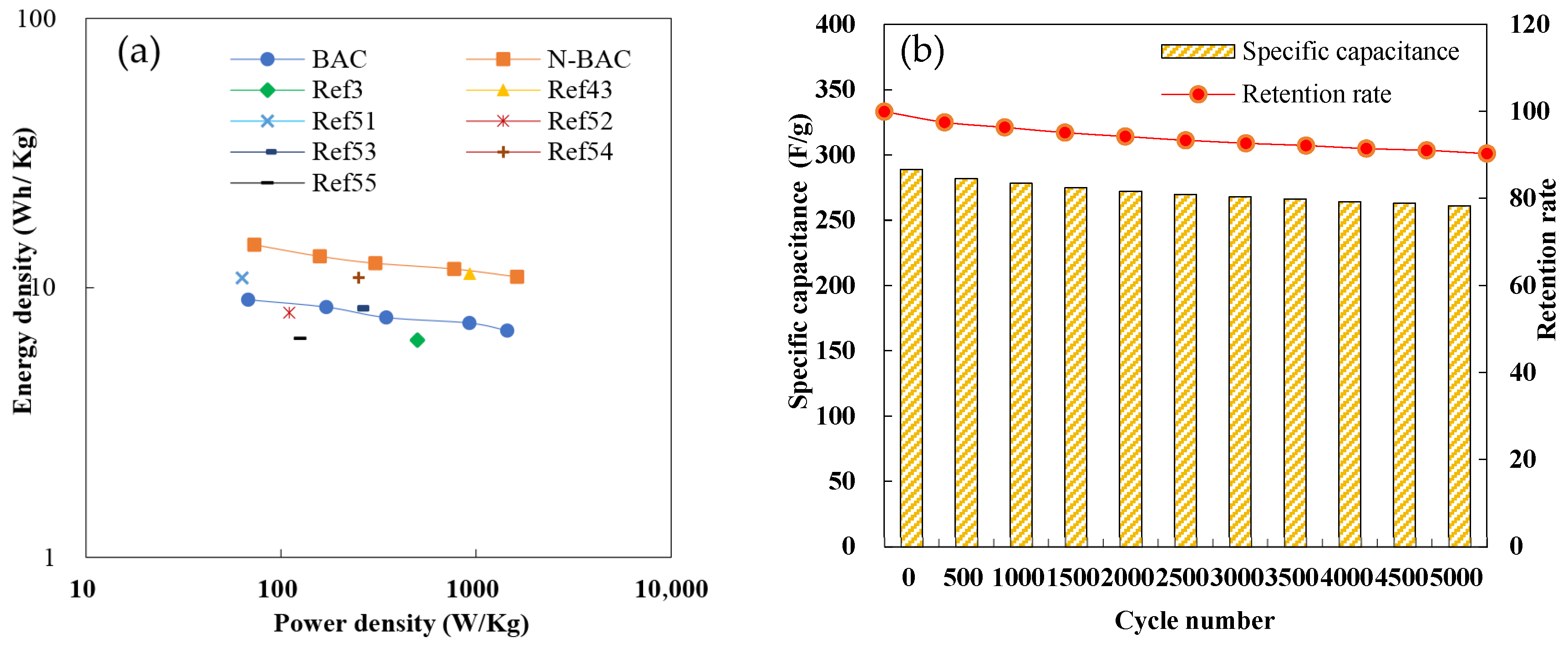
The energy/power density of supercapacitors is an important indicator for assessing their practical application capability. Ragone plots of BAC and N-BAC based on the 6 M KOH electrolyte are displayed in Figure 7a. N-BAC with the 6 M KOH electrolyte exhibits the maximum energy density of 14.4 Wh/kg at a power density of 73.1 W/kg, and holds 11.0 Wh/kg at the power density of 1624.6 W/kg, both of which exceed those of BAC (9.0 Wh/kg at 67.9 W/kg and 6.9 Wh/g at 1442.7 W/kg). The values of N-BAC are higher than those of previously reported biomass-based carbon materials such as CPC650-1-3 [3], adsorbed AC [44], ABC-900 [52], TC [53], ACF [54], HJPC-4 [55], and LAC800-4 [56]. The cyclic stability of the N-BAC electrode using the 6 M KOH electrolyte was assessed at the a rate of 10 mV/s. As shown in Figure 7b, the specific capacitance is about 260.9 F/g, and the retention rate is nearly 90.3% of the original capacitance after 5000 cycles between −1.2 V and 0 V, demonstrating excellent cyclic stability for supercapacitor applications.

4. Conclusions

In this work, bamboo was utilized as the raw material to synthesize bamboo-based activated carbon (BAC) and nitrogen-doped bamboo-based activated carbon (N-BAC) through a two-step process of carbonization followed by KOH activation. The materials were subsequently applied as electrode materials for supercapacitors. It was observed that process parameters such as carbonization temperature, carbonization time, activation temperature, activation time, and impregnation ratio significantly influenced the structure and iodine adsorption capacity of the activated carbon, showing a volcano-type dependence. Under the optimized conditions of a carbonization temperature of 600 °C for 60 min, an activation temperature of 850 °C for 60 min, and an impregnation ratio of 6:1, the prepared BAC exhibited the highest specific surface area (3013.30 m2/g), a total pore volume of 1.5813 cm3/g, and an average pore size of 2.0992 nm.
Although nitrogen doping slightly reduced the specific surface area and pore volume of BAC, the introduced nitrogen-containing functional groups were able to participate in redox reactions with the electrolyte, thereby significantly enhancing the electrochemical performance of N-BAC. In a 6.0 M KOH electrolyte, the specific capacitance of N-BAC reached 288.8 F/g at a scan rate of 0.01 V/s, exceeding that of the optimal BAC (180.85 F/g). The supercapacitor assembled with N-BAC delivered a high energy density of 14.4 Wh/kg at a power density of 73.1 W/kg in an aqueous electrolyte, while the specific capacitance retention rate was about 90.3% after 5000 cycles between −1.2 V and 0 V at a scan rate of 10 mV/s. In summary, this study successfully developed high-performance supercapacitor electrode materials, offering a new pathway for the high-value utilization of biomass resources.

Author Contributions

Conceptualization, D.J. and K.J.; methodology, J.J.; software, Z.Y.; validation, Z.Y. and D.J.; formal analysis, Z.Y. and K.J.; investigation, D.J. and Y.W.; data curation, D.J.; writing—original draft preparation, D.J. and Z.Y.; writing—review and editing, K.J. and Y.W.; supervision, J.J.; funding acquisition, D.J. and Y.W. All authors have read and agreed to the published version of the manuscript.

Funding

This work was funded by the Project of the National Natural Science Foundation of China (Grant No. 22578406), and project of scientific research foundation of Zhejiang University of Technology (Project No. 2021101009029). The research was supported by Zhejiang Province Key Laboratory of Biofuel and Biodiesel Laboratory of China Petroleum and Chemical Industry Federation.

Data Availability Statement

The original contributions presented in this study are included in the article material. Further inquires can be directed to the corresponding author.

Conflicts of Interest

Authors Dengxiang Ji, Zhihui You, Yi Wei and Jianbing Ji were employed by College of Chemical Engineering, Zhejiang University of Technology. Author Ke Jin was employed by Sinopec Research Institute of Petroleum Processing and Sinopec Maoming Petrochemical Co., Ltd. The authors declare that the research was conducted in the absence of any commercial or financial relationships that could be construed as a potential conflict of interest.

Abbreviations

BACBamboo-based activated carbon
N-BACNitrogen-doped bamboo-based activated carbon
SEMScanning electron microscopy
XRDX-ray diffraction
FTIRFourier transform infrared spectroscopy
XPSX-ray photoelectron spectroscopy
CVCyclic voltammetry
GCDGalvanostatic charge–discharge
EISElectrochemical impedance spectroscopy
BPBamboo powder
BCBamboo carbon
CsSpecific capacitance
EEnergy density
PPower density

References

  1. Liu, S.; Xu, Y.; Wu, J.; Huang, J. Celery-derived porous carbon materials for superior performance supercapacitors. Nanoscale Adv. 2021, 3, 5363–5372. [Google Scholar] [CrossRef]
  2. Yin, J.; Zhang, W.; Alhebshi, N.A.; Salah, N.; Alshareef, H.N. Synthesis strategies of porous carbon for supercapacitor applications. Small Methods 2020, 4, 1900853. [Google Scholar] [CrossRef]
  3. Zhang, Y.; Zhao, Y.; Qiu, L.; Xiao, J.; Wu, F.; Cao, J.; Bai, Y.; Liu, F. Insights into the KOH activation parameters in the preparation of corncob-based microporous carbon for high-performance supercapacitors. Diam. Relat. Mater. 2022, 129, 109331. [Google Scholar] [CrossRef]
  4. Luo, L.; Lan, Y.; Zhang, Q.; Deng, J.; Luo, L.; Zeng, Q.; Gao, H.; Zhao, W. A review on biomass-derived activated carbon as electrode materials for energy storage supercapacitors. J. Energy Storage 2022, 55, 105839. [Google Scholar] [CrossRef]
  5. Shi, C.; Wang, Y.; Kulaots, I.; Zhu, H.; Sheldon, B. Water-in-salt battery electrolyte for high-voltagesupercapacitors: A fundamental study on biomass and carbonfiber electrodes. J. Electrochem. Soc. 2024, 171, 110526. [Google Scholar] [CrossRef]
  6. Farber, E.; Seraphim, N.; Tamakuwala, K.; Stein, A.; Rücker, M.; Eisenberg, D. Porous materials: The next frontier in energy technologies. Science 2025, 390, eadn9391. [Google Scholar] [CrossRef] [PubMed]
  7. Tian, X.; Yu, J.; Qiu, L.; Zhu, Y.; Zhu, M. Structural changes and electrochemical properties of mesoporous activated carbon derived from Eucommia ulmoides wood tar by KOH activation for supercapacitor applications. Ind. Crops Prod. 2023, 197, 116628. [Google Scholar] [CrossRef]
  8. Qorbani, M.; Chen, K.; Chen, L. Hybrid and asymmetric supercapacitors: Achieving balanced stored charge across electrode materials. Small 2024, 20, 2400558. [Google Scholar] [CrossRef] [PubMed]
  9. Canales-Flores, R.; Prieto-Garcia, F. Activation methods of carbonaceous materials obtained from agricultural waste. Chem. Biodivers. 2016, 13, 261–268. [Google Scholar] [CrossRef]
  10. Yu, M.; Han, Y.; Li, J.; Wang, L. CO2-activated porous carbon derived from cattail biomass for removal of malachite green dye and application as supercapacitors. Chem. Eng. J. 2017, 317, 493–502. [Google Scholar] [CrossRef]
  11. Qu, W.; Xu, Y.; Lu, A.; Zhang, X.; Li, W. Converting biowaste corncob residue into high value added porous carbon for supercapacitor electrodes. Bioresour. Technol. 2015, 189, 285–291. [Google Scholar] [CrossRef] [PubMed]
  12. Teo, E.Y.L.; Muniandy, L.; Ng, E.P.; Adam, F.; Mohamed, A.R.; Jose, R.; Chong, K. High surface area activated carbon from rice husk as a high performance supercapacitor electrode. Electrochim. Acta 2016, 192, 110–119. [Google Scholar] [CrossRef]
  13. Li, Z.; Li, Y.; Zhu, J. Straw-based activated carbon: Optimization of the preparation procedure and performance of volatile organic compounds adsorption. Materials 2021, 14, 3284. [Google Scholar] [CrossRef]
  14. Apriwandi, A.; Taer, E.; Farma, R.; Setiadi, R.N.; Amiruddin, E. A facile approach of micro-mesopores structure binder-free coin/monolith solid design activated carbon for electrode supercapacitor. J. Energy Storage 2021, 40, 102823. [Google Scholar] [CrossRef]
  15. Chaudhari, S.; Kwon, S.Y.; Yu, J.S. Ordered multimodal porous carbon with hierarchical nanostructure as high performance electrode material for supercapacitors. RSC Adv. 2014, 4, 38931–38938. [Google Scholar] [CrossRef]
  16. Wang, J.; Kaskel, S. KOH activation of carbon-based materials for energy storage. J. Mater. Chem. 2012, 22, 23710–23725. [Google Scholar] [CrossRef]
  17. Zhan, Y.; Zhou, H.; Guo, F.; Tian, B.; Du, S.; Dong, Y.; Qian, L. Preparation of highly porous activated carbons from peanut shells as low-cost electrode materials for supercapacitors. J. Energy Storage 2021, 34, 102180. [Google Scholar] [CrossRef]
  18. Feng, H.; Zhou, T.; Ge, L.; Li, Q.; Zhao, C.; Huang, J.; Wang, Y. Study on the preparation of high value-added activated carbon from petroleum coke: Comparison between one-and two-step methods for carbonization and activation. Energy 2024, 292, 130570. [Google Scholar] [CrossRef]
  19. Bhattacharjya, D.; Yu, J.S. Activated carbon made from cow dung as electrode material for electrochemical double layer capacitor. J. Power Sources 2014, 262, 224–231. [Google Scholar] [CrossRef]
  20. Danish, M.; Ahmad, T. A review on utilization of wood biomass as a sustainable precursor for activated carbon production and application. Renew. Sustain. Energy Rev. 2018, 87, 1–21. [Google Scholar] [CrossRef]
  21. Guo, F.; Li, X.; Liu, Y.; Peng, K.; Guo, C.; Rao, Z. Catalytic cracking of biomass pyrolysis tar over char-supported catalysts. Energy Convers. Manag. 2018, 167, 81–90. [Google Scholar] [CrossRef]
  22. Quan, H.; Fan, X.; Wang, W.; Gao, W.; Dong, Y.; Chen, D. Hierarchically porous carbon derived from biomass: Effect of mesopore and heteroatom-doping on electrochemical performance. Appl. Surf. Sci. 2018, 460, 8–16. [Google Scholar] [CrossRef]
  23. Cao, Y.; Wang, X.; Gu, Z.; Fan, Q.; Gibbons, W.; Gadhamshetty, V.; Ai, N.; Zeng, G. Potassium chloride templated carbon preparation for supercapacitor. J. Power Sources 2018, 384, 360–366. [Google Scholar] [CrossRef]
  24. Inal, I.; Holmes, S.; Banford, A.; Aktas, Z. The performance of supercapacitor electrodes developed from chemically activated carbon produced from waste tea. Appl. Surf. Sci. 2015, 357, 696–703. [Google Scholar] [CrossRef]
  25. Shang, Z.; An, X.; Zhang, H.; Shen, M.; Baker, F.; Liu, Y.; Liu, L.; Yang, J.; Cao, H.; Xu, Q.; et al. Houttuynia-derived nitrogen-doped hierarchically porous carbon for high-performance supercapacitor. Carbon 2020, 161, 62–70. [Google Scholar] [CrossRef]
  26. Jang, S.; Lee, J.; Kang, S.; Kang, Y.; Roh, K. Nitrogen-doped and carbon-coated activated carbon as a conductivity additive-free electrode for supercapacitors. Energies 2021, 14, 7629. [Google Scholar] [CrossRef]
  27. Kim, S.; Bai, B.; Kim, M.; Lee, Y. Improved specific capacitance of pitch-based activated carbon by KOH/KMnO4 agent for supercapacitors. Carbon Lett. 2020, 30, 585–591. [Google Scholar] [CrossRef]
  28. Wee, J.; Kim, C.; Tojo, T.; Choi, G.; Yang, C.; Kim, Y. Boron-doped edges as active sites for water adsorption in activated carbons. Langmuir 2021, 37, 13179–13186. [Google Scholar] [CrossRef]
  29. Yaglikci, S.; Gokce, Y.; Yagmur, E.; Aktas, Z. The performance of sulphur doped activated carbon supercapacitors prepared from waste tea. Environ. Technol. 2020, 41, 36–48. [Google Scholar] [CrossRef]
  30. Gao, Y.; Yang, Z.; Wang, Y.; Wang, X. Boosting capacitive storage of cathode for lithium-ion capacitors: Combining pore structure with P-doping. Electrochim. Acta 2021, 368, 137646. [Google Scholar] [CrossRef]
  31. Chen, M.; Xuan, H.; Zheng, X.; Liu, J.; Dong, X.; Xi, F. N-doped mesoporous carbon by a hard-template strategy associated with chemical activation and its enhanced supercapacitance performance. Electrochim. Acta 2017, 238, 269–277. [Google Scholar] [CrossRef]
  32. Wang, Y.; Xuan, H.; Lin, G.; Wang, F.; Chen, Z.; Dong, X. A melamine-assisted chemical blowing synthesis of N-doped activated carbon sheets for supercapacitor application. J. Power Sources 2016, 319, 262–270. [Google Scholar] [CrossRef]
  33. Ma, Y.; Chen, M.; Zheng, X.; Yu, D.; Dong, X. Synergetic effect of swelling and chemical blowing to develop peach gum derived nitrogen-doped porous carbon nanosheets for symmetric supercapacitors. J. Taiwan Inst. Chem. Eng. 2019, 101, 24–30. [Google Scholar] [CrossRef]
  34. Iroegbu, A.; Ray, S. Bamboos: From bioresource to sustainable materials and chemicals. Sustainability 2021, 13, 12200. [Google Scholar] [CrossRef]
  35. GB/T 12496.8-2015; Test Methods of Wooden Activated Carbon-Determination of Iodine Number. State Administration for Market Regulation: Beijing, China, 2015.
  36. Witt, J.A.; Mumm, D.R.; Mohraz, A. Microstructural tunability of co-continuous bijel derived electrodes to provide high energy and power densities. J. Mater. Chem. A 2016, 4, 1000–1007. [Google Scholar] [CrossRef]
  37. Dhakal, G.; Mohapatra, D.; Kim, Y.; Lee, J.; Kim, W.; Shim, J. High-performance supercapacitors fabricated with activated carbon derived from lotus calyx biowaste. Renew. Energy 2022, 189, 587–600. [Google Scholar] [CrossRef]
  38. Wei, L.; Tian, K.; Jin, Y.; Zhang, X.; Guo, X. Three-dimensional porous hollow microspheres of activated carbon for high-performance electrical double-layer capacitors. Microporous Mesoporous Mater. 2016, 227, 210–218. [Google Scholar] [CrossRef]
  39. Zhao, W.; Luo, L.; Wang, H.; Fan, M. Synthesis of bamboo-based activated carbons with super-high specific surface area for hydrogen storage. BioResources 2017, 12, 1246–1262. [Google Scholar] [CrossRef]
  40. Xie, K.; Hu, Y.; Afonaa-Mensah, S.; Yuan, C.; Cao, B.; Wang, S.; Wang, Q. Study on preparation of nitrogen-doped hierarchically porous and high-performance carbon materials from seaweed biomass. J. Renew. Mater. 2022, 10, 541–560. [Google Scholar] [CrossRef]
  41. Lakshmikandan, M.; Murugesan, A.; Wang, S.; Abomohra, A.; Jovita, P.; Kiruthiga, S. Sustainable biomass production under CO2 conditions and effective wet microalgae lipid extraction for biodiesel production. J. Clean. Prod. 2020, 247, 119398. [Google Scholar] [CrossRef]
  42. Wang, Y.; Song, Y.; Xia, Y. Electrochemical capacitors: Mechanism, materials, systems, characterization and applications. Chem. Soc. Rev. 2016, 45, 5925–5950. [Google Scholar] [CrossRef]
  43. Wan, J.; Huang, S.; Li, X.; Liu, G.; Yang, L.; Xu, G. Expired milk powder-derived N, P-co-doped carbon/MnO composite as the enhanced anode for Li ion batteries. Langmuir 2026, 42, 3310–3320. [Google Scholar] [CrossRef] [PubMed]
  44. Tong, W.; Huang, F.; Chen, L.; Wu, H.; Zhou, X. Methylene blue enhanced bamboo activated carbon as high performance supercapacitor electrode materials. Ind. Crops Prod. 2022, 180, 114786. [Google Scholar] [CrossRef]
  45. Li, B.; Yu, M.; Li, Z.; Yu, C.; Li, Q.; Wang, H. Three-dimensional activated carbon nanosheets modified by graphitized carbon dots: One-step alkali pyrolysis preparation and supercapacitor applications. J. Energy Storage 2022, 51, 104515. [Google Scholar] [CrossRef]
  46. Byatarayappa, G.; Radhika, M.G.; Srilakshmi, R.; Tejashree, V.; Venkatesh, K.; Nagaraju, N.; Nagaraju, K. A comparative study on electrochemical performance of KOH activated carbons derived from different biomass sources-Musa acuminata stem, Pongamia pinnata seed oil extract cake, Cajanus cajan stem and Asclepias syriaca floss. Heliyon 2023, 9, e15399. [Google Scholar] [CrossRef]
  47. Yan, D.; Liu, L.; Wang, X.; Xu, K.; Zhong, J. Biomass-derived activated carbon nanoarchitectonics with hibiscus flowers for high-performance supercapacitor electrode applications. Chem. Eng. Technol. 2022, 45, 649–657. [Google Scholar] [CrossRef]
  48. Jiang, X.; Guo, F.; Jia, X.; Zhan, Y.; Zhou, H.; Qian, L. Synthesis of nitrogen-doped hierarchical porous carbons from peanut shell as a promising electrode material for high-performance supercapacitors. J. Energy Storage 2020, 30, 101451. [Google Scholar] [CrossRef]
  49. Fujishige, M.; Yoshida, I.; Toya, Y.; Banba, Y.; Oshida, K.; Tanaka, Y.; Dulyasereed, P.; Wongwiriyapand, W.; Takeuchi, K. Preparation of activated carbon from bamboo-cellulose fiber and its use for EDLC electrode material. J. Environ. Chem. Eng. 2017, 5, 1801–1808. [Google Scholar] [CrossRef]
  50. Ajay, K.; Dinesh, M. Performance studies of bamboo based nano activated carbon electrode material for supercapacitor applications. Mater. Today Proc. 2021, 46, 4510–4514. [Google Scholar] [CrossRef]
  51. Qiang, H.; Shi, M.; Wang, F.; Xia, M. Biomass-based N/P co-doped hierarchical porous carbon fabricated by a facile dual physico-chemical activation strategy for efficient capacitive deionization. Sep. Purif. Technol. 2024, 333, 125915. [Google Scholar] [CrossRef]
  52. Zhang, G.; Chen, Y.; Chen, Y.; Guo, H. Activated biomass carbon made from bamboo as electrode material for supercapacitors. Mater. Res. Bull. 2018, 102, 391–398. [Google Scholar] [CrossRef]
  53. Zhao, Y.; Lu, M.; Tao, P.; Zhang, Y.; Gong, X.; Yang, Z.; Zhang, G.; Li, H. Hierarchically porous and heteroatom doped carbon derived from tobacco rods for supercapacitors. J. Power Sources 2016, 307, 391–400. [Google Scholar] [CrossRef]
  54. Huang, Y.; Liu, Y.; Zhao, G.; Chen, J. Sustainable activated carbon fiber from sawdust by reactivation for high-performance supercapacitors. J. Mater. Sci. 2017, 52, 478–488. [Google Scholar] [CrossRef]
  55. Kang, C.; Zuo, M.; Qiu, C.; Zeng, F.; Wang, Y.; Chen, Z.; Liang, T.; Qiu, D. Hydrothermal pre-carbonization triggers structural reforming enabling pore-tunable hierarchical porous carbon for high-performance supercapacitors. Batteries 2025, 11, 7. [Google Scholar] [CrossRef]
  56. Pan, C.; Ji, Y.; Ren, S.; Lei, T.; Dong, L. Lignin-derived activated carbon as electrode material for high-performance supercapacitor. Molecules 2025, 30, 89. [Google Scholar] [CrossRef]
Figure 1. Schematic diagram of preparation of BAC.
Energies 19 01199 g001
Figure 2. The effects of process conditions on the iodine value of BAC. (a) The effect of carbonization temperature (Carbonization time: 60 min; activation temperature: 850 °C; activation time: 60 min; impregnation ratio: 6:1). (b) The effect of carbonization time (Carbonization temperature: 600 °C, Activation temperature: 850 °C, Activation time: 60 min, Impregnation ratio: 6:1). (c) The effect of activation temperature (Carbonization temperature: 600 °C, Carbonization time: 60 min, Activation time: 60 min, Impregnation ratio: 6:1). (d) The effect of activation time (Carbonization temperature: 600 °C, Carbonization time: 60 min, Activation temperature: 850 °C, Impregnation ratio: 6:1). (e) The effect of impregnation ratio (Carbonization temperature: 600 °C, Carbonization time: 60 min, Activation temperature: 850 °C, Activation time: 60 min).
Energies 19 01199 g002
Figure 3. SEM images: (a) BP; (b) BC; (c) BAC; (d) N-BAC.
Energies 19 01199 g003
Figure 4. (a) Adsorption isotherms and (b) pore size distribution of samples; (c) XRD patterns of BP, BC, BAC, and N-BAC; (d) FTIR spectroscopy of BP, BC, BAC, and N-BAC.
Energies 19 01199 g004
Figure 5. XPS spectra of samples: (a) full of spectra of BC, BAC and N-BAC; (b) C1s spectra and (c) N1s spectra of N-BAC; (d) N1s spectra of BC, BAC and N-BAC.
Energies 19 01199 g005
Figure 6. Electrochemical properties of BAC and N-BAC: (a) CV curves of BAC and (b) N-BAC at different scan rates; (c) GCD curves of BAC and (d) N-BAC at different current densities; (e) Nyquist plots; (f) specific capacitance at different scan rates.
Energies 19 01199 g006
Figure 7. (a) Ragone plots of BAC and N-BAC in 6 M KOH and comparison with related works; (b) Cycle stability after 5000 cycles between −1.2 V and 0 V at scan rate of 10 mV/s.
Energies 19 01199 g007
Table 1. Elemental analysis and industrial analysis of bamboo powder.
SampleUltimate Analysis (wt.%)Proximate Analysis (wt.%)
CHO 1NSMoistureAshFixed CarbonVolatile Matter
Value50.025.8843.560.380.165.403.6815.2275.70
1 Calculated by difference.
Table 2. Specific surface area and pore structure parameters of activated carbons prepared under different process conditions.
Process ParametersValueSBET 1 (m2/g)VT 2 (cm3/g)Vm 3 (cm3/g)Da 4 (nm)
carbonization temperature
(°C)
4002469.511.27860.71852.0785
6003013.301.58130.72182.0991
7002837.191.54740.67142.1816
carbonization time
(min)
302708.310.85320.26462.1648
603013.301.58130.72182.0991
902980.381.58710.71692.1300
activation temperature
(°C)
8001091.850.32180.32032.7545
8503013.301.58130.72182.0991
900617.840.39040.05572.8078
activation time
(min)
301786.070.52000.40132.1808
603013.301.58130.72182.0991
901417.780.60350.14612.3214
impregnation ratio4:11928.660.52690.47262.2458
6:13013.301.58130.72182.0991
7:11757.351.0680.19632.5726
1 The specific surface areas were calculated using the BET method. 2 Total pore volume at P/P0~0.99. 3 Micropore volume determined by using the t-plot method. 4 Average pore diameter.
Table 3. Specific surface area and pore structure parameters of four activated carbons.
SampleSBET (m2/g)VT (cm3/g)Vm (cm3/g)
BAC3013.301.58130.7218
N-BAC2447.321.21430.2684
Commercial-AC1681.821.64380.5469
YP-80F2316.401.31101.0209
Table 4. Comparison of the specific surface area and capacitive performance of BAC and N-BAC with representative biomass-derived activated carbons reported in the literature.
SampleSBET (m2/g)Cs (F/g)Reference
N-doped hierarchical porous carbons from peanut shell2014.6310.59[48]
Activated carbon from walnut shell1958.0245.0[23]
Activated N-doped mesoporous carbon2505.6336.9 [31]
Activated carbon from bamboo–cellulose fiber2366.043.0[49]
Bamboo-based nano-activated carbon1273.0143.0[50]
Activated carbon from corncob residue1210.0314.0[11]
N/P co-doped hierarchical porous carbon2170.0221.9[51]
BAC3013.3180.9This work
N-BAC2447.3288.8This work
Disclaimer/Publisher’s Note: The statements, opinions and data contained in all publications are solely those of the individual author(s) and contributor(s) and not of MDPI and/or the editor(s). MDPI and/or the editor(s) disclaim responsibility for any injury to people or property resulting from any ideas, methods, instructions or products referred to in the content.