Review

Optimization Strategies for Large-Scale PV Integration in Smart Distribution Networks: A Review


1
Department of Electrical Electronic and Computer Engineering, University of Catania, 95125 Catania, Italy
2
RESPECT S.r.l., Piazza Irpinia, 1, 09127 Cagliari, Italy
*
Author to whom correspondence should be addressed.
Energies 2026, 19(5), 1191; https://doi.org/10.3390/en19051191
Submission received: 9 January 2026 / Revised: 12 February 2026 / Accepted: 25 February 2026 / Published: 27 February 2026
(This article belongs to the Section A1: Smart Grids and Microgrids)

Abstract

The large-scale integration of photovoltaic systems into modern distribution networks requires advanced forecasting and optimisation tools to address variability, uncertainty, and increasingly complex operational conditions. This review examines 160 peer-reviewed studies published primarily between 2018 and 2026 and provides a unified, system-level perspective that links photovoltaic power forecasting, photovoltaic optimisation, and energy storage system management within the broader context of Smart Grid operation. The analysis covers forecasting techniques across all temporal horizons, compares deterministic, stochastic, metaheuristic, and hybrid optimisation approaches, and reviews siting, sizing, and operational strategies for both PV units and Energy Storage Systems, including their effects on hosting capacity, reactive power control, and network flexibility. A key contribution of this work is the consolidation of planning- and operation-oriented methods into a coherent framework that clarifies how forecasting accuracy influences Distributed Energy Resources optimisation and system-level performance. The review also highlights emerging trends, such as reinforcement learning for real-time Energy Storage Systems control, surrogate-assisted multi-objective optimisation, data-driven hosting capacity evaluation, and explainable AI for grid transparency, as essential enablers for flexible, resilient, and sustainable distribution networks. Open challenges include uncertainty modelling, real-world validation of optimisation tools, interoperability with flexibility markets, and the development of scalable and adaptive optimisation frameworks for next-generation smart grids.

1. Introduction

The increasing penetration of Renewable Energy Sources (RESs), particularly Photovoltaic (PV) systems, is profoundly transforming the operation and planning of modern electrical distribution networks. RES technologies are essential for supporting the Energy Transition, reducing carbon emissions, and decreasing the dependence on fossil fuels, as widely reported in recent international assessments, including the 2024 World Energy Outlook of the International Energy Agency [1]. Among RES technologies, PV has emerged as the most widely deployed in distribution systems due to its scalability, accessibility, and rapid cost reduction. Recent reviews confirm that PV dominates hybrid renewable energy system studies, appearing in over 95% of analysed configurations [2,3] and increasingly in grid-connected distribution network contexts. This trend is also consistent with recent works investigating the integration of Distributed Generation (DG) [4] and Distributed Energy Resources (DERs) optimisation in distribution grids, including analyses on voltage profiles, fault observability, and system flexibility [5,6].
However, integrating large amounts of PV into distribution networks presents significant operational and planning challenges. PV generation is inherently intermittent and highly dependent on meteorological variability, which can lead to voltage rise, reverse power flows, congestion, and increased uncertainty in grid operation. These issues are amplified when PV is combined with Electric Vehicles (EVs), demand-responsive loads, or data-driven control strategies [7,8,9,10]. Smart Grid (SG) technologies therefore become essential, enabling real-time monitoring, forecasting, and automated control to guarantee stability, reliability, and cost-effectiveness. In this context, several studies have emphasised how modern automation architectures, together with enhanced monitoring and protection schemes, can support PV hosting, continuity of service, and active network management [11,12,13].
Optimisation tools play a central role in addressing these challenges. Mathematical programming, metaheuristic techniques, and hybrid approaches have become increasingly relevant for a wide range of tasks, from PV siting and sizing to operational scheduling, Energy Storage System (ESS) coordination, and EV charging management [2,7,8]. In this context, PV power forecasting does not represent an ancillary task, but a foundational component of optimisation-based decision-making, supporting applications such as day-ahead scheduling, real-time control, reserve allocation, and economic dispatch. Recent research has also shown how optimisation and forecasting methods can be effectively integrated within distribution-level control systems and flexibility markets, enabling new operational paradigms [14,15].
Beyond forecasting, the optimisation of PV systems requires accurate assessment of network hosting capacity (HC), advanced reactive power management, and coordinated control of Smart Inverters. Similarly, ESSs are indispensable for mitigating the variability of renewable generation and enhancing grid flexibility. Optimisation methods determine optimal ESS sizing, placement, and charge–discharge strategies, increasingly relying on artificial intelligence and reinforcement learning for real-time adaptability.
Emerging approaches combining PV, ESS, and EV optimisation with local flexibility services and topology reconfiguration have been explored in recent distribution-network studies [16,17,18], highlighting the need for integrated planning and operational frameworks. A system-wide view is especially needed in contexts where grid topology, grounding practices, continuity-of-service requirements, and fault management strongly affect PV and ESS operational limits, topics examined in several analyses performed over time of distribution network behaviour [19,20].
While a large body of literature has addressed PV integration, power forecasting, and optimisation techniques separately, the increasing complexity of smart distribution networks calls for a more integrated and system-oriented perspective. In this context, this paper provides a comprehensive review that explicitly links PV power forecasting, optimisation strategies, and ESSs within a unified planning and operational framework.
Specifically, the main contributions of this work are fourfold: (i) PV power forecasting techniques are systematically classified across different temporal horizons, and their role as enabling inputs for downstream optimisation and control tasks is critically analysed; (ii) the themes related to integration of PV power forecasting with optimisation strategies for PV and ESSs are reviewed from both planning and operational perspectives, highlighting the impact on planning and operation challenges, such as voltage regulation, HC improvement and flexibility enhancement in active distribution networks; (iii) multi-objective optimisation frameworks and Pareto-based decision-making approaches are examined as essential tools for managing the trade-offs among technical, economic, and reliability objectives in distribution networks systems with high PV penetration; (iv) the paper discusses and consolidates an integrated conceptual interpretation that connects forecasting accuracy, optimisation paradigms, and system-level performance indicators, offering a coherent reading of current research trends and future developments in smart distribution network planning and operation. In doing so, the paper helps to fill an existing gap in the literature and outlines how emerging research directions, such as reinforcement learning for ESS control, surrogate-assisted multi-objective optimisation, data-driven HC assessment, and next-generation AI-based grid operation, may shape the evolution of SGs toward 2030.

1.1. Literature Search and Review Methodology

The present review is based on a structured literature search aimed at capturing recent and representative research on large-scale PV integration in smart distribution networks, with specific attention to the interplay between PV power forecasting, optimisation strategies, ESSs, and multi-objective decision-making frameworks. The literature search was primarily conducted using major scientific databases, including IEEE Xplore, ScienceDirect (Elsevier), MDPI, and Web of Science. The literature selection emphasises contributions published between 2018 and 2026 to capture the most recent technological advancements in Smart Grids, data-driven optimisation, and advanced control architectures, while not excluding seminal earlier works that provide essential theoretical foundations. The search process was guided by combinations of keywords such as PV power forecasting, PV integration, distribution networks, ESS optimisation, HC, smart inverters, multi-objective optimisation, and SG operation. Only peer-reviewed journal articles and high-quality international conference papers were considered.
The main inclusion criteria were:
  • Focus on distribution networks with significant PV penetration;
  • Explicit consideration of optimisation formulations for planning and/or operation;
  • Inclusion of ESSs, PV inverter control, or flexibility resources;
  • Relevance to SG operation, active network management, or advanced planning frameworks.
Studies dealing exclusively with transmission systems, purely component-level analyses, or non-optimised PV applications were excluded. Following this process, 160 studies were selected and analysed. Although overlaps among research themes exist, the reviewed literature can be broadly grouped into four main categories:
(i)
PV power forecasting methods across different temporal horizons;
(ii)
Optimisation techniques for PV siting, sizing, and operational integration;
(iii)
ESS optimisation and coordination with renewable generation;
(iv)
Multi-objective and surrogate-assisted optimisation frameworks for smart distribution networks.
The selected studies are relatively evenly distributed across the four categories, with a slight prevalence of works on forecasting and operational optimisation in recent years.
This methodological approach ensures transparency of the review process and supports the system-level interpretation adopted throughout the paper. It is worth noting that this review does not aim to be a fully systematic or exhaustive survey, but rather a structured and interpretative review focused on capturing representative and influential contributions relevant to the adopted system-level perspective.

1.2. Positioning with Respect to Existing Reviews and Contribution of This Work

Several recent review papers have addressed individual aspects of PV integration in power systems, including PV power forecasting techniques, optimisation methods for distributed generation placement, ESS sizing and scheduling, and HC assessment. For instance, recent reviews have focused on PV HC and optimisation in distribution networks [21,22], on PV–ESS planning and sizing strategies [23,24], or on PV power forecasting techniques for distribution system operation [25,26]. These works have provided valuable insights into specific methodological domains, such as metaheuristic optimisation for SGs, PV forecasting models, or hybrid RES design. However, most existing reviews tend to treat forecasting, optimisation, and ESSs as largely independent research streams, or focus on a single application layer (planning or operation). As a result, the strong interdependencies among prediction accuracy, optimisation paradigms, and operational flexibility are often discussed only implicitly.
The distinctive contribution of the present review lies in its integrated, system-level perspective, which explicitly links:
  • PV power forecasting across multiple time horizons,
  • Optimisation strategies for both planning and operation,
  • ESS coordination and flexibility provision,
  • and multi-objective decision-making frameworks, within a unified planning–operation continuum for smart distribution networks.
By consolidating these elements into a coherent analytical framework, the paper goes beyond a thematic classification of the literature and provides an interpretative reading of how forecasting accuracy propagates through optimisation layers and ultimately affects system-level performance indicators such as HC, voltage regulation, curtailment, and operational resilience. This perspective is particularly relevant in the context of next-generation SGs, where planning and operation are increasingly intertwined and supported by data-driven and adaptive control architectures.
Taken together, the reviewed studies reveal both convergence and fragmentation within literature. On the one hand, there is broad consensus that accurate PV power forecasting, particularly at short-term horizons, and coordinated ESS operation are essential enablers for effective optimisation in active distribution networks. On the other hand, significant divergence remains regarding the most suitable optimisation architectures, the treatment of uncertainty and degradation effects, and the scalability of advanced AI-based approaches beyond simulation-based case studies. This duality highlights the need for integrated and system-level interpretations, which this review aims to provide.
The paper is structured as follows: Section 2 presents PV power forecasting techniques and concludes with a system-level discussion on the cross-time-scale coordination of forecasting, optimisation, and energy storage; Section 3 describes the principal optimisation methods applied to PV systems, while Section 4 investigates the optimisation approaches adopted for ESSs in distribution networks. Since traditional single-objective optimisation methods often fail to capture the multiple and sometimes conflicting goals inherent in real-world distribution systems, Section 5 discusses the main Multi-Objective Optimisation (MOO) algorithms. The final Section provides conclusions and outlines future research perspectives.

2. PV Power Forecasting as a Tool for Optimisation

2.1. Role of PV Forecasting in Modern SGs

The increasing integration of PV systems into modern distribution networks is profoundly transforming the way electrical systems are managed and optimised, introducing new challenges for grid stability at both local and national levels [27,28].
Unlike conventional generation sources, which can be dispatched and controlled as needed, PV production depends heavily on meteorological conditions, such as solar irradiance, cloud cover, and temperature, which may vary rapidly across time and space [29]. This inherently variable and weather-driven nature introduces considerable uncertainty into power system behaviour, influencing the real-time balance between supply and demand at multiple scales.
As the share of solar energy injected into the grid continues to rise, maintaining stable voltage levels, allocating operating reserves, and coordinating DERs efficiently become increasingly complex. The widespread deployment of distributed PV systems significantly affects power flows in distribution networks. High PV penetration can lead to reverse power flows in traditionally radial feeders, as well as localised issues such as congestion or voltage rise, particularly in low-voltage networks where HC is limited [30,31]. These effects become even more relevant in active network configurations equipped with smart meters and monitoring systems, where accurate data acquisition enables enhanced visibility of grid states [5].
SGs offer an effective technological and operational response to these challenges. Through the deployment of advanced sensors, enhanced communication infrastructures, real-time monitoring, and automated control systems, SGs increase grid flexibility, improve resilience, and enable more efficient management of DERs.
Within this evolving infrastructure, PV systems assume an active and dynamic role, whose behaviour must be accurately predicted and effectively managed to avoid inefficiencies, instability, and unnecessary activation of reserves. Deviations between expected and actual PV output can lead to imbalances and operational issues that propagate across the electricity network, affecting technical stability, market efficiency, and even environmental performance. Conversely, accurate PV production forecasts enable system operators to anticipate fluctuations, improving scheduling, economic dispatch, and the coordination of DERs [25,26,32,33].
A particularly illustrative demonstration of the operational value of forecasting is provided by Albogamy et al. [34], who proposed a day-ahead optimisation framework integrating PV power forecasting, demand response, and microgrid energy management. Their results clearly highlight the benefits of embedding forecasting in intelligent microgrid control strategies: energy costs were reduced by 55%, carbon emissions by 45%, and the Peak-to-Average Ratio improved by 42%, substantially enhancing system stability and operational efficiency. The comparison between scenarios is explicit: without effective microgrid coordination, the benefits remain limited, whereas adopting a forecast-based control strategy significantly improves economic, environmental, and technical performance. These findings confirm that the combined integration of PV forecasting, demand response, and microgrid control represents a highly promising pathway for reducing operational costs, accelerating the energy transition, and strengthening the resilience of future SGs. Therefore, the rapid growth of PV generation and its increasingly significant impact on SG management require the capability to accurately predict the behaviour of these inherently variable systems. Forecasting thus becomes a central element of modern grid optimisation strategies. When properly integrated with operational planning and control, forecasting supports the development of a more efficient, stable, and sustainable electrical system.
Forecasts also underpin advanced SG functionalities, including demand response scheduling, dynamic pricing, and predictive grid control. In this context, ESSs play a complementary and increasingly strategic role. When coordinated with accurate forecasts and real-time control strategies, ESSs can absorb excess PV generation, mitigate peak injections, provide frequency regulation services, and enhance overall system flexibility. The synergistic integration of forecasting, storage, and automated control effectively transforms PV generation from an intermittent and uncertain resource into a predictable and optimizable component of the power system. This combined approach enables higher renewable penetration levels without compromising operational reliability or power quality [35].

2.2. Forecasting Horizons and Their Operational Significance

The practical usefulness of PV forecasts depends strongly on the time horizon considered, as short-, medium-, and long-term predictions lead to very different operational and planning decisions. A widely accepted taxonomy identifies four main categories of forecasting horizons, very short-term, short-term, medium-term, and long-term, as discussed in recent SG-oriented reviews [36].
Each horizon enables specific optimisation-oriented actions:
  • Very Short-Term Forecasting (VSTF)
VSTF predicts PV power output from a few minutes up to approximately one hour ahead [32]. This horizon is primarily used in SG operation and real-time power system management [37]. Grid operators rely on very short-term forecasts to schedule output power, regulate frequency, coordinate demand response, and optimise reserve capacity. They are equally relevant for real-time energy trading, dynamic pricing, system stability assessment, dispatch scheduling, and the management of PV-coupled storage systems. Since PV output can fluctuate rapidly due to changing weather conditions, VSTF is critical for mitigating the unpredictable, high-frequency variability of solar generation, an aspect widely discussed in the context of enhanced local grid visibility, state awareness and control [37,38,39].
  • Short-Term Forecasting (STF)
STF covers time horizons ranging from several minutes to a few days. These forecasts provide the foresight needed for reliable unit commitment, generation scheduling, and real-time dispatch. Accurate STF improves grid security, supports economic load dispatch decisions in electricity markets, and is particularly crucial for the operation of grid-connected solar microgrids. By offering an authoritative view of near-future PV production, STF enhances operational efficiency and strengthens the control and management of renewable-rich power systems.
  • Medium-Term Forecasting (MTF)
MTF predicts PV power generation from several days up to a few weeks ahead. This forecasting horizon is important for planning maintenance schedules of PV plants and associated equipment, such as transformers, in order to minimise operational losses. MTF is also essential for asset optimisation, generation unit control, scheduling, power system planning, and risk management. Because it accounts for expected future production, medium-term forecasting is particularly useful for scheduling maintenance activities in PV-integrated power systems.
  • Long-Term Forecasting (LTF)
LTF encompasses horizons from several weeks up to one year ahead. These forecasts support long-term strategic planning and ensure the optimal operation of PV systems over extended periods [32]. System operators use LTF to improve the management of transmission, operational, and distribution capacities. LTF also enables optimal decisions regarding the siting, sizing, and configuration of PV plants and associated storage assets. This class of forecasting is fundamental for long-term power system planning activities by utilities, developers, and other stakeholders, including the design of production portfolios and long-horizon transmission and distribution expansion.
Therefore, each forecasting horizon plays a distinct and well-defined role within SG operation, as different temporal scales enable different optimisation actions and control strategies. Table 1 illustrates how each forecasting horizon enables specific functions within SG operation, highlighting the strong interdependence between prediction accuracy and optimisation performance.
Short-term forecasting emerges as the pivotal layer that links PV variability with operational optimisation.

2.3. Classification of PV Forecasting Approaches

Beyond forecasting horizons, several forecasting approaches have been explored in the recent literature. In general, forecasting approaches can be grouped into five main categories:
  • Physical Models: These rely on meteorological and atmospheric data to estimate PV power output. They are particularly suitable for medium- to long-term forecasting horizons but require detailed climatic information and can be complex to implement [38].
  • Statistical Models: These approaches use historical production data to extrapolate future PV generation. Time-series models, such as autoregressive or ARIMA-based techniques, are simple and computationally efficient but often struggle in highly variable or nonlinear conditions [40,41].
  • Machine Learning and Deep Learning Methods: AI-based techniques, including neural networks (e.g., Long Short-Term Memory (LSTM), Recurrent Neural Network (RNN), Convolutional Neural Network (CNN)), Support Vector Machine, and ensemble learning, have demonstrated superior predictive performance, especially for short-term and highly volatile operating conditions. Hybrid approaches that combine multiple AI architectures or incorporate physical/statistical inputs further enhance prediction accuracy [42,43,44,45,46,47,48,49,50,51,52].
These data-driven methods are particularly effective in SG environments characterised by large volumes of heterogeneous data (e.g., smart meters, local measurements), a research direction aligned with recent advances in data-centric grid management and event-based forecasting in distribution networks [14].
  • Ensemble and Hybrid Methods: These approaches integrate multiple forecasting models, such as combining neural networks with optimisation algorithms or blending physical and statistical models, to improve robustness and overall forecasting accuracy [39,43,44,49,50,51,53,54].
  • Probabilistic Forecasting: Probabilistic forecasting generates forecasts in the form of prediction intervals or full probability distributions rather than single point estimates [55,56]. These models explicitly represent forecast uncertainty and variability, capturing the range of plausible PV power outcomes associated with meteorological uncertainty and model imperfections. Probabilistic outputs are typically expressed through quantiles, confidence intervals, or probability density functions, and may be produced using statistical, machine-learning-based, or hybrid approaches [38].
Compared to physics-based approaches, data-driven models are more suitable for real-time operational contexts, although at the cost of reduced interpretability. Machine learning and deep learning techniques are specifically suited for STF horizons and quickly changing operational circumstances because they can capture nonlinear correlations and complicated interactions between meteorological variables and PV production.
On the other hand, physics-based models provide a clearer picture of the physical processes at play and are generally more resilient when extrapolating past data, which is particularly important for medium- to long-term evaluations. To improve generalisation performance while partially maintaining model interpretability, hybrid and ensemble techniques combine physiologically meaningful inputs with data-driven learning capabilities. By clearly expressing uncertainty, probabilistic forecasting in this context goes beyond both paradigms and allows for a consistent handling of model faults and variability across various forecasting techniques.

2.4. Recent Advances and Trends in PV Forecasting

Recent literature highlights several research directions:
  • Deep Learning Innovations: Advanced neural architectures such as LSTM–RNN hybrids, LSTM–TCN (Temporal Convolutional Networks), and Graph Neural Networks (GNNs) have shown significant improvements in prediction accuracy by effectively capturing complex temporal and spatial dependencies in PV generation data [57].
  • Spatio-Temporal Modelling: Increasing attention is being given to models that jointly analyse geographical and temporal variations, using, for example, GNNs or regional clustering techniques, which are particularly valuable for forecasting in distributed and spatially dispersed SG environments [58].
  • Domain Adaptation and Transfer Learning: Recent approaches enable forecasting models trained on one site or region to be effectively adapted to other locations. This capability is especially advantageous when data availability is limited or when flexible, generalisable models are required [59].
  • Explainable AI (XAI): There is growing interest in developing more interpretable AI-based forecasting tools to support operator trust and operational transparency, although this field is still in an early stage within PV forecasting research [57,58,59,60,61].
Following this taxonomy, the comprehensive review conducted by Kaur et al. [62] provides an authoritative synthesis of the main forecasting families applied within SG environments. The authors systematically compare statistical, machine learning, deep learning, hybrid, and probabilistic approaches, outlining the principal strengths and limitations of each category. Their analysis confirms that deep learning models generally achieve the highest accuracy for short-term horizons, whereas probabilistic and probabilistic deep learning approaches offer superior uncertainty quantification, an essential requirement for modern SG operation. This evidence highlights the importance of selecting forecasting models that balance accuracy, robustness, and uncertainty awareness.
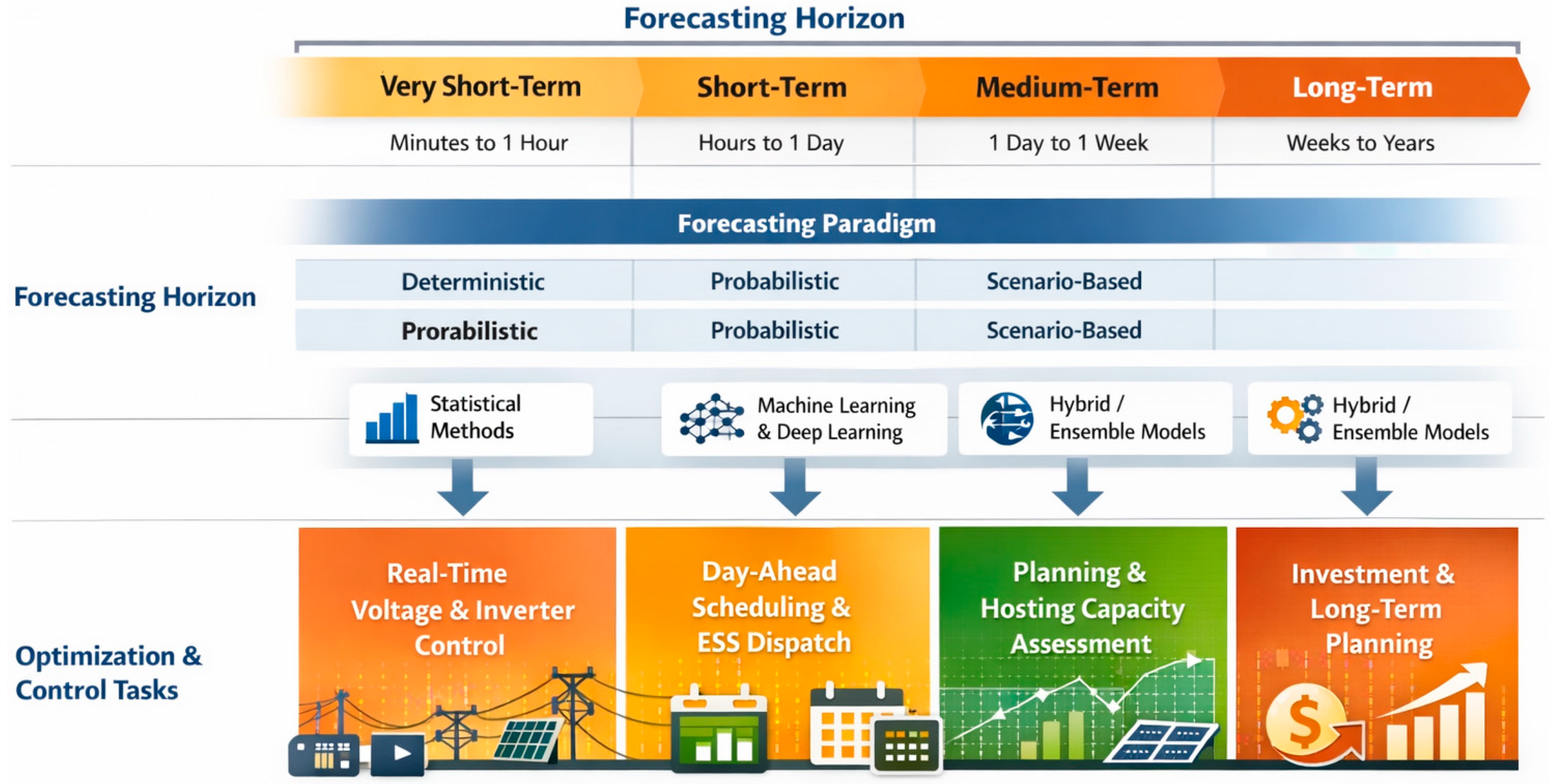
To support a decision-oriented interpretation of PV power forecasting in SGs, Figure 1 presents a conceptual framework that relates forecasting horizons and uncertainty modelling to the corresponding planning and operational optimisation tasks.
Complementing the conceptual perspective of Figure 1, Table 2 summarises the main PV power forecasting approaches by outlining their methodological foundations, strengths, limitations, and typical SG applications, thereby supporting a method-level interpretation of forecasting choices.
Building upon this conceptual comparison, Table 3 provides a performance-oriented overview of representative PV forecasting models. Accuracy ranges are indicative and depend on data availability, forecasting horizon, site characteristics, and evaluation methodology adopted in the referenced studies.

2.5. Challenges and Emerging Solutions

Despite their excellent performance, AI-based models face several challenges.
One of the most common issues is overfitting, which occurs when a model conforms too closely to its training data, capturing noise or irrelevant patterns rather than generalisable trends. This problem becomes particularly evident when only small or site-specific datasets are available, for example, when modelling the behaviour of a single PV plant.
Another critical challenge concerns model transparency. Many advanced AI architectures, especially deep learning and hybrid models, operate as black boxes: they can deliver highly accurate predictions but provide little insight into the reasoning behind their outputs. This lack of interpretability can undermine operator confidence, particularly for grid operators and regulatory authorities who must rely on traceable and trustworthy decision-support systems, especially in safety-critical contexts.
A further limitation relates to computational requirements. Training and updating models such as LSTMs, CNN–LSTM hybrids, or spatio-temporal neural networks demand substantial computing resources. The challenge becomes even more significant in real-time applications, where forecasts must be generated continuously using data streams from thousands of distributed sensors. Such constraints limit the deployment of these models on resource-constrained devices or in environments lacking powerful computational infrastructure.
To address these issues, recent research is moving toward lightweight and distributed solutions, such as federated learning and edge-AI approaches. These paradigms enable models to be trained directly on local devices without requiring data centralisation, thereby reducing communication overhead, improving response times, and enhancing privacy. In parallel, advances in XAI aim to make forecasting models more interpretable and trustworthy by providing clear indicators, feature contributions, and decision rationales.
Collectively, these developments are paving the way for a new generation of PV forecasting models, systems that are not only more accurate but also more transparent, adaptable, and easier to integrate into the SGs of the future.

2.6. Implications for Optimisation and Grid Planning

Integrating PV production forecasts into grid optimisation and planning is no longer optional; it has become a fundamental requirement for enhancing the efficiency and resilience of modern electricity systems [63]. PV generation forecasts provide essential inputs for decision-making tools such as OPF, UC, and ED. In practice, they make it possible to anticipate fluctuations in renewable generation and to plan resource utilisation more effectively.
Moreover, improved forecasting accuracy can reduce operating costs, lower reserve requirements, and enhance voltage and frequency regulation. These advantages are particularly relevant in distribution networks with high levels of distributed generation, where system balancing is more complex.
Forecasting also plays a central role in long-term planning. It supports grid reinforcement strategies, informs investment decisions, and assists in the optimal deployment of storage systems and flexible loads [38,64]. Forecast-driven scenario analyses enable planners to assess future conditions, such as demand growth, policy evolution, or climate-related variability, and to design appropriate mitigation strategies.
Several studies emphasise that integrating forecasting with optimisation significantly enhances hosted renewable capacity, improves fault observability, and enables more efficient real-time control in distribution networks, aligning with recent findings on improved grid resilience through enhanced measurement-based planning and operational decision-making [54].
PV forecasts further support the optimisation of demand response and dynamic network reconfiguration. They facilitate the coordinated operation of decentralised PV systems, ESSs, and flexible electrification loads. These capabilities align with modern approaches to fault-aware and resilience-oriented operation in medium-voltage distribution systems [65].
This synergy between forecasting and optimisation is poised to become a cornerstone of future electricity systems, smarter, more reliable, and substantially more sustainable.

2.7. Cross-Time-Scale Coordination of Forecasting, Optimisation, and Energy Storage in Smart Distribution Networks

Coordination systems that explicitly take into consideration several temporal decision layers, from real-time control actions to long-term planning processes, are necessary due to the growing penetration of PV generation in distribution networks. ESSs, PV power forecasts, and optimisation should not be viewed as separate instruments in this context. Instead, they need to be seen as closely related parts of a single decision-support system that functions on many time scales. This subsection’s discussion of the cross-time-scale perspective offers a conceptual link between PV forecasting and the optimisation techniques examined in the subsequent parts. It makes it clear how planning and operational choices can be logically matched inside smart distribution networks by explicitly connecting forecasting horizons, ESS flexibility, and optimisation goals. The shift from static and conservative planning paradigms to adaptive, data-driven planning–operation cycles is supported by this unified interpretation. Improved HC, increased system resilience, and more effective overall network performance are made possible by the constant interaction of forecasting, optimisation, and control within such frameworks.

2.7.1. Cross-Time-Scale Coupling and Functional Roles

As discussed in Section 2 and synthesised in Table 1 and Figure 1, PV power forecasting provides information at multiple temporal horizons, very short-term, short-term, medium-term, and long-term, each enabling distinct classes of optimisation and control actions. From a system-level perspective, storage devices act as temporal buffers that translate forecast information into actionable flexibility, allowing short-term operational corrections without violating long-term planning constraints. As a result, ESSs represent the main physical and operational interface between forecasting accuracy and optimisation effectiveness across time horizons.

2.7.2. Interface Between Planning and Operation Layers

The interface between planning and operational layers can be interpreted as an exchange of constraints, flexibility margins, and performance indicators. Planning-oriented optimisation defines admissible operating regions, including voltage limits, thermal constraints, HC thresholds, and ESS capacity envelopes. Operational optimisation then exploits short-term forecasts and real-time measurements to optimally operate PV inverters, ESSs, and other controllable assets within these predefined boundaries.
In this framework, forecasting accuracy directly affects the tightness of operational margins. Conservative planning assumptions based on poor or uncertain forecasts typically lead to reduced HC and increased curtailment. Conversely, improved forecasting accuracy enables planners to define less conservative operating envelopes, thereby allowing operational layers to exploit a larger portion of available network flexibility while maintaining reliability and safety.

2.7.3. Illustrative Coordination Scenario

To illustrate the unified perspective, consider a distribution feeder with high PV penetration and a centrally coordinated ESS. Day-ahead and intra-day PV forecasts indicate a high probability of peak PV generation during midday hours. At the planning–operation interface, this information activates operational strategies prioritising ESS charging and reactive power support from smart inverters to mitigate expected over-voltage conditions. As real-time measurements become available, VSTF refines the expected PV output trajectory. If actual generation exceeds forecasts, real-time optimisation reallocates ESS capacity and inverter reactive power to maintain voltage within limits, postponing or reducing active power curtailment. Conversely, if forecast errors are large and persistent, curtailment strategies may be triggered earlier to preserve system security.
In this scenario, the response priority among available tools, ESS dispatch, inverter control, and curtailment, is dynamically coordinated based on forecast reliability, demonstrating how prediction accuracy propagates through optimisation layers and affects operational decisions.

2.7.4. Impact of Forecast Accuracy on System-Level Performance

Improved forecasting accuracy has been widely recognised as a key factor in achieving measurable system-level benefits, which can be quantitatively assessed by linking forecast error metrics to downstream technical and economic performance indicators [66]. In the literature, this impact is typically verified through scenario-based or sensitivity analyses, where different levels of forecasting accuracy are imposed and the resulting system performance indicators are explicitly compared [66,67,68,69]. In this framework, forecasting errors are systematically varied, and their effects on operational metrics, such as curtailment rates, reserve activation, voltage violations, or operating costs, are quantified, enabling a direct cause–effect assessment between prediction accuracy and system performance. Deterministic accuracy measures such as RMSE, normalised RMSE, Mean Absolute Error, and forecast bias are commonly used to evaluate prediction quality and are directly associated with operational outcomes including PV power curtailment levels, network losses, reserve requirements, and voltage deviation or violation indices. In active distribution networks equipped with ESSs and smart inverter controls, reduced forecast errors also enable more effective utilisation of available flexibility, for example, by limiting excessive state-of-charge excursions and saturation events in ESS operation [67]. In parallel, probabilistic forecasting metrics, such as prediction interval coverage and CRPS, are increasingly adopted to support risk-aware operational decisions, with measurable impacts on reserve activation, congestion management, and system security margins [68]. While the magnitude of these improvements depends on network characteristics and control architectures, even moderate gains in forecast accuracy can translate into non-negligible operational and economic benefits [69]. From a system-level standpoint, this confirms that forecasting accuracy is not merely a prediction-quality metric, but a key enabler of effective optimisation strategies and flexibility utilisation across multiple time scales.
In addition to scenario-based analyses, recent empirical evidence has also quantified the sensitivity of system-level performance indicators to renewable generation variability, which forecast accuracy aims to anticipate. For example, a statistical analysis conducted on the Spanish power system showed a strong positive correlation (r = 0.82) between wind and solar generation variability and spinning reserve requirements, with a coefficient of determination R2 = 0.76, indicating that approximately 76% of the variation in reserve demand can be explained by fluctuations in renewable generation [70]. This result provides quantitative validation of the fact that better representation and prediction of renewable energy variability can directly translate into more accurate reserve sizing, reduced overprovisioning of ancillary services, and greater operational efficiency.

3. Optimisation Strategies for PV Integration in SGs

Optimisation approaches applied to PV integration problems can be broadly grouped into classical mathematical programming techniques, metaheuristic methods, and learning-based approaches. While mathematical programming formulations are often preferred for planning and scheduling problems with well-defined constraints, metaheuristic and data-driven methods have gained increasing relevance in complex, nonlinear, and large-scale optimisation settings typical of modern smart distribution networks.
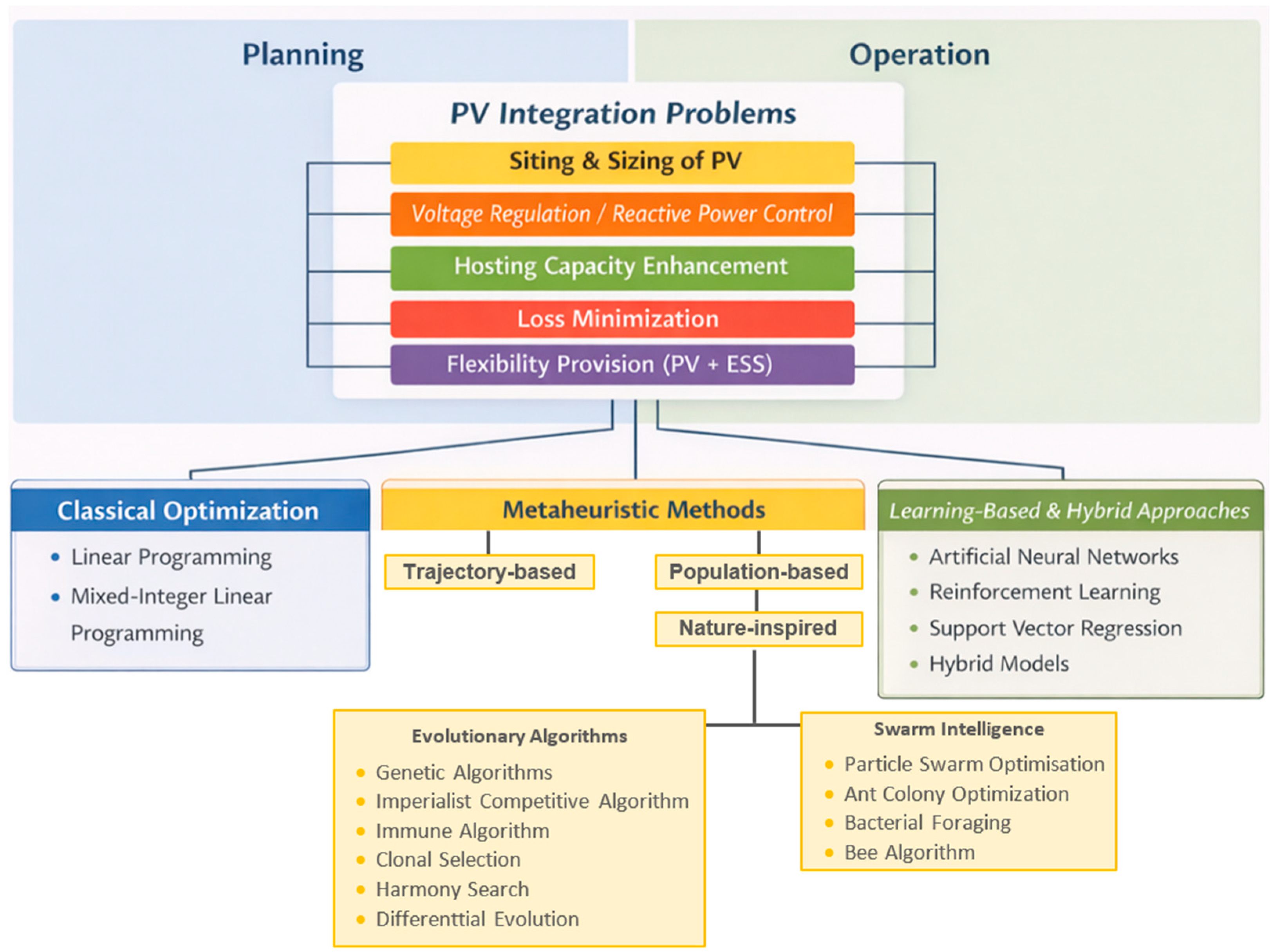
Building on the forecasting foundations discussed in Section 2, Section 3 examines the main optimisation techniques used to integrate PV generators into distribution networks, addressing both planning and operational challenges. The following subsections discuss the principal methods and applications within these two domains, while Figure 2 provides an application-oriented overview of the main optimisation method families adopted for PV integration.

3.1. Planning-Oriented Optimisation for PV Integration

Optimal PV integration is a critical planning problem that focuses on determining the best location and capacity (sizing) of PV units to maximise system-level benefits [71,72,73,74]. Planning typically aims to balance technical, financial, and environmental objectives [71]. Common goals include minimising power losses, managing investment costs, and reducing CO2 emissions [71,75,76]. Recent studies have also emphasised how PV siting and sizing must be coordinated with distribution network topology and automation strategies, an aspect explored for MV systems in several works on protection and network operation.
From a quantitative perspective, representative studies on PV siting and sizing optimisation in distribution feeders report active power loss reductions, often in the range of approximately 15–40% [77,78,79], with case studies reporting higher reductions [80]. HC increases typically range from 10% to 60%, though these metrics vary significantly depending on feeder topology, load patterns, voltage constraints, and adopted optimisation formulation [81,82]. These variations reflect the complexity of DER integration, where network-specific characteristics substantially influence technical outcomes.
In rural electrification contexts, the optimal system configuration and unit sizing problem involves selecting appropriate energy resources and establishing component ratings to achieve maximum efficiency, particularly when intermittent renewable sources are involved [83]. Given the complexity of simultaneously determining optimal allocation and sizing, metaheuristic algorithms are widely employed for this class of problems [84,85,86,87]. For example, Evolutionary Programming techniques have been used for the optimal placement of Renewable Distributed Generators [75]. Analytical approaches are also applied to sizing optimisation, such as in systems combining solar PV and battery banks [84].

3.2. HC and Technical Constraints for PV Sizing

The sizing of PV generators in distribution networks is a critical element of the transition toward decentralised and renewable-based power systems. Proper dimensioning ensures both the maximisation of energy production and the preservation of network reliability, voltage quality, and operational safety. In modern distribution grids, characterised by high-RES penetration, bidirectional power flows, and increasing electrification, PV sizing must account for local grid constraints as well as regulatory requirements [86].
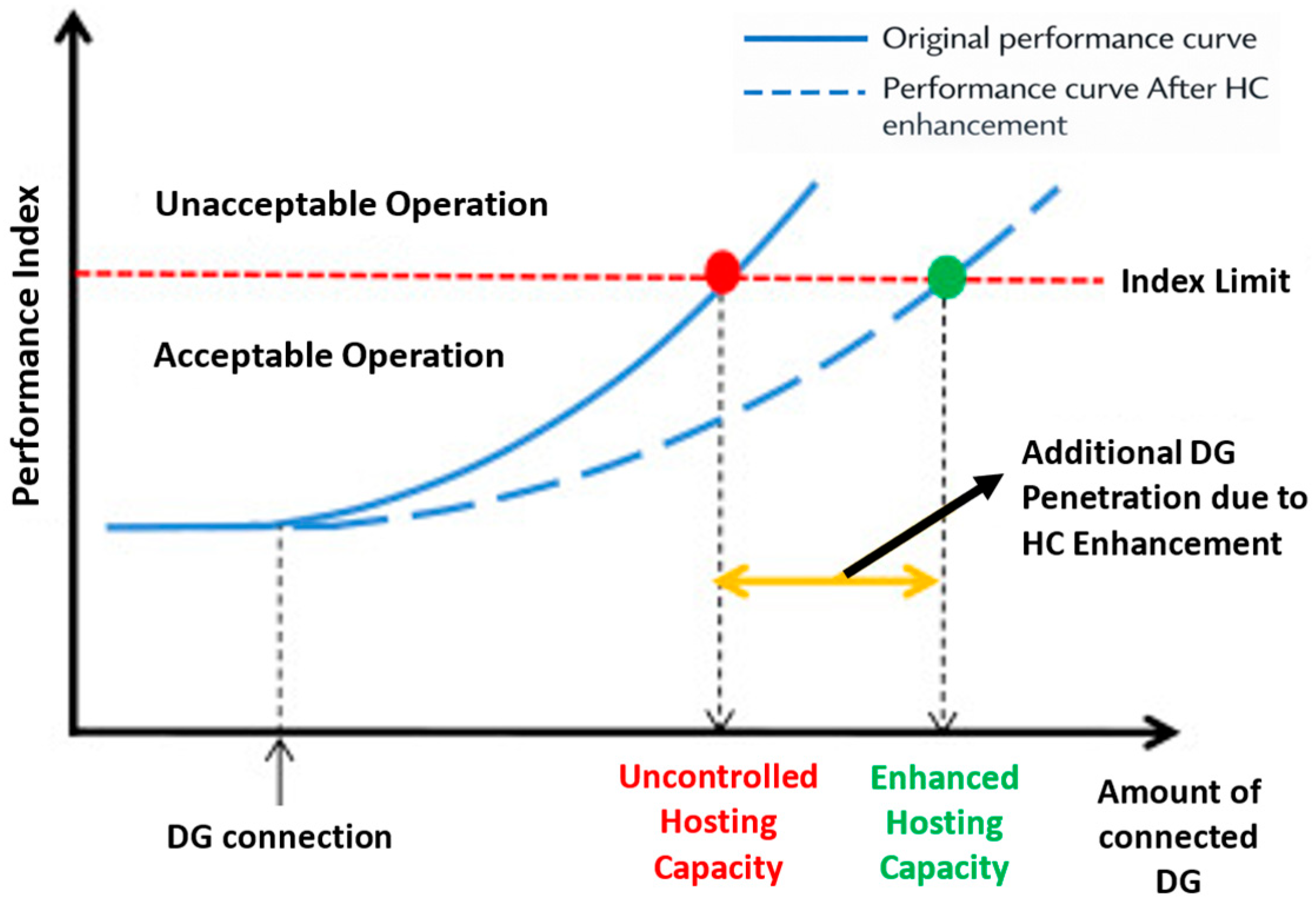
The concept of HC represents the maximum amount of DG, particularly PV units, that can be connected to an electrical distribution network without violating operational limits such as voltage rise, thermal overload, protection coordination, or power quality requirements. It serves as a key indicator of how much RES/PV a grid can accommodate while preserving safety and reliability. HC assessment depends on network configuration, load profiles, inverter control strategies, and operational and environmental conditions. The combined effect of planning measures and operational control strategies on HC can be conceptually interpreted as a constraint-relief mechanism. Figure 3 illustrates how active network management enables higher levels of DG penetration by shifting the intersection with the same operational limit, without altering the constraint itself.
Several analytical and simulation-based methods have been proposed for HC estimation, including deterministic, probabilistic, and optimisation-based approaches. In deterministic HC evaluation, the grid is analysed under worst-case load and generation scenarios to verify compliance with voltage and current limits [87].
Probabilistic methods, on the other hand, incorporate uncertainties in PV generation and demand, often using Monte Carlo simulations or stochastic optimisation [88,89]. Recent research increasingly incorporates machine learning and data-driven techniques for dynamic HC estimation, leveraging real-time network measurements to support operational decision-making [7]. As grids evolve toward more active and flexible operation, HC becomes a dynamic indicator of network adaptability, making advanced HC assessment essential for DSOs in planning and operational contexts.

3.3. Technical and Regulatory Factors Affecting PV Sizing

From a technical standpoint, the optimal sizing of PV generators depends on parameters such as irradiance, load profiles, feeder topology, voltage constraints, and HC values [87]. Excessive PV capacity may lead to adverse impacts, including voltage rise, reverse power flows, and issues in protection coordination, particularly in low-voltage feeders with limited reactive power support. Accordingly, optimisation methods such as Mixed-Integer Linear Programming (MILP), heuristic algorithms, and probabilistic analyses are widely applied to determine maximum PV penetration while ensuring compliance with operational constraints [3,90,91,92].
From a regulatory perspective, many national frameworks impose principles of non-discriminatory grid access and technical neutrality, requiring Distribution System Operators (DSOs) to accommodate all qualified renewable producers on equal terms. As a result, PV sizing must address not only technical feasibility but also regulatory compliance, including transparent connection procedures, defined timelines, and non-discriminatory treatment of applicants (producers and consumers).
The interplay between technical and regulatory requirements implies that PV sizing cannot occur in isolation from broader network planning. DSOs are required to evaluate connection requests based on the available network capacity and provide standardised procedures and timelines for applicants. The coexistence of technical and regulatory requirements implies that PV sizing cannot be performed in isolation from broader network planning activities. DSOs must coordinate with system operators to define connection limits, reinforcement plans, and voltage control strategies. Furthermore, emerging regulatory frameworks promoting flexibility markets and active network management encourage PV systems to operate dynamically within grid constraints, potentially adjusting their active or reactive power setpoints in real time [93].

3.4. Operational Optimisation: Voltage Control and Curtailment Management

From an operational standpoint, the growing penetration of PV systems complicates voltage regulation along distribution feeders. Bidirectional flows resulting from high PV generation may induce over-voltage conditions [94,95]. Smart inverters play a fundamental role in addressing these issues through reactive power control (Volt/Var), defined by standardised capability curves and operational constraints [96,97]. Their functionality is typically defined by specific Volt/Var and power capability curves [96]. Optimisation methods are increasingly employed to coordinate reactive power dispatch among PV inverters [98].
Advanced strategies include decentralised Volt/Var control based on linear decision rules linked to local PV output, often solved through convex quadratic programming within adjustable robust optimisation frameworks [96]. Effective real-time voltage management frequently requires coordination between PV inverters and traditional devices such as OLTCs and shunt capacitors [94,96,98].
Active power curtailment remains a widely used measure to mitigate over-voltage, yet it raises important fairness concerns. Customers located toward feeder ends tend to experience disproportionate curtailment.
Fairness-aware optimisation schemes mitigate this issue either by adding a secondary fairness objective weighted alongside curtailment minimization, or by implementing feedback controllers where weights are adjusted based on historical curtailment levels.

4. Optimisation of ESSs in Distribution Networks

4.1. ESS Roles and General Principles

ESSs play a crucial role in enhancing the flexibility, reliability, and efficiency of modern power distribution networks. Based on recent projections, global energy storage demand is expected to triple by 2030 [99]; this rapid growth is one of the key drivers motivating researchers to develop new storage solutions capable of managing electricity accurately and consistently according to system needs.
The integration of ESSs requires sophisticated optimisation techniques to determine their optimal sizing, placement, and operational strategies. These methods aim to minimise energy losses, improve voltage profiles, and support the integration of renewable energy sources, thereby maximising their utilisation. In the literature, well-dimensioned ESSs operated through advanced optimisation strategies are shown to yield substantial technical benefits. In representative case studies, network active power losses are reduced from baseline values of approximately 8–10% to levels exceeding 50–60% in the most favourable configurations, together with significant improvements in minimum bus voltage and voltage deviation indices, depending on network topology and renewable energy penetration [100,101,102]. Several studies further report that appropriately sized and coordinated ESSs can reduce renewable energy curtailment by approximately 20–40% in realistic distribution network scenarios, and by up to 50–70% under optimised high-penetration conditions when compared with cases without storage [103,104,105]. Moreover, multiple case studies on IEEE benchmark feeders and real-world distribution networks demonstrate that suitably sited and controlled ESSs can substantially enhance PV HC. Reported gains range from modest increases on small rural feeders to marked improvements in the maximum admissible PV penetration in larger or more constrained networks, with the achievable percentages strongly dependent on network characteristics, storage size, and control strategy [106,107,108].
ESSs can be categorised according to several factors, including the type of energy stored, intended application, storage duration, and efficiency [109].

4.2. Classification of ESS Technologies

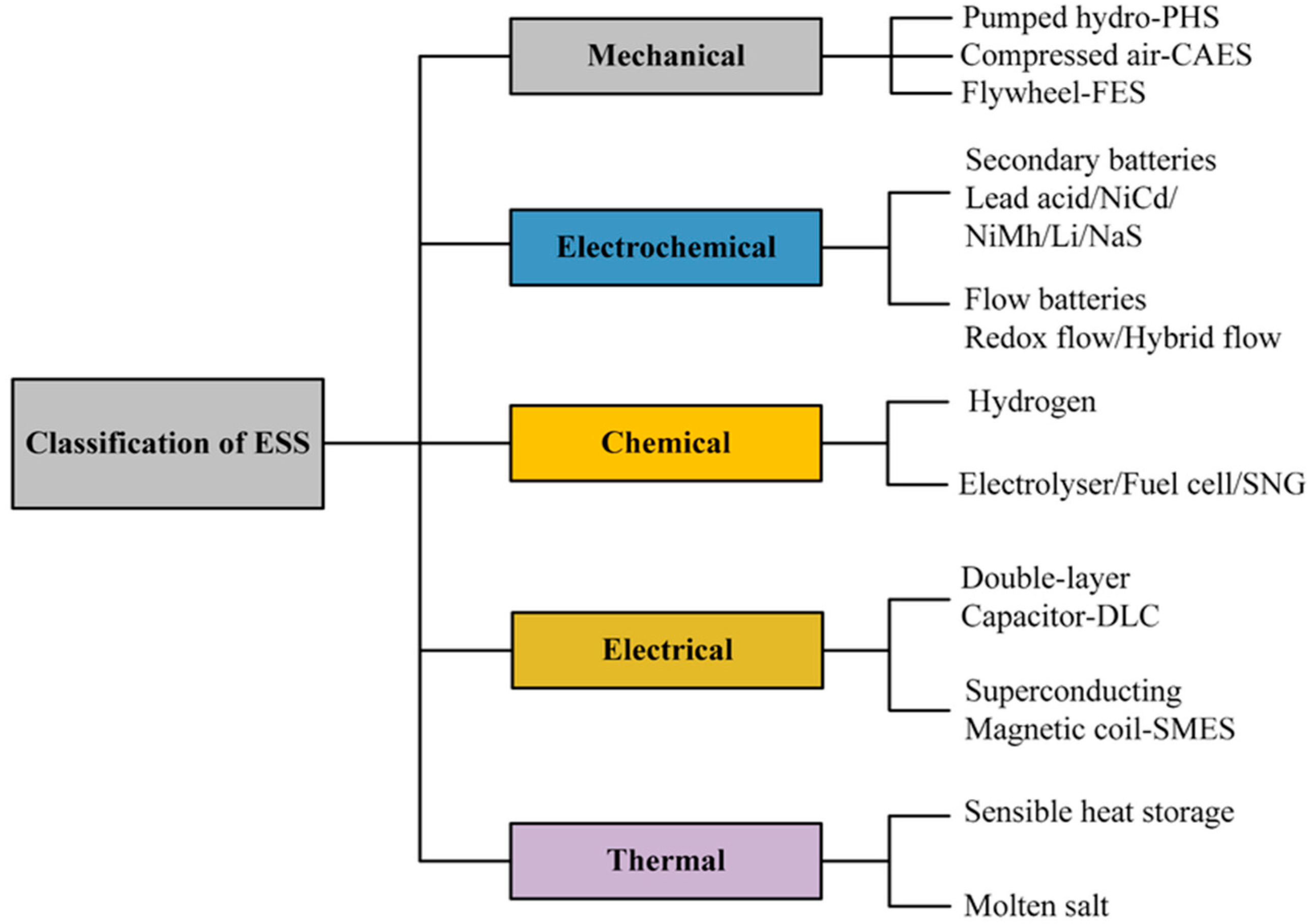
ESSs encompass a wide range of technologies characterised by different physical principles and performance characteristics. While such technological classifications are well established in the literature, they provide a useful reference framework for understanding how different ESS types contribute to PV integration and optimisation across multiple time scales. Figure 4 summaries the main ESS technology families considered in this review, which are discussed in detail in the following subsections.

4.2.1. Chemical and Electrochemical Energy Storage

Chemical energy storage devices rely on atomic and molecular bonds to store energy through chemical reactions; among these, synthetic natural gas and hydrogen represent two widely used clean energy vectors.
Electrochemical energy storage (ECES) systems mainly include Flow Battery Energy Storage (FBES) and Battery Energy Storage (BES). FBES technologies store energy in liquid electrolytes contained in external tanks or reservoirs, which are pumped through electrochemical cells during charge and discharge cycles. Common FBES technologies include Polysulfide Bromide (PSB), Vanadium Redox Batteries (VRB), and Zinc–Bromine (ZnBr) batteries. These systems typically employ microporous membranes to separate electrolytes and facilitate ion exchange.
BES solutions, on the other hand, directly store energy within electrode materials through electrochemical reactions. They generally consist of an electrolyte and two electrodes that allow ion transfer during operation. The rapid growth of BES technologies, dominated by Lithium-ion (Li-ion) batteries, underscores the importance of continued innovation and investment in battery technology to meet evolving flexibility and storage requirements within modern power systems.
From an optimisation perspective, chemical and electrochemical ESSs primarily contribute to PV integration over medium- to long-term time scales, supporting energy shifting, peak shaving, and PV curtailment minimization through planning-oriented sizing and scheduling strategies, while battery-based solutions are also increasingly exploited in operational optimisation problems due to their fast response and modularity.

4.2.2. Mechanical Energy Storage

Mechanical Energy Storage (MES) systems enable the conversion of energy between mechanical and electrical forms [109]. These technologies are vital for managing fluctuations in energy demand and ensuring a reliable and efficient energy supply. Flywheel Energy Storage (FES) is one example: it stores energy as kinetic energy by accelerating a flywheel using electrical power during the charging phase, maintaining the stored energy in rotational motion.
The most widely deployed MES technology is Pumped Hydro Energy Storage (PHES). PHES operates by pumping water to an elevated reservoir when surplus electricity is available, typically during periods of low demand. When demand increases, the stored water is released to flow through turbines, generating electricity. These MES technologies provide fast response times and allow rapid energy conversion when needed. They are also characterised by high efficiency and long cycle lifetimes, making them valuable components of resilient and sustainable energy infrastructures.
From the optimisation viewpoint, MES plays a dual role in distribution networks with high PV penetration: flywheel-based solutions are particularly suited to short-term operational optimisation problems requiring fast power balancing and smoothing of PV fluctuations, while pumped hydro storage is mainly addressed in long-term planning and scheduling frameworks aimed at energy shifting, peak load management, and system-level flexibility enhancement.

4.2.3. Electrical Energy Storage (EES)

EES systems constitute another important class of energy storage technology, enabling the efficient storage and utilisation of electrical energy. These systems are essential for managing peak demand, enhancing grid stability, supporting intermittent renewable energy sources, and improving the overall optimisation of power systems.
Capacitors are widely used in electrostatic storage systems, storing energy for short-term power delivery across various applications. Their rapid charging and discharging capabilities make them suitable for high-power, fast-response applications. Capacitors are commonly employed in electronics, electric vehicles, renewable energy systems, and power electronics. Supercapacitors represent an advanced form of electrostatic energy storage, offering higher energy densities than traditional capacitors and bridging the gap between capacitors and batteries. They store energy by forming an electrostatic double layer at the interface between electrode and electrolyte.
Superconducting Magnetic Energy Storage (SMES) systems store electrical energy in the magnetic field generated by a persistent current circulating through a superconducting coil. SMES offers extremely fast response times and high efficiency, although its deployment is limited by cooling requirements and cost.
In the context of network operation optimisation, EES systems are primarily exploited in very short-term and real-time control problems, where their extremely fast response enables voltage regulation, power quality support, and mitigation of rapid PV-induced fluctuations, often within control-oriented or hierarchical optimisation frameworks.

4.3. Coupling ESSs with RESs

Given the intermittent nature of the most widespread RESs, such as PV and wind, ESSs are normally combined with renewable generators to optimise the amount of clean energy used. RESs exploit natural energy flows to generate electricity from resources that are sustainable over the long term [110]. These include geothermal energy, wind power, hydropower, biofuels, and solar energy harvested directly from the sun. For instance, the output of a PV panel drops to zero during dark hours. To maintain the balance between intermittent renewable energy production and consumption, ESSs are therefore required [111,112,113].
ESSs hold significant potential for optimising energy management and reducing energy waste caused by curtailment. These systems vary widely in design, each aimed at capturing energy from different sources and storing it for a range of applications. In typical applications, energy is stored during low-demand periods and released during periods of high demand. As a result, various optimisation strategies have been developed for the integration and operation of these combined RES–ESS systems. This section aims to provide a comprehensive analysis of the optimisation methods that can be adopted for this purpose. In this context, the joint modelling and optimisation of RES–ESS systems becomes essential to manage variability, reduce curtailment, and exploit storage flexibility across different operational and planning horizons.
ESS optimisation is crucial for enhancing energy-system efficiency, reducing operational costs, and maximising renewable resource utilisation, particularly in contexts with high RES penetration.

4.4. Comparative Applicability of ESS Optimisation Methods Across Time Scales and Operational Contexts

This subsection provides a comparative interpretation of the main optimisation methods adopted for ESS integration, which is essential to clarify their practical applicability across different time scales, system sizes, and operational requirements.
From a time-scale perspective, mathematical programming approaches such as MILP are predominantly applied to planning and day-ahead operational problems, where decision variables, constraints, and objective functions can be clearly formalised. MILP-based formulations are particularly effective for ESS sizing, siting, and coordinated scheduling when accurate forecasts and sufficient computational time are available. However, their scalability becomes limited as network size increases or when high-resolution temporal coupling is required.
Metaheuristic algorithms, including Genetic Algorithms (GAs) and Particle Swarm Optimisation (PSO), exhibit greater flexibility in handling nonlinear, nonconvex, and multi-objective formulations, making them suitable for complex planning problems and medium-term operational optimisation. Their main advantage lies in their ability to explore large solution spaces without requiring convexity assumptions. Nevertheless, convergence speed and solution repeatability may vary, and real-time deployment remains challenging without further simplifications or surrogate modelling.
Dynamic Programming (DP) is inherently suited to time-coupled charge–discharge scheduling problems, as it explicitly accounts for inter-temporal dependencies. Despite this advantage, DP suffers from the well-known curse of dimensionality, which restricts its applicability to small- or medium-scale systems unless state-space reduction techniques are adopted.
Robust and stochastic optimisation frameworks explicitly address uncertainty in PV generation and load demand, enhancing solution reliability under variable operating conditions. Robust approaches ensure feasibility under worst-case scenarios but tend to yield conservative solutions, whereas stochastic formulations offer a more balanced trade-off between performance and risk at the cost of increased computational complexity and scenario generation requirements. These methods are particularly relevant for risk-aware planning and operation in networks with high renewable penetration.
From an operational and real-time perspective, classical optimisation methods are often complemented, or replaced, by learning-based approaches. Reinforcement Learning (RL) and hybrid data-driven controllers enable ESSs to adapt their behaviour dynamically in response to rapidly changing system states, without relying on explicit system models. These approaches are increasingly attractive for real-time applications, although challenges related to training stability, safety guarantees, and explainability still limit large-scale deployment.
Overall, the literature suggests that no single optimisation method is universally optimal for ESS integration. Instead, hybrid and hierarchical frameworks, combining planning-oriented mathematical programming with operational metaheuristic or learning-based control layers, appear to offer the most promising balance between optimality, scalability, and real-time feasibility. This comparative perspective highlights the importance of selecting optimisation tools based not only on theoretical performance but also on time scale, computational resources, data availability, and deployment constraints.

4.5. Overview of ESS Optimisation Methods

Given the operational challenges discussed in Section 3, ESSs emerge as key resources for enabling further optimisation and HC improvements. Various optimisation approaches have been proposed for ESS integration, addressing both planning tasks (sizing, siting) and operational tasks (charge/discharge scheduling). These optimisation approaches are increasingly combined with forecasting tools and active network management strategies to enhance flexibility and HC in distribution networks with high PV penetration.

4.5.1. Mathematical Programming Approaches

Popular optimisation approaches for ESSs include MILP, dynamic programming, and metaheuristic algorithms such as GAs and PSO [114]. MILP has been widely used for both planning and operational problems due to its ability to effectively handle binary decisions and complex system constraints [113,114,115,116].
DP represents one of the earliest optimisation paradigms applied to hybrid energy systems. The RAPSODY model proposed by De and Musgrove [117] is among the first structured applications of DP for the optimisation of hybrid energy conversion systems, anticipating many of the time-coupled ESS scheduling problems addressed by modern optimisation frameworks. DP is well suited for time-dependent problems such as charge/discharge scheduling [118]. Probabilistic techniques are also commonly applied to account for long-term weather variability, nonlinear system behaviour, and multi-objective functions [119,120].

4.5.2. Metaheuristic and Intelligent Algorithms

Metaheuristic methods, although not guaranteeing global optimality, offer flexibility and computational efficiency for large-scale, nonlinear optimisation problems [121]. GAs employ mechanisms inspired by natural selection, such as heredity, mutation, crossover, and selection, to explore the solution space [122,123]. Fuzzy logic, grounded in fuzzy set theory, provides a mathematical framework to incorporate human expert knowledge into digital controllers [124]. For example, the authors in [125] successfully applied fuzzy logic to develop an intelligent framework for energy management that assures the optimal performance of a hybrid system in Johor, Malaysia. The fuzzy logic controller is designed for managing the power flow between the hybrid system and utility grid to ensure the load is being supplied continuously.
In this context, fuzzy logic is often used as a control-oriented optimisation surrogate rather than as a global optimisation method.
PSO mimics the collective movement of fish or birds in three-dimensional space, where each particle’s position represents a potential solution [126]. Neural network algorithms, inspired by the structure and function of the human brain, can be trained to perform optimisation-related tasks [127]. In [128], an ANN was used to develop a novel energy management strategy for controlling a DC microgrid using a hybrid energy storage system, demonstrating superior performance compared to earlier optimisation methods.
An integrated approach combining ANNs and GA was proposed in [129] to optimise a solar industrial-process heat system, using the Group Method of Data Handling, also known as polynomial networks, as part of the optimisation process. Another study [130] applied a combination of optimisation techniques, including Genetic algorithm Particle swarm optimisation, Gravity search algorithm Particle swarm optimisation, GA, Gravity search algorithm, and PSO algorithms, to determine the optimal sizing of a stand-alone hybrid renewable energy system consisting of PV/wind turbines/battery storage/diesel generator components for a university campus, concluding that the hybrid GA combined with PSO, when aligned with astute energy management strategies, was more effective in determining optimal design parameters than other methodologies.

4.6. Advanced and Hybrid Optimisation Frameworks

Recent advances also include stochastic optimisation and robust optimisation, which explicitly account for uncertainties in demand and renewable generation [131,132]. With the growing complexity of distribution systems, multi-objective optimisation frameworks are gaining popularity as they enable balancing economic, technical, and environmental objectives. The integration of ESSs with demand response programmes and SG technologies further expands optimisation potential.
In recent years, power system planners have also devoted particular attention to security and reliability considerations. In [133], an efficient model is proposed for enhancing the security of active distribution networks composed of multiple microgrids by optimally utilising energy storage resources and consumption management plans. The authors adopt a hierarchical two-stage approach: the first stage models disruptive incidents and their impacts on the distribution network, while the second stage implements preventive and corrective measures to increase system readiness and reduce the consequences of severe events. At this stage, energy storage, DG, renewable sources, and responsive loads are jointly exploited. In the corrective phase, an independent microgrid partitioning method is employed to accelerate the load restoration process.
To fully leverage the potential of ESSs and network reconfiguration, a coordinated optimisation method is presented in [134] to improve the economic efficiency of distribution networks under normal operating conditions as well as the reliability of power supply during fault conditions.

4.7. Limitations of Existing Methods and Hybrid Approaches

A key drawback of several optimisation techniques lies in their complexity and computational time requirements [135]. For economic optimisation, conventional optimisation methods remain widely adopted due to their simplicity and ease of implementation. These techniques typically operate within a limited parameter space, making them effective when the solution landscape is not highly complex; however, they struggle with multidimensional, nonlinear formulations.
For the sizing of high-resolution energy systems, analytical methodologies are generally recommended. Simulation-based approaches relying on Monte Carlo Simulations are often considered unsuitable due to their modelling complexity, dependence on detailed data, frequently unavailable, and significantly longer computational time.
Metaheuristic methods, by contrast, have shown strong potential for optimising ESS integration. These approaches provide high computational speed, good accuracy, and strong efficiency, making them suitable for complex optimisation problems. Their heuristic nature enables rapid identification of high-quality solutions, which is essential when managing the dynamic and unpredictable behaviour of renewable resources and storage systems [136].
Another study [135] emphasises the heuristic nature and fast convergence to near-global optima as defining characteristics of new-generation algorithms. Hybrid methods, in particular, have demonstrated robust and fast optimisation performance. Research indicates that hybrid techniques are among the most effective approaches for integrating HRES and ESSs, as they combine the strengths of different optimisation paradigms to overcome the limitations of single-method strategies [137]. For example, a hybrid framework may utilise PSO for its rapid convergence and GA for its robustness, resulting in a comprehensive optimisation strategy that balances speed, accuracy, and resilience. These methods are especially effective in managing systems with multiple energy sources and storage units. While they can handle diverse constraints and objectives, hybrid approaches typically require more complex design and coding structures [135].

4.8. Reinforcement Learning and Emerging Trends

With reference to the aforementioned HC concept, enhancing HC requires coordinated voltage control through OLTCs, capacitor banks, and PV inverter reactive power regulation, as well as network reconfiguration and ESS integration [96]. ESS devices can mitigate over-voltage conditions and reverse power flows, effectively expanding the HC of LV and MV feeders [134].
Recent developments in RL have enabled real-time control of ESSs under dynamic and uncertain operating conditions. Approaches such as Deep Q-Learning and Deep Deterministic Policy Gradient employ neural networks to learn optimal charge/discharge strategies directly from interactions with the system, without requiring explicit modelling of the environment. These techniques allow ESS units to adapt to fluctuating renewable generation and variable market prices, maximising both economic benefits and operational efficiency. RL-based controllers have been shown to outperform conventional rule-based or offline-optimised strategies in dynamic settings, achieving near-optimal performance with reduced computational overhead [138].
Future research trends include combining RL with model-based predictive control and federated learning to enable scalable, distributed coordination of ESSs across wide-area networks [60]. In addition, further work should focus on developing more sophisticated optimisation algorithms capable of handling the uncertainties, stochasticity, and dynamic behaviour of renewable energy systems. Exploring policy frameworks and financial models to support ESS adoption across different industrial sectors will also be essential to accelerate the transition toward sustainable and resilient energy systems.

4.9. Comparative Overview of Forecasting and Optimisation Approaches

This subsection provides a comparative synthesis of the main forecasting and optimisation approaches discussed above, highlighting their key characteristics and application domains. Table 4 provides a high-level comparison of ESS optimisation methods, highlighting their typical objectives, strengths, and limitations. The table is intended to provide a qualitative and methodological overview of ESS optimisation approaches rather than a direct performance benchmark, as the suitability of each method strongly depends on the specific problem formulation, time scale, uncertainty modelling assumptions, and overall system context.

5. Multi-Objective Optimisation with PV Units and Storage Systems

5.1. Motivation and Role of Multi-Objective Optimisation

The operation and planning of modern electrical distribution networks, as discussed in the previous Sections, are becoming increasingly complex due to the widespread integration of RES generators and ESSs. These DERs introduce nonlinear and stochastic behaviours that significantly influence power flows, voltage stability, and overall network reliability. Therefore, traditional single-objective optimisation methods, typically focused on minimising power losses or operational costs, are often inadequate for capturing the multiple and sometimes conflicting objectives that characterise real-world distribution systems. For example, maximising renewable energy utilisation may conflict with objectives such as loss minimization, voltage regulation, network congestion mitigation, or the preservation of ESSs’ lifetime [139].
In this context, MOO techniques provide a systematic framework to address competing objectives simultaneously. Rather than yielding a single optimal solution, MOO methods generate a set of Pareto-optimal solutions that explicitly represent the trade-offs among technical, economic, and environmental criteria.
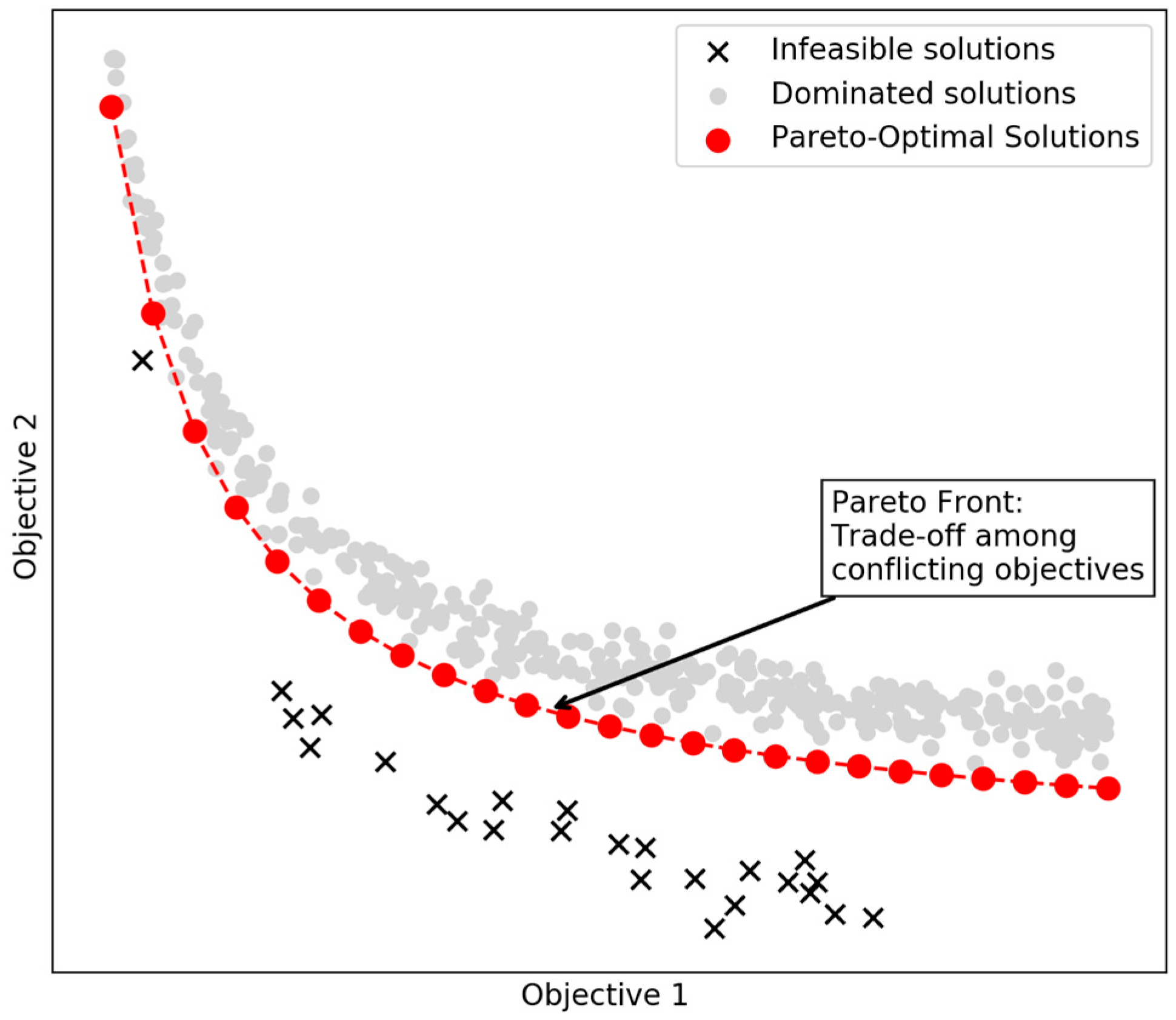
To clarify the Pareto optimality concept, Figure 5 illustrates a representative Pareto front for a two-objective optimisation problem. The Pareto front corresponds to the set of non-dominated solutions, for which any improvement in one objective necessarily leads to a deterioration in at least one other objective. Solutions within the trade-off (decision) region but not lying on the Pareto front are dominated and therefore suboptimal, while infeasible solutions violate network or operational constraints and cannot be accepted regardless of their objective values. This graphical representation highlights how MOO frameworks support informed decision-making by explicitly exposing the compromise among conflicting objectives.
Building upon this conceptual foundation, the following subsections focus on the application of MOO methods to the planning and operation of distribution networks integrating PV generation and ESSs, with particular attention to the most relevant objective functions and trade-offs encountered in practical implementations.

5.2. Applications of MOO in Distribution Networks with PV and ESSs

In distribution networks, MOO plays a crucial role in optimising DER placement, operational scheduling, and control strategies under constraints imposed by voltage limits, line capacities, and regulatory frameworks [140]. Moreover, MOO approaches can incorporate uncertainty in PV generation and load demand, enabling robust decision-making under variable and stochastic conditions [141]. The inclusion of ESSs further amplifies the need for MOO techniques, as their operation must simultaneously balance objectives such as minimising degradation, optimising charge–discharge cycles, and enhancing grid flexibility [142]. Algorithms such as NSGA-II, MOPSO, and hybrid MILP–evolutionary frameworks have proven particularly effective in this context [143,144].
The use of MOO in distribution systems encompasses a variety of objectives, including the minimisation of active power losses, voltage profile improvement, emission reduction, and maximisation of renewable energy utilisation [139]. These objectives are inherently coupled and often conflicting, which makes their simultaneous treatment particularly suitable for Pareto-based optimisation frameworks. When PV generators and ESS units are involved, additional aspects such as intermittency management, storage degradation, and dynamic network reconfiguration must also be addressed [145]. Thus, MOO serves as a powerful methodological tool to guide the optimal planning and operation of modern SGs under regulatory and operational constraints.
In power distribution networks, these objectives are often conflicting. For example, minimising operational costs may lead to higher power losses or increased voltage deviations, while maximising PV penetration can exacerbate network congestion and require additional investments in flexibility assets. Therefore, the solution to a MOO problem is not a single optimal point but a Pareto front, representing the set of non-dominated solutions that cannot be improved in one objective without worsening another [146].
To identify such Pareto-optimal solutions, several approaches can be employed, including weighted-sum methods, ε-constraint methods, and evolutionary algorithms such as NSGA-II or MOPSO [143,147]. Evolutionary approaches are particularly well suited for distribution network optimisation due to their flexibility and inherent capability to handle nonlinearities, discrete decision variables, and large search spaces.
PV generators have become one of the most widespread DERs thanks to declining costs and supportive policies. Accordingly, MOO is used to balance PV generation maximisation with operational constraints such as voltage limits, thermal capacity, and network losses [148,149]. Similarly, ESS optimisation involves multiple objectives, including minimising operational costs, reducing voltage deviations, limiting degradation, and supporting system reliability [150]. The integration of ESSs transforms the operational optimisation problem into a temporal one, where inter-temporal constraints must be respected.
At the planning level, MOO is employed to determine the optimal locations and capacities of PV and ESS installations. The decision variables typically include the size of each DER, its placement within the network, and its operational modes. The commonly adopted objectives involve investment cost reduction, power loss minimisation, voltage stability enhancement, and increased system resilience [123,151]. Furthermore, MOO frameworks have been applied to maximise HC while minimising investment and operational costs, simultaneously addressing technical, economic, and regulatory considerations [141].
At the operational level, MOO enables dynamic scheduling of DER and ESS units on an hourly or sub-hourly basis. The main objectives include cost minimisation, grid stability improvement, and emission reduction. More recent studies utilise stochastic MOO approaches to account for PV forecast uncertainties, relying on probabilistic constraints or scenario-based modelling [146].
With these application areas clarified, the next subsection reviews the principal MOO algorithms used in PV–ESS integration.

5.3. Algorithms for MOO in PV–ESS Systems

In line with the multi-objective formulations discussed in the previous subsection, due to the nonlinear and nonconvex characteristics of power distribution networks, heuristic and metaheuristic algorithms have gained significant popularity. Among these, NSGA-II, MOPSO, Differential Evolution, and Artificial Bee Colony algorithms are widely used [147,152]. Hybrid methods that combine classical optimisation with metaheuristics are also emerging. Additionally, machine learning-based surrogate models are increasingly adopted to accelerate MOO computations and reduce the computational burden associated with high-dimensional search spaces [153].
This aspect becomes particularly critical when MOO is applied to large-scale networks, stochastic formulations, or high-fidelity simulation environments. Given the high computational burden of many MOO tools, particularly when involving stochastic inputs and high-fidelity simulations, the use of surrogate-assisted techniques is becoming increasingly important, as discussed next.

Surrogate-Assisted MOO and Emerging Trends

In MOO, surrogate models (or meta-models) are increasingly adopted to approximate computationally expensive simulations and accelerate convergence toward the Pareto front. They replace high-fidelity network simulations, such as power flow, optimal dispatch, or stability analyses, with fast predictive functions that map decision variables to performance metrics.
Among the most relevant methods are Gaussian Process Regression (GPR) and Kriging, which provide probabilistic estimations and quantify prediction uncertainty, making them particularly suitable for adaptive sampling and active-learning strategies [154,155]. Machine learning-based surrogates, including eXtreme Gradient Boosting (XGBoost). SVR and ANNs are also increasingly employed to improve computational scalability and robustness in large-scale optimisation problems [156,157].
Recent studies show that hybrid algorithms combining evolutionary optimisation methods (e.g., NSGA-II, MOPSO) with surrogate modelling can reduce computational costs by up to 90% while maintaining high accuracy in Pareto front estimation [153]. Adaptive surrogate frameworks have also emerged, where the surrogate model is updated dynamically as new data becomes available, thereby enhancing prediction accuracy and ensuring continuous learning under renewable-generation uncertainty [158,159].
In future SGs, surrogate-assisted MOO will play a central role in enabling real-time decision support, uncertainty-aware control, and co-optimisation of DERs, particularly when combined with federated learning and multi-agent frameworks for distributed problem-solving [160].
In conclusion, MOO provides a comprehensive framework for addressing the challenges associated with planning and operating modern distribution networks with high PV and ESS penetration. Future research is expected to concentrate on integrating data-driven prediction models, adaptive control, and real-time optimisation within MOO frameworks, while ensuring alignment with evolving regulatory policies.
Overall, the analysis presented in this section highlights how MOO has become a key methodological enabler for the integration of PV generation and ESSs in modern distribution networks. At the same time, the reviewed studies reveal that the increasing complexity of SGs, together with uncertainty, scalability, and real-time operational requirements, still poses significant challenges. These aspects motivate the need for continued research efforts, which are synthesised and discussed in the concluding section, together with future perspectives on optimisation-driven SG planning and operation.

5.4. Comparative Discussion and Practical Implications

It is crucial to show how various forecasting and optimisation paradigms compare in terms of applicability, strengths, and limits in realistic renewable energy system deployments, going beyond a descriptive classification of current methodologies.
Long-term planning studies and scenarios with limited data availability might benefit from the openness and cheap processing complexity of physics-based and statistical forecasting models. However, their accuracy in short-term operational applications is frequently hampered by their low capacity to capture nonlinear dynamics. However, at the expense of greater data requirements, computational complexity, and decreased interpretability, data-driven and deep learning systems typically provide improved prediction accuracy in short- and very short-term horizons.
Optimisation strategies exhibit a similar trade-off. Regarding centralised optimisation frameworks, although they facilitate coordinated asset management and globally optimal solutions, they have communication and scalability issues. Distributed and decentralised approaches improve scalability and robustness, although often at the expense of optimality and with increased sensitivity to forecast errors. While centralised optimisation ensures global optimality, its practical deployment becomes challenging in large-scale distribution systems with high communication latency.
From a practical perspective, the integration of ESSs plays a key role in mitigating the limitations of both forecasting and optimisation methods, providing operational flexibility that relaxes accuracy and responsiveness requirements. These comparisons highlight that no single approach is universally optimal, and that method selection should be driven by application context, temporal horizon, and system-level constraints rather than standalone performance metrics.
The integration of ESSs is crucial in reducing the drawbacks of forecasting and optimisation techniques, offering operational flexibility that eases the demands for accuracy and responsiveness. These comparisons demonstrate that no single strategy is universally optimal and that system-level restrictions, temporal horizon, and application context, rather than independent performance metrics, should be taken into consideration when choosing a method.

6. Conclusions and Future Perspectives

This review has examined the state-of-the-art in large-scale PV integration in smart distribution networks by jointly analysing PV power forecasting techniques, optimisation strategies, ESSs, and multi-objective coordination frameworks. Rather than addressing these topics as independent research areas, the paper has adopted an integrated perspective that highlights their strong interdependencies and their collective role in enabling the reliable, efficient, and flexible operation of distribution systems with high PV penetration.
A key contribution of this review lies in clarifying how forecasting accuracy, optimisation methodologies, and DER control strategies are deeply interconnected. PV power forecasting has emerged not merely as a standalone problem, but as a fundamental enabler for a wide range of optimisation tasks, ranging from real-time voltage control and operational scheduling to long-term planning and HC assessment. In this context, the representation of uncertainty and the alignment between forecasting horizons and decision-making timescales are shown to be critical factors influencing the effectiveness of optimisation-based solutions.
From an optimisation perspective, the analysis has shown that classical mathematical programming, metaheuristic techniques, and learning-based approaches are increasingly combined to address the nonlinear, stochastic, and large-scale nature of modern distribution networks. ESSs play a central role in this evolution, also contributing to HC enhancement, voltage regulation, and increased operational flexibility in active distribution networks. At the same time, the growing adoption of multi-objective optimisation and Pareto-based decision-making frameworks reflects the need to explicitly manage trade-offs among competing technical, economic, and reliability objectives, for which no single optimal solution exists.
Beyond purely technical forecasting and optimisation aspects, the effective deployment of PV-driven flexibility solutions also depends on broader system-level enablers. Market interoperability issues, such as the coordination of multiple stakeholders’ interests and the compatibility of communication protocols, represent key enabling factors and open challenges for translating optimisation-based strategies into real-world flexibility services. At the same time, the increasing penetration of power-electronics-interfaced DERs and data-driven control architectures raises critical safety, resilience, and fault-tolerance concerns, especially in the presence of faults, communication failures, or cyber–physical threats. In this context, adaptive, event-triggered, and fault-tolerant control strategies can be viewed as a complementary layer to forecasting-driven optimisation and ESS coordination.

6.1. Limitations of Current Research

Although this review presents significant progress, several limitations can be highlighted in both the existing literature and the scope of this work. Most optimisation and control strategies for distribution networks integrated with PV systems are still mostly validated through simulation-based studies, which often use simplified or idealised network models and limited field demonstrations. Although these approaches are essential for methodological development, their transferability to real operating conditions remains only partially evaluated. Furthermore, many contributions adopt simplified modelling assumptions, particularly regarding uncertainty propagation, network dynamics and long-term degradation of ESSs, which, when dealing with practical applications, can affect the robustness of optimisation results.
From a review perspective, the literature surveyed primarily covers the period 2019–2026 and mainly focuses on distribution-level applications, while also incorporating selected earlier foundational works where necessary. Consequently, transmission-oriented studies addressing related challenges at different system scales are only partially discussed. Finally, although regulatory and market aspects are increasingly relevant for PV and ESS optimisation, their treatment in the reviewed literature remains fragmented and highly context-dependent; therefore, these aspects are addressed to the extent necessary to support the technical discussion.

6.2. Future Research Directions

Starting from these limitations, future research should focus on more realistic, scalable and implementable optimisation models for distribution networks integrated with PV systems. As far as modelling is concerned, there is a need for approaches that can jointly capture uncertainty propagation, intertemporal constraints and ESS degradation within unified optimisation formulations. In this context, promising tools include digital twins and hybrid models based on data and informed by physics; these would bridge the gap between simulation-based studies and real-world operation. At the same time, surrogate modelling and learning-assisted optimisation techniques can significantly improve computational scalability, enabling real-time or near-real-time decision-making in large-scale systems. Further efforts should also focus on developing reproducible benchmark systems and open datasets, facilitating transparent comparison between methodologies and accelerating their practical adoption. Finally, the integration of explainable and trustworthy artificial intelligence, together with interoperable and market-responsive optimisation frameworks, will be essential to ensure transparency, regulatory acceptance and the effective participation of PV and ESS resources in future flexibility markets.

Funding

The research presented in this paper has been funded by the Research Project ATIRESET “Advanced Modelling, Analysis and Management Techniques for Integrating Renewable Energy Sources and Electrified Transport into Smart Grids” (PI: prof. Stefania Conti). Call for proposals on the “Sustainable Mobility Center–National Center for Sustainable Mobility”, CN00000023–Spoke 13, under the PNRR, Mission 4, Component 2, Investment Line 1.4, financed by the European Union–Next Generation EU. Part of the research here presented has been also developed under the Project “DATA-SET: DATA driven dependencies for Sustainable Energy and Transport”, “PIAno inCEntivi per la RIcerca di Ateneo” (PIACERI) 2024/2026, Track 1 funded by the University of Catania.

Data Availability Statement

No new data were created or analyzed in this study. Data sharing is not applicable to this paper.

Conflicts of Interest

The authors declare no conflicts of interest. The funders had no role in the design of the study; in the collection, analyses, or interpretation of data; in the writing of the manuscript; or in the decision to publish the results.

References

  1. International Energy Agency (IEA). World Energy Outlook 2024; IEA: Paris, France, 2024. Available online: https://www.iea.org/terms (accessed on 26 February 2025).
  2. Papadimitrakis, M.; Giamarelos, N.; Stogiannos, M.; Zois, E.N.; Livanos, N.A.-I.; Alexandridis, A. Metaheuristic search in smart grids: A review with emphasis on planning, scheduling, and power flow optimization applications. Renew. Sustain. Energy Rev. 2021, 145, 111072. [Google Scholar] [CrossRef]
  3. He, Y.; Guo, S.; Dong, P.; Zhang, Y.; Huang, J.; Zhou, J. A state-of-the-art review and bibliometric analysis on the sizing optimization of off-grid hybrid renewable energy systems. Renew. Sustain. Energy Rev. 2023, 183, 113476. [Google Scholar] [CrossRef]
  4. Ackermann, T.; Andersson, G.; Söder, L. Distributed generation: A definition. Electr. Power Syst. Res. 2001, 57, 195–204. [Google Scholar] [CrossRef]
  5. Conti, S.; Melis, A.; Pisano, P.; Pilo, F.; Ruggeri, S.; Soma, G.G. Risk-oriented assessment of LV distribution network hosting capacity for electric vehicles. IET Conf. Proc. 2024, 5, 665–668. [Google Scholar] [CrossRef]
  6. Conti, S.; Faraci, G.; Nicolosi, R.; Rizzo, S.A.; Schembra, G. Battery management in a green fog-computing node: A reinforcement-learning approach. IEEE Access 2017, 5, 27509–27521. [Google Scholar] [CrossRef]
  7. Arévalo, P.; Ochoa-Correa, D.; Villa-Ávila, E. Optimizing microgrid operation: Integration of emerging technologies and artificial intelligence for energy efficiency. Electronics 2024, 13, 3754. [Google Scholar] [CrossRef]
  8. Manousakis, N.M.; Karagiannopoulos, P.S.; Tsekouras, G.J.; Kanellos, F.D. Integration of renewable energy and electric vehicles in power systems: A review. Processes 2023, 11, 1544. [Google Scholar] [CrossRef]
  9. Liu, L.; Xu, X.; Khurana, H. Voltage calculations in secondary distribution networks via physics-inspired neural networks using smart meter data. IEEE Trans. Smart Grid 2024, 15, 5205–5218. [Google Scholar] [CrossRef]
  10. Sultan, V.; Aryal, A.; Chang, H.; Kral, J. Integration of EVs into the smart grid: A systematic literature review. Energy Inform. 2022, 5, 65. [Google Scholar] [CrossRef]
  11. Conti, S.; Nicolosi, R.; Rizzo, S.A.; Zeineldin, H.H. Optimal dispatching of distributed generators and storage systems for MV islanded microgrids. IEEE Trans. Power Deliv. 2012, 27, 1243–1251. [Google Scholar] [CrossRef]
  12. Conti, S.; Rizzo, S.A. Modelling of microgrid-renewable generators accounting for power-output correlation. IEEE Trans. Power Deliv. 2013, 27, 1243–1251. [Google Scholar] [CrossRef]
  13. Conti, S.; Rizzo, S.A.; El-Saadany, E.F.; Essam, M.; Atwa, Y.M. Reliability assessment of distribution systems considering telecontrolled switches and microgrids. IEEE Trans. Power Syst. 2014, 29, 598–607. [Google Scholar] [CrossRef]
  14. Conti, S.; Nicolosi, R.; Rizzo, S.A. Generalized systematic approach to assess distribution system reliability with dispersed generation. IEEE Trans. Power Deliv. 2012, 27, 261–270. [Google Scholar] [CrossRef]
  15. Conti, S.; Greco, A.M.; Raiti, S. Local control of photovoltaic distributed generation for voltage regulation in LV distribution networks. Eur. Trans. Electr. Power 2009, 19, 798–813. [Google Scholar] [CrossRef]
  16. Conti, S.; Rizzo, S.A. An open source tool for reliability evaluation of distribution systems with renewable generators. Energy Syst. 2019, 10, 385–414. [Google Scholar] [CrossRef]
  17. Essam, M.; Atwa, Y.M.; El-Saadany, E.F.; Conti, S.; Rizzo, S.A. Microgrids reliability enhancement under different penetration levels of grid DG units. J. Electr. Eng. Technol. 2018, 13, 1407–1418. [Google Scholar] [CrossRef]
  18. Conti, S.; Raiti, S.; Tina, G.; Vagliasindi, U. Integration of multiple PV units in urban power distribution systems. Sol. Energy 2003, 75, 87–94. [Google Scholar] [CrossRef]
  19. Conti, S.; Tina, G.; Ragusa, C. Optimal sizing procedure for stand-alone photovoltaic systems with battery storage. J. Sol. Energy Eng. 2002, 124, 77–82. [Google Scholar] [CrossRef]
  20. Conti, S.; Rizzo, S.A. Probability of adequacy evaluation considering power output correlation of renewable generators in smart grids. Int. J. Electr. Power Energy Syst. 2014, 61, 145–151. [Google Scholar] [CrossRef]
  21. Han, L. Key technologies and review of hosting capacity assessment for distributed photovoltaic integration into distribution networks. Appl. Comput. Eng. 2025, 148, 75–82. [Google Scholar] [CrossRef]
  22. Fatima, S.; Püvi, V.; Lehtonen, M. Review on the PV hosting capacity in distribution networks. Energies 2020, 13, 4756. [Google Scholar] [CrossRef]
  23. Sutikno, T.; Arsadiando, W.; Wangsupphaphol, A.; Yudhana, A.; Facta, M. A review of recent advances on hybrid energy storage systems for solar photovoltaic power generation. IEEE Access 2022, 10, 42346–42364. [Google Scholar] [CrossRef]
  24. Gupta, R.; Sossan, F. Optimal sizing and siting of energy storage systems considering curtailable photovoltaic generation in power distribution networks. Appl. Energy 2023, 339, 120955. [Google Scholar] [CrossRef]
  25. Mohamad Radzi, P.N.L.; Akhter, M.N.; Mekhilef, S.; Mohamed Shah, N. Review on the application of photovoltaic forecasting using machine learning for very short- to long-term forecasting. Sustainability 2023, 15, 42942. [Google Scholar] [CrossRef]
  26. Tsai, W.C.; Tu, C.S.; Hong, C.M.; Lin, W.M. A review of state-of-the-art and short-term forecasting models for solar PV power generation. Energies 2023, 16, 5436. [Google Scholar] [CrossRef]
  27. Gandhi, O.; Kumar, D.S.; Rodríguez-Gallegos, C.D.; Srinivasan, D. Review of power system impacts at high PV penetration—Part I: Factors limiting PV penetration. Sol. Energy 2020, 210, 181–201. [Google Scholar] [CrossRef]
  28. Maghami, M.R.; Pasupuleti, J.; Ling, C.M. A static and dynamic analysis of photovoltaic penetration into MV distribution networks. Processes 2023, 11, 1172. [Google Scholar] [CrossRef]
  29. Iheanetu, K.J. Solar photovoltaic power forecasting: A review. Sustainability 2022, 14, 17005. [Google Scholar] [CrossRef]
  30. Gulraiz, A.; Zaidi, S.S.H.; Ashraf, M.; Ali, M.; Lashab, A.; Guerrero, J.M.; Khan, B. Impact of photovoltaic ingress on the performance and stability of low-voltage grid-connected microgrids. Results Eng. 2025, 26, 105030. [Google Scholar] [CrossRef]
  31. Balogun, O.A.; Sun, Y.; Gbadega, P.A. Coordination of smart inverter-enabled distributed energy resources for optimal PV–BESS integration and voltage stability in modern power distribution networks: A systematic review and bibliometric analysis. e-Prime—Adv. Electr. Eng. Electron. Energy 2024, 10, 100800. [Google Scholar] [CrossRef]
  32. Asghar, R.; Fulginei, F.R.; Quercio, M.; Mahrouch, A. Artificial neural networks for photovoltaic power forecasting: A review of five promising models. IEEE Access 2024, 12, 90461–90485. [Google Scholar] [CrossRef]
  33. Meenal, R.; Binu, D.; Ramya, K.C.; Michael, P.A.; Kumar, K.V.; Rajasekaran, E. Sangeetha Weather forecasting for renewable energy systems: A review. Arch. Comput. Methods Eng. 2022, 29, 2875–2891. [Google Scholar] [CrossRef]
  34. Albogamy, F.R.; Hafeez, G.; Khan, I.; Khan, S.; Alkhammash, H.I.; Ali, F.; Rukh, G. Efficient energy optimization and day-ahead energy forecasting in smart grids considering demand response and microgrids. Sustainability 2021, 13, 11429. [Google Scholar] [CrossRef]
  35. Liu, Z.; Du, Y. Evolution towards dispatchable PV using forecasting, storage, and curtailment: A review. Electr. Power Syst. Res. 2023, 223, 109554. [Google Scholar] [CrossRef]
  36. El Hendouzi, A.; Bourouhou, A. Solar photovoltaic power forecasting. J. Electr. Comput. Eng. 2020, 2020, 8819925. [Google Scholar] [CrossRef]
  37. Gupta, A.K.; Singh, R.K. A review of the state of the art in solar photovoltaic output power forecasting using data-driven models. Electr. Eng. 2024, 107, 4727–4770. [Google Scholar] [CrossRef]
  38. Zhi, Y.; Sun, T.; Yang, X. A physical model with meteorological forecasting for hourly rooftop photovoltaic power prediction. J. Build. Eng. 2023, 75, 106997. [Google Scholar] [CrossRef]
  39. Thaker, J.; Höller, R. Hybrid model for intra-day probabilistic PV power forecast. Renew. Energy 2024, 232, 121057. [Google Scholar] [CrossRef]
  40. Patel, R. Solar Based Electrical Power Generation Forecasting Using Time Series Models. Int. J. Darshan Inst. Eng. Res. Emerg. Technology 2021, 9, 16–21. [Google Scholar] [CrossRef]
  41. Chodakowska, E.; Nazarko, J.; Nazarko, Ł.; Rabayah, H.; Abendeh, R.; Alawneh, R. ARIMA Models in Solar Radiation Forecasting in Different Geographic Locations. Energies 2023, 16, 5029. [Google Scholar] [CrossRef]
  42. Abdel-Nasser, M.; Mahmoud, K. Accurate photovoltaic power forecasting models using deep LSTM-RNN. Neural Comput. Appl. 2019, 31, 2727–2740. [Google Scholar] [CrossRef]
  43. Raza, M.Q.; Mithulananthan, N.; Li, J.; Lee, K.Y.; Gooi, H.B. An ensemble framework for day-ahead forecast of PV output power in smart grids. IEEE Trans. Ind. Inform. 2019, 15, 4624–4634. [Google Scholar] [CrossRef]
  44. Lateko, A.A.H.; Yang, H.-T.; Huang, C.-M. Short-term PV power forecasting using a regression-based ensemble method. Energies 2022, 15, 4171. [Google Scholar] [CrossRef]
  45. Li, G.; Wang, H.; Zhang, S.; Xin, J.; Liu, H. Recurrent neural networks-based photovoltaic power forecasting approach. Energies 2019, 12, 2538. [Google Scholar] [CrossRef]
  46. Ilias, L.; Sarmas, E.; Marinakis, V.; Askounis, D.; Doukas, H. Unsupervised domain adaptation methods for photovoltaic power forecasting. Appl. Soft Comput. 2023, 149, 110979. [Google Scholar] [CrossRef]
  47. Mellit, A.; Massi Pavan, A.; Ogliari, E.; Leva, S.; Lughi, V. Advanced methods for photovoltaic output power forecasting: A review. Appl. Sci. 2020, 10, 487. [Google Scholar] [CrossRef]
  48. Limouni, T.; Yaagoubi, R.; Bouziane, K.; Guissi, K.; Baali, E.H. Accurate one-step and multi-step forecasting of very short-term PV power using an LSTM–TCN model. Renew. Energy 2023, 205, 1010–1024. [Google Scholar] [CrossRef]
  49. Gupta, P.; Singh, R. PV power forecasting based on data-driven models: A review. Int. J. Sustain. Eng. 2021, 14, 1733–1755. [Google Scholar] [CrossRef]
  50. Tao, K.; Zhao, J.; Tao, Y.; Qi, Q.; Tian, Y. Operational day-ahead photovoltaic power forecasting based on a transformer variant. Appl. Energy 2024, 373, 123825. [Google Scholar] [CrossRef]
  51. Simeunović, J.; Schubnel, B.; Alet, P.-J.; Carrillo, R.E. Spatio-temporal graph neural networks for multi-site PV power forecasting. IEEE Trans. Sustain. Energy 2022, 13, 1210–1220. [Google Scholar] [CrossRef]
  52. Lai, W.; Zhen, Z.; Wang, F.; Fu, W.; Wang, J.; Zhang, X.; Ren, H. Sub-region division-based short-term regional distributed PV power forecasting method considering spatio-temporal correlations. Energy 2024, 288, 129716. [Google Scholar] [CrossRef]
  53. Boum, A.; Kakeu, V.; Mbey, C.; Souhe, F. Photovoltaic Power Generation Forecasting Using a Novel Hybrid Intelligent Model in Smart Grid. Comput. Intell. Neurosci. 2022, 2022, 7495548. [Google Scholar] [CrossRef]
  54. Li, P.; Zhou, K.; Lu, X.; Yang, S. A hybrid deep learning model for short-term PV power forecasting. Appl. Energy 2020, 259, 114216. [Google Scholar] [CrossRef]
  55. Wu, Y.; Huang, C.; Phan, Q. Completed Review of Various Solar Power Forecasting Techniques Considering Different Viewpoints. Energies 2022, 15, 3320. [Google Scholar] [CrossRef]
  56. Li, B.; Zhang, J. A review on the integration of probabilistic solar forecasting in power systems. Sol. Energy 2020, 210, 68–86. [Google Scholar] [CrossRef]
  57. Yu, J.; Li, X.; Yang, L.; Li, L.; Huang, Z.; Shen, K.; Yang, X.; Yang, X.; Xu, Z.; Zhang, D.; et al. Deep learning models for PV power forecasting: Review. Energies 2024, 17, 3973. [Google Scholar] [CrossRef]
  58. Wang, H.; Zheng, X.; Lai, W. Short-term power prediction of regional distributed photovoltaic power plants based on spatiotemporal information fusion. J. Renew. Sustain. Energy 2025, 17, 046103. [Google Scholar] [CrossRef]
  59. Bak, S.; Choi, S.; Yang, D.; Kim, D.; Rho, H.; Lee, K. Transfer learning for photovoltaic power forecasting across regions using large-scale datasets. IEEE Access 2025, 13, 136175–136190. [Google Scholar] [CrossRef]
  60. Kuzlu, M.; Cali, U.; Sharma, V.; Güler, Ö. Gaining insight into solar photovoltaic power generation forecasting utilizing explainable artificial intelligence tools. IEEE Access 2020, 8, 187814–187823. [Google Scholar] [CrossRef]
  61. Ozdemir, G.; Kuzlu, M.; Catak, F. Machine learning insights into forecasting solar power generation with explainable AI. Electr. Eng. 2024, 107, 7329–7350. [Google Scholar] [CrossRef]
  62. Kaur, D.; Islam, S.N.; Mahmud, M.A.; Haque, M.E.; Dong, Z.Y. Energy forecasting in smart grid systems: Recent advancements in probabilistic deep learning. IET Gener. Transm. Distrib. 2022, 16, 4461–4479. [Google Scholar] [CrossRef]
  63. Das, U.; Tey, K.; Seyedmahmoudian, M.; Mekhilef, S.; Idris, M.; Deventer, W.; Horan, B.; Stojcevski, A. Forecasting of photovoltaic power generation and model optimization: A review. Renew. Sustain. Energy Rev. 2018, 81, 912–928. [Google Scholar] [CrossRef]
  64. Barrera-Singaña, C.; Comech, M.; Arcos, H. A comprehensive review on the integration of renewable energy through advanced planning and optimization techniques. Energies 2025, 18, 2961. [Google Scholar] [CrossRef]
  65. Dimovski, A.; Moncecchi, M.; Falabretti, D.; Merlo, M. PV forecast for the optimal operation of the medium-voltage distribution network: A real-life implementation on a large-scale pilot. Energies 2020, 13, 5330. [Google Scholar] [CrossRef]
  66. Cui, M.; Zhang, J.; Hodge, B.; Lu, S.; Hamann, H. A methodology for quantifying reliability benefits from improved solar power forecasting in multi-timescale power system operations. IEEE Trans. Smart Grid 2018, 9, 6897–6908. [Google Scholar] [CrossRef]
  67. Chen, Y.; Deng, C.; Dinglin, L.; Man, C. Quantifying cumulative effects of stochastic forecast errors of renewable energy generation on energy storage SOC and application of a hybrid MPC approach to microgrids. Int. J. Electr. Power Energy Syst. 2020, 117, 105710. [Google Scholar] [CrossRef]
  68. Wang, Q.; Tuohy, A.; Ortega-Vazquez, M.; Bello, M.; Ela, E.; Kirk-Davidoff, D.; Hobbs, W.; Ault, D.; Philbrick, R. Quantifying the value of probabilistic forecasting for power system operation planning. Appl. Energy 2023, 343, 121254. [Google Scholar] [CrossRef]
  69. Ventura, C.; Tina, G.M.; Rizzo, S.A. Imbalance charge reduction in the Italian intra-day market using short-term forecasting of photovoltaic generation. Energies 2025, 18, 4161. [Google Scholar] [CrossRef]
  70. Tur, M.R.; Bayindir, R. The impact of variable renewable energy on spinning reserve requirements: A case study of the Spanish power system. In Proceedings of the 13th International Conference on Smart Grid (icSmartGrid), Glasgow, UK, 27–29 May 2025; pp. 822–829. [Google Scholar] [CrossRef]
  71. Guzman-Henao, J.; Grisales-Noreña, L.F.; Restrepo-Cuestas, B.J.; Montoya, O.D. Optimal integration of photovoltaic systems in distribution networks from a technical, financial, and environmental perspective. Energies 2023, 16, 562. [Google Scholar] [CrossRef]
  72. Silva, C.; Mendes, S.; Negrete, L.; López-Lezama, J.; Muñoz-Galeano, N. Optimizing Photovoltaic Generation Placement and Sizing Using Evolutionary Strategies Under Spatial Constraints. Energies 2025, 18, 2091. [Google Scholar] [CrossRef]
  73. Montoya, O.D.; Grisales-Noreña, L.F.; Giral-Ramírez, D.A. Optimal placement and sizing of PV sources in distribution grids using a modified gradient-based metaheuristic optimizer. Sustainability 2022, 14, 3318. [Google Scholar] [CrossRef]
  74. Diab, A.; Mahmoud, F.; Sultan, H.; El-Sayed, A.; Ismeil, M.; Kamel, O. Various optimization algorithms for efficient placement and sizing of photovoltaic distributed generations in different networks. PLoS ONE 2025, 20, e0319422. [Google Scholar] [CrossRef]
  75. Belbachir, N.; Zellagui, M.; Settoul, S.; El-Bayeh, C.Z.; El-Sehiemy, R.A. Multi-dimension-based optimal allocation of uncertain renewable distributed generation outputs with seasonal source–load power uncertainties in electrical distribution networks using the marine predator algorithm. Energies 2023, 16, 1595. [Google Scholar] [CrossRef]
  76. Mendoza Osorio, D.; Rosero Garcia, J. Convex stochastic approaches for the optimal allocation of distributed energy resources in AC distribution networks with measurements fitted to a continuous probability distribution function. Energies 2023, 16, 5566. [Google Scholar] [CrossRef]
  77. Alaas, Z.; Moustafa, G.; Mansour, H. Performance of pelican optimizer for energy losses minimization via optimal photovoltaic systems in distribution feeders. PLoS ONE 2025, 20, e0319298. [Google Scholar] [CrossRef]
  78. Paz-Rodríguez, A.; Castro-Ordoñez, J.; Montoya, O.D.; Giral-Ramírez, D. Optimal integration of photovoltaic sources in distribution networks for daily energy losses minimization using the vortex search algorithm. Appl. Sci. 2021, 11, 4418. [Google Scholar] [CrossRef]
  79. Hamedi, M.; Shayeghi, H.; Seyedshenava, S.; Safari, A.; Younesi, A.; Bizon, N.; Iana, V. Developing an integration of smart-inverter-based hosting-capacity enhancement in dynamic expansion planning of PV-penetrated LV distribution networks. Sustainability 2023, 15, 11183. [Google Scholar] [CrossRef]
  80. Mahato, J.; Poudel, Y.; Chapagain, M.; Mandal, R. Power loss minimization and voltage profile improvement of radial distribution networks through the installation of capacitors and distributed generation. Arch. Adv. Eng. Sci. 2024, 3, 1–9. [Google Scholar] [CrossRef]
  81. De Oliveira, T.; Bollen, M.; Etherden, N. A hosting capacity-based approach toward distribution system planning for high PV penetration. Electr. Power Syst. Res. 2025, 238, 111138. [Google Scholar] [CrossRef]
  82. Zenhom, Z.; Aleem, S.; Zahab, E.; Ali, Z.; Almalaq, A.; Boghdady, T. Synergistic Hierarchical Bi-Level Optimisation of Demand Response Programmes and Smart Inverter Volt/Var Control for Maximising Hosting Capacity of Power Systems With Renewable-Based Distributed Generators. IEEE Access 2025, 13, 3530557. [Google Scholar] [CrossRef]
  83. Akbas, B.; Kocaman, A.S.; Nock, D.; Trotter, P.A. Rural electrification: An overview of optimization methods. Renew. Sustain. Energy Rev. 2022, 156, 111935. [Google Scholar] [CrossRef]
  84. Thirunavukkarasu, M.; Sawle, Y.; Lala, H. A comprehensive review on optimization of hybrid renewable energy systems using various optimization techniques. Renew. Sustain. Energy Rev. 2023, 176, 113192. [Google Scholar] [CrossRef]
  85. Shaikh, M.S.; Raj, S.; Zheng, G.; Xie, S.; Wang, C.; Dong, X.; Lin, Y.; Wang, C. Applications, classifications, and challenges: A comprehensive evaluation of recently developed metaheuristics for search and analysis. Artif. Intell. Rev. 2025, 58, 390. [Google Scholar] [CrossRef]
  86. Chen, C.; Peng, W.; Xie, C.; Dong, S.; Hua, Y. Photovoltaic hosting capacity assessment of distribution networks considering source–load uncertainty. Energies 2025, 18, 2134. [Google Scholar] [CrossRef]
  87. Cagnano, A.; De Tuglie, E.; Mancarella, P. Microgrids: Overview and guidelines for practical implementations and operation. Appl. Energy 2020, 258, 114039. [Google Scholar] [CrossRef]
  88. Saldaña-González, A.E.; Aragüés-Peñalba, M.; Gadelha, V.; Sumper, A. Review of active distribution network planning: Elements in optimization models and generative AI applications. Energies 2026, 19, 116. [Google Scholar] [CrossRef]
  89. Islam, M.T.; Hossain, M.J.; Habib, M.A. Data-driven dynamic optimization for hosting capacity forecasting in low-voltage grids. Energies 2025, 18, 3955. [Google Scholar] [CrossRef]
  90. Farivar, M.; Low, S.H. Branch Flow Model: Relaxations and Convexification—Part II. IEEE Trans. Power Syst. 2013, 28, 2565–2572. [Google Scholar] [CrossRef]
  91. Pareja, L.A.G.; Carmona, O.G.; López-Lezama, J.M. A MILP Model for Simultaneous Optimal Placement, Sizing, and Operation of PV Distributed Generation and D-STATCOMs in Distribution Systems. IEEE Access 2025, 13, 149947–149964. [Google Scholar] [CrossRef]
  92. Munikoti, S.; Natarajan, B.; Jhala, K.; Lai, K. Probabilistic Voltage Sensitivity Analysis to Quantify Impact of High PV Penetration on Unbalanced Distribution System. IEEE Trans. Power Syst. 2020, 36, 3080–3092. [Google Scholar] [CrossRef]
  93. Autorità di Regolazione per Energia Reti e Ambiente (ARERA). Progetti Pilota per la Partecipazione delle Risorse Distribuite ai Mercati di Flessibilità; Delibera 300/2017/R/eel; ARERA: Milan, Italy, 2017; Available online: https://www.e-distribuzione.it/progetti-e-innovazioni/il-progetto-edge.html (accessed on 12 February 2026). (In Italian)
  94. Akasaka, R.; Hara, R.; Kita, H.; Sugimura, S.; Kurihara, T. Determination of estimation accuracy of voltage profiles required for proper voltage control by on-load tap changers in distribution systems. Energies 2024, 17, 84. [Google Scholar] [CrossRef]
  95. Knez, K.; Herman, L.; Blažič, B. Dynamic management of flexibility in distribution networks through sensitivity coefficients. Energies 2024, 17, 1783. [Google Scholar] [CrossRef]
  96. Alshehri, M.; Yang, J. Voltage optimization in active distribution networks—Utilizing analytical and computational approaches in high renewable energy penetration environments. Energies 2024, 17, 1216. [Google Scholar] [CrossRef]
  97. Rajendran, G.; Raute, R.; Caruana, C. A comprehensive review of solar PV integration with smart grids: Challenges, standards, and grid codes. Energies 2025, 18, 2221. [Google Scholar] [CrossRef]
  98. Lu, X.; Liu, J.; Liu, X.; Liu, J.; Lin, L. Distributed optimization strategy for voltage regulation in PV-integrated power systems with limited sensor deployment. Energies 2025, 18, 3598. [Google Scholar] [CrossRef]
  99. Ralon, P. Electricity Storage and Renewables: Costs and Markets to 2030; International Renewable Energy Agency (IRENA): Abu Dhabi, United Arab Emirates, 2017. [Google Scholar]
  100. Sheikh, H.; Rathi, M.; Soomro, A. Optimal integration of battery energy storage systems with high penetration of renewable energy in radial distribution networks. Clean Energy 2022, 6, 404–411. [Google Scholar] [CrossRef]
  101. Mumtahina, U.; Alahakoon, S.; Wolfs, P. Optimal allocation and sizing of battery energy storage systems in distribution networks using the mountain gazelle optimization algorithm. Energies 2025, 18, 379. [Google Scholar] [CrossRef]
  102. Khasanov, M.; Kamel, S.; Hassan, M.; Domínguez-García, J.L. Maximizing renewable energy integration with battery storage in distribution systems using a modified bald eagle search optimization algorithm. Neural Comput. Appl. 2024, 36, 8577–8605. [Google Scholar] [CrossRef]
  103. Denholm, P.; Mai, T. Timescales of energy storage needed for reducing renewable energy curtailment. Renew. Energy 2019, 130, 388–399. [Google Scholar] [CrossRef]
  104. Migliari, L.; Micheletto, D.; Cocco, D. A hydrogen-fuelled compressed air energy storage system for flexibility reinforcement and variable renewable energy integration in grids with high generation curtailment. Energy Convers. Manag. 2024, 306, 118308. [Google Scholar] [CrossRef]
  105. Zanatta, G.; Pereira, A.; Ferreira, Â. On the mitigation of renewable energy curtailment by using pumped hydro storage systems. In Proceedings of the 10th International Conference on Modern Power Systems (MPS), Cluj-Napoca, Romania, 21–23 June 2023. [Google Scholar] [CrossRef]
  106. Yuan, K.; Wan, Z.; Sun, C.; Ding, Y.; Nie, M.; Liu, X. Distributed Energy Storage System Siting and Sizing Method Considering Photovoltaic Hosting Capacity Enhancement. In Proceedings of the 2025 8th International Conference on Energy, Electrical and Power Engineering (CEEPE), Wuxi, China, 25–27 April 2025. [Google Scholar] [CrossRef]
  107. Emami, P.; Delkhosh, H.; Moghaddam, M. Hosting Capacity Enhancement Utilizing Small Pumped-Hydro Storages in Rural Distribution Networks. Int. Trans. Electr. Energy Syst. 2025, 2025, 307334. [Google Scholar] [CrossRef]
  108. Gupta, R.; Sossan, F.; Paolone, M. Countrywide PV hosting capacity and energy storage requirements for distribution networks: The case of Switzerland. Appl. Energy 2021, 281, 116010. [Google Scholar] [CrossRef]
  109. Krishan, O.; Suhag, S. An updated review of energy storage systems: Classification and applications in distributed generation power systems incorporating renewable energy resources. Int. J. Energy Res. 2019, 43, 6171–6210. [Google Scholar] [CrossRef]
  110. Osman, A.I.; Chen, L.; Yang, M.; Msigwa, G.; Farghali, M.; Fawzy, S.; Rooney, D.W. Cost, environmental impact, and resilience of renewable energy under a changing climate: A review. Environ. Chem. Lett. 2023, 21, 741–764. [Google Scholar] [CrossRef]
  111. Jamal, T.; Salehin, S. Hybrid renewable energy sources power systems. In Hybrid Renewable Energy Systems and Microgrids; Elsevier: Amsterdam, The Netherlands, 2021; pp. 179–214. [Google Scholar] [CrossRef]
  112. Banik, R.; Das, P. A review on architecture, performance, and reliability of hybrid power systems. J. Inst. Eng. (India) Ser. B 2020, 101, 527–539. [Google Scholar] [CrossRef]
  113. Liu, X.; Wang, P.; Loh, P.C. A hybrid AC/DC microgrid and its coordination control. IEEE Trans. Smart Grid 2011, 2, 278–286. [Google Scholar] [CrossRef]
  114. Shahzad, K.; Amin, A.A. Optimal planning of distributed energy storage systems in active distribution networks using advanced heuristic optimization techniques. J. Electr. Eng. Technol. 2021, 16, 2447–2462. [Google Scholar] [CrossRef]
  115. Ajiboye, O.K.; Ochiegbu, C.V.; Ofosu, E.A.; Gyamfi, S. A review of hybrid renewable energies optimisation: Design, methodologies, and criteria. Int. J. Sustain. Energy 2023, 42, 648–684. [Google Scholar] [CrossRef]
  116. Liu, J.; Wunsch, D.; Wang, S.; Bo, R. Multi-parametric Analysis for Mixed Integer Linear Programming: An Application to Transmission Upgrade and Congestion Management. Sustain. Energy Grids Netw. 2024, 40, 101563. [Google Scholar] [CrossRef]
  117. De, A.R.; Musgrove, L. The optimization of hybrid energy conversion systems using the dynamic programming model—Rapsody. Int. J. Energy Res. 1988, 12, 447–457. [Google Scholar] [CrossRef]
  118. Zou, B.; Peng, J.; Li, S.; Li, Y.; Yan, J.; Yang, H. Comparative study of the dynamic programming-based and rule-based operation strategies for grid-connected PV-battery systems of office buildings. Appl. Energy 2022, 305, 117875. [Google Scholar] [CrossRef]
  119. Alguhi, A.; Alotaibi, M.; Al-Ammar, E. Probabilistic Planning for an Energy Storage System Considering the Uncertainties in Smart Distribution Networks. Sustainability 2023, 16, 290. [Google Scholar] [CrossRef]
  120. Hu, J.; Wang, Y.; Cheng, F.; Shi, H. A Long-Term Power Supply Risk Evaluation Method for China Regional Power System Based on Probabilistic Production Simulation. Energies 2024, 17, 2515. [Google Scholar] [CrossRef]
  121. Shafiullah, M.; Abido, M.; Al-Mohammed, A. Metaheuristic optimization techniques. In Power System Fault Diagnosis; Elsevier: Amsterdam, The Netherlands, 2022. [Google Scholar] [CrossRef]
  122. Memon, S.A.; Patel, R.N. An overview of optimization techniques used for sizing of hybrid renewable energy systems. Renew. Energy Focus 2021, 39, 1–26. [Google Scholar] [CrossRef]
  123. Celli, G.; Pilo, F.; Pisano, G.; Soma, G.G. Distribution energy storage investment prioritization with a real-coded multi-objective genetic algorithm. Electr. Power Syst. Res. 2018, 163, 154–163. [Google Scholar] [CrossRef]
  124. Dawoud, S.M.; Lin, X.; Okba, M.I. Hybrid renewable microgrid optimization techniques: A review. Renew. Sustain. Energy Rev. 2018, 82, 2039–2052. [Google Scholar] [CrossRef]
  125. Alfred, N.; Guntreddi, V.; Shuaibu, A.; Bakare, M. A fuzzy logic based energy management model for solar PV-wind standalone with battery storage system. Sci. Rep. 2025, 15, 24660. [Google Scholar] [CrossRef]
  126. Seng, U.; Malik, H.; Márquez, F.; Alotaibi, M.; Afthanorhan, A. Fuzzy logic-based intelligent energy management framework for hybrid PV-wind-battery system: A case study of commercial building in Malaysia. J. Energy Storage 2024, 102, 114109. [Google Scholar] [CrossRef]
  127. Amirtharaj, S.; Premalatha, L.; Gopinath, D. Optimal utilization of renewable energy sources in microgrid-connected systems with integrated converters: An AGONN approach. Analog Integr. Circuits Signal Process. 2019, 101, 513–532. [Google Scholar] [CrossRef]
  128. Abualigah, L.; Diabat, A.; Mirjalili, S.; Abd Elaziz, M.; Gandomi, A.H. The arithmetic optimization algorithm. Comput. Methods Appl. Mech. Eng. 2021, 376, 113609. [Google Scholar] [CrossRef]
  129. Ramu, S.; Vairavasundaram, I.; Palaniyappan, B.; Bragadeshwaran, A.; Aljafari, B. Enhanced energy management of DC microgrid: Artificial neural networks-driven hybrid energy storage system with integration of bidirectional DC-DC converter. J. Energy Storage 2024, 88, 111562. [Google Scholar] [CrossRef]
  130. Liu, H.; Zhai, R.; Fu, J.; Wang, Y.; Yang, Y. Optimization study of thermal-storage PV–CSP integrated systems based on a GA–PSO algorithm. Sol. Energy 2019, 184, 391–409. [Google Scholar] [CrossRef]
  131. Güven, A. A comparative study on hybrid GA-PSO performance for stand-alone hybrid energy systems optimization. Sigma J. Eng. Nat. Sci. Sigma Mühendislik Fen Bilim. Derg. 2024, 42, 1410–1438. [Google Scholar] [CrossRef]
  132. Celli, G.; Galici, M.; Pilo, F.; Ruggeri, S.; Soma, G.G. Uncertainty reduction on flexibility services provision from DERs by resorting to DSO storage devices. Appl. Sci. 2021, 11, 3395. [Google Scholar] [CrossRef]
  133. Ahrari, M.; Shirini, K.; Gharehveran, S.S.; Ahsaee, M.G.; Haidari, S.; Anvari, P. A security-constrained robust optimization for energy management of active distribution networks with the presence of energy storage and demand flexibility. J. Energy Storage 2024, 84, 111024. [Google Scholar] [CrossRef]
  134. Zhao, C.; Duan, Q.; Lu, J.; Wang, H.; Sha, G.; Jia, J.; Zhou, G. Coordinated optimization method for distributed energy storage and dynamic reconfiguration to enhance the economy and reliability of distribution networks. Energies 2024, 17, 6040. [Google Scholar] [CrossRef]
  135. Saharia, B.J.; Brahma, H.; Sarmah, N. A review of algorithms for control and optimization for energy management of hybrid renewable energy systems. J. Renew. Sustain. Energy 2018, 10, 053502. [Google Scholar] [CrossRef]
  136. Morshed, M.J.; Hmida, J.B.; Fekih, A. A probabilistic multi-objective approach for power flow optimization in hybrid wind–PV–PEV systems. Appl. Energy 2018, 211, 1136–1149. [Google Scholar] [CrossRef]
  137. Akter, A.; Zafir, E.I.; Dana, N.H.; Joysoyal, R.; Sarker, S.K.; Li, L.; Muyeen, S.M.; Das, S.K.; Kamwa, I. A review on microgrid optimization with meta-heuristic techniques: Scopes, trends, and recommendations. Energy Strategy Rev. 2024, 51, 101298. [Google Scholar] [CrossRef]
  138. Silvestri, A.; Coraci, D.; Brandi, S.; Capozzoli, A.; Borkowski, E.; Köhler, J.; Wu, D.; Zeilinger, M.N.; Schlueter, A. Real building implementation of a deep reinforcement learning controller to enhance energy efficiency and indoor temperature control. Appl. Energy 2024, 368, 123447. [Google Scholar] [CrossRef]
  139. Marksan, P.; Buayai, K.; Ratchapan, R.; Sangangam, W.; Bhumkittipich, K.; Kerdchuen, K.; Stadler, I.; Marsong, S.; Kongjeen, Y. Multi-objective optimization of mobile battery energy storage and dynamic feeder reconfiguration for enhanced voltage profiles in active distribution systems. Energies 2025, 18, 5515. [Google Scholar] [CrossRef]
  140. Liu, X.; Tian, M.; Dong, Z.; Guo, L.; Zhou, Y.; Wang, Y. Multi-scenario robust stochastic programming-based distributed energy resources allocation in distribution networks: Balancing economic efficiency and resilience. Reliab. Eng. Syst. Saf. 2025, 266, 111749. [Google Scholar] [CrossRef]
  141. Ferraz, R.; Ferraz, R.; Rueda-Medina, A. Multi-objective Optimization Approach for Allocation and Sizing of Distributed Energy Resources Preserving the Protection Scheme in Distribution Networks. J. Control. Autom. Electr. Syst. 2023, 34, 1080–1092. [Google Scholar] [CrossRef]
  142. Arias, N.; López, J.; Hashemi, S.; Franco, J.; Rider, M.J. Multi-objective sizing of battery energy storage systems for stackable grid applications. IEEE Trans. Smart Grid 2021, 12, 2708–2721. [Google Scholar] [CrossRef]
  143. Rabee, H.; Majeed, D. Energy Management System-Based Multi-Objective Nizar Optimization Algorithm Considering Grid Power and Battery Degradation Cost. Energies 2025, 18, 5678. [Google Scholar] [CrossRef]
  144. Jaber, A.; Younes, R.; Lafon, P.; Khoder, J. A review on multi-objective mixed-integer non-linear optimization programming methods. Eng 2024, 5, 1961–1979. [Google Scholar] [CrossRef]
  145. Qi, H.; Yan, X.; Kang, Y.; Yang, Z.; Ma, S.; Mi, Y. Multi-objective optimization strategy for the distribution network considering distributed PV and ESS integration. Energy Res. 2024, 10, 1418893. [Google Scholar]
  146. Cortés-Caicedo, B.; Grisales-Noreña, L.F.; Montoya, O.D.; Bolaños, R.I.; Muñoz, J. A multi-objective optimization approach based on the non-dominated sorting genetic algorithm II for power coordination in battery energy storage systems for DC distribution network applications. J. Energy Storage 2025, 113, 115430. [Google Scholar] [CrossRef]
  147. Deb, K. Multi-Objective Optimization Using Evolutionary Algorithms; John Wiley & Sons: Chichester, UK, 2001. [Google Scholar]
  148. M’dioud, M.; Er-Rays, Y.; Bannari, A.; Bannari, R.; Bossoufi, B.; El Kafazi, I. Multi-objective optimization of distributed generation in electrical grids using an adaptive chaotic salp swarm algorithm. Unconv. Resour. 2026, 9, 100299. [Google Scholar] [CrossRef]
  149. Loji, K.; Sharma, S.; Sharma, G.; Rawat, T. Multiobjective distribution system operation with demand response to optimize solar hosting capacity, voltage deviation index, and network loss. Sci. Rep. 2025, 15, 300. [Google Scholar] [CrossRef] [PubMed]
  150. Nyingu, B.T.; Masike, L.; Mbukani, M.W.K. Multi-Objective Optimization of Load Flow in Power Systems: An Overview. Energies 2025, 18, 6056. [Google Scholar] [CrossRef]
  151. Liu, Y.; Wu, X. A collaborative optimization approach for configuring energy storage systems and scheduling multi-type electric vehicles using an improved multi-objective particle swarm optimization algorithm. Processes 2025, 13, 1343. [Google Scholar] [CrossRef]
  152. Kumar, S.; Mandal, K.; Chakraborty, N. Optimal DG placement by multi-objective opposition based chaotic differential evolution for techno-economic analysis. Appl. Soft Comput. 2019, 78, 70–83. [Google Scholar] [CrossRef]
  153. Ghafariasl, P.; Mahmoudan, A.; Mohammadi, M.; Nazarparvar, A.; Hoseinzadeh, S.; Fathali, M.; Chang, S.; Zeinalnezhad, M.; Garcia, D. Neural network-based surrogate modeling and optimization of a multigeneration system. Applied Energy 2024, 364, 123130. [Google Scholar] [CrossRef]
  154. Lu, N.; Li, Y.; Mi, J.; Huang, H.Z. AMFGP: An active learning reliability analysis method based on a multi-fidelity Gaussian process surrogate model. Reliab. Eng. Syst. Saf. 2024, 246, 110020. [Google Scholar] [CrossRef]
  155. Sobester, A.; Forrester, A.J.; Keane, A.J. Engineering Design via Surrogate Modelling: A Practical Guide; Wiley: Hoboken, NJ, USA, 2021. [Google Scholar]
  156. Yeptho, P.; Saldaña-González, A.E.; Aragüés-Peñalba, M.; Barja-Martínez, S. Evaluation of XGBoost and ANN as surrogates for power flow predictions with dynamic energy storage scenarios. Energies 2025, 18, 4416. [Google Scholar] [CrossRef]
  157. Liang, X.; Zhang, H.; Liu, Q.; Liu, Z.; Liu, H. A support vector regression-based interval power flow prediction method for distribution networks with DG integration. Front. Energy Res. 2024, 12, 1465604. [Google Scholar] [CrossRef]
  158. Reis, M.J.C.S. Symmetry-guided surrogate-assisted NSGA-II for multi-objective optimization of renewable energy systems. Symmetry 2025, 17, 1367. [Google Scholar] [CrossRef]
  159. Deng, Q.; Kang, Q.; Zhou, M.; Wang, X.; Zhao, S.; Wu, S.; Ghahramani, M. Evolutionary algorithm based on surrogate and inverse surrogate models for expensive multiobjective optimization. IEEE/CAA J. Autom. Sin. 2025, 12, 961–973. [Google Scholar] [CrossRef]
  160. Kumar, A.; Rizwan, M.; Nangia, U. A hybrid optimization technique for proficient energy management in smart grid environments. Int. J. Hydrogen Energy 2022, 47, 5564–5576. [Google Scholar] [CrossRef]
Figure 1. Conceptual classification of PV power forecasting approaches in SGs, highlighting the relationship between forecasting horizons, uncertainty representation, and downstream optimisation and control tasks.
Energies 19 01191 g001
Figure 2. Application-oriented overview of the main optimisation method families adopted for PV integration in distribution networks. The hierarchical classification of classical (blue), metaheuristic (orange), and learning-based (green) approaches is highlighted, supporting both planning and operational PV integration problems, and underlining their role across planning and operational contexts with their relevance to key PV-related optimisation problems.
Energies 19 01191 g002
Figure 3. Conceptual illustration of HC enhancement in distribution networks. The original (continuous blue line) and enhanced constraint curves (dashed blue line) are compared against the same operational limit (Index Limit). HC improvement is represented by a horizontal shift in the constraint intersection point, indicating increased allowable DG penetration enabled by planning and operational measures.
Energies 19 01191 g003
Figure 4. Classification of ESSs relevant to PV integration and optimisation.
Energies 19 01191 g004
Figure 5. Conceptual illustration of a Pareto front in a two-objective optimisation problem, showing non-dominated (Pareto-optimal), dominated, and infeasible solutions within the objective space.
Energies 19 01191 g005
Table 1. Summary of forecasting horizons, their main applications in SG operation, and the corresponding optimisation tasks they enable.
Forecasting HorizonTime RangeMain Applications
in Grid Operation
Optimisation Tasks Enabled
VSTFMinutes → 1 hReal-time control; inverter reactive power management; On-Load Tap Changers (OLTCs) tap actions; protective relays coordination; primary frequency support.
-
Fast ESS charge/discharge control
-
Real-time Optimal Power Flow (OPF)
-
Predictive voltage regulation
-
Fast DR activation
STFHours → Few daysDay-ahead scheduling; intra-day dispatch; microgrid energy management; short-term balancing
-
Unit Commitment (UC)
-
Economic Dispatch (ED)
-
Optimal reserve sizing
-
Market bidding strategies
-
ESS arbitrage optimisation
-
EV charging scheduling
MTFDays → WeeksMaintenance planning; asset management; seasonal operational adjustments.
-
Preventive maintenance scheduling
-
Medium-term hybrid system optimisation
-
Fuel consumption planning
LTFWeeks → YearsNetwork planning; PV/ESS siting and sizing; capacity expansion; policy evaluation.
-
HC evaluation
-
Expansion planning
-
DER investment optimisation
-
Long-term economic analyses
Table 2. Descriptive overview of PV power forecasting approaches for SG applications, including their methodological foundations, advantages and limitations, and representative use cases.
ApproachDescriptionStrengthsLimitationsTypical Use
Physical ModelsBased on Numerical Weather Prediction (NWP), solar geometry, clear-sky modelsPhysically consistent; scalable to any locationHigh computational burden; reliant on accurate weather dataMedium/Long-term forecasting
Statistical ModelsARIMA, exponential smoothing, state-spaceFast, interpretable, low data requirementsLimited under high variability; linear assumptionsShort-term under stable weather conditions
Machine LearningArtificial Neural Network (ANN), Support Vector Regression (SVR), Random Forest and Gradient Boosting MachineCaptures nonlinear dynamics; handles multi-source dataRisk of overfitting; needs large datasetsShort-term operational forecasting
Deep LearningLSTM, CNN, TCN, GNN, TransformersBest accuracy; captures temporal–spatial dependenciesHigh computational cost; less interpretableVery short- and short-term forecasting; multi-site prediction
Hybrid ModelsPhysical + ML/DL, ensemble systemsRobust; combines complementary strengthsComplex design; higher implementation effortAll horizons forecasting, high-stability applications
Probabilistic ModelsBayesian DL, quantile methods, ensemblesProvides uncertainty; essential for risk-aware optimisationRequires scenario generation; heavier computationRisk-aware optimisation tasks such as reserve sizing, market bidding, ESS optimisation
Table 3. Performance-oriented overview of representative PV power forecasting models, summarising typical input data requirements, indicative accuracy metrics (Root Mean Square Error (RMSE) for deterministic models and Continuous Ranked Probability Score (CRPS) for probabilistic ones) ranges reported in the literature, and their suitability across different forecasting horizons.
Model TypeTime
Horizon
Input FeaturesKey ReferencesAccuracy/Metric
Physical
Models
Short-, Medium- to
Long-term
NWP
Solar irradiance
Temperature
Panel parameters
[38]RMSE ≈ 10–15%
stable under clear-sky conditions
Statistical
Models
Short- to
Medium-term
Historical PV output
past weather data
[26,40,41]RMSE ≈ 8–12%
limited under variable weather
Machine
Learning
Very short- to
Short-term
Historical PV power
Meteorological data
Temporal data
[25,32,36]RMSE ≈ 5–8%
adaptable to nonlinear patterns
Deep
Learning
Very-short to
Short-term
PV data
Irradiance
Temperature
Sky images
[42,43,44,45,46,48]RMSE ≈ 3–6%
high robustness with LSTM/CNN
Hybrid
Models
Short- to
Medium-term
Physical
+ AI-based inputs
[39,53,54]RMSE ≈ 2–5%
improved robustness
Probabilistic
Forecasting
Short- to
Long-term
PV data
Uncertainty measures
Ensemble outputs
[39,55,56]CRPS
reliability metrics
uncertainty quantification
Spatio-TemporalShort-termMulti-site PV data
Spatial correlations
[51,52]RMSE ≈ 3–5%
scalable across regions
Table 4. Qualitative overview of optimisation methods for ESSs, highlighting typical objectives, strengths, and limitations across different problem formulations and operating contexts.
MethodCharacteristicsTypical
Objectives
StrengthsLimitationsReferences
MILPdeterministic
mathematical
binary/continuous
variables
cost
losses
(reduction)
high accuracy
well-established
solvers
computationally
intensive
for large-scale or
nonlinear systems
[113,114,115,116]
GApopulation-based
evolutionary
heuristic
cost
emissions
(reduction)
Flexible
multi-objective
problems
may converge
slowly or
to local optima
[123,124,130]
PSOSwarm-intelligence
metaheuristic
(social behaviour)
cost
losses
(reduction)
fast convergence
easy to implement
risk of
premature
convergence
[130,131]
DPrecursive
sequential
decision
charge/discharge
scheduling
reliability
(increase)
handles
time-dependent
problems
suffering
from
dimensionality
issues
[117,118]
Robustuncertainty
within
defined
bounds
reliability
security
(increase)
ensures
feasible
solutions
under worst-case
conditions
conservative
results,
higher
computational
cost
[133]
Stochasticrandom
variables to
model
uncertainty
cost
(reduction)
reliability
(increase)
probabilistic
modelling
requires
large scenario
datasets,
complex to solve
[122,133]
Disclaimer/Publisher’s Note: The statements, opinions and data contained in all publications are solely those of the individual author(s) and contributor(s) and not of MDPI and/or the editor(s). MDPI and/or the editor(s) disclaim responsibility for any injury to people or property resulting from any ideas, methods, instructions or products referred to in the content.