


Abstract
Aimed at mitigating DC bus voltage fluctuations in electrolytic capacitor-less (ECL) motor drive systems caused by insufficient damping, conventional model predictive control (MPC) offers a fast dynamic response but fails to enhance the inherent damping or fully suppress such voltage variations. To address this limitation, this paper proposes a model predictive control strategy with adaptive virtual resistance adjustment (AVR-MPC). First, a virtual resistance loop is embedded into the active power decoupling circuit to reshape the system impedance and improve the damping characteristics at the model level. Subsequently, the state equations incorporating the virtual resistance are derived using small-signal modeling, and a Lyapunov function is constructed to determine its stable operating range. Based on this analysis, a dynamic relationship between the virtual resistance and the predicted current deviation is established, enabling adaptive tuning of the virtual resistance in response to the current deviation, thereby enhancing system stability under transient conditions. Finally, experimental results validate the effectiveness of the proposed control strategy.
1. Introduction
With the increasing demands for higher reliability and power density in drive systems for applications such as industrial automation and new energy vehicles, the electrolytic capacitor-less (ECL) drive system based on an active power decoupling circuit (APDC) has emerged as a research focus in power electronics, owing to its advantages such as extended service life [1,2,3,4,5]. However, the absence of electrolytic capacitors significantly reduces the decoupling capacitance, thereby accentuating the system’s inherent weak damping characteristic. Under dynamic operating conditions, such as abrupt changes in motor speed or torque, this insufficient damping makes the DC bus voltage highly susceptible to severe oscillations, which can degrade both motor control performance and power quality [6,7]. Consequently, achieving precise suppression of DC bus voltage fluctuations under dynamic conditions has become a critical technical challenge that demands an effective solution [8,9,10].
To address the dynamic stability issues of ECL drive systems caused by weak damping characteristics, early control schemes adopted the DC bus voltage signal as the core control variable and suppressed voltage fluctuations via feedback compensation based on the PI controller architecture. Ref. [11] introduced the average DC bus voltage into the direct-axis current reference and effectively suppressed the speed ripple induced by voltage ripples under steady-state conditions through PI feedback regulation. Ref. [12] incorporated the steady-state DC bus voltage ripple amplitude into the inverter current control loop and reduced its interference with the d–q axis reference currents via feedback compensation, thereby widening the stable range of motor speed. However, such methods are designed for steady-state or periodic voltage fluctuations and exhibit poor adaptability to dynamic operating conditions with sudden changes in speed and torque. Building on [12,13] dynamically modified the d–q axis current commands by real-time monitoring the rate of change in DC bus voltage, which improved the dynamic stability of the system. Nevertheless, this method still relies on feedback compensation for disturbances in essence and does not break away from the traditional PI regulation framework. Due to the fact that the integral link of PI control relies on error accumulation to achieve regulation, its dynamic response has inherent lag, making it difficult to quickly suppress the internal energy oscillation of the system caused by sudden power changes, and the system may still face insufficient stability under severe disturbances.
To address the problem of inherent dynamic response lag in traditional PI control, model predictive control (MPC) has broken through the above limitations by virtue of its core characteristics of “forward prediction and receding horizon optimization” and its advantage in handling multiple constraints, and has been extensively researched and applied in the field of power electronic conversion and motor drives [14,15,16,17]. Ref. [18] proposed a two-step optimization strategy to minimize the cost function under the satisfaction of hard constraints and introduced an incremental model to eliminate the dependence on motor flux linkage parameters, which effectively reduced the computational complexity and improved the dynamic performance and accuracy of current control under parameter variations. Ref. [19] embedded the motor power variation into the grid-side current prediction model and cost function, realizing the fast tracking of motor-side power fluctuations by grid-side power, thereby effectively suppressing the DC bus voltage oscillation and improving the dynamic voltage stability. Ref. [20] focused on the system resonance problem, extracted the resonant component of the capacitor current, constructed a reduced-order prediction model to analyze the resonance characteristics, and integrated it into the cost function. Based on this, the MPC receding horizon optimization generates a targeted suppression signal, which is superimposed on the inverter output voltage command, thus achieving precise suppression of resonance and rapid improvement of system stability. Ref. [21] constructed a virtual control function correlating DC bus voltage fluctuation, motor power variation and grid-side current based on the Lyapunov function, embedded it into the cost function to replace the traditional current controller, and further enhanced the tracking capability of the grid side for motor-side power variation, optimizing the system operation stability.
Although the aforementioned MPC strategies have significantly improved the tracking accuracy and dynamic response of critical variables such as current and power—by virtue of their inherent forward prediction and receding horizon optimization—they fundamentally suppress oscillations only indirectly, by enhancing the tracking performance of control commands. These methods do not actively reshape the system’s output impedance characteristics and therefore cannot fundamentally enhance its inherent damping capability. Consequently, under severe transient conditions such as abrupt speed or torque variations, the resulting internal energy oscillations cannot be rapidly attenuated, and the issue of DC bus voltage fluctuation remains pronounced.
To address the problem that MPC cannot fundamentally improve the weak damping characteristics of the system, this paper introduces the impedance reshaping concept of virtual resistance [22,23,24] and deeply integrates it with the MPC framework. On this basis, this paper proposes model predictive control based on an adaptive virtual resistance (AVR-MPC). Discretizing this strategy first embeds a virtual resistance loop into the active power decoupling circuit architecture to actively reshape the system impedance characteristics and enhance the inherent damping at the system model level. The system state equation incorporating virtual resistance is derived via small-signal modeling, and a Lyapunov function is constructed to define the stable value range of virtual resistance. On this basis, a dynamic correlation model between virtual resistance and predicted current deviation is further established, and the virtual resistance parameter is adaptively tuned according to the difference between the actual and reference values of the predicted current. This method not only retains the ability of virtual resistance to optimize system impedance characteristics but also leverages the receding horizon optimization mechanism of model prediction to enhance the rapidity and accuracy of dynamic response, thus effectively improving the stability of the system under dynamic operating conditions.
The rest of this paper is organized as follows. Section 2 introduces the working principle and stability analysis of the ECL drive system. Section 3 elaborates on the proposed control strategy. Section 4 presents experimental validations to verify the effectiveness of the proposed control. Finally, Section 5 draws the conclusions of this paper.
2. Working Principle and Stability Analysis of the ECL Drive System
2.1. Topology Structure of the ECL System
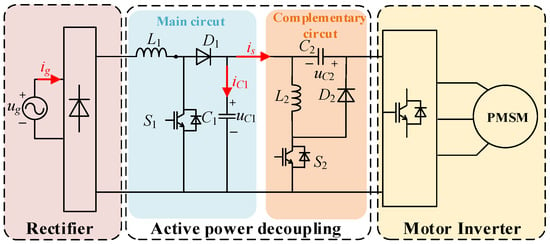
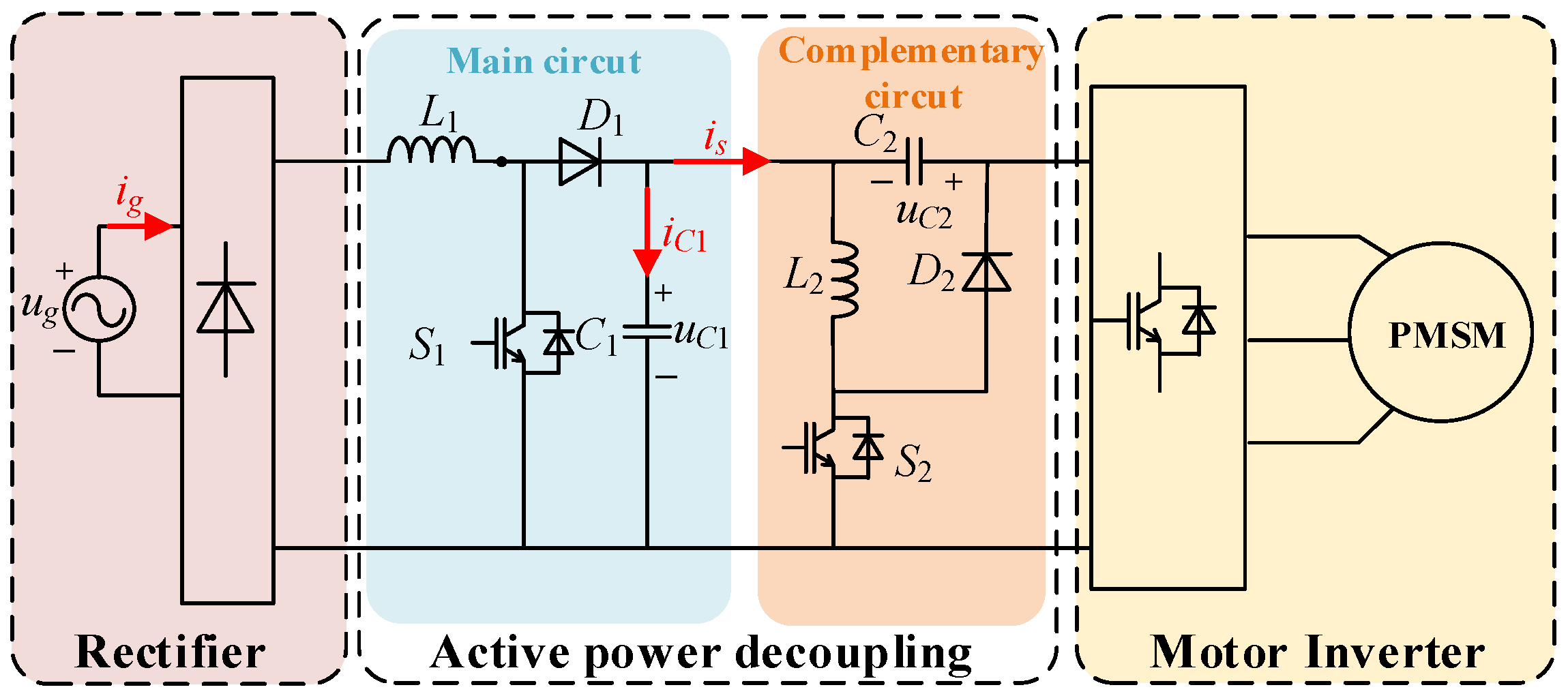
The ECL drive system studied in this paper consists of three parts: a diode rectifier, an active power decoupling circuit, and a three-phase motor inverter. The specific structure of the drive system is shown in Figure 1.
Figure 1.
Structure of the ECL drive system.
The following relationships exist in the drive system:
where udc is the DC-link voltage, and uC1 and uC2 are the instantaneous voltages across capacitors C1 and C2, respectively.
The expressions for uC1 and uC2 are given as follows:
where UC1 and UC2 are the average voltages of capacitors C1 and C2, respectively; PM is the motor power; ωg is the angular frequency of the grid voltage; and k1 and k2 are the ratios of the instantaneous power of C1 and C2 to the instantaneous power of the APDC, respectively.
According to the principle of power conservation, since the inductor power is negligible compared to the capacitor power, the total instantaneous power of the grid equals the sum of the instantaneous powers of capacitors C1 and C2, which satisfies the following relation:
When the conditions of Equation (4) are satisfied, the voltages of capacitors C1 and C2 exhibit complementary characteristics, and no DC-link voltage fluctuation occurs in the ECL drive system:
2.2. Establishment of the Equivalent Model for the ECL System
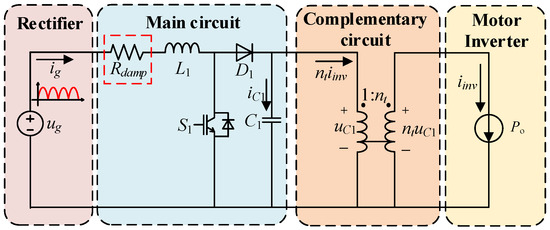
The decoupling capacitance of the ECL drive system is significantly reduced, leading to quite different operating characteristics from conventional systems. To analyze these characteristics, the system is modeled with ideal components, and the motor and three-phase inverter are equivalent to a controlled current source with power Po.
Based on the ampere-second balance principle of power electronic converters, the analysis of inductor L1 in the active power decoupling circuit yields
where d2 is the duty cycle of switch S2, d2′ = 1 − d2 is the input current of the complementary circuit, iL2 is the current of inductor L2, and iinv is the current of the motor equivalent controlled current source.
It can be concluded from Equation (5) and the principle of ampere-second balance that
Simplification based on Equations (5) and (6) yields
By the same token, through the analysis of the voltage relationship of the circuit based on the volt-second balance principle, it can be concluded that
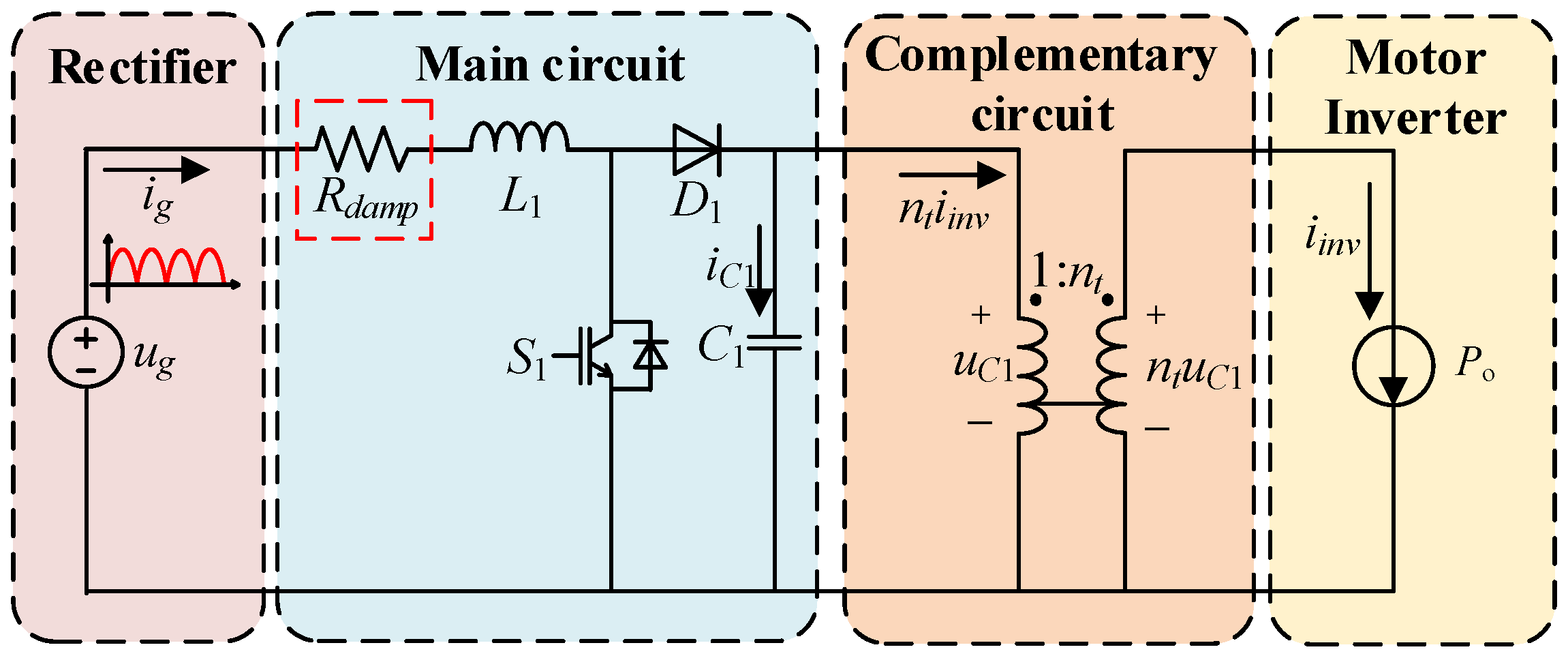
From Equations (7) and (8), the input/output currents and voltages of the complementary circuit are proportional to each other; thus, the circuit can be equivalent to an ideal transformer with a turns ratio of 1:nt (nt = 1/(1 − d2)). It should be stressed that this is only an equivalent analytical model, and no physical transformer is employed in the actual system. The overall equivalent model of the ECL drive system is shown in Figure 2.
Figure 2.
Equivalent circuit of the ECL drive system.
2.3. Stability Analysis of the ECL Drive System
Taking the disconnection of S1 (with D1 conducting and capacitor C1 powered by both the grid and inductor L1) as the analysis case, this paper derives the transfer function of the equivalent circuit of the ECL drive system with the virtual resistance Rdamp introduced as shown in Figure 2 and evaluates its stability. Under this condition, the system satisfies the following circuit relationships:
where ig denotes the grid current in the circuit; according to the equivalent circuit shown in Figure 2, it can be expressed as
where nt, iinv and iC1 denote the turns ratio, input current of the complementary circuit and charging current of the film capacitor C1, respectively. The power Po of the equivalent controlled current source can be expressed as
uC1 is expressed as
where UC1 and ΔuC1 denote the average voltage and ripple voltage of capacitor C1, respectively, with ΔuC1 ≪ UC1.
Substituting Equation (12) into Equation (11) yields
Then, perform a Taylor expansion on formula ; combined with the approximation condition << UC1, the higher-order small terms are neglected and substituted into Equation (13), yielding
Substituting Equation (14) into Equation (10) and combining it with Equations (9) and (11), the transfer function G1 (s) of uC1 relative to ug is obtained as follows:
where UC1(s) and Ug(s) are the Laplace transforms of the output voltage uC1(t) and the input voltage ug(t), respectively.
From Equation (15), the damping ratio ζ of the system with the virtual resistance introduced is obtained as
It can be seen from Equation (16) that the introduction of virtual resistance Rdamp increases the system damping ratio ζ, thereby suppressing oscillation and improving anti-disturbance performance. However, traditional virtual resistance with fixed-parameter design has obvious limitations: an excessively small Rdamp provides insufficient damping improvement, leaving the system with significant oscillation and overshoot; an excessively large Rdamp results in ζ > 1 and the system entering an overdamped state, with dynamic response speed reduced significantly. Therefore, the parameter design of virtual resistance must balance oscillation suppression and dynamic response speed.
3. Model Predictive Control Strategy Based on Adaptive Adjustment of Virtual Resistance
3.1. Working Principle
The original state equation of the ECL drive system can be expressed as follows:
Discretizing the continuous-domain model of inductor current in Equation (17) and applying the approximation rule of the forward Euler method yields the predicted current value iL1(k + 1) of inductor L1 at discrete time k + 1.
where Ts is the sampling period, and ug (k) and uC1 (k) denote the input voltage of the APDC and the voltage of capacitor C1 at sampling point k, respectively.
Equation (18) shows that the traditional model predictive control only predicts current based on the system’s inherent parameters (e.g., L1, Ts). However, due to the reduced decoupling capacitor, the ECL drive system has an inherent weak damping characteristic. When the motor speed or torque changes abruptly, the drastic power variation causes grid current surges, and the weak damping fails to quickly suppress oscillations, resulting in a significant deviation between the predicted and reference inductor currents, prolonged regulation convergence time and large DC bus voltage fluctuations.
To improve the weak damping characteristic of the ECL drive system, the state equation of the system is modified as follows after introducing the virtual resistance Rdamp into the APDC circuit:
where udamp is the voltage across the virtual resistance Rdamp.
Discretizing Equation (19) yields the predicted value iL1−VR (k + 1) of the inductor current iL1 with the virtual resistance incorporated.
Equation (20) indicates that after introducing the virtual resistance, the predicted current iL1−VR (k + 1) decreases monotonically with the increase in Rdamp. A moderate increase in Rdamp can effectively suppress the overshoot caused by the sudden speed increase of the motor; however, an excessive increase will lead to the deviation of the predicted current from the reference value and the lag of grid current behind the motor power change, thereby deteriorating the dynamic performance of the system. Therefore, the parameter design of Rdamp needs to achieve a dynamic balance between overshoot suppression and tracking speed.
3.2. Definition of the Value Range of Virtual Resistance
To ensure the global stability of the system during the virtual resistance adjustment process, the traditional stability analysis method relying on transfer functions is abandoned, and a composite Lyapunov function is constructed based on the energy characteristics of the ECL drive system. This function specifically incorporates both the average magnetic energy of inductor L1 and the average electric energy of capacitor C1, and can fully reflect the average energy variation trend of the system during the dynamic process, with its expression given as follows:
where iL1−av and UC1 denote the average current of inductor L1 and the average voltage of capacitor C1, respectively, and satisfy the relationship iL1−av = Po/ug−av, where ug−av is the average grid voltage.
According to the core criterion of Lyapunov stability, the necessary and sufficient condition for system stability is < 0. Differentiating Equation (21) yields
According to Figure 2, when S1 is turned off, the inductor current iL1 supplies charging current to capacitor C1 and input current is to the complementary circuit simultaneously. By Kirchhoff’s Current Law (KCL), iL1−av = iC1−av + is−av. Given that is−av > 0, it follows that iC1−av < iL1−av. Let iC1−av = biL1−av (0 < b < 1) and substitute it into Equation (22).
According to Lyapunov’s stability criterion, the condition that Equation (23) < 0 must be satisfied. Meanwhile, given that (b − 1)iL1−avUC1 < 0 and iL1−av > 0, the lower bound constraint of the virtual resistance is derived as follows:
Stability constraints cannot balance the system’s dynamic tracking performance. Excessively large virtual resistance will lead the system to an overdamped state, reducing the response speed to motor power changes. To this end, a Lyapunov function for tracking performance optimization is constructed based on the predicted current tracking error.
A new Lyapunov function is constructed to analyze the tracking performance of the AVR-MPC.
where iL1−ref is the reference value of inductor current at time k + 1, and iL1−VR (k + 1) is the predicted current value including virtual resistance.
According to the stability condition of the Lyapunov function, < 0 must be satisfied to achieve fast convergence of the tracking error. Substituting Equation (20) into Equation (26) and differentiating yields
Since the grid voltage ug is less than the capacitor voltage uC1, it can be derived from Equation (27) that
To satisfy the stability condition of the Lyapunov function, it can be further deduced from Equations (27) and (28) that
Since Ts is extremely small, the second term in Equation (29) can be omitted. Equation (29) is simplified as
To satisfy Equation (30), the upper limit constraint condition of the virtual resistance is derived:
Therefore, to ensure the stability of the system, the value range of the virtual resistance can be derived from Equations (24) and (31) as follows:
However, under dynamic operating conditions, the predicted inductor current value at the next moment obtained by the traditional fixed virtual resistance control strategy will deviate from its reference value. The deviation degree is related to the intensity of power variation, making it difficult to meet the control requirements of the ECL drive system under complex operating conditions.
3.3. Design of the Adaptive Tuning Mechanism
To address the aforementioned issues, this paper correlates the virtual resistance with the current deviation under dynamic operating conditions and proposes a virtual resistance adaptive adjustment mechanism based on the predicted current deviation, the specific formulation of which is given in Equation (33).
where Rmin and Rmax are the lower and upper limits of the virtual resistance range obtained by Equation (32), respectively; ρ is the predicted current deviation, expressed as |iL1−ref (k) − iL1(k)|; ρmin and ρmax are the preset minimum and maximum thresholds of the predicted current deviation, respectively; and Ks is the proportional coefficient between the virtual resistance and the predicted current deviation.
To ensure that the dynamic adjustment range of the virtual resistance is consistently maintained within the optimal interval for suppressing the system’s weak damping characteristic, this paper conducts a targeted parameter matching analysis by combining Equations (32) and (33) and then derives the reasonable value range of the proportional adjustment coefficient Ks that correlates the virtual resistance with the current deviation, as shown below.
Assume that the actual power of the motor P0 = 300 W, and ug−av = 220 V, then Rmin can be obtained according to Equation (32).
With L1 = 4 mH and Ts = 0.00001 s, then Rmax can be obtained as
The following expressions can be obtained according to Equations (33), (35), and (36).
where ρ is the current error, which is selected according to the actual situation. Generally, ρmin and ρmax are set to 40% and 80% of the initial current, respectively, which is determined based on the trade-off between system dynamic response and damping stability in practical ECL drive system applications. ρmin and ρmax are presented as follows:
According to Equations (34), (38), and (39), the range of Ks can be obtained.
When the current deviation ρ < 0.1, the ECL drive system operates in a stable state without obvious oscillation or dynamic fluctuation. The virtual resistance is set to 0 to avoid the impact of over-damping on the dynamic response speed, thus ensuring fast tracking of grid current and motor power variations. When the deviation increases to the range of 0.1 < ρ < ρmin, dynamic operating conditions such as sudden motor speed rise and torque mutation occur, leading to slight fluctuations in the system. The virtual resistance is switched to the minimum damping value Rmin, which provides basic damping support to prevent oscillation amplification.
When the deviation falls into the moderate range of ρmin < ρ < ρmax, system fluctuations intensify and oscillation risks escalate. The virtual resistance Rdamp = Ksρ is linearly correlated with the deviation, realizing adaptive damping that accurately matches the oscillation amplitude and balances damping effect with response performance. Once the deviation exceeds ρmax, it indicates that the system is subjected to severe disturbances. The virtual resistance is immediately switched to the maximum damping value Rmax, which provides the strongest damping compensation to rapidly suppress severe oscillations and prevent system instability.
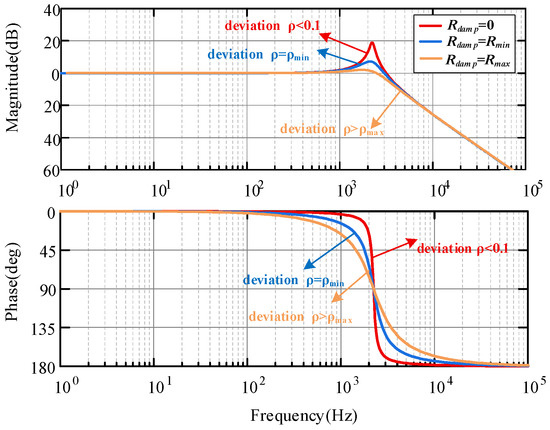
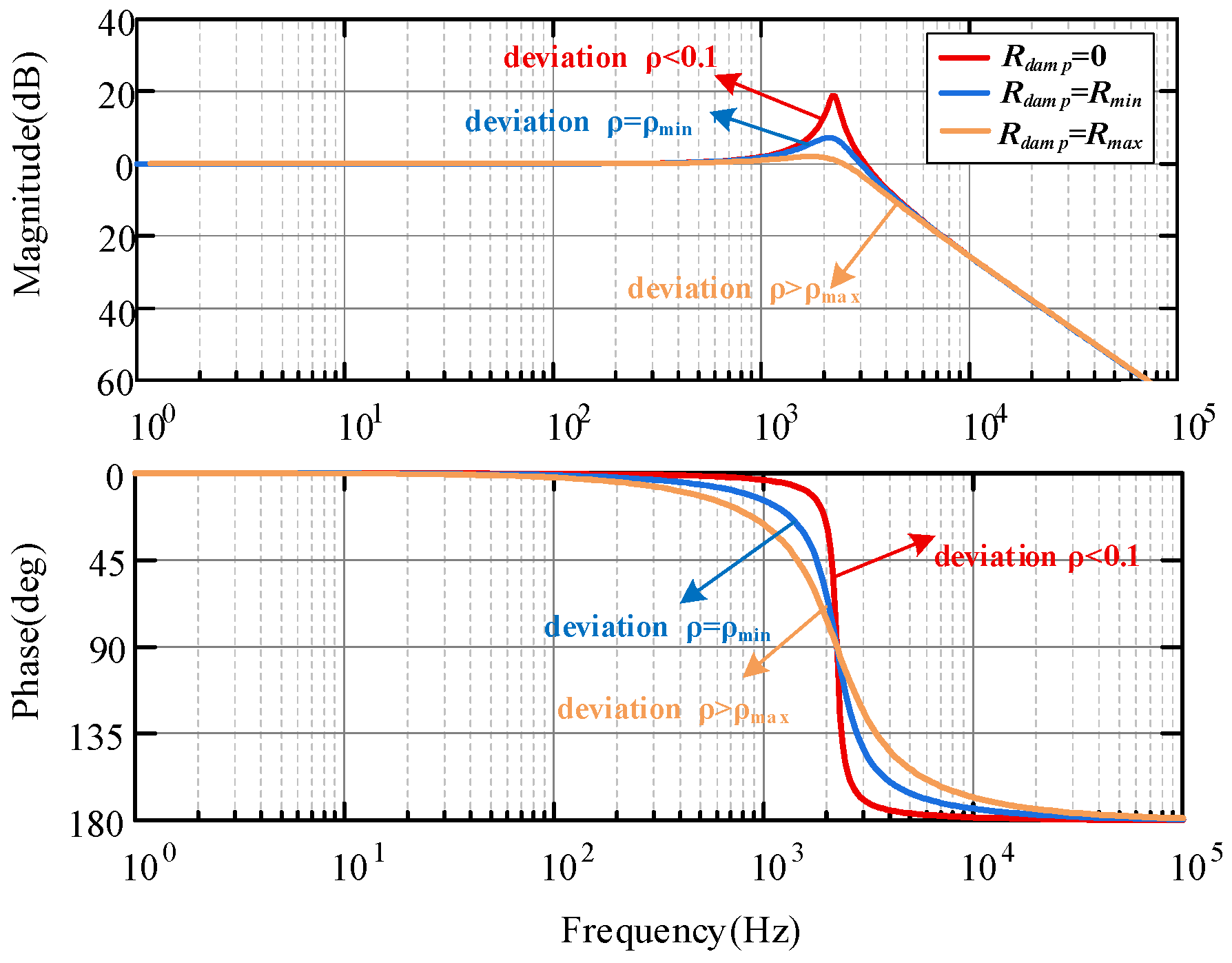
To better analyze the system stability, the Bode plots characterizing the stability of the system under different current deviations are plotted in accordance with Equation (15), as shown in Figure 3.
Figure 3.
Bode plots of system stability under different current deviations.
It can be seen from Figure 3 that the amplitude curves exhibit no oscillatory divergence tendency when crossing the 0 dB line under all operating conditions, with the gain margin remaining consistently positive; the phase curves never drop to −180° throughout the entire frequency range, and the phase margin at the gain crossover frequency is sufficient, indicating that the proposed control strategy can ensure system stability under all operating conditions. Specifically, when Rdump = 0 Ω, the inherent damping characteristics of the system already meet the requirements for steady-state operation. When the system is subjected to severe dynamic conditions with ρ > ρmax, setting Rdump = Rmax ensures that the system still maintains a positive margin, which verifies the stability under extreme operating conditions. Under moderate dynamic conditions where ρmin < ρ < ρmax, the virtual resistance can realize adaptive adjustment according to the system state. Combined with its characteristic of smooth correction of system damping, both the amplitude-frequency and phase-frequency curves of the open-loop transfer function show monotonic variations without pole jumping or abrupt changes in resonance peaks. It can thus be inferred that the system can maintain favorable stability with any value of virtual resistance within this interval. In summary, the Bode plot analysis fully verifies that the proposed control strategy can effectively guarantee the stable operation of the system under different operating conditions.
3.4. Performance Comparative Analysis of Control Strategies
To verify the superiority of the AVR-MPC strategy, the current regulation characteristics of the traditional predictive current control are compared with those of the AVR-MPC strategy.
The current variation of the traditional predictive current control after n-step prediction is expressed as follows:
The current variation of the AVR-MPC strategy during the process after n-step prediction can be expressed as follows:
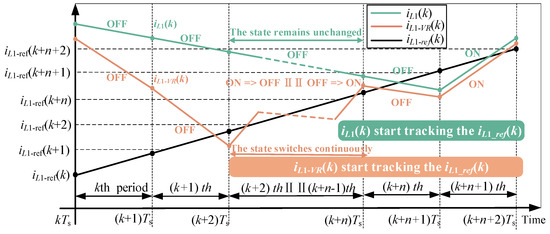
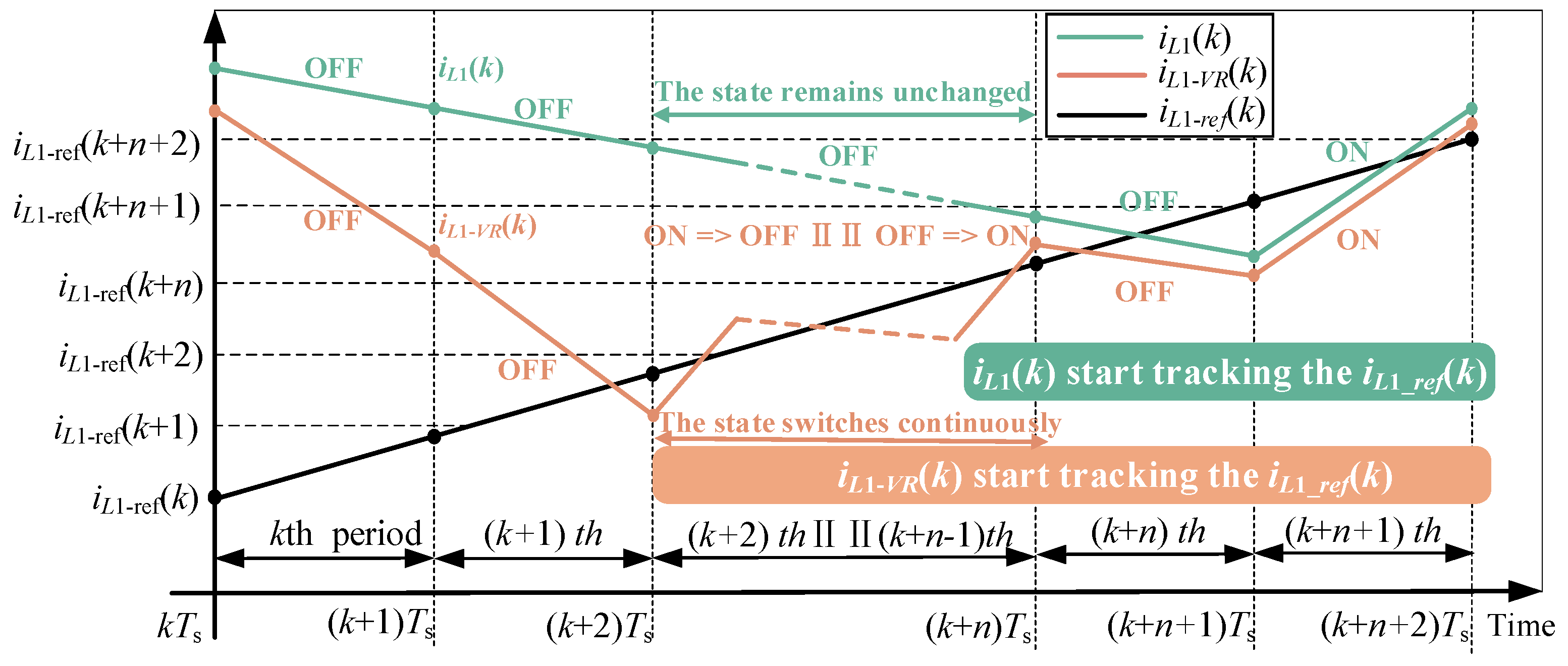
Based on Equations (41) and (42), plot the comparison diagram of rolling optimization between traditional predictive current control and AVR-MPC as shown in Figure 4.
Figure 4.
Comparison diagram of rolling optimization between traditional control and AVR-MPC.
Where iL1−ref (k), iL1(k) and iL1−VR (k) denote the reference value, the predicted value obtained by the traditional method, and the optimized predicted value of the inductor current, respectively. kTs represents the starting moment of the dynamic operating condition.
Figure 4 shows that at time kTs, the predicted currents of both methods deviate from the reference value. The green curve represents the traditional model predictive control, while the orange curve represents the AVR-MPC proposed in this paper. The AVR-MPC can quickly correct the deviation by dynamically increasing the virtual resistance and achieve stable tracking of the reference value at time (k + 2)Ts. In contrast, the traditional predictive current control cannot realize stable tracking until time (k + n + 1)Ts, with a significantly longer adjustment period.
Therefore, the AVR-MPC proposed in this paper achieves fast tracking of the reference current by the predicted current through dynamically adjusting the resistance value of the virtual resistor, thereby improving the dynamic performance of the ECL drive system.
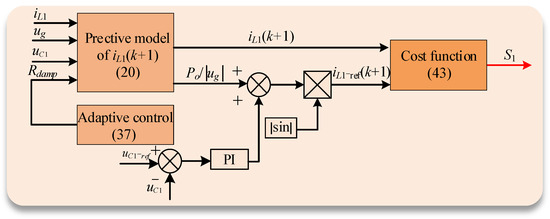
To enable the predicted value iL1 (k + 1) to accurately track the reference value iL1(k + 1), the current model corresponding to the minimum value of the cost function g1 is selected to control S1, and the cost function g1 is given as follows:
The control block diagram of the APDC is shown in Figure 5.
Figure 5.
The control block diagram of the APDC based on AVR-MPC.
3.5. ECL System Control Strategy
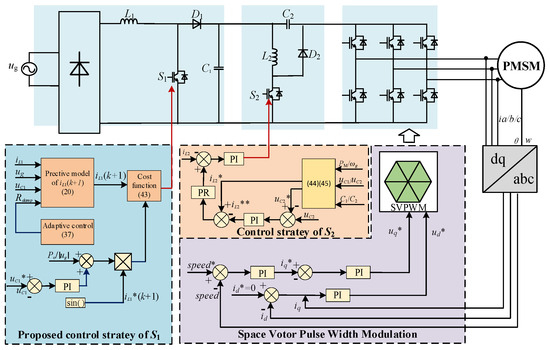
The overall control block diagram of the ECL drive system is shown in Figure 6. Among them, the boost converter adopts the AVR-MPC strategy proposed in this paper to achieve bus voltage stabilization, and the control method of the voltage outer-loop controller for the decoupling converter is as follows:
where θ is the phase difference between the grid voltage and UC1/UC2, and the current inner-loop controller adopts the instantaneous current control method [25], which is given as follows:
Figure 6.
The overall block diagram of the ECL drive system.
PMSM adopts the current vector control strategy. The motor speed is collected and fed back in real time by a speed sensor, while the d/q axis currents id and iq are calculated from the three-phase stator winding currents via Clark–Park transformation. The speed-loop PI regulator outputs the d/q axis current reference commands id* and id* according to the deviation between the given speed n* and the actual feedback speed n. The current-loop PI regulator then generates the d/q axis voltage reference signals ud* and uq* based on the deviation between the current references and the actual feedback currents, which are finally converted into inverter switch control signals by the SVPWM algorithm to achieve efficient operation of the PMSM.
The PI regulators for both the speed loop and current loop are tuned using the engineering tuning method based on the typical Type I system. The specific parameters are as follows: for the current loop, proportional gain Kp = 10 and integral gain Ki = 250; for the speed loop, proportional gain Kp = 0.03 and integral gain Ki = 3.5
4. Experimental Verification
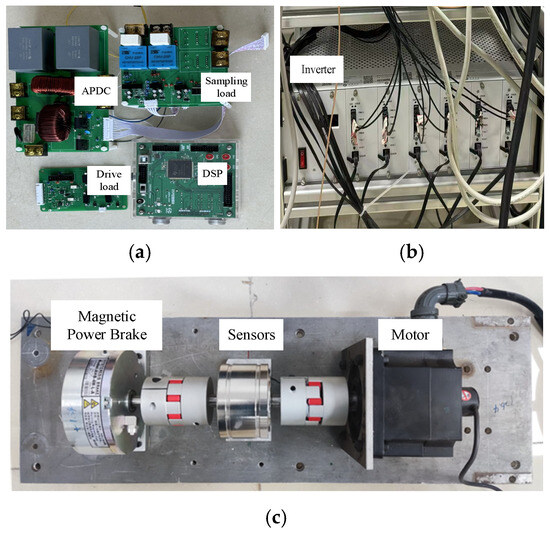
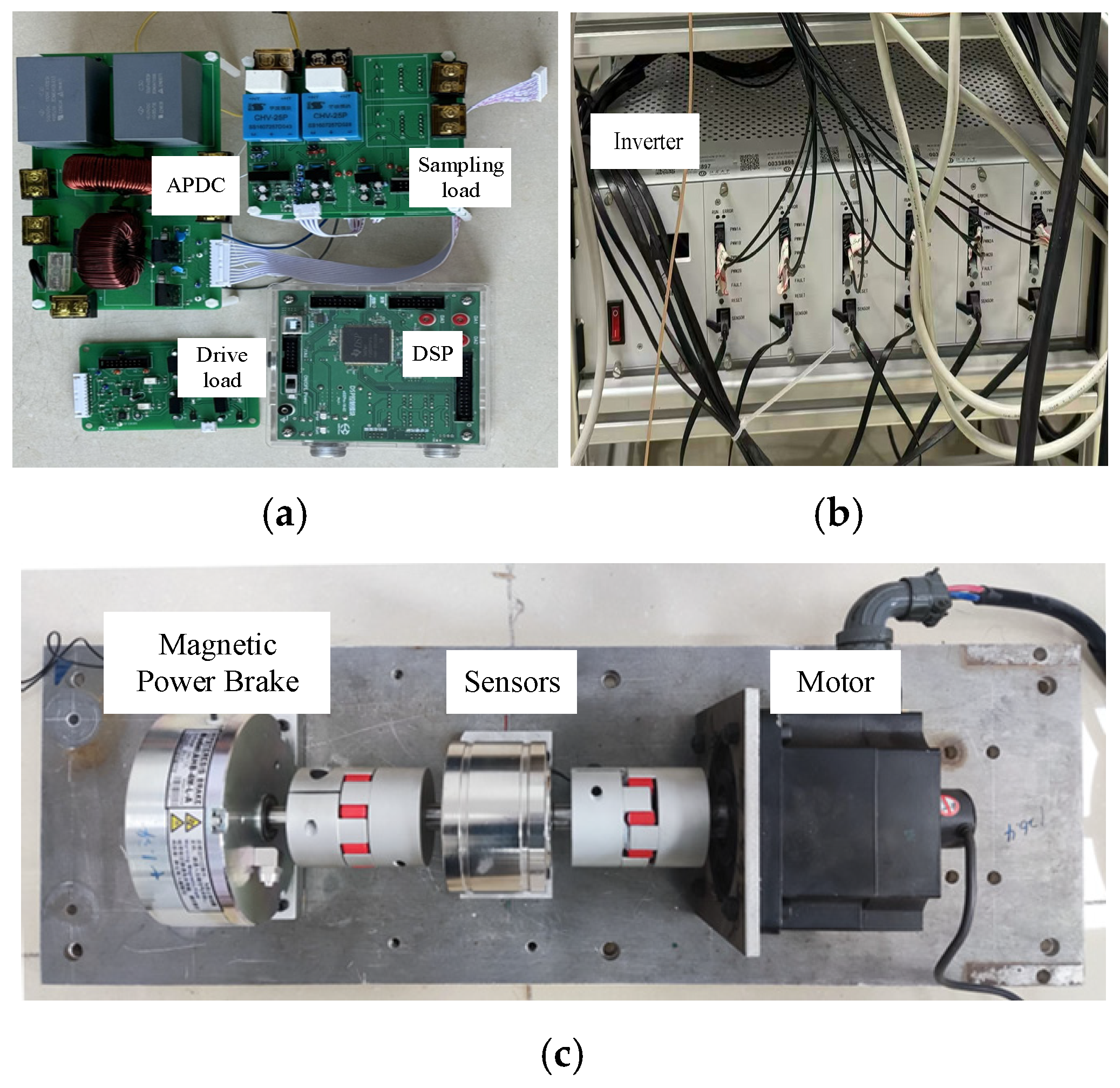
To verify the effectiveness of the AVR-MPC strategy proposed in this paper, a PMSM-based ECL experimental platform as shown in Figure 7 was established. The platform adopted DSP TMS320F28335 to implement the proposed control strategy, constructed the motor inverter based on the FS30R06W1E3 IGBT module, used a magnetic powder brake as the load, and collected the motor torque and speed data via torque and speed sensors.
Figure 7.
Experimental platform: (a) controller and power converter; (b) motor inverter; (c) motor platform.
Table 1 lists the key parameters of the ECL motor drive system. The system is equipped with ACS712-20T current-mode Hall sensors(Worcester, MA, USA) and CHV-25P voltage-mode Hall sensors (Geneva, Switzerland), which collect the current and voltage signals of the drive system, respectively. The TC4452VOA713(Chandler, AZ, USA) chip is selected to drive and control the power switching device MOSFET.
Table 1.
Key parameters of the proposed ECL drive system.
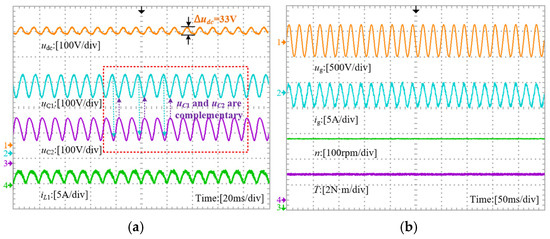
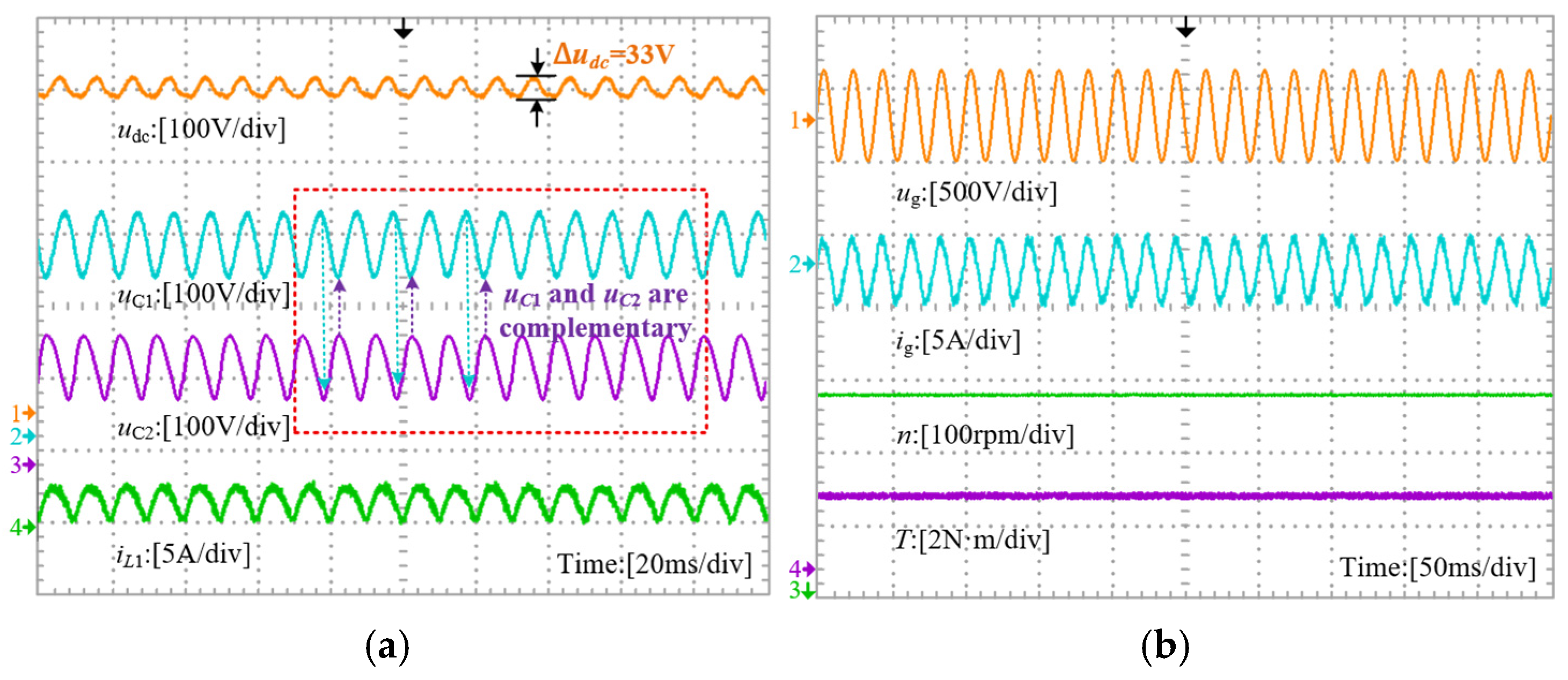
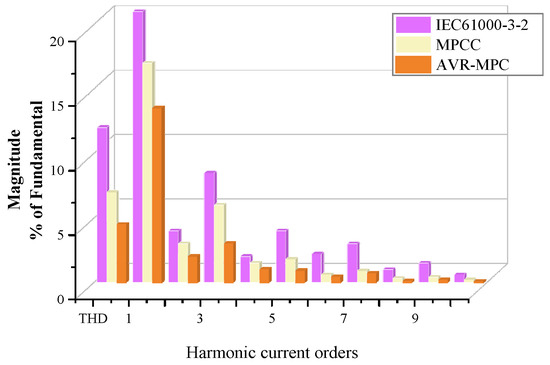
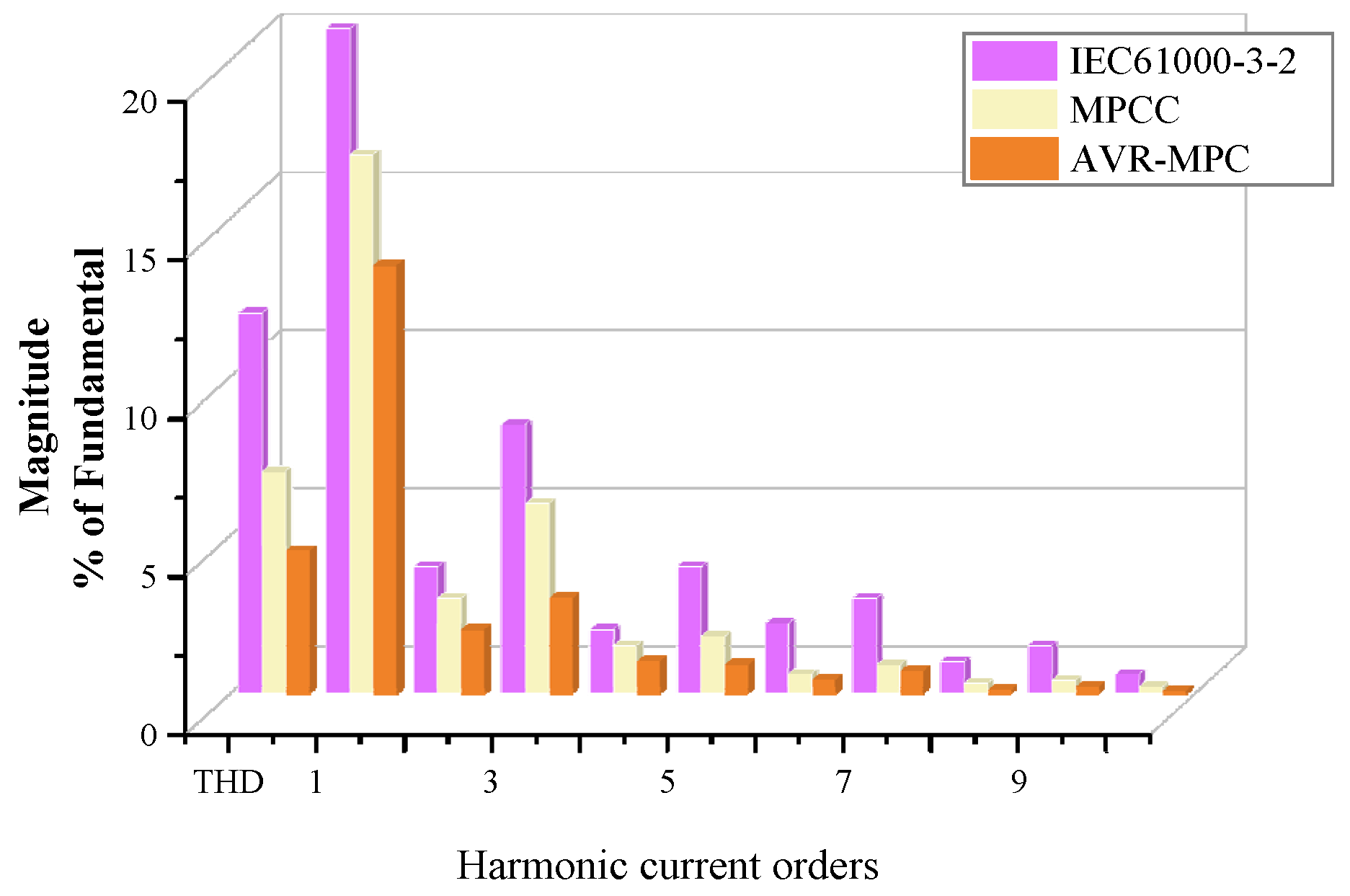
Figure 8 demonstrates the steady-state operation performance of the model predictive control based on the adaptive adjustment of virtual resistance proposed in this paper in the ECL drive system. The experimental given speed is 1800 r/min with a load torque of 2 N·m. As shown in Figure 8a, under steady-state conditions, the bus voltage ripple of the proposed AVR-MPC strategy is 33 V, accounting for 7.33% of the bus voltage, and the active power decoupling circuit can achieve accurate voltage complementarity of the split capacitors. The ig waveform in Figure 8b and the Total Harmonic Distortion (THD) analysis in Figure 9 indicate that the grid current harmonics under the proposed control strategy meet the IEC 61000-3-2 harmonic standard. In addition, Figure 8b shows that the motor has small speed and torque ripples during operation, and the ECL drive system exhibits excellent steady-state operation performance.
Figure 8.
Steady-state experimental waveforms of the ECL drive system: (a) udc, uC1, uC2 and iL1 under AVR-MPC; (b) ug, ig, motor speed n and torque T under AVR-MPC.
Figure 9.
Current harmonics of ig.
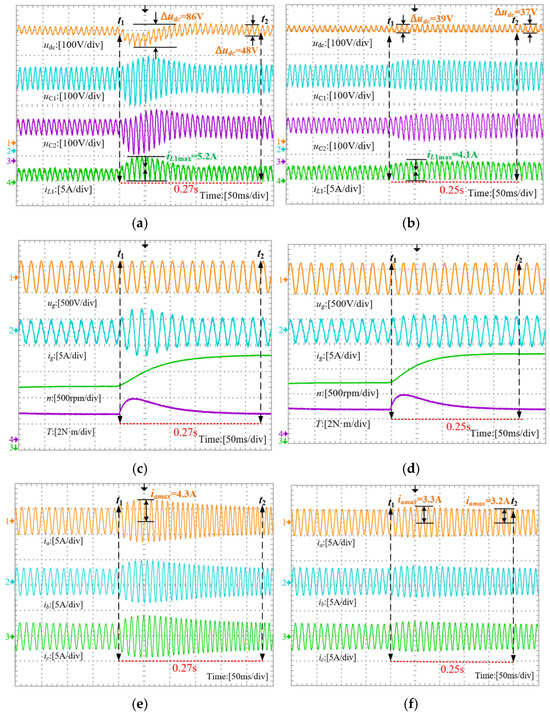
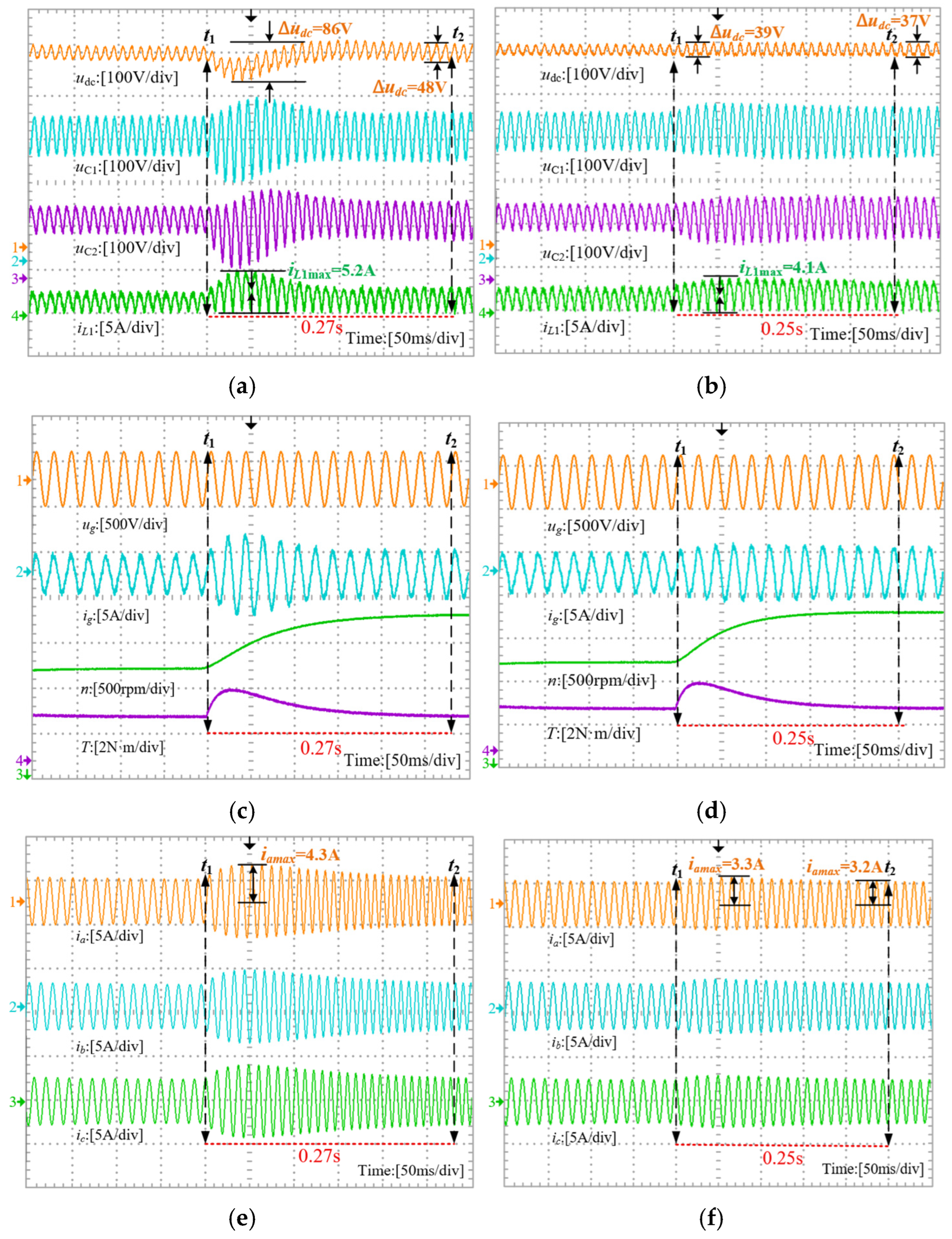
Figure 10 presents the experimental waveforms of the ECL drive system under a sudden speed change condition, offering a clear and direct performance comparison between the conventional predictive current control scheme and the proposed AVR-MPC scheme. During the experiment, the motor load torque was maintained constant at 2 N·m, and the initial motor speed was set to 1200 rpm. At a specific instant t1, the reference speed was stepped up to 1800 rpm, and the system eventually reached a stable steady-state operating condition at time t2.
Figure 10.
Experimental waveforms of the ECL drive system under speed step conditions: (a) udc, uC1, uC2 and iL1 with the conventional predictive current control; (b) udc, uC1, uC2 and iL1 with AVR-MPC; (c) ug, ig, motor speed n and torque T with the conventional predictive current control; (d) ug, ig, motor speed n and torque T with AVR-MPC. (e) motor current ia, ib, ic with the conventional predictive current control; (f) motor current ia, ib, ic with AVR-MPC.
As shown in Figure 10a, under the sudden speed increase condition, the DC bus voltage of the ECL drive system employing conventional predictive current control exhibits significant fluctuations, with a maximum value of 86 V, while the inductor current iL1 experiences a sharp surge, reaching a peak value of 5.2 A. In contrast, Figure 10b demonstrates that with the proposed AVR-MPC, the maximum DC bus voltage fluctuation is reduced to 39 V, and the peak value of iL1 is limited to 4.1 A, corresponding to reductions of 54.65% and 21.16%, respectively, compared to the conventional method. Additionally, the figures indicate that the DC bus voltage stabilization times under conventional predictive current control and the proposed AVR-MPC are 0.27 s and 0.25 s, respectively. After stabilization, the bus voltage ripples are 48 V and 37 V, respectively, with the ripple under AVR-MPC reduced by 22.9% relative to the conventional approach.
Figure 10c,d further illustrate that the speed/torque of the ECL drive system reaches a steady state in 0.27 s under conventional predictive current control and in 0.25 s under AVR-MPC, indicating a 7.4% reduction in stabilization time with the proposed method. Figure 10e shows that the motor current under conventional control exhibits noticeable fluctuations, with a maximum amplitude of 4.3 A. Meanwhile, Figure 10f reveals that under the proposed AVR-MPC, the maximum motor current amplitude is 3.3 A, representing a 23.3% reduction compared to the conventional control. In summary, the experimental results demonstrate that, compared to predictive current control, the proposed control strategy effectively mitigates DC bus voltage fluctuations and inductor current surges under sudden speed increase conditions, thereby significantly enhancing system stability during abrupt speed variations.
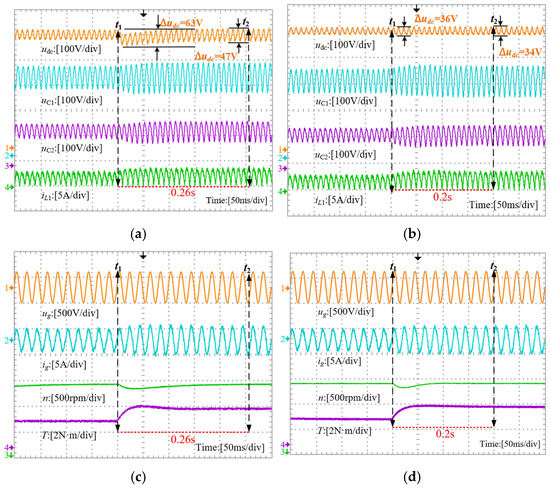
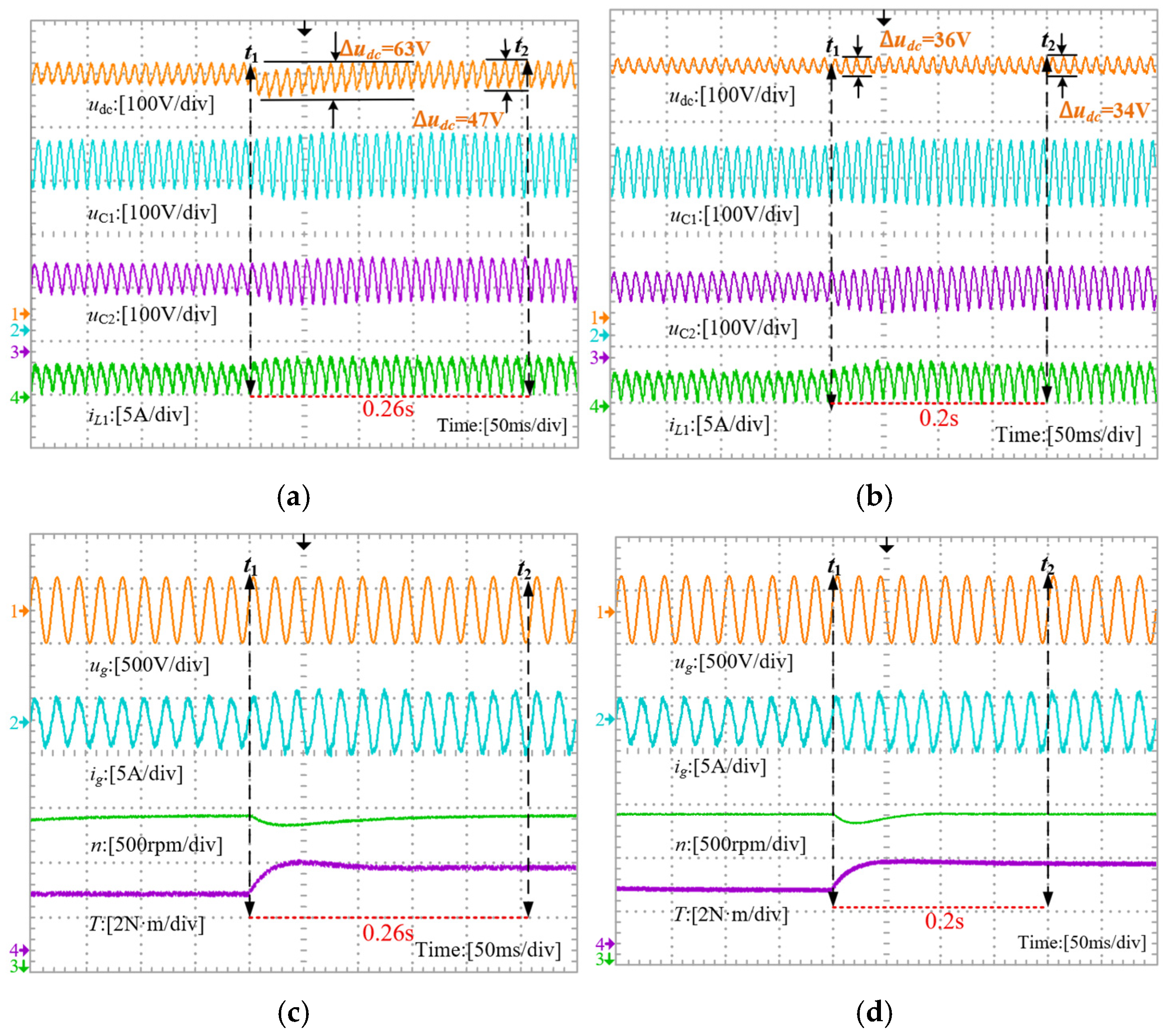
Figure 11 presents the experimental waveforms of the ECL motor drive system under a sudden load increase condition, offering an intuitive comparison of the dynamic performance between the conventional predictive current control scheme and the AVR-MPC scheme proposed in this paper. During the experiment, the motor speed was maintained at 1200 rpm with an initial load torque of 2 N·m. At time t1, the reference torque was stepped up to 3 N·m, and the system reached a steady torque state at time t2.
Figure 11.
Experimental waveforms of the ECL drive system under torque step conditions: (a) udc, uC1, uC2 and iL1 with the conventional predictive current control; (b) udc, uC1, uC2 and iL1 with AVR-MPC; (c) ug, ig, motor speed n and torque T with the conventional predictive current control; (d) ug, ig, motor speed n and torque T with AVR-MPC.
Figure 11a indicates that under the sudden load increase condition, the DC bus voltage of the ECL drive system adopting conventional predictive current control undergoes significant fluctuations with a maximum value of 63 V. In contrast, with the AVR-MPC proposed in this paper, the maximum fluctuation of the DC bus voltage is 36 V, representing a reduction of 42.9% compared to the conventional predictive current control, as illustrated in Figure 11b. In addition, the DC bus voltage of the conventional predictive current control and AVR-MPC takes 0.26 s and 0.2 s to stabilize, respectively. After stabilization, the bus voltage ripples are 47 V and 34 V, with the ripple of the AVR-MPC reduced by 27.66% compared to the conventional method. Figure 11c,d show that the torque/speed of the ECL drive system takes 0.26 s and 0.2 s to reach a steady state under the conventional predictive current control and AVR-MPC, respectively. The stabilization time of torque/speed under AVR-MPC is shortened by 23.08% compared to the conventional predictive current control. In summary, the experimental results demonstrate that under the sudden load increase condition, the control strategy proposed in this paper can effectively reduce the bus voltage fluctuation and significantly enhance the stability of the system when the load changes abruptly.
5. Discussion
The proposed AVR-MPC strategy has demonstrated its effectiveness on a PMSM drive system, but the following limitations and areas for future extension remain:
- Method Generalizability: This strategy is based on system-level impedance reshaping. Its mathematical model (as shown in Equation (20)) involves only general circuit parameters such as inductor current and capacitor voltage and does not rely on the specific electromagnetic structure of PMSMs. Therefore, it can theoretically be extended to other motor types (e.g., induction motors, switched reluctance motors), as long as the drive system includes an APDC unit and employs the same impedance reshaping approach for voltage fluctuation suppression.
- Parameter Sensitivity: As can be seen from Equation (20), the prediction accuracy is directly affected by the inductance parameter. When the actual inductance value deviates due to magnetic saturation or temperature drift during operation, it leads to current prediction errors, which in turn affect the adaptive adjustment of the virtual resistance (Equation (33)). This may result in two adverse scenarios: excessively high virtual resistance causing an overdamped system (slowing dynamic response) or insufficient virtual resistance leading to an underdamped state (risk of persistent oscillation).
- Measurement Noise Impact: The adjustment of the virtual resistance depends on the current deviation ρ (Equation (33)). If noise is introduced by the current sensor, ρ may be overestimated even under steady-state conditions, unnecessarily triggering an increase in virtual resistance and reducing the system’s dynamic response speed.
- Grid Adaptability: This study assumes ideal grid conditions and does not consider grid voltage sags or distortions. Under non-ideal grid conditions, the grid voltage term in Equation (20) would introduce disturbance components, affecting both the prediction model accuracy and the virtual resistance adjustment performance.
Future work will focus on online parameter identification, improving noise immunity, and extending the method’s adaptability to non-ideal grid conditions.
6. Conclusions
This paper proposes a model predictive control strategy based on the adaptive adjustment of virtual resistance (AVR-MPC), which effectively addresses the problem that traditional model predictive control (MPC) cannot fundamentally improve the weak damping characteristics of the system. Experimental results show that under steady-state operation, the proposed strategy achieves effective complementarity of active power decoupling and ensures good power quality, with the grid current harmonic content complying with the IEC 61000-3-2 harmonic standard, thus guaranteeing stable operation of the drive system. During sudden speed and torque changes, the maximum DC bus voltage fluctuations are limited to 39 V and 36 V, respectively, representing reductions of 54.65% and 42.9% compared to traditional predictive current control. In conclusion, the proposed strategy significantly improves the dynamic operation performance of the ECL drive system.
Author Contributions
Conceptualization, C.Z.; validation, T.L.; investigation, C.Z. and T.L.; resources, C.Z. and H.J.; writing—original draft preparation, T.L.; writing—review and editing, C.Z. and H.J.; correspondence, W.Z. All authors have read and agreed to the published version of the manuscript.
Funding
This research was funded by the National Natural Science Foundation of China under Grant 52077098.
Data Availability Statement
The original contributions presented in this study are included in the article. Further inquiries can be directed to the corresponding author.
Conflicts of Interest
The authors declare no conflicts of interest.
References
- Huo, J.; Ding, D.; Ren, Z.; Wang, G.; Zhao, N.; Zhu, L.; Xu, D. A Novel Flux-weakening Control Method with Quadrature Voltage Constrain for Electrolytic Capacitorless PMSM Drives. CES Trans. Electr. Mach. Syst. 2022, 6, 279–287. [Google Scholar] [CrossRef] [Scilit]
- Zhao, N.; Wang, G.; Zhang, R.; Li, B.; Bai, Y.; Xu, D. Inductor Current Feedback Active Damping Method for Reduced DC-Link Capacitance IPMSM Drives. IEEE Trans. Power Electron. 2019, 34, 4558–4568. [Google Scholar] [CrossRef] [Scilit]
- Zhang, C.; Xu, L.; Zhu, X.; Du, Y.; Quan, L. Elimination of DC-Link Voltage Ripple in PMSM Drives with a DC-Split-Capacitor Converter. IEEE Trans. Power Electron. 2021, 36, 8141–8154. [Google Scholar] [CrossRef] [Scilit]
- Yang, S.; Zhai, C.; Gao, Y.; Dou, H.; Zhao, X.; He, Y.; Wang, X. Planting Uniformity Performance of Motor-Driven Maize Precision Seeding Systems. Int. J. Agric. Biol. Eng. 2022, 15, 101–108. [Google Scholar] [CrossRef] [Scilit]
- Xiao, Y.; Yang, Y.; Liu, C.; Rodriguez, J. Design and Analysis of a Wireless Ultrasonic Motor Drive System. IEEE Trans. Power Electron. 2023, 38, 12309–12314. [Google Scholar] [CrossRef] [Scilit]
- Ding, D.; Zhang, G.; Wang, G.; Xu, D. Dual Antiovervoltage Control Scheme for Electrolytic Capacitorless IPMSM Drives with Coefficient Autoregulation. IEEE Trans. Power Electron. 2020, 35, 2895–2907. [Google Scholar] [CrossRef] [Scilit]
- Ding, D.; Wang, G.; Zhao, N.; Zhang, G.; Xu, D. An Antiovervoltage Control Scheme for Electrolytic Capacitorless IPMSM Drives Based on Stator Current Vector Orientation. IEEE Trans. Ind. Electron. 2020, 67, 3517–3527. [Google Scholar] [CrossRef] [Scilit]
- Yan, W.; Lu, W.; Jiang, Z.; Zhao, Y.; Wang, W.; Wang, Y.C. Current Control of Electrolytic Capacitor-Less Variable Frequency Drive System for Synchronous Reluctance Motors Based on Power Balancing and Compensation. IEEE Access 2024, 12, 150639–150650. [Google Scholar] [CrossRef] [Scilit]
- Zhang, C.; Xu, L.; Zhu, X.; Du, Y.; Quan, L. Torque Ripple Reduction of PMSM with Small Capacitor Drive Systems Based on Combined Control Method. IEEE Access 2021, 9, 98874–98882. [Google Scholar] [CrossRef] [Scilit]
- Liu, Y.; Zhang, Z.; Guo, H.; Zhang, Q.; Yang, P.; Zhu, P.; Zhuang, X. An Active DC-Link Stabilization Strategy for Permanent Magnet Synchronous Motor Drive System Based on Inverter Voltage Compensation. IEEE/ASME Trans. Mechatron. 2022, 27, 2786–2795. [Google Scholar] [CrossRef] [Scilit]
- Jung, S.-J.; Chee, S.-K.; Sul, Y.-J.; Park, H.-S.; Kim, W.-K. Control of Three-Phase Inverter for AC Motor Drive with Small DC-Link Capacitor Fed by Single-Phase AC Source. IEEE Trans. Ind. Appl. 2014, 50, 1074–1081. [Google Scholar] [CrossRef] [Scilit]
- Tau, J.-H.; Tzou, Y.-Y. PFC Control of Electrolytic Capacitor-Less PMSM Drives for Home Appliances. In Proceedings of the 2017 IEEE 26th International Symposium on Industrial Electronics (ISIE), Edinburgh, UK, 19–21 June 2017. [Google Scholar]
- Song, X.; Zheng, S.; Han, B.; Peng, C.; Zhou, X. Active Damping Stabilization for High-Speed BLDCM Drive System Based on Band-Pass Filter. IEEE Trans. Power Electron. 2017, 32, 5438–5449. [Google Scholar] [CrossRef] [Scilit]
- Wei, Y.; Young, H.; Ke, D.; Wang, F.; Qi, H.; Rodríguez, J. Model-Free Predictive Control Using Sinusoidal Generalized Universal Model for PMSM Drives. IEEE Trans. Ind. Electron. 2024, 71, 13720–13731. [Google Scholar] [CrossRef] [Scilit]
- Zhang, Y.; Shao, L.; Yin, Z.; Bai, C.; Liu, J. Ultralocal Model Based Model Predictive Torque Control of Induction Motor Drives with Model Free Speed Controller. IEEE Trans. Ind. Electron. 2025, 72, 8962–8973. [Google Scholar] [CrossRef] [Scilit]
- Mousavi, M.S.; Davari, S.A.; Nekoukar, V.; Garcia, C.; Rodriguez, J. A Robust Torque and Flux Prediction Model by a Modified Disturbance Rejection Method for Finite-Set Model-Predictive Control of Induction Motor. IEEE Trans. Power Electron. 2021, 36, 9322–9333. [Google Scholar] [CrossRef] [Scilit]
- Zhang, X.; Liu, Z.; Zhang, P.; Zhang, Y. Model Predictive Current Control for PMSM Drives Based on Nonparametric Prediction Model. IEEE Trans. Transp. Electrif. 2024, 10, 711–719. [Google Scholar] [CrossRef] [Scilit]
- Jiang, X.; Yang, Y.; Fan, M.; Ji, A.; Xiao, Y.; Zhang, X.; Zhang, W.; Garcia, C.; Vazquez, S.; Rodriguez, J. An Improved Implicit Model Predictive Current Control with Continuous Control Set for PMSM Drives. IEEE Trans. Transp. Electrif. 2022, 8, 2444–2455. [Google Scholar] [CrossRef] [Scilit]
- Zhang, C.; Zheng, Y.; Zhu, W.; Gao, R. Model Predictive Current Control for DC-Link Ripple Voltage Suppression in Electrolytic Capacitor-Less Drive System. Energies 2022, 15, 9297. [Google Scholar] [CrossRef] [Scilit]
- Zhang, C.; Xia, X.; Cao, T.; Ling, L.; Zhu, W. DC-Link Voltage Fluctuation Suppression via Lyapunov-Based Power Tracking Model Predictive Current Control in Electrolytic Capacitor-Less Drive Systems. J. Power Electron. 2025, 26, 341–350. [Google Scholar] [CrossRef] [Scilit]
- Zheng, C.; Xie, M.; Dong, X.; Gong, Z.; Dragičević, T.; Rodriguez, J. Modulated Model Predictive Current Control with Active Damping for LC-Filtered PMSM Drives. IEEE J. Emerg. Sel. Top. Power Electron. 2024, 12, 3848–3861. [Google Scholar] [CrossRef] [Scilit]
- Fan, B.; Li, Q.; Wang, W.; Yao, G.; Ma, H.; Zeng, X.; Guerrero, J.M. A Novel Droop Control Strategy of Reactive Power Sharing Based on Adaptive Virtual Impedance in Microgrids. IEEE Trans. Ind. Electron. 2022, 69, 11335–11347. [Google Scholar] [CrossRef] [Scilit]
- Chen, S.; Sun, Y.; Han, H.; Fu, S.; Luo, S.; Shi, G. A Modified VSG Control Scheme with Virtual Resistance to Enhance Both Small-Signal Stability and Transient Synchronization Stability. IEEE Trans. Power Electron. 2023, 38, 6005–6014. [Google Scholar] [CrossRef] [Scilit]
- Xiong, X.; Wu, C.; Blaabjerg, F. Effects of Virtual Resistance on Transient Stability of Virtual Synchronous Generators Under Grid Voltage Sag. IEEE Trans. Ind. Electron. 2022, 69, 4754–4764. [Google Scholar] [CrossRef] [Scilit]
- Zhang, C.; Gao, R.; Zhu, X.; Xu, L.; Du, Y. Boost-Based Active Power Decoupling Converter with Voltage Complementary for Electrolytic Capacitor-Less PMSM Drive System. IEEE Trans. Power Electron. 2024, 39, 11493–11503. [Google Scholar] [CrossRef] [Scilit]

Disclaimer/Publisher’s Note: The statements, opinions and data contained in all publications are solely those of the individual author(s) and contributor(s) and not of MDPI and/or the editor(s). MDPI and/or the editor(s) disclaim responsibility for any injury to people or property resulting from any ideas, methods, instructions or products referred to in the content. |
© 2026 by the authors. Licensee MDPI, Basel, Switzerland. This article is an open access article distributed under the terms and conditions of the Creative Commons Attribution (CC BY) license.