1. Introduction
To address the challenge of long distance between primary energy-rich regions and load centers, China has implemented the strategy of “West-to-East Power Transmission and National Grid Interconnection”, forming a power grid structure with large-scale cross-regional AC/DC interconnection. As an important sending-end grid of the southern corridor for “West-to-East Power Transmission”, Yunnan Power Grid, which is rich in renewable energy resources, has achieved asynchronous interconnection with the main grid of China Southern Power Grid to meet the demand for large-scale and wide-range accommodation of renewable energy [
1]. However, with the continuous increase in the proportion of renewable energy integration, the capacity of synchronous generators connected with Yunnan Power Grid has decreased, the system mechanical inertia has dropped significantly, and both the frequency regulation capability and voltage support capability have been significantly weakened [
2]. Meanwhile, renewable-energy-generating units suffer from weak disturbance rejection, low overload capacity, and insufficient tolerance to frequency and voltage deviations. The superposition of these factors poses a serious threat to the operational security of the sending-end system and also restricts the effective improvement of the DC delivery scale of clean energy. Therefore, there is an urgent need for a safe and efficient operation optimization and adjustment method that can synergistically improve renewable energy accommodation and power transmission amount of the DC transmission lines on the premise of ensuring the operational security of the asynchronous interconnected sending-end system.
Operation optimization and adjustment is a common measure for power grid dispatch departments at all levels to improve the operational security and economic efficiency of the system. Many studies related to improving the operational performance of power grids have employed various optimization techniques to minimize operational costs and losses or to improve the voltage profile and renewable energy accommodation. Focusing on the coordinated operation of the regulated power supply and the renewable energy source, Reference [
3] proposes a joint optimization model for multi-energy complementary clean energy bases. Based on the long-term load and power generation data of renewable energy base typical scenarios in western China, it is demonstrated that the model is effective in accommodating green power and the economic viability of investment as well. In [
4], a day-ahead optimization model of active distribution network is established to coordinate the operation of distributed renewable energy generation, energy storage device and interruptible load in order to realize the maximum consumption of distributed green power and the economical operation of distribution network and the model is solved by means of adaptive particle swarm optimization (APSO). Combined cooling, heating and power (CCHP) systems, as typical distributed multi-energy supply systems in the energy sector, are widely favored for their high energy utilization efficiency. A dual-focused optimization model is proposed in [
5] to address economic efficiency and environmental sustainability concurrently, where an improved particle swarm optimization (IPSO) is employed to solve the model. Taking tap changing voltage regulators and reactive power capability of PVs into account, Reference [
6] develops a model based on Whale Optimization Algorithm to minimize voltage deviations and active power losses of a low-voltage distribution system during the heavy load operation scenario. The Osprey Optimization (OO) is applied in [
7] to the optimal operation of a modified CIGRE benchmark microgrid in order to minimize generation cost and losses when the load of the microgrid is supplied with conventional energy, renewable energy and energy storage system. Case studies on normal operation and generator outage demonstrate the advantages of OO over the conventional PSO. Considering the uncertain factors in power system operation, such as initial data and dynamic changes in the system, Reference [
8] constructs a neural analytical network model to optimize the power system operation mode, so as to reduce active power losses while improving the adaptability of system operation. With an integrated simulated annealing algorithm (SA) and deep reinforcement learning (DRL), Reference [
9] proposes a multi-objective optimization model to address distribution network efficiency reduction due to high reactive power losses. The model transforms the optimization of distribution network operation mode into a Markov decision process, which significantly improves decision-making efficiency. In power systems with a high penetration of renewable energy, the optimal allocation of reserve capacity has gradually become a research hotspot to address the adequacy risks caused by the frequent fluctuations in renewable energy output. Incorporating both economic cost and multi-resource physical constraints, Reference [
10] provides a hierarchical hybrid reinforcement learning framework to optimize dispatching of multi-type resource reserve in terms of wind power prediction deviations. Reference [
11] proposes a novel method for utility-level battery control in distribution grids, which integrates reinforcement learning (RL) into model predictive control (MPC). The proposed approach considers look-ahead constraints on the battery state of charge while forming a fast and real-time battery control strategy. Simulation results demonstrate that the proposed method outperforms the conventional MPC and other safe RL schemes in terms of both cost performance and constraint violations. Optimization of power grid operation relies on optimal power flow (OPF) calculations with specific objectives. Recently, neural networks (NN) have shown great potential for solving large-scale OPF problems. To enhance the interpretability and reliability of NN-based methods, Reference [
12] proposes a transparent neural network solver for the OPF problem. It explicitly explains the input–output relationship by performing Taylor expansion on the Karush–Kuhn–Tucker (KKT) conditions of the OPF model and deriving network weights. Numerical results demonstrate that the proposed solver achieves high efficiency, strong generalization, superior accuracy, and reliability.
Under the new power system paradigm, the large-scale integration of high-penetration renewable energy endows power grids with pronounced spatio-temporal coupling characteristics, which are precisely the advantage of spatio-temporal graph convolutional network (STGCN) modeling. STGCN is a deep-learning model specifically designed to process graph-structured data that evolves over time, which is good at simultaneously capturing the features and dependencies of data in both the spatial (graph structure) and temporal (sequence) dimensions. Currently, applications of STGCN in power systems are mainly concentrated in the fields of renewable energy generation and load forecasting, as well as power system stability analysis and assessment [
13,
14,
15,
16,
17,
18,
19]. Reference [
13] employs STGCN to encode multi-input data and leverages transformers to capture temporal dependencies, achieving high-precision short-term load forecasting for integrated energy systems. In Reference [
14], an improved STGCN is adopted to extract deep spatial–temporal features of wind power so as to improve the accuracy of ultra-short-term power forecasting. Reference [
15] achieves low root mean square error prediction by combining STGCN with gated linear units to capture spatial and temporal characteristics across multiple photovoltaic power stations. In the field of system stability assessment, Reference [
16] demonstrates that STGCN combined with residual networks can be applied to short-term voltage stability evaluation in regional power grids. Reference [
17] combines the self-attention mechanism with STGCN, enhancing the model’s generalization ability against changes in topological structure, thereby making it suitable for frequency stability prediction. To address the problems of dynamic reconfiguration and voltage regulation in unbalanced three-phase distribution systems, Reference [
20] proposes a physics-informed STGCN, which can accurately predict the status of tie switches/sectionalizers and the tap positions of voltage regulators, paving the way for the efficient solution of refined adjustment schemes through planning algorithms in subsequent steps. Simulations demonstrate that the proposed method can effectively reduce distributed energy resource (DER) curtailment and voltage deviation. In comparison, research on the application of STGCN to the optimal operation of power systems remains relatively limited, mainly due to the challenges in comprehensively and accurately modeling the operational security constraints of power systems.
In summary, fruitful research achievements have been made on the optimal operation of power systems or multi-energy systems. However, existing studies pay relatively little attention to the optimal operation of asynchronously interconnected systems, especially on how to coordinate the operational security of the sending-end system itself and the power delivery demand of the outgoing DC links. Therefore, the research challenge addressed in this paper is as follows: for the DC sending-end systems with asynchronous interconnection, to develop a fast optimization method for system operation that satisfies the required security margins of voltage and frequency and can maximize the delivery of clean energy through DC lines. The objective is to meet the demand for secure and flexible adjustment of unit operation modes caused by load and the frequent fluctuations in renewable energy generation. Against the above background, this paper proposes a fast optimization method for unit operation mode of asynchronous networking sending-end power systems with high-penetration renewable energy based on STGCN and IMOPSO-PSD. Its main innovations are as follows: by embedding operational security constraints and multi-objective guidance terms of unit operation modes into STGCN, a prediction model for unit operation mode of the sending-end system is established. Then, through the refining and verification employing the simplified IMOPSO-PSD process, the optimal unit operation mode of the sending-end system is obtained.
The remainder of this paper is organized as follows. First,
Section 2 describes the formulation of UOMO model based on the support capability adjustment of the sending-end system in asynchronous interconnected grids. Second,
Section 3 establishes a fast optimization framework for unit operation mode of the sending-end power system based on STGCN, in which solving UOMO is transformed into a prediction problem of the optimal operation mode. Furthermore,
Section 4 elaborates the workflow of fast unit operation mode optimization integrating STGCN and IMOPSO-PSD. Subsequently,
Section 5 demonstrates the model application on the modified IEEE 39-bus system. Finally, the conclusions of this paper and discussions on future work are presented.
4. STGCN- and IMOPSO-PSD-Based Optimization Process for Unit Operation Mode of Asynchronous Interconnected Sending-End Power Systems
Using the optimization framework shown in
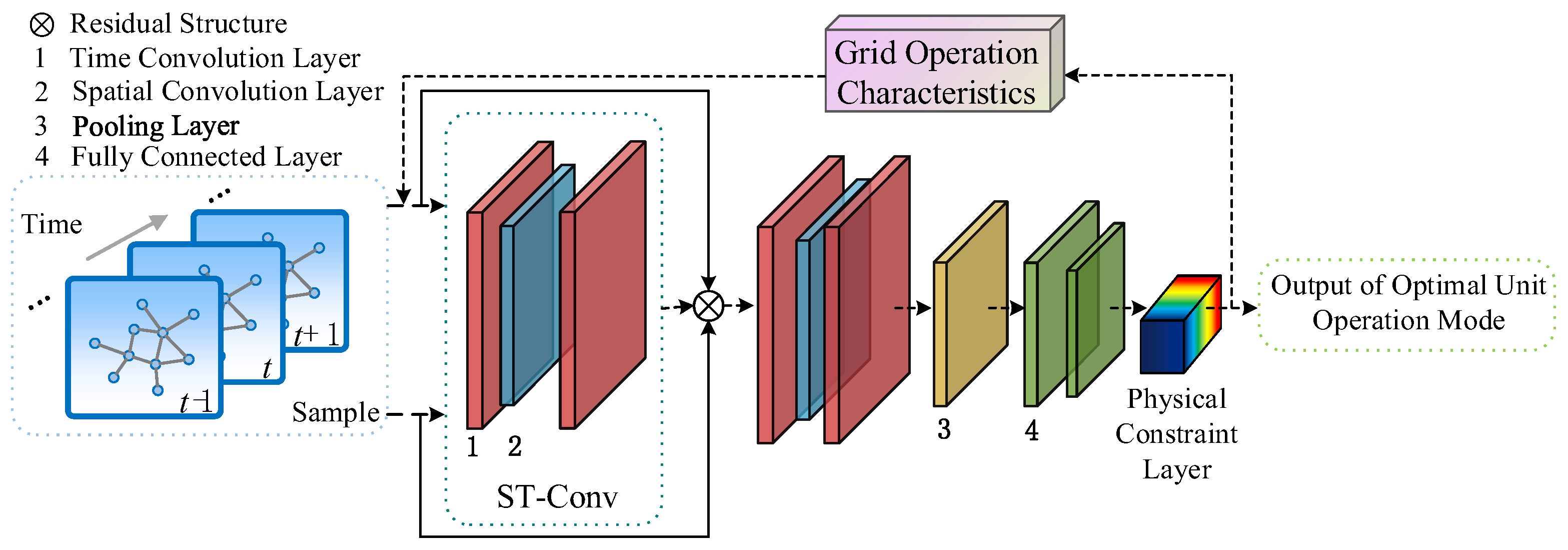
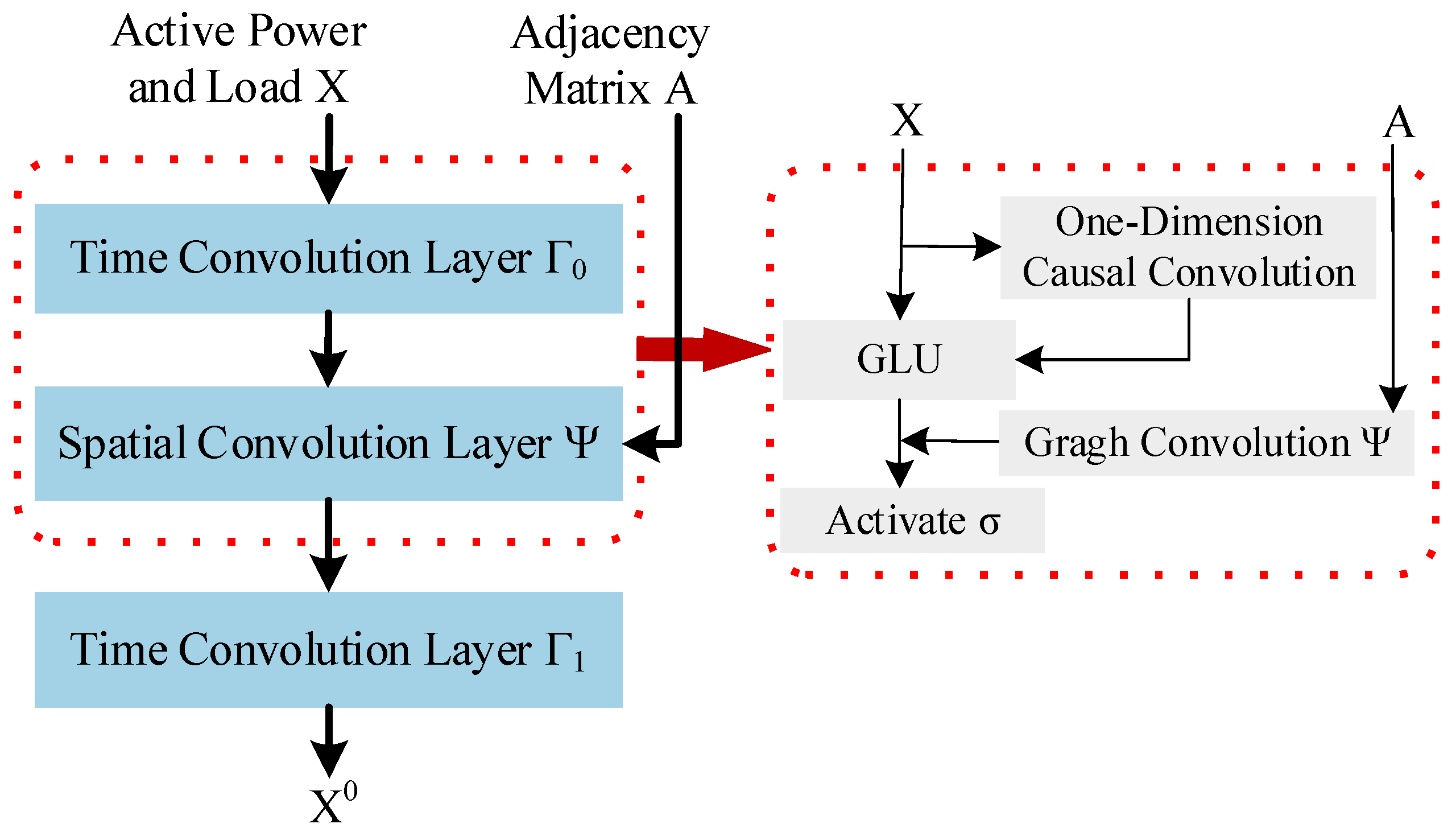
Figure 1 to continuously adjust the unit operation mode according to the time-series operating state of the sending-end system requires completing the training of the STGCN model. First, a dataset available for the STGCN model needs to be constructed, which should contain the patterns or rules of optimal adjustment for the unit operation mode in the sending-end power system. Second, it can be observed that, due to the inherent characteristics of STGCN, its modeling does not incorporate the complete UOMO model. Thus, to ensure reasonable and effective results, the unit operation mode predicted by STGCN model requires further refining and verification.
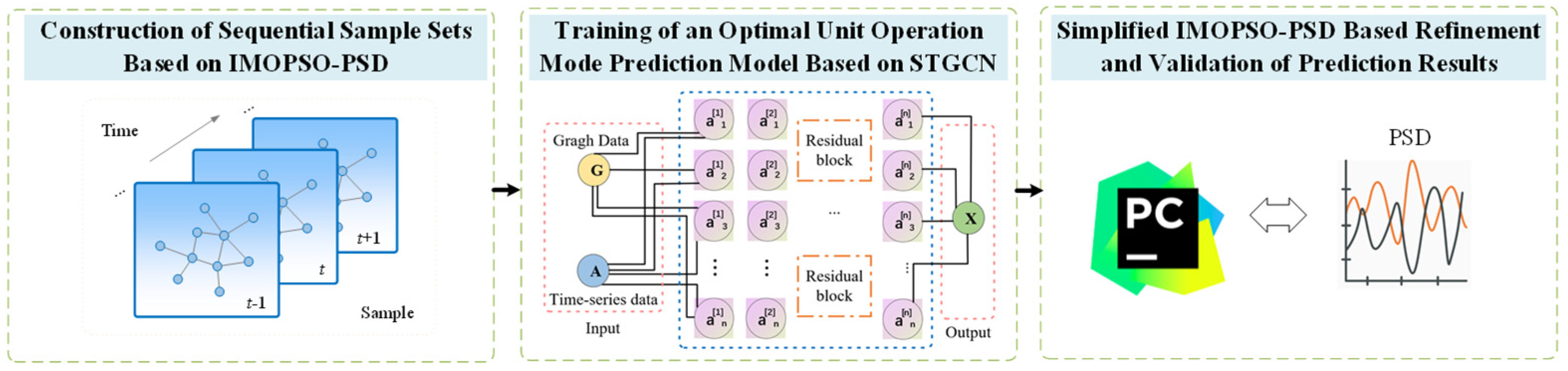
In summary, the training process of STGCN model includes the main steps shown in
Figure 3, namely, (1) construction of sequential sample sets based on IMOPSO-PSD; (2) training of the optimal unit operation mode prediction model based on STGCN; and (3) refining and validation of the prediction results based on the simplified IMOPSO-PSD.
Next, the solution process of the UOMO model using IMOPSO-PSD serving as the foundation for steps (1) and (3) is introduced first. Subsequently, the key steps illustrated in
Figure 3 are explained.
4.1. Solution of UOMO Model Based on IMOPSO-PSD and Its Simplified Process
UOMO model constructed in
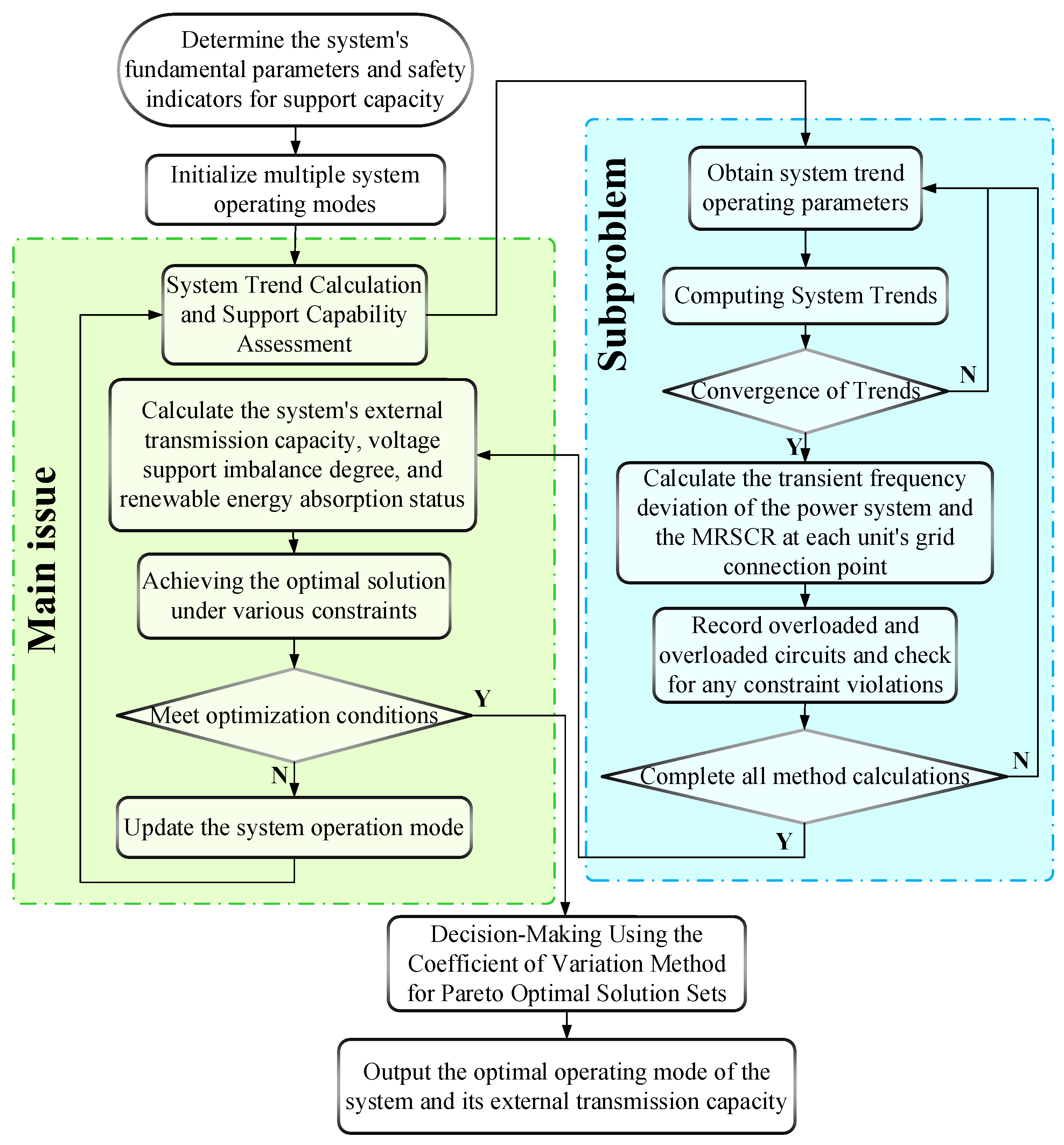
Section 2 is a nonlinear, multi-objective optimization problem. This paper proposes a solution method for UOMO model based on IMOPSO-PSD. The main optimization process is modeled using IMOPSO, which serves as the main optimization problem. The calculation of constraints such as the voltage support capability at POI of renewable energy stations involved in the model is solved using PSD software (Version 2.0.1.8) widely adopted by the dispatch departments of power companies, forming the optimization sub-problem. Upon completion of the main optimization process, the Pareto optimal solution set for unit operation modes is obtained, and the coefficient of variation method is further employed to determine the optimal unit operation mode. The complete solution process of UOMO model based on IMOPSO-PSD is illustrated in
Figure 4.
PSO algorithm features simple coding and strong adaptability to problems. IMOPSO algorithm adopted in this paper uses the same particle update mechanism as the standard PSO algorithm, where the velocity and direction of particles are determined according to the information of individual particles and the particle swarm in the solution space. The main improvements lie in suppressing the defect that the algorithm is prone to fall into local optima by introducing inertia weight, optimizing the selection of individual optimal values [
23], and adopting crossover and mutation [
24]. Meanwhile, infeasible solutions during initialization and optimization are avoided through timely constraint checking.
PSD software is a collection of power system analysis packages widely used in the dispatch departments of China’s power grid companies. It includes many core programs such as the power flow calculation program PSD-PF, short-circuit current program PSD-SCCP, and transient stability program PSD-ST, with the advantages of large calculation scale and good numerical stability. Within the main problem-solving framework based on IMOPSO algorithm, PSD is used to calculate and verify sub-problems such as power flow calculation, MRSCR and transient frequency deviation, as shown in
Figure 4.
The solution efficiency of UOMO model based on IMOPSO-PSD is significantly affected by the selection of initial solutions, and the solving process is time-consuming without prior heuristic information. However, when the initial solutions are relatively close to the target solutions, the necessary simplified procedure for IMOPSO-PSD is recommended to improve the solving efficiency. The simplified treatment includes reducing the size of the initial particle swarm, decreasing the number of iterations, and weakening mutation operations in the main optimization problem.
4.2. Construction of Labeled Sequential Sample Set Based on IMOPSO-PSD
A sequential sample set is a dataset of system operating states formed at a certain time resolution corresponding to a power grid topology represented by G = (V, E, A), and its structure is a 4-dimensional matrix of size such as (NS, NN, NT, 2). Here, NS denotes the number of samples; NN denotes the number of nodes, which is equal to the total number of nodes in the node set V; NT denotes the length of the time-series data; and the number of node features is 2, representing the active power output and the node load at each node.
The sequential sample set consists of a relatively small number of typical scenarios and a large number of non-typical scenarios. The typical scenarios include representative operating states of the sending-end system in terms of the output levels of synchronous generating units, renewable energy units, load levels, and the corresponding outward transmission power levels. In addition, the typical scenarios also cover differentiated operating conditions such as fluctuations in renewable energy output. The non-typical scenarios refer to operating conditions that are close to the operating states of various typical scenarios, with the Euclidean distance as the quantitative criterion.
To enable STGCN model to learn the patterns or rules underlying the optimal adjustment of unit operation modes in the sending-end system contained in the sample set, it is necessary to optimize the unit operation modes for each time-series sample one by one to complete the labeling process. The labeling of a small number of typical scenarios is implemented through the solution flow of UOMO model based on IMOPSO-PSD. However, the labeling of a large number of non-typical scenarios is performed using a simplified IMOPSO-PSD flow. The reasons are as follows: during the labeling of typical scenarios, after multiple rounds of crossover and mutation operations of IMOPSO, a considerable number of suboptimal solutions are obtained along with the optimal solution for unit operation modes. Some of these suboptimal solutions may implicitly contain the optimal adjustment patterns for non-typical scenarios. Therefore, combined with quantitative judgment based on Euclidean distance, a certain number of suboptimal solutions can be selected to form an initial solution set together with non-typical scenarios, and the simplified IMOPSO-PSD can be used to quickly complete the labeling of non-typical scenarios.
4.3. Prediction Result Refinement and Verification Based on Simplified IMOPSO-PSD
Since STGCN model does not reflect the security constraints in UOMO model such as Equations (6) and (7), the predicted unit operation mode optimization results need to be refined and verified to ensure the accuracy and reliability.
To improve the efficiency of refinement and verification, some suboptimal solutions with prediction errors within a certain range from the STGCN prediction results are used as the initial solution set for the simplified IMOPSO-PSD procedure. The number and range of the solution set can be determined according to the prediction accuracy and reliability of STGCN model so that the optimal solution for unit operation mode optimization can be obtained rapidly.
5. Case Study
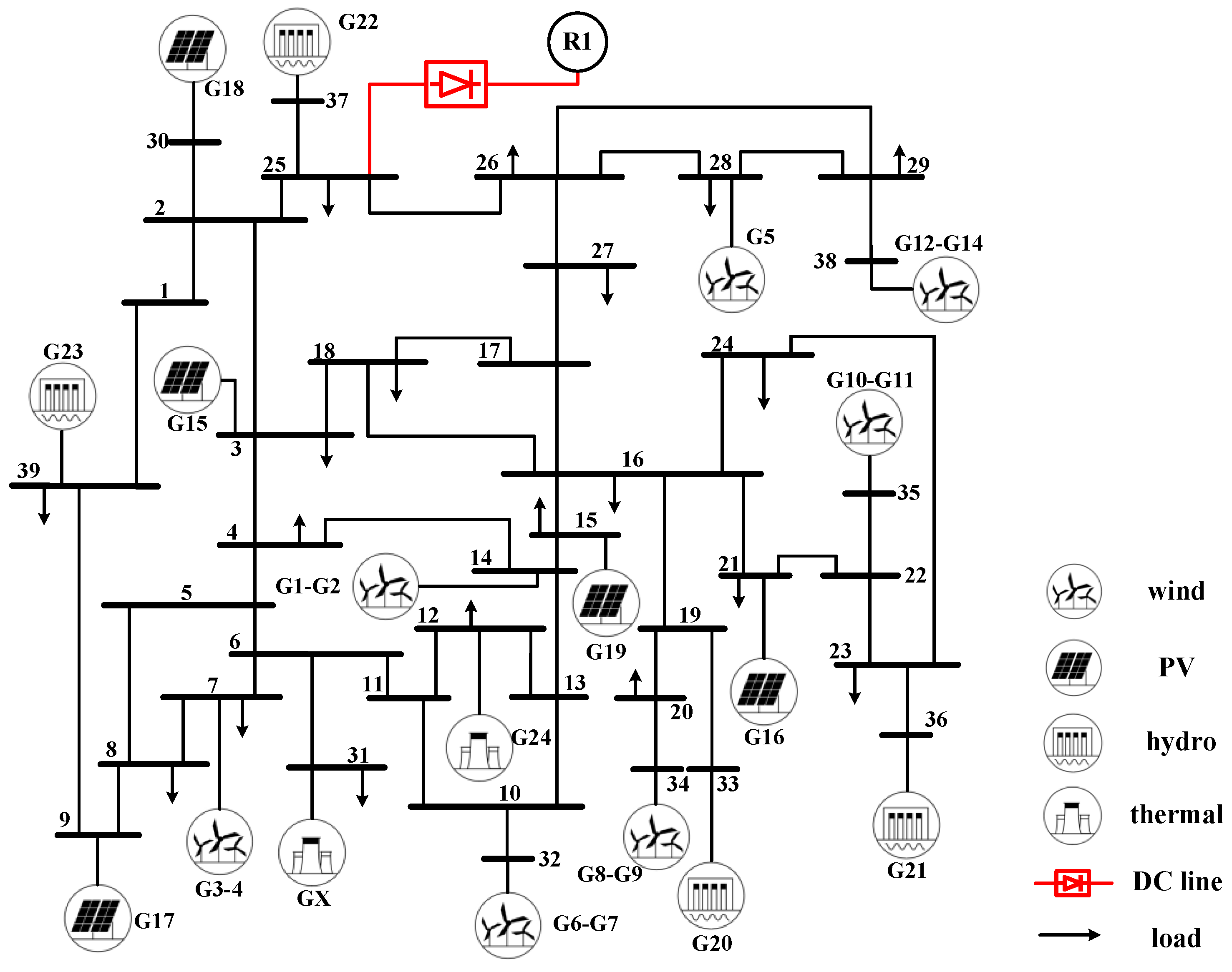
To demonstrate the effectiveness of the method proposed, IEEE 39-bus system, as shown in
Figure 5, is modified to simulate a sending-end system with high penetration of renewable energy generators, which is interconnected with other regions via DC transmission lines.
In the diagram, G1–G14 are wind turbines, G15–G19 are photovoltaic (PV) units, G20–G23 are hydroelectric units, and G24 and GX are thermal power units. GX serves as the balancing unit. The system is connected to an equivalent external system R1 through a single DC transmission line. To ensure the stability of the receiving-end system and maintain a sufficient load deficit, R1 is equivalent to an infinite bus system, and a large load is configured to simulate the power demand of a load center.
The total AC load inside the sending-end system is 3120.1 MW. The total installed capacity of renewable energy units is 3303 MW, and the total installed capacity of synchronous units is 3303 MW. The base capacity is 100 MVA, and the heavy-duty line flow limit is set to 90% of its rated value.
5.1. Sequential Sample Set
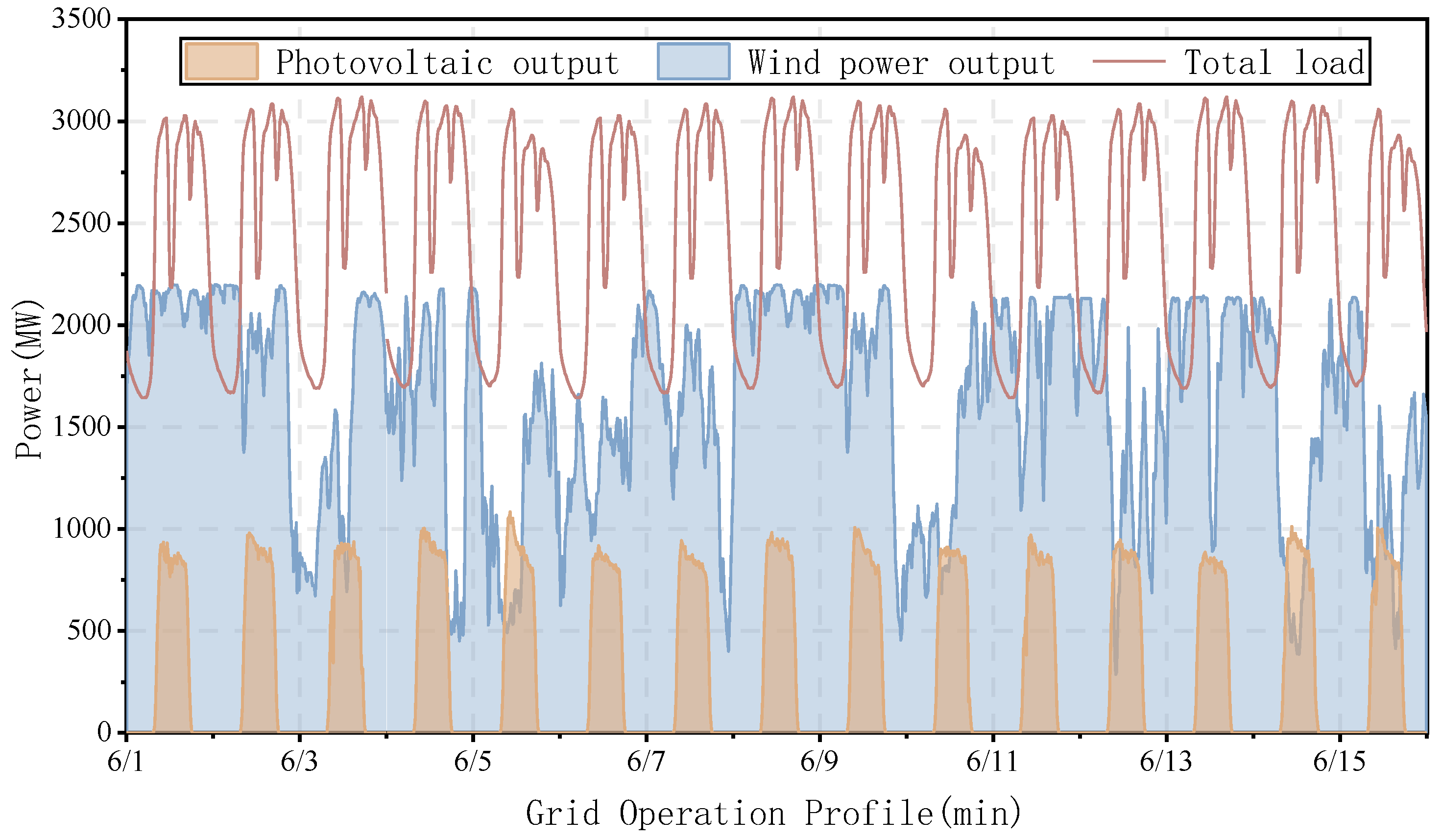
The objective of the unit operation mode optimization using the method proposed in this paper is to maximize the DC transmission level of clean green power while ensuring the voltage and frequency support capability of the sending-end system. Therefore, when constructing the sequential sample set, summer scenarios with relatively high output of wind power, PV power and adequate hydropower are deliberately selected so as to avoid load shedding caused by insufficient wind and photovoltaic power generation during peak load periods.
Figure 6 shows the output of wind and PV units and the total load in the time-series sample set used for simulation in this paper. The sample adopts 15 consecutive days of operation data in the first half of June from a power grid, with a time resolution of 5 min and a total of 4320 samples. The training set and test set are divided at a ratio of 3:1. All samples have undergone the labeling process described in
Section 4.2 to meet the requirements of subsequent STGCN model training and testing.
5.2. Optimal Unit Operation Mode Prediction Based on STGCN Model
Based on PaddlePaddle, an open-source industrial-grade deep learning platform, STGCN model with the structure shown in
Figure 1 has been built on the Python 3.7 platform. The experimental environment consists of an AMD Renoir (Ryzen 4000 APU) 4800H CPU @ 2.90 GHz, 16 GB of RAM, and an NVIDIA GeForce GTX 2060 GPU. The time stride is set to 12, the learning rate to 1 × 10
−3, and the number of features to 2.
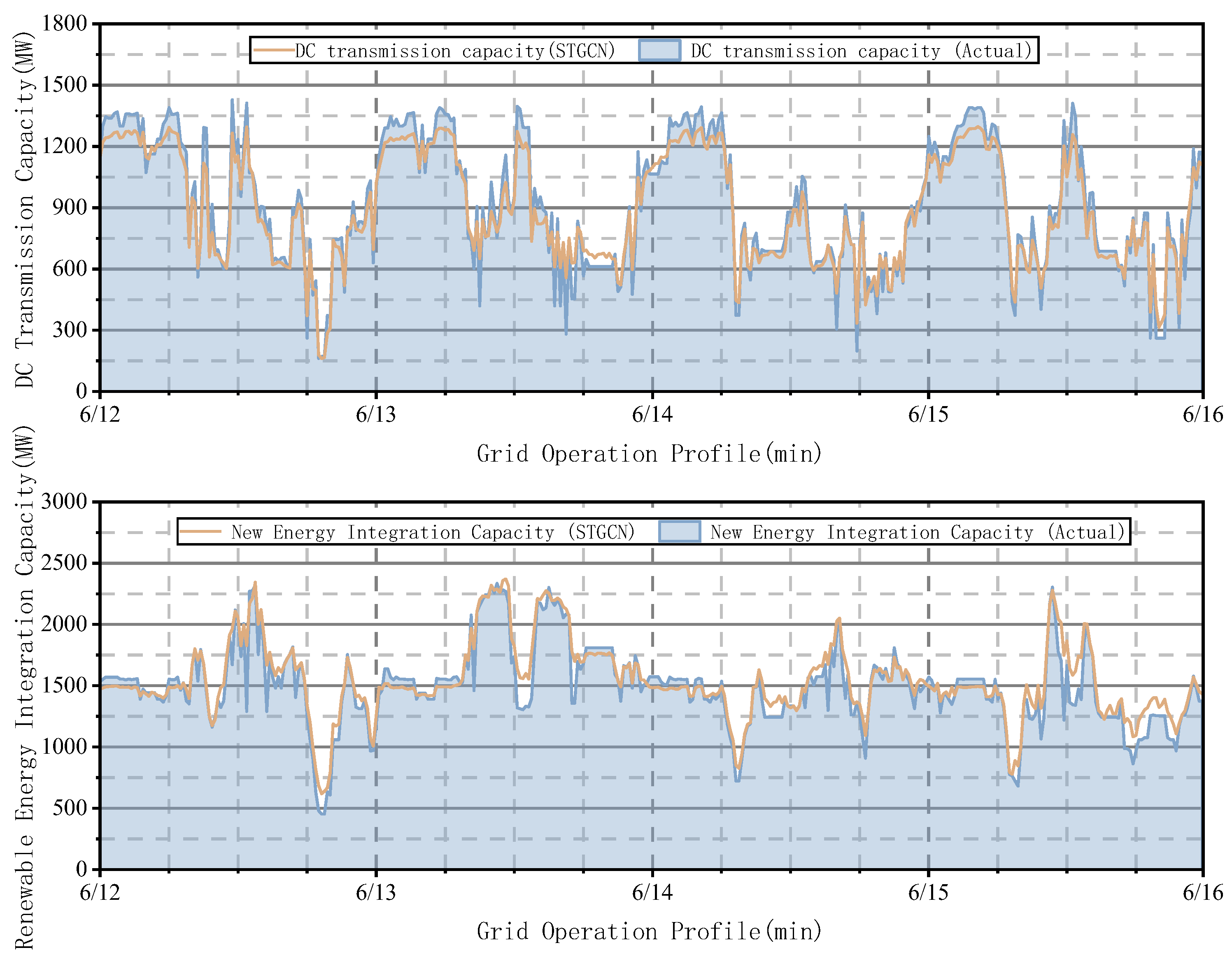
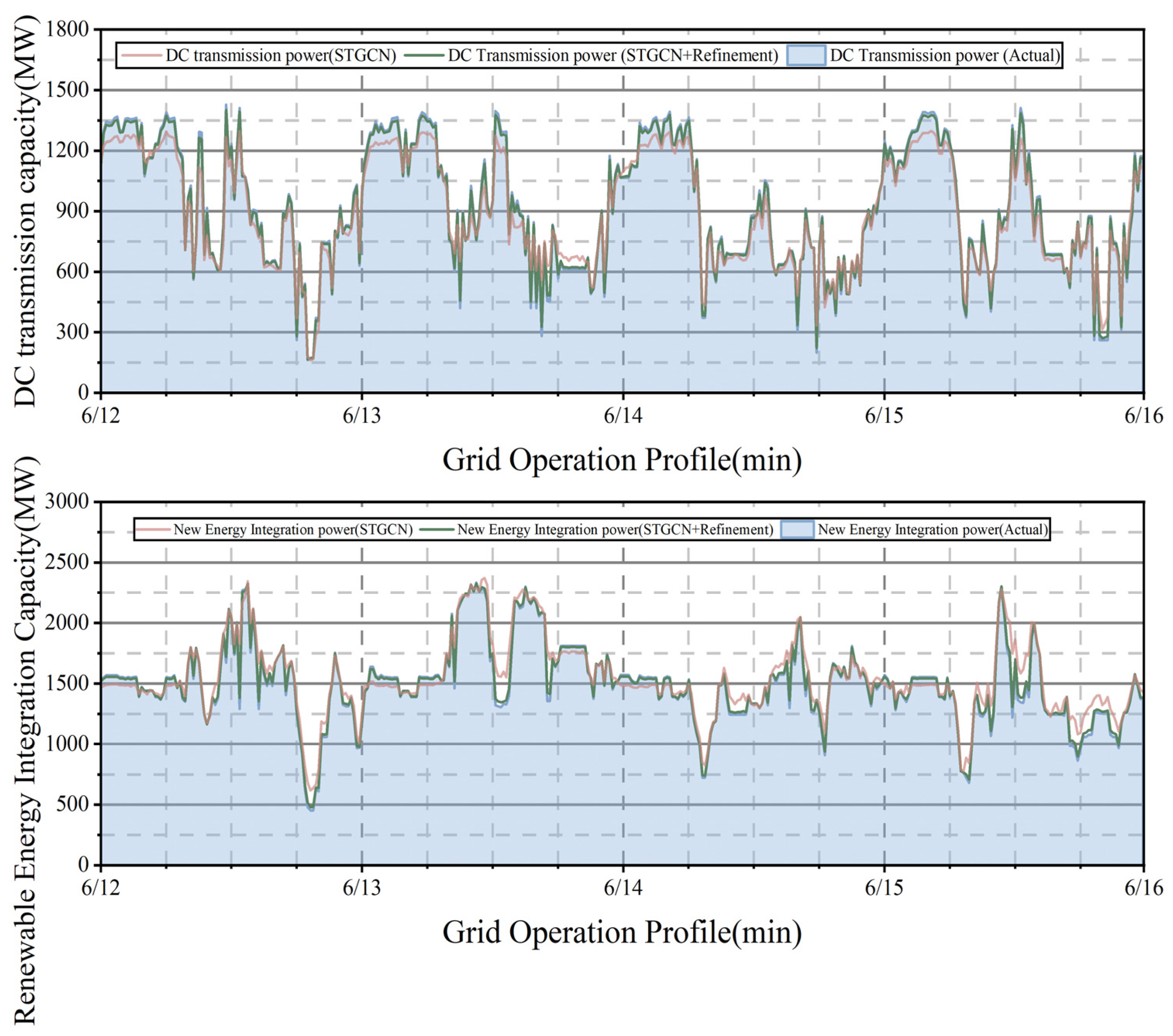
Using the well-trained STGCN model, the prediction results of DC external transmission capacity and renewable energy accommodation capability are obtained by feeding the test dataset, as illustrated in
Figure 7. The data marked with “Actual” represent the results obtained by solving DCEPTO model using IMOPSO-PSD or its simplified procedure, i.e., the label values of the input samples.
On the whole, the STGCN prediction model can effectively respond to the fluctuations in renewable energy generation. The prediction error of the optimal solution for unit operation modes is generally no more than 10%, and most errors are maintained within 5%. However, there still exist certain discrepancies between the model prediction results and the actual values during a few periods with large fluctuations in renewable energy. In addition, the prediction of DC external transmission capability at some moments is relatively conservative, indicating that room still exists for further improvement.
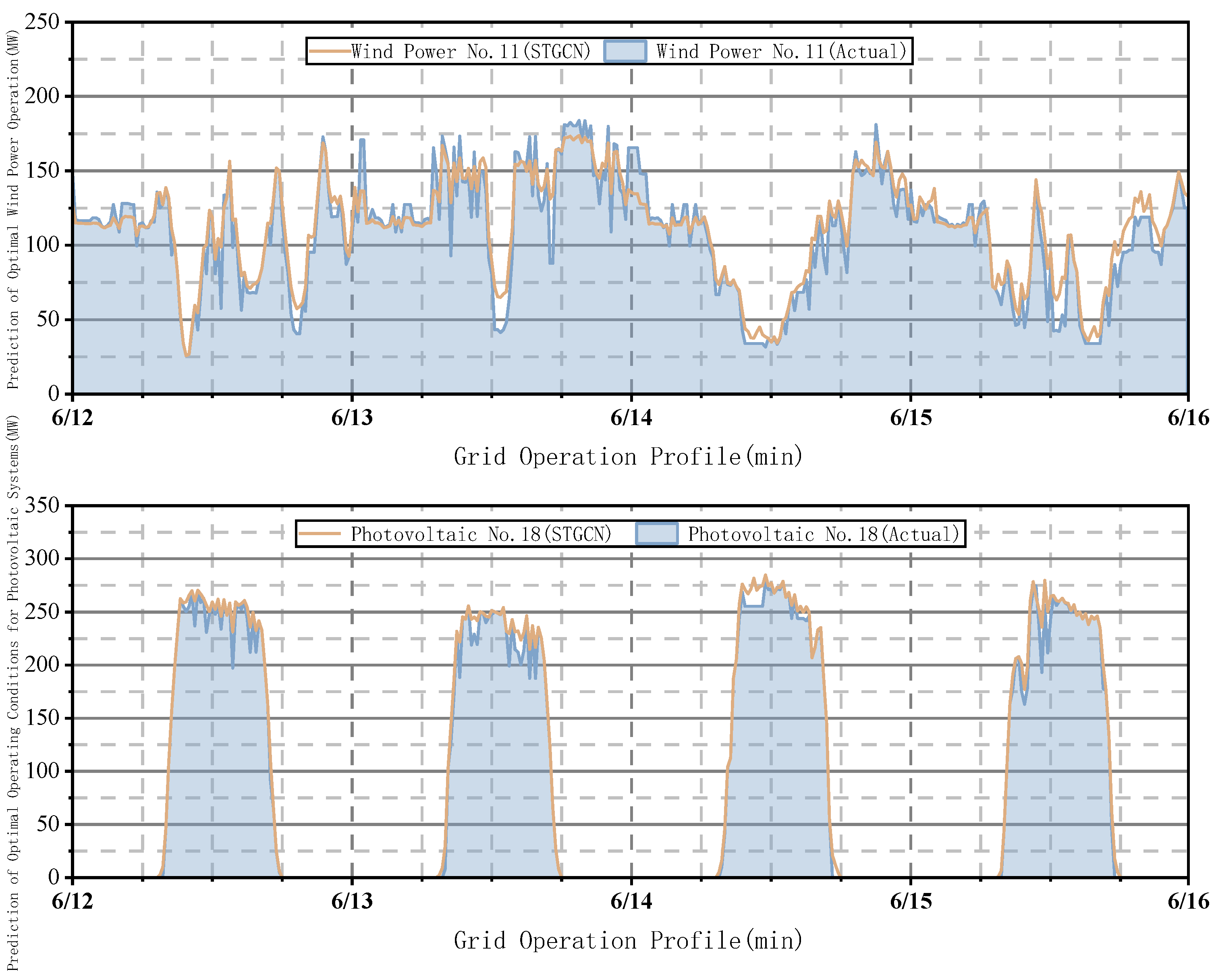
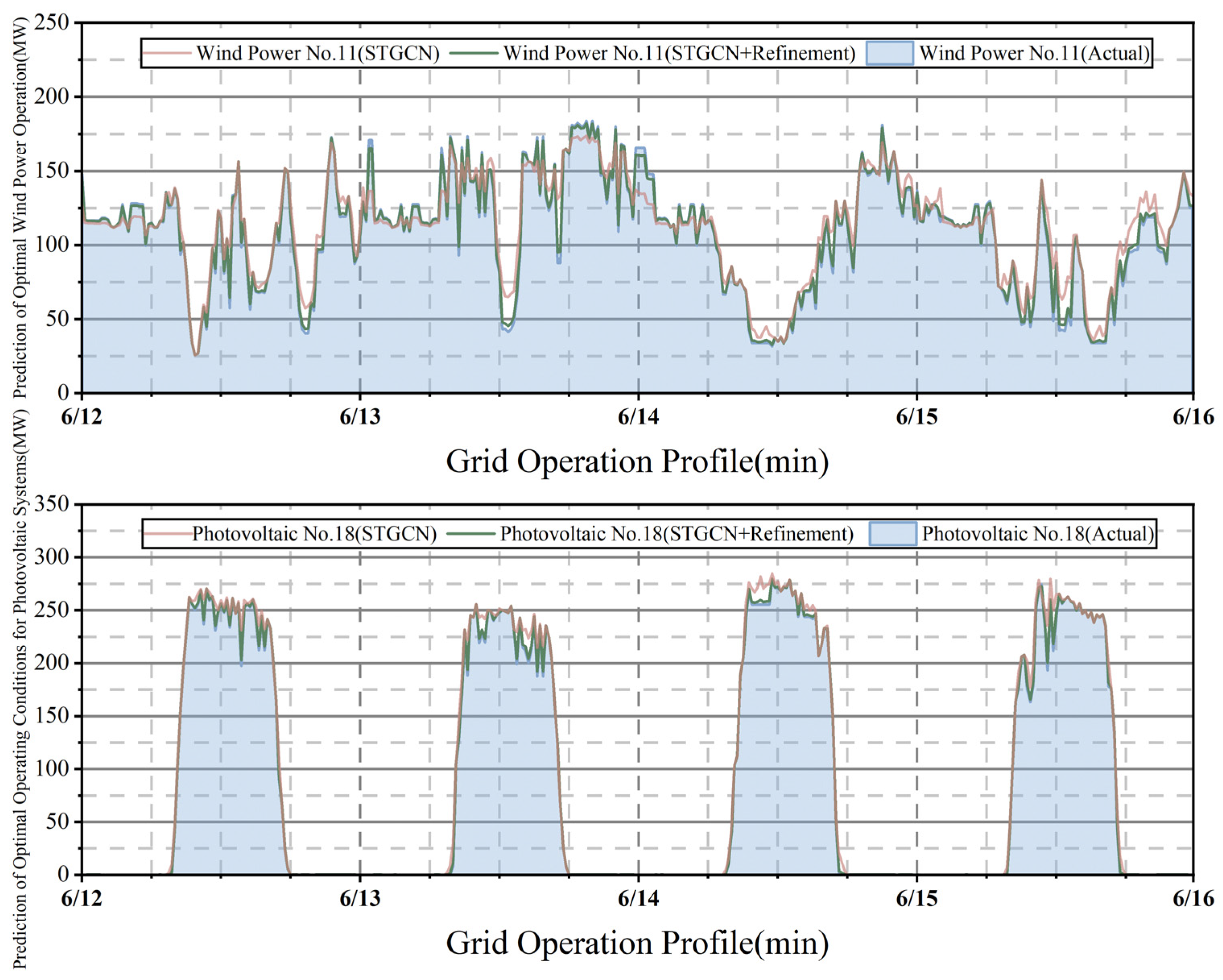
To further analyze the prediction performance of STGCN model, output prediction results of Unit 11 (wind power) and Unit 18 (photovoltaic), which exhibit relatively severe power fluctuations, are shown in
Figure 8.
It can be observed that STGCN model can track the fluctuation trend of renewable energy units’ output and ensure a certain prediction accuracy. Compared with PV units with relatively stable output, STGCN model has relatively large errors at individual moments when predicting the optimal outputs of wind power units with strong output fluctuations. If these results are directly adopted to adjust and control the unit operation, there exist potential risks such as insufficient voltage support capability and line flow violations.
5.3. Refinement of Prediction Results Based on Simplified IMOPSO-PSD
For the above optimization results with a few larger prediction errors, further refinement is required using the simplified IMOPSO-PSD procedure. Through comparative simulation experiments, the main simplification measures adopted for the IMOPSO-PSD procedure include: reducing the initial particle population size by 40%, retaining only 10% of the original iterations, and removing inertia weight and crossover-mutation operations.
Based on the analysis of the prediction results from STGCN model, the prediction error range for samples to be refined is set to ±10%. That is, samples with prediction errors within ±10% are selected as the initial solutions for the simplified IMOPSO-PSD and further refined. The final optimization results are shown in
Figure 9.
As shown in
Figure 9, after further refinement, the prediction accuracy is significantly improved compared with the direct output of STGCN model. The optimized results are basically consistent with the actual values, except for a few peaks where the error is less than 5%. From the optimization results of individual units, even for Wind Turbine Unit 11 with relatively large output fluctuations, the maximum error between the refined output and the actual value is no more than 3%.
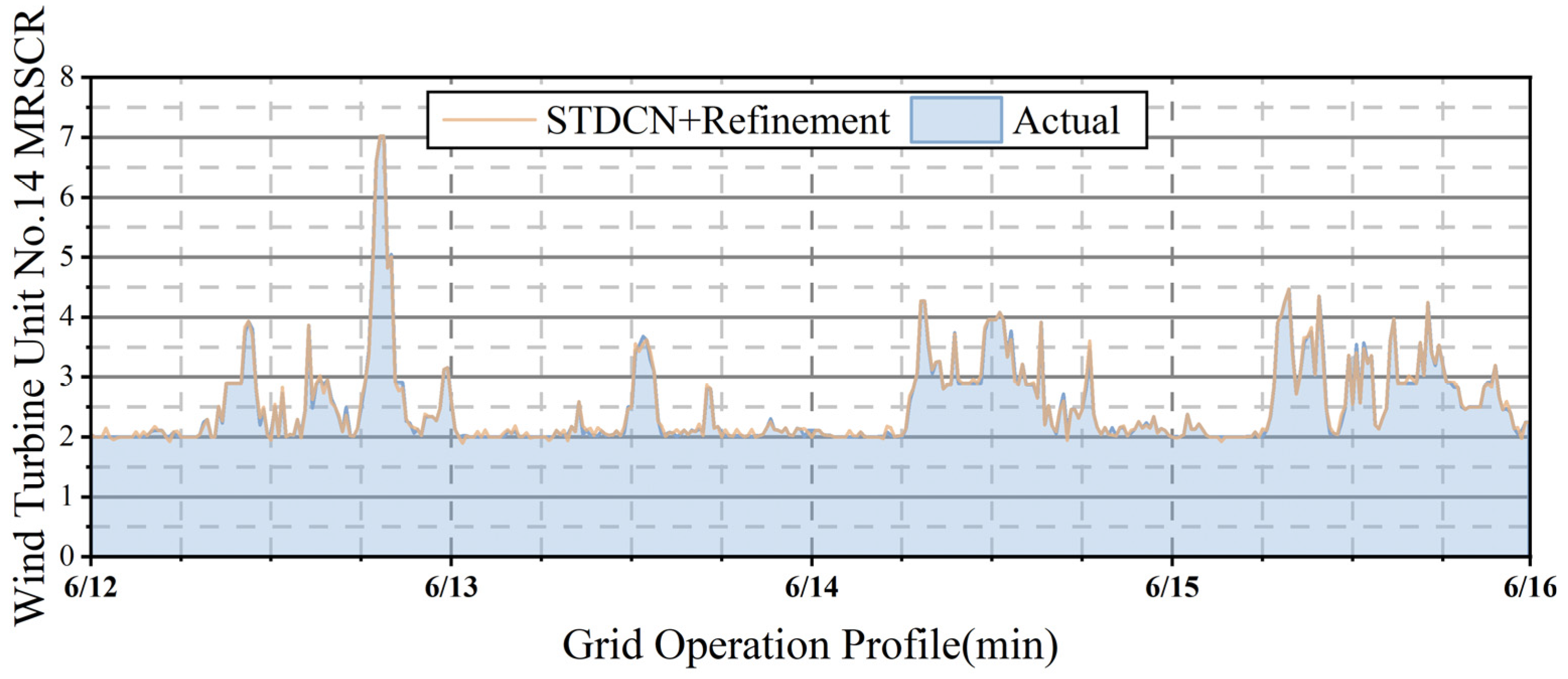
Furthermore, the reliability of refined prediction results is verified by comparing the MRSCR values at Wind Turbine Unit 14, where the voltage support capability is the weakest, as shown in
Figure 10.
As shown by the comparison between the refined predicted and actual MRSCR values, the proposed method can effectively regulate unit output. Even at the weakest voltage support location, the MRSCR remains above 2 for most periods and above 1.92 at its minimum, which guarantees the required voltage support for renewable energy units in the sending-end system.
5.4. Robustness Analysis of Proposed Method
Further, the robustness of the proposed method is analyzed by comparing the error statistical indicators between the direct prediction results of the STGCN model and the further refined results on the test dataset.
The test set contains a total of 1152 samples, including both typical and non-typical scenarios, which can reflect representative and differentiated system operating states. To avoid incomparable errors caused by differences in unit capacity, the absolute percentage error is adopted as the unified error evaluation index in this paper.
For the active power output of unit i under the k-th operating scenario, let its labeled value be and the result directly predicted by the STGCN model or further refined be . Then the relative error is defined as:
For the test dataset, the direct prediction results of STGCN model yield a mean relative error of 8.62%, a median of 3.92%, a variance of 167.66, and a standard deviation of 12.97. It can be observed from unit outputs of samples that STGCN model produces relatively large prediction errors for scenarios with severe output fluctuations of renewable energy units. The large variance and standard deviation of the relative errors indicate that the robustness of the model needs to be improved.
Furthermore, after refining the prediction results of STGCN model using the simplified IMOPSO-PSD procedure, the mean relative error is 1.44%, the median is 0.65%, the variance is 4.66, and the standard deviation is 2.16. It can be seen that both the accuracy and stability of the final solution are significantly improved, which ensures the reliability for practical applications.
6. Conclusions
Based on the operational characteristics and dispatching requirements of asynchronous networking sending-end power systems with high-penetration renewable energy, this paper proposes a fast optimization method for unit operation modes based on STGCN and IMOPSO-PSD. It completes the construction of a multi-objective optimization model, the design of an STGCN framework integrated with physical constraints, and the realization of the full-process optimization, with the effectiveness of the method verified through case analysis on the modified IEEE 39-bus system. The main conclusions are as follows:
(1) The constructed UOMO model balances multiple objectives, including DC power transmission, renewable energy accommodation and voltage support balance, incorporates voltage and frequency support capabilities, as well as unit operation security constraints, and accurately meets the collaborative optimization requirements of “security-accommodation-transmission” for asynchronous networking sending-end systems, thus providing a scientific model foundation for the optimization of unit operation modes.
(2) The STGCN framework integrated with a physical constraint layer and a feedback mechanism for objective loss of UOMO can effectively extract the spatial dependence of grid node topology and the temporal dependence features of generation load. Its prediction results can well track the fluctuation trend of renewable energy output. The mean error of the predicted optimal solution for unit operation mode is within 10%, which can provide high-quality initial solutions for subsequent refinement. This significantly alleviates the initial-value sensitivity issue of traditional intelligent optimization methods and greatly improves optimization efficiency.
(3) The refining strategy for STGCN prediction results based on the simplified IMOPSO-PSD procedure is effective. Compared with the prediction results of STGCN model, it significantly reduces the prediction deviation under scenarios with severe fluctuations in renewable energy output. The accuracy and stability of the solutions are both remarkably improved, ensuring reliability in practical applications.
In summary, the proposed method not only leverages the fast spatio-temporal feature extraction and prediction capability of STGCN but also ensures the physical rationality of the optimization results by using the accurate constraint checking ability of IMOPSO-PSD. This can meet the needs of operators for continuous and rapid adjustment of unit operation modes and also provides a new solution for power system optimization problems.
Although the proposed method for optimizing unit operation modes of asynchronous interconnected sending-end power systems has achieved preliminary performance, its adaptive capability for engineering applications still needs to be further enhanced. Future improvements are discussed as follows:
(1) A comprehensive operation-mode sample set is essential to improve the prediction performance of STGCN model, which is inherent to deep-learning methods. On the one hand, representative operating scenarios with sufficient security margins and high clean-energy DC transmission levels should be collected, with particular attention to complex cases such as rapid fluctuations in renewable energy generation under extreme weather. On the other hand, the optimal and suboptimal operation modes predicted by STGCN can be fed back into the sample set as high-quality samples to serve as initial solutions and boost training efficiency.
(2) The proposed method is currently validated under a fixed grid topology, where only generation output is optimized without considering unit commitment. To achieve full and flexible regulation of system operation modes, the capability of STGCN in modeling variable grid topologies should be further explored, and security constraints related to unit start–stop should be incorporated into the model.
Finally, based on the above improvements, the engineering applicability of the model to large-scale practical power grids will be investigated.