Uncertainty-Aware Planning of EV Charging Infrastructure and Renewable Integration in Distribution Networks: A Review


 and
and
Abstract
1. Introduction
1.1. Related Work
1.2. Research Questions
- How can forecasting methodologies be systematically incorporated into EVCS and RES planning to improve system reliability, optimization, and resilience under uncertainty?
- What are the key technical, economic, and environmental challenges in integrating EVCSs and RESs into distribution networks, and how can robust system optimization strategies effectively address them?
- In what ways can innovative planning algorithms enhance the long-term sustainability, reliability cost-effectiveness, and operational efficiency of EVCS–RES-integrated distribution systems?
2. Electric Vehicle Charging Stations (EVCSs)
2.1. EVCS Uncertainty Modeling
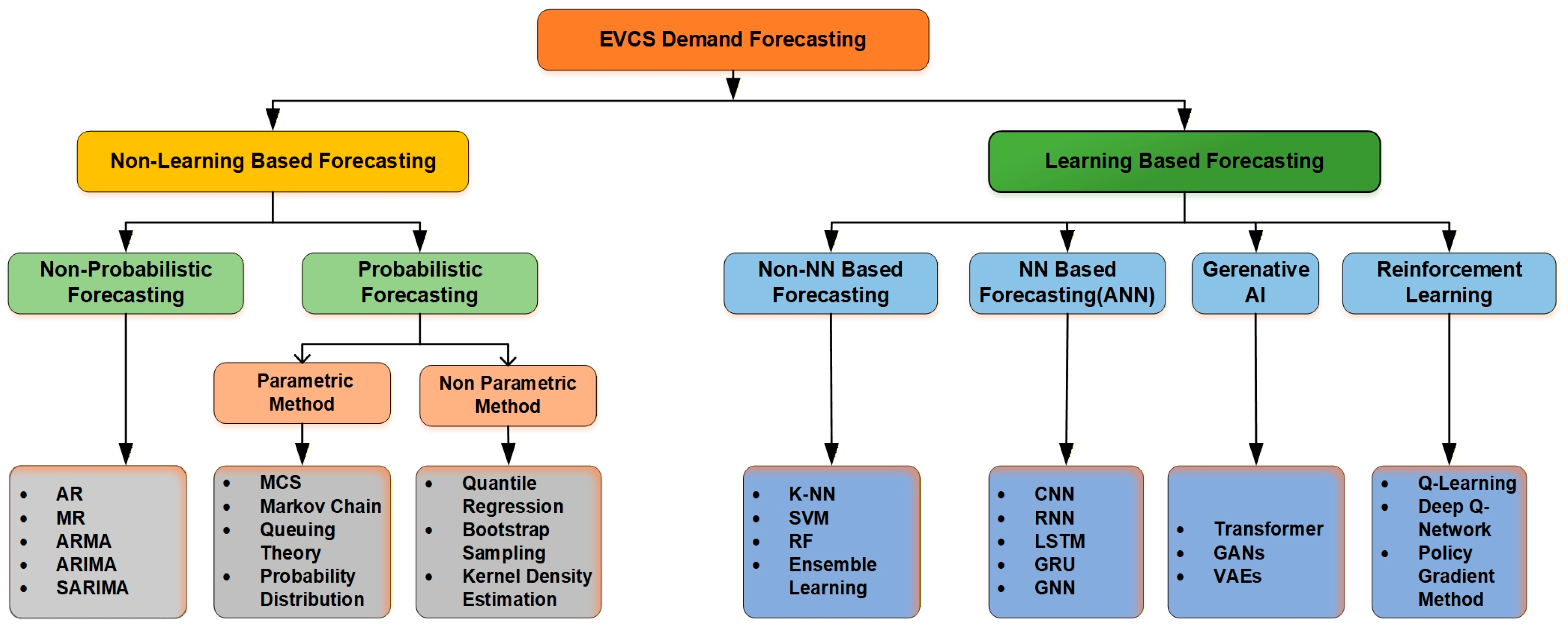
2.1.1. Non-Learning-Based EV Charging Demand-Forecasting Methods
Non-Probabilistic Forecasting Method
Probabilistic Forecasting Method
- Parametric Probabilistic methods
- Monte Carlo Simulation (MCS)
- 2.
- Markov Chain (MC)
- Non-Parametric Methods
2.1.2. Learning-Based EV Charging Load-Forecasting Methods
Non-NN-Based Machine-Learning Forecasting
- Random Forests (RFs)
- K-Nearest Neighbor (K-NN)
- Support Vector Machines (SVMs)
- Ensemble Learning
NN-Based Machine-Learning Forecasting
- Artificial Neural Network (ANN)
- 1.
- Convolutional Neural Network (CNN)
- 2.
- Recurrent Neural Networks (RNNs)
- 3.
- Graph Neural Network (GNN)
- 4.
- Hybrid Approach
Generative AI
- Transformer
- Generative Adversarial Networks (GANs)
- Variational Auto-Encoders (VAEs)
Reinforcement Learning (RL)
2.2. Review of EVCS Planning
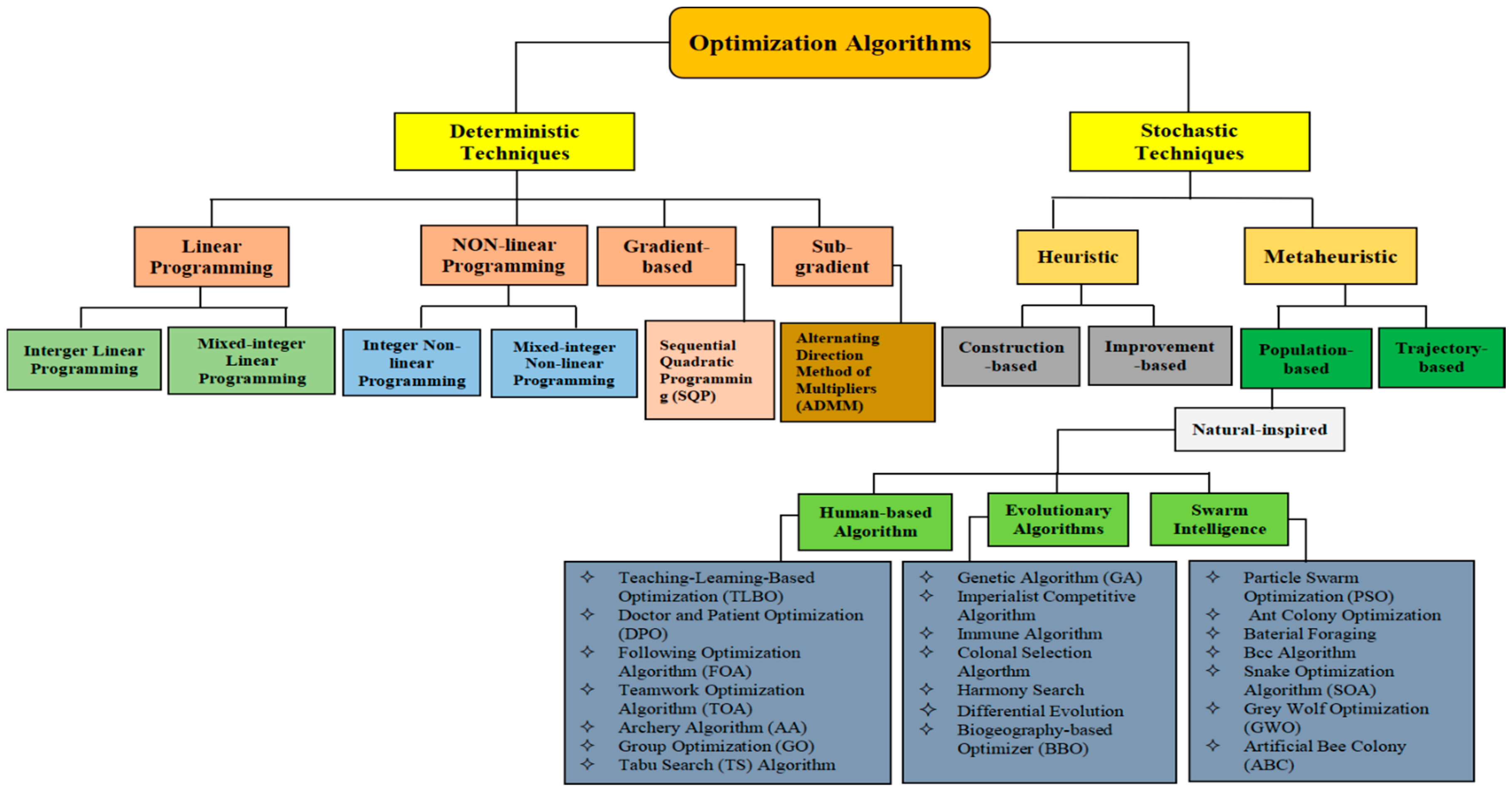
2.2.1. Planning Algorithms
2.2.2. Objective Function

| Ref. No. | Author | Objective Function | ||||||||||
|---|---|---|---|---|---|---|---|---|---|---|---|---|
| Technical Criteria | Economy Criteria | Envir. Criteria | Reliability Criteria | |||||||||
| Qloss | Ploss | VDevi | Psup | VSI | Inst Cost | Invst Cost | OP. Cost | Mnt. Cost | Ems CO2 | |||
| [100] | Hammam et al. (2024) | ✓ | ✓ | ✓ | ||||||||
| [101] | Abdelaziz et al. (2024) | ✓ | ✓ | ✓ | ✓ | ✓ | ||||||
| [63] | Bilal et al. (2022) | ✓ | ✓ | ✓ | ✓ | ✓ | ✓ | ✓ | ✓ | |||
| [102] | Kumar et al. (2024) | ✓ | ✓ | ✓ | ✓ | ✓ | ||||||
| [103] | Prakobkaew et al. (2024) | ✓ | ✓ | |||||||||
| [104] | Eid El-Iali et al. (2024) | ✓ | ✓ | ✓ | ||||||||
| [105] | Balu, Mukherjee (2024) | ✓ | ✓ | ✓ | ✓ | ✓ | ✓ | |||||
| [106] | Hu, Li et al. (2024) | ✓ | ✓ | ✓ | ||||||||
| [107] | Bilal et al. (2021) | ✓ | ✓ | ✓ | ✓ | |||||||
| [108] | Keramati et al. (2024) | ✓ | ✓ | ✓ | ✓ | |||||||
| [86] | Nafeh et al. (2024) | ✓ | ✓ | ✓ | ✓ | |||||||
| [109] | Balu et al. (2023) | ✓ | ✓ | ✓ | ||||||||
| [110] | Krishnamurthy et al. (2023) | ✓ | ✓ | ✓ | ✓ | ✓ | ||||||
| [111] | Jin et al. (2024) | ✓ | ✓ | ✓ | ✓ | ✓ | ✓ | |||||
| [112] | Rene et al. (2023) | ✓ | ✓ | ✓ | ||||||||
| [113] | Archana et al. (2021) | ✓ | ✓ | ✓ | ||||||||
| [114] | Chen, et al. (2021) | ✓ | ✓ | ✓ | ✓ | |||||||
| [115] | Bilal et al. (2021) | ✓ | ✓ | ✓ | ||||||||
3. EV and RES Integration in the Distribution Network
| Author/Year /Ref. | Proposed Strategy | RES Type | Objective Function | |||||||||
|---|---|---|---|---|---|---|---|---|---|---|---|---|
| Tech. Criteria | Eco. Criteria | Env. Criteria | Rel. Criteria | |||||||||
| Qloss | Ploss | VDevi | VSI | Inst Cost | Invst Cost | OP. Cost | Mnt. Cost | Ems CO2 | ||||
| Bilal et al. (2022) [63] | Modified Salp Swarm Algorithm | Solar (PV) | Y | Y | Y | Y | Y | Y | Y | |||
| Ul Hassan et al. (2023) [64] | Teaching–learning-based optimization | Solar (PV) | Y | Y | Y | Y | Y | Y | Y | |||
| Eid et al. (2024) [126] | Honey badger algorithm (HBA) | Wind Turbine | Y | |||||||||
| Adetunji et al. (2022) [127] | Whale optimization algorithm–genetic algorithm (WOAGA) | Solar (PV) | Y | Y | Y | Y | Y | Y | ||||
| Vijayan et al. (2023) [128] | Knuth’s Algorithm S | Solar (PV) | Y | Y | Y | |||||||
| Eid et al. (2022) [129] | Gorilla Troop Optimizer (GTO) algorithm | Solar (PV) and WT | Y | Y | Y | |||||||
| Bilal et al. (2021) [107] | Hybrid of grey wolf optimization and particle swarm optimization (HGWOPSO) | Solar (PV) | Y | Y | Y | Y | ||||||
| Ponnam et al. (2020) [130] | Harries Hawks Optimization (HHO) Algorithm | PV, WT | Y | Y | Y | Y | ||||||
| Fokui et al. (2021) [131] | Bacterial foraging optimization algorithm–particle swarm optimization (BFOA-PSO) algorithm | Solar (PV) systems | Y | Y | Y | |||||||
| Zeb et al. (2020) [132] | Particle swarm optimization (PSO) | Solar (PV) | Y | Y | Y | |||||||
| Zhang et al. (2021) [133] | Multi-objective natural aggregation algorithm (MONAA) | Wind power | Y | Y | ||||||||
| Pompern et al. (2023) [134] | Particle swarm optimization (PSO) | Solar (PV) | Y | Y | Y | Y | Y | Y | ||||
3.1. Frameworks, Regulatory Challenges, and Socioeconomic Barriers in EVCS–RES Integration
3.1.1. Challenges in EVCS-RES Planning
3.1.2. Policies and Incentives
4. Discussion and Conclusions
- ⮚
- Optimal planning and placement of EVCSs and RESs can significantly enhance power quality, minimize energy losses, reduce infrastructure costs, and lower CO2 emissions. Strategically placing RESs near EVCSs reduces grid dependence and alleviates grid stress during peak load hours.
- ⮚
- Most of the work has modeled EV load demand and PV generation in a simplistic and deterministic manner, whereas both should be treated stochastically by considering factors such as EV arrival/departure times, battery degradation, solar irradiance variability, temperature fluctuations, and weather uncertainties. Also, for efficient planning, advanced forecasting methods for EV, wind, and solar demand are necessary.
- ⮚
- Various algorithms have been proposed for the optimal planning of integrated EVCS and RES systems, ranging from deterministic to advanced stochastic approaches. However, metaheuristic algorithms are ideal for power system optimization problems due to their robustness, flexibility, and effectiveness in handling system uncertainties, which are crucial for efficient solutions in modern networks. Recently, hybrid optimization methods such as BFOA-PSO and WOAGA have demonstrated superior performance by combining the strengths of individual algorithms to achieve faster convergence, improved accuracy, and better exploration–exploitation balance, making them suitable for dealing with the complexity of EVCS-RES integration.
- ⮚
- Most existing studies on EVCS and RES integration have concentrated on technical issues such as power losses, voltage stability, and economic benefits. However, limited attention has been given to environmental impacts and long-term reliability. Moreover, comprehensive investigations that integrate technical, economic, environmental, and reliability impacts with the application of advanced forecasting techniques and optimization algorithms are still lacking.
- ⮚
- A key insight from the survey is that while numerous studies have proposed advanced deterministic and metaheuristic algorithms for optimal placement and sizing, fewer works address uncertainty propagation, coordinated energy management, and long-term reliability in an integrated manner. Optimization robustness should therefore not be evaluated solely by convergence speed or objective value improvement, but by resilience against renewable variability, EV demand fluctuations, and planning horizon uncertainties.
- ⮚
- The growing penetration of RESs and large-scale EV charging highlights the strategic role of battery energy storage systems (BESSs) as an enabling technology. Coordinated active–reactive power control and intelligent storage dispatch can mitigate voltage deviations, reduce losses, and enhance reliability under stochastic conditions. However, such operational coordination is still insufficiently embedded within many planning models.
- ⮚
- The fluctuation of renewable energy and EV charging demand creates substantial issues for grid operators. Traditional statistical and probabilistic forecasting approaches are extensively employed, but they frequently fail to capture the nonlinear and stochastic character of these uncertainties. Future research should concentrate on AI-based forecasting systems that can better predict complex patterns, enhance accuracy, and strengthen grid planning and operation.
- ⮚
- Conventional optimization techniques frequently have drawbacks, such as premature convergence to local optima and difficulty managing the nonlinear, dynamic nature of integrated energy systems. These flaws diminish their efficacy in balancing several, often conflicting, objectives under uncertainty. To address these difficulties, more advanced optimization approaches with multi-objective and methodologies are necessary, resulting in robust and globally optimum solutions.
- ⮚
- The majority of the recent research on EVCS and RES integration have generally concentrated on technical elements like power losses, voltage stability, and economic advantages, with little emphasis on the environmental impacts and long-term reliability evaluation of the distribution network. However, as EVCSs and RESs become more widely used, reliability becomes an increasingly important aspect in ensuring the long-term viability of grid operations. Future studies should explore the long-term impacts on infrastructure and planning, with a comprehensive focus on technical, economic, environmental, and reliability aspects.
- ⮚
- The present research on EVCS and RES integration focuses on both technical and economic optimization, with very little attention paid to commercial models and policy frameworks. Large-scale adoption may confront obstacles in terms of investment risks, participation of stakeholders, and customer acceptability in the absence of proper governmental support and new commercial strategies. Future research should thus focus on researching sustainable business models and policy mechanisms that may motivate stakeholders and ensure the optimal integration of EVCSs and renewable energy.
- ⮚
- Future studies should develop integrated optimization frameworks that jointly determine EVCS placement and BESS sizing, scheduling, and active–reactive power support. Such models should evaluate system robustness under uncertainty and quantify the reliability and voltage regulation benefits of coordinated storage control in RES-dominated distribution networks.
- ⮚
- The majority of the current research uses static or one-period optimization models. Multi-stage stochastic planning frameworks that concurrently take into account scenario-based RES generation uncertainty, probabilistic EV arrival/departure behavior, and load growth forecasts over medium- and long-term horizons should be developed in future studies. Planners would be able to explicitly quantify uncertainty propagation and system risk exposure by using optimization approaches that are either chance-constrained or distributionally resilient.
- ⮚
- Operational control and siting decisions are frequently separated in current studies. Future models have to incorporate network reconfiguration, coordinated active–reactive power regulation, BESS size and dispatch, and EVCS deployment. An efficient methodological framework for integrating operational and investment choices might be offered by bi-level or hierarchical optimization frameworks.
- ⮚
- It is obvious that reliability indices (such SAIDI, SAIFI, and ENS) must be explicitly included in optimization formulations. Future studies should create objective functions that take reliability into account, including failure rate modeling and component aging, and use scenario-based stress testing to examine resilience in the extreme events.
- ⮚
- To facilitate quantitative trade-off analysis between cost, reliability, and environmental performance, future research should incorporate life-cycle emission metrics, model marginal emission factors, and directly integrate carbon pricing or emission constraints into multi-objective formulations instead of qualitatively discussing sustainability.
- ⮚
- Future research should employ ensemble learning or deep learning for EV and RES demand prediction, incorporate probabilistic forecasting outputs into optimization models, and quantify forecast error effect using sensitivity or scenario analysis rather than utilizing forecasting as a preprocessing step.
- ⮚
- Future research should go beyond technological optimization and directly include regulatory compliance limitations, incentive mechanisms, and market design factors into multi-objective EVCS–RES planning models. Scenario-based assessment of carbon taxation levels, subsidy schemes, and reliability requirements can lower deployment hurdles, including investment risk, stakeholder reluctance, and infrastructure finance challenges, while offering policymakers evidence-based recommendations.
Author Contributions
Funding
Data Availability Statement
Conflicts of Interest
Abbreviations
| LSE | load serving entity | PV | Photovoltaic |
| E | energy | Qloss | Reactive power loss |
| O.P | operational | Ploss | Active power loss |
| Ems | emission | VDevi | Voltage deviation |
| Invst/Syst | investment/system | Inst | Installation |
| Rev | revenue | CO2 | Carbon |
| Rel/Stab | reliability/stability | kWh | kilowatt hour |
| Mnt. | maintenance | Ref. | Reference |
| WT | wind turbine | Env. | environmental |
| Tech. | technical | Psup | supply power |
| Eco. | economic | VSI | Voltage Stability Index |
References
- Rashid, M.; Elfouly, T.; Chen, N. A Comprehensive Survey of Electric Vehicle Charging Demand Forecasting Techniques. IEEE Open J. Veh. Technol. 2024, 5, 1348–1373. [Google Scholar] [CrossRef]
- Kim, Y.; Kim, S. Forecasting Charging Demand of Electric Vehicles Using Time-Series Models. Energies 2021, 14, 1487. [Google Scholar] [CrossRef]
- Naik, N.; Vyjayanthi, C. Optimization of Vehicle-to-Grid (V2G) Services for Development of Smart Electric Grid: A Review. In Proceedings of the 2021 International Conference on Smart Generation Computing, Communication and Networking (SMART GENCON); IEEE: New York, NY, USA, 2021; pp. 1–6. [Google Scholar]
- Akshay, K.C.; Grace, G.H.; Gunasekaran, K.; Samikannu, R. Power Consumption Prediction for Electric Vehicle Charging Stations and Forecasting Income. Sci. Rep. 2024, 14, 6497. [Google Scholar] [CrossRef] [PubMed]
- Ivarsoy, E.; Torsater, B.N.; Korpas, M. Stochastic Load Modeling of High-Power Electric Vehicle Charging—A Norwegian Case Study. In Proceedings of the 2020 International Conference on Smart Energy Systems and Technologies (SEST); IEEE: Istanbul, Turkey, 2020; pp. 1–6. [Google Scholar]
- Shun, T.; Kunyu, L.; Xiangning, X.; Jianfeng, W.; Yang, Y.; Jian, Z. Charging Demand for Electric Vehicle Based on Stochastic Analysis of Trip Chain. IET Gener. Transm. Distrib. 2016, 10, 2689–2698. [Google Scholar] [CrossRef]
- Zhang, M.; Wu, Z.; Zhang, Q.; Yang, X. EV Charging Load Forecasting Considering Urban Traffic Road Network and User Psychology under Multi-Time Scenarios. In Proceedings of the 2021 3rd International Conference on Smart Power & Internet Energy Systems (SPIES); IEEE: Shanghai, China, 2021; pp. 315–321. [Google Scholar]
- Dong, X.; Mu, Y.; Jia, H.; Wu, J.; Yu, X. Planning of Fast EV Charging Stations on a Round Freeway. IEEE Trans. Sustain. Energy 2016, 7, 1452–1461. [Google Scholar] [CrossRef]
- Xiao, Z.; Zhou, Y.; Cao, J.; Xu, R. A Medium- and Long-Term Orderly Charging Load Planning Method for Electric Vehicles in Residential Areas. World Electr. Veh. J. 2021, 12, 216. [Google Scholar] [CrossRef]
- Zheng, Y.; Shao, Z.; Zhang, Y.; Jian, L. A Systematic Methodology for Mid-and-Long Term Electric Vehicle Charging Load Forecasting: The Case Study of Shenzhen, China. Sustain. Cities Soc. 2020, 56, 102084. [Google Scholar] [CrossRef]
- Tian, J.; Lv, Y.; Zhao, Q.; Gong, Y.; Li, C.; Ding, H.; Yu, Y. Electric Vehicle Charging Load Prediction Considering the Orderly Charging. Energy Rep. 2022, 8, 124–134. [Google Scholar] [CrossRef]
- Wang, Y.; Infield, D. Markov Chain Monte Carlo Simulation of Electric Vehicle Use for Network Integration Studies. Int. J. Electr. Power Energy Syst. 2018, 99, 85–94. [Google Scholar] [CrossRef]
- Wang, X.; Nie, Y.; Cheng, K.W.E.; Mei, J. Forecast of Urban EV Charging Load and Smart Control Concerning Uncertainties. In Proceedings of the 2016 International Symposium on Electrical Engineering (ISEE); IEEE: Hong Kong, China, 2016; pp. 1–7. [Google Scholar]
- Rodrigues, F.; Agra, A. Berth Allocation and Quay Crane Assignment/Scheduling Problem under Uncertainty: A Survey. Eur. J. Oper. Res. 2022, 303, 501–524. [Google Scholar] [CrossRef]
- Ali, A.; Shaaban, M.F.; Awad, A.S.A.; Azzouz, M.A.; Lehtonen, M.; Mahmoud, K. Multi-Objective Allocation of EV Charging Stations and RESs in Distribution Systems Considering Advanced Control Schemes. IEEE Trans. Veh. Technol. 2023, 72, 3146–3160. [Google Scholar] [CrossRef]
- Harish, B.N.; Surendra, U. A Review on Power Quality Issues in Electric Vehicle Interfaced Distribution System and Mitigation Techniques. Indones. J. Electr. Eng. Comput. Sci. 2022, 25, 656. [Google Scholar] [CrossRef]
- Ahmad, F.; Iqbal, A.; Ashraf, I.; Marzband, M.; Khan, I. Optimal Location of Electric Vehicle Charging Station and Its Impact on Distribution Network: A Review. Energy Rep. 2022, 8, 2314–2333. [Google Scholar] [CrossRef]
- Tercan, S.M.; Demirci, A.; Unutmaz, Y.E.; Elma, O.; Yumurtaci, R. A Comprehensive Review of Recent Advances in Optimal Allocation Methods for Distributed Renewable Generation. IET Renew. Power Gener. 2023, 17, 3133–3150. [Google Scholar] [CrossRef]
- Acharige, S.S.G.; Haque, M.E.; Arif, M.T.; Hosseinzadeh, N.; Hasan, K.N.; Oo, A.M.T. Review of Electric Vehicle Charging Technologies, Standards, Architectures, and Converter Configurations. IEEE Access 2023, 11, 41218–41255. [Google Scholar] [CrossRef]
- Kim, S.; Hur, J. A Probabilistic Modeling Based on Monte Carlo Simulation of Wind Powered EV Charging Stations for Steady-States Security Analysis. Energies 2020, 13, 5260. [Google Scholar] [CrossRef]
- Almazroui, A.; Mohagheghi, S. Probabilistic Analysis of Power System Performance Under High PV and EV Penetration. In Proceedings of the 2025 IEEE Green Technologies Conference (GreenTech); IEEE: Wichita, KS, USA, 2025; pp. 1–5. [Google Scholar]
- Lobos-Cornejo, S.; Grisales-Noreña, L.F.; Andrade, F.; Montoya, O.D.; Sanin-Villa, D. Smart Energy Strategy for AC Microgrids to Enhance Economic Performance in Grid-Connected and Standalone Operations: A Gray Wolf Optimizer Approach. Sci 2025, 7, 73. [Google Scholar] [CrossRef]
- Sadhukhan, A.; Ahmad, M.S.; Sivasubramani, S. Optimal Allocation of EV Charging Stations in a Radial Distribution Network Using Probabilistic Load Modeling. IEEE Trans. Intell. Transp. Syst. 2022, 23, 11376–11385. [Google Scholar] [CrossRef]
- Chen, Y.; Pang, B.; Xiang, X.; Lu, T.; Xia, T.; Geng, G. Probabilistic Forecasting of Electric Vehicle Charging Load Using Composite Quantile Regression LSTM. In Proceedings of the 2023 IEEE/IAS Industrial and Commercial Power System Asia (I&CPS Asia); IEEE: Chongqing, China, 2023; pp. 984–989. [Google Scholar]
- Chen, L.; Huang, X.; Zhang, H. Modeling the Charging Behaviors for Electric Vehicles Based on Ternary Symmetric Kernel Density Estimation. Energies 2020, 13, 1551. [Google Scholar] [CrossRef]
- Jamali Jahromi, A.; Mohammadi, M.; Afrasiabi, S.; Afrasiabi, M.; Aghaei, J. Probability Density Function Forecasting of Residential Electric Vehicles Charging Profile. Appl. Energy 2022, 323, 119616. [Google Scholar] [CrossRef]
- Khaki, B.; Chung, Y.-W.; Chu, C.; Gadh, R. Nonparametric User Behavior Prediction for Distributed EV Charging Scheduling. In Proceedings of the 2018 IEEE Power & Energy Society General Meeting (PESGM); IEEE: Portland, OR, USA, 2018; pp. 1–5. [Google Scholar]
- Shahriar, S.; Al-Ali, A.R.; Osman, A.H.; Dhou, S.; Nijim, M. Machine Learning Approaches for EV Charging Behavior: A Review. IEEE Access 2020, 8, 168980–168993. [Google Scholar] [CrossRef]
- Fu, B.; Liu, M.; He, H.; Lan, F.; He, X.; Liu, L.; Huang, L.; Fan, D.; Zhao, M.; Jia, Z. Comparison of Optimized Object-Based RF-DT Algorithm and SegNet Algorithm for Classifying Karst Wetland Vegetation Communities Using Ultra-High Spatial Resolution UAV Data. Int. J. Appl. Earth Obs. Geoinf. 2021, 104, 102553. [Google Scholar] [CrossRef]
- Ullah, I.; Liu, K.; Yamamoto, T.; Zahid, M.; Jamal, A. Electric Vehicle Energy Consumption Prediction Using Stacked Generalization: An Ensemble Learning Approach. Int. J. Green Energy 2021, 18, 896–909. [Google Scholar] [CrossRef]
- Shahriar, S.; Al-Ali, A.R.; Osman, A.H.; Dhou, S.; Nijim, M. Prediction of EV Charging Behavior Using Machine Learning. IEEE Access 2021, 9, 111576–111586. [Google Scholar] [CrossRef]
- Lee, B.; Lee, H.; Ahn, H. Improving Load Forecasting of Electric Vehicle Charging Stations Through Missing Data Imputation. Energies 2020, 13, 4893. [Google Scholar] [CrossRef]
- Chauhan, V.K.; Dahiya, K.; Sharma, A. Problem Formulations and Solvers in Linear SVM: A Review. Artif. Intell. Rev. 2019, 52, 803–855. [Google Scholar] [CrossRef]
- Shayegan, M.J. A Brief Review and Scientometric Analysis on Ensemble Learning Methods for Handling COVID-19. Heliyon 2024, 10, e26694. [Google Scholar] [CrossRef]
- Zhu, J.; Yang, Z.; Mourshed, M.; Guo, Y.; Zhou, Y.; Chang, Y.; Wei, Y.; Feng, S. Electric Vehicle Charging Load Forecasting: A Comparative Study of Deep Learning Approaches. Energies 2019, 12, 2692. [Google Scholar] [CrossRef]
- El-Azab, H.-A.I.; Swief, R.A.; El-Amary, N.H.; Temraz, H.K. Seasonal Electric Vehicle Forecasting Model Based on Machine Learning and Deep Learning Techniques. Energy AI 2023, 14, 100285. [Google Scholar] [CrossRef]
- Hussain, M.; O’Nils, M.; Lundgren, J.; Mousavirad, S.J. A Comprehensive Review on Deep Learning-Based Data Fusion. IEEE Access 2024, 12, 180093–180124. [Google Scholar] [CrossRef]
- Marzbani, F.; Osman, A.H.; Hassan, M.S. Electric Vehicle Energy Demand Prediction Techniques: An In-Depth and Critical Systematic Review. IEEE Access 2023, 11, 96242–96255. [Google Scholar] [CrossRef]
- Ahmad, M.Z.; Dahlan, N.Y.; Mat Yasin, Z. Enhanced Load Forecasting Using CNN-BiLSTM Models in University Buildings with Solar PV. Int. J. Electr. Electron. Eng. 2024, 11, 61–70. [Google Scholar] [CrossRef]
- Li, Y.; Huang, Y.; Zhang, M. Short-Term Load Forecasting for Electric Vehicle Charging Station Based on Niche Immunity Lion Algorithm and Convolutional Neural Network. Energies 2018, 11, 1253. [Google Scholar] [CrossRef]
- Ahmed, D.M.; Hassan, M.M.; Mstafa, R.J. A Review on Deep Sequential Models for Forecasting Time Series Data. Appl. Comput. Intell. Soft Comput. 2022, 2022, 6596397. [Google Scholar] [CrossRef]
- Waqas, M.; Humphries, U.W. A Critical Review of RNN and LSTM Variants in Hydrological Time Series Predictions. MethodsX 2024, 13, 102946. [Google Scholar] [CrossRef]
- Hewamalage, H.; Bergmeir, C.; Bandara, K. Recurrent Neural Networks for Time Series Forecasting: Current Status and Future Directions. Int. J. Forecast. 2021, 37, 388–427. [Google Scholar] [CrossRef]
- Zhou, J.; Cui, G.; Hu, S.; Zhang, Z.; Yang, C.; Liu, Z.; Wang, L.; Li, C.; Sun, M. Graph Neural Networks: A Review of Methods and Applications. AI Open 2020, 1, 57–81. [Google Scholar] [CrossRef]
- Wang, S.; Chen, A.; Wang, P.; Zhuge, C. Predicting Electric Vehicle Charging Demand Using a Heterogeneous Spatio-Temporal Graph Convolutional Network. Transp. Res. Part C Emerg. Technol. 2023, 153, 104205. [Google Scholar] [CrossRef]
- You, L.; Chen, Q.; Qu, H.; Zhu, R.; Yan, J.; Santi, P.; Ratti, C. FMGCN: Federated Meta Learning-Augmented Graph Convolutional Network for EV Charging Demand Forecasting. IEEE Internet Things J. 2024, 11, 24452–24466. [Google Scholar] [CrossRef]
- Banda, P.; Bhuiyan, M.A.; Hasan, K.N.; Zhang, K.; Song, A. Timeseries Based Deep Hybrid Transfer Learning Frameworks: A Case Study of Electric Vehicle Energy Prediction. In Computational Science—ICCS 2021; Springer: Cham, Switzerland, 2021; pp. 259–272. [Google Scholar]
- Ren, F.; Tian, C.; Zhang, G.; Li, C.; Zhai, Y. A Hybrid Method for Power Demand Prediction of Electric Vehicles Based on SARIMA and Deep Learning with Integration of Periodic Features. Energy 2022, 250, 123738. [Google Scholar] [CrossRef]
- Zhang, H.; Niyato, D.; Zhang, W.; Zhao, C.; Du, H.; Jamalipour, A.; Sun, S.; Pei, Y. The Role of Generative Artificial Intelligence in Internet of Electric Vehicles. IEEE Internet Things J. 2025, 12, 6208–6232. [Google Scholar] [CrossRef]
- Koohfar, S.; Woldemariam, W.; Kumar, A. Prediction of Electric Vehicles Charging Demand: A Transformer-Based Deep Learning Approach. Sustainability 2023, 15, 2105. [Google Scholar] [CrossRef]
- Zhang, R. GCN-TRN: Efficient Transformer Based Electric Vehicle Charging Demand Forecasting System. In Proceedings of the 5th International Conference on Computer Science and Software Engineering; ACM: New York, NY, USA, 2022; pp. 527–533. [Google Scholar]
- Shen, H.; Wang, Z.; Zhou, X.; Lamantia, M.; Yang, K.; Chen, P.; Wang, J. Electric Vehicle Velocity and Energy Consumption Predictions Using Transformer and Markov-Chain Monte Carlo. IEEE Trans. Transp. Electrif. 2022, 8, 3836–3847. [Google Scholar] [CrossRef]
- Waheed, A.; Goyal, M.; Gupta, D.; Khanna, A.; Al-Turjman, F.; Pinheiro, P.R. CovidGAN: Data Augmentation Using Auxiliary Classifier GAN for Improved Covid-19 Detection. IEEE Access 2020, 8, 91916–91923. [Google Scholar] [CrossRef] [PubMed]
- Chatterjee, S.; Hazra, D.; Byun, Y.-C. GAN-Based Synthetic Time-Series Data Generation for Improving Prediction of Demand for Electric Vehicles. Expert Syst. Appl. 2025, 264, 125838. [Google Scholar] [CrossRef]
- Zhang, W.; Lei, S.; Jiang, Y.; Yao, T.; Wang, Y.; Sun, Z. Enhancing Load Forecasting with VAE-GAN-Based Data Cleaning for Electric Vehicle Charging Loads. In Database Systems for Advanced Applications. DASFAA 2024 International Workshops; Springer: Singapore, 2025; pp. 110–125. [Google Scholar]
- Kim, T.; Lee, D.; Hwangbo, S. A Deep-Learning Framework for Forecasting Renewable Demands Using Variational Auto-Encoder and Bidirectional Long Short-Term Memory. Sustain. Energy Grids Netw. 2024, 38, 101245. [Google Scholar] [CrossRef]
- Li, J.; Lv, Y.; Zhou, Z.; Du, Z.; Wei, Q.; Xu, K. Identification and Correction of Abnormal, Incomplete Power Load Data in Electricity Spot Market Databases. Energies 2025, 18, 176. [Google Scholar] [CrossRef]
- Munikoti, S.; Agarwal, D.; Das, L.; Halappanavar, M.; Natarajan, B. Challenges and Opportunities in Deep Reinforcement Learning With Graph Neural Networks: A Comprehensive Review of Algorithms and Applications. IEEE Trans. Neural Netw. Learn. Syst. 2024, 35, 15051–15071. [Google Scholar] [CrossRef]
- Quah, K.H.; Quek, C. Maximum Reward Reinforcement Learning: A Non-Cumulative Reward Criterion. Expert Syst. Appl. 2006, 31, 351–359. [Google Scholar] [CrossRef]
- Eddine, M.D.; Shen, Y. A Deep Learning Based Approach for Predicting the Demand of Electric Vehicle Charge. J. Supercomput. 2022, 78, 14072–14095. [Google Scholar] [CrossRef]
- Qin, Z.; Dong, N.; Liu, D.; Wang, Z.; Cao, J. Scalable Multi-Agent Reinforcement Learning for Residential Load Scheduling Under Data Governance. IEEE Trans. Ind. Cyber-Phys. Syst. 2025, 3, 351–361. [Google Scholar] [CrossRef]
- Deeum, S.; Charoenchan, T.; Janjamraj, N.; Romphochai, S.; Baum, S.; Ohgaki, H.; Mithulananthan, N.; Bhumkittipich, K. Optimal Placement of Electric Vehicle Charging Stations in an Active Distribution Grid with Photovoltaic and Battery Energy Storage System Integration. Energies 2023, 16, 7628. [Google Scholar] [CrossRef]
- Bilal, M.; Alsaidan, I.; Alaraj, M.; Almasoudi, F.M.; Rizwan, M. Techno-Economic and Environmental Analysis of Grid-Connected Electric Vehicle Charging Station Using AI-Based Algorithm. Mathematics 2022, 10, 924. [Google Scholar] [CrossRef]
- Ul Hassan, S.; Yousif, M.; Nawaz Khan, S.; Ali Abbas Kazmi, S.; Imran, K. A Decision-Centric Approach for Techno-Economic Optimization and Environmental Assessment of Standalone and Grid-Integrated Renewable-Powered Electric Vehicle Charging Stations under Multiple Planning Horizons. Energy Convers. Manag. 2023, 294, 117571. [Google Scholar] [CrossRef]
- Alanazi, F. Electric Vehicles: Benefits, Challenges, and Potential Solutions for Widespread Adaptation. Appl. Sci. 2023, 13, 6016. [Google Scholar] [CrossRef]
- Khalid, M.R.; Alam, M.S.; Sarwar, A.; Jamil Asghar, M.S. A Comprehensive Review on Electric Vehicles Charging Infrastructures and Their Impacts on Power-Quality of the Utility Grid. eTransportation 2019, 1, 100006. [Google Scholar] [CrossRef]
- Yuvaraj, T.; Devabalaji, K.R.; Kumar, J.A.; Thanikanti, S.B.; Nwulu, N.I. A Comprehensive Review and Analysis of the Allocation of Electric Vehicle Charging Stations in Distribution Networks. IEEE Access 2024, 12, 5404–5461. [Google Scholar] [CrossRef]
- Shareef, H.; Islam, M.M.; Mohamed, A. A Review of the Stage-of-the-Art Charging Technologies, Placement Methodologies, and Impacts of Electric Vehicles. Renew. Sustain. Energy Rev. 2016, 64, 403–420. [Google Scholar] [CrossRef]
- Zhang, Q.; Li, H.; Zhu, L.; Campana, P.E.; Lu, H.; Wallin, F.; Sun, Q. Factors Influencing the Economics of Public Charging Infrastructures for EV—A Review. Renew. Sustain. Energy Rev. 2018, 94, 500–509. [Google Scholar] [CrossRef]
- Dantzig, G.B. Linear Programming. Oper. Res. 2002, 50, 42–47. [Google Scholar] [CrossRef]
- Bertsekas, D.P. Nonlinear Programming. J. Oper. Res. Soc. 1997, 48, 334. [Google Scholar] [CrossRef]
- Bellman, R. Dynamic Programming. Science 1966, 153, 34–37. [Google Scholar] [CrossRef] [PubMed]
- Yang, X.S. Engineering Optimization: An Introduction with Metaheuristic Applications; John Wiley & Sons: Hoboken, NJ, USA, 2010. [Google Scholar]
- Nassef, A.M.; Abdelkareem, M.A.; Maghrabie, H.M.; Baroutaji, A. Review of Metaheuristic Optimization Algorithms for Power Systems Problems. Sustainability 2023, 15, 9434. [Google Scholar] [CrossRef]
- Sadeghi Ahangar, S.; Abazari, S.R.; Rabbani, M. A Region-Based Model for Optimizing Charging Station Location Problem of Electric Vehicles Considering Disruption—A Case Study. J. Clean. Prod. 2022, 336, 130433. [Google Scholar] [CrossRef]
- Li, K.; Shao, C.; Hu, Z.; Shahidehpour, M. An MILP Method for Optimal Planning of Electric Vehicle Charging Stations in Coordinated Urban Power and Transportation Networks. IEEE Trans. Power Syst. 2023, 38, 5406–5419. [Google Scholar] [CrossRef]
- Mirhoseini, P.; Ghaffarzadeh, N. Economic Battery Sizing and Power Dispatch in a Grid-Connected Charging Station Using Convex Method. J. Energy Storage 2020, 31, 101651. [Google Scholar] [CrossRef]
- Zhang, P.; Mansouri, S.A.; Rezaee Jordehi, A.; Tostado-Véliz, M.; Alharthi, Y.Z.; Safaraliev, M. An ADMM-Enabled Robust Optimization Framework for Self-Healing Scheduling of Smart Grids Integrated with Smart Prosumers. Appl. Energy 2024, 363, 123067. [Google Scholar] [CrossRef]
- Zhou, X.; Zou, S.; Wang, P.; Ma, Z. ADMM-Based Coordination of Electric Vehicles in Constrained Distribution Networks Considering Fast Charging and Degradation. IEEE Trans. Intell. Transp. Syst. 2021, 22, 565–578. [Google Scholar] [CrossRef]
- Bi, X.; Chipperfield, A.J.; Tang, W.K.S. Coordinating Electric Vehicle Flow Distribution and Charger Allocation by Joint Optimization. IEEE Trans. Industr. Inform. 2021, 17, 8112–8121. [Google Scholar] [CrossRef]
- Mao, T.; Zhang, X.; Zhou, B. Intelligent Energy Management Algorithms for EV-Charging Scheduling with Consideration of Multiple EV Charging Modes. Energies 2019, 12, 265. [Google Scholar] [CrossRef]
- Wu, Y.; Ravey, A.; Chrenko, D.; Miraoui, A. Demand Side Energy Management of EV Charging Stations by Approximate Dynamic Programming. Energy Convers. Manag. 2019, 196, 878–890. [Google Scholar] [CrossRef]
- Velimirovic, L.Z.; Janjic, A.; Vranic, P.; Velimirovic, J.D.; Petkovski, I. Determining the Optimal Route of Electric Vehicle Using a Hybrid Algorithm Based on Fuzzy Dynamic Programming. IEEE Trans. Fuzzy Syst. 2023, 31, 609–618. [Google Scholar] [CrossRef]
- Atat, R.; Ismail, M.; Serpedin, E.; Overbye, T. Dynamic Joint Allocation of EV Charging Stations and DGs in Spatio-Temporal Expanding Grids. IEEE Access 2020, 8, 7280–7294. [Google Scholar] [CrossRef]
- Wang, J.; Wang, K.; Li, Z.; Lu, H.; Jiang, H. Short-Term Power Load Forecasting System Based on Rough Set, Information Granule and Multi-Objective Optimization. Appl. Soft Comput. 2023, 146, 110692. [Google Scholar] [CrossRef]
- Nafeh, A.E.-S.A.; Omran, A.E.-F.A.; Elkholy, A.; Yousef, H.K.M. Optimal Economical Sizing of a PV-Battery Grid-Connected System for Fast Charging Station of Electric Vehicles Using Modified Snake Optimization Algorithm. Results Eng. 2024, 21, 101965. [Google Scholar] [CrossRef]
- Aljaidi, M.; Samara, G.; Singla, M.K.; Alsarhan, A.; Hassan, M.; Safaraliev, M.; Matrenin, P.; Tavlintsev, A. A Particle Swarm Optimizer-Based Optimization Approach for Locating Electric Vehicles Charging Stations in Smart Cities. Int. J. Hydrogen Energy 2024, 87, 1047–1055. [Google Scholar] [CrossRef]
- Che, S.; Chen, Y.; Wang, L. Electric Vehicle Charging Station Layout for Tourist Attractions Based on Improved Two-Population Genetic PSO. Energies 2023, 16, 983. [Google Scholar] [CrossRef]
- Dai, Q.; Liu, J.; Wei, Q. Optimal Photovoltaic/Battery Energy Storage/Electric Vehicle Charging Station Design Based on Multi-Agent Particle Swarm Optimization Algorithm. Sustainability 2019, 11, 1973. [Google Scholar] [CrossRef]
- Mahdipour, S.M.; Maghouli, P. Merchant EV Charging Station Expansion Planning. Electr. Power Syst. Res. 2024, 231, 110309. [Google Scholar] [CrossRef]
- Lazari, V.; Chassiakos, A. Multi-Objective Optimization of Electric Vehicle Charging Station Deployment Using Genetic Algorithms. Appl. Sci. 2023, 13, 4867. [Google Scholar] [CrossRef]
- Jordán, J.; Palanca, J.; Martí, P.; Julian, V. Electric Vehicle Charging Stations Emplacement Using Genetic Algorithms and Agent-Based Simulation. Expert Syst. Appl. 2022, 197, 116739. [Google Scholar] [CrossRef]
- Golive, S.G.; Paramasivam, B.; Ravindra, J. Optimal Location of EV Charging Stations in the Distribution System Considering GWO Algorithm. Indian J. Sci. Technol. 2024, 17, 751–759. [Google Scholar] [CrossRef]
- Gupta, R.S.; Anand, Y.; Tyagi, A.; Anand, S. Sustainable Charging Station Allocation in the Distribution System for Electric Vehicles Considering Technical, Economic, and Societal Factors. J. Energy Storage 2023, 73, 109052. [Google Scholar] [CrossRef]
- Sultana, U.; Umer, M.; Shamoon, M.; Hasan, M. Optimal Planning of a Photovoltaic-Based Grid-Connected Electric Vehicle Charging System Using Teaching–Learning-Based Optimization (TLBO). In Proceedings of the 7th International Electrical Engineering Conference; MDPI: Basel, Switzerland, 2022; p. 28. [Google Scholar]
- Tan, W.; Yuan, X.; Wang, J.; Xu, H.; Wu, L. Multi-Objective Teaching–Learning-Based Optimization Algorithm for Carbon-Efficient Integrated Scheduling of Distributed Production and Distribution Considering Shared Transportation Resource. J. Clean. Prod. 2023, 406, 137061. [Google Scholar] [CrossRef]
- Xue, R.; Wu, Z. A Survey of Application and Classification on Teaching-Learning-Based Optimization Algorithm. IEEE Access 2020, 8, 1062–1079. [Google Scholar] [CrossRef]
- Jia, Y.-H.; Mei, Y.; Zhang, M. Confidence-Based Ant Colony Optimization for Capacitated Electric Vehicle Routing Problem With Comparison of Different Encoding Schemes. IEEE Trans. Evol. Comput. 2022, 26, 1394–1408. [Google Scholar] [CrossRef]
- Li, Z.; Wei, Y.; Park, J.H. An Improved Bilevel Algorithm Based on Ant Colony Optimization and Adaptive Large Neighborhood Search for Routing and Charging Scheduling of Electric Vehicles. IEEE Trans. Transp. Electrif. 2025, 11, 934–944. [Google Scholar] [CrossRef]
- Hammam, A.H.; Nayel, M.A.; Mohamed, M.A. Optimal Design of Sizing and Allocations for Highway Electric Vehicle Charging Stations Based on a PV System. Appl. Energy 2024, 376, 124284. [Google Scholar] [CrossRef]
- Abdelaziz, M.A.; Ali, A.A.; Swief, R.A.; Elazab, R. A Reliable Optimal Electric Vehicle Charging Stations Allocation. Ain Shams Eng. J. 2024, 15, 102763. [Google Scholar] [CrossRef]
- Kumar, B.A.; Jyothi, B.; Singh, A.R.; Bajaj, M.; Rathore, R.S.; Tuka, M.B. Hybrid Genetic Algorithm-Simulated Annealing Based Electric Vehicle Charging Station Placement for Optimizing Distribution Network Resilience. Sci. Rep. 2024, 14, 7637. [Google Scholar] [CrossRef]
- Prakobkaew, P.; Sirisumrannukul, S. Optimal Locating and Sizing of Charging Stations for Large-scale Areas Based on GIS Data and Grid Partitioning. IET Gener. Transm. Distrib. 2024, 18, 1235–1254. [Google Scholar] [CrossRef]
- Eid El-Iali, A.; Doumiati, M.; Machmoum, M. Optimal Sizing of the Energy Storage System for Plug-in Fuel Cell Electric Vehicles, Balancing Costs, Emissions and Aging. J. Energy Storage 2024, 92, 112095. [Google Scholar] [CrossRef]
- Balu, K.; Mukherjee, V. Optimal Deployment of Electric Vehicle Charging Stations, Renewable Distributed Generation with Battery Energy Storage and Distribution Static Compensator in Radial Distribution Network Considering Uncertainties of Load and Generation. Appl. Energy 2024, 359, 122707. [Google Scholar] [CrossRef]
- Hu, D.; Li, X.; Liu, C.; Liu, Z.-W. Integrating Environmental and Economic Considerations in Charging Station Planning: An Improved Quantum Genetic Algorithm. Sustainability 2024, 16, 1158. [Google Scholar] [CrossRef]
- Bilal, M.; Rizwan, M.; Alsaidan, I.; Almasoudi, F.M. AI-Based Approach for Optimal Placement of EVCS and DG With Reliability Analysis. IEEE Access 2021, 9, 154204–154224. [Google Scholar] [CrossRef]
- Keramati, F.; Mohammadi, H.R.; Shiran, G.R. Determining Optimal Location and Size of PEV Fast-Charging Stations in Coupled Transportation and Power Distribution Networks Considering Power Loss and Traffic Congestion. Sustain. Energy Grids Netw. 2024, 38, 101268. [Google Scholar] [CrossRef]
- Balu, K.; Mukherjee, V. Optimal Allocation of Electric Vehicle Charging Stations and Renewable Distributed Generation with Battery Energy Storage in Radial Distribution System Considering Time Sequence Characteristics of Generation and Load Demand. J. Energy Storage 2023, 59, 106533. [Google Scholar] [CrossRef]
- Krishnamurthy, N.K.; Sabhahit, J.N.; Jadoun, V.K.; Gaonkar, D.N.; Shrivastava, A.; Rao, V.S.; Kudva, G. Optimal Placement and Sizing of Electric Vehicle Charging Infrastructure in a Grid-Tied DC Microgrid Using Modified TLBO Method. Energies 2023, 16, 1781. [Google Scholar] [CrossRef]
- Jin, Y.; Acquah, M.A.; Seo, M.; Han, S. Optimal Siting and Sizing of EV Charging Station Using Stochastic Power Flow Analysis for Voltage Stability. IEEE Trans. Transp. Electrif. 2024, 10, 777–794. [Google Scholar] [CrossRef]
- Rene, E.A.; Tounsi Fokui, W.S.; Nembou Kouonchie, P.K. Optimal Allocation of Plug-in Electric Vehicle Charging Stations in the Distribution Network with Distributed Generation. Green Energy Intell. Transp. 2023, 2, 100094. [Google Scholar] [CrossRef]
- Archana, A.N.; Rajeev, T. A Novel Reliability Index Based Approach for EV Charging Station Allocation in Distribution System. IEEE Trans. Ind. Appl. 2021, 57, 6385–6394. [Google Scholar] [CrossRef]
- Chen, L.; Xu, C.; Song, H.; Jermsittiparsert, K. Optimal Sizing and Sitting of EVCS in the Distribution System Using Metaheuristics: A Case Study. Energy Rep. 2021, 7, 208–217. [Google Scholar] [CrossRef]
- Bilal, M.; Kumar, A.; Rizwan, M. Coordinated Allocation of Electric Vehicle Charging Stations and Capacitors in Distribution Network. In Proceedings of the 2021 IEEE 2nd International Conference On Electrical Power and Energy Systems (ICEPES); IEEE: Bhopal, India, 2021; pp. 1–6. [Google Scholar]
- Haider, W.; Hassan, S.J.U.; Mehdi, A.; Hussain, A.; Adjayeng, G.O.M.; Kim, C.-H. Voltage Profile Enhancement and Loss Minimization Using Optimal Placement and Sizing of Distributed Generation in Reconfigured Network. Machines 2021, 9, 20. [Google Scholar] [CrossRef]
- Razavi, S.-E.; Rahimi, E.; Javadi, M.S.; Nezhad, A.E.; Lotfi, M.; Shafie-khah, M.; Catalão, J.P.S. Impact of Distributed Generation on Protection and Voltage Regulation of Distribution Systems: A Review. Renew. Sustain. Energy Rev. 2019, 105, 157–167. [Google Scholar] [CrossRef]
- International Renewable Energy Agency (IRENA). Renewable Capacity Statistics 2024; IRENA: Abu Dhabi, United Arab Emirates, 2024. Available online: https://www.irena.org/publications/2024/mar/renewable-capacity-statistics-2024 (accessed on 20 March 2024).
- Anees, A.S. Grid Integration of Renewable Energy Sources: Challenges, Issues and Possible Solutions. In Proceedings of the 2012 IEEE 5th India International Conference on Power Electronics (IICPE); IEEE: Delhi, India, 2012; pp. 1–6. [Google Scholar]
- Wang, W.; Liu, L.; Liu, J.; Chen, Z. Energy Management and Optimization of Vehicle-to-Grid Systems for Wind Power Integration. CSEE J. Power Energy Syst. 2020, 7, 172–180. [Google Scholar] [CrossRef]
- Amer, A.; Azab, A.; Azzouz, M.A.; Awad, A.S.A. A Stochastic Program for Siting and Sizing Fast Charging Stations and Small Wind Turbines in Urban Areas. IEEE Trans. Sustain. Energy 2021, 12, 1217–1228. [Google Scholar] [CrossRef]
- Ji, D.; Lv, M.; Yang, J.; Yi, W. Optimizing the Locations and Sizes of Solar Assisted Electric Vehicle Charging Stations in an Urban Area. IEEE Access 2020, 8, 112772–112782. [Google Scholar] [CrossRef]
- Yoldaş, Y.; Önen, A.; Muyeen, S.M.; Vasilakos, A.V.; Alan, İ. Enhancing Smart Grid with Microgrids: Challenges and Opportunities. Renew. Sustain. Energy Rev. 2017, 72, 205–214. [Google Scholar] [CrossRef]
- Ayyadi, S.; Bilil, H.; Maaroufi, M. Optimal Charging of Electric Vehicles in Residential Area. Sustain. Energy Grids Netw. 2019, 19, 100240. [Google Scholar] [CrossRef]
- Arif, S.M.; Lie, T.T.; Seet, B.C.; Ayyadi, S.; Jensen, K. Review of Electric Vehicle Technologies, Charging Methods, Standards and Optimization Techniques. Electronics 2021, 10, 1910. [Google Scholar] [CrossRef]
- Eid, A.; Abdel-Salam, M. Management of Electric Vehicle Charging Stations in Low-Voltage Distribution Networks Integrated with Wind Turbine–Battery Energy Storage Systems Using Metaheuristic Optimization. Eng. Optim. 2024, 56, 1335–1360. [Google Scholar] [CrossRef]
- Adetunji, K.E.; Hofsajer, I.W.; Abu-Mahfouz, A.M.; Cheng, L. An Optimization Planning Framework for Allocating Multiple Distributed Energy Resources and Electric Vehicle Charging Stations in Distribution Networks. Appl. Energy 2022, 322, 119513. [Google Scholar] [CrossRef]
- Vijayan, V.; Mohapatra, A.; Singh, S.N.; Dewangan, C.L. An Efficient Modular Optimization Scheme for Unbalanced Active Distribution Networks With Uncertain EV and PV Penetrations. IEEE Trans. Smart Grid 2023, 14, 3876–3888. [Google Scholar] [CrossRef]
- Eid, A.; Mohammed, O.; El-Kishky, H. Efficient Operation of Battery Energy Storage Systems, Electric-Vehicle Charging Stations and Renewable Energy Sources Linked to Distribution Systems. J. Energy Storage 2022, 55, 105644. [Google Scholar] [CrossRef]
- Ponnam, V.K.B.; Swarnasri, K. Multi-Objective Optimal Allocation of Electric Vehicle Charging Stations and Distributed Generators in Radial Distribution Systems Using Metaheuristic Optimization Algorithms. Eng. Technol. Appl. Sci. Res. 2020, 10, 5837–5844. [Google Scholar] [CrossRef]
- Tounsi Fokui, W.S.; Saulo, M.J.; Ngoo, L. Optimal Placement of Electric Vehicle Charging Stations in a Distribution Network With Randomly Distributed Rooftop Photovoltaic Systems. IEEE Access 2021, 9, 132397–132411. [Google Scholar] [CrossRef]
- Zeb, M.Z.; Imran, K.; Khattak, A.; Janjua, A.K.; Pal, A.; Nadeem, M.; Zhang, J.; Khan, S. Optimal Placement of Electric Vehicle Charging Stations in the Active Distribution Network. IEEE Access 2020, 8, 68124–68134. [Google Scholar] [CrossRef]
- Zhang, J.; Wang, S.; Zhang, C.; Luo, F.; Dong, Z.Y.; Li, Y. Planning of Electric Vehicle Charging Stations and Distribution System with Highly Renewable Penetrations. IET Electr. Syst. Transp. 2021, 11, 256–268. [Google Scholar] [CrossRef]
- Pompern, N.; Premrudeepreechacharn, S.; Siritaratiwat, A.; Khunkitti, S. Optimal Placement and Capacity of Battery Energy Storage System in Distribution Networks Integrated With PV and EVs Using Metaheuristic Algorithms. IEEE Access 2023, 11, 68379–68394. [Google Scholar] [CrossRef]
- Lei, X.; Zhong, J.; Chen, Y.; Shao, Z.; Jian, L. Grid Integration of Electric Vehicles within Electricity and Carbon Markets: A Comprehensive Overview. eTransportation 2025, 25, 100435. [Google Scholar] [CrossRef]


| Features | Ref. [8] | Ref. [17] | Ref. [18] | Ref. [19] | Ref. [20] | Ref. [21] | Current Review |
|---|---|---|---|---|---|---|---|
| EVCS planning | ✓ | ✓ | ✓ | ✓ | ✓ | ✓ | ✓ |
| RES integration | ✓ | ✓ | ✓ | ✓ | ✓ | ✓ | ✓ |
| Traditional forecasting | ✓ | ✗ | ✗ | ✗ | ✓ | ✓ | ✓ |
| AI-based forecasting | ✗ | ✗ | ✗ | ✗ | ✗ | ✗ | ✓ |
| Uncertainty propagation analysis | ✗ | ✗ | ✗ | ✗ | ✓ | ✓ | ✓ |
| Multi-objective synthesis | Limited | Limited | Limited | Limited | Limited | Limited | Comprehensive |
| Recent optimization algorithms | ✓ | ✓ | ✓ | ✗ | ✗ | ✓ | ✓ |
| Challenges, policies, and incentives | ✓ | ✓ | ✓ | ✗ | ✗ | ✗ | ✓ |
| Author/Year/Ref. | Quantitative Indices |
|---|---|
| Rashid et al. (2024) [1] | MAE, RMSE, MAPE |
| Akshay et al. (2024) [4] | RMSE, MAPE |
| Shahriar et al. (2021) [31] | RMSE, MAE |
| Zhu et al. (2019) [35] | MAE, RMSE, MAPE |
| El-Azab et al. (2023) [36] | RMSE, MAE |
| Koohfar et al. (2023) [50] | RMSE, MAPE, MAE |
| Algorithms/Ref. | Advantage | Disadvantage |
|---|---|---|
| Mixed-integer linear program (MILP) [75,76,77] | MILP models a wide range of optimization problems, including EVCS allocation. It easily handles complex problems and obtains feasible solutions. It applies to multi-objective planning problems. | MILP models are often complex and time-consuming, requiring detailed datasets. Their ability to achieve a globally optimal solution is highly sensitive to problem formulation. |
| Alternating direction method of multipliers (ADMM) [78,79] | ADMM is effective for decomposing problems into sub-sections, handling complex constraints, and ensuring convergence to global optimum in convex optimization problems. It is suitable for tough problems and those with limited datasets, improving solution efficiency even for large and complex issues. | ADMM struggles with non-convex problems, as convergence is not guaranteed. It catches challenges in solving large problems, requiring advanced techniques. It converges slowly for high accuracy, but it can be memory-intensive depending on the nature of the decomposed problems. |
| Sequential quadratic programming (SQP) [80,81] | SQP is computationally efficient for smaller problems and is suitable for solving problems with nonlinear equality and inequality constraints. SQP performs well with problems that have continuously differentiable objective functions and constraints. | SQP converges to a local optimum instead of a global optimum if the initial starting point is poorly selected. It struggles with non-continuously differentiable functions, affecting its accuracy and convergence. Its implementation is complex. |
| Dynamic programming (DP) iteration [82,83,84] | DP is efficient for complex tasks due to less computation time. It provides planners with flexible solutions by adjusting to varying charging conditions, like energy prices and demand. DP addresses multi-objectives like minimizing cost and maximizing reliability by including weighted objectives in its structure. | DP is too resource-intensive for large-scale problems due to its recursive calculations and high memory demand. As the number of decision variables grows, DP’s complexity increases exponentially, making multi-parameter optimization planning problems more challenging to solve. |
| Snake optimization algorithm (SOA) [85,86] | SOA strikes a balance between global and local search, preventing premature convergence. It is versatile, applicable to a wide range of optimization problems, and easy to implement. | SOA struggles with complex problems and may need hybrid algorithms to achieve global optimal solutions. It converges to a local optimum under certain conditions, acquiring the wrong solution. |
| Particle swarm optimization (PSO) [87,88,89] | PSO has fewer parameters, making it easier to implement. Its performance requires only a few control parameters. PSO’s social component enables it to explore the global search space, reducing the chance of trapping in local optima. | PSO may prematurely converge to a local optimum, and its performance tends to decline with complex problems. It often requires hybridization with other algorithms to effectively handle more complex issues. |
| Genetic algorithm (GA) [90,91,92] | GA excels in exploring complex searches, preventing them from being trapped in a local optimum. It addresses diverse optimization challenges, especially nonlinear problems. It tackles combined optimization tasks like routing. GA can be modified. | GA struggles to compute large and complex problems for its numerous solutions. It cannot always find global optimum solutions for these problems, and its performance depends on parameters like population size, mutation rate, crossover rate, and selection strategy. |
| Grey wolf optimization (GWO) [93,94] | GWO parameters are few, making its implementation easy. It balances global search and local search, guided by its leadership structure. GWO avoids local optima while searching for global optima and outperforms in multi-modal scenarios with many local optima. | GWO struggles with premature convergence in complex and large-scale problems. It declines in performance for high-dimensional issues. It has fewer control parameters, and its performance is highly sensitive to them. |
| Teaching–learning-based optimization (TLBO) method [95,96,97] | TLBO avoids algorithm-specific parameters, requiring only population size and iteration, thus reducing its computational complexity and increasing efficiency. It does not require additional parameters to balance exploration and exploitation and escapes local minima, enhancing its global optimum search with a group learning-based approach. | When population growth halts, TLBO experiences stagnation. Its performance is not always superior in specific problem cases. Rapid learning from teachers and peers can quickly reduce population diversity, limiting exploration and potentially missing good solutions. TLBO’s performance is dependent on population size. |
| Ant colony optimization (ACO) [98,99] | ACO is suitable for discrete optimization problems and is flexible for complex, multi-objective scenarios. It is self-adaptive, enhancing solution accuracy over time by adjusting iterations based on previous results. ACO is also ideal for optimization problems with parameters that vary over time. | ACO has a high computational cost, particularly with many iterations. It is sensitive to initial conditions and parameter settings (e.g., pheromone decay rate and evaporation rate). Additionally, ACO implementation is complex and requires careful parameter tuning. |
| Author/Year/Ref. | Load Parameters | PV Characteristics | EVCS Charging Profile |
|---|---|---|---|
| Adetunji et al. (2022) [127] |
|
|
|
| Vijayan et al. (2023) [128] |
|
|
|
| Eid et al. (2022) [129] |
|
|
|
| Bilal et al. (2021) [107] |
|
|
|
| Ponnam et al. (2020) [130] |
|
|
|
| Fokui et al. (2021) [131] |
|
|
|
| Zeb et al. (2020) [132] |
|
|
|
| Author/Year/Ref. | Practical Constraints |
|---|---|
| Adetunji et al. (2022) [127] | Power balance, nodal voltage, BESS operation, and EV load constraint |
| Vijayan et al. (2023) [128] | Voltage unbalance factor limits, extreme tap position limits, voltage regulation limits, power balance, nodal voltage, and line current limits |
| Eid et al. (2022) [129] | State-of-Charge limits, Size of BES Limits, PV and wind turbine limits, power balance, and nodal voltage limits |
| Bilal et al. (2021) [107] | DG limits, power balance, and nodal voltage limits |
| Ponnam et al. (2020) [130] | Number of Charging points and Charging capacity limits, power balance, active power, reactive power, and nodal voltage limits |
| Fokui et al. (2021) [131] | Charging Power of EVCS limits, power balance, and nodal voltage limits |
| Zeb et al. (2020) [132] | Thermal limits, Charging capacity of EVCS limits, charger number limits, parking slots limits, state of charge, and nodal voltage limits |
| Pompern et al. (2023) [134] | Power and capacity of BESS limits, power balance, and nodal voltage limits |
Disclaimer/Publisher’s Note: The statements, opinions and data contained in all publications are solely those of the individual author(s) and contributor(s) and not of MDPI and/or the editor(s). MDPI and/or the editor(s) disclaim responsibility for any injury to people or property resulting from any ideas, methods, instructions or products referred to in the content. |
© 2026 by the authors. Licensee MDPI, Basel, Switzerland. This article is an open access article distributed under the terms and conditions of the Creative Commons Attribution (CC BY) license.
Share and Cite
Tripathy, S.; Fahnbulleh, E.B.; Ghatak, S.R.; Lopes, F.; Acharjee, P. Uncertainty-Aware Planning of EV Charging Infrastructure and Renewable Integration in Distribution Networks: A Review. Energies 2026, 19, 1131. https://doi.org/10.3390/en19051131
Tripathy S, Fahnbulleh EB, Ghatak SR, Lopes F, Acharjee P. Uncertainty-Aware Planning of EV Charging Infrastructure and Renewable Integration in Distribution Networks: A Review. Energies. 2026; 19(5):1131. https://doi.org/10.3390/en19051131
Chicago/Turabian StyleTripathy, Sasmita, Edwin Boima Fahnbulleh, Sriparna Roy Ghatak, Fernando Lopes, and Parimal Acharjee. 2026. "Uncertainty-Aware Planning of EV Charging Infrastructure and Renewable Integration in Distribution Networks: A Review" Energies 19, no. 5: 1131. https://doi.org/10.3390/en19051131
APA StyleTripathy, S., Fahnbulleh, E. B., Ghatak, S. R., Lopes, F., & Acharjee, P. (2026). Uncertainty-Aware Planning of EV Charging Infrastructure and Renewable Integration in Distribution Networks: A Review. Energies, 19(5), 1131. https://doi.org/10.3390/en19051131