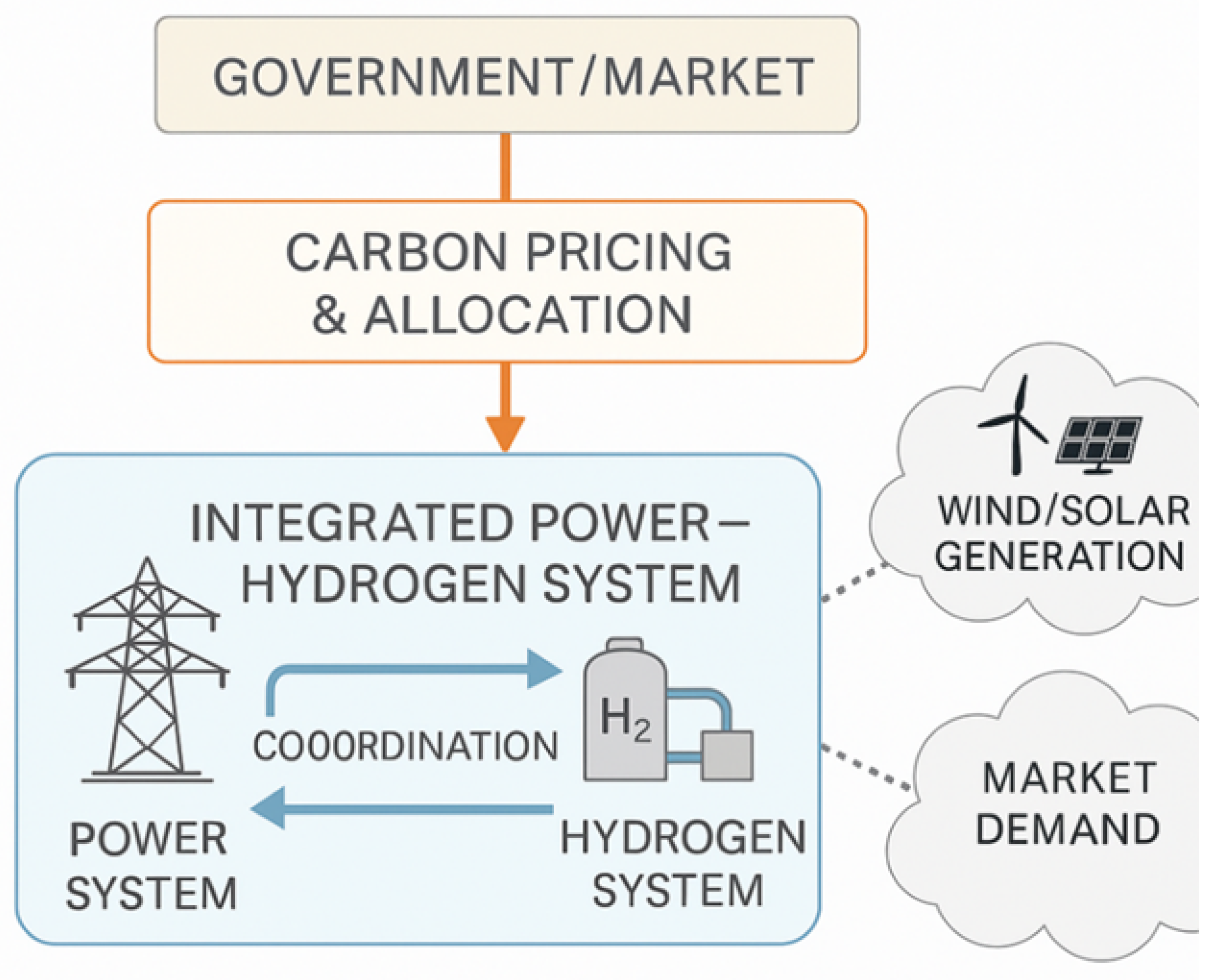
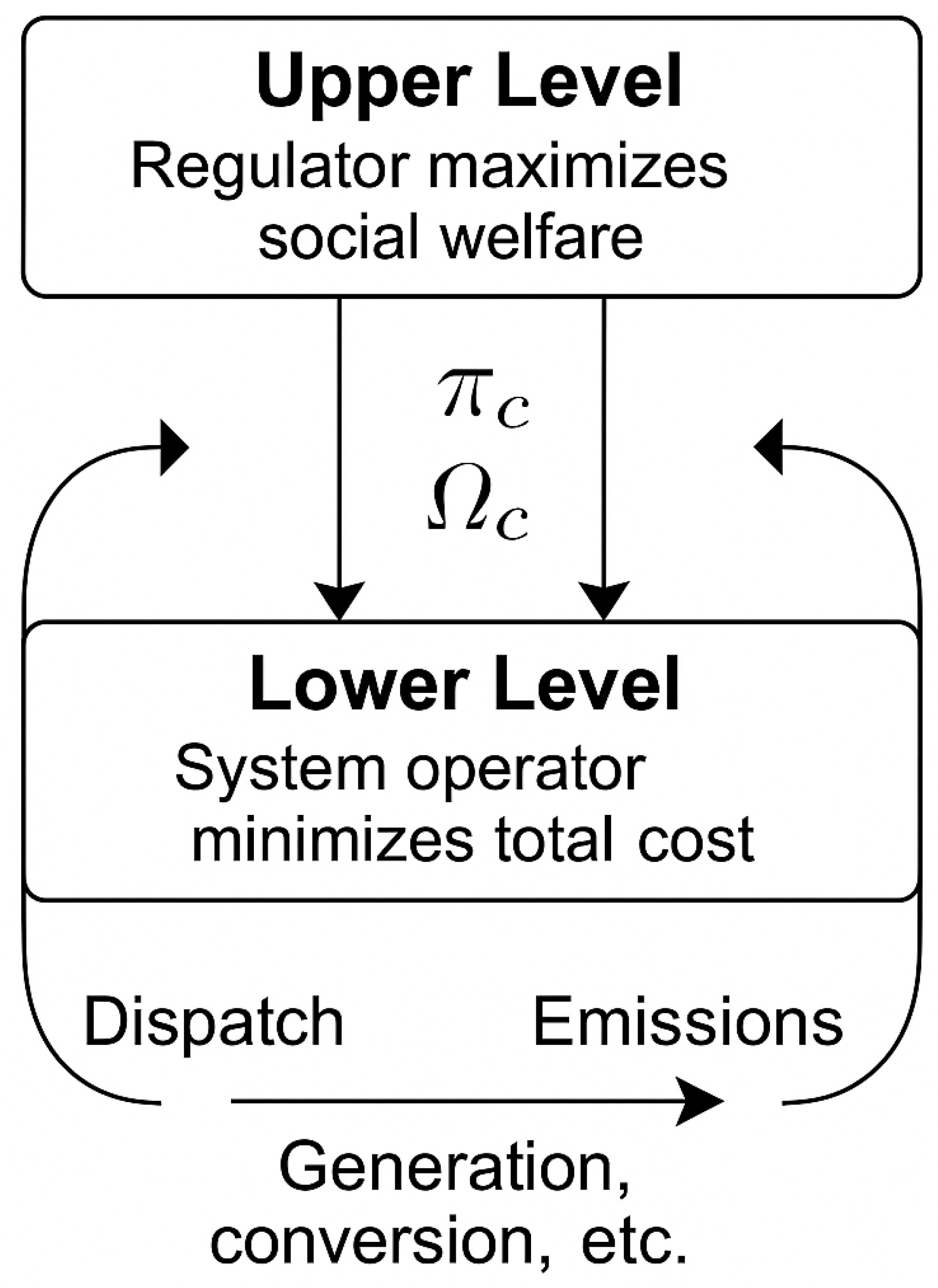
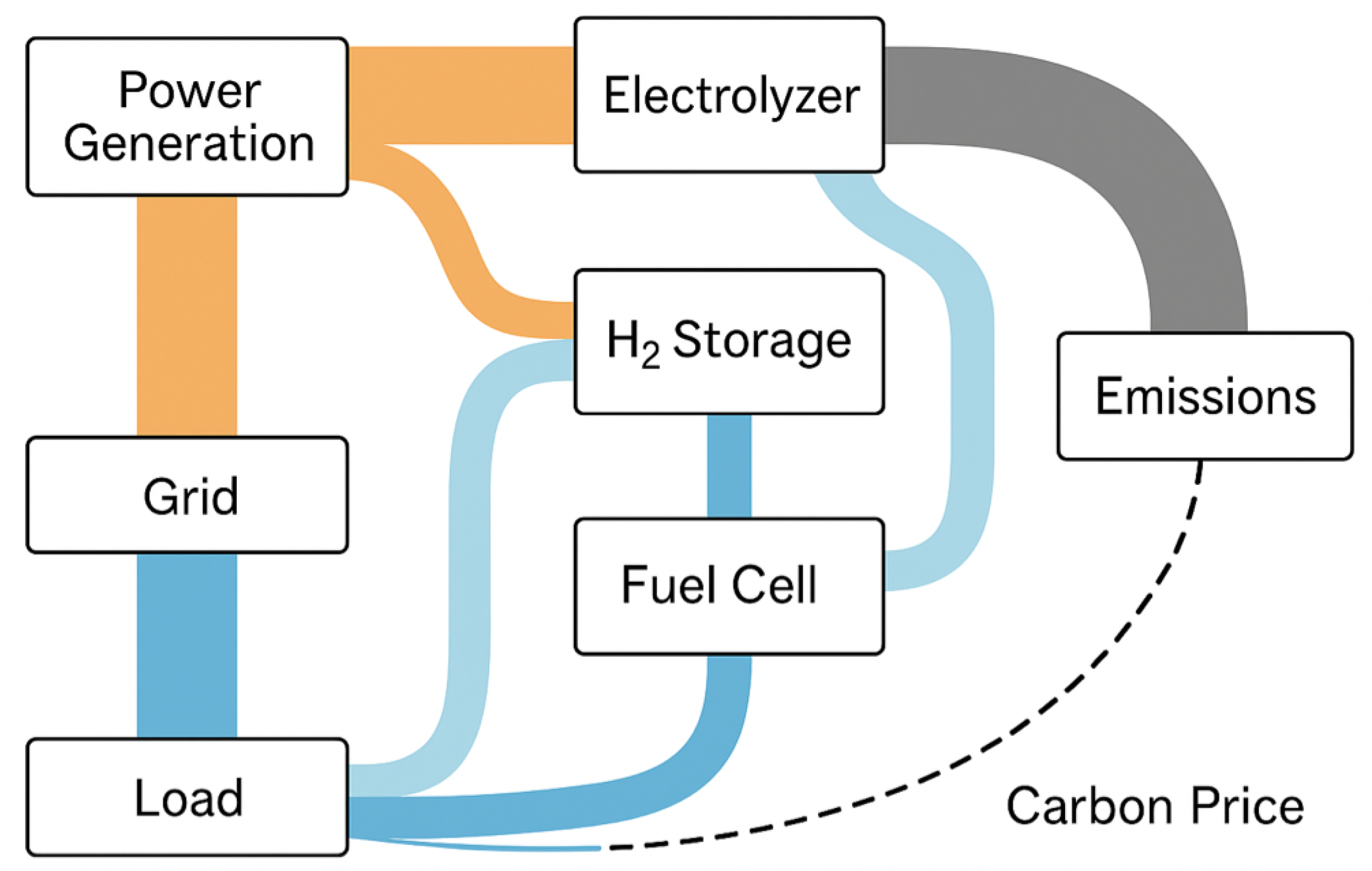
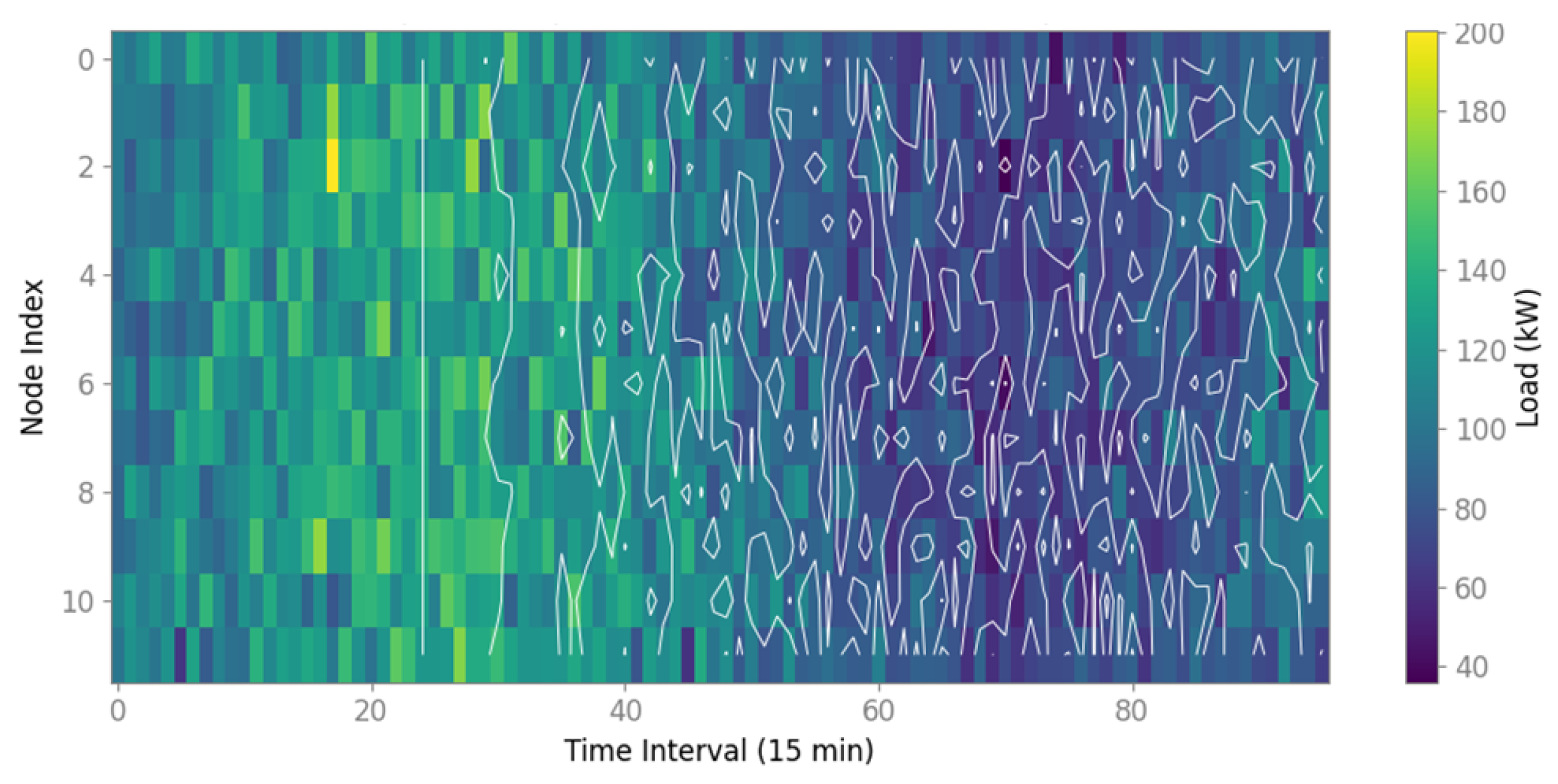
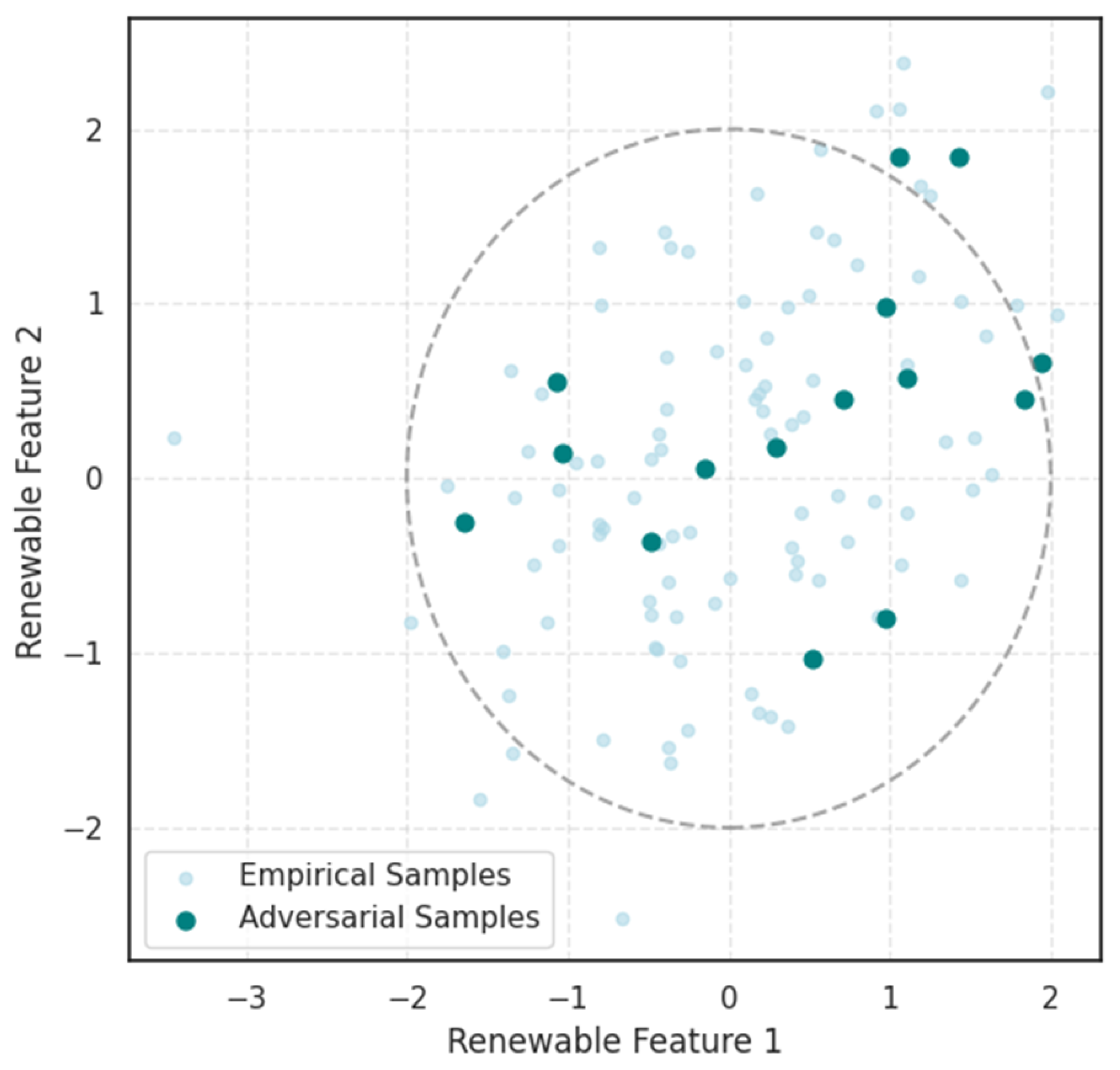
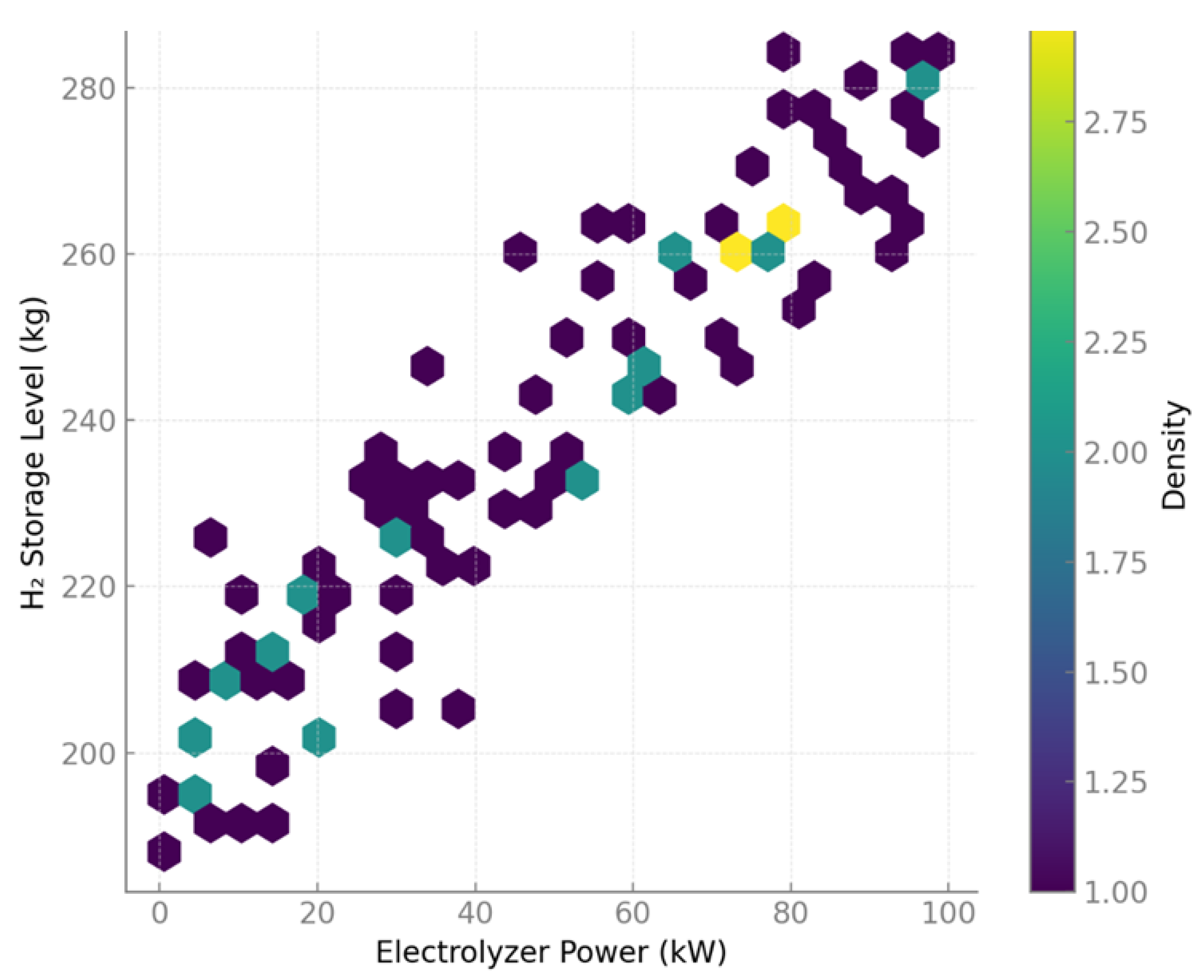
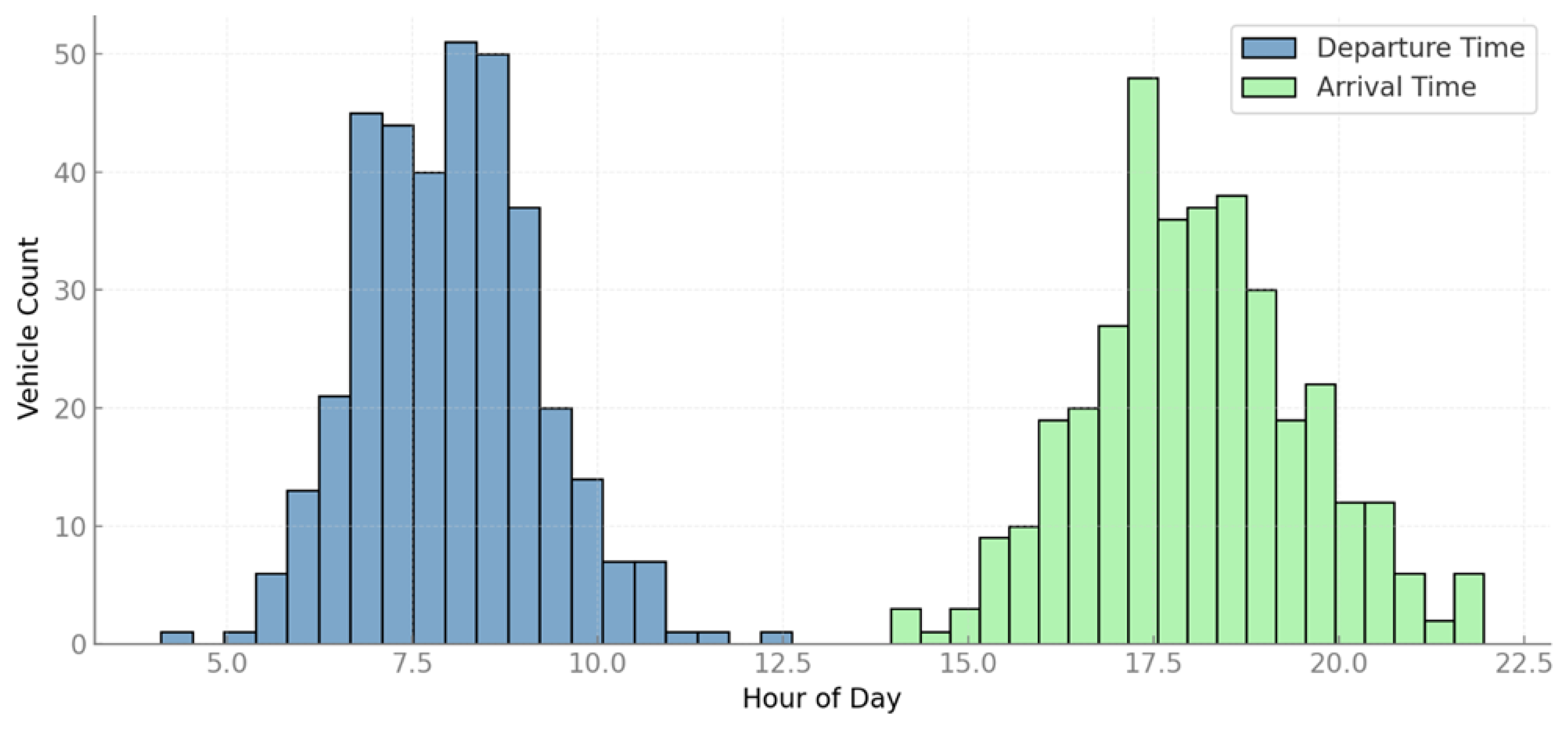
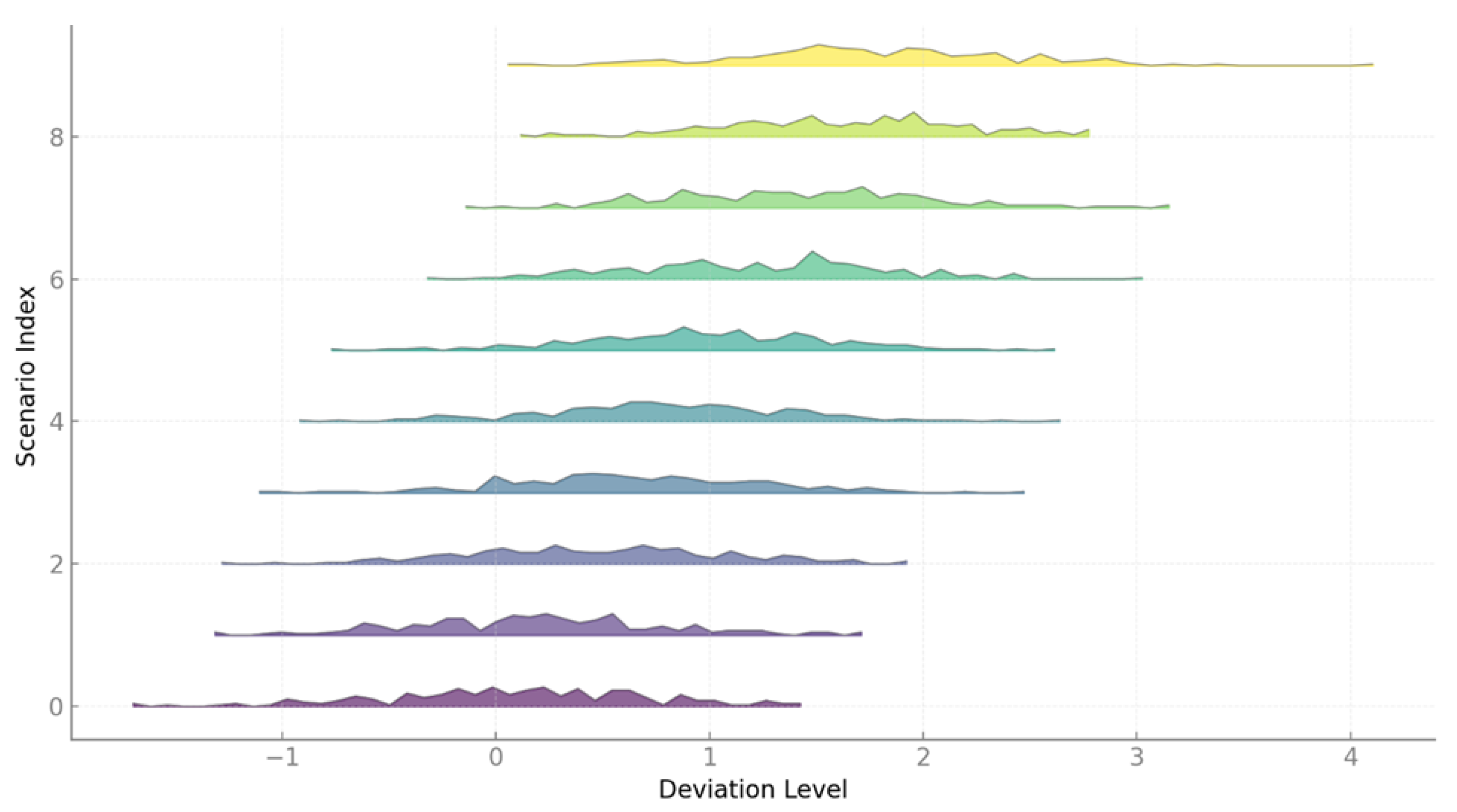
The following section constructs the theoretical foundation and computational realization of the proposed carbon price-coupled bilevel optimization framework. The formulation begins with a rigorous representation of hierarchical decision-making between regulatory and operational layers, where the upper-level entity determines carbon prices and emission quotas to maximize social welfare, while the lower-level energy operator minimizes system-wide dispatch costs subject to carbon and operational constraints. To embed resilience under renewable and demand uncertainty, the model incorporates a Wasserstein-based Distributionally Robust Optimization (DRO) reformulation, enabling the solution to remain valid under statistically perturbed probability distributions. Beyond the formulation, the section presents a stepwise decomposition strategy based on Benders and Column-and-Constraint Generation (CCG) principles, translating the complex bilevel structure into a sequence of tractable subproblems. The dual transformation and subgradient-based optimality cuts jointly ensure convergence with provable robustness. Together, these mathematical and algorithmic layers embody a unified philosophy: that sustainable energy coordination emerges not only from optimal economic design but also from resilient computational structure.
Equation (1) defines the comprehensive system-level objective function for the carbon price-coupled, distributionally robust integrated power–hydrogen system. The first summation over
captures the thermal generation cost, comprising the linear fuel term
, the quadratic production cost
, and the carbon-emission component
weighted by the carbon price
. The second summation models hydrogen subsystem operation, including the electrolyzer energy consumption
, the fuel cell conversion
, and hydrogen storage cycling losses
, establishing cross-domain coupling between electricity and hydrogen vectors. The third summation penalizes imbalance costs under uncertainty scenarios
, where deviations between total generation and stochastic demand
are scaled by imbalance factor
. Finally, the last robust term integrates a Wasserstein-based distributionally robust adjustment, where the ambiguity set
centered at empirical distribution
bounds possible stochastic variations. The inner expectation quantifies squared deviations among wind generation
, solar generation
, and demand fluctuation
, weighted by the sensitivity matrix
. This objective thereby unifies cost minimization, carbon regulation, hydrogen–electricity synergy, and resilience against renewable uncertainty within a single integrated optimization framework.
The relationship above ensures the nodal power equilibrium at every time period. Electricity generated by thermal units
, fuel cells
, and discharged energy storage
must precisely match the sum of system consumption, consisting of electrolyzer input
, charging power
, net demand
, and conversion losses
. This coupling secures the instantaneous energy balance that underlies all feasible operation trajectories.
Here the electrochemical conversion interface between the electric and hydrogen subsystems is formalized. On the left, the electrical input of an electrolyzer
is translated into hydrogen inflow
through its efficiency
; on the right, the fuel-cell process reverses this pathway, generating electrical power
from hydrogen outflow
scaled by
. Together these linear equalities enforce strict mass–energy conversion consistency across the two domains.
The temporal evolution of hydrogen inventory is described above. The storage state
is augmented by inflows
weighted by charging efficiency
and depleted by outflows
corrected for discharging efficiency
; a small leakage term
reflects natural loss in containment. This constraint establishes dynamic continuity of stored hydrogen and links the system’s present and future states, forming the backbone of intertemporal coordination between production, storage, and utilization processes.
Thermal generation units operate only within their permissible limits. The binary variable
denotes the on/off commitment state of unit
g at time
t. When a generator is active, its output
must remain between its minimum and maximum operating thresholds
and
; otherwise, both bounds collapse to zero. This constraint guarantees feasible production ranges for all generating units while implicitly embedding unit commitment behavior in the scheduling framework.
The feasible operating ranges of electrolyzers and fuel cells are described above. The first inequality bounds the electrical consumption of each electrolyzer
by its rated capacity
, while the second limits the fuel-cell output
to its maximum permissible generation
. Together, these ensure technical integrity of the hydrogen subsystem, preventing overloading and enabling consistent energy conversion between domains.
Carbon emissions associated with electricity generation are quantified through the above linear relation. For each time interval, the total emission
equals the sum of all generator outputs
weighted by their specific emission factors
. This expression provides a transparent and tractable mapping between economic dispatch decisions and environmental impact, allowing direct coupling with carbon pricing and policy constraints in the upper-level market formulation.
A carbon-cap condition limits total emissions in each period. The quantity
computed from generation outputs must not exceed the allowance
determined by the upper-level market. This constraint directly connects system operation with environmental policy, embedding emission regulation within the lower-level scheduling model.
Uncertainty enters the system through renewable and load vectors. Each random vector
comprises wind generation
, solar generation
, and stochastic demand
. The tilde denotes random realization drawn from an unknown distribution
lying within a Wasserstein ambiguity set
, whose radius
quantifies the decision-maker’s robustness preference.
The ambiguity set above defines all plausible probability distributions
whose
p-Wasserstein distance from the empirical sample distribution
does not exceed the tolerance
. The transport plan
maps mass between the true and empirical distributions, and the cost of this mapping measured by
establishes the degree of deviation allowed. By adopting this metric, the model formally controls sensitivity to sample uncertainty while remaining computationally tractable in the reformulated optimization.
The dual representation above converts the intractable worst-case expectation into a convex minimization with respect to
. Here,
denotes the scenario-dependent cost function, and
represents the
n-th empirical sample. The reformulation preserves the full distributional rigor of the Wasserstein DRO while providing computational tractability via linear–conic solvers. Parameter
operates as a Lagrange multiplier regulating the trade-off between conservatism (
) and cost realism.
Feasibility of the lower-level system is enforced through grouped constraint functions.
represents all electrical power-flow and capacity relations,
captures hydrogen energy balances and conversion couplings, and
embeds emission caps and sustainability regulations. These compact formulations ease analytical derivation and allow KKT-based reformulation.
Stationarity of the lower-level optimization problem is expressed by the above KKT condition, where
and
are dual multipliers corresponding to equality and inequality constraints, respectively. The Jacobian matrices
and
linearize all constraint sets around the current solution, ensuring gradient orthogonality between the feasible manifold and the cost function
.
Complementarity conditions link the primal and dual spaces. The notation
denotes orthogonality
with both non-negative, enforcing that an inequality constraint becomes active only when its corresponding multiplier is positive. This structure naturally emerges in MPEC (mathematical programs with equilibrium constraints) representations of hierarchical optimization problems.
The Lagrangian function aggregates the primal objective
and constraint contributions weighted by their respective multipliers. It serves as a unifying bridge between primal feasibility and dual sensitivity, enabling efficient single-level transformation once embedded into the upper-level problem.
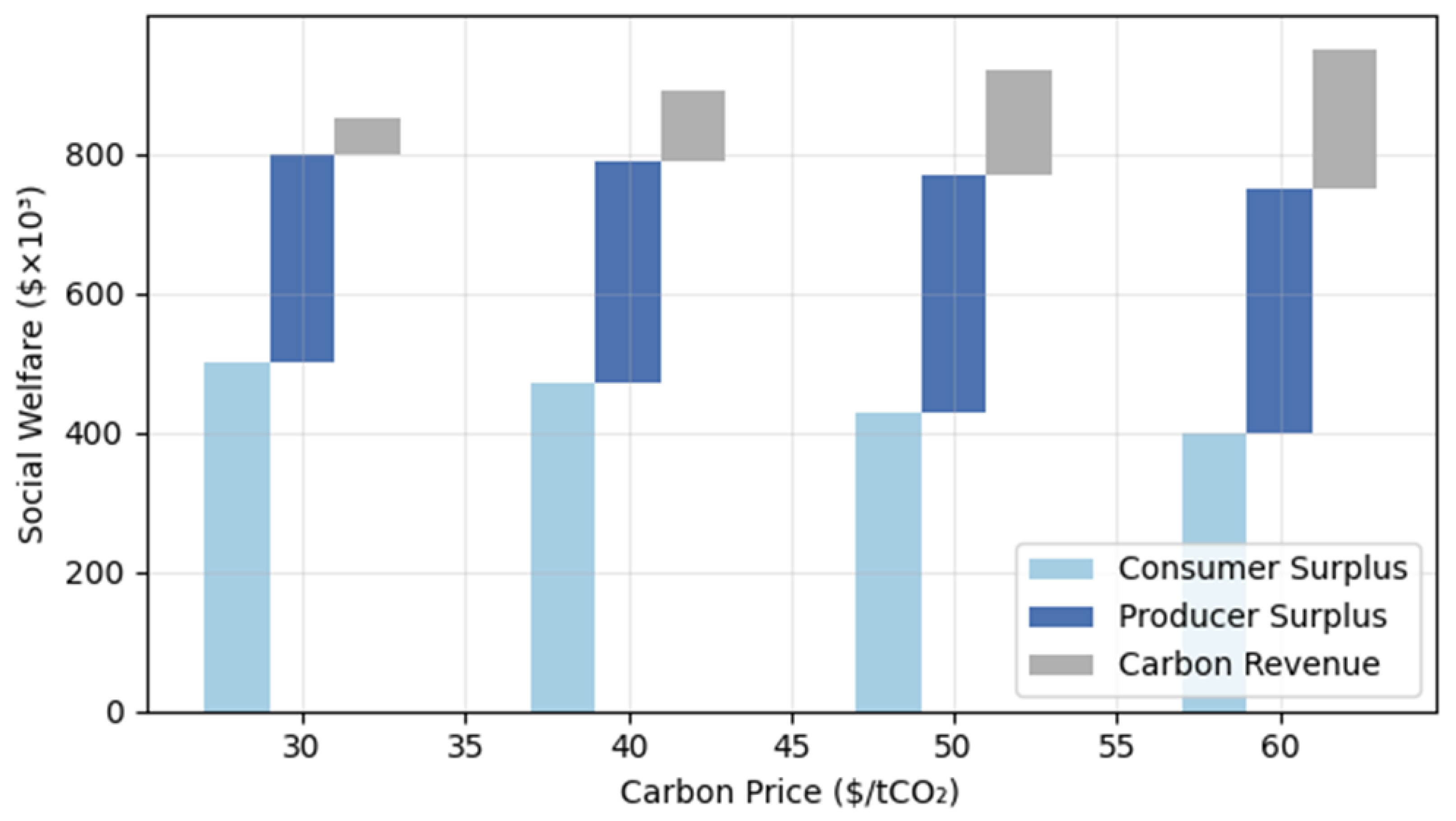
The upper-level carbon-market optimization maximizes overall social welfare
. It balances the consumer utility
against the system’s operational cost
and carbon payments
. The associated constraints maintain emission compliance
and bound the policy variables
and
within regulatory limits. Through this layer, carbon pricing feedback and allowance design co-evolve with the lower-level scheduling model, completing the bilevel interaction between environmental policy and operational optimization.
The hierarchical optimization problem can be equivalently represented as a single-level mathematical program with equilibrium constraints (MPEC). Here, the primal decision vector
consolidates all lower-level dispatch variables, while the indicator term
embeds the complementarity and feasibility conditions described in (13) and (14). This transformation collapses the bilevel structure into one tractable yet nonconvex formulation, enabling the use of decomposition-based solvers and dual reformulations.
A Benders-type master formulation approximates the nonlinear recourse cost by iterative linearization. Each iteration
k yields a supporting hyperplane cut for the master problem through the linearized first-order expansion of
. The auxiliary variable
accumulates the current upper bound of the total operational cost, providing a continuously tightening approximation of the lower-level response surface.
Within each iteration, the subproblem solves for optimal operational responses to a fixed upper-level decision
. This stage computes the minimal dispatch cost subject to the linearized feasibility region
, effectively acting as the operational oracle that informs the master-level welfare optimization.
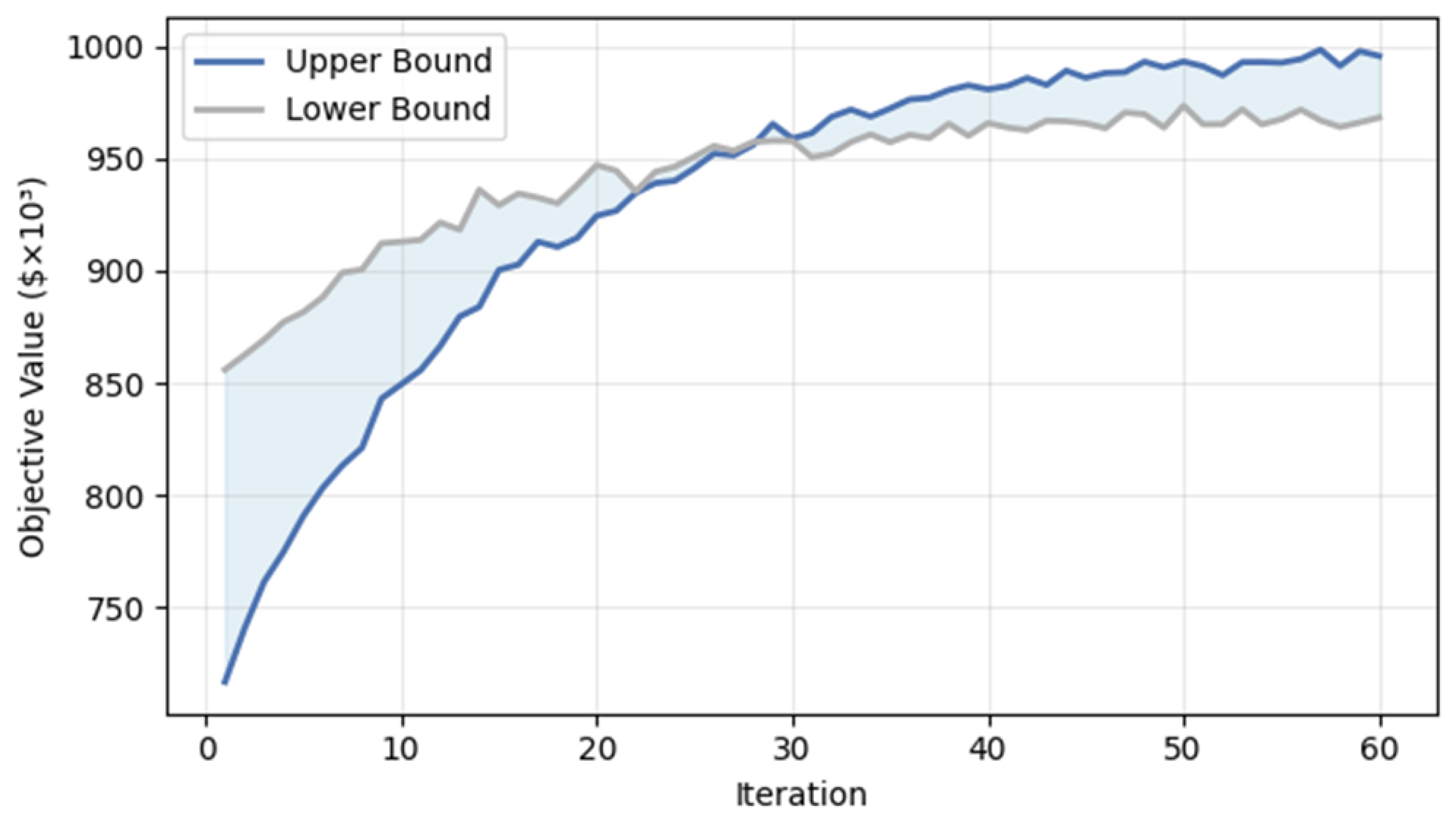
Convergence of the decomposition scheme is monitored through the optimality gap between upper and lower bounds of the system cost, denoted
and
. When the gap falls below the tolerance
, the iterative process terminates, guaranteeing near-optimal performance of the bilevel carbon price-coupled operation.
Policy parameters are updated adaptively through convex combinations of historical and adversarial realizations. At iteration
r, the carbon price
and quota
are blended with the latest optimal responses
and
using a learning rate
. This dynamic feedback rule stabilizes the regulatory–operational interaction and promotes progressive convergence of policy signals toward equilibrium.
A proximal regularization step refines primal decisions and mitigates oscillations in continuous–discrete variable interactions. The quadratic penalty
stabilizes iterative updates, ensuring convergence even under strong nonconvexity and high-dimensional coupling among energy carriers.
Finally, the algorithm halts when successive recourse-cost values differ by less than the stopping threshold
. This final condition confirms the stabilization of both policy and operational decisions, yielding the globally consistent solution for carbon price-coupled, distributionally robust coordination of the integrated power–hydrogen system.
The inner worst-case search within the distributionally robust layer is replaced by a discrete approximation. Each scenario
represents a specific realization of renewable generation and demand, and the Wasserstein distance
quantifies how far the scenario deviates from the empirical baseline. This formulation forms the computational core of the column-and-constraint generation (CCG) procedure, identifying adversarial conditions that maximize system loss and enriching the uncertainty set dynamically.
Loss aggregation evolves adaptively as the algorithm iterates. At each step
r, the updated expected loss
is expressed as a convex combination of the previous loss estimate
and the adversarial realization
discovered through (24). The relaxation parameter
controls the stability and speed of convergence, ensuring that the final estimate represents a balanced reflection of both empirical and worst-case observations.
Updating the dual variable
provides a self-correcting mechanism for distributional robustness. By solving the inner convex minimization, the algorithm automatically calibrates the trade-off between conservatism and empirical fit for iteration
. Smaller values of
imply heavier penalization of large deviations, while larger values reduce robustness in favor of empirical accuracy. This step maintains stability in the Wasserstein-DRO structure and ensures consistency of risk adjustment across iterations.
The welfare functional
synthesizes the total benefit of the integrated power–hydrogen system at iteration
. It combines the minimized system operation cost
with the carbon payment term
and consumer utility
. This aggregate indicator captures the combined effects of market decisions, emission regulation, and end-user satisfaction—serving as the final performance measure for the bilevel carbon price-coupled optimization.
Termination occurs when welfare variation between successive iterations becomes negligible. The tolerance
governs this stopping condition. Once the improvement of
stabilizes, the entire hierarchy—from the upper-level carbon policy to the lower-level operational scheduling—is considered converged, yielding a distributionally robust equilibrium for the integrated power–hydrogen system under carbon market coupling.
Compared with conventional deterministic or stochastic optimization frameworks, the proposed model provides a more resilient representation of uncertainty and policy–operation interactions. Deterministic bilevel approaches assume fixed parameter values and therefore cannot capture variability in renewable output or demand behavior. Scenario-based stochastic models incorporate uncertainty but rely on the accuracy and completeness of scenario sets, which may lead to sensitivity under distributional shifts. In contrast, the Wasserstein-based distributionally robust formulation used in this study constructs an ambiguity set around empirical samples and evaluates worst-case realizations within that set, enabling a more reliable assessment of system behavior under uncertain conditions. This structure strengthens the analytical capability of the bilevel carbon pricing model by integrating uncertainty handling, operational flexibility, and policy design within a unified optimization framework.
The choice of the CS–ARDL model is informed by the empirical properties of the dataset and the interconnected structure of the system being analyzed. The underlying variables display substantial cross-sectional dependence driven by shared technological transitions, coordinated carbon pricing signals, and common socio-economic influences across units. Such dependence introduces unobserved common factors that render first-generation panel estimators, including conventional ARDL, FMOLS, and DOLS approaches, biased and inconsistent. The CS–ARDL methodology addresses this challenge by incorporating cross-section averages of both dependent and explanatory variables, thereby correcting for latent global shocks and accommodating co-movements induced by system-wide drivers. Moreover, CS–ARDL is capable of simultaneously capturing short-run dynamic adjustments and long-run equilibrium relationships without imposing restrictive homogeneity assumptions or requiring extensive pre-testing procedures. Its flexibility allows heterogeneous adjustment speeds across units while maintaining robustness to correlated disturbances. These characteristics make the CS–ARDL model particularly suitable for empirical environments influenced by jointly evolving policy interventions, coupled energy infrastructures, and multi-region behavioral dynamics, offering an econometrically reliable basis for quantifying both transient responses and structural linkages within the integrated system.