


Abstract
High-temperature superconducting (HTS) technologies continue to advance as promising solutions for large-capacity rotating electrical machinery. However, the cryogenic architecture required to maintain superconducting states remains a critical design challenge, particularly for performance evaluation systems (PESs). Conventional helium–neon (He–Ne) circulation-based cooling enables stable low-temperature operation and has been experimentally validated in previous PES implementations, but it introduces substantial limitations due to installation complexity, flow-induced instability, and limited adaptability to different coil configurations. To address these constraints, this study proposes a conduction-cooled PES architecture optimized for HTS field coil testing and examines its thermal and structural characteristics through comprehensive design and finite element method (FEM)-based analysis. A multi-stage conduction cooling pathway using a cryocooler, thermal straps, and copper heat plates was designed to achieve uniform temperature distribution and reduce thermal gradients across the HTS winding. Three-dimensional FEM simulations were performed to evaluate the steady-state temperature distribution and heat-transfer characteristics of the proposed conduction-cooled PES under representative thermal load conditions, and the predicted cooling performance was comparatively assessed against the He–Ne cooled PES. The conduction-cooled PES was analyzed by comparing its predicted performance with previously obtained experimental results from the He–Ne cooled PES. The proposed conduction cooling architecture achieved a significant reduction in total heat load, decreasing from 177 W in the He–Ne system to approximately 78 W in the conduction-cooled configuration while also improving thermal efficiency and simplifying system integration. In addition, conduction cooling enhances compatibility with a wider range of HTS coil geometries by eliminating the constraints associated with fluid-based circulation. While the proposed conduction-cooled PES has not yet been physically fabricated, the numerical framework was established based on experimentally confirmed operating conditions of the previously implemented He–Ne-cooled PES, and future work will include fabrication and experimental validation of the conduction-cooled configuration. These findings demonstrate that conduction cooling represents a practical and scalable alternative for next-generation PES platforms and provide essential design guidelines for the development of high-field HTS coils and large-capacity superconducting rotating machines.
1. Introduction
The rapid expansion of large-scale renewable energy systems, such as multi-megawatt offshore wind power generators, has intensified the need for electrical machines with high power density, reduced weight, and enhanced operational efficiency [1,2,3,4,5]. High-temperature superconducting (HTS) technologies have emerged as promising candidates to meet these requirements, owing to their ability to operate under high current density and strong magnetic flux conditions while minimizing resistive losses [6,7,8,9,10]. Continuous advancements in second-generation coated conductors, cryocooler performance, and superconducting structural materials have further strengthened the feasibility of applying HTS coils to next-generation rotating machinery [11,12,13]. As HTS devices become increasingly relevant in multi-megawatt applications, it has become essential to establish reliable performance evaluation systems (PESs) capable of reproducing the electromagnetic, mechanical, and cryogenic conditions encountered during generator operation [14,15,16,17,18]. Recent research on HTS rotating machines has extensively explored electromagnetic optimization, mechanical stress analysis, thermal modeling, and quench behavior [19,20,21,22]. However, despite these advancements, the availability of flexible and scalable PES platforms remains limited. Globally, research institutes have recognized the need for PES environments that can experimentally validate HTS coils before integration into full generator assemblies, particularly for verifying electromagnetic force characteristics, flux distribution, mechanical deformation, and thermal stability [23,24,25]. Although the previously developed He–Ne circulation PES demonstrated stable low-temperature operation and produced valuable experimental results, its complex fluid-handling network, vacuum sealing requirements, pressure management components, and susceptibility to flow instabilities significantly reduced system flexibility [26,27,28]. In addition, the total heat load of approximately 177 W imposed a substantial burden on the cryogenic system and restricted adaptability to various HTS coil geometries. Conduction cooling eliminates the need for cryogenic fluids, allows for a compact and mechanically simplified cryogenic configuration, and offers improved long-term thermal stability without risks associated with flow oscillation or pressure-driven disturbances [29,30]. The adoption of conduction cooling in high-field magnet systems, compact superconducting devices, and cryogenic power electronics underscores its growing importance. However, the literature still lacks systematic investigations that integrate conduction cooling into PES architectures optimized for large-capacity HTS coils, particularly those in the multi-megawatt class. Cryogenic cooling for HTS applications includes liquid cryogen cooling, forced-flow circulation cooling, thermosiphon cooling, and conduction cooling. Fluid-based schemes require complex cryogenic plumbing and circulation components, which increase parasitic heat loads and limit scalability for modular PES designs. Therefore, this study proposes a conduction-cooled PES architecture to simplify cryogenic integration and reduce total heat load, enabling a more scalable and adaptable evaluation platform for large-capacity HTS field coils.
In this study, a conduction-cooled PES architecture is proposed and analyzed to address the limitations of the He–Ne circulation system. A multi-stage conduction cooling pathway was designed using cryocoolers, copper heat plates, thermal straps, and low-resistance interfaces to achieve efficient heat extraction and uniform temperature distribution across the HTS coil. Special attention was given to optimizing the structure of the current lead, which combines high-conductivity brass for ambient-temperature regions with superconducting materials for cryogenic sections, thereby reducing parasitic thermal loads and improving overall system performance. The mechanical frame and PES structure were redesigned to incorporate conduction cooling interfaces and maintain structural integrity during electromagnetic loading. Three-dimensional finite element simulations were conducted to predict heat-flow behavior, cooldown characteristics, total heat load, thermal stress, and deformation under coupled electromagnetic and cryogenic conditions. Based on these analyses, detailed engineering drawings for a fabrication-ready conduction-cooled PES were developed. Although the conduction-cooled PES has not yet been experimentally fabricated, its performance was thoroughly evaluated by comparing analytical and simulation outcomes with previously obtained experimental data from the He–Ne–cooled PES. The conduction cooling system achieved a substantial reduction in total heat load from 177 W to approximately 78 W while enhancing thermal stability and simplifying system integration. These results highlight the significant potential of conduction cooling as a reliable, efficient, and scalable cryogenic approach for HTS coil evaluation. The findings presented in this work establish a comprehensive design and validation framework for conduction-cooled PES platforms and offer essential engineering guidelines for the development of next-generation HTS generators and high-field superconducting devices.
2. Design of the PES with Neon–Helium Hybrid Cryo-Cooling System
2.1. Specifications of the 10 MW Class HTS Generator
The 10 MW class HTS generator used in this study has been designed, and the PES was developed specifically to test and validate the HTS field coils prior to their integration into the generator [31]. To ensure that the PES accurately reproduces the electromagnetic and cryogenic operating conditions of the actual machine, the fundamental design specifications of both the generator and the HTS field coil must be clearly defined. Accordingly, Table 1 and Table 2 summarize the core specifications of the 10 MW class HTS generator and the designed HTS field coil, respectively.
Table 1.
Detailed specifications of the 10 MW class HTS generator.
Table 2.
Specifications of the designed HTS field coil for a 10 MW class HTS generator.
Table 1 presents the major electrical, mechanical, and geometric parameters of the generator, which form the basis for determining the magnetic field distribution, torque characteristics, and thermal boundaries that the PES must replicate. The generator delivers a rated output of 10.5 MW at a rotational speed of 9.6 rpm, producing a rated torque of 10.57 MN·m. It operates with a line-to-line voltage of 6.6 kV and an armature current of 918 A, while employing a 40-pole configuration with an active length of 700 mm, an air gap of 15 mm, and a cryostat thickness of 20 mm. Additional parameters—such as the 40 mm air gap between the coil and cryostat, the seven turns per stator coil, and a copper current density of 3 A/mm2—define the electromagnetic environment to be emulated in the evaluation platform.
Table 2 details the specifications of the HTS field coil designed for this generator. The coil is wound with 12 mm-wide and 0.15 mm-thick HTS tape with a self-field critical current of 600 A at 77 K, arranged within a 40 pole. Each pole comprises multiple HTS coil layers totaling 310 turns and is designed to operate at 35 K using metal insulation compatible with cryogenic and high-field applications. The effective axial length of the coil is 700 mm, and approximately 115.64 km of HTS tape is utilized to achieve the required magnetic force. At the operating current of 221 A, the coil generates a maximum magnetic field and perpendicular magnetic field of 2.8 T and 2.0 T, respectively. These parameters serve as essential inputs to the electromagnetic, thermal, and structural analyses performed for the PES design, ensuring that the evaluation system faithfully reflects the real-world operating conditions of the 10 MW class HTS generator.
2.2. Configuration of the PES
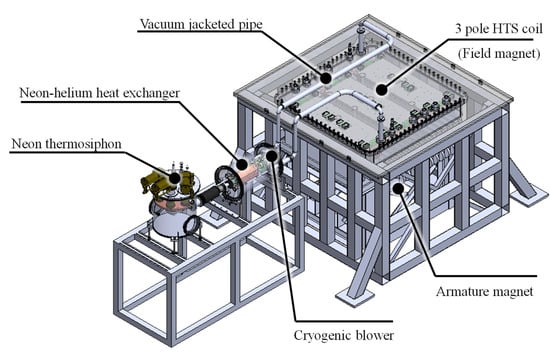
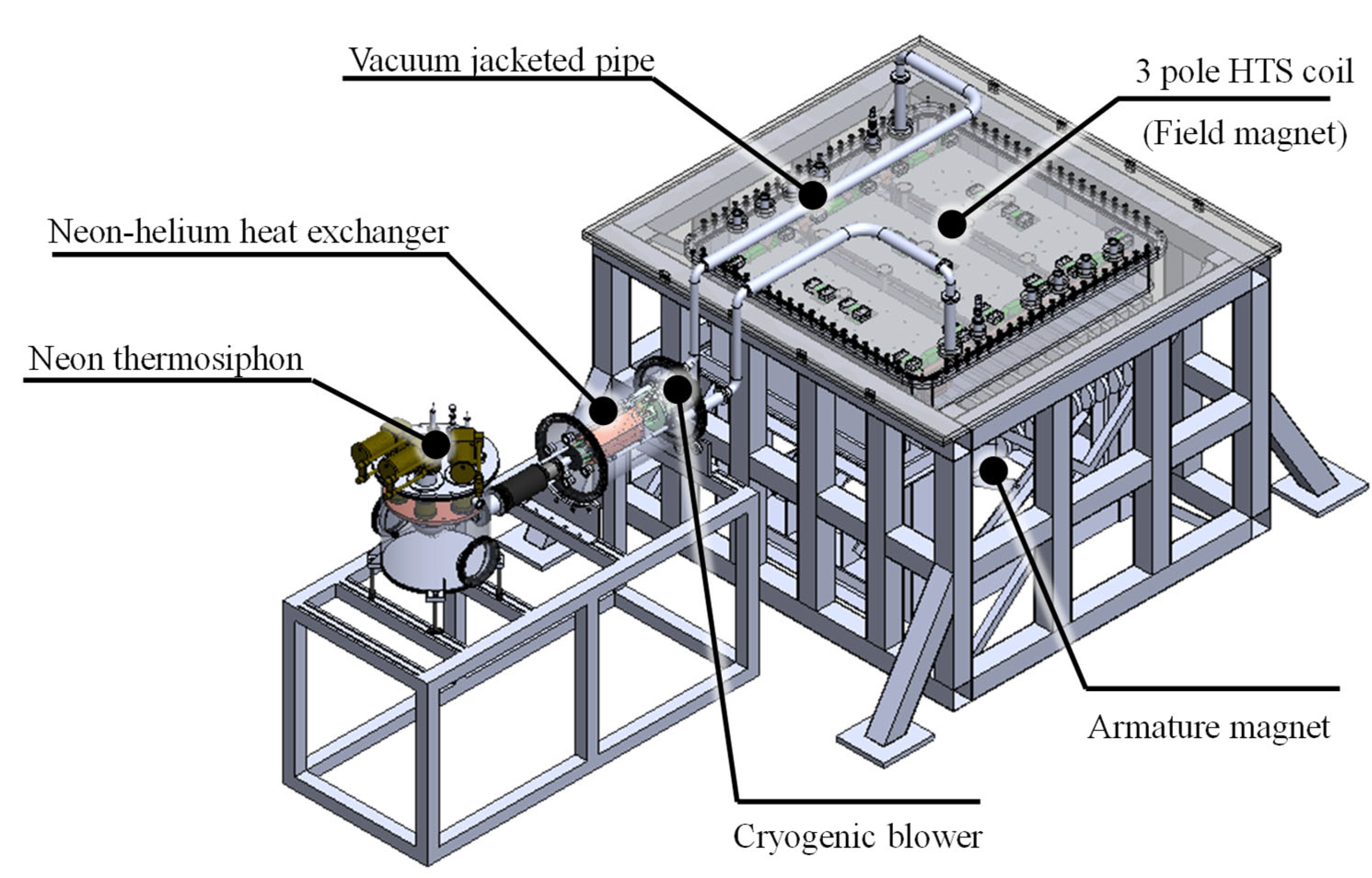
Figure 1 illustrates the previously fabricated PES equipped with an He–Ne cooling system, which was used to experimentally evaluate the electromagnetic and thermal behavior of the HTS field coils for the 10 MW-class generator. The system consists of a He–Ne heat exchanger, a neon thermosiphon loop, a vacuum-jacketed transfer line, and a cryogenic blower that circulates the working gas mixture throughout the cryogenic path. Three HTS field coils forming one pole pair are mounted inside the cryostat located at the center of the PES frame, while the surrounding armature magnet assembly reproduces the electromagnetic loading conditions required for full-scale coil testing. This configuration enabled stable cryogenic operation during experimental runs and served as the baseline reference for the comparative analysis performed in this study.
Figure 1.
Configuration of the PES for a designed 10 MW class HTS generator.
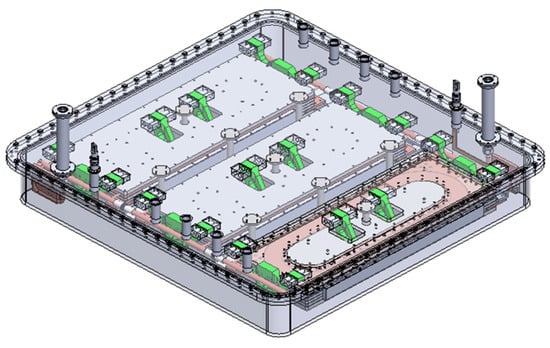
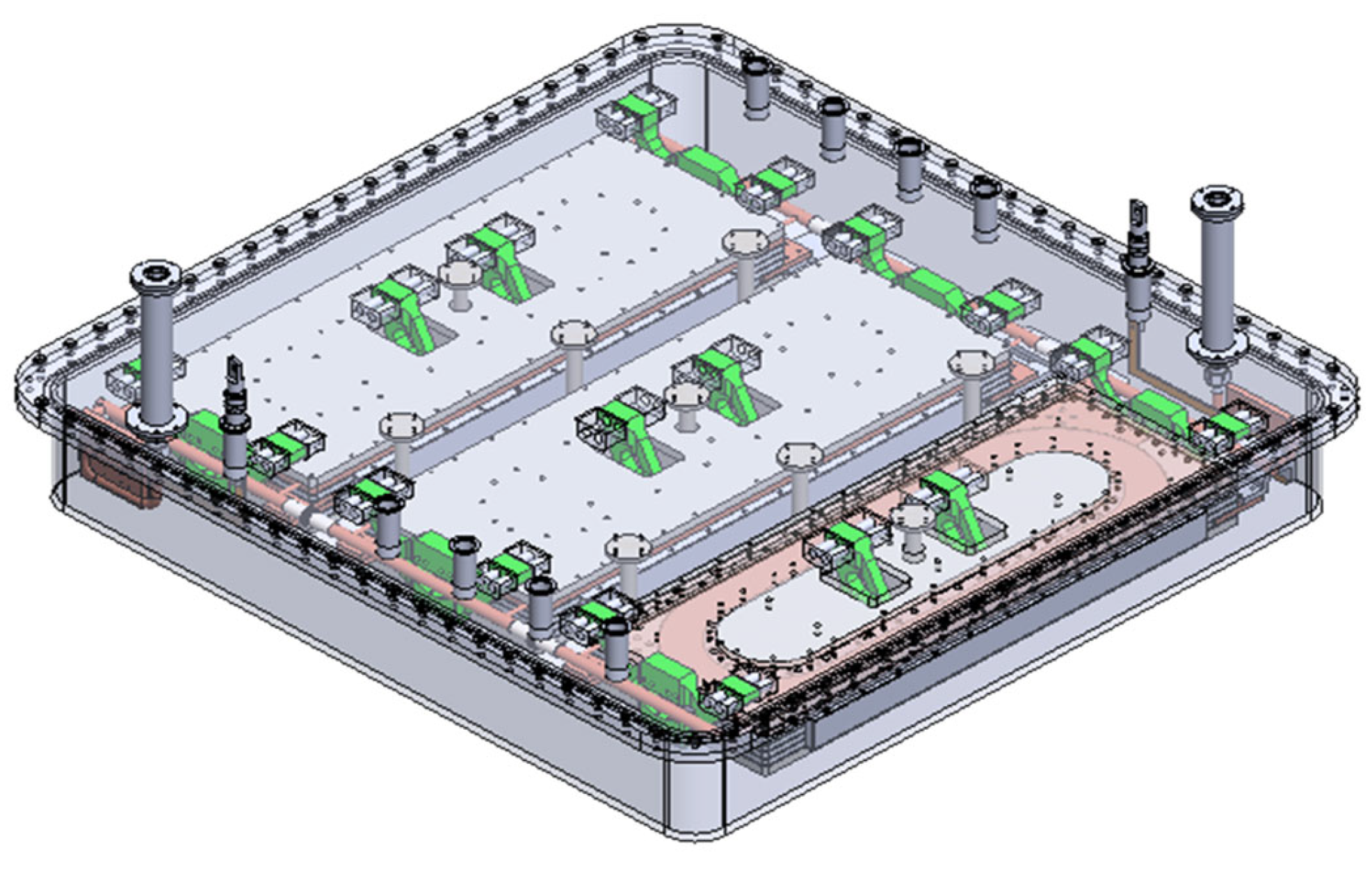
Figure 2 shows the internal configuration of the cryostat containing the three HTS coils used in the PES. The coils are arranged to match the pole geometry of the 10 MW-class generator and are mechanically supported by a set of insulated fixtures designed to withstand the Lorentz forces generated during operation. The cryostat provides a thermally isolated environment for the HTS coils, allowing the He–Ne cooling system to maintain the operating temperature while minimizing external heat intrusion. This coil assembly was used for all experimental tests conducted with the He–Ne-cooled PES and forms the basis for the comparison with the conduction-cooled PES design proposed in this work.
Figure 2.
Configuration of the HTS field coils for PES.
2.3. He–Ne Circulation Cooling System for the PES
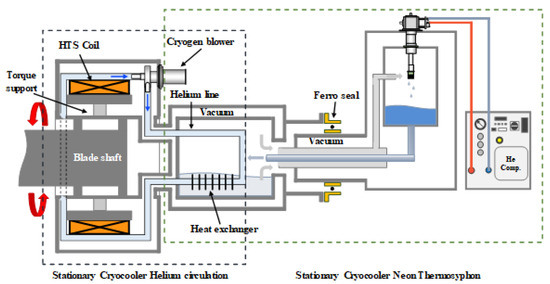
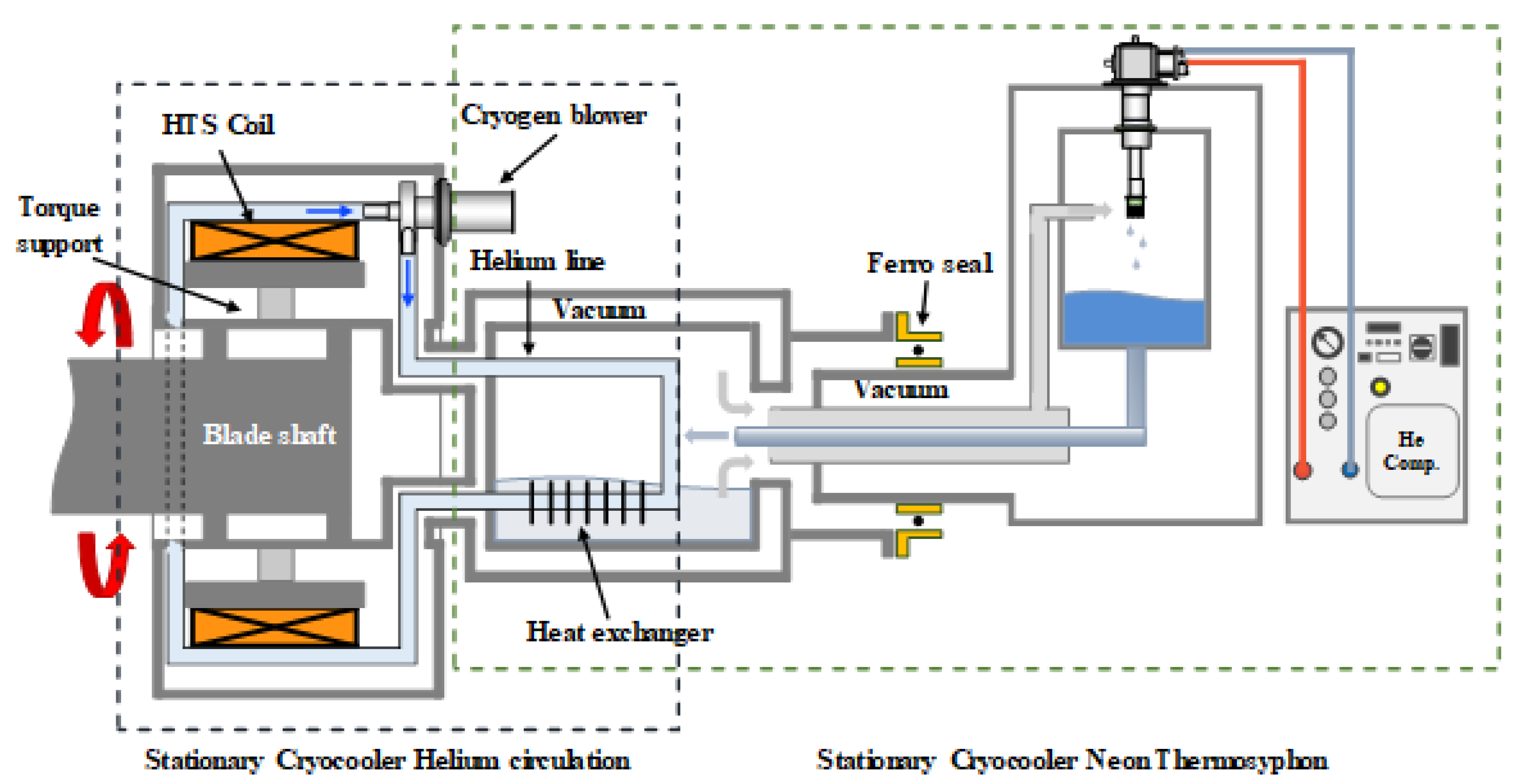
Figure 3 presents the conceptual configuration of the He–Ne circulation cooling system applied to the previously fabricated PES. The system utilizes a combined helium circulation loop and a neon thermosiphon to maintain the HTS coils at cryogenic temperature during operation. Helium gas is circulated through the cryogenic blower and directed toward the HTS coil region through vacuum-jacketed transfer lines, where it absorbs heat generated from conduction paths and residual losses. The neon thermosiphon loop operates in parallel, providing an additional cooling mechanism through phase-change heat transport, enabling stable thermal management without excessive mechanical complexity. This conceptual layout establishes the fundamental cryogenic pathway that supports the cooling performance of the PES [32].
Figure 3.
Concept of the He–Ne circulation cooling system for the PES.
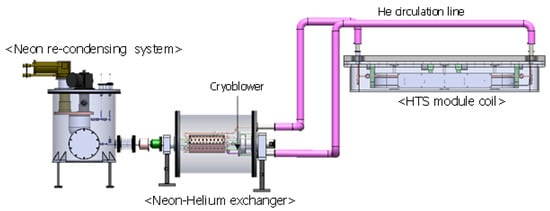
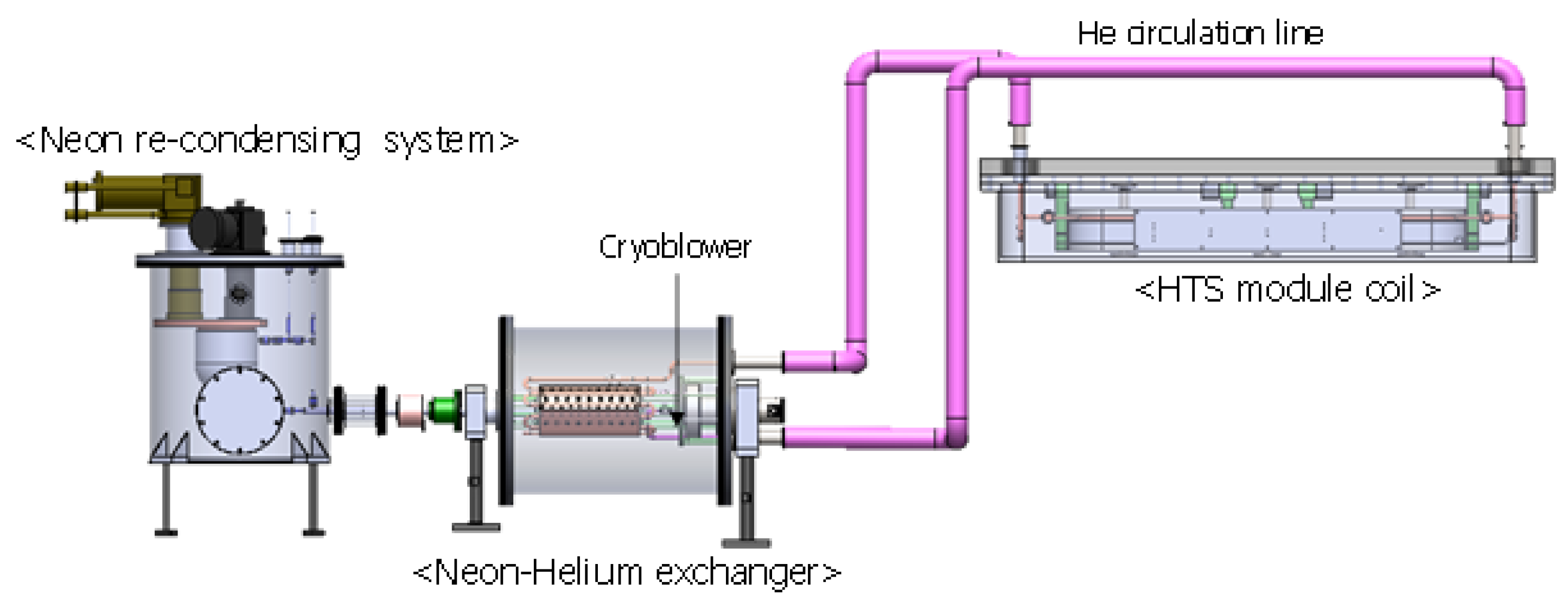
Figure 4 shows the detailed engineering design of the He–Ne cooling system incorporated into the PES. The system includes a He circulation line, a dedicated He–Ne heat exchanger, and a cryogenic blower that drives the closed-loop coolant flow. The neon re-condensing subsystem prevents neon vapor accumulation by returning condensed neon to the thermosiphon loop, ensuring steady-state thermal performance. The HTS module coil cryostat is integrated into the circulation loop so that the mixed-gas cooling system can directly extract heat from the HTS coils during energization. This detailed design forms the basis of the cryogenic operation in the experimental PES and reflects the actual configuration used during performance testing.
Figure 4.
Detailed design of the He–Ne circulation cooling system for the PES.
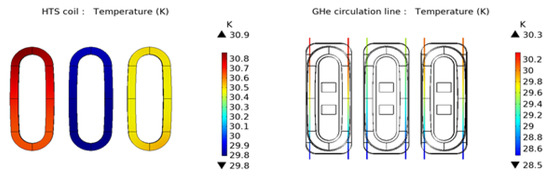
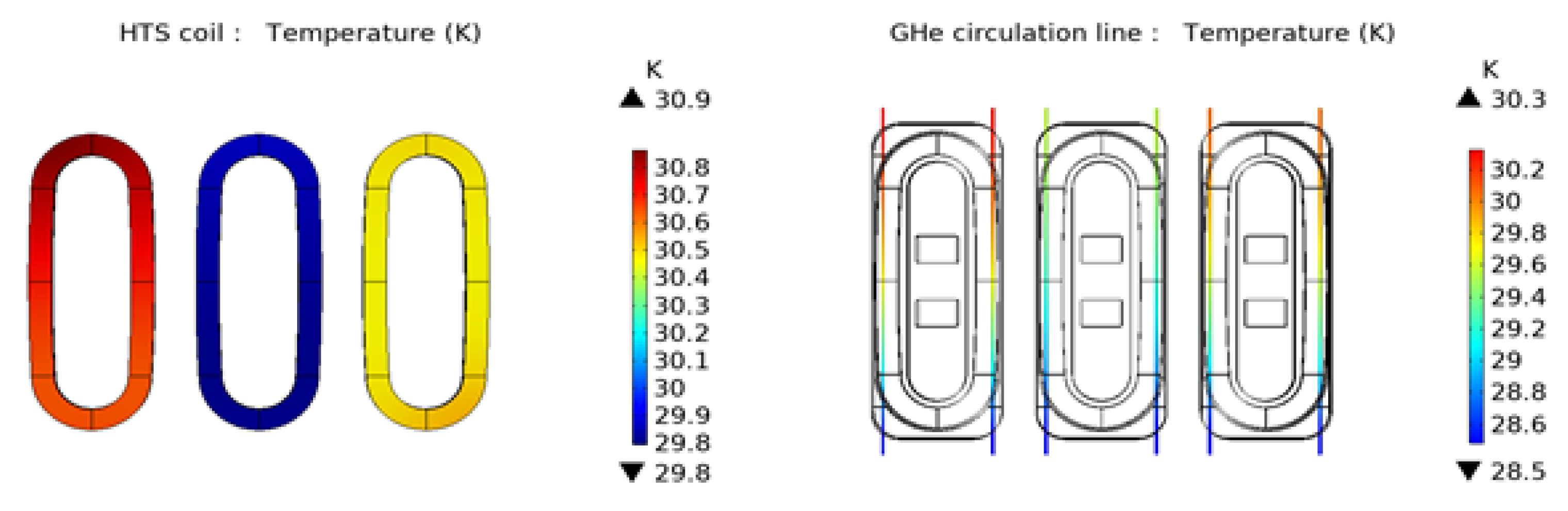
Figure 5 presents the thermal analysis results of the He–Ne cooling system, highlighting temperature distributions along the HTS coil and within the gaseous helium (GHe) circulation line. The HTS coils exhibit a temperature range between approximately 29.8 K and 30.9 K, confirming that the He–Ne system is capable of maintaining sufficient cryogenic margins for stable HTS operation. The GHe circulation line shows similarly uniform temperature behavior, indicating efficient heat extraction along the coolant path. These thermal analysis results provide a baseline thermal reference for the He–Ne-cooled PES and are used as comparative input for evaluating the proposed conduction-cooled PES in this study.
Figure 5.
Thermal analysis results of the He–Ne circulation cooling system for the PES.
3. Design and Analysis of the Conduction Cooling System for PES
3.1. Concept of the Conduction Cooling System for PES
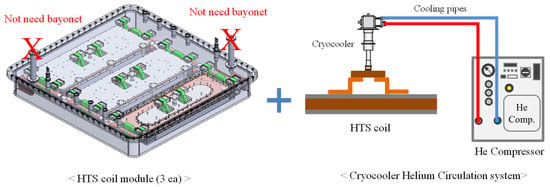
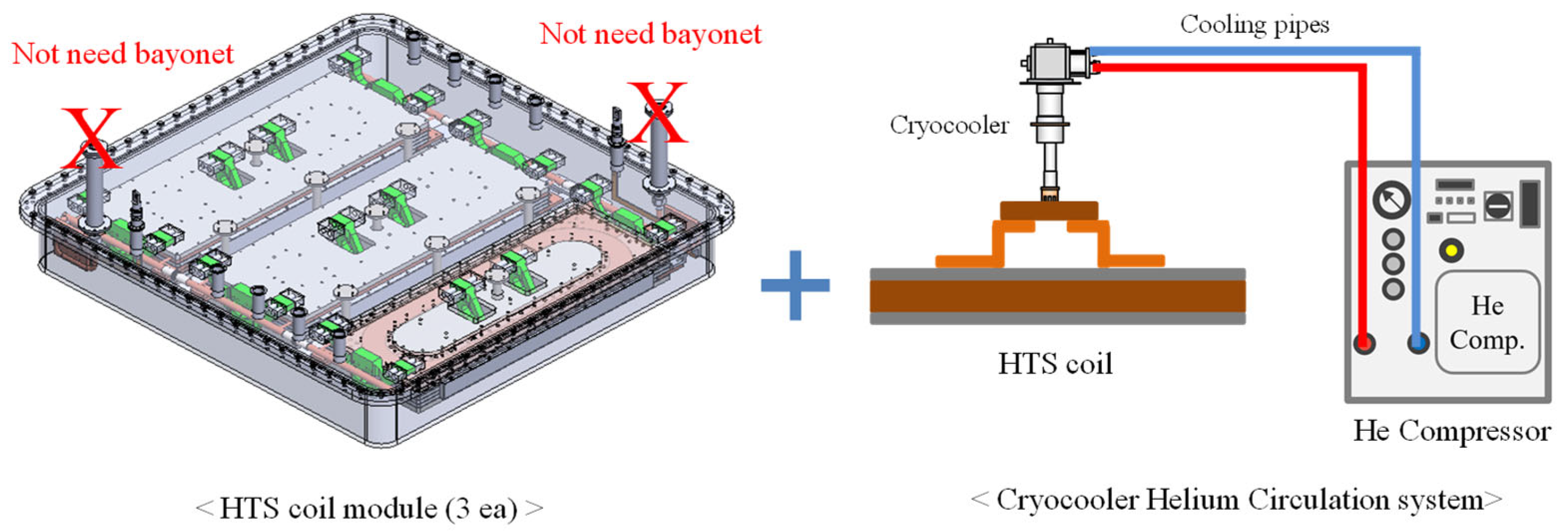
Figure 6 illustrates the conceptual configuration of the conduction cooling system proposed for the PES. Unlike the previously implemented He–Ne circulation system, the conduction-cooled PES removes the need for bayonet-type cryogenic transfer lines and eliminates gas-circulation components, resulting in a significantly simplified cryogenic structure. In this configuration, the three HTS coil modules are mounted inside a cryostat that is directly coupled to a cryocooler through a series of thermal straps and high-conductivity heat spreaders. The cryocooler provides the primary cooling source, transferring heat away from the HTS coils through solid conduction paths rather than through a circulating cryogenic fluid. This conceptual design forms the foundation for the subsequent thermal and structural optimization of the conduction-cooled PES.
Figure 6.
Concept of the conduction cooling system for PES.
When designing the conduction cooling architecture, two commercially available single-stage cryo-coolers (RDK-400B and RDK-500B, SHI Cryogenics Group, Tokyo, Japan) were considered to meet the thermal requirements of the PES. The total heat load of the conduction-cooled PES was analytically estimated to be approximately 78 W at the operating temperature of 35 K, and the cooling capacities of the candidate cryocoolers were evaluated accordingly. The RDK-400B provides a cooling capacity of approximately 80 W at 35 K, whereas the RDK-500B offers a higher capacity of approximately 110 W at the same temperature. Both cryocoolers satisfy the minimum thermal performance requirement, but the RDK-500B provides additional thermal margin that is advantageous for compensating transient heat loads and uncertainties in thermal contact resistance.
The margin difference mainly originates from the different cooling capacities of the two cryocoolers at the target operating temperature. Although the estimated heat load is approximately 78 W, the RDK-500B provides a higher cooling capacity at 35 K, leading to a larger thermal margin. This margin improves robustness against heat disturbances and uncertainties in thermal contact resistance; therefore, the RDK-500B case offers more stable thermal operation than the RDK-400B configuration.
The selection of the cryocooler was therefore incorporated into the thermal design of the PES, and FEM-based thermal simulations were conducted using the performance curves of both cryocoolers. The simulations evaluated cooldown time, steady-state temperature distribution, and thermal gradients across the HTS coils and structural components. These results were used to assess whether each cryocooler could maintain the target temperature of 35 K under operational heat loads, including conduction through the current leads, radiation heat transfer to the cryostat walls, and mechanical support conduction paths. Through this analysis process, the cryocooler performance curves played a critical role in defining the thermal boundary conditions of the conduction-cooled PES.
3.2. Optimal Design of Current Leads
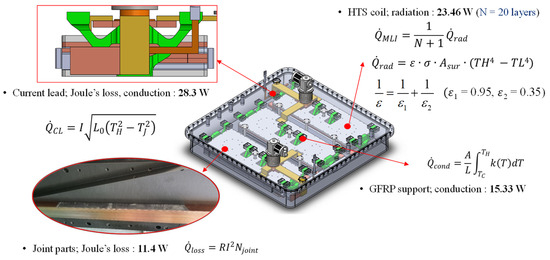
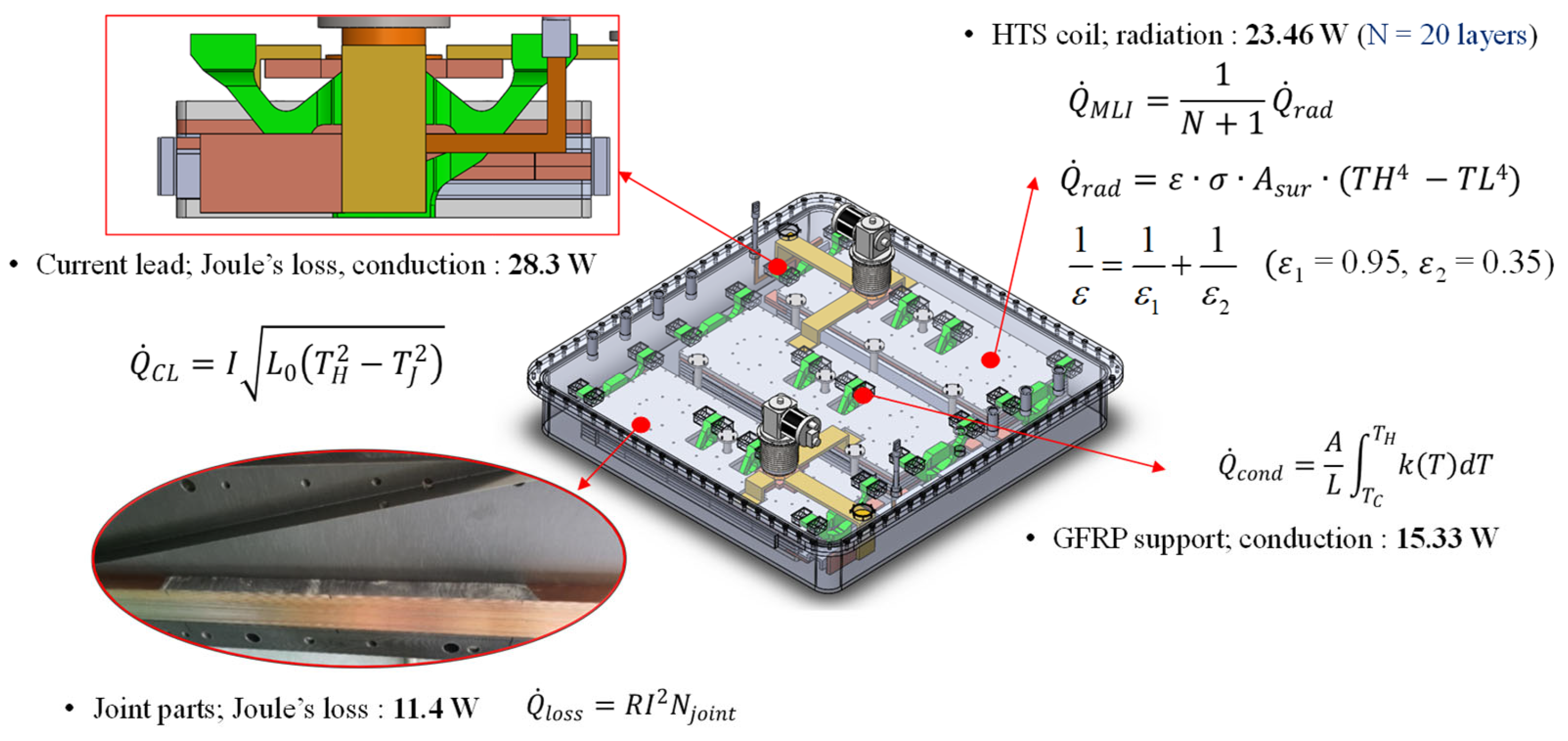
Figure 7 presents the thermal load components considered in the optimal design of the current leads for the conduction-cooled PES. The heat loads originate from multiple pathways, including Joule losses in the resistive segments of the current lead, conduction heat transfer from the high-temperature interface to the cryogenic region, radiation heat transfer through the multi-layer insulation surrounding the HTS coils, and conduction through the GFRP mechanical supports. The experimental measurement of joint resistance revealed a Joule loss of approximately 11.4 W at the operating current of the HTS coil, while the conduction heat load through the main brass lead section was estimated to be 28.3 W. In addition, the radiation heat load from the HTS coil surface was calculated to be 23.46 W for 20 insulation layers, and the heat conduction through the GFRP support structure contributed approximately 15.33 W. Equations (1)–(4) were used to analytically evaluate the conduction load and determine the optimal geometric ratio L/A, which minimizes heat transfer while maintaining current-carrying capability.
Figure 7.
Thermal load conditions considering design and experimental results.
In Equations (1)–(4), I denotes the operating current (A), k(T) is the temperature-dependent thermal conductivity (W/m·K), and (T) is the temperature-dependent electrical resistivity (Ω·m). TH and TL represent the high- and low-temperature boundaries (K), respectively. The formulation is derived from classical optimization theory for conduction-cooled current leads, which minimizes the total heat load to the cryogenic stage by balancing Joule heating and conductive heat transfer. The parameter L/A represents the geometric ratio of lead length to cross-sectional area, and a is the optimized design constant determined from the integral form of material properties. In Figure 7, L0 represents the effective conduction length of the resistive current-lead section considered in the Joule-loss and conduction heat-load estimation. This effective length corresponds to the dominant thermal/electrical path between the ambient terminal and the cryogenic interface and is used consistently for heat-load evaluation in the current lead design.
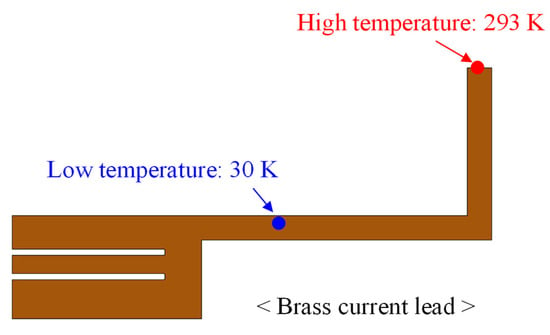
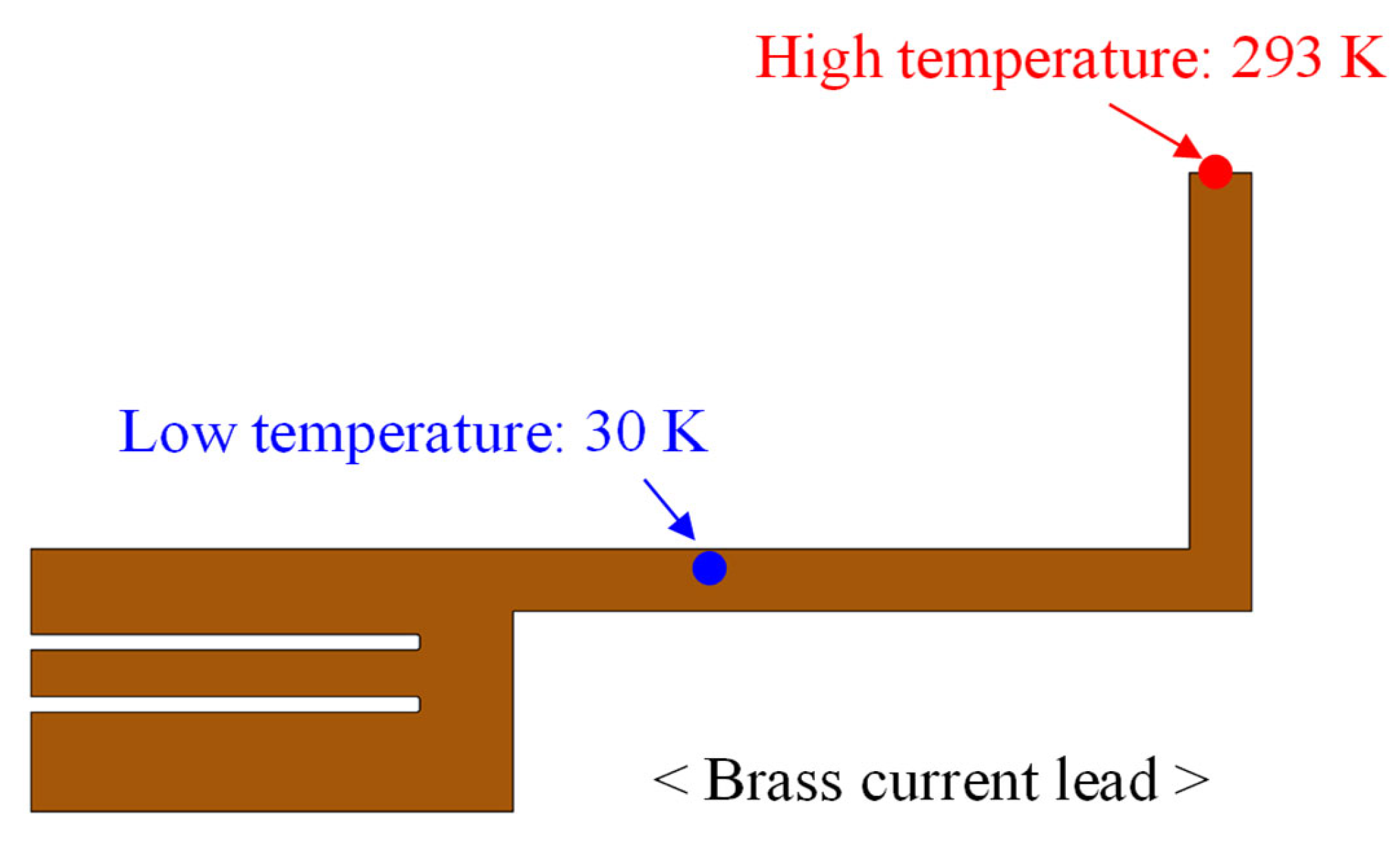
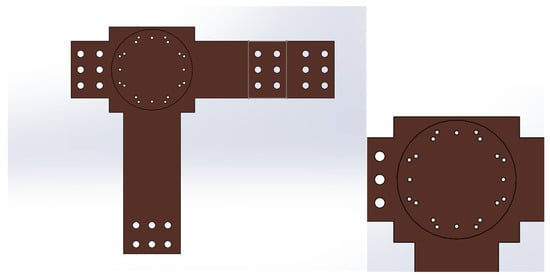
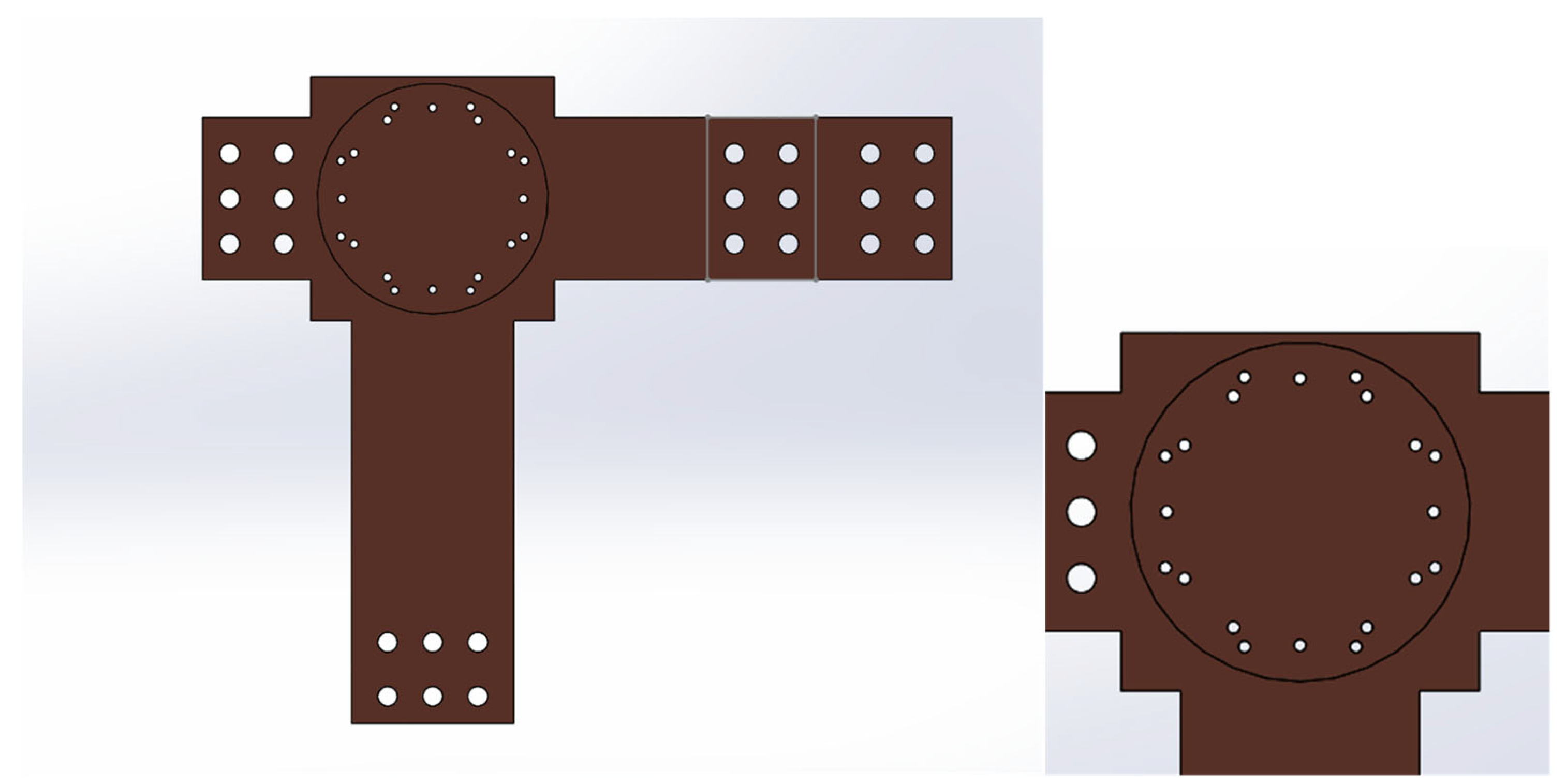
Figure 8 illustrates the final design of the current lead used for the HTS coils in the PES. The current lead is fabricated from brass to balance thermal conductivity and electrical performance, with one end connected to the ambient-temperature terminal at 293 K and the opposite end interfaced with the HTS coil operating near 30 K. The geometric layout is configured to maximize the effective thermal path length while minimizing cross-sectional area in order to reduce conduction heat flow to the cryogenic region. The optimized thickness ensures mechanical robustness during cooldown while limiting parasitic heat leakage into the cryostat.
Figure 8.
Designed the current lead of the HTS field coil for PES.
The detailed specifications of the designed current lead are summarized in Table 3. The brass current lead has a length of 291 mm, a width of 20 mm, and an optimized thickness of 4.8 mm. Under the operating current of 221 A, the total heat load introduced by the current lead system including conduction and Joule heating was calculated to be 11.32 W. These values satisfy the thermal constraints imposed by the conduction-cooled PES and align with the analytical optimization performed using the thermal load equations. The resulting design provides a practical and thermally efficient current delivery pathway, supporting stable operation of the HTS coils within the PES.
Table 3.
Specifications of the designed current lead.
3.3. FEM Modeling Methodology and Validation
This study employed three-dimensional finite element modeling to evaluate and compare the thermal performance of the proposed conduction-cooled PES with the previously implemented He–Ne hybrid circulation cooling system. The thermal simulations were formulated using a steady-state heat conduction model based on Fourier’s law. The governing equation applied to solid domains is expressed as:
where T is temperature (K), k(T) is temperature-dependent thermal conductivity (W/m·K), and q represents volumetric heat generation (W/m3). Temperature-dependent cryogenic material properties were applied to major components such as copper heat spreaders, thermal straps, current leads, and structural supports to reflect realistic low-temperature behavior.
Boundary conditions were defined based on the cryostat structure and cryocooler interfaces. The cold-head regions were modeled as thermal sinks using manufacturer performance-curve information at the target operating temperature range. Representative thermal loads were applied to capture parasitic heat inflow pathways, including radiation heat load to the HTS module, conduction through GFRP supports, Joule and conduction losses in current leads, and joint resistance losses.
To ensure consistency of the comparative evaluation, identical numerical settings, mesh strategy, and boundary-condition definitions were applied to all cooling configurations considered in this study. The purpose of the FEM analysis is therefore a comparative thermal design assessment under physically representative conditions rather than an absolute experimental validation. Because the conduction-cooled PES has not yet been fabricated, direct experimental comparison is outside the scope of this work and is planned for future studies. Nevertheless, the modeling conditions were selected based on experimentally confirmed operating parameters of the previously developed He–Ne-cooled PES, ensuring that the numerical framework reflects realistic PES operation.
3.4. Thermal Analysis of PES with Conduction Cooling System
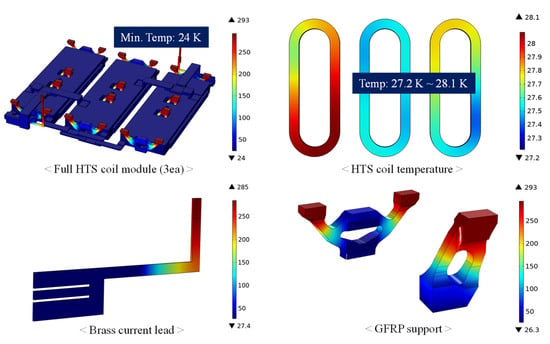
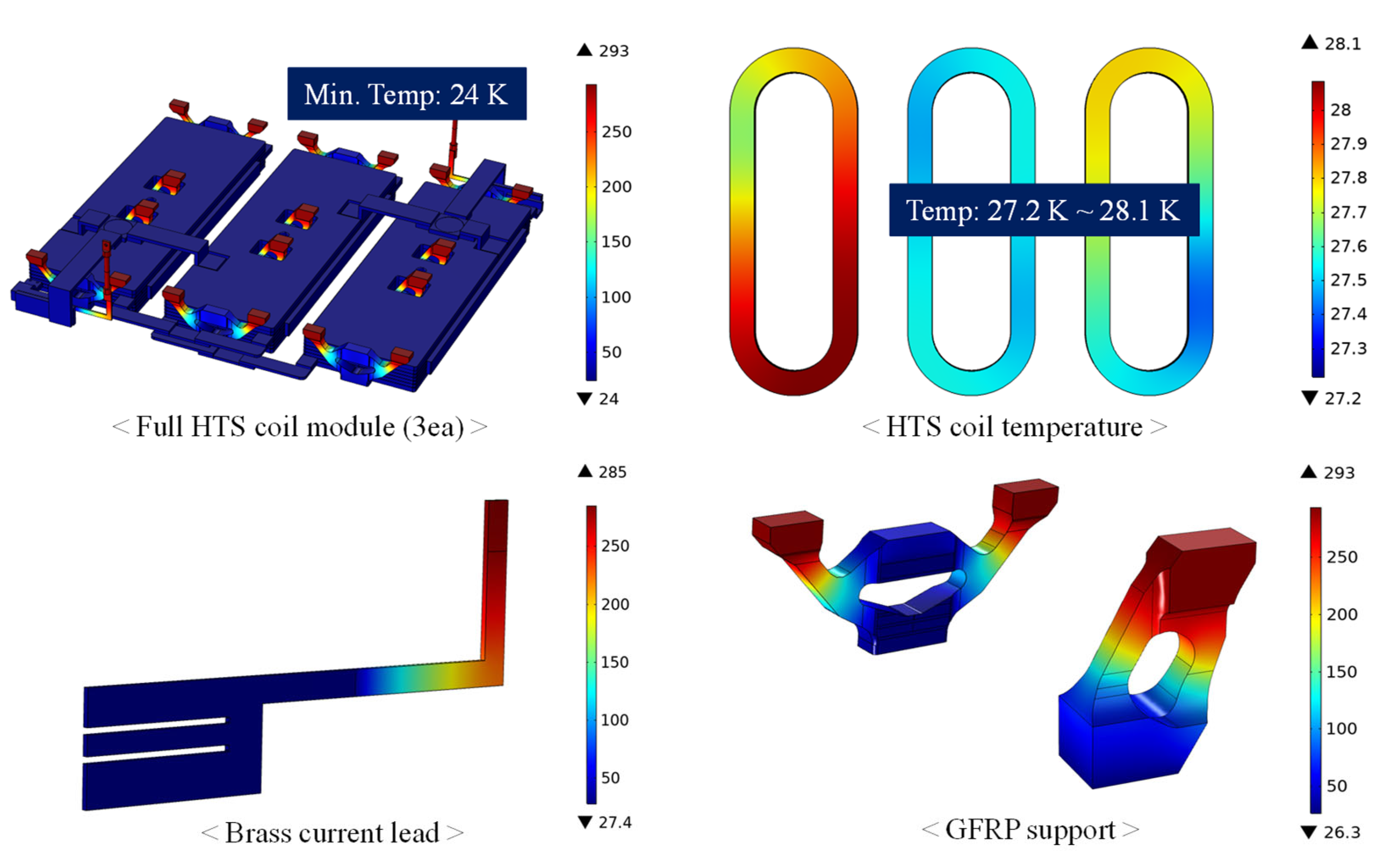
Figure 9 presents the 3D FEM thermal simulation results of the conduction-cooled PES when two RDK-400B cryocoolers are applied as the primary cooling source. The temperature distribution of the full HTS coil module shows a minimum temperature of approximately 24 K, with the HTS coils stabilizing in the range of 27.2~28.1 K under steady-state operation. The brass current lead indicates a gradual temperature gradient from the ambient region to the cryogenic interface, confirming that the optimized lead geometry effectively reduces conductive heat inflow. The GFRP support structures also exhibit predictable thermal gradients, maintaining structural temperatures above the cryogenic limit while minimizing parasitic heat loads. These results demonstrate that the RDK-400B cryocoolers provide sufficient cooling performance to maintain the PES below 30 K, although the available thermal margin is relatively limited.
Figure 9.
Three-dimensional FEM simulation results (using two RDK-400B cryo-coolers).
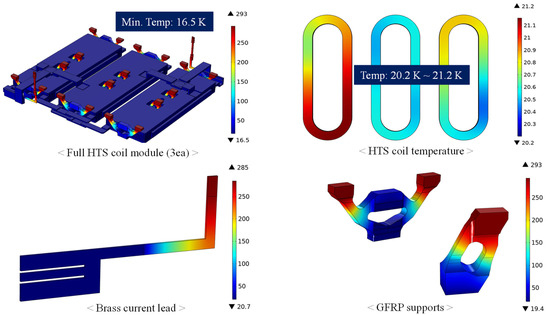
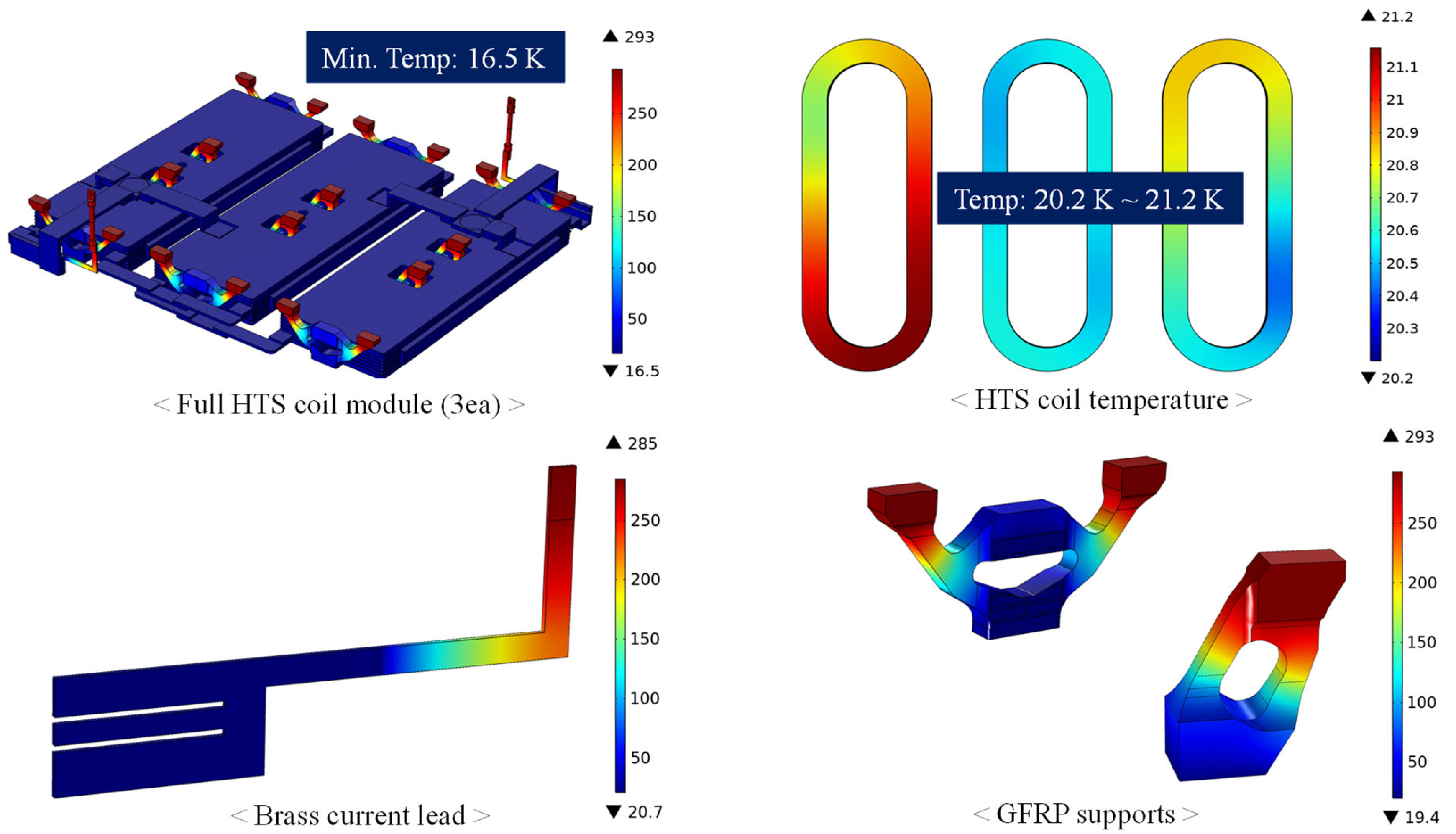
Figure 10 shows the corresponding FEM simulation results when two higher-capacity RDK-500B cryocoolers are employed. The increased cooling power results in a substantially lower minimum temperature of approximately 16.5 K in the full HTS coil module, and the HTS coil operating range improves to 20.2~21.2 K. This enhanced temperature profile provides significant thermal margin for dynamic loading conditions and non-uniform heat generation within the PES. The brass current lead and GFRP supports exhibit similar thermal behavior to that observed in the RDK-400B case, but with overall temperature levels reduced due to the improved cooling capacity. The results confirm that the RDK-500B offers superior thermal stability and robustness, making it a more suitable choice for the conduction-cooled PES, particularly considering the total heat load of 78 W.
Figure 10.
Three-dimensional FEM simulation results (using two RDK-500B cryo-coolers).
Overall, the comparative FEM results indicate that both cryocooler types can maintain cryogenic operation within the required temperature range for HTS coil testing; however, the RDK-500B provides a greater cooling margin and improved uniformity across the PES components, which is advantageous for ensuring stable HTS performance and reducing thermal stress during operation.
In the conduction-cooled configuration, temperature gradients are observed along thermal straps, copper heat spreaders, and structural supports. Such gradients may potentially induce thermo-mechanical effects such as thermal contraction mismatch and localized thermal stress. However, the major thermal links (e.g., copper braided straps) are inherently mechanically compliant, and thus they mitigate thermally induced forces by accommodating differential contraction during cool-down. Moreover, the GFRP primarily supports the function as positioning components with relatively low thermal conductivity, which limits thermally induced loading paths. Therefore, the resulting thermo-mechanical deformation is expected to remain minor (within typical assembly tolerances) and is not anticipated to compromise alignment or structural integrity of the HTS coil modules.
3.5. Comparison of Heat Loss According to Cooling Method
Table 4 summarizes the detailed comparison of heat loss between the He–Ne hybrid cooling system and the conduction cooling configurations using two different cryocooler models, RDK-400B and RDK-500B. The He–Ne hybrid system exhibits a total thermal load of approximately 177 W, largely due to losses in the blower unit, vacuum-jacketed pipes, and the He–Ne heat exchanger. In contrast, the conduction cooling configurations show significantly reduced total heat loads of 78.48 W and 78.75 W when using two RDK-400B and two RDK-500B cryocoolers, respectively. The reductions primarily stem from the elimination of bayonet joints and gas-circulation components, which contribute substantial parasitic heat loads in the hybrid system. Both conduction cooling designs demonstrate significantly higher cryocooler margins, with the RDK-400B configuration providing 51.5% (82.5 W) and the RDK-500B configuration providing 64.2% (141.2 W), whereas the He–Ne hybrid system shows only 11.5%. These results confirm that conduction cooling not only reduces steady-state heat loss but also offers greater operational robustness and thermal stability for the PES.
Table 4.
Comparison of total heat loss and cryocooler margins for different cooling methods.
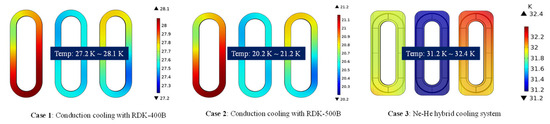
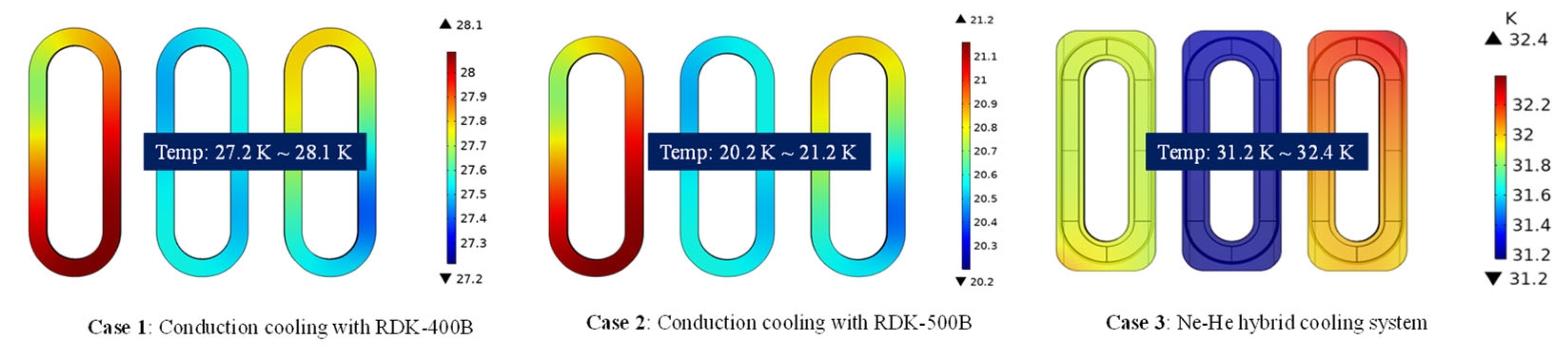
Figure 11 and Table 5 illustrate the steady-state HTS coil temperature distributions obtained from thermal analysis for the three cooling configurations. In the case of conduction cooling with RDK-400B, the HTS coils maintain temperatures between 27.2 K and 28.1 K, demonstrating adequate cooling performance with moderate thermal margin. When the higher-capacity RDK-500B cryocoolers are used, coil temperatures further decrease to 20.2–21.2 K, indicating a substantial improvement in thermal uniformity and reduced temperature gradient along the coil length. In contrast, the He–Ne hybrid cooling system exhibits a higher operating temperature range of 31.2–32.4 K, which is close to the thermal limit for HTS operation and leaves considerably less thermal margin compared with the conduction-cooled designs. These results confirm that conduction cooling provides more reliable cryogenic conditions for HTS performance evaluation.
Figure 11.
Thermal analysis results of the HTS field coils according to the cooling methods.
Table 5.
Temperature of the HTS field coils according to the cooling methods.
4. Detailed Design of the PES with Conduction Cooling System
Based on the design requirements and thermal–mechanical analysis results, a detailed engineering configuration of the conduction-cooled PES was developed, and the final arrangement of all cooling and structural components was established as shown in Figure 12, Figure 13, Figure 14, Figure 15, Figure 16, Figure 17 and Figure 18. This detailed design reflects the integration of the optimized cooling pathways, cryocooler interfaces, and mechanical support structures derived from the preceding analysis.
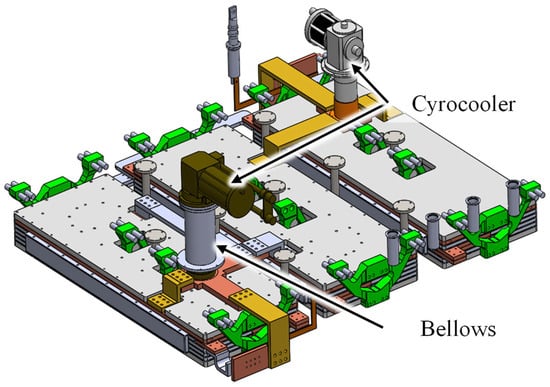
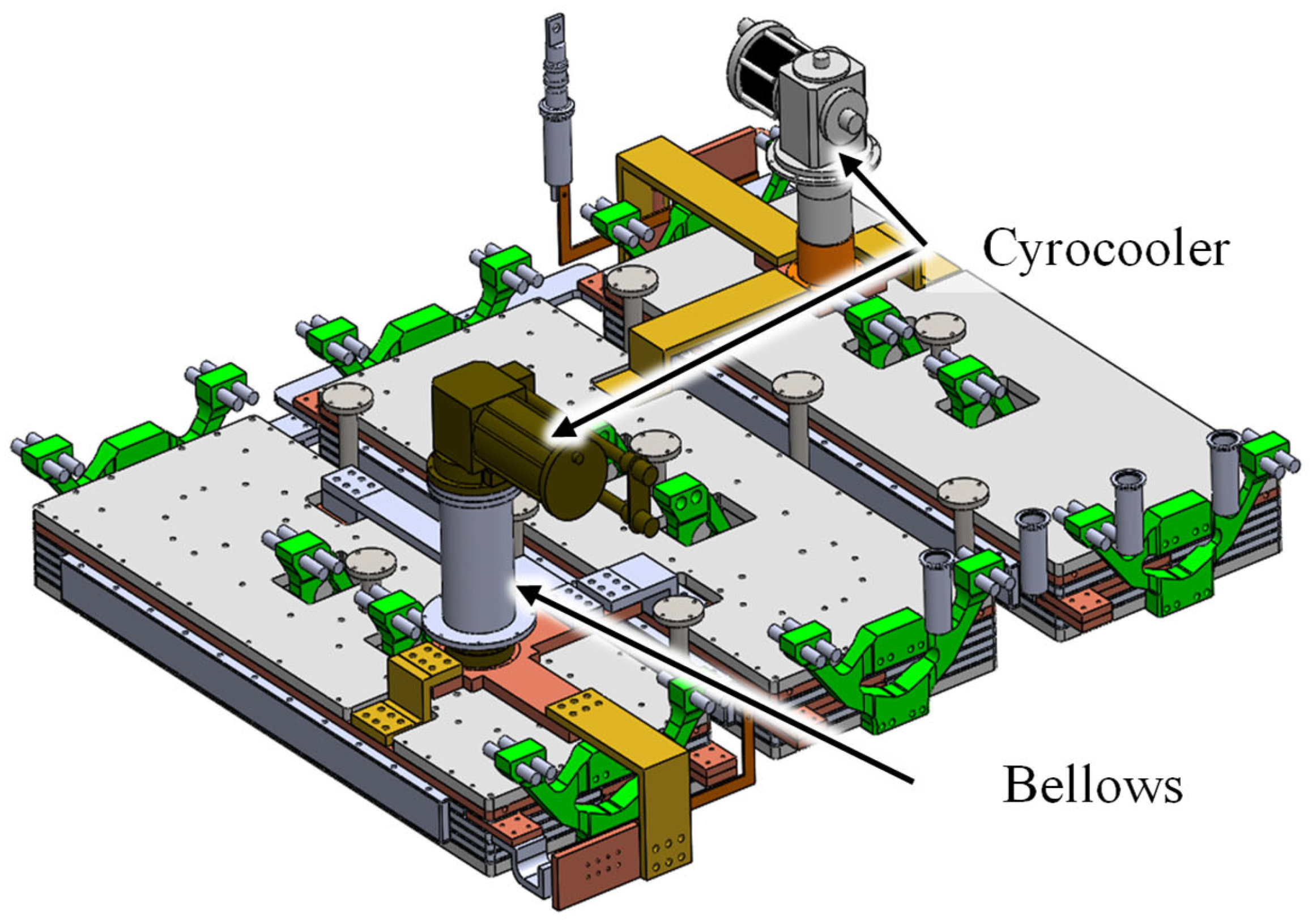
Figure 12.
Detailed layout of the PES with conduction cooling components.
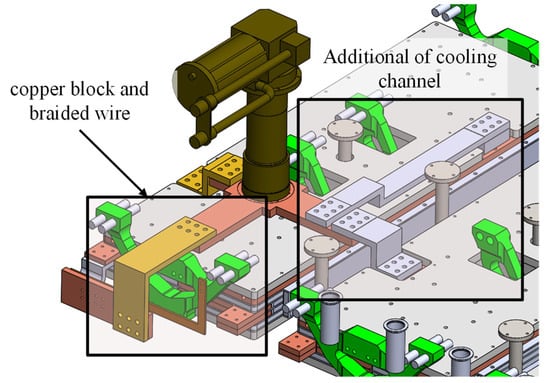
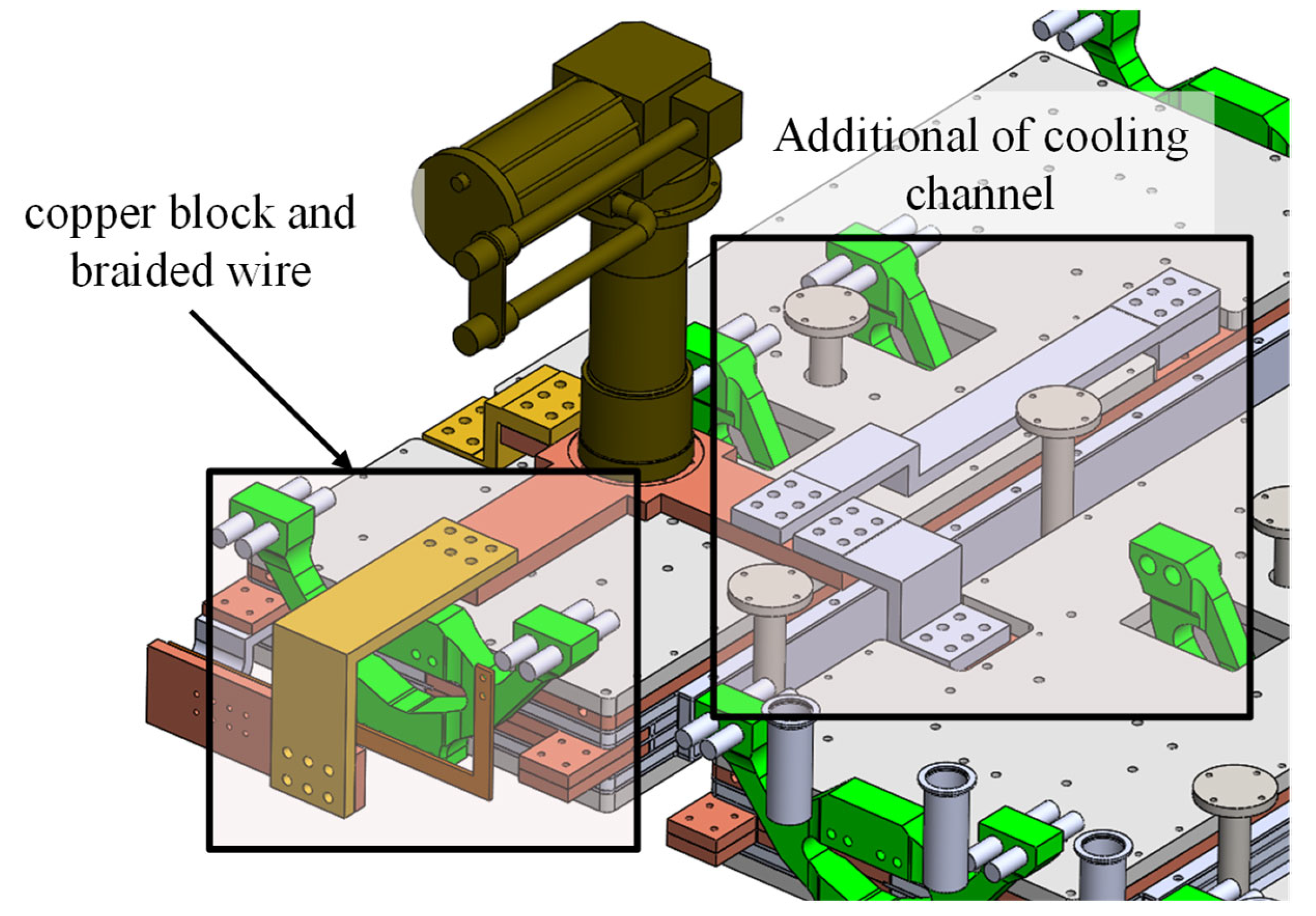
Figure 13.
Additional cooling channels and copper–braided wire assembly.
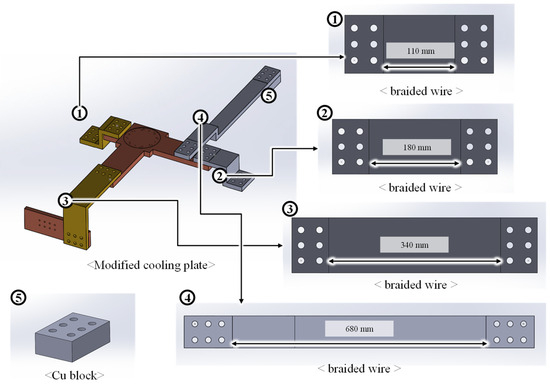
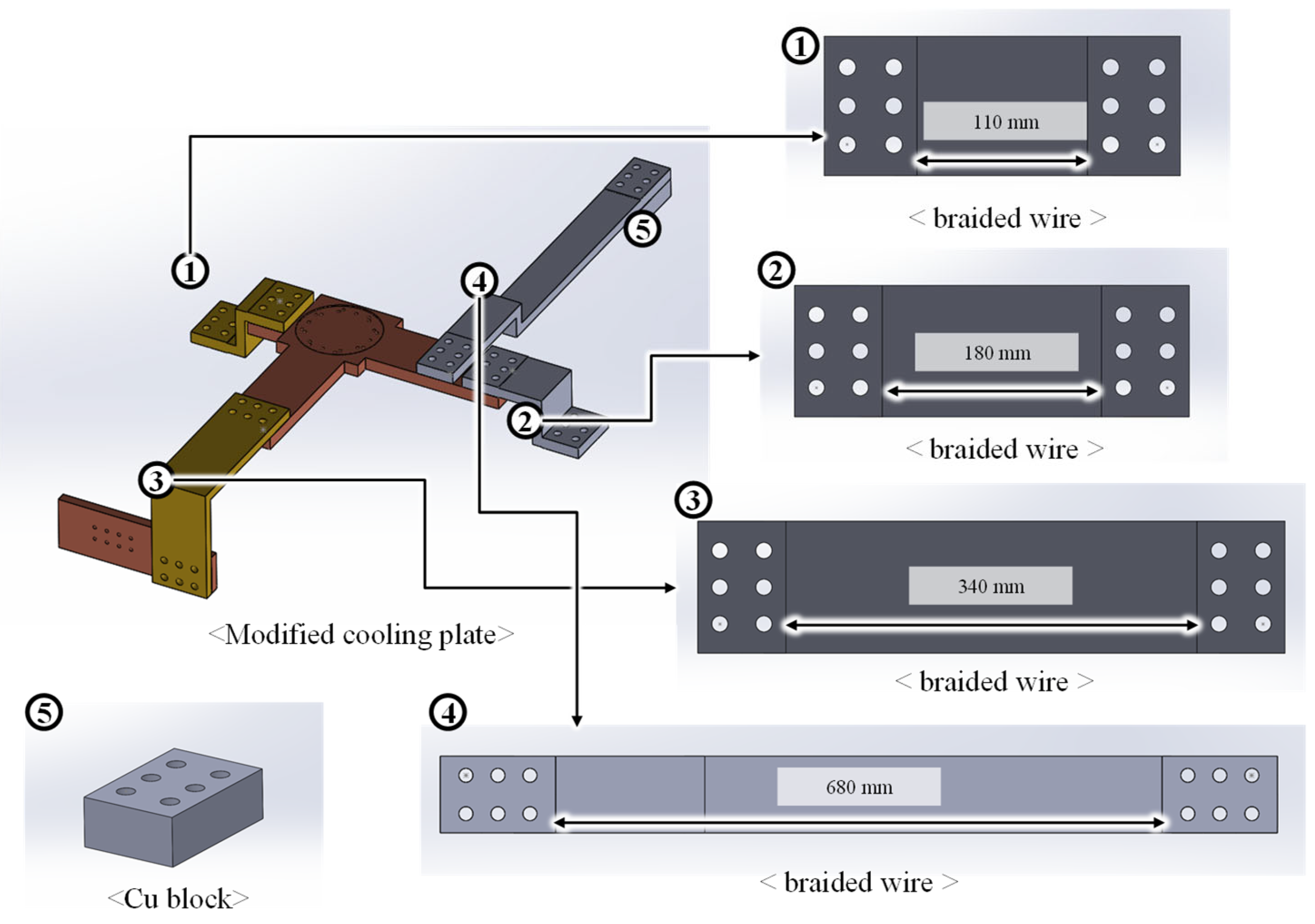
Figure 14.
Components of the modular conduction cooling plate.
Figure 15.
Design of the conduction cooling plate.
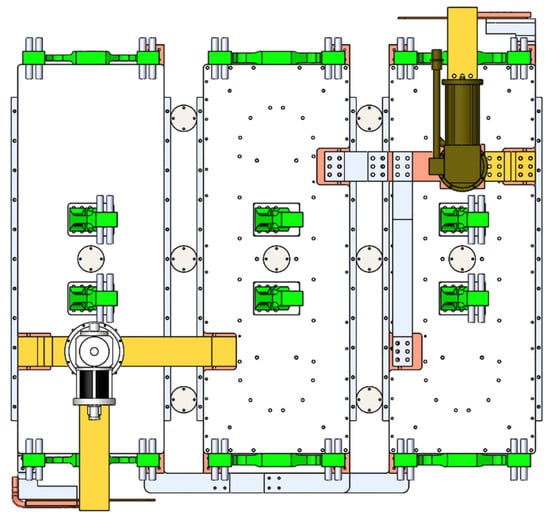
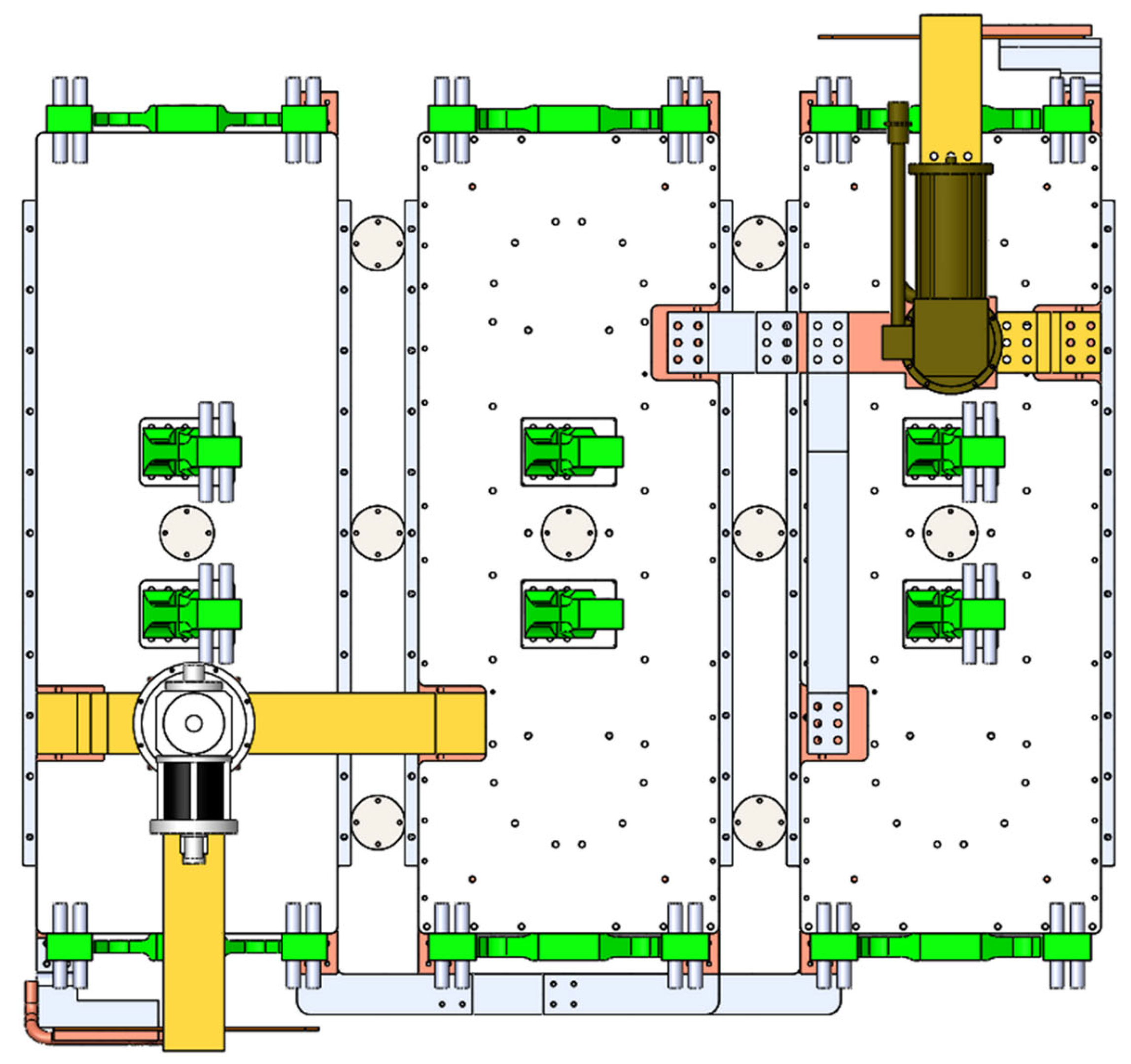
Figure 16.
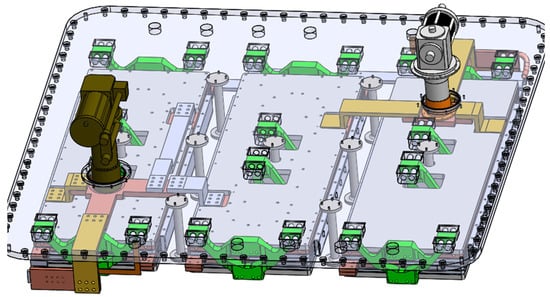
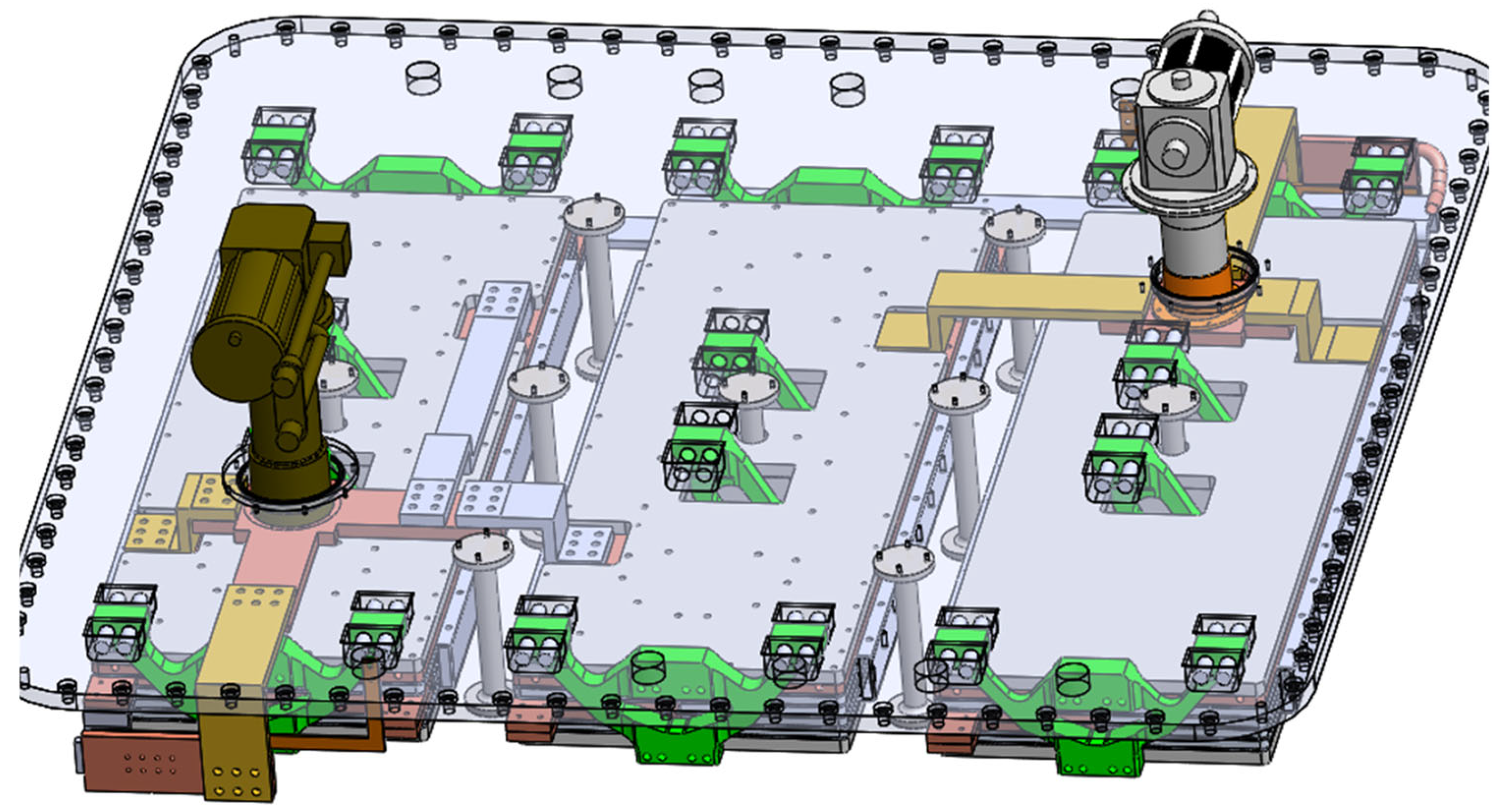
Top-view arrangement of conduction cooling elements in the PES.
Figure 17.
Three-dimensional integration of the conduction cooling system within the cryostat.
Figure 18.
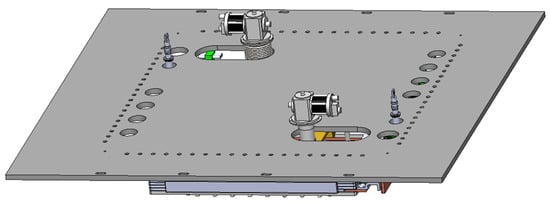
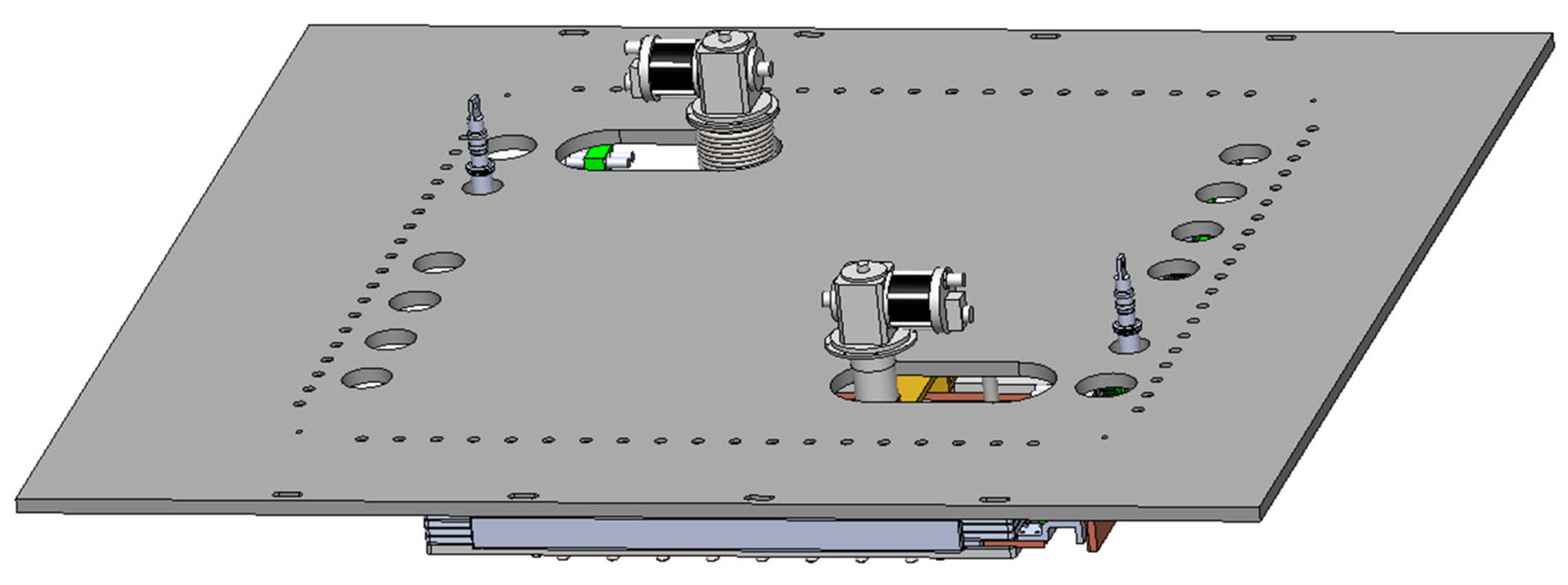
Installation of the conduction cooling assembly onto the back-iron structure.
Figure 12 presents the structural layout of the PES designed for conduction cooling. The cryocooler cold heads are mounted on the upper assembly, and bellows are incorporated to accommodate thermal contraction while preventing mechanical stress from being transmitted to the HTS modules. This configuration ensures both structural reliability and stable thermal coupling within the cryostat.
Figure 13 highlights the introduction of additional cooling channels and the incorporation of copper blocks with braided copper wires to enhance heat transfer efficiency. These components serve as flexible, high-conductivity thermal links that distribute cooling uniformly across the HTS coil modules, reducing localized thermal resistance and improving overall thermal stability.
Figure 14 illustrates the modular conduction cooling plate and its constituent elements, including multiple braided wire segments and a compact copper block. These modular components form optimized thermal routes between the cryocooler cold head and the HTS coil assembly, enabling effective heat extraction and reduced thermal gradients.
Figure 15 shows the finalized cooling plate design, which includes multiple thermal interfaces and mounting features to ensure secure installation and uniform heat spreading. The symmetric structure supports stable thermal performance across all three HTS coil modules within the PES.
Figure 16 provides a top-view representation of the installed conduction cooling components. The placement of cryocoolers, braided wires, and cooling plates is optimized to minimize thermal resistance and maximize cooling efficiency across the system.
Figure 17 presents the three-dimensional integration of the conduction cooling system within the cryostat. This figure visualizes how the thermal pathways and structural supports are interconnected to form a unified cooling architecture capable of maintaining the HTS coils at the target operating temperature.
Figure 18 shows the installation of the integrated conduction cooling assembly onto the back-iron structure. This step demonstrates how the thermal management system aligns with the magnetic and mechanical elements of the PES, completing the final assembly before cryostat sealing.
Figure 12, Figure 13, Figure 14, Figure 15, Figure 16, Figure 17 and Figure 18 illustrate the complete engineering realization of the conduction cooling system, incorporating analysis-driven optimization and full mechanical integration. This comprehensive design establishes a practical foundation for future fabrication and experimental evaluation of the conduction-cooled PES.
5. Conclusions
This study presented the design and numerical evaluation of a conduction-cooled performance evaluation system (PES) for 10 MW-class high-temperature superconducting (HTS) field coil testing, aiming to overcome the limitations of the previously implemented helium–neon (He–Ne) circulation-based cooling configuration. In the conventional system, the cryogenic circulation loop and associated components increase installation complexity and introduce substantial parasitic heat loads, which reduce scalability and adaptability for modular HTS coil evaluation.
A conduction-cooled PES architecture was proposed to simplify the cryogenic structure by eliminating fluid circulation components and by introducing solid conduction pathways using cryocoolers, copper heat spreaders, and thermal straps. Based on analytical heat-load estimation and three-dimensional FEM thermal simulations, the total heat load of the proposed conduction-cooled PES was reduced from approximately 177 W in the He–Ne circulation system to about 78 W, indicating a significant improvement in thermal efficiency. Comparative simulations using two commercially available cryocoolers (RDK-400B and RDK-500B) confirmed that both configurations satisfy the required cryogenic operating range for HTS coil evaluation, while the higher-capacity RDK-500B provides a larger thermal margin and improved robustness against heat disturbances and interface uncertainties.
In addition, detailed engineering layouts and component-level designs were developed for fabrication readiness, including optimized thermal conduction routes and current lead configurations to minimize parasitic heat leakage into the cryogenic region. Although the proposed conduction-cooled PES has not yet been experimentally fabricated, the numerical framework was established based on validated operating conditions and prior experimental experience with the baseline He–Ne-cooled PES.
Future work will focus on the fabrication of the conduction-cooled PES, experimental verification of thermal performance under coil energization, and further refinement of thermal interface design to enhance cooling efficiency and operational stability. Overall, the proposed conduction cooling architecture provides practical design guidelines for scalable and modular PES platforms and supports the development of next-generation large-capacity HTS rotating machinery.
Author Contributions
Conceptualization and methodology, B.-S.G.; software B.-S.G.; investigation, B.-S.G. and S.-J.L.; writing—original draft preparation, B.-S.G.; writing—review and editing, B.-S.G. and S.-J.L.; project administration, B.-S.G. and S.-J.L.; supervision, B.-S.G. All authors have read and agreed to the published version of the manuscript.
Funding
This work was supported by the Korea Institute of Energy Technology Evaluation and Planning (KETEP) grant funded by the Korea government (MOTIE) (RS-2022-KP002821, Development of durability evaluation and remaining useful life prediction technology for wind turbine life extension).
Data Availability Statement
The original contributions presented in this study are included in the article. Further inquiries can be directed to the corresponding author.
Conflicts of Interest
The authors declare no conflicts of interest.
References
- Maki, N.; Takao, T.; Fuchino, S.; Hiwasa, H.; Hirakawa, M.; Okumura, K.; Asada, M.; Takahashi, R. Study of Practical Applications of HTS Synchronous Machines. IEEE Trans. Appl. Supercond. 2005, 15, 2166–2169. [Google Scholar] [CrossRef]
- Lewis, C.; Muller, J. A Direct Drive Wind Turbine HTS Generator. In Proceedings of the IEEE Power Engineering Society General Meeting, Tampa, FL, USA, 24–28 June 2007; pp. 1–8. [Google Scholar]
- Klaus, G.; Wilke, M.; Frauenhofer, J.; Nick, W.; Neumüller, H.W. Design Challenges and Benefits of HTS Synchronous Machines. In Proceedings of the IEEE Power Engineering Society General Meeting, Tampa, FL, USA, 24–28 June 2007; pp. 1–8. [Google Scholar]
- McDonald, A. Structural Analysis of Low-Speed, High-Torque Electrical Generators for Direct Drive Renewable Energy Converters. Ph.D. Thesis, University of Edinburgh, Edinburgh, UK, 2008. [Google Scholar]
- Xu, Y.; Maki, N.; Izumi, M. Performance Comparison of 10-MW Wind Turbine Generators with HTS, Copper, and PM Excitation. IEEE Trans. Appl. Supercond. 2015, 25, 5204006. [Google Scholar] [CrossRef] [Scilit]
- Chang, H.M.; Kim, M.J. Optimization of Conduction-Cooled Current Leads with Unsteady Operating Current. Cryogenics 2009, 49, 210–217. [Google Scholar] [CrossRef] [Scilit]
- Van Nugteren, J.; Willering, G.P.; Wessel, W.A.J.; ten Kate, H.H.J. Thermal Drift and Heat Load Characterization of Conduction-Cooled High-Field Superconducting Coils. Supercond. Sci. Technol. 2016, 29, 085009. [Google Scholar]
- Jang, J.Y.; Yoon, S.; Hahn, S.; Lee, S.G. Design, Construction and 13 K Conduction-Cooled Operation of a 3 T 100 mm Bore REBCO Magnet. Supercond. Sci. Technol. 2017, 30, 104010. [Google Scholar] [CrossRef] [Scilit]
- Haran, K.S.; Kalsi, S.; Arndt, T.; Karmaker, H.; Badcock, R.; Buckley, B.; Haugan, T.; Izumi, M.; Loder, D.; Bray, J.W.; et al. High Power Density Superconducting Machines—Development Status and Technology Roadmap. Supercond. Sci. Technol. 2017, 30, 123002. [Google Scholar] [CrossRef] [Scilit]
- McDonald, A.; Bhuiyan, N.A. Optimization of Generators for Offshore Direct Drive Wind Turbines. IEEE Trans. Energy Convers. 2017, 32, 348–358. [Google Scholar] [CrossRef] [Scilit]
- Brambilla, R.; Grilli, F.; Martini, L.; Bocchi, M.; Angeli, G. A Finite-Element Method Framework for Modeling Rotating Machines With Superconducting Windings. IEEE Trans. Appl. Supercond. 2018, 28, 5207511. [Google Scholar] [CrossRef] [Scilit]
- Cavagnino, A.; Niu, X.; Roselli, C.; Rocchi, D. Design and Optimization of Conduction-Cooled HTS Current Leads by Numerical Thermal Modeling. Cryogenics 2018, 92, 77–86. [Google Scholar]
- Sung, H.J.; Go, B.S.; Park, M. A Performance Evaluation System of an HTS Pole for Large-scale HTS Wind Power Generators. IEEE Trans. Appl. Supercond. 2019, 29, 5203905. [Google Scholar] [CrossRef] [Scilit]
- Go, B.S.; Sung, H.J.; Park, M.; Yu, I.K. Design and Comparative Analysis of Performance Evaluation Systems for a Large-Scale HTS Generator. IEEE Trans. Appl. Supercond. 2019, 29, 5204005. [Google Scholar] [CrossRef]
- Winkler, T. The EcoSwing Project. IOP Conf. Ser. Mater. Sci. Eng. 2019, 502, 012004. [Google Scholar] [CrossRef] [Scilit]
- Kim, C.; Sung, H.J.; Go, B.S.; Nam, G.D.; Kim, S.; Park, M. Design and Property Analysis of a Performance Evaluation System for HTS Wind Power Generators. IEEE Trans. Appl. Supercond. 2020, 30, 5202805. [Google Scholar] [CrossRef] [Scilit]
- Song, X.; Mijatovic, N.; Bührer, C.; Kellers, J.; Wiezoreck, J.; Krause, J.; Pütz, H.; Hansen, J.; Rebsdorf, A.V. Experimental Validation of a Full-Size Pole Pair Set-Up of an MW-Class Direct Drive Superconducting Wind Turbine Generator. IEEE Trans. Energy Convers. 2020, 35, 1120–1128. [Google Scholar] [CrossRef] [Scilit]
- Song, X.; Bührer, C.; Brutsaert, P.; Ammar, A.; Krause, J.; Bergen, A.; Winkler, T.; Dhalle, M.; Hansen, J.; Rebsdorf, A.V.; et al. Ground Testing of the World’s First MW-Class Direct-Drive HTS Wind Turbine Generator. IEEE Trans. Energy Convers. 2020, 35, 757–764. [Google Scholar] [CrossRef] [Scilit]
- Sun, R.; Abeynayake, G.; Liang, J.; Wang, K. Reliability and Economic Evaluation of Offshore Wind Power DC Systems. Energies 2021, 14, 2922. [Google Scholar] [CrossRef] [Scilit]
- Tartt, K.; Amiri, A.; McDonald, A.; Jaen-Sola, P. Structural Optimisation of Offshore Direct Drive Wind Turbine Generators. J. Phys. Conf. Ser. 2021, 2018, 012040. [Google Scholar] [CrossRef] [Scilit]
- Asim, T.; Islam, S.Z.; Hemmati, A.; Khalid, M.S.U. A Review of Recent Advancements in Offshore Wind Turbine Technology. Energies 2022, 15, 579. [Google Scholar] [CrossRef] [Scilit]
- Bensalah, A.; Barakat, G.; Amara, Y. Electrical Generators for Large Wind Turbine: Trends and Challenges. Energies 2022, 15, 6700. [Google Scholar] [CrossRef] [Scilit]
- Barooni, M.; Ashuri, T.; Velioglu Sogut, D.; Wood, S.; Taleghani, S. Floating Offshore Wind Turbines: Current Status and Future Prospects. Energies 2023, 16, 2. [Google Scholar] [CrossRef] [Scilit]
- Soares, R.; Oliveira, A.; Sarrias, M.; Fernandez, R. Current Status and Future Trends of Offshore Wind Power in Europe. Energy 2020, 202, 117787. [Google Scholar] [CrossRef] [Scilit]
- Goudarzi, N.; Zhu, W.D. A Review on the Development of Wind Turbine Generators Across the World. Int. J. Dyn. Control 2013, 1, 192–202. [Google Scholar] [CrossRef] [Scilit]
- Jaen-Sola, P.; Donald, A. Design of Direct-Drive Wind Turbine Electrical Generator Structures Using Topology Optimization Techniques. J. Phys. Conf. Ser. 2020, 1618, 052009. [Google Scholar] [CrossRef] [Scilit]
- Hansen, T.A.; Wilson, E.J.; Fitts, J.P.; Jansen, M.; Beiter, P.; Steffen, B.; Xu, B.; Guillet, J.; Münster, M.; Kitzing, L. Five Grand Challenges of Offshore Wind Financing in the United States. Energy Res. Soc. Sci. 2024, 107, 103329. [Google Scholar] [CrossRef] [Scilit]
- Tumse, S.; Bilgili, M.; Yildirim, A.; Sahin, B. Comparative Analysis of Global Onshore and Offshore Wind Energy Characteristics and Potentials. Sustainability 2024, 16, 6614. [Google Scholar] [CrossRef] [Scilit]
- McDonald, A.; Sola, P. Advanced Structural Modelling of Wind Turbine Electrical Generators. Ph.D. Thesis, Newcastle University, Newcastle upon Tyne, UK, 2017. [Google Scholar]
- IRENA. Future of Wind: Deployment, Investment, Technology, Grid Integration and Socio-Economic Aspects (A Global Energy Transformation Paper); International Renewable Energy Agency: Masdar City, United Arab Emirates, 2019. [Google Scholar]
- Go, B.S. Characteristic Analysis of Electromagnetic Force in an HTS Field Coil Using a Performance Evaluation System. Energies 2024, 17, 4366. [Google Scholar] [CrossRef] [Scilit]
- Seo, G.; Mun, J.; Kim, D.; Park, M.; Kim, S. Neon–Helium Hybrid Cooling System for a 10 MW Class Superconducting Wind Power Generator. IEEE Trans. Appl. Supercond. 2021, 31, 5202205. [Google Scholar] [CrossRef] [Scilit]

Disclaimer/Publisher’s Note: The statements, opinions and data contained in all publications are solely those of the individual author(s) and contributor(s) and not of MDPI and/or the editor(s). MDPI and/or the editor(s) disclaim responsibility for any injury to people or property resulting from any ideas, methods, instructions or products referred to in the content. |
© 2026 by the authors. Licensee MDPI, Basel, Switzerland. This article is an open access article distributed under the terms and conditions of the Creative Commons Attribution (CC BY) license.