Article

ANFIS-Based Controller and Associated Cybersecurity Issues with Hybrid Energy Storage Used in EV-Connected Microgrid System

Department of Electrical & Computer Engineering, The University of Memphis, Memphis, TN 38111, USA
*
Author to whom correspondence should be addressed.
Energies 2026, 19(4), 1103; https://doi.org/10.3390/en19041103
Submission received: 28 December 2025 / Revised: 2 February 2026 / Accepted: 19 February 2026 / Published: 22 February 2026

Abstract

The increasing integration of electric vehicles (EVs) and renewable energy sources has accelerated the adoption of DC microgrids, where maintaining voltage stability and effective power sharing remains a critical challenge. Hybrid energy storage systems (HESS), combining batteries and supercapacitors, are commonly employed to address dynamic power variations. However, conventional proportional–integral (PI)-based control strategies for HESS can exhibit performance limitations under nonlinear and varying operating conditions. To overcome this drawback, this paper presents an adaptive neuro-fuzzy inference system (ANFIS)-based control strategy for HESS located in a DC microgrid, with comparative evaluation against both conventional PI and traditional Fuzzy Logic controller (FLC) schemes. The proposed approach is evaluated using a detailed MATLAB/Simulink R2024a model of a DC microgrid including EVs. Simulation results show that, under normal operating conditions, the ANFIS-based control demonstrates improved transient response, reduced voltage fluctuations, and effective coordination between the battery and supercapacitor during renewable power variations, compared to PI and FLC-controlled systems. In addition to nominal performance assessment, this work investigates the vulnerability of the ANFIS controller to cyber-attacks. Two representative attack scenarios, false data injection (FDI) and denial-of-service (DoS), are applied to critical measurement and control signals of HESS. Simulation results reveal that, although the DC-bus voltage regulation is largely maintained during attack intervals, cyber manipulation significantly disrupts the intended HESS power-sharing behavior.

1. Introduction

In recent years, the adoption of electric vehicles (EVs) has been rapidly increasing due to growing environmental concerns and continuous technological advancements in transportation electrification [1]. The pollution of the environment, increasing prices of fossil fuels, low efficiency of gasoline-powered vehicles, and numerous advantages of electric vehicles over their gasoline counterparts—such as clean technology, nearly zero greenhouse gas emissions, higher efficiency, and lower electricity costs compared to fossil fuels—have positioned electric vehicles as the primary alternative in the transportation sector [2]. In 2023, global EV sales exceeded 14 million units, representing an increase of approximately 35% compared to the previous year [3]. While this rapid growth supports decarbonization goals, it also introduces new challenges for existing power system infrastructure, particularly in terms of voltage regulation, increased peak demand, and stress on distribution networks during simultaneous EV charging events [4,5].
The increasing penetration of renewable energy sources and the rapid growth of EVs are driving a shift toward DC microgrids as an efficient and scalable solution for localized power delivery [6,7]. Compared to conventional AC systems, DC microgrids offer higher efficiency, simpler integration of renewable sources, and improved compatibility with DC loads such as EV chargers and energy storage systems. To ensure the DC-bus voltage remains stable during normal operating conditions, DC microgrids must respond effectively to variations in both renewable energy generation and the highly dynamic charging behavior of EVs [8,9]. These variations can cause rapid changes in power balance, leading to voltage deviations and reduced power-quality performance if not properly managed [10].
To address this challenge, many DC microgrids incorporate hybrid energy storage system (HESS) that combine batteries and supercapacitors [11]. The HESS enables coordinated energy management in which the battery maintains long-term energy balance while the supercapacitor mitigates short-term disturbances [12]. This coordinated operation reduces battery stress, enhances system lifetime, and improves overall voltage stability [13]. Conventional proportional–integral (PI) controllers have been extensively used for DC microgrid control due to their simplicity and ease of implementation [14]. However, PI-based control strategies often require careful tuning and may exhibit degraded performance under nonlinear system behavior, parameter uncertainty, and rapidly changing operating conditions [15]. To overcome these limitations, intelligent control approaches such as fuzzy logic control, neural networks, and adaptive neuro-fuzzy inference system (ANFIS) controllers have gained increasing attention in recent years [16,17,18,19]. Among these, ANFIS offers a unique combination of learning capability and rule-based interpretability, making it attractive for power electronic and microgrid applications [20].
Although extensive research has been conducted on the operation and control of HESS in DC microgrids, most studies primarily address voltage regulation and power management under normal operating conditions [12,21]. These works successfully demonstrate the coordination between the battery and the supercapacitor but typically assume ideal communication networks and perfect sensor measurements, without considering the effects of malicious data interference [22,23]. While cybersecurity in power systems has received growing attention, existing research largely concentrates on transmission systems, smart meters, or conventional distribution networks [24]. In practical DC microgrids, control architecture increasingly relies on communication-enabled measurement and reference signals, which expose intelligent controllers to cybersecurity threats [25]. Cyber-attacks such as false data injection (FDI) and denial-of-service (DoS) have been shown to severely impact power system stability and control performance by corrupting measurements or blocking control signals [26,27]. In FDI attacks, malicious data are intentionally injected into measurement or reference signals, leading to incorrect control actions. A notable example occurred in 2015, when cyber attackers injected falsified data into the Ukrainian power grid, disrupting electricity supply to more than 225,000 customers [28,29]. DoS attacks disrupt communication by blocking or freezing critical signals required for control and monitoring. In a DoS attack, the controller may receive outdated, incomplete, or no information from sensors or supervisory layers, effectively preventing timely control actions. Such disruptions can cause loss of coordination among distributed resources, delayed response to disturbances, and increased stress on energy storage components [30]. Both attack types can adversely affect microgrid stability, degrade voltage regulation, and compromise coordinated energy management, particularly in communication-dependent control architectures.
Motivated by these gaps, this paper presents the design and evaluation of an ANFIS-based control framework for a battery–supercapacitor HESS equipped with a DC microgrid consisting of solar photovoltaic (PV) and EV and investigates its vulnerability to cyber-attacks. The proposed control architecture employs an outer ANFIS-based DC-bus voltage regulation loop and inner ANFIS-based current control loops for coordinated HESS operation. The ANFIS controllers are trained offline using operational data generated from conventionally tuned PI controllers to ensure stable operation and fair performance comparison. In addition to evaluating nominal performance under EV load and solar irradiance variations, this work examines the impact of FDI and DoS attacks on critical measurement and control signals of HESS. In this work, extensive simulations have been performed using MATLAB/Simulink software.
The main contributions of this paper are summarized as follows:
  • An ANFIS-based hierarchical control scheme is developed for HESS equipped with a solar PV and EV-connected DC microgrid system.
  • The performance of the proposed ANFIS controller is compared with that of the conventional PI controller and a traditional Fuzzy Logic controller (FLC) for HESS.
  • The cybersecurity vulnerability of ANFIS-controlled HESS is systematically investigated by modeling and applying FDI and DoS attacks on critical measurement and control signals within the DC microgrid.
  • A qualitative and performance-oriented analysis is conducted to demonstrate how cyber-attacks disrupt the intended power-sharing mechanism between the battery and supercapacitor.
The remainder of this paper is organized as follows. Section 2 presents the problem statement. Section 3 introduces the proposed ANFIS-based control framework for HESS, where the overall control architecture is described. For comparison purposes, the PI controller and FLC design is also summarized in this section. Section 4 discusses the simulation results and compares the performance of the controllers under normal operating conditions. Section 5 addresses cybersecurity issues associated with ANFIS-controlled HESS, including the mechanism and mathematical modeling of the attacks, and the assumptions and scope of the analysis. Section 6 presents and discusses the simulation results under cyber-attack scenarios, highlighting the impact of FDI and DoS attacks on system stability and battery–supercapacitor coordination. Finally, Section 7 concludes the paper and summarizes the key findings and insights.

2. Problem Statement

The increasing penetration of renewable energy sources, particularly photovoltaic (PV) systems, has accelerated the deployment of DC microgrids in EV-connected power systems. DC microgrids offer higher efficiency, simpler power conversion stages, and better compatibility with DC-native sources and loads such as PV arrays, battery energy storage systems, supercapacitors, and EV charging infrastructure. However, the intermittent and stochastic nature of solar generation introduces significant challenges in maintaining DC-bus voltage stability, power balance, and proper energy-sharing among hybrid energy storage components.
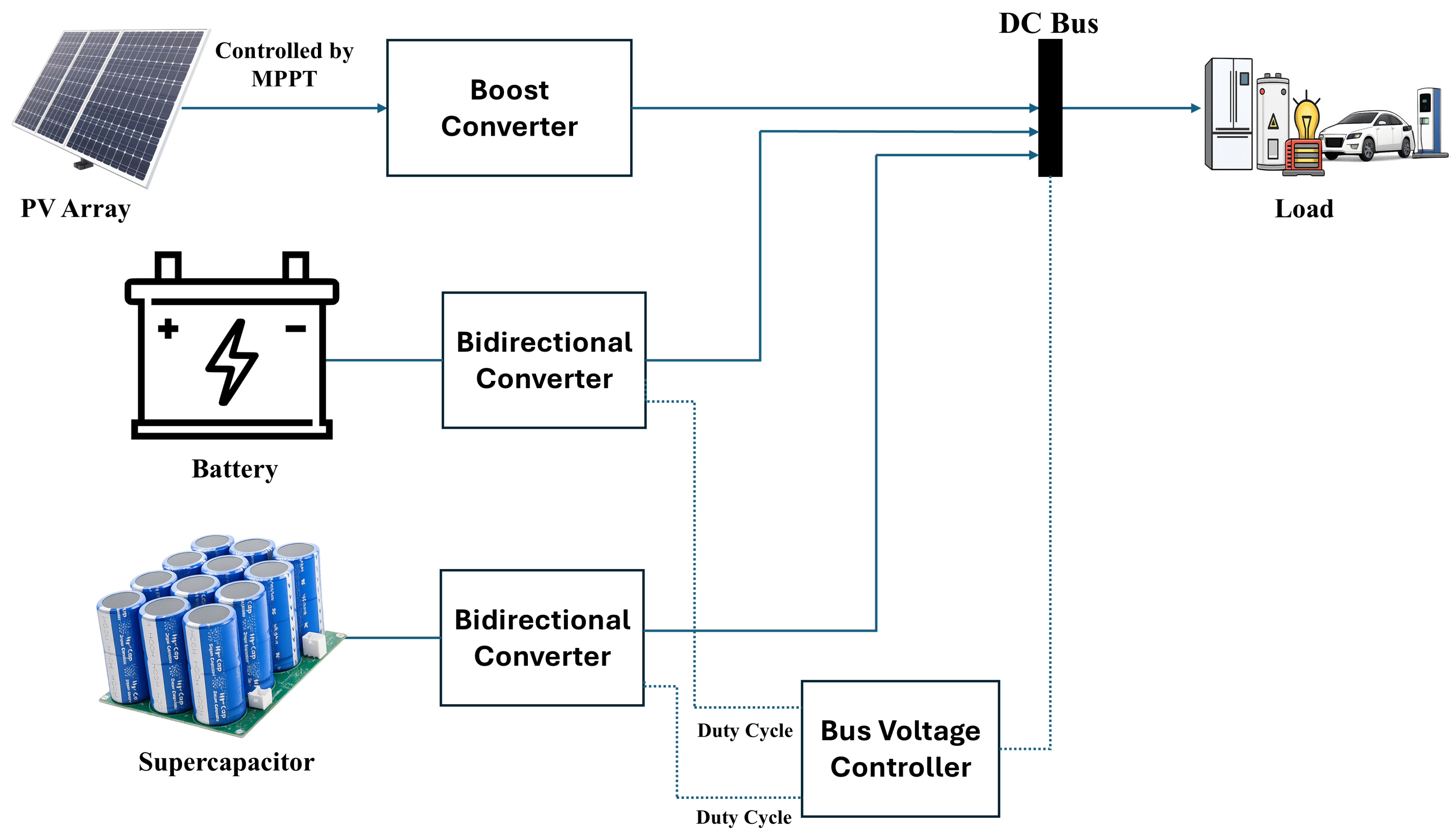
Figure 1 illustrates the considered DC microgrid architecture used in this study. The primary renewable source is a PV array, which is interfaced to the DC bus through a boost converter. The boost converter is governed by a maximum power point tracking (MPPT) algorithm that continuously adjusts the duty ratio to ensure that the PV array operates at its maximum power point under varying irradiance conditions. The PV subsystem is rated at approximately 2 kW and is formed by a single parallel string of eight series-connected PV modules, each rated at 250 W under standard test conditions. In addition to the PV source, the system employs a HESS consisting of a battery and a supercapacitor, each connected to the DC bus through its own bidirectional DC–DC converter. All DC–DC converters (PV boost, battery bidirectional converter, and supercapacitor bidirectional converter) were operated with a switching frequency of 10 kHz. The coordination of the hybrid energy storage system is achieved through a bus voltage controller. The battery is rated at 260 V with a capacity of 48 Ah and is initialized at 50% state of charge (SOC), enabling it to support long-term energy balancing and steady-state power delivery. The supercapacitor bank is rated at 300 V with an equivalent capacitance of 99.5 F and is designed to handle high-power, short-duration transients caused by rapid changes in solar irradiance or EV load demand. The primary control objective of the microgrid is to maintain a regulated DC-bus voltage while ensuring smooth power delivery to the load under varying solar irradiance and EV load conditions. The nominal DC-bus voltage is regulated at 400 V to supply an aggregated DC load that represents typical end-use demand along with EV charging. To capture the impact of simultaneous EV charging, an additional EV load is connected for a specified time interval, representing a sudden increase in EV penetration due to multiple EVs plugging in concurrently.
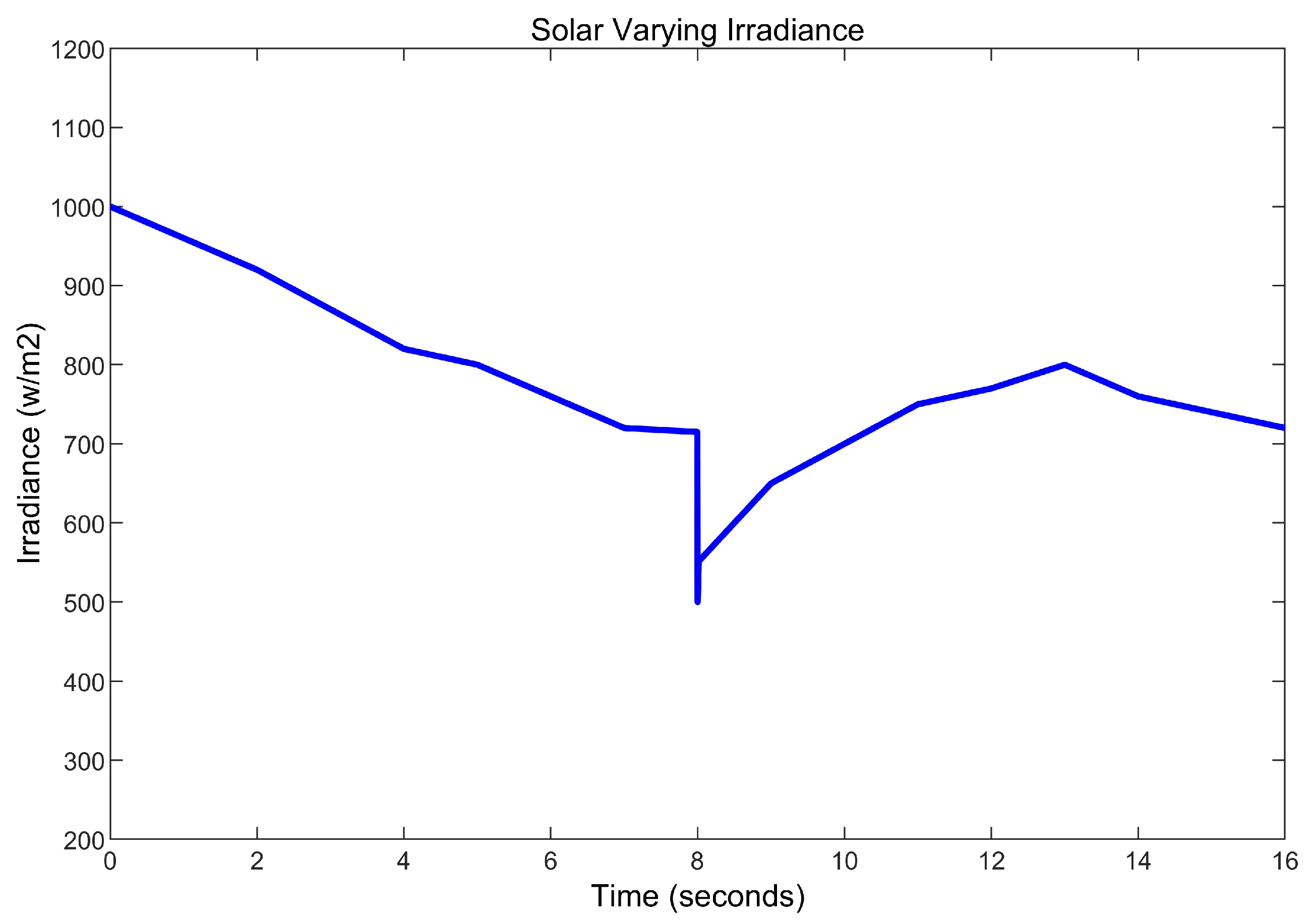
To evaluate realistic operating conditions, a time-varying solar irradiance profile is applied to the PV system, as shown in Figure 2. The irradiance gradually decreases from its nominal value and experiences a sudden drop around t = 8 s, followed by partial recovery. Such irradiance variations directly affect the PV output power, leading to power imbalance at the DC bus if not properly compensated by the energy storage system. In practical EV-connected microgrids, these fluctuations can result in voltage deviations, increased stress on power electronic converters, and degraded power quality.
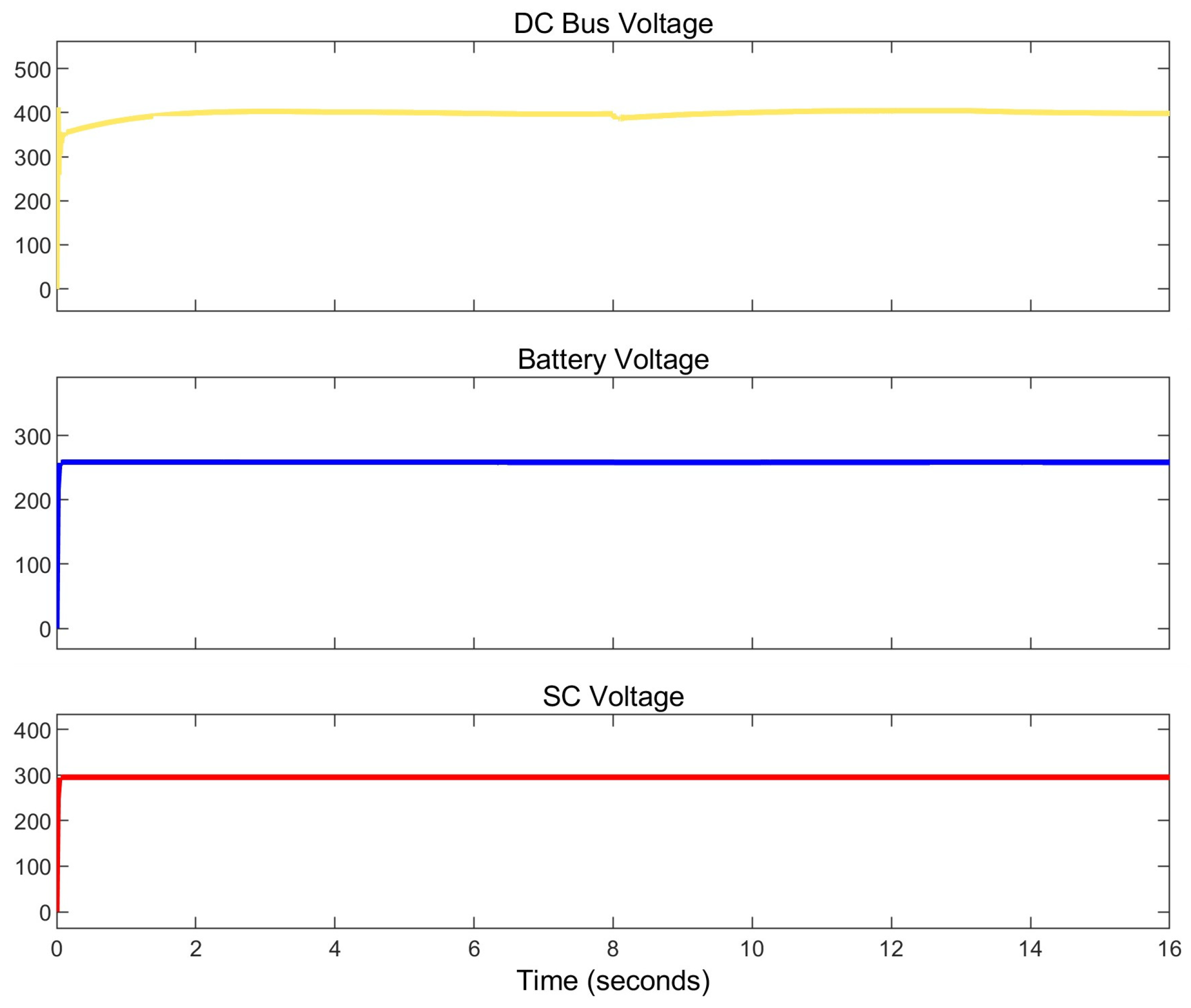
Figure 3 shows the voltage responses of the system under conventional PI control during normal operation. It can be observed that the PI controller successfully regulates the DC-bus voltage around its reference value despite changes in solar irradiance. Meanwhile, both the battery and supercapacitor voltages remain within their nominal operating ranges, indicating stable electrical operation of the HESS under normal conditions.
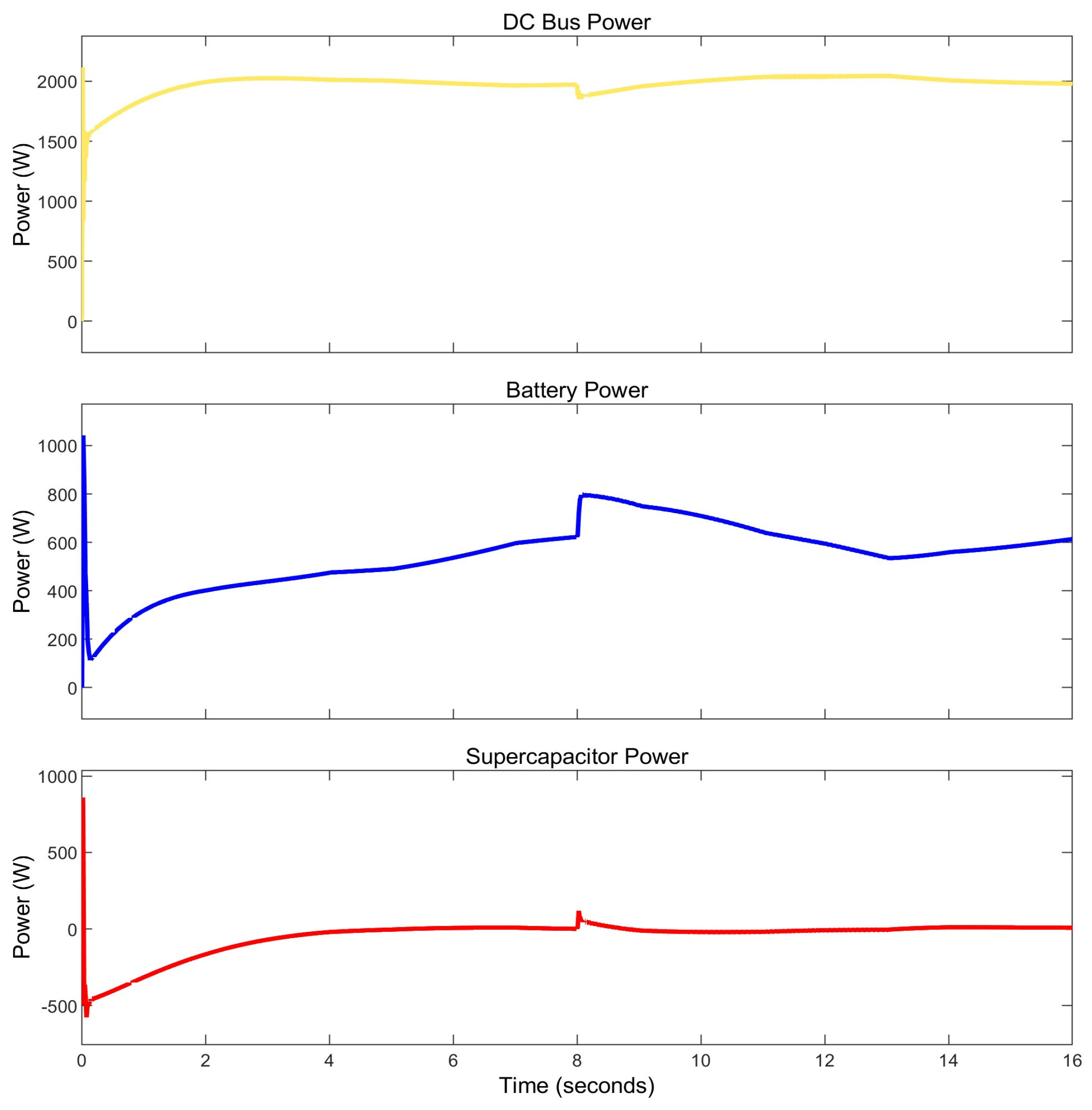
The corresponding power-sharing behavior under PI control is illustrated in Figure 4. The battery supplies the dominant portion of the steady-state power required to balance the DC bus, while the supercapacitor primarily responds during transient events, such as the irradiance disturbance at t = 8 s. This behavior is consistent with the intended roles of the HESS components, where the battery addresses low-frequency energy demands and the supercapacitor compensates for fast power fluctuations.
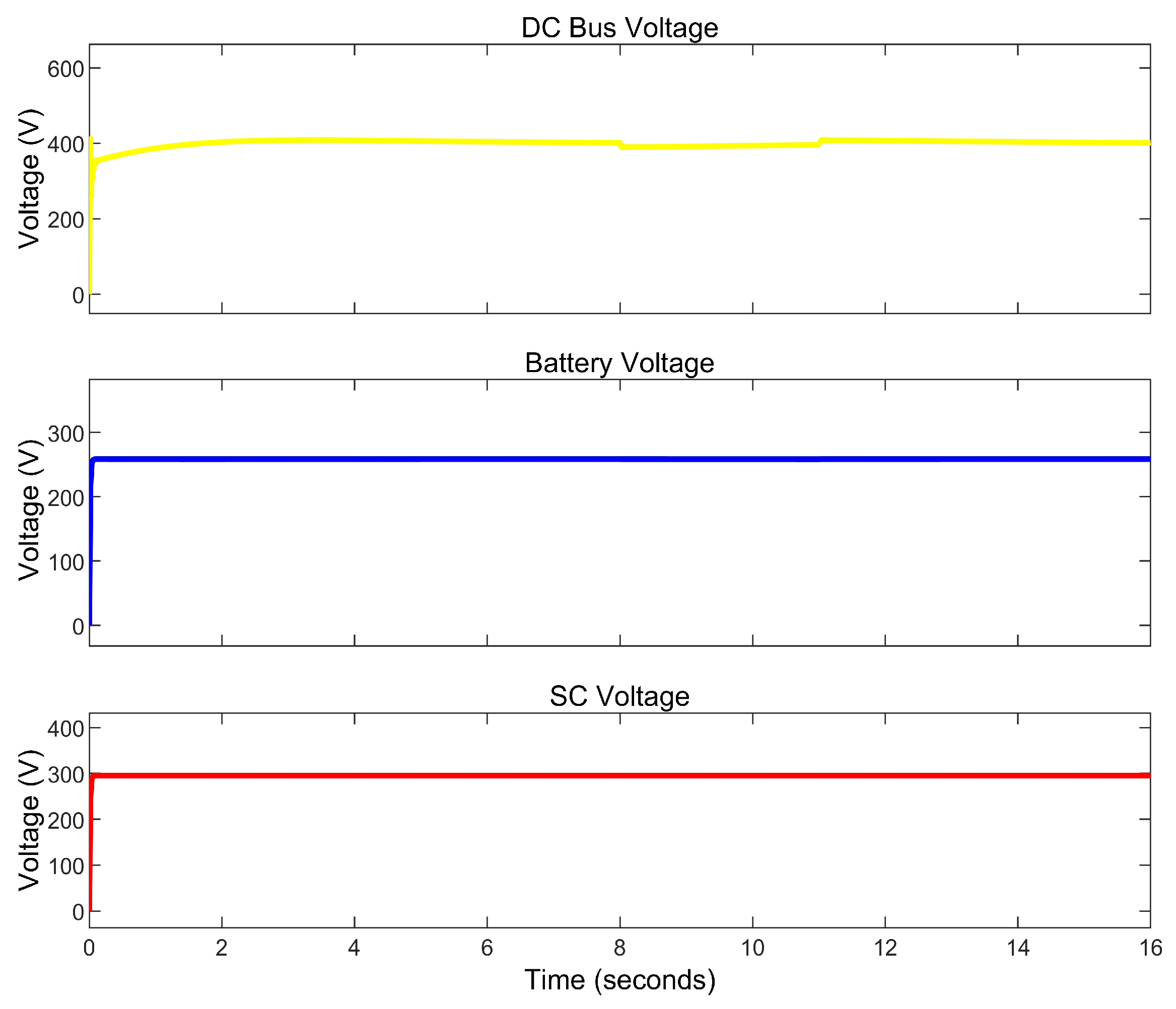
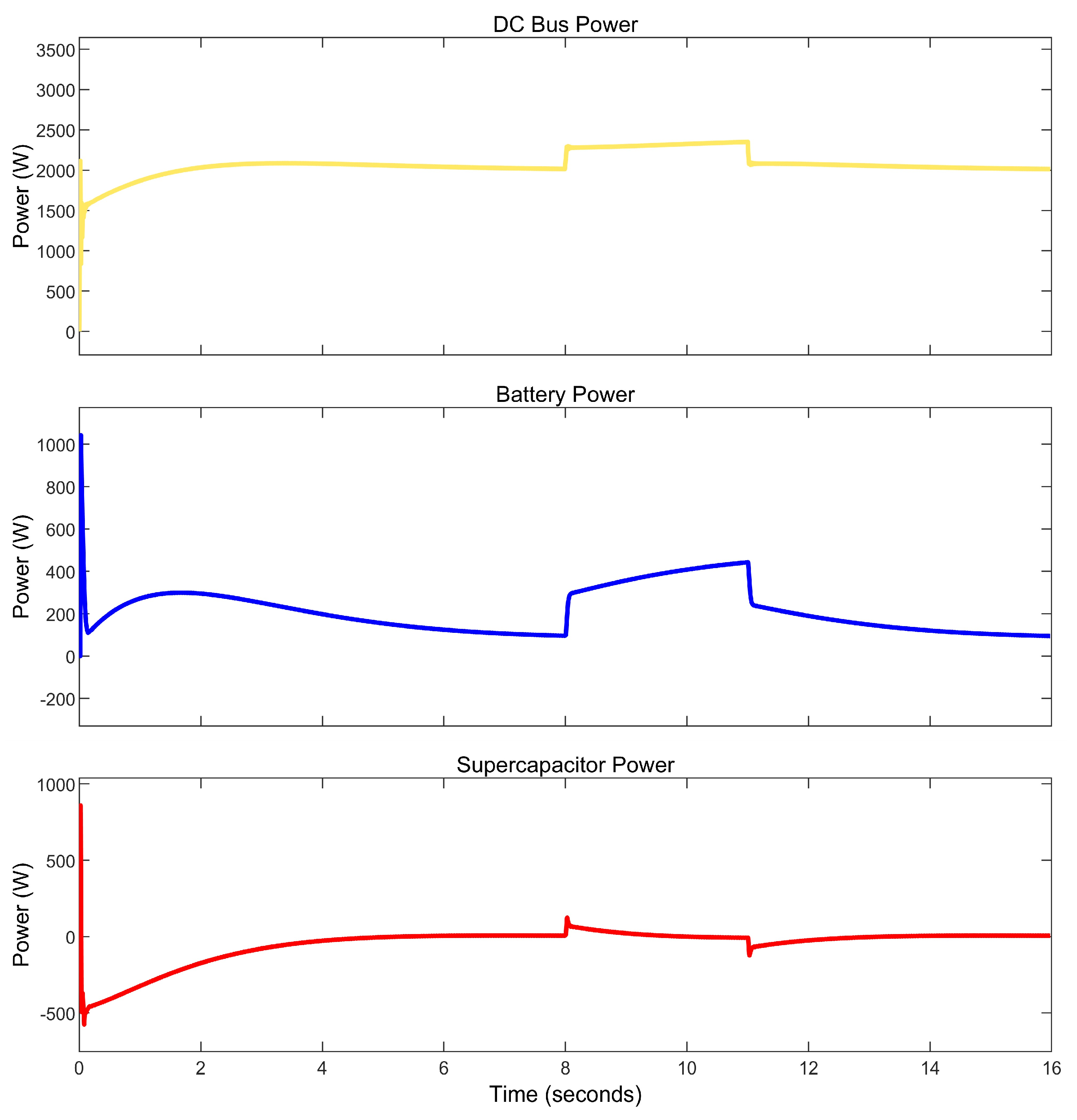
In addition to renewable intermittency, the DC microgrid must also tolerate step changes in EV charging demand, which can occur when multiple chargers connect/disconnect within a short period. To emulate EV charging fluctuations, a step increase in EV load of 20% (400 W) is applied from t = 8 s to t = 11 s while keeping solar irradiance constant. Figure 5 and Figure 6 show the corresponding PI-controlled responses. The DC-bus voltage maintains regulation close to 400 V during the load event, while the additional demand is primarily supplied by the battery, and the supercapacitor contributes only a brief transient response during the EV load change.
These observations clearly indicate that while PI controllers remain attractive due to their simplicity and ease of implementation, their performance is highly sensitive to parameter tuning and operating conditions. In EV-connected DC microgrids with frequent renewable fluctuations and fast load dynamics, a fixed-structure controller may fail to consistently ensure optimal voltage regulation and coordinated energy management.
Motivated by these challenges, there is a need for an adaptive control strategy capable of capturing system nonlinearities and dynamically adjusting control actions without relying on an explicit mathematical model. Furthermore, as modern microgrids increasingly rely on communication-assisted control loops, understanding how such advanced controllers behave under cyber disturbances is equally important. This work therefore investigates an ANFIS-based controller for HESS for DC-bus voltage regulation and analyzes its vulnerability to representative cyber-attacks under realistic operating conditions.

3. Proposed ANFIS Controller for Hybrid Energy Storage System

3.1. ANFIS Controller Description

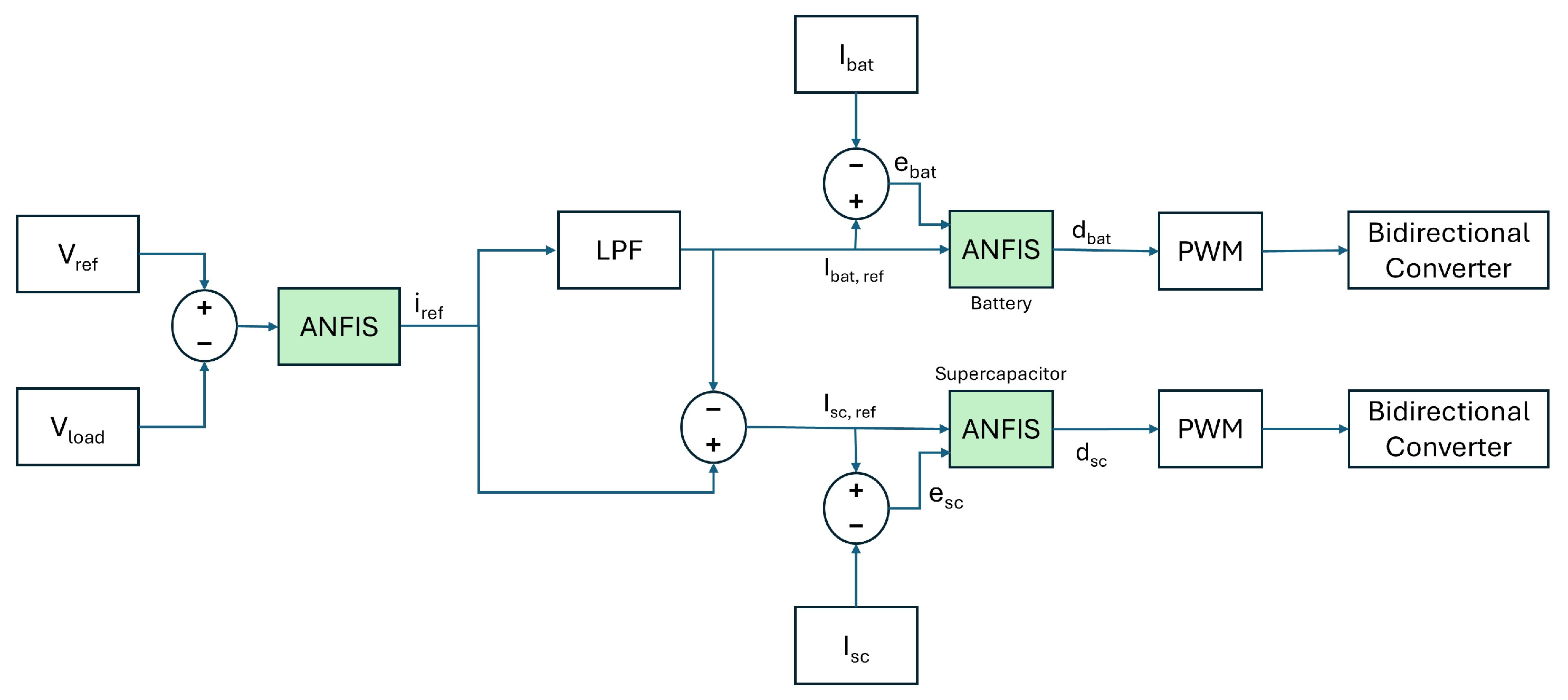
The proposed control strategy adopts a hierarchical ANFIS-based structure for regulating the DC-bus voltage and coordinating power sharing between the battery and supercapacitor in the HESS. As illustrated in Figure 7, the control system consists of an outer DC-bus voltage regulation loop and two inner current control loops associated with the battery and supercapacitor bidirectional DC–DC converters.
The outer-loop ANFIS generates the total reference current required to maintain the DC-bus voltage at its reference value. This reference current is subsequently decomposed using a first-order low-pass filter (LPF) with time constant of 0.01 s to obtain individual current references for the battery and supercapacitor. The inner-loop ANFIS controllers then generate the corresponding duty-cycle commands for the bidirectional converters to ensure accurate current tracking.
Prior to the implementation of the ANFIS-based controllers, conventional PI controllers were designed for the DC-bus voltage loop, the battery current loop, and the supercapacitor current loop to ensure stable operation of the DC microgrid. The outer DC-bus voltage PI gains were set to Kp = 0.05 and Ki = 0.05, while the inner current PI gains (battery and supercapacitor) were set to Kp = 0.1 and Ki = 0.1. Simulation data obtained from the PI-controlled system under normal operating conditions were then used to train the corresponding ANFIS controllers. This data-driven approach enables the ANFIS to learn the control behavior of the baseline PI controllers while retaining the capability to handle nonlinearities and operating variations.

3.1.1. Outer Voltage-Loop ANFIS Controller (SISO)

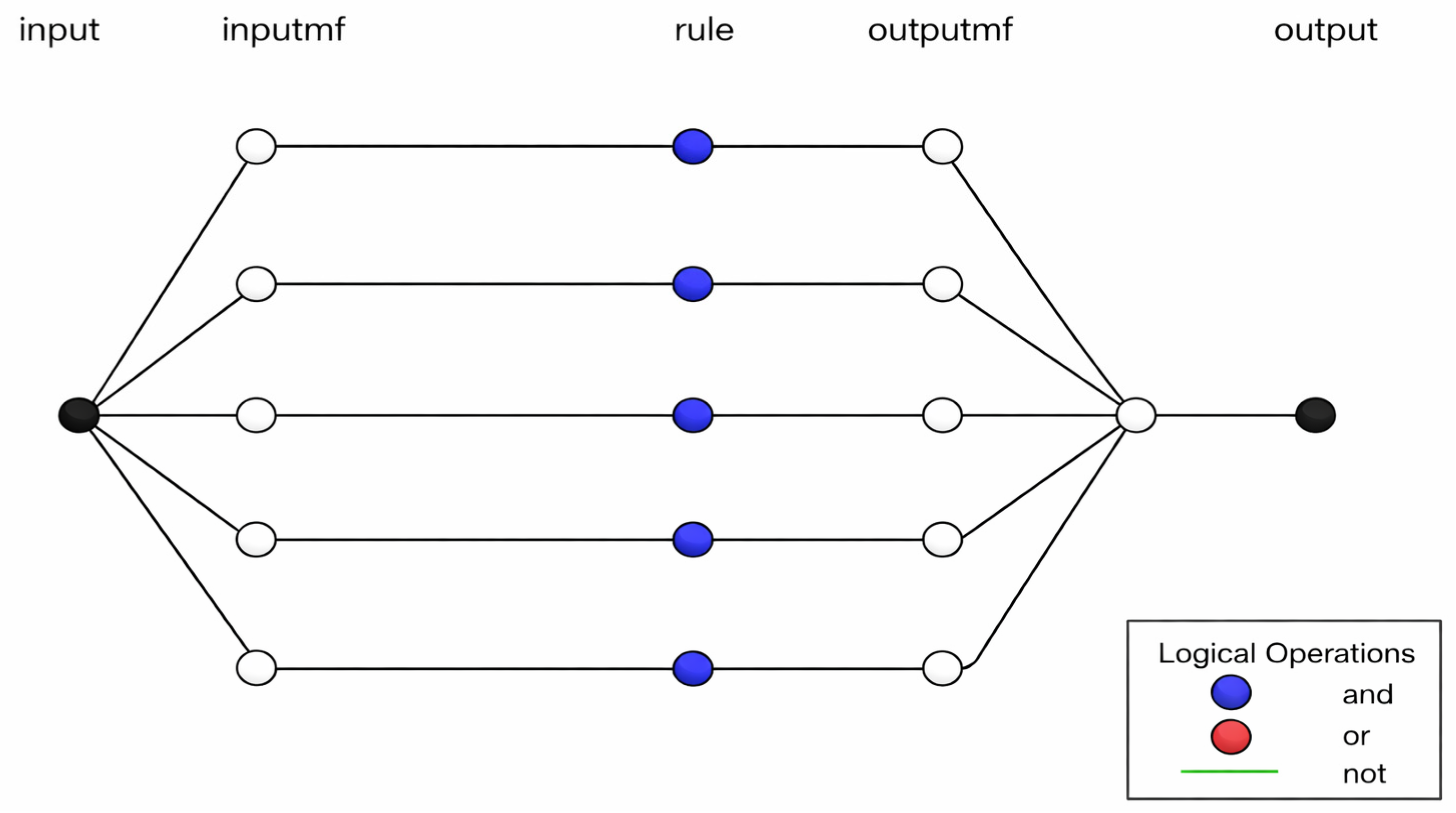
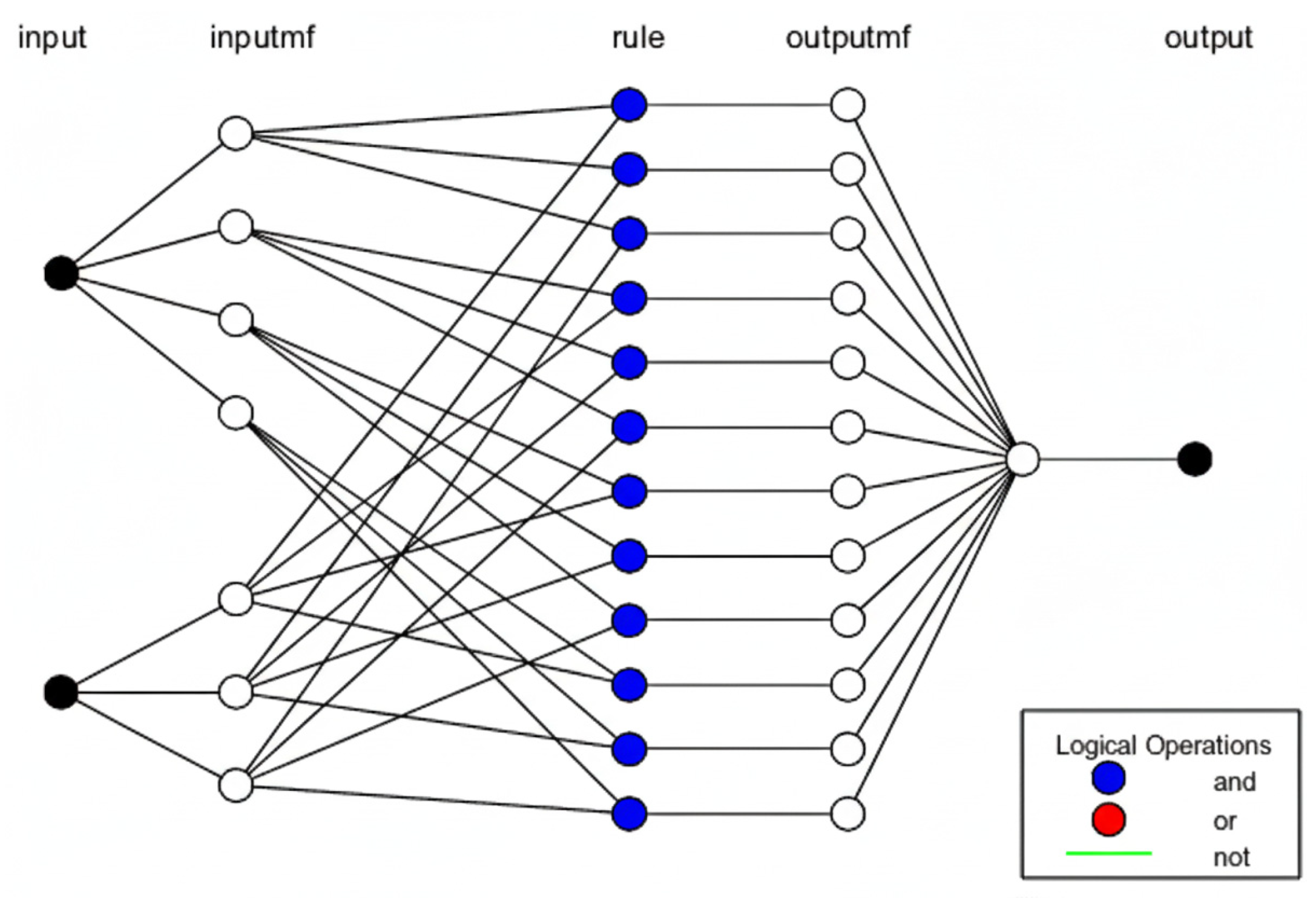
The outer voltage control loop is implemented using a single-input single-output (SISO) ANFIS. The internal structure of the SISO ANFIS used for DC-bus voltage regulation is illustrated in Figure 8.
The input to the ANFIS is defined as the DC-bus voltage error:
ev (t) = Vref (t) − Vload (t),
where Vref denotes the reference DC voltage and Vload represents the measured DC-bus voltage.
The output of the outer-loop ANFIS is the total reference current iref, which represents the net current demand required to regulate the DC-bus voltage:
iref (t) = ANFISv (ev (t)),
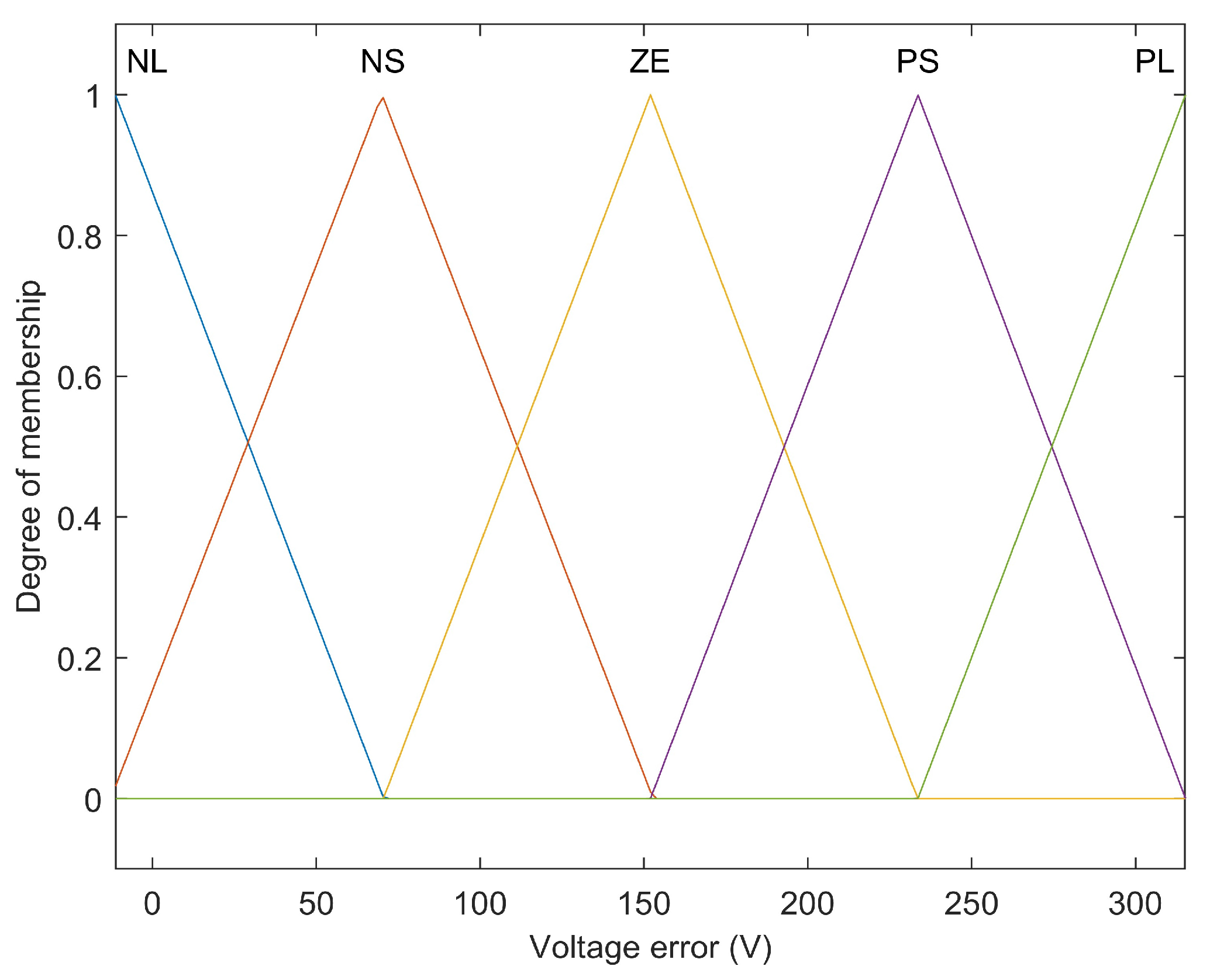
The ANFIS is designed using five triangular membership functions for the input voltage error. A zero-order Takagi–Sugeno fuzzy inference system is adopted [31], where the consequent part of each fuzzy rule is constant. A typical fuzzy rule can be expressed as
Rule k: If ev is Ak, then iref = Ck,
where Ak denoted the k-th fuzzy set of the input variable and Ck is a constant consequent parameter.
The firing strength of each rule is given by
wk = μAk (ev),
where μ represents the membership function value.
The normalized firing strength is calculated as
w ¯ k = w k j = 1 N w j
The final ANFIS output is obtained through weighted averaging of all rule consequents:
i r e f = k = 1 N w ¯ k c k
Using the grid partitioning technique, the fuzzy inference system was constructed with five triangular membership functions, denoted as Negative Large (NL), Negative Small (NS), Zero (ZE), Positive Small (PS), and Positive Large (PL). The membership functions associated with the input variable of the outer voltage-loop ANFIS controller is illustrated in Figure 9. Based on the defined membership functions, a total of five fuzzy inference rules is formulated for the outer voltage-loop ANFIS controller. The corresponding fuzzy rule base is summarized in Table 1.
The selection of membership function type and number was performed using a trial-and-error, data-driven approach based on system response characteristics. By balancing modeling accuracy and structural simplicity, the ANFIS parameters were refined using training data generated from the PI-controlled system. The details of the training parameters of the outer-loop ANFIS controller are summarized in Table 2.

3.1.2. Current Reference Decomposition Using LPF

To achieve coordinated power sharing between the battery and supercapacitor, the total reference current generated by the outer-loop ANFIS is decomposed using a low-pass filter:
ibat,ref (t) = LPF {iref (t)},
isc,ref (t) = iref (t) − ibat,ref (t),
This decomposition ensures that the battery supplies the low-frequency (average) power component, while the supercapacitor compensates for high-frequency transient power variations.

3.1.3. Inner Current-Loop ANFIS Controllers (MISO)

Battery ANFIS Controller: The battery current control loop is implemented using a multi-input single-output (MISO) ANFIS controller, whose internal structure is illustrated in Figure 10. The inputs to the battery ANFIS are defined as
ebat (t) = ibat,ref (t) − ibat (t),
ibat,ref (t).
where ibat denotes the measured battery current. The output of the battery ANFIS is the duty-cycle command dbat applied to the battery bidirectional DC–DC converter:
dbat (t) = ANFISbat (ebat (t), ibat,ref (t)).
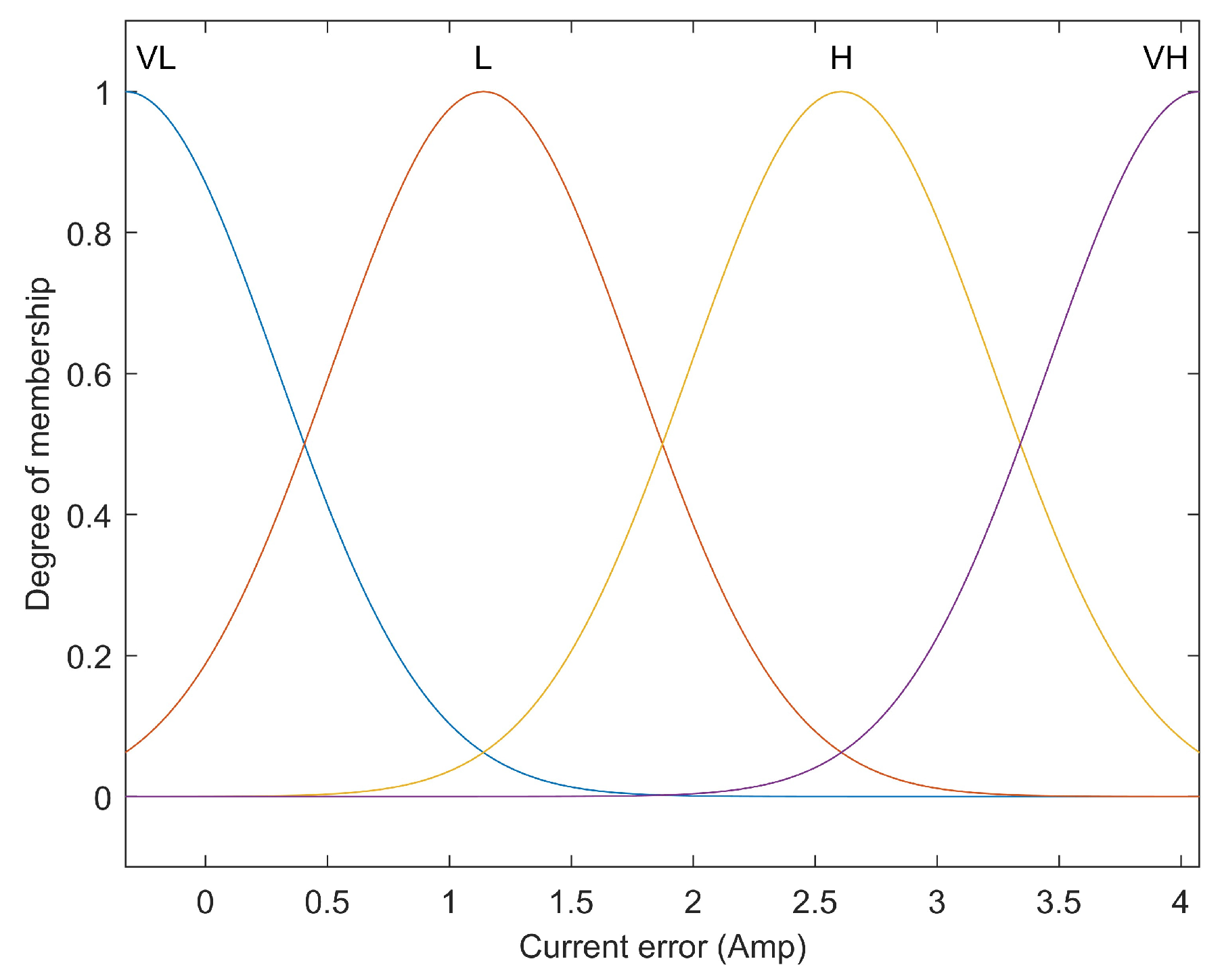
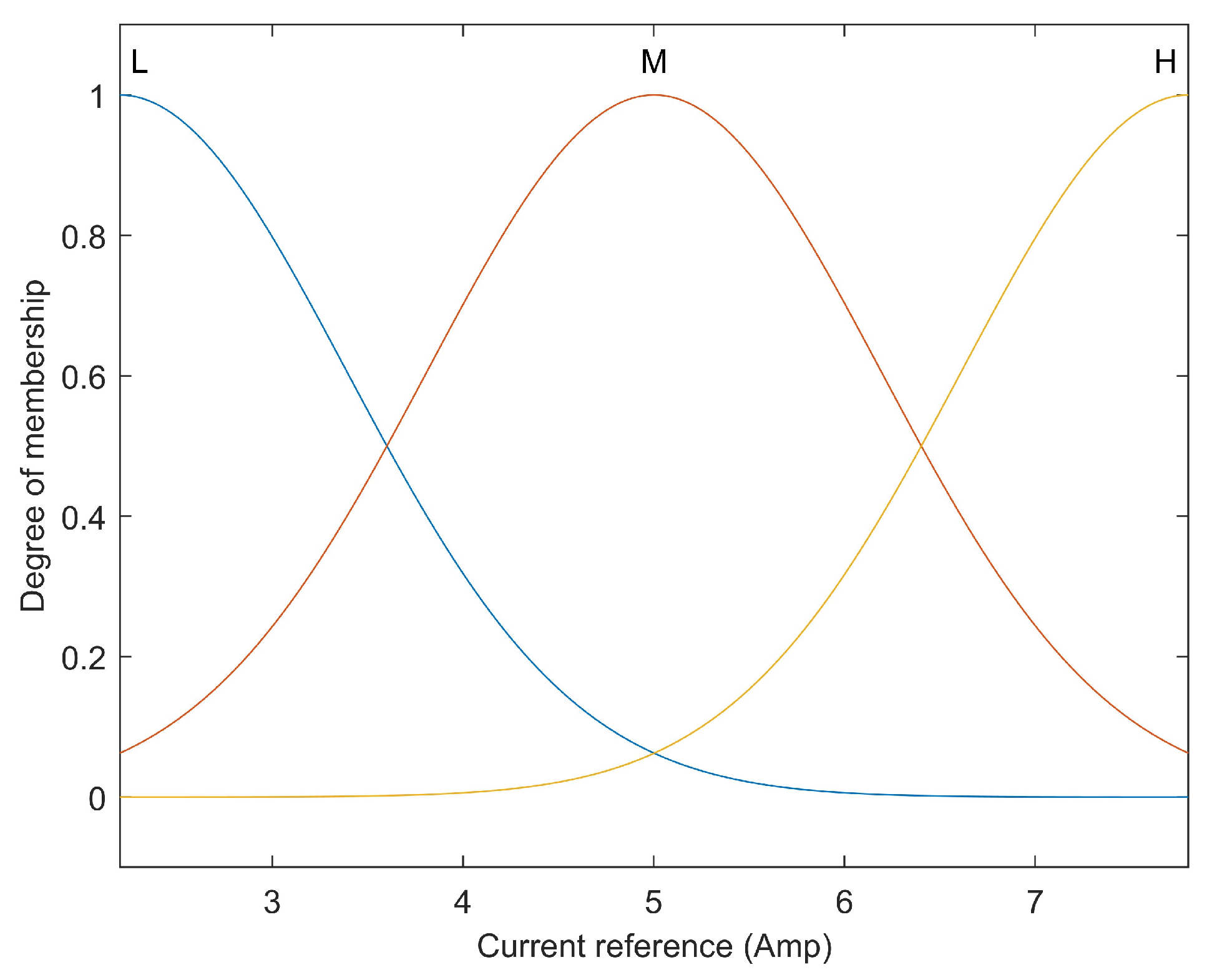
Gaussian membership functions are employed for both input variables. The current error input is represented using four membership functions—Very Low (VL), Low (L), High (H), and Very High (VH), while the reference current input is represented using three membership functions—Low (L), Medium (M), and High (H). The membership functions associated with the two input variables of the inner current-loop ANFIS controller are illustrated in Figure 11 and Figure 12. Based on the data-driven ANFIS training process, a total of 12 fuzzy inference rules is formed for the battery current controller. A compact rule table summarizing the inference rules is provided in Table 3.
In this table, Ck denotes the constant output of the corresponding zero-order Sugeno fuzzy rule, representing the duty-cycle command applied to the battery DC–DC converter and learned during the ANFIS training process.
A typical Takagi–Sugeno fuzzy rule is expressed as
Rule k: If ebat is Ak and ibat,ref is Bk, then dbat = pkebat + qkibat,ref + rk,
where pk, qk and rk represent consequent parameters of the Takagi–Sugeno fuzzy rule.
The firing strength of each rule is calculated as
wk = μAk (ebat) μBk (ibat,ref), k =1,…, 12.
The normalized firing strength is defined as
w ¯ k = w k j = 1 12 w j .
The final duty-cycle command is obtained by weighted aggregation of the rule outputs:
d b a t = k = 1 12 w ¯ k p k e b a t     q k i b a t , r e f     r k .
Supercapacitor ANFIS Controller: The supercapacitor current control loop follows the same ANFIS structure as the battery controller, as shown in Figure 10. The current tracking error is defined as
esc (t) = isc,ref (t) − isc (t),
where isc represents the measured supercapacitor current. The inputs to the supercapacitor ANFIS are esc and isc,ref. The output is the duty-cycle command dsc:
dsc (t) = ANFISsc (esc (t), isc,ref (t)).
Gaussian membership functions are used for both input variables, with four membership functions assigned to the current error and three membership functions assigned to the reference current. The membership functions associated with these two input variables are illustrated in Figure 11 and Figure 12. Like the battery ANFIS, a total of 12 fuzzy inference rules is formed, and the corresponding compact rule base is summarized in Table 3; however, the consequent parameters Ck represent the duty-cycle command applied to the supercapacitor DC–DC converter.
The number and type of membership functions were selected through a data-driven trial-and-error process based on current tracking accuracy and dynamic response characteristics. The final parameter set represents a compromise between control precision and computational complexity, ensuring stable current regulation. The training parameters of the battery and supercapacitor ANFIS current controllers are summarized in Table 4.

3.1.4. PWM and Converter Interface

The duty-cycle outputs dbat and dsc are constrained within the interval [0, 1] and are applied to PWM modules to generate appropriate gate signals for the battery and supercapacitor bidirectional DC–DC converters.

3.2. PI Controller Description

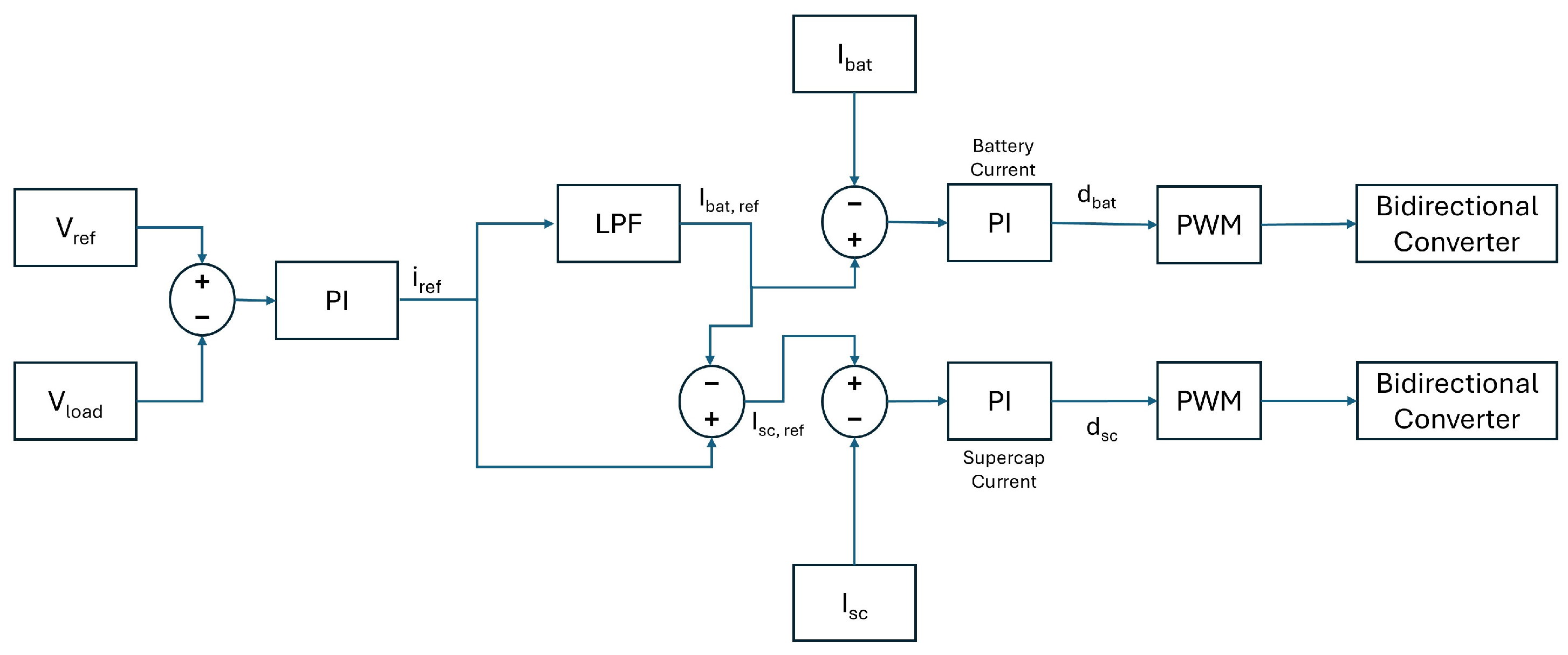
In this work, the performance of the proposed ANFIS controller has been compared with that of the conventional proportional–integral (PI) control strategy for HESS. The PI controllers shown in Figure 13 were designed for all three control loops. This PI-based architecture serves two purposes: (i) to ensure stable operation of the DC microgrid under normal operating conditions, and (ii) to generate high-quality training data for the subsequent development of the ANFIS controllers.
The overall PI control structure follows the same hierarchical framework adopted for the ANFIS-based control, thereby enabling a fair and consistent comparison between the two control approaches.
The DC-bus voltage control error is defined as
ev (t) = Vref (t) − Vload (t),
and the corresponding PI controller generates the total current reference as
i r e f t = K p , v e v t + K i , v e v t   d t ,
where Kp and Ki represents the proportional and integral gains of the PI controller.
The total reference current is decomposed using a low-pass filter to obtain the battery and supercapacitor current references:
ibat,ref (t) = LPF {iref (t)},
isc,ref (t) = iref (t) − ibat,ref (t).
The battery and supercapacitor current control errors are defined as
ebat (t) = ibat,ref (t) − ibat (t),
esc (t) = isc,ref (t) − isc (t).
The corresponding PI control laws are expressed as
d b a t ( t ) = K p , b a t e b a t ( t ) + K i , b a t e b a t ( t )   d t ,
d s c ( t ) = K p , s c e s c ( t ) + K i , s c e s c ( t )   d t ,
where dbat and dsc denote the duty-cycle commands applied to the battery and supercapacitor bidirectional DC-DC converters, respectively. The PI controller parameters were determined by using a systematic trial-and-error tuning approach based on the dynamic response of the DC microgrid. The gains were adjusted to achieve stable DC-bus voltage regulation, acceptable settling time, and proper power-sharing behavior between the battery and the supercapacitor.

3.3. Fuzzy Logic Controller Description

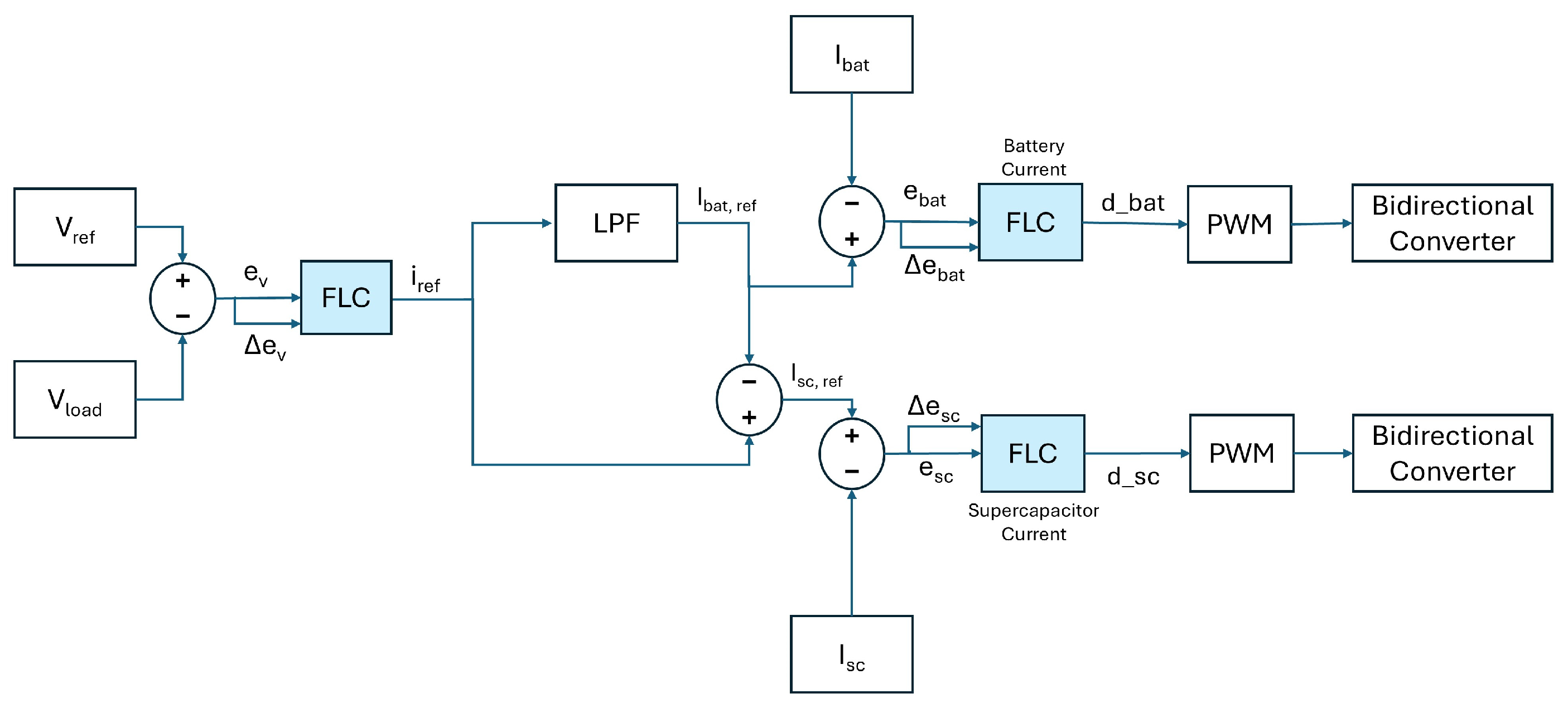
For comparative evaluation purposes, a conventional Fuzzy Logic controller (FLC) is implemented and assessed alongside the PI- and ANFIS-based control strategies. The proposed FLC is based on a Mamdani-type fuzzy inference system and is applied to the complete hierarchical control structure shown in Figure 14 of the DC microgrid [32]. For consistency and fairness in comparison, the same control architecture and signal flow used in the PI and ANFIS implementations are preserved, with only the control laws replaced by fuzzy inference mechanisms.
Each FLC employs two input variables, namely the control error (e) and the change of error (Δe), defined generically as
e (k) = xref (k) − x (k), Δe (k) = e (k) − e (k − 1),
where x represents the controlled variable. In the outer loop, x corresponds to the DC-bus voltage, while in the inner loops it corresponds to the battery or supercapacitor error current. The output of each FLC is formulated as an incremental control signal, which is accumulated to generate the corresponding reference or duty-cycle command. This incremental structure ensures integral-like behavior while maintaining numerical stability and avoiding abrupt control actions.
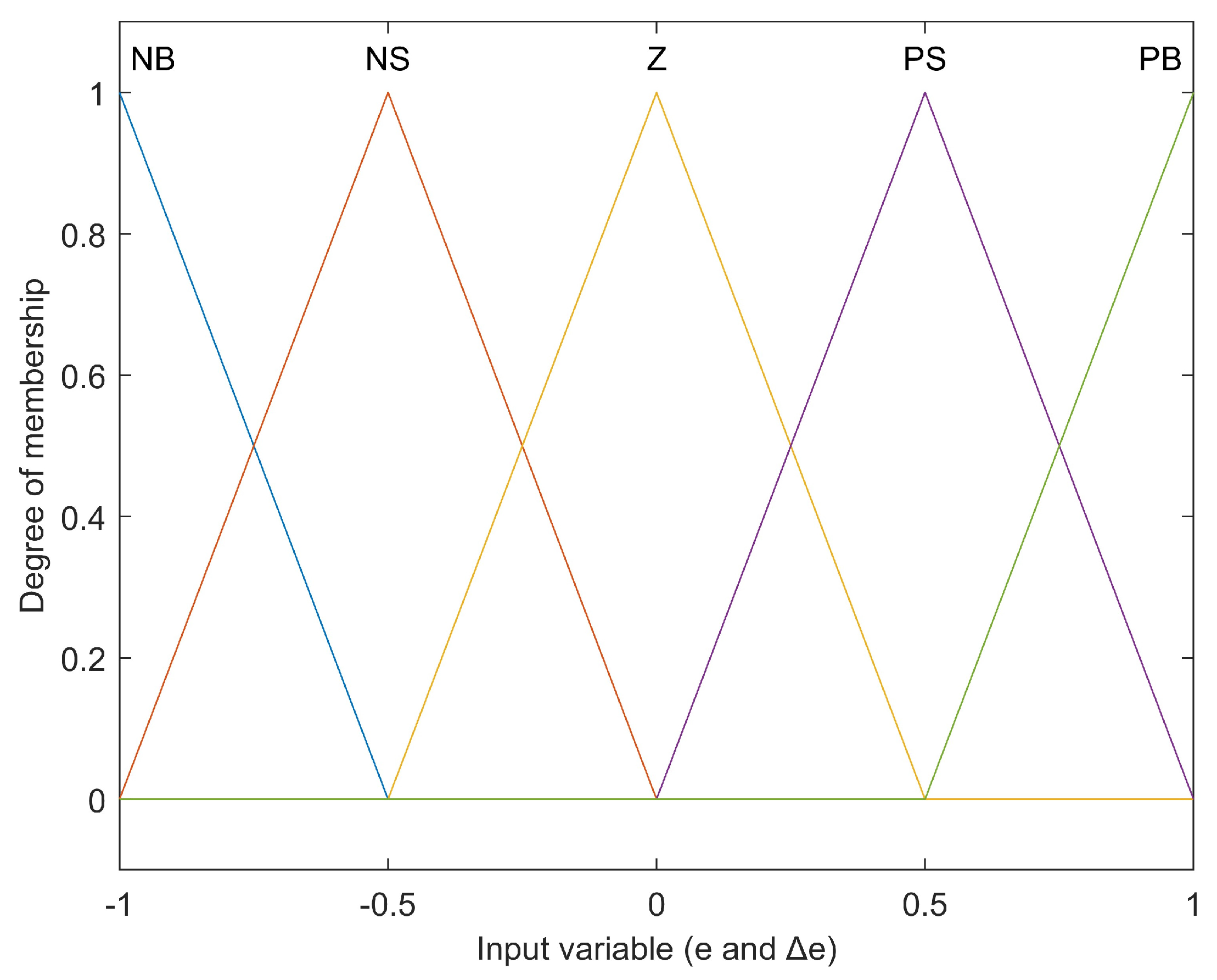
The input variables of the FLC are normalized within the range [−1, 1] using appropriate scaling gains. Five triangular membership functions—Negative Big (NB), Negative Small (NS), Zero (Z), Positive Small (PS), and Positive Big (PB)—are defined for each input variable. A representative set of input membership functions is illustrated in Figure 15, and the same membership function structure is employed for all fuzzy controllers used in this study. Based on these membership functions, A total of 25 fuzzy rules is constructed for each controller and arranged in a symmetric 5 × 5 rule base, as summarized in Table 5. The fuzzy inference process employs the minimum operator for rule conjunction, the maximum operator for rule aggregation, and the centroid method for defuzzification [32].

4. Simulation Results and Discussion on Performance of Controllers

This section presents a comparative performance evaluation of the proposed ANFIS-based controller, Fuzzy Logic controller and conventional PI controller under normal operating conditions with solar irradiance variation. In addition to solar irradiance disturbances, EV load variations were also incorporated at the DC bus level during system modeling. However, to maintain a focused baseline comparison, the performance results presented in this paper focus on solar irradiance variations. The objective of this analysis is to assess the dynamic response, voltage regulation capability, and power-sharing behavior of the DC microgrid when subjected to variations in solar irradiance. All simulations presented in this section were performed using the MATLAB/Simulink R2024a software and were conducted without cyber-attacks to establish a baseline comparison among the three control strategies.
A time-varying solar irradiance profile, shown in Figure 2, is applied to the PV system. A sudden reduction in irradiance occurs at approximately t = 8 s, emulating a realistic environmental disturbance such as cloud shading. The response of the DC-bus voltage, DC-bus power, battery voltage and power, and supercapacitor voltage and power are analyzed for the controllers.

4.1. DC-Bus Voltage and Power Response

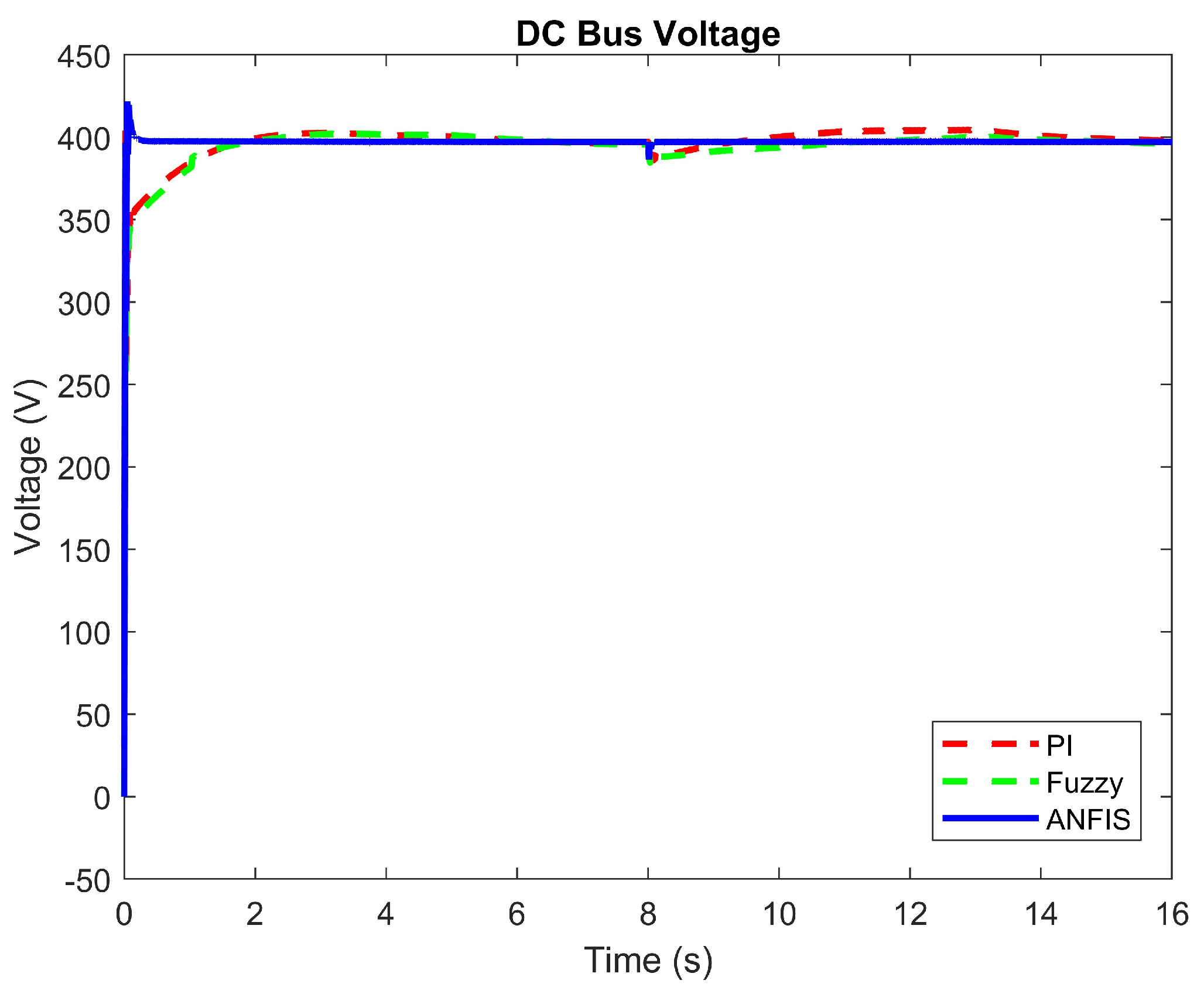
Figure 16 illustrates the DC-bus voltage response under PI, Fuzzy Logic, and ANFIS controls. In all cases, the DC-bus voltage is regulated around the reference value of 400 V, demonstrating stable operation of the microgrid. During the startup phase, the ANFIS-based controller achieves a faster transient response, reaching the steady-state voltage more rapidly than the PI and Fuzzy Logic controllers. The Fuzzy Logic controller exhibits a little improved transient behavior compared to the PI controller but remains slower than the ANFIS-based approach. At the solar irradiance disturbance occurring at t = 8 s, all controllers experience a brief voltage deviation due to the sudden reduction in PV generation. However, the ANFIS-based controller exhibits improved voltage recovery characteristics, with a smaller deviation and smoother return to the nominal voltage compared to the PI and Fuzzy Logic controllers. The Fuzzy Logic controller provides intermediate performance, reducing voltage deviation relative to the PI controller but with slower recovery than ANFIS. Overall, these results highlight the enhanced adaptability of the ANFIS controller under rapid operating condition changes.
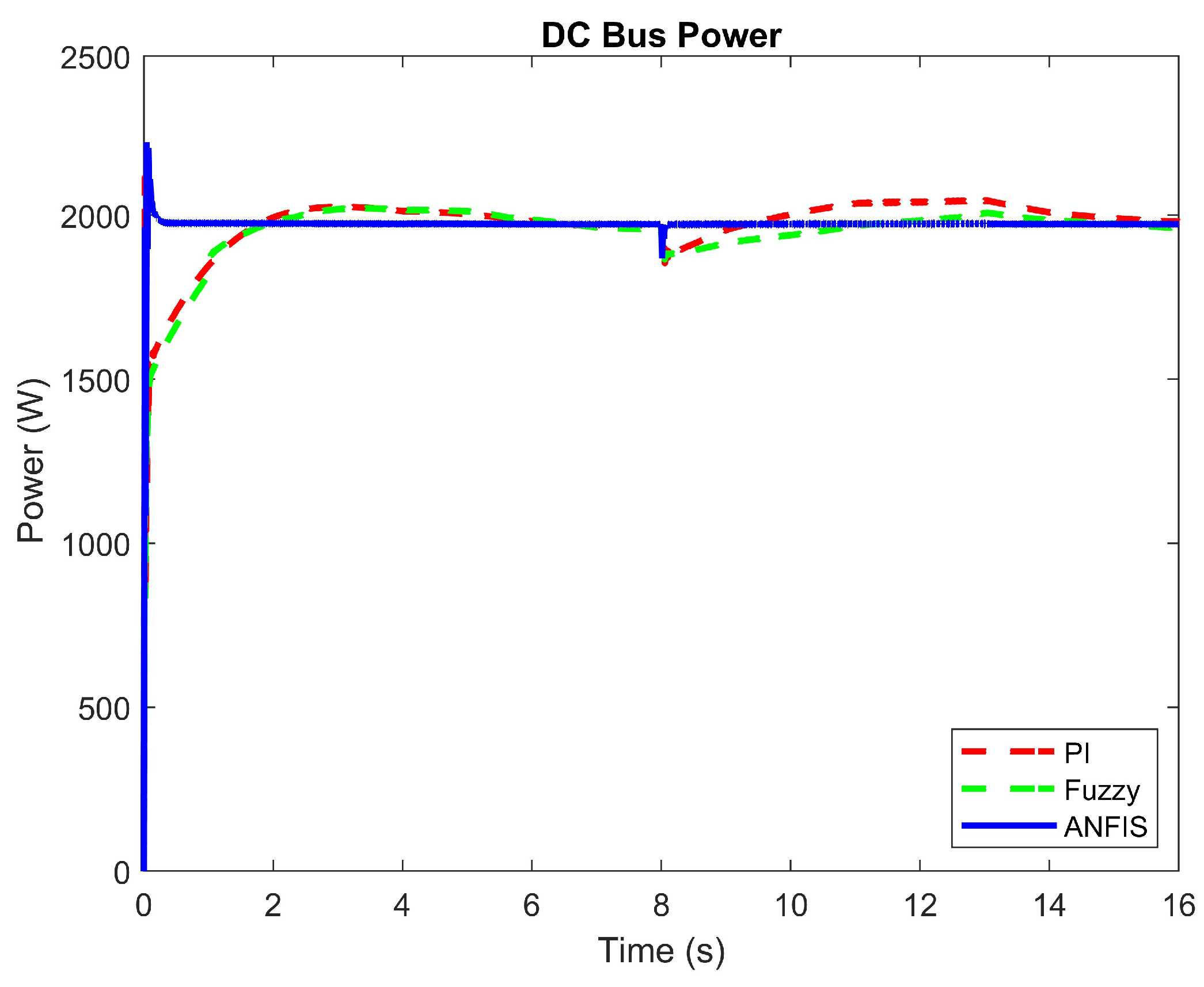
The corresponding DC-bus power responses are shown in Figure 17. Under steady-state conditions, all three controllers maintain the DC-bus power close to the required load demand of approximately 2 kW. During the irradiance variation, the PI-controlled system exhibits noticeable oscillations in the DC-bus power, whereas the Fuzzy Logic controller reduces these oscillations but still shows moderate power fluctuations. In contrast, the ANFIS-based controller provides a smoother power transition with reduced oscillatory behavior. This demonstrates improved power regulation performance of the ANFIS controller during PV generation fluctuations.

4.2. Battery Voltage and Power Response

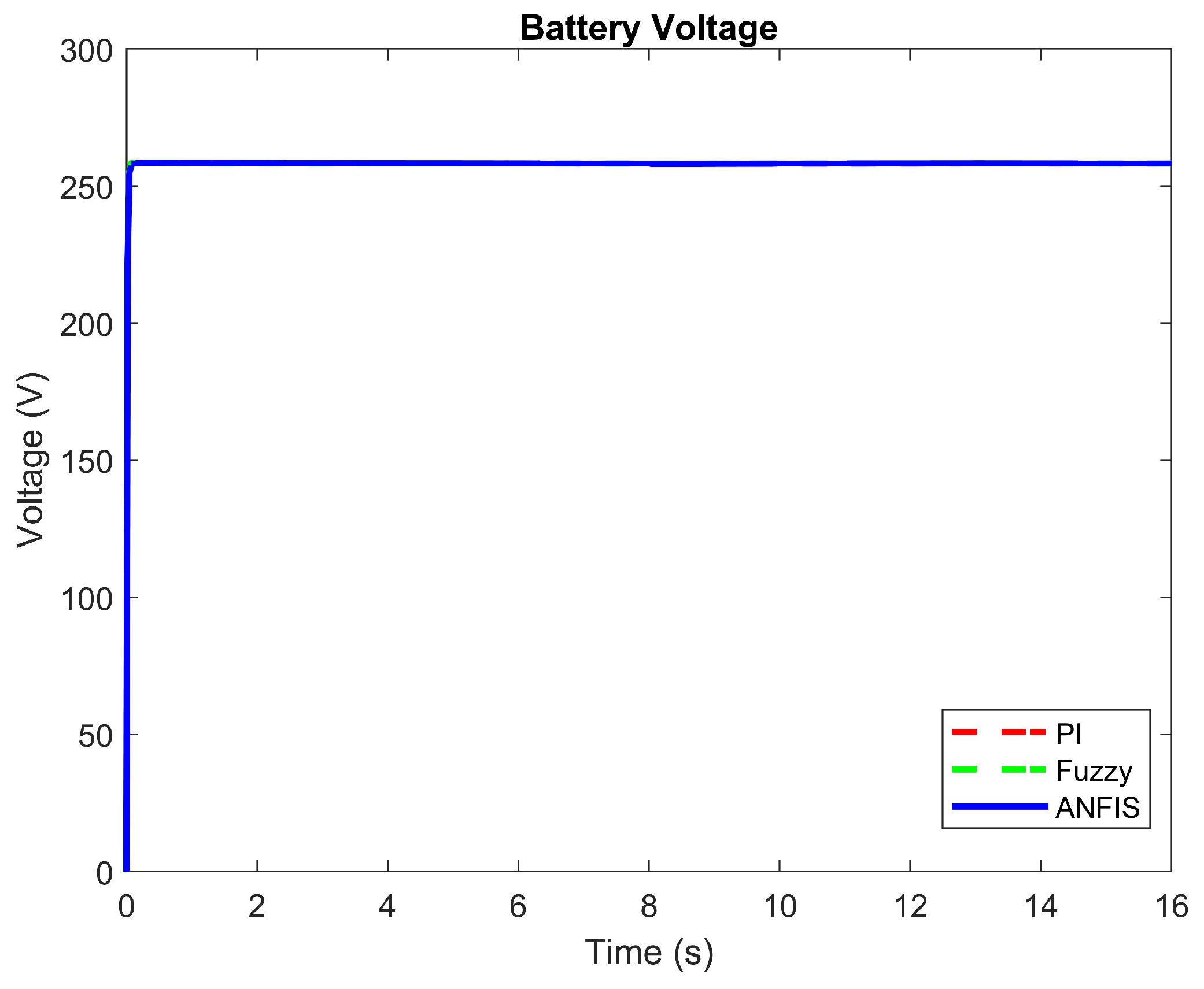
Figure 18 presents the battery voltage profiles under PI, Fuzzy Logic, and ANFIS control strategies. The battery voltage remains close to its nominal value of approximately 260 V throughout the simulation, indicating that all three controllers are effective in maintaining stable battery operation. No significant voltage overshoot or instability is observed, suggesting comparable steady-state voltage regulation performance.
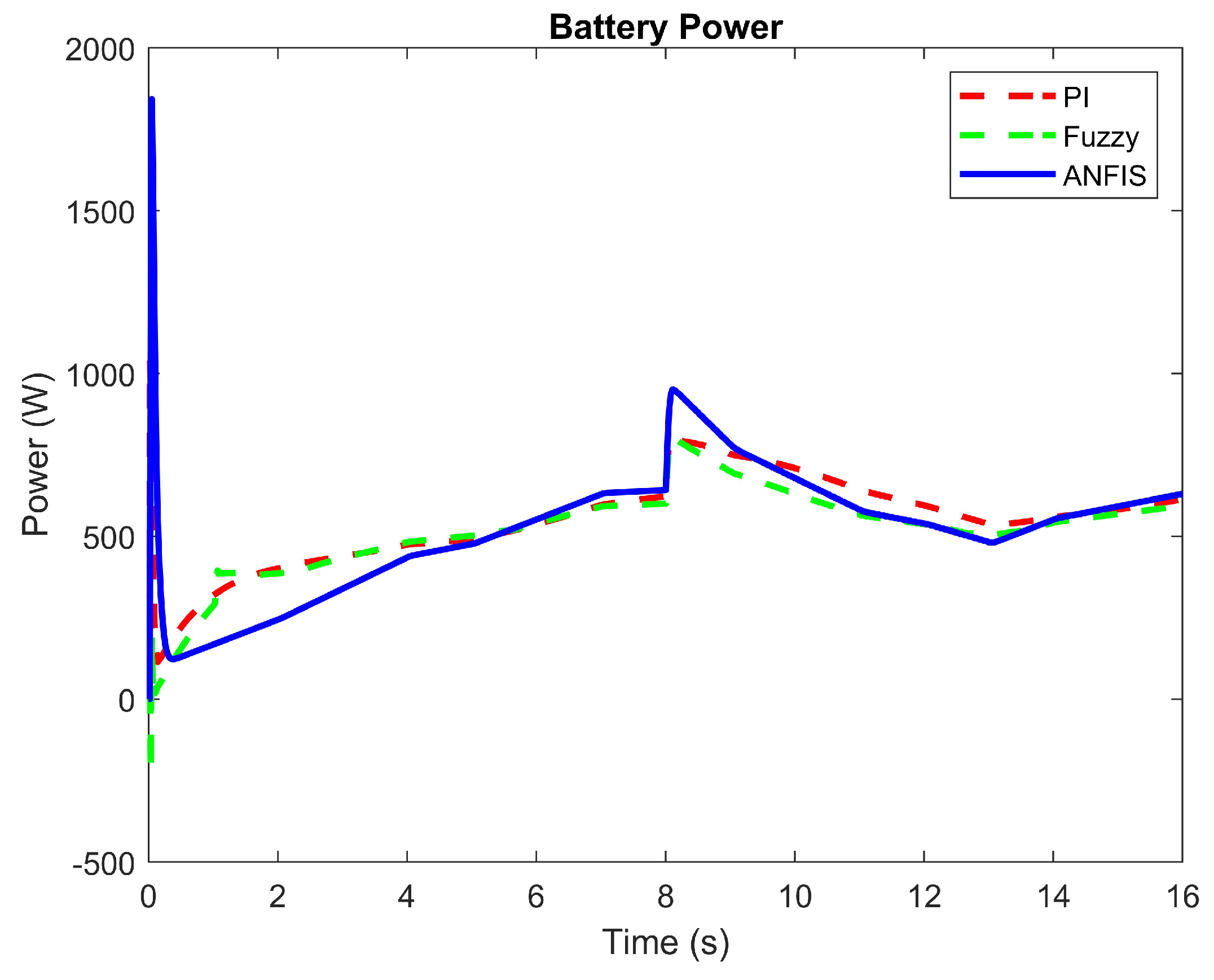
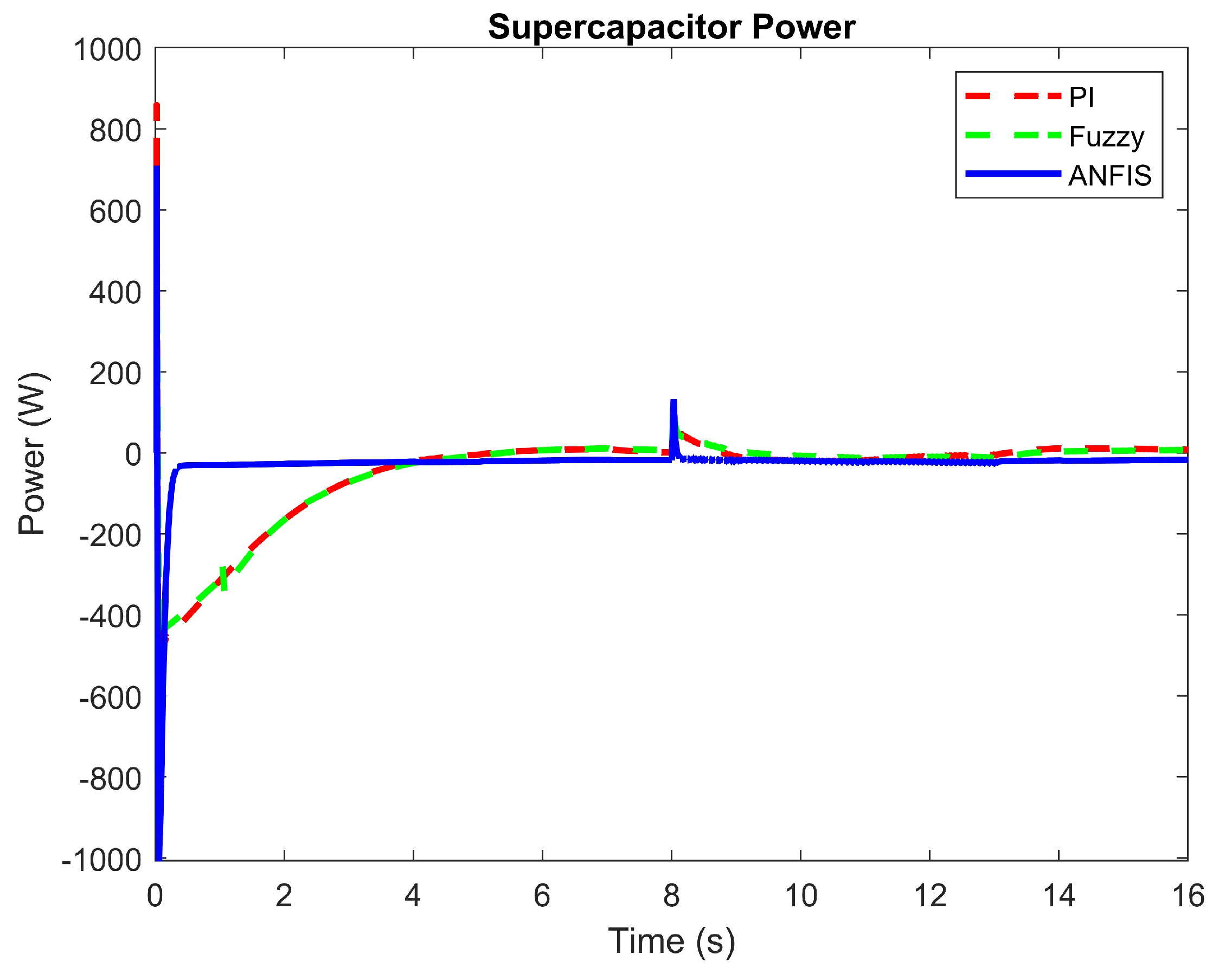
The battery power responses are shown on Figure 19. Following the solar irradiance disturbance, the battery compensates for the reduced PV power by increasing its power contribution in all cases. Compared to the PI controller, both the Fuzzy Logic and ANFIS-based controller exhibit smoother battery power transition with less abrupt changes during the transient period. In particular, the ANFIS-based controller demonstrates the smoothest response, indicating reduced battery stress and improved energy management under fluctuating renewable generation.

4.3. Supercapacitor Voltage and Power Response

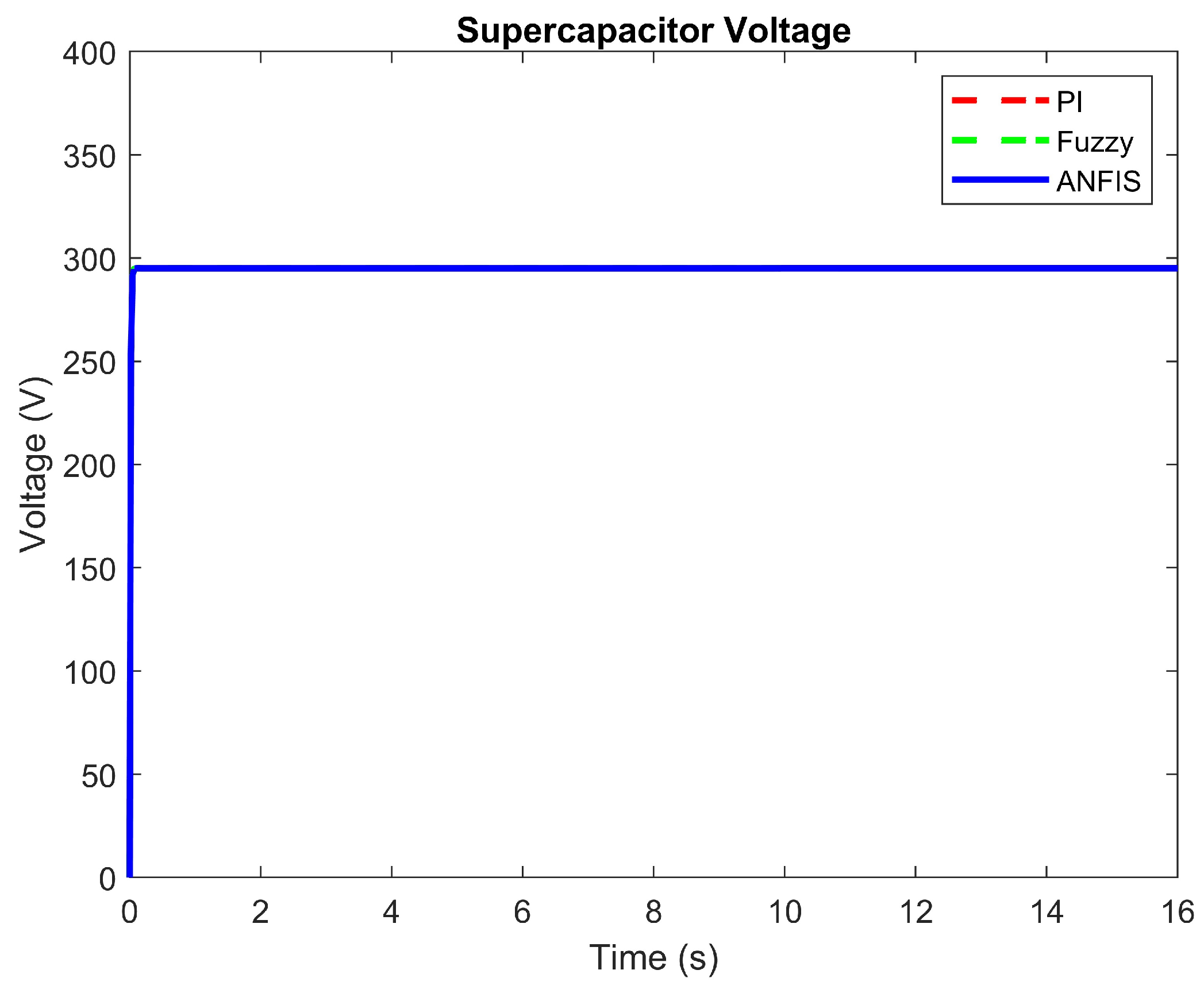
Figure 20 shows the supercapacitor voltage response under the PI, Fuzzy Logic, and ANFIS control strategies. The supercapacitor voltage is regulated around its nominal value of approximately 300 V in all cases, confirming stable operation of the supercapacitor energy storage unit. The voltage profiles under the three controllers are comparable, with no adverse effects observed during the irradiance variation, indicating that all control strategies effectively maintain supercapacitor voltage stability.
The supercapacitor power responses are depicted in Figure 21. At startup and during the irradiance disturbance, the supercapacitor absorbs and supplies high-frequency transient power components as expected. At t = 8 s, a pronounced transient is observed in the supercapacitor power due to the sudden drop in solar irradiance. This response confirms the intended function of the supercapacitor in compensating for rapid power deficits. Under PI control, the supercapacitor experiences a larger power excursion with slower damping. The Fuzzy Logic controller provides a smoother response compared to PI, but residual oscillations remain. In contrast, the ANFIS-based controller enables a faster and more controlled supercapacitor power response, effectively absorbing the high-frequency component of the disturbance and reducing oscillatory behavior. This improved transient performance enhances overall system stability during abrupt renewable power variations.

4.4. Quantitative Performance Comparison

To provide a quantitative comparison of the control strategies, standard time-domain performance indices are evaluated for the DC-bus voltage regulation under solar irradiance variation. The Integral of Absolute Error (IAE), Integral of Squared Error (ISE), and settling time are computed based on the DC-bus voltage error over the entire simulation duration. These performance metrics are computed from the DC-bus voltage responses shown in Figure 16.
The IAE and ISE performance indices are defined as
I A E = 0 T | e v t | d t
I S E = 0 T e v 2 t d t
where ev denotes the DC-bus voltage error, and T represents the total simulation duration.
Table 6 summarizes the quantitative performance comparison among the three controllers. The IAE and ISE values are obtained by using Equations (27) and (28), respectively, while the settling time is measured from the startup transient using MATLAB/Simulink R2024a bilevel measurements with ±2% tolerance band.
As observed, the ANFIS-based controller achieves the lowest IAE and ISE, indicating superior voltage regulation accuracy and reduced cumulative deviation compared to both PI and fuzzy controllers. Moreover, ANFIS exhibits a significantly faster settling time, demonstrating enhanced dynamic response during startup and disturbance conditions. While the fuzzy controller provides moderate improvement in settling time relative to PI control, its higher IAE and ISE values suggest inferior overall error minimization.

4.5. Discussion

Overall, the simulation results demonstrate that PI, Fuzzy Logic and ANFIS controllers can maintain stable operation of the DC microgrid under normal operating conditions. However, the ANFIS-based control strategy shows improved transient characteristics, including faster startup response, smoother DC-bus power regulation, and enhanced damping of battery and supercapacitor power fluctuations during sudden solar irradiance changes. The Fuzzy Logic controller provides improved dynamic performance compared to the conventional PI controller, particularly in reducing oscillations, but does not achieve the same level of transient responsiveness and damping as the ANFIS-based approach. At the same time, the steady-state voltage regulation performance of all three controllers remains comparable. These results indicate that the ANFIS-based controller can effectively enhance the dynamic performance of a PV-integrated DC microgrid without compromising steady-state stability, making it a suitable alternative to conventional PI and rule-based fuzzy control under variable renewable energy conditions.

5. Cybersecurity Issues with ANFIS Controller for HESS

This section investigates the vulnerability of the ANFIS-based control architecture to cyber-attacks affecting critical control and feedback signals in a DC microgrid with hybrid energy storage. Since ANFIS controllers rely on real-time measurement and communication signals for nonlinear inference and decision-making, malicious manipulation of these signals can significantly degrade system performance. In this work, the focus is strictly on impact analysis, and no attack detection or mitigation mechanisms are considered.
Two representative cyber-attacks are examined: false data injection (FDI) and denial-of-service (DoS). These attacks are selected due to their relevance in practical cyber–physical power systems and their ability to disrupt control loops without causing physical damage to system components.

5.1. How Cyber-Attack Happens in ANFIS Controller

In the considered DC microgrid, the ANFIS controller depends on measured system variables and internally generated control signals to regulate the DC-bus voltage and coordinate power sharing between the battery and supercapacitor. Cyber-attacks can occur when an adversary gains access to the communication channel carrying measurement or control signals between sensors, controllers, and power electronic converters.
In the case of an FDI attack, the attacker deliberately alters a measured signal before it reaches the controller, thereby misleading the ANFIS inference mechanism. Since ANFIS does not inherently verify the authenticity of its inputs, such manipulation directly affects the fuzzy rule evaluation and results in incorrect control actions. In contrast, DoS attack disrupts the timely delivery of control signals by blocking updates and forcing the controller or actuator to retain outdated information. In converter-based systems, this type of attack can be particularly harmful, as holding stale duty-cycle commands prevents the controller from responding to fast system dynamics.
In this study, cyber-attacks are applied only to the ANFIS-based controller, as illustrated in Figure 7, while the physical plant and power electronic components remain intact. The objective is to evaluate how cyber-induced signal corruption affects voltage regulation, power sharing, and transient performance of the hybrid energy storage system.

5.2. Mathematical Modeling of Considered Cyber-Attacks

5.2.1. FDI Attack on DC-Bus Voltage (Vload)

The first attack scenario considers an FDI attack targeting the measured DC-bus voltage Vload (t), which is used by the outer-loop ANFIS voltage controller. During the attack interval t ∈ [5, 9] second, the measured voltage is maliciously reduced by a constant bias of 100 V.
The compromised voltage measurement received by the controller is modeled as
V load FDI ( t ) = V load ( t ) 100 , 5 t 9 V load ( t ) , otherwise .
As a result, the voltage error used by the outer ANFIS controller becomes
e v FDI ( t ) = V ref ( t ) V load FDI ( t ) .
This artificially inflated voltage error causes the ANFIS controller to generate an incorrect total current reference, leading to abnormal power commands for the battery and supercapacitor. The attack directly affects the inference process of the outer voltage ANFIS and propagates through the entire hybrid energy storage control hierarchy.

5.2.2. DoS Attack on Supercapacitor Duty Cycle (dsc)

The second attack scenario considers a DoS attack applied to the supercapacitor duty-cycle command dsc (t) generated by the inner ANFIS current controller. During the attack interval t ∈ [5, 10] second, the control signal update is blocked, and the duty cycle is held at its last available value.
The DoS attack is mathematically expressed as
d sc DoS t = d sc t 0 , 5 t 10 d sc t , otherwise .
where t0 =5 s denotes the onset of the attack.
By freezing the duty-cycle command, the supercapacitor converter is prevented from responding to changes in power demand or system disturbances. This disrupts the fast transient compensation role of the supercapacitor and forces the battery to absorb a larger portion of high-frequency power fluctuations, thereby degrading overall system performance.

5.3. Assumptions and Scope of Analysis

The following assumptions are adopted to define the scope of this cybersecurity study:
  • The attacker has access to the communication channels carrying measurements or control signals.
  • The physical components of the DC microgrid remain uncompromised.
  • Cyber-attacks affect only information signals and do not alter system parameters.
  • The analysis focuses solely on performance degradation due to cyber-attacks, and no detection or mitigation strategies are considered.
Under these assumptions, the presented attack models provide a realistic framework for evaluating the vulnerability of ANFIS-based control in EV-connected DC microgrids with HESS.

6. Simulation Results and Discussion on Cyber-Attack Impacts on ANFIS Controller

This section presents the simulation results obtained under FDI and DoS attack targeting the ANFIS-based control architecture presented in Figure 7. The objective is to analyze how malicious manipulation of measurement signals affects voltage regulation and power-sharing behavior of the hybrid energy storage system.

6.1. Impact of FDI Attack

An FDI attack is introduced on the measured DC-bus voltage Vload during the interval t = 5–9 s, where the voltage signal received by the ANFIS controller is biased by −100 V. This corrupted measurement directly affects the voltage error used by the outer ANFIS loop and propagates through the current-reference generation and inner current control layers.
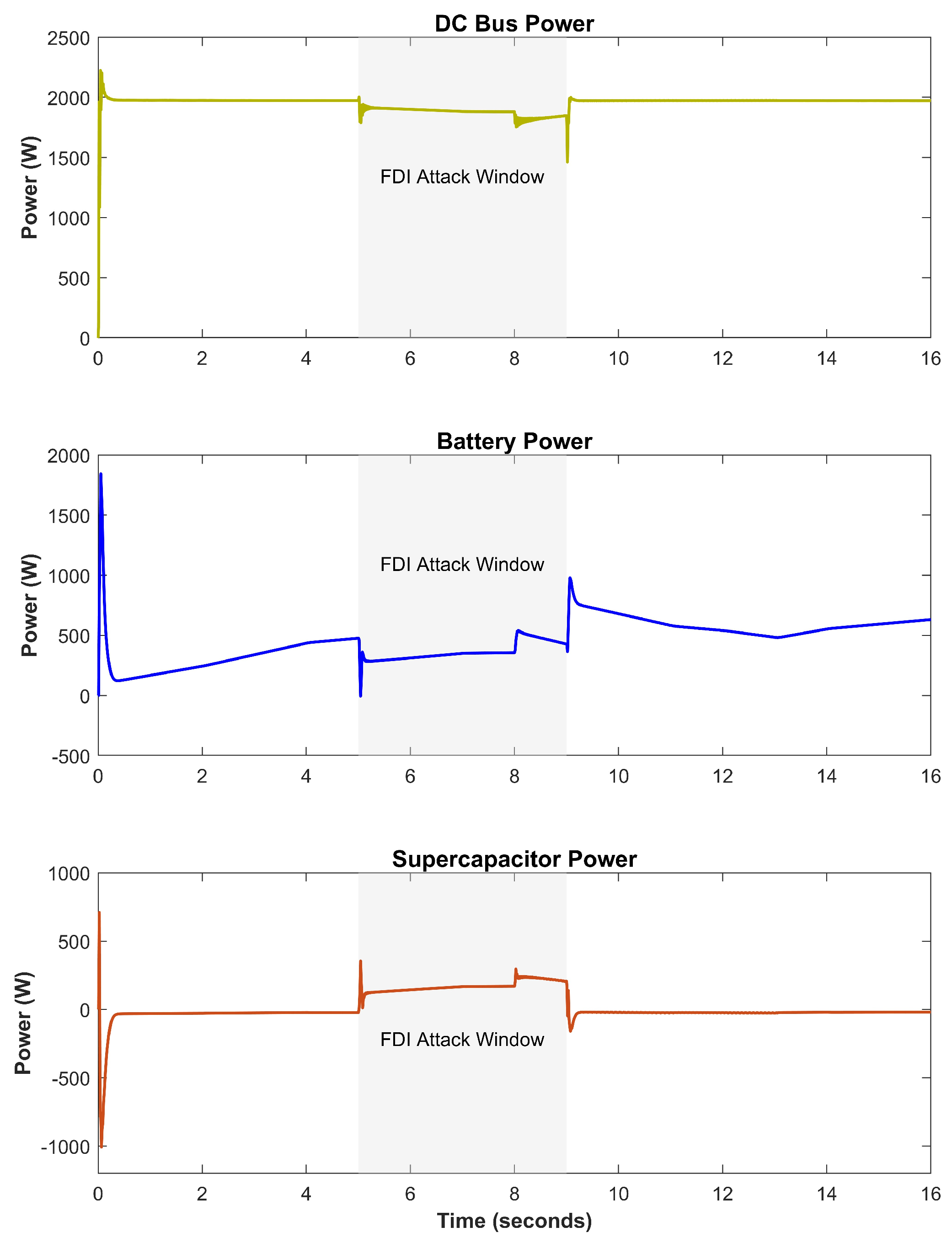
Figure 22 illustrates the impact of the FDI attack on DC-bus power, battery power, and supercapacitor power. Under normal conditions, the hybrid energy storage system exhibits coordinated operation in which the supercapacitor primarily compensates for fast transients while the battery supplies the slower power component. However, during the attack window, this coordination is noticeably disrupted.
Due to the artificially inflated voltage error, the ANFIS controller is misled into generating incorrect current references. As a result, the supercapacitor supplies power continuously throughout the attack interval, rather than limiting its contribution to short-duration transients. The attack compromises the power balance of the DC bus, causing the power to drop from a regulated 2000 W to a degraded 1900 W between t = 5 s and t = 8 s. A critical instability is observed at t = 9 s, where the DC-bus power suffers a transient dip to 1500 W—a 25% deviation from the nominal value. Under normal conditions at t = 5 s, the battery provides ~480 W. During the attack, this drops immediately to ~280 W (42% deviation), forcing other components to compensate. At t = 8 s load change, the normal battery power spikes by ~300 W. Under the FDI attack, the spike is much more severe with a 620 W transient. In the absence of an attack, the SC remains idle at 0 W during steady-state periods. During the FDI attack window, the SC is forced into a sustained discharge state, peaking at 380 W. This behavior deviates from the intended HESS operating principle and indicates that the controller incorrectly interprets the system state. In addition, both the battery and supercapacitor power profiles exhibit larger power spikes compared to normal operation, reflecting unstable and uncoordinated power sharing.
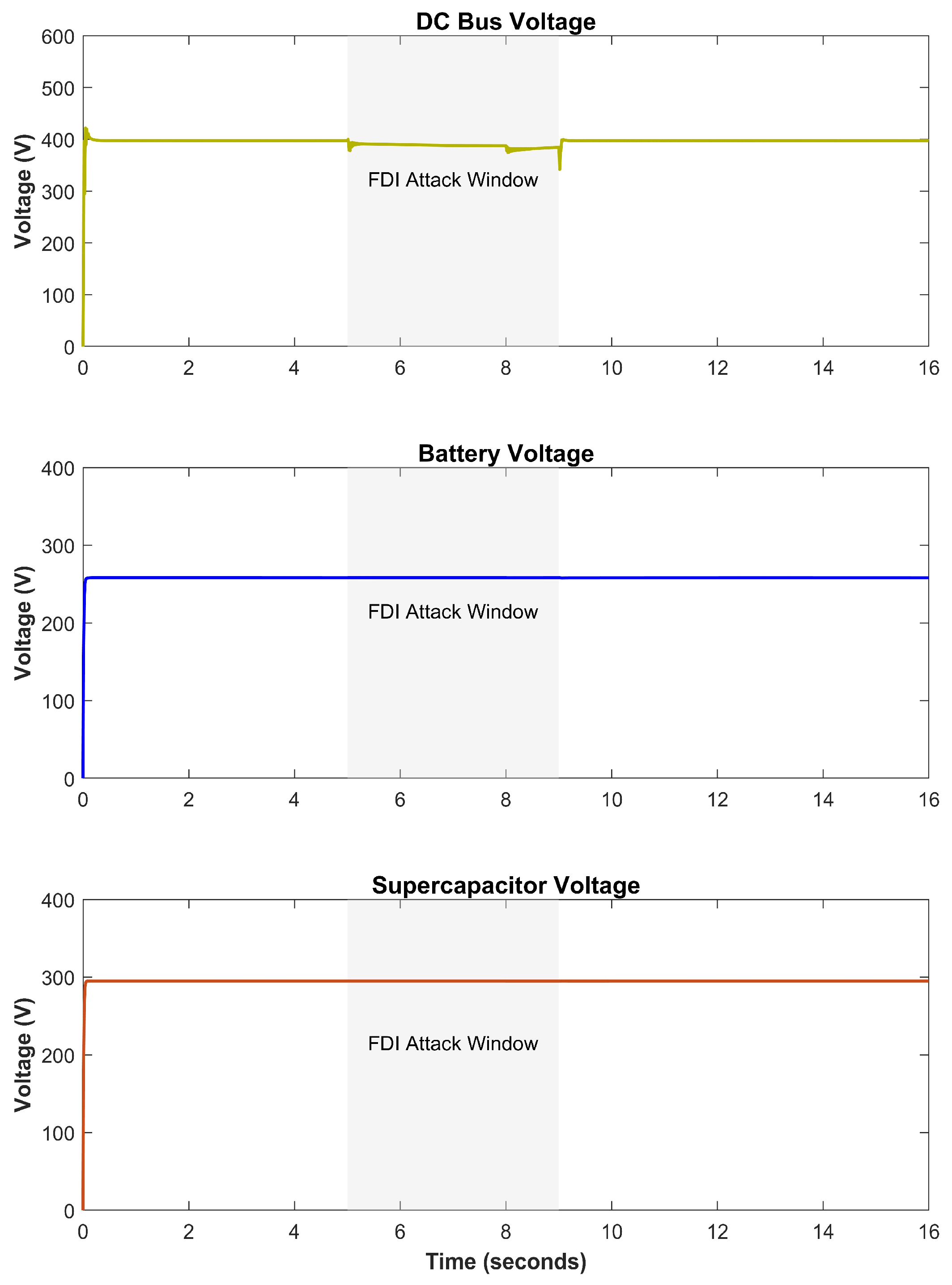
Figure 23 presents the corresponding voltage responses of the DC bus, battery, and supercapacitor. During the FDI attack, the DC-bus voltage experiences a noticeable deviation from its reference value, accompanied by sharp transient dips and recovery spikes. Although the voltage does not collapse, the increased fluctuations indicate degraded regulation performance. The battery and supercapacitor voltages remain within their nominal operating ranges. However, the abnormal power exchange during the attack suggests increased electrical stress on the energy storage components.
Compared to the normal ANFIS-controlled operation, the FDI attack results in higher voltage and power oscillations, unintended continuous supercapacitor participation, and loss of proper power-sharing dynamics. These results demonstrate that, despite maintaining overall system stability, the ANFIS controller is vulnerable to measurement-level cyber manipulation, which can significantly degrade performance and compromise the intended operational behavior of the HESS.

6.2. Impact of DoS Attack

This subsection evaluates the impact of a denial-of-service (DoS) attack on the ANFIS-based supercapacitor control loop by freezing the supercapacitor duty-cycle command d sc (hold-last-value) over the interval t = 5 to 10 s. Under this condition, the supercapacitor converter operates using a stale command and cannot update its control action based on the instantaneous system state.
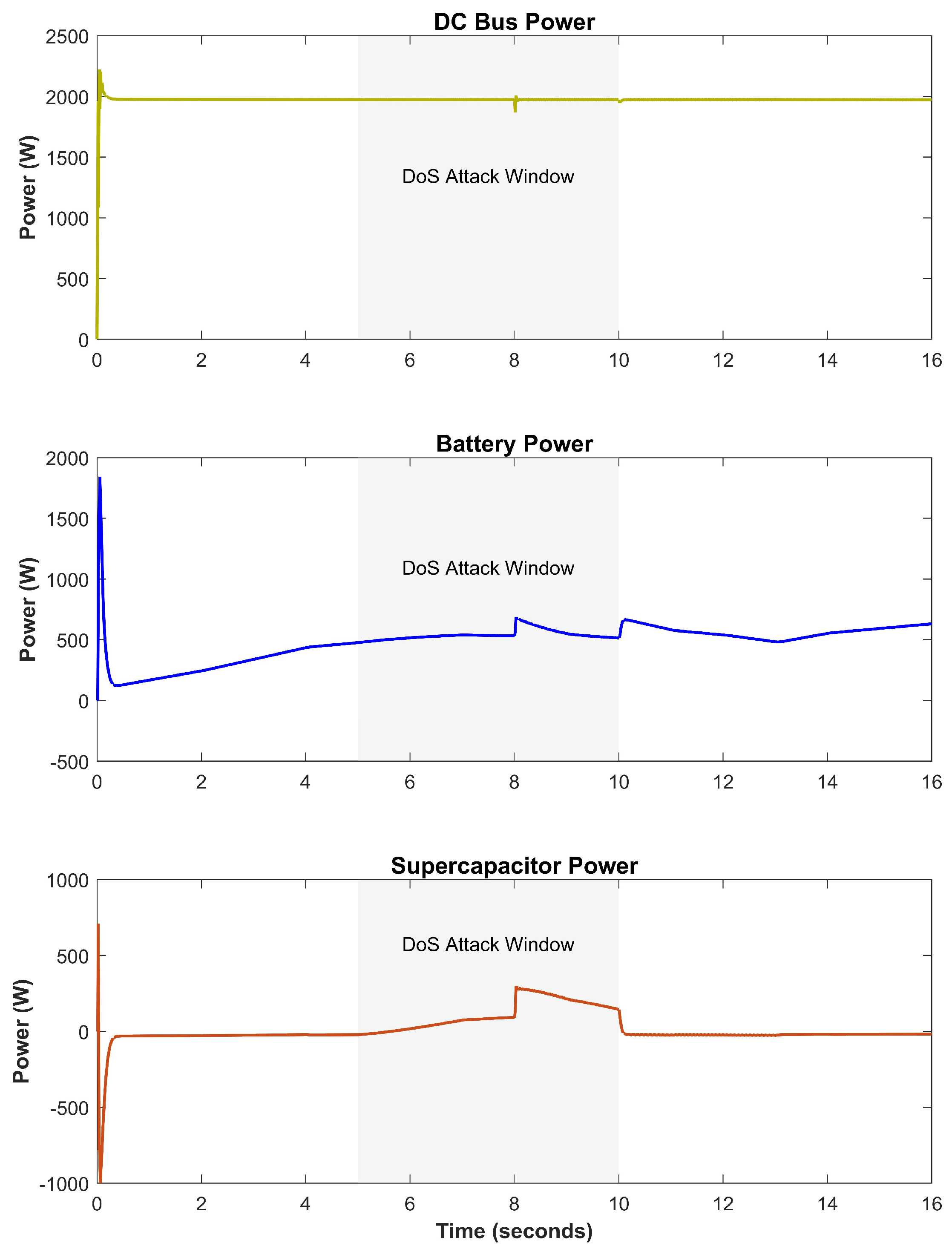
Figure 24 shows the DC-bus, battery, and supercapacitor power responses under the DoS attack. A key observation is that once the attack begins at t = 5 sec, the supercapacitor power does not remain near its nominal transient-only contribution. Instead, the supercapacitor gradually increases its power output after attack initiation and continues supplying power throughout the entire attack window. Starting at t = 5 s, supercapacitor begins an unintended discharge, reaching 100 W by t = 7 s and spiking to nearly 300 W at t = 8 s. This sustained supercapacitor support is not expected under normal HESS coordination, where the supercapacitor should primarily compensate for short-term disturbances and then return close to zero steady-state power.
This effect becomes more evident around the irradiance disturbance (near t = 8 s). Under normal ANFIS operation, the supercapacitor is expected to inject or absorb power mainly during the transient immediately following the irradiance drop. However, during the DoS interval, the supercapacitor continues delivering non-zero power well beyond the transient response, indicating that the held duty-cycle command causes an unintended operating point and disrupts the intended low-frequency/high-frequency power-sharing behavior. As a result, the battery exhibits modified power trajectories and additional power adjustments to maintain system balance, reflecting degraded coordination between the storage devices during the attack.
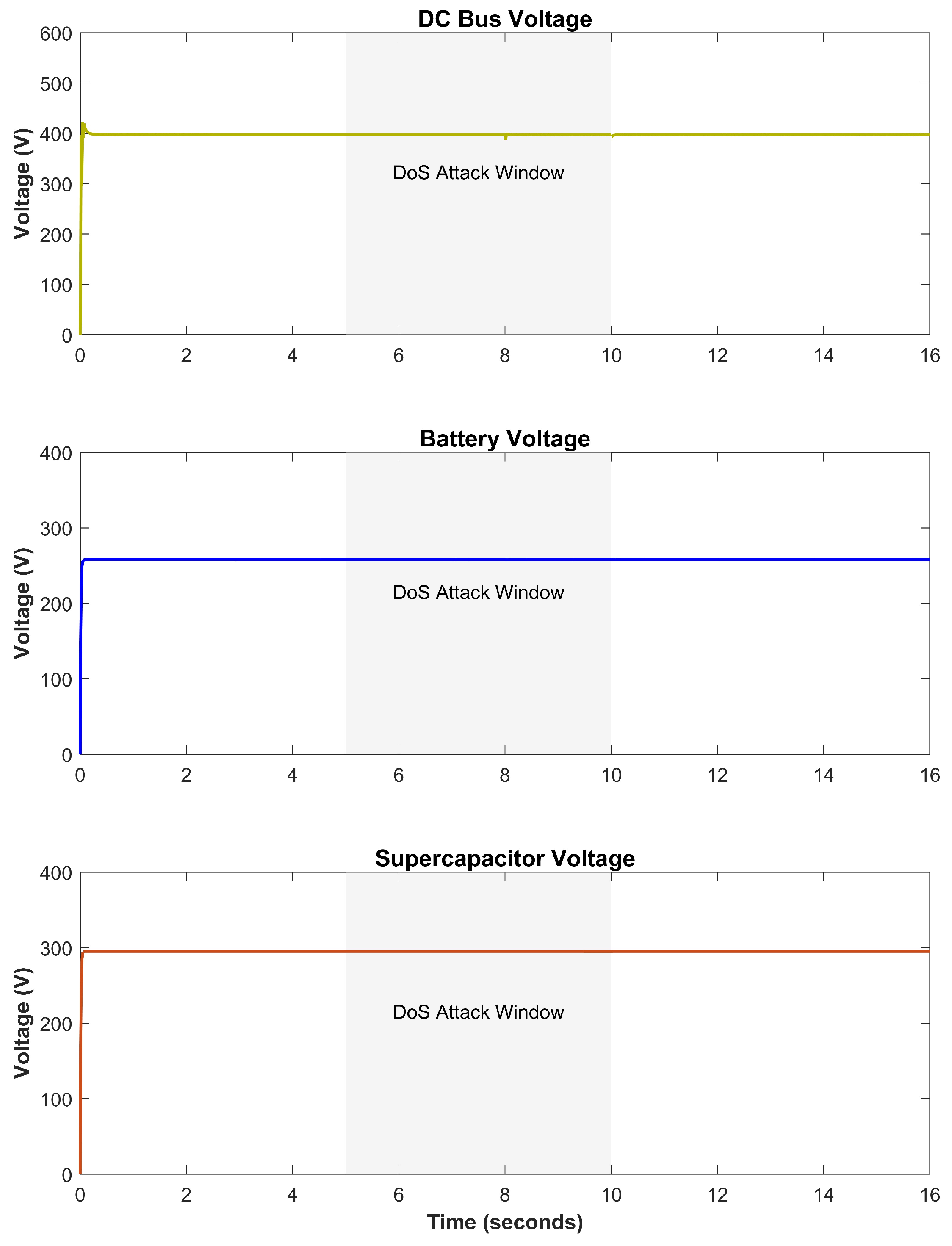
Figure 25 presents the corresponding voltages. The DC-bus voltage remains regulated close to its reference value, but small deviations and recovery spikes appear during the attack interval, consistent with the loss of optimal dynamic compensation. Although battery and supercapacitor voltages remain within their nominal ranges, the sustained supercapacitor power delivery during t = 5–10 s suggests that the DoS attack can distort the internal energy-sharing mechanism even when the DC-bus voltage appears approximately regulated.
Overall, the DoS attack does not necessarily cause immediate collapse in the DC-bus voltage for the tested scenario, but it clearly degrades the intended HESS coordination by forcing the supercapacitor to contribute power for an extended duration rather than only during fast transients. This behavior implies increased stress and unnecessary energy usage in the supercapacitor branch and altered battery loading, which can become critical under longer attack durations or repeated events.

7. Conclusions

This paper presents a comprehensive analysis of an ANFIS-based control strategy for HESS consisting of a battery and a supercapacitor in a PV and EV-integrated DC microgrid system. The ANFIS controller was designed to regulate the DC-bus voltage and coordinate power sharing between the battery and supercapacitor under normal operating conditions. To ensure a fair comparison, conventional PI controllers were first developed for all control loops, and their operational data were subsequently used to train the corresponding ANFIS controllers. Based on the simulation results, the following conclusions can be drawn.
(i) Under normal operating conditions with time-varying solar irradiance, the ANFIS-based controller demonstrated effective DC-bus voltage regulation and smooth power balancing among the PV source, battery, and supercapacitor. The results showed reduced voltage deviation and improved transient handling during irradiance changes compared to the PI-based baseline, while maintaining nominal battery and supercapacitor voltage levels. Importantly, the supercapacitor behavior under ANFIS control remained largely transient-focused during normal operation, consistent with its intended role in a HESS.
(ii) The cybersecurity impact analysis revealed that ANFIS-based control is vulnerable to targeted cyber-attacks on critical feedback and control signals. In the FDI attack scenario, manipulation of the load voltage measurement caused unintended control actions, leading to prolonged supercapacitor power injection and increased voltage and power fluctuations. Similarly, during the DoS attack implemented by freezing the supercapacitor duty cycle, the supercapacitor supplied power beyond transient periods, deviating from the designed power-sharing strategy. These results highlight that although ANFIS improves control performance under normal conditions, cyber-attacks can significantly distort learned control behavior and disrupt coordinated HESS operation.
Overall, this study emphasizes that advanced data-driven controllers such as ANFIS must be evaluated not only for performance enhancement but also for cyber resilience.
It should be noted that the results presented in this study are obtained through detailed MATLAB/Simulink R2024a-based simulations. While this allows controlled evaluation of control performance and cyber-attack impacts at the system level, experimental validation using hardware prototypes is beyond the scope of the present work. In addition, the ANFIS controllers in this study are trained offline using operational data generated from baseline PI controllers, operate in a corrective manner based on real-time measurements, and do not incorporate predictive forecasting of PV generation or EV load demand. Therefore, while the trained ANFIS can provide smooth nonlinear mapping and interpolation within the trained input domain, its performance under operating profiles that differ significantly from the training distribution is not guaranteed. Furthermore, the number and type of membership functions employed in the ANFIS controllers were selected using a heuristic trial-and-error approach to balance control performance and computational complexity. Therefore, global optimality of the ANFIS structure is not claimed. Finally, the cyber-attacks considered in this study are modeled using simplified representations, and more sophisticated adaptive or stealthy attack scenarios are not addressed.
Future research will focus on real-time implementation and experimental validation to assess the practical feasibility of ANFIS-based HESS control under realistic operating conditions. Additional efforts will investigate alternative training strategies, online adaptation mechanisms, optimization-based structure tuning methods, such as particle swarm optimization or genetic algorithms to improve generalization under untrained operating conditions. Moreover, future work will focus on integrating cyber-attack detection mechanisms, resilient or adaptive control architectures, and secure communication frameworks to enhance the robustness of ANFIS-controlled DC microgrids under adversarial conditions. The cyber-attack analysis presented in this work is intended to evaluate the vulnerability and robustness limits of ANFIS-based HESS control under compromised communication conditions and to motivate the development of dedicated mitigation and detection strategies in future research. More sophisticated attack models involving adaptive, stealthy, or time-varying characteristics, as well as sensitivity analysis with respect to attack magnitude and duration will be addressed in future research. In addition, short-term forecasting of PV generation and EV load demand using machine learning models will be investigated to enable proactive HESS coordination. The applicability of novel intelligent control strategies beyond ANFIS will be explored for coordinated HESS operation in future studies.

Author Contributions

Conceptualization, M.N.I. and M.H.A.; methodology, M.N.I.; software, M.N.I.; validation, M.N.I. and M.H.A.; formal analysis, M.N.I. and M.H.A.; investigation, M.N.I. and M.H.A.; resources, M.H.A.; data curation, M.N.I.; writing—original draft preparation, M.N.I.; writing—review and editing, M.H.A.; visualization, M.H.A.; supervision, M.H.A.; project administration, M.H.A.; funding acquisition, M.H.A. All authors have read and agreed to the published version of the manuscript.

Funding

This research received no external funding.

Data Availability Statement

The original contributions presented in this study are included in the article. Further inquiries can be directed to the corresponding author.

Acknowledgments

The authors acknowledge the financial support from the Electrical and Computer Engineering Department of the University of Memphis, USA, to perform this work.

Conflicts of Interest

The authors declare no conflicts of interest.

References

  1. Peterson, S.B.; Michalek, J.J. Cost-Effectiveness of Plug-in Hybrid Electric Vehicle Battery Capacity and Charging Infrastructure Investment for Reducing US Gasoline Consumption. Energy Policy 2013, 52, 429–438. [Google Scholar] [CrossRef]
  2. Arefin, A.A.; Meraj, S.T.; Lipu, M.S.H.; Rahman, M.S.; Rahman, T.; Hasan, K.; Sarker, M.R.; Muttaqi, K.M. Societal, Environmental, and Economic Impacts of Electric Vehicles towards Achieving Sustainable Development Goals. Results Eng. 2025, 27, 107060. [Google Scholar] [CrossRef]
  3. IEA. Global EV Outlook 2024; IEA: Paris, France, 2024; Available online: https://www.iea.org/reports/global-ev-outlook-2024 (accessed on 25 December 2025).
  4. Roy, P.; Ilka, R.; He, J.; Liao, Y.; Cramer, A.M.; Mccann, J.; Delay, S.; Coley, S.; Geraghty, M.; Dahal, S. Impact of Electric Vehicle Charging on Power Distribution Systems: A Case Study of the Grid in Western Kentucky. IEEE Access 2023, 11, 49002–49023. [Google Scholar] [CrossRef]
  5. Deb, S.; Tammi, K.; Kalita, K.; Mahanta, P. Impact of Electric Vehicle Charging Station Load on Distribution Network. Energies 2018, 11, 178. [Google Scholar] [CrossRef]
  6. Ashok Kumar, A.; Amutha Prabha, N. A Comprehensive Review of DC Microgrid in Market Segments and Control Technique. Heliyon 2022, 8, e11694. [Google Scholar] [CrossRef]
  7. Lasseter, R.H. Smart Distribution: Coupled Microgrids. Proc. IEEE 2011, 99, 1074–1082. [Google Scholar] [CrossRef]
  8. Mohan, H.M.; Dash, S.K. Renewable Energy-Based DC Microgrid with Hybrid Energy Management System Supporting Electric Vehicle Charging System. Systems 2023, 11, 273. [Google Scholar] [CrossRef]
  9. Alrubaie, A.J.; Salem, M.; Swadi, M.; Yahya, K.; Kamarol, M.; Dawsari, S.A. Electric Vehicle Integration in Microgrid: Hierarchical Control, Emerging Technologies, and Future Directions. Energy Rep. 2025, 14, 5590–5615. [Google Scholar] [CrossRef]
  10. Tewari, T.; Mohapatra, A.; Anand, S. Coordinated Control of OLTC and Energy Storage for Voltage Regulation in Distribution Network With High PV Penetration. IEEE Trans. Sustain. Energy 2021, 12, 262–272. [Google Scholar] [CrossRef]
  11. Jing, W.; Hung Lai, C.; Wong, S.H.W.; Wong, M.L.D. Battery-supercapacitor Hybrid Energy Storage System in Standalone DC Microgrids: Areview. IET Renew. Power Gen. 2017, 11, 461–469. [Google Scholar] [CrossRef]
  12. Nawaz, F.; Pashajavid, E.; Fan, Y.; Batool, M. Enhanced Distributed Coordinated Control Strategy for DC Microgrid Hybrid Energy Storage Systems Using Adaptive Event Triggering. Electronics 2025, 14, 3303. [Google Scholar] [CrossRef]
  13. Lin, X.; Zamora, R. Controls of Hybrid Energy Storage Systems in Microgrids: Critical Review, Case Study and Future Trends. J. Energy Storage 2022, 47, 103884. [Google Scholar] [CrossRef]
  14. Pogaku, N.; Prodanovic, M.; Green, T.C. Modeling, Analysis and Testing of Autonomous Operation of an Inverter-Based Microgrid. IEEE Trans. Power Electron. 2007, 22, 613–625. [Google Scholar] [CrossRef]
  15. Katiraei, F.; Iravani, M.R. Power Management Strategies for a Microgrid With Multiple Distributed Generation Units. IEEE Trans. Power Syst. 2006, 21, 1821–1831. [Google Scholar] [CrossRef]
  16. Neelagiri, S.; Usha, P.; Biradar, S. Fuzzy Logic-Based Energy Management System for a Microgrid with Hybrid Energy Storage: Design, Control, and Comparative Analysis. Int. J. Pow. Elec. Dri. Syst. 2025, 16, 1991–2004. [Google Scholar] [CrossRef]
  17. Song, D.; Yousaf, A.; Noor, J.; Cao, Y.; Dong, M.; Yang, J.; Rizk-Allah, R.M.; Elkholy, M.H.; Talaat, M. ANN-Based Model Predictive Control for Hybrid Energy Storage Systems in DC Microgrid. Prot. Control Mod. Power Syst. 2025, 10, 1–15. [Google Scholar] [CrossRef]
  18. Rao, S.N.V.B.; Pavan Kumar, Y.V.; Amir, M.; Ahmad, F. An Adaptive Neuro-Fuzzy Control Strategy for Improved Power Quality in Multi-Microgrid Clusters. IEEE Access 2022, 10, 128007–128021. [Google Scholar] [CrossRef]
  19. Morozov, S.; Kupriyanov, M. A Neuro-Fuzzy System for Power Supply Control. Eng. Proc. 2023, 33, 49. [Google Scholar] [CrossRef]
  20. Jang, J.-S.R. ANFIS: Adaptive-Network-Based Fuzzy Inference System. IEEE Trans. Syst. Man Cybern. 1993, 23, 665–685. [Google Scholar] [CrossRef]
  21. Cabrane, Z.; Ouassaid, M.; Maaroufi, M. Battery and Supercapacitor for Photovoltaic Energy Storage: A Fuzzy Logic Management. IET Renew. Power Gen. 2017, 11, 1157–1165. [Google Scholar] [CrossRef]
  22. Shi, B.; Zhou, Y.; Zhao, W.; Zhou, Y.; Zhao, Z.; Yuan, L.; Wei, S.; Nie, J.; Li, K.; Shi, B.; et al. A Novel Coordinated Control Strategy for Energy Storage System in DC Microgrid With Weak Communication. IEEE Trans. Ind. Appl. 2020, 56, 800–814. [Google Scholar] [CrossRef]
  23. Yu, Y.; Liu, G.-P.; Hu, W. Coordinated Distributed Predictive Control for Voltage Regulation of DC Microgrids With Communication Delays and Data Loss. IEEE Trans. Smart Grid 2023, 14, 1708–1722. [Google Scholar] [CrossRef]
  24. Tatipatri, N.; Arun, S.L. A Comprehensive Review on Cyber-Attacks in Power Systems: Impact Analysis, Detection, and Cyber Security. IEEE Access 2024, 12, 18147–18167. [Google Scholar] [CrossRef]
  25. Zhong, X.; Yu, L.; Brooks, R.; Venayagamoorthy, G.K. Cyber Security in Smart DC Microgrid Operations. In 2015 IEEE First International Conference on DC Microgrids (ICDCM); IEEE: Atlanta, GA, USA, 2015; pp. 86–91. [Google Scholar] [CrossRef]
  26. Zhong, X.; Li, G.X.; Zhng, C. False Data Injection in Power Smart Grid and Identification of the Most Vulnerable Bus; a Case Study 14 IEEE Bus Network. Energy Rep. 2021, 7, 8476–8484. [Google Scholar] [CrossRef]
  27. Teixeira, A.; Amin, S.; Sandberg, H.; Johansson, K.H.; Sastry, S.S. Cyber Security Analysis of State Estimators in Electric Power Systems. In 49th IEEE Conference on Decision and Control (CDC); IEEE: Atlanta, GA, USA, 2010; pp. 5991–5998. [Google Scholar] [CrossRef]
  28. Liang, G.; Zhao, J.; Luo, F.; Weller, S.R.; Dong, Z.Y. A Review of False Data Injection Attacks Against Modern Power Systems. IEEE Trans. Smart Grid 2017, 8, 1630–1638. [Google Scholar] [CrossRef]
  29. Liang, G.; Weller, S.R.; Zhao, J.; Luo, F.; Dong, Z.Y. The 2015 Ukraine Blackout: Implications for False Data Injection Attacks. IEEE Trans. Power Syst. 2017, 32, 3317–3318. [Google Scholar] [CrossRef]
  30. Ortega-Fernandez, I.; Liberati, F. A Review of Denial of Service Attack and Mitigation in the Smart Grid Using Reinforcement Learning. Energies 2023, 16, 635. [Google Scholar] [CrossRef]
  31. Takagi, T.; Sugeno, M. Fuzzy Identification of Systems and Its Applications to Modeling and Control. IEEE Trans. Syst. Man Cybern. 1985, SMC-15, 116–132. [Google Scholar] [CrossRef]
  32. Mamdani, E.H.; Assilian, S. An experiment in linguistic synthesis with a fuzzy logic controller. Int. J. Man-Mach. Stud. 1975, 7, 1–13. [Google Scholar] [CrossRef]
Figure 1. Block diagram of DC microgrid.
Energies 19 01103 g001
Figure 2. Solar irradiance profile.
Energies 19 01103 g002
Figure 3. Voltage responses under solar irradiance variation Using PI control: DC-bus voltage, battery voltage, and supercapacitor voltage.
Energies 19 01103 g003
Figure 4. Power responses under solar irradiance variation using PI control: DC-bus power, battery power, and supercapacitor power.
Energies 19 01103 g004
Figure 5. Voltage responses under sudden EV load connection using PI control: DC-bus voltage, battery voltage, and supercapacitor voltage.
Energies 19 01103 g005
Figure 6. Power responses under sudden EV load connection using PI control: DC-bus power, battery power, and supercapacitor power.
Energies 19 01103 g006
Figure 7. Control structure of HESS.
Energies 19 01103 g007
Figure 8. Outer voltage-loop ANFIS structure. The black circles represent the input and output nodes, while the white circles denote adaptive nodes associated with the membership function.
Energies 19 01103 g008
Figure 9. Membership functions of the voltage error input for the outer voltage-loop ANFIS controller. The five colored lines represent the triangular membership functions associated with Negative Large (NL), Negative Small (NS), Zero (ZE), Positive Small (PS), and Positive Large (PL) voltage error levels, respectively.
Energies 19 01103 g009
Figure 10. Inner current-loop ANFIS structure. The black circles represent the input and output nodes, while the white circles denote adaptive nodes associated with the membership function.
Energies 19 01103 g010
Figure 11. Membership functions of the current error input for the inner current-loop ANFIS controller. The colored lines represent the membership functions corresponding to Very Low (VL), Low (L), High (H), and Very High (VH) current error levels, respectively.
Energies 19 01103 g011
Figure 12. Membership functions of the reference current input for the inner current-loop ANFIS controller. The colored lines represent the membership functions corresponding to Low (L), Medium (M), and High (H) reference current levels, respectively.
Energies 19 01103 g012
Figure 13. HESS control structure with PI.
Energies 19 01103 g013
Figure 14. HESS control structure with Fuzzy Logic.
Energies 19 01103 g014
Figure 15. Triangular membership functions for the normalized input variables of the non-adaptive Mamdani Fuzzy Logic controller. The colored lines represent the membership functions corresponding to Negative Big (NB), Negative Small (NS), Zero (Z), Positive Small (PS), and Positive Big (PB), respectively.
Energies 19 01103 g015
Figure 16. DC-bus voltage response under solar irradiance variation using PI, Fuzzy Logic and ANFIS controls.
Energies 19 01103 g016
Figure 17. DC-bus power response under solar irradiance variation using PI, Fuzzy Logic and ANFIS controls.
Energies 19 01103 g017
Figure 18. Battery voltage response under solar irradiance variation using PI, Fuzzy Logic and ANFIS controls.
Energies 19 01103 g018
Figure 19. Battery power response under solar irradiance variation using PI, Fuzzy Logic and ANFIS control.
Energies 19 01103 g019
Figure 20. Supercapacitor voltage response under solar irradiance variation using PI, Fuzzy Logic and ANFIS Control.
Energies 19 01103 g020
Figure 21. Supercapacitor power response under solar irradiance variation using PI, Fuzzy Logic and ANFIS Control.
Energies 19 01103 g021
Figure 22. DC-bus power, battery power, and supercapacitor power responses of the ANFIS-controlled DC microgrid under FDI attack.
Energies 19 01103 g022
Figure 23. DC-bus voltage, battery voltage, and supercapacitor voltage responses of the ANFIS-controlled DC microgrid under FDI attack.
Energies 19 01103 g023
Figure 24. DC-bus power, battery power, and supercapacitor power responses of the ANFIS-controlled DC microgrid under DoS attack.
Energies 19 01103 g024
Figure 25. DC-bus voltage, battery voltage, and supercapacitor voltage responses of the ANFIS-controlled DC microgrid under DoS attack.
Energies 19 01103 g025
Table 1. Fuzzy rule base of outer voltage-loop ANFIS controller.
Voltage Error (ev)Total Current Reference (iref)
NLVery Low Current
NSLow Current
ZENominal Current
PSHigh Current
PLVery High Current
Table 2. Training of outer voltage-loop ANFIS.
ParametersDetails
Fuzzy Inference SystemGrid Partition
No of Input1
No of Output1
No of Membership Functions5
Membership Function TypeTriangular
No of Fuzzy Rules5
Optimization TechniqueHybrid
Error Tolerance0.0001
No of Epochs for Training50
Number of Training Samples145,000
Table 3. Compact rule base of inner current-loop ANFIS controller.
Current Error/Reference CurrentLMH
VLC1C2C3
LC4C5C6
HC7C8C9
VHC10C11C12
Table 4. Training of inner current-loop ANFIS.
ParametersBattery ANFISSupercapacitor ANFIS
Fuzzy Inference SystemGrid PartitionGrid Partition
No of Input22
No of Output11
No of Membership Functions4, 34, 3
Membership Function Type GaussianGaussian
No of Fuzzy Rules1212
Optimization TechniqueHybridHybrid
Error Tolerance0.00010.0001
No of Epochs for Training6060
Number of Training Samples145,000145,000
Table 5. Rule base of the Mamdani Fuzzy Logic controller.
e/ΔeNBNSZPSPB
NBNBNBNBNSZ
NSNBNBNSZPS
ZNBNSZPSPB
PSNSZPSPBPB
PBZPSPBPBPB
Table 6. Quantitative performance comparison of DC-bus voltage regulation.
MetricPIFuzzyANFIS
IAE (V·s)79.865192.069948.6741
ISE (V2·s)2.932 × 1033.295 × 1031.566 × 103
Settling Time (s)1.4431.0580.096
Disclaimer/Publisher’s Note: The statements, opinions and data contained in all publications are solely those of the individual author(s) and contributor(s) and not of MDPI and/or the editor(s). MDPI and/or the editor(s) disclaim responsibility for any injury to people or property resulting from any ideas, methods, instructions or products referred to in the content.