1. Introduction
The global shift toward low-carbon, energy-efficient development has become a strategic imperative for firms amid tightening climate policies and carbon-neutrality goals. Firms are increasingly evaluated not solely on environmental pledges but also on measurable improvements in energy transition performance, reflected in reduced energy consumption, lower energy intensity, and lower carbon emission intensity. At the same time, the rapid integration of artificial intelligence (AI) into production and manufacturing systems is transforming how firms coordinate resources, monitor operations, and manage energy use. In industrial contexts, such integration predominantly occurs through AI-enabled intelligent automation embedded in production equipment and operational systems, such as intelligent sensors, predictive maintenance modules, and real-time process control, rather than through standalone algorithmic or software-based AI applications. These twin structural trends raise a fundamental question: Does AI adoption promote corporate energy transition? And, if so, through which organizational channels and over what time horizon?
The answer is not predetermined. On one hand, AI-enabled automation embedded in production processes can enhance sensing accuracy, forecasting precision, and operational optimization, thereby reducing energy waste and emissions. On the other hand, while large-scale algorithmic AI relies on energy-intensive data infrastructure, the form of AI examined in this study primarily operates through embedded intelligent automation in production systems. According to the International Energy Agency [
1], electricity demand from data centers and AI-computation is projected to double by 2030, implying that AI may simultaneously enable efficiency gains and increase energy consumption. Yet, the IEA’s Energy Efficiency 2024 report documents meaningful improvements in industrial energy intensity where intelligent control systems have been implemented, and its forthcoming Energy and AI (2025) report identifies expanding applications of AI, such as predictive maintenance, real-time scheduling, and anomaly detection, that may directly reduce energy use and carbon emission intensity [
2].
Despite these developments, systematic firm-level evidence remains limited. Case studies and engineering demonstrations show AI’s energy-saving potential but lack generalizability. Empirical research on digital transformation primarily focuses on productivity or operational efficiency [
3,
4], while environmental performance studies often focus on single outcome measures such as energy intensity or emissions. As a result, the multidimensional nature of the energy transition, encompassing energy consumption, energy intensity, and carbon emission intensity, has not been analyzed within a unified framework [
5]. Moreover, although theory suggests that AI-enabled production transformation may influence energy transition through green innovation, operating efficiency, and resource allocation efficiency, prior empirical work has rarely quantified these organizational channels or examined whether such effects evolve dynamically as firms internalize intelligent manufacturing capabilities.
To fill these gaps, this study investigates how, over what horizon, and whether AI adoption contributes to corporate energy transition. We ask three research questions:
RQ1. Does AI adoption reduce firms’ energy consumption, energy intensity, and carbon emission intensity?
RQ2. Do green innovation, operating efficiency, and resource allocation efficiency mediate the relationship between AI adoption and each dimension of energy transition performance?
RQ3. Do the effects of AI adoption follow a dynamic adjustment path, with initial integration costs followed by performance improvements?
Using a panel of Chinese A-share listed firms (2012–2024), this study conceptualizes AI adoption as the intensity of AI-enabled intelligent automation embedded in production capital, and measures it as the ratio of machinery and equipment book value to total employees, following the intelligent-manufacturing literature in the Chinese context [
6]. This measure captures the depth of intelligent automation relevant to energy monitoring, process control, and operational optimization, rather than standalone algorithmic AI. For robustness, we also examine AI investment as a percentage of total assets. Energy transition performance is captured via three outcome variables: energy consumption, energy intensity, and carbon emission intensity. Our empirical strategy uses firm- and year-fixed effects, instrumental variables, and control-function methods to address endogeneity, and a staggered-adoption event study to capture dynamic effects. Mechanism testing uses parallel causal mediation analysis.
This study contributes in three main ways: First, by providing comprehensive multi-dimensional evidence on AI’s effects on corporate energy transition. Second, by identifying and quantifying the mediating roles of green innovation, operating efficiency, and resource allocation efficiency. Third, by revealing a dynamic investment–adaptation–return trajectory, showing that energy benefits from AI strengthen as firms internalize intelligent manufacturing capabilities. By embedding AI-enabled production transformation into corporate energy transition performance, the study advances understanding of how firms align digital upgrading with low-carbon objectives.
2. Literature Review
2.1. AI Adoption in Firms: Concept, Measurement, and Organizational Effects
In production and operations settings, AI adoption refers to the integration of intelligent sensing, prediction, and optimization into physical equipment, manufacturing execution systems, and managerial control routines. Unlike generic digitalization, this embedded form of AI directly affects how inputs are combined and controlled on the shop floor, thereby altering process stability, utilization, and the firm’s effective production function. Recent empirical work in manufacturing and energy-intensive sectors treats AI adoption as an operational capability that can be observed through equipment–process integration and its downstream performance consequences (e.g., energy, emissions, and innovation outcomes) [
7,
8].
Empirical studies have converged on three clusters of firm-level AI adoption measures: Text-based disclosure indicators that parse annual reports for AI-related terms to quantify adoption intensity or diffusion. In Chinese energy and manufacturing samples, text-based measures of AI adoption have been linked to green innovation efficiency, suggesting that disclosure-captured adoption correlates with actual capability upgrading [
9,
10,
11]. Human-capital/competence proxies (e.g., AI/IT talent, AI-oriented teams). These variables emphasize capability formation but can be sensitive to organization size and reporting practices [
12]. Capital-equipment-based measures that capture the depth of intelligent/automated equipment embedded per worker, for example, machine and equipment value scaled by employment [
13].
In the Chinese intelligent-manufacturing context, recent work shows that equipment/worker ratios align with the degree of process automation/intelligence and help explain energy–environment performance at the firm/industry level. In our setting, this measure is well-suited because it directly reflects the extent to which AI-enabled equipment is integrated into energy-relevant processes, rather than merely signaling strategic intent. This triangulation, including text, talent, and equipment, has two advantages. First, it separates embedded operational AI from generic digital rhetoric. Second, it allows concordance tests (e.g., equipment-based primary measure with text- or investment-based robustness), thereby increasing construct validity.
Recent studies connect firm-level AI adoption to innovation, operations, and allocation. On the innovation margin, AI adoption by energy and manufacturing firms is associated with higher green innovation efficiency and the upgrading of cleaner technological solutions [
10]. In operations, embedded AI supports predictive maintenance, real-time scheduling, and anomaly detection, thereby improving utilization and reducing losses in energy-intensive stages [
13]. Industry syntheses document these capabilities as the most immediate levers for reducing waste and stabilizing load profiles [
2]. On the allocation margin, AI facilitates finer capital–labor–energy matching and curbs low-return expansion, which has been linked to lower energy intensity in recent firm-level evidence [
14]. Together, these results indicate that AI adoption functions not as a narrow IT input but as a capability transformation that shapes how firms search for improvements (innovation), execute processes (operations), and allocate factors (resources). These three domains are theoretically proximate to energy transition performance (energy consumption, energy intensity, and carbon emission intensity).
2.2. Corporate Energy Transition: Drivers, Outcomes, and Measurement
Corporate energy transition refers to the shift from energy-intensive production modes to more efficient, low-carbon operational structures. Under the dual pressures of national carbon neutrality strategies and tightening regulatory standards, firms are increasingly required to demonstrate measurable progress in their energy consumption, conversion, and externalization. In this context, corporate energy transition performance is evaluated through observable outcomes rather than through environmental signaling or policy-compliance narratives.
Corporate energy transition performance is inherently multi-dimensional, as it involves changes in how firms consume energy, convert energy into output, and externalize environmental impacts. Accordingly, three outcome indicators are widely recognized as the core components of energy transition:
Energy consumption reflects the absolute scale of energy input and indicates whether firms have effectively constrained total resource use in production.
Energy intensity measures the efficiency of converting energy into economic value, and is therefore regarded as the most direct expression of process improvement and technology upgrading.
Carbon emission intensity captures the environmental externalities associated with energy use and reflects firms’ alignment with carbon-reduction goals.
These three dimensions correspond to the “input-efficiency-externality” framework commonly applied in energy systems and industrial sustainability analysis [
15,
16]. Significantly, they do not necessarily move in parallel. For instance, firms may reduce carbon emission intensity by switching to cleaner fuels while leaving energy intensity unchanged, or may improve intensity but experience rising total consumption due to production scale expansion. Likewise, the impacts of green technology upgrading may appear earlier in emissions and only gradually in intensity, as organizations learn and adapt their equipment [
17]. Therefore, focusing on only one dimension risks drawing incomplete or misleading conclusions about the transition’s progress. A firm that reports lower emissions may still be structurally energy-intensive, while a firm that reduces intensity may continue to expand overall energy demand. To distinguish substantive improvements from cosmetic adjustments, and to identify whether firms are genuinely shifting toward low-carbon, high-efficiency trajectories, energy transition must be evaluated simultaneously across: Total energy input (scale effect), Energy-output conversion efficiency (efficiency effect), Environmental externalities (carbon effect). This multi-dimensional evaluation framework provides a necessary basis for examining the impact of technological, managerial, and digital transformations, such as AI adoption, on corporate energy transition.
A growing body of research identifies technological upgrading, managerial integration, and external institutional conditions as key determinants of energy transition outcomes. Intelligent manufacturing and digital control systems improve monitoring precision, stabilize production cycles, and reduce avoidable energy waste [
18]. Organizational capabilities, particularly data governance and cross-department coordination, mediate whether technological investments translate into performance gains [
19]. At the policy level, carbon pricing mechanisms, environmental disclosure requirements, and green finance allocation shape firms’ incentives and cost–benefit expectations [
20,
21]. However, many of these studies focus on a single dimension of the energy transition at a time, such as carbon emission intensity or energy use per unit of output. This creates fragmented insights because efficiency, scale, and environmental impacts do not always move in the same direction. To understand how firms meaningfully progress toward carbon neutrality, it is necessary to jointly assess energy consumption, energy intensity, and carbon-emission intensity.
2.3. AI Adoption and Corporate Energy Transition
From a theoretical perspective, the impact of AI adoption on corporate energy transition follows from how firms process information, embed capabilities, and reconfigure operations. Information processing theory argues that organizations reduce uncertainty and inefficiency by increasing their capacity to acquire, interpret, and act on real-time information; AI-enabled sensing, monitoring, and prediction transform production from reactive control to adaptive optimization [
22]. The resource-based view treats AI-enabled operational intelligence as a strategic capability that improves the efficiency with which inputs are converted into outputs [
23]. Dynamic capability theory further suggests that firms that can sense constraints and reconfigure processes achieve better alignment with decarbonization requirements, a function strengthened by AI’s monitoring and feedback loops [
24,
25]. Within this integrated theoretical framework, AI adoption should affect the energy transition across three non-substitutable dimensions: the scale of energy use, the efficiency of converting energy into output, and the environmental externalities of energy use [
26].
Energy consumption captures the absolute scale of resource input and is highly sensitive to process instability, downtime, and load fluctuations. By enhancing condition monitoring, predictive maintenance, and load forecasting, AI reduces non-productive draw and prevents energy-intensive cycling, thereby lowering unnecessary consumption through real-time variance suppression [
10,
22]. Energy intensity reflects the efficiency with which energy is transformed into economic value. As a routinized capability, AI improves parameter calibration (e.g., temperature, pressure, feed rate), stabilizes throughput, and reduces defects, mechanisms that raise output per unit of energy input [
27]. Empirical evidence on intelligent control and sensing documents systematic improvements in internal efficiency and production quality stability consistent with lower intensity [
28]. Carbon emissions intensity represents the environmental externalities of energy use and depends on both the amount of energy consumed and the way processes are organized. AI-assisted sensing and feedback enable firms to identify high-emission stages, implement corrective adjustments, and reconfigure production toward cleaner pathways, an adaptive reconfiguration emphasized by dynamic capability theory [
24,
29]. Based on the discussion above, we propose the following hypothesis:
H1a. Ceteris paribus, firms with higher levels of AI adoption exhibit lower levels of total energy consumption.
H1b. Ceteris paribus, AI adoption is associated with a reduction in firms’ energy intensity.
H1c. Ceteris paribus, AI adoption is associated with a decrease in firms’ carbon emission intensity.
2.4. Mechanisms Linking AI Adoption to Corporate Energy Transition
The influence of AI adoption on corporate energy transition arises from how AI reshapes firms’ knowledge generation, operational coordination, and resource-deployment structures. First, knowledge search and recombination theory highlight that technological upgrading requires firms to absorb external knowledge and integrate it with internal capabilities to generate innovative solutions [
30]. AI directly enhances these absorptive and recombinative capacities, making green innovation a key channel through which AI can facilitate structural improvements in energy use. Second, information processing theory argues that operational inefficiencies stem from delays, noise, and the lack of real-time feedback in production systems [
22]. AI addresses these bottlenecks by improving sensing, monitoring, and adaptive control, suggesting operational efficiency as an immediate mechanism influencing dynamic energy use. Third, the resource-based view and misallocation theory emphasize that firms differ in performance based on how effectively they deploy inputs to high-productivity uses [
23,
31]. AI improves resource allocation by optimizing input-output matching, thereby enabling a strategic re-optimization mechanism that affects the long-term energy transition. The three mechanisms examined in this study, including green innovation, operational efficiency, and resource allocation efficiency, are theoretically grounded and complement one another. Together, these three mechanisms reflect the structural, process, and strategic layers of organizational transformation and align with the multidimensional nature of energy transition outcomes, including energy consumption, energy intensity, and carbon emission intensity.
2.4.1. Green Innovation Mechanism
From the perspective of knowledge search and recombination theory, firms improve innovation outcomes by strengthening their capacity to absorb external knowledge, identify valuable technological opportunities, and integrate them into internal production routines [
31,
32]. AI enhances each of these innovation-relevant cognitive processes. Machine learning systems enhance search depth by uncovering complex functional and material relationships that would be difficult to detect through human experimentation [
33]. Furthermore, simulation and digital twin technologies reduce the cost of recombination, allowing firms to evaluate alternative green technologies before committing to physical investment [
34].
Green innovation is particularly consequential for energy transition because it alters the technological frontier that defines a firm’s energy use. First, green innovation enables the substitution of high-energy-intensity equipment with more efficient alternatives, directly reducing total energy consumption [
35]. Second, process redesign and the optimization of conversion parameters improve energy intensity [
36], that is, reducing the energy required per unit of output. Third, the development or adoption of clean production systems lowers carbon emission intensity, not merely as an incidental outcome but as a structural shift in the environmental performance of production [
37]. Therefore, if AI adoption strengthens firms’ green innovation capabilities [
38], the improvements should translate into reductions in total energy consumption, energy intensity, and carbon-emission intensity.
H2a. Green innovation mediates the effect of AI adoption on reducing firms’ total energy consumption.
H2b. Green innovation mediates the effect of AI adoption on reducing firms’ energy intensity.
H2c. Green innovation mediates the effect of AI adoption on reducing firms’ carbon emission intensity.
2.4.2. Operational Efficiency Mechanism
Information processing theory argues that firms experience inefficiency when there is a gap between operational conditions and the organization’s ability to perceive and respond to them [
22]. Industrial production is inherently complex, with energy usage influenced by equipment stability, load balancing, production scheduling, and maintenance cycles. AI reduces such complexity by providing continuous sensing, real-time anomaly detection, predictive maintenance, and adaptive process tuning, thereby lowering process volatility and minimizing energy waste [
39,
40].
Operational efficiency improvements affect the three dimensions of energy transition through distinct channels. First, predictive maintenance and dynamic scheduling reduce idle consumption and shutdown-startup surges, thereby lowering total energy consumption [
41]. Second, improved parameter stability increases the precision of energy-to-output conversion, thereby reducing energy intensity. Third, stable process control and fault detection limit emission spikes, reducing both total carbon emissions and emissions per unit of output [
42]. Thus, operational efficiency is a direct, real-time mechanism through which AI adoption delivers measurable, near-term energy performance gains.
H3a. Operational efficiency mediates the effect of AI adoption on reducing firms’ total energy consumption.
H3b. Operational efficiency mediates the effect of AI adoption on reducing firms’ energy intensity.
H3c. Operational efficiency mediates the effect of AI adoption on reducing firms’ carbon emission intensity.
2.4.3. Resource Allocation Efficiency Mechanism
Beyond innovation and process dynamics, corporate energy transition also depends on how firms allocate capital, labor, and energy resources across production uses. The resource-based view emphasizes that organizational performance depends on the firm’s ability to deploy resources to their highest-value applications [
23]. Similarly, misallocation theory shows that distortions in input allocation lead to excess input usage without proportional output increases [
9]. AI-enabled automation reduces misallocation by increasing the precision of information used to evaluate marginal productivity, forecast load requirements, and identify low-return capacity segments.
Improved resource allocation efficiency impacts energy transition outcomes in three ways. First, by constraining redundant or low-utilization capacity, AI reduces unnecessary scaling of total energy consumption [
43]. Second, by directing energy use to higher-value processes, AI reduces energy intensity. Third, by reorganizing input portfolios away from carbon-intensive modes of production, AI promotes systematic emissions reduction, complementing but not duplicating the impact of green innovation and process optimization [
44,
45].
H4a. Resource allocation efficiency mediates the effect of AI adoption on reducing firms’ total energy consumption.
H4b. Resource allocation efficiency mediates the effect of AI adoption on reducing firms’ energy intensity.
H4c. Resource allocation efficiency mediates the effect of AI adoption on reducing firms’ carbon emission intensity.
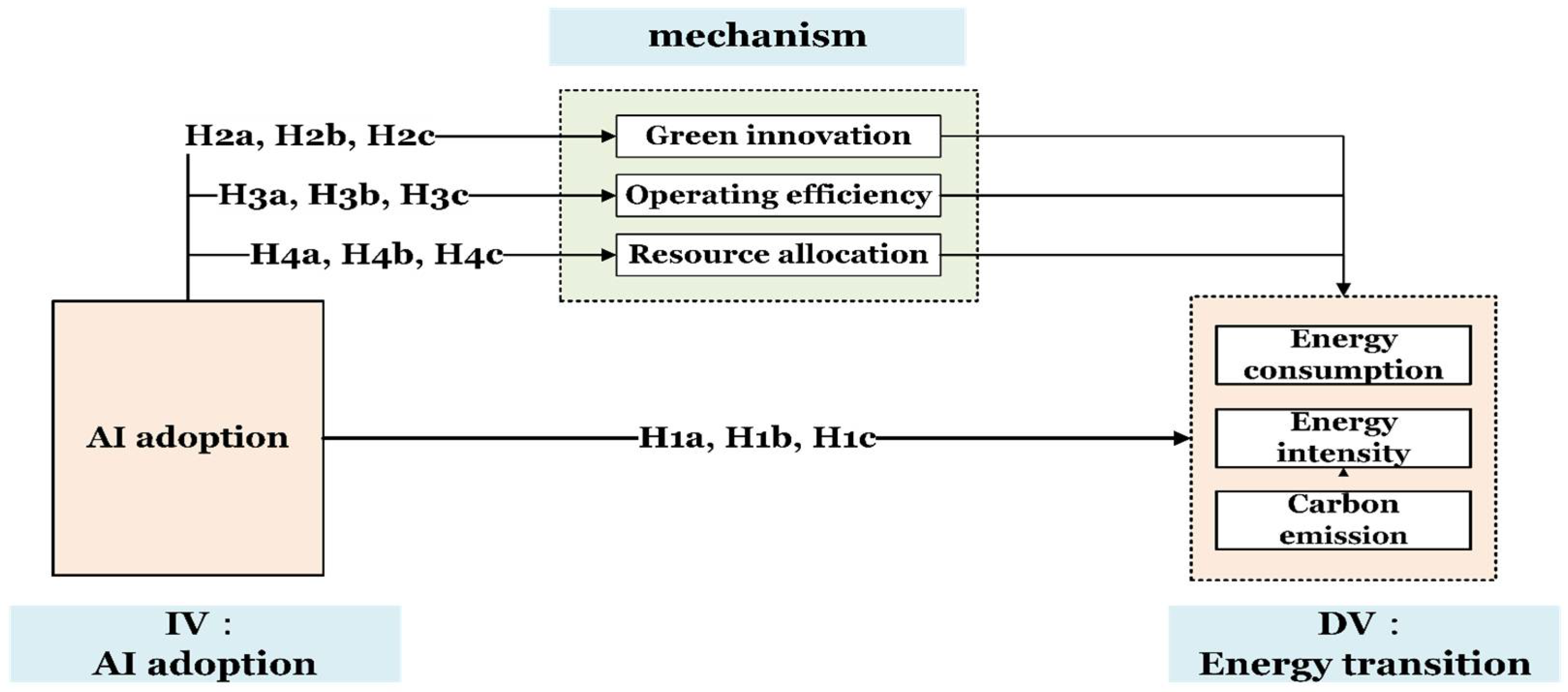
Figure 1 shows the conceptual framework, with AI adoption as the core variable indicating how intelligent technologies are integrated into firms’ systems. Energy transition performance is a multi-dimensional construct, including total energy consumption, energy intensity, and carbon emissions, reflecting scale, efficiency, and environmental impact. The framework suggests that AI affects the energy transition indirectly through three capability transformations: green innovation, operational efficiency, and resource allocation efficiency. Green innovation involves redesigning products and processes for cleaner, more efficient technologies. Operational efficiency is about improved process coordination and real-time adjustments enabled by AI. Resource allocation efficiency concerns reconfiguring inputs for higher value and lower emissions. The model hypothesizes direct effects of AI on energy transition dimensions (H1a–H1c) and mediated effects through the three capabilities (H2a–H2c, H3a–H3c, H4a–H4c). It views energy transition as a systemic organizational change outcome.
3. Research Design
3.1. Sample and Data
This study uses panel data from Chinese A-share listed firms (2012–2024) to examine the impact of AI adoption on energy transition. We exclude financial firms and remove firms with missing or abnormal data, winsorizing variables at the 1st and 99th percentiles. Data on AI adoption and financials come from CSMAR and Wind, while energy metrics are from environmental disclosures and CNRDS. Green patents are from CNIPA and matched via IPC Green. Operational efficiency and resource indicators are derived from firm-level input-output data. This creates a balanced panel to analyze within-firm changes in energy transition after AI adoption.
3.2. Variable Construction
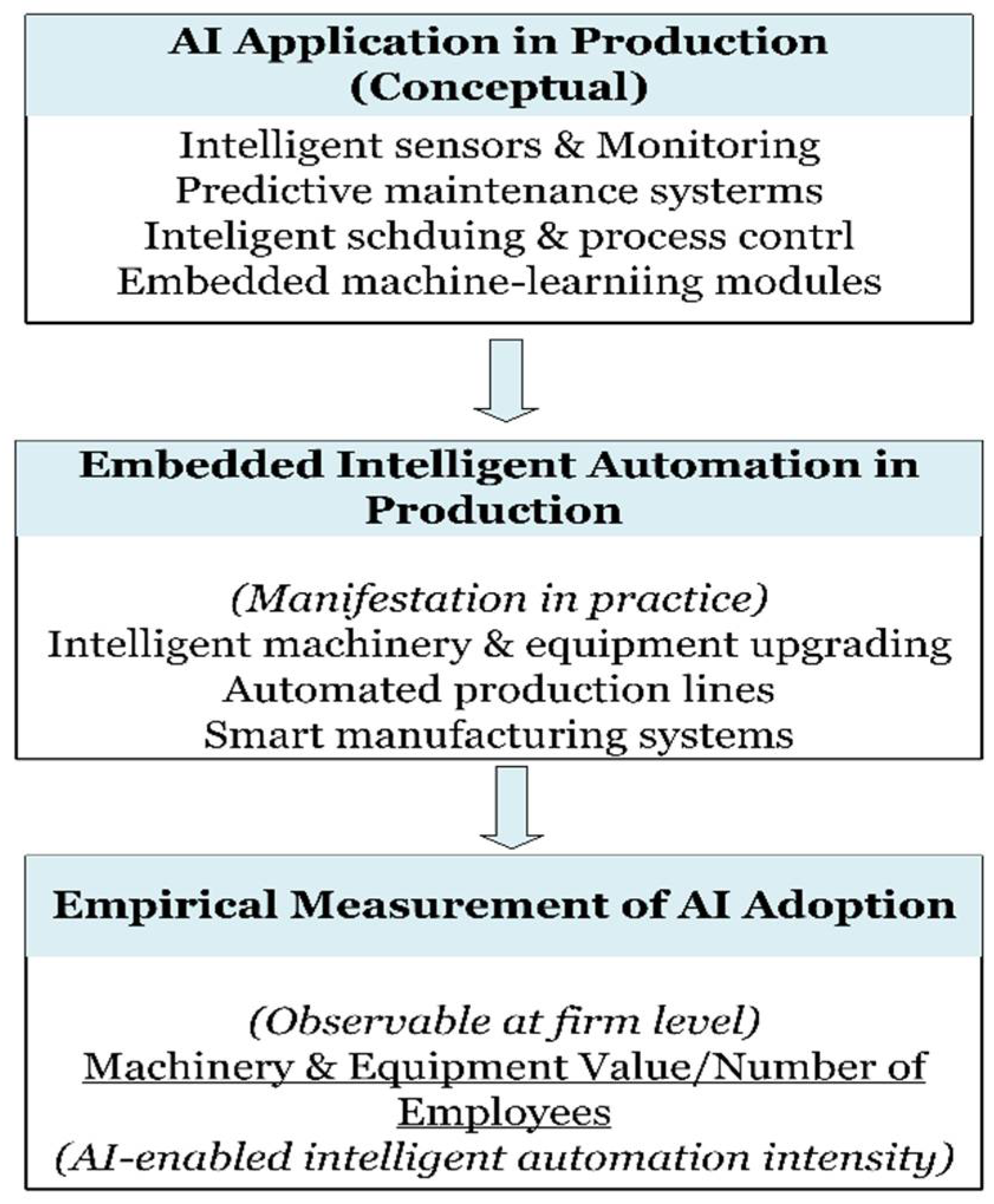
The core explanatory variable in this study is AI adoption. In line with the intelligent-manufacturing literature and the measurement logic illustrated in
Figure 2, we conceptualize AI adoption as AI-enabled intelligent automation embedded in firms’ production processes, rather than standalone algorithmic or software-based AI applications. In industrial settings, particularly in manufacturing firms, such embedded AI primarily manifests through intelligent machinery, automated production lines, and smart manufacturing systems that integrate sensing, monitoring, predictive maintenance, and real-time process control.
Following this conceptualization, and consistent with prior studies on intelligent manufacturing and capital–labor technological substitution, we measure firm-level AI adoption using the intensity of intelligent automation, proxied by the logarithm of the ratio between the net value of machinery and production equipment and the number of employees. This indicator captures the extent to which intelligent, AI-enabled production capital is deployed relative to labor input, thereby reflecting the depth of AI-enabled automation embedded in firms’ operating systems and production activities. Importantly, this measure should be interpreted as an indicator of embedded AI-enabled automation capability, rather than a generic measure of capital intensity. Formally, AI adoption is constructed as following model (1):
To further alleviate concerns that this proxy may capture general capital deepening rather than AI-related production upgrading, we provide additional robustness analyses using alternative measures of AI-related investment intensity and complementary identification strategies in subsequent sections.
3.2.1. Dependent Variables
(1) Energy consumption. It reflects the absolute scale and structural characteristics of energy use within the production system. From an energy economics perspective, energy consumption not only captures the intensity of production activity but also indicates the underlying technical regime and the firm’s stage in the energy transition process [
46]. In a transition-oriented context, a decline in energy consumption accompanied by stable or increasing output indicates decoupling, suggesting improvements in resource efficiency, technological upgrading, and energy management capabilities [
47]. AI plays a critical enabling role in this process: by supporting real-time energy monitoring, production sequence optimization, and load forecasting, AI systems allow firms to detect waste, adjust operating schedules, and achieve dynamic, data-driven energy control [
48]. To ensure consistent measurement across heterogeneous energy sources, we measure energy consumption as comprehensive energy consumption in standard coal equivalent. Following the unified accounting framework adopted by the National Bureau of Statistics of China and the China Energy Statistical Yearbook, different energy inputs consumed during firms’ production activities are converted into standard coal equivalent based on their primary energy equivalents, which account for the average energy inputs involved in extraction, conversion, transmission, and final use, as shown in model (2). Comprehensive energy use is calculated as following model, detailed energy categories and conversion coefficients are reported in
Appendix A Table A3. The resulting total energy consumption is expressed in tons of standard coal equivalent, and we take the natural logarithm to reduce scale heterogeneity. The measurement approach ensures physical comparability, inter-firm comparability, and interpretability regarding the expected direction of AI’s impact. If AI-enabled intelligent automation improves energy efficiency, the estimated coefficient on AI adoption in empirical models should be significantly negative, indicating that AI acts as a driver of enterprise-level energy transition.
(2) Energy intensity. It measures energy consumption relative to output. It is defined as total energy consumption divided by operating revenue, reflecting the efficiency with which firms convert energy into economic value (model 3).
(3) Carbon emission intensity. It captures the environmental externalities associated with firms’ energy use. Carbon emissions reflect not only the scale of fossil energy consumption but also the effectiveness of corporate low-carbon governance and process decarbonization [
49]. To measure firms’ carbon emissions, we adopt the approach of the energy consumption structure combine with carbon emission factor, which is widely used in national greenhouse gas inventories and corporate environmental accounting. Specifically, total annual carbon emissions are calculated by multiplying the consumption of each type of energy
by its corresponding carbon emission coefficient
(model 4).
where the energy types include raw coal, natural gas, gasoline, diesel, electricity, and district heating, and the carbon emission coefficients are sourced from the IPCC Guidelines for National Greenhouse Gas Inventories and national energy emission factors. To reflect carbon outcomes relative to economic scale, we construct carbon emission intensity by dividing total emissions by firms’ operating revenue and applying a logarithmic transformation (model 5):
This specification captures the extent to which firms generate lower carbon emissions per unit of economic output, a central indicator of progress toward a low-carbon transition in production systems. The data on energy consumption for calculating emissions are obtained from the CEADS database and the Wind energy accounts, while financial data come from CSMAR. This approach ensures comparability, consistency with national GHG reporting standards, and a meaningful interpretation of the expected influence of AI adoption: if AI improves energy management, process optimization, and resource orchestration, carbon emission intensity should decline accordingly.
3.2.2. Mediating Variables
To examine the internal capability pathways through which AI adoption affects firms’ energy transition performance, we construct three mediating variables aligned with the theoretical mechanisms discussed above.
Each mediating variable is constructed to capture a distinct internal capability channel through which AI adoption may affect firms’ energy transition performance. Specifically, green innovation reflects technology upgrading toward low-carbon production; operating efficiency captures process optimization and real-time coordination enabled by AI; and resource allocation efficiency represents improvements in investment and factor allocation driven by AI-enhanced information processing. These three variables operationalize the green innovation, operational efficiency, and resource allocation mechanisms proposed in
Section 2 and are examined separately in the mediation analysis.
(1) Green innovation. It captures the extent to which firms develop and commercialize environmentally oriented technologies and serves as the mediating channel through which AI adoption promotes low-carbon technological upgrading. Following the WIPO “Y02” classification of climate-mitigation technologies and the OECD ENV-TECH standard, we identify annual counts of green-invention and utility-model patents. To address the skewed distribution and zero-observation cases, we take the natural logarithm of one plus the total number of green patents:
This measure reflects low-carbon technological upgrading and firms’ capacity to embed green knowledge into production and energy management practices. The logarithmic transformation includes a constant of one to accommodate firms with zero green patent applications in a given year, which is standard practice in patent-based innovation measures.
(2) Operating efficiency. It captures process optimization as a mediating channel through which AI adoption improves firms’ energy performance, enabled by AI-driven monitoring, predictive maintenance, and dynamic production scheduling. We construct a composite Operating Efficiency Index (OEI) based on three standardized financial indicators: the management expense ratio (
), working capital turnover (
), and total asset turnover (
). Using principal component analysis (PCA), the first principal component has an eigenvalue of 1.87 and explains 62.4% of total variance; thus, we retain it as the efficiency index (model 7):
where
,
,
are factor loadings from PCA, and the inverse of
ensures directional consistency such that higher values indicate greater efficiency.
(3) Resource allocation efficiency. It reflects AI-enabled improvements in capital and factor allocation that operate as an internal mechanism linking AI adoption to enhanced energy transition outcomes. Following Richardson [
50], we model expected investment based on firm fundamentals and industry-year characteristics:
The absolute value of the residual
represents the degree of investment inefficiency, either over- or under-investment. To obtain a measure where higher values indicate greater efficiency, we define:
This measure captures whether AI adoption reduces resource misallocation by improving forecasting precision, factor coordination, and alignment of marginal productivity.
Taken together, these three mediators represent structural upgrading (green innovation), process optimization (operational efficiency), and input–output reconfiguration (resource-allocation efficiency), constituting the capability transformation pathway through which AI adoption is expected to facilitate firms’ energy transition.
3.2.3. Control Variables
To account for firm characteristics that may jointly influence AI adoption and energy transition outcomes, we include several control variables. Profitability (ROA), leverage (Lev), cash flow (Cashflow), and growth (Growth) capture firms’ financial conditions and investment capacity. Board independence (Indep) reflects governance oversight. Tobin’s Q proxies market valuation and future expectations. Firm size (Size) and firm age (Age) control for scale and life-cycle heterogeneity. All continuous variables are winsorized at the 1% and 99% levels, and industry- and year-fixed effects are included to account for sectoral technological trends and macroeconomic shocks.
3.3. Model Specification
To identify the overall effect of AI adoption on firms’ energy transition performance, we estimate the following two-way fixed effects model:
where
denotes one of the three indicators of energy transition performance (energy consumption, energy intensity, or carbon emission intensity).
represents the level of AI adoption, and
includes firm-level characteristics as described earlier.
and
represent firm and year fixed effects, respectively, capturing unobserved time-invariant heterogeneity and macroeconomic shocks.
is the idiosyncratic disturbance term. The coefficient
, reflects the net impact of AI adoption on firms’ energy transition performance. All continuous variables are standardized before regression to facilitate cross-model comparability of coefficients.
To examine the underlying mechanisms through which AI adoption affects these outcomes, we further estimate the following mediation models (model 11 and 12):
Here, corresponds to one of the three mechanisms: green innovation, operating efficiency, or resource allocation efficiency. Evidence of mediation is established if is significant and remains substantial when included in the outcome equation, indicating that AI adoption affects energy transition performance through the proposed intermediate channel. Partial or complete mediation is determined based on whether decreases or becomes insignificant when the mediator is introduced.
3.4. Robustness and Endogeneity Identification Strategy
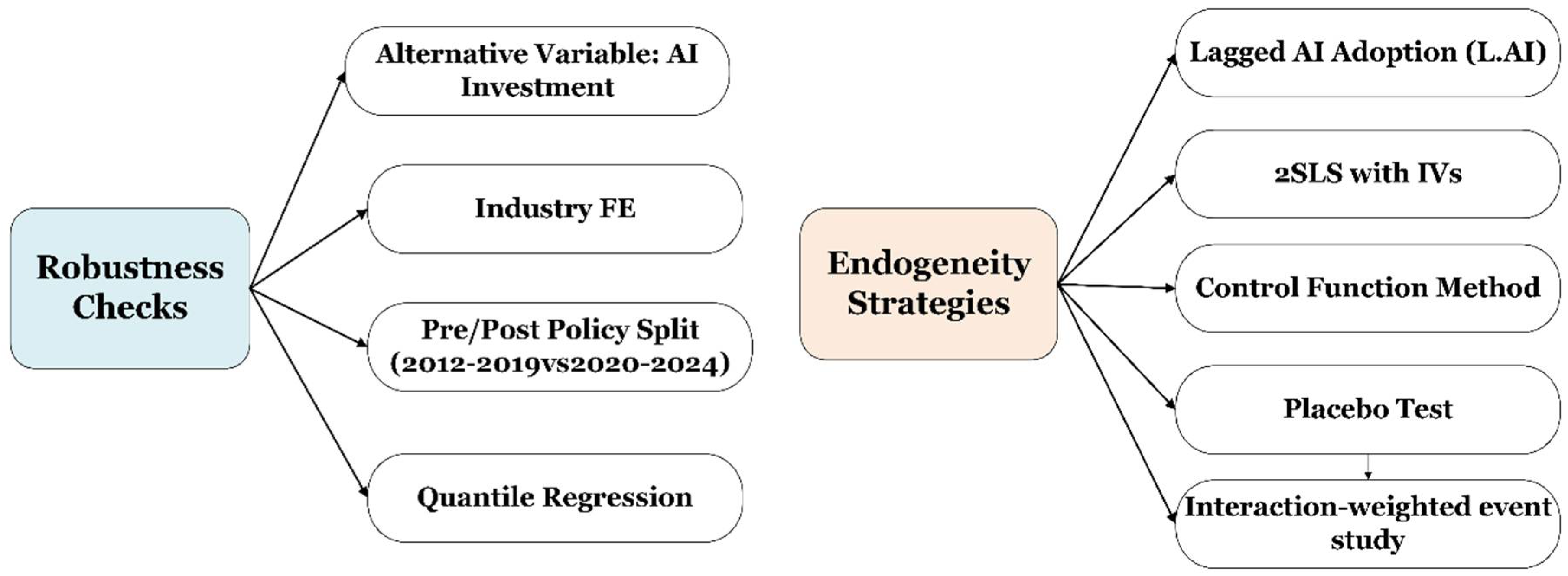
Figure 3 summarizes the study’s validation framework. Robustness checks include alternative AI measures (AI investment), industry fixed effects, pre- and post-policy (2012–2019 vs. 2020–2024) subsamples, and quantile regressions to account for distributional heterogeneity. Endogeneity is addressed through lagged AI adoption, two-stage least squares (2SLS) estimation with external instruments (industry-level robot penetration, provincial AI density), control-function correction, placebo tests, and an interaction-weighted event study to verify causal dynamics and parallel trends. Collectively, these strategies ensure that the estimated effects of AI adoption on firms’ energy transition are both statistically reliable and causally robust.
4. Empirical Results
4.1. Descriptive Statistics
Table 1 presents the descriptive statistics of the main variables. The three measures of corporate energy transition exhibit meaningful variation. Energy consumption has an average value of 7.236 (log-transformed), while energy intensity shows considerable dispersion (mean = 1.211; SD = 1.554), indicating substantial heterogeneity in firms’ energy efficiency. Carbon emission intensity (LnCarEmi) also displays a moderate spread (mean = 13.29), consistent with differences in industrial structure and production technologies across firms. The mean AI adoption is 11.73, with a wide range of 0–17.01, suggesting varying levels of digital and intelligent manufacturing deployment across firms. The three mechanism variables, green innovation, operating efficiency, and resource allocation efficiency, also show pronounced variation. Overall, the distributional patterns suggest that firms in China exhibit significant heterogeneity in both technological upgrading and energy transition performance, providing sufficient variation for econometric identification.
4.2. Correlation Analysis
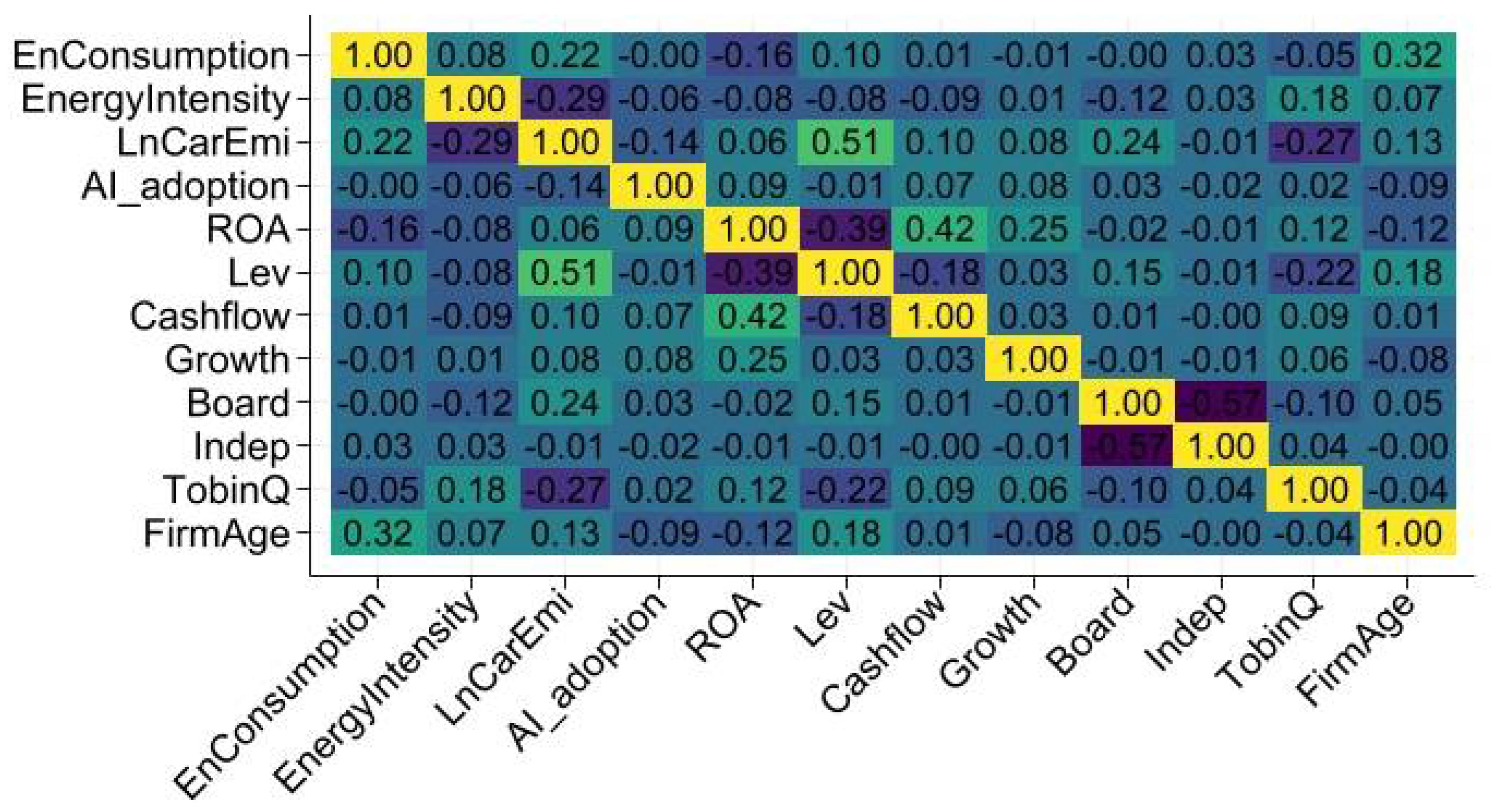
The correlation matrix in
Figure 4 shows the pairwise correlations among the main variables. AI adoption is negatively correlated with energy intensity (−0.29) and carbon emissions (−0.22), and is slightly negatively correlated with energy consumption (−0.08), consistent with the theoretical expectation that AI may enhance energy efficiency and reduce carbon-related outputs. The three mechanism variables also show reasonable correlations with both AI adoption and energy performance variables. Importantly, none of the correlation coefficients are excessively high, and no pair exceeds the commonly recognized threshold of 0.70, reducing concerns about strong linear relationships among covariates. These results preliminarily support the plausibility of our theoretical propositions but do not imply causality, which will be further examined in regression analyses. To further assess potential multicollinearity,
Appendix A Table A2 reports the Variance Inflation Factors (VIF). The mean VIF is 1.420, and the most significant VIF value is 2.010 (for carbon emissions), far below the conventional threshold of 10. This indicates that multicollinearity is not a concern in our regression models and that the estimated coefficients will be statistically reliable and economically interpretable.
4.3. Baseline Regression Results
Table 2 reports the baseline fixed-effects regression results examining the impact of AI adoption on firms’ energy transition performance. Columns (1), (3), and (5) report baseline specifications without firm and year fixed effects, while Columns (2), (4), and (6) incorporate both firm and year fixed effects to account for time-invariant firm heterogeneity and common macroeconomic shocks. Columns (1)–(2) correspond to Energy Consumption, (3)–(4) to Energy Intensity, and (5)–(6) to Carbon Emission. Across all models, the coefficient of AI_adoption is negative and statistically significant at the 1% level, indicating that AI adoption significantly enhances firms’ energy transition outcomes. In terms of economic magnitude, the estimated coefficients imply that a one-unit increase in AI adoption is associated with economically meaningful reductions in firms’ energy use and emissions. Specifically, based on the specifications with firm and year fixed effects, AI adoption corresponds to an approximate 2.0% reduction in total energy consumption, a 1.8% decline in energy intensity, and a 2.3% reduction in carbon emission intensity. These magnitudes suggest that the impact of AI adoption is not only statistically significant but also quantitatively important, particularly given the scale of industrial energy use among Chinese listed firms.
Specifically, AI adoption is associated with lower total energy consumption, suggesting that intelligent sensing, predictive scheduling, and process optimization technologies enable firms to detect inefficiencies, manage loads dynamically, and reduce redundant energy use. The results remain robust after controlling for firm- and year-fixed effects, implying that unobserved time-invariant firm characteristics, such as managerial quality or baseline technology capacity, do not drive the relationship. AI adoption also reduces energy intensity, demonstrating that firms not only consume less energy but also use it more efficiently in generating output. This finding supports the view that AI improves real-time coordination, equipment maintenance, and workflow management, thereby reducing the energy required per unit of output. The more substantial magnitude of the coefficients for Energy Intensity relative to Energy Consumption suggests that AI’s contribution lies primarily in efficiency enhancement rather than pure energy reduction. The coefficients for Carbon Emission are negative and significant, indicating that AI adoption mitigates carbon intensity through structural upgrading, efficiency gains, and substitution away from high-carbon inputs. Control variables show expected signs: profitable firms exhibit lower carbon intensity, while highly leveraged firms have higher energy intensity and emissions. Larger and older firms consume more total energy, reflecting scale effects. Overall, these results provide strong support for H1a, H1b, and H1c, confirming that AI adoption serves as an effective technological pathway for advancing corporate energy transition.
4.4. Robustness Tests
To ensure the validity and stability of the baseline estimates, a series of robustness checks was conducted. These analyses address potential concerns of measurement bias, omitted heterogeneity, and distributional dependence. The results, summarized in
Table 3,
Table 4 and
Table 5, confirm that the observed relationship between AI adoption and firms’ energy transition performance is both statistically robust and economically meaningful.
- (1)
Alternative Measurement and Industry Fixed Effects
Table 3 reports the results using an alternative measure of AI adoption, firms’ AI investment level, to replace the baseline indicator based on machine equipment value per employee. AI investment level is constructed from firms’ annual reports and financial disclosures, capturing the scale of AI-related capital expenditures relative to firm size. It is measured annually, thereby reflecting firms’ financial commitment to AI technologies rather than their operational automation intensity.
Columns (1)–(3) present regressions in which AI investment level replaces the baseline AI adoption measure, while Columns (4)–(6) re-estimate the baseline specification with the original AI adoption variable for comparison. Across Columns (1)–(3), the estimated coefficients of AIInvestLevel are significantly negative for Energy Consumption and Energy Intensity, and significantly negative for Carbon Emission Intensity after accounting for industry fixed effects, indicating that firms with greater AI-related capital investment experience superior energy transition performance. For example, a higher AI investment level is associated with lower total energy consumption and lower energy intensity, suggesting that financial investments in AI-related technologies can translate into tangible improvements in firms’ energy efficiency.
In Columns (4)–(6), the coefficients on the baseline AI adoption variable remain negative and statistically significant, even after incorporating industry fixed effects. The similarity in magnitude and statistical significance across the two sets of columns indicates that the main results are not sensitive to how AI adoption is measured. Taken together, these findings suggest that the observed relationship between AI adoption and firms’ energy transition outcomes reflects a substantive technological upgrading effect rather than a measurement artifact.
- (2)
Policy-Period Heterogeneity: Before and After the “Dual-Carbon” Strategy
Table 4 reports the results of a temporal split-sample analysis based on China’s “Dual-Carbon” policy framework. The sample is divided into two subperiods—2012–2019 (pre-policy) and 2020–2024 (post-policy)—to examine whether the effects of AI adoption vary across policy regimes. Columns (1)–(2) present results for total energy consumption, Columns (3)–(4) for energy intensity, and Columns (5)–(6) for carbon emission intensity.
The results indicate an apparent strengthening of AI’s energy-efficiency effects in the post-policy period. Specifically, the coefficients of AI adoption on Energy Intensity and Carbon Emission Intensity become larger in magnitude and remain statistically significant after 2020, suggesting that AI adoption contributes more strongly to efficiency improvements and emission reductions under the Dual-Carbon policy environment. This pattern is consistent with enhanced policy support—such as green finance, carbon disclosure regulations, and digital transformation initiatives—which amplify the effectiveness of AI-enabled energy management and low-carbon operations.
By contrast, the coefficient on total energy consumption becomes positive in the post-policy period. This result does not contradict the main conclusion, as it reflects scale expansion effects in the context of rapid post-2020 industrial recovery and output growth. Notably, the simultaneous decline in energy intensity and carbon emission intensity indicates that firms are using energy more efficiently and producing lower emissions per unit of output, even if aggregate energy use increases. Overall, these findings underscore the context-dependent nature of AI’s contribution to corporate energy transition and highlight the role of institutional environments in shaping its net effects.
- (3)
Quantile Regression: Distributional Robustness and Heterogeneous Effects
Table 5 reports the results of quantile regressions at the 25th, 50th, 75th, and 90th percentiles of firms’ energy transition performance, allowing us to assess whether the effects of AI adoption vary across the distribution. Across all three outcome variables—total energy consumption, energy intensity, and carbon emission intensity—the coefficients on AI adoption are consistently negative and statistically significant, confirming that mean-based estimates do not drive the baseline results.
Significantly, the magnitude of the estimated coefficients increases monotonically at higher quantiles. For example, in the case of energy consumption, the coefficient of AI adoption declines from −0.003 at the 25th percentile to −0.025 at the 90th percentile. A similar pattern is observed for energy intensity and carbon emission intensity, where the absolute effects of AI adoption are substantially larger among firms located in the upper tail of the distribution. This indicates that AI adoption generates stronger energy-saving and emission-reduction effects for firms with initially higher energy use and carbon intensity.
These findings suggest that AI-enabled digital transformation yields disproportionate benefits for energy-intensive and high-emission firms, where the scope for process optimization, predictive control, and real-time coordination is greater. Conversely, for firms that already operate at relatively low energy or emission intensity levels, the marginal gains from additional AI adoption are smaller, consistent with diminishing returns to efficiency improvements. Overall, the quantile regression results reinforce the robustness of the baseline conclusions and highlight the heterogeneous effectiveness of AI adoption across firms with different energy profiles.
Across all robustness strategies, alternative measurement, policy-period analysis, and quantile regressions, the empirical evidence consistently supports the baseline conclusion that AI adoption significantly promotes firms’ energy transition. The persistence of the negative coefficients under various model specifications provides strong confidence in the causal interpretation. These findings collectively demonstrate that AI-enabled digital transformation represents a resilient and scalable pathway toward improving energy efficiency and reducing carbon intensity at the firm level.
4.5. Endogeneity Identification
To strengthen causal identification, this section implements three complementary strategies: an instrumental variable (IV) approach, a control function (CF) correction, and a placebo randomization test to ensure the robustness and exogeneity of the estimated effects.
- (1)
Instrumental Variable Approach
Table 6 reports the two-stage least squares (2SLS) estimation results using industry-level robot penetration and regional AI firm density as external instruments for firm-level AI adoption. Columns (1), (3), and (5) present the first-stage regressions, while Columns (2), (4), and (6) report the corresponding second-stage effects on Energy Consumption, Energy Intensity, and Carbon Emission Intensity, respectively.
The first-stage results indicate that both instruments are strongly and positively associated with AI adoption. As shown in Columns (1), (3), and (5), the coefficients on industry robot penetration and regional AI firm density are positive and statistically significant at the 1% level (e.g., coefficients of 0.002 and 0.130, respectively), confirming their relevance. Instrument strength diagnostics further support this conclusion: the Kleibergen–Paap rk LM statistics and Cragg–Donald F statistics (approximately 578.6 and 296.2, respectively) substantially exceed conventional critical values, and the Stock–Yogo weak identification test rejects concerns about weak instruments.
The second-stage estimates show that AI adoption continues to exert a statistically significant and economically meaningful negative effect on firms’ energy outcomes. Specifically, in Columns (2), (4), and (6), the estimated coefficients of AI adoption are −0.324 for Energy Consumption, −0.566 for Energy Intensity, and −0.080 for Carbon Emission Intensity, all significant at the 1% level. These magnitudes are comparable to, and in some cases larger than, those obtained from the baseline fixed-effects regressions, suggesting that the baseline estimates are not driven by reverse causality or omitted-variable bias. Overall, the 2SLS results provide strong causal evidence that exogenous increases in AI adoption, driven by sectoral automation diffusion and regional AI ecosystem development, lead to sustained improvements in firms’ energy efficiency and carbon performance.
- (2)
Control Function Correction
To further verify the causal interpretation, a control function (CF) approach is employed to address potential endogeneity arising from firm-level self-selection or partial correlation between AI adoption and unobserved determinants of energy performance. In the first stage, AI adoption is regressed on the two instruments to obtain its fitted value (AI_adoption_hat) and residual term (AI_adoption_resid). In the second stage, both variables are included in the principal regression to test the significance of the residual term. As shown in
Table 7, the estimated coefficients of AI_adoption_hat remain significantly negative across all three dependent variables (−0.494 ***, −1.621 ***, and −0.764 *** for Energy Consumption, Energy Intensity, and Carbon Emission, respectively), confirming that AI adoption continues to exert a strong positive effect on energy efficiency after correcting for endogeneity. Importantly, the residual term (AI_adoption_resid) is statistically significant across all specifications, indicating the presence of unobserved factors correlated with firms’ AI adoption decisions and confirming that endogeneity is non-negligible in the baseline estimates. The significance of this residual term validates the use of the control function approach, as its inclusion in the second-stage regression effectively corrects for selection bias and simultaneity. Taken together, these results indicate that, after explicitly accounting for endogeneity, the beneficial impact of AI adoption on firms’ energy performance remains robust. This finding supports the causal interpretation that AI-enabled intelligent production technologies enhance production efficiency and emission control capacity through improved resource optimization and operational management.
- (3)
Placebo Test
Finally, a placebo-randomization test is conducted to assess model stability and to exclude spurious correlations. Following Rosenbaum (2002) and Chernozhukov et al. (2021), the AI adoption variable is randomly shuffled 500 times across firms while keeping the sample structure and control variables unchanged [
51,
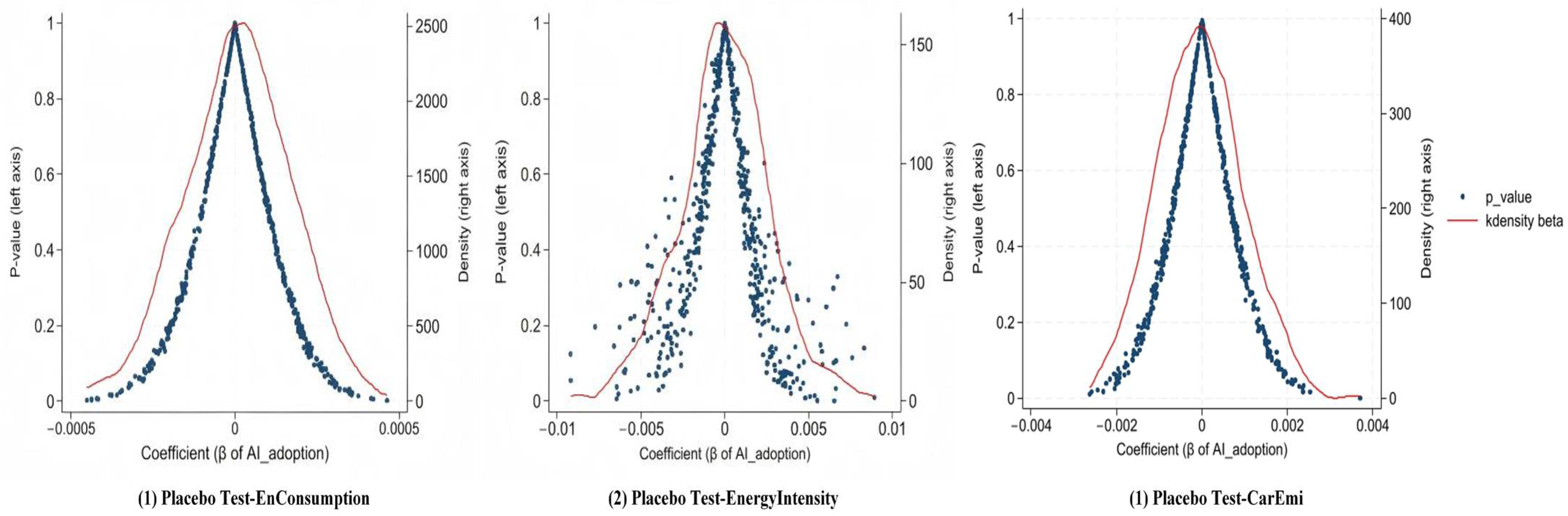
52]. Each simulated sample is re-estimated to obtain the distribution of placebo coefficients (β^p). The results, illustrated in
Figure 5, show that the placebo coefficient distributions are tightly centered around zero for all three energy outcomes. In each panel, the red curve depicts the kernel density of coefficients obtained from the randomized placebo assignments, while the blue dots represent the associated p-values. The vertical reference line marks the actual estimated coefficient from the baseline regression. For Energy Consumption, the accurate estimate (β = −0.324) lies far in the tail of the placebo distribution and well outside its 95% confidence interval. Similar patterns hold for Energy Intensity and Carbon Emissions.
These results indicate that the estimated negative relationship between AI adoption and firms’ energy outcomes is unlikely to arise from random assignment or model overfitting, thereby providing strong evidence that the baseline findings reflect a stable, non-spurious structural effect.
Across all identification strategies, including 2SLS estimation, control function correction, and placebo randomization, the results converge on a consistent conclusion: AI adoption exerts a causal and economically meaningful effect in promoting corporate energy transition. These tests collectively eliminate concerns of reverse causality, weak instrument bias, and spurious correlation, thereby reinforcing the validity of the causal pathway proposed in the theoretical framework. The empirical evidence thus provides strong support for the inference that AI-enabled digital transformation fosters real improvements in energy efficiency and carbon reduction, laying a solid econometric foundation for the subsequent mechanism analysis.
4.6. Dynamic Event Study Analysis
Given that the AI pilot policy was implemented across different provinces and years in China, firms were exogenously exposed to distinct AI-related policy environments at various points in time. Such staggered policy exposure may lead to estimation bias under a standard two-way fixed effects (TWFE) framework. To address this issue and to capture the heterogeneous timing of policy-induced exposure to AI technologies, we employ the interaction-weighted event study approach proposed by Sun and Abraham (2021) [
53]. Importantly, this event study captures dynamic responses to policy-induced exposure rather than endogenous firm-level AI adoption decisions. The AI pilot policy alters firms’ external technological and institutional environment by promoting AI-related infrastructure, applications, and diffusion, thereby generating quasi-experimental variation in firms’ exposure to AI technologies. This design allows us to examine whether, and how, firms’ energy transition performance evolves dynamically following exposure to the AI pilot policy. Unlike the traditional Difference-in-Differences (DID) estimator, which identifies only the average treatment effect, this method enables us to trace the dynamic causal trajectory of the policy impact before and after implementation. Specifically, it allows us to test parallel trends in the pre-policy period and to examine whether the effects accumulate, dissipate, or reverse in the post-policy period. This design provides a quasi-experimental setting for identifying the temporal evolution of firms’ energy transition outcomes around the AI pilot policy shock. The dynamic specification is defined as follows:
where
represents firm-level energy performance indicators, including EnergyConsumption, EnergyIntensity, and CarbonEmission. The event-time dummies
capture the firm’s relative year
with respect to the implementation of the provincial AI pilot policy, ranging from five years before (
) to four years after (k = 4) the policy adoption. The year of policy implementation (k = 0) is omitted and serves as the reference period. Firm-level control variables
include ROA, Leverage, Cashflow, Growth, Board, Indep, TobinQ, and FirmAge, accounting for profitability, capital structure, liquidity, growth, governance, and firm characteristics.
and
denote firm and year fixed effects, respectively, capturing unobservable time-invariant heterogeneity and macroeconomic shocks. The error term
is clustered at the provincial level to account for spatially correlated shocks within policy regions.
The estimated coefficients (
) identify the dynamic marginal effects of exposure to the AI pilot policy on firms’ energy outcomes across different event years. Coefficients for
test the parallel-trend assumption, while coefficients for
trace the post-policy dynamics following policy-induced AI exposure. Consistent with
Table 8, the event-time dummies are defined for eleven relative periods (
to g4), with tail periods binned to mitigate boundary effects.
The results in
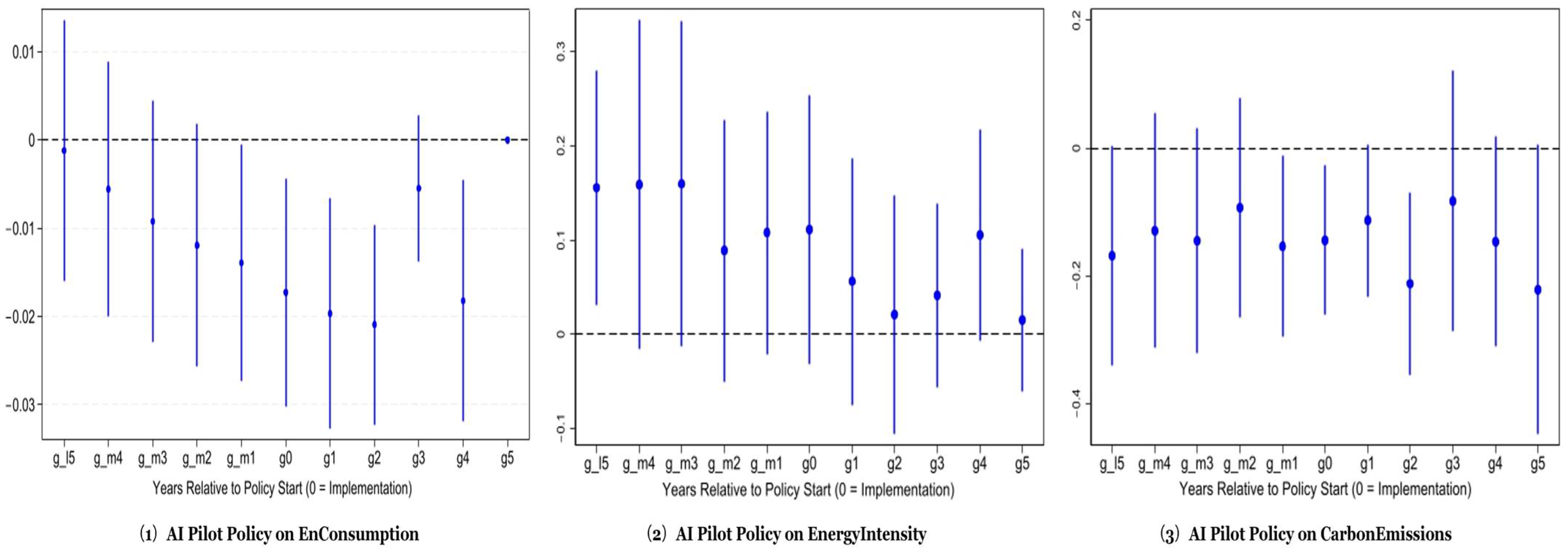
Table 9 demonstrate that the estimated coefficients for pre-policy periods (g_l5 to g_m1) are statistically insignificant across all models, supporting the parallel trends assumption. This indicates that before the implementation of AI pilot policies, treated and untreated firms exhibited similar energy trajectories, thereby validating the identification strategy. After policy implementation, the coefficients exhibit a clear temporal pattern. For EnergyConsumption, the coefficients during the implementation year (g0 = −0.020 ***) and the subsequent one to two years (g1 = −0.021 ***) are significantly negative, indicating that policy-induced AI exposure is associated with immediate reductions in firms’ energy use. For EnergyIntensity, the results show a short-term increase in the first year (g1 = 0.208 ***), followed by a significant decline (g2 = −0.212 ***), reflecting a transitional stage in which AI adoption initially increases learning and adjustment costs but subsequently enhances operational efficiency. For CarbonEmission, the coefficients turn negative and significant in the two years following the policy, confirming that AI-driven monitoring and digital management systems effectively suppress emissions over time.
Figure 6 illustrates the dynamic effects of policy-induced exposure to AI technologies on firms’ energy transition outcomes. Panel (1) shows a steady decline in energy consumption following policy implementation; Panel (2) reveals a rise-then-fall pattern in energy intensity; and Panel (3) indicates a continuous reduction in carbon emissions, with the most significant effects materializing two years after policy implementation. Notably, while energy intensity increases temporarily during the early post-policy period, energy consumption declines immediately after policy implementation, indicating that the observed adjustment effects do not reflect higher total energy use.
This dynamic evolution is consistent with a learning–adaptation–diffusion process, in which firms gradually respond to the AI-related policy environment by internalizing AI-enabled practices in energy management. From an economic perspective, the results reveal a two-phase policy effect. In the short term, firms incur adjustment and integration costs as they respond to AI-related policy initiatives, temporarily increasing energy intensity. Over time, continued exposure to AI-supportive policy environments facilitates improvements in energy allocation and operational efficiency, leading to sustained reductions in energy use and emissions. Quantitatively, the AI pilot policy is associated with reductions of approximately 2.0% in energy consumption, 1.8% in energy intensity, and 2.3% in carbon emissions within two to three years after implementation. Overall, these findings suggest that AI pilot policies generate both immediate efficiency responses and longer-term environmental benefits by shaping firms’ technological environments and capability accumulation processes. The observed decline–stabilization pattern reflects a gradual transition toward more efficient energy systems driven by policy-facilitated diffusion of AI-enabled technologies, rather than discrete firm-level adoption events.
5. Mechanism Identification and Heterogeneity Verification in AI-Driven Energy Transition
5.1. Mediating Mechanism Analysis
As a general-purpose technology, Artificial Intelligence (AI) promotes firms’ energy transition not only by directly reducing energy use but also by enhancing innovation capability, operational efficiency, and resource allocation. This section empirically identifies three mediating pathways: green innovation, operating efficiency, and resource allocation efficiency, through which AI adoption facilitates energy transition. Following the three-step mediation framework proposed by Baron and Kenny [
23], we first estimate the effect of AI adoption on each mediator. We then examine its direct impact on energy outcomes and finally include both AI adoption and the mediator to test for coefficient attenuation and statistical significance. All regressions control for firm-level characteristics (ROA, Lev, etc.) and include firm-, year-, and industry-fixed effects, with clustered provincial standard errors.
- (1)
Green Innovation Pathway
Green innovation serves as a central mechanism connecting AI adoption and energy transition. Theoretically, AI enhances data processing, predictive modeling, and technological integration, thereby reducing innovation uncertainty and accelerating the commercialization of clean technologies. Empirically (
Table 10), AI adoption significantly enhances green innovation (β = 0.011,
p < 0.01). In turn, green innovation reduces energy consumption (−0.016,
p < 0.01), energy intensity (−0.048,
p < 0.01), and carbon emissions (−0.024,
p < 0.01). When green innovation is introduced, AI’s coefficients remain significant but decline in magnitude, confirming partial mediation. These findings support H2a–H2c: AI adoption improves energy transition both directly and indirectly through technological upgrading. Economically, this implies that AI fosters sustained efficiency gains not merely via automation but by enabling continuous innovation and cleaner production. Green innovation transforms isolated energy-saving actions into cumulative, scalable improvements, enhancing firms’ long-term adaptability under increasingly stringent carbon and energy constraints.
- (2)
Operating Efficiency Pathway
The operating efficiency pathway captures the organizational dimension of AI’s energy governance effects. According to transaction cost and information-processing theories, improving energy efficiency depends heavily on transparent information flows, controllable processes, and precise resource scheduling [
54]. Traditional energy management often relies on experience-based decisions, leading to distorted energy allocation and inefficient operations. AI mitigates these inefficiencies by enabling real-time equipment monitoring, predictive energy load optimization, and algorithmic coordination across production and supply chains. As reported in
Table 11, AI adoption significantly enhances firms’ operating efficiency (0.004,
p < 0.01), confirming a stable efficiency gain from AI integration. Operating efficiency has a significant negative effect on all three energy performance measures: energy consumption (−0.001,
p < 0.05), energy intensity (−0.129,
p < 0.01), and carbon emissions (−0.122,
p < 0.01). After controlling operating efficiency, the absolute values of the AI coefficients decrease but remain significant, indicating partial mediation and supporting H3a–H3c. These results highlight that AI-driven energy improvements derive not only from technological automation but also from enhanced managerial coordination and data-driven decision-making. Over time, as digital learning and feedback mechanisms are institutionalized, the efficiency channel becomes a sustained source of competitive advantage, shifting the focus of energy transition from hardware upgrading to intelligent operations.
- (3)
Resource Allocation Efficiency Pathway
Distinct from the previous two pathways, the resource allocation efficiency mechanism captures AI’s structural governance role in firms’ investment and capital allocation. In conventional settings, information asymmetry and managerial myopia often lead to over- or underinvestment, exacerbating energy waste and emissions. By improving data analytics and predictive accuracy, AI enhances investment transparency and optimizes capital allocation, channeling resources toward energy-efficient and low-carbon projects. According to
Table 12, AI adoption significantly reduces overinvestment levels (0.001,
p < 0.01), demonstrating its corrective effect on irrational capital expansion. Overinvestment, in contrast, is positively related to energy consumption (0.026,
p < 0.01), energy intensity (0.472,
p < 0.01), and carbon emissions (0.273,
p < 0.01), implying that distorted capital allocation increases both energy input and environmental pressure. When both AI adoption and overinvestment are included, the AI coefficient’s magnitude decreases, confirming a partial mediating effect via resource allocation efficiency. Hence, hypotheses H4a–H4c are empirically supported: AI adoption indirectly improves firms’ energy efficiency and reduces emissions by enhancing the rationality of investment decisions. Economically, this indicates that effective energy management depends not only on technological upgrading but also on optimal resource allocation across production processes. AI reshapes capital allocation logic, directing investment toward high-efficiency, low-carbon, and digitalized systems, transforming the energy transition from “technological substitution” to “structural optimization”.
5.2. Heterogeneity Analysis
Building on the mediation results, this section investigates contextual heterogeneity to clarify when and where AI adoption yields more substantial energy transition effects. Chinese firms differ significantly in size, ownership, institutional environment, and industry factor intensity, implying that AI’s impact on energy outcomes is not uniform. As a General-Purpose Technology (GPT) [
55], AI’s effectiveness depends on firms’ absorptive capacity, digital infrastructure, and institutional support. When these foundations are strong, AI promotes continuous energy efficiency through learning, optimization, and intelligent resource scheduling; when weak, adoption may be merely symbolic [
56], yielding limited real effects.
To identify these boundary conditions, subsample regressions are conducted across four dimensions: (1) Firm size (large vs. small); (2) Ownership type (SOE vs. non-SOE); (3) Regional marketization (high vs. low); and (4) Industry factor intensity (labor-, capital-, and technology-intensive). Firm and year fixed effects are retained, with standard errors clustered at the provincial level. The heterogeneity analysis serves three purposes: (1) defining the boundary conditions of AI’s mechanisms, (2) revealing structural differences in China’s corporate energy governance, and (3) empirically demonstrating how institutional and technological systems interact in shaping firms’ low-carbon transition paths.
- (1)
Firm Size Heterogeneity
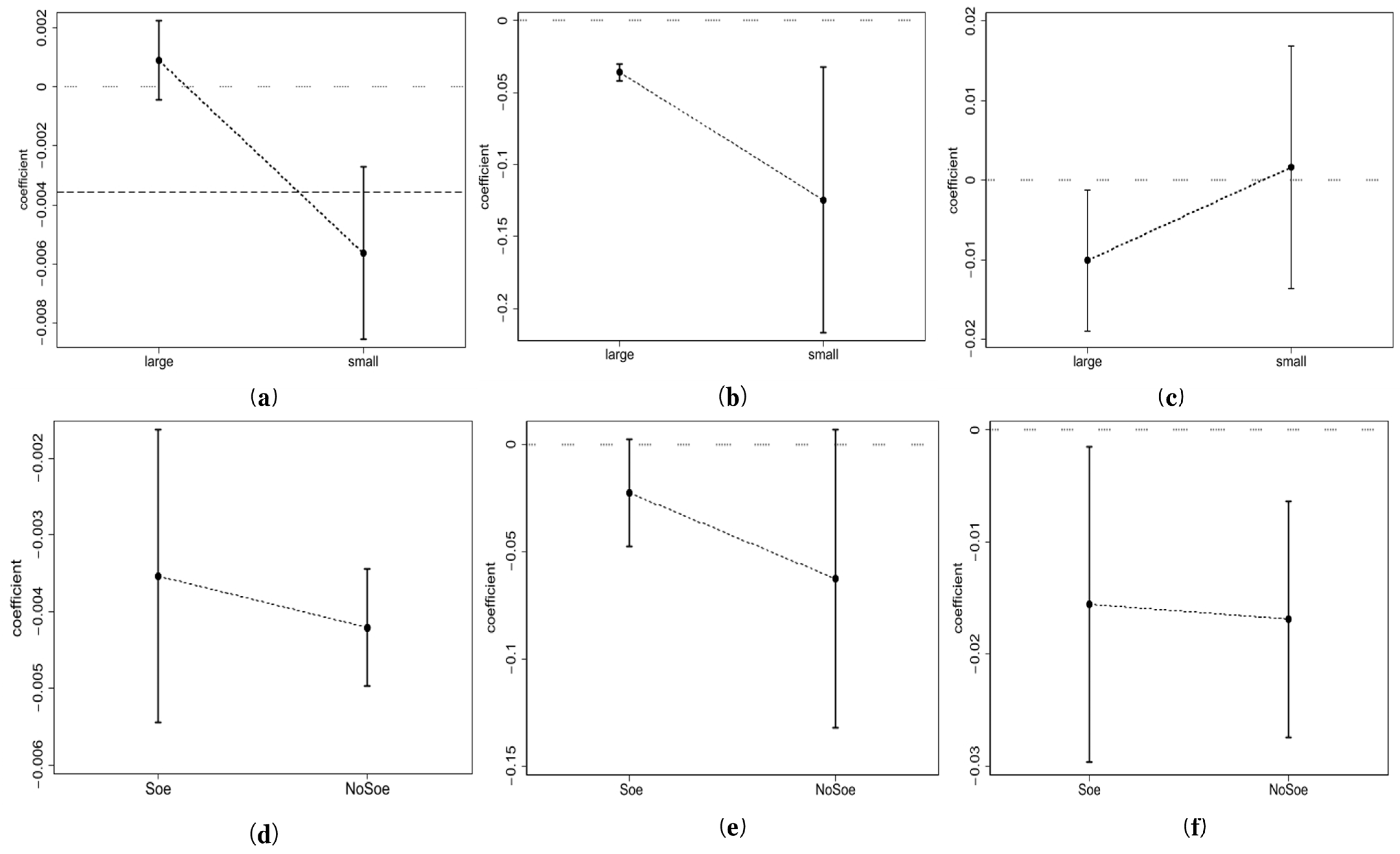
Firm size is a critical boundary condition for the effectiveness of AI adoption. As a capital- and data-intensive technology, AI requires sustained investments in data platforms, computational infrastructure, and technical expertise. Large firms typically possess stronger financial capacity, digital maturity, and managerial resources, enabling deeper integration of AI into production scheduling, equipment control, and energy management systems. In contrast, small firms often face financial constraints and technical bottlenecks, resulting in fragmented or superficial AI implementation. To examine this, firms are divided at the median of total assets into large-scale and small-scale groups. As illustrated in
Figure 7a–c, the coefficients of AI adoption are significantly larger (and more negative) for large firms across all three energy performance indicators, energy consumption, energy intensity, and carbon emissions, than for small firms.
This suggests that AI’s energy efficiency gains are primarily realized in large enterprises, consistent with the “scale absorption” hypothesis, which holds that technological diffusion benefits are contingent on firm capacity and digital readiness.
- (2)
Ownership Heterogeneity
Ownership structure represents another crucial institutional boundary. State-owned enterprises (SOEs) and non-state enterprises differ substantially in strategic objectives, governance structures, and incentive mechanisms. SOEs typically enjoy preferential access to policy and financial resources but may face bureaucratic rigidity and weaker performance-based incentives, which can hinder the efficiency of AI projects. In contrast, non-SOEs, driven by stronger competitive and profit motives, are more likely to adopt AI to improve cost control and efficiency. Accordingly, the sample is divided into SOEs and non-SOEs. As shown in
Figure 7d–f, AI adoption exhibits more pronounced negative coefficients for non-SOEs in energy consumption, energy intensity, and carbon emissions. At the same time, the effects for SOEs are weaker or statistically insignificant. These results imply that market-oriented firms translate AI technology into energy efficiency improvements more effectively than administratively constrained SOEs. The findings support the view that institutional flexibility and incentive alignment are key conditions for realizing AI’s potential in sustainable energy transition.
- (3)
Institutional Environment Heterogeneity
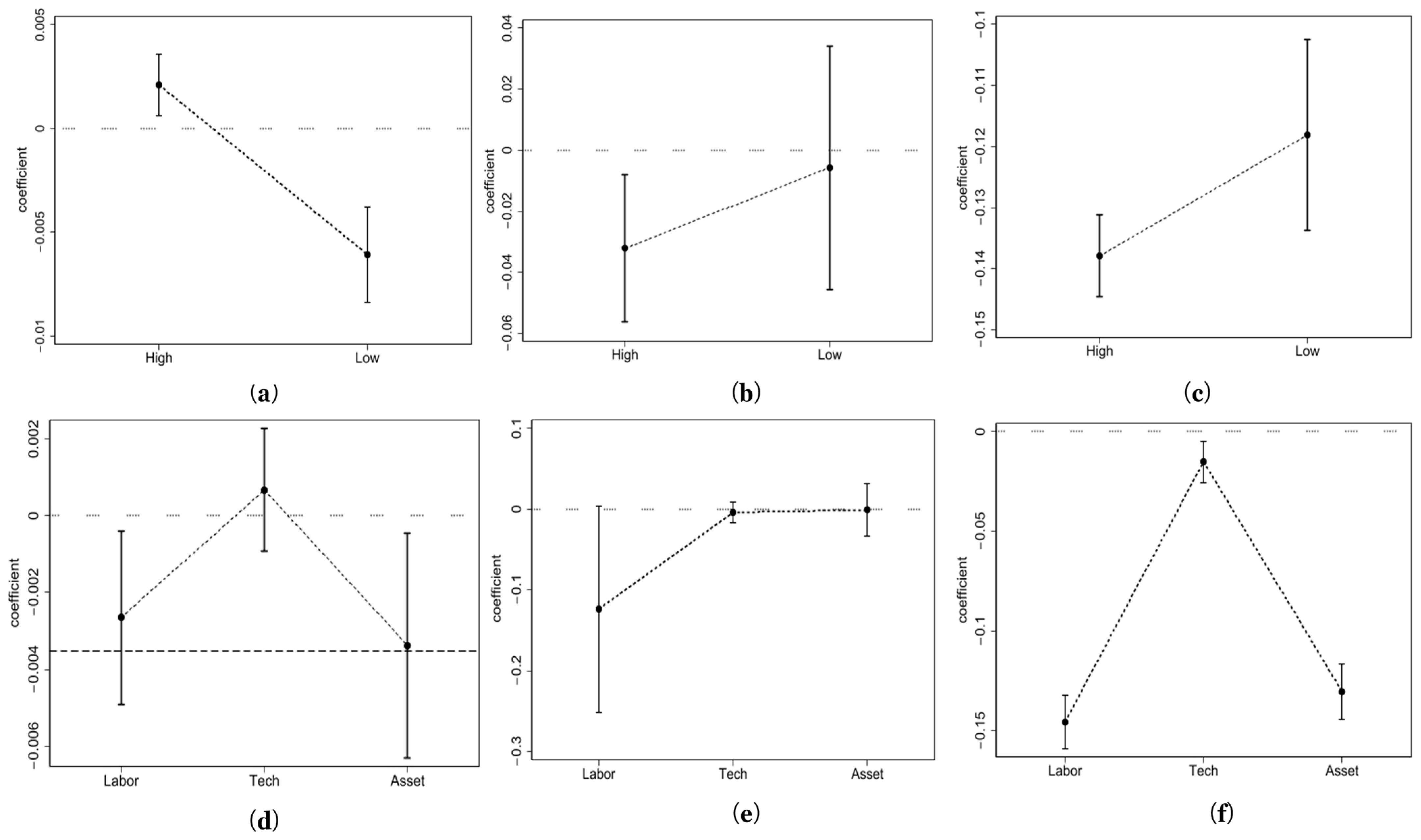
Regional marketization represents the maturity of the institutional environment, influencing firms’ incentives for technological adoption, resource allocation efficiency, and factor mobility. Accordingly, differences in marketization may moderate the extent to which AI adoption enhances energy transition outcomes. Provinces are divided into high- and low-marketization regions based on the latest China Provincial Marketization Index, and separate regressions are performed for each group. As shown in
Figure 8a–c, the coefficients of AI adoption are consistently more negative in high-marketization regions across all three indicators, energy consumption, energy intensity, and carbon emissions, than in low-marketization regions. This demonstrates that developed market institutions amplify AI’s energy-efficiency effects. In highly marketized areas, transparent price signals, flexible factor markets, and competitive pressures facilitate the diffusion of AI and productivity gains. Conversely, in less marketized regions, administrative intervention and resource rigidity hinder technological absorption, weakening AI’s impact. These results highlight that institutional maturity is a key enabler of AI-driven energy transition, supporting the argument that institutional quality and technological innovation are mutually reinforcing forces in sustainable transformation.
- (4)
Industrial Factor Intensity Heterogeneity
The industrial factor endowment determines both the applicability and the marginal impact of AI technologies. To capture sectoral differences, industries are reclassified following the CSRC industrial taxonomy and grouped by factor intensity using three indicators: capital intensity (fixed assets/total assets), labor intensity (employee compensation/operating costs), and technology intensity (R&D expenditure/employee compensation). Ward’s minimum-variance clustering method divides industries into technology-, capital-, and labor-intensive groups, maximizing between-group heterogeneity and ensuring robustness.
Figure 8d–f show that AI adoption yields the most substantial reductions in energy consumption, energy intensity, and carbon emissions in technology-intensive industries, moderate effects in capital-intensive sectors, and the weakest in labor-intensive ones. This pattern shows that AI’s energy-saving benefits depend on the industry’s absorptive capacity for technology. Firms in technology-intensive sectors integrate AI more effectively with existing automation and digital infrastructure, achieving greater efficiency gains, while labor-intensive industries, constrained by fragmented processes and low digital readiness, realize limited improvements.
6. Discussion
This study provides firm-level causal evidence that artificial intelligence (AI) adoption promotes corporate energy transition by reducing total energy consumption, improving energy intensity, and lowering carbon-emission intensity. Based on a comprehensive panel of Chinese listed firms from 2012 to 2024 and a suite of complementary identification strategies, the results reveal that AI-enabled digital transformation reshapes firms’ energy-use patterns in a persistent and economically meaningful manner. Rather than generating transitory efficiency gains, AI adoption induces sustained improvements in energy performance, particularly when firms operate in supportive institutional environments and possess complementary organizational capabilities.
The empirical findings suggest that AI adoption alters firms’ production and energy management processes through embedded intelligent automation rather than standalone algorithmic applications. By integrating sensing technologies, predictive analytics, and real-time process control into production systems, AI enables firms to identify energy inefficiencies, optimize production schedules, and dynamically allocate energy inputs. These mechanisms jointly contribute to reductions in absolute energy consumption while simultaneously improving output efficiency, as reflected in lower energy intensity. Notably, the magnitude of the estimated effects indicates that AI’s contribution to the energy transition primarily operates through efficiency gains rather than simple output contraction. Firms adopting AI technologies not only consume less energy overall but also generate more output per unit of energy input. The consistent negative effects on carbon emission intensity further imply that AI-driven optimization facilitates structural upgrading away from energy- and carbon-intensive production modes, reinforcing the environmental dimension of digital transformation.
From a theoretical perspective, the results refine and extend existing frameworks on digital transformation and sustainability. Consistent with general-purpose technology (GPT) theory, AI exhibits systemic spillovers that extend beyond productivity enhancement to environmental upgrading. Unlike narrow automation technologies, AI adoption reconfigures multiple organizational functions simultaneously, allowing firms to internalize learning effects and coordinate energy-related decisions across production stages [
55,
57]. Viewed through the lens of the resource-based view (RBV) and dynamic capabilities theory, AI strengthens firms’ abilities to sense operational inefficiencies, integrate heterogeneous information, and reconfigure production and energy systems in response to environmental constraints [
24,
58]. The mediation results provide direct evidence for this capability-based mechanism: AI adoption promotes green innovation, improves operational efficiency, and enhances resource allocation efficiency, which jointly transmit the effects of digital intelligence to energy transition outcomes. These findings position AI not merely as a productivity-enhancing input but as a strategic organizational capability that supports long-term sustainability-oriented transformation.
The study contributes to and connects three major strands of literature. First, it extends the digital transformation literature, which has traditionally emphasized automation and data analytics as sources of incremental efficiency gains, by demonstrating that AI adoption generates structural and systemic improvements in firms’ energy performance [
59]. Second, relative to the green innovation literature, the results show that AI-driven innovation serves not only as an outcome of digitalization but also as a causal transmission channel linking digital capabilities to environmental performance [
60]. Third, drawing on institutional theory, the heterogeneity analyses reveal that the effectiveness of AI adoption is amplified in regions with higher levels of marketization and governance quality, underscoring the importance of institutional complementarity in realizing the sustainability potential of digital technologies. Collectively, these insights reposition AI from a narrowly defined efficiency tool to a strategic enabler of corporate energy transition, integrating digital economics with emerging theories of capability-driven and institutionally embedded sustainability transformation.
7. Conclusions and Future Implications
This study examines whether and how AI adoption facilitates corporate energy transition using firm-level data from China. The empirical evidence demonstrates that AI adoption significantly reduces energy consumption, improves energy intensity, and lowers carbon emission intensity. These effects are robust across alternative measurements, subsample analyses, and multiple causal identification strategies, supporting the conclusion that AI-enabled digital transformation constitutes a meaningful pathway toward low-carbon production systems.
The study contributes to the literature in several dimensions. First, it advances theory by conceptualizing AI as a strategic, production-embedded capability that supports the energy transition through green innovation, operational efficiency, and resource-allocation optimization. Second, it provides firm-level causal evidence on the environmental effects of AI adoption, enriching energy economics with a multi-dimensional assessment of energy transition performance. Third, methodologically, the study combines dynamic event-study designs with instrumental variable and control-function approaches to strengthen causal inference in the analysis of digital technologies and sustainability outcomes.
The findings carry important policy implications. They suggest that digital transformation policies and energy transition strategies should be coordinated. Targeted incentives for AI-enabled intelligent manufacturing, alongside institutional reforms that enhance marketization and governance quality, can amplify the energy-saving and emission-reducing effects of digital technologies. Policymakers aiming to achieve carbon neutrality goals may therefore benefit from viewing AI not only as a productivity tool but also as a core component of sustainability-oriented industrial policy.
Despite these contributions, several limitations warrant attention. First, the AI adoption measure captures the presence and intensity of embedded intelligent automation but does not differentiate between specific functional applications; future research could explore process-level heterogeneity across design, production, and logistics. Second, while this study focuses on firm-level energy outcomes, potential rebound effects and upstream energy use associated with digital infrastructure and data centers remain an essential topic for future investigation. Integrating firm-level energy savings with supply chain and digital infrastructure footprints would allow for a more comprehensive assessment of net energy effects. Finally, extending the analysis beyond China could provide comparative insights into how institutional variation shapes the energy-transition impacts of AI adoption.
In conclusion, this study demonstrates that AI-enabled digital transformation not only enhances operational efficiency but also serves as a sustained mechanism for corporate energy transition, driven by organizational learning, technological innovation, and institutional alignment.